-
This invention relates to silver halide based photographic elements
containing peptoid-substituted azole dye-forming couplers, novel azomethine dyes
formed therefrom, and the couplers themselves. The photographic elements
produce dyes that exhibit desirable spectral absorption characteristics and good
stability.
-
In the photographic art color images are formed by the exposure of
a silver halide light sensitive element containing organic dye forming couplers
followed by processing in aqueous developer solutions containing an aromatic
primary amine color developing agent. The resultant dyes formed are yellow,
magenta, or cyan and result in the formation of a color image in the photographic
element.
-
In the ink jet art images are formed by the deposition of a
preformed colored ink or pigment upon a receiver material by use of a cartridge
head loaded with a solution or dispersion of preformed dyes or pigments. The
resultant images are colored as a result of the deposition of a varied mixture of the
preformed inks or pigments.
-
Both of these imaging methods require novel color forming
materials to improve the properties of the resultant images. Color forming image
dyes must have desirable hues and good stability with little or no fading or
discoloration under storage in the dark or when exposed to light. The couplers
which form these dyes should have good coupling efficiency and lead to dye
images with high contrast and high density in areas of maximum exposure and low
density in areas of minimum exposure.
-
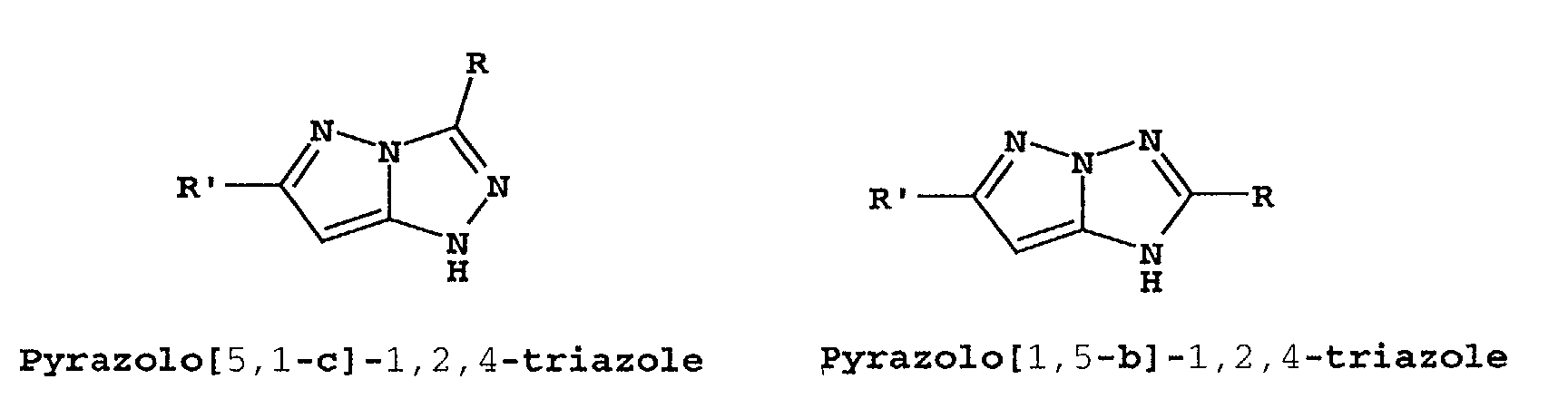
Couplers which have been recently received considerable interest in
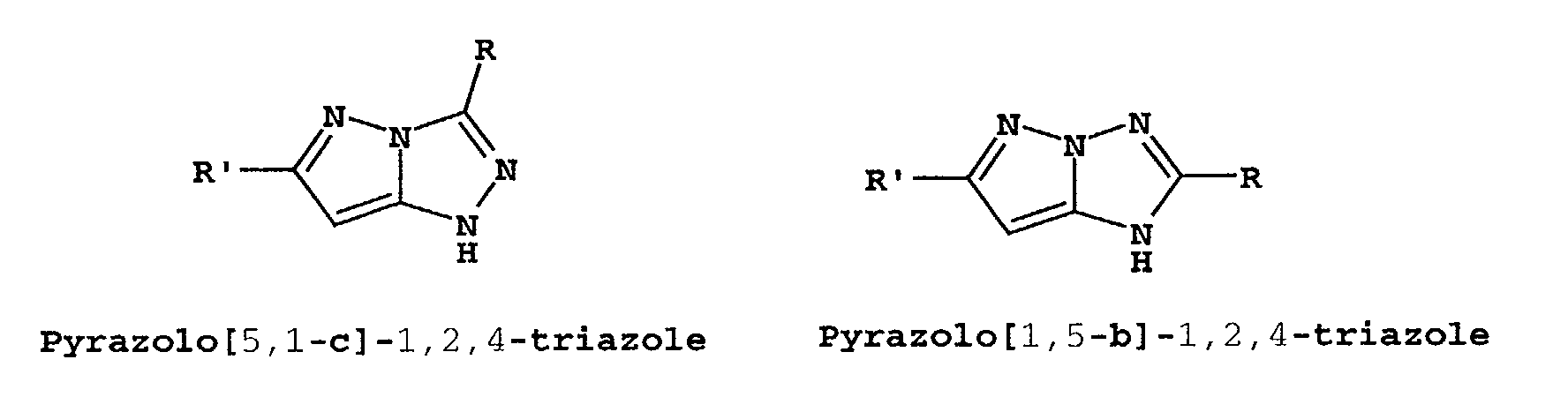
the imaging art include the pyrazolo[5,1-c]-1,2,4-triazole and the pyrazolo[1,5-b]-1,2,4-triazole
heterocycles as shown below.
-
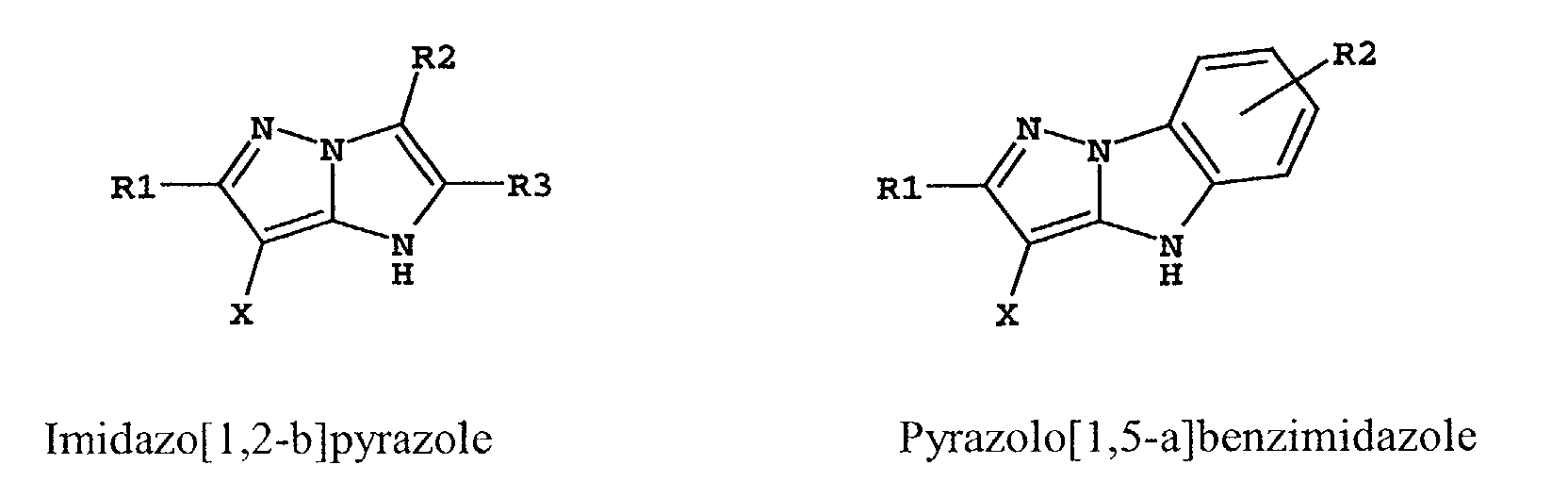
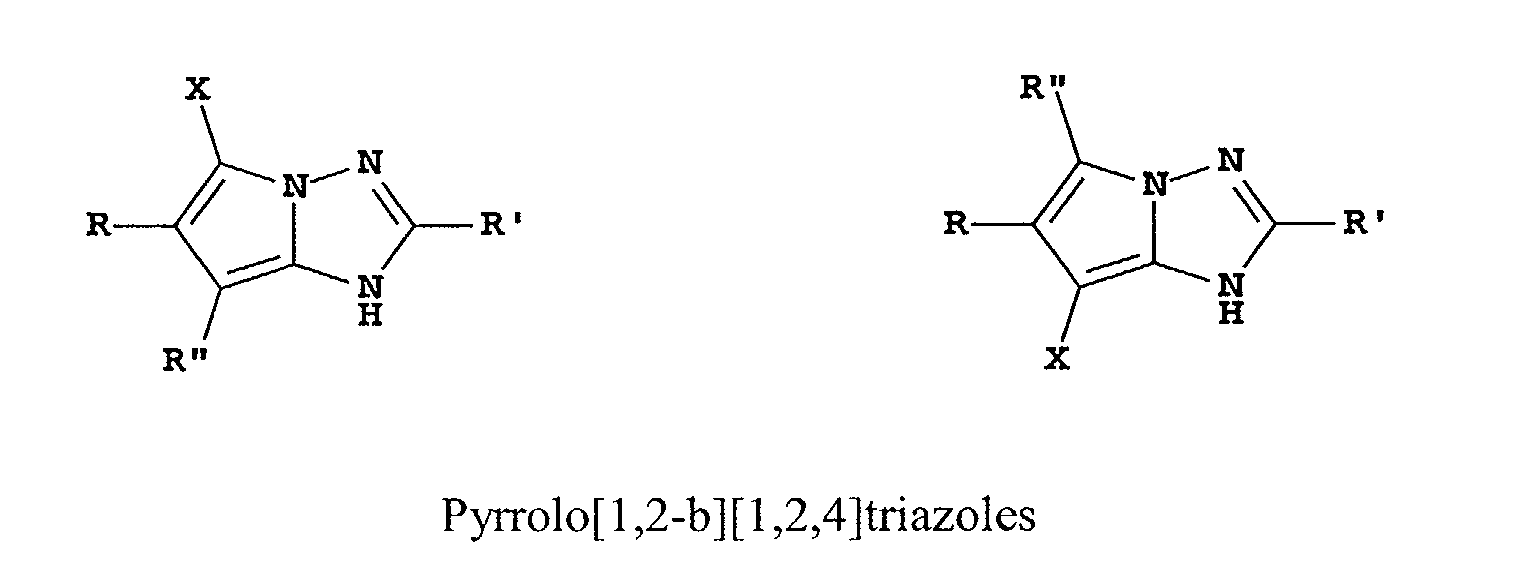
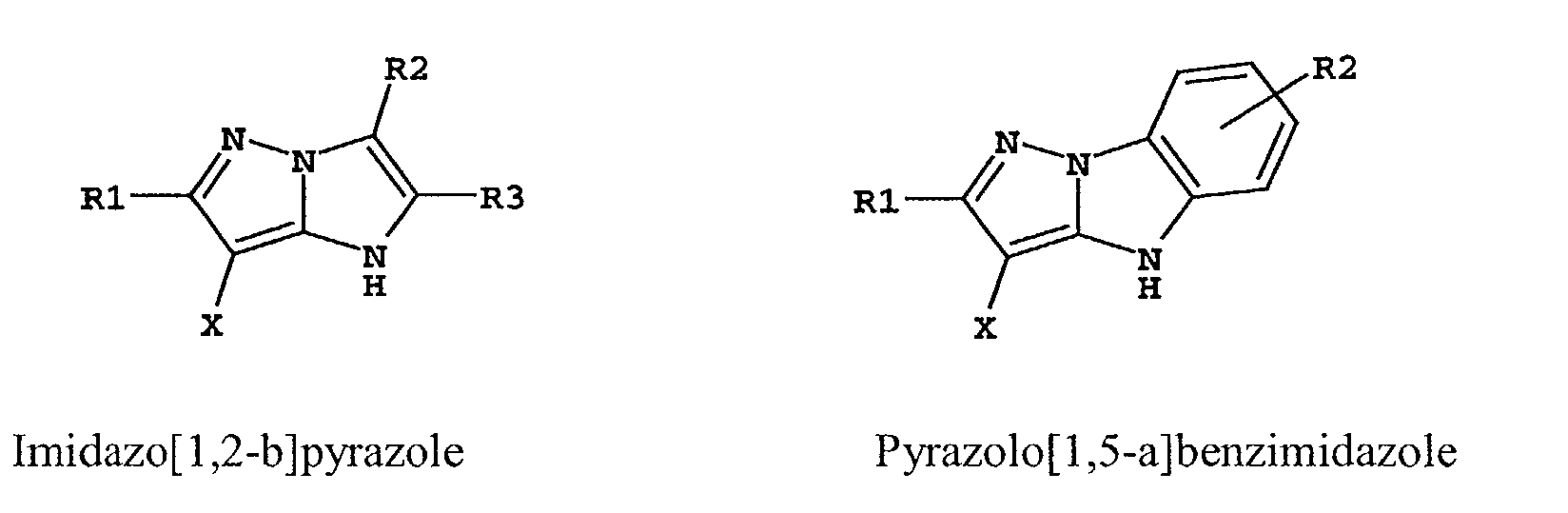
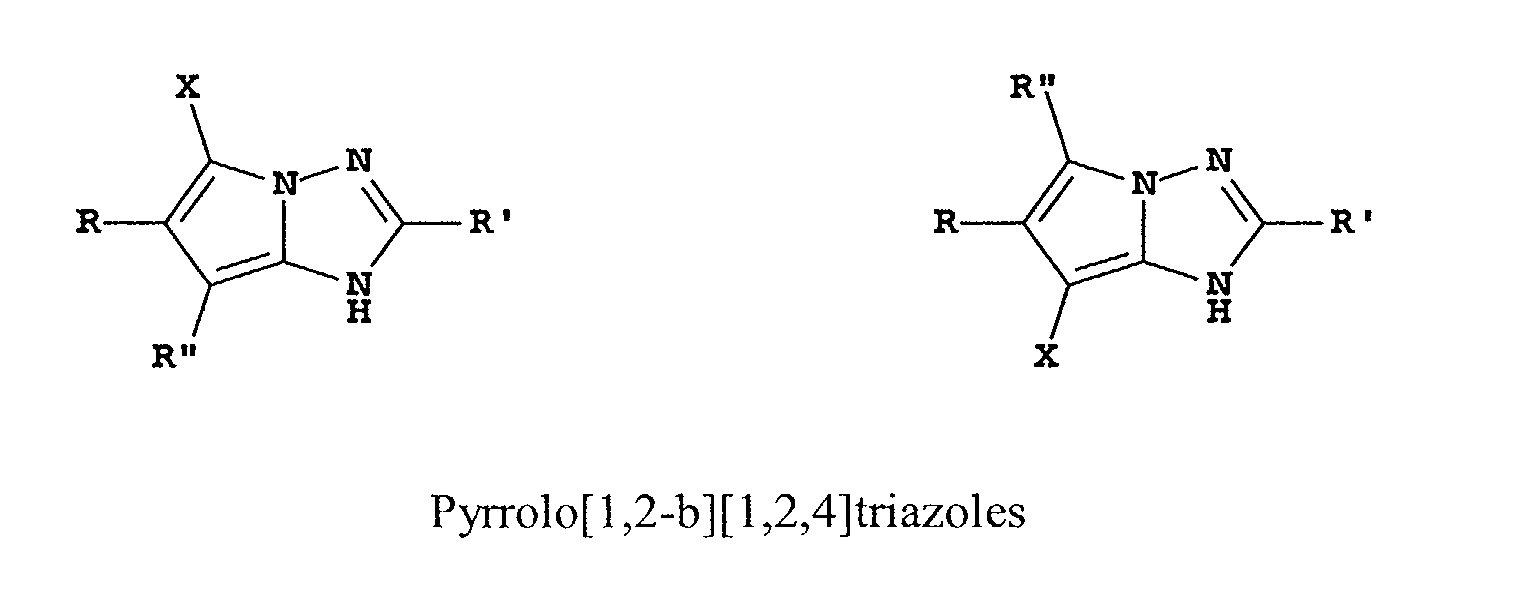
Other couplers include the imidazole, benzimidazole, and
pyrroloazole couplers such as:
-
Other examples are the pyrazolone couplers as discussed
hereinafter.
-
The R groups are substituents and X is H or a coupling-off group.
It is well recognized by those skilled in the art that modifications of the structure
of the substituents on the pyrazolotriazole heterocycle can have important effects
on the dyes formed from these couplers, including improvements in dye image
stability, etc. Thus, the researcher skilled in the art of photographic couplers is
always seeking new substituents on the pyrazolotriazole heterocycle with an aim
to discover ever better image dye properties. In recent years many patents have
been issued on variations of the 3-alkyl substituted pyrazolo[5,1-c]-1,2,4-triazole
couplers. These couplers have the required hue, contrast, and efficiency properties
necessary to produce superior image dyes in modern photographic materials.
Nevertheless, new substituent research continues.
-
In Bailey's original patent, US 3,810,761 (5/1974), a wide range of
substituents are described as useful in varying the hue and properties of
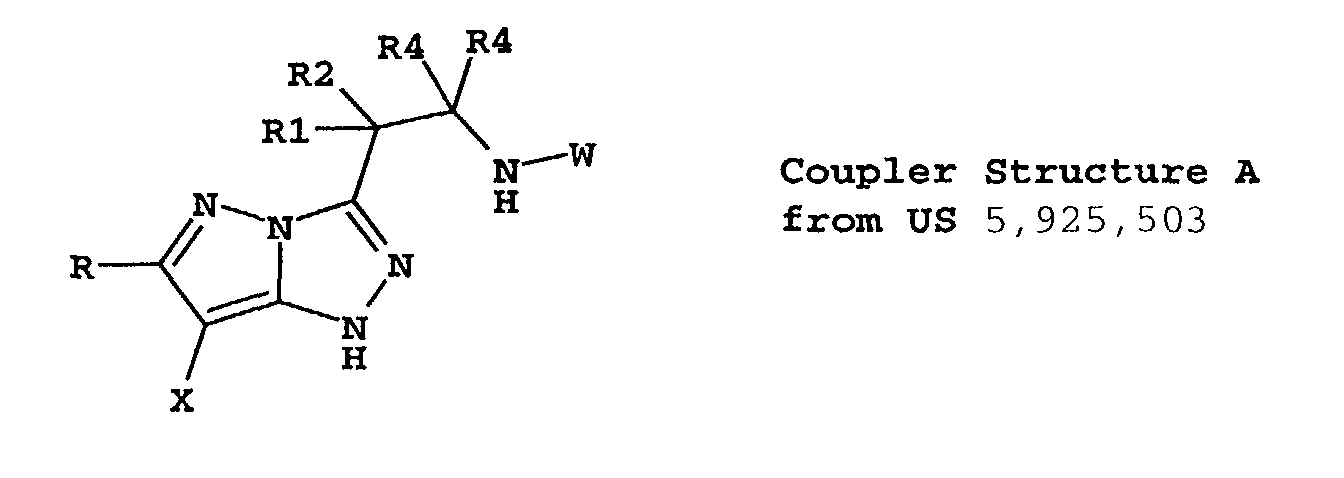
pyrazolo[5,1-c]-1,2,4-triazole image dyes. In Harder's patent, US 5,925,503
(7/1999), a tetramethylethyl link in the 3-position of the pyrazolo[5,1-c]-1,2,4-triazole
is reported to provide image dyes with superior light stability and hue. In
Harder's patented structure, see Coupler Structure A below, W is reported to
represent C(O)R5, SO2R5, or P(O)(OR6)2.
-
The properties of a pyrazolo[5,1-c]-1,2,4-triazole coupler similar to
Structure A in which W is reported to be a CHR structural unit would be of
interest to the skilled photographic coupler researcher. However, a synthesis
method for such a pyrazolo[5,1-c]-1,2,4-triazole coupler is unknown. This is
because the alkylation of the pendant amino functional group in Structure A by
typical alkylating agents such as methyliodide, ethyliodide, methyltosylate, etc.,
results in the simultaneous alkylation of the ring nitrogen centers at position 1 and
position 5 of the pyrazolo[5,1-c]-1,2,4-triazole ring thus producing products which
contain multiple alkylated centers. Thus, the synthesis of new and improved
pyrazolo[5,1-c]-1,2,4-triazoles has been limited in the past to those materials of
the type described in Harder US 5,925,503 (7/1999).
-
Recently, Zuckermann, et. al., have described the solid phase
organic chemistry synthesis of N-(substituted)glycines, a.k.a. "peptoids", from
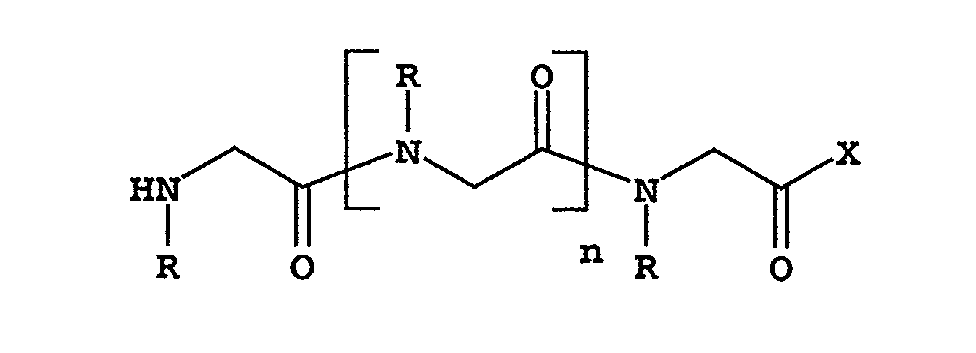
available and inexpensive starting materials. As used herein, a "peptoid" group
means a substituent having a primary amine group linked to the remainder of the
coupler compound, "Coup", with or without a linking group, through a chain of
acetamide groups as in the following:
-
The technique of solid phase synthesis is known to those in the organic
chemistry synthesis art and has been described in recent journal articles and books.
The solid phase synthesis of the peptoid materials described by Zuckermann is
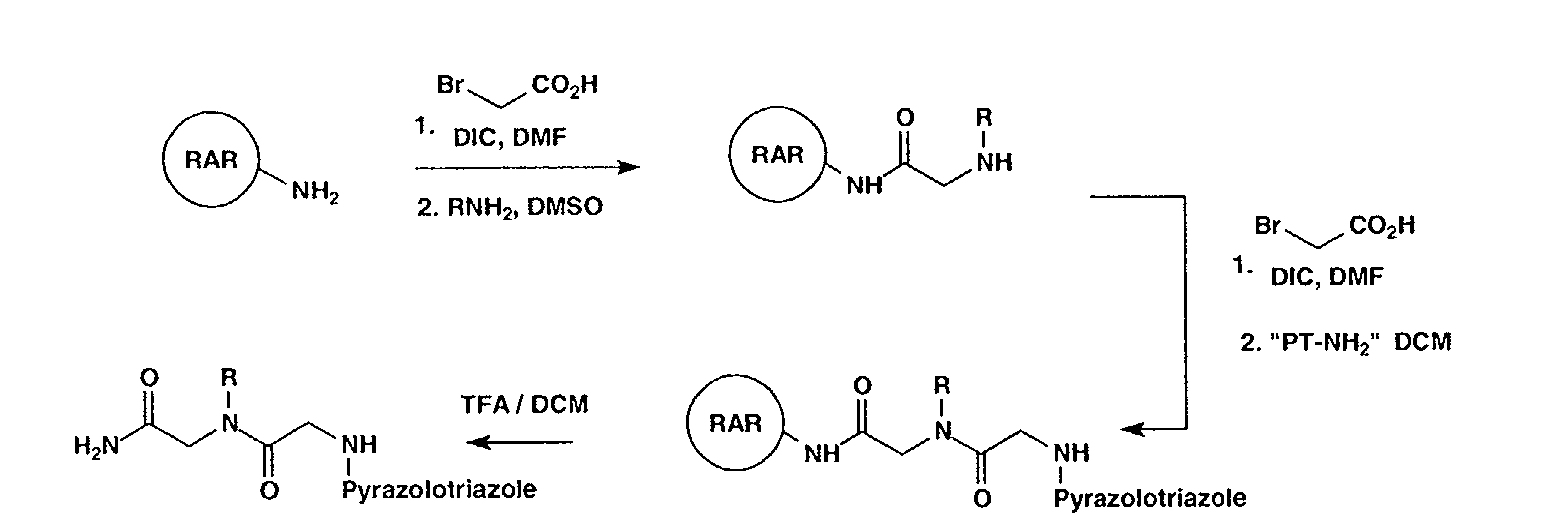
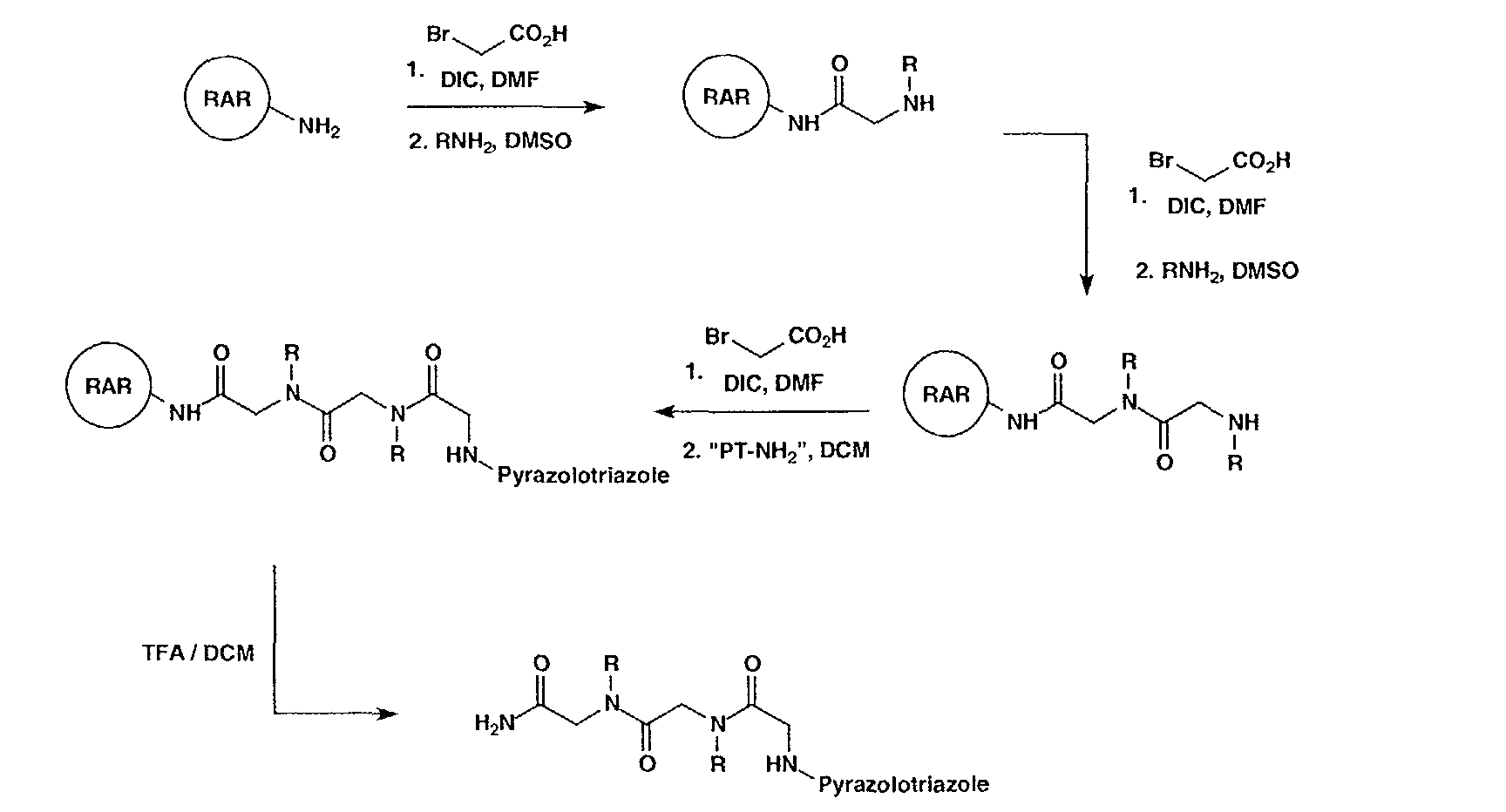
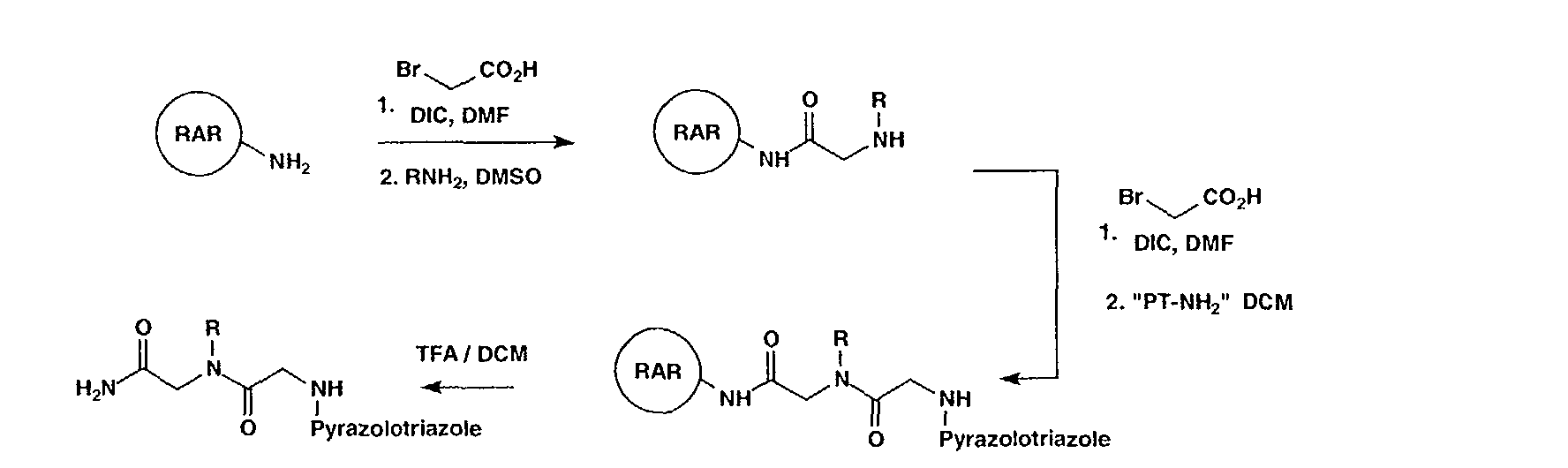
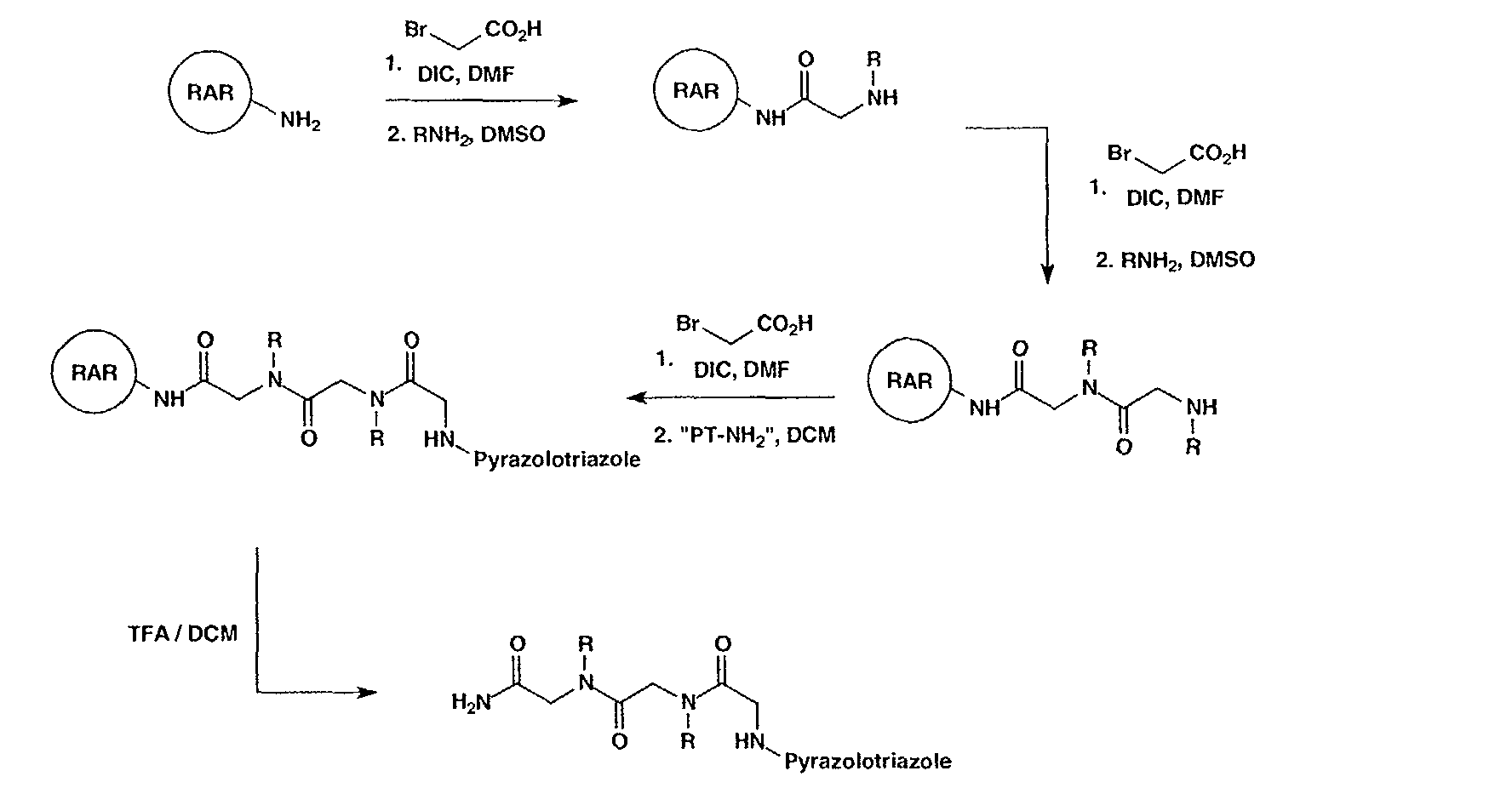
assembled by repetition of a two step sequence from two readily available starting
materials. The first step is acylation of Rink (more specifically described in the
"Synthesis" section hereof) resin with bromoacetic acid. The second step is the
addition of a primary amine resulting in a nucleophilic displacement of the
bromine. Repetition of these two steps is reported to assemble an oligomeric
peptoid. The choice of amines to be used in the assembly of the peptoid ballasts
will be made by those skilled in the art based upon desired characteristics of size,
shape, flexibility, degree of branching, molecular weight, and hydrophobicity
among other attributes.
-
It has now been found that the use of the alkylation protocol as
reported above does not result in the multiple alkylation of the ring nitrogen
centers at position 1 and position 5 of the pyrazoloazole ring as demonstrated by
such typical alkylating agents as methyliodide, ethyliodide, and methyltosylate,
etc., but instead, results in the alkylation of the pendant amino functional group
shown in Coupler Structure A without further alkylation occuring. This straightforward
synthesis enables the production for the first time of pyrazoloazole
couplers bearing peptoid substituents in the W position of Coupler Structure A
and enables the production of photographic elements and dyes using the couplers.
-
It would be useful to have photographic materials containing novel
coupler compounds that produce dyes that exhibit desirable spectral absorption
characteristics and good stability.
-
In accordance with the present invention there is provided a
photographic element comprising a silver halide emulsion and a peptoid-containing
azole dye-forming coupler. The invention also includes the peptoid
couplers and the dyes resulting from the reaction of the couplers with a color
developer, and an imaging process employing the photographic element.
-
The azole formed dyes exhibit desirable spectral absorption
characteristics and good stability.
-
A detailed description of the invention is provided as follows. A
peptoid group is a functionality depicted below as defined by R.N. Zuckermann,
et. al.,
J. Am. Chem. Soc.,
1992, 10646-10647 in which R is generally defined as a
side chain and X as an NH
2, and n is a number equal to or greater than zero,
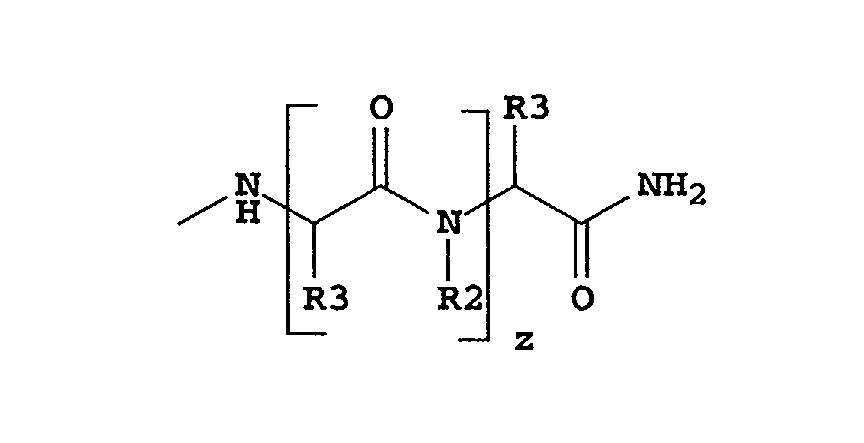
or, for purposes of this invention,
-
The couplers useful in the element of the invention contain a
peptoid group represented by the above formula. The couplers form dyes having
desirable hue and stability for imaging. They conveniently contain up to 7,
suitably 2-4 acetamide groups, and they are desirably linked to the coupler nucleus
by a tetramethyl ethyl group.
-
Azole couplers are well-known and include one ring as in the
pyrazolones or two fused 5-membered rings at least one being an azole. Azole
couplers include, for example, the pyrazolo[5,1-c]-1,2,4-triazole, pyrazolo[1,5-b]-1,2,4-triazole,
imidazo[1,2-b]pyrazole, pyrazolo[1,5-a]benzimidazole and pyrrolo
[1,2-b][1,2,4] triazole heterocycles as shown below in which each R group is a
substituent and X is H or a coupling off group.
-
The R groups are substituents and X is H or a coupling-off group.
More commonly, the second ring is a triazole such as the 1H-pyrazolo[5,1-c]-1,2,4-triazole
and a 1H-pyrazolo[1,5-b]-1,2,4-triazole, as shown above.
-
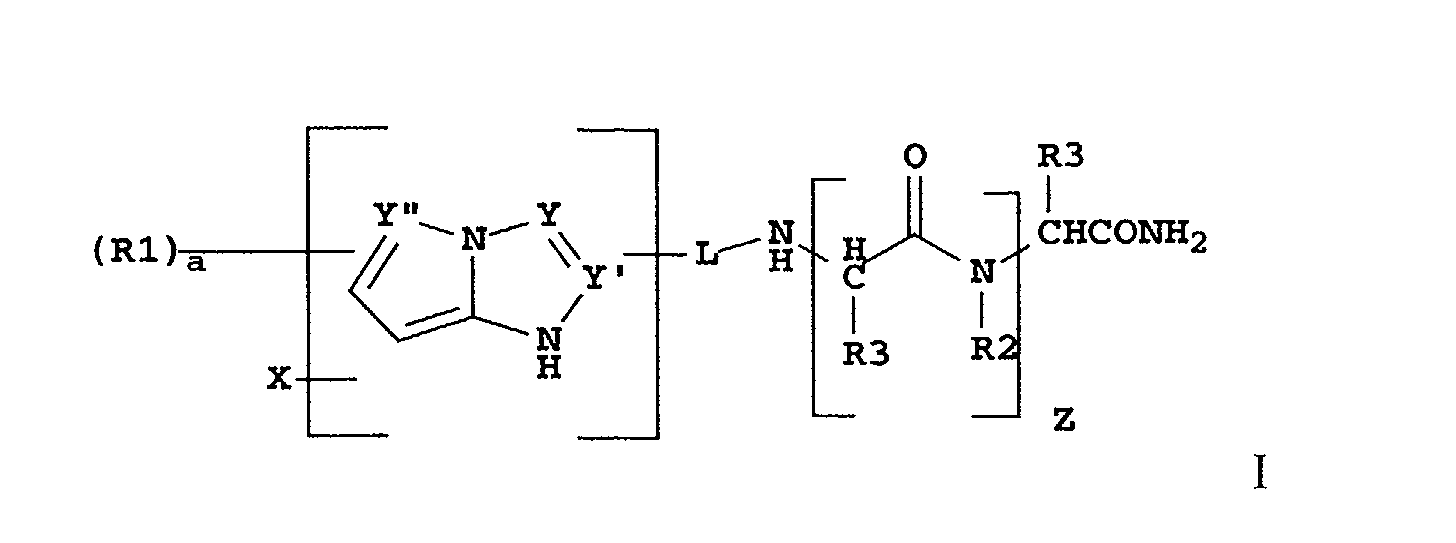
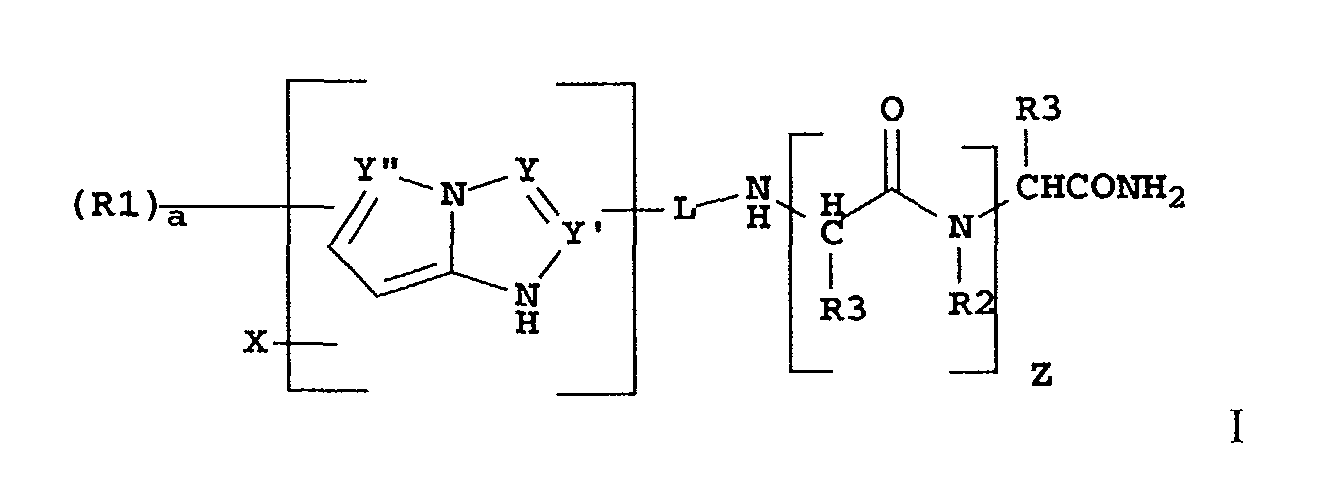
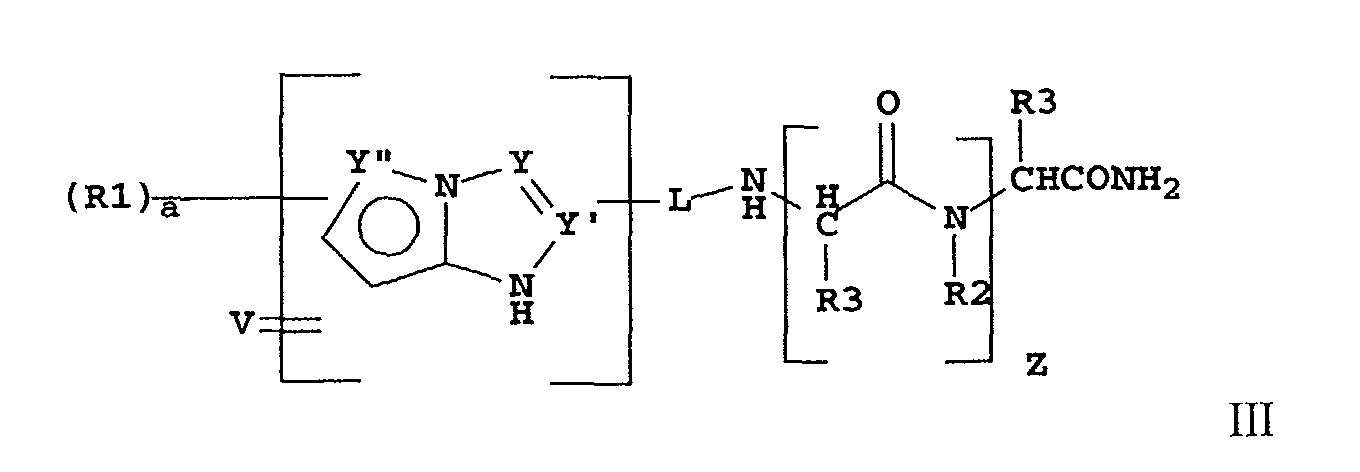
A generic formula that represents a suitably substituted bicyclic
azole coupler is shown in Formula I below:
wherein
each R1 represents an independently selected substituent group and a is 0-4;
each R2 represents an independently selected substituent group;
each R3 represents hydrogen or an independently selected substituent
group;
L represents a single bond or a chain of atoms containing one or more of
carbon, nitrogen, oxygen, and sulfur atoms;
each Y, Y', and Y" independently represents a carbon or nitrogen atom
with the proviso that at least one of Y, Y' or Y" is a carbon, and that Y and Y'
may represent the carbons necessary to form part of a fused six membered
aromatic ring, and provided further that, if Y and Y' represents the carbons
necessary to form part of a fused six membered aromatic ring, the L linking group
is not attached directly to the Y or Y' atom, and Y, Y' and Y" may be further
substituted by R1 when not directly attached to L;
X is a hydrogen atom, a halogen atom, a carboxy group, an acyl group, or a
group bonded to the coupling position through an oxygen, nitrogen, or sulfur
atom, and
Z is 1-6.
-
Desirably a is at least 1 and each R1 represents a substituent such
as those listed hereinafter. Typical examples of such groups include methyl,
ethyl, butyl, dodecyl, octadecyl, icosenyl, iso-propyl, tert-butyl, tert-octyl, tert-dodecyl,
cyclohexyl, cyclopentyl, allyl, vinyl, 2-hexadecenyl, and propargyl
groups. Especially preferred R1 substituents are alkyl, aryl, alkoxy, amino,
anilino, alkoxycarbonyl, carbamoyl, acyl, cyano, sulfone, and sulfonamido groups
and particularly t-butyl, phenyl, ethylcarboxyl, methylcyclopropyl, and adamantyl
groups.
-
R2 may be a substituent such as an alkyl, cycloalkl, aryl, or
heteroaryl group. Useful examples include groups containing up to 20 carbon
atoms such as cyclohexyl, 2-ethylhexyl, dodecyl, 3-ethoxypropyl,
cyclohexylmethyl, benzyl, phenyl, and 1-(3-propyl)-2-pyrrolidinone groups.
-
R3 may be hydrogen or a substituent group such as one of the
substituent groups specified for R1. Hydrogen is conveniently employed
-
The group X is useful as hydrogen or a leaving (or coupling-off)
group. Examples of groups represented by X include but are not limited to
hydrogen or any of the coupling off groups known in the art as described more
fully hereinafter. Especially preferred X groups include hydrogen and halogen.
-
The atoms represented by Y, Y', and Y" are nitrogen or carbon. At
least one of them is carbon and Y and Y' may join to form a fused six-membered
aromatic ring so long as the group L is not bonded to Y or Y'.
-
The value of "Z" is indicative of the length of the peptoid chain.
Typically Z is 1-3.
-
Azomethine dyes of the invention are formed upon reaction of an
oxidized primary aromatic amine with the azole couplers useful in this invention.
Preferred dyes of this invention upon suitable dispersion preparation and ink jet
coating on a suitable receiver provide magenta images with a spectral absorption
peak in the region of the spectrum from 500 to 600 nm with a half band width of
less then 120 nm, preferably less than 100 nm and most preferably less than 90 nm
and exhibit the property of good light and dark stability. The couplers of this
invention may also optionally be prepared into suitable dispersions which when
coated upon a support bearing a light sensitive silver halide emulsion and further
after exposure and processing in an oxidized primary aromatic amine developing
solution may produce magenta images with a spectral absorption peak in the
region of the spectrum from 500 to 600 nm with a half band width of less then 120
nm, preferably less than 100 nm and most preferably less than 90 nm and exhibit
the property of good light and dark stability.
-
-
The couplers of the present invention may be used as intermediates
to prepare novel dyes. As described by Bailey in EP 1,253,933 such novel dyes
may be useful in sensitized silver halide photographic materials as filter dyes or
sensitizing dyes. Such dyes may also be useful as textile dyes and in more modern
imaging applications such as a thermal dye transfer imaging processes and as ink
jet dyes. For example, azomethine dyes of the generic Dye Structure GI are shown
below.
-
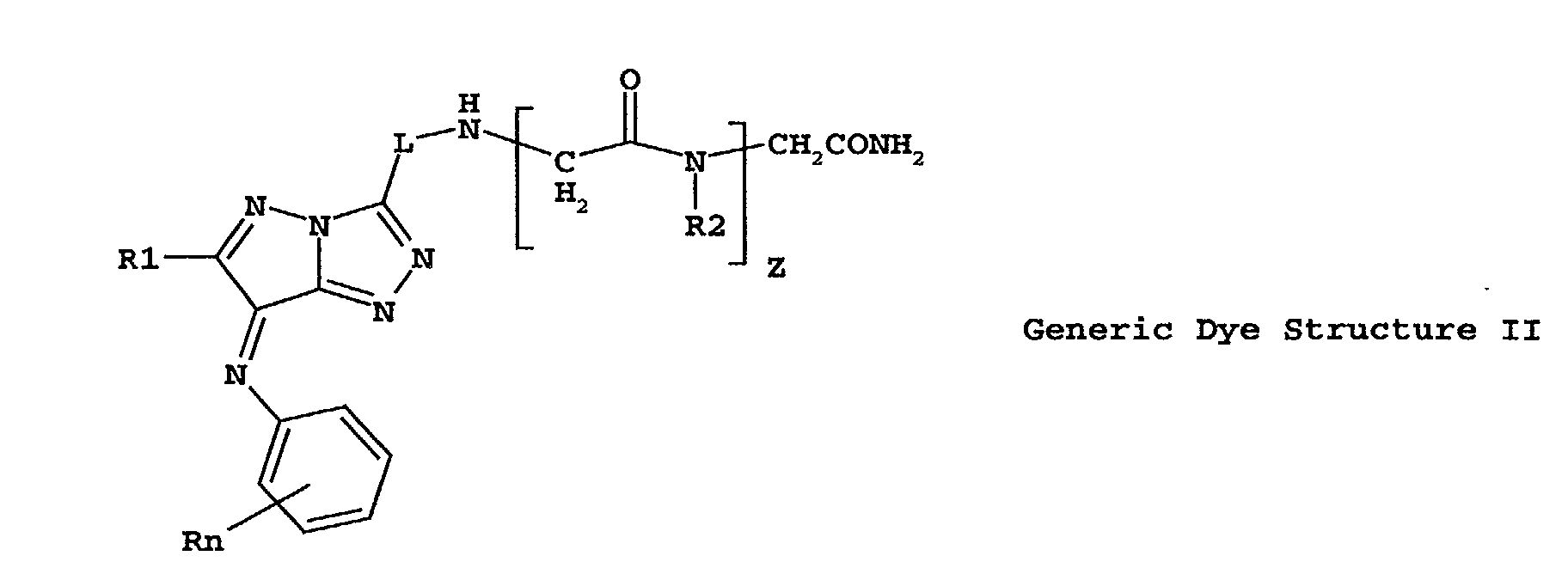
Most especially preferred dyes are the azomethine dyes of generic
Dye Structure II below. These dyes are easily prepared by the reaction of oxidized
primary aromatic amines with the novel pyrazolo[5,1-c]-1,2,4-triazole couplers of
this invention. These new dyes have good extinction and high optical density with
low unwanted absorbance at wavelengths of light which reduce the desirable hue
of the dye. The azomethine dyes prepared from the couplers of this invention
have been found to have good light stability. This particular stability may result
from the intramolecular hydrogen bonding of the N1 heterocycle center of the
pyrazolo[5,1-c]-1,2,4-triazole coupler with the terminal primary amide
functionality of the peptoid substituent.
-
One skilled in the art of image coupler synthesis may recognize that
L groups in coupler Structure I may represent alkyl, aryl, or heteroaryl groups
which may in turn be further substituted. Examples of such substituents may
typically include those described below by are not limited by those listed.
-
The variables in the dye structures are defined as shown above for
formula I.
-
The novel dyes of Dye Structure II may be represented by the
couplers bearing a peptoid functionality as part of the 3-substituent on the
pyrazolo[5,1-c]-1,2,4-triazole heterocycle.
-
In the novel Dye Structure II the substituents Rn represent one or
more substituents defining typical aminophenol and p-phenylenediamine
derivatives which may include but are not limited by the following: o-aminophenol,
p-aminophenol; 5-amino-2-hydroxytoluene, 2-amino-3-hydroxytoluene,
2-hydroxy-3-amino-1,4-dimethylbenzene, N,N-diethyl-p-phenylenediamine,
2-amino-5-diethylaminotoluene, 2-amino-5-(N-ethyl-N-laurylamino)toluene,
4-[N-ethyl-N-(beta-hydroxyethyl)amino]aniline, 2-methyl-4-[N-ethyl-N-(beta-hydroxyethyl)amino]aniline,
4-amino-3-methyl-N-ethyl-N-[beta-(methanesulfonamido)ethyl]
aniline, N-(2-amino-5-diethylaminophenylethyl)methanesulfonamide,
N,N-dimethyl-p-phenylenediamine
monohydrochloride, 4-N,N-diethyl-2-methylphenylenediamine
monohydrochloride, 4-(N-ethyl-N-2-methanesulfonylaminoethyl)-2-methylphenylenediamine
sesquisulfate monohydrate, 4-(N-ethyl-N-2-hydroxyethyl)-2-methylphenylenediamine
sulfate, 4-amino-3-methyl-N-ethyl-N-methoxyethylaniline,
4-amino-3-methyl-N-ethyl-N-beta-ethoxyethylaniline, 4-amino-3-methyl-N-ethyl-N-beta-butoxyethylaniline,
and 4-N,N-diethyl-2,2'-methanesulfonylaminoethylphenylenediamine
hydrochloride.
-
Particularly preferred are the p-phenylenediamines and especially
the N,N-dialkyl-p-phenylenediamines in which the alkyl groups or the aromatic
nucleus can be substituted or unsubstituted.
-
-
The couplers of this invention will be recognized by one skilled in
the art as useful in photographic elements. The photographic elements of this
invention can be single color elements or multicolor elements. Multicolor
elements typically contain dye image-forming units sensitive to each of the three
primary regions of the visible spectrum. Each unit can be comprised of a single
emulsion layer or of multiple emulsion layers sensitive to a given region of the
spectrum. The layers of the element, including the layers of the image-forming
units, can be arranged in various orders as known in the art.
-
Unless otherwise specifically stated, use of the term "group",
"substituted" or "substituent" means any group or atom other than hydrogen.
Additionally, when the term "group" is used, it means that when a substituent
group contains a substitutable hydrogen, it is also intended to encompass not only
the substituent's unsubstituted form, but also its form further substituted with any
substituent group or groups as herein mentioned, so long as the substituent does
not destroy properties necessary for photographic utility. Suitably, a substituent
group may be halogen or may be bonded to the remainder of the molecule by an
atom of carbon, silicon, oxygen, nitrogen, phosphorous, or sulfur. The substituent
may be, for example, halogen, such as chlorine, bromine or fluorine; nitro;
hydroxyl; cyano; carboxyl; or groups which may be further substituted, such as
alkyl, including straight or branched chain or cyclic alkyl, such as methyl,
trifluoromethyl, ethyl, t-butyl, 3-(2,4-di-t-pentylphenoxy) propyl, cyclohexyl, and
tetradecyl; alkenyl, such as ethylene, 2-butene; alkoxy, such as methoxy, ethoxy,
propoxy, butoxy, 2-methoxyethoxy, sec-butoxy, hexyloxy, 2-ethylhexyloxy,
tetradecyloxy, 2-(2,4-di-t-pentylphenoxy)ethoxy, and 2-dodecyloxyethoxy; aryl
such as phenyl, 4-t-butylphenyl, 2,4,6-trimethylphenyl, naphthyl; aryloxy, such as
phenoxy, 2-methylphenoxy, alpha- or beta-naphthyloxy, and 4-tolyloxy;
carbonamido, such as acetamido, benzamido, butyramido, tetradecanamido, alpha-(2,4-di-t-pentyl-phenoxy)acetamido,
alpha-(2,4-di-t-pentylphenoxy)butyramido,
alpha-(3-pentadecylphenoxy)-hexanamido, alpha-(4-hydroxy-3-t-butylphenoxy)-tetradecanamido,
2-oxo-pyrrolidin-1-yl, 2-oxo-5-tetradecylpyrrolin-1-yl, N-methyltetradecanamido,
N-succinimido, N-phthalimido, 2,5-dioxo-1-oxazolidinyl,
3-dodecyl-2,5-dioxo-1-imidazolyl, and N-acetyl-N-dodecylamino,
ethoxycarbonylamino, phenoxycarbonylamino, benzyloxycarbonylamino,
hexadecyloxycarbonylamino, 2,4-di-t-butylphenoxycarbonylamino,
phenylcarbonylamino, 2,5-(di-t-pentylphenyl)carbonylamino, p-dodecyl-phenylcarbonylamino,
p-tolylcarbonylamino, N-methylureido, N,N-dimethylureido,
N-methyl-N-dodecylureido, N-hexadecylureido, N,N-dioctadecylureido,
N,N-dioctyl-N'-ethylureido, N-phenylureido, N,N-diphenylureido,
N-phenyl-N-p-tolylureido, N-(m-hexadecylphenyl)ureido, N,N-(2,5-di-t-pentylphenyl)-N'-ethylureido,
and t-butylcarbonamido; sulfonamido, such
as methylsulfonamido, benzenesulfonamido, p-tolylsulfonamido, p-dodecylbenzenesulfonamido,
N-methyltetradecylsulfonamido, N,N-dipropyl-sulfamoylamino,
and hexadecylsulfonamido; sulfamoyl, such as N-methylsulfamoyl,
N-ethylsulfamoyl, N,N-dipropylsulfamoyl, N-hexadecylsulfamoyl,
N,N-dimethylsulfamoyl; N-[3-(dodecyloxy)propyl]sulfamoyl,
N-[4-(2,4-di-t-pentylphenoxy)butyl] sulfamoyl,
N-methyl-N-tetradecylsulfamoyl, and N-dodecylsulfamoyl; carbamoyl, such as N-methylcarbamoyl,
N,N-dibutylcarbamoyl, N-octadecylcarbamoyl, N-[4-(2,4-di-t-pentylphenoxy)butyl]carbamoyl,
N-methyl-N-tetradecylcarbamoyl, and N,N-dioctylcarbamoyl;
acyl, such as acetyl, (2,4-di-t-amylphenoxy)acetyl,
phenoxycarbonyl, p-dodecyloxyphenoxycarbonyl methoxycarbonyl,
butoxycarbonyl, tetradecyloxycarbonyl, ethoxycarbonyl, benzyloxycarbonyl, 3-pentadecyloxycarbonyl,
and dodecyloxycarbonyl; sulfonyl, such as
methoxysulfonyl, octyloxysulfonyl, tetradecyloxysulfonyl, 2-ethylhexyloxysulfonyl,
phenoxysulfonyl, 2,4-di-t-pentylphenoxysulfonyl,
methylsulfonyl, octylsulfonyl, 2-ethylhexylsulfonyl, dodecylsulfonyl,
hexadecylsulfonyl, phenylsulfonyl, 4-nonylphenylsulfonyl, and p-tolylsulfonyl;
sulfonyloxy, such as dodecylsulfonyloxy, and hexadecylsulfonyloxy; sulfinyl, such
as methylsulfinyl, octylsulfinyl, 2-ethylhexylsulfinyl, dodecylsulfinyl,
hexadecylsulfinyl, phenylsulfinyl, 4-nonylphenylsulfinyl, and p-tolylsulfinyl; thio,
such as ethylthio, octylthio, benzylthio, tetradecylthio, 2-(2,4-di-t-pentylphenoxy)ethylthio,
phenylthio, 2-butoxy-5-t-octylphenylthio, and p-tolylthio;
acyloxy, such as acetyloxy, benzoyloxy, octadecanoyloxy, p-dodecylamidobenzoyloxy,
N-phenylcarbamoyloxy, N-ethylcarbamoyloxy, and
cyclohexylcarbonyloxy; amine, such as phenylanilino, 2-chloroanilino,
diethylamine, dodecylamine; imino, such as I (N-phenylimido)ethyl, N-succinimido
or 3-benzylhydantoinyl; phosphate, such as dimethylphosphate and
ethylbutylphosphate; phosphite, such as diethyl and dihexylphosphite; a
heterocyclic group, a heterocyclic oxy group or a heterocyclic thio group, each of
which may be substituted and which contain a 3 to 7 membered heterocyclic ring
composed of carbon atoms and at least one hetero atom selected from the group
consisting of oxygen, nitrogen and sulfur, such as 2-furyl, 2-thienyl, 2-benzimidazolyloxy
or 2-benzothiazolyl; quaternary ammonium, such as
triethylammonium; and silyloxy, such as trimethylsilyloxy.
-
If desired, the substituents may themselves be further substituted
one or more times with the described substituent groups. The particular
substituents used may be selected by those skilled in the art to attain the desired
photographic properties for a specific application and can include, for example,
hydrophobic groups, solubilizing groups, blocking groups, and releasing or
releasable groups. When a molecule may have two or more substituents, the
substituents may be joined together to form a ring such as a fused ring unless
otherwise provided. Generally, the above groups and substituents thereof may
include those having up to 48 carbon atoms, typically 1 to 36 carbon atoms and
usually less than 24 carbon atoms, but greater numbers are possible depending on
the particular substituents selected.
-
The materials useful in the invention can be used in any of the ways
and in any of the combinations known in the art. Typically, the invention
materials are incorporated in a melt and coated as a layer described herein on a
support to form part of a photographic element. When the term "associated" is
employed, it signifies that a reactive compound is in or adjacent to a specified
layer where, during processing, it is capable of reacting with other components.
-
To control the migration of various components, it may be
desirable to include a high molecular weight hydrophobe or "ballast" group in
coupler molecules. Representative ballast groups include substituted or
unsubstituted alkyl or aryl groups containing 8 to 48 carbon atoms.
Representative substituents on such groups include alkyl, aryl, alkoxy, aryloxy,
alkylthio, hydroxy, halogen, alkoxycarbonyl, aryloxcarbonyl, carboxy, acyl,
acyloxy, amino, anilino, carbonamido, carbamoyl, alkylsulfonyl, arylsulfonyl,
sulfonamido, and sulfamoyl groups wherein the substituents typically contain 1 to
42 carbon atoms. Such substituents can also be further substituted.
-
The photographic elements can be single color elements or
multicolor elements. Multicolor elements contain image dye-forming units
sensitive to each of the three primary regions of the spectrum. Each unit can
comprise a single emulsion layer or multiple emulsion layers sensitive to a given
region of the spectrum. The layers of the element, including the layers of the
image-forming units, can be arranged in various orders as known in the art. In an
alternative format, the emulsions sensitive to each of the three primary regions of
the spectrum can be disposed as a single segmented layer.
-
A typical multicolor photographic element comprises a support
bearing a cyan dye image-forming unit comprised of at least one red-sensitive
silver halide emulsion layer having associated therewith at least one cyan dye-forming
coupler, a magenta dye image-forming unit comprising at least one green-sensitive
silver halide emulsion layer having associated therewith at least one
magenta dye-forming coupler, and a yellow dye image-forming unit comprising at
least one blue-sensitive silver halide emulsion layer having associated therewith at
least one yellow dye-forming coupler. The element can contain additional layers,
such as filter layers, interlayers, overcoat layers, and subbing layers.
-
If desired, the photographic element can be used in conjunction
with an applied magnetic layer as described in Research Disclosure, November
1992, Item 34390 published by Kenneth Mason Publications, Ltd., Dudley Annex,
12a North Street, Emsworth, Hampshire P010 7DQ, ENGLAND, and as described
in Hatsumi Kyoukai Koukai Gihou No. 94-6023, published March 15, 1994,
available from the Japanese Patent Office. When it is desired to employ the
inventive materials in a small format film, Research Disclosure, June 1994, Item
36230, provides suitable embodiments.
-
In the following discussion of suitable materials for use in the
emulsions and elements of this invention, reference will be made to Research
Disclosure, September 1996, Item 38957, available as described above, which is
referred to herein by the term "Research Disclosure". The Sections hereinafter
referred to are Sections of the Research Disclosure.
-
Except as provided, the silver halide emulsion containing elements
employed in this invention can be either negative-working or positive-working as
indicated by the type of processing instructions (i.e. color negative, reversal, or
direct positive processing) provided with the element. Suitable emulsions and
their preparation as well as methods of chemical and spectral sensitization are
described in Sections I through V. Various additives such as UV dyes,
brighteners, antifoggants, stabilizers, light absorbing and scattering materials, and
physical property modifying addenda such as hardeners, coating aids, plasticizers,
lubricants and matting agents are described, for example, in Sections II and VI
through VIII. Color materials are described in Sections X through XIII. Suitable
methods for incorporating couplers and dyes, including dispersions in organic
solvents, are described in Section X(E). Scan facilitating is described in Section
XIV. Supports, exposure, development systems, and processing methods and
agents are described in Sections XV to XX. The information contained in the
September 1994 Research Disclosure, Item No. 36544 referenced above, is
updated in the September 1996 Research Disclosure, Item No. 38957. Certain
desirable photographic elements and processing steps, including those useful in
conjunction with color reflective prints, are described in Research Disclosure,
Item 37038, February 1995.
-
Coupling-off groups are well known in the art. Such groups can
determine the chemical equivalency of a coupler, i.e., whether it is a 2-equivalent
or a 4-equivalent coupler, or modify the reactivity of the coupler. Such groups can
advantageously affect the layer in which the coupler is coated, or other layers in
the photographic recording material, by performing, after release from the coupler,
functions such as dye formation, dye hue adjustment, development acceleration or
inhibition, bleach acceleration or inhibition, electron transfer facilitation, and color
correction.
-
The presence of hydrogen at the coupling site provides a 4-equivalent
coupler, and the presence of another coupling-off group usually
provides a 2-equivalent coupler. Representative classes of such coupling-off
groups include, for example, chloro, alkoxy, aryloxy, hetero-oxy, sulfonyloxy,
acyloxy, acyl, heterocyclyl, sulfonamido, mercaptotetrazole, benzothiazole,
mercaptopropionic acid, phosphonyloxy, arylthio, and arylazo. These coupling-off
groups are described in the art, for example, in U.S. Pat. Nos. 2,455,169,
3,227,551, 3,432,521, 3,476,563, 3,617,291, 3,880,661, 4,052,212 and 4,134,766;
and in UK. Patents and published application Nos. 1,466,728, 1,531,927,
1,533,039, 2,006,755A and 2,017,704A.
-
Image dye-forming couplers may be included in the element such
as couplers that form cyan dyes upon reaction with oxidized color developing
agents which are described in such representative patents and publications as:
"Farbkuppler-eine Literature Ubersicht," published in Agfa Mitteilungen, Band III,
pp. 156-175 (1961) as well as in U.S. Patent Nos. 2,367,531; 2,423,730;
2,474,293; 2,772,162; 2,895,826; 3,002,836; 3,034,892; 3,041,236; 4,333,999;
4,746,602; 4,753,871; 4,770,988; 4,775,616; 4,818,667; 4,818,672; 4,822,729;
4,839,267; 4,840,883; 4,849,328; 4,865,961; 4,873,183; 4,883,746; 4,900,656;
4,904,575; 4,916,051; 4,921,783; 4,923,791; 4,950,585; 4,971,898; 4,990,436;
4,996,139; 5,008,180; 5,015,565; 5,011,765; 5,011,766; 5,017,467; 5,045,442;
5,051,347; 5,061,613; 5,071,737; 5,075,207; 5,091,297; 5,094,938; 5,104,783;
5,178,993; 5,813,729; 5,187,057; 5,192,651; 5,200,305 5,202,224; 5,206,130;
5,208,141; 5,210,011; 5,215,871; 5,223,386; 5,227,287; 5,256,526; 5,258,270;
5,272,051; 5,306,610; 5,326,682; 5,366,856; 5,378,596; 5,380,638; 5,382,502;
5,384,236; 5,397,691; 5,415,990; 5,434,034; 5,441,863; EPO 0 246 616;
EPO 0 250 201; EPO 0 271 323; EPO 0 295 632; EPO 0 307 927; EPO 0 333 185;
EPO 0 378 898; EPO 0 389 817; EPO 0 487 111; EPO 0 488 248; EPO 0 539 034;
EPO 0 545 300; EPO 0 556 700; EPO 0 556 777; EPO 0 556 858; EPO 0 569 979;
EPO 0 608 133; EPO 0 636 936; EPO 0 651 286; EPO 0 690 344; German OLS
4,026,903; German OLS 3,624,777. and German OLS 3,823,049. Typically such
couplers are phenols, naphthols, or pyrazoloazoles.
-
Couplers that form magenta dyes upon reaction with oxidized color
developing agent are described in such representative patents and publications as:
"Farbkuppler-eine Literature Ubersicht," published in Agfa Mitteilungen, Band III,
pp. 126-156 (1961) as well as U.S. Patents 2,311,082 and 2,369,489; 2,343,701;
2,600,788; 2,908,573; 3,062,653; 3,152,896; 3,519,429; 3,758,309; 3,935,015;
4,540,654; 4,745,052; 4,762,775; 4,791,052; 4,812,576; 4,835,094;
4,840,877; 4,845,022; 4,853,319; 4,868,099; 4,865,960; 4,871,652; 4,876,182;
4,892,805; 4,900,657; 4,910,124; 4,914,013; 4,921,968; 4,929,540; 4,933,465;
4,942,116; 4,942,117; 4,942,118; U.S. Patent 4,959,480; 4,968,594; 4,988,614;
4,992,361; 5,002,864; 5,021,325; 5,066,575; 5,068,171; 5,071,739; 5,100,772;
5,110,942; 5,116,990; 5,118,812; 5,134,059; 5,155,016; 5,183,728; 5,234,805;
5,235,058; 5,250,400; 5,254,446; 5,262,292; 5,300,407; 5,302,496; 5,336,593;
5;350,667; 5,395,968; 5,354,826; 5,358,829; 5,368,998; 5,378,587; 5,409,808;
5,411,841; 5,418,123; 5,424,179; EPO 0 257 854; EPO 0 284 240; EPO
0 341 204; EPO 347,235; EPO 365,252; EPO 0 422 595; EPO 0 428 899; EPO
0 428 902; EPO 0 459 331; EPO 0 467 327; EPO 0 476 949; EPO 0 487 081;
EPO 0 489 333; EPO 0 512 304; EPO 0 515 128; EPO 0 534 703; EPO 0 554 778;
EPO 0 558 145; EPO 0 571 959; EPO 0 583 832; EPO 0 583 834; EPO 0 584 793;
EPO 0 602 748; EPO 0 602 749; EPO 0 605 918; EPO 0 622 672; EPO 0 622 673;
EPO 0 629 912; EPO 0 646 841, EPO 0 656 561; EPO 0 660 177; EPO 0 686 872;
WO 90/10253; WO 92/09010; WO 92/10788; WO 92/12464; WO 93/01523; WO
93/02392; WO 93/02393; WO 93/07534; UK Application 2,244,053; Japanese
Application 03192-350; German OLS 3,624,103; German OLS 3,912,265; and
German OLS 40 08 067. Typically such couplers are pyrazolones, pyrazoloazoles,
or pyrazolobenzimidazoles that form magenta dyes upon reaction with oxidized
color developing agents.
-
Couplers that form yellow dyes upon reaction with oxidized color
developing agent are described in such representative patents and publications as:
"Farbkuppler-eine Literature Ubersicht," published in Agfa Mitteilungen; Band III;
pp. 112-126 (1961); as well as U.S. Patent 2,298,443; 2,407,210; 2,875,057;
3,048,194; 3,265,506; 3,447,928; 4,022,620; 4,443,536; 4,758,501; 4,791,050;
4,824,771; 4,824,773; 4,855,222; 4,978,605; 4,992,360; 4,994,361; 5,021,333;
5,053,325; 5,066,574; 5,066,576; 5,100,773; 5,118,599; 5,143,823; 5,187,055;
5,190,848; 5,213,958; 5,215,877; 5,215,878; 5,217,857; 5,219,716; 5,238,803;
5,283,166; 5,294,531; 5,306,609; 5,328,818; 5,336,591; 5,338,654; 5,358,835;
5,358,838; 5,360,713; 5,362,617; 5,382,506; 5,389,504; 5,399,474;. 5,405,737;
5,411,848; 5,427,898; EPO 0 327 976; EPO 0 296 793; EPO 0 365 282;
EPO 0 379 309; EPO 0 415 375; EPO 0 437 818; EPO 0 447 969; EPO 0 542 463;
EPO 0 568 037; EPO 0 568 196; EPO 0 568 777; EPO 0 570 006; EPO 0 573 761;
EPO 0 608 956; EPO 0 608 957; and EPO 0 628 865. Such couplers are typically
open chain ketomethylene compounds.
-
Couplers that form colorless products upon reaction with oxidized
color developing agent are described in such representative patents as:
UK. 861,138; U.S. Pat. Nos. 3,632,345; 3,928,041; 3,958,993 and 3,961,959.
Typically such couplers are cyclic carbonyl containing compounds that form
colorless products on reaction with an oxidized color developing agent.
-
Couplers that form black dyes upon reaction with oxidized color
developing agent are described in such representative patents as U.S. Patent Nos.
1,939,231; 2,181,944; 2,333,106; and 4,126,461; German OLS No. 2,644,194 and
German OLS No. 2,650,764. Typically, such couplers are resorcinols or m-aminophenols
that form black or neutral products on reaction with oxidized color
developing agent.
-
In addition to the foregoing, so-called "universal" or "washout"
couplers may be employed. These couplers do not contribute to image dye-formation.
Thus, for example, a naphthol having an unsubstituted carbamoyl or
one substituted with a low molecular weight substituent at the 2- or 3- position
may be employed. Couplers of this type are described, for example, in U.S. Patent
Nos. 5,026,628, 5,151,343, and 5,234,800.
-
It may be useful to use a combination of couplers any of which may
contain known ballasts or coupling-off groups such as those described in U.S.
Patent 4,301,235; U.S. Patent 4,853,319 and U.S. Patent 4,351,897. The coupler
may contain solubilizing groups such as described in U.S. Patent 4,482,629. The
coupler may also be used in association with "wrong" colored couplers (e.g. to
adjust levels of interlayer correction) and, in color negative
applications, with masking couplers such as those described in EP 213.490;
Japanese Published Application 58-172,647; U.S. Patent Nos. 2,983,608;
4,070,191; and 4,273,861; German Applications DE 2,706,117 and DE 2,643,965;
UK. Patent 1,530,272; and Japanese Application 58-113935. The masking
couplers may be shifted or blocked, if desired.
-
Typically, couplers are incorporated in a silver halide emulsion
layer in a mole ratio to silver of 0.05 to 1.0 and generally 0.1 to 0.5. Usually the
couplers are dispersed in a high-boiling organic solvent in a weight ratio of solvent
to coupler of 0.1 to 10.0 and typically 0.1 to 2.0 although dispersions using no
permanent coupler solvent are sometimes employed.
-
The invention may be used in association with materials that
release Photographically Useful Groups (PUGS) that accelerate or otherwise
modify the processing steps e.g. of bleaching or fixing to improve the quality of
the image. Bleach accelerator releasing couplers such as those described in EP
193,389; EP 301,477; U.S. 4,163,669; U.S. 4,865,956; and U.S. 4,923,784, may
be useful. Also contemplated is use in association with nucleating agents,
development accelerators or their precursors (UK Patent 2,097,140; UK. Patent
2,131,188); electron transfer agents (U.S. 4,859,578; U.S. 4,912,025); antifogging
and anti color-mixing agents such as derivatives of hydroquinones, aminophenols,
amines, gallic acid; catechol; ascorbic acid; hydrazides; sulfonamidophenols; and
non color-forming couplers.
-
The invention may also be used in combination with filter dye
layers comprising colloidal silver sol or yellow, cyan, and/or magenta filter dyes,
either as oil-in-water dispersions, latex dispersions or as solid particle dispersions.
Additionally, they may be used with "smearing" couplers (e.g. as described in U.S.
4,366,237; EP 96,570; U.S. 4,420,556; and U.S. 4,543,323.) Also, the materials
useful in the invention may be blocked or coated in protected form as described,
for example, in Japanese Application 61/258,249 or U.S. 5,019,492.
-
The invention may further be used in combination with image-modifying
compounds that release PUGS such as "Developer Inhibitor-Releasing"
compounds (DIR's). DIR's useful in conjunction with the invention are known in
the art and examples are described in U.S. Patent Nos. 3,137,578; 3,148,022;
3,148,062; 3,227,554; 3,384,657; 3,379,529; 3,615,506; 3,617,291; 3,620,746;
3,701,783; 3,733,201; 4,049,455; 4,095,984; 4,126,459; 4,149,886; 4,150,228;
4,211,562; 4,248,962; 4,259,437; 4,362,878; 4,409,323; 4,477,563; 4,782,012;
4,962,018; 4,500,634; 4,579,816; 4,607,004; 4,618,571; 4,678,739; 4,746,600;
4,746,601; 4,791,049; 4,857,447; 4,865,959; 4,880,342; 4,886,736; 4,937,179;
4,946,767; 4,948,716; 4,952,485; 4,956,269; 4,959,299; 4,966,835; 4,985,336 as
well as in patent publications GB 1,560,240; GB 2,007,662; GB 2,032,914; GB
2,099,167; DE 2,842,063, DE 2,937,127; DE 3,636,824; DE 3,644,416 as well as
the following European Patent Publications: 272,573; 335,319; 336,411; 346,
899; 362, 870; 365,252; 365,346; 373,382; 376,212; 377,463; 378,236; 384,670;
396,486; 401,612; 401,613.
-
Such compounds are also disclosed in "Developer-Inhibitor-Releasing
(DIR) Couplers for Color Photography," C.R. Barr, J.R. Thirtle and
P.W. Vittum in
Photographic Science and Engineering, Vol. 13, p. 174 (1969).
Generally, the developer inhibitor-releasing (DIR) couplers include a coupler
moiety and an inhibitor coupling-off moiety (IN). The inhibitor-releasing couplers
may be of the time-delayed type (DIAR couplers) which also include a timing
moiety or chemical switch which produces a delayed release of inhibitor.
Examples of typical inhibitor moieties are: oxazoles, thiazoles, diazoles, triazoles,
oxadiazoles, thiadiazoles, oxathiazoles, thiatriazoles, benzotriazoles, tetrazoles,
benzimidazoles, indazoles, isoindazoles, mercaptotetrazoles, selenotetrazoles,
mercaptobenzothiazoles, selenobenzothiazoles, mercaptobenzoxazoles,
selenobenzoxazoles, mercaptobenzimidazoles, selenobenzimidazoles,
benzodiazoles, mercaptooxazoles, mercaptothiadiazoles, mercaptothiazoles,
mercaptotriazoles, mercaptooxadiazoles, mercaptodiazoles, mercaptooxathiazoles,
telleurotetrazoles or benzisodiazoles. In a preferred embodiment, the inhibitor
moiety or group is selected from the following formulas:


wherein R
I is selected from the group consisting of straight and branched alkyls of
from 1 to 8 carbon atoms, benzyl, phenyl, and alkoxy groups and such groups
containing none, one or more than one such substituent; R
II is selected from xR
I
and -SR
I; R
III is a straight or branched alkyl group of from 1 to 5 carbon atoms
and m is from 1 to 3; and R
IV is selected from the group consisting of hydrogen,
halogens and alkoxy, phenyl and carbonamido groups, -COOR
V and -NHCOOR
V
wherein R
V is selected from substituted and unsubstituted alkyl and aryl groups.
-
Although it is typical that the coupler moiety included in the
developer inhibitor-releasing coupler forms an image dye corresponding to the
layer in which it is located, it may also form a different color as one associated
with a different film layer. It may also be useful that the coupler moiety included
in the developer inhibitor-releasing coupler forms colorless products and/or
products that wash out of the photographic material during processing (so-called
"universal" couplers).
-
A compound such as a coupler may release a PUG directly upon
reaction of the compound during processing, or indirectly through a timing or
linking group. A timing group produces the time-delayed release of the PUG such
groups using an intramolecular nucleophilic substitution reaction (U.S.
4,248,962); groups utilizing an electron transfer reaction along a conjugated
system (U.S. 4,409,323; 4,421,845; 4,861,701, Japanese Applications 57-188035;
58-98728; 58-209736; 58-209738); groups that function as a coupler or reducing
agent after the coupler reaction (U.S. 4,438,193; U.S. 4,618,571) and groups that
combine the features describe above. It is typical that the timing group is of one
of the formulas:
wherein IN is the inhibitor moiety, R
VII is selected from the group consisting of
nitro, cyano, alkylsulfonyl; sulfamoyl; and sulfonamido groups; a is 0 or 1; and
R
VI is selected from the group consisting of substituted and unsubstituted alkyl
and phenyl groups. The oxygen atom of each timing group is bonded to the
coupling-off position of the respective coupler moiety of the DIAR.
-
The timing or linking groups may also function by electron transfer
down an unconjugated chain. Linking groups are known in the art under various
names. Often they have been referred to as groups capable of utilizing a
hemiacetal or iminoketal cleavage reaction or as groups capable of utilizing a
cleavage reaction due to ester hydrolysis such as U.S. 4,546,073. This electron
transfer down an unconjugated chain typically results in a relatively fast
decomposition and the production of carbon dioxide, formaldehyde, or other low
molecular weight by-products. The groups are exemplified in EP 464,612, EP
523,451, U.S. 4,146,396, Japanese Kokai 60-249148 and 60-249149.
-
Suitable developer inhibitor-releasing couplers for use in the
present invention include, but are not limited to, the following:
-
It is also contemplated that the present invention may be employed
to obtain reflection color prints as described in Research Disclosure, November
1979, Item 18716, available from Kenneth Mason Publications, Ltd, Dudley
Annex, 12a North Street, Emsworth, Hampshire P0101 7DQ, England. Materials
useful in the invention may be coated on pH adjusted support as described in U.S.
4,917,994; on a support with reduced oxygen permeability (EP 553,339); with
epoxy solvents (EP 164,961); with nickel complex stabilizers (U.S. 4,346,165;
U.S. 4,540,653 and U.S. 4,906,559 for example); with ballasted chelating agents
such as those in U.S. 4,994,359 to reduce sensitivity to polyvalent cations such as
calcium; and with stain reducing compounds such as described in U.S. 5,068,171.
Other compounds useful in combination with the invention are disclosed in
Japanese Published Applications described in Derwent Abstracts having accession
numbers as follows: 90-072,629, 90-072,630; 90-072,631; 90-072,632; 90-072,633;
90-072,634; 90-077,822; 90-078,229; 90-078,230; 90-079,336; 90-079,337;
90-079,338; 90-079,690; 90-079,691; 90-080,487; 90-080,488; 90-080,489;
90-080,490; 90-080,491; 90-080,492; 90-080,494; 90-085,928; 90-086,669;
90-086,670; 90-087,360; 90-087,361; 90-087,362; 90-087,363; 90-087,364;
90-088,097; 90-093,662; 90-093,663; 90-093,664; 90-093,665; 90-093,666;
90-093,668; 90-094,055; 90-094,056; 90-103,409; 83-62,586; 83-09,959.
-
Conventional radiation-sensitive silver halide emulsions can be
employed in the practice of this invention. Such emulsions are illustrated by
Research Disclosure, Item 38755, September 1996, I. Emulsion grains and their
preparation.
-
Especially useful in this invention are tabular grain silver halide
emulsions. Tabular grains are those having two parallel major crystal faces and
having an aspect ratio of at least 2. The term "aspect ratio" is the ratio of the
equivalent circular diameter (ECD) of a grain major face divided by its thickness
(t). Tabular grain emulsions are those in which the tabular grains account for at
least 50 percent (preferably at least 70 percent and optimally at least 90 percent)
of the total grain projected area. Preferred tabular grain emulsions are those in
which the average thickness of the tabular grains is less than 0.3 micrometer
(preferably thin--that is, less than 0.2 micrometer and most preferably ultrathin--that
is, less than 0.07 micrometer). The major faces of the tabular grains can lie in
either {111} or {100} crystal planes. The mean ECD of tabular grain emulsions
rarely exceeds 10 micrometers and more typically is less than 5 micrometers.
-
In their most widely used form tabular grain emulsions are high
bromide {111} tabular grain emulsions. Such emulsions are illustrated by Kofron
et al U.S. Patent 4,439,520, Wilgus et al U.S. Patent 4,434,226, Solberg et al U.S.
Patent 4,433,048, Maskasky U.S. Patents 4,435,501,, 4,463,087 and 4,173,320,
Daubendiek et al U.S. Patents 4,414,310 and 4,914,014, Sowinski et al U.S. Patent
4,656,122, Piggin et al U.S. Patents 5,061,616 and 5,061,609, Tsaur et al U.S.
Patents 5,147,771, '772, '773, 5,171,659 and 5,252,453, Black et al 5,219,720 and
5,334,495, Delton U.S. Patents 5,310,644, 5,372,927 and 5,460,934, Wen U.S.
Patent 5,470,698, Fenton et al U.S. Patent 5,476,760, Eshelman et al U.S. Patents
5,612,175 and 5,614,359, and Irving et al U.S. Patent 5,667,954.
-
Ultrathin high bromide {111} tabular grain emulsions are
illustrated by Daubendiek et al U.S. Patents 4,672,027, 4,693,964, 5,494,789,
5,503,971 and 5,576,168, Antoniades et al U.S. Patent 5,250,403, Olm et al U.S.
Patent 5,503,970, Deaton et al U.S. Patent 5,582,965, and Maskasky U.S. Patent
5,667,955.
-
High bromide {100} tabular grain emulsions are illustrated by
Mignot U.S. Patents 4,386,156 and 5,386,156.
-
High chloride {111} tabular grain emulsions are illustrated by Wey
U.S. Patent 4,399,215, Wey et al U.S. Patent 4,414,306, Maskasky U.S. Patents
4,400,463, 4,713,323, 5,061,617, 5,178,997, 5,183,732, 5,185,239, 5,399,478 and
5,411,852, and Maskasky et al U.S. Patents 5,176,992 and 5,178,998.
Ultrathin high chloride {111} tabular grain emulsions are illustrated by Maskasky
U.S. Patents 5,271,858 and 5,389,509.
-
High chloride {100} tabular grain emulsions are illustrated by
Maskasky U.S. Patents 5,264,337, 5,292,632, 5,275,930 and 5,399,477, House et
al U.S. Patent 5,320,938, Brust et al U.S. Patent 5,314,798, Szajewski et al U.S.
Patent 5,356,764, Chang et al U.S. Patents 5,413,904 and 5,663,041, Oyamada
U.S. Patent 5,593,821, Yamashita et al U.S. Patents 5,641,620 and 5,652,088,
Saitou et al U.S. Patent 5,652,089, and Oyamada et al U.S. Patent 5,665,530.
Ultrathin high chloride {100} tabular grain emulsions can be prepared by
nucleation in the presence of iodide, following the teaching of House et al and
Chang et al, cited above.
-
The emulsions can be surface-sensitive emulsions, i.e., emulsions
that form latent images primarily on the surfaces of the silver halide grains, or the
emulsions can form internal latent images predominantly in the interior of the
silver halide grains. The emulsions can be negative-working emulsions, such as
surface-sensitive emulsions or unfogged internal latent image-forming emulsions,
or direct-positive emulsions of the unfogged, internal latent image-forming type,
which are positive-working when development is conducted with uniform light
exposure or in the presence of a nucleating agent. Tabular grain emulsions of the
latter type are illustrated by Evans et al. U.S. 4,504,570.
-
Photographic elements can be exposed to actinic radiation,
typically in the visible region of the spectrum, to form a latent image and can then
be processed to form a visible dye image. Processing to form a visible dye image
includes the step of contacting the element with a color-developing agent to
reduce developable silver halide and oxidize the color-developing agent.
Oxidized color developing agent in turn reacts with the coupler to yield a dye. If
desired "Redox Amplification" as described in Research Disclosure XVIIIB(5)
may be used.
-
A "color negative element" utilizes negative-working silver halide
and provides a negative image upon processing. A first type of such element is a
capture element, which is a color negative film that is designed for capturing an
image in negative form rather than for viewing an image. A second type of such
an element is a direct-view element that is designed, at least in part, for providing
a positive image viewable by humans.
-
In the capture element, speed (the sensitivity of the element to low
light conditions) is usually critical to obtaining sufficient image in such elements.
Such elements are typically silver bromoiodide emulsions coated on a transparent
support and are sold packaged with instructions to process in known color
negative processes such as the Kodak C-41 process as described in The British
Journal of Photography Annual of 1988, pages 191-198. If a color negative film
element is to be subsequently employed to generate a viewable projection print as
for a motion picture, a process such as the Kodak ECN-2 process described in the
H-24 Manual available from Eastman Kodak Co. may be employed to provide the
color negative image on a transparent support. Color negative development times
are typically 3' 15" or less and desirably 90 or even 60 seconds or less.
-
A direct-view photographic element is one which yields a color
image that is designed for human viewing (1) by reflected light, such as a
photographic paper print, (2) by transmitted light, such as a display transparency,
or (3) by projection, such as a color slide or a motion picture print. These direct-view
elements may be exposed and processed in a variety of ways. For example,
paper prints, display transparencies, and motion picture prints are typically
produced by digitally printing or by optically printing an image from a color
negative onto the direct-viewing element and processing though an appropriate
negative-working photographic process to give a positive color image. The
element may be sold packaged with instructions for digital printing or for
processing using a color negative optical printing process, for example the Kodak
RA-4 process, as generally described in PCT WO 87/04534 or U.S. 4,975,357, to
form a positive image. Color projection prints may be processed, for example, in
accordance with the Kodak ECP-2 process as described in the H-24 Manual.
Color print development times are typically 90 seconds or less and desirably 45 or
even 30 seconds or less. Color slides may be produced in a similar manner but are
more typically produced by exposing the film directly in a camera and processing
through a reversal color process or a direct positive process to give a positive color
image. The foregoing images may also be produced by alternative processes such
as digital printing.
-
Each of these types of photographic elements has its own particular
requirements for dye hue, but in general they all require cyan dyes whose
absorption bands are less deeply absorbing (that is, shifted away from the red end
of the spectrum) than color negative films. This is because dyes in direct-view
elements are selected to have the best appearance when viewed by human eyes,
whereas the dyes in image capture materials are designed to best match the needs
of the printing process.
-
A reversal element is capable of forming a positive image without
optical printing. To provide a positive (or reversal) image, the color development
step is preceded by development with a non-chromogenic developing agent to
develop exposed silver halide, but not form dye, and followed by uniformly
fogging the element to render unexposed silver halide developable. Such reversal
elements are typically sold packaged with instructions to process using a color
reversal process such as the Kodak E-6 process as described in The British Journal
of Photography Annual of 1988, page 194. Alternatively, a direct positive
emulsion can be employed to obtain a positive image.
-
The above elements are typically sold with instructions to process
using the appropriate method such as the mentioned color negative (Kodak C-41),
color print (Kodak RA-4), or reversal (Kodak E-6) process.
-
The photographic element of the invention can be incorporated into
exposure structures intended for repeated use or exposure structures intended for
limited use, variously referred to by names such as "single use cameras", "lens
with film", or "photosensitive material package units".
-
Preferred color developing agents are
p-phenylenediamines such
as:
- 4-amino-N,N-diethylaniline hydrochloride,
- 4-amino-3-methyl-N,N-diethylaniline hydrochloride,
- 4-amino-3-methyl-N-ethyl-N-(2-methanesulfonamidoethyl)aniline
sesquisulfate hydrate,
- 4-amino-3-methyl-N-ethyl-N-(2-hydroxyethyl)aniline sulfate,
- 4-amino-3-(2-methanesulfonamidoethyl)-N,N-diethylaniline
hydrochloride, and
- 4-amino-N-ethyl-N-(2-methoxyethyl)-m-toluidine di-p-toluene sulfonic
acid.
-
-
Development is usually followed by the conventional steps of
bleaching, fixing, or bleach-fixing, to remove silver or silver halide, washing, and
drying.
Synthesis
-
The synthesis of oligomeric N-substituted glycines has been
described by R.N. Zuckermann, et. al., J. Am. Chem. Soc., 1992, 10646-10647;
and J. Med. Chem. 1994, 2678-2685, by Eric M. Gordon and James F. Kerwin, Jr.,
Combinatorial Chemistry and Molecular Diversity in Drug Discovery, Wiley-Liss
Press, John Wiley and Sons, Inc. New York, NY, 1998, by Barry A. Bunin, The
Combinatorial Index, Academic Press, New York, 1998, and by Anthony W.
Czarnik and Sheila DeWitt, A Practical Guide to Combinatorial Chemistry, ACS
Professional Reference Books, Washington, D.C., 1997. These materials have
been named peptoids because they are structurally related to the well known
peptides. Further, S.M. Miller, et. al., Bioorganic & Medicinal Chemistry Lett.,
1994, 2657-2662, has reported that N-substituted glycines are less rapidly
hydrolyzed than similar L-amino containing peptides. Further it is anticipated that
the unwanted hydrogen bonding of peptide linkages resulting in excessive aqueous
solubility and crystallinity would be greatly diminished by introduction of a
substituent on the nitrogen of the glycine fragment resulting in overall higher
hydrophobicity which is a desirable characteristic of oil soluble imaging dyes.
Peptoid substituted pyrazoloazole couplers may be synthesized by using a
substituted pyrazoloazole in which the substituent on a carbon center contains a
primary amine functional group.
-
Couplers of the present invention can be prepared by simple
reactions and methods described below. U.S. Patent No. 5,256,526 provides
useful intermediates for pyrrolotriazoles. Typical syntheses are illustrated by the
following examples. In the examples below the starting material Rink Amide
Resin , RAR, is commercially available from Argonaut Technologies, Inc., San
Carlos, California, U.S.A. and is sold as the FMOC protected material under the
name of "PS-Rink-Fmoc Resin". This resin is a polystyrene backbone lightly (1-2%)
cross-linked with divinylbenzene that has been functionalized with 4-(2,4-dimethoxyphenyl-Fmoc-aminomethyl)-phenylacetic
acid, where the Fmoc group is
9-fluorenylmethyloxycarbonyl. The typical bead size is 90-105 microns and the
typical amine loading is 0.90 - 0.95 mmol per gram. Similar Rink Amide Resins
may also be sold from the same supplier under the trade names of Argogel ™ and
Argopore ™ and will have bead size and amine loading which is different than
"PS-Rink-Fmoc Resin". All described reactions were run in an Argonaut Quest
210 ™ Reactor using 5 mL Teflon reaction vessels which allowed for the
simultaneous synthesis of up to twenty materials. It will be understood by one
skilled in the art of organic synthesis that the reactions could also be carried out
using conventional laboratory glassware with the expectation that similar results
would be obtained.
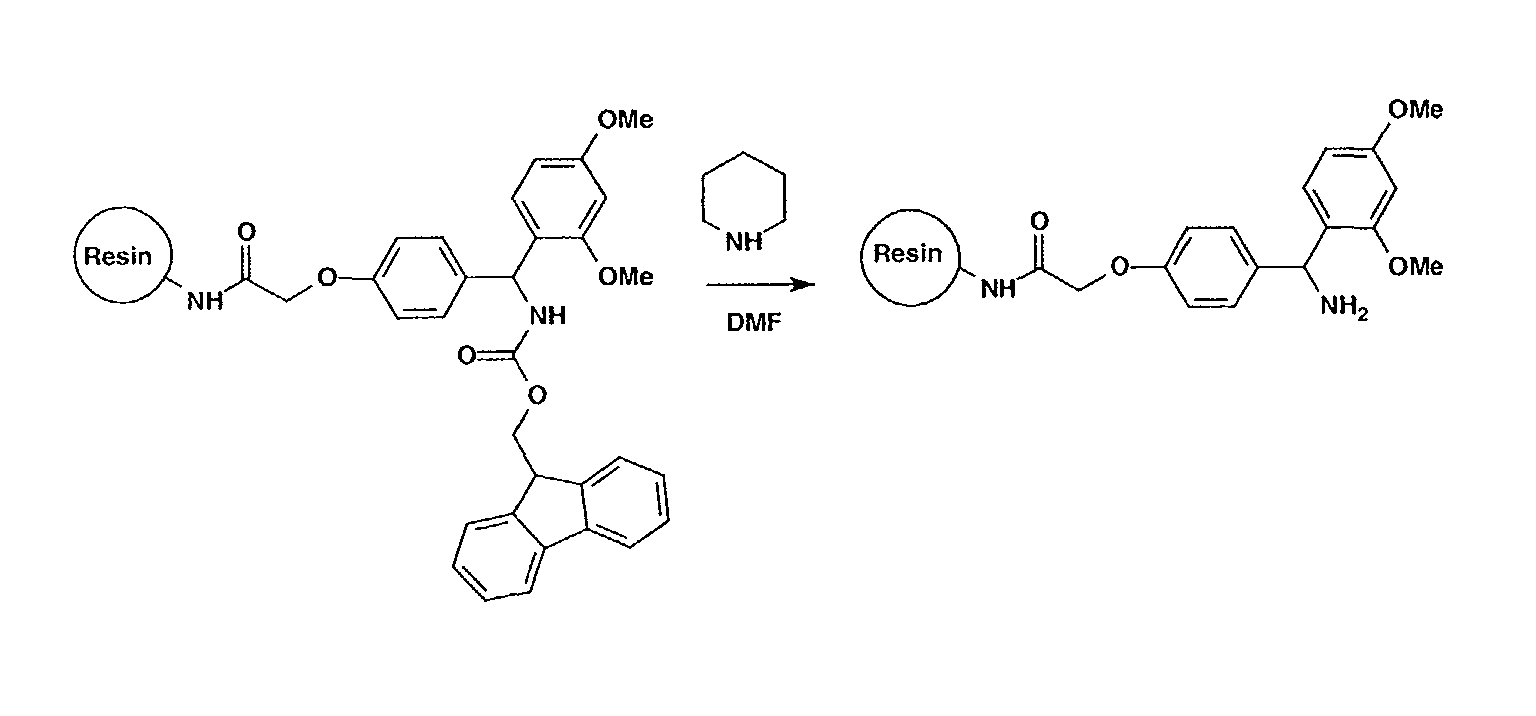
General Procedure Rink-NH-Fmoc Resin to Rink-NH2 Resin
-
Into a 5mL reaction vessel was placed 0.2 grams of PS-Rink-Fmoc
Resin. The resin was swelled by the addition of 4 mL of dimethylformamide. The
resin was agitated for 10 minutes and then the reaction vessel drained. The 9-fluorenylmethyloxycarbonyl
(Fmoc) group was removed by treatment with 4 mL
of a stock solution of 20% piperidine in dimethylformamide (volume %), agitated
for 5 minutes, then the vessel was drained. This treatment with 20% piperidine in
dimethylformamide was repeated once more. The resin was then washed four
times each with 4 mL of dimethylformamide, dichloromethane, tetrahydrofuran
and finally with dimethylformamide again with 3 minutes agitation during each
wash. The resin was air dried, and a sample removed from the reaction vessel and
analyzed for percent Fmoc removal by NMR which showed complete removal of
the Fmoc group.
Example 1: Synthesis of Coupler A1
-
-
Step 1. Into a 5 mL reaction vessel containing 0.2 grams of Rink-NH2
resin, described above, was added 3 mL of 0.6 Molar solution of bromoacetic acid
in dimethylformamide and 1 mL of 3.2 Molar solution of diisopropylcarbodiimide
in dimethylformamide. The vessel contents were mixed at room temperature for
30 minutes, drained and the operation repeated twice more. The resin was then
washed four times each with 4 mL of dimethylformamide and 4 mL of
dimethylsulfoxide with 2.5 minutes agitation during each wash. After draining the
wash solvent, a 4 mL solution of 2.0 Molar cyclohexylamine in
dimethylsulfoxide was added. The resin reaction mixture was agitated for 18
hours at room temperature then drained. The resin was then washed eight times
with 4 mL dimethylformamide each for 2.5 minutes agitation.
-
Step 2. After draining the wash solvent, was added 3 mL of 0.6 Molar
solution of bromoacetic acid in dimethylformamide and 1 mL of 3.2 Molar
solution of diisopropylcarbodiimide in dimethylformamide. The vessel contents
were mixed for 30 minutes, drained and the operation repeated twice more. The
resin was then washed four times each with 4 mL of dimethylformamide and 4 mL
of dimethylsulfoxide with 2.5 minutes agitation during each wash. After draining
the wash solvent, was added 4 mL of a 0.5 Molar dichloromethane, or optionally
dimethylsulfoxide, solution of 6-(1,1 -dimethylethyl)-α,α,β,β-tetramethyl- 1H-pyrazolo[5,1-c]-1,2,4-triazole-3-ethanamine,
Chemical Abstracts Registry Number
210405-85-9 whose preparation has been described in Harder, et. al., US
5,925,503 (7/1999). The resin reaction mixture was agitated for 18 hours at room
temperature then drained. The resin was then thoroughly washed four times each
with 4 mL of dimethylformamide, tetrahydrofuran, methanol and dichloromethane
with 2.5 minutes agitation during each wash. This process was repeated twice.
-
Step 3. After draining the wash solvent, the product was cleaved from the
resin by treatment with 4 mL of 20% trifluoroacetic acid in dichloromethane
(volume %), agitation for 30 min, then draining with collection of the cleavage
solution containing product. This operation was repeated twice more and the
collected cleavage solutions were combined. The resin was then washed three
times with 4 mL of dichloromethane and this solvent was also added to the
cleavage solution containing product. The cleavage solution was then
concentrated to dryness under vacuum without heat to afford 117 milligrams of
product A1 with 84% purity as determined by Reverse Phase High Pressure Liquid
Chromatography analysis. Electrospray MS: [MH]+ = 460m/e.
-
Using the above procedure with substitution of 2-ethylhexylamine,
dodecylamine, 3-ethoxypropylamine, cyclohexanemethylamine, benzylamine,
aniline or 1-(3-aminopropyl)-2-pyrrolidinone, and hexylamine all available from
the Aldrich Chemical Company, Milwaukee, Wisconsin, U.S.A., for
cyclohexylamine the peptoid couplers A2 - A8 could be obtained.
-
Using the above procedure with substitution of 6-(1,1-dimethylethyl)-pyrazolo[5,1-c]-1,2,4-triazole-3-ethanamine,
whose preparation as
the toluenesulfonic acid salt, Chemical Abstract Registry Number 152602-81-8, is
described in Kirschke, et.al., Liebigs Ann. Chem. 1994, 10, 1037-42, for 6-(1,1-dimethylethyl)-α,α,β,β-tetramethyl-1H-pyrazolo[5,1-c]-1
,2,4-triazole-3-ethanamine,
the peptoid couplers A'1 - A'8 could be obtained.
-
Using the above procedure with substitution of 6-(1,1-dimethylethyl)-β-methyl-pyrazolo[1,5-b]-1,2,4-triazole-2-ethanamine,
Chemical
Abstract Registry Number 180483-99-2, whose preparation is described in
Kawagishi, T., et. al., US 5,605,788, for 6-(1,1-dimethylethyl)-α,α,β,β-tetramethyl-1H-pyrazolo[5,1-c]-1,2,4-triazole-3-ethanamine,
and hexylamine, the
peptoid couplers E1 - E8 could be obtained.
-
Purification and isolation of the resultant couplers was found to be
most conveniently achieved by Preparative High Pressure Liquid
Chromatography. Identification of the products by Electrospray mass
spectrometry consistently showed formation of the desired materials. Using these
techniques materials of high purity could be routinely obtained.
Example 2: Synthesis of Coupler B1
-
-
Step 1. Into a 5 mL reaction vessel containing 0.2 grams of Rink-NH2
resin, described above, was added 3 mL of 0.6 Molar solution of bromoacetic acid
in dimethylformamide and 1 mL of 3.2 Molar solution of diisopropylcarbodiimide
in dimethylformamide. The vessel contents were mixed at room temperature for
30 minutes, drained and the operation repeated twice more. The resin was then
washed eight times with 4 mL of dimethylformamide with 3 minutes agitation
during each wash. After draining the wash solvent, a 4 mL solution of 2.0 Molar
cyclohexylamine in dimethylsulfoxide was added. The resin reaction mixture was
agitated for 18 hours at room temperature then drained. The resin was then
washed eight times with 4 mL dimethylformamide each for 3 minutes agitation.
-
Step 2. After draining the wash solvent, was added 3 mL of 0.6 Molar
solution of bromoacetic acid in dimethylformamide and 1 mL of 3.2 Molar
solution of diisopropylcarbodiimide in dimethylformamide. The vessel contents
were mixed at room temperature for 30 minutes, drained and the operation
repeated twice more. The resin was then washed eight times each with 4 mL of
dimethylformamide with 3 minutes agitation during each wash. After draining the
wash solvent, a 4 mL solution of 2.0 Molar cyclohexylamine in dimethylsulfoxide
was added. The resin reaction mixture was agitated for 18
hours at room temperature then drained. The resin was then washed eight times
with 4 mL dimethylformamide each for 3 minutes agitation.
-
Step 3. After draining the wash solvent, was added 3 mL of 0.6 Molar
solution of bromoacetic acid in dimethylformamide and 1 mL of 3.2 Molar
solution of diisopropylcarbodiimide in dimethylformamide. The vessel contents
were mixed for 30 minutes, drained and the operation repeated twice more. The
resin was then washed eight times each with 4 mL of dimethylformamide with 3
minutes agitation during each wash. After draining the wash solvent, was added 4
mL of a 0.5 Molar dichloromethane, or optionally dimethylsulfoxide, solution of
6-(1,1-dimethylethyl)-α,α,β,β-tetramethyl-1H-pyrazolo[5,1-c]-1,2,4-triazole-3-ethanamine,
Chemical Abstracts Registry Number 210405-85-9 whose preparation
has been described in Harder, et. al., US 5,925,503 (7/1999). The resin reaction
mixture was agitated for 18 hours at room temperature then drained. The resin
was then thoroughly washed eight times each with 4 mL of dimethylformamide,
then eight times 4 mL of dichloromethane with 3 minutes agitation during each
wash.
-
Step 4. After draining the wash solvent, the product was cleaved from the
resin by treatment with 4 mL of 20% trifluoroacetic acid in dichloromethane
(volume %), agitation for 30 min, then draining with collection of the cleavage
solution containing product. This operation was repeated twice more and the
collected cleavage solutions were combined. The resin was then washed twice
with 4 mL of dichloromethane and this solvent was also added to the cleavage
solution containing product. The cleavage solution was then concentrated to
dryness under vacuum without heat to afford 126 milligrams of product B1 with
97% purity as determined by Reverse Phase High Pressure Liquid
Chromatography analysis. Electrospray MS: [MH]+ = 599m/e.
-
Using the above procedure with substitution of 2-ethylhexylamine,
dodecylamine, 3-ethoxypropylamine, cyclohexanemethylamine, benzylamine, and
hexylamine, all available from the Aldrich Chemical Company, Milwaukee,
Wisconsin, U.S.A., for cyclohexylamine the peptoid couplers B2 - B25 could be
obtained.
-
Using the above procedure with substitution of 6-(1,1-dimethylethyl)-pyrazolo[5,1-c]-1,2,4-triazole-3-ethanamine,
whose preparation as
the toluenesulfonic acid salt, Chemical Abstract Registry Number 152602-81-8, is
described in Kirschke, et.al., Liebigs Ann. Chem. 1994, 10, 1037-42, for 6-(1,1-dimethylethyl)-α,α,β,β-tetramethyl-1H-pyrazolo[5,1-c]-1,2,4-triazole-3-ethanamine,
the peptoid couplers B'1 - B'25 could be obtained.
-
It will be understood by one skilled in the art that repetition of Step
2 in the procedure above would result in a five step procedure for the preparation
of Inventive Coupler C1. In this manner, substitution of 2-ethylhexylamine,
dodecylamine, 3-ethoxypropylamine, cyclohexanemethylamine, benzylamine, and
hexylamine, all available from the Aldrich Chemical Company, Milwaukee,
Wisconsin, U.S.A., for cyclohexylamine the inventive couplers C2 - C25 could
also be obtained.
-
Substitution of N-[2-[6-(1,1-dimethylethyl)-1H-pyrazolo[5,1-c]-1,2,4-triazol-3-yl]-1,1,2-trimethylpropyl]-2-[2-aminophenoxy]-acetamide,
which
may be prepared by methods described in Romanet, et. al., US 5,972,587 (10/99),
for 6-(1,1-dimethylethyl)-α,α,β,β-tetramethyl-1H-pyrazolo[5,1-c]-1,2,4-triazole-3-ethanamine,
in the above procedure Step 3 will result in the preparation of
Inventive Coupler D17. Further, in this manner, substitution of 2-ethylhexylamine,
dodecylamine, 3-ethoxypropylamine, cyclohexanemethylamine,
benzylamine, and hexylamine, all available from the Aldrich Chemical Company,
Milwaukee, Wisconsin, U.S.A., for cyclohexylamine the inventive couplers D1-D22
could also be obtained.
-
Using the above procedure with substitution of 4-[6-(1,1-dimethylethyl)-lH-pyrazolo[1,5-b]-1,2,4-triazol-2-yl]-benzenamine,
Chemical
Abstract Registry Number 152828-25-6, whose preparation is described in
Mizukawa, Y., et. al., US 5,451,501 (9/1995), for 6-(1,1-dimethylethyl)-α,α,β,
β-tetramethyl-1H-pyrazolo[5,1-c]-1,2,4-triazole-3-ethanamine, the peptoid
couplers F1 - F22 could be obtained.
-
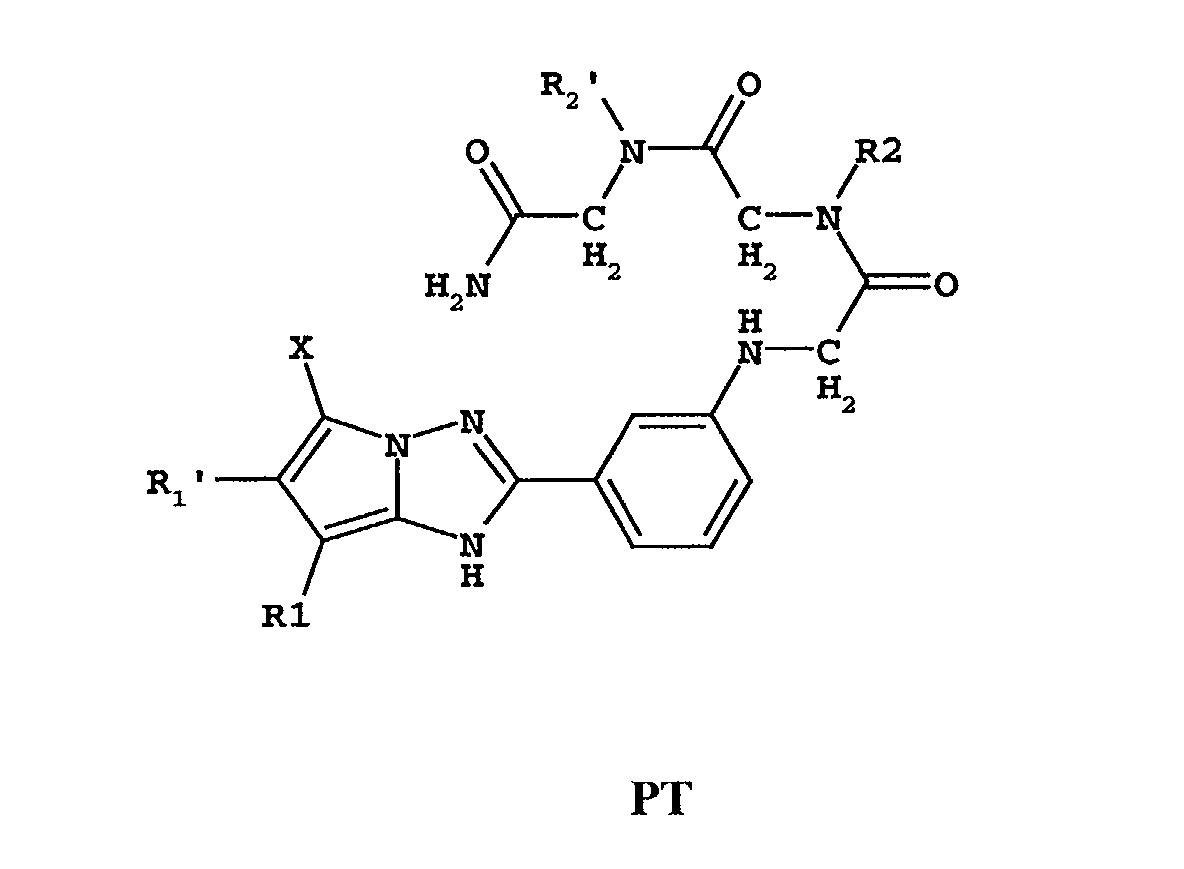
Using the above procedure with substitution of 7-cyano-2-(3-aminophenyl)-1H-pyrrolo[1,2-b][1,2,4]triazole-6-carboxylic
acid, ethyl ester,
whose preparation is described in Suzuki, M., et. al. US 5,256,526 (10/1993) for
6-(1,1-dimethylethyl)-α,α,β,β-tetramethyl-1H-pyrazolo[5,1-c]-1,2,4-triazole-3-ethanamine,
the peptoid couplers PT1 - PT8 could be obtained.
-
Purification and isolation of the resultant couplers was found to be
most conveniently achieved by Preparative High Pressure Liquid
Chromatography. Identification of the products by Electrospray mass
spectrometry consistently showed formation of the desired materials. Using these
techniques materials of high purity could be routinely obtained.
It will be recognized by one skilled in the arts of imaging science that dyes of the
current invention may be used in such technologies as thermal dye transfer and ink
jet imaging, but are in no wise limited to those technologies. Dyes of the present
invention can be prepared by reactions and methods described below. Typical
syntheses are illustrated by the following examples.
Example 1: Synthesis of Coupler A1
-
-
Step 1. Into a 5 mL reaction vessel containing 0.2 grams of Rink-NH2
resin, described above, was added 3 mL of 0.6 Molar solution of bromoacetic acid
in dimethylformamide and 1 mL of 3.2 Molar solution of diisopropylcarbodiimide
in dimethylformamide. The vessel contents were mixed at room temperature for
30 minutes, drained and the operation repeated once more. The resin was then
washed four times each with 4 mL of dimethylformamide and 4 mL of
dimethylsulfoxide with 2.5 minutes agitation during each wash. After draining the
wash solvent, a 4 mL solution of 2.0 Molar cyclohexylamine in dimethylsulfoxide
was added. The resin reaction mixture was agitated for 18 hours at room
temperature then drained. The resin was then washed eight times with 4 mL
dimethylformamide each for 2.5 minutes agitation.
-
Step 2. After draining the wash solvent, was added 3 mL of 0.6 Molar
solution of bromoacetic acid in dimethylformamide and 1 mL of 3.2 Molar
solution of diisopropylcarbodiimide in dimethylformamide. The vessel contents
were mixed for 30 minutes, drained and the operation repeated once more. The
resin was then washed four times each with 4 mL of dimethylformamide and 4 mL
of dimethylsulfoxide with 2.5 minutes agitation during each wash. After draining
the wash solvent, was added 4 mL of a 0.5 Molar dichloromethane, or optionally
dimethylsulfoxide, solution of 6-(1,1 -dimethylethyl)-α,α,β,β-tetramethyl- 1H-pyrazolo[5,1-c]-1,2,4-triazole-3-ethanamine,
Chemical Abstracts Registry Number
210405-85-9 whose preparation has been described in Harder, et. al., US
5,925,503 (7/1999). The resin reaction mixture was agitated for 18 hours at room
temperature then drained. The resin was then thoroughly washed four times each
with 4 mL of dimethylformamide, 4 mL of tetrahydrofuran, 4 mL of methanol and
4 mL of dichloromethane with 2.5 minutes agitation during each wash.
-
Step 3. After draining the wash solvent, the product was cleaved from the
resin by treatment with 4 mL of 20% trifluoroacetic acid in dichloromethane
(volume %), agitation for 30 min, then draining with collection of the cleavage
solution containing product. This operation was repeated once more and the
collected cleavage solutions were combined. The resin was then washed twice
with 4 mL of dichloromethane and this solvent was also added to the cleavage
solution containing product. The cleavage solution was then concentrated to
dryness under vacuum without heat to afford 98 milligrams of product A1 with
84% purity as determined by Reverse Phase High Pressure Liquid
Chromatography analysis. Electrospray MS: [MH]+ = 460m/e.
-
Using the above procedure with substitution of 2-ethylhexylamine,
dodecylamine, 3-ethoxypropylamine, aminomethylcyclohexane, benzylamine,
aniline or 1-(3-aminopropyl)-2-pyrrolidinone, and hexylamine all available from
the Aldrich Chemical Company, Milwaukee, Wisconsin, U.S.A., for
cyclohexylamine the peptoid couplers A2 - A8 could be obtained.
-
Using the above procedure with substitution of 6-(1,1-dimethylethyl)-pyrazolo[5,1-c]-1,2,4-triazole-3-ethanamine,
whose preparation as
the toluenesulfonic acid salt, Chemical Abstract Registry Number 152602-81-8, is
described in Kirschke, et.al., Liebigs Ann. Chem. 1994, 10, 1037-42, for 6-(1,1-dimethylethyl)-α,α,β,β-tetramethyl-1H-pyrazolo[5,1-c]-1,2,4-triazole-3-ethanamine,
the peptoid couplers A'1 - A'8 could be obtained.
-
Using the above procedure with substitution of 6-(1,1-dimethylethyl)-β-methyl-pyrazolo[1,5-b]-1,2,4-triazole-2-ethanamine,
Chemical
Abstract Registry Number 180483-99-2, whose preparation is described in
Kawagishi, T., et. al., US 5,605,788, for 6-(1,1-dimethylethyl)-α,α,β,β-tetramethyl-1H-pyrazolo[5,1-c]-1,2,4-triazole-3-ethanamine,
and hexylamine, the
peptoid couplers E1 - E8 could be obtained.
-
Purification and isolation of the resultant couplers was found to be
most conveniently achieved by Preparative High Pressure Liquid
Chromatography. Identification of the products by Electrospray mass
spectrometry consistently showed formation of the desired materials. Using these
techniques materials of high purity could be routinely obtained.
Example 2: Synthesis of Coupler B1
-
-
Step 1. Into a 5 mL reaction vessel containing 0.2 grams of Rink-NH2
resin, described above, was added 3 mL of 0.6 Molar solution of bromoacetic acid
in dimethylformamide and 1 mL of 3.2 Molar solution of diisopropylcarbodiimide
in dimethylformamide. The vessel contents were mixed at room temperature for
30 minutes, drained and the operation repeated once more. The resin was then
washed four times each with 4 mL of dimethylformamide and 4 mL of
dimethylsulfoxide with 2.5 minutes agitation during each wash. After draining the
wash solvent, a 4 mL solution of 2.0 Molar cyclohexylamine in dimethylsulfoxide
was added. The resin reaction mixture was agitated for 18 hours at room
temperature then drained. The resin was then washed eight times with 4 mL
dimethylformamide each for 2.5 minutes agitation.
-
Step 2. After draining the wash solvent, was added 3 mL of 0.6 Molar
solution of bromoacetic acid in dimethylformamide and 1 mL of 3.2 Molar
solution of diisopropylcarbodiimide in dimethylformamide. The vessel contents
were mixed at room temperature for 30 minutes, drained and the operation
repeated once more. The resin was then washed four times each with 4 mL of
dimethylformamide and 4 mL of dimethylsulfoxide with 2.5 minutes agitation
during each wash. After draining the wash solvent, a 4 mL solution of 2.0 Molar
cyclohexylamine in dimethylsulfoxide was added. The resin reaction mixture was
agitated for 18 hours at room temperature then drained. The resin was then
washed eight times with 4 mL dimethylformamide each for 2.5 minutes agitation.
-
Step 3. After draining the wash solvent, was added 3 mL of 0.6 Molar
solution of bromoacetic acid in dimethylformamide and 1 mL of 3.2 Molar
solution of diisopropylcarbodiimide in dimethylformamide. The vessel contents
were mixed for 30 minutes, drained and the operation repeated once more. The
resin was then washed four times each with 4 mL of dimethylformamide and 4 mL
of dimethylsulfoxide with 2.5 minutes agitation during each wash. After draining
the wash solvent, was added 4 mL of a 0.5 Molar dichloromethane, or optionally
dimethylsulfoxide, solution of 6-(1,1-dimethylethyl)-α,α,β,β-tetramethyl-1H-pyrazolo[5,1-c]-1,2,4-triazole-3-ethanamine,
Chemical Abstracts Registry Number
210405-85-9 whose preparation has been described in Harder, et. al., US
5,925,503 (7/1999). The resin reaction mixture was agitated for 18 hours at room
temperature then drained. The resin was then thoroughly washed four times each
with 4 mL of dimethylformamide, 4 mL of tetrahydrofuran, 4 mL of methanol and
4 mL of dichloromethane with 2.5 minutes agitation during each wash.
-
Step 4. After draining the wash solvent, the product was cleaved from the
resin by treatment with 4 mL of 20% trifluoroacetic acid in dichloromethane
(volume %), agitation for 30 min, then draining with collection of the cleavage
solution containing product. This operation was repeated once more and the
collected cleavage solutions were combined. The resin was then washed twice
with 4 mL of dichloromethane and this solvent was also added to the cleavage
solution containing product. The cleavage solution was then concentrated to
dryness under vacuum without heat to afford 123 milligrams of product B1 with
97% purity as determined by Reverse Phase High Pressure Liquid
Chromatography analysis. Electrospray MS: [MH]+ = 599m/e.
-
Using the above procedure with substitution of 2-ethylhexylamine,
dodecylamine, 3-ethoxypropylamine, aminomethylcyclohexane, benzylamine, and
hexylamine, all available from the Aldrich Chemical Company, Milwaukee,
Wisconsin, U.S.A., for cyclohexylamine the peptoid couplers B2 - B25 could be
obtained.
-
Using the above procedure with substitution of 6-(1,1-dimethylethyl)-pyrazolo[5,1-c]-1,2,4-triazole-3-ethanamine,
whose preparation as
the toluenesulfonic acid salt, Chemical Abstract Registry Number 152602-81-8, is
described in Kirschke, et.al., Liebigs Ann. Chem. 1994, 10, 1037-42, for 6-(1,1-dimethylethyl)-α,α,β,β-tetramethyl-1H-pyrazolo[5,1-c]-1,2,4-triazole-3-ethanamine,
the peptoid couplers B'1 - B'25 could be obtained.
-
It will be understood by one skilled in the art that repetition of Step
2 in the procedure above would result in a five step procedure for the preparation
of Inventive Coupler C1. In this manner, substitution of 2-ethylhexylamine,
dodecylamine, 3-ethoxypropylamine, aminomethylcyclohexane, benzylamine, and
hexylamine, all available from the Aldrich Chemical Company, Milwaukee,
Wisconsin, U.S.A., for cyclohexylamine the inventive couplers C2 - C25 could
also be obtained.
-
Substitution of N-[2-[6-(1,1-dimethylethyl)-1H-pyrazolo[5,1-c]-1,2,4-triazol-3-yl]-1,1,2-trimethylpropyl]-2-[2-aminophenoxy]-acetamide,
which
may be prepared by methods described in Romanet, et. al., US 5,972,587 (10/99),
for 6-(1,1-dimethylethyl)-α,α,β,β-tetramethyl-1H-pyrazolo[5,1-c]-1,2,4-triazole-3-ethanamine,
in the above procedure Step 3 will result in the preparation of
Inventive Coupler D17. Further, in this manner, substitution of 2-ethylhexylamine,
dodecylamine, 3-ethoxypropylamine, aminomethylcyclohexane,
benzylamine, and hexylamine, all available from the Aldrich Chemical Company,
Milwaukee, Wisconsin, U.S.A., for cyclohexylamine the inventive couplers D1-D22
could also be obtained.
-
Using the above procedure with substitution of 4-[6-(1,1-dimethylethyl)-1H-pyrazolo[1,5-b]-1,2,4-triazol-2-yl]-benzenamine,
Chemical
Abstract Registry Number 152828-25-6, whose preparation is described in
Mizukawa, Y., et. al., US 5,451,501 (9/1995), for 6-(1,1-dimethylethyl)-α,α,β,β-tetramethyl-1H-pyrazolo[5,1-c]-1,2,4-triazole-3-ethanamine,
the peptoid couplers
F1 - F22 could be obtained.
-
Using the above procedure with substitution of 7-cyano-2-(3-aminophenyl)-1H-pyrrolo[1,2-b][1,2,4]triazole-6-carboxylic
acid, ethyl ester,
whose preparation is described in Suzuki, M., et. al. US 5,256,526 (10/1993) for
6-(1,1-dimethylethyl)-α,α,β,β-tetramethyl-1H-pyrazolo[5,1-c]-1,2,4-triazole-3-ethanamine,
the peptoid couplers PT1 - PT8 could be obtained.
-
Purification and isolation of the resultant couplers was found to be
most conveniently achieved by Preparative High Pressure Liquid
Chromatography. Identification of the products by Electrospray mass
spectrometry consistently showed formation of the desired materials. Using these
techniques materials of high purity could be routinely obtained.
-
It will be recognized by one skilled in the arts of imaging science
that dyes of the current invention may be used in such technologies as thermal dye
transfer and ink jet imaging, but are in no wise limited to those technologies.
Dyes of the present invention can be prepared by reactions and methods described
below. Typical syntheses are illustrated by the following examples.
Method of Dye Preparation
-
There are two methods used to prepare the dyes:
- 1. A small amount of dry coupler is weighed into a tube with the
addition of a dry developer. An organic solvent such as acetonitrile or other
common reversed-phase chromatographic solvent is added and the solution
sonicated until the coupler has dissolved. An aliquot of aqueous base is added to
both dissolve the developer and ionize the coupler. An oxidizing agent such as
sodium persulphate is added to form the dye in solution. The total volume of
around 20ml is rapidly transferred to a reversed-phase low pressure
chromatographic system where the dye is eventually eluted by applying a solvent
gradient. The effluent is monitored using a spectrophotometric detector tuned to
an appropriate wavelength. The dye peak is collected and the solvent evaporated.
Recovery of dye is usually in the 80%+ efficiency with purities generally
averaging better than 98%. The recovered dye is analyzed by mass spectrometry
for identity and High Performance Liquid Chromatography for purity prior to
making an emulsion.
- 2. The coupler is used to make the emulsion and the emulsion is
coated with additional gelatin and small amounts of silver halide dispersion as
described in the dispersion and coating sections. The coupler coating is converted
to dye proportional to the amount of oxidant (in this method exposed silver halide)
using conventional photographic development. This involves adding
photographic developer solution for 1-2 minutes. A water rinse is done after
removal of the developer. An aliquot of photographic bleach solution is added for
1 minute to remove any silver halide and then removed. Finally, repeated water
rinses remove all residual developing chemicals.
-
Method of Dye Dispersion Preparation
-
Many pertinent photographic properties such as hue, bandwidth,
and light stability are hugely affected by the chemical formulations of the
emulsions which are then coated onto various substrates. The purified dye or
coupler is formulated into an emulsion using basically the same process.
- 1. The initial dye or coupler is weighed and dissolved in an organic
solvent for easier transfer. An aliquot is added to a 15mL polypropylene
centrifuge tube with the appropriate coupler solvent. Any formulation addenda
such as stabilizers are also added at this time. The organic solvent is evaporated
leaving the dye or coupler dissolved in a small pellet of coupler solvent. An
additional auxiliary coupler solvent may be added with sonication or heating
depending on solubility characteristics of the dye or coupler. The final
components consisting of water, surfactant, and gelatin are added to make
somewhere on the order of 4 ml of solution. This solution is sonicated using a
1/4inch probe with 150 watts of power at 20KHz for up to 25 minutes. The
resulting emulsion has been shown to have median particle sizes on the order of
0.3 microns. This emulsion is filtered using 0.45 um filters. An aliquot is diluted
with water and measured spectrophotometrically to verify the quality. The
resulting formulation contains a gelatin concentration between 1-3.5%, dye
concentrations of 2-3 millimolar or coupler concentrations 6-14 millimolar. These
emulsions are chilled and stored prior to coating
-
Method of Dye Dispersion Ink Jet Coating
-
There are three distinct coating techniques which are used for
micro-scale evaluations. Each of these techniques has its benefits and drawbacks.
All of the techniques use conventional disposable microtiterplates or special
holders which conform to titerplate dimensions. This allows us to use
commercially available equipment for both measurement and photographic
development.
- 1. The first technique developed uses a special holder called a
fadeplate. This holder accepts various web materials for laying down emulsions
using ink-jet or similar technology. Typically a gelatin subbed Estar™ material is
held in the fadeplate. The material is held down on a chilled vacuum plate when
depositing material. Various devices are used to create patterns of dye emulsion
dots which are merged by repeatedly dispensing a pattern with a slight offset.
Typically dots are formed from drops of 100 pl to 50nl. The resulting patterned
laydown is allowed to dry at room temperature before measurement of
photographic parameters.
- 2. The second technique involves adding 1-3% gelatin with sufficient
dye emulsion and hardener to form 40 -60 ul of solution. After mixing, the plate
is chill set and then allowed to dry overnight. The resulting plate has a uniformly
coated mid section adequate for measurement.
- 3. The third technique uses a mixture of coupler dispersion, gelatin,
hardener, and silver dispersion. The silver dispersion is metered in using ink-jet
technology and the plate mixed.. After mixing, the plate is chill set and then
allowed to dry overnight. The plate is processed as described in the dye
preparation section to form a uniform layer of dye for studies. This technique
provides a coating of dye in a matrix which is very close to that found in
conventional films and papers.
-
Method of Coated Dye Light Fade Measurement
-
There are two major ways which are used to measure Light stability.
- 1. The fadeplates or titerplates are read spectrophotometrically using a
commercial instrument. The spectra are stored in a database with specific
information as to composition and exposure for each distinct section of the plate.
The plates are mounted on white reflective cards, and a UV filter sheet is taped
into place to screen the UV wavelengths. These cards are mounted in a large
temperature controlled sphere with a 50 Klux light source revolving in the center.
The plates are removed periodically and re-measured until the measurements
indicate that about 10% of the dye has been lost. The data is then used to calculate
light fade stability metrics. This typically takes on the order of 3 weeks but
several plates can be faded simultaneously.
- 2. A more rapid method can be used with fadeplate type coatings.
The coated section is cut out using a razor knife and placed in a modified holder
resembling a standard cuvette. A specially modified spectrophotometer has been
programmed to expose several cells at a time with 200Klux of light and
periodically collect visible spectra. The data can be plotted and photographic
parameters measured in a few hours to days.
-
-
The absorbance maximum of the coated dyes of this invention and
the relative light fade of the coated dyes of this invention are shown in Table I and
are compared to the corresponding data for Comparison Dyes
CD-1 and
CD-2
whose structures are shown below.
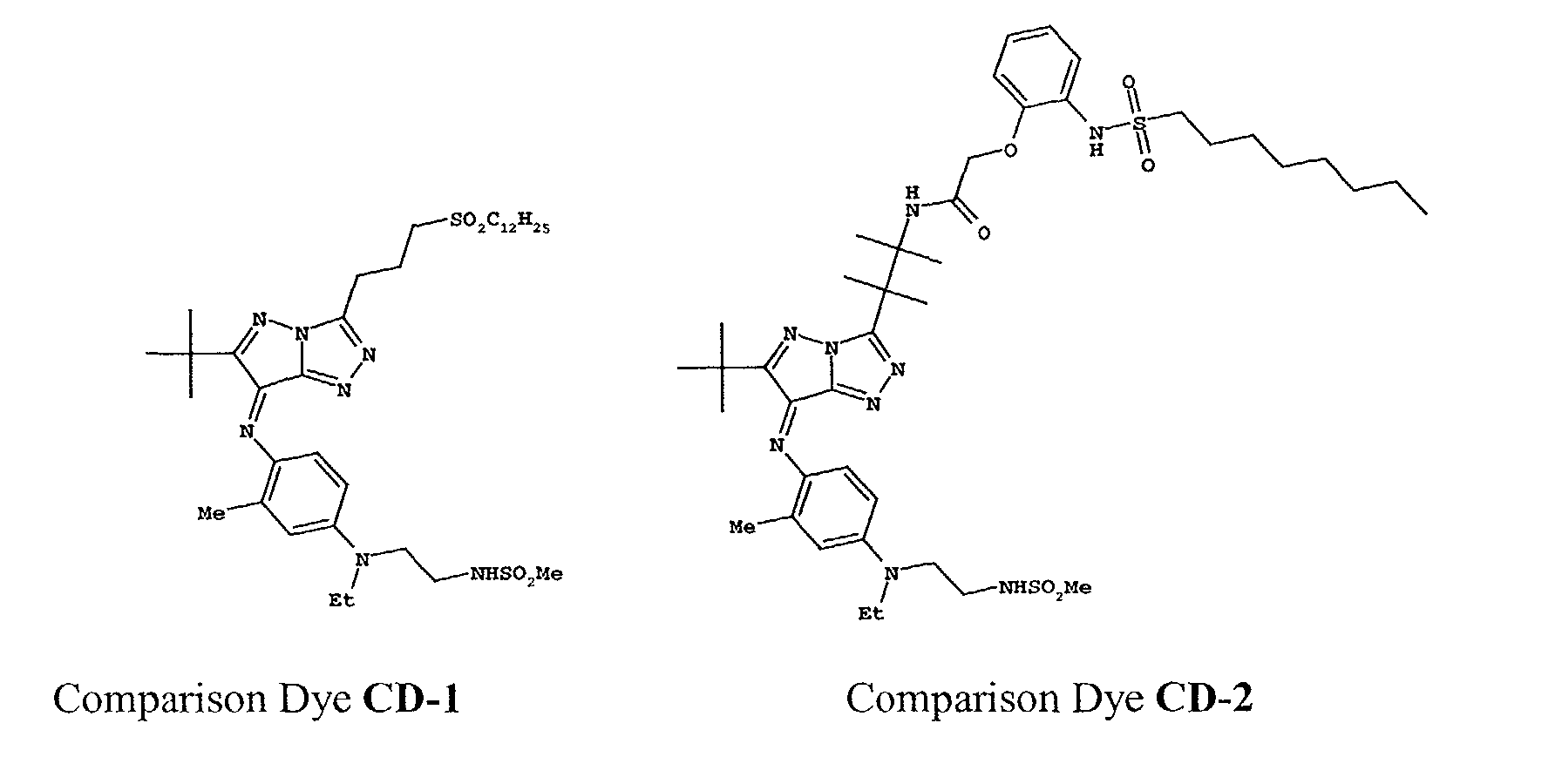
| The invention dyes G1-G12 were formulated as dye dispersions with a stabilizer set. The invention dyes G13 to G28 were formulated as coupler dispersions with stabilizer sets. |
| Dye | Absorbance maximum Coated Image | Half Band width Coated Image | Relative light fade |
| Comparison Dye CD-1 | 545nm | 90nm | 2.78 |
| Comparison Dye CD-2 | 549 nm | 74 nm | 1.00 |
| Invention Dye G1 | 550 nm | 84 nm | 4.09 |
| Invention Dye G2 | 550 nm | 76 nm | 2.71 |
| Invention Dye G3 | 550nm | 77 nm | 2.51 |
| Invention Dye G4 | 550 nm | 79 nm | 2.64 |
| Invention Dye G5 | 550 nm | 78 nm | 1.99 |
| Invention Dye G6 | 550 nm | 80 nm | 2.06 |
| Invention Dye G7 | 550 nm | 79 nm | 3.53 |
| Invention Dye G8 | 550 nm | 78 nm | 1.87 |
| Invention Dye G9 | 550 nm | 78 nm | 2.41 |
| Invention Dye G10 | 550 nm | 79 nm | 2.32 |
| Invention Dye G11 | 550 nm | 77 nm | 2.13 |
| Invention Dye G12 | 550 nm | 78 nm | 1.84 |
| Invention Dye G13 | 555 nm | 84 nm | 1.80 |
| Invention Dye G14 | 556 nm | 77 nm | 1.48 |
| Invention Dye G15 | 554 nm | 78 nm | 1.39 |
| Invention Dye G16 | 554 nm | 78 nm | 1.09 |
| Invention Dye G17 | 555 nm | 76 nm | 1.23 |
| Invention Dye G18 | 556 nm | 76 nm | 1.22 |
| Invention Dye G19 | 555 nm | 76 nm | 1.13 |
| Invention Dye G20 | 554 nm | 75 nm | 2.01 |
| Invention Dye G21 | 556 nm | 77 nm | 1.15 |
| Invention Dye G22 | 556 nm | 76 nm | 0.92 |
| Invention Dye G23 | 555 nm | 76 nm | 1.08 |
| Invention Dye G24 | 555 nm | 76 nm | 0.96 |
| Invention Dye G25 | 554 nm | 76 nm | 0.94 |
| Invention Dye G26 | 556 nm | 74 nm | 0.95 |
| Invention Dye G27 | 556 nm | 76 nm | 1.04 |
| Invention Dye G28 | 555 nm | 76 nm | 0.94 |
-
The data in Table I indicate that the dyes prepared from the
couplers according to the present invention offer good light stability with a deeper
absorbance maximum and without unwanted excessive absorbance band shape
broadening compared with dye from pyrazolotriazole couplers of the prior art.
-
The invention embodiments include the element wherein the
pyrazoloazole coupler is a pyrazolo[5,1-c]-1,2,4-triazole, pyrazolo[1,5-b]-1,2,4-triazole,
imidazo[1,2-b]pyrazole, a pyrazolo[1,5-a]benzimidazole, or a
pyrrolo[1,2-b][1,2,4]triazole.
-
Embodimets of the invention include a process for forming an
image in the element as claimed after the element has been imagewise exposed to
light comprising contacting the element with a color developing compound to
form a dye, such as one that has a half bandwidth of less than 100 nm. Also
contemplated is an azole coupler compound represented by formula I:
wherein
each R1 represents an independently selected substituent group and a is 0-4;
each R2 represents an independently selected substituent group;
each R3 represents hydrogen or an independently selected substituent
group;
L represents a single bond or a chain of atoms containing one or more of
carbon, nitrogen, oxygen, and sulfur atoms;
each Y, Y', and Y" represents a carbon or nitrogen atom with the proviso
that at least one of Y, Y' or Y" is a carbon, and that Y and Y' may represent the
carbons necessary to form part of a fused six membered aromatic ring, and
provided further that if Y and Y' represents the carbons necessary to form part of a
fused six membered aromatic ring, the L linking group is not attached directly to
the Y or Y' atom, and Y, Y' and Y" may be further substituted by R1 when not
directly attached to L;
X represents a hydrogen atom, a halogen atom, a carboxy group, an acyl
group, or a group bonded to the coupling position through an oxygen, nitrogen, or
sulfur atom, and
Z is 1-6.
-
Further contemplated is an azole dye represented by formula III:
wherein
each R1 represents an independently selected substituent group and a is 0-4;
each R2 represents an independently selected substituent group;
each R3 represents hydrogen or an independently selected substituent
group;
L represents a single bond or a chain of atoms containing one or more of
carbon, nitrogen, oxygen, and sulfur atoms;
each Y, Y', and Y" independently represents a carbon or nitrogen atom
with the proviso that at least one of Y, Y' or Y" is a carbon, and that Y and Y'
may represent the carbons necessary to form part of a six membered aromatic ring,
and provided further that if Y and Y' represents the carbons necessary to form part
of a six membered aromatic ring, the L linking group is not attached directly to the
Y or Y' atom, and Y, Y' and Y" may be further substituted by R1 when not
directly attached to L;
V is an aza group derived from a para-phenylenediamine group;
X represents a hydrogen, halogen, or a 3 to 7 membered heterocyclic ring
composed of carbon atoms and at least one nitrogen, oxygen, or sulfur atom, and
Z is 1-6 and
an azole azomethine dye compound represented by general formula IV:
wherein R1, R2, R3, L, Y, Y', Y", and Z are the same as claimed in claim 19 and
R
m represents 1-5 substituent groups on the phenyl ring.