EP1319660A1 - Optically active azetidincarboxamide-coordinated transition metal complexes as catalysts in asymmetric reduction - Google Patents
Optically active azetidincarboxamide-coordinated transition metal complexes as catalysts in asymmetric reduction Download PDFInfo
- Publication number
- EP1319660A1 EP1319660A1 EP02026925A EP02026925A EP1319660A1 EP 1319660 A1 EP1319660 A1 EP 1319660A1 EP 02026925 A EP02026925 A EP 02026925A EP 02026925 A EP02026925 A EP 02026925A EP 1319660 A1 EP1319660 A1 EP 1319660A1
- Authority
- EP
- European Patent Office
- Prior art keywords
- substituted
- azetidincarboxamide
- optically active
- hydrogen
- compound
- Prior art date
- Legal status (The legal status is an assumption and is not a legal conclusion. Google has not performed a legal analysis and makes no representation as to the accuracy of the status listed.)
- Withdrawn
Links
Classifications
-
- C—CHEMISTRY; METALLURGY
- C07—ORGANIC CHEMISTRY
- C07F—ACYCLIC, CARBOCYCLIC OR HETEROCYCLIC COMPOUNDS CONTAINING ELEMENTS OTHER THAN CARBON, HYDROGEN, HALOGEN, OXYGEN, NITROGEN, SULFUR, SELENIUM OR TELLURIUM
- C07F15/00—Compounds containing elements of Groups 8, 9, 10 or 18 of the Periodic Table
- C07F15/0006—Compounds containing elements of Groups 8, 9, 10 or 18 of the Periodic Table compounds of the platinum group
- C07F15/0046—Ruthenium compounds
- C07F15/0053—Ruthenium compounds without a metal-carbon linkage
-
- C—CHEMISTRY; METALLURGY
- C07—ORGANIC CHEMISTRY
- C07D—HETEROCYCLIC COMPOUNDS
- C07D205/00—Heterocyclic compounds containing four-membered rings with one nitrogen atom as the only ring hetero atom
- C07D205/02—Heterocyclic compounds containing four-membered rings with one nitrogen atom as the only ring hetero atom not condensed with other rings
- C07D205/04—Heterocyclic compounds containing four-membered rings with one nitrogen atom as the only ring hetero atom not condensed with other rings having no double bonds between ring members or between ring members and non-ring members
-
- C—CHEMISTRY; METALLURGY
- C07—ORGANIC CHEMISTRY
- C07F—ACYCLIC, CARBOCYCLIC OR HETEROCYCLIC COMPOUNDS CONTAINING ELEMENTS OTHER THAN CARBON, HYDROGEN, HALOGEN, OXYGEN, NITROGEN, SULFUR, SELENIUM OR TELLURIUM
- C07F15/00—Compounds containing elements of Groups 8, 9, 10 or 18 of the Periodic Table
- C07F15/0006—Compounds containing elements of Groups 8, 9, 10 or 18 of the Periodic Table compounds of the platinum group
- C07F15/0046—Ruthenium compounds
-
- Y—GENERAL TAGGING OF NEW TECHNOLOGICAL DEVELOPMENTS; GENERAL TAGGING OF CROSS-SECTIONAL TECHNOLOGIES SPANNING OVER SEVERAL SECTIONS OF THE IPC; TECHNICAL SUBJECTS COVERED BY FORMER USPC CROSS-REFERENCE ART COLLECTIONS [XRACs] AND DIGESTS
- Y02—TECHNOLOGIES OR APPLICATIONS FOR MITIGATION OR ADAPTATION AGAINST CLIMATE CHANGE
- Y02P—CLIMATE CHANGE MITIGATION TECHNOLOGIES IN THE PRODUCTION OR PROCESSING OF GOODS
- Y02P20/00—Technologies relating to chemical industry
- Y02P20/50—Improvements relating to the production of bulk chemicals
- Y02P20/55—Design of synthesis routes, e.g. reducing the use of auxiliary or protecting groups
Definitions
- the present invention relates to optically active azetidincarboxamide-coordinated transition metal complexes, which is useful as catalysts for asymmetric synthesis using a prochiral unsaturated organic compounds, optically active azetidincarboxamide compounds and use thereof.
- Asymmetric reduction of ketones using a catalyst having a proline amide compound as a ligand has been reported by Rhyoo et al (Tetrahedron Lett., 2001, vol. 42, page 5045). The report was limited to a reduction of aromatic ketones, and no description was given for the reduction of an aliphatic ketones.
- Azetidine pyridylamide was only known as a ligand for the nicotine acetylcholine receptor (Balboni et al. (Arzneim.-Forsch., 2000, vol. 50, page 507-511). No asymmetric catalysts using the azetidincarboxamide compounds as the ligand were known.
- an optically active azetidincarboxamide-coordinated transition metal complexes of formula (1) as depicted below can be used as a catalyst in a process for producing a chiral compound from a prochiral unsaturated organic compound, using a readily available optically active azetidinecarboxylic acids.
- the present invention provides
- substituted or unsubstituted aryl examples include, for example, phenyl, tolyl, naphthyl, biphenyl, furyl, thienyl and the like.
- substituted or unsubstituted alkyl examples include, for example, a straight chain, branched or cyclic C1-10 alkyl group such as methyl, ethyl, n-propyl, isopropyl, n-butyl, isobutyl, t-butyl, n-amyl, neopentyl, cyclopentyl, n-hexyl, cyclohexyl, n-octyl, n-nonyl, menthyl, 2,3,4-trimethyl-3-pentyl, 2,4-dimethyl-3-pentyl and the like.
- a straight chain, branched or cyclic C1-10 alkyl group such as methyl, ethyl, n-propyl, isopropyl, n-butyl, isobutyl, t-butyl, n-amyl, neopentyl, cyclopent
- substituted or unsubstituted aralkyl examples include, for example, benzyl, 2-phenylethyl, 2-naphthylethyl, diphenylmethyl and the.
- These groups may be further substituted with a suitable substituent groups, and they are not particularly limited insofar as they adversely affect the invention.
- substituents include, for example, a halogen such as fluorine, chlorine, bromine or iodine; an alkoxy (e.g. C1-4 alkoxy) such as methoxy, ethoxy, n-propoxy, t-butoxy or the like; an aryloxy such as phenoxy and the like; a lower alkyl(e.g. C1-6 alkyl) such as methyl, ethyl, isopropyl, n-butyl, t-butyl, n-amyl, n-hexyl and the like; a lower alkylthio (e.g.
- C1-4alkylthio group) ' such as methylthio, ethylthio, n-propylthio, t-butylthio and the like; an arylthio such as phenylthio; nitro; sulfonic acid and the like.
- Examples of the protective group represented by Z or Z' include, for example, an aliphatic or aromatic acyl group(acetyl, pivaloyl, benzoyl and th elike), a hydrocarbyloxycarbonyl group(methoxycarbonyl, ethoxycarbonyl,t-butoxycarbonyl, and the like), a hydrocarbylsulfonyl group (methylsulfonyl, tosyl, trifuloromethylsulfonyl and th elike), a benzyl group (e.g. benzyl, trityl, methoxybenzyl, di(p-methoxyphenyl)methyl group and the like), and silyl group (e.g. trimethylsilyl, t-butyldimethylsilyl, diophenylmethylsilyl group and the like).
- an aliphatic or aromatic acyl group (acetyl, pivaloyl, benzoyl and
- optically active azetidincarboxamide compounds of formula (2) as the raw material in the invention, in which Z is a protective group for amino can be obtained, for example, by amidating an optically active azetidinecarboxylic acid of formula (3): wherein Z represents a protective group for amino and * indicates an asymmetric carbon.
- Compounds in which Z is hydrogen can be obtained, for example, by amidating optically active azetidinecarboxylic acid of formula (4): wherein Z' represents a protective group for amino and * indicates an asymmetric carbon, and then deprotecting Z' to give the optically active azetidincarboxamide compounds of formula (2).
- the amidation may be conducted in a similar manner as disclosed by Balboni et al. (Arzneim.-Forsch., 2000, vol. 50, page 509).
- the protection or deprotection of the compounds of the present invention can be accomplished by introducing or removing the protecting group by similar methods as disclosed in Protective Groups in Organic Synthesis, Greene, T.W. 3 rd Edition, Wiley, the whole disclosure of which is incorporated herein by reference.
- transition metal represented by M preferably include rhodium, ruthenium, palladium, iridium, platinum and the like. Particularly in the asymmetric reduction reaction of the prochiral unsaturated organic compounds, rhodium and ruthenium are preferably used.
- Examples of counter ion represented by X - preferably include fluorine ion, chlorine ion, bromine ion, iodine ion, perchlorate, hexafluorophosphate, tetrafluoroborate, trifluoromethylbenzenesulfonate, trifluoromethanesulfonate and the like.
- the ligands represented by L 1 and L 2 may be anyone that can be coordinated to the transition metal and include carbon monoxide, nitrogen monoxide, NH 2 and the like, as well as halogen such as chlorine, bromine and the like, olefin ligands, acetylene ligands, aromatic compound ligands, organic oxygen-containing compound ligands, organic sulfur-containing compound ligands, organic nitrogen-containing compound ligands and the like.
- olefin ligands examples include, for example, ethylene, allyl, butadiene, cyclohexene, 1,3-cyclohexadiene, 1,5-cyclooctadiene, cyclooctatriene, norbornadiene, acrylic acid esters, methacrylic acid esters, cyclopentadienyl, pentamethylcyclopentadienyl and the like.
- 5-membered ring compounds of the following formula are can also be used as the ligand: wherein Ra to Re are same or different and respectively represent hydrogen, halogen, substituted or unsubstituted alkyl, substituted or unsubstituted aralkyl, substituted or unsubstituted aryl, substituted or unsubstituted alkenyl, or substituted or unsubstituted alkoxyl or alkyloxycarbonyl group.
- Ra to Re include, for example, fluorine, chlorine, bromine and iodine for halogen; methyl, ethyl, n-propyl, isopropyl, n-butyl, isobutyl, t-butyl, n-amyl, neopentyl, n-hexyl, cyclohexyl, n-octyl, n-nonyl, menthyl, 2,3,4-trimethyl-3-pentyl, 2,4-dimethyl-3-pentyl and the like for the alkyl; benzyl, 2-phenylethyl, 2-naphthylethyl, diphenylmethyl and the like for aralkyl; phenyl, naphthyl, biphenyl, furyl, thienyl and the like for the aryl; 2-methyl-1-propenyl, 2-butenyl, trans- ⁇ -st
- These groups may be further substituted with halogen as described above; alkoxyl as described above; aryloxy as described above; lower alkyl such as methyl, ethyl, isopropyl, n-butyl, t-butyl, n-amyl, n-hexyl or the like; lower alkylthio such as n-propylthio, t-butylthio or the like; arylthio such as phenylthio; nitro; or hydroxyl.
- the number of substituents is any number between 1 and 5 and location of substitution can be optioanlly selected.
- acetylene ligands include, for example, acetylene, 1,2-dimethylacetylene, 1,4-pentadiyne, 1,2-diphenylacetylene and the like.
- aromatic compound ligands examples include, for excample, benzene, p-cymene, mesitylene, hexamethylbenzene, naphthalene, anthracene and the like.
- aromatic compounds typically include cyclic aromatic compounds of the following formula: wherein Rf's are same or different and represent hydrogen, saturated or unsaturated hydrocarbon group, or heteroatom-containing functional group.
- saturated hydrocarbon examples include, for example, alkyl such as methyl, ethyl, propyl, isopropyl, butyl, pentyl, hexyl, heptyl and the like; and cycloalkyl such as cyclopropyl, cyclobutyl, cyclopentyl, cyclohexyl and the like;
- unsaturated hydrocarbon examples include, for example, benzyl, vinyl, allyl, aryl such as a phenyl, or naphthyl group, and the-like.
- heteroatom-containing functional group examples include, for example, hydroxyl, alkoxyl, alkoxycarbonyl and the like.
- the number of substituents is any number between 1 and 6 and location of substitution is optional.
- organic oxygen-containing compound ligands examples include acetate, benzoate, acetylacetonate and the like.
- organic sulfur-containing compound ligands examples include dimethylsulfoxide, dimethylsulfide, thiophene, carbon disulfide, carbon sulfide, thiophenol and the like.
- organic nitrogen-containing compound ligands examples include acetonitrile, benzonitrile, t-butylisocyanide, pyridine, 1,10-phenanthroline, 2,2'-bipyridyl and the like.
- bidentate ligand examples include, for example, acetylacetonate, 1,3-bis(diphenylphosphino)propane, 2,2'bipyrydyl and the like.
- the optically active azetidincarboxamide-coordinated transition metal complex of formula (1) can be produced by reacting an optically active azetidincarboxamide of formula (2) with a transition metal complex of the following formula (5) : MYpLs wherein M represents a transition metal, Y represents hydrogen, halogen, carboxyl, alkoxy or hydroxy, L represents the ligand L 1 or L 2 as described above, and p and s respectively represent integers of 0 to 6.
- transition metal complex (5) examples include, for example, chlorotris(triphenylphosphine)rhodium(I), cyclopentadienylbis(triphenylphosphine)rhodium(I), bis(cyclooctadiene)diiododirhodium(I), chloro(cyclopentadienyl)bis(triphenylphosphine)ruthenium( II), chloro(pentamethylcyclopentadienyl)(1,3-bis(diphenylphosphino)propane)ruthenium(II), chloro(pentamethylcyclopentadienyl)(1,5-cyclooctadiene)-ruthenium(II), chlorotris(triphenylphosphine)iridium(I), pentamethylcyclopentadienylbis(ethylene)iridium(I), (ethylene)bis(triphenylphosphine)platinum(0), trans
- optically active azetidincarboxamide-coordinated transition metal complex of formula (1) can usually be produced, for example, by the following processes:
- the optically active azetidincarboxamide compound of formula (2) is typically dissolved in a solvent and the transition metal complex (5) described above is added thereto.
- the obtained reaction solution is concentrated to give the optically active azetidincarboxamide-coordinated transition metal complex of formula (1).
- the reaction product is obtained in the form of precipitates, the solid can be separated.
- the above procedure is usually carried out in an atmosphere of inert gas such as argon or the like.
- the solvent used in such reaction is not particularly limited insofar as effect of the invention is not inhibited.
- the solvent include, for example, alcohols such as methanol, isopropanol or the like; ethers such as tetrahydrofuran, diethyl ether or the like; aromatic hydrocarbons such as toluene, benzene or the like; aliphatic hydrocarbons such as hexane, cyclohexane or the like; halogenated hydrocarbons such as dichloromethane, chloroform, chlorobenzene or the like; and so on.
- alcohols such as methanol, isopropanol or the like
- ethers such as tetrahydrofuran, diethyl ether or the like
- aromatic hydrocarbons such as toluene, benzene or the like
- aliphatic hydrocarbons such as hexane, cyclohexane or the like
- halogenated hydrocarbons such as dichloromethane, chloroform, chlorobenzene or the like
- the amount that may be used of the optically active azetidincarboxamide-coordinated transition metal complex of formula (1) varies depending on the reaction conditions and economy. Usually, an amount of about 1/10 to 1/100,000 mol per mol of the unsaturated organic compound as the reaction substrate can be used, and preferable amount is within a range of about 1/50 to 1/10,000.
- the prochiral unsaturated organic compound includes a ketone compound of formula (6): wherein R 3 and R 4 are different and represent substituted or unsubstituted alkyl, substituted or unsubstituted aryl or substituted or unsubstituted aralkyl, or R 3 and R 4 are combined together to form an asymmetric cyclic ketone, and an imine compound of formula (7): wherein R 3 and R 4 are different and represent substituted or unsubstituted alkyl, substituted or unsubstituted aryl or substituted or unsubstituted aralkyl, R 5 represents hydrogen, substituted or unsubstituted alkyl, substituted or unsubstituted aryl or substituted or unsubstituted aralkyl, or R 3 and R 4 , R 3 and R 5 or R 4 and R 5 are bonded together to form an asymmetric cyclic imine.
- the imine compound of formula (7) can be obtained by reacting an amine compound of formula: R 5 NH 2 with the ketone compound of formula (6) by known manners.
- alkyl represented by R 3 , R 4 or R 5 in the compounds of the above formulae (6) and (7) include, for example, alkyl having 1 to 8 carbon atoms (e.g. methyl, ethyl, propyl, butyl, pentyl, hexyl, heptyl, octyl or the like).
- aryl in the aryl and the aralkyl group above examples include, for example, phenyl, naphthyl, pyridyl, pyrimidyl, furyl, thienyl and the like.
- the alkyl and aryl may be substituted with an alkyl having 1 to 6 carbon atoms (e.g. methyl, ethyl, porpyl, butyl, pentyl, hexyl or the like), an alkoxy having 1 to 6 carbon atoms (e.g. methoxy, ethoxy, porpoxy, butoxy, pentyloxy, hexyloxy or the like), halogen (e.g. fluorine, chlorine, bromine, and iodine) or the like.
- an alkyl having 1 to 6 carbon atoms e.g. methyl, ethyl, porpyl, butyl, pentyl, hexyl or the like
- an alkoxy having 1 to 6 carbon atoms e.g. methoxy, ethoxy, porpoxy, butoxy, pentyloxy, hexyloxy or the like
- halogen e.g. fluorine, chlorine
- the alkyl in the aralkyl includes an alkyl group having 1 to 12 carbon atoms (e.g. methyl, ethyl, propyl, butyl, pentyl, hexyl, heptyl, octyl, nonyl, decyl, undecyl, dodecyl and the like).
- cyclic ketone which may be substituted of formula (6) include, for example, cycloalkenone having 5 to 12 carbon atoms, which may be fused with a benzene ring such as 1-indanone, 2-indanone, 1-tetralone, 2-tetralone, 1-benzosuberone and the like, and the cyclic ketone may be substituted with an alkyl having 1 to 6 carbon atoms (e.g. methyl, ethyl, propyl, butyl, pentyl, hexyl or the like), an alkoxy having 1 to 6 carbon atoms (e.g. methoxy, ethoxy, propoxy, butoxy, pentyloxy, hexyloxy or the like), halogen (e.g. fluorine, chlorine, bromine, and iodine) or the like.
- cycloalkenone having 5 to 12 carbon atoms which may be fused with a benzene ring such as 1-in
- Examples of the cyclic imine which may be substituted of formula (7) formed by combining R 3 and R 5 or R 4 and R 5 include 2,3,4,5-tetrahydro-6-methylpyridine, 1-methyl-3,-4-dihydroisoquinoline and the like, and the cyclic imine may be substituted with alkyl having 1 to 6 carbon atoms(e.g. methyl, ethyl, propyl, butyl, pentyl, hexyl or the like), alkoxy having 1 to 6 carbon atoms (e.g. methoxy, ethoxy, propoxy, butoxy, pentyloxy, hexyloxy or the like), halogen (e.g. fluorine, chlorine, bromine, or iodine) or the like.
- alkyl having 1 to 6 carbon atoms e.g. methyl, ethyl, propyl, butyl, pentyl, hexyl or the like
- the compounds of the formula (6) include, for example, acetophenone, propiophenone, butyrophenone, isobutyrophenone, chloromethylphenylketone, bromomethylphenylketone, 2-acetylpyridine, 3-acetylpyridine, (o-methoxy)acetophenone, (o-ethoxy)acetophenone, (o-propoxy)acetophenone, (o-benzyloxy)acetophenone, ⁇ -acetonaphthone, p-chlorophenyl methyl ketone, p-bromophenyl methyl ketone, p-cyanophenyl methyl ketone, phenyl benzyl ketone, phenyl (o-tolylmethyl) ketone, phenyl (m-tolylmethyl) ketone, phenyl (p-tolylmethyl) ketone, 2-butanone, 2-pentanone, 2-hexan
- the compounds of the formula (7) include, for example, 3,4-dihydro-5-phenyl-1H-pyrrole, 2,3,4,5-tetrahydro-6-phenylpyridine, 1-methyl-3,4-dihydroisoquinoline, 6,7-dimethoxy-1-methyl-3,4-dihydroisoquinoline, 1-phenyl-3,4-dihydroisoquinoline, 1-methyl-3,4-dihydro-9H-pyrido[3,4-b]indole, ⁇ -methylbenzylidenebenzylamine and the like.
- the ketone compound of formula (6) and the imine compound of formula (7) are asymmetrically reduced to produce a chiral organic compound such as a chiral alcohol of formula (6'): wherein R 3 and R 4 are the same as defined above and * indicates an asymmetric carbon atom, or a chiral amine of formula (7') : wherein R 3 , R 4 and R 5 are the same as defined above and * indicates an asymmetric carbon atom, respectively.
- a chiral organic compound such as a chiral alcohol of formula (6'): wherein R 3 and R 4 are the same as defined above and * indicates an asymmetric carbon atom, or a chiral amine of formula (7') : wherein R 3 , R 4 and R 5 are the same as defined above and * indicates an asymmetric carbon atom, respectively.
- a solvent In a hydrogen-transfer type reduction reaction, usually a solvent is used.
- a solvent that solubilizes raw materials for the reaction and catalyst system is preferably used.
- a hydrogen source is required in the reaction.
- the hydrogen source include, for example, a primary or secondary alcohol, an unsaturated compound such as cyclohexene, cyclohexadiene, indoline and the like, formic acid and salts thereof are utilized.
- Preferred are secondary alcohols (e.g. isopropanol, sec-butanol, cyclohexanol, 1-phenethyl alcohol and the like) and unsaturated compounds, and more preferred are secondary alcohols.
- the reaction temperature is usually -90 to 150°C and preferably the reaction can be carried out at about -20 to 100°C.
- the reaction period varies depending on conditions such as concentration of the substrate, temperature and the like and usually the reaction is completed within several hours to about 30 hours.
- the product may be separated or isolated in a known manner such as extraction, phase-separation, distillation and/or chromatography, if necessary.
- reaction in the invention can be carried out either by batch system or by continuous system as the reaction mode.
- Preferred azetidincarboxamide compounds are an azetidincarboxamide compound of formula (2), wherein either one of R 1 and R 2 is hydrogen, more preferred is an azetidincarboxamide compound of formula(2), wherein R 2 is hydrogen and R 1 is substituted or unsubstituted alkyl, substituted or unsubstituted phenyl or substituted or unsubstituted naphthyl, and furthermore preferred is an azetidincarboxamide compound of formula (2), wherein z is hydrogen in the more preferred compound above.
- optically active azetidincarboxamide compound of formula (2) of the present invention include, for example, optically active N-phenyl-2-azetidinecarboxamide, N-(1-naphthyl)-2-azetidinecarboxamide, N-(4-methoxyphenyl)-2-azetidinecarboxamide, N-(2-fluorophenyl)-2-azetidinecarboxamide and the like.
- Azetidincarboxamide compounds of formula (2) wherein R 2 is a phenyl group, Z is a hydrogen atom, and R 1 is a methyl group or a hydrogen atom were erroneously disclosed in Table 1, page 504 by Balboni et al. (Arzneim.-Forsch., 2000, vol. 50, page 507-511) despite the fact that the disclosed compounds should have a pyridyl group in place of the phenyl group as R 2 group in the above-described compounds.
- optically active azetidincarboxamide-coordinated transition metal complexes of formula (1) include transition metal complexes derived from the above optically active azetidincarboxamide compound of formula (2) and the like.
- optically active azetidincarboxamide-coordinated transition metal complex of formula (1) of the invention is useful as a catalyst for producing chiral compound from a prochiral unsaturated organic compounds.
- Example 6 The procedure in Example 6 was repeated except that (S)-N-(1-naphthyl)-2-azetidinecarboxamide chlororuthenium (p-cymene) complex (0.005 mmol) was used as the catalyst and the reaction temperature was changed to 30°C to give optically active 3-quinuclidinol (optical purity: 23%ee). The conversion was 99%.
- Example 6 The procedure in Example 6 was repeated except that (S)-N-(4-methoxyphenyl)-2-azetidinecarboxamide chlororuthenium (p-cymene) complex (0.005 mmol) was used as the catalyst and the reaction temperature was changed to 30°C to give optically active 3-quinuclidinol (optical purity: 52%ee). The conversion was 99%.
- Example 6 The procedure in Example 6 was repeated except that (S)-N-(2-fluorophenyl)-2-azetidinecarboxamide chlororuthenium (p-cymene) complex (0.005 mmol) was used as the catalyst and the reaction temperature was changed to 30°C to give optically active 3-quinuclidinol (optical purity: 46%ee). The conversion was 99%.
- Example 6 The procedure in Example 6 was repeated except that acetophenone (0.5 mmol) was used in place of 3-quinuclidinone and the reaction temperature was changed to 30°C to give optically active phenylethanol (optical purity: 68%ee). The conversion was 94%.
Landscapes
- Chemical & Material Sciences (AREA)
- Organic Chemistry (AREA)
- Organic Low-Molecular-Weight Compounds And Preparation Thereof (AREA)
- Catalysts (AREA)
- Low-Molecular Organic Synthesis Reactions Using Catalysts (AREA)
Abstract
There are disclosed an optically active azetidincarboxamide-coordinated transition metal complex of formula (1): <CHEM> wherein R<1> and R<2> each independently represent hydrogen, substituted or unsubstituted alkyl, substituted or unsubstituted aralkyl or substituted or unsubstituted aryl; Z represents hydrogen or a protective group for amino; M represents a transition metal, X<-> represents a counter ion, m represents an integer of 0 to 4, n represents 0 or 1, L<1> and L<2> each independently represent a ligand or are bonded together to represent a bidentate ligand and * indicates that the marked atom is an asymmetric carbon atom, and an azetidincarboxamide compound for producing the same.
Description
The present invention relates to optically active
azetidincarboxamide-coordinated transition metal complexes,
which is useful as catalysts for asymmetric synthesis using
a prochiral unsaturated organic compounds, optically active
azetidincarboxamide compounds and use thereof.
Asymmetric reduction of ketones using a catalyst having
a proline amide compound as a ligand has been reported by Rhyoo
et al (Tetrahedron Lett., 2001, vol. 42, page 5045). The
report was limited to a reduction of aromatic ketones, and
no description was given for the reduction of an aliphatic
ketones. Azetidine pyridylamide was only known as a ligand
for the nicotine acetylcholine receptor (Balboni et al.
(Arzneim.-Forsch., 2000, vol. 50, page 507-511). No
asymmetric catalysts using the azetidincarboxamide compounds
as the ligand were known.
According to the present invention, an optically active
azetidincarboxamide-coordinated transition metal complexes
of formula (1) as depicted below can be used as a catalyst
in a process for producing a chiral compound from a prochiral
unsaturated organic compound, using a readily available
optically active azetidinecarboxylic acids.
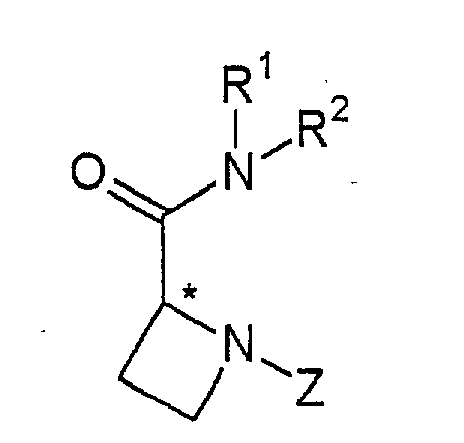
The present invention provides

substituted or unsubstituted alkyl,
substituted or unsubstituted aralkyl or
substituted or unsubstituted aryl;
Z represents hydrogen or a protective group for amino;
M represents a transition metal,
X- represents a counter ion,
m represents an integer of 0 to 4, n represents 0 or 1,
L1 and L2 each independently represent a ligand or are bonded together to represent a bidentate ligand and * indicates that the marked atom is an asymmetric carbon atom;
The invention will be described below in detail.
A description will be made to the substituent groups
represented by R1 and R2 in the optically active
azetidincarboxamide-coordinated transition metal complexes
of formula (1) and optically active azetidincarboxamide
compounds of formula (2).
Examples of the substituted or unsubstituted aryl
include, for example, phenyl, tolyl, naphthyl, biphenyl,
furyl, thienyl and the like.
Examples of the substituted or unsubstituted alkyl
include, for example, a straight chain, branched or cyclic
C1-10 alkyl group such as methyl, ethyl, n-propyl, isopropyl,
n-butyl, isobutyl, t-butyl, n-amyl, neopentyl, cyclopentyl,
n-hexyl, cyclohexyl, n-octyl, n-nonyl, menthyl,
2,3,4-trimethyl-3-pentyl, 2,4-dimethyl-3-pentyl and the
like.
Examples of the substituted or unsubstituted aralkyl
include, for example, benzyl, 2-phenylethyl, 2-naphthylethyl,
diphenylmethyl and the.
These groups may be further substituted with a suitable
substituent groups, and they are not particularly limited
insofar as they adversely affect the invention.
Examples of the substituent include, for example, a
halogen such as fluorine, chlorine, bromine or iodine;
an alkoxy (e.g. C1-4 alkoxy) such as methoxy, ethoxy, n-propoxy, t-butoxy or the like;
an aryloxy such as phenoxy and the like;
a lower alkyl(e.g. C1-6 alkyl) such as methyl, ethyl, isopropyl, n-butyl, t-butyl, n-amyl, n-hexyl and the like;
a lower alkylthio (e.g. C1-4alkylthio group) 'such as methylthio, ethylthio, n-propylthio, t-butylthio and the like;
an arylthio such as phenylthio; nitro; sulfonic acid and the like.
an alkoxy (e.g. C1-4 alkoxy) such as methoxy, ethoxy, n-propoxy, t-butoxy or the like;
an aryloxy such as phenoxy and the like;
a lower alkyl(e.g. C1-6 alkyl) such as methyl, ethyl, isopropyl, n-butyl, t-butyl, n-amyl, n-hexyl and the like;
a lower alkylthio (e.g. C1-4alkylthio group) 'such as methylthio, ethylthio, n-propylthio, t-butylthio and the like;
an arylthio such as phenylthio; nitro; sulfonic acid and the like.
Examples of the protective group represented by Z or Z'
include, for example, an aliphatic or aromatic acyl
group(acetyl, pivaloyl, benzoyl and th elike),
a hydrocarbyloxycarbonyl group(methoxycarbonyl, ethoxycarbonyl,t-butoxycarbonyl, and the like),
a hydrocarbylsulfonyl group (methylsulfonyl, tosyl, trifuloromethylsulfonyl and th elike),
a benzyl group (e.g. benzyl, trityl, methoxybenzyl, di(p-methoxyphenyl)methyl group and the like), and
silyl group (e.g. trimethylsilyl, t-butyldimethylsilyl, diophenylmethylsilyl group and the like).
a hydrocarbyloxycarbonyl group(methoxycarbonyl, ethoxycarbonyl,t-butoxycarbonyl, and the like),
a hydrocarbylsulfonyl group (methylsulfonyl, tosyl, trifuloromethylsulfonyl and th elike),
a benzyl group (e.g. benzyl, trityl, methoxybenzyl, di(p-methoxyphenyl)methyl group and the like), and
silyl group (e.g. trimethylsilyl, t-butyldimethylsilyl, diophenylmethylsilyl group and the like).
The optically active azetidincarboxamide compounds of
formula (2), as the raw material in the invention, in which
Z is a protective group for amino can be obtained, for example,
by amidating an optically active azetidinecarboxylic acid of
formula (3):
 wherein Z represents a protective group for amino and *
indicates an asymmetric carbon. Compounds in which Z is
hydrogen can be obtained, for example, by amidating optically
active azetidinecarboxylic acid of formula (4):
wherein Z represents a protective group for amino and *
indicates an asymmetric carbon. Compounds in which Z is
hydrogen can be obtained, for example, by amidating optically
active azetidinecarboxylic acid of formula (4):
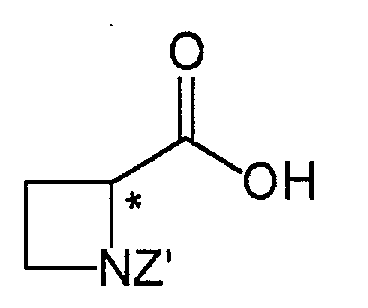 wherein Z' represents a protective group for amino and *
indicates an asymmetric carbon,
wherein Z' represents a protective group for amino and *
indicates an asymmetric carbon,
and then deprotecting Z' to give the optically active azetidincarboxamide compounds of formula (2).
and then deprotecting Z' to give the optically active azetidincarboxamide compounds of formula (2).
The amidation may be conducted in a similar manner as
disclosed by Balboni et al. (Arzneim.-Forsch., 2000, vol. 50,
page 509).
The protection or deprotection of the compounds of the
present invention can be accomplished by introducing or
removing the protecting group by similar methods as disclosed
in Protective Groups in Organic Synthesis, Greene, T.W. 3rd
Edition, Wiley, the whole disclosure of which is
incorporated herein by reference.
Examples of the transition metal represented by M
preferably include rhodium, ruthenium, palladium, iridium,
platinum and the like. Particularly in the asymmetric
reduction reaction of the prochiral unsaturated organic
compounds, rhodium and ruthenium are preferably used.
Examples of counter ion represented by X- preferably
include fluorine ion, chlorine ion, bromine ion, iodine ion,
perchlorate, hexafluorophosphate, tetrafluoroborate,
trifluoromethylbenzenesulfonate, trifluoromethanesulfonate
and the like.
The ligands represented by L1 and L2 may be anyone that
can be coordinated to the transition metal and include carbon
monoxide, nitrogen monoxide, NH2 and the like, as well as
halogen such as chlorine, bromine and the like, olefin ligands,
acetylene ligands, aromatic compound ligands,
organic oxygen-containing compound ligands,
organic sulfur-containing compound ligands,
organic nitrogen-containing compound ligands and the like.
organic oxygen-containing compound ligands,
organic sulfur-containing compound ligands,
organic nitrogen-containing compound ligands and the like.
Examples of the above-mentioned olefin ligands include,
for example, ethylene, allyl, butadiene, cyclohexene,
1,3-cyclohexadiene, 1,5-cyclooctadiene, cyclooctatriene,
norbornadiene, acrylic acid esters, methacrylic acid esters,
cyclopentadienyl, pentamethylcyclopentadienyl and the like.
In addition, 5-membered ring compounds of the following
formula are can also be used as the ligand:
 wherein Ra to Re are same or different and respectively
represent hydrogen, halogen, substituted or unsubstituted
alkyl, substituted or unsubstituted aralkyl, substituted or
unsubstituted aryl, substituted or unsubstituted alkenyl, or
substituted or unsubstituted alkoxyl or alkyloxycarbonyl
group.
wherein Ra to Re are same or different and respectively
represent hydrogen, halogen, substituted or unsubstituted
alkyl, substituted or unsubstituted aralkyl, substituted or
unsubstituted aryl, substituted or unsubstituted alkenyl, or
substituted or unsubstituted alkoxyl or alkyloxycarbonyl
group.
- Specific examples of Ra to Re include, for example,
fluorine, chlorine, bromine and iodine for halogen; methyl,
ethyl, n-propyl, isopropyl, n-butyl, isobutyl, t-butyl,
n-amyl, neopentyl, n-hexyl, cyclohexyl, n-octyl, n-nonyl,
menthyl, 2,3,4-trimethyl-3-pentyl, 2,4-dimethyl-3-pentyl
and the like for the alkyl; benzyl, 2-phenylethyl,
2-naphthylethyl, diphenylmethyl and the like for aralkyl;
phenyl, naphthyl, biphenyl, furyl, thienyl and the like for
the aryl;
2-methyl-1-propenyl, 2-butenyl, trans-β-styryl, 3-phenyl-1-propenyl, 1-cyclohexenyl and the like for alkenyl;
methoxy, ethoxy, n-propoxy, t-butoxy and the like for alkoxyl;
phenoxy and the like for aryloxy; methoxycarbonyl, ethoxycarbonyl, t-butoxycarbonyl, benzyloxycarbonyl and the like for alkyloxycarbonyl;
phenyloxycarbonyl and the like for aryoxycarbonyl.
2-methyl-1-propenyl, 2-butenyl, trans-β-styryl, 3-phenyl-1-propenyl, 1-cyclohexenyl and the like for alkenyl;
methoxy, ethoxy, n-propoxy, t-butoxy and the like for alkoxyl;
phenoxy and the like for aryloxy; methoxycarbonyl, ethoxycarbonyl, t-butoxycarbonyl, benzyloxycarbonyl and the like for alkyloxycarbonyl;
phenyloxycarbonyl and the like for aryoxycarbonyl.
These groups may be further substituted with halogen as
described above; alkoxyl as described above; aryloxy as
described above; lower alkyl such as methyl, ethyl, isopropyl,
n-butyl, t-butyl, n-amyl, n-hexyl or the like; lower
alkylthio such as n-propylthio, t-butylthio or the like;
arylthio such as phenylthio; nitro; or hydroxyl. The number
of substituents is any number between 1 and 5 and location
of substitution can be optioanlly selected.
Examples of acetylene ligands include, for example,
acetylene, 1,2-dimethylacetylene, 1,4-pentadiyne,
1,2-diphenylacetylene and the like.
Examples of the aromatic compound ligands include, for
excample, benzene, p-cymene, mesitylene, hexamethylbenzene,
naphthalene, anthracene and the like.
Examples of the aromatic compounds typically include
cyclic aromatic compounds of the following formula:
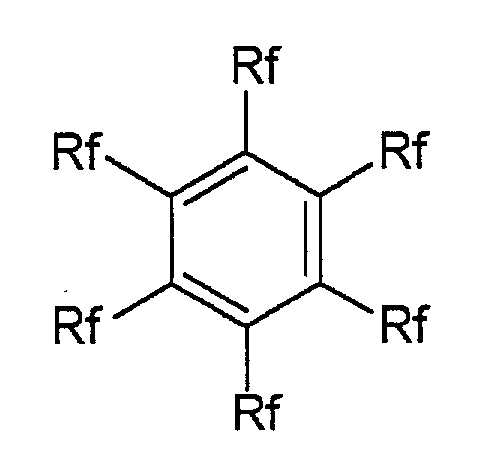 wherein Rf's are same or different and represent hydrogen,
saturated or unsaturated hydrocarbon group, or
heteroatom-containing functional group.
wherein Rf's are same or different and represent hydrogen,
saturated or unsaturated hydrocarbon group, or
heteroatom-containing functional group.
Examples of the saturated hydrocarbon include, for
example, alkyl such as methyl, ethyl, propyl, isopropyl,
butyl, pentyl, hexyl, heptyl and the like; and
cycloalkyl such as cyclopropyl, cyclobutyl, cyclopentyl, cyclohexyl and the like;
cycloalkyl such as cyclopropyl, cyclobutyl, cyclopentyl, cyclohexyl and the like;
Examples of the unsaturated hydrocarbon include, for
example, benzyl, vinyl, allyl, aryl such as a phenyl, or
naphthyl group, and the-like.
Examples of the heteroatom-containing functional group
include, for example, hydroxyl, alkoxyl, alkoxycarbonyl and
the like. The number of substituents is any number between
1 and 6 and location of substitution is optional.
Examples of the organic oxygen-containing compound
ligands include acetate, benzoate, acetylacetonate and the
like.
Examples of the organic sulfur-containing compound
ligands include dimethylsulfoxide, dimethylsulfide,
thiophene, carbon disulfide, carbon sulfide, thiophenol and
the like.
Examples of the organic nitrogen-containing compound
ligands include acetonitrile, benzonitrile,
t-butylisocyanide, pyridine, 1,10-phenanthroline,
2,2'-bipyridyl and the like.
Examples of the bidentate ligand include, for example,
acetylacetonate, 1,3-bis(diphenylphosphino)propane,
2,2'bipyrydyl and the like.
The optically active azetidincarboxamide-coordinated
transition metal complex of formula (1) can be produced by
reacting an optically active azetidincarboxamide of formula
(2) with a transition metal complex of the following formula
(5) :
MYpLs
wherein M represents a transition metal, Y represents
hydrogen, halogen, carboxyl, alkoxy or hydroxy, L represents
the ligand L1 or L2 as described above, and p and s respectively
represent integers of 0 to 6.
Examples of the transition metal complex (5) include,
for example, chlorotris(triphenylphosphine)rhodium(I),
cyclopentadienylbis(triphenylphosphine)rhodium(I),
bis(cyclooctadiene)diiododirhodium(I), chloro(cyclopentadienyl)bis(triphenylphosphine)ruthenium( II), chloro(pentamethylcyclopentadienyl)(1,3-bis(diphenylphosphino)propane)ruthenium(II), chloro(pentamethylcyclopentadienyl)(1,5-cyclooctadiene)-ruthenium(II), chlorotris(triphenylphosphine)iridium(I), pentamethylcyclopentadienylbis(ethylene)iridium(I), (ethylene)bis(triphenylphosphine)platinum(0), trans-[chloro(ethyl)bis(triethylphosphine)platinum(II)], cis-[diethylbis(triethylphosphine)platinum(II)], dichloro(norbornadiene)platinum(II), tetrakis(triphenylphosphine)platinum(0), and the like. The complex that may be suitably used in the invention is not limited to these compounds.
bis(cyclooctadiene)diiododirhodium(I), chloro(cyclopentadienyl)bis(triphenylphosphine)ruthenium( II), chloro(pentamethylcyclopentadienyl)(1,3-bis(diphenylphosphino)propane)ruthenium(II), chloro(pentamethylcyclopentadienyl)(1,5-cyclooctadiene)-ruthenium(II), chlorotris(triphenylphosphine)iridium(I), pentamethylcyclopentadienylbis(ethylene)iridium(I), (ethylene)bis(triphenylphosphine)platinum(0), trans-[chloro(ethyl)bis(triethylphosphine)platinum(II)], cis-[diethylbis(triethylphosphine)platinum(II)], dichloro(norbornadiene)platinum(II), tetrakis(triphenylphosphine)platinum(0), and the like. The complex that may be suitably used in the invention is not limited to these compounds.
The optically active azetidincarboxamide-coordinated
transition metal complex of formula (1) can usually be
produced, for example, by the following processes:
The optically active azetidincarboxamide compound of
formula (2) is typically dissolved in a solvent and the
transition metal complex (5) described above is added thereto.
The obtained reaction solution is concentrated to give the
optically active azetidincarboxamide-coordinated transition
metal complex of formula (1). When the reaction product is
obtained in the form of precipitates, the solid can be
separated. The above procedure is usually carried out in an
atmosphere of inert gas such as argon or the like. The solvent
used in such reaction is not particularly limited insofar as
effect of the invention is not inhibited. Examples the
solvent include, for example, alcohols such as methanol,
isopropanol or the like; ethers such as tetrahydrofuran,
diethyl ether or the like; aromatic hydrocarbons such as
toluene, benzene or the like; aliphatic hydrocarbons such as
hexane, cyclohexane or the like; halogenated hydrocarbons
such as dichloromethane, chloroform, chlorobenzene or the
like; and so on.
Next, the process for producing asymmetric compound
from a prochiral unsaturated compound using the optically
active azetidincarboxamide-coordinated transition metal
complex of formula (1) is described below.
The amount that may be used of the optically active
azetidincarboxamide-coordinated transition metal complex of
formula (1) varies depending on the reaction conditions and
economy. Usually, an amount of about 1/10 to 1/100,000 mol
per mol of the unsaturated organic compound as the reaction
substrate can be used, and preferable amount is within a range
of about 1/50 to 1/10,000.
The prochiral unsaturated organic compound includes
a ketone compound of formula (6):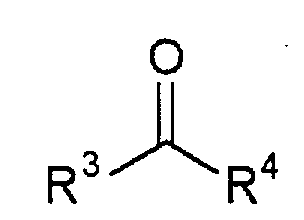 wherein R3 and R4 are different and represent substituted or
unsubstituted alkyl, substituted or unsubstituted aryl or
substituted or unsubstituted aralkyl, or R3 and R4 are combined
together to form an asymmetric cyclic ketone, and
wherein R3 and R4 are different and represent substituted or
unsubstituted alkyl, substituted or unsubstituted aryl or
substituted or unsubstituted aralkyl, or R3 and R4 are combined
together to form an asymmetric cyclic ketone, and
an imine compound of formula (7): wherein R3 and R4 are different and represent
substituted or unsubstituted alkyl, substituted or unsubstituted aryl or substituted or unsubstituted aralkyl,
R5 represents hydrogen, substituted or unsubstituted alkyl, substituted or unsubstituted aryl or substituted or unsubstituted aralkyl, or
R3 and R4, R3 and R5 or R4 and R5 are bonded together to form an asymmetric cyclic imine.
a ketone compound of formula (6):
an imine compound of formula (7):
substituted or unsubstituted alkyl, substituted or unsubstituted aryl or substituted or unsubstituted aralkyl,
R5 represents hydrogen, substituted or unsubstituted alkyl, substituted or unsubstituted aryl or substituted or unsubstituted aralkyl, or
R3 and R4, R3 and R5 or R4 and R5 are bonded together to form an asymmetric cyclic imine.
The imine compound of formula (7) can be obtained by
reacting an amine compound of formula: R5NH2 with the ketone
compound of formula (6) by known manners.
Examples of the alkyl represented by R3, R4 or R5 in the
compounds of the above formulae (6) and (7) include, for
example, alkyl having 1 to 8 carbon atoms (e.g. methyl, ethyl,
propyl, butyl, pentyl, hexyl, heptyl, octyl or the like).
Examples of the aryl in the aryl and the aralkyl group
above include, for example, phenyl, naphthyl, pyridyl,
pyrimidyl, furyl, thienyl and the like.
The alkyl and aryl may be substituted with an alkyl
having 1 to 6 carbon atoms (e.g. methyl, ethyl, porpyl, butyl,
pentyl, hexyl or the like), an alkoxy having 1 to 6 carbon
atoms (e.g. methoxy, ethoxy, porpoxy, butoxy, pentyloxy,
hexyloxy or the like), halogen (e.g. fluorine, chlorine,
bromine, and iodine) or the like.
The alkyl in the aralkyl includes an alkyl group having
1 to 12 carbon atoms (e.g. methyl, ethyl, propyl, butyl, pentyl,
hexyl, heptyl, octyl, nonyl, decyl, undecyl, dodecyl and the
like).
Examples of cyclic ketone which may be substituted of
formula (6) include, for example, cycloalkenone having 5 to
12 carbon atoms, which may be fused with a benzene ring such
as 1-indanone, 2-indanone, 1-tetralone, 2-tetralone,
1-benzosuberone and the like, and the cyclic ketone may be
substituted with an alkyl having 1 to 6 carbon atoms (e.g.
methyl, ethyl, propyl, butyl, pentyl, hexyl or the like), an
alkoxy having 1 to 6 carbon atoms (e.g. methoxy, ethoxy,
propoxy, butoxy, pentyloxy, hexyloxy or the like), halogen
(e.g. fluorine, chlorine, bromine, and iodine) or the like.
Examples of the cyclic imine which may be substituted
of formula (7) formed by combining R3 and R5 or R4 and R5 include
2,3,4,5-tetrahydro-6-methylpyridine,
1-methyl-3,-4-dihydroisoquinoline and the like, and the
cyclic imine may be substituted with alkyl having 1 to 6 carbon
atoms(e.g. methyl, ethyl, propyl, butyl, pentyl, hexyl or the
like), alkoxy having 1 to 6 carbon atoms (e.g. methoxy, ethoxy,
propoxy, butoxy, pentyloxy, hexyloxy or the like), halogen
(e.g. fluorine, chlorine, bromine, or iodine) or the like.
Specific examples of the compounds of the formula (6)
include, for example, acetophenone, propiophenone,
butyrophenone, isobutyrophenone, chloromethylphenylketone,
bromomethylphenylketone, 2-acetylpyridine,
3-acetylpyridine, (o-methoxy)acetophenone,
(o-ethoxy)acetophenone, (o-propoxy)acetophenone,
(o-benzyloxy)acetophenone, α-acetonaphthone,
p-chlorophenyl methyl ketone, p-bromophenyl methyl ketone,
p-cyanophenyl methyl ketone, phenyl benzyl ketone,
phenyl (o-tolylmethyl) ketone, phenyl (m-tolylmethyl) ketone,
phenyl (p-tolylmethyl) ketone, 2-butanone, 2-pentanone,
2-hexanone, 2-heptanone, 2-octanone, 2-nonanone, 2-decanone,
cyclohexyl methyl ketone, cyclohexyl ethyl ketone,
cyclohexyl benzyl ketone, t-butyl methyl ketone,
3-quinuclidinone, 1-indanone, 2-indanone, 1-tetralone,
2-tetralone, benzyl (2-pyridyl) ketone,
benzyl (3-pyridyl) ketone, benzyl (2-thiazolyl) ketone and
the like.
Specific examples of the compounds of the formula (7)
include, for example, 3,4-dihydro-5-phenyl-1H-pyrrole,
2,3,4,5-tetrahydro-6-phenylpyridine,
1-methyl-3,4-dihydroisoquinoline,
6,7-dimethoxy-1-methyl-3,4-dihydroisoquinoline,
1-phenyl-3,4-dihydroisoquinoline,
1-methyl-3,4-dihydro-9H-pyrido[3,4-b]indole,
α-methylbenzylidenebenzylamine and the like.
The ketone compound of formula (6) and the imine
compound of formula (7) are asymmetrically reduced to produce
a chiral organic compound such as a chiral alcohol of formula
(6'):
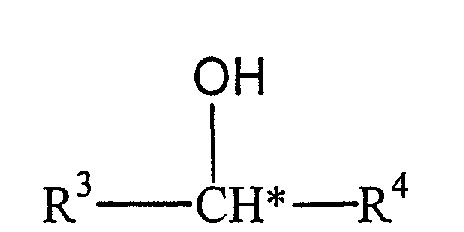 wherein R3 and R4 are the same as defined above and * indicates
an asymmetric carbon atom, or a chiral amine of formula (7') :
wherein R3 and R4 are the same as defined above and * indicates
an asymmetric carbon atom, or a chiral amine of formula (7') :
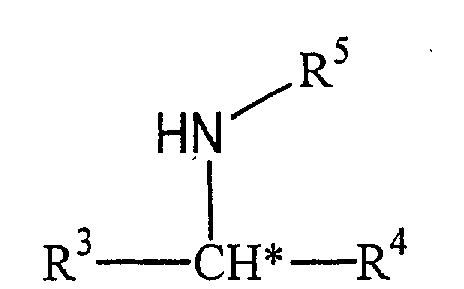 wherein R3, R4 and R5 are the same as defined above and *
indicates an asymmetric carbon atom, respectively.
wherein R3, R4 and R5 are the same as defined above and *
indicates an asymmetric carbon atom, respectively.
In a hydrogen-transfer type reduction reaction, usually
a solvent is used. A solvent that solubilizes raw materials
for the reaction and catalyst system is preferably used.
Additionally, a hydrogen source is required in the
reaction. Examples of the hydrogen source include, for
example, a primary or secondary alcohol, an unsaturated
compound such as cyclohexene, cyclohexadiene, indoline and
the like, formic acid and salts thereof are utilized.
Preferred are secondary alcohols (e.g. isopropanol,
sec-butanol, cyclohexanol, 1-phenethyl alcohol and the like)
and unsaturated compounds, and more preferred are secondary
alcohols.
The reaction temperature is usually -90 to 150°C and
preferably the reaction can be carried out at about -20 to
100°C.
The reaction period varies depending on conditions such
as concentration of the substrate, temperature and the like
and usually the reaction is completed within several hours
to about 30 hours. After completion of the reaction the
product may be separated or isolated in a known manner such
as extraction, phase-separation, distillation and/or
chromatography, if necessary.
In addition, the reaction in the invention can be
carried out either by batch system or by continuous system
as the reaction mode.
Preferred azetidincarboxamide compounds are an
azetidincarboxamide compound of formula (2), wherein either
one of R1 and R2 is hydrogen, more preferred is an
azetidincarboxamide compound of formula(2), wherein R2 is
hydrogen and R1 is substituted or unsubstituted alkyl,
substituted or unsubstituted phenyl or substituted or
unsubstituted naphthyl, and furthermore preferred is an
azetidincarboxamide compound of formula (2), wherein z is
hydrogen in the more preferred compound above.
Specific examples of the optically active
azetidincarboxamide compound of formula (2) of the present
invention include, for example, optically active
N-phenyl-2-azetidinecarboxamide,
N-(1-naphthyl)-2-azetidinecarboxamide,
N-(4-methoxyphenyl)-2-azetidinecarboxamide,
N-(2-fluorophenyl)-2-azetidinecarboxamide and the like.
Azetidincarboxamide compounds of formula (2) wherein R2
is a phenyl group, Z is a hydrogen atom, and R1 is a methyl
group or a hydrogen atom were erroneously disclosed in Table
1, page 504 by Balboni et al. (Arzneim.-Forsch., 2000, vol.
50, page 507-511) despite the fact that the disclosed
compounds should have a pyridyl group in place of the phenyl
group as R2 group in the above-described compounds.
The optically active azetidincarboxamide-coordinated
transition metal complexes of formula (1) include transition
metal complexes derived from the above optically active
azetidincarboxamide compound of formula (2) and the like.
The optically active azetidincarboxamide-coordinated
transition metal complex of formula (1) of the invention is
useful as a catalyst for producing chiral compound from a
prochiral unsaturated organic compounds.
The invention is described below in more detail with
reference to Examples. These Examples should not be
considered as a limitation upon the invention.
Under an argon atmosphere, 1.00 g (4.97 mmol) of
(S)-N-t-butoxycarbonyl-2-azetidinecarboxylic acid was
dissolved in 15 ml of tetrahydrofuran and 502 mg (4.97 mmol)
of triethylamine was added thereto. While stirring the
reaction mixture at 0°C, 539 mg (4.97 mmol) of ethyl
chlorocarbonate was added gradually and dropwise. After the
dropping was completed, the mixture was stirred at 0°C for 30
minutes, and then 463 mg (4.97 mmol) of aniline was added.
After stirring at 0°C for 1 hour, the stirring was continued
at room temperature for 16 hours. The reaction mixture was
stirred under heating to reflux for further 3 hours, and then
cooled to room temperature. Solid was filtered and washed
with ethyl acetate. Then the organic layer was concentrated
and the residue was purified by column chromatography to give
the desired product, i.e., optically active 1.27 g (yield:
93%) of
(S)-1-t-butoxycarbonyl-N-phenyl-2-azetidinecarboxamide in
the form of a white solid.
Into 5 ml of chloroform was dissolved 494 mg (1.79 mmol)
of (S)-1-t-butoxycarbonyl-N-phenyl-2-azetidinecarboxamide
obtained above, and 2 ml of trifluoroacetic acid was gradually
dropped at room temperature. After the dropping was completed,
the mixture was stirred at room temperature for 2 hours. Then
20 ml of toluene was added and the mixture was concentrated
in a rotary evaporator. The residue was adjusted to pH 7 by
addition of 0.1M methanolic sodium hydroxide solution and the
obtained solution was concentrated. The residue was
dissolved in 20 ml of 1N hydrochloric acid and washed with
diethyl ether. The washed residue was made alkaline with
sodium hydroxide and extracted with 20 ml of diethyl ether.
The obtained organic layer was washed with a saturated sodium
hydroxide solution, dried over anhydrous sodium sulfate and
concentrated to give 234 mg (yield: 74%) of
(S)-N-phenyl-2-azetidinecarboxamide in the form of a white
solid. 1H-NMR (heavy chloroform, δ(ppm)): 2.17 (s, 1H),
2.40-2.50 (m, 1H), 2.67-2.73 (m, 1H), 3.32-3.39 (m, 1H), 3.82
(q, J=8.4 Hz, 1H), 4.42 (t, J=8.4 Hz, 1H), 7.11 (t, J=8.4 Hz,
1H), 7.34 (t, J=8.4 Hz, 2H), 7.63 (d, J=8.4 Hz, 2H), 9.55 (s,
1H). 13C-NMR (heavy chloroform, δ(ppm)): 27.66, 44.46, 60.60,
120.37, 125.18, 130.07, 138.79, 173.24.
The procedure for reaction and post-treatment in
Example 1 was repeated except that 1-naphthylamine was used
in place of aniline to give
(S)-N-(1-naphthyl)-2-azetidinecarboxamide. Overall yield:
69%.
1H-NMR (heavy chloroform, δ(ppm)): 2.22 (s, 1H) , 2.50-2.57 (m, 1H), 2.75-2.80 (m, 1H), 3.43-3.50 (m, 1H), 3.88 (q, J=8.5 Hz, 1H), 4.55 (t, J=8.5 Hz, 1H), 7.46-8.29 (m, 7H), 10.40 (s, 1H). 13C-NMR (heavy chloroform, δ(ppm)): 27.15, 43.96, 60.39, 118.28, 120.61, 125.07, 125.22, 126.27, 126.41, 126.53, 129.21, 132.71, 134.45, 172.71.
1H-NMR (heavy chloroform, δ(ppm)): 2.22 (s, 1H) , 2.50-2.57 (m, 1H), 2.75-2.80 (m, 1H), 3.43-3.50 (m, 1H), 3.88 (q, J=8.5 Hz, 1H), 4.55 (t, J=8.5 Hz, 1H), 7.46-8.29 (m, 7H), 10.40 (s, 1H). 13C-NMR (heavy chloroform, δ(ppm)): 27.15, 43.96, 60.39, 118.28, 120.61, 125.07, 125.22, 126.27, 126.41, 126.53, 129.21, 132.71, 134.45, 172.71.
The procedure for reaction and post-treatment in
Example 1 was repeated except that 4-methoxyaniline was used
in place of aniline to give
(S)-N-(4-methoxyphenyl)-2-azetidinecarboxamide. Overall
yield: 63%.
1H-NMR (heavy chloroform, δ(ppm)): 2.17 (s, 1H), 2.40-2.47 (m, 1H), 2.67-2.72 (m, 1H), 3.32-3.38 (m, 1H), 3.80 (s, 3H), 3.78-3.86 (m, 1H), 4.42 (t, J=8.5 Hz, 1H), 6.88 (d, J=9.0 Hz, 2H), 7.55 (d, J=9.0 Hz, 2H), 9.43 (s, 1H). 13C-NMR (heavy chloroform, δ(ppm)): 26.98, 43.76, 55.86, 59.84, 114.52, 121.26, 131.36, 156.58, 172.23.
1H-NMR (heavy chloroform, δ(ppm)): 2.17 (s, 1H), 2.40-2.47 (m, 1H), 2.67-2.72 (m, 1H), 3.32-3.38 (m, 1H), 3.80 (s, 3H), 3.78-3.86 (m, 1H), 4.42 (t, J=8.5 Hz, 1H), 6.88 (d, J=9.0 Hz, 2H), 7.55 (d, J=9.0 Hz, 2H), 9.43 (s, 1H). 13C-NMR (heavy chloroform, δ(ppm)): 26.98, 43.76, 55.86, 59.84, 114.52, 121.26, 131.36, 156.58, 172.23.
The procedure for reaction and post-treatment in
Example 1 was repeated except that 2-fluoroaniline was used
in place of aniline to give
(S)-N-(2-fluorophenyl)-2-azetidinecarboxamide. Overall
yield: 61%.
1H-NMR (heavy chloroform, δ(ppm)): 2.30 (s, 1H), 2.42-2.51 (m, 1H), 2.68-2.73 (m, 1H), 3.35-3.41 (m, 1H), 3.82 (q, J=8.5 Hz, 1H), 4.46 (t, J=8.5 Hz, 1H), 7.02-7.16 (m, 3H), 8.38-8.46(m, 1H), 9.90 (s, 1H). 13C-NMR (heavy chloroform, δ(ppm)): 26.94, 43.80, 60.00, 115.22 (d, JCF=19.0 Hz), 121.41, 124.53 (d, JCF=7.5 Hz), 124.87 (d, JCF=3.7 Hz), 126.64 (d, JCF=10.3 Hz), 153.01 (d, JCF=244.0 Hz), 172.76.
1H-NMR (heavy chloroform, δ(ppm)): 2.30 (s, 1H), 2.42-2.51 (m, 1H), 2.68-2.73 (m, 1H), 3.35-3.41 (m, 1H), 3.82 (q, J=8.5 Hz, 1H), 4.46 (t, J=8.5 Hz, 1H), 7.02-7.16 (m, 3H), 8.38-8.46(m, 1H), 9.90 (s, 1H). 13C-NMR (heavy chloroform, δ(ppm)): 26.94, 43.80, 60.00, 115.22 (d, JCF=19.0 Hz), 121.41, 124.53 (d, JCF=7.5 Hz), 124.87 (d, JCF=3.7 Hz), 126.64 (d, JCF=10.3 Hz), 153.01 (d, JCF=244.0 Hz), 172.76.
Under an argon atmosphere, 215 mg (1.22 mmol) of
(S)-N-phenyl-2-azetidinecarboxamide obtained in Example 1
was dissolved in 7 ml of anhydrous isopropanol and 337 mg (0.55
mmol) of dichlororuthenium (p-cymene) complex
[RuCl2(p-cymene)]2 was added thereto. Then, 246 mg (2.44 mmol)
of triethylamine was added. The obtained mixture was stirred
with heating at 80°C for 1 hour. Then, the solution was
concentrated and anhydrous diethyl ether was added to the
residue to give (S)-N-phenyl-2-azetidinecarboxamide
chlororuthenium (p-cymene) complex in the form of yellowish
orange powders in a quantitative yield.
MS (EI, m/e): 446, 410, 234, 134.
Under an argon atmosphere, 2.4 mg (0.005 mmol) of
(S)-N-phenyl-2-azetidinecarboxamide chlororuthenium
(p-cymene) complex obtained in Example 5 and 62.6 mg (0.5
mmol) of 3-quinuclidinone were dissolved in 2 ml of
isopropanol. To the obtained solution was added 20 µl (0.01
mmol) of 0.5M potassium hydroxide solution in isopropanol and
allowed to react at 0°C for 6 hours. After the reaction was
completed, The reaction mixture was concentrated and the
residue was purified by silica gel column chromatography to
give the desired product, i.e., optically active
3-quinuclidinol. The analysis of the optical purity of the
product with HPLC having an optically active stationary phase
showed a purity of 64% ee. The conversion was 99%.
The procedure in Example 6 was repeated except that
(S)-N-(1-naphthyl)-2-azetidinecarboxamide chlororuthenium
(p-cymene) complex (0.005 mmol) was used as the catalyst and
the reaction temperature was changed to 30°C to give optically
active 3-quinuclidinol (optical purity: 23%ee). The
conversion was 99%.
The procedure in Example 6 was repeated except that
(S)-N-(4-methoxyphenyl)-2-azetidinecarboxamide
chlororuthenium (p-cymene) complex (0.005 mmol) was used as
the catalyst and the reaction temperature was changed to 30°C
to give optically active 3-quinuclidinol (optical purity:
52%ee). The conversion was 99%.
The procedure in Example 6 was repeated except that
(S)-N-(2-fluorophenyl)-2-azetidinecarboxamide
chlororuthenium (p-cymene) complex (0.005 mmol) was used as
the catalyst and the reaction temperature was changed to 30°C
to give optically active 3-quinuclidinol (optical purity:
46%ee). The conversion was 99%.
The procedure in Example 6 was repeated except that
acetophenone (0.5 mmol) was used in place of 3-quinuclidinone
and the reaction temperature was changed to 30°C to give
optically active phenylethanol (optical purity: 68%ee). The
conversion was 94%.
Claims (11)
- An optically active azetidincarboxamide-coordinated transition metal complex of formula (1):wherein R1 and R2 each independently represent hydrogen,

substituted or unsubstituted alkyl,
substituted or unsubstituted aralkyl or
substituted or unsubstituted aryl;
Z represents hydrogen or a protective group for amino;
M represents a transition metal,
X- represents a counter ion,
m represents an integer of 0 to 4, n represents 0 or 1, L1 and L2 each independently represent a ligand or are bonded together to represent a bidentate ligand and * indicates that the marked atom is an asymmetric carbon atom. - An optically active azetidincarboxamide compound of formula (2):wherein R1 and R2 each independently represent hydrogen,

substituted or unsubstituted alkyl,
substituted or unsubstituted aralkyl or
substituted or unsubstituted aryl;
Z represents hydrogen or a protective group for amino; and * indicates an asymmetric carbon. - The optically active azetidincarboxamide compound according to claim 2, wherein either one of R1 and R2 is hydrogen.
- The optically active azetidincarboxamide compound according to claim 2 or 3, wherein R2 is hydrogen and R1 is substituted or unsubstituted alkyl, substituted or unsubstituted phenyl or substituted or unsubstituted naphthyl.
- The optically active azetidincarboxamide compound according to claim 2 or 3, wherein Z is hydrogen.
- The optically active azetidincarboxamide compound according to claim 4, wherein Z is hydrogen.
- A process for asymmetrically reducing a prochiral unsaturated organic compound, which comprises hydrogenating a prochiral unsaturated organic compound in the presence of the optically active azetidincarboxamide-coordinated transition metal complex of claim 1, thereby producing a corresponding chiral organic compound.
- The process according to claim 7, wherein the unsaturated organic compound is a ketone compound or an imine compound.
- The process according to claim 7 or 8, wherein the reaction is conducted in the presence of a hydrogen source.
- The process according to claim 9, wherein the hydrogen source is a secondary alcohol.
- The process according to claim 10, wherein the secondary alcohol is isopropanol.
Applications Claiming Priority (2)
| Application Number | Priority Date | Filing Date | Title |
|---|---|---|---|
| JP2001379814A JP2003176266A (en) | 2001-12-13 | 2001-12-13 | Optically active azetidine amide coordinated transition metal complexes and uses |
| JP2001379814 | 2001-12-13 |
Publications (1)
| Publication Number | Publication Date |
|---|---|
| EP1319660A1 true EP1319660A1 (en) | 2003-06-18 |
Family
ID=19186993
Family Applications (1)
| Application Number | Title | Priority Date | Filing Date |
|---|---|---|---|
| EP02026925A Withdrawn EP1319660A1 (en) | 2001-12-13 | 2002-12-03 | Optically active azetidincarboxamide-coordinated transition metal complexes as catalysts in asymmetric reduction |
Country Status (3)
| Country | Link |
|---|---|
| US (1) | US20030120088A1 (en) |
| EP (1) | EP1319660A1 (en) |
| JP (1) | JP2003176266A (en) |
Families Citing this family (3)
| Publication number | Priority date | Publication date | Assignee | Title |
|---|---|---|---|---|
| EP2186812B1 (en) * | 2007-09-06 | 2013-07-03 | Nippon Soda Co., Ltd. | Production process of optically active 3-quinuclidinol derivative |
| US9174899B2 (en) | 2011-10-25 | 2015-11-03 | Hamari Chemicals, Ltd. | Method for producing optically active alcohols |
| KR102038619B1 (en) | 2013-01-08 | 2019-10-30 | 삼성전자주식회사 | Redox flow battery |
Citations (2)
| Publication number | Priority date | Publication date | Assignee | Title |
|---|---|---|---|---|
| US5744606A (en) * | 1996-01-19 | 1998-04-28 | Lonza Ag | Process for the preparation of optically active 3-quinuclidinol |
| EP0863212A2 (en) * | 1997-03-04 | 1998-09-09 | Daicel Chemical Industries, Ltd. | Processes for production of optical active quinuclidinol |
-
2001
- 2001-12-13 JP JP2001379814A patent/JP2003176266A/en active Pending
-
2002
- 2002-12-03 EP EP02026925A patent/EP1319660A1/en not_active Withdrawn
- 2002-12-11 US US10/315,987 patent/US20030120088A1/en not_active Abandoned
Patent Citations (2)
| Publication number | Priority date | Publication date | Assignee | Title |
|---|---|---|---|---|
| US5744606A (en) * | 1996-01-19 | 1998-04-28 | Lonza Ag | Process for the preparation of optically active 3-quinuclidinol |
| EP0863212A2 (en) * | 1997-03-04 | 1998-09-09 | Daicel Chemical Industries, Ltd. | Processes for production of optical active quinuclidinol |
Non-Patent Citations (4)
| Title |
|---|
| "Balboni et al", ARZNEIMITTELFORSCHUNG, vol. 50, 2000, pages 507 - 511, XP001121111 * |
| BOGGIAN, M; VERTUANI, G. ET AL: "The formyl tripeptides containing 2-azetidine carboxylic acid", FARMACO, vol. 52, no. 6-7, 1977, pages 439-444, XP009005071 * |
| FUGITA ET AL: "2-aminometyl-1-azetidinyl derivatives", CHEM.PHARM.BULL., vol. 46, no. 5, 1998, pages 787 - 796, XP001097261 * |
| HAE YOON RHYOO ET AL, TETRAHEDRON LETTERS, vol. 42, 25 May 2001 (2001-05-25), pages 5045 - 5048, XP002232726 * |
Also Published As
| Publication number | Publication date |
|---|---|
| JP2003176266A (en) | 2003-06-24 |
| US20030120088A1 (en) | 2003-06-26 |
Similar Documents
| Publication | Publication Date | Title |
|---|---|---|
| AU2019346118B2 (en) | Manufacture of compounds and compositions for inhibiting the activity of SHP2 | |
| EP3390421B1 (en) | Metal complexes | |
| US7323565B2 (en) | Method for the catalytic production of hydrocodone and hydromorphone | |
| EP4178962B1 (en) | Manufacture of compounds and compositions for inhibiting the activity of shp2 | |
| EP1849792B1 (en) | Biphosphine ruthenium complexes with chiral diamine ligands as catalysts | |
| Lesma et al. | New solution free and polymer anchored chiral bispidine-based amino alcohols. Synthesis and screening for the enantioselective addition of diethylzinc to benzaldehyde | |
| EP2773611B1 (en) | Method for producing optically active -hydroxy- -aminocarboxylic acid ester | |
| US20030120088A1 (en) | Optically active azetidincarboxamide-coordinated transition metal complexes | |
| US6187961B1 (en) | Process for the preparation of trans-(R,R)-actinol | |
| JP3159661B2 (en) | Method for producing optically active alcohols | |
| JP7588082B2 (en) | Amination agent and method for producing amination product | |
| Mul et al. | Hydrogenation of the two diastereomers of the 66-electron linear cluster Ru4 (CO) 10 [R1C: C (H) C (H): NR2] 2. Hydrogen-transfer reactions and the molecular structure of the only isolable diastereomer of the 64-electron butterfly cluster (. mu.-H) 2Ru4 (CO) 8 [CH3C: C (H) C (H): N-iso-Pr] 2 | |
| JP4182242B2 (en) | Optically active azetidine methanol phosphine coordination transition metal complexes, intermediates, processes and applications | |
| RU2797951C2 (en) | Production of compounds and compositions for suppression of shp2 activity | |
| US6762306B2 (en) | Chiral ligand | |
| Slak | The Development of Chiral Titanocenes as Photoredox Catalysts | |
| CA2556962A1 (en) | Chiral tertiary aminoalkylnaphthols | |
| KR100435525B1 (en) | Asymmetric Transfer Hydrogenation of Aromatic Ketones | |
| JP2004067514A (en) | 2-amino-1-cyclopentanolphosphine coordinated transition metal complex and method for producing the same | |
| CN117049999A (en) | A kind of preparation method of nematvir intermediate | |
| JP2001294594A (en) | Phosphine-containing amino compound, method for producing the same, ruthenium complex and method for producing alcohol | |
| JP2025134168A (en) | Copper-catalyzed stereospecific cyanation reactions | |
| HK40084841A (en) | Manufacture of compounds and compositions for inhibiting the activity of shp2 | |
| HK40084841B (en) | Manufacture of compounds and compositions for inhibiting the activity of shp2 | |
| JP2006248952A (en) | Production method of ketone |
Legal Events
| Date | Code | Title | Description |
|---|---|---|---|
| PUAI | Public reference made under article 153(3) epc to a published international application that has entered the european phase |
Free format text: ORIGINAL CODE: 0009012 |
|
| AK | Designated contracting states |
Designated state(s): AT BE BG CH CY CZ DE DK EE ES FI FR GB GR IE IT LI LU MC NL PT SE SI SK TR |
|
| AX | Request for extension of the european patent |
Extension state: AL LT LV MK RO |
|
| 17P | Request for examination filed |
Effective date: 20031210 |
|
| 17Q | First examination report despatched |
Effective date: 20040123 |
|
| AKX | Designation fees paid |
Designated state(s): CH DE FR GB LI NL |
|
| STAA | Information on the status of an ep patent application or granted ep patent |
Free format text: STATUS: THE APPLICATION IS DEEMED TO BE WITHDRAWN |
|
| 18D | Application deemed to be withdrawn |
Effective date: 20040603 |