EP1319549A2 - A seat weight measuring apparatus - Google Patents
A seat weight measuring apparatus Download PDFInfo
- Publication number
- EP1319549A2 EP1319549A2 EP02025007A EP02025007A EP1319549A2 EP 1319549 A2 EP1319549 A2 EP 1319549A2 EP 02025007 A EP02025007 A EP 02025007A EP 02025007 A EP02025007 A EP 02025007A EP 1319549 A2 EP1319549 A2 EP 1319549A2
- Authority
- EP
- European Patent Office
- Prior art keywords
- base frame
- seat
- rail
- measuring apparatus
- stopper bolt
- Prior art date
- Legal status (The legal status is an assumption and is not a legal conclusion. Google has not performed a legal analysis and makes no representation as to the accuracy of the status listed.)
- Withdrawn
Links
- 230000009979 protective mechanism Effects 0.000 claims abstract description 17
- 230000003014 reinforcing effect Effects 0.000 claims description 13
- 230000002787 reinforcement Effects 0.000 claims description 6
- 239000011347 resin Substances 0.000 claims description 4
- 229920005989 resin Polymers 0.000 claims description 4
- 229910000831 Steel Inorganic materials 0.000 description 11
- 239000010959 steel Substances 0.000 description 11
- 230000000694 effects Effects 0.000 description 5
- 238000003780 insertion Methods 0.000 description 5
- 230000037431 insertion Effects 0.000 description 5
- 229910052751 metal Inorganic materials 0.000 description 5
- 239000002184 metal Substances 0.000 description 5
- 150000002739 metals Chemical class 0.000 description 5
- 238000003466 welding Methods 0.000 description 4
- 238000005452 bending Methods 0.000 description 3
- 230000000052 comparative effect Effects 0.000 description 3
- 238000001514 detection method Methods 0.000 description 3
- 229920006362 Teflon® Polymers 0.000 description 2
- 238000010276 construction Methods 0.000 description 2
- 230000002452 interceptive effect Effects 0.000 description 2
- 210000003739 neck Anatomy 0.000 description 2
- 230000002093 peripheral effect Effects 0.000 description 2
- 230000001012 protector Effects 0.000 description 2
- 230000037396 body weight Effects 0.000 description 1
- 238000006243 chemical reaction Methods 0.000 description 1
- 230000001419 dependent effect Effects 0.000 description 1
- 239000000428 dust Substances 0.000 description 1
- 210000005069 ears Anatomy 0.000 description 1
- 230000006870 function Effects 0.000 description 1
- 238000000034 method Methods 0.000 description 1
- 239000002245 particle Substances 0.000 description 1
Images







Classifications
-
- B—PERFORMING OPERATIONS; TRANSPORTING
- B60—VEHICLES IN GENERAL
- B60R—VEHICLES, VEHICLE FITTINGS, OR VEHICLE PARTS, NOT OTHERWISE PROVIDED FOR
- B60R21/00—Arrangements or fittings on vehicles for protecting or preventing injuries to occupants or pedestrians in case of accidents or other traffic risks
- B60R21/01—Electrical circuits for triggering passive safety arrangements, e.g. airbags, safety belt tighteners, in case of vehicle accidents or impending vehicle accidents
- B60R21/015—Electrical circuits for triggering passive safety arrangements, e.g. airbags, safety belt tighteners, in case of vehicle accidents or impending vehicle accidents including means for detecting the presence or position of passengers, passenger seats or child seats, and the related safety parameters therefor, e.g. speed or timing of airbag inflation in relation to occupant position or seat belt use
- B60R21/01512—Passenger detection systems
- B60R21/01516—Passenger detection systems using force or pressure sensing means
-
- B—PERFORMING OPERATIONS; TRANSPORTING
- B60—VEHICLES IN GENERAL
- B60N—SEATS SPECIALLY ADAPTED FOR VEHICLES; VEHICLE PASSENGER ACCOMMODATION NOT OTHERWISE PROVIDED FOR
- B60N2/00—Seats specially adapted for vehicles; Arrangement or mounting of seats in vehicles
- B60N2/002—Seats provided with an occupancy detection means mounted therein or thereon
- B60N2/0021—Seats provided with an occupancy detection means mounted therein or thereon characterised by the type of sensor or measurement
- B60N2/0024—Seats provided with an occupancy detection means mounted therein or thereon characterised by the type of sensor or measurement for identifying, categorising or investigation of the occupant or object on the seat
- B60N2/0025—Seats provided with an occupancy detection means mounted therein or thereon characterised by the type of sensor or measurement for identifying, categorising or investigation of the occupant or object on the seat by using weight measurement
-
- B—PERFORMING OPERATIONS; TRANSPORTING
- B60—VEHICLES IN GENERAL
- B60N—SEATS SPECIALLY ADAPTED FOR VEHICLES; VEHICLE PASSENGER ACCOMMODATION NOT OTHERWISE PROVIDED FOR
- B60N2/00—Seats specially adapted for vehicles; Arrangement or mounting of seats in vehicles
- B60N2/002—Seats provided with an occupancy detection means mounted therein or thereon
- B60N2/0021—Seats provided with an occupancy detection means mounted therein or thereon characterised by the type of sensor or measurement
- B60N2/003—Seats provided with an occupancy detection means mounted therein or thereon characterised by the type of sensor or measurement characterised by the sensor mounting location in or on the seat
- B60N2/0031—Seats provided with an occupancy detection means mounted therein or thereon characterised by the type of sensor or measurement characterised by the sensor mounting location in or on the seat mounted on the frame
-
- B—PERFORMING OPERATIONS; TRANSPORTING
- B60—VEHICLES IN GENERAL
- B60N—SEATS SPECIALLY ADAPTED FOR VEHICLES; VEHICLE PASSENGER ACCOMMODATION NOT OTHERWISE PROVIDED FOR
- B60N2/00—Seats specially adapted for vehicles; Arrangement or mounting of seats in vehicles
- B60N2/02—Seats specially adapted for vehicles; Arrangement or mounting of seats in vehicles the seat or part thereof being movable, e.g. adjustable
- B60N2/04—Seats specially adapted for vehicles; Arrangement or mounting of seats in vehicles the seat or part thereof being movable, e.g. adjustable the whole seat being movable
- B60N2/06—Seats specially adapted for vehicles; Arrangement or mounting of seats in vehicles the seat or part thereof being movable, e.g. adjustable the whole seat being movable slidable
- B60N2/07—Slide construction
- B60N2/0702—Slide construction characterised by its cross-section
- B60N2/0715—C or U-shaped
-
- B—PERFORMING OPERATIONS; TRANSPORTING
- B60—VEHICLES IN GENERAL
- B60N—SEATS SPECIALLY ADAPTED FOR VEHICLES; VEHICLE PASSENGER ACCOMMODATION NOT OTHERWISE PROVIDED FOR
- B60N2/00—Seats specially adapted for vehicles; Arrangement or mounting of seats in vehicles
- B60N2/02—Seats specially adapted for vehicles; Arrangement or mounting of seats in vehicles the seat or part thereof being movable, e.g. adjustable
- B60N2/04—Seats specially adapted for vehicles; Arrangement or mounting of seats in vehicles the seat or part thereof being movable, e.g. adjustable the whole seat being movable
- B60N2/06—Seats specially adapted for vehicles; Arrangement or mounting of seats in vehicles the seat or part thereof being movable, e.g. adjustable the whole seat being movable slidable
- B60N2/07—Slide construction
- B60N2/0722—Constructive details
- B60N2/0732—Attachment of seat frame to the slide, e.g. eyelets
-
- B—PERFORMING OPERATIONS; TRANSPORTING
- B60—VEHICLES IN GENERAL
- B60R—VEHICLES, VEHICLE FITTINGS, OR VEHICLE PARTS, NOT OTHERWISE PROVIDED FOR
- B60R21/00—Arrangements or fittings on vehicles for protecting or preventing injuries to occupants or pedestrians in case of accidents or other traffic risks
- B60R21/01—Electrical circuits for triggering passive safety arrangements, e.g. airbags, safety belt tighteners, in case of vehicle accidents or impending vehicle accidents
- B60R21/015—Electrical circuits for triggering passive safety arrangements, e.g. airbags, safety belt tighteners, in case of vehicle accidents or impending vehicle accidents including means for detecting the presence or position of passengers, passenger seats or child seats, and the related safety parameters therefor, e.g. speed or timing of airbag inflation in relation to occupant position or seat belt use
- B60R21/01512—Passenger detection systems
- B60R21/01516—Passenger detection systems using force or pressure sensing means
- B60R21/0152—Passenger detection systems using force or pressure sensing means using strain gauges
-
- G—PHYSICS
- G01—MEASURING; TESTING
- G01G—WEIGHING
- G01G19/00—Weighing apparatus or methods adapted for special purposes not provided for in the preceding groups
- G01G19/40—Weighing apparatus or methods adapted for special purposes not provided for in the preceding groups with provisions for indicating, recording, or computing price or other quantities dependent on the weight
- G01G19/413—Weighing apparatus or methods adapted for special purposes not provided for in the preceding groups with provisions for indicating, recording, or computing price or other quantities dependent on the weight using electromechanical or electronic computing means
- G01G19/414—Weighing apparatus or methods adapted for special purposes not provided for in the preceding groups with provisions for indicating, recording, or computing price or other quantities dependent on the weight using electromechanical or electronic computing means using electronic computing means only
- G01G19/4142—Weighing apparatus or methods adapted for special purposes not provided for in the preceding groups with provisions for indicating, recording, or computing price or other quantities dependent on the weight using electromechanical or electronic computing means using electronic computing means only for controlling activation of safety devices, e.g. airbag systems
-
- G—PHYSICS
- G01—MEASURING; TESTING
- G01G—WEIGHING
- G01G23/00—Auxiliary devices for weighing apparatus
- G01G23/005—Means for preventing overload
-
- B—PERFORMING OPERATIONS; TRANSPORTING
- B60—VEHICLES IN GENERAL
- B60N—SEATS SPECIALLY ADAPTED FOR VEHICLES; VEHICLE PASSENGER ACCOMMODATION NOT OTHERWISE PROVIDED FOR
- B60N2210/00—Sensor types, e.g. for passenger detection systems or for controlling seats
- B60N2210/10—Field detection presence sensors
- B60N2210/12—Capacitive; Electric field
-
- B—PERFORMING OPERATIONS; TRANSPORTING
- B60—VEHICLES IN GENERAL
- B60N—SEATS SPECIALLY ADAPTED FOR VEHICLES; VEHICLE PASSENGER ACCOMMODATION NOT OTHERWISE PROVIDED FOR
- B60N2210/00—Sensor types, e.g. for passenger detection systems or for controlling seats
- B60N2210/40—Force or pressure sensors
- B60N2210/42—Strain gauges
Definitions
- the present invention relates to an apparatus for measuring a seat weight including the weight of a passenger sitting on a vehicle seat.
- the present invention relates to a seat weight measuring apparatus which has enough strength against load in a direction in which a rear side of the vehicle seat is lifted.
- Automobiles are equipped with seat belt devices and airbag devices to secure safety for passengers in the automobiles.
- these safety devices depending on the weight (body weight) of a passenger in order to improve the performance of seat belt devices and/or airbag devices.
- the amount of gas for deploying the airbag, the airbag inflating speed, or the pretension load of the seat belt may be adjusted depending on the weight of the passenger. For that purpose, it is necessary to somehow measure the weight of the passenger sitting on the seat.
- An example for achieving the object is a seat weight measuring apparatus employing strain gauges as load sensors.
- Load sensors to be used for this purpose are required to have both enough high accuracy of detection and enough fracture strength.
- the accuracy of detection required for the load sensor against the load in the gravitational direction is a level enabling a load variation about 100g to be detected. It is required that the accuracy is not affected when a load of 100 kg is applied in any direction other than the gravitational direction.
- the strength of the load sensor it is required that the sensor is not broken even when it is subjected to a large load in the event of a vehicle collision. Examples of load sensors satisfying the abovementioned conditions are disclosed in Japanese Patent Unexamined Publication No.
- large negative G may be applied to a vehicle body so as to create a moment lifting up the rear side of a vehicle seat in the event of vehicle collision.
- the first seat weight measuring apparatus of the present invention is a seat weight measuring apparatus for measuring a seat weight including the weight of a passenger sitting on a vehicle seat, comprising: a base frame fixed to a vehicle floor; front and rear rail brackets which are located near front and rear ends of said base frame, respectively and are connected to a seat rail which is slidable in the frontward and rearward directions of the vehicle; and a sensor portion which is mounted on said base frame for detecting the load applied from said rail brackets to said base frame, wherein said sensor portion comprises a distortion sensor fixed at the middle in the longitudinal direction of said base frame; and arms which are disposed at a front portion and a rear portion of said base frame, respectively, to extend in the longitudinal direction, each arm is provided at its one end (the center-side end) with a press portion for transmitting force to said distortion sensor and at its other end (its front or rear end) with a connecting portion relative to said each rail bracket, and is characterized in that protective mechanisms are disposed around said front and rear rail brackets
- the second seat weight measuring apparatus of the present invention is a seat weight measuring apparatus for measuring a seat weight including the weight of a passenger sitting on a vehicle seat, comprising: a base frame fixed to a lower side of a seat frame below said vehicle seat; front and rear rail brackets which are located near front and rear ends of said base frame, respectively and are connected to a seat rail which is slidable in the frontward and rearward directions of the vehicle; and a sensor portion which is mounted on said base frame for detecting the load applied from said rail brackets to said base frame, wherein said sensor portion comprises: a distortion sensor fixed at the middle in the longitudinal direction of said base frame; and arms which are disposed at a front portion and a rear portion of said base frame, respectively, to extend in the longitudinal direction, each arm is provided at its one end (the center-side end) with a press portion for transmitting force to said distortion sensor and at its other end (its front or rear end) with a connecting portion relative to said each rail bracket, and is characterized in that protective mechanisms are disposed around said front
- the apparatus When large negative G is applied to a vehicle body, for example, in the event of vehicle collision, a moment is created to incline a vehicle seat toward the front so that the rear side of the vehicle seat is lifted.
- the reinforcing member for providing reinforcement against the load of lifting the rail brackets or the base frame upward is provided, the apparatus has higher load withstand capability in a direction of lifting up the rear side of the vehicle seat.
- the first seat weight measuring apparatus of the present invention is mounted between the seat rail and the vehicle floor, while the second seat weight measuring apparatus is mounted between the seat rail and the vehicle seat.
- the purpose of the seat weight measuring apparatus described in this specification is basically to measure the weight of a passenger on the vehicle seat. Therefore, an apparatus which measures the weight of a passenger with eliminating the weight of the vehicle seat itself is included in the seat weight measuring apparatus described in this specification.
- said protective mechanism at the rear side comprises: a first stopper bolt which connects said rail bracket and said arm in such a manner as to allow the pivotal movement of them and is stopped by said base frame in the event of excessive load, and a second stopper bolt as said reinforcing member which transmits said excessive load between said rail bracket and said base frame or the vehicle floor to prevent the deformation of the apparatus due to the excessive load. That is, the first stopper bolt takes a task of transmitting load from the rail bracket to the arm and also takes a task of bearing the excessive load, while the second stopper bolt is a member used exclusively for reinforcing the protective mechanism.
- said second stopper bolt bears the most of the excessive load exerted on the rail bracket and the base frame. Therefore, though it is simple in structure just by using the stopper bolts, the reinforcement of the mounting structure of the seat weight measuring apparatus can be realized. By employing nuts for fastening the stopper bolts, the mounting operation can be securely facilitated.
- said second stopper bolt may be fixed to said base frame or the vehicle floor and may be loosely fitted to said rail bracket, and said first stopper bolt may be loosely fitted to said base frame.
- the second stopper bolt does not move relative to the base frame and the vehicle floor, thereby facilitating the structure.
- said second stopper bolt may be positioned right above or right below the connecting portion of said seat rail and said seat bracket.
- said reinforcing member may be fixed directly to the seat bracket on said vehicle floor, and said excessive load can be transmitted from said rail bracket to said seat bracket through said reinforcing member.
- the excessive load is transmitted directly to a member (for example, the seat bracket) of the vehicle floor via the second stopper bolt, thereby further providing advantages for the strength.
- said seat rail and said rail bracket may be connected to each other by rivet(s), the vertical center line of said rivet(s) may be shifted from the vertical center line of said first stopper bolt, and the vertical center line of said rivet(s) may substantially coincides with the vertical center line of said second stopper bolt.
- the seat weight measuring apparatus and the seat rail are riveted together.
- the first stopper bolt and the arm do not interfere the riveting work because the positions of the rivets are shifted from the positions of the first stopper bolt and the rear ends of the arm.
- the vertical center lines of the rivets and the second stopper bolt substantially coincide with each other, little force of breaking the rivets and little moment of bending the rail bracket are created. That is, the apparatus has a structure which is uniform in strength.
- a seat weight measuring apparatus for measuring a seat weight including the weight of a passenger sitting on a vehicle seat, comprising: a base frame extending in the frontward and rearward directions of the vehicle; rail brackets which are located near front and rear ends of the base frame, respectively, to interpose between the base frame and a seat rail which is slidable in the frontward and rearward directions of the vehicle; and a sensor portion which is mounted on said base frame, wherein said sensor portion comprises: a distortion sensor fixed at the middle in the longitudinal direction of said base frame; and arms which are disposed at a front portion and a rear portion of said base frame, respectively, to extend in the longitudinal direction, each arm is provided at its one end (the center-side end) with a press portion for transmitting force to said distortion sensor and at its other end (its front or rear end) with a connecting portion relative to said each rail bracket, and is characterized in that tip ends of the press portions of said arms are covered with resin caps.
- noises contact noise between metals generated when the press portions of the arms collide with the distortion sensor can be nearly completely absorbed, thereby preventing the passenger sitting on the seat from hearing jarring sounds.
- Fig. 1 is an exploded perspective view showing the general structure of a seat weight measuring apparatus according to the first embodiment of the present invention.
- Fig. 2 is an exploded perspective view showing the structure of a sensor portion of the seat weight measuring apparatus according to the first embodiment of the present invention.
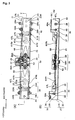
- Figs. 3(A), 3(B) are illustrations showing the general structure (in the assembled state) of the seat weight measuring apparatus according to the first embodiment of the present invention, wherein Fig. 3(A) is a plan view thereof and Fig. 3(B) is a sectional view taken along a line X-X of Fig. 3(A).
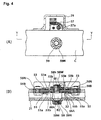
- Figs. 4(A), 4(B) are enlarged views showing detail structure about the sensor portion of the seat weight measuring apparatus according to the first embodiment of the present invention, wherein Fig. 4(A) is a plan view thereof and Fig. 4(B) is a sectional view taken along a line Y-Y of Fig. 4(A).
- Figs. 5(A), 5(B) are enlarged perspective views of a rear end portion of the seat weight measuring apparatus according to the first embodiment of the present invention, wherein Fig. 5(A) is an illustration showing it in the exploded state and Fig. 5(B) is an illustration showing it in the assembled state.
- Figs. 6(A), 6(B) are enlarged front sectional views of a bolt-mounting portion of the seat weight measuring apparatus according to the first embodiment of the present invention, wherein Fig. 6(A) is a sectional view taken along the axis of a front stopper bolt and Fig. 6(B) is a sectional view taken along the axis of a pivot bolt.
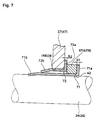
- Fig. 7 is an enlarged sectional view schematically showing a portion about a double sleeve in an exaggerated way.
- Fig. 8 is a side view schematically showing a whole vehicle seat provided with the seat weight measuring apparatus according to the first embodiment of the present invention.
- Figs. 9(A), 9(B) are side sectional views showing an example of a rear end portion of a base frame of a seat weight measuring apparatus according to the first embodiment of the present invention as a comparative example, wherein Fig. 9(A) shows the normal state and Fig. 9(B) shows a state after a force in a direction of lifting the seat is exerted.
- Figs. 10(A), 10(B) are side sectional views showing the rear end portion of the base frame of the seat weight measuring apparatus according to the first embodiment of the present invention, wherein Fig. 10(A) shows the normal state and Fig. 10(B) shows a state after a force in a direction of lifting the seat is exerted.
- Fig. 11 is an exploded perspective view showing the general structure of a seat weight measuring apparatus according to the second embodiment of the present invention.
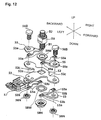
- Fig. 12 is an exploded perspective view showing the structure of a sensor portion of the seat weight measuring apparatus according to the second embodiment of the present invention.
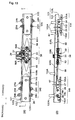
- Figs. 13(A), 13(B) are illustrations showing the general structure (in the assembled state) of the seat weight measuring apparatus according to the second embodiment of the present invention, wherein Fig. 13(A) is a plan view thereof and Fig. 13(B) is a sectional view taken along a line X-X of Fig. 13(A).
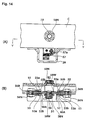
- Figs. 14(A), 14(B) are enlarged views showing detail structure about the sensor portion of the seat weight measuring apparatus according to the second embodiment of the present invention, wherein Fig. 14(A) is a plan view thereof and Fig. 14(B) is a sectional view taken along a line Y-Y of Fig. 14(A).
- Fig. 15 is a side view schematically showing a whole vehicle seat provided with the seat weight measuring apparatus according to the second embodiment of the present invention.
- the upward and downward directions mean the gravitational directions
- the forward and backward directions mean the forward and backward directions of a vehicle
- the leftward and rightward directions mean the leftward and rightward directions for a driver in the vehicle.
- Fig. 8 shows a vehicle seat 1.
- the vehicle seat 1 has a seat cushion 1a on which a person can sits.
- a seat pan 2 made of a steel plate is disposed beneath the seat cushion 1a.
- the seat pan 2 extends to cover the lower surface of the seat cushion 1a.
- side frames 3 made of steel plates extend downwardly from the seat pan 2.
- Each of the side frames 3 is connected at its lower side to a seat rail 8.
- the seat rail 8 is a combination of an upper rail 11 and a lower rail 15 which are arranged to slide each other in the forward and backward directions.
- the lower rail 15 is connected at its lower side to a seat weight measuring apparatus 10 via front and rear rail brackets 35, 45.
- the seat weight measuring apparatus 10 is fixed to a seat bracket 9 secured to a vehicle floor 7.
- the same constructions each composed of the side frame 3, the seat rail 8, the seat weight measuring apparatus 10, and the seat bracket 9 are disposed on the left and right sides of the seat 1, respectively.
- the seat rail 8 (the upper rail 11 and the lower rail 15) extends in the forward and backward direction.
- a conventional seat rail such as of T-shaped type and Y-shaped type may be employed.
- the seat weight measuring apparatus 10 comprises a base frame 21 which extends long in the forward and backward direction.
- the base frame 21 is a product made by press-working of a steel plate having a U-shaped cross section.
- the bottom of the base frame 21 will be called a base bottom plate 22 and portions which stand from the left and right edges of the base bottom plate 22 to form corners of 90° therebetween will be called base side plates 23 (23L, 23R). It should be noted that the base frame will be sometimes called just "base”.
- the base frame 21 is provided near the front and rear ends thereof with mounting portions 30, 40, respectively, for attaching the base frame to a vehicle body or the seat rail and is provided at the center thereof with a sensor portion 50.
- the base bottom plate 22 has holes 22A at predetermined locations (see Fig. 1).
- the holes 22A are holes for insertion of calking jigs (see mark J in Fig. 9(A)) as will be described later and holes for insertion of rivets (see mark 9R in Figs. 9(A), 9(B), Figs. 10(A), 10(B)) for fixing the base to the seat brackets 9 (see Fig. 8, Figs. 10(A), 10(B)).
- Each base side plate 23 has three holes (an elongate hole 32, a pivot hole 33, and a small hole 31) formed in a front end portion thereof.
- the holes 32, 33, and 31 of the base side plate 23L are formed to face those of the opposite base side plate 23R.
- the elongate holes 32 formed near the front end of the base are long in the upward and downward direction.
- a stopper bolt (pivot pin) 24 is inserted through the elongated holes 32.
- the stopper bolt 24 is a pivot pin which supports a rail bracket 35 and an arm 61 together and transmits load to the arm 61 as shown in Fig. 3(B).
- the stopper bolt 24 is provided at one end with a hexagon head 24H, at the other end with a threaded portion 24S, and at the middle with a smooth cylindrical surface.
- the stopper bolt 24 is inserted through the elongated holes 32 and is then fixed by a stopper nut 24N via a stopper washer 24W.
- the pivot holes 33 are formed in positions closer to the center than the positions of the elongated holes 32.
- Formed around the pivot holes 33 are counter bores 33a formed in outer surfaces of the base side plates 23 and convexities 33b formed in the inner surfaces of the base side plates 23.
- Inserted into the pivot holes 33 are a pivot bolt (pivot pin) 25 as shown in Fig. 1, Fig. 3 and Fig. 6(B).
- the pivot bolt 25 is a pivot pin for supporting the arm 61 pivotally relative to the base frame 21.
- the arm 61 pivots about the pivot bolt 25.
- the pivot bolt 25 is provided at one end with a hexagon head 25H, at the other end with a threaded portion 25S, and at the middle with a smooth cylindrical surface.
- the pivot bolt 25 is inserted through the pivot holes 33 and is then fixed by a pivot nut 25N.
- stopper bolt 24 and the pivot bolt 25 are of a type to be fastened by the nuts 24N and 25N, these are easily and securely attached.
- the small holes 31 formed adjacent to the pivot holes 33 are service holes for observation of the assembling state.
- the Z arm 61 (61Fr) is arranged inside the base frame 21 at the mounting portion 30 at the front end side of the base frame 21.
- the Z arm 61 has a center-side portion, when seen in plan view, which is forked into two branches (center-side branches 66) and has a rectangular portion near the front end.
- the Z arm 61 has arm side plates 67 (67L, 67R) near its ends.
- the arm side plates 67 (67L, 67R) are formed by upwardly folding left and right edge of the Z arm 61 at an angle of 90°.
- the center-side branches 66 are just flat plates.
- the arm side plates 67 extend along the inner surfaces of the base side plates 23 as shown in Figs. 3(A), 3(B) and Figs. 6(A), 6(B). There are gaps between the base side plates 23 and the arm side plates 67, respectively so that flanges of sleeves 70 (71, 72) and 75 are disposed between the base side plates 23 and the arm side plates 67, respectively.
- each of the side plates 67 of the Z arm 61 is provided with holes 62, 63 formed at locations corresponding to the elongate hole 32, the pivot hole 33 of the base side plate 23.
- Figs. 3(A), 3(B), Fig. 6(A), 6(B) inserted into the holes 62 (corresponding to the elongate holes 32 of the base frame 21) formed near the end of the Z arm 61 is the stopper bolt 24.
- Inserted into the holes 63 (corresponding to the pivot holes 33 of the base frame 21) at the center side of the Z arm 61 is the pivot bolt 25.
- the main task of the stopper bolt 24 is connecting the rail bracket 35 and the Z arm 61 in such a manner as to allow the pivotal movement of them and transmitting load to the Z arm 61 as can be seen clearly in Fig. 3(B). Since there are gaps between the stopper bolt 24 and the elongated holes 32, the base frame 21 and the stopper bolt 24 are normally prevented from interfering each other.
- the pivot bolt 25 is a pivot shaft which supports the Z arm 61 relative to the base frame 21 so that the Z arm 61 pivots about the pivot bolt 25 as shown in Fig. 3(B).
- the center-side branches 66 of the Z arm 61 are separated from each other to the right and left and extend toward the center of the base 21. Each of the branches has a reduced width near the center. As shown in Fig. 1 and Figs. 3(A), 3(B), a ridge portion 61a is formed in the central portion of the Z arm 61. The ridge portion 61a is formed by press-working to increase the strength of the Z arm 61. Action portions at the ends of the center-side branches 66 are covered by resin arm caps 66A, respectively. The resin arm caps 66A i.e. the action end portions are sandwiched between wings 53a, 55a of upper and lower half arms 53, 55 (as will be detailed later) of the load sensor 51.
- the Z arm 61 slightly pivots, whereby the action end portions transmit the load to the sensor plate 52 through the half arms 53, 55.
- the front rail bracket 35 is assembled inside the Z arm 61.
- the front rail bracket 35 made of steel member is formed to have an inverted U-shaped cross section as seen in front.
- the front rail bracket 35 has a flat upper plate 36 and side plates 37 (37F, 37R) formed by downwardly folding left and right edge portions thereof at an angle of 90°.
- the lower rail 15 (see Fig. 8) of the seat rail 8 is mounted on the upper plate 36.
- the upper plate 36 has a hole 36a formed therein through which a rivet fastening the upper plate 36 to the seat rail is inserted.
- Each side plate 37 of the front rail bracket 35 is formed in a trapezoidal shape in its plan view.
- the left and right side plates 37 have holes 38, respectively, to confront each other.
- the holes 38 are formed at locations corresponding to the elongate holes 32 of the base side plates 23 and the holes 62 of the Z arm 61.
- the stopper bolt 24 In the assembled state, inserted into the holes 38 is the stopper bolt 24 as shown in Figs. 3(A), 3(B), and Fig. 6(A).
- double sleeves 70 are fitted around the outer periphery of the cylindrical portion of the stopper bolt 24.
- the double sleeve 70 comprises an inner sleeve 71 which is long and an outer sleeve 72 which is short and fitted around the inner sleeve 71.
- the sleeves 71, 72 are products made by drawing steel sheets and have flanges 71a, 72a at one ends and tapered portions 71b, 72b (see Fig. 7) at the other ends.
- the inner surfaces of the sleeves 71, 72 and the end faces of the flanges 71a, 72a are coated with Teflon®.
- Fig. 7 shows the inclinations of the tapered portions 71b, 72b in an exaggerated way.
- the inner sleeve 71 of the double sleeve 70 is fitted into a space between the shaft portion of the stopper bolt 24 and the hole 62 of the arm side plate 67 and a space between the shaft portion of the stopper bolt 24 and the hole 38 of the front rail bracket 35.
- the outer sleeve 72 is press fitted between the outer periphery of the inner sleeve 71 and the hole 38 of the front rail bracket 35.
- the flange 72a of the outer sleeve 72 is disposed between the arm side plate 67 and the side plate 37 of the front rail bracket 35.
- the flange 71a of the inner sleeve 71 abuts on the outer surface of the arm side plate 67.
- the inner sleeve 71 Since the inner sleeve 71 is press fitted into the hole 62 of the arm side plate 67 in such a manner as to press the outer periphery of the sleeve 71 against the inner periphery of the hole 62, the inner sleeve 71 is prevented from rattling within the hole 62. Between the inner sleeve 71 and the stopper bolt 24 inserted through the inner bore of the inner sleeve 71, the tapered portion 71b of the inner sleeve 71 is elastically in contact with and supports the outer periphery of the stopper bolt 24.
- the stopper bolt 24 is prevented from rattling within the inner bore of the inner sleeve 71.
- the tapered portion 72b of the outer sleeve 72 is elastically in contact with and supports the outer periphery of the inner sleeve 71. Therefore, while there is a clearance between a portion of the outer sleeve 72 other than the tapered portion 72b and the inner sleeve 72, the inner sleeve 71 is prevented from rattling within the inner bore of the outer sleeve 72.
- sleeves 75 are fitted around the outer periphery of the cylindrical portion of the pivot bolt 25.
- Each sleeve 75 is a product made by drawing a steel sheet and has a flange 75a at one end and a tapered portion 75b at the other end.
- the inner surface of the sleeve 75 and the end face of the flange 75a are coated with Teflon®.
- the sleeve 75 Since the sleeve 75 is press fitted into the hole 63 of the arm side plate 67 in such a manner as to press the outer periphery of the sleeve 75 against the inner periphery of the hole 63, the inner sleeve 75 is prevented from rattling within the hole 63. Between the sleeve 75 and the pivot bolt 25 inserted through the inner bore of the sleeve 75, the tapered portion 75b of the sleeve 75 is elastically in contact with and supports the outer periphery of the pivot bolt 25.
- the stopper bolt 25 is prevented from rattling within the inner bore of the sleeve 75. Accordingly, the occurrence of noise (contact noise between metals) generated due to the rattling of the pivot bolt 25 and/or the Z arm 61 can be prevented when the weight applied to the seat is varied.
- the great different point between the mounting portion 40 at the rear end side of the base frame and the aforementioned mounting portion 30 at the front end side of the base frame is that the mounting portion 40 at the rear end side of the base frame has two stopper bolts as the protective mechanism for transmitting excessive load from the rear rail bracket 45 to the base frame 21, thereby having higher load withstand capability than the mounting portion 30 at the front end side of the base frame.
- a front-side (first) stopper bolt 26 and a rear-side (second) stopper bolt 28 are provided to the mounting portion 40 at the rear end side.
- the front-side stopper bolt 26 has the same structure as the stopper bolt 24 of the mounting portion 30 at the front side mentioned above.
- the rear-side stopper bolt 28 is an additional reinforcing member which is not used in the mounting portion 30 at the front end side. The following description will center on the structure of the rear-side stopper bolt 28 as an additional member.
- the base frame 21 has a circular hole 44 (adjacent to an elongate hole 42) near the rear end thereof through which the rear-side stopper bolt 28 is inserted.
- the circular hole 44 has such a diameter as to allow the insertion of the shaft portion of the rear stopper bolt 28.
- the rear stopper bolt 28 is provided at one end with a hexagon head 28H, at the other end with a threaded portion 28S, and at the middle with a smooth cylindrical surface, similarly to the front stopper bolt 26.
- the rear stopper bolt 28 is fixed by a stopper nut 28N as shown in Fig. 3(A) and Fig. 5(B) when assembled.
- a Z arm 61 (61Rr) to be arranged inside the rear side portion of the base frame 21 has the same structure as the aforementioned Z arm 61Fr arranged in the front side portion of the base frame and comprises center-side branches 66, arm side plates 67 (67L, 67R), and arm caps 66A over action portions at the ends thereof.
- the Z arm 61Fr at the front end side of the base frame and the Z arm 61Rr at the rear end side of the base frame are arranged symmetrically about the center of the base.
- the rear rail bracket 45 is arranged inside the Z arm 61Rr. As can be seen clearly in Fig. 1 and Figs. 5(A), 5(B), the rear rail bracket 45 made of steel member is formed to have an inverted U-shaped cross section as seen in front.
- the rear rail bracket 45 has a flat upper plate 46 and side plates 47 (47F, 47R) formed by downwardly folding left and right edge portions thereof at an angle of 90°.
- the seat rail is mounted on the upper plate 46.
- the upper plate 46 has two holes 46a formed therein through which rivets (as will be described later; see Fig. 10) fixing the upper plate 46 to the seat rail are inserted.
- Each side plate 47 of the rear rail bracket 45 is formed in a trapezoidal shape in its plan view.
- Each of the left and right side plates 47 has a hole 48 and an elongate hole 49 at locations corresponding to the elongate hole 42 and the circular hole 44 of the base side plate 23.
- the front stopper bolt 26 is inserted through the holes 48 (corresponding to the elongate holes 42 and the holes 62 of the Z arm 61Rr).
- a double sleeve 70 is inserted through spaces between the front stopper bolt 26 and the hole 48 of the rear rail bracket 45 and between the front stopper bolt 26 and the hole 62 of the Z arm similarly to that described with reference to Fig. 6(A) and Fig. 7.
- the front stopper bolt 26 is loosely fitted to the elongate holes 42 of the base frame 21.
- the rear stopper bolt 28 is inserted through the elongate holes 49 (corresponding to the circular holes 44) of the rear rail bracket 45 with corresponding gaps. That is, the rear stopper bolt 28 is loosely fitted to the elongated holes 49 of the rear rail bracket.
- each of the left and right base side plates 23L, 23R is formed with a notch 23X at the middle in the longitudinal direction of the base frame 21.
- a protector 29 which overhangs in the leftward direction is fixed to the outer surface of the left base side plate 23L.
- a load sensor 51 is installed inside the notches 23X of the base frame 21 and the protector 29.
- the main component of the load sensor 51 is the sensor plate (plate spring) 52 which is a rectangular plate having two necks 52c as a whole.
- a sensor connector 57 is fixed by a vis 57a (see Fig. 4(A)).
- an insulating layer for electrical insulating, a wiring layer, and a resistive layer are formed on the sensor plate 52.
- four strain gauges are formed, the load sensor 51 being composed of the four strain gauges. The strain gauges are connected to each other to form a bridge circuit.
- the measured value of strain gauges are transmitted from the sensor connector 57 to an ECU (not shown) through cables. It should be noted that the load may be obtained by conversion from deflection of the sensor plate 52 detected by electrical capacitance pressure sensors or Hall elements, instead of the detection of strain of the sensor plate 52 being detected by the strain gauges.
- a center post 59 is fixed to the base bottom plate 22 to stand at the middle in the longitudinal direction of the base bottom plate 22.
- the center post 59 is a substantially cylindrical member having bolts B1, B2 projecting upwardly and downwardly.
- the lower bolt B2 of the center post 59 penetrates the base bottom plate 22 and is screwed into a center nut 59.
- the upper bolt B1 of the center post 59 penetrates a central hole 52e (see Fig. 2) of the center plate 52 and is fixed via a center washer 59 with a center nut 58N.
- the center of the sensor plate 52 is strongly fixed to the base bottom plate 22 of the base frame 21 through the center post 59.
- the structure of the load sensor 51 will be further described.
- the half arms 53, 55 Attached to the both front and rear ends of the sensor plate 52 are half arms 53, 55.
- the half arms 53, 55 are provided in the form of two pairs to be arranged above and below the front and rear ends of the sensor plate 52 to clamp the sensor plate 52 as shown in Fig. 2 and Fig. 4(B). Since the half arms 53, 55 have same configuration, a description will be made as only the half arm 55 arranged below.
- the half arm 55 has a base which is a rectangular plate and is provided with a mounting hole 55e formed in the center of the base.
- the half arm 55 has wings 55a which extend in the rightward and leftward directions from edges of the base near the center.
- Mound-like supports 55b are formed on the backs (sic) of the wings 55a and extend in the rightward and leftward directions. The top of each support 55b is slightly edged.
- the bases of the upper half arm 53 and the lower half arm 55 are fully attached to the surfaces of the sensor plate 52 and are fixed by bolts 56B and nuts 56N.
- the wings 53a, 55a of the upper and lower half arms 53, 55 are arranged in such a manner that the supports 53b, 55b confront each other. Sandwiched between the supports 53b, 55b are the arm caps 66A of the Z arm action portions.
- the supports 53b, 55b are positioned at the necks of the sensor plate 52.
- Figs. 9(A), 9(B) are side sectional views showing an example of a rear end portion of a base frame of a seat weight measuring apparatus as a comparative example, wherein Fig. 9(A) shows the normal state and Fig. 9(B) shows a state after a force in a direction of lifting the seat is exerted.
- Figs. 10(A), 10(B) are side sectional views showing the rear end portion of the base frame of the seat weight measuring apparatus according to the first embodiment of the present invention, wherein Fig. 10(A) shows the normal state and Fig. 10(B) shows a state after a force in a direction of lifting the seat is exerted.
- a single stopper bolt i.e. the front stopper bolt 26 is provided for transmitting an excessive load exerted on a rear rail bracket 45' to a base frame 21.
- the stopper bolt 26 is tightly fitted relative to the rear rail bracket 45' and a Z arm 61Rr and is loosely fitted in an elongate hole 42 of the base frame 21.
- a lower surface of a lower rail 15 and an upper plate 46' of the rear rail bracket 45' are connected to each other by two rivets 15R aligned in the forward and rearward direction.
- a base bottom plate 22 of the base frame 21 is connected to a seat bracket (leg) 9' by a single rivet 9R at a front side (left side in Figs. 9(A), 9(B)) and a welded portion W at a rear side.
- the welded portion W is more securely welded (for example, by continuous welding) than spot welding shown in Figs. 10(A), 10(B) as described later.
- the seat bracket 9' is fixed to a vehicle floor 7 by a bolt 7B.
- the vertical center line between the two upper rivets 15R and the vertical center line of the stopper bolt 26 are shifted from each other as shown in Figs. 9(A), 9(B).
- the seat bracket 9' has two holes at locations corresponding to the holes 22A formed in the aforementioned base bottom plate 22.
- the holes 22A are provided for insertion of a calking jig J (shown by a virtual line in Fig. 9(A)).
- the calking jig J is used for driving the rivets 15R for connecting the rail 15 and the rail bracket 45' after the seat weight measuring apparatus and the seat rail 15 are put on the seat bracket 9'.
- bolts or nuts which can be inserted into the holes 22A may be used to connect the rail 15 and the rail bracket 45'.
- two stopper bolts i.e. the front and rear stopper bolts 26, 28, are provided for transmitting an excessive load exerted on the rear rail bracket 45 to the base frame 21.
- the front stopper bolt 26 is tightly fitted relative to the rear rail bracket 45 and the Z arm 61Rr and is loosely fitted in the elongate hole 42 of the base frame 21 (see Fig. 6(A)).
- the rear stopper bolt 28 is tightly fitted relative to the base frame 21 and is loosely fitted in the elongate hole 49 of the rear rail bracket 45 (see Fig. 5(B)).
- a lower surface of the lower rail 15 and the upper plate 46 of the rear rail bracket 45 are connected to each other by two rivets 15R aligned in the forward and rearward direction.
- the base bottom plate 22 of the base frame 21 is connected to the seat bracket 9 by a single rivet 9R at a front side (left side in Figs. 10(A), 10(B)) and welded portions SP by spot welding (at two locations aligned in the width direction of the vehicle) at the middle.
- the seat bracket 9 has two holes at locations corresponding to the holes 22A (see Fig. 1) formed in the base bottom plate 22. Similarly to the above case, the holes 22A are provided for insertion of a calking jig for driving the rivets 15R.
- the vertical center line between the upper two rivets 15R and the vertical center line of the front stopper bolt 26 are shifted from each other, the vertical center line between the rivets 15R substantially coincides with the vertical center line of the rear stopper bolt 28.
- the load applied to the seat rail 15 is transmitted directly to the seat bracket 9 through the rail bracket 45 and the rear stopper bolt 28. Therefore, relatively simple structure is enough for the connection between the base frame 21 of the seat weight measuring apparatus and the seat bracket 9.
- the seat bracket 9 shown in Figs. 10(A), 10(B) has a fixed base 9a and connecting portions 9b extending diagonally from the fixing base 9a.
- the fixed base 9a is fixed to a vehicle floor 7 by a bolt 7B.
- the connecting portions 9b stand along the respective base side plates 23.
- the connecting portions 9b are disposed in spaces (see Fig. 1 and Figs. 5(A), 5(B)) between the hexagonal head 28H of the rear stopper bolt 28 and the outer surface of the corresponding base plate 23 and between the bearing face of the stopper nut 28N and the outer surface of the corresponding base plate 23.
- the rear stopper bolt 28 penetrates the centers of the connecting portions 9b.
- the moment of inclining the seat is applied evenly to the two rivets 15R connecting the lower rail 15 and the rear rail bracket 45 so as to reduce the concentrated load to the lower rail 15 and the rear rail bracket 45 and thus prevent the lower rail 15 and the rear rail bracket 45 from being deformed. Since the vertical center line between the upper two rivets 15R is substantially the same as the vertical center line of the rear stopper bolt 28 as described above, little force of breaking the rivets 15R and little moment of bending the lower rail 15 are created. The moment of inclining the lower rail 15 is transmitted to the seat bracket 9 via the rear stopper bolt 28 and is finally received by the vehicle floor 7. The load to the base frame 21 is reduced so as to prevent the base frame 21 from being deformed. In this manner, effect of the lifting of the seat rear portion upon the mounting portion 40 is avoided.
- the seat weight measuring apparatus 10 and the lower rail 15 or the seat bracket 9 are riveted together.
- the front stopper bolt 26 and the Z arm 61 do not interfere the riveting work because the positions of the rivets are shifted from the positions of the front stopper bolt 26 and rear ends of the Z arm 61.
- Fig. 15 shows a vehicle seat 101.
- the vehicle seat 101 has a seat cushion 101a and a seat pan 102 similarly to the first embodiment.
- side frames 103 made of steel plates, extend downwardly from the seat pan 102.
- Each of the side frame 103 is connected at its lower side to a seat weight measuring apparatus 100.
- the seat weight measuring apparatus 100 is connected to a seat rail 108 via front and rear rail brackets 135, 145.
- the seat rail 108 is a combination of an upper rail 11 and a lower rail 115 which are arranged to slide each other in the forward and backward directions.
- the seat rail 108 is supported to a seat bracket 109 secured to a vehicle floor 7.
- the same constructions each composed of the side frame 103, the seat weight measuring apparatus 100, the seat rail 108, and the seat bracket 109 are disposed on the left and right sides of the seat 101.
- the great different points between the seat weight measuring apparatus 100 of this embodiment and the seat weight measuring apparatus 10 of the first embodiment are the arrangement described above with reference to Fig. 15 and the structures of base frame and the front and rear rail brackets.
- the seat weight measuring apparatus 10 (see Fig. 8) of the first embodiment is arranged between the seat rail 8 (upper side) and the seat bracket 9 (lower side)
- the seat weight measuring apparatus 100 (see Fig. 15) of the second embodiment is arranged between the side frame 103 (upper side) and the seat rail 108 (lower side).
- Each Z arm 61 (61Fr, 61Rr) is identical in structure as that in the aforementioned embodiment, except that it is arranged upside down.
- a load sensor 51 is identical in structure as that in the aforementioned embodiment, except that it is arranged upside down.
- components having the same structures and functions as those of the seat weight measuring apparatus 10 of the first embodiment, including the Z arms and the load sensor, are marked with the same numerals.
- the base frame 121 of the seat weight measuring apparatus 100 is a product made by press-working of a steel plate having an inverted U-shaped cross section.
- the base frame 121 since the base frame 121 is arranged such that the opening of the U shape faces downward, no cover is required.
- the ceiling of the base frame 121 will be called a base top plate 122 and portions which extends downwardly from the left and right edges of the base top plate 122 to form corners of 90° therebetween will be called base side plates 123 (123L, 123R).
- the base top plate 122 has a plurality of (four in the illustrated example) bolts 122A which are studded at predetermined positions as shown in Fig. 11 and Figs. 13(A), 13(B).
- each of the holes formed in the side frame 103 is larger than the major diameter of each bolt 122A.
- the base frame 121 is provided near the front and rear ends thereof with mounting portions 130, 140, respectively, for attaching the apparatus to a vehicle body or the seat rail and is provided at the middle thereof with a sensor portion 50.
- each base side plate 123 has two holes (an elongate hole 32, a pivot hole 33) formed in a front end portion thereof. Inserted into the elongated holes 32 is a stopper bolt 24 and inserted into the pivot holes 33 is a pivot bolt 25.
- a Z arm 61 (61Fr) is arranged inside the base frame 121. The Z arm 61 in the second embodiment is arranged upside down, as compared to the first embodiment, such that the left and right arm side plates 67 (67L, 67R) extend downwardly by 90°. Inserted into the holes 62 (corresponding to the elongate holes 32 of the base frame 121) of the Z arm 61 is the stopper bolt 24. Inserted into the holes 63 (corresponding to the pivot holes 33 of the base frame 121) of the Z arm 61 is the pivot bolt 25.
- the stopper bolt 24 is the pivot of the Z arm 61.
- the pivot bolt 25 penetrates both the base frame 121 and the Z arm 61 and is supported by them so as to transmit load on the base frame 121 to the Z arm 61, whereby the Z arm 61 pivots as shown in Fig. 13(B). Since there are gaps of elongated holes 32A between the base frame 121 and the stopper bolt 24, the base frame 121 and the stopper bolt 24 are normally prevented from interfering each other.
- the front rail bracket 135 is assembled inside the Z arm 61.
- the front rail bracket 135 is a member made of a steel plate and is formed by upwardly folding left and right edge portions of the sheet plate.
- Cylindrical nuts 135A are welded to the front rail bracket 135 at two locations near the front end and the rear end, respectively. Inserted into the cylindrical nuts 135A are bolts (not shown) for mounting the front rail bracket 135 to the seat bracket 109.
- the front rail bracket 135 has connecting portions 137 (137L, 137R) standing from the left and right side edges thereof.
- the left and right connecting portions 137 are provided with holes 138, respectively, formed to face to each other.
- Each hole 138 is formed at a position corresponding to the elongate holes 32 of the base side plate 123 and the holes 62 of the Z arm 61.
- the stopper bolt 24 is inserted through the holes 138 when assembled as shown in Figs. 13(A), 13(B).
- double sleeves 70 are fitted around the outer periphery of the stopper bolt 24, while sleeves 75 are fitted around the outer periphery of the pivot bolt 25.
- the spring action of the double sleeves 70 and the sleeves 75 can prevent the occurrence of noise (contact noise between metals) generated when the weight applied to the seat is varied.
- the mounting portion 140 at the rear end side of the base frame 121 has higher load withstand capability than the mounting portion 130 at the front end side of the base frame in the same manner as the first embodiment.
- each base side plate 123 has three holes (an elongate hole 42, a pivot hole 43, and a circular hole 44). Inserted into the elongated holes 42 is a front stopper bolt 26. Inserted into the pivot holes 43 is a pivot bolt 27. Inserted into the circular hole 44 formed at a position nearest to the rear end of the base is a rear stopper bolt 28. In the assembled state of the seat weight measuring apparatus 100, the bolt 122A studded near the rear end of the base top plate 122 is positioned substantially right over the rear stopper bolt 28 (see Fig. 11, Figs. 13(A), 13(B)).
- a Z arm 61 (61Rr) to be arranged inside the rear side portion of the base frame 121 has the same structure as the aforementioned Z arm 61Fr arranged in the front side portion of the base frame and is arranged upside down to have arm side plates 67 (67L, 67R) extending downwardly by 90°. Inserted into the holes 62 (corresponding to the elongate holes 42) of the Z arm 61 is the front stopper bolt 26. Inserted into the holes 63 (corresponding to the pivot holes 43) of the Z arm 61 is the pivot bolt 27.
- a rear rail bracket 145 is arranged inside the Z arm 61Rr.
- the rear rail bracket 145 is a member made of a steel plate and is formed by upwardly folding left and right edge portions of the sheet plate.
- Cylindrical nuts 145A are welded to the rear rail bracket 145 at two locations near the front end and the rear end, respectively. Inserted into the cylindrical nuts 145A are bolts (not shown) for mounting the rear rail bracket 145 to the seat bracket 109, similarly to the front bracket 135.
- the rear rail bracket 145 has connecting portions 147 (147L, 147R) standing from the left and right side edges thereof.
- Each of the left and right connecting portions 147 is provided with a hole 148 and an elongate hole 149 formed at respective positions corresponding to the elongate holes 42 and the circular holes 44 of the base side plates 123.
- the front stopper bolt 24 is inserted through the holes 148 (corresponding to the elongate holes 42 and the holes 62 of the Z arm) as shown in Fig. 11 and Figs. 13(A), 13(B).
- the front stopper bolt 26 is inserted through the holes 148 of the rear rail bracket 145 and the holes 62 of the Z arm 61Rr with the double sleeves 70 (inner sleeves 71 and outer sleeves 72) therebetween and is loosely inserted through the elongate holes 42 of the base frame 121.
- the rear stopper bolt 28 is inserted through the elongate holes 149 (corresponding to the circular holes 44) of the rear rail bracket 145.
- the rear stopper bolt 28 is loosely fitted to the elongate holes 149 of the rear rail bracket 145 and is inserted through the circular holes 44 of the base frame 121.
- the sleeves 75 which are the same as described above are inserted through spaces between the pivot bolt 27 and the holes 63 of the Z arm 61Rr.
- the load sensor 51 positioned at the middle of the base frame 121 is arranged upside down as shown in Fig. 12 to correspond to the arrangement of the base frame 121 which is arranged upside down.
- the load sensor 51 is identical in structure as that in the first embodiment.
- the moment created when load is applied to the seat weight measuring apparatus 100 is opposite to the moment of the first embodiment in the vertical direction.
- a hole marked by a numeral 122B formed at the center of the base frame 121 shown in Fig. 11 is a hole through which a bolt B2 of the center post 59 is inserted.
- the two stopper bolt 26, 28 increase the load withstand capability of the mounting portion 140 at the rear end side of the base frame 121 to be higher than that of the mounting portion 130 at the front end side of the base frame, thus preventing the mounting portion 140 from being deformed due to the lifting of the rear side portion of the seat.
- the bolt 122A is positioned substantially right over the rear stopper bolt 28 as shown in Fig. 11 and Figs. 13(A), 13(B). Therefore, the path (line of force) of transmitting force from the vehicle floor to the seat via the rear stopper bolt 28 and the bolt 122A of the seat weight measuring apparatus 100 is nearly straight, thereby further increasing the load withstand capability.
- the seat weight apparatus 100 of the second embodiment even when residual stress may be applied in the seat weight measuring apparatus 100 due to the effect from the surface of the vehicle floor 107, the residual stress can be absorbed by clearance generated in the slidable connection between the upper rails 111 and the lower rails 115 of the seat rails 108 which exists between the seat brackets 109 on the vehicle floor 107 and the seat weight measuring apparatuses 100. Therefore, the effect is hardly transmitted from the surface of the vehicle floor 107 to the seat weight measuring apparatus 100, thereby securely keeping the sufficient accuracy of the apparatus. Further, since the base frame 121 is arranged to face downwardly, invading dust and other particles hardly collect inside the base frame 121. It avoids necessity of providing a cover or the like for closing the openings of the base frame 121, thereby reducing the cost and the weight.
- the present invention can provide a seat weight measuring apparatus having the advantage that the possibility of damaging the mounting portion due to the lifting of the rear side of the seat can be reduced.
Landscapes
- Engineering & Computer Science (AREA)
- Mechanical Engineering (AREA)
- Physics & Mathematics (AREA)
- Aviation & Aerospace Engineering (AREA)
- Transportation (AREA)
- Mathematical Physics (AREA)
- Theoretical Computer Science (AREA)
- General Physics & Mathematics (AREA)
- Seats For Vehicles (AREA)
- Automotive Seat Belt Assembly (AREA)
- Air Bags (AREA)
Abstract
Description
Claims (8)
- A seat weight measuring apparatus (10) for measuring a seat weight including the weight of a passenger sitting on a vehicle seat (1), comprising:a base frame (21) fixed to a vehicle floor (7);front and rear rail brackets (35, 45) which are located near front and rear ends of said base frame (21), respectively and are connected to a seat rail (8) which is slidable in the frontward and rearward directions of the vehicle; anda sensor portion (50) which is mounted on said base frame (21) for detecting the load applied from said rail brackets (35, 45) to said base frame (21), whereinsaid sensor portion (50) comprises:a distortion sensor (51) fixed at the middle in the longitudinal direction of said base frame (21); andarms (61) which are disposed at a front portion and a rear portion of said base frame (21), respectively, to extend in the longitudinal direction, each arm (61) is provided at its one end (the center-side end) with a press portion (66) for transmitting force to said distortion sensor (51) and at its other end (its front or rear end) with a connecting portion relative to said each rail bracket (35, 45), and whereinprotective mechanisms (24, 26, 28) are disposed around said front and rear rail brackets (35, 45), and when the load applied on the said rail brackets (35, 45) and said base frame (21) exceeds a predetermined value, said protective mechanisms (24, 26, 28) transmit the excessive load between said rail brackets (35, 45) and said base frame (21) or the vehicle floor (7) directly not through said arms (61), andthe protective mechanism (26, 28) at the rear side is provided with a reinforcing member (28) for providing reinforcement against the load in a direction in which the rail brackets (35, 45) are lifted upward.
- A seat weight measuring apparatus (100) for measuring a seat weight including the weight of a passenger sitting on a vehicle seat (101), comprising:a base frame (121) fixed to a lower side of a seat frame (103) below said vehicle seat (101);front and rear rail brackets (135, 145) which are located near front and rear ends of said base frame (121), respectively and are connected to a seat rail (108) which is slidable in the frontward and rearward directions of the vehicle; anda sensor portion (50) which is mounted on said base frame (121) for detecting the load applied from said rail brackets (135, 145) to said base frame (121), whereinsaid sensor portion (50) comprises:a distortion sensor (51) fixed at the middle in the longitudinal direction of said base frame (121); andarms (61) which are disposed at a front portion and a rear portion of said base frame (121), respectively, to extend in the longitudinal direction, each arm (61) is provided at its one end (the center-side end) with a press portion (66) for transmitting force to said distortion sensor (51) and at its other end (its front or rear end) with a connecting portion relative to said each rail bracket (135, 145), and whereinprotective mechanisms (24, 26, 28) are disposed around said front and rear rail brackets (135, 145) and when the load applied on said base frame (121) and the said rail brackets (135, 145) exceeds a predetermined value, said protective mechanisms (24, 26, 28) transmit the excessive load between said base frame (121) and said rail brackets (135, 145) directly not through said arms (61), andthe protective mechanism (26, 28) at the rear side is provided with a reinforcing member (28) for providing reinforcement against the load in a direction in which the base frame (121) is lifted upward.
- A seat weight measuring apparatus (10, 100) as claimed in claim 1 or 2, wherein said protective mechanism (10, 100) at the rear side comprises:a first stopper bolt (26) which connects said rail bracket (45, 145) and said arm (61Rr) in such a manner as to allow the pivotal movement of them and is stopped by said base frame (21, 121) in the event of excessive load, anda second stopper bolt (28) as said reinforcing member which transmits said excessive load between said rail bracket (45, 145) and said base frame (21, 121) or the vehicle floor (7) to prevent the deformation of the apparatus (10, 100) due to the excessive load.
- A seat weight measuring apparatus (10, 100) as claimed in claim 3, wherein said second stopper bolt (28) is positioned right above or right below the connecting portion of said seat rail (8, 108) and said seat bracket (45, 145).
- A seat weight measuring apparatus as claimed in claim 3 or 4, wherein said second stopper bolt (28) is fixed to said base frame (21, 121) or the vehicle floor (7) and is loosely fitted to said rail bracket (45, 145), and
said first stopper bolt (26) is loosely fitted to said base frame (21, 121). - A seat weight measuring apparatus (10) as claimed in any one of claim 1 to 5, wherein said reinforcing member (28) is fixed directly to the seat bracket (9, 109) on said vehicle floor (7), and
said excessive load is transmitted from said rail bracket (8, 108) to said seat bracket (9) through said reinforcing member (28). - A seat weight measuring apparatus as claimed in any one of claim 1 to 6, wherein said seat rail (8, 108) and said rail bracket (35, 45, 135, 145) are connected to each other by rivet(s) (15R),
the vertical center line of said rivet(s) (15R) is shifted from the vertical center line of said first stopper bolt (26), and
the vertical center line of said rivet(s) (15R) substantially coincides with the vertical center line of said second stopper bolt (28). - A seat weight measuring apparatus (10, 100) for measuring a seat weight including the weight of a passenger sitting on a vehicle seat (1, 101), comprising:a base frame (21, 121) extending in the frontward and rearward directions of the vehicle;rail brackets (35, 45, 135, 145) which are located near front and rear ends of the base frame (21, 121), respectively, to interpose between the base frame (21, 121) and a seat rail (8, 108) which is slidable in the frontward and rearward directions of the vehicle; anda sensor portion (50) which is mounted on said base frame (21, 121), whereinsaid sensor portion (50) comprises:a distortion sensor (51) fixed at the middle in the longitudinal direction of said base frame (21, 121); andarms (61) which are disposed at a front portion and a rear portion of said base frame (21, 121), respectively, to extend in the longitudinal direction, each arm (61) is provided at its one end (the center-side end) with a press portion (66) for transmitting force to said distortion sensor (51) and at its other end (its front or rear end) with a connecting portion relative to said each rail bracket (35, 45, 135, 145), and whereintip ends of the press portions (66) of said arms are covered with resin caps (66A).
Applications Claiming Priority (2)
| Application Number | Priority Date | Filing Date | Title |
|---|---|---|---|
| JP2001379906 | 2001-12-13 | ||
| JP2001379906A JP2003177052A (en) | 2001-12-13 | 2001-12-13 | Apparatus for measuring sheet weight |
Publications (2)
| Publication Number | Publication Date |
|---|---|
| EP1319549A2 true EP1319549A2 (en) | 2003-06-18 |
| EP1319549A3 EP1319549A3 (en) | 2004-05-19 |
Family
ID=19187024
Family Applications (1)
| Application Number | Title | Priority Date | Filing Date |
|---|---|---|---|
| EP02025007A Withdrawn EP1319549A3 (en) | 2001-12-13 | 2002-11-08 | A seat weight measuring apparatus |
Country Status (3)
| Country | Link |
|---|---|
| US (1) | US6841741B2 (en) |
| EP (1) | EP1319549A3 (en) |
| JP (1) | JP2003177052A (en) |
Cited By (2)
| Publication number | Priority date | Publication date | Assignee | Title |
|---|---|---|---|---|
| EP1498704A3 (en) * | 2003-07-14 | 2006-10-25 | Delphi Technologies, Inc. | Vehicle occupant weight estimation apparatus |
| CN117968569A (en) * | 2024-04-01 | 2024-05-03 | 中汽研汽车检验中心(武汉)有限公司 | Contour detection method for vehicle seat mounting bracket |
Families Citing this family (36)
| Publication number | Priority date | Publication date | Assignee | Title |
|---|---|---|---|---|
| JP4183124B2 (en) * | 2002-08-21 | 2008-11-19 | タカタ株式会社 | Seat load measuring device |
| JP3894879B2 (en) * | 2002-11-27 | 2007-03-22 | 本田技研工業株式会社 | Crew weight detection device |
| JP2004317401A (en) * | 2003-04-18 | 2004-11-11 | Takata Corp | Seat load measuring apparatus |
| JP4171340B2 (en) * | 2003-04-18 | 2008-10-22 | タカタ株式会社 | Seat load measuring device |
| US7172244B2 (en) * | 2003-06-26 | 2007-02-06 | Lear Corporation | Vehicle seat assembly having a vehicle occupant sensing system and a seat cushion insert positioned therein |
| US7132953B2 (en) * | 2003-06-26 | 2006-11-07 | Lear Corporation | Spring sensor assembly for a vehicle seat cushion |
| US7075450B2 (en) * | 2003-06-26 | 2006-07-11 | Lear Corporation | Vehicle occupant sensing system having discrete wiring |
| US6994397B2 (en) * | 2003-06-26 | 2006-02-07 | Lear Corporation | Vehicle occupant sensing system having sensor assemblies with variable blasing member |
| US7063382B2 (en) * | 2003-06-26 | 2006-06-20 | Lear Corporation | Vehicle seat assembly having a vehicle occupant sensing system and a seat cushion insert |
| US7258398B2 (en) * | 2003-06-26 | 2007-08-21 | Lear Corporation | Vehicle occupant sensing system having an upper slide member with an emitter interference member |
| JP4187205B2 (en) * | 2003-07-31 | 2008-11-26 | タカタ株式会社 | Seat weight measuring device |
| EP1664026B1 (en) * | 2003-08-15 | 2009-01-21 | Merck & Co., Inc. | Mitotic kinesin inhibitors |
| JP3812905B2 (en) * | 2003-08-19 | 2006-08-23 | 本田技研工業株式会社 | Occupant detection device |
| US7059029B2 (en) | 2003-12-30 | 2006-06-13 | Lear Corporation | Method of testing a sensor array incorporated into a vehicle seat |
| US6985077B2 (en) * | 2003-12-30 | 2006-01-10 | Lear Corporation | Method of tuning a sensor array for occupancy sensing in a vehicle seat |
| US7034670B2 (en) * | 2003-12-30 | 2006-04-25 | Lear Corporation | Method of occupancy classification in a vehicle seat |
| US6901322B1 (en) | 2003-12-30 | 2005-05-31 | Lear Corporation | Method of predicting an empty seat condition in an occupancy sensing system |
| US7053759B2 (en) | 2003-12-30 | 2006-05-30 | Lear Corporation | Method of determining an equivalent value for a failed sensor in a vehicle seat having an occupancy sensing system |
| IL160364A0 (en) * | 2003-12-30 | 2009-02-11 | Nexense Ltd | Method and apparatus for measuring torque and other forces |
| US7185916B2 (en) * | 2004-01-14 | 2007-03-06 | Lear Corporation | Vehicle seat assembly having a field effect sensor for detecting seat position |
| US7225067B2 (en) * | 2004-07-02 | 2007-05-29 | Lear Corporation | Vehicle occupant sensing system for a vehicle seat assembly and method of operating the same |
| DE102004035982A1 (en) * | 2004-07-23 | 2006-03-16 | Siemens Ag | Force measuring device |
| US7405370B2 (en) * | 2004-10-27 | 2008-07-29 | Lear Corporation | Vehicle occupant sensing system having enclosed sensor assembly |
| US20060097497A1 (en) * | 2004-10-27 | 2006-05-11 | Sallam Faisal K | Vehicle occupant sensing system having a contamination barrier member |
| US7402769B2 (en) * | 2004-10-27 | 2008-07-22 | Lear Corporation | Vehicle occupant sensing system having a retention member for a biasing member |
| US7365278B2 (en) * | 2004-10-27 | 2008-04-29 | Lear Corporation | Vehicle occupant sensing system having a contamination barrier member |
| US7428942B2 (en) * | 2004-10-27 | 2008-09-30 | Lear Corporation | Vehicle occupant sensing system having guiding ribs |
| US7100980B2 (en) * | 2004-10-27 | 2006-09-05 | Lear Corporation | Vehicle seat assembly having a vehicle occupant sensing system with a biasing pad |
| JP4677769B2 (en) | 2004-11-19 | 2011-04-27 | アイシン精機株式会社 | Seat load detection device |
| US7219760B2 (en) * | 2005-02-14 | 2007-05-22 | Trw Automotive U.S Llc | Seat load sensing apparatus |
| ITBO20050244A1 (en) * | 2005-04-15 | 2006-10-16 | Ferrari Spa | ASSEMBLY SYSTEM WITH OCCUPANT WEIGHT MEASUREMENT FOR A SEAT OF A MOTOR VEHICLE |
| JP4137958B2 (en) * | 2006-06-23 | 2008-08-20 | アイシン精機株式会社 | Vehicle seat load detection device |
| JP6611248B2 (en) * | 2016-02-16 | 2019-11-27 | アルプスアルパイン株式会社 | Load sensor |
| JP6809375B2 (en) * | 2017-05-22 | 2021-01-06 | トヨタ紡織株式会社 | Fastening structure for vehicle seats and fasteners for vehicle seats |
| GB2579075B (en) * | 2018-11-19 | 2021-06-16 | Caterpillar Inc | Work machine with sensor enabled user control |
| US11719557B2 (en) | 2019-12-24 | 2023-08-08 | Joyson Safety Systems Acquisition Llc | Apparatus and method of producing a sensing substrate |
Citations (5)
| Publication number | Priority date | Publication date | Assignee | Title |
|---|---|---|---|---|
| JPH11304579A (en) | 1998-04-16 | 1999-11-05 | Takata Kk | Seat weight measuring device |
| JPH11351952A (en) | 1998-06-05 | 1999-12-24 | Takata Kk | Seat weight measuring device |
| JP2000122068A (en) | 1998-10-21 | 2000-04-28 | Fuji Electric Co Ltd | Material for oriented organic molecular thin film and method for producing oriented organic molecular thin film |
| JP2000258233A (en) | 1999-03-09 | 2000-09-22 | Takata Corp | Seat weight measuring device |
| JP2001012998A (en) | 1999-05-20 | 2001-01-19 | Takata Corp | Sheet weight measuring apparatus |
Family Cites Families (11)
| Publication number | Priority date | Publication date | Assignee | Title |
|---|---|---|---|---|
| JP3353645B2 (en) * | 1997-04-24 | 2002-12-03 | トヨタ自動車株式会社 | Occupant weight detection device |
| DE19852541C1 (en) * | 1998-11-05 | 2000-03-23 | Brose Fahrzeugteile | Method and device for identifying occupancy of a motor vehicle seat activates an electrical driving mechanism to trigger an adjustment device for disengaging if it identifies an unoccupied seat. |
| JP4585054B2 (en) * | 1999-03-09 | 2010-11-24 | タカタ株式会社 | Seat weight measuring device |
| JP3859401B2 (en) * | 1999-08-26 | 2006-12-20 | タカタ株式会社 | Buckle and seat belt device provided with the same |
| US6161891A (en) * | 1999-10-21 | 2000-12-19 | Cts Corporation | Vehicle seat weight sensor |
| JP2001304949A (en) | 2000-04-24 | 2001-10-31 | Takata Corp | Sheet weight-measuring device |
| US6448512B1 (en) * | 2000-08-22 | 2002-09-10 | Trw Inc. | Weight sensing apparatus |
| WO2002043984A2 (en) * | 2000-11-28 | 2002-06-06 | Siemens Vdo Automotive Corporation | Weight sensor assembly with overload spring |
| US6916997B2 (en) * | 2001-12-07 | 2005-07-12 | Robert Bosch Corporation | Weight sensors having centralized loose tolerance universal force and Mx/My moments overload stops |
| US6835899B2 (en) * | 2002-08-21 | 2004-12-28 | Trw Inc. | Load sensing assembly for a vehicle seat |
| US6695379B1 (en) * | 2003-04-14 | 2004-02-24 | Tachi-S Co., Ltd. | Structure for load detection element in vehicle seat |
-
2001
- 2001-12-13 JP JP2001379906A patent/JP2003177052A/en active Pending
-
2002
- 2002-11-08 EP EP02025007A patent/EP1319549A3/en not_active Withdrawn
- 2002-12-11 US US10/248,021 patent/US6841741B2/en not_active Expired - Fee Related
Patent Citations (5)
| Publication number | Priority date | Publication date | Assignee | Title |
|---|---|---|---|---|
| JPH11304579A (en) | 1998-04-16 | 1999-11-05 | Takata Kk | Seat weight measuring device |
| JPH11351952A (en) | 1998-06-05 | 1999-12-24 | Takata Kk | Seat weight measuring device |
| JP2000122068A (en) | 1998-10-21 | 2000-04-28 | Fuji Electric Co Ltd | Material for oriented organic molecular thin film and method for producing oriented organic molecular thin film |
| JP2000258233A (en) | 1999-03-09 | 2000-09-22 | Takata Corp | Seat weight measuring device |
| JP2001012998A (en) | 1999-05-20 | 2001-01-19 | Takata Corp | Sheet weight measuring apparatus |
Cited By (3)
| Publication number | Priority date | Publication date | Assignee | Title |
|---|---|---|---|---|
| EP1498704A3 (en) * | 2003-07-14 | 2006-10-25 | Delphi Technologies, Inc. | Vehicle occupant weight estimation apparatus |
| US7308347B2 (en) | 2003-07-14 | 2007-12-11 | Delphi Technologies, Inc. | Frame-based occupant weight estimation apparatus having compliant load transfer mechanism |
| CN117968569A (en) * | 2024-04-01 | 2024-05-03 | 中汽研汽车检验中心(武汉)有限公司 | Contour detection method for vehicle seat mounting bracket |
Also Published As
| Publication number | Publication date |
|---|---|
| JP2003177052A (en) | 2003-06-27 |
| US6841741B2 (en) | 2005-01-11 |
| EP1319549A3 (en) | 2004-05-19 |
| US20030111276A1 (en) | 2003-06-19 |
Similar Documents
| Publication | Publication Date | Title |
|---|---|---|
| EP1319549A2 (en) | A seat weight measuring apparatus | |
| US7399932B2 (en) | Seat load measuring apparatus | |
| US7823951B2 (en) | Passenger's weight measurement device for vehicle seat and attachment structure for load sensor | |
| EP1930209B1 (en) | Occupant weight measurement device for vehicle seat and installation structure for load sensor | |
| JP5580371B2 (en) | Vehicle seat | |
| JP3646378B2 (en) | Vehicle seat device | |
| JP3904913B2 (en) | Load detection structure for vehicle seat | |
| JP4050729B2 (en) | Vehicle seat occupant weight measurement device | |
| JP2002168682A (en) | Load detection structure for vehicle slide seat | |
| GB2352525A (en) | Vehicle seat weight measuring device | |
| US6835899B2 (en) | Load sensing assembly for a vehicle seat | |
| US6559392B1 (en) | Weight-sensing support assembly for automotive seat cushion frame | |
| JP4210402B2 (en) | Vehicle seat | |
| US6759603B2 (en) | Weight sensor assembly with overload spring | |
| JP2003270030A (en) | Load detection structure for vehicle slide seat | |
| JP2011218881A (en) | Vehicle seat | |
| US6943695B2 (en) | Seat load measuring apparatus | |
| US7000489B2 (en) | Seat-load measuring apparatus | |
| JP3836769B2 (en) | Vehicle seat device | |
| JP2003194621A (en) | Load detection structure for vehicle seats | |
| US20060152048A1 (en) | Forward slippage preventive structure of seat cushion with lifter device | |
| JP2003166872A (en) | Load detection structure for vehicle seats | |
| US20050023045A1 (en) | Seat weight measuring apparatus | |
| JP4676722B2 (en) | Load sensor mounting structure | |
| GB2363202A (en) | Vehicle seat weight measuring arrangement |
Legal Events
| Date | Code | Title | Description |
|---|---|---|---|
| PUAI | Public reference made under article 153(3) epc to a published international application that has entered the european phase |
Free format text: ORIGINAL CODE: 0009012 |
|
| AK | Designated contracting states |
Designated state(s): AT BE BG CH CY CZ DE DK EE ES FI FR GB GR IE IT LI LU MC NL PT SE SK TR |
|
| AX | Request for extension of the european patent |
Extension state: AL LT LV MK RO SI |
|
| PUAL | Search report despatched |
Free format text: ORIGINAL CODE: 0009013 |
|
| AK | Designated contracting states |
Kind code of ref document: A3 Designated state(s): AT BE BG CH CY CZ DE DK EE ES FI FR GB GR IE IT LI LU MC NL PT SE SK TR |
|
| AX | Request for extension of the european patent |
Extension state: AL LT LV MK RO SI |
|
| RIC1 | Information provided on ipc code assigned before grant |
Ipc: 7G 01G 19/414 B Ipc: 7B 60N 2/00 B Ipc: 7B 60R 21/01 A |
|
| AKX | Designation fees paid | ||
| REG | Reference to a national code |
Ref country code: DE Ref legal event code: 8566 |
|
| STAA | Information on the status of an ep patent application or granted ep patent |
Free format text: STATUS: THE APPLICATION IS DEEMED TO BE WITHDRAWN |
|
| 18D | Application deemed to be withdrawn |
Effective date: 20041120 |