EP1318995B1 - Pyridinone and pyridinethione derivatives having hiv inhibiting properties - Google Patents
Pyridinone and pyridinethione derivatives having hiv inhibiting properties Download PDFInfo
- Publication number
- EP1318995B1 EP1318995B1 EP01980812A EP01980812A EP1318995B1 EP 1318995 B1 EP1318995 B1 EP 1318995B1 EP 01980812 A EP01980812 A EP 01980812A EP 01980812 A EP01980812 A EP 01980812A EP 1318995 B1 EP1318995 B1 EP 1318995B1
- Authority
- EP
- European Patent Office
- Prior art keywords
- alkyl
- het
- alkyloxy
- amino
- mono
- Prior art date
- Legal status (The legal status is an assumption and is not a legal conclusion. Google has not performed a legal analysis and makes no representation as to the accuracy of the status listed.)
- Expired - Lifetime
Links
- 0 CN(C(c1c2cccc1)=*)C2=O Chemical compound CN(C(c1c2cccc1)=*)C2=O 0.000 description 3
- ZXLYYQUMYFHCLQ-UHFFFAOYSA-N CN(C(c1c2cccc1)=O)C2=O Chemical compound CN(C(c1c2cccc1)=O)C2=O ZXLYYQUMYFHCLQ-UHFFFAOYSA-N 0.000 description 2
- GQARNFNCXINCFB-UHFFFAOYSA-N CCC(C(Oc1cc(C)cc(C)c1)=C1I)=C(C=O)NC1=O Chemical compound CCC(C(Oc1cc(C)cc(C)c1)=C1I)=C(C=O)NC1=O GQARNFNCXINCFB-UHFFFAOYSA-N 0.000 description 1
- OTOINPNIKBUCJV-UHFFFAOYSA-N CCOC(C(C(Oc1cc(C)cc(C)c1)=C1I)=C(N)NC1=O)=O Chemical compound CCOC(C(C(Oc1cc(C)cc(C)c1)=C1I)=C(N)NC1=O)=O OTOINPNIKBUCJV-UHFFFAOYSA-N 0.000 description 1
- XTLCKZTVVWESAA-UHFFFAOYSA-N Cc1cc(OC(C(CO)=C(C)NC2=O)=C2I)cc(C)c1 Chemical compound Cc1cc(OC(C(CO)=C(C)NC2=O)=C2I)cc(C)c1 XTLCKZTVVWESAA-UHFFFAOYSA-N 0.000 description 1
Classifications
-
- C—CHEMISTRY; METALLURGY
- C07—ORGANIC CHEMISTRY
- C07D—HETEROCYCLIC COMPOUNDS
- C07D213/00—Heterocyclic compounds containing six-membered rings, not condensed with other rings, with one nitrogen atom as the only ring hetero atom and three or more double bonds between ring members or between ring members and non-ring members
- C07D213/02—Heterocyclic compounds containing six-membered rings, not condensed with other rings, with one nitrogen atom as the only ring hetero atom and three or more double bonds between ring members or between ring members and non-ring members having three double bonds between ring members or between ring members and non-ring members
- C07D213/04—Heterocyclic compounds containing six-membered rings, not condensed with other rings, with one nitrogen atom as the only ring hetero atom and three or more double bonds between ring members or between ring members and non-ring members having three double bonds between ring members or between ring members and non-ring members having no bond between the ring nitrogen atom and a non-ring member or having only hydrogen or carbon atoms directly attached to the ring nitrogen atom
- C07D213/60—Heterocyclic compounds containing six-membered rings, not condensed with other rings, with one nitrogen atom as the only ring hetero atom and three or more double bonds between ring members or between ring members and non-ring members having three double bonds between ring members or between ring members and non-ring members having no bond between the ring nitrogen atom and a non-ring member or having only hydrogen or carbon atoms directly attached to the ring nitrogen atom with hetero atoms or with carbon atoms having three bonds to hetero atoms with at the most one bond to halogen, e.g. ester or nitrile radicals, directly attached to ring carbon atoms
- C07D213/62—Oxygen or sulfur atoms
- C07D213/63—One oxygen atom
- C07D213/64—One oxygen atom attached in position 2 or 6
-
- A—HUMAN NECESSITIES
- A61—MEDICAL OR VETERINARY SCIENCE; HYGIENE
- A61P—SPECIFIC THERAPEUTIC ACTIVITY OF CHEMICAL COMPOUNDS OR MEDICINAL PREPARATIONS
- A61P31/00—Antiinfectives, i.e. antibiotics, antiseptics, chemotherapeutics
- A61P31/12—Antivirals
- A61P31/14—Antivirals for RNA viruses
- A61P31/18—Antivirals for RNA viruses for HIV
-
- C—CHEMISTRY; METALLURGY
- C07—ORGANIC CHEMISTRY
- C07D—HETEROCYCLIC COMPOUNDS
- C07D213/00—Heterocyclic compounds containing six-membered rings, not condensed with other rings, with one nitrogen atom as the only ring hetero atom and three or more double bonds between ring members or between ring members and non-ring members
- C07D213/02—Heterocyclic compounds containing six-membered rings, not condensed with other rings, with one nitrogen atom as the only ring hetero atom and three or more double bonds between ring members or between ring members and non-ring members having three double bonds between ring members or between ring members and non-ring members
- C07D213/04—Heterocyclic compounds containing six-membered rings, not condensed with other rings, with one nitrogen atom as the only ring hetero atom and three or more double bonds between ring members or between ring members and non-ring members having three double bonds between ring members or between ring members and non-ring members having no bond between the ring nitrogen atom and a non-ring member or having only hydrogen or carbon atoms directly attached to the ring nitrogen atom
- C07D213/60—Heterocyclic compounds containing six-membered rings, not condensed with other rings, with one nitrogen atom as the only ring hetero atom and three or more double bonds between ring members or between ring members and non-ring members having three double bonds between ring members or between ring members and non-ring members having no bond between the ring nitrogen atom and a non-ring member or having only hydrogen or carbon atoms directly attached to the ring nitrogen atom with hetero atoms or with carbon atoms having three bonds to hetero atoms with at the most one bond to halogen, e.g. ester or nitrile radicals, directly attached to ring carbon atoms
- C07D213/62—Oxygen or sulfur atoms
- C07D213/69—Two or more oxygen atoms
-
- C—CHEMISTRY; METALLURGY
- C07—ORGANIC CHEMISTRY
- C07D—HETEROCYCLIC COMPOUNDS
- C07D213/00—Heterocyclic compounds containing six-membered rings, not condensed with other rings, with one nitrogen atom as the only ring hetero atom and three or more double bonds between ring members or between ring members and non-ring members
- C07D213/02—Heterocyclic compounds containing six-membered rings, not condensed with other rings, with one nitrogen atom as the only ring hetero atom and three or more double bonds between ring members or between ring members and non-ring members having three double bonds between ring members or between ring members and non-ring members
- C07D213/04—Heterocyclic compounds containing six-membered rings, not condensed with other rings, with one nitrogen atom as the only ring hetero atom and three or more double bonds between ring members or between ring members and non-ring members having three double bonds between ring members or between ring members and non-ring members having no bond between the ring nitrogen atom and a non-ring member or having only hydrogen or carbon atoms directly attached to the ring nitrogen atom
- C07D213/60—Heterocyclic compounds containing six-membered rings, not condensed with other rings, with one nitrogen atom as the only ring hetero atom and three or more double bonds between ring members or between ring members and non-ring members having three double bonds between ring members or between ring members and non-ring members having no bond between the ring nitrogen atom and a non-ring member or having only hydrogen or carbon atoms directly attached to the ring nitrogen atom with hetero atoms or with carbon atoms having three bonds to hetero atoms with at the most one bond to halogen, e.g. ester or nitrile radicals, directly attached to ring carbon atoms
- C07D213/62—Oxygen or sulfur atoms
- C07D213/70—Sulfur atoms
-
- C—CHEMISTRY; METALLURGY
- C07—ORGANIC CHEMISTRY
- C07D—HETEROCYCLIC COMPOUNDS
- C07D213/00—Heterocyclic compounds containing six-membered rings, not condensed with other rings, with one nitrogen atom as the only ring hetero atom and three or more double bonds between ring members or between ring members and non-ring members
- C07D213/02—Heterocyclic compounds containing six-membered rings, not condensed with other rings, with one nitrogen atom as the only ring hetero atom and three or more double bonds between ring members or between ring members and non-ring members having three double bonds between ring members or between ring members and non-ring members
- C07D213/04—Heterocyclic compounds containing six-membered rings, not condensed with other rings, with one nitrogen atom as the only ring hetero atom and three or more double bonds between ring members or between ring members and non-ring members having three double bonds between ring members or between ring members and non-ring members having no bond between the ring nitrogen atom and a non-ring member or having only hydrogen or carbon atoms directly attached to the ring nitrogen atom
- C07D213/60—Heterocyclic compounds containing six-membered rings, not condensed with other rings, with one nitrogen atom as the only ring hetero atom and three or more double bonds between ring members or between ring members and non-ring members having three double bonds between ring members or between ring members and non-ring members having no bond between the ring nitrogen atom and a non-ring member or having only hydrogen or carbon atoms directly attached to the ring nitrogen atom with hetero atoms or with carbon atoms having three bonds to hetero atoms with at the most one bond to halogen, e.g. ester or nitrile radicals, directly attached to ring carbon atoms
- C07D213/62—Oxygen or sulfur atoms
- C07D213/70—Sulfur atoms
- C07D213/71—Sulfur atoms to which a second hetero atom is attached
-
- C—CHEMISTRY; METALLURGY
- C07—ORGANIC CHEMISTRY
- C07D—HETEROCYCLIC COMPOUNDS
- C07D213/00—Heterocyclic compounds containing six-membered rings, not condensed with other rings, with one nitrogen atom as the only ring hetero atom and three or more double bonds between ring members or between ring members and non-ring members
- C07D213/02—Heterocyclic compounds containing six-membered rings, not condensed with other rings, with one nitrogen atom as the only ring hetero atom and three or more double bonds between ring members or between ring members and non-ring members having three double bonds between ring members or between ring members and non-ring members
- C07D213/04—Heterocyclic compounds containing six-membered rings, not condensed with other rings, with one nitrogen atom as the only ring hetero atom and three or more double bonds between ring members or between ring members and non-ring members having three double bonds between ring members or between ring members and non-ring members having no bond between the ring nitrogen atom and a non-ring member or having only hydrogen or carbon atoms directly attached to the ring nitrogen atom
- C07D213/60—Heterocyclic compounds containing six-membered rings, not condensed with other rings, with one nitrogen atom as the only ring hetero atom and three or more double bonds between ring members or between ring members and non-ring members having three double bonds between ring members or between ring members and non-ring members having no bond between the ring nitrogen atom and a non-ring member or having only hydrogen or carbon atoms directly attached to the ring nitrogen atom with hetero atoms or with carbon atoms having three bonds to hetero atoms with at the most one bond to halogen, e.g. ester or nitrile radicals, directly attached to ring carbon atoms
- C07D213/78—Carbon atoms having three bonds to hetero atoms, with at the most one bond to halogen, e.g. ester or nitrile radicals
-
- C—CHEMISTRY; METALLURGY
- C07—ORGANIC CHEMISTRY
- C07D—HETEROCYCLIC COMPOUNDS
- C07D213/00—Heterocyclic compounds containing six-membered rings, not condensed with other rings, with one nitrogen atom as the only ring hetero atom and three or more double bonds between ring members or between ring members and non-ring members
- C07D213/02—Heterocyclic compounds containing six-membered rings, not condensed with other rings, with one nitrogen atom as the only ring hetero atom and three or more double bonds between ring members or between ring members and non-ring members having three double bonds between ring members or between ring members and non-ring members
- C07D213/04—Heterocyclic compounds containing six-membered rings, not condensed with other rings, with one nitrogen atom as the only ring hetero atom and three or more double bonds between ring members or between ring members and non-ring members having three double bonds between ring members or between ring members and non-ring members having no bond between the ring nitrogen atom and a non-ring member or having only hydrogen or carbon atoms directly attached to the ring nitrogen atom
- C07D213/60—Heterocyclic compounds containing six-membered rings, not condensed with other rings, with one nitrogen atom as the only ring hetero atom and three or more double bonds between ring members or between ring members and non-ring members having three double bonds between ring members or between ring members and non-ring members having no bond between the ring nitrogen atom and a non-ring member or having only hydrogen or carbon atoms directly attached to the ring nitrogen atom with hetero atoms or with carbon atoms having three bonds to hetero atoms with at the most one bond to halogen, e.g. ester or nitrile radicals, directly attached to ring carbon atoms
- C07D213/78—Carbon atoms having three bonds to hetero atoms, with at the most one bond to halogen, e.g. ester or nitrile radicals
- C07D213/79—Acids; Esters
- C07D213/80—Acids; Esters in position 3
-
- C—CHEMISTRY; METALLURGY
- C07—ORGANIC CHEMISTRY
- C07D—HETEROCYCLIC COMPOUNDS
- C07D213/00—Heterocyclic compounds containing six-membered rings, not condensed with other rings, with one nitrogen atom as the only ring hetero atom and three or more double bonds between ring members or between ring members and non-ring members
- C07D213/02—Heterocyclic compounds containing six-membered rings, not condensed with other rings, with one nitrogen atom as the only ring hetero atom and three or more double bonds between ring members or between ring members and non-ring members having three double bonds between ring members or between ring members and non-ring members
- C07D213/04—Heterocyclic compounds containing six-membered rings, not condensed with other rings, with one nitrogen atom as the only ring hetero atom and three or more double bonds between ring members or between ring members and non-ring members having three double bonds between ring members or between ring members and non-ring members having no bond between the ring nitrogen atom and a non-ring member or having only hydrogen or carbon atoms directly attached to the ring nitrogen atom
- C07D213/60—Heterocyclic compounds containing six-membered rings, not condensed with other rings, with one nitrogen atom as the only ring hetero atom and three or more double bonds between ring members or between ring members and non-ring members having three double bonds between ring members or between ring members and non-ring members having no bond between the ring nitrogen atom and a non-ring member or having only hydrogen or carbon atoms directly attached to the ring nitrogen atom with hetero atoms or with carbon atoms having three bonds to hetero atoms with at the most one bond to halogen, e.g. ester or nitrile radicals, directly attached to ring carbon atoms
- C07D213/78—Carbon atoms having three bonds to hetero atoms, with at the most one bond to halogen, e.g. ester or nitrile radicals
- C07D213/81—Amides; Imides
- C07D213/82—Amides; Imides in position 3
-
- C—CHEMISTRY; METALLURGY
- C07—ORGANIC CHEMISTRY
- C07D—HETEROCYCLIC COMPOUNDS
- C07D213/00—Heterocyclic compounds containing six-membered rings, not condensed with other rings, with one nitrogen atom as the only ring hetero atom and three or more double bonds between ring members or between ring members and non-ring members
- C07D213/02—Heterocyclic compounds containing six-membered rings, not condensed with other rings, with one nitrogen atom as the only ring hetero atom and three or more double bonds between ring members or between ring members and non-ring members having three double bonds between ring members or between ring members and non-ring members
- C07D213/04—Heterocyclic compounds containing six-membered rings, not condensed with other rings, with one nitrogen atom as the only ring hetero atom and three or more double bonds between ring members or between ring members and non-ring members having three double bonds between ring members or between ring members and non-ring members having no bond between the ring nitrogen atom and a non-ring member or having only hydrogen or carbon atoms directly attached to the ring nitrogen atom
- C07D213/60—Heterocyclic compounds containing six-membered rings, not condensed with other rings, with one nitrogen atom as the only ring hetero atom and three or more double bonds between ring members or between ring members and non-ring members having three double bonds between ring members or between ring members and non-ring members having no bond between the ring nitrogen atom and a non-ring member or having only hydrogen or carbon atoms directly attached to the ring nitrogen atom with hetero atoms or with carbon atoms having three bonds to hetero atoms with at the most one bond to halogen, e.g. ester or nitrile radicals, directly attached to ring carbon atoms
- C07D213/78—Carbon atoms having three bonds to hetero atoms, with at the most one bond to halogen, e.g. ester or nitrile radicals
- C07D213/84—Nitriles
- C07D213/85—Nitriles in position 3
-
- C—CHEMISTRY; METALLURGY
- C07—ORGANIC CHEMISTRY
- C07D—HETEROCYCLIC COMPOUNDS
- C07D213/00—Heterocyclic compounds containing six-membered rings, not condensed with other rings, with one nitrogen atom as the only ring hetero atom and three or more double bonds between ring members or between ring members and non-ring members
- C07D213/02—Heterocyclic compounds containing six-membered rings, not condensed with other rings, with one nitrogen atom as the only ring hetero atom and three or more double bonds between ring members or between ring members and non-ring members having three double bonds between ring members or between ring members and non-ring members
- C07D213/89—Heterocyclic compounds containing six-membered rings, not condensed with other rings, with one nitrogen atom as the only ring hetero atom and three or more double bonds between ring members or between ring members and non-ring members having three double bonds between ring members or between ring members and non-ring members with hetero atoms directly attached to the ring nitrogen atom
-
- C—CHEMISTRY; METALLURGY
- C07—ORGANIC CHEMISTRY
- C07D—HETEROCYCLIC COMPOUNDS
- C07D215/00—Heterocyclic compounds containing quinoline or hydrogenated quinoline ring systems
- C07D215/02—Heterocyclic compounds containing quinoline or hydrogenated quinoline ring systems having no bond between the ring nitrogen atom and a non-ring member or having only hydrogen atoms or carbon atoms directly attached to the ring nitrogen atom
- C07D215/16—Heterocyclic compounds containing quinoline or hydrogenated quinoline ring systems having no bond between the ring nitrogen atom and a non-ring member or having only hydrogen atoms or carbon atoms directly attached to the ring nitrogen atom with hetero atoms or with carbon atoms having three bonds to hetero atoms with at the most one bond to halogen, e.g. ester or nitrile radicals, directly attached to ring carbon atoms
- C07D215/20—Oxygen atoms
- C07D215/22—Oxygen atoms attached in position 2 or 4
-
- C—CHEMISTRY; METALLURGY
- C07—ORGANIC CHEMISTRY
- C07D—HETEROCYCLIC COMPOUNDS
- C07D215/00—Heterocyclic compounds containing quinoline or hydrogenated quinoline ring systems
- C07D215/02—Heterocyclic compounds containing quinoline or hydrogenated quinoline ring systems having no bond between the ring nitrogen atom and a non-ring member or having only hydrogen atoms or carbon atoms directly attached to the ring nitrogen atom
- C07D215/16—Heterocyclic compounds containing quinoline or hydrogenated quinoline ring systems having no bond between the ring nitrogen atom and a non-ring member or having only hydrogen atoms or carbon atoms directly attached to the ring nitrogen atom with hetero atoms or with carbon atoms having three bonds to hetero atoms with at the most one bond to halogen, e.g. ester or nitrile radicals, directly attached to ring carbon atoms
- C07D215/20—Oxygen atoms
- C07D215/22—Oxygen atoms attached in position 2 or 4
- C07D215/227—Oxygen atoms attached in position 2 or 4 only one oxygen atom which is attached in position 2
-
- C—CHEMISTRY; METALLURGY
- C07—ORGANIC CHEMISTRY
- C07D—HETEROCYCLIC COMPOUNDS
- C07D215/00—Heterocyclic compounds containing quinoline or hydrogenated quinoline ring systems
- C07D215/02—Heterocyclic compounds containing quinoline or hydrogenated quinoline ring systems having no bond between the ring nitrogen atom and a non-ring member or having only hydrogen atoms or carbon atoms directly attached to the ring nitrogen atom
- C07D215/16—Heterocyclic compounds containing quinoline or hydrogenated quinoline ring systems having no bond between the ring nitrogen atom and a non-ring member or having only hydrogen atoms or carbon atoms directly attached to the ring nitrogen atom with hetero atoms or with carbon atoms having three bonds to hetero atoms with at the most one bond to halogen, e.g. ester or nitrile radicals, directly attached to ring carbon atoms
- C07D215/36—Sulfur atoms
-
- C—CHEMISTRY; METALLURGY
- C07—ORGANIC CHEMISTRY
- C07D—HETEROCYCLIC COMPOUNDS
- C07D401/00—Heterocyclic compounds containing two or more hetero rings, having nitrogen atoms as the only ring hetero atoms, at least one ring being a six-membered ring with only one nitrogen atom
- C07D401/02—Heterocyclic compounds containing two or more hetero rings, having nitrogen atoms as the only ring hetero atoms, at least one ring being a six-membered ring with only one nitrogen atom containing two hetero rings
- C07D401/06—Heterocyclic compounds containing two or more hetero rings, having nitrogen atoms as the only ring hetero atoms, at least one ring being a six-membered ring with only one nitrogen atom containing two hetero rings linked by a carbon chain containing only aliphatic carbon atoms
-
- C—CHEMISTRY; METALLURGY
- C07—ORGANIC CHEMISTRY
- C07D—HETEROCYCLIC COMPOUNDS
- C07D401/00—Heterocyclic compounds containing two or more hetero rings, having nitrogen atoms as the only ring hetero atoms, at least one ring being a six-membered ring with only one nitrogen atom
- C07D401/02—Heterocyclic compounds containing two or more hetero rings, having nitrogen atoms as the only ring hetero atoms, at least one ring being a six-membered ring with only one nitrogen atom containing two hetero rings
- C07D401/12—Heterocyclic compounds containing two or more hetero rings, having nitrogen atoms as the only ring hetero atoms, at least one ring being a six-membered ring with only one nitrogen atom containing two hetero rings linked by a chain containing hetero atoms as chain links
-
- C—CHEMISTRY; METALLURGY
- C07—ORGANIC CHEMISTRY
- C07D—HETEROCYCLIC COMPOUNDS
- C07D405/00—Heterocyclic compounds containing both one or more hetero rings having oxygen atoms as the only ring hetero atoms, and one or more rings having nitrogen as the only ring hetero atom
- C07D405/02—Heterocyclic compounds containing both one or more hetero rings having oxygen atoms as the only ring hetero atoms, and one or more rings having nitrogen as the only ring hetero atom containing two hetero rings
- C07D405/04—Heterocyclic compounds containing both one or more hetero rings having oxygen atoms as the only ring hetero atoms, and one or more rings having nitrogen as the only ring hetero atom containing two hetero rings directly linked by a ring-member-to-ring-member bond
-
- C—CHEMISTRY; METALLURGY
- C07—ORGANIC CHEMISTRY
- C07D—HETEROCYCLIC COMPOUNDS
- C07D405/00—Heterocyclic compounds containing both one or more hetero rings having oxygen atoms as the only ring hetero atoms, and one or more rings having nitrogen as the only ring hetero atom
- C07D405/02—Heterocyclic compounds containing both one or more hetero rings having oxygen atoms as the only ring hetero atoms, and one or more rings having nitrogen as the only ring hetero atom containing two hetero rings
- C07D405/12—Heterocyclic compounds containing both one or more hetero rings having oxygen atoms as the only ring hetero atoms, and one or more rings having nitrogen as the only ring hetero atom containing two hetero rings linked by a chain containing hetero atoms as chain links
-
- C—CHEMISTRY; METALLURGY
- C07—ORGANIC CHEMISTRY
- C07D—HETEROCYCLIC COMPOUNDS
- C07D407/00—Heterocyclic compounds containing two or more hetero rings, at least one ring having oxygen atoms as the only ring hetero atoms, not provided for by group C07D405/00
- C07D407/02—Heterocyclic compounds containing two or more hetero rings, at least one ring having oxygen atoms as the only ring hetero atoms, not provided for by group C07D405/00 containing two hetero rings
- C07D407/04—Heterocyclic compounds containing two or more hetero rings, at least one ring having oxygen atoms as the only ring hetero atoms, not provided for by group C07D405/00 containing two hetero rings directly linked by a ring-member-to-ring-member bond
-
- C—CHEMISTRY; METALLURGY
- C07—ORGANIC CHEMISTRY
- C07D—HETEROCYCLIC COMPOUNDS
- C07D407/00—Heterocyclic compounds containing two or more hetero rings, at least one ring having oxygen atoms as the only ring hetero atoms, not provided for by group C07D405/00
- C07D407/02—Heterocyclic compounds containing two or more hetero rings, at least one ring having oxygen atoms as the only ring hetero atoms, not provided for by group C07D405/00 containing two hetero rings
- C07D407/06—Heterocyclic compounds containing two or more hetero rings, at least one ring having oxygen atoms as the only ring hetero atoms, not provided for by group C07D405/00 containing two hetero rings linked by a carbon chain containing only aliphatic carbon atoms
-
- C—CHEMISTRY; METALLURGY
- C07—ORGANIC CHEMISTRY
- C07D—HETEROCYCLIC COMPOUNDS
- C07D407/00—Heterocyclic compounds containing two or more hetero rings, at least one ring having oxygen atoms as the only ring hetero atoms, not provided for by group C07D405/00
- C07D407/02—Heterocyclic compounds containing two or more hetero rings, at least one ring having oxygen atoms as the only ring hetero atoms, not provided for by group C07D405/00 containing two hetero rings
- C07D407/12—Heterocyclic compounds containing two or more hetero rings, at least one ring having oxygen atoms as the only ring hetero atoms, not provided for by group C07D405/00 containing two hetero rings linked by a chain containing hetero atoms as chain links
-
- C—CHEMISTRY; METALLURGY
- C07—ORGANIC CHEMISTRY
- C07D—HETEROCYCLIC COMPOUNDS
- C07D407/00—Heterocyclic compounds containing two or more hetero rings, at least one ring having oxygen atoms as the only ring hetero atoms, not provided for by group C07D405/00
- C07D407/14—Heterocyclic compounds containing two or more hetero rings, at least one ring having oxygen atoms as the only ring hetero atoms, not provided for by group C07D405/00 containing three or more hetero rings
-
- C—CHEMISTRY; METALLURGY
- C07—ORGANIC CHEMISTRY
- C07D—HETEROCYCLIC COMPOUNDS
- C07D409/00—Heterocyclic compounds containing two or more hetero rings, at least one ring having sulfur atoms as the only ring hetero atoms
- C07D409/02—Heterocyclic compounds containing two or more hetero rings, at least one ring having sulfur atoms as the only ring hetero atoms containing two hetero rings
- C07D409/04—Heterocyclic compounds containing two or more hetero rings, at least one ring having sulfur atoms as the only ring hetero atoms containing two hetero rings directly linked by a ring-member-to-ring-member bond
-
- C—CHEMISTRY; METALLURGY
- C07—ORGANIC CHEMISTRY
- C07D—HETEROCYCLIC COMPOUNDS
- C07D409/00—Heterocyclic compounds containing two or more hetero rings, at least one ring having sulfur atoms as the only ring hetero atoms
- C07D409/02—Heterocyclic compounds containing two or more hetero rings, at least one ring having sulfur atoms as the only ring hetero atoms containing two hetero rings
- C07D409/12—Heterocyclic compounds containing two or more hetero rings, at least one ring having sulfur atoms as the only ring hetero atoms containing two hetero rings linked by a chain containing hetero atoms as chain links
-
- C—CHEMISTRY; METALLURGY
- C07—ORGANIC CHEMISTRY
- C07D—HETEROCYCLIC COMPOUNDS
- C07D413/00—Heterocyclic compounds containing two or more hetero rings, at least one ring having nitrogen and oxygen atoms as the only ring hetero atoms
- C07D413/02—Heterocyclic compounds containing two or more hetero rings, at least one ring having nitrogen and oxygen atoms as the only ring hetero atoms containing two hetero rings
- C07D413/06—Heterocyclic compounds containing two or more hetero rings, at least one ring having nitrogen and oxygen atoms as the only ring hetero atoms containing two hetero rings linked by a carbon chain containing only aliphatic carbon atoms
-
- C—CHEMISTRY; METALLURGY
- C07—ORGANIC CHEMISTRY
- C07D—HETEROCYCLIC COMPOUNDS
- C07D413/00—Heterocyclic compounds containing two or more hetero rings, at least one ring having nitrogen and oxygen atoms as the only ring hetero atoms
- C07D413/02—Heterocyclic compounds containing two or more hetero rings, at least one ring having nitrogen and oxygen atoms as the only ring hetero atoms containing two hetero rings
- C07D413/12—Heterocyclic compounds containing two or more hetero rings, at least one ring having nitrogen and oxygen atoms as the only ring hetero atoms containing two hetero rings linked by a chain containing hetero atoms as chain links
-
- C—CHEMISTRY; METALLURGY
- C07—ORGANIC CHEMISTRY
- C07D—HETEROCYCLIC COMPOUNDS
- C07D413/00—Heterocyclic compounds containing two or more hetero rings, at least one ring having nitrogen and oxygen atoms as the only ring hetero atoms
- C07D413/14—Heterocyclic compounds containing two or more hetero rings, at least one ring having nitrogen and oxygen atoms as the only ring hetero atoms containing three or more hetero rings
-
- C—CHEMISTRY; METALLURGY
- C07—ORGANIC CHEMISTRY
- C07D—HETEROCYCLIC COMPOUNDS
- C07D417/00—Heterocyclic compounds containing two or more hetero rings, at least one ring having nitrogen and sulfur atoms as the only ring hetero atoms, not provided for by group C07D415/00
- C07D417/02—Heterocyclic compounds containing two or more hetero rings, at least one ring having nitrogen and sulfur atoms as the only ring hetero atoms, not provided for by group C07D415/00 containing two hetero rings
- C07D417/06—Heterocyclic compounds containing two or more hetero rings, at least one ring having nitrogen and sulfur atoms as the only ring hetero atoms, not provided for by group C07D415/00 containing two hetero rings linked by a carbon chain containing only aliphatic carbon atoms
-
- C—CHEMISTRY; METALLURGY
- C07—ORGANIC CHEMISTRY
- C07D—HETEROCYCLIC COMPOUNDS
- C07D417/00—Heterocyclic compounds containing two or more hetero rings, at least one ring having nitrogen and sulfur atoms as the only ring hetero atoms, not provided for by group C07D415/00
- C07D417/02—Heterocyclic compounds containing two or more hetero rings, at least one ring having nitrogen and sulfur atoms as the only ring hetero atoms, not provided for by group C07D415/00 containing two hetero rings
- C07D417/12—Heterocyclic compounds containing two or more hetero rings, at least one ring having nitrogen and sulfur atoms as the only ring hetero atoms, not provided for by group C07D415/00 containing two hetero rings linked by a chain containing hetero atoms as chain links
-
- C—CHEMISTRY; METALLURGY
- C07—ORGANIC CHEMISTRY
- C07D—HETEROCYCLIC COMPOUNDS
- C07D491/00—Heterocyclic compounds containing in the condensed ring system both one or more rings having oxygen atoms as the only ring hetero atoms and one or more rings having nitrogen atoms as the only ring hetero atoms, not provided for by groups C07D451/00 - C07D459/00, C07D463/00, C07D477/00 or C07D489/00
- C07D491/02—Heterocyclic compounds containing in the condensed ring system both one or more rings having oxygen atoms as the only ring hetero atoms and one or more rings having nitrogen atoms as the only ring hetero atoms, not provided for by groups C07D451/00 - C07D459/00, C07D463/00, C07D477/00 or C07D489/00 in which the condensed system contains two hetero rings
- C07D491/04—Ortho-condensed systems
Definitions
- the present invention is concerned with pyridinone and pyridinethione derivatives having Human Immunodeficiency Virus (HIV) replication inhibiting properties. It further relates to processes for their preparation and pharmaceutical compositions comprising them. The invention also relates to the use of said compounds in the manufacture of a medicament useful for the treatment of subjects suffering from HIV infection.
- HIV Human Immunodeficiency Virus
- WO 86/01815 discloses the synthesis of monoazodyes and their use as dyestuffs.
- Can. J. Chem., 1980, 58 (5), 501-526 discloses the chemistry of aurodox and related antibiotics.
- WO 97/05113 discloses 4-aryl-thio-pyridin-2(1H)-ones and their use for treating HIV related diseases.
- WO 99/55676 discloses 3-(amino- or aminoalkyl)pyridinone or pyridinethione derivatives and their use for the treatment of HIV related diseases.
- thiopyridinones disclosed in WO 97/05113 have a 50% inhibitory concentration of virus multiplication (IC 50 ) for nevirapine resistant strains of about 260 nM, whereas the free amino or aminoalkyl pyridinone and pyridinone derivatives disclosed in WO 99/55676 have a 50% inhibitory concentration of virus multiplication for nevirapine resistant strains of more than 10 000 nM.
- the inventors have found a new family of pyridinones and pyridinethiones derivatives which show better HIV inhibitory properties.
- C 1-4 alkyl as a group or part of a group defines straight or branched chain saturated hydrocarbon radicals having from 1 to 4 carbon atoms such as methyl, ethyl, propyl, 1-methylethyl, butyl and the like;
- C 1-6 alkyl as a group or part of a group defines straight or branched chain saturated hydrocarbon radicals having from 1 to 6 carbon atoms such as the groups defined for C 1-4 alkyl and pentyl, hexyl, 2-methylpropyl, 2-methylbutyl and the like;
- C 2-4 alkenyl as a group or part of a group defines straight or branched chain hydrocarbon radicals having from 2 to 4 carbon atoms and containing a double bond such as ethenyl, propenyl, butenyl and the like;
- C 2-6 alkenyl as a group or part of a group defines straight or branched chain hydrocarbon radicals having from 2 to 6 carbon atoms and containing
- halo is generic to fluoro, chloro, bromo and iodo.
- polyhalomethyl as a group or part of a group is defined as mono- or polyhalosubstituted methyl, in particular methyl with one or more fluoro atoms, for example, difluoromethyl or trifluoromethyl;
- polyhaloC 1-6 alkyl as a group or part of a group is defined as mono- or polyhalosubstituted C 1-6 alkyl, for example, the groups defined in halomethyl, 1,1-difluoro-ethyl and the like.
- more than one halogen atom is attached to an alkyl group within the definition of polyhalomethyl or polyhaloC 1-6 alkyl, they may be the same or different.
- the R 1 or Het 1 , Het 2 , Het 3 , Het 4 or Het 5 radical as described above for the compounds of formula (I) may be attached to the remainder of the molecule of formula (I) through any ring carbon or heteroatom as appropriate.
- Het 1 when Het 1 is pyridyl, it may be 2-pyridyl, 3-pyridyl or 4-pyridyl.
- Lines drawn into ring systems indicate that the bond may be attached to any suitable ring atom.
- any variable e.g. aryl
- each definition is independent.
- stereochemically isomeric forms as used herein before defines all the possible stereoisomeric forms which the compounds of formula (I), and their N-oxides, addition salts, quaternary amines or physiologically functional derivatives may possess.
- chemical designation of compounds denotes the mixture of all possible stereochemically isomeric forms, said mixtures containing all diastereomers and enantiomers of the basic molecular structure as well as each of the individual isomeric forms of formula (I) and their N -oxides, salts, solvates, quaternary amines substantially free, i.e.
- stereogenic centers may have the R- or S-configuration; substituents on bivalent cyclic (partially) saturated radicals may have either the cis- or trans -configuration.
- Compounds encompassing double bonds can have an E or Z-stereochemistry at said double bond.
- Stereochemically isomeric forms of the compounds of formula (I) are obviously intended to be embraced within the scope of this invention.
- salts of the compounds of formula (I) are those wherein the counterion is pharmaceutically acceptable.
- salts of acids and bases which are non-pharmaceutically acceptable may also find use, for example, in the preparation or purification of a pharmaceutically acceptable compound. All salts, whether pharmaceutically acceptable or not, are included within the ambit of the present invention.
- the pharmaceutically acceptable acid and base addition salts as mentioned hereinabove are meant to comprise the therapeutically active non-toxic acid and base addition salt forms which the compounds of formula (I) are able to form.
- the pharmaceutically acceptable acid addition salts can conveniently be obtained by treating the base form with such appropriate acid.
- Appropriate acids comprise, for example, inorganic acids such as hydrohalic acids, e.g. hydrochloric or hydrobromic acid, sulfuric, nitric, phosphoric and the like acids; or organic acids such as, for example, acetic, propanoic, hydroxyacetic, lactic, pyruvic, oxalic (i.e. ethanedioic) malonic, succinic (i.e.
- butanedioic acid maleic, fumaric, malic, tartaric, citric, methanesulfonic, ethanesulfonic, benzensulfonic, p-toluenesulfonic, cyclamic, salicylic, p-aminosalicylic, pamoic and the like acids.
- salt forms can be converted by treatment with an appropriate base into the free base form.
- the compounds of formula (I) containing an acidic proton may also be converted into their non-toxic metal or amine addition salt forms by treatment with appropriate organic and inorganic bases.
- Appropriate base salt forms comprise, for example, the ammonium salts, the alkali and earth alkaline metal salts, e.g. the lithium, sodium, potassium, magnesium, calcium salts and the like, salts with organic bases, e.g.
- primary, secondary and tertiary aliphatic and aromatic amines such as methylamine, ethylamine, propylamine, isopropylamine, the four butylamine isomers, dimethylamine, diethylamine, diethanolamine, dipropylamine, diisopropylamine, din-butylamine, pyrrolidine, piperidine, morpholine, trimethylamine, thiehylamine, tripropylamine, quinuclidine, pyridine, quinoline and isoquinoline; the benzathine, N-methyl-D-glucamine, hydrabamine salts, and salts with amino acids such as, for example, arginine, lysine and the like.
- salt forms can be converted by treatment with acid into the free acid form.
- addition salt as used hereinabove also comprises the solvates which the compounds of formula (I) as well as the salts thereof, are able to form.
- solvates are for example hydrates, alcoholates and the like.
- quaternary amine as used hereinbefore defines the quaternary ammonium salts which the compounds of formula (I) are able to form by reaction between a basic nitrogen of a compound of formula (I) and an appropriate quaternizing agent, such as, for example, an optionally substituted alkylhalide, arylhalide or arylalkylhalide, e.g. methyliodide or benzyliodide.
- Other reactants with good leaving groups may also be used, such as alkyl trifluoromethanesulfonates, alkyl methanesulfonates, and alkyl p-toluenesulfonates.
- a quaternary amine has a positively charged nitrogen.
- Counterions include chloro, bromo, iodo, trifluoroacetate and acetate.
- the counterion of choice can be introduced using ion exchange resins.
- a special group of compound contains those compounds of formula (I) wherein Q is halo;
- X is a bivalent radical of formula -(CH 2 ) p - (a-1) or -(CH 2 ) q -Z-(CH 2 ) r - (a-2); wherein p is an integer of value 1 to 5; q is an integer of value 0 to 5; r is an integer of value 0 to 5;
- a special group of compound contains those compounds of formula (I) wherein Q is halo, X is (a-2) with q and r being 0 and Z being O, S or SO;
- Particular compounds are those compounds of formula (I) wherein Q is iodo.
- Preferred compounds are those compounds of formula (I) wherein Q is iodo, X-R 1 is a 3,5-dimethylphenylthio or a 3,5-dimethylphenyloxy and R 2 is a hydroxymethyl or a N-morpholinomethyl or a 3-phenylpropyl or a furan-2-yl-methylthiomethyl.
- Also preferred compounds are those compounds of formula (I) wherein Q is iodo, X-R 1 is a 3-(2-cyano-vinyl)-5-iodophenyloxy or 5-bromo-3-(2-cyano-vinyl) and R 2 is ethyl.
- Most preferred compounds are compounds n° 242, 255, 43, 264, 124, 249, 298, 326, 133, 241, 253, 306,328,46,105,254,256,284,296,319, 83, 88,108,109,115, 286, 299, 45, 85, 86, 244, 297, 250, 257, 307, 81, 92, 140, 143, 217, 221, 232, 245, 309, 321, 322, 31, 218, 222, 314, 8, 99, 121, 219, 233, 551, 470, 375, 483, 547, 606, 618, 662, 694, 700, 709 and 713 of table 1.
- the present invention also relates to a method of treating warm-blooded animals suffering from HIV infection.
- Said method comprises the administration of the therapeutically effective amount of a compound of formula (I) or any sub group thereof, a N -oxide form, a pharmaceutically acceptable addition salt or a stereochemically isomeric form thereof in admixture with a pharmaceutical carrier.
- the compounds of formula (I) can be prepared according to art-known procedures.
- compounds of formula (I) wherein X is an oxygen and R 1 a 3,5-dimethylphenyl, said compound being represented by formula (I-a) can be prepared by reacting an intermediate of formula (II) with a derivative of formula (III)
- the reaction products may be isolated from the reaction medium and, if necessary, further purified according to methodologies generally known in the art such as, for example, extraction, crystallization, distillation, trituration and chromatography.
- the compounds of formula (I) wherein X is a sulphur can be prepared by reacting an intermediate of formula (IV) with a derivative of formula (V) in an appropriate solvent such as for example methanol, ethanol, propanol, butanol, dioxane, tetrahydrofurane, 2-methoxyethylether or toluene, and the like. This reaction can be performed at a temperature comprised between 20 and 130°C.
- the compounds of formula (I) may further be prepared by converting compounds of formula (I) into each other according to art-known group transformation reactions.
- the compounds of formula (I) may be converted to the corresponding N -oxide forms following art-known procedures for converting a trivalent nitrogen into its N -oxide form.
- Said N -oxidation reaction may generally be carried out by reacting the starting material of formula (I) with an appropriate organic or inorganic peroxide.
- Appropriate inorganic peroxides comprise, for example, hydrogen peroxide, alkali metal or earth alkaline metal peroxides, e.g. sodium peroxide, potassium peroxide;
- appropriate organic peroxides may comprise peroxy acids such as, for example, benzenecarboperoxoic acid or halo substituted benzenecarboperoxoic acid, e.g.
- 3-chlorobenzenecarboperoxoic acid peroxoalkanoic acids, e.g. peroxoacetic acid, alkylhydroperoxides, e.g. t.butyl hydro-peroxide.
- Suitable solvents are, for example, water, lower alcohols, e.g. ethanol and the like, hydrocarbons, e.g. toluene, ketones, e.g. 2-butanone, halogenated hydrocarbons, e.g. dichloromethane, and mixtures of such solvents.
- Some of the compounds of formula (I) and some of the intermediates in the present invention may contain an asymmetric carbon atom.
- Pure stereochemically isomeric forms of said compounds and said intermediates can be obtained by the application of art-known procedures.
- diastereoisomers can be separated by physical methods such as selective crystallization or chromatographic techniques, e.g. counter current distribution, liquid chromatography and the like methods.
- Enantiomers can be obtained from racemic mixtures by first converting said racemic mixtures with suitable resolving agents such as, for example, chiral acids, to mixtures of diastereomeric salts or compounds; then physically separating said mixtures of diastereomeric salts or compounds by, for example, selective crystallization of chromatographic techniques, e.g.
- the compounds of formula (I) as prepared in the hereinabove described processes may be synthesized as a mixture of stereoisomeric forms, in particular in the form of racemic mixtures of enantiomers which can be separated from one another following art-known resolution procedures.
- the racemic compounds of formula (I) may be converted into the corresponding diastereomeric salt forms by reaction with a suitable chiral acid. Said diastereomeric salt forms are subsequently separated, for example, by selective or fractional crystallization and the enantiomers are liberated therefrom by alkali.
- An alternative manner of separating the enantiomeric forms of the compounds of formula (I) involves liquid chromatography using a chiral stationary phase.
- Said pure stereochemically isomeric forms may also be derived from the corresponding pure stereochemically isomeric forms of the appropriate starting materials, provided that the reaction occurs stereospecifically.
- said compound will be synthesized by stereospecific methods of preparation. These methods will advantageously employ enantiomerically pure starting materials.
- Functional groups which it is desirable to protect include hydroxy, amino and carboxylic acid.
- Suitable protecting groups for hydroxy include trialkylsilyl groups (e.g. tert-butyldimethylsilyl, tert-butyldiphenylsilyl or trimethylsilyl), benzyl and tetrahydropyranyl.
- Suitable protecting groups for amino include tert-butyloxycarbonyl or benzyloxycarbonyl.
- Suitable protecting groups for carboxylic acid include C 1-6 alkyl or benzyl esters.
- the protection and deprotection of functional groups may take place before or after a reaction step.
- the compounds of the present invention show antiretroviral properties, in particular against Human Immunodeficiency Virus (HIV), which is the aetiological agent of Acquired Immune Deficiency Syndrome (AIDS) in humans.
- HIV Human Immunodeficiency Virus
- the HIV virus preferentially infects human T-4 cells and destroys them or changes their normal function, particularly the coordination of the immune system.
- an infected patient has an everdecreasing number of T-4 cells, which moreover behave abnormally.
- the immunological defense system is unable to combat infections and neoplasms and the HIV infected subject usually dies by opportunistic infections such as pneumonia, or by cancers.
- HIV infection further has also been associated with peripheral neuropathy progressive generalized lymphadenopathy (PGL) and AIDS-related complex (ARC).
- PDL peripheral neuropathy progressive generalized lymphadenopathy
- ARC AIDS-related complex
- the present compounds also show activity against HIV-1 strains that have acquired resistance to art-know non-nucleoside reverse transcriptase inhibitors. They also have little or no binding affinity to human ⁇ -1 acid glycoprotein.
- the compounds of the present invention are useful in the treatment of individuals infected by HIV and for the prophylaxis of these individuals.
- the compounds of the present invention may be useful in the treatment of warm-blooded animals infected with viruses whose existence is mediated by, or depends upon, the enzyme reverse transcriptase.
- Conditions which may be prevented or treated with the compounds of the present invention include AIDS, AIDS-related complex (ARC), progressive generalized lymphadenopathy (PGL), as well as chronic CNS diseases caused by retroviruses, such as, for example HIV mediated dementia and multiple sclerosis.
- the compounds of the present invention or any subgroup thereof may therefore be used as medicines against above-mentioned conditions.
- Said use as a medicine or method of treatment comprises the systemic administration to HIV-infected subjects of an amount effective to combat the conditions associated with HIV and other pathogenic retroviruses, especially HIV-1.
- compositions of the present invention may be formulated into various pharmaceutical forms for administration purposes.
- compositions there may be cited all compositions usually employed for systemically administering drugs.
- an effective amount of the particular compound, optionally in addition salt form, as the active ingredient is combined in intimate admixture with a pharmaceutically acceptable carrier, which carrier may take a wide variety of forms depending on the form of preparation desired for administration.
- a pharmaceutically acceptable carrier which carrier may take a wide variety of forms depending on the form of preparation desired for administration.
- These pharmaceutical compositions are desirable in unitary dosage form suitable, particularly, for administration orally, rectally, percutaneously, or by parenteral injection.
- any of the usual pharmaceutical media may be employed such as, for example, water, glycols, oils, alcohols and the like in the case of oral liquid sugars, kaolin, lubricants, binders, disintegrating agent and the like in the case of powders pills, capsules, and tablets.
- the carrier will usually comprise sterile water, at least in large part, though other ingredients, for example, to aid solubility, may be included.
- injectable solutions for example, may be prepared in which the carrier comprises saline solution, glucose solution or a mixture of saline and glucose solution.
- Injectable suspensions may also be prepared in which case appropriate liquid carriers, suspending agents and the like may be employed. Also included are solid form preparations which are intended to be converted, shortly before use, to liquid form preparations.
- the carrier optionally comprises a penetration enhancing agent and/or a suitable wetting agent, optionally combined with suitable additives of any nature in minor proportions, which additives do not introduce a significant deleterious effect on the skin. Said additives may facilitate the administration to the skin and/or may be helpful for preparing the desired compositions.
- These compositions may be administered in various ways, e.g., as a transdermal patch, as a spot-on, as an ointment.
- cyclodextrins may be included in the compositions.
- suitable ingredients e.g. cyclodextrins
- cyclodextrins are ⁇ , ⁇ , ⁇ -cyclodextrins or ethers and mixed ethers thereof wherein one or more of the hydroxy groups of the anhydroglucose units of the cyclodextrin are substituted with C 1-6 alkyl, particularly methyl, ethyl or isopropyl, e.g.
- complexants and/or solubilizers are ⁇ -CD, randomly methylated ⁇ -CD, 2,6-dimethyl- ⁇ -CD, 2-hydroxyethyl- ⁇ -CD, 2-hydroxyethyl- ⁇ -CD, 2-hydroxypropyl- ⁇ -CD and (2-carboxymethoxy)propyl- ⁇ -CD, and in particular 2-hydroxypropyl- ⁇ -CD (2-HP- ⁇ -CD).
- mixed ether denotes cyclodextrin derivatives wherein at least two cyclodextrin hydroxy groups are etherified with different groups such as, for example, hydroxy-propyl and hydroxyethyl.
- the average molar substitution (M.S.) is used as a measure of the average number of moles of alkoxy units per mole of anhydroglucose.
- the average substitution degree (D.S.) refers to the average number of substituted hydroxyls per anhydroglucose unit.
- the M.S. and D.S. value can be determined by various analytical techniques such as nuclear magnetic resonance (NMR), mass spectrometry (MS) and infrared spectroscopy (IR). Depending on the technique used, slightly different values may be obtained for one given cyclodextrin derivative.
- NMR nuclear magnetic resonance
- MS mass spectrometry
- IR infrared spectroscopy
- slightly different values may be obtained for one given cyclodextrin derivative.
- the M.S. ranges from 0.125 to 10 and the D.S. ranges from 0.125 to 3.
- compositions for oral or rectal administration comprise particles obtainable by melt-extruding a mixture comprising a compound of formula (I) and an appropriate water-soluble polymer and subsequently milling said melt-extruded mixture. Said particles can then be formulated by conventional techniques into pharmaceutical dosage forms such as tablets and capsules.
- Said particles consist of a solid dispersion comprising a compound of formula (I) and one or more pharmaceutically acceptable water-soluble polymers.
- the preferred technique for preparing solid dispersions is the melt-extrusion process comprising the following steps:
- the solid dispersion product is milled or ground to particles having a particle size of less than 1500 ⁇ m, preferably less than 400 ⁇ m, more preferably less than 250 ⁇ m and most preferably less than 125 ⁇ m.
- the water-soluble polymers in the particles are polymers that have an apparent viscosity, when dissolved at 20°C in an aqueous solution at 2 % (w/v), of 1 to 5000 mPa.s, more preferably of 1 to 700 mPa.s, and most preferred of 1 to 100 mPa.s.
- suitable water-soluble polymers include alkylcelluloses, hydroxyalkylcelluloses, hydroxyalkyl alkylcelluloses, carboxyalkylcelluloses, alkali metal salts of carboxyalkylcelluloses, carboxyalkylalkylcelluloses, carboxyalkylcellulose esters, starches, pectines, chitin derivates, polysaccharides, polyacrylic acids and the salts thereof, polymethacrylic acids and the salts and esters thereof, methacrylate copolymers, polyvinylalcohol, polyalkylene oxides and copolymers of ethylene oxide and propylene oxide.
- Preferred water-soluble polymers are Eudragit E® (Röhm GmbH, Germany) and hydroxypropyl methylcelluloses.
- cyclodextrins can be used as water soluble polymer in the preparation of the above-mentioned particles as is disclosed in WO 97/18839.
- Said cyclodextrins include the pharmaceutically acceptable unsubstituted and substituted cyclodextrins known in the art, more particularly ⁇ , ⁇ , ⁇ -cyclodextrins or the pharmaceutically acceptable derivatives thereof.
- Substituted cyclodextrins which can be used include polyethers described in U.S. Patent 3,459,731. Further substituted cyclodextrins are ethers wherein the hydrogen of one or more cyclodextrin hydroxy groups is replaced by C 1-6 alkyl, hydroxyC 1-6 alkyl, carboxy-C 1-6 alkyl or C 1-6 alkyloxycarbonylC 1-6 alkyl or mixed ethers thereof.
- substituted cyclodextrins are ethers wherein the hydrogen of one or more cyclodextrin hydroxy groups is replaced by C 1-3 alkyl, hydroxyC 2-4 alkyl or carboxyC 1-2 alkyl or more in particular by methyl, ethyl, hydroxyethyl, hydroxypropyl, hydroxybutyl, carboxy-methyl or carboxyethyl.
- ⁇ -cyclodextrin ethers e.g. dimethyl- ⁇ -cydodextrin as described by M. Nogradi ( Drugs of the Future, (1984) Vol. 9, No. 8, p. 577-578) and polyethers, e.g. hydroxypropyl ⁇ -cyclodextrin and hydroxyethyl ⁇ -cyclodextrin, being examples.
- alkyl ether may be a methyl ether with a degree of substitution of about 0.125 to 3, e.g. about 0.3 to 2.
- a hydroxypropyl cyclodextrin may for example be formed from the reaction between ⁇ -cyclodextrin an propylene oxide and may have a MS value of about 0.125 to 10, e.g. about 0.3 to 3.
- a more novel type of substituted cyclodextrins is sulfobutylcyclodextrines.
- the ratio of the compound of formula (I) over cyclodextrin may vary widely. For example ratios of 1/100 to 100/1 may be applied. Interesting ratios of the compound of formula (I) over cyclodextrin range from about 1/10 to 10/1. More interesting ratios range from about 1/5 to 5/1.
- the compounds of formula (I) may further be convenient to formulate the compounds of formula (I) in the form of nanoparticles which have a surface modifier adsorbed on the surface thereof in an amount sufficient to maintain an effective average particle size of less than 1000 nm.
- Useful surface modifiers are believed to include those which physically adhere to the surface of the compound of formula (I) but do not chemically bond to said compound.
- Suitable surface modifiers can preferably be selected from known organic and inorganic pharmaceutical excipients. Such excipients include various polymers, low molecular weight oligomers, natural products and surfactants. Preferred surface modifiers include nonionic and anionic surfactants.
- Yet another interesting way of formulating the compounds of formula (I) involves a pharmaceutical composition whereby the compounds of formula (I) are incorporated in hydrophilic polymers and applying this mixture as a coat film over many small beads, thus yielding a composition which can conveniently be manufactured and which is suitable for preparing pharmaceutical dosage forms for oral administration.
- Said beads comprise a central, rounded or spherical core, a coating film of a hydrophilic polymer and a compound of formula (I) and a seal-coating polymer layer.
- Materials suitable for use as cores in the beads are manifold, provided that said materials are pharmaceutically acceptable and have appropriate dimensions and firmness.
- examples of such materials are polymers, inorganic substances, organic substances, and saccharides and derivatives thereof.
- Unit dosage form refers to physically discrete units suitable as unitary dosages, each unit containing a predetermined quantity of active ingredient calculated to produce the desired therapeutic effect in association with the required pharmaceutical carrier.
- Examples of such dosage unit forms are tablets (including scored or coated tablets), capsules, pills, powder packets, wafers, injectable solutions or suspensions and the like, and segregated multiples thereof.
- an effective daily amount would be from 0.01 mg/kg to 50 mg/kg body weight, more preferably from 0.1 mg/kg to 10 mg/kg body weight. It may be appropriate to administer the required dose at two, three, four or more sub-doses at appropriate intervals throughout the day. Said sub-doses may be formulated as unit dosage forms, for example, containing I to 1000 mg, and in particular 5 to 200 mg of active ingredient per unit dosage form.
- the exact dosage and frequency of administration depends on the particular compound of formula (I) used, the particular condition being treated, the severity of the condition being treated, the age, the weight and general physical condition of the particular patient as well as other medication the individual may be taking, as is well known to those skilled in the art. Furthermore, it is evident that said effective daily amount may be lowered or increased of the response of the treated subject and/or depending on the evaluation of the physician prescribing the compounds of the instant invention.
- the effective daily amount ranges mentioned hereinabove are therefore only guidelines and are not intended to limit the scope or use of the invention to any extent.
- the combination of an antiretroviral compound and a compound of the present invention can be used as a medicine.
- the present invention also relates to a product containing (a) a compound of the present invention, and (b) another antiretroviral compound, as a combined preparation for simultaneous, separate or sequential use in anti-HIV treatment.
- the different drugs may be combined in a single preparation together with pharmaceutically acceptable carriers.
- Said other antiretroviral compounds may be known antiretroviral compounds such as nucleoside reverse transcriptase inhibitors, e.g.
- zidovudine (3'-azido-3'-deoxythymidine; AZT), didanosine (dideoxy inosine; ddl), zalcitabine (dideoxycytidine; ddC) or lamivudine (3'-thia-2'-3'-dideoxycytidine; 3TC) and the like; non-nucleoside reverse transcriptase inhibitors such as suramine, pentamidine, thymopentin, castanospermine, efavirenz, rescriptor (BHAP derivative), dextran (dextran sulfate), foscarnet-sodium (trisodium phosphono formate), nevirapine (11-cyclopropyl-5,11-dihydro-4-methyl-6 H dipyrido[3,2-b: 2',3'-e][1,4]diazepin-6-one), tacrine (tetrahydroaminoacridine)
- indinavir ritanovir, saquinovir, ABT-378 and the like; fusion inhibitors; integrase inhibitors; or immunomodulating agents, e.g. levamisole and the like.
- the compound of formula (I) can also be combined with another compound of formula (I).
- the intermediate 4 (273 mg; 1 mmol) was dissolved in acetic acid (4 ml) and ethyl acetate (4 ml). At room temperature and in the dark N -iodosuccinimide (225 mg ; 1 mmol) was added in one portion. After 4 hours under stirring at room temperature, the mixture was poured into water (15 ml) and the pH of the solution was adjusted to 7 with 28% ammonia. The combined organic layers obtained by extraction with ethyl acetate (3x30 ml) were washed with brine (10 ml), dried over magnesium sulfate and evaporated to give a gum.
- This compound was prepared starting from the di-(2,4,6-trichlorophenyl)malonate (intermediate 11) which was obtained as described by Kappe, Th., ( Mh. Chem. (1967), 98 , 874).
- the intermediate 17 (100 mg; 0.33 mmol) was dissolved in acetic acid (2 ml) and ethyl acetate (2 ml). At room temperature and in the dark N -iodosuccinimide (75 mg; 0.33 mmol) was added in one portion. After 2.5 h under stirring at room temperature, the mixture was poured into water (5 ml) and the pH of the solution was adjusted to ca.7 with 28% ammonia. The combined organic layers obtained by extraction with CH 2 Cl 2 (3x10 ml) were washed with water (15 ml), dried over magnesium sulfate and evaporated to give a solid residue.
- the intermediate 17 (50 mg ; 0.16 mmol) was dissolved in acetic acid (3 ml) and ethyl acetate (3 ml). At room temperature and in the dark N- bromosuccinimide (29 mg ; 0.16 mmol) was added in one portion. After 30 min. under stirring at room temperature, the mixture was poured into water (10 ml) and the pH of the solution was adjusted to ca.7 with 28% ammonia. The combined organic layers obtained by extraction with ethyl acetate (3x15 ml) were dried over magnesium sulfate and evaporated to give a solid residue.
- Table 1 lists intermediates and compounds of formula (I) which were made analogous to one of the above examples.
- the 50% cytotoxic concentration (CC 50 in ⁇ M) was defined as the concentration of compound that reduced the absorbance of the mock-infected control sample by 50%.
- the percent protection achieved by the compound in HIV-infected cells was calculated by the following formula: ( O D T ) HIV ⁇ ( O D C ) HIV ( O D C ) MOCK ⁇ ( O D C ) HIV expressed in %, whereby (OD T ) HIV is the optical density measured with a given concentration of the test compound in HIV-infected cells; (OD C ) HIV is the optical density measured for the control untreated HIV-infected cells; (OD C ) MOCK is the optical density measured for the control untreated mock-infected cells; all optical density values were determined at 540 nm.
- the dose achieving 50% protection according to the above formula was defined as the 50% inhibitory concentration (IC 50 in ⁇ M).
- the ratio of CC 50 to IC 50 was defined as the selectivity index (SI).
- the compounds of formula (I) were shown to inhibit HIV-1 effectively. Particular IC 50 , CC 50 and SI values are listed in Table 2 hereinbelow.
Landscapes
- Organic Chemistry (AREA)
- Chemical & Material Sciences (AREA)
- Health & Medical Sciences (AREA)
- Life Sciences & Earth Sciences (AREA)
- Virology (AREA)
- Medicinal Chemistry (AREA)
- General Health & Medical Sciences (AREA)
- Tropical Medicine & Parasitology (AREA)
- Communicable Diseases (AREA)
- Oncology (AREA)
- Chemical Kinetics & Catalysis (AREA)
- General Chemical & Material Sciences (AREA)
- AIDS & HIV (AREA)
- Nuclear Medicine, Radiotherapy & Molecular Imaging (AREA)
- Pharmacology & Pharmacy (AREA)
- Animal Behavior & Ethology (AREA)
- Molecular Biology (AREA)
- Public Health (AREA)
- Veterinary Medicine (AREA)
- Pharmaceuticals Containing Other Organic And Inorganic Compounds (AREA)
- Pyridine Compounds (AREA)
- Quinoline Compounds (AREA)
- Other In-Based Heterocyclic Compounds (AREA)
- Nitrogen Condensed Heterocyclic Rings (AREA)
- Plural Heterocyclic Compounds (AREA)
- Heterocyclic Carbon Compounds Containing A Hetero Ring Having Oxygen Or Sulfur (AREA)
- Medicines That Contain Protein Lipid Enzymes And Other Medicines (AREA)
Abstract
Description
- The present invention is concerned with pyridinone and pyridinethione derivatives having Human Immunodeficiency Virus (HIV) replication inhibiting properties. It further relates to processes for their preparation and pharmaceutical compositions comprising them. The invention also relates to the use of said compounds in the manufacture of a medicament useful for the treatment of subjects suffering from HIV infection.
- Compounds structurally related to the present compounds are disclosed in the prior art.
Naturforsch. B, Anorg. Chem., Org. Chem., 1983, 38 B (3), 398-403 discloses iodine, nitrogen and sulfurylides of 2-pyridones.
Pol. J. Chem., 1979, 53 (11), 2349-2354 discloses N-(tetrahalo-4-pyridyl) aminobenzoic acid derivatives and their use as herbicides.
J. Med. Chem., 1983, 26 (9), 1329-1333 discloses the synthesis of aza analogs of lucanthone useful as antitumor and bactericidal agents.
WO 86/01815 discloses the synthesis of monoazodyes and their use as dyestuffs.
Can. J. Chem., 1980, 58 (5), 501-526 discloses the chemistry of aurodox and related antibiotics.
WO 97/05113 discloses 4-aryl-thio-pyridin-2(1H)-ones and their use for treating HIV related diseases.
WO 99/55676 discloses 3-(amino- or aminoalkyl)pyridinone or pyridinethione derivatives and their use for the treatment of HIV related diseases. - However their activities are still moderate and their use in human therapy also could lead to the emergence of resistant strains. The most active thiopyridinones disclosed in WO 97/05113 have a 50% inhibitory concentration of virus multiplication (IC50) for nevirapine resistant strains of about 260 nM, whereas the free amino or aminoalkyl pyridinone and pyridinone derivatives disclosed in WO 99/55676 have a 50% inhibitory concentration of virus multiplication for nevirapine resistant strains of more than 10 000 nM.
- The inventors have found a new family of pyridinones and pyridinethiones derivatives which show better HIV inhibitory properties.
- The present invention is concerned with compounds of formula

the N-oxides, the pharmaceutically acceptable addition salts, the quaternary amines and stereochemically isomeric forms thereof, wherein
Y is O or S;
Q is halo;
X is a bivalent radical of formula
-(CH2)p- (a-1)
or
-(CH2)q-Z-(CH2)r- (a-2);
wherein p is an integer of value 1 to 5;
q is an integer of value 0 to 5;
r is an integer of value 0 to 5;
Z is O, S, NR7, C(=O), S(=O), S(=O)2, CHOR13, CH=CH, CH(NR7R8) or CF2;
and wherein each hydrogen atom may be replaced by C1-4alkyl or hydroxyC1-4alkyl; - R1
- is C3-6cycloalkyl, C1-6alkenyl, aryl;
- R2
- is selected from hydrogen; formyl; cyano; azido; hydroxy; oxiranyl; amino; mono- or di(C1-4alkyl)amino; formylamino; mercapto(C1-6)alkyl; hydrazino; R5aR6aN-C(=O)-; R9-N=C(R10)-; C2-6alkenyl optionally substituted with one or two substituents each independently selected from halo, hydroxy, cyano, formyl, C1-6alkyloxy, C1-6alkylcarbonyl, C1-6alkyloxycarbonyl, C1-6alkylcarbonyloxy, di(C1-4alkyl)carbamoyl, [di(C1-4alkyl)amino(C1-6alkyl)] (C1-4alkyl)carbamoyl, [di(C1-4alkyl)amino(C1-6alkyl)](arylC1-4alkyl)carbamoyl, di(C1-4alkyloxy) (C1-4alkyl)carbamoyl, (cyanoC1-6alkyl)(C1-6alkyl)aminoC1-6alkyl, N-hydroxy-imino, aryl, Het2, Het2carboxamido, Het2(C1- 6alkyl)carbamoyl; C2-6alkynyl optionally substituted with one or two substituents each independently selected from halo, hydroxy, cyano, formyl, C1-6alkyloxy, C1-6alkylcarbonyl, C1-6alkyloxycarbonyl, C1-6alkylcarbonyloxy, N-hydroxy-imino, aryl or Het2; C1-6alkyloxy; hydroxyC1-6alkyloxy; aminoC1-6alkyloxy; mono- or di(C1-4alkyl)aminoC1-6alkyloxy; C1-6alkylcarbonyl; arylcarbonyl; Het2carbonyl; C1-6alkyloxycarbonyl; C1-6alkylcarbonyloxy; aryl; aryloxy; arylC1-6alkyloxy; arylthio; arylC1-6alkylthio; mono- or di(aryl)amino; Het2; Het2oxy; Het2thio; Het2C1-6alkyloxy; Het2C1-6alkylthio; Het2SO2; Het2SO; mono- or di(Het2)amino; C3-6cycloalkyl; C3-6cycloalkyloxy; C3-6cycloalkylthio; C1-6alkylthio; hydroxyC1-6alkylthio; aminoC1-6alkylthio; mono- or di(C1-4alkyl)aminoC1-6alkylthio; C1-6alkyl optionally substituted with one or two substituents each independently selected from halo, hydroxy, cyano, carboxyl, C1-6alkyloxy, C1-6alkylthio, C1-6alkylsulfonyl, C1-6alkycarbamoylC1-4alkylthio, hydroxyC1-6alkyloxy, C1-6alkyloxyC1-6alkyloxy, C1-6alkyloxyC1-6alkylthio C1-6alkylcarbonyl, C1-6alkylcarbonyloxy, aminocarbonyloxy, mono- or di(C1-4alkyl)aminocarbonyloxy, C1-6alkyloxycarbonyl, C1-6alkyloxycarbonylC1-6alkyloxy, C1-6alkyloxycarbonylC1-6alkylthio, aryl, Het2, aryloxy, arylthio, arylC1-6alkyloxy, arylC1-6alkylthio, Het2C1-6alkyloxy, Het2C1-6alkylthio, C1-6alkyl-S(=O)2-oxy, amino, mono- or di(C1-6alkyl)amino, di(C1-6alkyl)aminoC1-6alkylthio, [di(C1-6alkyl)amino(C1-6alkyl)](C1-6alkyl)amino, di(cyanoC1-6alkyl)amino, C1-6alkyloxycarbonylamino, C1-6alkyloxyC1-6alkylcarbonylamino, mono- or di(aryl)amino, mono- or di(arylC1-4alkyl)amino, mono- or di(C1-4alkyloxyC1-4alkyl)amino, mono- or di(C1-4alkylthioC1-4alkyl)amino, mono- or di(Het2C1-4alkyl)amino, (Het2C1-4alkyl)(C1-4alkyl)amino, (cyanoC1-6alkyl)(C1-6alkyl)amino, C3-6cycloalkylthio, R11-(C=O)-NH-, R12-NH-(C=O)-NH-, R14-S(=O)2-NH-, C1-6alkyl-P(O-R15)2=O, C1-6alkyl-P(O-C1-6alkyl-O)=O or a radical of formula
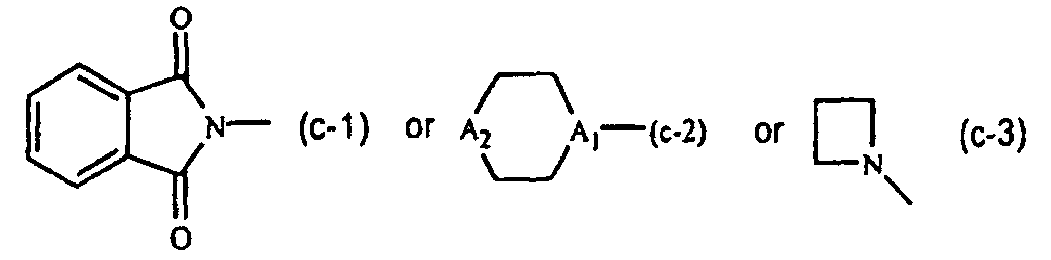
with A being CH or N, and A2 being CH2, NR13, S or 0, provided that when A1 is CH then A2 is other than CH2, said radical (c-1), (c-2) and (c-3) being optionally substituted with one or two substituents each independently selected from H, C1-6 alkyl, C1-6 alkyloxy, hydroxy C1-4alkyl, C1-6alkyloxycarbonyl, C1-6 alkyloxycarbonylC1-4alkyl, aminoC1-6alkyl, C1-4alkylcarbonyl, arylcarbonyl, aryl, Het1, Het1-(C=O)-, hydroxy, cyano,C1-4alkylcyano, CONR16R17 with R16 and R17 being independently H or alkyl, mono or di(C1-4alkyl)aminoalkyl, 4-hydroxy-4-phenyl or 4-cyano-4-phenyl; - R3
- is selected from hydrogen; halo; formyl; cyano; azido; hydroxy; oxiranyl; amino; mono- or di(C1-4alkyl)amino; formylamino; mercapto(C1-6)alkyl; hydrazino; R5aR6aN-C(=O)-; R9-N=C(R10)-; C2-6alkenyl optionally substituted with one or two substituents each independently selected from halo, hydroxy, cyano, formyl, C1-6alkyloxy, C1-6alkylcarbonyl, C1-6alkyloxycarbonyl, C1-6alkylcarbonyloxy, di(C1-4alkyl)carbamoyl, [di(C1-4alkyl)amino (C1-6alkyl)](C1-4alkyl)carbamoyl, [di(C1-4alkyl)amino(C1-6alkyl)](arylC1-4alkyl) carbamoyl, di(C1-4alkyloxy) (C1-4alkyl)carbamoyl, (cyanoC1-6alkyl)(C1-6alkyl)aminoC1-6alkyl, N-hydroxy-imino, aryl, Het2, Het2carboxamido, Het2(C1-6alkyl)carbamoyl; C2-6alkynyl optionally substituted with one or two substituents each independently selected from halo, hydroxy, cyano, formyl, C1-6alkyloxy, C1-6alkylcarbonyl, C1-6alkyloxycarbonyl, C1-6alkylcarbonyloxy, N-hydroxy-imino, aryl or Het2; C1-6alkyloxy; hydroxyC1-6alkyloxy; aminoC1-6alkyloxy; mono- or di(C1-4alkyl)aminoC1-6alkyloxy; C1-6alkylcarbonyl; arylcarbonyl; Het2carbonyl; C1-6alkyloxycarbonyl; C1-6alkylcarbonyloxy; aryl; aryloxy; arylC1-6alkyloxy; arylthio; arylC1-6alkylthio; mono- or di(aryl)amino; Het2; Het2oxy; Het2thio; Het2C1-6alkyloxy; Het2C1-6alkylthio; Het2SO2; Het2SO; mono- or di(Het2)amino; C3-6cycloalkyl; C3-6cycloalkyloxy; C3-6cycloalkylthio; C1-6alkylthio; hydroxyC1-6alkylthio; aminoC1-6alkylthio; mono- or di(C1-4alkyl)aminoC1-6alkylthio; C1-6alkyl optionally substituted with one or two substituents each independently selected from halo, hydroxy, cyano, carboxyl, C1-6alkyloxy, C1-6alkylthio, C1-6alkylsulfonyl, C1-6alkycarbamoylC1-4alkylthio, hydroxyC1-6alkyloxy, C1-6alkyloxyC1-6alkyloxy, C1-6alkyloxyC1-6alkylthio C1-6alkylcarbonyl, C1-6alkylcarbonyloxy, aminocarbonyloxy, mono- or di(C1-4alkyl)aminocarbonyloxy, C1-6alkyloxycarbonyl, C1-6alkyloxycarbonylC1-6alkyloxy, C1-6alkyloxycarbonylC1-6alkylthio, aryl, Het2, aryloxy, arylthio, arylC1-6alkyloxy, arylC1-6alkylthio, Het2C1-6alkyloxy, Het2C1-6alkylthio, C1-6alkyl-S(=O)2-oxy, amino, mono- or di(C1-6alkyl)amino, di(C1-6alkyl)aminoC1-6alkylthio, [di(C1-6alkyl)amino(C1-6alkyl)](C1-6alkyl)amino, di(cyanoC1-6alkyl)amino, C1-6alkyloxycarbonylamino, C1-6alkyloxyC1-6alkylcarbonylamino, mono- or di(aryl)amino, mono- or di(arylC1-4alkyl)amino, mono- or di(C1-4alkyloxyC1-4alkyl)amino, mono- or di(C1-4alkylthioC1-4alkyl)amino, mono- or di(Het2C1-4alkyl)amino, (Het2C1- 4alkyl)(C1-4alkyl)amino, (cyanoC1-6alkyl)(C1-6alkyl)amino, C3-6cycloalkylthio, R11-(C=O)-NH-, R12-NH-(C=O)-NH-, R14-S(=O)2-NH-, C1-6alkyl-P(O-R15)2=O, C1-6alkyl-P(O-C1-6alkyl-O)=O or a radical of formula

with A1 being CH or N, and A2 being CH2, NR13, S or O, provided that when A1 is CH then A2 is other than CH2, said radical (c-1), (c-2) and (c-3) being optionally substituted with one or two substituents each independently selected from H, C1-6 alkyl, C1-6 alkyloxy, hydroxy C1-4alkyl, C1-6alkyloxycarbonyl, C1-6 alkyloxycarbonylC1-4alkyl, aminoC1-6alkyl, C1-4alkylcarbonyl, arylcarbonyl, aryl, Het1, Het1-(C=O)-, hydroxy, cyano, C1-4alkylcyano, CONR16R17 with R16 and R17 being independently H or alkyl, mono or di(C1-4alkyl)aminoalkyl, 4-hydroxy-4-phenyl or 4-cyano-4-phenyl; - R4
- is hydrogen;
- R5a and R6a
- each independently are hydrogen; C1-4alkyl optionally substituted with cyano, C1-4alkyloxy, C1-4alkylthio, amino, mono-or di(C1-4alkyl)amino or a radical of formula

with A5 and A6 each independently being CH2, NR13 or O; - R7, R7a and R7b
- each independently are hydrogen, formyl or C1-4alkyl;
- R8, R8a and R8b
- each independently are hydrogen or C1-4alkyl;
- R9
- is hydrogen, hydroxy, C1-4alkyloxy, carboxylC1-4alkyloxy, C1-4alkyloxycarbonyl-C1-4alkyloxy, C2-4alkenyloxy, C2-4alkynyloxy or arylC1-4alkyloxy;
- R10
- is hydrogen, carboxyl or C1-4alkyl;
- R11
- is hydrogen; C1-4alkyl optionally substituted with cyano, C1-4alkyloxy, C1-4alkyl-S(=O)2-, aryl or Het3; C1-4alkyloxy; C2-4alkenyl; arylC2-4alkenyl; Het3C2-4alkenyl; C2-4alkynyl; Het3C2-4alkynyl, arylC2-4alkynyl; C3-6cycloalkyl; aryl; naphthyl or Het3;
- R12
- is C1-4alkyl, arylC1-4alkyl, aryl, arylcarbonyl, C1-4alkylcarbonyl, C1-4alkyloxycarbonyl or C1-4alkyloxycarbonylC1-4alkyl;
- R13
- is hydrogen, C1-4alkyl or C1-4alkylcarbonyl;
- R14
- is C1-4alkyl optionally substituted with aryl or Het4; polyhaloC1-4alkyl or C2-4alkenyl optionally substituted with aryl or Het4;
- R15
- is C1-4 alkyl;
- Het1 and Het2
- each independently are a heterocycle selected from pyrrolyl, furanyl, thienyl, imidazolyl, oxazolyl, isoxazolyl, thiazolyl, pyridyl, pyrimidinyl, pyrazinyl, pyridazinyl, pyrrolidinyl, tetrahydrofuranyl, tetrahydrothienyl, tetrahydropyrimidinyl, imidazolidinyl, oxazolidinyl, thiazolidinyl, piperidinyl, hexahydropyrimidinyl, piperazinyl, hexahydropyridazinyl, morpholinyl, thiomorpholinyl triazolyl, tetrazolyl, pyrrolyl, pyrazolyl, benzopyrrolyl, benzofuranyl, benzothienyl, benzimidazolyl, benzoxazolyl, benzothiazolyl, benzotriazolyl, indolyl, indazolyl, benzodioxanyl, quinolinyl, 2-oxo-1,2-dihydro-quinolinyl, imidazopyridinyl, dihydropyrrolyl or dihydroisoxazolyl, said heterocycle optionally being substituted with one, two or three substituents each independently selected from O, S, halo, formyl, amino, hydroxy, cyano, C1-4alkyl, hydroxyC1-4alkyl, carboxyC1-4alkyl, carbamoylC1-4alkyl, carbamoylC1-4alkoxy, C1-4alkyloxy, C1-4alkylcarbonyl, C1-4alkyloxyC1-4alkyl, cyanoC1-4alkyl, di(C1-4alkyl)aminoC1-4alkyl, -OCONH2, C1-4alkoxyC1-4alkyl, aryl, Het2C1-4alkyl, polyhaloC1-4alkyl, C3-6cycloalkyl or arylC2-6alkenyl;
- Het3
- is a monocyclic or bicyclic heterocycle selected from pyrrolyl, furanyl, thienyl, imidazolyl, oxazolyl, thiazolyl, pyridinyl, pyrimidinyl, pyrazinyl, pyridazinyl, benzopyrrolyl, benzofuranyl, benzothienyl, benzimidazolyl, benzoxazolyl, benzothiazolyl, quinolinyl, 2-oxo-1,2-dihydro-quinolinyl, pyrrolidinyl, tetrahydrofuranyl, tetrahydrothienyl, imidazolidinyl, oxazolidinyl, thiazolidinyl, piperidinyl, hexahydropyrimidinyl, piperazinyl, hexahydropyridazinyl or a radical of formula

with A7 or A8 each independently being selected from CH2 or O;
each of said monocyclic or bicyclic heterocycles may optionally be substituted with one, two or three substituents each independently selected from halo, hydroxy,C1-4alkyl, C1-4alkyloxy, C1-4alkylcarbonyl or polyhaloC1-4alkyl; - Het4
- is a monocyclic heterocycle selected from pyrrolyl, furanyl, thienyl, imidazolyl, oxazolyl, thiazolyl, pyridyl, pyrimidinyl, pyrazinyl, pyridazinyl, said heterocycle optionally being substituted with one, two or three substituents each independently selected from halo, hydroxy, C1-4alkyl, C1-4alkyloxy, C1-4alkylcarbonyl or polyhaloC1-4alkyl;
- Het5
- is pyridyl, pyrimidyl, pyridazinyl, pyrazinyl, pyrrolyl, thienyl, furanyl, imidazolyl, thiazolyl, oxazolyl, tetrazolyl, piperidinyl, morpholinyl or pyrrolidinyl;
- aryl
- is phenyl optionally substituted with one, two or three substituents each independently selected from halo; hydroxy; carboxyl; cyano; formyl; acetyl; nitro; amino; mono- or di(C1-4alkyl)amino; C1-4alkylcarbonylamino; mono- or di(C1-4alkyl)aminocarbonylamino; C1-4alkyl-S(=O)2-NH-; Het5(=S)-S-C1-4alkyl ; C1-6alkyloxy; sulfamoyl; (C1-4alkyl)sulfamoyl; arylsulfamoyl; Het2 sulfamoyl; O-P=OR15; C1-6alkyl optionally substituted with halo, hydroxy, cyano, nitro, formyl, amino, mono- or di(C1-4alkyl)amino, C1-6alkyloxycarbonyl, C1-6alkyloxy, C1-6alkyloxyC1-6alkyloxy, C2-6alkenyloxy, C1-6alkylcarbonyloxy, C1-6alkyloxycarbonylthio, N-hydroxyimino, phenyl or Het5; C2-6alkenyl optionally substituted with halo, hydroxy, cyano, nitro, formyl, amino, mono- or di(C1-4alkyl)amino, C1-6alkyloxycarbonyl, C1-6alkyloxy, C1-6alkylcarbonyl, C1-6alkylcarbonyloxy, N-hydroxy-imino, phenyl or Het5; C2-6alkynyl optionally substituted with halo, hydroxy, cyano, formyl, amino, mono- or di(C1-4alkyl)amino, C1-6alkyloxycarbonyl, C1-6alkyloxy, C1-6alkylcarbonyl, C1-6alkylcarbonyloxy, N-hydroxy-imino, phenyl or Het5; phenyl; phenyloxy; phenyl(C1-4alkyl)thioC1-4alkyl; (C3-6)cyclohexylthioC1-4alkyl or isoxazolinyl optionally substituted by C1-4alkyloxycarbonyl or morpholinylC1-4alkyl
- As used herein C1-4alkyl as a group or part of a group defines straight or branched chain saturated hydrocarbon radicals having from 1 to 4 carbon atoms such as methyl, ethyl, propyl, 1-methylethyl, butyl and the like; C1-6alkyl as a group or part of a group defines straight or branched chain saturated hydrocarbon radicals having from 1 to 6 carbon atoms such as the groups defined for C1-4alkyl and pentyl, hexyl, 2-methylpropyl, 2-methylbutyl and the like; C2-4alkenyl as a group or part of a group defines straight or branched chain hydrocarbon radicals having from 2 to 4 carbon atoms and containing a double bond such as ethenyl, propenyl, butenyl and the like; C2-6alkenyl as a group or part of a group defines straight or branched chain hydrocarbon radicals having from 2 to 6 carbon atoms and containing at least one double bond such as the groups defined for C2-4alkenyl and pentenyl, hexenyl, 2,4-hexadienyl, 1,3-butadienyl, 3-methylbutenyl and the like; C2-4alkynyl as a group or part of a group defines straight or branched chain hydrocarbon radicals having from 2 to 4 carbon atoms and containing one triple bond such as ethynyl, propynyl, butynyl and the like; C2-6alkynyl as a group or part of a group defines straight or branched chain hydrocarbon radicals having from 2 to 6 carbon atoms and containing one triple bond such as the groups defined such as ethynyl, propynyl, butynyl, pentynyl, hexynyl, 3-methylbutynyl and the like; C3-6cycloalkyl is generic to cyclopropyl, cyclobutyl, cyclopentyl and cyclohexyl.
- As used hereinbefore, the term (=O) forms a carbonyl moiety when attached to a carbon atom, a sulfoxide moiety when attached to a sulfur atom, a sulfonyl moiety when two of said terms are attached to a sulfur atom, a phosphonate when attached to a phosphorus atom.
- The term halo is generic to fluoro, chloro, bromo and iodo. As used in the foregoing and hereinafter, polyhalomethyl as a group or part of a group is defined as mono- or polyhalosubstituted methyl, in particular methyl with one or more fluoro atoms, for example, difluoromethyl or trifluoromethyl; polyhaloC1-6alkyl as a group or part of a group is defined as mono- or polyhalosubstituted C1-6alkyl, for example, the groups defined in halomethyl, 1,1-difluoro-ethyl and the like. In case more than one halogen atom is attached to an alkyl group within the definition of polyhalomethyl or polyhaloC1-6alkyl, they may be the same or different.
- The R1 or Het1, Het2, Het3, Het4 or Het5 radical as described above for the compounds of formula (I) may be attached to the remainder of the molecule of formula (I) through any ring carbon or heteroatom as appropriate. For example, when Het1 is pyridyl, it may be 2-pyridyl, 3-pyridyl or 4-pyridyl.
- Lines drawn into ring systems indicate that the bond may be attached to any suitable ring atom.
When any variable (e.g. aryl) occurs more than one time in any constituent, each definition is independent. - It will be appreciated that some of the compounds of formula (I) and their N-oxides, addition salts, quaternary amines and stereochemically isomeric forms may contain one or more centers of chirality and exist as stereochemically isomeric forms.
- The term "stereochemically isomeric forms" as used herein before defines all the possible stereoisomeric forms which the compounds of formula (I), and their N-oxides, addition salts, quaternary amines or physiologically functional derivatives may possess. Unless otherwise mentioned or indicated, the chemical designation of compounds denotes the mixture of all possible stereochemically isomeric forms, said mixtures containing all diastereomers and enantiomers of the basic molecular structure as well as each of the individual isomeric forms of formula (I) and their N-oxides, salts, solvates, quaternary amines substantially free, i.e. associated with less than 10%, preferably less than 5%, in particular less than 2% and most preferably less than 1% of the other isomers. In particular, stereogenic centers may have the R- or S-configuration; substituents on bivalent cyclic (partially) saturated radicals may have either the cis- or trans-configuration. Compounds encompassing double bonds can have an E or Z-stereochemistry at said double bond. Stereochemically isomeric forms of the compounds of formula (I) are obviously intended to be embraced within the scope of this invention.
- For therapeutic use, salts of the compounds of formula (I) are those wherein the counterion is pharmaceutically acceptable. However, salts of acids and bases which are non-pharmaceutically acceptable may also find use, for example, in the preparation or purification of a pharmaceutically acceptable compound. All salts, whether pharmaceutically acceptable or not, are included within the ambit of the present invention.
- The pharmaceutically acceptable acid and base addition salts as mentioned hereinabove are meant to comprise the therapeutically active non-toxic acid and base addition salt forms which the compounds of formula (I) are able to form. The pharmaceutically acceptable acid addition salts can conveniently be obtained by treating the base form with such appropriate acid. Appropriate acids comprise, for example, inorganic acids such as hydrohalic acids, e.g. hydrochloric or hydrobromic acid, sulfuric, nitric, phosphoric and the like acids; or organic acids such as, for example, acetic, propanoic, hydroxyacetic, lactic, pyruvic, oxalic (i.e. ethanedioic) malonic, succinic (i.e. butanedioic acid); maleic, fumaric, malic, tartaric, citric, methanesulfonic, ethanesulfonic, benzensulfonic, p-toluenesulfonic, cyclamic, salicylic, p-aminosalicylic, pamoic and the like acids.
- Conversely said salt forms can be converted by treatment with an appropriate base into the free base form.
- The compounds of formula (I) containing an acidic proton may also be converted into their non-toxic metal or amine addition salt forms by treatment with appropriate organic and inorganic bases. Appropriate base salt forms comprise, for example, the ammonium salts, the alkali and earth alkaline metal salts, e.g. the lithium, sodium, potassium, magnesium, calcium salts and the like, salts with organic bases, e.g. primary, secondary and tertiary aliphatic and aromatic amines such as methylamine, ethylamine, propylamine, isopropylamine, the four butylamine isomers, dimethylamine, diethylamine, diethanolamine, dipropylamine, diisopropylamine, din-butylamine, pyrrolidine, piperidine, morpholine, trimethylamine, thiehylamine, tripropylamine, quinuclidine, pyridine, quinoline and isoquinoline; the benzathine, N-methyl-D-glucamine, hydrabamine salts, and salts with amino acids such as, for example, arginine, lysine and the like.
- Conversely the salt forms can be converted by treatment with acid into the free acid form.
- The term addition salt as used hereinabove also comprises the solvates which the compounds of formula (I) as well as the salts thereof, are able to form. Such solvates are for example hydrates, alcoholates and the like.
- The term "quaternary amine" as used hereinbefore defines the quaternary ammonium salts which the compounds of formula (I) are able to form by reaction between a basic nitrogen of a compound of formula (I) and an appropriate quaternizing agent, such as, for example, an optionally substituted alkylhalide, arylhalide or arylalkylhalide, e.g. methyliodide or benzyliodide. Other reactants with good leaving groups may also be used, such as alkyl trifluoromethanesulfonates, alkyl methanesulfonates, and alkyl p-toluenesulfonates. A quaternary amine has a positively charged nitrogen.
- Pharmaceutically acceptable counterions include chloro, bromo, iodo, trifluoroacetate and acetate. The counterion of choice can be introduced using ion exchange resins.
- Some of the compounds of formula (I) may also exist in their tautomeric form. Such forms although not explicitly indicated in the above formula are intended to be included within the scope of the present invention.
- Whenever used hereinafter, the term "compounds of formula (I)" or "compounds of formula (I-a)" is meant to include also the N-oxides, the addition salts, the quaternary amines and all stereoisomeric forms.
- A special group of compound contains those compounds of formula (I) wherein
Q is halo;
X is a bivalent radical of formula
-(CH2)p- (a-1)
or
-(CH2)q-Z-(CH2)r- (a-2);
wherein p is an integer of value 1 to 5;
q is an integer of value 0 to 5;
r is an integer of value 0 to 5;
Z is O S, NR7, C(=O), S(=O), S(=O)2, CHOR13, CH=CH, CH(NR7R8) or CF2;
and wherein each hydrogen atom may be replaced by C1-4alkyl or hydroxyC1-4alkyl; - R1
- is C3-6cycloalkyl, aryl;
- R2
- is selected from hydrogen; formyl; cyano; azido; hydroxy; oxiranyl; amino; mono- or di(C1-4alkyl)amino; formylamino; R5aR6aN-C(=O)-; R9-N=C(R10)-; C2-6alkenyl optionally substituted with one or two substituents each independently selected from halo, hydroxy, cyano, formyl, C1-6alkyloxy, C1-6alkylcarbonyl, C1-6alkyloxycarbonyl, C1-6alkylcarbonyloxy, N-hydroxyimino, aryl or Het2; C2-6alkynyl optionally substituted with one or two substituents each independently selected from halo, hydroxy, cyano, formyl, C1-6alkyloxy, C1-6alkylcarbonyl, C1-6alkyloxycarbonyl, C1-6alkylcarbonyloxy, N-hydroxy-imino, aryl or Het2; C1-6alkyloxy; hydroxyC1-6alkyloxy; aminoC1-6alkyloxy; mono- or di(C1-4alkyl)aminoC1-6alkyloxy; C1-6alkylcarbonyl; arylcarbonyl; Het2carbonyl; C1-6alkyloxycarbonyl; C1-6alkylcarbonyloxy; aryl; aryloxy; arylC1-6alkyloxy; arylthio; arylC1-6alkylthio; mono- or di(aryl)amino; Het2; Het2oxy; Het2thio; Het2C1-6alkyloxy; Het2C1-6alkylthio; mono- or di(Het2)amino; C3-6cycloalkyl; C3-6cycloalkyloxy; C3-6cycloalkylthio; C1-6alkylthio; hydroxyC1-6alkylthio; aminoC1-6alkylthio; mono- or di(C1-4alkyl)aminoC1-6alkylthio; C1-6alkyl optionally substituted with one or two substituents each independently selected from halo, hydroxy, cyano, C1-6alkyloxy, C1-6alkylthio, hydroxyC1-6alkyloxy, C1-6alkyloxyC1-6alkyloxy, C1-6alkylcarbonyl, C1-6alkylcarbonyloxy, aminocarbonyloxy, mono- or di(C1-4alkyl)aminocarbonyloxy, C1-6alkyloxycarbonyl, C1-6alkyloxycarbonylC1-6alkyloxy, C1-6alkyloxycarbonylC1-6alkylthio, aryl, Het2, aryloxy, arylthio, arylC1-6alkyloxy, arylC1-6alkylthio, Het2C1-6alkyloxy, Het2C1-6alkylthio, C1-6alkyl-S(=O)2-oxy, amino, mono- or di(C1-6alkyl)amino, C1-6alkyloxycarbonylamino, C1-6alkyloxyC1-6alkylcarbonylamino, mono- or di(aryl)amino, mono- or di(arylC1-4alkyl)amino, mono- or di(C1-4alkyloxyC1-4alkyl)amino, mono- or di(C1-4alkylthioC1-4alkyl)amino, mono- or di(Het2C1-4alkyl)amino, R11-(C=O)-NH-, R12-NH-(C=O)-NH-, R14-S(=O)2-NH-, C1-6alkyl-P(O-R15)2=O, C1-6alkyl-P(O-C1-6alkyl-O)=O or a radical of formula

with A1 being CH2 or N, and A2 being CH2, NR13, S or O, provided that when A1 is CH2 then A2 is other than CH2, said radical (c-1) and (c-2) being optionally substituted with one or two substituents each independently selected from H, C1-6 alkyl, C1-6 alkyloxy, hydroxy C1-4alkyl, C1-6 alkyloxycarbonyl, C1-6 alkyloxycarbonylC1-4alkyl, aminoC1-6alkyl, carbonyl, hydroxy, cyano, CONR16R17 with R16 and R17 being independently H or alkyl, mono or di(C1-4alkyl)aminoalkyl, 4-hydroxy-4-phenyl or 4-cyano-4-phenyl; - R3
- is selected from hydrogen; halo; formyl; cyano; azido; hydroxy; oxiranyl; amino; mono- or di(C1-4alkyl)amino; formylamino; R5aR6aN-C(=O)-; R9-N=C(R10)-; C2-6alkenyl optionally substituted with one or two substituents each independently selected from halo, hydroxy, cyano, formyl, C1-6alkyloxy, C1-6alkylcarbonyl, C1-6alkyloxycarbonyl, C1-6alkylcarbonyloxy, N-hydroxyimino, aryl or Het2; C2-6alkynyl optionally substituted with one or two substituents each independently selected from halo, hydroxy, cyano, formyl, C1-6alkyloxy, C1-6alkylcarbonyl, C1-6alkyloxycarbonyl, C1-6alkylcarbonyloxy, N-hydroxy-imino, aryl or Het2; C1-6alkyloxy; hydroxyC1-6alkyloxy; aminoC1-6alkyloxy; mono- or di(C1-4alkyl)aminoC1-6alkyloxy; C1-6alkylcarbonyl; arylcarbonyl; Het2carbonyl; C1-6alkyloxycarbonyl; C1-6alkylcarbonyloxy; aryl; aryloxy; arylC1-6alkyloxy; arylthio; arylC1-6alkylthio; mono- or di(aryl)amino; Het2; Het2oxy; Het2thio; Het2C1-6alkyloxy; Het2C1-6alkylthio; mono- or di(Het2)amino; C3-6cycloalkyl; C3-6cycloalkyloxy C3-6cycloalkylthio; C1-6alkylthio; hydroxyC1-6alkylthio; aminoC1-6alkylthio; mono- or di(C1-4alkyl)aminoC1-6alkylthio; C1-6alkyl optionally substituted with one or two substituents each independently selected from halo, hydroxy, cyano, C1-6alkyloxy, C1-6alkylthio, hydroxyC1-6alkyloxy, C1-6alkyloxyC1-6alkyloxy, C1-6alkylcarbonyl, C1-6alkylcarbonyloxy, aminocarbonyloxy, mono- or di(C1-4alkyl)aminocarbonyloxy, C1-6alkyloxycarbonyl, C1-6alkyloxycarbonylC1-6alkyloxy, C1-6alkyloxycarbonylC1-6alkylthio, aryl, Het2, aryloxy, arylthio, arylC1-6alkyloxy, arylC1-6alkylthio, Het2C1-6alkyloxy, Het2C1-6alkylthio, C1-6alkyl-S(=O)2-oxy, amino, mono- or di(C1-6alkyl)amino, C1-6alkyloxycarbonylamino, C1-6alkyloxyC1-6alkylcarbonylamino, mono- or di(aryl)amino, mono- or di(arylC1-4alkyl)amino, mono- or di(C1-4alkyloxyC1-4alkyl)amino, mono- or di(C1-4alkylthioC1-4alkyl)amino, mono- or di(Het2C1-4alkyl)amino, R11-(C=O)-NH-, R12-NH-(C=O)-NH-, R14-S(=O)2-NH-, C1-6alkyl-P(O-R15)2=O, C1-6alkyl-P(O-C1-6alkyl-O)=O or a radical of formula

with A1 being CH2 or N, and A2 being CH2, NR13, S or O, provided that when A1 is CH2 then A2 is other than CH2, said radical (c-1) and (c-2) being optionally substituted with one or two substituents each independently selected from H, C1-6 alkyl, C1-6 alkyloxy, hydroxy C1-4alkyl, C1-6 alkyloxycarbonyl, C1-6 alkyloxycarbonylC1-4alkyl, aminoC1-6alkyl, carbonyl, hydroxy, cyano, CONR16R17 with R16 and R17 being independently H or alkyl, mono or di(C1-4alkyl)aminoalkyl, 4-hydroxy-4-phenyl or 4-cyano-4-phenyl; - R4
- is hydrogen;
- R5a and R6a
- each independently are hydrogen; C1-4 alkyl optionally substituted with cyano, C1-4alkyloxy, C1-4alkylthio, amino, mono-or di(C1-4alkyl)amino or a radical of formula

with A5 and A6 each independently being CH2, NR13 or O; - R7, R7a and R7b
- each independently are hydrogen, formyl or C1-4alkyl;
- R8, R8a and R8b
- each independently are hydrogen or C1-4alkyl;
- R9
- is hydrogen, hydroxy, C1-4alkyloxy, carboxylC1-4alkyloxy, C1-4alkyloxycarbonyl-C1-4alkyloxy, C2-4alkenyloxy, C2-4alkynyloxy or arylC1-4alkyloxy;
- R10
- is hydrogen, carboxyl or C1-4alkyl;
- R11
- is hydrogen; C1-4alkyl optionally substituted with cyano, C1-4alkyloxy, C1-4alkyl-S(=O)2-, aryl or Het3; C1-4alkyloxy; C2-4alkenyl; arylC2-4alkenyl; Het3C2-4alkenyl; C2-4alkynyl; Het3C2-aalkynyl, arylC2-4alkynyl; C3-6cycloalkyl; aryl; naphthyl or Het3;
- R12
- is C1-4alkyl, arylC1-4alkyl, aryl, arylcarbonyl, C1-4alkylcarbonyl, C1-4alkyloxycarbonyl or C1-4alkyloxycarbonylC1-4alkyl;
- R13
- is hydrogen, C1-4alkyl or C1-4alkylcarbonyl;
- R14
- is C1-4alkyl optionally substituted with aryl or Het4; polyhaloC1-4alkyl or C2-4alkenyl optionally substituted with aryl or Het4;
- R15
- is C1-4 alkyl;
- Het1 and Het2
- each independently are a heterocycle selected from pyrrolyl, furanyl, thienyl, imidazolyl, oxazolyl, thiazolyl, pyridyl, pyrimidinyl, pyrazinyl, pyridazinyl, pyrrolidinyl, tetrahydrofuranyl, tetrahydrothienyl, imidazolidinyl, oxazolidinyl, thiazolidinyl, piperidinyl, hexahydropyrimidinyl, piperazinyl, hexahydropyridazinyl, benzopyrrolyl, benzofuranyl, benzothienyl, benzimidazolyl, benzoxazolyl, benzothiazolyl, quinolinyl or 2-oxo-1,2-dihydro-quinolinyl, said heterocycle optionally being substituted with one, two or three substituents each independently selected from halo, hydroxy, C1-4alkyl, C1-4alkyloxy, C1-4alkylcarbonyl or polybaloC1-4alkyl;
- Het3
- is a monocyclic or bicyclic heterocycle selected from pyrrolyl, furanyl, thienyl, imidazolyl, oxazolyl, thiazolyl, pyridinyl, pyrimidinyl, pyrazinyl, pyridazinyl, benzopyrrolyl, benzofuranyl, benzothienyl, benzimidazolyl, benzoxazolyl, benzothiazolyl, quinolinyl, 2-oxo-1,2-dihydro-quinolinyl, pyrrolidinyl, tetrahydrofuranyl, tetrahydrothienyl, imidazolidinyl, oxazolidinyl, thiazolidinyl, piperidinyl, hexahydropyrimidinyl, piperazinyl, hexahydropyridazinyl or a radical of formula

with A7 or A8 each independently being selected from CH2 or O; each of said monocyclic or bicyclic heterocycles may optionally be substituted with one, two or three substituents each independently selected from halo, hydroxy,C1-4alkyl, C1-4alkyloxy, C1-4alkylcarbonyl or polyhaloC1-4alkyl; - Het4
- is a monocyclic heterocycle selected from pyrrolyl, furanyl, thienyl, imidazolyl, oxazolyl, thiazolyl, pyridyl, pyrimidinyl, pyrazinyl, pyridazinyl, said heterocycle optionally being substituted with one, two or three substituents each independently selected from halo, hydroxy, C1-4alkyl, C1-4alkyloxy, C1-4alkylcarbonyl or polyhaloC1-4alkyl;
- Het5
- is pyridyl, pyrimidyl, pyridazinyl, pyrazinyl, pyrrolyi, thienyl, furanyl, imidazolyl, thiazolyl or oxazolyl;
- aryl
- is phenyl optionally substituted with one, two or three substituents each independently selected from halo; hydroxy; carboxyl; cyano; formyl; nitro; amino; mono- or di(C1-4alkyl)amino; C1-4alkylcarbonylamino; mono- or di(C1-4alkyl)aminocarbonylamino; C1-4alkyl-S(=O)2-NH-; C1-6alkyloxy; C1-6alkyl optionally substituted with halo, hydroxy, cyano, formyl, amino, mono- or di(C1-4alkyl)amino, C1-6alkyloxycarbonyl, C1-6alkyloxy, C1-6alkyloxyC1-6alkyloxy, C1-6alkylcarbonyloxy, N-hydroxy-imino, phenyl or Het5; C2-6alkenyl optionally substituted with halo, hydroxy, cyano, formyl, amino, mono- or di(C1-4alkyl)amino, C1-6alkyloxycarbonyl, C1-6alkyloxy, C1-6alkylcarbonyl, C1-6alkylcarbonyloxy, N-hydroxy-imino, phenyl or Het5; C2-6alkynyl optionally substituted with halo, hydroxy, cyano, formyl, amino, mono- or di(C1-4alkyl)amino, C1-6alkyloxycarbonyl, C1-6alkyloxy, C1-6alkylcarbonyl, C1-6alkylcarbonyloxy, N-hydroxy-imino, phenyl or Het5; phenyl or phenyloxy;
- A special group of compound contains those compounds of formula (I) wherein
Q is halo,
X is (a-2) with q and r being 0 and Z being O, S or SO; - R1
- is phenyl optionally substituted with one, two or three substituents each independently selected from halo; hydroxy; carboxyl; cyano; formyl; nitro; amino; mono- or di(C1-4alkyl)amino; C1-4alkylcarbonylamino; mono- or di(C1-4alkyl)aminocarbonylamino; C1-4alkyl-S(=O)2-NH-; C1-6alkyloxy; C1-6alkyl optionally substituted with halo, hydroxy, cyano, formyl, amino, mono- or di(C1-4alkyl)amino, C1-6alkyloxycarbonyl, C1-6alkyloxy, C1-6alkyloxyC1-6alkyloxy, C1-6alkylcarbonyloxy, N-hydroxy-imino, phenyl or Het5; C2-6alkenyl optionally substituted with halo, hydroxy, cyano, formyl, amino, mono- or di(C1-4alkyl)amino, C1-6alkyloxycarbonyl, C1-6alkyloxy, C1-6alkylcarbonyl, C1-6alkylcarbonyloxy, N-hydroxy-imino, phenyl or Het5; C2-6alkynyl optionally substituted with halo, hydroxy, cyano, formyl, amino, mono- or di(C1-4alkyl)amino, C1-6alkyloxycarbonyl, C1-6alkyloxy, C1-6alkylcarbonyl, C1-6alkylcarbonyloxy, N-hydroxy-imino, phenyl or Het5; phenyl or phenyloxy;
- Particular compounds are those compounds of formula (I) wherein Q is iodo.
Preferred compounds are those compounds of formula (I) wherein Q is iodo, X-R1 is a 3,5-dimethylphenylthio or a 3,5-dimethylphenyloxy and R2 is a hydroxymethyl or a N-morpholinomethyl or a 3-phenylpropyl or a furan-2-yl-methylthiomethyl. Also preferred compounds are those compounds of formula (I) wherein Q is iodo, X-R1 is a 3-(2-cyano-vinyl)-5-iodophenyloxy or 5-bromo-3-(2-cyano-vinyl) and R2 is ethyl. - Most preferred compounds are compounds n° 242, 255, 43, 264, 124, 249, 298, 326, 133, 241, 253, 306,328,46,105,254,256,284,296,319, 83, 88,108,109,115, 286, 299, 45, 85, 86, 244, 297, 250, 257, 307, 81, 92, 140, 143, 217, 221, 232, 245, 309, 321, 322, 31, 218, 222, 314, 8, 99, 121, 219, 233, 551, 470, 375, 483, 547, 606, 618, 662, 694, 700, 709 and 713 of table 1.
- The present invention also relates to a method of treating wann-blooded animals suffering from HIV infection. Said method comprises the administration of the therapeutically effective amount of a compound of formula (I) or any sub group thereof, a N-oxide form, a pharmaceutically acceptable addition salt or a stereochemically isomeric form thereof in admixture with a pharmaceutical carrier.
- The compounds of formula (I) can be prepared according to art-known procedures.
In general, compounds of formula (I) wherein X is an oxygen and R1 a 3,5-dimethylphenyl, said compound being represented by formula (I-a) can be prepared by reacting an intermediate of formula (II) with a derivative of formula (III)
In this and the following preparations, the reaction products may be isolated from the reaction medium and, if necessary, further purified according to methodologies generally known in the art such as, for example, extraction, crystallization, distillation, trituration and chromatography. - The compounds of formula (I) wherein X is a sulphur, said compound being represented by formula (I-b) can be prepared by reacting an intermediate of formula (IV) with a derivative of formula (V) in an appropriate solvent such as for example methanol, ethanol, propanol, butanol, dioxane, tetrahydrofurane, 2-methoxyethylether or toluene, and the like. This reaction can be performed at a temperature comprised between 20 and 130°C.

- The compounds of formula (I) may further be prepared by converting compounds of formula (I) into each other according to art-known group transformation reactions.
- The compounds of formula (I) may be converted to the corresponding N-oxide forms following art-known procedures for converting a trivalent nitrogen into its N-oxide form. Said N-oxidation reaction may generally be carried out by reacting the starting material of formula (I) with an appropriate organic or inorganic peroxide. Appropriate inorganic peroxides comprise, for example, hydrogen peroxide, alkali metal or earth alkaline metal peroxides, e.g. sodium peroxide, potassium peroxide; appropriate organic peroxides may comprise peroxy acids such as, for example, benzenecarboperoxoic acid or halo substituted benzenecarboperoxoic acid, e.g. 3-chlorobenzenecarboperoxoic acid, peroxoalkanoic acids, e.g. peroxoacetic acid, alkylhydroperoxides, e.g. t.butyl hydro-peroxide. Suitable solvents are, for example, water, lower alcohols, e.g. ethanol and the like, hydrocarbons, e.g. toluene, ketones, e.g. 2-butanone, halogenated hydrocarbons, e.g. dichloromethane, and mixtures of such solvents.
- Some of the compounds of formula (I) and some of the intermediates in the present invention may contain an asymmetric carbon atom. Pure stereochemically isomeric forms of said compounds and said intermediates can be obtained by the application of art-known procedures. For example, diastereoisomers can be separated by physical methods such as selective crystallization or chromatographic techniques, e.g. counter current distribution, liquid chromatography and the like methods. Enantiomers can be obtained from racemic mixtures by first converting said racemic mixtures with suitable resolving agents such as, for example, chiral acids, to mixtures of diastereomeric salts or compounds; then physically separating said mixtures of diastereomeric salts or compounds by, for example, selective crystallization of chromatographic techniques, e.g. liquid chromatography and the like methods; and finally converting said separated diastereomeric salts or compounds into the corresponding enantiomers. Pure stereochemically isomeric forms may also be obtained from the pure stereochemically isomeric forms of the appropriate intermediates and starting materials, provided that the intervening reactions occurs stereospecifically.
- An alternative manner of separating the enantiomeric forms of the compounds of formula (I) and intermediates involves liquid chromatography using a chiral stationary phase.
- Some of the intermediates and starting materials are known compounds and may be commercially available or may be prepared according to art-known procedures.
- The compounds of formula (I) as prepared in the hereinabove described processes may be synthesized as a mixture of stereoisomeric forms, in particular in the form of racemic mixtures of enantiomers which can be separated from one another following art-known resolution procedures. The racemic compounds of formula (I) may be converted into the corresponding diastereomeric salt forms by reaction with a suitable chiral acid. Said diastereomeric salt forms are subsequently separated, for example, by selective or fractional crystallization and the enantiomers are liberated therefrom by alkali. An alternative manner of separating the enantiomeric forms of the compounds of formula (I) involves liquid chromatography using a chiral stationary phase. Said pure stereochemically isomeric forms may also be derived from the corresponding pure stereochemically isomeric forms of the appropriate starting materials, provided that the reaction occurs stereospecifically. Preferably if a specific stereoisomer is desired, said compound will be synthesized by stereospecific methods of preparation. These methods will advantageously employ enantiomerically pure starting materials.
- It will be appreciated by those skilled in the art that in the processes described above the functional groups of intermediate compounds may need to be blocked by protecting groups.
- Functional groups which it is desirable to protect include hydroxy, amino and carboxylic acid. Suitable protecting groups for hydroxy include trialkylsilyl groups (e.g. tert-butyldimethylsilyl, tert-butyldiphenylsilyl or trimethylsilyl), benzyl and tetrahydropyranyl. Suitable protecting groups for amino include tert-butyloxycarbonyl or benzyloxycarbonyl. Suitable protecting groups for carboxylic acid include C1-6alkyl or benzyl esters.
- The protection and deprotection of functional groups may take place before or after a reaction step.
- The use of protecting groups is fully described in 'Protective Groups in Organic Chemistry', edited by J W F McOmie, Plenum Press (1973), and 'Protective Groups in Organic Synthesis' 2nd edition, T W Greene & P G M Wutz, Wiley Interscience (1991).
- The compounds of the present invention show antiretroviral properties, in particular against Human Immunodeficiency Virus (HIV), which is the aetiological agent of Acquired Immune Deficiency Syndrome (AIDS) in humans. The HIV virus preferentially infects human T-4 cells and destroys them or changes their normal function, particularly the coordination of the immune system. As a result, an infected patient has an everdecreasing number of T-4 cells, which moreover behave abnormally. Hence, the immunological defense system is unable to combat infections and neoplasms and the HIV infected subject usually dies by opportunistic infections such as pneumonia, or by cancers. Other conditions associated with HIV infection include thrombocytopaenia, Kaposi's sarcoma and infection of the central nervous system characterized by progressive demyelination, resulting in dementia and symptoms such as progressive dysarthria, ataxia and disorientation. HIV infection further has also been associated with peripheral neuropathy progressive generalized lymphadenopathy (PGL) and AIDS-related complex (ARC).
- The present compounds also show activity against HIV-1 strains that have acquired resistance to art-know non-nucleoside reverse transcriptase inhibitors. They also have little or no binding affinity to human α-1 acid glycoprotein.
- Due to their antiretroviral properties, particularly their anti-HIV properties, especially their anti-HIV-1-activity, the compounds of the present invention are useful in the treatment of individuals infected by HIV and for the prophylaxis of these individuals. In general, the compounds of the present invention may be useful in the treatment of warm-blooded animals infected with viruses whose existence is mediated by, or depends upon, the enzyme reverse transcriptase. Conditions which may be prevented or treated with the compounds of the present invention, especially conditions associated with HIV and other pathogenic retroviruses, include AIDS, AIDS-related complex (ARC), progressive generalized lymphadenopathy (PGL), as well as chronic CNS diseases caused by retroviruses, such as, for example HIV mediated dementia and multiple sclerosis.
- The compounds of the present invention or any subgroup thereof may therefore be used as medicines against above-mentioned conditions. Said use as a medicine or method of treatment comprises the systemic administration to HIV-infected subjects of an amount effective to combat the conditions associated with HIV and other pathogenic retroviruses, especially HIV-1.
- The compounds of the present invention or any subgroup thereof may be formulated into various pharmaceutical forms for administration purposes. As appropriate compositions there may be cited all compositions usually employed for systemically administering drugs. To prepare the pharmaceutical compositions of this invention, an effective amount of the particular compound, optionally in addition salt form, as the active ingredient is combined in intimate admixture with a pharmaceutically acceptable carrier, which carrier may take a wide variety of forms depending on the form of preparation desired for administration. These pharmaceutical compositions are desirable in unitary dosage form suitable, particularly, for administration orally, rectally, percutaneously, or by parenteral injection. For example, in preparing the compositions in oral dosage form, any of the usual pharmaceutical media may be employed such as, for example, water, glycols, oils, alcohols and the like in the case of oral liquid sugars, kaolin, lubricants, binders, disintegrating agent and the like in the case of powders pills, capsules, and tablets. Because of their ease in administration, tablets and capsules represent the list advantageous oral dosage unit forms, in which case solid pharmaceutical carriers are obviously employed. For parenteral compositions, the carrier will usually comprise sterile water, at least in large part, though other ingredients, for example, to aid solubility, may be included. Injectable solutions, for example, may be prepared in which the carrier comprises saline solution, glucose solution or a mixture of saline and glucose solution. Injectable suspensions may also be prepared in which case appropriate liquid carriers, suspending agents and the like may be employed. Also included are solid form preparations which are intended to be converted, shortly before use, to liquid form preparations. In the compositions suitable for percutaneous administration, the carrier optionally comprises a penetration enhancing agent and/or a suitable wetting agent, optionally combined with suitable additives of any nature in minor proportions, which additives do not introduce a significant deleterious effect on the skin. Said additives may facilitate the administration to the skin and/or may be helpful for preparing the desired compositions. These compositions may be administered in various ways, e.g., as a transdermal patch, as a spot-on, as an ointment.
- To aid solubility of the compounds of formula (I), suitable ingredients, e.g. cyclodextrins, may be included in the compositions. Appropriate cyclodextrins are α, β, γ-cyclodextrins or ethers and mixed ethers thereof wherein one or more of the hydroxy groups of the anhydroglucose units of the cyclodextrin are substituted with C1-6alkyl, particularly methyl, ethyl or isopropyl, e.g. randomly methylated β-CD; hydroxyC1-6alkyl, particularly hydroxyethyl, hydroxy-propyl or hydroxybutyl; carboxyC1-6alkyl, particularly carboxymethyl or carboxy-ethyl; C1-6alkylcarbonyl, particularly acetyl. Especially noteworthy as complexants and/or solubilizers are β-CD, randomly methylated β-CD, 2,6-dimethyl-β-CD, 2-hydroxyethyl-β-CD, 2-hydroxyethyl-β-CD, 2-hydroxypropyl-β-CD and (2-carboxymethoxy)propyl-β-CD, and in particular 2-hydroxypropyl-β-CD (2-HP-β-CD).
- The term mixed ether denotes cyclodextrin derivatives wherein at least two cyclodextrin hydroxy groups are etherified with different groups such as, for example, hydroxy-propyl and hydroxyethyl.
- The average molar substitution (M.S.) is used as a measure of the average number of moles of alkoxy units per mole of anhydroglucose. The average substitution degree (D.S.) refers to the average number of substituted hydroxyls per anhydroglucose unit. The M.S. and D.S. value can be determined by various analytical techniques such as nuclear magnetic resonance (NMR), mass spectrometry (MS) and infrared spectroscopy (IR). Depending on the technique used, slightly different values may be obtained for one given cyclodextrin derivative. Preferably, as measured by mass spectrometry, the M.S. ranges from 0.125 to 10 and the D.S. ranges from 0.125 to 3.
- Other suitable compositions for oral or rectal administration comprise particles obtainable by melt-extruding a mixture comprising a compound of formula (I) and an appropriate water-soluble polymer and subsequently milling said melt-extruded mixture. Said particles can then be formulated by conventional techniques into pharmaceutical dosage forms such as tablets and capsules.
- Said particles consist of a solid dispersion comprising a compound of formula (I) and one or more pharmaceutically acceptable water-soluble polymers. The preferred technique for preparing solid dispersions is the melt-extrusion process comprising the following steps:
- a) mixing a compound of formula (I) and an appropriate water-soluble polymer,
- b) optionally blending additives with the thus obtained mixture,
- c) heating the thus obtained blend until one obtains a homogenous melt,
- d) forcing the thus obtained melt through one or more nozzles; and
- e) cooling the melt till it solidifies.
- The solid dispersion product is milled or ground to particles having a particle size of less than 1500 µm, preferably less than 400 µm, more preferably less than 250 µm and most preferably less than 125 µm.
- The water-soluble polymers in the particles are polymers that have an apparent viscosity, when dissolved at 20°C in an aqueous solution at 2 % (w/v), of 1 to 5000 mPa.s, more preferably of 1 to 700 mPa.s, and most preferred of 1 to 100 mPa.s. For example, suitable water-soluble polymers include alkylcelluloses, hydroxyalkylcelluloses, hydroxyalkyl alkylcelluloses, carboxyalkylcelluloses, alkali metal salts of carboxyalkylcelluloses, carboxyalkylalkylcelluloses, carboxyalkylcellulose esters, starches, pectines, chitin derivates, polysaccharides, polyacrylic acids and the salts thereof, polymethacrylic acids and the salts and esters thereof, methacrylate copolymers, polyvinylalcohol, polyalkylene oxides and copolymers of ethylene oxide and propylene oxide. Preferred water-soluble polymers are Eudragit E® (Röhm GmbH, Germany) and hydroxypropyl methylcelluloses.
- Also one or more cyclodextrins can be used as water soluble polymer in the preparation of the above-mentioned particles as is disclosed in WO 97/18839. Said cyclodextrins include the pharmaceutically acceptable unsubstituted and substituted cyclodextrins known in the art, more particularly α, β, γ-cyclodextrins or the pharmaceutically acceptable derivatives thereof.
- Substituted cyclodextrins which can be used include polyethers described in U.S. Patent 3,459,731. Further substituted cyclodextrins are ethers wherein the hydrogen of one or more cyclodextrin hydroxy groups is replaced by C1-6alkyl, hydroxyC1-6alkyl, carboxy-C1-6alkyl or C1-6alkyloxycarbonylC1-6alkyl or mixed ethers thereof. In particular such substituted cyclodextrins are ethers wherein the hydrogen of one or more cyclodextrin hydroxy groups is replaced by C1-3alkyl, hydroxyC2-4alkyl or carboxyC1-2alkyl or more in particular by methyl, ethyl, hydroxyethyl, hydroxypropyl, hydroxybutyl, carboxy-methyl or carboxyethyl.
- Of particular utility are the β-cyclodextrin ethers, e.g. dimethyl-β-cydodextrin as described by M. Nogradi (Drugs of the Future, (1984) Vol. 9, No. 8, p. 577-578) and polyethers, e.g. hydroxypropyl β-cyclodextrin and hydroxyethyl β-cyclodextrin, being examples. Such an alkyl ether may be a methyl ether with a degree of substitution of about 0.125 to 3, e.g. about 0.3 to 2. Such a hydroxypropyl cyclodextrin may for example be formed from the reaction between β-cyclodextrin an propylene oxide and may have a MS value of about 0.125 to 10, e.g. about 0.3 to 3.
- A more novel type of substituted cyclodextrins is sulfobutylcyclodextrines.
The ratio of the compound of formula (I) over cyclodextrin may vary widely. For example ratios of 1/100 to 100/1 may be applied. Interesting ratios of the compound of formula (I) over cyclodextrin range from about 1/10 to 10/1. More interesting ratios range from about 1/5 to 5/1. - It may further be convenient to formulate the compounds of formula (I) in the form of nanoparticles which have a surface modifier adsorbed on the surface thereof in an amount sufficient to maintain an effective average particle size of less than 1000 nm. Useful surface modifiers are believed to include those which physically adhere to the surface of the compound of formula (I) but do not chemically bond to said compound.
- Suitable surface modifiers can preferably be selected from known organic and inorganic pharmaceutical excipients. Such excipients include various polymers, low molecular weight oligomers, natural products and surfactants. Preferred surface modifiers include nonionic and anionic surfactants.
- Yet another interesting way of formulating the compounds of formula (I) involves a pharmaceutical composition whereby the compounds of formula (I) are incorporated in hydrophilic polymers and applying this mixture as a coat film over many small beads, thus yielding a composition which can conveniently be manufactured and which is suitable for preparing pharmaceutical dosage forms for oral administration.
- Said beads comprise a central, rounded or spherical core, a coating film of a hydrophilic polymer and a compound of formula (I) and a seal-coating polymer layer.
- Materials suitable for use as cores in the beads are manifold, provided that said materials are pharmaceutically acceptable and have appropriate dimensions and firmness. Examples of such materials are polymers, inorganic substances, organic substances, and saccharides and derivatives thereof.
- It is especially advantageous to formulate the aforementioned pharmaceutical compositions in unit dosage form for ease of administration and uniformity of dosage. Unit dosage form as used herein refers to physically discrete units suitable as unitary dosages, each unit containing a predetermined quantity of active ingredient calculated to produce the desired therapeutic effect in association with the required pharmaceutical carrier. Examples of such dosage unit forms are tablets (including scored or coated tablets), capsules, pills, powder packets, wafers, injectable solutions or suspensions and the like, and segregated multiples thereof.
- Those of skill in the treatment of HIV-infection could determine the effective daily amount from the test results presented here. In general, it is contemplated that an effective daily amount would be from 0.01 mg/kg to 50 mg/kg body weight, more preferably from 0.1 mg/kg to 10 mg/kg body weight. It may be appropriate to administer the required dose at two, three, four or more sub-doses at appropriate intervals throughout the day. Said sub-doses may be formulated as unit dosage forms, for example, containing I to 1000 mg, and in particular 5 to 200 mg of active ingredient per unit dosage form.
- The exact dosage and frequency of administration depends on the particular compound of formula (I) used, the particular condition being treated, the severity of the condition being treated, the age, the weight and general physical condition of the particular patient as well as other medication the individual may be taking, as is well known to those skilled in the art. Furthermore, it is evident that said effective daily amount may be lowered or increased of the response of the treated subject and/or depending on the evaluation of the physician prescribing the compounds of the instant invention. The effective daily amount ranges mentioned hereinabove are therefore only guidelines and are not intended to limit the scope or use of the invention to any extent.
- Also, the combination of an antiretroviral compound and a compound of the present invention can be used as a medicine. Thus, the present invention also relates to a product containing (a) a compound of the present invention, and (b) another antiretroviral compound, as a combined preparation for simultaneous, separate or sequential use in anti-HIV treatment. The different drugs may be combined in a single preparation together with pharmaceutically acceptable carriers. Said other antiretroviral compounds may be known antiretroviral compounds such as nucleoside reverse transcriptase inhibitors, e.g. zidovudine (3'-azido-3'-deoxythymidine; AZT), didanosine (dideoxy inosine; ddl), zalcitabine (dideoxycytidine; ddC) or lamivudine (3'-thia-2'-3'-dideoxycytidine; 3TC) and the like; non-nucleoside reverse transcriptase inhibitors such as suramine, pentamidine, thymopentin, castanospermine, efavirenz, rescriptor (BHAP derivative), dextran (dextran sulfate), foscarnet-sodium (trisodium phosphono formate), nevirapine (11-cyclopropyl-5,11-dihydro-4-methyl-6Hdipyrido[3,2-b: 2',3'-e][1,4]diazepin-6-one), tacrine (tetrahydroaminoacridine) and the like; compounds of the TIBO (tetrahydroimidazo[4,5,1-jk][1,4]-benzodiazepine-2(1H)-one and thione)-type e.g. (S)-8-chloro-4,5,6,7-tetrahydro-5-methyl-6-(3-methyl-2-butenyl)imidazo-[4,5,1-jk][1,4]benzodiazepine-2(1H)-thione compounds of the α-APA (α-anilino phenyl acetamide) type e.g. α-[(2-nitro-pheny))amino]-2,6-dichloro-benzene-acetamide and the like; TAT-inhibitors, e.g. RO-5-3335 and the like; protease inhibitors e.g. indinavir, ritanovir, saquinovir, ABT-378 and the like; fusion inhibitors; integrase inhibitors; or immunomodulating agents, e.g. levamisole and the like. The compound of formula (I) can also be combined with another compound of formula (I).
- The following examples are intended to illustrate the present invention. The numbers under the formulas correspond to the numbers in the table (I).
-

2-chloro-4-hydroxy-6-oxo-1,6-dihydro-pyridine-3-carboxylic acid ethyl ester (intermediate 1) was obtained as described by J. A. Elvidge and N. A. Zaidi (J. Chem. Soc., (1968), 17, 2188) and dichloro-3,5-dimethyliodobenzene (intermediate 2) as described by H.J. Lucas, E.R. Kennedy, Org. Synth. (1955) Vol-III, 482-483. - Intermediate 2 (0.73 g, 2.2 mmol) was suspended in 10 ml of water containing sodium carbonate (0.24 g, 2.2 mmol) and stirred for 30 min. at room temperature. To this mixture a solution of intermediate 1 (0.44 g, 2 mmol) in 10 ml of water containing also sodium carbonate (0.22 g; 2 mmol) was added. After stirring for one hour at 20°C the precipitate was filtered off, washed with water, dried in vacuo and suspended in diglyme (5 ml). After heating at 100°C for 10 min., the solvent was removed in vacuo. Purification by flash chromatography (SiO2 CH2Cl2/ethanol 98:2) gave the titled compound (0.6 g, 67%) as yellow microcrystals, m. p. 180-182°C.
- Sodium azide (0.20 g, 3.12 mmol) was added to a solution of intermediate 3 (0.50 g, 1.56 mmol) in DMSO (5ml), and the mixture was heated at 50°C for 5 hours Reaction mixture was partitioned between water (30 ml) and ethyl acetate (40 ml). The organic layer was dried over magnesium sulfate and concentred. Flash chromatography (SiO2, CH2Cl2/ethanol 95:5) gave the desired product (0.49 g, 70%) as a white solid, m. p. = 216-218°C.
-

4-[3,5-dimethylphenyl)-thio]-5-ethyl-6-methyl-2(1H)-pyridinone (intermediate 4) was obtained as described by Dollé et al. (J. Med. Chem., (1995),38,4679-4686). - The intermediate 4 (273 mg; 1 mmol) was dissolved in acetic acid (4 ml) and ethyl acetate (4 ml). At room temperature and in the dark N-iodosuccinimide (225 mg ; 1 mmol) was added in one portion. After 4 hours under stirring at room temperature, the mixture was poured into water (15 ml) and the pH of the solution was adjusted to 7 with 28% ammonia. The combined organic layers obtained by extraction with ethyl acetate (3x30 ml) were washed with brine (10 ml), dried over magnesium sulfate and evaporated to give a gum. It was then purified by flash chromatography on silica gel column with CH2Cl2-ethanol (98:2) as the eluent to give the main fraction containing the titled compound which was recristallized from ethanol furnishing the pure intermediate 5 as yellow microcrystals (122 mg ; 51%), m. p. = 252°C.
- m-chloroperbenzoic acid and water (70%, 123 mg ; 0.5 mmol) in chloroform (15 ml) was dried over magnesium sulfate and filtered. To this solution at 0°C was added the intermediate 5 (200 mg ; 0.5 mmol) and the mixture was kept under stirring for 1 hour. A saturated solution of sodium carbonate (5 ml) was added and the combined organic layers obtained by extraction with CH2Cl2 (3x30 ml) were dried over magnesium sulfate and evaporated. The residue obtained was then chromatographed (SiO2, CH2Cl2/ethanol 98:2) to give the titled compound (113 mg; 50%).
1H NMR. (200 MHz, CDCl3), d : 0.66 (t, 3H, CH3-CH2, J=6.9 Hz) ; 2.20-2.90 (m, 11H, CH3-6,3',5', CH2CH3); 7.08 (s, 1H, H-4') ; 7.25 (s, 2H, H-2',6') ; 12.9 (s, 1H, NH). -

Ethyl 4-hydroxy-6-methyl-2-oxo-1,2-dihydro-3-pyridinecarboxylate (intermediate 6) was described by E. Knoevenagel and A. Fries (Ber., (1898), 31, 768). - The mixture of intermediate 6 (1.8 g; 9.1 mmol), Na2CO3 (970 mg ; 9.1 mmol) and water (30 ml) was heated in an oil bath at 90°C. Three portions of 37% formaldehyde solution in water (1.46 ml; 18.2 mmol each) were added every 45 min. The homogeneous mixture obtained was kept at the same temperature for 30 min. further and the oil bath was removed. When the internal temperature reaches 60°C, ethyl acetate (40 ml) and acetic acid (1.8 ml) were added and after extraction with hot ethyl acetate (4x40 ml) the organic layer was evaporated under reduced pressure. The residue was then purified by flash chromatography on a silica gel column with CH2Cl2/ethanol (95:5) as the eluent to give the expected intermediate 7 (830 mg; 40%), m. p. = 262-265°C.
- To a stirred solution of intermediate 7 (500 mg ; 2.2 mmol) in CH2Cl2 (80 ml) was added at reflux MnO2 (4 g ; 46 mmol) and the reflux was maintained for 50 hours. The hot mixture was filtered off, the solid was washed successively with hot methanol (3x50 ml) and hot ethyl acetate (3x50 ml). The solvents were evaporated and the solid residue obtained was then purified by flash chromatography on a column of silica gel with CH2Cl2/ethanol (98:2) as the eluent to give the intermediate 8 (420 mg; 85%); m. p. = 248-250°C.
- To a solution of intermediate 8 (350 mg ;1.5 mmol) in 1,4-dioxane (15 ml) was added water (7.6 ml) and 1N HCl (2.4 ml) and the mixture was heated under reflux for 24 hours. The hot solution was extracted with ethyl acetate (3x30 ml) and the solvent was removed under reduced pressure furnishing the titled intermediate 9 as yellow microcrystals (110 mg; 47%); m. p. > 260°C. This compound was used for the next step without any further purification.
- Intermediate 2 (1.31 g, 4.32 mmol) was suspended in 25 ml of water containing sodium carbonate (0.46 g, 4.32 mmol) and stirred for 30 min. at room temperature. To this mixture a solution of intermediate 9 (0.55 g, 3.6 mmol) in 25 ml of water containing also sodium carbonate (0.38 g; 3.6 mmol) was added. After stirring for 1hour at 20°C the precipitate was filtered off, washed with water, dried in vacuo and suspended in dimethylformamide (15 ml). After heating under reflux for 1h the solvent was removed in vacuo. Purification by flash chromatography (SiO2, CH2Cl2/EtOH 95:5) gave the titled compound (1.01 g, 73%) as yellow microcrystals, m. p. >260°C.
-

- To a stirred solution of compound 269 (500 mg ; 1.3 mmol) in methanol (50 ml) was added NaBH4 (350 mg ; 9.2 mmol) in small portions for a period of 10 min. After 1hour on stirring at room temperature, water (20 ml) and a solution 10% potassium carbonate (30 ml) were added. The mixture was extracted with ethyl acetate (3x60 ml) and the organic layer was washed with brine, dried over magnesium sulfate and the solvent was removed under reduced pressure giving colorless microcrystals which correspond to the titled compound (490 mg ; 97%) m.p.=248-250°C.
-

- The heterogeneous solution of compound 257 (450 mg; 1.2 mmol) in CH2Cl2 (30 ml) became homogeneous mixture by addition at room temperature of SOCl2 (2.6 ml). After 2 hours on stirring at room temperature, all the volatiles were removed under reduced pressure giving a yellow solid which corresponds to the expected compound 125 in quantitative yield (470 mg); m. p.= 256-258°C. This compound was used for the next step without any further purification.
-

- A solution of compound 125 (60 mg; 0.15 mmol) in absolute ethanol (5 ml) and potassium carbonate (60 mg; 0.44 mmol) was heated under reflux for 16 hours. After evaporation under reduced pressure, water (5 ml) was added and the mixture was extracted with ethyl acetate (3x10 ml). The organic layer was washed with brine (5 ml), dried over magnesium sulfate and the solvent was removed. The colorless solid residue was then purified by flash chromatography on a silica gel column with CH2Cl2/ethanol (98:2) as the eluent to give the titled compound 255 (59 mg; 95%); m. p. = 234-236°C.
-

- This compound was prepared starting from the 5-ethyl-6-methyl-4-hydroxypyridin-2(1H)-one (intermediate 10) which was obtained as described by Dollé et al. (J. Med. Chem., (1995), 38, 4679-4686).
- Intermediate 2 (3,75 g ; 12,4 mmol) was suspended in water (50 ml) containing sodium carbonate (1,31 g ; 12,4 mmol) and stirred for 30 min at room temperature. To this mixture a solution intermediate 10 (1,9 g; 12,4 mmol) in water (50 ml) containing also sodium carbonate (1,31 g ; 12,4 mmol) was added. After stirring for 1 hour at 20°C the precipitate was filtered off, washed with water, dried under vacuum at room temperature and suspended in dimethylformamide (20 ml). The mixture was refluxed for 1 hour. The solvent was removed in vacuo. Purification by flash chromatography (SiO2 CH2Cl2/ Et OH 98:2) gave the titled compound (4,3 g; 90%) as colorless microcrystals; m. p. = 240°C.
-

- Compound 258 (300 mg, 0.1783 mmol) and palladium tetrakistriphenylphosphine (45 mg, 5%mol) were dissolved in toluene (6 ml). Tributyl(vinyl)tin (358 mg, 0.94 mmol) was added at room temperature. The mixture was refluxed for 12 hours. Water (8 ml) was added and the aqueous layer was extracted with dichloromethane and dried over magnesium sulfate. The solvent was removed under vacuum and the residue was purified by flash chromatography (SiO2, CH2Cl2/ethanol 98:2) to give the titled compound 234 as colorless microcrystals (87 mg, 39%); m. p. = 200°C.
-

- Compound 234 (90 mg, 0.318 mmol) was dissolved in absolute ethanol (10 ml). The catalyst palladium on carbon 10% (44 mg) was added. The mixture was stirred under hydrogen atmosphere at room temperature for 12hours. The catalyst was filtered off and the solvent was evaporated under vacuum. The residue was purified by flash chromatography (SiO2, CH2Cl2/ethanol 98:2) to give the desired compound as colorless microcrystals (60 mg, 66%);, m.p. = 180°C.
-

- This compound was prepared starting from the di-(2,4,6-trichlorophenyl)malonate (intermediate 11) which was obtained as described by Kappe, Th., (Mh. Chem. (1967), 98, 874).
- A solution of ethyl 3-aminocrotonate (12.6 g, 97.5 mmol) and of intermediate 11 in diglyme (400 ml) was heated at 100° C for 3 hours during which the product separated out. After cooling, diethylether (1.5 1) was added and the desired intermediate 12 was filtered (14.2 g, 75%). m. p. 243-245°C.
- To a solution of intermediate 12 (2 g; 10 mmol) and benzyltriethylammonium chloride (9.1 g; 40 mmol) in acetonitrile (40 ml) was added in one portion phosphorus oxychloride (2.2 ml; 24 mmol). The obtained mixture was stirred at room temperature under nitrogen atmosphere for 5 min. and heated under reflux for 2hours. After evaporation of the solvent, cool water (40 ml) was added and the mixture was stirred for 0.5hour. Extraction with CH2Cl2 followed by a silica gel column chromatography using CH2Cl2/ethanol (99:1) as eluent gave i) ethyl 2,4-dichloro-6-methylpyridin-5-ylcarboxylate (1.7 g; 72%) (which can be transformed into the intermediate 13 and ii) intermediate 13 (506 mg; 24%) m.p.=161-163°C.
- A mixture of the intermediate 13 (1.2 g ; 5.6 mmol) in ethanol (15 ml), triethylamine (1.5 ml) and 3,5-dimethylthiophenol (1.45 ml ; 11 mmol) was heated under reflux for 16 hours. After evaporation under reduced pressure, diethylether (50 ml) was added and the precipitate was filtered off. The intermediate 14 was obtained (1.42 g; 80%) as a colorless solid m.p.= 233-235°C.
- Under nitrogen atmosphere, the intermediate 14 (500 mg ; 1.6 mmol) was suspended in dry tetrahydrofurane (20 ml) and LiAlH4 (120 mg; 3.2 mmol) was added at 0°C. The mixture was stirred at room temperature for 18 hours and poured in ethyl acetate (50 ml) at 0°C and a solution 10% H2SO4 (100 ml) was added dropwise. The mixture was extracted with ethyl acetate (2x100ml) and the organic layer was removed under reduced pressure giving the intermediate 15 (310 mg; 71%) m.p.=268-270°C.
- A suspension of intermediate 15 (275 mg ; 1 mmol) in dichloromethane (10 ml) became homogeneous by addition of SOCl2 (2.3 ml) at room temperature. After 2 hours of stirring at room temperature, all the volatiles were removed under reduced pressure giving a yellow solid which corresponds to the expected intermediate 16 in quantitative yield (294 mg).
This compound was used for the next step without further purification. - A solution of intermediate 16 (250 mg ; 0.85 mmol) in absolute ethanol (10 ml) and triethylamine (0.24 ml) was heated at 50°C for 18 hours. After evaporation under reduced pressure the residue was purified by flash chromatography on a silica gel column with CH2Cl2/ethanol (99:1) as the eluent to give the titled intermediate 17 (243 mg; 94%) m.p. = 203-205°C.
- The intermediate 17 (100 mg; 0.33 mmol) was dissolved in acetic acid (2 ml) and ethyl acetate (2 ml). At room temperature and in the dark N-iodosuccinimide (75 mg; 0.33 mmol) was added in one portion. After 2.5 h under stirring at room temperature, the mixture was poured into water (5 ml) and the pH of the solution was adjusted to ca.7 with 28% ammonia. The combined organic layers obtained by extraction with CH2Cl2 (3x10 ml) were washed with water (15 ml), dried over magnesium sulfate and evaporated to give a solid residue. It was then chromatographed on silica gel column with CH2Cl2/ethanol (99:1) as the eluent to give the titled compound 86 as colorless microcrystals (96 mg; 68%) m.p.=220-222°C.
-

- The intermediate 17 (50 mg ; 0.16 mmol) was dissolved in acetic acid (3 ml) and ethyl acetate (3 ml). At room temperature and in the dark N-bromosuccinimide (29 mg ; 0.16 mmol) was added in one portion. After 30 min. under stirring at room temperature, the mixture was poured into water (10 ml) and the pH of the solution was adjusted to ca.7 with 28% ammonia. The combined organic layers obtained by extraction with ethyl acetate (3x15 ml) were dried over magnesium sulfate and evaporated to give a solid residue. It was then purified by flash chromatography on silica gel column with CH2Cl2/ethanol (99:1) as the eluent to give the titled compound 85 as colorless microcrystals (48 mg; 76%) m.p.= 183-184°C.
-

- 3,5-dimethylthiophenol (0.69 ml ; 5.1 mmol) was added to a mixture of intermediate 13 (1 g ; 4.6 mmol) in triethylamine (1ml) and ethanol (20 ml). The mixture was stirred and refluxed then brought to room temperature and poured out into water. The precipitate was filtered. The residue was crystallized from diethyl ether. The precipitate was filtered off and dried to yield (1,2 g; 80%) of intermediate 18; m.p. = 230°C.
- N-iodosuccinimide (0.085 g ; 0.4 mmol) was added at room temperature to a solution of intermediate 18 (0.1. g ; 0.3 mmol) in ethyl acetate (0.3 ml) and acetic acid (0.3 ml) under nitrogen. The mixture was stirred 48 hours in darkness. The solvent was evaporated. The residue was purified by column chromatography over Kromasil® (CH2Cl2; 100). Two fractions were collected and the solvent was evaporated to give 0.052 g of a compound which was crystallized from diisopropyl ether. The precipitate was filtered off and dried to yield (32 mg; 23%) of compound 71; m.p. = 210°C.
-

- Diisobutylaluminium hydride (20wt.% solution in toluene) (0.75 ml; 0.9 mmol) was added at -70°C to a mixture of compound 71 (0.1 g ; 0.2 mmol) in toluene (10 ml). The mixture was stirred at 0°C for 1 hour, poured out into water and extracted with ethyl acetate. The residue was crystallized from diisopropyl ether. The precipitate was filtered off and dried to yield (56 mg; 70%) of compound 61 ; m.p.= 240°C.
-

- SOCl2 (0.9 ml ; 12.3 mmol) was added dropwise at 0°C to a solution of compound 61 (0.8 g; 1.9 mmol) in CH2Cl2 (90 ml). The mixture was stirred at room temperature overnight and evaporated till dryness. The residue was taken up in CH2Cl2 and evaporated (3 times) to yield 0.7 g (89 %) m.p. = 218°C. The product was used without further purification in the next reaction step.
-

- A mixture of compound 60 (0.1 g ; 0.2 mmol) and ethanethiol (0.036 ml ; 0.5 mmol) in triethylamine (0.1 ml) and ethanol (2 ml) was stirred and refluxed for 4 hours. The solvent was evaporated. The residue (0.06 g) was purified by column chromatography over silica gel (eluent : CH2Cl2/CH3OH/NH4OH; 95/5/0. 1). The pure fractions were collected and the solvent was evaporated. The residue (0.02 g) was crystallized from diisopropylether. The precipitate was filtered off and driedto yield 0.018 g (17 %); m.p.= 210°C.
-

- A mixture of compound 60 (0.05 g ; 0.1 mmol), morpholine (0.02 ml; 0.0002 mol) and K2CO3 (0.082g ; 0.6 mmol) in acetonitrile (2 ml; 0.6 mmol) was stirred at 50°C in a sealed tube for 2 hours, poured out into water and extracted with ethylacetate. The solvent was evaporated. The residue was crystallized from diisopropyl ether. The precipitate was filtered off and dried. The residue (0.057 g) was crystallized from isopropanol. The precipitate was filtered off and dried to yield 0.041 g (73 %), m.p. = 230°C.
-

- A solution of sodium hydride (60 % dispersion in mineral oil) in tetrahydrofurane (500 ml) was cooled at 0°C under nitrogen. 3-oxo-hexanoïc-acid ethyl ester (25 g; 158 mmol) was added dropwise and the mixture was stirred at 0°C for 15 minutes. Butyllithium 1.6 M (99 ml; 158 mmol) was added dropwise and the mixture was stirred at 0°C for 1 hour. Diethoxy-acetic acid ethyl ester (27.8 g ; 0.178 mol) was added drop wise and the mixture was stirred at 0°C for 1 hour. Hydrochloric acid 12 N (50 ml) was added and the mixture was stirred at room temperature for 1 hour and extracted with diethyl ether to yield 20 g (53%) of intermediate 19. The product was used without further purification in the next reaction step.
- A mixture of intermediate 19 (20 g ; 82 mmol) in CH3OH/NH3 (150 ml) was stirred at 60°C for 4 hours, evaporated till dryness and taken up in diisopropyl ether. The precipitate was filtered to yield 1.5 g of intermediate 20 (7.5 %). The product was used without further purification in the next reaction step.
- A mixture of intermediate 20 (3.4 g ; 14 mmol) and Na2CO3 (3 g ; 28 mmol) in water (50 ml) was stirred at room temperature for 15 min to give residue 1. A mixture of intermediate 2 (4.66 g ; 15.4 mmol) and Na2CO3 (3 g ; 28 mmol) in water (50 ml) was stirred at room temperature for 15 min to give residue 2. Residue 1 and residue 2 were combined and then stirred at room temperature for 2 hours. The precipitate was filtered off, washed with water and dried. Yield 8 g of intermediate 21; m. p. = 125°C).
- A mixture of intermediate 21 (6 g ; 12.7 mmol) in DMF (20 ml) was stirred at 120°C for 1 hour. The solvent was evaporated till dryness to yield 5 g of compound 134 (83 %). The residue was used immediately without further purification.
-

- A mixture of compound 134 (5 g; 10 mmol) in HCl 3N (30 ml) and tetrahydrofurane (5 ml) was stirred at 100°C for 30 min. and then extracted with CH2Cl2. The organic layer was separated, dried, filtered and the solvent was evaporated. The residue (5g) was crystallized from diisopropyl ether. The precipitate was filtered off and dried to yield 3.5 g of titled compound 159 (83 %), m.p. = 158°C.
The residue was used without further purification. -

- NaBH4 (0.047 g; 13 mmol) was added to a mixture of compound 159 (0.5g; 0.013 mol) in methanol (3 ml). The mixture was stirred at room temperature for 1 hour. Water was added. The precipitate was filtered off, taken up in diisopropyl ether and dried to yield 0.26 g (52 %), m. p. = 70°C).
-

- A mixture of compound 81 (0.1 g; 0.001 mol) and potassium cyanide (0.024 g; 0.0003 mol) in ethanol (2 ml) was stirred at 80°C in a celled tube overnight. H2O was added. The mixture was extracted with CH2Cl2. The solvent was evaporated. The residue was purified by column chromatography over silica gel (eluent: CH2Cl2/CH3OH 99/1; 15-40 µm). The pure fractions were collected and the solvent was evaporated. The residue (0.03 g) was crystallized from DIPE. The precipitate was filtered off and dried to yield 0.21 g (21 %), m.p. = 220°C.
-
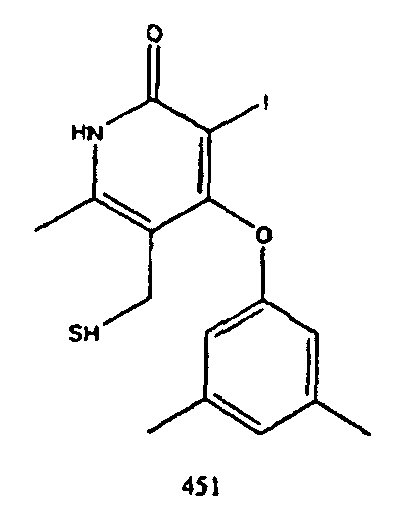
- A mixture of compound 125 (1.5 g; 0.0037 mol) and thiourea (0.31 g; 0.00408 mol) in DMSO (30 ml) was stirred at room temperature for 1 hour. NaOH 3N was added. The mixture was stirred for 15 minutes, acidified with HCl 3N and extracted with ethylacetate (EtOAc). The organic layer was separated, dried on magnesium sulfate (MgSO4 filtered and the solvent was evaporated. The residue was taken up in DIPE and filtered. The precipitate (1.2 g) was purified by column chromatography over silica gel (eluent: EtOAc 100%; 35-70 µm) and dried to yield 0.3 g (20%).
-

- A mixture of compound 451 (0.07 g; 0.0001 mol) and 4-chloromethyl-2-methylthiazole (0.16 g; 0.0008 mol) in ethanol (3 ml) and triethylamine (0.2 ml) was stirred at 80°C for 1 hour. H2O was added. The mixture was extracted with EtOAc. The organic layer was separated, dried (MgSO4), filtered and the solvent was evaporated. The residue (0.04 g) was purified by column chromatography over silica gel (eluent: CH2Cl2/CH3OH 98/2; 15-40 µm). The pure fractions were collected and the solvent was evaporated and dried to yield 0.018 g.
- Ammonium nitrate (3.1 g; 0.039 mol) was added to a solution of intermediate 22 (2-acethyl-5-phenyl-pentanoic acid ethyl ester) (8.8 g; 0.0354 mol) in tetrahydrofuran (90 ml). Ammoniac was bubbled. The mixture was stirred and refluxed for 6 hours, then stirred at room temperature for 12 hours, poured out into H2O and extracted with CH2Cl2. The organic layer was separated, dried on magnesium sulfate (MgSO4), filtered and the solvent was evaporated and dried to yield 8.3 g.
-

- Sodium ethoxide in ethanol (27.5 ml; 0.0738 mol) was stirred and refluxed. Malonic acid diethyl ester (11.8 ml; 0.0738 mol) was added dropwise. A solution of intermediate 23 (8.3 g; 0.0335 mol) in ethanol (30 ml) was added dropwise. The mixture was stirred and refluxed for 15 hours. Three-quarters of EtOH were evaporated. The mixture was poured out in ice, acidified with HCl 3N and extracted with EtOAc. The organic layer was separated, dried (MgSO4), filtered and the solvent was evaporated. The residue (19.5 g) was purified by column chromatography over silica gel (eluent: CH2Cl2/NH4OH 96/4/0.1; 15-35 µm). Two fractions were collected and the solvent was evaporated and dried to yield 0.43 g (4%).
- A mixture of intermediate 24 (0.1 g; 0.003 mol) and sodium hydroxide (0.038 g; 0.0009 mol) in H2O (1.5 ml) was stirred and refluxed for 15 hours, then cooled to 5°C with HCl 3N. The precipitate was filtered, washed with H2O, then with isopropanol and dried to yield 0.07 g (91%).
-

- A mixture of dichloro-3,5-dimethyliodobenzene (0.096 g; 0.0003 mol) and sodium carbonate (0.12 g; 0.0005 mol) in dimethylformamide (1 ml; 0.5 ml) was stirred at room temperature for 30 minutes. A solution of intermediate 25 (0.07 g; 0.0002 mol) and sodium carbonate (0.6 g; 0.0005 mol) in H2O (0.5 ml) was added. The mixture was stirred at room temperature for 1 hour. The precipitate was filtered, washed with H2O, then with DIPE and dried. The residue (0.12 g) was taken up in DMF and stirred at 100°C for 30 minutes. The solvent was evaporated till dryness. The residue (0.1 g) was purified by column chromatography over silica gel (eluent: CH2Cl2/CH3OH/NH4OH 98/2/0 to 95/5/0.1; 35-70 µm). The pure fractions were collected and the solvent was evaporated. The residue (0.07 g) was taken up in iPrOH. The precipitate was filtered off and dried to yield 0.06 g (44%), m.p. = 220°C.
-

- 3-Bromo-5-iodobenzaldehyde dichloride (intermediate 26) was obtained as described by H.J. Lucas and E.R. Kennedy, Org. Synth. (1955), III, 482-483.
- Intermediate 26 (311 mg, 1 mmol) was suspended in 10 ml of water containing sodium carbonate (106 mg, 1 mmol) and stirred for 30 min. at room temperature. To this mixture a solution of 5-ethyl-6-methyl-4-hydroxypyridin-2(1H)-one (153 mg, 1 mmol) in 10 ml of water containing also Na2CO3 (106 mg, 1 mmol) was added. After stirring for 1h at 20°C the precipitate was filtered off, washed with water, dried in vacuo and suspended in dimetllylforrnamide (5 mL). After heating at 120°C for 10 min., the solvent was removed. Purification by flash chromatography (SiO2, CH2Cl2/EtOH 98:2) gave the titled compound (205 mg, 44%) as yellow microcrystals, m.p. >260°C.
- To a 0°C magnetically stirred solution of diethyl(cyanomethyl)-phosphonate (113 µL, 0.68 mmol) in anhydrous THF (3 mL), NaH (28 mg; 0.68 mmol) was added (60% in mineral water). After stirring at room temperature for 1 h, compound 469 (80 mg; 0.17 mmol) was added and the reaction mixture was stirred 18 h at room temperature and poured into water (5 ml). The resulting solution was extracted with AcOEt, dried over MgSO4 and evaporated. The oily residue obtained was then crystallized from Et2O to give the pure titled compound (65 mg; 77%), m.p.> 260°C.
- Table 1 lists intermediates and compounds of formula (I) which were made analogous to one of the above examples.


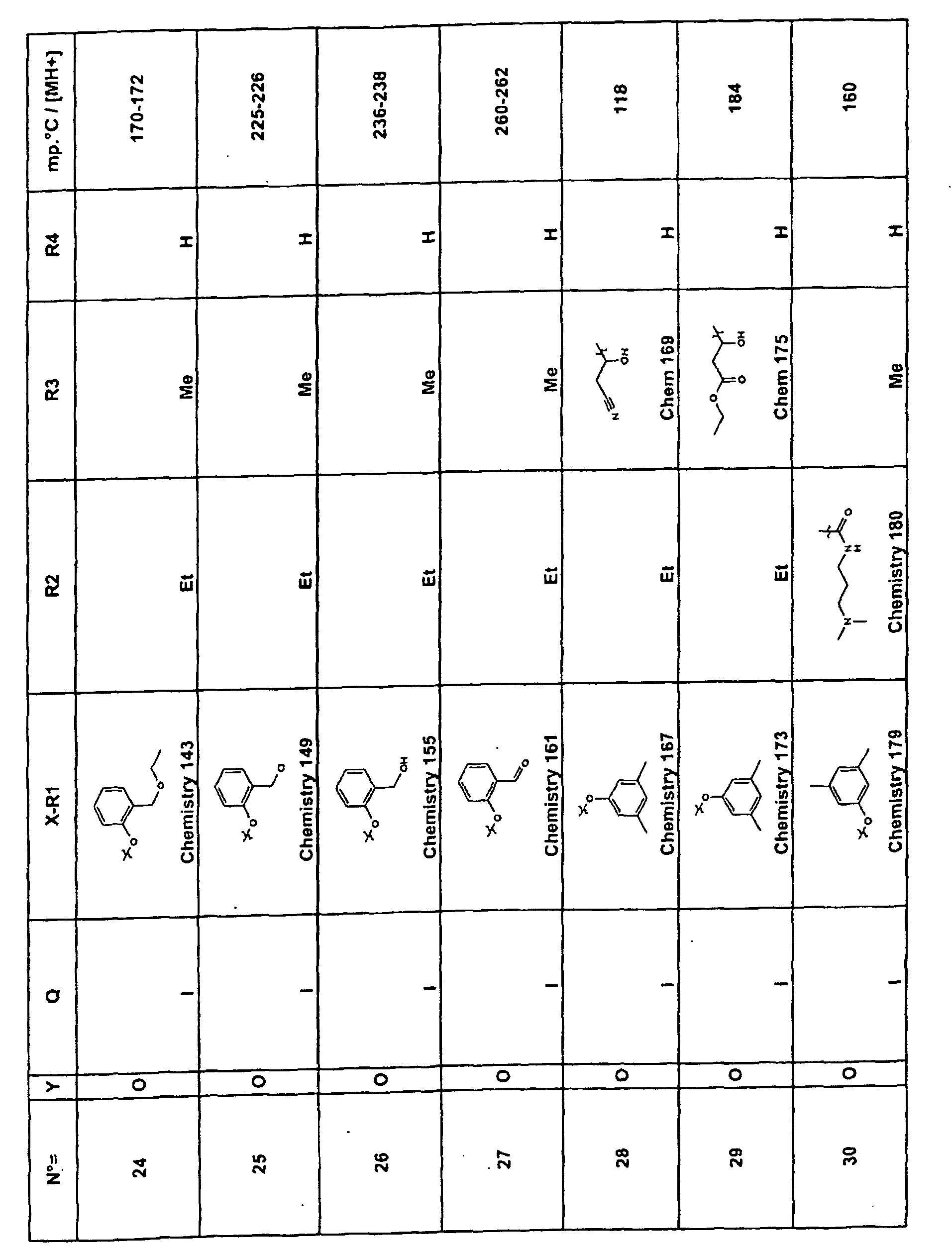


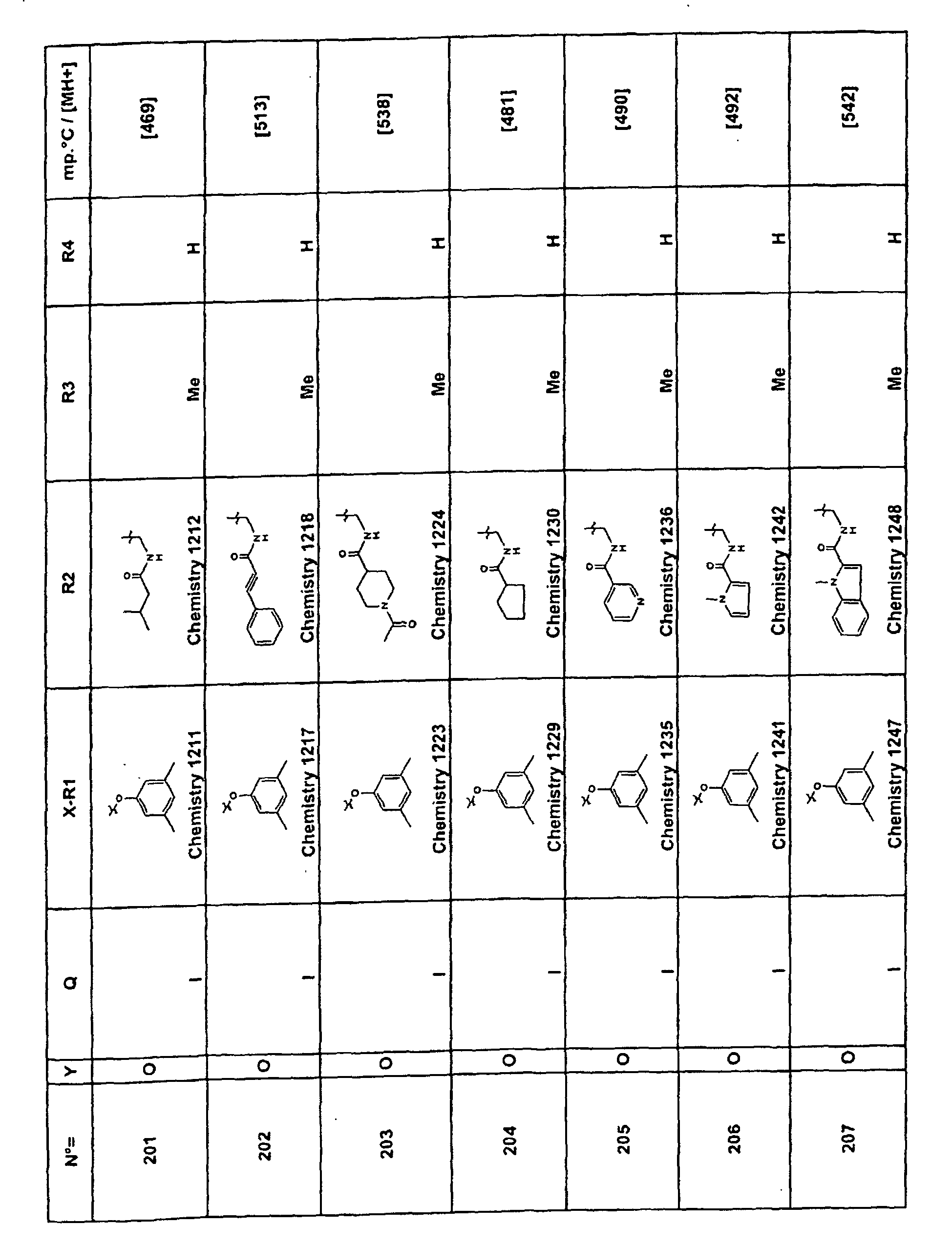
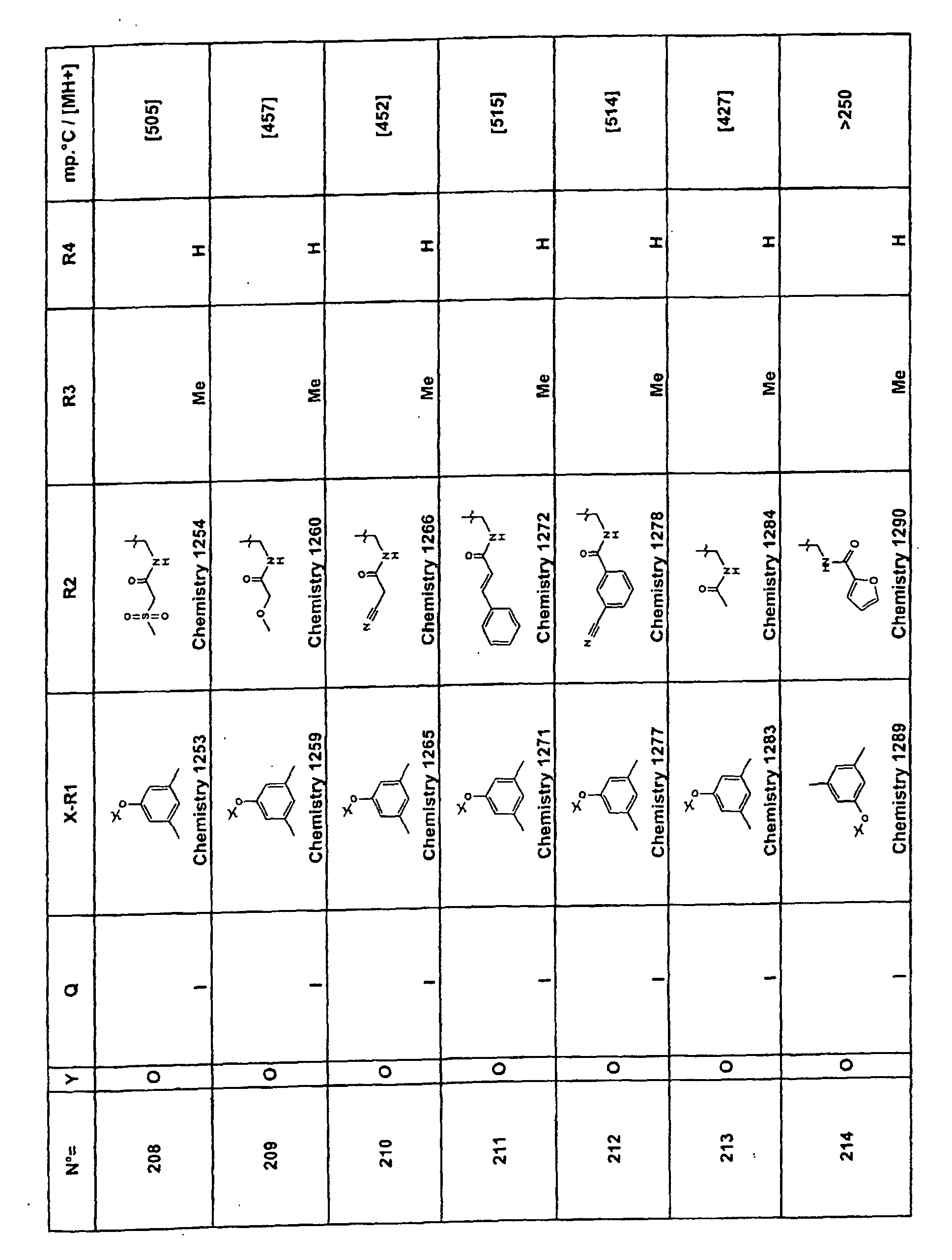


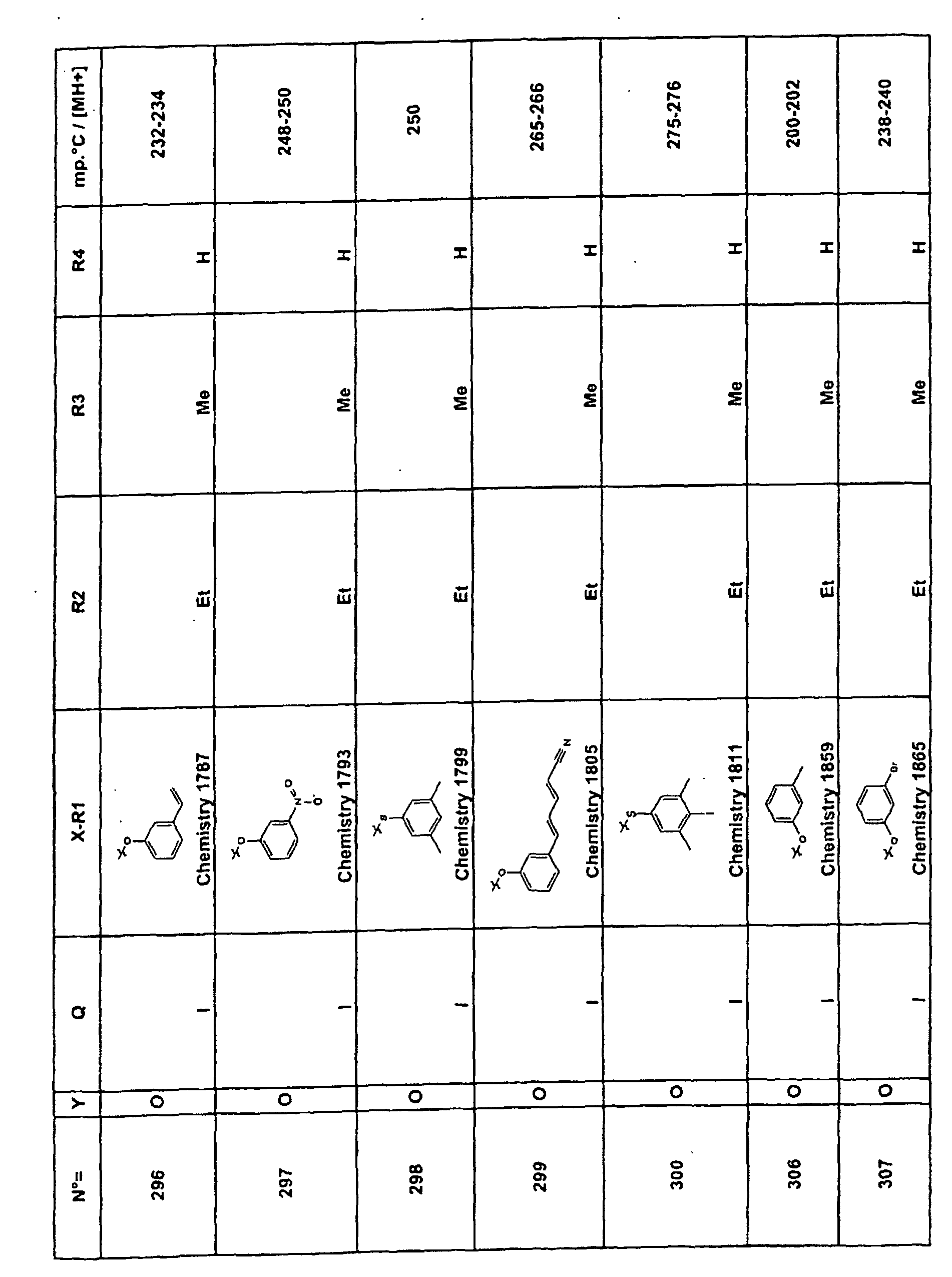


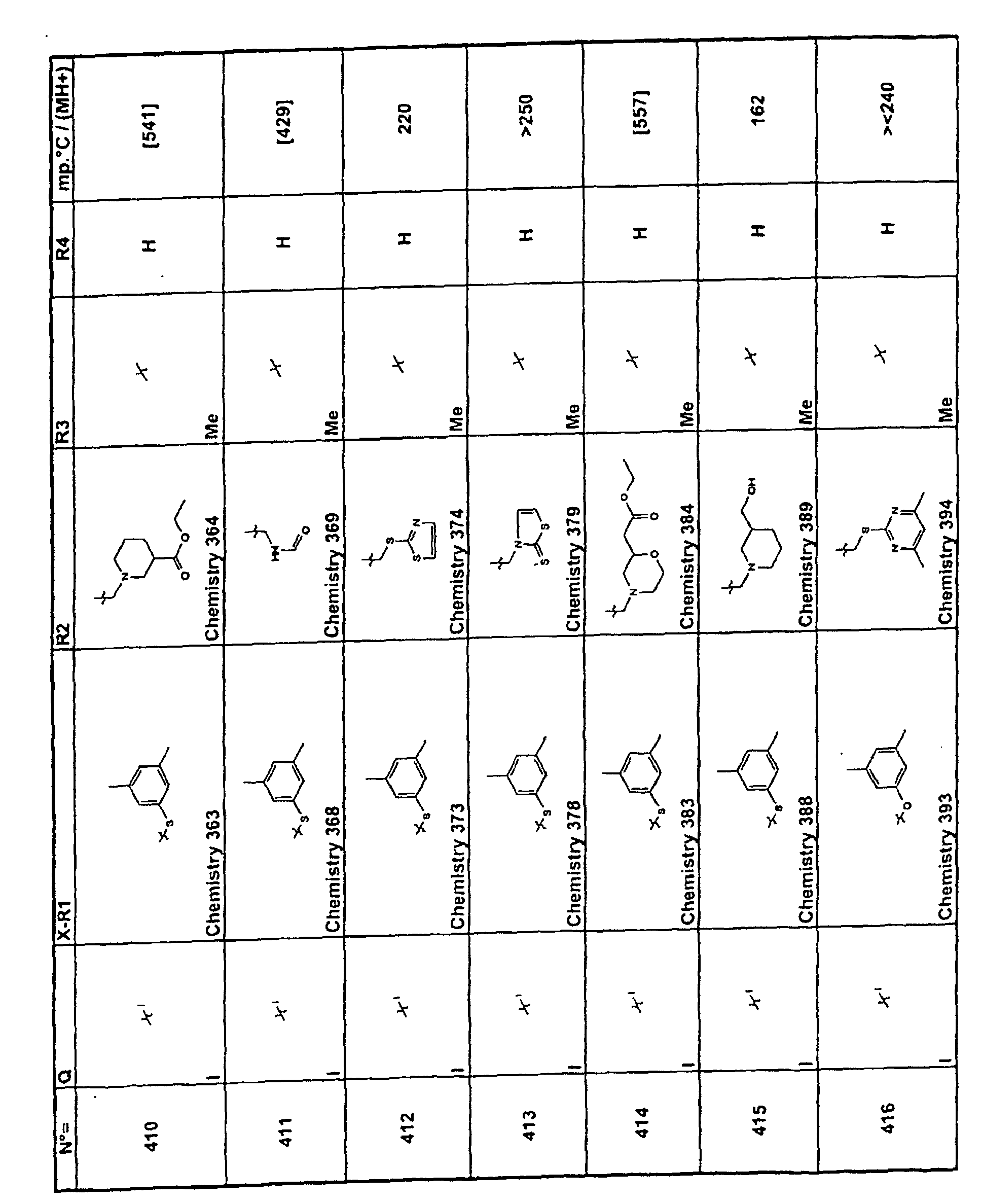


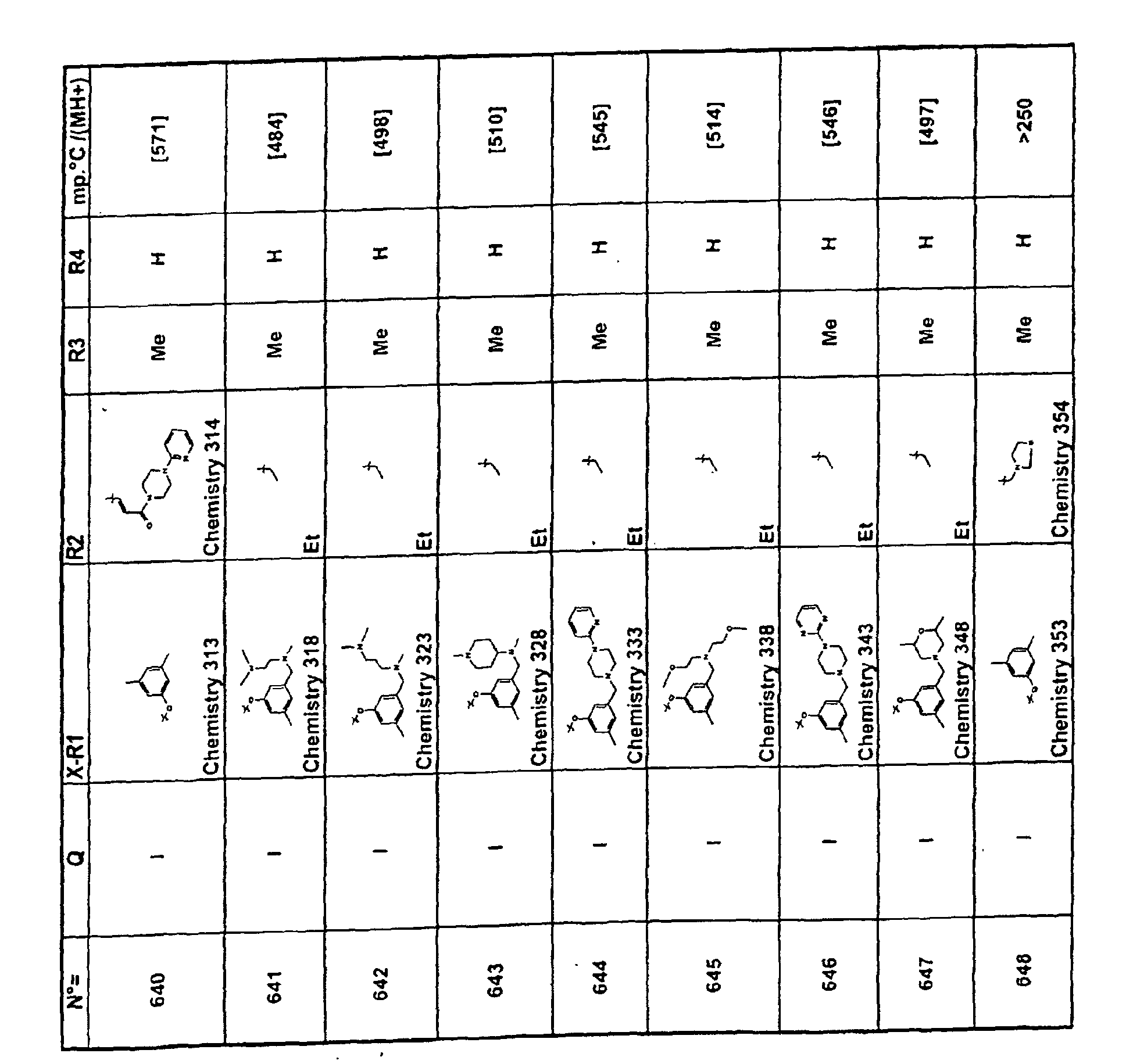


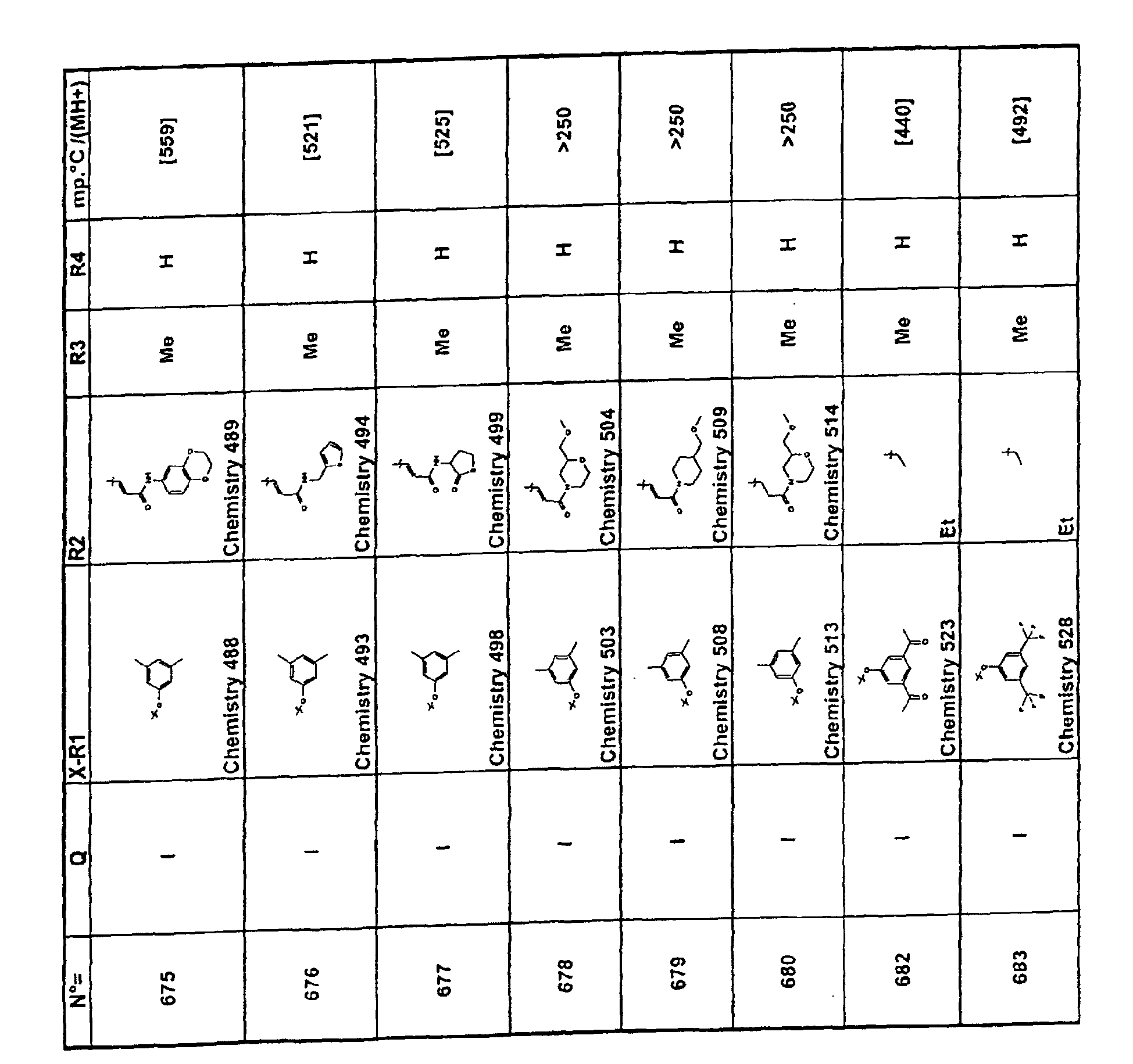


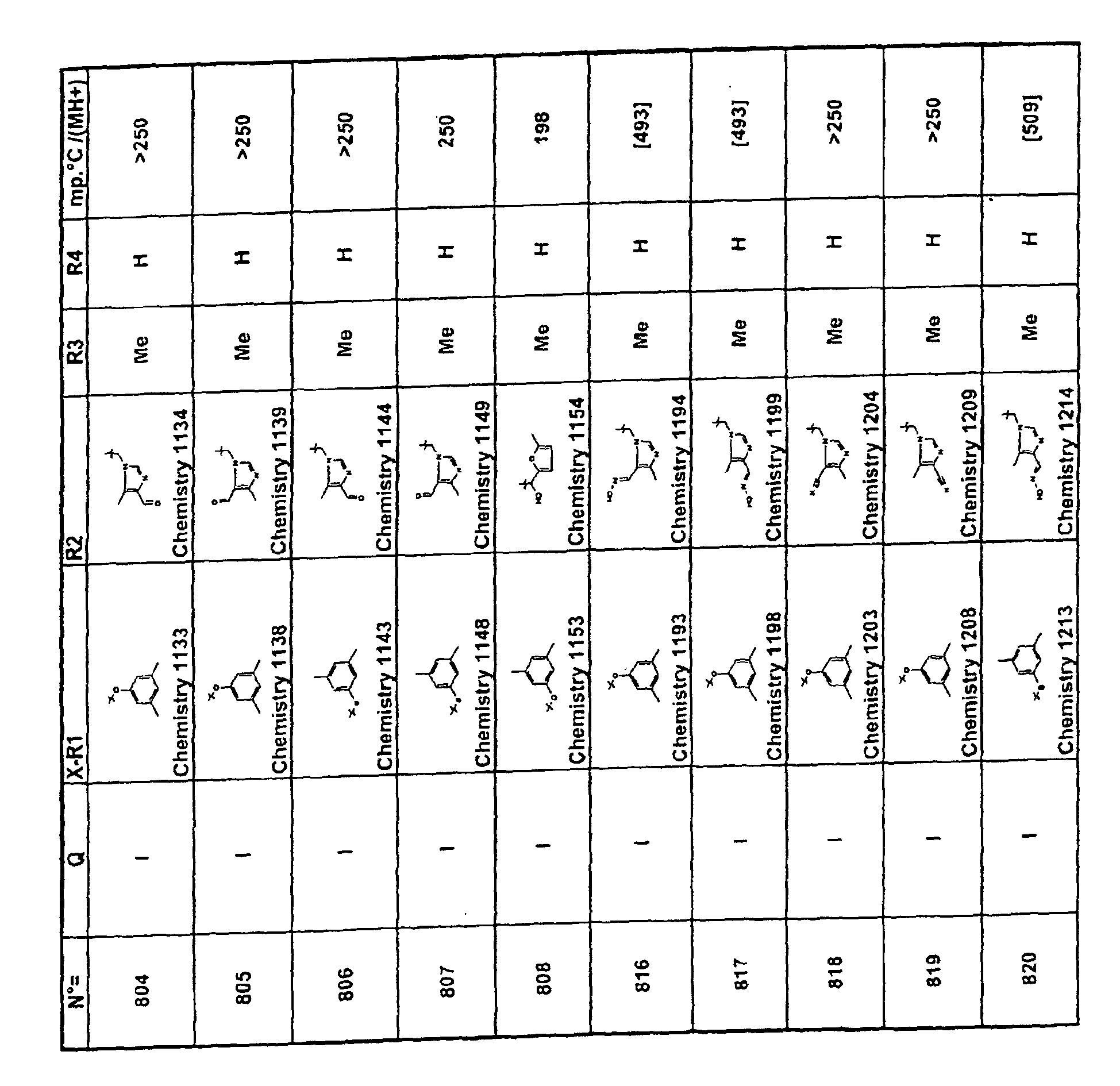

- A rapid, sensitive and automated assay procedure was used for the in vitro evaluation of anti-HIV agents. An HIV-1 transformed T4-cell line, MT-4, which was previously shown (Koyanagi et al., Int. J Cancer, (1985), 36, 445-451) to be highly susceptible to and permissive for HIV infection, served as the target cell line. Inhibition of the HIV-induced cytopathic effect was used as the end point. The viability of both HIV- and mock-infected cells was assessed spectrophotometrically via the in situ reduction of 3-(4,5-dimethylthiazol-2-yl)-2,5-diphenyltetrazolium bromide (MTT). The 50% cytotoxic concentration (CC50 in µM) was defined as the concentration of compound that reduced the absorbance of the mock-infected control sample by 50%. The percent protection achieved by the compound in HIV-infected cells was calculated by the following formula:
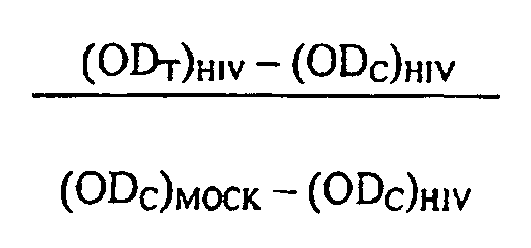
expressed in %,
whereby (ODT)HIV is the optical density measured with a given concentration of the test compound in HIV-infected cells; (ODC)HIV is the optical density measured for the control untreated HIV-infected cells; (ODC)MOCK is the optical density measured for the control untreated mock-infected cells; all optical density values were determined at 540 nm. The dose achieving 50% protection according to the above formula was defined as the 50% inhibitory concentration (IC50 in µM). The ratio of CC50 to IC50 was defined as the selectivity index (SI). The compounds of formula (I) were shown to inhibit HIV-1 effectively. Particular IC50, CC50 and SI values are listed in Table 2 hereinbelow.Table 2 N° IC50(µm) c SI c CC50(µm) 242 0,0006 > 158489 > 100 255 0,0006 > 15849 > 10 684 0,0008 > 125893 > 100 43 0,0010 10000 10 264 0,0010 > 10000 > 10 470 0,0010 12589 13 483 0,0010 > 100000 > 100 551 0,0010 12589 13 124 0,0013 > 7943 > 10 249 0,0013 > 25119 > 32 298 0,0013 > 7943 > 10 326 0,0013 7943 10 375 0,0013 > 79433 > 100 589 0,0013 > 7943 > 10 606 0,0013 15849 20 133 0,0016 > 6310 > 10 241 0,0016 > 63096 > 100 253 0,0016 > 6310 > 10 306 0,0016 > 19953 > 32 328 0,0016 > 63096 > 100 370 0,0016 > 63096 > 100 662 0,0016 > 63096 > 100 426 0,0016 39811 63 46 0,0020 > 50119 > 100 105 0,0020 > 5012 > 10 254 0,0020 > 15849 > 32 256 0,0020 > 5012 > 10 284 0,0020 > 5012 > 10 296 0,0020 12589 25 319 0,0020 > 50119 > 100 574 0,0020 > 50119 > 100 618 0,0020 25119 50 650 0,0020 > 50119 > 100 83 0,0025 3162 8 88 0,0025 > 39811 > 100 108 0,0025 19953 50 109 0,0025 12589 32 115 0,0025 3162 8 286 0,0025 > 12589 > 32 299 0,0025 32 0 713 0,0025 > 39811 > 100 45 0,0032 > 31623 > 100 85 0,0032 > 31623 > 100 86 0,0032 > 31623 > 100 244 0,0040 > 25119 > 100 297 0,0040 > 7943 > 32 250 0,0050 5012 25 257 0,0050 > 6310 > 32 307 0,0050 > 6310 > 32 81 0,0063 1995 13 92 0,0063 > 5012 > 32 140 0,0063 > 1585 > 10 143 0,0063 > 1585 > 10 217 0,0063 > 1585 > 10 221 0,0063 > 3162 > 20 232 0,0063 > 5012 > 32 245 0,0063 > 15849 > 100 309 0,0063 1585 10 321 0,0063 > 15849 > 100 322 0,0063 > 15849 > 100 547 0,0063 > 15849 > 100 31 0,0079 > 12589 > 100 218 0,0079 > 1259 > 10 222 0,0079 251 2 700 0,0079 > 1000 > 8 314 0,0079 > 3981 > 32 701 0,0100 6310 63 8 0,0100 > 10000 > 100 99 0,0100 > 10000 > 100 121 0,0100 > 10000 > 100 219 0,0100 > 3162 > 32 233 0,0100 > 1000 > 10 694 0,0100 39811 63 696 0,0158 > 2512 > 40
or R2 and R3 may be taken together to form a bivalent radical of formula
-(CH2)t-CH2-A3-CH2- (d-1)
with t being an integer of 0, 1 or 2 and A3 being CH2, O, S, NR7a or N[C(=O)R8a] and wherein each hydrogen in said formula (d-1) may be substituted with halo, C1-4alkyl, C1-4alkyloxy, C1-4alkylcarbonyl, haloC1-4alkylcarbonyl or arylcarbonyl;
provided that 3-iodo-6-methyl-4-phenoxy-2(1H)-pyridinone is not included.
or R2 and R3 may be taken together to form a bivalent radical of formula
-(CH2)t-CH2-A3-CH2- (d-1)
or
-CH=CH-CH=CH- (d-2)
with t being an integer of 0, 1 or 2 and A3 being CH2, O, S, NR7a or N[C(=O)R8a] and wherein each hydrogen in said formula (d-1) or (d-2) may be substituted with halo, C1-4alkyl, C1-4alkyloxy, C1-4alkylcarbonyl, haloC1-4alkylcarbonyl or arylcarbonyl;
R2 is selected from formyl; C1-6alkyloxycarbonylalkyl; Het2; Het2C1-6alkyl; C1-6alkylthio; C1-6alkyl optionally substituted with one or two substituents each independently selected from hydroxy or halo;
R3 is selected from formyl; C1-6alkyl optionally substituted with one or two C1-6alkyloxy;
R4 is hydrogen.
Claims (13)
- Compounds of formula (I)

the N-oxides, the pharmaceutically acceptable addition salts, the quaternary amines and stereochemically isomeric forms thereof, wherein
Y is O or S;
Q is halo;
X is a bivalent radical of formula
-(CH2)p- (a-1)
or
-(CH2)q-Z-(CH2)r- (a-2);
wherein p is an integer of value 1 to 5;
q is an integer of value 0 to 5;
r is an integer of value 0 to 5;
Z is O, S, NR7, C(=O), S(=O), S(=O)2, CHOR13 CH=CH, CH(NR7R8) or CF2; and wherein each hydrogen atom may be replaced by C1-4alkyl or hydroxyC1-4alkyl;
R1 is C3-6cycloalkyl, C1-6alkenyl, aryl;R2 is selected from hydrogen; formyl; cyano; azido; hydroxy; oxiranyl; amino; mono- or di(C1-4alkyl)amino; formylamino; mercapto(C1-6)alkyl; hydrazino; R5aR6aN-C(=O)-; R9-N=C(R10)-; C2-6alkenyl optionally substituted with one or two substituents each independently selected from halo, hydroxy, cyano, formyl, C1-6alkyloxy, C1-6alkylcarbonyl, C1-6alkyloxycarbonyl, C1-6alkylcarbonyloxy, di(C1-4alkyl)carbamoyl, [di(C1-4alkyl)amino(C1-6alkyl)] (C1-4alkyl)carbamoyl, [di(C1-4alkyl)amino(C1-6alkyl)](arylC1-4alkyl)carbamoyl, di(C1-4alkyloxy) (C1-4alkyl)carbamoyl, (cyanoC1-6alkyl)(C1-6alkyl)aminoC1-6alkyl, N-hydroxy-imino, aryl, Het2, Het2carboxamido, Het2(C1-6alkyl)carbamoyl; C2-6alkynyl optionally substituted with one or two substituents each independently selected from halo, hydroxy, cyano, formyl, C1-6alkyloxy, C1-6alkylcarbonyl, C1-6alkyloxycarbonyl, C1-6alkylcarbonyloxy, N-hydroxy-imino, aryl or Het2; C1-6alkyloxy; hydroxyC1-6alkyloxy; aminoC1-6alkyloxy; mono- or di(C1-4alkyl)aminoC1-6alkyloxy; C1-6alkylcarbonyl; arylcarbonyl; Het2carbonyl; C1-6alkyloxycarbonyl; C1-6alkylcarbonyloxy; aryl; aryloxy; arylC1-6alkyloxy; arylthio; arylC1-6alkylthio; mono- or di(aryl)amino; Het2; Het2oxy; Het2thio; Het2C1-6alkyloxy; Het2C1-6alkylthio; Het2SO2; Het2SO; mono- or di(Het2)amino; C3-6cycloalkyl; C3-6cycloalkyloxy; C3-6cycloalkylthio; C1-6alkylthio; hydroxyC1-6alkylthio; aminoC1-6alkylthio; mono- or di(C1-4alkyl)aminoC1-6alkylthio; C1-6alkyl optionally substituted with one or two substituents each independently selected from halo, hydroxy, cyano, carboxyl, C1-6alkyloxy, C1-6alkylthio, C1-6alkylsulfonyl, C1-6alkycarbamoylC1-4alkylthio, hydroxyC1-6alkyloxy, C1-6alkyloxyC1-6alkyloxy, C1-6alkyloxyC1-6alkylthio C1-6alkylcarbonyl, C1-6alkylcarbonyloxy, aminocarbonyloxy, mono- or di(C1-4alkyl)aminocarbonyloxy, C1-6alkyloxycarbonyl, C1-6alkyloxycarbonylC1-6alkyloxy, C1-6alkyloxycarbonylC1-6alkylthio, aryl, Het2, aryloxy, arylthio, arylC1-6alkyloxy, arylC1-6alkylthio, Het2C1-6alkyloxy, Het2C1-6alkylthio, C1-6alkyl-S(=O)2-oxy, amino, mono- or di(C1-6alkyl)amino, di(C1-6alkyl)aminoC1-6alkylthio, [di(C1-6alkyl)amino(C1-6alkyl)](C1-6alkyl)amino, di(cyanoC1-6alkyl)amino, C1-6alkyloxycarbonylamino, C1-6alkyloxyC1-6alkylcarbonylamino, mono- or di(aryl)amino, mono- or di(arylC1-4alkyl)amino, mono- or di(C1-4alkyloxyC1-4alkyl)amino, mono- or di(C1-4alkylthioC1-4alkyl)amino, mono- or di(Het2C1-4alkyl)amino, (Het2C1-4alkyl)(C1-4alkyl)amino, (cyanoC1-6alkyl)(C1-6alkyl)amino, C3-6Cycloalkylthio, R11-(C=O)-NH-, R12-NH-(C=O)-NH-, R14-S(=O)2-NH-, C1-6alkyl-P(O-R15)2=O, C1-6alkyl-P(O-C1-6alkyl-O)=O or a radical of formula
with A1 being CH or N, and A2 being CH2, NR13, S or O, provided that when A1 is CH then A2 is other than CH2, said radical (c-1), (c-2) and (c-3) being optionally substituted with one or two substituents each independently selected from H, C1-6 alkyl, C1-6 alkyloxy, hydroxy C1-4alkyl, C1-6alkyloxycarbonyl, C1-6 alkyloxycarbonylC1-4alkyl, aminoC1-6alkyl, C1-4alkylcarbonyl, arylcarbonyl, aryl, Het1, Het1-(C=0)-, hydroxy, cyano, C1-4alkylcyano, CONR16R17 with R16 and R17 being independently H or alkyl, mono or di(C1-4alkyl)aminoalkyl, 4-hydroxy-4-phenyl or 4-cyano-4-phenyl;R3 is selected from hydrogen; halo; formyl; cyano; azido; hydroxy; oxiranyl; amino; mono- or di(C1-4alkyl)amino; formylamino; mercapto(C1-6)alkyl; hydrazino; R5aR6aN-C(=O)-, R9-N=C(R10)-; C2-6alkenyl optionally substituted with one or two substituents each independently selected from halo, hydroxy, cyano, formyl, C1-6alkyloxy, C1-6alkylcarbonyl, C1-6alkyloxycarbonyl, C1-6alkylcarbonyloxy, di(C1-4alkyl)carbamoyl, [di(C1-4alkyl)amino(C1-6alkyl)](C1-4alkyl)carbamoyl, [di(C1-4alkyl)amino(C1-6alkyl)](arylC1-4alkyl)carbamoyl, di(C1-4alkyloxy) (C1-4alkyl)carbamoyl, (cyanoC1-6alkyl)(C1-6alkyl)aminoC1-6alkyl, N-hydroxyimino, aryl, Het2, Het2carboxamido, Het2(C1-6alkyl)carbamoyl; C2-6alkynyl. optionally substituted with one or two substituents each independently selected from halo, hydroxy, cyano, formyl, C1-6alkyloxy, C1-6alkylcarbonyl, C1-6alkyloxycarbonyl, C1-6alkylcarbonyloxy, N-hydroxy-imino, aryl or Het2; C1-6alkyloxy; hydroxyC1-6alkyloxy; aminoC1-6alkyloxy; mono- or di(C1-4alkyl)aminoC1-6alkyloxy; C1-6alkylcarbonyl; arylcarbonyl; Het2carbonyl; C1-6alkyloxycarbonyl; C1-6alkylcarbonyloxy; aryl; aryloxy; arylC1-6alkyloxy; arylthio; arylC1-6alkylthio; mono- or di(aryl)amino; Het2; Het2oxy; Het2thio; Het2C1-6alkyloxy; Het2C1-6alkylthio; Het2SO2; Het2SO; mono- or di(Het2)amino; C3-6cycloalkyl; C3-6cycloalkyloxy; C3-6cycloalkylthio; C1-6alkylthio; hydroxyC1-6alkylthio; aminoC1-6alkylthio; mono- or di(C1-4alkyl)aminoC1-6alkylthio; C1-6alkyl optionally substituted with one or two substituents each independently selected from halo, hydroxy, cyano, carboxyl, C1-6alkyloxy, C1-6alkylthio, C1-6alkylsulfonyl, C1-6alkycarbamoylC1-4alkylthio, hydroxyC1-6alkyloxy, C1-6alkyloxyC1-6alkyloxy, C1-6alkyloxyC1-6alkylthio C1-6alkylcarbonyl, C1-6alkylcarbonyloxy, aminocarbonyloxy, mono- or di(C1-4alkyl)aminocarbonyloxy, C1-6alkyloxycarbonyl, C1-6alkyloxycarbonylC1-6alkyloxy, C1-6alkyloxycarbonylC1-6alkylthio, aryl, Het2, aryloxy, arylthio, arylC1-6alkyloxy, arylC1-6alkylthio, Het2C1-6alkyloxy, Het2C1-6alkylthio, C1-6alkyl-S(=O)2-oxy, amino, mono- or di(C1-6alkyl)amino, di(C1-6alkyl)aminoC1-6alkylthio, [di(C1-6alkyl)amino(C1-6alkyl)](C1-6alkyl)amino, di(cyanoC1-6alkyl)amino, C1-6alkyloxycarbonylamino, C1-6alkyloxyC1-6alkylcarbonylamino, mono- or di(aryl)amino, mono- or di(arylC1-4alkyl)amino, mono- or di(C1-4alkyloxyC1-4alkyl)amino, mono- or di(C1-4alkylthioC1-4alkyl)amino, mono- or di(Het2C1-4alkyl)amino, (Het2C1-4alkyl)(C1-4alkyl)amino, (cyanoC1-6alkyl)(C1-6alkyl)amino, C3-6cycloalkylthio, R11-(C=O)-NH-, R12-NH-(C=O)-NH-, R14-S(=O)2-NH-, C1-6alkyl-P(O-R15)2=O, C1-6alkyl-P(O-C1-6alkyl-O)=O or a radical of formula
with A1 being CH or N, and A2 being CH2, NR13, S or O, provided that when A1 is CH then A2 is other than CH2, said radical (c-1), (c-2) and (c-3) being optionally substituted with one or two substituents each independently selected from H, C1-6 alkyl, C1-6 alkyloxy, hydroxy C1-4alkyl, C1-6alkyloxycarbonyl, C1-6 alkyloxycarbonylC1-4alkyl, aminoC1-6alkyl, C1-4alkylcarbonyl, arylcarbonyl, aryl, Het1, Het1-(C=O)-, hydroxy, cyano, C1-4alkylcyano, CONR16R17 with R16 and R17 being independently H or alkyl, mono or di(C1-4alkyl)aminoalkyl, 4-hydroxy-4-phenyl or 4-cyano-4-phenyl;
or R2 and R3 may be taken together to form a bivalent radical of formula
-(CH2)t-CH2-A3-CH2- (d-1)
with t being an integer of 0, 1 or 2 and A3 being CH2, O, S, NR7a or N[C(=O)R8a] and wherein each hydrogen in said formula (d-1) may be substituted with halo, C1-4alkyl, C1-4alkyloxy, C1-4alkylcarbonyl, haloC1-4alkylcarbonyl or arylcarbonyl;R4 is hydrogen;R5a and R6a each independently are hydrogen; C1-4alkyl optionally substituted with cyano, C1-4alkyloxy, C1-4alkylthio, amino, mono-or di(C1-4alkyl)amino or a radical of formula
with A5 and A6 each independently being CH2, NR13 or O;R7, R7a and R7b each independently are hydrogen, formyl or C1-4alkyl;R8, R8a and R8b each independently are hydrogen or C1-4alkyl;R9 is hydrogen, hydroxy, C1-4alkyloxy, carboxylC1-4alkyloxy, C1-4alkyloxycarbonyl-C1-4alkyloxy, C2-4alkenyloxy, C2-4alkynyloxy or arylC1-4alkyloxy;R10 is hydrogen, carboxyl or C1-4alkyl;R11 is hydrogen; C1-4alkyl optionally substituted with cyano, C1-4alkyloxy, C1-4alkyl-S(=O)2-, aryl or Het3; C1-4alkyloxy; C2-4alkenyl; arylC2-4alkenyl; Het3C2-4alkenyl; C2-4alkynyl; Het3C2-4alkynyl, arylC2-4alkynyl; C3-6cycloalkyl; aryl; naphthyl or Het3;R12 is C1-4alkyl, arylC1-4alkyl, aryl, arylcarbonyl, C1-4alkylcarbonyl, C1-4alkyloxycarbonyl or C1-4alkyloxycarbonylC1-4alkyl;R13 is hydrogen, C1-4alkyl or C1-4alkylcarbonyl;R14 is C1-4alkyl optionally substituted with aryl or Het4; polyhaloC1-4alkyl or C2-4alkenyl optionally substituted with aryl or Het4;R15 is C1-4 alkyl;Het1 and Het2 each independently are a heterocycle selected from pyrrolyl, furanyl, thienyl, imidazolyl, oxazolyl, isoxazolyl, thiazolyl, pyridyl, pyrimidinyl, pyrazinyl, pyridazinyl, pyrrolidinyl, tetrahydrofuranyl, tetrahydrothienyl, tetrahydropyrimidinyl, imidazolidinyl, oxazolidinyl, thiazolidinyl, piperidinyl, hexahydropyrimidinyl, piperazinyl, hexahydropyridazinyl, morpholinyl, thiomorpholinyl triazolyl, tetrazolyl, pyrrolyl, pyrazolyl, benzopyrrolyl, benzofuranyl, benzothienyl, benzimidazolyl, benzoxazolyl, benzothiazolyl, benzotriazolyl, indolyl, indazolyl, benzodioxanyl, quinolinyl, 2-oxo-1,2-dihydro-quinolinyl, imidazopyridinyl, dihydropyrrolyl or dihydroisoxazolyl, said heterocycle optionally being substituted with one, two or three substituents each independently selected from O, S, halo, formyl, amino, hydroxy, cyano, C1-4alkyl, hydroxyC1-4alkyl, carboxyC1-4alkyl, carbamoylC1-4alkyl, carbamoylC1-4alkoxy, C1-4alkyloxy, C1-4alkylcarbonyl, C1-4alkyloxyC1-4alkyl, cyanoC1-4alkyl, di(C1-4alkyl)aminoC1-4alkyl, -OCONH2, C1-4alkoxyC1-4alkyl, aryl, Het2C1-4alkyl, polyhaloC1-4alkyl, C3-6cycloalkyl or arylC2-6alkenyl;Het3 is a monocyclic or bicyclic heterocycle selected from pyrrolyl, furanyl, thienyl, imidazolyl, oxazolyl, thiazolyl, pyridinyl, pyrimidinyl, pyrazinyl, pyridazinyl, benzopyrrolyl, benzofuranyl, benzothienyl, benzimidazolyl, benzoxazolyl, benzothiazolyl, quinolinyl, 2-oxo-1,2-dihydro-quinolinyl, pyrrolidinyl, tetrahydrofuranyl, tetrahydrothienyl, imidazolidinyl, oxazolidinyl, thiazolidinyl, piperidinyl, hexahydropyrimidinyl, piperazinyl, hexahydropyridazinyl or a radical of formula
with A7 or A8 each independently being selected from CH2 or O; each of said monocyclic or bicyclic heterocycles may optionally be substituted with one, two or three substituents each independently selected from halo, hydroxy, C1-4alkyl, C1-4alkyloxy, C1-4alkylcarbonyl or polyhaloC1-4alkyl;Het4 is a monocyclic heterocycle selected from pyrrolyl, furanyl, thienyl, imidazolyl, oxazolyl, thiazolyl, pyridyl, pyrimidinyl, pyrazinyl, pyridazinyl, said heterocycle optionally being substituted with one, two or three substituents each independently selected from halo, hydroxy, C1-4alkyl, C1-4alkyloxy, C1-4alkylcarbonyl or polyhaloC1-4alkyl;Het5 is pyridyl, pyrimidyl, pyridazinyl, pyrazinyl, pyrrolyl, thienyl, furanyl, imidazolyl, thiazolyl, oxazolyl, tetrazolyl, piperidinyl, morpholinyl or pyrrolidinyl;aryl is phenyl optionally substituted with one, two or three substituents each independently selected from halo; hydroxy; carboxyl; cyano; formyl; acetyl; nitro; amino; mono- or di(C1-4alkyl)amino; C1-4alkylcarbonylamino; mono- or di(C1-4alkyl)aminocarbonylamino; C1-4alkyl-S(=O)2-NH-; Het5(=S)-S-C1-4alkyl ; C1-6alkyloxy; sulfamoyl; (C1-4alkyl)sulfamoyl; arylsulfamoyl; Het2sulfamoyl; O-P=OR15; C1-6alkyl optionally substituted with halo, hydroxy, cyano, nitro, formyl, amino, mono- or di(C1-4alkyl)amino, C1-6alkyloxycarbonyl, C1-6alkyloxy, C1-6alkyloxyC1-6alkyloxy, C2-6alkenyloxy, C1-6alkylcarbonyloxy, C1-6alkyloxycarbonylthio, N-hydroxyimino, phenyl or Het5; C2-6alkenyl optionally substituted with halo, hydroxy, cyano, nitro, formyl, amino, mono- or di(C1-4alkyl)amino, C1-6alkyloxycarbonyl, C1-6alkyloxy, C1-6alkylcarbonyl, C1-6alkylcarbonyloxy, N-hydroxy-imino, phenyl or Het5; C2-6alkynyl optionally substituted with halo, hydroxy, cyano, formyl, amino, mono- or di(C1-4alkyl)amino, C1-6alkyloxycarbonyl, C1-6alkyloxy, C1-6alkylcarbonyl, C1-6alkylcarbonyloxy, N-hydroxy-imino, phenyl or Het5; phenyl; phenyloxy; phenyl(C1-4alkyl)thioC1-4alkyl; (C3-6)cyclohexylthioC1-4alkyl or isoxazolinyl optionally substituted by C1-4alkyloxycarbonyl or morpholinylC1-4alkyl
provided that 3-iodo-6-methyl-4-phenoxy-2(1H)-pyridinone is not included. - Compounds as claimed in claim 1 wherein
Q is halo;
X is a bivalent radical of formula
-(CH2)p- (a-1)
or
-(CH2)q-Z-(CH2)r- (a-2);
wherein p is an integer of value 1 to 5;
q is an integer of value 0 to 5;
r is an integer of value 0 to 5;
Z is O, S, NR7, C(=O), S(=O), S(=O)2, CHOR13, CH=CH, CH(NR7R8) or CF2;
and wherein each hydrogen atom may be replaced by C1-4alkyl or hydroxyC1-4alkyl;
R1 is C3-6cycloalkyl, aryl;R2 is selected from hydrogen; formyl; cyano; azido; hydroxy; oxiranyl; amino; mono- or di(C1-4alkyl)amino; formylamino; R5aR6aN-C(=O)-; R9-N=C(R10)-; C2-6alkenyl optionally substituted with one or two substituents each independently selected from halo, hydroxy, cyano, formyl, C1-6alkyloxy, C1-6alkylcarbonyl, C1-6alkyloxycarbonyl, C1-6alkylcarbonyloxy, N-hydroxyimino, aryl or Het2; C2-6alkynyl optionally substituted with one or two substituents each independently selected from halo, hydroxy, cyano, formyl, C1-6alkyloxy, C1-6alkylcarbonyl, C1-6alkyloxycarbonyl, C1-6alkylcarbonyloxy, N-hydroxy-imino, aryl or Het2; C1-6alkyloxy; hydroxyC1-6alkyloxy; aminoC1-6alkyloxy; mono- or di(C1-4alkyl)aminoC1-6alkyloxy; C1-6alkylcarbonyl; arylcarbonyl; Het2carbonyl; C1-6alkyloxycarbonyl; C1-6alkylcarbonyloxy; aryl; aryloxy; arylC1-6alkyloxy; arylthio; arylC1-6alkylthio; mono- or di(aryl)amino; Het2; Het2oxy; Het2thio; Het2C1-6alkyloxy; Het2C1-6alkylthio; mono- or di(Het2)amino; C3-6cycloalkyl; C3-6cycloalkyloxy; C3-6cycloalkylthio; C1-6alkylthio; hydroxyC1-6alkylthio; aminoC1-6alkylthio; mono- or di(C1-4alkyl)aminoC1-6alkylthio; C1-6alkyl optionally substituted with one or two substituents each independently selected from halo, hydroxy, cyano, C1-6alkyloxy, C1-6alkylthio, hydroxyC1-6alkyloxy, C1-6alkyloxyC1-6alkyloxy, C1-6alkylcarbonyl, C1-6alkylcarbonyloxy, aminocarbonyloxy, mono- or di(C1-4alkyl)aminocarbonyloxy, C1-6alkyloxycarbonyl, C1-6alkyloxycarbonylC1-6alkyloxy, C1-6alkyloxycarbonylC1-6alkylthio, aryl, Het2, aryloxy, arylthio, arylC1-6alkyloxy, arylC1-6alkylthio, Het2C1-6alkyloxy, Het2C1-6alkylthio, C1-6alkyl-S(=O)2-oxy, amino, mono- or di(C1-6alkyl)amino, C1-6alkyloxycarbonylamino, C1-6alkyloxyC1-6alkylcarbonylamino, mono- or di(aryl)amino, mono- or di(arylC1-4alkyl)amino, mono- or di(C1-4alkyloxyC1-4alkyl)amino, mono- or di(C1-4alkylthioC1-4alkyl)amino, mono- or di(Het2C1-4alkyl)amino, R11-(C=O)-NH-, R12-NH-(C=O)-NH-, R14-S(=O)2-NH-, C1-6alkyl-P(O-R15)2=O, C1-6alkyl-P(O-C1-6alkyl-O)=O or a radical of formula
with A1 being CH2 or N, and A2 being CH2, NR13, S or O, provided that when A1 is CH2 then A2 is other than CH2, said radical (c-1) and (c-2) being optionally substituted with one or two substituents each independently selected from H, C1-6 alkyl, C1-6 alkyloxy, hydroxy C1-4alkyl, C1-6 alkyloxycarbonyl, C1-6 alkyloxycarbonylC1-4alkyl, aminoC1-6alkyl, carbonyl, hydroxy, cyano, CONR16R17 with R16 and R17 being independently H or alkyl, mono or di(C1-4alkyl)aminoalkyl, 4-hydroxy-4-phenyl or 4-cyano-4-phenyl;R3 is selected from hydrogen; halo; formyl; cyano; azido; hydroxy; oxiranyl; amino; mono- or di(C1-4alkyl)amino; formylamino; R5aR6aN-C(=O)-; R9-N=C(R10)-; C2-6alkenyl optionally substituted with one or two substituents each independently selected from halo, hydroxy, cyano, formyl, C1-6alkyloxy, C1-6alkylcarbonyl, C1-6alkyloxycarbonyl, C1-6alkylcarbonyloxy, N-hydroxyimino, aryl or Het2; C2-6alkynyl optionally substituted with one or two substituents each independently selected from halo, hydroxy, cyano, formyl, C1-6alkyloxy, C1-6alkylcarbonyl, C1-6alkyloxycarbonyl, C1-6alkylcarbonyloxy, N-hydroxy-imino, aryl or Het2; C1-6alkyloxy; hydroxyC1-6alkyloxy; aminoC1-6alkyloxy; mono- or di(C1-4alkyl)aminoC1-6alkyloxy; C1-6alkylcarbonyl; arylcarbonyl; Het2carbonyl; C1-6alkyloxycarbonyl; C1-6alkylcarbonyloxy; aryl; aryloxy; arylC1-6alkyloxy; arylthio; arylC1-6alkylthio; mono- or di(aryl)amino; Het2; Het2oxy, Het2thio; Het2C1-6alkyloxy; Het2C1-6alkylthio; mono- or di(Het2)amino; C3-6cycloalkyl; C3-6cycloalkyloxy; C3-6cycloalkylthio; C1-6alkylthio; hydroxyC1-6alkylthio; aminoC1-6alkylthio; mono- or di(C1-4alkyl)aminoC1-6alkylthio; C1-6alkyl optionally substituted with one or two substituents each independently selected from halo, hydroxy, cyano, C1-6alkyloxy, C1-6alkylthio, hydroxyC1-6alkyloxy, C1-6alkyloxyC1-6alkyloxy, C1-6alkylcarbonyl, C1-6alkylcarbonyloxy, aminocarbonyloxy, mono- or di(C1-4alkyl)aminocarbonyloxy, C1-6alkyloxycarbonyl, C1-6alkyloxycarbonylC1-6alkyloxy, C1-6alkyloxycarbonylC1-6alkylthio, aryl, Het2, aryloxy, arylthio, arylC1-6alkyloxy, arylC1-6alkylthio, Het2C1-6alkyloxy, Het2C1-6alkylthio, C1-6alkyl-S(=O)2-oxy, amino, mono- or di(C1-6alkyl)amino, C1-6alkyloxycarbonylamino, C1-6alkyloxyC1-6alkylcarbonylamino, mono- or di(aryl)amino, mono- or di(arylC1-4alkyl)amino, mono- or di(C1-4alkyloxyC1-4alkyl)amino, mono- or di(C1-4alkylthioC1-4alkyl)amino, mono- or di(Het2C1-4alkyl)amino, R11-(C=O)-NH-, R12-NH-(C=O)-NH-, R14-S(=O)2-NH-, C1-6alkyl-P(O-R15)2=O, C1-6alkyl-P(O-C1-6alkyl-O)=O or a radical of formula
with A1 being CH2 or N, and A2 being CH2, NR13, S or O, provided that when A1 is CH2 then A2 is other than CH2, said radical (c-1) and (c-2) being optionally substituted with one or two substituents each independently selected from H, C1-6 alkyl, C1-6 alkyloxy, hydroxy C1-4alkyl, C1-6 alkyloxycarbonyl, C1-6 alkyloxycarbonylC1-4alkyl, aminoC1-6alkyl, carbonyl, hydroxy, cyano, CONR16R17 with R16 and R17 being independently H or alkyl, mono or di(C1-4alkyl)aminoalkyl, 4-hydroxy-4-phenyl or 4-cyano-4-phenyl;
or R2 and R3 may be taken together to form a bivalent radical of formula
-(CH2)t-CH2-A3-CH2- (d-1)
or
-CH=CH-CH=CH- (d-2)
with t being an integer of 0,1 or 2 and A3 being CH2, O, S, NR7a or N[C(=0)R8a] and wherein each hydrogen in said formula (d-1) or (d-2) may be substituted with halo, C1-4alkyl, C1-4alkyloxy, C1-4alkylcarbonyl, haloC1-4alkylcarbonyl or arylcarbonyl;R4 is hydrogen;R5a and R6a each independently are hydrogen; C1-4alkyl optionally substituted with cyano, C1-4alkyloxy, C1-4alkylthio, amino, mono-or di(C1-4alkyl)amino or a radical of formula
with A5 and A6 each independently being CH2, NR13 or O;R7, R7a and R7b each independently are hydrogen, formyl or C1-4alkyl;R8, R8a and R8b each independently are hydrogen or C1-4alkyl;R9 is hydrogen, hydroxy, C1-4alkyloxy, carboxylC1-4alkyloxy, C1-4alkyloxycarbonyl-C1-4alkyloxy, C2-4alkenyloxy, C2-4alkynyloxy or arylC1-4alkyloxy;R10 is hydrogen, carboxyl or C1-4alkyl;R11 is hydrogen; C1-4alkyl optionally substituted with cyano, C1-4alkyloxy, C1-4alkyl-S(=O)2-, aryl or Het3; C1-4alkyloxy; C2-4alkenyl; arylC2-4alkenyl; Het3C2-4alkenyl; C2-4alkynyl; Het3C2-4alkynyl, arylC2-4alkynyl; C3-6cycloalkyl; aryl; naphthyl or Het3;R12 is C1-4alkyl, arylC1-4alkyl, aryl, arylcarbonyl, C1-4alkylcarbonyl, C1-4alkyloxycarbonyl or C1-4alkyloxycarbonylC1-4alkyl;R13 is hydrogen, C1-4alkyl or C1-4alkylcarbonyl;R14 is C1-4alkyl optionally substituted with aryl or Het4; polyhaloC1-4alkyl or C2-4alkenyl optionally substituted with aryl or Het4;R15 is C1-4 alkyl;Het1 and Het2 each independently are a heterocycle selected from pyrrolyl, furanyl, thienyl, imidazolyl, oxazolyl, thiazolyl, pyridyl, pyrimidinyl, pyrazinyl, pyridazinyl, pyrrolidinyl, tetrahydrofuranyl, tetrahydrothienyl, imidazolidinyl, oxazolidinyl, thiazolidinyl, piperidinyl, hexahydropyrimidinyl, piperazinyl, hexahydropyridazinyl, benzopyrrolyl, benzofuranyl, benzothienyl, benzimidazolyl, benzoxazolyl, benzothiazolyl, quinolinyl or 2-oxo-1,2-dihydro-quinolinyl, said heterocycle optionally being substituted with one, two or three substituents each independently selected from halo, hydroxy, C1-4alkyl, C1-4alkyloxy, C1-4alkylcarbonyl or polyhaloC1-4alkyl;Het3 is a monocyclic or bicyclic heterocycle selected from pyrrolyl, furanyl, thienyl, imidazolyl, oxazolyl, thiazolyl, pyridinyl, pyrimidinyl, pyrazinyl, pyridazinyl, benzopyrrolyl, benzofuranyl, benzothienyl, benzimidazolyl, benzoxazolyl, benzothiazolyl, quinolinyl, 2-oxo-1,2-dihydro-quinolinyl, pyrrolidinyl, tetrahydrofuranyl, tetrahydrothienyl, imidazolidinyl, oxazolidinyl; thiazolidinyl, piperidinyl, hexahydropyrimidinyl, piperazinyl, hexahydropyridazinyl or a radical of formula
with A7 or A8 each independently being selected from CH2 or O; each of said monocyclic or bicyclic heterocycles may optionally be substituted with one, two or three substituents each independently selected from halo, hydroxy,C1-4alkyl, C1-4alkyloxy, C1-4alkylcarbonyl or polyhaloC1-4alkyl;Het4 is a monocyclic heterocycle selected from pyrrolyl, furanyl, thienyl, imidazolyl, oxazolyl, thiazolyl, pyridyl, pyrimidinyl, pyrazinyl, pyridazinyl, said heterocycle optionally being substituted with one, two or three substituents each independently selected from halo, hydroxy, C1-4alkyl, C1-4alkyloxy, C1-4alkylcarbonyl or polyhaloC1-4alkyl;Het5 is pyridyl, pyrimidyl, pyridazinyl, pyrazinyl, pyrrolyl, thienyl, furanyl, imidazolyl, thiazolyl or oxazolyl;aryl is phenyl optionally substituted with one, two or three substituents each independently selected from halo; hydroxy; carboxyl; cyano; formyl; nitro; amino; mono- or di(C1-4alkyl)amino; C1-4alkylcarbonylamino; mono- or di(C1-4alkyl)aminocarbonylamino; C1-4alkyl-S(=O)2-NH-; C1-6alkyloxy; C1-6alkyl optionally substituted with halo, hydroxy, cyano, formyl, amino, mono- or di(C1-4alkyl)amino, C1-6alkyloxycarbonyl, C1-6alkyloxy, C1-6alkyloxyC1-6alkyloxy, C1-6alkylcarbonyloxy, N-hydroxy-imino, phenyl or Het5; C2-6alkenyl optionally substituted with halo, hydroxy, cyano, formyl, amino, mono- or di(C1-4alkyl)amino, C1-6alkyloxycarbonyl, C1-6alkyloxy, C1-6alkylcarbonyl, C1-6alkylcarbonyloxy, N-hydroxy-imino, phenyl or Het5; C2-6alkynyl optionally substituted with halo, hydroxy, cyano, formyl, amino, mono- or di(C1-4alkyl)amino, C1-6alkyloxycarbonyl, C1-6alkyloxy, C1-6alkylcarbonyl, C1-6alkylcarbonyloxy, N-hydroxy-imino, phenyl or Het5; phenyl or phenyloxy; - Compounds as claimed in claim 1 wherein
Q is halo,
X is (a-2) with q and r being 0 and Z being O, S or SO;R1 is phenyl optionally substituted with one, two or three substituents each independently selected from halo; hydroxy; carboxyl; cyano; formyl; nitro; amino; mono- or di(C1-4alkyl)amino; C1-4alkylcarbonylamino; mono- or di(C1-4alkyl)aminocarbonylamino; C1-4alkyl-S(=O)2-NH-; C1-6alkyloxy, C1-6alkyl optionally substituted with halo, hydroxy, cyano, formyl, amino, mono- or di(C1-4alkyl)amino, C1-6alkyloxycarbonyl, C1-6alkyloxy, C1-6alkyloxyC1-6alkyloxy, C1-6alkylcarbonyloxy, N-hydroxy-imino, phenyl or Het5; C2-6alkenyl optionally substituted with halo, hydroxy, cyano, formyl, amino, mono- or di(C1-4alkyl)amino, C1-6alkyloxycarbonyl, C1-6alkyloxy, C1-6alkylcarbonyl, C1-6alkylcarbonyloxy, N-hydroxy-imino, phenyl or Het5; C2-6alkynyl optionally substituted with halo, hydroxy, cyano, formyl, amino, mono- or di(C1-4alkyl)amino, C1-6alkyloxycarbonyl, C1-6alkyloxy, C1-6alkylcarbonyl, C1-6alkylcarbonyloxy, N-hydroxy-imino, phenyl or Het5; phenyl or phenyloxy;
R2 is selected from formyl; C1-6alkyloxycarbonylalkyl; Het2; Het2C1-6alkyl; C1-6alkylthio; C1-6alkyl optionally substituted with one or two substituents each independently selected from hydroxy or halo;
R3 is selected from formyl; C1-6alkyl optionally substituted with one or two C1-6alkyloxy;
R4 is hydrogen. - Compounds as claimed in any one of claims 1 and 3 wherein Q is iodo.
- Compounds as claimed in any one of claims 1 to 4 wherein Q is iodo, X-R1 is a 3,5-dimethylphenylthio or a 3,5-dimethylphenyloxy and R2 is a hydroxymethyl or a N-morpholinomethyl, or a 3-phenylproyl or a furan-2-yl-methylthiomethyl.
- Compounds as claimed in any one of claims 1 to 5 wherein Q is iodo, X-R1 is a 3-(2-cyano-vinyl)-5-iodophenyloxy or 5-bromo-3-(2-cyano-vinyl) and R2 is ethyl.
- Compounds as claimed in any one of claims 1 to 4 wherein the compounds are listed in the following table:


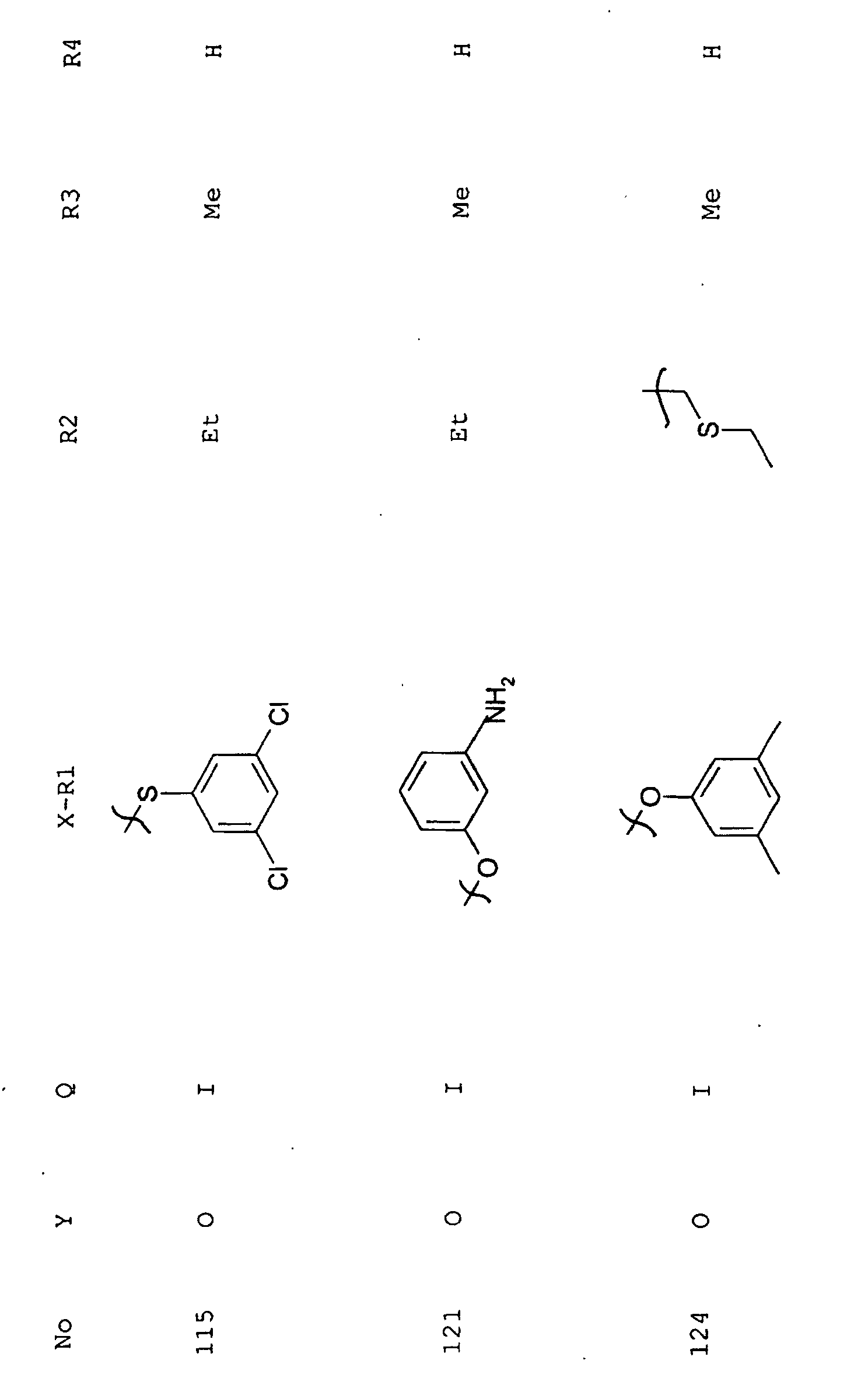


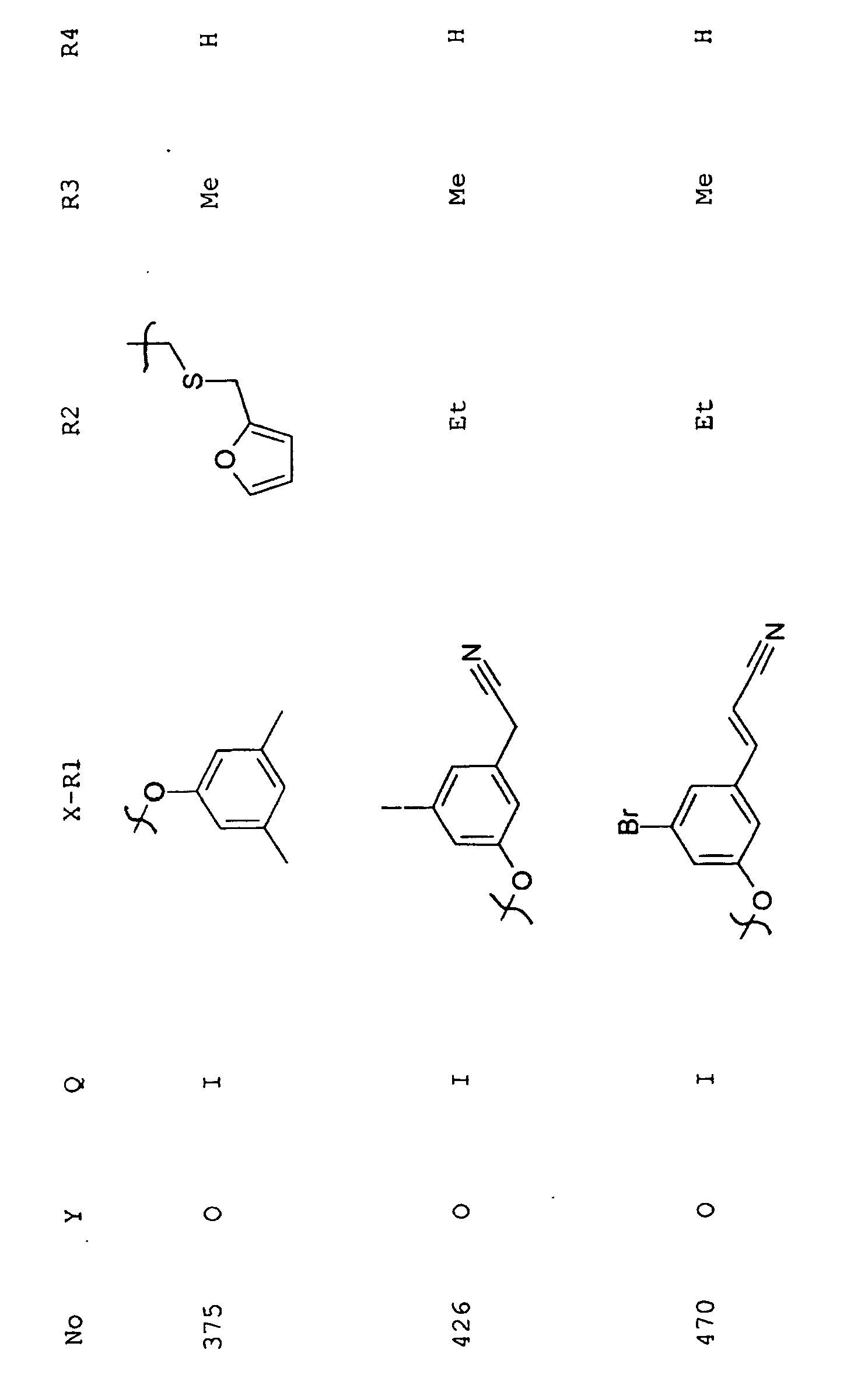


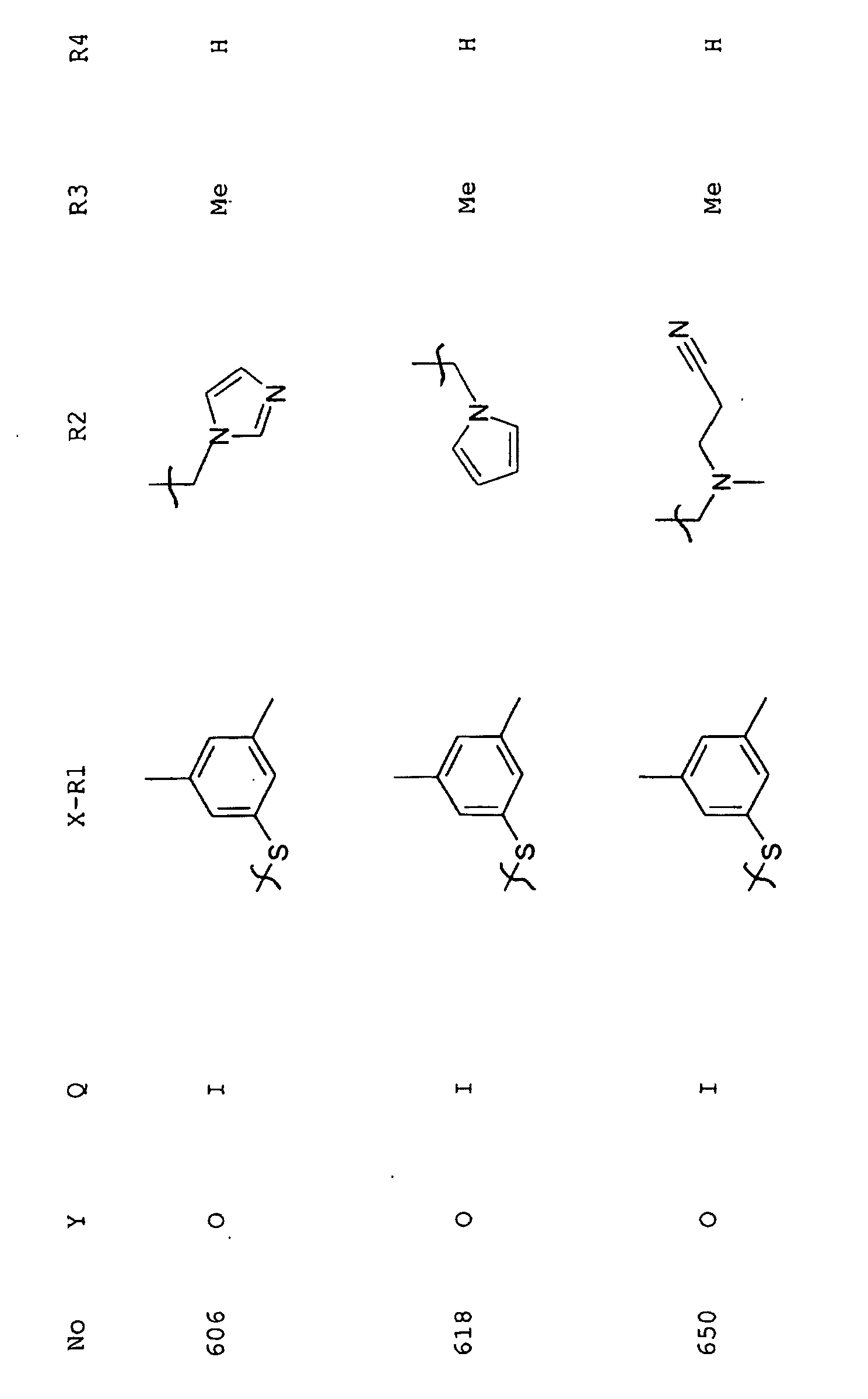


- The use of a compound as claimed in anyone of claims 1 to 7 for the manufacture of a medicine for the treatment of subjects suffering from Human Immuno Deficiency Virus infection.
- A pharmaceutical composition comprising a pharmaceutically acceptable carrier and a therapeutically active amount of a compound as defined in anyone of claims 1 to 7.
- A process for preparing a pharmaceutical composition as defined in claim 9, characterized in that a therapeutically effective amount of a compound as defined in anyone of claims 1 to 5 is intimately mixed with a pharmaceutically acceptable carrier.
- The combination of a compound of formula (I) as defined in claim 1 and other antiretroviral compounds.
- A product containing (a) a compound of formula (I) as defined in claim 1 and (b) another antiretroviral compound as a combined preparation for simultaneous, separate or sequential use in anti-HIV treatment.
- A pharmaceutical composition comprising a pharmaceutically acceptable carrier and as active ingredients (a) a compound of formula (I) as defined in claim 1 and (b) another antiretroviral compound.
Priority Applications (1)
| Application Number | Priority Date | Filing Date | Title |
|---|---|---|---|
| EP01980812A EP1318995B1 (en) | 2000-09-19 | 2001-09-18 | Pyridinone and pyridinethione derivatives having hiv inhibiting properties |
Applications Claiming Priority (4)
| Application Number | Priority Date | Filing Date | Title |
|---|---|---|---|
| EP00402583 | 2000-09-19 | ||
| EP00402583 | 2000-09-19 | ||
| PCT/IB2001/002082 WO2002024650A2 (en) | 2000-09-19 | 2001-09-18 | Pyridinone and pyridinethione derivatives having hiv inhibiting properties |
| EP01980812A EP1318995B1 (en) | 2000-09-19 | 2001-09-18 | Pyridinone and pyridinethione derivatives having hiv inhibiting properties |
Publications (2)
| Publication Number | Publication Date |
|---|---|
| EP1318995A2 EP1318995A2 (en) | 2003-06-18 |
| EP1318995B1 true EP1318995B1 (en) | 2006-03-08 |
Family
ID=8173871
Family Applications (1)
| Application Number | Title | Priority Date | Filing Date |
|---|---|---|---|
| EP01980812A Expired - Lifetime EP1318995B1 (en) | 2000-09-19 | 2001-09-18 | Pyridinone and pyridinethione derivatives having hiv inhibiting properties |
Country Status (7)
| Country | Link |
|---|---|
| US (1) | US7115608B2 (en) |
| EP (1) | EP1318995B1 (en) |
| JP (1) | JP2004509867A (en) |
| AT (1) | ATE319706T1 (en) |
| AU (1) | AU2002212598A1 (en) |
| DE (1) | DE60117839T2 (en) |
| WO (1) | WO2002024650A2 (en) |
Families Citing this family (33)
| Publication number | Priority date | Publication date | Assignee | Title |
|---|---|---|---|---|
| CA2456292A1 (en) * | 2001-08-14 | 2003-02-27 | Toyama Chemical Co., Ltd. | Novel virus growth inhibitor and/or virucidal method, and novel pyrazine nucleotide or pirazine nucleoside analog |
| AU2004268455B2 (en) * | 2003-08-29 | 2009-12-17 | Ono Pharmaceutical Co., Ltd. | Compound capable of binding S1P receptor and pharmaceutical use thereof |
| EP1516873A1 (en) * | 2003-09-22 | 2005-03-23 | Facultés Universitaires Notre-Dame de la Paix | 2-pyridinone derivatives, having HIV inhibiting properties |
| WO2006012624A2 (en) * | 2004-07-21 | 2006-02-02 | The Regents Of The University Of California | Mechanism-based crosslinkers |
| MX2007007919A (en) * | 2004-12-31 | 2008-01-22 | Reddy Us Therapeutics Inc | Novel benzylamine derivatives as cetp inhibitors. |
| AP2007004244A0 (en) | 2005-05-10 | 2007-12-31 | Intermune Inc | Method of modulating stress-activated protein kinase system |
| JP5112317B2 (en) * | 2005-08-29 | 2013-01-09 | バーテックス ファーマシューティカルズ インコーポレイテッド | 3,5-Disubstituted pyrid-2-ones useful as inhibitors of the TEC family of non-receptor tyrosine kinases |
| CN101952274A (en) * | 2007-11-20 | 2011-01-19 | 默沙东公司 | Non-nucleoside reverse transcriptase inhibitor |
| PE20100747A1 (en) * | 2008-04-21 | 2010-11-03 | Novartis Ag | HETEROCYCLIC COMPOUNDS AS MEK INHIBITORS |
| JP2011518841A (en) * | 2008-04-24 | 2011-06-30 | ニューリンク ジェネティクス, インコーポレイテッド | IDO inhibitor |
| EP2296653B1 (en) | 2008-06-03 | 2016-01-27 | Intermune, Inc. | Compounds and methods for treating inflammatory and fibrotic disorders |
| WO2010026075A1 (en) * | 2008-09-04 | 2010-03-11 | F. Hoffmann-La Roche Ag | Pyridine derivatives as inhibitors of hiv-i reverse transcriptase |
| CN103288719A (en) * | 2012-03-05 | 2013-09-11 | 苏州欧凯医药技术有限公司 | Synthesis of non-nucleoside HIV (human immunodeficiency virus) inhibitor pyridone lead |
| WO2014043252A2 (en) | 2012-09-11 | 2014-03-20 | Rutgers, The State University Of New Jersey | Therapeutic hydroxypyridinones, hydroxypyrimidinones and hydroxypyridazinones |
| AR092742A1 (en) | 2012-10-02 | 2015-04-29 | Intermune Inc | ANTIFIBROTIC PYRIDINONES |
| TW201441193A (en) | 2012-12-06 | 2014-11-01 | Kyowa Hakko Kirin Co Ltd | Pyridone compound |
| DK3102576T3 (en) | 2014-02-03 | 2019-07-22 | Vitae Pharmaceuticals Llc | DIHYDROPYRROLOPYRIDINE INHIBITORS OF ROR-GAMMA |
| RU2692485C2 (en) | 2014-04-02 | 2019-06-25 | Интермьюн, Инк. | Antifibrous pyridinones |
| CA2957785C (en) | 2014-08-11 | 2023-01-03 | Angion Biomedica Corporation | Cytochrome p450 inhibitors and uses thereof |
| SI3207043T1 (en) | 2014-10-14 | 2019-04-30 | Vitae Pharmaceuticals, Inc. | Dihydropyrrolopyridine inhibitors of ror-gamma |
| US9663515B2 (en) | 2014-11-05 | 2017-05-30 | Vitae Pharmaceuticals, Inc. | Dihydropyrrolopyridine inhibitors of ROR-gamma |
| US9845308B2 (en) | 2014-11-05 | 2017-12-19 | Vitae Pharmaceuticals, Inc. | Isoindoline inhibitors of ROR-gamma |
| CA2970819A1 (en) | 2014-12-31 | 2016-07-07 | Angion Biomedica Corp. | Methods and agents for treating disease |
| EP3297615A1 (en) * | 2015-05-20 | 2018-03-28 | INSERM - Institut National de la Santé et de la Recherche Médicale | Methods and pharmaceutical composition for modulation polarization and activation of macrophages |
| EP3331876B1 (en) | 2015-08-05 | 2020-10-07 | Vitae Pharmaceuticals, LLC | Modulators of ror-gamma |
| EP3868750A1 (en) | 2015-11-20 | 2021-08-25 | Vitae Pharmaceuticals, LLC | Modulators of ror-gamma |
| US9481674B1 (en) | 2016-06-10 | 2016-11-01 | Vitae Pharmaceuticals, Inc. | Dihydropyrrolopyridine inhibitors of ROR-gamma |
| CN106279011A (en) * | 2016-08-16 | 2017-01-04 | 成都百事兴科技实业有限公司 | A kind of preparation method of 2,4 dihydroxy 6 methylnicotinic acid ethyl esters |
| US20190367457A1 (en) | 2016-12-30 | 2019-12-05 | Mitobridge, Inc. | Oxopyridine derivatives useful as aminocarboxymuconate semialdehyde decarboxylase (acmsd) inhibitors |
| CN115716826A (en) | 2017-07-24 | 2023-02-28 | 生命医药有限责任公司 | Inhibitors of RORγ |
| WO2019018975A1 (en) | 2017-07-24 | 2019-01-31 | Vitae Pharmaceuticals, Inc. | Inhibitors of ror gamma |
| CN113234084B (en) * | 2021-05-18 | 2023-05-05 | 云南民族大学 | Compound with anti-rotavirus activity in Meadowrue of Crane celebration and preparation method thereof |
| CN119768393A (en) | 2022-05-25 | 2025-04-04 | 医肯纳肿瘤学公司 | MEK inhibitors and uses thereof |
Family Cites Families (13)
| Publication number | Priority date | Publication date | Assignee | Title |
|---|---|---|---|---|
| US4017499A (en) * | 1976-04-05 | 1977-04-12 | Sandoz, Inc. | 6H(1)-Benzopyrano(3,2-c)quinolines |
| DE3406329A1 (en) * | 1984-02-22 | 1985-08-22 | Merck Patent Gmbh, 6100 Darmstadt | PYRIDONE |
| NZ238576A (en) * | 1990-06-18 | 1994-12-22 | Merck & Co Inc | Pyridinone derivatives, preparation and pharmaceutical compositions thereof |
| FR2737496B1 (en) * | 1995-07-31 | 1997-12-19 | Centre Nat Rech Scient | 4-ARYL-THIO-PYRIDIN-2 (1H) -ONES, MEDICAMENTS CONTAINING THEM, AND USES THEREOF IN THE TREATMENT OF HIV-1 AND 2-RELATED DISEASES |
| DE19544098A1 (en) * | 1995-11-27 | 1997-05-28 | Hoechst Schering Agrevo Gmbh | Cycloalkylmethyl and cycloalkylidenemethyl pyridines, processes for their preparation, compositions containing them and their use as pesticides and fungicides |
| DE19613591A1 (en) * | 1996-04-04 | 1997-10-09 | Hoechst Ag | Substituted quinoline derivatives, process for their preparation and their use |
| CA2274093C (en) * | 1996-12-05 | 2006-11-07 | Amgen Inc. | Substituted pyrimidinone and pyridinone compounds and their use |
| DE19732330C2 (en) * | 1997-07-28 | 2001-04-19 | Koenig & Bauer Ag | Drive for a printing unit |
| DE19755316C2 (en) * | 1997-12-12 | 1999-10-07 | Koenig & Bauer Ag | Drive for cylinders of a printing unit |
| CZ20003978A3 (en) | 1998-04-27 | 2001-09-12 | Centre National De La Recherche Scientifique | Derivatives of 3-(amino- or aminoalkyl)pyridinone and use thereof |
| WO2000000475A1 (en) * | 1998-06-30 | 2000-01-06 | Du Pont Pharmaceuticals Company | Substituted quinolin-2(1h)-ones useful as hiv reverse transcriptase inhibitors |
| GB9930061D0 (en) * | 1999-12-20 | 2000-02-09 | Glaxo Group Ltd | Quinolone compounds for use in treating viral infections |
| US6736060B2 (en) * | 2000-09-20 | 2004-05-18 | Koenig & Bauer Aktiengesellschaft | Printing unit |
-
2001
- 2001-09-18 AT AT01980812T patent/ATE319706T1/en not_active IP Right Cessation
- 2001-09-18 WO PCT/IB2001/002082 patent/WO2002024650A2/en not_active Ceased
- 2001-09-18 AU AU2002212598A patent/AU2002212598A1/en not_active Abandoned
- 2001-09-18 US US10/380,784 patent/US7115608B2/en not_active Expired - Fee Related
- 2001-09-18 JP JP2002529063A patent/JP2004509867A/en active Pending
- 2001-09-18 DE DE60117839T patent/DE60117839T2/en not_active Expired - Lifetime
- 2001-09-18 EP EP01980812A patent/EP1318995B1/en not_active Expired - Lifetime
Also Published As
| Publication number | Publication date |
|---|---|
| JP2004509867A (en) | 2004-04-02 |
| WO2002024650A2 (en) | 2002-03-28 |
| WO2002024650B1 (en) | 2002-11-14 |
| AU2002212598A1 (en) | 2002-04-02 |
| WO2002024650A3 (en) | 2002-08-08 |
| EP1318995A2 (en) | 2003-06-18 |
| DE60117839D1 (en) | 2006-05-04 |
| US7115608B2 (en) | 2006-10-03 |
| US20040229847A1 (en) | 2004-11-18 |
| ATE319706T1 (en) | 2006-03-15 |
| DE60117839T2 (en) | 2006-11-23 |
Similar Documents
| Publication | Publication Date | Title |
|---|---|---|
| US20040229847A1 (en) | Pyridinone and pyridinethione derivatives having hiv inhibiting properties | |
| JP5230050B2 (en) | HIV replication inhibitor | |
| KR100658489B1 (en) | Pyrimidine Inhibits HIV Replication | |
| EP1419152B1 (en) | Hiv inhibiting pyrimidines derivatives | |
| EP3071203A2 (en) | Tetrahydroquinoline compositions as bet bromodomain inhibitors | |
| EP1370265A1 (en) | Hiv inhibiting pyrazinone derivatives | |
| US7015221B2 (en) | 2,4-disubstituted triazine derivatives | |
| AU2002315251B2 (en) | HIV inhibiting pyrazinone derivatives | |
| MXPA01003646A (en) | Hiv replication inhibiting pyrimidines | |
| AU2002315251A1 (en) | HIV inhibiting pyrazinone derivatives | |
| HK1038232B (en) | 2,4-disubstituted triazine derivatives with anti hiv activity |
Legal Events
| Date | Code | Title | Description |
|---|---|---|---|
| PUAI | Public reference made under article 153(3) epc to a published international application that has entered the european phase |
Free format text: ORIGINAL CODE: 0009012 |
|
| 17P | Request for examination filed |
Effective date: 20030407 |
|
| AK | Designated contracting states |
Designated state(s): AT BE CH CY DE DK ES FI FR GB GR IE IT LI LU MC NL PT SE TR |
|
| AX | Request for extension of the european patent |
Extension state: AL LT LV MK RO SI |
|
| 17Q | First examination report despatched |
Effective date: 20040601 |
|
| GRAP | Despatch of communication of intention to grant a patent |
Free format text: ORIGINAL CODE: EPIDOSNIGR1 |
|
| GRAS | Grant fee paid |
Free format text: ORIGINAL CODE: EPIDOSNIGR3 |
|
| GRAA | (expected) grant |
Free format text: ORIGINAL CODE: 0009210 |
|
| AK | Designated contracting states |
Kind code of ref document: B1 Designated state(s): AT BE CH CY DE DK ES FI FR GB GR IE IT LI LU MC NL PT SE TR |
|
| PG25 | Lapsed in a contracting state [announced via postgrant information from national office to epo] |
Ref country code: IT Free format text: LAPSE BECAUSE OF FAILURE TO SUBMIT A TRANSLATION OF THE DESCRIPTION OR TO PAY THE FEE WITHIN THE PRESCRIBED TIME-LIMIT;WARNING: LAPSES OF ITALIAN PATENTS WITH EFFECTIVE DATE BEFORE 2007 MAY HAVE OCCURRED AT ANY TIME BEFORE 2007. THE CORRECT EFFECTIVE DATE MAY BE DIFFERENT FROM THE ONE RECORDED. Effective date: 20060308 Ref country code: NL Free format text: LAPSE BECAUSE OF FAILURE TO SUBMIT A TRANSLATION OF THE DESCRIPTION OR TO PAY THE FEE WITHIN THE PRESCRIBED TIME-LIMIT Effective date: 20060308 Ref country code: BE Free format text: LAPSE BECAUSE OF FAILURE TO SUBMIT A TRANSLATION OF THE DESCRIPTION OR TO PAY THE FEE WITHIN THE PRESCRIBED TIME-LIMIT Effective date: 20060308 Ref country code: FI Free format text: LAPSE BECAUSE OF FAILURE TO SUBMIT A TRANSLATION OF THE DESCRIPTION OR TO PAY THE FEE WITHIN THE PRESCRIBED TIME-LIMIT Effective date: 20060308 Ref country code: AT Free format text: LAPSE BECAUSE OF FAILURE TO SUBMIT A TRANSLATION OF THE DESCRIPTION OR TO PAY THE FEE WITHIN THE PRESCRIBED TIME-LIMIT Effective date: 20060308 Ref country code: LI Free format text: LAPSE BECAUSE OF FAILURE TO SUBMIT A TRANSLATION OF THE DESCRIPTION OR TO PAY THE FEE WITHIN THE PRESCRIBED TIME-LIMIT Effective date: 20060308 Ref country code: CH Free format text: LAPSE BECAUSE OF FAILURE TO SUBMIT A TRANSLATION OF THE DESCRIPTION OR TO PAY THE FEE WITHIN THE PRESCRIBED TIME-LIMIT Effective date: 20060308 |
|
| REG | Reference to a national code |
Ref country code: GB Ref legal event code: FG4D |
|
| REG | Reference to a national code |
Ref country code: CH Ref legal event code: EP |
|
| REG | Reference to a national code |
Ref country code: IE Ref legal event code: FG4D |
|
| REF | Corresponds to: |
Ref document number: 60117839 Country of ref document: DE Date of ref document: 20060504 Kind code of ref document: P |
|
| PG25 | Lapsed in a contracting state [announced via postgrant information from national office to epo] |
Ref country code: DK Free format text: LAPSE BECAUSE OF FAILURE TO SUBMIT A TRANSLATION OF THE DESCRIPTION OR TO PAY THE FEE WITHIN THE PRESCRIBED TIME-LIMIT Effective date: 20060608 Ref country code: SE Free format text: LAPSE BECAUSE OF FAILURE TO SUBMIT A TRANSLATION OF THE DESCRIPTION OR TO PAY THE FEE WITHIN THE PRESCRIBED TIME-LIMIT Effective date: 20060608 |
|
| PG25 | Lapsed in a contracting state [announced via postgrant information from national office to epo] |
Ref country code: ES Free format text: LAPSE BECAUSE OF FAILURE TO SUBMIT A TRANSLATION OF THE DESCRIPTION OR TO PAY THE FEE WITHIN THE PRESCRIBED TIME-LIMIT Effective date: 20060619 |
|
| PG25 | Lapsed in a contracting state [announced via postgrant information from national office to epo] |
Ref country code: PT Free format text: LAPSE BECAUSE OF FAILURE TO SUBMIT A TRANSLATION OF THE DESCRIPTION OR TO PAY THE FEE WITHIN THE PRESCRIBED TIME-LIMIT Effective date: 20060808 |
|
| NLV1 | Nl: lapsed or annulled due to failure to fulfill the requirements of art. 29p and 29m of the patents act | ||
| PG25 | Lapsed in a contracting state [announced via postgrant information from national office to epo] |
Ref country code: IE Free format text: LAPSE BECAUSE OF NON-PAYMENT OF DUE FEES Effective date: 20060918 |
|
| ET | Fr: translation filed | ||
| REG | Reference to a national code |
Ref country code: CH Ref legal event code: PL |
|
| PG25 | Lapsed in a contracting state [announced via postgrant information from national office to epo] |
Ref country code: MC Free format text: LAPSE BECAUSE OF NON-PAYMENT OF DUE FEES Effective date: 20060930 |
|
| PLBE | No opposition filed within time limit |
Free format text: ORIGINAL CODE: 0009261 |
|
| STAA | Information on the status of an ep patent application or granted ep patent |
Free format text: STATUS: NO OPPOSITION FILED WITHIN TIME LIMIT |
|
| 26N | No opposition filed |
Effective date: 20061211 |
|
| PG25 | Lapsed in a contracting state [announced via postgrant information from national office to epo] |
Ref country code: GR Free format text: LAPSE BECAUSE OF FAILURE TO SUBMIT A TRANSLATION OF THE DESCRIPTION OR TO PAY THE FEE WITHIN THE PRESCRIBED TIME-LIMIT Effective date: 20060609 |
|
| PG25 | Lapsed in a contracting state [announced via postgrant information from national office to epo] |
Ref country code: LU Free format text: LAPSE BECAUSE OF NON-PAYMENT OF DUE FEES Effective date: 20060918 Ref country code: TR Free format text: LAPSE BECAUSE OF FAILURE TO SUBMIT A TRANSLATION OF THE DESCRIPTION OR TO PAY THE FEE WITHIN THE PRESCRIBED TIME-LIMIT Effective date: 20060308 |
|
| PG25 | Lapsed in a contracting state [announced via postgrant information from national office to epo] |
Ref country code: CY Free format text: LAPSE BECAUSE OF FAILURE TO SUBMIT A TRANSLATION OF THE DESCRIPTION OR TO PAY THE FEE WITHIN THE PRESCRIBED TIME-LIMIT Effective date: 20060308 |
|
| PGFP | Annual fee paid to national office [announced via postgrant information from national office to epo] |
Ref country code: GB Payment date: 20100826 Year of fee payment: 10 |
|
| PGFP | Annual fee paid to national office [announced via postgrant information from national office to epo] |
Ref country code: FR Payment date: 20101018 Year of fee payment: 10 |
|
| PGFP | Annual fee paid to national office [announced via postgrant information from national office to epo] |
Ref country code: DE Payment date: 20100909 Year of fee payment: 10 |
|
| GBPC | Gb: european patent ceased through non-payment of renewal fee |
Effective date: 20110918 |
|
| REG | Reference to a national code |
Ref country code: FR Ref legal event code: ST Effective date: 20120531 |
|
| REG | Reference to a national code |
Ref country code: DE Ref legal event code: R119 Ref document number: 60117839 Country of ref document: DE Effective date: 20120403 |
|
| PG25 | Lapsed in a contracting state [announced via postgrant information from national office to epo] |
Ref country code: DE Free format text: LAPSE BECAUSE OF NON-PAYMENT OF DUE FEES Effective date: 20120403 |
|
| PG25 | Lapsed in a contracting state [announced via postgrant information from national office to epo] |
Ref country code: FR Free format text: LAPSE BECAUSE OF NON-PAYMENT OF DUE FEES Effective date: 20110930 Ref country code: GB Free format text: LAPSE BECAUSE OF NON-PAYMENT OF DUE FEES Effective date: 20110918 |