EP1318686A1 - Transmission timing for data packets transmitted from an internet terminal to a terminal in a cellular radio network - Google Patents
Transmission timing for data packets transmitted from an internet terminal to a terminal in a cellular radio network Download PDFInfo
- Publication number
- EP1318686A1 EP1318686A1 EP02102689A EP02102689A EP1318686A1 EP 1318686 A1 EP1318686 A1 EP 1318686A1 EP 02102689 A EP02102689 A EP 02102689A EP 02102689 A EP02102689 A EP 02102689A EP 1318686 A1 EP1318686 A1 EP 1318686A1
- Authority
- EP
- European Patent Office
- Prior art keywords
- data
- transmission
- unit
- packets
- over
- Prior art date
- Legal status (The legal status is an assumption and is not a legal conclusion. Google has not performed a legal analysis and makes no representation as to the accuracy of the status listed.)
- Withdrawn
Links
- 230000005540 biological transmission Effects 0.000 title claims abstract description 59
- 230000001413 cellular effect Effects 0.000 title abstract description 6
- 238000000034 method Methods 0.000 claims abstract description 21
- 238000004891 communication Methods 0.000 claims abstract description 7
- 230000001360 synchronised effect Effects 0.000 claims abstract description 7
- 230000001276 controlling effect Effects 0.000 description 6
- 230000003044 adaptive effect Effects 0.000 description 2
- 238000013459 approach Methods 0.000 description 2
- 230000006835 compression Effects 0.000 description 2
- 238000007906 compression Methods 0.000 description 2
- 238000012545 processing Methods 0.000 description 2
- 230000001934 delay Effects 0.000 description 1
- 238000013461 design Methods 0.000 description 1
- 230000006866 deterioration Effects 0.000 description 1
- 230000000694 effects Effects 0.000 description 1
- 238000005516 engineering process Methods 0.000 description 1
- 230000002452 interceptive effect Effects 0.000 description 1
- 238000010295 mobile communication Methods 0.000 description 1
- 238000012986 modification Methods 0.000 description 1
- 230000004048 modification Effects 0.000 description 1
- 230000000737 periodic effect Effects 0.000 description 1
- 230000001105 regulatory effect Effects 0.000 description 1
- 238000005070 sampling Methods 0.000 description 1
- 238000012360 testing method Methods 0.000 description 1
Images

Classifications
-
- H—ELECTRICITY
- H04—ELECTRIC COMMUNICATION TECHNIQUE
- H04W—WIRELESS COMMUNICATION NETWORKS
- H04W56/00—Synchronisation arrangements
- H04W56/0055—Synchronisation arrangements determining timing error of reception due to propagation delay
- H04W56/0065—Synchronisation arrangements determining timing error of reception due to propagation delay using measurement of signal travel time
-
- H—ELECTRICITY
- H04—ELECTRIC COMMUNICATION TECHNIQUE
- H04L—TRANSMISSION OF DIGITAL INFORMATION, e.g. TELEGRAPHIC COMMUNICATION
- H04L65/00—Network arrangements, protocols or services for supporting real-time applications in data packet communication
- H04L65/40—Support for services or applications
- H04L65/401—Support for services or applications wherein the services involve a main real-time session and one or more additional parallel real-time or time sensitive sessions, e.g. white board sharing or spawning of a subconference
- H04L65/4015—Support for services or applications wherein the services involve a main real-time session and one or more additional parallel real-time or time sensitive sessions, e.g. white board sharing or spawning of a subconference where at least one of the additional parallel sessions is real time or time sensitive, e.g. white board sharing, collaboration or spawning of a subconference
-
- H—ELECTRICITY
- H04—ELECTRIC COMMUNICATION TECHNIQUE
- H04L—TRANSMISSION OF DIGITAL INFORMATION, e.g. TELEGRAPHIC COMMUNICATION
- H04L65/00—Network arrangements, protocols or services for supporting real-time applications in data packet communication
- H04L65/60—Network streaming of media packets
- H04L65/65—Network streaming protocols, e.g. real-time transport protocol [RTP] or real-time control protocol [RTCP]
-
- H—ELECTRICITY
- H04—ELECTRIC COMMUNICATION TECHNIQUE
- H04L—TRANSMISSION OF DIGITAL INFORMATION, e.g. TELEGRAPHIC COMMUNICATION
- H04L65/00—Network arrangements, protocols or services for supporting real-time applications in data packet communication
- H04L65/80—Responding to QoS
-
- H—ELECTRICITY
- H04—ELECTRIC COMMUNICATION TECHNIQUE
- H04M—TELEPHONIC COMMUNICATION
- H04M2207/00—Type of exchange or network, i.e. telephonic medium, in which the telephonic communication takes place
- H04M2207/18—Type of exchange or network, i.e. telephonic medium, in which the telephonic communication takes place wireless networks
-
- H—ELECTRICITY
- H04—ELECTRIC COMMUNICATION TECHNIQUE
- H04M—TELEPHONIC COMMUNICATION
- H04M7/00—Arrangements for interconnection between switching centres
- H04M7/0093—Arrangements for interconnection between switching centres signalling arrangements in networks
-
- H—ELECTRICITY
- H04—ELECTRIC COMMUNICATION TECHNIQUE
- H04W—WIRELESS COMMUNICATION NETWORKS
- H04W48/00—Access restriction; Network selection; Access point selection
- H04W48/08—Access restriction or access information delivery, e.g. discovery data delivery
-
- H—ELECTRICITY
- H04—ELECTRIC COMMUNICATION TECHNIQUE
- H04W—WIRELESS COMMUNICATION NETWORKS
- H04W72/00—Local resource management
- H04W72/20—Control channels or signalling for resource management
- H04W72/21—Control channels or signalling for resource management in the uplink direction of a wireless link, i.e. towards the network
-
- H—ELECTRICITY
- H04—ELECTRIC COMMUNICATION TECHNIQUE
- H04W—WIRELESS COMMUNICATION NETWORKS
- H04W72/00—Local resource management
- H04W72/20—Control channels or signalling for resource management
- H04W72/23—Control channels or signalling for resource management in the downlink direction of a wireless link, i.e. towards a terminal
-
- H—ELECTRICITY
- H04—ELECTRIC COMMUNICATION TECHNIQUE
- H04W—WIRELESS COMMUNICATION NETWORKS
- H04W76/00—Connection management
- H04W76/10—Connection setup
-
- H—ELECTRICITY
- H04—ELECTRIC COMMUNICATION TECHNIQUE
- H04W—WIRELESS COMMUNICATION NETWORKS
- H04W84/00—Network topologies
- H04W84/02—Hierarchically pre-organised networks, e.g. paging networks, cellular networks, WLAN [Wireless Local Area Network] or WLL [Wireless Local Loop]
- H04W84/04—Large scale networks; Deep hierarchical networks
- H04W84/042—Public Land Mobile systems, e.g. cellular systems
-
- H—ELECTRICITY
- H04—ELECTRIC COMMUNICATION TECHNIQUE
- H04W—WIRELESS COMMUNICATION NETWORKS
- H04W92/00—Interfaces specially adapted for wireless communication networks
- H04W92/02—Inter-networking arrangements
Definitions
- This invention relates to controlling transmission timing, and especially remote controlling of transmission timing in packet switched media communication systems.
- a telephony system should be designed in such a way that the maximum round trip delay can be limited below a predetermined threshold so as to provide predictable and acceptable quality.
- CS circuit switched
- PS networks such as the Internet
- IP telephony IP telephony
- VoIP Voice-over-IP
- the basic idea of a PS network is that the transmitted data is decomposed into small sub-blocks called packets, and the receiving application uses received packets to recompose the original data. Each packet can be transmitted from source to destination independently of other packets, and it is up to the network to route packets from source to destination.
- the packets belonging to the same stream will use different routes to reach the destination.
- a PS network provides only a so-called 'best effort' service: the packets are transmitted from source to destination without any guarantees about the QoS. Therefore, it is possible that some of the packets are lost during transmission, and the time required for the transmission from source to destination is in the general case unpredictable. Due to varying load in the network and possibly also to different transmission paths of the packets, the transmission delay can vary from packet to packet within a stream. This variation in transmission time is called jitter. Considering the Internet in general, the transmission delay can vary from a negligible level to even several seconds.
- jitter although usually the transmission time and jitter are related: in many cases long transmission time also means large jitter. This unpredictable delay behaviour is likely to cause quality problems for VolP services.
- IP network such as a company LAN (Local Area Network)
- the delay and jitter can often be limited to a desired range by network design and by controlling the amount of traffic that is allowed into the network.
- the CS approach has been extended to cover data services over a CS radio channel.
- the radio system which was originally designed for speech services
- the data rates offered are relatively low.
- these services have gained popularity, and rapid advances in radio technology are expected to significantly increase available data rates in the near future.
- the Internet offers a vast range of services, and therefore it would be appealing to combine these 'two worlds' to extend the coverage of the 'Internet services' also to mobile users.
- the convergence is also appealing from the telephony point of view, the scenario being that of a connection between a terminal in a cellular mobile (radio) network and a terminal in a VolP domain.
- CN PS core network
- CN PS core network
- GW gateway
- AN access network
- RTP Real-time Transport Protocol
- UDP User Datagram Protocol
- IP User Datagram Protocol
- GSM speech frames can be encapsulated into RTP packets according to the standard specified in ETSI TS 101 318 "Telecommunications and Internet Protocol Harmonization Over Networks (TIPHON); Using GSM speech codecs within ITU-T Recommendation H.323", v1.1.1, 1998.
- TIPHON Internet Protocol Harmonization Over Networks
- RTCP The RTP Control Protocol
- RTP The RTP Control Protocol
- RTCP packets should also be transmitted.
- RTCP is used to monitor quality of service and to give information about the participants.
- RTCP packets are transmitted periodically, typically less often than RTP packets to save bandwidth (see section 6.2 of the IETF RFC 1889).
- radio bandwidth is arguably the most scarce resource on a path from a fixed VolP terminal to a mobile terminal in a cellular network. Furthermore, transmission over a RAN is likely to introduce a considerable amount of delay. Therefore, the radio link can be regarded as the 'bottleneck' within this connection, and it would be advantageous to try to optimise the use of radio band.
- radio bandwidth requires strict scheduling of transmitted data, and this usually means that radio frames must be transmitted at fixed intervals.
- efficient radio transmission usually also implies that the data from different sources ('logical channels') is transmitted on the same radio block ('physical channel'). In pure CS environments this normally does not have any effect on the performance/delay of the system.
- the entity controlling the radio transmission timing does not have any control over transmission times of a terminal that is located in the PS VolP domain. Transmission over the external PS domain is asynchronous, and in this kind of case the frames from different sources scheduled for radio transmission in the same radio block arrive at the RAN at different times and have to be buffered to wait for further transmission over the radio link.
- FIG. 2 shows schematically the arrangement of a GSM mobile station , BTS (Base Transceiver Station) and BSC (Base Station Controller).
- the GSM mobile is connected to via radio interface to a BTS.
- Speech frames are transmitted between BTS and BSC in TRAU (Transcoder/Rate Adaptor Unit) frames. Speech frames are encoded/decoded in the TRAU unit, which is typically located in the BSC. Delay between GSM mobile and BSC may change during a call, since:
- the BTS sends TRAU frames when those are received from the radio channel.
- the TRAU unit located in the BSC decodes the TRAU frames to speech samples, which are sent to the PCM line. Since the sampling interval is fixed in the PCM line, the TRAU unit can skip or repeat speech samples to adjust the timing in case the arrival of a TRAU frame differs from the nominal frame length 20 ms.
- the BTS sends TRAU frames to the radio channel at fixed intervals depending on timing in the radio channel.
- BSC has no information about timing at the BTS. Additionally, if the time slot or the BTS changes, the optimal timing changes too.
- BTS sends timing information to the BSC. According to this time alignment information, the BSC adjusts transmission time of the downlink TRAU frames. Again, transmission time can be adjusted by repeating or skipping PCM speech samples.
- a method for transferring data over a communication link from a first unit to a second unit comprising a first portion across which the data is carried by the transmission of data packets at regular intervals, and a second portion between the first portion and the first unit over which the data is carried in a form that is not synchronised with the transmission of data packets over the first portion; the method comprising transmitting to the first unit synchronisation information regarding the times at which packets are to be transmitted over the first portion.
- the PS network may introduce quite a long transmission delay and large jitter. In this case, proportional advance of a timing control will be quite small. However, an interactive packet based speech service is of limited attraction unless the delay can be limited to a small enough value. Thus, the VolP domain should comprise a well regulated network with small jitter and relatively low transmission delay. In this case synchronization with the RAN can afford savings in overall delay. In many cases a LAN can provide small enough jitter and delay. Also a normal internet connection may fulfil these requirements, especially if QoS classifications are used.
- a method for controlling the transmission scheduling of a remote VolP terminal (remote terminal is a terminal that is located in a different network than the other party of the connection) is provided.
- the entity controlling transmission over a synchronized link can send requests to the remote terminal with which it has established a link to adjust its transmission timing to match that of the radio link.
- the adjustment of transmission time can be performed at call set up and/or during the call:
- the amount of saving in delay is up to the block duration of the transmitted media. For example with the AMR codec using 20ms frames this method can save up to 20ms in one-way transmission time. If the transmission is configured to encapsulate several consecutive frames into each transmitted packet, in some scenarios the possible saving could be even bigger.
- Identifier TIME_ALIGNMENT_REQUEST (a constant) Data 16 bit signed integer indicating the amount of time shift to be done. The unit indication the change is the same as the unit of the timestamp in the RTP packet
- Identifier TIME_ALIGNMENT_RESPONSE (a constant) Data 16 bit signed integer, which indicates the how much the timing has been changed. Typically, this is the same as in the request. However, in same cases the timing change may be implemented in small steps and further response messages will be transmitted later. The value may also be different if the time alignment can not be implemented with the asked resolution (in this case the closest value is chosen). Value "0" indicates that this entity is not capable of changing the timing.
- the receiving unit sends a TIME_ALIGNMENT_REQUEST message to ask the transmitting unit to change the timing.
- the transmitting unit indicates the change by sending TIME_ALIGNMENT_RESPONSE.
- Coded speech is transmitted over a CS RAN and through a GW to an internet terminal.
- the packet transmission time of the CS RAN is fixed; in other words speech frames can be sent and received at fixed moments of time.
- the timing may also change during a call.
- the internet terminal which contains also processing means for implementing the speech codec, can freely change its timing.
- the internet terminal starts to send the packets at an arbitrary moment.
- the GW has to buffer the incoming packets to fit them with CS RAN timing (the GW and BS (Base Station) exchange timing information).
- CS RAN timing the GW and BS (Base Station) exchange timing information.
- GW and the internet terminal can use the time alignment according to the following steps.
- t r (n) t 0 + n*20, where t r (n) indicates the reception time at GW for packet n, and t 0 indicates the time when the first packet of the stream was received.
- the transmission from the internet terminal can be started at an arbitrary moment of time, and the adjustment of transmission timing can be made immediately when the radio link timing is known. Re-adjustment can be needed e.g. because of the handover in the radio network, or because of the clock drift in the internet terminal.
- the GW will typically request a time alignment that is shorter than the frame length. Sometimes it may happen that GW wants to change the timing more than the frame length, for instance in the situation where the GW has many frames in its input buffer. It this case, one option is for the GW simply to remove one or more frames from its buffer. However, this may cause audible deterioration. Instead, a time alignment request can be sent to the speech codec of the internet terminal. In the speech codec, the encoder can remove speech frames that are not important for good speech quality (e.g. frames containing speech pauses).
- 3G systems or PS internet systems may provide services for conference calls.
- this service may contain a unit, which decodes each speech channel, sums the speech signals, encodes the summed signal and sends it back to a participant of the conference call. If the participants send speech packets that are not synchronous, the negotiation unit must delay the packets to be able to sum them. By synchronising the packets to the transmission slots the previously mentioned delay can be reduced.
- the systems described above can be applied to a wide range of networks in which data is transmitted in periodic transmission slots, for example GSM, GERAN, UTRAN, or other types of network.
- the method presented in this invention report can be applied to any delay critical packet based media (speech/audio/video) that employs constant transmission interval between successive packets within a stream.
- Examples of application areas are Voice over IP (VolP) and teleconferencing applications over packet switched networks, but naturally this idea can applied to any delay critical packet based application.
- VolP Voice over IP
- teleconferencing applications over packet switched networks, but naturally this idea can applied to any delay critical packet based application.
Landscapes
- Engineering & Computer Science (AREA)
- Multimedia (AREA)
- Computer Networks & Wireless Communication (AREA)
- Signal Processing (AREA)
- Data Exchanges In Wide-Area Networks (AREA)
- Mobile Radio Communication Systems (AREA)
Abstract
A method for transferring data over a communication link from a first unit (e.g. an Internet terminal) to a
second unit (e.g. alterminal in a cellular radio network), the
link comprising a first portion across which the data is carried by the
transmission of data packets at regular intervals (e.g. the radio network) , and a second portion between the
first portion and the first unit over which the data is carried in a form that is not
synchronised with the transmission of data packets over the first portion
(e.g. a packet switched network such as an IP network); the method
comprising transmitting to the first unit time alignment information regarding the
times at which packets are to be transmitted over the first portion.
Description
- This invention relates to controlling transmission timing, and especially remote controlling of transmission timing in packet switched media communication systems.
- Practically all modern telephony applications use speech compression to increase the efficiency with which the transmission media are used. The functional entity that performs the compression is called a speech codec. Most of the modern speech codecs operate by processing the speech signal in short segments called frames. For instance, all GSM (global system for mobile communications) codecs, including the AMR (adaptive multi-rate) codec, use 20 ms frames.
- One commonly known property of a telephone link is that it is very sensitive to the delay introduced by the transmission of speech data transmission time from sender to receiver and back (so called round trip delay). Practical tests have shown that even relatively short round trip delay (around 400ms) degrades the interactivity of the discussion, and round trip delays over 800ms are found to reduce the quality of Service (QoS) to an unacceptable level. Therefore, generally a telephony system should be designed in such a way that the maximum round trip delay can be limited below a predetermined threshold so as to provide predictable and acceptable quality.
- Traditional telephony services use the circuit switched (CS) approach. This means that the parties to the connection communicate over a transmission channel that is reserved for the whole duration of the communication. This implies that the data is transmitted over a fixed route, and also the transmission time is fixed and predictable. Therefore, this kind of telephone network can offer reliable service with controlled QoS. An important group of applications employing CS telephone services are some cellular mobile systems, e.g. GSM.
- On the other hand, the emergence of the Internet has created a new platform for telephony applications: There are already a number of telephony applications which use packet switched (PS) networks (such as the Internet) to transmit speech data. Most, although not all, PS networks are based on IP (internet protocol) protocols (like the Internet) and telephony applications running on this kind of networks are referred as IP telephony or Voice-over-IP (VoIP). The basic idea of a PS network is that the transmitted data is decomposed into small sub-blocks called packets, and the receiving application uses received packets to recompose the original data. Each packet can be transmitted from source to destination independently of other packets, and it is up to the network to route packets from source to destination. This implies that it is quite possible that the packets belonging to the same stream will use different routes to reach the destination. Furthermore, in general a PS network provides only a so-called 'best effort' service: the packets are transmitted from source to destination without any guarantees about the QoS. Therefore, it is possible that some of the packets are lost during transmission, and the time required for the transmission from source to destination is in the general case unpredictable. Due to varying load in the network and possibly also to different transmission paths of the packets, the transmission delay can vary from packet to packet within a stream. This variation in transmission time is called jitter. Considering the Internet in general, the transmission delay can vary from a negligible level to even several seconds. The same applies also to jitter, although usually the transmission time and jitter are related: in many cases long transmission time also means large jitter. This unpredictable delay behaviour is likely to cause quality problems for VolP services. However, in a relatively small and closed IP network, such as a company LAN (Local Area Network), the delay and jitter can often be limited to a desired range by network design and by controlling the amount of traffic that is allowed into the network.
- As an example, in the current GSM system the CS approach has been extended to cover data services over a CS radio channel. Because of the narrow bandwidth offered by the radio system (which was originally designed for speech services), the data rates offered are relatively low. In spite of this, these services have gained popularity, and rapid advances in radio technology are expected to significantly increase available data rates in the near future. On the other hand, the Internet offers a vast range of services, and therefore it would be appealing to combine these 'two worlds' to extend the coverage of the 'Internet services' also to mobile users. The convergence is also appealing from the telephony point of view, the scenario being that of a connection between a terminal in a cellular mobile (radio) network and a terminal in a VolP domain.
- One proposed system would include both CS and PS radio access networks (RANs), together with a PS core network (CN). Furthermore, the CN part of the network could be connected to an external PS network (such as the Internet or a company LAN) through a gateway (GW), thus enabling a connection to a terminal connected to this external network via its own access network (AN). This could conceivably enable seamless and transparent connection between terminals anywhere within reach of a concatenation of networks. Figure 1 presents a greatly simplified illustration of this arrangement.
- In a PS network, speech frames are typically transmitted using the Real-time Transport Protocol (RTP) packets. (See IETF RFC 1889 "RTP: A Transport Protocol for Real-Time Applications", 1996). Furthermore, RTP is typically run over User Datagram Protocol (UDP) and IP. (See IETF RFC 768 "User Datagram Protocol", 1980). GSM speech frames can be encapsulated into RTP packets according to the standard specified in ETSI TS 101 318 "Telecommunications and Internet Protocol Harmonization Over Networks (TIPHON); Using GSM speech codecs within ITU-T Recommendation H.323", v1.1.1, 1998. Currently, the IETF is also working on specifying a method to encapsulate AMR speech frames into RTP. This will be an important specification for 3G work, since the AMR codec has been selected to be the only mandatory speech codec for 3G systems.
- The RTP Control Protocol (RTCP) is an integral part of the RTP specification. Whenever RTP packets are used, RTCP packets should also be transmitted. (See IETF RFC 1889 "RTP: A Transport Protocol for Real-Time Applications", 1996). RTCP is used to monitor quality of service and to give information about the participants. RTCP packets are transmitted periodically, typically less often than RTP packets to save bandwidth (see section 6.2 of the IETF RFC 1889).
- In the communication situation described above (and illustrated in figure 1), radio bandwidth is arguably the most scarce resource on a path from a fixed VolP terminal to a mobile terminal in a cellular network. Furthermore, transmission over a RAN is likely to introduce a considerable amount of delay. Therefore, the radio link can be regarded as the 'bottleneck' within this connection, and it would be advantageous to try to optimise the use of radio band.
- The efficient use of radio bandwidth requires strict scheduling of transmitted data, and this usually means that radio frames must be transmitted at fixed intervals. Furthermore, efficient radio transmission usually also implies that the data from different sources ('logical channels') is transmitted on the same radio block ('physical channel'). In pure CS environments this normally does not have any effect on the performance/delay of the system. On the other hand, the entity controlling the radio transmission timing does not have any control over transmission times of a terminal that is located in the PS VolP domain. Transmission over the external PS domain is asynchronous, and in this kind of case the frames from different sources scheduled for radio transmission in the same radio block arrive at the RAN at different times and have to be buffered to wait for further transmission over the radio link.
- Figure 2 shows schematically the arrangement of a GSM mobile station , BTS (Base Transceiver Station) and BSC (Base Station Controller). The GSM mobile is connected to via radio interface to a BTS. Speech frames are transmitted between BTS and BSC in TRAU (Transcoder/Rate Adaptor Unit) frames. Speech frames are encoded/decoded in the TRAU unit, which is typically located in the BSC. Delay between GSM mobile and BSC may change during a call, since:
- 1. the time slot may change,
- 2. the GSM mobile may change from one BTS to another BTS inside the BSC area. Normally, TRAU frames are transmitted every 20 ms. However, it is possible to change the length of the TRAU frames (and thus the transmission period) by changing the number of stop-bits located at the end of the TRAU frame.
-
- To handle uplink timing, the BTS sends TRAU frames when those are received from the radio channel. The TRAU unit located in the BSC decodes the TRAU frames to speech samples, which are sent to the PCM line. Since the sampling interval is fixed in the PCM line, the TRAU unit can skip or repeat speech samples to adjust the timing in case the arrival of a TRAU frame differs from the nominal frame length 20 ms.
- To handle downlink timing, the BTS sends TRAU frames to the radio channel at fixed intervals depending on timing in the radio channel. At the beginning of the call BSC has no information about timing at the BTS. Additionally, if the time slot or the BTS changes, the optimal timing changes too. To adjust the timing, BTS sends timing information to the BSC. According to this time alignment information, the BSC adjusts transmission time of the downlink TRAU frames. Again, transmission time can be adjusted by repeating or skipping PCM speech samples.
- The above mentioned timing method is explained in detail in GSM 08.60 "Digital cellular telecommunications system (Phase 2+); In-band control of remote transcoders and rate adaptors for full rate traffic channels", v8.1.0, 1999 at chapter 4.6.1 "Time Alignment of the speech service frames".
- According to the present invention there is provided a method for transferring data over a communication link from a first unit to a second unit, the link comprising a first portion across which the data is carried by the transmission of data packets at regular intervals, and a second portion between the first portion and the first unit over which the data is carried in a form that is not synchronised with the transmission of data packets over the first portion; the method comprising transmitting to the first unit synchronisation information regarding the times at which packets are to be transmitted over the first portion.
- Preferred features of the invention are set out in the dependant claims.
- The present invention will now be described by way of example with reference to the accompanying drawings, in which:
- figure 1 shows a Connection between a mobile terminal and a fixed VolP terminal;
- figure 2 illustrates speech transmission in a GSM system;
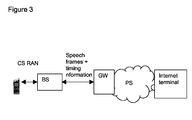
- figure 3 illustrates a call via CS RAN to an internet terminal.
-
- An embodiment of the invention will be described with reference to telephony applications. However, similar principles could be applied to any appropriate delay critical applications in which frame based media are used with fixed transmission intervals between successive data frames within a stream.
- The PS network may introduce quite a long transmission delay and large jitter. In this case, proportional advance of a timing control will be quite small. However, an interactive packet based speech service is of limited attraction unless the delay can be limited to a small enough value. Thus, the VolP domain should comprise a well regulated network with small jitter and relatively low transmission delay. In this case synchronization with the RAN can afford savings in overall delay. In many cases a LAN can provide small enough jitter and delay. Also a normal internet connection may fulfil these requirements, especially if QoS classifications are used.
- Since the system might be operating near the maximum allowable delay, even small savings in the overall delay can make the system more feasible. Therefore, in this embodiment a method for controlling the transmission scheduling of a remote VolP terminal (remote terminal is a terminal that is located in a different network than the other party of the connection) is provided.
- In this embodiment the entity controlling transmission over a synchronized link (in this example a radio link) can send requests to the remote terminal with which it has established a link to adjust its transmission timing to match that of the radio link. The adjustment of transmission time can be performed at call set up and/or during the call:
- 1. The time adjustment can be performed during the call set-up (when the connection is being established) by indicating the correct 'grid' of the transmission times. The initial control might require synchronization of the clocks in both ends. This can be performed e.g. by using Network Time Protocol (NTP). (See IETF RFC 1305 "Network Time Protocol (Version 3): Specification, Implementation and Analysis", 1992). The timing adjustment information can be sent using a proprietary protocol, or it could be possible to specify e.g. an RTCP message subtype for this purpose.
- 2. During a call there may be a need for re-adjustment due to, for example, handover in the radio network or to clock drift in the remote terminal. In case of on-line timing adjustment it is also desirable to have the capacity to manipulate the transmitted media by dropping data or generating some extra data, if the transmission time 'grid' is changed forward or backwards. In the case of a speech application the change could be performed safely with the aid of the speech encoder: the adjustment could be performed during a speech pause or during a period of speech in which it is determined that the manipulation of the signal is unlikely to have a great impact on speech quality.
-
- By synchronisation of the data transmission with the transmission slots available in the network overall transmission delay can be reduced. In theory the amount of saving in delay is up to the block duration of the transmitted media. For example with the AMR codec using 20ms frames this method can save up to 20ms in one-way transmission time. If the transmission is configured to encapsulate several consecutive frames into each transmitted packet, in some scenarios the possible saving could be even bigger.
- One way to provide for the synchronisation information to be carried is by extending the RTCP protocol, for example by adding two optional fields to the RTCP packet. These fields contain an identifier and data as follows:
Identifier TIME_ALIGNMENT_REQUEST (a constant) Data 16 bit signed integer indicating the amount of time shift to be done. The unit indication the change is the same as the unit of the timestamp in the RTP packet Identifier TIME_ALIGNMENT_RESPONSE (a constant) Data 16 bit signed integer, which indicates the how much the timing has been changed. Typically, this is the same as in the request. However, in same cases the timing change may be implemented in small steps and further response messages will be transmitted later. The value may also be different if the time alignment can not be implemented with the asked resolution (in this case the closest value is chosen). Value "0" indicates that this entity is not capable of changing the timing. - In use, the receiving unit sends a TIME_ALIGNMENT_REQUEST message to ask the transmitting unit to change the timing. When the transmitting unit has changed its timing, it indicates the change by sending TIME_ALIGNMENT_RESPONSE.
- One example application of the system will be described with reference to figure 3.
- Coded speech is transmitted over a CS RAN and through a GW to an internet terminal. As explained earlier, the packet transmission time of the CS RAN is fixed; in other words speech frames can be sent and received at fixed moments of time. The timing may also change during a call. The internet terminal, which contains also processing means for implementing the speech codec, can freely change its timing.
- At the beginning of the call, the internet terminal starts to send the packets at an arbitrary moment. The GW has to buffer the incoming packets to fit them with CS RAN timing (the GW and BS (Base Station) exchange timing information). To minimize the delay, GW and the internet terminal can use the time alignment according to the following steps. For instance, if the AMR (Adaptive Multi-Rate) codec using 20ms frames is employed, and the internet terminal transmits data with one frame per packet, and we assume that there is no jitter, the packets (frames) arrive at the GW at 20ms intervals:
- However, if we use the method proposed in this invention to send a message to the internet terminal and ask it to adjust its transmission in such a way that packets (frames) are sent 18 ms later, the reception from the internet terminal and transmission over the radio link would be 'synchronised', resulting in an 18ms reduction in end-to-end transmission delay.
- The transmission from the internet terminal can be started at an arbitrary moment of time, and the adjustment of transmission timing can be made immediately when the radio link timing is known. Re-adjustment can be needed e.g. because of the handover in the radio network, or because of the clock drift in the internet terminal.
- The GW will typically request a time alignment that is shorter than the frame length. Sometimes it may happen that GW wants to change the timing more than the frame length, for instance in the situation where the GW has many frames in its input buffer. It this case, one option is for the GW simply to remove one or more frames from its buffer. However, this may cause audible deterioration. Instead, a time alignment request can be sent to the speech codec of the internet terminal. In the speech codec, the encoder can remove speech frames that are not important for good speech quality (e.g. frames containing speech pauses).
- In the future, 3G systems or PS internet systems may provide services for conference calls. For voice, this service may contain a unit, which decodes each speech channel, sums the speech signals, encodes the summed signal and sends it back to a participant of the conference call. If the participants send speech packets that are not synchronous, the negotiation unit must delay the packets to be able to sum them. By synchronising the packets to the transmission slots the previously mentioned delay can be reduced.
- The systems described above can be applied to a wide range of networks in which data is transmitted in periodic transmission slots, for example GSM, GERAN, UTRAN, or other types of network.
- Thus by exchanging time alignment information in a call in a PS (packet switched) 'network, delay can be reduced. This is of particular value for real-time applications such as the transmission of speech, audio and/or video.
- The method presented in this invention report can be applied to any delay critical packet based media (speech/audio/video) that employs constant transmission interval between successive packets within a stream. Examples of application areas are Voice over IP (VolP) and teleconferencing applications over packet switched networks, but naturally this idea can applied to any delay critical packet based application.
- The applicant draws attention to the fact that the present invention may include any feature or combination of features disclosed herein either implicitly or explicitly or any generalisation thereof, without limitation to the scope of any definitions set out above. In view of the foregoing description it will be evident to a person skilled in the art that various modifications may be made within the scope of the invention.
Claims (10)
- A method for transferring data over a communication link from a first unit to a second unit, the link comprising a first portion across which the data is carried by the transmission of data packets at regular intervals, and a second portion between the first portion and the first unit over which the data is carried in a form that is not synchronised with the transmission of data packets over the first portion; the method comprising transmitting to the first unit synchronisation information regarding the times at which packets are to be transmitted over the first portion.
- A method as claimed in claim 1, comprising the step of the first unit determining when to transmit data towards the second unit based on the synchronisation information.
- A method as claimed in claim 2, wherein the first unit transmits data towards the second unit as data packets.
- A method as claimed in claim 3, wherein the first unit transmits the packets towards the second unit at times determined based on the synchronisation information to achieve a lower average delay in the packets entering the first portion of the link than half the period between transmission of packets over the first portion.
- A method as claimed in any preceding claim, wherein the synchronisation information is sent in the form of an RTCP message.
- A method as claimed in any preceding claim, wherein the synchronisation information is sent by means of the Network Time Protocol.
- A method as claimed in any preceding claim, wherein the data is delay-critical data.
- A method as claimed in claim 7, wherein the data represents speech information.
- A method as claimed in claim 8, wherein the data is carried is voice-over-IP data.
- A method for transferring data over a communication link substantially as herein described with reference to the accompanying drawings.
Applications Claiming Priority (2)
| Application Number | Priority Date | Filing Date | Title |
|---|---|---|---|
| GBGB0129386.9A GB0129386D0 (en) | 2001-12-07 | 2001-12-07 | Transmission timing |
| GB1293869 | 2001-12-07 |
Publications (1)
| Publication Number | Publication Date |
|---|---|
| EP1318686A1 true EP1318686A1 (en) | 2003-06-11 |
Family
ID=9927239
Family Applications (1)
| Application Number | Title | Priority Date | Filing Date |
|---|---|---|---|
| EP02102689A Withdrawn EP1318686A1 (en) | 2001-12-07 | 2002-12-05 | Transmission timing for data packets transmitted from an internet terminal to a terminal in a cellular radio network |
Country Status (3)
| Country | Link |
|---|---|
| US (1) | US7532612B2 (en) |
| EP (1) | EP1318686A1 (en) |
| GB (1) | GB0129386D0 (en) |
Cited By (2)
| Publication number | Priority date | Publication date | Assignee | Title |
|---|---|---|---|---|
| EP1513044A1 (en) * | 2003-09-04 | 2005-03-09 | Broadcom Corporation | Clock drift compensation using network time protocol |
| WO2005062632A1 (en) * | 2003-12-23 | 2005-07-07 | Telefonaktiebolaget Lm Ericsson (Publ) | Connection-oriented paging between core network and radio access network nodes |
Families Citing this family (10)
| Publication number | Priority date | Publication date | Assignee | Title |
|---|---|---|---|---|
| KR100313760B1 (en) * | 1999-11-10 | 2001-11-17 | 박종섭 | Dynamic channel allocation method of extension coverage base station in mobile communication system |
| US7583662B1 (en) * | 2005-04-12 | 2009-09-01 | Tp Lab, Inc. | Voice virtual private network |
| KR100818555B1 (en) * | 2006-02-03 | 2008-04-02 | 삼성전자주식회사 | Delay Management System and Method in TSI PIP Communication of Mobile Communication System |
| US9420332B2 (en) * | 2006-07-06 | 2016-08-16 | Qualcomm Incorporated | Clock compensation techniques for audio decoding |
| US7940655B2 (en) * | 2007-10-31 | 2011-05-10 | Futurewei Technologies, Inc. | Cross-layer optimization of VoIP services in advanced wireless networks |
| US20090161655A1 (en) * | 2007-12-20 | 2009-06-25 | Qualcomm, Incorporated | Umb cell site modem architecture and methods |
| CN101646143B (en) | 2008-08-07 | 2012-02-01 | 上海华为技术有限公司 | Method and access point device for prompting network domain |
| US9838544B2 (en) | 2014-06-27 | 2017-12-05 | Agora Lab, Inc. | Systems and methods for improved quality of a call over network with load leveling and last mile signal indication |
| US9479412B2 (en) | 2014-06-27 | 2016-10-25 | Agora Lab, Inc. | Systems and methods for improved quality of a visualized call over network through pathway testing |
| US10855841B1 (en) * | 2019-10-24 | 2020-12-01 | Qualcomm Incorporated | Selective call notification for a communication device |
Citations (3)
| Publication number | Priority date | Publication date | Assignee | Title |
|---|---|---|---|---|
| WO2001015473A1 (en) * | 1999-08-19 | 2001-03-01 | Telefonaktiebolaget Lm Ericsson (Publ) | Methods and arrangements for transcoder selection and transcoding data within packet-switched communication networks supporting radio interfaces |
| WO2001045354A1 (en) * | 1999-12-17 | 2001-06-21 | Nokia Corporation | Data call routing on ip connections |
| WO2001058097A1 (en) * | 2000-01-31 | 2001-08-09 | Telefonaktiebolaget Lm Ericsson (Publ) | Mapping of transcoder/rate adaptor unit protocols onto user datagram protocols |
Family Cites Families (22)
| Publication number | Priority date | Publication date | Assignee | Title |
|---|---|---|---|---|
| ATE244965T1 (en) * | 1994-02-25 | 2003-07-15 | Koninkl Philips Electronics Nv | METHOD AND ARRANGEMENT FOR DATA PACKET TRANSMISSION |
| FI960404A7 (en) * | 1996-01-29 | 1997-07-30 | Nokia Corp | Speech transmission in a mobile network |
| FI103456B1 (en) * | 1996-03-29 | 1999-06-30 | Nokia Telecommunications Oy | Transmission of speech in a packet network |
| US6167040A (en) * | 1997-10-10 | 2000-12-26 | Nokia Telecommunications Oy | Speech transmission between terminals in different networks |
| FI973975L (en) * | 1997-10-16 | 1999-04-17 | Nokia Telecommunications Oy | Mobile communication system and transcoder unit |
| FI109755B (en) * | 1997-11-13 | 2002-09-30 | Nokia Corp | A method of controlling a transcoder in a mobile communication system as well as a mobile communication system |
| AU5764698A (en) * | 1997-12-31 | 1999-07-26 | Nokia Telecommunications Oy | Method for performing discontinous transmission in an asynchronous transfer mode |
| AU6206898A (en) | 1998-01-02 | 1999-07-26 | Nokia Networks Oy | A method for synchronization adaptation of asynchronous digital data streams |
| FI104926B (en) * | 1998-01-28 | 2000-04-28 | Nokia Networks Oy | Statistical multiplexing in telecommunications networks |
| FI107504B (en) * | 1998-04-09 | 2001-08-15 | Nokia Networks Oy | Performing a number of simultaneous calls in a mobile telecommunication system |
| US6295302B1 (en) * | 1998-04-24 | 2001-09-25 | Telefonaktiebolaget L M Ericsson (Publ) | Alternating speech and data transmission in digital communications systems |
| FI981407L (en) * | 1998-05-11 | 1999-11-12 | Nokia Networks Oy | Handover and network adaptation in a radio system |
| US6452950B1 (en) * | 1999-01-14 | 2002-09-17 | Telefonaktiebolaget Lm Ericsson (Publ) | Adaptive jitter buffering |
| WO2000074411A1 (en) * | 1999-05-31 | 2000-12-07 | Nokia Corporation | Transmission and interconnection method |
| EP1236295B1 (en) | 1999-12-08 | 2005-08-17 | Broadcom Corporation | Synchronized transport across non-synchronous networks |
| DE10013798C1 (en) * | 2000-03-20 | 2001-09-20 | Siemens Ag | Monitoring transmission quality in cellular radio communications system with simple acquisition of transmission quality data |
| US7386000B2 (en) * | 2001-04-17 | 2008-06-10 | Nokia Corporation | Packet mode speech communication |
| US7408948B2 (en) * | 2001-04-17 | 2008-08-05 | Nokia Corporation | Packet mode speech communication |
| US7319703B2 (en) * | 2001-09-04 | 2008-01-15 | Nokia Corporation | Method and apparatus for reducing synchronization delay in packet-based voice terminals by resynchronizing during talk spurts |
| US7110416B2 (en) * | 2001-09-04 | 2006-09-19 | Nokia Corporation | Method and apparatus for reducing synchronization delay in packet-based voice terminals |
| EP1359698B1 (en) * | 2002-04-30 | 2005-01-12 | Psytechnics Ltd | Method and apparatus for transmission error characterisation |
| US6879600B1 (en) * | 2002-06-03 | 2005-04-12 | Sprint Spectrum, L.P. | Method and system for intersystem wireless communication session arbitration |
-
2001
- 2001-12-07 GB GBGB0129386.9A patent/GB0129386D0/en not_active Ceased
-
2002
- 2002-12-05 EP EP02102689A patent/EP1318686A1/en not_active Withdrawn
- 2002-12-06 US US10/310,977 patent/US7532612B2/en not_active Expired - Fee Related
Patent Citations (3)
| Publication number | Priority date | Publication date | Assignee | Title |
|---|---|---|---|---|
| WO2001015473A1 (en) * | 1999-08-19 | 2001-03-01 | Telefonaktiebolaget Lm Ericsson (Publ) | Methods and arrangements for transcoder selection and transcoding data within packet-switched communication networks supporting radio interfaces |
| WO2001045354A1 (en) * | 1999-12-17 | 2001-06-21 | Nokia Corporation | Data call routing on ip connections |
| WO2001058097A1 (en) * | 2000-01-31 | 2001-08-09 | Telefonaktiebolaget Lm Ericsson (Publ) | Mapping of transcoder/rate adaptor unit protocols onto user datagram protocols |
Non-Patent Citations (1)
| Title |
|---|
| "DIGITAL CELLULAR TELECOMMUNICATIONS SYSTEM (PHASE 2+);IN-BAND CONTROL OF REMOTE TRANSCODERS AND RATE ADAPTORS FOR ENHANCED FULL RATE (EFR) AND FULL RATE TRAFFIC CHANNELS(GSM 08.60 VERSION 7.0.1 RELEASE 1998), EUROPEAN TELECOMMUNICATIONS STANDARDS INSTITUTE", ETSI EN 300 737 V7.0.1, XX, XX, January 2000 (2000-01-01), pages 1 - 31, XP002171819 * |
Cited By (3)
| Publication number | Priority date | Publication date | Assignee | Title |
|---|---|---|---|---|
| EP1513044A1 (en) * | 2003-09-04 | 2005-03-09 | Broadcom Corporation | Clock drift compensation using network time protocol |
| US7602815B2 (en) | 2003-09-04 | 2009-10-13 | Broadcom Corporation | Using network time protocol in voice over packet transmission |
| WO2005062632A1 (en) * | 2003-12-23 | 2005-07-07 | Telefonaktiebolaget Lm Ericsson (Publ) | Connection-oriented paging between core network and radio access network nodes |
Also Published As
| Publication number | Publication date |
|---|---|
| GB0129386D0 (en) | 2002-01-30 |
| US7532612B2 (en) | 2009-05-12 |
| US20030123428A1 (en) | 2003-07-03 |
Similar Documents
| Publication | Publication Date | Title |
|---|---|---|
| EP2182734B1 (en) | Synchronization of audio and video data in a wireless communication system | |
| CN100586099C (en) | Fast signaling method for streaming quality of service for service management in wireless networks | |
| US6993021B1 (en) | Lightweight internet protocol encapsulation (LIPE) scheme for multimedia traffic transport | |
| JP4367657B2 (en) | Voice communication method and apparatus | |
| US20100091748A1 (en) | Voice Transmission Apparatus | |
| US7532612B2 (en) | Transmission timing | |
| IL190751A (en) | Traffic generation during inactive user plane | |
| FI106510B (en) | Voice transmission system between a terminal equipment in a mobile telephone network and a fixed network | |
| KR20060111036A (en) | Method of providing video call service in mobile communication terminal considering weak electric field situation | |
| US7756108B2 (en) | Transmission of voice over a network | |
| US6707791B1 (en) | Internet protocol stack for real time applications | |
| EP1481518B1 (en) | Apparatus and method for de-prioritization of bypass packets in a packet based communication system | |
| Subbiah et al. | RTP payload multiplexing between IP telephony gateways | |
| Balazs | Push-to-talk performance over gprs | |
| US20070274281A1 (en) | Method of Establishing a Communication Link in a Digital Communication System | |
| AU2005200851A1 (en) | PCM-based data transmission system and voice/data communication switching method | |
| JP4199057B2 (en) | Communication terminal and content receiving method | |
| US20050195861A1 (en) | Sound communication system and mobile station | |
| KR100646308B1 (en) | Wireless codec transmission and reception method in packet network | |
| Das et al. | VoIP services in wireless networks | |
| KR20050001242A (en) | Video telephone method for mobile communication device | |
| Onifade | A Dual Buffer Scheme for Combating Frame Erasure Problems in VoIP Communication | |
| Onifade | A DUAL BUFFER SCHEME FOR COMBACTING FRAME ERASURE PROBLEMS IN VoIP COMMUNICATION. |
Legal Events
| Date | Code | Title | Description |
|---|---|---|---|
| PUAI | Public reference made under article 153(3) epc to a published international application that has entered the european phase |
Free format text: ORIGINAL CODE: 0009012 |
|
| AK | Designated contracting states |
Designated state(s): AT BE BG CH CY CZ DE DK EE ES FI FR GB GR IE IT LI LU MC NL PT SE SI SK TR |
|
| AX | Request for extension of the european patent |
Extension state: AL LT LV MK RO |
|
| 17P | Request for examination filed |
Effective date: 20031211 |
|
| 17Q | First examination report despatched |
Effective date: 20040120 |
|
| AKX | Designation fees paid |
Designated state(s): AT BE BG CH CY CZ DE DK EE ES FI FR GB GR IE IT LI LU MC NL PT SE SI SK TR |
|
| STAA | Information on the status of an ep patent application or granted ep patent |
Free format text: STATUS: THE APPLICATION IS DEEMED TO BE WITHDRAWN |
|
| 18D | Application deemed to be withdrawn |
Effective date: 20040731 |