EP1318519A2 - Information playback apparatus - Google Patents
Information playback apparatus Download PDFInfo
- Publication number
- EP1318519A2 EP1318519A2 EP02026998A EP02026998A EP1318519A2 EP 1318519 A2 EP1318519 A2 EP 1318519A2 EP 02026998 A EP02026998 A EP 02026998A EP 02026998 A EP02026998 A EP 02026998A EP 1318519 A2 EP1318519 A2 EP 1318519A2
- Authority
- EP
- European Patent Office
- Prior art keywords
- playback
- loop
- music
- information
- played
- Prior art date
- Legal status (The legal status is an assumption and is not a legal conclusion. Google has not performed a legal analysis and makes no representation as to the accuracy of the status listed.)
- Withdrawn
Links
- 230000003252 repetitive effect Effects 0.000 claims abstract description 27
- ATJFFYVFTNAWJD-UHFFFAOYSA-N Tin Chemical compound [Sn] ATJFFYVFTNAWJD-UHFFFAOYSA-N 0.000 abstract description 25
- 239000000872 buffer Substances 0.000 description 30
- 230000000694 effects Effects 0.000 description 28
- 238000012545 processing Methods 0.000 description 25
- 238000000034 method Methods 0.000 description 18
- 230000008569 process Effects 0.000 description 17
- 230000004044 response Effects 0.000 description 12
- 230000002441 reversible effect Effects 0.000 description 12
- 230000006870 function Effects 0.000 description 11
- 230000008859 change Effects 0.000 description 8
- 239000012636 effector Substances 0.000 description 8
- 230000005236 sound signal Effects 0.000 description 6
- 230000000881 depressing effect Effects 0.000 description 5
- 238000001514 detection method Methods 0.000 description 5
- 238000010586 diagram Methods 0.000 description 4
- 238000012546 transfer Methods 0.000 description 3
- 241001422033 Thestylus Species 0.000 description 2
- 238000006243 chemical reaction Methods 0.000 description 2
- 230000000994 depressogenic effect Effects 0.000 description 2
- 239000000284 extract Substances 0.000 description 2
- 238000012986 modification Methods 0.000 description 2
- 230000004048 modification Effects 0.000 description 2
- 238000005070 sampling Methods 0.000 description 2
- 230000003321 amplification Effects 0.000 description 1
- 230000003139 buffering effect Effects 0.000 description 1
- 238000012790 confirmation Methods 0.000 description 1
- 230000002708 enhancing effect Effects 0.000 description 1
- 230000002401 inhibitory effect Effects 0.000 description 1
- 239000004973 liquid crystal related substance Substances 0.000 description 1
- 238000005259 measurement Methods 0.000 description 1
- 230000036651 mood Effects 0.000 description 1
- 238000003199 nucleic acid amplification method Methods 0.000 description 1
- 230000000284 resting effect Effects 0.000 description 1
- 238000010079 rubber tapping Methods 0.000 description 1
- 239000004065 semiconductor Substances 0.000 description 1
Images


Classifications
-
- G—PHYSICS
- G11—INFORMATION STORAGE
- G11B—INFORMATION STORAGE BASED ON RELATIVE MOVEMENT BETWEEN RECORD CARRIER AND TRANSDUCER
- G11B20/00—Signal processing not specific to the method of recording or reproducing; Circuits therefor
-
- G—PHYSICS
- G10—MUSICAL INSTRUMENTS; ACOUSTICS
- G10H—ELECTROPHONIC MUSICAL INSTRUMENTS; INSTRUMENTS IN WHICH THE TONES ARE GENERATED BY ELECTROMECHANICAL MEANS OR ELECTRONIC GENERATORS, OR IN WHICH THE TONES ARE SYNTHESISED FROM A DATA STORE
- G10H1/00—Details of electrophonic musical instruments
- G10H1/0033—Recording/reproducing or transmission of music for electrophonic musical instruments
- G10H1/0041—Recording/reproducing or transmission of music for electrophonic musical instruments in coded form
-
- G—PHYSICS
- G11—INFORMATION STORAGE
- G11B—INFORMATION STORAGE BASED ON RELATIVE MOVEMENT BETWEEN RECORD CARRIER AND TRANSDUCER
- G11B27/00—Editing; Indexing; Addressing; Timing or synchronising; Monitoring; Measuring tape travel
- G11B27/005—Reproducing at a different information rate from the information rate of recording
- G11B27/007—Reproducing at a different information rate from the information rate of recording reproducing continuously a part of the information, i.e. repeating
-
- G—PHYSICS
- G11—INFORMATION STORAGE
- G11B—INFORMATION STORAGE BASED ON RELATIVE MOVEMENT BETWEEN RECORD CARRIER AND TRANSDUCER
- G11B27/00—Editing; Indexing; Addressing; Timing or synchronising; Monitoring; Measuring tape travel
- G11B27/10—Indexing; Addressing; Timing or synchronising; Measuring tape travel
- G11B27/102—Programmed access in sequence to addressed parts of tracks of operating record carriers
- G11B27/105—Programmed access in sequence to addressed parts of tracks of operating record carriers of operating discs
-
- G—PHYSICS
- G10—MUSICAL INSTRUMENTS; ACOUSTICS
- G10H—ELECTROPHONIC MUSICAL INSTRUMENTS; INSTRUMENTS IN WHICH THE TONES ARE GENERATED BY ELECTROMECHANICAL MEANS OR ELECTRONIC GENERATORS, OR IN WHICH THE TONES ARE SYNTHESISED FROM A DATA STORE
- G10H2210/00—Aspects or methods of musical processing having intrinsic musical character, i.e. involving musical theory or musical parameters or relying on musical knowledge, as applied in electrophonic musical tools or instruments
- G10H2210/375—Tempo or beat alterations; Music timing control
- G10H2210/391—Automatic tempo adjustment, correction or control
Definitions
- the present invention relates to an information playback apparatus for playing back information recorded in an information recording medium, such as a CD (Compact Disc), a DVD (Digital Versatile Disc), and an MD (Mini Disc).
- an information recording medium such as a CD (Compact Disc), a DVD (Digital Versatile Disc), and an MD (Mini Disc).
- an information playback apparatus called an effector furnished with an editing function has been known as an information playback apparatus for playing back information recorded in an information recording medium, such as a CD, a DVD, and an MD.
- an information playback apparatus for playing back information recorded in an information recording medium, such as a CD, a DVD, and an MD.
- the effector plays music or the like recorded in an information recording medium, for example, the effector is able to produce sound effects by applying modulation in various manners to a sound signal being played back.
- the effector is provided with a manipulation member called a jog dial made of a disc-shaped rotatable member.
- a manipulation member called a jog dial made of a disc-shaped rotatable member.
- an analog record player on which is placed an analog record, such as an LP, at the number of revolutions (rotational speed) different from the normal number of revolutions while the analog record is being played, the moving speed (running speed) of the stylus with respect to the recording grooves of the analog record is changed, thereby producing a sound at a tempo different from a tempo at which the original music or the like is played.
- the jog dial is provided to the conventional information playback apparatus to attain the same phenomenon as with the analog record player.
- the jog dial is provided as an equivalent to the turntable of the analog record player, and when the user or the like changes the rotational speed of the jog dial by hand, he/she can produce the same sound effects produced when forcedly changing the moving speed of the stylus with respect to an analog record, that is, sound effects at a tempo different from that of the original music or the like.
- the effector provided with such an editing function is used in a discotheque, for example.
- a manipulator called a disc jockey (DJ) enhances the stage effect by, for example, creating an enjoyable mood for those who are enjoying dancing by producing sound effects called rap sounds at a tempo different from that of the original music as he/she rotationally manipulates the jog dial.
- DJ disc jockey
- the manipulator called the disc jockey wishes to randomly select a piece of music which would match best with the ever-changing atmosphere of the dance hall from more than one piece of music recorded in an information recording medium.
- the manipulator called the disc jockey wishes to randomly select a piece of music which would match best with the ever-changing atmosphere of the dance hall from more than one piece of music recorded in an information recording medium.
- he/she has to select a piece of music to be played next when the piece of music being played is nearing the end, so that the next piece of music selected in advance is started to play as soon as the previous piece of music ends.
- the manipulator may wish to randomly select the next piece of music through continuous playback while he/she manipulates the aforementioned jog dial. This case, in particular, involves further complicated manipulations, and raises a problem in terms of convenience of operation.
- Some types of conventional information playback apparatus is furnished with a "random playback function, "by which a plurality of pieces of music which have been selected randomly and registered in advance are played automatically in succession in the order of selection.
- a random playback function "by which a plurality of pieces of music which have been selected randomly and registered in advance are played automatically in succession in the order of selection.
- the manipulator has opted to select pieces of music without using the automatic random playback function or the automatic random playback function is unavailable, for example, when the disc jockey selects pieces of music one by one by taking the stage effect into consideration, more convenient operation is needed.
- the present invention is devised in view of the foregoing problems, and has an object to provide an information playback apparatus capable of making operations more convenient, for example, when one piece of music or the like is switched to another to be played continuously, and playing a sound which sounds natural during the switching manipulations.
- an information playback apparatus of the invention is an information playback apparatus, including: playback device for playing back information recorded in an information recording medium; manipulation device for specifying a start of repetitive playback; and control device for, when the manipulation device specifies the start of repetitive playback, controlling the playback device to repetitively play back information in a range from a point at which the start is specified to a point at which a certain time has passed.
- the information playback apparatus of the invention arranged as above, once the start of repetitive playback is specified, the information in the range from the point at which the start of repetitive playback is specified to the point at which the certain time has passed is played back repetitively.
- this arrangement secures a time for the user or the like to perform a manipulation, for example, to select information, such as music, recorded in an information recording medium during repetitive playback without any complicated manipulation, and further, makes it possible to forestall a problem that playback of the information is terminated before playback of the selected information is started.
- the information playback apparatus of the invention further includes: beat-number detecting device for detecting the number of beats per unit time of information being played back by the playback device, wherein the control device finds a time in proportion to a ratio of the number of beats per unit time measured by said beat-number detecting device at a time when said manipulation device specifies the start of repetitive playback to a pre-determined certain number of beats, and based on the found time, sets the information in the range from the point at which the start is specified to the point at which the certain time has passed, so as to render said playback device to perform repetitive playback.
- the information playback apparatus of the invention arranged as above, when the start of repetitive playback is specified, the number of beats per unit time of the information being played back at this instance is found, and information to be played back during repetitive playback is set based on the number of beats thus found and the pre-determined certain number of beats.
- the number of beats of sounds to be actually played during repetitive playback can be made substantially equal, thereby making it possible to play sounds which sound natural.
- sounds which sound natural can be played when playback is repeated from the first information again following the last information.
- the information playback apparatus of the invention further includes input device for inputting the certain number of beats.
- the user or the like can perform repetitive playback at the number of beats (the number of beats per unit time) he desires, and for example, more convenient operation can be achieved.
- an information playback apparatus of the invention with reference to the accompanying drawings.
- an explanation will be given to an information playback apparatus called an effector furnished with an editing function of producing sound effects by playing an information recording medium (hereinafter, referred to simply as a disc), such as a CD and a DVD, and applying signal processing in various manners to a played back signal.
- a disc an information recording medium
- signal processing in various manners to a played back signal.
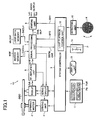
- Fig. 1 is a block diagram depicting an arrangement of an information playback apparatus 1 of this embodiment, which is provided with: a spindle motor 2 for rotating a disc DISC at a predetermined linear velocity; a pickup 3 for optically reading out information recorded in a recording surface of the disc DISC and outputting a readout signal Sdt; a driving unit 4 for driving the spindle motor 2 with a supply of power; a servo circuit 5 for servo-controlling the driving unit 4 and the pickup 3; and an RF amplifier unit 6.
- the information playback apparatus 1 is provided with a signal processing unit 7, an editing unit 8, a buffer memory MBF, and a loop data memory MLOOP which together form the playback means, plus a system controller 9 having a loop playback control unit 10, an input unit 11, a display unit 12, a playback speed (tempo) adjusting unit 13, a jog dial 14, and a detecting unit 15.
- the RF amplifier unit 6 generates playback data (hereinafter, referred to as RF data) DRF from the readout signal Sdt and supplies the same to the signal processing unit 7.
- RF data playback data
- the servo circuit 5 servo-controls the spindle motor 2 through the driving unit 4, and servo-controls the pickup 3 as to its position with respect to the recording surface of the disc DISC to control the occurrence of a tracking error, a focus error, etc.
- a carriage unit for moving the pickup 3 back and forth along the radius of the disc DISC is provided, and so-called random access is achieved by adjusting the position of the pickup 3 with respect to an address in the disc DISC at a command from the system controller 9.
- the system controller 9 is composed of a microprocessor (MPU) or the like furnished with computing and controlling functions, and is responsible for the central control on an operation of the entire information playback apparatus 1 in addition to the aforementioned servo-control while controlling the signal processing unit 7 and the editing unit 8.
- MPU microprocessor
- the signal processing unit 7 is composed of a digital signal processor (DSP) furnished with a computing function.
- DSP digital signal processor
- the signal processing unit 7 includes a decode portion 7a, a beat density measuring portion 7b, and a read/write address control portion 7c, and makes a memory access to the buffer memory MBF and the loop data memory MLOOP through the read/write address control portion 7c.
- the decode portion 7a decodes the RF data DRF supplied from the RF amplifier unit 6 in conformity with the standard of CDs and DVDs.
- the decode portion 7a thus converts the RF data DRF to demodulation data (symbol is omitted), then separates and extracts audio playback data and control data CNT for controlling seamless playback from the demodulation data, and decodes the audio playback data into audio data Dd which makes seamless playback possible, in accordance with the control contents in the separated and extracted control data CNT for seamless playback.
- control data CNT is the control data to achieve seamless playback of the address data, data of playback times corresponding to the addresses, synchronization data, program chain information (PGCI), etc. pre-recorded in the disc DISC, and in accordance with the control data CNT, the decode portion 7a decodes the audio playback data contained randomly in the RF data DRF into a stream of continuous audio data Dd which makes seamless playback possible. Also, the decode portion 7a supplies the system controller 9 with the separated and extracted control data CNT.
- PGCI program chain information
- the beat density measuring portion 7b measures true beat density of music or the like being played in real time from the audio data Dd decoded in the decode portion 7a.
- the beat density means a tempo of music or the like, and is defined as beats (the number of beats) per unit time.
- the beat density measuring portion 7b is provided with unillustrated digital band-pass filter, digital comparing circuit, and counting circuit.
- the beat density measuring portion 7b generates audio data Dd1 enhancing tempo components by allowing the audio data Dd which makes seamless playback possible and is outputted one after another from the decode portion 7a to pass through the digital band-pass filter in a predetermined frequency band. Then, it compares the audio data Dd1 with a predetermined threshold using the digital comparing circuit, extracts audio data Dd2 at levels higher than the predetermined threshold as the data indicating the tempo components.
- the counting circuit counts the number of generations of the audio data Dd2 per unit time using the counting circuit, and sets the counted number of generations per unit time as the true beat density (in other words, the number of beats per unit time) of music or the like being played. Then, it outputs the measurement result as beat density data DBPM to be supplied to the system controller 9 together with the aforementioned control data CNT.
- a tempo is the number of beats per unit time which determines the melody of music or the like
- the beat density measuring portion 7b measures a tempo (the number of beats per unit time) of music or the like as the beat density by measuring the number of beats per unit time using the digital band-pass filter, the digital comparing circuit, and the counting circuit.
- the true beat density does not indicate a temp of a sound after the original tempo of music or the like is changed with the tempo adjusting unit 13 or the jog dial 14 described below, but it means the beat density which indicates the original tempo of music or the like recorded in the disc DISC.
- the read/write address control portion 7c controls data writing and data reading through a memory access to the buffer memory MBF and the loop data memory MLOOP, which are each composed of a large-capacity semiconductor memory, using read/write address control data Brw and Crw, respectively.
- the read/write address control portion 7c stores the audio data Dd supplied from the decode portion 7a at the addresses in the buffer memory MBF and the loop data memory MLOOP without disturbing the sequence which makes seamless playback possible, and outputs the audio data Dd stored in the buffer memory MBF and the loop data memory MLOOP as playback audio data Dmb and DLP, respectively.
- a memory access is controlled so that the playback audio data Dmb and the playback audio data DLP are not supplied to the editing unit 8 simultaneously.
- forward playback, reverse playback, and shuttle playback are set by changing the direction in which the readout addresses in the buffer memory MBF are specified using the read/write address control data Brw.
- the read/write address control portion 7c changes a switching time ⁇ for successively switching the readout addresses with respect to the buffer memory MBF according to a control signal SPD supplied from the system controller 9.
- a control signal SPD supplied from the system controller 9.
- the output timing of the individual playback audio data Dmb is changed by changing the switching time ⁇ for the individual readout addresses with respect to the buffer memory MBF.
- the switching time ⁇ for the readout addresses is adjusted to (made equal to) the normal switching time ⁇ a determined by the music or the like, and thus the output timing for the individual playback audio data Dmb (Ddi, Ddi+1, Ddi+2, and so forth) is set to the normal timing.
- the switching timer ⁇ for the readout addresses is set longer than the normal switching time ⁇ a .
- the switching time ⁇ for the readout addresses is set shorter than the normal switching time ⁇ a .
- the digital-to-analog converter performs digital-to-analog conversion based on a predetermined sampling cycle, it is possible produce sound effects at a tempo different from that of the original music or the like by changing the number of the playback audio data Dmb per unit time with respect to the sampling cycle.
- the user or the like can specify playback at a desired tempo by manipulating the tempo adjusting unit 13 or the jog dial 14.
- shuttle playback is performed for playing sound effects at tempos in response to the rotational speeds in the respective directions.
- the loop data memory MLOOP is provided to supply the editing unit 8 with the playback audio data DLP when performing "loop playback", which is a special function furnished to the information playback apparatus 1 of this embodiment.
- the buffer memory MBF is provided to supply the editing unit 8 with the playback audio data Dmb by buffering the audio data Dd decoded in the decode portion 7a when normal forward playback, reverse playback or shuttle playback is performed.
- the loop data memory MLOOP is provided to supply the editing unit 8 with the playback audio data DLP when loop playback is performed in response to an ON-manipulation of a loop-in button key Pin described below by the user or the like.
- the loop data memory MLOOP Upon ON-manipulation of the loop-in button key Pin, the loop data memory MLOOP stores more than one audio data Dd corresponding to a time range from a point (hereinafter, referred to as a "loop-in-point") tin at which the ON-manipulation is performed to a point (hereinafter, referred to as a "loop-out-point) tout at which a predetermined time T has passed, and outputs later the stored audio data Dd as the playback audio data DLP for loop playback.
- a point hereinafter, referred to as a "loop-in-point”
- the system controller 9 sets a time (hereinafter, referred to as a "loop playback period") T indicating a period from the loop-in-point tin to the loop-out-point tout.
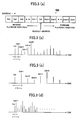
- the read/write address control portion 7c transfers the audio data Dd corresponding to a range of the loop playback period T as schematically shown in Fig. 4 from the buffer memory MBF to the loop data memory MLOOP to be stored therein.
- the buffer memory MBF buffers many audio data Dd which makes seamless playback possible
- the audio data Dd has been already stored in a memory region corresponding to a range of the loop playback period T from the loop-in-point tin to the loop-out-point tout.
- the read/write address control portion 7c transfers the audio data Dd stored in the memory region corresponding to the region of the loop playback period T from the buffer memory MBF to the loop data memory MLOOP to be stored therein, whereby so-called copying of data is performed.
- the read/write address control portion 7c changes the switching time ⁇ for the readout addresses with respect to the loop data memory MLOOP, in accordance with a command from the loop playback control unit 10 provided in the system controller 9.
- the editing unit 8 outputs the analog audio signal So to sound a speaker by applying digital-to-analog conversion to the playback audio data Dmb or DLP supplied from the signal processing unit 7 using the aforementioned digital-to-analog converter, and then applying power amplification. Also, in a case where the playback audio data Dmb or DLP of the stereo system is supplied, the editing unit 8 isolates channels and outputs the analog audio signal So for each channel.
- the editing unit 8 pre-stores modulation data, such as a sawtooth wave, a rectangular wave, a triangular wave, a waveform imitating a sound of a jet plane, etc.
- modulation data such as a sawtooth wave, a rectangular wave, a triangular wave, a waveform imitating a sound of a jet plane, etc.
- modulation data is specified by the specification data EFT from the system controller 9.
- the editing unit 8 modulates the playback audio data Dmb or DLP with the specified modulation data, and converts the modulated audio data into the analog audio signal So using the digital-to-analog converter, so as to be outputted.
- This arrangement allows various sound effects to be produced as the user or the like desires.
- the input unit 11 is provided with a plurality of manipulation keys for the user or the like to manipulate the information playback apparatus 1. Besides the aforementioned loop-in button key Pin and editing keys, the input unit 11 is provided with a loop-off button key Poff to stop loop playback processing, and manipulation keys to specify a start, a stop, or a pause of playback.
- the display unit 12 is composed of a display element, such as a liquid crystal display, and displays on-screen menus for presenting a manipulation method, etc. to the user or the like, and an operation status of the information playback apparatus 1.
- the tempo adjusting unit 13 is composed of a variable resistor provided with an adjusting knob P , and is provided to change and adjust the aforementioned switching time ⁇ for the readout addresses with respect to the buffer memory MBF.
- the system controller 9 detects a resistance value at the reference position, and judges that music or the like should be played at the original tempo. Then, it supplies the control signal SPD to the read/write address control portion 7c to set the readout timing for the playback audio data Dmb from the buffer memory MBF based on the normal switching time ⁇ a corresponding to the detected resistance value.
- the system controller 9 detects a difference between the resistance value at the reference position and the resistance value at the deviated position, and supplies the control signal SPD to the read/write address control portion 7c to set the readout timing for the playback audio data Dmb from the buffer memory MBF based on the switching time ⁇ ( ⁇ ⁇ a ) depending on the detected difference between the resistance values.
- the tempo adjusting unit 13 makes it possible to play sound effects at various tempos by adjusting the switching time ⁇ for the readout addresses with respect to the buffer memory MBF, depending on the adjusted position of the adjusting knob P .
- the jog dial 14 is, as described above, a rotatable manipulation member, and is provided to perform forward playback, reverse playback, and shuttle playback depending on the rotational direction, and to play sound effects at various tempos by adjusting the aforementioned switching time ⁇ for the readout addresses with respect to the buffer memory MBF in response to the rotational speed.
- the detecting unit 15 is provided with a rotary encoder for detecting the rotational speed and the rotational direction of the jog dial 14, and supplies the detection result from the rotary encoder to the system controller 9.
- the system controller 9 Upon receipt of the detection result from the detecting unit 15, the system controller 9 directs the read/write address control portion 7c to perform forward playback, reverse playback, or shuttle playback depending on the rotational direction of the jog dial 14, and to set the switching time ⁇ in response to the rotational speed of the jog dial 14 using the control signal SPD to change the number of playback audio data Dmb per unit time. As a result, sound effects at various tempos can be played.
- the detecting unit 15 is provided with a pressure detecting sensor for detecting a pressing pressure when the user or the like touches the jog dial 14 by hand, and supplies the detection result of a pressing pressure to the system controller 9.
- a distortion sensing element whose resistance value varies with a pressing pressure is provided at the back surface of the jog dial 14.
- the pressure detecting sensor supplies the system controller 9 with a change in the resistance value of the distortion sensing element as the detection result of the pressing pressure.
- the system controller 9 Upon reception of the detection result of the pressing pressure, the system controller 9 counts the number of depressing manipulations per unit time, and judges that the counted number per unit time is the tempo of sound effects the user or the like desires. Then, the system controller 9 directs the read/write address control portion 7c using the control signal SPD to set the switching time ⁇ in response to the depressing speed to change the number of playback audio data Dmb per unit time outputted from the buffer memory MBF in order to play sound effects at the tempo the user or the like desires.
- the user or the like manipulates the tempo adjusting unit 13 or the jog dial 14 when he/she wishes to play sound effects at a tempo different from that of the original music or the like.
- the jog dial 14 is used to play sound effects at a tempo in response to a rotational speed or a depressing speed while it is manipulated to rotate or to be depressed, and therefore, is furnished with a function of adjusting a tempo dynamically.
- the tempo adjusting unit 13 is used to play sound effects at a tempo corresponding to the position of the adjusting knob P . Hence, even when the adjusting knob P stays at rest, sound effects can be played continuously at the tempo corresponding to the resting position. Therefore, the tempo adjusting unit 13 is furnished with a function for adjusting a tempo statically.
- the system controller 9 controls the read/write address control portion 7c to set a basic switching time ⁇ depending on the position of the adjusting knob P of the tempo adjusting unit 13, and then to change the basic switching time ⁇ in response to the rotational seed or the depressing speed of the jog dial 14.
- the tempo adjusting unit 13 is provided to set the basic tempo when playing music or the like
- the jog dial 14 is provided to further change a tempo with reference to the basic tempo set by the tempo adjusting unit 13.
- the loop playback control unit 10 is achieved by running a predetermined system program on the micro processor (MPU) provided to the system controller 9.
- MPU micro processor
- the aforementioned loop-in button key Pin is manipulated to be ON, it computes the loop playback period T from the loop-in-point tin to the loop-out-point tout, during which loop playback should be performed. Further, it controls the signal processing unit 7 to continue loop playback with the playback data DLP stored in the loop data memory MLOOP until the loop-off button key Poff is manipulated to be ON.
- the loop playback control unit 10 computes the beat density (that is, a tempo) BPMreal of a sound actually being played at the point (that is, the loop-in-point) tin at which the loop-in button key Pin is manipulated to be ON.
- the switching time ⁇ for the individual readout addresses with respect to the buffer memory MBF is set depending on the position of the adjusting knob P provided to the tempo adjusting unit 13, or in response to the rotational speed or the depressing speed of the jog dial 14.
- the beat density BPMreal of the sound actually being played when the user or the like manipulates the tempo adjusting unit 13 or the jog dial 14 can be found by computing Equation (1) above.
- Equation (2) above a constant "60" is 60 seconds, and a coefficient Kbpm is the beat density of a sound to be played actually during loop playback based on the playback audio data DLP.
- the user or the like pre-sets the coefficient Kbpm using a corresponding manipulation key provided to the input unit 11.
- Equation (2) by multiplying the inverse (that is, 1/BPMreal) of the actually measured beat density BPMreal by the pre-set certain beat density Kbpm, a ratio (Kbpm/BPMreal) of the beat density BPMreal and the beat density Kbpm is found, and by multiplying the ratio (Kbpm/BPMreal) by the constant "60 seconds", the time (loop playback period) T during which loop playback should be performed is computed.
- the loop playback control unit 10 directs the read/write address control portion 7c in the signal processing unit 7 to transfer more than one audio data Dd stored in the memory region corresponding to the loop playback period T from the buffer memory MBF to the loop data memory MLOOP to be stored therein, and then to set the switching time ⁇ for the readout addresses with respect to the loop data memory MLOOP to a time corresponding to the coefficient Kbpm, so that the playback audio data DLP corresponding to a range of the loop playback period T is repetitively outputted until the loop-off button key Poff is manipulated to be ON.
- the playback audio data DLP is supplied successively to the editing unit 8 from the loop-in-point tin to the loop-out-point tout in sync with the switching time ⁇ . Further, repetitive processing is performed, in which when the playback audio data DLP corresponding to the loop-out-point tout has been outputted, the playback audio data DLP is successively outputted from the loop-in-point tin again.
- loop playback is ended at the instant the loop-off button key Poff is manipulated to be ON.
- the loop playback control unit 10 sets four seconds as the loop playback period T from the loop-in-point tin to the loop-out-point tout according to the relation in Equation (2) above.
- the loop playback control unit 10 sets eight seconds as the loop playback period T from the loop-in-point tin to the loop-out-point tout according to the relation in Equation (2) above.
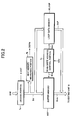
- the system controller 9 directs the read/write address control portion 7c to make settings so that the audio data Dd decoded in the decode portion 7a is supplied to the editing unit 8 through the buffer memory MBF, while inhibiting a memory access to the loop data memory MLOOP (Step S100). Subsequently, normal playback processing is started (Step S102).
- Step S104 the beat density measuring portion 7b measures the true beat density BPM of music or the like being played.
- Step S106 whether the user or the like specifies to end the playback or whether all the pieces of music or the like (that is, all the titles) recorded in the disc DISC have been played is judged.
- the process proceeds to Step S108, and when it is judged that at least one of these conditions is met, the playback processing is terminated.
- Step S108 whether the loop-in button key Pin is manipulated to be ON is detected. When it is not manipulated to be ON, the process returns to Step S104 and the normal playback operation is continued. When it is manipulated to be ON, the process proceeds to loop-in-point registration interrupt processing performed by the loop playback control unit 10 as detailed in Fig. 6.
- Step S200 the loop playback control unit 10 detects the address at which stored is the playback audio data Dmb being played back at the time when the loop-in button key Pin is manipulated to be ON, that is, the address in the buffer memory MBF corresponding to the loop-in-point tin.
- Step S202 whether the true beat density has been measured in Step S104 described above is judged. More specifically, because the beat density measuring portion 7b measures the beat density by counting the number of beats per certain predetermined time, there may be a case that the beat density has not been measured if the certain time has not passed yet. Thus, whether the true beat density has been measured in Step S104 described above is judged for confirmation.
- Step S204 When the true beat density has been measured, the process proceeds to Step S204; otherwise, the process proceeds to Step S206.
- Step S204 computations of Equations (1) and (2) above are performed, so that the beat density BPMreal of a sound actually being played at the loop-in-point tin is computed, and further, the loop playback period T during which loop playback should be performed is computed, and the readout address in the buffer memory MBF at which stored is the playback audio data Dmb corresponding to the loop-out-point tout is detected, after which the process proceeds to Step S208.
- Step S206 because the true beat density has not been measured, instead of the true beat density, the quasi-beat density (dummy beat density) registered in advance is used for Equations (1) and (2) above, and the quasi-beat density BPMreal' at the loop-in-point tin is computed. Further, based on the quasi-beat density BPMreal', the loop playback period T during which loop playback should be performed is computed and the readout address in the buffer memory MBF at which stored is the playback audio data Dmb corresponding to the loop-out-point tout is detected, after which the process proceeds to Step S208.
- the quasi-beat density BPMreal' the loop playback period T during which loop playback should be performed is computed and the readout address in the buffer memory MBF at which stored is the playback audio data Dmb corresponding to the loop-out-point tout is detected, after which the process proceeds to Step S208.
- Step S208 more than one playback audio data (the playback audio data corresponding to the loop playback period T ) Dmb stored between two readout addresses in the buffer memory MBF respectively corresponding to the loop-in-point tin and the loop-out-point tout found in Step S204 or S206 described above is transferred to the loop data memory MLOOP to be stored therein, whereupon the loop-in-point registration interrupt processing is completed. Then, the process proceeds to loop playback processing detailed in Fig. 7.
- Step S300 a data output from the buffer memory MBF to the editing unit 8 is inhibited, and the operation is switched to a data output from the loop data memory MLOOP to the editing unit 8.
- Step S302 data readout is started from the playback audio data DLP corresponding to the loop-in-point tin to the playback audio data DLP corresponding to the loop-out-point tout stored in the loop datamemory MLOOP.
- the readout addresses are set in sync with the switching time ⁇ corresponding to the aforementioned coefficient Kbpm.
- Step S304 whether the loop-off button key Poff is manipulated to be ON is judged to check whether there is any command to end loop playback.
- the loop playback processing is terminated, and the process proceeds to the processing which begins with Step S100 of Fig. 5 described above.
- Step S306 the process proceeds to Step S306 to continue loop playback, and further, in Step S308, whether the playback audio data DLP up to the address corresponding the loop-out-point tout has been played is judged.
- Step S306 When the playback audio data DLP up to the address corresponding the loop-out-point tout has not been played yet, the process returns to Step S306 to continue loop playback.
- the process returns to Step S302, so that the playback audio data DLP at the address corresponding to the loop-in-point tin is read out again to continue loop playback.
- Loop playback is continued until the loop-off button key Poff is manipulated to be ON in Step S304 described above, and when the loop-off button key Poff is manipulated to be ON, the process returns to the processing which begins with Step S100 of Fig. 5.
- the user or the like selects a piece of music or the like to be played next or replaces a disc DISC and selects a desired piece of music or the like recorded in the new disc DISC while loop playback is performed, and after he/she finishes the foregoing manipulation, he/she manipulates the loop-off button key Poff to be ON.
- the loop playback processing is terminated, and the processing which begins with Step S100 of Fig. 5 is started again, whereby the selected next piece of music is played continuously.
- the playback processing is repeated based on the playback audio data DLP corresponding to the certain loop playback period T since the loop-in button key Pin is manipulated to be ON until the loop-off button key Poff is manipulated to be ON.
- a piece of music which has been played is played continuously during loop playback, and sounds which sound natural to the user are thereby played.
- the beat density BPMreal of music or the like actually being played at the time when the loop-in button key Pin is manipulated to be ON is measured, and the loop playback period T corresponding to the pre-set beat density Kbpm is computed based on the actual beat density BPMreal, so that the loop-in-point tin and the loop-out-point tout are set to specify the playback audio data DLP to be played during loop playback.
- the beat densities of sounds to be actually played during loop playback can be substantially homogeneous. That is, tempos of sounds to be actually played are substantially constant (in other words, beat intervals can be almost equal), thereby making it possible to provide sounds which sound natural at a stable tempo during loop playback.
- the above embodiment described the information playback apparatus 1 for playing a CD or a DVD.
- the invention can be applied to an information playback apparatus for an information recording medium, such as an MD, capable of recording and playing back information basically in accordance with the principle similar to that of the embodiment above.
- a manipulation means for specifying a start of repetitive playback so that once the start of repetitive playback is specified, the information in the range from the point at which the start of repetitive playback is specified to the point at which the certain time has passed is played back repetitively.
- this arrangement secures a time for the user or the like to perform a manipulation, for example, to select information, such as music, recorded in an information recording medium during repetitive playback without any complicated manipulation, and further, makes it possible to forestall a problem that playback of the information is terminated before playback of the selected information is started.
- it is the information following the information which has been played back until the start of repetitive playback is specified is played back repetitively.
- information, such as music is played repetitively, for example, sounds which sound natural are played repetitively.
- the information playback apparatus of the invention arranged as above, when the start of repetitive playback is specified, the number of beats per unit time of the information being played back at this instance is found, and information to be played back during repetitive playback is set based on the number of beats thus found and the pre-determined certain number of beats.
- the number of beats of sounds to be actually played during repetitive playback can be made substantially equal, thereby making it possible to play sounds which sound natural.
- sounds which sound natural can be played when playback is repeated from the first information again following the last information.
- the information playback apparatus of the invention further includes input means for inputting the certain number of beats, the user or the like can per form repetitive playback at the number of beats (the number of beats per unit time) he desires, and for example, more convenient operation can be achieved.
Landscapes
- Engineering & Computer Science (AREA)
- Physics & Mathematics (AREA)
- Acoustics & Sound (AREA)
- Multimedia (AREA)
- Signal Processing (AREA)
- Signal Processing For Digital Recording And Reproducing (AREA)
- Electrophonic Musical Instruments (AREA)
- Indexing, Searching, Synchronizing, And The Amount Of Synchronization Travel Of Record Carriers (AREA)
- Management Or Editing Of Information On Record Carriers (AREA)
Abstract
Description
Claims (3)
- An information playback apparatus (1), comprising:playback means for playing back information recorded in an information recording medium (DISC);manipulation means (11) for specifying a start of repetitive playback; andcontrol means (9) for, when the manipulation means (11) have specified the start of repetitive playback, controlling the playback means to repetitively play back information in a range from a point at which the start has been specified to a point at which a certain time has passed.
- The apparatus (1) according to claim 1,
further comprising:beat-number detecting means (7b) for detecting the number of beats per unit time of information being played back by the playback means;wherein the control means (9) find a time in proportion to a ratio of the number of beats per unit time measured by the beat-number detecting means (7b) at a time when the manipulation means (11) have specified the start of repetitive playback to a predetermined certain number of beats, and based on the found time, set the information in the range from the point at which the start has been specified to the point at which the certain time has passed, so as to render the playback means to perform repetitive playback. - The apparatus according to claim 2,
further comprising input means (11) for inputting he certain number of beats.
Applications Claiming Priority (2)
| Application Number | Priority Date | Filing Date | Title |
|---|---|---|---|
| JP2001371174 | 2001-12-05 | ||
| JP2001371174A JP2003173623A (en) | 2001-12-05 | 2001-12-05 | Information reproducing device |
Publications (2)
| Publication Number | Publication Date |
|---|---|
| EP1318519A2 true EP1318519A2 (en) | 2003-06-11 |
| EP1318519A3 EP1318519A3 (en) | 2004-05-26 |
Family
ID=19180260
Family Applications (1)
| Application Number | Title | Priority Date | Filing Date |
|---|---|---|---|
| EP02026998A Withdrawn EP1318519A3 (en) | 2001-12-05 | 2002-12-05 | Information playback apparatus |
Country Status (3)
| Country | Link |
|---|---|
| US (1) | US20030103422A1 (en) |
| EP (1) | EP1318519A3 (en) |
| JP (1) | JP2003173623A (en) |
Cited By (5)
| Publication number | Priority date | Publication date | Assignee | Title |
|---|---|---|---|---|
| WO2005048246A3 (en) * | 2003-11-12 | 2005-07-07 | Koninkl Philips Electronics Nv | Method and apparatus for reproducing data from an optical storage device |
| EP1646046A1 (en) * | 2004-10-08 | 2006-04-12 | ORION ELECTRIC CO., Ltd. | Recording medium reproducing apparatus, repeated reproduction method, and method of moving repeated reproduction section |
| EP1727144A1 (en) * | 2005-05-05 | 2006-11-29 | Tatung Co., Ltd. | Method for a continuous repeat segment playback of an electronic file |
| US7336886B2 (en) | 2003-10-31 | 2008-02-26 | Primax Electronics Ltd. | Method for playback flow control |
| WO2008107994A1 (en) * | 2007-03-08 | 2008-09-12 | Pioneer Corporation | Information reproducer and method, and computer program |
Families Citing this family (7)
| Publication number | Priority date | Publication date | Assignee | Title |
|---|---|---|---|---|
| JP4302967B2 (en) * | 2002-11-18 | 2009-07-29 | パイオニア株式会社 | Music search method, music search device, and music search program |
| JP3933583B2 (en) * | 2003-01-10 | 2007-06-20 | ローランド株式会社 | Electronic musical instruments |
| EP1550942A1 (en) * | 2004-01-05 | 2005-07-06 | Thomson Licensing S.A. | User interface for a device for playback of audio files |
| US8207437B2 (en) * | 2005-03-18 | 2012-06-26 | Idebyran S Ab | Hand-held computing device with built-in disc-jockey functionality |
| JP4317892B2 (en) * | 2005-03-28 | 2009-08-19 | パイオニア株式会社 | Audio signal playback device |
| JP4801029B2 (en) * | 2007-09-21 | 2011-10-26 | 株式会社ディーアンドエムホールディングス | REPRODUCTION DEVICE, REPRODUCTION METHOD, RECORDING MEDIUM, AND PROGRAM |
| JP6455001B2 (en) * | 2014-07-16 | 2019-01-23 | カシオ計算機株式会社 | Musical sound reproducing apparatus, method, and program |
Family Cites Families (4)
| Publication number | Priority date | Publication date | Assignee | Title |
|---|---|---|---|---|
| JP3157963B2 (en) * | 1993-08-27 | 2001-04-23 | パイオニア株式会社 | Optical disc playback device |
| US5614687A (en) * | 1995-02-20 | 1997-03-25 | Pioneer Electronic Corporation | Apparatus for detecting the number of beats |
| JP4060993B2 (en) * | 1999-07-26 | 2008-03-12 | パイオニア株式会社 | Audio information storage control method and apparatus, and audio information output apparatus. |
| JP3795265B2 (en) * | 1999-07-26 | 2006-07-12 | パイオニア株式会社 | Audio information reproducing method and apparatus, and audio information output apparatus |
-
2001
- 2001-12-05 JP JP2001371174A patent/JP2003173623A/en active Pending
-
2002
- 2002-12-04 US US10/309,154 patent/US20030103422A1/en not_active Abandoned
- 2002-12-05 EP EP02026998A patent/EP1318519A3/en not_active Withdrawn
Cited By (6)
| Publication number | Priority date | Publication date | Assignee | Title |
|---|---|---|---|---|
| US7336886B2 (en) | 2003-10-31 | 2008-02-26 | Primax Electronics Ltd. | Method for playback flow control |
| WO2005048246A3 (en) * | 2003-11-12 | 2005-07-07 | Koninkl Philips Electronics Nv | Method and apparatus for reproducing data from an optical storage device |
| EP1646046A1 (en) * | 2004-10-08 | 2006-04-12 | ORION ELECTRIC CO., Ltd. | Recording medium reproducing apparatus, repeated reproduction method, and method of moving repeated reproduction section |
| EP1727144A1 (en) * | 2005-05-05 | 2006-11-29 | Tatung Co., Ltd. | Method for a continuous repeat segment playback of an electronic file |
| WO2008107994A1 (en) * | 2007-03-08 | 2008-09-12 | Pioneer Corporation | Information reproducer and method, and computer program |
| JPWO2008107994A1 (en) * | 2007-03-08 | 2010-06-10 | パイオニア株式会社 | Information reproducing apparatus and method, and computer program |
Also Published As
| Publication number | Publication date |
|---|---|
| EP1318519A3 (en) | 2004-05-26 |
| US20030103422A1 (en) | 2003-06-05 |
| JP2003173623A (en) | 2003-06-20 |
Similar Documents
| Publication | Publication Date | Title |
|---|---|---|
| US7042814B2 (en) | Information playback apparatus | |
| JP3812332B2 (en) | Recording medium playback device | |
| JP2011141555A (en) | Computer program, information reproduction device, and method | |
| US7031243B2 (en) | Beat density detecting apparatus and information playback apparatus | |
| US20030103422A1 (en) | Information playback apparatus | |
| JP4733737B2 (en) | Information reproducing apparatus and method, and computer program | |
| US6967905B2 (en) | Information playback apparatus | |
| WO2007004541A1 (en) | Computer program, information reproducing device, and method | |
| EP1229544A2 (en) | Information reproducing apparatus | |
| JPH04265592A (en) | Information reproducing device | |
| US20080273009A1 (en) | Information Reproducing Apparatus and Method, Dj Device, and Computer Program | |
| EP0276143B1 (en) | Device for Specifying and Calculating a Reproducing Time of an Optical Disk Player | |
| US5197051A (en) | Device for specifying and calculating a play time of an optical disk player | |
| WO2007102387A1 (en) | Information reproducing device and method and computer program | |
| JPWO2008107949A1 (en) | Information reproducing apparatus and method, and computer program | |
| JP3402490B2 (en) | Information playback device | |
| JPH02152084A (en) | Recorded information reproducing system | |
| JPH0689548A (en) | Device for reproducing recording medium | |
| JP3583819B2 (en) | Optical disk drive | |
| JP2615582B2 (en) | Playback device | |
| WO2006104108A1 (en) | Information reproducing device and method, and computer program | |
| JPWO2006104164A1 (en) | Audio signal playback device | |
| JPH0831074A (en) | Disc playback device | |
| JP2008257792A (en) | Audio data reproduction device | |
| JPWO2008107948A1 (en) | Information reproducing apparatus and method, and computer program |
Legal Events
| Date | Code | Title | Description |
|---|---|---|---|
| PUAI | Public reference made under article 153(3) epc to a published international application that has entered the european phase |
Free format text: ORIGINAL CODE: 0009012 |
|
| AK | Designated contracting states |
Designated state(s): AT BE BG CH CY CZ DE DK EE ES FI FR GB GR IE IT LI LU MC NL PT SE SI SK TR |
|
| AX | Request for extension of the european patent |
Extension state: AL LT LV MK RO |
|
| PUAL | Search report despatched |
Free format text: ORIGINAL CODE: 0009013 |
|
| AK | Designated contracting states |
Kind code of ref document: A3 Designated state(s): AT BE BG CH CY CZ DE DK EE ES FI FR GB GR IE IT LI LU MC NL PT SE SI SK TR |
|
| AX | Request for extension of the european patent |
Extension state: AL LT LV MK RO |
|
| 17P | Request for examination filed |
Effective date: 20041020 |
|
| AKX | Designation fees paid |
Designated state(s): DE ES FR GB IT |
|
| STAA | Information on the status of an ep patent application or granted ep patent |
Free format text: STATUS: THE APPLICATION HAS BEEN WITHDRAWN |
|
| 18W | Application withdrawn |
Effective date: 20090302 |