EP1318484A2 - Apparatus and method for authenticating a user by employing feature points of a fingerprint image of the user - Google Patents
Apparatus and method for authenticating a user by employing feature points of a fingerprint image of the user Download PDFInfo
- Publication number
- EP1318484A2 EP1318484A2 EP02254683A EP02254683A EP1318484A2 EP 1318484 A2 EP1318484 A2 EP 1318484A2 EP 02254683 A EP02254683 A EP 02254683A EP 02254683 A EP02254683 A EP 02254683A EP 1318484 A2 EP1318484 A2 EP 1318484A2
- Authority
- EP
- European Patent Office
- Prior art keywords
- feature points
- data
- fingerprint image
- fingerprint
- user
- Prior art date
- Legal status (The legal status is an assumption and is not a legal conclusion. Google has not performed a legal analysis and makes no representation as to the accuracy of the status listed.)
- Withdrawn
Links
Images


Classifications
-
- G—PHYSICS
- G06—COMPUTING OR CALCULATING; COUNTING
- G06V—IMAGE OR VIDEO RECOGNITION OR UNDERSTANDING
- G06V40/00—Recognition of biometric, human-related or animal-related patterns in image or video data
- G06V40/10—Human or animal bodies, e.g. vehicle occupants or pedestrians; Body parts, e.g. hands
- G06V40/12—Fingerprints or palmprints
- G06V40/1365—Matching; Classification
-
- G—PHYSICS
- G06—COMPUTING OR CALCULATING; COUNTING
- G06K—GRAPHICAL DATA READING; PRESENTATION OF DATA; RECORD CARRIERS; HANDLING RECORD CARRIERS
- G06K19/00—Record carriers for use with machines and with at least a part designed to carry digital markings
- G06K19/06—Record carriers for use with machines and with at least a part designed to carry digital markings characterised by the kind of the digital marking, e.g. shape, nature, code
- G06K19/067—Record carriers with conductive marks, printed circuits or semiconductor circuit elements, e.g. credit or identity cards also with resonating or responding marks without active components
- G06K19/07—Record carriers with conductive marks, printed circuits or semiconductor circuit elements, e.g. credit or identity cards also with resonating or responding marks without active components with integrated circuit chips
- G06K19/0716—Record carriers with conductive marks, printed circuits or semiconductor circuit elements, e.g. credit or identity cards also with resonating or responding marks without active components with integrated circuit chips at least one of the integrated circuit chips comprising a sensor or an interface to a sensor
- G06K19/0718—Record carriers with conductive marks, printed circuits or semiconductor circuit elements, e.g. credit or identity cards also with resonating or responding marks without active components with integrated circuit chips at least one of the integrated circuit chips comprising a sensor or an interface to a sensor the sensor being of the biometric kind, e.g. fingerprint sensors
-
- G—PHYSICS
- G06—COMPUTING OR CALCULATING; COUNTING
- G06V—IMAGE OR VIDEO RECOGNITION OR UNDERSTANDING
- G06V10/00—Arrangements for image or video recognition or understanding
- G06V10/20—Image preprocessing
- G06V10/24—Aligning, centring, orientation detection or correction of the image
- G06V10/243—Aligning, centring, orientation detection or correction of the image by compensating for image skew or non-uniform image deformations
-
- G—PHYSICS
- G06—COMPUTING OR CALCULATING; COUNTING
- G06V—IMAGE OR VIDEO RECOGNITION OR UNDERSTANDING
- G06V10/00—Arrangements for image or video recognition or understanding
- G06V10/40—Extraction of image or video features
- G06V10/48—Extraction of image or video features by mapping characteristic values of the pattern into a parameter space, e.g. Hough transformation
-
- G—PHYSICS
- G06—COMPUTING OR CALCULATING; COUNTING
- G06V—IMAGE OR VIDEO RECOGNITION OR UNDERSTANDING
- G06V40/00—Recognition of biometric, human-related or animal-related patterns in image or video data
- G06V40/10—Human or animal bodies, e.g. vehicle occupants or pedestrians; Body parts, e.g. hands
- G06V40/12—Fingerprints or palmprints
- G06V40/13—Sensors therefor
- G06V40/1318—Sensors therefor using electro-optical elements or layers, e.g. electroluminescent sensing
-
- G—PHYSICS
- G06—COMPUTING OR CALCULATING; COUNTING
- G06V—IMAGE OR VIDEO RECOGNITION OR UNDERSTANDING
- G06V40/00—Recognition of biometric, human-related or animal-related patterns in image or video data
- G06V40/10—Human or animal bodies, e.g. vehicle occupants or pedestrians; Body parts, e.g. hands
- G06V40/12—Fingerprints or palmprints
- G06V40/1347—Preprocessing; Feature extraction
-
- G—PHYSICS
- G06—COMPUTING OR CALCULATING; COUNTING
- G06V—IMAGE OR VIDEO RECOGNITION OR UNDERSTANDING
- G06V40/00—Recognition of biometric, human-related or animal-related patterns in image or video data
- G06V40/50—Maintenance of biometric data or enrolment thereof
-
- G—PHYSICS
- G07—CHECKING-DEVICES
- G07C—TIME OR ATTENDANCE REGISTERS; REGISTERING OR INDICATING THE WORKING OF MACHINES; GENERATING RANDOM NUMBERS; VOTING OR LOTTERY APPARATUS; ARRANGEMENTS, SYSTEMS OR APPARATUS FOR CHECKING NOT PROVIDED FOR ELSEWHERE
- G07C9/00—Individual registration on entry or exit
- G07C9/20—Individual registration on entry or exit involving the use of a pass
- G07C9/22—Individual registration on entry or exit involving the use of a pass in combination with an identity check of the pass holder
- G07C9/25—Individual registration on entry or exit involving the use of a pass in combination with an identity check of the pass holder using biometric data, e.g. fingerprints, iris scans or voice recognition
- G07C9/257—Individual registration on entry or exit involving the use of a pass in combination with an identity check of the pass holder using biometric data, e.g. fingerprints, iris scans or voice recognition electronically
Definitions
- the present invention relates to an apparatus and method for authenticating a user by employing feature points of a fingerprint image of the user; and, more particularly, an apparatus and method for authenticating a user by correcting a phase of a registered fingerprint image to be identical with that of a target fingerprint image, i.e., a fingerprint image to be authenticated and thereafter, comparing feature points of the above-mentioned two fingerprint images in order to estimate similarity between the registered fingerprint image and the target fingerprint image under an environment in which hardware resources of a smart card, a universal serial bus (USB) token or the like are limited.
- USB universal serial bus
- a fingerprint image of a user is first registered in a security token such as a smart card, a universal serial bus (USB) token or the like and then without an outflow information of a registered fingerprint image data of the user, the registered fingerprint image and a target finger print image, i.e., a fingerprint image to be authenticated are compared to each other.
- the comparison result obtained in the above-mentioned conventional user authentication apparatus is transmitted to outside.
- This apparatus guarantees higher security than a system in which a central processing unit therein manages fingerprint image data or a system in which registered fingerprint image data is transmitted to an authentication performing circuit in outside thereof. Further, this apparatus can cut off outflow of living body data to thereby protect security of the living body data.
- first and second feature points are extracted from registered fingerprint image and target fingerprint image, respectively. Then, the extracted first and second feature points are corrected.
- the estimation accuracy is enhanced when the two fingerprint images are obtained with a same position and direction.
- a three dimensional region including a bin representing differences of positions and directions is allocated on a memory. Differences of positions and directions of each pair of two feature points are obtained and then accumulated in a corresponding bin within a region. Accumulations for all pairs of two feature points are obtained and then, a bin having a maximum value is obtained as a maximum bin value. Then, correction of positions and directions for the two feature points are carried out with reference to the maximum bin value.
- this method since a memory burden greatly increases because a considerable amount of memory is required to allocate the three dimensional region for accumulating differences of positions and directions. Accordingly, this method cannot be applied on a security token having limited hardware resources such as a smart card or a USB token.
- the Korean Patent Registration NO. 10-0267263 describes a fingerprint image comparison method free from influence of rotation and transition thereof.
- This method relates to a fingerprint image comparison method for estimating whether a pair of two fingerprint images is same or not quickly by using feature points data previously extracted from fingerprint images and detecting corresponding points providing information of rotation and transition of the fingerprint images.
- the Korean Patent Registration NO. 10-0198108 relates to an apparatus for identifying a user by using a fingerprint image and an IC card.
- a user to use a card first registers or stores his or her own fingerprint image. Then, when the user intends to identify himself or herself, a fingerprint image instantly inputted to a card reader is compared with the previously registered fingerprint image in an IC card in a security system. But, the comparison process is performed outside the security system, there entails possibility of outflow of the fingerprint image data.
- an object of the present invention to provide an apparatus and method for authenticating a user by correcting a phase of a registered fingerprint image to be identical with that of a target fingerprint image, i.e., a fingerprint image to be authenticated and thereafter, comparing feature points of the two fingerprint images in order to estimate similarity between the registered fingerprint image and the target fingerprint image under an environment in which hardware resources of a smart card, a universal serial bus (USB) token or the like are limited.
- USB universal serial bus
- an apparatus for authenticating a user by employing feature points of a fingerprint image of the user including:
- Fig. 1 shows a block diagram of an apparatus 100 for authenticating a user by employing feature points of a fingerprint image of the user in accordance with the present invention.
- the apparatus 100 includes a fingerprint image input circuit 10, an input/output (I/O) interface 20, a host 30 and a security token circuit 40.
- I/O input/output
- the fingerprint image input circuit 10 scans a fingerprint of a user to be registered to thereby provide a first fingerprint image to the host 30 through the I/O interface 20.
- the fingerprint image input circuit 10 also scans a fingerprint of a user to be authenticated to thereby provide a second fingerprint image to the host 30 through the I/O interface 20.
- the I/O interface 20 performs interfacing between the fingerprint image input circuit 10 and the host 30 and carries out interfacing between the host 30 and the security token circuit 40 with feature points data and authentication result data.
- the host 30 provides data for feature points of the first fingerprint image having been registered as registered feature points data corresponding to the first fingerprint image and data for feature points of the second fingerprint image to be authenticated corresponding to the second fingerprint image.
- the host 30 may have a CPU 32 and a memory 34.
- the CPU 32 receives the first fingerprint image from the fingerprint image input circuit 10 of a user and extracts feature points from the first fingerprint image.
- the CPU 32 selects desired feature points in a predetermined manner from the extracted feature points to thereby provide data for feature points of the fingerprint image having been registered (hereinafter referred to as registered feature points data) to the memory 34 and the security token circuit 40 through the I/O interface 20.
- the CPU 32 receives the second fingerprint image from the fingerprint image input circuit 10 of a user and extracts feature points from the second fingerprint image.
- the CPU 32 selects desired feature points in a predetermined manner from the extracted feature points to thereby provide data for feature points of the fingerprint image to be authenticated (hereinafter referred to as target feature points data) to the memory 34 and the MICOM 42 through the I/O interface 20.
- the memory 34 stores therein the registered feature points data and the target feature points data.
- a smart card or a universal serial bus (USB) token can be used as the security token circuit 40.
- the security token circuit 40 estimates a position difference and a direction difference between pairs of two feature points, i.e., a registered feature point and a target feature point and corrects the two feature points based on the position difference and the direction difference to thereby provide authentication result data to the host 30.
- the security token circuit 40 may have a storing unit 44, a micro-computer (MICOM) 42 and a processing memory 46.
- the MICOM 42 feeds the registered feature points data received from the host 30 to the storing unit 44 and receives the target feature points data from the host 30.
- the MICOM 42 retrieves the registered feature points data previously stored in the storing unit 44 and loads the registered feature points data in the processing memory 46. Then, the MICOM 42 compares the registered feature points data loaded in the processing memory 46 with the target feature points data to thereby generate authentication result data.
- this authentication result data can be obtained as follows.
- a position difference and direction difference of each pair of two feature points are obtained, e.g., by employing the so-called Hough Transform technique and then the differences are accumulated in a corresponding bin within a memory region. Accumulations for all pairs of two feature points are obtained and then, a bin having a maximum value is obtained as a maximum bin value.
- a unit of a bin is varied starting from a large initial value to a smaller value, thereby setting a new region. This process is repeated until the unit of a bin reaches to a minimum value. Then, when the unit of bin reaches to the minimum value, within a corresponding new region, final differences of positions and directions of each pair of two feature points are obtained. Thereafter, feature points of the two fingerprint images are corrected based on the obtained differences. There are estimated a similarity between the corrected feature points. If the similarity exceeds a predetermined threshold, it is determined that the two finger print images are same. In this case, a corresponding user is identified as a right user.
- the storing unit 44 stores feature points data from the MICOM 42.
- the processing memory 46 as a buffer memory carries out loading registered feature points data in response to a loading control signal from the MICOM 42.
- the processing memory 46 further temporarily stores differences of positions and directions between corresponding feature points of the two fingerprint images obtained by comparing the registered feature points data with the target feature points data.
- the processing memory 46 may be a random access memory whose storing capacity ranges from 4k to 60k.
- Fig. 2 is a flow chart representing a process of registration of a fingerprint image of a user in a security token circuit, e.g., the security token circuit 40.
- a user inputs his or her fingerprint into the fingerprint image input circuit 10 to register his or her own fingerprint image.
- the fingerprint image input circuit 10 scans the user's fingerprint to thereby provide scanned fingerprint image data to the CPU 32 in the host 30 through the I/O interface 20.
- the CPU 32 in the host 30 receives the scanned fingerprint image data from the fingerprint image input circuit 10 and extracts feature points from the scanned fingerprint image data. Then, the CPU 32 selects desired feature points in a predetermined manner from the extracted feature points to thereby store the desired feature points data in the memory 34 and feeds the desired feature points data to the MICOM 42 in the security token circuit 40 through the I/O interface 20. Then, at step S204, the MICOM 42 in the security token circuit 40 stores the desired feature points data as registered feature points data in the storing unit 44. Then, the process of registration of the fingerprint image of the user is ended.
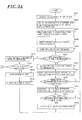
- Figs. 3A and 3B depict a detailed flow diagram of a total process of a method for authenticating a user by employing feature points of a fingerprint image of the user in accordance with a preferred embodiment of the present invention.
- a user After the fingerprint image registration process is ended as described in the above with reference to Fig. 2, at step S301, a user inputs a smart card or a universal serial bus (USB) token and at the same time, inputs his or her fingerprint into the fingerprint image input circuit 10 to authenticate his or her own fingerprint image.
- a smart card or a universal serial bus (USB) token inputs his or her fingerprint into the fingerprint image input circuit 10 to authenticate his or her own fingerprint image.
- USB universal serial bus
- the fingerprint image input circuit 10 scans the user's fingerprint to thereby provide the scanned fingerprint image data to the CPU 32 in the host 30 through the I/O interface 20.
- the CPU 32 in the host 30 receives the scanned fingerprint image data from the fingerprint image input circuit 10 and extracts feature points from the scanned fingerprint image data. Then, the CPU 32 selects desired feature points in a predetermined manner from the extracted feature points to thereby store the desired feature points data in the memory 34 and provides the desired feature points data as target feature points data to the security token circuit 40 through the I/O interface 20.
- the MICOM 42 in the security token circuit 40 retrieves the registered feature points data previously stored in the storing unit 44 and loads the registered feature points data to evaluate the feature points thereof.
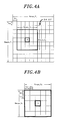
- the MICOM 42 in order to extract differences of position and direction of pairs of two feature points, i.e., a registered feature point and a corresponding target feature point, sets a region for accumulating differences of position and direction of the two feature points as illustrated in Fig. 4A and then determines units of each bin in view of position (bx 1 , by 1 ) and direction (not shown in Figs. 4A and 4B).
- Figs. 4A and 4B present examples of two-dimensional bins obtained in accordance with bin accumulation process shown in Figs. 3A and 3B.
- bx 1 represents an initial X-direction unit
- bx 2 represents a second X-direction unit smaller than bx 1
- by 1 represents an initial Y-direction unit
- by 2 represents a second Y-direction unit smaller than by 1 .
- step S306 there is checked whether all feature points (i.e., all pairs of the two feature points) are considered. If all feature points (i.e., all pairs of the two feature points) are considered, then the process goes to step S313; and if all feature points are not considered, then the process flows to step S307.
- a pair of two feature points i.e., a registered feature point and a target feature point is generated and then, at step S308, a direction difference between the two feature points is estimated.
- step S309 if the direction difference is not greater than a threshold (TH), then the process goes to step S310; and if otherwise, the process returns to step S306.
- step S310 a position difference between the two feature points is estimated.
- step S311 if the position difference is not greater than a threshold (TH), then the process goes to step S312; and if otherwise, the process returns to step S306.
- a level of a bin corresponding to each of a position difference and a direction difference in a region is elevated or accumulated, wherein the region is predetermined, e.g., in the processing memory 46.
- step S313 a bin having a maximum level is obtained. Then, at step S314, there is checked whether a unit of a bin is minimum. If the unit of a bin is not minimum, the process goes to step S315. At step S315, a unit of a bin is varied from a large initial value to a smaller value, thereby setting a new region smaller than the region having the initial value. Then at step S316, a unit of bin for each of a position difference and a direction difference is reset. Then, the process returns to step S306.
- step S314 if the unit of a bin is minimum, the process flows to step S317 through a tab "A" as shown in Figs. 3A and 3B.
- step S317 a position difference and a direction difference corresponding to a maximum bin value, e.g., a position difference and a direction difference corresponding to "B" shown in Fig. 4B.
- the MICOM 42 corrects the registered feature points data and the target feature points data based on the extracted position difference and direction difference. Then, at step S319, the MICOM 42 estimates a similarity between the corrected two feature points. Finally, at step S320, there is performed an authentication therefor. Namely, if the similarity is greater than a predetermined threshold, the two fingerprint images are determined to be same; and if otherwise, the two fingerprint images are determined to be different from each other. Then, the process is ended.
- the above-mentioned bin region which has been initially set relates to a position movement and a rotation of direction.
- a bin for a position movement relates to a size of a fingerprint image.
- each of the "Range_X 1 " and "Range_y 1 " should be set as about 200 pixels. This represents that position tracing of about 100 pixels in up/down and right/left directions is possible.
- 60 degrees of rotation (30 degrees for each of the right and left direction) should be possible.
- each of the bx 1 and by 1 may b initially set as 8 and then decreases to 4, 2; a unit of bin for direction may be initially set as 4 and then decreases to 2, 1.
- a region of position should be decreased starting from one of about 200 pixels to about 100 pixels, about 50 pixels; and a region of direction should be decreased starting from one of 60 degrees to 30 degrees, 15 degrees.
- a unit to increase a level of a bin may be "1" or other value. Besides a corresponding bin, its neighborhood bin may also be accumulated. In this case, the so-called Gaussian distribution can be utilized.
- USB universal serial bus
Landscapes
- Engineering & Computer Science (AREA)
- Physics & Mathematics (AREA)
- General Physics & Mathematics (AREA)
- Theoretical Computer Science (AREA)
- Human Computer Interaction (AREA)
- Multimedia (AREA)
- Computer Hardware Design (AREA)
- Microelectronics & Electronic Packaging (AREA)
- Automation & Control Theory (AREA)
- Computer Vision & Pattern Recognition (AREA)
- Collating Specific Patterns (AREA)
Abstract
Description
estimating a similarity between the corrected feature points to thereby generate authentication result data; and providing the authentication result data to the host.
Claims (12)
- An apparatus for authenticating a user by employing feature points of a fingerprint image of the user, comprising:a fingerprint image input circuit for scanning a fingerprint of a user to be registered, thereby providing a first fingerprint image and scanning a fingerprint of a user to be authenticated, thereby providing a second fingerprint image;a host circuit for providing data for feature points of the first fingerprint image having been registered as registered feature points data corresponding to the first fingerprint image and data for feature points of the second fingerprint image to be authenticated as target feature points data corresponding to the second fingerprint image;a security token circuit for estimating a position difference and a direction difference between pairs of a registered feature point and a target feature point and correcting the two feature points based on the position difference and the direction difference to thereby provide authentication result data to the host circuit; andan I/O interfacing circuit for performing interfacing fingerprint images between the fingerprint image input circuit and the host circuit and feature points data and authentication result data between the host circuit and the security token circuit.
- The apparatus of claim 1, wherein the security token circuit corrects the registered feature points data and the target feature points data based on the extracted position difference and direction difference and then estimates a similarity between the corrected two feature points; and if the similarity is greater than a predetermined threshold, determines that the two fingerprint images are same and accordingly, performs a normal authentication process for the user.
- The apparatus of claim 1, wherein the security token circuit corrects includes;
a MICOM for feeding the registered feature points data and after receiving the target feature points data from the host circuit, retrieving the registered feature points data previously stored and loading the registered feature points data and then comparing the registered feature points data with the target feature points data to thereby generate a position difference and a direction difference of each pair of two feature points by employing the so-called Hough Transform technique and accumulating the differences in a corresponding bin within a memory region, wherein a unit of a bin relating the accumulation is varied starting from a large initial value to a smaller value in order to decrease the memory amount and thereafter, when the unit of bin reaches to the minimum value, within a corresponding new region, final differences of positions and directions of each pair of two feature points are obtained and feature points of the two fingerprint images are corrected based on the obtained differences;
a storing unit for storing the feature points data from the MICOM; and
a processing memory for carrying out loading registered feature points data in response to a loading control signal from the MICOM and further temporarily storing the differences of positions and directions between corresponding feature points of the two fingerprint images. - The apparatus of claim 3, wherein the processing memory is a random access memory whose storing capacity ranges from 4k to 60k.
- The apparatus of claim 1, wherein the host circuit further includes a memory for storing therein the registered feature points data and the target feature points data.
- A method for registering a fingerprint image of a user for use in a system including a fingerprint image input circuit, a host and a security token circuit, the method comprising the steps of:(a) inputting a fingerprint of the user into the fingerprint image input circuit;(b) scanning, by the fingerprint image input circuit, the fingerprint of the user to thereby provide scanned fingerprint image data to a CPU in the host;(c) extracting feature points from the fingerprint image data and then selecting desired feature points in a predetermined manner from the extracted feature points to thereby store the desired feature points data in a memory and feeding the desired feature points data to the MICOM in the security token circuit through an I/O interface; and(d) storing the desired feature points data as registered feature points data in a storing unit.
- A method for authenticating a user by employing feature points of a fingerprint image of the user for use in a system including a fingerprint image input circuit, a host and a security token circuit, the method comprising the steps of:correcting the feature points of the two fingerprint images based on the obtained differences; and(a) registering feature points data of a fingerprint image of the user as registered feature points data into the security token circuit;(b) inputting a fingerprint of a user to be authenticated into the fingerprint image input circuit;(c) scanning the fingerprint of the user to thereby provide scanned fingerprint image data to the host;(d) receiving the scanned fingerprint image data and extracting feature points from the scanned fingerprint image data and then selecting desired feature points in a predetermined manner from the extracted feature points to thereby provide the desired feature points data as target feature points data to the security token circuit;(e) in the security token circuit, estimating the registered feature points data and the target feature points data, thereby obtaining a position difference and a direction difference of each pair of two feature points and then the differences for all pairs of two feature points are accumulated in a corresponding bin within a memory region and then obtaining a bin having a maximum value as a maximum bin value and by varying a unit of a bin starting from a large initial value to a smaller value, thereby setting a new region and then repeating this process until the unit of a bin reaches to a minimum value and thereafter, when the unit of bin reaches to the minimum value within a corresponding new region, obtaining final differences of positions and directions of each pair of two feature points; and
estimating a similarity between the corrected feature points to thereby generate authentication result data; and
providing the authentication result data to the host. - The method of claim 7, wherein in said step (e), the registered feature points data and the target feature points data are corrected based on the extracted position difference and direction difference and then a similarity between the corrected two feature points is estimated and then, if the similarity is greater than a predetermined threshold, the two fingerprint images are determined to be same and if otherwise, the two fingerprint images are determined to be different from each other.
- The method of claim 7, wherein the security token circuit includes;
a storing unit for storing the feature points data from the MICOM; and
a processing memory for carrying out loading registered feature points data in response to a loading control signal from the MICOM and further temporarily storing the differences of positions and directions between corresponding feature points of the two fingerprint images. - The method of claim 7, wherein the processing memory is a random access memory whose storing capacity ranges from 4k to 60k.
- The method of claim 7, wherein a CPU in the host receives the scanned fingerprint image data from the fingerprint image input circuit and extracts feature points from the scanned fingerprint image data and then selects desired feature points in a predetermined manner from the extracted feature points to thereby provide the desired feature points data in the memory and provides the desired feature points data as target feature points data to the security token circuit through the I/O interface.
- The method of claim 7, wherein the host further includes a memory for storing therein the registered feature points data and the target feature points data received from the CPU.
Applications Claiming Priority (2)
| Application Number | Priority Date | Filing Date | Title |
|---|---|---|---|
| KR2001076460 | 2001-12-05 | ||
| KR10-2001-0076460A KR100453220B1 (en) | 2001-12-05 | 2001-12-05 | Apparatus and method for authenticating user by using a fingerprint feature |
Publications (2)
| Publication Number | Publication Date |
|---|---|
| EP1318484A2 true EP1318484A2 (en) | 2003-06-11 |
| EP1318484A3 EP1318484A3 (en) | 2005-11-30 |
Family
ID=19716649
Family Applications (1)
| Application Number | Title | Priority Date | Filing Date |
|---|---|---|---|
| EP02254683A Withdrawn EP1318484A3 (en) | 2001-12-05 | 2002-07-03 | Apparatus and method for authenticating a user by employing feature points of a fingerprint image of the user |
Country Status (4)
| Country | Link |
|---|---|
| US (1) | US7079670B2 (en) |
| EP (1) | EP1318484A3 (en) |
| KR (1) | KR100453220B1 (en) |
| CN (1) | CN1258735C (en) |
Cited By (2)
| Publication number | Priority date | Publication date | Assignee | Title |
|---|---|---|---|---|
| RU2339080C2 (en) * | 2006-11-30 | 2008-11-20 | Закрытое акционерное общество "СОНДА Технолоджи" | Method of preventing unauthorised access to protected system |
| CN101064045B (en) * | 2006-04-28 | 2010-07-28 | 富士通株式会社 | Biometric authentication devices and computer products |
Families Citing this family (23)
| Publication number | Priority date | Publication date | Assignee | Title |
|---|---|---|---|---|
| AU3071001A (en) * | 1999-12-23 | 2001-07-09 | National University Of Singapore, The | Wavelet-enhanced automated fingerprint identification system |
| KR100453220B1 (en) * | 2001-12-05 | 2004-10-15 | 한국전자통신연구원 | Apparatus and method for authenticating user by using a fingerprint feature |
| US20050044385A1 (en) * | 2002-09-09 | 2005-02-24 | John Holdsworth | Systems and methods for secure authentication of electronic transactions |
| JP4758594B2 (en) * | 2002-09-24 | 2011-08-31 | セイコーエプソン株式会社 | Input device, information device, and control information generation method |
| KR100479332B1 (en) * | 2002-12-09 | 2005-03-31 | 한국전자통신연구원 | Method for matching fingerprint |
| US8014570B2 (en) * | 2004-11-16 | 2011-09-06 | Activcard, Inc. | Method for improving false acceptance rate discriminating for biometric authentication systems |
| US8171304B2 (en) * | 2003-05-15 | 2012-05-01 | Activcard Ireland Limited | Method, system and computer program product for multiple biometric template screening |
| FR2862785B1 (en) * | 2003-11-21 | 2006-01-20 | Atmel Grenoble Sa | DIGITAL SENSOR SENSOR WITH TWO SCANNING DIRECTIONS |
| US7734929B2 (en) * | 2004-04-30 | 2010-06-08 | Hewlett-Packard Development Company, L.P. | Authorization method |
| JP4375212B2 (en) * | 2004-11-18 | 2009-12-02 | ソニー株式会社 | Collation apparatus, collation method, collation system, and program |
| FR2878631B1 (en) * | 2004-11-29 | 2007-01-12 | Sagem | METHOD FOR IDENTIFYING A USER USING MODIFIED BIOMETRIC CHARACTERISTICS AND DATABASE FOR CARRYING OUT SAID METHOD |
| SE530514C2 (en) | 2006-09-07 | 2008-06-24 | Innitor Ab | A method, apparatus and computer software product in fingerprint matching |
| JP2008287433A (en) * | 2007-05-16 | 2008-11-27 | Sony Corp | Vein pattern management system, vein pattern registration device, vein pattern authentication device, vein pattern registration method, vein pattern authentication method, program, and vein data structure |
| CA2695439A1 (en) | 2007-07-12 | 2009-01-15 | Innovation Investments, Llc | Identity authentication and secured access systems, components, and methods |
| US8655026B2 (en) * | 2009-06-24 | 2014-02-18 | Koninklijke Philips N.V. | Robust biometric feature extraction with and without reference point |
| US9436864B2 (en) * | 2012-08-23 | 2016-09-06 | Apple Inc. | Electronic device performing finger biometric pre-matching and related methods |
| US9288669B2 (en) * | 2013-02-28 | 2016-03-15 | Netiq Corporation | Mobile touch authentication refresh |
| JP5796725B2 (en) * | 2013-03-22 | 2015-10-21 | カシオ計算機株式会社 | Authentication processing apparatus, authentication processing method, and program |
| KR101429737B1 (en) * | 2013-11-05 | 2014-08-12 | 주식회사 드림시큐리티 | System for user athentication service using security token, method of user athentication service, and apparatus for the same |
| KR102222120B1 (en) | 2014-05-22 | 2021-03-03 | 삼성에스디아이 주식회사 | Secondary battery |
| KR101774746B1 (en) * | 2015-08-13 | 2017-09-05 | 주식회사 슈프리마 | Authentication method by using finger print and authentication apparatus thereof |
| CN106788962B (en) * | 2016-12-13 | 2020-04-14 | 电子科技大学 | Vector similarity judgment method under privacy protection |
| US10984216B2 (en) * | 2018-12-12 | 2021-04-20 | Novatek Microelectronics Corp. | Optical fingerprint recognition system and fingerprint image capturing method |
Family Cites Families (25)
| Publication number | Priority date | Publication date | Assignee | Title |
|---|---|---|---|---|
| JP3556281B2 (en) | 1994-09-14 | 2004-08-18 | 三菱電機株式会社 | Human body collation device |
| US5613014A (en) * | 1994-10-12 | 1997-03-18 | Martin Marietta Corp. | Fingerprint matching system |
| US5887140A (en) * | 1995-03-27 | 1999-03-23 | Kabushiki Kaisha Toshiba | Computer network system and personal identification system adapted for use in the same |
| US5684799A (en) * | 1995-03-28 | 1997-11-04 | Bell Atlantic Network Services, Inc. | Full service network having distributed architecture |
| JP2776757B2 (en) * | 1995-04-04 | 1998-07-16 | 日本電気ソフトウェア株式会社 | Fingerprint finger axis detection device |
| KR100198108B1 (en) | 1995-09-21 | 1999-06-15 | 송병남 | Access permit device using user's fingerprint and IC card |
| US5717777A (en) * | 1996-01-11 | 1998-02-10 | Dew Engineering And Development Limited | Longest line method and apparatus for fingerprint alignment |
| JPH10149446A (en) * | 1996-11-20 | 1998-06-02 | Mitsubishi Electric Corp | Fingerprint matching device, fingerprint matching system and fingerprint matching method |
| US6185318B1 (en) | 1997-08-22 | 2001-02-06 | International Business Machines Corporation | System and method for matching (fingerprint) images an aligned string-based representation |
| US6233348B1 (en) * | 1997-10-20 | 2001-05-15 | Fujitsu Limited | Fingerprint registering apparatus, fingerprint identifying apparatus, and fingerprint identifying method |
| US6134340A (en) * | 1997-12-22 | 2000-10-17 | Trw Inc. | Fingerprint feature correlator |
| KR100267263B1 (en) * | 1998-03-13 | 2000-11-01 | 박병엽 | Rotation and translation- invariant method for matching fingerprints |
| US6182892B1 (en) * | 1998-03-25 | 2001-02-06 | Compaq Computer Corporation | Smart card with fingerprint image pass-through |
| US6360953B1 (en) * | 1998-07-15 | 2002-03-26 | Magnex Corporation | Secure print sensing smart card with on-the-fly-operation |
| DE69935705T2 (en) * | 1998-12-28 | 2007-07-12 | Casio Computer Co., Ltd. | Device and method for image comparison |
| KR100299858B1 (en) * | 1999-03-19 | 2001-09-26 | 이영익 | fingerprint matching method |
| US6721891B1 (en) * | 1999-03-29 | 2004-04-13 | Activcard Ireland Limited | Method of distributing piracy protected computer software |
| JP3415492B2 (en) * | 1999-06-24 | 2003-06-09 | Necエレクトロニクス株式会社 | Fingerprint collation system and its fingerprint collation method |
| US6681034B1 (en) * | 1999-07-15 | 2004-01-20 | Precise Biometrics | Method and system for fingerprint template matching |
| JP3825222B2 (en) * | 2000-03-24 | 2006-09-27 | 松下電器産業株式会社 | Personal authentication device, personal authentication system, and electronic payment system |
| US6799275B1 (en) * | 2000-03-30 | 2004-09-28 | Digital Persona, Inc. | Method and apparatus for securing a secure processor |
| JP2001344213A (en) * | 2000-05-31 | 2001-12-14 | Hitachi Ltd | Biometric authentication system |
| JP4405656B2 (en) * | 2000-10-20 | 2010-01-27 | 富士通株式会社 | Personal authentication system using fingerprint information and registration / authentication method for the same |
| AU2002318165A1 (en) * | 2001-05-25 | 2002-12-09 | Biometric Informatics Technology, Inc. | Fingerprint recognition system |
| KR100453220B1 (en) * | 2001-12-05 | 2004-10-15 | 한국전자통신연구원 | Apparatus and method for authenticating user by using a fingerprint feature |
-
2001
- 2001-12-05 KR KR10-2001-0076460A patent/KR100453220B1/en not_active Expired - Fee Related
-
2002
- 2002-07-01 US US10/184,875 patent/US7079670B2/en not_active Expired - Lifetime
- 2002-07-03 EP EP02254683A patent/EP1318484A3/en not_active Withdrawn
- 2002-07-15 CN CNB021407258A patent/CN1258735C/en not_active Expired - Fee Related
Cited By (2)
| Publication number | Priority date | Publication date | Assignee | Title |
|---|---|---|---|---|
| CN101064045B (en) * | 2006-04-28 | 2010-07-28 | 富士通株式会社 | Biometric authentication devices and computer products |
| RU2339080C2 (en) * | 2006-11-30 | 2008-11-20 | Закрытое акционерное общество "СОНДА Технолоджи" | Method of preventing unauthorised access to protected system |
Also Published As
| Publication number | Publication date |
|---|---|
| EP1318484A3 (en) | 2005-11-30 |
| KR20030046073A (en) | 2003-06-12 |
| US20030103658A1 (en) | 2003-06-05 |
| CN1258735C (en) | 2006-06-07 |
| US7079670B2 (en) | 2006-07-18 |
| KR100453220B1 (en) | 2004-10-15 |
| CN1423229A (en) | 2003-06-11 |
Similar Documents
| Publication | Publication Date | Title |
|---|---|---|
| US7079670B2 (en) | Apparatus and method for authenticating a user by employing feature points of a fingerprint image of the user | |
| US7151846B1 (en) | Apparatus and method for matching fingerprint | |
| US6301375B1 (en) | Apparatus and method for identifying individuals through their subcutaneous vein patterns and integrated system using said apparatus and method | |
| US7274807B2 (en) | Method and apparatus for supporting a biometric registration performed on a card | |
| US7162058B2 (en) | Authentication system by fingerprint | |
| EP0650137A2 (en) | An apparatus for fingerprint verification | |
| US20140133711A1 (en) | Biometric information correction apparatus, biometric information correction method and computer-readable recording medium for biometric information correction | |
| JP2004506253A (en) | Biometric identity check | |
| WO2010119500A1 (en) | Biometric information registration device, biometric information registration method, computer program for registering biometric information, biometric authentication device, biometric authentication method, and computer program for biometric authentication | |
| US9292752B2 (en) | Image processing device and image processing method | |
| Nedjah et al. | Efficient yet robust biometric iris matching on smart cards for data high security and privacy | |
| US20060023921A1 (en) | Authentication apparatus, verification method and verification apparatus | |
| JP2001351103A (en) | Image collation device, image collation method, and recording medium recording image collation program | |
| WO2018198500A1 (en) | Collation device, collation method and collation program | |
| US20240257552A1 (en) | Non-contact three-dimensional palm vein modeling method and apparatus, and authentication method | |
| WO2012138086A2 (en) | Apparatus and method for hierarchically verifying fingerprints using similarity distribution | |
| WO2012138004A1 (en) | Fingerprint authentication device using pca, and method therefor | |
| US20060120578A1 (en) | Minutiae matching | |
| CN113673477B (en) | Palm vein non-contact three-dimensional modeling method, device and authentication method | |
| EP4481699B1 (en) | Computer-implemented method for obtaining a combined image | |
| KR100456463B1 (en) | A Hybrid Fingerprint Verification Method using Global and Local Features | |
| JP2866461B2 (en) | Fingerprint collation device | |
| CN118799988B (en) | A fingerprint recognition method, device and system for intelligent access control | |
| JPS6015779A (en) | Fingerprint collator | |
| WO2004074978A2 (en) | Methods, computer program products and devices for check of identity |
Legal Events
| Date | Code | Title | Description |
|---|---|---|---|
| PUAI | Public reference made under article 153(3) epc to a published international application that has entered the european phase |
Free format text: ORIGINAL CODE: 0009012 |
|
| AK | Designated contracting states |
Designated state(s): AT BE BG CH CY CZ DE DK EE ES FI FR GB GR IE IT LI LU MC NL PT SE SK TR |
|
| AX | Request for extension of the european patent |
Extension state: AL LT LV MK RO SI |
|
| PUAL | Search report despatched |
Free format text: ORIGINAL CODE: 0009013 |
|
| AK | Designated contracting states |
Kind code of ref document: A3 Designated state(s): AT BE BG CH CY CZ DE DK EE ES FI FR GB GR IE IT LI LU MC NL PT SE SK TR |
|
| AX | Request for extension of the european patent |
Extension state: AL LT LV MK RO SI |
|
| 17P | Request for examination filed |
Effective date: 20060530 |
|
| AKX | Designation fees paid |
Designated state(s): DE GB |
|
| 17Q | First examination report despatched |
Effective date: 20061114 |
|
| STAA | Information on the status of an ep patent application or granted ep patent |
Free format text: STATUS: THE APPLICATION IS DEEMED TO BE WITHDRAWN |
|
| 18D | Application deemed to be withdrawn |
Effective date: 20081015 |