EP1318178B1 - Purified cochineal pigment and process for producing the same - Google Patents
Purified cochineal pigment and process for producing the same Download PDFInfo
- Publication number
- EP1318178B1 EP1318178B1 EP01914195A EP01914195A EP1318178B1 EP 1318178 B1 EP1318178 B1 EP 1318178B1 EP 01914195 A EP01914195 A EP 01914195A EP 01914195 A EP01914195 A EP 01914195A EP 1318178 B1 EP1318178 B1 EP 1318178B1
- Authority
- EP
- European Patent Office
- Prior art keywords
- treatment
- cochineal
- color
- producing
- membrane
- Prior art date
- Legal status (The legal status is an assumption and is not a legal conclusion. Google has not performed a legal analysis and makes no representation as to the accuracy of the status listed.)
- Expired - Lifetime
Links
Images
Classifications
-
- C—CHEMISTRY; METALLURGY
- C09—DYES; PAINTS; POLISHES; NATURAL RESINS; ADHESIVES; COMPOSITIONS NOT OTHERWISE PROVIDED FOR; APPLICATIONS OF MATERIALS NOT OTHERWISE PROVIDED FOR
- C09B—ORGANIC DYES OR CLOSELY-RELATED COMPOUNDS FOR PRODUCING DYES, e.g. PIGMENTS; MORDANTS; LAKES
- C09B61/00—Dyes of natural origin prepared from natural sources, e.g. vegetable sources
Definitions
- This invention relates to a method of producing said cochineal color of high purity and free of allergens.
- Cochineal in broad use as a coloring agent is derived from the red coloring matter occurring in the female insect bodies of Coccus cacti L. which grows on Nopalea coccinellifera and other plants of the family Cactaceae cultivated in the desert areas of Mexico and Central and South America. As such, cochineal is harvested from said insect by extracting its dried bodies with water or alcohol.
- cochineal contains allergenic impurity proteins and as such may be an etiologic factor in allergic diseases ( Ann Allergy Asthma, Vol. 84(5),549-552, 2000.).
- cochineal colors produced by conventional methods poses problems that the types and applications of the products, and the usage concentration of the color are limited due to the odors probably attributable to the above raw material. Another problem is also pointed out that the conventional cochineal colors tend to form a sediment with time since they contain proteins and like contaminants derived from the above raw material.
- the inventors of this invention made an intensive investigation to overcome the above allergenicity problem of the conventional cochineal colors and have come to develop the cochineal colors defined below.
- This invention is directed to processes for the production of the following purified cochineal colors (1) and (2).
- This invention relates to processes for the production of cochineal color derived from Coccus cacti L. and characterized by its being substantially allergen-free.
- Cochineal is generally a red coloring matter composed predominantly of carminic acid which is an anthraquinone color and, as mentioned above, is produced by a process starting with Coccus cacti L.
- the cochineal color produced by the process of the invention has been purified, for implementing the above feature, to a degree substantially not containing proteins of molecular weight not less than 6000.
- the cochineal color produced by the process of the invention as such can be produced by a technology which comprises using a cochineal extract solution obtained by extracting C . cacti insect bodies with a suitable solvent, subjecting saidcochineal extractsolution to proteolysis and, then, to a suitable purification treatment such as ion exchange treatment and/or membrane treatment to remove a fraction of molecular weight not less than 6000 from the cochineal extract.
- a suitable purification treatment such as ion exchange treatment and/or membrane treatment to remove a fraction of molecular weight not less than 6000 from the cochineal extract.
- a highly purified cochineal color produced according to the invention can be produced and acquired by subjecting the liquor after proteolysis of a cochineal extract solution to any one of adsorption treatment, ion exchange treatment, acid treatment or membrane treatment or an arbitrary combination of any two or more of said treatments.
- the cochineal extract solution for use in the present invention can be obtained, by advantageously comminuting the dried C . cactis L. insect bodies and extracting the powder with water, an alcohol or an aqueous alcohol.
- the alcohol includes lower alcohols containing 1 ⁇ 4 carbon atoms, such as methanol, ethanol, propanol, isopropyl alcohol and butanol. The preferred is ethanol.
- the method of extraction may be one in routine use for extraction.
- the extraction method includes but is not restricted to a method which comprises soaking the dry powder of C . cactis L. bodies in said solvent by a cold extraction technique or a warm extraction technique, a method comprising extracting said powder under warming and stirring and filtering the same, and a percolation method.
- the preferred technique comprises immersing the dry powder of C . cacti L. insect bodies in a solvent, preferably prewarmed, for several minutes through a few hours, preferably for tens of minutes.
- the pH of the extractant solvent is not particularly restricted but is preferably neutral - alkaline, specifically pH 6 ⁇ 8, preferably pH 7 ⁇ 8, more preferably about pH 7.5.
- the basic compound to be used for alkalinizing the extractant solvent can be selected from a broad range of compounds which can be used in foods and is not particularly restricted otherwise. As typical examples, sodium hydroxide, sodium carbonate, sodium hydrogencarbonate and sodium citrate can be mentioned.
- the cochineal extract solution obtained in the above manner is filtered, coprecipitated or centrifuged to remove a solid fraction where necessary and, then, subjected to proteolysis either as it is or after concentration.
- the proteolysis can be generally effected by means of an enzyme.
- the enzyme for use in the proteolysis is not particularly restricted insofar as it is capable of digesting protein or peptides. Expediently, enzyme preparations commercially available as proteases or peptidases can be employed.
- the enzymatic proteolysis can be carried out under specific conditions suited to the respective enzymes. For the enzymatic treatment under acidic conditions, for instance, said cochineal extract solution is preferably adjusted to pH 3 ⁇ 5, preferably pH 3.5 ⁇ 4.5, using an inorganic acid such as hydrochloric acid, sulfuric acid or phosphoric acid or an organic acid such as citric acid, malic acid, tartaric acid, lactic acid, acetic acid or fumaric acid.
- the temperature for this proteolysis is not particularly restricted but may generally be within the range of 30 ⁇ 60°C.
- the protein hydrolysate thus obtained is subjected to filtration, coprecipitation or centrifugation for removal of the precipitate formed where necessary and, either directly or after concentration, is further subjected to adsorption treatment, ion exchange treatment, acid treatment or membrane treatment.
- adsorption treatment ion exchange treatment, acid treatment or membrane treatment.
- ion exchange treatment ion exchange treatment
- acid treatment or membrane treatment ion exchange treatment
- the filtration procedure for removal of the precipitates formed in the various stages in the process according to the invention, inclusive of the precipitate mentioned just above, can be carried out in the presence of a filter aid, such as diatomaceous earth or celite, the use of which enables removal of fine particles which are not easy to filter off.
- a filter aid such as diatomaceous earth or celite
- the adsorption treatment can be carried out in the routine manner.
- it may be an adsorption treatment using such an adsorbent as activated carbon, silica gel or a porous ceramic material or an adsorption treatment using an adsorbent resin as follows: a styrenic adsorbent resin such as Duolite S-861 (TM, Diamond Shamrock, U.S.A.; the same applies below), Duolite S-862, Duolite S863 and Duolite S-866; an aromatic adsorbent resin such as Sepabeads SSP700 (TM, Mitsubishi Chemical; the same applies below), Sepabeads SP825, Diaion HP10 (TM, Mitsubishi Chemical; the same applies below), Diaion HP20, Diaion HP21, Diaion HP40 and Diaion HP50, etc.; and Amberlite XAD-4 (TM, Organo; the same applies below), Amberlite XAD-7 and Amberlite XAD-2000, etc., for instance.
- the adsorption treatment is carried out preferably, but not essentially, under acidic conditions.
- the sample to be adsorbed is preferably adjusted to pH above 2 ⁇ 4, more preferably pH about 3, with said inorganic or organic acid.
- the cochineal color adsorbed on the adsorbent can be recovered by desorbing (eluting) it with a suitable solvent such as an aqueous alcohol.
- a suitable solvent such as an aqueous alcohol.
- the adsorbent is washed with a suitable solvent, such as water, which does not cause desorption of the cochineal color.
- the preferred aqueous alcohol generally contains 10 ⁇ 60 % by volume, more preferably 20 ⁇ 80 % by volume, of an alcohol.
- the alcohol includes lower alcohols of 1 ⁇ 4 carbon atoms, such as methanol, ethanol, propanol, isopropyl alcohol and butanol.
- the preferred alcohol is ethanol.
- the desorbing solvent or eluent is preferably neutral - alkaline, namely pH 7 ⁇ 9, preferably pH 8 ⁇ 9, and the adjustment to such a pH level can be made using sodium citrate, sodium hydroxide, sodium carbonate, sodium hydrogencarbonate or the like.
- the liquor available on adsorption treatment of the cochineal extract solution can be subjected to a further adsorption treatment or to any of various other treatments such as ion exchange treatment, membrane treatment and acid treatment.
- This adsorption treatment may be the same treatment as described above.
- the ion exchange treatment is not particularly restricted but includes the routine cation exchange or anion exchange treatment using the conventional ion exchange resin.
- the cation exchange resin for instance, includes but is not restricted to strongly cation exchange resins and weakly cation exchange resins, such as Diaion SK1B (TM, Mitsubishi Chemical; the same applies below), Diaion SK102, Diaion SK116, Diaion PK208, Diaion WK10 and Diaion WK20 , among others.
- the anion exchange resin is not particularly restricted, either, but includes Diaion SA10A (TM, Mitsubishi Chemical; the same applies below), Diaion SA12A, Diaion SA20A, Diaion PA306, Diaion WA10, and Diaion WA20, among others.
- the membrane treatment in the context of the present invention means a variety of filtration treatments using membranes, thus including a treatment with a membrane filter (MF), a functional high polymer membrane such as an ultrafiler (UF), a nanofilter (NF), a reverse osmosis (RO) filter or an electrodialysis membrane.
- MF membrane filter
- UF ultrafiler
- NF nanofilter
- RO reverse osmosis
- the known membrane treatment technology includes not only the UF and RO membrane methods but also the dialysis treatment utilizing the concentration gradient across an ion-selective membrane and the electrodialysis treatment using an ion exchange membrane with application of a voltage, among others.
- the NF membrane filtration method is preferred.
- the membrane material for use in the membrane treatment method may be natural, synthetic or semisynthetic and includes cellulose, cellulose diacetate or triacetate, polyamides, polysulfones, polystyrenes, polyimides and polyacrylonitrile, among others.
- the membrane treatment according to the invention includes a treatment by which high molecular compounds are removed with a membrane having a cut-off molecular weight of, for example, 10000-1000000 and a treatment by which low molecular compounds are removed with a membrane having a cut-off molecular weight of about 2000-8000, preferably about 6000, more preferably about 3000
- the former technology specifically includes the UF membrane technique using any of NTU-3150 membrane, NTU-3250 membrane, NTU-3550 membrane and NTU-3800 UF membrane (all available from Nitto Denko Corporation); Cefilt-UF (product of Nippon NGK Insulators, Ltd.); AHP-2013 membrane, AHP-3013 membrane and AHP-1010 membrane (all available from Asahi Chemical Industry), among others.
- the later technology includes the reverse osmosis membrane (NF membrane; cut-off mol. wt.
- NTR-7250 membrane NTR-7410 membrane, NTR-7430 membrane and NTR-7450 membrane (all from Nitto Denko Corporation); AIP-3013 membrane; ACP-3013 membrane, ACP-2013 membrane, AIP-2013 membrane and AIO-1010 membrane (all available from Asahi Chemical Industry), among others.
- NTR-7250 membrane NTR-7410 membrane, NTR-7430 membrane and NTR-7450 membrane
- AIP-3013 membrane ACP-3013 membrane, ACP-2013 membrane, AIP-2013 membrane and AIO-1010 membrane
- ACP-2013 membrane ACP-2013 membrane
- AIO-1010 membrane all available from Asahi Chemical Industry
- the acid treatment can be effected by adjusting the protein hydrolysate of a cochineal extract solution or the liquor subjected to the various treatments mentioned above to pH 1 ⁇ 6, preferably pH 1.5 ⁇ 4, to thereby expose the liquor to an acidic environment.
- the acid treatment can be expediently carried out by adding an acid to said liquor.
- the acid to be used is not particularly restricted insofar as it is in routine use as a food additive and can be arbitrarily selected from among such acids. For example, such organic acids as citric acid, acetic acid, malic acid, lactic acid, etc. and such inorganic acids as sulfuric acid, hydrochloric acid, phosphoric acid, nitric acid, etc. can be employed.
- the preferred is a treatment using an inorganic acid which is in routine use as a food additive.
- the temperature condition for said acid treatment is not particularly restricted but usually can be arbitrarily selected from the range of 5 ⁇ 100°C.
- the range of 20 ⁇ 100°C or the range of 40 ⁇ 200°C may be used.
- the duration of acid treatment is not particularly restricted but usually can be arbitrarily selected from the range of 1 ⁇ 300 minutes. Generally speaking, a shorter treatment time suffices at a high treatment temperature and, in this sense, the treatment time at 40 ⁇ 100° C. for instance, may be selected from the range of 5 ⁇ 60 minutes.
- the treatment load liquor may optionally be agitated, there being no particular rule to be complied with.
- carbon dioxide gas, ethylene, propane or the like may be contacted with the protein hydrolysate of a cochineal extract solution or said liquor after said adsorption treatment under supercritical temperature and pressure conditions in a hermetically closed system.
- the preferred treatment method comprises subjecting the cochineal extract after proteolytic treatment to an adsorption treatment and subjecting the liquor obtained by desorption from the adsorbent to a membrane treatment. Furthermore, where necessary, an ion exchange treatment may be carried out after said adsorption treatment.
- the membrane treatment mentioned above is preferably an MF, UF or NF membrane treatment, more preferably an MF or NF membrane treatment. Furthermore, this membrane treatment is preferably carried out using a membrane having a cut-off molecular weight of 2000-8000, preferably about 6000, more preferably about 3000, to thereby remove high molecular compounds, preferably those having molecular weights over 6000, more preferably over 3000.
- the cochineal color thus obtained, has been effectively deprived of various contaminants inclusive of the C. cacti L. insect-derived proteins which are allergenic or potentially allergenic.
- a cochineal color which, when formulated in foods, pharmaceuticals, quasi drugs or cosmetic products which are, or are liable to be, taken by mouth, does not induce allergic responses.
- the cochineal color obtained by the above method of the invention scarcely forms a precipitate with time, thus enjoying a good shelf-life.
- the term "cochineal color” means carminic acid in the main but the cochineal color in the context of the invention includes not only carminic acid but also carmine which is the pigment (inclusive of its complexes and their polymers) formed as a metal ion, such as aluminum or calcium ion, is complexed with carminic acid.
- carmine there can be mentioned such species as the complex of carminic acid with aluminum ion, inclusive of its polymer (aluminum lake), and the complex of carminic acid with calcium ion, inclusive of its polymer (calcium lake).
- the cochineal as obtained in the above manner can be formulated with a carrier and/or additive which is acceptable from food sanitation points of view or pharmaceutically acceptable and be provided in the form of a color composition.
- This color composition can be used with advantage for the colorant product to be added for the purpose of coloring foods inclusive of drinks, pharmaceutical products, quasi drugs or cosmetic products, particularly those products which are intended, or are liable, to be taken by mouth.
- the dosage form of the colorant product is not particularly restricted but may be a solution or dispersion of the cochineal color in a medium such as water, an alcohol, e.g. ethanol, or a suitable other solvent (for example, propylene glycol, glycerol or the like) or a dry (solid) product as prepared by formulating the cochineal color in a carrier (excipient) such as dextrin, lactose, dried starch syrup or the like and molding the mixture into powders, granules, tablets or pills.
- a carrier excipient
- the additives which can be formulated in the colorant product are not particularly restricted but include those food additives which are generally used in colors and colorant products, such as preservatives (sodium acetate, protamine, etc.), stabilizers (gum arabic, gellan gum, carrageenin, trehalose, water-soluble hemicellulose, sodium phosphate, sodium metaphosphate, etc.), emulsifiers (lecithin, sucrose fatty acid esters, polyglycerol fatty acid esters, etc.), antioxidant (tea extract, raw coffee extract, sunflower seed extract, myrica extract, rutin extract, rosemary extract, enzymatically treated rutin, decomposition product of rutin (quercetin), enzymatically treated isoquercitrin, tocopherols, ascorbic acid compounds, etc.).
- preservatives sodium acetate, protamine, etc.
- stabilizers glycol arabic, gellan gum, carrageenin, treha
- the cochineal color significantly deodorized can be prepared by the process of the invention.
- the process for producing a cochineal color of the invention may be understood as a process for deodorizing a cochineal color.
- the invention includes the following modes.
- This cochineal protein hydrolysate was run onto a column packed with the adsorbent resin Amberlite XAD-7 (150 L) to adsorb cochineal color. After the resin column was washed with 8 volumes of water, the cochineal color was eluted out with 130 L of 50% aqueous solution of ethanol (pH 7.5) to collect 82 L of eluate. Then, this adsorption-treated fluid was treated with an MF membrane (a ceramic filter, 0.2 ⁇ m; NGK Insulators) at 2 kg/cm 2 and 20°C to recover 82 L of MF filtrate.
- Amberlite XAD-7 150 L
- a treatment using an NF membrane was carried out at 3 kg/cm 2 and 20°C to give 80 L of NF filtrate.
- the color value (E 10% 1 cm ) mentioned above is a value found by measuring the absorbance of a solution of the objective cochineal color (0.1 N HCl) at the maximum absorption wavelength (ca 410 nm) in the visible region of the spectrum and converting the absorbance value to the absorbance of a 10 w/v % solution.
- the sample for electrophoresis was prepared by mixing 105 ⁇ l of the above sample with 10 ⁇ l of 2-mercaptoethanol, 25 ⁇ l of 0.5 M Tris-HCl (pH 6.8), 40 ⁇ l of 10 wt.% SDS and 20 ⁇ l of 70 wt. % glycerin and boiling the mixture for 3 minutes.
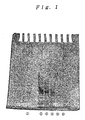
- Fig. 1 The results of electrophoresis are shown in Fig. 1.
- the lanes from left to right represent 1 ⁇ Molecular weight markers (16950Da, 14410Da, 10704Da, 8167Da, 6217Da, 2512Da), 2 ⁇ cochineal extract solution , 3 ⁇ protein hydrolysate, 4 ⁇ adsorption-treated solution, 5 ⁇ MF filtrate, and 6 ⁇ NF filtrate.
- Example 1 Comparative color 1
- Comparative color 2 Comparative color 2 + + + 0 7 3 + + 0 3 6 + 0 0 1 ⁇ 2 0 0 - 8 0 0
- the cochineal color of the invention is odorless or odorous in a degree hardly perceivable, and the cochineal color significantly deodorized can be prepared by the process of the invention.
- the cochineal color produced according to this invention is a substantially allergen-free, safe color which has been highly purified to remove the protein and other contaminants derived from the raw material Coccus cacti L. insect. Therefore, this color and the colorant product containing the color according to the invention can be used without fear of risks for allergic responses as the coloring matter for products which are, or are liable to be, taken by mouth, such as beverages and other foods, pharmaceutical products, quasi drugs and cosmetic products.
- the cochineal color produced by the process of the invention is significantly deodorized to a degree hardly perceivable, so that the color can be used for coloring products such as foods, cosmetics, etc. of which commercial values are influenced by their odor.
- the cochineal color produced by the process according to the invention is least liable to form a precipitate with time so that it can evenly color various products, such as drinks, foods including confectionery, etc. without the need for filtration in advance of use.
Landscapes
- Chemical & Material Sciences (AREA)
- Organic Chemistry (AREA)
- Coloring Foods And Improving Nutritive Qualities (AREA)
Abstract
Description
- Sample for assay: 10 µl/lane
- Buffer: Tris-glycine (pH 6.8), 0.1% SDS
| Evaluation | Purified cochineal color product | Comparative color 1 | |
| + + + | 0 | 7 | 3 |
| + + | 0 | 3 | 6 |
| + | 0 | 0 | 1 |
| ± | 2 | 0 | 0 |
| - | 8 | 0 | 0 |
- + + +:
- An odor derived from the insect Coccus cacti L. is strongly perceived.
- + +:
- An odor derived from the insect Coccus cacti L. is perceived.
- +:
- An odor derived from the insect Coccus cacti L. is faintly perceived.
- ±:
- An odor derived from the insect Coccus cacti L. is hardly perceived.
- -:
- An odor derived from the insect Coccus cacti L. is not perceived.
Claims (22)
- A process for producing a cochineal color which comprises subjecting a cochineal extract solution to proteolysis and removing a fraction of molecular weight not less than 6000.
- A process for producing a cochineal color as claimed in Claim 1 wherein a fraction of molecular weight not less than 6000 is removed by membrane treatment.
- A process for producing a cochineal color as claimed in Claim 1 which comprises subjecting a cochineal extract solution to proteolysis and at least one treatment selected from the group consisting of adsorption treatment, ion exchange treatment, acid treatment and membrane treatment, and removing a fraction of molecular weight not less than 6000.
- A process for producing a cochineal color as claimed in Claim 1 which comprises subjecting a cochineal extract solution to proteolysis, adsorption treatment and at least one treatment selected from the group consisting of ion exchange treatment, acid treatment and membrane treatment, and removing a fraction of molecular weight not less than 6000.
- A process for producing a cochineal color as claimed in Claim 1 wherein the cochineal extract solution is an extracted product obtained by extracting Coccus cacti L. insect bodies with use of an aqueous alcohol.
- A process for producing a cochineal color as claimed in Claim 1 wherein the cochineal extract solution is subjected to proteolysis under an acidic condition.
- A process for producing a cochineal color as claimed in Claim 3 or 4 wherein the adsorption treatment is carried out sunder an acidic condition.
- A process for producing a cochineal color as claimed in Claim 3 or 4 wherein the adsorption treatment comprises causing a cochineal color to be adsorbed on an adsorbent under an acidic condition and, then, desorbed with an aqueous alcohol under a condition of pH 7 to 9.
- A process for producing a cochineal color as claimed in Claim 3 wherein the acid treatment is conducted with an acid used as a food additive.
- A process for producing a cochineal color as claimed in Claim 2 wherein the membrane treatment is at least one treatment selected from the group consisting of reverse osmosis membrane treatment, membrane filter treatment, ultrafiltration membrane treatment and nanofiltration membrane treatment.
- A process for producing a cochineal color as claimed in Claim 2 wherein the membrane treatment is a treatment using a membrane having a cut-off molecular weight of 2000 to 8000.
- A process according to claim 1 for producing a cochineal color wherein the color is odorous in a hardly perceptible way, comprising subjecting a cochineal extract solution to proteolysis and removing a fraction of molecular weight not less than 6000.
- A process for producing a cochineal colour as claimed in Claim 12 wherein a fraction of molecular weight not less than 6000 is removed by membrane treatment.
- A process for producing a cochineal color as claimed in Claim 12 which comprises subjecting a cochineal extract solution to proteolysis and at least one treatment selected from the group consisting of adsorption treatment, ion exchange treatment, acid treatment and membrane treatment, and removing a fraction of molecular weight not less than 6000.
- A process for producing a cochineal color as claimed in Claim 12 which comprises subjecting a cochineal extract solution to proteolysis, adsorption treatment and at least one treatment selected from the group consisting of ion exchange treatment, acid treatment and membrane treatment, and removing a fraction of molecular weight not less than 6000.
- A process for producing a cochinal color as claimed in Claim 12 wherein the cochineal extract solution is an extracted product obtained by extracting Coccus cacti L. insect bodies with use of an aqueous alcohol.
- A process for producing a cochineal color as claimed in Claim 12 wherein the cochineal extract solution is subjected to proteolysis under an acidic condition.
- A process for producing a cochineal color as claimed in Claim 14 or 15 wherein the adsorption treatment is carried out under an acidic condition.
- A process for producing a cochineal color as claimed in Claim 14 or 15 wherein the adsorption treatment comprises causing a cochineal color to be adsorbed on an adsorbent under an acidic condition and, then, desorbed with an aqueous alcohol under a condition of pH 7 to 9.
- A process for producing a cochineal color as claimed in Claim 14 wherein the acid treatment is conducted with an acid used as a food additive.
- A process for producing a cochineal color as claimed in Claim 12 wherein the membrane treatment is at least one treatment selected from the group consisting of reverse osmosis membrane treatment, membrane filter treatment, ultrafiltration membrane treatment and nanofiltration membrane treatment.
- A process for producing a cochineal color as claimed in Claim 12 wherein the membrane treatment is a treatment using a membrane having a cut-off molecular weight of 2000 to 8000.
Applications Claiming Priority (3)
| Application Number | Priority Date | Filing Date | Title |
|---|---|---|---|
| JP2000274596 | 2000-09-11 | ||
| JP2000274596 | 2000-09-11 | ||
| PCT/JP2001/002310 WO2002022743A1 (en) | 2000-09-11 | 2001-03-23 | Purified cochineal pigment and process for producing the same |
Publications (3)
| Publication Number | Publication Date |
|---|---|
| EP1318178A4 EP1318178A4 (en) | 2003-06-11 |
| EP1318178A1 EP1318178A1 (en) | 2003-06-11 |
| EP1318178B1 true EP1318178B1 (en) | 2004-11-24 |
Family
ID=18760333
Family Applications (1)
| Application Number | Title | Priority Date | Filing Date |
|---|---|---|---|
| EP01914195A Expired - Lifetime EP1318178B1 (en) | 2000-09-11 | 2001-03-23 | Purified cochineal pigment and process for producing the same |
Country Status (12)
| Country | Link |
|---|---|
| US (3) | US20030003201A1 (en) |
| EP (1) | EP1318178B1 (en) |
| JP (1) | JP4129577B2 (en) |
| KR (1) | KR100737340B1 (en) |
| CN (1) | CN1329453C (en) |
| AT (1) | ATE283316T1 (en) |
| AU (1) | AU2001239553A1 (en) |
| CA (1) | CA2389814C (en) |
| DE (1) | DE60107446T2 (en) |
| ES (1) | ES2232604T3 (en) |
| PE (1) | PE20020618A1 (en) |
| WO (1) | WO2002022743A1 (en) |
Cited By (1)
| Publication number | Priority date | Publication date | Assignee | Title |
|---|---|---|---|---|
| US7641704B2 (en) | 2004-11-25 | 2010-01-05 | Chr-Hansen A/S | Method for the preparation of a carminic acid lake |
Families Citing this family (16)
| Publication number | Priority date | Publication date | Assignee | Title |
|---|---|---|---|---|
| JP2004210708A (en) * | 2002-12-27 | 2004-07-29 | Sanei Gen Ffi Inc | Cosmetics colored with carmine and its coloring method |
| JP4443134B2 (en) * | 2003-03-27 | 2010-03-31 | 株式会社林原生物化学研究所 | Coloring material |
| JP4184148B2 (en) * | 2003-05-15 | 2008-11-19 | 三栄源エフ・エフ・アイ株式会社 | Cochineal dye purification method |
| RU2243981C1 (en) * | 2003-09-03 | 2005-01-10 | Открытое акционерное общество "Лианозовский молочный комбинат" | Carminic acid chelate compound, method for its preparing, foodstuff and beverage containing carminic acid complex compound |
| GB0424891D0 (en) * | 2004-11-11 | 2004-12-15 | Boots Co Plc | Topical compositions |
| US9497946B2 (en) | 2007-08-31 | 2016-11-22 | Badderloch Woad, Inc. | System and methodology for culturing cochineal insects on an artificial medium |
| WO2009032085A1 (en) * | 2007-08-31 | 2009-03-12 | Badderloch Woad, Inc. | Means to culture cochineal insects in an artificial medium |
| EP2690974B1 (en) * | 2011-03-30 | 2016-05-25 | Chr. Hansen Natural Colors A/S | Carmine food coloring composition with high stability |
| CN102585540B (en) * | 2011-12-30 | 2013-11-27 | 上海染料研究所有限公司 | Method for preparing edible pigment such as new red |
| CN103540158B (en) * | 2012-07-11 | 2015-08-05 | 上海工程技术大学 | A kind of method of Cochineal color resin purification |
| JP6411034B2 (en) * | 2013-06-06 | 2018-10-24 | 三栄源エフ・エフ・アイ株式会社 | Method for analysis of proteins in natural acid pigments |
| JP6338928B2 (en) * | 2014-05-21 | 2018-06-06 | 三栄源エフ・エフ・アイ株式会社 | Quantitative analysis of protein in cochineal dye |
| KR101636519B1 (en) * | 2014-10-07 | 2016-07-04 | 한국원자력연구원 | Reducing method of allergenicity from cochineal extract dye |
| CN108047758A (en) * | 2017-12-27 | 2018-05-18 | 张永成 | A kind of method with mineral salt complexing natural pigment |
| WO2020067140A1 (en) * | 2018-09-27 | 2020-04-02 | Dic株式会社 | Pigment and production method therefor |
| CN111100477B (en) * | 2019-12-18 | 2021-03-26 | 上海工程技术大学 | Method for purifying cochineal pigment with high content |
Family Cites Families (11)
| Publication number | Priority date | Publication date | Assignee | Title |
|---|---|---|---|---|
| JPS4611115B1 (en) * | 1968-04-08 | 1971-03-20 | ||
| JPS5360934A (en) * | 1976-11-15 | 1978-05-31 | Takasago Corp | Production of cochineal pigment |
| JPS6045231B2 (en) | 1976-12-06 | 1985-10-08 | 武田薬品工業株式会社 | safe colorants |
| JPS5950264B2 (en) | 1980-04-02 | 1984-12-07 | 三栄化学工業株式会社 | Stabilization method for anthraquinone and carotenoid pigments |
| US5147673A (en) | 1989-08-16 | 1992-09-15 | Jose Schul | Colorant based on carminic acid, method of preparation, and method of coloring a foodstuff |
| US5164212A (en) | 1991-08-23 | 1992-11-17 | Del Monte Corporation | Method for coloring fruits and vegetables with anthraquinones and product |
| US5403362A (en) | 1993-05-10 | 1995-04-04 | Allegro Natural Dyes Inc. | Mordant and method of dyeing fibers |
| JP3398463B2 (en) | 1994-03-04 | 2003-04-21 | 江崎グリコ株式会社 | Stabilization method for foods containing coloring agents and / or vitamins |
| JP3577358B2 (en) * | 1995-04-06 | 2004-10-13 | 長谷川香料株式会社 | Method for producing deodorized carmine dye |
| CN1222535C (en) * | 1996-09-16 | 2005-10-12 | 诺沃奇梅兹有限公司 | Enzymatic degradation of carbohydrates in protein isolation methods |
| AU772905B2 (en) | 1999-05-21 | 2004-05-13 | Chr. Hansen Natural Colors A/S | A colouring substance composition and a method of manufacturing same |
-
2001
- 2001-03-23 CN CNB018027148A patent/CN1329453C/en not_active Expired - Lifetime
- 2001-03-23 US US09/831,379 patent/US20030003201A1/en not_active Abandoned
- 2001-03-23 AT AT01914195T patent/ATE283316T1/en not_active IP Right Cessation
- 2001-03-23 JP JP2002526986A patent/JP4129577B2/en not_active Expired - Lifetime
- 2001-03-23 CA CA002389814A patent/CA2389814C/en not_active Expired - Lifetime
- 2001-03-23 EP EP01914195A patent/EP1318178B1/en not_active Expired - Lifetime
- 2001-03-23 DE DE60107446T patent/DE60107446T2/en not_active Expired - Lifetime
- 2001-03-23 KR KR1020027005996A patent/KR100737340B1/en not_active Expired - Lifetime
- 2001-03-23 ES ES01914195T patent/ES2232604T3/en not_active Expired - Lifetime
- 2001-03-23 AU AU2001239553A patent/AU2001239553A1/en not_active Abandoned
- 2001-03-23 WO PCT/JP2001/002310 patent/WO2002022743A1/en not_active Ceased
- 2001-09-10 PE PE2001000908A patent/PE20020618A1/en active IP Right Grant
- 2001-09-19 US US09/953,826 patent/US20020058016A1/en not_active Abandoned
-
2003
- 2003-05-05 US US10/428,995 patent/US7261904B2/en not_active Expired - Lifetime
Cited By (2)
| Publication number | Priority date | Publication date | Assignee | Title |
|---|---|---|---|---|
| US7641704B2 (en) | 2004-11-25 | 2010-01-05 | Chr-Hansen A/S | Method for the preparation of a carminic acid lake |
| US8021440B2 (en) | 2004-11-25 | 2011-09-20 | Chr-Hansen A/S | Method for the preparation of a carminic acid lake |
Also Published As
| Publication number | Publication date |
|---|---|
| CA2389814C (en) | 2009-07-28 |
| AU2001239553A1 (en) | 2002-03-26 |
| HK1052716A1 (en) | 2003-09-26 |
| CA2389814A1 (en) | 2002-03-21 |
| JP4129577B2 (en) | 2008-08-06 |
| DE60107446T2 (en) | 2005-11-10 |
| KR100737340B1 (en) | 2007-07-09 |
| KR20020070433A (en) | 2002-09-09 |
| CN1388821A (en) | 2003-01-01 |
| US7261904B2 (en) | 2007-08-28 |
| ATE283316T1 (en) | 2004-12-15 |
| DE60107446D1 (en) | 2004-12-30 |
| US20030003201A1 (en) | 2003-01-02 |
| ES2232604T3 (en) | 2005-06-01 |
| EP1318178A4 (en) | 2003-06-11 |
| US20020058016A1 (en) | 2002-05-16 |
| JPWO2002022743A1 (en) | 2004-01-22 |
| WO2002022743A1 (en) | 2002-03-21 |
| EP1318178A1 (en) | 2003-06-11 |
| CN1329453C (en) | 2007-08-01 |
| US20030199019A1 (en) | 2003-10-23 |
| PE20020618A1 (en) | 2002-07-11 |
Similar Documents
| Publication | Publication Date | Title |
|---|---|---|
| US7261904B2 (en) | Purified cochineal and method for its production | |
| EP2096146A1 (en) | Deodorized plant pigment derived from Ipomoea Batatas | |
| JP2008031150A (en) | Process for producing purified chlorogenic acid | |
| DE69821428T2 (en) | METHOD FOR PRODUCING AN ALPHA-MONOGLUCOSYL HESPERIDINE-RICH SUBSTANCE | |
| CA2620689A1 (en) | Grape seeds extracts obtainable by fractioning on a resin | |
| JP4510230B2 (en) | Deodorized safflower yellow | |
| JP3410610B2 (en) | Separation method of safflower yellow pigment and sugar from safflower extract | |
| JP4134906B2 (en) | Purified purple corn pigment and method for preparing the same | |
| JP4184148B2 (en) | Cochineal dye purification method | |
| HK1052716B (en) | Purified cochineal pigment and process for producing the same | |
| JP5355906B2 (en) | Deodorizing Convolvuleaceae Ipomoea genus plant pigment | |
| JP3978570B2 (en) | Deodorized gardenia yellow | |
| JP3978564B2 (en) | Purified purple corn pigment | |
| JP2005118015A (en) | Black bean extract and preparation method thereof | |
| JPWO2010109629A1 (en) | Method for obtaining antioxidant substance from roasted coffee beans, obtained antioxidant substance, and food containing the same | |
| Sapers | Deodorization of a colorant prepared from Red Cabbage | |
| JP2004075911A (en) | Method for producing deodorized cruciferous plant pigment | |
| JPH05302038A (en) | Purification of carthamin pigment | |
| CN117545373A (en) | Momordica grosvenori extract and its preparation method | |
| JP2009201455A (en) | Method for coloring beverage | |
| JP2009201453A (en) | Method for coloring pickles | |
| KR20090049148A (en) | Separation of Anthocyanins and Polyphenols as High Purity from Black Chokeberry Fruit | |
| JPH02248465A (en) | Preparation of red rice-derived coloring matter | |
| JP2009201450A (en) | Method for coloring jelly | |
| JP2009201447A (en) | Method for coloring candy |
Legal Events
| Date | Code | Title | Description |
|---|---|---|---|
| PUAI | Public reference made under article 153(3) epc to a published international application that has entered the european phase |
Free format text: ORIGINAL CODE: 0009012 |
|
| 17P | Request for examination filed |
Effective date: 20020610 |
|
| A4 | Supplementary search report drawn up and despatched |
Effective date: 20030226 |
|
| AK | Designated contracting states |
Designated state(s): AT BE CH CY DE DK ES FI FR GB GR IE IT LI LU MC NL PT SE TR |
|
| AX | Request for extension of the european patent |
Extension state: AL LT LV MK RO SI |
|
| 17Q | First examination report despatched |
Effective date: 20030519 |
|
| GRAP | Despatch of communication of intention to grant a patent |
Free format text: ORIGINAL CODE: EPIDOSNIGR1 |
|
| GRAS | Grant fee paid |
Free format text: ORIGINAL CODE: EPIDOSNIGR3 |
|
| GRAA | (expected) grant |
Free format text: ORIGINAL CODE: 0009210 |
|
| AK | Designated contracting states |
Kind code of ref document: B1 Designated state(s): AT BE CH CY DE DK ES FI FR GB GR IE IT LI LU MC NL PT SE TR |
|
| PG25 | Lapsed in a contracting state [announced via postgrant information from national office to epo] |
Ref country code: FI Free format text: LAPSE BECAUSE OF FAILURE TO SUBMIT A TRANSLATION OF THE DESCRIPTION OR TO PAY THE FEE WITHIN THE PRESCRIBED TIME-LIMIT Effective date: 20041124 Ref country code: AT Free format text: LAPSE BECAUSE OF FAILURE TO SUBMIT A TRANSLATION OF THE DESCRIPTION OR TO PAY THE FEE WITHIN THE PRESCRIBED TIME-LIMIT Effective date: 20041124 Ref country code: TR Free format text: LAPSE BECAUSE OF FAILURE TO SUBMIT A TRANSLATION OF THE DESCRIPTION OR TO PAY THE FEE WITHIN THE PRESCRIBED TIME-LIMIT Effective date: 20041124 Ref country code: BE Free format text: LAPSE BECAUSE OF FAILURE TO SUBMIT A TRANSLATION OF THE DESCRIPTION OR TO PAY THE FEE WITHIN THE PRESCRIBED TIME-LIMIT Effective date: 20041124 Ref country code: NL Free format text: LAPSE BECAUSE OF FAILURE TO SUBMIT A TRANSLATION OF THE DESCRIPTION OR TO PAY THE FEE WITHIN THE PRESCRIBED TIME-LIMIT Effective date: 20041124 |
|
| REG | Reference to a national code |
Ref country code: GB Ref legal event code: FG4D |
|
| REG | Reference to a national code |
Ref country code: CH Ref legal event code: EP |
|
| REG | Reference to a national code |
Ref country code: CH Ref legal event code: NV Representative=s name: SERVOPATENT GMBH |
|
| REF | Corresponds to: |
Ref document number: 60107446 Country of ref document: DE Date of ref document: 20041230 Kind code of ref document: P |
|
| REG | Reference to a national code |
Ref country code: IE Ref legal event code: FG4D |
|
| REG | Reference to a national code |
Ref country code: DK Ref legal event code: T3 |
|
| PG25 | Lapsed in a contracting state [announced via postgrant information from national office to epo] |
Ref country code: GR Free format text: LAPSE BECAUSE OF FAILURE TO SUBMIT A TRANSLATION OF THE DESCRIPTION OR TO PAY THE FEE WITHIN THE PRESCRIBED TIME-LIMIT Effective date: 20050224 Ref country code: SE Free format text: LAPSE BECAUSE OF FAILURE TO SUBMIT A TRANSLATION OF THE DESCRIPTION OR TO PAY THE FEE WITHIN THE PRESCRIBED TIME-LIMIT Effective date: 20050224 |
|
| PG25 | Lapsed in a contracting state [announced via postgrant information from national office to epo] |
Ref country code: CY Free format text: LAPSE BECAUSE OF FAILURE TO SUBMIT A TRANSLATION OF THE DESCRIPTION OR TO PAY THE FEE WITHIN THE PRESCRIBED TIME-LIMIT Effective date: 20050323 Ref country code: LU Free format text: LAPSE BECAUSE OF NON-PAYMENT OF DUE FEES Effective date: 20050323 |
|
| PG25 | Lapsed in a contracting state [announced via postgrant information from national office to epo] |
Ref country code: MC Free format text: LAPSE BECAUSE OF NON-PAYMENT OF DUE FEES Effective date: 20050331 |
|
| NLV1 | Nl: lapsed or annulled due to failure to fulfill the requirements of art. 29p and 29m of the patents act | ||
| REG | Reference to a national code |
Ref country code: ES Ref legal event code: FG2A Ref document number: 2232604 Country of ref document: ES Kind code of ref document: T3 |
|
| PLBE | No opposition filed within time limit |
Free format text: ORIGINAL CODE: 0009261 |
|
| STAA | Information on the status of an ep patent application or granted ep patent |
Free format text: STATUS: NO OPPOSITION FILED WITHIN TIME LIMIT |
|
| ET | Fr: translation filed | ||
| 26N | No opposition filed |
Effective date: 20050825 |
|
| PG25 | Lapsed in a contracting state [announced via postgrant information from national office to epo] |
Ref country code: PT Free format text: LAPSE BECAUSE OF NON-PAYMENT OF DUE FEES Effective date: 20050424 |
|
| REG | Reference to a national code |
Ref country code: CH Ref legal event code: PFA Owner name: SAN-EI GEN F.F.I., INC. Free format text: SAN-EI GEN F.F.I., INC.#1-11, SANWA-CHO 1-CHOME#TOYONAKA-SHI, OSAKA 561-0828 (JP) -TRANSFER TO- SAN-EI GEN F.F.I., INC.#1-11, SANWA-CHO 1-CHOME#TOYONAKA-SHI, OSAKA 561-0828 (JP) |
|
| PGFP | Annual fee paid to national office [announced via postgrant information from national office to epo] |
Ref country code: IE Payment date: 20080221 Year of fee payment: 8 |
|
| PGFP | Annual fee paid to national office [announced via postgrant information from national office to epo] |
Ref country code: CH Payment date: 20090310 Year of fee payment: 9 |
|
| REG | Reference to a national code |
Ref country code: IE Ref legal event code: MM4A |
|
| PG25 | Lapsed in a contracting state [announced via postgrant information from national office to epo] |
Ref country code: IE Free format text: LAPSE BECAUSE OF NON-PAYMENT OF DUE FEES Effective date: 20090323 |
|
| REG | Reference to a national code |
Ref country code: CH Ref legal event code: PL |
|
| PG25 | Lapsed in a contracting state [announced via postgrant information from national office to epo] |
Ref country code: LI Free format text: LAPSE BECAUSE OF NON-PAYMENT OF DUE FEES Effective date: 20100331 Ref country code: CH Free format text: LAPSE BECAUSE OF NON-PAYMENT OF DUE FEES Effective date: 20100331 |
|
| REG | Reference to a national code |
Ref country code: FR Ref legal event code: PLFP Year of fee payment: 15 |
|
| REG | Reference to a national code |
Ref country code: FR Ref legal event code: PLFP Year of fee payment: 16 |
|
| REG | Reference to a national code |
Ref country code: FR Ref legal event code: PLFP Year of fee payment: 17 |
|
| REG | Reference to a national code |
Ref country code: FR Ref legal event code: PLFP Year of fee payment: 18 |
|
| PGFP | Annual fee paid to national office [announced via postgrant information from national office to epo] |
Ref country code: GB Payment date: 20200311 Year of fee payment: 20 Ref country code: DK Payment date: 20200310 Year of fee payment: 20 Ref country code: IT Payment date: 20200226 Year of fee payment: 20 Ref country code: DE Payment date: 20200310 Year of fee payment: 20 |
|
| PGFP | Annual fee paid to national office [announced via postgrant information from national office to epo] |
Ref country code: FR Payment date: 20200227 Year of fee payment: 20 |
|
| PGFP | Annual fee paid to national office [announced via postgrant information from national office to epo] |
Ref country code: ES Payment date: 20200401 Year of fee payment: 20 |
|
| REG | Reference to a national code |
Ref country code: DE Ref legal event code: R071 Ref document number: 60107446 Country of ref document: DE |
|
| REG | Reference to a national code |
Ref country code: DK Ref legal event code: EUP Expiry date: 20210323 |
|
| REG | Reference to a national code |
Ref country code: GB Ref legal event code: PE20 Expiry date: 20210322 |
|
| PG25 | Lapsed in a contracting state [announced via postgrant information from national office to epo] |
Ref country code: GB Free format text: LAPSE BECAUSE OF EXPIRATION OF PROTECTION Effective date: 20210322 |
|
| REG | Reference to a national code |
Ref country code: ES Ref legal event code: FD2A Effective date: 20211029 |
|
| PG25 | Lapsed in a contracting state [announced via postgrant information from national office to epo] |
Ref country code: ES Free format text: LAPSE BECAUSE OF EXPIRATION OF PROTECTION Effective date: 20210324 |