(Technical Field)
The present invention relates to a composition for
retaining and developing the flavor of foods, which
composition is useful in the technology for enhancing the
good flavor of food or drink products and developing the
good flavor stably over a long time period in the field of
foods and drinks and the like.
The present invention relates also to a new
thiazolidine compound which is useful in the technology for
enhancing the good flavor of food or drink products and
developing the good flavor stably over a long time period
in the field of foods and drinks and the like.
Furthermore, the present invention provides a method
for obtaining foods or drinks whose palatability has been
enhanced by suppressing or masking the unpleasant odor of
foods or drinks or imparting favorable flavors to foods or
drinks, by retaining the flavors of foods or drinks stably
and developing the flavors at the time of eating or
drinking.
The present invention also provides a method for
obtaining frozen foods whose palatability has been enhanced
by suppressing or masking the unpleasant odor of frozen
foods or imparting favorable flavors to frozen foods, by
retaining the flavors of frozen foods stably and developing
the flavors at the time of eating.
The present invention relates to a method for
improving the flavor of, inter alia, a retort food by
suppressing or masking its peculiar unpleasant odor with
the use of a non-volatile thiazolidine compound.
Furthermore, the present invention relates also to a
method for improving the flavor of, inter alia, a processed
soybean-incorporated food product by suppressing or masking
its soybean-peculiar unpleasant odor with the use of a non-volatile
thiazolidine compound.
(Background Art)
It is very important in the production of food
products to retain good flavors of just-made foods or
drinks until they are eaten or drunk, and develop the good
flavors when necessary.
However, in the actual food industries, the flavors
inherent in such products as seasonings, processed foods or
the like may be weakened or lost by such operations as
concentration, drying or the like during the production
process of the products. Meanwhile, flavors unfavorable to
commercial products may develop during the production
process or distribution channel. Under the circumstances,
a technology for enhancing good flavors of food or drink
products and developing the good flavors stably over a long
time period has been strongly desired.
Meanwhile, a number of studies have been so far made
on the technology for controlling the retention and
development of aromas ("Latest Technology for Food
Flavors", issued by Kougyo Gijyutsukai in 1988). For
example, encapsulation of aromas in microcapsules,
confinement of aromas in matrices, inclusion of aromas by
cyclodextrin or the like, action of enzymes on volatile
aroma constituent precursors such as glycosides are known.
However, there are problems, e.g., in a method of
physically retaining aromas, it is difficult to control its
amount of development at will, whereas in a method using
glycosides, it has such problems that the target compounds
are limited only to alcohols and that enzymes used are
deactivated in a system heated for using the enzymes.
Further, as to processed foods, the flavors inherent
in the products may be weakened or lost by such operations
as concentration, drying or the like during the production
process of the products.
Meanwhile, sulfur-containing compounds which are
aroma substances generally has a low aroma threshold and
often play an important role in aroma characteristics for
perfume cosmetics, food products and the like. For
example, it is known that fran-derivative thiol compounds
(such as 2-Furylmethanethiol (FMT) and 2-Methyl-3-furanthiol
(MFT) and the like) greatly contribute to the
aromatizing of foods including coffees and livestock meats
("Sulfur Compounds in Foods", ACS Symposium Series 564,
American Chemical Society (1994)). However, since these
thiol compounds have a low threshold, it is difficult to
retain the development amount of their aroma within a
proper range and to retain their aroma concentration within
a predetermined range over a long time period. Therefore,
a method for retaining or developing the aroma effectively
has been expected to be developed.
It is very important, as has been described, in the
production of food products to retain good flavors of just-made
foods or drinks until they are eaten or drunk and
develop the good flavors when necessary.
However, in the actual food industries, flavors are
gradually volatilized and weakened or lost, or degraded or
turned into unpleasant odors during each step of
production, distribution, storage, and the like. Under
these circumstances, a technology for enhancing good
flavors of food or drink products and developing the good
flavors stably over a long time period has been strongly
desired.
Meanwhile, as has been also described, a number of
studies have been so far made on the technology for
controlling the retention and development of aromas
("Latest Technology for Food Flavors", issued by Kougyo
Gijyutsukai in 1988). For example, encapsulation of aromas
in microcapsules, confinement of aromas in matrices,
inclusion of aromas by cyclodextrin or the like, action of
enzymes on volatile aroma constituent precursors such as
glycosides are known.
Further, as a method for preventing the
volatilization of aroma components, there have been
proposed, e.g., a method in which an aroma material is
dissolved in a solvent material which can dissolve the
aroma component of the aroma material and which has a
higher boiling point than the sublimation and/or
volatilization temperature of the aroma component, and then
the resulting mixture is mixed into foods or perfume
cosmetics (Japanese Patent Application Laid-Open No.
50084/1999), a method of blending polylysine or a salt
thereof as active ingredients (Japanese Patent Application
Laid-Open No. 30712/1994), and a method of adding a whey
protein or a derivative thereof to foods or drinks; and for
the purpose of enhanced storage stability of aromas, there
have been proposed a method of sealing or confining an
aroma component within carbohydrate (s), as exemplified by a
sorbitol-encapsulated flavor obtained by sealing or
confining a flavor within a molten mixture of sorbitol,
mannitol and saccharine (Japanese Patent Application Laid-Open
No. 71866/1983), a composite flavor having a flavor
contained in xylitol (Japanese Patent Application Laid-Open
No. 76062/1983), and the like.
As for a method for suppressing unpleasant odors of
foods or drinks, there have been practiced, as measures for
preventing the deterioration of aromas by oxygen, the
development of a container or bag made of a synthetic resin
having a reduced oxygen permeability, the introduction of a
food production process comprising deoxygenation
operations, the addition of antioxidants, and the like. As
measures for preventing the deterioration of aromas by
light, there have been proposed a milk-containing acidic
drink to which rutin, morin or quercetin has been added for
the purposes of preventing the occurrence of substances
causing unpleasant odors and/or tastes and improving
preservability (Japanese Patent Publication No.
21450/1992); a method of preventing the deterioration of
flavors by sunshine by using chlorogenic acid, caffeic acid
or ferulic acid which are derived from the extracts from
raw coffee beans, and vitamin C, rutin or quercetin in
combination (Japanese Patent Application Laid-Open No.
27374/1992); and a method of preventing the deterioration
of a natural aroma material by adding chlorogenic acid
derived from coffee beans to a aroma composition derived
from a natural material (Japanese Patent Application Laid-Open
No. 345693/1992). Further, as measures for
suppressing the deterioration of flavors by light, heat or
oxygen, a method wherein a specific flavone derivative is
used (Japanese Patent Application Laid-Open No.
169148/1999) has been proposed.
Meanwhile, it has heretofore been well known that a
variety of thiols are widely distributed as aroma
components in a variety of food products. The thiols
include those which are contained in naturally occurring
materials such as vegetable essential oil and the like as
well as those which are produced secondarily by heat
treatment, enzyme reaction or the like at the time of
processing. These have the problem that the aromas
inherent in such thiols are lost by heat treatment at the
time of food processing such as sterilization treatment and
the like or by long-time preservation, and it is thought
that the problem is caused by the decomposition,
deterioration or volatilization of the thiols by heat. In
Japanese Patent Application Laid-Open No. 281697/2000
disclosed is a method in which when a thiol compound
exhibiting an aroma is used in the form of a glycoside, the
stability of the thiol compound against the heat or the
like applied during the production process of food products
is increased, while the aroma inherent in the thiol is also
exhibited as the glycoside is gradually decomposed due to
the influences of heat and/or pH, whereby the aroma can be
prolonged although the thiol compound is used in low
concentrations due to a low threshold. However, the method
does not have the function of developing aroma at the time
of eating foods and is therefore different from the present
invention described below in greater detail.
The background art concerning frozen foods is as
follows:
Conventionally, when a component having a strong
aroma volatility is to be incorporated into frozen foods,
an essential oil-like component is added as it is or the
component in the form of a powder obtained by causing
dextrin or the like to adsorb the component and powdering
the resulting product, is added. According to this method,
however, it is difficult to cause a sufficient amount of
the component to remain in an end product since most of the
component is volatilized under severe heating conditions
such as frying or the like. Further, since the
volatilization of the component added proceeds gradually
during frozen preservation, measures such as sealing with
the use of a gas-impermeable packaging materials, or the
like, must be taken.
Further, there has been proposed a frozen food which
contains an oil-like aroma volatile component encapsuled in
capsules whereby the aroma volatile component remains in an
sufficient amount in the end product even after the product
has undergone a heating operation (Japanese Patent
Application Laid-Open No. 014332/2000), and there has been
also proposed a composition containing an amino acid,
reducing sugar, protein and water as a topping composition
for a microwave oven which topping composition is capable
of giving favorable browning and/or roasted savor to foods
by microwave cooking (Japanese Patent Application Laid-Open
No. 103790/1999).
Further, the background art concerning retort foods
is as follows:
As is well known, retort foods include so-called
"retort pouch foods" (in the narrow sense) produced by
filling with food material, a bag-shaped container (pouch)
made of a light-shielding plastic film obtained by
laminating an aluminum foil or a transparent plastic film
having a low oxygen permeability, sealing the opening of
the container by heat sealing and subjecting the container
to commercial heat sterilization at temperatures higher
than 100°C by using a pressurized sterilizer (retort) as
well as canned foods and bottled foods (in the broad
sense). Since the retort foods can be preserved over a
long time period at room temperature, they are widely used
due to convenience thereof.
However, since retort foods are produced by being
subjected to heat treatment at high temperatures (retort
treatment), a so-called "retort odor" which is an
unpleasant odor may be produced. This has been considered
unfavorable from the viewpoint of product quality.
Substances causing the unpleasant odor (to be
sometimes referred to as "retort odor" hereinafter) are not
yet identified.
To alleviate the retort odor, the easing of
conditions for heat sterilization and the like have
heretofore been studied. However, in order to distribute
retort foods at ordinary temperature, they must be
sterilized at high temperatures to some extent, and the
easing of the conditions for heat sterilization is limited
as an operation for preventing the deterioration of
flavors.
Further, there have been proposed a method in which a
gas-impermeable package is used as the package for retort
foods (Japanese Patent Application Laid-Open No.
29845/1992) and a method in which the inside of the package
is substituted with a nitrogen gas at the time of
sterilizing the retort food (Japanese Patent Application
Laid-Open No. 254167/1986). In addition, a method in which
cyclodextrin is added at the time of producing retort foods
(Japanese Patent Application Laid-Open No. 75366/1985), a
method in which sucrose fatty acid ester is added at the
time of producing retort foods (Japanese Patent Application
Laid-Open No. 17407/1982) have also been considered.
However, the improvement in the package and the
substitution with nitrogen increase costs, since the
existing packaging materials and filling equipment must be
altered accordingly. Meanwhile, satisfactory results have
not been obtained by the method using cyclodextrin or
sucrose fatty acid ester.
Thus, the development of a simple and effective
method for suppressing or masking the retort odor whereby
the flavor of retort foods is improved, has been desired.
Furthermore, the background art concerning soybean-incorporated
or -utilized food products is as follows:
Soybean protein may be mentioned as a typical example
of soybean-incorporated or -utilized food products. The
soybean protein which is a vegetable protein, is used not
only as a major edible protein source but also in a variety
of food processings by taking advantage of its
characteristics and is expected to be used more and more in
the future along with increasing consciousness in health.
However, although soybean protein is excellent from
the viewpoint of its nutritive value and functionalities
such as emulsifying property and the like, it is limited in
many cases when it is used as an ingredient or raw material
of food, since it has a unique taste, smell, color and the
like. Further, it is known that the unique taste and smell
are greatly attributable to the lipid moiety remaining in
the soybean protein. In other words, unsaturated fatty
acids such as linoleic acid, linolenic acid and the like
cause oxidation due to enzymatic or non-enzymatic factors
and are converted into carbonyl compounds or the like
typified by aldehydes such as hexanol, and the like, and it
is said that these substances are attributable to the taste
and smell peculiar to defatted soy milk, isolated soybean
protein, or the like.
Therefore, for removing or alleviating the unpleasant
odor peculiar to soybean protein, a number of studies have
heretofore been made. There are known, for example,
methods such as enzyme treatment, microorganism treatment,
activated carbon treatment, thermo-vacuum treatment and the
like (Wolf, W.J.: J.Agric.Food Chem., 23, 136(1975), Ryuzo
Sasaki, Hideo Chiba; Chemistry and Organism, 21, 536(1983),
Warner, K., Mounts, T.L., Rackis, J.J. and Wolf, W.J.;
Cereal Chem., 60, 102(1982) and so on). Further, as a
simple method, a method in which a variety of masking
agents are added has also been studied.
Further, a method in which a solution containing
soybean protein is brought into contact with a weak-basic
anion-exchange resin, an amphoteric ion-exchange resin or a
functional group-free synthetic adsorption resin to remove
the "soybean odor" peculiar to soybeans which is called
"bean-like odor" or "weed-like odor", has also been studied
(Japanese Patent Application Laid-Open No. 276955/1994).
However, the above methods such as enzyme treatment,
microorganism treatment, activated carbon treatment,
thermo-vacuum treatment, ion-exchange resin treatment and
the like have not yet succeeded in removing the unpleasant
odor, that is, soybean smell, completely. In addition,
these treatments make the process complicated and increase
costs, and are therefore accompanied with some problems to
be solved with regard to actual applications. Further, the
above-described method of adding masking agents exhibits
some effects, but it is basically not for removing the
soybean smell. Therefore, the method has the problem that
it can not be applied when soybean protein is used as the
main ingredient in high concentrations and its amount to be
used is restricted.
(Disclosure of the Invention)
Under the background of the above-described prior
art, it is an object of the present invention to provide an
excellent composition comprising, as the effective
ingredient, a non-volatile thiazolidine compound for
retaining and developing the flavor, which composition can
be used in the field of foods and drinks and the like for
enhancing the good flavor of food or drink products, and
retaining stably and developing the good flavor over a long
time period (a first object of the present invention).
Under the background of the above-described prior
art, it is another object of the present invention to
provide an excellent substance for retaining and developing
the flavor, which substance can be used in the field of
foods and drinks and the like for enhancing the good flavor
of food or drink products, and retaining stably and
developing the good flavor over a long time period, said
substance being a novel non-volatile thiazolidine compound
(a second object of the present invention).
Under the background of the above prior art, it is
still another object of the present invention to provide
foods or drinks whose palatability has been enhanced by
suppressing or masking the unpleasant odor of foods or
drinks and/or imparting favorable flavors to foods or
drinks, with the concurrent use of a non-volatile flavor
compound (described later) in addition to a non-volatile
thiazolidine compound, whereby the flavors of foods or
drinks can be stably retained and developed at the time of
eating or drinking (a third object of the present
invention).
Furthermore, under the background of the above prior
art, it is an object of the present invention to provide
frozen foods whose palatability has been enhanced by
suppressing or masking the unpleasant odor of frozen foods
and/or imparting favorable flavors to frozen foods, with
the concurrent use of a non-volatile flavor compound in
addition to a non-volatile thiazolidine compound, whereby
the flavors of frozen foods can be stably retained and
developed at the time of eating (a fourth object of the
present invention).
Under the background of the above prior art, it is
another object of the present invention to provide a simple
and effective method for suppressing the deterioration of
the flavor of a retort food at the time of heat-sterilizing
the retort food, with the use of a non-volatile
thiazolidine compound, whereby the unpleasant retort odor
of the retort food can be suppressed and the flavor of the
retort food can be improved at the time of eating the
retort food, and a retort food which has been produced by
such method and whose flavor is improved by suppressing the
retort odor (a fifth embodiment of the present invention).
In this case, the concurrent use of a non-volatile flavor
compound and/or a reaction flavor in addition to a non-volatile
thiazolidine compound can give a favorable aroma
to, and mask the unpleasant odor of, the retort food.
Under the background of the above prior art, it is
still another object of the present invention to provide a
simple and effective method for suppressing the unpleasant,
weed-like odor peculiar to soybeans, of the soybean-incorporated
or -utilized food product, whereby the flavor
of a soybean-incorporated or -utilized food product can be
improved, and a soybean-incorporated or -utilized food
product which has been produced by such method and whose
flavor is improved by suppressing the unpleasant odor (a
sixth embodiment of the present invention). In this case,
the concurrent use of a non-volatile flavor compound and/or
a reaction flavor in addition to a non-volatile
thiazolidine compound can give a favorable aroma to, and
mask the unpleasant odor of, the soybean-incorporated or -
utilized food product.
Now, first, a first embodiment of the present
invention intended for the purpose of attaining the above-described
first object of the present invention will be
described in greater detail.
The present inventors have made intensive studies to
achieve the object and found (a) that if a thiazolidine
compound is caused to coexist in a food or drink in a
concentration of 0.1 to 10,000 ppm, preferably 1 to 1,000
ppm, at the time of eating or drinking, the flavor inherent
in the food or drink is enhanced, and the flavor components
are retained stably over a long time period, whereby the
favorable flavor can be retained until the food or drink is
eaten or drunk, (b) that when the above compound is allowed
to exist in a processed food or the like, the flavor of the
product can be prevented from becoming weakened or
disappearing, (c) that since the enhancement of the flavor
with the use of the above compound is accompanied with an
effect of sustained release, the concentration of the
active flavor component can be maintained within a given
proper range over a long time period, and (d) that since
the above compound itself is an odorless substance having a
slight acid taste, it can be applied to a wide variety of
foods and drinks without impairing the flavor inherent in
the foods or drinks to which the compound has been added.
The present embodiment has been completed based on these
findings.
Accordingly, the present embodiment relates to a
composition for retaining and developing the flavor of a
food or drink which composition comprises a non-volatile
thiazolidine compound as the active ingredient; a method of
producing a food or drink which comprises adding or using
such composition; and a food or drink containing such
composition, which food or drink has been produced by the
production method.
Incidentally, the mechanism of retaining and
developing the flavor by a thiazolidine compound according
to the present embodiment is considered as follows.
That is, as shown in the following formula (1), a
non-volatile thiazolidine compound (a) produces a 2-aminoethanethiol
derivative (b) by an equilibrium reaction.
wherein R
1, R
2, R
3 and R
4 independently represent a hydrogen
atom or a functional group bonded to the thiazolidine ring
skeleton via carbon atom, as exemplified by an alkyl group,
aryl group, carboxyl group or a proton.
The compound (b) produced by the equilibrium reaction
cuts reductively the sulfide bonds present in a food or
drink by the reducibility of its thiol group. As a result,
the potentially aromatic thiol present in the form where
two molecules of an aromatic thiol are disulfide-bonded or
where an aromatic thiol disulfide-bonded to a non-volatile
thiol such as cysteine, releases the aromatic thiol, and
the released thiol develops and enhances the aroma.
Further, the compound (b) produced by the above reaction
produces further aroma components when its thiol group
undergoes a further chemical change by heating or the like.
Meanwhile, as the thiol compound (b) once produced or
released from the thiazolidine compound (a) by the
equilibrium reaction disappears by cutting disulfide bonds
reductively or undergoing other chemical changes, it is
newly produced little by little. Therefore, its effect can
be maintained over a long time period, whereby the aroma
components of foods or drinks which have been added with
the thiazolidine compound, can be retained stably over a
long time period, and the aroma components can be
maintained in a proper developing amount over a long time
period until the food or drink is eaten or drunk.
Further, the non-volatile thiazolidine compound
according to the present embodiment can control the
developing amount of aroma components by changing its
amount to be added to a food or drink.
Furthermore, an aroma thiol compound itself is liable
to be oxidized, and thiol compounds present in a food or
drink (including raw materials thereof) is also liable to
disappear during distribution or preservation of the food
or drink. On the other hand, the thiazolidine compound
according to the present embodiment has an excellent
stability as compared with the thiol compound (refer to
Example 3 to be described later) and is very advantageously
added to and used in a food or the like.
Next, a second embodiment of the present invention
intended for the purpose of attaining the above-described
second object of the present invention will be described in
greater detail.
The present inventors have made further intensive
studies to achieve the object and found, as is similar to
what has been described above in connection with the first
embodiment of the present invention, (a) that if a new
specific thiazolidine derivative (novel thiazolidine
compound) is caused to coexist in a food or drink in a
concentration of 0.1 to 10,000 ppm, preferably 1 to 1,000
ppm, at the time of eating or drinking, the flavor inherent
in the food or drink is enhanced, and the flavor components
are retained stably over a long time period, whereby the
favorable flavor can be retained until the food or drink is
eaten or drunk, (b) that when the above compound is allowed
to exist in a processed food or the like, the flavor of the
product can be prevented from becoming weakened or
disappearing, (c) that since the enhancement of the flavor
with the use of the above compound is accompanied with an
effect of sustained release, the concentration of the
active flavor component can be maintained within a given
proper range over a long time period, and (d) that since
the above compound itself is an odorless substance having a
slight acid taste, it can be applied to a wide range of
foods and drinks without impairing the flavor inherent in
the foods or drinks to which the compound has been added.
The present invention has been completed based on these
findings.
Accordingly, the present embodiment relates to a
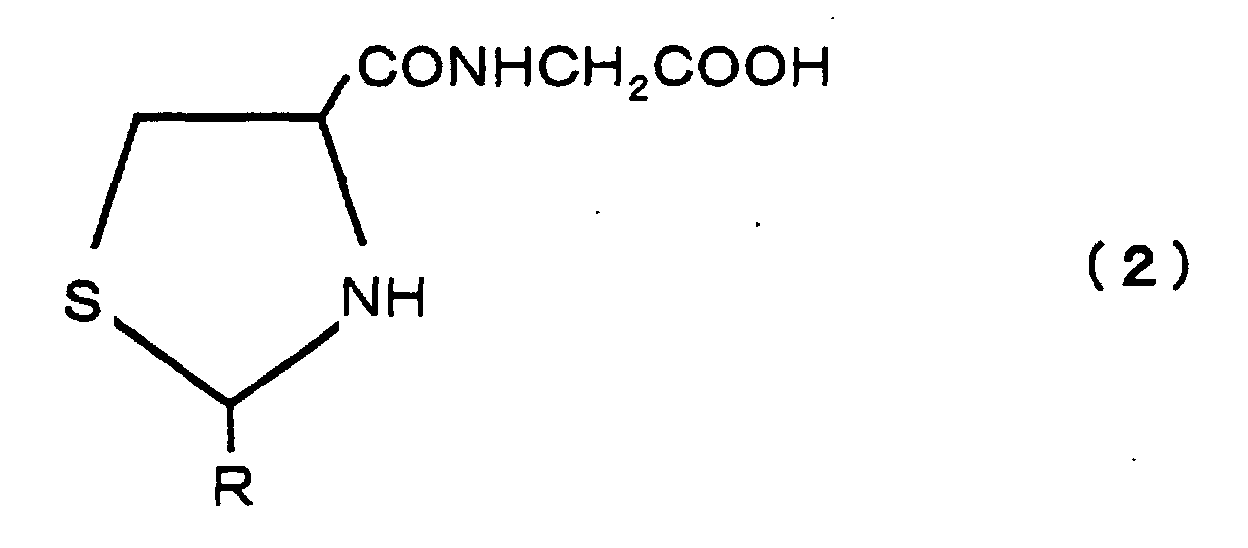
novel thiazolidine compound which is an organic compound
represented by the following general formula (2) in which R
is a group having the same structure as that of the
residual group obtained by removing an oxygen atom from the
aldehyde group of an aldose or aldose-type oligosaccharide
or that of the residual group obtained by removing an
oxygen atom from the carbonyl group of a ketose or ketose-type
oligosaccharide, and salts thereof.
Incidentally, it is to be noted that the novel
thiazolidine compounds are covered by the non-volatile
thiazolidine compounds described above in connection with
the first embodiment of the present invention.
Additionally, the mechanism of retaining and
developing the flavor by the novel thiazolidine compounds
of the present embodiment is considered to be the same as
that by the non-volatile thiazolidine compounds described
above in connection with the first embodiment of the
present invention, and is as follows.
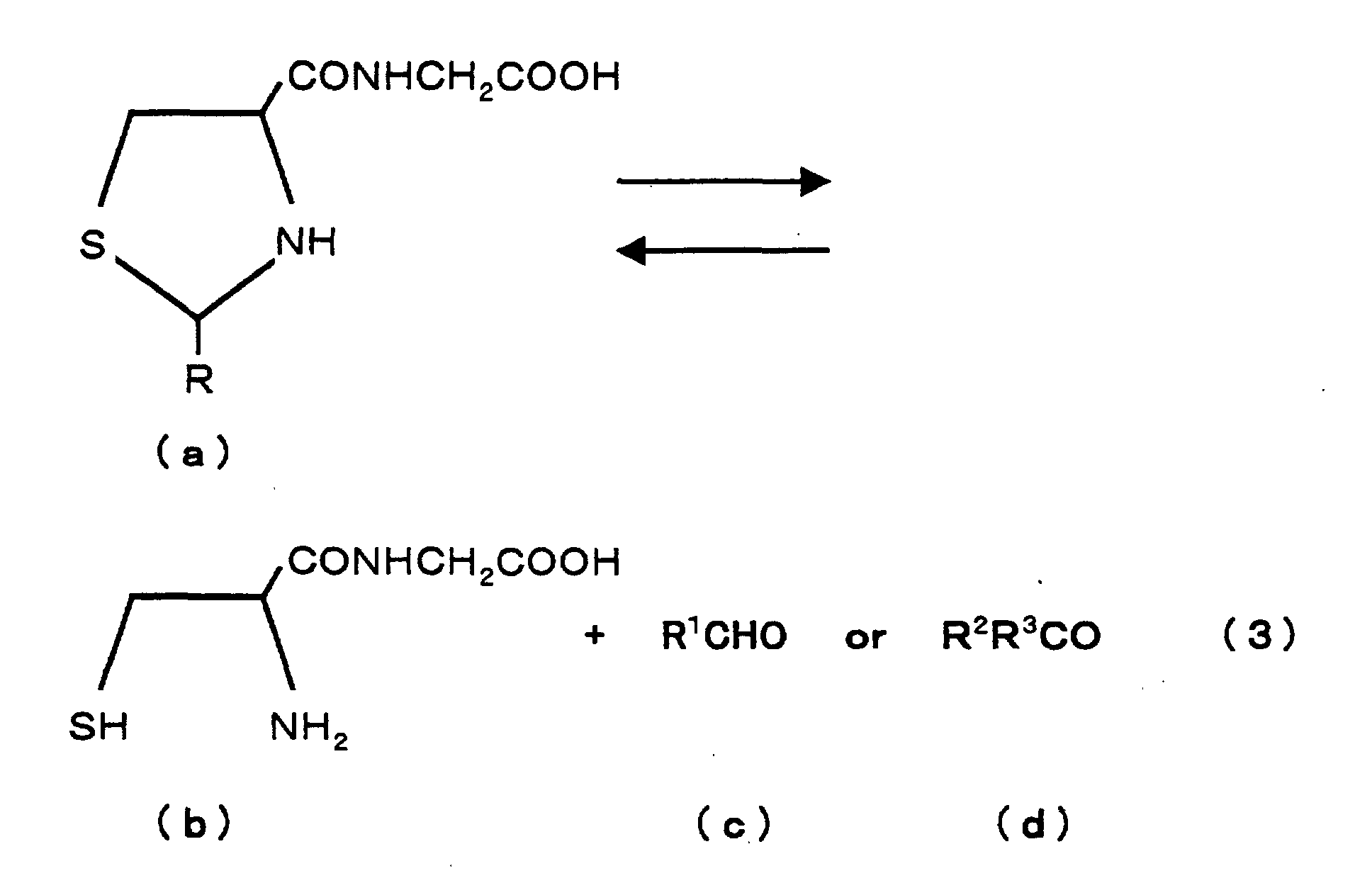
That is, as shown in the following formula (3), a
novel thiazolidine compound (a) produces cysteinylglycine
(b) by an equilibrium reaction.
The cysteinylglycine (b) produced by the equilibrium
reaction cuts reductively the sulfide bonds present in a
food or drink by the reducibility of its thiol group. As a
result, the potentially aromatic thiol present in the form
where two molecules of an aromatic thiol are disulfide-bonded
or where an aromatic thiol disulfide-bonded to a
non-volatile thiol such as cysteine, releases the aromatic
thiol, and the released thiol develops and enhances the
aroma. Further, the cysteinylglycine (b) produced by the
above reaction produces further aroma components when its
thiol group undergoes a further chemical change by heating
or the like. Meanwhile, as the cysteinylglycine (b) (a
thiol compound) once produced or released from the
thiazolidine compound (a) by the equilibrium reaction
disappears by cutting disulfide bonds reductively or
undergoing other chemical changes, it is newly produced
little by little. Therefore, its effect can be maintained
over a long time period, whereby the aroma components of
foods or drinks which have been added with the thiazolidine
compound, can be retained stably over a long time period,
and the aroma components can be maintained in a proper
developing amount over a long time period until the food or
drink is eaten or drunk. Incidentally, in the above
formula (3), the compounds (c) and (d) represent an aldose-type
oligosaccharide and a ketose or ketose-type
oligosaccharide, respectively.
Further, the novel thiazolidine compounds according
to the present embodiment can control the developing amount
of aroma components by changing its amount to be added to a
food or drink.
Furthermore, an aroma thiol compound itself is liable
to be oxidized, and thiol compounds present in a food or
drink (including raw materials thereof) is also liable to
disappear during distribution or preservation of the food
or drink. On the other hand, the novel thiazolidine
compounds according to the present embodiment naturally has
an excellent stability as compared with the thiol compound
and is very advantageously added to and used in a food or
the like, because the novel thiazolidine compounds are
covered by the non-volatile thiazolidine compounds, as has
been described above.
A third embodiment of the present invention intended
for the purpose of attaining the above-described third
object of the present invention will be described below.
The present inventors have made intensive studies to
achieve the above object and found that the concurrent use
of a flavor compound where an aromatic thiol (volatile
flavor compound) is disulfide-bonded to a non-volatile
thiol compound such as cysteine or the like, the flavor
compound being referred to as "non-volatile flavor
compound" in the present specification, in addition to a
non-volatile thiazolidine compound described above in
connection with the first embodiment of the present
invention, enhances the effects of the first embodiment of
the present invention. The present embodiment has been
completed based on these findings. In greater detail, they
have found that when a non-volatile thiazolidine compound
is caused to be present in a food or drink in a
concentration of 0.1 to 10,000 ppm, preferably 1 to 1,000
ppm at the time of eating or drinking, and a non-volatile
flavor compound is concurrently caused to be present in the
food or drink in a concentration of 0.1 to 10,000 ppb,
preferably 1 to 1,000 ppb at the time of eating or
drinking, the flavor of the food or drink is enhanced and
the flavor components are retained stably over a long time
period, whereby the favorable flavor can be retained until
the food or drink is eaten or drunk, and the favorable
flavor can be developed at the time of eating or drinking
the food or drink, and whereby the unpleasant odor of the
food or drink can be suppressed, thereby improving the
palatability of the food or drink. The present embodiment
has been completed based on these findings.
Accordingly, the present embodiment relates to a
composition for retaining and developing the flavor of
foods or drinks which composition comprises a non-volatile
thiazolidine compound in an amount of 1 - 10,000 ppm and a
non-volatile flavor compound and/or a reaction flavor in an
amount of 1 - 10,000 ppb, both amounts being at the time of
eating or drinking, a method of producing a food or drink
with the use of such composition, and the food or drink
which has been produced by such method.
Incidentally, the above thiazolidine compound and the
above flavor compound can be in the form of raw materials
containing these compounds, such as seasonings, extracts,
and the like.
A fourth embodiment of the present invention intended
for the purpose of attaining the above-described fourth
object of the present invention will be described below.
The present inventors have made intensive studies to
achieve the above object and found that the concurrent use
of a non-volatile flavor compound described above, in
addition to a non-volatile thiazolidine compound described
above in connection with the first embodiment of the
present invention, enhances the effects of the first
embodiment of the present invention. The present
embodiment has been completed based on these findings. In
greater detail, they have found, as is similar to what has
been described above in connection with the third
embodiment of the present invention, that when a non-volatile
thiazolidine compound is caused to be present in a
frozen food in a concentration of 0.1 to 10,000 ppm,
preferably 1 to 1,000 ppm at the time of eating, and a non-volatile
flavor compound is concurrently caused to be
present in the frozen food in a concentration of 0.1 to
10,000 ppb, preferably 1 to 1,000 ppb at the time of
eating, the flavor of the frozen food is enhanced and the
flavor components are retained stably over a long time
period, whereby the favorable flavor can be retained until
the frozen food is eaten, and the favorable flavor can be
developed at the time of eating the frozen food, and
whereby the unpleasant odor of the frozen food can be
suppressed, thereby improving the palatability of the
frozen food. The present embodiment has been completed
based on these findings.
Accordingly, the present embodiment relates to a
composition for retaining and developing the flavor of
frozen foods which composition comprises a non-volatile
thiazolidine compound in an amount of 1 - 10,000 ppm and a
non-volatile flavor compound and/or a reaction flavor in an
amount of 1 - 10,000 ppb, both amounts being at the time of
eating, a method of producing a frozen food with the use of
such composition, and the frozen food which has been
produced by such method.
Incidentally, the above-described thiazolidine
compound and the above-described non-volatile flavor
compound can be in the form of raw materials containing
these compounds, such as seasonings, extracts, and the
like, as is the same as in the third embodiment of the
present invention.
A fifth embodiment of the present invention intended
for the purpose of attaining the above-described fifth
object of the present invention will be described below.
The present inventors have made intensive studies to
achieve the above object and found that when a non-volatile
thiazolidine compound described above in connection with
the first embodiment of the present invention, is added
before heat sterilization during the production process of
a retort food or at the time of opening the package of a
retort food to cook or eat it, the unpleasant odor of the
retort food can be suppressed easily and effectively. The
present embodiment has been completed based on these
findings.
Accordingly, the present embodiment relates to a
method for improving the flavor of a retort food, in which
a non-volatile thiazolidine compound is added to the retort
food, whereby the unpleasant odor of the retort food can be
suppressed.
The details of the mechanism how the retort odor can
be suppressed by the method of the present embodiment
remain to be elucidated. However, the present inventors
assume at present that the added non-volatile thiazolidine
compound reacts with aldehydes and/or ketones which are
thought to be one of the causes of the retort odor, and
makes them non-volatile, whereby the retort odor is
suppressed.
A sixth embodiment of the present invention intended
for the purpose of attaining the above-described sixth
object of the present invention will be described below.
The present inventors have made intensive studies to
achieve the above object and found that when a non-volatile
thiazolidine compound described above in connection with
the first embodiment of the present invention, is added to
a soybean-incorporated food product (or soybean-utilized
food product) either before or during the processing of its
raw materials or at the time of cooking or eating a
soybean-incorporated food product, the unpleasant odor of
the soybean-incorporated food product can be suppressed
easily and effectively. The present embodiment has been
completed based on these findings.
Accordingly, the present embodiment relates to a
method for improving the flavor of a soybean-incorporated
food product, in which a non-volatile thiazolidine compound
is added to the soybean-incorporated food product to
suppress the unpleasant, weed-like odor peculiar to the
soybean-incorporated food product.
Now, the embodiments of the present invention will be
successively described below in more detail.
First, the first embodiment of the present invention
will be described in more detail hereinafter.
By the non-volatile thiazolidine compound according
to the present embodiment is meant a non-volatile
thiazolidine derivative having at least one substituent on
the thiazolidine skeleton. Illustrative examples of the
thiazolidine compound include thioproline and derivatives
thereof and 2-(polyhydroxyalkyl)thiazolidine-4-carboxylic
acids. Specific examples thereof include 2-(1,2,3-trihydroxypropyl)thiazolidine-4-carboxylic
acid, 2-(1,2,3,4-tetrahydroxybutyl)thiazolidine-4-carboxylic
acid,
2-(1,2,3,4,5-pentahydroxypentyl)thiazolidine-4-carboxylic
acid, 2-hydroxymethyl-2-(1,2,3,4-tetrahydroxybutyl)thiazolidine-4-carboxylic
acid, 2-(1,2,4,5-tetrahydroxy-3-glucopyranosyloxypentyl)
thiazolidine-4-carboxylic acid, and the like. There may be
mentioned, as further examples thereof, 2-(1,2,3,4-tetrahydroxybutyl)thiazolidine-4-carbonyl-N-glycine
and 2-(1,2,3,4,5-pentahydroxypentyl)thiazolidine-4-carbonyl-N-glycine,
as referred to above in connection with the second
embodiment of the present invention.
These thiazolidine compounds can be obtained by an
ordinary method in which cysteine and an aldehyde are
reacted with each other in an aqueous solution under
neutral to alkaline conditions.
Next, a description will be given to a method for
preparing the composition of the present embodiment for
retaining and developing the flavor of a food or drink.
The preparation of the composition of the present
embodiment is not particularly limited except that a non-volatile
thiazolidine compound is contained as the active
ingredient. As such a thiazolidine compound, a
commercially available or synthetic thiazolidine compound
can be used. Further, if possible, a natural substance
containing the thiazolidine compound or a synthetic
reaction mixture of thiazolidine may also be used as it is.
Its form is also not particularly limited, and it can
be formed into appropriate forms such as powders, granules,
liquid, paste and the like with or without using an
excipient or diluent, regarded as appropriate. This
includes a variety of seasonings containing the
composition.
And, foods and drinks whose flavor is to be retained
and developed with the use of a composition of the present
embodiment for retaining and developing flavors, are not
particularly limited, insofar as they can exhibit the
effects intended by using a composition of the present
embodiment for retaining and developing flavors, when the
composition is used or added. As examples of such foods
and drinks, there may be mentioned soups such as a consommé
soup, corn soup, soup for Chinese noodles, and the like,
powdery seasonings such as flavoring seasonings and the
like, liquid seasonings such as soup stocks, dipping sauces
for foods served in the hot pot, dipping sauces for
Japanese noodles and the like, cup noodles, beverages such
as coffee, and processed meat products such as hamburgers,
meat balls, and the like. Various frozen foods may be also
mentioned.
Next, a description will be given to a method for
retaining and developing the flavor of a food or drink with
the use of the composition of the present embodiment for
retaining and developing the flavor.
As could be understood from the above-described
mechanism how flavors are retained and developed with a
thiazolidine compound according to the present embodiment,
the point is that the effect of retaining and developing
the flavor can be exhibited when the thiazolidine compound
contained in a composition of the present invention,
coexists with other flavor components at the time of eating
or drinking. Therefore, the timing and method of adding
the composition, the form of the composition to be added,
and the like can be selected from a wide range. Concerning
the amount to be added, the composition is added in such an
amount that it ensures that the desired effect can be
exhibited with the thiazolidine compound. For example, in
the case of a chicken consommé soup, the composition is
preferably added or used at a concentration of 1 to 1,000
ppm at the time of eating.
Finally, a description will be given to the
distribution of the composition of the present embodiment
for retaining and developing the flavor of a food or drink.
The composition of the present embodiment can be
distributed as it is or in the form of seasonings obtained
by mixing the composition with other flavor components.
Further, it can also be distributed in the form of a
processed food produced by using the composition of the
present invention.
Secondly, the second embodiment of the present
invention will be described in more detail hereinafter.
First, the novel compounds per se of the present
embodiment will be described.
In the above general formula (2) representing the
novel thiazolidine compounds of the present embodiment, R
is the same in structure as the residual group obtained by
removing an oxygen atom from the aldehyde group of an
aldose or aldose-type oligosaccharide or the residual group
obtained by removing an oxygen atom from the carbonyl group
of a ketose or ketose-type oligosaccharide. Suitable
examples of the aldose when the novel thiazolidine compound
of the present embodiment is used in food products include
aldopentoses such as xylose, ribose and the like; and
aldohexoses such as glucose, galactose, mannose and the
like. Meanwhile, by the aldose-type oligosaccharide is
meant an oligosaccharide having an aldehyde group, and the
polymerization degree of the oligosaccharide is preferably
about 2 to 5 when the novel thiazolidine compound of the
present invention is used in food products. Illustrative
examples of such an aldose-type oligosaccharide include
maltose, lactose, cellobiose and the like. Further,
illustrative examples of the ketose include fructose.
Next, the synthetic method of the novel thiazolidine
compounds of the present embodiment will be described.
The novel thiazolidine compounds of the present
embodiment can be obtained, e.g., by an ordinary method in
which cysteinylglycine is reacted with an aldose or aldose-type
oligosacohride, or a ketose or a ketose-type
oligosacoharide in an aqueous solution under neutral to
alkaline conditions.
Next, a description will be given to a method for
preparing the composition of the present embodiment for
retaining and developing the flavor of a food or drink.
This is the same as has been described above in connection
with the first embodiment of the present invention.
I.e., the preparation of the composition of the
present embodiment is not particularly limited except that
a novel thiazolidine compound of the present embodiment is
contained as the active ingredient. Such a novel
thiazolidine compound can be obtained, as has been
described above, by a per se ordinary method. Further, if
possible, a synthetic reaction mixture of thiazolidine
containing the thiazolidine compound, may also be used as
it is.
Moreover, its form is also not particularly limited,
and it can be formed into appropriate forms such as
powders, granules, liquid, paste and the like, with or
without using an excipient or diluent, regarded as
appropriate. This includes a variety of seasonings
containing the compound.
Next, a description will be given to a method for
retaining and developing the flavor of a food or drink with
the use of the composition of the present embodiment for
retaining and developing the flavor. This is the same as
has been described above in connection with the first
embodiment of the present invention.
I.e., as could be understood from the above-described
mechanism how flavors are retained and developed with a
thiazolidine compound according to the present embodiment,
the point is that the effect of retaining and developing
the flavor can be exhibited when the thiazolidine compound
contained in a composition of the present embodiment,
coexists with other flavor components at the time of eating
or drinking. Therefore, the timing and method of adding
the composition, the form of the composition to be added,
and the like can be selected from a wide range. Concerning
the amount to be added, the composition is added in such an
amount that it ensures that the desired effect can be
exhibited with the thiazolidine compound. For example, in
the case of a beef consommé soup, the composition is
preferably added or used at a concentration of 1 to 1,000
ppm at the time of eating.
Finally, a description will be given to the
distribution of the composition of the present embodiment
for retaining and developing the flavor of a food or drink.
This is also the same as has been described above in
connection with the first embodiment of the present
invention.
I.e., the composition of the present embodiment can
be distributed as it is or in the form of seasonings
obtained by mixing the composition with other flavor
components. Further, it can also be distributed in the
form of a processed food produced by using the composition
of the present embodiment.
In the third place, the third embodiment of the
present invention will be described in more detail.
The non-volatile thiazolidine according to this
embodiment of the present invention is the same as has been
described above in connection with the first and second
embodiments of the present invention.
By the non-volatile flavor compound according to the
present embodiment is meant, as has been described, a
compound stabilized by the formation of the disulfide bond
between an aromatic thiol (volatile flavor compound) and a
non-volatile thiol. Illustrative examples of the aromatic
thiol (volatile flavor compound) include, e.g., 2-furylmethanethiol
(FMT), 2-methyl-3-furanthiol (MFT), 2-(1-mercaptoethyl)furan
(MEF), and the like. Illustrative
examples of the non-volatile thiol include cysteine,
glutathione, and the like.
Illustrative examples of the food and drink according
to the present embodiment include soups such as a consommé
soup, corn soup, soup for Chinese noodles, and the like,
powdery seasonings such as flavoring seasonings and the
like, liquid seasonings such as soup stocks, dipping sauces
for foods served in the hot pot, dipping sauces for
Japanese noodles, and the like, cup noodles, beverages such
as coffee, and processed meat products such as hamburgers,
meat balls, and the like.
The thiazolidine compound is added in an amount of
0.1 to 10,000 ppm, preferably 1 to 1,000 ppm, based on the
weight of the food or drink, and the non-volatile flavor
compound in which an aromatic thiol (volatile flavor
compound) is disulfide-bonded to a non-volatile thiol such
as cysteine or the like is added in an amount of 0.1 to
10,000 ppb, preferably 1 to 1,000 ppb, based on the weight
of the food or drink, the amounts being at the time of
eating or drinking.
The non-volatile thiazolidine compound and the non-volatile
flavor compound may be added by any means such as
powder mixing, liquid mixing or the like.
The effect has been observed when the non-volatile
thiazolidine compound and the non-volatile flavor compound
have been added either at the time of producing and
processing the food or drink or at the time of eating the
food or drink.
In the fourth place, the fourth embodiment of the
present invention will be described in more detail.
The non-volatile thiazolidine compound according to
the present embodiment is the same as has been described in
connection with the first and second embodiments of the
present invention.
The non-volatile flavor compound according to the
present embodiment is the same as has been described above
in connection with the third embodiment of the present
invention.
Illustrative examples of the frozen foods according
to the present embodiment include processed meat products
such as hamburgers, croquettes, Chinese dumpling with
minced pork and vegetable stuffing (gyoza), steamed Chinese
pork dumpling wrapped in a thin flour-and-water pancake
(shao-mai), and the like; fried shrimps; processed rice
products such as baked rice balls, pilafs, Chinese fried
rice (with eggs, shrimps, etc.), and the like; gratins;
pizzas; Chinese noodles; curry rice; ingredients in
Chinese-flavored rice served in a bowl; and the like.
The thiazolidine compound is added in an amount of
0.1 to 10,000 ppm, preferably 1 to 1,000 ppm, based on the
weight of the frozen food, and the non-volatile flavor
compound is added in an amount of 0.1 to 10,000 ppb,
preferably 1 to 1,000 ppb, based on the weight of the
frozen food, the amounts being at the time of eating.
The non-volatile thiazolidine compound and the non-volatile
flavor compound may be added by any means such as
powder mixing, liquid mixing or the like. This is the same
as has been described above in connection with the third
embodiment of the present invention.
The effect has been observed when the non-volatile
thiazolidine compound and the non-volatile flavor compound
have been added either at the time of producing and
processing the frozen food or at the time of eating the
frozen food. This is also the same as has been described
above in connection with the third embodiment of the
present invention.
In the fifth place, the fifth embodiment of the
present invention will be described in more detail.
The non-volatile thiazolidine compound according to
the present embodiment is all the same as has been
described in connection with the first and second
embodiments of the present invention.
There may be mentioned as illustrative examples of
the retort foods according to the present embodiment,
sauces such as meat sauce, white sauce, demigrass sauce,
and the like; liquid-type mixed seasonings; stews; soups;
curries; rice porridges; processed meat products such as
hamburgers, meat balls, and the like; processed seafood
products such as steamed fish pastes, mackerels cooked with
fermented soybean pastes, and the like, all of which are
packaged in heat-resistant packages (retort packages or
containers) such as retort pouches, cans, bottles, and the
like.
The amount of the non-volatile thiazolidine compound
is not particularly limited as long as the desired effect
of the present embodiment can be exhibited. For example,
in the case of foods such as meat sauce, white sauce,
curry, or the like, the non-volatile thiazolidine compound
is added in such amount that it is in an amount of 1 to
10,000 ppm, preferably 10 to 1,000 ppm, at the time of
eating or drinking, based on its weight, to raw food
materials to be retort treated. The raw food materials
added with the non-volatile thiazolidine compound is
charged and sealed in, e.g., a retort pouch, and is
subjected to heat sterilization (retort treatment).
The non-volatile thiazolidine compound may be added
by any means such as powder mixing, liquid mixing, or the
like.
As regards the timing of adding or using the non-volatile
thiazolidine compound, the effect of suppressing
the retort odor has been observed when the non-volatile
thiazolidine compound is added either before the raw
materials of a retort food are subjected to heat
sterilization (retort treatment) during the production
process of the retort food, at the time of opening the
retort package to cook it after the heat sterilization
(retort treatment), or at the time of opening the retort
package to eat or drink it. However, in consideration of
the primary object of heating a retort food, i.e.,
sterilization, and the degree of the effect of suppressing
the retort odor at the time of eating or drinking the
retort food, the non-volatile thiazolidine compound is the
most suitably added to the raw materials of the retort food
before the raw materials are subjected to heat
sterilization during the production process of the retort
food.
Incidentally, a disulfide compound (non-volatile
flavor compound) such as MFT-Cys (a disulfide of 2-methyl-3-franthiol
with cysteine, i.e., 2-methyl-3-franthiol
crysteine disulfide) or the like, a reaction flavor, or the
like, can of course be concurrently used, in addition to
the non-volatile thiazolidine compound according to the
present embodiment.
The retort food is preferably heat-sterilized at
temperatures of about 100 to 130°C for several minutes to
several tens of minutes. However, the temperature, the
pressure and time for the heat sterilization are not
particularly limited as long as the effect of the retort
treatment can be achieved, and the retort treatment can be
carried out in accordance with an ordinary method.
Finally, the sixth embodiment of the present
invention will be described in more detail.
The non-volatile thiazolidine compound according to
the present embodiment is all the same as has been
described in connection with the first and second
embodiments of the present invention.
There may be mentioned as illustrative examples of
the soybean-incorporated or -utilized food products
according to the present embodiment, soybean curds, bean
curd refuses, soybean milk, soybean proteins, and food
products using soybean protein or aqueous solution thereof,
such as hams, sausages, hamburgers and the like. Moreover,
soybean oils extracted from soybeans, and the like, may be
mentioned.
The amount of the non-volatile thiazolidine compound
is not particularly limited as long as the desired effect
of the present embodiment can be exhibited. For example,
in the case of soybean milk, the non-volatile thiazolidine
compound is added thereto in an amount of 1 to 10,000 ppm,
preferably 10 to 1,000 ppm, based on its weight. Also, in
the case of soybean protein, the non-volatile thiazolidine
compound is added thereto in an amount of 1 to 10,000 ppm,
preferably 10 to 1,000 ppm, based on its weight.
The non-volatile thiazolidine compound may be added
by any means such as powder mixing, liquid mixing, or the
like. This is the same as has been described in connection
with the fifth embodiment of the present invention.
As regards the timing of adding or using the non-volatile
thiazolidine compound, it is not particularly
limited as long as the desired effect of the present
embodiment can be exhibited. For example, in the case of a
soybean protein-incorporated hamburger, the effect of
suppressing the unpleasant odor can be observed when the
non-volatile thiazolidine compound is added at the time of
processing raw materials, e.g., preparing soybean proteins,
or at the time of making a soybean-incorporated food
product, e.g., cooking the soybean protein-incorporated
hamburger by using the soybean proteins. The effect of
suppressing the unpleasant odor can also be observed when
the non-volatile thiazolidine compound is added at the time
of eating soybean-incorporated food products such as
soybean milk or bean curd refuses. However, in
consideration of the degree of the effect of suppressing
the soybean odor, the non-volatile thiazolidine compound is
the most suitably added either before or while the raw
materials are processed or when soybean-incorporated food
products are made.
Further, it is needless to say that a disulfide
compound (non-volatile flavor compound) such as MFT-Cys (a
disulfide of 2-methyl-3-franthiol with cysteine, i.e., 2-methyl-3-franthiol
crysteine disulfide) or the like, a
reaction flavor, or the like, can be concurrently used, in
addition to the non-volatile thiazolidine compound
according to the present embodiment.
In the foregoing, the present invention has been
divided into the six embodiments and each embodiment has
been described. As can be seen from the foregoing, the
non-volatile thiazolidine compound is used as the agent of
enhancing or improving the flavors of foods or drinks in
accordance with each embodiment. Therefore, the six
embodiments of the present invention constitute a group of
inventions so liked as to form a single general inventive
concept, the concept being the identification of the non-volatile
thiazolidine compound as a flavor enhancing or
improving agent for foods and drinks.
(Brief Description of the Drawings)
Fig. 1 shows an ESI-MS spectra indicating the
formation of a thiazolidine compound according to the first
embodiment of the present invention (Example 1).
Fig. 2 shows an ESI-MS spectra indicating the
formation of another thiazolidine compound according to the
first embodiment of the present invention (Example 2).
Fig. 3 shows an APCI-MS spectra indicating the
formation of still another thiazolidine compound according
to the first embodiment of the present invention (Example
3).
Fig. 4 shows the comparison of stability between
glutathione and cysteine (Example 4).
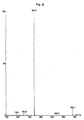
Fig. 5 shows an ESI-MS spectra of a novel
thiazolidine compound according to the second embodiment of
the present invention (Example 8).
Fig. 6 shows an ESI-MS spectra of another novel
thiazolidine compound according to the second embodiment of
the present invention (Example 9).
(Best Mode for Carrying Out the Invention)
The present invention will be further described with
reference to Examples.
First, Examples will be given concerning the first
embodiment of the present invention.
Example 1 Synthesis of 2-(1,2,3,4-tetrahydroxybutyl)thiazolidine-4-carboxylic
acid
17.56 Grams (100 mmol) of cysteine hydrochloride and
15.01 g (100 mmol) of xylose were dissolved in 35 ml of
pure water, 8.36 ml (100 mmol) of pyridine was then added
thereto, and the resulting solution was stirred at room
temperature for 72 hours. 300 Milliliters of ethanol was
added to the stirred solution, and the solution was left to
stand in a refrigerator, whereby a paste-like precipitate
was formed. The solvent was removed by decantation, and
the precipitate was dissolved in 100 ml of water. After
the insoluble matters were removed by filtration, the
remaining solution was condensed to about 30 ml. Ethanol
was continuously added to the condensed solution until a
precipitate was about to appear, and the solution was then
left to stand in a refrigerator overnight. The resulting
crystals were collected by filtration and dried under
reduced pressure. The crystals were dissolved in water
again, the insoluble matters were removed by filtration,
the resulting solution was condensed, ethanol was added to
the solution to cause recrystallization, and the produced
crystals were collected by filtration and dried under
reduced pressure to obtain 10.8 g of white powder (molar
yield based on the cysteine: 42.7 %). The white powder was
identified as the target compound since the ion mass number
of the white powder by ESI-MS spectrum (Electron Spray
Ionization-Mass Spectrometry) was, as is shown in Fig. 1
given later, equal to the molecular weight (254) of the
compound obtained by hydrogenating the target compound.
Example 2 Synthesis of 2-(1,2,3,4,5-pentahydroxypentyl)thiazolidine-4-carboxylic
acid
17.56 Grams (100 mmol) of cysteine hydrochloride and
18.02 g (100 mmol) of glucose were dissolved in 35 ml of
pure water, 8.36 ml (100 mmol) of pyridine was then added
thereto, and the resulting solution was stirred at room
temperature for 96 hours. 200 Milliliters of methanol was
added to the stirred solution, whereby a precipitate was
formed. The precipitate was collected by filtering and was
suspended in 300 ml of water. The suspension was heated to
50°C to give a solution. The solution was condensed to
about 100 ml at 45°C under reduced pressure. The insoluble
matters were removed by filtration, and the remaining
solution was, after added with 200 ml of methanol, left to
stand in a refrigerator overnight. The resulting crystals
were collected by filtration and dried under reduced
pressure, whereby 15.0 g of a white powder was obtained
(molar yield based on the cysteine: 52.9 %). The white
powder was identified as the target compound since the ion
mass number of the white powder by ESI-MS spectrum
(Electron Spray Ionization-Mass Spectrometry) was, as is
shown in Fig. 2 given later, equal to the molecular weight
(284) of the compound obtained by hydrogenating the target
compound.
Example 3 Synthesis of 2-(1,2,4,5-tetrahydroxy-3-glucopyranosyloxypentyl)
thiazolidine-4-carboxylic
acid
17.56 Grams (100 mmol) of cysteine hydrochloride and
34.20 g (100 mmol) of maltose were dissolved in 35 ml of
pure water, 8.36 ml (100 mmol) of pyridine was then added
thereto, and the resulting solution was stirred at room
temperature for 72 hours. 300 Milliliters of ethanol was
added to the stirred solution, and the solution was left to
stand in a refrigerator, whereby a paste-like precipitate
was formed. The solvent was removed by decantation, and
the precipitate was dissolved in 100 ml of water. After
the insoluble matters were removed by filtration, the
remaining solution was condensed to about 30 ml. Ethanol
was continuously added to the condensed solution until a
precipitate was about to appear, and the solution was then
left to stand in a refrigerator overnight. The produced
crystals were collected by filtration. The crystals were
then dissolved in water again, the insoluble matters were
removed by filtration, the resulting solution was
condensed, and ethanol was added to the solution to cause
recrystallization. The produced crystals were collected by
filtration and dried under reduced pressure to obtain 2.2 g
of a white powder (molar yield based on cysteine: 4.9 %)
The white powder was identified as the target
compound since the ion mass number of the white powder by
APCI-MS (Atmospheric Pressure Chemical Ionization-Mass
Spectrometry) spectrum was, as is shown in Fig. 3 given
later, equal to the molecular weight (444) of the compound
([M-H]-) obtained by dehydrogenating the target compound.
Example 4 Comparison of Stability between Glutathione and
Cysteine
2-(1,2,3,4-tetrahydroxybutyl)thiazolidine-4-carboxylic
acid (abbreviated as "TCA" hereinafter), one of
the non-volatile thiazolidine compounds according to the
present embodiment, glutathione (abbreviated as "GSH"
hereinafter) and cysteine (abbreviated as "Cys"
hereinafter) were each dissolved separately in 50 mM
potassium phosphate solutions in such amount to give a
concentration of 0.5 mM. The prepared solutions were each
adjusted to a pH of 7.0 with an aqueous 1 N sodium
hydroxide solution and then left to stand at room
temperature (25°C). A change with time in the survival
rate of each component was measured by high-performance
liquid chromatography. As a result, it is understood that
the thiazolidine compound had better stability than the
glutathione and the cysteine as shown in Fig. 4 given
later.
Example 5 Sensory Evaluation of Commercial Consommé Soup
System (Part 1)
The non-volatile thiazolidine compound obtained as in
Example 1 was added to a commercial chicken consommé soup
in such amount that the concentration of the compound would
be 0.07% when the soup was eaten. The commercial consommé
soup added with the compound was compared arid evaluated
with the same commercial chicken consommé soup but not
added with the compound, concerning the strength and
preference of the flavors by a panel of six experts in
accordance with the evaluation criteria attached to Table
1. As a result, as shown in Table 1, the soup added with
the compound (Inventive) had a significantly stronger and
more preferable flavor than the one but not added with the
compound (Control).
| Consommé Soup (Part 1) |
| Evaluation Items | Average points of Inventive |
| Strength of Flavor | 1.0 |
| Preference of Flavor | 1.3 |
| Rating |
+2 |
Strong or preferable |
| |
+1 |
Rather strong or rather preferable |
| |
0 |
Non-different |
| |
-1 |
Rather weak or rather non-preferable |
| |
-2 |
Weak or non-preferable |
Example 6 Sensory Evaluation of Commercial Egg Soup System
The non-volatile thiazolidine compound obtained as in
Example 1 was added to a commercial egg soup in such amount
that the concentration of the compound would be 0.07% when
the soup was eaten. The commercial egg soup added with the
compound was compared with the same commercial egg soup but
not added with the compound, and was evaluated concerning
the strength and preference of the flavors by a panel of
six experts in accordance with the evaluation criteria
attached to the above Table 1. As a result, as is shown in
the following Table 2, the soup added with the compound
(Inventive) had a significantly stronger and more
preferable flavor than the one not added with the compound
(Control).
| Egg Soup |
| Evaluation Items | Average points of Inventive |
| Strength of Flavor | 1.0 |
| Preference of Flavor | 0.8 |
The non-volatile thiazolidine compound obtained as in
Example 1 was added to another commercial corn soup
different from that of Example 5 in such amount that the
concentration of the compound would be 0.07% when the soup
was eaten. The commercial corn soup added with the
compound was compared with the same commercial corn soup
but not added with the compound, and was evaluated
concerning the strength and preference of the flavors by a
panel of six experts in accordance with the evaluation
criteria attached to the above Table 1. As a result, as is
shown in the following Table 3, the soup added with the
compound (Inventive) had a significantly stronger and more
preferable flavor than the one but not added with the
compound (Control).
| Consommé Soup (Part 2) |
| Evaluation Items | Average points of Inventive |
| Strength of Flavor | 0.6 |
| Preference of Flavor | 1.0 |
Next, the second embodiment of the present invention
will be described in more detail with reference to Examples
hereinafter.
Example 8 Synthesis of a New Compound, 2-(1,2,3,4-tetrahydroxybutyl)
thiazolidine-4-carbonyl-N-glycine
100 Milligrams (0.56 mmol) of cystenylglycine
(product of Sigma Co., Ltd.) and 84 mg (0.56 mmol) of
xylose were dissolved in 0.2 ml of pure water, and 50 µl
(0.59 mmol) of pyridine was added thereto. After the
obtained solution was mixed well, it was left to stand at
room temperature for 5 hours for reaction. When 2 ml of
ethanol was added to the reaction solution and the
resulting mixture was left to stand at 5°C overnight, a
white precipitate was formed. After the precipitate was
collected with a centrifugal separator and washed with
ethanol, it was dissolved in 0.2 ml of pure water and
freeze-dried, whereby 94 mg of a white powder was obtained.
The white powder was identified as the target
compound since the ion mass number of the white powder by
ESI-MS spectrum (Electron Spray Ionization-Mass
Spectrometry) was, as is shown in Fig. 5 given later, equal
to the molecular weight (311) of the compound obtained by
hydrogenating the target compound.
Example 9 Synthesis of a New Compound, 2-(1,2,3,4,5-pentahydroxypentyl)
thiazolidine-4-carbonyl-N-glycine
100 Milligrams (0.56 mmol) of cystenylglycine
(product of Sigma Co., Ltd.) and 100 mg (0.56 mmol) of
glucose were dissolved in 0.2 ml of pure water, and 50 µl
(0.59 mmol) of pyridine was added thereto. After the
obtained solution was mixed well, it was left to stand at
room temperature for 5 hours for reaction. When 2 ml of
ethanol was added to the reaction solution and the
resulting mixture was left to stand at 5°C overnight, a
white precipitate was formed. After the precipitate was
collected with a centrifugal separator and washed with
ethanol, it was dissolved in 0.2 ml of pure water and
freeze-dried, whereby 85 mg of a white powder was obtained.
The white powder was identified as the target
compound since the ion mass number of the white powder by
ESI-MS spectrum (Electron Spray Ionization-Mass
Spectrometry) was, as is shown in Fig. 6 given later, equal
to the molecular weight (341) of the compound obtained by
hydrogenating the target compound.
Example 10 Use for Beef Consommé Soup
The thiazolidine compound obtained in Example 8 was
added to a commercial solid beef consommé (product of Knorr
Foods Co., Ltd.) in such amount that the concentration of
the compound would be 0.03% at the time of eating. The
resulting solid beef consommé was dissolved in hot water to
prepare a consommé soup. The consommé soup was, while
maintained at 70°C in an open system, compared with a
consommé soup prepared from the same solid beef consommé
but not added with the compound. The consommé soup added
with the thiazolidine compound (Present invention)
apparently had a stronger beef-like flavor than the
consonuné soup added with no thiazolidine compound
(Control). In addition, even at a lapse of 1 hour after
the preparation of the samples, the soup added with the
thiazolidine compound still had a apparently stronger aroma
than the soup added with no thiazolidine compound, and the
thiazolidine compound was still in effect.
Example 11 Use for Instant Coffee
The thiazolidine compound obtained in Example 8 was
added to commercial freeze-dried instant coffee in such
amount that the concentration of the compound would be
0.01% when the coffee was drunk. The mixture was dissolved
in hot water to prepare a hot coffee. The hot coffee was,
while maintained at 70°C in an open system, compared with a
hot coffee added with no thiazolidine compound. The hot
coffee added with the thiazolidine compound (Present
invention) apparently had a stronger favorable coffee aroma
than the hot coffee added with no thiazolidine compound
(Control). In addition, even at a lapse of 30 minutes
after the preparation of the samples, the hot coffee added
with the thiazolidine compound still apparently had a
stronger aroma than the hot coffee added with no
thiazolidine compound, and the thiazolidine compound was
still in effect.
In the third place, Examples will be given concerning
the third embodiment of the present invention.
Example 12 Synthesis of 2-(1,2,3,4-tetrahydroxybutyl)thiazolidine-4-carboxylic
acid
Example 1 was repeated to obtain 2-(1,2,3,4-tetrahydroxybutyl)thiazolidine-4-carboxylic
acid.
Example 13 Synthesis of 2-methyl-3-franthiol cysteine
disulfide (MFT-Cys)
2-Methyl-3-furylthiol (56 mg) was dissolved in N,N-dimethylformamide
(400 µl), and this solution was dissolved
in acetonitrile (20 ml) with stirring. Separately, 2
equivalents in terms of sodium hydroxide of an aqueous 27%
sodium hydroxide solution was added to cystine (0.1 g), and
the resulting solution and water (20 ml) were added to the
above-mention solution and stirred. Cysteine (0.1 g) was
added to the stirred solution, and the resulting mixture
was allowed to react with stirring at room temperature for
2 days. After the reaction mixture was adjusted to a pH of
2, the resulting precipitate was filtered with a 0.45-µm
filter followed by distilling out the acetonitrile. The
condensed solution was then filtered with a 0.45-µm filter,
then adjusted in its amount to about 15 ml followed by
purifying by reversed-phase HPLC. The reversed-phase HPLC
was carried out by using Inertsil ODS having a size of 20 ×
250 mm of GL Science Co., Ltd. as a column, 0.1% formic
acid as an eluant A and acetonitrile containing 0.1% formic
acid as an eluant B, a gradient from 5%B to 40%B (20
minutes), and a flow rate of 10 ml/min, and detection was
carried out at 254 nm. Fractions containing the target
compound were collected and freeze-dried to obtain a brown
powder in an amount of 11.0 mg (Yield: 9.6%).
Example 14 Synthesis of 2-furylmethanethiol cysteine
disulfide (FFT-Cys)
2 Equivalents in terms of sodium hydroxide of an
aqueous 27% sodium hydroxide solution and water (20 ml)
were added to cystine (0.1 g) to give a solution. To the
resulting solution were added 2-furylmethanethiol and MeOH
(40 ml), and the resulting mixture was allowed to react
with stirring at room temperature for 1 week. After the
reaction mixture was adjusted to a pH of 2, the resulting
precipitate was filtered followed by washing the
precipitate with water and MeOH. The filtrate and washings
were collected and condensed. The resulting precipitate
was filtered off with a 0.45 µm filter, and the remainders
were adjusted in its amount to about 8 ml followed by
purifying by reversed-phase HPLC. The reversed-phase HPLC
was carried out by using Inertsil ODS having a size of 20 ×
250 mm of GL Science Co., Ltd. as a column, 0.1% formic
acid as an eluant A and acetonitrile containing 0.1% formic
acid as an eluant B, a gradient from 5%B to 40%B (20
minutes), and a flow rate of 10 ml/min. Detection was
carried out at 210 nm. Fractions containing the target
compound were collected and freeze-dried to obtain a white
powder in an amount of 34.5 mg (Yield: 17.2%).
Example 15 Synthesis of 2-(1-mercaptoethyl)furan cysteine
disulfide (MEF-Cys)
100 Milligrams of cystine was dissolved in 50 ml of
an aqueous 0.1 N sodium hydroxide solution, to which was
added a solution of 41.8 mg of MEF dissolved in 10 ml of
methanol. The mixture was stoppered tightly and allowed to
stand at room temperature for 5 days'. Thereafter, the
solution was neutralized and washed with ether, followed by
concentrating the aqueous layer to dryness with the use of
a rotary evaporator. The dried mass was dissolved again in
a small amount of water, followed by purifying with the use
of a solid phase extracting column ("Bondelute C18" ex
Varian). The methanol-eluted fractions were freeze-dried,
whereby a white powder was obtained in an amount of 10 mg
(Yield: 12.4%).
Example 16 Sensory Evaluation of Commercial Chicken
Consommé Soup System (Part 1)
The non-volatile thiazolidine compound obtained by
the above Example 12 was added to 100 g of chicken consommé
soup prepared by adding 600 ml of hot water to two cubes
(14 g) of commercial chicken consommé (product of Knorr
Foods Co., Ltd.) in such amount that the concentration of
the compound would be 5 ppm when the soup was eaten.
Sensory evaluations were made on the chicken consommé soup
containing the non-volatile thiazolidine compound and a
chicken consommé soup containing none of the non-volatile
thiazolidine compound by a panel of five experts in
accordance with the evaluation criteria attached to the
following Table 4. As a result, as is shown in Table 4,
the soup containing the non-volatile thiazolidine compound
(Inventive) showed a significantly improved preference as
compared with the one containing none of the non-volatile
thiazolidine compound (Control).
| Sensory Evaluation of Chicken Consommé Soup (Part 1) |
| Evaluation Items | Average Rating of Inventive |
| Strength of Odor of Degraded Chicken Fat | -1.20 |
| Preference of Aroma | +1.00 |
| Strength of Flavor of Meat | +0.40 |
| Overall Preference of Flavor | +1.00 |
| Overall Evaluation (0 to 10) | 6.20 |
| Rating |
+2 |
Strong or preferable |
| |
+1 |
Rather strong or rather preferable |
| |
0 |
Same as the one containing no non-volatile thiazolidine compound |
| |
-1 |
Rather weak or rather non-preferable |
| |
-2 |
Weak or non-preferable |
Example 17 Sensory Evaluation of Commercial Chicken
Consommé Soup System (Part 2)
The non-volatile thiazolidine compound obtained in
Example 12 and the MFT-Cys obtained in Example 13 were
added to 100 g of the chicken consommé soup prepared by
adding 600 ml of hot water to two cubes (14 g) of
commercial chicken consommé (product of Knorr Foods Co.,
Ltd.) in such amount that the concentrations of the non-volatile
thiazolidine compound and the MFT-Cys would be 5
ppm and 500 ppb, respectively, when the soup was eaten.
Sensory evaluations were made on the chicken consommé soup
containing both the non-volatile thiazolidine compound and
MFT-Cys and a chicken consommé soup containing none of the
thiazolidine compound and the MFT-Cys as the control by a
panel of five experts in accordance with the evaluation
criteria attached to the above Table 4. As a result, the
soup containing both the non-volatile thiazolidine compound
and the MFT-Cys (Inventive) had, as is shown in the
following Table 5, a significantly improved preference as
compared with the one containing neither the thiazolidine
compound nor the MFT-Cys (Control).
| Sensory Evaluation of Chicken Consommé Soup (Part 2) |
| Evaluation Items | Average Rating of Inventive |
| Strength of Aroma | +1.80 |
| Strength of Odor of Degraded Chicken Fat | -1.60 |
| Preference of Aroma | +1.40 |
| Strength of Flavor of Meat | +1.60 |
| Overall Preference of Flavor | +1.60 |
| Overall Evaluation (0 to 10) | 7.40 |
The non-volatile thiazolidine compound obtained in
Example 12 and a commercial reaction flavor ("AROMATE MB",
product of Ajinomoto Co., Inc.) were added to 100 g of
chicken consommé soup prepared by adding 600 ml of hot
water to two cubes (14 g) of commercial chicken consommé
(product of Knorr Foods Co., Ltd.) in such amount that the
concentrations of the non-volatile thiazolidine compound
and the reaction flavor would be 5 ppm and 100 ppm,
respectively, when the soup was eaten. Sensory evaluations
were made on the chicken consommé soup containing both the
non-volatile thiazolidine compound and reaction flavor and
a chicken consommé soup containing none of the thiazolidine
compound and "AROMATE MB" by a panel of five experts in
accordance with the evaluation criteria attached to the
above Table 4. As a result, as is shown in the following
Table 6, the soup containing both the non-volatile
thiazolidine compound and the reaction flavor (Inventive)
had a significantly improved preference as compared with
the one containing none of the thiazolidine compound and
the reaction flavor (Control).
| Sensory Evaluation of Chicken Consommé Soup (Part 3) |
| Evaluation Items | Average Rating of Inventive |
| Strength of Odor of Degraded Chicken Fat | -1.80 |
| Preference of Aroma | +1.60 |
| Strength of Flavor of Meat | +0.60 |
| Overall Preference of Flavor | +1.80 |
| Overall Evaluation (0 to 10) | 7.80 |
The non-volatile thiazolidine compound obtained in
Example 12 was added to 100 g of a corn cream soup prepared
by adding 450 ml of hot water to three bags (52g) of
commercial corn cream cup soup (product of Ajinomoto Co.,
Inc.) in such amount that the concentration of the non-volatile
thiazolidine compound would be 5 ppm, when the
soup was eaten. Sensory evaluations were made on the corn
cream soup containing the non-volatile thiazolidine
compound and a corn cream soup containing none of the non-volatile
thiazolidine compound by a panel of five experts
in accordance with the evaluation criteria attached to the
above Table 4. As a result, as is shown in the following
Table 7, the soup containing the non-volatile thiazolidine
compound (Inventive) had a significantly improved
preference as compared with the one containing none of the
non-volatile thiazolidine compound (Control).
| Sensory Evaluation of Corn Cream Soup (Part 1) |
| Evaluation Items | Average Rating of Inventive |
| Strength of Aroma | +0.60 |
| Preference of Aroma | +0.60 |
| Strength of Milk Flavor | +1.40 |
| Overall Preference of Flavor | +1.00 |
| Overall Evaluation (0 to 10) | 6.60 |
The non-volatile thiazolidine compound obtained in
Example 12 and the MEF-Cys obtained in Example 15 were
added to 100 g of a corn cream soup prepared by adding 450
ml of hot water to three bags (52g) of commercial corn
cream cup soup (product of Ajinomoto Co., Inc.) in such
amount that the concentrations of the non-volatile
thiazolidine compound and the MEF-Cys would be 5 ppm and
100 ppb, respectively, when the soup was eaten. Sensory
evaluations were made on the corn cream soup containing
both the non-volatile thiazolidine compound and the MEF-Cys
and a corn cream soup containing neither the non-volatile
thiazolidine compound nor the MEF-Cys by a panel of five
experts in accordance with the evaluation criteria attached
to the above Table 4. As a result, as is shown in the
following Table 8, the soup containing both the non-volatile
thiazolidine compound and the MEF-Cys (Inventive)
had a significantly improved preference as compared with
the one containing neither the non-volatile thiazolidine
compound nor the MEF-Cys (Control).
| Sensory Evaluation of Corn Cream Soup (Part 2) |
| Evaluation Items | Average Rating of Inventive |
| Strength of Aroma | +1.40 |
| Strength of Aroma of Raw Corn | +1.00 |
| Preference of Aroma | +1.00 |
| Overall Preference of Flavor | +1.20 |
| Overall Evaluation (0 to 10) | 6.40 |
The non-volatile thiazolidine compound obtained in
Example 12 was added to 100 g of
miso soup prepared by
adding 450 ml of hot water to three packages (63.6g) of
commercial instant
miso soup "ASAGE" (product of Nagatanien
Co., Ltd.) in such amount that the concentration of the
non-volatile thiazolidine compound would be 100 ppm when
the soup was eaten. Sensory evaluations were made on the
miso soup containing the non-volatile thiazolidine compound
and a
miso soup containing none of the non-volatile
thiazolidine compound by a panel of five experts in
accordance with the evaluation criteria attached to the
above Table 4. As a result, as is shown in the following
Table 9, the soup containing the non-volatile thiazolidine
compound (Inventive) had a significantly improved
preference as compared with the one containing none of the
non-volatile thiazolidine compound (Control).
| Sensory Evaluation of Miso Soup |
| Evaluation Items | Average Rating of Inventive |
| Strength of Odor of Browned Bean Paste | -0.80 |
| Preference of Aroma | +1.00 |
| Strength of Flavor of dashi | +0.80 |
| Overall Preference of Flavor | +1.40 |
| Overall Evaluation (0 to 10) | 7.20 |
In the fourth place, Examples will be given
concerning the fourth embodiment of present invention.
Example 22 Synthesis of 2-(1,2,3,4-tetrahydroxybutyl)thiazolidine-4-carboxylic
acid
Example 1 was repeated to obtain 2-(1,2,3,4-tetrahydroxybutyl)thiazolidine-4-carboxylic
acid.
Example 23 Synthesis of 2-methyl-3-franthiol cysteine
disulfide (MFT-Cys)
Example 13 was repeated to obtain 2-methyl-3-franthiol
cysteine disulfide (MFT-Cys).
Example 24 Synthesis of 2-furylmethanethiol cysteine
disulfide (FFT-Cys)
Example 14 was repeated to obtain 2-furylmethanethiol
cysteine disulfide (FFT-Cys).
Example 25 Synthesis of 2-(1-mercaptoethyl)furan cysteine
disulfide (MEF-Cys)
Example 15 was repeated to obtain 2-(1-mercaptoethyl)furan
cysteine disulfide (MEF-Cys).
Example 26 Sensory Evaluation of Commercial Frozen
Hamburger System (Part 1)
The non-volatile thiazolidine compound obtained by
Example 22 was added to 20 g of a commercial frozen
hamburger product (product of Nichirei Corporation) in such
amount that the concentration of the non-volatile
thiazolidine compound would be 20 ppm when the hamburger
was eaten. After the frozen hamburger product was
defrosted and heated with a microwave oven, sensory
evaluations were made on the hamburger containing the non-volatile
thiazolidine compound and a hamburger containing
none of the non-volatile thiazolidine compound by a panel
of five experts in accordance with the evaluation criteria
attached to the following Table 10. As a result, as is
shown in Table 10, the hamburger containing the non-volatile
thiazolidine compound (Inventive) had a
significantly improved preference as compared with the one
containing none of the non-volatile thiazolidine compound
(Control).
| Sensory Evaluation of Commercial Frozen Hamburger (Part 1) |
| Evaluation Items | Average Rating of Inventive |
| Strength of Beast Odor Peculiar to Meat | -1.00 |
| Preference of Aroma | +0.80 |
| Strength of Flavor of Meat | +0.40 |
| Overall Preference of Flavor | +0.60 |
| Overall Evaluation (0 to 10) | 5.80 |
| Rating |
+2 |
Strong or preferable |
| |
+1 |
Rather strong or rather preferable |
| |
0 |
Same as the control |
| |
-1 |
Rather weak or rather non-preferable |
| |
-2 |
Weak or non-preferable |
Example 27 Sensory Evaluation of Commercial Frozen
Hamburger System (Part 2)
The non-volatile thiazolidine compound obtained by
Example 22 and the MFT-Cys abtained by Example 23 were
added to 20 g of a commercial frozen hamburger product
(product of Nichirei Corporation) in such amount that the
concentrations of the non-volatile thiazolidine compound
and the MFT-Cys would be 20 ppm and 100 ppb, respectively,
when the hamburger was eaten. Sensory evaluations were
made on the hamburger containing both the non-volatile
thiazolidine compound and the MFT-Cys and a hamburger
containing none of the non-volatile thiazolidine compound
and the MFT-Cys by a panel of five experts in accordance
with the evaluation criteria attached to the above Table
10. As a result, as is shown in the following Table 11,
the hamburger containing both the non-volatile thiazolidine
compound and the MFT-Cys (Inventive) had a significantly
improved preference as compared with the one containing
none of the non-volatile thiazolidine compound and the MFT-Cys
(Control).
| Sensory Evaluation of Commercial Frozen Hamburger (Part 2) |
| Evaluation Items | Average Rating of Inventive |
| Strength of Aroma | +1.80 |
| Strength of Beast Odor Peculiar to Meat | -0.80 |
| Preference of Aroma | +1.40 |
| Strength of Flavor of Meat | +1.80 |
| Overall Preference of Flavor | +1.60 |
| Overall Evaluation (0 to 10) | 7.00** |
The non-volatile thiazolidine compound obtained by
Example 22 and the FFT-Cys abtained by Example 24 were
added to 20 g of a commercial frozen hamburger product
(product of Nichirei Corporation) in such amount that the
concentrations of the non-volatile thiazolidine compound
and the FFT-Cys would be 20 ppm and 100 ppb, respectively,
when the hamburger was eaten. Sensory evaluations were
made on the hamburger containing both the non-volatile
thiazolidine compound and the FFT-Cys and a hamburger
containing none of the thiazolidine compound and the FFT-Cys
by a panel of five experts in accordance with the
evaluation criteria attached to the above Table 10. As a
result, as is shown in the following Table 12, the
hamburger containing both the non-volatile thiazolidine
compound and the FFT-Cys (Inventive) had a significantly
improved preference as compared with the one containing
neither the thiazokicine compound nor the FFT-Cys
(Control).
| Sensory Evaluation of Commercial Frozen Hamburger (Part 3) |
| Evaluation Items | Average Rating of Inventive |
| Strength of Aroma | +1.40 |
| Strength of Beast Odor Peculiar to Meat | -1.40 |
| Preference of Aroma | +1.40 |
| Strength of Flavor of Meat | +1.40 |
| Overall Preference of Flavor | +1.40 |
| Overall Evaluation (0 to 10) | 7.20 |
The non-volatile thiazolidine compound obtained by
Example 22 and a commercial reaction flavor "AROMATE MB"
(product of Ajinomoto Co., Inc.) were added to 20 g of a
commercial frozen hamburger product (product of Nichirei
Corporation) in such amount that the concentrations of the
non-volatile thiazolidine compound and the AROMATE MB would
be 20 ppm and 100 ppm, respectively, when the hamburger was
eaten. Sensory evaluations were made on the hamburger
containing both the non-volatile thiazolidine compound and
the AROMATE MB and a hamburger containing none of the
thiazolidine compound and the AROMATE MB by a panel of five
experts in accordance with the evaluation criteria attached
to the above Table 10. As a result, as is shown in the
following Table 13, the hamburger containing both the non-volatile
thiazolidine compound and the AROMATE MB
(Inventive) had a significantly improved preference as
compared with the one containing neither the thiazolidine
compound nor the AROMATE MB (Control).
| Sensory Evaluation of Commercial Frozen Hamburger (Part 4) |
| Evaluation Items | Average Rating of Inventive |
| Strength of Aroma | +1.40 |
| Strength of Beast Odor Peculiar to Meat | -1.20 |
| Preference of Aroma | +1.60 |
| Strength of Flavor of Meat | +1.60 |
| Overall Preference of Flavor | +1.60 |
| Overall Evaluation (0 to 10) | 7.40 |
In the fifth place, Examples will be given concerning
the fifth embodiment of the present invention.
Example 30 Synthesis of 2-(1,2,3,4-tetrahydroxybutyl)thiazolidine-4-carboxylic
acid
Example 1 was repeated to obtain 2-.(1,2,3,4-tetrahydroxybutyl)thiazolidine-4-carboxylic
acid.
Example 31 Meat Sauce
100 ppm of the non-volatile thiazolidine compound
obtained in Example 30 was added to 120 g of the meat sauce
prepared according to the recipe shown in the following
Table 14. The resulting mixture was sealed in a retort
pouch, and subjected to heat treatment at 123°C for 15
minutes (retort treatment), whereby an inventive product
was obtained. Further, for the sake of comparison, another
meat sauce (control product) was prepared in the same
manner except that the non-volatile thiazolidine compound
was not used.
On the following day, the pouches containing the two
types of meat sauces, respectively, were opened, and
sensory evaluations were made on the two types of meat
sauces by a panel of six experts. That is, when the
product according to the present embodiment was compared
with the control product, the strength of the retort odor
of the product according to the present embodiment was
rated on a scale of -2 to +2, while the preference of the
aroma or flavor of the product according to the present
embodiment was rated on a scale of +2 to -2, and the
product according to the present embodiment was rated as 0
when the result of rating a particular item of the product
according to the present embodiment was the same as that of
the control product, and an average was calculated for each
evaluation item. The results are shown in the following
Table 15.
| Recipe of Meat Sauce |
| Ingredients | Blending Ratio (g) |
| Minced Meat | 200 |
| Onion | 200 |
| Carrot | 100 |
| Celery | 100 |
| Garlic | 5 |
| Tomato Paste | 150 |
| Whole Tomato | 370 |
| Fond de Veau (commercial aseptic product) | 10 |
| Table Salt | 10 |
| Granulated Sugar | 8 |
| Water | 200 |
| Sensory Evaluation of Meat Sauce |
| Evaluation Items | Average Rating of Inventive |
| Strength of Retort Odor | -0.83 |
| Overall Preference of Aroma | +1.00 |
| Overall Preference of Flavor | +0.8 |
| Rating |
+2 |
Strong or preferable |
| |
+1 |
Rather strong or rather preferable |
| |
0 |
Non-different |
| |
-1 |
Rather weak or rather non-preferable |
| |
-2 |
Weak or non-preferable |
As can be understood from Table 15, according to the
present embodiment, the retort odor was alleviated, and the
aroma and flavor were improved as a whole.
Finally, Examples will be given concerning the sixth
embodiment of the present invention.
Example 32 Synthesis of 2-(1,2,3,4-tetrahydroxybutyl)thiazolidine-4-carboxylic
acid
Ecample 1 was repeated to obtain 2-(1,2,3,4-tetrahydroxybutyl)thiazolidine-4-carboxylic
acid.
Example 33 Sensory Evaluation of Soybean Protein
The non-volatile thiazolidine compound obtained in
Example 32 was added to an aqueous 5% soybean protein
solution prepared by adding 19 g of water per 1 gram of
soybean protein "AJIPRON HP" (product of Ajinomoto Co.,
Inc.) in such amount that the concentration of the compound
would be 100 ppm at the time of eating, and the resulting
solution was heated at 100°C for 1 hour for the purpose of
enhancing the effect of suppressing the unpleasant odor.
Sensory evaluations were made on this aqueous soybean
protein solution (product according to the present
embodiment) and an aqueous soybean protein solution
(control product) prepared in the same manner except that
the non-volatile thiazolidine compound was not added, by a
panel of five experts for the evaluation items shown in the
following Table 16 in accordance with the evaluation
criteria attached to the same Table. Incidentally, overall
evaluation was made in the following manner. That is, the
evaluation was made on a scale of 1 to 10 when the rate of
the control product was 5. The results are also shown in
the same Table as the averages for each evalution item. As
can be understood from Table 16, the product according to
the present embodiment containing the non-volatile
thiazolidine compound (Inventive) had a significantly
improved preference as compared with the product containing
none of the non-volatile thiazolidine compound (Control).
| Sensory Evaluation of Soybean Protein |
| Evaluation Items | Average Rating of Inventive |
| Strength of Weed-like Aroma | -1.40 |
| Overall Preference of Aroma | +0.80 |
| Overall Strength of Flavor | -0.40 |
| Overall Preference of Flavor | +0.60 |
| Overall Evaluation (0 to 10) | 6.20 |
| Rating |
+2 |
Strong or preferable |
| |
+1 |
Rather strong or rather preferable |
| |
0 |
Same as the control |
| |
-1 |
Rather weak or rather non-preferable |
| |
-2 |
Weak or non-preferable |
Example 34 Sensory Evaluation of Soybean Protein-Incorporated
Hamburger System (Part 1)
The non-volatile thiazolidine compound obtained by
Example 32 was added to 250 g of the ingredients of a
hamburger which were mixed in accordance with the recipe
shown in the following Table 17 in such amount that the
concentration of the compound would be 500 ppm at the time
of eating. The ingredients were mixed well and divided
into 50 g portions. Each 50 g portion of the mixture was
formed into a round shape and pan-fried. Sensory
Evaluations were made by a panel of five experts in
accordance with the evaluation criteria attached to the
above Table 16. As a result, as is shown in the following
Table 18, the hamburger containing the non-volatile
thiazolidine compound (Inventive) had a significantly
improved preference than the hamburger containing none of
the non-volatile thiazolidine compound (Control).
| Recipe of Soybean Protein-Incorporated Hamburger |
| Ingredients | Blending Ratio (g) |
| Mixed Ground Meat (Beef and Pork) | 580 |
| Soybean Protein "AJIPRON HP" | 21 |
| Onion | 240 |
| Bread Crumb | 60 |
| Water | 120 |
| Egg | 60 |
| Table Salt | 7.6 |
| Pepper | 0.84 |
| Sensory Evaluation of Soybean Protein-incorporated Hamburger (Part 1) |
| Evaluation Items | Average Rating of Inventive |
| Strength of Aroma | 0.00 |
| Preference of Aroma | +0.20 |
| Strength of Flavor of Soybean Protein | -0.40 |
| Strength of Flavor of Meat | +0.40 |
| Overall Preference of Flavor | +0.40 |
| Overall Evaluation (0 to 10) | 5.20 |
The non-volatile thiazolidine compound obtained in
Example 32 was added to 250 g of the ingredients of a
hamburger which were mixed in accordance with the recipe
shown in the above Table 17 in such amount that the
concentration of the compound would be 500 ppm at the time
of eating, and MFT-Cys was also added to the ingredients of
the hamburger in such amount that the concentration thereof
would be 200 ppb at the time of eating for the purposes of
alleviating the soybean odor and enhancing the meat-like
aroma. The ingredients were mixed well, and divided into
50 g portions. Each 50 g portion of the mixture was formed
into a round shape and pan-fried (product according to the
present embodiment). Further, for the sake of comparison,
a hamburger was prepared in the same manner except that
neither the non-volatile thiazolidine compound nor MFT-Cys
was added (control product). The product according to the
present embodiment was compared with the control product
and evaluated in the same manner as in Example 33. As a
result, as is shown in the following Table 19, the
hamburger containing both the non-volatile thiazolidine
compound and MFT-Cys (Inventive) had a significantly
improved preference than the hamburger containing neither
the non-volatile thiazolidine compound nor MFT-Cys
(Control).
| Sensory Evaluation of Soybean Protein-incorporated Hamburger (Part 2) |
| Evaluation Items | Average Rating of Inventive |
| Overall Strength of Aroma | +1.20 |
| Overall Preference of Aroma | +1.00 |
| Strength of Flavor of Soybean Protein | -0.60 |
| Strength of Flavor of Meat | +1.20 |
| Overall Preference of Flavor | +0.80 |
| Overall Evaluation (0 to 10) | 6.60 |
The non-volatile thiazolidine compound obtained in
Example 32 was added to 250 g of the ingredients of a
hamburger which were mixed in accordance with the recipe
shown in the above Table 17 in such amount that the
concentration of the compound would be 500 ppm at the time
of eating, and a commercial reaction flavor "AROMATE MB"
(product of Ajinomoto Co., Inc.) was also added to the
ingredients of the hamburger in such amount that the
concentration thereof would be 250 ppm at the time of
eating for the purposes of alleviating the soybean odor and
enhancing the meat-like aroma. The ingredients were mixed
well, and divided into 50 g portions. Each 50 g portion of
the mixture was formed into a round shape and pan-fried
(product according to the present embodiment). Further,
for the sake of comparison, a hamburger was prepared in the
same manner except that neither the non-volatile
thiazolidine compound nor AROMATE MB was added (control
product). The product according to the present embodiment
was compared and evaluated in the same manner as in Example
33. As a result, as is shown in the following Table 20,
the hamburger containing both the non-volatile thiazolidine
compound and AROMATE MB (Inventive) had a significantly
improved preference than the hamburger containing neither
the non-volatile thiazolidine compound nor AROMATE MB
(Control).
| Sensory Evaluation of Soybean Protein-incorporated Hamburger (Part 3) |
| Evaluation Items | Average Rating of Inventive |
| Overall Strength of Aroma | +1.40 |
| Overall Preference of Aroma | +1.60 |
| Strength of Flavor of Soybean Protein | -1.00 |
| Strength of Flavor of Meat | +1.20 |
| Overall Preference of Flavor | +01.40 |
| Overall Evaluation (0 to 10) | 7.00 |
According to the present invention, there can be
easily provided an excellent composition which can be used
in the field of foods and drinks and the like and can
retain and develop flavors effectively.
Further, according to the present invention, the
unpleasant odor of retort foods can be easily suppressed by
using a non-volatile thiazolidine compound alone or using a
non-molatile flavor compound and/or a reaction flavor
concurrently with a non-molatile thiazolidine compound,
and, in turn, there can be easily provided retort foods
whose flavor has been improved.
Moreover, according to the present invention, the
unpleasant odor of soybean-invorporated food products
(soybean-utilized food products) can be easily suppressed
by using a non-volatile thiazolidine compound alone or
using a non-molatile flavor compound and/or a reaction
flavor concurrently with a non-molatile thiazolidine
compound, and, in turn, there can be easily provided
soybean-utilized food produts whose flavor has been
improved.