EP1317408B1 - Method for the purification of lactic acid on an industrial scale - Google Patents
Method for the purification of lactic acid on an industrial scale Download PDFInfo
- Publication number
- EP1317408B1 EP1317408B1 EP01979068A EP01979068A EP1317408B1 EP 1317408 B1 EP1317408 B1 EP 1317408B1 EP 01979068 A EP01979068 A EP 01979068A EP 01979068 A EP01979068 A EP 01979068A EP 1317408 B1 EP1317408 B1 EP 1317408B1
- Authority
- EP
- European Patent Office
- Prior art keywords
- crystallization
- lactic acid
- hydroxy acid
- acid
- carried out
- Prior art date
- Legal status (The legal status is an assumption and is not a legal conclusion. Google has not performed a legal analysis and makes no representation as to the accuracy of the status listed.)
- Expired - Lifetime
Links
- 238000000034 method Methods 0.000 title claims abstract description 49
- 238000000746 purification Methods 0.000 title claims abstract description 11
- JVTAAEKCZFNVCJ-UHFFFAOYSA-N lactic acid Chemical compound CC(O)C(O)=O JVTAAEKCZFNVCJ-UHFFFAOYSA-N 0.000 title claims description 128
- 239000004310 lactic acid Substances 0.000 title claims description 64
- 235000014655 lactic acid Nutrition 0.000 title claims description 62
- 238000002425 crystallisation Methods 0.000 claims abstract description 73
- 230000008025 crystallization Effects 0.000 claims abstract description 61
- 229940061720 alpha hydroxy acid Drugs 0.000 claims abstract description 43
- 150000001280 alpha hydroxy acids Chemical class 0.000 claims abstract description 38
- 241001550224 Apha Species 0.000 claims abstract description 15
- 238000001816 cooling Methods 0.000 claims abstract description 14
- 238000002844 melting Methods 0.000 claims abstract description 13
- 230000008018 melting Effects 0.000 claims abstract description 13
- 239000013078 crystal Substances 0.000 claims description 30
- XLYOFNOQVPJJNP-UHFFFAOYSA-N water Substances O XLYOFNOQVPJJNP-UHFFFAOYSA-N 0.000 claims description 20
- 238000001704 evaporation Methods 0.000 claims description 11
- 230000008020 evaporation Effects 0.000 claims description 11
- 238000000926 separation method Methods 0.000 claims description 7
- 239000002904 solvent Substances 0.000 claims description 6
- 239000012452 mother liquor Substances 0.000 claims description 5
- 235000014666 liquid concentrate Nutrition 0.000 claims description 4
- 239000007788 liquid Substances 0.000 claims description 3
- 238000007865 diluting Methods 0.000 claims 1
- 239000000243 solution Substances 0.000 description 29
- JVTAAEKCZFNVCJ-REOHCLBHSA-N L-lactic acid Chemical compound C[C@H](O)C(O)=O JVTAAEKCZFNVCJ-REOHCLBHSA-N 0.000 description 18
- 239000002253 acid Substances 0.000 description 17
- AEMRFAOFKBGASW-UHFFFAOYSA-N Glycolic acid Chemical compound OCC(O)=O AEMRFAOFKBGASW-UHFFFAOYSA-N 0.000 description 10
- 239000000725 suspension Substances 0.000 description 9
- IJGRMHOSHXDMSA-UHFFFAOYSA-N Atomic nitrogen Chemical compound N#N IJGRMHOSHXDMSA-UHFFFAOYSA-N 0.000 description 8
- LFQSCWFLJHTTHZ-UHFFFAOYSA-N Ethanol Chemical compound CCO LFQSCWFLJHTTHZ-UHFFFAOYSA-N 0.000 description 8
- 238000004821 distillation Methods 0.000 description 7
- 239000007864 aqueous solution Substances 0.000 description 6
- 229930182843 D-Lactic acid Natural products 0.000 description 5
- JVTAAEKCZFNVCJ-UWTATZPHSA-N D-lactic acid Chemical compound C[C@@H](O)C(O)=O JVTAAEKCZFNVCJ-UWTATZPHSA-N 0.000 description 5
- RTZKZFJDLAIYFH-UHFFFAOYSA-N Diethyl ether Chemical compound CCOCC RTZKZFJDLAIYFH-UHFFFAOYSA-N 0.000 description 5
- 230000015572 biosynthetic process Effects 0.000 description 5
- 235000000346 sugar Nutrition 0.000 description 5
- 244000005700 microbiome Species 0.000 description 4
- 239000000203 mixture Substances 0.000 description 4
- 229910052757 nitrogen Inorganic materials 0.000 description 4
- 150000008163 sugars Chemical class 0.000 description 4
- AURKDQJEOYBJSQ-UHFFFAOYSA-N 2-hydroxypropanoyl 2-hydroxypropanoate Chemical compound CC(O)C(=O)OC(=O)C(C)O AURKDQJEOYBJSQ-UHFFFAOYSA-N 0.000 description 3
- HBAQYPYDRFILMT-UHFFFAOYSA-N 8-[3-(1-cyclopropylpyrazol-4-yl)-1H-pyrazolo[4,3-d]pyrimidin-5-yl]-3-methyl-3,8-diazabicyclo[3.2.1]octan-2-one Chemical class C1(CC1)N1N=CC(=C1)C1=NNC2=C1N=C(N=C2)N1C2C(N(CC1CC2)C)=O HBAQYPYDRFILMT-UHFFFAOYSA-N 0.000 description 3
- XEKOWRVHYACXOJ-UHFFFAOYSA-N Ethyl acetate Chemical compound CCOC(C)=O XEKOWRVHYACXOJ-UHFFFAOYSA-N 0.000 description 3
- OKKJLVBELUTLKV-UHFFFAOYSA-N Methanol Chemical compound OC OKKJLVBELUTLKV-UHFFFAOYSA-N 0.000 description 3
- 230000007423 decrease Effects 0.000 description 3
- 230000032050 esterification Effects 0.000 description 3
- 238000005886 esterification reaction Methods 0.000 description 3
- 238000000855 fermentation Methods 0.000 description 3
- 230000004151 fermentation Effects 0.000 description 3
- 235000013305 food Nutrition 0.000 description 3
- 238000010438 heat treatment Methods 0.000 description 3
- 238000004519 manufacturing process Methods 0.000 description 3
- 150000003839 salts Chemical class 0.000 description 3
- 238000003756 stirring Methods 0.000 description 3
- 239000000126 substance Substances 0.000 description 3
- 238000005406 washing Methods 0.000 description 3
- OZZQHCBFUVFZGT-UHFFFAOYSA-N 2-(2-hydroxypropanoyloxy)propanoic acid Chemical compound CC(O)C(=O)OC(C)C(O)=O OZZQHCBFUVFZGT-UHFFFAOYSA-N 0.000 description 2
- OKTJSMMVPCPJKN-UHFFFAOYSA-N Carbon Chemical compound [C] OKTJSMMVPCPJKN-UHFFFAOYSA-N 0.000 description 2
- HEDRZPFGACZZDS-UHFFFAOYSA-N Chloroform Chemical compound ClC(Cl)Cl HEDRZPFGACZZDS-UHFFFAOYSA-N 0.000 description 2
- 238000005119 centrifugation Methods 0.000 description 2
- 235000008504 concentrate Nutrition 0.000 description 2
- 239000012141 concentrate Substances 0.000 description 2
- 230000000694 effects Effects 0.000 description 2
- 150000004676 glycans Chemical class 0.000 description 2
- 230000007062 hydrolysis Effects 0.000 description 2
- 238000006460 hydrolysis reaction Methods 0.000 description 2
- 239000012535 impurity Substances 0.000 description 2
- 238000009533 lab test Methods 0.000 description 2
- 125000002496 methyl group Chemical group [H]C([H])([H])* 0.000 description 2
- 150000002894 organic compounds Chemical class 0.000 description 2
- 229920001282 polysaccharide Polymers 0.000 description 2
- 239000005017 polysaccharide Substances 0.000 description 2
- 238000007127 saponification reaction Methods 0.000 description 2
- 239000007787 solid Substances 0.000 description 2
- 239000007858 starting material Substances 0.000 description 2
- 238000003786 synthesis reaction Methods 0.000 description 2
- 238000004448 titration Methods 0.000 description 2
- OZZQHCBFUVFZGT-BKLSDQPFSA-N (2s)-2-(2-hydroxypropanoyloxy)propanoic acid Chemical compound CC(O)C(=O)O[C@@H](C)C(O)=O OZZQHCBFUVFZGT-BKLSDQPFSA-N 0.000 description 1
- 125000006527 (C1-C5) alkyl group Chemical group 0.000 description 1
- 241000894006 Bacteria Species 0.000 description 1
- 239000002028 Biomass Substances 0.000 description 1
- ZAFNJMIOTHYJRJ-UHFFFAOYSA-N Diisopropyl ether Chemical compound CC(C)OC(C)C ZAFNJMIOTHYJRJ-UHFFFAOYSA-N 0.000 description 1
- WQZGKKKJIJFFOK-GASJEMHNSA-N Glucose Natural products OC[C@H]1OC(O)[C@H](O)[C@@H](O)[C@@H]1O WQZGKKKJIJFFOK-GASJEMHNSA-N 0.000 description 1
- 241000186660 Lactobacillus Species 0.000 description 1
- 244000199866 Lactobacillus casei Species 0.000 description 1
- 235000013958 Lactobacillus casei Nutrition 0.000 description 1
- CZMRCDWAGMRECN-UGDNZRGBSA-N Sucrose Chemical compound O[C@H]1[C@H](O)[C@@H](CO)O[C@@]1(CO)O[C@@H]1[C@H](O)[C@@H](O)[C@H](O)[C@@H](CO)O1 CZMRCDWAGMRECN-UGDNZRGBSA-N 0.000 description 1
- 229930006000 Sucrose Natural products 0.000 description 1
- WQZGKKKJIJFFOK-VFUOTHLCSA-N beta-D-glucose Chemical compound OC[C@H]1O[C@@H](O)[C@H](O)[C@@H](O)[C@@H]1O WQZGKKKJIJFFOK-VFUOTHLCSA-N 0.000 description 1
- 150000001720 carbohydrates Chemical class 0.000 description 1
- 235000014633 carbohydrates Nutrition 0.000 description 1
- 229910052799 carbon Inorganic materials 0.000 description 1
- 150000001721 carbon Chemical group 0.000 description 1
- BVKZGUZCCUSVTD-UHFFFAOYSA-N carbonic acid Chemical compound OC(O)=O BVKZGUZCCUSVTD-UHFFFAOYSA-N 0.000 description 1
- 238000005345 coagulation Methods 0.000 description 1
- 230000015271 coagulation Effects 0.000 description 1
- 150000001875 compounds Chemical class 0.000 description 1
- 239000002178 crystalline material Substances 0.000 description 1
- 238000000354 decomposition reaction Methods 0.000 description 1
- 238000001514 detection method Methods 0.000 description 1
- 239000000539 dimer Substances 0.000 description 1
- 238000000909 electrodialysis Methods 0.000 description 1
- 125000004185 ester group Chemical group 0.000 description 1
- 150000002148 esters Chemical class 0.000 description 1
- 238000000605 extraction Methods 0.000 description 1
- 238000012262 fermentative production Methods 0.000 description 1
- 238000001914 filtration Methods 0.000 description 1
- 238000004508 fractional distillation Methods 0.000 description 1
- 239000008103 glucose Substances 0.000 description 1
- 229910001385 heavy metal Inorganic materials 0.000 description 1
- 125000004435 hydrogen atom Chemical group [H]* 0.000 description 1
- 125000002887 hydroxy group Chemical group [H]O* 0.000 description 1
- 238000012994 industrial processing Methods 0.000 description 1
- 238000002955 isolation Methods 0.000 description 1
- 150000003903 lactic acid esters Chemical class 0.000 description 1
- 229940039696 lactobacillus Drugs 0.000 description 1
- 229940017800 lactobacillus casei Drugs 0.000 description 1
- 239000000463 material Substances 0.000 description 1
- 239000000155 melt Substances 0.000 description 1
- 210000000056 organ Anatomy 0.000 description 1
- 150000007524 organic acids Chemical class 0.000 description 1
- 235000005985 organic acids Nutrition 0.000 description 1
- 230000020477 pH reduction Effects 0.000 description 1
- 239000002245 particle Substances 0.000 description 1
- 239000000825 pharmaceutical preparation Substances 0.000 description 1
- 229920000642 polymer Polymers 0.000 description 1
- 239000000276 potassium ferrocyanide Substances 0.000 description 1
- 238000002360 preparation method Methods 0.000 description 1
- 238000001256 steam distillation Methods 0.000 description 1
- 239000000758 substrate Substances 0.000 description 1
- 239000005720 sucrose Substances 0.000 description 1
- XOGGUFAVLNCTRS-UHFFFAOYSA-N tetrapotassium;iron(2+);hexacyanide Chemical compound [K+].[K+].[K+].[K+].[Fe+2].N#[C-].N#[C-].N#[C-].N#[C-].N#[C-].N#[C-] XOGGUFAVLNCTRS-UHFFFAOYSA-N 0.000 description 1
- 239000010409 thin film Substances 0.000 description 1
Classifications
-
- C—CHEMISTRY; METALLURGY
- C07—ORGANIC CHEMISTRY
- C07C—ACYCLIC OR CARBOCYCLIC COMPOUNDS
- C07C51/00—Preparation of carboxylic acids or their salts, halides or anhydrides
- C07C51/42—Separation; Purification; Stabilisation; Use of additives
- C07C51/43—Separation; Purification; Stabilisation; Use of additives by change of the physical state, e.g. crystallisation
Definitions
- the present invention relates to a method for the purification of an ⁇ -hydroxy acid, in which the ⁇ -hydroxy acid is lactic acid on an industrial scale.
- Lactic acid is usually marketed as a dilute or concentrated solution, because lactic acid has a strong tendency to form intermolecular esters (dimeric and polymeric lactic acid). In addition, lactic acid (even very pure lactic acid) is strongly hygroscopic. The purification of lactic acid (the racemic mixture and in particular the enantiomers of lactic acid) on an industrial scale is a complicated and difficult process according to the prior art.
- lactic acid or 2-hydroxypropionic acid
- the fermentative production of lactic acid includes first of all a fermentation step in which a carbohydrate-containing substrate such as glucose or sucrose is converted to lactic acid by a suitable microorganism.
- a carbohydrate-containing substrate such as glucose or sucrose
- Known microorganisms producing S-lactic acid are various bacteria of the genus Lactobacillus, such as Lactobacillus casei for example.
- microorganisms are also known which produce (R)-lactic acid selectively.
- the aqueous fermentation product is then processed in order to obtain lactic acid.
- the usual industrial processing path generally consists of separation of the biomass followed by acidification, purification and concentration.
- (S)-lactic acid the lactic acid so obtained is sufficiently pure to be processed in foods for human consumption.
- (S)- or (R)-lactic acid which is ultimately obtained by this usual method can be 98% enantiomerically pure or even higher (i.e. 98% or more of the lactic acid present consists of the (S)-or (R)-cnantiomer).
- the product still contains residual sugars, however.
- the product is also yellow in colour and on heating this becomes brown to black through decomposition of impurities.
- the organoleptic properties often leave something to be desired.
- the lactic acid enantiomer is thus moderately suitable for application in foods, but on the whole not suitable for pharmaceutical applications and for synthesis of chiral compounds.
- the purity of the product can be increased by esterification followed by hydrolysis, so that it is suitable for pharmaceutical applications. As a result of this esterification/hydrolysis, however, the enantiomeric purity decreases and the lactic acid still contains a small amount of the alcohol which has been used in the esterification.
- Examples of other methods for the purification of lactic acid include subjecting aqueous solutions of lactic acid to one or more extraction, (steam) distillation and/or evaporation steps, electrodialysis steps and crystallizations (see for example Ullmans Encyklopädie der Technischen Chemie, Verlag Chemie GmbH, Weinheim, fourth edition, Part 17, pages 1-7 (1979); H.
- German Patent 593,657 (granted on 15 February 1934) a laboratory experiment is described in which an aqueous solution of lactic acid, which contained an excess of the S component and practically no lactic acid anhydride, was concentrated by means of a thin-film evaporation technique, if necessary at reduced pressure. The concentrated lactic acid solution was then rapidly cooled, with formation of crystals. After that the crystals were separated from the mother liquor, washed with ether and repeatedly recrystallized from ethyl acetate or chloroform or a comparable solvent until the crystals showed a sharp melting point of 53°C. The chiral purity or the enantiomeric excess and the colour are not reported.
- Crystalline (S)-lactic acid has been marketed by, for example, Fluka and Sigma with purities of more than 99% (see for example M.L. Buszko, E.R. Andrew, Mol. Phys. 76, 83-87 (1992) and T.S. Ing, A.W. Yu, V. Nagaraja, N. A. Amin, S. Ayache, V. C. Lucas, J. T. Daugirdas, Int. J. Artif. Organs 17, 70-73 (1994)). Crystalline S-lactic acid with a water content of less than 1 per cent by weight is known from EP A 563,455 (see Example 1). The crystal structure of lactic acid is described in A. Schouten, J.A. Kanters, J.
- Lactic acid can also be obtained in a synthetic manner. This is known.
- the product of the synthetic production method is a racemic mixture which thus contains (S)-lactic acid and (R)-lactic acid in equal quantities.
- the separate enantiomers can be separated by means of known techniques, such as diastereoisomer separation techniques, where one of the enantiomers crystallizes out as a salt and this salt is then converted back to the enantiomeric lactic acid, but the enantiomeric product finally obtained will inevitably still contain significant quantities of the other enantiomer.
- glycolic acid of industrial quality can be crystallized by putting a solution thereof in a freezer, giving rise to crystals which are filtered off. It will be clear that such a method is unsuitable for being carried out on an industrial scale. Such a method is also applied in DE A 2,810,975.
- a method for the purification of lactic acid on an industrial scale involves: (a) the distillation under reduced pressure of a concentrated lactic acid solution with a total acid content of at least 95% by weight and a monomeric lactic acid content of at least 80% by weight, calculated in terms of the concentrated lactic acid solution, and with a ratio of the lactic acid enantiomers not equal to 1, and (b) subjecting the distilled lactic acid solution to a crystallization, with formation of pure lactic acid, where the pure lactic acid has a total acid content of at least 99% by weight, a monomeric lactic acid content of at least 98% by weight, a chiral purity of 99% or more, calculated in terms of the total quantity of pure lactic acid, a colour of not more than 10 APHA units and an acceptable odour.
- step (a) of this method requires a great deal of energy and that complicated distillation equipment is required.
- WO 92/05138 a method for the production of crystalline glycolic acid is disclosed which method includes the steps of cooling an aqueous solution of glycolic acid and adding seed crystals to induce crystallisation.
- the present invention aims to solve this problem and therefore relates to a method for the purification of a fermentatively prepared ⁇ -hydroxy acid on an industrial scale (i.e. a scale of at least 1000 tons per annum), in which an ⁇ -hydroxy acid with a colour (fresh) of not more than 10,000 APHA units is subjected to at least two crystallization steps, with the crystallisation steps being carried out with water as a solvent in cooling crystallisation devices, melting crystallisation devices, evaporative crystallisation devices and/or adiabatic crystallisation devices, in which the ⁇ -hydroxy acid in lactic acid.
- an industrial scale i.e. a scale of at least 1000 tons per annum
- an ⁇ -hydroxy acid with a colour (fresh) of not more than 10,000 APHA units is subjected to at least two crystallization steps, with the crystallisation steps being carried out with water as a solvent in cooling crystallisation devices, melting crystallisation devices, evaporative crystallisation devices and/or adiabatic crystal
- Advantages of the present invention are that the method requires little energy and relatively simple equipment can be used.
- An ⁇ -hydroxy acid means a carbonic acid which is substituted with a hydroxy group on the a carbon atom.
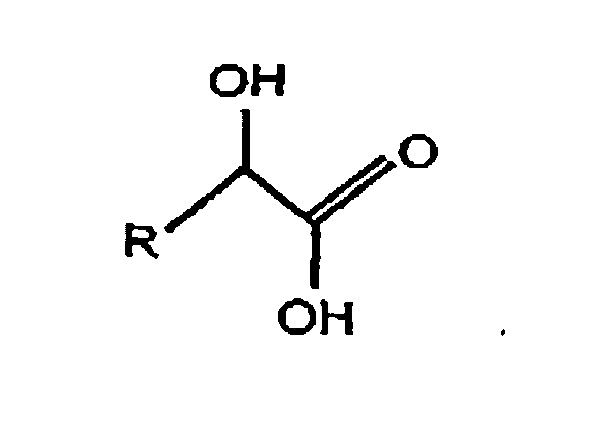
- the general formula of an ⁇ -hydroxy acid is therefore: where R is a hydrogen atom, a C 1 -C 5 alkyl group (preferably a methyl group), a C 6 -C 12 aryl group or a heterocyclic cycloalkyl or -aryl group.
- the ⁇ -hydroxy acid according to the invention is lactic acid (R is methyl).
- the feed for the method is preferably characterized by a colour (fresh) of not more than 7500 APHA and in particular of not more than 5000 APHA, a total acid content of at least 70% by weight, relative to the whole feed, and a free acid content of at least 60% by weight, relative to the whole feed.
- a colour (fresh) of not more than 7500 APHA and in particular of not more than 5000 APHA, a total acid content of at least 70% by weight, relative to the whole feed, and a free acid content of at least 60% by weight, relative to the whole feed.
- the feed preferably has a total acid content of at least 80% by weight and a free acid content of at least 70% by weight.
- the feed is further characterized by a total nitrogen content of not more than 10,000 ppm, preferably not more than 5,000 ppm, and a total quantity of residual sugars (predominantly polysaccharides) of not more than 20,000 ppm, preferably not more than 10,000 ppm, where all the contents here indicated are relative to the whole feed.
- the chiral purity of the feed is at least 90% and preferably at least 95%.
- Total acid content is the acid content after saponification of intermolecular ester bonds with an excess base and is determined by back titration with acid. The total acid content thus gives the quantity of monomeric, dimeric and polymeric lactic acid.
- the free acid content (FA) is determined by direct titration with base, i.e. before saponification of the intermolecular ester groups.
- Chiral purity 100 % ⁇ S - isomer / ( R - isomer + S - isomer )
- two crystallization steps are preferably carried out, with both crystallization steps preferably being carried out in one device.
- the known crystallization techniques can in principle be applied in the method according to the present invention.
- An example of such a technique is melting crystallization (or cooling crystallization), where the condensed, liquid concentrate or distillate, which for example contains (S)- or (R)-lactic acid in a molten state, is directly cooled, so that the (S)- or (R)-lactic acid crystallizes out. It is preferable to keep the temperature at which crystallization occurs (the crystallization temperature) as low as possible, so that the formation of oligomers and polymers of the ⁇ -hydroxy acid is limited as much as possible. According to the invention a concentrate is preferably used, since the preparation of a distillate is unfavourable in terms of process energy.
- Melting crystallization is a process in which a crystalline material is obtained from a melt of the material to be crystallized. This technique is for example described in detail in Kirk-Othmer, Encyclopedia of Chemical Technology, fourth edition, Part 7, pages 723-727 (1993), in J.W. Mullin, "Crystallization", third revised edition, Butterworth-Heinemann Ltd., pages 309-323 (1993) and in J. Ullrich and B. Kallies, Current Topics in Crystal Growth Research, 1 (1994), which have been recorded here for reference.
- the main advantage of melting crystallization relative to distillation is that much less energy is needed, because the enthalpy of melting of organic compounds is generally lower than the enthalpy of evaporation.
- the melting crystallization can be carried out with the aid of a suspension crystallization or a layer crystallization, if necessary in combination with a washing column or a centrifuge, or another purification technique.
- suitable equipment and processes are described in Kirk-Othmer, Encyclopedia of Chemical Technology, fourth edition, Part 7, pages 723-727 (1993), in J.W. Mullin, "Crystallization", third revised edition, Butterworth-Heinemann Ltd., pages 309-323 (1993) and J. Ullrich and B. Kallies, Current Topics in Crystal Growth Research, 1 (1994), the content of which has been recorded here for reference.
- the driving force for the crystallization in the evaporative crystallization technique is the bringing about of supersaturation in, for example, a concentrated lactic acid solution by evaporation of water, so that the concentration of the solution increases while the temperature remains constant. Crystallization of the lactic acid then occurs during the evaporation of water.
- Another highly suitable crystallization technique is adiabatic crystallization, where the driving force for the crystallization is the bringing about of supersaturation in, for example, a concentrated lactic acid solution by evaporation of water without supplying heat.
- the evaporation of water has two effects: (a) the temperature of the concentrated lactic acid solution becomes lower and (b) the concentration of the acid increases. Both effects lead to a decrease in the solubility and an increase in the supersaturation.
- the crystallization steps are preferably carried out according to the invention by means of adiabatic crystallization or cooling crystallization, in particular by means of adiabatic crystallization.
- Seed crystals are preferably added to feed in the crystallizations. If a solvent is used in the crystallization, this is preferably water.
- the ⁇ -hydroxy acid which is crystallized out can then be separated by the known methods for solid-liquid separation from the remaining liquid, or mother liquor.
- suitable separation techniques for separating the ⁇ -hydroxy acid crystals from the mother liquor are centrifugation, decanting, filtration, separation by means of one or more washing columns, or a combination of two or more of these techniques. In the context of the invention it has been found that centrifugation and separation with one or more washing columns is particularly appropriate.
- mother liquors which are obtained still contain considerable quantities of ⁇ -hydroxy acid. For optimal process management it is therefore preferable to feed these mother liquors back into the process.
- the ⁇ -hydroxy acid crystals which are obtained are directly dissolved in a suitable solvent, usually water, in order to prevent coagulation of the hygroscopic ⁇ -hydroxy acid crystals occurring.
- a suitable solvent usually water
- the concentration of the ⁇ -hydroxy acid solution so obtained can in principle have any desired concentration. In practice this will usually vary from 30 to 95%. Concentrations commonly occurring on the market are 80-90%.
- the invention describes an ⁇ -hydroxy acid or an ⁇ -hydroxy acid solution with a chiral purity of at least 99% and a colour of not more than 20 APHA units, preferably not more than 10 APHA units, with the ⁇ -hydroxy acid or the ⁇ -hydroxy acid solution having an acceptable odour, in particular for pharmaceutical applications.
- the solvent is preferably water.
- the chiral purity is preferably at least 99%, in particular at least 99.5%, which corresponds to 99% enantiomeric excess (ee) or higher.
- Most preferable is chiral ⁇ -hydroxy acid, or the solution thereof, whose chiral purity is at least 99.8% (i.e. at least 99.6% ee).
- the ⁇ -hydroxy acid or the ⁇ -hydroxy acid solution also meets the following requirements:
- the ⁇ -hydroxy acid or the ⁇ -hydroxy acid solution possesses a considerable improvement for application in foods and a higher chemical purity than the products according to the prior art.
- the ⁇ -hydroxy acid according to the invention can be both an S- ⁇ -hydroxy acid and a (R)- ⁇ -hydroxy acid, depending on the microorganism which is used in the fermentation.
- both the (S)- ⁇ -hydroxy acid and the (R)- ⁇ -hydroxy acid or the solutions thereof can very suitably be applied for chiral syntheses.
- the chirally pure (S)- ⁇ -hydroxy acid or solutions thereof are also very-suitable for being applied in pharmaceutical preparations.
- a double-walled 2.7-litre vessel was connected with a thermostat bath and 2045 g of the starting material described above was put into the vessel.
- the acid was cooled to 40°C while stirring and inoculated with 0.4 g of a suspension which contained seed crystals.
- the acid was then cooled from 40° to 30°C in 5 hours in accordance with a linear cooling programme.
- the crystals formed were rod-shaped and many small particles were formed.
- the temperature of the thermostat bath was 30°C and that of the crystal suspension of the acid was 31.9°C.
- the suspension was centrifuged (Sieva laboratory centrifuge, Hermle). 831 g of crystals and 1061 g of mother liquor were obtained (yield of 46%, calculated in terms of lactic acid).
- a three-necked round-bottomed flask of 0.5 litre was placed in a thermostat bath and 349 g of the crystals obtained above and 22.3 g of water were put into the flask, so that a suspension was obtained which corresponded to a lactic acid concentration of about 94%.
- the suspension was heated while stirring in order to dissolve all the crystals and the solution was then cooled to 36°C while stirring. After that about 0.27 g of a suspension which contained seed crystals was added and the seed crystals were left to grow for 10 minutes at 36° to 24°C.
- the mixture was then cooled in accordance with a linear programme (from 36°C to 24°C in 6 hours).
- the crystals formed had a cuboid shape.
Landscapes
- Chemical & Material Sciences (AREA)
- Organic Chemistry (AREA)
- Crystallography & Structural Chemistry (AREA)
- Engineering & Computer Science (AREA)
- Oil, Petroleum & Natural Gas (AREA)
- Organic Low-Molecular-Weight Compounds And Preparation Thereof (AREA)
Abstract
Description
- The present invention relates to a method for the purification of an α-hydroxy acid, in which the α-hydroxy acid is lactic acid on an industrial scale.
- Lactic acid is usually marketed as a dilute or concentrated solution, because lactic acid has a strong tendency to form intermolecular esters (dimeric and polymeric lactic acid). In addition, lactic acid (even very pure lactic acid) is strongly hygroscopic. The purification of lactic acid (the racemic mixture and in particular the enantiomers of lactic acid) on an industrial scale is a complicated and difficult process according to the prior art.
- It is known how to produce lactic acid, or 2-hydroxypropionic acid, in a fermentative manner. In general the fermentative production of lactic acid includes first of all a fermentation step in which a carbohydrate-containing substrate such as glucose or sucrose is converted to lactic acid by a suitable microorganism. Known microorganisms producing S-lactic acid are various bacteria of the genus Lactobacillus, such as Lactobacillus casei for example. In addition microorganisms are also known which produce (R)-lactic acid selectively. The aqueous fermentation product is then processed in order to obtain lactic acid. The usual industrial processing path generally consists of separation of the biomass followed by acidification, purification and concentration.
- In the case of (S)-lactic acid the lactic acid so obtained is sufficiently pure to be processed in foods for human consumption. (S)- or (R)-lactic acid which is ultimately obtained by this usual method can be 98% enantiomerically pure or even higher (i.e. 98% or more of the lactic acid present consists of the (S)-or (R)-cnantiomer). The product still contains residual sugars, however. The product is also yellow in colour and on heating this becomes brown to black through decomposition of impurities. Moreover, in the case of (S)-lactic acid, the organoleptic properties often leave something to be desired. The lactic acid enantiomer is thus moderately suitable for application in foods, but on the whole not suitable for pharmaceutical applications and for synthesis of chiral compounds.
- The purity of the product can be increased by esterification followed by hydrolysis, so that it is suitable for pharmaceutical applications. As a result of this esterification/hydrolysis, however, the enantiomeric purity decreases and the lactic acid still contains a small amount of the alcohol which has been used in the esterification. Examples of other methods for the purification of lactic acid include subjecting aqueous solutions of lactic acid to one or more extraction, (steam) distillation and/or evaporation steps, electrodialysis steps and crystallizations (see for example Ullmans Encyklopädie der Technischen Chemie, Verlag Chemie GmbH, Weinheim, fourth edition, Part 17, pages 1-7 (1979); H. Benninga, "History of Lactic Acid Making", Kluwer Academic Publishers, Dordrecht - Boston - London (1990); C. H. Holten, "Lactic Acid; Properties and Chemistry of Lactic Acid and Derivatives", Verlag Chemie GmbH, Weinheim (1971); The Merck Index, Merck & Co., Inc., eleventh edition, page 842 (1989); Römmp Chemie Lexicon, G. Thieme Verlag, Stuttgart and New York, ninth edition, Part 4, pages 2792-2893 (1991) and the Netherlands patent applications 1013265 and 1013682.
- In German Patent 593,657 (granted on 15 February 1934) a laboratory experiment is described in which an aqueous solution of lactic acid, which contained an excess of the S component and practically no lactic acid anhydride, was concentrated by means of a thin-film evaporation technique, if necessary at reduced pressure. The concentrated lactic acid solution was then rapidly cooled, with formation of crystals. After that the crystals were separated from the mother liquor, washed with ether and repeatedly recrystallized from ethyl acetate or chloroform or a comparable solvent until the crystals showed a sharp melting point of 53°C. The chiral purity or the enantiomeric excess and the colour are not reported.
- In H. Borsook, H. M. Huffman, Y-P. Liu, J. Biol. Chem. 102, 449-460 (1933) a laboratory experiment is described in which an aqueous mixture, which contained 50 per cent lactic acid with an excess of (S)-lactic acid, 30 per cent lactic acid anhydride and lactic acid dimer and 15 per cent water, was subjected to fractional distillation at approximately 0.13 mbar and 105°C. The middle fraction was then distilled again and after that cooled in an ice/salt bath with formation of a solid crystal mass. It is reported that the distillation has to be performed with small quantities, because with larger quantities there is a big loss of product as a result of the long heating time. The solid crystal mass was then recrystallized three times from an equal volume of equal quantities of diethyl ether and diisopropyl ether, and the crystals were isolated and dried at room temperature in a vacuum drier. In this way it was possible to obtain (S)-lactic acid with a melting point of 52.7-52.8°C which contained less than 0.1 per cent impurities such as water, lactic acid anhydride or lactic acid dimer. The chiral purity or the enantiomeric excess and the colour of (S)-lactic acid are not reported.
- In L.B. Lockwood, D.E. Yoder, M. Zienty, Ann. N.Y. Acad. Sci. 119, 854 (1965) the distillation and crystallization of lactic acid on a laboratory scale is also described, the melting point of the optically pure lactic acid obtained being 54°C. The colour is not reported.
- In 1934 the crystallization of lactic acid was investigated by Boehringer Ingelheim, but this method was not found to give good results, owing to problems with the purification and further treatment. After the Second World War, however, it turned out that Boehringer Ingelheim was able to produce lactic acid for pharmaceutical applications on a scale of about 12 to 15 tons per month, with a yield of about 77 to 86 per cent. In this process an aqueous solution of lactic acid was purified by means of steam distillation at reduced pressure (about 13 mbar), followed by crystallization at -25°C, after which the crystals were dissolved in water and the solution was treated with potassium ferrocyanide (to remove heavy metals) and activated charcoal. The chiral purity or the enantiomeric excess or other properties such as colour and odour of the (S)-lactic acid so produced are not known (see H. Benninga, "History of Lactic Acid Making", Kluwer Academic Publishers, Dordrecht - Boston - London, pages 347-350 (1990)).
- Crystalline (S)-lactic acid has been marketed by, for example, Fluka and Sigma with purities of more than 99% (see for example M.L. Buszko, E.R. Andrew, Mol. Phys. 76, 83-87 (1992) and T.S. Ing, A.W. Yu, V. Nagaraja, N. A. Amin, S. Ayache, V. C. Gandhi, J. T. Daugirdas, Int. J. Artif. Organs 17, 70-73 (1994)). Crystalline S-lactic acid with a water content of less than 1 per cent by weight is known from EP A 563,455 (see Example 1). The crystal structure of lactic acid is described in A. Schouten, J.A. Kanters, J. van Krieken, J. Mol. Struct. 323, 165-168 (1994). Lactic acid can also be obtained in a synthetic manner. This is known. The product of the synthetic production method, however, is a racemic mixture which thus contains (S)-lactic acid and (R)-lactic acid in equal quantities. It is true that the separate enantiomers can be separated by means of known techniques, such as diastereoisomer separation techniques, where one of the enantiomers crystallizes out as a salt and this salt is then converted back to the enantiomeric lactic acid, but the enantiomeric product finally obtained will inevitably still contain significant quantities of the other enantiomer.
- In European Patent Application 552,255 it is reported that glycolic acid of industrial quality can be crystallized by putting a solution thereof in a freezer, giving rise to crystals which are filtered off. It will be clear that such a method is unsuitable for being carried out on an industrial scale. Such a method is also applied in DE A 2,810,975.
- In WO 00/56693 a method is described for the purification of lactic acid on an industrial scale, the method involving: (a) the distillation under reduced pressure of a concentrated lactic acid solution with a total acid content of at least 95% by weight and a monomeric lactic acid content of at least 80% by weight, calculated in terms of the concentrated lactic acid solution, and with a ratio of the lactic acid enantiomers not equal to 1, and (b) subjecting the distilled lactic acid solution to a crystallization, with formation of pure lactic acid, where the pure lactic acid has a total acid content of at least 99% by weight, a monomeric lactic acid content of at least 98% by weight, a chiral purity of 99% or more, calculated in terms of the total quantity of pure lactic acid, a colour of not more than 10 APHA units and an acceptable odour.
- Disadvantages of the method according to WO 00/56693 are that in particular step (a) of this method requires a great deal of energy and that complicated distillation equipment is required.
- In EP A 733,616 a method for the production of glycolic acid crystals is described in which an aqueous solution of glycolic acid is concentrated, seed crystals are added to the concentrated solution and the solution is cooled.
- In WO 92/05138 a method for the production of crystalline glycolic acid is disclosed which method includes the steps of cooling an aqueous solution of glycolic acid and adding seed crystals to induce crystallisation.
- The present invention aims to solve this problem and therefore relates to a method for the purification of a fermentatively prepared α-hydroxy acid on an industrial scale (i.e. a scale of at least 1000 tons per annum), in which an α-hydroxy acid with a colour (fresh) of not more than 10,000 APHA units is subjected to at least two crystallization steps, with the crystallisation steps being carried out with water as a solvent in cooling crystallisation devices, melting crystallisation devices, evaporative crystallisation devices and/or adiabatic crystallisation devices, in which the α-hydroxy acid in lactic acid.
- Advantages of the present invention are that the method requires little energy and relatively simple equipment can be used.
- An α-hydroxy acid means a carbonic acid which is substituted with a hydroxy group on the a carbon atom. The general formula of an α-hydroxy acid is therefore:
- The feed for the method is preferably characterized by a colour (fresh) of not more than 7500 APHA and in particular of not more than 5000 APHA, a total acid content of at least 70% by weight, relative to the whole feed, and a free acid content of at least 60% by weight, relative to the whole feed. If the α-hydroxy acid is lactic acid, the feed preferably has a total acid content of at least 80% by weight and a free acid content of at least 70% by weight. The feed is further characterized by a total nitrogen content of not more than 10,000 ppm, preferably not more than 5,000 ppm, and a total quantity of residual sugars (predominantly polysaccharides) of not more than 20,000 ppm, preferably not more than 10,000 ppm, where all the contents here indicated are relative to the whole feed. The chiral purity of the feed is at least 90% and preferably at least 95%.
- Total acid content (TA) is the acid content after saponification of intermolecular ester bonds with an excess base and is determined by back titration with acid. The total acid content thus gives the quantity of monomeric, dimeric and polymeric lactic acid. The free acid content (FA) is determined by direct titration with base, i.e. before saponification of the intermolecular ester groups. The content of monomeric lactic acid (MM) is here defined as:

- Chiral purity (for an excess S-isomer) is here defined as:

- According to the invention two crystallization steps are preferably carried out, with both crystallization steps preferably being carried out in one device.
- The known crystallization techniques can in principle be applied in the method according to the present invention. An example of such a technique is melting crystallization (or cooling crystallization), where the condensed, liquid concentrate or distillate, which for example contains (S)- or (R)-lactic acid in a molten state, is directly cooled, so that the (S)- or (R)-lactic acid crystallizes out. It is preferable to keep the temperature at which crystallization occurs (the crystallization temperature) as low as possible, so that the formation of oligomers and polymers of the α-hydroxy acid is limited as much as possible. According to the invention a concentrate is preferably used, since the preparation of a distillate is unfavourable in terms of process energy.
- Melting crystallization is a process in which a crystalline material is obtained from a melt of the material to be crystallized. This technique is for example described in detail in Kirk-Othmer, Encyclopedia of Chemical Technology, fourth edition, Part 7, pages 723-727 (1993), in J.W. Mullin, "Crystallization", third revised edition, Butterworth-Heinemann Ltd., pages 309-323 (1993) and in J. Ullrich and B. Kallies, Current Topics in Crystal Growth Research, 1 (1994), which have been recorded here for reference. The main advantage of melting crystallization relative to distillation is that much less energy is needed, because the enthalpy of melting of organic compounds is generally lower than the enthalpy of evaporation. This advantage also occurs with other crystallization techniques, because the enthalpy of crystallization is usually lower than the enthalpy of evaporation. Another advantage of melting crystallization relative to distillation is furthermore that the process can generally be carried out at a much lower temperature - which is advantageous when the organic compound is thermally unstable.
- The melting crystallization can be carried out with the aid of a suspension crystallization or a layer crystallization, if necessary in combination with a washing column or a centrifuge, or another purification technique. Examples of suitable equipment and processes are described in Kirk-Othmer, Encyclopedia of Chemical Technology, fourth edition, Part 7, pages 723-727 (1993), in J.W. Mullin, "Crystallization", third revised edition, Butterworth-Heinemann Ltd., pages 309-323 (1993) and J. Ullrich and B. Kallies, Current Topics in Crystal Growth Research, 1 (1994), the content of which has been recorded here for reference.
- It has also been found that crystallization of an aqueous solution gives very good results. In this crystallization treatment a concentrated lactic acid solution is for example diluted with water and this is then subjected to one or more cooling and/or evaporative crystallization steps. In these techniques the concentrate or distillate is directly cooled (cooling crystallization) or concentrated by evaporation of water (evaporative crystallization). The driving force for the crystallization in the cooling crystallization technique is the bringing about of supersaturation in the concentrated lactic acid solution by reducing the temperature of the concentrated lactic acid solution. As a result of the lower temperature of the solution the solubility decreases and supersaturation occurs.
- The driving force for the crystallization in the evaporative crystallization technique is the bringing about of supersaturation in, for example, a concentrated lactic acid solution by evaporation of water, so that the concentration of the solution increases while the temperature remains constant. Crystallization of the lactic acid then occurs during the evaporation of water.
- Another highly suitable crystallization technique is adiabatic crystallization, where the driving force for the crystallization is the bringing about of supersaturation in, for example, a concentrated lactic acid solution by evaporation of water without supplying heat. The evaporation of water has two effects: (a) the temperature of the concentrated lactic acid solution becomes lower and (b) the concentration of the acid increases. Both effects lead to a decrease in the solubility and an increase in the supersaturation.
- The crystallization steps are preferably carried out according to the invention by means of adiabatic crystallization or cooling crystallization, in particular by means of adiabatic crystallization. Seed crystals are preferably added to feed in the crystallizations. If a solvent is used in the crystallization, this is preferably water.
- The α-hydroxy acid which is crystallized out can then be separated by the known methods for solid-liquid separation from the remaining liquid, or mother liquor.
- Examples of suitable separation techniques for separating the α-hydroxy acid crystals from the mother liquor are centrifugation, decanting, filtration, separation by means of one or more washing columns, or a combination of two or more of these techniques. In the context of the invention it has been found that centrifugation and separation with one or more washing columns is particularly appropriate.
- The mother liquors which are obtained still contain considerable quantities of α-hydroxy acid. For optimal process management it is therefore preferable to feed these mother liquors back into the process.
- After isolation, the α-hydroxy acid crystals which are obtained are directly dissolved in a suitable solvent, usually water, in order to prevent coagulation of the hygroscopic α-hydroxy acid crystals occurring. The concentration of the α-hydroxy acid solution so obtained can in principle have any desired concentration. In practice this will usually vary from 30 to 95%. Concentrations commonly occurring on the market are 80-90%.
- The invention describes an α-hydroxy acid or an α-hydroxy acid solution with a chiral purity of at least 99% and a colour of not more than 20 APHA units, preferably not more than 10 APHA units, with the α-hydroxy acid or the α-hydroxy acid solution having an acceptable odour, in particular for pharmaceutical applications. In the case of an α-hydroxy acid solution the solvent is preferably water. The chiral purity is preferably at least 99%, in particular at least 99.5%, which corresponds to 99% enantiomeric excess (ee) or higher. Most preferable is chiral α-hydroxy acid, or the solution thereof, whose chiral purity is at least 99.8% (i.e. at least 99.6% ee).
- The α-hydroxy acid or the α-hydroxy acid solution also meets the following requirements:
- □ alcohol content: not more than 250 ppm (alcohol is methanol, ethanol or other alcohol, as alcohol as such or in the form of a lactate).
- □ total nitrogen: not more than 15 ppm.
- □ total sugar: not more than 100 ppm.
- □ total polysaccharides: not more than 100 ppm.
- □ organic acids (other than lactic acid): not more than 250 ppm.
- With regard to odour the α-hydroxy acid or the α-hydroxy acid solution possesses a considerable improvement for application in foods and a higher chemical purity than the products according to the prior art.
- When it is chiral, the α-hydroxy acid according to the invention can be both an S-α-hydroxy acid and a (R)-α-hydroxy acid, depending on the microorganism which is used in the fermentation.
- Because of their high chiral purity both the (S)-α-hydroxy acid and the (R)-α-hydroxy acid or the solutions thereof can very suitably be applied for chiral syntheses. The chirally pure (S)-α-hydroxy acid or solutions thereof are also very-suitable for being applied in pharmaceutical preparations.
- The invention is now illustrated by means of the following example.
- (S)-lactic acid with the following properties is used as the starting material:
Total acid content 95.4% Free acid content 91.1 % Colour (fresh) 4850 APHA Total nitrogen 1080 ppm Total residual sugars 6490 ppm Chiral purity 99.61 % - In a first crystallization step a double-walled 2.7-litre vessel was connected with a thermostat bath and 2045 g of the starting material described above was put into the vessel. The acid was cooled to 40°C while stirring and inoculated with 0.4 g of a suspension which contained seed crystals. The acid was then cooled from 40° to 30°C in 5 hours in accordance with a linear cooling programme. The crystals formed were rod-shaped and many small particles were formed. After 5 hours the temperature of the thermostat bath was 30°C and that of the crystal suspension of the acid was 31.9°C. The suspension was centrifuged (Sieva laboratory centrifuge, Hermle). 831 g of crystals and 1061 g of mother liquor were obtained (yield of 46%, calculated in terms of lactic acid).
- In a second crystallization step a three-necked round-bottomed flask of 0.5 litre was placed in a thermostat bath and 349 g of the crystals obtained above and 22.3 g of water were put into the flask, so that a suspension was obtained which corresponded to a lactic acid concentration of about 94%. The suspension was heated while stirring in order to dissolve all the crystals and the solution was then cooled to 36°C while stirring. After that about 0.27 g of a suspension which contained seed crystals was added and the seed crystals were left to grow for 10 minutes at 36° to 24°C. The mixture was then cooled in accordance with a linear programme (from 36°C to 24°C in 6 hours). The crystals formed had a cuboid shape. After cooling to 24°C the suspension was centrifuged: 165 g of crystals were obtained from 356 g of suspension (yield of 49%, calculated in terms of lactic acid). The total yield from the two crystallization steps was 22%, calculated in terms of lactic acid. The crystals from the first and second crystallization were dissolved in water (90% solution) and the solutions were analysed. The results are shown in the table below.
First crystallization Second crystallization Colour (fresh) 349 APHA 14 APHA Colour (after heating) 713 APHA 18 APHA Total nitrogen 55 ppm <10 ppm Total residual sugars 430 ppm 40 ppma Chiral purity 99.97% >99.99% a This value is close to the detection limit.
Claims (10)
- Method for the purification of a fermentatively prepared α-hydroxy acid on an industrial scale in which an α-hydroxy acid with a colour (fresh) of not more than 10,000 APHA units is subjected to at least two crystallisation steps, with the crystallisation steps being carried out with water as a solvent in cooling crystallisation devices, melting crystallisation devices, evaporative crystallisation devices and/or adiabatic crystallisation devices, in which the α-hydroxy acid is lactic acid.
- Method according to claim 1, in which two crystallization steps arc applied.
- Method according to Claim 2, in which the crystallization steps are carried out in one device.
- Method according to any one of the preceding claims, in which the product stream from the crystallization steps is separated into a mother liquor and α-hydroxy acid crystals by means of solid-liquid separation.
- Method according to any one of the preceding claims, in which, the chiral purity of the α-hydroxy acid is at least 90% with a colour (fresh) of not more than 10,000 APHA units.
- Method according to any one of the preceding claims, in which the α-hydroxy acid is prepared fermentatively, with a colour (fresh) of not more than 3000 APHA units.
- Method according to any one of the preceding claims, in which the cooling crystallization is carried out by direct cooling of a condensed, liquid concentrate or distillate of the α-hydroxy acid.
- Method according to any one of the preceding claims, in which the melting crystallization is carried out by direct cooling of a condensed, liquid concentrate or distillate which contains the α-hydroxy acid in a molten state.
- Method according to any one of the preceding claims, in which the evaporative crystallization is carried out by (1) diluting a condensed, liquid concentrate or distillate of the α-hydroxy acid with water and (2) evaporation of water.
- Method according to any one of the preceding claims, in which the adiabatic crystallization is carried out by evaporation of water without supplying heat.
Applications Claiming Priority (3)
| Application Number | Priority Date | Filing Date | Title |
|---|---|---|---|
| NL1016204 | 2000-09-15 | ||
| NL1016204 | 2000-09-15 | ||
| PCT/NL2001/000684 WO2002022546A1 (en) | 2000-09-15 | 2001-09-14 | METHOD FOR THE PURIFICATION OF AN α-HYDROXY ON INDUSTRIAL SCALE_______________________________________________________ |
Publications (2)
| Publication Number | Publication Date |
|---|---|
| EP1317408A1 EP1317408A1 (en) | 2003-06-11 |
| EP1317408B1 true EP1317408B1 (en) | 2007-03-07 |
Family
ID=19772100
Family Applications (1)
| Application Number | Title | Priority Date | Filing Date |
|---|---|---|---|
| EP01979068A Expired - Lifetime EP1317408B1 (en) | 2000-09-15 | 2001-09-14 | Method for the purification of lactic acid on an industrial scale |
Country Status (10)
| Country | Link |
|---|---|
| US (1) | US7002039B2 (en) |
| EP (1) | EP1317408B1 (en) |
| JP (1) | JP2004509092A (en) |
| CN (1) | CN100418941C (en) |
| AT (1) | ATE356108T1 (en) |
| AU (1) | AU2002211057A1 (en) |
| BR (1) | BRPI0113942B8 (en) |
| DE (1) | DE60127144T2 (en) |
| ES (1) | ES2283440T3 (en) |
| WO (1) | WO2002022546A1 (en) |
Families Citing this family (13)
| Publication number | Priority date | Publication date | Assignee | Title |
|---|---|---|---|---|
| WO2000056693A1 (en) * | 1999-03-22 | 2000-09-28 | Purac Biochem B.V. | Method of industrial-scale purification of lactic acid |
| ATE340156T1 (en) | 2000-06-02 | 2006-10-15 | Nippon Catalytic Chem Ind | METHOD FOR PRODUCING ALPHA-HYDROXYCARBONIC ACID |
| WO2007049707A1 (en) * | 2005-10-26 | 2007-05-03 | Mitsui Chemicals, Inc. | Process for producing glycolic acid |
| US7439391B2 (en) * | 2006-10-12 | 2008-10-21 | E.I. Du Pont De Nemours And Company | Multi-stage glycolic acid crystallization |
| JP5359348B2 (en) * | 2009-02-18 | 2013-12-04 | 東レ株式会社 | Method for producing high purity lactic acid |
| ES2436509T3 (en) * | 2009-07-16 | 2014-01-02 | Purac Biochem Bv | Liquid composition of lactic acid and method for its preparation |
| WO2011095631A1 (en) | 2010-02-08 | 2011-08-11 | Purac Biochem Bv | Process for manufacturing lactic acid |
| CN102153461B (en) * | 2011-02-12 | 2013-05-01 | 上海多纶化工有限公司 | Method for preparing glycollic acid with ethylene glycol |
| CN102153460B (en) * | 2011-02-12 | 2013-05-01 | 上海多纶化工有限公司 | Method for preparing glycollic acid by glycol |
| EP2736331A1 (en) | 2011-07-26 | 2014-06-04 | Helmholtz Zentrum München Deutsches Forschungszentrum für Gesundheit und Umwelt (GmbH) | Plant protective composition containing alpha-hydroxy acids |
| FR3001453B1 (en) | 2013-01-30 | 2015-03-06 | Roquette Freres | PROCESS FOR PURIFYING GLYCOLIC ACID BY THERMAL TREATMENT |
| WO2021225956A1 (en) | 2020-05-04 | 2021-11-11 | Astex Pharmaceuticals, Inc. | Methods for synthesizing anhydrous lactic acid |
| JP7638693B2 (en) * | 2020-12-15 | 2025-03-04 | 大阪瓦斯株式会社 | Method for producing hydroxyalkanoic acid crystals and crystalline polymorphs of hydroxyalkanoic acid |
Family Cites Families (6)
| Publication number | Priority date | Publication date | Assignee | Title |
|---|---|---|---|---|
| DE593657C (en) * | 1931-07-16 | 1934-03-01 | Byk Guldenwerke Chem Fab Akt G | Process for the production of solid lactic acid |
| JPH06501268A (en) * | 1990-09-20 | 1994-02-10 | イー・アイ・デュポン・ドゥ・ヌムール・アンド・カンパニー | Production of high purity hydroxyacetic acid |
| JP3188305B2 (en) * | 1992-05-07 | 2001-07-16 | 月島機械株式会社 | Adiabatic cooling type melt crystallization method equipped with absorption condenser and its apparatus |
| US5510526A (en) * | 1993-06-29 | 1996-04-23 | Cargill, Incorporated | Lactic acid production, separation and/or recovery process |
| DE19510156A1 (en) * | 1995-03-21 | 1996-09-26 | Hoechst Ag | Process for the preparation of crystalline glycolic acid |
| US20020102672A1 (en) * | 1999-10-04 | 2002-08-01 | Joseph Mizrahi | Process for producing a purified lactic acid solution |
-
2001
- 2001-09-14 AU AU2002211057A patent/AU2002211057A1/en not_active Abandoned
- 2001-09-14 JP JP2002526747A patent/JP2004509092A/en active Pending
- 2001-09-14 AT AT01979068T patent/ATE356108T1/en not_active IP Right Cessation
- 2001-09-14 CN CNB018188745A patent/CN100418941C/en not_active Expired - Lifetime
- 2001-09-14 WO PCT/NL2001/000684 patent/WO2002022546A1/en not_active Ceased
- 2001-09-14 EP EP01979068A patent/EP1317408B1/en not_active Expired - Lifetime
- 2001-09-14 ES ES01979068T patent/ES2283440T3/en not_active Expired - Lifetime
- 2001-09-14 BR BRPI0113942A patent/BRPI0113942B8/en not_active IP Right Cessation
- 2001-09-14 US US10/380,535 patent/US7002039B2/en not_active Expired - Lifetime
- 2001-09-14 DE DE60127144T patent/DE60127144T2/en not_active Expired - Lifetime
Also Published As
| Publication number | Publication date |
|---|---|
| BRPI0113942B1 (en) | 2017-05-30 |
| DE60127144T2 (en) | 2007-11-22 |
| WO2002022546A1 (en) | 2002-03-21 |
| BRPI0113942B8 (en) | 2021-05-25 |
| US20040116740A1 (en) | 2004-06-17 |
| BR0113942A (en) | 2003-07-22 |
| ES2283440T3 (en) | 2007-11-01 |
| JP2004509092A (en) | 2004-03-25 |
| CN100418941C (en) | 2008-09-17 |
| US7002039B2 (en) | 2006-02-21 |
| ATE356108T1 (en) | 2007-03-15 |
| AU2002211057A1 (en) | 2002-03-26 |
| EP1317408A1 (en) | 2003-06-11 |
| CN1474799A (en) | 2004-02-11 |
| DE60127144D1 (en) | 2007-04-19 |
Similar Documents
| Publication | Publication Date | Title |
|---|---|---|
| JP5595336B2 (en) | Process for purification of glycolic acid on an industrial scale | |
| US6630603B1 (en) | Method of industrial-scale purification of lactic acid | |
| US7002039B2 (en) | Method for the purification of an alpha-hydroxy acid on an industrial scale | |
| CN102918017B (en) | Method for preparing monoammonium succinate and conversion of monoammonium succinate to succinic acid from fermentation broth containing diammonium succinate, monoammonium succinate and/or succinic acid | |
| EP1317409B1 (en) | Method for the purification of an alpha-hydroxy acid on an industrial scale | |
| US20110266133A1 (en) | Processes for producing monoammonium adipate from fermentation broths containing diammonium adipate, monoammonium adipate and/or adipic acid, and conversion of monoammonium adipate to adipic acid | |
| CA2738164A1 (en) | Processes for producing adipic acid from fermentation broths containing diammonium adipate |
Legal Events
| Date | Code | Title | Description |
|---|---|---|---|
| PUAI | Public reference made under article 153(3) epc to a published international application that has entered the european phase |
Free format text: ORIGINAL CODE: 0009012 |
|
| 17P | Request for examination filed |
Effective date: 20030409 |
|
| AK | Designated contracting states |
Designated state(s): AT BE CH CY DE DK ES FI FR GB GR IE IT LI LU MC NL PT SE TR |
|
| AX | Request for extension of the european patent |
Extension state: AL LT LV MK RO SI |
|
| 17Q | First examination report despatched |
Effective date: 20050310 |
|
| RTI1 | Title (correction) |
Free format text: METHOD FOR THE PURIFICATION OF LACTIC ACID ON AN INDUSTRIAL SCALE |
|
| GRAP | Despatch of communication of intention to grant a patent |
Free format text: ORIGINAL CODE: EPIDOSNIGR1 |
|
| GRAS | Grant fee paid |
Free format text: ORIGINAL CODE: EPIDOSNIGR3 |
|
| GRAA | (expected) grant |
Free format text: ORIGINAL CODE: 0009210 |
|
| AK | Designated contracting states |
Kind code of ref document: B1 Designated state(s): AT BE CH CY DE DK ES FI FR GB GR IE IT LI LU MC NL PT SE TR |
|
| PG25 | Lapsed in a contracting state [announced via postgrant information from national office to epo] |
Ref country code: LI Free format text: LAPSE BECAUSE OF FAILURE TO SUBMIT A TRANSLATION OF THE DESCRIPTION OR TO PAY THE FEE WITHIN THE PRESCRIBED TIME-LIMIT Effective date: 20070307 Ref country code: FI Free format text: LAPSE BECAUSE OF FAILURE TO SUBMIT A TRANSLATION OF THE DESCRIPTION OR TO PAY THE FEE WITHIN THE PRESCRIBED TIME-LIMIT Effective date: 20070307 Ref country code: CH Free format text: LAPSE BECAUSE OF FAILURE TO SUBMIT A TRANSLATION OF THE DESCRIPTION OR TO PAY THE FEE WITHIN THE PRESCRIBED TIME-LIMIT Effective date: 20070307 Ref country code: AT Free format text: LAPSE BECAUSE OF FAILURE TO SUBMIT A TRANSLATION OF THE DESCRIPTION OR TO PAY THE FEE WITHIN THE PRESCRIBED TIME-LIMIT Effective date: 20070307 |
|
| REG | Reference to a national code |
Ref country code: GB Ref legal event code: FG4D |
|
| REG | Reference to a national code |
Ref country code: CH Ref legal event code: EP |
|
| REF | Corresponds to: |
Ref document number: 60127144 Country of ref document: DE Date of ref document: 20070419 Kind code of ref document: P |
|
| REG | Reference to a national code |
Ref country code: IE Ref legal event code: FG4D |
|
| PG25 | Lapsed in a contracting state [announced via postgrant information from national office to epo] |
Ref country code: SE Free format text: LAPSE BECAUSE OF FAILURE TO SUBMIT A TRANSLATION OF THE DESCRIPTION OR TO PAY THE FEE WITHIN THE PRESCRIBED TIME-LIMIT Effective date: 20070607 |
|
| PG25 | Lapsed in a contracting state [announced via postgrant information from national office to epo] |
Ref country code: PT Free format text: LAPSE BECAUSE OF FAILURE TO SUBMIT A TRANSLATION OF THE DESCRIPTION OR TO PAY THE FEE WITHIN THE PRESCRIBED TIME-LIMIT Effective date: 20070807 |
|
| ET | Fr: translation filed | ||
| REG | Reference to a national code |
Ref country code: CH Ref legal event code: PL |
|
| REG | Reference to a national code |
Ref country code: ES Ref legal event code: FG2A Ref document number: 2283440 Country of ref document: ES Kind code of ref document: T3 |
|
| PLBE | No opposition filed within time limit |
Free format text: ORIGINAL CODE: 0009261 |
|
| STAA | Information on the status of an ep patent application or granted ep patent |
Free format text: STATUS: NO OPPOSITION FILED WITHIN TIME LIMIT |
|
| PG25 | Lapsed in a contracting state [announced via postgrant information from national office to epo] |
Ref country code: DK Free format text: LAPSE BECAUSE OF FAILURE TO SUBMIT A TRANSLATION OF THE DESCRIPTION OR TO PAY THE FEE WITHIN THE PRESCRIBED TIME-LIMIT Effective date: 20070307 |
|
| 26N | No opposition filed |
Effective date: 20071210 |
|
| PG25 | Lapsed in a contracting state [announced via postgrant information from national office to epo] |
Ref country code: MC Free format text: LAPSE BECAUSE OF NON-PAYMENT OF DUE FEES Effective date: 20070930 Ref country code: IT Free format text: LAPSE BECAUSE OF FAILURE TO SUBMIT A TRANSLATION OF THE DESCRIPTION OR TO PAY THE FEE WITHIN THE PRESCRIBED TIME-LIMIT Effective date: 20070307 Ref country code: GR Free format text: LAPSE BECAUSE OF FAILURE TO SUBMIT A TRANSLATION OF THE DESCRIPTION OR TO PAY THE FEE WITHIN THE PRESCRIBED TIME-LIMIT Effective date: 20070608 |
|
| PG25 | Lapsed in a contracting state [announced via postgrant information from national office to epo] |
Ref country code: IE Free format text: LAPSE BECAUSE OF NON-PAYMENT OF DUE FEES Effective date: 20070914 |
|
| PG25 | Lapsed in a contracting state [announced via postgrant information from national office to epo] |
Ref country code: CY Free format text: LAPSE BECAUSE OF FAILURE TO SUBMIT A TRANSLATION OF THE DESCRIPTION OR TO PAY THE FEE WITHIN THE PRESCRIBED TIME-LIMIT Effective date: 20070307 |
|
| PG25 | Lapsed in a contracting state [announced via postgrant information from national office to epo] |
Ref country code: LU Free format text: LAPSE BECAUSE OF NON-PAYMENT OF DUE FEES Effective date: 20070914 |
|
| PG25 | Lapsed in a contracting state [announced via postgrant information from national office to epo] |
Ref country code: TR Free format text: LAPSE BECAUSE OF FAILURE TO SUBMIT A TRANSLATION OF THE DESCRIPTION OR TO PAY THE FEE WITHIN THE PRESCRIBED TIME-LIMIT Effective date: 20070307 |
|
| REG | Reference to a national code |
Ref country code: DE Ref legal event code: R082 Ref document number: 60127144 Country of ref document: DE Representative=s name: WEICKMANN & WEICKMANN PATENT- UND RECHTSANWAEL, DE Ref country code: DE Ref legal event code: R082 Ref document number: 60127144 Country of ref document: DE Representative=s name: WEICKMANN & WEICKMANN PATENTANWAELTE - RECHTSA, DE Ref country code: DE Ref legal event code: R082 Ref document number: 60127144 Country of ref document: DE Representative=s name: PATENTANWAELTE WEICKMANN & WEICKMANN, DE |
|
| REG | Reference to a national code |
Ref country code: FR Ref legal event code: PLFP Year of fee payment: 16 |
|
| REG | Reference to a national code |
Ref country code: FR Ref legal event code: PLFP Year of fee payment: 17 |
|
| REG | Reference to a national code |
Ref country code: FR Ref legal event code: PLFP Year of fee payment: 18 |
|
| PGFP | Annual fee paid to national office [announced via postgrant information from national office to epo] |
Ref country code: FR Payment date: 20200925 Year of fee payment: 20 Ref country code: GB Payment date: 20200928 Year of fee payment: 20 Ref country code: NL Payment date: 20200928 Year of fee payment: 20 Ref country code: DE Payment date: 20200929 Year of fee payment: 20 |
|
| PGFP | Annual fee paid to national office [announced via postgrant information from national office to epo] |
Ref country code: BE Payment date: 20200928 Year of fee payment: 20 |
|
| PGFP | Annual fee paid to national office [announced via postgrant information from national office to epo] |
Ref country code: ES Payment date: 20201001 Year of fee payment: 20 |
|
| REG | Reference to a national code |
Ref country code: DE Ref legal event code: R071 Ref document number: 60127144 Country of ref document: DE |
|
| REG | Reference to a national code |
Ref country code: NL Ref legal event code: MK Effective date: 20210913 |
|
| REG | Reference to a national code |
Ref country code: GB Ref legal event code: PE20 Expiry date: 20210913 |
|
| REG | Reference to a national code |
Ref country code: BE Ref legal event code: MK Effective date: 20210914 |
|
| PG25 | Lapsed in a contracting state [announced via postgrant information from national office to epo] |
Ref country code: GB Free format text: LAPSE BECAUSE OF EXPIRATION OF PROTECTION Effective date: 20210913 |
|
| REG | Reference to a national code |
Ref country code: ES Ref legal event code: FD2A Effective date: 20220110 |
|
| PG25 | Lapsed in a contracting state [announced via postgrant information from national office to epo] |
Ref country code: ES Free format text: LAPSE BECAUSE OF EXPIRATION OF PROTECTION Effective date: 20210915 |