EP1317106A2 - Method and apparatus for data scrambling/descrambling - Google Patents
Method and apparatus for data scrambling/descrambling Download PDFInfo
- Publication number
- EP1317106A2 EP1317106A2 EP02102640A EP02102640A EP1317106A2 EP 1317106 A2 EP1317106 A2 EP 1317106A2 EP 02102640 A EP02102640 A EP 02102640A EP 02102640 A EP02102640 A EP 02102640A EP 1317106 A2 EP1317106 A2 EP 1317106A2
- Authority
- EP
- European Patent Office
- Prior art keywords
- scrambling
- sign
- symbols
- descrambling
- qam
- Prior art date
- Legal status (The legal status is an assumption and is not a legal conclusion. Google has not performed a legal analysis and makes no representation as to the accuracy of the status listed.)
- Withdrawn
Links
Images


Classifications
-
- H—ELECTRICITY
- H04—ELECTRIC COMMUNICATION TECHNIQUE
- H04L—TRANSMISSION OF DIGITAL INFORMATION, e.g. TELEGRAPHIC COMMUNICATION
- H04L25/00—Baseband systems
- H04L25/02—Details ; arrangements for supplying electrical power along data transmission lines
- H04L25/03—Shaping networks in transmitter or receiver, e.g. adaptive shaping networks
- H04L25/03828—Arrangements for spectral shaping; Arrangements for providing signals with specified spectral properties
- H04L25/03866—Arrangements for spectral shaping; Arrangements for providing signals with specified spectral properties using scrambling
-
- H—ELECTRICITY
- H04—ELECTRIC COMMUNICATION TECHNIQUE
- H04L—TRANSMISSION OF DIGITAL INFORMATION, e.g. TELEGRAPHIC COMMUNICATION
- H04L27/00—Modulated-carrier systems
- H04L27/32—Carrier systems characterised by combinations of two or more of the types covered by groups H04L27/02, H04L27/10, H04L27/18 or H04L27/26
- H04L27/34—Amplitude- and phase-modulated carrier systems, e.g. quadrature-amplitude modulated carrier systems
-
- H—ELECTRICITY
- H04—ELECTRIC COMMUNICATION TECHNIQUE
- H04B—TRANSMISSION
- H04B1/00—Details of transmission systems, not covered by a single one of groups H04B3/00 - H04B13/00; Details of transmission systems not characterised by the medium used for transmission
- H04B1/69—Spread spectrum techniques
- H04B1/707—Spread spectrum techniques using direct sequence modulation
Definitions
- This invention relates in general to the field of radio communications and more specifically to a method and apparatus for M-ary Quadrature Amplitude Modulation (QAM) and M-ary Phase Shift Keying (PSK) data scrambling/descrambling.
- QAM Quadrature Amplitude Modulation
- PSK Phase Shift Keying
- Code Division Multiple Access CDMA
- CDMA Code Division Multiple Access
- PN psuedonoise
- the forward link data scrambling is done by applying a user specific long PN sequence on Binary Phase Shift Keying (BPSK) or Quadrature Phase Shift Keying (QPSK) modulated symbols.
- BPSK Binary Phase Shift Keying
- QPSK Quadrature Phase Shift Keying
- M-PSK M-ary PSK
- M-ary QAM modulation the output from the modulator is a baseband representation of the modulated signal. M, is the number of points in the signal constellation.
- the M-ary modulation block accepts binary represntation between 0 and M-1, and output I and Q symbol pairs which represents one of the M constellation points.
- scrambling on the modulated symbols is equivalent to scrambling on the bits because each bit can be uniquely mapped to an I or Q symbol.
- the modulated signals are uniformly distributed among the constellation points.
- Modulated symbol domain scrambling for higher order QAM modulation results in a similar problem.
- the information sequence consists of a fixed 4-bit pattern
- scrambling on 16 QAM modulated symbols results in phase rotation only, and it only uses 4 out of 16 constellation points.
- Such data dependent average signal power adversely affects signal peak-to-average power, which in turn degrades receiver AGC performance. It also affects the modulated signal energy detection, which is essential to the scaling in the QAM demapper in the receiver. This effect is especially pronounced for a single user occupying multiple Walsh code channels that is widely used in a high data rate systems.
- FIG. 3 shows a block diagram of this prior art approach with the descrambler including blocks 302-306.
- FIG. 4 there is shown a bit level descrambling block 402 together with a symbol level descrambling block 404 in the receiver as required by this prior art design. Note that block 402 could also be combined into the QAM demapper.
- scrambling in the symbol domain can be done as follows in accordance with the invention:
- FIG. 1 there is shown a transmitter 100 that performs the data scrambling technique shown above.
- a long code mask from a particular user (m) is sent to a long code generator 102 which produces the long code that is sent to the I and Q scrambling bit extractor 104.
- the output from the I and Q scrambling bit extractor 104 is sent to block 106 where scrambling bit repetition using 1X factor for non-time delay (TD) and 2X factor for time delay (TD) with the same bits going to I, I and Q, Q.
- TD non-time delay
- TD time delay
- Descrambling can be done by using exactly the same algorithm as above with ⁇ I, Q ⁇ representing the received signal, and the descrambled ⁇ I, Q ⁇ being the input to the demapper 202 as shown in the block diagram of a receiver 200 in FIG. 2 in accordance with the invention.
- ⁇ is chosen depending on the particular system design requirments, in the preferred embodiment, ⁇ is in the range from 0 to 0.05, but can be outside this range depending on the particular system requirments. Some other algorithms may be used for the same purpose. It should also be noted that a normolization algorithm is needed to scale the receiving symbols properly for a fixed D value. An alternative is to scale D according to the receiving signal energy. In all the cases mentioned above, the proposed scrambling method is always applicable.
- a modulated symbol ⁇ I, Q ⁇ represents 6-bit sequence ⁇ a5 a4 a3 a2 a1 a0 ⁇ and can be scrambled by ⁇ s5 s4 s3 s2 s1 s0 ⁇ as follows:
- descrambling can be done by using the exact same algorithm as above with ⁇ I, Q ⁇ representing the received signal, and descrambled ⁇ I, Q ⁇ being the input to the demapper.
- the following algorithm is used before the de-scrambling to limit the abnormally large symbol magnitude caused by the channel variation and noise: If 2 D 1 ⁇
- , I sign ( I )*
- , I sign ( Q )*
- Extension to other orders of PSK and QAM modulation is straightforward.
- the algorithm presented above can be easily extended to the M-PSK or M-QAM modulations using other Gray mapping other than the one we used here.
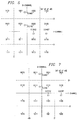
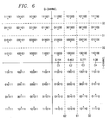
- a 16 QAM constellation using such Gray mapping is shown in FIG 7, and the de-scrambling algorithm is as follows
- the present invention provides for a modulated symbol domain data scrambling/descrambling method that overcomes the modulated signal non-uniform distribution problems associated with higher order M-ary QAM and M-ary PSK modulation. It also provides the flexibility of placing the descrambler outside the QAM demapper, and provides the advantage that it is backward compatible to the standards with symbol level scrambling, such as interim specifications (IS) IS-95 and IS-2000.
- IS interim specifications
Landscapes
- Engineering & Computer Science (AREA)
- Computer Networks & Wireless Communication (AREA)
- Signal Processing (AREA)
- Physics & Mathematics (AREA)
- Spectroscopy & Molecular Physics (AREA)
- Power Engineering (AREA)
- Digital Transmission Methods That Use Modulated Carrier Waves (AREA)
Abstract
Description
if 0≤|I|<2D 1,I=sign(I)*|2D 1 -|I∥;
else I = I.
if 0≤|Q|<2D 1,Q=sign(Q)*|2D 1-|Q∥;
else Q=Q.
The value of Δ is chosen depending on the particular system design requirments, in the preferred embodiment, Δ is in the range from 0 to 0.05, but can be outside this range depending on the particular system requirments. Some other algorithms may be used for the same purpose.
It should also be noted that a normolization algorithm is needed to scale the receiving symbols properly for a fixed D value. An alternative is to scale D according to the receiving signal energy. In all the cases mentioned above, the proposed scrambling method is always applicable.
if 0 ≤ |I| < 2D 1,I = sign(I)*|2D 1 - |I||;
else I = I.
if 0 ≤ |Q| < 2D 1,Q = sign(Q)*|2D 1 -|Q∥;
else Q = Q.
if 0 ≤ |I| < D1, I = sign(I)*|D1 - |I∥;
if D 1 ≤ |I| < 2D 1,I = sign(I)*|3D 1 - |I∥;
else I = I.
if 0 ≤ |Q| < D 1,Q = sign(Q)*|D 1 - |Q∥;
if D 1 ≤ |Q| < 2D 1,Q = sign(Q)*|3D 1 - |Q∥;
else Q = Q.
Extension to other orders of PSK and QAM modulation is straightforward. The algorithm presented above can be easily extended to the M-PSK or M-QAM modulations using other Gray mapping other than the one we used here.
S = -S,
else S = S;
if A ≤ |S| < B, I = sign (S) * |(A + B) -
|S||;
else S = S.
- A = 0, B = 2D1 for i = 2, 3;
- A = 0, B = D1, and A= D1, B = 2 D1 for i = 4, 5;
- A = 0, B = D1/2, A= D1/2, B = D1, A= D1, B = 3D1/2, A = 3D1/2, B = 2D1 for i = 6, 7, etc.
If B ≤ |S|, S = sign (S) * |B - Δ |, where Δ is a small non-negative number.
S = -S,
else S = S
if A ≤|S| < B,I = sign(S)*|(A + B)-|S∥;
else S = S.
Claims (6)
- A method for data scrambling or descrambling modulated signals, where si represents the scrambling code, S represents Q symbols with i being odd and I symbols with i being even, comprising the steps of:(a) if de-scrambling the modulated signals and if B ≤|S|, then S = sign (S) *|B - Δ|, where Δ is a small non-negative number,(b) determining if si =1, for i = 0,1, if i>1 skip to step (d);(c) setting S = -S if in step (a) si = 1, else setting S = S; and(d) determining if si = 1, for i ≥ 2 and
if A ≤ |S| < B,A = 0, B = 2D1 for i = 2, 3;A = 0, B = D1, and A= D1, B = 2 D1 for i = 4, 5;A = 0, B = D1/2; A= D1/2, B = D1; A= D1, B = 3D1/2; A = 3D1/2, B = 2D1, for i = 6, 7, etc. - A method for data scrambling or de-scrambling modulated signals, where si represents the scrambling code, S represents Q symbols with i being even and I symbols with i being odd, comprising the steps of:if A ≤ |S| < B,(a) if de-scrambling the modulated signals and
if B ≤ |S|, then S = sign (S) *|B - Δ|, where Δ is a small non-negative number,(b) determining if si =1, for i = 0,1 , if i>1 skip to step (d);(c) setting S = -S if in step (a) si = 1, else setting S = S;(d) determining if si = 1, for i ≥ 2 andA = 0, B = 2D1 for i = 2, 3;A = 0, B = D1, and A= D1, B = 2 D1 for i = 4, 5;A = 0, B = D1/2; A= D1/2, B = D1; A= D1, B = 3D1/2; A = 3D1/2, B = 2D1, for i = 6, 7, etc. - A method for data scrambling or descrambling modulated signals, where si represents the scrambling code, S represents I symbols when i = 0,..., log2(M)/2-1 and associated with Q symbols when i = log2(M)/2,..., log2(M)-1, comprising the steps of:if also A ≤ |S|< B, then S = sign (S) * |(A + B) - |S||, else S = S; and(a) if de-scrambling the modulated signals and
if B ≤ |S|, then S = sign (S) *|B - Δ|, where Δ is a small non-negative number,(b) determining if si = 1for i=1,3;(c) setting S = -S if si = 1, else setting S = S;(d) determining if si = 1 for i = 2,4 and
where: A = 0 and B = 2D1. - A method for data scrambling or descrambling modulated signals, where si represents the scrambling code, S represents Q symbols when i = 0,..., log2(M)/2-1 and associated with I symbols when i = log2(M)/2,..., log2(M)-1, comprising the steps of:where: A = 0 and B = 2D1.(a) if de-scrambling the modulated signals and
if B ≤ |S|, then S = sign (S) *|B - Δ|, where Δ is a small non-negative number,(b) determining if si = 1for i=1,3;(b) setting S = -S if si = 1, else setting S = S;(c) determining if si = 1 for i = 2,4 and if also A ≤ |S|< B, then - A receiver for data descrambling modulated signals, where si represents the scrambling code, S represents Q symbols with i being odd and I symbols with i being even, comprising:a rake receiver; anda data descrambler coupled to the rake receiver, the data descrambler performing the steps of:if A ≤ |S| < B,(a) if B ≤|S|, then S = sign (S) *|B - Δ|, where Δ is a small non-negative number,(b) determining if si = 1, for i = 0,1 , if i>1 skip to step (d);(c) setting S = -S if in step (a) si = 1, else setting S = S;(d) determining if si = 1, for i ≥ 2 andA = 0, B = 2D1 for i = 2, 3;A = 0, B = D1, and A= D1, B = 2 D1 for i = 4, 5; andA = 0, B = D1/2; A= D1/2, B = D1; A= D1, B = 3D1/2; A = 3D1/2, B = 2D1, for i = 6, 7, etc.
- A receiver for data descrambling modulated signals, where si represents the scrambling code, S represents Q symbols with i being even and I symbols with i being odd, comprising:a rake receiver; anda data desrambler coupled to the rake receiver, the data descrambler performing the steps of:if A ≤ |S| < B,(a) if B ≤|S|, then S = sign (S) *|B - Δ|, where Δ is a small non-negative number,(b) determining if si = 1, for i = 0,1, if i>1 skip to step (d);(c) setting S = -S if in step (a) si = 1, else setting S = S;(d) determining if si = 1, for i ≥ 2 andA = 0, B = 2D1 for i = 2, 3;A = 0, B = D1, and A= D1, B = 2 D1 for i = 4, 5; andA = 0, B = D1/2; A= D1/2, B = D1; A= D1, B = 3D1/2; A = 3D1/2, B =2D1, for i = 6, 7, etc.
Applications Claiming Priority (2)
| Application Number | Priority Date | Filing Date | Title |
|---|---|---|---|
| US09/997,639 US20030099359A1 (en) | 2001-11-29 | 2001-11-29 | Method and apparatus for data scrambling/descrambling |
| US997639 | 2001-11-29 |
Publications (2)
| Publication Number | Publication Date |
|---|---|
| EP1317106A2 true EP1317106A2 (en) | 2003-06-04 |
| EP1317106A3 EP1317106A3 (en) | 2003-06-11 |
Family
ID=25544226
Family Applications (1)
| Application Number | Title | Priority Date | Filing Date |
|---|---|---|---|
| EP02102640A Withdrawn EP1317106A3 (en) | 2001-11-29 | 2002-11-25 | Method and apparatus for data scrambling/descrambling |
Country Status (2)
| Country | Link |
|---|---|
| US (1) | US20030099359A1 (en) |
| EP (1) | EP1317106A3 (en) |
Cited By (2)
| Publication number | Priority date | Publication date | Assignee | Title |
|---|---|---|---|---|
| WO2013026323A1 (en) * | 2011-08-25 | 2013-02-28 | 中兴通讯股份有限公司 | Scrambling method and device |
| CN101483502B (en) * | 2009-02-24 | 2014-01-08 | 北京邮电大学 | An Adaptive Transmission Method Suitable for Mixed Modulation |
Families Citing this family (16)
| Publication number | Priority date | Publication date | Assignee | Title |
|---|---|---|---|---|
| US8577026B2 (en) | 2010-12-29 | 2013-11-05 | Ternarylogic Llc | Methods and apparatus in alternate finite field based coders and decoders |
| US7643632B2 (en) * | 2004-02-25 | 2010-01-05 | Ternarylogic Llc | Ternary and multi-value digital signal scramblers, descramblers and sequence generators |
| US7505589B2 (en) | 2003-09-09 | 2009-03-17 | Temarylogic, Llc | Ternary and higher multi-value digital scramblers/descramblers |
| US20070110229A1 (en) * | 2004-02-25 | 2007-05-17 | Ternarylogic, Llc | Ternary and Multi-Value Digital Signal Scramblers, Descramblers and Sequence of Generators |
| US20110064214A1 (en) * | 2003-09-09 | 2011-03-17 | Ternarylogic Llc | Methods and Apparatus in Alternate Finite Field Based Coders and Decoders |
| US7475331B1 (en) | 2003-10-07 | 2009-01-06 | Marvell International Ltd. | Data dependent scrambler with improved global constraint |
| US7218144B2 (en) * | 2004-02-25 | 2007-05-15 | Ternarylogic Llc | Single and composite binary and multi-valued logic functions from gates and inverters |
| US7696785B2 (en) * | 2004-02-25 | 2010-04-13 | Ternarylogic Llc | Implementing logic functions with non-magnitude based physical phenomena |
| US8374289B2 (en) | 2004-02-25 | 2013-02-12 | Ternarylogic Llc | Generation and detection of non-binary digital sequences |
| US7548092B2 (en) | 2004-02-25 | 2009-06-16 | Ternarylogic Llc | Implementing logic functions with non-magnitude based physical phenomena |
| US7580472B2 (en) * | 2004-02-25 | 2009-08-25 | Ternarylogic Llc | Generation and detection of non-binary digital sequences |
| US20060021003A1 (en) * | 2004-06-23 | 2006-01-26 | Janus Software, Inc | Biometric authentication system |
| US7562106B2 (en) * | 2004-08-07 | 2009-07-14 | Ternarylogic Llc | Multi-value digital calculating circuits, including multipliers |
| US20100164548A1 (en) * | 2004-09-08 | 2010-07-01 | Ternarylogic Llc | Implementing Logic Functions With Non-Magnitude Based Physical Phenomena |
| JP4542405B2 (en) * | 2004-09-30 | 2010-09-15 | 株式会社ケンウッド | Baseband signal generation apparatus, baseband signal generation method, and program |
| CN107506326B (en) * | 2017-07-05 | 2019-03-15 | 芯启源(南京)半导体科技有限公司 | Data transmission scrambling and descrambling circuit, transmission and receiving device and system |
Family Cites Families (4)
| Publication number | Priority date | Publication date | Assignee | Title |
|---|---|---|---|---|
| US5828694A (en) * | 1996-07-01 | 1998-10-27 | Trimble Navigation Limited | Determination of multipath tracking error |
| US6005888A (en) * | 1997-07-08 | 1999-12-21 | Texas Instruments Incorporated | Method for providing offset mask for pseudo-noise sequence generator |
| US6035040A (en) * | 1997-10-17 | 2000-03-07 | Nortel Networks Corporation | System and method for decryption in the symbol domain |
| US6157679A (en) * | 1997-10-17 | 2000-12-05 | Motorola, Inc. | Method of adding encryption/encoding element to the modulation/demodulation process |
-
2001
- 2001-11-29 US US09/997,639 patent/US20030099359A1/en not_active Abandoned
-
2002
- 2002-11-25 EP EP02102640A patent/EP1317106A3/en not_active Withdrawn
Cited By (4)
| Publication number | Priority date | Publication date | Assignee | Title |
|---|---|---|---|---|
| CN101483502B (en) * | 2009-02-24 | 2014-01-08 | 北京邮电大学 | An Adaptive Transmission Method Suitable for Mixed Modulation |
| WO2013026323A1 (en) * | 2011-08-25 | 2013-02-28 | 中兴通讯股份有限公司 | Scrambling method and device |
| CN102957499A (en) * | 2011-08-25 | 2013-03-06 | 中兴通讯股份有限公司 | Scrambling method and scrambling device |
| CN102957499B (en) * | 2011-08-25 | 2018-07-10 | 深圳市中兴微电子技术有限公司 | A kind of method for scrambling and device |
Also Published As
| Publication number | Publication date |
|---|---|
| EP1317106A3 (en) | 2003-06-11 |
| US20030099359A1 (en) | 2003-05-29 |
Similar Documents
| Publication | Publication Date | Title |
|---|---|---|
| US20030099359A1 (en) | Method and apparatus for data scrambling/descrambling | |
| EP0815677B1 (en) | Multicarrier communication system and method for peak power control | |
| US9088314B2 (en) | System and method for data scrambling to reduce the crest factor in an OFDM waveform | |
| US20200162172A1 (en) | Physical-Layer Security for Coherent Communications System | |
| US6683955B1 (en) | Method for receiving a secured transmission of information through a plurality of frequency orthogonal subchannels | |
| US20100266124A1 (en) | Data communication apparatus | |
| US8340294B2 (en) | Secure modulation and demodulation | |
| CN103746804B (en) | secure communication method based on multi-parameter fractional Fourier transform and constellation scrambling | |
| CN113225174A (en) | Quantum noise stream encryption system based on one-dimensional chaotic sequence and encoding and decoding method | |
| US6501841B1 (en) | Method for providing security for a transmission of information through a plurality of frequency orthogonal subchannels | |
| EP0910190A2 (en) | System and method for decryption in the symbol domain | |
| US10461970B2 (en) | Transmitter and receiver for supporting FTN signaling and method for same | |
| US7068701B2 (en) | Data transmission and reception within a spread-spectrum communication system | |
| US11581944B2 (en) | Optical transmission system | |
| CN101567867B (en) | Scramble processing method and baseband signal forming method | |
| JP2007228564A (en) | Data transmitting apparatus and data receiving apparatus | |
| Kodama | Secure Digital-domain Symbol Masking Using Four-level Phase-shift-based twobit Block-ciphering for Coherent QPSK Transmission | |
| JP3240842B2 (en) | Digital processing circuit of radio | |
| EP1188284B1 (en) | System and method for data scrambling to reduce the crest factor in an ofdm waveform | |
| KR100717682B1 (en) | Apparatus and method for generating signals with interleaved frequency division multiple access method, and signal receiving apparatus | |
| Muta et al. | Partial scrambling selected mapping for PAPR reduction of OFDM signals | |
| CN118138221A (en) | Information transmission method, device, electronic equipment and medium | |
| Kojima et al. | A study of SLM PAPR reduction of OFDM signals without side information | |
| Leng et al. | Applications of modulation in a mceliece-like symmetric-key scheme | |
| Tsopa | Estimation of Signal Encoding and Scrambling Impact on Information Transmission System Security |
Legal Events
| Date | Code | Title | Description |
|---|---|---|---|
| PUAI | Public reference made under article 153(3) epc to a published international application that has entered the european phase |
Free format text: ORIGINAL CODE: 0009012 |
|
| PUAL | Search report despatched |
Free format text: ORIGINAL CODE: 0009013 |
|
| AK | Designated contracting states |
Designated state(s): AT BE BG CH CY CZ DE DK EE ES FI FR GB GR IE IT LI LU MC NL PT SE SK TR |
|
| AX | Request for extension of the european patent |
Extension state: AL LT LV MK RO SI |
|
| AK | Designated contracting states |
Designated state(s): AT BE BG CH CY CZ DE DK EE ES FI FR GB GR IE IT LI LU MC NL PT SE SK TR |
|
| AX | Request for extension of the european patent |
Extension state: AL LT LV MK RO SI |
|
| RIC1 | Information provided on ipc code assigned before grant |
Ipc: 7H 04L 25/03 A Ipc: 7H 04L 27/34 B |
|
| 17P | Request for examination filed |
Effective date: 20031211 |
|
| AKX | Designation fees paid |
Designated state(s): DE FR GB |
|
| 17Q | First examination report despatched |
Effective date: 20170119 |
|
| STAA | Information on the status of an ep patent application or granted ep patent |
Free format text: STATUS: THE APPLICATION IS DEEMED TO BE WITHDRAWN |
|
| 18D | Application deemed to be withdrawn |
Effective date: 20170801 |
|
| RIC1 | Information provided on ipc code assigned before grant |
Ipc: H04L 25/03 20060101AFI20030313BHEP Ipc: H04L 27/34 20060101ALI20030423BHEP |