EP1317004A1 - Fractal structure and method of forming it - Google Patents
Fractal structure and method of forming it Download PDFInfo
- Publication number
- EP1317004A1 EP1317004A1 EP01958457A EP01958457A EP1317004A1 EP 1317004 A1 EP1317004 A1 EP 1317004A1 EP 01958457 A EP01958457 A EP 01958457A EP 01958457 A EP01958457 A EP 01958457A EP 1317004 A1 EP1317004 A1 EP 1317004A1
- Authority
- EP
- European Patent Office
- Prior art keywords
- fractal
- nebula
- fractal structure
- dimension
- based complex
- Prior art date
- Legal status (The legal status is an assumption and is not a legal conclusion. Google has not performed a legal analysis and makes no representation as to the accuracy of the status listed.)
- Withdrawn
Links
Images



















Classifications
-
- C—CHEMISTRY; METALLURGY
- C30—CRYSTAL GROWTH
- C30B—SINGLE-CRYSTAL GROWTH; UNIDIRECTIONAL SOLIDIFICATION OF EUTECTIC MATERIAL OR UNIDIRECTIONAL DEMIXING OF EUTECTOID MATERIAL; REFINING BY ZONE-MELTING OF MATERIAL; PRODUCTION OF A HOMOGENEOUS POLYCRYSTALLINE MATERIAL WITH DEFINED STRUCTURE; SINGLE CRYSTALS OR HOMOGENEOUS POLYCRYSTALLINE MATERIAL WITH DEFINED STRUCTURE; AFTER-TREATMENT OF SINGLE CRYSTALS OR A HOMOGENEOUS POLYCRYSTALLINE MATERIAL WITH DEFINED STRUCTURE; APPARATUS THEREFOR
- C30B25/00—Single-crystal growth by chemical reaction of reactive gases, e.g. chemical vapour-deposition growth
- C30B25/02—Epitaxial-layer growth
- C30B25/10—Heating of the reaction chamber or the substrate
- C30B25/105—Heating of the reaction chamber or the substrate by irradiation or electric discharge
-
- B—PERFORMING OPERATIONS; TRANSPORTING
- B82—NANOTECHNOLOGY
- B82Y—SPECIFIC USES OR APPLICATIONS OF NANOSTRUCTURES; MEASUREMENT OR ANALYSIS OF NANOSTRUCTURES; MANUFACTURE OR TREATMENT OF NANOSTRUCTURES
- B82Y25/00—Nanomagnetism, e.g. magnetoimpedance, anisotropic magnetoresistance, giant magnetoresistance or tunneling magnetoresistance
-
- B—PERFORMING OPERATIONS; TRANSPORTING
- B82—NANOTECHNOLOGY
- B82Y—SPECIFIC USES OR APPLICATIONS OF NANOSTRUCTURES; MEASUREMENT OR ANALYSIS OF NANOSTRUCTURES; MANUFACTURE OR TREATMENT OF NANOSTRUCTURES
- B82Y40/00—Manufacture or treatment of nanostructures
-
- C—CHEMISTRY; METALLURGY
- C30—CRYSTAL GROWTH
- C30B—SINGLE-CRYSTAL GROWTH; UNIDIRECTIONAL SOLIDIFICATION OF EUTECTIC MATERIAL OR UNIDIRECTIONAL DEMIXING OF EUTECTOID MATERIAL; REFINING BY ZONE-MELTING OF MATERIAL; PRODUCTION OF A HOMOGENEOUS POLYCRYSTALLINE MATERIAL WITH DEFINED STRUCTURE; SINGLE CRYSTALS OR HOMOGENEOUS POLYCRYSTALLINE MATERIAL WITH DEFINED STRUCTURE; AFTER-TREATMENT OF SINGLE CRYSTALS OR A HOMOGENEOUS POLYCRYSTALLINE MATERIAL WITH DEFINED STRUCTURE; APPARATUS THEREFOR
- C30B29/00—Single crystals or homogeneous polycrystalline material with defined structure characterised by the material or by their shape
- C30B29/02—Elements
- C30B29/04—Diamond
-
- C—CHEMISTRY; METALLURGY
- C30—CRYSTAL GROWTH
- C30B—SINGLE-CRYSTAL GROWTH; UNIDIRECTIONAL SOLIDIFICATION OF EUTECTIC MATERIAL OR UNIDIRECTIONAL DEMIXING OF EUTECTOID MATERIAL; REFINING BY ZONE-MELTING OF MATERIAL; PRODUCTION OF A HOMOGENEOUS POLYCRYSTALLINE MATERIAL WITH DEFINED STRUCTURE; SINGLE CRYSTALS OR HOMOGENEOUS POLYCRYSTALLINE MATERIAL WITH DEFINED STRUCTURE; AFTER-TREATMENT OF SINGLE CRYSTALS OR A HOMOGENEOUS POLYCRYSTALLINE MATERIAL WITH DEFINED STRUCTURE; APPARATUS THEREFOR
- C30B29/00—Single crystals or homogeneous polycrystalline material with defined structure characterised by the material or by their shape
- C30B29/60—Single crystals or homogeneous polycrystalline material with defined structure characterised by the material or by their shape characterised by shape
- C30B29/605—Products containing multiple oriented crystallites, e.g. columnar crystallites
-
- H—ELECTRICITY
- H01—ELECTRIC ELEMENTS
- H01F—MAGNETS; INDUCTANCES; TRANSFORMERS; SELECTION OF MATERIALS FOR THEIR MAGNETIC PROPERTIES
- H01F41/00—Apparatus or processes specially adapted for manufacturing or assembling magnets, inductances or transformers; Apparatus or processes specially adapted for manufacturing materials characterised by their magnetic properties
- H01F41/14—Apparatus or processes specially adapted for manufacturing or assembling magnets, inductances or transformers; Apparatus or processes specially adapted for manufacturing materials characterised by their magnetic properties for applying magnetic films to substrates
- H01F41/30—Apparatus or processes specially adapted for manufacturing or assembling magnets, inductances or transformers; Apparatus or processes specially adapted for manufacturing materials characterised by their magnetic properties for applying magnetic films to substrates for applying nanostructures, e.g. by molecular beam epitaxy [MBE]
Definitions
- This invention relates a fractal structure and its forming method, especially based on a novel principle.
- a solid material For application of a solid material to electronic or optical devices, physical properties of the material may restrict its applications. For example, in case of using a semiconductor material in a light-emitting device, it will be usable in a device of an emission wavelength corresponding to the band gap of the .material, but some consideration will be necessary for changing the emission wavelength. Regarding physical properties related to semiconductor bands, controls by superlattices have been realized. More specifically, by changing the period of a superlattice, the bandwidth of its subband can be controlled to design an emission wavelength.
- An object the invention intends to accomplish is to provide a fractal structure and its forming method capable of modulating and controlling the dimensionality of a material by a design method beyond the simple fractal nature.
- Another object the invention intends to accomplish is to provide a fractal structure and its forming method capable of controlling phase transition and chaos, in particular, quantum chaos, by a design method beyond the simple fractal nature.
- a more complex fractal structure having a portion characterized by a plurality of fractal dimensions can be formed by changing the growth conditions with time during growth of the fractal structure.
- a distinctive nebula-like fractal-based complex structure made up of a mixture of a plurality of regions different in fractal dimension can be formed by changing growth conditions toward obtaining a higher fractal dimension after forming regions of a lower fractal dimension.
- phase transition such as magnetic phase transition
- chaos such as quantum chaos in an electron state
- the present invention has been made on the basis of those researches by the Inventor.
- a fractal structure having a plurality of regions different in fractal dimension characterizing the self-similarity comprising:
- a fractal structure forming method for forming a fractal structure having a plurality of regions different in fractal dimension characterizing the self-similarity comprising:
- the timing for changing the growth conditions by adjusting the timing for changing the growth conditions from those for obtaining a first fractal dimension to those for obtaining a second fractal dimension, the nature of phase transition appearing in the fractal structure is controlled.
- critical temperature for ferromagnetic phase transition appearing in the fractal structure is controlled.
- the nature of chaos appearing in the fractal structure is controlled, or more particularly, quantum chaos in the electron state, for example, is controlled.
- the control of the quantum chaos in the electron state can be controlled with a high controllability by adjusting the timing for changing the growth conditions and additionally introducing a random magnetic field by addition of magnetic impurities.
- these regions forming the fractal structure exhibit a form of nebula as a whole.
- the first fractal dimension D f1 and the second fractal dimension D f2 are determined to be preferably D f1 >2.7 and D f2 ⁇ 2.3, typically 2.7 ⁇ D f1 ⁇ 3 and 1 ⁇ D f2 ⁇ 2.3, and more preferably 2. 9 ⁇ D f1 ⁇ 3 and 1 ⁇ D f2 ⁇ 2.3.
- the upper limit value 3 of D f1 corresponds to the dimension of a three-dimensional space whereas the lower limit value 1 of D f2 is necessary for ensuring connectivity in the structure.
- growth conditions of the fractal structure are represented by ⁇ of Equation (4).
- natures of solvents employed for the growth are one of the growth conditions. That is, in this case, a plurality of regions different in fractal dimension can be formed by selecting appropriate solvents, respectively, in the growth process.
- a nebula-like fractal-based complex structure made up of a mixture of a plurality of regions different in fractal dimension from each other can be obtained by changing the growth condition of the fractal structure with time so as to first carry out the growth under growth conditions providing a low fractal dimension and to thereafter continue the growth under different growth conditions providing a higher fractal dimension. Then, in this fractal structure, the nature of phase transition occurring in the fractal structure can be controlled by, for example, adjustment of the timing for changing the growth conditions. Additionally, optimization of the fractal dimensions improves the controllability.
- nebula-like fractal-based complex structures each made up of a mixture of portions characterized by a plurality of fractal dimensions are taken. These nebula-like fractal-based complex structures are formed by first forming a region having a lower fractal dimension and thereafter changing the growth conditions to provide a higher fractal dimension.
- a method of forming a nebula-like fractal-based complex structure according to the first embodiment can be obtained by developing Dielectric Breakdown Model ((32) A. Erzan, L. Pietronero, A. Vespignani, Rev. Mod. Phys. 67, 545(1995); (33) L. Niemeyer, L. Pietronero, H.J. Wiesmann, Phys. Rev. Lett. 52, 1033(1984) (34) R. Ugajin, S. Hirata, and Y. Kuroki, Physica A, 278, 312(2000)).
- T n is a set of lattice sites on the three-dimensional lattice. T 0 contains (0, 0, 0) alone, and T n+1 is created by sequentially adding a single lattice site to T n according to the rule given below.
- Equation (1) is solved to determine the potential.
- the lattice site which will be added to T n to construct T n+1 , is hot contained in T n , and it is selected from the set of lattice sites, i.e. U n , nearest to T n .
- the number of lattice sites contained in U n is denoted by N n .
- Figs. 1, 2 and 3 Results of the simulation are shown in Figs. 1, 2 and 3.
- a spin system describing a ferromagnetic structure is defined on the nebula-like fractal-based complex structure defined in (1).
- S p is the spin at the p site.
- a natural model of spin-to-spin interaction J p,q is: That is, spin-to-spin interaction exists only between nearest-neighbor sites.
- M For the purpose of calculating spontaneous magnetization M at a finite temperature T, statistical mechanics of an equilibrium system is introduced.
- a partition function Z is defined as follows. where ⁇ S p ⁇ in the symbol of the sum pertains to the sum regarding all spin states.
- Spontaneous magnetization is defined as the statistical average of spins as follows. where the expected value ⁇ S p > is and n+1 is the total number of spins.
- Fig. 5 shows spontaneous magnetization in the nebula-like fractal-based complex structure shown in Figs. 1, 2 and 3.
- the critical temperature for spontaneous magnetization to disappear changes with ⁇ 1 .
- the form of the magnetization curve does not change, and the critical temperature changes. It has been found, therefore, that various materials exhibiting various magnetic properties can be obtained by changing growth parameters in this nebula-like fractal-based complex structure, which is a fractal-based complex.
- m > ⁇ m
- m > where m 0, 1, 2, ⁇ , n.
- ⁇ j ⁇ j ⁇
- the density of states of the system is defined by and the staircase function is calculated.
- the staircase function obtained is converted by a technique called "unfolding" such that the density of states becomes constant in average.
- nearest-neighbor level spacing ibution P(s) and ⁇ 3 statistics of Dyson and Metha are calculated as quantum level statistics.
- GOE Gaussian orthogonal ensemb
- Fig. 10 shows P(s) and Fig. 11 shows ⁇ 3 statistics.
- a method of forming the nebula-like fractal-based complex structure according to the third embodiment is the same as the method of forming the nebula-like fractal-based complex structure according to the first embodiment.
- simulation is carried out. Results of the simulation are shown in Figs. 12, 13, 14 and 15.
- hopping is possible only between nearest-neighbor sites.
- phase factors ⁇ p,q which are random from one site to another, are added. If the phase factor is integrated in the loop making one turn around a lattice point, a magnetic flux passing through the loop is obtained. This means a magnetic field is locally introduced to the random distribution of 0 ⁇ p,q ⁇ 2 ⁇ . This magnetic field is absolutely random in both intensity and direction, and in spatial average, it becomes a zero magnetic field and never breaks the fractal property of the system.
- m > ⁇ m
- m > where m 0, 1, 2, ⁇ ,n.
- ⁇ j ⁇ j ⁇
- the density of states of the system is defined by and the staircase function is calculated.
- the staircase function obtained is converted by a technique called "unfolding" such that the density of states becomes constant in average.
- nearest-neighbor level spacing distribution P(s) and ⁇ 3 statistics of Dyson and Metha are calculated as quantum level statistics.
- P GUE Gausian unitary ensemble
- Fig. 16 shows P(s) and Fig. 17 shows ⁇ 3 statistics.
- the quantum level statistics is that of Poisson distribution.
- a method of forming the nebula-like fractal-based complex structure according to the fourth embodiment is the same as the method of forming the nebula-like fractal-based complex structure according to the first embodiment.
- a spin system describing a ferromagnetic structure is defined on the nebula-like fractal-based complex structure defined in (1).
- p 0, 1, 2, ⁇ , n.
- S p is the spin at the p site.
- a natural model of spin-spin interaction J p,q is: That is, spin-spin interaction exists only between nearest-neighbor sites.
- a partition function Z is defined as follows. where ⁇ S p ⁇ in the symbol of the sum pertains to the sum regarding all spin states.
- Spontaneous magnetization is defined as the statistical average of spins as follows. where the expected value ⁇ S p > is and n+1 is the total number of spins.
- M is generally a vector quantity in a spin space, but its absolute value M -
- the phase transition temperature of the nebula-like fractal-based complex structure is remarkably changed.
- the modulatory property is smaller as compared with Fig. 19, but still remains significantly large.
- the modulatory property is remarkably smaller as compared with Figs. 19 and 20.
- the phase transition temperatures are controlled by ⁇ 2 to a certain extent.
- a method of forming the nebula-like fractal-based complex structure according to the fifth embodiment is the same as the method of forming the nebula-like fractal-based complex structure according to the first embodiment.
- a quantum system of one particle is defined on the nebula-like fractal-based complex structure defined in (1).
- Fig. 25 shows P(s) and Fig. 26 shows ⁇ 3 statistics.
- ⁇ 1 0.2
- Fig. 29 shows P(s) and Fig. 30 shows ⁇ 3 statistics.
- the quantum level statistics changes away from that of Poisson distribution and approaches GOE distribution.
- the quantum level statistics changes away from that of Poisson distribution and approaches that of GOE distribution.
- the Berry-Robnik parameter ⁇ is used ((38) M.V. Berry and M. Robnik, J. Phys. A (Math. Gen.) 17, 2413(1984)).
- ⁇ 1 - ⁇
- P 2 ( s,p ) p 2 e- ps erf ⁇ p s 2 - 2 p p + ⁇ p 3 s 2 ) e - ps - ⁇ p 2 s 2 /4 is introduced, where was used.
- the Berry-Robnik parameter is the value of ⁇ obtained by optimum approximation of P(s) obtained y numerical calculation with P 2 (s, ⁇ ) shown above.
- ⁇ is the ratio in volume of regular regions (integrable systems and regions capable of perturbing development therefrom) in a phase space.
- Fig. 33 shows the Berry-Robnik parameter ⁇ in nebula-like fractal-based complex structures.
- a method of forming the nebula-like fractal-based complex structure according to the sixth embodiment is the same as the method of forming the nebula-like fractal-based complex structure according to the first embodiment.
- U 7 in Fig. 44
- U 8 in Fig. 45.
- a nebula-like fractal-based complex structure made up of a mixture of a plurality of regions different in fractal dimension from each other and to modulate and control the dimensionality of a material by a design method beyond those heretofore used to obtain conventional simple fractal properties.
- the nature of various phase transitions occurring in these fractal structures can be controlled, for example, by adjusting the timing for changing the growth conditions.
- controllability can be improved by optimization of fractal dimensions.
Landscapes
- Chemical & Material Sciences (AREA)
- Engineering & Computer Science (AREA)
- Crystallography & Structural Chemistry (AREA)
- Nanotechnology (AREA)
- Materials Engineering (AREA)
- Metallurgy (AREA)
- Organic Chemistry (AREA)
- Power Engineering (AREA)
- Manufacturing & Machinery (AREA)
- Physics & Mathematics (AREA)
- Spectroscopy & Molecular Physics (AREA)
- Chemical Kinetics & Catalysis (AREA)
- General Chemical & Material Sciences (AREA)
- General Physics & Mathematics (AREA)
- Condensed Matter Physics & Semiconductors (AREA)
- Management, Administration, Business Operations System, And Electronic Commerce (AREA)
- Superconductor Devices And Manufacturing Methods Thereof (AREA)
- Thin Magnetic Films (AREA)
Abstract
A fractal structure is formed to have a
plurality of regions different in fractal dimension
characterizing the self-similarity. The fractal
structure is grown from one or more origins under
growth conditions providing a first fractal dimension
in a first portion of the growth process from the start
point of time to a first point of time, and under
growth conditions providing a second fractal dimension
lower than the first fractal dimension in another
portion of the growth process from the first point of
time to a second point of time. By adjusting the
timing for changing the growth conditions, the fractal
structure is controlled in nature of phase transition,
such as critical temperature for ferromagnetic phase
transition, which occurs in the fractal structure. For
enhancing the controllability, the first fractal
dimension is preferably larger than 2.7 and the second
fractal dimension is preferably smaller than 2.3.
Description
This invention relates a fractal structure
and its forming method, especially based on a novel
principle.
For application of a solid material to
electronic or optical devices, physical properties of
the material may restrict its applications. For
example, in case of using a semiconductor material in a
light-emitting device, it will be usable in a device of
an emission wavelength corresponding to the band gap of
the .material, but some consideration will be necessary
for changing the emission wavelength. Regarding
physical properties related to semiconductor bands,
controls by superlattices have been realized. More
specifically, by changing the period of a superlattice,
the bandwidth of its subband can be controlled to
design an emission wavelength.
Targeting on controlling many-electron-state
structures by material designs, the Inventor proposed
many-body effect engineering by quantum dot-based
structures and has continued theoretical analyses ((1)
U.S. Patent 5,430,309; (2) U.S. Patent 5,663,571; (3)
U.S. Patent 5,719,407; (4) U.S. Patent 5,828,090; (5)
U.S. Patent 5,831,294; (6) U.S. Patent 6,020,605; (7)
J. Appl. Phys. 76, 2833(1994); (8) Phys. Rev. B51,
10714(1995); (9) Phys. Rev. B51, 11136(1995); (10) J.
Appl. Phys. 77, 5509(1995); (11) Phys. Rev. B53,
6963(1996); (12) Phys. Rev. B53, 10141(1996); (13)
Appl. Phys. Lett. 68, 2657(1996); (14) J. Appl. Phys.
80, 3893(1996); (15) J. Phys. Soc. Jpn. 65, 3952(1996);
(16) Jpn. J. Appl. Phys. 36, 638(1997); (17) J. Phys.
Soc. Jpn. 66, 425(1997); (18) J. Appl. Phys. 81, 2693
(1997); (19) Physica (Amsterdam) 229B, 146(1997); (20)
Physica (Amsterdam) 237A, 220(1997); (21) Surf. Sci.
375, 403(1997); (22) Physica (Amsterdam) 240B,
116(1997); (23) Physica (Amsterdam) 240B, 128(1997);
(24) Physica (Amsterdam) IE, 226(1997); (25) Phys. Rev.
Lett. 80. 572(1-998) ; (26') Jpn. J. Appl. Phys. 37,
863(1998); (27) Physica (Amsterdam) 245B, 311(1998);
(28) Physica (Amsterdam) 235B, 96(1998); (29) Phys.
Rev. B59, 4952(1999); (30) Surf. Sci. 432, 1(1999);
(31) International Journal of Modern Physics B. Vol.
13, No. 21, 22, pp. 2689-2703, 1999). For example,
realization of various correlated electronic systems is
expected by adjusting a tunneling phenomenon between
quantum dots and interaction between electrons in
quantum dots. Let the tunneling transfer between
adjacent quantum dots be written as t. Then, if
quantum dots are aligned in form of a square lattice,
the bandwidth of one electron state is Teff=4t. If
quantum dots form a one-dimensional chain, the
bandwidth of one electron state is Teff=2t. In case of
a three-dimensional quantum dot array, Teff=6t. That
is, if D is the dimension of a quantum dot array, the
bandwidth of one electron state has been Teff=2Dt. Here
is made a review about half-filled (one electron per
each quantum dot) Mott transition (also called Mott-Hubbard
transition or Mott metal-insulator transition).
Let the effective interaction of electrons within a
quantum dot be written as Ueff, then the Hubbard gap on
the part of the Mott insulator is substantially
described as Δ=Ueff-Teff, and the Mott transition can be
controlled by changing Ueff or t. As already proposed,
the Mott-Hubbard transition can be controlled by
adjusting Ueff or t, using field effect, and it is
applicable to field effect devices (Literatures (5),
(6), (11) and (14) introduced above).
On the other hand, reviewing the equation of
Δ=Ueff-Teff=Ueff-2Dt, it will be possible to control
Mott-Hubbard transition by controlling the
dimensionality D of the system. For this purpose, the
Applicant already proposed a fractal-based structure
that can continuously change the dimensionality, and
have exhibited that Mott-Hubbard transition is
controllable by changing the fractal dimensions.
To enable designing of wider materials, it is
desired to modify and control the dimension of
materials by designing methods beyond the simple
fractal nature.
As physical systems in charge of information
processing, intrinsic non-linearity is indispensable.
As devices having been used for years, there are
electronic devices using materials exhibiting non-linear
responses to certain extents. For example, two-terminal
devices exhibiting defferential negative
resistances are one example of devices that are non-linear
in current-voltage characteristics. Of course,
MOS-FET, which is a three-terminal device, supports the
modern technologies. By coupling these electronic
devices having non-linear properties with a linear
electronic circuit and constructing an information
processing device having a non linear property, any
desired calculation can be executed.
However, difficulties by high integration
have become issues with such electronic circuits.
Generation of heat is one of the problems, for example.
The heat generation caused by intrinsic electric
resistance is mandatory for producing non-linearity of
an electronic device, and indispensable and essential
for executing information processing.
To avoid this difficulty, trials have been
made to decrease the number of devices by enhancing
non-linearity of component devices. Progress of this
scheme necessarily results in the need for component
devices having non-linearity as strong as chaotic.
When a chaotic classical system is quantized, what
characterizes the behaviors of the quantum system is
quantum chaos.
On the other hand, as miniaturization of
component devices progresses, electrons confined in a
device result in behaving as quantum mechanical
particles. Therefore, from this point of view, hopes
are placed on components devices exhibiting quantum
chaos. The Applicant has continued to theoretically
demonstrate that, in a quantum system in a structure
having a fractal configuration, the quantum chaos can
be controlled by changing the fractal dimension
characterizing the system.
An object the invention intends to accomplish
is to provide a fractal structure and its forming
method capable of modulating and controlling the
dimensionality of a material by a design method beyond
the simple fractal nature.
Another object the invention intends to
accomplish is to provide a fractal structure and its
forming method capable of controlling phase transition
and chaos, in particular, quantum chaos, by a design
method beyond the simple fractal nature.
The Inventor found, through concentrated
researches toward solution of those issues, that a more
complex fractal structure having a portion
characterized by a plurality of fractal dimensions can be formed by changing the growth conditions with time during growth of the fractal structure. Especially in the process of growing a random fractal, it has been found that a distinctive nebula-like fractal-based complex structure made up of a mixture of a plurality of regions different in fractal dimension can be formed by changing growth conditions toward obtaining a higher fractal dimension after forming regions of a lower fractal dimension. Then, it has been found that, in fractal structures of this type, occurrence of phase transition, such as magnetic phase transition, and chaos, such as quantum chaos in an electron state, can be controlled. As a result of later detailed analysis, it has been found that there are fractal dimensions suitable for controlling these phenomena.
characterized by a plurality of fractal dimensions can be formed by changing the growth conditions with time during growth of the fractal structure. Especially in the process of growing a random fractal, it has been found that a distinctive nebula-like fractal-based complex structure made up of a mixture of a plurality of regions different in fractal dimension can be formed by changing growth conditions toward obtaining a higher fractal dimension after forming regions of a lower fractal dimension. Then, it has been found that, in fractal structures of this type, occurrence of phase transition, such as magnetic phase transition, and chaos, such as quantum chaos in an electron state, can be controlled. As a result of later detailed analysis, it has been found that there are fractal dimensions suitable for controlling these phenomena.
The present invention has been made on the
basis of those researches by the Inventor.
That is, to overcome the above-indicated
problems, according to the first aspect of the
invention, there is provided a fractal structure having
a plurality of regions different in fractal dimension
characterizing the self-similarity, comprising:
According to the second aspect of the
invention, there is provided a fractal structure
forming method for forming a fractal structure having a
plurality of regions different in fractal dimension
characterizing the self-similarity, comprising:
In the present invention, by adjusting the
timing for changing the growth conditions from those
for obtaining a first fractal dimension to those for
obtaining a second fractal dimension, the nature of
phase transition appearing in the fractal structure is
controlled. For example, by adjusting the timing for
changing the growth conditions, critical temperature
for ferromagnetic phase transition appearing in the
fractal structure is controlled. Further, by adjusting
the timing for changing the growth conditions, the
nature of chaos appearing in the fractal structure is
controlled, or more particularly, quantum chaos in the
electron state, for example, is controlled. The
control of the quantum chaos in the electron state can
be controlled with a high controllability by adjusting
the timing for changing the growth conditions and
additionally introducing a random magnetic field by
addition of magnetic impurities. Typically, these
regions forming the fractal structure exhibit a form of
nebula as a whole.
From the viewpoint of ensuring satisfactory
control of the critical temperature of ferromagnetic
transition appearing in the fractal structure and
satisfactory control of the quantum chaos, or ensuring
satisfactory control of the correlative electron
system, the first fractal dimension Df1 and the second
fractal dimension Df2 are determined to be preferably
Df1>2.7 and Df2<2.3, typically 2.7<Df1≤3 and 1≤Df2<2.3,
and more preferably 2. 9≤Df1≤3 and 1≤Df2<2.3. The upper
limit value 3 of Df1 corresponds to the dimension of a
three-dimensional space whereas the lower limit value 1
of Df2 is necessary for ensuring connectivity in the
structure.
In an embodiment that will be explained later
in detail, growth conditions of the fractal structure
are represented by α of Equation (4). In actual
growth, however, if the fractal structure is grown in
the liquid phase, for example, natures of solvents
employed for the growth are one of the growth
conditions. That is, in this case, a plurality of
regions different in fractal dimension can be formed by
selecting appropriate solvents, respectively, in the
growth process.
According to the invention having the above-summarized
configuration, a nebula-like fractal-based
complex structure made up of a mixture of a plurality
of regions different in fractal dimension from each
other can be obtained by changing the growth condition
of the fractal structure with time so as to first carry
out the growth under growth conditions providing a low
fractal dimension and to thereafter continue the growth
under different growth conditions providing a higher
fractal dimension. Then, in this fractal structure,
the nature of phase transition occurring in the fractal
structure can be controlled by, for example, adjustment
of the timing for changing the growth conditions.
Additionally, optimization of the fractal dimensions
improves the controllability.
Some embodiments of the invention will now be
explained below. In the following embodiments, nebula-like
fractal-based complex structures each made up of a
mixture of portions characterized by a plurality of
fractal dimensions are taken. These nebula-like
fractal-based complex structures are formed by first
forming a region having a lower fractal dimension and
thereafter changing the growth conditions to provide a
higher fractal dimension.
A method of forming a nebula-like fractal-based
complex structure according to the first
embodiment can be obtained by developing Dielectric
Breakdown Model ((32) A. Erzan, L. Pietronero, A.
Vespignani, Rev. Mod. Phys. 67, 545(1995); (33) L.
Niemeyer, L. Pietronero, H.J. Wiesmann, Phys. Rev.
Lett. 52, 1033(1984) (34) R. Ugajin, S. Hirata, and Y.
Kuroki, Physica A, 278, 312(2000)).
Here is defined a cubic lattice S in a three-dimensional
space, and a scalar potential field (i1,
i2, i3 ) is defined on its lattice site (i1, i2, i3) ∈S
and called a potential. Let this potential obey the
Laplace's equation
Δ(i 1 ,i 2 ,i 3 ) = 0
A pattern Tn, which will be defined later, is a set of
lattice sites on the three-dimensional lattice. T0
contains (0, 0, 0) alone, and Tn+1 is created by
sequentially adding a single lattice site to Tn
according to the rule given below.
Let the potential of each site contained in
Tn be 1 and let the potential at infinity be 0. That
is,
(i 1 ,i 2 ,i 3 ) = 0 when (i 1 ,i 2 ,i 3 ) → ∞
(i 1 ,i 2 ,i 3 ) = 1 when (i 1 ,i 2 ,i 3 )∈Tn
Under these boundary conditions, Equation (1) is solved
to determine the potential. The lattice site, which
will be added to Tn to construct Tn+1, is hot contained
in Tn, and it is selected from the set of lattice
sites, i.e. Un, nearest to Tn. The number of lattice
sites contained in Un is denoted by Nn.
Intensity of the electric fields for lattice
sites (i1,m, i2,m, i3,m) (where m=1, 2, ···, Nn) in Un is
defined as
Em (α) = |(i 1,m ,i 2,m ,i 3,m )-1|α
The probability that a certain site (i1,m, i2,m, i3,m) in
Un is selected is proportional to the electric field
Em(α). That is, the probability is

By repeating these operations, construction
of Tn is progressed. An ideal fractal will be a set of
limits repeated infinitely as
 When α = 1, the foregoing and the result of generation
of the pattern by Diffusion limited aggregation ((35)
T.A. Witten, Jr. and L.M. Sander, Phys. Rev. Lett. 47,
1400(1984); Phys. Rev. B27, 5686(1983)).
When α = 1, the foregoing and the result of generation
of the pattern by Diffusion limited aggregation ((35)
T.A. Witten, Jr. and L.M. Sander, Phys. Rev. Lett. 47,
1400(1984); Phys. Rev. B27, 5686(1983)).
The nebula-like fractal-based complex
structure according to the first embodiment is formed
by changing the α parameter in accordance with the step
n of the above-mentioned growth. That is, the above
growth process is progressed using α1 under 1≤n≤τ1, α2
under τ1+1≤n≤τ2, and α3 under τ2+1≤n≤τ3. Simulation is
performed below, taking fractal structure having two
different fractal dimensions. Those characterized by
α1>α2 are called nebula-like fractal-based complex
structures, and simulation was carried out particularly
for cases commonly fixing τ2=10000, α1=2 and α2=0, and
changing τ1. Results of the simulation are shown in
Figs. 1, 2 and 3. Fig. 1 is for τ1=3000, Fig. 2 is for
τ1=5000, and Fig. 3 is for τ1=7000. It will be
understood from Figs. 1, 2 and 3 that regions of a low
fractal dimension are formed while violently branching
in an early period of growth, and thereafter, a layer
of a higher fractal dimension grows on the branched
structure. In the regions formed in the latter half of
the growth, since the growth progresses entirely, it
shows the tendency of smoothing the branched structure
formed in the initial stage. This is just a nebula-like
fractal-based complex structure.
For the purpose of understanding the
structure in greater detail, a calculation process of
fractal dimensions is used. Let r represent the
distance from the growth origin (0, 0, 0) and N(r)
represent the number of growth points contained in a
ball with the radius r. Then, using a as a factor of
proportionality, if N(r) can be expressed as
N (r ) = arDf
then Df is called the fractal dimension. Therefore,
since logarithms of both sides are
logN (r ) = loga + Df logr
if log-log plots ride on a straight line, the structure
can be regarded as a fractal, and its inclination is
the fractal dimension. In Fig. 4, log-log plotting was
made for various cases obtained by the above-mentioned
growth experiment. It will be understood from Fig. 4
that, under τ1=3000, 5000 and 7000, the fractal
dimension in the region with small log(r) is
approximately Df=2.6, and the fractal dimension of the
region with large log(r) is approximately Df=2.0.
(2) Ferromagnetic phase transition in the nebula-like
fractal-based complex structure
A spin system describing a ferromagnetic
structure is defined on the nebula-like fractal-based
complex structure defined in (1). A review is made
about the lattice point
rp = (i 1,p ,i 2,p ,i 3,p )∈T n
that is the origin of Tn. In Equation (9), p=1, 2, ···,
n+1. By placing a spin on a lattice site rp∈Tn, here
is taken a spin system that can be described by the
following Hamiltonian.
 Sp is the spin at the p site. A natural model of spin-to-spin
interaction Jp,q is:
Sp is the spin at the p site. A natural model of spin-to-spin
interaction Jp,q is:
 That is, spin-to-spin interaction exists only between
nearest-neighbor sites. For the purpose of calculating
spontaneous magnetization M at a finite temperature T,
statistical mechanics of an equilibrium system is
introduced. A partition function Z is defined as
follows.
That is, spin-to-spin interaction exists only between
nearest-neighbor sites. For the purpose of calculating
spontaneous magnetization M at a finite temperature T,
statistical mechanics of an equilibrium system is
introduced. A partition function Z is defined as
follows.
 where {Sp} in the symbol of the sum pertains to the sum
regarding all spin states. Spontaneous magnetization
is defined as the statistical average of spins as
follows.
where {Sp} in the symbol of the sum pertains to the sum
regarding all spin states. Spontaneous magnetization
is defined as the statistical average of spins as
follows.
 where the expected value <Sp> is
 and n+1 is the total number of spins. M is generally
a vector quantity in a spin space, but its absolute
value M = |M| is calculated.
and n+1 is the total number of spins. M is generally
a vector quantity in a spin space, but its absolute
value M = |M| is calculated.
Here is made a review about an Ising model.
In an Ising model, only two states of
SP = 1 or - 1
can exist. Let a mean field approximation be
introduced into the Ising model. Spontaneous
magnetization of the p-th site is written as µp. In
this system, since the molecule field varies with site,
let it written as µ p . As an assumption of the mean
field approximation, here is employed a molecule field
that can be written by spontaneous magnetization of the
nearest-neighbor site as
 This assumption simplifies the foregoing Hamiltonian to
 A self-consistent equation ensuring spontaneous
magnetization obtained by using a partition function by
the simplified Hamiltonian becomes µp results in
A self-consistent equation ensuring spontaneous
magnetization obtained by using a partition function by
the simplified Hamiltonian becomes µp results in
µ p = tanh(βµ p )
and by numerically solving this equation, spontaneous
magnetization of the system
 is obtained.
Fig. 5 shows spontaneous magnetization in the
nebula-like fractal-based complex structure shown in
Figs. 1, 2 and 3. Note that the structure of τ1=0 is
the same as a simple fractal structure having a single
fractal dimension of α=0. Further, the structure of
τ1=10000 is the same as a simple fractal structure
having a single fractal dimension of α=2. It is seen
that the critical temperature for spontaneous
magnetization to disappear changes with τ1. As apparent
from Fig. 5, in this nebula-like fractal-based complex
structure, the form of the magnetization curve does not
change, and the critical temperature changes. It has
been found, therefore, that various materials
exhibiting various magnetic properties can be obtained
by changing growth parameters in this nebula-like
fractal-based complex structure, which is a fractal-based
complex.
A method of forming the nebula-like fractal-based
complex structure according to the second
embodiment is the same as the method of forming the
nebula-like fractal-based complex structure according
to the first embodiment. Also in the second embodiment,
assuming α1>α2, commonly fixing τ2=10000, α1=2 and α2=0,
and changing τ1, simulation is carried out. Results of
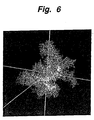
the simulation are shown in Figs. 6, 7, 8 and 9. Fig.
6 is for τ1=2000, Fig. 7 is for τ1=4000. Fig. 8 is for
τ1=6000, and Fig. 9 is for τ1=8000. As seen from Figs.
6, 7, 8 and 9, similarly to the first embodiment, since
regions of a low fractal dimension are formed while
violently branching in an early period of growth; a
layer of a higher fractal dimension thereafter grows on
the branched structure; and the growth progresses
entirely in the regions formed in the latter half of
the growth, it shows the tendency of smoothing the
branched structure formed in the initial stage.
A quantum system of a single particle is
defined on the nebula-like fractal-based complex
structure defined in (1). Assume a lattice site shown
below, which is the origin of Tn.
rp = (i 1,p ,i 2,p ,i 3,p )∈Tn
where p=0, 1, 2, ···, n. Here is defined an operator c † p
that creates a quantum at a lattice site rp∈Tn. Of
course, an anticommutative relation
 is established. Here the Hamiltonian H and is defined as
 Here is employed as the transfer tp,q
 In this model, hopping is possible only between
nearest-neighbor sites.
In this model, hopping is possible only between
nearest-neighbor sites.
When εm denotes the eigenenergy of the
Hamiltonian H and and | m> denotes the eigenvector,
H |m > = ε m |m >
where m=0, 1, 2, ···, n.
First, n+1 quantum levels εm are
standardized such that spacing between nearest-neighbor
levels becomes l in average. That is,
ω j = ε j -ε j -1
However, when j=1, 2, ···, n, by using
 it is converted into new levels
ε0 = 0
 Here,
Here,
Ω j = ω j ω
The density of states of the system is defined by
 and the staircase function
 is calculated. The staircase function obtained is
converted by a technique called "unfolding" such that
the density of states becomes constant in average. By
using quantum levels o d in this manner, nearest-neighbor
level spacing ibution P(s) and Δ3
statistics of Dyson and Metha are calculated as quantum
level statistics. As taught in literatures ((36)
(37)), by using these statistics, it can be detected
whether quantum chaos has been generated or not. It is
also known that a quantum chaotic system is sensitive
to perturbation from outside similarly to the classical
chaotic system, and analysis of quantum chaos is
important as a polestar of designs of non-linear
materials.
is calculated. The staircase function obtained is
converted by a technique called "unfolding" such that
the density of states becomes constant in average. By
using quantum levels o d in this manner, nearest-neighbor
level spacing ibution P(s) and Δ3
statistics of Dyson and Metha are calculated as quantum
level statistics. As taught in literatures ((36)
(37)), by using these statistics, it can be detected
whether quantum chaos has been generated or not. It is
also known that a quantum chaotic system is sensitive
to perturbation from outside similarly to the classical
chaotic system, and analysis of quantum chaos is
important as a polestar of designs of non-linear
materials.
In case of an integrable system, nearest-neighbor
level spacing distribution P(s) and Δ3
statistics are those of Poisson distribution
PP (s ) = e - s
Δ3 (n ) = n 15
In case of a quantum chaotic system, it becomes GOE
(Gaussian orthogonal ensemb) distribution
PGOE (s ) = πs2 e -πs2 /4
 where γ is the Euler's constant.
Since the nebula-like fractal-based complex
structure analyzed here is one obtained by growth
experiment of n=10000, this quantum system includes
n+1=10001 eigenstates. Based on energy eigenvalues
concerning 1501 states from the 510-th to 2001-th
eigenstates from the ground state, among those
eigenstates, the following quantum level statistics was
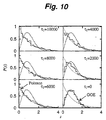
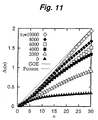
calculated. Figs. 10 and 11 show quantum level
statistics in a nebula-like fractal-based complex
structure of (α1, α2) = (0, 2). Fig. 10 shows P(s) and
Fig. 11 shows Δ3 statistics. In case of τ1=10000, the
structure is the same as the simple fractal of α=2, and
the fractal dimension is near 2(Df ~2.16). Therefore,
the system behaves as an integrable system. In this
case, the quantum level statistics is that of Poisson
distribution. On the other hand, in case of τ1=0, the
structure is the same as the simple fractal of α=0, and
the fractal dimension is near 3(Df ~2.91). Therefore,
the system behaves as a quantum chaotic system, and the
quantum level statistics is that of GOE distribution.
As shown in Figs. 10 and 11, as τ1 increases from 0 to
10000, the quantum level statistics changes from GOE
distribution to Poisson distribution. Therefore, wide
kinds of quantum systems can be realized by setting τ1
at predetermined values.
Through a review of the changes in quantum
level statistics in the nebula-like fractal-based
complex structure, it is recognized that the quantum
chaotic properties begin to decrease with a relatively
small value of τ1. This suggests that the branching
property still remains sufficiently in the complex
structure obtained and the chaotic property of the
quantum chaos is weakened. Taking it into
consideration, it is recognized that a plurality of
regions conjoin in the nebula-like fractal-based
complex structure and form a complex structure as a
whole.
A method of forming the nebula-like fractal-based
complex structure according to the third
embodiment is the same as the method of forming the
nebula-like fractal-based complex structure according
to the first embodiment. In the third embodiment,
assuming α1>α2, commonly fixing τ2=10000, α1=2 and α2=0,
and changing τ1, simulation is carried out. Results of
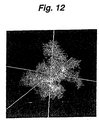
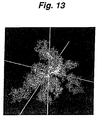
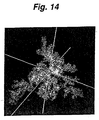
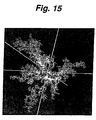
the simulation are shown in Figs. 12, 13, 14 and 15.
Fig. 12 is for τ1=2000, Fig. 13 is for τ1=4000. Fig. 14
is for τ1=6000, and Fig. 15 is for τ1=8000. As seen
from Figs. 12, 13, 14 and 15, similarly to the first
embodiment, since regions of a low fractal dimension
are formed while violently branching in an early period
of growth; a layer of a higher fractal dimension
thereafter grows on the branched structure; and the
growth progresses entirely in the regions formed in the
latter half of the growth, it shows the tendency of
smoothing the branched structure formed in the initial
stage.
A quantum system of a single particle is
defined on the nebula-like fractal-based complex
structure defined in (1). Assume a lattice site shown
below, which is the origin of Tn.
rp = (i 1, p ,i 2, p ,i 3, p )∈Tn
where p=1, 2, ···, n+1. Here is defined an operator c † p
that creates a quantum at a lattice site rp∈Tn. Of
course, an anticommutative relation
 is established. Here the Hamiltonian H and is defined as
 Here is employed as the transfer tp,q,
 where p,q=-q,p is a random real number satisfying
0 < p,q < 2π
In this model, hopping is possible only between
nearest-neighbor sites. Then, along with the hopping,
phase factors p,q, which are random from one site to
another, are added. If the phase factor is integrated
in the loop making one turn around a lattice point, a
magnetic flux passing through the loop is obtained.
This means a magnetic field is locally introduced to
the random distribution of 0<p,q<2π. This magnetic
field is absolutely random in both intensity and
direction, and in spatial average, it becomes a zero
magnetic field and never breaks the fractal property of
the system.
When εm denotes the eigenenergy of the
Hamiltonian H and and | m> denotes the eigenvector,
H |m > = ε m |m >
where m=0, 1, 2, ···,n.
First, n+1 quantum levels εm are
standardized such that spacing between nearest-neighbor
levels becomes 1 in average. That is,
ωj =ε j -ε j -1
However, when j=1, 2, ···, n, by using
 it is converted into new levels
ε0 = 0
 Here,
Here,
Ω j = ω j ω
The density of states of the system is defined by
 and the staircase function
 is calculated. The staircase function obtained is
converted by a technique called "unfolding" such that
the density of states becomes constant in average. By
using quantum levels obtained in this manner, nearest-neighbor
level spacing distribution P(s) and Δ3
statistics of Dyson and Metha are calculated as quantum
level statistics. As taught in a literature ((36) and
(37) shown above), by using these statistics, it can be
detected whether quantum chaos has been generated or
not. It is also known that a quantum chaotic system is
sensitive to perturbation from outside similarly to the
classical chaotic system, and analysis of quantum chaos
is important as a polestar of designs of non-linear
materials.
is calculated. The staircase function obtained is
converted by a technique called "unfolding" such that
the density of states becomes constant in average. By
using quantum levels obtained in this manner, nearest-neighbor
level spacing distribution P(s) and Δ3
statistics of Dyson and Metha are calculated as quantum
level statistics. As taught in a literature ((36) and
(37) shown above), by using these statistics, it can be
detected whether quantum chaos has been generated or
not. It is also known that a quantum chaotic system is
sensitive to perturbation from outside similarly to the
classical chaotic system, and analysis of quantum chaos
is important as a polestar of designs of non-linear
materials.
In case of an integrable system, nearest-neighbor
level spacing distribution P(s) and Δ3
statistics are those of Poisson distribution
PP (s ) = e -s
Δ3 (n ) = n 15
In case of a quantum chaotic system under a magnetic
field, it becomes GUE (Gaussian unitary ensemble)
distribution
PGUE (s ) = 32s 2 π2 e -4s 2 /π
 where γ is the Euler's constant.
Since the nebula-like fractal-based complex
structure analyzed here is one obtained by growth
experiment of n=10000, this quantum system includes
n+1=10001 eigenstates. Based on energy eigenvalues
concerning 1501 states from the 510-th to 2001-th
eigenstates from the ground state, among those
eigenstates, the following quantum level statistics was
calculated. Figs. 16 and 17 show quantum level
statistics in a nebula-like fractal-based complex
structure under a random magnetic field of (α1 α2)=(2,
0). Fig. 16 shows P(s) and Fig. 17 shows Δ3
statistics. In case of τ1=10000, the structure is the
same as the simple fractal of α=2, and the fractal
dimension is near 2(Df ~2.16). Therefore, the system
behaves as an integrable system. In this case, the
quantum level statistics is that of Poisson
distribution. On the other hand, in case of τ1=0. the
structure is the same as the simple fractal of α=0, and
the fractal dimension is near 3(Df ~2.91). Therefore,
the system behaves as a quantum chaotic system, and the
quantum level statistics is that of GUE distribution.
As shown in Figs. 16 and 17, as τ1 increases from 0 to
10000, the quantum level statistics changes from GUE
distribution to Poisson distribution. Therefore, wide
kinds of quantum systems can be realized by setting τ1
at predetermined values.
A method of forming the nebula-like fractal-based
complex structure according to the fourth
embodiment is the same as the method of forming the
nebula-like fractal-based complex structure according
to the first embodiment. As growth conditions,
however, while fixing τ1=5000 and τ2=10000, (α1, α2) was
changed variously within the range satisfying α1>α2 for
carrying out numerical experiment of growth.
Regarding methods of forming a single fractal
structure by a dielectric breakdown model, it is known
that changes of α invite changes of the fractal
dimension Df of the fractal structure to be formed.
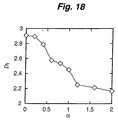
Fractal dimensions having obtained by simulation are
shown in Fig. 18 (see Literature (34)). As apparent
from Fig. 18, as α increases, Df decreases. When
α<0.5, Df>2.7 is obtained. When α>1, Df<2.3 is
obtained.
A spin system describing a ferromagnetic
structure is defined on the nebula-like fractal-based
complex structure defined in (1). A review is made
about the lattice point
rp = (i 1,p ,i 2,p ,i 3,p )∈Tn
that is the origin of Tn. In Equation 53, p=0, 1, 2,
···, n. By placing a spin on a lattice site rp∈Tn, here
is taken a spin system that can be described by the
following Hamiltonian.
 Sp is the spin at the p site. A natural model of spin-spin
interaction Jp,q is:
Sp is the spin at the p site. A natural model of spin-spin
interaction Jp,q is:
 That is, spin-spin interaction exists only between
nearest-neighbor sites. For the purpose of calculating
spontaneous magnetization M at a finite temperature T,
statistical mechanics of an equilibrium system is
introduced. A partition function Z is defined as
follows.
That is, spin-spin interaction exists only between
nearest-neighbor sites. For the purpose of calculating
spontaneous magnetization M at a finite temperature T,
statistical mechanics of an equilibrium system is
introduced. A partition function Z is defined as
follows.
 where {Sp} in the symbol of the sum pertains to the sum
regarding all spin states. Spontaneous magnetization
is defined as the statistical average of spins as
follows.
where {Sp} in the symbol of the sum pertains to the sum
regarding all spin states. Spontaneous magnetization
is defined as the statistical average of spins as
follows.
 where the expected value <Sp> is
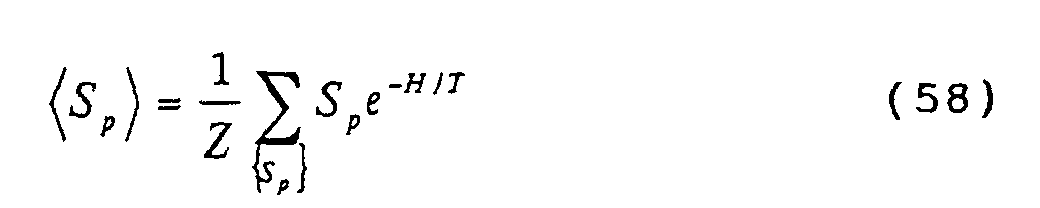 and n+1 is the total number of spins. M is generally
a vector quantity in a spin space, but its absolute
value M - |M| is calculated.
and n+1 is the total number of spins. M is generally
a vector quantity in a spin space, but its absolute
value M - |M| is calculated.
Here is made a review about an Ising model.
In an Ising model, only two states of
SP = 1 or - 1
can exist. Let a mean field approximation be
introduced into the Ising model. Spontaneous
magnetization of the p-th site is written as (µp. In
this system, since the molecule field varies with site,
let it written as µ p . As an assumption of the mean
field approximation, here is employed a molecule field
that can be written by spontaneous magnetization of the
nearest-neighbor site as
 This assumption simplifies the foregoing Hamiltonian to
 A self-consistent equation ensuring spontaneous
magnetization obtained by using a partition function by
the simplified Hamiltonian becomes µp results in
A self-consistent equation ensuring spontaneous
magnetization obtained by using a partition function by
the simplified Hamiltonian becomes µp results in
µ p = tanh(βµ p )
and by numerically solving this equation, spontaneous
magnetization of the system
 is obtained.
Fig. 19 shows spontaneous magnetization in
case of α2=0 fixed and α1 changed. Here, α1=0
corresponds to spontaneous magnetization in the same
structure as the simple fractal of α=0. As shown in
Fig. 19, as α1 increases, the phase transition
temperature of the nebula-like fractal-based complex
structure is remarkably changed.
Fig. 20 shows spontaneous magnetization in
case of α2=0.2 fixed and α1 changed. Here, α1=0.2
corresponds to spontaneous magnetization in the same
structure as the simple fractal of α=0.2. The
modulatory property is smaller as compared with Fig.
19, but still remains significantly large.
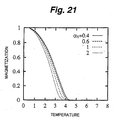
Fig. 21 shows spontaneous magnetization in
case of α2=0.4 fixed and α1 changed. Here, α1=0.4
corresponds to spontaneous magnetization in the same
structure as the simple fractal of α=0.4. As seen from
Fig. 21, the modulatory property is remarkably smaller
as compared with Figs. 19 and 20.
Fig. 22 shows spontaneous magnetization in
case of α1=2 fixed and α2 changed. Here, α2=2
corresponds to spontaneous magnetization in the same
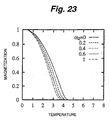
structure as the simple fractal of α=2. Fig. 23 shows
spontaneous magnetization in case of α1=1 fixed and α2
changed. Here, α2=1 corresponds to spontaneous
magnetization in the same structure as the simple
fractal of α=1. Fig. 24 shows spontaneous
magnetization in case of α1=0.6 fixed and α2 changed.
Here, α2=0.6 corresponds to spontaneous magnetization
in the same structure as the simple fractal of α=0.6.
As seen from Figs. 22, 23 and 24, the phase transition
temperatures are controlled by α2 to a certain extent.
Generalizing the above aspects of spontaneous
magnetization, when a nebula-like fractal-based complex
structure satisfies the condition of approximately
Df<2.3 in the growth process of 1≤n≤τ1, i.e. in the
initial stage of the growth, and the growth condition
of approximately Df>2.7 in the growth process of
τ1+1≤n≤τ2, i.e. in the final stage of the growth, the
ferromagnetic phase transition temperature in the
nebula-like fractal-based complex structure will be,
controlled well.
A method of forming the nebula-like fractal-based
complex structure according to the fifth
embodiment is the same as the method of forming the
nebula-like fractal-based complex structure according
to the first embodiment. As growth conditions,
however, fixing τ1=5000 and τ2=10000 and using various
combinations of (α1, α2) satisfying α1>α2, particularly
using 0, 0.2, 0.4, 0.6, 1 and 2 as α1 and α2, numerical
experiment of growth was carried out.
In the same process as demonstrated by
Equations (20) through (35) of the second embodiment, a
quantum system of one particle is defined on the
nebula-like fractal-based complex structure defined in
(1).
Since the nebula-like fractal-based complex
structure analyzed here is one obtained by growth
experiment of n=10000, this quantum system includes
n+1=10001 eigenstates. Based on energy eigenvalues
concerning 1501 states from the 510-th to 2001-th
eigenstates from the ground state, among those
eigenstates, the following quantum level statistics was
calculated. Figs. 25 and 26 show quantum level
statistics in a nebula-like fractal-based complex
structure under (α1, α2)=(x, 2) where x=0, 0.2, 0.4,
0.6, 1 and 2. Fig. 25 shows P(s) and Fig. 26 shows Δ3
statistics. In case of α1=0, the structure is the same
as the simple fractal of α=0, and the fractal dimension
is near 3(Df ~2.91). Therefore, the system behaves as
a quantum chaotic system. In this case, the quantum
level statistics is that of GOE distribution. As α1
increases, the quantum level statistics changes away
from that of GOE distribution and approaches that of
Poisson distribution. However, even after reading
α1=2, a large difference from Poisson distribution
still remains.
Fig. 27 shows Δ3 statistics in a nebula-like
fractal-based complex structure under (α1, α2)=(x, 0.2)
where x=0.2, 0.4, 0.6, 1 and 2. In case of α1=0.2, the
structure is the same as the simple fractal of α=0.2,
and behaves as a quantum chaotic system. As α1
increases, the quantum level statistics changes away
from that of GOE distribution and approaches that of
Poisson distribution. Figs. 28 shows Δ3 statistics in
a nebula-like fractal-based complex structure under
(α1, α2)=(x, 0.4) where x=0.4, 0.6, 1 and 2. In case
of α1=0.4, the structure is the same as the simple
fractal of α=0.4, and it is already apart from that of
GOE distribution too much to be a quantum chaotic
system. Here again, as α1 increases, the quantum level
statistics changes away from that of GOE distribution
and approaches that of Poisson distribution.
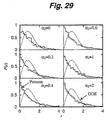
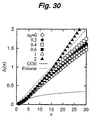
Figs. 29 and 30 show quantum level statistics
in a nebula-like fractal-based complex structure under
(α1, α2)=(2, x) where x=0, 0.2, 0.4, 0.6, 1 and 2.
Fig. 29 shows P(s) and Fig. 30 shows Δ3 statistics. In
case of α2=0, it is the same as α1=2 of Figs. 25 and
26. In case of α2=2, the structure is the same as the
simple fractal of α=2, and the fractal dimension is
near 2(Df ~2.16). Therefore, the system behaves as an
integrable system. As α2 decreases, the quantum level
statistics changes away from that of Poisson
distribution and approaches GOE distribution.
Fig. 31 shows Δ3 statistics in a nebula-like
fractal-based complex structure under (α1, α2)=(1, x)
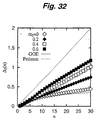
where x=0, 0.2, 0.4, 0.6 and 1. Fig. 32 shows Δ3
statistics in a nebula-like fractal-based complex
structure under (α1, α2)=(0.6, x) where x=0, 0.2, 0.4
and 0.6. As α2 decreases, the quantum level statistics
changes away from that of Poisson distribution and
approaches that of GOE distribution.
For quantitative evaluation of the above-reviewed
controllability, the Berry-Robnik parameter ρ
is used ((38) M.V. Berry and M. Robnik, J. Phys. A
(Math. Gen.) 17, 2413(1984)). First, when ρ = 1 - ρ,
P2 (s,p ) = p2 e-ps erf π p s 2 - 2p p + π p 3 s 2 )e -ps -π p 2 s 2 /4
is introduced, where
 was used. This function P2(s, ρ) coincides with P(s)
of Poisson distribution under ρ=1, and coincides with
P(s) of GOE distribution under ρ=0. That is, by
changing ρ from 0 to 1, quantum level statistics from
those of quantum chaotic systems to those of integrable
systems can be interpolated. The Berry-Robnik
parameter is the value of ρ obtained by optimum
approximation of P(s) obtained y numerical calculation
with P2(s, ρ) shown above. Within the range of
semiclassical approximation, ρ is the ratio in volume
of regular regions (integrable systems and regions
capable of perturbing development therefrom) in a phase
space.
was used. This function P2(s, ρ) coincides with P(s)
of Poisson distribution under ρ=1, and coincides with
P(s) of GOE distribution under ρ=0. That is, by
changing ρ from 0 to 1, quantum level statistics from
those of quantum chaotic systems to those of integrable
systems can be interpolated. The Berry-Robnik
parameter is the value of ρ obtained by optimum
approximation of P(s) obtained y numerical calculation
with P2(s, ρ) shown above. Within the range of
semiclassical approximation, ρ is the ratio in volume
of regular regions (integrable systems and regions
capable of perturbing development therefrom) in a phase
space.
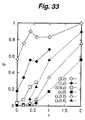
Fig. 33 shows the Berry-Robnik parameter ρ in
nebula-like fractal-based complex structures. (α1,
α2)=(x, 0) is the Berry-Robnik parameter in the case
where α1 is placed on the abscissa while fixing α2=2.
It is apparent from Fig. 33 that widely various quantum
systems from quantum chaotic systems to integrable
systems can be realized by setting (α1, α2) to
predetermined values.
A method of forming the nebula-like fractal-based
complex structure according to the sixth
embodiment is the same as the method of forming the
nebula-like fractal-based complex structure according
to the first embodiment. As growth conditions,
however, fixing τ1=5000 and τ2=10000 and using various
combinations of (α1, α2) satisfying α1>α2, particularly
using 0, 0.2, 0.4, 0.6, 1 and 2 as α1 and α2, numerical
experiment of growth was carried out.
An electron system is defined on the nebula-like
fractal-based complex structure defined in (1). A
review is made about the lattice point
rp = (i 1, p ,i 2, p ,i 3, p )∈Tn
that is the origin of Tn. In Equation (66), p=0, 1, 2,
···, n. An operator c and † / p,σ for generating an electron of a
spin σ is defined at the lattice point rp∈Tn . Of
course, there is the anticommutative relation
 Here is defined a single-band Hubbard Hamiltonian H and of
the electron system as follows.
Here is defined a single-band Hubbard Hamiltonian H and of
the electron system as follows.

Assuming that electrons are movable only
among nearest-neighbor sites, the following is employed
as λp,q.
 Additionally, the spin σ electron density operator of
the j-th site, n and j,σ = c and † / j,σ c and j,σ , and their sum,
Additionally, the spin σ electron density operator of
the j-th site, n and j,σ = c and † / j,σ c and j,σ , and their sum,
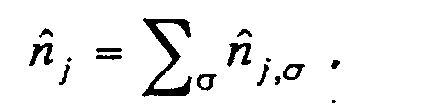 are defined.
For the purpose of defining a temperature
Green's function, here is introduced a grand canonical
Hamiltonian K and = H and - µN and where
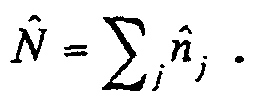 In the half-filled
taken here, chemical potential is µ=U/2. The
half-filled grand canonical Hamiltonian can be
expressed as
In the half-filled
taken here, chemical potential is µ=U/2. The
half-filled grand canonical Hamiltonian can be
expressed as
 Operators t andj,i, σ , j andj,i, σ , ûi and d andi, σ are defined beforehand
as
Operators t andj,i, σ , j andj,i, σ , ûi and d andi, σ are defined beforehand
as
t j,i, σ = c † j ,σ c i ,σ + c † i ,σ c j ,σ
j j,i, σ = c † j ,σ c i ,σ - c † i ,σ c j ,σ
ûi = c † i ,↑ c i, ↑ c † i ,↓ c i ,↓ + c i ,↑ c † i ,↑ c i ,↓ c † i ,↓
d i,σ = c † i ,σ c i ,σ - c i ,σ c † i ,σ
If the temperature Green function is defined for
operators  and B and given, taking τ as imaginary time,
it is as follows.
 The on-site Green function
 is especially important.
Imaginary time development of the system is
obtained by the Heisenberg equation
 As the equation of motion of the on-site Green
function,
As the equation of motion of the on-site Green
function,
 is obtained. Then, the approximation shown below is
introduced, following Gros ((35) C. Gros, Phys. Rev.
B50, 7295(1994)). If the site p is the nearest-neighbor
site of the site j, the resolution
is obtained. Then, the approximation shown below is
introduced, following Gros ((35) C. Gros, Phys. Rev.
B50, 7295(1994)). If the site p is the nearest-neighbor
site of the site j, the resolution
 is introduced as the approximation. This is said to be
exact in case of infinite-dimensional Bethe lattices,
but in this case, it is only within approximation.
Under the approximation, the following equation is
obtained.
is introduced as the approximation. This is said to be
exact in case of infinite-dimensional Bethe lattices,
but in this case, it is only within approximation.
Under the approximation, the following equation is
obtained.
 where
where
 was introduced. To solve the equation, obtained,
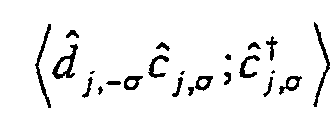 has to be analyzed. In case of half-filled
models, this equation of motion is
has to be analyzed. In case of half-filled
models, this equation of motion is
 Here again, with reference to the Gros theory,
approximation is introduced. It is the following
translation.
Here again, with reference to the Gros theory,
approximation is introduced. It is the following
translation.

 By executing this translation, the following closed
equation is obtained.
By executing this translation, the following closed
equation is obtained.
 Here is assumed that there is no dependency on spin.
That is, assuming
Here is assumed that there is no dependency on spin.
That is, assuming
Gj, ↑ = Gj, ↓
the following calculation is executed. This is
because, when analytic continuation is conducted as
iωn→ω+i δ for small δ,
Dj (ω) = - ImGj (ω + i δ)
becomes the local density of states of the site j, and
 becomes the density of states of the system. For later
numerical calculation of densities of states, δ=0.0001
will be used.
becomes the density of states of the system. For later
numerical calculation of densities of states, δ=0.0001
will be used.
Regarding the nebula-like fractal-based
complex structure obtained in (1), fixing t=1, τ1=5000
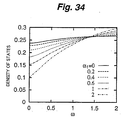
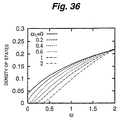
and τ2=10000, densities of states are calculated. Figs.
34, 35 and 36 show densities of states of half-filled
electron systems (10001 electrons) in the nebula-like
fractal-based complex structure under (α1, α2)=(x, 0)
where x=0, 0.2, 0.4, 0.6, 1 and 2. U=6 is used in Fig.
34, U=7 in Fig. 35, and U=8 in Fig. 36. In case of
α1=0, the structure is the same as the simple fractal
of α=0, and the fractal dimension is near 3(Df ~2.91).
In Fig. 34, for all values of α1, densities of states
D(0) under ω=0 are finite, and the electron system is
in a metal phase. As α1 increases, D(0) gradually
decreases, and the electron system approaches an
insulator. In Fig. 35, when α1<1, the state of density
D(0) under ω=0 is finite, and the electron system is
in a metal phase. However, when α1=2, D(0) disappears
substantially, and Mott insulator transformation
occurs. In Fig. 36, as α1 increases, disappearance of
D(0) occurs, that is, typical Mott transition occurs.
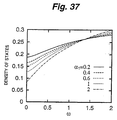
Figs. 37, 38 and 39 show densities of states
of half-filled electron systems (10001 electrons) in
the nebula-like fractal-based complex structure under
(α1, α2)=(x, 0.2) where x=0.2, 0.4, 0.6, 1 and 2. U=6
is used in Fig. 37, U=7 in Fig. 38, and U=8 in Fig. 39.
In case of α1=0.2, the structure is the same as the
simple fractal of α=0.2. In Fig. 37, for all values of
α1, densities of states D(0) under ω=0 are finite, and
the electron system is in a metal phase. As α1
increases, D(0) gradually decreases, and the electron
system approaches an insulator. In Fig. 38, when α1<1,
the state of density D(0) under ω=0 is finite, and the
electron system is in a metal phase. However, when
α1=2, D(0) disappears substantially, and Mott insulator
transformation occurs. In Fig. 39, it is recognized
the system behaves as a Mott insulator under all values
of α1, but its insulation performance, i.e. electron-to-electron
correlative effect, is enhanced as α1
increases. This is because width of the effective
Hubbard gap increases along with the increase of α1.
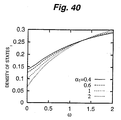
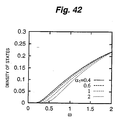
Figs. 40, 41 and 42 show densities of states
of half-filled electron systems (10001 electrons) in
the nebula-like fractal-based complex structure under
(α1, α2)=(x, 0.4) where x=0.4, 0.6, 1 and 2. U=6 is
used in Fig. 40, U=7 in Fig. 41, and U=8 in Fig. 42.
In case of α1=0.4, the structure is the same as the
simple fractal of α=0.4. In Fig. 40, for all values of
α1, densities of states D(0) under ω=0 are finite, and
the electron system is in a metal phase. As α1
increases, D(0) gradually decreases, and the electron
system approaches an insulator. In Fig. 41, as α1
increases, disappearance of D(0) occurs, that. is,
typical Mott transition occurs. In Fig. 42, for all
values of α1, the systems behave as Mott insulators,
but it is recognized that the insulation performance,
i.e. electron-to-electron correlative effect, increases
along with the increase of α1. This is because the
width of the effective Hubbard gap becomes larger as α1
increases.
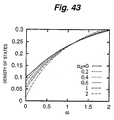
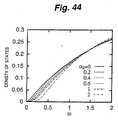
Figs. 43, 44 and 45 show densities of states
of half-filled electron systems (10001 electrons) in
the nebula-like fractal-based complex structure under
(α1, α2)=(2, x) where x=0, 0.2, 0.4, 0.6, 1 and 2. U=6
is used in Fig. 43, U=7 in Fig. 44, and U=8 in Fig. 45.
In case of α2=2, the structure is the same as the
simple fractal of α=2, and the fractal dimension is
near 2(Df -2.16). In Fig. 43, for all values of α2,
densities of states D(0) under ω=0 are finite, and the
electron system is in a metal phase. As α2 increases,
D(0) gradually decreases, and the electron system
approaches an insulator. In Figs. 44 and 45, for all
values of α2, the systems behave as Mott insulators,
but it is recognized that the insulation performance,
i.e. electron-to-electron correlative effect, increases
along with the increase of α2. This is because the
width of the effective Hubbard gap becomes larger as α2
increases.
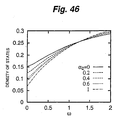
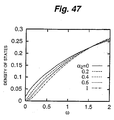
Figs. 46, 47 and 48 show densities of states
of half-filled electron systems (10001 electrons) in
the nebula-like fractal-based complex structure under
(α1, α2)=(1, x) where x=0, 0.2, 0.4, 0.6 and 1. U=6 is
used in Fig. 46, U=7 in Fig. 47, and U=8 in Fig. 48.
In case of α2=1, the structure is the same as the
simple fractal of α=1. In Fig. 46, for all values of
α2, densities of states D(0) under ω=0 are finite, and
the electron system is in a metal phase. In Fig. 47,
as α2 increases, disappearance of D(0) occurs, that is,
typical Mott transition occurs. In Fig. 48, for all
values of α2, the systems behave as Mott insulators,
but it is recognized that the insulation performance,
i.e. electron-to-electron correlative effect, is
enhanced as for all values of α2 . This is because the
width of the effective Hubbard gap becomes larger as α2
increases.
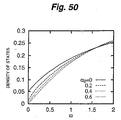
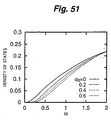
Figs. 49, 50 and 51 show densities of states
of half-filled electron systems (10001 electrons) in
the nebula-like fractal-based complex structure under
(α1, α2)=(0.6, x) where x=0, 0.2, 0.4 and 0.6. U=6 is
used in Fig. 49, U=7 in Fig. 50, and U=8 in Fig. 51.
In case of α2=0.6, the structure is the same as the
simple fractal of α=0.6. In Figs. 49 and 50, for all
values of α2, densities of states D(0) under ω=0 are
finite, and the electron system is in a metal phase.
As α2 increases, D(0) gradually decreases, and the
system approaches an insulator. In Fig. 51, for all
values of α2, the systems behave as Mott insulators,
but it is recognized that the insulation performance,
i.e. electron-to-electron correlative effect, is
enhanced as α2 increases. This is because the width of
the effective Hubbard gap becomes larger as α2
increases.
Through the above analysis, it has been
confirmed that various forms of correlative electron
systems ranging from the metal phase to the insulator
phase can be realized by changing (α1, α2). Especially
when the condition of approximately Df<2.3 as the
fractal dimension in the initial stage of growth and
the condition of approximately Df>2.7 as the fractal
dimension of the final stage of growth are satisfied,
remarkably excellent controllability can be obtained.
Heretofore, the invention has been explained
by way of some embodiments. The invention, however, is
not limited to these embodiments but involves various
changes or modifications within the technical concept
and scope of the invention.
As described above, according to the
invention, by changing growth conditions with time
during growth of a fractal structure to first grow it
under growth conditions providing a low fractal
dimension and thereafter grow it under different growth
conditions providing a higher fractal dimension, it is
possible to obtain a nebula-like fractal-based complex
structure made up of a mixture of a plurality of
regions different in fractal dimension from each other
and to modulate and control the dimensionality of a
material by a design method beyond those heretofore
used to obtain conventional simple fractal properties.
Moreover, the nature of various phase transitions
occurring in these fractal structures can be
controlled, for example, by adjusting the timing for
changing the growth conditions. Furthermore,
controllability can be improved by optimization of
fractal dimensions.
Claims (19)
- A fractal structure having a plurality of regions different in fractal dimension characterizing the self-similarity, comprising:said fractal structure being grown from one or more origins under growth conditions providing a first fractal dimension in a portion of the growth process from the start point of time of growth to a first point and under growth conditions providing a second fractal dimension in another portion of the growth process from said first point of time to a second point of time.
- A fractal structure according to claim 1 wherein said fractal structure is controlled in nature of phase transition occurring therein by adjustment of the timing for changing said growth conditions.
- A fractal structure according to claim 1 wherein said fractal structure is controlled in critical temperature for ferromagnetic phase transition occurring therein by adjustment of the timing for changing said growth conditions.
- A fractal structure according to claim 1 wherein said fractal structure is controlled in nature of a chaos appearing therein by adjustment of the timing for changing said growth conditions.
- A fractal structure according to claim 1 wherein said fractal structure is controlled in nature of a quantum chaos in an electron state appearing therein by adjustment of the timing for changing said growth conditions.
- A fractal structure according to claim 5 wherein said quantum chaos in the electron state is controlled by addition of a magnetic impurity.
- A fractal structure according to claim 1 wherein said regions are nebula-like as a whole.
- A fractal structure according to claim 1 wherein Df1>2.7 and Df2<2.3 are satisfied where Df1 is said first fractal dimension and Df2 is said second fractal dimension.
- A fractal structure according to claim 1 wherein 2.7<Df1≤3 and 1≤Df2<2.3 are satisfied where Df1 is said first fractal dimension and Df2 is said second fractal dimension.
- A fractal structure according to claim 1 wherein 2.9≤Df1≤3 and 1≤Df2<2.3 are satisfied where Df1 is said first fractal dimension and Df2 is said second fractal dimension.
- A fractal structure forming method for forming a fractal structure having a plurality of regions different in fractal dimension characterizing the self-similarity, comprising:growing said fractal structure from one or more origins under growth conditions providing a first fractal dimension in a portion of the growth process from the start point of time of growth to a first point and under growth conditions providing a second fractal dimension in another portion of the growth process from said first point of time to a second point of time.
- A fractal structure forming method according to claim 11 wherein the timing for changing said growth conditions is adjusted to control phase transition occurring in said fractal structure.
- A fractal structure forming method according to claim 11 wherein the timing for changing said growth conditions is adjusted to control critical temperature for ferromagnetic phase transition occurring in said fractal structure.
- A fractal structure forming method according to claim 11 wherein the timing for changing said growth conditions is adjusted to control the nature of a chaos appearing in said fractal structure.
- A fractal structure forming method according to claim 11 wherein the timing for changing said growth conditions is adjusted to control a quantum chaos in an electron state appearing in said fractal structure.
- A fractal structure forming method according to claim 15 wherein a magnetic impurity is added to control said quantum chaos in the electron state.
- A fractal structure forming method according to claim 11 wherein Df1>2.7 and Df2<2.3 are satisfied where Df1 is said first fractal dimension and Df2 is said second fractal dimension.
- A fractal structure forming method according to claim 11 wherein 2.7<Df1≤3 and 1≤Df2<2.3 are satisfied where Df1 is said first fractal dimension and Df2 is said second fractal dimension.
- A fractal structure forming method according to claim 11 wherein 2.9≤Df1≤3 and 1≤Df2<2.3 are satisfied where Df1 is said first fractal dimension and Df2 is said second fractal dimension.
Applications Claiming Priority (5)
| Application Number | Priority Date | Filing Date | Title |
|---|---|---|---|
| JP2000255236 | 2000-08-25 | ||
| JP2000255236 | 2000-08-25 | ||
| JP2000333395 | 2000-10-31 | ||
| JP2000333395 | 2000-10-31 | ||
| PCT/JP2001/007248 WO2002017410A1 (en) | 2000-08-25 | 2001-08-24 | Fractal structure and method of forming it |
Publications (2)
| Publication Number | Publication Date |
|---|---|
| EP1317004A1 true EP1317004A1 (en) | 2003-06-04 |
| EP1317004A4 EP1317004A4 (en) | 2007-05-30 |
Family
ID=26598451
Family Applications (1)
| Application Number | Title | Priority Date | Filing Date |
|---|---|---|---|
| EP01958457A Withdrawn EP1317004A4 (en) | 2000-08-25 | 2001-08-24 | FRACTAL STRUCTURE AND METHOD OF FORMING THE STRUCTURE |
Country Status (6)
| Country | Link |
|---|---|
| US (1) | US7135071B2 (en) |
| EP (1) | EP1317004A4 (en) |
| KR (1) | KR20020048976A (en) |
| CN (1) | CN1227754C (en) |
| AU (1) | AU2001280141A1 (en) |
| WO (1) | WO2002017410A1 (en) |
Cited By (1)
| Publication number | Priority date | Publication date | Assignee | Title |
|---|---|---|---|---|
| EP1415952A4 (en) * | 2001-08-09 | 2006-11-29 | Sony Corp | FRACTAL STRUCTURE AND PRODUCTION METHOD THEREFOR, FUNCTIONAL MATERIAL AND METHOD FOR PRODUCING THE SAME, AND FUNCTIONAL DEVICE AND PRODUCTION METHOD THEREOF |
Families Citing this family (2)
| Publication number | Priority date | Publication date | Assignee | Title |
|---|---|---|---|---|
| US6727863B2 (en) * | 2001-10-26 | 2004-04-27 | The Hong Kong University Of Science And Technology | Planar band gap materials |
| CN100508713C (en) * | 2003-09-08 | 2009-07-01 | 财团法人大阪产业振兴机构 | Fractal structure, fractal structure aggregate, and production method and use thereof |
Family Cites Families (3)
| Publication number | Priority date | Publication date | Assignee | Title |
|---|---|---|---|---|
| FR2584518B1 (en) * | 1985-07-05 | 1990-06-22 | Comp Generale Electricite | MACROMOLECULAR STRUCTURES AND METHOD FOR MANUFACTURING SUCH STRUCTURES |
| JPH11195801A (en) | 1998-01-06 | 1999-07-21 | Canon Inc | Photovoltaic element |
| JP4221845B2 (en) | 1999-10-20 | 2009-02-12 | ソニー株式会社 | Method for controlling phase transition of ferromagnetic fractal combination, method for controlling phase transition of fractal combination, fractal combination, ferromagnetic fractal combination, information processing method, information storage method, information storage medium, information processing apparatus and information storage apparatus |
-
2001
- 2001-08-24 EP EP01958457A patent/EP1317004A4/en not_active Withdrawn
- 2001-08-24 KR KR1020027005195A patent/KR20020048976A/en not_active Ceased
- 2001-08-24 WO PCT/JP2001/007248 patent/WO2002017410A1/en not_active Ceased
- 2001-08-24 AU AU2001280141A patent/AU2001280141A1/en not_active Abandoned
- 2001-08-24 US US10/089,857 patent/US7135071B2/en not_active Expired - Fee Related
- 2001-08-24 CN CNB018025544A patent/CN1227754C/en not_active Expired - Fee Related
Cited By (1)
| Publication number | Priority date | Publication date | Assignee | Title |
|---|---|---|---|---|
| EP1415952A4 (en) * | 2001-08-09 | 2006-11-29 | Sony Corp | FRACTAL STRUCTURE AND PRODUCTION METHOD THEREFOR, FUNCTIONAL MATERIAL AND METHOD FOR PRODUCING THE SAME, AND FUNCTIONAL DEVICE AND PRODUCTION METHOD THEREOF |
Also Published As
| Publication number | Publication date |
|---|---|
| EP1317004A4 (en) | 2007-05-30 |
| US20020195598A1 (en) | 2002-12-26 |
| CN1388991A (en) | 2003-01-01 |
| AU2001280141A1 (en) | 2002-03-04 |
| CN1227754C (en) | 2005-11-16 |
| WO2002017410A1 (en) | 2002-02-28 |
| US7135071B2 (en) | 2006-11-14 |
| KR20020048976A (en) | 2002-06-24 |
Similar Documents
| Publication | Publication Date | Title |
|---|---|---|
| Stormer et al. | The fractional quantum Hall effect | |
| Vollhardt et al. | Non-perturbative approaches to magnetism in strongly correlated electron systems | |
| Ryu et al. | Effect of size nonuniformities on the band gap of two-dimensional photonic crystals | |
| Spencer et al. | Effect of electron-phonon interaction range on lattice polaron dynamics: A continuous-time quantum Monte Carlo study | |
| Dimitrova et al. | Many-body spin rotation by adiabatic passage in spin-1/2 XXZ chains of ultracold atoms | |
| EP1317004A1 (en) | Fractal structure and method of forming it | |
| Hankevych et al. | Weak ferromagnetism and other instabilities of the two-dimensional t− t′ Hubbard model at van Hove fillings | |
| Boyacioglu et al. | Two-electron singlet states in semiconductor quantum dots with Gaussian confinement: a single-parameter variational calculation | |
| EP1223626A1 (en) | Fractal structure and its forming method | |
| Ugajin | Electric-field-induced Mott metal-insulator transition | |
| Heitmann | Far infrared spectroscopy of quantum-dots and antidot arrays | |
| EP1415952A1 (en) | FRACTAL STRUCTURE AND ITS PRODUCING METHOD&comma; FUNCTIONAL MATERIAL AND ITS PRODUCING METHOD&comma; AND FUNCTIONAL DEVICE AND ITS PRODUCING METHOD | |
| Kürten et al. | Fractal structures in systems made of small magnetic particles | |
| Zhu et al. | Spin oscillation and its reduction in a quantum dot | |
| US7061007B1 (en) | Ferromagnetic fractal combination structure | |
| US6759676B2 (en) | Multiply-complexed one-dimensional structure, multiply-twisted helix, multiply-looped ring structure and functional material | |
| Farkašovský et al. | Ferromagnetism in the two-dimensional Hubbard model with long-range hopping | |
| Blaschke et al. | Classical orbit bifurcation and quantum interference in mesoscopic magnetoconductance | |
| JPWO2002017410A1 (en) | Fractal structure and method for forming same | |
| JPWO2001091201A1 (en) | Fractal structure and method for forming same | |
| Arapan et al. | Conductance of a disordered double quantum wire in a magnetic field: Boundary roughness scattering | |
| Dahan | Deeply bound donor states of interstitial Mn impurity in a GaAs quantum well | |
| US20030134750A1 (en) | Multiplex winding helical structure and fuctional material | |
| Tsukanov et al. | A photon source based on the quantum well/dot structure in a microcavity | |
| JPWO2001073851A1 (en) | Multi-composite one-dimensional structures and functional materials |
Legal Events
| Date | Code | Title | Description |
|---|---|---|---|
| PUAI | Public reference made under article 153(3) epc to a published international application that has entered the european phase |
Free format text: ORIGINAL CODE: 0009012 |
|
| 17P | Request for examination filed |
Effective date: 20020731 |
|
| AK | Designated contracting states |
Designated state(s): AT BE CH CY DE DK ES FI FR GB GR IE IT LI LU MC NL PT SE TR |
|
| AX | Request for extension of the european patent |
Extension state: AL LT LV MK RO SI |
|
| RBV | Designated contracting states (corrected) |
Designated state(s): AT BE CH DE FR GB LI |
|
| A4 | Supplementary search report drawn up and despatched |
Effective date: 20070426 |
|
| STAA | Information on the status of an ep patent application or granted ep patent |
Free format text: STATUS: THE APPLICATION HAS BEEN WITHDRAWN |
|
| 18W | Application withdrawn |
Effective date: 20070601 |