EP1316680A2 - Method for generating energy by using exothermic reaction of metal - Google Patents
Method for generating energy by using exothermic reaction of metal Download PDFInfo
- Publication number
- EP1316680A2 EP1316680A2 EP02292980A EP02292980A EP1316680A2 EP 1316680 A2 EP1316680 A2 EP 1316680A2 EP 02292980 A EP02292980 A EP 02292980A EP 02292980 A EP02292980 A EP 02292980A EP 1316680 A2 EP1316680 A2 EP 1316680A2
- Authority
- EP
- European Patent Office
- Prior art keywords
- metal
- oxidant
- reaction
- hydrogen
- water
- Prior art date
- Legal status (The legal status is an assumption and is not a legal conclusion. Google has not performed a legal analysis and makes no representation as to the accuracy of the status listed.)
- Withdrawn
Links
Images

Classifications
-
- C—CHEMISTRY; METALLURGY
- C10—PETROLEUM, GAS OR COKE INDUSTRIES; TECHNICAL GASES CONTAINING CARBON MONOXIDE; FUELS; LUBRICANTS; PEAT
- C10L—FUELS NOT OTHERWISE PROVIDED FOR; NATURAL GAS; SYNTHETIC NATURAL GAS OBTAINED BY PROCESSES NOT COVERED BY SUBCLASSES C10G OR C10K; LIQUIFIED PETROLEUM GAS; USE OF ADDITIVES TO FUELS OR FIRES; FIRE-LIGHTERS
- C10L3/00—Gaseous fuels; Natural gas; Synthetic natural gas obtained by processes not covered by subclass C10G, C10K; Liquefied petroleum gas
-
- F—MECHANICAL ENGINEERING; LIGHTING; HEATING; WEAPONS; BLASTING
- F02—COMBUSTION ENGINES; HOT-GAS OR COMBUSTION-PRODUCT ENGINE PLANTS
- F02K—JET-PROPULSION PLANTS
- F02K9/00—Rocket-engine plants, i.e. plants carrying both fuel and oxidant therefor; Control thereof
- F02K9/42—Rocket-engine plants, i.e. plants carrying both fuel and oxidant therefor; Control thereof using liquid or gaseous propellants
- F02K9/425—Propellants
Definitions
- the present invention relates to a method for generating energy by using an exothermic reaction of metal, which improves a principle of the metal fuel propulsive body according to claim 2 in U. S. Pat. No. 6,237,340B1, "Method for reusing a substance's thermal expansion energy" issued to the present inventor.
- the present invention pertains to a method for generating energy by using an exothermic reaction of metal, comprising the steps of reacting oxidants containing mostly water with combustion substances containing mostly light metal to generate hydrogen; reacting generated hydrogen with nitric acid, sulfuric acid, chlorine peroxide, metal nitrate, metal perchlorate, metal sulfate, and hydrogen peroxide to generate water and heat; continuously repeating the above two steps with the use of generated water to gradually increase explosive power, and to a method for utilizing generated energy (explosive power).
- an exothermal reaction can be used as propulsive energy in a rocket.
- the propulsive energy in a rocket is obtained by an explosion, which is generated by reacting source substances of explosive energy such as liquid oxygen, hydrogen peroxide, liquid hydrogen, ammonia, gas for combustion, oil fuel, explosives, gun powders with nonmetal substances and organic substances.
- the prior technology as described above has disadvantages in that the source substances of explosive energy are expensive and have a large volume and a heavy weight.
- the method provides energy using light and inexpensive substances.
- Figure 1 is a pictorial view of material mixture instrument.
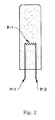
- Figure 2 is a pictorial view of high-energy generated instrument by using shock heat.
- 460 kg of dissolved sodium (Na) was placed into a combustion material tank T-1, which was then maintained at 150 °C. Under a closed state of a locking valve V-1, the tank was pressurized to the required pressure of 30 kgf/cm 2 or higher using inert gas (argon, nitrogen, etc.) through the pressurization port A-1.
- inert gas argon, nitrogen, etc.
- 340 kg of sodium nitrate (NaNO 3 ) was dissolved in 180 kg or higher, actually 280 kg of water (H 2 O) and added to an oxidant material tank T-2, after which a locking valve V-2 was closed and the tank was pressurized to 30 kgf/cm 2 or higher, the required pressure, using air through the pressurization port A-2.
- 460 kg of dissolved sodium (Na) was added to a combustion material tank T-1, which was then maintained at 150 °C. Under a closed state of a locking valve V-1, the tank was pressurized to the necessary pressure of 30 kgf/cm 2 or higher using inert gas (argon, nitrogen, etc.) through the pressurization port A-1. Separately, 252 kg of nitric acid (HNO 3 ) was dissolved in 162 kg or higher, actually 262 kg of water (H 2 O) and charged into an oxidant material tank T-2. A locking valve V-2 was closed before the tank was pressurized to 30 kgf/cm 2 or higher, the required pressure, using air through the pressurization port A-2.
- inert gas argon, nitrogen, etc.
- the reactions are oxidants, reactive metal and nonmetal combustion materials
- 522 kg of dissolved sodium (Na) was added to a combustion material tank T-1, which was then maintained at 150 °C.
- the tank Under a closed state of a locking valve V-1, the tank was pressurized to the required pressure of 30 kgf/cm 2 or higher using inert gas (argon, nitrogen, etc.).
- 606 kg of perchloric acid (HClO 4 ) was dissolved in 216 kg or higher, actually 316 kg of water (H 2 O) and added to an oxidant material tank T-2. Thereafter, a locking valve V-2 was closed and the tank was pressurized to 30 kgf/cm 2 or more, the required pressure, using air.
- nonmetal combustion material 424 kg of ammonia was filled into a material tank, and a locking valve was closed before the tank was pressurized to the required pressure or higher.
- the materials in the tanks were sprayed to a reaction chamber through each tank nozzle, on the basis of a predetermined spray ratio.
- temperature and pressure in the reaction chamber were increased upon addition of an oxidant material, an active metal as a combustion material and a nonmetal combustion material, 698 kg of gas was explosively produced at a high temperature.
- oxidant materials use was made of nitric acid (HNO 3 ), sodium nitrate (NaNO 3 ), aluminum nitrate (Al(NO 3 ) 3 ) and so on.
- Powders of a metal were mixed with powders of a metal salt, without use of water, and subjected to shock heat to generate chain-reactions. As such, little gas was generated and gaseous expansion reaction of the metal and the metal salt occurred.
- 170 g of sodium nitrate (NaNO 3 ) powder and 145 g of magnesium (Mg) powder were thoroughly mixed and added to a preparative container, after which the container was sealed.
- spark was generated by an internal resistance wire R-1. Through exothermic chain reactions initiated by such spark, the metal salt was gasified, producing high energy under high pressure.
- Example 7 is characterized in that a bond reaction is continuously conducted by adding a shock heat to reactions 7a to 7e to generate high temperature energy.
- the high temperature energy expands a small amount of a certain gas and gasifies the metal salt, thereby causing significant expansion of products, but having excellent expansion effect only in the small sealant space because the expansion limitation is low. Therefore, these reactions can be used to crush a rock bed without a large explosion noise or scattering of debris, and are less harmful to the environment and humans over conventional methods.
- NaNO 3 sodium nitrate
- KNO 3 potassium nitrate
- LiNO 3 lithium nitrate
- Ca(NO 3 ) 2 calcium nitrate
- Mg(NO 3 ) 2 magnesium nitrate
- Al(NO 3 ) 3 aluminum nitrate
- Ba(NO 3 ) 2 barium nitrate
- Fe(NO 3 ) 3 iron nitrate
- Mn(NO 3 ) 2 manganese nitrate
- Cu(NO 3 ) 2 copper nitrate
- Potassium oxide K 2 O
- sodium oxide Na 2 O
- lithium oxide Li 2 O
- calcium oxide CaO
- copper oxide CuO
- magnesium oxide MgO
- strontium oxide SrO
- barium oxide BaO
- iron oxide Fe 2 O 3
- manganese oxide MnO 2
- zinc oxide ZnO
- Potassium sulfate K 2 SO 4
- sodium sulfate Na 2 SO 4
- lithium sulfate Li 2 SO 4
- strontium sulfate SrSO 4
- calcium sulfate CaSO 4
- magnesium sulfate MgSO 4
- barium sulfate BaSO 4
- iron sulfate Fe 2 (SO 4 ) 3
- manganese sulfate MnSO 4
- copper sulfate CuSO 4
- aluminum sulfate Al 2 (SO 4 ) 3
- zinc sulfate ZnSO 4
- H 2 O Water (H 2 O), hydrogen peroxide (H 2 O 2 ), nitric acid (HNO 3 ), perchloric acid (HClO 4 ), sulfuric acid (H 2 SO 4 ), and the like.
- a lump type or a powder type of a reactive metal such as potassium (K), lithium (Li), sodium (Na), magnesium (Mg), titanium (Ti), calcium (Ca), aluminum (Al), and chrome (Cr).
- Combustible nonmetal such as hydrogen (H 2 ), ammonia (NH 3 ), oil for combustion, toluene, benzene, petroleum, hydrocarbons.
- oxidants such as water, hydrogen peroxide, nitric acid, perchloric acid, sulfuric acid, metal nitrate, metal sulfate, and metal perchlorate are directly reacted with reactive metals as combustion substances.
- These bond reactions comprise an A type reaction in which gas expansion pressure is raised stepwise and a B type reaction in which the bond reaction is integrally carried out, and provides energy, for example a propulsive force of a rocket, by use of expansion pressure of the substances and water upon supplying heat energy to the substances and water.
- the oxidant such as water, hydrogen peroxide, nitric acid, sulfuric acid, metal nitrate, metal perchlorate, and metal sulfate is reacted with the reactive metal and combustible nonmetal to generate an explosion energy.
- the present invention provides a method for increasing energy by repeating a bond reaction of oxidants such as water, hydrogen peroxide, liquid acid, metal salt with light metal such as combustion substances.
- oxidants such as water, hydrogen peroxide, liquid acid, metal salt with light metal such as combustion substances.
- the method has economic advantages in that inexpensive substances such as light metal and oil are used as the combustion substance.
- equation 7 the method can be used to crush a structure or a rock bed without a large explosion noise or the scattering of debris.
Landscapes
- Engineering & Computer Science (AREA)
- Chemical & Material Sciences (AREA)
- Combustion & Propulsion (AREA)
- Mechanical Engineering (AREA)
- General Engineering & Computer Science (AREA)
- Oil, Petroleum & Natural Gas (AREA)
- General Chemical & Material Sciences (AREA)
- Chemical Kinetics & Catalysis (AREA)
- Organic Chemistry (AREA)
- Inorganic Compounds Of Heavy Metals (AREA)
- Compounds Of Alkaline-Earth Elements, Aluminum Or Rare-Earth Metals (AREA)
- Catalysts (AREA)
- Liquid Carbonaceous Fuels (AREA)
Abstract
Disclosed herein is a method for generating energy by
using exothermic reaction of metal, comprising the steps of
reacting an oxidant containing mostly water with combustion
substances mainly containing light metals to generate
hydrogen; reacting generated hydrogen with nitric acid,
sulfuric acid, chlorine peroxide, metal nitrate, metal
perchlorate, metal sulfate, and hydrogen peroxide to
generate water and heat; continuously repeating the above
two steps with the use of water to gradually increase
explosive power, and to a method for utilizing generated
energy. The method can generate increased amounts of energy
by repeatedly reacting oxidants such as water, liquid acid,
and metal salt with combustion substances containing mostly
light metals, and has economic advantages in that
inexpensive substances such as light metal and oil are used
as combustion substances.
Description
- The present invention relates to a method for generating energy by using an exothermic reaction of metal, which improves a principle of the metal fuel propulsive body according to
claim 2 in U. S. Pat. No. 6,237,340B1, "Method for reusing a substance's thermal expansion energy" issued to the present inventor. - Particularly, the present invention pertains to a method for generating energy by using an exothermic reaction of metal, comprising the steps of reacting oxidants containing mostly water with combustion substances containing mostly light metal to generate hydrogen; reacting generated hydrogen with nitric acid, sulfuric acid, chlorine peroxide, metal nitrate, metal perchlorate, metal sulfate, and hydrogen peroxide to generate water and heat; continuously repeating the above two steps with the use of generated water to gradually increase explosive power, and to a method for utilizing generated energy (explosive power).
- Generally, an exothermal reaction can be used as propulsive energy in a rocket. For example, conventionally, the propulsive energy in a rocket is obtained by an explosion, which is generated by reacting source substances of explosive energy such as liquid oxygen, hydrogen peroxide, liquid hydrogen, ammonia, gas for combustion, oil fuel, explosives, gun powders with nonmetal substances and organic substances.
- However, the prior technology as described above, has disadvantages in that the source substances of explosive energy are expensive and have a large volume and a heavy weight.
- Therefore, it is an object of the present invention to avoid disadvantages of the prior arts, and to provide a method for generating energy by using an exothermic reaction of metal, comprising the steps of reacting an oxidant containing mostly water with a combustion substance containing mostly light metal to generate hydrogen; reacting generated hydrogen with nitric acid, chlorine peroxide, sulfuric acid, metal nitrate, metal perchlorate, metal sulfate, and hydrogen peroxide to generate energy. The method provides energy using light and inexpensive substances.
- It is another object of the present invention to provide a method for economically generating energy by using an exothermic reaction of metal with the use of inexpensive metals, which can be applied to crush a structure or a rock bed without a large explosion noise or the scattering of crushed debris.
- The figures in the accompanying drawings depict various elements corresponding to the subject invention. Like reference numerals in the drawings refer to like elements.
- Figure 1 is a pictorial view of material mixture instrument.
- Figure 2 is a pictorial view of high-energy generated instrument by using shock heat.
- A better understanding of the present invention may be obtained in light of the following examples which are set forth to illustrate, but are not to be construed to limit the present invention.
- 460 kg of dissolved sodium (Na) was placed into a combustion material tank T-1, which was then maintained at 150 °C. Under a closed state of a locking valve V-1, the tank was pressurized to the required pressure of 30 kgf/cm2 or higher using inert gas (argon, nitrogen, etc.) through the pressurization port A-1. Separately, 340 kg of sodium nitrate (NaNO3) was dissolved in 180 kg or higher, actually 280 kg of water (H2O) and added to an oxidant material tank T-2, after which a locking valve V-2 was closed and the tank was pressurized to 30 kgf/cm2 or higher, the required pressure, using air through the pressurization port A-2. The materials in both tanks were sprayed to a reaction chamber B through each tank nozzle N-1, N-2, based on a spray ratio of 4.6:6.2. As such, the sprayed materials reacted exothermically to increase temperature and pressure within the reaction chamber, resulting in the explosive production of 280 kg of gas at a high temperature. If sprayed with created salt, the injection power was more increased as a result of increasing density of gas. As another oxidant material, magnesium nitrate (Mg(NO3)2) was used. A concrete reaction is as follows.


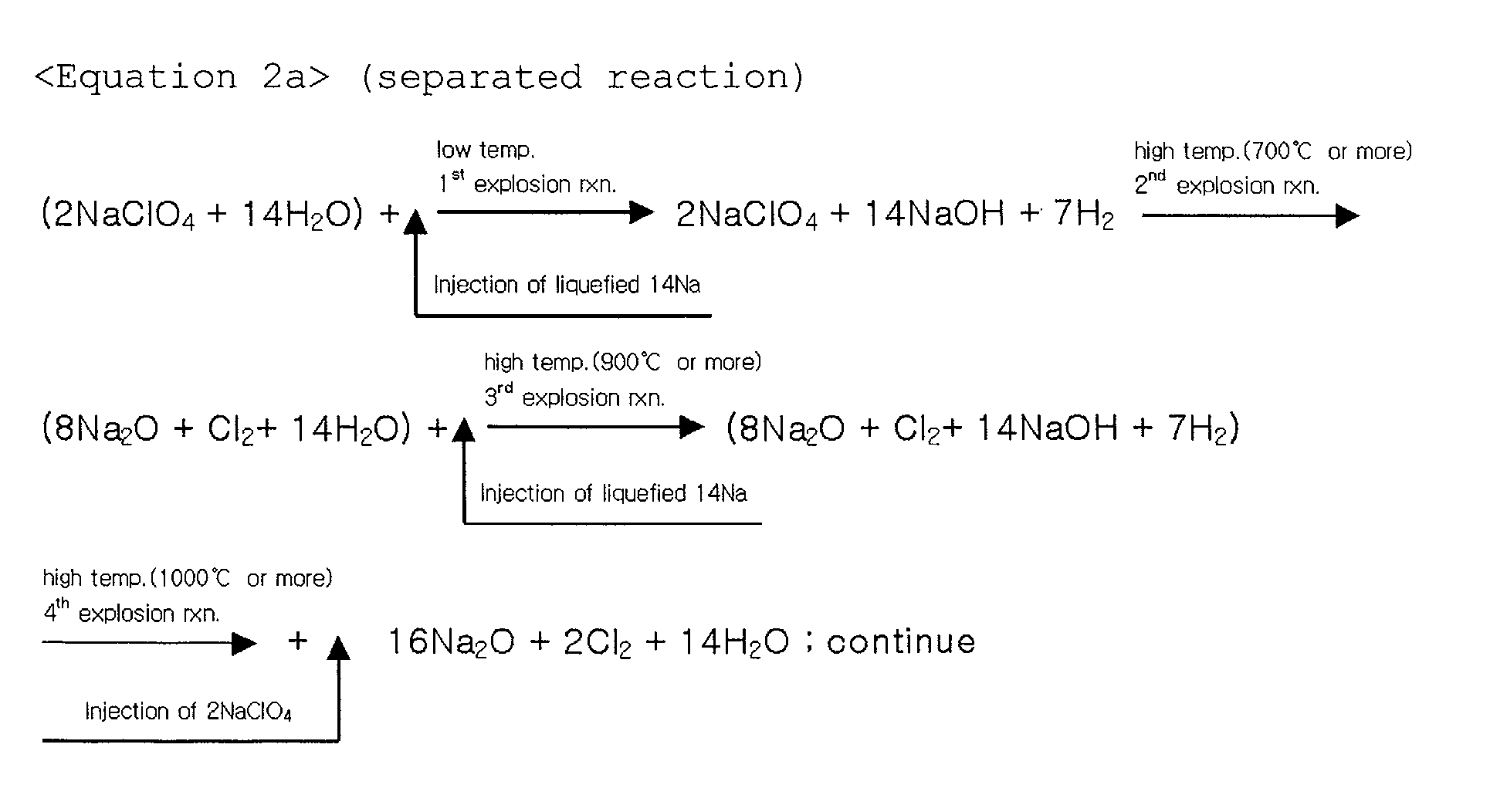
- 736 kg of dissolved sodium (Na) was added to a combustion material tank T-1, which was then maintained at 150 °C. A locking valve V-1 was closed, and the tank was pressurized to the required pressure of 30 kgf/cm2 or higher using inert gas (argon, nitrogen, etc.) through the pressurization port A-1. Then, 492 kg of sodium perchlorate (NaClO4) was dissolved in 288 kg or higher, actually 388 kg of water (H2O) and added to an oxidant material tank T-2, after which a locking valve V-2 was closed and the tank was pressurized to 30 kgf/cm2 or higher, the required pressure, using air through the pressurization port A-2. The materials in both tanks were sprayed to a reaction chamber B through each tank nozzle N-1, N-2, based on a spray ratio of 7.36:8.8. As such, temperature and pressure in the reaction chamber were increased by exothermic reaction, explosively yielding 388 kg of gas at a high temperature. If sprayed with created salt, the injection power was more increased as a result of increasing density of gas. A concrete reaction is shown, below.

- 460 kg of dissolved sodium (Na) was added to a combustion material tank T-1, which was then maintained at 150 °C. Under a closed state of a locking valve V-1, the tank was pressurized to the necessary pressure of 30 kgf/cm2 or higher using inert gas (argon, nitrogen, etc.) through the pressurization port A-1. Separately, 252 kg of nitric acid (HNO3) was dissolved in 162 kg or higher, actually 262 kg of water (H2O) and charged into an oxidant material tank T-2. A locking valve V-2 was closed before the tank was pressurized to 30 kgf/cm2 or higher, the required pressure, using air through the pressurization port A-2. The materials in both tanks were sprayed to a reaction chamber B through each tank nozzle N-1, N-2, on the basis of a spray ratio of 4.6:5.14. As such, temperature and pressure within the reaction chamber was increased by exothermic reaction, 354 kg of gas was explosively produced at a high temperature. If sprayed with created salt, the injection power was more increased as a result of increasing density of gas. A concrete reaction is shown, below.


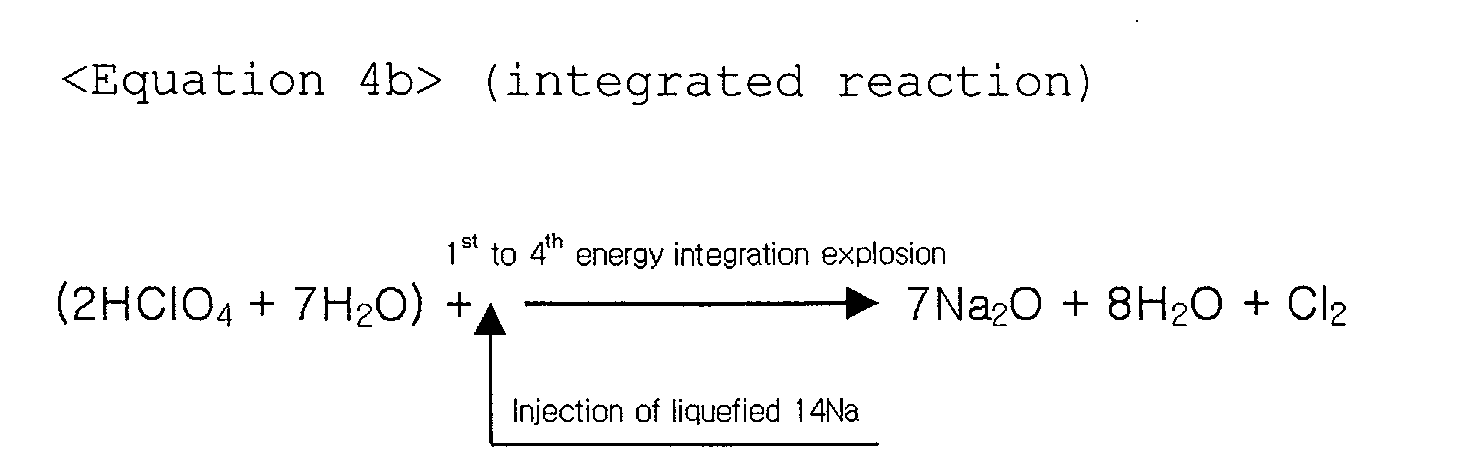
- 736 kg of dissolved sodium (Na) was added into a combustion material tank T-1, which was then maintained at 150 °C. Under a closed state of a locking valve V-1, the tank was pressurized to the required pressure of 30 kgf/cm2 or higher using inert gas (argon, nitrogen, etc.) through the pressurization port A-1. Separately, 404 kg of perchloric acid (HClO4) was dissolved in 270 kg or higher, actually 370 kg of water (H2O) and added to an oxidant material tank T-2. Thereafter, a locking valve V-2 was closed and the tank was pressurized to 30 kgf/cm2 or higher, the required pressure, using air through the pressurization port A-2. The materials in both tanks were sprayed to a reaction chamber B through each tank nozzle N-1, N-2, based upon a spray ratio of 7.36:7.74. As such, the sprayed materials reacted exothermically to increase temperature and pressure in the reaction chamber, 406 kg of gas was explosively produced at a high temperature. If sprayed with created salt, the injection power was more increased as a result of increasing density of gas. A concrete reaction is given, below.

- 276 kg of dissolved sodium (Na) was added to a combustion material tank T-1, which was then maintained at 150 °C. Under a closed state of a locking valve V-1, the tank was pressurized to the required pressure of 30 kgf/cm2 or higher using inert gas (argon, nitrogen, etc.) through the pressurization port A-1. Separately, 196 kg of sulfuric acid (H2SO4) was dissolved in 90 kg or higher, actually 190 kg of water (H2O) and added to an oxidant material tank T-2. Thereafter, a locking valve V-2 was closed and the tank was pressurized to 30 kgf/cm2 or higher, the required pressure, using air through the pressurization port A-2. The materials in both tanks were sprayed to a reaction chamber B through each tank nozzle N-1, N-2, based upon a spray ratio of 2.76:3.86. As such, the sprayed materials reacted exothermically and thus temperature and pressure in the reaction chamber were increased, explosively yielding 226 kg of gas at a high temperature. If sprayed with created salt, the injection power was more increased as a result of increasing density of gas. A concrete reaction is given, below.


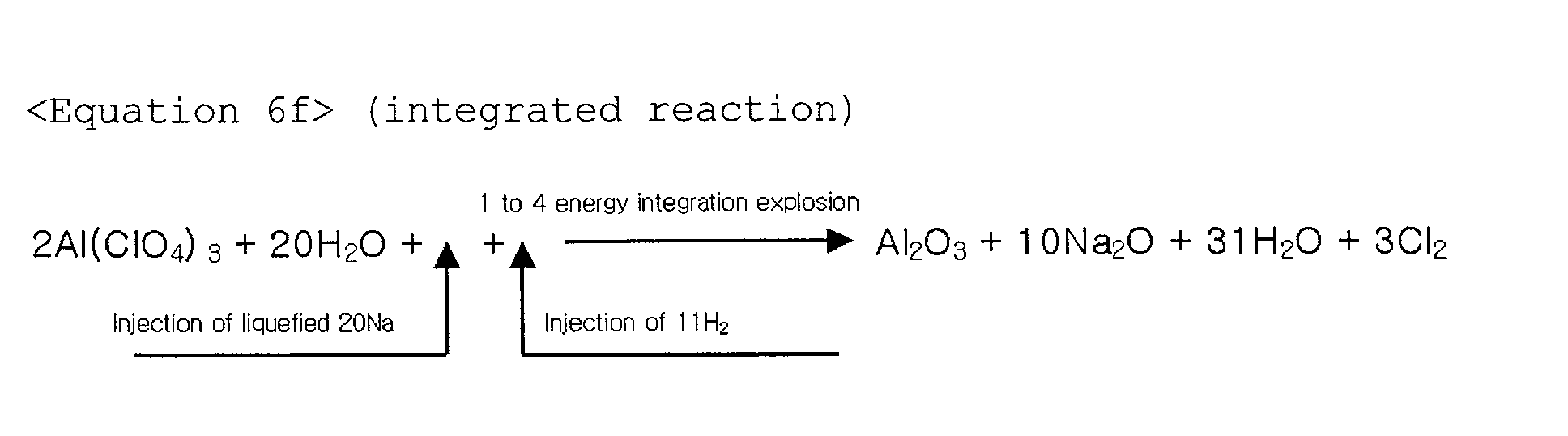
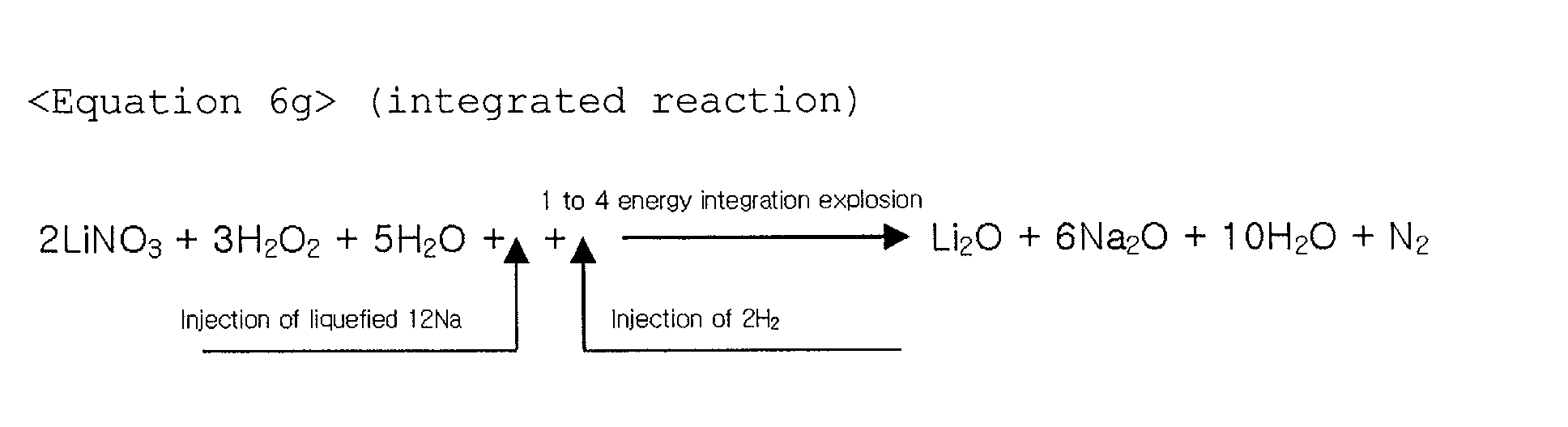
- The reactions are oxidants, reactive metal and nonmetal combustion materials, 522 kg of dissolved sodium (Na) was added to a combustion material tank T-1, which was then maintained at 150 °C. Under a closed state of a locking valve V-1, the tank was pressurized to the required pressure of 30 kgf/cm2 or higher using inert gas (argon, nitrogen, etc.). Then, 606 kg of perchloric acid (HClO4) was dissolved in 216 kg or higher, actually 316 kg of water (H2O) and added to an oxidant material tank T-2. Thereafter, a locking valve V-2 was closed and the tank was pressurized to 30 kgf/cm2 or more, the required pressure, using air. Further, as a nonmetal combustion material, 424 kg of ammonia was filled into a material tank, and a locking valve was closed before the tank was pressurized to the required pressure or higher. The materials in the tanks were sprayed to a reaction chamber through each tank nozzle, on the basis of a predetermined spray ratio. As such, temperature and pressure in the reaction chamber were increased upon addition of an oxidant material, an active metal as a combustion material and a nonmetal combustion material, 698 kg of gas was explosively produced at a high temperature. As other oxidant materials, use was made of nitric acid (HNO3), sodium nitrate (NaNO3), aluminum nitrate (Al(NO3)3) and so on. Meanwhile, as other nonmetal combustion materials, a fuel oil (CH4) , hydrogen (H2) and the like were used. If sprayed with created salt, the injection power was more increased as a result of increasing density of gas. A concrete reaction is given, below.




- Powders of a metal were mixed with powders of a metal salt, without use of water, and subjected to shock heat to generate chain-reactions. As such, little gas was generated and gaseous expansion reaction of the metal and the metal salt occurred. 170 g of sodium nitrate (NaNO3) powder and 145 g of magnesium (Mg) powder were thoroughly mixed and added to a preparative container, after which the container was sealed. When power was supplied to electrodes P-1 and P-2 as illustrated in fig. 2 for a moment, spark was generated by an internal resistance wire R-1. Through exothermic chain reactions initiated by such spark, the metal salt was gasified, producing high energy under high pressure. As other powders of metal, use was made of aluminum(Al) and so on. Meanwhile, as other powders of metal salt, sodium perchlorate(NaClO4), sodium sulfate(Na2SO4), iron oxide(Fe2O3), copper oxide(CuO) and the like singleness or mixture were used. A concrete reaction is given, below.

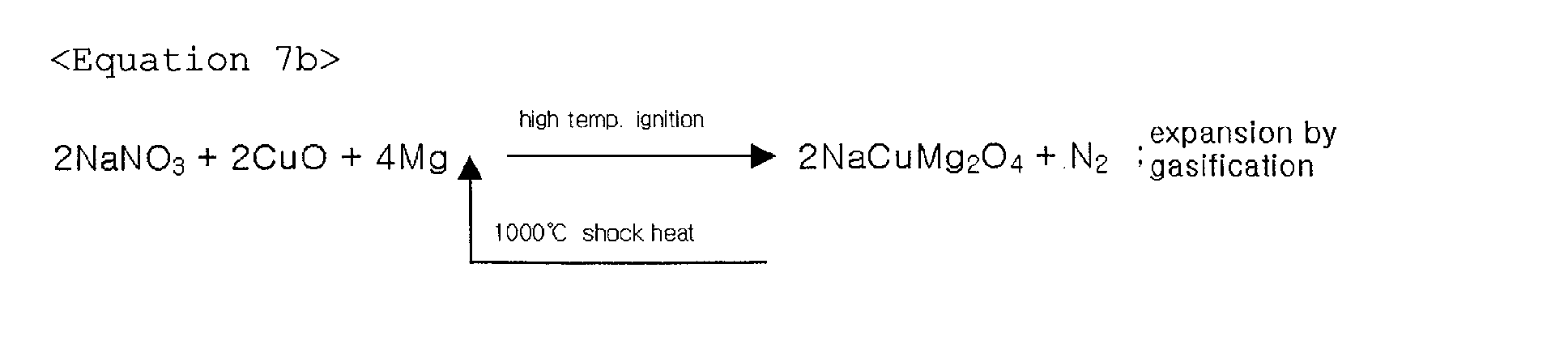


- Example 7 is characterized in that a bond reaction is continuously conducted by adding a shock heat to reactions 7a to 7e to generate high temperature energy. The high temperature energy expands a small amount of a certain gas and gasifies the metal salt, thereby causing significant expansion of products, but having excellent expansion effect only in the small sealant space because the expansion limitation is low. Therefore, these reactions can be used to crush a rock bed without a large explosion noise or scattering of debris, and are less harmful to the environment and humans over conventional methods.
- Sodium nitrate (NaNO3), potassium nitrate (KNO3), lithium nitrate (LiNO3), calcium nitrate (Ca(NO3)2), magnesium nitrate (Mg(NO3)2), aluminum nitrate (Al(NO3)3), barium nitrate (Ba(NO3)2), iron nitrate (Fe(NO3)3), manganese nitrate (Mn(NO3)2), copper nitrate (Cu(NO3)2), and the like.
- Potassium perchlorate (KClO4), sodium perchlorate (NaClO4), lithium perchlorate (LiClO4), calcium perchlorate (Ca(ClO4)2), magnesium perchlorate (Mg(ClO4)2), strontium perchlorate (Sr(ClO4)2), barium perchlorate (Ba(ClO4)2), iron perchlorate (Fe(ClO4)3), manganese perchlorate (Mn(ClO4)2), copper perchlorate (Cu(ClO4)2), aluminum perchlorate (Al(ClO4)3), zinc perchlorate (Zn(ClO4)2), and the like.
- Potassium oxide (K2O), sodium oxide (Na2O), lithium oxide (Li2O), calcium oxide (CaO), copper oxide (CuO), magnesium oxide (MgO), strontium oxide (SrO), barium oxide (BaO), iron oxide (Fe2O3), manganese oxide (MnO2), zinc oxide (ZnO), and the like.
- Potassium sulfate (K2SO4), sodium sulfate (Na2SO4), lithium sulfate (Li2SO4), strontium sulfate (SrSO4), calcium sulfate (CaSO4), magnesium sulfate (MgSO4), barium sulfate (BaSO4), iron sulfate (Fe2(SO4)3), manganese sulfate (MnSO4), copper sulfate (CuSO4), aluminum sulfate (Al2(SO4)3), zinc sulfate (ZnSO4), and the like.
- Water (H2O), hydrogen peroxide (H2O2), nitric acid (HNO3), perchloric acid (HClO4), sulfuric acid (H2SO4), and the like.
- A lump type or a powder type of a reactive metal such as potassium (K), lithium (Li), sodium (Na), magnesium (Mg), titanium (Ti), calcium (Ca), aluminum (Al), and chrome (Cr).
- Combustible nonmetal such as hydrogen (H2), ammonia (NH3), oil for combustion, toluene, benzene, petroleum, hydrocarbons.
- In examples 1 to 5, oxidants such as water, hydrogen peroxide, nitric acid, perchloric acid, sulfuric acid, metal nitrate, metal sulfate, and metal perchlorate are directly reacted with reactive metals as combustion substances. These bond reactions comprise an A type reaction in which gas expansion pressure is raised stepwise and a B type reaction in which the bond reaction is integrally carried out, and provides energy, for example a propulsive force of a rocket, by use of expansion pressure of the substances and water upon supplying heat energy to the substances and water.
- In equations 6a to 6f, the oxidant such as water, hydrogen peroxide, nitric acid, sulfuric acid, metal nitrate, metal perchlorate, and metal sulfate is reacted with the reactive metal and combustible nonmetal to generate an explosion energy.
- The present invention provides a method for increasing energy by repeating a bond reaction of oxidants such as water, hydrogen peroxide, liquid acid, metal salt with light metal such as combustion substances. The method has economic advantages in that inexpensive substances such as light metal and oil are used as the combustion substance.
- Furthermore, it can be seen from equation 7 that the method can be used to crush a structure or a rock bed without a large explosion noise or the scattering of debris.
- The present invention has been described in an illustrative manner, and it is to be understood that the terminology used is intended to be in the nature of description rather than of limitation. Many modifications and variations of the present invention are possible in light of the above teachings. Therefore, it is to be understood that within the scope of the appended claims, the invention may be practiced otherwise than as specifically described.
Claims (5)
- A method for generating an explosion energy by using an exothermic reaction of metal, comprising:wherein said second and third reaction process are carried out in a repeating and consecutive manner.a first reaction process in which an elementary oxidant based on water is reacted with a combustion substance based on light metal to generate hydrogen;a second reaction process in which the hydrogen generated from the 1st reaction is reacted with an oxidant to generate water, said oxidant being selected from the group consisting of nitric acid, chlorine peroxide, sulfuric acid, metal nitrate, metal perchlorate, metal sulfate, hydrogen peroxide, and combinations thereof;a third reaction process in which the water generated from the 2nd reaction is reacted with a light metal element to generate hydrogen, said light metal element being selected from the group consisting of potassium (K), lithium (Li), sodium (Na), magnesium (Mg), titanium (Ti), calcium (Ca), aluminum (Al), chrome (Cr), and combinations thereof;a fourth reaction process in which the hydrogen generated from the 3rd reaction is reacted with an oxidant selected from the group consisting of nitric acid, chlorine peroxide, sulfuric acid, metal nitrate, metal perchlorate, metal sulfate, hydrogen peroxide and combinations thereof,
- The method according to claim 1, wherein combustion substances are a lump or a powder of reactive metals comprising potassium (K), lithium (Li), sodium (Na), magnesium (Mg), titanium (Ti), calcium (Ca), aluminum (Al), and chrome (Cr).
- The method according to claim 1, wherein combustion substances combined with nonmetals comprising hydrogen (H2), ammonia (NH3), oil for combustion, toluene, benzene, petroleum, hydrocarbons, and reactive metals comprising potassium (K), lithium (Li), sodium (Na), magnesium (Mg), titanium (Ti), calcium (Ca), aluminum (Al), and chrome (Cr) are used.
- A method for generating an explosion energy by using exothermic reaction of metal, comprising the oxidization of an combustion substance comprising at least two light metal elements with an elementary oxidant selected from the group consisting of water, hydrogen peroxide, metal nitrate, metal sulfate, metal perchlorate, nitric acid, sulfuric acid, and chlorine peroxide, wherein the oxidant and the combustion substance are controlled in such stoichiometrical quantities that the oxidation is performed in one phase.
- A method for generating a limited expansion energy by using exothermic reaction of metal, comprising a chain reaction of a powdered oxidant and at least two light metal elements in a closed volume with supply of shock heat, said powdered oxidant being selected from the group consisting of metal nitrate, metal perchlorate, metal oxide, and metal sulfate, said light metal element being selected from the group consisting of potassium (K), lithium (Li), sodium (Na), magnesium (Mg), titanium (Ti), calcium (Ca), aluminum (Al), and chrome (Cr), whereby a large pressure can be generated, applicable to crush a structure or a rock bed without a large explosion noise or the scattering of debris.
Applications Claiming Priority (2)
| Application Number | Priority Date | Filing Date | Title |
|---|---|---|---|
| KR1020010075913A KR20030045976A (en) | 2001-12-03 | 2001-12-03 | Energy generating method by using exothermic reaction of metal |
| KR2001075913 | 2001-12-03 |
Publications (1)
| Publication Number | Publication Date |
|---|---|
| EP1316680A2 true EP1316680A2 (en) | 2003-06-04 |
Family
ID=19716571
Family Applications (1)
| Application Number | Title | Priority Date | Filing Date |
|---|---|---|---|
| EP02292980A Withdrawn EP1316680A2 (en) | 2001-12-03 | 2002-12-03 | Method for generating energy by using exothermic reaction of metal |
Country Status (7)
| Country | Link |
|---|---|
| US (1) | US6736069B2 (en) |
| EP (1) | EP1316680A2 (en) |
| JP (1) | JP3986337B2 (en) |
| KR (1) | KR20030045976A (en) |
| CN (1) | CN1244520C (en) |
| AU (1) | AU4063302A (en) |
| CA (1) | CA2385192A1 (en) |
Families Citing this family (5)
| Publication number | Priority date | Publication date | Assignee | Title |
|---|---|---|---|---|
| KR100771011B1 (en) * | 2006-04-25 | 2007-10-29 | 장우기 | Rotary engine capable of producing hydrogen and generators equipped with the rotary engine |
| WO2009121170A1 (en) * | 2008-03-31 | 2009-10-08 | Et-Energy Corp. | Chemical process for generating energy |
| US8250981B1 (en) | 2010-01-21 | 2012-08-28 | The United States Of America As Represented By The Secretary Of The Navy | Underwater hydro-reactive explosive system |
| US8387535B1 (en) | 2010-05-14 | 2013-03-05 | The United States Of America As Represented By The Secretary Of The Navy | Hydroreactive energetic device and method |
| US8931414B1 (en) * | 2013-02-27 | 2015-01-13 | The United States Of America As Represented By The Secretary Of The Navy | Reaction container containing aluminum |
Citations (1)
| Publication number | Priority date | Publication date | Assignee | Title |
|---|---|---|---|---|
| US6237340B1 (en) | 1999-06-18 | 2001-05-29 | Chang Sun Kim | Method for reusing a substance's thermal expansion energy |
Family Cites Families (8)
| Publication number | Priority date | Publication date | Assignee | Title |
|---|---|---|---|---|
| US3882324A (en) * | 1973-12-17 | 1975-05-06 | Us Navy | Method and apparatus for combustibly destroying microelectronic circuit board interconnections |
| US5072647A (en) * | 1989-02-10 | 1991-12-17 | Gt-Devices | High-pressure having plasma flow transverse to plasma discharge particularly for projectile acceleration |
| US5212343A (en) * | 1990-08-27 | 1993-05-18 | Martin Marietta Corporation | Water reactive method with delayed explosion |
| US5431105A (en) * | 1993-09-16 | 1995-07-11 | Maxwell Laboratories, Inc. | Electrothermal chemical cartridge |
| US6209457B1 (en) * | 1998-08-13 | 2001-04-03 | Technology Commercialization Corp. | Method and preformed composition for controlled localized heating of a base material using an exothermic reaction |
| CA2367197A1 (en) * | 2001-01-10 | 2002-07-10 | Cesaroni Technology Incorporated | Liquid/solid fuel hybrid propellant system for a rocket |
| KR20030006083A (en) * | 2001-07-11 | 2003-01-23 | 김창선 | The rapid expanding metallic compound |
| KR20030037707A (en) * | 2001-11-05 | 2003-05-16 | 김창선 | The rapid expanding metallic compound |
-
2001
- 2001-12-03 KR KR1020010075913A patent/KR20030045976A/en not_active Ceased
-
2002
- 2002-03-20 JP JP2002078294A patent/JP3986337B2/en not_active Expired - Lifetime
- 2002-03-27 US US10/106,064 patent/US6736069B2/en not_active Expired - Fee Related
- 2002-04-25 CN CNB021183430A patent/CN1244520C/en not_active Expired - Fee Related
- 2002-05-07 CA CA002385192A patent/CA2385192A1/en not_active Abandoned
- 2002-05-15 AU AU40633/02A patent/AU4063302A/en not_active Abandoned
- 2002-12-03 EP EP02292980A patent/EP1316680A2/en not_active Withdrawn
Patent Citations (1)
| Publication number | Priority date | Publication date | Assignee | Title |
|---|---|---|---|---|
| US6237340B1 (en) | 1999-06-18 | 2001-05-29 | Chang Sun Kim | Method for reusing a substance's thermal expansion energy |
Also Published As
| Publication number | Publication date |
|---|---|
| KR20030045976A (en) | 2003-06-12 |
| CA2385192A1 (en) | 2003-06-03 |
| CN1422832A (en) | 2003-06-11 |
| US6736069B2 (en) | 2004-05-18 |
| AU4063302A (en) | 2003-06-05 |
| US20030106452A1 (en) | 2003-06-12 |
| JP2003172599A (en) | 2003-06-20 |
| CN1244520C (en) | 2006-03-08 |
| JP3986337B2 (en) | 2007-10-03 |
Similar Documents
| Publication | Publication Date | Title |
|---|---|---|
| US3814694A (en) | Non-toxic gas generation | |
| US5460667A (en) | Gas generating agent and gas generator for automobile air bags | |
| US4062708A (en) | Azide gas generating composition | |
| US4386979A (en) | Gas generating compositions | |
| US6849247B1 (en) | Gas generating process for propulsion and hydrogen production | |
| EP1316680A2 (en) | Method for generating energy by using exothermic reaction of metal | |
| US6589375B2 (en) | Low solids gas generant having a low flame temperature | |
| WO1995019342A2 (en) | Gas generant composition containing non-metallic salts of 5-nitrobarbituric acid | |
| Bansal et al. | A critical review of limitations and challenges in advancement of HNF as a green oxidizer for composite solid propellant formulations | |
| Yin et al. | Pseudo-oxide metal carbodiimides: Application in thermite reactions | |
| AU7971600A (en) | Gas generator and method for the generation of low-temperature gas | |
| EP4139245B1 (en) | Material and generator for generating hydrogen gas | |
| Grobler et al. | Pyrotechnic Alternatives to Primary Explosive‐Based Initiators | |
| CA2586957A1 (en) | Cartridge of metal expansion cell for rock destruction | |
| CN1034196A (en) | The explosive that is used for bullet and solid rocket propellant | |
| Oxley | Explosives detection: potential problems | |
| Oxley | Non‐traditional explosives: Potential detection problems | |
| US7422618B2 (en) | Expansive cell composition for electric rock destruction | |
| KR100700417B1 (en) | Precision Control Crushing Agent Composition | |
| Wilson et al. | Pyrotechnic delays and thermal sources | |
| KR20160095767A (en) | metallic compound for blasting | |
| Zhang et al. | Metal-Based Green Energetic Catalysts for Solid Propellant Combustion Control | |
| US3053710A (en) | Magnesium hydride explosive compositions | |
| Tulepov et al. | Combustion processes of gas generators in the form of cartridges on the basis of ammonium nitrate, flammable nanoaluminum and nanocarbon additives | |
| RU2332637C2 (en) | Pyrotechnic generator |
Legal Events
| Date | Code | Title | Description |
|---|---|---|---|
| PUAI | Public reference made under article 153(3) epc to a published international application that has entered the european phase |
Free format text: ORIGINAL CODE: 0009012 |
|
| AK | Designated contracting states |
Designated state(s): AT BE BG CH CY CZ DE DK EE ES FI FR GB GR IE IT LI LU MC NL PT SE SI SK TR |
|
| AX | Request for extension of the european patent |
Extension state: AL LT LV MK RO |
|
| STAA | Information on the status of an ep patent application or granted ep patent |
Free format text: STATUS: THE APPLICATION IS DEEMED TO BE WITHDRAWN |
|
| 18D | Application deemed to be withdrawn |
Effective date: 20070703 |