EP1316616A1 - Method for producing linear DNA fragments for the in vitro expression of proteins - Google Patents
Method for producing linear DNA fragments for the in vitro expression of proteins Download PDFInfo
- Publication number
- EP1316616A1 EP1316616A1 EP02026225A EP02026225A EP1316616A1 EP 1316616 A1 EP1316616 A1 EP 1316616A1 EP 02026225 A EP02026225 A EP 02026225A EP 02026225 A EP02026225 A EP 02026225A EP 1316616 A1 EP1316616 A1 EP 1316616A1
- Authority
- EP
- European Patent Office
- Prior art keywords
- linear dna
- dna fragment
- protein
- expression
- pcr
- Prior art date
- Legal status (The legal status is an assumption and is not a legal conclusion. Google has not performed a legal analysis and makes no representation as to the accuracy of the status listed.)
- Granted
Links
- 0 CC1C2/*=C/CC(CC3)C3C(C)C2C2=C(C)*C12 Chemical compound CC1C2/*=C/CC(CC3)C3C(C)C2C2=C(C)*C12 0.000 description 2
Images



Classifications
-
- C—CHEMISTRY; METALLURGY
- C12—BIOCHEMISTRY; BEER; SPIRITS; WINE; VINEGAR; MICROBIOLOGY; ENZYMOLOGY; MUTATION OR GENETIC ENGINEERING
- C12N—MICROORGANISMS OR ENZYMES; COMPOSITIONS THEREOF; PROPAGATING, PRESERVING, OR MAINTAINING MICROORGANISMS; MUTATION OR GENETIC ENGINEERING; CULTURE MEDIA
- C12N15/00—Mutation or genetic engineering; DNA or RNA concerning genetic engineering, vectors, e.g. plasmids, or their isolation, preparation or purification; Use of hosts therefor
- C12N15/09—Recombinant DNA-technology
- C12N15/10—Processes for the isolation, preparation or purification of DNA or RNA
-
- C—CHEMISTRY; METALLURGY
- C12—BIOCHEMISTRY; BEER; SPIRITS; WINE; VINEGAR; MICROBIOLOGY; ENZYMOLOGY; MUTATION OR GENETIC ENGINEERING
- C12Q—MEASURING OR TESTING PROCESSES INVOLVING ENZYMES, NUCLEIC ACIDS OR MICROORGANISMS; COMPOSITIONS OR TEST PAPERS THEREFOR; PROCESSES OF PREPARING SUCH COMPOSITIONS; CONDITION-RESPONSIVE CONTROL IN MICROBIOLOGICAL OR ENZYMOLOGICAL PROCESSES
- C12Q1/00—Measuring or testing processes involving enzymes, nucleic acids or microorganisms; Compositions therefor; Processes of preparing such compositions
- C12Q1/68—Measuring or testing processes involving enzymes, nucleic acids or microorganisms; Compositions therefor; Processes of preparing such compositions involving nucleic acids
- C12Q1/6844—Nucleic acid amplification reactions
- C12Q1/686—Polymerase chain reaction [PCR]
Definitions
- the present invention concerns a method for producing linear DNA fragments for the in vitro expression of proteins in which a linear DNA fragment which contains control elements necessary for expression and the protein-coding gene which has complementary regions to the two ends of the linear DNA fragment at both ends, are amplified together using a primer pair which binds upstream and downstream of the expression control regions on the linear DNA fragment, characterized in that the linear DNA fragment can be produced by linearizing an expression vector. Furthermore a method is disclosed which concerns the preparation of the protein-coding gene the ends of which have regions which overlap with the linear DNA fragment.
- Another advantage of the method according to the invention is that the gene sequence to be expressed is fused into the vector in the first PCR cycles with the linear vector which codes for a resistance gene. Since the vector arms serve as primers in the first cycles, the complete plasmid is cosynthesized to a certain extent. This has the advantage that the final product can not only be used for expression in cell-free systems but also directly for transformation in a suitable bacterial strain. Hence the PCR product is secured in the plasmid as a bacterial clone.
- the amplification can be carried out by PCR protocols known to a person skilled in the art (PCR by Newton & Graham, 1994, publisher Spektrum, Heidelberg; PCR by McPherson and Moller, 2000, BIOS Scientific Publishers Oxford).
- the kit according to the invention may additionally contain DNA polymerases with or without proof-reading activity or a mixture of the two as well as the required buffer and magnesium chloride solutions and deoxynucleotide triphosphates, and reagents for optimizing PCR reactions such as DMSO, glycerol, formamide, betaine, 7-deaza GTP etc..
- the linear DNA fragments contain C-terminal or N-terminal tag sequences or a fusion protein sequence such as the His tag, HA tag and GFP sequence.
Landscapes
- Chemical & Material Sciences (AREA)
- Life Sciences & Earth Sciences (AREA)
- Organic Chemistry (AREA)
- Health & Medical Sciences (AREA)
- Engineering & Computer Science (AREA)
- Zoology (AREA)
- Wood Science & Technology (AREA)
- Genetics & Genomics (AREA)
- Bioinformatics & Cheminformatics (AREA)
- Biotechnology (AREA)
- General Engineering & Computer Science (AREA)
- General Health & Medical Sciences (AREA)
- Physics & Mathematics (AREA)
- Molecular Biology (AREA)
- Microbiology (AREA)
- Biophysics (AREA)
- Biomedical Technology (AREA)
- Biochemistry (AREA)
- Proteomics, Peptides & Aminoacids (AREA)
- Chemical Kinetics & Catalysis (AREA)
- Crystallography & Structural Chemistry (AREA)
- Analytical Chemistry (AREA)
- Plant Pathology (AREA)
- Immunology (AREA)
- Preparation Of Compounds By Using Micro-Organisms (AREA)
- Measuring Or Testing Involving Enzymes Or Micro-Organisms (AREA)
Abstract
Description
- a linear DNA fragment which can be produced by linearizing an expression vector and contains all control elements required for the expression of proteins.
- outer primers which bind upstream and downstream of the expression control region on the linear DNA fragment. The outer primer pair can also bind directly to the 5' end of the promoter and terminator region.
- producing a linear DNA fragment by the inventive method described above,
- in vitro transcription and/or translation.
It is particularly preferred that the in vitro expression of the protein is carried out in a coupled system using a lysate from bacterial strains or eukaryotic cells (Zubay 1973; Baranov et al., 1989; Kigawa and Yokoyama, 1991; Kudlicki et al., 1992; Spirin, 1992; Baranov and Spirin, 1993). The in vitro expression of proteins can also be carried out in a CFCF or CECF reactor (Spirin et al., 1988).
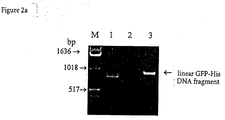
- lane M
- DNA molecular weight marker
-
lane 1 - 5 µl GFP PCR product from the first gene-specific PCR
-
lane 2 - negative control of the overlap extension PCR without the first gene product
-
lane 3 - 5 µl product from the overlap extension PCR (GFP-His)
- lane X
- DNA molecular weight marker
- lane -
- negative control of the gene-specific PCR without template
- lane +
- 5 µl product from the first gene-specific first PCR (GFP)
- lane VII
- DNA molecular weight marker
- lane 9/10
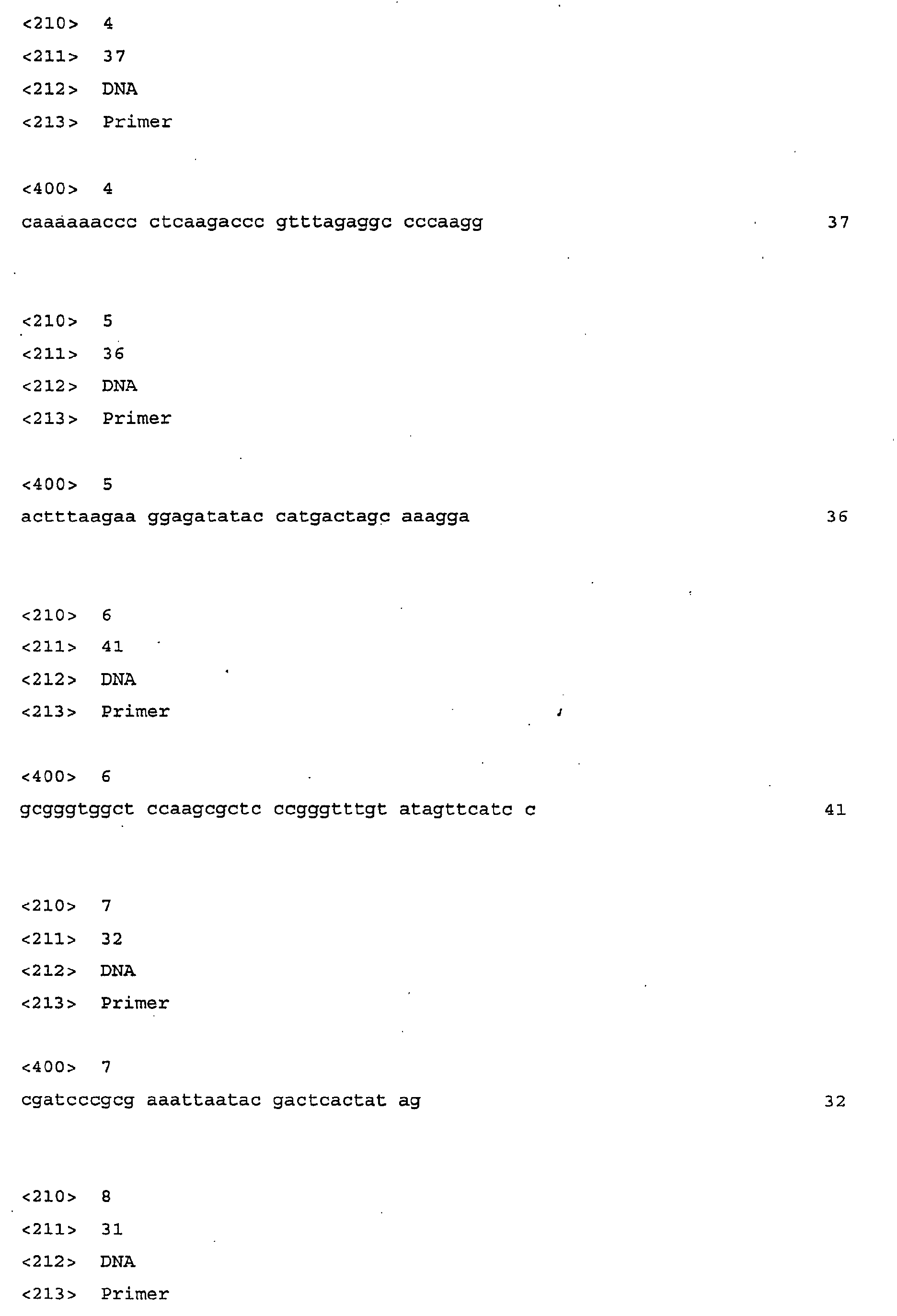
- 3 µl GFP PCR product from the overlap extension PCR (GFP Strep tag) using the primer combination 9/10 (SEQ ID NOs.: 7 and 8)
- lane 26/28
- 3 µl GFP PCR product from the overlap extension PCR (GFP Strep tag) using the primer combination 26/28 (SEQ ID NOs.: 9 and 10)
- lane 50/49
- 3 µl GFP PCR product from the overlap extension PCR (GFP Strep tag) using the primer combination 50/49 (SEQ ID NOs.: 11 and 12)
- lane M
- DNA molecular weight marker
- lane -
- negative control of the gene-specific PCR without template
- lane +
- 5 µl product from the first gene-specific first PCR (Epo)
- lane 2.2
- 5 µl Epo PCR product from the overlap extension PCR (Epo Strep tag)
- lane 2.4
- 5 µl Epo PCR product from the overlap extension PCR (Epo His tag).


Sense primer Md0 SS:



B GFP 22/18 2.1 over

pair 9/10 sense primer M + 9 SS


pair 26/28 sense primer M + 26 SS


pair 50/49 sense primer M + 50 SS


2X Xa Epo


sense primer Md0 SS





Claims (25)
- Method for producing linear DNA fragments for the in vitro expression of proteins in which a linear DNA fragment which contains control elements is amplified together with the protein-coding gene whose two ends have complementary regions to the two ends of the linear DNA fragment, using a primer pair which binds upstream and downstream of the expression control region on the linear DNA fragment, wherein the linear DNA fragment can be produced by linearizing an expression vector.
- Method for producing linear DNA fragments as claimed in claim 1, wherein the protein-coding gene whose ends have regions that are complementary to the two ends of the linear DNA fragment is produced in a PCR reaction in which the protein-coding gene is amplified using gene-specific primers whose 5' end has regions which overlap the linear DNA fragments and in this manner the amplified gene is extended by the overlapping regions of the primers.
- Method as claimed in claim 2, wherein the gene-specific primers have at least five additional nucleotides at the 5' end which are identical to the 3' ends of the upper or lower strand of the linear DNA fragment.
- Method as claimed in claim 2 or 3, wherein the process steps of extending the protein-coding gene and the joint amplification of this gene together with a linear DNA fragment containing control elements is carried out in a common reaction.
- Method as claimed in claim 2 or 3, wherein the process steps of extending the protein-coding gene and the joint amplification of this gene together with a linear DNA fragment containing control elements are carried out in successive reactions.
- Method as claimed in one of the claims 1 to 5, wherein the linearized vector contains a promoter and a terminator region as control elements.
- Method as claimed in one of the claims 1 to 6, wherein the linear vector contains the T7 promoter, the ribosomal binding site and the T7 terminator and the in vitro expression is carried out using lysates from E. coli.
- Method for producing PCR fragments as claimed in one of the claims 1-7, wherein the linearized vector contains a C-terminal or N-terminal His tag or a fusion protein sequence.
- Kit for producing linear DNA fragments for the in vitro expression of proteins which is present in one or several containers comprising:a linear DNA fragment which can be produced by linearizing an expression vector and contains control,outer primers which bind either upstream or downstream of the expression control region on the linear DNA fragment or directly to the 5' ends of the control regions.
- Kit as claimed in claim 9 containing gene-specific primers which at the 5' end have regions which overlap the ends of the linear DNA fragment.
- Kit as claimed in one of the claims 9 and 10 containing a polymerase and buffer.
- Kit as claimed in one of the claims 9-11, wherein the linear DNA fragments contain the T7 promoter, the ribosomal binding site and the T7 terminator.
- Kit as claimed in one of the claims 9-12, wherein the linear DNA fragments contain C-terminal or N-terminal tag sequences or fusion protein sequences.
- Use of a kit as claimed in one of the claims 9-13 to produce a linear DNA fragment for the in vitro expression of proteins.
- Linear DNA fragment obtainable by a method as claimed in one of the claims 1 to 8, wherein the PCR fragment contains a protein-coding gene and control elements.
- Linear DNA fragment as claimed in claim 15, wherein the DNA fragment contains the T7 promoter, the ribosomal binding site and the T7 terminator.
- Linear DNA fragment as claimed in claim 15 or 16, wherein the DNA fragment contains a C-terminal or N-terminal tag sequence or a fusion protein sequence.
- Use of a linear DNA fragment as claimed in one of the claims 15-17 for the in vitro expression of a protein in a cell-free expression system.
- Use of a linear DNA fragment as claimed in one of the claims 15-17 for the in vitro expression of a protein using a lysate from bacterial strains or eukaryotic cells.
- Method for expressing proteins comprising the steps:producing a linear DNA fragment by a method as claimed in one of the claims 1-8,in vitro transcription and translation.
- Method as claimed in claim 20, wherein the in vitro expression of the protein is carried out in a cell-free expression system.
- Method as claimed in claim 20 or 21, wherein the in vitro expression of the protein is carried out using a lysate from bacterial strains or eukaryotic cells.
- Method as claimed in one of the claims 20-22, wherein the in vitro expression of the protein is carried out using a lysate from E. coli.
- Method for expressing a protein as claimed in one of the claims 20-23, wherein the protein-coding gene is amplified directly from a gene bank or RNA fraction by PCR or RT-PCR.
- Method as claimed in one of the claims 20-24 wherein the protein is expressed in a CFCF or CECF reactor.
Applications Claiming Priority (3)
| Application Number | Priority Date | Filing Date | Title |
|---|---|---|---|
| DE10158904 | 2001-11-30 | ||
| DE10158904A DE10158904A1 (en) | 2001-11-30 | 2001-11-30 | Process for the preparation of linear DNA fragments for the in vitro expression of proteins |
| US10/314,007 US20040110135A1 (en) | 2001-11-30 | 2002-12-06 | Method for producing linear DNA fragments for the in vitro expression of proteins |
Publications (2)
| Publication Number | Publication Date |
|---|---|
| EP1316616A1 true EP1316616A1 (en) | 2003-06-04 |
| EP1316616B1 EP1316616B1 (en) | 2015-01-28 |
Family
ID=32963502
Family Applications (1)
| Application Number | Title | Priority Date | Filing Date |
|---|---|---|---|
| EP02026225.9A Expired - Lifetime EP1316616B1 (en) | 2001-11-30 | 2002-11-26 | Method for producing linear DNA fragments for the in vitro expression of proteins |
Country Status (4)
| Country | Link |
|---|---|
| US (1) | US20040110135A1 (en) |
| EP (1) | EP1316616B1 (en) |
| JP (1) | JP2003189890A (en) |
| DE (1) | DE10158904A1 (en) |
Cited By (8)
| Publication number | Priority date | Publication date | Assignee | Title |
|---|---|---|---|---|
| EP1411131A4 (en) * | 2001-07-02 | 2005-11-30 | Riken | DNA MATRIX PRODUCTION PROCESS AND PROTEIN PRODUCTION PROCESS IN CELL-FREE PROTEIN SYNTHESIS SYSTEM USING THE FIRST PROCESS |
| EP1767629A3 (en) * | 1999-08-25 | 2009-04-01 | Ambergen, Inc. | Methods for the detection, analysis and isolation of nascent proteins |
| US8226976B2 (en) | 2007-11-05 | 2012-07-24 | Riken | Method of using cell-free protein synthesis to produce a membrane protein |
| US8445232B2 (en) | 2004-11-17 | 2013-05-21 | Riken | Cell-free system for synthesis of proteins derived from cultured mammalian cells |
| US8603774B2 (en) | 2002-11-28 | 2013-12-10 | National Food Research Institute | Extract of E. coli cells having mutation in ribosomal protein S12, and method for producing protein in cell-free system using the extract |
| US8664355B2 (en) | 2004-11-19 | 2014-03-04 | Riken | Cell-free protein synthesis method with the use of linear template DNA and cell extract therefor |
| US11618777B2 (en) | 2015-07-31 | 2023-04-04 | Shigeyuki Yokoyama | Method of manufacturing membrane protein and utilization thereof |
| US11926817B2 (en) | 2019-08-09 | 2024-03-12 | Nutcracker Therapeutics, Inc. | Microfluidic apparatus and methods of use thereof |
Families Citing this family (5)
| Publication number | Priority date | Publication date | Assignee | Title |
|---|---|---|---|---|
| US20070117179A1 (en) * | 2005-09-27 | 2007-05-24 | Invitrogen Corporation | In vitro protein synthesis systems for membrane proteins that include adolipoproteins and phospholipid-adolipoprotein particles |
| WO2008106660A2 (en) * | 2007-03-01 | 2008-09-04 | Invitrogen Corporation | Isolated phospholipid-protein particles |
| US20100304378A1 (en) * | 2007-09-17 | 2010-12-02 | Universite De Strasbourg | Method for Detecting or Quantifying a Truncating Mutation |
| WO2012147370A1 (en) | 2011-04-28 | 2012-11-01 | 国立大学法人山口大学 | Terminator sequence-containing reverse primer for overexpression and linear dna |
| CN109370999A (en) * | 2018-11-23 | 2019-02-22 | 浙江善测禾骑士生物科技有限公司 | A kind of Klenow(exo-) mutain expression and purification method |
Citations (5)
| Publication number | Priority date | Publication date | Assignee | Title |
|---|---|---|---|---|
| US5571690A (en) * | 1991-05-08 | 1996-11-05 | The University Of Virginia Patents Foundation | Method for the cell-free synthesis of proteins |
| WO1998011249A1 (en) * | 1996-09-13 | 1998-03-19 | Garvin Alex M | Mutation detection using peptide tagged in vitro synthesized proteins |
| WO2000034514A1 (en) * | 1998-12-08 | 2000-06-15 | Proteus (S.A.) | METHOD FOR DETERMINING THE ACTIVITY OF A SUBSTANCE USING A FUNCTIONAL TEST $i(IN VITRO) |
| WO2000056914A1 (en) * | 1999-03-24 | 2000-09-28 | Gene Therapy Systems, Inc. | Method for generating transcriptionally active dna fragments |
| US6232107B1 (en) * | 1998-03-27 | 2001-05-15 | Bruce J. Bryan | Luciferases, fluorescent proteins, nucleic acids encoding the luciferases and fluorescent proteins and the use thereof in diagnostics, high throughput screening and novelty items |
Family Cites Families (2)
| Publication number | Priority date | Publication date | Assignee | Title |
|---|---|---|---|---|
| PL189698B1 (en) * | 1996-03-12 | 2005-09-30 | Pg Txl Co | Water-soluble promedicines of paklitaxel |
| US6207378B1 (en) * | 1997-08-19 | 2001-03-27 | Nippon Flour Mills Co., Ltd. | Method for amplifying nucleic acid molecules and method for synthesizing proteins |
-
2001
- 2001-11-30 DE DE10158904A patent/DE10158904A1/en not_active Withdrawn
-
2002
- 2002-11-26 EP EP02026225.9A patent/EP1316616B1/en not_active Expired - Lifetime
- 2002-11-29 JP JP2002348959A patent/JP2003189890A/en active Pending
- 2002-12-06 US US10/314,007 patent/US20040110135A1/en not_active Abandoned
Patent Citations (5)
| Publication number | Priority date | Publication date | Assignee | Title |
|---|---|---|---|---|
| US5571690A (en) * | 1991-05-08 | 1996-11-05 | The University Of Virginia Patents Foundation | Method for the cell-free synthesis of proteins |
| WO1998011249A1 (en) * | 1996-09-13 | 1998-03-19 | Garvin Alex M | Mutation detection using peptide tagged in vitro synthesized proteins |
| US6232107B1 (en) * | 1998-03-27 | 2001-05-15 | Bruce J. Bryan | Luciferases, fluorescent proteins, nucleic acids encoding the luciferases and fluorescent proteins and the use thereof in diagnostics, high throughput screening and novelty items |
| WO2000034514A1 (en) * | 1998-12-08 | 2000-06-15 | Proteus (S.A.) | METHOD FOR DETERMINING THE ACTIVITY OF A SUBSTANCE USING A FUNCTIONAL TEST $i(IN VITRO) |
| WO2000056914A1 (en) * | 1999-03-24 | 2000-09-28 | Gene Therapy Systems, Inc. | Method for generating transcriptionally active dna fragments |
Non-Patent Citations (4)
| Title |
|---|
| JACKSON M ET AL: "ENHANCED POLYPEPTIDE SYNTHESIS PROGRAMMED BY LINEAR DNA FRAGMENTS IN CELL-FREE EXTRACTS LACKING EXONUCLEASE V", FEBS LETTERS, XX, XX, vol. 163, no. 2, 14 November 1983 (1983-11-14), pages 221 - 224, XP008005956, ISSN: 0014-5793 * |
| KAIN K C ET AL: "UNIVERSAL PROMOTER FOR GENE EXPRESSION WITHOUT CLONING: EXPRESSION-PCR", BIOTECHNIQUES, NATICK, MA, US, vol. 10, no. 3, March 1991 (1991-03-01), pages 366 - 368,370-372,374, XP000912135 * |
| NAKANO HIDEO ET AL: "Efficient coupled transcription/translation from PCR template by a hollow-fiber membrane bioreactor.", BIOTECHNOLOGY AND BIOENGINEERING, vol. 64, no. 2, 20 July 1999 (1999-07-20), pages 194 - 199, XP002237026, ISSN: 0006-3592 * |
| SPIRIN A S: "CELL-FREE PROTEIN SYNTHESIS BIOREACTOR", AMERICAN CHEMICAL SOCIETY CONFERENCE PROCEEDINGS SERIES: FRONTIERS IN BIOPROCESSING, XX, XX, 1991, pages 31 - 43, XP001023126 * |
Cited By (13)
| Publication number | Priority date | Publication date | Assignee | Title |
|---|---|---|---|---|
| EP1767629A3 (en) * | 1999-08-25 | 2009-04-01 | Ambergen, Inc. | Methods for the detection, analysis and isolation of nascent proteins |
| EP1411131A4 (en) * | 2001-07-02 | 2005-11-30 | Riken | DNA MATRIX PRODUCTION PROCESS AND PROTEIN PRODUCTION PROCESS IN CELL-FREE PROTEIN SYNTHESIS SYSTEM USING THE FIRST PROCESS |
| US7195895B2 (en) | 2001-07-02 | 2007-03-27 | Riken | Method of producing template DNA and method of producing protein in cell-free protein synthesis system using the same |
| US7846694B2 (en) | 2001-07-02 | 2010-12-07 | Riken | Process for producing template DNA and process for producing protein in cell-free protein synthesis system with the use of the same |
| US8603774B2 (en) | 2002-11-28 | 2013-12-10 | National Food Research Institute | Extract of E. coli cells having mutation in ribosomal protein S12, and method for producing protein in cell-free system using the extract |
| US8445232B2 (en) | 2004-11-17 | 2013-05-21 | Riken | Cell-free system for synthesis of proteins derived from cultured mammalian cells |
| US8664355B2 (en) | 2004-11-19 | 2014-03-04 | Riken | Cell-free protein synthesis method with the use of linear template DNA and cell extract therefor |
| US8226976B2 (en) | 2007-11-05 | 2012-07-24 | Riken | Method of using cell-free protein synthesis to produce a membrane protein |
| US11618777B2 (en) | 2015-07-31 | 2023-04-04 | Shigeyuki Yokoyama | Method of manufacturing membrane protein and utilization thereof |
| US11926817B2 (en) | 2019-08-09 | 2024-03-12 | Nutcracker Therapeutics, Inc. | Microfluidic apparatus and methods of use thereof |
| US12448618B2 (en) | 2019-08-09 | 2025-10-21 | Nutcracker Therapeutics, Inc. | Microfluidic apparatus and methods of use thereof |
| US12492394B2 (en) | 2019-08-09 | 2025-12-09 | Nutcracker Therapeutics, Inc. | Microfluidic apparatus and methods of use thereof |
| USD1134933S1 (en) | 2019-08-09 | 2026-07-14 | Medici Therapeutics, Inc. | Microfluidic apparatus |
Also Published As
| Publication number | Publication date |
|---|---|
| US20040110135A1 (en) | 2004-06-10 |
| JP2003189890A (en) | 2003-07-08 |
| DE10158904A1 (en) | 2003-06-12 |
| EP1316616B1 (en) | 2015-01-28 |
Similar Documents
| Publication | Publication Date | Title |
|---|---|---|
| US11932882B2 (en) | Reverse transcriptase variants | |
| EP1316616B1 (en) | Method for producing linear DNA fragments for the in vitro expression of proteins | |
| JP7058839B2 (en) | Cell-free protein expression using rolling circle amplification products | |
| AU2018314605B2 (en) | Cell-free protein expression using double-stranded concatameric DNA | |
| EP1411131B1 (en) | Process for producing template dna and process for producing protein in cell-free protein synthesis system with the use of the same | |
| US20240174991A1 (en) | Fusion rt variants for improved performance | |
| WO1992007949A1 (en) | Method for the in vitro production of protein from a dna sequence without cloning | |
| CN104911199B (en) | Cloned dna molecule method | |
| US20080153128A1 (en) | Cell-Free Protein Synthesis | |
| Prodromou et al. | DNA fragmentation-based combinatorial approaches to soluble protein expression: Part I. Generating DNA fragment libraries | |
| Chen et al. | High-Level Expression of Human β-Defensin-2 Gene with Rare Codons in E. coli Cell-Free System | |
| Tabuchi et al. | An efficient ligation method in the making of an in vitro virus for in vitro protein evolution | |
| WO2015089339A2 (en) | Compositions, methods and kits for dna fragmentation and tagmentation | |
| JP2005512578A6 (en) | PCR-based highly efficient polypeptide screening | |
| JP2005512578A (en) | PCR-based highly efficient polypeptide screening | |
| US7211647B2 (en) | DNA synthetase | |
| JP5858415B2 (en) | Linker for preparing mRNA / cDNA-protein conjugate and purification method of nucleotide-protein conjugate using the same | |
| US20030166054A1 (en) | Enhanced in vitro protein synthesis | |
| Ferro-Gallego et al. | Circular PCR as an efficient and precise umbrella of methods for the generation of circular dsDNA with staggered nicks: Mechanism and types | |
| US20240150735A1 (en) | Polymerases for isothermal nucleic acid amplification | |
| Ivanov et al. | Human ribosomal protein S26 inhibits splicing of its own pre-mRNA | |
| Krupp et al. | Simplified in vitro synthesis of mutated RNA molecules: An oligonucleotide promoter determines the initiation site of T7 RNA polymerase on ss M 13 phage DNA | |
| US20250320537A1 (en) | Synthesis of dna molecules in in vitro enzymatic systems | |
| Mead et al. | Methods and materials for restriction endonuclease applications | |
| US20120171727A1 (en) | Novel genome walking method for cloning of unknown dna sequences adjacent to known sequence |
Legal Events
| Date | Code | Title | Description |
|---|---|---|---|
| PUAI | Public reference made under article 153(3) epc to a published international application that has entered the european phase |
Free format text: ORIGINAL CODE: 0009012 |
|
| AK | Designated contracting states |
Designated state(s): AT BE BG CH CY CZ DE DK EE ES FI FR GB GR IE IT LI LU MC NL PT SE SK TR |
|
| AX | Request for extension of the european patent |
Extension state: AL LT LV MK RO SI |
|
| 17P | Request for examination filed |
Effective date: 20031204 |
|
| AKX | Designation fees paid |
Designated state(s): AT BE BG CH CY CZ DE DK EE ES FI FR GB GR IE IT LI LU MC NL PT SE SK TR |
|
| GRAP | Despatch of communication of intention to grant a patent |
Free format text: ORIGINAL CODE: EPIDOSNIGR1 |
|
| INTG | Intention to grant announced |
Effective date: 20140905 |
|
| GRAS | Grant fee paid |
Free format text: ORIGINAL CODE: EPIDOSNIGR3 |
|
| GRAA | (expected) grant |
Free format text: ORIGINAL CODE: 0009210 |
|
| AK | Designated contracting states |
Kind code of ref document: B1 Designated state(s): AT BE BG CH CY CZ DE DK EE ES FI FR GB GR IE IT LI LU MC NL PT SE SK TR |
|
| REG | Reference to a national code |
Ref country code: GB Ref legal event code: FG4D |
|
| RIN1 | Information on inventor provided before grant (corrected) |
Inventor name: WESSNER, STEPHANIE Inventor name: WATZELE, MANFRED, DR. Inventor name: ROEDER, ALBERT, DR. Inventor name: MUTTER, WOLFGANG, DR. Inventor name: BUCHBERGER, BERND, DR. Inventor name: JANY, CORDULA, DR. |
|
| REG | Reference to a national code |
Ref country code: CH Ref legal event code: EP |
|
| REG | Reference to a national code |
Ref country code: IE Ref legal event code: FG4D |
|
| REG | Reference to a national code |
Ref country code: DE Ref legal event code: R096 Ref document number: 60246941 Country of ref document: DE Effective date: 20150312 |
|
| REG | Reference to a national code |
Ref country code: AT Ref legal event code: REF Ref document number: 708259 Country of ref document: AT Kind code of ref document: T Effective date: 20150315 |
|
| REG | Reference to a national code |
Ref country code: AT Ref legal event code: MK05 Ref document number: 708259 Country of ref document: AT Kind code of ref document: T Effective date: 20150128 |
|
| REG | Reference to a national code |
Ref country code: NL Ref legal event code: VDEP Effective date: 20150128 |
|
| PG25 | Lapsed in a contracting state [announced via postgrant information from national office to epo] |
Ref country code: SE Free format text: LAPSE BECAUSE OF FAILURE TO SUBMIT A TRANSLATION OF THE DESCRIPTION OR TO PAY THE FEE WITHIN THE PRESCRIBED TIME-LIMIT Effective date: 20150128 Ref country code: FI Free format text: LAPSE BECAUSE OF FAILURE TO SUBMIT A TRANSLATION OF THE DESCRIPTION OR TO PAY THE FEE WITHIN THE PRESCRIBED TIME-LIMIT Effective date: 20150128 Ref country code: BG Free format text: LAPSE BECAUSE OF FAILURE TO SUBMIT A TRANSLATION OF THE DESCRIPTION OR TO PAY THE FEE WITHIN THE PRESCRIBED TIME-LIMIT Effective date: 20150428 Ref country code: ES Free format text: LAPSE BECAUSE OF FAILURE TO SUBMIT A TRANSLATION OF THE DESCRIPTION OR TO PAY THE FEE WITHIN THE PRESCRIBED TIME-LIMIT Effective date: 20150128 |
|
| PG25 | Lapsed in a contracting state [announced via postgrant information from national office to epo] |
Ref country code: AT Free format text: LAPSE BECAUSE OF FAILURE TO SUBMIT A TRANSLATION OF THE DESCRIPTION OR TO PAY THE FEE WITHIN THE PRESCRIBED TIME-LIMIT Effective date: 20150128 Ref country code: NL Free format text: LAPSE BECAUSE OF FAILURE TO SUBMIT A TRANSLATION OF THE DESCRIPTION OR TO PAY THE FEE WITHIN THE PRESCRIBED TIME-LIMIT Effective date: 20150128 Ref country code: GR Free format text: LAPSE BECAUSE OF FAILURE TO SUBMIT A TRANSLATION OF THE DESCRIPTION OR TO PAY THE FEE WITHIN THE PRESCRIBED TIME-LIMIT Effective date: 20150429 |
|
| REG | Reference to a national code |
Ref country code: DE Ref legal event code: R097 Ref document number: 60246941 Country of ref document: DE |
|
| PG25 | Lapsed in a contracting state [announced via postgrant information from national office to epo] |
Ref country code: DK Free format text: LAPSE BECAUSE OF FAILURE TO SUBMIT A TRANSLATION OF THE DESCRIPTION OR TO PAY THE FEE WITHIN THE PRESCRIBED TIME-LIMIT Effective date: 20150128 Ref country code: SK Free format text: LAPSE BECAUSE OF FAILURE TO SUBMIT A TRANSLATION OF THE DESCRIPTION OR TO PAY THE FEE WITHIN THE PRESCRIBED TIME-LIMIT Effective date: 20150128 Ref country code: CZ Free format text: LAPSE BECAUSE OF FAILURE TO SUBMIT A TRANSLATION OF THE DESCRIPTION OR TO PAY THE FEE WITHIN THE PRESCRIBED TIME-LIMIT Effective date: 20150128 Ref country code: EE Free format text: LAPSE BECAUSE OF FAILURE TO SUBMIT A TRANSLATION OF THE DESCRIPTION OR TO PAY THE FEE WITHIN THE PRESCRIBED TIME-LIMIT Effective date: 20150128 |
|
| PLBE | No opposition filed within time limit |
Free format text: ORIGINAL CODE: 0009261 |
|
| STAA | Information on the status of an ep patent application or granted ep patent |
Free format text: STATUS: NO OPPOSITION FILED WITHIN TIME LIMIT |
|
| PG25 | Lapsed in a contracting state [announced via postgrant information from national office to epo] |
Ref country code: IT Free format text: LAPSE BECAUSE OF FAILURE TO SUBMIT A TRANSLATION OF THE DESCRIPTION OR TO PAY THE FEE WITHIN THE PRESCRIBED TIME-LIMIT Effective date: 20150128 |
|
| 26N | No opposition filed |
Effective date: 20151029 |
|
| PG25 | Lapsed in a contracting state [announced via postgrant information from national office to epo] |
Ref country code: BE Free format text: LAPSE BECAUSE OF FAILURE TO SUBMIT A TRANSLATION OF THE DESCRIPTION OR TO PAY THE FEE WITHIN THE PRESCRIBED TIME-LIMIT Effective date: 20150128 |
|
| REG | Reference to a national code |
Ref country code: DE Ref legal event code: R119 Ref document number: 60246941 Country of ref document: DE |
|
| PG25 | Lapsed in a contracting state [announced via postgrant information from national office to epo] |
Ref country code: LU Free format text: LAPSE BECAUSE OF FAILURE TO SUBMIT A TRANSLATION OF THE DESCRIPTION OR TO PAY THE FEE WITHIN THE PRESCRIBED TIME-LIMIT Effective date: 20151126 Ref country code: MC Free format text: LAPSE BECAUSE OF FAILURE TO SUBMIT A TRANSLATION OF THE DESCRIPTION OR TO PAY THE FEE WITHIN THE PRESCRIBED TIME-LIMIT Effective date: 20150128 |
|
| REG | Reference to a national code |
Ref country code: CH Ref legal event code: PL |
|
| GBPC | Gb: european patent ceased through non-payment of renewal fee |
Effective date: 20151126 |
|
| PG25 | Lapsed in a contracting state [announced via postgrant information from national office to epo] |
Ref country code: CH Free format text: LAPSE BECAUSE OF NON-PAYMENT OF DUE FEES Effective date: 20151130 Ref country code: LI Free format text: LAPSE BECAUSE OF NON-PAYMENT OF DUE FEES Effective date: 20151130 |
|
| REG | Reference to a national code |
Ref country code: IE Ref legal event code: MM4A |
|
| REG | Reference to a national code |
Ref country code: FR Ref legal event code: ST Effective date: 20160729 |
|
| PG25 | Lapsed in a contracting state [announced via postgrant information from national office to epo] |
Ref country code: GB Free format text: LAPSE BECAUSE OF NON-PAYMENT OF DUE FEES Effective date: 20151126 Ref country code: IE Free format text: LAPSE BECAUSE OF NON-PAYMENT OF DUE FEES Effective date: 20151126 Ref country code: DE Free format text: LAPSE BECAUSE OF NON-PAYMENT OF DUE FEES Effective date: 20160601 |
|
| PG25 | Lapsed in a contracting state [announced via postgrant information from national office to epo] |
Ref country code: FR Free format text: LAPSE BECAUSE OF NON-PAYMENT OF DUE FEES Effective date: 20151130 |
|
| PG25 | Lapsed in a contracting state [announced via postgrant information from national office to epo] |
Ref country code: CY Free format text: LAPSE BECAUSE OF FAILURE TO SUBMIT A TRANSLATION OF THE DESCRIPTION OR TO PAY THE FEE WITHIN THE PRESCRIBED TIME-LIMIT Effective date: 20150128 |
|
| PG25 | Lapsed in a contracting state [announced via postgrant information from national office to epo] |
Ref country code: TR Free format text: LAPSE BECAUSE OF FAILURE TO SUBMIT A TRANSLATION OF THE DESCRIPTION OR TO PAY THE FEE WITHIN THE PRESCRIBED TIME-LIMIT Effective date: 20150128 |
|
| PG25 | Lapsed in a contracting state [announced via postgrant information from national office to epo] |
Ref country code: PT Free format text: LAPSE BECAUSE OF FAILURE TO SUBMIT A TRANSLATION OF THE DESCRIPTION OR TO PAY THE FEE WITHIN THE PRESCRIBED TIME-LIMIT Effective date: 20150128 |