EP1316611A1 - L-methionine gamma-lyase with modified function - Google Patents
L-methionine gamma-lyase with modified function Download PDFInfo
- Publication number
- EP1316611A1 EP1316611A1 EP01958478A EP01958478A EP1316611A1 EP 1316611 A1 EP1316611 A1 EP 1316611A1 EP 01958478 A EP01958478 A EP 01958478A EP 01958478 A EP01958478 A EP 01958478A EP 1316611 A1 EP1316611 A1 EP 1316611A1
- Authority
- EP
- European Patent Office
- Prior art keywords
- substituted
- cys
- protein
- methionine
- lyase
- Prior art date
- Legal status (The legal status is an assumption and is not a legal conclusion. Google has not performed a legal analysis and makes no representation as to the accuracy of the status listed.)
- Granted
Links
- 108010043135 L-methionine gamma-lyase Proteins 0.000 title claims abstract description 166
- 238000000034 method Methods 0.000 claims abstract description 79
- 102000004190 Enzymes Human genes 0.000 claims abstract description 71
- 108090000790 Enzymes Proteins 0.000 claims abstract description 71
- 108090000623 proteins and genes Proteins 0.000 claims abstract description 63
- 102000004169 proteins and genes Human genes 0.000 claims abstract description 57
- 150000001413 amino acids Chemical group 0.000 claims abstract description 44
- 239000000758 substrate Substances 0.000 claims abstract description 18
- 125000000539 amino acid group Chemical group 0.000 claims abstract description 16
- 238000002360 preparation method Methods 0.000 claims abstract description 16
- NGVDGCNFYWLIFO-UHFFFAOYSA-N pyridoxal 5'-phosphate Chemical compound CC1=NC=C(COP(O)(O)=O)C(C=O)=C1O NGVDGCNFYWLIFO-UHFFFAOYSA-N 0.000 claims description 49
- 235000007682 pyridoxal 5'-phosphate Nutrition 0.000 claims description 49
- 239000011589 pyridoxal 5'-phosphate Substances 0.000 claims description 49
- 230000000694 effects Effects 0.000 claims description 48
- 230000035772 mutation Effects 0.000 claims description 44
- 239000005515 coenzyme Substances 0.000 claims description 29
- 239000000539 dimer Substances 0.000 claims description 29
- 238000010494 dissociation reaction Methods 0.000 claims description 23
- 239000013598 vector Substances 0.000 claims description 22
- 230000005593 dissociations Effects 0.000 claims description 21
- 108020004414 DNA Proteins 0.000 claims description 17
- 229920001223 polyethylene glycol Polymers 0.000 claims description 17
- 239000002202 Polyethylene glycol Substances 0.000 claims description 16
- 241000588724 Escherichia coli Species 0.000 claims description 15
- 101100335897 Caenorhabditis elegans gly-9 gene Proteins 0.000 claims description 14
- 108091005573 modified proteins Proteins 0.000 claims description 13
- 102000035118 modified proteins Human genes 0.000 claims description 13
- 238000006467 substitution reaction Methods 0.000 claims description 13
- 238000012217 deletion Methods 0.000 claims description 11
- 230000037430 deletion Effects 0.000 claims description 11
- 238000003780 insertion Methods 0.000 claims description 11
- 230000037431 insertion Effects 0.000 claims description 11
- 239000003814 drug Substances 0.000 claims description 8
- 102000007056 Recombinant Fusion Proteins Human genes 0.000 claims description 7
- 108010008281 Recombinant Fusion Proteins Proteins 0.000 claims description 7
- 238000007385 chemical modification Methods 0.000 claims description 7
- 208000008589 Obesity Diseases 0.000 claims description 5
- 235000020824 obesity Nutrition 0.000 claims description 5
- 229940124597 therapeutic agent Drugs 0.000 claims description 5
- 102000053602 DNA Human genes 0.000 claims description 4
- 206010028980 Neoplasm Diseases 0.000 claims description 4
- 230000032683 aging Effects 0.000 claims description 4
- 239000012670 alkaline solution Substances 0.000 claims description 4
- 239000001963 growth medium Substances 0.000 claims description 4
- 208000019622 heart disease Diseases 0.000 claims description 4
- 229940124272 protein stabilizer Drugs 0.000 claims description 4
- 201000011510 cancer Diseases 0.000 claims description 3
- 229920002307 Dextran Polymers 0.000 claims description 2
- SXRSQZLOMIGNAQ-UHFFFAOYSA-N Glutaraldehyde Chemical compound O=CCCCC=O SXRSQZLOMIGNAQ-UHFFFAOYSA-N 0.000 claims description 2
- 208000012902 Nervous system disease Diseases 0.000 claims description 2
- 239000004372 Polyvinyl alcohol Substances 0.000 claims description 2
- 229920000191 poly(N-vinyl pyrrolidone) Polymers 0.000 claims description 2
- 229920001583 poly(oxyethylated polyols) Polymers 0.000 claims description 2
- 229920001451 polypropylene glycol Polymers 0.000 claims description 2
- 229920002451 polyvinyl alcohol Polymers 0.000 claims description 2
- 208000019553 vascular disease Diseases 0.000 claims description 2
- 239000013078 crystal Substances 0.000 abstract description 45
- 108091028043 Nucleic acid sequence Proteins 0.000 abstract description 20
- 230000008569 process Effects 0.000 abstract description 12
- 230000000087 stabilizing effect Effects 0.000 abstract description 9
- 239000002246 antineoplastic agent Substances 0.000 abstract description 5
- 239000000243 solution Substances 0.000 description 60
- 150000008546 L-methionines Chemical class 0.000 description 51
- 210000004027 cell Anatomy 0.000 description 28
- 238000002425 crystallisation Methods 0.000 description 19
- 230000014509 gene expression Effects 0.000 description 19
- FFEARJCKVFRZRR-UHFFFAOYSA-N L-Methionine Natural products CSCCC(N)C(O)=O FFEARJCKVFRZRR-UHFFFAOYSA-N 0.000 description 16
- 229930195722 L-methionine Natural products 0.000 description 16
- 230000008025 crystallization Effects 0.000 description 16
- 229960004452 methionine Drugs 0.000 description 16
- FFEARJCKVFRZRR-BYPYZUCNSA-N L-methionine Chemical compound CSCC[C@H](N)C(O)=O FFEARJCKVFRZRR-BYPYZUCNSA-N 0.000 description 15
- FAPWRFPIFSIZLT-UHFFFAOYSA-M Sodium chloride Chemical compound [Na+].[Cl-] FAPWRFPIFSIZLT-UHFFFAOYSA-M 0.000 description 14
- 230000001965 increasing effect Effects 0.000 description 14
- 230000001105 regulatory effect Effects 0.000 description 14
- BFNBIHQBYMNNAN-UHFFFAOYSA-N ammonium sulfate Chemical compound N.N.OS(O)(=O)=O BFNBIHQBYMNNAN-UHFFFAOYSA-N 0.000 description 12
- 239000013604 expression vector Substances 0.000 description 12
- 239000013612 plasmid Substances 0.000 description 12
- 229910052921 ammonium sulfate Inorganic materials 0.000 description 11
- 235000011130 ammonium sulphate Nutrition 0.000 description 11
- 239000012064 sodium phosphate buffer Substances 0.000 description 11
- 239000000872 buffer Substances 0.000 description 10
- 238000000746 purification Methods 0.000 description 10
- DGVVWUTYPXICAM-UHFFFAOYSA-N β‐Mercaptoethanol Chemical compound OCCS DGVVWUTYPXICAM-UHFFFAOYSA-N 0.000 description 10
- 238000003756 stirring Methods 0.000 description 9
- PEDCQBHIVMGVHV-UHFFFAOYSA-N Glycerine Chemical compound OCC(O)CO PEDCQBHIVMGVHV-UHFFFAOYSA-N 0.000 description 8
- 239000008118 PEG 6000 Substances 0.000 description 8
- 229920002584 Polyethylene Glycol 6000 Polymers 0.000 description 8
- 238000004519 manufacturing process Methods 0.000 description 7
- 239000002609 medium Substances 0.000 description 7
- 239000008363 phosphate buffer Substances 0.000 description 7
- 239000011780 sodium chloride Substances 0.000 description 7
- TYEYBOSBBBHJIV-UHFFFAOYSA-N 2-oxobutanoic acid Chemical compound CCC(=O)C(O)=O TYEYBOSBBBHJIV-UHFFFAOYSA-N 0.000 description 6
- 108091034117 Oligonucleotide Proteins 0.000 description 6
- 240000004808 Saccharomyces cerevisiae Species 0.000 description 6
- 235000014680 Saccharomyces cerevisiae Nutrition 0.000 description 6
- 239000012535 impurity Substances 0.000 description 6
- 239000000203 mixture Substances 0.000 description 6
- 238000012986 modification Methods 0.000 description 6
- 230000004048 modification Effects 0.000 description 6
- 238000004458 analytical method Methods 0.000 description 5
- 230000000052 comparative effect Effects 0.000 description 5
- 238000009792 diffusion process Methods 0.000 description 5
- 230000002255 enzymatic effect Effects 0.000 description 5
- 238000003384 imaging method Methods 0.000 description 5
- 239000000178 monomer Substances 0.000 description 5
- 239000000047 product Substances 0.000 description 5
- UKAUYVFTDYCKQA-VKHMYHEASA-N L-homoserine Chemical compound OC(=O)[C@@H](N)CCO UKAUYVFTDYCKQA-VKHMYHEASA-N 0.000 description 4
- NBIIXXVUZAFLBC-UHFFFAOYSA-N Phosphoric acid Chemical compound OP(O)(O)=O NBIIXXVUZAFLBC-UHFFFAOYSA-N 0.000 description 4
- 238000002441 X-ray diffraction Methods 0.000 description 4
- 210000004102 animal cell Anatomy 0.000 description 4
- 239000003795 chemical substances by application Substances 0.000 description 4
- 238000000502 dialysis Methods 0.000 description 4
- 238000002474 experimental method Methods 0.000 description 4
- 235000011187 glycerol Nutrition 0.000 description 4
- 230000003993 interaction Effects 0.000 description 4
- 238000012900 molecular simulation Methods 0.000 description 4
- 239000002244 precipitate Substances 0.000 description 4
- 238000001953 recrystallisation Methods 0.000 description 4
- 238000000926 separation method Methods 0.000 description 4
- 238000010792 warming Methods 0.000 description 4
- UKAUYVFTDYCKQA-UHFFFAOYSA-N -2-Amino-4-hydroxybutanoic acid Natural products OC(=O)C(N)CCO UKAUYVFTDYCKQA-UHFFFAOYSA-N 0.000 description 3
- 102220475717 Lethal(2) giant larvae protein homolog 1_C49S_mutation Human genes 0.000 description 3
- 241000589776 Pseudomonas putida Species 0.000 description 3
- 239000006285 cell suspension Substances 0.000 description 3
- 238000010367 cloning Methods 0.000 description 3
- 238000004440 column chromatography Methods 0.000 description 3
- 238000000354 decomposition reaction Methods 0.000 description 3
- VHJLVAABSRFDPM-QWWZWVQMSA-N dithiothreitol Chemical compound SC[C@@H](O)[C@H](O)CS VHJLVAABSRFDPM-QWWZWVQMSA-N 0.000 description 3
- 238000002955 isolation Methods 0.000 description 3
- 210000003734 kidney Anatomy 0.000 description 3
- 238000005259 measurement Methods 0.000 description 3
- 239000012528 membrane Substances 0.000 description 3
- 239000013615 primer Substances 0.000 description 3
- 238000011160 research Methods 0.000 description 3
- 230000005469 synchrotron radiation Effects 0.000 description 3
- VHUUQVKOLVNVRT-UHFFFAOYSA-N Ammonium hydroxide Chemical compound [NH4+].[OH-] VHUUQVKOLVNVRT-UHFFFAOYSA-N 0.000 description 2
- 108010006591 Apoenzymes Proteins 0.000 description 2
- 208000024172 Cardiovascular disease Diseases 0.000 description 2
- 101100007328 Cocos nucifera COS-1 gene Proteins 0.000 description 2
- 241000196324 Embryophyta Species 0.000 description 2
- 241000701959 Escherichia virus Lambda Species 0.000 description 2
- 241000206602 Eukaryota Species 0.000 description 2
- 241000238631 Hexapoda Species 0.000 description 2
- 229920002873 Polyethylenimine Polymers 0.000 description 2
- WCUXLLCKKVVCTQ-UHFFFAOYSA-M Potassium chloride Chemical compound [Cl-].[K+] WCUXLLCKKVVCTQ-UHFFFAOYSA-M 0.000 description 2
- 239000012506 Sephacryl® Substances 0.000 description 2
- CDBYLPFSWZWCQE-UHFFFAOYSA-L Sodium Carbonate Chemical compound [Na+].[Na+].[O-]C([O-])=O CDBYLPFSWZWCQE-UHFFFAOYSA-L 0.000 description 2
- 239000000654 additive Substances 0.000 description 2
- 230000000996 additive effect Effects 0.000 description 2
- 229910000147 aluminium phosphate Inorganic materials 0.000 description 2
- QGZKDVFQNNGYKY-UHFFFAOYSA-N ammonia Natural products N QGZKDVFQNNGYKY-UHFFFAOYSA-N 0.000 description 2
- 230000003698 anagen phase Effects 0.000 description 2
- 230000000259 anti-tumor effect Effects 0.000 description 2
- 230000015572 biosynthetic process Effects 0.000 description 2
- 239000008280 blood Substances 0.000 description 2
- 210000004369 blood Anatomy 0.000 description 2
- 239000007853 buffer solution Substances 0.000 description 2
- 238000004587 chromatography analysis Methods 0.000 description 2
- 239000013611 chromosomal DNA Substances 0.000 description 2
- 229940079593 drug Drugs 0.000 description 2
- 238000001962 electrophoresis Methods 0.000 description 2
- 230000002708 enhancing effect Effects 0.000 description 2
- 239000013613 expression plasmid Substances 0.000 description 2
- 239000012530 fluid Substances 0.000 description 2
- 239000001257 hydrogen Substances 0.000 description 2
- 229910052739 hydrogen Inorganic materials 0.000 description 2
- 239000003112 inhibitor Substances 0.000 description 2
- 229910017053 inorganic salt Inorganic materials 0.000 description 2
- 239000002198 insoluble material Substances 0.000 description 2
- 238000004255 ion exchange chromatography Methods 0.000 description 2
- KWGKDLIKAYFUFQ-UHFFFAOYSA-M lithium chloride Chemical compound [Li+].[Cl-] KWGKDLIKAYFUFQ-UHFFFAOYSA-M 0.000 description 2
- 239000002773 nucleotide Substances 0.000 description 2
- 125000003729 nucleotide group Chemical group 0.000 description 2
- 210000001672 ovary Anatomy 0.000 description 2
- 230000001376 precipitating effect Effects 0.000 description 2
- 230000002265 prevention Effects 0.000 description 2
- 230000017854 proteolysis Effects 0.000 description 2
- 150000003839 salts Chemical class 0.000 description 2
- 239000012488 sample solution Substances 0.000 description 2
- 238000002741 site-directed mutagenesis Methods 0.000 description 2
- 239000003381 stabilizer Substances 0.000 description 2
- 238000005728 strengthening Methods 0.000 description 2
- 239000000126 substance Substances 0.000 description 2
- 239000006228 supernatant Substances 0.000 description 2
- 230000014621 translational initiation Effects 0.000 description 2
- XLYOFNOQVPJJNP-UHFFFAOYSA-N water Substances O XLYOFNOQVPJJNP-UHFFFAOYSA-N 0.000 description 2
- SBKVPJHMSUXZTA-MEJXFZFPSA-N (2S)-2-[[(2S)-2-[[(2S)-1-[(2S)-5-amino-2-[[2-[[(2S)-1-[(2S)-6-amino-2-[[(2S)-2-[[(2S)-5-amino-2-[[(2S)-2-[[(2S)-2-[[(2S)-2-[[(2S)-2-amino-3-(1H-indol-3-yl)propanoyl]amino]-3-(1H-imidazol-4-yl)propanoyl]amino]-3-(1H-indol-3-yl)propanoyl]amino]-4-methylpentanoyl]amino]-5-oxopentanoyl]amino]-4-methylpentanoyl]amino]hexanoyl]pyrrolidine-2-carbonyl]amino]acetyl]amino]-5-oxopentanoyl]pyrrolidine-2-carbonyl]amino]-4-methylsulfanylbutanoyl]amino]-3-(4-hydroxyphenyl)propanoic acid Chemical compound C([C@@H](C(=O)N[C@@H](CC=1C2=CC=CC=C2NC=1)C(=O)N[C@@H](CC(C)C)C(=O)N[C@@H](CCC(N)=O)C(=O)N[C@@H](CC(C)C)C(=O)N[C@@H](CCCCN)C(=O)N1CCC[C@H]1C(=O)NCC(=O)N[C@@H](CCC(N)=O)C(=O)N1CCC[C@H]1C(=O)N[C@@H](CCSC)C(=O)N[C@@H](CC=1C=CC(O)=CC=1)C(O)=O)NC(=O)[C@@H](N)CC=1C2=CC=CC=C2NC=1)C1=CNC=N1 SBKVPJHMSUXZTA-MEJXFZFPSA-N 0.000 description 1
- JKMHFZQWWAIEOD-UHFFFAOYSA-N 2-[4-(2-hydroxyethyl)piperazin-1-yl]ethanesulfonic acid Chemical compound OCC[NH+]1CCN(CCS([O-])(=O)=O)CC1 JKMHFZQWWAIEOD-UHFFFAOYSA-N 0.000 description 1
- OSJPPGNTCRNQQC-UWTATZPHSA-N 3-phospho-D-glyceric acid Chemical compound OC(=O)[C@H](O)COP(O)(O)=O OSJPPGNTCRNQQC-UWTATZPHSA-N 0.000 description 1
- 241000193830 Bacillus <bacterium> Species 0.000 description 1
- 244000063299 Bacillus subtilis Species 0.000 description 1
- 235000014469 Bacillus subtilis Nutrition 0.000 description 1
- 241000894006 Bacteria Species 0.000 description 1
- 101710132601 Capsid protein Proteins 0.000 description 1
- 241000282693 Cercopithecidae Species 0.000 description 1
- 241000282552 Chlorocebus aethiops Species 0.000 description 1
- 101710094648 Coat protein Proteins 0.000 description 1
- 241000699662 Cricetomys gambianus Species 0.000 description 1
- 241000699802 Cricetulus griseus Species 0.000 description 1
- 108010076010 Cystathionine beta-lyase Proteins 0.000 description 1
- 229920002271 DEAE-Sepharose Polymers 0.000 description 1
- 239000003155 DNA primer Substances 0.000 description 1
- 102000016928 DNA-directed DNA polymerase Human genes 0.000 description 1
- 108010014303 DNA-directed DNA polymerase Proteins 0.000 description 1
- KCXVZYZYPLLWCC-UHFFFAOYSA-N EDTA Chemical compound OC(=O)CN(CC(O)=O)CCN(CC(O)=O)CC(O)=O KCXVZYZYPLLWCC-UHFFFAOYSA-N 0.000 description 1
- 241001646716 Escherichia coli K-12 Species 0.000 description 1
- 108700039691 Genetic Promoter Regions Proteins 0.000 description 1
- 102100021181 Golgi phosphoprotein 3 Human genes 0.000 description 1
- 239000007995 HEPES buffer Substances 0.000 description 1
- FFFHZYDWPBMWHY-UHFFFAOYSA-N HOMOCYSTEINE Chemical compound OC(=O)C(N)CCS FFFHZYDWPBMWHY-UHFFFAOYSA-N 0.000 description 1
- 101710125418 Major capsid protein Proteins 0.000 description 1
- 108010038049 Mating Factor Proteins 0.000 description 1
- 241001465754 Metazoa Species 0.000 description 1
- 101710141454 Nucleoprotein Proteins 0.000 description 1
- 101150012394 PHO5 gene Proteins 0.000 description 1
- 208000018737 Parkinson disease Diseases 0.000 description 1
- 108091005804 Peptidases Proteins 0.000 description 1
- 102000004160 Phosphoric Monoester Hydrolases Human genes 0.000 description 1
- 108090000608 Phosphoric Monoester Hydrolases Proteins 0.000 description 1
- 108091000080 Phosphotransferase Proteins 0.000 description 1
- 101710083689 Probable capsid protein Proteins 0.000 description 1
- 239000004365 Protease Substances 0.000 description 1
- 108010076504 Protein Sorting Signals Proteins 0.000 description 1
- 241000589516 Pseudomonas Species 0.000 description 1
- 108700005075 Regulator Genes Proteins 0.000 description 1
- 102100037486 Reverse transcriptase/ribonuclease H Human genes 0.000 description 1
- -1 S-substituted L-Cysteine Chemical class 0.000 description 1
- 241000235070 Saccharomyces Species 0.000 description 1
- 241000235346 Schizosaccharomyces Species 0.000 description 1
- 241000235347 Schizosaccharomyces pombe Species 0.000 description 1
- 244000061456 Solanum tuberosum Species 0.000 description 1
- 235000002595 Solanum tuberosum Nutrition 0.000 description 1
- 241000256251 Spodoptera frugiperda Species 0.000 description 1
- 108091081024 Start codon Proteins 0.000 description 1
- 241000187747 Streptomyces Species 0.000 description 1
- 206010042618 Surgical procedure repeated Diseases 0.000 description 1
- 239000007983 Tris buffer Substances 0.000 description 1
- 241000209140 Triticum Species 0.000 description 1
- 235000021307 Triticum Nutrition 0.000 description 1
- 241000700605 Viruses Species 0.000 description 1
- JLCPHMBAVCMARE-UHFFFAOYSA-N [3-[[3-[[3-[[3-[[3-[[3-[[3-[[3-[[3-[[3-[[3-[[5-(2-amino-6-oxo-1H-purin-9-yl)-3-[[3-[[3-[[3-[[3-[[3-[[5-(2-amino-6-oxo-1H-purin-9-yl)-3-[[5-(2-amino-6-oxo-1H-purin-9-yl)-3-hydroxyoxolan-2-yl]methoxy-hydroxyphosphoryl]oxyoxolan-2-yl]methoxy-hydroxyphosphoryl]oxy-5-(5-methyl-2,4-dioxopyrimidin-1-yl)oxolan-2-yl]methoxy-hydroxyphosphoryl]oxy-5-(6-aminopurin-9-yl)oxolan-2-yl]methoxy-hydroxyphosphoryl]oxy-5-(6-aminopurin-9-yl)oxolan-2-yl]methoxy-hydroxyphosphoryl]oxy-5-(6-aminopurin-9-yl)oxolan-2-yl]methoxy-hydroxyphosphoryl]oxy-5-(6-aminopurin-9-yl)oxolan-2-yl]methoxy-hydroxyphosphoryl]oxyoxolan-2-yl]methoxy-hydroxyphosphoryl]oxy-5-(5-methyl-2,4-dioxopyrimidin-1-yl)oxolan-2-yl]methoxy-hydroxyphosphoryl]oxy-5-(4-amino-2-oxopyrimidin-1-yl)oxolan-2-yl]methoxy-hydroxyphosphoryl]oxy-5-(5-methyl-2,4-dioxopyrimidin-1-yl)oxolan-2-yl]methoxy-hydroxyphosphoryl]oxy-5-(5-methyl-2,4-dioxopyrimidin-1-yl)oxolan-2-yl]methoxy-hydroxyphosphoryl]oxy-5-(6-aminopurin-9-yl)oxolan-2-yl]methoxy-hydroxyphosphoryl]oxy-5-(6-aminopurin-9-yl)oxolan-2-yl]methoxy-hydroxyphosphoryl]oxy-5-(4-amino-2-oxopyrimidin-1-yl)oxolan-2-yl]methoxy-hydroxyphosphoryl]oxy-5-(4-amino-2-oxopyrimidin-1-yl)oxolan-2-yl]methoxy-hydroxyphosphoryl]oxy-5-(4-amino-2-oxopyrimidin-1-yl)oxolan-2-yl]methoxy-hydroxyphosphoryl]oxy-5-(6-aminopurin-9-yl)oxolan-2-yl]methoxy-hydroxyphosphoryl]oxy-5-(4-amino-2-oxopyrimidin-1-yl)oxolan-2-yl]methyl [5-(6-aminopurin-9-yl)-2-(hydroxymethyl)oxolan-3-yl] hydrogen phosphate Polymers Cc1cn(C2CC(OP(O)(=O)OCC3OC(CC3OP(O)(=O)OCC3OC(CC3O)n3cnc4c3nc(N)[nH]c4=O)n3cnc4c3nc(N)[nH]c4=O)C(COP(O)(=O)OC3CC(OC3COP(O)(=O)OC3CC(OC3COP(O)(=O)OC3CC(OC3COP(O)(=O)OC3CC(OC3COP(O)(=O)OC3CC(OC3COP(O)(=O)OC3CC(OC3COP(O)(=O)OC3CC(OC3COP(O)(=O)OC3CC(OC3COP(O)(=O)OC3CC(OC3COP(O)(=O)OC3CC(OC3COP(O)(=O)OC3CC(OC3COP(O)(=O)OC3CC(OC3COP(O)(=O)OC3CC(OC3COP(O)(=O)OC3CC(OC3COP(O)(=O)OC3CC(OC3COP(O)(=O)OC3CC(OC3COP(O)(=O)OC3CC(OC3CO)n3cnc4c(N)ncnc34)n3ccc(N)nc3=O)n3cnc4c(N)ncnc34)n3ccc(N)nc3=O)n3ccc(N)nc3=O)n3ccc(N)nc3=O)n3cnc4c(N)ncnc34)n3cnc4c(N)ncnc34)n3cc(C)c(=O)[nH]c3=O)n3cc(C)c(=O)[nH]c3=O)n3ccc(N)nc3=O)n3cc(C)c(=O)[nH]c3=O)n3cnc4c3nc(N)[nH]c4=O)n3cnc4c(N)ncnc34)n3cnc4c(N)ncnc34)n3cnc4c(N)ncnc34)n3cnc4c(N)ncnc34)O2)c(=O)[nH]c1=O JLCPHMBAVCMARE-UHFFFAOYSA-N 0.000 description 1
- 239000002253 acid Substances 0.000 description 1
- 230000002378 acidificating effect Effects 0.000 description 1
- 239000012190 activator Substances 0.000 description 1
- 230000002776 aggregation Effects 0.000 description 1
- 238000004220 aggregation Methods 0.000 description 1
- 238000000137 annealing Methods 0.000 description 1
- 239000007864 aqueous solution Substances 0.000 description 1
- 230000001580 bacterial effect Effects 0.000 description 1
- FFBHFFJDDLITSX-UHFFFAOYSA-N benzyl N-[2-hydroxy-4-(3-oxomorpholin-4-yl)phenyl]carbamate Chemical compound OC1=C(NC(=O)OCC2=CC=CC=C2)C=CC(=C1)N1CCOCC1=O FFBHFFJDDLITSX-UHFFFAOYSA-N 0.000 description 1
- 230000003115 biocidal effect Effects 0.000 description 1
- 230000004071 biological effect Effects 0.000 description 1
- 210000004899 c-terminal region Anatomy 0.000 description 1
- 238000004422 calculation algorithm Methods 0.000 description 1
- 238000004364 calculation method Methods 0.000 description 1
- 239000000969 carrier Substances 0.000 description 1
- 238000005119 centrifugation Methods 0.000 description 1
- 230000008859 change Effects 0.000 description 1
- 238000006243 chemical reaction Methods 0.000 description 1
- 239000003153 chemical reaction reagent Substances 0.000 description 1
- 210000004978 chinese hamster ovary cell Anatomy 0.000 description 1
- 235000019504 cigarettes Nutrition 0.000 description 1
- 238000010276 construction Methods 0.000 description 1
- 230000003247 decreasing effect Effects 0.000 description 1
- 238000011161 development Methods 0.000 description 1
- 230000018109 developmental process Effects 0.000 description 1
- 230000009881 electrostatic interaction Effects 0.000 description 1
- 238000006911 enzymatic reaction Methods 0.000 description 1
- 238000011067 equilibration Methods 0.000 description 1
- 239000000284 extract Substances 0.000 description 1
- 230000002349 favourable effect Effects 0.000 description 1
- 238000000855 fermentation Methods 0.000 description 1
- 230000004151 fermentation Effects 0.000 description 1
- 210000003754 fetus Anatomy 0.000 description 1
- 238000001914 filtration Methods 0.000 description 1
- 239000012634 fragment Substances 0.000 description 1
- 238000001641 gel filtration chromatography Methods 0.000 description 1
- 238000002523 gelfiltration Methods 0.000 description 1
- 238000007429 general method Methods 0.000 description 1
- 238000010353 genetic engineering Methods 0.000 description 1
- 230000002414 glycolytic effect Effects 0.000 description 1
- 230000012010 growth Effects 0.000 description 1
- 238000003306 harvesting Methods 0.000 description 1
- 238000010438 heat treatment Methods 0.000 description 1
- 230000002209 hydrophobic effect Effects 0.000 description 1
- 230000006698 induction Effects 0.000 description 1
- 230000000977 initiatory effect Effects 0.000 description 1
- 239000007924 injection Substances 0.000 description 1
- 238000002347 injection Methods 0.000 description 1
- 239000003550 marker Substances 0.000 description 1
- 239000000463 material Substances 0.000 description 1
- 230000007246 mechanism Effects 0.000 description 1
- 229910052751 metal Inorganic materials 0.000 description 1
- 239000002184 metal Substances 0.000 description 1
- 239000011259 mixed solution Substances 0.000 description 1
- 238000010369 molecular cloning Methods 0.000 description 1
- 101150006061 neur gene Proteins 0.000 description 1
- 150000007523 nucleic acids Chemical group 0.000 description 1
- 238000011017 operating method Methods 0.000 description 1
- 239000000546 pharmaceutical excipient Substances 0.000 description 1
- 102000020233 phosphotransferase Human genes 0.000 description 1
- 239000013600 plasmid vector Substances 0.000 description 1
- 229920002401 polyacrylamide Polymers 0.000 description 1
- 229920000642 polymer Polymers 0.000 description 1
- 229920001184 polypeptide Polymers 0.000 description 1
- 239000001103 potassium chloride Substances 0.000 description 1
- 235000011164 potassium chloride Nutrition 0.000 description 1
- 238000004321 preservation Methods 0.000 description 1
- 102000004196 processed proteins & peptides Human genes 0.000 description 1
- 108090000765 processed proteins & peptides Proteins 0.000 description 1
- 239000012460 protein solution Substances 0.000 description 1
- 239000002510 pyrogen Substances 0.000 description 1
- 230000001698 pyrogenic effect Effects 0.000 description 1
- 230000009467 reduction Effects 0.000 description 1
- 230000010076 replication Effects 0.000 description 1
- 108091008146 restriction endonucleases Proteins 0.000 description 1
- 238000005185 salting out Methods 0.000 description 1
- 229920006395 saturated elastomer Polymers 0.000 description 1
- 239000012047 saturated solution Substances 0.000 description 1
- 230000003248 secreting effect Effects 0.000 description 1
- 230000028327 secretion Effects 0.000 description 1
- 229910000029 sodium carbonate Inorganic materials 0.000 description 1
- 238000002415 sodium dodecyl sulfate polyacrylamide gel electrophoresis Methods 0.000 description 1
- 239000000725 suspension Substances 0.000 description 1
- 208000024891 symptom Diseases 0.000 description 1
- 238000003786 synthesis reaction Methods 0.000 description 1
- 238000012360 testing method Methods 0.000 description 1
- 231100000419 toxicity Toxicity 0.000 description 1
- 230000001988 toxicity Effects 0.000 description 1
- 230000002463 transducing effect Effects 0.000 description 1
- 230000001131 transforming effect Effects 0.000 description 1
- LENZDBCJOHFCAS-UHFFFAOYSA-N tris Chemical compound OCC(N)(CO)CO LENZDBCJOHFCAS-UHFFFAOYSA-N 0.000 description 1
- 238000000108 ultra-filtration Methods 0.000 description 1
- 238000002424 x-ray crystallography Methods 0.000 description 1
Images



Classifications
-
- C—CHEMISTRY; METALLURGY
- C12—BIOCHEMISTRY; BEER; SPIRITS; WINE; VINEGAR; MICROBIOLOGY; ENZYMOLOGY; MUTATION OR GENETIC ENGINEERING
- C12N—MICROORGANISMS OR ENZYMES; COMPOSITIONS THEREOF; PROPAGATING, PRESERVING, OR MAINTAINING MICROORGANISMS; MUTATION OR GENETIC ENGINEERING; CULTURE MEDIA
- C12N9/00—Enzymes; Proenzymes; Compositions thereof; Processes for preparing, activating, inhibiting, separating or purifying enzymes
- C12N9/88—Lyases (4.)
-
- A—HUMAN NECESSITIES
- A61—MEDICAL OR VETERINARY SCIENCE; HYGIENE
- A61P—SPECIFIC THERAPEUTIC ACTIVITY OF CHEMICAL COMPOUNDS OR MEDICINAL PREPARATIONS
- A61P25/00—Drugs for disorders of the nervous system
-
- A—HUMAN NECESSITIES
- A61—MEDICAL OR VETERINARY SCIENCE; HYGIENE
- A61P—SPECIFIC THERAPEUTIC ACTIVITY OF CHEMICAL COMPOUNDS OR MEDICINAL PREPARATIONS
- A61P3/00—Drugs for disorders of the metabolism
- A61P3/04—Anorexiants; Antiobesity agents
-
- A—HUMAN NECESSITIES
- A61—MEDICAL OR VETERINARY SCIENCE; HYGIENE
- A61P—SPECIFIC THERAPEUTIC ACTIVITY OF CHEMICAL COMPOUNDS OR MEDICINAL PREPARATIONS
- A61P35/00—Antineoplastic agents
-
- A—HUMAN NECESSITIES
- A61—MEDICAL OR VETERINARY SCIENCE; HYGIENE
- A61P—SPECIFIC THERAPEUTIC ACTIVITY OF CHEMICAL COMPOUNDS OR MEDICINAL PREPARATIONS
- A61P43/00—Drugs for specific purposes, not provided for in groups A61P1/00-A61P41/00
-
- A—HUMAN NECESSITIES
- A61—MEDICAL OR VETERINARY SCIENCE; HYGIENE
- A61P—SPECIFIC THERAPEUTIC ACTIVITY OF CHEMICAL COMPOUNDS OR MEDICINAL PREPARATIONS
- A61P9/00—Drugs for disorders of the cardiovascular system
-
- A—HUMAN NECESSITIES
- A61—MEDICAL OR VETERINARY SCIENCE; HYGIENE
- A61P—SPECIFIC THERAPEUTIC ACTIVITY OF CHEMICAL COMPOUNDS OR MEDICINAL PREPARATIONS
- A61P9/00—Drugs for disorders of the cardiovascular system
- A61P9/10—Drugs for disorders of the cardiovascular system for treating ischaemic or atherosclerotic diseases, e.g. antianginal drugs, coronary vasodilators, drugs for myocardial infarction, retinopathy, cerebrovascula insufficiency, renal arteriosclerosis
-
- A—HUMAN NECESSITIES
- A61—MEDICAL OR VETERINARY SCIENCE; HYGIENE
- A61K—PREPARATIONS FOR MEDICAL, DENTAL OR TOILETRY PURPOSES
- A61K38/00—Medicinal preparations containing peptides
Definitions
- the present invention relates to a functionally modified L-methionine ⁇ -lyase, in which an amino acid sequence of the wild type subunit is modified. More particularly, it relates to a recombinant protein constituting a functionally modified L-methionine ⁇ -lyase capable of stabilizing an association of its tetramer and/or its dimer structure of L-methionine ⁇ -lyase; particularly to a functionally modified L-methionine ⁇ -lyase which is improved in various aspects such as, a prevention of the dissociation of a coenzyme, pyridoxal 5'-phosphate (Pyridoxal 5'-phosphate: PLP), a stability in an alkaline solution and a thermal stability thereof.
- PLP pyridoxal 5'-phosphate
- a functionally modified L-methionine ⁇ -lyase with increased substrate specificity. It relates to an enzyme consisting a multimer of a recombinant protein constituting a functionally modified L-methionine ⁇ -lyase, an enzyme chemically modified by a stabilizer, a DNA encoding them, a vector including the DNA, a transformant obtained by introducing the vector to the host, and a method of preparation of functionally modified L-methionine ⁇ -lyase comprising a process of cultivation of the transformant and a process of recovering the recombinant protein produced by the culture medium thereof. It relates also to the therapeutic agent comprising functionally modified L-methionine ⁇ -lyase against cancer, obesity, cardiac diseases and the like.
- L-methionine ⁇ -lyase (EC 4.4.1.11) is an enzyme which requires pyridoxal 5'-phosphate (PLP) as a coenzyme and catalyzes ⁇ , ⁇ -dissociation and ⁇ -substitution of L-methionine or its derivatives and also ⁇ , ⁇ -dissociation and ⁇ -substitution of S-substituted L-Cysteine or its derivatives [Tanaka, H. et al., Biochemistry, 16 , 100-106 (1977)].
- Pseudomonas putida and its physicochemical and enzymological properties have already been investigated [Nakayama, T.
- L-methionine ⁇ -lyase comprises a tetramer of homogeneous subunit (monomer) and one molecular of coenzyme PLP binds to a subunit [Nakayama, T.
- L-methionine ⁇ -lyase may be therapeutic agents for obesity [Orentreich, N et al.; J. Nutr., 123 , 265-274 (1993)], Parkinson's disease [Crowell, Jr., et al.; Behav. Neur. Biol., 59 , 186-193 (1993)], cardiovascular diseases [Lockwood, B. C. et al.; Biochem.
- rat is short, 80 min and extends to only about double even by using a polyethylene glycol modification [Tan, et al.; Protein Expression Purif., 12 , 45-52 (1998)].
- the stability of the enzyme may be improved by chemical modification with polyethylene glycol at the Lys residues exposed on the surface of the enzyme.
- the chemical modification at an amino acid residue is completely different from an introduction of mutation. Therefore, the success about the increase of the structural stability of L-methionine ⁇ -lyase with polyethylene glycol does not suggest a success in the increase of the structural stability of L-methionine ⁇ -lyase by substitution, insertion or deletion of the amino acid residues.
- the chemical modification by means of a stabilizer of protein such as polyethylene glycol and the like did not suggest the further increase of the structural stability of functionally modified L-methionine ⁇ -lyase.
- the does of a drug useful for medicines should be small. Accordingly, the supply of a functionally modified L-methionine ⁇ -lyase with an enhanced activity and a long half-time, by means of introduction of a mutation such as substitution of amino acid residue, contributes to the development of a useful anti-tumor agent and the like.
- the increase in half-life of functionally modified L-methionine ⁇ -lyase is expected by chemical modification with polyethylene glycol and the like. Enhancement of an anti-tumor activity and a reduction of side effects are expected by combining the functionally modified L-methionine ⁇ -lyase and other anti-tumor agents.
- the present inventors have determined steric structure of wild type L-methionine ⁇ -lyase, particularly the site contributing to the preservation of its tetramer structure and the substrate specificity by means of an X-ray analysis for crystal, predicted the amino acid residues for the structure stability and the activity increase, and introduced a mutation, whereby accomplishing the present invention.
- the present invention relates to:
- the present invention relates to (31) a crystalline L-methionine ⁇ -lyase, (32) a structure of L-methionine ⁇ -lyase determined by the X-ray crystal analysis, (33) the structure of crystalline L-methionine ⁇ -lyase and use of the structure to analyze another crystalline state combined with an inhibitor and the like, (34) use of the structure of L-methionine ⁇ -lyase for stabilizing the structure, such as a chemical modification with polyethylene glycol and the like, except for substitution, insertion and deletion of the amino acid residue of wild type or functionally modified L-methionine ⁇ -lyase, and use of functionally modified form.
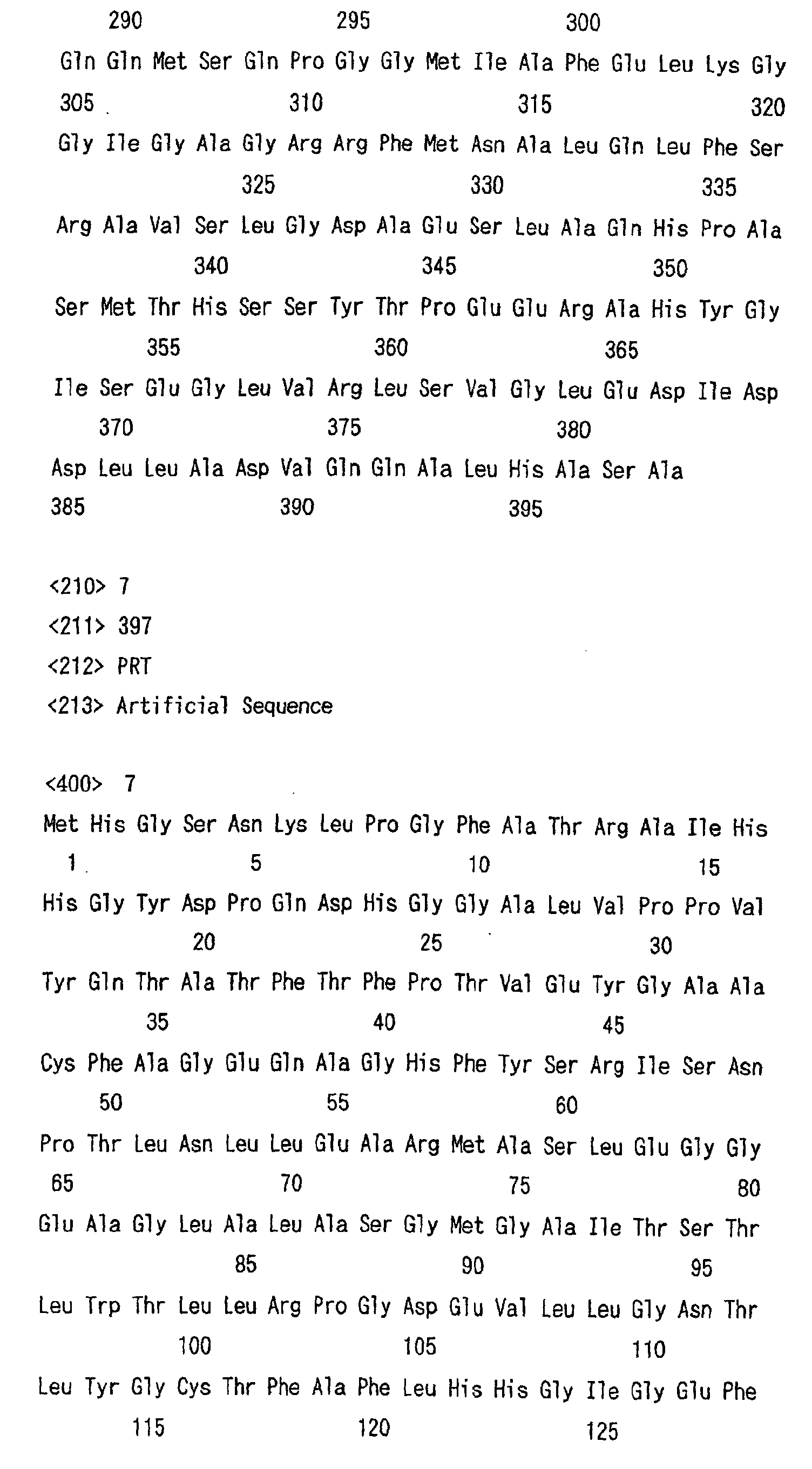
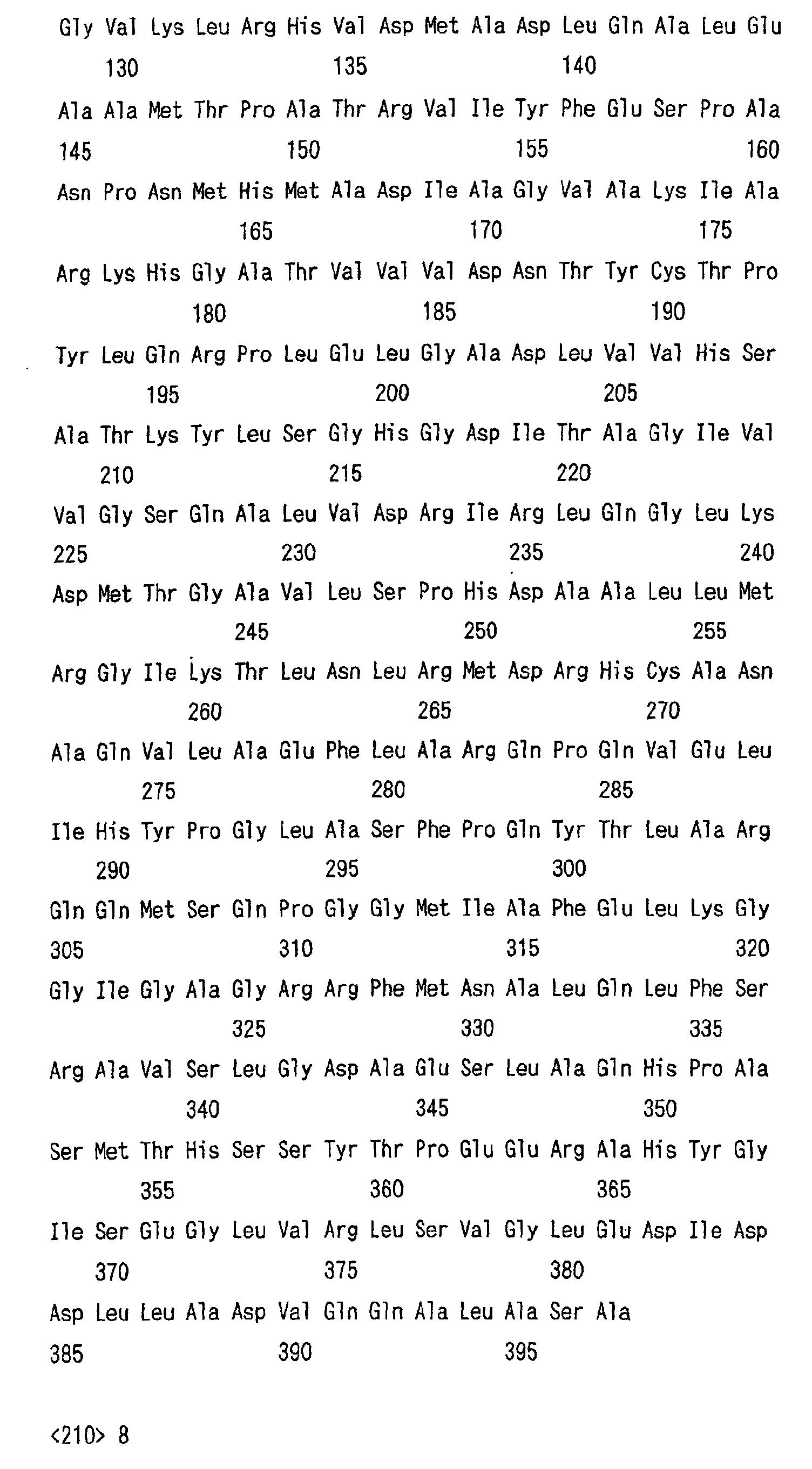
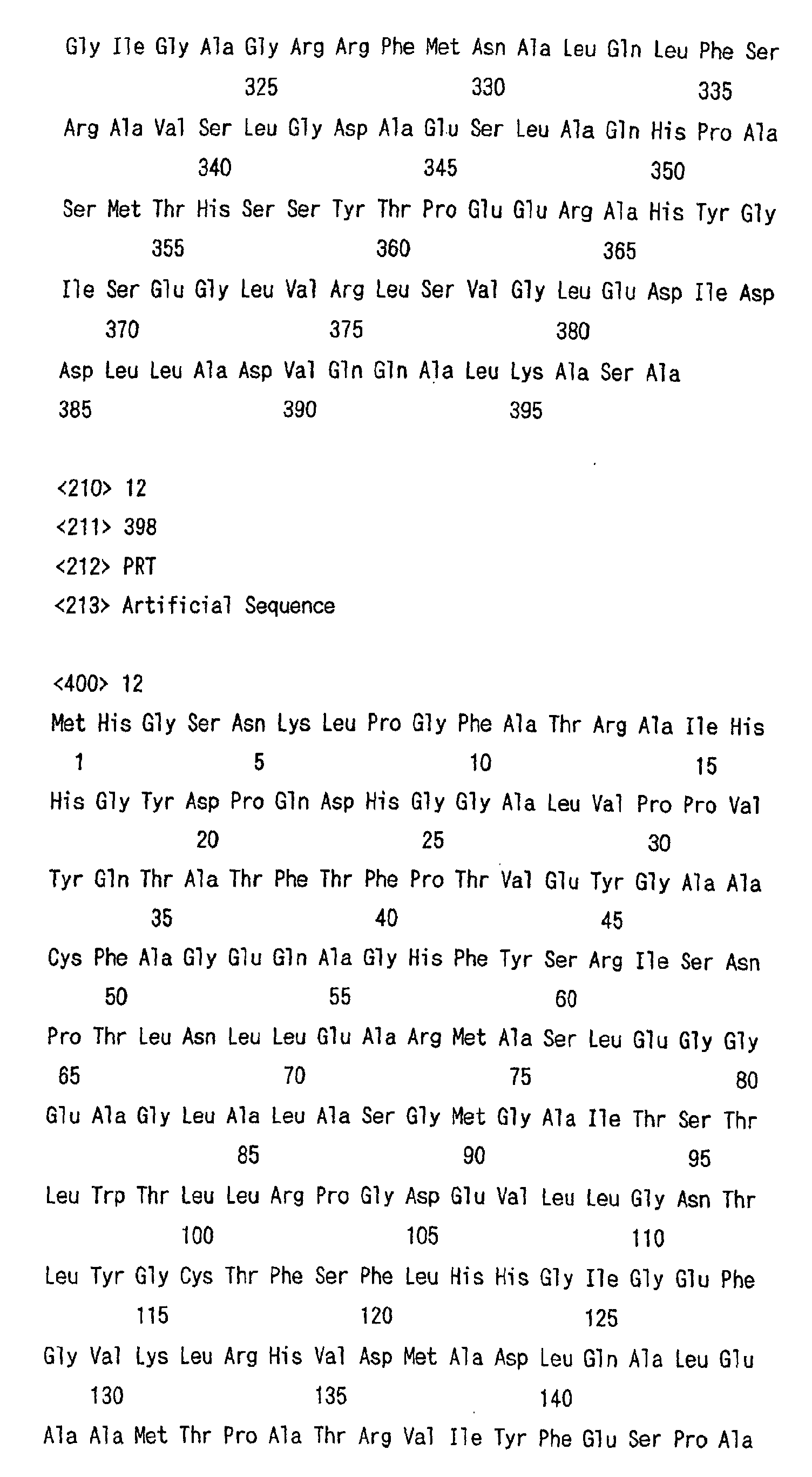
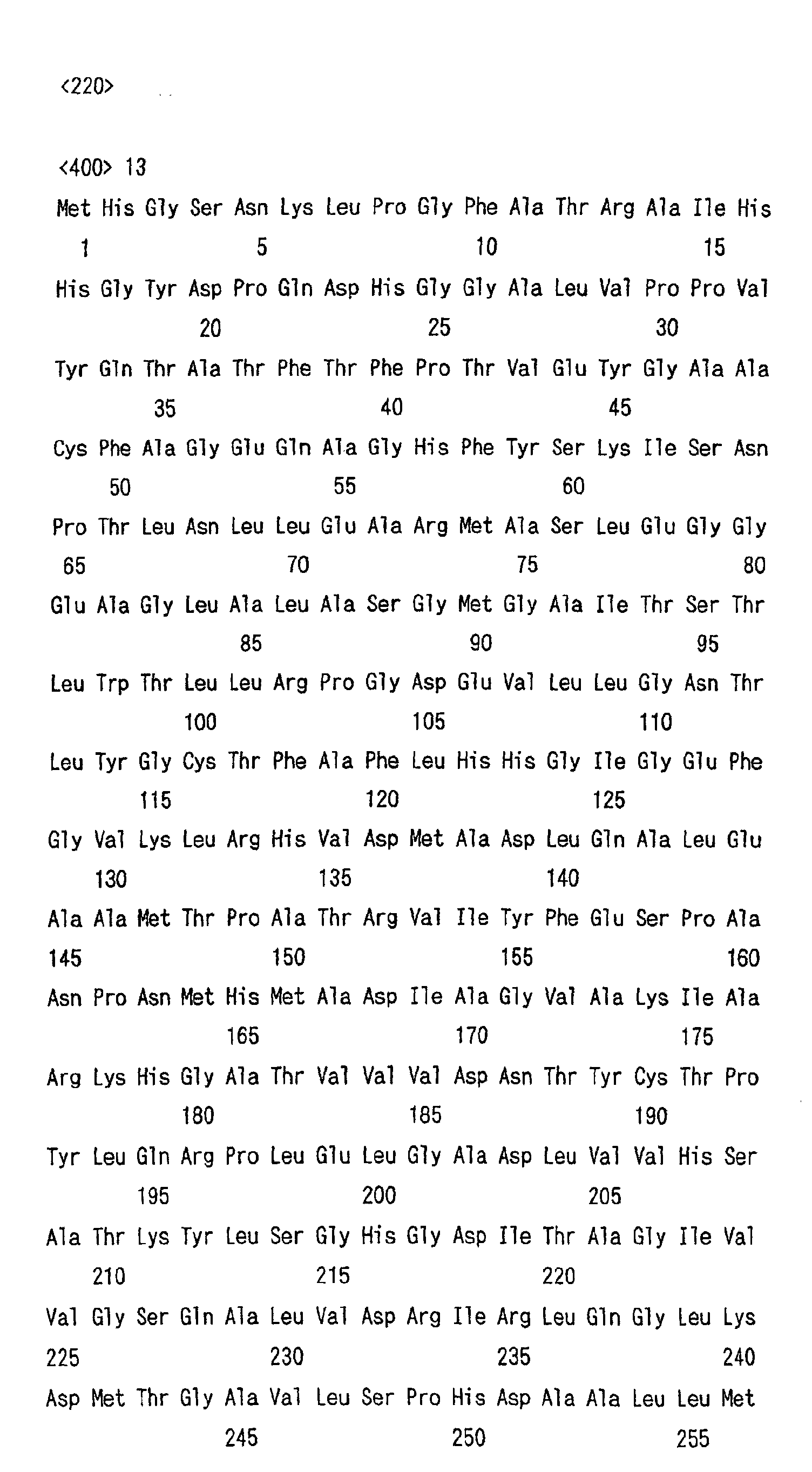
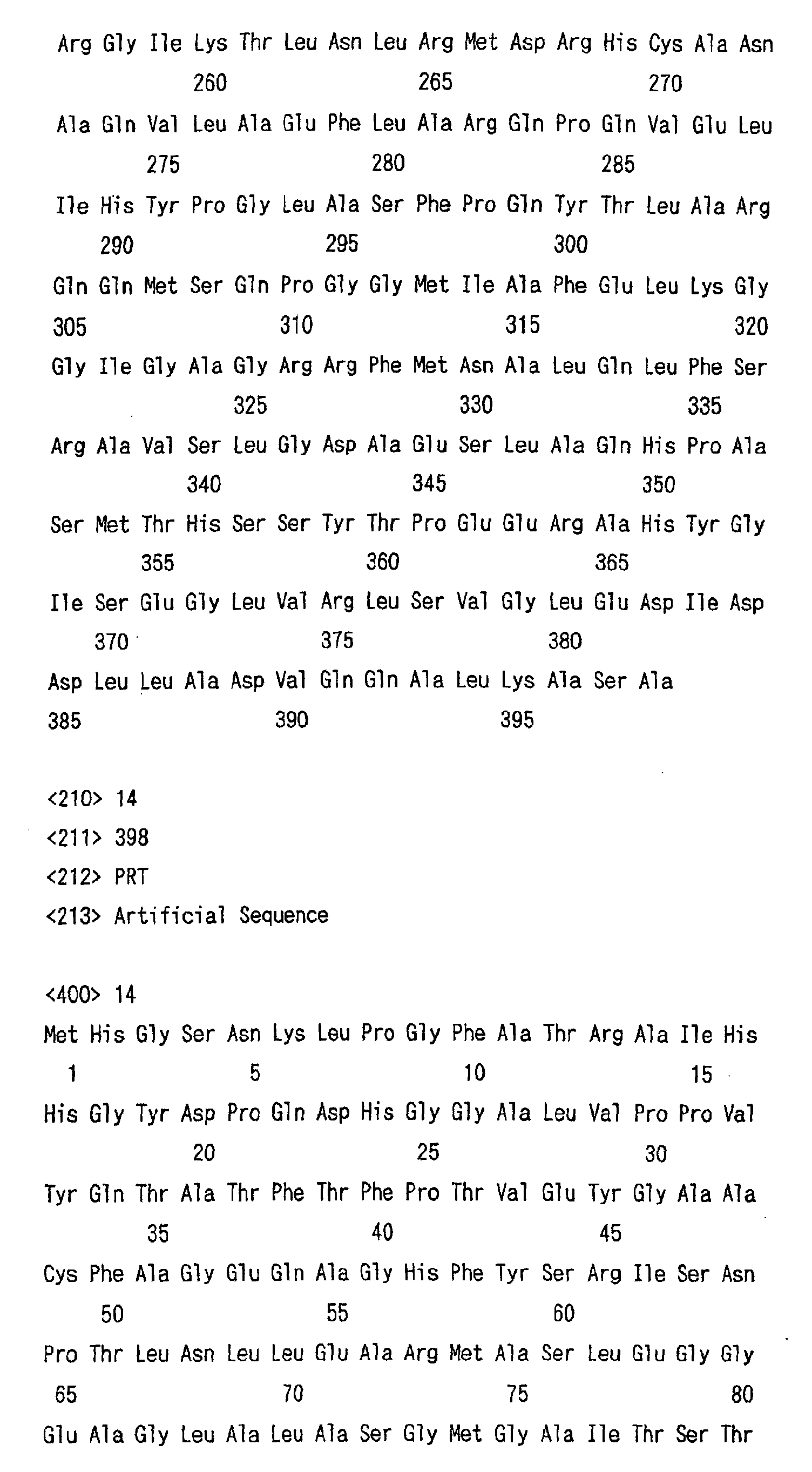
- the present invention as one embodiment relates to a protein characterized by being a functionally modified form of a subunit comprising an amino acid sequence having at least one mutation selected from deletion, substitution or insertion of one or more amino acid residue in the subunit of an amino acid sequence of wild type L-methionine ⁇ -lyase as described in SEQ ID NO: 1.
- the protein is a functionally modified protein having at least one mutation selected from mutations, wherein Lys-6 is substituted by His, Gly-9 is substituted by Cys, Cys-49 is substituted by Ser, Arg-61 is substituted by Lys, Cys-116 is substituted by Ser, Phe-128 is substituted by Cys, Cys-190 is substituted by Ser, Gly-217 is substituted by Ser, Ser-248 is substituted by Cys, Leu-341 is substituted by His, Asp-382 is substituted by Pro and/or Asp-385 is substituted by Cys, in the amino acid sequence described in SEQ ID NO: 1.
- the protein is a functionally modified protein shown by consisting of an amino acid sequence with 85% or more homology with that from No.1 to No. 398 shown in SEQ ID NO: 1.
- the homology for instance, can be calculated by the similarity shown as a score which can be obtained by using a search program, BLAST comprising the algorithm developed by Altschul, et al., [J. Mol. Biol., 215 , 403-410 (1990).
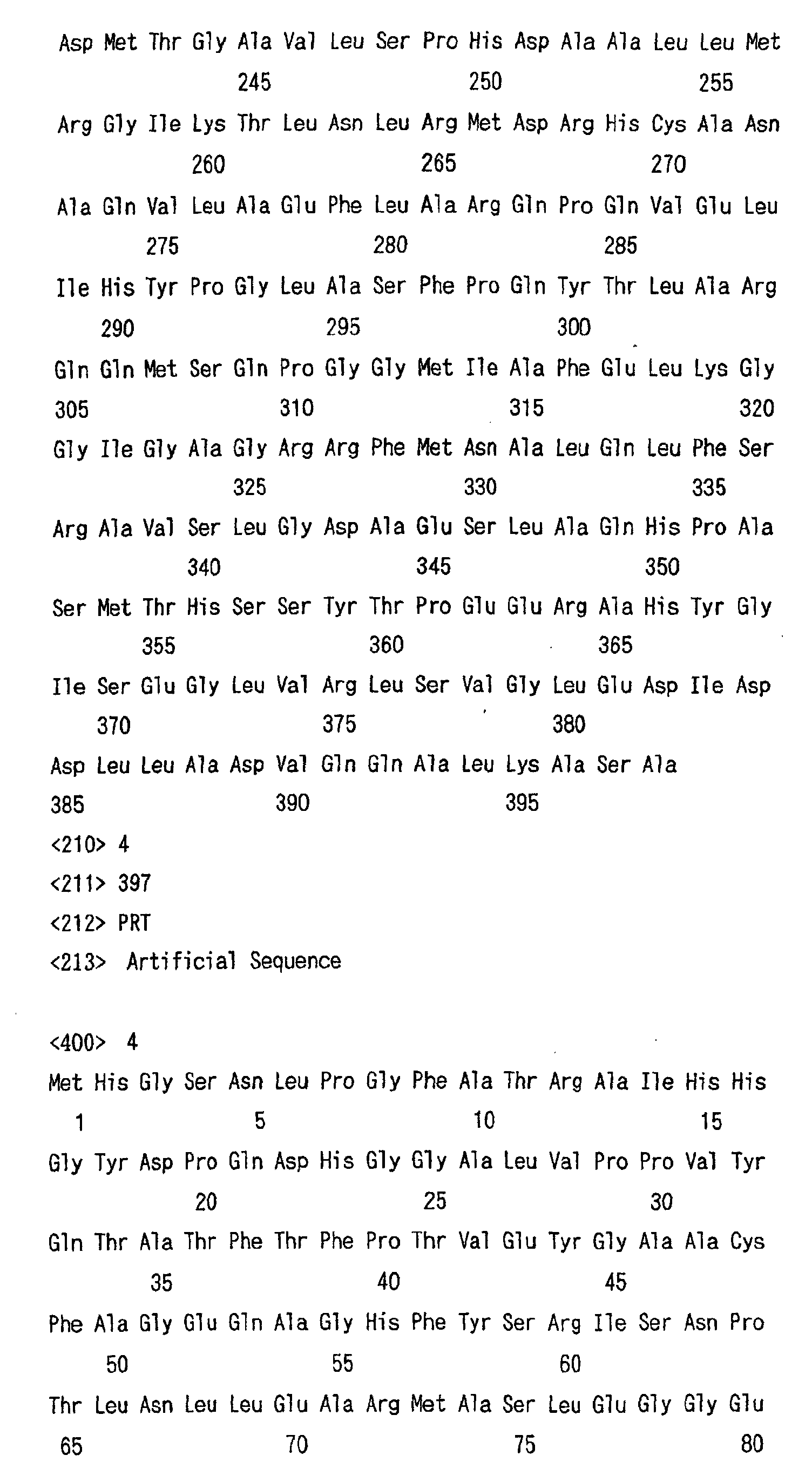
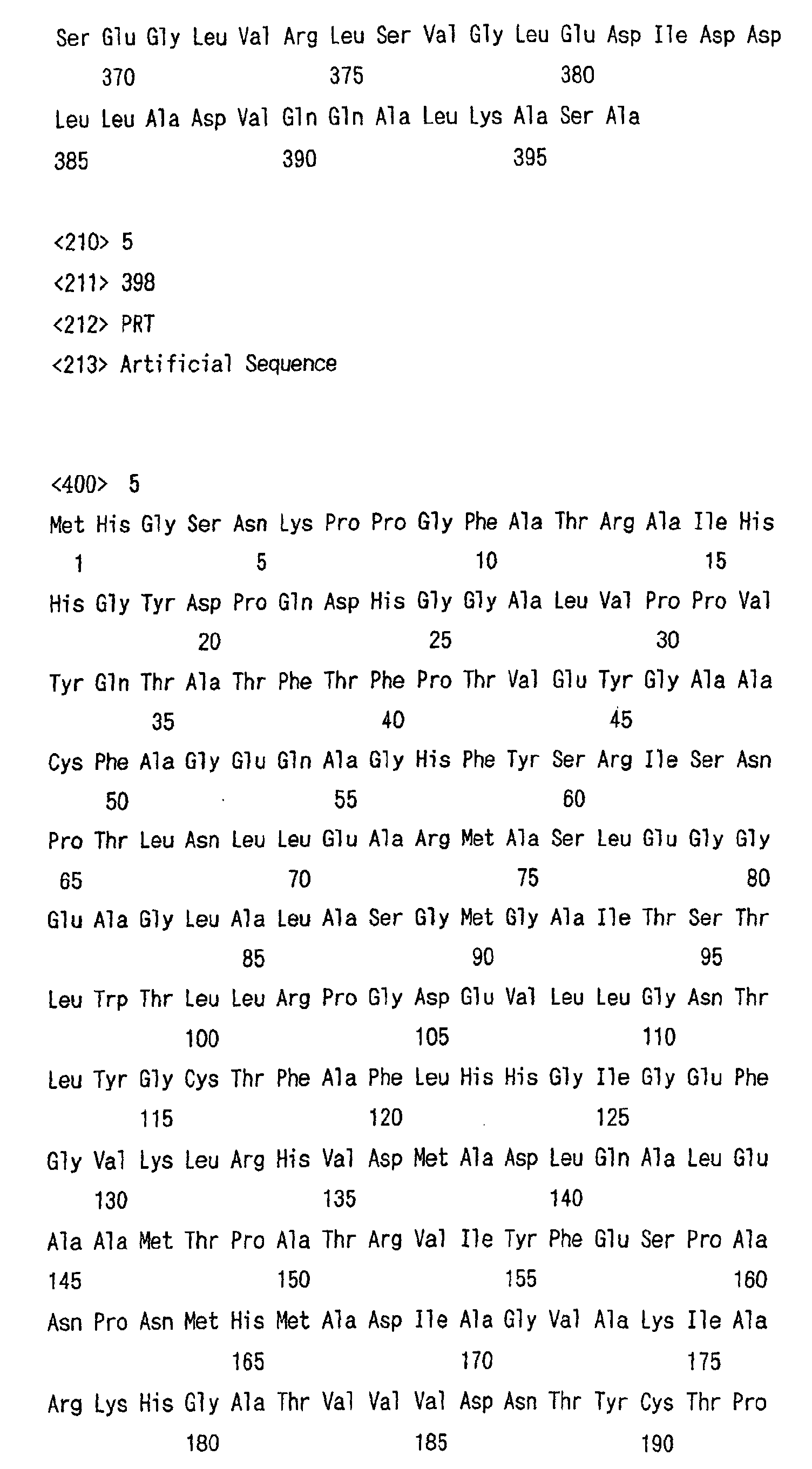
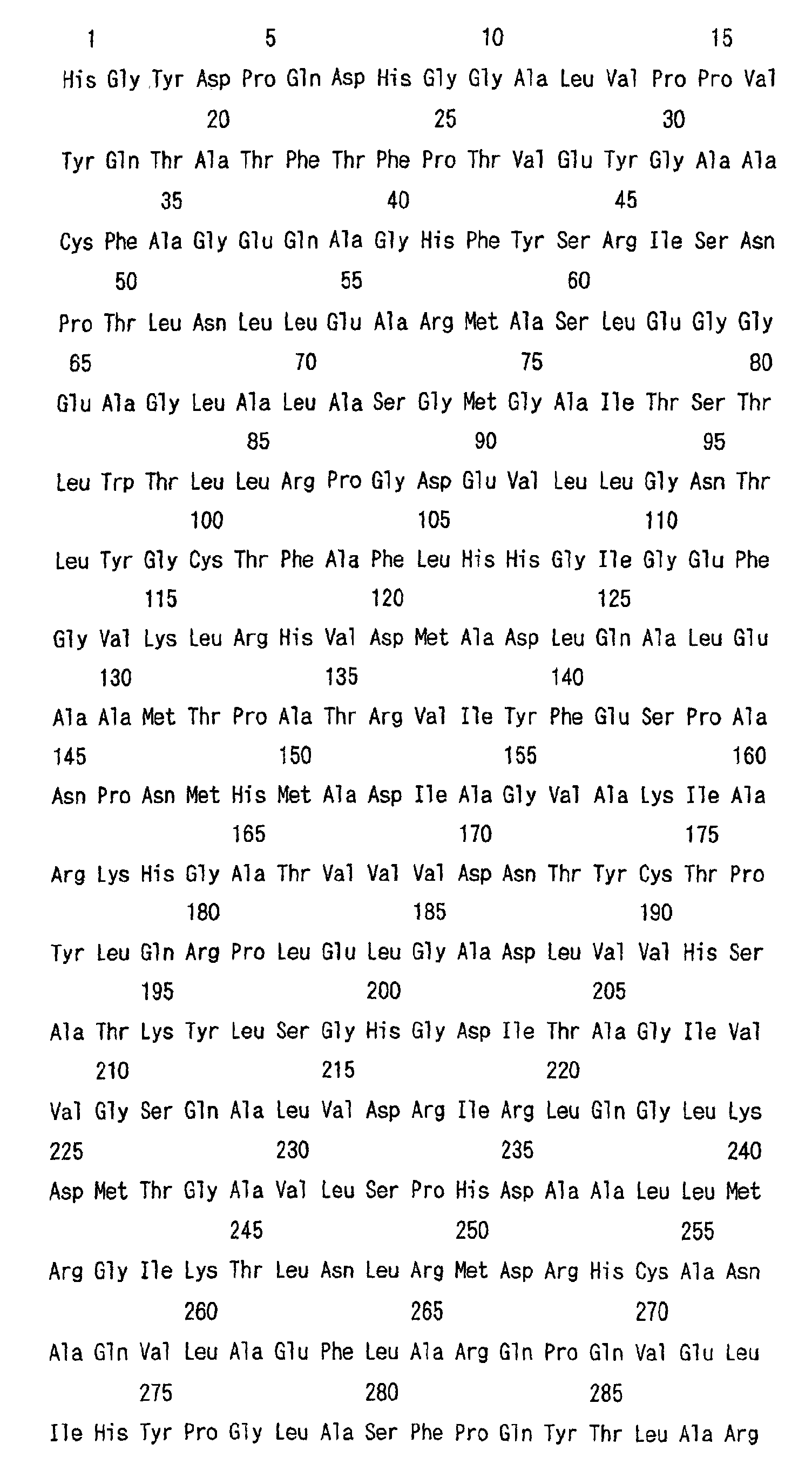
- wild type L-methionine ⁇ -lyase refers to an enzyme that consists of four subunits (monomers) which comprises a polypeptide having an amino acid sequence represented by SEQ ID NO: 1 [Inoue, H. et al.; J. Biochem., 117 , 1120-1125 (1995)] and that has one coenzyme, pyridoxal 5'-phosphate in every subunit.
- two subunits constitute a dimer structure so as to have two coenzymes, pyridoxal 5'-phosphate in the inner side and prevent a dissociation of the coenzyme.
- a functionally modified protein of the subunit of L-methionine ⁇ -lyase refers to a subunit constituting an enzyme that has the same order of biological activity as wild type L-methionine ⁇ -lyase, stabilizes its tetramer structure more than wild type L-methionine ⁇ -lyase and/or has an increased substrate specificity, and refers to a protein that has at least one mutation selected from those having substitution, insertion or deletion of one or more amino acid residue(s).
- its tetramer structure of L-methionine ⁇ -lyase is stabilized comprises "its tetramer structure of L-methionine ⁇ -lyase is stabilized by stabilizing an association among dimers of the subunit of the enzyme, stabilizing the dimer structure of the enzyme and/or preventing a dissociation of coenzyme, pyridoxal 5'-phosphate, to prevent the enzyme from protease-caused proteolysis and the like in blood.
- the term "the association of each dimer of the subunit of L-methionine ⁇ -lyase is stabilized" refers to a protection of the enzyme from protease-caused proteolysis and the like by means of forming a disulfide bond between dimers and can be exemplified by a method, wherein a tetramer structure is stabilized by forming a disulfide bond between dimers by substituting Gly-9 and Asp-385 by Cys and the like, described in SEQ ID NO: 1.
- its dimer structure of a subunit of L-methionine ⁇ -lyase is stabilized refers to preventing the dissociation of the coenzyme, pyridoxal 5'-phosphate by forming a disulfide bond between subunits and protecting a decomposition caused by a protease or the like and is exemplified by a method that stabilizes a dimer structure by substituting Phe-128 by Cys to form a disulfide bond between subunits, by substituting Ser-248 by Cys to form a disulfide bond and by substituting Cys-116 described in SEQ ID NO: 1 by Asp and/or by substituting Ala-119 by Ser to strengthen a hydrogen bond, or the like.
- prevent the dissociation of coenzyme, pyridoxal 5'-phosphate refers to a prevention of an dissociation by means of increasing an interaction between the coenzyme, pyridoxal 5'-phosphate and the subunit, by means of mutation of an amino acid sequence existing in the neighborhood of the binding site of the coenzyme, pyridoxal 5'-phosphate and is exemplified by a method that prevents a dissociation from the subunit by strengthening an interaction with the coenzyme, pyridoxal 5'-phosphate, by substituting Arg-61 by Lys, substituting Cys-190 by Ser and/or substituting Leu-341 by His described in SEQ ID NO: 1.
- the substituted amino acid residue is hydrophilic
- the dissociation of the coenzyme, pyridoxal 5'-phosphate is prevented owing to hydrogen bonding directly or via a water molecule or an electrostatic interaction.
- the substituted amino acid residue is hydrophobic
- the dissociation of the coenzyme, pyridoxal 5'-phosphate is prevented by a van der Waals interaction.
- the term "increase an activity in comparison with that of wild type L-methionine ⁇ -lyase” refers to enhancing activity of the modified form comparing with that of the wild type form under the same condition of measurement and is exemplified by a method stabilizing the structure of an enzyme, increasing the specificity of a substrate or preventing a dissociation of PLP thereof by substituting Lys-6 by His, substituting Phe-128 by Cys, substituting Cys-190 by Ser, substituting Ser-248 by Cys and/or Asp-385 substituting by Cys described in SEQ ID NO: 1.
- stabilize the enzyme in an alkaline solution refers to preventing the decrease of the enzymatic activity at a higher pH than the optimum pH of the enzyme and is exemplified by a method which prevents an aggregation of enzyme by stabilizing the structure of the enzyme, preferably its tetramer structure or the like, thereof by substituting Cys-49 by Ser described in SEQ ID NO: 1.
- stabilize the enzyme at high temperature refers to preventing the decrease of the enzymatic activity at higher temperature than the optimum temperature of the enzyme and is exemplified by a method which increases the thermal stability by stabilizing a structure of the enzyme, preferably by stabilizing an association between subunits by substituting Gly-9 and Asp-385 by Cys, described in SEQ ID NO: 1.
- the term "increase substrate specificity of the enzyme” refers to increasing the enzymatic activity by enhancing a substrate specificity by substituting a site that recognizes the substrate, L-methionine, to an amino acid residue, which can easily associate with the substrate and is exemplified by a method, wherein a specificity to L-methionine increases by substituting Gly-217 by Ser and/or substituting Ser-248 by Cys described in SEQ ID NO: 1.
- the present invention provides a method for preparing a functionally modified L-methionine ⁇ -lyase which comprises constructing a recombinant vectors by introducing a DNA sequence encoding the functionally modified L-methionine ⁇ -lyase which is modified by substitution, insertion or deletion of the above amino acid in the amino acid sequence described in SEQ ID NO: 1, introducing it into a vector suitable for a host, transforming the host with the vector and cultivating the transformant.
- the present method can be carried out according to the steps as exemplified below.
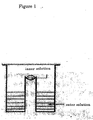
- Fig. 1 shows a schema of vapor diffusion method (Sitting Drop method).
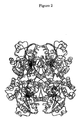
- Fig. 2 is a schema of a tetramer structure of L-methionine ⁇ -lyase. Its tetramer comprises four subunits, each of which binds to one coenzyme, pyridoxal 5'-phosphate. Pyridoxal 5'-phosphate is shown with black color.
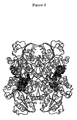
- Fig. 3 shows 10 amino acid residues of the N -terminal of the amino acid sequence of each subunit in its tetramer structure of L-methionine ⁇ -lyase with black color.
- Fig. 4 shows 10 amino acid residue of the C -terminal of the amino acid sequence of each subunit in its tetramer structure of L-methionine ⁇ -lyase with black color.
- Fig. 5 is a schema of a dimer structure of L-methionine ⁇ -lyase. Each subunit binds to the coenzyme, pyridoxal 5'-phosphate and they interact each other in the dimer. The coenzyme pyridoxal 5'-phosphate is shown with black color.
- Fig. 6 is a schema of a monomer structure of L-methionine ⁇ -lyase. The subunit binds to the coenzyme, pyridoxal 5'-phosphate.
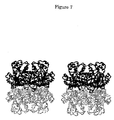
- Fig. 7 shows an association among dimers in the tetramer structure of L-methionine ⁇ -lyase.
- Fig. 8 shows an association between monomers in the dimer structure of L-methionine ⁇ -lyase.
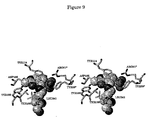
- Fig. 9 shows a binding site of the coenzyme, pyridoxal 5'-phosphate in the dimer structure of L-methionine ⁇ -lyase.
- a strain which expresses L-methionine ⁇ -lyase is prepared by introducing a recombinant plasmid containing the region of structural gene of L-methionine ⁇ -lyase into E. coli cells and is cultivated. From the resulting culture broth, cells are harvested, disrupted, and an aqueous solution of polyethyleneimine is added to adjust the final concentration of the solution to 0.05 to 0.5% (w/v), preferably 0.1 to 0.2% (w/v).
- the solution is treated at 5 to 25 °C for 1 to 20 min for removing cell debris to obtain a solution of crude L-methionine ⁇ -lyase.
- the cell debris may be removed by heat treatment (at 55 to 65 °C for 1 to 10 min) of the supernatant obtained by discarding the harvest of the cell by a centrifugation, instead of the treatment with the aqueous polyethyleneimine.
- the cell debris may be removed by adding a filter aid such as Coporoc-SA.
- the solution of the crude enzyme is subjected to salt-out with ammonium sulfate and then centrifugal separation.
- the obtained precipitate is dissolved in a buffer solution, preferably in a phosphate buffer to prepare a solution of crude L-methionine ⁇ -lyase can be prepared by dissolving.
- concentration of L-methionine ⁇ -lyase in the phosphate buffer is 4 to 30 g/L, preferably 10 to 20 g/L and most preferable is 15 g/L at this stage.
- the impurity is removed by adding polyethylene glycol to the solution of crude L-methionine ⁇ -lyase so as to be 5 to 25% (w/v), preferably 8 to 12% (w/v) in the final concentration, followed by stirring at 2 to 15 °C, preferably 4 °C for 10 to 120 min, preferably 60 min.
- Preferable polyethylene glycol is about 7200 or more in average molecular weight such as PEG 6000 and the like.
- ammonium sulfate is added so as to be a 8 to 12% solution in the final saturated concentration, preferably 10% or the pH value of the solution is adjusted to be 7.5 to 9.5, which is far from the isoelectric point of L-methionine ⁇ -lyase, preferably 8.0 to 9.0.
- the obtained crude crystal of L-methionine ⁇ -lyase had high purity and a decrease of pyrogenic substances was observed.
- the crystal can be preserved for a long period under a cold condition.
- a recombinant L-methionine ⁇ -lyase can be obtained, which is purified the same as or more than that obtained by purification using in combination without crystallization.
- purification method of column choromatography such as ion exchange chromatography or gel filtration chromatography
- the crystallization method is obviously favorable than the chromatography.
- the purification method of L-methionine ⁇ -lyase including the preparation of the crystal of the present invention is a very useful industrial purification method.
- Crystallization of the enzyme for the X-ray experiment can be performed using a solution of L-methionine ⁇ -lyase.
- a vapor-diffusion method e.g. Hanging Drop, Sitting Drop or the like, or a dialysis method can be used as a crystallization method. Every method comprises the realization of the equilibration between the solution containing the protein (inner solution) and that without the protein (outer solution), to accelerate the supersaturation and the growth from the crystal of the solution.
- the vapor-diffusion method is that the inner and outer solutions do not contact directly and the dialysis method is that the inner and outer solutions can contact through the dialysis membrane, which has an ability to cut molecules of an appropriate weight.
- a solution for crystallization 1 was prepared by adding, to a 50 mM solution of phosphoric acid adjusted to pH 7.1 to 7.5, preferably pH 7.2, ammonium sulfate so as to be a 0.5 to 1.5% solution (w/v), preferably 1% (w/v) and adding MPD so as to be a 40% solution. Then a solution for crystallization 2 was prepared by adding ammonium sulfate so as to be a 0.5 to 1.5% solution (w/v), preferably 1% (w/v) and adding PEG 6000 so as to be a 28 to 32% solution, preferably 30 %, to a 50 mM solution of phosphoric acid adjusted to pH 7.1 to 7.5, preferably pH 7.2.
- the crystals of recombinant L-methionine ⁇ -lyase obtained through such a crystalline method had the same order of enzymatic activity as that of the corresponding wild type protein even after dissolving again. And the amino acid sequence of the N terminal was identical each other.
- the diffraction intensity of crystals was measured by using an X-ray detector such as the detector system R-AXIS IV equipped with the imaging plate (Rigaku Co.), an imaging plate or a CCD, at Beamline 24XU-hatch A (Hyogo prefecture's beamline) of synchrotron radiation facility, Spring-8 in Japan.
- X-ray produced from an X-ray generator of circulated anti-cathode systems or the synchrotron radiation, is irradiated to the crystal, whose diffraction patterns are obtained.
- the obtained diffraction patterns are processed and scaled as an intensity data set by using software programs for treatment of diffraction patterns such as DENZO (HKL Research Inc.), and then structure determination is carried out.
- a program package, X-PLOR [A. T. Brunger, X-PLOR, Version 98.0: Yale University press: New Haven, CT, 1998; offered by Molecular Simulations, Inc. and the like] is used to determine the steric structure.
- the crystal structure wherein the R value is 25% or less and the resolution is 2 to 3 ⁇ , can be obtained by the data of the synchrotron radiation and an imaging plate system and by refinement using X-PLOR. This quality is enough for the identification of inhibitors.
- the stereo view of the complex of the apoenzyme and the coenzyme can be achieved using software for a graphic computer such as Insight II [Biosyn/molecular simulations, Inc. (San Diego, California)], Quanta [Molecular Simulations, Inc. (Burlington, Massachusetts)] or the like.
- the geometries of the interactions mode between the apoenzyme and the coenzyme can be clarified by using tools included in the program.
- a crystal of L-methionine ⁇ -lyase was prepared by Sitting Drop method from the protein solution of phosphate buffer pH 7.2 with MPD, PEG 6000 and ammonium sulfate as precipitants.
- the diffraction patterns from the crystal was measured by using the X-ray diffraction system equipped with an imaging plate, R-AXIS IV (Rigaku Co.) and reflections were collected until 1.8 ⁇ resolution.
- the structure was determined by the molecular replacement method using the routine of the program package, X-PLOR.
- the R-value of refinement structure is 23.4%.
- the measured diffraction patterns from the crystal was processed with software, DENZO (HKL, Research Inc.).
- the present invention also provides a method of preparing a functionally modified L-methionine ⁇ -lyase and of determining the crystal structure.
- the present invention provides a method of identifying the active site by determining the position of the association site of the dimer and the subunit and the position of the binding site of pyridoxal 5'-phosphate, based on the crystal structure of L-methionine ⁇ -lyase.
- functional modification can be carried out at the specified or combined site among sites of association of the dimer and the subunit, and the binding site of pyridoxal 5'-phosphate.
- the functionally modified form is characterized by some special properties different from that of wild type of L-methionine ⁇ -lyase.
- the functionally modified form may have an increased structural stability toward the dissociation of the subunit.
- a determination method of the amino acid sequence of protein is well known in the above process (1), for example, an automatic amino acid sequencer on the market can be used.
- the synthesis of oligonucleotide having a specified base sequence can be carried out by using a DNA synthetic apparatus on the market according to the operating procedure in the process (1) and (2).
- the DNA base sequence can be determined using a well-known M13 vector by the method of Snger, et al. [Proc. Natl. Acad. Sci. U.S.A., 74 , 5463-5467(1977)] in the process (1) and (2).
- the vector for cloning refers to a plasmid vector such as pUC118, pUC119, pUC13, pBR322 or pAT153 or a phage vector such as ⁇ ZAPII, ⁇ gt10 in the process (1) and (2).
- An E. coli bacteria can be used as a host for cloning and expression, e.g. Escherichia coli K-12 cell line, such as HB101 strain, DH1 strain, C600 strain, JM103 strain, JM105 strain, JM109 strain or MV1184 strain.
- pYES2, pYEUra3 and the like can be used as the vector for isolation of the protein from the supernatant.
- Pseudomonas strain is used as the host, RSF1010, RK2 and the like can be used as the vector and so called self-cloning can be performed.
- a DNA fragment containing the structural gene of intended functionally modified L-methionine ⁇ -lyase may be inserted into a promoter suitable for a function in the host such as Lac, Tac, Trc, Trp and ⁇ PL, an expression vector having Shine-Dalgarno (SD) sequence e.g. pKK223-3 and pPL-lambda and the like, and furthermore an ATG vector having a translation initiation codon ATG e.g. pKK233-2, pTrc99A and the like.
- SD Shine-Dalgarno
- the effective expression may be possible by inserting the constructed expression plasmid into a suitable host, e.g. Escherichia coli , JM103 strain, JM109 strain, HB101 strain, C600 strain or the like in the above process (5).
- a suitable host e.g. Escherichia coli , JM103 strain, JM109 strain, HB101 strain, C600 strain or the like in the above process (5).
- Purification and isolation of the expressed functionally modified L-methionine ⁇ -lyase can be carried out by combining various well-known methods of purification and isolation in the above mentioned process (6).
- the well-known method refers to salting-out, dialysis, ultrafiltration, gel filtration, various kinds of chromatographies such as ion-exchange chromatography and the like, various kinds of electrophoresis such as SDS-polyacryl amide gel electrophoresis and the like.
- the protein defined by the term "a protein of functionally modified form of the subunit, comprising an amino acid sequence having at least one mutation selected from substitution, insertion or deletion of one or more amino acid residue is in comparison with the subunit of an amino acid sequence of wild type L-methionine ⁇ -lyase as described in SEQ ID NO: 1" means a functionally modified protein which can include a chemical or biochemical modification as well as natural or unnatural amino acid or the amino acid sequence, provided that the formation or activity is the substantially same as L-methionine ⁇ -lyase produced by pseudomonas putida ICR3460 cell line.
- the functionally modified protein can be prepared by a well-known method by a person ordinary skilled in the art such as a site-specific mutagenesis using the PCR method.
- the present invention also provides an anti-tumor agent comprising the functional modified L-methionine ⁇ -lyase of the present invention or variants thereof.
- the anti-tumor agent of the present invention can be prepared using any of known carriers or excipients therefor. It is typically in the form of injections and can be lyophilized products. For administration, it will be generally infused parenterally over several ten minutes to several hours per day for several days to several weeks. Although the administration dose varies depending on intended effects, sex, age, weight and severity of symptoms of patients and the like, it is generally from about 1 to 1000 U/kg weight/day, and preferably from about 50 to 500 U/kg weight/day.
- the region of the structural gene of L-methionine ⁇ -lyase was inserted into the expression vector of pKK233-2 and the expression plasmid of L-methionine ⁇ -lyase, pMGLTrc03 was inserted into an E. coli, JM109 strain, which was used for the expression strain of recombinant L-methionine ⁇ -lyase.
- the cells were cultivated at 28°C for 24h in a Terrific medium containing 4% glycerin on three 30-L jar fermenters. Isopropyl- ⁇ -D-thiogaractopyranoside was added so as to be a 0.3 mM solution at the logarithmic growth phase to induce the expression of L-methionine ⁇ -lyase.
- Coporoc-SA (Otsuka Pharmaceuticals Co.) was added to the disrupted cell suspension, 36.6 kg so as to be a 0.6% solution (w/w) in the final concentration and the mixture was stirred for 1h.
- a centrifugal separation of the mixture 39 kg treated with coprec-SA gave a solution of the crude enzyme 37 kg, in which there was L-methionine ⁇ -lyase 160 g of specific activity 29 U/mg.
- Ammonium sulfate 8.86 kg was added gradually to a solution of the crude enzyme obtained in Example 2 so as to be a 40% saturated ammonium sulfate solution.
- the mixture dissolved at pH 7.2 with aqueous ammonia, was salted out at 4°C and preserved for 1 to 3 days. Separation by centrifuging, a precipitate, was dissolved in a dissolving buffer (20 mM phosphate buffer, pH 7.2; 0.5 mM PLP, 0.05% 2-mercaptoethanol) 3.6 L, then a dissolving buffer 0.2 L, containing ammonium sulfate 150 g was added thereto. The solution was adjusted to pH 7.2 with aqueous ammonia and cooled to 4°C.
- a dissolving buffer 1.6 L containing PEG 6000, 540 g was added slowly thereto, and the mixture was stirred at 4°C for 1h.
- the precipitate (insoluble materials) was removed by centrifuging and the solution was added slowly to a dissolving buffer, 5.4 L containing PEG 6000, 650 g.
- the solution was warmed to 32 °C and a solution of 4M NaCl 540 ml was added with stirring for 20 min. Stirring at 32 °C for 1h gave rod crystals of L-methionine ⁇ -lyase in the solution. Then, the crystals were aged with stirring at 4 °C for 20h, and collected by centrifugal separation as crude crystals.
- Example 3 The crude rod crystal obtained in Example 3 was dissolved in a dissolving buffer 6 L and the precipitate (insoluble materials) was removed by centrifuging. A dissolving buffer 2.4 L containing PEG 6000 760 g was added slowly and the mixture was warmed at 32 °C. A solution of 4M NaCl 420 ml was added with stirring during 20 min. Octahedral crystals of L-methionine ⁇ -lyase appeared after stirring at 32 °C for 1h and 4 °C for 20h. The crystals of L-methionine ⁇ -lyase were collected by centrifuging and dissolved in a dissolving buffer 6L.
- Example 4 A dissolved solution of the recrystallized material obtained in Example 4 was applied to column chromatography on DEAE-Sepharose FF (Amersham Pharmacia Biotech Co.) 5L which was previously equilibrated in a 20 mM sodium phosphate buffer (pH 7.2). After the column was washed with a 20 mM sodium phosphate buffer (pH 7.2) containing 0.1 mM of PLP and 0.01% 2-mercaptoethanol, the product was eluted with a 20 mM sodium phosphate buffer (pH 7.2) containing 120 mM NaCl, 0.1 mM PLP and 0.01% 2-mercaptoethanol.
- the active fraction 15 L was concentrated by the use of a filtration membrane (Millipore Co.) of molecular weight cut off, 10 kDa to 2.7 L.
- L-Methionine ⁇ -lyase 87 g was there in the concentrated solution.
- a portion of 0.9 L of the concentrated solution 2.7 L was applied to column chromatography on Sephacryl S-200HR (Amersham Pharmacia Biotech Co.) 18 L which was previously equilibrated in a 20 mM sodium phosphate buffer (pH 7.5) containing 0.01 mM PLP. The procedure repeated three times.
- the specific activity of obtained L-methionine ⁇ -lyase of the active fraction was about 61 U/mg and L-methionine ⁇ -lyase 69 g was there.
- a recrystallization for an X-ray diffraction experiment was carried out by the use of the solution (sample solution) obtained in Example 5.
- the vapor-diffusion method (Sitting Drop method) was used as the method of recrystallization (Fig. 1).
- a solution for crystallization 1 (containing a 50 mM sodium phosphate buffer, pH 7.2; 1% ammonium sulfate, 40% 2-methyl-2, 4-penatnediol) and a solution for crystallization 2 (containing a 50 mM sodium phosphate buffer, pH 7.2; 1% ammonium sulfate and PEG 6000) were prepared.
- the solution for crystallization 1 500 ⁇ l and the solution for crystallization 2 100 ⁇ l were mixed and used as an outer solution. Then, 10 ⁇ l of the outer solution was taken out and mixed with 10 ⁇ l of sample solution, which was filtrated with a membrane filter. The mixed solution was used as an inner solution.
- the plates for the crystallization was immediately set in a chamber adjusted at 4 °C. Tiny crystals were appeared after 2 days and it was recognized through the microscopic observation. The crystal grew up to 0.5 X 0.5 X 0.3 mm after 1 week standing.
- the crystal structure was solved by means of molecular replacement method the program package X-PLOR [A. T. Brunger, X-PLOR, Version 98.0: Yale University Press: New Haven, CT, 1998; Molecular Simulations, Inc.].
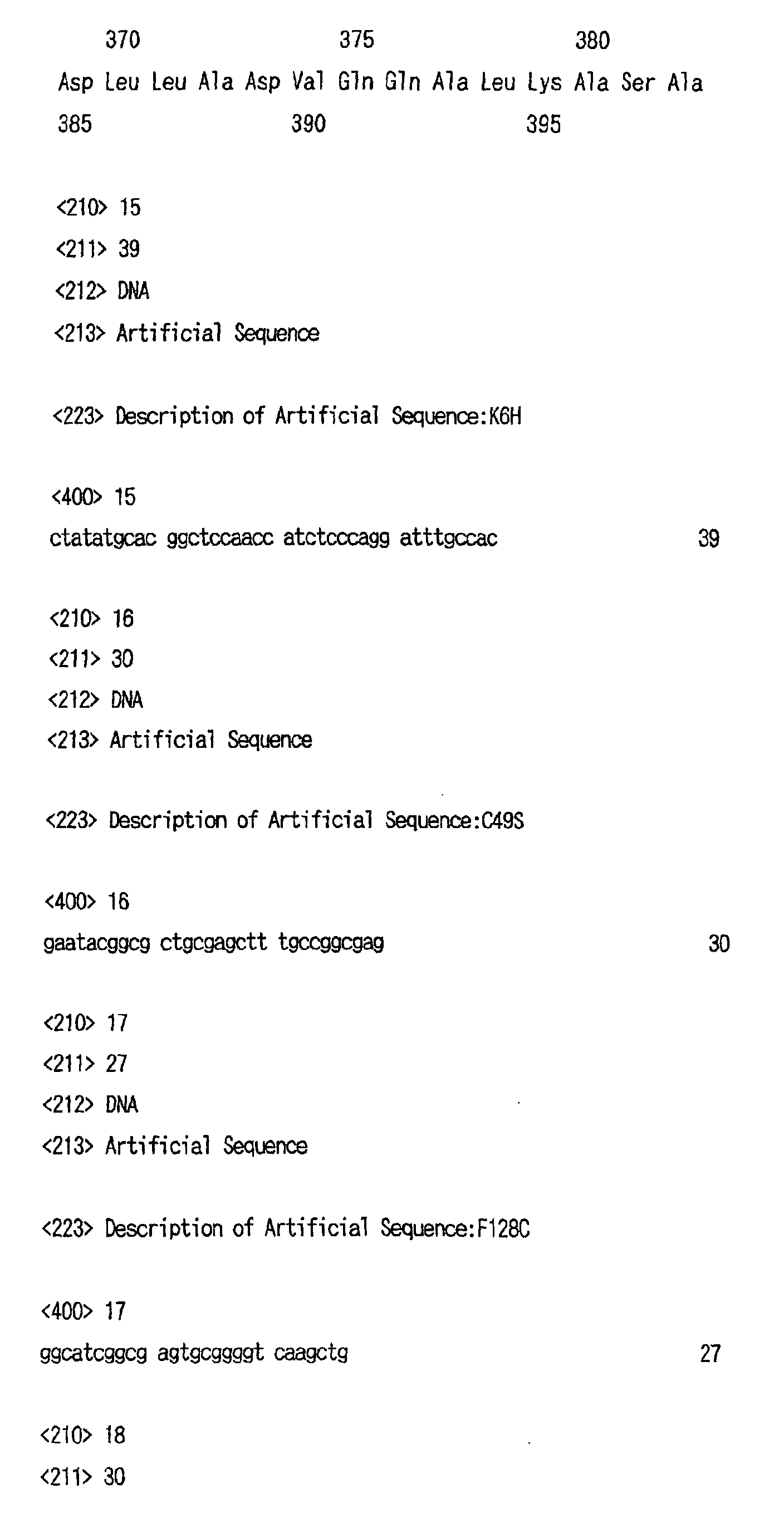
- Functionally modified L-methionine ⁇ -lyase gene was constructed by the use of Quick Change Site-Directed Mutagenesis Kit (StrataGene Co.) to obtain functionally modified L-methionine ⁇ -lyase, wherein Lys-6 is substituted by His, Cys-49 is substituted by Ser, Ala-119 is substituted by Ser, Phe-128 is substituted by Cys, Cys-190 is substituted by Ser, Gly-217 is substituted by Ser, Ser-248 is substituted by Cys, Leu-341 is substituted by His, Asp-385 is substituted by Cys, Lys-395 is substituted by His and Gly-9 is substituted by Cys and Asp-385 is substituted by Cys in the amino acid sequence described in SEQ ID NO: 1 (hereafter each enzyme is shown to be K6H ,C49S, A119S, F128C, C190S, G217S, S248C, L341H, D385C, K395H and
- a synthetic oligonucleotide primer in which a site specific mutation was inserted was prepared and the mutation was introduced according to the procedure of the protocol. Two types of the synthetic oligonucleotide primers with forward and inverse directions were prepared. The oligonucleotide primer with forward direction was shown in Table 5.
- the transformed strain obtained in Example 8 was cultivated in 10 tubes of the 10 ml LB medium containing 0.5% glycerin and then cultivated in a Terrific medium 120 ml containing 4% glycerin at 28 °C for 24h. Isopropyl- ⁇ -dithiogaractopyranoside was added so as to be a 0.3 mM solution of the final concentration at the logarithmic growth phase to induce the expression of L-methionine ⁇ -lyase.
- the cells were harvested by centrifuging, suspended in a 100 mM phosphate buffer 40 ml containing 1mM EDTEA-2Na, 0.75 mM PLP and 0.01% DTT and then disrupted by means of a high pressure homogenizer.
- Filter aid, Coporoc-SA (Otsuka Pharmaceuticals Co.) was added so as to be a 0.6% solution (w/w) in the final concentration and the impurity was removed by centrifuging.
- Ammonium sulfate was added so as to be a 60% saturated solution in the final concentration at 5 °C with keeping pH 7.2.
- the salt-outed product was collected by centrifuging and dissolved in a 20 mM sodium phosphate buffer (pH 7.2) 25 ml containing 0.5mM PLP and 0.05% 2-mercaptoethanol.
- PEG 6000 was added so as to be an 8% solution in the final concentration and the impurity was removed by centrifuging.
- NaCl was added so as to be 200 mM in the final concentration at 37 °C.
- After maintaining at 5 °C overnight the appeared crystals were collected by centrifuging and dissolved in a 20 mM sodium phosphate buffer (pH 7.2) containing 0.5mM PLP and 0.05% 2-mercaptoethanol.
- the solution showed a single band in an electrophoresis on SDS polyacrylamide gel and showed to be pure and yield enough for the examination on the property analysis of functionally modified L-methionine ⁇ -lyase.
- Example 9 The specific activity of purified functionally modified L-methionine ⁇ -lyase obtained in Example 9 is shown in Table 6, comparing with that of wild type L-methionine ⁇ -lyase as 100.
- the activity was measured according to the procedure by Soda et al. [Methods Enzymol., 143 , 459-465 (1987)], wherein the production rate of ⁇ -ketobutyrate acid was measured in the presence of L-methionine, Functionally modified enzyme Specific activity (%) K6H 122 F128C 112 C190S 120 S248C 131 D385C 102 WT 100
- Every functionally modified enzyme obtained showed an increase of specific activity than that of wild type L-methionine ⁇ -lyase.
- the purified functionally modified L-methionine ⁇ -lyase obtained in Example 9 was incubated in a 0.1 M sodium carbonate buffer (pH 11.0) at 37 °C for 3h and the remaining activity was measured.
- the comparative remaining activity was shown in Table 7, in comparison with the remaining activity value 100 in a 0.1 M sodium phosphate buffer (pH 8.0).
- the activity was measured according to the procedure by Soda et al. [Methods Enzymol., 143 , 459-465 (1987)], wherein the production rate of ⁇ -ketobutyrate was measured in the presence of L-methionine.
- the purified functionally modified L-methionine ⁇ -lyase obtained in Example 9 was incubated in a 0.1 M sodium phosphate buffer (pH 7.2) at 65 °C for 30 min and the remaining activity was measured.
- the comparative remaining activity was shown in Table 8, in comparison with the remaining activity 100 at 37 °C.
- the activity was measured according to the procedure by Soda et al. [Methods EnzymoL, 143 , 459-465 (1987)], wherein the production rate of ⁇ -ketobutyrate was measured in the presence of L-methionine.
- Example 9 The purified functionally modified L-methionine ⁇ -lyase obtained in Example 9 was once dialyzed in a 0.1 M sodium phosphate buffer (pH 7.2) and excess PLP was removed and the activity value in the presence of PLP was compared with that in the absence of PLP. The comparative remaining activity was shown in Table 9, in comparison with the remaining activity value 100 with that with PLP. The activity was measured according to the procedure by Soda et al. [Methods Enzymol., 143, 459-465 (1987)], wherein the production rate of ⁇ -ketobutyrate was measured under in the presence of L-methionine. Functionally modified enzyme Activity without PLP (%) C190S 81 L341H 80 WT 75
- the substrate specificity of the purified functionally modified L-methionine ⁇ -lyase obtained in Example 9 was investigated.
- the activity was measured according to the procedure by Soda et al. [Methods Enzymol., 143 , 459-465 (1987)], wherein the production rate of ⁇ -ketobutyrate was measured in the presence of 250 mM L-homoserine and 25 mM L-methionine as the substrate and their values were compared.
- the comparative specific activity was shown in Table 10, wherein the case of L-methionine against that of L-homoserine was taken to be 100 in wild type of L-methionine ⁇ -lyase.
- Functionally modified enzyme Activity (%) G217S 188 S248C 127 WT 100
- the activity against L-methionine increased in every functionally modified enzyme. Furthermore, Km value to L-methionine of S248D and wild type of L-methionine ⁇ -lyase was obtained. The Km value of wild type L-methionine ⁇ -lyase was 1.3 mM and that of S248C was 1.0 mM. An affinity to L-methionine increased in S248C enzyme.
- the substrate specificity of the purified functionally modified L-methionine ⁇ -lyase obtained in Example 9 was investigated.
- the activity was measured according to the procedure by Soda et al. [Methods Enzymol., 143 , 459-465 (1987)], wherein the production rate of ⁇ -ketobutyrate was measured in the presence of 12.5 mM D,L-homocysteine and 25 mM L-methionine as the substrate and their values were compared.
- the comparative specific activity was shown in Table 11, wherein the case of L-methionine against that of D,L-homoserine was taken to be 100 in wild type of L-methionine ⁇ -lyase.
- a functionally modified recombinant L-methionine ⁇ -lyase of the present invention is obtained by cultivation of a recombinant E-coli in a suitable medium, and constitutes naturally an active form which comprises a tetramer in the soluble fraction (cell-free extracts).
- the protein or the polymer of its mutant of the present invention, or preferably an enzyme of the tetramer is useful as a therapeutic agent for tumor, obesity, heart disease, cardiovascular disease, CNS, aging and the like.
Landscapes
- Health & Medical Sciences (AREA)
- Life Sciences & Earth Sciences (AREA)
- Chemical & Material Sciences (AREA)
- Engineering & Computer Science (AREA)
- Bioinformatics & Cheminformatics (AREA)
- Organic Chemistry (AREA)
- Medicinal Chemistry (AREA)
- General Health & Medical Sciences (AREA)
- Veterinary Medicine (AREA)
- Chemical Kinetics & Catalysis (AREA)
- Nuclear Medicine, Radiotherapy & Molecular Imaging (AREA)
- General Chemical & Material Sciences (AREA)
- Pharmacology & Pharmacy (AREA)
- Animal Behavior & Ethology (AREA)
- Public Health (AREA)
- Zoology (AREA)
- Wood Science & Technology (AREA)
- Genetics & Genomics (AREA)
- Biomedical Technology (AREA)
- Biochemistry (AREA)
- Microbiology (AREA)
- Cardiology (AREA)
- Heart & Thoracic Surgery (AREA)
- Molecular Biology (AREA)
- General Engineering & Computer Science (AREA)
- Biotechnology (AREA)
- Diabetes (AREA)
- Child & Adolescent Psychology (AREA)
- Vascular Medicine (AREA)
- Hematology (AREA)
- Obesity (AREA)
- Urology & Nephrology (AREA)
- Neurology (AREA)
- Neurosurgery (AREA)
- Enzymes And Modification Thereof (AREA)
- Micro-Organisms Or Cultivation Processes Thereof (AREA)
- Medicines That Contain Protein Lipid Enzymes And Other Medicines (AREA)
Abstract
Description
| Purification step | specific activity (U/mg) | Activity yield (%) | |
| Example 2 | Crude enzyme soln. | 28.7 | 100 |
| Example 3 | Rod crystal | 54.5 | 88 |
| Example 4 | Octagonal crystal Soln. | 55.4 | 82 |
| Example 5 | Sephacryl S-200 HR | 61.2 | 50 |
Then, 10 µl of the outer solution was taken out and mixed with 10 µl of sample solution, which was filtrated with a membrane filter. The mixed solution was used as an inner solution. The plates for the crystallization was immediately set in a chamber adjusted at 4 °C. Tiny crystals were appeared after 2 days and it was recognized through the microscopic observation. The crystal grew up to 0.5 X 0.5 X 0.3 mm after 1 week standing.
| Measurement conditions | |
| Size of Cryst. | 0.5X0.5X0.3mm |
| wave length of X-RAY | 0.835 Å |
| Camera radius | 320mm |
| Size of collimator | 0.1mm |
| exposure time of X-RAY | 8 min |
| Region of vibration angle | 0.8 degree |
| Shell I/Sigma in resolution shells: | ||||||||||
| Lower | Upper | % of reflections with I/Sigma less than | ||||||||
| limit | limit | 0 | 1 | 2 | 3 | 5 | 10 | 20 | >20 | total |
| 40.00 | 3.88 | 0.8 | 1.4 | 1.8 | 2.1 | 2.8 | 4.9 | 18.2 | 81.4 | 99.6 |
| 3.88 | 3.08 | 0.9 | 1.5 | 2.2 | 3.0 | 5.0 | 14.0 | 62.6 | 36.5 | 99.1 |
| 2.69 | 2.44 | 2.1 | 4.7 | 7.6 | 11.1 | 18.0 | 44.3 | 95.5 | 4.1 | 99.7 |
| 2.44 | 2.27 | 3.0 | 7.0 | 12.3 | 17.6 | 27.6 | 57.4 | 98.9 | 0.9 | 99.7 |
| 2.27 | 2.13 | 3.8 | 9.6 | 17.0 | 23.8 | 36.6 | 68.7 | 99.8 | 0.1 | 99.9 |
| 2.13 | 2.03 | 5.6 | 13.9 | 23.6 | 32.8 | 48.3 | 77.4 | 99.6 | 0.4 | 100.0 |
| 2.03 | 1.94 | 7.5 | 19.8 | 33.4 | 44.8 | 61.0 | 85.0 | 99.6 | 0.4 | 100.0 |
| 1.94 | 1.86 | 10.9 | 28.6 | 46.1 | 58.9 | 75.2 | 94.0 | 99.4 | 0.0 | 99.5 |
| 1.86 | 1.80 | 15.2 | 37.6 | 57.0 | 68.4 | 80.5 | 90.3 | 92.0 | 0.0 | 92.1 |
| All | hkl | 5.1 | 12.6 | 20.4 | 26.7 | 36.3 | 56.4 | 85.0 | 13.9 | 98.9 |
| Summary of reflections intensities and R-factors by shells R linear = SUM (ABS(I - <I>)) / SUM (I) R square = SUM ( (I- <I>) ** 2) / SUM (I ** 2) Chi**2 = SUM ( (I- <I>) ** 2) / (Error ** 2 * N / (N-1))) In all sums single measurements are excluded | ||||||||
| Shell | Lower | Upper | Average | Average | Norm. | Linear | Square | |
| limit | Angstrom | I | error | stat. | Chi**2 | R-fac | R-fac | |
| 40.00 | 3.88 | 5214.9 | 199.5 | 86.1 | 1.043 | 0.059 | 0.072 | |
| 3.88 | 3.08 | 3402.8 | 206.4 | 73.8 | 0.977 | 0.084 | 0.094 | |
| 3.08 | 2.69 | 1455.5 | 112.0 | 46.7 | 0.980 | 0.116 | 0.122 | |
| 2.69 | 2.44 | 871.2 | 74.5 | 39.2 | 1.077 | 0.153 | 0.152 | |
| 2.44 | 2.27 | 619.7 | 61.3 | 38.7 | 1.121 | 0.199 | 0.191 | |
| 2.27 | 2.13 | 508.4 | 59.4 | 42.2 | 1.114 | 0.246 | 0.230 | |
| 2.13 | 2.03 | 375.0 | 63.5 | 44.6 | 1.118 | 0.315 | 0.288 | |
| 2.03 | 1.94 | 250.3 | 48.1 | 45.0 | 1.055 | 0.428 | 0.386 | |
| 1.94 | 1.86 | 165.4 | 50.0 | 48.0 | 0.936 | 0.552 | 0.484 | |
| 1.86 | 1.80 | 110.1 | 57.3 | 57.0 | 0.888 | 0.723 | 0.611 | |
| All reflections | 1330.6 | 93.2 | 52.3 | 1.041 | 0.110 | 0.088 |

| Functionally modified enzyme | Specific activity (%) |
| K6H | 122 |
| F128C | 112 |
| C190S | 120 |
| S248C | 131 |
| D385C | 102 |
| WT | 100 |
| Functionally modified enzyme | Remaining activity (%) |
| C49S | 87 |
| WT | 79 |
| Functionally modified enzyme | Remaining activity (%) |
| G9C+D385C | 80 |
| WT | 10 |
| Functionally modified enzyme | Activity without PLP (%) |
| C190S | 81 |
| L341H | 80 |
| WT | 75 |
| Functionally modified enzyme | Activity (%) |
| G217S | 188 |
| S248C | 127 |
| WT | 100 |
| Functionally modified enzyme | Activity (%) |
| K6H | 165 |
| F128C | 136 |
| S248C | 178 |
| WT | 100 |










Claims (30)
- A functionally modified protein having at least one mutation selected from mutants; wherein Lys-6 is substituted by His, Gly-9 is substituted by Cys, Cys-49 is substituted by Ser, Cys-116 is substituted by Ser or Tyr, Ala-119 is substituted by Ser, Phe-128 is substituted by Cys, Cys-190 is substituted by Ser, Gly-217 is substituted by Ser, Ser-248 is substituted by Cys, Leu-341 is substituted by His, Asp-382 is substituted by Pro and/or Asp-385 is substituted by Cys, in the amino acid sequence of the subunit of wild type L-methionine γ-lyase described in SEQ ID NO: 1.
- The functionally modified protein having a mutation as claimed in 1, which consists of an amino acid sequence with 85% or more homology of that from No. 1 to No. 398 shown in SEQ ID NO: 1.
- The protein as claimed in claim 1 or 2, wherein its tetramer structure of L-methionine γ-lyase is stabilized.
- The protein as claimed in any one of claims 1 to 3, wherein the association of each dimer of a subunit of L-methionine γ-lyase is stabilized.
- The protein as claimed in claim 4, wherein Lys-6 is substituted by His, Lys-395 is substituted by His, Gly-9 and Asp-382 are substituted by Cys and/or Gly-9 and Asp-385 are substituted by Cys, in the amino acid sequence described in SEQ ID NO: 1;
- The protein as claimed in any one of claim 1 to 3, wherein its dimer structure of a subunit of L-methionine γ-lyase is stabilized.
- The protein as claimed in claim 6, wherein Cys-116 is substituted by Ser or Tyr, Ala-119 is substituted by Ser, Phe-128 is substituted by Cys and/or Ser-248 is substituted by Cys, in the amino acid sequence described in SEQ ID NO: 1.
- The protein as claimed in any one of claims 1 to 3, having a mutation for preventing a dissociation of pyridoxal 5'-phosphate, a coenzyme of L-methionine γ-lyase.
- The protein as claimed in claim 8, wherein Lys-190 is substituted by Ser and/or Leu-341 is substituted by His, in an amino acid sequence described in SEQ ID NO: 1.
- The protein as claimed in any one of claims 1 to 9, having at least one mutation selected from substitution, insertion or deletion, wherein one or more amino acid residue(s) is (are) to stabilize an association of dimers, to stabilize the dimer structure of a subunit and to prevent a dissociation of coenzyme, pyridoxal 5'-phosphate.
- The protein as claimed in any one of claims 1 to 10, having at least one mutation selected from mutations, wherein Lys-6 is substituted by His, Gly-9 is substituted by Cys, Cys-116 is substituted by Ser or Tyr, Phe-128 is substituted by Cys, Ser-248 is substituted by Cys, Leu-341 is substituted by His, Asp-382 is substituted by Cys and/or Lys-395 is substituted by His to stabilize the association between dimers and the dimeric structure of the subunit and to prevent the dissociation of the coenzyme, pyridoxal 5'-phosphate.
- The protein as claimed in any one of claims 1 to 3, wherein the mutation can increase an activity in comparison with that of wild type L-methionine γ-lyase.
- The protein as claimed in claim 12, having a mutation, wherein Lys-6 is substituted by His, Phe-128 is substituted by Cys, Cys-190 is substituted by Ser, Ser-248 is substituted by Cys and/or Asp-385 is substituted by Cys, in the amino acid sequence described in SEQ ID NO: 1.
- The protein as claimed in any one of claims 1 to 3, wherein the mutation is to stabilize the enzyme in an alkaline solution.
- The protein as claimed in claim 14, wherein Cys-49 is substituted by Ser in the amino acid sequence described in SEQ ID NO: 1.
- The protein as claimed in any one of claims 1 to 3, wherein the mutation is to stabilize the enzyme at high temperature.
- The protein as claimed in claim 16, having a mutation, wherein Gly-9 and Asp-385 are substituted by Cys in the amino acid sequence described in SEQ ID NO: 1.
- The protein as claimed in any one of claims 1 to 3, wherein the mutation is to increase substrate specificity of the enzyme.
- The protein as claimed in claim 18, having a mutation, wherein Gly-217 and Ser-248 are substituted by Cys in the amino acid sequence described in SEQ ID NO: 1.
- An enzyme, consisting of a multimer including one or more subunit as claimed in any one of claims 1 to 19.
- The enzyme as claimed in claim 20, comprising a tetramer.
- The enzyme as claimed in claim 20 or 21, chemically modified by a protein stabilizer.
- The enzyme as claimed in claim 22, wherein the protein stabilizer is polyethylene glycol, dextran, poly N-vinylpyrrolidone, polypropylene glycol, polyoxyethylated polyol, polyvinyl alcohol or glutaraldehyde.
- A DNA molecule encoding the protein as claimed in any one of claims 1 to 19.
- A vector containing a DNA molecule as claimed in claim 24.
- A transformant obtained by introducing the vector as claimed in claim 25 to a host.
- The transformant as claimed in claim 26, wherein the host is Escherichia coli.
- A method of preparing an enzyme as claimed in any one of claims 1 to 19, which comprises cultivating the transformant as claimed in claim 27 and recovering the produced recombinant protein from the culture medium.
- A method of preparing an enzyme as claimed in claim 22 or 23, which comprising a chemical modification of a recombinant protein prepared by using the method of preparation as claimed in claim 28.
- A therapeutic agent comprising the enzyme as described in any one of claims 20 to 23 for cancer, obesity, cardiac diseases, vascular diseases, neurologic diseases or aging.
Applications Claiming Priority (3)
| Application Number | Priority Date | Filing Date | Title |
|---|---|---|---|
| JP2000268314 | 2000-09-05 | ||
| JP2000268314 | 2000-09-05 | ||
| PCT/JP2001/007271 WO2002020807A1 (en) | 2000-09-05 | 2001-08-24 | L-methionine $g(g)-lyase with modified function |
Publications (3)
| Publication Number | Publication Date |
|---|---|
| EP1316611A1 true EP1316611A1 (en) | 2003-06-04 |
| EP1316611A4 EP1316611A4 (en) | 2004-05-26 |
| EP1316611B1 EP1316611B1 (en) | 2013-03-13 |
Family
ID=18755106
Family Applications (1)
| Application Number | Title | Priority Date | Filing Date |
|---|---|---|---|
| EP01958478A Expired - Lifetime EP1316611B1 (en) | 2000-09-05 | 2001-08-24 | L-methionine gamma-lyase with modified function |
Country Status (5)
| Country | Link |
|---|---|
| US (1) | US7118903B2 (en) |
| EP (1) | EP1316611B1 (en) |
| JP (1) | JP4484098B2 (en) |
| AU (1) | AU2001280155A1 (en) |
| WO (1) | WO2002020807A1 (en) |
Families Citing this family (9)
| Publication number | Priority date | Publication date | Assignee | Title |
|---|---|---|---|---|
| WO2002020807A1 (en) * | 2000-09-05 | 2002-03-14 | Shionogi & Co., Ltd. | L-methionine $g(g)-lyase with modified function |
| EP1710304A4 (en) * | 2003-12-24 | 2008-01-16 | Shionogi & Co | PROCESS FOR PRODUCING A PROTEIN POLYMER COMPOSITE |
| EP2531597B1 (en) | 2010-02-04 | 2021-01-06 | AEMase, Inc. | Engineered enzymes with methionine-gamma-lyase enzymes and pharmacological preparations therof |
| WO2015031726A2 (en) | 2013-08-29 | 2015-03-05 | Board Of Regents, The University Of Texas System | Engineered primate l-methioninase for therapeutic purposes |
| JP2016528920A (en) | 2013-08-29 | 2016-09-23 | ボード・オブ・リージエンツ,ザ・ユニバーシテイ・オブ・テキサス・システム | Modified primate cystine / cysteine-degrading enzymes as anti-neoplastic agents |
| JP7187040B2 (en) | 2017-05-12 | 2022-12-12 | ボード オブ リージェンツ,ザ ユニバーシティ オブ テキサス システム | Human enzyme-mediated homocysteine depletion for treating patients with hyperhomocysteinemia and homocystinuria |
| US10865403B2 (en) | 2017-05-12 | 2020-12-15 | Board Of Regents, The University Of Texas System | Engineered primate cystine/cysteine degrading enzymes for therapeutic uses |
| BR112021007687A2 (en) | 2018-10-26 | 2021-08-10 | Board Of Regents, The University Of Texas System | engineering of primate cystine/cysteine degrading enzymes for therapeutic uses |
| AU2022279241A1 (en) * | 2021-05-21 | 2023-11-30 | Syntis Bio, Inc. | Engineered methionine gamma lyase variants |
Family Cites Families (7)
| Publication number | Priority date | Publication date | Assignee | Title |
|---|---|---|---|---|
| US5891704A (en) | 1992-11-19 | 1999-04-06 | Anticancer, Inc. | Method to produce high levels of methioninase |
| ES2184756T3 (en) | 1992-11-19 | 2003-04-16 | Anticancer Inc | USE OF METIONINASE AS AN ANTITUMORAL AGENT IN ANTIMETIONINE CHEMOTHERAPY. |
| JP3125610B2 (en) * | 1993-12-24 | 2001-01-22 | 和光純薬工業株式会社 | Method for stabilizing L-methionine γ-lyase |
| US5571510A (en) * | 1993-12-29 | 1996-11-05 | The Regents Of The University Of California | Method for selective methionine starvation of malignant cells in mammals |
| US5861154A (en) | 1995-10-30 | 1999-01-19 | Shionogi & Co., Ltd. | Recombinant L-methionine γ-lyase |
| JP3375834B2 (en) * | 1995-10-30 | 2003-02-10 | 塩野義製薬株式会社 | Recombinant L-methionine γ-lyase |
| WO2002020807A1 (en) * | 2000-09-05 | 2002-03-14 | Shionogi & Co., Ltd. | L-methionine $g(g)-lyase with modified function |
-
2001
- 2001-08-24 WO PCT/JP2001/007271 patent/WO2002020807A1/en not_active Ceased
- 2001-08-24 AU AU2001280155A patent/AU2001280155A1/en not_active Abandoned
- 2001-08-24 EP EP01958478A patent/EP1316611B1/en not_active Expired - Lifetime
- 2001-08-24 JP JP2002525814A patent/JP4484098B2/en not_active Expired - Fee Related
- 2001-08-24 US US10/362,924 patent/US7118903B2/en not_active Expired - Fee Related
Also Published As
| Publication number | Publication date |
|---|---|
| JPWO2002020807A1 (en) | 2004-01-15 |
| EP1316611B1 (en) | 2013-03-13 |
| US7118903B2 (en) | 2006-10-10 |
| EP1316611A4 (en) | 2004-05-26 |
| AU2001280155A1 (en) | 2002-03-22 |
| JP4484098B2 (en) | 2010-06-16 |
| WO2002020807A1 (en) | 2002-03-14 |
| US20040110164A1 (en) | 2004-06-10 |
Similar Documents
| Publication | Publication Date | Title |
|---|---|---|
| KR102547316B1 (en) | Adenosine nucleobase editing agents and uses thereof | |
| US6200563B1 (en) | Synthetic mammalian sulphamidase and genetic sequences encoding same | |
| US6210666B1 (en) | Truncated α-galactosidase A to treat fabry disease | |
| US8668907B2 (en) | Highly functional enzyme having α-galactosidase activity | |
| EP1316611B1 (en) | L-methionine gamma-lyase with modified function | |
| Ullman et al. | Molecular and biochemical studies on the hypoxanthine-guanine phosphoribosyltransferases of the pathogenic haemoflagellates | |
| KR101535791B1 (en) | Improved iduronate-2-sulfatase and use thereof | |
| CN102791856A (en) | Enzymes processed with methionine-γ-lyase and pharmacological preparations thereof | |
| HUT77874A (en) | Modified human C3 proteins | |
| EP1078062A2 (en) | Growth-associated protease inhibitor heavy chain precursor | |
| FI90353C (en) | Plasmid for expression of human manganese superoxide dismutase in bacteria and method for producing and recovering enzymatically active human manganese superoxide dismutase | |
| Benelli et al. | Herbaspirillum seropedicae signal transduction protein PII is structurally similar to the enteric GlnK | |
| US6653118B1 (en) | Deoxyribonuclease, gene encoding same and use thereof | |
| Cook et al. | Crystal structure of adenosine kinase from Toxoplasma gondii at 1.8 Å resolution | |
| CN1073154C (en) | Superoxide dismutase-4 | |
| CN1150324C (en) | A new human lysozyme gene, its encoded polypeptide and its preparation method | |
| US6475767B1 (en) | Process for producing L-methionine γ-lyase crystals | |
| US6291648B1 (en) | Antitumor protein and corresponding gene sequence isolated from matsutake mushrooms | |
| EP0591472A1 (en) | Expression of enzymatically active recombinant human acetylcholinesterase and uses thereof | |
| JP2002523097A (en) | Novel human lysozyme gene, polypeptide encoded thereby, and methods of making them | |
| JP2002523099A (en) | Novel human lysozyme gene, polypeptide encoded thereby, and methods of making them | |
| CN1303931A (en) | Novel polypeptide-XRN-100 and polynucleotide coding said polypeptide | |
| KR20240051868A (en) | Pharmaceutical Composition for Treating, Preventing or Ameliorating GM1 Gangliosidosis or Morquio Syndrome B and Administration Method Thereof | |
| Reinhard et al. | Cloning, expression, purification, crystallization and preliminary X-ray diffraction analysis of succinyl-diaminopimelate desuccinylase (Rv1202, DapE) from Mycobacterium tuberculosis | |
| Nuttall | Structural studies of enzymes from pathogenic parasites |
Legal Events
| Date | Code | Title | Description |
|---|---|---|---|
| PUAI | Public reference made under article 153(3) epc to a published international application that has entered the european phase |
Free format text: ORIGINAL CODE: 0009012 |
|
| 17P | Request for examination filed |
Effective date: 20030321 |
|
| AK | Designated contracting states |
Designated state(s): AT BE CH CY DE DK ES FI FR GB GR IE IT LI LU MC NL PT SE TR |
|
| AX | Request for extension of the european patent |
Extension state: AL LT LV MK RO SI |
|
| A4 | Supplementary search report drawn up and despatched |
Effective date: 20040408 |
|
| RIC1 | Information provided on ipc code assigned before grant |
Ipc: 7A 61P 9/10 B Ipc: 7A 61P 25/00 B Ipc: 7C 12N 9/88 B Ipc: 7A 61P 3/04 B Ipc: 7A 61P 9/00 B Ipc: 7C 12N 1/21 B Ipc: 7C 12N 15/60 A Ipc: 7A 61K 38/43 B Ipc: 7A 61P 35/00 B |
|
| RAP1 | Party data changed (applicant data changed or rights of an application transferred) |
Owner name: ANTICANCER, INC. |
|
| 17Q | First examination report despatched |
Effective date: 20070614 |
|
| GRAP | Despatch of communication of intention to grant a patent |
Free format text: ORIGINAL CODE: EPIDOSNIGR1 |
|
| GRAS | Grant fee paid |
Free format text: ORIGINAL CODE: EPIDOSNIGR3 |
|
| GRAA | (expected) grant |
Free format text: ORIGINAL CODE: 0009210 |
|
| AK | Designated contracting states |
Kind code of ref document: B1 Designated state(s): AT BE CH CY DE DK ES FI FR GB GR IE IT LI LU MC NL PT SE TR |
|
| REG | Reference to a national code |
Ref country code: GB Ref legal event code: FG4D |
|
| REG | Reference to a national code |
Ref country code: CH Ref legal event code: EP Ref country code: AT Ref legal event code: REF Ref document number: 600845 Country of ref document: AT Kind code of ref document: T Effective date: 20130315 |
|
| REG | Reference to a national code |
Ref country code: IE Ref legal event code: FG4D |
|
| REG | Reference to a national code |
Ref country code: DE Ref legal event code: R096 Ref document number: 60147767 Country of ref document: DE Effective date: 20130508 |
|
| PG25 | Lapsed in a contracting state [announced via postgrant information from national office to epo] |
Ref country code: ES Free format text: LAPSE BECAUSE OF FAILURE TO SUBMIT A TRANSLATION OF THE DESCRIPTION OR TO PAY THE FEE WITHIN THE PRESCRIBED TIME-LIMIT Effective date: 20130624 Ref country code: SE Free format text: LAPSE BECAUSE OF FAILURE TO SUBMIT A TRANSLATION OF THE DESCRIPTION OR TO PAY THE FEE WITHIN THE PRESCRIBED TIME-LIMIT Effective date: 20130313 |
|
| REG | Reference to a national code |
Ref country code: AT Ref legal event code: MK05 Ref document number: 600845 Country of ref document: AT Kind code of ref document: T Effective date: 20130313 |
|
| REG | Reference to a national code |
Ref country code: NL Ref legal event code: VDEP Effective date: 20130313 |
|
| PG25 | Lapsed in a contracting state [announced via postgrant information from national office to epo] |
Ref country code: FI Free format text: LAPSE BECAUSE OF FAILURE TO SUBMIT A TRANSLATION OF THE DESCRIPTION OR TO PAY THE FEE WITHIN THE PRESCRIBED TIME-LIMIT Effective date: 20130313 Ref country code: GR Free format text: LAPSE BECAUSE OF FAILURE TO SUBMIT A TRANSLATION OF THE DESCRIPTION OR TO PAY THE FEE WITHIN THE PRESCRIBED TIME-LIMIT Effective date: 20130614 |
|
| PG25 | Lapsed in a contracting state [announced via postgrant information from national office to epo] |
Ref country code: BE Free format text: LAPSE BECAUSE OF FAILURE TO SUBMIT A TRANSLATION OF THE DESCRIPTION OR TO PAY THE FEE WITHIN THE PRESCRIBED TIME-LIMIT Effective date: 20130313 |
|
| REG | Reference to a national code |
Ref country code: CH Ref legal event code: NV Representative=s name: VOSSIUS AND PARTNER, CH |
|
| PG25 | Lapsed in a contracting state [announced via postgrant information from national office to epo] |
Ref country code: PT Free format text: LAPSE BECAUSE OF FAILURE TO SUBMIT A TRANSLATION OF THE DESCRIPTION OR TO PAY THE FEE WITHIN THE PRESCRIBED TIME-LIMIT Effective date: 20130715 Ref country code: AT Free format text: LAPSE BECAUSE OF FAILURE TO SUBMIT A TRANSLATION OF THE DESCRIPTION OR TO PAY THE FEE WITHIN THE PRESCRIBED TIME-LIMIT Effective date: 20130313 Ref country code: NL Free format text: LAPSE BECAUSE OF FAILURE TO SUBMIT A TRANSLATION OF THE DESCRIPTION OR TO PAY THE FEE WITHIN THE PRESCRIBED TIME-LIMIT Effective date: 20130313 |
|
| PGFP | Annual fee paid to national office [announced via postgrant information from national office to epo] |
Ref country code: CH Payment date: 20130830 Year of fee payment: 13 Ref country code: DE Payment date: 20130930 Year of fee payment: 13 |
|
| PG25 | Lapsed in a contracting state [announced via postgrant information from national office to epo] |
Ref country code: CY Free format text: LAPSE BECAUSE OF FAILURE TO SUBMIT A TRANSLATION OF THE DESCRIPTION OR TO PAY THE FEE WITHIN THE PRESCRIBED TIME-LIMIT Effective date: 20130313 |
|
| PGFP | Annual fee paid to national office [announced via postgrant information from national office to epo] |
Ref country code: FR Payment date: 20130821 Year of fee payment: 13 Ref country code: GB Payment date: 20130830 Year of fee payment: 13 |
|
| PLBE | No opposition filed within time limit |
Free format text: ORIGINAL CODE: 0009261 |
|
| STAA | Information on the status of an ep patent application or granted ep patent |
Free format text: STATUS: NO OPPOSITION FILED WITHIN TIME LIMIT |
|
| PG25 | Lapsed in a contracting state [announced via postgrant information from national office to epo] |
Ref country code: DK Free format text: LAPSE BECAUSE OF FAILURE TO SUBMIT A TRANSLATION OF THE DESCRIPTION OR TO PAY THE FEE WITHIN THE PRESCRIBED TIME-LIMIT Effective date: 20130313 |
|
| 26N | No opposition filed |
Effective date: 20131216 |
|
| PG25 | Lapsed in a contracting state [announced via postgrant information from national office to epo] |
Ref country code: IT Free format text: LAPSE BECAUSE OF FAILURE TO SUBMIT A TRANSLATION OF THE DESCRIPTION OR TO PAY THE FEE WITHIN THE PRESCRIBED TIME-LIMIT Effective date: 20130313 |
|
| REG | Reference to a national code |
Ref country code: DE Ref legal event code: R097 Ref document number: 60147767 Country of ref document: DE Effective date: 20131216 |
|
| PG25 | Lapsed in a contracting state [announced via postgrant information from national office to epo] |
Ref country code: MC Free format text: LAPSE BECAUSE OF FAILURE TO SUBMIT A TRANSLATION OF THE DESCRIPTION OR TO PAY THE FEE WITHIN THE PRESCRIBED TIME-LIMIT Effective date: 20130313 |
|
| REG | Reference to a national code |
Ref country code: IE Ref legal event code: MM4A |
|
| PG25 | Lapsed in a contracting state [announced via postgrant information from national office to epo] |
Ref country code: IE Free format text: LAPSE BECAUSE OF NON-PAYMENT OF DUE FEES Effective date: 20130824 |
|
| REG | Reference to a national code |
Ref country code: DE Ref legal event code: R119 Ref document number: 60147767 Country of ref document: DE |
|
| REG | Reference to a national code |
Ref country code: CH Ref legal event code: PL |
|
| GBPC | Gb: european patent ceased through non-payment of renewal fee |
Effective date: 20140824 |
|
| PG25 | Lapsed in a contracting state [announced via postgrant information from national office to epo] |
Ref country code: LI Free format text: LAPSE BECAUSE OF NON-PAYMENT OF DUE FEES Effective date: 20140831 Ref country code: CH Free format text: LAPSE BECAUSE OF NON-PAYMENT OF DUE FEES Effective date: 20140831 |
|
| REG | Reference to a national code |
Ref country code: FR Ref legal event code: ST Effective date: 20150430 |
|
| REG | Reference to a national code |
Ref country code: DE Ref legal event code: R119 Ref document number: 60147767 Country of ref document: DE Effective date: 20150303 |
|
| PG25 | Lapsed in a contracting state [announced via postgrant information from national office to epo] |
Ref country code: TR Free format text: LAPSE BECAUSE OF FAILURE TO SUBMIT A TRANSLATION OF THE DESCRIPTION OR TO PAY THE FEE WITHIN THE PRESCRIBED TIME-LIMIT Effective date: 20130313 |
|
| PG25 | Lapsed in a contracting state [announced via postgrant information from national office to epo] |
Ref country code: LU Free format text: LAPSE BECAUSE OF NON-PAYMENT OF DUE FEES Effective date: 20130824 Ref country code: GB Free format text: LAPSE BECAUSE OF NON-PAYMENT OF DUE FEES Effective date: 20140824 Ref country code: DE Free format text: LAPSE BECAUSE OF NON-PAYMENT OF DUE FEES Effective date: 20150303 |
|
| PG25 | Lapsed in a contracting state [announced via postgrant information from national office to epo] |
Ref country code: FR Free format text: LAPSE BECAUSE OF NON-PAYMENT OF DUE FEES Effective date: 20140901 |