EP1316605A2 - Method for producing DNA - Google Patents
Method for producing DNA Download PDFInfo
- Publication number
- EP1316605A2 EP1316605A2 EP02257862A EP02257862A EP1316605A2 EP 1316605 A2 EP1316605 A2 EP 1316605A2 EP 02257862 A EP02257862 A EP 02257862A EP 02257862 A EP02257862 A EP 02257862A EP 1316605 A2 EP1316605 A2 EP 1316605A2
- Authority
- EP
- European Patent Office
- Prior art keywords
- restriction enzyme
- sequence
- digestion
- recognition
- vector
- Prior art date
- Legal status (The legal status is an assumption and is not a legal conclusion. Google has not performed a legal analysis and makes no representation as to the accuracy of the status listed.)
- Withdrawn
Links
- 238000004519 manufacturing process Methods 0.000 title claims abstract description 43
- 108091008146 restriction endonucleases Proteins 0.000 claims abstract description 478
- 239000012634 fragment Substances 0.000 claims abstract description 313
- 230000029087 digestion Effects 0.000 claims abstract description 274
- 239000002773 nucleotide Substances 0.000 claims abstract description 54
- 125000003729 nucleotide group Chemical group 0.000 claims abstract description 54
- 108020004414 DNA Proteins 0.000 claims description 162
- 238000000034 method Methods 0.000 claims description 88
- 108091028043 Nucleic acid sequence Proteins 0.000 claims description 17
- 102000053602 DNA Human genes 0.000 claims description 9
- 238000000137 annealing Methods 0.000 description 35
- 238000006243 chemical reaction Methods 0.000 description 28
- 238000003786 synthesis reaction Methods 0.000 description 28
- 230000002194 synthesizing effect Effects 0.000 description 17
- 108090000790 Enzymes Proteins 0.000 description 8
- 102000004190 Enzymes Human genes 0.000 description 8
- 102000016928 DNA-directed DNA polymerase Human genes 0.000 description 7
- 108010014303 DNA-directed DNA polymerase Proteins 0.000 description 7
- 108090000623 proteins and genes Proteins 0.000 description 5
- 238000005215 recombination Methods 0.000 description 5
- 230000006798 recombination Effects 0.000 description 5
- 238000012163 sequencing technique Methods 0.000 description 5
- 230000015572 biosynthetic process Effects 0.000 description 4
- 238000002741 site-directed mutagenesis Methods 0.000 description 3
- 241000700605 Viruses Species 0.000 description 2
- 210000001106 artificial yeast chromosome Anatomy 0.000 description 2
- 238000010364 biochemical engineering Methods 0.000 description 2
- 238000010367 cloning Methods 0.000 description 2
- 239000012467 final product Substances 0.000 description 2
- 239000012535 impurity Substances 0.000 description 2
- 238000010348 incorporation Methods 0.000 description 2
- 239000013612 plasmid Substances 0.000 description 2
- 230000010076 replication Effects 0.000 description 2
- 102000003960 Ligases Human genes 0.000 description 1
- 108090000364 Ligases Proteins 0.000 description 1
- 108020004682 Single-Stranded DNA Proteins 0.000 description 1
- 238000013461 design Methods 0.000 description 1
- 230000005764 inhibitory process Effects 0.000 description 1
- 238000003780 insertion Methods 0.000 description 1
- 230000037431 insertion Effects 0.000 description 1
- 238000012986 modification Methods 0.000 description 1
- 230000004048 modification Effects 0.000 description 1
- 230000035772 mutation Effects 0.000 description 1
- 239000000047 product Substances 0.000 description 1
- 238000000746 purification Methods 0.000 description 1
Images





Classifications
-
- C—CHEMISTRY; METALLURGY
- C12—BIOCHEMISTRY; BEER; SPIRITS; WINE; VINEGAR; MICROBIOLOGY; ENZYMOLOGY; MUTATION OR GENETIC ENGINEERING
- C12N—MICROORGANISMS OR ENZYMES; COMPOSITIONS THEREOF; PROPAGATING, PRESERVING, OR MAINTAINING MICROORGANISMS; MUTATION OR GENETIC ENGINEERING; CULTURE MEDIA
- C12N15/00—Mutation or genetic engineering; DNA or RNA concerning genetic engineering, vectors, e.g. plasmids, or their isolation, preparation or purification; Use of hosts therefor
- C12N15/09—Recombinant DNA-technology
- C12N15/63—Introduction of foreign genetic material using vectors; Vectors; Use of hosts therefor; Regulation of expression
- C12N15/64—General methods for preparing the vector, for introducing it into the cell or for selecting the vector-containing host
-
- C—CHEMISTRY; METALLURGY
- C12—BIOCHEMISTRY; BEER; SPIRITS; WINE; VINEGAR; MICROBIOLOGY; ENZYMOLOGY; MUTATION OR GENETIC ENGINEERING
- C12N—MICROORGANISMS OR ENZYMES; COMPOSITIONS THEREOF; PROPAGATING, PRESERVING, OR MAINTAINING MICROORGANISMS; MUTATION OR GENETIC ENGINEERING; CULTURE MEDIA
- C12N15/00—Mutation or genetic engineering; DNA or RNA concerning genetic engineering, vectors, e.g. plasmids, or their isolation, preparation or purification; Use of hosts therefor
- C12N15/09—Recombinant DNA-technology
- C12N15/63—Introduction of foreign genetic material using vectors; Vectors; Use of hosts therefor; Regulation of expression
- C12N15/66—General methods for inserting a gene into a vector to form a recombinant vector using cleavage and ligation; Use of non-functional linkers or adaptors, e.g. linkers containing the sequence for a restriction endonuclease
Definitions
- the present invention relates to a method for producing DNA having an arbitrary sequence. More specifically, the present invention relates to a method for producing DNA by ligation.
- the method based on PCR suffers from a limitation that DNA having a target nucleotide sequence to be used as a template needs to exist beforehand.
- the method based on chemical synthesis reactions does not suffer from such a limitation.
- a length of DNA that can be practically produced by the method has an upper limit, DNA having a length longer than the limit must be produced by ligation.
- An object of the present invention is to provide an efficient method for producing DNA by ligation of DNA fragments.
- the inventors of the present invention found that DNA having a target nucleotide sequence could be efficiently produced by using a vector in which restriction enzyme sites are arranged in a specific manner, and thus accomplished the present invention.
- the present invention provides the following:
- Fig. 1 shows examples of combinations of the first restriction enzyme and the second restriction enzyme for the vector of the present invention.
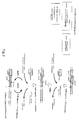
- Fig. 2 is an explanatory view showing an example of the production method of the present invention.
- Fig. 3 is an explanatory view showing a method for producing an insert fragment.
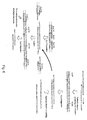
- Fig. 4 is an explanatory view showing another example of the production method of the present invention.
- Fig. 5 is an explanatory view showing the first example of the method for producing an insert fragment according to the present invention.
- Fig. 6 is an explanatory view showing the second example of the method for producing an insert fragment according to the present invention.
- Fig. 7 is an explanatory view showing the third example of the method for producing an insert fragment according to the present invention.
- Fig. 8 is an explanatory view showing the fourth example of the method for producing an insert fragment according to the present invention.
- Fig. 9 is an explanatory view showing the fifth example of the method for producing an insert fragment according to the present invention.
- the vector of the present invention is a vector comprising one recognition sequence of a first restriction enzyme of which digestion site exists at a particular position with respect to the recognition sequence and does not exist within the recognition sequence and one recognition sequence of a second restriction enzyme, wherein a fragment obtained by digestion of the vector with the first restriction enzyme can be digested with the second restriction enzyme and a distance between the digestion site of the first restriction enzyme and the digestion site of the second restriction enzyme is 30 nucleotides or shorter.
- the first restriction enzyme is a restriction enzyme of which digestion site exists at a particular position with respect to its recognition sequence and does not exist within the recognition sequence (hereinafter, also referred to as "distant digestion-type enzyme").
- a restriction enzyme Class II restriction enzymes of which digestion site is outside the recognition sequence are known, and specific examples thereof include Ace III, Bse RI, Bsa I, Fok I, Bsm BI, Bpm I, Mbo II, Bbv I, Bsg I, Bsm FI, Eci I, Mnl I Sfa NI and so forth.
- the second restriction enzyme is not particularly limited so long as its recognition sequence and digestion site are specific.
- the expression "a digestion site is specific” means that the digestion site exists at a particular position with respect to a recognition site of the enzyme under a specific reaction condition. The digestion site may exist either within or outside the recognition sequence.
- Class II restriction enzymes can be mentioned, and specific examples thereof include Eco RI, Xho I, Sac II, Nco I, Fok I, Bsm BI, Bmr I, Eam 1105I, Hin dIII, Bam HI, Kpn I, Pst I, Xba I and so forth.
- the distance between the digestion site of the first restriction enzyme and the digestion site of the second restriction enzyme means the number of nuclsotides between the end nucleotide position of the protruding strand closer to the digestion site of the second restriction enzyme in the end portion generated by digestion with the first restriction enzyme and the end nucleotide position of the protruding strand closer to the digestion site of the first restriction enzyme in the end portion generated by digestion with the second restriction enzyme.
- This distance is 30 nucleotides or shorter, preferably 20 nucleotides or shorter.
- the length should be a minimum length necessary and sufficient for recognition and digestion of DNA with the second restriction enzyme after digestion with the first restriction enzyme. The longer this distance is, the longer the fragment becomes that is removed and wasted in digestion with the first restriction enzyme and the second restriction enzyme. Since it increases the number of nucleotides to be synthesized, production of DNA becomes inefficient.
- Combination of the first restriction enzyme and the second restriction enzyme is not particularly limited so long as a fragment after digestion with the first restriction enzyme can be digested with the second restriction enzyme, and the distance between the digestion site of the first restriction enzyme and the digestion site of the second restriction enzyme is 30 nucleotides or shorter.
- Examples of combination of the first restriction enzyme and the second restriction enzyme are shown in Fig. 1.
- the aforementioned distances for the examples shown in Fig. 1 are shown in Table 1 below.
- the examples shown in Fig. 1, A are of a type in which the recognition sequence of the second restriction enzyme exits between the recognition sequence and the digestion site of the first restriction enzyme.
- 1, B are of a type in which the recognition sequence of the first restriction enzyme exists between the digestion site of the first restriction enzyme and the digestion site of the second restriction enzyme.
- the recognition sequence of the first restriction enzyme is eliminated by digestion with the second restriction enzyme after digestion with the first restriction enzyme.
- the nucleotide sequences of segments containing the recognition sequences in these examples are shown in Sequence Listing (SEQ ID NOS: 1-7).
- the second restriction enzyme may be either a distant digestion-type enzyme or not. Further, the order of the recognition sequence of the first restriction enzyme and the recognition sequence of the second restriction enzyme is arbitrary, and these sequences may overlap with each other.
- the vector of the present invention can be used in the production method of the present invention. Continuous partial sequences obtained by dividing a target sequence are successively inserted between the digestion site of the first restriction enzyme and the digestion site of the second restriction enzyme.
- the kinds of the vector are not particularly limited, and the vector may be derived from a plasmid, phage, virus, artificial yeast chromosome or the like.
- the size of the vector is not particularly limited either, a smaller size of the segment other than an inserted sequence is preferred in view of efficient replication.
- the vector of the present invention can be produced according to usual gene recombination techniques.
- the production method of the present invention is a method for producing DNA having a target sequence, which comprises the following steps (1) to (6):
- one end of each DNA fragment prepared in the step (1) is formed by adding a sequence to each partial sequence, the added sequence forming an end ligatable to an end formed by digestion with the second restriction enzyme, to which the DNA fragment is ligated, and the added sequence having such a length that digestion occurs at an end of the partial sequence upon digestion with the first restriction enzyme after the ligation, the other end of each DNA fragment is ligatable to an end formed by digestion with the first restriction enzyme, to which the DNA fragment is ligated, and the first restriction enzyme and the second restriction enzyme are selected so that their recognition sequences do not exist within the ligated partial sequences.
- the first restriction enzyme and the second restriction enzyme are as described in the above explanation of the vector of the present invention.
- step (1) a plurality of double-stranded DNA fragments each having one of continuous partial sequences obtained by dividing the target sequence as a part thereof are prepared.
- the target sequence is not particularly limited.
- the length of the partial sequence may be a length that can be practically obtained by synthesis based on chemical synthesis reactions or a method using chemical synthesis reactions and PCR in combination.
- the length is usually 60 to 120 nuclectides, preferably 80 to 100 nucleotides.
- the length is usually 100 to 220 nucleotides, preferably 140 to 180 nucleotides. The lengths of all these partial sequences do not need to be the same.
- Adjacent partial sequences overlap by nucleotides in a number of nucleotides in a protruding segment of a cohesive end to be generated at the site digested with the first restriction enzyme.
- the first restriction enzyme is Ace III
- adjacent partial sequences overlap by 4 nucleotides.
- One end of a DNA fragment containing each partial sequence is formed by adding a sequence forming an end ligatable to an end formed by digestion with the second restriction enzyme, to which the DNA fragment is ligated, to each partial sequence. Further, the other end is an end ligatable to an end formed by digestion with the first restriction enzyme, to which the DNA fragment is ligated. Consequently, the DNA fragment can be inserted into the vector digested successively with the first restriction enzyme and the second restriction enzyme in a predetermined direction.
- the expression that the end of the DNA fragment conforms to an end of a partial sequence means that an end of a protruding strand at an end of the DNA fragment conforms to an end of partial sequence.
- the sequence added to the end of the DNA fragment has such a length that digestion occurs at an end of the partial sequence upon digestion with the first restriction enzyme after the ligation.
- Digestion at an end of the partial sequence means that an end of a protruding strand at a digestion end on the partial sequence side becomes an end of the partial sequence.
- no irrelevant sequence exists between the partial sequences at an end formed by digestion with the first restriction enzyme.
- DNA fragments that are not the DNA fragment having the partial sequence first inserted into the vector are made to have ends ligatable to an end formed by digestion with the first restriction enzyme by making ends of DNA fragments conform with ends of the partial sequences and making one strand protrudent by a predetermined number of nucleotides.
- a DNA fragment containing a subsequent partial sequence can be ligated to an end formed by digestion with the first restriction enzyme without inserting irrelevant sequence between the partial sequences.
- N represents an arbitrary nucleotide.
- the DNA fragment described above (hereinafter, also referred to as "insert fragment”) can be obtained by a usual method such as a method of synthesizing two oligomers through chemical synthesis reactions so that they should form a target fragment upon annealing and then annealing these oligomers and a method of synthesizing two oligomers designed so that a recognition sequence of a restriction enzyme exists on each 5' end side and that their 3' end sides anneal to each other, through chemical synthesis reactions, annealing these oligomers, then performing extension reaction by using a DNA polymersse and digesting the extended fragment with a restriction enzyme.
- the insert fragments can also be obtained by the insert fragment-producing method of the present invention explained below.
- the first restriction enzyme and the second restriction enzyme are usually selected so that their recognition sequences do not exist within the target sequence. However, even when their recognition sequences exist within the target sequence, the production method of the present invention can be applied.
- DNA fragments are prepared with changing sequences identical to the recognition sequences of the first restriction enzyme and the second restriction enzyme in the target sequence to different sequences (as a result, the recognition sequences of the first restriction enzyme and the second restriction enzyme do not exist within ligated partial sequences), and further performing a step of restoring the changed segment in the sequence of the DNA fragment obtained in the step (6) to the original sequence to produce DNA having the target sequence. Modification of the sequence for restoring the segment to the original sequence can be performed by a method for introducing a desired mutation such as site-directed mutagenesis.
- the aforementioned vector of the present invention is prepared.
- the vector of the present invention can be produced according to usual gene recombination techniques.
- the vector is digested with the first restriction enzyme.
- the digestion can be performed under conditions suitable for the restriction enzyme used.
- the fragment obtained by digestion with the first restriction enzyme is digested with the second restriction enzyme.
- the digestion can be performed under conditions suitable for the restriction enzyme used.
- a longer fragment out of the fragments obtained by the digestion with the second restriction enzyme and one of the DNA fragments prepared in the step (1) are ligated in a predetermined order.
- the predetermined order referred to herein means an order of from one end segment to the other end segment of the target sequence. Purification and ligation of the fragments can be performed in a conventional manner.
- the steps (3) to (5) are repeated by using the clone obtained by the ligation as the vector used in the step (3) until all the DNA fragments prepared in the step (1) are ligated. Since the clone obtained by the ligation in the step (5) satisfies the requirements of the vector of the present invention, this clone can be used as the vector of the present invention in the step (3).
- a DNA fragment having a partial sequence (insert fragment) is prepared. Since the number of nucleotides in the protruding end produced at the digestion site of Ace III is 4, adjacent partial sequences overlap by 4 nucleotides.
- One end of the insert fragment is obtained by adding a sequence forming an end ligatable to an end formed by digestion with Eco RI to a partial sequence. The added sequence has such a length that digestion occurs at an end of the partial sequence upon digestion with Ace III after ligation.
- the other end of the insert fragment is an end ligatable to an end formed by digestion with Ace III. That is, an end of the insert fragment first inserted has a shape ligatable to an end formed by digestion with Ace III in the first vector.
- an end formed by digestion with Ace III is formed at the end of the partial sequence. Therefore, an end of the insert fragment subsequently inserted has such a shape that a segment overlapping with the partial sequence of the previously inserted insert fragment serves as a protruding strand.
- the insert fragment in this example has a sequence shown at the top of Fig. 3.
- Such an insert fragment can be obtained by a method of synthesizing such two oligomers through chemical synthesis reactions so that they form a target fragment upon annealing and then annealing these oligomers, as outlined in Fig. 3, (1), a method of synthesizing, through chemical synthesis reactions, two oligomers designed so that recognition sequences of Eco RI and Ace III exist on 5' end sides, respectively, and that their 3' end sides anneal to each other, annealing these oligomers, then performing extension reaction by using a DNA polymerase and digesting the extended fragment with Eco RI and Ace III, as outlined in Fig. 3, (2), or the like.
- the insert fragment can also be obtained by the insert fragment-producing method of the present invention explained below (see Figs. 5 to 8).
- the target sequence has the recognition sites of Ace III and Eco RI
- other restriction enzymes are selected.
- the recognition sequences are changed so that the ligated partial sequences do not include the recognition sites of Ace III and Eco RI.
- the vector is successively digested with Ace III and Eco RI. This digestion provides two fragments. A longer fragment out of these fragments and one of the DNA fragments (one containing a partial sequence at an end) are ligated to obtain a vector.
- the vector obtained by the ligation is a vector in which the recognition site of Eco RI is positioned between the recognition sequence and the digestion site of Ace III
- this vector is used in the same manner as the first vector, i.e., it is successively digested with Ace III and Eco RI as described above and ligated to a subsequent insert fragment (one having a partial sequence adjacent to the partial sequence immediately precedently inserted) to obtain a vector. Until all the prepared insert fragments are ligated, successive digestion with Ace III and Eco RI and ligation are repeated.
- sequence is changed in designing partial sequences, the sequence is restored by a method such as site-directed mutagenesis thereafter.
- each DNA fragment prepared in the step (1) is formed by adding a sequence to a partial sequence, the added sequence forming an end ligatable to an end formed by digestion with the second restriction enzyme, to which the DNA fragment is ligated, and the added sequence having such a length that digestion occurs at an end of the partial sequence upon digestion with the first restriction enzyme after ligation, and the insert fragment contains the recognition sequence of the first restriction enzyme in order to satisfy the requirement that the other end of each DNA fragment has an end ligatable to an end formed by digestion with the first restriction enzyme, to which the DNA fragment is ligated.
- the insert fragment contains the recognition sequence of the first restriction enzyme
- a vector to which a DNA fragment containing the first partial sequence is inserted does not need to have the digestion site of the first restriction enzyme. That is, when a vector of this embodiment is used, the recognition sequence of the first restriction enzyme does not need to be incorporated into the vector beforehand.
- the DNA fragment first inserted should be digested at an end of the partial sequence upon digestion with the first restriction enzyme after insertion. For example, it may be a fragment having an end that can be inserted into the digestion site of the second restriction enzyme.
- the aforementioned step (2) can be replaced with a step (2) of preparing the vector of the present invention to which a DNA fragment being one of DNA fragments prepared in the step (1) and having one of the end partial sequences of the target sequence is inserted so that digestion occurs at an end of the partial sequence upon digestion with the first restriction enzyme, wherein one end of each of DNA fragments that are not the DNA fragment inserted in the step (2) is formed by adding a sequence to each partial sequence, the added sequence forming an end ligatabe to an end formed by digestion with the second restriction enzyme, to which the DNA fragment is ligated, and the added sequence having such a length that digestion occurs at an end of the partial sequence upon digestion with the first restriction enzyme after ligation, and the other end of each of DNA fragments that are not the DNA fragment inserted in the step (2) is an end ligatable to an end formed by digestion with the first restriction enzyme, to which the DNA fragment is ligated.
- Fig. 4 a case where Bsa I and Eco RI are selected as the first restriction enzyme and the second restriction enzyme, respectively (the type in which the recognition sequence of the first restriction enzyme exists between the digestion site of the first restriction enzyme and the digestion site of the second restriction enzyme).
- nucleotides of partial sequences obtained by dividing the target sequence are represented by X, and arbitrary nucleotides are represented by N.
- a DNA fragment (insert fragment) containing a partial sequence is prepared. Since the number of nucleotides in the protruding end generated at the digestion site of Bsa I is 4, adjacent partial sequences overlap by 4 nucleotides.
- the insert fragment first inserted contains the recognition sequence of Bsa I and has an end that can be inserted into a digestion site of Eco RI.
- the recognition sequence of Bsa I exists at such a position that the fragment is digested at an end of the partial sequence upon digestion with Bsa I after ligation.
- each of insert fragments that are not the insert fragment first inserted a sequence that contains the recognition sequence of Bsa I and forms an end ligatable to an end formed by digestion with Eco RI is added to the partial sequence.
- the added sequence has such a length that digestion occurs at an end of the partial sequence upon digestion with Esa I after ligation.
- the other end of each of insert fragments that are not the insert fragment first inserted is made an end ligatable to an end formed by digestion with Bsa I. That is, the end of an insert fragment that is not the insert fragment inserted first has a shape that can be ligated to the end formed by digestion with Bsa I in the first vector.
- an end formed by digestion with Bsa I is formed at the end of the partial sequence. Therefore, an end of an insert fragment subsequently inserted has such a shape that a segment overlapping with the partial sequence of the insert fragment previously inserted serves as a protruding strand.
- Such an insert fragment can be obtained by a method of synthesizing such two oligomers through chemical synthesis reactions that they form a target fragment upon annealing and then annealing these oligomers, a method of synthesizing, through chemical synthesis reactions, two oligomers designed so that a recognition sequence of a restriction enzyme exists on each 5' end side and that their 3' end sides anneal to each other, annealing these oligomers, then ' extending the annealed fragment by using a DNA polymerase and digesting the extended fragment with the restriction enzyme, or the like.
- the insert fragment can also be obtained by the insert fragment-producing method of the present invention explained below (see Fig. 9).
- the recognition sequences are changed when partial sequences are designed so that the ligated partial sequences do not have the recognition sites of Bsa I and Eco RI.
- the insert fragment first inserted is prepared as a fragment that can be inserted into the digestion site of Eco RI and inserted into a vector containing Eco RI site.
- a vector can be obtained in which the recognition sequence of Bsa I exists between the digestion site of Bsa I and the digestion site of Eco RI.
- the obtained vector is successively digested with Bsa I and Eco RI. This digestion provides two fragments. A longer fragment out of these fragments and one of the DNA fragments (one containing a partial sequence at an end) are ligated to obtain a vector.
- the vector obtained by the ligation is a vector in which the recognition sequence of Bsa I exists between the digestion site of Bsa I and the digestion site of Eco RI
- this vector is used in the same manner as the aforementioned vector, i.e., it is successively digested with Bsa I and Eco RI in the same manner as described above and ligated with a subsequent insert fragment (one containing a partial sequence adjacent to the partial sequence inserted immediately precedently) to obtain a vector.
- a subsequent insert fragment one containing a partial sequence adjacent to the partial sequence inserted immediately precedently
- the sequence is restored by a method such as site-directed mutagenesis.
- the present invention also provides a method for producing an insert fragment used for the present invention and a vector used therefor.
- the insert fragment can be obtained by a usual method such as a method of synthesizing such two oligomers through chemical synthesis reactions that they form a target fragment upon annealing and then annealing these oligomers and a method of synthesizing, through chemical synthesis reactions, two oligomers designed so that a recognition sequence of restriction enzyme exists on each 5' end side and that their 3' end sides anneal to each other, annealing these oligomers, then extending the annealed fragment by using a DNA polymerase and digesting the extended fragment with the restriction enzyme.
- sequencing and production of an insert fragment can be easily performed by once incorporating a partial sequence into a vector in which recognition sequences of restriction enzymes are positioned in a specific manner. Consequently, if the target sequence is once determined, the factors to be considered in the design of the insert fragment are reduced. Therefore, the insert fragment can be easily designed, and selection of the fragments can be simultaneously performed after the incorporation into the vector.
- An insert fragment-producing method is a method for producing a DNA fragment used for the production method of the present invention, in which one end of the DNA fragment is formed by adding a sequence to a partial sequence, the added sequence forming an end ligatable to an end formed by digestion with the second restriction enzyme, to which the DNA fragment is ligated, and the added sequence having such a length that digestion occurs at an end of the partial sequence upon digestion with the first restriction enzyme after the ligation, and the other end is an end ligatable to an end formed by digestion with the first restriction enzyme, to which the DNA fragment is ligated, which method comprises steps of:
- the first restriction enzyme, the second restriction enzyme and the insert fragment are as described in the explanations of the production method of the present invention.
- the third restriction enzyme is a distant digestion-type enzyme that has a digestion site having the same shape as that of the digestion site of the first restriction enzyme.
- the third restriction enzyme may be the same as the first restriction enzyme.
- the fourth restriction enzyme is not particularly limited so long as the recognition sequence and the digestion site thereof are specific.
- the same restriction enzyme as the second enzyme may be used.
- the type of the vector is not particularly limited, and it may be a vector derived from a plasmid, phage, virus, artificial yeast chromosome or the like.
- the size of the vector is not particularly limited either, a smaller size of the segment other than an inserted sequence is preferred in view of efficient replication.
- the vector can be produced according to usual gene recombination techniques.
- a vector having the recognition sequences of the third restriction enzyme and the fourth restriction enzyme is prepared, in which the recognition sequence of the fourth restriction enzyme exists between the recognition sequence and the digestion site of the third restriction enzyme.
- a vector can be produced according to usual gene recombination techniques.
- a fragment containing a partial sequence of which both ends are ends ligatable to an end formed by digestion with the fourth restriction enzyme is prepared.
- a fragment can be obtained by a usual method such as a method of synthesizing two oligomers through chemical synthesis reactions so that they should form a target fragment upon annealing and then annealing these oligomers (double-strand annealing method) and a method of synthesizing, through chemical synthesis reactions, two oligomers designed so that a recognition sequence of a restriction enzyme exists on each 5' end side and that their 3' end sides anneal to each other, annealing these oligomers, then extending the annealed fragment by using a DNA polymerase, and digesting the extended fragment with the restriction enzyme (synthetic oligomer annealing and extension method).
- the vector prepared in the step (a) is digested with the fourth restriction enzyme, and the fragment obtained by the digestion with the fourth restriction enzyme and the DNA fragment prepared in the step (b) are ligated.
- the digestion can be performed under conditions suitable for the restriction enzyme used.
- the fragments can be ligated in a conventional manner.
- sequences serving as the recognition sequences of the third restriction enzyme and fourth restriction enzyme are provided so that a predetermined insert fragment is excised upon digestion of the clones obtained in the step (c) with the third restriction enzyme.
- the nucleotide sequences of the clones obtained by the ligation are analyzed to select a clone having the target partial sequence.
- the nucleotide sequences can be analyzed in a conventional manner.
- the selected clone is successively digested with the third restriction enzyme and the fourth restriction enzyme.
- the digestion can be performed under conditions suitable for the restriction enzymes used.
- the recognition sequence of the third restriction enzyme and the recognition sequence of the fourth restriction enzyme are identical
- the vector prepared in the step (a) has another recognition sequence of the third restriction enzyme
- digestion with the third restriction enzyme based on this recognition sequence generates an end having the same shape as that of an end formed by digestion with the fourth restriction enzyme
- two recognition sequences of the third restriction enzyme exist on the both sides of the digestion site of the fourth restriction enzyme, and digestion is performed only with the third restriction enzyme in the step (e).
- the digestion operation becomes easy.
- Fig. S nucleotides of partial sequences obtained by dividing the target sequence are represented by X, and arbitrary nucleotides are represented by N.
- a vector containing recognition sequences of AceIII and Eco RI is prepared in which the recognition sequence of Eco RI exists between the recognition sequence and the digestion site of Ace III.
- the nucleotide sequence of a segment containing the recognition sequences in the vector is shown as SEQ ID NO: 8.
- a fragment containing a partial sequence having an end ligatable to an end formed by digestion with Eco RI for both ends is prepared.
- Such a fragment can be obtained by a usual method such as a method of synthesizing two oligomers through chemical synthesis reactions so that they form a target fragment upon annealing and then annealing these oligomers (double-strand annealing method) and a method of synthesizing, through chemical synthesis reactions, two oligomers designed so that a recognition sequence of a restriction enzyme exists on each 5' end side and that their 3' end sides anneal to each other, annealing these oligomers, then extending the annealed fragment by using a DNA polymerase, and digesting the extended fragment with the restriction enzyme (synthetic oligomer annealing and extension method).
- the prepared vector is digested with Eco RI, and the fragment obtained by the digestion with Eco RI and the prepared DNA fragment are ligated.
- the sequences of the recognition sequences of Ace III and Eco RI are provided so that a predetermined insert fragment is excised upon digestion of the clone obtained by Ligation with Ace III.
- the nucleotide sequences of the clones obtained by the ligation are analyzed to select a clone having the target partial sequence.
- the selected vector is successively digested with Ace III and Eco RI. If there is used, as the vector, a vector having another recognition sequence of Ace III (parenthesized sequence in Fig. 5) in which digestion, based on this recognition sequence with Ace III generates an end having the same shape as a site digested with Eco RI and two recognition sequences of Ace III exist on the both sides of the digestion site of Eco RI, it is sufficient to use only Ace III to excise an insert fragment.
- the nucleotide sequences of the segments containing the recognition sequences of the restriction enzymes in the segment digested upon the excision are shown in SEQ ID NOS: 9 and 10.
- the present invention also provides a vector used in this embodiment of the insert fragment-producing method, in which the vector comprises the recognition sequences of the third restriction enzyme and the fourth restriction enzyme, and the recognition sequence of the fourth restriction enzyme exists between the recognition sequence and the digestion site of the third restriction enzyme, wherein the vector further comprises another recognition sequence of the third restriction enzyme, digestion based on this recognition sequence with the third restriction enzyme generates an end having the same shape as a site digested with the fourth restriction enzyme, and two recognition sequences of the third restriction enzyme exist on the both sides of the digestion site of the fourth restriction enzyme.
- the vector prepared in the step (a) has another recognition sequence of the third restriction enzyme, and two recognition sequences of the third restriction enzyme are symmetrically positioned as also for their directions with respect to the recognition sequence of the fourth restriction enzyme, and digestion is performed only with the third restriction enzyme in the step (f).
- the target fragment When a fragment is incorporated into this vector, the target fragment cannot be excised unless the fragment is incorporated in a specific direction. However, certain fragments may be incorporated only in a specific direction depending on their sequences. According to this embodiment, the aforementioned problem does not arise because the target fragment can be excised irrespective of the direction in which the fragment is incorporated.
- Fig. 6 nucleotides of partial sequences obtained by dividing the target sequence are represented by X, and arbitrary nucleotides are represented by N.
- a vector in which another recognition sequence of Ace III is contained and two recognition sequences of Ace III are positioned symmetrically as also for their directions with respect to the recognition sequence of Eco RI.
- the nucleotide sequence of the segment containing the recognition sequence in the vector is shown as SEQ ID NO: 11.
- sequences serving as the recognition sequences of Ace III and Eco RI are provided so that a predetermined insert fragment is excised upon digestion with Ace III of the clone obtained by ligation.
- a clone in which the fragment is inserted into the digestion site of Eco RI in the vector and selected by sequencing is digested with Ace III.
- the nucleotide sequences of the segments containing the recognition sequences of the restriction enzymes in the segment to be digested upon the excision are shown as SEQ ID NOS: 12 and 13.
- two recognition sites of the fourth restriction enzyme may be used.
- operations may be the same as in the above embodiment except that two recognition sites are regarded as one site.
- the vector prepared in the step (a) has two recognition sequences of the fourth restriction enzyme, these two recognition sequences of the fourth restriction enzyme are positioned in directions inverse to each other, the recognition sequences of the third restriction enzyme are positioned symmetrically as also for their directions on both sides of two recognition sequences of the fourth restriction enzyme, and the fourth restriction enzyme forms a one nucleotide-protruding end at the 3' end.
- an end with which TA cloning can be performed is formed, and therefore loss can be further reduced by positioning the recognition sequences of the restriction enzymes on both sides thereof.
- a vector in which another recognition sequence of Ace III is contained and two recognition sequences of Ace III are positioned symmetrically as also for their directions with respect to two recognition sequences of Bmr I or Eam 1105I.
- the nucleotide sequence of the segment containing the recognition sequences in the vector with Bmr I is shown in SEQ ID NO: 14.
- the nucleotide sequence of the segment containing the recognition sequences in the vector with Eam 1105I is shown in SEQ ID NO: 17.
- sequences serving as the recognition sequences of Ace III and Bmr I or Eam 1105I are provided so that a predetermined insert fragment is excised upon digestion with Ace III of the vector obtained by ligation.
- a vector in which the fragment is inserted into the digestion site of Bmr I or Eam 1105I (between two digestion sites) and which is selected by sequencing is digested with Ace III.
- the nucleotide sequences of the segments containing the recognition sequences of the restriction enzymes in the segment to be digested upon the excision in the case of the vector with Bmr I are shown in SEQ ID NOS: 15 and 16.
- the nucleotide sequences of the segments containing the recognition sequences of the restriction enzymes in the segment to be digested upon the excision in the case of the vector with Eam 1105I are shown in SEQ ID NOS: 18 and 19.
- the present invention also provides a vector used in this embodiment of the insert fragment-producing method, in which the vector comprises the recognition sequences of the third restriction enzyme and the fourth restriction enzyme, and the recognition sequence of the fourth restriction enzyme exists between the recognition sequence and the digestion site of the third restriction enzyme, wherein the vector further comprises another recognition sequence of the third restriction enzyme, and two recognition sequences of the third restriction enzyme are positioned symmetrically as also for their directions with respect to the recognition sequence of the fourth restriction enzyme.
- the vector there may be two recognition sites of the fourth restriction enzyme.
- the vector may be a vector in which two recognition sequences of the fourth restriction enzyme are contained, these two recognition sequences of the fourth restriction enzyme are positioned in directions inverse to each other, the recognition sequences of the third restriction enzyme are positioned symmetrically as also for their directions on both sides of two recognition sequences of the fourth restriction enzyme, and the fourth restriction enzyme forms a one nucleotide-protruding end at the 3' end.
- An insert fragment-producing method is a method for producing a DNA fragment used in the production method of the present invention, in which one end of the DNA fragment is formed by adding a sequence to a partial sequence, the added sequence forming an end ligatable to an end formed by digestion with the second restriction enzyme, to which the DNA fragment is ligated, and the added sequence having such a length that digestion occurs at an end of the partial sequence upon digestion with the first restriction enzyme after the ligation, and the other end is an end ligatable to an end formed by digestion with the first restriction enzyme, to which the DNA fragment is ligated, which method comprises steps of:
- the fifth restriction enzyme is a distant digestion-type enzyme and has a digestion site having the same shape as that of the digestion site of the first restriction enzyme.
- the fifth restriction enzyme may be the same as the first restriction enzyme.
- the first to fourth restriction enzymes and the vector are the same as those in the first embodiment.
- a vector having the recognition sequence of the fourth restriction enzyme is prepared.
- Such a vector can be produced according to usual gene recombination techniques.
- step (b) there is prepared a fragment containing a partial sequence of which both ends are ligatable to an end formed by digestion with the fourth restriction enzyme, which has a recognition sequence of the third restriction enzyme so that digestion based on the recognition sequence of the third restriction enzyme generating a digested site having the same shape as that of a digested site based on the recognition sequence of the first restriction enzyme generates an end having the same shape as that of one end of the fragment, and has a recognition sequence of a fifth restriction enzyme generating an end having the same shape as an end generated by the third restriction enzyme so that digestion by the fifth restriction enzyme occurs at an end of the partial sequence.
- Such a fragment can be obtained by a usual method such as a method of synthesizing two oligomers through chemical synthesis reactions so that they form a target fragment upon annealing and then annealing these oligomers (double-strand annealing method) and a method of synthesizing, through chemical synthesis reactions, two oligomers designed so that a recognition sequence of a restriction enzyme exists on each 5' end side and that their 3' end sides anneal to each other, annealing these oligomers, then extending the annealed fragment by using a DNA polymerase, and digesting the extended fragment with the restriction enzyme (synthetic oligomer annealing and extension method).
- the vector prepared in the step (a) is digested with the fourth restriction enzyme, and the fragment obtained by the digestion with the fourth restriction enzyme and the DNA fragment prepared in the step (b) are ligated.
- the digestion can be performed under conditions suitable for the restriction enzyme used.
- the fragments can he ligated in a conventional manner.
- a sequence serving as the recognition sequence of the fifth restriction enzyme is provided so that a predetermined DNA fragment is excised upon digestion of the clones obtained in the step (c) with the fifth restriction enzyme.
- the nucleotide sequences of the clones obtained by the ligation are analyzed to select a clone having the target partial sequence.
- the nucleotide sequences can be analyzed in a conventional manner.
- the selected clone is digested with the fourth restriction enzyme and the fifth restriction enzyme.
- the digestion can be performed under conditions suitable for the restriction enzymes used.
- the fragment digested with the fourth restriction enzyme cannot be digested with the fifth restriction enzyme, the fragment is successively digested with the fifth restriction enzyme and then the fourth restriction enzyme.
- the fragment digested with the fourth restriction enzyme can be digested with the fifth restriction enzyme, the fragment may be digested with these enzymes simultaneously or successively. In the case of this successive digestion, the order may be arbitrary.
- nucleotides of partial sequences obtained by dividing the target sequence are represented by X, and arbitrary nucleotides are represented by N.
- Such a fragment can be obtained by a usual method such as a method of synthesizing two oligomers through chemical synthesis reactions so that they form a target fragment upon annealing and then annealing these oligomers (double-strand annealing method) and a method of synthesizing, through chemical synthesis reactions, two oligomers designed so that a recognition sequence of a restriction enzyme exists on each 5' end side and that their 3' end sides anneal to each other, annealing these oligomers, then extending the annealed fragment by using a DNA polymerase, and digesting the extended fragment with the restriction enzyme (synthetic oligomer annealing and extension method).
- the prepared vector is digested with Eco RI, and the fragment obtained by the digestion with Eco RI and the prepared DNA fragment are ligated.
- sequences serving as the recognition sequences of Bbs I and Eco RI are provided so that a predetermined insert fragment is excised upon digestion with Bbs I and Eco RI of the clone obtained by ligation.
- the nucleotide sequences of the clones obtained by the ligation are analyzed to select a clone having the target partial sequence.
- the selected clone is digested with Bbs I and Eco RI.
- the clone may be digested with these enzymes simultaneously or successively. In the case of successive digestion, the order may be arbitrary.
- the nucleotide sequences of the segments containing the recognition sequences of the restriction enzymes in the segment digested upon the excision are shown as SEQ ID NOS: 6 and 20.
Landscapes
- Health & Medical Sciences (AREA)
- Genetics & Genomics (AREA)
- Life Sciences & Earth Sciences (AREA)
- Engineering & Computer Science (AREA)
- Zoology (AREA)
- Wood Science & Technology (AREA)
- Biomedical Technology (AREA)
- Organic Chemistry (AREA)
- Biotechnology (AREA)
- General Engineering & Computer Science (AREA)
- Chemical & Material Sciences (AREA)
- Bioinformatics & Cheminformatics (AREA)
- Molecular Biology (AREA)
- Microbiology (AREA)
- Physics & Mathematics (AREA)
- Plant Pathology (AREA)
- Biochemistry (AREA)
- General Health & Medical Sciences (AREA)
- Biophysics (AREA)
- Cell Biology (AREA)
- Measuring Or Testing Involving Enzymes Or Micro-Organisms (AREA)
Abstract
Description
- The present invention relates to a method for producing DNA having an arbitrary sequence. More specifically, the present invention relates to a method for producing DNA by ligation.
- As a method for producing DNA, there are known a method based on PCR, a method based on chemical synthesis reactions using an automatic synthesizer and so forth.
- However, the method based on PCR suffers from a limitation that DNA having a target nucleotide sequence to be used as a template needs to exist beforehand. On the other hand, the method based on chemical synthesis reactions does not suffer from such a limitation. However, since a length of DNA that can be practically produced by the method has an upper limit, DNA having a length longer than the limit must be produced by ligation.
- As a method for producing DNA by ligation, there is known a method of synthesizing, through chemical synthesis reactions, pairs of single-stranded DNA's having such sequences that DNA's of each pair generates a unique cohesive end when they are annealed and ligating the double-stranded DNA's obtained by annealing DNA's of each pair by using a ligase (Advances in Biochemical Engineering/Biotechnology, Vol. 37, 73-127 (1988)). However, in this method, since double-stranded DNA's having a unique cohesive end must be generated, it is difficult to confirm the nucleotide sequence of the each product in the course of the process. In addition, since impurities that can exist in DNA synthesized by the chemical synthesis reactions or erroneous annealing are all reflected in the final product, the probability of obtaining a final product having the target sequence becomes low, and a problem arises in view of efficiency.
- As a method free from the aforementioned problems, there is known a method of preparing relatively short fragments with an end having the same shape as that of an end formed by digestion with a restriction enzyme by the aforementioned ligation method, cloning the fragments in an appropriate vector and then successively ligating fragments excised from the vector using a restriction enzyme (Advances in Biochemical Engineering/Biotechnology, Vol. 37, 73-127 (1988)). However, in this method, as the number of fragments to be ligated increases, the number of required recognition sites of the restriction enzymes correspondingly increases. Therefore, the method is not efficient in regard of increased number of steps for temporarily introducing or eliminating recognition sites of the restriction enzymes in the target sequence.
- An object of the present invention is to provide an efficient method for producing DNA by ligation of DNA fragments.
- The inventors of the present invention found that DNA having a target nucleotide sequence could be efficiently produced by using a vector in which restriction enzyme sites are arranged in a specific manner, and thus accomplished the present invention.
- That is, the present invention provides the following:
- 1. A vector comprising one recognition sequence of a first restriction enzyme of which digestion site exists at a particular position with respect to the recognition sequence and does not exist within the recognition sequence and one recognition sequence of a second restriction enzyme of which digestion site is specific, wherein a fragment obtained by digestion of the vector with the first restriction enzyme can be digested with the second restriction enzyme and a distance between the digestion site of the first restriction enzyme and the digestion site of the second restriction enzyme is 30 nucleotides or shorter.
- 2. A method for producing DNA having a target sequence,
comprising steps of:
- (1) preparing a plurality of double-stranded DNA fragments each having one of continuous partial sequences obtained by dividing the target sequence as a part thereof,
- (2) preparing the vector as defined in the aforementioned 1,
- (3) digesting the vector with the first restriction enzyme,
- (4) digesting the fragment obtained by the digestion with the first restriction enzyme with the second restriction enzyme,
- (5) ligating a longer fragment out of the fragments obtained by the digestion with the second restriction enzyme and one of the DNA fragments prepared in the step (1) in a predetermined order, and
- (6) repeating the steps of (3) to (5) by using a clone
obtained by the ligation as the vector in the step (3) until
all the DNA fragments prepared in the step (1) are ligated,
wherein
adjacent partial sequences overlap by nucleotides in a number of nucleotides in a protruding segment of a cohesive end to be generated at the digestion site of the first restriction enzyme,
one end of each DNA fragment prepared in the step (1) is formed by adding a sequence to each partial sequence, the added sequence forming an end ligatable to an end formed by digestion with the second restriction enzyme, to which the DNA fragment is ligated, and the added sequence having such a length that digestion occurs at an end of the partial sequence upon digestion with the first restriction enzyme after the ligation,
the other end of each DNA fragment is ligatable to an end formed by digestion with the first restriction enzyme, to which the DNA fragment is ligated, and
the first restriction enzyme and the second restriction enzyme are selected so that their recognition sequences do not exist within the ligated partial sequence. - 3. The method according to the aforementioned 2, which further comprises, when a sequence identical to the recognition sequence of the first restriction enzyme or the second restriction enzyme exists within the target sequence, a step of preparing the DNA fragments in the step (1) with changing the identical sequence to a different sequence and restoring the changed segment in the sequence of the DNA fragment obtained in the step (6) to the original sequence to produce DNA having the target sequence.
- 4. A method for producing DNA having a target sequence,
comprising steps of:
- (1) preparing a plurality of double-stranded DNA fragments each having one of continuous partial sequences obtained by dividing the target sequence as a part thereof,
- (2) preparing the vector as defined in the aforementioned 1, to which a DNA fragment being one of the DNA fragments prepared in the step (1) and having one of end partial sequences of the target sequence is inserted so that digestion occurs at an end of the partial sequence upon digestion with the first restriction enzyme,
- (3) digesting the vector with the first restriction enzyme,
- (4) digesting the fragment obtained by the digestion with the first restriction enzyme with the second restriction enzyme,
- (5) ligating a longer fragment out of the fragments obtained by the digestion with the second restriction enzyme and one of the DNA fragments prepared in the step (1), and
- (6) repeating the steps of (3) to (5) by using a clone
obtained by the ligation as the vector in the step (3) until
all the DNA fragments prepared in the step (1) are ligated,
wherein
adjacent partial sequences overlap by nucleotides in a number of nucleotides in a protruding segment of a cohesive end to be generated at the digestion site of the first restriction enzyme,
one end of each of the DNA fragments that are not the DNA fragment inserted in the step (2) is formed by adding a sequence to each partial sequence, the added sequence forming an end ligatable to an end formed by digestion with the second restriction enzyme, to which the DNA fragment is ligated, and the added sequence having such a length that digestion occurs at an end of the partial sequence upon digestion with the first restriction enzyme after the ligation,
the other end of each of the DNA fragments that are not the DNA fragment inserted in the step (2) is ligatable to an end formed by digestion with the first restriction enzyme, to which the DNA fragment is ligated, and
the first restriction enzyme and the second restriction enzyme are selected so that their recognition sequences do not exist within the ligated partial sequences. - 5. The method according to the aforementioned 4, which further comprises, when a sequence identical to the recognition sequence of the first restriction enzyme or the second restriction enzyme exists within the target sequence, a step of preparing the DNA fragments in the step (1) with changing the identical sequence to a different sequence and restoring the changed segment in the sequence of the DNA fragment obtained in the step (6) to the original sequence to produce DNA having the target sequence.
- 6. A method for producing a DNA fragment used in the
production method as defined in any one of the
aforementioned 2 to 5, in which one end of the DNA fragment
is formed by adding a sequence to a partial sequence, said
added sequence forming an end ligatable to an end formed by
digestion with the second restriction enzyme, to which the
DNA fragment is ligated, and the added sequence having such
a length that digestion occurs at an end of the partial
sequence upon digestion with the first restriction enzyme
after the ligation, and the other end is an end ligatable to
an end formed by digestion with the first restriction enzyme,
to which the DNA fragment is ligated, which method comprises
steps of:
- (a) preparing a vector having a recognition sequence of a third restriction enzyme which generates a digestion site having the same shape as that of a digestion site of the first restriction enzyme, and a recognition sequence of a fourth restriction enzyme, in which the recognition sequence of the fourth restriction enzyme exists between the recognition sequence and the digestion site of the third restriction enzyme,
- (b) preparing a fragment comprising a partial sequence of which both ends are ligatable to an end formed by digestion with the fourth restriction enzyme,
- (c) digesting the vector prepared in the step (a) with the fourth restriction enzyme and ligating the fragment obtained by the digestion with the fourth restriction enzyme and the DNA fragment prepared in the step (b),
- (d) analyzing nucleotide sequences of clones obtained by the ligation to select a clone having the target partial sequence, and
- (e) successively digesting the selected clone with the third
restriction enzyme and the fourth restriction enzyme,
wherein
sequences serving as the recognition sequences of the third restriction enzyme and the fourth restriction enzyme are provided in the vector and the fragment prepared in the steps (a) and (b), respectively, so that a predetermined DNA fragment is excised upon digestion of the clones obtained in the step (c) with the third restriction enzyme. - 7. The method according to the aforementioned 6,
wherein the recognition sequence of the third restriction
enzyme and the recognition sequence of the fourth
restriction enzyme are identical,
the vector prepared in the step (a) has another recognition sequence of the third restriction enzyme, digestion with the third restriction enzyme based on this recognition sequence generates an end having the same shape as that of an end formed by digestion with the fourth restriction enzyme, two recognition sequences of the third restriction enzyme exist on the both sides of the digestion site of the fourth restriction enzyme, and
digestion is performed only with the third restriction enzyme in the step (e). - 8. The method according to the aforementioned 6,
wherein the vector prepared in the step (a) has another
recognition sequence of the third restriction enzyme, and
two recognition sequences of the third restriction enzyme
are symmetrically positioned as also for their directions
with respect to the recognition sequence of the fourth
restriction enzyme, and
digestion is performed only with the third restriction enzyme in the step (e). - 9. The method according to the aforementioned 8, wherein the vector prepared in the step (a) has two recognition sequences of the fourth restriction enzyme, two recognition sequences of the fourth restriction enzyme are positioned in directions inverse to each other, the recognition sequences of the third restriction enzyme are positioned symmetrically as also for their directions on both sides of two recognition sequences of the fourth restriction enzyme, and the fourth restriction enzyme forms a one nucleotide-protruding end at the 3' end.
- 10. A method for producing a DNA fragment used in the
production method as defined in any one of the
aforementioned 2 to 5, in which one end of the DNA fragment
is formed by adding a sequence to a partial sequence, the
added sequence forming an end ligatable to an end formed by
digestion with the second restriction enzyme, to which the
DNA fragment is ligated, and the added sequence having such
a length that digestion occurs at an end of the partial
sequence upon digestion with the first restriction enzyme
after the ligation, and the other end is an end ligatable to
an end formed by digestion with the first restriction enzyme,
to which the DNA fragment is ligated, which method comprises
steps of:
- (a) preparing a vector having a recognition sequence of the fourth restriction enzyme,
- (b) preparing a fragment containing a partial sequence of which both ends are ligatable to an end formed by digestion with the fourth restriction enzyme, which has a recognition sequence of the third restriction enzyme so that digestion based on the recognition sequence of the third restriction enzyme generating a digested site having the same shape as that of a digested site based on the recognition sequence of the first restriction enzyme generates an end having the same shape as that of one end of the fragment, and has a recognition sequence of a fifth restriction enzyme generating an end having the same shape as an end generated by the third restriction enzyme so that digestion with the fifth restriction enzyme occurs at an end of the partial sequence,
- (c) digesting the vector prepared in the step (a) with the fourth restriction enzyme and ligating the fragment obtained by the digestion with the fourth restriction enzyme and the DNA fragment prepared in the step (b),
- (d) analyzing nucleotide sequences of clones obtained by the ligation to select a clone having the target partial sequence, and
- (e) digesting the selected clone with the fourth restriction
enzyme and the fifth restriction enzyme,
wherein
a sequence serving as the recognition sequence of the fifth restriction enzyme is provided in the vector and the fragment prepared in the steps (a) and (b), respectively, so that a predetermined DNA fragment is excised upon digestion of the clones obtained in the step (c) with the fifth restriction enzyme. - 11. A vector used for the method as defined in the aforementioned 7, which comprises the recognition sequence of the third restriction enzyme, of which digestion site exists at a particular position with respect to the recognition sequence and does not exists within the recognition sequence, and the recognition sequence of the fourth restriction enzyme of which digestion site is specific, and in which the recognition sequence of the fourth restriction enzyme exists between the recognition sequence and the digestion site of the third restriction enzyme, wherein the vector has another recognition sequence of the third restriction enzyme, digestion based on this recognition sequence with the third restriction enzyme generates an end having the same shape as that obtained by digestion with the fourth restriction enzyme, and two recognition sequences of the third restriction enzyme exist on the both sides of the digestion site of the fourth restriction enzyme.
- 12. A vector used for the method as defined in the aforementioned 8, which comprises the recognition sequence of the third restriction enzyme, of which digestion site exists at a particular position with respect to the recognition sequence and does not exists within the recognition sequence, and the recognition sequence of the fourth restriction enzyme of which digestion site is specific, and in which the recognition sequence of the fourth restriction enzyme exists between the recognition sequence and the digestion site of the third restriction enzyme, wherein the vector comprises another recognition sequence of the third restriction enzyme, and two recognition sequences of the third restriction enzyme are symmetrically positioned as also for their directions with respect to the recognition sequence of the fourth restriction enzyme.
- 13. The vector according to the aforementioned 12, which comprises two recognition sequences of the fourth restriction enzyme, and in which two recognition sequences of the fourth restriction enzyme are positioned in directions inverse to each other, the recognition sequences of the third restriction enzyme are symmetrically positioned as also for their directions on both sides of two recognition sequences of the fourth restriction enzyme, and the fourth restriction enzyme forms a one nucleotide-protruding end at the 3' end.
-
- According to the present invention, it becomes possible to efficiently produce DNA by ligation of DNA fragments.
- Fig. 1 shows examples of combinations of the first restriction enzyme and the second restriction enzyme for the vector of the present invention.
- Fig. 2 is an explanatory view showing an example of the production method of the present invention.
- Fig. 3 is an explanatory view showing a method for producing an insert fragment.
- Fig. 4 is an explanatory view showing another example of the production method of the present invention.
- Fig. 5 is an explanatory view showing the first example of the method for producing an insert fragment according to the present invention.
- Fig. 6 is an explanatory view showing the second example of the method for producing an insert fragment according to the present invention.
- Fig. 7 is an explanatory view showing the third example of the method for producing an insert fragment according to the present invention.
- Fig. 8 is an explanatory view showing the fourth example of the method for producing an insert fragment according to the present invention.
- Fig. 9 is an explanatory view showing the fifth example of the method for producing an insert fragment according to the present invention.
- The vector of the present invention is a vector comprising one recognition sequence of a first restriction enzyme of which digestion site exists at a particular position with respect to the recognition sequence and does not exist within the recognition sequence and one recognition sequence of a second restriction enzyme, wherein a fragment obtained by digestion of the vector with the first restriction enzyme can be digested with the second restriction enzyme and a distance between the digestion site of the first restriction enzyme and the digestion site of the second restriction enzyme is 30 nucleotides or shorter.
- The first restriction enzyme is a restriction enzyme of which digestion site exists at a particular position with respect to its recognition sequence and does not exist within the recognition sequence (hereinafter, also referred to as "distant digestion-type enzyme"). As such a restriction enzyme, Class II restriction enzymes of which digestion site is outside the recognition sequence are known, and specific examples thereof include AceIII, BseRI, BsaI, FokI, BsmBI, BpmI, MboII, BbvI, BsgI, BsmFI, EciI, MnlI SfaNI and so forth.
- The second restriction enzyme is not particularly limited so long as its recognition sequence and digestion site are specific. The expression "a digestion site is specific" means that the digestion site exists at a particular position with respect to a recognition site of the enzyme under a specific reaction condition. The digestion site may exist either within or outside the recognition sequence. As such a restriction enzyme, Class II restriction enzymes can be mentioned, and specific examples thereof include EcoRI, XhoI, SacII, NcoI, FokI, BsmBI, BmrI, Eam1105I, HindIII, BamHI, KpnI, PstI, XbaI and so forth.
- The distance between the digestion site of the first restriction enzyme and the digestion site of the second restriction enzyme means the number of nuclsotides between the end nucleotide position of the protruding strand closer to the digestion site of the second restriction enzyme in the end portion generated by digestion with the first restriction enzyme and the end nucleotide position of the protruding strand closer to the digestion site of the first restriction enzyme in the end portion generated by digestion with the second restriction enzyme.
- This distance is 30 nucleotides or shorter, preferably 20 nucleotides or shorter. Ideally, the length should be a minimum length necessary and sufficient for recognition and digestion of DNA with the second restriction enzyme after digestion with the first restriction enzyme. The longer this distance is, the longer the fragment becomes that is removed and wasted in digestion with the first restriction enzyme and the second restriction enzyme. Since it increases the number of nucleotides to be synthesized, production of DNA becomes inefficient.
- Combination of the first restriction enzyme and the second restriction enzyme is not particularly limited so long as a fragment after digestion with the first restriction enzyme can be digested with the second restriction enzyme, and the distance between the digestion site of the first restriction enzyme and the digestion site of the second restriction enzyme is 30 nucleotides or shorter. Examples of combination of the first restriction enzyme and the second restriction enzyme are shown in Fig. 1. The aforementioned distances for the examples shown in Fig. 1 are shown in Table 1 below. The examples shown in Fig. 1, A are of a type in which the recognition sequence of the second restriction enzyme exits between the recognition sequence and the digestion site of the first restriction enzyme. The examples shown in Fig. 1, B are of a type in which the recognition sequence of the first restriction enzyme exists between the digestion site of the first restriction enzyme and the digestion site of the second restriction enzyme. In this type, the recognition sequence of the first restriction enzyme is eliminated by digestion with the second restriction enzyme after digestion with the first restriction enzyme. The nucleotide sequences of segments containing the recognition sequences in these examples are shown in Sequence Listing (SEQ ID NOS: 1-7).
- As shown in the examples shown in Fig. 1, the second restriction enzyme may be either a distant digestion-type enzyme or not. Further, the order of the recognition sequence of the first restriction enzyme and the recognition sequence of the second restriction enzyme is arbitrary, and these sequences may overlap with each other.
- The vector of the present invention can be used in the production method of the present invention. Continuous partial sequences obtained by dividing a target sequence are successively inserted between the digestion site of the first restriction enzyme and the digestion site of the second restriction enzyme.
- The kinds of the vector are not particularly limited, and the vector may be derived from a plasmid, phage, virus, artificial yeast chromosome or the like. Although the size of the vector is not particularly limited either, a smaller size of the segment other than an inserted sequence is preferred in view of efficient replication.
- The vector of the present invention can be produced according to usual gene recombination techniques.
- The production method of the present invention is a method for producing DNA having a target sequence, which comprises the following steps (1) to (6):
- (1) preparing a plurality of double-stranded DNA fragments each having one of continuous partial sequences obtained by dividing the target sequence as a part thereof,
- (2) preparing the vector according to the present invention,
- (3) digesting the vector with the first restriction enzyme,
- (4) digesting the fragment obtained by the digestion with the first restriction enzyme with the second restriction enzyme,
- (5) ligating a longer fragment out of the fragments obtained by the digestion with the second restriction enzyme and one of the DNA fragments prepared in the step (1) in a predetermined order, and
- (6) repeating the steps of (3) to (5) by using a clone obtained by the ligation as the vector in the step (3) until all the DNA fragments prepared in the step (1) are ligated.
-
- In the production method of the present invention,
adjacent partial sequences overlap by nucleotides in a number of nucleotides in a protruding segment of a cohesive end to be generated at the site digested with the first restriction enzyme,
one end of each DNA fragment prepared in the step (1) is formed by adding a sequence to each partial sequence, the added sequence forming an end ligatable to an end formed by digestion with the second restriction enzyme, to which the DNA fragment is ligated, and the added sequence having such a length that digestion occurs at an end of the partial sequence upon digestion with the first restriction enzyme after the ligation,
the other end of each DNA fragment is ligatable to an end formed by digestion with the first restriction enzyme, to which the DNA fragment is ligated, and
the first restriction enzyme and the second restriction enzyme are selected so that their recognition sequences do not exist within the ligated partial sequences. - The first restriction enzyme and the second restriction enzyme are as described in the above explanation of the vector of the present invention.
- In the step (1), a plurality of double-stranded DNA fragments each having one of continuous partial sequences obtained by dividing the target sequence as a part thereof are prepared.
- The target sequence is not particularly limited. The length of the partial sequence may be a length that can be practically obtained by synthesis based on chemical synthesis reactions or a method using chemical synthesis reactions and PCR in combination. In the case of synthesis based on chemical synthesis reactions, the length is usually 60 to 120 nuclectides, preferably 80 to 100 nucleotides. In the case of the method using synthesis by chemical synthesis reactions and PCR in combination, the length is usually 100 to 220 nucleotides, preferably 140 to 180 nucleotides. The lengths of all these partial sequences do not need to be the same. Adjacent partial sequences overlap by nucleotides in a number of nucleotides in a protruding segment of a cohesive end to be generated at the site digested with the first restriction enzyme. For example, when the first restriction enzyme is AceIII, adjacent partial sequences overlap by 4 nucleotides.
- One end of a DNA fragment containing each partial sequence is formed by adding a sequence forming an end ligatable to an end formed by digestion with the second restriction enzyme, to which the DNA fragment is ligated, to each partial sequence. Further, the other end is an end ligatable to an end formed by digestion with the first restriction enzyme, to which the DNA fragment is ligated. Consequently, the DNA fragment can be inserted into the vector digested successively with the first restriction enzyme and the second restriction enzyme in a predetermined direction. The expression that the end of the DNA fragment conforms to an end of a partial sequence means that an end of a protruding strand at an end of the DNA fragment conforms to an end of partial sequence.
- The sequence added to the end of the DNA fragment has such a length that digestion occurs at an end of the partial sequence upon digestion with the first restriction enzyme after the ligation. Digestion at an end of the partial sequence means that an end of a protruding strand at a digestion end on the partial sequence side becomes an end of the partial sequence. As a result, no irrelevant sequence exists between the partial sequences at an end formed by digestion with the first restriction enzyme.
- Further, the adjacent partial sequences overlap by nucleotides in a number of nucleotides in a protruding segment to be generated at an end of the digestion site of the first restriction enzyme. Therefore, DNA fragments that are not the DNA fragment having the partial sequence first inserted into the vector are made to have ends ligatable to an end formed by digestion with the first restriction enzyme by making ends of DNA fragments conform with ends of the partial sequences and making one strand protrudent by a predetermined number of nucleotides.
- Following the above procedure, a DNA fragment containing a subsequent partial sequence can be ligated to an end formed by digestion with the first restriction enzyme without inserting irrelevant sequence between the partial sequences.
- Specific examples of the sequences that are added to ends of DNA fragments shown in Fig. 1 are listed in Table 1. In the table, N represents an arbitrary nucleotide.
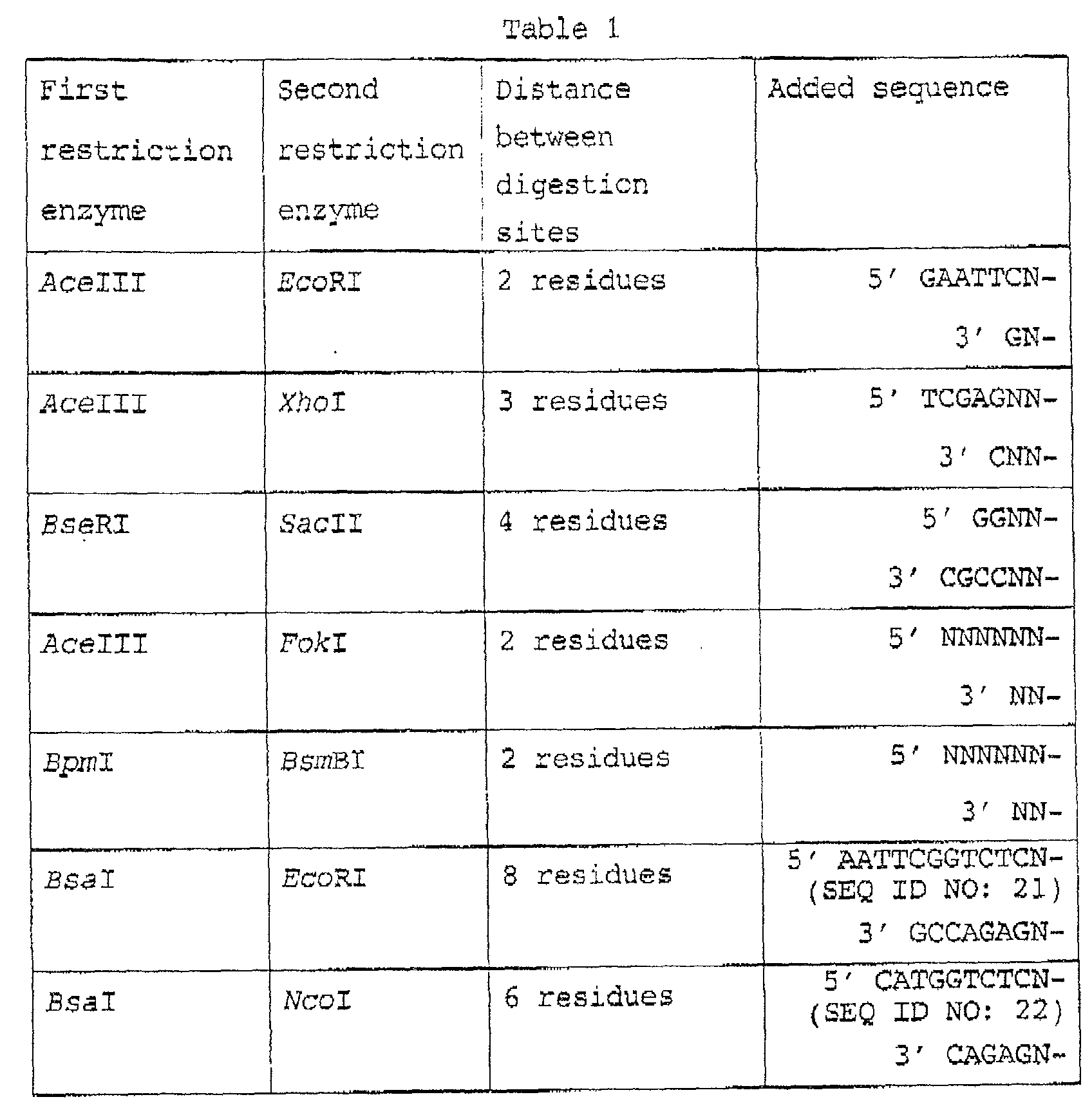
- The DNA fragment described above (hereinafter, also referred to as "insert fragment") can be obtained by a usual method such as a method of synthesizing two oligomers through chemical synthesis reactions so that they should form a target fragment upon annealing and then annealing these oligomers and a method of synthesizing two oligomers designed so that a recognition sequence of a restriction enzyme exists on each 5' end side and that their 3' end sides anneal to each other, through chemical synthesis reactions, annealing these oligomers, then performing extension reaction by using a DNA polymersse and digesting the extended fragment with a restriction enzyme. Further, the insert fragments can also be obtained by the insert fragment-producing method of the present invention explained below.
- The first restriction enzyme and the second restriction enzyme are usually selected so that their recognition sequences do not exist within the target sequence. However, even when their recognition sequences exist within the target sequence, the production method of the present invention can be applied. In this case, in the step (1), DNA fragments are prepared with changing sequences identical to the recognition sequences of the first restriction enzyme and the second restriction enzyme in the target sequence to different sequences (as a result, the recognition sequences of the first restriction enzyme and the second restriction enzyme do not exist within ligated partial sequences), and further performing a step of restoring the changed segment in the sequence of the DNA fragment obtained in the step (6) to the original sequence to produce DNA having the target sequence. Modification of the sequence for restoring the segment to the original sequence can be performed by a method for introducing a desired mutation such as site-directed mutagenesis.
- In the step (2), the aforementioned vector of the present invention is prepared. The vector of the present invention can be produced according to usual gene recombination techniques.
- In the step (3), the vector is digested with the first restriction enzyme. The digestion can be performed under conditions suitable for the restriction enzyme used.
- In the step (4), the fragment obtained by digestion with the first restriction enzyme is digested with the second restriction enzyme. The digestion, can be performed under conditions suitable for the restriction enzyme used.
- In the step (5), a longer fragment out of the fragments obtained by the digestion with the second restriction enzyme and one of the DNA fragments prepared in the step (1) are ligated in a predetermined order. The predetermined order referred to herein means an order of from one end segment to the other end segment of the target sequence. Purification and ligation of the fragments can be performed in a conventional manner.
- In the step (6), the steps (3) to (5) are repeated by using the clone obtained by the ligation as the vector used in the step (3) until all the DNA fragments prepared in the step (1) are ligated. Since the clone obtained by the ligation in the step (5) satisfies the requirements of the vector of the present invention, this clone can be used as the vector of the present invention in the step (3).
- Hereafter, there will be explained a case where AceIII and EcoRI are selected as the first restriction enzyme and the second restriction enzyme, respectively (those of a type in which the recognition sequence of the second restriction enzyme exists between the recognition sequence and the digestion site of the first restriction enzyme) as an example with reference to Fig. 2. In Fig. 2, nucleotides in the partial sequences obtained by dividing the target sequence are represented by X, and arbitrary nucleotides are represented by N.
- First, a DNA fragment having a partial sequence (insert fragment) is prepared. Since the number of nucleotides in the protruding end produced at the digestion site of AceIII is 4, adjacent partial sequences overlap by 4 nucleotides. One end of the insert fragment is obtained by adding a sequence forming an end ligatable to an end formed by digestion with EcoRI to a partial sequence. The added sequence has such a length that digestion occurs at an end of the partial sequence upon digestion with AceIII after ligation. The other end of the insert fragment is an end ligatable to an end formed by digestion with AceIII. That is, an end of the insert fragment first inserted has a shape ligatable to an end formed by digestion with AceIII in the first vector. When the vector to which the insert fragment is inserted is digested with AceIII, an end formed by digestion with AceIII is formed at the end of the partial sequence. Therefore, an end of the insert fragment subsequently inserted has such a shape that a segment overlapping with the partial sequence of the previously inserted insert fragment serves as a protruding strand.
- The insert fragment in this example has a sequence shown at the top of Fig. 3. Such an insert fragment can be obtained by a method of synthesizing such two oligomers through chemical synthesis reactions so that they form a target fragment upon annealing and then annealing these oligomers, as outlined in Fig. 3, (1), a method of synthesizing, through chemical synthesis reactions, two oligomers designed so that recognition sequences of EcoRI and AceIII exist on 5' end sides, respectively, and that their 3' end sides anneal to each other, annealing these oligomers, then performing extension reaction by using a DNA polymerase and digesting the extended fragment with EcoRI and AceIII, as outlined in Fig. 3, (2), or the like. Further, the insert fragment can also be obtained by the insert fragment-producing method of the present invention explained below (see Figs. 5 to 8).
- When the target sequence has the recognition sites of AceIII and EcoRI, other restriction enzymes are selected. Alternatively, when the partial sequences are designed, the recognition sequences are changed so that the ligated partial sequences do not include the recognition sites of AceIII and EcoRI.
- Further, a vector in which the recognition site of EcoRI is positioned between the recognition sequence and the digestion site of AceIII is prepared.
- After the first vector and the DNA fragments are prepared, the vector is successively digested with AceIII and EcoRI. This digestion provides two fragments. A longer fragment out of these fragments and one of the DNA fragments (one containing a partial sequence at an end) are ligated to obtain a vector.
- Since the vector obtained by the ligation is a vector in which the recognition site of EcoRI is positioned between the recognition sequence and the digestion site of AceIII, this vector is used in the same manner as the first vector, i.e., it is successively digested with AceIII and EcoRI as described above and ligated to a subsequent insert fragment (one having a partial sequence adjacent to the partial sequence immediately precedently inserted) to obtain a vector. Until all the prepared insert fragments are ligated, successive digestion with AceIII and EcoRI and ligation are repeated.
- When a sequence is changed in designing partial sequences, the sequence is restored by a method such as site-directed mutagenesis thereafter.
- Following the above procedure, DNA having the target sequence is produced.
- When a vector of a type in which the recognition sequence of the first restriction enzyme exists between the digestion site of the first restriction enzyme and the digestion site of the second restriction enzyme (see Fig. 1B) is used, one end of each DNA fragment prepared in the step (1) is formed by adding a sequence to a partial sequence, the added sequence forming an end ligatable to an end formed by digestion with the second restriction enzyme, to which the DNA fragment is ligated, and the added sequence having such a length that digestion occurs at an end of the partial sequence upon digestion with the first restriction enzyme after ligation, and the insert fragment contains the recognition sequence of the first restriction enzyme in order to satisfy the requirement that the other end of each DNA fragment has an end ligatable to an end formed by digestion with the first restriction enzyme, to which the DNA fragment is ligated.
- In this case, since the insert fragment contains the recognition sequence of the first restriction enzyme, a vector to which a DNA fragment containing the first partial sequence is inserted does not need to have the digestion site of the first restriction enzyme. That is, when a vector of this embodiment is used, the recognition sequence of the first restriction enzyme does not need to be incorporated into the vector beforehand. Furthermore, it is sufficient that the DNA fragment first inserted should be digested at an end of the partial sequence upon digestion with the first restriction enzyme after insertion. For example, it may be a fragment having an end that can be inserted into the digestion site of the second restriction enzyme.
- Therefore, in the production method of the present invention using the vector of this embodiment, the aforementioned step (2) can be replaced with a step (2) of preparing the vector of the present invention to which a DNA fragment being one of DNA fragments prepared in the step (1) and having one of the end partial sequences of the target sequence is inserted so that digestion occurs at an end of the partial sequence upon digestion with the first restriction enzyme, wherein one end of each of DNA fragments that are not the DNA fragment inserted in the step (2) is formed by adding a sequence to each partial sequence, the added sequence forming an end ligatabe to an end formed by digestion with the second restriction enzyme, to which the DNA fragment is ligated, and the added sequence having such a length that digestion occurs at an end of the partial sequence upon digestion with the first restriction enzyme after ligation, and the other end of each of DNA fragments that are not the DNA fragment inserted in the step (2) is an end ligatable to an end formed by digestion with the first restriction enzyme, to which the DNA fragment is ligated.
- Hereafter, the production method according to this embodiment will be explained with reference to Fig. 4 by using, as an example, a case where BsaI and EcoRI are selected as the first restriction enzyme and the second restriction enzyme, respectively (the type in which the recognition sequence of the first restriction enzyme exists between the digestion site of the first restriction enzyme and the digestion site of the second restriction enzyme). In Fig. 4, nucleotides of partial sequences obtained by dividing the target sequence are represented by X, and arbitrary nucleotides are represented by N.
- First, a DNA fragment (insert fragment) containing a partial sequence is prepared. Since the number of nucleotides in the protruding end generated at the digestion site of BsaI is 4, adjacent partial sequences overlap by 4 nucleotides. The insert fragment first inserted contains the recognition sequence of BsaI and has an end that can be inserted into a digestion site of EcoRI. The recognition sequence of BsaI exists at such a position that the fragment is digested at an end of the partial sequence upon digestion with BsaI after ligation. At one end of each of insert fragments that are not the insert fragment first inserted, a sequence that contains the recognition sequence of BsaI and forms an end ligatable to an end formed by digestion with EcoRI is added to the partial sequence. The added sequence has such a length that digestion occurs at an end of the partial sequence upon digestion with EsaI after ligation. The other end of each of insert fragments that are not the insert fragment first inserted is made an end ligatable to an end formed by digestion with BsaI. That is, the end of an insert fragment that is not the insert fragment inserted first has a shape that can be ligated to the end formed by digestion with BsaI in the first vector. When the vector to which the insert fragment is inserted is digested with BsaI, an end formed by digestion with BsaI is formed at the end of the partial sequence. Therefore, an end of an insert fragment subsequently inserted has such a shape that a segment overlapping with the partial sequence of the insert fragment previously inserted serves as a protruding strand.
- Such an insert fragment can be obtained by a method of synthesizing such two oligomers through chemical synthesis reactions that they form a target fragment upon annealing and then annealing these oligomers, a method of synthesizing, through chemical synthesis reactions, two oligomers designed so that a recognition sequence of a restriction enzyme exists on each 5' end side and that their 3' end sides anneal to each other, annealing these oligomers, then ' extending the annealed fragment by using a DNA polymerase and digesting the extended fragment with the restriction enzyme, or the like. Further, the insert fragment can also be obtained by the insert fragment-producing method of the present invention explained below (see Fig. 9).
- When the target sequence has the recognition sites of BsaI and EcoRI, other restriction enzymes are selected. Alternatively, the recognition sequences are changed when partial sequences are designed so that the ligated partial sequences do not have the recognition sites of BsaI and EcoRI.
- The insert fragment first inserted is prepared as a fragment that can be inserted into the digestion site of EcoRI and inserted into a vector containing EcoRI site. As a result, a vector can be obtained in which the recognition sequence of BsaI exists between the digestion site of BsaI and the digestion site of EcoRI.
- The obtained vector is successively digested with BsaI and EcoRI. This digestion provides two fragments. A longer fragment out of these fragments and one of the DNA fragments (one containing a partial sequence at an end) are ligated to obtain a vector.
- Since the vector obtained by the ligation is a vector in which the recognition sequence of BsaI exists between the digestion site of BsaI and the digestion site of EcoRI, this vector is used in the same manner as the aforementioned vector, i.e., it is successively digested with BsaI and EcoRI in the same manner as described above and ligated with a subsequent insert fragment (one containing a partial sequence adjacent to the partial sequence inserted immediately precedently) to obtain a vector. Until all the prepared insert fragments are ligated, successive digestion with BsaI and EcoRI and ligation are repeated.
- Thereafter, when a sequence is changed in designing of the partial sequences, the sequence is restored by a method such as site-directed mutagenesis.
- Following the above procedure, DNA having the target sequence is produced.
- The present invention also provides a method for producing an insert fragment used for the present invention and a vector used therefor.
- The insert fragment can be obtained by a usual method such as a method of synthesizing such two oligomers through chemical synthesis reactions that they form a target fragment upon annealing and then annealing these oligomers and a method of synthesizing, through chemical synthesis reactions, two oligomers designed so that a recognition sequence of restriction enzyme exists on each 5' end side and that their 3' end sides anneal to each other, annealing these oligomers, then extending the annealed fragment by using a DNA polymerase and digesting the extended fragment with the restriction enzyme. However, due to possibilities of errors in annealing, errors in uptake of nucleotides during the extension and inhibition of the reaction by impurities during the synthesis of the oligomers, it is not so likely that a fragment obtained by such a method should contain a target fragment. Therefore, after the insert fragments are ligated, sequencing must be performed to select a fragment incorporated with the target fragment. Both strands need to be read from both sides in order to reliably determine the sequence. In this case, however, the longer the synthesized strands become, the higher the cost becomes, since customized primers are required for the sequencing. Further, since this operation must be repeated for each incorporation, a very long period of time is required.
- According to the insert fragment-producing method of the present invention, sequencing and production of an insert fragment can be easily performed by once incorporating a partial sequence into a vector in which recognition sequences of restriction enzymes are positioned in a specific manner. Consequently, if the target sequence is once determined, the factors to be considered in the design of the insert fragment are reduced. Therefore, the insert fragment can be easily designed, and selection of the fragments can be simultaneously performed after the incorporation into the vector.
- An insert fragment-producing method according to a first embodiment of the present invention is a method for producing a DNA fragment used for the production method of the present invention, in which one end of the DNA fragment is formed by adding a sequence to a partial sequence, the added sequence forming an end ligatable to an end formed by digestion with the second restriction enzyme, to which the DNA fragment is ligated, and the added sequence having such a length that digestion occurs at an end of the partial sequence upon digestion with the first restriction enzyme after the ligation, and the other end is an end ligatable to an end formed by digestion with the first restriction enzyme, to which the DNA fragment is ligated, which method comprises steps of:
- (a) preparing a vector having a recognition sequence of a third restriction enzyme which generates a digestion site having the same shape as that of a digestion site of the first restriction enzyme, and a recognition sequence of a fourth restriction enzyme, in which the recognition sequence of the fourth restriction enzyme exists between the recognition sequence and the digestion site of the third restriction enzyme,
- (b) preparing a fragment comprising a partial sequence of which both ends are ligatable to an end formed by digestion with the fourth restriction enzyme,
- (c) digesting the vector prepared in the step (a) with the fourth restriction enzyme and ligating the fragment obtained by the digestion with the fourth restriction enzyme and the DNA fragment prepared in the step (b),
- (d) analyzing nuoleotide sequences of clones obtained by the ligation to select a clone having the target partial sequence, and
- (e) successively digesting the selected clone with the third
restriction enzyme and the fourth restriction enzyme,
wherein
sequences serving as the recognition sequences of the third restriction enzyme and the fourth restriction enzyme are provided in the vector and the fragment prepared in the steps (a) and (b), respectively, so that a predetermined DNA fragment is excised upon digestion of the vector obtained in the step (c) with the third restriction enzyme. -
- The first restriction enzyme, the second restriction enzyme and the insert fragment are as described in the explanations of the production method of the present invention.
- The third restriction enzyme is a distant digestion-type enzyme that has a digestion site having the same shape as that of the digestion site of the first restriction enzyme. The third restriction enzyme may be the same as the first restriction enzyme.
- The fourth restriction enzyme is not particularly limited so long as the recognition sequence and the digestion site thereof are specific. The same restriction enzyme as the second enzyme may be used.
- The type of the vector is not particularly limited, and it may be a vector derived from a plasmid, phage, virus, artificial yeast chromosome or the like. Although the size of the vector is not particularly limited either, a smaller size of the segment other than an inserted sequence is preferred in view of efficient replication. The vector can be produced according to usual gene recombination techniques.
- In the step (a), a vector having the recognition sequences of the third restriction enzyme and the fourth restriction enzyme is prepared, in which the recognition sequence of the fourth restriction enzyme exists between the recognition sequence and the digestion site of the third restriction enzyme. Such a vector can be produced according to usual gene recombination techniques.
- In the step (b), a fragment containing a partial sequence of which both ends are ends ligatable to an end formed by digestion with the fourth restriction enzyme is prepared. Such a fragment can be obtained by a usual method such as a method of synthesizing two oligomers through chemical synthesis reactions so that they should form a target fragment upon annealing and then annealing these oligomers (double-strand annealing method) and a method of synthesizing, through chemical synthesis reactions, two oligomers designed so that a recognition sequence of a restriction enzyme exists on each 5' end side and that their 3' end sides anneal to each other, annealing these oligomers, then extending the annealed fragment by using a DNA polymerase, and digesting the extended fragment with the restriction enzyme (synthetic oligomer annealing and extension method).
- In the step (c), the vector prepared in the step (a) is digested with the fourth restriction enzyme, and the fragment obtained by the digestion with the fourth restriction enzyme and the DNA fragment prepared in the step (b) are ligated. The digestion can be performed under conditions suitable for the restriction enzyme used. The fragments can be ligated in a conventional manner.
- In the vector and the fragment prepared in the steps (a) and (b), respectively, sequences serving as the recognition sequences of the third restriction enzyme and fourth restriction enzyme are provided so that a predetermined insert fragment is excised upon digestion of the clones obtained in the step (c) with the third restriction enzyme.
- In the step (d), the nucleotide sequences of the clones obtained by the ligation are analyzed to select a clone having the target partial sequence. The nucleotide sequences can be analyzed in a conventional manner.
- In the step (e), the selected clone is successively digested with the third restriction enzyme and the fourth restriction enzyme. The digestion can be performed under conditions suitable for the restriction enzymes used.
- In an embodiment of this insert fragment-producing method, the recognition sequence of the third restriction enzyme and the recognition sequence of the fourth restriction enzyme are identical, the vector prepared in the step (a) has another recognition sequence of the third restriction enzyme, digestion with the third restriction enzyme based on this recognition sequence generates an end having the same shape as that of an end formed by digestion with the fourth restriction enzyme, two recognition sequences of the third restriction enzyme exist on the both sides of the digestion site of the fourth restriction enzyme, and digestion is performed only with the third restriction enzyme in the step (e). In this embodiment, since only one kind of restriction enzyme is used in the step (e), the digestion operation becomes easy.
- Hereafter, there will be explained a case where AceIII and EcoRI are selected as the third restriction enzyme and the fourth restriction enzyme, respectively, as an example, with reference to Fig. 5. In Fig. S, nucleotides of partial sequences obtained by dividing the target sequence are represented by X, and arbitrary nucleotides are represented by N.
- First, a vector containing recognition sequences of AceIII and EcoRI is prepared in which the recognition sequence of EcoRI exists between the recognition sequence and the digestion site of AceIII. The nucleotide sequence of a segment containing the recognition sequences in the vector is shown as SEQ ID NO: 8.
- A fragment containing a partial sequence having an end ligatable to an end formed by digestion with EcoRI for both ends is prepared. Such a fragment can be obtained by a usual method such as a method of synthesizing two oligomers through chemical synthesis reactions so that they form a target fragment upon annealing and then annealing these oligomers (double-strand annealing method) and a method of synthesizing, through chemical synthesis reactions, two oligomers designed so that a recognition sequence of a restriction enzyme exists on each 5' end side and that their 3' end sides anneal to each other, annealing these oligomers, then extending the annealed fragment by using a DNA polymerase, and digesting the extended fragment with the restriction enzyme (synthetic oligomer annealing and extension method).
- The prepared vector is digested with EcoRI, and the fragment obtained by the digestion with EcoRI and the prepared DNA fragment are ligated.
- In the prepared vector and fragment, the sequences of the recognition sequences of AceIII and EcoRI are provided so that a predetermined insert fragment is excised upon digestion of the clone obtained by Ligation with AceIII.
- The nucleotide sequences of the clones obtained by the ligation are analyzed to select a clone having the target partial sequence.
- The selected vector is successively digested with AceIII and EcoRI. If there is used, as the vector, a vector having another recognition sequence of AceIII (parenthesized sequence in Fig. 5) in which digestion, based on this recognition sequence with AceIII generates an end having the same shape as a site digested with EcoRI and two recognition sequences of AceIII exist on the both sides of the digestion site of EcoRI, it is sufficient to use only AceIII to excise an insert fragment. The nucleotide sequences of the segments containing the recognition sequences of the restriction enzymes in the segment digested upon the excision are shown in SEQ ID NOS: 9 and 10.
- The present invention also provides a vector used in this embodiment of the insert fragment-producing method, in which the vector comprises the recognition sequences of the third restriction enzyme and the fourth restriction enzyme, and the recognition sequence of the fourth restriction enzyme exists between the recognition sequence and the digestion site of the third restriction enzyme, wherein the vector further comprises another recognition sequence of the third restriction enzyme, digestion based on this recognition sequence with the third restriction enzyme generates an end having the same shape as a site digested with the fourth restriction enzyme, and two recognition sequences of the third restriction enzyme exist on the both sides of the digestion site of the fourth restriction enzyme.
- In another embodiment of the aforementioned insert fragment-producing method, the vector prepared in the step (a) has another recognition sequence of the third restriction enzyme, and two recognition sequences of the third restriction enzyme are symmetrically positioned as also for their directions with respect to the recognition sequence of the fourth restriction enzyme, and digestion is performed only with the third restriction enzyme in the step (f).
- When a fragment is incorporated into this vector, the target fragment cannot be excised unless the fragment is incorporated in a specific direction. However, certain fragments may be incorporated only in a specific direction depending on their sequences. According to this embodiment, the aforementioned problem does not arise because the target fragment can be excised irrespective of the direction in which the fragment is incorporated.
- Hereafter, there will be explained a case where AceIII and EcoRI are selected as the third restriction enzyme and the fourth restriction enzyme, respectively, as an example, with reference to Fig. 6. In Fig. 6, nucleotides of partial sequences obtained by dividing the target sequence are represented by X, and arbitrary nucleotides are represented by N.
- In this embodiment, as the vector, a vector is used in which another recognition sequence of AceIII is contained and two recognition sequences of AceIII are positioned symmetrically as also for their directions with respect to the recognition sequence of EcoRI. The nucleotide sequence of the segment containing the recognition sequence in the vector is shown as SEQ ID NO: 11.
- In the prepared vector and fragment, sequences serving as the recognition sequences of AceIII and EcoRI are provided so that a predetermined insert fragment is excised upon digestion with AceIII of the clone obtained by ligation.
- A clone in which the fragment is inserted into the digestion site of EcoRI in the vector and selected by sequencing is digested with AceIII. The nucleotide sequences of the segments containing the recognition sequences of the restriction enzymes in the segment to be digested upon the excision are shown as SEQ ID NOS: 12 and 13.
- In this embodiment, two recognition sites of the fourth restriction enzyme may be used. In this case, operations may be the same as in the above embodiment except that two recognition sites are regarded as one site. In the embodiment using two recognition sites of the fourth restriction enzyme, it is preferred that the vector prepared in the step (a) has two recognition sequences of the fourth restriction enzyme, these two recognition sequences of the fourth restriction enzyme are positioned in directions inverse to each other, the recognition sequences of the third restriction enzyme are positioned symmetrically as also for their directions on both sides of two recognition sequences of the fourth restriction enzyme, and the fourth restriction enzyme forms a one nucleotide-protruding end at the 3' end. According to this embodiment, an end with which TA cloning can be performed is formed, and therefore loss can be further reduced by positioning the recognition sequences of the restriction enzymes on both sides thereof.
- Examples of the restriction enzyme that forms a one nucleotide-protruding end at the 3' end include BmrI, Eam1105I, BciVI, MboII, MnlI and so forth,
- Hereafter, there will be explained a case where AceIII and BmrI (Fig. 7) or Eam1105I (Fig. 8) are selected as the third restriction enzyme and the fourth restriction enzyme, respectively, as an example, with reference to Figs. 7 and 8. In Figs. 7 and 8, nucleotides of partial sequences obtained by dividing the target sequence are represented by X, and arbitrary nucleotides are represented by N.
- In this embodiment, as the vector, a vector is used in which another recognition sequence of AceIII is contained and two recognition sequences of AceIII are positioned symmetrically as also for their directions with respect to two recognition sequences of BmrI or Eam1105I. The nucleotide sequence of the segment containing the recognition sequences in the vector with BmrI is shown in SEQ ID NO: 14. The nucleotide sequence of the segment containing the recognition sequences in the vector with Eam1105I is shown in SEQ ID NO: 17.
- In the prepared vector and fragment, sequences serving as the recognition sequences of AceIII and BmrI or Eam1105I are provided so that a predetermined insert fragment is excised upon digestion with AceIII of the vector obtained by ligation.
- A vector in which the fragment is inserted into the digestion site of BmrI or Eam1105I (between two digestion sites) and which is selected by sequencing is digested with AceIII. The nucleotide sequences of the segments containing the recognition sequences of the restriction enzymes in the segment to be digested upon the excision in the case of the vector with BmrI are shown in SEQ ID NOS: 15 and 16. The nucleotide sequences of the segments containing the recognition sequences of the restriction enzymes in the segment to be digested upon the excision in the case of the vector with Eam1105I are shown in SEQ ID NOS: 18 and 19.
- The present invention also provides a vector used in this embodiment of the insert fragment-producing method, in which the vector comprises the recognition sequences of the third restriction enzyme and the fourth restriction enzyme, and the recognition sequence of the fourth restriction enzyme exists between the recognition sequence and the digestion site of the third restriction enzyme, wherein the vector further comprises another recognition sequence of the third restriction enzyme, and two recognition sequences of the third restriction enzyme are positioned symmetrically as also for their directions with respect to the recognition sequence of the fourth restriction enzyme.
- In this vector, there may be two recognition sites of the fourth restriction enzyme. Further, the vector may be a vector in which two recognition sequences of the fourth restriction enzyme are contained, these two recognition sequences of the fourth restriction enzyme are positioned in directions inverse to each other, the recognition sequences of the third restriction enzyme are positioned symmetrically as also for their directions on both sides of two recognition sequences of the fourth restriction enzyme, and the fourth restriction enzyme forms a one nucleotide-protruding end at the 3' end.
- An insert fragment-producing method according to a second embodiment of the present invention is a method for producing a DNA fragment used in the production method of the present invention, in which one end of the DNA fragment is formed by adding a sequence to a partial sequence, the added sequence forming an end ligatable to an end formed by digestion with the second restriction enzyme, to which the DNA fragment is ligated, and the added sequence having such a length that digestion occurs at an end of the partial sequence upon digestion with the first restriction enzyme after the ligation, and the other end is an end ligatable to an end formed by digestion with the first restriction enzyme, to which the DNA fragment is ligated, which method comprises steps of:
- (a) preparing a vector having a recognition sequence of the fourth restriction enzyme,
- (b) preparing a fragment containing a partial sequence of which both ends are ligatable to an end formed by digestion with the fourth restriction enzyme, which has a recognition sequence of the third restriction enzyme so that digestion based on the recognition sequence of the third restriction enzyme generating a digested site having the same shape as that of a digested site based on the recognition sequence of the first restriction enzyme generates an end having the same shape as that of one end of the fragment, and has a recognition sequence of a fifth restriction enzyme generating an end having the same shape as an end generated by the third restriction enzyme so that digestion with the fifth restriction enzyme occurs at an end of the partial sequence,
- (c) digesting the vector prepared in the step (a) with the fourth restriction enzyme and ligating the fragment obtained by the digestion with the fourth restriction enzyme and the DNA fragment prepared in the step (b),
- (d) analyzing nucleotide sequences of clones obtained by the ligation to select a clone having the target partial sequence, and
- (e) digesting the selected clone with the fourth restriction
enzyme and the fifth restriction enzyme,
wherein
a sequence serving as the recognition sequence of the fifth restriction enzyme is provided in the vector and the fragment prepared in the steps (a) and (b), respectively, so that a predetermined DNA fragment is excised upon digestion of the clones obtained in the step (c) with the fifth restriction enzyme. -
- The fifth restriction enzyme is a distant digestion-type enzyme and has a digestion site having the same shape as that of the digestion site of the first restriction enzyme. The fifth restriction enzyme may be the same as the first restriction enzyme. The first to fourth restriction enzymes and the vector are the same as those in the first embodiment.
- In the step (a), a vector having the recognition sequence of the fourth restriction enzyme is prepared. Such a vector can be produced according to usual gene recombination techniques.
- In the step (b), there is prepared a fragment containing a partial sequence of which both ends are ligatable to an end formed by digestion with the fourth restriction enzyme, which has a recognition sequence of the third restriction enzyme so that digestion based on the recognition sequence of the third restriction enzyme generating a digested site having the same shape as that of a digested site based on the recognition sequence of the first restriction enzyme generates an end having the same shape as that of one end of the fragment, and has a recognition sequence of a fifth restriction enzyme generating an end having the same shape as an end generated by the third restriction enzyme so that digestion by the fifth restriction enzyme occurs at an end of the partial sequence. Such a fragment can be obtained by a usual method such as a method of synthesizing two oligomers through chemical synthesis reactions so that they form a target fragment upon annealing and then annealing these oligomers (double-strand annealing method) and a method of synthesizing, through chemical synthesis reactions, two oligomers designed so that a recognition sequence of a restriction enzyme exists on each 5' end side and that their 3' end sides anneal to each other, annealing these oligomers, then extending the annealed fragment by using a DNA polymerase, and digesting the extended fragment with the restriction enzyme (synthetic oligomer annealing and extension method).
- In the step (c), the vector prepared in the step (a) is digested with the fourth restriction enzyme, and the fragment obtained by the digestion with the fourth restriction enzyme and the DNA fragment prepared in the step (b) are ligated. The digestion can be performed under conditions suitable for the restriction enzyme used. The fragments can he ligated in a conventional manner.
- In the vector and fragment prepared in the steps (a) and (b), respectively, a sequence serving as the recognition sequence of the fifth restriction enzyme is provided so that a predetermined DNA fragment is excised upon digestion of the clones obtained in the step (c) with the fifth restriction enzyme.
- In the step (d), the nucleotide sequences of the clones obtained by the ligation are analyzed to select a clone having the target partial sequence. The nucleotide sequences can be analyzed in a conventional manner.
- In the step (e), the selected clone is digested with the fourth restriction enzyme and the fifth restriction enzyme. The digestion can be performed under conditions suitable for the restriction enzymes used. When the fragment digested with the fourth restriction enzyme cannot be digested with the fifth restriction enzyme, the fragment is successively digested with the fifth restriction enzyme and then the fourth restriction enzyme. When the fragment digested with the fourth restriction enzyme can be digested with the fifth restriction enzyme, the fragment may be digested with these enzymes simultaneously or successively. In the case of this successive digestion, the order may be arbitrary.
- Hereafter, there will be explained a case where BsaI, EcoRI and BbsI are selected as the third restriction enzyme, the fourth restriction enzyme and fifth restriction enzyme, respectively, as an example, with reference to Fig. 9. In Fig. 9, nucleotides of partial sequences obtained by dividing the target sequence are represented by X, and arbitrary nucleotides are represented by N.
- First, a vector having the recognition sequence of EcoRI is prepared.
- There is prepared a fragment containing a partial sequence in which both ends are ligatable to an end formed by digestion with EcoRI, the recognition sequence of BsaI is contained so that digestion based on the recognition sequence with BsaI generates an end having the same shape as that of one end of this fragment and the recognition sequence of BbsI is contained so that digestion with BbsI causes digestion at an end of the partial sequence. Such a fragment can be obtained by a usual method such as a method of synthesizing two oligomers through chemical synthesis reactions so that they form a target fragment upon annealing and then annealing these oligomers (double-strand annealing method) and a method of synthesizing, through chemical synthesis reactions, two oligomers designed so that a recognition sequence of a restriction enzyme exists on each 5' end side and that their 3' end sides anneal to each other, annealing these oligomers, then extending the annealed fragment by using a DNA polymerase, and digesting the extended fragment with the restriction enzyme (synthetic oligomer annealing and extension method).
- The prepared vector is digested with EcoRI, and the fragment obtained by the digestion with EcoRI and the prepared DNA fragment are ligated.
- In the prepared vector and fragment, sequences serving as the recognition sequences of BbsI and EcoRI are provided so that a predetermined insert fragment is excised upon digestion with BbsI and EcoRI of the clone obtained by ligation.
- The nucleotide sequences of the clones obtained by the ligation are analyzed to select a clone having the target partial sequence.
- The selected clone is digested with BbsI and EcoRI. The clone may be digested with these enzymes simultaneously or successively. In the case of successive digestion, the order may be arbitrary. The nucleotide sequences of the segments containing the recognition sequences of the restriction enzymes in the segment digested upon the excision are shown as SEQ ID NOS: 6 and 20.

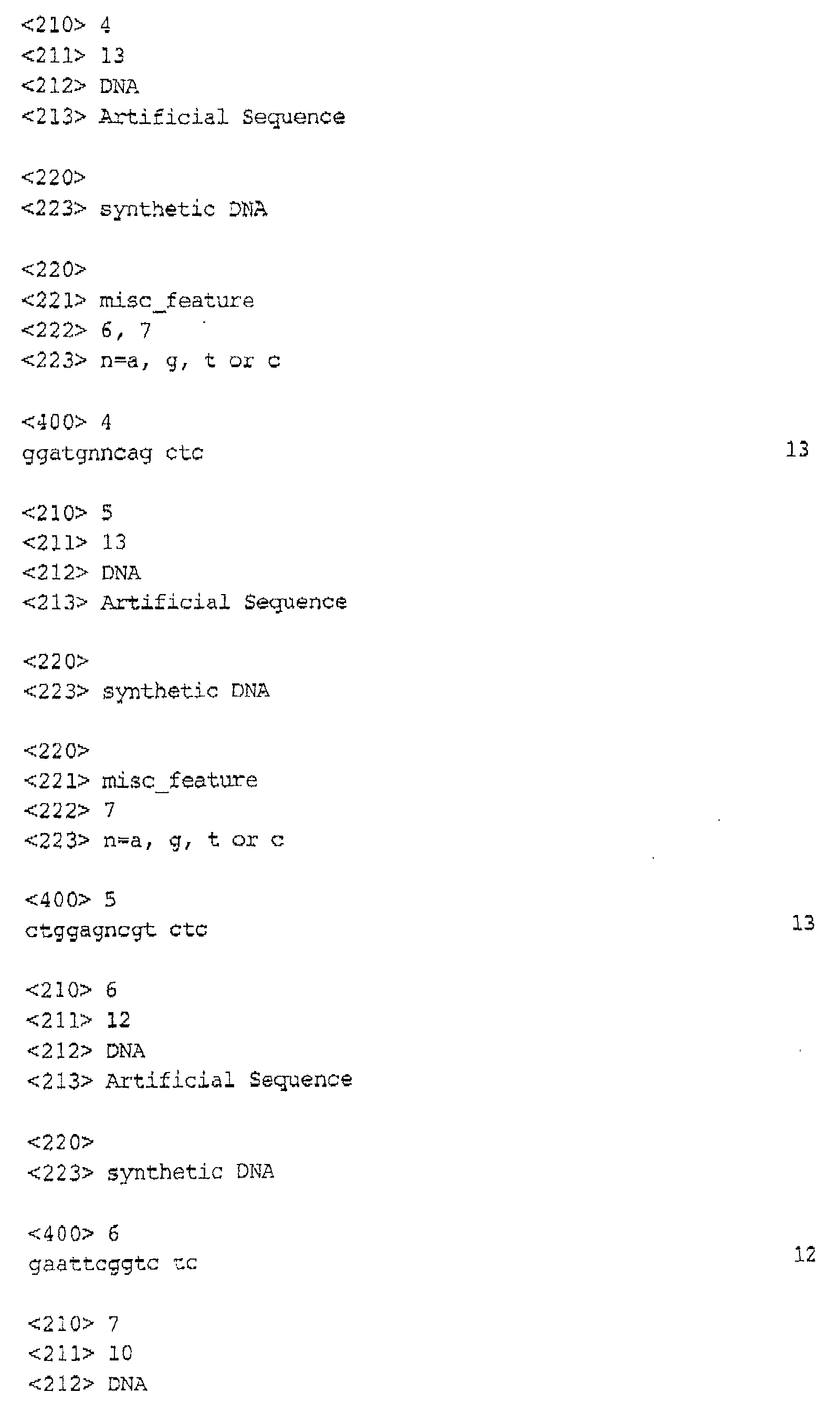
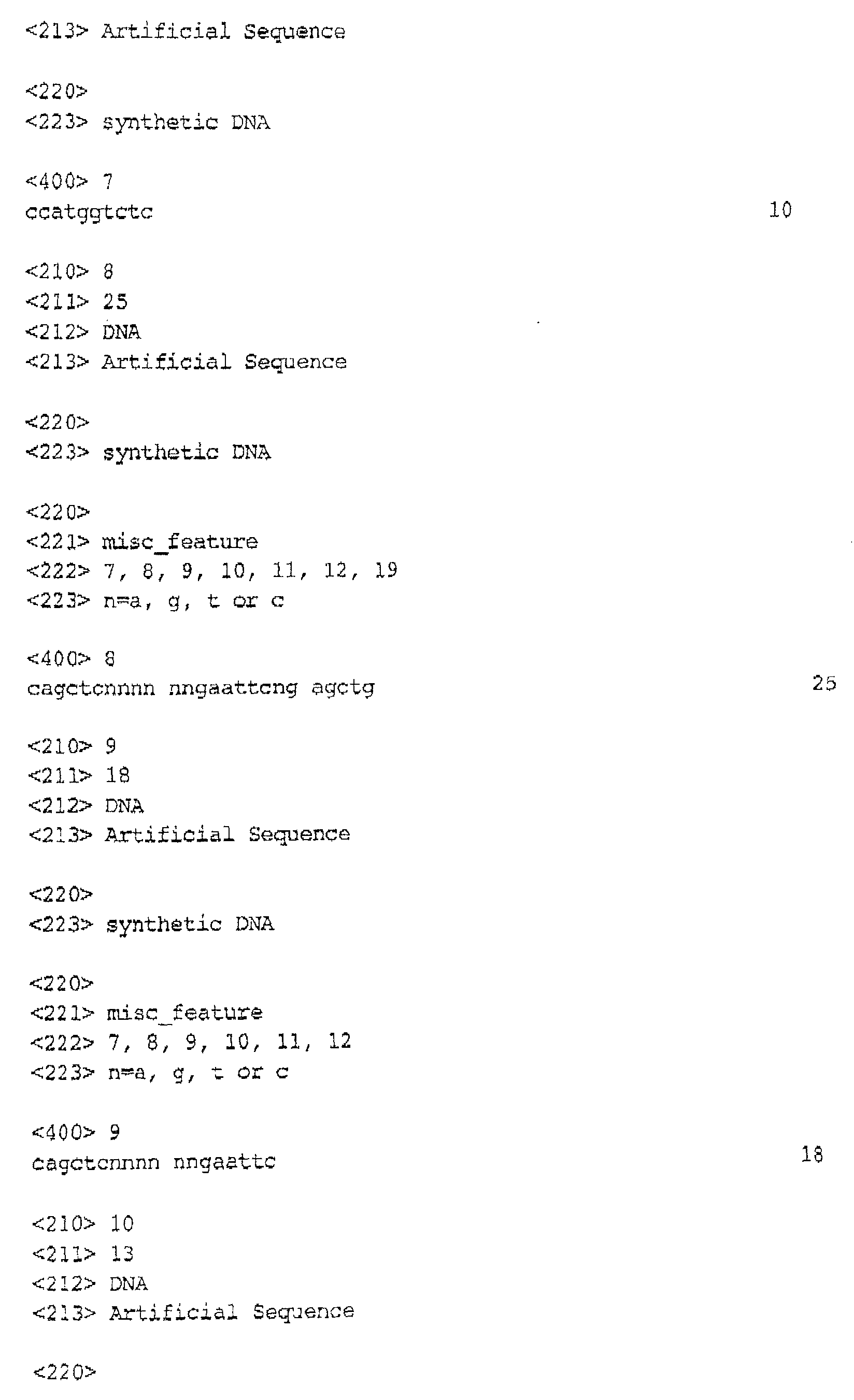
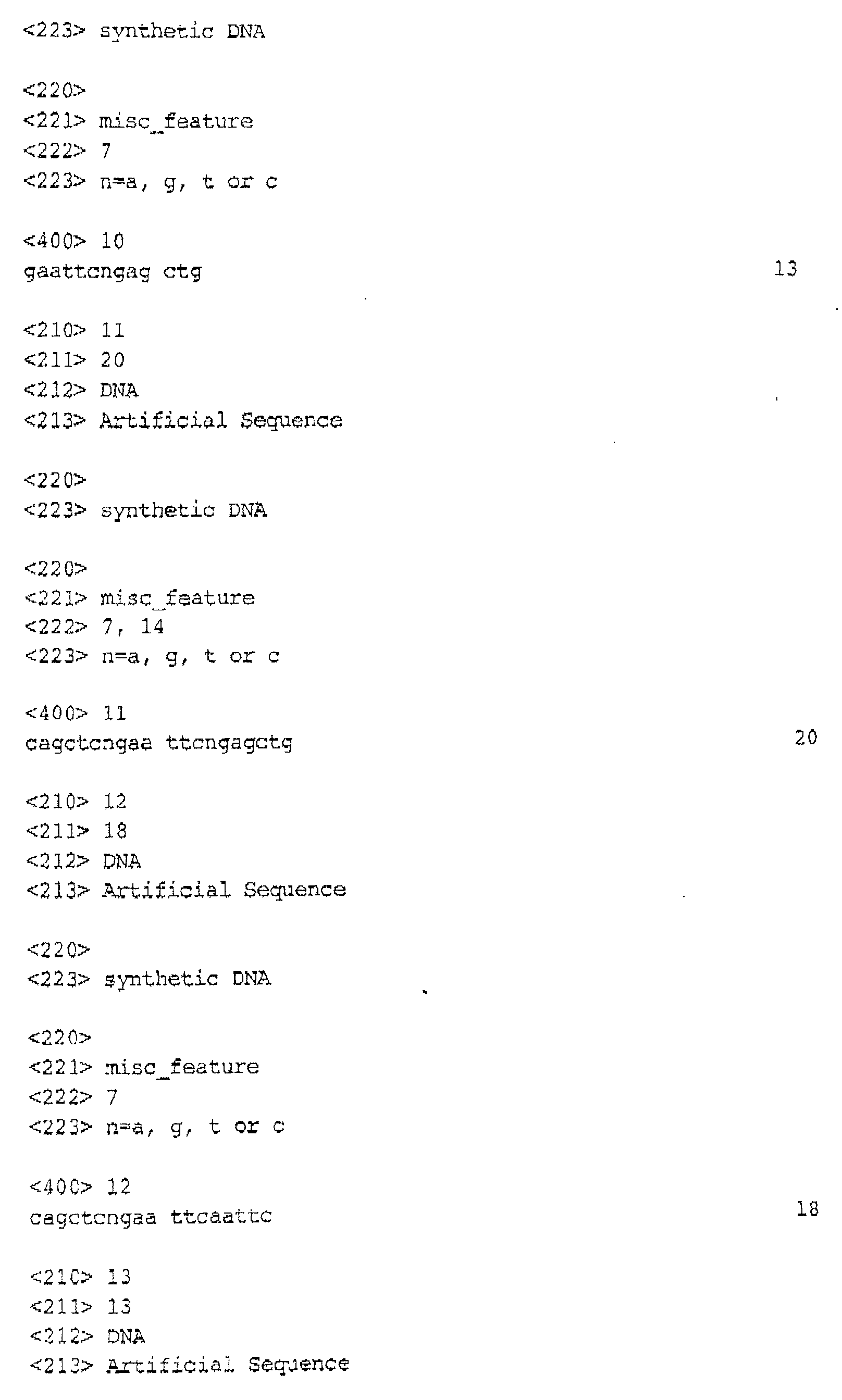
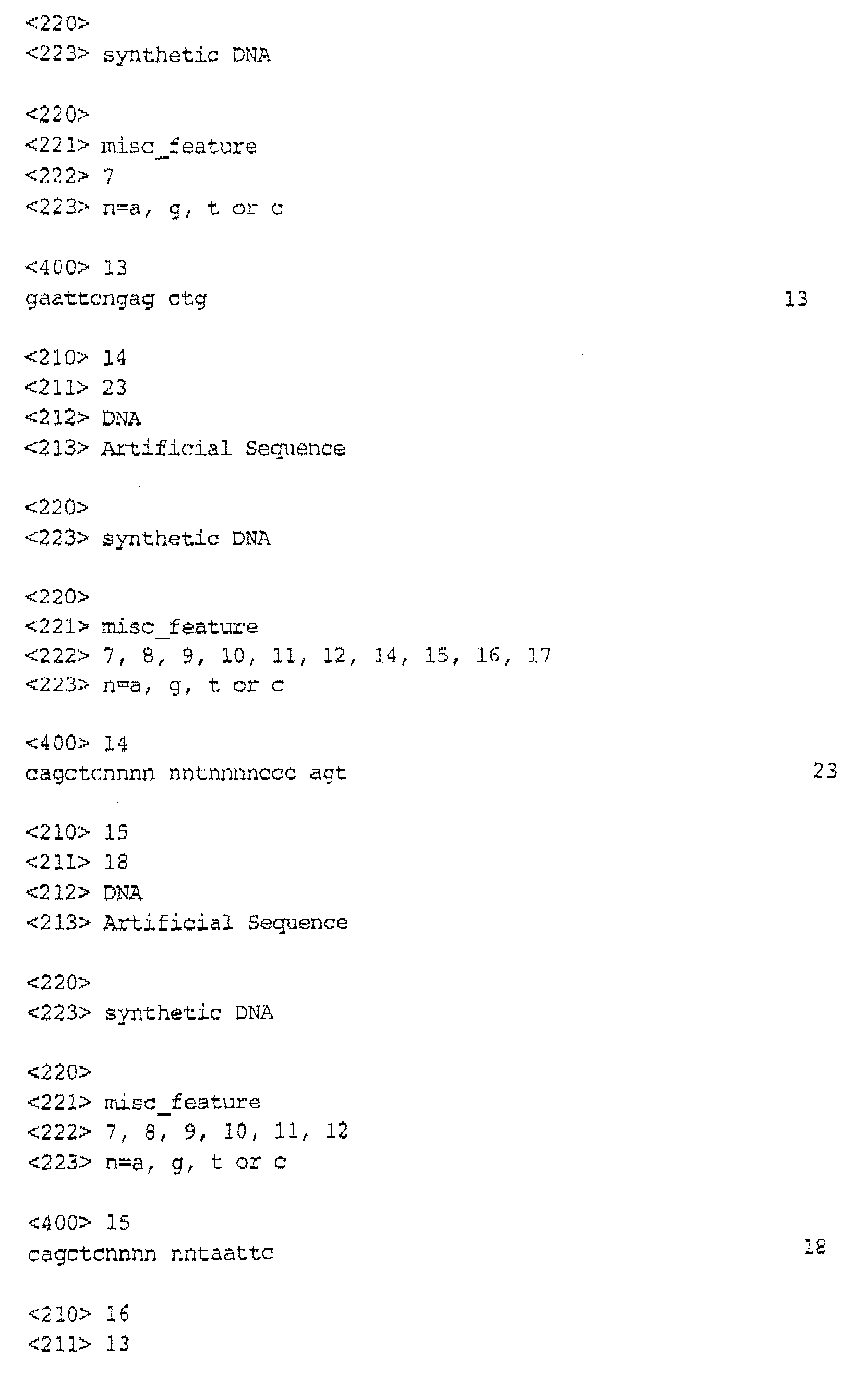
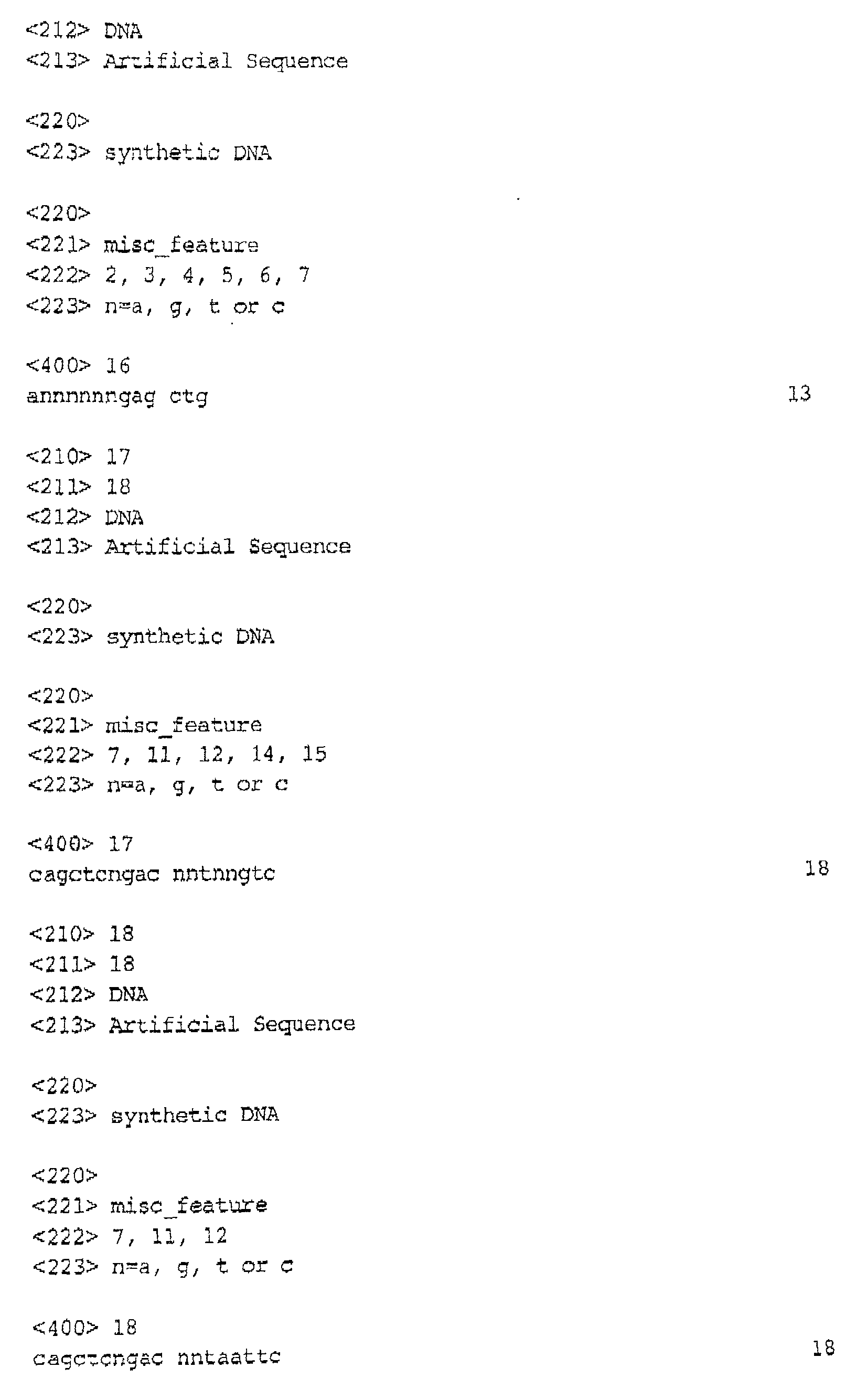


Claims (13)
- A vector comprising one recognition sequence of a first restriction enzyme of which digestion site exists at a particular position with respect to the recognition sequence and does not exist within the recognition sequence and one recognition sequence of a second restriction enzyme of which digestion site is specific, wherein a fragment obtained by digestion of the vector with the first restriction enzyme can be digested with the second restriction enzyme and a distance between the digestion site of the first restriction enzyme and the digestion site of the second restriction enzyme is 30 nucleotides or shorter.
- A method for producing DNA having a target sequence, comprising steps of:(1) preparing a plurality of double-stranded DNA fragments each having one of continuous partial sequences obtained by dividing the target sequence as a part thereof,(2) preparing the vector as defined in Claim 1,(3) digesting the vector with the first restriction enzyme,(4) digesting the fragment obtained by the digestion with the first restriction enzyme with the second restriction enzyme,(5) ligating a longer fragment out of the fragments obtained by the digestion with the second restriction enzyme and one of the DNA fragments prepared in the step (1) in a predetermined order, and(6) repeating the steps of (3) to (5) by using a clone obtained by the ligation as the vector in the step (3) until all the DNA fragments prepared in the step (1) are ligated,
wherein
adjacent partial sequences overlap by nucleotides in a number of nucleotides in a protruding segment of a cohesive end to be generated at the digestion site of the first restriction enzyme,
one end of each DNA fragment prepared in the step (1) is formed by adding a sequence to each partial sequence, the added sequence forming an end ligatable to an end formed by digestion with the second restriction enzyme, to which the DNA fragment is ligated, and the added sequence having such a length that digestion occurs at an end of the partial sequence upon digestion with the first restriction enzyme after the ligation,
the other end of each DNA fragment is ligatable to an end formed by digestion with the first restriction enzyme, to which the DNA fragment is ligated, and
the first restriction enzyme and the second restriction enzyme are selected so that their recognition sequences do not exist within the ligated partial sequences. - The method according to Claim 2, which further comprises, when a sequence identical to the recognition sequence of the first restriction enzyme or the second restriction enzyme exists within the target sequence, a step of preparing the DNA fragments in the step (1) with changing the identical sequence to a different sequence and restoring the changed segment in the sequence of the DNA fragment obtained in the step (6) to the original sequence to produce DNA having the target sequence.
- A method for producing DNA having a target sequence; comprising steps of:(1) preparing a plurality of double-stranded DNA fragments each having one of continuous partial sequences obtained by dividing the target sequence as a part thereof,(2) preparing the vector as defined in Claim 1, to which a DNA fragment being one of the DNA fragments prepared in the step (1) and having one of end partial sequences of the target sequence is inserted so that digestion occurs at an end of the partial sequence upon digestion with the first restriction enzyme,(3) digesting the vector with the first restriction enzyme,(4) digesting the fragment obtained by the digestion with the first restriction enzyme with the second restriction enzyme,(5) lighting a longer fragment out of the fragments obtained by the digestion with the second restriction enzyme and one of the DNA fragments prepared in the step (1), and(6) repeating the steps of (3) to (5) by using a clone obtained by the ligation as the vector in the step (3) until all the DNA fragments prepared in the step (1) are ligated,
wherein
adjacent partial sequences overlap by nucleotides in a number of nucleotides in a protruding segment of a cohesive end to be generated at the digestion site of the first restriction enzyme,
one end of each of the DNA fragments that are not the DNA fragment inserted in the step (2) is formed by adding a sequence to each partial sequence, the added sequence forming an end ligatable to an end formed by digestion with the second restriction enzyme, to which the DNA fragment is ligated, and the added sequence having such a length that digestion occurs at an end of the partial sequence upon digestion with the first restriction enzyme after the ligation,
the other end of each of the DNA fragments that are not the DNA fragment inserted in the step (2) is ligatable to an end formed by digestion with the first restriction enzyme, to which the DNA fragment is ligated, and
the first restriction enzyme and the second restriction enzyme are selected so that their recognition sequences do not exist within the ligated partial sequences. - The method according to Claim 4, which further comprises, when a sequence identical to the recognition sequence of the first restriction enzyme or the second restriction enzyme exists within the target sequence, a step of preparing the DNA fragments in the step (1) with changing the identical sequence to a different sequence and restoring the changed segment in the sequence of the DNA fragment obtained in the step (6) to the original sequence to produce DNA having the target sequence.
- A method for producing a DNA fragment used in the production method as defined in any one of claims 2 to 5, in which one end of the DNA fragment is formed by adding a sequence to a partial sequence, the added sequence forming an end ligatable to an end formed by digestion with the second restriction enzyme, to which the DNA fragment is ligated, and the added sequence having such a length that digestion occurs at an end of the partial sequence upon digestion with the first restriction enzyme after the ligation, and the other end is an end ligatable to an end formed by digestion with the first restriction enzyme, to which the DNA fragment is ligated, which method comprises steps of:(a) preparing a vector having a recognition sequence of a third restriction enzyme which generates a digestion site having the same shape as that of a digestion site of the first restriction enzyme, and a recognition sequence of a fourth restriction enzyme, in which the recognition sequence of the fourth restriction enzyme exists between the recognition sequence and the digestion site of the third restriction enzyme,(b) preparing a fragment comprising a partial sequence of which both ends are ligatable to an end formed by digestion with the fourth restriction enzyme,(c) digesting the vector prepared in the step (a) with the fourth restriction enzyme and ligating the fragment obtained by the digestion with the fourth restriction enzyme and the DNA fragment prepared in the step (b),(d) analyzing nucleotide sequences of clones obtained by the ligation to select a clone having the target partial sequence, and(e) successively digesting the selected clone with the third restriction enzyme and the fourth restriction enzyme,
wherein
sequences serving as the recognition sequences of the third restriction enzyme and the fourth restriction enzyme are provided in the vector and the fragment prepared in the steps (a) and (b), respectively, so that a predetermined DNA fragment is excised upon digestion of the clones obtained in the step (c) with the third restriction enzyme. - The method according to Claim 6, wherein the recognition sequence of the third restriction enzyme and the recognition sequence of the fourth restriction enzyme are identical,
the vector prepared in the step (a) has another recognition sequence of the third restriction enzyme, digestion with the third restriction enzyme based on this recognition sequence generates an end having the same shape as that of an end formed by digestion with the fourth restriction enzyme, two recognition sequences of the third restriction enzyme exist on the both sides of the digestion site of the fourth restriction enzyme, and
digestion is performed only with the third restriction enzyme in the step (e). - The method according to Claim 6, wherein the vector prepared in the step (a) has another recognition sequence of the third restriction enzyme, and two recognition sequences of the third restriction enzyme are symmetrically positioned as also for their directions with respect to the recognition sequence of the fourth restriction enzyme, and
digestion is performed only with the third restriction enzyme in the step (e). - The method according to Claim 8, wherein the vector prepared in the step (a) has two recognition sequences of the fourth restriction enzyme, two recognition sequences of the fourth restriction enzyme are positioned in directions inverse to each other, the recognition sequences of the third restriction enzyme are positioned symmetrically as also for their directions on both sides of two recognition sequences of the fourth restriction enzyme, and the fourth restriction enzyme forms a one nucleotide-protruding end at the 3' end.
- A method for producing a DNA fragment used in the production method as defined in any one of Claims 2 to 5, in which one end of the DNA fragment is formed by adding a sequence to a partial sequence, the added sequence forming an end ligatable to an end formed by digestion with the second restriction enzyme, to which the DNA fragment is ligated, and the added sequence having such a length that digestion occurs at an end of the partial sequence upon digestion with the first restriction enzyme after the ligation, and the other end is an end ligatable to an end formed by digestion with the first restriction enzyme, to which the DNA fragment is ligated, which method comprises steps of:(a) preparing a vector having a recognition sequence of the fourth restriction enzyme,(b) preparing a fragment containing a partial sequence of which both ends are ligatable to an end formed by digestion with the fourth restriction enzyme, which has a recognition sequence of the third restriction enzyme so that digestion based or. the recognition sequence of the third restriction enzyme generating a digested site having the same shape as that of a digested site based on the recognition sequence of the first restriction enzyme generates an end having the same shape as that of one end of the fragment, and has a recognition sequence of a fifth restriction enzyme generating an end having the same shape as an end generated by the third restriction enzyme so that digestion with the fifth restriction enzyme occurs at an end of the partial sequence,(c) digesting the vector prepared in the step (a) with the fourth restriction enzyme and ligating the fragment obtained by the digestion with the fourth restriction enzyme and the DNA fragment prepared in the step (b),(d) analyzing nucleotide sequences of clones obtained by the ligation to select a clone having the target partial sequence, and(e) digesting the selected clone with the fourth restriction enzyme and the fifth restriction enzyme,
wherein
a sequence serving as the recognition sequence of the fifth restriction enzyme is provided in the vector and the fragment prepared in the steps (a) and (b), respectively, so that a predetermined DNA fragment is excised upon digestion of the clones obtained in the step (c) with the fifth restriction enzyme. - A vector used for the method as defined in Claim 7, which comprises the recognition sequence of the third restriction enzyme, of which digestion site exists at a particular position with respect to the recognition sequence and does not exists within the recognition sequence, and the recognition sequence of the fourth restriction enzyme of which digestion site is specific, and in which the recognition sequence of the fourth restriction enzyme exists between the recognition sequence and the digestion site of the third restriction enzyme, wherein the vector has another recognition sequence of the third restriction enzyme, digestion based on this recognition sequence with the third restriction enzyme generates an end having the same shape as that obtained by digestion with the fourth restriction enzyme, and two recognition sequences of the third restriction enzyme exist on the both sides of the digestion site of the fourth restriction enzyme.
- A vector used for the method as defined in Claim 8, which comprises the recognition sequence of the third restriction enzyme, of which digestion site exists at a particular position with respect to the recognition sequence and does not exists within the recognition sequence, and the recognition sequence of the fourth restriction enzyme of which digestion site is specific, and in which the recognition sequence of the fourth restriction enzyme exists between the recognition sequence and the digestion site of the third restriction enzyme, wherein the vector comprises another recognition sequence of the third restriction enzyme, and two recognition sequences of the third restriction enzyme are symmetrically positioned as also for their directions with respect to the recognition sequence of the fourth restriction enzyme.
- The vector according to Claim 12, which comprises two recognition sequences of the fourth restriction enzyme, and in which two recognition sequences of the fourth restriction enzyme are positioned in directions inverse to each other, the recognition sequences of the third restriction enzyme are symmetrically positioned as also for their directions on both sides of two recognition sequences of the fourth restriction enzyme, and the fourth restriction enzyme forms a one nucleotide-protruding end at the 3' end.
Applications Claiming Priority (2)
| Application Number | Priority Date | Filing Date | Title |
|---|---|---|---|
| JP2001351927 | 2001-11-16 | ||
| JP2001351927A JP2003144159A (en) | 2001-11-16 | 2001-11-16 | DNA production method |
Publications (2)
| Publication Number | Publication Date |
|---|---|
| EP1316605A2 true EP1316605A2 (en) | 2003-06-04 |
| EP1316605A3 EP1316605A3 (en) | 2003-12-03 |
Family
ID=19164171
Family Applications (1)
| Application Number | Title | Priority Date | Filing Date |
|---|---|---|---|
| EP02257862A Withdrawn EP1316605A3 (en) | 2001-11-16 | 2002-11-14 | Method for producing DNA |
Country Status (4)
| Country | Link |
|---|---|
| US (1) | US20030109009A1 (en) |
| EP (1) | EP1316605A3 (en) |
| JP (1) | JP2003144159A (en) |
| CA (1) | CA2408977A1 (en) |
-
2001
- 2001-11-16 JP JP2001351927A patent/JP2003144159A/en active Pending
-
2002
- 2002-11-14 EP EP02257862A patent/EP1316605A3/en not_active Withdrawn
- 2002-11-15 US US10/298,491 patent/US20030109009A1/en not_active Abandoned
- 2002-11-15 CA CA002408977A patent/CA2408977A1/en not_active Abandoned
Non-Patent Citations (3)
| Title |
|---|
| LEE JAE H ET AL: "Sequential amplification of cloned DNA as tandem multimers using class-IIS restriction enzymes." GENETIC ANALYSIS BIOMOLECULAR ENGINEERING, vol. 13, no. 6, 1996, pages 139-145, XP004017262 * |
| SZYBALSKI W ET AL: "CLASS-IIS RESTRICTION ENZYMES - A REVIEW" GENE, ELSEVIER BIOMEDICAL PRESS. AMSTERDAM, NL, vol. 100, 1991, pages 13-26, XP002074512 ISSN: 0378-1119 * |
| WELKER E ET AL: "VECTORS WITH HIDDEN CLONING SITES" BIOCHEMICAL AND BIOPHYSICAL RESEARCH COMMUNICATIONS, ACADEMIC PRESS INC. ORLANDO, FL, US, vol. 271, 2000, pages 534-536, XP001082051 ISSN: 0006-291X * |
Also Published As
| Publication number | Publication date |
|---|---|
| US20030109009A1 (en) | 2003-06-12 |
| JP2003144159A (en) | 2003-05-20 |
| EP1316605A3 (en) | 2003-12-03 |
| CA2408977A1 (en) | 2003-05-16 |
Similar Documents
| Publication | Publication Date | Title |
|---|---|---|
| CA3046617C (en) | Construction of next generation sequencing (ngs) libraries using competitive strand displacement | |
| JP3337748B2 (en) | Method for synthesizing full-length cDNA, method for producing intermediate thereof, and method for producing recombinant vector containing full-length cDNA | |
| JP4517114B2 (en) | cDNA synthesis method | |
| US4293652A (en) | Method for synthesizing DNA sequentially | |
| US6372429B1 (en) | Method for assembly of multiple DNA fragments | |
| US20040038253A1 (en) | Method of synthesizing polynucleotide | |
| JP5780527B2 (en) | Method for producing circular DNA formed from single molecule DNA | |
| US6846626B1 (en) | Method for amplifying sequences from unknown DNA | |
| EP3619311B1 (en) | Dna assembly | |
| WO2010063711A1 (en) | Method for introducing diversity into and assembly of polynucleotide sequences | |
| EP2295580A1 (en) | Methods of constructing display libraries of genetic packages for members of a diverse family of peptides | |
| CN120350093A (en) | Method for preparing nucleic acid molecules for sequencing | |
| CN114026249A (en) | Method for constructing library based on RNA sample and application | |
| US5968743A (en) | DNA sequencing method and reagents kit | |
| EP1316605A2 (en) | Method for producing DNA | |
| Che | BioBricks++: Simplifying assembly of standard DNA components | |
| US11692219B2 (en) | Construction of next generation sequencing (NGS) libraries using competitive strand displacement | |
| US11299775B2 (en) | Method for designing primer, primer, primer set, DNA amplification method, and analysis method | |
| US20060234238A1 (en) | Polymerase-based protocols for generating chimeric oligonucleotides | |
| US6838266B2 (en) | Method for producing DNA | |
| JP2002171983A (en) | Method for nucleic acid ligation | |
| KR20250162973A (en) | Method for producing nucleic acid sequence of target gene with a designated mutation and method for constructing saturation mutagenic libraries using thereof | |
| EP1160328B1 (en) | Frame adjust linkers | |
| JPH0353882A (en) | Amplifying method of nucleic acid sequence and cloning method of same sequence | |
| RU2023126333A (en) | METHODS FOR OBTAINING LIBRARIES FOR SEQUENCING BY DIRECTED TAGGMENTATION USING TRANSPOSON-BASED TECHNOLOGY WITH UNIQUE MOLECULAR IDENTIFIERS FOR ERROR CORRECTION |
Legal Events
| Date | Code | Title | Description |
|---|---|---|---|
| PUAI | Public reference made under article 153(3) epc to a published international application that has entered the european phase |
Free format text: ORIGINAL CODE: 0009012 |
|
| AK | Designated contracting states |
Designated state(s): AT BE BG CH CY CZ DE DK EE ES FI FR GB GR IE IT LI LU MC NL PT SE SK TR |
|
| AX | Request for extension of the european patent |
Extension state: AL LT LV MK RO SI |
|
| PUAL | Search report despatched |
Free format text: ORIGINAL CODE: 0009013 |
|
| AK | Designated contracting states |
Kind code of ref document: A3 Designated state(s): AT BE BG CH CY CZ DE DK EE ES FI FR GB GR IE IT LI LU MC NL PT SE SK TR |
|
| AX | Request for extension of the european patent |
Extension state: AL LT LV MK RO SI |
|
| AKX | Designation fees paid | ||
| REG | Reference to a national code |
Ref country code: DE Ref legal event code: 8566 |
|
| STAA | Information on the status of an ep patent application or granted ep patent |
Free format text: STATUS: THE APPLICATION IS DEEMED TO BE WITHDRAWN |
|
| 18D | Application deemed to be withdrawn |
Effective date: 20040504 |