EP1316124B1 - Fuel cell stack compression system - Google Patents
Fuel cell stack compression system Download PDFInfo
- Publication number
- EP1316124B1 EP1316124B1 EP01966688A EP01966688A EP1316124B1 EP 1316124 B1 EP1316124 B1 EP 1316124B1 EP 01966688 A EP01966688 A EP 01966688A EP 01966688 A EP01966688 A EP 01966688A EP 1316124 B1 EP1316124 B1 EP 1316124B1
- Authority
- EP
- European Patent Office
- Prior art keywords
- fuel cell
- compression system
- spring assembly
- springs
- cell stack
- Prior art date
- Legal status (The legal status is an assumption and is not a legal conclusion. Google has not performed a legal analysis and makes no representation as to the accuracy of the status listed.)
- Expired - Lifetime
Links
- 239000000446 fuel Substances 0.000 title claims abstract description 79
- 230000006835 compression Effects 0.000 title claims abstract description 67
- 238000007906 compression Methods 0.000 title claims abstract description 67
- 230000003247 decreasing effect Effects 0.000 claims abstract description 10
- 238000013519 translation Methods 0.000 claims description 19
- 230000000712 assembly Effects 0.000 claims description 16
- 238000000429 assembly Methods 0.000 claims description 16
- 230000007246 mechanism Effects 0.000 claims description 11
- 230000008878 coupling Effects 0.000 claims description 8
- 238000010168 coupling process Methods 0.000 claims description 8
- 238000005859 coupling reaction Methods 0.000 claims description 8
- 238000007596 consolidation process Methods 0.000 abstract description 3
- 238000012546 transfer Methods 0.000 abstract description 2
- 210000004027 cell Anatomy 0.000 description 56
- 230000014616 translation Effects 0.000 description 15
- 238000013461 design Methods 0.000 description 9
- 238000000034 method Methods 0.000 description 6
- 210000003850 cellular structure Anatomy 0.000 description 4
- BVKZGUZCCUSVTD-UHFFFAOYSA-L Carbonate Chemical compound [O-]C([O-])=O BVKZGUZCCUSVTD-UHFFFAOYSA-L 0.000 description 3
- 239000007789 gas Substances 0.000 description 3
- 238000003475 lamination Methods 0.000 description 3
- 230000007774 longterm Effects 0.000 description 3
- 239000007787 solid Substances 0.000 description 3
- 125000006850 spacer group Chemical group 0.000 description 3
- 230000008859 change Effects 0.000 description 2
- 238000004519 manufacturing process Methods 0.000 description 2
- VNWKTOKETHGBQD-UHFFFAOYSA-N methane Chemical compound C VNWKTOKETHGBQD-UHFFFAOYSA-N 0.000 description 2
- 239000007800 oxidant agent Substances 0.000 description 2
- 230000001590 oxidative effect Effects 0.000 description 2
- UFHFLCQGNIYNRP-UHFFFAOYSA-N Hydrogen Chemical compound [H][H] UFHFLCQGNIYNRP-UHFFFAOYSA-N 0.000 description 1
- 238000006243 chemical reaction Methods 0.000 description 1
- 239000011248 coating agent Substances 0.000 description 1
- 238000000576 coating method Methods 0.000 description 1
- 238000005260 corrosion Methods 0.000 description 1
- 230000007797 corrosion Effects 0.000 description 1
- 230000007423 decrease Effects 0.000 description 1
- 238000010586 diagram Methods 0.000 description 1
- 230000005611 electricity Effects 0.000 description 1
- 238000003487 electrochemical reaction Methods 0.000 description 1
- 239000003792 electrolyte Substances 0.000 description 1
- 239000003344 environmental pollutant Substances 0.000 description 1
- 239000001257 hydrogen Substances 0.000 description 1
- 229910052739 hydrogen Inorganic materials 0.000 description 1
- 238000009434 installation Methods 0.000 description 1
- 150000002500 ions Chemical class 0.000 description 1
- 239000000314 lubricant Substances 0.000 description 1
- 230000001050 lubricating effect Effects 0.000 description 1
- 239000000463 material Substances 0.000 description 1
- 231100000719 pollutant Toxicity 0.000 description 1
- 230000008569 process Effects 0.000 description 1
- 230000009467 reduction Effects 0.000 description 1
- 239000000126 substance Substances 0.000 description 1
Images




Classifications
-
- H—ELECTRICITY
- H01—ELECTRIC ELEMENTS
- H01M—PROCESSES OR MEANS, e.g. BATTERIES, FOR THE DIRECT CONVERSION OF CHEMICAL ENERGY INTO ELECTRICAL ENERGY
- H01M8/00—Fuel cells; Manufacture thereof
- H01M8/24—Grouping of fuel cells, e.g. stacking of fuel cells
- H01M8/2465—Details of groupings of fuel cells
- H01M8/247—Arrangements for tightening a stack, for accommodation of a stack in a tank or for assembling different tanks
- H01M8/248—Means for compression of the fuel cell stacks
-
- H—ELECTRICITY
- H01—ELECTRIC ELEMENTS
- H01M—PROCESSES OR MEANS, e.g. BATTERIES, FOR THE DIRECT CONVERSION OF CHEMICAL ENERGY INTO ELECTRICAL ENERGY
- H01M8/00—Fuel cells; Manufacture thereof
- H01M8/10—Fuel cells with solid electrolytes
- H01M8/12—Fuel cells with solid electrolytes operating at high temperature, e.g. with stabilised ZrO2 electrolyte
- H01M2008/1293—Fuel cells with solid oxide electrolytes
-
- H—ELECTRICITY
- H01—ELECTRIC ELEMENTS
- H01M—PROCESSES OR MEANS, e.g. BATTERIES, FOR THE DIRECT CONVERSION OF CHEMICAL ENERGY INTO ELECTRICAL ENERGY
- H01M8/00—Fuel cells; Manufacture thereof
- H01M8/14—Fuel cells with fused electrolytes
- H01M2008/147—Fuel cells with molten carbonates
-
- Y—GENERAL TAGGING OF NEW TECHNOLOGICAL DEVELOPMENTS; GENERAL TAGGING OF CROSS-SECTIONAL TECHNOLOGIES SPANNING OVER SEVERAL SECTIONS OF THE IPC; TECHNICAL SUBJECTS COVERED BY FORMER USPC CROSS-REFERENCE ART COLLECTIONS [XRACs] AND DIGESTS
- Y02—TECHNOLOGIES OR APPLICATIONS FOR MITIGATION OR ADAPTATION AGAINST CLIMATE CHANGE
- Y02E—REDUCTION OF GREENHOUSE GAS [GHG] EMISSIONS, RELATED TO ENERGY GENERATION, TRANSMISSION OR DISTRIBUTION
- Y02E60/00—Enabling technologies; Technologies with a potential or indirect contribution to GHG emissions mitigation
- Y02E60/30—Hydrogen technology
- Y02E60/50—Fuel cells
Definitions
- This invention relates to fuel cells and, in particular, to methods and apparatus for maintaining a compressive load on stacks of such fuel cells. More specifically, the invention relates to methods and apparatus for maintaining a compressive load in high temperature systems such as molten carbonate and solid oxide fuel cell stacks.
- a fuel cell is a device which directly converts chemical energy stored in a fuel such as hydrogen or methane into electrical energy by means of an electrochemical reaction. This differs from traditional electric power generating methods which must first combust the fuel to produce heat and then convert the heat into mechanical energy and finally into electricity.
- the more direct conversion process employed by a fuel cell has significant advantages over traditional means in both increased efficiency and reduced pollutant emissions.
- a fuel cell similar to a battery includes a negative (anode) electrode separated by an electrolyte which serves to conduct electrically charged ions between them.
- a fuel cell will continue to produce electric power as long as fuel and oxidant are supplied to the anode and cathode, respectively.
- gas flow fields are produced adjacent to the anode and cathode through which fuel and oxidant gas are supplied.
- a number of individual fuel cells must be stacked in series with an electrically conductive separator plate in between each cell.
- a fuel cell stack may have several hundred cells in series. In order to work properly, intimate contact must be maintained between all cells in the stack. Also this contact must continue during all stack operating conditions for the duration of the stack's life. Factors to be considered in achieving this requirement include manufacturing tolerances of the cell components, nonuniform thermal expansion of the cell components during operation and long term consolidation of the cell components resulting in shrinkage of the stack.
- the system must apply enough load to overcome the manufacturing tolerances early in life to bring the cell components into intimate contact. It also must be great enough during operation to prevent the cells from delaminating due to the inevitable thermal gradients within the stack. At the same time, the compression system load should not be so great as to cause excessive shrinkage of the stack during its life as this places undue demands on auxiliary stack hardware and on the required follow-up of the compression system itself. An additional requirement is that the system does not completely relax over time to insure that adequate stack pressure is maintained through the end of life.
- U.S. Patent 4,430,390 describes spring members which run within the manifolds of the fuel cell stack attaching to the endplates and forcing them toward each other. This design is not desirable for high temperature systems such as molten carbonate and solid oxide stacks because the spring members would need to be excessively large and be constructed of exotic, corrosion resistant materials to withstand the high temperature environment.
- U.S. Patent 4,692,391 describes a design where the end plates are directly connected by rigid tensile members such as bolts or threaded rods. However, this system provides practically no load following capability to maintain stack compression as it shrinks.
- U.S. Patent 5,686,200 describes small, twisted wire or ribbon springs which may be used to apply load to individual cells within a stack. This design is inappropriate for large area fuel cells as the separator plates to which the springs are attached could not be constructed stiff enough to insure adequate load was delivered to the central area of the cells.
- U.S. Patent 5,789,091 describes the use of continuous compression bands which are wrapped around the stack and placed in tension. Again, this method suffers from inadequate follow-up for stacks with significant long term creep.
- JP 09 139225 A discloses a fastening device for a fuel cell comprising tie rods with screw threads, the tie rods being parallel to the stacking axis of the stack.
- a worm gearing of a servo motor is mechanically coupled to the said screw thread and is perpendicular to the tie rod axis such that a torque is transmittable between worm gearing and screw thread.
- JP 09 270267 A discloses a fuel cell which can be stably operated by preventing any misalignment of cells constituting a fuel cell lamination even if excessive vibration is exerted on the fuel cell during transportation or at the time of occurrence of an earthquake.
- the fuel cell comprises a fuel cell lamination, in which the fuel cells are laminated one on another.
- the fuel cell lamination is held between fastening plates by a longitudinal tie bolts and a spring, which supplies sufficient compression force for preventing misalignment of the fuel cell.
- the axes of both, the tie bolts and the spring, are parallel to the stacking axis.
- a more complex system uses rigid tie bars to span the top end plate.
- Rigid tie rods are connected to the tie bars and to a mechanical linkage near the bottom of the stack.
- This linkage connects the tie rods to a spring assembly in the form of a belleville disk pack located under the bottom end plate. Insulating layers are used to protect the spring assembly from excessive temperature during service.
- the spring and linkage are designed so as to apply a fairly constant load to the stack during its life.
- the spring assembly is designed to rotate about one of its ends during operation.
- This design has the limitations of causing excessive stack shrinkage and requiring extra space under the stack to accommodate rotation of the spring assembly.
- Another limitation of this design lies in the high cost associated with the numerous, large belleville disks which make up the spring assembly.
- the design presents safety concerns, since the disks of the spring assembly must be preloaded prior to installation in order to generate a relatively constant load profile.
- a compression system for providing a compressive force to a fuel cell stack
- the compression system includes one or more members each connected to a first end of the stack and extending to the opposite second end of the stack and a coupling mechanism situated adjacent the second end of the stack and including for each of the one or more members a spring assembly and a linkage assembly together adapted to cause translation movement provided by the spring assembly to be converted into a movement of the associated member in a direction between the first and second ends of the stack without rotation of the spring assembly.
- the linkage assembly includes a lever arm, first, second and third pins and a slotted bearing.
- the first pin is rotationally mounted at one end of the lever arm and is connected to the end of the associated member.
- the second pin serves as the pivot point for the lever arm and is rotationally mounted to a base frame.
- the third pin is rotationally mounted to the second end of the lever arm and is situated in the slot of the slotted bearing. The bearing, in turn, is engaged by the second end of the shaft of the spring assembly.
- the spring assembly is horizontally situated under the second end of the fuel cell stack and includes a fixed base plate and a translatable captivating plate between which the one or more springs of the assembly are situated.
- a shaft extends horizontally through the center of the springs and a first end of the shaft is attached to the captivating plate and a second end engages the linkage assembly.
- the horizontal translation of the one or more springs of the spring assembly is carried to the captivating plate and from the captivating plate to the shaft of the spring assembly.
- the horizontal translation of the shaft is then carried by the shaft to the bearing and from the bearing to the third pin.
- This causes the pin to undergo both horizontal translation and translation in the orthogonal direction, i.e. vertical translation, due to rotation of the lever arm about the second pin.
- These translations are then imparted to the first pin at the first end of the lever. This, in turn, causes the associated member to undergo a vertical translation, which translation maintains the desired compressive force on the fuel cell stack
- a plurality of concentric springs of different length are used in the spring assembly to realize a desired non-linear, decreasing compressive load on the fuel cell stack.
- FIG. 1 shows a fuel cell stack 1 having end plates 2 and 3, between which are stacked the fuel cells 4 of the stack.
- One or more manifolds 5 are provided for supplying and extracting gases from the stack
- the stack 1 might typically be a high temperature system such as , for example, a molten carbonate or solid oxide type system.
- a fuel cell stack compression system 11 in accordance with the principles of the present invention is provided. More particularly, the compression system 11 causes compressive forces to be supplied to the stack between the end plates 2 and 3 over the life of the stack in such a way as to accommodate for changes in the stack geometry and, in particular, the stack vertical height or length.
- the compression system 11 includes rigid tie bars 12 and 13 spanning opposite ends of the top end plate 2.
- the tie bar 12 is observable as the tie bar 13 is situated behind it in the view shown.
- a connecting member in the form of a rigid tie rod which extends along the face of the stack from the first end plate 2 to the second end plate 3.
- tie rods 14 and 15 connected to the ends of tie bar 12 are visible with the tie rods 16 and 17 connected to the ends of the tie bar 13 again being invisible in the view shown.
- the compression system 11 further includes coupling mechanisms 21 situated at the ends of the tie rods 14-17 adjacent the second end plate 3 of the stack 1.
- the coupling mechanisms 21 are of like configuration and are adapted to maintain a desired compression force on the stack 1 through forces applied to the stack via the tie rods 14-17 and tie bars 12-13.
- each coupling mechanism includes a spring assembly 22 situated under the second plate 3 of the stack and a mechanical linkage assembly 23 linking the spring assembly 22 to the end of the associated tie rod.
- the combination of each spring assembly 22 and its associated mechanical linkage assembly 23 is adapted to cause translation movement provided by the spring assembly to be converted into a movement of the associated tie rod between the first and second end plates 2 and 3 of the stack 1 without rotation of the spring assembly.
- horizontal movement by the spring assembly is converted in this way into a vertical movement of the associated tie rod, to thereby maintain a desired compressive force between the end plates of the stack.
- each spring assembly 22 includes a base plate 31 which is rigidly mounted under the fuel cell stack 1.
- One or more springs shown in FIG. 2 as a series of concentric parallel springs 32, 33 and 34, are disposed so that a first end of each spring is adjacent the base plate 31. These springs then extend toward a second captivating plate 35 and have their second ends adjacent this plate.
- a shaft 36 is routed along the central axis of the springs 32-34. One end 36a of the shaft passes through an aperture 35a in the captivating plate 35 and is held to the plate by a nut 37. The other end 36b of the shaft passes through an aperture 31a in the base plate 31 and connects to the mechanical linkage assembly 23.
- the one or more springs of the assembly can be placed in compression at an initial state of the fuel cell stack and then allowed to expand as the stack geometry changes to provide the necessary horizontal translation movement and, in turn, the necessary vertical translation movement of the associated tie rod to accommodate for these changes.
- the two outermost springs 33-34 of the spring assembly 22 are coil springs.
- the innermost spring 32 comprises a stack of belleville disks spaced from the base plate 31 by a spacer disk 38. The thickness of this disk and the corresponding spacer disk 39 situated at the captivating plate 35 are selected so that the belleville disks begin to be compressed at a predetermined point in the stroke of the shaft 36.
- the disks also serve to properly position the coil springs 33-34 along the axis of the shaft.
- the combination of spacers and belleville disks additionally provide a positive stop for the shaft 36 internal to the spring assembly once the belleville disks have been completely flattened. This feature is important during initial compression of the fuel cell stack so that a very high pressure can be applied to the stack without the need for external stop mechanisms and without yielding of the springs.
- each linkage assembly 23 includes a rigid lever arm 41 and three pins 42, 43 and 44.
- a first pin 42 is rotatably mounted at a first end 41a of the lever 41 and connects to a block 45 having a seating area 45a for seating an associated tie rod.
- a second pin 43 is mounted to a base frame 46 which is connected to the base plate 31.
- the lever arm 41 is rotatably mounted at its central area 41b to the pin 43 which acts as the pivot point of the lever arm.
- a third pin 44 is rotatably mounted at a second end 41c of the lever arm 41 and is used to transfer the translational movement of the shaft 36 of the spring assembly 22 to the lever arm 41.
- the pins 42 and 44 are arranged with a finite radius from pin 43. As a result, the pin 42 and the pin 44 will move in a circular arcuate path about the pin 43. To accommodate the horizontal and vertical translation resulting from this arcuate path, the aforementioned block 45 connecting the lever arm 41 to the associated tie rod is allowed to rotate. This results in a slight angle change of the tie rod relative to the stack face. As the tie rod tends to be long, the angular change of the rod is typically small and results in very little impact on the achieved stack load.
- the movement of the shaft 36 of the spring assembly 22 is coupled to the lever arm 41 via the pin 44. Since the shaft movement is confined to horizontal translation due to the base plate 31 being fixed and since the pin 44 undergoes both horizontal and vertical translation due to its arcuate rotation as the lever arm 41 rotates, in order to accommodate these different types of movement, the mechanical linkage assembly 23 is further provided with a sliding bearing 47 to couple the shaft 36 to the pin 44.
- the bearing 47 has a threaded hole 47a which receives the second end 36b of the shaft 36 so that the bearing is urged horizontally with the horizontal movement of the shaft.
- the bearing also includes a central slot 47b in which the pin 44 of the mechanical linkage assembly is received.
- the pin and slot surfaces may be polished and hardened to reduce friction between them.
- a ball or roller bearing may be used to mount pin 44 in the slot 47b, thereby allowing the pin to rotate within the lever arm and roll with respect to the slot.
- Another pin configuration would be a pin with a flat portion in contact with the slot so as to provide less contact pressure on the slot and have less likelihood of binding. Further reduction in sliding friction between pin 44 and the slot 47b could also be easily achieved through the use of a lubricant or lubricating coating on the pin and/or slot.
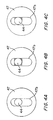
- FIGS. 4A-4C illustrate some of the above and other pin configurations usable for the pin 44.
- the pin 44 is of round configuration.
- the pin 44 has a square configuration and in FIG. 4C the pin 44 has a semi-square configuration.
- FIGS. 3A-3C show various positions of the linkage assemblies 23 during operation of the fuel cell stack 1.
- FIG. 3A illustrates the position of the linkage assemblies when.the stack is placed in operation.
- the spring assemblies 22 of the compression system 11 are fully compressed so that the compression system is under maximum compression.
- the lever arms 41 have thus been fully rotated so that their ends 41a and pins 42 are at the highest vertical position.
- the pins 44 are at their most outward positions horizontally and at their highest positions vertically in their arcuate paths 51.
- FIG. 3B illustrates the linkage after the stack has been in operation and the geometry, i.e. the height, of the stack has reduced to a point where the compression system 11 is under half compression.
- the lever arms 41 are at half rotation so that the ends 41a and the pins 42 are at half their highest vertical position.
- the pins 44 have been moved horizontally to their mid horizontal positions and to their lowest vertical positions in their arcuate paths 51.
- FIG. 3C shows the linkage assemblies after the stack has reached an operating condition where little if any further shrinkage of the stack is expected and the compression system is under no compression.
- the lever arms 41 have moved to a position where their ends 41a and the pins 42 are at their lowest vertical position. This places the blocks 45 and the tie rods 14-17 at their lowest vertical positions, thereby again maintaining the necessary compressive force on the stack end plates with the reduced height of the stack.
- the pins 44 have moved to their most inward positions horizontally and to their highest positions vertically in their arcuate paths 51.
- the shrinkage of the stack 1 is accommodated while maintaining the desired compressive force on the stack.
- This is accomplished with spring assemblies which can be located under the end plate 2 of the stack, but which do not have to be rotated.
- the space requirements for these assemblies and the complexity of the assemblies is significantly reduced. This, in turn, provides an overall more compact and less expensive system.
- spring assemblies 22 of the compression system 11 of FIGS. land 2 have been shown as using three concentric springs, any number of one or more springs may be used to generate the desired load versus deflection characteristic for each spring assembly.
- the invention has been illustrated with coil springs and belleville disk packs for the spring assemblies, any other resilient member which can be placed in compression may be used as the one or more springs.
- mechanical linkage assemblies 23 can be other than the assemblies illustrated. Alternate configurations include rack and pinion gear sets, cable pulley systems or any other mechanisms capable of redirecting the horizontal movement of the spring assembly to a vertical movement without rotation of the spring assembly.
- the concentric springs 32-34 of the spring assemblies are formed so that one or more of the springs have varying or different lengths so as to provide a non-linearly, decreasing load or compressive force on the fuel cell stack 1 as it shrinks.
- the belleville disk pack 32 is of shorter length than the coil springs 33 and 34. This is advantageous in providing good consolidation pressure early in stack life while minimizing the long term, total stack shrinkage.
- FIG. 5 is a graph displaying one possible stack loading profile achievable with the concentric springs 32-34.
- a high load is applied at the beginning of stack life and this load decreases non-linearly as the stack shrinks.
- section a of the load curve represents the point at which the belleville disk packs 32 of the spring assemblies of the compression system of FIG. 1 are fully flattened or compressed.
- Section b of the load curve is achieved when both coil springs 33-34 and the belleville disk packs 32 of the spring assemblies are working together in parallel and in partial compression.
- Section c of the load curve is achieved when the belleville disk packs are no longer compressed and only the coil springs 33-34 are partially compressed and applying a force or load.
Landscapes
- Life Sciences & Earth Sciences (AREA)
- Engineering & Computer Science (AREA)
- Manufacturing & Machinery (AREA)
- Sustainable Development (AREA)
- Sustainable Energy (AREA)
- Chemical & Material Sciences (AREA)
- Chemical Kinetics & Catalysis (AREA)
- Electrochemistry (AREA)
- General Chemical & Material Sciences (AREA)
- Fuel Cell (AREA)
Abstract
Description
- This invention relates to fuel cells and, in particular, to methods and apparatus for maintaining a compressive load on stacks of such fuel cells. More specifically, the invention relates to methods and apparatus for maintaining a compressive load in high temperature systems such as molten carbonate and solid oxide fuel cell stacks.
- A fuel cell is a device which directly converts chemical energy stored in a fuel such as hydrogen or methane into electrical energy by means of an electrochemical reaction. This differs from traditional electric power generating methods which must first combust the fuel to produce heat and then convert the heat into mechanical energy and finally into electricity. The more direct conversion process employed by a fuel cell has significant advantages over traditional means in both increased efficiency and reduced pollutant emissions.
- In general, a fuel cell, similar to a battery includes a negative (anode) electrode separated by an electrolyte which serves to conduct electrically charged ions between them. In contrast to a battery, however, a fuel cell will continue to produce electric power as long as fuel and oxidant are supplied to the anode and cathode, respectively. To achieve this, gas flow fields are produced adjacent to the anode and cathode through which fuel and oxidant gas are supplied. In order to produce a useful power level, a number of individual fuel cells must be stacked in series with an electrically conductive separator plate in between each cell.
- In the present state of the art, a fuel cell stack may have several hundred cells in series. In order to work properly, intimate contact must be maintained between all cells in the stack. Also this contact must continue during all stack operating conditions for the duration of the stack's life. Factors to be considered in achieving this requirement include manufacturing tolerances of the cell components, nonuniform thermal expansion of the cell components during operation and long term consolidation of the cell components resulting in shrinkage of the stack.
- Accordingly, a variety of requirements are placed on the system used to compress the fuel cell stack. The system must apply enough load to overcome the manufacturing tolerances early in life to bring the cell components into intimate contact. It also must be great enough during operation to prevent the cells from delaminating due to the inevitable thermal gradients within the stack. At the same time, the compression system load should not be so great as to cause excessive shrinkage of the stack during its life as this places undue demands on auxiliary stack hardware and on the required follow-up of the compression system itself. An additional requirement is that the system does not completely relax over time to insure that adequate stack pressure is maintained through the end of life.
- Conventional fuel cell stack designs use one of a number of mechanisms for applying compressive load to the stack.
U.S. Patent 4,430,390 describes spring members which run within the manifolds of the fuel cell stack attaching to the endplates and forcing them toward each other. This design is not desirable for high temperature systems such as molten carbonate and solid oxide stacks because the spring members would need to be excessively large and be constructed of exotic, corrosion resistant materials to withstand the high temperature environment.U.S. Patent 4,692,391 describes a design where the end plates are directly connected by rigid tensile members such as bolts or threaded rods. However, this system provides practically no load following capability to maintain stack compression as it shrinks. -
U.S. Patent 5,686,200 describes small, twisted wire or ribbon springs which may be used to apply load to individual cells within a stack. This design is inappropriate for large area fuel cells as the separator plates to which the springs are attached could not be constructed stiff enough to insure adequate load was delivered to the central area of the cells.U.S. Patent 5,789,091 describes the use of continuous compression bands which are wrapped around the stack and placed in tension. Again, this method suffers from inadequate follow-up for stacks with significant long term creep. -
JP 09 139225 A -
JP 09 270267 A - Other methods of stack compression commonly used in the field include placing coil or belleville disk springs in compression at the end of a set of stiff tie rods which tie the opposing stack end plates together. Another design utilizes flexible bars to span the opposing end plates which are again connected by rigid rods to form leaf springs. These designs suffer from either inadequate follow-up or inadequate load capability for present state of the art, large scale, high temperature fuel cell stacks.
- A more complex system, previously employed by the assignee of the subject application, uses rigid tie bars to span the top end plate. Rigid tie rods are connected to the tie bars and to a mechanical linkage near the bottom of the stack. This linkage connects the tie rods to a spring assembly in the form of a belleville disk pack located under the bottom end plate. Insulating layers are used to protect the spring assembly from excessive temperature during service. In this system the spring and linkage are designed so as to apply a fairly constant load to the stack during its life. Additionally, to accommodate the geometry of the mechanical linkage, the spring assembly is designed to rotate about one of its ends during operation.
- This design has the limitations of causing excessive stack shrinkage and requiring extra space under the stack to accommodate rotation of the spring assembly. Another limitation of this design lies in the high cost associated with the numerous, large belleville disks which make up the spring assembly. Finally, the design presents safety concerns, since the disks of the spring assembly must be preloaded prior to installation in order to generate a relatively constant load profile.
- It is therefore an object of the present invention to provide a fuel cell stack compression system which overcomes the above disadvantages of the prior art systems:
It is a further object of the present invention to provide a fuel cell stack compression system with desirable load-deflection characteristics applicable to large, high temperature fuel cell stacks;
It is also an object of the present invention to provide fuel cell stack compression system with minimized space requirements under the fuel cell stack;
It is yet a further object of the present invention to provide a fuel cell stack compression system having reduced costs; and
It is also an object of the present invention to provide fuel cell stack compression system which is safe to use. - In accordance with the principles of the present invention, the above and other objectives are realized in a compression system for providing a compressive force to a fuel cell stack in which the compression system includes one or more members each connected to a first end of the stack and extending to the opposite second end of the stack and a coupling mechanism situated adjacent the second end of the stack and including for each of the one or more members a spring assembly and a linkage assembly together adapted to cause translation movement provided by the spring assembly to be converted into a movement of the associated member in a direction between the first and second ends of the stack without rotation of the spring assembly. In this way, a desired compressive force can be maintained between the ends of the stack by the one or more members as the stack geometry changes. The linkage assembly includes a lever arm, first, second and third pins and a slotted bearing. The first pin is rotationally mounted at one end of the lever arm and is connected to the end of the associated member. The second pin serves as the pivot point for the lever arm and is rotationally mounted to a base frame. The third pin is rotationally mounted to the second end of the lever arm and is situated in the slot of the slotted bearing. The bearing, in turn, is engaged by the second end of the shaft of the spring assembly.
- In the embodiment of the invention to be disclosed hereinafter, the spring assembly is horizontally situated under the second end of the fuel cell stack and includes a fixed base plate and a translatable captivating plate between which the one or more springs of the assembly are situated. A shaft extends horizontally through the center of the springs and a first end of the shaft is attached to the captivating plate and a second end engages the linkage assembly.
- With this configuration, the horizontal translation of the one or more springs of the spring assembly is carried to the captivating plate and from the captivating plate to the shaft of the spring assembly. The horizontal translation of the shaft is then carried by the shaft to the bearing and from the bearing to the third pin. This causes the pin to undergo both horizontal translation and translation in the orthogonal direction, i.e. vertical translation, due to rotation of the lever arm about the second pin. These translations are then imparted to the first pin at the first end of the lever. This, in turn, causes the associated member to undergo a vertical translation, which translation maintains the desired compressive force on the fuel cell stack
- In a further aspect of the invention, a plurality of concentric springs of different length are used in the spring assembly to realize a desired non-linear, decreasing compressive load on the fuel cell stack.
- The above and other features and aspects of the present invention will become more apparent upon reading the following detailed description in conjunction with the accompanying drawings, in which:
-
FIG. 1 is an elevation view of a fuel cell stack utilizing a fuel cell stack compression system in accordance with the principles of the present invention; -
FIG. 2 is a cross-sectional, isometric view of the spring assembly and mechanical linkage assembly of the fuel cell stack compression system shown inFIG 1 ; -
FIGS. 3A-3C are schematic diagrams of the mechanical linkage assembly of the fuel cell stack compression system ofFIG. 1 in the fully compressed, half compressed and non compressed states, respectively; -
FIGS. 4A-4C are schematic illustrations of different configurations which can be used for the slotted bearing and the pin of the mechanical linkage assembly of the fuel cell stack compression system ofFIG. 1 ; and -
FIG. 5 is a graph illustrating one possible stack loading profile achievable with the fuel cell stack compression system ofFig. 1 . -
FIG. 1 shows afuel cell stack 1 havingend plates fuel cells 4 of the stack. One ormore manifolds 5 are provided for supplying and extracting gases from the stack Thestack 1 might typically be a high temperature system such as , for example, a molten carbonate or solid oxide type system. - In order to maintain the
fuel cells 4 of thestack 1 in intimate contact, a fuel cellstack compression system 11 in accordance with the principles of the present invention is provided. More particularly, thecompression system 11 causes compressive forces to be supplied to the stack between theend plates - As shown, the
compression system 11 includes rigid tie bars 12 and 13 spanning opposite ends of thetop end plate 2. InFIG. 1 , only thetie bar 12 is observable as the tie bar 13 is situated behind it in the view shown. Connected to each end of each tie bar is a connecting member in the form of a rigid tie rod which extends along the face of the stack from thefirst end plate 2 to thesecond end plate 3. InFIG. 1 ,only tie rods tie bar 12 are visible with the tie rods 16 and 17 connected to the ends of the tie bar 13 again being invisible in the view shown. - In accordance with the principles of the invention, the
compression system 11 further includescoupling mechanisms 21 situated at the ends of the tie rods 14-17 adjacent thesecond end plate 3 of thestack 1. Thecoupling mechanisms 21 are of like configuration and are adapted to maintain a desired compression force on thestack 1 through forces applied to the stack via the tie rods 14-17 and tie bars 12-13. - As shown in
FIG. 1 and in more detail inFIG. 2 , each coupling mechanism includes aspring assembly 22 situated under thesecond plate 3 of the stack and amechanical linkage assembly 23 linking thespring assembly 22 to the end of the associated tie rod. In accordance with the invention, the combination of eachspring assembly 22 and its associatedmechanical linkage assembly 23 is adapted to cause translation movement provided by the spring assembly to be converted into a movement of the associated tie rod between the first andsecond end plates stack 1 without rotation of the spring assembly. In particular, horizontal movement by the spring assembly is converted in this way into a vertical movement of the associated tie rod, to thereby maintain a desired compressive force between the end plates of the stack. - As seen more clearly in
FIG. 2 , eachspring assembly 22 includes abase plate 31 which is rigidly mounted under thefuel cell stack 1. One or more springs, shown inFIG. 2 as a series of concentric parallel springs 32, 33 and 34, are disposed so that a first end of each spring is adjacent thebase plate 31. These springs then extend toward a secondcaptivating plate 35 and have their second ends adjacent this plate. Ashaft 36 is routed along the central axis of the springs 32-34. Oneend 36a of the shaft passes through anaperture 35a in thecaptivating plate 35 and is held to the plate by anut 37. Theother end 36b of the shaft passes through anaperture 31a in thebase plate 31 and connects to themechanical linkage assembly 23. With this configuration for thespring assembly 22, the one or more springs of the assembly can be placed in compression at an initial state of the fuel cell stack and then allowed to expand as the stack geometry changes to provide the necessary horizontal translation movement and, in turn, the necessary vertical translation movement of the associated tie rod to accommodate for these changes. - In the present embodiment of
FIG. 2 , the two outermost springs 33-34 of thespring assembly 22 are coil springs. Theinnermost spring 32, in turn, comprises a stack of belleville disks spaced from thebase plate 31 by aspacer disk 38. The thickness of this disk and thecorresponding spacer disk 39 situated at thecaptivating plate 35 are selected so that the belleville disks begin to be compressed at a predetermined point in the stroke of theshaft 36. The disks also serve to properly position the coil springs 33-34 along the axis of the shaft. The combination of spacers and belleville disks additionally provide a positive stop for theshaft 36 internal to the spring assembly once the belleville disks have been completely flattened. This feature is important during initial compression of the fuel cell stack so that a very high pressure can be applied to the stack without the need for external stop mechanisms and without yielding of the springs. - As above-described, the horizontal movement of each
spring assembly 22 is coupled as a vertical movement to an associated tie rod via the associatedlinkage assembly 23. As shown inFIG. 2 , eachlinkage assembly 23 includes arigid lever arm 41 and threepins first pin 42 is rotatably mounted at afirst end 41a of thelever 41 and connects to ablock 45 having aseating area 45a for seating an associated tie rod. Asecond pin 43 is mounted to abase frame 46 which is connected to thebase plate 31. Thelever arm 41 is rotatably mounted at its central area 41b to thepin 43 which acts as the pivot point of the lever arm. Athird pin 44 is rotatably mounted at a second end 41c of thelever arm 41 and is used to transfer the translational movement of theshaft 36 of thespring assembly 22 to thelever arm 41. - As can be appreciated, the
pins pin 43. As a result, thepin 42 and thepin 44 will move in a circular arcuate path about thepin 43. To accommodate the horizontal and vertical translation resulting from this arcuate path, theaforementioned block 45 connecting thelever arm 41 to the associated tie rod is allowed to rotate. This results in a slight angle change of the tie rod relative to the stack face. As the tie rod tends to be long, the angular change of the rod is typically small and results in very little impact on the achieved stack load. - As is apparent, the movement of the
shaft 36 of thespring assembly 22 is coupled to thelever arm 41 via thepin 44. Since the shaft movement is confined to horizontal translation due to thebase plate 31 being fixed and since thepin 44 undergoes both horizontal and vertical translation due to its arcuate rotation as thelever arm 41 rotates, in order to accommodate these different types of movement, themechanical linkage assembly 23 is further provided with a slidingbearing 47 to couple theshaft 36 to thepin 44. - More particularly, as shown in
FIG. 2 , thebearing 47 has a threadedhole 47a which receives thesecond end 36b of theshaft 36 so that the bearing is urged horizontally with the horizontal movement of the shaft. The bearing also includes acentral slot 47b in which thepin 44 of the mechanical linkage assembly is received. As a result, as the bearing 47 moves horizontally, thepin 44 moves horizontally with the bearing, while also sliding vertically in theslot 47b. Thepin 44 is thus allowed to undergo horizontal and vertical movement to accommodate the arcuate path followed by the pin as a result of rotation of the pin with thelever arm 41. - In order to facilitate smooth sliding of the
pin 44 within theslot 47b, the pin and slot surfaces may be polished and hardened to reduce friction between them. Alternately, a ball or roller bearing may be used to mountpin 44 in theslot 47b, thereby allowing the pin to rotate within the lever arm and roll with respect to the slot. Another pin configuration would be a pin with a flat portion in contact with the slot so as to provide less contact pressure on the slot and have less likelihood of binding. Further reduction in sliding friction betweenpin 44 and theslot 47b could also be easily achieved through the use of a lubricant or lubricating coating on the pin and/or slot. -
FIGS. 4A-4C illustrate some of the above and other pin configurations usable for thepin 44. InFIG. 4A , thepin 44 is of round configuration. InFIG. 4B , thepin 44 has a square configuration and inFIG. 4C thepin 44 has a semi-square configuration. - The operation of the
compression system 11 can be understood by reference toFIGS. 3A-3C which show various positions of thelinkage assemblies 23 during operation of thefuel cell stack 1.FIG. 3A illustrates the position of the linkage assemblies when.the stack is placed in operation. At this time, thespring assemblies 22 of thecompression system 11 are fully compressed so that the compression system is under maximum compression. Thelever arms 41 have thus been fully rotated so that theirends 41a and pins 42 are at the highest vertical position. This places theblocks 45 and the tie rods 14-17 also in their highest upward positions, thereby creating the necessary compressive force on theend plates pins 44 are at their most outward positions horizontally and at their highest positions vertically in theirarcuate paths 51. -
FIG. 3B illustrates the linkage after the stack has been in operation and the geometry, i.e. the height, of the stack has reduced to a point where thecompression system 11 is under half compression. At this time, thelever arms 41 are at half rotation so that theends 41a and thepins 42 are at half their highest vertical position. This places theblocks 45 and the tie rods 14-17 at half their maximum vertical positions, thereby maintaining the necessary compressive force on the stack end with the reduced height of the stack. In this case, thepins 44 have been moved horizontally to their mid horizontal positions and to their lowest vertical positions in theirarcuate paths 51. - Finally,
FIG. 3C shows the linkage assemblies after the stack has reached an operating condition where little if any further shrinkage of the stack is expected and the compression system is under no compression. At this time, thelever arms 41 have moved to a position where theirends 41a and thepins 42 are at their lowest vertical position. This places theblocks 45 and the tie rods 14-17 at their lowest vertical positions, thereby again maintaining the necessary compressive force on the stack end plates with the reduced height of the stack. At this time, thepins 44 have moved to their most inward positions horizontally and to their highest positions vertically in theirarcuate paths 51. - As can be appreciated, with the
compression system 11 of the invention, the shrinkage of thestack 1 is accommodated while maintaining the desired compressive force on the stack. This is accomplished with spring assemblies which can be located under theend plate 2 of the stack, but which do not have to be rotated. As a result, the space requirements for these assemblies and the complexity of the assemblies is significantly reduced. This, in turn, provides an overall more compact and less expensive system. - While the
spring assemblies 22 of thecompression system 11 of FIGS.land 2 have been shown as using three concentric springs, any number of one or more springs may be used to generate the desired load versus deflection characteristic for each spring assembly. In addition, while the invention has been illustrated with coil springs and belleville disk packs for the spring assemblies, any other resilient member which can be placed in compression may be used as the one or more springs. - It should also be noted that the
mechanical linkage assemblies 23 can be other than the assemblies illustrated. Alternate configurations include rack and pinion gear sets, cable pulley systems or any other mechanisms capable of redirecting the horizontal movement of the spring assembly to a vertical movement without rotation of the spring assembly. - In a further aspect of the present invention, and as shown in
FIG. 2 , the concentric springs 32-34 of the spring assemblies are formed so that one or more of the springs have varying or different lengths so as to provide a non-linearly, decreasing load or compressive force on thefuel cell stack 1 as it shrinks. In the case shown, thebelleville disk pack 32 is of shorter length than the coil springs 33 and 34. This is advantageous in providing good consolidation pressure early in stack life while minimizing the long term, total stack shrinkage. -
FIG. 5 is a graph displaying one possible stack loading profile achievable with the concentric springs 32-34. In the load profile ofFIG. 5 , a high load is applied at the beginning of stack life and this load decreases non-linearly as the stack shrinks. - More particularly, section a of the load curve represents the point at which the belleville disk packs 32 of the spring assemblies of the compression system of
FIG. 1 are fully flattened or compressed. Section b of the load curve is achieved when both coil springs 33-34 and the belleville disk packs 32 of the spring assemblies are working together in parallel and in partial compression. Section c of the load curve is achieved when the belleville disk packs are no longer compressed and only the coil springs 33-34 are partially compressed and applying a force or load.
Claims (23)
- A compression system for providing a compressive force to a fuel cell stack (1) having first and second ends, said compression system (11) comprising:one or more members each connected to said first end of the stack (1) and extending to said second end of said stack (1);and one or more coupling mechanisms (21) situated adjacent the second end of the stack (1), each said coupling mechanism (21) being coupled to a different one of said one or more members and including: a spring assembly (22) and a linkage assembly (23) together adapted to convert a translation movement provided by the spring assembly (22) into a movement of an associated member of the one or more members in a direction transverse to said translation movement and between the first and second ends of the stack (1) without rotation of the spring assembly (22), the associated member being the member to which the coupling mechanism (21) which includes the spring assembly (22) and the linkage assembly (23) is coupled; wherein:each said spring assembly (22) is adapted to provide a translation movement perpendicular to the stacking axis; andeach said linkage assembly (23) includes: a lever arm (41); first (42), second (43) and third pins (44), said first pin (42) being attached to one end (41a) of said lever arm (41) and coupled to an end of the associated member, said second pin (43) serving as a pivot point for the lever arm (41), and said third pin (44) being mounted to the second end (41c) of the lever arm (41); and a bearing (47) having a slot (47b), said third pin (44) being situated in said slot (47b) of said bearing (47), and said bearing (47) being engaged by said spring assembly (22) to move perpendicular to the stacking axis in response to said translation movement of said spring assembly (22).
- A compression system in accordance with claim 1, wherein:each said spring assembly (22) is horizontally situated opposing the second end of the fuel cell stack (1) and includes: a fixed base plate (31); a captivating plate (3 5) spaced from the fixed base plate (31); one or more springs (32, 33, 34) situated between said base plate (31) and said captivating plate (35); and a shaft (36) extending horizontally through a center of the one or more springs (32, 33, 34), a first end (36a) of said shaft (36) being attached to said captivating plate (35) and a second end (36b) of said shaft (36) engaging said linkage assembly (23); andthe bearing (47) of each said linkage assembly (23) is engaged by the second end (36b) of the shaft (36) of the spring assembly (22) which is included in the coupling mechanism (21) which includes the linkage assembly (23).
- A compression system in accordance with claim 2, wherein:each said linkage assembly (23) further includes: a seating block (45) connected to said first pin (42) and into which the end of the associated member is seated; and a base frame (46) abutting said base plate (31), said second pin (43) being mounted to said base frame (46) and extending through an aperture in said lever arm (41).
- A compression system in accordance with claim 3, wherein:said fuel cell stack (1) includes first (2) and second end plates (3) disposed at said first and second ends of said fuel cell stack (1);said compression system (11) further includes one or more rigid tie bars (12) (13) extending across said first end plate (2);each of said one or more members is a rigid tie rod (14, 15, 16, 17) connected to a tie bar (12, 13) and extending along a face of said fuel cell stack (1); andeach said spring assembly (22) is disposed opposing said second end plate (3).
- A compression system in accordance with claim 2, wherein:said fuel cell stack (1) includes first (2) and second end plates (3) disposed at said first and second ends of said fuel cell stack (1);said compression system (11) further includes one or more rigid tie bars (12, 13) extending across said first end plate (2);each of said one or more members is a rigid tie rod (14, 15, 16, 17) connected to a tie bar (12, 13) and extending along a face of said fuel cell stack (1); andeach said spring assembly (22) is disposed opposing said second end plate (3).
- A compression system in accordance with claim 5, wherein:each said spring assembly (22) comprises a plurality of concentric springs (32, 33, 34).
- A compression system in accordance with claim 6, wherein:at least two of said plurality of springs (32, 33, 34) in an uncompressed state are of different length to provide a non-linear, decreasing load to said fuel cell stack (1).
- A compression system in accordance with claim 6, wherein:each said spring assembly (22) includes an inner spring (32) in the form of a belleville disk pack, a middle coil spring (33) and an outer coil spring (34).
- A compression system in accordance with claim 8, wherein:said belleville disk pack is of shorter length in an uncompressed state than said middle and outer coil springs (33, 34) in an uncompressed state.
- A compression system in accordance with claim 8, wherein:each said spring assembly (22) includes one or more stop members disposed at one or more ends (36a, 36b) of said shaft (36) to prevent permanent deflection of said springs (32, 33, 34).
- A compression system in accordance with claim 2, wherein:each said spring assembly (22) includes one or more stop members disposed at one or more ends (36a, 36b) of said shaft (36) to prevent permanent deflection of said springs (32, 33, 34).
- A compression system in accordance with claim 11, wherein:each of said spring assemblies (22) comprises a plurality of springs (32, 33, 34); and at least two of said plurality of springs (32, 33, 34) in an uncompressed state are of different length to provide a non-linear, decreasing load to said fuel cell stack (1).
- A compression system in accordance with claim 2, wherein:each of said spring assemblies (22) comprises a plurality of springs (32, 33, 34); and at least two of said plurality of springs (32, 33, 34) in an uncompressed state are of different length to provide a non-linear, decreasing load to said fuel cell stack (1).
- A compression system in accordance with claim 1, wherein:each said spring assembly (22) includes: one or more springs (32, 33, 34); and one or more stop members disposed to prevent permanent deflection of said springs (32, 33, 34).
- A compression system in accordance with claim 14, wherein:each said spring assembly (22) includes a plurality of springs (32, 33, 34);at least two of said plurality of springs (32, 33, 34) are of a different length to provide a non-linear, decreasing load to said fuel cell stack (1).
- A compression system in accordance with claim 1, wherein:each said spring assembly (22) includes a plurality of springs (32, 33, 34), and at least two of said plurality of springs (32, 33, 34) are of different length to provide a non-linear, decreasing load to said fuel cell stack (1).
- A compression system in accordance with claim 1 for providing a compressive force to a fuel cell stack (1) having first and second ends, wherein:the spring assembly (22) includes a plurality of concentric springs (32, 33, 34) which in the uncompressed state are of different length to provide a non-linear, decreasing load to said fuel cell stack (1).
- A compression system in accordance with claim 17, wherein:each said spring assembly (22) includes one or more stop members disposed to prevent permanent deflection of said springs (32, 33, 34).
- A compression system in accordance with claim 17, wherein:each said spring assembly (22) includes an inner spring (32) in the form of a belleville disk pack, a middle coil spring (33) and an outer coil spring (34).
- A compression system in accordance with claim 19, wherein:said belleville disk pack in an uncompressed state is of shorter length than said middle and outer coil springs (33, 34) in an uncompressed state.
- A compression system in accordance with claim 17, wherein:said fuel cell stack (1) includes first (2) and second end plates (3) disposed at said first and second ends of said fuel cell stack (1);said compression system (11) further includes one or more rigid tie bars (12, 13) extending across said first end plate (2);each of said one or more members is a rigid tie rod (14, 15, 16, 17) connected to a tie bar (12, 13) and extending along a face of said fuel cell stack (1); andeach said spring assembly (22) is disposed opposing said second end plate (3).
- A fuel cell system comprising:a fuel cell stack (1) having first and second ends; anda compression system (11) in accordance with claim 1.
- A fuel cell system in accordance with claim 22, wherein
the spring assembly (22) includes a plurality of concentric springs (32, 33, 34) which in the uncompressed state are of different length to provide a non-linear, decreasing load to said fuel cell stack (1).
Applications Claiming Priority (3)
| Application Number | Priority Date | Filing Date | Title |
|---|---|---|---|
| US651921 | 2000-08-31 | ||
| US09/651,921 US6413665B1 (en) | 2000-08-31 | 2000-08-31 | Fuel cell stack compression system |
| PCT/US2001/041695 WO2002019456A1 (en) | 2000-08-31 | 2001-08-13 | Fuel cell stack compression system |
Publications (3)
| Publication Number | Publication Date |
|---|---|
| EP1316124A1 EP1316124A1 (en) | 2003-06-04 |
| EP1316124A4 EP1316124A4 (en) | 2010-02-03 |
| EP1316124B1 true EP1316124B1 (en) | 2011-10-05 |
Family
ID=24614779
Family Applications (1)
| Application Number | Title | Priority Date | Filing Date |
|---|---|---|---|
| EP01966688A Expired - Lifetime EP1316124B1 (en) | 2000-08-31 | 2001-08-13 | Fuel cell stack compression system |
Country Status (5)
| Country | Link |
|---|---|
| US (1) | US6413665B1 (en) |
| EP (1) | EP1316124B1 (en) |
| JP (1) | JP2004508671A (en) |
| CN (1) | CN1222067C (en) |
| WO (1) | WO2002019456A1 (en) |
Cited By (2)
| Publication number | Priority date | Publication date | Assignee | Title |
|---|---|---|---|---|
| DE102015015751A1 (en) | 2015-07-17 | 2017-01-19 | Ceragen GmbH | Compression system for fuel cell stack and fuel cell stack |
| EP4621892A1 (en) | 2024-03-21 | 2025-09-24 | SolydEra SA | A stack assembly with a load applying mechanism |
Families Citing this family (36)
| Publication number | Priority date | Publication date | Assignee | Title |
|---|---|---|---|---|
| US7001685B2 (en) * | 2002-06-24 | 2006-02-21 | Delphi Technologies, Inc. | Fuel cell stack assembly load frame with compression spring |
| US6797425B2 (en) * | 2002-12-24 | 2004-09-28 | Fuelcell Energy, Inc. | Fuel cell stack compressive loading system |
| US6964825B2 (en) * | 2003-07-25 | 2005-11-15 | Fuelcell Energy, Inc. | Compliant manifold gasket |
| US7645537B2 (en) * | 2003-10-15 | 2010-01-12 | Hewlett-Packard Development Company, L.P. | Multi-cell fuel cell layer and system |
| JP2005310467A (en) * | 2004-04-20 | 2005-11-04 | Nissan Motor Co Ltd | FUEL CELL STACK AND METHOD OF FIXING FUEL CELL STACK |
| DE102004037678A1 (en) * | 2004-08-02 | 2006-03-16 | Webasto Ag | fuel cell stack |
| US7419739B2 (en) * | 2004-08-25 | 2008-09-02 | General Motors Corporation | Flexible bipolar plate |
| US7794890B2 (en) * | 2004-09-03 | 2010-09-14 | Gm Global Technology Operations, Inc. | Aligning method for repeating and non-repeating units in a fuel cell stack |
| US7276304B2 (en) * | 2004-12-23 | 2007-10-02 | Fuelcell Energy, Inc. | Fuel cell system including a unit for electrical isolation of a fuel cell stack from a manifold assembly and method therefor |
| JP2008004307A (en) * | 2006-06-20 | 2008-01-10 | Toyota Motor Corp | Fuel cell |
| DE102006028498B4 (en) * | 2006-06-21 | 2016-04-14 | Elringklinger Ag | fuel cell stack |
| US8283079B2 (en) * | 2006-11-03 | 2012-10-09 | Honeywell International Inc. | Fuel cell power generator with water reservoir |
| US8822097B2 (en) * | 2006-11-30 | 2014-09-02 | Honeywell International Inc. | Slide valve for fuel cell power generator |
| TWI326134B (en) * | 2006-12-21 | 2010-06-11 | Ind Tech Res Inst | Fuel cell module |
| KR100784444B1 (en) | 2006-12-29 | 2007-12-11 | 두산중공업 주식회사 | Stack pressure device |
| US8962211B2 (en) | 2008-12-15 | 2015-02-24 | Honeywell International Inc. | Rechargeable fuel cell |
| US9276285B2 (en) * | 2008-12-15 | 2016-03-01 | Honeywell International Inc. | Shaped fuel source and fuel cell |
| US8932780B2 (en) | 2008-12-15 | 2015-01-13 | Honeywell International Inc. | Fuel cell |
| US20110000864A1 (en) * | 2009-07-06 | 2011-01-06 | Moore Lela K | Cookware Holder and Method |
| WO2011041323A2 (en) | 2009-09-30 | 2011-04-07 | Bloom Energy Corporation | Fuel cell stack compression devices and methods |
| DE102010007982A1 (en) * | 2010-02-15 | 2011-08-18 | Daimler AG, 70327 | Device for compressing a fuel cell assembly by means of variable spring elements |
| WO2012040253A1 (en) | 2010-09-20 | 2012-03-29 | Nextech Materials, Ltd. | Fuel cell repeat unit and fuel cell stack |
| US9029040B2 (en) | 2012-04-17 | 2015-05-12 | Intelligent Energy Limited | Fuel cell stack and compression system therefor |
| GB2505963B (en) * | 2012-09-18 | 2021-04-07 | Intelligent Energy Ltd | A fuel cell stack assembly |
| US9677679B2 (en) * | 2013-06-26 | 2017-06-13 | Dresser, Inc. | Valve with force generating element |
| US20150068416A1 (en) * | 2013-09-11 | 2015-03-12 | Hamilton Sundstrand Space Systems International, Inc. | Low profile laminate assemblies |
| TW201633593A (en) | 2015-01-29 | 2016-09-16 | 博隆能源股份有限公司 | Fuel cell stack assembly and method of operating the same |
| DE102016205282B3 (en) * | 2016-03-31 | 2017-08-17 | Ford Global Technologies, Llc | Fuel cell stack with clamping device and method for operating a fuel cell stack |
| DE112018000798T5 (en) | 2017-02-13 | 2019-12-12 | Ess Tech, Inc | LEAF SPRING COMPRESSION SYSTEM DESIGN |
| AU2018307740B2 (en) * | 2017-07-24 | 2024-03-28 | Nuvera Fuel Cells, LLC. | Systems and methods of fuel cell stack compression |
| US10916793B2 (en) | 2017-10-06 | 2021-02-09 | Bloom Energy Corporation | Method for joining a ceramic matrix composite to dense ceramics for improved joint strength |
| DE102018210176A1 (en) * | 2018-06-22 | 2019-12-24 | Audi Ag | fuel cell stack |
| DE102018210181A1 (en) * | 2018-06-22 | 2019-12-24 | Audi Ag | fuel cell stack |
| CN111384423B (en) * | 2018-12-29 | 2021-04-27 | 长城汽车股份有限公司 | Pressurized assembly, fuel cell stack and first end plate assembly therefor, pressurized frame, method of assembly, and vehicle |
| CN111710895B (en) * | 2020-06-22 | 2025-04-25 | 深圳市新浦自动化设备有限公司 | Push balance structure and battery formation fixture |
| DE102021214569B4 (en) | 2021-12-17 | 2025-06-18 | Volkswagen Aktiengesellschaft | Battery module and motor vehicle |
Family Cites Families (14)
| Publication number | Priority date | Publication date | Assignee | Title |
|---|---|---|---|---|
| US4345009A (en) * | 1979-08-17 | 1982-08-17 | United Technologies Corporation | Fuel cell stack compressive loading system |
| US4430390A (en) | 1982-09-23 | 1984-02-07 | Engelhard Corporation | Compact fuel cell stack |
| JPS60113955U (en) | 1984-01-10 | 1985-08-01 | 株式会社 富士電機総合研究所 | Fuel cell |
| JPH0760693B2 (en) * | 1984-12-21 | 1995-06-28 | 株式会社東芝 | Fuel cell stack |
| US5686200A (en) | 1993-12-22 | 1997-11-11 | Ballard Power Systems Inc. | Electrochemical fuel cell assembly with compliant compression mechanism |
| US5773160A (en) * | 1994-06-24 | 1998-06-30 | Ballard Power Systems Inc. | Electrochemical fuel cell stack with concurrent flow of coolant and oxidant streams and countercurrent flow of fuel and oxidant streams |
| US5484666A (en) * | 1994-09-20 | 1996-01-16 | Ballard Power Systems Inc. | Electrochemical fuel cell stack with compression mechanism extending through interior manifold headers |
| JPH09139225A (en) * | 1995-11-13 | 1997-05-27 | Toshiba Corp | Fuel cell tightening device |
| GB9526577D0 (en) * | 1995-12-28 | 1996-02-28 | Nat Power Plc | Method for the fabrication of electrochemical cells |
| JPH09270267A (en) * | 1996-04-02 | 1997-10-14 | Fuji Electric Co Ltd | Fuel cell |
| US5789091C1 (en) | 1996-11-19 | 2001-02-27 | Ballard Power Systems | Electrochemical fuel cell stack with compression bands |
| US5804326A (en) * | 1996-12-20 | 1998-09-08 | Ballard Power Systems Inc. | Integrated reactant and coolant fluid flow field layer for an electrochemical fuel cell |
| KR100362831B1 (en) * | 1997-10-28 | 2002-11-29 | 가부시끼가이샤 도시바 | A fuel cell with a gas manifold |
| JP3388710B2 (en) * | 1999-03-16 | 2003-03-24 | 三菱電機株式会社 | Fuel cell |
-
2000
- 2000-08-31 US US09/651,921 patent/US6413665B1/en not_active Expired - Lifetime
-
2001
- 2001-08-13 JP JP2002524248A patent/JP2004508671A/en active Pending
- 2001-08-13 WO PCT/US2001/041695 patent/WO2002019456A1/en not_active Ceased
- 2001-08-13 CN CNB018147240A patent/CN1222067C/en not_active Expired - Fee Related
- 2001-08-13 EP EP01966688A patent/EP1316124B1/en not_active Expired - Lifetime
Cited By (3)
| Publication number | Priority date | Publication date | Assignee | Title |
|---|---|---|---|---|
| DE102015015751A1 (en) | 2015-07-17 | 2017-01-19 | Ceragen GmbH | Compression system for fuel cell stack and fuel cell stack |
| EP4621892A1 (en) | 2024-03-21 | 2025-09-24 | SolydEra SA | A stack assembly with a load applying mechanism |
| WO2025195650A1 (en) | 2024-03-21 | 2025-09-25 | Solydera Sa | A stack assembly with a load applying mechanism |
Also Published As
| Publication number | Publication date |
|---|---|
| JP2004508671A (en) | 2004-03-18 |
| WO2002019456A1 (en) | 2002-03-07 |
| EP1316124A4 (en) | 2010-02-03 |
| US6413665B1 (en) | 2002-07-02 |
| CN1222067C (en) | 2005-10-05 |
| CN1449591A (en) | 2003-10-15 |
| EP1316124A1 (en) | 2003-06-04 |
Similar Documents
| Publication | Publication Date | Title |
|---|---|---|
| EP1316124B1 (en) | Fuel cell stack compression system | |
| US6797425B2 (en) | Fuel cell stack compressive loading system | |
| US6190793B1 (en) | Electrochemical fuel cell stack with an improved compression assembly | |
| EP0104892B1 (en) | Compact fuel cell stack | |
| EP2898562B1 (en) | A fuel cell stack assembly | |
| EP3557673B1 (en) | Electrochemical stack | |
| JP2008508688A (en) | Fuel cell stack with clamping device | |
| JP2016126833A (en) | Solid oxide fuel cell | |
| US7001685B2 (en) | Fuel cell stack assembly load frame with compression spring | |
| JPS61148770A (en) | Fuel cell lamination body | |
| JP7587430B2 (en) | Manufacturing method and manufacturing device for power generating cell stack | |
| JPH09139225A (en) | Fuel cell tightening device | |
| HK1058727A (en) | Fuel cell stack compression system | |
| JP2005235408A (en) | FUEL CELL AND METHOD FOR MEASURING LENGTH OF CELL LAMINATE | |
| EP4651247A1 (en) | Compression hardware for compressing several electrochemical unit cells of a fuel cell and/or electrolyser stack for lightweight applications | |
| EP4213254B1 (en) | Rods for fuel cell | |
| CN219759625U (en) | Bipolar plate, fuel cell stack and vehicle | |
| JP2011198546A (en) | Flat-plate solid oxide fuel cell module and method for operating the same | |
| JP2023114241A (en) | Manufacturing method of fuel cell stack | |
| JP2008004505A (en) | FUEL CELL STACK, FUEL CELL STACKING METHOD, AND FUEL CELL STACK ASSEMBLY | |
| HK1124174B (en) | Compression assembly, solid oxide fuel cell stack, process for compression, and its use | |
| HK1058726A (en) | Retention system for fuel-cell stack manifolds |
Legal Events
| Date | Code | Title | Description |
|---|---|---|---|
| PUAI | Public reference made under article 153(3) epc to a published international application that has entered the european phase |
Free format text: ORIGINAL CODE: 0009012 |
|
| 17P | Request for examination filed |
Effective date: 20030128 |
|
| AK | Designated contracting states |
Designated state(s): AT BE CH CY DE DK ES FI FR GB GR IE IT LI LU MC NL PT SE TR |
|
| RBV | Designated contracting states (corrected) |
Designated state(s): AT BE CH DE FR GB LI |
|
| A4 | Supplementary search report drawn up and despatched |
Effective date: 20100107 |
|
| RIC1 | Information provided on ipc code assigned before grant |
Ipc: H01M 8/24 20060101AFI20091229BHEP |
|
| 17Q | First examination report despatched |
Effective date: 20010302 |
|
| R17C | First examination report despatched (corrected) |
Effective date: 20100302 |
|
| GRAP | Despatch of communication of intention to grant a patent |
Free format text: ORIGINAL CODE: EPIDOSNIGR1 |
|
| RIC1 | Information provided on ipc code assigned before grant |
Ipc: H01M 8/24 20060101AFI20110128BHEP |
|
| RBV | Designated contracting states (corrected) |
Designated state(s): DE FR GB |
|
| GRAS | Grant fee paid |
Free format text: ORIGINAL CODE: EPIDOSNIGR3 |
|
| GRAA | (expected) grant |
Free format text: ORIGINAL CODE: 0009210 |
|
| AK | Designated contracting states |
Kind code of ref document: B1 Designated state(s): DE FR GB |
|
| REG | Reference to a national code |
Ref country code: GB Ref legal event code: FG4D |
|
| REG | Reference to a national code |
Ref country code: DE Ref legal event code: R096 Ref document number: 60145461 Country of ref document: DE Effective date: 20111201 |
|
| PLBE | No opposition filed within time limit |
Free format text: ORIGINAL CODE: 0009261 |
|
| STAA | Information on the status of an ep patent application or granted ep patent |
Free format text: STATUS: NO OPPOSITION FILED WITHIN TIME LIMIT |
|
| 26N | No opposition filed |
Effective date: 20120706 |
|
| REG | Reference to a national code |
Ref country code: DE Ref legal event code: R097 Ref document number: 60145461 Country of ref document: DE Effective date: 20120706 |
|
| GBPC | Gb: european patent ceased through non-payment of renewal fee |
Effective date: 20120813 |
|
| REG | Reference to a national code |
Ref country code: FR Ref legal event code: ST Effective date: 20130430 |
|
| PG25 | Lapsed in a contracting state [announced via postgrant information from national office to epo] |
Ref country code: GB Free format text: LAPSE BECAUSE OF NON-PAYMENT OF DUE FEES Effective date: 20120813 |
|
| PG25 | Lapsed in a contracting state [announced via postgrant information from national office to epo] |
Ref country code: FR Free format text: LAPSE BECAUSE OF NON-PAYMENT OF DUE FEES Effective date: 20120831 |
|
| PGFP | Annual fee paid to national office [announced via postgrant information from national office to epo] |
Ref country code: DE Payment date: 20190730 Year of fee payment: 19 |
|
| REG | Reference to a national code |
Ref country code: DE Ref legal event code: R119 Ref document number: 60145461 Country of ref document: DE |
|
| PG25 | Lapsed in a contracting state [announced via postgrant information from national office to epo] |
Ref country code: DE Free format text: LAPSE BECAUSE OF NON-PAYMENT OF DUE FEES Effective date: 20210302 |
|
| P01 | Opt-out of the competence of the unified patent court (upc) registered |
Effective date: 20230508 |