EP1316086B1 - Combining dtw and hmm in speaker dependent and independent modes for speech recognition - Google Patents
Combining dtw and hmm in speaker dependent and independent modes for speech recognition Download PDFInfo
- Publication number
- EP1316086B1 EP1316086B1 EP01968568A EP01968568A EP1316086B1 EP 1316086 B1 EP1316086 B1 EP 1316086B1 EP 01968568 A EP01968568 A EP 01968568A EP 01968568 A EP01968568 A EP 01968568A EP 1316086 B1 EP1316086 B1 EP 1316086B1
- Authority
- EP
- European Patent Office
- Prior art keywords
- voice recognition
- engine
- word
- candidate
- distance
- Prior art date
- Legal status (The legal status is an assumption and is not a legal conclusion. Google has not performed a legal analysis and makes no representation as to the accuracy of the status listed.)
- Expired - Lifetime
Links
- 230000001419 dependent effect Effects 0.000 title claims abstract description 25
- 238000013507 mapping Methods 0.000 claims abstract description 50
- 238000000034 method Methods 0.000 claims abstract description 41
- 238000012360 testing method Methods 0.000 claims description 21
- 238000005259 measurement Methods 0.000 claims description 8
- 230000006870 function Effects 0.000 description 19
- 238000012549 training Methods 0.000 description 13
- 239000013598 vector Substances 0.000 description 11
- 230000008569 process Effects 0.000 description 5
- 230000008901 benefit Effects 0.000 description 4
- 238000005070 sampling Methods 0.000 description 3
- 238000009795 derivation Methods 0.000 description 2
- 230000000977 initiatory effect Effects 0.000 description 2
- 239000011159 matrix material Substances 0.000 description 2
- 238000004422 calculation algorithm Methods 0.000 description 1
- 238000004364 calculation method Methods 0.000 description 1
- 238000004891 communication Methods 0.000 description 1
- 230000006835 compression Effects 0.000 description 1
- 238000007906 compression Methods 0.000 description 1
- 230000008878 coupling Effects 0.000 description 1
- 238000010168 coupling process Methods 0.000 description 1
- 238000005859 coupling reaction Methods 0.000 description 1
- 238000013461 design Methods 0.000 description 1
- 238000012986 modification Methods 0.000 description 1
- 230000004048 modification Effects 0.000 description 1
- 230000037361 pathway Effects 0.000 description 1
- 238000012545 processing Methods 0.000 description 1
- 230000011218 segmentation Effects 0.000 description 1
Images


Classifications
-
- G—PHYSICS
- G10—MUSICAL INSTRUMENTS; ACOUSTICS
- G10L—SPEECH ANALYSIS TECHNIQUES OR SPEECH SYNTHESIS; SPEECH RECOGNITION; SPEECH OR VOICE PROCESSING TECHNIQUES; SPEECH OR AUDIO CODING OR DECODING
- G10L15/00—Speech recognition
- G10L15/28—Constructional details of speech recognition systems
- G10L15/32—Multiple recognisers used in sequence or in parallel; Score combination systems therefor, e.g. voting systems
-
- G—PHYSICS
- G10—MUSICAL INSTRUMENTS; ACOUSTICS
- G10L—SPEECH ANALYSIS TECHNIQUES OR SPEECH SYNTHESIS; SPEECH RECOGNITION; SPEECH OR VOICE PROCESSING TECHNIQUES; SPEECH OR AUDIO CODING OR DECODING
- G10L15/00—Speech recognition
- G10L15/08—Speech classification or search
- G10L15/14—Speech classification or search using statistical models, e.g. Hidden Markov Models [HMMs]
-
- G—PHYSICS
- G10—MUSICAL INSTRUMENTS; ACOUSTICS
- G10L—SPEECH ANALYSIS TECHNIQUES OR SPEECH SYNTHESIS; SPEECH RECOGNITION; SPEECH OR VOICE PROCESSING TECHNIQUES; SPEECH OR AUDIO CODING OR DECODING
- G10L15/00—Speech recognition
- G10L15/08—Speech classification or search
- G10L15/12—Speech classification or search using dynamic programming techniques, e.g. dynamic time warping [DTW]
-
- G—PHYSICS
- G10—MUSICAL INSTRUMENTS; ACOUSTICS
- G10L—SPEECH ANALYSIS TECHNIQUES OR SPEECH SYNTHESIS; SPEECH RECOGNITION; SPEECH OR VOICE PROCESSING TECHNIQUES; SPEECH OR AUDIO CODING OR DECODING
- G10L15/00—Speech recognition
- G10L15/08—Speech classification or search
- G10L15/14—Speech classification or search using statistical models, e.g. Hidden Markov Models [HMMs]
- G10L15/142—Hidden Markov Models [HMMs]
Definitions
- the present invention pertains generally to the field of communications and more specifically to a novel and improved system and method for voice recognition.
- Voice recognition represents one of the most important techniques to endow a machine with simulated intelligence to recognize user or user-voiced commands and to facilitate human interface with the machine. VR also represents a key technique for human speech understanding. Systems that employ techniques to recover a linguistic message from an acoustic speech signal are called voice recognizers.
- voice recognizer is used herein to mean generally any spoken-user-interface-enabled device.
- VR also commonly referred to as speech recognition
- VR may be used to replace the manual task of pushing buttons on a wireless telephone keypad. This is especially important when a user is initiating a telephone call while driving a car.
- the driver When using a phone without VR, the driver must remove one hand from the steering wheel and look at the phone keypad while pushing the buttons to dial the call. These acts increase the likelihood of a car accident.
- a speech-enabled phone i.e., a phone designed for speech recognition
- a hands-free car-kit system would permit the driver to maintain both hands on the steering wheel during call initiation.
- Speech recognition devices are classified as either speaker-dependent (SD) or speaker-independent (SI) devices. Speaker-dependent devices, which are more common, are trained to recognize commands from particular users. In contrast, speaker-independent devices are capable of accepting voice commands from any user. To increase the performance of a given VR system, whether speaker-dependent or speaker-independent, training is required to equip the system with valid parameters. In other words, the system needs to learn before it can function optimally.
- SD speaker-dependent
- SI speaker-independent
- a speaker-dependent VR device typically operates in two phases, a training phase and a recognition phase.
- the VR system prompts the user to speak each of the words in the system's vocabulary once or twice (typically twice) so the system can learn the characteristics of the user's speech for these particular words or phrases.
- An exemplary vocabulary for a hands-free car kit might include the digits on the keypad; the keywords “call,” “send,” “dial,” “cancel,” “clear,” “add,” “delete,” “history,” “program,” “yes,” and “no”; and the names of a predefined number of commonly called coworkers, friends, or family members.
- the user can initiate calls in the recognition phase by speaking the trained keywords, which the VR device recognizes by comparing the spoken utterances with the previously trained utterances (stored as templates) and taking the best match. For example, if the name "John” were one of the trained names, the user could initiate a call to John by saying the phrase "Call John.” The VR system would recognize the words “Call” and "John,” and would dial the number that the user had previously entered as John's telephone number.
- a speaker-independent VR device also uses a training template that contains a prerecorded vocabulary of a predefined size (e.g., certain control words, the numbers zero through nine, and yes and no).
- a prerecorded vocabulary of a predefined size e.g., certain control words, the numbers zero through nine, and yes and no.
- a large number of speakers e.g., 100 must be recorded saying each word in the vocabulary.
- a speaker independent (SI) Hidden Markov Model (HMM) engine may yield a different result than a speaker independent Dynamic Time Warping (DTW) engine.
- SI speaker independent
- DTW Dynamic Time Warping
- a speaker-dependent VR and a speaker independent VR may yield different results.
- a speaker-dependent engine performs recognition using templates pertaining to a specific user.
- a speaker independent engine performs recognition using templates generated using exemplars from an ensemble of users. Since speaker specific templates are closer to a given user's speaking style, SD engines provide better accuracy than SI engines. However, SI engines have the advantage that the users need not go through the "training process" prior to using the system.
- a system and method that combines engines of different types is desired. Combining multiple engines would provide enhanced accuracy and use a greater amount of information in the input speech signal.
- a system and method for combining VR engines is described in U.S. Patent Application No. 09/618,177 entitled “Combined Engine System and Method for Voice Recognition", filed July 18, 2000, which is assigned to the assignee of the present invention.
- a decision logic VR system can use heuristic logic to devise decision rules.
- the decision logic typically starts with the measured distances between a testing utterance and the top candidate (word) templates of each engine. For example, suppose two engines (engines D and H) are used. Let d 1 and d 2 denote the distance between the test utterance and the top two candidate words of engine D, and h 1 and h 2 denote the distance between the test utterance and the top two candidate words of engine H. Let d g and h g denotes the distance between the test utterance and the "garbage" templates of engine D and H, respectively. The garbage templates are used to represent all words not in the vocabulary.
- the decision logic involves a sequence of comparisons among these measured distances and a set of pre-defined thresholds.
- the comparison rules and thresholds need to be synthesized and adjusted on a trial-by-error basis, in part, because they cannot be systematically optimized. This is a time-consuming and difficult process.
- the heuristic rules may be application-dependent. For example, a new set of rules needs to be synthesized if the top three words rather than the top two words are used for each engine. It is likely that the set of rules for recognizing noise-free speech would be different from those for recognizing noisy speech.
- a voice recognition system as set forth in claims 1 and 15, and a method of voice recognition, as set forth in claims 16 and 20, are provided. Embodiments of the invention are described in the dependent claims.
- speaker-independent voice recognition engines are combined. In another embodiment, speaker-dependent voice recognition engines are combined. In yet another embodiment, a speaker-independent voice recognition engine is combined with a speaker-dependent voice recognition engine.
- a speaker-independent voice recognition engine is a Dynamic Time Warping voice recognition engine. In one embodiment, a speaker-independent voice recognition engine is a Hidden Markov Model. In one embodiment, a speaker-dependent voice recognition engine is a Dynamic Time Warping voice recognition engine. In one embodiment, a speaker-dependent voice recognition engine is a Hidden Markov Model.
- a voice recognition system 100 as shown in FIG. 1 has three types of voice recognition engines capable of performing isolated word recognition tasks: a dynamic time warping speaker independent (DTW-SI) engine 104, a dynamic time warping speaker-dependent (DTW-SD) engine 106, and a hidden Markov model (HMM) engine 108. These engines are used for command word recognition and digit recognition to provide rich spoken user interfaces to common tasks performed by a handheld device, such as, e.g., a mobile phone, personal digital assistant (PDA) etc.
- the voice recognition system 100 comprises a DTW-SI 104 and a DTW-SD engine 106.
- the voice recognition system 100 comprises a DTW-SI engine 104 and an HMM engine 108. In yet another embodiment, the voice recognition system 100 comprises a DTW-SD engine 106 and an HMM engine 108. In one embodiment, the HMM engine 108 is speaker independent. In another embodiment, the HMM engine 108 is speaker-dependent. It would be understood by those skilled in the art that any VR engine known in the art may be used. In yet another embodiment, a plurality of other VR engines types are combined. It would also be apparent to those skilled in the art that the engines can be configured in any combination.
- a voice recognition system 100 includes an analog-to-digital converter (A/D) 102, a DTW-SI engine 104, a DTW-SD engine 106, and an HMM engine 108.
- the A/D 102 is a hardware A/D.
- the A/D 102 is implemented in software.
- the A/D 102 and the engines 104, 106, 108 are implemented as one device. It would be understood by those skilled in the art, that the A/D 102 and the engines 104, 206, 108 may be implemented and distributed among any number of devices.
- the A/D 102 is coupled to the DTW-SI engine 104, the DTW-SD engine 106, and the HMM engine 108.
- the DTW-SI engine 104, the DTW-SD engine 106, and the HMM engine 108 are coupled to a mapping module 110.
- the mapping module takes as input the outputs of the engines 104, 106, 108 and produces a word corresponding to a speech signal s(t).
- the speech samples are provided to the DTW-SI engine 104, the DTW-SD engine 106, and the HMM engine 108.
- Each engine processes the speech samples and produces hypotheses, i.e., candidate words for the speech signal s(t).
- the mapping module then maps the candidate words onto a decision space, which is evaluated in order to select the candidate word that best reflects the speech signal s(t).
- the system has the advantages of both DTW and HMM engines.
- DTW and HMM templates are created explicitly during a training phase in which the voice recognition system is trained to recognize input speech signals.
- DTW and HMM templates are created implicitly during typical usage of the voice recognition system. Exemplary training systems and methods are described in U.S. Patent Application No. 09/248,513 entitled “VOICE RECOGNITION REJECTION SCHEME", filed February 8, 1999, which is assigned to the assignee of the present invention, and U.S. Patent Application No. 09/225,891, entitled “SYSTEM AND METHOD FOR SEGMENTATION AND RECOGNITION OF SPEECH SIGNALS", filed January 4, 1999, which is assigned to the assignee of the present invention.
- a set of templates for all of the vocabulary words of the voice recognition system are stored in any conventional form of nonvolatile storage medium, such as, e.g., flash memory. This allows the templates to remain in the storage medium when the power to the voice recognition system 100 is turned off.
- the set of templates is constructed with a speaker-independent template building system.
- command words are included in a VR engine vocabulary.
- a trellis is formed by plotting a time sequence of the utterance to be tested against a time sequence for each utterance stored in a template database. The utterance being tested is then compared, point by point (e.g., every 10 ms), with each utterance in the template database, one utterance at a time. For each utterance in the template database, the utterance being tested is adjusted, or "warped,” in time, being either compressed or expanded at particular points until the closest possible match with the utterance in the template database is achieved.
- the two utterances are compared, and either a match is declared at that point (zero cost), or a mismatch is declared.
- a mismatch is declared at a particular point.
- the utterance being tested is compressed, expanded, or if necessary, mismatched. The process is continued until the two utterances have been completely compared against each other.
- a large number (typically thousands) of differently adjusted utterances is possible.
- the adjusted utterance having the lowest cost function i.e., requiring the least number of compressions and/or expansions and/or mismatches is selected.
- speaker-independent voice recognition engines operating the same vocabulary set are combined.
- speaker-dependent voice recognition engines are combined.
- a speaker-independent voice recognition engine is combined with a speaker-dependent voice recognition engine, both engines operating on the same vocabulary set.
- a speaker-independent voice recognition engine is combined with a speaker-dependent voice recognition engine, both engines operating on different vocabulary sets.
- Each engine produces an output as to which word in its vocabulary was spoken.
- Each output includes a word candidate for the input signal. Words that do not correspond to the input signal are rejected. Exemplary rejection schemes are described in U.S. Patent Application No. 09/248,513.
- d 1 and d 2 denote the distance between the test utterance and the top two candidate words of engine D
- h 1 and h 2 denote the distance between the test utterance and the top two candidate words of engine H.
- the variables d g and h g denote the distance between the test utterance and the "garbage" templates of engine D and H, respectively.
- the garbage templates are used to represent all words not in the vocabulary.
- the decision of selecting a candidate from the candidates produced by the VR engines is made based on a mapping from the measurement space (d 1 ,d 2 ,...d g and h 1 ,h 2 ...,h g ) to the decision space (accept/reject the test utterance as one of the words in the list).
- the mapping is a linear mapping. In another embodiment, the mapping is a nonlinear mapping.
- a flowchart of method steps performed by a device having a DTW-based VR engine and an HMM-based VR engine is shown in FIG. 3.
- a test utterance T u is obtained.
- a DTW voice recognition analysis is performed on the test utterance T u in step 202 and an HMM voice recognition analysis is performed on the test utterance T u in step 204.
- a set of DTW candidate words D i is obtained.
- a set of HMM candidate words H i is obtained.
- a linear mapping function is applied to each DTW candidate word D, and each HMM candidate word H i .
- step 212 recognition of a candidate word is based on the linear mapping results.
- the candidate word with the minimum mapping function value is chosen as a recognized word W(T u ).
- step 214 the mapping function value of the recognized word W(T u ) is compared to a threshold. If the mapping function value of the recognized word W(T u ) is less than the threshold, the recognized word is rejected in step 216. If the mapping function value of the recognized word W(T u ) is greater than the threshold, the recognized word is accepted in step 218.
- W j is a set of candidate words where index j is the set number and N is the number of sets. Each set has a number of candidate words, the number being a positive integer.
- Index i is the VR engine number.
- Each VR engine also produces a distance D g between the test utterance T u and the out-of-vocabulary word template W g .
- An in-vocabulary word is a word that is in the vocabulary of a VR engine.
- An out-of-vocabulary word is a word that is not in the vocabulary of a VR engine.
- the candidate word evaluated is valid and the input is accepted. Otherwise, the input is rejected.
- Table 1 shows a matrix of distances in an embodiment with a DTW engine and an HMM engine, wherein the top two words from each engine are chosen to be the candidate set.
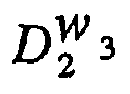
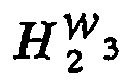
- D 1 and D 2 are distances for the top two candidate words from the DTW VR engine and H 1 and H 2 are the distances for the top two candidate words from the HMM VR engine.
- a linear mapping function is used for both choosing a word from the candidate set, and making the decision to accept or reject.
- D denotes a DTW engine.
- H denotes an HMM engine.
- D 1 w i is the distance between T u and W i .
- D 2 w i is the distance for the second best candidate excluding W i .
- D g denotes the distance between T u and the garbage template.
- H 1 w i , H 2 w i , H g represent, respectively, the same quantities as for the DTW engine.
- the upper limit on the index i is n.
- the mapping function can be constructed or trained objectively to minimize false acceptance/rejection errors.
- Vector b is a vector that indicates the correct/incorrect nature of each training vector
- MSE mean square error
- advanced error minimization procedures such as minimizing the total error count, are also used to solve for the coefficient vector c. It would also be apparent to those skilled in the art that other error minimization procedures known in the art can be used to solve for the coefficient vector c.
- mapping function method is equally applicable to multiple (>2) engines and multiple (>2) word candidates.
- One or more variables/parameters are used in the mapping function instead of coefficients.
- the one or more variables/parameters used in the mapping function are speech parameters from a VR engine. It would also be apparent to those skilled in the art that the one or more variables/parameters can be speech parameters taken from the measurement or processing of the speech signal s(t).
- the various illustrative logical blocks, modules, and mapping described in connection with the embodiments disclosed herein may be implemented or performed with a processor executing a set of firmware instructions, an application specific integrated circuit (ASIC), a field programmable gate array (FPGA) or other programmable logic device, discrete gate or transistor logic, discrete hardware components such as, e.g., registers, any conventional programmable software module and a processor, or any combination thereof designed to perform the functions described herein.
- the A/D 102, the VR engines, and the mapping module 110 may advantageously be executed in a microprocessor, but in the alternative, the A/D 102, the VR engines, and the mapping module 110 may be executed in any conventional processor, controller, microcontroller, or state machine.
- the templates could reside in RAM memory, flash memory, ROM memory, EPROM memory, EEPROM memory, registers, hard disk, a removable disk, a CD-ROM, or any other form of storage medium known in the art.
- the memory may be integral to any aforementioned processor (not shown).
- a processor (not shown) and memory (not shown) may reside in an ASIC (not shown).
- the ASIC may reside in a telephone.
Landscapes
- Engineering & Computer Science (AREA)
- Physics & Mathematics (AREA)
- Computational Linguistics (AREA)
- Health & Medical Sciences (AREA)
- Audiology, Speech & Language Pathology (AREA)
- Human Computer Interaction (AREA)
- Acoustics & Sound (AREA)
- Multimedia (AREA)
- Probability & Statistics with Applications (AREA)
- Machine Translation (AREA)
- Fittings On The Vehicle Exterior For Carrying Loads, And Devices For Holding Or Mounting Articles (AREA)
- Electrically Operated Instructional Devices (AREA)
- Image Analysis (AREA)
- Circuit For Audible Band Transducer (AREA)
- Selective Calling Equipment (AREA)
- Two-Way Televisions, Distribution Of Moving Picture Or The Like (AREA)
- Electric Clocks (AREA)
- Toys (AREA)
Abstract
Description
- The present invention pertains generally to the field of communications and more specifically to a novel and improved system and method for voice recognition.
- Voice recognition (VR) represents one of the most important techniques to endow a machine with simulated intelligence to recognize user or user-voiced commands and to facilitate human interface with the machine. VR also represents a key technique for human speech understanding. Systems that employ techniques to recover a linguistic message from an acoustic speech signal are called voice recognizers. The term "voice recognizer" is used herein to mean generally any spoken-user-interface-enabled device.
- The use of VR (also commonly referred to as speech recognition) is becoming increasingly important for safety reasons. For example, VR may be used to replace the manual task of pushing buttons on a wireless telephone keypad. This is especially important when a user is initiating a telephone call while driving a car. When using a phone without VR, the driver must remove one hand from the steering wheel and look at the phone keypad while pushing the buttons to dial the call. These acts increase the likelihood of a car accident. A speech-enabled phone (i.e., a phone designed for speech recognition) would allow the driver to place telephone calls while continuously watching the road. In addition, a hands-free car-kit system would permit the driver to maintain both hands on the steering wheel during call initiation.
- Speech recognition devices are classified as either speaker-dependent (SD) or speaker-independent (SI) devices. Speaker-dependent devices, which are more common, are trained to recognize commands from particular users. In contrast, speaker-independent devices are capable of accepting voice commands from any user. To increase the performance of a given VR system, whether speaker-dependent or speaker-independent, training is required to equip the system with valid parameters. In other words, the system needs to learn before it can function optimally.
- A speaker-dependent VR device typically operates in two phases, a training phase and a recognition phase. In the training phase, the VR system prompts the user to speak each of the words in the system's vocabulary once or twice (typically twice) so the system can learn the characteristics of the user's speech for these particular words or phrases. An exemplary vocabulary for a hands-free car kit might include the digits on the keypad; the keywords "call," "send," "dial," "cancel," "clear," "add," "delete," "history," "program," "yes," and "no"; and the names of a predefined number of commonly called coworkers, friends, or family members. Once training is complete, the user can initiate calls in the recognition phase by speaking the trained keywords, which the VR device recognizes by comparing the spoken utterances with the previously trained utterances (stored as templates) and taking the best match. For example, if the name "John" were one of the trained names, the user could initiate a call to John by saying the phrase "Call John." The VR system would recognize the words "Call" and "John," and would dial the number that the user had previously entered as John's telephone number. Systems and methods for training
- A speaker-independent VR device also uses a training template that contains a prerecorded vocabulary of a predefined size (e.g., certain control words, the numbers zero through nine, and yes and no). A large number of speakers (e.g., 100) must be recorded saying each word in the vocabulary.
- Different speaker independent VR devices may yield different results. For example, a speaker independent (SI) Hidden Markov Model (HMM) engine may yield a different result than a speaker independent Dynamic Time Warping (DTW) engine. Combining the results of both these engines can result in a system with better recognition accuracy and lower rejection rates than using the results of only one of the engines.
- A speaker-dependent VR and a speaker independent VR may yield different results. A speaker-dependent engine performs recognition using templates pertaining to a specific user. A speaker independent engine performs recognition using templates generated using exemplars from an ensemble of users. Since speaker specific templates are closer to a given user's speaking style, SD engines provide better accuracy than SI engines. However, SI engines have the advantage that the users need not go through the "training process" prior to using the system.
- A system and method that combines engines of different types is desired. Combining multiple engines would provide enhanced accuracy and use a greater amount of information in the input speech signal. A system and method for combining VR engines is described in U.S. Patent Application No. 09/618,177 entitled "Combined Engine System and Method for Voice Recognition", filed July 18, 2000, which is assigned to the assignee of the present invention.
- A decision logic VR system can use heuristic logic to devise decision rules. The decision logic typically starts with the measured distances between a testing utterance and the top candidate (word) templates of each engine. For example, suppose two engines (engines D and H) are used. Let d1 and d2 denote the distance between the test utterance and the top two candidate words of engine D, and h1 and h2 denote the distance between the test utterance and the top two candidate words of engine H. Let dg and hg denotes the distance between the test utterance and the "garbage" templates of engine D and H, respectively. The garbage templates are used to represent all words not in the vocabulary. The decision logic involves a sequence of comparisons among these measured distances and a set of pre-defined thresholds. The comparison rules and thresholds, however, need to be synthesized and adjusted on a trial-by-error basis, in part, because they cannot be systematically optimized. This is a time-consuming and difficult process. In addition, the heuristic rules may be application-dependent. For example, a new set of rules needs to be synthesized if the top three words rather than the top two words are used for each engine. It is likely that the set of rules for recognizing noise-free speech would be different from those for recognizing noisy speech.
- Thus, a system and method for resolving different results from a plurality of different VR engines is desired.
- Attention is drawn to the document US-A-5,754,978, which discloses a speech recognition system with two recognition engines. The speech recognition engines supply a recognized text output signal each of which is provided to a text comparator. The comparator compares the recognized text output signals and accepts or rejects the text based on the degree of an agreement between the output signals from each of the engines.
- Attention is also drawn to a paper by Bouchaffra et al. "A methodology for mapping scores to probabilities", IEEE transactions on pattern analysis and machine intelligence, IEEE Inc. New York, U.S., Volume 21, No. 9 XP, 000851870. The paper describes a derivation of the probability of correctness from scores assigned by most recognizer. The derivation of probability values puts the output of different recognizes on the same scale which makes a comparison across recognisers trivial.
- Finally attention is drawn to the prior art document US-A-5 734 793, which describes a system for recognizing spoken sounds from continuous speech and includes a plurality of classifiers and a selector. Each of the classifiers implements a discriminated function which is based on a polynomial extension. By determining the polynomial coefficients of a discriminated function, the corresponding classifying is tuned to classify a specific spoken sound. The selector utilizes the classified outputs to identify the spoken sounds. A method of using the system is also described.
- In accordance with the present invention a voice recognition system, as set forth in claims 1 and 15, and a method of voice recognition, as set forth in claims 16 and 20, are provided. Embodiments of the invention are described in the dependent claims.
- The described embodiments are directed to a system and method for voice recognition. In one embodiment, a method of combining a plurality of voice recognition engines to improve voice recognition is provided. The method advantageously includes coupling a plurality of voice recognition engines to a mapping module. Each VR engine produces a hypothesis, i.e., word candidate; then the mapping module applies a mapping function to select a hypothesis from the hypotheses produced by the plurality of VR engines.
- In one embodiment, speaker-independent voice recognition engines are combined. In another embodiment, speaker-dependent voice recognition engines are combined. In yet another embodiment, a speaker-independent voice recognition engine is combined with a speaker-dependent voice recognition engine.
- In one embodiment, a speaker-independent voice recognition engine is a Dynamic Time Warping voice recognition engine. In one embodiment, a speaker-independent voice recognition engine is a Hidden Markov Model. In one embodiment, a speaker-dependent voice recognition engine is a Dynamic Time Warping voice recognition engine. In one embodiment, a speaker-dependent voice recognition engine is a Hidden Markov Model.
- The features, objects, and advantages of the present invention will become more apparent from the detailed description set forth below when taken in conjunction with the drawings in which like reference characters identify correspondingly throughout and wherein:
- FIG.1 shows an embodiment of a voice recognition system having three types of voice recognition engines;
- FIG. 2 shows a voice recognition system including a DTW engine and an HMM engine; and
- FIG. 3 shows an embodiment of a voice recognition system with two voice recognition engines.
- In one embodiment, a
voice recognition system 100 as shown in FIG. 1 has three types of voice recognition engines capable of performing isolated word recognition tasks: a dynamic time warping speaker independent (DTW-SI) engine 104, a dynamic time warping speaker-dependent (DTW-SD)engine 106, and a hidden Markov model (HMM)engine 108. These engines are used for command word recognition and digit recognition to provide rich spoken user interfaces to common tasks performed by a handheld device, such as, e.g., a mobile phone, personal digital assistant (PDA) etc. In another embodiment, thevoice recognition system 100 comprises a DTW-SI 104 and a DTW-SD engine 106. In yet another embodiment, thevoice recognition system 100 comprises a DTW-SI engine 104 and an HMMengine 108. In yet another embodiment, thevoice recognition system 100 comprises a DTW-SD engine 106 and an HMMengine 108. In one embodiment, the HMMengine 108 is speaker independent. In another embodiment, the HMMengine 108 is speaker-dependent. It would be understood by those skilled in the art that any VR engine known in the art may be used. In yet another embodiment, a plurality of other VR engines types are combined. It would also be apparent to those skilled in the art that the engines can be configured in any combination. - In accordance with one embodiment, as illustrated in FIG. 1, a
voice recognition system 100 includes an analog-to-digital converter (A/D) 102, a DTW-SI engine 104, a DTW-SD engine 106, and an HMMengine 108. In one embodiment, the A/D 102 is a hardware A/D. In another embodiment, the A/D 102 is implemented in software. In one embodiment, the A/D 102 and theengines D 102 and theengines - The A/
D 102 is coupled to the DTW-SI engine 104, the DTW-SD engine 106, and the HMMengine 108. The DTW-SI engine 104, the DTW-SD engine 106, and the HMMengine 108 are coupled to amapping module 110. The mapping module takes as input the outputs of theengines - The
voice recognition system 100 may reside in, e.g., a wireless telephone or a hands-free car kit. A user (not shown) speaks a word or phrase, generating a speech signal. The speech signal is converted to an electrical speech signal, s(t), with a conventional transducer (not shown). The speech signal, s(t), is provided to the A/D 102, which converts the speech signal to digitized speech samples in accordance with a known sampling method such as, e.g., pulse coded modulation (PCM), A-law, or µ-law. In one embodiment, typically, there are N 16-bit speech samples every second. Thus, N=8,000 for 8,000 Hz sampling frequency and N=16,000 for 16,000 Hz sampling frequency. - The speech samples are provided to the DTW-SI engine 104, the DTW-
SD engine 106, and the HMMengine 108. Each engine processes the speech samples and produces hypotheses, i.e., candidate words for the speech signal s(t). The mapping module then maps the candidate words onto a decision space, which is evaluated in order to select the candidate word that best reflects the speech signal s(t). - In one embodiment, the voice recognition system includes two VR engines as shown in FIG. 2. The
voice recognition system 100 includes aDTW engine 112 and an HMMengine 114. In one embodiment, the DTW engine is a speaker-independent VR engine. In another embodiment, the DTW engine is a speaker-dependent VR engine. In one embodiment, the HMM engine is a speaker-independent VR engine. In another embodiment, the HMM engine is a speaker-dependent VR engine. - In these embodiments, the system has the advantages of both DTW and HMM engines. In one embodiment, DTW and HMM templates are created explicitly during a training phase in which the voice recognition system is trained to recognize input speech signals. In another embodiment, DTW and HMM templates are created implicitly during typical usage of the voice recognition system. Exemplary training systems and methods are described in U.S. Patent Application No. 09/248,513 entitled "VOICE RECOGNITION REJECTION SCHEME", filed February 8, 1999, which is assigned to the assignee of the present invention, and U.S. Patent Application No. 09/225,891, entitled "SYSTEM AND METHOD FOR SEGMENTATION AND RECOGNITION OF SPEECH SIGNALS", filed January 4, 1999, which is assigned to the assignee of the present invention.
- A set of templates for all of the vocabulary words of the voice recognition system are stored in any conventional form of nonvolatile storage medium, such as, e.g., flash memory. This allows the templates to remain in the storage medium when the power to the
voice recognition system 100 is turned off. In one embodiment, the set of templates is constructed with a speaker-independent template building system. In one embodiment, command words are included in a VR engine vocabulary. - The DTW technique is known in the art and described in Lawrence Rabiner & Biing-Hwang Juang, Fundamentals of Speech Recognition 200-238 (1993). In accordance with the DTW technique, a trellis is formed by plotting a time sequence of the utterance to be tested against a time sequence for each utterance stored in a template database. The utterance being tested is then compared, point by point (e.g., every 10 ms), with each utterance in the template database, one utterance at a time. For each utterance in the template database, the utterance being tested is adjusted, or "warped," in time, being either compressed or expanded at particular points until the closest possible match with the utterance in the template database is achieved. At each point in time the two utterances are compared, and either a match is declared at that point (zero cost), or a mismatch is declared. In the event of a mismatch at a particular point, the utterance being tested is compressed, expanded, or if necessary, mismatched. The process is continued until the two utterances have been completely compared against each other. A large number (typically thousands) of differently adjusted utterances is possible. The adjusted utterance having the lowest cost function (i.e., requiring the least number of compressions and/or expansions and/or mismatches) is selected. In similar fashion to a Viterbi decoding algorithm, the selection is advantageously performed by looking backward from each point in the utterance in the template database to determine the pathway having the lowest total cost. This permits the lowest-cost (i.e., most closely matched) adjusted utterance to be determined without resorting to the "brute-force" method of generating every possible one of the differently adjusted utterances. The lowest-cost adjusted utterances for all of the utterances in the template database are then compared and the one having the lowest cost is selected as the stored utterance most closely matched to the tested utterance.
- Although DTW matching schemes in a DTW engine 104 and Viterbi decoding in an HMM
engine 108 are similar, the DTW and HMM engines utilize different front end schemes, i.e., feature extractors, to provide feature vectors to the matching stage. For this reason, the error patterns of the DTW and HMM engines are quite different. A voice recognition system with a combined engine takes advantage of differences in error patterns. By combining the results from both the engines properly, a higher overall recognition accuracy may be achieved. More importantly, lower rejection rates for desired recognition accuracy may be achieved. - In one embodiment, speaker-independent voice recognition engines operating the same vocabulary set are combined. In another embodiment, speaker-dependent voice recognition engines are combined. In yet another embodiment, a speaker-independent voice recognition engine is combined with a speaker-dependent voice recognition engine, both engines operating on the same vocabulary set. In yet another embodiment, a speaker-independent voice recognition engine is combined with a speaker-dependent voice recognition engine, both engines operating on different vocabulary sets.
- Each engine produces an output as to which word in its vocabulary was spoken. Each output includes a word candidate for the input signal. Words that do not correspond to the input signal are rejected. Exemplary rejection schemes are described in U.S. Patent Application No. 09/248,513.
- Accurate speech recognition is difficult for an embedded system, in part because of its limited computing resource. To increase system accuracy, speech recognition is accomplished using multiple recognition engines. Different VR engines, however, may produce different outcomes. For example, one engine might choose "Jane" and "Joe" as top candidate words, whereas another VR engine might choose "Julie" and "Joe" as the top two candidates. These different results need to be resolved. An answer must be given, i.e., a candidate word needs to be selected. The VR system has to reach a decision based on these candidate words for multiple engines to be functional.
- In one embodiment, there are X (X= 2, 3, ...) engines combined, each engine producing Y (Y= 1, 2, ...) candidate words. Therefore, there are X*Y candidates out of which only one is the correct answer. In another embodiment, each engine may produce a different number of candidates.
- In an embodiment with two engines D and H, d1 and d2 denote the distance between the test utterance and the top two candidate words of engine D, and h1 and h2 denote the distance between the test utterance and the top two candidate words of engine H. The variables dg and hg denote the distance between the test utterance and the "garbage" templates of engine D and H, respectively. The garbage templates are used to represent all words not in the vocabulary.
- In one embodiment, the decision of selecting a candidate from the candidates produced by the VR engines is made based on a mapping from the measurement space (d1,d2,...dg and h1,h2...,hg) to the decision space (accept/reject the test utterance as one of the words in the list). In one embodiment, the mapping is a linear mapping. In another embodiment, the mapping is a nonlinear mapping.
- In accordance with one embodiment, a flowchart of method steps performed by a device having a DTW-based VR engine and an HMM-based VR engine is shown in FIG. 3. In
step 200, a test utterance Tu is obtained. Once the test utterance Tu is obtained, a DTW voice recognition analysis is performed on the test utterance Tu instep 202 and an HMM voice recognition analysis is performed on the test utterance Tu instep 204. Instep 206, a set of DTW candidate words Di is obtained. Instep 208, a set of HMM candidate words Hi is obtained. Instep 210, a linear mapping function is applied to each DTW candidate word D, and each HMM candidate word Hi. Instep 212, recognition of a candidate word is based on the linear mapping results. Instep 212, the candidate word with the minimum mapping function value is chosen as a recognized word W(Tu). Instep 214, the mapping function value of the recognized word W(Tu) is compared to a threshold. If the mapping function value of the recognized word W(Tu) is less than the threshold, the recognized word is rejected instep 216. If the mapping function value of the recognized word W(Tu) is greater than the threshold, the recognized word is accepted instep 218. -

test utterance T u 200 and in-vocabulary words, Wj, j=1,2,...,N. Wj is a set of candidate words where index j is the set number and N is the number of sets. Each set has a number of candidate words, the number being a positive integer. Index i is the VR engine number. - Each VR engine also produces a distance Dg between the test utterance Tu and the out-of-vocabulary word template Wg. An in-vocabulary word is a word that is in the vocabulary of a VR engine. An out-of-vocabulary word is a word that is not in the vocabulary of a VR engine.
- If the result of the mapping function is greater than a threshold, the candidate word evaluated is valid and the input is accepted. Otherwise, the input is rejected.
- Table 1 shows a matrix of distances in an embodiment with a DTW engine and an HMM engine, wherein the top two words from each engine are chosen to be the candidate set. D1 and D2 are distances for the top two candidate words from the DTW VR engine and H1 and H2 are the distances for the top two candidate words from the HMM VR engine.
- In an embodiment with two VR engines where one VR engine produces X distances and the other engine produces Y distances, a total of X*Y candidate words is produced.
- Only one word from a candidate set will be recognized and a decision is made determining if the recognition should be rejected/accepted. In one embodiment, a linear mapping function is used for both choosing a word from the candidate set, and making the decision to accept or reject.
- Each set of candidate words, W i , i=1, 2, 3, 4, has its corresponding measurement vectors as shown in table 1.
TABLE 1 W 1 : 

D g 

H g W 2 : 

D g 

H g W 3 : 
D g 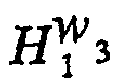
H g W 4 : 

D g 

H g - D denotes a DTW engine. H denotes an HMM engine.


- The linear mapping function has the form:

Two VR engines 2 two candidate words for the first VR engine +2 two candidate words for the second VR engine +2 n=6 - The decision rules for word recognition and word acceptance are as follows:
- 1. The word that maximizes M i (D f H) is chosen as the word to be recognized; and
- 2. The recognition is accepted when M i (D f H)>0 and rejected when Mi (D,H) ≤ 0.
- The mapping function can be constructed or trained objectively to minimize false acceptance/rejection errors. In one embodiment, the constants c i (i=0,1,..., n) are obtained from training. In the training process, the identity of each testing sample is known. The measurement vector of one word (among W1, W2, W3, and W4) is marked as correct (+1), and the rest are marked as incorrect (-1). Training determines the value of the coefficient vector c= c i (i=0,1,...n) in order to minimize the number of misclassifications.
- Vector b is a vector that indicates the correct/incorrect nature of each training vector, and W is the measurement matrix where each row is a measurement vector


- This procedure minimizes the mean square error (MSE). In another embodiment, advanced error minimization procedures, such as minimizing the total error count, are also used to solve for the coefficient vector c. It would also be apparent to those skilled in the art that other error minimization procedures known in the art can be used to solve for the coefficient vector c.
- The mapping function method is equally applicable to multiple (>2) engines and multiple (>2) word candidates. When there are L VR engines and each produces N word candidates, the generalized mapping function has the form:
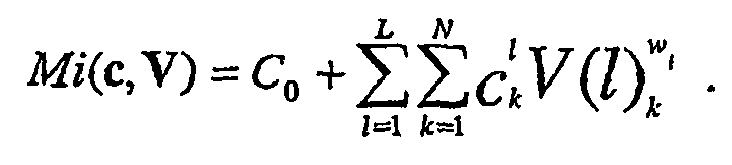
- C0 is the threshold constant.


- One or more variables/parameters are used in the mapping function instead of coefficients. In one embodiment, the one or more variables/parameters used in the mapping function are speech parameters from a VR engine. It would also be apparent to those skilled in the art that the one or more variables/parameters can be speech parameters taken from the measurement or processing of the speech signal s(t).
- Thus, a novel and improved method and apparatus for combining engines for voice recognition has been described. Those of skill in the art would understand that the various illustrative logical blocks, modules, and mapping described in connection with the embodiments disclosed herein may be implemented as electronic hardware, computer software, or combinations of both. The various illustrative components, blocks, modules, circuits, and steps have been described generally in terms of their functionality. Whether the functionality is implemented as hardware or software depends upon the particular application and design constraints imposed on the overall system. Skilled artisans recognize the interchangeability of hardware and software under these circumstances, and how best to implement the described functionality for each particular application. As examples, the various illustrative logical blocks, modules, and mapping described in connection with the embodiments disclosed herein may be implemented or performed with a processor executing a set of firmware instructions, an application specific integrated circuit (ASIC), a field programmable gate array (FPGA) or other programmable logic device, discrete gate or transistor logic, discrete hardware components such as, e.g., registers, any conventional programmable software module and a processor, or any combination thereof designed to perform the functions described herein. The A/
D 102, the VR engines, and themapping module 110 may advantageously be executed in a microprocessor, but in the alternative, the A/D 102, the VR engines, and themapping module 110 may be executed in any conventional processor, controller, microcontroller, or state machine. The templates could reside in RAM memory, flash memory, ROM memory, EPROM memory, EEPROM memory, registers, hard disk, a removable disk, a CD-ROM, or any other form of storage medium known in the art. The memory (not shown) may be integral to any aforementioned processor (not shown). A processor (not shown) and memory (not shown) may reside in an ASIC (not shown). The ASIC may reside in a telephone. - The previous description of the embodiments of the invention is provided to enable any person skilled in the art to make or use the present invention. The various modifications to these embodiments will be readily apparent to those skilled in the art, and the generic principles defined herein may be applied to other embodiments without the use of the inventive faculty. Thus, the present invention is not intended to be limited to the embodiments shown herein but is to be accorded the widest scope consistent with the principles and novel features disclosed herein.
Claims (23)
- A voice recognition system (100), comprising:a plurality of voice recognition (VR) engines (104,106,108) each voice recognition engine configured to produce a word candidate; anda mapping module (110) that is configured to take as input the word candidates from the plurality of VR engines (104,106,108) and select a word candidate based on a mapping function;wherein the mapping function is:

wherein F is a first voice recognition engine, S is a second voice recognition engine,


- The voice recognition system (100) of claim 1, wherein the plurality of voice recognition engines includes a speaker-independent voice recognition engine (104).
- The voice recognition system (100) of claim 1, wherein the plurality of voice recognition engines includes a speaker-dependent voice recognition engine (106).
- The voice recognition system (100) of claim 2, wherein the plurality of voice recognition engines includes a speaker-dependent voice recognition engine (106).
- The voice recognition system (100) of claim 4, wherein at least one speaker-independent voice recognition (104) engine is a Dynamic Time Warping voice recognition engine.
- The voice recognition system (100) of claim 4, wherein at least one speaker-independent voice recognition engine (104) is a Hidden Markov Model voice recognition engine.
- The voice recognition system (100) of claim 4, wherein at least one speaker-dependent voice recognition engine (106) is a Dynamic Time Warping voice recognition engine.
- The voice recognition system (100) of claim 4, wherein at least one speaker-dependent voice recognition engine (106) is a Hidden Markov Model recognition engine.
- The voice recognition system (100) of claim 1, wherein the mapping function linearly maps the word candidates from a measurement space to a decision space.
- The voice recognition system (100) of claim 1, wherein the word candidate is represented by a distance between a word candidate template and the utterance.
- The voice recognition system (100) of claim 10 wherein the mapping module multiplies each distance from each VR engine by a coefficient and adds the products and another coefficient C0, thereby producing a sum.
- The voice recognition system (100) of claim 11, wherein a word candidate is selected based on the sum.
- The voice recognition system (100) of claim 12, wherein the coefficient is a real constant.
- The voice recognition system (100) of claim 12, wherein the coefficient is a speech parameter.
- A voice recognition system (100), comprising:a plurality of voice recognition (VR) engines (104,106,108), each voice recognition engine configured to produce a word candidate; anda mapping module (110) that is configured to take as input the word candidates from the plurality of VR engines (104,106,108) and select a word candidate based on a mapping function;wherein the mapping function is:

wherein C0 is a threshold constant,

- A method of voice recognition, comprising:obtaining at least one candidate word for a test utterance (200) andselecting a recognized word from the at least one candidate word based on a mapping function;wherein the mapping function is:

wherein F is a first voice recognition engine, S is a second voice recognition engine,


- The method of claim 16, wherein the mapping function linearly maps the at least one candidate word from a measurement space to a decision space.
- The method of claim 16, wherein the coefficient is a real constant.
- The method of claim 16 wherein the coefficient is a speech parameter.
- A method of voice recognition, comprising:obtaining at least one candidate word for a test utterance (200); andselecting a recognized word from the at least one candidate word based on a mapping function;wherein the mapping function is:

wherein C0 is a threshold constant,

- The method of claim 16 or claim 20, wherein the step of obtaining further comprises the steps of:obtaining said test utterance;analyzing the test utterance;providing at least one candidate word for the test utterance based on the analysis of the test utterance; and wherein the step of selecting further comprises the steps of :applying said mapping function to the at least one candidate word (210);selecting a candidate word from the at least one candidate word based on the mapping function value of the at least one candidate word (212); andcomparing the mapping function value of the selected candidate word to a threshold (214).
- The method of claim 21 further comprising accepting the selected candidate word based on the comparison (218).
- The method of claim 21 further comprising rejecting the selected candidate word based on the comparison (216).
Applications Claiming Priority (3)
| Application Number | Priority Date | Filing Date | Title |
|---|---|---|---|
| US657760 | 1984-10-04 | ||
| US09/657,760 US6754629B1 (en) | 2000-09-08 | 2000-09-08 | System and method for automatic voice recognition using mapping |
| PCT/US2001/027625 WO2002021513A1 (en) | 2000-09-08 | 2001-09-05 | Combining dtw and hmm in speaker dependent and independent modes for speech recognition |
Publications (2)
| Publication Number | Publication Date |
|---|---|
| EP1316086A1 EP1316086A1 (en) | 2003-06-04 |
| EP1316086B1 true EP1316086B1 (en) | 2006-11-08 |
Family
ID=24638560
Family Applications (1)
| Application Number | Title | Priority Date | Filing Date |
|---|---|---|---|
| EP01968568A Expired - Lifetime EP1316086B1 (en) | 2000-09-08 | 2001-09-05 | Combining dtw and hmm in speaker dependent and independent modes for speech recognition |
Country Status (12)
| Country | Link |
|---|---|
| US (1) | US6754629B1 (en) |
| EP (1) | EP1316086B1 (en) |
| JP (1) | JP2004518155A (en) |
| KR (1) | KR100901092B1 (en) |
| CN (1) | CN1238836C (en) |
| AT (1) | ATE344959T1 (en) |
| AU (1) | AU2001288808A1 (en) |
| BR (1) | BR0113725A (en) |
| DE (1) | DE60124408T2 (en) |
| ES (1) | ES2273885T3 (en) |
| TW (1) | TW548630B (en) |
| WO (1) | WO2002021513A1 (en) |
Cited By (1)
| Publication number | Priority date | Publication date | Assignee | Title |
|---|---|---|---|---|
| CN101256769B (en) * | 2008-03-21 | 2011-06-15 | 深圳市汉音科技有限公司 | Speech recognition devices and methods thereof |
Families Citing this family (36)
| Publication number | Priority date | Publication date | Assignee | Title |
|---|---|---|---|---|
| DE60120062T2 (en) * | 2000-09-19 | 2006-11-16 | Thomson Licensing | Voice control of electronic devices |
| US20030004720A1 (en) * | 2001-01-30 | 2003-01-02 | Harinath Garudadri | System and method for computing and transmitting parameters in a distributed voice recognition system |
| US20020143540A1 (en) * | 2001-03-28 | 2002-10-03 | Narendranath Malayath | Voice recognition system using implicit speaker adaptation |
| US7941313B2 (en) * | 2001-05-17 | 2011-05-10 | Qualcomm Incorporated | System and method for transmitting speech activity information ahead of speech features in a distributed voice recognition system |
| US7203643B2 (en) * | 2001-06-14 | 2007-04-10 | Qualcomm Incorporated | Method and apparatus for transmitting speech activity in distributed voice recognition systems |
| US20040138885A1 (en) * | 2003-01-09 | 2004-07-15 | Xiaofan Lin | Commercial automatic speech recognition engine combinations |
| DE10334400A1 (en) | 2003-07-28 | 2005-02-24 | Siemens Ag | Method for speech recognition and communication device |
| KR100571574B1 (en) * | 2004-07-26 | 2006-04-17 | 한양대학교 산학협력단 | Similar Speaker Recognition Method Using Nonlinear Analysis and Its System |
| KR100693284B1 (en) * | 2005-04-14 | 2007-03-13 | 학교법인 포항공과대학교 | Speech recognition device |
| US20070225970A1 (en) * | 2006-03-21 | 2007-09-27 | Kady Mark A | Multi-context voice recognition system for long item list searches |
| US8532984B2 (en) | 2006-07-31 | 2013-09-10 | Qualcomm Incorporated | Systems, methods, and apparatus for wideband encoding and decoding of active frames |
| GB0616070D0 (en) * | 2006-08-12 | 2006-09-20 | Ibm | Speech Recognition Feedback |
| US8239190B2 (en) | 2006-08-22 | 2012-08-07 | Qualcomm Incorporated | Time-warping frames of wideband vocoder |
| US7881928B2 (en) * | 2006-09-01 | 2011-02-01 | International Business Machines Corporation | Enhanced linguistic transformation |
| US9659559B2 (en) * | 2009-06-25 | 2017-05-23 | Adacel Systems, Inc. | Phonetic distance measurement system and related methods |
| EP2453979B1 (en) * | 2009-07-17 | 2019-07-24 | Implantica Patent Ltd. | A system for voice control of a medical implant |
| KR101066472B1 (en) * | 2009-09-15 | 2011-09-21 | 국민대학교산학협력단 | Voice based speech recognition device and voice recognition method |
| CN102651218A (en) * | 2011-02-25 | 2012-08-29 | 株式会社东芝 | Method and equipment for creating voice tag |
| KR101255141B1 (en) * | 2011-08-11 | 2013-04-22 | 주식회사 씨에스 | Real time voice recignition method for rejection ration and for reducing misconception |
| US9767793B2 (en) | 2012-06-08 | 2017-09-19 | Nvoq Incorporated | Apparatus and methods using a pattern matching speech recognition engine to train a natural language speech recognition engine |
| US9378737B2 (en) * | 2012-11-05 | 2016-06-28 | Mitsubishi Electric Corporation | Voice recognition device |
| CN103065627B (en) * | 2012-12-17 | 2015-07-29 | 中南大学 | Special purpose vehicle based on DTW and HMM evidence fusion is blown a whistle sound recognition methods |
| CN105027198B (en) * | 2013-02-25 | 2018-11-20 | 三菱电机株式会社 | Speech recognition system and speech recognition device |
| CN104143330A (en) * | 2013-05-07 | 2014-11-12 | 佳能株式会社 | Voice recognizing method and voice recognizing system |
| US9390708B1 (en) * | 2013-05-28 | 2016-07-12 | Amazon Technologies, Inc. | Low latency and memory efficient keywork spotting |
| TWI506458B (en) * | 2013-12-24 | 2015-11-01 | Ind Tech Res Inst | Apparatus and method for generating recognition network |
| CN104103272B (en) * | 2014-07-15 | 2017-10-10 | 无锡中感微电子股份有限公司 | Audio recognition method, device and bluetooth earphone |
| PL3065131T3 (en) | 2015-03-06 | 2021-01-25 | Zetes Industries S.A. | Method and system for post-processing a speech recognition result |
| EP3065132A1 (en) | 2015-03-06 | 2016-09-07 | ZETES Industries S.A. | Method and system for determining the validity of an element of a speech recognition result |
| EP3065133A1 (en) | 2015-03-06 | 2016-09-07 | ZETES Industries S.A. | Method and system for generating an optimised solution in speech recognition |
| US10170110B2 (en) * | 2016-11-17 | 2019-01-01 | Robert Bosch Gmbh | System and method for ranking of hybrid speech recognition results with neural networks |
| US10360914B2 (en) | 2017-01-26 | 2019-07-23 | Essence, Inc | Speech recognition based on context and multiple recognition engines |
| US10861450B2 (en) * | 2017-02-10 | 2020-12-08 | Samsung Electronics Co., Ltd. | Method and apparatus for managing voice-based interaction in internet of things network system |
| CN107039037A (en) * | 2017-04-21 | 2017-08-11 | 南京邮电大学 | A kind of alone word voice recognition method based on DTW |
| CN109767758B (en) * | 2019-01-11 | 2021-06-08 | 中山大学 | Vehicle-mounted voice analysis method, system, storage medium and device |
| US12431157B2 (en) | 2023-03-06 | 2025-09-30 | International Business Machines Corporation | Audio playback and captioning |
Family Cites Families (14)
| Publication number | Priority date | Publication date | Assignee | Title |
|---|---|---|---|---|
| US4831551A (en) * | 1983-01-28 | 1989-05-16 | Texas Instruments Incorporated | Speaker-dependent connected speech word recognizer |
| US4763278A (en) * | 1983-04-13 | 1988-08-09 | Texas Instruments Incorporated | Speaker-independent word recognizer |
| US4783804A (en) * | 1985-03-21 | 1988-11-08 | American Telephone And Telegraph Company, At&T Bell Laboratories | Hidden Markov model speech recognition arrangement |
| US5073939A (en) * | 1989-06-08 | 1991-12-17 | Itt Corporation | Dynamic time warping (DTW) apparatus for use in speech recognition systems |
| BR9508898A (en) | 1994-09-07 | 1997-11-25 | Motorola Inc | System to recognize spoken sounds |
| US5717826A (en) * | 1995-08-11 | 1998-02-10 | Lucent Technologies Inc. | Utterance verification using word based minimum verification error training for recognizing a keyboard string |
| US5754978A (en) * | 1995-10-27 | 1998-05-19 | Speech Systems Of Colorado, Inc. | Speech recognition system |
| US6272455B1 (en) * | 1997-10-22 | 2001-08-07 | Lucent Technologies, Inc. | Method and apparatus for understanding natural language |
| US6125341A (en) * | 1997-12-19 | 2000-09-26 | Nortel Networks Corporation | Speech recognition system and method |
| US6321195B1 (en) * | 1998-04-28 | 2001-11-20 | Lg Electronics Inc. | Speech recognition method |
| ITTO980383A1 (en) | 1998-05-07 | 1999-11-07 | Cselt Centro Studi Lab Telecom | PROCEDURE AND VOICE RECOGNITION DEVICE WITH DOUBLE STEP OF NEURAL AND MARKOVIAN RECOGNITION. |
| US6275800B1 (en) * | 1999-02-23 | 2001-08-14 | Motorola, Inc. | Voice recognition system and method |
| US6526380B1 (en) * | 1999-03-26 | 2003-02-25 | Koninklijke Philips Electronics N.V. | Speech recognition system having parallel large vocabulary recognition engines |
| US6671669B1 (en) | 2000-07-18 | 2003-12-30 | Qualcomm Incorporated | combined engine system and method for voice recognition |
-
2000
- 2000-09-08 US US09/657,760 patent/US6754629B1/en not_active Expired - Lifetime
-
2001
- 2001-09-05 JP JP2002525645A patent/JP2004518155A/en active Pending
- 2001-09-05 AU AU2001288808A patent/AU2001288808A1/en not_active Abandoned
- 2001-09-05 AT AT01968568T patent/ATE344959T1/en not_active IP Right Cessation
- 2001-09-05 EP EP01968568A patent/EP1316086B1/en not_active Expired - Lifetime
- 2001-09-05 BR BR0113725-5A patent/BR0113725A/en not_active IP Right Cessation
- 2001-09-05 WO PCT/US2001/027625 patent/WO2002021513A1/en not_active Ceased
- 2001-09-05 DE DE60124408T patent/DE60124408T2/en not_active Expired - Lifetime
- 2001-09-05 CN CNB018153631A patent/CN1238836C/en not_active Expired - Fee Related
- 2001-09-05 ES ES01968568T patent/ES2273885T3/en not_active Expired - Lifetime
- 2001-09-05 KR KR1020037003316A patent/KR100901092B1/en not_active Expired - Fee Related
- 2001-09-07 TW TW090122242A patent/TW548630B/en active
Cited By (1)
| Publication number | Priority date | Publication date | Assignee | Title |
|---|---|---|---|---|
| CN101256769B (en) * | 2008-03-21 | 2011-06-15 | 深圳市汉音科技有限公司 | Speech recognition devices and methods thereof |
Also Published As
| Publication number | Publication date |
|---|---|
| TW548630B (en) | 2003-08-21 |
| DE60124408D1 (en) | 2006-12-21 |
| ES2273885T3 (en) | 2007-05-16 |
| US6754629B1 (en) | 2004-06-22 |
| KR100901092B1 (en) | 2009-06-08 |
| BR0113725A (en) | 2004-08-17 |
| CN1238836C (en) | 2006-01-25 |
| DE60124408T2 (en) | 2007-09-06 |
| EP1316086A1 (en) | 2003-06-04 |
| WO2002021513A8 (en) | 2002-06-20 |
| JP2004518155A (en) | 2004-06-17 |
| KR20030061797A (en) | 2003-07-22 |
| HK1058428A1 (en) | 2004-05-14 |
| ATE344959T1 (en) | 2006-11-15 |
| WO2002021513A1 (en) | 2002-03-14 |
| CN1454381A (en) | 2003-11-05 |
| AU2001288808A1 (en) | 2002-03-22 |
Similar Documents
| Publication | Publication Date | Title |
|---|---|---|
| EP1316086B1 (en) | Combining dtw and hmm in speaker dependent and independent modes for speech recognition | |
| EP1301922B1 (en) | System and method for voice recognition with a plurality of voice recognition engines | |
| US6836758B2 (en) | System and method for hybrid voice recognition | |
| US5754978A (en) | Speech recognition system | |
| US6735563B1 (en) | Method and apparatus for constructing voice templates for a speaker-independent voice recognition system | |
| US6925154B2 (en) | Methods and apparatus for conversational name dialing systems | |
| US20020178004A1 (en) | Method and apparatus for voice recognition | |
| US7136815B2 (en) | Method for voice recognition | |
| EP1159735B1 (en) | Voice recognition rejection scheme | |
| EP1734509A1 (en) | Method and system for speech recognition | |
| HK1058428B (en) | Combining dtw and hmm in speaker dependent and independent modes for speech recognition | |
| HK1057816B (en) | System and method for voice recognition with a plurality of voice recognition engines |
Legal Events
| Date | Code | Title | Description |
|---|---|---|---|
| PUAI | Public reference made under article 153(3) epc to a published international application that has entered the european phase |
Free format text: ORIGINAL CODE: 0009012 |
|
| 17P | Request for examination filed |
Effective date: 20030306 |
|
| AK | Designated contracting states |
Designated state(s): AT BE CH CY DE DK ES FI FR GB GR IE IT LI LU MC NL PT SE TR |
|
| AX | Request for extension of the european patent |
Extension state: AL LT LV MK RO SI |
|
| GRAP | Despatch of communication of intention to grant a patent |
Free format text: ORIGINAL CODE: EPIDOSNIGR1 |
|
| GRAS | Grant fee paid |
Free format text: ORIGINAL CODE: EPIDOSNIGR3 |
|
| GRAA | (expected) grant |
Free format text: ORIGINAL CODE: 0009210 |
|
| AK | Designated contracting states |
Kind code of ref document: B1 Designated state(s): AT BE CH CY DE DK ES FI FR GB GR IE IT LI LU MC NL PT SE TR |
|
| PG25 | Lapsed in a contracting state [announced via postgrant information from national office to epo] |
Ref country code: IT Free format text: LAPSE BECAUSE OF FAILURE TO SUBMIT A TRANSLATION OF THE DESCRIPTION OR TO PAY THE FEE WITHIN THE PRESCRIBED TIME-LIMIT;WARNING: LAPSES OF ITALIAN PATENTS WITH EFFECTIVE DATE BEFORE 2007 MAY HAVE OCCURRED AT ANY TIME BEFORE 2007. THE CORRECT EFFECTIVE DATE MAY BE DIFFERENT FROM THE ONE RECORDED. Effective date: 20061108 Ref country code: CH Free format text: LAPSE BECAUSE OF FAILURE TO SUBMIT A TRANSLATION OF THE DESCRIPTION OR TO PAY THE FEE WITHIN THE PRESCRIBED TIME-LIMIT Effective date: 20061108 Ref country code: BE Free format text: LAPSE BECAUSE OF FAILURE TO SUBMIT A TRANSLATION OF THE DESCRIPTION OR TO PAY THE FEE WITHIN THE PRESCRIBED TIME-LIMIT Effective date: 20061108 Ref country code: AT Free format text: LAPSE BECAUSE OF FAILURE TO SUBMIT A TRANSLATION OF THE DESCRIPTION OR TO PAY THE FEE WITHIN THE PRESCRIBED TIME-LIMIT Effective date: 20061108 Ref country code: NL Free format text: LAPSE BECAUSE OF FAILURE TO SUBMIT A TRANSLATION OF THE DESCRIPTION OR TO PAY THE FEE WITHIN THE PRESCRIBED TIME-LIMIT Effective date: 20061108 Ref country code: LI Free format text: LAPSE BECAUSE OF FAILURE TO SUBMIT A TRANSLATION OF THE DESCRIPTION OR TO PAY THE FEE WITHIN THE PRESCRIBED TIME-LIMIT Effective date: 20061108 |
|
| REG | Reference to a national code |
Ref country code: GB Ref legal event code: FG4D |
|
| REG | Reference to a national code |
Ref country code: CH Ref legal event code: EP |
|
| REG | Reference to a national code |
Ref country code: IE Ref legal event code: FG4D |
|
| REF | Corresponds to: |
Ref document number: 60124408 Country of ref document: DE Date of ref document: 20061221 Kind code of ref document: P |
|
| REG | Reference to a national code |
Ref country code: SE Ref legal event code: TRGR |
|
| PG25 | Lapsed in a contracting state [announced via postgrant information from national office to epo] |
Ref country code: DK Free format text: LAPSE BECAUSE OF FAILURE TO SUBMIT A TRANSLATION OF THE DESCRIPTION OR TO PAY THE FEE WITHIN THE PRESCRIBED TIME-LIMIT Effective date: 20070208 |
|
| PG25 | Lapsed in a contracting state [announced via postgrant information from national office to epo] |
Ref country code: PT Free format text: LAPSE BECAUSE OF FAILURE TO SUBMIT A TRANSLATION OF THE DESCRIPTION OR TO PAY THE FEE WITHIN THE PRESCRIBED TIME-LIMIT Effective date: 20070409 |
|
| NLV1 | Nl: lapsed or annulled due to failure to fulfill the requirements of art. 29p and 29m of the patents act | ||
| REG | Reference to a national code |
Ref country code: ES Ref legal event code: FG2A Ref document number: 2273885 Country of ref document: ES Kind code of ref document: T3 |
|
| REG | Reference to a national code |
Ref country code: CH Ref legal event code: PL |
|
| ET | Fr: translation filed | ||
| PLBE | No opposition filed within time limit |
Free format text: ORIGINAL CODE: 0009261 |
|
| STAA | Information on the status of an ep patent application or granted ep patent |
Free format text: STATUS: NO OPPOSITION FILED WITHIN TIME LIMIT |
|
| 26N | No opposition filed |
Effective date: 20070809 |
|
| PG25 | Lapsed in a contracting state [announced via postgrant information from national office to epo] |
Ref country code: MC Free format text: LAPSE BECAUSE OF NON-PAYMENT OF DUE FEES Effective date: 20070930 Ref country code: GR Free format text: LAPSE BECAUSE OF FAILURE TO SUBMIT A TRANSLATION OF THE DESCRIPTION OR TO PAY THE FEE WITHIN THE PRESCRIBED TIME-LIMIT Effective date: 20070209 |
|
| PG25 | Lapsed in a contracting state [announced via postgrant information from national office to epo] |
Ref country code: IE Free format text: LAPSE BECAUSE OF NON-PAYMENT OF DUE FEES Effective date: 20070905 |
|
| PG25 | Lapsed in a contracting state [announced via postgrant information from national office to epo] |
Ref country code: CY Free format text: LAPSE BECAUSE OF FAILURE TO SUBMIT A TRANSLATION OF THE DESCRIPTION OR TO PAY THE FEE WITHIN THE PRESCRIBED TIME-LIMIT Effective date: 20061108 Ref country code: LU Free format text: LAPSE BECAUSE OF NON-PAYMENT OF DUE FEES Effective date: 20070905 |
|
| PG25 | Lapsed in a contracting state [announced via postgrant information from national office to epo] |
Ref country code: TR Free format text: LAPSE BECAUSE OF FAILURE TO SUBMIT A TRANSLATION OF THE DESCRIPTION OR TO PAY THE FEE WITHIN THE PRESCRIBED TIME-LIMIT Effective date: 20061108 |
|
| PGFP | Annual fee paid to national office [announced via postgrant information from national office to epo] |
Ref country code: ES Payment date: 20100909 Year of fee payment: 10 |
|
| PGFP | Annual fee paid to national office [announced via postgrant information from national office to epo] |
Ref country code: SE Payment date: 20100907 Year of fee payment: 10 Ref country code: IT Payment date: 20100917 Year of fee payment: 10 Ref country code: FR Payment date: 20100920 Year of fee payment: 10 Ref country code: FI Payment date: 20100901 Year of fee payment: 10 |
|
| PGFP | Annual fee paid to national office [announced via postgrant information from national office to epo] |
Ref country code: GB Payment date: 20100809 Year of fee payment: 10 |
|
| PGFP | Annual fee paid to national office [announced via postgrant information from national office to epo] |
Ref country code: DE Payment date: 20100930 Year of fee payment: 10 |
|
| GBPC | Gb: european patent ceased through non-payment of renewal fee |
Effective date: 20110905 |
|
| PG25 | Lapsed in a contracting state [announced via postgrant information from national office to epo] |
Ref country code: FI Free format text: LAPSE BECAUSE OF NON-PAYMENT OF DUE FEES Effective date: 20110905 Ref country code: IT Free format text: LAPSE BECAUSE OF NON-PAYMENT OF DUE FEES Effective date: 20110905 |
|
| REG | Reference to a national code |
Ref country code: FR Ref legal event code: ST Effective date: 20120531 |
|
| REG | Reference to a national code |
Ref country code: SE Ref legal event code: EUG |
|
| REG | Reference to a national code |
Ref country code: DE Ref legal event code: R119 Ref document number: 60124408 Country of ref document: DE Effective date: 20120403 |
|
| PG25 | Lapsed in a contracting state [announced via postgrant information from national office to epo] |
Ref country code: DE Free format text: LAPSE BECAUSE OF NON-PAYMENT OF DUE FEES Effective date: 20120403 |
|
| PG25 | Lapsed in a contracting state [announced via postgrant information from national office to epo] |
Ref country code: GB Free format text: LAPSE BECAUSE OF NON-PAYMENT OF DUE FEES Effective date: 20110905 Ref country code: FR Free format text: LAPSE BECAUSE OF NON-PAYMENT OF DUE FEES Effective date: 20110930 |
|
| PG25 | Lapsed in a contracting state [announced via postgrant information from national office to epo] |
Ref country code: SE Free format text: LAPSE BECAUSE OF NON-PAYMENT OF DUE FEES Effective date: 20110906 |
|
| REG | Reference to a national code |
Ref country code: ES Ref legal event code: FD2A Effective date: 20130604 |
|
| PG25 | Lapsed in a contracting state [announced via postgrant information from national office to epo] |
Ref country code: ES Free format text: LAPSE BECAUSE OF NON-PAYMENT OF DUE FEES Effective date: 20110906 |