EP1315325A1 - Scheduled switching in antenna diversity receivers - Google Patents
Scheduled switching in antenna diversity receivers Download PDFInfo
- Publication number
- EP1315325A1 EP1315325A1 EP02102576A EP02102576A EP1315325A1 EP 1315325 A1 EP1315325 A1 EP 1315325A1 EP 02102576 A EP02102576 A EP 02102576A EP 02102576 A EP02102576 A EP 02102576A EP 1315325 A1 EP1315325 A1 EP 1315325A1
- Authority
- EP
- European Patent Office
- Prior art keywords
- message
- bursts
- antennas
- packet
- communication system
- Prior art date
- Legal status (The legal status is an assumption and is not a legal conclusion. Google has not performed a legal analysis and makes no representation as to the accuracy of the status listed.)
- Ceased
Links
Images

Classifications
-
- H—ELECTRICITY
- H04—ELECTRIC COMMUNICATION TECHNIQUE
- H04B—TRANSMISSION
- H04B7/00—Radio transmission systems, i.e. using radiation field
- H04B7/02—Diversity systems; Multi-antenna system, i.e. transmission or reception using multiple antennas
- H04B7/04—Diversity systems; Multi-antenna system, i.e. transmission or reception using multiple antennas using two or more spaced independent antennas
- H04B7/08—Diversity systems; Multi-antenna system, i.e. transmission or reception using multiple antennas using two or more spaced independent antennas at the receiving station
- H04B7/0802—Diversity systems; Multi-antenna system, i.e. transmission or reception using multiple antennas using two or more spaced independent antennas at the receiving station using antenna selection
- H04B7/0822—Diversity systems; Multi-antenna system, i.e. transmission or reception using multiple antennas using two or more spaced independent antennas at the receiving station using antenna selection according to predefined selection scheme
-
- H—ELECTRICITY
- H04—ELECTRIC COMMUNICATION TECHNIQUE
- H04L—TRANSMISSION OF DIGITAL INFORMATION, e.g. TELEGRAPHIC COMMUNICATION
- H04L1/00—Arrangements for detecting or preventing errors in the information received
- H04L1/02—Arrangements for detecting or preventing errors in the information received by diversity reception
- H04L1/06—Arrangements for detecting or preventing errors in the information received by diversity reception using space diversity
- H04L1/0618—Space-time coding
-
- H—ELECTRICITY
- H04—ELECTRIC COMMUNICATION TECHNIQUE
- H04L—TRANSMISSION OF DIGITAL INFORMATION, e.g. TELEGRAPHIC COMMUNICATION
- H04L1/00—Arrangements for detecting or preventing errors in the information received
- H04L1/08—Arrangements for detecting or preventing errors in the information received by repeating transmission, e.g. Verdan system
Definitions
- This invention relates to improving the reception of digital radio signals with reduced-complexity radio receivers, such as those which may be used with handheld multimedia communication devices in wireless LAN applications. It particularly relates to radio receivers with multiple antennas. In particular, the present invention uses a protocol assisted switched diversity antenna system.
- Wireless LANs differ from wired LANs in that various radio transmission channels may interfere with one another. Indeed signal propagation is further subject to many variations in signal strength due to such factors as multipathing a result of the various propagation paths a wireless signal may experience and other factors that interfere with a clean signal. Diversity is one means of dealing with these various effects.
- Antenna spatial diversity is one of the most powerful techniques for improvement of radio channel quality.
- the technique assumes that radio signals arrive at antennas displaced in space via substantially different propagation paths when a multipath (Rayleigh) propagation environment is present.
- the signals arriving at each antenna are substantially decorrelated (provided large enough antenna spacing is used), and impairments which may affect each of them due to multipath fading are mostly non-overlapping in time and frequency.
- Using the two signals in combination, with an appropriate combining technique based on a quality metric e.g. received signal strength
- the receiver uses one of the antennas to recover the desired signal while monitoring the quality metric. If the quality metric falls below an acceptable level, an RF switch is actuated to connect the receiver instantaneously to a different antenna.
- switched diversity usage is relegated to analog transmission systems (e.g. analog cellular) or digital systems, which can accommodate retransmission of unacknowledged or negatively acknowledged messages.
- analog transmission systems e.g. analog cellular
- digital systems which can accommodate retransmission of unacknowledged or negatively acknowledged messages.
- switched diversity may be applied using a large number of antennas.
- Conventional switched diversity systems do not cooperate with MAC protocols since the switching of the antenna is autonomous at the receiver.
- Wireless LANs are now being contemplated for delivery of time-bound multimedia communications in addition to their current use for non-time-bound data.
- Protocols have been developed for providing scheduled, non-conflicting time intervals for transmission of multimedia packets whose latency requirements cannot accommodate conventional retransmissions for error correction. Because delays caused by ack/nak-directed retransmission cannot be tolerated, one must seek other means to reduce error rate.
- Forward error correction coding is usually used for such purposes, but its use may incur large coding overheads in the case of multipath propagation environments where a significant number of symbols may be eliminated by a fade at a single antenna.
- An exemplary diversity system involves use of a novel fusion of switched diversity with protocol-based transmission redundancy and error-correction coding to improve to improve the performance of radio receivers.
- a specific embodiment disclosed herein uses a single receiver which may be connected to more than one antenna via an RF switch.
- the switch is controlled, not by signal strength or other metric, but rather incremented by the sequence number of a series of scheduled packet bursts which are prescribed by a QoS protocol.
- the message itself is recovered from the series of packet transmissions, each displaced in time.
- Each transmission may be coded in such a way as to provide a combination of error-correction coding and user data, providing a trade-off opportunity between radio resource use and error rate.
- An example of a coding scheme which may be utilized is space-time codes.
- a receiver of a base station having two decorrelated antennas is enabled to operate with a fusion of switched diversity reception and protocol based redundancy using time spaced transmission bursts, each containing the same message, to improve the performance of radio receivers (i.e., including mobile receivers) in a WLAN.
- the protocol works with the antenna switching process to provide the best signal reception.
- space-time codes are used to spread the message information over the two transmitted bursts separated in time within a PCF control frame such as defined in the WLAN 802.11 standard. This advantageously allows reduction of radio resource use as compared with the above redundant transmissions. The robustness of the operation is maintained.
- These embodiments may include a capability of notifying a transmitting end from a receiving end of the transmission that a client receiver is capable of protocol assisted switched diversity operations, including the number of antennas and receivers available for reception.
- an option is given a receiving end of the system to acknowledge correct receipt of the message.
- a transmitting end to may use this acknowledgement to cause the transmitting part of the system to cease sending diversity bursts. This permits a significant conservation of system radio resources.
- receiver (100) is connected to antennas (101 and 102) by an RF switch (103).
- the receiver consists of a conventional analog RF processing (104), signal strength measurement (105) and digital demodulation (106) facilities.
- the digital output of the receiver consisting of message symbols and associated signal strength values, is connected to a buffer memory arrays (107 and 108).
- Control of RF switch 103 is accomplished with the aid of microcomputer (109) which executes a stored program implementing the MAC protocol.
- the RF switch control will be operated in the conventional mode (switching based on an RF signal strength quality metric as described above), or in the multiple burst mode (where it is switched to ensure that a particular burst is received by a particular antenna.
- the base station will be assumed to have at least combinational diversity reception, and may also support transmit diversity.
- the method works as follows: Operating in the conventional switched-diversity mode, the client receiver has acquired the RF channel and has selected an antenna which is delivering acceptable signal strength. By receiving the channel for a period of time, the receiver has allowed the MAC microprocessor to synchronize with the base station transmissions and to cooperate according to protocol rules for channel access. The MAC communicates to the base station that its hardware configuration supports switched-diversity QoS improvement as part of its session-access preamble, during which it requests a specific stream QoS type.
- the switched-diversity QoS option would be engaged only for high-priority traffic in a priority-based scheduling system, or for the traffic requiring the highest end-to-end QoS performance in a parameter-based system.
- the balance of the example will assume that the "parameterized-QoS" mode is used (see Figure 2).
- the QoS mode illustrated in Figure 2 uses a protocol set of a proposed 802.11e standard.
- a station (STA/client) communicating with an access port (AP) may only use the wireless transmission medium during specified periods of time. These specified periods of time include Contention Free Periods (CFPs), Controlled Contention intervals (CCI) and Resource Reservation (RR) frames and Contention Control (CC) frames.
- CCPs Contention Free Periods
- CCI Controlled Contention intervals
- RR Resource Reservation
- CC Contention Control
- a controller grants the transmission medium for use by RR frames by transmitting a CC frame. Only RR frames are transmitted during a time period specified by the CCI frame.
- the RR frames define the needed Bandwidth of the designated QoS.
- the CC frames designate parameter for the CCI. Further details of this procedure are contained in the 802.11 proposal of the IEEE.
- the base station When the base station determines that downlink (to the client) traffic has arrived from the network, it schedules a series of burst transmissions (in this example, two). The base station initiates message transmission by issuing a polling request, followed by the first packet burst. The first burst, containing the message, will be received exclusively on the antenna which has been in use (the RF switch remains set for the duration of the burst). While the burst is being received, the receiver's output (soft symbols and signal strength values) is stored sequentially in buffer 107. At the conclusion of the base station's transmission, the client transmits a polling response, followed by any uplink (to the base station) traffic it may have to send.
- a polling response followed by any uplink (to the base station) traffic it may have to send.
- the microprocessor which has been adhering the protocol, immediately causes the RF switch to connect the alternate antenna to the receiver, in preparation for reception of the second burst, containing the same message.
- the base station transmits a second polling request and the second packet burst. This burst is received exclusively using the second antenna; the receiver output is similarly stored sequentially in buffer 108.
- the microcomputer Following receipt of the second burst, the microcomputer extracts the first symbol of the first burst from buffer 107 with its corresponding signal strength value. Likewise, it extracts the first symbol of the second burst from buffer 108, with its corresponding signal strength value. Using a combination of symbol decoding, error correction decoding, and combining based on the signal strength metric, the desired message is extracted. Techniques such as Maximal Ratio Combining (MRC), well known to those skilled in the art, could be used for this purpose.
- MRC Maximal Ratio Combining
- the method uses implicit time-displaced redundancy in cooperation with antenna diversity, the quality of the recovered message is comparable to conventional combinational diversity if the channel is stationary during the interval which includes both bursts and the bursts contain exactly the same information. If the channel is not stationary over this interval, the method produces a form of space-time spreading, which may provide improvement over combinational diversity methods.
- Additions to the invention may include adding an ability of the system to communicate from a terminating end to a transmitter to specify the receiver capability to perform protocol assisted diversity operation and include the number of antennas and radio receivers that the terminating end has.
- the receiving end may notify a transmitting end promptly if a message is successfully received, allowing reconstructing of the transmitted message, before a subsequent burst is received. This allows action to cease further transmission of bursts related to this particular message thereby resulting in a conserving of radio resources in the system.
- a hybrid architecture consisting of switched-diversity and combinational diversity elements may be used (e.g. four antennas, a 4x4 switch matrix, and two receivers) to provide significantly improved performance over conventional two-branch combinational diversity.
Landscapes
- Engineering & Computer Science (AREA)
- Computer Networks & Wireless Communication (AREA)
- Signal Processing (AREA)
- Radio Transmission System (AREA)
- Mobile Radio Communication Systems (AREA)
Abstract
Fading is countered in a WLAN or similar system to maintain QoS by a fusion of
switched diversity and protocol based redundancy using time spaced transmission bursts to
improve the performance of radio receivers. This redundancy may be enhanced by an overlay of
space-time coding of the transmission bursts.
Description
- This invention relates to improving the reception of digital radio signals with reduced-complexity radio receivers, such as those which may be used with handheld multimedia communication devices in wireless LAN applications. It particularly relates to radio receivers with multiple antennas. In particular, the present invention uses a protocol assisted switched diversity antenna system.
- Wireless LANs (Local Area networks) differ from wired LANs in that various radio transmission channels may interfere with one another. Indeed signal propagation is further subject to many variations in signal strength due to such factors as multipathing a result of the various propagation paths a wireless signal may experience and other factors that interfere with a clean signal. Diversity is one means of dealing with these various effects.
- Antenna spatial diversity is one of the most powerful techniques for improvement of radio channel quality. The technique assumes that radio signals arrive at antennas displaced in space via substantially different propagation paths when a multipath (Rayleigh) propagation environment is present. Thus, the signals arriving at each antenna are substantially decorrelated (provided large enough antenna spacing is used), and impairments which may affect each of them due to multipath fading are mostly non-overlapping in time and frequency. Using the two signals in combination, with an appropriate combining technique based on a quality metric (e.g. received signal strength), can allow better communication quality to be sustained.
- In order to capitalize on the full value of antenna diversity, it is conventional to implement duplicate receivers for each antenna path. Although this "combinational" diversity approach is very effective, it can be costly and difficult to implement in a low power environment. A simpler approach, using a smaller number of receivers than the number of antennas is called "switched diversity". In these implementations, the receiver uses one of the antennas to recover the desired signal while monitoring the quality metric. If the quality metric falls below an acceptable level, an RF switch is actuated to connect the receiver instantaneously to a different antenna.
- Usually switched diversity usage is relegated to analog transmission systems (e.g. analog cellular) or digital systems, which can accommodate retransmission of unacknowledged or negatively acknowledged messages. For systems in which the radio channel remains stationary for an acceptable interval, switched diversity may be applied using a large number of antennas. Conventional switched diversity systems, however, do not cooperate with MAC protocols since the switching of the antenna is autonomous at the receiver.
- Wireless LANs are now being contemplated for delivery of time-bound multimedia communications in addition to their current use for non-time-bound data. Protocols have been developed for providing scheduled, non-conflicting time intervals for transmission of multimedia packets whose latency requirements cannot accommodate conventional retransmissions for error correction. Because delays caused by ack/nak-directed retransmission cannot be tolerated, one must seek other means to reduce error rate. Forward error correction coding is usually used for such purposes, but its use may incur large coding overheads in the case of multipath propagation environments where a significant number of symbols may be eliminated by a fade at a single antenna.
- Although combinational diversity is an attractive means of reducing error rate in multipath environments, wireless LAN clients frequently require low dissipation and small (PC-MCIA) form factors, and are less able to support the complexity and cost of multiple receivers. Eventually, VLSI techniques will succeed in meeting the size, cost, and dissipation requirements for these clients. However, it would be advantageous to have a means by which the switched-diversity architectures in use for today's wireless LAN receivers could be utilized to provide the necessary improved BER performance in association with software-based protocol and coding techniques.
- An exemplary diversity system involves use of a novel fusion of switched diversity with protocol-based transmission redundancy and error-correction coding to improve to improve the performance of radio receivers. A specific embodiment disclosed herein uses a single receiver which may be connected to more than one antenna via an RF switch. In contrast to conventional switched-diversity operation, the switch is controlled, not by signal strength or other metric, but rather incremented by the sequence number of a series of scheduled packet bursts which are prescribed by a QoS protocol. The message itself is recovered from the series of packet transmissions, each displaced in time. Each transmission may be coded in such a way as to provide a combination of error-correction coding and user data, providing a trade-off opportunity between radio resource use and error rate. An example of a coding scheme which may be utilized is space-time codes.
- In one particular embodiment a receiver of a base station having two decorrelated antennas is enabled to operate with a fusion of switched diversity reception and protocol based redundancy using time spaced transmission bursts, each containing the same message, to improve the performance of radio receivers (i.e., including mobile receivers) in a WLAN. The protocol works with the antenna switching process to provide the best signal reception.
- In another embodiment space-time codes are used to spread the message information over the two transmitted bursts separated in time within a PCF control frame such as defined in the WLAN 802.11 standard. This advantageously allows reduction of radio resource use as compared with the above redundant transmissions. The robustness of the operation is maintained.
- These embodiments may include a capability of notifying a transmitting end from a receiving end of the transmission that a client receiver is capable of protocol assisted switched diversity operations, including the number of antennas and receivers available for reception.
- In another aspect of the invention, where enough bursts have been received successfully to reconstruct the transmitted message (via check sum or other error detection technique), an option is given a receiving end of the system to acknowledge correct receipt of the message. A transmitting end to may use this acknowledgement to cause the transmitting part of the system to cease sending diversity bursts. This permits a significant conservation of system radio resources.
-
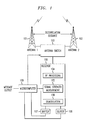
- FIG. 1 is a schematic of an exemplary receiver using two antennas to achieve spatial diversity; and
- FIG. 2 is a graph of control protocol frames used in an exemplary transmission media.
-
- In an examplary two-antenna, one-receiver embodiment as shown in Figure 1, receiver (100) is connected to antennas (101 and 102) by an RF switch (103). The receiver consists of a conventional analog RF processing (104), signal strength measurement (105) and digital demodulation (106) facilities. The digital output of the receiver, consisting of message symbols and associated signal strength values, is connected to a buffer memory arrays (107 and 108). Control of
RF switch 103 is accomplished with the aid of microcomputer (109) which executes a stored program implementing the MAC protocol. Based on the state of the protocol, the RF switch control will be operated in the conventional mode (switching based on an RF signal strength quality metric as described above), or in the multiple burst mode (where it is switched to ensure that a particular burst is received by a particular antenna. - For the purposes of this example, the base station will be assumed to have at least combinational diversity reception, and may also support transmit diversity. In operation, the method works as follows: Operating in the conventional switched-diversity mode, the client receiver has acquired the RF channel and has selected an antenna which is delivering acceptable signal strength. By receiving the channel for a period of time, the receiver has allowed the MAC microprocessor to synchronize with the base station transmissions and to cooperate according to protocol rules for channel access. The MAC communicates to the base station that its hardware configuration supports switched-diversity QoS improvement as part of its session-access preamble, during which it requests a specific stream QoS type. Ordinarily, the switched-diversity QoS option would be engaged only for high-priority traffic in a priority-based scheduling system, or for the traffic requiring the highest end-to-end QoS performance in a parameter-based system. The balance of the example will assume that the "parameterized-QoS" mode is used (see Figure 2).
- The QoS mode illustrated in Figure 2 uses a protocol set of a proposed 802.11e standard. In this protocol set, a station (STA/client) communicating with an access port (AP) may only use the wireless transmission medium during specified periods of time. These specified periods of time include Contention Free Periods (CFPs), Controlled Contention intervals (CCI) and Resource Reservation (RR) frames and Contention Control (CC) frames. A controller grants the transmission medium for use by RR frames by transmitting a CC frame. Only RR frames are transmitted during a time period specified by the CCI frame. The RR frames define the needed Bandwidth of the designated QoS. The CC frames designate parameter for the CCI. Further details of this procedure are contained in the 802.11 proposal of the IEEE.
- When the base station determines that downlink (to the client) traffic has arrived from the network, it schedules a series of burst transmissions (in this example, two). The base station initiates message transmission by issuing a polling request, followed by the first packet burst. The first burst, containing the message, will be received exclusively on the antenna which has been in use (the RF switch remains set for the duration of the burst). While the burst is being received, the receiver's output (soft symbols and signal strength values) is stored sequentially in
buffer 107. At the conclusion of the base station's transmission, the client transmits a polling response, followed by any uplink (to the base station) traffic it may have to send. The microprocessor, which has been adhering the protocol, immediately causes the RF switch to connect the alternate antenna to the receiver, in preparation for reception of the second burst, containing the same message. At some later moment in the current superframe or a subsequent superframe, the base station transmits a second polling request and the second packet burst. This burst is received exclusively using the second antenna; the receiver output is similarly stored sequentially inbuffer 108. - Following receipt of the second burst, the microcomputer extracts the first symbol of the first burst from
buffer 107 with its corresponding signal strength value. Likewise, it extracts the first symbol of the second burst frombuffer 108, with its corresponding signal strength value. Using a combination of symbol decoding, error correction decoding, and combining based on the signal strength metric, the desired message is extracted. Techniques such as Maximal Ratio Combining (MRC), well known to those skilled in the art, could be used for this purpose. - Since the method uses implicit time-displaced redundancy in cooperation with antenna diversity, the quality of the recovered message is comparable to conventional combinational diversity if the channel is stationary during the interval which includes both bursts and the bursts contain exactly the same information. If the channel is not stationary over this interval, the method produces a form of space-time spreading, which may provide improvement over combinational diversity methods.
- Using identical (duplicated) transmission in the bursts uses twice the radio resource than would be required with a combinational diversity system. For time-bound (fixed duration) material which uses relatively short packets (e.g. digital voice), this increase in resource usage would undoubtedly be an acceptable trade-off for increased quality and hardware simplicity. For high throughput (large packet) traffic, total redundancy of packets may constitute unacceptable overhead. Accordingly, by use of appropriate coding techniques (e.g. space-time codes) it is possible to trade off quality improvement for radio resource usage by partially or completely spreading the message across the bursts. Such a strategy allows flexibility between BER improvement and channel occupancy. Space-time codes may be used for improving performance in a wireless environment and when combined with protocol switched diversity significantly improves transmission efficiency over that of the protocol switched diversity alone.
- Additions to the invention may include adding an ability of the system to communicate from a terminating end to a transmitter to specify the receiver capability to perform protocol assisted diversity operation and include the number of antennas and radio receivers that the terminating end has.
- In another arrangement, the receiving end may notify a transmitting end promptly if a message is successfully received, allowing reconstructing of the transmitted message, before a subsequent burst is received. This allows action to cease further transmission of bursts related to this particular message thereby resulting in a conserving of radio resources in the system.
- Those skilled in the art may devise many variations of these schemes without departing from the spirit and scope of the invention. A hybrid architecture consisting of switched-diversity and combinational diversity elements may be used (e.g. four antennas, a 4x4 switch matrix, and two receivers) to provide significantly improved performance over conventional two-branch combinational diversity.
Claims (21)
- A radio receiver comprising
first and second antennas connected to RF processing circuitry by an RF switch;an RF switch control switched incrementally in response to a sequence of scheduled packet bursts. - The radio receiver of claim 1, wherein:the RF switch control schedules sequence bursts prescribed by a QoS defined by a MAC protocol.
- The radio receiver of claim 2, wherein:a MAC processor is synchronized with transmission of a base station.
- The radio receiver of claim 1, wherein:the antennas are switched so that each antenna receives a related packet burst.
- A method of maintaining a controlled QoS in a wireless communication system, comprising steps of:receiving communications from a transceiver at a transmission station by wireless transceivers at receiving stations having switched protocol diversity reception operational modes;communications being formatted as multiple packet bursts;enabling a first antenna to receive a first packet burst;enabling a second antenna to receive a second packet burst;recording the received bursts as soft information in a storage medium;combining the soft information from the first and second bursts into a single message.
- The method of claim 5 wherein:each packet burst contains a same complete message.
- The method of claim 5 wherein:each packet burst contains a portion of a space-time coded message spread across the first and second packet bursts.
- A method of achieving a QoS control in a wireless LAN communication system, comprising steps of:transmitting a message contained within a plurality of packet bursts occurring at spaced time intervals;receiving the packet burst individually at a plurality of antennas.
- The method of claim 8 wherein;each of the plurality of the antennas is connected to a radio receiver at separate times relative to other receiving antennas.
- The method of claim 8, wherein:including a complete message within each packet burst.
- The method of claim 8 wherein:a message is spread across the plurality of packet bursts by space-time coding.
- The method of claim 8 wherein:the process of signal transmitting combines a protocol with signal processing.
- A communication system for coupling a transmitter and a receiver adapted for receiving at least first and second signal bursts by first and second antennas respectively, and responding to the two signal bursts to communicate a single unified message at the receiver; whereby:the first and second signal bursts are sequentially separated in time;the first and second antennas are sequentially enabled to communicate to storage at the receiver;enabling a representation of the unified message by responding to the first and second signals.
- The communication system of claim 13, wherein:the first and second signal bursts are identical packets of a common message.
- The communication system of claim 13, wherein:the first and second signal bursts are each a part of a space-time coded message spread across two bursts; anda common message is derived from the sequential signal bursts received by the first and second antennas.
- The communication system of claim 13, wherein:enabling includes retaining the first and second signal bursts in a storage medium and processing to deliver the single unified message.
- The communication system of claim 13, wherein:deriving the common message includes selecting a message from one of the receiving antennas.
- The communication system of claim 13, wherein:deriving the common message includes decoding a space-time coded signal spread across and received by both the first and second antennas.
- The method of claim 8, including a further step of:notifying a transmitter at a transmitting end by a receiving end of the number of antennas and radio receivers at the receiving end.
- The method of claim 8, including a further step of:a receiver notifying a transmitter that it accepts and responds to protocol-assisted diversity operations.
- The method of claim 8, including a further step of:upon reconstruction of a received message sending a message to the transmitting end to cease further message bursts.
Applications Claiming Priority (2)
| Application Number | Priority Date | Filing Date | Title |
|---|---|---|---|
| US09/989,779 US8090381B2 (en) | 2001-11-20 | 2001-11-20 | Protocol assisted switched diversity of antennas |
| US989779 | 2001-11-20 |
Publications (1)
| Publication Number | Publication Date |
|---|---|
| EP1315325A1 true EP1315325A1 (en) | 2003-05-28 |
Family
ID=25535451
Family Applications (1)
| Application Number | Title | Priority Date | Filing Date |
|---|---|---|---|
| EP02102576A Ceased EP1315325A1 (en) | 2001-11-20 | 2002-11-14 | Scheduled switching in antenna diversity receivers |
Country Status (3)
| Country | Link |
|---|---|
| US (1) | US8090381B2 (en) |
| EP (1) | EP1315325A1 (en) |
| CA (1) | CA2411725C (en) |
Cited By (2)
| Publication number | Priority date | Publication date | Assignee | Title |
|---|---|---|---|---|
| WO2006094786A1 (en) * | 2005-03-09 | 2006-09-14 | Fraunhofer-Gesellschaft zur Förderung der angewandten Forschung e.V. | Protocol controlled antenna selection |
| US11984963B2 (en) | 2018-12-11 | 2024-05-14 | Nordic Semiconductor Asa | Radio devices with switchable antennas |
Families Citing this family (9)
| Publication number | Priority date | Publication date | Assignee | Title |
|---|---|---|---|---|
| US7336679B2 (en) * | 2002-03-15 | 2008-02-26 | Hughes Electronic Corporation | Method and system for providing differentiated quality of service diversity ALOHA |
| US20040204105A1 (en) * | 2002-05-24 | 2004-10-14 | Ying-Chang Liang | Method and apparatus for a base station with multiple distributed antennas to communicate with mobile stations |
| US7333787B2 (en) * | 2003-09-22 | 2008-02-19 | Tarang Luthra | Reducing interference in high speed home network using signal processing |
| US20050141495A1 (en) * | 2003-12-30 | 2005-06-30 | Lin Xintian E. | Filling the space-time channels in SDMA |
| DE102007058258A1 (en) * | 2007-11-26 | 2009-06-10 | Pilz Gmbh. & Co. Kg | Device and method for wireless networking of automation technology devices |
| US8520625B2 (en) | 2009-05-27 | 2013-08-27 | At&T Intellctual Property I, L.P. | Transmit antenna subset selection for retransmission |
| GB201218865D0 (en) * | 2012-10-19 | 2012-12-05 | Renesas Mobile Corp | Methods, devices and computer program products improving mobile communication |
| US9237581B2 (en) * | 2013-03-14 | 2016-01-12 | Cavium, Inc. | Apparatus and method for media access control scheduling with a sort hardware coprocessor |
| US9706564B2 (en) | 2013-03-14 | 2017-07-11 | Cavium, Inc. | Apparatus and method for media access control scheduling with a priority calculation hardware coprocessor |
Citations (1)
| Publication number | Priority date | Publication date | Assignee | Title |
|---|---|---|---|---|
| EP0740430A2 (en) * | 1995-04-27 | 1996-10-30 | Sharp Kabushiki Kaisha | Diversity radio communication system |
Family Cites Families (12)
| Publication number | Priority date | Publication date | Assignee | Title |
|---|---|---|---|---|
| JPH08321785A (en) * | 1995-05-24 | 1996-12-03 | Sony Corp | Transmitter, receiver, transmitting method, receiving method and transmitting method |
| US6560443B1 (en) * | 1999-05-28 | 2003-05-06 | Nokia Corporation | Antenna sharing switching circuitry for multi-transceiver mobile terminal and method therefor |
| US6363062B1 (en) * | 1999-06-08 | 2002-03-26 | Caly Corporation | Communications protocol for packet data particularly in mesh topology wireless networks |
| JP3458772B2 (en) * | 1999-06-30 | 2003-10-20 | 日本電気株式会社 | Digital multiplex receiving apparatus and receiving method |
| FI19991940A7 (en) * | 1999-09-10 | 2001-03-11 | Nokia Corp | Broadcast diversity |
| JP3581282B2 (en) * | 1999-09-17 | 2004-10-27 | 松下電器産業株式会社 | Base station apparatus and antenna control method |
| US7248841B2 (en) * | 2000-06-13 | 2007-07-24 | Agee Brian G | Method and apparatus for optimization of wireless multipoint electromagnetic communication networks |
| AU2001284723A1 (en) * | 2000-08-03 | 2002-02-18 | Morphics Technology, Inc. | Dynamically reconfigurable universal transmitter system |
| US6891810B2 (en) * | 2001-01-19 | 2005-05-10 | Raze Technologies, Inc. | Wireless access system and associated method using multiple modulation formats in TDD frames according to subscriber service type |
| US6751480B2 (en) * | 2000-12-01 | 2004-06-15 | Lucent Technologies Inc. | Method for simultaneously conveying information to multiple mobiles with multiple antennas |
| US20030012308A1 (en) * | 2001-06-13 | 2003-01-16 | Sampath Hemanth T. | Adaptive channel estimation for wireless systems |
| US7937052B2 (en) * | 2006-06-27 | 2011-05-03 | Cisco Technology, Inc. | Multiple input multiple output signal receiving apparatus with optimized performance |
-
2001
- 2001-11-20 US US09/989,779 patent/US8090381B2/en not_active Expired - Fee Related
-
2002
- 2002-11-13 CA CA2411725A patent/CA2411725C/en not_active Expired - Fee Related
- 2002-11-14 EP EP02102576A patent/EP1315325A1/en not_active Ceased
Patent Citations (1)
| Publication number | Priority date | Publication date | Assignee | Title |
|---|---|---|---|---|
| EP0740430A2 (en) * | 1995-04-27 | 1996-10-30 | Sharp Kabushiki Kaisha | Diversity radio communication system |
Non-Patent Citations (1)
| Title |
|---|
| "IMPROVED TIME-DIVERSITY METHODS FOR DIGITAL CELLULAR TELEPHONE RECEIVERS", RESEARCH DISCLOSURE, KENNETH MASON PUBLICATIONS, HAMPSHIRE, GB, no. 424, August 1999 (1999-08-01), pages 1024, XP000889044, ISSN: 0374-4353 * |
Cited By (3)
| Publication number | Priority date | Publication date | Assignee | Title |
|---|---|---|---|---|
| WO2006094786A1 (en) * | 2005-03-09 | 2006-09-14 | Fraunhofer-Gesellschaft zur Förderung der angewandten Forschung e.V. | Protocol controlled antenna selection |
| US8078108B2 (en) | 2005-03-09 | 2011-12-13 | Fraunhofer-Gesellschaft Zur Foerderung Der Angewandten Forschung E.V. | Protocol-controlled antenna selection |
| US11984963B2 (en) | 2018-12-11 | 2024-05-14 | Nordic Semiconductor Asa | Radio devices with switchable antennas |
Also Published As
| Publication number | Publication date |
|---|---|
| US20030096617A1 (en) | 2003-05-22 |
| CA2411725A1 (en) | 2003-05-20 |
| CA2411725C (en) | 2011-01-11 |
| US8090381B2 (en) | 2012-01-03 |
Similar Documents
| Publication | Publication Date | Title |
|---|---|---|
| US10771199B2 (en) | Methods and apparatus for reverse link acknowledgement in a wireless local area network (WLAN) | |
| US7606182B2 (en) | Cooperative relay transmission method for a wireless communication system | |
| US6862456B2 (en) | Systems and methods for improving range for multicast wireless communication | |
| KR101500973B1 (en) | Enhanced multi-user transmission | |
| JP5905914B2 (en) | Method and apparatus for cooperative wireless communication (COOPERATING WIRELESS COMMUNICATIONS) | |
| JP4229705B2 (en) | Wireless communication system | |
| TWI330043B (en) | Mimo wlan system and method of transmitting signaling information in the same | |
| US7406060B2 (en) | Coverage improvement in wireless systems with fixed infrastructure based relays | |
| JP2022500908A (en) | Communication technique | |
| US20060056345A1 (en) | Method and system for supporting use of a smart antenna in a wireless local area network | |
| CN101273543A (en) | Method of Selecting Antenna and Beam in Multiple-Input Multiple-Output Wireless Local Area Network | |
| JP2011518500A (en) | Method and apparatus for delayed block acknowledgment in a wireless local area network (WLAN) | |
| US20160270049A1 (en) | Method and Apparatus for Providing an Efficient Control Channel Structure in a Wireless Communication System | |
| US20100146358A1 (en) | Method and Arrangement Relating to Communications Network | |
| US8090381B2 (en) | Protocol assisted switched diversity of antennas | |
| US8737455B2 (en) | Method of selecting antennas in a wireless communicating network for high reliability and low latency | |
| Realp et al. | A cross-layer approach to multi-user diversity in heterogeneous wireless systems | |
| EP1349328A1 (en) | Data transfer method | |
| Perahia | High Throughput Enhancement to Wireless LANs | |
| Realp et al. | Heterogeneous Wireless Systems | |
| HK1184605A (en) | Methods and apparatus for reverse link acknowledgement in a wireless local area network (wlan) | |
| HK1184605B (en) | Methods and apparatus for reverse link acknowledgement in a wireless local area network (wlan) |
Legal Events
| Date | Code | Title | Description |
|---|---|---|---|
| PUAI | Public reference made under article 153(3) epc to a published international application that has entered the european phase |
Free format text: ORIGINAL CODE: 0009012 |
|
| AK | Designated contracting states |
Designated state(s): AT BE BG CH CY CZ DE DK EE ES FI FR GB GR IE IT LI LU MC NL PT SE SK TR |
|
| AX | Request for extension of the european patent |
Extension state: AL LT LV MK RO SI |
|
| 17P | Request for examination filed |
Effective date: 20030617 |
|
| AKX | Designation fees paid |
Designated state(s): DE GB |
|
| 17Q | First examination report despatched |
Effective date: 20040129 |
|
| STAA | Information on the status of an ep patent application or granted ep patent |
Free format text: STATUS: THE APPLICATION HAS BEEN REFUSED |
|
| 18R | Application refused |
Effective date: 20070216 |