EP1315312A2 - Radio base station and method of controlling radio communications - Google Patents
Radio base station and method of controlling radio communications Download PDFInfo
- Publication number
- EP1315312A2 EP1315312A2 EP02023616A EP02023616A EP1315312A2 EP 1315312 A2 EP1315312 A2 EP 1315312A2 EP 02023616 A EP02023616 A EP 02023616A EP 02023616 A EP02023616 A EP 02023616A EP 1315312 A2 EP1315312 A2 EP 1315312A2
- Authority
- EP
- European Patent Office
- Prior art keywords
- time slot
- transmit diversity
- base station
- downlink time
- radio base
- Prior art date
- Legal status (The legal status is an assumption and is not a legal conclusion. Google has not performed a legal analysis and makes no representation as to the accuracy of the status listed.)
- Granted
Links
Images




Classifications
-
- H—ELECTRICITY
- H04—ELECTRIC COMMUNICATION TECHNIQUE
- H04B—TRANSMISSION
- H04B7/00—Radio transmission systems, i.e. using radiation field
- H04B7/02—Diversity systems; Multi-antenna system, i.e. transmission or reception using multiple antennas
- H04B7/04—Diversity systems; Multi-antenna system, i.e. transmission or reception using multiple antennas using two or more spaced independent antennas
- H04B7/06—Diversity systems; Multi-antenna system, i.e. transmission or reception using multiple antennas using two or more spaced independent antennas at the transmitting station
- H04B7/0613—Diversity systems; Multi-antenna system, i.e. transmission or reception using multiple antennas using two or more spaced independent antennas at the transmitting station using simultaneous transmission
Definitions
- the present invention relates to a radio base station and a method of controlling radio communications. More particularly, the present invention relates to a radio base station and a method of controlling radio communications which use transmit diversity in IMT-2000 CDMA TDD systems.
- Fading typically occurs in radio communications, greatly degrading transmission quality, that is, bit error rate characteristics.
- Transmit diversity is a known method for compensating such degradation of transmission quality due to fading.
- Downlink transmit diversity a kind of transmit diversity, will be described below.
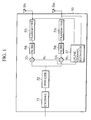
- FIG. 1 partially illustrates the configuration of a radio base station 50 using a conventional downlink transmit diversity.
- FIG.1 illustrates functions relating to data transmission.
- the radio base station 50 includes, as shown in FIG. 1, an encoder 51, a spreader 52, weighting units 53 1 and 53 2 , filters 54 1 and 54 2 , transmitters 55 1 and 55 2 , antennas 56 1 and 56 2 , and an uplink channel estimator 57.
- the encoder 51 is connected to the spreader 52, encoding and interleaving data to be transmitted (hereinafter referred to as transmission data) under a predetermined scheme and transmitting the encoded and interleaved transmission data to the spreader 52.
- the spreader 52 is connected to the encoder 51 and the weighting units 53 1 and 53 2 , spreading and scrambling transmission data received from the encoder 51 under a predetermined scheme and transmitting the spread and scrambled transmission data to the weighting units 53 1 and 53 2 .
- the weighting units 53 1 and 53 2 are connected to the spreader 52, the filters 54 1 and 54 2 , and the uplink channel estimator 57, and weighting (e.g., multiplying) transmission data received from the spreader 52 by weighting factors W1 and W2 received from the uplink channel estimator 57.
- the weighting units 53 1 and 53 2 transmit the weighted transmission data to the filters 54 1 and 54 2 .
- the filters 54 1 and 54 2 are connected to the weighting units 53 1 and 53 2 and the transmitters 55 1 and 55 2 , filtering transmission data received from the weighting units 53 1 and 53 2 and transmitting the filtered transmission data to the transmitters 55 1 and 55 2 .
- the transmitters 55 1 and 55 2 are connected to the filters 54 1 and 54 2 and the antennas 56 1 and 56 2 , transmitting transmission data received from the filters 54 1 and 54 2 via radio lines with predetermined carrier frequencies, in cooperation with the antennas 56 1 and 56 2 .
- the uplink channel estimator 57 is connected to the weighting units 53 1 and 53 2 and the antennas 56 1 and 56 2 , monitoring uplink radio communications channels (e.g., time slots, spread codes or carrier frequencies) set for the antennas 56 1 and 56 2 , thereby estimating (performing channel estimation) the status of the uplink radio communications channels (e.g., waveform distortion, delay fluctuation, amplitude fluctuation and phase lag), determining the weighting factors W1 and W2 based on the channel estimation, and transmitting the determined weighting factors W1 and W2 to the weighting units 53 1 and 53 2 .
- uplink radio communications channels e.g., time slots, spread codes or carrier frequencies
- the status of the uplink radio communications channels e.g., waveform distortion, delay fluctuation, amplitude fluctuation and phase lag
- STD selective transmit diversity
- a kind of downlink transmit diversity for example, uses “1" or “0” as the weighting factor W1 and correspondingly "0" or “1” as the weighting factor W2.
- transmission data is transmitted only via either a first transmission line consisting of the filter 54 1 , transmitter 55 1 and antenna 56 1 or a second transmission line consisting of the filter 54 2 , transmitter 55 2 and antenna 56 2 .
- TxAA Transmission Adaptive Array
- TxAA Transmission Adaptive Array
- FIGS. 2(a) and 2(b) illustrate time slot configurations used in IMT-2000 CDMA TDD radio communications channels.
- a plurality of users can share a single time slot using a code division multiple system, and a single user (mobile terminal) can occupy a plurality of time slots.
- the uplink channel estimator 57 causes down link time slot #3 to reflect the channel estimation of uplink time slot #2 and causes downlink time slot #5 to reflect the channel estimation of uplink time slot #4, thus controlling the downlink transmit diversity based on the channel estimation of the immediately preceding uplink time slots.
- the uplink channel estimator 57 controls the downlink transmit diversity so that the channel estimation of uplink time slot #2 is reflected by all subsequent time slots (#3 to #15).
- a radio base station and a method of controlling radio communications using the conventional downlink transmit diversity when a plurality of users (mobile terminals) share a single time slot using a code division multiple system, radio communications are simultaneously performed between a plurality of antennas and all users (mobile terminals) sharing the single time slot. Therefore the radio base station and the method of controlling radio communications using the conventional downlink transmit diversity may result in any greatly increased degree of interference signals from other users (mobile terminals) which need to be eliminated and the degradation of transmission quality.
- An object of the present invention is to provide a radio base station and a method of controlling radio communications using the conventional downlink transmit diversity, which can compensate for the degradation of transmission quality in radio communications even when a plurality of users (mobile terminals) share a single time slot using a code division multiple system.
- a radio base station which comprises: a channel estimator configured to perform channel estimation of an uplink time slot; a transmit diversity controller configured to control the transmit diversity used for each downlink time slot based on said channel estimation and the number of users sharing the downlink time slot when using a code division multiple system; and a data transmitter configured to transmit data via the downlink time slot using the controlled transmit diversity.
- the transmit diversity controller preferably further controls the transmit diversity used for each downlink time slot based on the time difference from the instant of said channel estimation
- the transmit diversity controller preferably further determines whether or not to use the transmit diversity for each downlink time slot.
- the transmit diversity controller preferably further determines a kind of the transmit diversity used for each downlink time slot.
- a method of controlling radio communications which comprises the steps of: a) performing, at a radio base station, channel estimation of an uplink time slot; b) controlling, at a radio base station, the transmit diversity used for each downlink time slot based on said channel estimation and the number of users sharing the downlink time slot when using a code division multiple system; and c) transmitting, at the radio base station, data in the downlink time slot when using the controlled transmit diversity.
- the radio base station preferably further controls the transmit diversity used for each downlink time slot based on the time difference from the instant of said channel estimation.
- step b) it is preferably determined whether or not to use the transmit diversity for each downlink time slot.
- a kind of the transmit diversity used is determined for each downlink time slot.
- FIG. 3 is a diagram illustrating the general configuration of a radio base station 10 according to this embodiment.
- the radio base station 10 of this embodiment transmits transmission data to radio information terminals (mobile terminals) via radio communications channels.
- the radio base station 10 includes, as shown in FIG. 3, an encoder 11, a spreader 12, a distributor 13, a downlink (DL) time slot diversity controller 14, a transmission processor 15, and an uplink channel estimator 16.
- the encoder 11 and the spreader 12 have the same functions as those of the encoder 51 and the spreader 52 of the conventional radio base station 50.
- the encoder 11 is connected to the spreader 12.
- the spreader 12 is connected to the encoder 11 and the distributor 13.
- the distributor 13 is connected to the spreader 12 and the downlink time slot diversity controller 14, dividing transmission data received from the spreader 12 into downlink (DL) time slots (DL#1 to DL#N) and transmitting the respective divided transmission data of the time slots (DL#1 to DL#N) to the corresponding first to Nth downlink (DL) time slot diversity controllers 14 1 to 14 N .
- the distributor 13 transmits the number of users sharing each of downlink (DL) time slots (DL#1 to DL#N) to the corresponding first to Nth downlink (DL) time slot diversity controllers 14 1 to 14 N .
- the downlink time slot diversity controller 14 is connected to the distributor 13, the transmission processor 15 and the uplink channel estimator 16, including the first to Nth downlink time slot diversity controllers 14 1 to 14 N ,corresponding to the downlink time slots (DL#1 to DL#N).
- the first to Nth downlink time slot diversity controllers 14 1 to 14 N determines whether or not to use the transmit diversity, and determine which transmit diversity to use (a kind of transmit diversity) for the corresponding downlink time slots (DL#1 to DL#N) based on the channel estimation of uplink channels performed by the uplink channel estimator 16 and the number of the users transmitted from the distributor 13, thereby performing diversity control.
- the transmit diversity used here includes, for example, downlink transmit diversity (such as STD and TxAA).
- the first to Nth downlink time slot diversity controllers 14 1 to 14 N constitute a transmit diversity controller for controlling the transmit diversity used for each of the downlink time slots DL#1 to DL#N.
- the third downlink time slot diversity controller 14 3 may determine the nonuse of the transmit diversity (or the use of STD) for DL#3, and the fifth downlink time slot diversity controller 14 5 may determine the use of TxAA for DL#5.
- the third downlink time slot diversity controller 14 3 may determine the nonuse of the transmit diversity (or the use of STD) for DL#3, and the fifth downlink time slot diversity controller 14 5 may determine the use of TxAA for DL#5.
- the transmission processor 15 is connected to the downlink time slot diversity controller 14 and the uplink channel estimator 16, processing transmission data received from the downlink time slot diversity controller 14 in accordance with the transmit diversity determined by the downlink time slot diversity controller 14 (e.g., selecting a transmission line or weighting each transmission line), performing filtering as required, and transmitting the processed transmission data via antennas 15 a1 and/or 15 a2 .
- the transmission processor 15 constitutes a data transmitter for transmitting data with the downlink time slots DL#1 to DL#N, using the controlled transmit diversity.
- the uplink channel estimator 16 is connected to the downlink time slot diversity controller 14 and the antenna 15 a1 and 15 a2 , monitoring uplink radio communications channels set for the antenna 15 a1 and 15 a2 , estimating the status of the uplink radio communications channels (such as waveform distortion, delay fluctuation, amplitude fluctuation, and phase log) (performing channel estimation), and transmitting the channel estimation to the downlink time slot diversity controller 14.
- the uplink channel estimator 16 constitutes a channel estimator for performing channel estimation of uplink time slots UL#1 to UL#N.
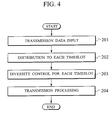
- FIG. 4 is a flowchart illustrating the operation of the radio base station 10 for transmitting received transmission data via radio communications channels.
- transmission data to be transmitted via radio communications channels is supplied to the encoder 11.
- the encoder 11 encodes and interleaves the supplied transmission data and transmits the transmission data to the spreader 12.
- the spreader 12 spreads and scrambles the transmission data and transmits the transmission data to the distributor 13.
- the distributor 13 divides the transmission data received from the spreader 12 into each of the down link time slots (DL#1 to DL#N) and transmits the respective divided transmission data of the time slots (DL#1 to DL#N) to the corresponding first to Nth downlink time slot diversity controllers 14 1 to 14 N .
- the first to Nth downlink time slot diversity controllers 14 1 and 14 N determine whether or not to use the transmit diversity for the corresponding downlink time slots (DL#1 to DL#N) or determine which transmit diversity to use based on the channel estimation of the uplink channels performed transmitted from the uplink channel estimator 16 and the number of the users transmitted from the distributor 13, thereby performing diversity control.
- the transmission processor 15 processes the transmission data received from the downlink time slot diversity controller 14 in accordance with the transmit diversity determined by the downlink time slot diversity controller 14 (e.g., selects a transmission line or weights each transmission line), performs filtering as required, and transmits the processed transmission data via the antennas 15 a1 and 15 a2 .
- the radio base station 10 has the first to Nth downlink time slot diversity controllers 14 1 and 14 2 which control the transmit diversity used for the respective downlink time slots (DL#1 to DL#N) based on the number of users sharing the downlink time slots (DL#1 to DL#N). Therefore the radio base station 10 according to this embodiment controls the determination of the nonuse of the transmit diversity when a plurality of users (mobile terminals) a single time when slot using a code division multiple system, thus preventing any greatly increased degree of interference signals from other users (mobile terminals) which need to be eliminated and the degradation of downlink transmission quality.
- the present invention is not limited to the above embodiment, and may have a threshold data comparator 27 provided between a distributor 23 and a downlink time slot diversity controller 24 as shown in FIG. 5.
- the threshold data comparator 27 measures time differences between each of downlink time slots (DL#1 to DL#N) and a time slot on which channel estimation is performed, and compares the time differences found by the measurements with a time difference as predetermined threshold data.
- the threshold data comparator 27 transmits the comparison results to corresponding first to Nth downlink time slot diversity controllers 24 1 to 24 N .
- the first to Nth downlink time slot diversity controllers 24 1 to 24 N determine whether or not to use the transmit diversity for the corresponding downlink time slots (DL#1 to DL#N), and determine which transmit diversity to use based on the channel estimation of the uplink channels by an uplink channel estimator 26, the number of the users transmitted from the distributor 23 and the comparison results received from the threshold data comparator 27, thereby performing diversity control.
- Transmit diversity used here includes downlink transmit diversity (such as STD and TxAA), for example.
- the first to Nth downlink time slot diversity controllers 24 1 to 24 N constitute a transmit diversity controller for controlling the transmit diversity used for each of the downlink time slots DL#1 to DL#N.
- the third to forth downlink time slot diversity controllers 24 3 to 24 4 may determine the use of TxAA for DL#3 to DL#4 which are time slots not exceeding a time difference as predetermined threshold data (e.g., four time slots) and occupied by a single user (mobile terminal).
- the fifth to fifteenth downlink time slot diversity controllers 24 5 to 24 15 may determine the use of STD (or the nonuse of the transmit diversity) for DL#5 to DL#15.
- FIG. 6 is a flowchart illustrating the operation of the radio base station 20 for transmitting received transmission data via radio communications channels.
- transmission data to be transmitted via radio communications channels is supplied to an encoder 21.
- the encoder 21 encodes and interleaves the supplied transmission data and transmits the transmission data to a spreader 22.
- the spreader 22 spreads and scrambles the transmission data and transmits the transmission data to the distributor 23.
- the distributor 23 divides the transmission data received from the spreader 12 into each of the downlink time slots (DL#1 to DL#N) and transmits the respective divided transmission data of the time slots (DL#1 to DL#N) to the corresponding first to Nth downlink time slot diversity controllers 24 1 to 24 N .
- the threshold data comparator 27 measures time differences between each of the downlink time slots (DL#1 to DL#N) and a time slot on which channel estimation is performed, and compares the time differences found by the measurements and a time difference as predetermined threshold data.
- the threshold data comparator 27 transmits the comparison results to the corresponding first to Nth downlink time slot diversity controllers 24 1 to 24 N .
- the first to Nth downlink time slot diversity controllers 24 1 to 24 N determine whether or not to use the transmit diversity, and determine which transmit diversity to use for the corresponding downlink time slots (DL#1 to DL#N), based on the channel estimation of uplink channels performed by the uplink channel estimator 26, the number of the users transmitted from the distributor 23 and the comparison results received from the threshold data comparator 27, thereby performing diversity control.
- a transmission processor 25 processes the transmission data received from the downlink time slot diversity controller 24 in accordance with the transmit diversity determined by the downlink time slot diversity controller 24 (e.g. , selects a transmission line or weights each transmission line), performs filtering as required, and transmits the processed transmission data via antennas 25 a1 and 25 a2 .
- the present invention can provide a radio base station and a method of controlling radio communications using the downlink transmit diversity, which can compensate for the degradation of transmission quality in radio communications even when a plurality of users (mobile terminals) share a single time slot using a code division multiple system.
Landscapes
- Engineering & Computer Science (AREA)
- Computer Networks & Wireless Communication (AREA)
- Signal Processing (AREA)
- Mobile Radio Communication Systems (AREA)
- Radio Transmission System (AREA)
- Time-Division Multiplex Systems (AREA)
Abstract
Description
Claims (8)
- A radio base station comprising:a channel estimator configured to perform channel estimation of an uplink time slot;a transmit diversity controller configured to control transmit diversity used for each downlink time slot based on said channel estimation and the number of users sharing the downlink time slot when using a code division multiple system; anda data transmitter configured to transmit data in said downlink time slot using said controlled transmit diversity.
- A radio base station as set forth in claim 1, wherein:said transmit diversity controller further controls the transmit diversity used for each downlink time slot based on the time difference from the instant of said channel estimation.
- A radio base station as set forth in claim 1, wherein:said transmit diversity controller determines whether or not to use the transmit diversity for each downlink time slot.
- A radio base station as set forth in claim 1, wherein:said transmit diversity controller determines a kind of the transmit diversity used for each downlink time slot.
- A method of controlling radio communications, comprising the steps of:a) performing, at a radio base station, channel estimation of an uplink time slot;b) controlling, at said radio base station, transmit diversity used for each downlink time slot based on said channel estimation and the number of users sharing the downlink time slot when using a code division multiple system; andc) transmitting, at said radio base station, data in said downlink time slot using said controlled transmit diversity.
- A method of controlling radio communications as set forth in claim 5, wherein:in said step b), said radio base station further controls the transmit diversity used for each downlink time slot based on the time difference from the instant of said channel estimation.
- A method of controlling radio communications as set forth in claim 5, wherein:in said step b), it is determined whether or not to use the transmit diversity for each downlink time slot.
- A method of controlling radio communications as set forth in claim 5, wherein:in said step b), a kind of the transmit diversity used is determined for each downlink time slot.
Applications Claiming Priority (2)
| Application Number | Priority Date | Filing Date | Title |
|---|---|---|---|
| JP2001328205A JP3975069B2 (en) | 2001-10-25 | 2001-10-25 | Radio base station and radio communication control method |
| JP2001328205 | 2001-10-25 |
Publications (3)
| Publication Number | Publication Date |
|---|---|
| EP1315312A2 true EP1315312A2 (en) | 2003-05-28 |
| EP1315312A3 EP1315312A3 (en) | 2003-08-13 |
| EP1315312B1 EP1315312B1 (en) | 2005-03-16 |
Family
ID=19144305
Family Applications (1)
| Application Number | Title | Priority Date | Filing Date |
|---|---|---|---|
| EP20020023616 Expired - Lifetime EP1315312B1 (en) | 2001-10-25 | 2002-10-18 | Radio base station and method of controlling radio communications |
Country Status (5)
| Country | Link |
|---|---|
| US (1) | US7342943B2 (en) |
| EP (1) | EP1315312B1 (en) |
| JP (1) | JP3975069B2 (en) |
| CN (1) | CN100405858C (en) |
| DE (1) | DE60203243T2 (en) |
Cited By (1)
| Publication number | Priority date | Publication date | Assignee | Title |
|---|---|---|---|---|
| CN101399587B (en) * | 2007-09-25 | 2012-08-29 | 展讯通信(上海)有限公司 | Base station transmission method and device in communication system |
Families Citing this family (12)
| Publication number | Priority date | Publication date | Assignee | Title |
|---|---|---|---|---|
| GB2394144B (en) * | 2002-10-10 | 2005-01-26 | Motorola Inc | Regulation of time intervals in a wireless communication system |
| KR101022066B1 (en) | 2003-05-17 | 2011-03-17 | 엘지전자 주식회사 | Downlink Control Channel Structure in Mobile Communication System and Time-Code Allocation Method Using the Same |
| US7643406B2 (en) * | 2004-12-06 | 2010-01-05 | Nextel Communications Company L.P. | System and method for enhancing capacity for a wireless communication system |
| EP1879334B1 (en) * | 2006-07-14 | 2009-08-26 | Research in Motion Limited | A method and apparatus for reducing link interference by a link between a user equipment component and an access network component |
| CN101146349B (en) * | 2006-12-18 | 2011-01-19 | 中兴通讯股份有限公司 | A system and method for improving throughput performance of forward supplementary channel |
| JP4976914B2 (en) * | 2007-05-01 | 2012-07-18 | 株式会社エヌ・ティ・ティ・ドコモ | Base station apparatus and communication control method |
| WO2009012448A2 (en) * | 2007-07-18 | 2009-01-22 | Marvell World Trade Ltd. | Wireless network with simultaneous uplink transmission of independent data from multiple client stations |
| CN101796740A (en) | 2007-09-06 | 2010-08-04 | 富士通株式会社 | Mobile Communication System Using Adaptive Multiple Antennas |
| CN101742539B (en) * | 2009-12-25 | 2012-06-27 | 国网信息通信有限公司 | Wireless resource allocation method and system |
| US8737506B1 (en) * | 2010-12-29 | 2014-05-27 | Sprint Communications Company L.P. | Determination of transmit diversity transmission delays |
| EP4030830A4 (en) * | 2019-10-10 | 2022-12-07 | Huawei Technologies Co., Ltd. | CHANNEL ESTIMATION METHOD AND APPARATUS |
| CN116709552A (en) * | 2022-12-13 | 2023-09-05 | 南京埃尔乔亿自控设备有限公司 | Intelligent micro base station fusion wireless communication system |
Family Cites Families (52)
| Publication number | Priority date | Publication date | Assignee | Title |
|---|---|---|---|---|
| US4679426A (en) * | 1985-09-09 | 1987-07-14 | Fuller Milton E | Wave shape chemical analysis apparatus and method |
| US4724427A (en) * | 1986-07-18 | 1988-02-09 | B. I. Incorporated | Transponder device |
| US5368948A (en) * | 1989-01-09 | 1994-11-29 | Esselte Meto International Produktions | Magnetic materials for security applications |
| US5025246A (en) * | 1990-04-10 | 1991-06-18 | Sensormatic Electronics Corporation | EAS tag with motion detection facility |
| DE4319878A1 (en) * | 1992-06-17 | 1993-12-23 | Micron Technology Inc | High frequency identification system card - has integrated circuit chip or carrier layer sealed by top layer and coupled to batteries and antenna system |
| ES2141194T3 (en) * | 1993-01-29 | 2000-03-16 | Becton Dickinson Co | COMPACT APPARATUS FOR BLOOD CULTIVATION. |
| JP3350163B2 (en) * | 1993-06-25 | 2002-11-25 | 株式会社カイノス | Extraction container holding transfer device |
| US6087186A (en) * | 1993-07-16 | 2000-07-11 | Irori | Methods and apparatus for synthesizing labeled combinatorial chemistry libraries |
| US5508203A (en) * | 1993-08-06 | 1996-04-16 | Fuller; Milton E. | Apparatus and method for radio frequency spectroscopy using spectral analysis |
| US5792668A (en) * | 1993-08-06 | 1998-08-11 | Solid State Farms, Inc. | Radio frequency spectral analysis for in-vitro or in-vivo environments |
| US5995950A (en) * | 1993-08-23 | 1999-11-30 | Pitney Bowes Inc. | Carrier management system having a capability to determine discounted shipping charges for groups of parcels having the same consignee |
| US5541604A (en) * | 1993-09-03 | 1996-07-30 | Texas Instruments Deutschland Gmbh | Transponders, Interrogators, systems and methods for elimination of interrogator synchronization requirement |
| US5479416A (en) * | 1993-09-30 | 1995-12-26 | Micron Technology, Inc. | Apparatus and method for error detection and correction in radio frequency identification device |
| JP2876517B2 (en) | 1994-02-16 | 1999-03-31 | 松下電器産業株式会社 | CDMA / TDD base station apparatus, CDMA / TDD mobile station apparatus, CDMA / TDD wireless communication system, and CDMA / TDD wireless communication method |
| US5529221A (en) * | 1994-05-16 | 1996-06-25 | Roy; Harold Van | Metered serving dispenser of granular materials |
| US5682143A (en) * | 1994-09-09 | 1997-10-28 | International Business Machines Corporation | Radio frequency identification tag |
| US5583819A (en) * | 1995-01-27 | 1996-12-10 | Single Chip Holdings, Inc. | Apparatus and method of use of radiofrequency identification tags |
| US6017496A (en) * | 1995-06-07 | 2000-01-25 | Irori | Matrices with memories and uses thereof |
| US5874214A (en) * | 1995-04-25 | 1999-02-23 | Irori | Remotely programmable matrices with memories |
| US5595531A (en) * | 1995-07-26 | 1997-01-21 | Ryobi North America | Random orbit sander having speed limiter |
| US6040773A (en) * | 1995-10-11 | 2000-03-21 | Motorola, Inc. | Radio frequency identification tag arranged for magnetically storing tag state information |
| GB9523583D0 (en) * | 1995-11-17 | 1996-01-17 | Merck Sharp & Dohme | Therapeutic agents |
| DE19543622C2 (en) * | 1995-11-23 | 1999-12-30 | Deutsche Telekom Ag | Method and device for the bidirectional transmission of high-rate digital signals |
| US5736332A (en) * | 1995-11-30 | 1998-04-07 | Mandecki; Wlodek | Method of determining the sequence of nucleic acids employing solid-phase particles carrying transponders |
| US5771657A (en) * | 1996-05-07 | 1998-06-30 | Merck Medco Managed Care, Inc. | Automatic prescription filling, sorting and packaging system |
| US5821524A (en) * | 1996-08-19 | 1998-10-13 | Pharmacopeia, Inc. | Method and apparatus for reading bar coded tubular members such as cylindrical vials |
| US5874896A (en) * | 1996-08-26 | 1999-02-23 | Palomar Technologies Corporation | Electronic anti-shoplifting system employing an RFID tag |
| US6049278A (en) * | 1997-03-24 | 2000-04-11 | Northrop Grumman Corporation | Monitor tag with patch antenna |
| US5981166A (en) * | 1997-04-23 | 1999-11-09 | Pharmaseq, Inc. | Screening of soluble chemical compounds for their pharmacological properties utilizing transponders |
| US5991282A (en) * | 1997-05-28 | 1999-11-23 | Telefonaktiebolaget Lm Ericsson | Radio communication system with diversity reception on a time-slot by time-slot basis |
| US6025780A (en) * | 1997-07-25 | 2000-02-15 | Checkpoint Systems, Inc. | RFID tags which are virtually activated and/or deactivated and apparatus and methods of using same in an electronic security system |
| US5961925A (en) * | 1997-09-22 | 1999-10-05 | Bristol-Myers Squibb Company | Apparatus for synthesis of multiple organic compounds with pinch valve block |
| US6002344A (en) * | 1997-11-21 | 1999-12-14 | Bandy; William R. | System and method for electronic inventory |
| JPH11275035A (en) | 1998-01-26 | 1999-10-08 | Matsushita Electric Ind Co Ltd | Mobile station communication device, base station communication device, and wireless communication system |
| JP3798549B2 (en) | 1998-03-18 | 2006-07-19 | 富士通株式会社 | Multi-beam antenna system for radio base station |
| US6040774A (en) * | 1998-05-27 | 2000-03-21 | Sarnoff Corporation | Locating system and method employing radio frequency tags |
| US6018299A (en) * | 1998-06-09 | 2000-01-25 | Motorola, Inc. | Radio frequency identification tag having a printed antenna and method |
| US5963136A (en) * | 1998-07-15 | 1999-10-05 | O'brien; Charles Terrence | Interactive prescription compliance and life safety system |
| AU5681099A (en) * | 1998-08-25 | 2000-03-14 | Ericsson Inc. | Wireless communications system employing selective diversity transmission, method for selectively enabling diversity transmission, and a wireless telecommunications network employing the system or the method |
| US6008727A (en) * | 1998-09-10 | 1999-12-28 | Xerox Corporation | Selectively enabled electronic tags |
| US5986562A (en) * | 1998-09-11 | 1999-11-16 | Brady Worldwide, Inc. | RFID tag holder for non-RFID tag |
| US6147604A (en) * | 1998-10-15 | 2000-11-14 | Intermec Ip Corporation | Wireless memory device |
| DE19850279B4 (en) * | 1998-10-30 | 2005-12-22 | Robert Bosch Gmbh | Method for the transmission of signals between a first radio station and a second radio station and radio station |
| JP3620779B2 (en) | 1998-12-28 | 2005-02-16 | 株式会社エヌ・ティ・ティ・ドコモ | Channel assignment device |
| US6804311B1 (en) * | 1999-04-08 | 2004-10-12 | Texas Instruments Incorporated | Diversity detection for WCDMA |
| US6151487A (en) * | 1999-08-31 | 2000-11-21 | Hughes Electronics Corporation | Demodulation structure for fast fading cellular channels |
| JP2001094487A (en) | 1999-09-22 | 2001-04-06 | Matsushita Electric Ind Co Ltd | Radio transmission apparatus and transmission diversity method |
| JP3663092B2 (en) | 1999-11-19 | 2005-06-22 | 三洋電機株式会社 | Wireless base station |
| DE10009150A1 (en) | 2000-02-26 | 2001-08-30 | Bosch Gmbh Robert | Data transmission method and system |
| US6711124B2 (en) * | 2001-05-25 | 2004-03-23 | Ericsson Inc. | Time interval based channel estimation with transmit diversity |
| JP2003087161A (en) * | 2001-09-06 | 2003-03-20 | Ntt Docomo Inc | Radio base station and radio communication control method |
| US7065131B2 (en) * | 2002-01-31 | 2006-06-20 | Intel Corporation | Processor and method for weight detection in a closed loop diversity mode WCDMA system |
-
2001
- 2001-10-25 JP JP2001328205A patent/JP3975069B2/en not_active Expired - Fee Related
-
2002
- 2002-10-18 EP EP20020023616 patent/EP1315312B1/en not_active Expired - Lifetime
- 2002-10-18 DE DE2002603243 patent/DE60203243T2/en not_active Expired - Lifetime
- 2002-10-23 CN CNB021460302A patent/CN100405858C/en not_active Expired - Fee Related
- 2002-10-24 US US10/279,079 patent/US7342943B2/en not_active Expired - Fee Related
Cited By (1)
| Publication number | Priority date | Publication date | Assignee | Title |
|---|---|---|---|---|
| CN101399587B (en) * | 2007-09-25 | 2012-08-29 | 展讯通信(上海)有限公司 | Base station transmission method and device in communication system |
Also Published As
| Publication number | Publication date |
|---|---|
| DE60203243T2 (en) | 2006-02-09 |
| EP1315312B1 (en) | 2005-03-16 |
| CN1414805A (en) | 2003-04-30 |
| US7342943B2 (en) | 2008-03-11 |
| US20030081574A1 (en) | 2003-05-01 |
| DE60203243D1 (en) | 2005-04-21 |
| CN100405858C (en) | 2008-07-23 |
| JP2003134035A (en) | 2003-05-09 |
| JP3975069B2 (en) | 2007-09-12 |
| EP1315312A3 (en) | 2003-08-13 |
Similar Documents
| Publication | Publication Date | Title |
|---|---|---|
| JP3404382B2 (en) | Transmission diversity method and system | |
| FI105368B (en) | Power control in mobile communication system | |
| JP5366346B2 (en) | Method for configuring a communication system | |
| KR100909973B1 (en) | Wireless communication system | |
| EP1388226B1 (en) | Channel quality measurements for downlink resource allocation | |
| RU2387082C2 (en) | Method and device for transmission in multi-antenna communication system | |
| KR101206402B1 (en) | Distributed antenna system and its data transmission method and central controller | |
| EP2057768B1 (en) | Efficient cqi signaling in multi-beam mimo systems | |
| US7342943B2 (en) | Radio base station and method of controlling radio communications | |
| US7688979B2 (en) | MIMO air interface utilizing dirty paper coding | |
| EP1185120A1 (en) | Base station apparatus and handover control method | |
| EP1547275A1 (en) | Packet data transmission in a mimo system | |
| WO1997008911A1 (en) | A handover method, and a cellular radio system | |
| WO2003049355A1 (en) | Communication using simultaneous orthogonal signals | |
| JPH08321785A (en) | Transmitter, receiver, transmitting method, receiving method and transmitting method | |
| EP1386421A1 (en) | Radio communication system | |
| US10412686B2 (en) | Radio communication system, method of operating a communication system, and a mobile station | |
| US6914889B1 (en) | Variable rate forward power control for multichannel applications | |
| EP1292049B1 (en) | Radio base station and method of controlling radio communications with transmit diversity | |
| US6396821B1 (en) | Radio communication apparatus of diversity transmission system | |
| EP0951759B1 (en) | Transmission method and radio system | |
| US20060035608A1 (en) | Method and system for using angular hopping in wireless communication systems | |
| CN1305666A (en) | Method and device for code division multiple access full-duplex wireless transmission system | |
| CN1303544A (en) | Method and radio station for signal transmission in radio communication system |
Legal Events
| Date | Code | Title | Description |
|---|---|---|---|
| PUAI | Public reference made under article 153(3) epc to a published international application that has entered the european phase |
Free format text: ORIGINAL CODE: 0009012 |
|
| 17P | Request for examination filed |
Effective date: 20021018 |
|
| AK | Designated contracting states |
Designated state(s): AT BE BG CH CY CZ DE DK EE ES FI FR GB GR IE IT LI LU MC NL PT SE SK TR |
|
| AX | Request for extension of the european patent |
Extension state: AL LT LV MK RO SI |
|
| PUAL | Search report despatched |
Free format text: ORIGINAL CODE: 0009013 |
|
| AK | Designated contracting states |
Designated state(s): AT BE BG CH CY CZ DE DK EE ES FI FR GB GR IE IT LI LU MC NL PT SE SK TR |
|
| AX | Request for extension of the european patent |
Extension state: AL LT LV MK RO SI |
|
| 17Q | First examination report despatched |
Effective date: 20031028 |
|
| AKX | Designation fees paid |
Designated state(s): DE GB |
|
| GRAP | Despatch of communication of intention to grant a patent |
Free format text: ORIGINAL CODE: EPIDOSNIGR1 |
|
| GRAS | Grant fee paid |
Free format text: ORIGINAL CODE: EPIDOSNIGR3 |
|
| GRAA | (expected) grant |
Free format text: ORIGINAL CODE: 0009210 |
|
| AK | Designated contracting states |
Kind code of ref document: B1 Designated state(s): DE GB |
|
| REG | Reference to a national code |
Ref country code: GB Ref legal event code: FG4D |
|
| REG | Reference to a national code |
Ref country code: IE Ref legal event code: FG4D |
|
| REF | Corresponds to: |
Ref document number: 60203243 Country of ref document: DE Date of ref document: 20050421 Kind code of ref document: P |
|
| PLBE | No opposition filed within time limit |
Free format text: ORIGINAL CODE: 0009261 |
|
| STAA | Information on the status of an ep patent application or granted ep patent |
Free format text: STATUS: NO OPPOSITION FILED WITHIN TIME LIMIT |
|
| 26N | No opposition filed |
Effective date: 20051219 |
|
| PGFP | Annual fee paid to national office [announced via postgrant information from national office to epo] |
Ref country code: DE Payment date: 20181002 Year of fee payment: 17 |
|
| PGFP | Annual fee paid to national office [announced via postgrant information from national office to epo] |
Ref country code: GB Payment date: 20181017 Year of fee payment: 17 |
|
| REG | Reference to a national code |
Ref country code: DE Ref legal event code: R119 Ref document number: 60203243 Country of ref document: DE |
|
| PG25 | Lapsed in a contracting state [announced via postgrant information from national office to epo] |
Ref country code: DE Free format text: LAPSE BECAUSE OF NON-PAYMENT OF DUE FEES Effective date: 20200501 |
|
| GBPC | Gb: european patent ceased through non-payment of renewal fee |
Effective date: 20191018 |
|
| PG25 | Lapsed in a contracting state [announced via postgrant information from national office to epo] |
Ref country code: GB Free format text: LAPSE BECAUSE OF NON-PAYMENT OF DUE FEES Effective date: 20191018 |