FIELD OF THE INVENTION
The present invention relates to a silver halide
photographic light-sensitive material. In particular, the
present invention relates to an ultrahigh contrast negative
type photographic light-sensitive material suitable as a silver
halide photographic light-sensitive material used for a
photomechanical process.
BACKGROUND OF THE INVENTION
In photomechanical processes used in the field of graphic
arts, used is a method in which photographic images of
continuous tone are converted into so-called dot images in which
variable image density is represented by sizes of dot areas,
and such images are combined with photographed images of
characters or line originals to produce printing plates. For
silver halide photographic light-sensitive materials used for
such a purpose, ultrahigh contrast photographic characteristic
enabling clear distinction between image portions and non-image
portions has been required in order to obtain favorable
reproducibility of characters, line originals and dot images.
As a system responding to such a requirement, there has
been known the so-called lithographic development method in
which a silver halide light-sensitive material comprising
silver chlorobromide is processed with a hydroquinone developer
having an extremely low effective concentration of sulfite ions
to form images of high contrast. However, in this method, the
developer is extremely unstable against oxidation by air since
the sulfite ion concentration in the developer is extremely low,
and therefore a lot of developer must be replenished in order
to stably maintain the developer activity.
As image forming systems in which the instability of the
image formation according to the lithographic development
method is eliminated and light-sensitive materials are
processed with a developer showing good storage stability to
obtain ultrahigh contrast photographic characteristic, there
can be mentioned those described in U.S. Patent Nos. 4,166,742,
4,168,977, 4,221,857, 4,224,401, 4,243,739, 4,269,922,
4,272,606, 4,311,781, 4,332,878, 4,618,574, 4,634,661,
4,681,836, 5,650,746 and so forth. These are systems in which
a silver halide photographic light-sensitive material of
surface latent image type containing a hydrazine derivative is
processed with a developer containing hydropuinone/metol
or hydroquinone/phenidone as main developing agents and
0.15 mol/l or more of sulfite preservative and having pH of
11.0-12.3 to form ultrahigh contrast negative images having a
gamma of 10 or higher. According to these systems , photographic
characteristics of ultrahigh contrast and high sensitivity can
be obtained, and because sulfite can be added to the developer
at a high concentration, stability of the developer to air
oxidation is markedly improved compared with conventional
lithographic developers.
In order to form sufficiently ultrahigh contrast images
with use of a hydrazine derivative, it is necessary to perform
processing with a developer having pH of 11 or higher, usually
11.5 or higher. Although it becomes possible to increase the
stability of the developer by use of a sulfite preservative at
a high concentration, it is necessary to use such a developer
of high pH as described above in order to obtain ultrahigh
contrast photographic images, and the developer is still likely
to suffer from air oxidation and instable even with the presence
of the preservative. Therefore, various attempts have been
made in order to realize ultrahigh images with a lower pH to
further improve stability of the developer.
For example, U.S. Patent Nos. 4,269,929 (Japanese Patent
Laid-open Publication (Kokai, henceforth referred to as "JP-A")
No. 61-267759), 4,737,452 (JP-A-60-179734) , 5,104,769,
4,798,780, JP-A-1-179939, JP-A-1-179940, U.S. Patent Nos.
4,998,604, 4,994,365 and JP-A-8-272023 disclose methods of
using a highly active hydrazine derivative and a nucleation
accelerator in order to obtain ultrahigh images by using a
developer having pH of less than 11.0.
However, silver halide photographic light-sensitive
materials used for such image-forming systems have problems
concerning processing stability, for example, due to exhaustion
of processing solutions, activities of hydrazine compound and
nucleation accelerator vary and thus sensitivity fluctuates.
As means for improving processing stability, use of an emulsion
providing a higher contrast can be mentioned. However, it
causes a problem that use of an emulsion providing a higher
contrast causes reduction of sensitivity. Therefore, it has
been desired to develop a technique for obtaining higher
sensitivity with superior processing stability.
Considering these problems of the conventional
techniques, an object of the present invention is to provide
a silver halide photographic light-sensitive material that
provides high contrast and high sensitivity.
SUMMARY OF THE INVENTION
As a result of various researches of the inventors of the
present invention, they found that a superior silver halide
photographic light-sensitive material could provided by using
a particular silver halide emulsion to provide a gamma exceeding
a certain level, and thus accomplished the present invention.
That is, the present invention provides a silver halide
photographic light-sensitive material comprising at least one
silver halide emulsion layer on a support, wherein 40 mol % or
more, preferably 45-75 mol % of silver halide contained in the
silver halide emulsion layer is silver bromide and the silver
halide contains 1 × 10⁻⁶ mole or more, preferably 5 × 10⁻⁶ mole
to 5 × 10⁻³ mole per mole of silver of a metal complex containing
one or more cyanide ligands, and the silver halide photographic
light-sensitive material has a characteristic curve drawn in
orthogonal coordinates of logarithm of light exposure (x-axis)
and optical density (y-axis) using equal unit lengths for the
both axes, on which gamma is 4.0 or more for the optical density
range of 0.1-1.5.
In the silver halide photographic light-sensitive
material of the present invention, the metal complex containing
one or more cyanide ligands exists in the inside of silver halide
crystals, and preferably 99 mol % or less, more preferably 95
mol % or less, of the total amount of silver contained in the
silver halide crystals is contained in the inside of the
crystals. Further, the silver halide crystals preferably have
an aspect ratio (diameter as circle/thickness) of 2 or less.
At least one of silver halide emulsion layers
constituting the silver halide photographic light-sensitive
material of the present invention preferably contains at least
one spectral sensitization dye represented by the following
formula (I), (II), (III), (IV), (V), (VIa) or (VIb).
In the formula, Y
11, Y
12, Y
13 and Y
14 each independently
represent =N (R
1), an oxygen atom, a sulfur atom, a selenium atom
or a tellurium atom, provided that either one of Y
13 and Y
14 is
=N(R
1), and Y
11, Y
12 and Y
13 or Y
11, Y
12 and Y
14 do not simultaneously
represent a sulfur atom. R
11 represents an aliphatic group
having a water-solubilizable group and 8 or less carbon atoms,
and R
1, R
12 and R
13 each independently represent an aliphatic
group, an aryl group or a heterocyclic group. However, at least
two of R
1, R
12 and R
13 have a water-solubilizable group. Z
11
represents a nonmetallic atom group required to form a 5- or
6-membered nitrogen-containing heterocyclic ring, and the 5-or
6-membered nitrogen-containing heterocyclic ring formed
with Z
11 may have a condensed ring. W
1 represents an oxygen atom,
a sulfur atom, =N(R
1) or =C(E
11) (E
12). E
11 and E
12 each
independently represent an electron-withdrawing group. These
may bond to each other to form a keto ring or an acidic
heterocyclic ring. L
11 and L
12 each independently represent a
substituted or unsubstituted methine group, and I
11 represents
0 or 1. M
1 represents an ion required to offset the charge of
the molecule. n
11 represents a number required to neutralize
the total charge of the molecule. However, when an
intramolecular salt is formed, n
11 is 0.
In the formula, Z
21 represents a nonmetallic atom group
required to form a 5- or 6-membered nitrogen-containing
heterocyclic ring, and the 5- or 6-membered nitrogen-containing
heterocyclic ring formed with Z
21 may have a condensed ring.
Y
21 and Y
22 each independently represent =N(R
2) , an oxygen atom,
a sulfur atom, a selenium atom or a tellurium atom. W
2
represents =N (Ar) , an oxygen atom, a sulfur atom or =C (E
21) (E
22).
E
21 and E
22 each independently represent an electron-withdrawing
group or a nonmetallic atom group for forming an acidic
heterocyclic ring when E
21 and E
22 bond to each other, and Ar
represents an aromatic group or an aromatic heterocyclic group.
R
21 represents an aliphatic group having 8 or less carbon atoms
and a water-solubilizable group, and R
2, R
22 and R
23 each
independently represent an aliphatic group, an aryl group or
a heterocyclic group. However, at least two of R
2, R
22 and R
23
have a water-solubilizable group. L
21, L
22, L
23 and L
24 each
independently represent a substituted or unsubstituted methine
group, and m
21 represents 0 or 1. M
2 represents an ion required
to offset the charge of the molecule. n
21 represents a number
required to neutralize the total charge of the molecule.
However, when an intramolecular salt is formed, n
21 is 0.
In the formula, R
31 and R
32 each independently represent
an alkyl group. However, at least one alkyl group has a
water-soluble group. V
31, V
32, V
33 and V
34 represent a hydrogen
atom or a monovalent substituent. However, the sum of the
molecular weight of these substituents (V
31, V
32, V
33 and V
34)
is 50 or less. L
31, L
32, L
33 and L
34 each independently represent
a substituted or unsubstituted methine group. M
3 represents
an ion required to offset the charge of the molecule. n
31
represents a number required to neutralize the total charge of
the molecule. However, when an intramolecular salt is formed,
n
31 is 0.
In the formula, R
41 represents an alkyl group, an alkenyl
group or an aryl group, R
42 and R
43 each independently represent
a hydrogen atom, an alkyl group, an alkenyl group or an aryl
group, and R
44, R
45 and R
46 each independently represent an alkyl
group, an alkenyl group, an aryl group or a hydrogen atom. L
41
and L
42 each independently represent a substituted or
unsubstituted methine group, and p represents 0 or 1. Z
41
represents an atomic group required to complete a 5- or
6-membered heterocyclic ring, and the 5- or 6-membered
heterocyclic group formed with Z
41 may have a condensed ring.
M
4 represents an ion required to offset the charge of the
molecule. n
41 represents a number required to neutralize the
total charge of the molecule. However, when an intramolecular
salt is formed, n
41 is 0. The spectral sensitization dye
represented by the formula (IV) has at least three
water-solubilizable groups.
In the formula, Z
51 and Z
52 each independently represent
a nonmetallic atom group required to form a 5- or 6-membered
nitrogen-containing heterocyclic ring, and the 5- or 6-membered
nitrogen-containing heterocyclic ring formed with Z
51 or Z
52 may
have a condensed ring. R
51 and R
52 each independently represent
an alkyl group, a substituted alkyl group or an aryl group. Q
51
and Q
52 represent a nonmetallic atom group required to together
form a thiazolidinone ring or an imidazolidinone ring. L
51, L
52
and L
53 each independently represent a methine group or a
substituted methine group. n
51 and n
52 each independently
represent 0 or 1. M
5 represents an ion required to offset the
charge of the molecule. n
53 represents a number required to
neutralize the total charge of the molecule. However, when an
intramolecular salt is formed, n
53 is 0.
In the formula, R
61 and R
62 each independently represent
an alkyl group. R
63 represents a hydrogen atom, a lower alkyl
group, a lower alkoxy group, a phenyl group, a benzyl group or
a phenethyl group. V
6 represents a hydrogen atom, a lower alkyl
group, an alkoxy group, a halogen atom or a substituted alkyl
group, and p
6 represents 1 or 2. Z
61 represents a group required
to form a 5- or 6-membered nitrogen-containing heterocyclic
ring, and the 5- or 6-membered nitrogen-containing heterocyclic
ring formed with Z
61 may have a condensed ring. m
61 represents
0 or 1. M
61 represents an ion required to offset the charge of
the molecule. n
61 represents a number required to neutralize
the total charge of the molecule. However, when an
intramolecular salt is formed, n
61 is 0.
In the formula, R64 and R65 each independently represent
an alkyl group. R66 and R67 each independently represent a
hydrogen atom, a lower alkyl group, a lower alkoxy group, a
phenyl group, a benzyl group or a phenethyl group. R68 and R69
each represent a hydrogen atom. R68 and R69 may bond to each
other to form an alkylene group. R70 represents a hydrogen atom,
a lower alkyl group, a lower alkoxy group, a phenyl group, a
benzyl group or -N(W61)(W62) [W61 and W62 each independently
represent an alkyl group or an aryl group, or W61 and W62 may
bond to each other to form a 5- or 6-membered
nitrogen-containing heterocyclic ring]. Further, R66 and R70
or R67 and R70 may bond to each other, respectively, to form an
alkylene group. Z62 and Z63 each independently represent a
nonmetallic atom group required to form a 5- or 6-membered
nitrogen-containing heterocyclic ring, and the 5- or 6-membered
nitrogen-containing heterocyclic ring formed with Z62 or Z63 may
have a condensed ring. M62 represents an ion required to offset
the charge of the molecule. n62 represents a number required
to neutralize the total charge of the molecule. However, when
an intramolecular salt is formed, n62 is 0.
The silver halide photographic light-sensitive material
of the present invention preferably contains a hydrazine
derivative. Further, the silver halide photographic
light-sensitive material preferably has a membrane surface pH
of 6.0 or less for the emulsion layer side. The silver halide
photographic light-sensitive material of the present invention
can be processed with a developer prepared by using a solid
processing agent.
According to the present invention, there can be provided
a high contrast silver halide photographic light-sensitive
material showing high sensitivity and superior processing
stability.
BRIEF DESCRIPTION OF THE DRAWING
Fig. 1 shows absorption spectra for emulsion layer side
and back layer side of a silver halide photographic
light-sensitive material according to an embodiment of the
present invention. The longitudinal axis represents
absorbance (graduated in 0.1), and the transverse axis
represents wavelength of from 350 nm to 900 nm. The solid line
represents the absorption spectrum of the emulsion layer side,
and the broken line represents the absorption spectrum of the
back layer side.
DESCRIPTION OF SPECIFIC EMBODIMENTS
The silver halide photographic light-sensitive material
of the present invention will be explained in detail hereafter.
In the present specification, ranges indicated with "-" mean
ranges including the numerical values before and after "-" as
the minimum and maximum values, respectively.
As the silver halide of the silver halide emulsion used
for the silver halide photographic light-sensitive material of
the present invention, 40 mol % or more of silver halide
contained in the silver halide emulsion layer is silver bromide.
In particular, 45-75 mol % of silver halide contained in the
silver halide emulsion layer is silver bromide. Specifically,
silver chlorobromide or silver chloroiodobromide containing
silver bromide in an amount of 45 mol % or more is preferably
used. Further, silver chlorobromide or silver
chloroiodobromide containing silver bromide in an amount of
45-75 mol % is more preferably used. While the form of silver
halide grain may be any of cubic, tetradecahedral, octahedral,
irregular and tabular forms, a form having an aspect ratio
(diameter as circle/thickness) of 2 or less is preferred, and
a cubic form is most preferred. The silver halide preferably
has a mean grain size of 0.1-0.7 µm, more preferably 0.1-0.5
µm, and preferably has a narrow grain size distribution in terms
of a variation coefficient, which is represented as {(Standard
deviation of grain size) / (mean grain size) } × 100, of preferably
15% or less, more preferably 10% or less.
The silver halide grains may have uniform or different
phases for the inside and the surface layer. Further, they may
have a localized layer having a different halogen composition
inside the grains or as surface layers of the grains.
The photographic emulsion used for the present invention
can be prepared by using the methods described in P. Glafkides,
Chimie et Physique Photographique, Paul Montel (1967); G.F.
Duffin, Photographic Emulsion Chemistry, The Focal Press
(1966); V.L. Zelikman et al., Making and Coating Photographic
Emulsion, The Focal Press (1964) and so forth.
That is, any of an acidic process and a neutral process
may be used. In addition, a soluble silver salt may be reacted
with a soluble halogen salt by any of the single jet method,
double jet method and a combination thereof. A method of
forming grains in the presence of excessive silver ions
(so-called reverse mixing method) may also be used.
As one type of the double jet method, a method of
maintaining the pAg constant in the liquid phase where silver
halide is produced, that is, the so-called controlled double
jet method, may also be used. Further, it is preferable to form
grains using the so-called silver halide solvent such as ammonia,
thioether or tetra-substituted thiourea. More preferred as
the silver halide solvent is a tetra-substituted thiourea
compound, and it is described in JP-A-53-82408 and
JP-A-55-77737. Preferred examples of the thiourea compound
include tetramethylthiourea and 1,3-dimethyl-2-imidazolidinethione.
While the amount of the silver halide solvent to
be added may vary depending on the kind of the compound used,
the desired grain size and halide composition of silver halide,
it is preferably in the range of from 10-5 to 10-2 mol per mol
of silver halide.
According to the controlled double jet method or the
method of forming grains using a silver halide solvent, a silver
halide emulsion comprising regular crystal form grains and
having a narrow grain size distribution can be easily prepared,
and these methods are useful for preparing the silver halide
emulsion used for the present invention.
In order to achieve a uniform grain size, it is preferable
to rapidly grow grains within the range of not exceeding the
critical saturation degree by using a method of changing the
addition rate of silver nitrate or alkali halide according to
the grain growth rate as described in British Patent No.
1,535,016, (Japanese Patent Publication (Kokoku, henceforth
referred to as "JP-B") No. 48-36890 and JP-B-52-16364, or a
method of changing the concentration of the aqueous solution
as described in U.S. Patent No. 4,242,445 and JP-A-55-158124.
The silver halide emulsion used for the present invention
contains 1 × 10⁻⁶ mole or more per mole of silver of a metal
complex containing one or more cyanide ligands in the silver
halide. The silver halide contains preferably 5 × 10⁻⁶ mole to
1 × 10⁻² mole, more preferably 5 × 10⁻⁶ mole to 5 × 10⁻³ mole,
per mole of silver of a metal complex containing one or more
cyanide ligands.
The metal complex containing one or more cyanide ligands
used for the present invention is added in the form of a
water-soluble complex salt. Particularly preferred examples
thereof include hexacoordinate complexes represented by the
following formula:
[M(CN)n1L6-n1]n-
In the formula, M represents a metal belonging Groups V
to VIII, and Ru, Re, Os and Fe are particularly preferred. L
represents a ligand other than cyanide, and preferred are a
halide ligand, a nitrosyl ligand, a thionitrosyl ligand and so
forth. n1 represents 1-6, and n represents 0, 1, 2, 3 or 4.
n1 is preferably 6. In the complexes, the counter ion is not
critical, and an ammonium or an alkali metal ion is usually used.
Specific examples of the complex used for the present
invention are mentioned below. However, the complexes that can
be used by the present invention are not limited to these.
| [Re(NO)(CN)5]2- | [Re(O)2(CN)4]3- |
| [Os(NO)(CN)5]2- | [Os(CN)6]4- |
| [Os(O)2(CN)4]4- |
| [Ru(CN)6]4- | [Fe(CN)6]4- |
Although the metal complex used for the present invention
may exist anywhere in the silver halide grains, it preferably
exists in the inside of silver halide crystals. Preferably 99
mol % or less, more preferably 95 mol % or less, further
preferably 0-95 mol %, of silver of each silver halide crystal
exists in the inside of the silver halide crystal. To attain
this characteristic, the photosensitive silver halide grains
are preferably formed with multiple layers as described in the
examples mentioned later.
The silver halide emulsion used for the present invention
preferably contains a rhodium compound, an iridium compound,
a rhenium compound, a ruthenium compound, an osmium compound
or the like in order to attain high contrast and low fog, in
addition to the metal complex containing one or more cyanide
ligands.
As the rhodium compound used for the present invention,
a water-soluble rhodium compound can be used. Examples thereof
include rhodium (III) halide compounds and rhodium complex salts
having a halogen, amine, oxalato, aquo or the like as a ligand,
such as hexachlororhodium(III) complex salt,
pentachloroaquorhodium complex salt, tetrachlorodiaquorhodium
complex salt, hexabromorhodium(III) complex salt,
hexaaminerhodium(III) complex salt and trioxalatorhodium(III)
complex salt. The rhodium compound is dissolved in water or
an appropriate solvent prior to use, and a method commonly used
for stabilizing the rhodium compound solution, that is, a method
of adding an aqueous solution of hydrogen halide (e.g.,
hydrochloric acid, hydrobromic acid or hydrofluoric acid) or
an alkali halide (e.g., KCl, NaCl, KBr or NaBr), may be used.
In place of using a water-soluble rhodium, separate silver
halide grains that have been previously doped with rhodium may
be added and dissolved at the time of preparation of silver
halide.
The rhenium, ruthenium or osmium compound used for the
present invention is added in the form of a water-soluble complex
salt described in JP-A-63-2042, JP-A-1-285941, JP-A-2-20852,
JP-A-2-20855 and so forth. Particularly preferred examples are
hexacoordinate complex salts represented by the following
formula:
[ML6]n-
In the formula, M represents Ru, Re or Os, L represents
a ligand, and n represents 0, 1, 2, 3 or 4. In this case, the
counter ion plays no important role and an ammonium or alkali
metal may be used. Preferred examples of the ligand include a
halide ligand, a nitrosyl ligand, a thionitrosyl ligand and so
forth. Specific examples of the complex that can be used for
the present invention are shown below. However, the scope of
the present invention is not limited to these examples.
| [ReCl6]3- | [ReBr6]3- |
| [ReCl5(NO)]2- | [Re (NS) Br5]2- |
| [RuCl6]3- | [RuCl4(H2O)2]1- |
| [RuCl5(NO)]2- | [RuBr5(NS)]2- |
| [Ru(CO)3Cl3]2- | [Ru(CO)Cl5]2- |
| [Ru(CO)Br5]2- | [OsCl6]3- |
| [OsCl5(NO)]2- | [Os (NS)Br5]2- |
The amount of these compounds is preferably from 1 × 10⁻⁹
to 1 × 10⁻⁵ mol, particularly preferably from 1 × 10⁻⁸ to 1 × 10⁻⁶
mol, per mole of silver halide.
The iridium compounds used in the present invention
include hexachloroiridium, hexabromoiridium, hexaammineiridium,
pentachloronitrosyliridium and so forth.
The silver halide emulsion used for the present invention
is preferably subjected to chemical sensitization. The
chemical sensitization may be performed by using a known method
such as sulfur sensitization, selenium sensitization,
tellurium sensitization, noble metal sensitization or the like.
These sensitization methods may be used each alone or in any
combination. When these sensitization methods are used in
combination, preferable combinations include sulfur and gold
sensitizations, sulfur, selenium and gold sensitizations,
sulfur, tellurium and gold sensitizations and so forth.
The sulfur sensitization used in the present invention
is usually performed by adding a sulfur sensitizer and stirring
the emulsion at a high temperature of 40°C or above for a
predetermined time. The sulfur sensitizer may be a known
compound, and examples thereof include, in addition to sulfur
compounds contained in gelatin, various sulfur compounds such
as thiosulfates, thioureas, thiazoles and rhodanines, among
which thiosulfates and thioureas are preferred. As the
thiourea compounds, the specifically tetra-substituted
thiourea compounds described in U.S. Patent No. 4,810,626 are
particularly preferred. Although the amount of the sulfur
sensitizer to be added varies depending on various conditions
such as pH, temperature and grain size of silver halide at the
time of chemical ripening, it is preferably from 10-7 to 10-2
mol, more preferably from 10-5 to 10-3 mol, per mol of silver
halide.
The selenium sensitizer used for the present invention
may be a known selenium compound. That is, the selenium
sensitization is usually performed by adding a labile and/or
non-labile selenium compound and stirring the emulsion at a high
temperature of 40°C or above for a predetermined time. Examples
of the labile selenium compound include those described in
JP-B-44-15748, JP-B-43-13489, JP-A-4-109240 and JP-A-4-324855.
Among these, particularly preferred are those compounds
represented by formulas (VIII) and (IX) of JP-A-4-324855.
The tellurium sensitizer that can be used for the present
invention is a compound capable of producing silver telluride,
presumably serving as a sensitization nucleus, on the surface
or inside of silver halide grains. The rate of the formation
of silver telluride in a silver halide emulsion can be examined
according to the method described in JP-A-5-313284.
Specifically, there can be used the compounds described
in U.S. Patent Nos. 1,623,499, 3,320,069 and 3,772,031; British
Patent Nos. 235,211, 1,121,496, 1,295,462 and 1,396,696;
Canadian Patent No. 800,958; JP-A-4-204640, JP-A-4-271341,
JP-A-4-333043, JP-A-5-303157; J. Chem. Soc. Chem. Commun., 635
(1980); ibid., 1102 (1979); ibid., 645 (1979); J. Chem. Soc.
Perkin. Trans., 1, 2191 (1980); S. Patai (compiler), The
Chemistry of Organic Selenium and Tellurium Compounds, Vol. 1
(1986); and ibid., Vol. 2 (1987). The compounds represented
by the formulas (II) , (III) and (IV) mentioned in JP-A-4-324855
are particularly preferred.
The amount of the selenium or tellurium sensitizer used
for the present invention varies depending on silver halide
grains used, chemical ripening conditions and so forth.
However, it is generally from about 10-8 to about 10-2 mol,
preferably from about 10-7 to about 10-3 mol, per mol of silver
halide. The conditions for chemical sensitization in the
present invention are not particularly restricted. However,
in general, pH is 5-8, pAg is 6-11, preferably 7-10 and
temperature is 40-95°C., preferably 45-85°C.
Noble metal sensitizers that can be used for the present
invention include gold, platinum, palladium and iridium, and
gold sensitization is particularly preferred. Specific
examples of the gold sensitizers used for the present invention
include chloroauric acid, potassium chloroaurate, potassium
aurithiocyanate, gold sulfide and so forth, which can be used
in an amount of about 10-7 to about 10-2 mol per mol of silver
halide.
As for the silver halide emulsion used for the present
invention, production or physical ripening process for the
silver halide grains may be performed in the presence of a
cadmium salt, sulfite, lead salt, thallium salt or the like.
In the present invention, reduction sensitization may be
used. Examples of the reduction sensitizer include a stannous
salt, amine, formamidinesulfinic acid, silane compound and so
forth.
To the silver halide emulsion of the present invention,
a thiosulfonic acid compound may be added according to the
method described in European Unexamined Patent Publication
EP293917A.
In the silver halide photographic light-sensitive
material of the present invention, one to three kinds of silver
halide emulsions are preferably used. When two or more kinds
of emulsions are used in combination, those having different
average grain sizes, those having different halogen
compositions, those containing metal complexes of different
kinds in different amounts, those having different crystal
habits, those subjected to chemical sensitizations with
different conditions or those having different sensitivities
are preferably used in combination. In order to obtain high
contrast, it is especially preferable to coat an emulsion having
higher sensitivity as it becomes closer to a support as
described in JP-A-6-324426.
At least one of silver halide emulsion layers
constituting the silver halide photographic light-sensitive
material of the present invention preferably contains at least
one spectral sensitization dye represented by the following
formula (I), (II), (III), (IV), (V), (VIa) or (VIb).
The compounds represented by the formula (I) used for the
present invention will be explained. Examples of the
water-solubilizable group of the aliphatic group having 8 or
less carbon atoms and a water-solubilizable group, which is
represented by R11, include an acidic group such as a sulfo group,
a carboxy group, a phosphono group, a sulfate group and a sulfino
group. Examples of the aliphatic group having 8 or less carbon
atoms include, for example, a branched or straight alkyl group
(e.g., methyl, ethyl, n-propyl, n-pentyl, isobutyl etc.), an
alkenyl group having 3-8 carbon atoms (e.g., 3-butenyl,
2-propenyl etc.) and an aralkyl group having 3-8 carbon atoms
(e.g., benzyl, phenethyl etc.).
As for the groups represented by R1 in =N(R1) represented
by Y11, Y12, Y13, Y14 or W1, R12 or R13, examples of the aliphatic
group include, for example, a branched or straight alkyl group
having 1-8 carbon atoms (e.g., methyl, ethyl, n-propyl,
n-pentyl, isobutyl etc.), an alkenyl group having 3-8 carbon
atoms (e.g., 3-butenyl, 2-propenyl etc.) and an aralkyl group
having 3-8 carbon atoms (e.g., benzyl, phenethyl etc.),
examples of the aryl group include, for example, a phenyl group,
and examples of the heterocyclic group include, for example,
a pyridyl group (2-, 4-), a pyrazyl group, a furyl group (2-),
a thienyl group (2-), a sulfolanyl group, a tetrahydrofuryl
group, a piperidinyl group, a pyrrole group, an imidazolyl group
etc.
At least two of R12, R13 and R1 have a water-solubilizable
group. Examples of the water-solubilizable group of R12, R13
and R1 include, for example, an acidic group such as a sulfo
group, a carboxy group, a phosphono group, a sulfate group and
a sulfino group.
Each of the groups of R11, R12, R13 and R1 may have another
substituent. Examples of the substituent include a halogen
atom (e.g., fluorine atom, chlorine atom, bromine atom etc.),
an alkoxy group (e.g., methoxy group, ethoxy group etc.), an
aryloxy group (e.g., phenoxy group, p-tolyloxy group etc.), a
cyano group, a carbamoyl group (e.g., carbamoyl group,
N-methylcarbamoyl group, N,N-tetramethylenecarbamoyl group
etc.), a sulfamoyl groups (e.g., sulfamoyl group,
N,N-3-oxapentamethyleneaminosulfonyl group etc.), a
methanesulfonyl group, an alkoxycarbonyl groups (e.g.,
ethoxycarbonyl group, butoxycarbonyl group etc.) , an aryl group
(e.g., phenyl group, carboxyphenyl group etc.), an acyl group
(e.g., acetyl group, benzoyl group etc.) and so forth.
Specific examples of the aliphatic group having a
water-solubilizable group include carboxymethyl, sulfoethyl,
sulfopropyl, sulfobutyl, sulfopentyl, 3-sulfobutyl,
6-sulfo-3-oxahexyl, "-sulfopropoxycarbonylmethyl, "-sulfopropylaminocarbonylmethyl,
N-ethyl-N-sulfopropyl, 3-sulfinobutyl,
3-phosphonopropyl, 4-sulfo-3-butenyl, 2-carboxy-2-propenyl,
o-sulfobenzyl, p-sulfophenethyl, p-carboxybenzyl
and so forth, specific examples of the aryl group having a
water-solubilizable group include p-sulfophenyl group,
p-carboxyphenyl group and so forth, and specific examples of
the heterocyclic group having a water-solubilizable group
include 4-sulfothienyl group, 3-carboxypyridyl group and so
forth.
R11 is preferably an alkyl group substituted with a sulfo
group, and it is preferred that at least two of R12, R13 and R1
should be carboxymethyl groups.
Examples of the 5- or 6-membered nitrogen-containing
heterocyclic ring and 5- or 6-membered nitrogen-containing
heterocyclic ring having a condensed ring, which are formed with
Z11, include basic heterocyclic rings forming cyanine dyes.
Examples of these heterocyclic rings include, for example, an
oxazole ring (oxazole, benzoxazole, naphthooxazole etc.), a
thiazole ring (e.g., thiazolidine, thiazole, benzothiazole,
naphthothiazole etc.), an imidazole ring (e.g., imidazole,
benzimidazole, naphthoimidazole etc.), a selenazole ring (e.g.,
selenazole, benzoselenazole, naphthoselenazole etc.), a
tellurazole ring (e.g., tellurazole, benzotellurazole,
naphthotellurazole etc.), a pyridine ring (e.g., pyridine,
quinoline etc.) and a pyrrole ring (e.g., pyrrole, indole,
indolenine etc.).
These heterocyclic rings may have a substituent at an
arbitrary position, and examples of the substituent include,
for example, a halogen atom (fluorine atom, chlorine atom,
bromine atom, iodine atom) , a trifluoromethyl group, an alkoxy
group (e.g., an unsubstituted alkoxy group such as methoxy,
ethoxy and butoxy, a substituted alkoxy group such as
2-methoxyethoxy and benzyloxy etc.), a hydroxy group, a cyano
group, an aryloxy group (e.g., a substituted or unsubstituted
aryloxy group such as phenoxy and tolyloxy) , an aryl group (e.g.,
a substituted or unsubstituted aryl group such as phenyl,
p-chlorophenyl, p-tolyl and p-methoxyphenyl), a stilyl group,
a heterocyclic group (e.g., furyl, thienyl etc.), a carbamoyl
group (e.g., carbamoyl, N-ethylcarbamoyl etc.), a sulfamoyl
group (e.g., sulfamoyl, N,N-dimethylsulfamoyl etc.), an
acylamino group (e.g., acetylamino, propionylamino,
benzoylamino etc.), an acyl group (e.g., acetyl, benzoyl etc.),
an alkoxycarbonyl group (e.g., ethoxycarbonyl etc.), a
sulfonamido group (e.g., methanesulfonylamido,
benzenesulfonamido etc.), a sulfonyl group (e.g.,
methanesulfonyl, p-toluenesulfonyl etc.), a carboxy group, an
alkyl group (e.g., an arbitrary alkyl group such as methyl,
ethyl and isopropyl).
Examples of the substituent on a carbon atom of the methine
group represented by L11 or L12 include, for example, a lower
alkyl group (e.g., methyl, ethyl etc.), a phenyl group (e.g.,
phenyl, carboxyphenyl etc.), an alkoxy group (e.g., methoxy,
ethoxy etc.), an aryloxy group as (e.g., phenoxy,
carboxyphenoxy etc.), an aralkyl group (e.g., benzyl etc.), a
fluorine atom, a heterocyclic group (e.g., pyridyl, pyrrolyl,
tetrahydrophenyl, thienyl, furyl, pentahydrooxazinyl etc.)
and so forth.
Use of a dye in which any one of carbon atoms of the methine
group has a substituent provides favorable effects. That is,
high spectral sensitivity can be generally obtained, the dye
has a property that it is readily breached in a processing bath,
and staining by residual color is reduced.
The electron-withdrawing group represented by E11 or E12
in=C(E11)(E12) represented by W1 is selected from groups showing
a Hammett's "p value of 0.3 or more. Specific examples thereof
include a cyano group, a carbamoyl group (e.g., carbamoyl,
morpholinocarbamoyl, N-methylcarbamoyl etc.), an
alkoxycarbonyl group (e.g., methoxycarbonyl, ethoxycarbonyl
etc.), a sulfamoyl group (e.g., sulfamoyl, morpholinosulfonyl,
N,N-dimethylsulfamoyl etc.), an acyl group (e.g., acetyl,
benzoyl etc.), a sulfonyl group (e.g., methanesulfonyl,
ethanesulfonyl, benzenesulfonyl, toluenesulfonyl etc.) and so
forth.
The Hammett's "p value is a constant of substituent
obtained by Hammett et al. from effect of the substituent on
hydrolysis of benzoic acid ester and is described in detail in
Journal of Organic Chemistry, vol. 23, 420-427 (1958); Jikken
Kagaku Koza (Lecture of Experimental Chemistry), vol. 14
(Maruzen Shuppan) ; Physical Organic Chemistry (McGraw Hill Book,
1940); Drug Design vol. VII (Academic Press, New York, 1976);
Yakubutsu no Kozo Kassei Sokan (Structural Activity Correlation
of Drugs) (Nankodo, 1979) and so forth.
Examples of the keto ring or acidic heterocyclic ring
formed with E
11 and E
12 bonding to each other in =C(E
11) (E
12)
include, for example, rings represented by the following
formulas:
In the formula, Ra and Rb each represent a lower alkyl
group, an aryl group or a heterocyclic group. Examples of the
lower alkyl group include, for example, a substituted or
unsubstituted lower alkyl group such as methyl, ethyl, propyl,
2-hydroxyethyl, 2-methoxyethyl, trifluoroethyl, allyl,
carboxymethyl, carboxyethyl, 2-sulfoethyl and benzyl,
examples of the aryl group include, for example, a phenyl group,
and examples of the heterocyclic group include, for example,
a pyridyl group (2-, 4-) , a pyrazyl group, a furyl group (2-),
a thienyl group (2-), a sulfolanyl group, a tetrahydrofuryl
group, a piperidinyl group, a pyrrole group, an imidazolyl group
and so forth.
M1 represents an ion required to offset the charge of the
molecule. Specific examples of cation include, for example,
a proton, an organic ammonium ion (e.g., triethylammonium ion,
triethanolammonium ion etc.) and an inorganic cation (e.g.,
cations of lithium, sodium, calcium etc.), and examples of
acidic anion include, for example, a halogen ion (e.g., chloride
ion, bromide ion, iodide ion etc.), p-toluenesulfonate ion,
perchlorate ion, boron tetrafluoride ion and so forth.
n11 is a number required to neutralize the total charge
of the molecule with M1. When the dye molecule forms an
intramolecular salt, the charge of the molecule does not need
to be offset and thus n11 is 0.
Among the spectral sensitization dyes represented by the
formula (I), spectral sensitization dyes represented by the
following formula (Ia) are preferred.
In the formula, Y11, Y12, Y13, R11, R12, R13, L11, L12, M1 and
n11 have the same meanings as Y11, Y12, Y13, R11, R12, R13, L11, L12,
M1 and n11 in the formula (I), respectively. R14 represents an
aliphatic group, an aryl group or a heterocyclic group. However,
at least three of R1, R12, R13 and R14 have a water-solubilizable
group. Z12 represents a nonmetallic atom group required to form
a 5- or 6-membered nitrogen-containing heterocyclic ring. The
5- or 6-membered nitrogen-containing heterocyclic ring formed
with of Z12 may have a condensed ring.
Specific examples of the spectral sensitization dyes
represented by the formula (I) are mentioned below. However,
the spectral sensitization dyes represented by the formula (I)
that can be used by the present invention are not limited to
these.
The compounds represented by the formula (II) used for
the present invention will be explained hereafter. Examples
of the water-solubilizable group of the aliphatic group having
8 or less carbon atoms and a water-solubilizable group, which
is represented by R21, include an acidic group such as a sulfo
group, a carboxy group, a phosphono group, a sulfate group and
a sulfino group. Examples of the aliphatic group having 8 or
less carbon atoms include, for example, a branched or straight
alkyl group (e.g., methyl, ethyl, n-propyl, n-pentyl, isobutyl
etc.) , an alkenyl group having 3-8 carbon atoms (e.g., 3-butenyl,
2-propenyl etc.) and an aralkyl group having 3-8 carbon atoms
(e.g., benzyl, phenethyl etc.).
As for the group represented by R2 in =N(R2) represented
by Y21 or Y22, R22 or R23, examples of the aliphatic group include,
for example, a branched or straight alkyl group having 1-8
carbon atoms (e.g.,methyl,ethyl,n-propyl, n-pentyl,isobutyl
etc.), an alkenyl group having 3-8 carbon atoms (e.g., 3-butenyl,
2-propenyl etc.) and an aralkyl group having 3-8 carbon atoms
(e.g., benzyl, phenethyl etc.), examples of the aryl group
include, for example, a phenyl group, and examples of the a
heterocyclic group include, for example, a pyridyl group (2-,
4-) , a pyrazyl group, a furyl group (2-) , a thienyl group (2-),
a sulfolanyl group, a tetrahydrofuryl group, a piperidinyl
group, a pyrrole group, an imidazolyl group etc.
At least two of R22, R23 and R2 have a water-solubilizable
group. Examples of the water-solubilizable group of R22, R23
and R2 include, for example, an acidic group such as a sulfo
group, a carboxy group, a phosphono group, a sulfate group and
a sulfino group.
Each of the groups of R21, R22, R23 and R2 may have another
substituent. Examples of the substituent include a halogen
atom (e.g., fluorine atom, chlorine atom, bromine atom etc.),
an alkoxy group (e.g., methoxy group, ethoxy group etc.), an
aryloxy group (e.g., phenoxy group, p-tolyloxy group etc.), a
cyano group, a carbamoyl group (e.g., carbamoyl group,
N-methylcarbamoyl group, N,N-tetramethylenecarbamoyl group
etc.), a sulfamoyl group (e.g., sulfamoyl group,
N,N-3-oxapentamethyleneaminosulfonyl group etc.), a
methanesulfonyl group, an alkoxycarbonyl group (e.g.,
ethoxycarbonyl group, butoxycarbonyl group etc.) , an aryl group
(e.g., phenyl group, carboxyphenyl group etc.), an acyl group
(e.g., acetyl group, benzoyl group etc.) and so forth.
Specific examples of the aliphatic group having a
water-solubilizable group include carboxymethyl, sulfoethyl,
sulfopropyl, sulfobutyl, sulfopentyl, 3-sulfobutyl, 6-sulfo-3-oxahexyl,
"-sulfopropoxycarbonylmethyl, "-sulfopropylaminocarbonylmethyl,
N-ethyl-N-sulfopropyl, 3-sulfinobutyl,
3-phosphonopropyl, 4-sulfo-3-butenyl, 2-carboxy-2-propenyl,
o-sulfobenzyl, p-sulfophenethyl, p-carboxybenzyl and so forth,
specific examples of the aryl group having a
water-solubilizable group include p-sulfophenyl group,
p-carboxyphenyl group and so forth, and specific examples of
the heterocyclic group having a water-solubilizable group
include 4-sulfothienyl group, 3-carboxypyridyl group and so
forth.
R21 is preferably an alkyl group substituted with a sulfo
group, and it is preferred that at least two of R22, R23 and R2
should be carboxymethyl groups.
Examples of the 5- or 6-membered nitrogen-containing
heterocyclic ring and 5- or 6-membered nitrogen-containing
heterocyclic ring having a condensed ring, which are formed with
Z21, include basic heterocyclic rings forming cyanine dyes.
Examples of these heterocyclic rings include, for example, an
oxazole ring (oxazole, benzoxazole, naphthooxazole etc.), a
thiazole ring (e.g., thiazolidine, thiazole, benzothiazole,
naphthothiazole etc.), an imidazole ring (e.g., imidazole,
benzimidazole, naphthoimidazole etc.), a selenazole ring (e.g.,
selenazole, benzoselenazole, naphthoselenazole etc.), a
tellurazole ring (e.g., tellurazole, benzotellurazole,
naphthotellurazole etc.), a pyridine ring (e.g., pyridine,
quinoline etc.) and a pyrrole ring (e.g., pyrrole, indole,
indolenine etc.).
These heterocyclic rings may have a substituent at an
arbitrary position, and examples of the substituent include,
for example, a halogen atom (fluorine atom, chlorine atom,
bromine atom, iodine atom) , a trifluoromethyl group, an alkoxy
group (e.g., an unsubstituted alkoxy group such as methoxy,
ethoxy and butoxy, a substituted alkoxy group such as
2-methoxyethoxy and benzyloxy) , a hydroxy group, a cyano group,
an aryloxy group (e.g., a substituted or unsubstituted aryloxy
group such as phenoxy and tolyloxy), an aryl group (e.g., a
substituted or unsubstituted aryl group such as phenyl,
p-chlorophenyl, p-tolyl and p-methoxyphenyl), a stilyl group,
a heterocyclic group (e.g., furyl, thienyl etc.), a carbamoyl
group (e.g., carbamoyl, N-ethylcarbamoyl etc.), a sulfamoyl
group (e.g., sulfamoyl, N,N-dimethylsulfamoyl etc.), an
acylamino group (e.g., acetylamino, propionylamino,
benzoylamino etc.), an acyl group (e.g., acetyl, benzoyl etc.),
an alkoxycarbonyl group (e.g., ethoxycarbonyl etc.), a
sulfonamido group (e.g., methanesulfonylamido,
benzenesulfonamido etc.), a sulfonyl group (e.g.,
methanesulfonyl, p-toluenesulfonyl etc.), a carboxy group, an
alkyl group (e.g., an arbitrary alkyl group such as methyl,
ethyl and isopropyl).
Examples of the substituent on a carbon atom of the methine
group represented by L21, L22, L23 or L24 include, for example,
a lower alkyl group (e.g., methyl, ethyl etc.), a phenyl group
(e.g., phenyl, carboxyphenyl etc.), an alkoxy group (e.g.,
methoxy, ethoxy etc.), an aryloxy group (e.g., phenoxy,
carboxyphenoxy etc.), an aralkyl group (e.g., benzyl etc.), a
fluorine atom, a heterocyclic group (e.g., pyridyl, pyrrolyl,
tetrahydrophenyl, thienyl, furyl, pentahydrooxazinyl etc.)
and so forth.
Examples of the aromatic group or aromatic heterocyclic
group represented by Ar in =N(Ar) represented by W2 include,
for example, a phenyl group, a pyridyl group (2-, 4-), a pyrazyl
group, a furyl group (2-), a thienyl group (2-), a pyrrole group,
an imidazolyl group and so forth.
The electron-withdrawing group represented by E21 or E22
in =C(E21) (E22) represented by W2 is selected from groups showing
a Hammett's "p value of 0.3 or more. Specific examples thereof
include a cyano group, a carbamoyl group (e.g., carbamoyl,
morpholinocarbamoyl, N-methylcarbamoyl etc.), an
alkoxycarbonyl group (e.g., methoxycarbonyl, ethoxycarbonyl
etc.), a sulfamoyl group (e.g., sulfamoyl, morpholinosulfonyl,
N,N-dimethylsulfamoyl etc.), an acyl group (e.g., acetyl,
benzoyl etc.), a sulfonyl group (e.g., methanesulfonyl,
ethanesulfonyl, benzenesulfonyl, toluenesulfonyl etc.) and so
forth.
The Hammett's "p value is a constant of substituent
obtained by Hammett's et al. from effect of the substituent on
hydrolysis of benzoic acid ester and is describe in detail in
Journal of Organic Chemistry, vol. 23, 420-427 (1958); Jikken
Kagaku Koza (Lecture of Experimental Chemistry), vol. 14
(Maruzen Shuppan) ; Physical Organic Chemistry (McGraw Hill Book,
1940); Drug Design vol. VII (Academic Press, New York, 1976);
Yakubutsu no Kozo Kassei Sokan (Structural Activity Correlation
of Drugs) (Nankodo, 1979) and so forth.
Examples of the keto ring or acidic heterocyclic ring
formed with E
21 and E
22 bonding to each other in =C(E
21) (E
22)
include, for example, rings represented by the following
formulas:
In the formula, Ra and Rb each represent a lower alkyl
group, an aryl group or a heterocyclic group. Examples of the
lower alkyl group include, for example, substituted or
unsubstituted lower alkyl group such as methyl, ethyl, propyl,
2-hydroxyethyl, 2-methoxyethyl, trifluoroethyl, allyl,
carboxymethyl, carboxyethyl, 2-sulfoethyl and benzyl,
examples of the aryl group include, for example, a phenyl group,
and examples of the heterocyclic group include, for example,
a pyridyl group (2-, 4-), a pyrazyl group, a furyl group (2-),
a thienyl group (2-), a sulfolanyl group, a tetrahydrofuryl
group, a piperidinyl group, a pyrrole group, an imidazolyl group
and so forth.
M2 represents an ion required to offset the charge of the
molecule. Specific examples of cation include, for example,
a proton, an organic ammonium ion (e.g., triethylammonium ion,
triethanolammonium ion etc.) and an inorganic cation (e.g.,
cations of lithium, sodium, calcium etc.), and examples of
acidic anion include, for example, a halogen ion (e.g., chloride
ion, bromide ion, iodide ion etc.), p-toluenesulfonate ion,
perchlorate ion, boron tetrafluoride ion and so forth.
n21 is a number required to neutralize the total charge
of the molecule with M2. When the dye molecule forms an
intramolecular salt, the charge of the molecule does not need
to be offset and thus n21 is 0.
Among the spectral sensitization dyes represented by the
formula (II), spectral sensitization dyes represented by the
following formula (IIa) are preferred.
In the formula, Y21, Y22, R21, R22, R23, M2 and n21 have the
same meanings as Y21, Y22, R21, R22, R23, M2 and n21 in the formula
(II), respectively. Z22 represents a nonmetallic atom group
required to form a 5- or 6-membered nitrogen-containing
heterocyclic ring. The 5- or 6-membered nitrogen-containing
heterocyclic ring formed with Z22 may have a condensed ring.
L25, L26, L27 and L28 each independently represent a substituted
or unsubstituted methine group, and at least one of L25, L26,
L27 and L28 has a substituent.
In the formula (IIa), examples of the substituent on a
carbon atom of the methine group represented by L25, L26, L27 and
L28 include, for example, a lower alkyl group (e.g., methyl,
ethyl etc.), a phenyl group (e.g., phenyl, carboxyphenyl etc.),
an alkoxy group (e.g., methoxy, ethoxy etc.), an aryloxy group
as (e.g., phenoxy, carboxyphenoxy etc.), an aralkyl group (e.g.,
benzyl etc.), a fluorine atom, a heterocyclic group (e.g.,
pyridyl, pyrrolyl, tetrahydrophenyl, thienyl, furyl,
pentahydrooxazinyl etc.) and so forth.
Examples of the 5- or 6-membered nitrogen-containing
heterocyclic ring and 5- or 6-membered nitrogen-containing
heterocyclic ring having a condensed ring formed with Z22 are
similar to the examples of the 5- or 6-membered
nitrogen-containing heterocyclic ring and 5- or 6-membered
nitrogen-containing heterocyclic ring having a condensed ring
formed with Z21 in the formula (II).
Specific examples of the spectral sensitization dyes
represented by the formula (II) are mentioned below. However,
the spectral sensitization dyes represented by the formula (II)
that can be used by the present invention are not limited to
these.
The aforementioned compounds can be readily synthesized
by referring to known methods described in F.M. Hamer, Cyanine
Dyes and Related Compounds, Interscience Publishers, 1964;
J.C.S., 1954, 1490-1501; U.S. Patent Nos. 2,454,629, 2,493,748,
British Patent No. 489,335, EP730,008A and so forth.
As for specific synthesis examples, Preparation Examples
1 and 2 mentioned later can be referred to. The exemplary
compounds other than the compounds synthesized in Preparation
Examples 1 and 2 can be synthesized in a manner similar to those
described in the preparation examples.
The compounds represented by the formula (III) used for
the present invention will be explained hereafter. R
31 and R
32
represent an alkyl group. However, at least one of the alkyl
groups has a water-soluble group. The water-soluble group is
a group for imparting water solubility to the compound, and the
water-soluble group preferably has such water solubility that
at least 0.5 g of the compound should be dissolved in 1 L of
water at room temperature. Specific examples of R
31 and R
32
include the following groups. Among these, alkyl groups having
an acidic group are preferred.
In the formula, Q31 represents an alkylene group, an
arylene group or an alkenylene group. M31 represents a hydrogen
atom, an ammonium, an alkali metal (e.g., sodium, potassium),
an alkaline earth metal (e.g., calcium) or an organic amine salt
(e.g., triethylamine salt, 1,8-diazabicyclo[5.4.0]-7-undecene
salt). R33 represents an alkyl group or an aryl group.
Preferred as Q31 are an alkylene group (e.g., methylene group,
ethylene group, propylene group, butylene group, pentylene
group) , an arylene group (e.g., phenylene group) , an alkenylene
group (e.g., propenylene group) and a group consisting of a
combination of these.
These groups may further contain one or more groups
selected from an amido group, an ester group, a sulfoamido group,
a sulfonic acid ester group, a ureido group, a sulfonyl group,
a sulfinyl group, a thioether group, an ether group, a carbonyl
group and an amino group. Specific examples of Q
31 are mentioned
below.
Other than the above, the bridging groups described in
EP472,004A, pages 5-7 can be used. Particularly preferred are
methylene group, ethylene group, propylene group and butylene
group.
As for the groups represented by R33, examples of the alkyl
group include, for example, methyl group, ethyl group and
hydroxyethyl group, and examples of the aryl group include, for
example, phenyl group and 4-chlorophenyl group.
R31 is preferably a sulfoalkyl group (e.g., 4-sulfobutyl
group, 3-sulfobutyl group, 3-sulfopropyl group, 2-sulfoethyl
group). R32 is preferably a carboxyalkyl group (e.g.,
carboxymethyl group, 2-carboxyethyl group). R31 is more
preferably 2-sulfoethyl group, and R32 is more preferably
carboxymethyl group.
Although V31, V32, V33 and V34 may represent a hydrogen atom
or any monovalent substituent, they preferably represent a
hydrogen atom, an alkyl group (e.g., methyl group, ethyl group,
propyl group), a substituted alkyl group (e.g., hydroxymethyl
group), an alkoxy group (e.g., methoxy group, ethoxy group),
a halogen atom (e.g., fluorine atom, chlorine atom) , a hydroxy
group, an acyl group (e.g., acetyl group), a carbamoyl group,
a carboxy group or a cyano group, more preferably a hydrogen
atom, an alkyl group (e.g., methyl group) or an alkoxy group
(e.g., methoxy group) , particularly preferably a hydrogen atom.
The sum of molecular weight means a simple sum of the molecular
weights of V31, V32, V33 and V34. For example, when V31, V32, V33
and V34 all represent a hydrogen atom, the sum is 4, and when
V31, V32 and V34 represent a hydrogen atom and V33 represent a
phenyl group, the sum is 77.
L31, L32, L33 and L34 represent a methine group or a
substituted methine group {for example, a methine group
substituted with a substituted or unsubstituted alkyl group
(e.g., methyl group, ethyl group, n-propyl group, i-propyl
group, cyclopropyl group, butyl group, 2-carboxyethyl group),
a substituted or unsubstituted aryl group (e.g., phenyl group,
naphthyl group, anthryl group, o-carboxyphenyl group), a
heterocyclic group (e.g., pyridyl group, thienyl group, furano
group, barbituric acid), a halogen atom (e.g., chlorine atom,
bromine atom), an alkoxy group (e.g., methoxy group, ethoxy
group), an amino group (e.g., N,N-diphenylamino group,
N-methyl-N-phenylamino group, N-methylpiperazino group), an
alkylthio group (e.g., methylthio group, ethylthio group) or
the like}. They may form a ring with another methine group,
or may form a ring with an auxochrome.
L31, L32 and L34 preferably represent an unsubstituted
methine group. L33 preferably represents a methine group
substituted with an unsubstituted alkyl group (e.g., methyl
group, ethyl group), more preferably a methine group
substituted with methyl group.
M3 represents an ion required to offset the charge of the
molecule. Specific examples of cation include, for example,
a proton, an organic ammonium ion (e.g., triethylammonium ion,
triethanolammonium ion etc.) and an inorganic cation (e.g.,
cations of lithium, sodium, calcium etc.), and examples of
acidic anion include, for example, a halogen ion (e.g., chloride
ion, bromide ion, iodide ion etc.), p-toluenesulfonate ion,
perchlorate ion, boron tetrafluoride ion and so forth.
n31 is a number required to neutralize the total charge
of the molecule with M3. When the dye molecule forms an
intramolecular salt, the charge of the molecule does not need
to be offset and thus n31 is 0.
In the formula (III), particularly preferred
combinations of substituents consist of hydrogen atoms as V
31,
V
32, V
33 and V
34, a sulfoalkyl group or a salt thereof, preferably
a sulfoethyl group or a salt thereof, as R
31, a carboxyalkyl
group or a salt thereof, preferably a carboxymethyl group or
a salt thereof, as R
32, methine groups as L
31, L
32 and L
34, and
a methine group substituted with methyl group as L
33. Such
compounds can be represented by the following formula (III-a).
In the formula, M3 has the same meaning as M3 in the formula
(III), and those mentioned as preferred examples of M3 in the
formula (III) are preferred. More preferred is a sodium ion.
n32 has the same meaning as n31. Q32 and Q33 have the same meanings
as Q31, and they preferably represent an alkylene group (e.g.,
methylene group, ethylene group, propylene group, butylene
group). Q32 is more preferably an ethylene group, and Q33 is
particularly preferably a methylene group.
Typical examples of the compounds represented by the
formula (III) are mentioned below. However, the compounds that
can be used for the present invention are not limited to these
examples.
The compounds represented by the formula (III) can be
synthesized by the methods described in M. Hamer, Heterocyclic
Compounds Cyanine Dyes and Related Compounds, John Wiley & Sons
Co., New York, London, 1964; D.M. Sturmer, Heterocyclic
Compounds -- Special topics in heterocyclic chemistry, Chapter
18, Section 14, pages 482-515, John Wiley & Sons, New York,
London, 1977; Rodd'S Chemistry of Carbon Compounds, 2nd Ed.,
Vol. IV, Part B, Chapter 15, pages 369-422, 1977 and 2nd Ed.,
Vol. IV, Part B, Chapter 15, pages 267-296, 1985, Elsevier
Science Publishing Company Inc., New York and so forth.
The compounds represented by the formula (IV) used for
the present invention will be explained hereafter. In the
formula (IV), Z41 represents an atomic group required to
complete a 5- or 6-membered heterocyclic ring, which may have
a condensed ring, and the atomic group is preferably an atomic
group for completing oxazole ring, benzoxazole ring,
naphthooxazole ring, thiazole ring, benzothiazole ring,
naphthothiazole ring, imidazole ring, benzimidazole ring,
naphthoimidazole ring, pyridine ring, quinoline ring,
1,3,4-thiadiazole ring, thiazoline ring, selenazole ring,
benzoselenazole ring, naphthoselenazole ring,
benzotellurazole ring or naphthotellurazole ring.
The spectral sensitization dyes represented by the
formula (IV) have at least three water-solubilizable groups,
and they preferably have water-solubilizable groups at least
on R44, R45 and R46, more preferably one water-solubilizable group
on each of R44, R45 and R46. Further, they may have four or more
water-solubilizable groups, and in such a case, it is preferred
that at least three of R41, R44, R45 and R46 or all of the four
each have a water-solubilizable group. Each group preferably
has only one water-solubilizable group. However, the
water-solubilizable group may not necessarily exist on a
particular group, and for example, R41, R42 and R43 may have one
or more acidic substituents or salts thereof.
Among the spectral sensitization dyes represented by the
formula (IV), spectral sensitization dyes represented by the
following formula (IVa) are preferred.
In the formula, R41, R42, R43, R44, R45, R46, M4 and n41 have
the same meanings as R41, R42, R43, R44, R45, R46, M4 and n41 in the
formula (IV), respectively.
R47 and R48 each independently represent an alkyl group,
an alkenyl group, an alkoxy group, an alkylthio group, an acyl
group, an acyloxy group, an alkoxycarbonyl group, an
alkylsulfonyl group, a carbamoyl group, a sulfamoyl group, an
aryl group, an arylthio group, a hetero aromatic group, a
hydrogen atom, a hydroxy group, a halogen atom, a carboxy group
or a cyano group. R41 and R42 may together represent an atomic
group required to form a benzene ring, a naphthalene ring or
an anthracene ring.
R41, R42, R43, R44, R45, R46, R47 and R48 do not have another
aromatic ring group as a substituent.
The spectral sensitization dyes represented by the
formula (IVa) have at least three water-solubilizable groups.
As for the groups represented by R47 or R48 in the
aforementioned formula (IVa), examples of the alkyl group
include methyl group, ethyl group, propyl group and butyl group,
examples of the alkenyl group include 3-butenyl group and
2-propenyl group, examples of the alkoxy group include methoxy
group, ethoxy group, propyloxy group, and butoxy group,
examples of the alkylthio group include methylthio group,
ethylthio group, propylthio group and butylthio group, examples
of the acyl group include methylcarbonyl group, ethylcarbonyl
group, propylcarbonyl group and butylcarbonyl group, examples
of the acyloxy group include methylcarbonyloxy group,
ethylcarbonyloxy group, propylcarbonyloxy group and
butylcarbonyloxy group, examples of the alkoxycarbonyl group
include methyloxycarbonyl group, ethyloxycarbonyl group,
propyloxycarbonyl group and butyloxycarbonyl group, examples
of the alkylsulfonyl group include methylsulfonyl group,
ethylsulfonyl group, propylsulfonyl group and butylsulfonyl
group, examples of the carbamoyl group include methylcarbamoyl
group, ethylcarbamoyl group, propylcarbamoyl group and
butylcarbamoyl group, examples of the sulfamoyl group include
methylsulfamoyl group, ethylsulfamoyl group, propylsulfamoyl
group and butylsulfamoyl group, examples of the aryl group
include phenyl group, examples of the arylthio group include
phenylthio group, examples of the hetero aromatic group include
pyridyl group, pyrrolyl group, tetrahydrophenyl group, thienyl
group, furyl group and pentahydrooxazinyl group, and examples
of the halogen atom include chlorine atom, fluorine atom,
bromine atom and iodine atom. The aforementioned groups may
further have a substituent.
The alkyl group and alkenyl group represented by R41, R42,
R43, R44, R45 or R46 in the formula (IV) and the formula (IVa)
may be an alkyl group and alkenyl group having 1-20 carbon atoms,
respectively. Preferred alkyl group and alkenyl group are an
alkyl group and alkenyl group having 1-10 carbon atoms, more
preferred are an alkyl group and alkenyl group having 1-8 carbon
atoms , and particularly preferred are an alkyl group and alkenyl
group having 1-4 carbon atoms. These alkyl group and alkenyl
group may be straight, branched or cyclic alkyl group and
alkenyl group and may have a substituent such as a hydroxy group
and a sulfo group. Specific examples of these alkyl group and
alkenyl group include, for example, methyl group, ethyl group,
propyl group, 2-hydroxyethyl group, 4-sulfobutyl group,
3-sulfopropyl group, 3-butenyl group and 2-propenyl group.
R41, R44, R45 and R46 preferably represent an alkyl group
having 1-5 carbon atoms, and R42 and R43 preferably represent
a hydrogen atom or an alkyl group having 1-5 carbon atoms. It
is particularly preferred that R42 represents a hydrogen atom
and R43 represents an unsubstituted alkyl group such as methyl
group and ethyl group.
M4 represents an ion required to offset the charge of the
molecule. Specific examples of cation include, for example,
a proton, an organic ammonium ion (e.g., triethylammonium ion,
triethanolammonium ion etc.) and an inorganic cation (e.g.,
cations of lithium, sodium, calcium etc.), and examples of
acidic anion include., for example, a halogen ion (e.g., chloride
ion, bromide ion, iodide ion etc.), p-toluenesulfonate ion,
perchlorate ion, boron tetrafluoride ion and so forth.
n41 is a number required to neutralize the total charge
of the molecule with M4. When the dye molecule forms an
intramolecular salt, the charge of the molecule does not need
to be offset and thus n41 is 0.
The spectral sensitization dyes represented by the
formula (IV) or (IVa) have at least three water-solubilizable
groups, and examples of the water-solubilizable groups include,
for example, an acidic substituent or a salt thereof. Specific
examples of the water-solubilizable groups include a carboxy
group, a sulfo group, a phosphato group, a phosphono group, a
sulfonamido group, a sulfamoyl group and an acylsulfonamido
group (e.g., -CH2CONHSO2CH3). In the formulas (IV) and (IVa),
an ester that does not have an ionized or ionic proton does not
fall within the scope of the water-solubilizable group.
Particularly preferred water-solubilizable groups are a
carboxy group and a sulfo group (e.g., 3-sulfobutyl group,
4-sulfobutyl group, 3-sulfopropyl group, 2-sulfoethyl group,
carboxymethyl group, carboxyethyl group, carboxypropyl
group).
Specific examples of the substituent that the
aforementioned substituents may have further include, for
example, a halogen atom (e.g., chlorine atom, fluorine atom,
bromine atom), an alkoxy group (especially an alkoxy group
having 1-10 carbon atoms, such as methoxy group and ethoxy
group) , a substituted or unsubstituted alkyl group (especially
an alkyl group having 1-10 carbon atoms, such as methyl group
and trifluoromethyl group), an amido group or carbamoyl group
(especially an amido group or carbamoyl group having 1-10 carbon
atoms, more preferably 1-6 carbon atoms), an alkoxycarbonyl
group (especially an alkoxycarbonyl group having 1-10 carbon
atoms, more preferably an alkoxycarbonyl group having an alkyl
group having 1-6 carbon atoms) , a substituted or unsubstituted
aryl group (especially a substituted or unsubstituted aryl
group having 6-20 carbon atoms, more preferably 6-10 carbon
atoms, such as phenyl group and 5-chlorophenyl group), a
thioalkyl group (e.g., methylthio group, ethylthio group), a
hydroxy group and an alkenyl group (especially an alkenyl group
having 1-10 carbon atoms, more preferably 1-6 carbon atoms).
The spectral sensitization dyes represented by the
formula (IV) provide a photosensitive silver halide emulsion
showing maximum sensitivity wavelength (λmax) of about 550-750
nm, preferably 600-690 nm, most preferably 620-680 nm.
The spectral sensitization dyes represented by the
formula (IV) are described in British Patent No. 489,335, and
they can be synthesized by using trinucleate melocyanines as
a starting material. The spectral sensitization dyes
represented by the formula (IV) can also be prepared by the
method described in detail in the U.S. patent application of
Mee filed on February 28, 1995 (Title of the invention: METHOD
OF SYNTHESIZING DEYS AND PRECURSOR COMPOUNDS THEREFOR).
Specific examples of the spectral sensitization dyes
represented by the formula (IV) are mentioned below. However,
the spectral sensitization dyes represented by the formula (IV)
that can be used for the present invention are not limited to
these.
The compounds represented by the formula (V) used for the
present invention will be explained hereafter. Examples of the
5- or 6-membered nitrogen-containing heterocyclic ring or 5-or
6-membered nitrogen-containing heterocyclic ring having a
condensed ring formed with Z51 or Z52 include, for example, a
thiazole ring (e.g., thiazole, 4-methylthiazole, 4-phenylthiazole,
4,5-dimethylthiazole, 4,5-diphenylthiazole etc.), a
benzothiazole ring (e.g., benzothiazole, 5-chlorobenzothiazole,
6-chlorobenzothiazole, 5-methylbenzothiazole,
6-methylbenzothiazole, 5-bromobenzothiazole, 6-bromobenzothiazole,
5-iodobenzothiazole, 6-iodobenzothiazole,
5-phenylbenzothiazole, 5-methoxybenzothiazole, 6-methoxybenzothiazole,
5-ethoxybenzothiazole, 5-ethoxycarbonylbenzothiazole,
5-hydroxybenzothiazole, 5-carboxybenzothiazole,
5-fluorobenzothiazole, 5-dimethylaminobenzothiazole,
5-acetylaminobenzothiazole, 5-trifluoromethylbenzothiazole,
5,6-dimethylbenzothiazole, 5-hydroxy-6-methylbenzothiazole,
5-ethoxy-6-methylbenzothiazole, tetrahydrobenzothiazole
etc.), a naphthothiazole ring (e.g., naphtho[2,1-d]thiazole,
naphtho[1,2-d]thiazole, naphtho[2,3-d]thiazole, 5-methoxynaphtho[1,2-d]thiazole,
7-ethoxynaphtho[2,1-d]thiazole,
8-methoxynaphtho[2,1-d]thiazole, 5-methoxynaphtho[2,3-d]-thiazole
etc.), a selenazole ring (e.g., 4-methylselenazole,
4-phenylselenazole etc.), a benzoselenazole ring (e.g.,
benzoselenazole, 5-chlorobenzoselenazole, 5-phenylbenzoselenazole,
5-methoxybenzoselenazole, 5-methylbenzoselenazole,
5-hydroxybenzoselenazole etc.), a naphthoselenazole
ring (e.g., naphtho[2,1-d]selenazole, naphtho[1,2-d]selenazole
etc.), an oxazole ring (e.g., oxazole, 4-methyloxazole,
5-methyloxazole, 4,5-dimethyloxazole etc.), a benzoxazole
ring (e.g., benzoxazole, 5-fluorobenzoxazole, 5-chlorobenzoxazole,
5-bromobenzoxazole, 5-trifluoromethylbenzoxazole,
5-methylbenzoxazole, 5-methyl-6-phenylbenzoxazole, 5,6-dimethylbenzoxazole,
5-methoxybenzoxazole, 5,6-dimethoxybenzoxazole,
5-phenylbenzoxazole, 5-carboxybenzoxazole, 5-methoxycarbonylbenzoxazole,
5-acetylbenzoxazole, 5-hydroxybenzoxazole
etc.), a naphthooxazole ring (e.g., naphtho[2,1-d]-oxazole,
naphtho[1,2-d]oxazole, naphtho[2,3-d]oxazole etc.),
a 2-quinoline nucleus, an imidazole nucleus, a benzimidazole
ring, 3,3'-dialkylindolenine ring, a 2-pyridine ring and a
thiazoline ring.
Particularly preferably, at least one of the 5- or
6-membered nitrogen-containing heterocyclic rings or 5- or
6-membered nitrogen-containing heterocyclic rings having a
condensed ring formed with Z51 and Z52 is a thiazole ring, a
thiazoline ring, an oxazole ring or a benzoxazole ring.
As for the groups represented by R51 and R52, examples of
the alkyl group include, for example, an alkyl group having 5
or less carbon atoms (e.g., methyl group, ethyl group, n-propyl
group, n-butyl group etc.), examples of the substituted alkyl
group include a substituted alkyl group having 5 or less carbon
atoms {e.g., a hydroxyalkyl group (e.g., 2-hydroxyethyl group,
3-hydroxypropyl group, 4-hydroxybutyl group etc.), a
carboxyalkyl group (e.g., carboxymethyl group, 2-carboxyethyl
group, 3-carboxypropyl group, 4-carboxybutyl group,
2- (2-carboxyethoxy) ethyl group etc.) , a sulfoalkyl group (e.g.,
2-sulfoethyl group, 3-sulfopropyl group, 3-sulfobutyl group,
4-sulfobutyl group, 2-hydroxy-3-sulfopropyl group,
2-(3-sulfopropoxy)ethyl group, 2-acetoxy-3-sulfopropyl group,
3-methoxy-2-(3-sulfopropoxy)propyl group, 2-[(3-sulfopropoxy)ethoxy]ethyl
group, 2-hydroxy-3-(3'-sulfopropoxy)propyl
group etc.), an aralkyl group (preferred is an aralkyl group
of which alkyl moiety has 1-5 carbon atoms, and the aryl moiety
is preferably phenyl group, e.g., benzyl group, phenethyl group,
phenylpropyl group, phenylbutyl group, p-tolylpropyl group,
p-methoxyphenethyl group, p-chlorophenethyl group,
p-carboxybenzyl group, p-sulfophenethyl group, p-sulfobenzyl
group etc.) , an aryloxyalkyl group (the alkyl moiety preferably
has 1-5 carbon atoms, and the aryl moiety of the aryloxy moiety
is preferably phenyl group, e.g., phenoxyethyl group,
phenoxypropyl group, phenoxybutyl group, p-methylphenoxyethyl
group, p-methoxyphenoxypropyl group etc.), vinylmethyl group
etc.}, and examples of the aryl group include a phenyl group
etc.
Examples of the substituent of the substituted methine
group represented by L51, L52 or L53 include, for example, an alkyl
group (e.g., methyl group, ethyl group etc.), an substituted
alkyl group {e.g., an alkoxyalkyl group (e.g., 2-ethoxyethyl
group etc.), a carboxyalkyl group (e.g., 2-carboxyethyl group
etc.), an alkoxycarbonylalkyl group (e.g.,
2-methoxycarbonylethyl group etc.), an aralkyl group (e.g.,
benzyl group, phenethyl group etc.)}, an aryl group (e.g.,
phenyl group, p-methoxyphenyl group, p-chlorophenyl group,
o-carboxyphenyl group etc.) and so forth.
Further, L51 and R51 or L53 and R52 may bond to each other
at the methine chain, respectively, to form a
nitrogen-containing heterocyclic ring.
Examples of the substituent on the nitrogen atom of the
thiazolidinone ring or imidazolidinone ring formed with Q51 and
Q52 together include, for example, an alkyl group (preferably
an alkyl group having 1-8 carbon atoms, such as methyl group,
ethyl group and propyl group) , an allyl group, an aralkyl group
(preferably an aralkyl group having 1-5 carbon atoms for the
alkyl moiety, such as benzyl group and p-carboxyphenylmethyl
group), an aryl group (preferably an aryl group having 6-9
carbon atoms in total, such as phenyl group and p-carboxyphenyl
group), a hydroxyalkyl group (preferably a hydroxyalkyl group
having 1-5 carbon atoms for the alkyl group moiety, such as
2-hydroxyethyl group), a carboxyalkyl group (preferably a
carboxyalkyl group having 1-5 carbon atoms for the alkyl group
moiety, such as carboxymethyl group), an alkoxycarbonylalkyl
group (preferably an alkoxycarbonylalkyl group having 1-3
carbon atoms for the alkoxy moiety, such as
methoxycarbonylethyl group) and so forth.
M5 represents an ion required to offset the charge of the
molecule. Specific examples of cation include, for example,
a proton, an organic ammonium ion (e.g., triethylammonium ion,
triethanolammonium ion etc.) and an inorganic cation (e.g.,
cations of lithium, sodium, calcium etc.), and examples of
acidic anion include, for example, a halogen ion (e.g., chloride
ion, bromide ion, iodide ion etc.), p-toluenesulfonate ion,
perchlorate ion, boron tetrafluoride ion and so forth.
n53 is a number required to neutralize the total charge
of the molecule with M5. When the dye molecule forms an
intramolecular salt, the charge of the molecule does not need
to be offset and thus n53 is 0.
Specific examples of the spectral sensitization dyes
represented by the formula (V) are mentioned below. However,
the spectral sensitization dyes represented by the formula (V)
that can be used for the present invention are not limited to
these.
The compounds represented by the formula (VIa) used for
the present invention will be explained hereafter. The alkyl
group represented by R61 or R62 includes a substituted alkyl group.
The alkyl group represented by R61 or R62 is preferably an alkyl
group having 1-8 carbon atoms such as methyl group, ethyl group,
propyl group, butyl group, pentyl group, heptyl group and octyl
group.
Examples of the substituted alkyl group include a
substituted alkyl group (preferably having 6 or less carbon
atoms for the alkyl moiety) having, as a substituent, for
example, a carboxyl group, a sulfo group, a cyano group, a
halogen atom (e.g., fluorine atom, chlorine atom, bromine atom
etc.), a hydroxyl group, an alkoxycarbonyl group (preferably
an alkoxycarbonyl group having 8 or less carbon atoms, such as
methoxycarbonyl group, ethoxycarbonyl group and
benzyloxycarbonyl group) , an alkoxy group (preferably an alkoxy
group having 7 or less carbon atoms, such as methoxy group,
ethoxy group, propoxy group, butoxy group and benzyloxy group) ,
an aryloxy group (e.g., phenoxy group, p-tolyloxy group etc.),
an acyloxy group (preferably an acyloxy group having 3 or less
carbon atoms, such as acetyloxy group and propionyloxy group),
an acyl group (preferably an acyl group having 8 or less carbon
atoms, such as acetyl group, propionyl group, benzoyl group and
mesyl group), a carbamoyl group (e.g., carbamoyl group,
N,N-dimethylcarbamoyl group, morpholinocarbamoyl group,
piperidinocarbamoyl group etc.), a sulfamoyl group (e.g.,
sulfamoyl group, N,N-dimethylsulfamoyl group,
morpholinosulfonyl group etc.), an aryl group (e.g., phenyl
group, p-hydroxyphenyl group, p-carboxyphenyl group,
p-sulfophenyl group, "-naphthyl group etc.) or the like. The
substituted alkyl group may have two or more substituents
consisting of any combination of the foregoing substituents.
R63 is preferably a phenyl group, a benzyl group or a
phenethyl group, particularly preferably a lower alkyl group
or a benzyl group.
As for the groups represented by R63, the lower alkyl is
preferably an alkyl group having 1-4 carbon atoms, such as
methyl group, ethyl group, propyl group and butyl group, and
the lower alkoxy group is preferably an alkoxy group having 1-4
carbon atoms, such as methoxy group, ethoxy group, propoxy group
and butoxy group.
As for the groups represented by V6, the lower alkyl group
is preferably an alkyl group having 1-4 carbon atoms, such as
methyl group, ethyl group and propyl group, the alkoxy group
is preferably an alkoxy group having 1-4 carbon atoms, such as
methoxy group, ethoxy group and butoxy group, examples of the
halogen atom include fluorine atom, chlorine atom etc., and the
substituted alkyl group is preferably a substituted alkyl group
having 1-4 carbon atoms such as trifluoromethyl group and
carboxymethyl group.
Examples of the 5- or 6-membered nitrogen-containing
heterocyclic ring or 5- or 6-membered nitrogen-containing
heterocyclic ring having a condensed ring formed with Z61
include, for example, a thiazole ring {e.g., benzothiazole,
4-chlorobenzothiazole, 5-chlorobenzothiazole, 6-chlorobenzothiazole,
7-chlorobenzothiazole, 4-methylbenzothiazole,
5-methylbenzothiazole, 6-methylbenzothiazole, 5-bromobenzothiazole,
6-bromobenzothiazole, 5-iodobenzothiazole,
5-phenylbenzothiazole, 5-methoxybenzothiazole, 6-methoxybenzothiazole,
5-ethoxybenzothiazole, 5-carboxybenzothiazole,
5-ethoxycarbonylbenzothiazole, 5-phenethylbenzothiazole,
5-fluorobenzothiazole, 5-trifluoromethylbenzothiazole,
5,6-dimethylbenzothiazole, 5-hydroxy-6-methylbenzothiazole,
tetrahydrobenzothiazole, 4-phenylbenzothiazole, naphtho[2,1-d]thiazole,
naphtho[1,2-d]thiazole, naphtho[2,3-d]thiazole,
5-methoxynaphtho[1,2-d]thiazole, 7-ethoxynaphtho[2,1-d]-thiazole,
8-methoxynaphtho[2,1-d]thiazole, 5-methoxynaphtho[2,3-d]thiazole
etc.}, a selenazole ring {e.g. benzoselenazole,
5-chlorobenzoselenazole, 5-methoxybenzoselenazole, 5-methylbenzoselenazole,
5-hydroxybenzoselenazole, naphtho[2,1-d]-selenazole,
naphtho[1,2-d]selenazole etc.}, an oxazole ring
{e.g. benzoxazole, 5-chlorobenzoxazole, 5-methylbenzoxazole,
5-bromobenzoxazole, 5-fluorobenzoxazole, 5-phenylbenzoxazole,
5-methoxybenzoxazole, 5-trifluorobenzoxazole, 5-hydroxybenzoxazole,
5-carboxybenzoxazole, 6-methylbenzoxazole,
6-chlorobenzoxazole, 6-methoxybenzoxazole, 6-hydroxybenzoxazole,
5,6-dimethylbenzoxazole, 4,6-dimethylbenzoxazole,
5-ethoxybenzoxazole, naphtho[2,1-d]oxazole, naphtho[2,3-d]-oxazole
etc.}, a quinoline ring {e.g., 2-quinoline, 3-methyl-2-quinoline,
5-ethyl-2-quinoline, 6-methyl-2-quinoline,
8-fluoro-2-quinoline, 6-methoxy-2-quinoline, 6-hydroxy-2-quinoline,
8-chloro-2-quinoline, 8-fluoro-4-quinoline etc.},
3,3-dialkylindolenine ring {e.g., 3,3-dimethylindolenine,
3,3-diethylindolenine, 3,3-dimethyl-5-cyanoindolenine,
3,3-dimethyl-5-methoxyindolenine, 3,3-dimethyl-5-methylindolenine,
3,3-dimethyl-5-chloroindolenine etc.}, an imidazole
ring {e.g., 1-methylbenzimidazole, 1-ethylbenzimidazole,
1-methyl-5-chlorobenzimidazole, 1-ethyl-5-chlorobenzimidazole,
1-methyl-5,6-dichlorobenzimidazole, 1-ethyl-5,6-dichlorobenzimidazole,
1-ethyl-5-methoxybenzimidazole,
1-methyl-5-cyanobenzimidazole, 1-ethyl-5-cyanobenzimidazole,
1-methyl-5-fluorobenzimidazole, 1-ethyl-5-fluorobenzimidazole,
1-phenyl-5,6-dichlorobenzimidazole, 1-allyl-5,6-dichlorobenzimidazole,
1-allyl-5-chlorobenzimidazole,
1-phenylbenzimidazole, 1-phenyl-5-chlorobenzimidazole,
1-methyl-5-trifluoromethylbenzimidazole, 1-ethyl-5-trifluoromethylbenzimidazole,
1-ethylnaphtho[1,2-d]imidazole
etc.} and a pyridine ring {e.g., pyridine, 5-methyl-2-pyridine,
3-methyl-4-pyridine etc.}.
The 5- or 6-membered nitrogen-containing heterocyclic
ring is preferably a thiazole ring or an oxazole ring, and the
5- or 6-membered nitrogen-containing heterocyclic ring or 5-or
6-membered nitrogen-containing heterocyclic ring having a
condensed ring is more preferably a benzothiazole ring, a
naphthothiazole ring, a naphthooxazole ring or a benzoxazole
ring.
M61 represents an ion required to offset the charge of
the molecule. Specific examples of cation include, for example,
a proton, an organic ammonium ion (e.g., triethylammonium ion,
triethanolammonium ion etc.) and an inorganic cation (e.g.,
cations of lithium, sodium, calcium etc.), and examples of
acidic anion include, for example, a halogen ion (e.g., chloride
ion, bromide ion, iodide ion etc.), p-toluenesulfonate ion,
perchlorate ion, boron tetrafluoride ion and so forth.
n61 is a number required to neutralize the total charge
of the molecule with M61. When the dye molecule forms an
intramolecular salt, the charge of the molecule does not need
to be offset and thus n61 is 0.
Specific examples of the spectral sensitization dyes
represented by the formula (VIa) are mentioned below. However,
the spectral sensitization dyes represented by the formula
(VIa) that can be used for the present invention are not limited
to these.
The compounds represented by the formula (VIb) used for
the present invention will be explained hereafter. The alkyl
group represented by R64 or R65 includes a substituted alkyl group.
The alkyl group represented by R64 or R65 is preferably an alkyl
group having 1-8 carbon atoms such as methyl group, ethyl group,
propyl group, butyl group, pentyl group, heptyl group and octyl
group.
Examples of the substituted alkyl group include a
substituted alkyl group (preferably having 6 or less carbon
atoms for the alkyl moiety) having, as a substituent, for
example, a carboxyl group, a sulfo group, a cyano group, a
halogen atom (e.g., fluorine atom, chlorine atom, bromine atom
etc.), a hydroxyl group, an alkoxycarbonyl group (preferably
an alkoxycarbonyl group having 8 or less carbon atoms, such as
methoxycarbonyl group, ethoxycarbonyl group and
benzyloxycarbonyl group) , an alkoxy group (preferably an alkoxy
group having 7 or less carbon atoms, such as methoxy group,
ethoxy group, propoxy group, butoxy group and benzyloxy group) ,
an aryloxy group (e.g., phenoxy group, p-tolyloxy group etc.),
an acyloxy group (preferably an acyloxy group having 3 or less
carbon atoms, such as acetyloxy group and propionyloxy group) ,
an acyl group (preferably an acyl group having 8 or less carbon
atoms, such as acetyl group, propionyl group, benzoyl group and
mesyl group), a carbamoyl group (e.g., carbamoyl group,
N,N-dimethylcarbamoyl group, morpholinocarbamoyl group,
piperidinocarbamoyl group) , a sulfamoyl group (e.g., sulfamoyl
group, N,N-dimethylsulfamoyl group, morpholinosulfonyl group
etc.), an aryl group (e.g., phenyl group, p-hydroxyphenyl group,
p-carboxyphenyl group, p-sulfophenyl group, "-naphthyl group
etc.) or the like. The substituted alkyl group may have two
or more substituents consisting of any combination of the
foregoing substituents.
As for the groups represented by R66 or R67, the lower alkyl
group is preferably an alkyl group having 1-4 carbon atoms, such
as methyl group, ethyl group, propyl group and butyl group, and
the alkoxy group is preferably an alkoxy group having 1-4 carbon
atoms, such as methoxy group, ethoxy group, propoxy group and
butoxy group.
R66 and R67 preferably represent a phenyl group, a benzyl
group or a phenethyl group, particularly preferably a lower
alkyl group or a benzyl group.
Examples of the divalent alkylene group formed with R68
and R69 bonding to each other include, for example, an ethylene
group, a trimethylene and so forth. These alkylene groups may
have one or more substituents. Examples of the substituent
include an alkyl group (preferably an alkyl group having 1-4
carbon atoms, such as methyl group, ethyl group, propyl group,
isopropyl group and butyl group) , a halogen atom (e.g., chlorine
atom, bromine atom) , an alkoxy group (preferably an alkoxy group
having 1-4 carbon atoms, such as methoxy group, ethoxy group,
propoxy group, isopropoxy group and butoxy group) and so forth.
As for the groups represented by R70, the lower alkyl group
is preferably an alkyl group having 1-4 carbon atoms such as
methyl group, ethyl group, propyl group and butyl group, and
the lower alkoxy group is preferably an alkoxy group having 1-4
carbon atoms such as methoxy group, ethoxy group, propoxy group
and butoxy group.
As for the groups represented by W61 or W62 in -N(W61) (W62)
represented by R70, the alkyl group is preferably an alkyl group
having 1-18 carbon atoms, more preferably an alkyl group having
1-4 carbon atoms, in the alkyl moiety. The alkyl group includes
an alkyl group having a substituent, and examples thereof
include methyl group, ethyl group, propyl group, butyl group,
benzyl group, phenylethyl group and so forth. The aryl group
includes an aryl group having a substituent, and examples
thereof include, for example, phenyl group, naphthyl group,
tolyl group, p-chlorophenyl group and so forth. Further, W61
and W62 may bond to each other to form a 5- or 6-membered
nitrogen-containing heterocyclic ring.
Further, as for R66, R67 and R70, R66 and R70 or R67 and R70
may bond to each other, respectively, to form a divalent
alkylene group. Examples of the divalent alkylene group
include, for example, an ethylene group, a trimethylene group
and so forth. These alkylene groups may have one or more
substituents. Examples of the substituent include an alkyl
group (preferably an alkyl group having 1-4 carbon atoms, such
as methyl group, ethyl group, propyl group, isopropyl group and
butyl group) , a halogen atom (e.g., chlorine atom, bromine atom) ,
an alkoxy group (preferably an alkoxy group having 1-4 carbon
atoms, such as methoxy group, ethoxy group, propoxy group,
isopropoxy group and butoxy group).
Examples of the 5- or 6-membered nitrogen-containing
heterocyclic ring or 5- or 6-membered nitrogen-containing
heterocyclic ring having a condensed ring formed with Z62 or
Z63 include, for example, a thiazole ring {e.g., benzothiazole,
4-chlorobenzothiazole, 5-chlorobenzothiazole, 6-chlorobenzothiazole,
7-chlorobenzothiazole, 4-methylbenzothiazole,
5-methylbenzothiazole, 6-methylbenzothiazole, 5-bromobenzothiazole,
6-bromobenzothiazole, 5-iodobenzothiazole,
5-phenylbenzothiazole, 5-methoxybenzothiazole, 6-methoxybenzothiazole,
5-ethoxybenzothiazole, 5-carboxybenzothiazole,
5-ethoxycarbonylbenzothiazole, 5-phenethylbenzothiazole,
5-fluorobenzothiazole, 5-trifluoromethylbenzothiazole,
5,6-dimethylbenzothiazole, 5-hydroxy-6-methylbenzothiazole,
tetrahydrobenzothiazole, 4-phenylbenzothiazole, naphtha[2,1-d]thiazole,
naphtho[1,2-d]thiazole, naphtho[2,3-d]thiazole,
5-methoxynaphtho[1,2-d]thiazole, 7-ethoxynaphtho[2,1-d]-thiazole,
8-methoxynaphtho[2,1-d]thiazole, 5-methoxynaphtho[2,3-d]thiazole
etc.}, a selenazole ring {e.g.
benzoselenazole, 5-chlorobenzoselenazole, 5-methoxybenzoselenazole,
5-methylbenzoselenazole, 5-hydroxybenzoselenazole,
naphtho[2,1-d]selenazole, naphtho[1,2-d]selenazole
etc.}, an oxazole ring {e.g. benzoxazole, 5-chlorobenzoxazole,
5-methylbenzoxazole, 5-bromobenzoxazole, 5-fluorobenzoxazole,
5-phenylbenzoxazole, 5-methoxybenzoxazole, 5-trifluorobenzoxazole,
5-hydroxybenzoxazole, 5-carboxybenzoxazole,
6-methylbenzoxazole, 6-chlorobenzoxazole, 6-methoxybenzoxazole,
6-hydroxybenzoxazole, 5,6-dimethylbenzoxazole, 4,6-dimethylbenzoxazole,
5-ethoxybenzoxazole, naphtho[2,1-d]oxazole,
naphtho[1,2-d]oxazole, naphtho[2,3-d]oxazole etc.}, a
quinoline ring {e.g., 2-quinoline, 3-methyl-2-quinoline,
5-ethyl-2-quinoline, 6-methyl-2-quinoline, 8-fluoro-2-quinoline,
6-methoxy-2-quinoline, 6-hydroxy-2-quinoline,
8-chloro-2-quinoline, 8-fluoro-4-quinoline etc.}, 3,3-dialkylindolenine
ring {e.g., 3,3-dimethylindolenine,
3,3-diethylindolenine, 3,3-dimethyl-5-cyanoindolenine, 3,3-dimethyl-5-methoxyindolenine,
3,3-dimethyl-5-methylindolenine,
3,3-dimethyl-5-chloroindolenine etc.}, an imidazole ring
{e.g., 1-methylbenzimidazole, 1-ethylbenzimidazole,
1-methyl-5-chlorobenzimidazole, 1-ethyl-5-chlorobenzimidazole,
1-methyl-5,6-dichlorobenzimidazole, 1-ethyl-5,6-dichlorobenzimidazole,
1-ethyl-5-methoxybenzimidazole,
1-methyl-5-cyanobenzimidazole, 1-ethyl-5-cyanobenzimidazole,
1-methyl-5-fluorobenzimidazole, 1-ethyl-5-fluorobenzimidazole,
1-phenyl-5,6-dichlorobenzimidazole, 1-allyl-5,6-dichlorobenzimidazole,
1-allyl-5-chlorobenzimidazole,
1-phenylbenzimidazole, 1-phenyl-5-chlorobenzimidazole,
1-methyl-5-trifluoromethylbenzimidazole, 1-ethyl-5-trifluoromethylbenzimidazole,
1-ethylnaphtho[1,2-d]imidazole
etc.} and a pyridine ring {e.g., pyridine, 5-methyl-2-pyridine,
3-methyl-4-pyridine etc.}.
The 5- or 6-membered nitrogen-containing heterocyclic
ring is preferably a thiazole ring or an oxazole ring, and the
5- or 6-membered nitrogen-containing heterocyclic ring or 5-or
6-membered nitrogen-containing heterocyclic ring having a
condensed ring is more preferably a benzothiazole ring, a
naphthothiazole ring, a naphthooxazole ring or a benzoxazole
ring.
M62 represents an ion required to offset the charge of
the molecule. Specific examples of cation include, for example,
a proton, an organic ammonium ion (e.g., triethylammonium ion,
triethanolammonium ion etc.) and an inorganic cation (e.g.,
cations of lithium, sodium, calcium etc.), and examples of
acidic anion include, for example, a halogen ion (e.g., chloride
ion, bromide ion, iodide ion etc.), p-toluenesulfonate ion,
perchlorate ion, boron tetrafluoride ion and so forth.
n62 is a number required to neutralize the total charge
of the molecule with M62. When the dye molecule forms an
intramolecular salt, the charge of the molecule does not need
to be offset and thus n62 is 0.
Specific examples of the spectral sensitization dyes
represented by the formula (VIb) are mentioned below. However,
the spectral sensitization dyes represented by the formula
(VIb) that can be used for the present invention are not limited
to these.
These spectral sensitization dyes may be used
individually or in combination, and a combination of spectral
sensitization dyes is often used for the purpose of, in
particular, supersensitization. In combination with a
spectral sensitization dye, a dye which itself has no spectral
sensitization effect, or a material that absorbs substantially
no visible light, but exhibits supersensitization may be
incorporated into the emulsion.
Useful spectral sensitization dyes, combinations of dyes
that exhibit supersensitization and materials that show
supersensitization are described in, for example, Research
Disclosure, Vol. 176, 17643, page 23, Item IV-J (December 1978) ;
JP-B-49-25500, JP-B-43-4933, JP-A-59-19032, JP-A-59-192242
mentioned above and so forth.
The spectral sensitization dyes used for the present
invention may be used in a combination of two or more of them.
The spectral sensitization dye may be added to a silver halide
emulsion by dispersing it directly in the emulsion, or by
dissolving it in a sole or mixed solvent of such solvents as
water, methanol, ethanol, propanol, acetone, methyl cellosolve,
2,2,3,3-tetrafluoropropanol, 2,2,2-trifluoroethanol,
3-methoxy-1-propanol, 3-methoxy-1-butanol,
1-methoxy-2-propanol or N,N-dimethylformamide, and then
adding the solution to the emulsion.
Alternatively, the spectral sensitization dye may be
added to the emulsion by the method disclosed in U.S. Patent
No. 3,469,987, in which a dye is dissolved in a volatile organic
solvent, the solution is dispersed in water or a hydrophilic
colloid and the dispersion is added to the emulsion; the methods
disclosed in JP-B-44-23389, JP-B-44-27555, JP-B-57-22091 and
so forth, in which a dye is dissolved in an acid and the solution
is added to the emulsion, or a dye is made into an aqueous
solution in the presence of an acid or base and the solution
is added to the emulsion; the method disclosed in, for example,
U.S. Patent Nos. 3,822,135 and 4,006,025, in which a dye is made
into an aqueous solution or a colloid dispersion in the presence
of a surfactant, and the solution or dispersion is added to the
emulsion; the method disclosed in JP-A-53-102733 and
JP-A-58-105141, in which a dye is directly dispersed in a
hydrophilic colloid and the dispersion is added to the emulsion;
or the method disclosed in JP-A-51-74624, in which a dye is
dissolved by using a compound capable of red-shift and the
solution is added to the emulsion. Ultrasonic waves may also
be used for the preparation of the solution.
The spectral sensitization dye used for the present
invention may be added to a silver halide emulsion at any step
known to be useful during the preparation of emulsion. For
example, the dye may be added at a step of formation of silver
halide grains and/or in a period before desalting or at a step
of desilverization and/or in a period after desalting and before
initiation of chemical ripening, as disclosed in, for example,
U.S. Patent Nos. 2,735,766, 3,628,960, 4,183,756, 4,225,666,
JP-A-58-184142, JP-A-60-196749 etc., or the dye may be added
in any period or at any step before coating of the emulsion,
such as immediately before or during chemical ripening, or in
a period after chemical ripening but before coating, as
disclosed in, for example, JP-A-58-113920. Further, a sole
kind of compound alone or compounds different in structure in
combination may be added as divided portions, for example, a
part is added during grain formation, and the remaining during
chemical ripening or after completion of the chemical ripening,
or a part is added before or during chemical ripening and the
remaining after completion of the chemical ripening, as
disclosed in, for example, U.S. Patent No. 4,225,666 and
JP-A-58-7629. The kind of compound or the kind of the
combination of compounds added as divided portions may be
changed.
The addition amount of the spectral sensitization dye
used for the present invention varies depending on the shape,
size, halogen composition of silver halide grains, method and
degree of chemical sensitization, kind of antifoggant and so
forth, but the addition amount may be from 4 × 10⁻⁶ to 8 × 10⁻³
mol per mol of silver halide. For example, when the silver
halide grain size is 0.2-1.3 µm, the addition amount is
preferably from 2 × 10⁻⁷ to 3.5 × 10⁻⁶, more preferably from 6.5
× 10-7 to 2.0 × 10⁻⁶ mol, per m2 of the surface area of silver
halide grains.
The silver halide photographic light-sensitive material
of the present invention has a characteristic curve with a gamma
of 4.0 or more, preferably 5.0-100, more preferably 5.0-30.
The "gamma" used in the present invention means
inclination of a straight line connecting two points
corresponding to optical densities of 0.1 and 1.5 on a
characteristic curve drawn in orthogonal coordinates of optical
density (y-axis) and common logarithm of light exposure
(x-axis) , in which equal unit lengths are used for the both axes.
That is, when the angle formed by the straight line and the x-axis
is represented by ", the gamma is represented by tan ".
In the present invention, in order to obtain the
characteristic curve, the silver halide photographic
light-sensitive material is processed by using a developer
(QR-D1 produced by Fuji Photo Film Co., Ltd) and a fixer (NF-1
produced by Fuji Photo Film Co., Ltd.) in an automatic
developing machine (FG-680AG produced by Fuji Photo Film Co.,
Ltd) with development conditions of 35°C for 30 seconds.
Various methods can be used as the method for obtaining
a silver halide photographic light-sensitive material having
the characteristic curve defined by the present invention. For
example, gamma of the silver halide photographic
light-sensitive material can be controlled by using silver
halide emulsion containing a heavy metal that can realize high
contrast (e.g., a metal belonging to Group VIII). It is
particularly preferable to use a silver halide emulsion
containing a rhodium compound, iridium compound, ruthenium
compound or the like. Further, it is also preferable to add
at least one compound selected from hydrazine derivatives,
amine compounds, phosphonium compounds and so forth as a
nucleating agent on the side having an emulsion layer.
The silver halide photographic light-sensitive material
of the present invention preferably contains a hydrazine
compound as a nucleating agent. It particularly preferably
contains at least one compound represented by the following
formula (D).
In the formula, R20 represents an aliphatic group, an
aromatic group or a heterocyclic group, R10 represents a
hydrogen atom or a blocking group, and G10 represents -CO-,
-COCO-, -C(=S)-, -SO2-, -SO-, -PO(R30)- group (R30 is selected
from the same range of groups defined for R10, and R30 may be
different from R10) or an iminomethylene group. A10 and A20 both
represent a hydrogen atom, or one of them represents a hydrogen
atom and the other represents a substituted or unsubstituted
alkylsulfonyl group, a substituted or unsubstituted
arylsulfonyl group or a substituted or unsubstituted acyl
group.
In the formula (D), the aliphatic group represented by
R20 is preferably a substituted or unsubstituted straight,
branched or cyclic alkyl, alkenyl or alkynyl group having 1-30
carbon atoms.
In the formula (D) , the aromatic group represented by R20
is a monocyclic or condensed-ring aryl group. Examples of the
ring include benzene ring and naphthalene ring. The
heterocyclic group represented by R20 is a monocyclic or
condensed-ring, saturated or unsaturated, aromatic or
non-aromatic heterocyclic group. Examples of the ring include
pyridine ring, pyrimidine ring, imidazole ring, pyrazole ring,
quinoline ring, isoquinoline ring, benzimidazole ring,
thiazole ring, benzothiazole ring, piperidine ring, triazine
ring and so forth.
R20 is preferably an aryl group, especially preferably
a phenyl group.
The group represented by R20 may be substituted with a
substituent. Typical examples of the substituent include, for
example, a halogen atom (fluorine, chlorine, bromine or iodine
atom) , an alkyl group (including an aralkyl group, a cycloalkyl
group, an active methine group etc.), an alkenyl group, an
alkynyl group, an aryl group, a heterocyclic group, a
quaternized nitrogen atom-containing heterocyclic group (e.g.,
piperidinio group) , an acyl group, an alkoxycarbonyl group, an
aryloxycarbonyl group, a carbamoyl group, a carboxyl group or
a salt thereof, a sulfonylcarbamoyl group, an acylcarbamoyl
group, a sulfamoylcarbamoyl group, a carbazoyl group, an oxalyl
group, an oxamoyl group, a cyano group, a thiocarbamoyl group,
a hydroxy group, an alkoxy group (including a group containing
a repeating unit of ethyleneoxy group or propyleneoxy group),
an aryloxy group, a heterocyclyloxy group, an acyloxy group,
an (alkoxy or aryloxy) carbonyloxy group, a carbamoyloxy group,
a sulfonyloxy group, an amino group, an (alkyl, aryl or
heterocyclyl)amino group, an N-substituted
nitrogen-containing heterocyclic group, an acylamino group, a
sulfonamido group, a ureido group, a thioureido group, an
isothioureido group, an imido group, an (alkoxy or
aryloxy)carbonylamino group, a sulfamoylamino group, a
semicarbazido group, a thiosemicarbazido group, a hydrazino
group, a quaternary ammonio group, an oxamoylamino group, an
(alkyl or aryl)sulfonylureido group, an acylureido group, an
N-acylsulfamoylamino group, a nitro group, a mercapto group,
an (alkyl, aryl or heterocyclyl)thio group, an (alkyl or
aryl)sulfonyl group, an (alkyl or aryl)sulfinyl group, a sulfo
group or a salt thereof, a sulfamoyl group, an N-acylsulfamoyl
group, a sulfonylsulfamoyl group or a salt thereof, a group
having phosphoric acid amide or phosphoric acid ester structure
and so forth.
These substituents may be further substituted with any
of these substituents.
Preferred examples of the substituent that R20 may have
include an alkyl group having 1-30 carbon atoms (including an
active methylene group) , an aralkyl group, a heterocyclic group,
a substituted amino group, an acylamino group, a sulfonamido
group, a ureido group, a sulfamoylamino group, an imido group,
a thioureido group, a phosphoric acid amido group, a hydroxyl
group, an alkoxy group, an aryloxy group, an acyloxy group, an
acyl group, an alkoxycarbonyl group, an aryloxycarbonyl group,
a carbamoyl group, a carboxyl group or a salt thereof, an (alkyl,
aryl or heterocyclyl) thio group, a sulfo group or a salt thereof,
a sulfamoyl group, a halogen atom, a cyano group, a nitro group
and so forth.
In the formula (D), R10 represents a hydrogen atom or a
blocking group, and specific examples of the blocking group
include an alkyl group, an alkenyl group, an alkynyl group, an
aryl group, a heterocyclic group, an alkoxy group, an aryloxy
group, an amino group and a hydrazino group.
The alkyl group represented by R10 is preferably an alkyl
group having 1-10 carbon atoms. Examples of the alkyl group
include methyl group, trifluoromethyl group, difluoromethyl
group, 2-carboxytetrafluoroethyl group, pyridiniomethyl group,
difluoromethoxymethyl group, difluorocarboxymethyl group,
3-hydroxypropyl group, methanesulfonamidomethyl group,
benzenesulfonamidomethyl group, hydroxymethyl group,
methoxymethyl group, methylthiomethyl group,
phenylsulfonylmethyl group, o-hydroxybenzyl group and so forth.
The alkenyl group is preferably an alkenyl group having 1-10
carbon atoms. Examples of the alkenyl group include vinyl group,
2,2-dicyanovinyl group, 2-ethoxycarbonylvinyl group,
2-trifluoro-2-methoxycarbonylvinyl group and so forth. The
alkynyl group is preferably an alkynyl group having 1-10 carbon
atoms. Examples of the alkynyl group include ethynyl group,
2-methoxycarbonylethynyl group and so forth. The aryl group
is preferably a monocyclic or condensed-ring aryl group, and
especially preferably an aryl group containing a benzene ring.
Examples of the aryl group include phenyl group,
3,5-dichlorophenyl group, 2-methanesulfonamidophenyl group,
2-carbamoylphenyl group, 4-cyanophenyl group,
2-hydroxymethylphenyl group and so forth.
The heterocyclic group is preferably a 5- or 6-membered,
saturated or unsaturated, monocyclic or condensed-ring
heterocyclic group that contains at least one nitrogen, oxygen
or sulfur atom, and it may be a heterocyclic group containing
a quaternized nitrogen atom. Examples of the heterocyclic
group include a morpholino group, a piperidino group
(N-substituted), a piperazino group, an imidazolyl group, an
indazolyl group (e.g., 4-nitroindazolyl group etc.), a
pyrazolyl group, a triazolyl group, a benzimidazolyl group, a
tetrazolyl group, a pyridyl group, a pyridinio group (e.g.,
N-methyl-3-pyridinio group), a quinolinio group, a quinolyl
group and so forth. Among these, especially preferred are a
morpholino group, a piperidino group, a pyridyl group, a
pyridinio group and so forth.
The alkoxy group is preferably an alkoxy group having 1-8
carbon atoms. Examples of the alkoxy group include methoxy
group, 2-hydroxyethoxy group, benzyloxy group and so forth.
The aryloxy group is preferably a phenyloxy group. The amino
group is preferably an unsubstituted amino group, an alkylamino
group having 1-10 carbon atoms, an arylamino group or a
saturated or unsaturated heterocyclylamino group (including a
quaternized nitrogen atom-containing heterocyclic group).
Examples of the amino group include
2,2,6,6-tetramethylpiperidin-4-ylamino group, propylamino
group, 2-hydroxyethylamino group, anilino group,
o-hydroxyanilino group, 5-benzotriazolylamino group,
N-benzyl-3-pyridinioamino group and so forth. The hydrazino
group is especially preferably a substituted or unsubstituted
hydrazino group, a substituted or unsubstituted
phenylhydrazino group (e.g., 4-benzenesulfonamidophenylhydrazino
group) or the like.
The group represented by R10 may be substituted with a
substituent. Preferred examples of the substituent are the
same as those exemplified as the substituent of R20.
In the formula (D) , R10 may be a group capable of splitting
the G10-R10 moiety from the residual molecule and subsequently
causing a cyclization reaction that produces a cyclic structure
containing atoms of the -G10-R10 moiety. Examples of such a
group include those described in, for example, JP-A-63-29751.
The hydrazine derivatives represented by the formula (D)
may contain an absorptive group capable of being absorbed onto
silver halide. Examples of the absorptive group include an
alkylthio group, an arylthio group, a thiourea group, a
thioamido group, a mercaptoheterocyclic group, a triazole group
and so forth, described in U.S. Patent Nos. 4,385,108 and
4,459,347, JP-A-59-195233, JP-A-59-200231, JP-A-59-201045,
JP-A-59-201046, JP-A-59-201047, JP-A-59-201048,
JP-A-59-201049, JP-A-61-170733, JP-A-61-270744, JP-A-62-948,
JP-A-63-234244, JP-A-63-234245 and JP-A-63-234246. Further,
these groups capable of being absorbed onto silver halide may
be modified into a precursor thereof. Examples of the precursor
include those groups described in JP-A-2-285344.
R10 or R20 in the formula (D) may contain a ballast group
or polymer that is usually used for immobile photographic
additives such as couplers. The ballast group used in the
present invention means a group having 6 or more carbon atoms
including such a linear or branched alkyl group (or an alkylene
group) , an alkoxy group (or an alkyleneoxy group) , an alkylamino
group (or an alkyleneamino group) , an alkylthio group or a group
having any of these groups as a partial structure, more
preferably a group having 7-24 carbon atoms including such a
linear or branched alkyl group (or an alkylene group) , an alkoxy
group (or an alkyleneoxy group), an alkylamino group (or an
alkyleneamino group), an alkylthio group or a group having any
of these groups as a partial structure. Examples of the polymer
include those described in, for example, JP-A-1-100530.
R10 or R20 in the formula (D) may contain a plurality of
hydrazino groups as substituents. In such a case, the compound
represented by the formula (D) is a multi-mer for hydrazino
group. Specific examples of such a compound include those
described in, for example, JP-A-64-86134, JP-A-4-16938,
JP-A-5-197091, WO95/32452, WO95/32453, JP-A-9-179229,
JP-A-9-235264, JP-A-9-235265, JP-A-9-235266, JP-A-9-235267
and so forth.
R10 or R20 in the formula (D) may contain a cationic group
(specifically, a group containing a quaternary ammonio group,
a group containing a quaternized phosphorus atom, a
nitrogen-containing heterocyclic group containing a
quaternized nitrogen atom etc.), a group containing repeating
units of ethyleneoxy group or propyleneoxy group, an (alkyl,
aryl or heterocyclyl)thio group, or a dissociating group (this
means a group or partial structure having a proton of low acidity
that can be dissociated with an alkaline developer or a salt
thereof, specifically, for example, carboxyl group (-COOH),
sulfo group (-SO3H), phosphonic acid group (-PO3H), phosphoric
acid group (-OPO3H), hydroxy group (-OH) , mercapto group (-SH),
-SO2NH2 group, N-substituted sulfonamido group (-SO2NH-,
-CONHSO2- group, -CONHSO2NH- group, -NHCONHSO2- group,
-SO2NHSO2- group) , -CONHCO- group, active methylene group, -NH-
group contained in a nitrogen-containing heterocyclic group,
a salt thereof etc.). Examples of the compounds containing
these groups include those described in, for example,
JP-A-7-234471, JP-A-5-333466, JP-A-6-19032, JP-A-6-19031,
JP-A-5-45761, U.S. Patent Nos. 4,994,365 and 4,988,604,
JP-A-7-259240, JP-A-7-5610, JP-A-7-244348, and German Patent
No. 4006032, JP-A-11-7093 and so forth.
In the formula (D), A10 and A20 each represent a hydrogen
atom or an alkyl- or arylsulfonyl group having 20 or less carbon
atoms (preferably, phenylsulfonyl group, or a phenylsulfonyl
group substituted with substituent(s) so that the total of the
Hammett's substituent constant of the substituent(s) should
become -0.5 or more) , or an acyl group having 20 or less carbon
atoms (preferably, benzoyl group, a benzoyl group substituted
with substituent(s) so that the total of the Hammett's
substituent constant of the substituent(s) should become -0.5
or more, or a straight, branched or cyclic, substituted or
unsubstituted, aliphatic acyl group (examples of the
substituent include a halogen atom, an ether group, a
sulfonamido group, a carbonamido group, a hydroxyl group, a
carboxyl group, a sulfo group etc.)). A10 and A20 each most
preferably represent a hydrogen atom.
Hereafter, hydrazine derivatives especially preferably
used for the present invention are explained.
R20 is especially preferably a substituted phenyl group.
Particularly preferred as the substituent are a sulfonamido
group, an acylamino group, a ureido group, a carbamoyl group,
a thioureido group, an isothioureido group, a sulfamoylamino
group, an N-acylsulfamoylamino group and so forth, further
preferred are a sulfonamido group and a ureido group, and the
most preferred is a sulfonamido group.
The hydrazine derivatives represented by the formula (D)
preferably have at least one substituent, directly or
indirectly on R20 or R10, selected from the group consisting of
a ballast group, a group that can be absorbed on silver halide,
a group containing quaternary ammonio group, a
nitrogen-containing heterocyclic group containing a
quaternized nitrogen atom, a group containing repeating units
of ethyleneoxy group, an (alkyl, aryl or heterocyclyl)thio
group, a dissociating group capable of dissociating in an
alkaline developer, and a hydrazino group capable of forming
a multi-mer (group represented by -NHNH-G10-R10). Furthermore,
R20 preferably directly or indirectly has one group selected
from the aforementioned groups as a substituent, and R20 is most
preferably a phenyl group substituted with a benzenesulfonamido
group directly or indirectly having one of the aforementioned
groups as a substituent on the benzene ring.
Among those groups represented by R10, when G10 is -CO-
group, preferred are a hydrogen atom, an alkyl group, an alkenyl
group, an alkynyl group, an aryl group and a heterocyclic group,
more preferred are a hydrogen atom, an alkyl group or a
substituted aryl group (the substituent is especially
preferably an electron-withdrawing group or o-hydroxymethyl
group) , and the most preferred are a hydrogen atom and an alkyl
group.
When G10 is -COCO- group, an alkoxy group, an aryloxy group,
and an amino group are preferred, and a substituted amino group,
specifically an alkylamino group, an arylamino group and a
saturated or unsaturated heterocyclylamino group are
especially preferred.
Further, when G10 is -SO2- group, R10 is preferably an alkyl
group, an aryl group or a substituted amino group.
In the formula (D) , G10 is preferably -CO- group or -COCO-
group, especially preferably -CO- group.
Specific examples of the compounds represented by the
formula (D) are illustrated below, but the present invention
is not limited to the following specific examples.
As the hydrazine derivatives used in the present
invention, in addition to the above, the following hydrazine
derivatives can also preferably be used. The hydrazine
derivatives used in the present invention can be synthesized
by various methods described in the following patent documents.
That is, there can be mentioned the compounds represented
by (Chemical formula 1) described in JP-B-6-77138, specifically,
compounds described on pages 3 and 4 of the same; compounds
represented by formula (I) described in JP-B-693082,
specifically, Compounds 1 to 38 described on pages 8 to 18 of
the same; compounds represented by the formulas (4) , (5) , and
(6) described in JP-A-6-230497, specifically, Compound 4-1 to
Compound 4-10 described on pages 25 and 26, Compound 5-1 to
Compound 5-42 described on pages 28 to 36 and Compound 6-1 to
Compound 6-7 described on pages 39 and 40 of the same,
respectively; compounds represented by the formulas (1) and (2)
described in JP-A-6-289520, specifically, Compounds 1-1) to
1-17) and 2-1) described on pages 5 to 7 of the same; compounds
represented by (Chemical formula 2) and (Chemical formula 3)
described in JP-A-6-313936, specifically, compounds described
on pages 6 to 19 of the same; compounds represented by (Chemical
formula 1) described in JP-A-6-313951, specifically, compounds
described on pages 3 to 5 of the same; compounds represented
by the formula (I) described in JP-A-7-5610, specifically,
Compounds I-1 to I-38 described on pages 5 to 10 of the same;
compounds represented by the formula (II) described in
JP-A-7-77783, specifically, Compounds II-1 to II-102 described
on pages 10 to 27 of the same; compounds represented by the
formulas (H) and (Ha) described in JP-A-7-104426, specifically,
Compounds H-1 to H-44 described on pages 8 to 15 of the same;
compounds that have an anionic group or nonionic group for
forming an intramolecular hydrogen bond with the hydrogen atom
of the hydrazine in the vicinity of the hydrazine group
described in JP-A-9-22082, especially compounds represented by
the formulas (A), (B), (C), (D), (E) and (F), specifically,
Compounds N-1 to N-30 described in the same; compounds
represented by the formula (1) described in JP-A-9-22082,
specifically, Compounds D-1 to D-55 described in the same as
well as the hydrazine derivatives described in WO95/32452,
WO95/32453, JP-A-9-179229, JP-A-9-235264, JP-A-9-235265,
JP-A-9-235266, JP-A-9-235267, JP-A-9-319019, JP-A-9-319020,
JP-A-10-130275, JP-A-11-7093, JP-A-6-332096, JP-A-7-209789,
JP-A-8-6193, JP-A-8-248549, JP-A-8-248550, JP-A-8-262609,
JP-A-8-314044, JP-A-8-328184, JP-A-9-80667, JP-A-9-127632,
JP-A-9-146208, JP-A-9-160156, JP-A-10-161260, JP-A-10-221800,
JP-A-10-213871, JP-A-10-254082, JP-A-10-254088,
JP-A-7-120864, JP-A-7-244348, JP-A-7-333773, JP-A-8-36232,
JP-A-8-36233, JP-A-8-36234, JP-A-8-36235, JP-A-8-272022,
JP-A-9-22083, JP-A-9-22084, JP-A-9-54381 and JP-A-10-175946.
In the present invention, the hydrazine nucleating agents
may be dissolved in an appropriate water-miscible organic
solvent, such as an alcohol (e.g., methanol, ethanol, propanol,
fluorinated alcohol), ketone (e.g., acetone, methyl ethyl
ketone), dimethylformamide, dimethyl sulfoxide, methyl
cellosolve or the like, before use.
The hydrazine nucleating agents may also be dissolved in
an oil such as dibutyl phthalate, tricresyl phosphate, glyceryl
triacetate or diethyl phthalate using an auxiliary solvent such
as ethyl acetate or cyclohexanone and mechanically processed
into an emulsion dispersion by a conventionally well-known
emulsion dispersion method before use. Alternatively, powder
of hydrazine nucleating agents may be dispersed in water by
means of ball mill, colloid mill or ultrasonic waves according
to a method known as solid dispersion method and used.
In the present invention, the hydrazine nucleating agent
may be added to any layer on the silver halide emulsion layer
side with respect to the support. For example, it can be added
to a silver halide emulsion layer or another hydrophilic colloid
layer. However, it is preferably added to a silver halide
emulsion layer or a hydrophilic colloid layer adjacent thereto.
Two or more kinds of hydrazine nucleating agents may be used
in combination.
The addition amount of the nucleating agent in the present
invention is preferably from 1 × 10⁻⁵ to 1 × 10⁻² mol, more
preferably from 1 × 10⁻⁵ to 5 × 10⁻³ mol, most preferably from
2 × 10⁻⁵ to 5 × 10⁻³ mol, per mol of silver halide.
The silver halide photographic light-sensitive material
of the present invention may contain a nucleation accelerator.
Examples of the nucleation accelerator used for the
present invention include amine derivatives, onium salts,
disulfide derivatives, hydroxymethyl derivatives and so forth.
Specific examples thereof include the compounds described in
JP-A-7-77783, page 48, lines 2 to 37, specifically, Compounds
A-1) to A-73) described on pages 49 to 58 of the same; compounds
represented by (Chemical formula 21) , (Chemical formula 22) and
(Chemical formula 23) described in JP-A-7-84331, specifically,
compounds described on pages 6 to 8 of the same; compounds
represented by formulas [Na] and [Nb] described in
JP-A-7-104426, specifically, Compounds Na-1 to Na-22 and
Compounds Nb-1 to Nb-12 described on pages 16 to 20 of the same;
compounds represented by the formulas (1), (2), (3), (4), (5),
(6) and (7) described in JP-A-8-272023, specifically, Compounds
1-1 to 1-19, Compounds 2-1 to 2-22, Compounds 3-1 to 3-36,
Compounds 4-1 to 4-5, Compounds 5-1 to 5-41, Compounds 6-1 to
6-58 and Compounds 7-1 to 7-38 mentioned in the same; and
nucleation accelerators described in JP-A-9-297377, p.55,
column 108, line 8 to p.69, column 136, line 44.
As the nucleation accelerator used for the present
invention, the quaternary salt compounds represented by the
formulas (a) to (f) are preferred, and the compounds represented
by the formula (b) are most preferred.
In the formula (a), Q1 represents a nitrogen atom or a
phosphorus atom, R100, R110 and R120 each represent an aliphatic
group, an aromatic group or a heterocyclic group, and these may
bond to each other to form a ring structure. M represents an
m10-valent organic group bonding to Q1 at a carbon atom contained
in M, and m10 represents an integer of 1-4.
In the formulas (b), (c) and (d) , A1, A2, A3, A4 and A5
each represent an organic residue for completing an unsaturated
heterocyclic ring containing a quaternized nitrogen atom, L10
and L20 represent a divalent bridging group, and R111, R222 and
R333 represent a substituent.
The quaternary salt compounds represented by the formula
(a) , (b), (c) or (d) have 20 or more in total of repeating units
of ethyleneoxy group or propyleneoxy group in the molecule, and
they may contain the units at two or more sites.
In the formula (e), Q2 represents a nitrogen atom or a
phosphorus atom. R200, R210 and R220 represent groups having the
same meanings as R100, R110 and R120 in the formula (a).
In the formula (f) , A6 represents a group having the same
meaning as A1 or A2 in the formula (b). However, the
nitrogen-containing unsaturated heterocyclic ring formed with
A6 may have a substituent, but it does not have a primary hydroxyl
group on the substituent. In the formulas (e) and (f), L30
represents an alkylene group, Y represents -C(=O)- or -SO2-,
and L40 represents a divalent bridging group containing at least
one hydrophilic group.
In the formulas (a) to (f), Xn- represents an n-valent
counter anion, and n represents an integer of 1-3. However,
when another anionic group is present in the molecule and it
forms an intramolecular salt with (Q1)+, (Q2)+ or N+, Xn- is not
required.
Examples of the aliphatic group represented by R100, R110
and R120 in the formula (a) include a linear or branched alkyl
group such as methyl group, ethyl group, propyl group, isopropyl
group, butyl group, isobutyl group, sec-butyl group, tert-butyl
group, octyl group, 2-ethylhexyl group, dodecyl group,
hexadecyl group and octadecyl group; an aralkyl group such as
a substituted or unsubstituted benzyl group; a cycloalkyl group
such as cyclopropyl groups, cyclopentyl group and cyclohexyl
group; an alkenyl group such as allyl group, vinyl group and
5-hexenyl group; a cycloalkenyl group such as cyclopentenyl
group and cyclohexenyl group; an alkynyl group such as
phenylethynyl group and so forth. Examples of the aromatic
group include an aryl group such as phenyl group, naphthyl group
and phenanthoryl group, and examples of the heterocyclic group
include pyridyl group, quinolyl group, furyl group, imidazolyl
group, thiazolyl group, thiadiazolyl group, benzotriazolyl
group, benzothiazolyl group, morpholyl group, pyrimidyl group,
pyrrolidyl group and so forth.
Examples of the substituent on these groups include,
besides the groups represented by R100, R110 and R120, a halogen
atom such as fluorine atom, chlorine atom, bromine atom and
iodine atom, a nitro group, an (alkyl or aryl)amino group, an
alkoxy group, an aryloxy group, an (alkyl or aryl)thio group,
a carbonamido group, a carbamoyl group, a ureido group, a
thioureido group, a sulfonylureido group, a sulfonamido group,
a sulfamoyl group, a hydroxyl group, a sulfonyl group, a
carboxyl group (including a carboxylate), a sulfo group
(including a sulfonate), a cyano group, an oxycarbonyl group,
an acyl group, a heterocyclic group (including a heterocyclic
group containing a quaternized nitrogen atom) and so forth.
These substituents may be further substituted with any of these
substituents.
The groups represented by R100, R110 and R120 in the formula
(a) may bond to each other to form a ring structure.
Example of the group represented by M in the formula (a)
include, when m10 represents 1, the same groups as the groups
defined for R100, R110 and R120. When m10 represents an integer
of 2 or more, M represents an m10-valent bridging group bonding
to Q1 at a carbon atom contained in M. Specifically, it
represents an m10-valent bridging group formed with an alkylene
group, an arylene group, a heterocyclic group or a group formed
from any of these groups in combination with any of -CO- group,
-O- group, -N(RN)- group, -S- group, -SO- group, -SO2- group
and -P=O- group (RN represents a hydrogen atom or a group
selected from the groups defined for R100, R110 and R120, and when
a plurality of RN exist in the molecule, they may be identical
to or different from each other or one another, and may bond
to each other or one another). M may have an arbitrary
substituent, and examples of the substituent include the
substituents that can be possessed by the groups represented
by R100, R110 and R120.
In the formula (a), R100, R110 and R120 preferably represent
a group having 20 or less carbon atoms. When Q1 represents a
phosphorus atom, an aryl group having 15 or less carbon atoms
is particularly preferred, and when Q1 represents a nitrogen
atom, an alkyl group, aralkyl group and aryl group having 15
or less carbon atoms are particularly preferred. m10 is
preferably 1 or 2. When m10 represents 1, M is preferably a group
having 20 or less carbon atoms, and an alkyl group, aralkyl group
and aryl group having 15 or less carbon atoms are particularly
preferred. When m10 represents 2, the divalent organic group
represented by M is preferably a divalent group formed with an
alkylene group or an arylene group, or a group formed from either
of these groups in combination with any of -CO- group, -O- group,
-N(RN)- group, -S- group and -SO2- group. When m10 represents
2, M is preferably a divalent group having 20 or less carbon
atoms and bonding to Q1 at a carbon atom contained in M. When
M or R100, R110 or R120 contains a plurality of repeating units
of ethyleneoxy group or propyleneoxy group, the preferred
ranges for the total carbon numbers mentioned above may not be
applied. Further, when m10 represents an integer of 2 or more,
a plurality of R100, R110 or R120 exist in the molecule. In this
case, a plurality of R100, R110 and R120 may be identical to or
different from each other or one another.
The quaternary salt compounds represented by the formula
(a) contain 20 or more in total of repeating units of ethyleneoxy
group or propyleneoxy group in the molecule, and they may exist
at one site or two or more site. When m10 represents an integer
of 2 or more, it is more preferred that 20 or more in total of
repeating units of ethyleneoxy group or propyleneoxy group
should be contained in the bridging group represented by M.
In the formulas (b), (c) and (d), A1, A2, A3, A4 and A5
represent an organic residue for completing a substituted or
unsubstituted unsaturated heterocyclic ring containing a
quaternized nitrogen atom, and it may contain a carbon atom,
an oxygen atom, a nitrogen atom, a sulfur atom and a hydrogen
atom and may be condensed with a benzene ring.
Examples of the unsaturated heterocyclic ring formed by
A1, A2, A3, A4 or A5 include pyridine ring, quinoline ring,
isoquinoline ring, imidazole ring, thiazole ring, thiadiazole
ring, benzotriazole ring, benzothiazole ring, pyrimidine ring,
pyrazole ring and so forth. A pyridine ring, quinoline ring
and isoquinoline ring are particularly preferred.
The unsaturated heterocyclic ring formed by A1, A2, A3,
A4 or A5 together with a quaternized nitrogen atom may have a
substituent. Examples of the substituent include the same
groups as the substituents that may be possessed by the groups
represented by R100, R110 and R120 in the formula (a). The
substituent is preferably a halogen atom (in particular,
chlorine atom), an aryl group having 20 or less carbon atoms
(phenyl group is particularly preferred), an alkyl group, an
alkynyl group, a carbamoyl group, an (alkyl or aryl) amino group,
an (alkyl or aryl) oxycarbonyl group, an alkoxy group, an aryloxy
group, an (alkyl or aryl)thio group, a hydroxyl group, a
mercapto group, a carbonamido group, a sulfonamido group, a
sulfo group (including a sulfonate), a carboxyl group
(including a carboxylate), a cyano group or the like,
particularly preferably a phenyl group, an alkylamino group,
a carbonamido group, a chlorine atom, an alkylthio group or the
like, most preferably a phenyl group.
The divalent bridging group represented by L10 or L20 is
preferably an alkylene group, an arylene group, an alkenylene
group, an alkynylene group, a divalent heterocyclic group, -SO2-,
-SO-, -O-, -S-, -N(RN')-, -C(=O)-, -PO- or a group formed by
a combination of any of these. RN' represents an alkyl group,
an aralkyl group, an aryl group or a hydrogen atom. The divalent
bridging group represented by L10 or L20 may have an arbitrary
substituent. Examples of the substituent include the
substituents that may be possessed by the groups represented
by R100, R110 and R120 in the formula (a). Particularly preferred
examples of L10 or L20 are an alkylene group, an arylene group,
-C(=O)-, -O-, -S-, -SO2-, -N(RN')- and a group formed by a
combination of any of these.
R111, R222 and R333 preferably represent an alkyl group or
aralkyl group having 1-20 carbon atoms, and they may be
identical to or different from one another. R111, R222 and R333
may have a substituent, and examples of the substituent include
the substituents that may be possessed by the groups represented
by R100, R110 and R120 in the formula (a). R111, R222 and R333 each
particularly preferably represent an alkyl group or aralkyl
group having 1-10 carbon atoms. Preferred examples of the
substituent thereof include a carbamoyl group, an oxycarbonyl
group, an acyl group, an aryl group, a sulfo group (including
a sulfonate), a carboxyl group (including a carboxylate), a
hydroxyl group, an (alkyl or aryl)amino group and an alkoxy
group.
However, when a plurality of repeating units of
ethyleneoxy group or propyleneoxy group are included in R111,
R222 or R333, the preferred ranges for the total carbon numbers
mentioned above for R111, R222 and R333 shall not be applied.
The quaternary salt compounds represented by the formula
(b) or (c) contain 20 or more in total of repeating units of
ethyleneoxy group or propyleneoxy group in the molecule, and
they may exist at one site or two or more site and may be contained
any of A1, A2, A3, A4, R111, R222, L10 and L20. However, it is
preferred that 20 or more in total of repeating units of
ethyleneoxy group or propyleneoxy group should be contained in
the bridging group represented by L10 or L20.
The quaternary salt compounds represented by the formula
(d) contain 20 or more in total of repeating units of ethyleneoxy
group or propyleneoxy group in the molecule, and they may exist
at one site or two or more site and may be contained any of A5
and R333. However, it is preferred that 20 or more in total of
repeating units of ethyleneoxy group or propyleneoxy group
should be contained in the group represented by R333.
The quaternary salt compounds represented by the formula
(a), (b), (c) or (d) may contain both of a repeating unit of
ethyleneoxy group and a repeating unit of propyleneoxy group.
Further, when a plurality of repeating units of ethyleneoxy
group or propyleneoxy group are contained, number of the
repeating units may be defined strictly as one number or defined
as an average number. In the latter case, each quaternary salt
compound consists of a mixture having a certain degree of
molecular weight distribution.
In the present invention, preferably 20 or more, more
preferably 20-67, in total of repeating units of ethyleneoxy
group should be contained.
In the formula (e), Q2, R200, R210 and R220 represent groups
having the same meanings as Q1, R100, R110 and R120 in the formula
(a), respectively, and the preferred ranges thereof are also
the same.
In the formula (f) , A6 represents a group having the same
meaning as A1 or A2 in the formula (b), and the preferred range
thereof is also the same. The nitrogen-containing unsaturated
heterocyclic ring formed with A6 in the formula (f) together
with a quaternized nitrogen atom may have a substituent,
provided that it does not have a substituent containing a
primary hydroxyl group.
In the formulas (e) and (f), L30 represents an alkylene
group. The alkylene group is preferably a linear, branched or
cyclic substituted or unsubstituted alkylene group having 1-20
carbon atoms. Moreover, it includes not only a saturated
alkylene group, of which typical example is ethylene group, but
also an alkylene group containing an unsaturated group, of which
typical examples are -CH2C6H4CH2- and -CH2CH=CHCH2-. Further,
when L30 has a substituent, examples of the substituent include
the examples of the substituent that may be possessed by the
groups represented by R100, R110 and R120 in the formula (a).
L30 is preferably a linear or branched saturated group
having 1-10 carbon atoms. More preferably, it is a substituted
or unsubstituted methylene group, ethylene group or
trimethylene group, particularly preferably a substituted or
unsubstituted methylene group or ethylene group, most
preferably a substituted or unsubstituted methylene group.
In the formulas (e) and (f), L40 represents a divalent
bridging group having at least one hydrophilic group. The
hydrophilic group used herein represents -SO2-, -SO-, -O-,
-P(=O) =, -C(=O)-, -CONH-, -SO2NH-, -NHSO2NH-, -NHCONH-, an
amino group, a guanidino group, an ammonio group, a heterocyclic
group containing a quaternized nitrogen atom or a group
consisting of a combination of these groups. L40 is formed by
an arbitrary combination of any of these hydrophilic groups and
an alkylene group, an alkenylene group, an arylene group or a
heterocyclic group.
The groups constituting L40 such as an alkylene group,
an arylene group, an alkenylene group and a heterocyclic group
may have a substituent. Examples of the substituent include
examples of the substituents that can be possessed by the groups
represented by R100, R110 and R120 in the formula (a) .
Although the hydrophilic group in L40 may exist so as to
interrupt L40 or as a part of a substituent on L40, it is more
preferably exist so as to interrupt L40. For example, there can
be mentioned a case where any one of -C(=O)-, -SO2-, -SO-, -O-,
-P(=O)=, -CONH-, -SO2NH-, -NHSO2NH-, -NHCONH-, a cationic group
(specifically, a quaternary salt structure of nitrogen or
phosphorus or a nitrogen-containing heterocyclic ring
containing a quaternized nitrogen atom), an amino group and a
guanidine group or a divalent group consisting of an arbitrary
combination of these groups exists so as to interrupt L40.
One of preferred examples of the hydrophilic group of L40
is a group having a plurality of repeating units of ethyleneoxy
group or propyleneoxy group consisting of a combination of ether
bonds and alkylene groups. The polymerization degree or
average polymerization degree of such a group is preferably
2-67.
The hydrophilic group of L40 also preferably contains a
dissociating group obtained as a result of combination of groups
of -SO2-, -SO-, -O-, -P(=O)=, -C(=O)-, -CONH-, -SO2NH-,
-NRSO2NH-, -NHCONH-, an amino group, a guanidino group, an
ammonio group, a heterocyclic group containing a quaternized
nitrogen atom and so forth, or as a substituent on L40. The
dissociating group referred to herein means a group or partial
structure having a proton of low acidity that can be dissociated
with an alkaline developer, or a salt thereof. Specifically,
it means, for example, a carboxy group (-COOH), a sulfo group
(-SO3H), a phosphonic acid group (-PO3H), a phosphoric acid
group (-OPO3H), a hydroxy group (-OH) , a mercapto group (-SH),
-SO2NH2 group, N-substituted sulfonamido group (-SO2NH-,
-CONHSO2- group, -SO2NHSO2- group), -CONHCO- group, an active
methylene group, -NH- group contained in a nitrogen-containing
heterocyclic group, salts thereof etc.
L40 consisting of a suitable combination of an alkylene
group or arylene group with -C (=O)-, -SO2-, -O-, -CONH-, -SO2NH-,
-NHSO2NH-, -NHCONH- or an amino group is preferably used. More
preferably, L40 consisting of a suitable combination of an
alkylene group having 2-5 carbon atoms with -C(=O)-, -SO2-, -O-,
-CONH-, -SO2NH-, -NHSO2NH- or -NHCONH- is used.
Y represents -C(=O)- or -SO2-. -C(=O)- is preferably
used.
Example of the counter anion represented by Xn- in the
formulas (a) to formula (f) include a halide ion such as chloride
ion, bromide ion and iodide ion, a carboxylate ion such as
acetate ion, oxalate ion, fumarate ion and benzoate ion, a
sulfonate ion such as p-toluenesulfonate ion, methanesulfonate
ion, butanesulfonate ion and benzenesulfonate ion, a sulfate
ion, a perchlorate ion, a carbonate ion, a nitrate ion and so
forth.
As the counter anion represented by Xn-, a halide ion,
a carboxylate ion, a sulfonate ion and a sulfate ion are
preferred, and n is preferably 1 or 2. As Xn-, a chloride ion
or a bromide ion is particularly preferred, and a chloride ion
is the most preferred.
However, when another anionic group is present in the
molecule and it forms an intramolecular salt with (Q1)+, (Q2)+
or N+, Xn- is not required.
As the quaternary salt compound used in the present
invention, the quaternary salt compounds represented by the
formula (b) , (c) or (f) are more preferred, and the quaternary
salt compounds represented by the formula (b) or (f) are
particularly preferred. Further, in the formula (b),
preferably 20 or more, particularly preferably 20-67, of
repeating units of ethyleneoxy group should be contained in the
bridging group represented by L10. Further, in the formula (f) ,
the unsaturated heterocyclic compound formed with A6
particularly preferably represents 4-phenylpyridine,
isoquinoline or quinoline.
Specific examples of the quaternary salt compounds
represented by any of the formulas (a) to (f) are listed below.
In the following formulas, Ph represents a phenyl group.
However, the present invention is not limited to the following
exemplary compounds.
The quaternary salt compounds represented by the formulas
(a) to (f) can be easily synthesized by known methods.
The nucleation accelerator that can be used in the present
invention may be dissolved in an appropriate water-miscible
organic solvent such as an alcohol (e.g., methanol, ethanol,
propanol or a fluorinated alcohol), ketone (e.g., acetone or
methyl ethyl ketone), dimethylformamide, dimethyl sulfoxide or
methyl cellosolve and used.
Alternatively, the nucleation accelerator may also be
dissolved in an oil such as dibutyl phthalate, tricresyl
phosphate, glyceryl triacetate or diethyl phthalate using an
auxiliary solvent such as ethyl acetate or cyclohexanone and
mechanically processed into an emulsion dispersion by a
conventionally well-known emulsion dispersion method before
use. Alternatively, powder of the nucleation accelerator may
be dispersed in water by means of ball mill, colloid mill or
ultrasonic waves according to a method known as solid dispersion
method and used.
The nucleation accelerator that can be used in the present
invention is preferably added to a non-photosensitive layer
consisting of a hydrophilic colloid layer not containing silver
halide emulsion provided on the silver halide emulsion layer
side of the support, particularly preferably to a hydrophilic
colloid layer between a silver halide emulsion layer and the
support.
The nucleation accelerator is preferably used in an
amount of from 1 × 10⁻⁶ to 2 × 10⁻² mol, more preferably from
1 × 10⁻⁵ to 2 × 10⁻² mol, most preferably from 2 × 10⁻⁵ to 1 ×
10-2 mol, per mol of silver halide. It is also possible to use
two or more kinds of nucleation accelerators in combination.
There are no particular limitations on various additives
used in the silver halide photographic light-sensitive material
of the present invention and, for example, those described below
can be used: polyhydroxybenzene compounds described in
JP-A-3-39948, page 10, right lower column, line 11 to page 12,
left lower column, line 5, specifically, Compounds (III)-1 to
(III)-25 described in the same; compounds that substantially
do not have an absorption maximum in the visible region
represented by the formula (I) described in JP-A-1-118832,
specifically, Compounds I-1 to I-26 described in the same;
antifoggants described in JP-A-2-103536, page 17, right lower
column, line 19, to page 18, right upper column, line 4; polymer
latexes described in JP-A-2-103536, page 18, left lower column,
line 12 to left lower column, line 20, polymer latexes having
an active methylene group represented by the formula (I)
described in JP-A-9-179228, specifically, Compounds I-1 to 1-16
described in the same, polymer latexes having core/shell
structure described in JP-A-9-179228, specifically, Compounds
P-1 to P-55 described in the same, and acidic polymer latexes
described in JP-A-7-104413, page 14, left column, line 1 to
right column, line 30, specifically, Compounds II-1) to II-9)
described on page 15 of the same; matting agents, lubricants
and plasticizers described in JP-A-2-103536, page 19, left
upper column, line 15 to right upper column, line 15; hardening
agents described in JP-A-2-103536, page 18, right upper column,
line 5 to line 17; compounds having an acid radical described
in JP-A-2-103536, page 18, right lower column, line 6 to page
19, left upper column, line 1; conductive materials described
in JP-A-2-18542, page 2, left lower column, line 13 to page 3,
right upper column, line 7, specifically, the metal oxides
described in page 2, right lower column, line 2 to line 10 of
the same, and conductive polymer compounds P-1 to P-7 described
in the same; water-soluble dyes described in JP-A-2-103536,
page 17, right lower column, line 1 to, page 18, right upper
column, line 18; solid dispersion dyes represented by the
formulas (FA), (FA1), (FA2) and (FA3) described in
JP-A-9-179243, specifically, Compounds F1 to F34 described in
the same; Compounds (II-2) to (II-24), Compounds (III-5) to
(III-18) and Compounds (IV-2) to (IV-7) described in
JP-A-7-152112, and solid dispersion dyes described in
JP-A-2-294638 and JP-A-5-11382; redox compounds capable of
releasing a development inhibitor by oxidation described in
JP-A-5-274816, preferably redox compounds represented by the
formulas (R-1), (R-2) and (R-3) described in the same,
specifically, Compounds R-1 to R-68 described in the same; and
binders described in JP-A-2-18542, page 3, right lower column,
line 1 to line 20.
The swelling ratio of the hydrophilic colloid layers
including the emulsion layers and protective layers of the
silver halide photographic light-sensitive materials of the
present invention is preferably in the range of 80-150%, more
preferably 90-140%. The swelling ratio of hydrophilic colloid
layers can be determined in the following manner. The thickness
(d0) of the hydrophilic colloid layers including the emulsion
layers and protective layers of the silver halide photographic
light-sensitive material is measured, and the swollen thickness
("d) is measured after the silver halide photographic material
is immersed in distilled water at 25°C for one minute. The
swelling ratio is calculated from the following equation:
Swelling ratio (%) = ("d/d0) × 100.
The silver halide photographic light-sensitive material
of the present invention preferably has a film surface pH of
7.5 or lower, more preferably 4.5-6.0, still more preferably
4.8-6.0, for the side on which silver halide emulsion layer is
coated. If it is lower than 4.5, advance of hardening of
emulsion layer tends to be slower.
As supports that can be used for practicing the present
invention, for example, baryta paper, polyethylene-laminated
paper, polypropylene synthetic paper, glass plate, cellulose
acetate, cellulose nitrate, and polyester film, e.g.,
polyethylene terephthalate, can be exemplified. The support
is appropriately selected depending on the intended use of the
silver halide photographic light-sensitive material.
Further, supports comprising a styrene polymer having
syndiotactic structure described in JP-A-7-234478 and U.S.
Patent No. 5,558,979 are also preferably used.
Processing chemicals such as developing solution
(developer) and fixing solution (fixer) and processing methods
that can be used for the present invention are described below.
However, of course the present invention should not be construed
as being limited to the following description and specific
examples.
For the development of the silver halide photographic
light-sensitive material of the present invention, any of known
methods can be used, and known developers can be used.
A developing agent for use in developer (hereinafter,
starter developer and replenisher developer are collectively
referred to as developer) used for the present invention is not
particularly limited, but it is preferable to add a
dihydroxybenzene compound, ascorbic acid derivative or
hydroquinonemonosulfonate, and they can be used each alone or
in combination. In particular, a dihydroxybenzene type
developing agent and an auxiliary developing agent exhibiting
superadditivity are preferably contained in combination, and
combinations of a dihydroxybenzene compound or an ascorbic acid
derivative with a 1-phenyl-3-pyrazolidone compound, or
combinations of a dihydroxybenzene compound or ascorbic acid
compound with a p-aminophenol compound can be mentioned.
Examples of the dihydroxybenzene developing agent as a
developing agent used for the present invention includes
hydroquinone, chlorohydroquinone, isopropylhydroquinone,
methylhydroquinone and so forth, and hydroquinone is
particularly preferred. Examples of the ascorbic acid
derivative developing agent include ascorbic acid, isoascorbic
acid and salts thereof. Sodium erythorbate is particularly
preferred in view of material cost.
Examples of the 1-phenyl-3-pyrazolidones or derivatives
thereof as the developing agent used for the present invention
include 1-phenyl-3-pyrazolidone, 1-phenyl-4,4-dimethyl-3-pyrazolidone,
1-phenyl-4-methyl-4-hydroxymethyl-3-pyrazolidone
and so forth.
Examples of the p-aminophenol type developing agent that
can be used for the present invention include
N-methyl-p-aminophenol, p-aminophenol, N-("-hydroxyphenyl)-p-aminophenol,
N-(4-hydroxyphenyl)glycine, o-methoxy-p-(N,N-dimethylamino)phenol,
o-methoxy-p-(N-methylamino)phenol etc.,
and N-methyl-p-aminophenol and aminophenols described in
JP-A-9-297377 and JP-A-9-297378 are especially preferred.
The dihydroxybenzene type developing agent is preferably
used in an amount of generally 0.05-0.8 mol/L. When a
dihydroxybenzene compound and a 1-phenyl-3-pyrazolidone
compound or a p-aminophenol compound are used in combination,
the former is preferably used in an amount of 0.05-0.6 mol/L,
more preferably 0.10-0.5 mol/L, and the latter is preferably
used in an amount of 0.06 mol/L or less, more preferably
0.003-0.03 mol/L.
The ascorbic acid derivative developing agent is
preferably used in an amount of generally 0.01-0.5 mol/L, more
preferably 0.05-0.3 mol/L. When an ascorbic acid derivative
and a 1-phenyl-3-pyrazolidone compound or a p-aminophenol
compound are used in combination, the ascorbic acid derivative
is preferably used in an amount of from 0.01-0.5 mol/L, and the
1-phenyl-3-pyrazolidone compound or p-aminophenol compound is
preferably used in an amount of 0.005-0.2 mol/L.
The developer used in processing the silver halide
photographic light-sensitive material of the present invention
may contain additives (e.g., a developing agent, alkali agent,
pH buffer, preservative, chelating agent etc.) that are
commonly used. Specific examples thereof are described below,
but the present invention is by no means limited to them.
Examples of the buffer for use in the developer used in
development include carbonates, boric acids described in
JP-A-62-186259, saccharides (e.g., saccharose) described in
JP-A-60-93433, oximes (e.g., acetoxime), phenols (e.g.,
5-sulfosalicylic acid) , tertiary phosphates (e.g., sodium salt
and potassium salt) etc., and carbonates are preferably used.
The buffer, in particular carbonate, is preferably used in an
amount of 0.05 mol/L or more, particularly preferably 0.08-1.0
mol/L.
In the present invention, both the starter developer and
the replenisher developer preferably have a property that the
solution shows pH increase of 0.8 or less when 0.1 mol of sodium
hydroxide is added to 1 L of the solution. As for the method
of confirming whether the starter developer or replenisher
developer used has the property, pH of the starter developer
or replenisher developer to be tested is adjusted to 10.5, 0.1
mol of sodium hydroxide is added to 1 L of the solution, then
pH of the solution is measured, and if increase of pH value is
in the range of 0.8 or less, the solution is determined to have
the property defined above. In the present invention, it is
particularly preferable to use a starter developer and
replenisher developer showing pH increase of 0.7 or less in the
aforementioned test.
Examples of the preservative that can be used for the
present invention include sodium sulfite, potassium sulfite,
lithium sulfite, ammonium sulfite, sodium bisulfite, sodium
methabisulfite, formaldehyde-sodium bisulfite and so forth. A
sulfite is used in an amount of preferably 0.2 mol/L or more,
particularly preferably 0.3 mol/L or more, but if it is added
too excessively, silver staining in the developer is caused.
Accordingly, the upper limit is desirably 1.2 mol/L. The amount
is particularly preferably 0.35-0.7 mol/L.
As the preservative for a dihydroxybenzene type
developing agent, a small amount of the aforementioned ascorbic
acid derivative may be used together with the sulfite. Sodium
erythorbate is particularly preferably used in view of material
cost. It is preferably added in an amount of 0.03-0.12,
particularly preferably 0.05-0.10, in terms of molar ratio with
respect to the dihydroxybenzene type developing agent. When
an ascorbic acid derivative is used as the preservative, the
developer preferably does not contain a boron compound.
Examples of additives to be used other than those
described above include a development inhibitor such as sodium
bromide and potassium bromide, an organic solvent such as
ethylene glycol, diethylene glycol, triethylene glycol and
dimethylformamide, a development accelerator such as an
alkanolamine including diethanolamine, triethanolamine etc.,
and an imidazole and derivatives thereof and an agent for
preventing uneven physical development such as a heterocyclic
mercapto compound (e.g., sodium 3-(5-mercaptotetrazol-1-yl)-benzenesulfonate,
1-phenyl-5-mercaptotetrazole etc.) and the
compounds described in JP-A-62-212651.
Further, a mercapto compound, indazole compound,
benzotriazole compound or benzimidazole compound may be added
as an antifoggant or a black spot (black pepper) inhibitor.
Specific examples thereof include 5-nitroindazole,
5-p-nitrobenzoylaminoindazole, 1-methyl-5-nitroindazole,
6-nitroindazole, 3-methyl-5-nitroindazole, 5-nitrobenzimidazole,
2-isopropyl-5-nitrobenzimidazole, 5-nitrobenzotriazole,
sodium 4-((2-mercapto-1,3,4-thiadiazol-2-yl)thio)butanesulfonate,
5-amino-1,3,4-thiadiazole-2-thiol, methylbenzotriazole,
5-methylbenzotriazole, 2-mercaptobenzotriazole and
so forth. The amount of these additives is generally 0.01-10
mmol, preferably 0.1-2 mmol, per liter of the developer.
Further, various kinds of organic or inorganic chelating
agents can be used individually or in combination in the
developer used for the present invention.
As the inorganic chelating agents, sodium
tetrapolyphosphate, sodium hexametaphosphate and so forth can
be used.
As the organic chelating agents, organic carboxylic acid,
aminopolycarboxylic acid, organic phosphonic acid,
aminophosphonic acid and organic phosphonocarboxylic acid can
be mainly used.
Examples of the organic carboxylic acid include acrylic
acid, oxalic acid, malonic acid, succinic acid, glutaric acid,
gluconic acid, adipic acid, pimelic acid, azelaic acid, sebacic
acid, nonanedicarboxylic acid, decanedicarboxylic acid,
undecanedicarboxylic acid, maleic acid, itaconic acid, malic
acid, citric acid, tartaric acid etc.
Examples of the aminopolycarboxylic acid include
iminodiacetic acid, nitrilotriacetic acid, nitrilotripropionic
acid, ethylenediaminemonohydroxyethyltriacetic acid,
ethylenediaminetetraacetic acid, glycol ether-tetraacetic
acid, 1,2-diaminopropanetetraacetic acid, diethylenetriaminepentaacetic
acid, triethylenetetraminehexaacetic acid,
1,3-diamino-2-propanoltetraacetic acid, glycol ether-diaminetetraacetic
acid, and compounds described in
JP-A-52-25632, JP-A-55-67747, JP-A-57-102624 and
JP-B-53-40900.
Examples of the organic phosphonic acid include
hydroxyalkylidene-diphosphonic acids described in U.S. Patent
Nos. 3,214,454 and 3,794,591 and West German Patent Publication
No. 2,227,369, and the compounds described in Research
Disclosure, Vol. 181, Item 18170 (May, 1979) and so forth.
Examples of the aminophosphonic acid include amino-tris(methylenephosphonic
acid), ethylenediaminetetramethylenephosphonic
acid, aminotrimethylenephosphonic acid and so forth,
and the compounds described in Research Disclosure, No. 18170
(supra), JP-A-57-208554, JP-A-54-61125, JP-A-55-29883,
JP-A-56-97347 and so forth can also be mentioned.
Examples of the organic phosphonocarboxylic acid include
the compounds described in JP-A-52-102726, JP-A-53-42730,
JP-A-54-121127, JP-A-55-4024, JP-A-55-4025, JP-A-55-126241,
JP-A-55-65955, JP-A-55-65956, Research Disclosure, No. 18170
(supra) and so forth.
The organic and/or inorganic chelating agents are not
limited to those described above. The organic and/or inorganic
chelating agents may be used in the form of an alkali metal salt
or an ammonium salt. The amount of the chelating agent added
is preferably from 1 × 10⁻⁴ to 1 × 10⁻¹ mol, more preferably from
1 × 10⁻³ to 1 × 10⁻² mol, per liter of the developer.
Further, a silver stain inhibitor may be added to the
developer, and examples thereof include, for example, the
compounds described in JP-A-56-24347, JP-B-56-46585,
JP-B-62-2849, JP-A-4-362942 and JP-A-8-6215; triazines having
one or more mercapto groups (for example, the compounds
described in JP-B-6-23830, JP-A-3-282457, and JP-A-7-175178);
pyrimidines having one or more mercapto groups (e.g.,
2-mercaptopyrimidine, 2,6-dimercaptopyrimidine, 2,4-dimercaptopyrimidine,
5,6-diamino-2,4-dimercaptopyrimidine,
2,4,6-trimercaptopyrimidine, the compounds described in
JP-A-9-274289 etc.); pyridines having one or more mercapto
groups (e.g., 2-mercaptopyridine, 2,6-dimercaptopyridine,
3,5-dimercaptopyridine, 2,4,6-trimercaptopyridine, compounds
described in JP-A-7-248587 etc.); pyrazines having one or more
mercapto groups (e.g., 2-mercaptopyrazine, 2,6-dimercaptopyrazine,
2,3-dimercaptopyrazine, 2,3,5-trimercaptopyrazine
etc.); pyridazines having one or more mercapto groups (e.g.,
3-mercaptopyridazine, 3,4-dimercaptopyridazine, 3,5-dimercaptopyridazine,
3,4,6-trimercaptopyridazine etc.); the
compounds described in JP-A-7-175177, polyoxyalkylphosphate
esters described in U.S. Patent No. 5,457,011 and so forth.
These silver stain inhibitors may be used individually or in
combination of two or more of these. The addition amount
thereof is preferably 0.05-10 mmol, more preferably 0.1-5 mmol,
per liter of the developer.
The developer may also contain the compounds described
in JP-A-61-267759 as a dissolution aid.
Further, the developer may also contain a toning agent,
surfactant, defoaming agent, hardening agent or the like, if
necessary.
The developer preferably has a pH of 9.0-12.0, more
preferably 9.0-11.0, particularly preferably 9.5-11.0. The
alkali agent used for adjusting pH may be a usual water-soluble
inorganic alkali metal salt (e.g., sodium hydroxide, potassium
hydroxide, sodium carbonate, potassium carbonate etc.).
With respect to the cation of the developer, potassium
ion less inhibits development and causes less indentations,
called fringes, on peripheries of blackened portions, compared
with sodium ion. When the developer is stored as a concentrated
solution, potassium salt is generally preferred, because of its
higher solubility. However, since, in the fixer, potassium ion
causes fixing inhibition on the same level as silver ion, a high
potassium ion concentration in the developer disadvantageously
causes increase of the potassium ion concentration in the fixer
because of carrying over of the developer by the silver halide
photographic light-sensitive material. In view of the above,
the molar ratio of potassium ion to sodium ion in the developer
is preferably between 20:80 and 80:20. The ratio of potassium
ion to sodium ion can be freely controlled within the
above-described range by a counter cation such as those derived
from a pH buffer, pH adjusting agent, preservative, chelating
agent or the like.
The replenishing amount of the developer is generally 470
mL or less, preferably 30-325 mL, per m2 of the silver halide
photographic light-sensitive material. The replenisher
developer may have the same composition and/or concentration
as the starter developer, or it may have a different composition
and/or concentration from the starter developer.
Examples of the fixing agent in the fixing processing
agent that can be used for the present invention include
ammonium thiosulfate, sodium thiosulfate and ammonium sodium
thiosulfate. The amount of the fixing agent may be varied
appropriately, but it is generally about 0.7-3.0 mol/L.
The fixer that can be used for the present invention may
contain a water-soluble aluminum salt or a water-soluble
chromium salt, which acts as a hardening agent, and of these
salts, a water-soluble aluminum salt is preferred. Examples
thereof include aluminum chloride, aluminum sulfate, potassium
alum, ammonium aluminum sulfate, aluminum nitrate, aluminum
lactate and so forth. These are preferably contained in an
amount of 0.01-0.15 mol/L in terms of an aluminum ion
concentration in the solution used.
When the fixer is stored as a concentrated solution or
a solid agent, it may be constituted by a plurality of parts
including a hardening agent or the like as a separate part, or
it may be constituted as a one-part agent containing all
components.
The fixing processing agent may contain, if desired, a
preservative (e.g., sulfite, bisulfite, metabisulfite etc. in
an amount of 0.015 mol/L or more, preferably 0.02-0.3 mol/L),
pH buffer (e.g., acetic acid, sodium acetate, sodium carbonate,
sodium hydrogencarbonate, phosphoric acid, succinic acid,
adipic acid etc. in an amount of generally 0.1-1 mol/L,
preferably 0.2-0.7 mol/L), and a compound having
aluminum-stabilizing ability or hard water-softening ability
(e.g., gluconic acid, iminodiacetic acid, 5-sulfosalicylic
acid, glucoheptanoic acid, malic acid, tartaric acid, citric
acid, oxalic acid, maleic acid, glycolic acid, benzoic acid,
salicylic acid, Tiron, ascorbic acid, glutaric acid, aspartic
acid, glycine, cysteine, ethylenediaminetetraacetic acid,
nitrilotriacetic acid, derivatives and salts thereof,
saccharides etc. in an amount of 0.001-0.5 mol/L, preferably
0.005-0.3 mol/L). However, in view of environmental
protection recently concerned, it is preferred that a boron
compound is not contained.
In addition, the fixing processing agent may contain the
compound described in JP-A-62-78551, a pH adjusting agent (e.g.,
sodium hydroxide, ammonia, sulfuric acid etc.), a surfactant,
a wetting agent, a fixing accelerator etc. Examples of the
surfactant include anionic surfactants such as sulfated
products and sulfonated products, polyethylene surfactants and
amphoteric surfactants described in JP-A-57-6840. Known
deforming agents may also be used. Examples of the wetting
agent include alkanolamines and alkylene glycols. Examples of
the fixing accelerator include alkyl- or aryl-substituted
thiosulfonic acids and salts thereof described in
JP-A-6-308681; thiourea derivatives described in
JP-B-45-35754, JP-B-58-122535 and JP-B-58-122536; alcohols
having a triple bond within the molecule; thioether compounds
described in U.S. Patent No. 4,126,459; mercapto compounds
described in JP-A-64-4739, JP-A-1-4739, JP-A-1-159645 and
JP-A-3-101728; mesoionic compounds and thiocyanate salts
described in JP-A-4-170539.
pH of the fixer used for the present invention is
preferably 4.0 or more, more preferably 4.5-6.0. pH of the
fixer may rise with processing by the contamination of a
developer. In such a case, pH of a hardening fixer is preferably
6.0 or less, more preferably 5.7 or less, and that of a
non-hardening fixer is preferably 7.0 or less, more preferably
6.7 or less.
The replenishing rate of the fixer is preferably 500 mL
or less, more preferably 390 mL or less, still more preferably
80-325 mL, per m2 of processed silver halide photographic
light-sensitive material. The composition and/or the
concentration of the replenisher fixer may be the same as or
different from those of the starter fixer.
The fixer can be reclaimed for reuse according to known
fixer reclaiming methods such as electrolytic silver recovery.
As reclaiming apparatuses, there are FS-2000 produced by Fuji
Photo Film Co., Ltd. and so forth.
Further, removal of dyes and so forth using an adsorptive
filter such as those comprising activated carbon is also
preferred.
When the developing and fixing processing chemicals used
in the present invention are solutions, they are preferably
preserved in packaging materials of low oxygen permeation as
disclosed in JP-A-61-73147. Further, when these solutions are
concentrated solutions, they are diluted with water to a
predetermined concentration in the ratio of 0.2-3 parts of water
to one part of the concentrated solutions.
Even if the developing processing chemicals and fixing
processing chemicals used in the present invention are made as
solids, the same effects as solutions can be obtained. Solid
processing chemicals are described below.
Solid chemicals that can be used for the present invention
may be made into known shapes such as powders , granular powders ,
granules, lumps, tablets, compactors, briquettes, plates, bars,
paste or the like. These solid chemicals may be covered with
water-soluble coating agents or films to separate components
that react with each other on contact, or they may have a
multilayer structure to separate components that react with
each other, or both types may be used in combination.
Although known coating agents and auxiliary granulating
agents can be used, polyvinylpyrrolidone, polyethylene glycol,
polystyrenesulfonic acid and vinyl compounds are preferably
used. Further, JP-A-5-45805, column 2, line 48 to column 3,
line 13 can be referred to.
When a multilayer structure is used, components that do
not react with each other on contact may be sandwiched with
components that react with each other and made into tablets and
briquettes, or components of known shapes may be made into a
similar layer structure and packaged. Methods therefor are
disclosed in JP-A-61-259921, JP-A-4-16841, JP-A-4-78848,
JP-A-5-93991 and so forth.
The bulk density of the solid processing chemicals is
preferably 0.5-6.0 g/cm3, in particular, the bulk density of
tablets is preferably 1.0-5.0 g/cm3, and that of granules is
preferably 0.5-1.5 g/cm3.
Solid processing chemicals used for the present invention
can be produced by using any known method, and one can refer
to, for example, JP-A-61-259921, JP-A-4-15641, JP-A-4-16841,
JP-A-4-32837, JP-A-4-78848, JP-A-5-93991, JP-A-4-85533,
JP-A-4-85534, JP-A-4-85535, JP-A-5-134362, JP-A-5-197070,
JP-A-5-204098, JP-A-5-224361, JP-A-6-138604, JP-A-6-138605,
JP-A-8-286329 and so forth.
More specifically, the rolling granulating method,
extrusion granulating method, compression granulating method,
cracking granulating method, stirring granulating method,
spray drying method, dissolution coagulation method,
briquetting method, roller compacting method and so forth can
be used.
The solubility of the solid chemicals used in the present
invention can be adjusted by changing state of surface (smooth,
porous etc.) or partially changing the thickness, or making the
shape into a hollow doughnut type. Further, it is also possible
to provide different solubilities to a plurality of granulated
products, or it is also possible for materials having different
solubilities to use various shapes to obtain the same
solubilities. Multilayer granulated products having
different compositions between the inside and the surface can
also be used.
Packaging materials of solid chemicals preferably have
low oxygen and water permeabilities, and those of known shapes
such as bag-like, cylindrical and box-like shapes can be used.
Packaging materials of foldable shapes are preferred for saving
storage space of waste packaging materials as disclosed in
JP-A-6-242585 to JP-A-6-242588, JP-A-6-247432, JP-A-6-247448,
JP-A-6-301189, JP-A-7-5664, and JP-A-7-5666 to JP-A-7-5669.
Takeout ports of processing chemicals of these packaging
materials may be provided with a screw cap, pull-top or aluminum
seal, or packaging materials may be heat-sealed, or other known
types may be used, and there are no particular limitations.
Waste packaging materials are preferably recycled or reused in
view of environmental protection.
Methods of dissolution and replenishment of the solid
processing chemicals are not particularly limited, and known
methods can be used. Examples of these known methods include
a method in which a certain amount of processing chemicals are
dissolved and replenished by a dissolving apparatus having a
stirring function, a method in which processing chemicals are
dissolved by a dissolving apparatus having a dissolving zone
and a zone where a finished solution is stocked and the solution
is replenished from the stock zone as disclosed in JP-A-9-80718,
and methods in which processing chemicals are fed to a
circulating system of an automatic processor and dissolved and
replenished, or processing chemicals are fed to a dissolving
tank provided in an automatic processor with progress of the
processing of silver halide photographic light-sensitive
materials as disclosed in JP-A-5-119454, JP-A-6-19102 and
JP-A-7-261357. In addition to the above methods, any of known
methods can be used. The charge of processing chemicals may
be conducted manually, or automatic opening and automatic
charge may be conducted by using a dissolving apparatus or an
automatic processor provided with an opening mechanism as
disclosed in JP-A-9-138495. The latter is preferred in view
of the working environment. Specifically, there are methods
of pushing through, unsealing, cutting off and bursting a
takeout port of package, methods disclosed in JP-A-6-19102 and
JP-A-6-95331 and so forth.
A silver halide photographic light-sensitive material is
subjected to washing or stabilizing processing after being
developed and fixed (hereinafter washing includes
stabilization processing, and a solution used therefor is
called water or washing water unless otherwise indicated) . The
water used-for washing with water may be any of tap water, ion
exchange water, distilled water and stabilized solution. The
replenishing rate therefor is, in general, about 8-17 liters
per m2 of the silver halide photographic light-sensitive
material, but washing can be carried out with a replenishing
rate less than the above. In particular, with a replenishing
rate of 3 liters or less (including zero, i.e., washing in a
reservoir) , not only water saving processing becomes possible
but also piping for installation of an automatic processor
becomes unnecessary. When washing is carried out with a reduced
replenishing amount of water, it is more preferable to use a
washing tank equipped with a squeegee roller or a crossover
roller disclosed in JP-A-63-18350, JP-A-62-287252 or the like.
The addition of various kinds of oxidizing agents (e.g., ozone,
hydrogen peroxide, sodium hypochlorite, activated halogen,
chlorine dioxide, sodium carbonate hydrogen peroxide salt etc.)
and filtration through filters may be combined to reduce load
on environmental pollution which becomes a problem when washing
is carried out with a small amount of water and to prevent
generation of scale.
As a method of reducing the replenishing amount of the
washing water, a multistage countercurrent system (e.g., two
stages or three stages) has been known for a long time. The
replenishing amount of the washing water in this system is
preferably 50-200 mL per m2 of the silver halide photographic
light-sensitive material. This effect can also similarly be
obtained in an independent multistage system (a method in which
a countercurrent is not used and fresh solution is separately
replenished to multistage washing tanks).
Further, means for preventing generation of scale may be
included in a washing process. Means for preventing generation
of scale is not particularly limited, and known methods can be
used. There are, for example, a method of adding an antifungal
agent (so-called scale preventive), a method of using
electroconduction, a method of irradiating ultraviolet ray,
infrared ray or far infrared ray, a method of applying a magnetic
field, a method of using ultrasonic wave processing, a method
of applying heat, a method of emptying tanks when they are not
used and so forth. These scale preventing means may be used
with progress of the processing of silver halide photographic
light-sensitive materials, may be used at regular intervals
irrespective of usage conditions, or may be conducted only
during the time when processing is not conducted, for example,
during night. In addition, washing water previously subjected
to a treatment with such means may be replenished. It is also
preferable to use different scale preventing means for every
given period of time for inhibiting proliferation of resistant
fungi.
As a water-saving and scale-preventing apparatus, an
apparatus AC-1000 produced by Fuji Photo Film Co., Ltd. and a
scale-preventing agent AB-5 produced by Fuji Photo Film Co.,
Ltd. may be used, and the method disclosed in JP-A-11-231485
may also be used.
The antifungal agent is not particularly restricted, and
a known antifungal agent may be used. Examples thereof include,
in addition to the above-described oxidizing agents,
glutaraldehyde, chelating agent such as aminopolycarboxylic
acid, cationic surfactant, mercaptopyridine oxide (e.g.,
2-mercaptopyridine-N-oxide)
and so forth, and a sole antifungal agent may be used,
or a plurality of antifungal agents may be used in combination.
The electricity may be applied according to the methods
described in JP-A-3-224685, JP-A-3-224687, JP-A-4-16280,
JP-A-4-18980 and so forth.
In addition, a known water-soluble surfactant or
defoaming agent may be added so as to prevent uneven processing
due to bubbling, or to prevent transfer of stains. Further,
the dye adsorbent described in JP-A-63-163456 may be provided
in the washing with water system, so as to prevent stains due
to a dye dissolved out from the silver halide photographic
light-sensitive material.
Overflow solution from the washing with water step may
be partly or wholly used by mixing it with the processing
solution having fixing ability, as described in JP-A-60-235133.
It is also preferable, in view of protection of the natural
environment, to reduce the biochemical oxygen demand (BOD),
chemical oxygen demand (COD), iodine consumption or the like
before discharge by subjecting the solution to microbial
treatment (for example, sulfur-oxidizing bacteria treatment,
activated sludge treatment, treatment with a filter comprising
a porous carrier such as activated carbon or ceramic carrying
microorganisms etc.) or oxidation treatment with
electrification or an oxidizing agent, or to reduce the silver
concentration in waste water by passing the solution through
a filter using a polymer having affinity for silver, or by adding
a compound that forms a hardly soluble silver complex, such as
trimercaptotriazine, to precipitate silver, and then passing
the solution through a filter.
In some cases, stabilization may be performed subsequent
to the washing with water, and as an example thereof, a bath
containing the compounds described in JP-A-2-201357,
JP-A-2-132435, JP-A-1-102553 and JP-A-46-44446 may be used as
a final bath of the silver halide photographic light-sensitive
material. This stabilization bath may also contain, if desired,
an ammonium compound, metal compound such as Bi or Al,
fluorescent brightening agent, various chelating agents, layer
pH-adjusting agent, hardening agent, bactericide, antifungal
agent, alkanolamine or surfactant.
The additives such as antifungal agent and the
stabilizing agent added to the washing with water or
stabilization bath may be formed into a solid agent like the
aforementioned development and fixing processing agents.
Waste solutions of the developer, fixer, washing water
or stabilizing solution used for the present invention are
preferably burned for disposal. The waste solutions can also
be concentrated or solidified by a concentrating apparatus such
as those described in JP-B-7-83867 and U.S. Patent No . 5, 439, 560,
and then disposed.
When the replenishing amounts of the processing agents
are reduced, it is preferable to prevent evaporation or air
oxidation of the solution by reducing the opening area of the
processing tank. A roller transportation-type automatic
developing machine is described in, for example, U.S. Patent
Nos. 3,025,779 and 3,545,971, and in the present specification,
it is simply referred to as a roller transportation-type
automatic processor. This automatic processor performs four
steps of development, fixing, washing with water and drying,
and it is most preferable to follow this four-step processing
also in the present invention, although other steps (e.g.,
stopping step) are not excluded. Further, a rinsing bath, tank
for washing with water or washing tank may be provided between
development and fixing and/or between fixing and washing with
water.
In the development of the silver halide photographic
light-sensitive material of the present invention, the
dry-to-dry time from the start of processing to finish of drying
is preferably 25-160 seconds, the development time and the
fixing time are each generally 40 seconds or less, preferably
6-35 seconds, and the temperature of each solution is preferably
25-50°C, more preferably 30-40°C. The temperature and the time
of washing with water are preferably 0-50°C and 40 seconds or
less, respectively. According to such a method, the silver
halide photographic light-sensitive material after
development, fixing and washing with water may be passed through
squeeze rollers, for squeezing washing water, and then dried.
The drying is generally performed at a temperature of from about
40°C to about 100°C. The drying time may be appropriately
varied depending on the ambient conditions. The drying method
is not particularly limited, and any known method may be used.
Hot-air drying and drying by a heat roller or far infrared rays
as described in JP-A-4-15534, JP-A-5-2256 and JP-A-5-289294 may
be used, and a plurality of drying methods may also be used in
combination.
The present invention will be specifically explained with
reference to the following examples and comparative examples.
The materials, amounts, ratios, types and procedures of
processes and so forth shown in the following examples can be
optionally changed so long as such change does not depart from
the spirit of the present invention. Therefore, the scope of
the present invention should not be construed in a limitative
way based on the following examples.
<Preparation Example 1>
Synthesis of Exemplary Compound II-2
In an amount of 2.56 g of 4-oxo-5-[3-[3-(3-sulfopropyl)-2(3H)-benzothiazolidene]-2-propenylethylidene]-2-thioxothia
zolidin-3-ylacetic acid was mixed with 2.5 g of dimethyl sulfate
and heated at 130°C for 120 minutes with stirring. After
returned to room temperature, the viscous reaction mixture was
added with isopropyl ether, stirred and left standing, and the
supernatant was removed by decantation. The residue was added
with 1 g of 4-oxo-2-thioxothiazolidin-3-ylacetic acid,
successively added with 10 ml of pyridine, mildly refluxed by
heating for 20 minutes and then crystallized by cooling. The
precipitates were taken by filtration and washed with an ethanol
solvent. The obtained crude crystals were recrystallized from
a methanol solvent to obtain 1.0 g of a dye that is Exemplary
Compound II-2. The absorption maximum wavelength of the dye
in a methanol solution was 644 nm.
<Preparation Example 2>
Synthesis of Exemplary Compound II-4
In an amount of 2.48 g of 4-oxo-5-[2-[2-[3-(2-sulfoethyl)-2(3H)-benzoxazolidene]ethylidene]butylidene]-2-thiox
othiazolidin-3-ylacetic acid was mixed with 2.5 g of dimethyl
sulfate and heated at 130°C for 60 minutes with stirring. After
returned to room temperature, the viscous reaction mixture was
added with isopropyl ether, stirred and left standing, and the
supernatant was removed by decantation. The residue was added
with 1 g of 4-oxo-2-thioxothiazolidin-3-ylacetic acid,
successively added with 10 ml of pyridine and 1 ml of
triethylamine, mildly refluxed by heating for 20 minutes and
then crystallized by cooling. The precipitates were taken by
filtration and washed with an ethanol solvent. The obtained
crude crystals were recrystallized from a methanol solvent to
obtain 0.8 g of a dye that is Exemplary Compound II-4. The
absorption maximum wavelength of the dye in a methanol solution
was 611 nm.
<Example 1>
In this example, silver halide photographic
light-sensitive materials satisfying the requirements of the
present invention (Samples 3, 4, 6, 9, 10, 12 and 14 to 22) and
comparative silver halide photographic light-sensitive
materials (Samples 1, 2, 5, 7, 8, 11 and 13) were prepared and
evaluated. Production methods of emulsions and
non-photosensitive silver halide grains used for the production
of those silver halide photographic light-sensitive materials
will be explained first, and then the method for producing the
silver halide photographic light-sensitive materials and
evaluations of them will be explained.
<<Preparation of Emulsion A>>
| Solution 1 |
| Water |
750 mL |
| Gelatin |
20 g |
| Sodium chloride |
3 g |
| 1,3-Dimethylimidazolidine-2-thione |
20 mg |
| Sodium benzenethiosulfonate |
10 mg |
| Citric acid |
0.7 g |
| Solution 2 |
| Water |
300 mL |
| Silver nitrate |
150 g |
| Solution 3 |
| Water |
300 mL |
| Sodium chloride |
38 g |
| Potassium bromide |
32 g |
| K3IrCl6 (0.005% in 20% KCl |
| aqueous solution) |
Amount shown in |
| |
Table 1 |
| (NH4)3[RhCl5(H2O)] (0.001% in 20% NaCl |
| aqueous solution) |
Amount shown in |
| |
Table 1 |
K3IrCl6 (0.005%) and (NH4)3[RhCl5(H2O)] (0.001%)
used for Solution 3 were prepared by dissolving powder of each
in 20% aqueous solution of KCl or 20% aqueous solution of NaCl
and heating the solution at 40°C for 120 minutes.
Solution 2 and Solution 3 in amounts corresponding to 90%
of each were simultaneously added to
Solution 1 maintained at
38°C and pH 4.5 over 20 minutes with stirring to form nucleus
grains having a diameter of 0.21 µm. Subsequently, Solution
4 and Solution 5 shown below were added over 8 minutes. Further ,
the remaining 10% of Solution 2 and Solution 3 were added over
2 minutes to allow growth of the grains to a diameter of 0.23
µm. Further, 0.15 g of potassium iodide was added and ripening
was allowed for 5 minutes to complete the grain formation.
| Solution 4 |
| Water | 100 mL |
| Silver nitrate | 50 g |
| Solution 5 |
| Water | 100 mL |
| Sodium chloride | 13 g |
| Potassium bromide | 11 g |
| K4[Fe(CN)6]•3H2O (potassium |
| ferrocyanide) | Amount shown in |
| | Table 1 |
Then, the resulting grains were washed according to a
conventional flocculation method. Specifically, after the
temperature of the mixture was lowered to 35°C, 3 g of Anionic
precipitating agent 1 shown below was added to the mixture, and
pH was lowered by using sulfuric acid until the silver halide
was precipitated (lowered to the range of pH 3.2 ± 0.2). Then,
about 3 L of the supernatant was removed (first washing with
water). Furthermore, the mixture was added with 3 L of
distilled water and then with sulfuric acid until the silver
halide was precipitated. In a volume of 3 L of the supernatant
was removed again (second washing with water). The same
procedure as the second washing with water was repeated once
more (third washing with water) to complete the washing with
water and desalting processes. The emulsion after the washing
with water and desalting was added with 45 g of gelatin, and
after pH was adjusted to 5.6 and pAg was adjusted to 7.5, added
with 10 mg of sodium benzenethiosulfonate, 3 mg of sodium
benzenethiosulfinate, 15 mg of sodium thiosulfate pentahydrate
and 4.0 mg of chloroauric acid to perform chemical sensitization
at 55°C for obtaining optimal sensitivity, and then added with
100 mg of 4-hydroxy-6-methyl-1,3,3a,7-tetrazaindene as a
stabilizer and 100 mg of an antiseptic (Proxcel, ICI).
Finally, there was obtained an emulsion of cubic silver
iodochlorobromide grains containing 30 mol % of silver bromide
and 0.08 mol % of silver iodide and having an average grain size
of 0.24 µm and a variation coefficient of 9%. The emulsion
finally showed pH of 5.7, pAg of 7.5, electric conductivity of
40 µS/m, density of 1.2-1.25 × 10
3 kg/m
3 and viscosity of 50
mPa•s. The molar amount of silver in the inside containing the
metal complex was 92.5% of the total silver amount.
Anionic precipitating agent 1
Average molecular weight: 120,000
| Solution 1 |
| Water |
750 mL |
| Gelatin |
20 g |
| Sodium chloride |
1 g |
| 1,3-Dimethylimidazolidine-2-thione |
20 mg |
| Sodium benzenthiosulfonate |
10 mg |
| Citric acid |
0.7 g |
| Solution 2 |
| Water |
300 mL |
| Silver nitrate |
150 g |
| Solution 3 |
| Water |
300 mL |
| Sodium chloride |
38 g |
| Potassium bromide |
32 g |
| K3IrCl6 (0.005% in 20% KCl |
Amount shown in |
| aqueous solution) |
Table 1 |
| (NH4)3[RhCl5(H2O)] (0.001% in 20% NaCl |
Amount shown in |
| aqueous solution) |
Table 1 |
K3IrCl6 (0.005%) and (NH4)3[RhCl5(H2O)] (0.001%)
used for Solution 3 were prepared by dissolving powder of each
in 20% aqueous solution of KCl or 20% aqueous solution of NaCl
and heating the solution at 40°C for 120 minutes.
Solution 2 and Solution 3 in amounts corresponding to 90%
of each were simultaneously added to
Solution 1 maintained at
38°C and pH 4.5 over 20 minutes with stirring to form nucleus
grains having a diameter of 0.17 µm. Subsequently, 500 mg of
4-hydroxy-6-methyl-1,3,3a,7-tetrazaindene was added, and
Solution 4 and Solution 5 shown below were further added over
8 minutes. Further, the remaining 10% of Solution 2 and
Solution 3 were added over 2 minutes to allow growth of the grains
to a diameter of 0.185 µm. Further, 0.15 g of potassium iodide
was added and ripening was allowed for 5 minutes to complete
the grain formation.
| Solution 4 |
| Water | 100 mL |
| Silver nitrate | 50 g |
| Solution 5 |
| Water | 100 mL |
| Sodium chloride | 13 g |
| Potassium bromide | 11 g |
| K4[Fe(CN)6] • 3H2O (potassium |
| ferrocyanide) | Amount shown in Table 1 |
Then, the resulting grains were washed according to a
conventional flocculation method. Specifically, after the
temperature of the mixture was lowered to 35°C, 3 g of Anionic
precipitating agent 1 was added to the mixture, and pH was
lowered by using sulfuric acid until the silver halide was
precipitated (lowered to the range of pH 3.2 ± 0.2). Then, about
3 L of the supernatant was removed (first washing with water).
Furthermore, the mixture was added with 3 L of distilled water
and then with sulfuric acid until the silver halide was
precipitated. In an amount of 3 L of the supernatant was removed
again (second washing with water) . The same procedure as the
second washing with water was repeated once more (third washing
with water) to complete the washing with water and desalting
processes. The emulsion after the washing with water and
desalting was added with 45 g of gelatin, and after pH was
adjusted to 5.6 and pAg was adjusted to 7.5, added with 10 mg
of sodium benzenethiosulfonate, 3 mg of sodium
benzenethiosulfinate, 2 mg of triphenylphosphine selenide and
4.0 mg of chloroauric acid to perform chemical sensitization
at 55°C for obtaining optimal sensitivity, and then added with
100 mg of 4-hydroxy-6-methyl-1,3,3a,7-tetrazaindene as a
stabilizer and 100 mg of an antiseptic (Proxcel, ICI).
Finally, there was obtained an emulsion of cubic silver
iodochlorobromide grains containing 30 mol % of silver bromide
and 0.08 mol % of silver iodide and having an average grain size
of 0.19 µm and a variation coefficient of 10%. The emulsion
finally showed pH of 5.7, pAg of 7.5, electric conductivity of
40 µS/m, density of 1.2 × 10³ kg/m3 and viscosity of 50 mPa•s.
The molar amount of silver in the inside containing the metal
complex was 92.5% of the total silver amount.
<<Preparation of Emulsions C to G>>
These emulsions were prepared in the same manner as the
preparation of Emulsion A except that the halogen compositions,
grain sizes, kinds of doped heavy metals and addition amounts
were changed as shown in Table 1. The halogen compositions were
controlled by changing addition amounts of sodium chloride and
potassium bromide in Solutions 3 and 5, and the grain sizes were
controlled by changing addition amounts of sodium chloride and
preparation temperatures for Solution 1.
<<Preparation of Emulsion H>>
This emulsion was prepared in the same manner as the
preparation of Emulsion B except that the halogen composition,
grain size, kind of doped heavy metal, addition amount thereof,
kind of gold sulfide according to the present invention and
addition amount thereof were changed as shown in Table 1. The
halogen composition was controlled by changing addition amounts
of sodium chloride and potassium bromide in Solutions 3 and 5,
and the grain size was controlled by changing addition amount
of sodium chloride and preparation temperature for Solution 1.
<<Preparation of Non-photosensitive silver halide grains (i)>>
| Solution 1 |
| Water |
1 L |
| Gelatin |
20 g |
| Sodium chloride |
3.0 g |
| 1,3-Dimethylimidazolidine-2-thione |
20 mg |
| Sodium benzenethiosulfonate |
8 mg |
| Solution 2 |
| Water |
400 mL |
| Silver nitrate |
100 g |
| Solution 3 |
| Water |
400 mL |
| Sodium chloride |
13.5 g |
| Potassium bromide |
45.0 g |
| (NH4)3[RhCl5(H2O)] (0.001% in 20% NaCl |
| aqueous solution) |
4 × 10⁻⁵ mol/Ag mol |
Solutions 1, 2 and 3 maintained at 70°C and pH 4.5 were
simultaneously added over 15 minutes with stirring to form
nucleus grains. Subsequently, Solution 4 and Solution 5 shown
below were added over 15 minutes, and 0.15 g of potassium iodide
was added to complete the grain formation.
Then, the resulting grains were washed with water
according to a conventional flocculation method. Specifically,
after the temperature of the mixture was lowered to 35°C, 3 g
of Anionic precipitating agent 1 was added to the mixture, and
pH was lowered by using sulfuric acid until the silver halide
was precipitated (lowered to the range of pH 3.2 ± 0.2). Then,
about 3 L of the supernatant was removed (first washing with
water). Furthermore, the mixture was added with 3 L of
distilled water and then with sulfuric acid until the silver
halide was precipitated. In an amount of 3 L of the supernatant
was removed again (second washing with water). The same
procedure as the second washing with water was repeated once
more (third washing with water) to complete the washing with
water and desalting processes. The emulsion after the washing
with water and desalting was added with 45 g of gelatin, and
after pH was adjusted to 5.7 and pAg was adjusted to 7.5, added
with phenoxyethanol as an antiseptic to finally obtain a
dispersion of non-post ripened cubic silver chloroiodobromide
grains (i) containing 30 mol % of silver chloride and 0.08 mol %
of silver iodide in average and having an average grain size
of 0.45 µm and a variation coefficient of 10%. The emulsion
finally showed pH of 5.7, pAg of 7.5, electric conductivity of
40 µS/m, density of 1.3-1.35 × 10³ kg/m3 and viscosity of 50
mPa•s.
<<Preparation of coating solutions>>
The silver halide photographic light-sensitive materials
prepared in this example had a structure where UL layer,
emulsion layer, lower protective layer and upper protective
layer were formed in this order on one surface of a polyethylene
terephthalate film support mentioned below having moisture
proof undercoat layers comprising vinylidene chloride on the
both surfaces, and an electroconductive layer and back layer
were formed in this order on the opposite surface.
Compositions of coating solutions used for forming the
layers are shown below.
| Coating solution for UL layer |
| Gelatin | 0.5 g/m2 |
| Polyethyl acrylate latex | 150 mg/m2 |
| Compound (Cpd-7) | 40 mg/m2 |
| Compound (Cpd-14) | 10 mg/m2 |
| 5-Methylbenzotriazole | 20 mg/m2 |
| Antiseptic (Proxcel, ICI) | 1.5 mg/m2 |
| Coating solution for emulsion layer |
| Emulsion | Amount shown in Table 2 |
Spectral sensitization dye
(mentioned in Table 2) | 5.7 × 10⁻⁴ mol/Ag mol |
| KBr | 3.4 × 10⁻⁴ mol/Ag mol |
| Compound (Cpd-1) | 2.0 × 10⁻⁴ mol/Ag mol |
| Compound (Cpd-2) | 2.0 × 10⁻⁴ mol/Ag mol |
| Compound (Cpd-3) | 8.0 × 10⁻⁴ mol/Ag mol |
| 4-Hydroxy-6-methyl-1,3,3a,7-tetrazaindene | 1.2 × 10⁻⁴ mol/Ag mol |
| Hydroquinone | 1.2 × 10⁻² mol/Ag mol |
| Citric acid | 3.0 × 10⁻⁴ mol/Ag mol |
| 5-Methylbenzotriazole | 20 mg/m2 |
| Hydrazine compound | Amount shown in |
| (compound shown in Table 2) | Table 2 |
| Nucleation accelerator | Amount shown in |
| (compound shown in Table 2) | Table 2 |
| 2,4-Dichloro-6-hydroxy-1,3,5-triazine sodium salt | 90 mg/m2 |
| Aqueous latex (Cpd-6) | 100 mg/m2 |
| Polyethyl acrylate latex | 150 mg/m2 |
| Colloidal silica (particle size: 10 nm) | 15 weight % as for |
| gelatin |
| Compound (Cpd-7) | 4 weight % as for |
| gelatin |
| Latex of copolymer of methyl acrylate, |
| 2-acrylamido-2-methypropanesulfonic acid |
| sodium salt and 2-acetoxyethyl methacrylate |
| (weight ratio = 88:5:7) | 150 mg/ m2 |
| Core/shell type latex |
| (core: styrene/butadiene copolymer |
| (weight ratio = 37/63), shell: |
| styrene/2-acetoxyethyl acrylate |
| copolymer (weight ratio = 84/16), |
| core/shell ratio = 50/50) | 150 mg/ m2 |
pH of the coating solution was adjusted to 5.6 by using
citric acid.
The coating solution for emulsion layer prepared as
described above was coated on the support mentioned below so
that the coated silver amount and coated gelatin amount should
become the amounts mentioned in Table 2.
| Coating solution for lower protective layer |
| Gelatin | 0.5 g/m2 |
| Non-photosensitive silver halide grains | 0.1 g/m2 |
| | as silver amount |
| Compound (Cpd-12) | 15 mg/m 2 |
| 1,5-Dihydroxy-2-benzaldoxime | 10 mg/m2 |
| Polyethyl acrylate latex | 150 mg/m2 |
| Compound (Cpd-13) | 3 mg/m2 |
| Compound (Cpd-20) | 5 mg/m2 |
| Antiseptic (Proxcel, ICI) | 1.5 mg/m2 |
| Coating solution for upper protective layer |
| Gelatin | 0.3 g/m2 |
| Amorphous silica matting agent |
| (average particle size: 3.5 µm) | 25 mg/m2 |
| Compound (Cpd-8) (gelatin dispersion) | 20 mg/m2 |
| Colloidal silica |
| (particle size: 10-20 nm, |
| Snowtex C, Nissan Chemical) | 30 mg/m2 |
| Compound (Cpd-9) | 50 mg/m2 |
| Sodium dodecylbenzenesulfonate | 20 mg/m2 |
| Compound (Cpd-10) | 20 mg/m2 |
| Compound (Cpd-11) | 20 mg/m2 |
| Antiseptic (Proxcel, ICI) | 1 mg/m2 |
Viscosity of the coating solutions for the layers was
adjusted by adding Thickener Z mentioned below.
| Coating solution for back layer |
| Gelatin | 3.3 g/m2 |
| Compound (Cpd-15) | 40 mg/m2 |
| Compound (Cpd-16) | 20 mg/m2 |
| Compound (Cpd-17) | 90 mg/m2 |
| Compound (Cpd-18) | 40 mg/m2 |
| Compound (Cpd-19) | 26 mg/m 2 |
| 1,3-Divinylsulfonyl-2-propanol | 60 mg/m2 |
| Polymethyl methacrylate microparticles |
| (mean particle sizes: 6.5 µm) | 30 mg/m2 |
| Liquid paraffin | 78 mg/m2 |
| Compound (Cpd-7) | 120 mg/m2 |
| Compound (Cpd-20) | 5 mg/m2 |
| Colloidal silica (particle size: 10 µm) | 15 weight % |
| | as for gelatin |
| Calcium nitrate | 20 mg/m2 |
| Antiseptic (Proxcel, ICI) | 12 mg/m2 |
| Coating solution for electroconductive layer |
| Gelatin | 0.1 g/m2 |
| Sodium dodecylbenzenesulfonate | 20 mg/m2 |
| SnO2/Sb (weight ratio = 9:1, average |
| particle size: 0.25 µm) | 200 mg/m2 |
| Antiseptic (Proxcel, ICI) | 0.3 mg/m2 |
Cpd-18
CH3(CH2)11-CH=CHSO3Na
Cpd-19
CH3(CH2)11-CH2-CH2SO3Na
On both surfaces of a biaxially stretched polyethylene
terephthalate support (thickness: 100 µm), coating solutions
for first undercoat layer and second undercoat layer having the
following compositions were coated.
| Coating solution for first undercoat layer |
| Core/shell type vinylidene chloride copolymer | (i) |
| | 15 g |
| 2,4-Dichloro-6-hydroxy-s-triazine | 0.25 g |
| Polystyrene microparticles |
| (mean particle size: 3 µm) | 0.05 g |
| Compound (Cpd-21) | 0.20 g |
| Colloidal silica (particle size: 70-100 nm |
| Snowtex ZL, Nissan Chemical,) | 0.12 g |
| Water | Amount making |
| | total amount |
| | 100 g |
The coating solution was adjusted to pH 6 by further
addition of 10 weight % of KOH and coated so that a dry thickness
of 0.9 µm should be obtained after drying at a drying temperature
of 180°C for 2 minutes.
| Coating solution for second undercoat layer |
| Gelatin | 1 g |
| Methylcellulose | 0.05 g |
| Compound (Cpd-22) | 0.02 g |
| C12H25O(CH2CH2O)10H | 0.03 g |
| Antiseptic (Proxcel, ICI) | 3.5 × 10⁻³ g |
| Acetic acid | 0.2 g |
| Water | Amount making |
| | total amount |
| | 100 g |
This coating solution was coated so that a dry thickness
of 0.1 µm should be obtained after drying at a drying temperature
of 170°C for 2 minutes.
Core/shell type vinylidene chloride copolymer (i)
Core : VDC / MMA / MA (80 weight %)
Shell: VDC / AN / AA (20 weight %)
Average particle size: 70 nm
Compound (Cpd-21)
Compound (Cpd-22)
<<Method for coating on support>>
First, on the aforementioned support coated with the
undercoat layers, as the emulsion layer side, four layers of
UL layer, emulsion layer, lower protective layer and upper
protective layer were simultaneously coated as stacked layers
in this order from the support at 35°C by the slide bead coating
method while adding a hardening agent solution and passed
through a cold wind setting zone (5°C). Then, on the side
opposite to the emulsion layer side, an electroconductive layer
and a back layer were simultaneously coated as stacked layers
in this order from the support by the curtain coating method
while adding a hardening agent solution, and passed through a
cold wind setting zone (5°C). After the coated support was
passed through each setting zone, the coating solutions showed
sufficient setting. Subsequently, the support coated with the
layers was dried for the both surfaces in a drying zone of the
drying conditions mentioned below. The coated support was
transported without any contact with rollers and the other
members after the coating of the back surface until it was rolled
up. The coating speed was 200 m/min.
<<Drying conditions>>
After the setting, the coated layers were dried with a
drying wind at 30°C until the water/gelatin weight ratio became
800%, and then with a drying wind at 35°C and relative humidity
of 30% for the period where the ratio became 200% from 800%.
The coated layers were further blown with the same wind, and
30 second after the point when the surface temperature became
34°C (regarded as completion of drying) , the layers were dried
with air at 48°C and relative humidity of 2% for 1 minute. In
this operation, the drying time was 50 seconds from the start
to the water/gelatin ratio of 800%, 35 seconds from 800% to 200%
of the ratio, and 5 seconds from 200% of the ratio to the end
of the drying.
This silver halide photographic light-sensitive material
was rolled up at 25°C and relative humidity of 55%, cut under
the same environment, conditioned for moisture content at 25°C
and relative humidity of 50% for 8 hours and then sealed in a
barrier bag conditioned for moisture content for 6 hours
together with a cardboard conditioned for moisture content at
25°C and relative humidity of 50% for 2 hours to prepare each
of Sample 1 to 22 mentioned in Table 2.
Humidity in the barrier bag was measured and found to be
45%. The obtained samples had a film surface pH of 5.5-5.8 for
the emulsion layer side and 6.0-6.5 for the back side.
Absorption spectra of the emulsion layer side and back layer
side are shown in Fig. 1.
<<Light exposure and development>>
Each of the obtained samples was exposed with xenon flash
light for an emission time of 10-6 second through an interference
filter having a peak at 667 nm and a step wedge.
Then, each sample was processed with development
conditions of 35°C for 30 seconds by using a developer (QR-D1,
Fuji Photo Film Co., Ltd.), a fixer (NF-1, Fuji Photo Film Co.,
Ltd.) and an automatic developing machine (FG-680AG, Fuji Photo
Film Co., Ltd.).
<<Evaluation>>
Sensitivity, gradation (gamma), practice density and
processing property of the samples were measured by the methods
described below.
(Sensitivity)
Sensitivity was represented with a reciprocal of exposure
giving a density of fog + 1.5 as a relative value based on the
sensitivity of Sample No. 1, which was taken as 100. A larger
value means higher sensitivity.
(Gamma)
A characteristic curve drawn in orthogonal coordinates
of optical density (y-axis) and common logarithm of light
exposure (x-axis) using equal unit lengths for the both axes
is prepared, and inclination of a straight line connecting two
points on the curve corresponding to optical densities of 0.1
and 1.5 was determined as gamma.
(Practice density)
Test steps were outputted by using an image setter
(RC5600V, Fuji Photo Film Co., Ltd.) at 175 lines/inch with
changing the light quantity and developed under the conditions
described above. The exposure was performed at an LV value
giving 50% of medium half tone dots, and density of a Dmax portion
was measured as practice density. The half tone % and the
practice density were measured by using a densitometer (Macbeth
TD904).
(Processing stability of silver halide photographic
light-sensitive material)
Twenty sheets per day of each sample prepared as shown
in Table 2 in the Daizen size (50.8 cm × 61.0 cm) blackened for
20% were processed by using the developer QR-D1 with
replenishing the used solution in an amount of 100 mL per one
sheet of Daizen size. This daily operation was performed for
6 days in a week, and this running was continued for 15 weeks.
A small amount of films were processed as described above to
obtain a developer undergone processing of a small amount of
films.
Three hundreds sheets per day of each sample prepared as
shown in Table 2 in the Daizen size (50.8 cm × 61.0 cm) blackened
for 80% were processed by using the developer QR-D1 with
replenishing the used solution in an amount of 100 mL per one
sheet of Daizen size. This daily operation was performed for
continuous 4 days. A large amount of films were processed as
described above to obtain a developer undergone processing of
a large amount of films.
Evaluation of practice density was performed by using
these developers to obtain a practice density obtained with the
developer undergone processing of a small amount of films (Small
amount) and a practice density obtained with the developer
undergone processing of a large amount of films (Large amount) .
In view of processing stability, the practice density,of 4 or
more is preferred.
The results of these evaluations are summarized in Table
2. From the results shown in Table 2, it can be seen that the
samples satisfying the requirements of the present invention
showed high sensitivity, high practice density and superior
processing stability.
Samples were prepared in the same manner as in Example
1 except that carboxymethyltrimethythiourea compound or
dicarboxymethyldimethylthiourea, which is a tetra-substituted
thiourea compound, was used instead of the sodium thiosulfate
used for chemical sensitization of Emulsion A in the same molar
amount as sodium thiosulfate. The samples having the
characteristics of the present invention showed good
performances as in Example 1.
<Example 3>
The same experiment as that of Example 1 was performed
by using RA2000 produced by Kodak Polychrome Graphics
(developer) and RA3000 produced by Kodak Polychrome Graphics
(fixer). The samples having the characteristics of the present
invention showed good performances as in Example 1.
<Example 4>
The same experiment as that of Example 1 was performed
by using G101C produced by Agfa-Gevaert AG (developer) and G333
produced by Agfa-Gevaert AG (fixer). The samples having the
characteristics of the present invention showed good
performances as in Example 1.
<Example 5>
The same experiment as that of Example 1 was performed
by using Type 681 produced by Konica Corporation (developer)
and Type 881 produced by Konica Corporation (fixer). The
samples having the characteristics of the present invention
showed good performances as in Example 1.
<Example 6>
The same experiment as that of Example 1 was performed
by using QR-D1 PD produced by Fuji Photo Film Co., Ltd. (solid
developer) and UR-F1 PD produced by Fuji Photo Film Co., Ltd.
(solid fixer). The samples having the characteristics of the
present invention showed good performances as in Example 1.
<Example 7>
The same experiment as that of Example 1 was performed
by using 681Z produced by Konica Corporation (solid developer)
and 881Z produced by Konica Corporation (solid fixer). The
samples having the characteristics of the present invention
showed good performances as in Example 1.
<Example 8>
The same experiment as that of Example 1 was performed
by using 731G produced by Konica Corporation (solid developer)
and 921G produced by Konica Corporation (solid fixer). The
samples having the characteristics of the present invention
showed good performances as in Example 1.
<Example 9>
When the processing procedures of Examples 1 to 8 were
performed at a development temperature of 38°C and fixing
temperature of 37°C for development time of 20 seconds, results
similar to those obtained in Examples 1 to 8 were obtained, and
thus the effect of the present invention was not degraded.
<Example 10>
Even when the processing procedures of Examples 1 to 9
were performed with a transportation speed of silver halide
photographic light-sensitive materials of 1500 mm/minute as a
line speed by using an automatic developing machine, FG-680AS
(Fuji Photo Film Co., Ltd.), the samples having the
characteristics of the present invention similarly showed good
performances.
<Example 11>
When the same evaluations were performed by using,
instead of Lux Setter RC-5600V produced by Fuji Photo Film Co.,
Ltd, any one of Image setter FT-R5055 produced by Dainippon
Screen Mfg. Co., Ltd., Select Set 5000, Avantra 25 and Acuset
1000 produced by Agfa Gevaert AG, Dolev 450 and Dolev 800
produced by Scitex, Lino 630, Quasar, Herkules ELITE and
Signasetter produced by Heidelberg, Lux Setters Luxel F-9000
and F-6000 produced by Fuji Photo Film Co., and Panther Pro 62
produced by PrePRESS Inc., the samples having the
characteristics of the present invention showed good
performances.
<Example 12>
Samples were prepared in the same manner as in Example
1 except that Compound V-19, VIa-7 or VIb-9 was used instead
of the spectral sensitization dyes mentioned in Table 2.
For each of the samples obtained as described above, the
same evaluations as Examples 1 to 12 were performed except that
the light exposure was performed through an interference filter
having a peak at 780 nm instead of the interference filter having
a peak at 667 nm and a step wedge. As a result, the samples
having the characteristics of the present invention showed good
performance.
As for evaluation of practice density, Image setter
FT-R3100 produced by Dainippon Screen Mfg. Co., Ltd. instead
of Lux Setter RC-5600V produced by Fuji Photo Film Co.
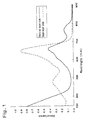


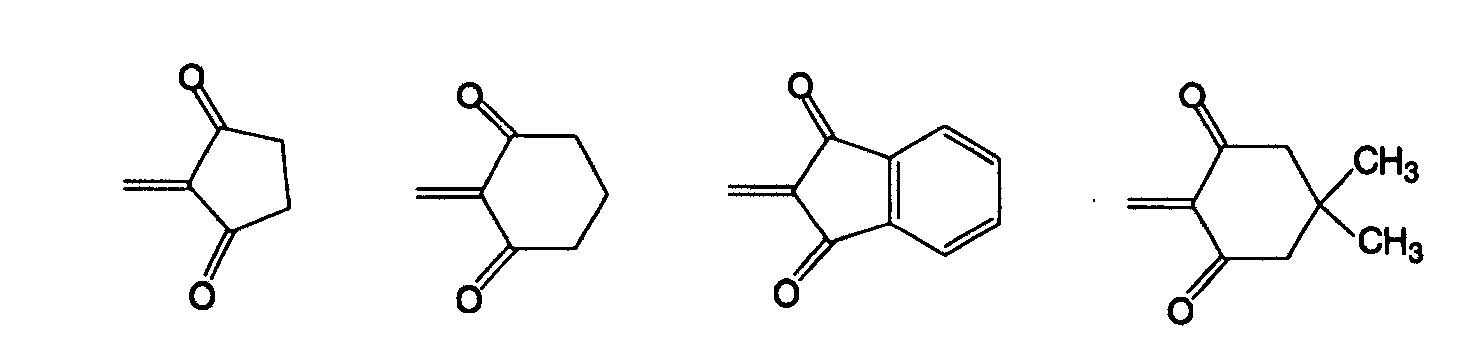
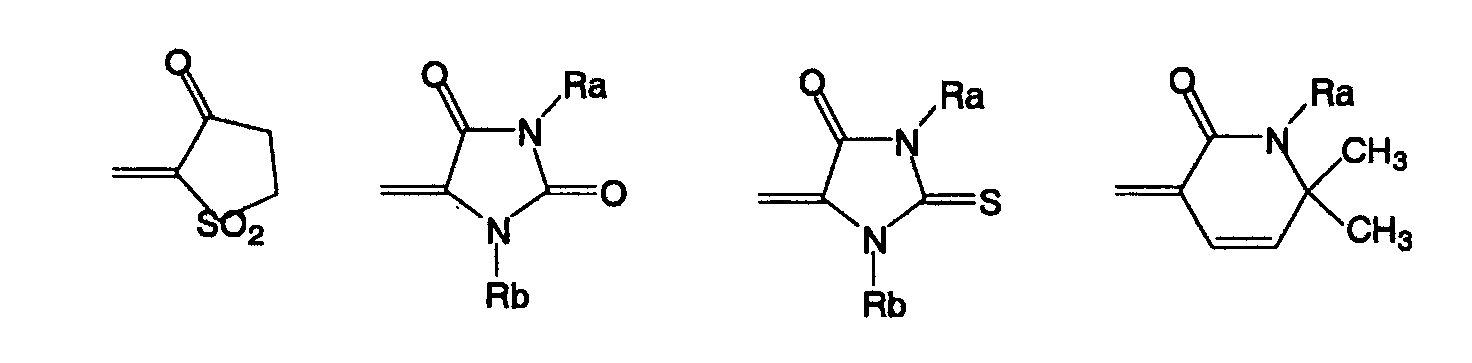


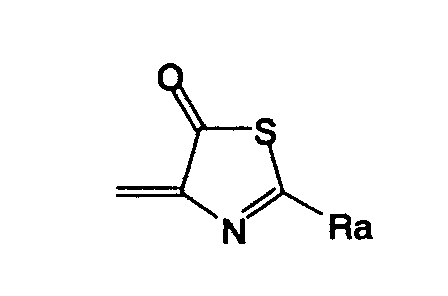


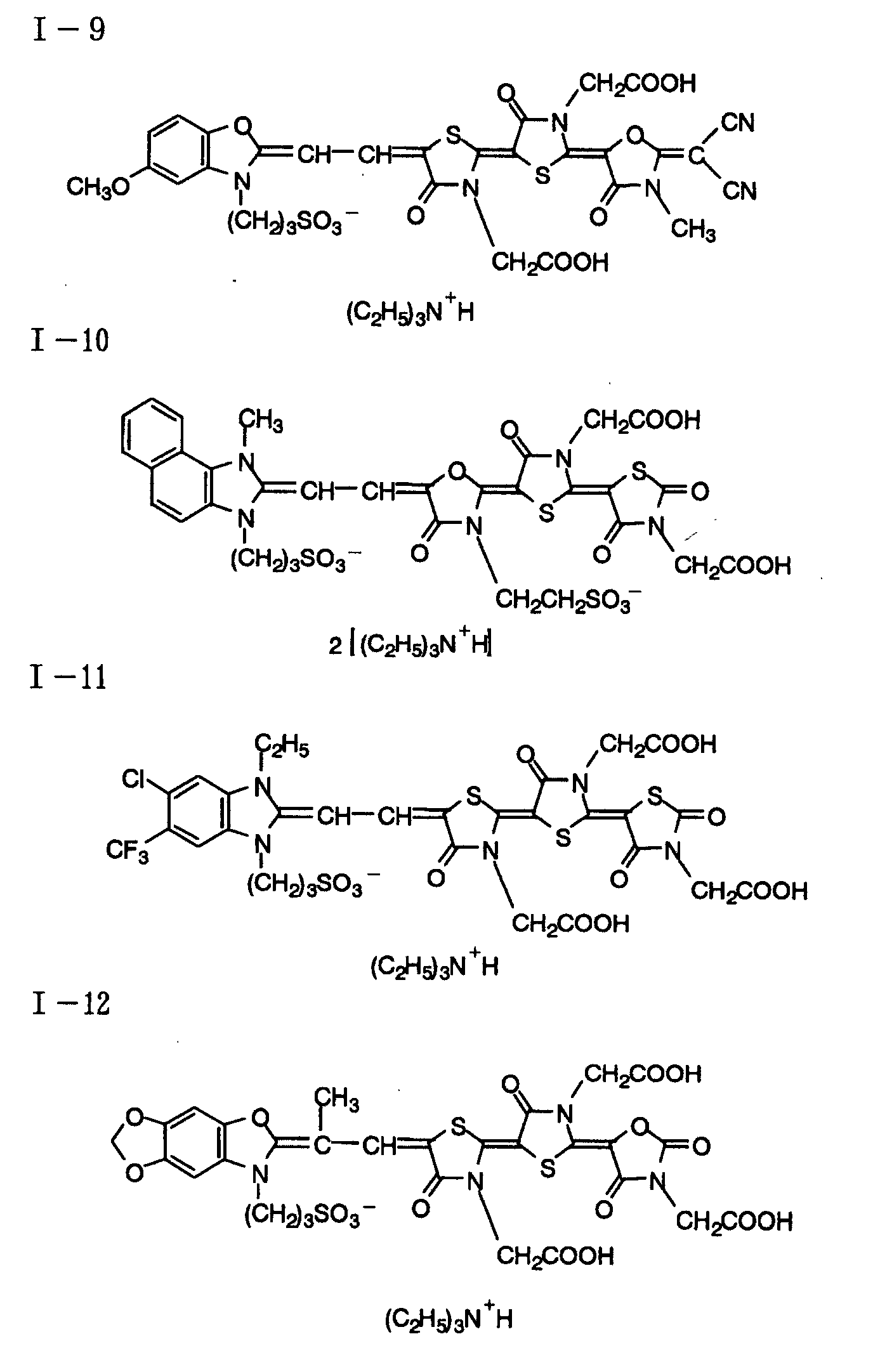

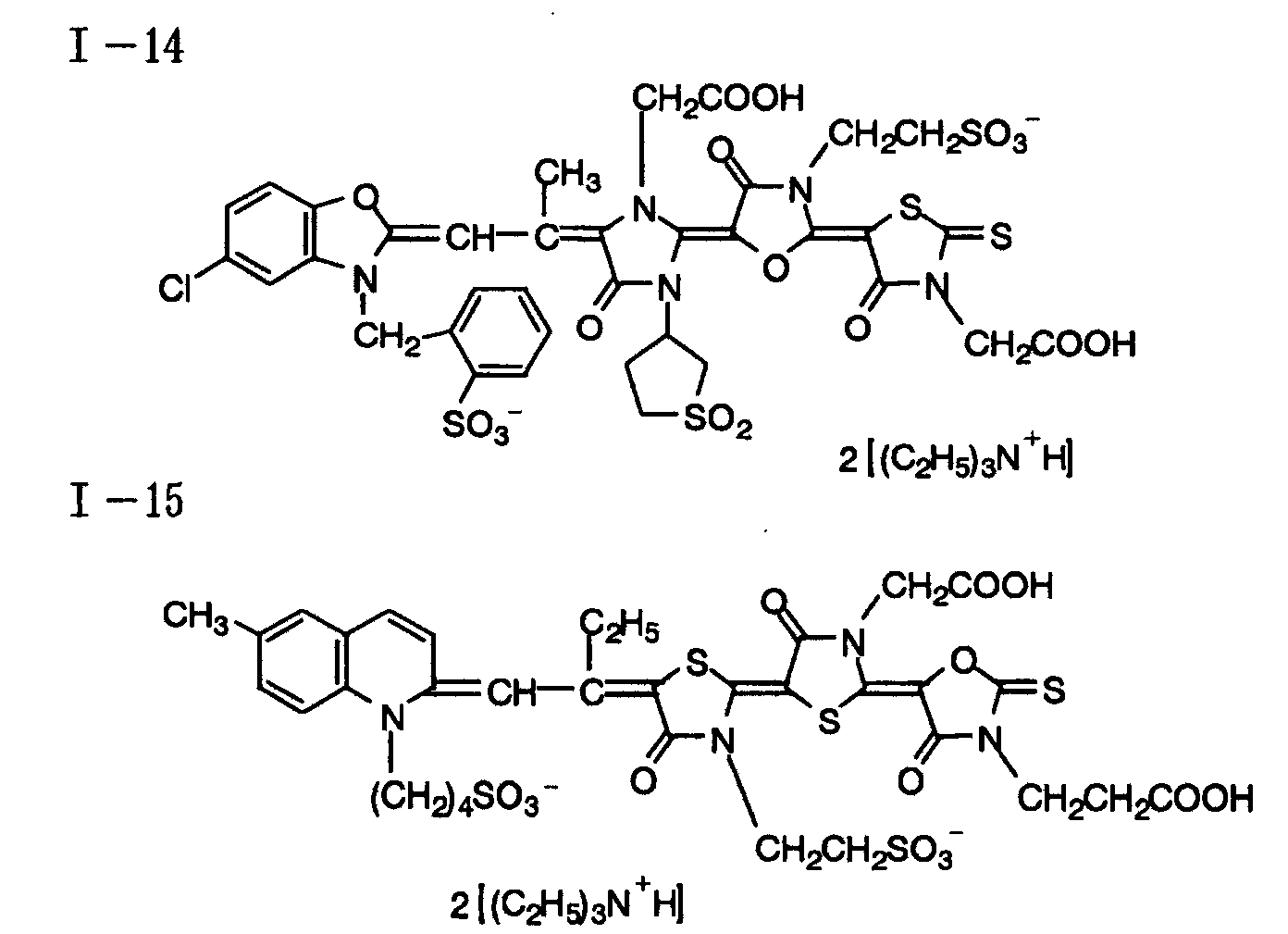


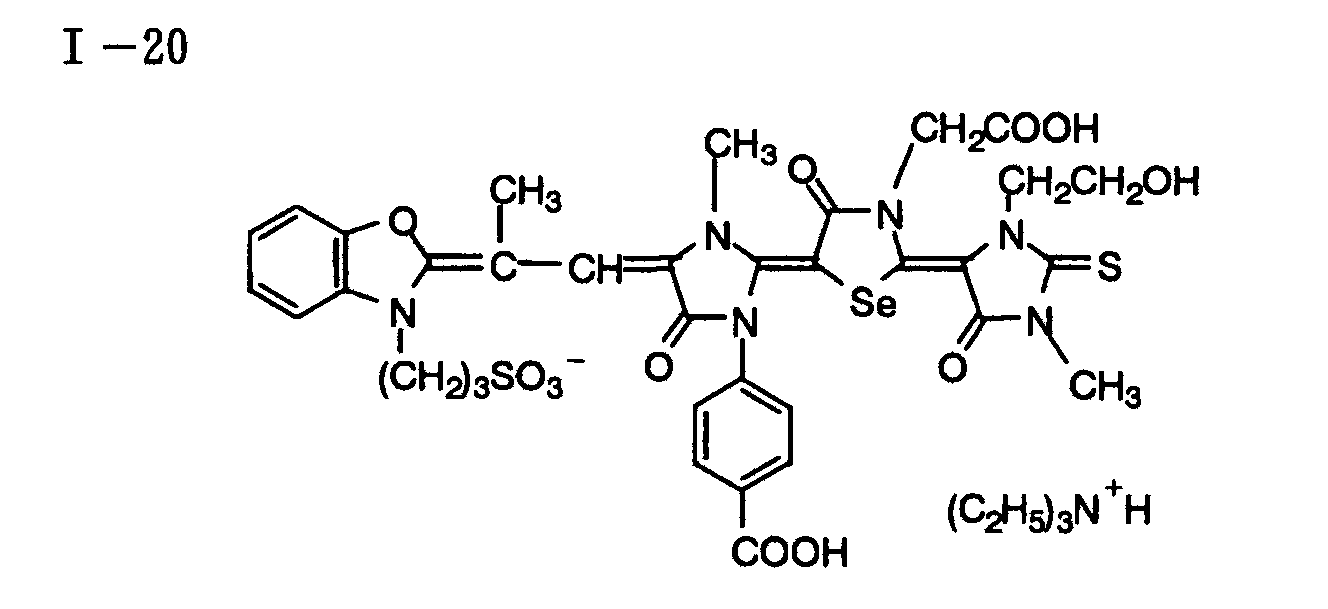


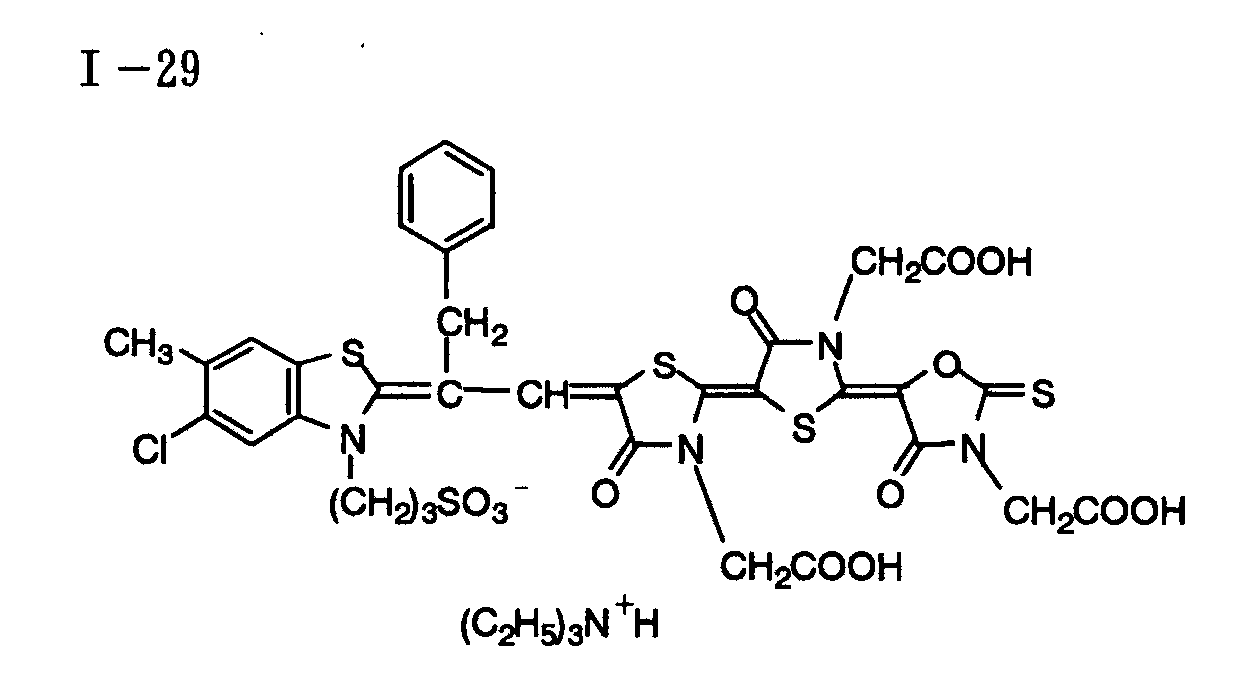
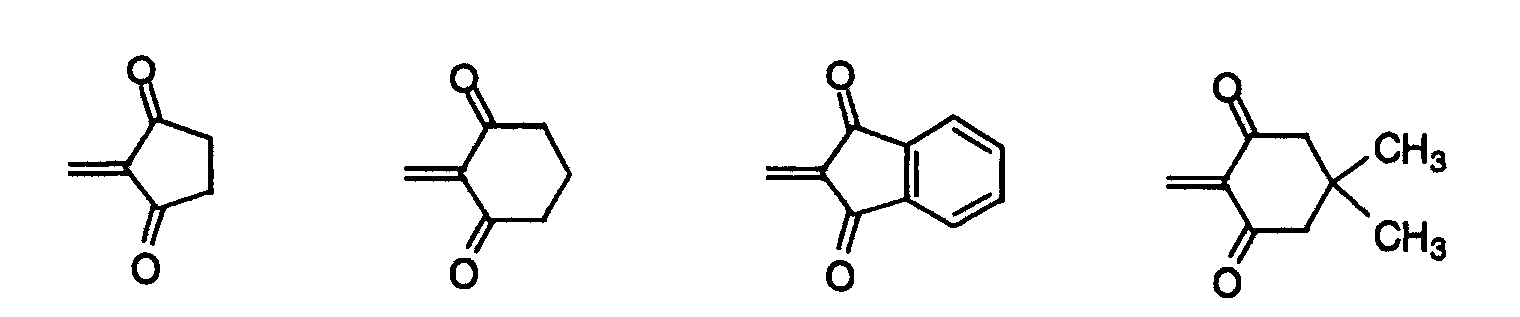
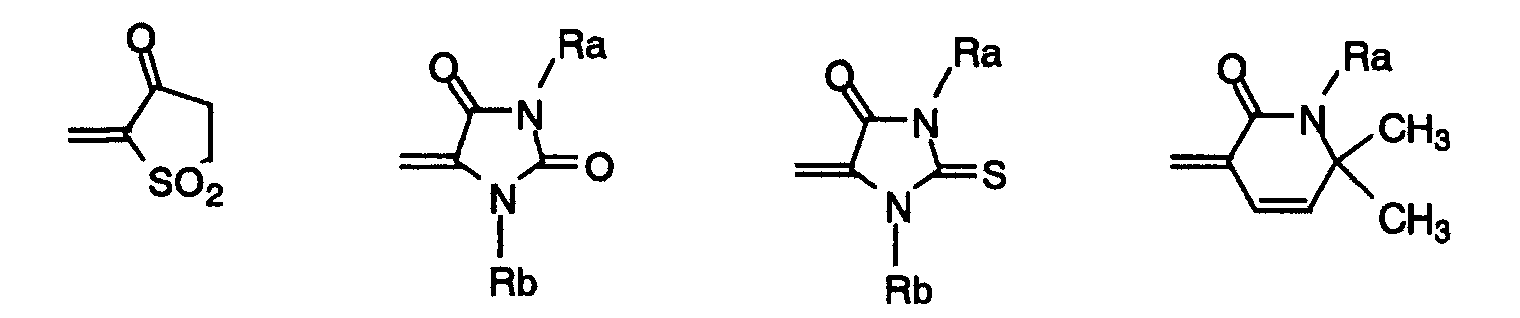



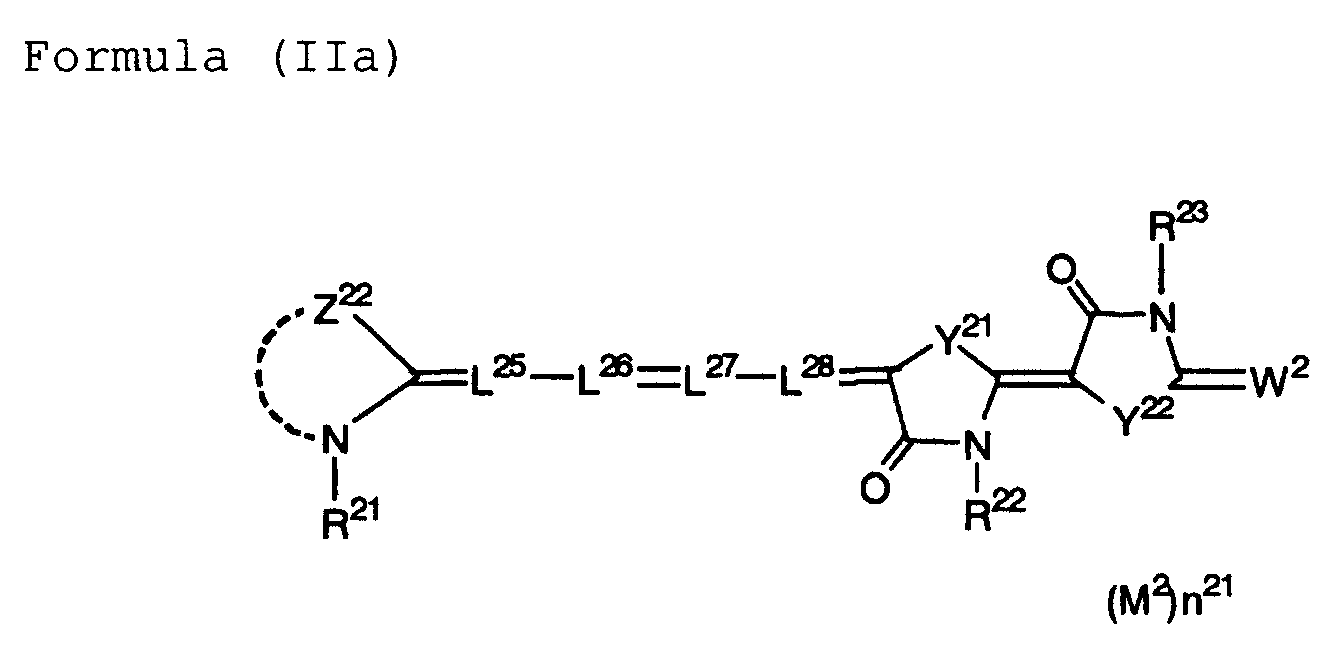


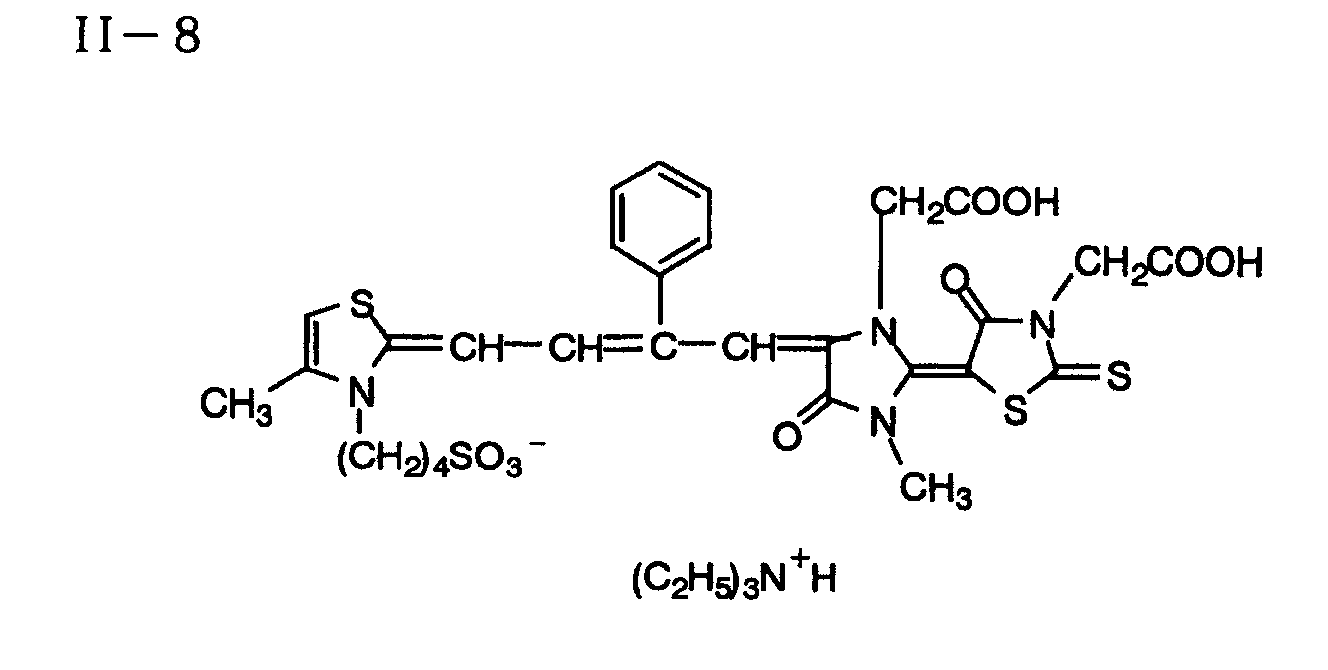

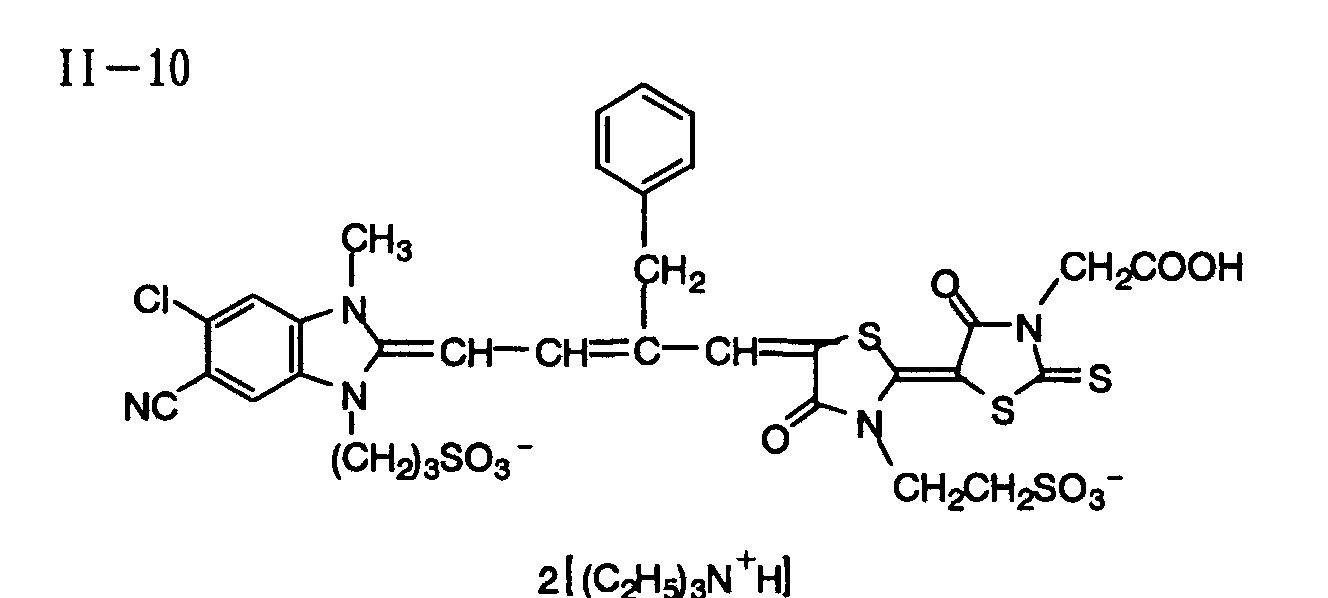
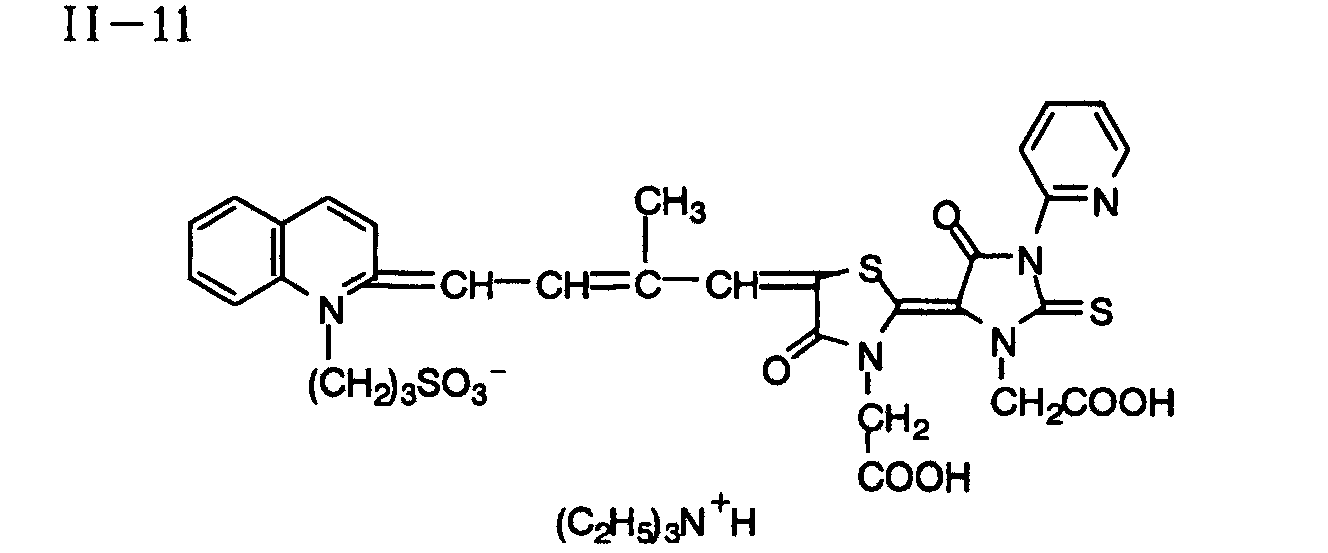
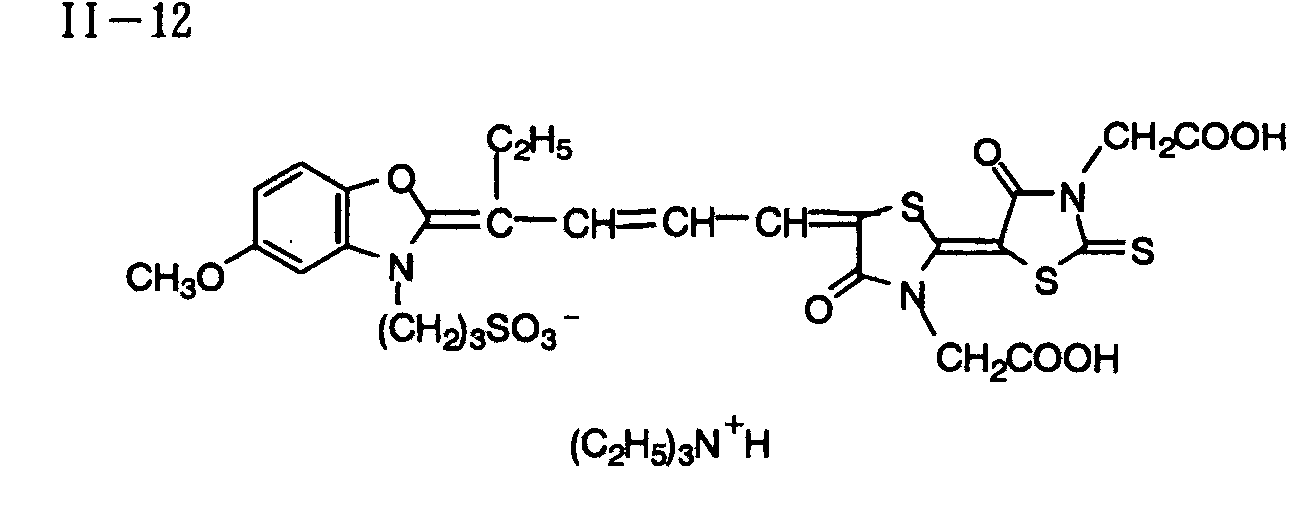
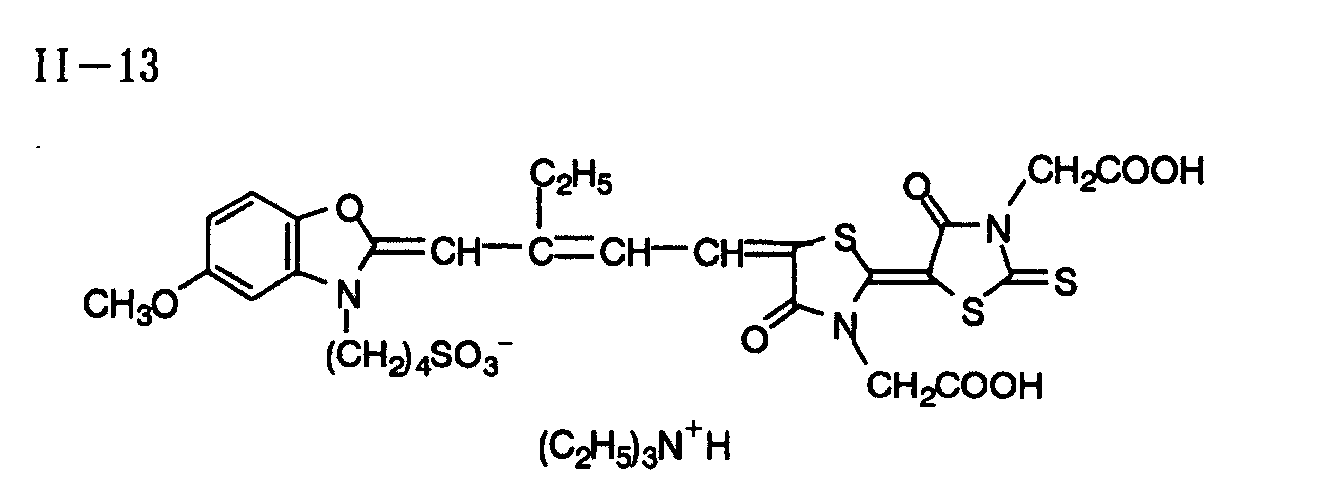

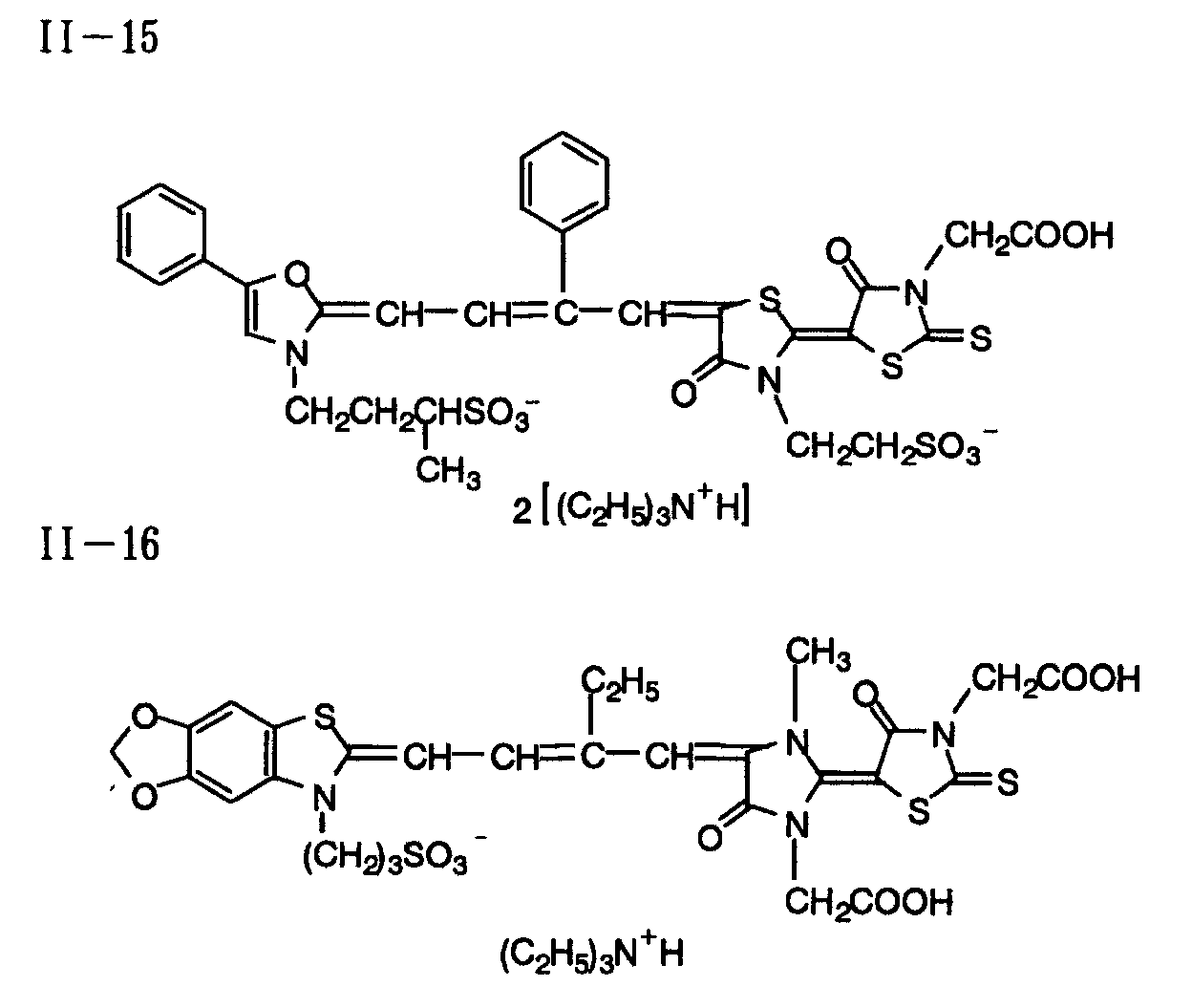
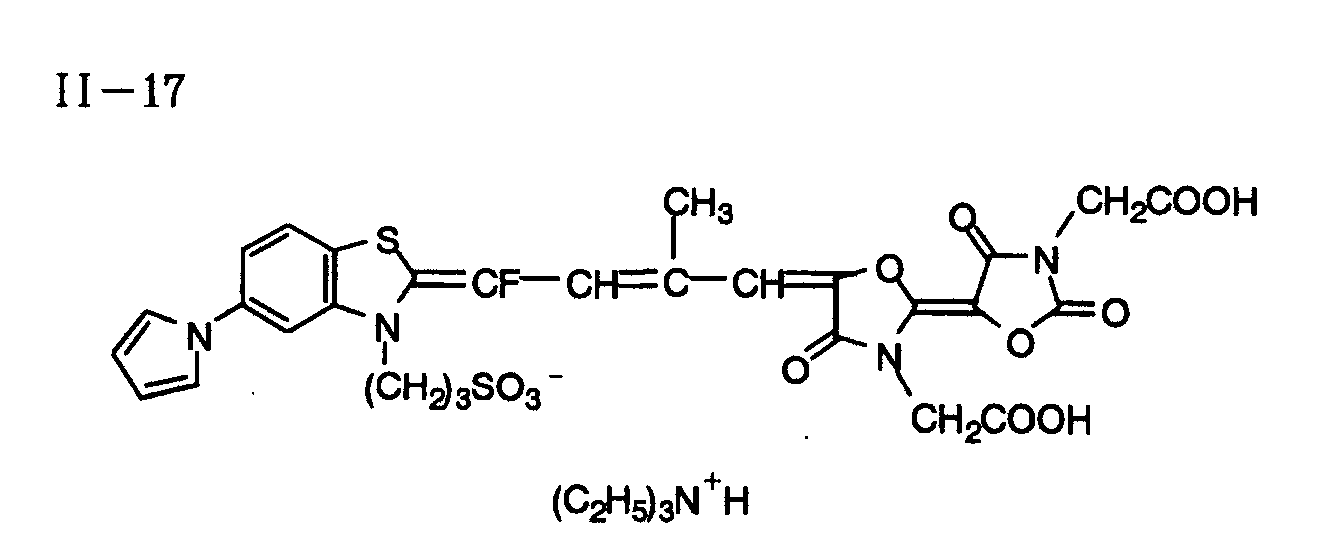

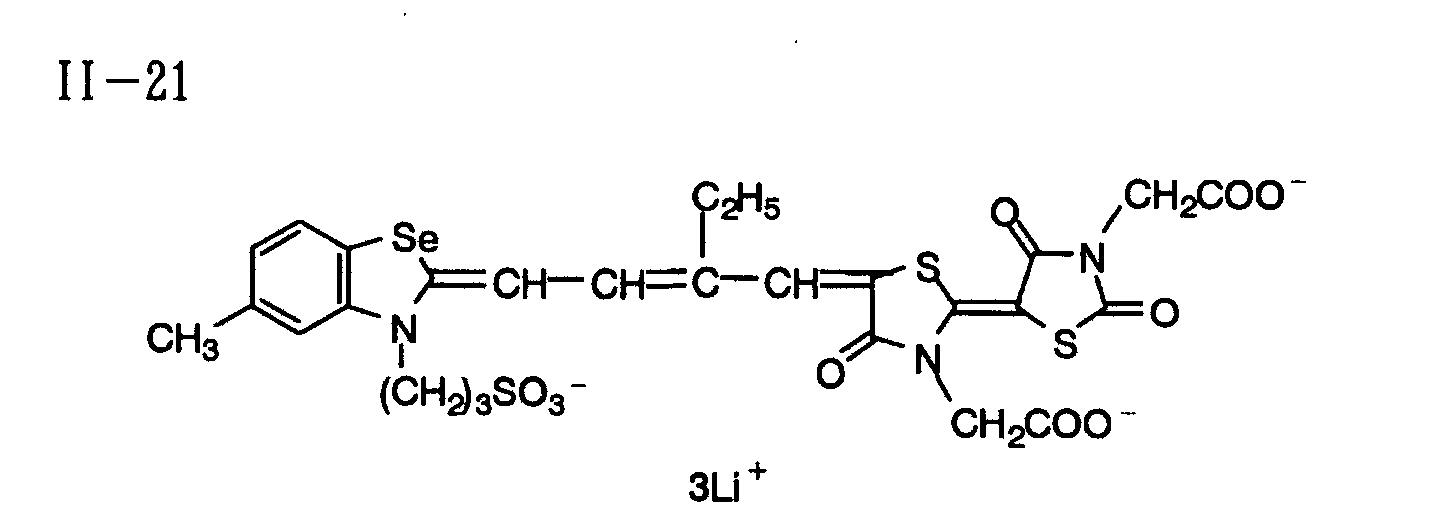
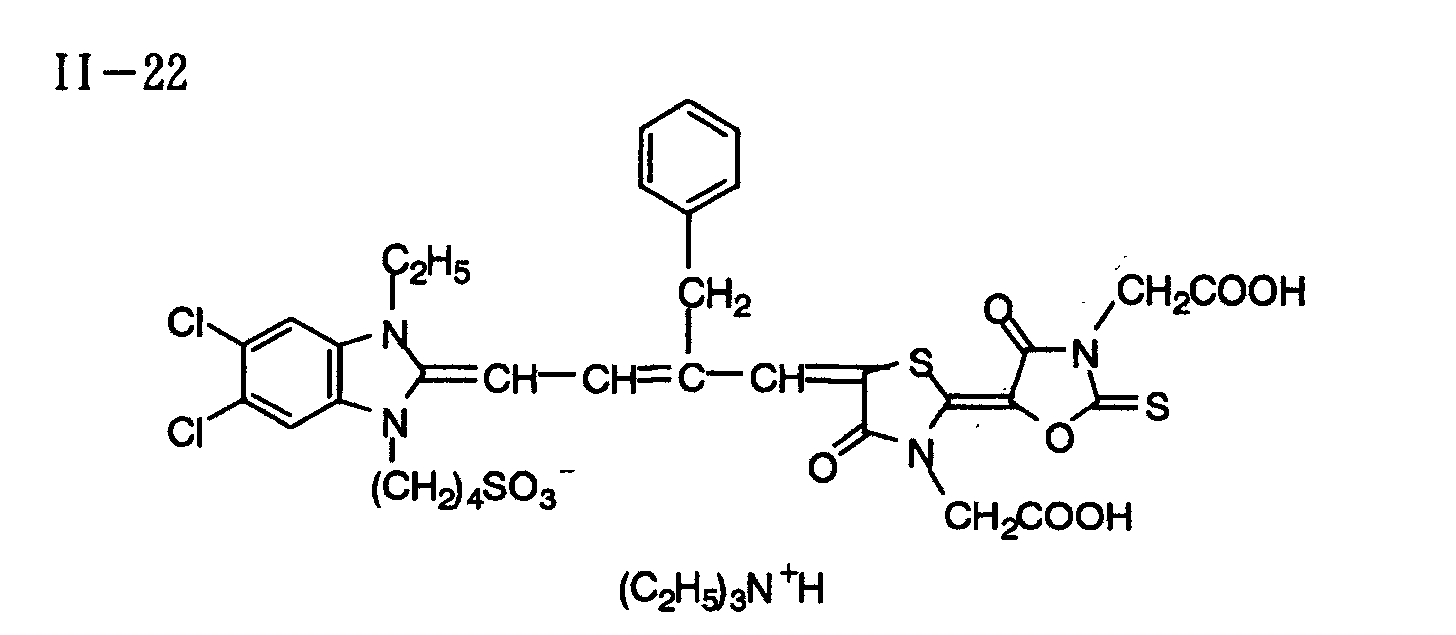


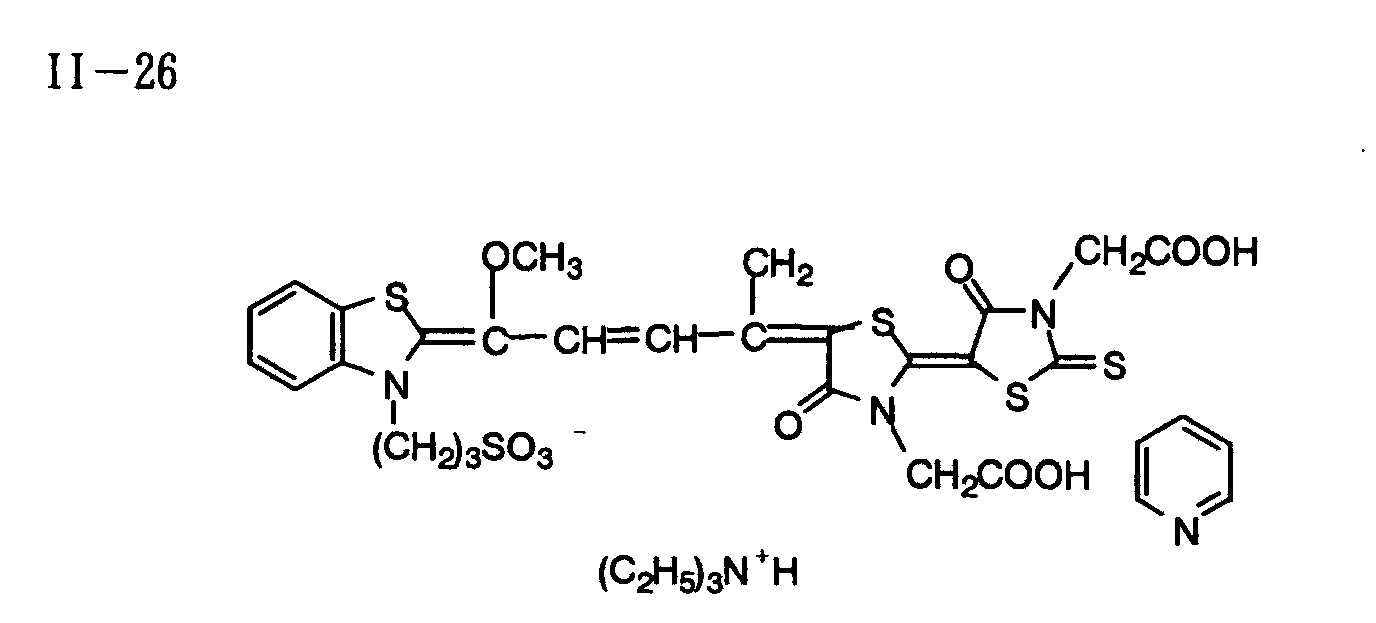
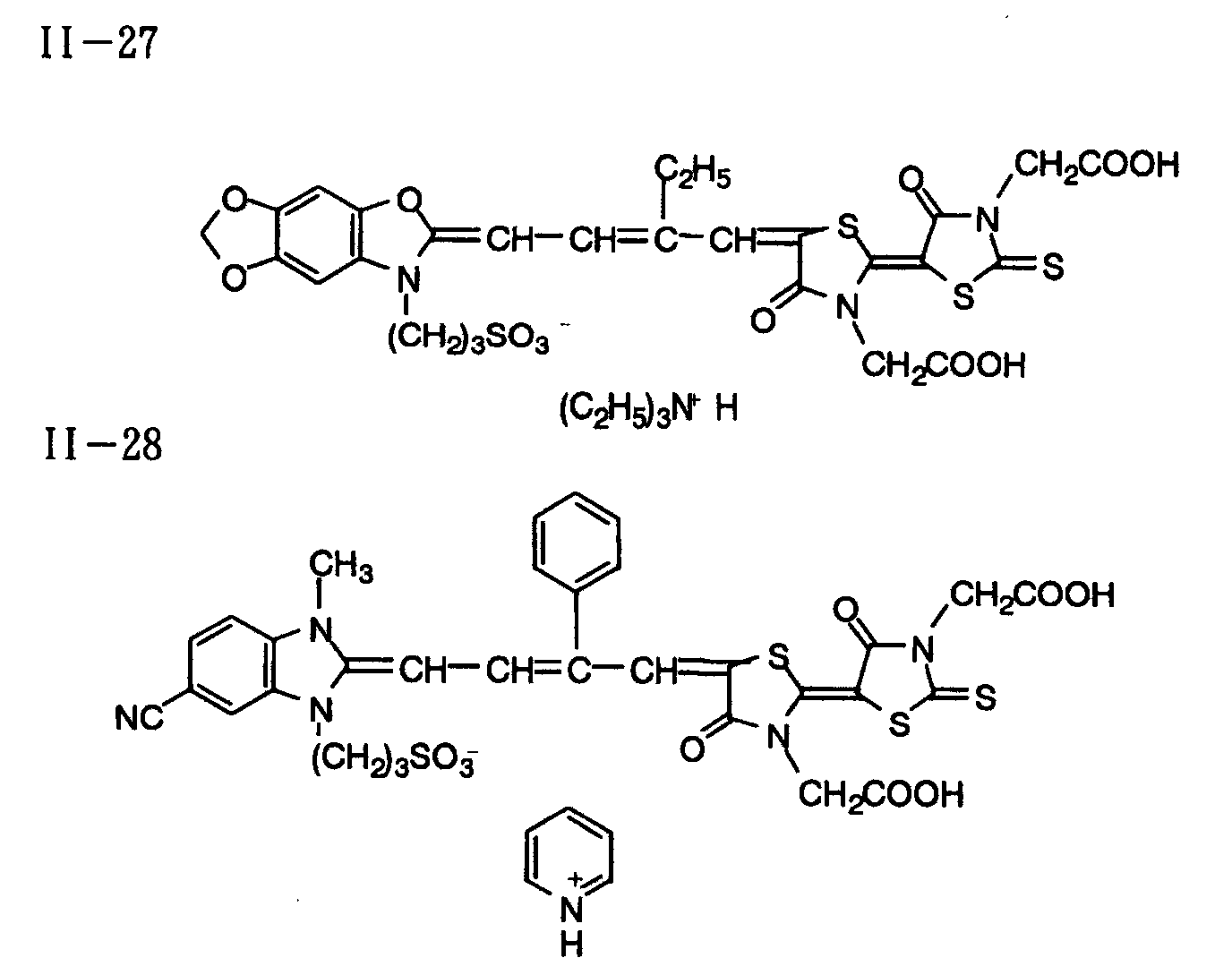
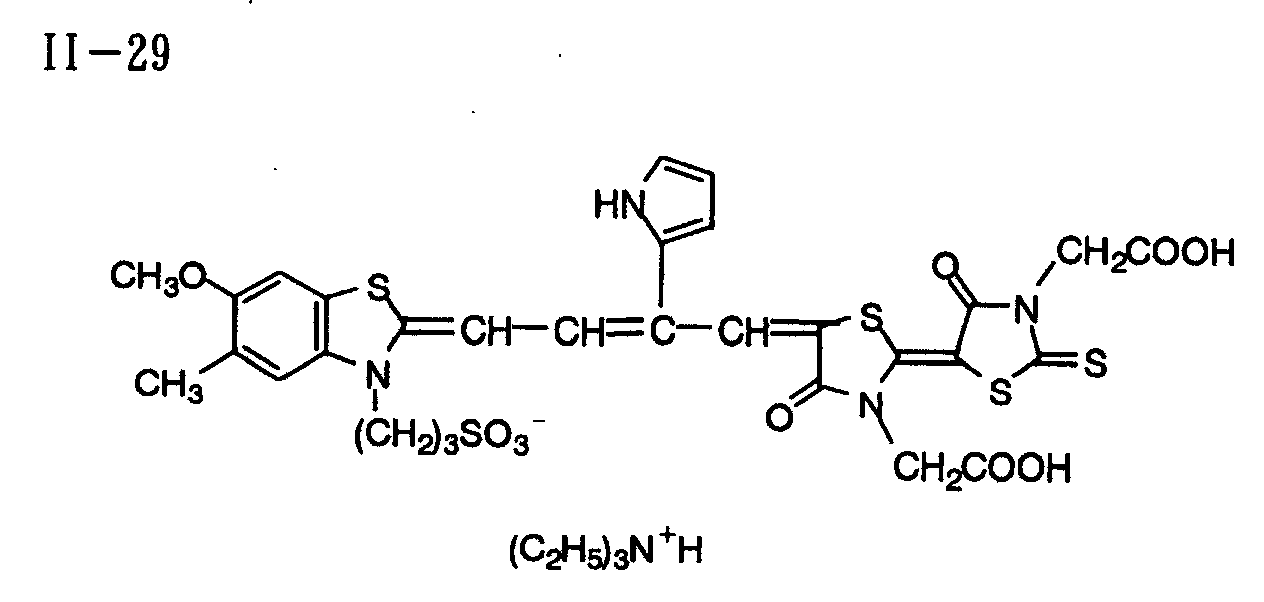




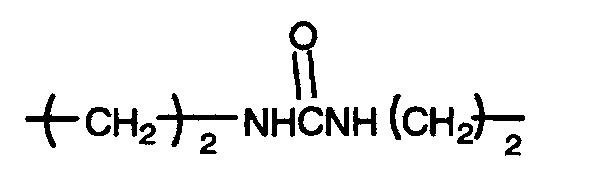

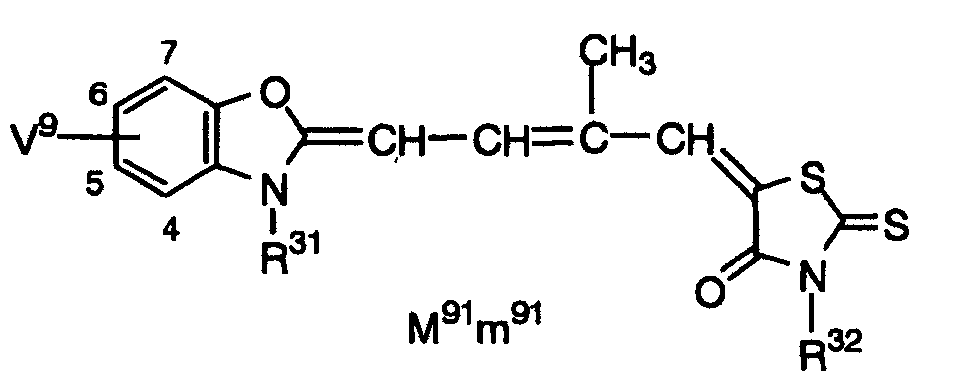
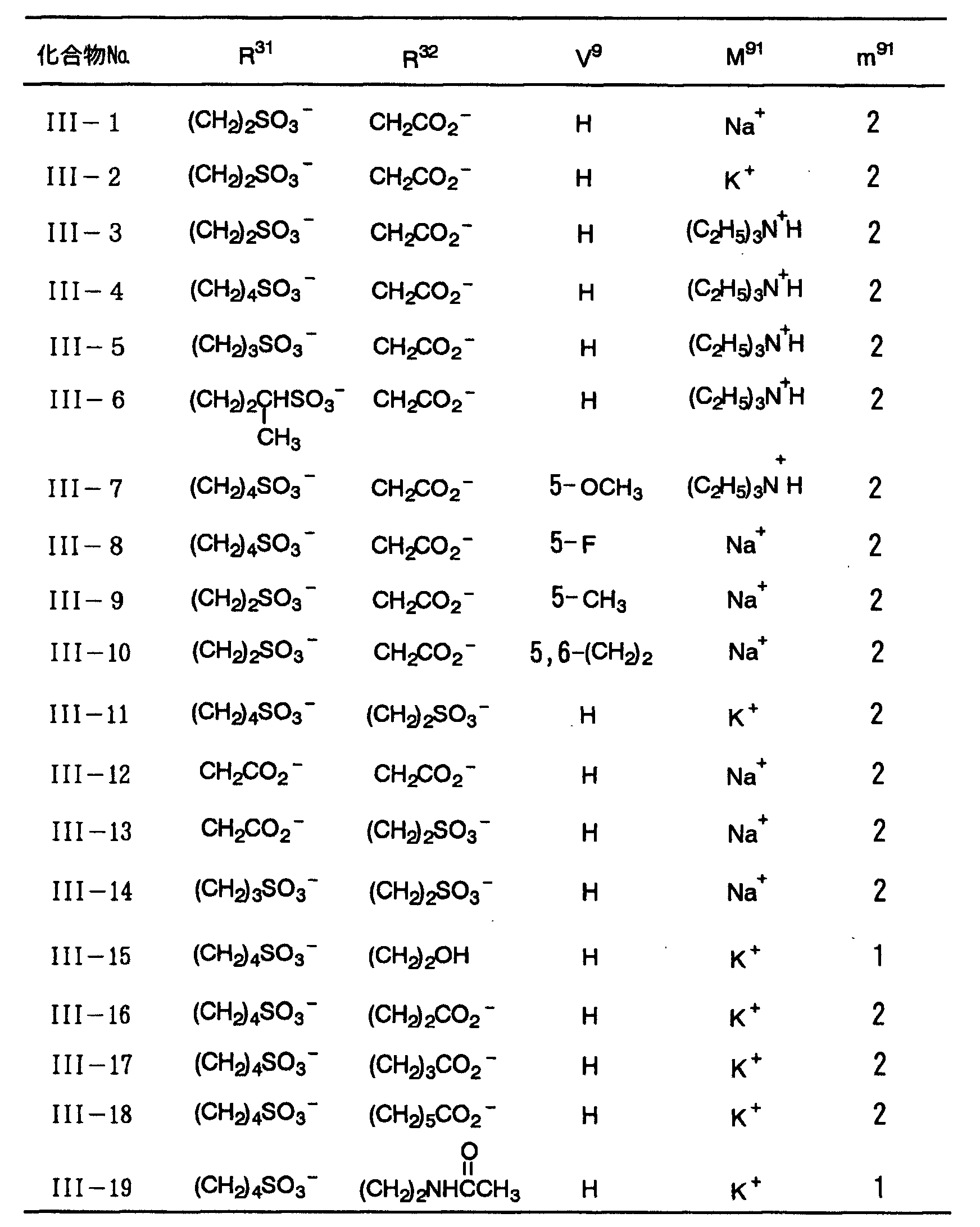
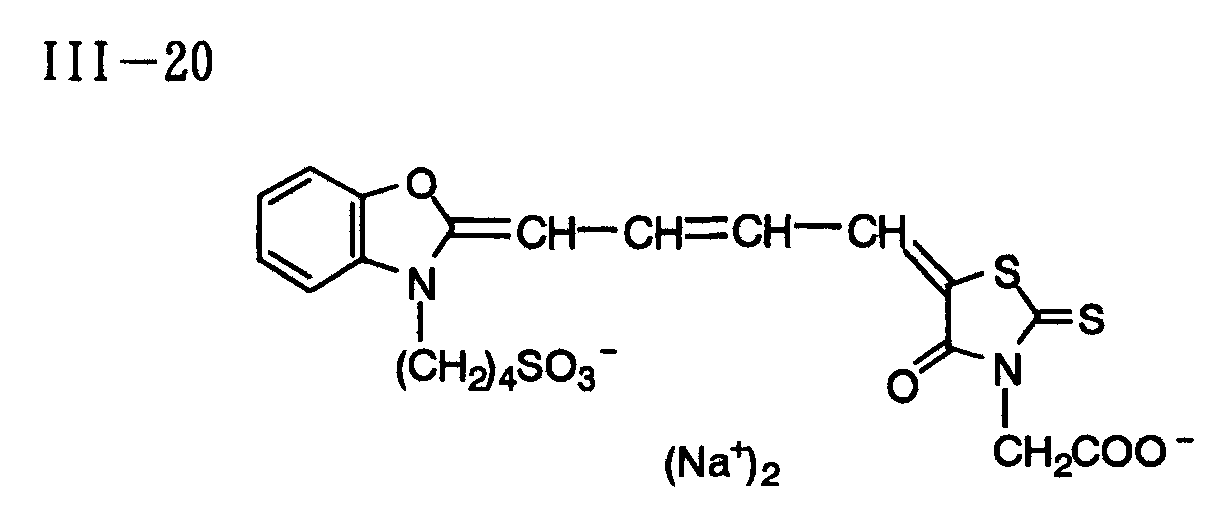
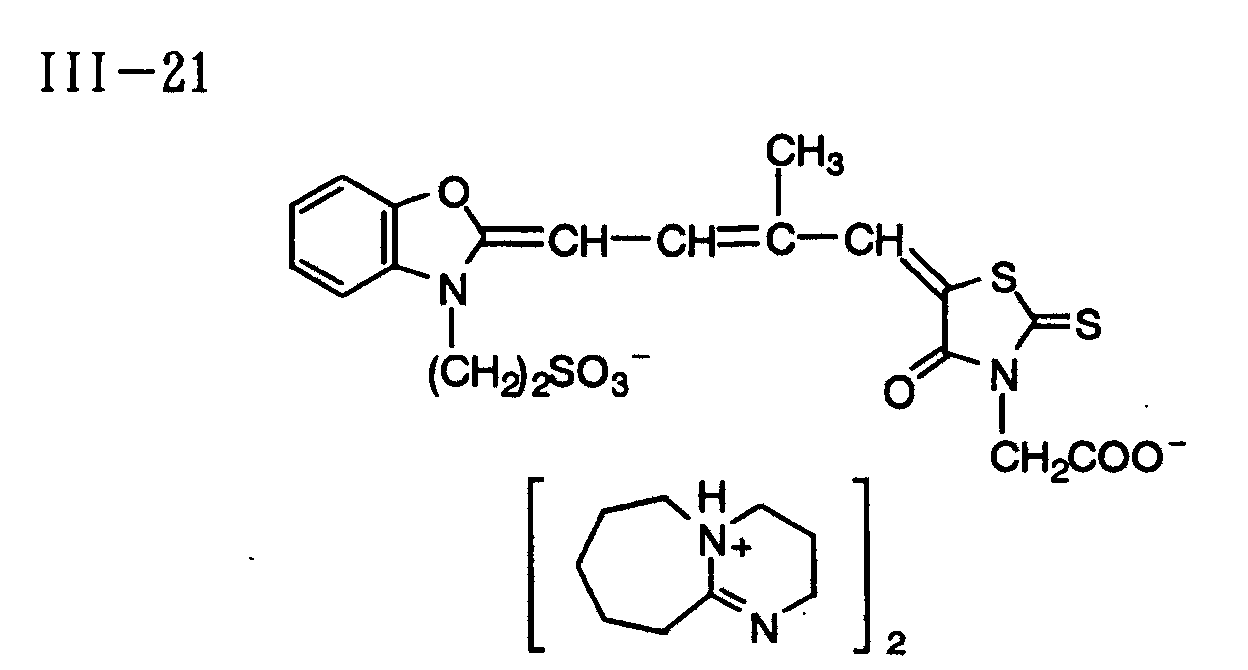
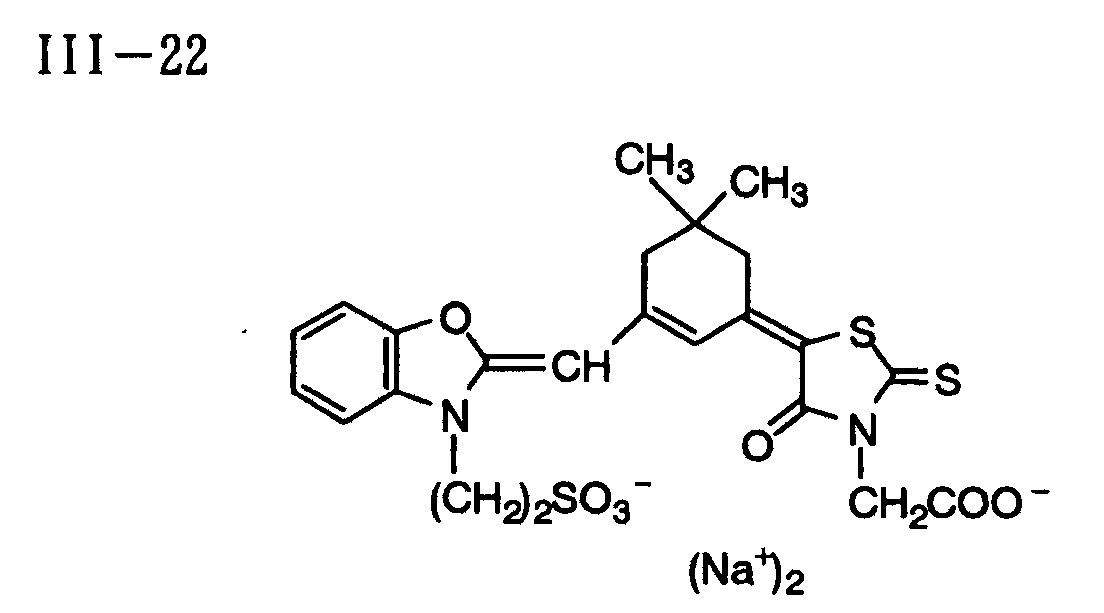

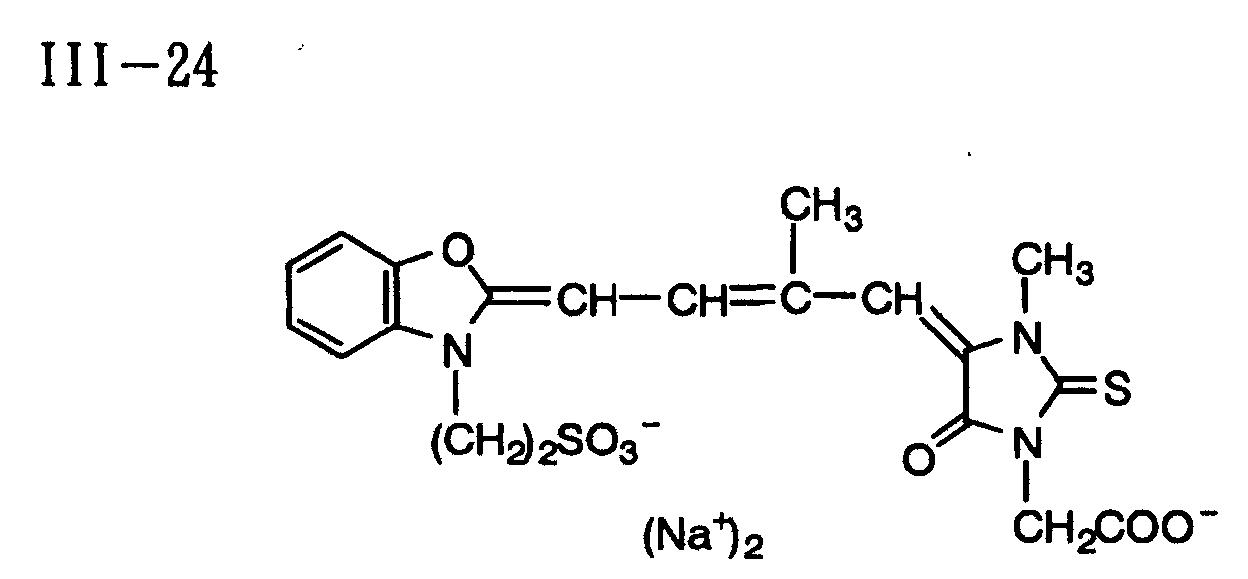
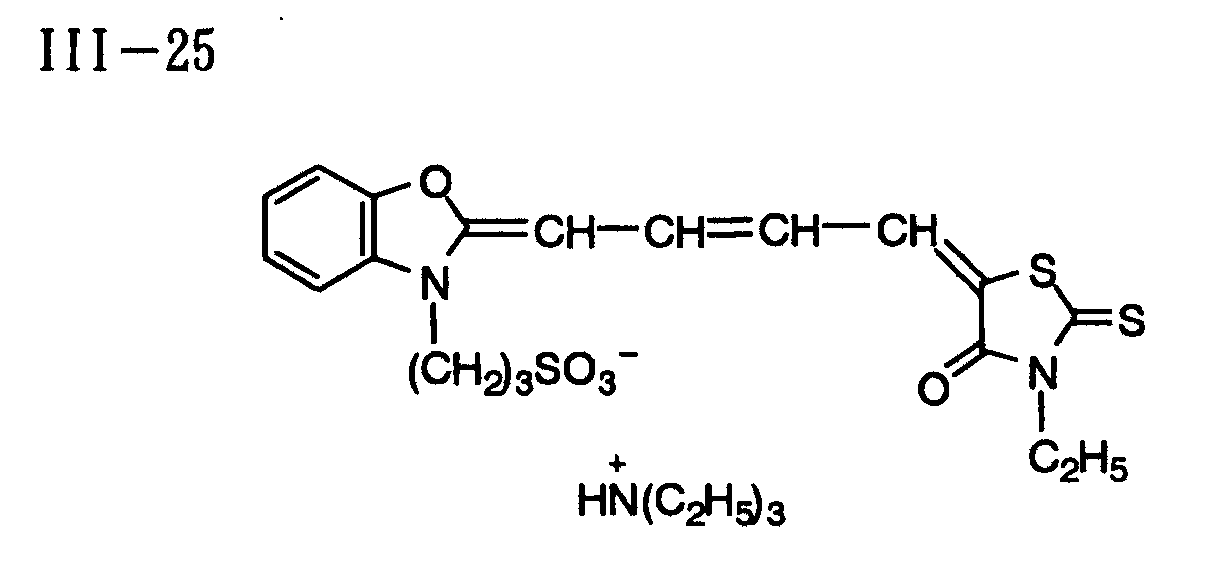
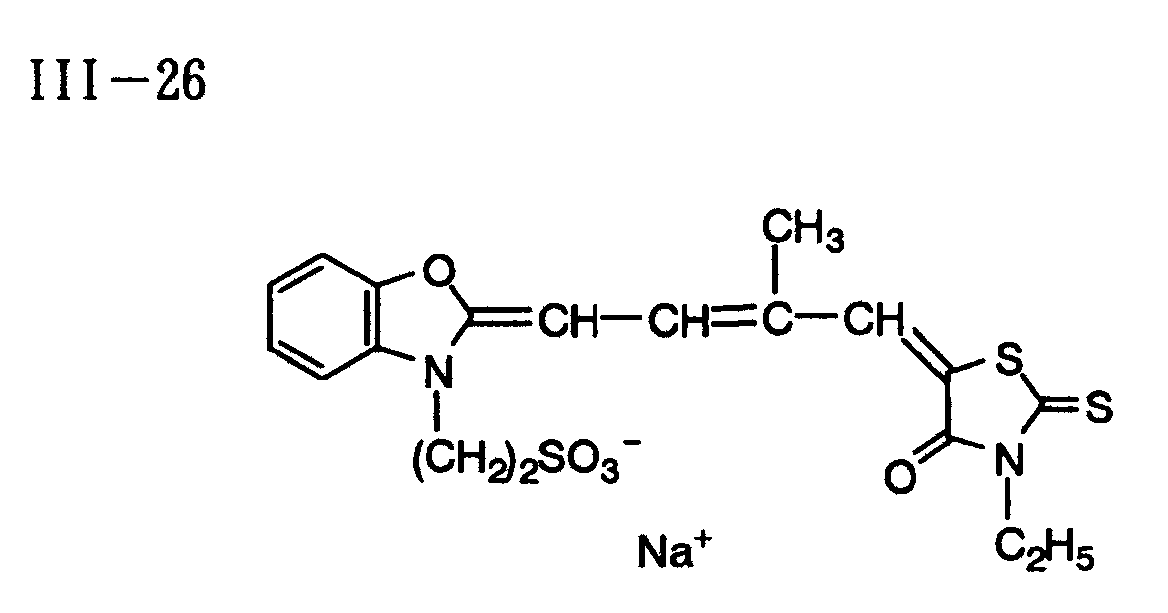
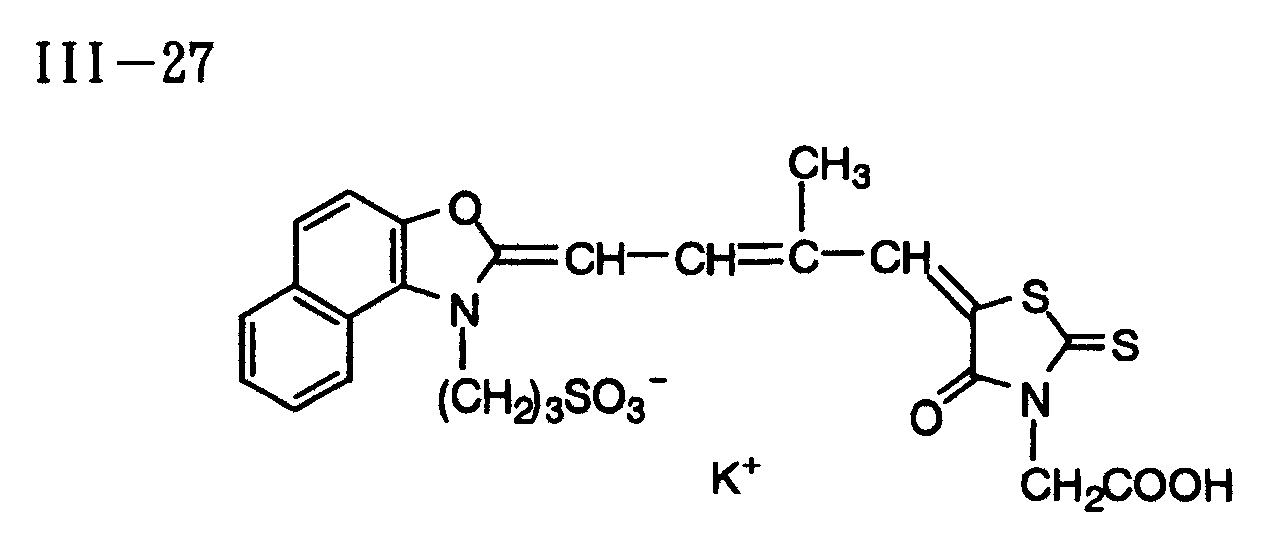


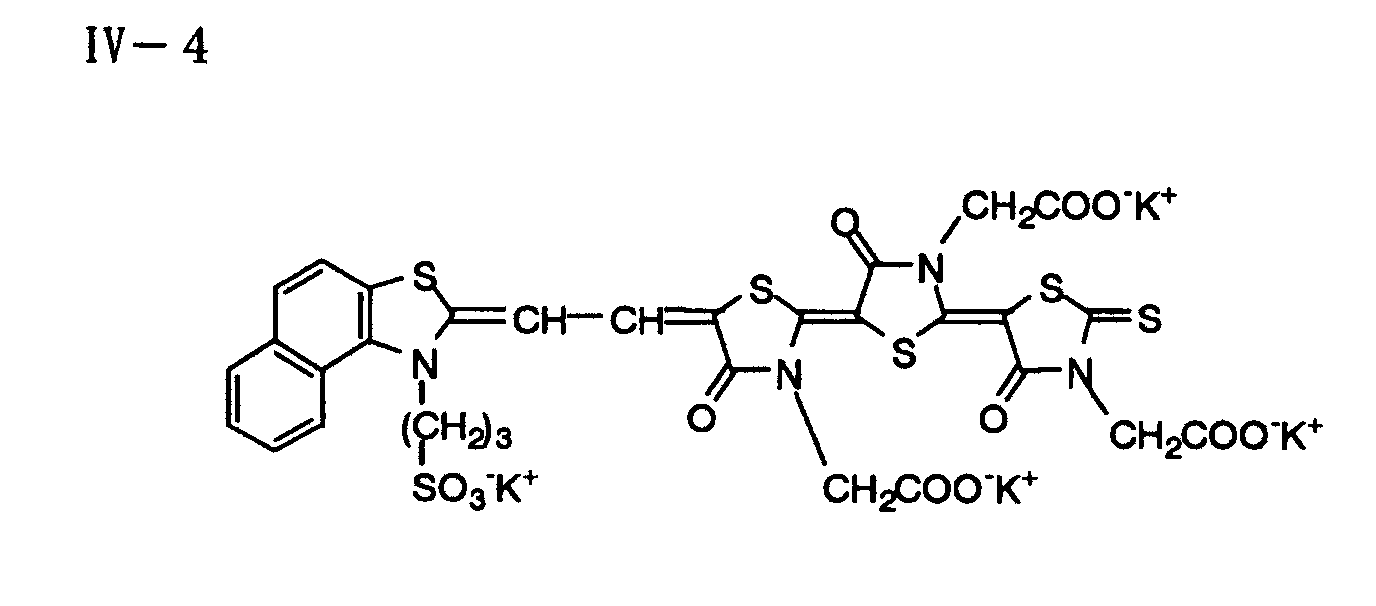
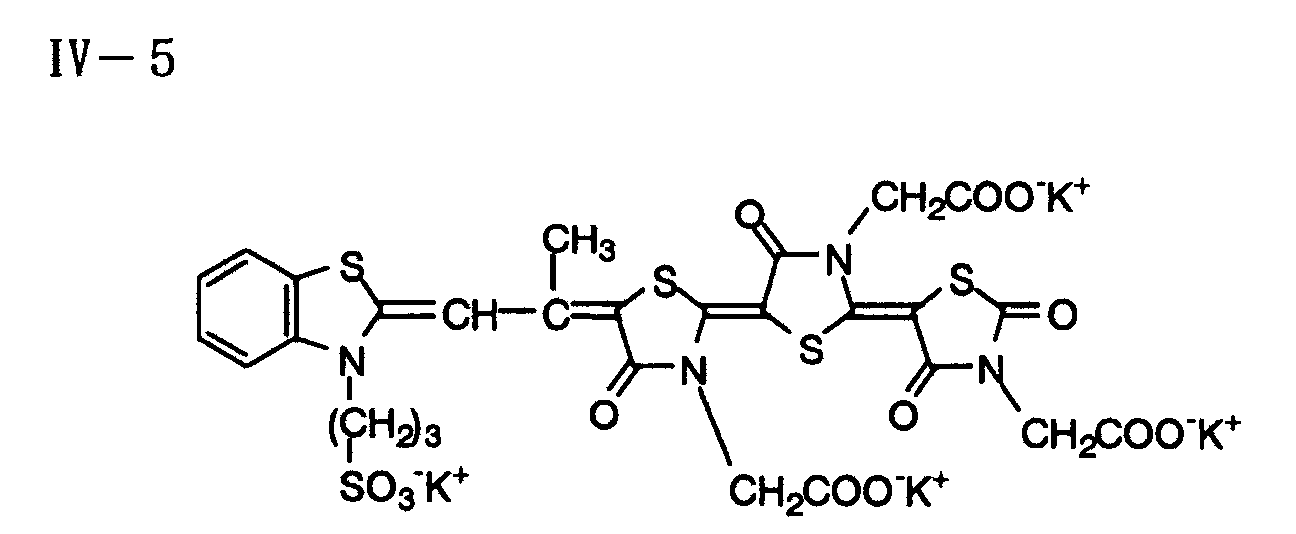
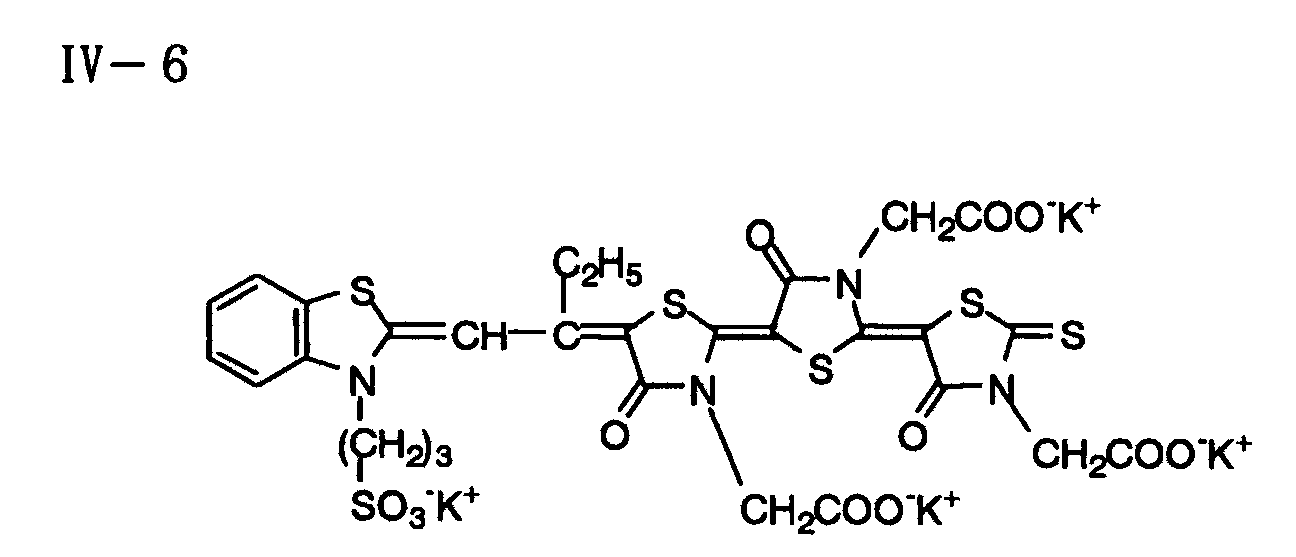

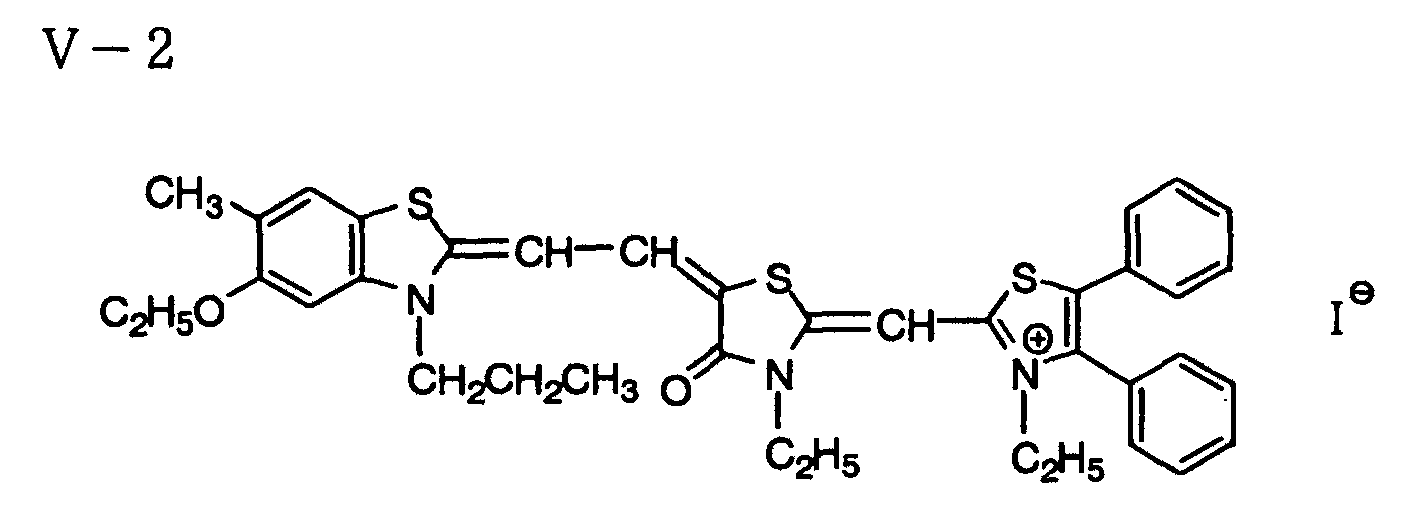

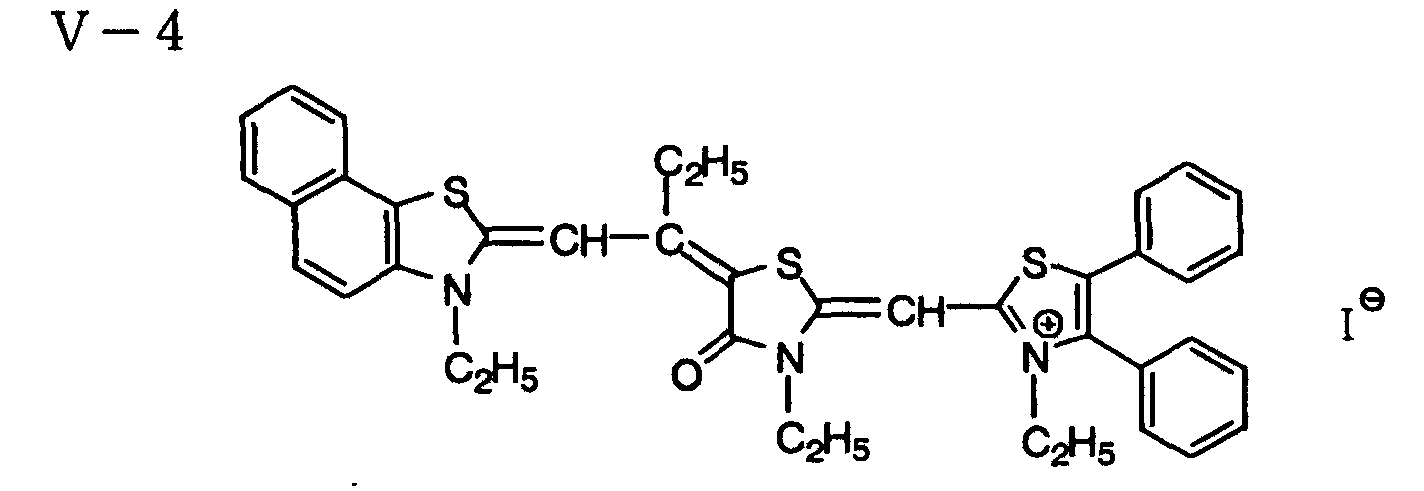

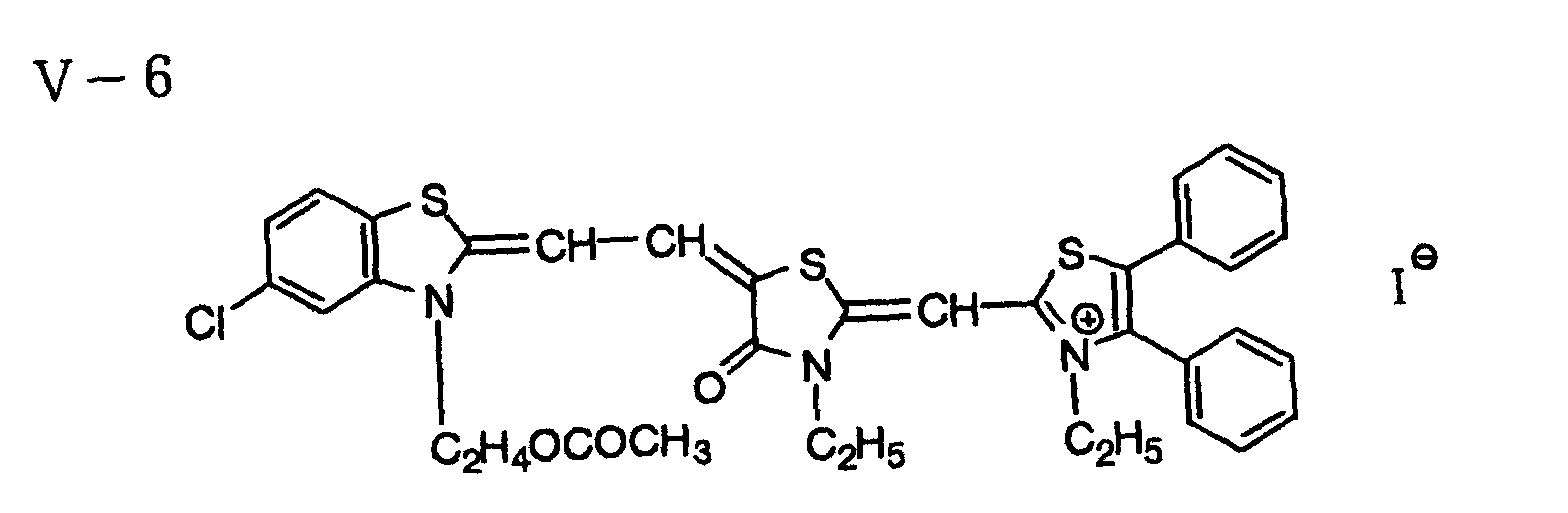

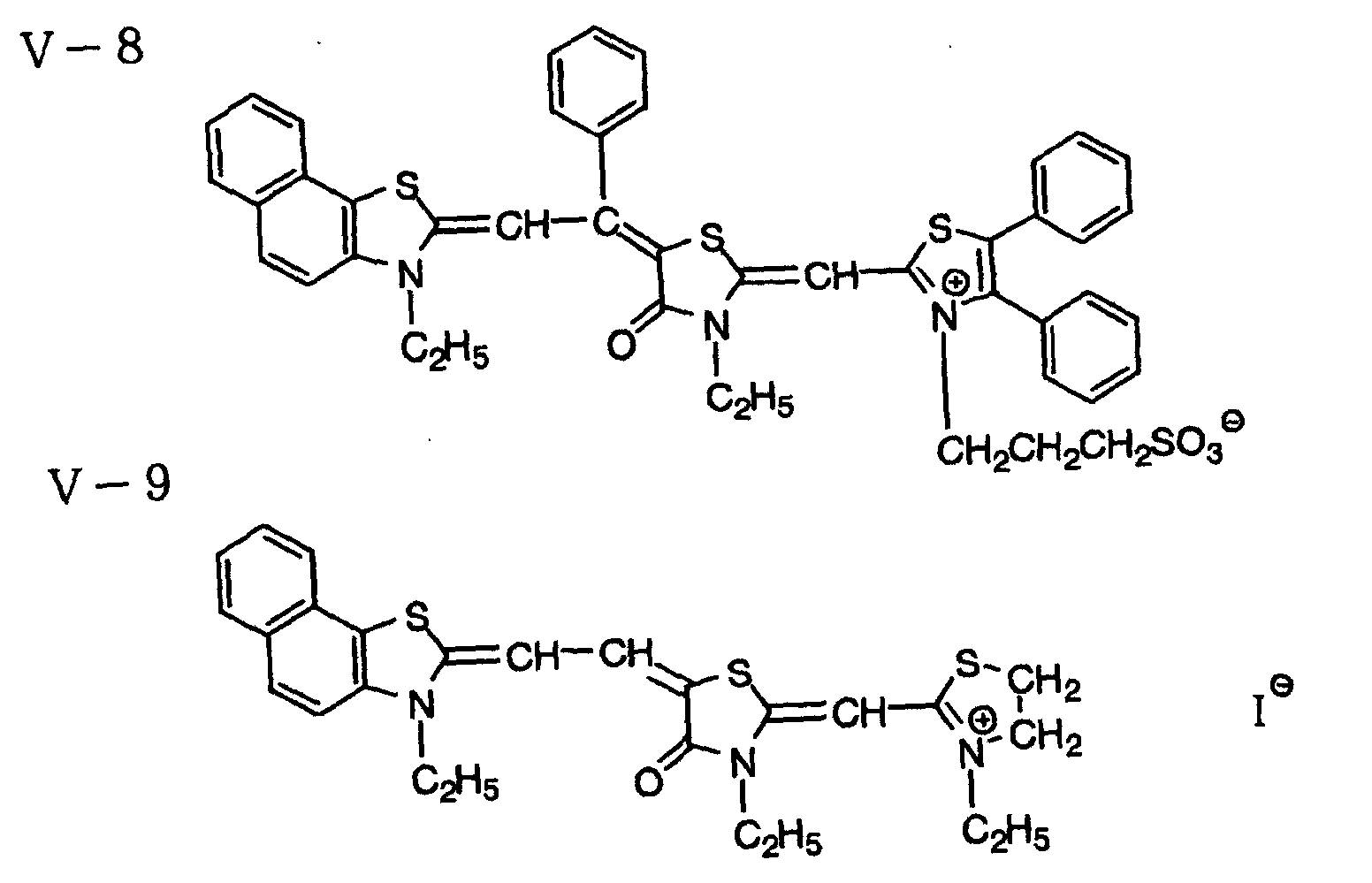
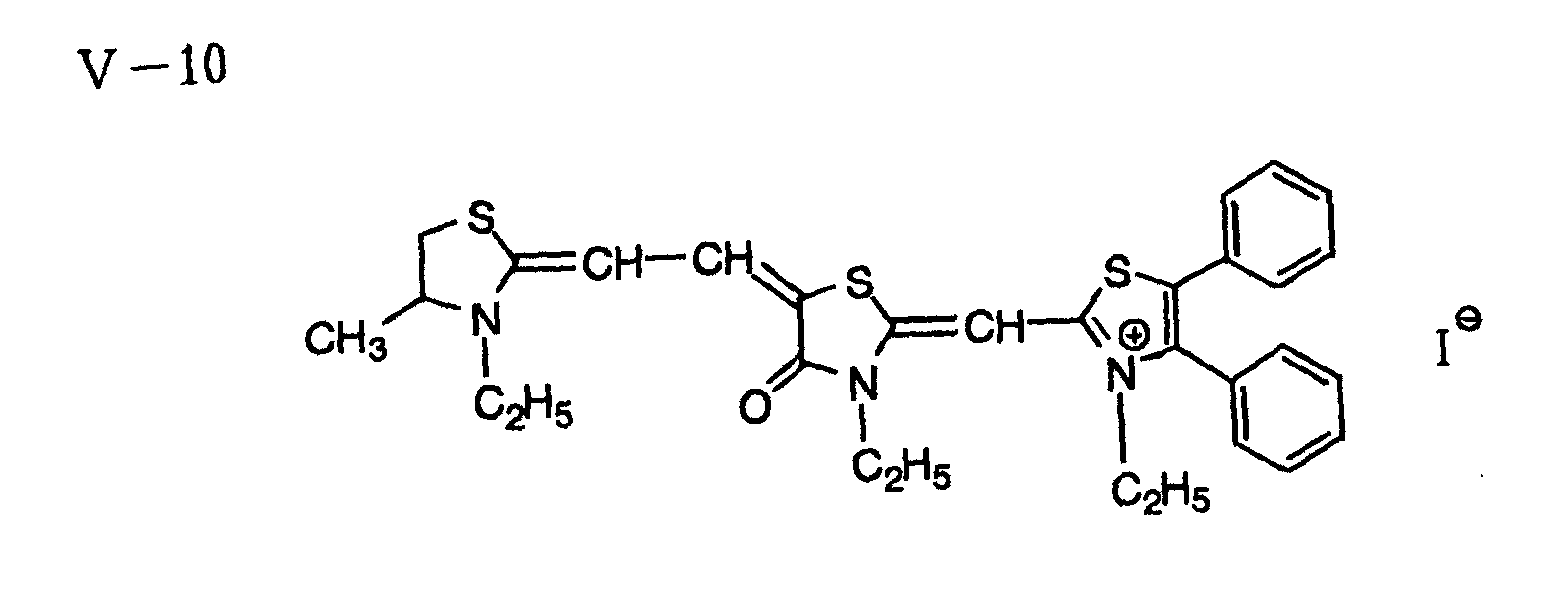


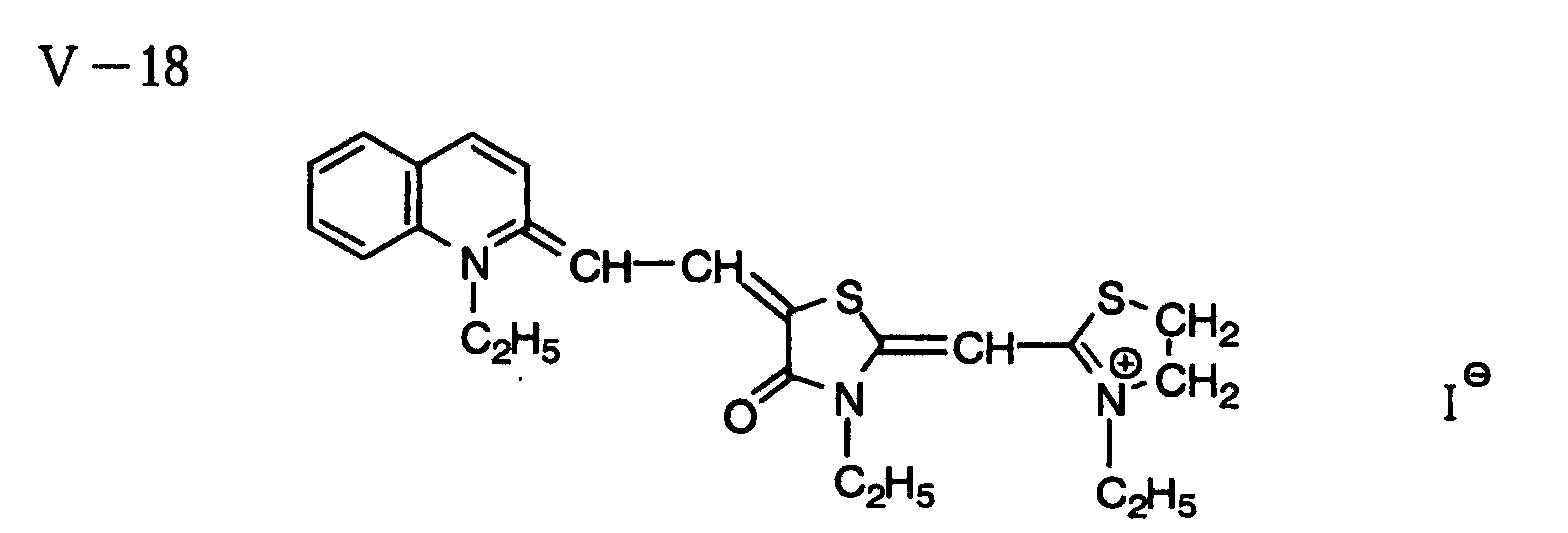


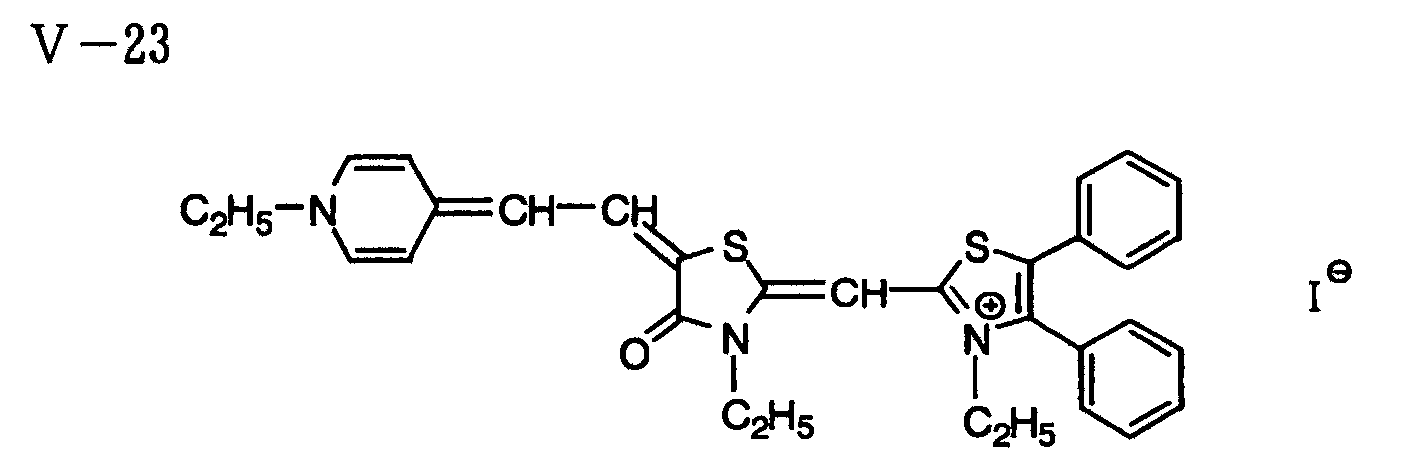

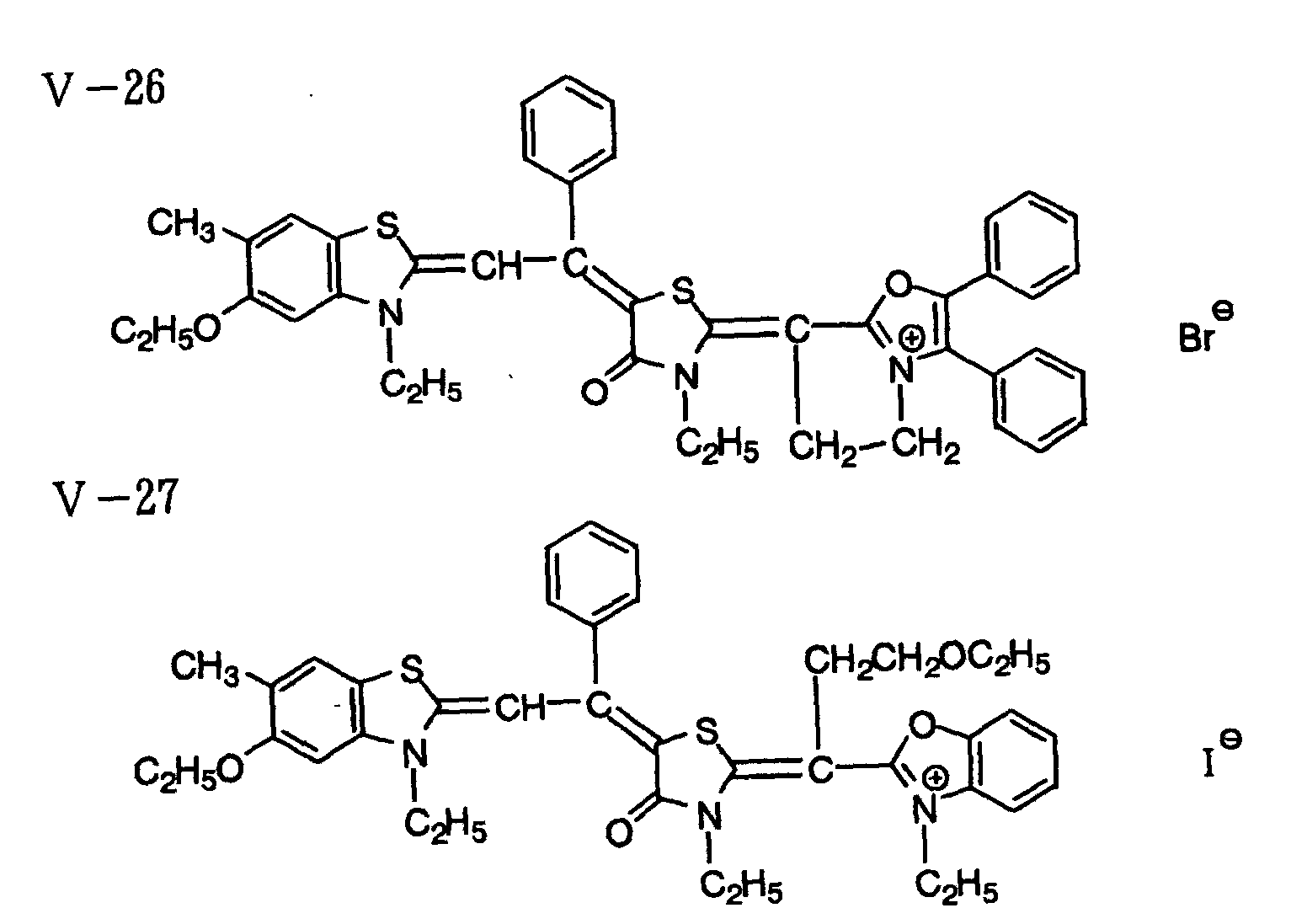

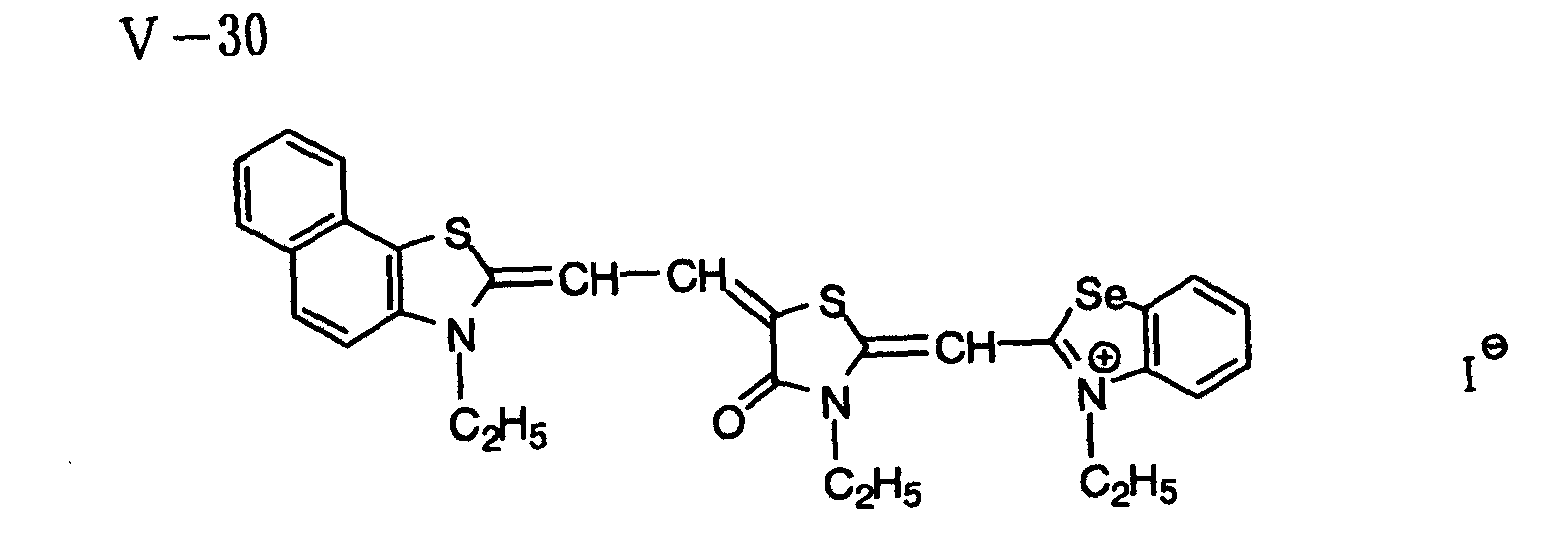
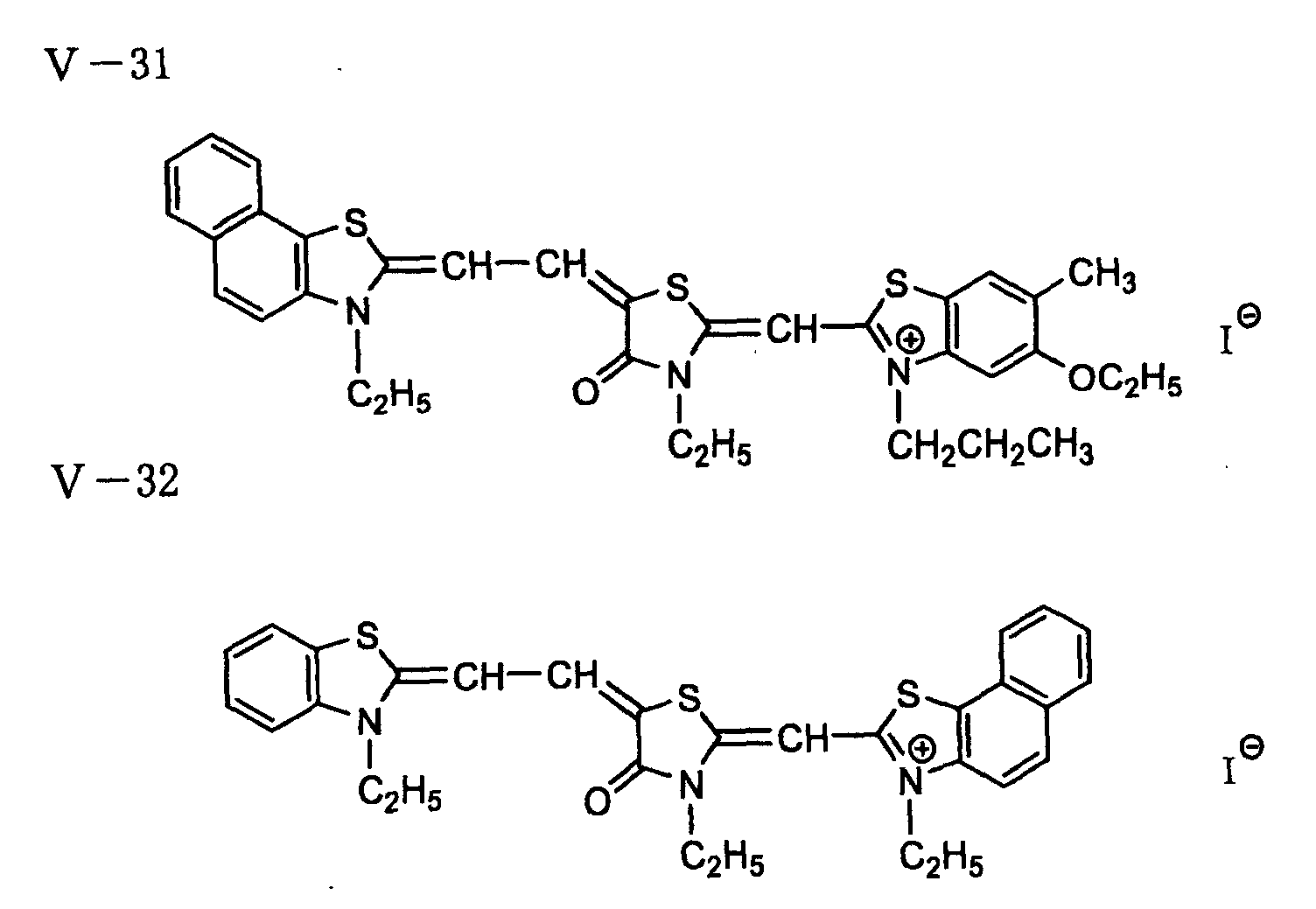


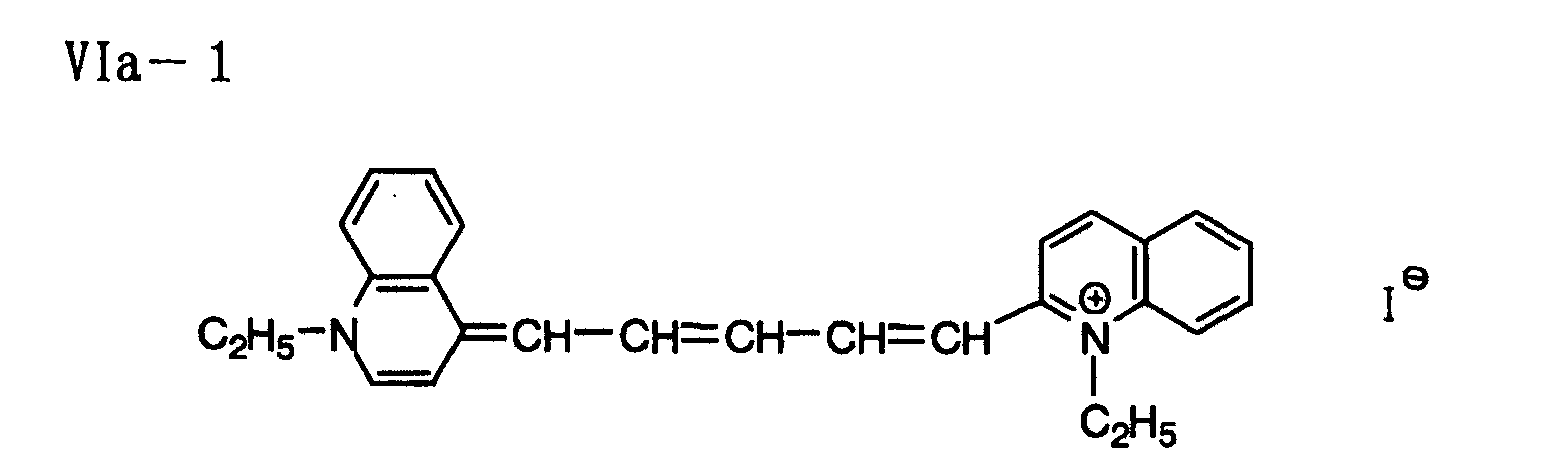

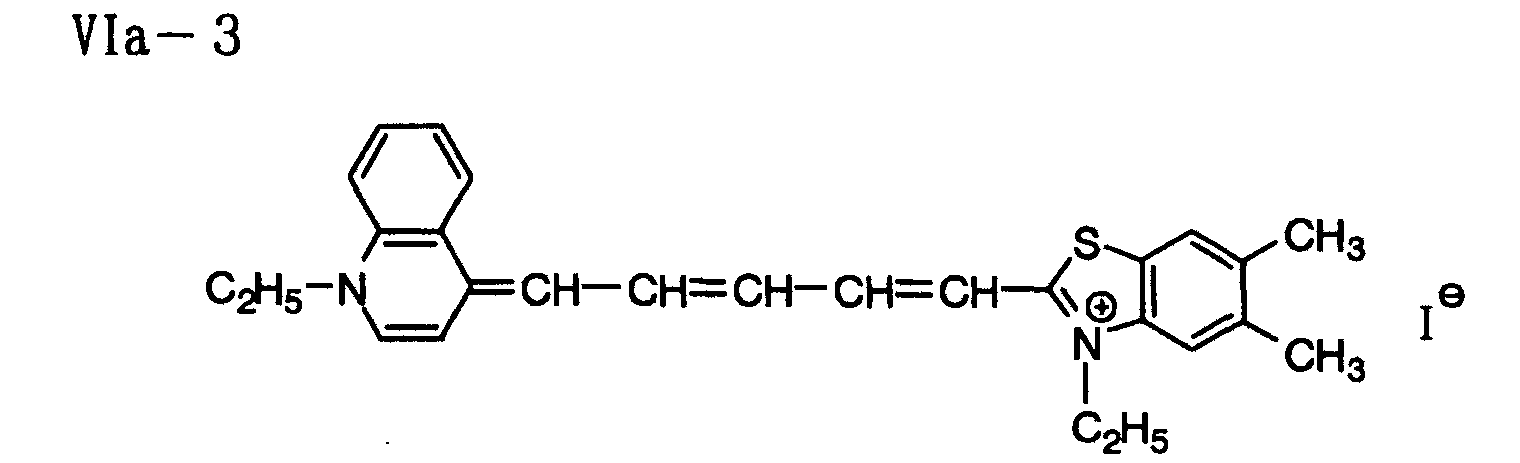
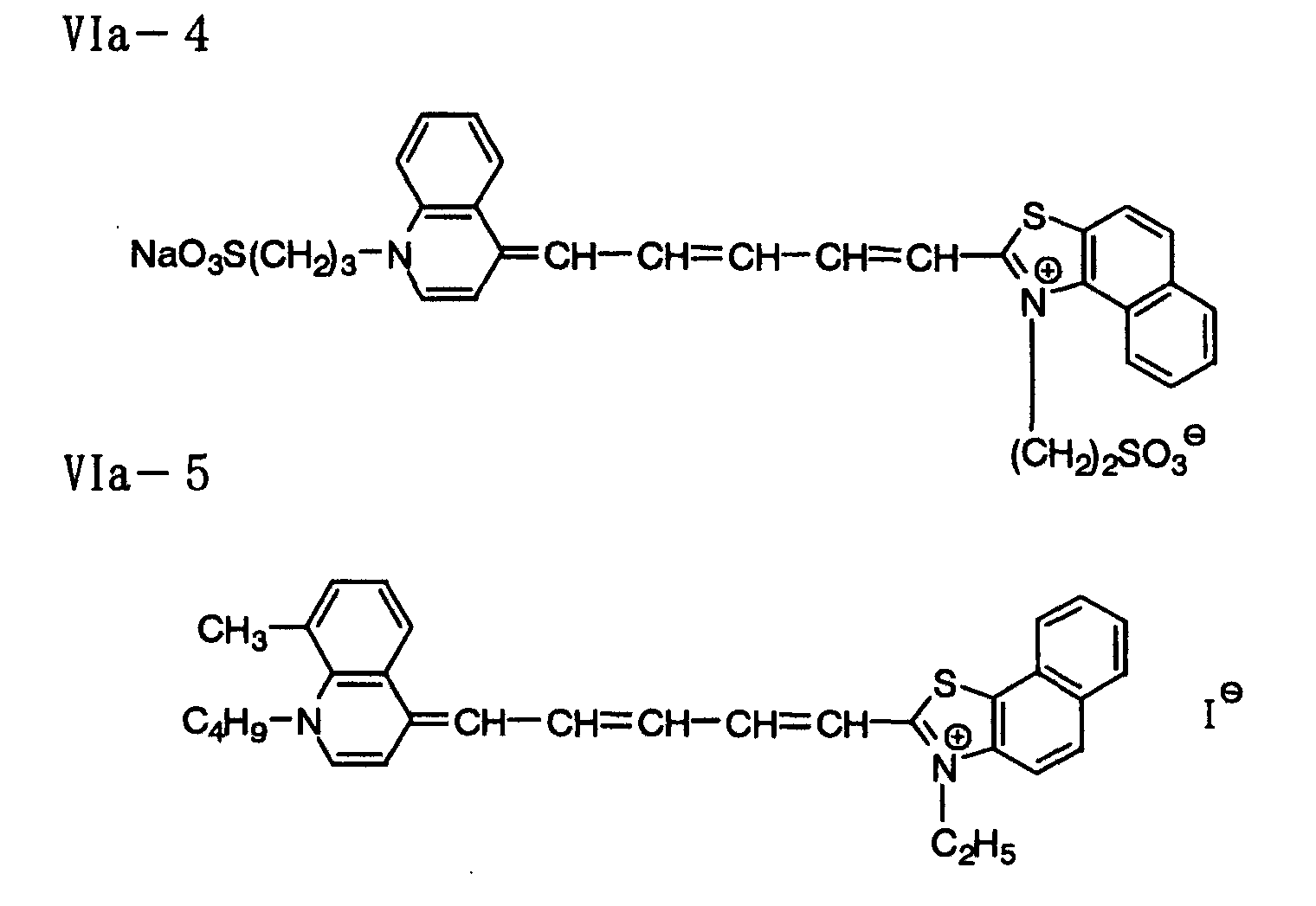

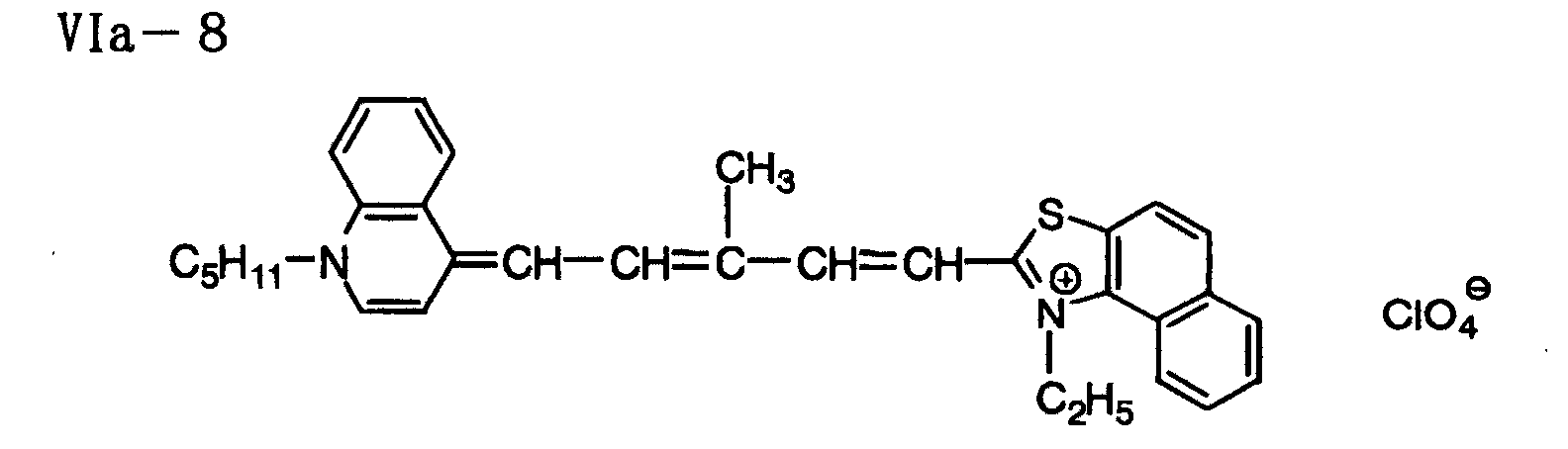
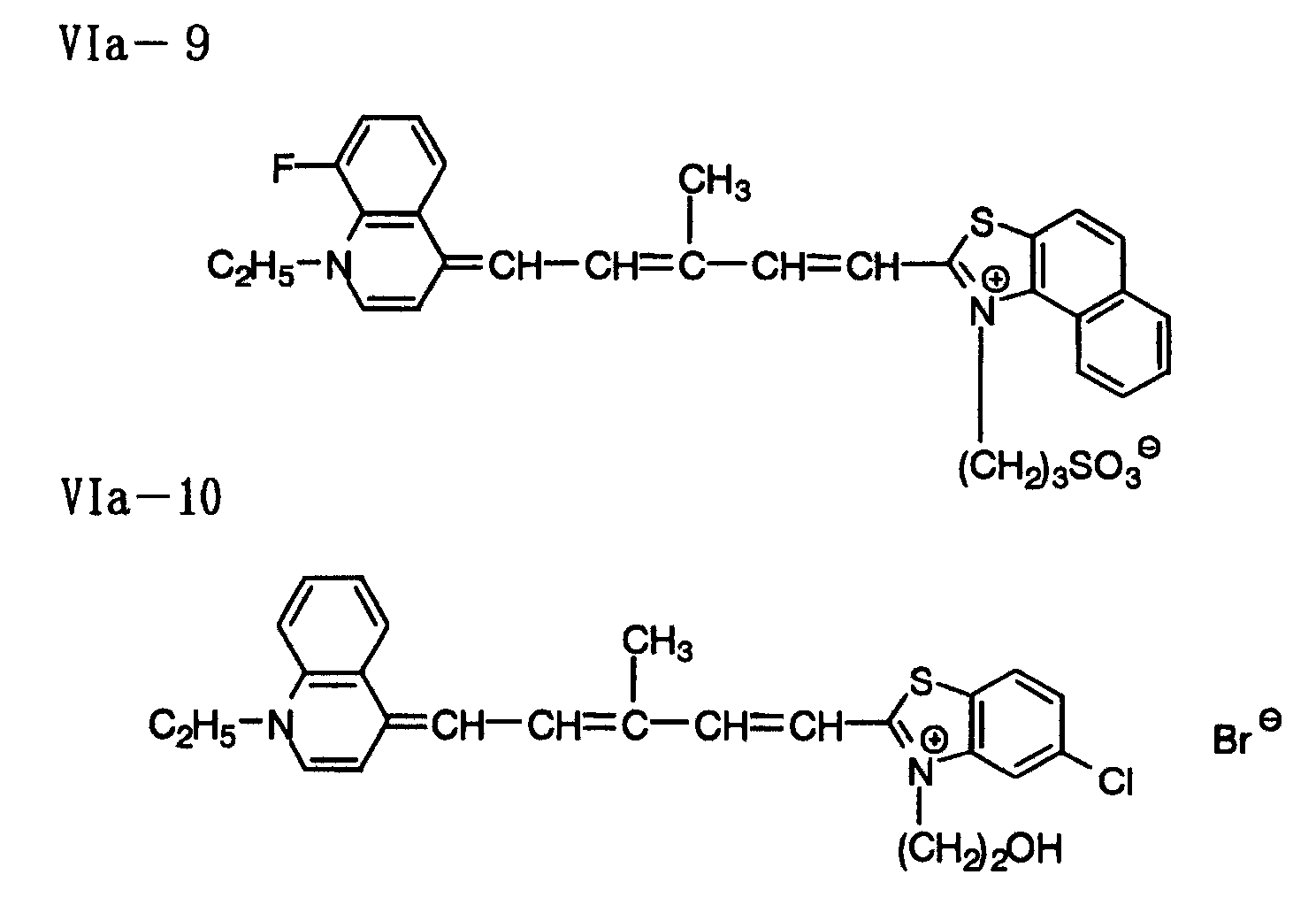

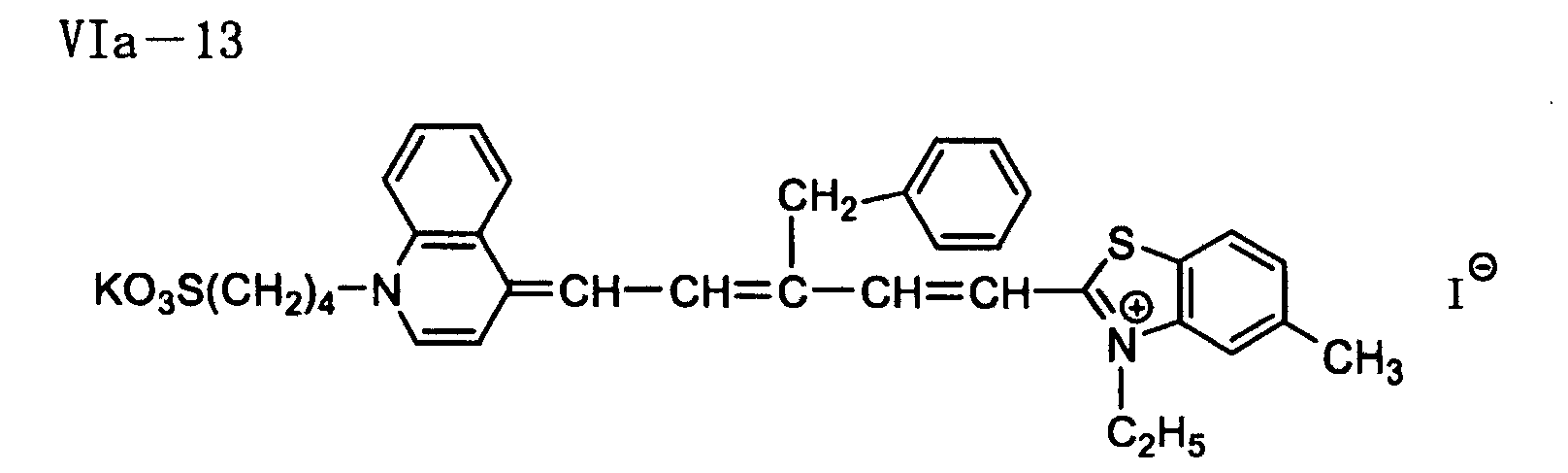
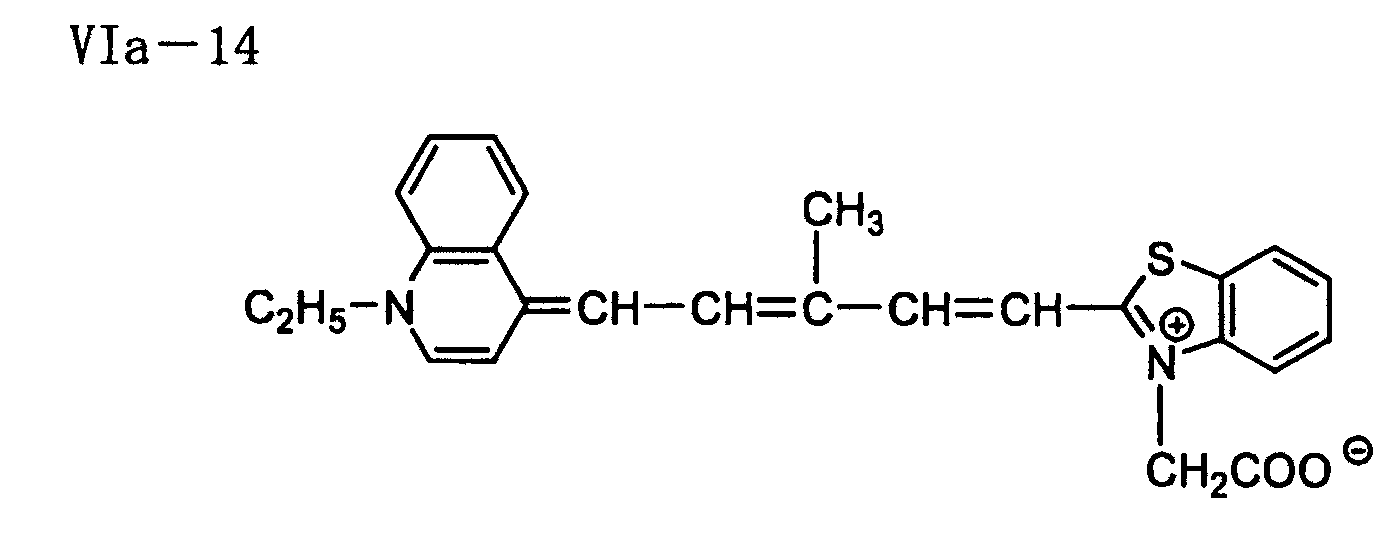

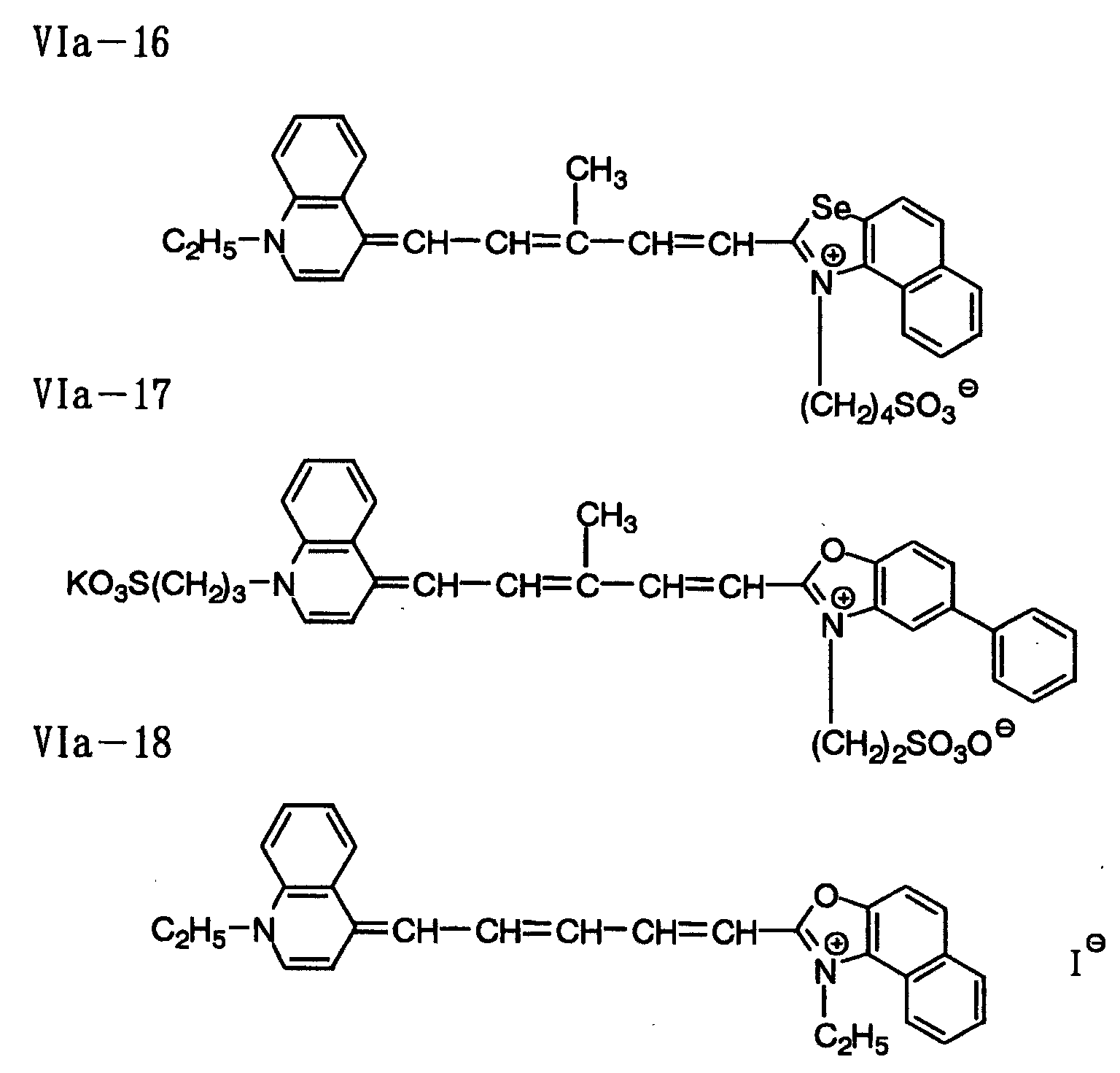

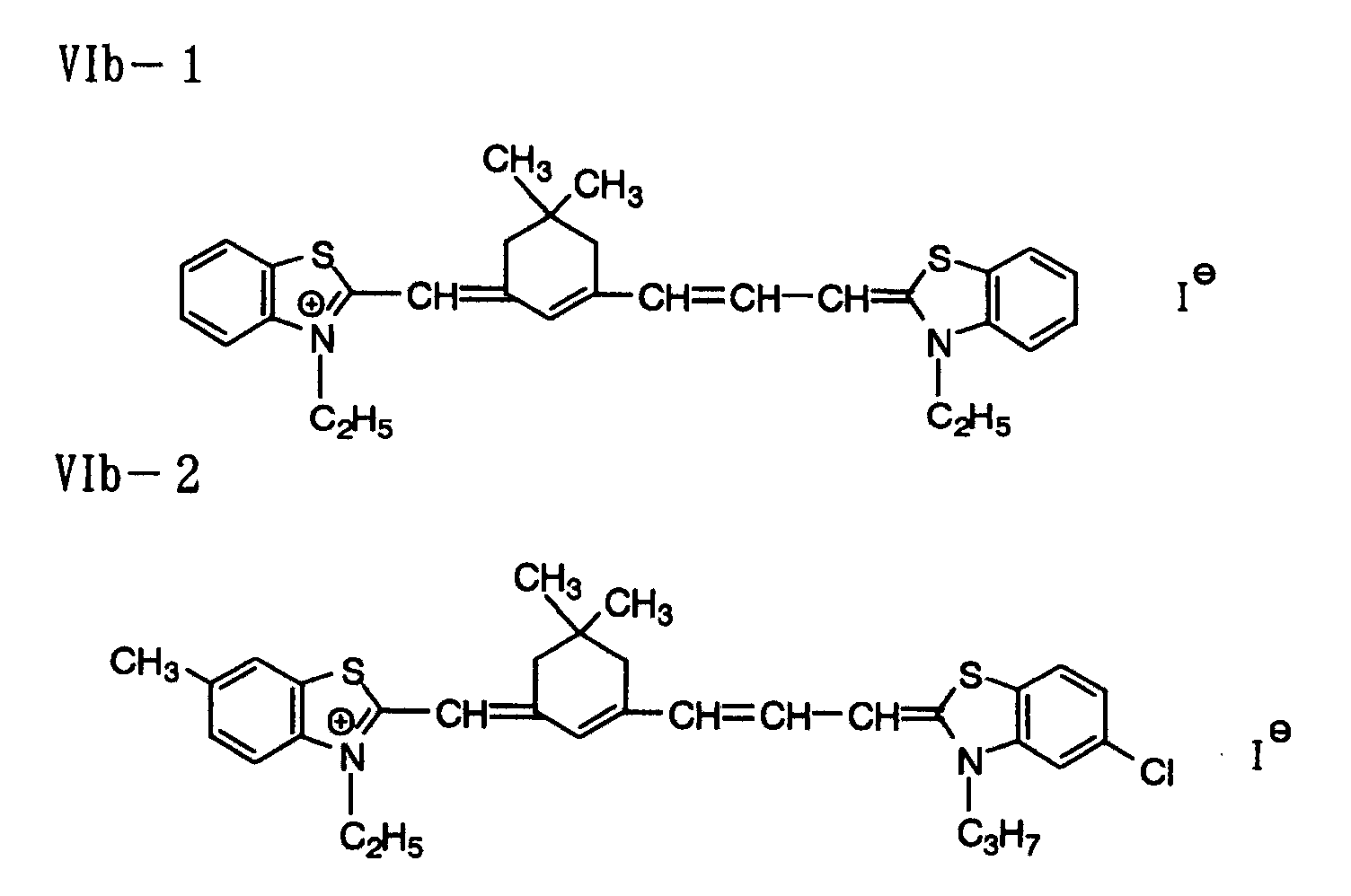
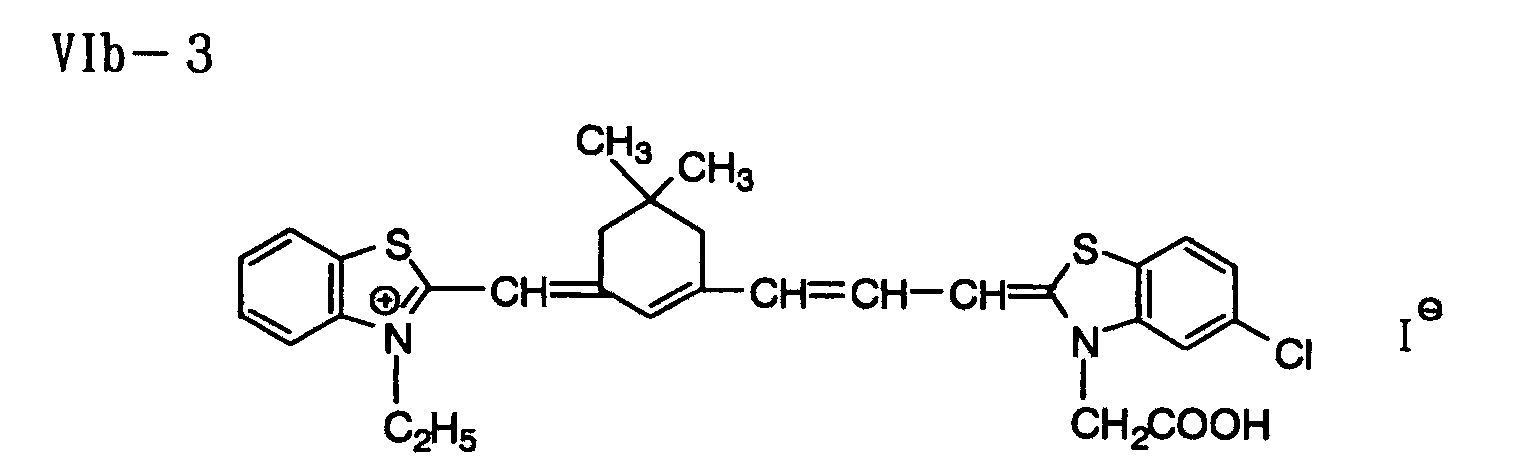
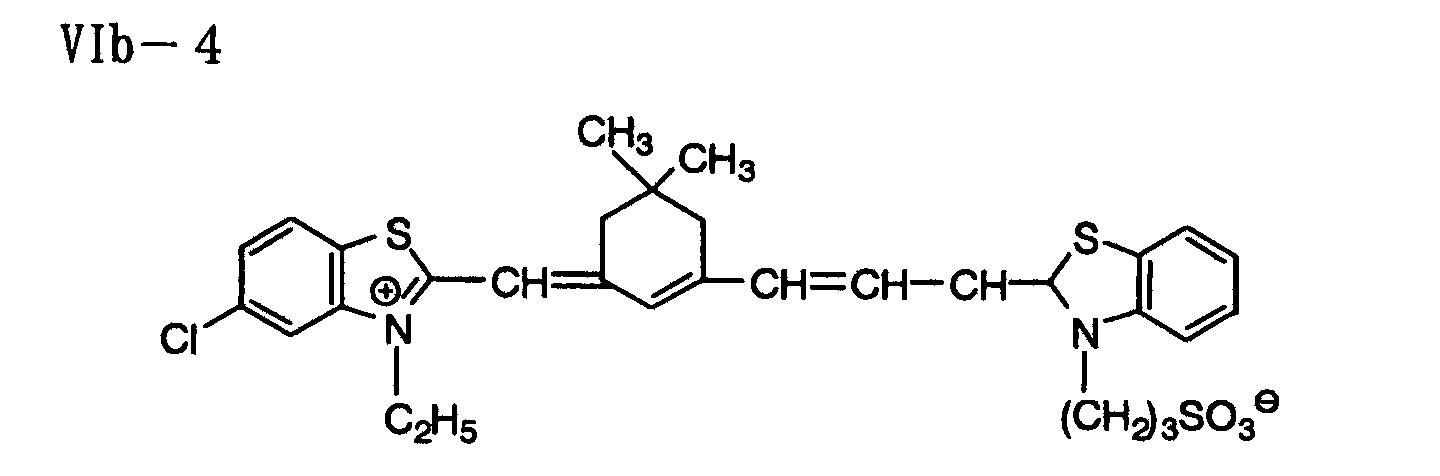


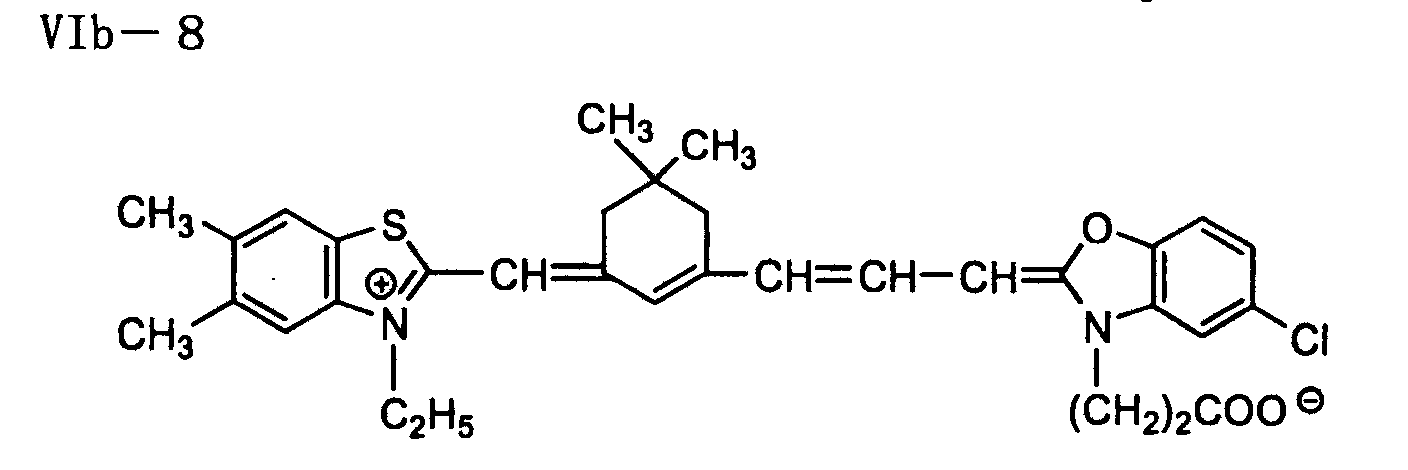


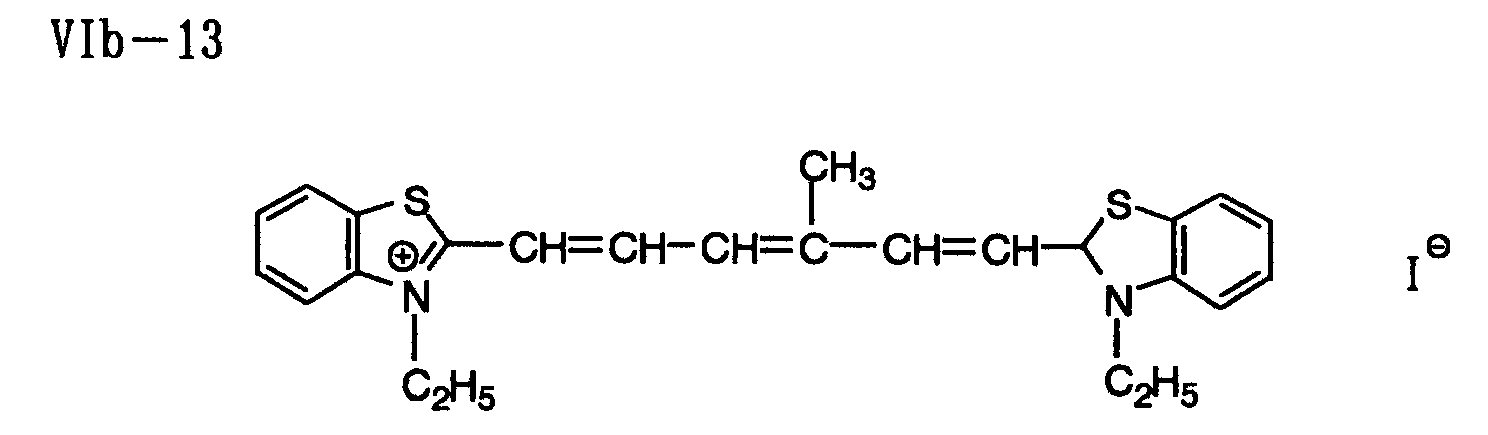
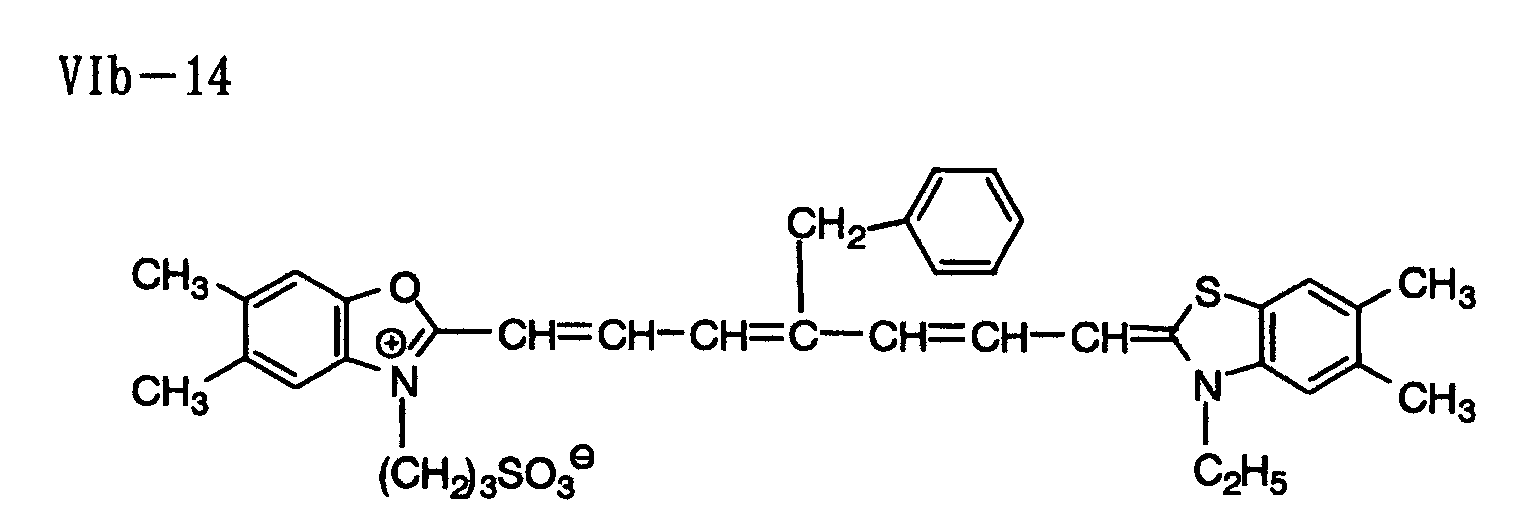
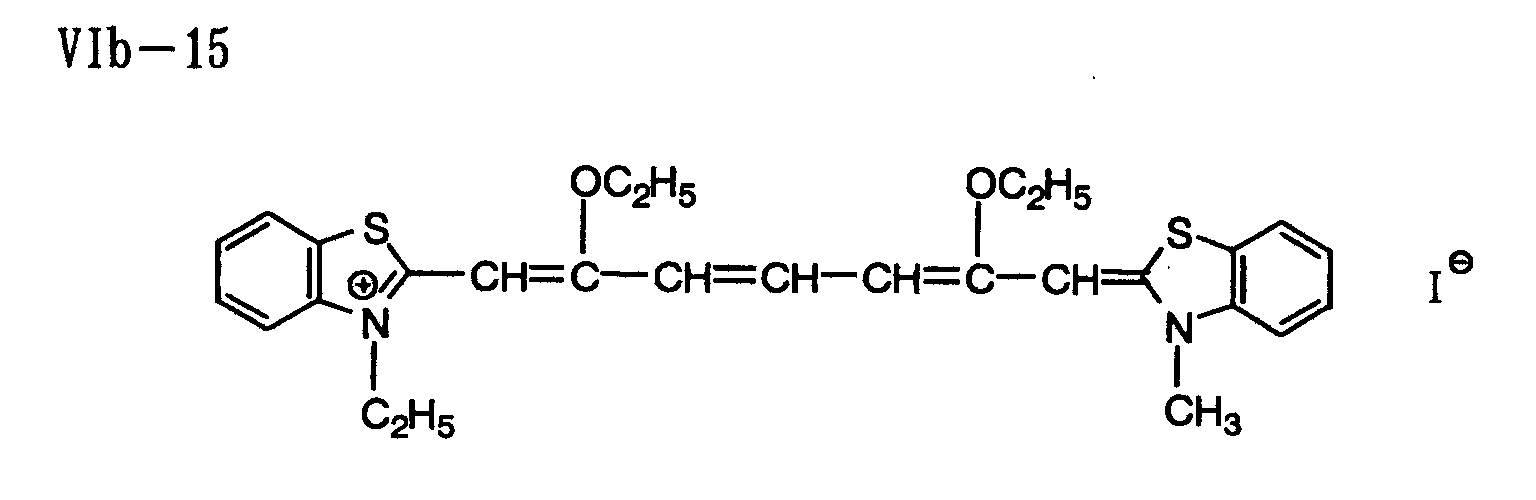


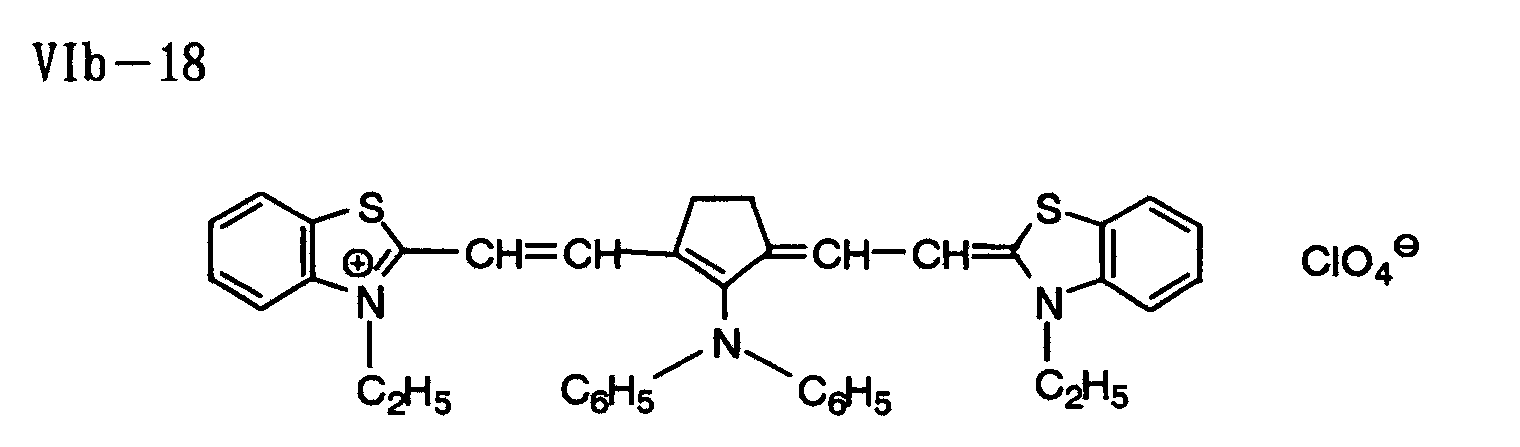
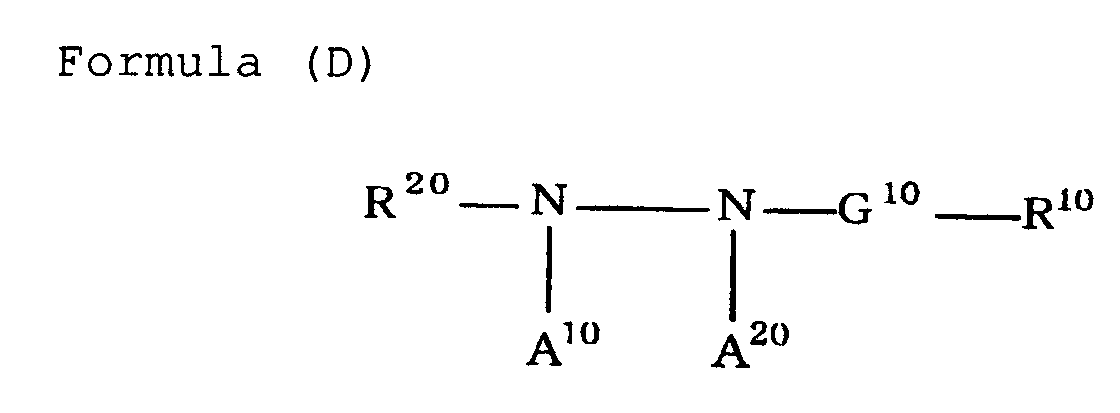

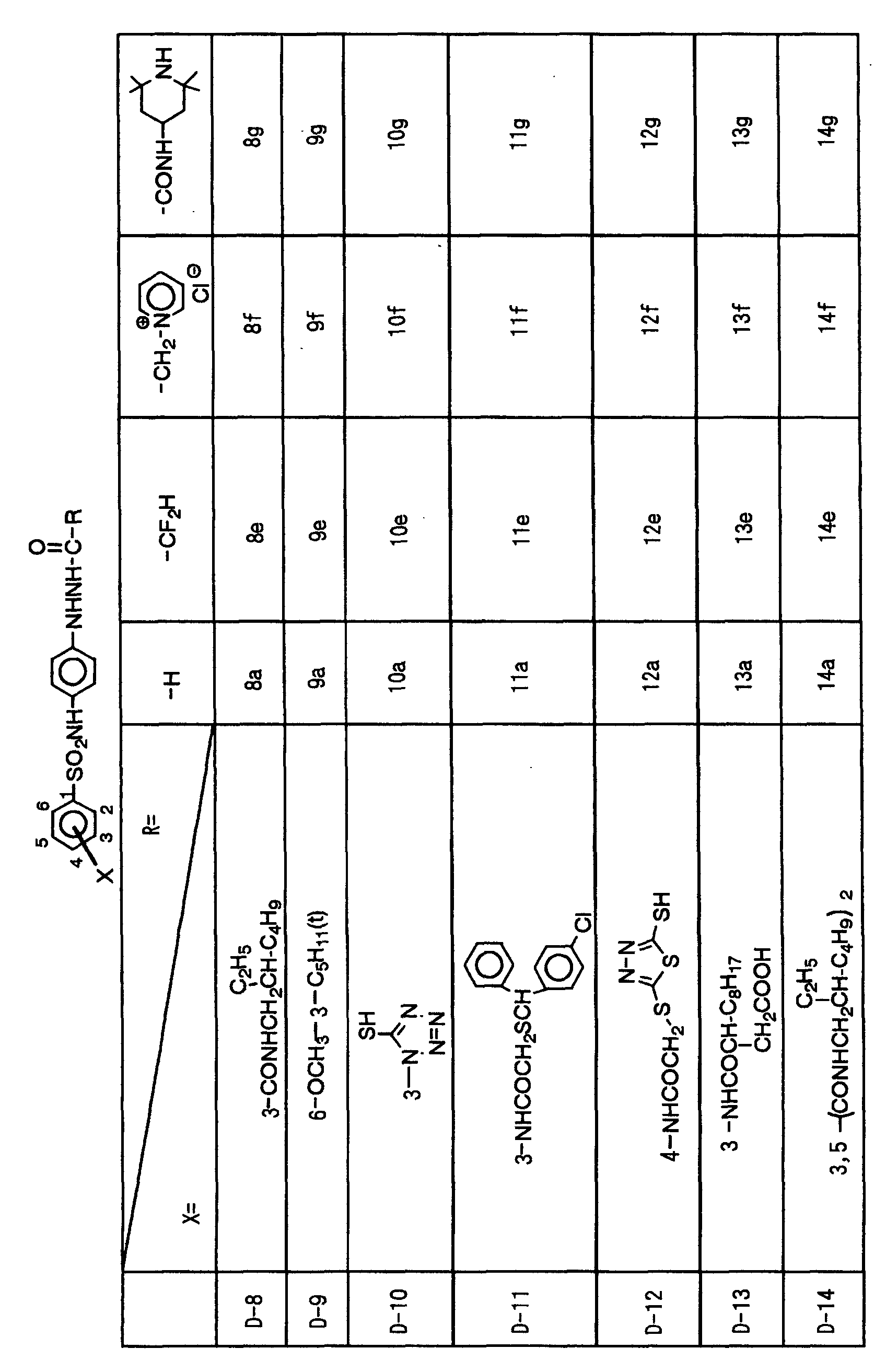
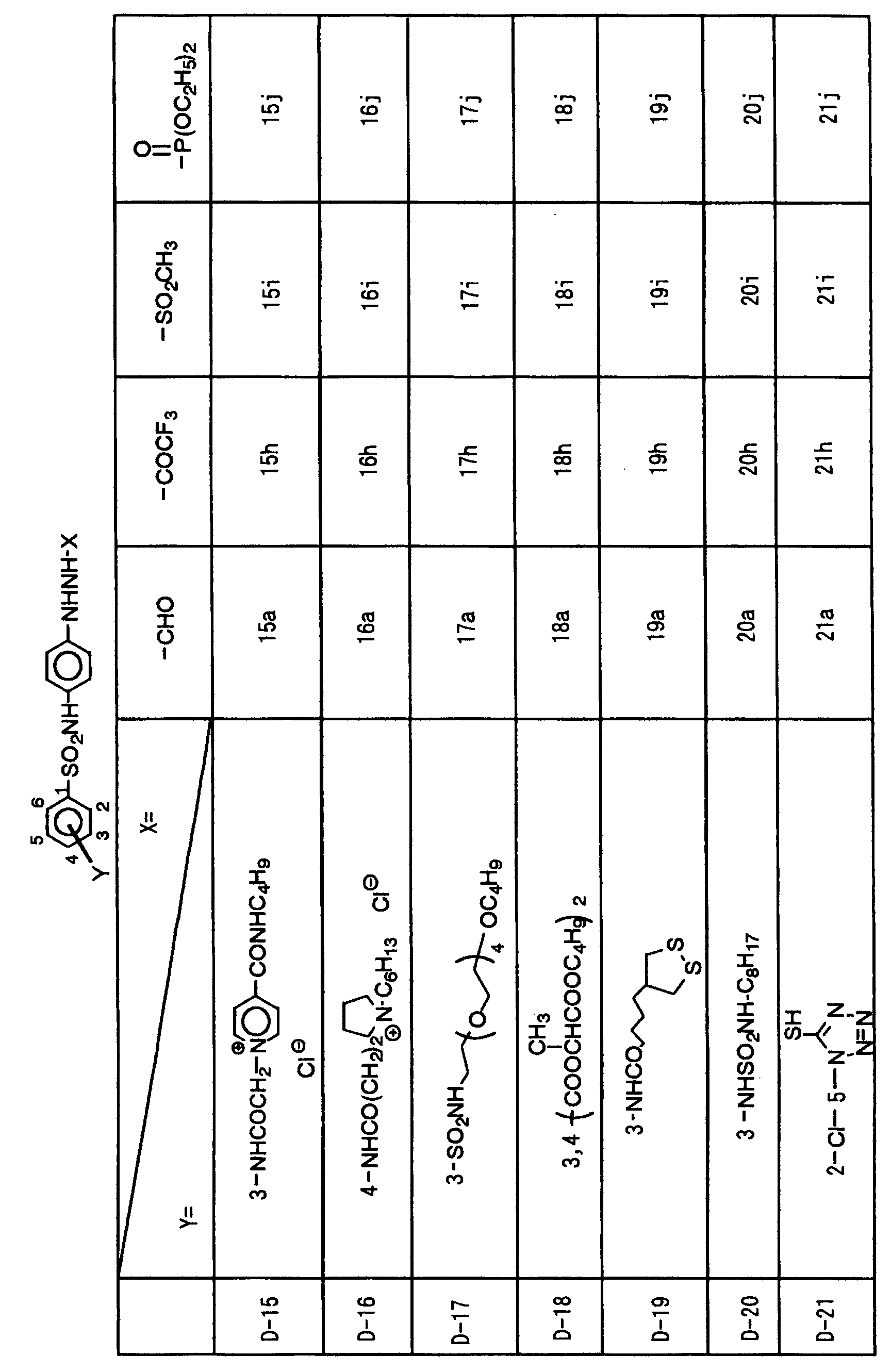

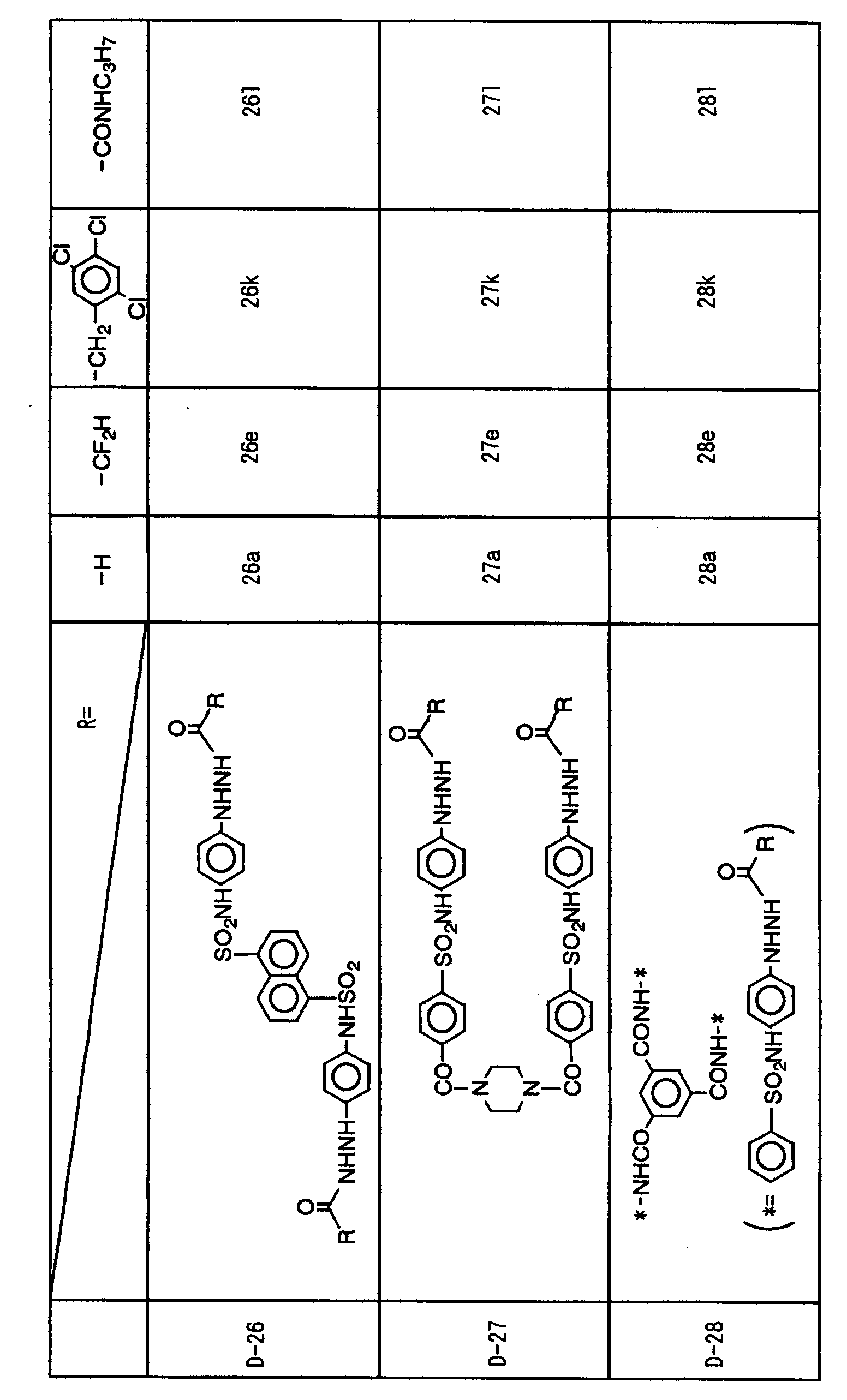
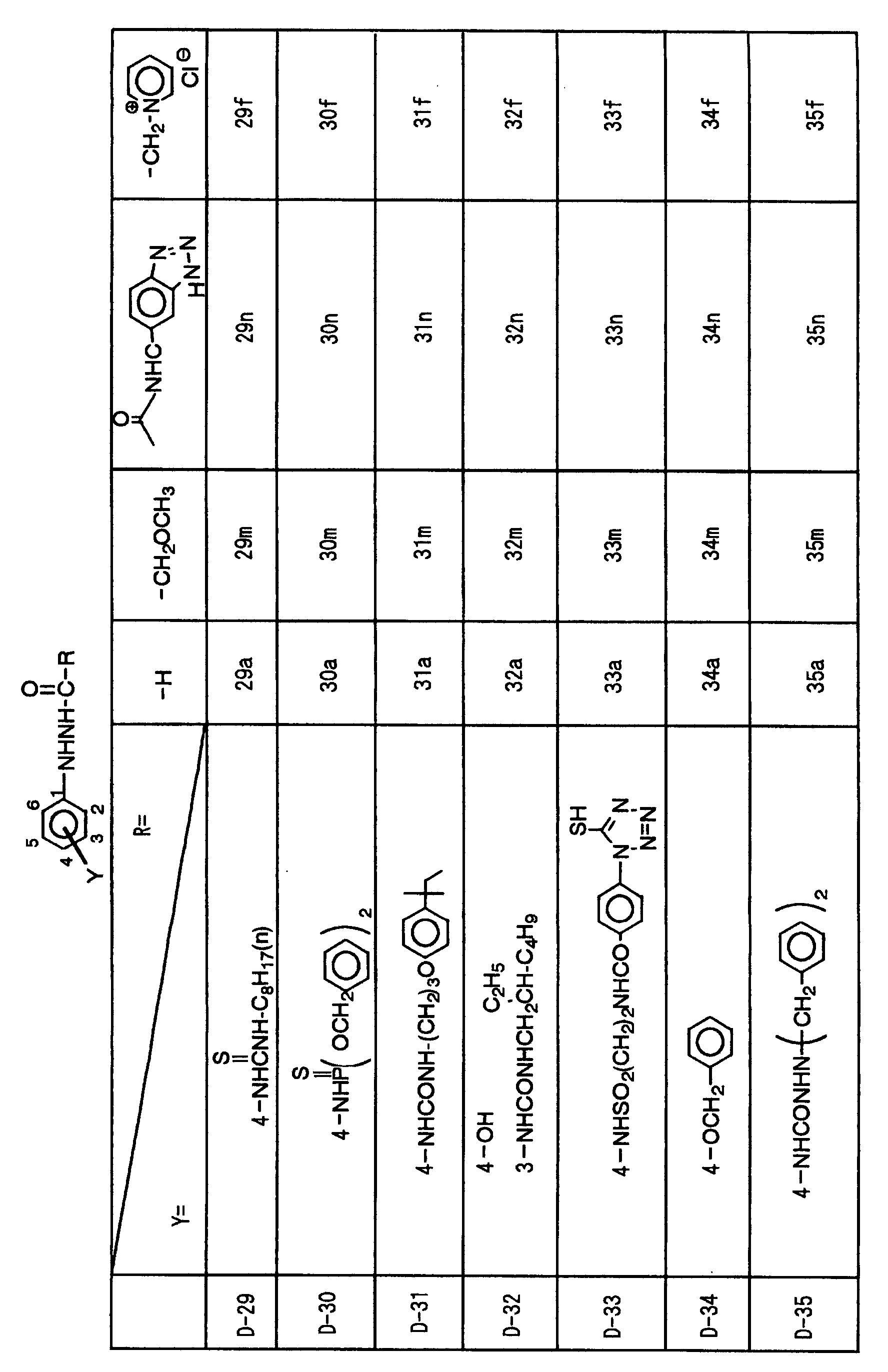


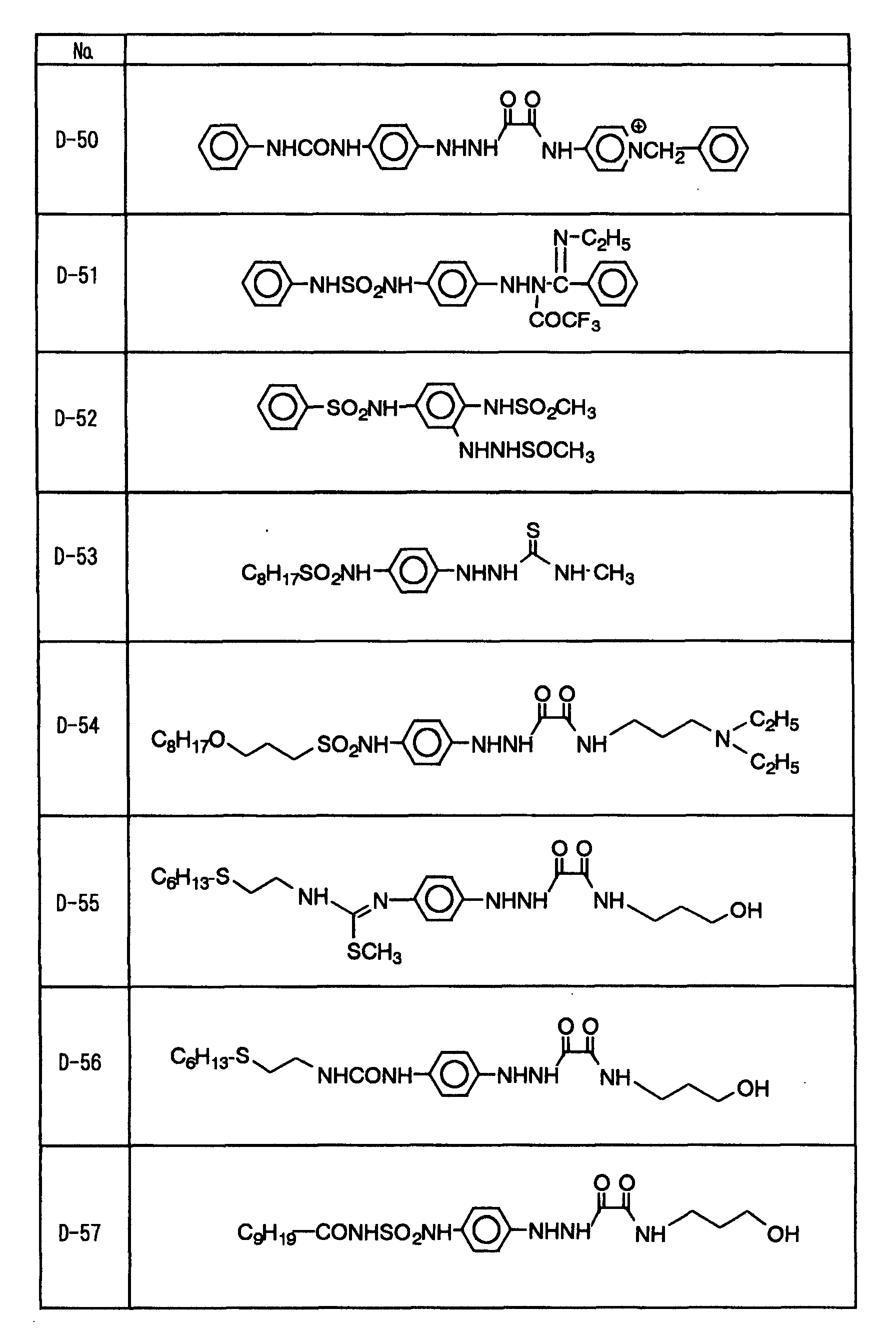
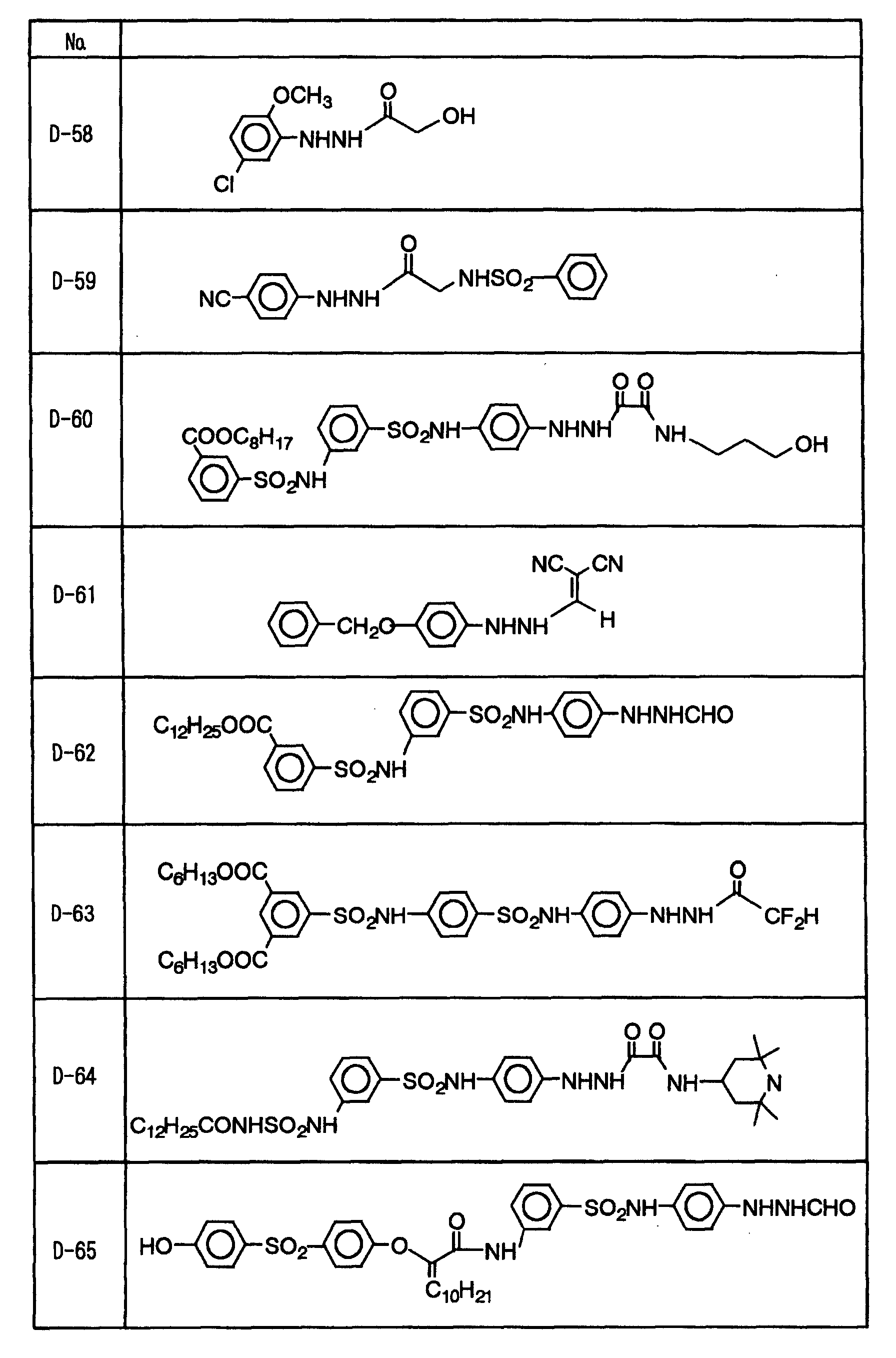
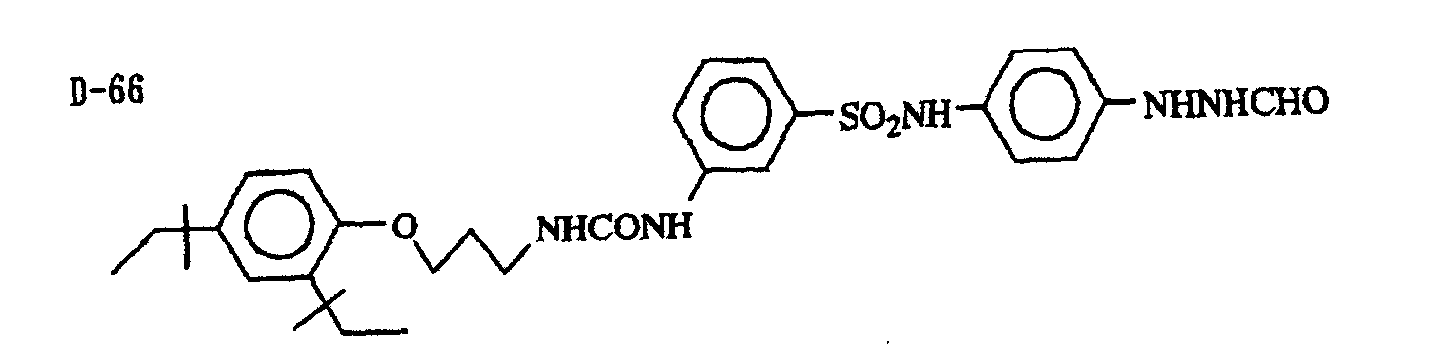
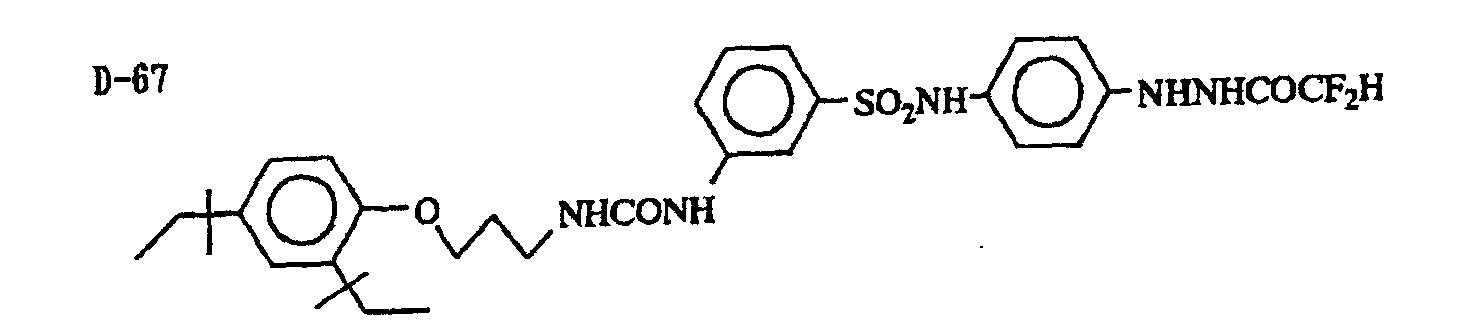
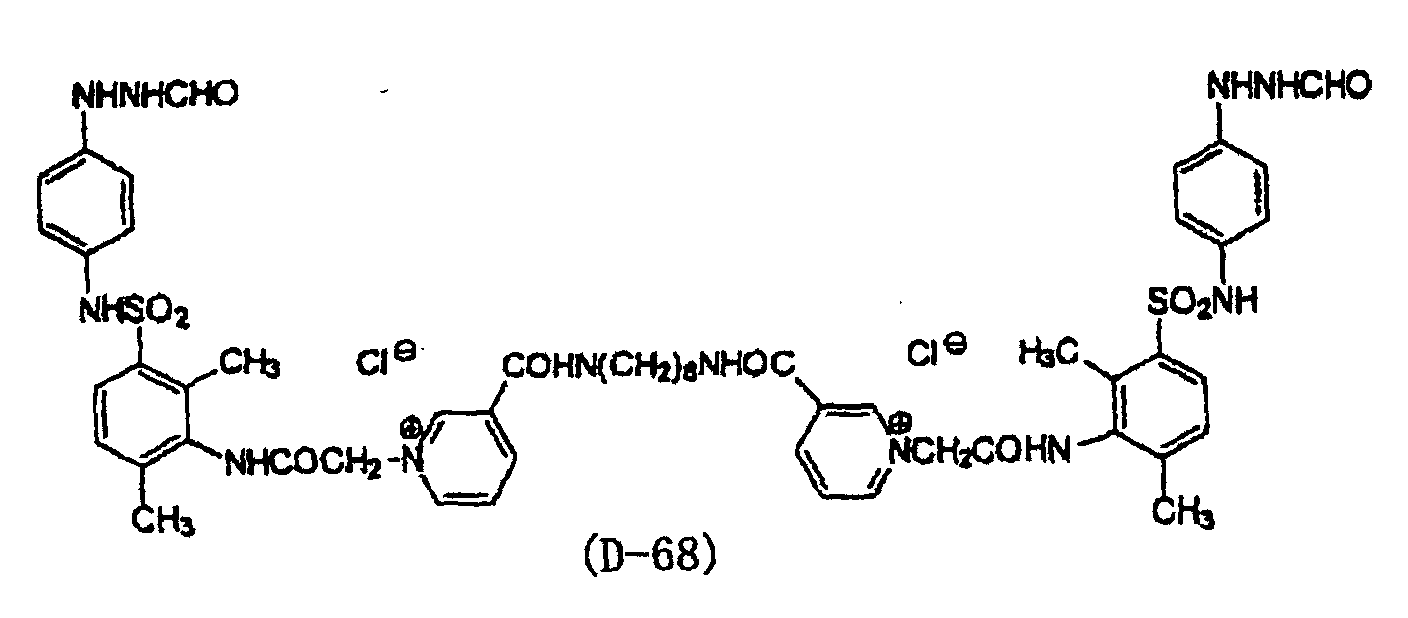

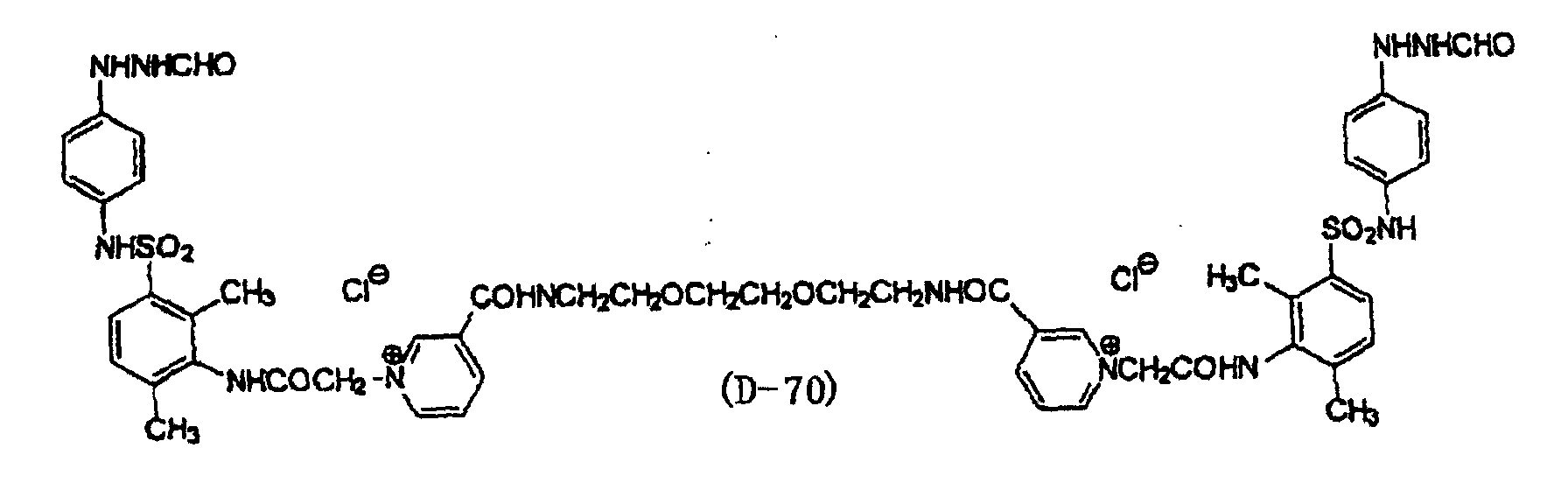

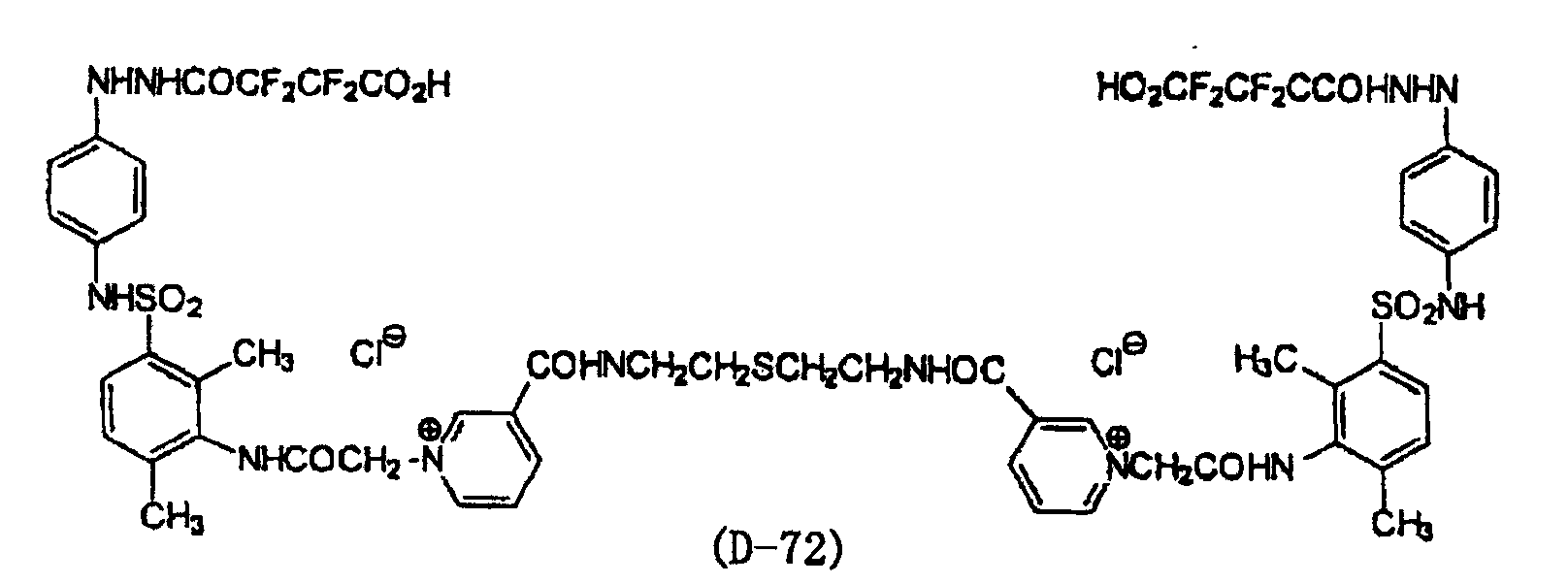
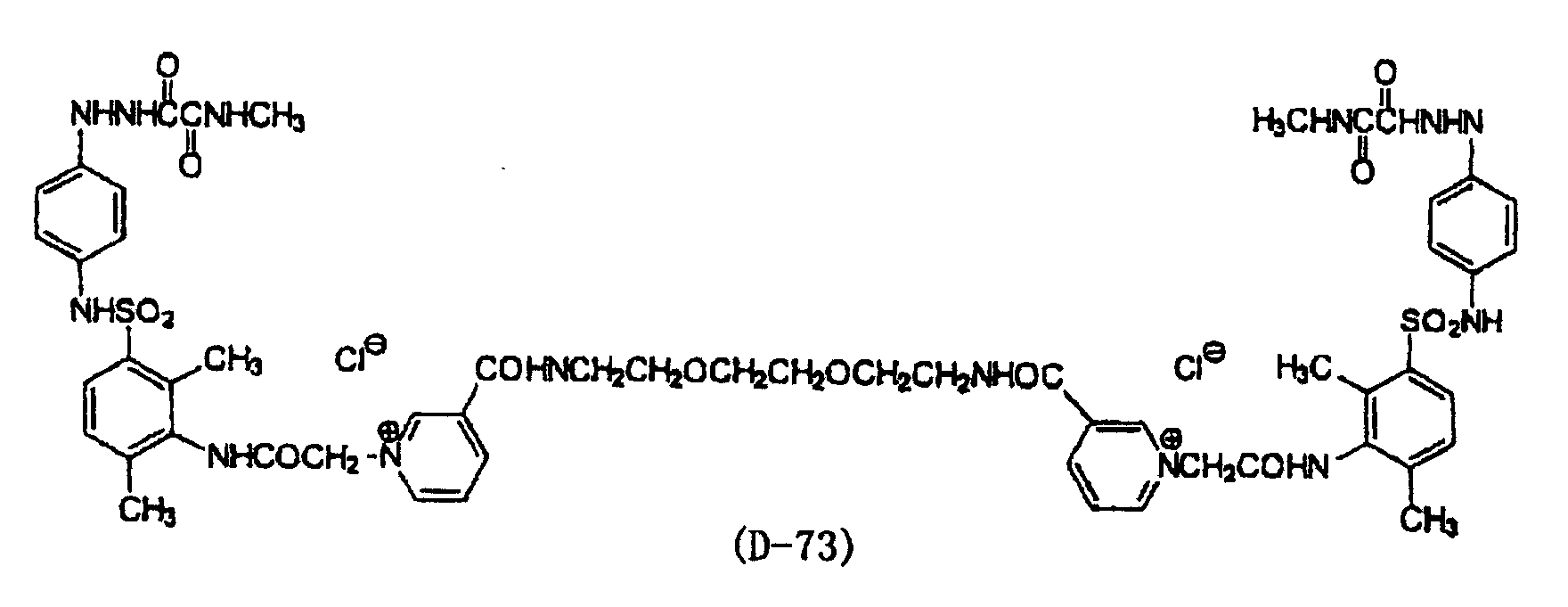

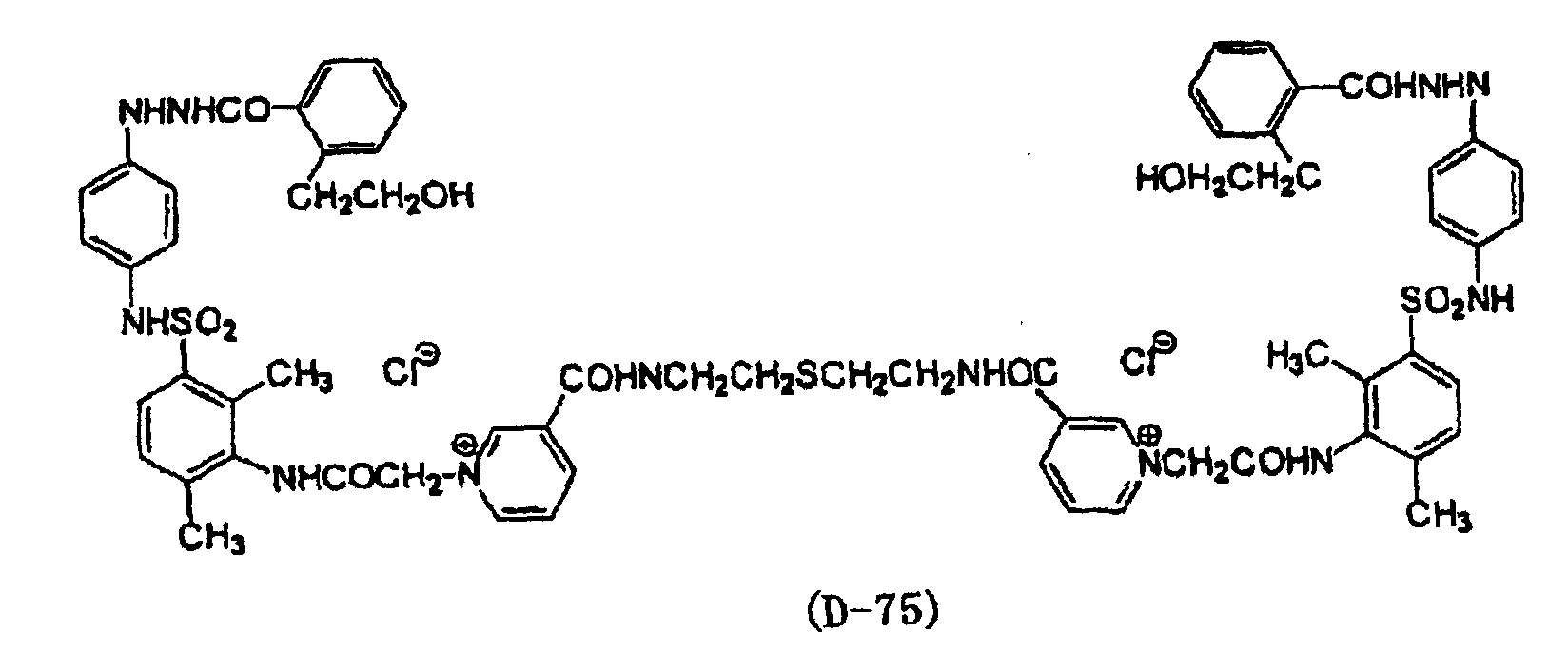

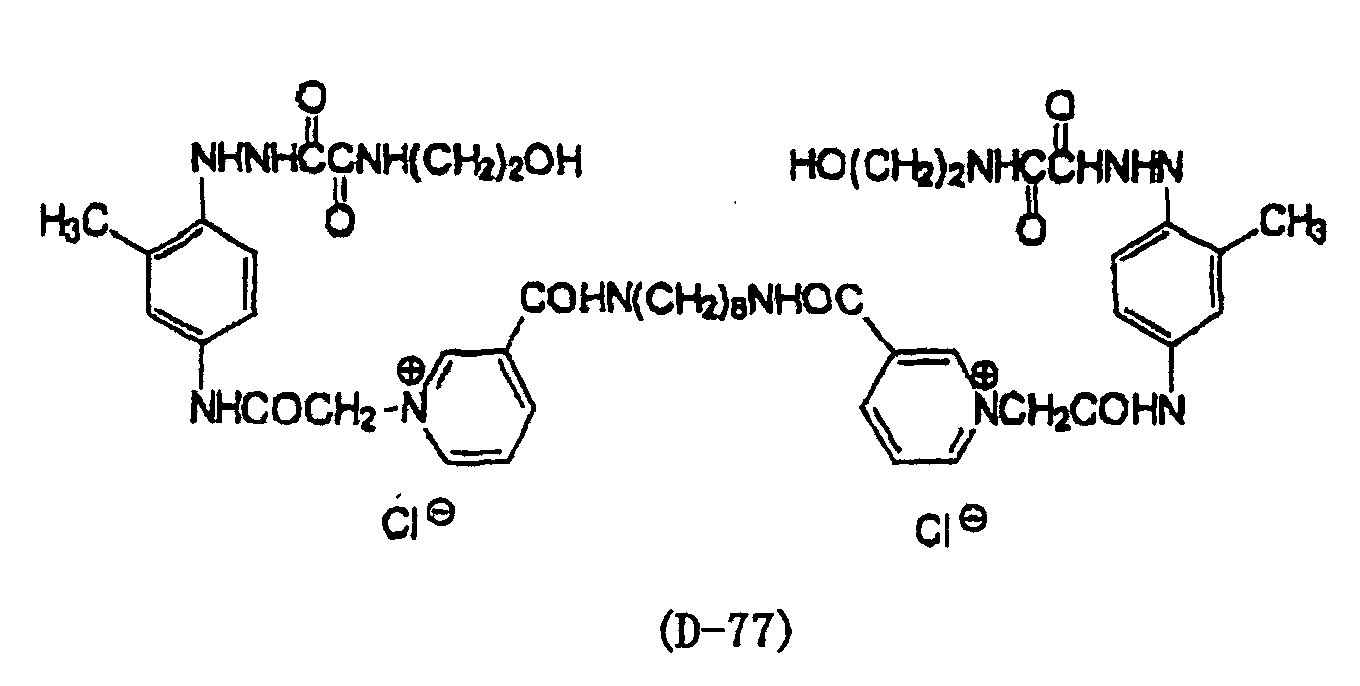
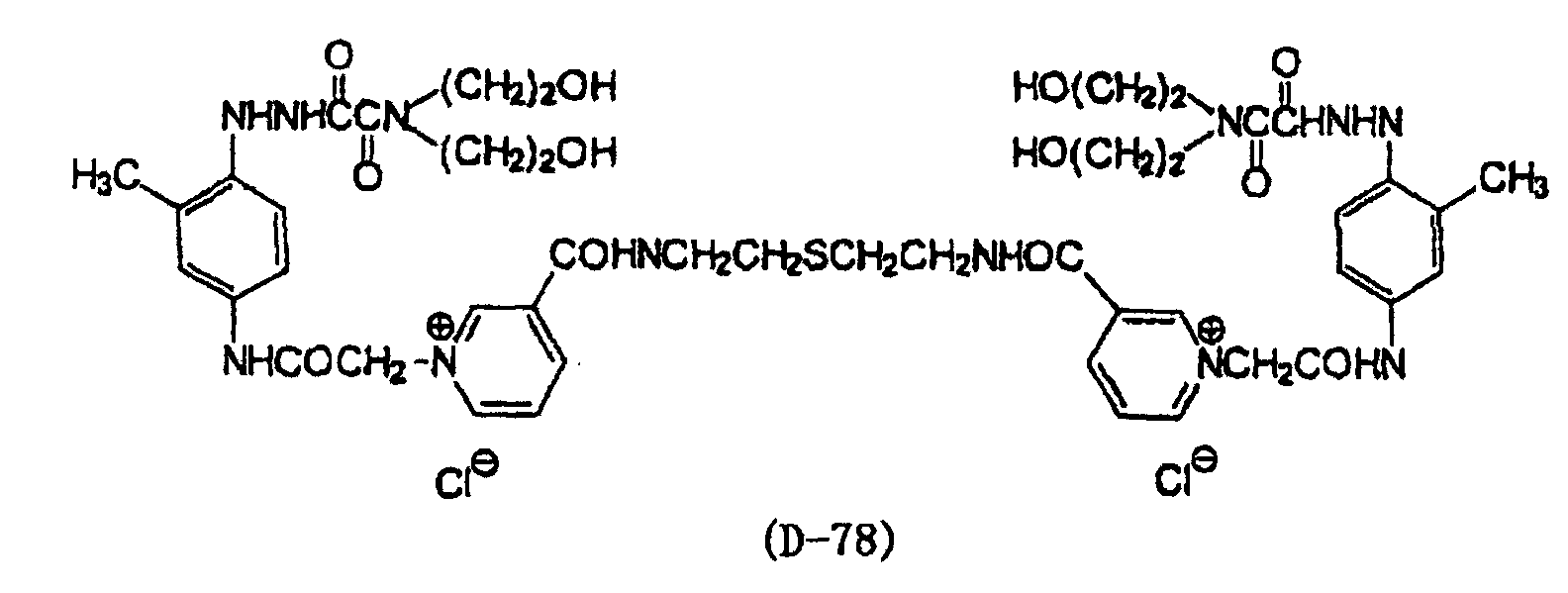
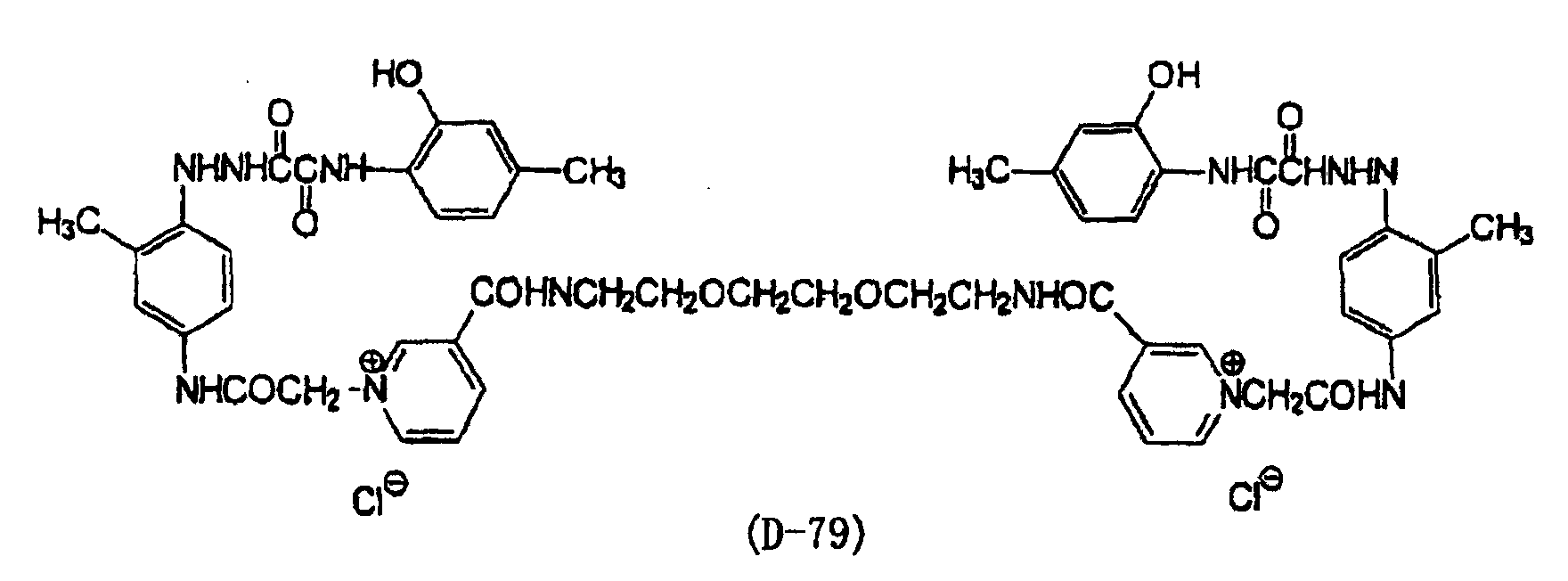

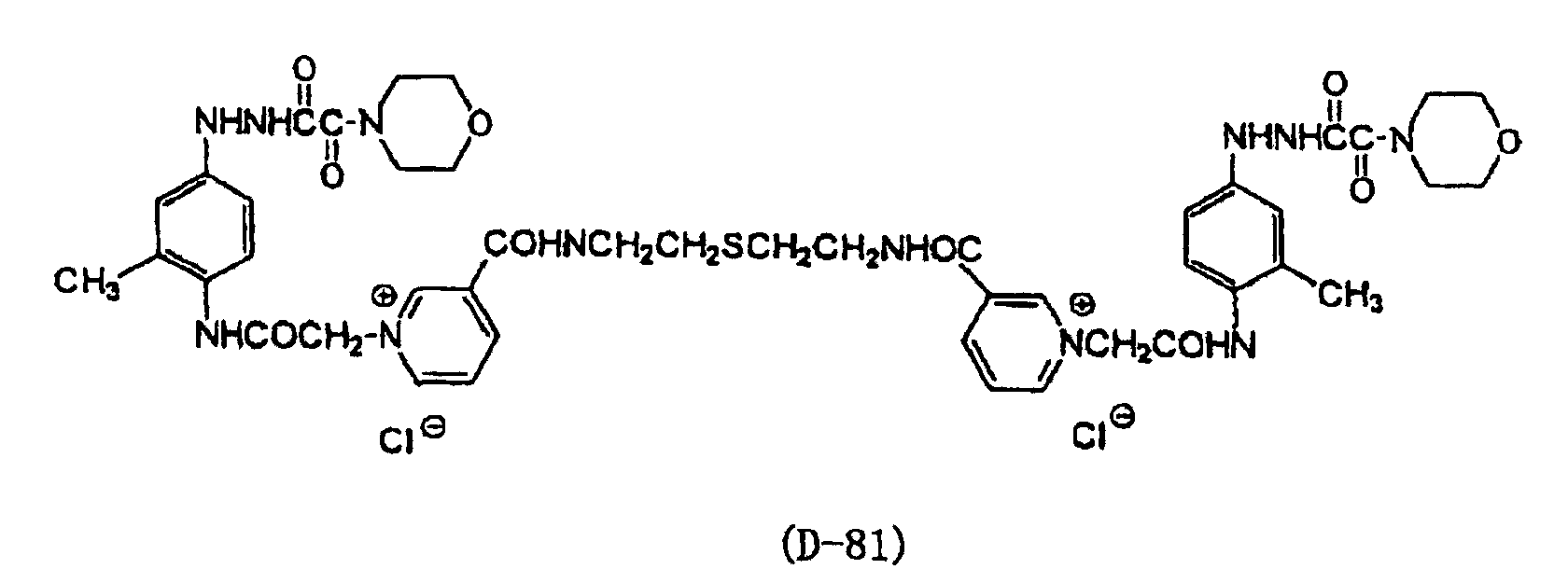


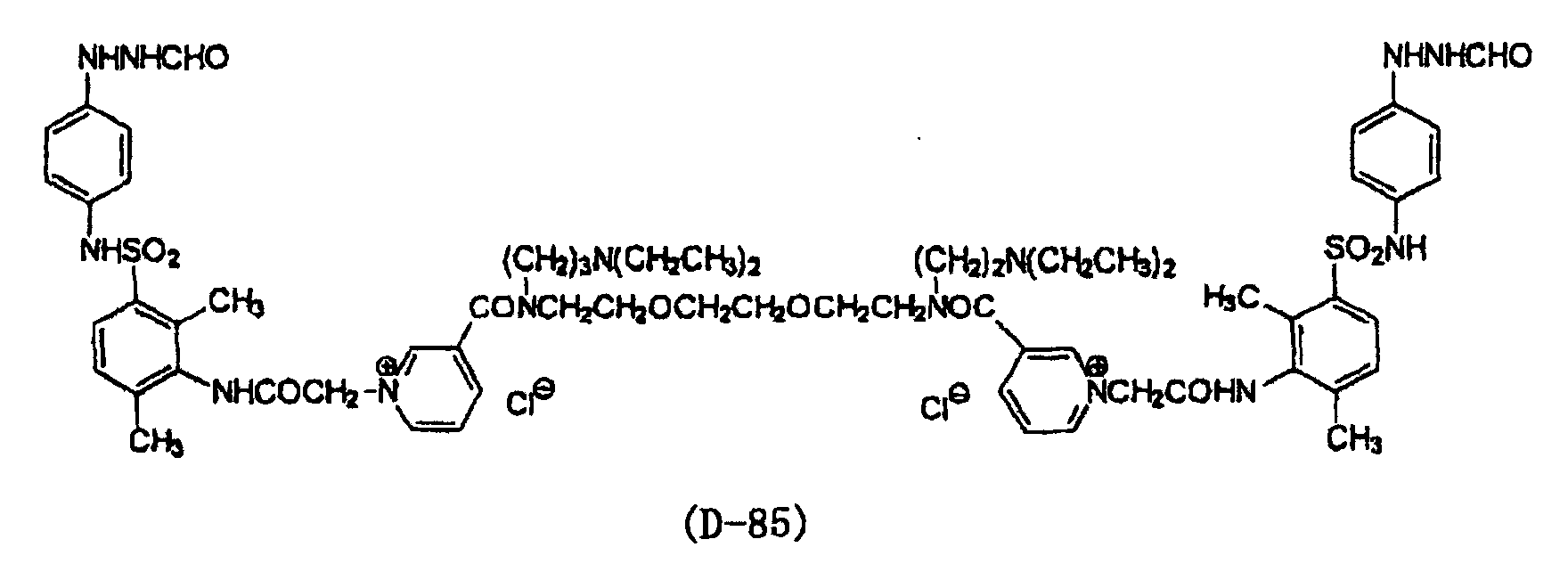

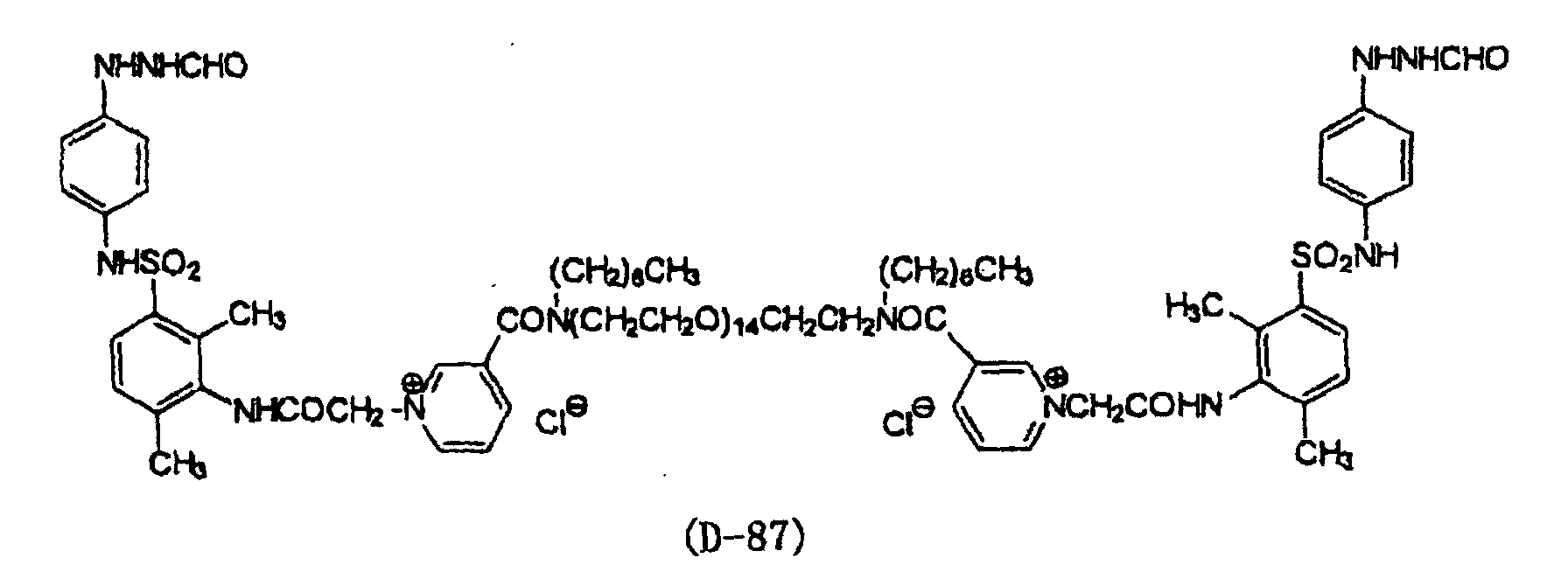

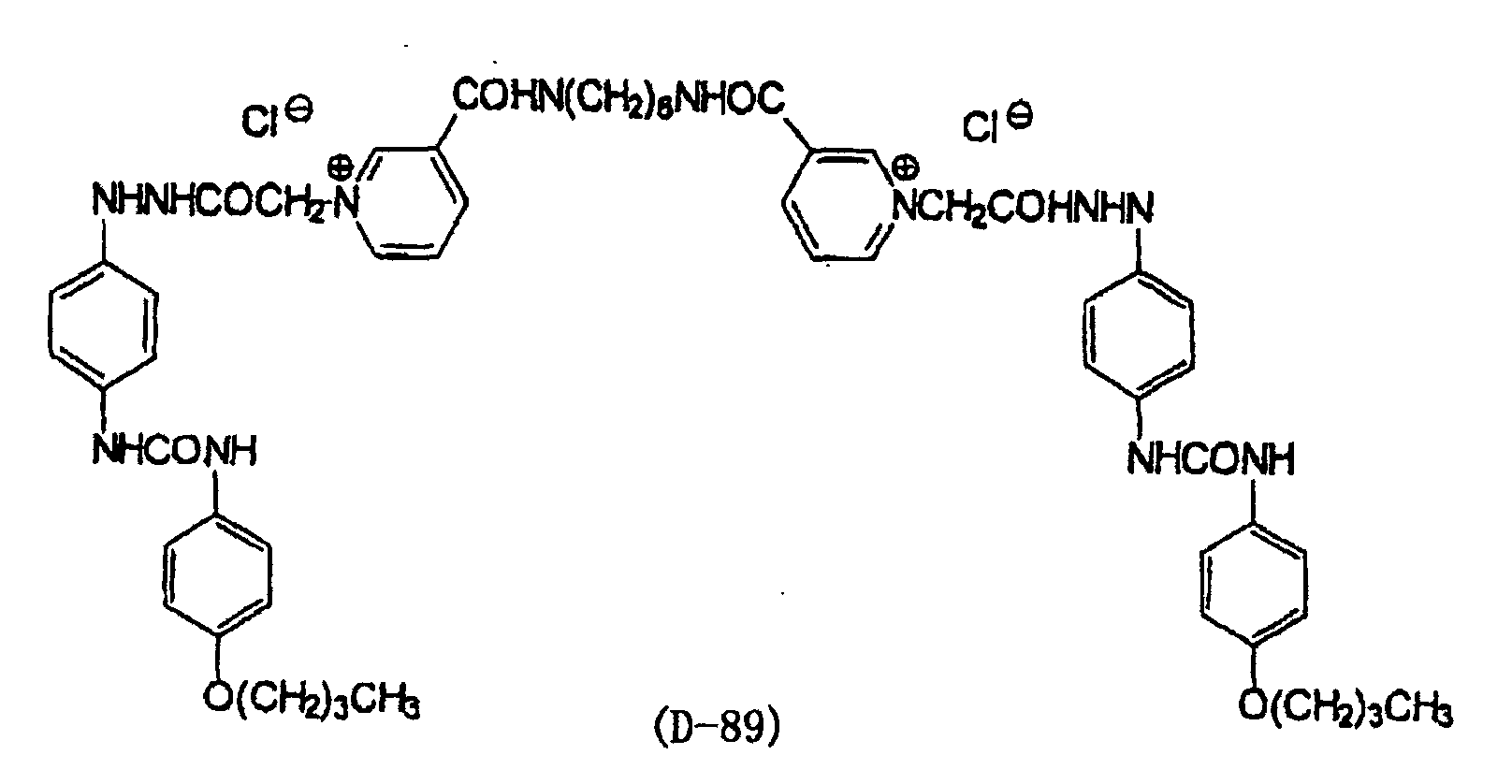
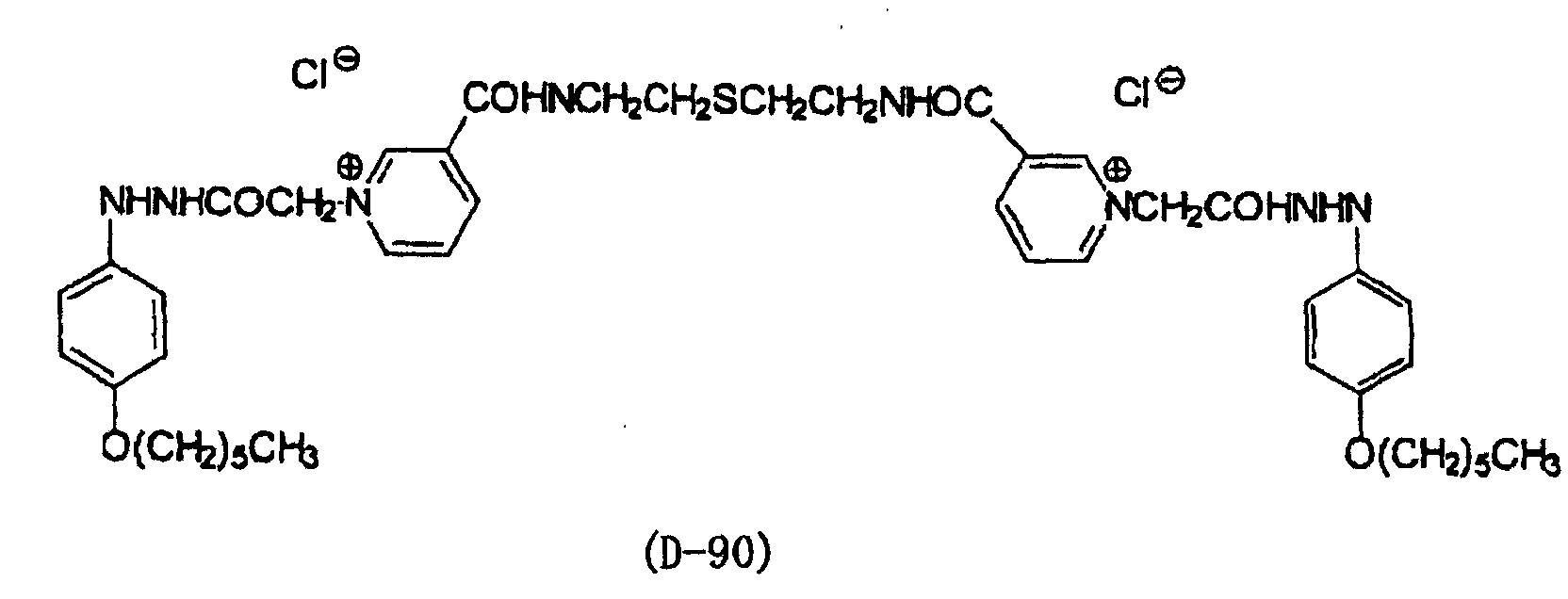
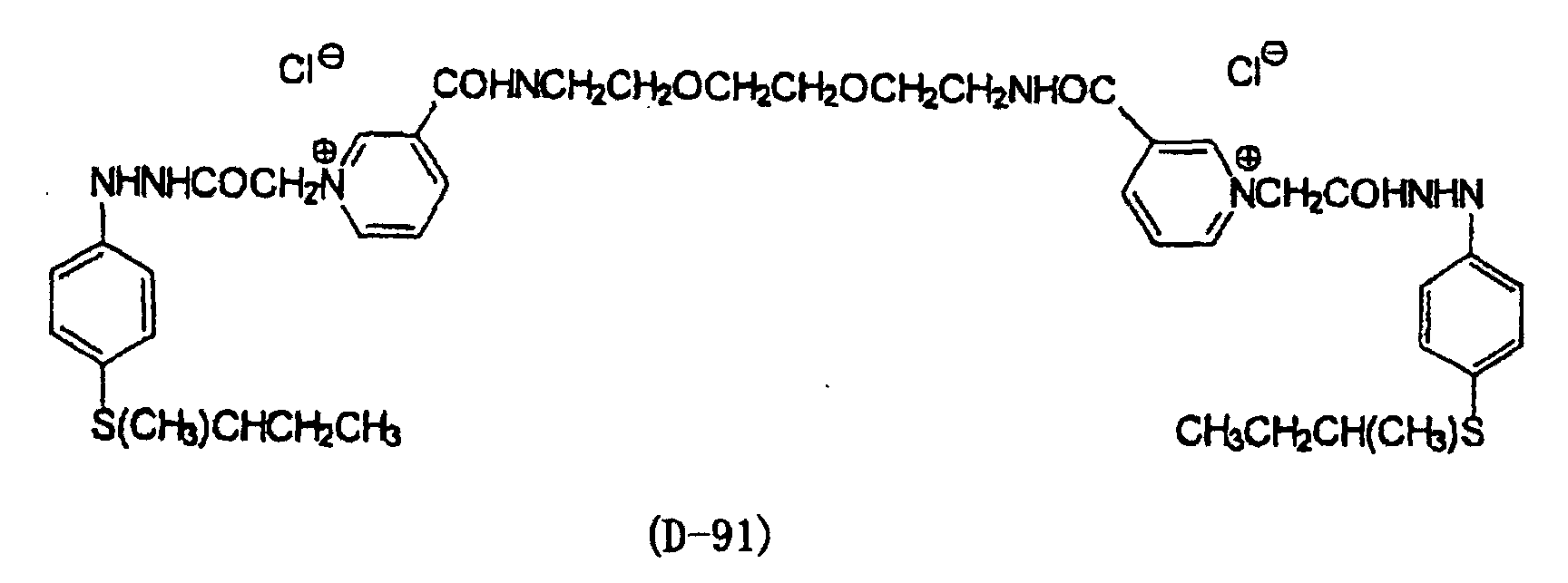

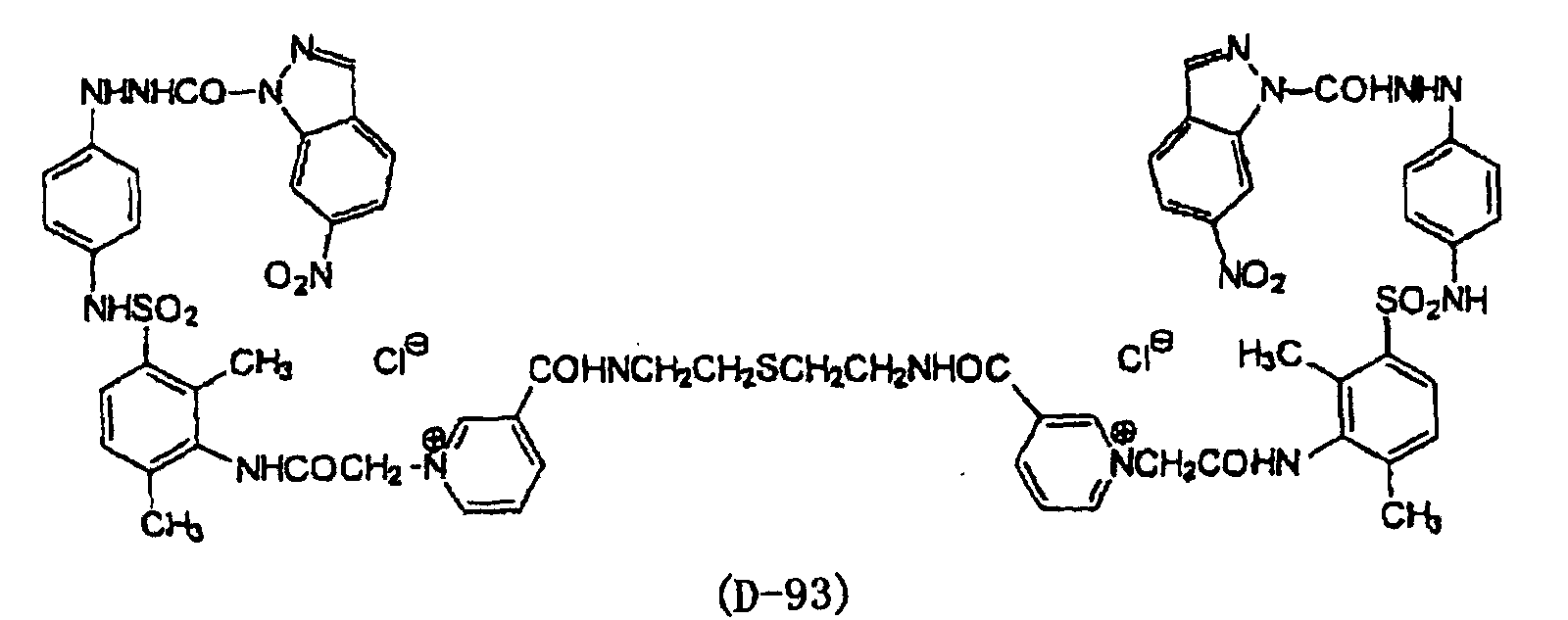
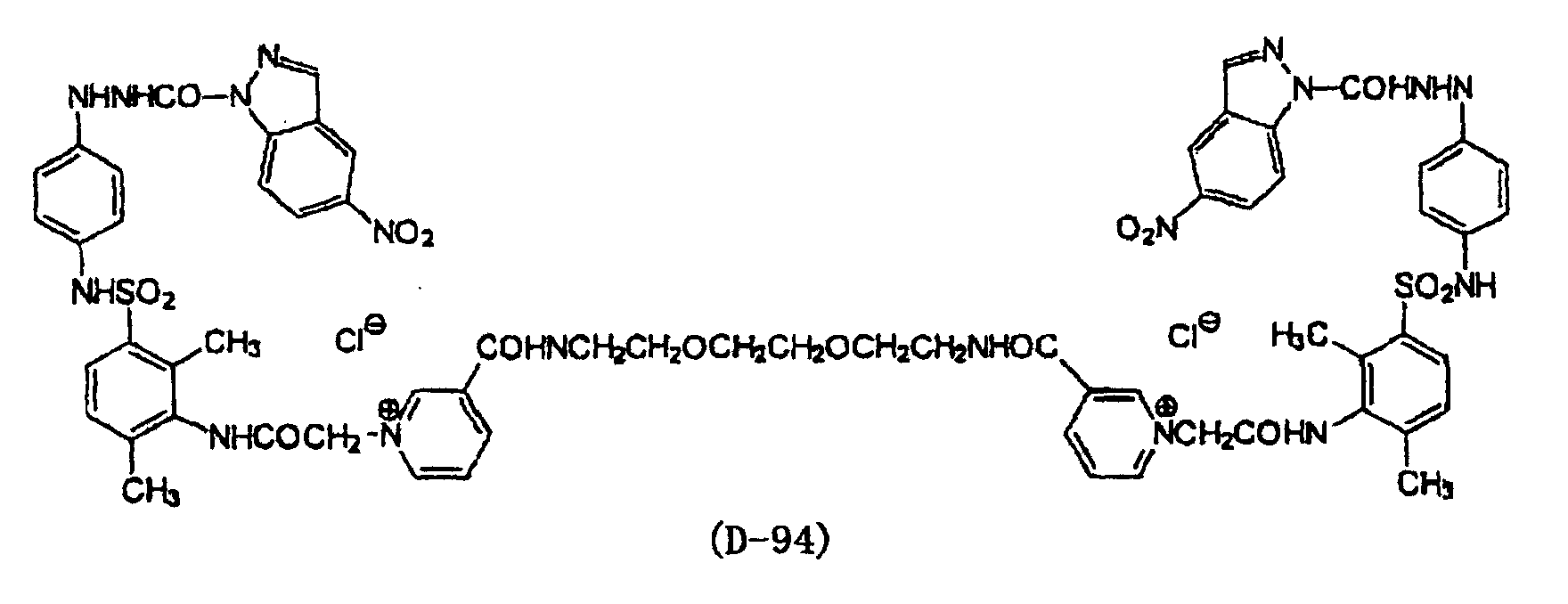


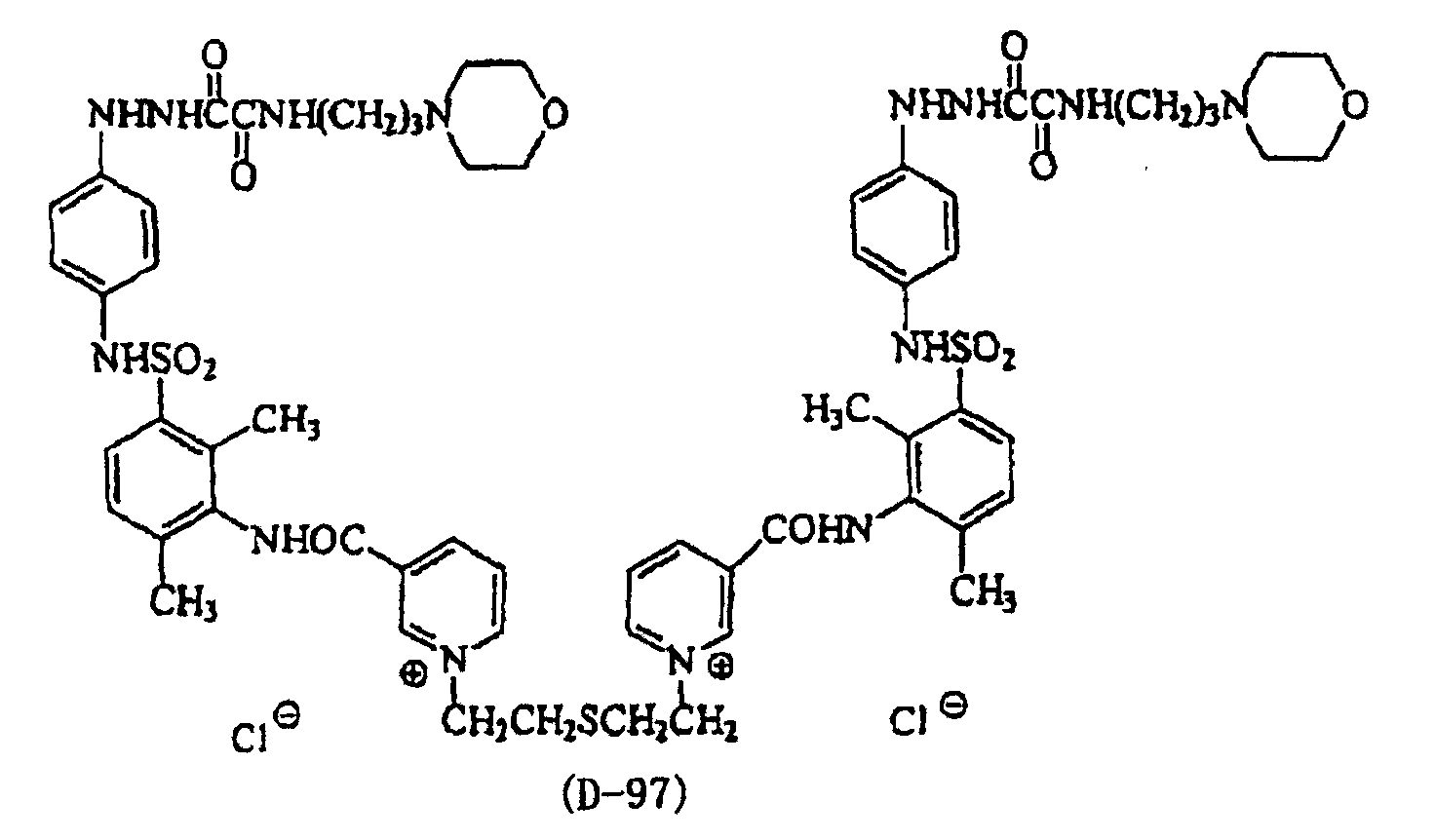

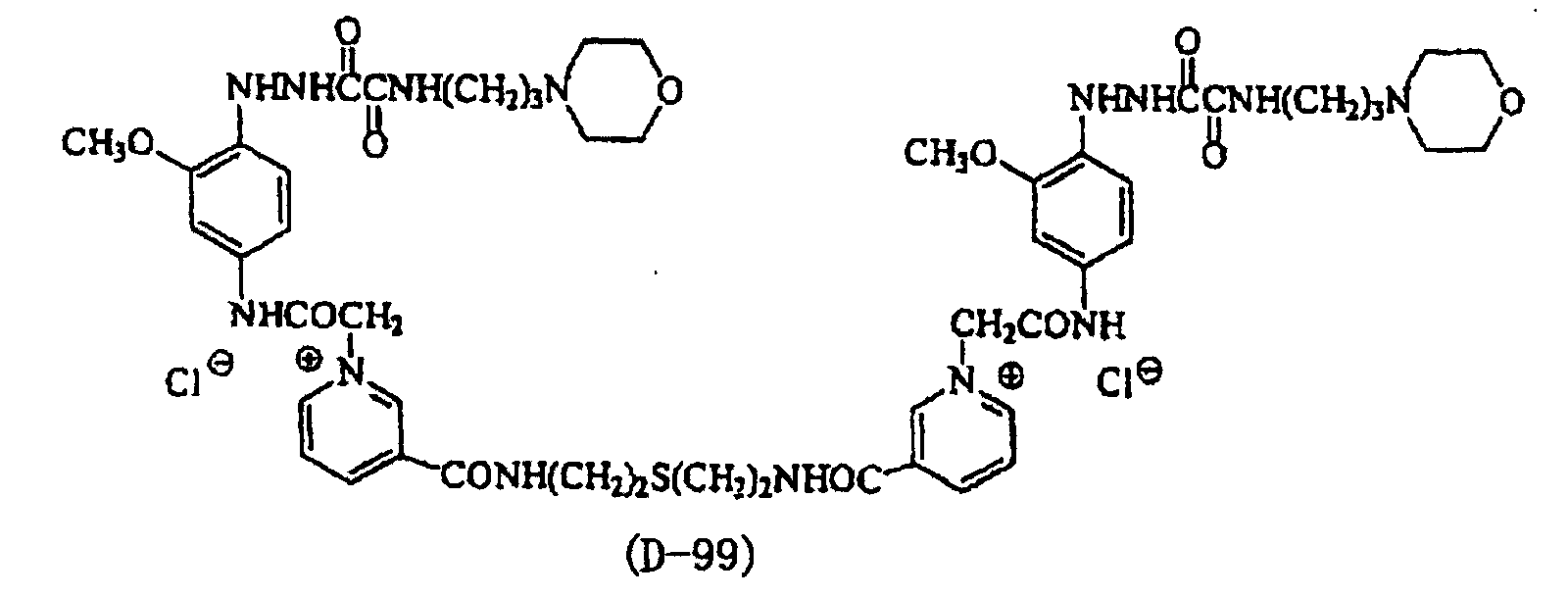

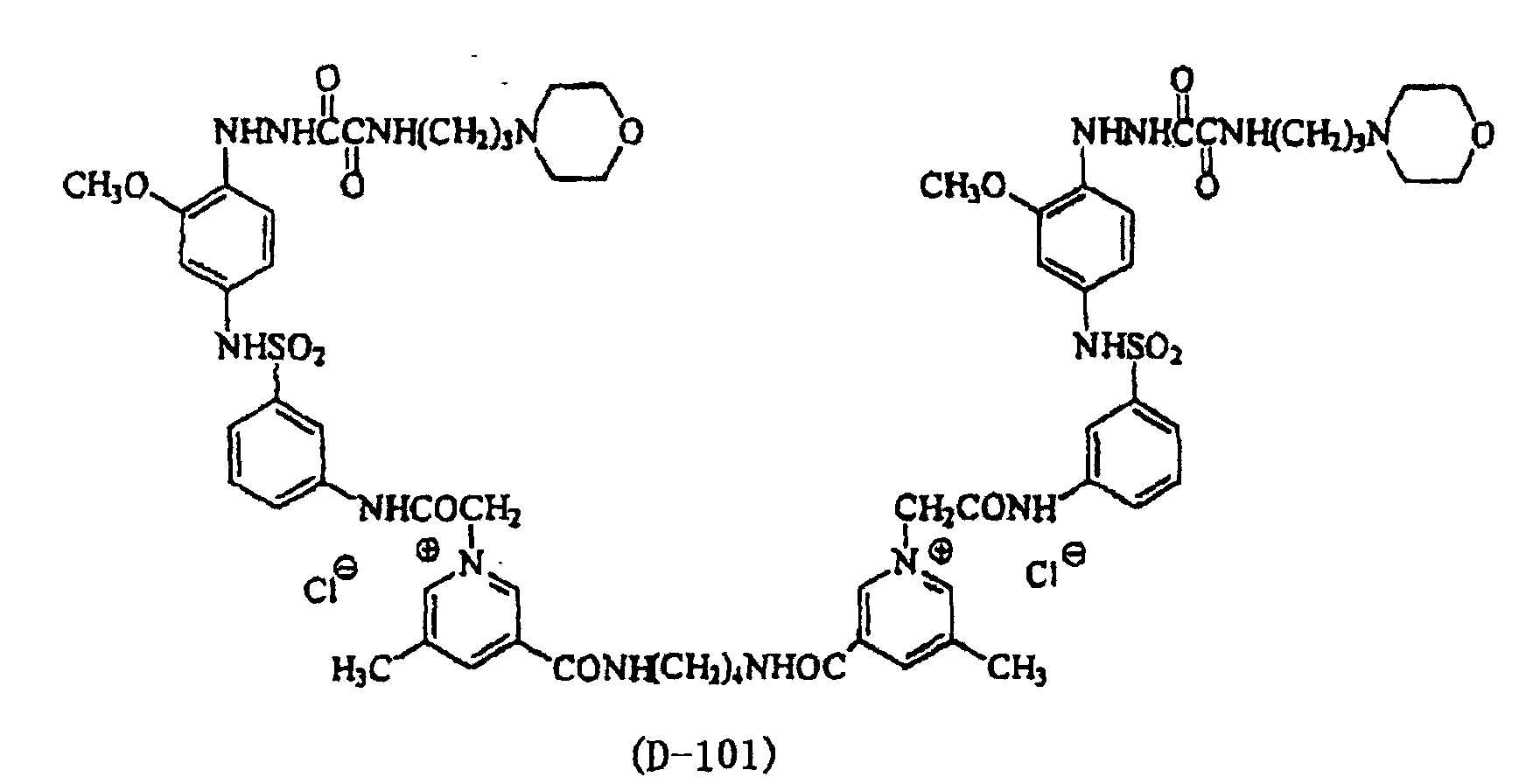

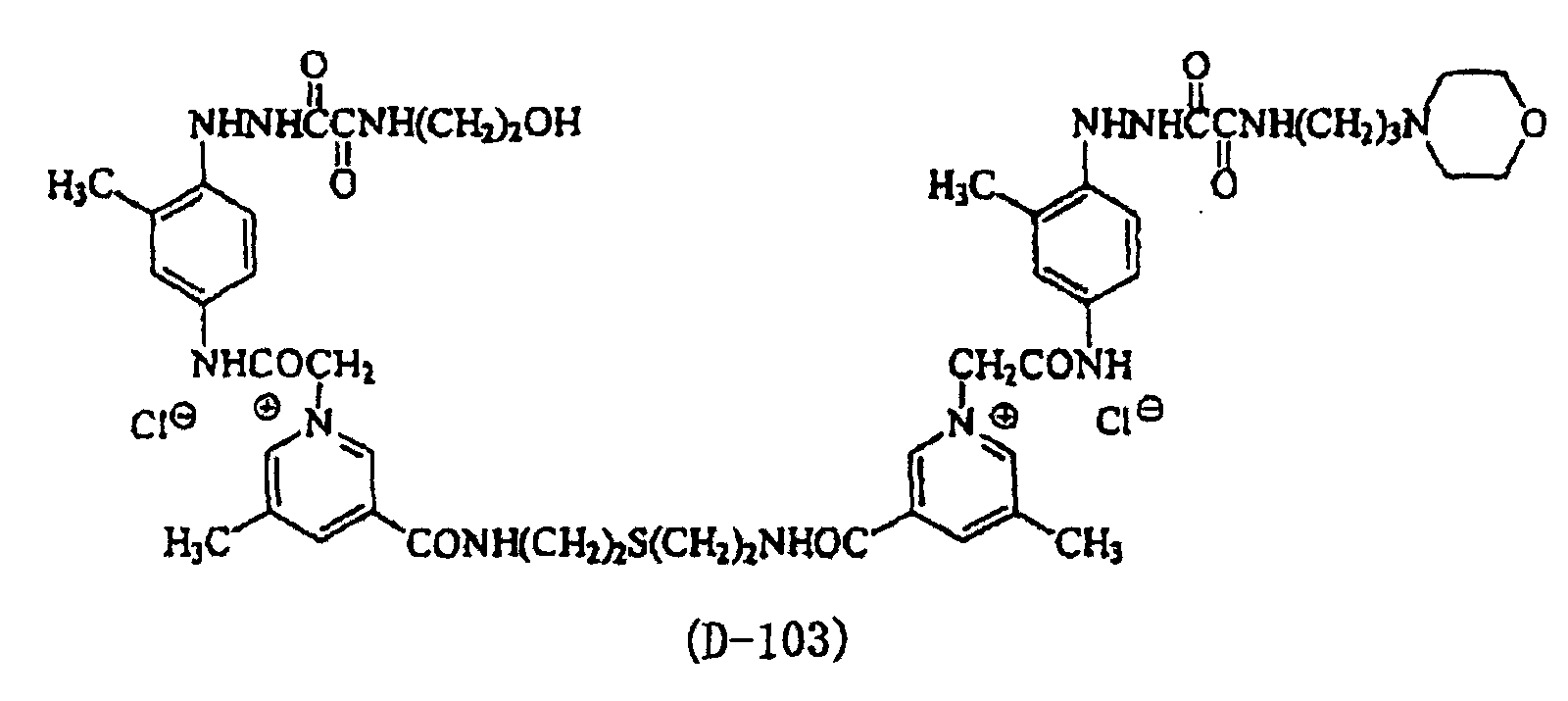


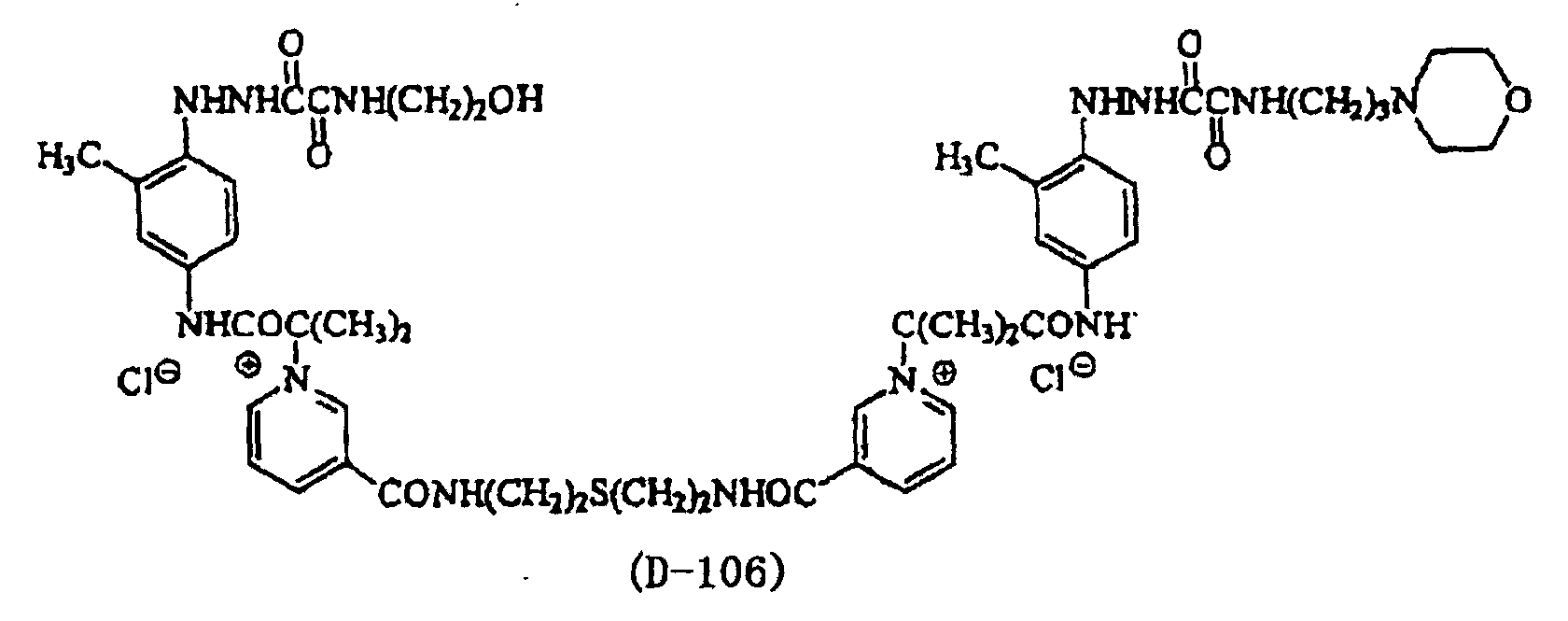




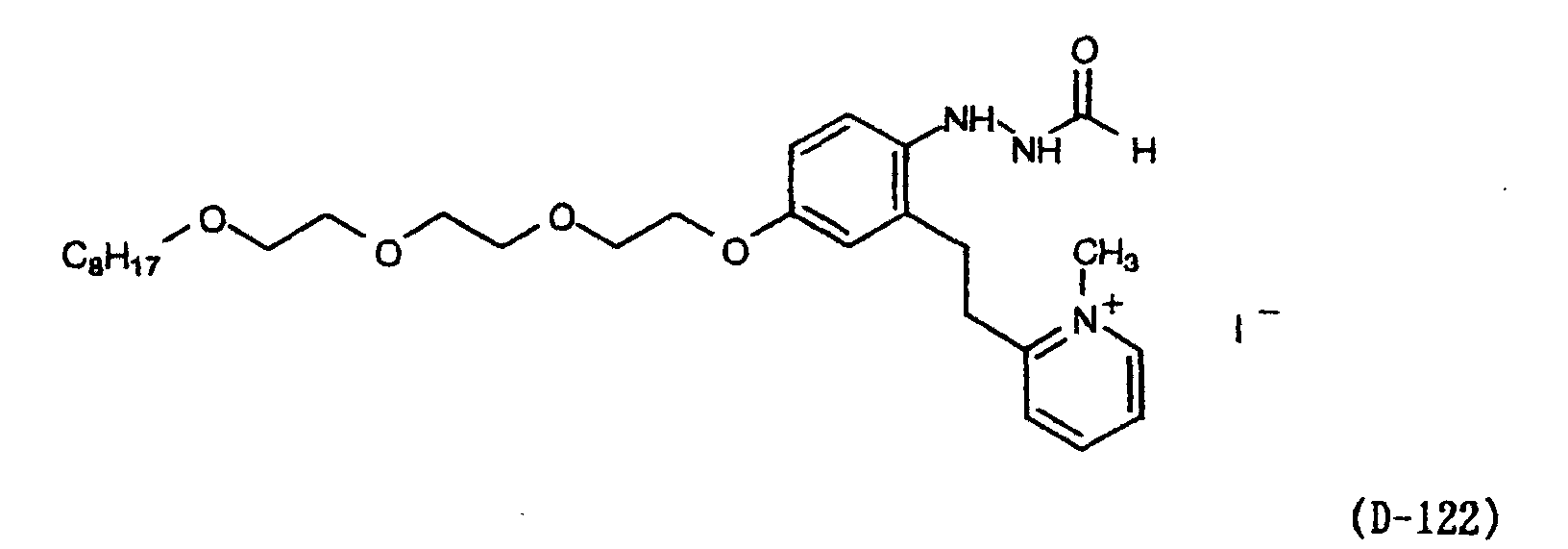
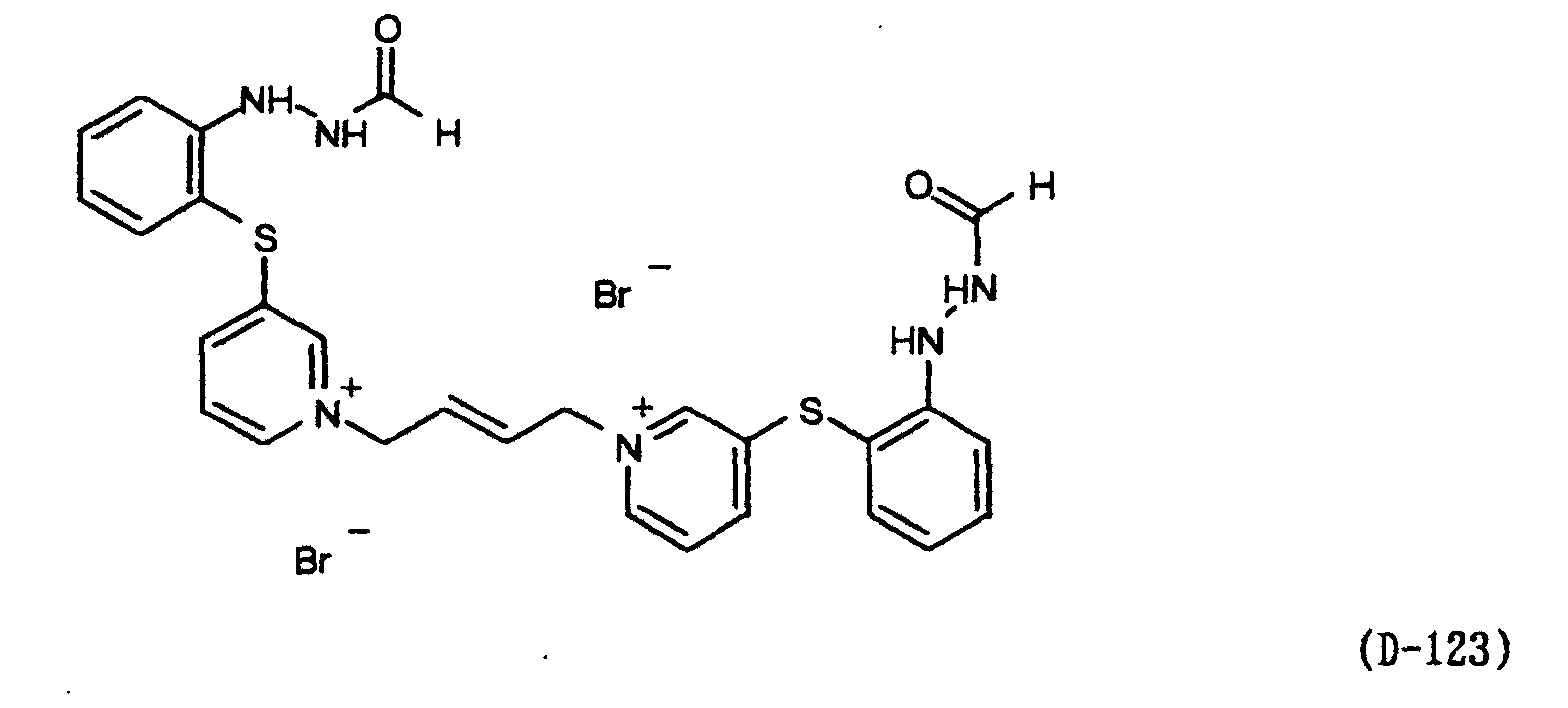
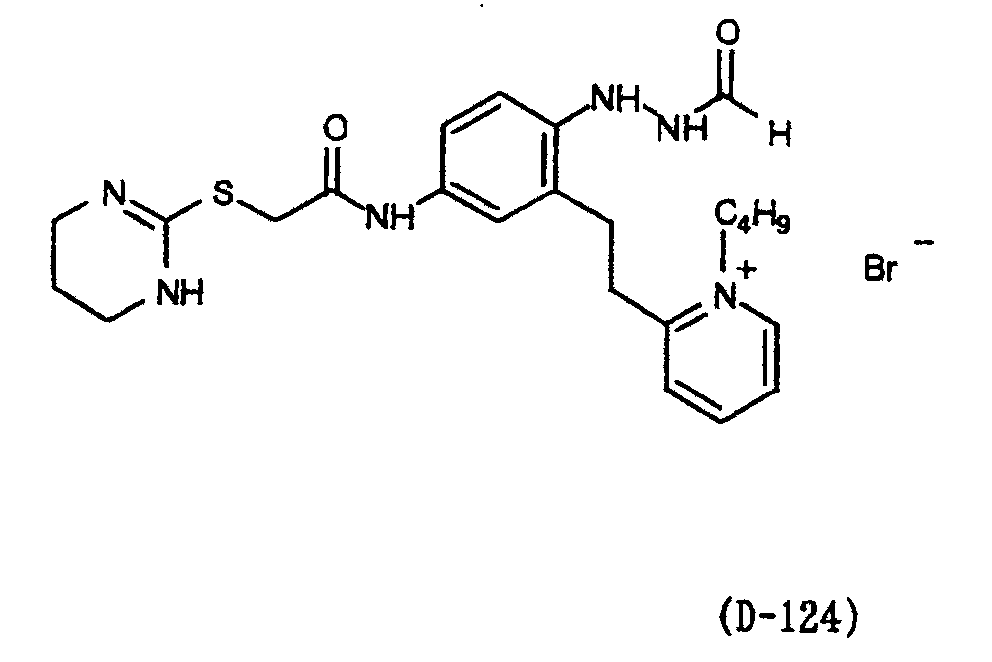

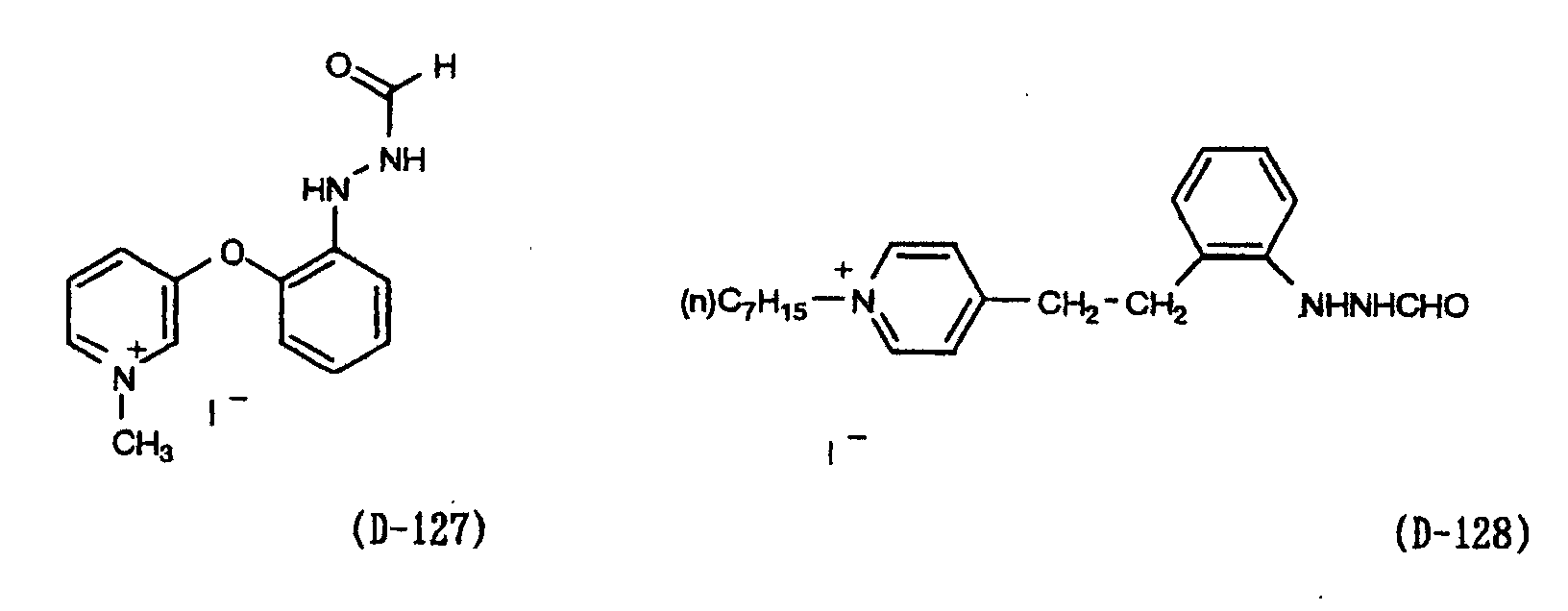

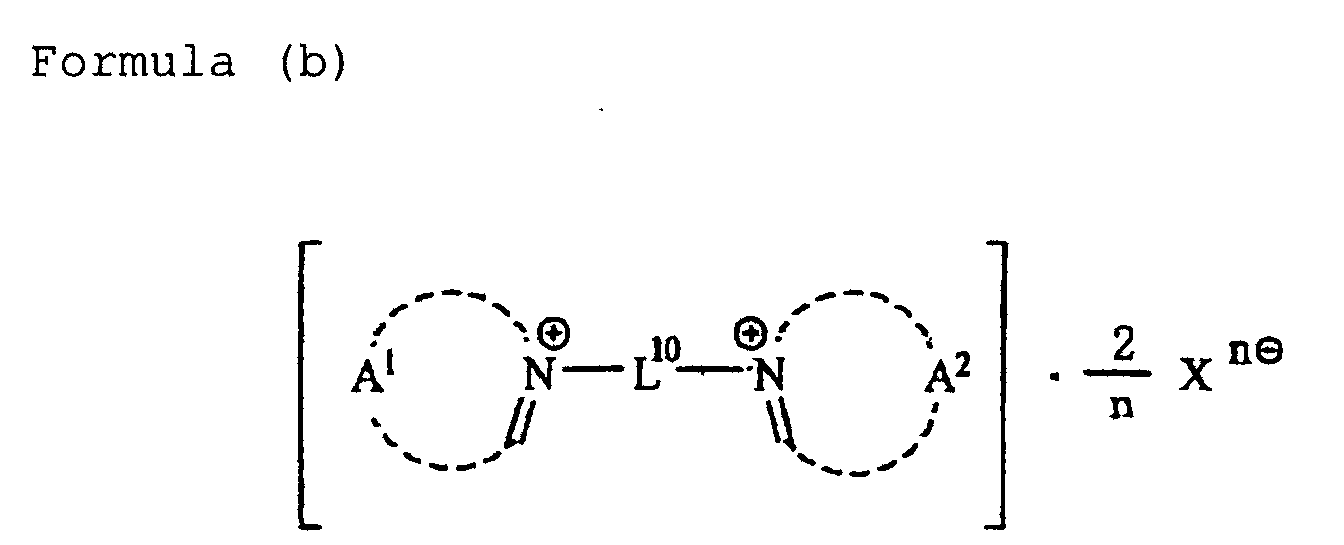

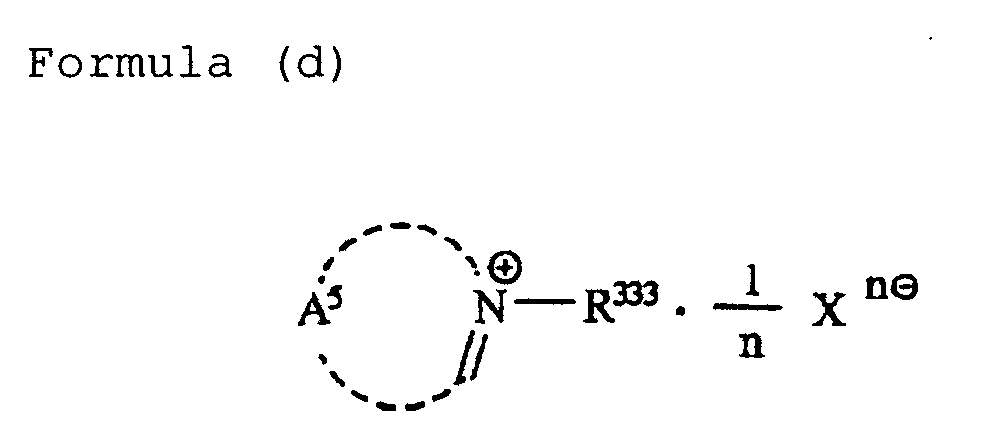
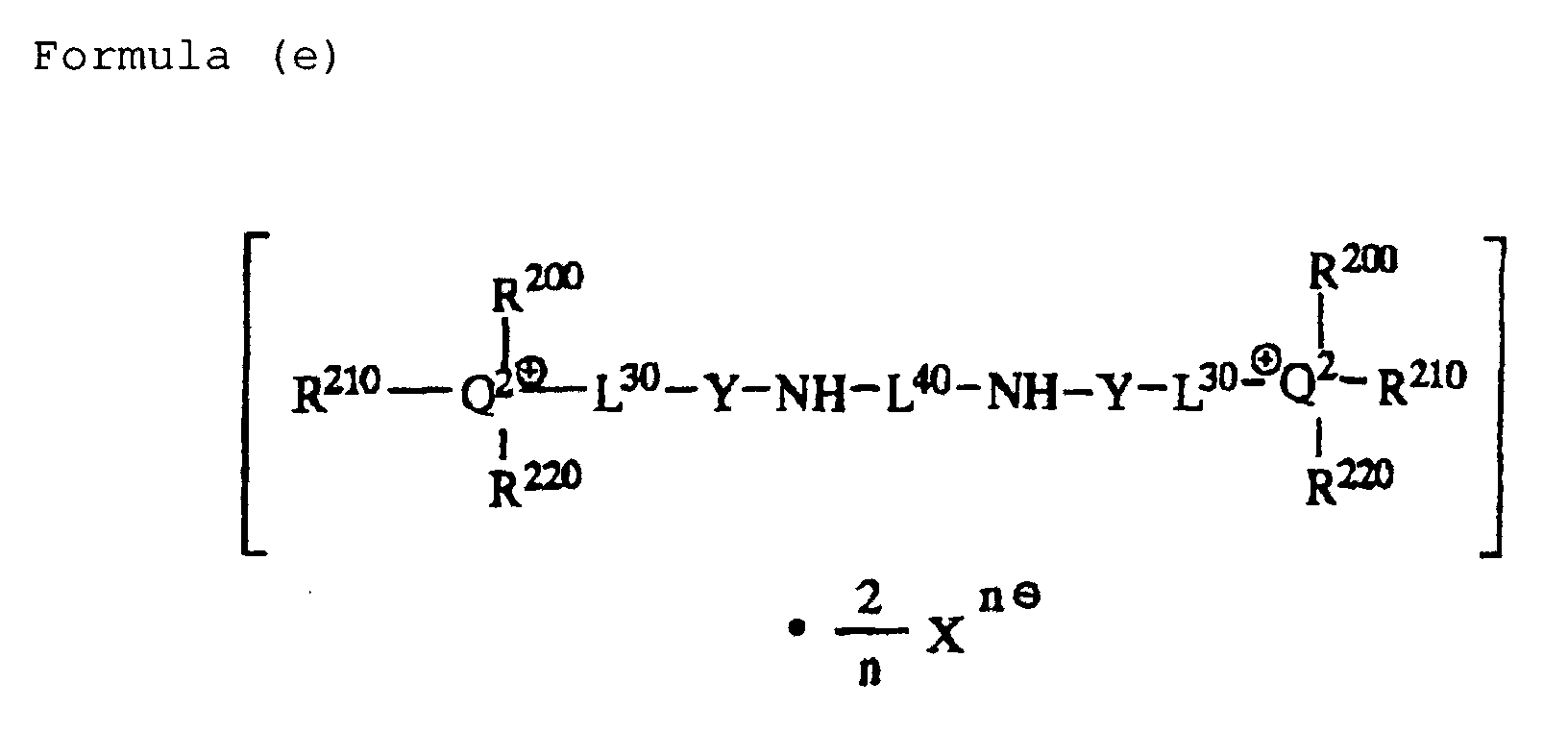
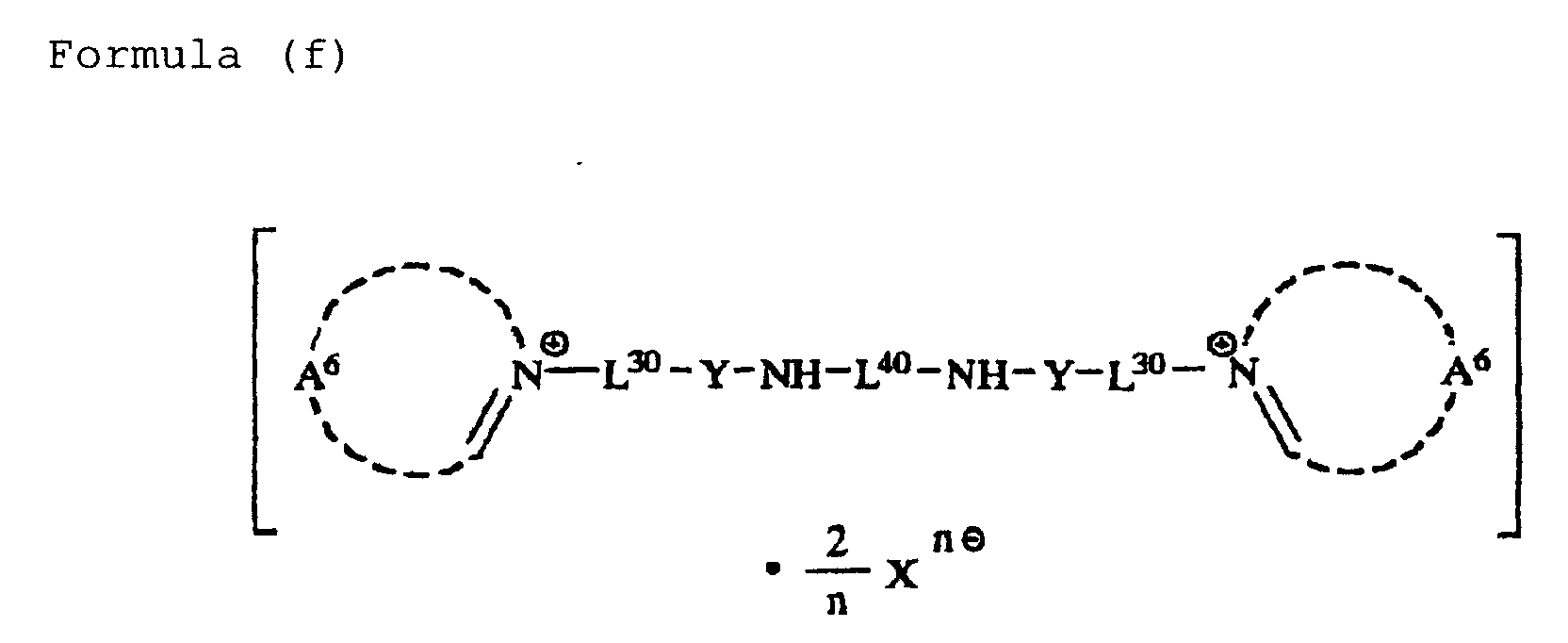
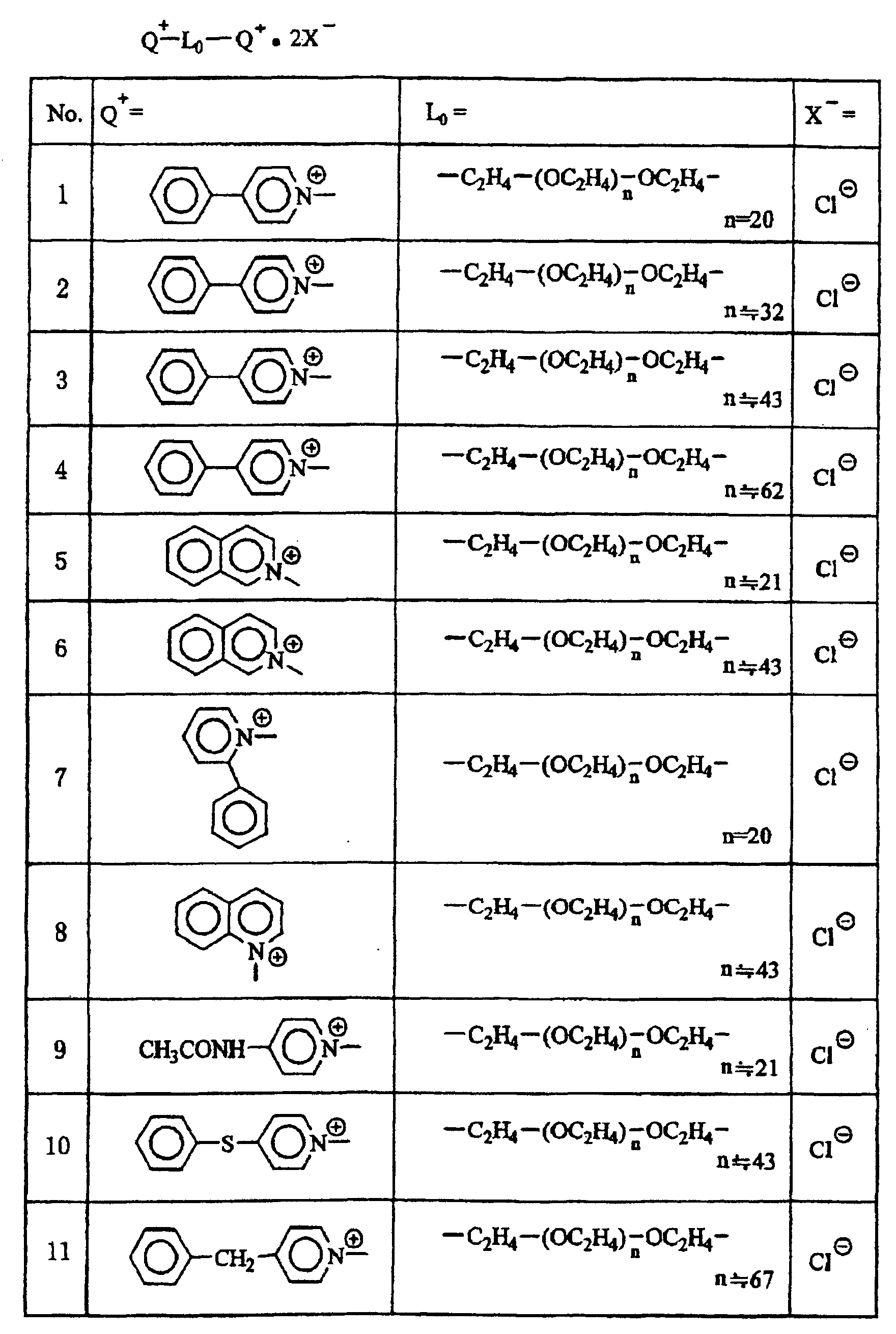

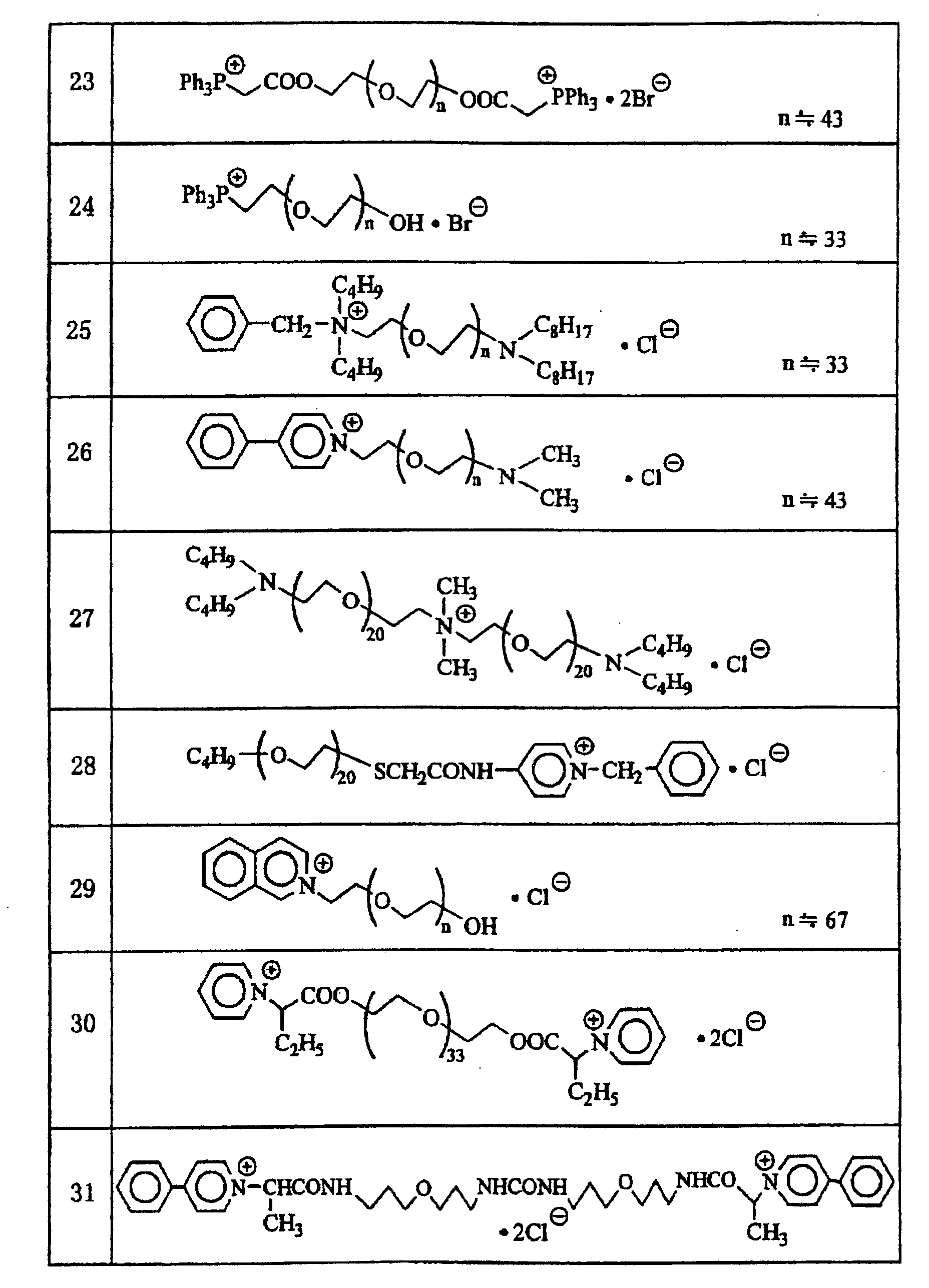

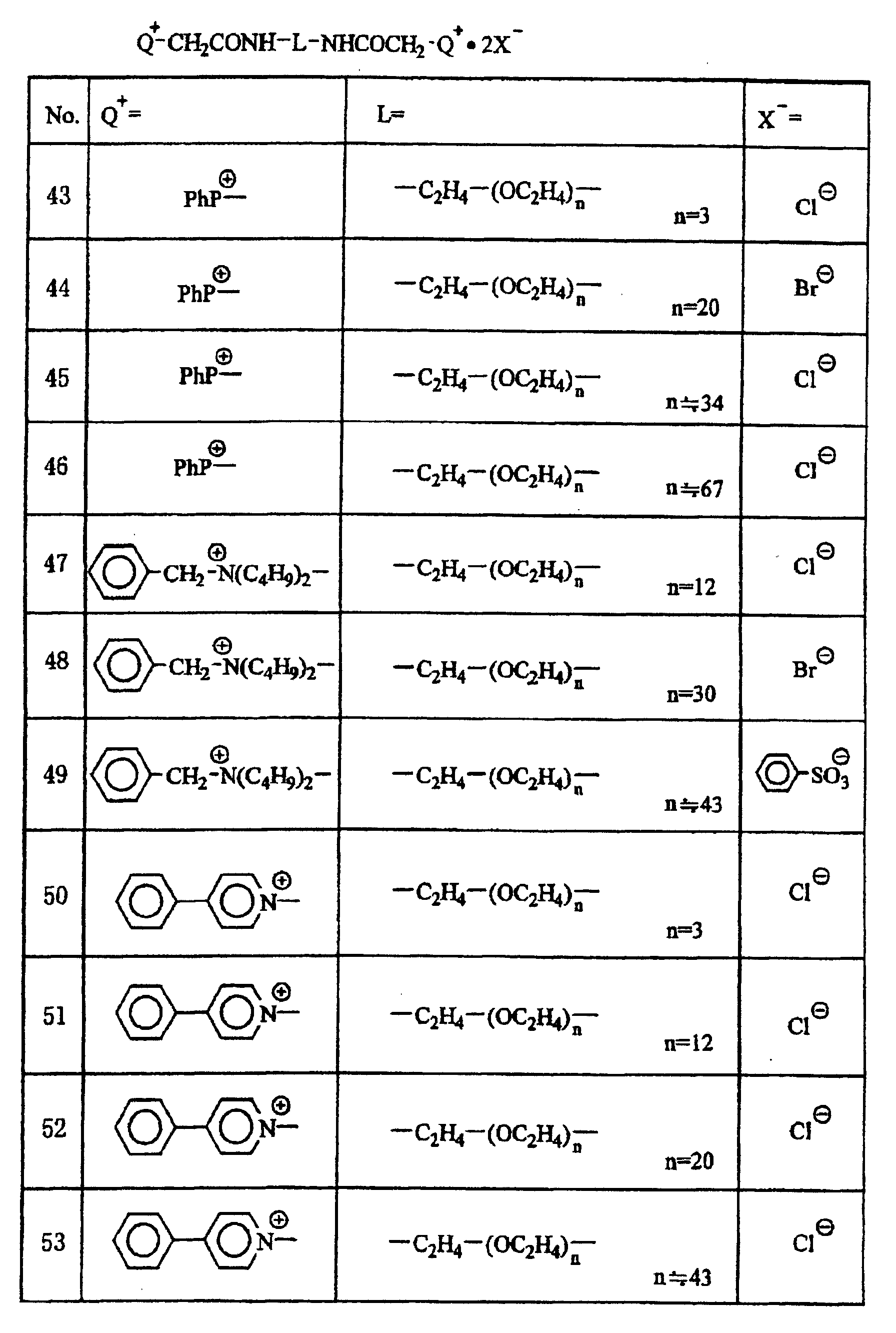
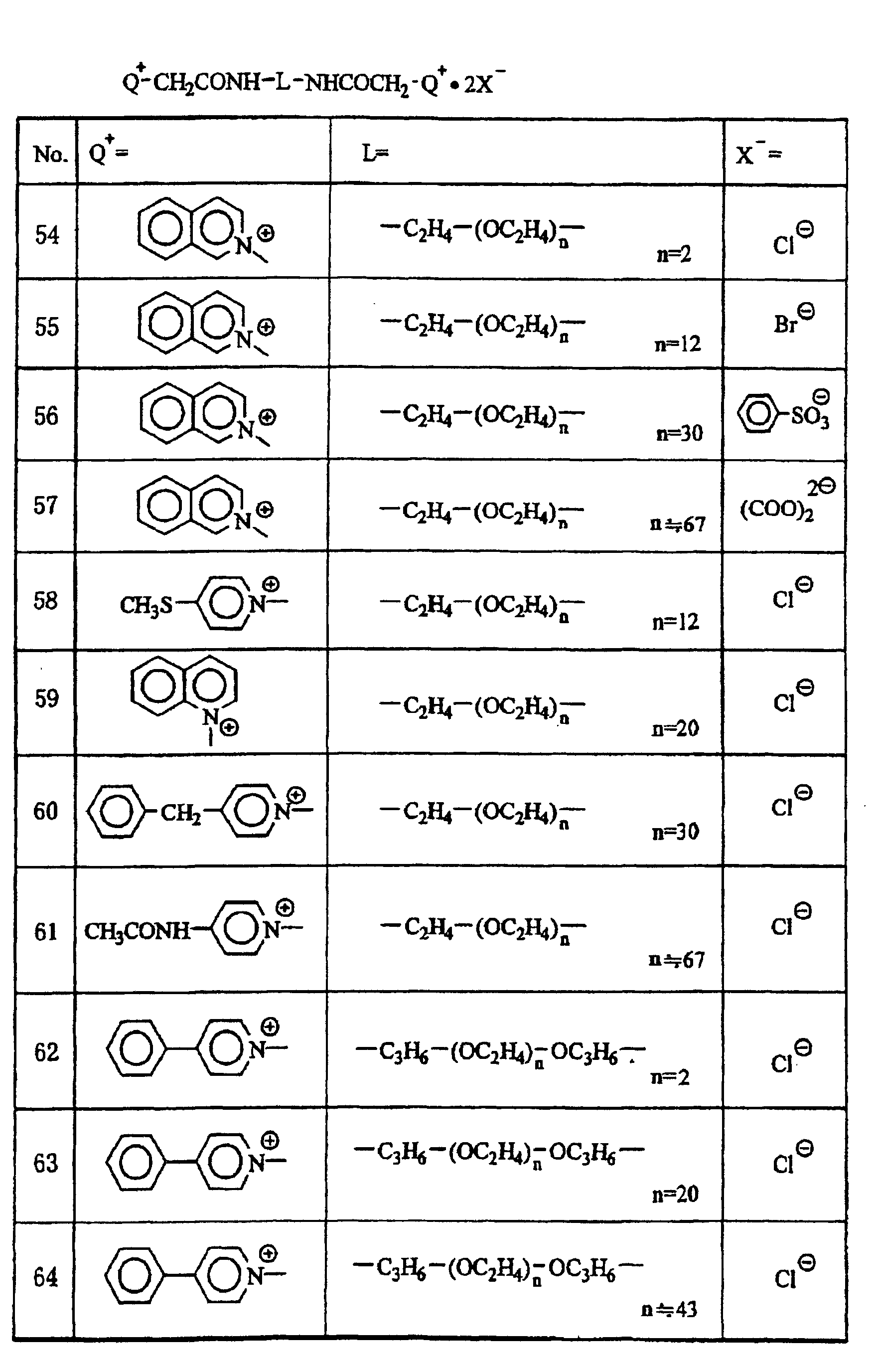


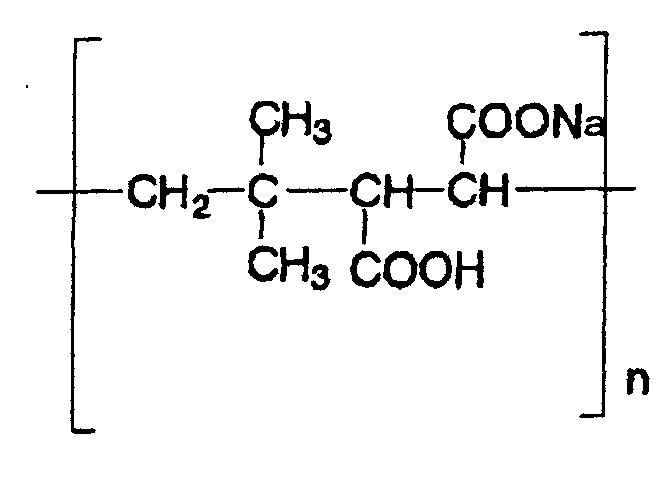

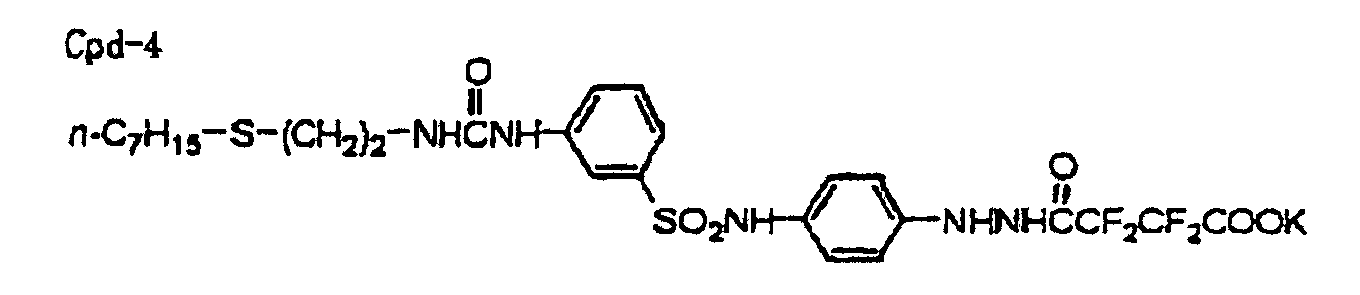
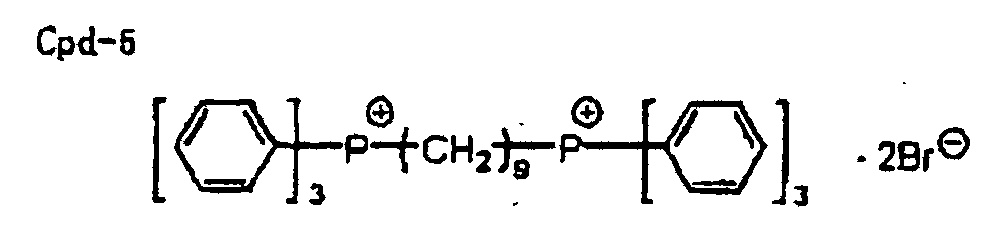

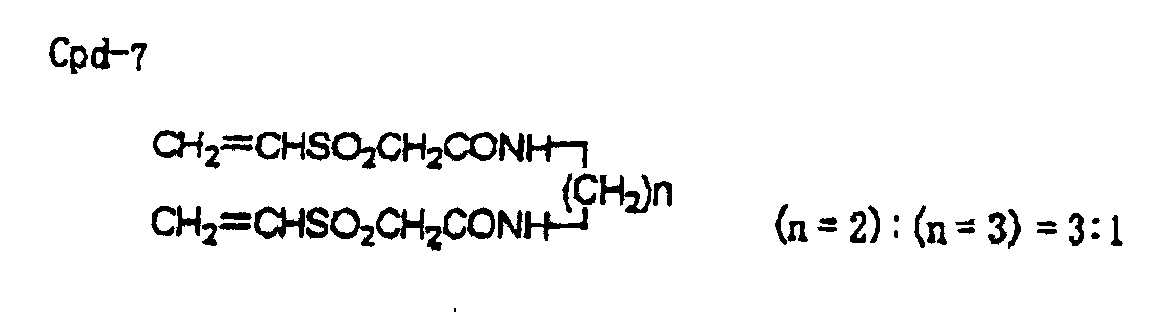
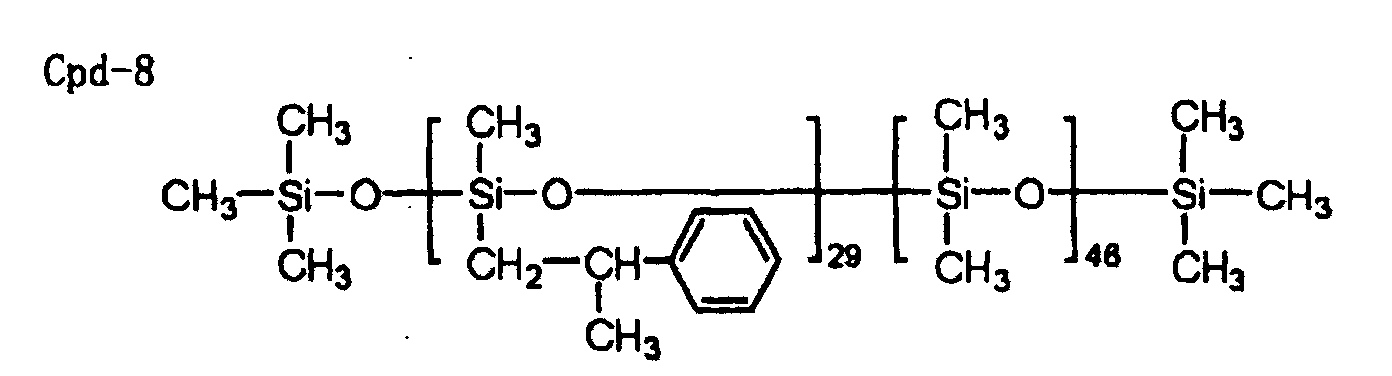

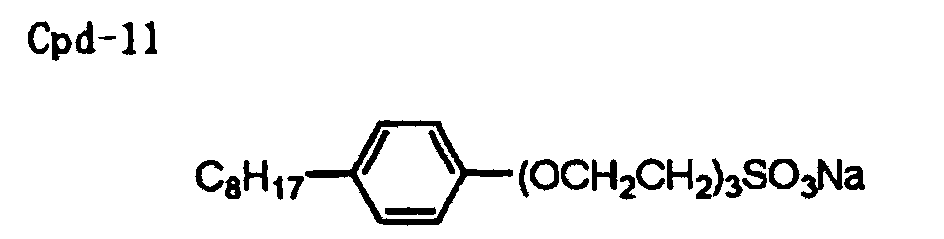
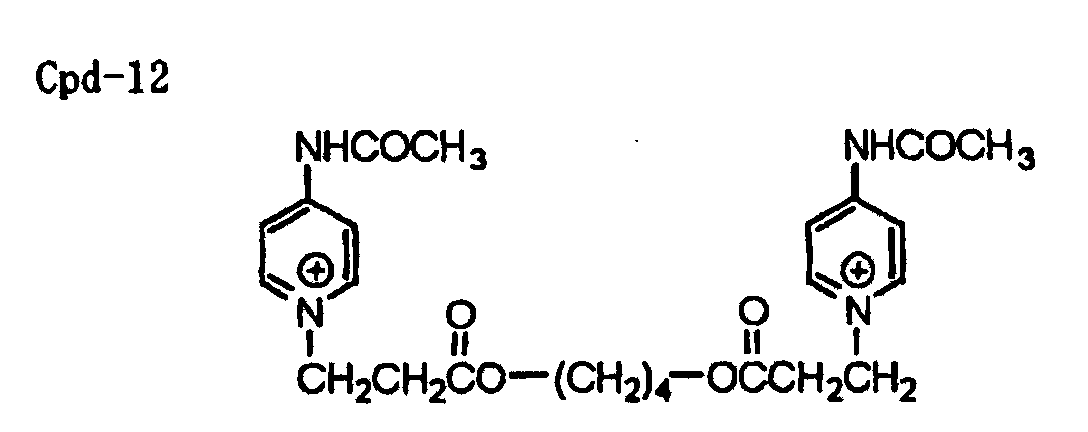

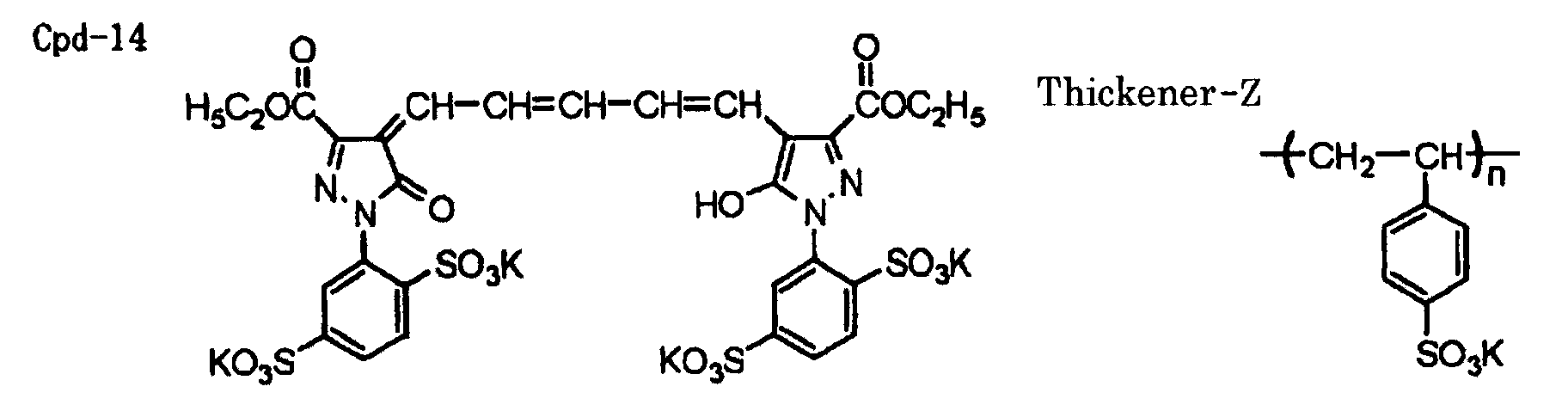
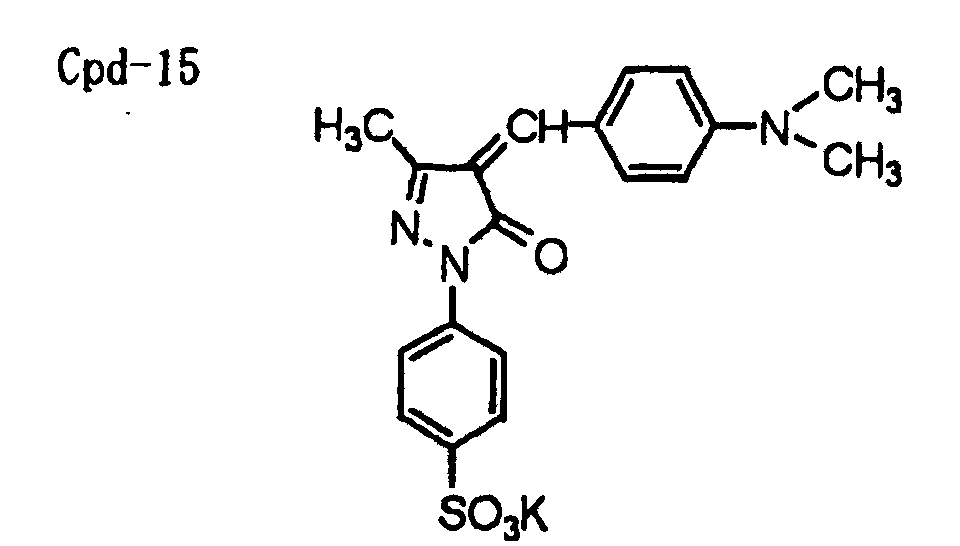
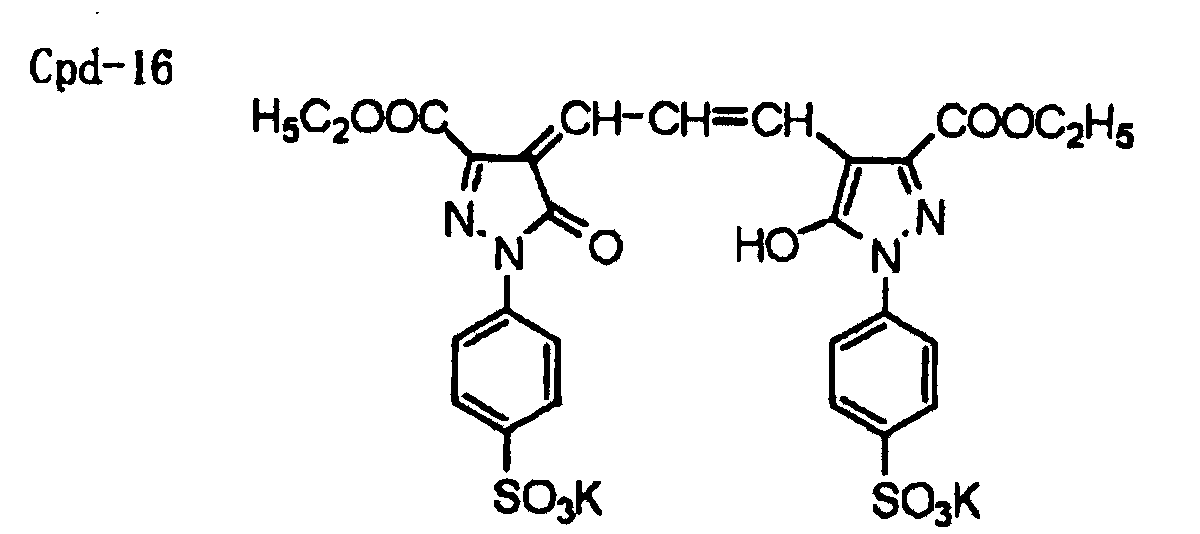
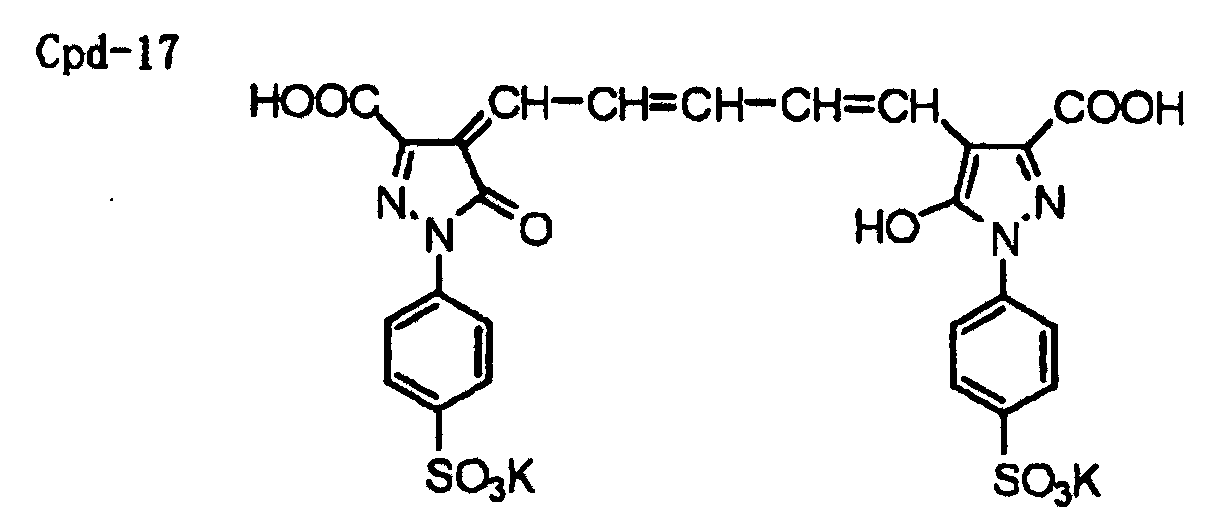


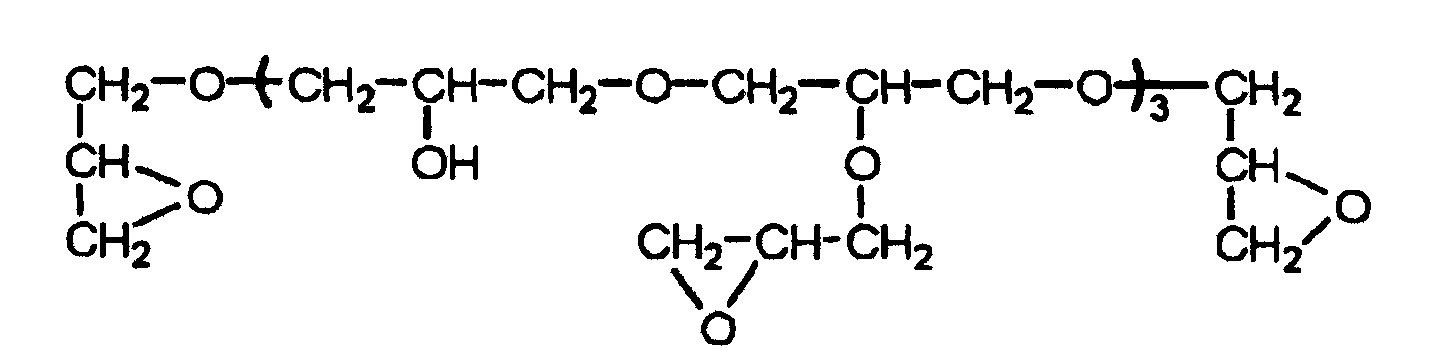

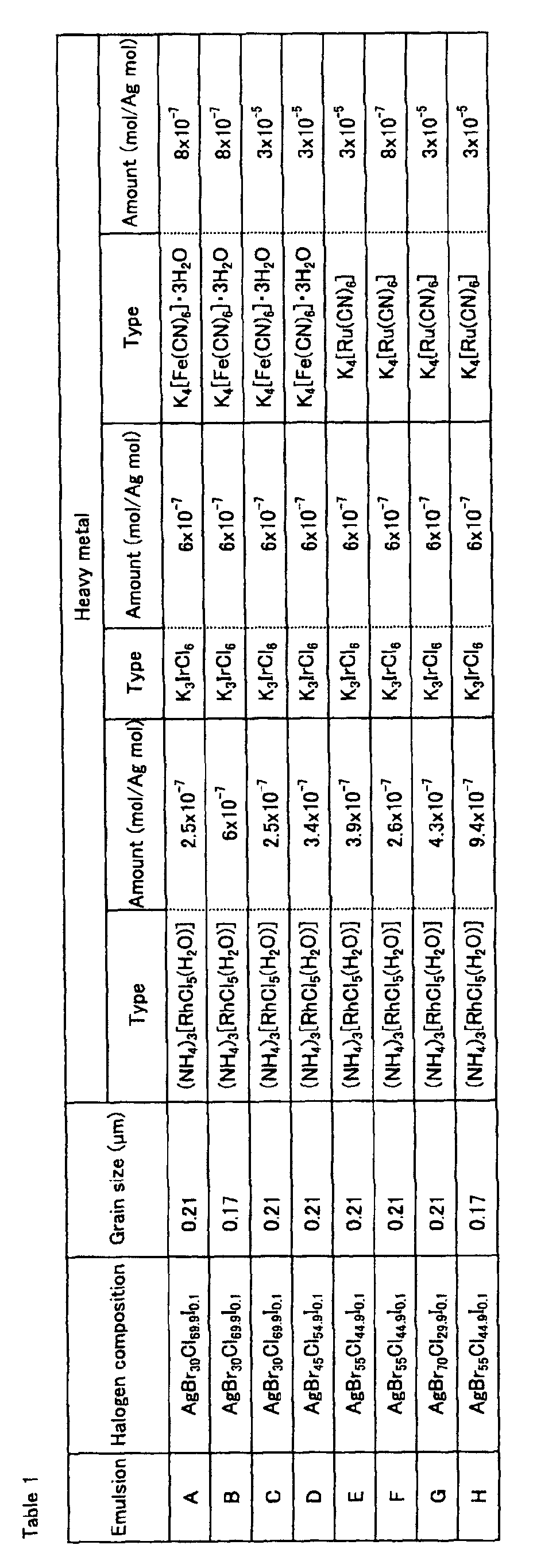
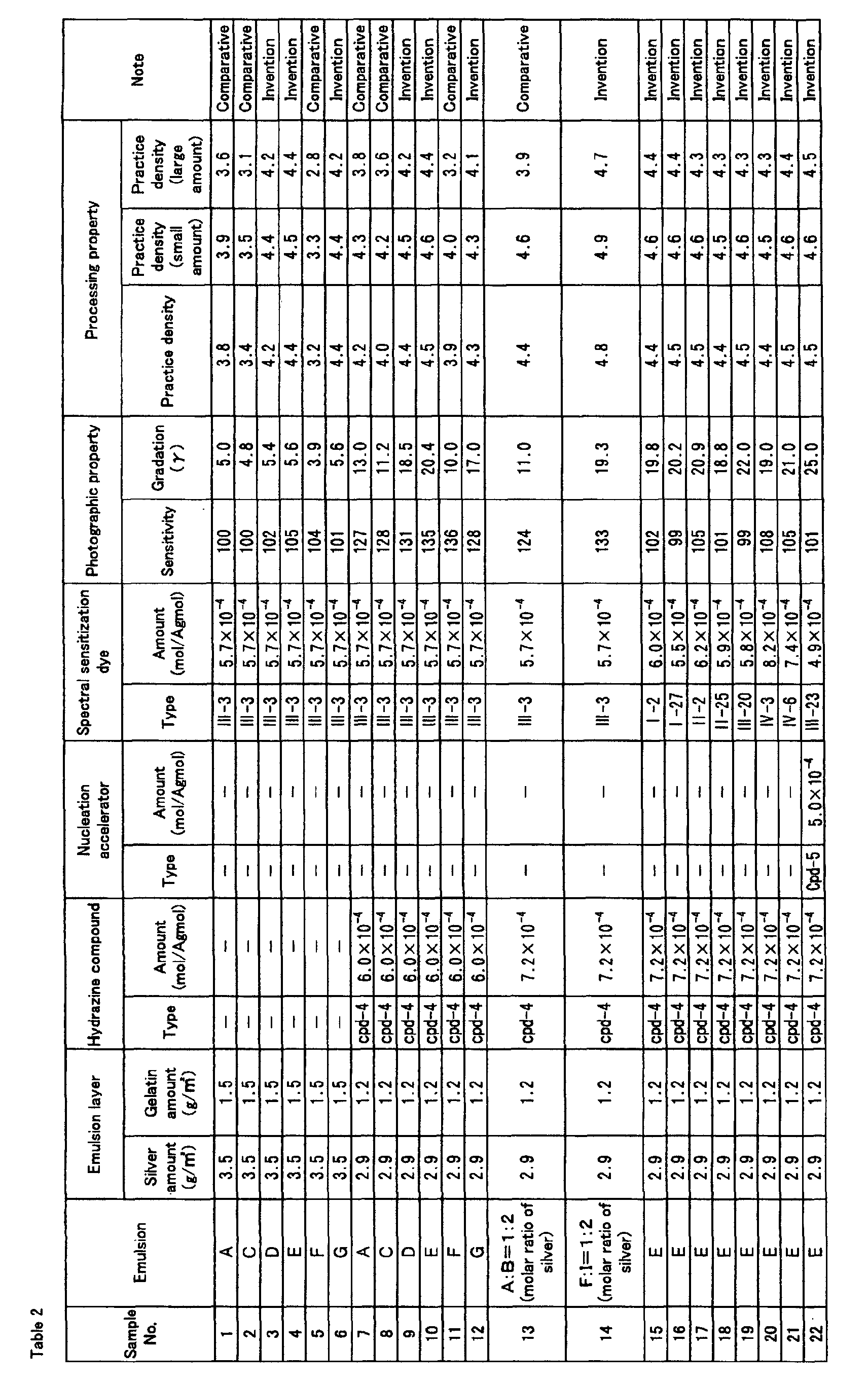
 (In the formula, Z21 represents a nonmetallic atom group required to form a 5- or 6-membered nitrogen-containing heterocyclic ring, and the 5- or 6-membered nitrogen-containing heterocyclic ring formed with Z21 may have a condensed ring. Y21 and Y22 each independently represent =N(R2), an oxygen atom, a sulfur atom, a selenium atom or a tellurium atom. W2 represents =N(Ar), an oxygen atom, a sulfur atom or =C(E21) (E22). E21 and E22 each independently represent an electron-withdrawing group or a nonmetallic atom group for forming an acidic heterocyclic ring when E21 and E22 bond to each other, and Ar represents an aromatic group or an aromatic heterocyclic group. R21 represents an aliphatic group having 8 or less carbon atoms and a water-solubilizable group, and R2, R22 and R23 each independently represent an aliphatic group, an aryl group or a heterocyclic group. However, at least two of R2, R22 and R23 have a water-solubilizable group. L21, L22, L23 and L24 each independently represent a substituted or unsubstituted methine group, and m21 represents 0 or 1. M2 represents an ion required to offset the charge of the molecule. n21 represents a number required to neutralize the total charge of the molecule. However, when an intramolecular salt is formed, n21 is 0.)
 (In the formula, R31 and R32 each independently represent an alkyl group. However, at least one alkyl group has a water-soluble group. V31, V32, V33 and V34 represent a hydrogen atom or a monovalent substituent. However, the sum of the molecular weight of these substituents (V31, V32, V33 and V34) is 50 or less. L31, L32, L33 and L34 each independently represent a substituted or unsubstituted methine group. M3 represents an ion required to offset the charge of the molecule. n31 represents a number required to neutralize the total charge of the molecule. However, when an intramolecular salt is formed, n31 is 0.)
 (In the formula, R41 represents an alkyl group, an alkenyl group or an aryl group, R42 and R43 each independently represent a hydrogen atom, an alkyl group, an alkenyl group or an aryl group, and R44, R45 and R46 each independently represent an alkyl group, an alkenyl group, an aryl group or a hydrogen atom. L41 and L42 each independently represent a substituted or unsubstituted methine group, and p represents 0 or 1. Z41 represents an atomic group required to complete a 5- or 6-membered heterocyclic ring, and the 5- or 6-membered heterocyclic group formed with Z41 may have a condensed ring. M4 represents an ion required to offset the charge of the molecule. n41 represents a number required to neutralize the total charge of the molecule. However, when an intramolecular salt is formed, n41 is 0. The spectral sensitization dye represented by the formula (IV) has at least three water-solubilizable groups.)
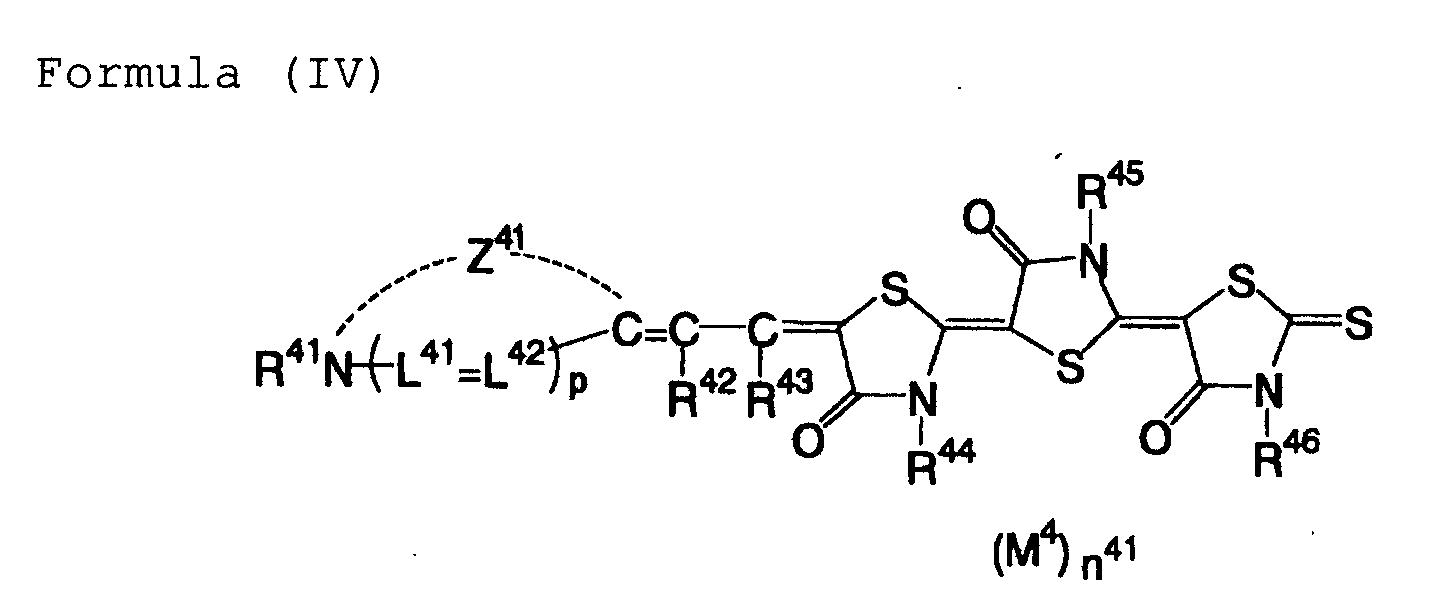 (In the formula, Z51 and Z52 each independently represent a nonmetallic atom group required to form a 5- or 6-membered nitrogen-containing heterocyclic ring, and the 5- or 6-membered nitrogen-containing heterocyclic ring formed with Z51 or Z52 may have a condensed ring. R51 and R52 each independently represent an alkyl group, a substituted alkyl group or an aryl group. Q51 and Q52 represent a nonmetallic atom group required to together form a thiazolidinone ring or an imidazolidinone ring. L51, L52 and L53 each independently represent a methine group or a substituted methine group, n51 and n52 each independently represent 0 or 1. M5 represents an ion required to offset the charge of the molecule. n53 represents a number required to neutralize the total charge of the molecule. However, when an intramolecular salt is formed, n53 is 0.)
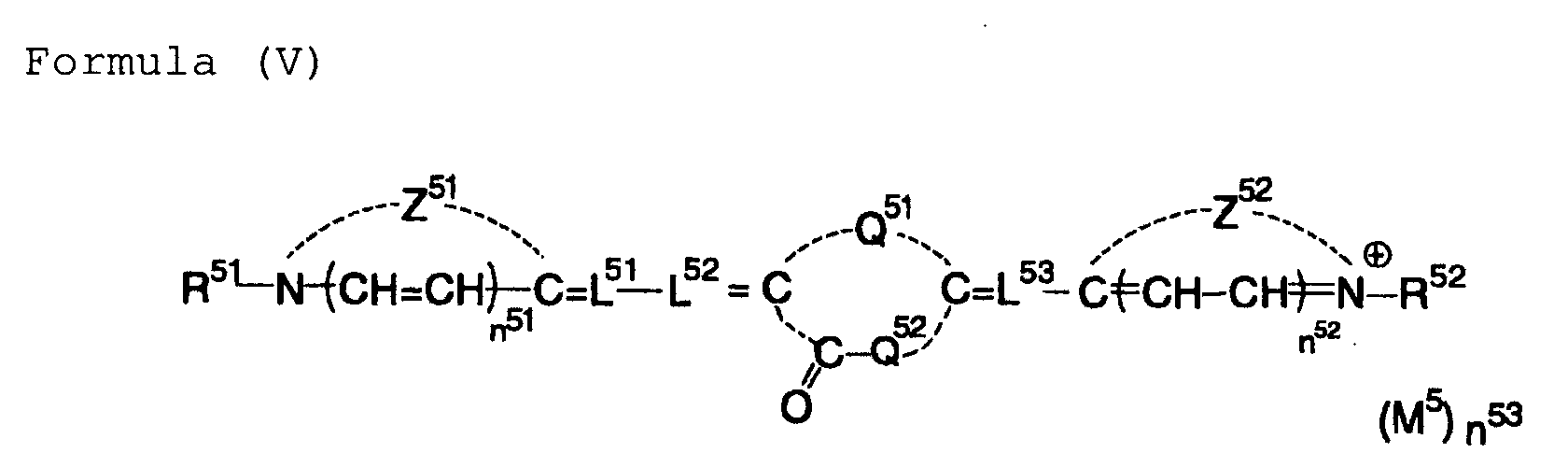 (In the formula, R61 and R62 each independently represent an alkyl group. R63 represents a hydrogen atom, a lower alkyl group, a lower alkoxy group, a phenyl group, a benzyl group or a phenethyl group. V6 represents a hydrogen atom, a lower alkyl group, an alkoxy group, a halogen atom or a substituted alkyl group, and p6 represents 1 or 2. Z61 represents a group required to form a 5- or 6-membered nitrogen-containing heterocyclic ring, and the 5- or 6-membered nitrogen-containing heterocyclic ring formed with Z61 may have a condensed ring. m61 represents 0 or 1. M61 represents an ion required to offset the charge of the molecule. n61 represents a number required to neutralize the total charge of the molecule. However, when an intramolecular salt is formed, n61 is 0.)
 (In the formula, R64 and R65 each independently represent an alkyl group. R66 and R67 each independently represent a hydrogen atom, a lower alkyl group, a lower alkoxy group, a phenyl group, a benzyl group or a phenethyl group. R68 and R69 each represent a hydrogen atom. R68 and R69 may bond to each other to form an alkylene group. R70 represents a hydrogen atom, a lower alkyl group, a lower alkoxy group, a phenyl group, a benzyl group or -N(W61) (W62) [W61 and W62 each independently represent an alkyl group or an aryl group, or W61 and W62 may bond to each other to form a 5- or 6-membered nitrogen-containing heterocyclic ring]. Further, R66 and R70 or R67 and R70 may bond to each other, respectively, to form an alkylene group. Z62 and Z63 each independently represent a nonmetallic atom group required to form a 5- or 6-membered nitrogen-containing heterocyclic ring, and the 5- or 6-membered nitrogen-containing heterocyclic ring formed with Z62 or Z63 may have a condensed ring. M62 represents an ion required to offset the charge of the molecule. n62 represents a number required to neutralize the total charge of the molecule. However, when an intramolecular salt is formed, n62 is 0.)