EP1314862A2 - Electromagnetic valve actuator - Google Patents
Electromagnetic valve actuator Download PDFInfo
- Publication number
- EP1314862A2 EP1314862A2 EP02257708A EP02257708A EP1314862A2 EP 1314862 A2 EP1314862 A2 EP 1314862A2 EP 02257708 A EP02257708 A EP 02257708A EP 02257708 A EP02257708 A EP 02257708A EP 1314862 A2 EP1314862 A2 EP 1314862A2
- Authority
- EP
- European Patent Office
- Prior art keywords
- valve
- armature
- valve member
- electromagnet
- open
- Prior art date
- Legal status (The legal status is an assumption and is not a legal conclusion. Google has not performed a legal analysis and makes no representation as to the accuracy of the status listed.)
- Withdrawn
Links
- 238000002485 combustion reaction Methods 0.000 claims abstract description 8
- 230000009467 reduction Effects 0.000 claims abstract description 8
- 238000010276 construction Methods 0.000 claims description 3
- 239000000853 adhesive Substances 0.000 claims description 2
- 230000001070 adhesive effect Effects 0.000 claims description 2
- 230000000737 periodic effect Effects 0.000 claims description 2
- 239000007789 gas Substances 0.000 description 41
- 230000006835 compression Effects 0.000 description 11
- 238000007906 compression Methods 0.000 description 11
- 238000010586 diagram Methods 0.000 description 5
- 238000006073 displacement reaction Methods 0.000 description 5
- 230000000694 effects Effects 0.000 description 4
- 230000009471 action Effects 0.000 description 3
- 238000013016 damping Methods 0.000 description 3
- 230000007423 decrease Effects 0.000 description 2
- 230000006698 induction Effects 0.000 description 2
- 238000002347 injection Methods 0.000 description 2
- 239000007924 injection Substances 0.000 description 2
- 230000000630 rising effect Effects 0.000 description 2
- QVGXLLKOCUKJST-UHFFFAOYSA-N atomic oxygen Chemical compound [O] QVGXLLKOCUKJST-UHFFFAOYSA-N 0.000 description 1
- 230000009286 beneficial effect Effects 0.000 description 1
- 230000008901 benefit Effects 0.000 description 1
- 230000033228 biological regulation Effects 0.000 description 1
- 230000008859 change Effects 0.000 description 1
- 238000001816 cooling Methods 0.000 description 1
- 230000003247 decreasing effect Effects 0.000 description 1
- 230000001419 dependent effect Effects 0.000 description 1
- 230000008030 elimination Effects 0.000 description 1
- 238000003379 elimination reaction Methods 0.000 description 1
- 230000000977 initiatory effect Effects 0.000 description 1
- 238000004519 manufacturing process Methods 0.000 description 1
- 230000004048 modification Effects 0.000 description 1
- 238000012986 modification Methods 0.000 description 1
- 239000001301 oxygen Substances 0.000 description 1
- 229910052760 oxygen Inorganic materials 0.000 description 1
- 230000003068 static effect Effects 0.000 description 1
Images



Classifications
-
- F—MECHANICAL ENGINEERING; LIGHTING; HEATING; WEAPONS; BLASTING
- F01—MACHINES OR ENGINES IN GENERAL; ENGINE PLANTS IN GENERAL; STEAM ENGINES
- F01L—CYCLICALLY OPERATING VALVES FOR MACHINES OR ENGINES
- F01L9/00—Valve-gear or valve arrangements actuated non-mechanically
- F01L9/10—Valve-gear or valve arrangements actuated non-mechanically by fluid means, e.g. hydraulic
- F01L9/16—Pneumatic means
-
- F—MECHANICAL ENGINEERING; LIGHTING; HEATING; WEAPONS; BLASTING
- F01—MACHINES OR ENGINES IN GENERAL; ENGINE PLANTS IN GENERAL; STEAM ENGINES
- F01L—CYCLICALLY OPERATING VALVES FOR MACHINES OR ENGINES
- F01L9/00—Valve-gear or valve arrangements actuated non-mechanically
- F01L9/20—Valve-gear or valve arrangements actuated non-mechanically by electric means
-
- F—MECHANICAL ENGINEERING; LIGHTING; HEATING; WEAPONS; BLASTING
- F02—COMBUSTION ENGINES; HOT-GAS OR COMBUSTION-PRODUCT ENGINE PLANTS
- F02B—INTERNAL-COMBUSTION PISTON ENGINES; COMBUSTION ENGINES IN GENERAL
- F02B2275/00—Other engines, components or details, not provided for in other groups of this subclass
- F02B2275/32—Miller cycle
-
- Y—GENERAL TAGGING OF NEW TECHNOLOGICAL DEVELOPMENTS; GENERAL TAGGING OF CROSS-SECTIONAL TECHNOLOGIES SPANNING OVER SEVERAL SECTIONS OF THE IPC; TECHNICAL SUBJECTS COVERED BY FORMER USPC CROSS-REFERENCE ART COLLECTIONS [XRACs] AND DIGESTS
- Y02—TECHNOLOGIES OR APPLICATIONS FOR MITIGATION OR ADAPTATION AGAINST CLIMATE CHANGE
- Y02T—CLIMATE CHANGE MITIGATION TECHNOLOGIES RELATED TO TRANSPORTATION
- Y02T10/00—Road transport of goods or passengers
- Y02T10/10—Internal combustion engine [ICE] based vehicles
- Y02T10/12—Improving ICE efficiencies
Definitions
- This invention relates to electromagnetic valve actuators for internal combustion engines or gas generators.
- a second issue is the requirement to simultaneously seat the valve and armature when the assembly is naturally subjected to differential thermal expansion, manufacturing tolerances and seat wear. Moreover, the landing velocity must be controlled to less than 0.15m/s to minimise contact noise.
- the aim of this invention is to solve the problems encountered with the existing proposals by providing a valve actuator which minimises electrical power requirements so that engine valves can be controlled using existing low voltage vehicle systems.
- a device for actuating a gas exchange valve of an internal combustion engine or gas generator comprising an armature operatively connected to the valve stem of a valve member and at least one electromagnet arranged to act on the armature to move the valve member from the open to the closed position, wherein the armature is disposed in a chamber and wherein a gas pressure source is connected by a supply line to the chamber, the arrangement being such that reduction of the electromagnetic force on the valve member in the closing direction is effective to enable the gas pressure from said gas pressure source to move the valve member to the open position.
- Elimination of the opening electromagnet also provides the opportunity to use fixed real time valve events to self supercharge the engine using standing pressure waves in fixed geometry exhaust and intake pipes independent of engine speed.
- a second electromagnet is provided to assist in moving the valve member to the open position.
- the valve opening and closing electromagnets are axially spaced and have opposing pole faces, the armature being disposed in the chamber between said pole faces.
- the gas pressure provides an approximately constant force to open the valve, so that the electromagnet does not have to hold against the maximum force of a rising force system such as a coil spring. Further reductions in electromagnetic holding power are possible in systems without an opening electromagnet.
- a seal is provided between contact faces of the armature and closing electromagnet so that the area of the armature exposed to the gas pressure in the closed position of the valve is less than the total area of the armature.
- the seal is preferably flexible in the axial direction and is arranged to be contacted by the armature in the closing direction of the valve member before the armature makes contact with the pole face of the closing electromagnet.
- the valve seat may be so disposed in relation to the pole face that the armature does not necessarily contact the pole face when the valve is closed.
- a unidirectional seal is desirably provided between the armature and the chamber.
- the return spring is desirably located in a compression chamber formed between the opening electromagnet and a stem of the valve member.
- a seal may be provided between the armature and the pole face of the opening electromagnet to reduce the armature area enclosing the compression chamber and thus the electromagnetic holding force required in the open position of the valve member.
- the vale stem may be of tubular construction with exit ports in order that said valve stem can also function as a gas supply passage.
- a device for actuating a gas exchange valve 1 having a valve stem 2 of an internal combustion engine comprises axially spaced valve closing and valve opening electromagnets 3 and 4 respectively having respective opposing pole faces 5 and 6.
- An armature 7 is disposed in a chamber 8 between the opposed pole faces 5 and 6 so as to be axially movable therebetween and is operatively connected to the valve stem 2 for opening and closing the valve 1.
- a compression chamber 9 is formed between the valve stem 2 and the opening electromagnet 4 and a return spring 10 for biasing the valve in the closing direction surrounds the valve stem and is located in the chamber 9.
- a gas pressure source 11 is connected by a supply line 12 to the chamber 8 via a passage through the closing electromagnet 3 and a vented shut down valve 13 is provided in the supply line 12. The valve 13 is normally closed when the engine is not operational.
- a supply port seal 14 decreases the armature area acted on by the gas supply pressure when the gas exchange valve 1 is in the closed position in order to minimise the holding force required by the closing electromagnet 3. Reduction of the holding current initiates armature/valve displacement under the action of feed pressure. Disengagement of the port seal 14 following initial armature displacement exposes the full armature area to the feed pressure, accelerating valve opening and compressing the gas and the spring in the compression chamber.
- the seal 14 is flexible in the axial direction and is arranged to be contacted by the armature 7 in the closing direction of the valve 1 before the armature 7 makes contact with the pole face 5. The seal 14 may be such that it prevents actual contact between the armature 7 and the pole face 5.
- a unidirectional armature seal 15 and a valve stem seal 16 minimise leakage from the compression chamber 9.
- the opening electromagnet is energised in order to hold the gas exchange valve 1 open.
- the compression chamber area acting on the armature 7 is reduced by the pole face area 5 in contact with the armature, thus minimising the required holding force of the opening electromagnet.
- Reducing the holding current of the opening electromagnet initiates valve closing under the influence of differential pressure across the armature 7.
- Hysteresis losses are overcome and the armature returned to the closed position against the port seal by energising the closing electromagnet with a current pulse.
- the timing of this current pulse may be varied in order to soft-land the armature on the port seal. Feed gas trapped outside the port seal may leak past the armature to the compression chamber using the unidirectional armature seal 15. The current pulse then subsides to its holding value.
- Excess return chamber gas is vented via a relief valve 17.
- the gas pressure supply passage 12 may be vented to atmosphere on engine shut down via the shut down valve 13 so that the gas exchange valve 1 is seated under the action of the valve closing spring 18.
- the exhaust valve is required to open against cylinder pressure at the end of expansion, thus requiring more force to open than the inlet valve.
- the port seal area and/or the feed pressure may be increased to increase the opening force.
- the variable valve timing available from electromagnetic actuators facilitates reduction of the compression volume (Miller cycle). The effect is to increase the ratio of expansion to compression and thus reduce the cylinder pressure at the end of expansion and hence the valve opening force required. There are also thermal efficiency gains.
- Fig. 2 of the drawings shows a single coil version in which the periodic time of the valve open phase is characterised by known spring / mass / damper principles. Of particular significance is an open valve period of fixed time duration because it permits intake and exhaust system tuning using fixed geometry pipes, independent of engine speed.
- Fig. 2 shows a valve-actuating device using a single electromagnet.
- a gas exchange valve 30 having a valve stem 31 comprises a closing electromagnet 32 and pole face 33, an armature 34 disposed in an armature chamber 35 so as to be axially movable therein and being operatively connected to said valve stem 31 for opening and closing the gas exchange valve 30, springs 36 and 37 for biasing said valve in a closing direction, a gas pressure source 38 and a supply line 39 for biasing said valve in an opening direction.
- a vented shut down valve 40 is provided in the supply line 39 and is normally closed when the engine is not operational.
- a supply port seal 41 decreases the armature area acted on by the gas supply pressure when the gas exchange valve 1 is in the closed position in order to minimise the holding force required by the closing electromagnet 32. Reduction of the holding current initiates armature/valve displacement under the action of feed pressure. Disengagement of the port seal 41 following initial armature displacement exposes the full armature area to feed pressure, accelerating valve opening and compressing the springs 36 and 37 in a spring chamber 42 that may be vented.
- the seal 41 may be flexible in the axial direction and be arranged to be contacted by the armature 34 in the closing direction of the valve 30 before the armature makes contact with the pole face 33. The seal 41 may also prevent actual contact between the armature 34 and the pole face 33.
- the stored spring energy returns said armature/gas exchange valve in the closing direction against the supply feed pressure aided by a current pulse to the closing electromagnet in order to soft land said gas exchange valve on its seat and bring the armature 34 into contact with the supply port seal 41.
- a vent path for the pressure acting on the outer annulus of the armature 34 is required in order to create the differential area, enabling the current to the closing electromagnetic valve to be reduced to the holding value.
- the pneumatic pressure may be varied in order to change the valve lift.
- Fig. 3 shows a gas exchange valve assembly embodying multiple armatures 51, 52 in order to increase the available electromagnetic force within the available package space.
- two closing electromagnets 53, 54 are employed against the opening gas pressure in a supply passage 55 acting on areas of armatures 51, 52 enclosed by port seals 56, 57.
- a valve stem 58 is of tubular construction in order that gas pressure may be conveyed to the armature 52 via ports 59.
- Springs 60, 61 support the valve mass in order that the valve remains closed in the absence of electromagnetic force and gas pressure, for example when the engine is shut down.
- the springs 60, 61 may also aid the location of armatures 51, 52 on the valve stem 58 against supply port seals 56, 57 as the bonding adhesive between said armatures and stem cures following initial assembly.
- Springs 60, 61 and compression chambers 62, 63 provide the return force aided by electromagnets 53, 54.
- the circumferential clearances around the armatures 51, 52, and valve stem 58 determine leakage rates during valve motion.
- a gas exchange valve 64 is attached to valve stem 58 which may be reduced in section in the region of the gas exchange passage (not shown).
- FIG. 4 shows engine timing diagrams for an engine using return stroke induction (patent EP 0 493 135 B1) in conjunction with valve open phases fixed in real time.
- Diagram 'A' illustrates an expansion phase extended beyond the compression phase in order to complete additional expansion work and reduce the combustion force acting on the exhaust valve at the time of opening. This further reduces the required exhaust valve actuator power.
- Diagram 'B' of figure 4 shows the effect of fixed valve event time at low engine speed.
- the intake and exhaust phases occupy only a very small proportion of the timing diagram and recompression is introduced into the expansion phase in order to complete the timing circle. Hence the exhaust valve opening is retarded until after bottom dead centre.
- variable valve timing is that one or more engine cylinders could be timed to function as compressors to replenish the gas pressure source.
- the function of a cylinder as a compressor may be permanent or intermittent.
- a delivery valve is required. The deceleration mode can be made productive by generating pressurised gas. In an automobile this would result in less use of the brakes and thus increased efficiency.
- Compressor cylinder performance using fixed event time delivery valves may be improved by applying variable event time to the inlet valves, or introducing multiple valve events into each phase.
- Stratified charge combustion may be achieved with the aid of air injection.
- Such an injector may be also function as a delivery valve in the compressor mode.
- the gas used for injection may be pressurised oxygen.
- this energy may be used for other duties.
- efficiency of many functions may be improved by operating intermittently rather than continuously.
- Such functions include power steering and cooling fan.
- the electrical load may benefit from an alternative power source for such functions as wipers and window openers etc.
- valve actuator minimises the electrical power consumption for the electromagnet(s) by reducing the required holding force in two ways. Firstly, by employing a constant force characteristic which gives up to 50% reduction and secondly by using differential areas to reduce the electromagnetic holding force.
- Fig. 2 using a single actuating electromagnet makes it possible to achieve a valve open duration fixed in real time. This facilitates optimised self-supercharging using pulse tuning effects from fixed geometry exhaust and intake manifolds independent of engine speed. These characteristics are particularly beneficial in the valved 2-stroke Miller cycle engine described in patent European Patent Specification No 0493135B1 in which charging takes place during decreasing cylinder volume.
Landscapes
- Engineering & Computer Science (AREA)
- Mechanical Engineering (AREA)
- General Engineering & Computer Science (AREA)
- Magnetically Actuated Valves (AREA)
- Valve Device For Special Equipments (AREA)
Abstract
Description
- This invention relates to electromagnetic valve actuators for internal combustion engines or gas generators.
- Existing proposals use counteracting spring pairs to power the valve from extreme positions. At static equilibrium the valve is half open. The disadvantage of spring power is that the rising force with displacement characteristic results in the need for powerful electromagnets using a 42V supply. A high current initiation pulse is also required to close the valve from the equilibrium position.
- A second issue is the requirement to simultaneously seat the valve and armature when the assembly is naturally subjected to differential thermal expansion, manufacturing tolerances and seat wear. Moreover, the landing velocity must be controlled to less than 0.15m/s to minimise contact noise.
- The aim of this invention is to solve the problems encountered with the existing proposals by providing a valve actuator which minimises electrical power requirements so that engine valves can be controlled using existing low voltage vehicle systems.
- According to the invention, there is provided a device for actuating a gas exchange valve of an internal combustion engine or gas generator, said device comprising an armature operatively connected to the valve stem of a valve member and at least one electromagnet arranged to act on the armature to move the valve member from the open to the closed position, wherein the armature is disposed in a chamber and wherein a gas pressure source is connected by a supply line to the chamber, the arrangement being such that reduction of the electromagnetic force on the valve member in the closing direction is effective to enable the gas pressure from said gas pressure source to move the valve member to the open position.
- By utilising gas pressure to open the valve, the power consumption of the electromagnets is greatly reduced because this is only used to close the valve. Return of the valve member to the closed position may be assisted by a return spring.
- Elimination of the opening electromagnet also provides the opportunity to use fixed real time valve events to self supercharge the engine using standing pressure waves in fixed geometry exhaust and intake pipes independent of engine speed.
- According to one embodiment of the invention, a second electromagnet is provided to assist in moving the valve member to the open position. In this embodiment, the valve opening and closing electromagnets are axially spaced and have opposing pole faces, the armature being disposed in the chamber between said pole faces.
- The gas pressure provides an approximately constant force to open the valve, so that the electromagnet does not have to hold against the maximum force of a rising force system such as a coil spring. Further reductions in electromagnetic holding power are possible in systems without an opening electromagnet.
- Preferably, a seal is provided between contact faces of the armature and closing electromagnet so that the area of the armature exposed to the gas pressure in the closed position of the valve is less than the total area of the armature. Such use of differential armature areas acted on by the gas pressure, dependent on its open or closed position, further reduces the electromagnetic holding power in proportion to the ratio of the areas.
- The seal is preferably flexible in the axial direction and is arranged to be contacted by the armature in the closing direction of the valve member before the armature makes contact with the pole face of the closing electromagnet. Alternatively, the valve seat may be so disposed in relation to the pole face that the armature does not necessarily contact the pole face when the valve is closed.
- A unidirectional seal is desirably provided between the armature and the chamber.
- The return spring is desirably located in a compression chamber formed between the opening electromagnet and a stem of the valve member. A seal may be provided between the armature and the pole face of the opening electromagnet to reduce the armature area enclosing the compression chamber and thus the electromagnetic holding force required in the open position of the valve member.
- The vale stem may be of tubular construction with exit ports in order that said valve stem can also function as a gas supply passage.
- The invention will now be described in detail, by way of example, with reference to the drawings, in which:-
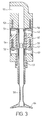
- Fig. 1 is a diagrammatic representation of one embodiment of a valve actuator according to the invention;
- Fig. 2 is a diagrammatic representation of a second embodiment of a valve actuator according to the invention;
- Fig. 3 is a vertical section through a third embodiment of a valve actuator according to the invention; and
- Fig. 4 shows engine timing diagrams combining fixed time valve events with return stroke induction
-
- Reference will first be made to Fig. 1 of the drawings in which a device for actuating a gas exchange valve 1 having a valve stem 2 of an internal combustion engine comprises axially spaced valve closing and
valve opening electromagnets 3 and 4 respectively having respective opposing pole faces 5 and 6. Anarmature 7 is disposed in achamber 8 between theopposed pole faces 5 and 6 so as to be axially movable therebetween and is operatively connected to the valve stem 2 for opening and closing the valve 1. Acompression chamber 9 is formed between the valve stem 2 and the opening electromagnet 4 and areturn spring 10 for biasing the valve in the closing direction surrounds the valve stem and is located in thechamber 9. Agas pressure source 11 is connected by asupply line 12 to thechamber 8 via a passage through theclosing electromagnet 3 and a vented shut downvalve 13 is provided in thesupply line 12. Thevalve 13 is normally closed when the engine is not operational. - A
supply port seal 14 decreases the armature area acted on by the gas supply pressure when the gas exchange valve 1 is in the closed position in order to minimise the holding force required by theclosing electromagnet 3. Reduction of the holding current initiates armature/valve displacement under the action of feed pressure. Disengagement of theport seal 14 following initial armature displacement exposes the full armature area to the feed pressure, accelerating valve opening and compressing the gas and the spring in the compression chamber. Theseal 14 is flexible in the axial direction and is arranged to be contacted by thearmature 7 in the closing direction of the valve 1 before thearmature 7 makes contact with thepole face 5. Theseal 14 may be such that it prevents actual contact between thearmature 7 and thepole face 5. Aunidirectional armature seal 15 and avalve stem seal 16 minimise leakage from thecompression chamber 9. - The opening electromagnet is energised in order to hold the gas exchange valve 1 open. The compression chamber area acting on the
armature 7 is reduced by thepole face area 5 in contact with the armature, thus minimising the required holding force of the opening electromagnet. Reducing the holding current of the opening electromagnet initiates valve closing under the influence of differential pressure across thearmature 7. Hysteresis losses are overcome and the armature returned to the closed position against the port seal by energising the closing electromagnet with a current pulse. The timing of this current pulse may be varied in order to soft-land the armature on the port seal. Feed gas trapped outside the port seal may leak past the armature to the compression chamber using theunidirectional armature seal 15. The current pulse then subsides to its holding value. - Excess return chamber gas is vented via a
relief valve 17. The gaspressure supply passage 12 may be vented to atmosphere on engine shut down via the shut downvalve 13 so that the gas exchange valve 1 is seated under the action of the valve closing spring 18. - Contact of the armature with the pole face of the electromagnet is not essential, and the flexible port seal may accommodate differential thermal expansion of the assembly.
- The exhaust valve is required to open against cylinder pressure at the end of expansion, thus requiring more force to open than the inlet valve. The port seal area and/or the feed pressure may be increased to increase the opening force. Moreover, the variable valve timing available from electromagnetic actuators facilitates reduction of the compression volume (Miller cycle). The effect is to increase the ratio of expansion to compression and thus reduce the cylinder pressure at the end of expansion and hence the valve opening force required. There are also thermal efficiency gains.
- Fig. 2 of the drawings shows a single coil version in which the periodic time of the valve open phase is characterised by known spring / mass / damper principles. Of particular significance is an open valve period of fixed time duration because it permits intake and exhaust system tuning using fixed geometry pipes, independent of engine speed. By way of example Fig. 2 shows a valve-actuating device using a single electromagnet. A
gas exchange valve 30 having avalve stem 31 comprises aclosing electromagnet 32 andpole face 33, anarmature 34 disposed in anarmature chamber 35 so as to be axially movable therein and being operatively connected to saidvalve stem 31 for opening and closing thegas exchange valve 30,springs gas pressure source 38 and asupply line 39 for biasing said valve in an opening direction. A vented shut downvalve 40 is provided in thesupply line 39 and is normally closed when the engine is not operational. - A supply port seal 41 decreases the armature area acted on by the gas supply pressure when the gas exchange valve 1 is in the closed position in order to minimise the holding force required by the
closing electromagnet 32. Reduction of the holding current initiates armature/valve displacement under the action of feed pressure. Disengagement of the port seal 41 following initial armature displacement exposes the full armature area to feed pressure, accelerating valve opening and compressing thesprings spring chamber 42 that may be vented. Again, the seal 41 may be flexible in the axial direction and be arranged to be contacted by thearmature 34 in the closing direction of thevalve 30 before the armature makes contact with thepole face 33. The seal 41 may also prevent actual contact between thearmature 34 and thepole face 33. - The stored spring energy returns said armature/gas exchange valve in the closing direction against the supply feed pressure aided by a current pulse to the closing electromagnet in order to soft land said gas exchange valve on its seat and bring the
armature 34 into contact with the supply port seal 41. In the closed position, a vent path for the pressure acting on the outer annulus of thearmature 34 is required in order to create the differential area, enabling the current to the closing electromagnetic valve to be reduced to the holding value. The pneumatic pressure may be varied in order to change the valve lift. - 4-stroke applications using a single electromagnetic actuator may require variable valve event times. To achieve this for a fixed dynamic mass, either the spring force or the damping is required to vary according to known spring mass damper principles. Regulation of the gas supply pressure would effect variation of the gas supply force. Variable damping would require the addition of a damping chamber to the dynamic mass with a variable bleed orifice.
- Fig. 3 shows a gas exchange valve assembly embodying
multiple armatures electromagnets supply passage 55 acting on areas ofarmatures port seals valve stem 58 is of tubular construction in order that gas pressure may be conveyed to thearmature 52 viaports 59.Springs springs armatures valve stem 58 against supply port seals 56, 57 as the bonding adhesive between said armatures and stem cures following initial assembly.Springs compression chambers electromagnets armatures gas exchange valve 64 is attached tovalve stem 58 which may be reduced in section in the region of the gas exchange passage (not shown). - Figure 4 shows engine timing diagrams for an engine using return stroke induction (patent EP 0 493 135 B1) in conjunction with valve open phases fixed in real time. Diagram 'A' illustrates an expansion phase extended beyond the compression phase in order to complete additional expansion work and reduce the combustion force acting on the exhaust valve at the time of opening. This further reduces the required exhaust valve actuator power.
- Diagram 'B' of figure 4 shows the effect of fixed valve event time at low engine speed. The intake and exhaust phases occupy only a very small proportion of the timing diagram and recompression is introduced into the expansion phase in order to complete the timing circle. Hence the exhaust valve opening is retarded until after bottom dead centre.
- The use of a gas pressure feed source requires a means of replenishment from a compressor. A further use of variable valve timing is that one or more engine cylinders could be timed to function as compressors to replenish the gas pressure source. The function of a cylinder as a compressor may be permanent or intermittent. To function as a compressor, a delivery valve is required. The deceleration mode can be made productive by generating pressurised gas. In an automobile this would result in less use of the brakes and thus increased efficiency.
- Compressor cylinder performance using fixed event time delivery valves may be improved by applying variable event time to the inlet valves, or introducing multiple valve events into each phase.
- Stratified charge combustion may be achieved with the aid of air injection. Such an injector may be also function as a delivery valve in the compressor mode. In a further enhancement, the gas used for injection may be pressurised oxygen.
- With a gas pressure source available, this energy may be used for other duties. In an automotive example the efficiency of many functions may be improved by operating intermittently rather than continuously. Such functions include power steering and cooling fan. The electrical load may benefit from an alternative power source for such functions as wipers and window openers etc.
- It will thus be seen that the valve actuator according to the invention minimises the electrical power consumption for the electromagnet(s) by reducing the required holding force in two ways. Firstly, by employing a constant force characteristic which gives up to 50% reduction and secondly by using differential areas to reduce the electromagnetic holding force.
- The embodiment shown in Fig. 2 using a single actuating electromagnet makes it possible to achieve a valve open duration fixed in real time. This facilitates optimised self-supercharging using pulse tuning effects from fixed geometry exhaust and intake manifolds independent of engine speed. These characteristics are particularly beneficial in the valved 2-stroke Miller cycle engine described in patent European Patent Specification No 0493135B1 in which charging takes place during decreasing cylinder volume.
- The invention is not restricted to the above described embodiments but variations and modifications may be made without departing from the scope of the invention.
Claims (11)
- A device for actuating a gas exchange valve of an internal combustion engine or gas generator, characterised in that said device comprises an armature (7; 34; 51,52) operatively connected to the valve stem (2,31,58) of a valve member (1,30,70) and at least one electromagnet (3; 32; 53,54) arranged to act on the armature (7; 34; 51,52) to move the valve member (1,30,70) from the open to the closed position, wherein the armature (7; 34; 51,42) is disposed in a chamber (8; 35; 62,63) and wherein a gas pressure source (11,38) is connected by a supply line (12,39,55) to the chamber (8; 35; 62,63), the arrangement being such that reduction of the electromagnetic force on the valve member (1,30,70) in the closing direction is effective to enable the gas pressure from said gas pressure source (11,38) to move the valve member (1,30,70) to the open position.
- A device according to claim 1, characterised in that a second electromagnet (4) is provided to assist in moving the valve member (1) from the closed to the open position.
- A device according to claim 2, characterised in that the valve closing and valve opening electromagnets (3,4) are axially spaced and have opposing pole faces (5,6), the armature (7) being disposed in the chamber (8) between said pole faces (5,6).
- A device according to any one of the preceding claims, characterised in that a seal (14; 41; 56,57) is provided between contact faces of the armature (7; 34; 51,52) and the valve closing electromagnet (3; 32; 53,54) whereby the area of the armature (7; 34; 51,52) exposed to the gas pressure in the closed position of the valve member (1,30,70) is less than the total area of the armature (7;34; 51,52), the seal (14;41; 56,57) preferably being flexible in the axial direction of movement of the valve member (1,30,70).
- A device according to claim 4, characterised in that the seal (14;41; 56,57) is arranged to be contacted by the armature (7;34; 51,52) in the closing direction of the valve member (1,30,70) before the armature makes contact with the face of the closing electromagnet (3;32; 53,54).
- A device according to any one of the preceding claims, characterised in that a spring (10; 36,37; 60,61) is provided to assist movement of the valve member (1,30,70) from the open to the closed position.
- A device according to any one of the preceding claims, characterised in that the valve stem (58) is of tubular construction with exit ports (59) in order that the valve stem (58) can also function as a gas supply passage.
- A device according to any one of the preceding claims, characterised in that a unidirectional seal (15; 68,69) is provided between the armature (7; 51,52) and the chamber (8; 62,63).
- A device according to any one of the preceding claims, wherein a plurality of electromagnets are provided to act on the armature (7; 34; 51,52) to move the valve member (1,30,70) from the open to the closed position and/or from the closed position to the open position.
- A device according to any one of the preceding claims, characterised in that the armature (7; 34; 51,52) is connected to the valve stem (2,31,58) by an adhesive.
- An internal combustion engine or a gas generator having the device claimed in any one of the preceding claims and arranged to operate with fixed periodic valve open times.
Applications Claiming Priority (2)
| Application Number | Priority Date | Filing Date | Title |
|---|---|---|---|
| GB0128049A GB2382378B (en) | 2001-11-22 | 2001-11-22 | Electromagnetic valve actuator |
| GB0128049 | 2001-11-22 |
Publications (2)
| Publication Number | Publication Date |
|---|---|
| EP1314862A2 true EP1314862A2 (en) | 2003-05-28 |
| EP1314862A3 EP1314862A3 (en) | 2006-07-05 |
Family
ID=9926286
Family Applications (1)
| Application Number | Title | Priority Date | Filing Date |
|---|---|---|---|
| EP02257708A Withdrawn EP1314862A3 (en) | 2001-11-22 | 2002-11-06 | Electromagnetic valve actuator |
Country Status (3)
| Country | Link |
|---|---|
| US (1) | US6619246B2 (en) |
| EP (1) | EP1314862A3 (en) |
| GB (1) | GB2382378B (en) |
Families Citing this family (3)
| Publication number | Priority date | Publication date | Assignee | Title |
|---|---|---|---|---|
| US9486906B2 (en) * | 2012-05-11 | 2016-11-08 | Illinois Tool Works Inc. | Lockout for fastener-driving tool |
| CN102877959B (en) * | 2012-09-28 | 2015-12-09 | 奇瑞汽车股份有限公司 | A kind of engine air valve controlling mechanism and controlling method thereof |
| SE540998C2 (en) * | 2014-04-17 | 2019-02-26 | Freevalve Ab | Combustion engine with pneumatic valve spring |
Citations (1)
| Publication number | Priority date | Publication date | Assignee | Title |
|---|---|---|---|---|
| EP0493135A1 (en) | 1990-12-27 | 1992-07-01 | HALL, Keith Gordon | Internal combustion engines |
Family Cites Families (6)
| Publication number | Priority date | Publication date | Assignee | Title |
|---|---|---|---|---|
| DE19622474C2 (en) * | 1996-06-05 | 1998-04-09 | Deutsch Zentr Luft & Raumfahrt | High speed actuator |
| DE19725218C2 (en) * | 1997-06-15 | 2000-11-02 | Daimler Chrysler Ag | Device for actuating a gas exchange valve for an internal combustion engine |
| JPH11311112A (en) * | 1998-03-14 | 1999-11-09 | Fev Motorentechnik Gmbh & Co Kg | Electromagnetically operable gas exchange valve for piston internal combustion engine with air return spring |
| IT1303950B1 (en) * | 1998-10-02 | 2001-03-01 | Magneti Marelli Spa | COMBUSTION ENGINE WITH ELECTROMAGNETIC ACTUATED VALVES. |
| DE10003115A1 (en) * | 2000-01-26 | 2001-08-02 | Bayerische Motoren Werke Ag | Valve control for internal combustion engines with an electro-magnetic actuator equipped with gas springs |
| DE10008991A1 (en) * | 2000-02-25 | 2001-08-30 | Bayerische Motoren Werke Ag | Gas exchange valve regulation with electromagnetic actuator for IC engines has armature separating gas springs and defining damper chamber in holding position on magnet |
-
2001
- 2001-11-22 GB GB0128049A patent/GB2382378B/en not_active Expired - Fee Related
-
2002
- 2002-11-04 US US10/287,861 patent/US6619246B2/en not_active Expired - Fee Related
- 2002-11-06 EP EP02257708A patent/EP1314862A3/en not_active Withdrawn
Patent Citations (1)
| Publication number | Priority date | Publication date | Assignee | Title |
|---|---|---|---|---|
| EP0493135A1 (en) | 1990-12-27 | 1992-07-01 | HALL, Keith Gordon | Internal combustion engines |
Also Published As
| Publication number | Publication date |
|---|---|
| US20030094149A1 (en) | 2003-05-22 |
| GB0128049D0 (en) | 2002-01-16 |
| GB2382378A (en) | 2003-05-28 |
| US6619246B2 (en) | 2003-09-16 |
| EP1314862A3 (en) | 2006-07-05 |
| GB2382378B (en) | 2003-12-24 |
Similar Documents
| Publication | Publication Date | Title |
|---|---|---|
| US4878464A (en) | Pneumatic bistable electronic valve actuator | |
| US5572961A (en) | Balancing valve motion in an electrohydraulic camless valvetrain | |
| KR100533781B1 (en) | Free-piston internal combustion engine with valves located in pistons | |
| Carter et al. | The free piston power pack: Sustainable power for hybrid electric vehicles | |
| US6308690B1 (en) | Hydraulically controllable camless valve system adapted for an internal combustion engine | |
| US5456222A (en) | Spool valve control of an electrohydraulic camless valvetrain | |
| EP0605672B1 (en) | Engine braking utilizing unit valve actuation | |
| US4974495A (en) | Electro-hydraulic valve actuator | |
| EP0605684B1 (en) | Method and apparatus for optimizing breathing utilizing unit valve actuation | |
| EP1472440B1 (en) | Efficient internal combustion engine valve actuator | |
| US6886509B2 (en) | Hydraulic actuator for actuating a gas exchange valve of an internal combustion engine | |
| US4852528A (en) | Pneumatic actuator with permanent magnet control valve latching | |
| US6964270B2 (en) | Dual mode EGR valve | |
| JPH01227807A (en) | Potential-energy drive type valve | |
| JP2000240477A (en) | Method for influencing mixture formation and charge movement in a cylinder of a spark ignition piston internal combustion engine | |
| JP2000161031A (en) | Valve control device for intake and exhaust valves of internal combustion engine | |
| US20040112312A1 (en) | Valve actuating device, and method for controlling same | |
| JPH04232319A (en) | Non-symmetrical double stabilizing fluid pressurre operation actuator mechanism | |
| CN115263485B (en) | Mechanism for realizing braking in engine cylinder and engine | |
| US7753014B2 (en) | Electro-hydraulic valve actuator with integral electric motor driven rotary control valve | |
| US6619246B2 (en) | Electromagnetic valve actuators | |
| US4991548A (en) | Compact valve actuator | |
| US20030041822A1 (en) | Piston internal combustion engine with pressure relief gas exhaust valves | |
| US6896236B2 (en) | Controlled leakage hydraulic damper | |
| US8256392B2 (en) | Method for actuating an electromagnetic switching valve |
Legal Events
| Date | Code | Title | Description |
|---|---|---|---|
| PUAI | Public reference made under article 153(3) epc to a published international application that has entered the european phase |
Free format text: ORIGINAL CODE: 0009012 |
|
| AK | Designated contracting states |
Designated state(s): AT BE BG CH CY CZ DE DK EE ES FI FR GB GR IE IT LI LU MC NL PT SE SK TR |
|
| AX | Request for extension of the european patent |
Extension state: AL LT LV MK RO SI |
|
| RAP1 | Party data changed (applicant data changed or rights of an application transferred) |
Owner name: BRUNTEL ENGINES LIMITED |
|
| RIN1 | Information on inventor provided before grant (corrected) |
Inventor name: BRUNTEL ENGINES LIMITED |
|
| PUAL | Search report despatched |
Free format text: ORIGINAL CODE: 0009013 |
|
| AK | Designated contracting states |
Kind code of ref document: A3 Designated state(s): AT BE BG CH CY CZ DE DK EE ES FI FR GR IE IT LI LU MC NL PT SE SK TR |
|
| AX | Request for extension of the european patent |
Extension state: AL LT LV MK RO SI |
|
| AKX | Designation fees paid | ||
| REG | Reference to a national code |
Ref country code: DE Ref legal event code: 8566 |
|
| STAA | Information on the status of an ep patent application or granted ep patent |
Free format text: STATUS: THE APPLICATION IS DEEMED TO BE WITHDRAWN |
|
| 18D | Application deemed to be withdrawn |
Effective date: 20070108 |