This invention concerns a fuel additive. In particular, this invention concerns a fuel
additive suitable for lowering low temperature operability below the cloud point of a fuel
oil.
Fuel additives are known for reducing the low temperature operability of fuel oils.
However, known fuel additives are often ineffective in lowering the low temperature
operability of fuel oils having a cloud point of less than or equal to -25°C.
Winter diesel fuel oils in Canada and most northern states of the USA have a cloud
point between -50°C and -15°C. Kerosene, which has a cloud point of -50°C, needs
to be added to the fuel oils in order to reduce their cloud points. The demand for
kerosene for low temperature grades of fuel oils increases markedly during the winter
months, putting pressure on the ability of refineries to meet demand.
CFPP (cold filter plugging point test- see J. Inst. Pet. vol. 52 (510), June 1966, pp 173-285)
is a test that is widely used in Europe to determine cold flow operability of fuels. In
North America this test is replaced by LTFT (low temperature filterability test, ASTM D
4539).
The aim of the present invention is to provide an improved fuel additive for lowering the
low temperature operability of fuel oils.
A further aim of the present invention is to provide a cold flow additive for fuel oils
having a cloud point of less than or equal to -20°C.
A further aim of the present invention is to provide a fuel additive that can be used to
replace, in part or in full, the use of kerosene in fuel oils, preferably diesel fuel oils,
having a cloud point of less than or equal to -20°C.
In accordance with the present invention there is provided a fuel additive comprising
The fuel additive preferably comprises:
The fuel additive also preferably comprises:
The fuel additive also preferably comprises:
The fuel additive also preferably comprises:
In accordance with the present invention there is also provided a fuel oil composition
comprising the fuel additive defined above and fuel oil.
In accordance with the present invention there is also provided a method for reducing
the cloud point of a fuel oil, the method comprising the step of adding the fuel additive
defined above to the fuel oil.
Although any fuel oil can be used, the inventors have found that the fuel additive of the
present invention is particularly effective in fuel oils having a cloud point of less than or
equal to -15°C, preferably less than or equal to -20°C, and even more preferably less
than or equal to -25°C.
In accordance with the present invention there is also provided use of the fuel additive
defined above as a replacement, in part or in full, for kerosene in fuel oils having a
cloud point of less than or equal to -15°C, preferably less than or equal to -20°C, and
even more preferably less than or equal to -25°C.
In accordance with the present invention there is also provided a fuel additive
concentrate comprising the fuel additive defined above in admixture with a compatible
solvent.
a) Wax
Waxes have conventionally been defined by reference to their gross physical
characteristics in view of the large and varied number of hydrocarbon components that
they contain and the difficulties in separating such closely homologous hydrocarbon
molecules. 'Industrial Waxes' by H. Bennett published in 1975 describes the different
types of petroleum wax and indicates that the characteristics of melting point and
refractive index have proved useful in classifying the variety of waxes available from
different sources.
The wax needs to have a melting point of less than 40°C. Preferably the wax has a
melting point of between 10 and 40°C. More preferably the wax has a melting point of
between 15 and 35°C. The melting point is determined using DSC, i.e. differential
scanning calorimetry, at heating/cooling rates of 2-5°C per minute. Further details of
the DSC test are provided in the Examples.
The wax needs to have a refractive index of greater than 1.4550 at 70°C. Preferably
the wax has a refractive index of greater than 1.4600, more preferably greater than
1.4650. The wax preferably has a refractive index of less than 1.475. The refractive
index is determined in accordance with the standard test method ASTM D1747-94, in
which the temperature at the point of measurement has been set to 70°C.
The wax is preferably a non-normal paraffinic wax. The term 'non-normal paraffinic
wax' is used to mean a wax that comprises less than 40% of n-alkanes by weight,
based on the total weight of the wax. Preferably the non-normal paraffinic wax contains
less than 35%, more preferably less than 30%, and even more preferably less than
20%, of n-alkanes by weight. Most preferably, the non-normal paraffinic wax contains
less than 10% of n-alkanes by weight.
The wax is typically obtained by appropriate separation and fractionation of waxcontaining
distillate fractions, and is available from wax suppliers.
A single wax having the required refractive index and melting point may be used in the
fuel additive. A mixture of one or more waxes, at least one of which having the required
refractive index and melting point, may also be used.
The wax is preferably present in the fuel oil in an amount ranging from 10 to 10,000
ppm, preferably from 50 to 5,000 ppm and most preferably from 100 to 1,000 ppm.
b) Growth Arrestor
The growth arrestor is also known as a growth inhibitor.
The growth arrestor is preferably a copolymer of ethylene and an unsaturated ester.
A copolymer of ethylene and an unsaturated ester has a polymethylene backbone
divided into segments by hydrocarbyl side chains interrupted by one or more oxygen
atoms and/or carbonyl groups.
More especially, the copolymer may comprise an ethylene copolymer having, in
addition to units derived from ethylene, units of the formula
-CR1R2-CHR3-
wherein R2 represents hydrogen or a methyl group;
R1 represents a -OOCR4 or -COOR4 group wherein R4 represents hydrogen or a C1 to
C28, preferably a C1 to C16, more preferably a C1 to C9, straight or branched chain alkyl
group; and R3 represents hydrogen or a -COOR4 or -OOCR4 group.
The growth arrestor may comprise a copolymer of ethylene with an ethylenically
unsaturated ester, or a derivative thereof. An example is a copolymer of ethylene with
an ester of an unsaturated carboxylic acid such as ethylene-acrylate (e.g. ethylene-2-ethylhexylacrylate),
but the ester is preferably one of an unsaturated alcohol with a
saturated carboxylic acid such as described in GB-A-1,263,152. An ethylene-vinyl
ester copolymer is preferably selected from: an ethylene-vinyl acetate, an ethylene vinyl
propionate, an ethylene-vinyl hexanoate, an ethylene-vinyl 2-ethylhexanoate, or an
ethylene-vinyl octanoate copolymer. Neo acid vinyl esters are also useful. Preferably,
the copolymers contain from 1 to 25, preferably 5 to 20, mole % of vinyl ester, more
preferably from 5 to 18 mole % of vinyl ester. They may also be in the form of mixtures
of two copolymers such as those described in US-A-3,961,916 and EP-A-113,581.
Preferably, number average molecular weight, as measured by vapour phase
osmometry, of the copolymer is 1,000 to 10,000, more preferably 1,000 to 5,000. If
desired, the copolymers may be derived from additional comonomers, e.g. they may be
terpolymers or tetrapolymers or higher polymers, for example where the additional
comonomer is isobutylene or diisobutylene or another ester giving rise to different units
of the above formula and wherein the above-mentioned mole %'s of ester relate to total
ester.
Also, the copolymers may additionally include small proportions of chain transfer agents
and/or molecular weight modifiers (e.g. acetaldehyde or propionaldehyde) that may be
used in the polymerisation process to make the copolymer.
The copolymers may be made by direct polymerisation of comonomers. Such
copolymers may also be made by transesterification, or by hydrolysis and reesterification,
of an ethylene unsaturated ester copolymer to give a different ethylene
unsaturated ester copolymer. For example, ethylene-vinyl hexanoate and ethylene-vinyl
octanoate copolymers may be made in this way, e.g. from an ethylene vinyl
acetate copolymer. Preferred copolymers are ethylene-vinyl acetate or ethylene-vinyl
propionate copolymers, or ethylene-vinyl 2-ethylhexanoate or ethylene-vinyl octanoate
co- or terpolymers, such as ethylene-vinyl acetate-vinyl 2-ethylhexanoate terpolymers.
The copolymers may, for example, have 15 or fewer, preferably 10 or fewer, more
preferably 6 or fewer, most preferably 2 to 5, methyl terminating side branches per 100
methylene groups, as measured by nuclear magnetic resonance spectroscopy, other
than methyl groups on a comonomer ester and other than terminal methyl groups.
The copolymers may have a polydispersity of 1 to 6, preferably 2 to 4; polydispersity
being the ratio of weight average molecular weight to number average molecular weight
both as measured by Gel Permeation Chromatography using polystyrene standards.
The growth arrestor may also be a copolymer of ethylene and 1-alkenes having a
carbon chain length of 3 to 8; or a hydrogenated polybutadiene.
The growth arrestor is preferably present in the fuel oil in an amount ranging from 5 to
5,000 ppm, preferably from 10 to 1,000 ppm and most preferably from 20 to 500 ppm.
c) Polar Nitrogen Compound
The polar nitrogen compound is also known as a wax anti-settling additive ('WASA').
Polar nitrogen compounds include an oil-soluble polar nitrogen compound carrying one
or more, preferably two or more, hydrocarbyl substituted amino or imino substituents,
the hydrocarbyl group being monovalent and containing 8 to 40 carbon atoms, and the
substituents optionally being in the form of a cation derived therefrom. The oil-soluble
polar nitrogen compound is either ionic or non-ionic and is capable of acting as a wax
crystal growth modifier in fuel oils. Preferably, the hydrocarbyl group is linear or slightly
linear, i.e. it may have one short length (1-4 carbon atoms) hydrocarbyl branch. When
the substituent is amino, it may carry more than one said hydrocarbyl group, which may
be the same or different.
The term "hydrocarbyl" refers to a group having a carbon atom directly attached to the
rest of the molecule and having a hydrocarbon or predominantly hydrocarbon
character. Examples include hydrocarbon groups, including aliphatic (e.g. alkyl or
alkenyl), alicyclic (e.g. cycloalkyl or cycloalkenyl), aromatic, alicyclic-substituted
aromatic, aromatic-substituted aliphatic and alicyclic groups. Aliphatic groups are
advantageously saturated. These groups may contain non-hydrocarbon substituents
provided their presence does not alter the predominantly hydrocarbon character of the
group. Examples include keto, halo, hydroxy, nitro, cyano, alkoxy and acyl. If the
hydrocarbyl group is substituted, a single (mono) substituent is preferred.
Examples of substituted hydrocarbyl groups include 2-hydroxyethyl, 3-hydroxypropyl,
4-hydroxybutyl, 2-ketopropyl, ethoxyethyl, and propoxypropyl. The groups may also or
alternatively contain atoms other than carbon in a chain or ring otherwise composed of
carbon atoms. Suitable hetero atoms include, for example, nitrogen, sulphur, and,
preferably, oxygen.
More especially, the or each amino or imino substituent is bonded to a moiety via an
intermediate linking group such as -CO-, -CO2 (-), -SO3 (-) or hydrocarbylene. Where the
linking group is anionic, the substituent is part of a cationic group, as in an amine salt
group.
When the polar nitrogen compound carries more than one amino or imino substituent,
the linking groups for each substituent may be the same or different.
Suitable amino substituents are long chain C12-C40, preferably C12-C24, alkyl primary,
secondary, tertiary or quaternary amino substituents.
Preferably, the amino substituent is a dialkylamino substituent, which, as indicated
above, may be in the form of an amine salt thereof; tertiary and quaternary amines can
form only amine salts. Said alkyl groups may be the same or different.
Preferably the amino substituents include dodecylamino, tetradecylamino, cocoamino,
and hydrogenated tallow amino. Examples of secondary amino substituents include
dioctadecylamino and methylbehenylamino. Mixtures of amino substituents may be
present such as those derived from naturally occurring amines. A preferred amino
substituent is the secondary hydrogenated tallow amino substituent, the alkyl groups of
which are derived from hydrogenated tallow fat and are typically composed of
approximately 4% C14, 31% C16 and 59% C18 n-alkyl groups by weight.
Suitable imino substituents are long chain C12-C40, preferably C12-C24, alkyl
substituents.
The moiety may be monomeric (cyclic or non-cyclic) or polymeric. When non-cyclic, it
may be obtained from a cyclic precursor such as an anhydride or a spirobislactone.
The cyclic ring system may include homocyclic, heterocyclic, or fused polycyclic
assemblies, or a system where two or more such cyclic assemblies are joined to one
another and in which the cyclic assemblies may be the same or different. Where there
are two or more such cyclic assemblies, the substituents may be on the same or
different assemblies, preferably on the same assembly. Preferably, the or each cyclic
assembly is aromatic, more preferably a benzene ring. Most preferably, the cyclic ring
system is a single benzene ring when it is preferred that the substituents are in the
ortho or meta positions, which benzene ring may be optionally further substituted.
The ring atoms in the cyclic assembly or assemblies are preferably carbon atoms but
may for example include one or more ring N, S or O atom, in which case or cases the
compound is a heterocyclic compound.
Examples of such polycyclic assemblies include polycyclic aromatics, rings joined "end-on"
such as diphenyl, heterocylics or alicyclics.
Examples of polar nitrogen compounds are described below:
(i) an amine salt and/or amide of a mono- or poly-carboxylic acid, e.g. having 1 to 4
carboxylic acid groups. It may be made, for example, by reacting at least one molar
proportion of a hydrocarbyl substituted amine with a molar proportion of the acid or its
anhydride.
When an amide is formed, the linking group is -CO-, and when an amine salt is formed,
the linking group is -CO2 (-).
The moiety may be cyclic or non-cyclic. Examples of cyclic moieties are those where
the acid is cyclohexane 1,2-dicarboxylic acid; cyclohexane 1,2-dicarboxylic acid;
cyclopentane 1,2-dicarboxylic acid; and naphthalene dicarboxylic acid. Generally, such
acids have 5 to 13 carbon atoms in the cyclic moiety. Preferred such cyclic acids are
benzene dicarboxylic acids such as phthalic acid, isophthalic acid, and terephthalic
acid, and benzene tetracarboxylic acids such as pyromelletic acid, phthalic acid being
particularly preferred. US-A-4,211,534 and EP-A-272,889 describes polar nitrogen
compounds containing such moieties.
Examples of non-cyclic moieties are those when the acid is a long chain alkyl or
alkylene substituted dicarboxylic acid such as a succinic acid, as described in US-A-4,147,520
for example.
Other examples of non-cyclic moieties are those where the acid is a nitrogen-containing
acid such as ethylene diamine tetracetic acid and nitrilotriacetic acid.
Further examples are the moieties obtained where a dialkyl spirobislactone is reacted
with an amine as described in DE-A-392699.
(ii) A compound having the formula I, or a salt thereof:
wherein B represents an aromatic system, A represents a hydrocarbyl group, R
1 and R
2
are the same or are different and each independently is an aliphatic hydrocarbyl group
containing 10-40 carbon atoms provided that one of R
1 and R
2 may represent a
hydrogen atom, z is at least 1 and wherein the aromatic system carries at least one
substituent group which is an activating group for the ring system or a derivative of an
activating group.
By the term hydrocarbyl in this specification is meant an organic moiety that is
composed of hydrogen and carbon, which is bonded to the rest of the molecule by a
carbon atom or atoms and which, unless the context states otherwise, may be aliphatic,
including alicyclic, aromatic or a combination thereof. It may be substituted or
unsubstituted, alkyl, aryl or alkaryl and may optionally contain unsaturation or
heteroatoms such as O, N or S, provided that such heteroatoms are insufficient to alter
the essentially hydrocarbyl nature of the group. It is preferred that A is an aliphatic
hydrocarbyl group and more preferably that A is a methylene group.
The term aromatic system is meant to include aromatic homocyclic, heterocyclic or
fused polycyclic assemblies, or a system where two or more such cyclic assemblies are
joined to one another and in which the cyclic assemblies may be the same or different.
Where there are two or more cyclic assemblies and Z is 2 or more the -(A-NR1R2)
groups present may be in the same or different assemblies. It is preferred that the
aromatic system is a ring system based on benzene rings.
The ring atoms in the aromatic system are preferably carbon atoms but may, for
example, include one or more heteroatoms such as N, S, or O in the system in which
case the compound is a heterocyclic compound.
Examples of such polycyclic assemblies include
By the term activating group is meant any group, other than a substituent aliphatic
hydrocarbyl group which activates the aromatic system to substitution reactions such as
electrophilic substitution, nucleophilic substitution or to the Mannich reaction. The
activating group may be a non-substituent group such as functionality that is within the
aromatic system as in, for example, heterocyclic compounds such as indole. The
activating group is located at least within or on each of the rings of the aromatic system
which are substituted with an -(A-NR1R2) group. It is preferred that the activating group
is a group that is on the ring system as opposed to being within the aromatic system.
Desirably the activating group or groups activate the aromatic system to electrophilic
substitution or to the Mannich reaction, most preferably to the Mannich reaction. It is
preferred that the activating group activates the aromatic system in the ortho or para
position relative to itself. The preferred activating group is a hydroxyl group. The
preferred activated aromatic system is a hydroxy aromatic system. By the term
derivative of an activating group is meant any group that can be produced by the
reaction of the activating group. For example, when the activating group is a hydroxyl
group one derivative would be an -O-C(O)-CH3 group produced by reaction of the
hydroxyl group with, for example, acetic anhydride. There may be more than one
activating group or a derivative of an activating group on or in the aromatic system; they
may be in or on the same or different rings. There may also be other substituents
present that are in or on the aromatic system and are not activating groups or
derivatives of activating groups.
Each aliphatic hydrocarbyl group constituting R1 and R2 in the invention may, for
example, be an alkyl or alkylene group or a mono or polyalkoxyalkyl group or aliphatic
hydrocarbyl group that contains heteroatoms such as O, N or S. Preferably each
aliphatic hydrocarbyl group is a straight chain alkyl group. The number of carbon atoms
in each aliphatic hydrocarbyl group is preferably 12-24, most preferably 16 to 22.
Preferably, such as when z = 1, the aromatic system also carries a substituent of
general formula II
wherein W = 0 or 1; Q represents A; and R
1 and R
2 have the meaning as given above.
It is preferred that W = 0 and that there is only one additional substituent of the above
general formula II. The additional substituent of general formula II may also be present
in the aromatic system when z is 2 or more. When there is no additional substituent of
general formula II present in the ring system it is preferred that z is 2 or more.
The most preferred compounds of general formula I are those which may be
represented by general formula III
wherein X represents hydrogen, or a hydrocarbyl group, or a non-hydrocarbyl group, or
a group of general formula IV:
wherein Y is a divalent group and wherein a = 1, 2, 3, 4 or 5, b = 1, 2, 3 or 4, c = 0, 1 or
2, d = 0, 1, 2, 3 or 4 and e = 0, 1, 2, 3 or 4 and wherein R
3, R
4, R
7 and R
8 are hydrogen
or hydrocarbyl, and wherein R
1 and R
2 are independently C
10-C
40 aliphatic hydrocarbyl
groups. D represents a hydroxyl group or a derivative of a hydroxyl group. When D is
a derivative of a hydroxyl group it is preferably a -O-C(O)-CH
3 group. The C
10-C
40
aliphatic hydrocarbyl groups may be linear or branched chains. It is preferred that the
chains are linear.
When X is a group other than a group of formula IV preferably a = 1 or 2 and b = 1, 2, 3
or 4, most preferably a =1 or 2 and b = 1, 2 or 3.
When X is a group of formula IV and c = 0, preferably a = 1, 2 or 3, b = 1, 2 or 3, d = 0,
1, 2 or 3, and e = 0, 1, 2 or 3, most preferably a = 1, b = 1, d = 1 and e = 1.
When X is a group of formula IV and c = 1, preferably a = 1, 2 or 3, b = 1, 2 or 3, d = 0,
1, 2 or 3 and e = 0, 1, 2 or 3, most preferably a = 1 or 2, b = 1 or 2, d = 0, 1 or 2 and e =
0, 1 or 2.
In both formulas III and IV the benzene ring may be part of a larger ring system such as
a fused polycyclic ring system or may be a heterocyclic ring or an aromatic ring other
than benzene.
When c = 1 groups III and IV may also be joined directly, as in when c = 0, in addition to
being joined by the divalent group Y. When c = 2 the divalent groups Y may be the
same or different.
Preferably R3, R4, R7 and R8 are hydrogen. The aliphatic hydrocarbyl groups R1 and R2
may be the same or different and are preferably independently C10-C40 alkyl groups.
Desirably the alkyl groups are independently C12-C24 alkyl groups and most preferably
C16-C22 alkyl groups. When there is more than one R1 or R2 group present they may be
the same or different aliphatic hydrocarbyl groups. Preferred combinations of alkyl
groups are those wherein R1/R2 are either C16/C18, C20/C22, C18/C18 or C22/C22.
The aliphatic hydrocarbyl groups may also contain hetero atoms such as O, N or S. It
is preferred that no hetero atoms are present in the aliphatic hydrocarbyl groups and
that the groups are linear or those which have low levels of branching.
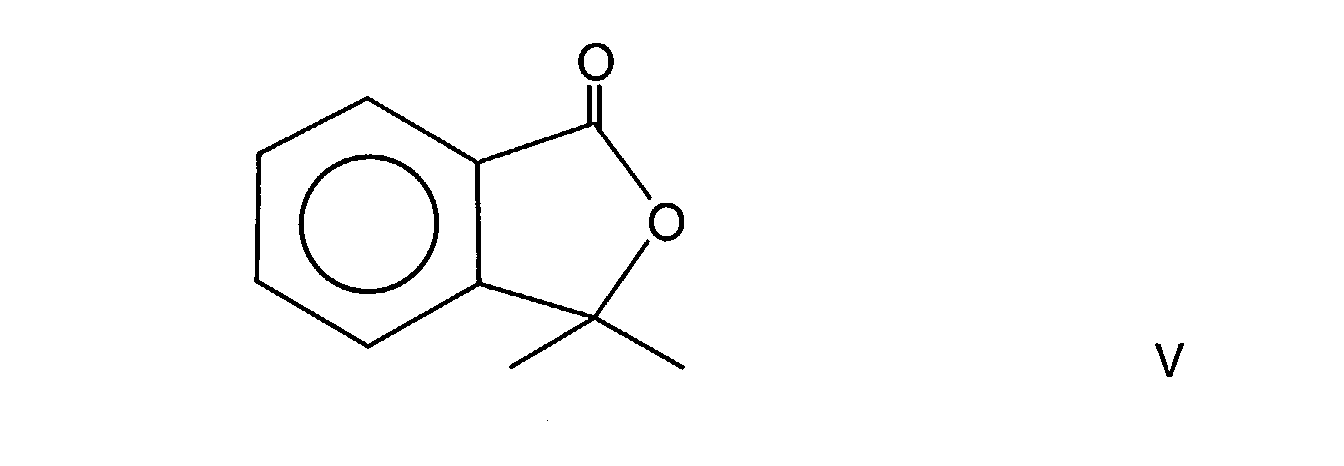
The divalent group Y may be a substituted or unsubstituted aliphatic group such as for
example methylene, -C(CH
3)
2-, -CH(Ph)-, a group of formula V or similar groups,
or groups such as -C(O)-, S(O)-, S(O)
2-, -O-, -S-, -C(O)-O- and -C(O)-O-R
11-O-C(O)-
wherein R
11 is a hydrocarbyl group as hereinbefore defined. When there are two
divalent groups present i.e. when c = 2 they may be the same or different e.g. the
combination of the group of formula V and -O- as in fluorescein. The divalent group Y
may also be an aromatic group. The divalent group Y may also contain activated cyclic
rings which have the substituent group -(A-NR
1R
2) present in the cyclic ring.
The compounds of general formula III may also be substituted with one or more groups
of general formula II. It is preferred that when X is a group other than that of formula IV
and when b = 1 that at least one group of general formula II is present in the compound
of formula III. The compounds of general formula III may also be substituted with non-hydrocarbyl
groups such as for example NO2 or CN groups.
In the compound of formula I as defined above the activating group is preferably a
hydroxyl group. The hydroxyl-aromatic system is hereinafter referred to as an activated
compound. The compound is prepared by reacting under Mannich condensation
conditions a formaldehyde or an aldehyde and a secondary amine which comprises
independently C10-C40 aliphatic hydrocarbyl groups.
The reactants may be used in equimolar or substantially equimolar proportions. The
mole ratio of the activated compound to secondary amine may be less than equimolar
for example 1:2, 1:3 or 1:4 or more. It is preferred that the mole ratio of activated
compound to secondary amine is 1:2 or substantially 1:2 and that there is sufficient
formaldehyde present to enable this mole ratio to be achieved in the final product.
The reaction may be carried out in a solvent for example toluene or without a solvent
and at a temperature in the range of 80°C to 120°C.
The aldehyde may be any aldehyde that reacts with an activated compound and a C10-C40
aliphatic hydrocarbyl secondary amine under Mannich condensation conditions. It
is preferred that formaldehyde is used in the method. The formaldehyde may be
employed in any of its conventional forms; it may be used in the form of an aqueous
solution such as formalin, as paraformaldehyde or as trioxane.
Suitable hydroxyaromatic compounds include for example: substituted phenols such as
2-, 3-, or 4-hydroxybenzophenone, 2-, 3-, or 4-hydroxybenzoic acid and 1 or 2-naphthol;
dihydroxy compounds such as resorcinol, catechol, hydroquinone, 2,2'-
biphenol, 4,4'biphenol, fluorescein, 2,2-bis(p-hydroxy phenyl)propane,
dihydroxybenzophenones, 4,4'-thiodiphenol, or dihydroxy benzoic acids such as 2,4-, or
3,5-dihydroxybenzoic acid; or trisphenolic compounds such as 1,1,1-tris-(4-hydroxy
phenyl)ethane. The hydroxy aromatic compounds may be substituted, for example,
with one or more of the following substituents: no-hydrocarbyl groups such as -NO2 or
CN; or hydrocarbyl groups such as -CHO, -COOR, -COR, -COOR; or aliphatic
hydrocarbyl groups such as alkyl groups. The substituent or substituents may be in the
ortho, para or meta or any combination of these positions in relation to the hydroxyl
group or groups. When the hydroxyaromatic compound is a substituted phenol it is
preferred that the substitution is in the ortho or para position. Phenols which have
certain para substituents have been found to produce bisdialkylaminomethyl Mannich
reaction products, derived from secondary amines with aliphatic hydrocarbyl groups of
C10 to C40, under milder reaction conditions and with greater ease than when using
unsubstituted phenol. In some cases substitution in the ortho position also allows
easier reaction under milder conditions, though some such substituents are not
beneficial, such as those substituents which are able to hydrogen bond with the
hydroxyl group. A suitable ortho substituent is a cyano group. It will be understood that
with dihydroxy compounds such as catechol where two or more hydroxy groups are
present in the same ring, that any one substituent may be ortho with respect to one of
these hydroxy groups and meta in relation to the other.
The amine may be any secondary amine that contains linear and/or branched chain
aliphatic hydrocarbyl groups of C10-C40, and preferably C12-C24 and most preferably C16-C22.
Preferred secondary amines are linear or those that have low levels of branching.
Examples of suitable secondary amines include the simple secondary amines such as
N,N-dihexadecylamine, N,N-dioctadecylamine, N,N-dieicosylamine, N,N-didocosylamine,
N,N-dicetylamine, N,N-distearylamine, N,N-diarachidylamine, N,N-dibehenylamine,
N,N-di hydrogenated tallow amine and mixed secondary amines which
comprise a mixture of any two of the following functionality: hexadecyl, octadecyl,
eicosyl, docosyl, cetyl, stearyl, arachidyl, behenyl or hydrogenated tallow or that derived
from the fatty acids of coconut oil.
Additional substituents of general formula II may be formed on the aromatic system
during the above reaction by reacting activated compounds which have a carboxylic
acid group present, with the corresponding amount of amine to take part in the above
reaction and also to neutralise the carboxylic acid groups present. Alternatively the
carboxylic acid groups may be neutralised after the reaction by adding the required
amount of amine, which may be the same or a different amine to that used in the
reaction, to neutralise the carboxylic acid groups.
There may be an additional reaction stage to convert the activating group into a
derivative of the activating group such as, for example, the conversion of a hydroxyl
group to its acetate ester by reaction for example with acetic anhydride.
(iii) A condensate of a long chain primary or secondary amine with a carboxylic acidcontaining
polymer.
Specific examples include polymers such as described in GB-A-2,121,807,
FR-A-2,592,387 and DE-A-3,941,561; and also esters of telomer acid and
alkanoloamines such as described in US-A-4,639,256; and the reaction product of an
amine containing a branched carboxylic acid ester, an epoxide and a mono-carboxylic
acid polyester such as described in US-A-4,631,071.
EP 0,283,292 describes amide containing polymers and EP 0,343,981 describes
amine-salt containing polymers.
It should be noted that the polar nitrogen compounds may contain other functionality
such as ester functionality.
The polar nitrogen compound is preferably present in the fuel oil in an amount ranging
from 5 to 5,000 ppm, preferably from 10 to 1,000 ppm and most preferably from 20 to
500 ppm.
d) Nucleator
The nucleator is preferably a polyoxyalkylene compound. Examples include
polyoxyalkylene esters, ethers, ester/ethers and mixtures thereof, particularly those
containing at least one, preferably at least two, C10 to C30 linear alkyl groups and one or
more polyoxyalkylene glycol group of molecular weight up to 5,000, preferably 200 to
5,000, the alkylene group in said polyoxyalkylene glycol containing from 1 to 4 carbon
atoms, as described in EP-A-61 895 and in U.S. Patent No. 4,491,455.
Preferred glycols are substantially linear polyethylene glycols (PEG) and polypropylene
glycols (PPG) having a molecular weight of about 100 to 5,000, preferably about 200 to
2,000. Esters are also preferred and fatty acids containing from 10 to 30 carbon atoms
are useful for reacting with the glycols to form the ester additives, it being preferred to
use C18 to C24 fatty acid, especially stearic and behenic acids. The esters may also be
prepared by esterifying polyethoxylated fatty acids, polyethoxylated alcohols or polyols.
Polyoxyalkylene diesters, diethers, ether/esters and mixtures thereof are suitable as
additives, when minor amounts of monoethers and monoesters (which are often formed
in the manufacturing process) may also be present. In particular, stearic or behenic
diesters of polyethylene glycol, polypropylene glycol or polyethylene/polypropylene
glycol mixtures are preferred.
Examples of other compounds in this general category are those described in
Japanese Patent Publication Nos. 2-51477 and 3-34790, and EP-A-117,108 and EP-A-326,356,
and cyclic esterified ethoxylates such as described EP-A-356,256.
Other suitable esters are those obtainable by the reaction of:
(i) an aliphatic monocarboxylic acid having 10 to 40 carbon atoms, and
(ii) an alkoxylated aliphatic monohydric alcohol, in which the alcohol has greater than
18 carbon atoms prior to alkoxylation and in which the degree of alkoxylation is 5 to 30
moles of alkylene oxide per mole of alcohol.
The ester may be formed from a single acid reactant (i) and single alcohol reactant (ii),
or from mixtures of acids (i) or alcohols (ii) or both. In the latter cases, a mixture of
ester products will be formed which may be used without separation if desired, or
separated to give discrete products before use.
These materials may also be prepared by alkoxylation of a fatty acid ester of a polyol
(e.g. ethoxylated sorbitan tristearate having the trade name TWEEN 65, which is
available from Uniqema, owned by ICI).
The degree of alkoxylation of the aliphatic monohydric alcohol is preferably 10 to 25
moles of alkylene oxide per mole of alcohol, more preferably 15 to 25 moles. The
alkoxylation is preferably ethoxylation, although propoxylation or butoxylation can also
be used successfully. Mixed alkoxylation, for example a mixture of ethylene and
propylene oxide units, may also be used.
The acid reactant (i) preferably has 18 to 30 carbon atoms, more preferably 16 to 24
carbon atoms such as 18 or 22 carbon atoms. The acid is preferably a saturated
aliphatic acid, more preferably an alkanoic acid. Alkanoic acids of 16 to 30 carbon
atoms are particularly useful. n-Alkanoic acids are preferred. Such acids include
behenic acid and arachidic acid, with behenic acid being preferred. Where mixtures of
acids are used, it is preferred that the average number of carbon atoms in the acid
mixture lies in the above-specified ranges and preferably the individual acids within the
mixture will not differ by more than 8 (and more preferably 4) carbon numbers.
The alcohol reactant (ii) is preferably derived from an aliphatic monohydric alcohol
having no more than 28 carbon atoms, and more preferably no more than 26 (or better,
24) carbon atoms, prior to alkoxylation. The range of 18 to 22 is particularly
advantageous for obtaining good wax crystal modification. The aliphatic alcohol is
preferably a saturated aliphatic alcohol, especially an alkanol (i.e. alkyl alcohol).
Alkanols having 16 to 28 carbon atoms, and particularly 18 to 26, such as 18 to 22
carbon atoms are preferred. n-Alkanols are most preferred, particularly those having
16 to 24 carbon atoms, and preferably 18 to 22 carbon atoms.
Where the alcohol reactant (ii) is a mixture of alcohols, this mixture may comprise a
single aliphatic alcohol alkoxylated to varying degrees, or a mixture of aliphatic alcohols
alkoxylated to either the same or varying degrees. Where a mixture of aliphatic
alcohols is used, the average carbon number prior to alkoxylation should be above 16
and preferably within the preferred ranges recited above. Preferably, the individual
alcohols in the mixture should not differ by more than 4 carbon atoms.
The esterification can be conducted by normal techniques known in the art. Thus, for
example, one mole equivalent of the alkoxylated alcohol is esterified by one mole
equivalent of acid by azeotroping in toluene at 110-120°C in the presence of 1 weight
percent of p-toluene sulphonic acid catalyst until esterification is complete, as judged by
Infra-Red Spectroscopy and/or reduction of the hydroxyl and acid numbers.
The alkoxylation of the aliphatic alcohol is also conducted by well-known techniques.
Thus, for example, a suitable alcohol is (where necessary) melted at about 70°C and 1
wt % of potassium ethoxide in ethanol added, the mixture thereafter being stirred and
heated to 100°C under a nitrogen sparge until ethanol ceases to be distilled off, the
mixture subsequently being heated to 150°C to complete formation of the potassium
salt. The reactor is then pressurised with alkylene oxide until the mass increases by
the desired weight of alkylene oxide (calculated from the desired degree of
alkoxylation). The product is finally cooled to 90°C and the potassium neutralised (e.g.
by adding an equivalent of lactic acid).
Compounds wherein the acid (i) is an alkanoic acid and the alkoxylated alcohol (ii) is
formed from one mole of a C18 to C22 alkanol and 15 to 25 moles of ethylene oxide
have been found to be particularly effective as low temperature flow and filterability
improvers, giving excellent wax crystal modification. In such embodiments, the acid (i)
is preferably an n-alkanoic acid having 18 to 22 carbon atoms and the alkanol
preferably has 16 to 22, more preferably 18 to 22 carbon atoms. Such a combination of
structural features has been found to be particularly advantageous in providing
improved wax crystal modification.
The nucleator is preferably present in the fuel oil in an amount ranging from 5 to 1,000
ppm, preferably from 10 to 500 ppm and most preferably from 10 to 200 ppm.
e) Comb polymers
Comb polymers are discussed in "Comb-Like Polymers. Structure and Properties",
N. A. Platé and V. P. Shibaev, J. Poly. Sci. Macromolecular Revs., 8, p 117 to 253
(1974).
Generally, comb polymers consist of molecules in which long chain branches such as
hydrocarbyl branches, optionally interrupted with one or more oxygen atoms and/or
carbonyl groups, having from 6 to 30 such as 10 to 30, carbon atoms, are pendant from
a polymer backbone, said branches being bonded directly or indirectly to the backbone.
Examples of indirect bonding include bonding via interposed atoms or groups, which
bonding can include covalent and/or electrovalent bonding such as in a salt. Generally,
comb polymers are distinguished by having a minimum molar proportion of units
containing such long chain branches.
Advantageously, the comb polymer is a homopolymer or a copolymer having at least 25
and preferably at least 40, more preferably at least 50, molar per cent of units having
side chains containing at least 6, such as at least 8, and preferably at least 10, atoms,
selected from, for example, carbon, nitrogen and oxygen, in a linear chain or a chain
containing a small amount of branching such as a single methyl branch.
As examples of preferred comb polymers there may be mentioned those containing
units of the general formula
where
- D
- represents R11, COOR10, OCOR10, R11COOR10 or OR10;
- E
- represents H, D or R11;
- G
- represents H or D;
- J
- represents H, R11, R11COOR10, or a substituted or unsubstituted aryl
or heterocyclic group;
- K
- represents H, COOR11, OCOR11, OR11 or COOH;
- L
- represents H, R11, COOR11, OCOR11 or substituted or unsubstituted
aryl;
- R10
- representing a hydrocarbyl group having 10 or more carbon atoms,
and
- R11
- representing a hydrocarbylene (divalent) group in the 11COOR10
moiety and otherwise a hydrocarbyl (monovalent) group,
and m and n represent mole ratios, their sum being 1 and m being finite and being up to
and including 1 and n being from zero to less than 1, preferably m being within the
range of from 1.0 to 0.4 and n being in the range of from 0 to 0.6. R
10 advantageously
represents a hydrocarbyl group with from 10 to 30 carbon atoms, preferably 10 to 24,
more preferably 10 to 18. Preferably, R
10 is a linear or slightly branched alkyl group
and R
11 advantageously represents a hydrocarbyl group with from 1 to 30 carbon atoms
when monovalent, preferably with 6 or greater, more preferably 10 or greater,
preferably up to 24, more preferably up to 18 carbon atoms. Preferably, R
11, when
monovalent, is a linear or slightly branched alkyl group. When R
11 is divalent, it is
preferably a methylene or ethylene group. By "slightly branched" is meant having a
single methyl branch.
The comb polymer may contain units derived from other monomers if desired or
required, examples being CO, vinyl acetate and ethylene. It is within the scope of the
invention to include two or more different comb copolymers.
The comb polymers may, for example, be copolymers of maleic anhydride or fumaric
acid and another ethylenically unsaturated monomer, e.g. an α-olefin or an unsaturated
ester, for example, vinyl acetate as described in EP-A-214,786. It is preferred but not
essential that equimolar amounts of the comonomers be used although molar
proportions in the range of 2 to 1 and 1 to 2 are suitable. Examples of olefins that may
be copolymerized with e.g. maleic anhydride, include 1-decene, 1-dodecene, 1-tetradecene,
1-hexadecene, 1-octadecene, and styrene. Other examples of comb
polymers include methacrylates and acrylates.
The copolymer may be esterified by any suitable technique and although preferred it is
not essential that the maleic anhydride or fumaric acid be at least 50% esterified.
Examples of alcohols that may be used include n-decan-1-ol, n-dodecan-1-ol, n-tetradecan-1-ol,
n-hexadecan-1-ol, and n-octadecan-1-ol. The alcohols may also
include up to one methyl branch per chain, for example, 1-methylpentadecan-1-ol, 2-methyltridecan-1-ol
as described in EP-A-213,879. The alcohol may be a mixture of
normal and single methyl branched alcohols. It is preferred to use pure alcohols rather
than alcohol mixtures such as may be commercially available; if mixtures are used, the
number of carbon atoms in the alkyl group is taken to be the average number of carbon
atoms in the alkyl groups of the alcohol mixture; if alcohols that contain a branch at the
1 or 2 positions are used, the number of carbon atoms in the alkyl group is taken to be
the number in the straight chain backbone segment of the alkyl group of the alcohol.
The copolymer may also be reacted with a primary and/or secondary amine, for
example, a mono- or di-hydrogenated tallow amine.
The comb polymers may especially be fumarate or itaconate polymers and copolymers
such as for example those described in European Patent Applications 153 176, 153
177, 156 577 and 225 688, and WO 91/16407.
Particularly preferred fumarate comb polymers are copolymers of alkyl fumarates and
vinyl acetate, in which the alkyl groups have from 12 to 20 carbon atoms, more
especially polymers in which the alkyl groups have 14 carbon atoms or in which the
alkyl groups are a mixture of C12/C14 alkyl groups, made, for example, by solution
copolymerizing an equimolar mixture of fumaric acid and vinyl acetate and reacting the
resulting copolymer with the alcohol or mixture of alcohols, which are preferably straight
chain alcohols. When the mixture is used it is advantageously a 1:1 by weight mixture
of normal C12 and C14 alcohols. Furthermore, mixtures of the C12 ester with the mixed
C12/C14 ester may advantageously be used. In such mixtures, the ratio of C12 to C12/C14
is advantageously in the range of from 1:1 to 4:1, preferably 2:1 to 7:2, and most
preferably about 3:1, by weight. The particularly preferred fumarate comb polymers
may, for example, have a number average molecular weight in the range of 1,000 to
100,000, preferably 1,000 to 50,000, as measured by Vapour Phase Osmometry
(VPO).
Other suitable comb polymers are the polymers and copolymers of α-olefins and
esterified copolymers of styrene and maleic anhydride, and esterified copolymers of
styrene and fumaric acid as described in EP-A-282,342; mixtures of two or more comb
polymers may be used in accordance with the invention and, as indicated above, such
use may be advantageous.
Other examples of comb polymers are hydrocarbon polymers such as copolymers of
ethylene and at least one α-olefin, preferably the α-olefin having at most 20 carbon
atoms, examples being n-octene-1, iso octene-1, n-decene-1 and n-dodecene-1, n-tetradecene-1
and n-hexadecene-1 (for example, as described in WO 93/19106).
Preferably, the number average molecular weight measured by Gel Permeation
Chromatography against polystyrene standards of such a copolymer is, for example, up
to 30,000 or up to 40,000. The hydrocarbon copolymers may be prepared by methods
known in the art, for example using a Ziegler type catalyst. Such hydrocarbon polymers
may for example have an isotacticity of 75% or greater.
The comb polymer may be present in the fuel oil in an amount ranging from 5 to 5,000
ppm, preferably from 10 to 1,000 ppm and most preferably from 20 to 500 ppm.
f) Alkyl Phenol Formaldehyde Condensates
Suitable alkyl phenol formaldehyde condensates are disclosed in EP 0 311 452 and EP
0 851 776.
The alkyl phenol formaldehyde condensate may be obtainable by the condensation
reaction between:
The alkyl phenol formaldehyde condensate may be present in the fuel oil in an amount
ranging from 5 to 5,000 ppm, preferably 10 to 1,000 ppm and most preferably from 20
to 500 ppm.
Co-Additives
In addition, the fuel additive may comprise one or more other conventional co-additives
known in the art, such as: detergents, antioxidants, corrosion inhibitors, de-hazers,
demulsifiers, metal deactivators, antifoaming agents, cetane improvers, co-solvents,
package compatibilizers, lubricity additives and antistatic additives.
Fuel Oil Composition
The fuel oil may be a hydrocarbon fuel oil such as a petroleum-based fuel oil, for
example kerosene or distillate fuel oil, or a middle distillate fuel oil, i.e. a fuel oil
obtained in refining crude oil as the fraction between the lighter kerosene and jet fuels
fraction and the heavier fuel oil fraction. Such distillate fuel oils generally boil within the
range of about 100°C to about 500°C, such as 150°C to about 400°C, for example,
those having a relatively high final boiling point of above 360°C. ASTM-D86 Middle
distillates contain a spread of hydrocarbons boiling over a temperature range. They are
also characterised by pour point, cloud point and CFPP, as well as their initial boiling
point (IBP) and final boiling point (FBP). The fuel oil can comprise atmospheric
distillate or vacuum distillate, or cracked gas oil or a blend in any proportion of straight
run and thermally and/or catalytically cracked distillates. The most common petroleum
distillate fuels are kerosene, jet fuels, diesel fuels, heating oils and heavy fuel oils,
diesel fuels and heating oils being preferred. The diesel fuel or heating oil may be a
straight atmospheric distillate, or may contain minor amounts, e.g. up to 35 wt %, of
vacuum gas oil or cracked gas oils or both.
Heating oils may be made of a blend of virgin distillate, e.g. gas oil, naphtha, etc. and
cracked distillates, e.g. catalytic cycle stock. A representative specification for a diesel
fuel includes a minimum flash point of 38°C and a 90% distillation point between 282
and 380°C (see ASTM Designations D-396 and D-975).
Also, the fuel oil may be an animal or vegetable oil (i.e. a 'biofuel'), or a mineral oil as
described above in combination with one or more animal or vegetable oils.
Examples of oils are rapeseed oil, coriander oil, soyabean oil, cottonseed oil, sunflower
oil, castor oil, olive oil, peanut oil, maize oil, almond oil, palm kernel oil, coconut oil,
mustard seed oil, beef tallow and fish oils. Rapeseed oil, which is a mixture of fatty
acids esterified with glycerol, is preferred as it is available in large quantities and can be
obtained in a simple way by pressing from rapeseed.
Examples of derivatives thereof are alkyl esters, such as methyl esters, of fatty acids of
the vegetable or animal oils. Such esters can be made by transesterification.
As lower alkyl esters of fatty acids, consideration may be given to the following, for
example, as commercial mixtures: the ethyl, propyl, butyl and especially methyl esters
of fatty acids with 12 to 22 carbon atoms, for example, of lauric acid, palmitic acid,
stearic acid, oleic acid, ricinoleic acid and linoleic acid.
The inventors have found that the fuel additive is particularly effective as a cold flow
improver in fuel oils, preferably diesel fuel oils, having a cloud point of less than or
equal to -15°C, preferably less than or equal to -20°C, and even more preferably less
than or equal to -25°C.
The fuel additive is also particularly effective in fuel oils having a final boiling point of
less than 360°C.
The concentration of the fuel additive in the fuel oil may, for example, be in the range of
1 to 10,000 ppm of fuel additive (active ingredient) by weight per weight of fuel oil, for
example, 10 to 5,000 ppm, such as 25 to 2,500 ppm (active ingredient) by weight per
weight of fuel oil, preferably 50 to 1,500 ppm, more preferably 200 to 1,200 ppm.
Additive Concentrate
The fuel additive concentrate comprises the fuel additive defined above in admixture
with a compatible solvent.
The fuel additive composition may take the form of a concentrate. Concentrates
comprising the fuel additive in admixture with a carrier liquid (e.g. as a solution or a
dispersion) are convenient as a means for incorporating the additive into bulk oil such
as distillate fuel, which incorporation may be done by methods known in the art. The
concentrates may also contain other additives as required and preferably contain from
3 to 90 wt %, more preferably 10 to 80 wt %, most preferably 20 to 75 wt % of the
additives preferably in solution in oil. Examples of carrier liquids are organic solvents
including hydrocarbon solvents, for example petroleum fractions such as naphtha,
kerosene, diesel and heater oil; aromatic hydrocarbons such as aromatic fractions, e.g.
those sold under the 'SOLVESSO' tradename; alcohols and/or esters; and paraffinic
hydrocarbons such as hexane and pentane and isoparaffins. The carrier liquid must, of
course, be selected having regard to its compatibility with the fuel additive and with the
fuel oil.
The fuel additives of the invention may be incorporated into bulk oil by other methods
such as those known in the art. If co-additives are required, they may be incorporated
into the bulk oil at the same time as the additives of the invention or at a different time.
The invention will now be described, by way of example only, with reference to the
following examples:
Example 1
Differential Scanning Calorimetry (DSC) Method for Melting Point
Determination
The DSC method measures the amount of heat (i.e. heat flow) needed to
maintain a sample at the same temperature as a reference sample (i.e. an
empty container) that is similarly cooled and heated.
The DSC test method involves heating a sample of wax (3-15mg) in a
small, sealed, aluminium container in a differential scanning calorimeter to a
temperature above its melting point. The wax is then cooled at 5°C/min to a
temperature well below its melting point. Finally the wax sample is then
heated again at 5°C/min back to a temperature above its melting point.
A plot of temperature versus heat flow is prepared. Any phase changes,
such as melting or freezing points, can be readily identified as more rapid
changes in heat flow. Some waxes, depending on their composition, do not
have sharp melting points so the end of melting can be difficult to pinpoint.
In such cases, it is useful to draw a tangent from the steep part of the curve
and to mark the point where it crosses the extended baseline, and denote
this as the melting point.
Example 2
Various types of waxes (see Table 1) were tested in combination with
typical co-additives to determine their efficacy as low temperature flow
improvers as determined by the LTFT method. The results are shown in
Table 3. The waxes were each made up into blend A (see formulation in
Table 2 below). All of the components were blended together at 50°C to
produce a homogeneous solution.
| Wax ID | Wax supplier | Trade Name | Melting Point (°C) by DSC | Refractive Index at 70°C |
| A1 | Honeywell | Microfiltrate | 23 | 1.4699 |
| A2 | Honeywell | Microfiltrate | 22 | 1.4714 |
| A3 | Honeywell | Microfiltrate | 24 | 1.4699 |
| B1 | Crompton | Witco Waxy Oil S-300 | 34 | 1.4611 |
| B2 | Crompton | Witco Waxy Oil S-300 | 35 | 1.4635 |
| B3 | Crompton | Witco Waxy Oil S-300 | 36 | 1.4622 |
| C | Crompton | Mineral Jelly #14 | 38 | 1.4472 |
| D | Mobil | Promor 103 | 77 | 1.4639 |
| E | Schumann-Sasol | ZLA 156/01 | 50 | 1.4546 |
| F | Honeywell | Astorwax 3040 | 53 | 1.4518 |
| G | Crompton | Petrolatum 68 | 55 | 1.4628 |
| H | Crompton | Techpet F | 63 | 1.4698 |
| I | Exxon | Slackwax 150N | 56 | 1.4342 |
| J | Honeywell | Astorwax 130 Filtrate | 36 | 1.4403 |
| K | Crompton | Mineral Jelly #10 | 37 | 1.4454 |
| Blend A |
| Proportion | Component | Component Code |
| 10% | Polar nitrogen compound: the product of the reaction of 2 moles dihydrogenated tallow amine with 1 mole phthalic anhydride | WASA |
| 20% | Growth arrestor: Ethylene-Vinyl Acetate copolymer, having an Mn of 3,500 and containing 16 mole% vinyl acetate | EVA |
| 60% | Test wax | Wax |
| 10% | Ethoxylated Sorbitan Tristearate (known as Tween 65) | Nucleator |
| Wax in Blend A | Melting Point (°C) by DSC | Refractive Index at 70°C | Lowest LTFT pass (°C) in Fuel A treated with Blend A |
| | | | 800 ppm | 1050 ppm |
| No additive | | | -28 | -28 |
| A1 | 23 | 1.4699 | -35 | -38 |
| A2 | 22 | 1.4714 | | -36 |
| A3 | 24 | 1.4699 | | -38 |
| B1 | 34 | 1.4611 | -36 | -36 |
| B2 | 35 | 1.4635 | | -36 |
| C | 38 | 1.4472 | >-33 |
| D | 77 | 1.4639 | -34 |
| E | 50 | 1.4546 | >-34 |
| F | 53 | 1.4518 | -33 |
| G | 55 | 1.4628 | -34 |
| H | 63 | 1.4698 | >-33 |
| I | 56 | 1.4342 | >-33 |
| J | 36 | 1.4403 | >-32 |
| K | 37 | 1.4454 | >-32 |
The results show that waxes, such as A1-3 and B1-2, which have a combination of low
melting point and high refractive index, give the best results. Waxes having either low
melting point or high refractive index alone do not give such good performance.
A further advantage of using waxes with low melting points is to improve the
handleability of the additive concentrate. Poor handleability could severely limit the
usage of the additive blend. Table 4 shows the pour point and appearance of Blend B
using each of the waxes. Blend B comprises 75% of blend A and 25% of an aromatic
solvent (Solvesso 150).
| Wax | Blend B Pour Point (°C) | Appearance of Blend B at test temperature after 1 week |
| ID | Melting Point (°C) by DSC | Refractive Index at 70°C | | 20°C | 40°C | 50°C |
| A1 | 23 | 1.4699 | 9 | Hazy fluid | clear fluid, <5% settled | clear fluid |
| A2 | 22 | 1.4714 | 9 | Hazy fluid | clear fluid | clear fluid |
| B1 | 34 | 1.4611 | 15 | clear fluid | clear fluid | clear fluid |
| C | 38 | 1.4472 | 30 | gel | clear fluid | clear fluid |
| D | 77 | 1.4639 | >50 | gel | gel | gel |
| E | 50 | 1.4546 | 38 | gel | gel | fluid |
| F | 53 | 1.4518 | 42 | gel | gel | fluid, 40% settled |
| G | 55 | 1.4628 | 42 | gel | semi-gel | clear fluid |
| H | 63 | 1.4698 | >40 | gel | semi-gel | clear fluid |
| | 58 | 1.4354 | 45 | gel | gel | fluid |
| J | 36 | 1.4403 | 15 | 50% settled | clear fluid | clear fluid |
| K | 37 | 1.4454 | 24 | gel | clear fluid, 10% settled | clear fluid |
It can be seen that the waxes that have low melting points give additive blends that
have low pour points and are fluid at ambient temperature.
Waxes having melting points above 36°C produce additive blends that are gelled at
ambient temperature.
Most commercial waxes have melting points above 40°C produce additive blends that
are gelled even at 40°C.
Example 3
Other PEG ester blends were compared for their LTFT performance in fuel A. The
results are shown in Table 5. The components used in the different blends are shown
in Table 6.
| Treat Rate (ppm ai) | LTFTs at -35°C |
| WASA | APFC | EVA | Wax A1 | Nucleator | Total |
| | | | | PEGS | Tween 65 | PEGB |
| | | | | | | | No additive | Fail |
| 50 | 50 | 200 | 600 | 100 | | | 1000 | Pass |
| 50 | 50 | 200 | 600 | | 100 | | 1000 | Pass |
| 63 | 63 | 333 | 438 | 104 | | | 1000 | Pass |
| 63 | 63 | 333 | 438 | | 104 | | 1000 | Pass |
| 57 | 57 | 343 | 429 | | | 114 | 1000 | Pass |
These similar packages show that alternatives in the PEG ester family are also
effective nucleators.
| Component | Code |
| Polar nitrogen compound: the product of the reaction of 2 moles dihydrogenated tallow amine with 1 mole phthalic anhydride | WASA |
| Growth arrestor: Ethylene-Vinyl Acetate copolymer, having an Mn of 3,500 and containing 16 mole% vinyl acetate | EVA |
| Test wax (A1 - microfiltrate) | Wax |
| Ethoxylated Sorbitan Tristearate | Tween 65 |
| Alkyl Phenol Formaldehyde Condensate | APFC |
| Other Nucleators: |
| PEG 400 Distearate | PEGS |
| PEG 400 Dibehenate | PEGB |
Additive Blend A, containing Wax A1 (the microfiltrate), was also tested in other fuels
and compared to existing, commercial LTFT additives. The results are shown in Table
7.
| Fuel Description | Additive | Treat Rate (ppm ai) | Lowest LTFT Pass (°C) | Comments |
| Canada 1 | None | 0 | -31 |
| Canada 1 | Blend A using wax A1 | 700 | -35 |
| Canada 1 | Blend A using Wax A1 | 875 | -38 | Additive of the invention at 875 ppm enables half of the kerosene in Canada 2 to be diverted to other uses |
| Canada 1 | R541 | 800 | -32 | Other, commercial LTFT additives are not effective in this type of fuel |
| Canada 1 | R533 | 900 | -32 |
| Canada 2 | None | 0 | -37 | Shows that fuel Canada 1 requires an equal volume of kerosene for a -37°C LTFT, without additive |
| Canada 3 | None | 0 | -31 |
| Canada 3 | Blend A using wax A1 | 700 | -36 |
| Canada 3 | Blend A using wax A1 | 860 | -37 |
| Canada 3 | R541 | 1350 | Fail -36 | Other, commercial LTFT additives are not effective in this type of fuel |
| Canada 3 | R533 | 1040 | Fail -36 |
The target LTFT for these fuels was a pass at -36°C or lower. Existing commercial
LTFT additives are not effective in these fuels.
R541 is a blend of EVA (a combination of EVA nucleator and EVA arrestor) with the
WASA (see Table 6).
R533 is a blend of EVA, a hydrogenated polybutadiene MDFI and WASA (see Table 6).
R541 and R533 contain neither an ethoxylate di-ester nor a wax.
Canada 2 is a blend of Canada 1 and kerosene in a ratio of 46:54.
Canada 3 is from a different refinery than Canada 1.
The characteristics of the fuels used in the examples are given below in Table 8.
| Refinery | Test Fuel A | Canada 1 | Canada 2 | Canada 3 |
| Flash Point °C | 48 | | | 60 |
| Wax at 10°C below WAT m% | 1.3 |
| Sulphur m% | 0.0417 | | | 0.0248 |
| Density at 15°C kgm-3 | 820.4 | | | 852.8 |
| KV at 20°C cSt | 2.278 | | | 3.744 |
| D86 IBP | 151 | 152 | 152 | 170 |
| 5.0% | 169 | 167 | 165 | 191 |
| 10.0% | 179 | 174 | 171 | 199 |
| 20.0% | 189 | 186 | 179 | 213 |
| 30.0% | 200 | 200 | 189 | 226 |
| 40.0% | 213 | 215 | 200 | 241 |
| 50.0% | 225 | 233 | 213 | 256 |
| 60.0% | 237 | 248 | 226 | 271 |
| 70.0% | 250 | 263 | 239 | 287 |
| 80.0% | 263 | 281 | 253 | 304 |
| 90.0% | 283 | 305 | 276 | 325 |
| 95.0% | 299 | 323 | 302 | 339 |
| FBP | 317 | 335 | 323 | 349 |
| 90% - 20% | 94 | 119 | 97 | 112 |
| FBP - 90% | 34 | 30 | 47 | 24 |
| Cloud Point (°C) | -30 | | | -33 |
| Pour Point (°C) | | -42 | | -45 |
| Lowest LTFT pass (°C) | | -31 | -37 |
Simulated Filter Plugging Point (IP419/96)
(Also see EP 0 403 097A2) | | -31 | -46 |