EP1314739A1 - Process for renaturation of recombinant, disulfide containing proteins at high protein concentrations in the presence of amines - Google Patents
Process for renaturation of recombinant, disulfide containing proteins at high protein concentrations in the presence of amines Download PDFInfo
- Publication number
- EP1314739A1 EP1314739A1 EP01127373A EP01127373A EP1314739A1 EP 1314739 A1 EP1314739 A1 EP 1314739A1 EP 01127373 A EP01127373 A EP 01127373A EP 01127373 A EP01127373 A EP 01127373A EP 1314739 A1 EP1314739 A1 EP 1314739A1
- Authority
- EP
- European Patent Office
- Prior art keywords
- protein
- refolding
- concentration
- tris
- interleukin
- Prior art date
- Legal status (The legal status is an assumption and is not a legal conclusion. Google has not performed a legal analysis and makes no representation as to the accuracy of the status listed.)
- Withdrawn
Links
- 102000004169 proteins and genes Human genes 0.000 title claims abstract description 128
- 108090000623 proteins and genes Proteins 0.000 title claims abstract description 128
- 238000000034 method Methods 0.000 title claims abstract description 28
- 238000004153 renaturation Methods 0.000 title claims abstract description 9
- 150000001412 amines Chemical class 0.000 title claims description 6
- 230000008569 process Effects 0.000 title description 8
- BWGNESOTFCXPMA-UHFFFAOYSA-N Dihydrogen disulfide Chemical compound SS BWGNESOTFCXPMA-UHFFFAOYSA-N 0.000 title description 5
- 239000000872 buffer Substances 0.000 claims abstract description 25
- 102000004388 Interleukin-4 Human genes 0.000 claims abstract description 24
- 108090000978 Interleukin-4 Proteins 0.000 claims abstract description 24
- 229940028885 interleukin-4 Drugs 0.000 claims abstract description 24
- 150000003512 tertiary amines Chemical class 0.000 claims abstract description 5
- 125000002924 primary amino group Chemical group [H]N([H])* 0.000 claims abstract description 3
- 125000000954 2-hydroxyethyl group Chemical group [H]C([*])([H])C([H])([H])O[H] 0.000 claims description 8
- 125000002496 methyl group Chemical group [H]C([H])([H])* 0.000 claims description 8
- QAOWNCQODCNURD-UHFFFAOYSA-L Sulfate Chemical compound [O-]S([O-])(=O)=O QAOWNCQODCNURD-UHFFFAOYSA-L 0.000 claims description 7
- 239000008137 solubility enhancer Substances 0.000 claims description 6
- MDFFNEOEWAXZRQ-UHFFFAOYSA-N aminyl Chemical compound [NH2] MDFFNEOEWAXZRQ-UHFFFAOYSA-N 0.000 claims description 4
- 125000003178 carboxy group Chemical group [H]OC(*)=O 0.000 claims description 4
- 125000001495 ethyl group Chemical group [H]C([H])([H])C([H])([H])* 0.000 claims description 4
- CBOIHMRHGLHBPB-UHFFFAOYSA-N hydroxymethyl Chemical compound O[CH2] CBOIHMRHGLHBPB-UHFFFAOYSA-N 0.000 claims description 4
- 239000003446 ligand Substances 0.000 claims description 4
- 229910052760 oxygen Inorganic materials 0.000 claims description 4
- 150000003335 secondary amines Chemical class 0.000 claims description 4
- 150000002500 ions Chemical group 0.000 claims description 3
- 102000015696 Interleukins Human genes 0.000 claims 1
- 108010063738 Interleukins Proteins 0.000 claims 1
- 150000001805 chlorine compounds Chemical group 0.000 claims 1
- PJJJBBJSCAKJQF-UHFFFAOYSA-N guanidinium chloride Chemical compound [Cl-].NC(N)=[NH2+] PJJJBBJSCAKJQF-UHFFFAOYSA-N 0.000 abstract description 12
- 239000003795 chemical substances by application Substances 0.000 abstract description 10
- 230000003196 chaotropic effect Effects 0.000 abstract description 8
- 108010039627 Aprotinin Proteins 0.000 abstract description 6
- 125000000467 secondary amino group Chemical class [H]N([*:1])[*:2] 0.000 abstract 1
- 235000018102 proteins Nutrition 0.000 description 109
- XUJNEKJLAYXESH-REOHCLBHSA-N L-Cysteine Chemical compound SC[C@H](N)C(O)=O XUJNEKJLAYXESH-REOHCLBHSA-N 0.000 description 36
- QAOWNCQODCNURD-UHFFFAOYSA-N Sulfuric acid Chemical compound OS(O)(=O)=O QAOWNCQODCNURD-UHFFFAOYSA-N 0.000 description 20
- 238000011084 recovery Methods 0.000 description 20
- LENZDBCJOHFCAS-UHFFFAOYSA-N tris Chemical compound OCC(N)(CO)CO LENZDBCJOHFCAS-UHFFFAOYSA-N 0.000 description 20
- 239000000203 mixture Substances 0.000 description 17
- 239000004201 L-cysteine Substances 0.000 description 16
- 235000013878 L-cysteine Nutrition 0.000 description 16
- 239000000243 solution Substances 0.000 description 14
- 230000002776 aggregation Effects 0.000 description 12
- 238000004220 aggregation Methods 0.000 description 12
- 239000000543 intermediate Substances 0.000 description 11
- 101000984722 Bos taurus Pancreatic trypsin inhibitor Proteins 0.000 description 10
- GSEJCLTVZPLZKY-UHFFFAOYSA-N Triethanolamine Chemical compound OCCN(CCO)CCO GSEJCLTVZPLZKY-UHFFFAOYSA-N 0.000 description 9
- 230000015572 biosynthetic process Effects 0.000 description 9
- 210000003000 inclusion body Anatomy 0.000 description 9
- 239000011521 glass Substances 0.000 description 8
- 230000004845 protein aggregation Effects 0.000 description 8
- KCXVZYZYPLLWCC-UHFFFAOYSA-N EDTA Chemical compound OC(=O)CN(CC(O)=O)CCN(CC(O)=O)CC(O)=O KCXVZYZYPLLWCC-UHFFFAOYSA-N 0.000 description 7
- ODKSFYDXXFIFQN-BYPYZUCNSA-N L-arginine Chemical compound OC(=O)[C@@H](N)CCCN=C(N)N ODKSFYDXXFIFQN-BYPYZUCNSA-N 0.000 description 6
- 229930064664 L-arginine Natural products 0.000 description 6
- 235000014852 L-arginine Nutrition 0.000 description 6
- 239000003599 detergent Substances 0.000 description 6
- 238000004007 reversed phase HPLC Methods 0.000 description 6
- 238000005063 solubilization Methods 0.000 description 6
- 230000007928 solubilization Effects 0.000 description 6
- 108010006519 Molecular Chaperones Proteins 0.000 description 5
- 229910019142 PO4 Inorganic materials 0.000 description 5
- 239000007983 Tris buffer Substances 0.000 description 5
- 230000014509 gene expression Effects 0.000 description 5
- NBIIXXVUZAFLBC-UHFFFAOYSA-K phosphate Chemical compound [O-]P([O-])([O-])=O NBIIXXVUZAFLBC-UHFFFAOYSA-K 0.000 description 5
- 239000010452 phosphate Substances 0.000 description 5
- 239000012460 protein solution Substances 0.000 description 5
- 239000000126 substance Substances 0.000 description 5
- HZAXFHJVJLSVMW-UHFFFAOYSA-N 2-Aminoethan-1-ol Chemical compound NCCO HZAXFHJVJLSVMW-UHFFFAOYSA-N 0.000 description 4
- 241000894006 Bacteria Species 0.000 description 4
- VEXZGXHMUGYJMC-UHFFFAOYSA-N Hydrochloric acid Chemical compound Cl VEXZGXHMUGYJMC-UHFFFAOYSA-N 0.000 description 4
- LSNNMFCWUKXFEE-UHFFFAOYSA-N Sulfurous acid Chemical compound OS(O)=O LSNNMFCWUKXFEE-UHFFFAOYSA-N 0.000 description 4
- -1 cyclic sugars Chemical class 0.000 description 4
- 230000000694 effects Effects 0.000 description 4
- 238000002474 experimental method Methods 0.000 description 4
- 238000005457 optimization Methods 0.000 description 4
- 150000003839 salts Chemical class 0.000 description 4
- 238000003756 stirring Methods 0.000 description 4
- PWKSKIMOESPYIA-UHFFFAOYSA-N 2-acetamido-3-sulfanylpropanoic acid Chemical compound CC(=O)NC(CS)C(O)=O PWKSKIMOESPYIA-UHFFFAOYSA-N 0.000 description 3
- WEVYAHXRMPXWCK-UHFFFAOYSA-N Acetonitrile Chemical compound CC#N WEVYAHXRMPXWCK-UHFFFAOYSA-N 0.000 description 3
- VEXZGXHMUGYJMC-UHFFFAOYSA-M Chloride anion Chemical compound [Cl-] VEXZGXHMUGYJMC-UHFFFAOYSA-M 0.000 description 3
- 241000588724 Escherichia coli Species 0.000 description 3
- PEDCQBHIVMGVHV-UHFFFAOYSA-N Glycerine Chemical compound OCC(O)CO PEDCQBHIVMGVHV-UHFFFAOYSA-N 0.000 description 3
- 238000004458 analytical method Methods 0.000 description 3
- 238000013459 approach Methods 0.000 description 3
- 239000006172 buffering agent Substances 0.000 description 3
- 210000004027 cell Anatomy 0.000 description 3
- XUJNEKJLAYXESH-UHFFFAOYSA-N cysteine Natural products SCC(N)C(O)=O XUJNEKJLAYXESH-UHFFFAOYSA-N 0.000 description 3
- 235000018417 cysteine Nutrition 0.000 description 3
- 238000013401 experimental design Methods 0.000 description 3
- 238000007689 inspection Methods 0.000 description 3
- 230000003993 interaction Effects 0.000 description 3
- 230000014759 maintenance of location Effects 0.000 description 3
- 238000004519 manufacturing process Methods 0.000 description 3
- 230000000087 stabilizing effect Effects 0.000 description 3
- 238000007619 statistical method Methods 0.000 description 3
- 238000006467 substitution reaction Methods 0.000 description 3
- 238000004448 titration Methods 0.000 description 3
- WPPGURUIRLDHAB-UHFFFAOYSA-M triethyl(hexadecyl)azanium;chloride Chemical compound [Cl-].CCCCCCCCCCCCCCCC[N+](CC)(CC)CC WPPGURUIRLDHAB-UHFFFAOYSA-M 0.000 description 3
- QKNYBSVHEMOAJP-UHFFFAOYSA-N 2-amino-2-(hydroxymethyl)propane-1,3-diol;hydron;chloride Chemical compound Cl.OCC(N)(CO)CO QKNYBSVHEMOAJP-UHFFFAOYSA-N 0.000 description 2
- DLFVBJFMPXGRIB-UHFFFAOYSA-N Acetamide Chemical compound CC(N)=O DLFVBJFMPXGRIB-UHFFFAOYSA-N 0.000 description 2
- 108091003079 Bovine Serum Albumin Proteins 0.000 description 2
- 229920000858 Cyclodextrin Polymers 0.000 description 2
- 108090000790 Enzymes Proteins 0.000 description 2
- 102000004190 Enzymes Human genes 0.000 description 2
- DHMQDGOQFOQNFH-UHFFFAOYSA-N Glycine Chemical compound NCC(O)=O DHMQDGOQFOQNFH-UHFFFAOYSA-N 0.000 description 2
- 102000005431 Molecular Chaperones Human genes 0.000 description 2
- AMQJEAYHLZJPGS-UHFFFAOYSA-N N-Pentanol Chemical compound CCCCCO AMQJEAYHLZJPGS-UHFFFAOYSA-N 0.000 description 2
- NBIIXXVUZAFLBC-UHFFFAOYSA-N Phosphoric acid Chemical compound OP(O)(O)=O NBIIXXVUZAFLBC-UHFFFAOYSA-N 0.000 description 2
- 108010029485 Protein Isoforms Proteins 0.000 description 2
- 102000001708 Protein Isoforms Human genes 0.000 description 2
- 101000654530 Tupaia virus (isolate Tupaia/Thailand/-/1986) Small hydrophobic protein Proteins 0.000 description 2
- XSQUKJJJFZCRTK-UHFFFAOYSA-N Urea Chemical compound NC(N)=O XSQUKJJJFZCRTK-UHFFFAOYSA-N 0.000 description 2
- 150000001298 alcohols Chemical class 0.000 description 2
- 235000001014 amino acid Nutrition 0.000 description 2
- 229960004405 aprotinin Drugs 0.000 description 2
- 238000003556 assay Methods 0.000 description 2
- 229940098773 bovine serum albumin Drugs 0.000 description 2
- 230000003139 buffering effect Effects 0.000 description 2
- 239000004202 carbamide Substances 0.000 description 2
- 238000006243 chemical reaction Methods 0.000 description 2
- 229940097362 cyclodextrins Drugs 0.000 description 2
- 230000003247 decreasing effect Effects 0.000 description 2
- 230000001419 dependent effect Effects 0.000 description 2
- 150000002019 disulfides Chemical class 0.000 description 2
- 229940088598 enzyme Drugs 0.000 description 2
- ZSIAUFGUXNUGDI-UHFFFAOYSA-N hexan-1-ol Chemical compound CCCCCCO ZSIAUFGUXNUGDI-UHFFFAOYSA-N 0.000 description 2
- 230000002209 hydrophobic effect Effects 0.000 description 2
- ZPNFWUPYTFPOJU-LPYSRVMUSA-N iniprol Chemical compound C([C@H]1C(=O)NCC(=O)NCC(=O)N[C@H]2CSSC[C@H]3C(=O)N[C@@H](CCCCN)C(=O)N[C@@H](C)C(=O)N[C@@H](CCCNC(N)=N)C(=O)N[C@H](C(N[C@H](C(=O)N[C@@H](CCCNC(N)=N)C(=O)N[C@@H](CC=4C=CC(O)=CC=4)C(=O)N[C@@H](CC=4C=CC=CC=4)C(=O)N[C@@H](CC=4C=CC(O)=CC=4)C(=O)N[C@@H](CC(N)=O)C(=O)N[C@@H](C)C(=O)N[C@@H](CCCCN)C(=O)N[C@@H](C)C(=O)NCC(=O)N[C@@H](CC(C)C)C(=O)N[C@@H](CSSC[C@H](NC(=O)[C@H](CC(O)=O)NC(=O)[C@H](CCC(O)=O)NC(=O)[C@H](C)NC(=O)[C@H](CO)NC(=O)[C@H](CCCCN)NC(=O)[C@H](CC=4C=CC=CC=4)NC(=O)[C@H](CC(N)=O)NC(=O)[C@H](CC(N)=O)NC(=O)[C@H](CCCNC(N)=N)NC(=O)[C@H](CCCCN)NC(=O)[C@H](C)NC(=O)[C@H](CCCNC(N)=N)NC2=O)C(=O)N[C@@H](CCSC)C(=O)N[C@@H](CCCNC(N)=N)C(=O)N[C@@H]([C@@H](C)O)C(=O)N[C@@H](CSSC[C@H](NC(=O)[C@H](CC=2C=CC=CC=2)NC(=O)[C@H](CC(O)=O)NC(=O)[C@H]2N(CCC2)C(=O)[C@@H](N)CCCNC(N)=N)C(=O)N[C@@H](CC(C)C)C(=O)N[C@@H](CCC(O)=O)C(=O)N2[C@@H](CCC2)C(=O)N2[C@@H](CCC2)C(=O)N[C@@H](CC=2C=CC(O)=CC=2)C(=O)N[C@@H]([C@@H](C)O)C(=O)NCC(=O)N2[C@@H](CCC2)C(=O)N3)C(=O)NCC(=O)NCC(=O)N[C@@H](C)C(O)=O)C(=O)N[C@@H](CCC(N)=O)C(=O)N[C@H](C(=O)N[C@@H](CC=2C=CC=CC=2)C(=O)N[C@H](C(=O)N1)C(C)C)[C@@H](C)O)[C@@H](C)CC)=O)[C@@H](C)CC)C1=CC=C(O)C=C1 ZPNFWUPYTFPOJU-LPYSRVMUSA-N 0.000 description 2
- 238000000746 purification Methods 0.000 description 2
- 230000004044 response Effects 0.000 description 2
- GEHJYWRUCIMESM-UHFFFAOYSA-L sodium sulfite Chemical compound [Na+].[Na+].[O-]S([O-])=O GEHJYWRUCIMESM-UHFFFAOYSA-L 0.000 description 2
- 235000000346 sugar Nutrition 0.000 description 2
- 238000000108 ultra-filtration Methods 0.000 description 2
- VKGQPUZNCZPZKI-UHFFFAOYSA-N (diaminomethylideneamino)azanium;sulfate Chemical compound NN=C(N)N.NN=C(N)N.OS(O)(=O)=O VKGQPUZNCZPZKI-UHFFFAOYSA-N 0.000 description 1
- RZRILSWMGXWSJY-UHFFFAOYSA-N 2-[bis(2-hydroxyethyl)amino]ethanol;sulfuric acid Chemical compound OS(O)(=O)=O.OCCN(CCO)CCO RZRILSWMGXWSJY-UHFFFAOYSA-N 0.000 description 1
- 229920001353 Dextrin Polymers 0.000 description 1
- 239000004375 Dextrin Substances 0.000 description 1
- 239000004471 Glycine Substances 0.000 description 1
- 101001002709 Homo sapiens Interleukin-4 Proteins 0.000 description 1
- 102000001706 Immunoglobulin Fab Fragments Human genes 0.000 description 1
- 108010054477 Immunoglobulin Fab Fragments Proteins 0.000 description 1
- MVIPJKVMOKFIEV-DFWYDOINSA-N L-canavanine sulfate Chemical compound OS(O)(=O)=O.OC(=O)[C@@H](N)CCON=C(N)N MVIPJKVMOKFIEV-DFWYDOINSA-N 0.000 description 1
- 102000016943 Muramidase Human genes 0.000 description 1
- 108010014251 Muramidase Proteins 0.000 description 1
- 108010062010 N-Acetylmuramoyl-L-alanine Amidase Proteins 0.000 description 1
- 102000007056 Recombinant Fusion Proteins Human genes 0.000 description 1
- 108010008281 Recombinant Fusion Proteins Proteins 0.000 description 1
- 102100033571 Tissue-type plasminogen activator Human genes 0.000 description 1
- 108050006955 Tissue-type plasminogen activator Proteins 0.000 description 1
- 238000003916 acid precipitation Methods 0.000 description 1
- 230000002378 acidificating effect Effects 0.000 description 1
- 230000003213 activating effect Effects 0.000 description 1
- 230000004913 activation Effects 0.000 description 1
- 230000002730 additional effect Effects 0.000 description 1
- 229910000147 aluminium phosphate Inorganic materials 0.000 description 1
- 125000000539 amino acid group Chemical group 0.000 description 1
- 150000001413 amino acids Chemical class 0.000 description 1
- 125000003277 amino group Chemical group 0.000 description 1
- QVGXLLKOCUKJST-UHFFFAOYSA-N atomic oxygen Chemical group [O] QVGXLLKOCUKJST-UHFFFAOYSA-N 0.000 description 1
- 238000011072 cell harvest Methods 0.000 description 1
- 210000003850 cellular structure Anatomy 0.000 description 1
- 239000013043 chemical agent Substances 0.000 description 1
- 238000007385 chemical modification Methods 0.000 description 1
- 238000003776 cleavage reaction Methods 0.000 description 1
- 150000001875 compounds Chemical class 0.000 description 1
- 238000010276 construction Methods 0.000 description 1
- 238000007796 conventional method Methods 0.000 description 1
- 125000000151 cysteine group Chemical group N[C@@H](CS)C(=O)* 0.000 description 1
- 238000001514 detection method Methods 0.000 description 1
- 235000019425 dextrin Nutrition 0.000 description 1
- 238000011026 diafiltration Methods 0.000 description 1
- 239000012538 diafiltration buffer Substances 0.000 description 1
- 238000000502 dialysis Methods 0.000 description 1
- 238000010790 dilution Methods 0.000 description 1
- 239000012895 dilution Substances 0.000 description 1
- 230000006334 disulfide bridging Effects 0.000 description 1
- 239000002158 endotoxin Substances 0.000 description 1
- 230000001747 exhibiting effect Effects 0.000 description 1
- 238000001914 filtration Methods 0.000 description 1
- 239000012847 fine chemical Substances 0.000 description 1
- 230000002068 genetic effect Effects 0.000 description 1
- ZRALSGWEFCBTJO-UHFFFAOYSA-O guanidinium Chemical compound NC(N)=[NH2+] ZRALSGWEFCBTJO-UHFFFAOYSA-O 0.000 description 1
- 102000055229 human IL4 Human genes 0.000 description 1
- 230000006698 induction Effects 0.000 description 1
- 239000004615 ingredient Substances 0.000 description 1
- 230000005764 inhibitory process Effects 0.000 description 1
- 239000013541 low molecular weight contaminant Substances 0.000 description 1
- 229960000274 lysozyme Drugs 0.000 description 1
- 239000004325 lysozyme Substances 0.000 description 1
- 235000010335 lysozyme Nutrition 0.000 description 1
- 239000000463 material Substances 0.000 description 1
- 230000007246 mechanism Effects 0.000 description 1
- 239000012528 membrane Substances 0.000 description 1
- 239000000693 micelle Substances 0.000 description 1
- 102000039446 nucleic acids Human genes 0.000 description 1
- 108020004707 nucleic acids Proteins 0.000 description 1
- 150000007523 nucleic acids Chemical class 0.000 description 1
- 230000002018 overexpression Effects 0.000 description 1
- 239000007800 oxidant agent Substances 0.000 description 1
- 230000001590 oxidative effect Effects 0.000 description 1
- 239000013612 plasmid Substances 0.000 description 1
- 229920001223 polyethylene glycol Polymers 0.000 description 1
- 229920001184 polypeptide Polymers 0.000 description 1
- UVTKHPSJNFFIDG-UHFFFAOYSA-L potassium tetrathionate Chemical compound [K+].[K+].[O-]S(=O)(=O)SSS([O-])(=O)=O UVTKHPSJNFFIDG-UHFFFAOYSA-L 0.000 description 1
- 238000002360 preparation method Methods 0.000 description 1
- 102000004196 processed proteins & peptides Human genes 0.000 description 1
- 108090000765 processed proteins & peptides Proteins 0.000 description 1
- 230000030788 protein refolding Effects 0.000 description 1
- 230000007420 reactivation Effects 0.000 description 1
- 239000011347 resin Substances 0.000 description 1
- 229920005989 resin Polymers 0.000 description 1
- 239000012465 retentate Substances 0.000 description 1
- 238000013341 scale-up Methods 0.000 description 1
- 230000007017 scission Effects 0.000 description 1
- 230000035945 sensitivity Effects 0.000 description 1
- 238000007086 side reaction Methods 0.000 description 1
- 238000001542 size-exclusion chromatography Methods 0.000 description 1
- 239000012064 sodium phosphate buffer Substances 0.000 description 1
- 235000010265 sodium sulphite Nutrition 0.000 description 1
- 230000003381 solubilizing effect Effects 0.000 description 1
- 238000001179 sorption measurement Methods 0.000 description 1
- 238000010561 standard procedure Methods 0.000 description 1
- 239000007858 starting material Substances 0.000 description 1
- 239000000758 substrate Substances 0.000 description 1
- 150000008163 sugars Chemical class 0.000 description 1
- 150000003467 sulfuric acid derivatives Chemical class 0.000 description 1
- 230000001629 suppression Effects 0.000 description 1
- 230000002195 synergetic effect Effects 0.000 description 1
- 229920001059 synthetic polymer Polymers 0.000 description 1
- UEUXEKPTXMALOB-UHFFFAOYSA-J tetrasodium;2-[2-[bis(carboxylatomethyl)amino]ethyl-(carboxylatomethyl)amino]acetate Chemical compound [Na+].[Na+].[Na+].[Na+].[O-]C(=O)CN(CC([O-])=O)CCN(CC([O-])=O)CC([O-])=O UEUXEKPTXMALOB-UHFFFAOYSA-J 0.000 description 1
- HPQYKCJIWQFJMS-UHFFFAOYSA-L tetrathionate(2-) Chemical compound [O-]S(=O)(=O)SSS([O-])(=O)=O HPQYKCJIWQFJMS-UHFFFAOYSA-L 0.000 description 1
- 230000001225 therapeutic effect Effects 0.000 description 1
- 230000014616 translation Effects 0.000 description 1
- YNJBWRMUSHSURL-UHFFFAOYSA-N trichloroacetic acid Chemical compound OC(=O)C(Cl)(Cl)Cl YNJBWRMUSHSURL-UHFFFAOYSA-N 0.000 description 1
Classifications
-
- C—CHEMISTRY; METALLURGY
- C07—ORGANIC CHEMISTRY
- C07K—PEPTIDES
- C07K1/00—General methods for the preparation of peptides, i.e. processes for the organic chemical preparation of peptides or proteins of any length
- C07K1/107—General methods for the preparation of peptides, i.e. processes for the organic chemical preparation of peptides or proteins of any length by chemical modification of precursor peptides
- C07K1/113—General methods for the preparation of peptides, i.e. processes for the organic chemical preparation of peptides or proteins of any length by chemical modification of precursor peptides without change of the primary structure
-
- C—CHEMISTRY; METALLURGY
- C07—ORGANIC CHEMISTRY
- C07K—PEPTIDES
- C07K1/00—General methods for the preparation of peptides, i.e. processes for the organic chemical preparation of peptides or proteins of any length
- C07K1/107—General methods for the preparation of peptides, i.e. processes for the organic chemical preparation of peptides or proteins of any length by chemical modification of precursor peptides
- C07K1/113—General methods for the preparation of peptides, i.e. processes for the organic chemical preparation of peptides or proteins of any length by chemical modification of precursor peptides without change of the primary structure
- C07K1/1133—General methods for the preparation of peptides, i.e. processes for the organic chemical preparation of peptides or proteins of any length by chemical modification of precursor peptides without change of the primary structure by redox-reactions involving cystein/cystin side chains
-
- C—CHEMISTRY; METALLURGY
- C07—ORGANIC CHEMISTRY
- C07K—PEPTIDES
- C07K14/00—Peptides having more than 20 amino acids; Gastrins; Somatostatins; Melanotropins; Derivatives thereof
- C07K14/435—Peptides having more than 20 amino acids; Gastrins; Somatostatins; Melanotropins; Derivatives thereof from animals; from humans
- C07K14/52—Cytokines; Lymphokines; Interferons
- C07K14/54—Interleukins [IL]
- C07K14/5406—IL-4
-
- C—CHEMISTRY; METALLURGY
- C07—ORGANIC CHEMISTRY
- C07K—PEPTIDES
- C07K14/00—Peptides having more than 20 amino acids; Gastrins; Somatostatins; Melanotropins; Derivatives thereof
- C07K14/81—Protease inhibitors
- C07K14/8107—Endopeptidase (E.C. 3.4.21-99) inhibitors
- C07K14/811—Serine protease (E.C. 3.4.21) inhibitors
- C07K14/8114—Kunitz type inhibitors
- C07K14/8117—Bovine/basic pancreatic trypsin inhibitor (BPTI, aprotinin)
Definitions
- the invention concerns a process for the renaturation of recombinant, eukaryotic proteins containing disulfide bonds after expression in prokaryotes.
- these proteins In case of the production of recombinant proteins in heterologous expression systems like e.g. Escherichia coli , these proteins often form inactive, insoluble aggregates (so-called “refractile bodies” or “inclusion bodies”). Additionally, these inclusion bodies are contaminated by host cell components like host cell proteins, nucleic acids, endotoxins and low molecular weight contaminants. It is assumed that the formation of these inclusion bodies is a result of the very high local concentration of the heterologous protein in the cell during induction and protein biosynthesis. However, the primary amino acid sequence of the heterologous protein in question is also of great importance as well as the presence of cysteine-residues that form covalent disulfide bonds during oxidative refolding. Before these target proteins can be used, e.g. for therapeutic purposes, the inclusion bodies have to be purified and, subsequently, the three-dimensional structure has to be renatured to convert the protein into the biologically active conformation.
- a commonly applied sequence of process steps involves, first, the solubilization of the inclusion bodies by the addition of high concentrations of chaotropic, denaturing agents (e.g. guanidinium hydrochloride or urea), or by the addition of strongly acidic agents like, e.g. glycine/phosphoric acid mixtures. Concurrently, intramolecular disulfide bonds present in the inclusion bodies may be either reduced chemically or cleaved by the so-called sulfitolysis procedure involving sulfite and an oxidizing agent. Secondly, the solubilized protein mixture may be further purified by either chromatographic means or filtration methods, both of which are well known procedures for those skilled in the art.
- chaotropic e.g. guanidinium hydrochloride or urea
- strongly acidic agents e.g. glycine/phosphoric acid mixtures.
- intramolecular disulfide bonds present in the inclusion bodies may be either reduced chemically or cleaved by
- the linearized, monomeric protein solution in the presence of high concentrations of chaotropic agent is highly diluted in order to allow for the formation of the biologically active form.
- This can be performed either rapidly (by simple dilution into a large volume of refolding buffer) or slowly by diafiltration or by dialysis against the refolding buffer.
- Other techniques described in the literature involve the adsorption of the target protein onto a chromatographic resin and, subsequently, lowering the concentration of chaotropic agent allowing refolding to take place, or size exclusion chromatography in order to separate the protein chains thereby circumventing the tendency to form aggregates.
- the concentration of the chaotropic salt has to be decreased below a circad limit, which is dependent on the target protein, e.g. usually below 0.5 M guanidinium hydrochloride.
- insoluble aggregates The major side reaction during refolding is the formation of insoluble aggregates, which is dependent on the local concentration of folding intermediates.
- folding aids are described, effectively suppressing this formation of insoluble protein aggregates, like e.g. chaperone proteins, other types of proteins (e.g. bovine serum albumin), and several types of non-protein materials, including sugars and cyclic sugars, short chain alcohols like e.g. glycerol, pentanol, hexanol, enzyme substrates, synthetic polymers, detergents, and chaotropic salts (de Bernardez Clark, E (1998): Curr. Opinion Biotechnol.
- a "stripping agent” like e.g. different cyclodextrins or linear dextrins, are added in considerable molar excess to the remove the detergent again allowing the protein to refold into its biologically active conformation.
- a "stripping agent” like e.g. different cyclodextrins or linear dextrins.
- L-arginine was shown for a number of proteins to be effective only in high molar excess with respect to the molarity of the protein to be refolded.
- the mechanism by which L-arginine suppresses the formation of protein aggregates is still unknown (Lilie H et al. (1998): Curr. Opinion Biotechnol. 9: 497-501).
- L-arginine is an expensive, chiral fine chemical.
- insoluble protein aggregates (so-called inclusion bodies) as obtained by overexpression in Escherichia coli , it is the task of the present invention to make available a commercially attractive route for the renaturation of proteins like, e.g., Interleukin-4 and its derivatives, at high protein concentrations employing a suitable, chemically simple and readily available aggregation suppressor. Due to its unspecificity, the aggregation suppressor(s) as described in the present invention may be applied to a wide range of different proteins.
- proteins like, e.g., Interleukin-4 and its derivatives
- the refolding buffer contains a further solubility enhancer like, e.g. additional ions, like e.g. chloride or, more preferably, sulfate ions, which aid in suppressing the formation of protein aggregates synergistically.
- a further solubility enhancer like, e.g. additional ions, like e.g. chloride or, more preferably, sulfate ions, which aid in suppressing the formation of protein aggregates synergistically.
- the objective of the present invention therefore include providing:
- Interleukin-4 derivative refers to muteins of human Interleukin-4 with exchanged amino acid residues at different sites of the polypeptide chain according to Sebald, W (1992): US-Patent 5,723,118 and EP-Patent 613499B1 dated 13. Nov. 1992 and Domingues et al. (1999): PCT patent application PCT/IB00/00769.
- BPTI bovine pancreatic trypsin inhibitor
- corrected folded protein refers to the target protein in its native structure exhibiting the native disulfide bonding.
- the "refolding yield”, as used herein, is defined as the concentration of correctly folded, unmodified target protein (e.g., [mg/L]) in the renaturation mixture.
- the "overall refolding yield”, as used herein, is defined as the concentration of correctly folded, unmodified target protein (e.g., [mg/L]) divided by the amount of total protein in the renaturation mixture.
- the overall refolding yield is expressed in [%].
- protein recovery or "recovery of soluble protein”, as used herein, refer to the ratio of soluble protein recovered after refolding and the initial total protein. The protein recovery is expressed in [%].
- purity ([%]), as used herein, is calculated on the basis of the refolding yield of the target protein and the concentration of soluble protein in the renaturation mixture as determined by RP-HPLC (see example 1).
- TRIS refers to the basic buffering substance Tris-(hydroxymethyl)-aminomethane.
- TEA refers to the basic buffering substance triethanolamine.
- GndHCl refers to the chaotropic salt guanidinium hydrocloride.
- solubility enhancers like e.g. chloride or, more preferably, sulfate ions
- Guanidinium hydrochloride effectively solubilizes folding intermediates at optimal concentrations of 750 mM.
- the N-methylated or N-ethylated derivatives and bis(-1-aminoguanidinium)-sulfate are more effectively solubilizing folding intermediates at lower concentrations (200-600 mM) as compared to guanidinium hydrochloride.
- the purity of the refolded protein (18.4 to 27.1%) is much lower compared to the phosphate control.
- TRIS is widely used at very low concentrations ( ⁇ 0.1 M) as a buffering substance in refolding mixtures, but not at high concentrations as aggregation suppressor.
- Ethanolamine which is structurally related to TRIS, also positively affected the solubilization of folding intermediates (pH-titration with HCl), resulting in comparable refolding and protein yields and purities.
- Interleukin-4 derivative and BPTI can be effectively refolded in a combined buffering system consisting of TRIS and sulfate ions (sulfuric acid titration).
- protein concentrations preferably 250 to 1000 [mg/L] can be employed, more preferably 400 to 700 [mg/L] and, even more preferably, 450 to 550 [mg/L].
- L-cysteine should be included into the refolding mixture in order to allow for the formation of stabilizing disulfide bonds, preferably at 1 to 4 [mM], more preferably at 2.5 to 3.5 [mM].
- TRIS/H 2 SO 4 should be present preferably at 1 to 3 [M], more preferably at 1.4 to 2.4 [M].
- the pH of the buffer is adjusted to about 7-9, more preferably 7 to 8, and most preferably 7.5.
- protein concentrations of preferably 500 to 1000 [mg/L] can be employed, more preferably 600 to 800 [mg/L] and, even more preferably, 700 to 800 [mg/L].
- L-cysteine should be included into the refolding mixture in order to allow for the formation of stabilizing disulfide bonds, preferably at 2.5 to 4 [mM], more preferably at 3.0 to 3.5 [mM].
- TRIS/H 2 SO 4 should be present preferably at 0.2 to 1.4 [M], more preferably at 0.3 to 1.0 [M].
- the pH of the buffer is adjusted to about 7-9, more preferably 7 to 8, and most preferably 7.5.
- triethanolamine effectively solubilizes folding intermediates (800%), does not affect the purity of the refolded protein (44.1% which is comparable to the phosphate control), resulting in the best refolding yield (1039% compared to the phosphate control).
- Interleukin-4 derivative can be effectively refolded in a combined buffering system consisting of TEA and sulfate ions (sulfuric acid titration).
- Protein concentrations preferably 250 to 1000 [mg/L] can be employed, more preferably 400 to 700 [mg/L] and, even more preferably, 450 to 550 [mg/L].
- L-cysteine should be included into the refolding mixture in order to allow for the formation of stabilizing disulfide bonds, preferably at 0.4 to 4 [mM], more preferably at 0.8 to 2 [mM].
- TEA/H 2 SO 4 should be present preferably at 0.5 to 2 [M], more preferably at 0.8 to 1.5 [M].
- the pH of the buffer is adjusted to about 7-9, more preferably 7 to 8, and most preferably 7.5.
- the central role of the amine function was demonstrated with canavanine-sulfate, where the central amine group is exchanged for an oxygen group, resulting in a complete loss of recovery of soluble protein (equal to the control without the addition of any aggregation suppressor) and loss of correctly refolded Interleukin-4 derivative.
- the data listed in Table 1 also show that the counter ion may also play a significant role.
- Sulfate ions are superior to chloride ions with regard to the refolding yield and inhibition of protein aggregation. Therefore, a combination of an amine as described above and a sulfate salt of sulfuric acid most effectively inhibits the formation of protein aggregates and allows the protein to refold into its native conformation.
- Analytical RP-HPLC is carried out on a YMC C4 column (5 ⁇ , 200 ⁇ , 4.6 x 250 mm) at a flow rate of 1.0 ml/min. Detection is performed at 210 nm. The optional pre-column (20 mm x 4 mm) is packed with Source 15 RPC (Pharmacia, Sweden). Buffer A is 0.1% TFA, buffer B is 0.1% TFA with 70% acetonitrile. The gradient is performed as follows: 0-2 min, 40% B; 2-19.5 min, 40%-85% B; 19.5-20 min, 85%-100%B; 20-21 min, 100% B, 21-22 min, 100%-40% B, 22-25 min, 40% B (reequilibration).
- the peak eluting at the retention time of the native form is integrated giving the refolding yield expressed in [mg/L] units and corresponds to the concentration of correctly folded protein (calculated based on external standard curves).
- the total area counts correspond to the concentration of soluble protein present in the refolding mixture expressed in [mg/L] units. The ratio of these two values give the purity of the refolded protein expressed in [%] units.
- the total protein concentration was determined after trichloroacetic acid precipitation, which was performed according to biochemical standard methods, using the commercially available BCA-assay (Pierce, USA) and bovine serum albumin (Boehringer-Mannheim, Germany) as calibration standard.
- Proteins were solubilized in the presence of 0.2 M Tris-HCl, pH 9 containing 8 M Guanidinium hydrochloride to give a final protein concentration of 10 [g/L].
- the SH-groups were then sulfitolyzed by the addition of 30 [g/L] sodium sulfite and 60 [g/L] potassium tetrathionate. After the addition of sulfite, the solution was stirred at room temperature for 30 min in order to allow completeness of the reaction of sulfite with any disulfides present in the solubilized proteins.
- tetrathionate was added and the solution is stirred for further 90 min in order to allow the conversion of SH-groups to disulfides and the cleavage to S-sulfite-groups to run to completion.
- the solution was filtered through a 1.2 ⁇ -cut off depth filter (e.g. Sartopure PP2, 1.2 ⁇ , Sartorius AG, Germany).
- the solution was then diafiltered against 5 volumes of diafiltration buffer consisting of 0.2 M Tris-HCl, pH 9 containing 4 M Guanidinium hydrochloride employing an ultrafiltration membrane (cut-off 10.000 MW, e.g. Hydrosart 10 kD, Sartorius AG, Germany).
- the retentate harvested from the ultrafiltration apparatus contained a final protein concentration of approx. 10 [g/L] and was stored at 2-8°C for up to 2 weeks.
- the protein solution from Example 2 containing denatured, sulfitolyzed protein, is diluted into refolding buffer to give a final protein concentration of 250 [mg/L] as determined by the BCA-assay (Pierce, USA).
- the refolding buffer consisted of the following ingredients:
- the total final volume of the refolding solution was 50 mL (glass vials, Schott, Germany). The glass vials were capped with parafilm. Refolding was allowed to run to completion within 24-36 hours with stirring on a magnetic bar stirrer (100-200 rpm). At intervals, samples were withdrawn and analyzed by RP-HPLC (see Example 1).
- the total final volume of the refolding solution was 50 mL (glass vials, Schott, Germany). The glass vials were capped with parafilm. Refolding was allowed to run to completion within 24-36 hours with stirring on a magnetic bar stirrer (100-200 rpm). At intervals, samples were withdrawn and analyzed by RP-HPLC (see Example 1).
- concentration of TRIS-base 0.5 to 3 [M]
- H 2 SO 4 depending on TRIS-concentration; 0.4 to 1.4 [M]
- residual guanidinium hydrochloride concentration 80-400 mM
- L-cysteine concentration 0.4 to 4 [mM]
- initial protein concentration 50 to 1000 [mg/L]
- the pH of the refolding buffer was adjusted to 7.5. All refolding mixtures contained 1 mM EDTA.
- Triethanolamine (TEA) /H 2 SO 4 -system Another attractive combination of aggregation suppressors is the Triethanolamine (TEA) /H 2 SO 4 -system. Therefore, this system was chosen for further optimization and scale-up of the protein concentration.
- the total final volume of the refolding solution was 50 mL (glass vials, Schott, Germany). The glass vials were capped with parafilm. Refolding was allowed to run to completion within 24-36 hours with stirring on a magnetic bar stirrer (100-200 rpm). At intervals, samples were withdrawn and analyzed by RP-HPLC (see Example 1).
- concentration of TEA (1 to 2 [M]
- H 2 SO 4 depending on TEA-concentration
- residual guanidinium hydrochloride concentration 80-400 mM
- L-cysteine concentration 0.4 to 10 [mM]
- initial protein concentration 50 to 1000 [mg/L]
- the pH of the refolding buffer was adjusted to 7.5. All refolding mixtures contained 1 mM EDTA.
- the TRIS/H 2 SO 4 -system was also optimized for BPTI.
- the TRIS/H 2 SO 4 -system was also optimized for BPTI.
- the total final volume of the refolding solution was 50 mL (glass vials, Schott, Germany). The glass vials were capped with parafilm. Refolding was allowed to run to completion within 24-36 hours with stirring on a magnetic bar stirrer (100-200 rpm). At intervals, samples were withdrawn and analyzed by RP-HPLC (see Example 1).
- concentration of TRIS (0 to 2 [M]), H 2 SO 4 (depending on the concentration of TRIS-base), residual guanidinium hydrochloride concentration (80-400 mM), L-cysteine concentration (0.1 to 4 [mM]), and initial protein concentration (50 to 1000 [mg/L]).
- concentration of TRIS (0 to 2 [M]
- H 2 SO 4 depending on the concentration of TRIS-base
- residual guanidinium hydrochloride concentration 80-400 mM
- L-cysteine concentration 0.1 to 4 [mM]
- initial protein concentration 50 to 1000 [mg/L]
- the pH of the refolding buffer was adjusted to 7.5. All refolding mixtures contained 1 mM EDTA.
Landscapes
- Chemical & Material Sciences (AREA)
- Organic Chemistry (AREA)
- Health & Medical Sciences (AREA)
- Life Sciences & Earth Sciences (AREA)
- Medicinal Chemistry (AREA)
- Molecular Biology (AREA)
- Biochemistry (AREA)
- Biophysics (AREA)
- General Health & Medical Sciences (AREA)
- Genetics & Genomics (AREA)
- Proteomics, Peptides & Aminoacids (AREA)
- Chemical Kinetics & Catalysis (AREA)
- Gastroenterology & Hepatology (AREA)
- Analytical Chemistry (AREA)
- General Chemical & Material Sciences (AREA)
- Toxicology (AREA)
- Zoology (AREA)
- Peptides Or Proteins (AREA)
- Preparation Of Compounds By Using Micro-Organisms (AREA)
- Medicines That Contain Protein Lipid Enzymes And Other Medicines (AREA)
Abstract
Description
- The invention concerns a process for the renaturation of recombinant, eukaryotic proteins containing disulfide bonds after expression in prokaryotes.
- In case of the production of recombinant proteins in heterologous expression systems like e.g. Escherichia coli, these proteins often form inactive, insoluble aggregates (so-called "refractile bodies" or "inclusion bodies"). Additionally, these inclusion bodies are contaminated by host cell components like host cell proteins, nucleic acids, endotoxins and low molecular weight contaminants. It is assumed that the formation of these inclusion bodies is a result of the very high local concentration of the heterologous protein in the cell during induction and protein biosynthesis. However, the primary amino acid sequence of the heterologous protein in question is also of great importance as well as the presence of cysteine-residues that form covalent disulfide bonds during oxidative refolding. Before these target proteins can be used, e.g. for therapeutic purposes, the inclusion bodies have to be purified and, subsequently, the three-dimensional structure has to be renatured to convert the protein into the biologically active conformation.
- A commonly applied sequence of process steps involves, first, the solubilization of the inclusion bodies by the addition of high concentrations of chaotropic, denaturing agents (e.g. guanidinium hydrochloride or urea), or by the addition of strongly acidic agents like, e.g. glycine/phosphoric acid mixtures. Concurrently, intramolecular disulfide bonds present in the inclusion bodies may be either reduced chemically or cleaved by the so-called sulfitolysis procedure involving sulfite and an oxidizing agent. Secondly, the solubilized protein mixture may be further purified by either chromatographic means or filtration methods, both of which are well known procedures for those skilled in the art.
- Subsequently, the linearized, monomeric protein solution in the presence of high concentrations of chaotropic agent is highly diluted in order to allow for the formation of the biologically active form. This can be performed either rapidly (by simple dilution into a large volume of refolding buffer) or slowly by diafiltration or by dialysis against the refolding buffer. Other techniques described in the literature involve the adsorption of the target protein onto a chromatographic resin and, subsequently, lowering the concentration of chaotropic agent allowing refolding to take place, or size exclusion chromatography in order to separate the protein chains thereby circumventing the tendency to form aggregates. In every case, the concentration of the chaotropic salt has to be decreased below a certained limit, which is dependent on the target protein, e.g. usually below 0.5 M guanidinium hydrochloride.
- The major side reaction during refolding is the formation of insoluble aggregates, which is dependent on the local concentration of folding intermediates. In the literature, a broad range of folding aids are described, effectively suppressing this formation of insoluble protein aggregates, like e.g. chaperone proteins, other types of proteins (e.g. bovine serum albumin), and several types of non-protein materials, including sugars and cyclic sugars, short chain alcohols like e.g. glycerol, pentanol, hexanol, enzyme substrates, synthetic polymers, detergents, and chaotropic salts (de Bernardez Clark, E (1998): Curr. Opinion Biotechnol. 9: 157-163 and citations therein; Lilie H, Schwarz E, Rudolph R (1998): Curr. Opinion Biotechnol. 9: 947-501 and citations therein; Sharma A, Karuppiah N (1998): US-patent 5,728,804 filed June 2, 1995). A different approach has recently been published where so-called artificial chaperones are used to keep hydrophobic folding intermediates in solution (Gellman S, Rozema DB (1996): US-patent 5,563,057 filed October 31, 1994). In a first step, hydrophobic folding intermediates are trapped into detergent micelles leading to a suppression of protein aggregation. The trapped folding intermediates cannot fold to the native conformation. In a second step, a "stripping agent", like e.g. different cyclodextrins or linear dextrins, are added in considerable molar excess to the remove the detergent again allowing the protein to refold into its biologically active conformation. There are several drawbacks to this approach like 1. Large molar excess of the expensive "stripping agent", 2. Protein aggregation occurring during the "stripping" phase, 3. Difficulty to remove residual detergent bound to the target protein, 4. Limitations in protein capacity and solubility of cyclodextrins and 5. Sensitivity of the artificial chaperone system with respect to process variations (limited robustness). Moreover, artificial chaperone systems are specific with respect to the target protein, the type of detergent and "stripping agent" and the experimental conditions employed. Hence, there is no generic artificial chaperone system available (Daugherty DL, Rozema D, Hanson PE, Gellman SH (1998): J. Biol. Chem. 273: 33961-33971; Rozema D, Gellman SH (1996): J. Biol. Chem. 271: 3478-3487).
- Most of the above mentioned aggregation suppressors only work with a limited number of proteins. One exception is the amino acid L-arginine, which was shown to be generally applicable to a wide range of different proteins like e.g. t-PA, Fab fragments, lysozyme and other enzymes (Rudolph R, Fischer S, Mattes R (1997): Process for the activating of gene-technologically produced, heterologous, disulfide bridge-containing eukaryotic proteins after expression in prokaryotes. U.S. patent 5,593,865; Rudolph R, Fischer S, Mattes R (1995): Process for the activation of T-PA or ING after genetic expression in prokaryotes. U.S. patent 5,453,363; de Bernardez Clark, E (1998): Curr. Opinion Biotechnol. 9: 157-163 and citations therein).
- L-arginine was shown for a number of proteins to be effective only in high molar excess with respect to the molarity of the protein to be refolded. The mechanism by which L-arginine suppresses the formation of protein aggregates is still unknown (Lilie H et al. (1998): Curr. Opinion Biotechnol. 9: 497-501). Moreover, L-arginine is an expensive, chiral fine chemical.
- Hence, there is still a need to develop strategies for protein refolding using conventional techniques. From the state of the art, no generally useable, chemically simple and inexpensive aggregation suppressor is known, which can be applied in a commercially attractive refolding process of proteins at high concentrations of up to 0.5-1 g/L.
- Starting from insoluble protein aggregates (so-called inclusion bodies) as obtained by overexpression in Escherichia coli, it is the task of the present invention to make available a commercially attractive route for the renaturation of proteins like, e.g., Interleukin-4 and its derivatives, at high protein concentrations employing a suitable, chemically simple and readily available aggregation suppressor. Due to its unspecificity, the aggregation suppressor(s) as described in the present invention may be applied to a wide range of different proteins.
- The method described herein comprises adding a solution of denatured, chemically modified or reduced protein, into a refolding buffer containing a primary, more preferably secondary or tertiary amines having the formulawith substitutions R1, R2, and R3, where R1 and R2 can be any combination of the ligands H, O=C-NH2, (CH2)4-NH2, (CH2)3-COOH, (CH2)2-CHOH-CH3, CH2-CH2-OH, CH2-CH3, CH3, NH2. The residue R3 can be C(NH2)=NH, C(CH2OH)3, CH2-CH2-OH or H.

- In a preferred embodiment, the refolding buffer contains a further solubility enhancer like, e.g. additional ions, like e.g. chloride or, more preferably, sulfate ions, which aid in suppressing the formation of protein aggregates synergistically.
- It is known for a large number of proteins from prior art that, for renaturation, certain limiting values of protein concentration should not be exceeded. The level of these concentration limits are depending on the nature of the protein to be refolded. Now is the recognition that comparatively large amounts of denatured protein do not require larger amounts of solution volume in order to achieve larger amounts of refolded protein due to the excessively high solubilization capacity of the above mentioned amine(s) or a combination of the above mentioned amines and another solubility enhancer.
- The objective of the present invention therefore include providing:
- a) a method of the above kind for refolding an inactive protein into a native conformation thereby effectively suppressing the formation of protein aggregates causing loss of refolding yield and recovery of soluble protein;
- b) a method of the above kind that allows the refolding at high protein concentrations; and
- c) a method of the above kind that can be used with inexpensive non-chiral commodity chemicals.
-
- These and still other objects and advantages of the present invention will be apparent from the description that follows. It should be understood that the following is merely a description of the preferred embodiments, and is not intended as a description of all possible embodiments. The claims should be looked to do determine the full scope of the invention.
- As used herein, the term "Interleukin-4 derivative" refers to muteins of human Interleukin-4 with exchanged amino acid residues at different sites of the polypeptide chain according to Sebald, W (1992): US-Patent 5,723,118 and EP-Patent 613499B1 dated 13. Nov. 1992 and Domingues et al. (1999): PCT patent application PCT/IB00/00769.
- As used herein, the term BPTI refers to bovine pancreatic trypsin inhibitor (also called aprotinin).
- As used herein, "correctly folded protein" refers to the target protein in its native structure exhibiting the native disulfide bonding.
- The "refolding yield", as used herein, is defined as the concentration of correctly folded, unmodified target protein (e.g., [mg/L]) in the renaturation mixture.
- The "overall refolding yield", as used herein, is defined as the concentration of correctly folded, unmodified target protein (e.g., [mg/L]) divided by the amount of total protein in the renaturation mixture. The overall refolding yield is expressed in [%].
- The terms "protein recovery" or "recovery of soluble protein", as used herein, refer to the ratio of soluble protein recovered after refolding and the initial total protein. The protein recovery is expressed in [%].
- The term "purity" ([%]), as used herein, is calculated on the basis of the refolding yield of the target protein and the concentration of soluble protein in the renaturation mixture as determined by RP-HPLC (see example 1).
- The term TRIS, as used herein, refers to the basic buffering substance Tris-(hydroxymethyl)-aminomethane. The term TEA, as used herein, refers to the basic buffering substance triethanolamine. The term GndHCl, as used herein, refers to the chaotropic salt guanidinium hydrocloride.
- The subject of the present invention is a process for the reactivation of recombinant, disulfide bridged proteins after heterologous expression in prokaryotes leading to insoluble inclusion bodies, which are, subsequent to purification of these protein aggregates, denatured in high concentrations of a suitable chaotropic salt, chemically modified (formation of a mixed disulfide between protein-SH groups and a suitable mercaptane or introduction of a sulfite group into the protein-SH groups to form S-SO3 groups), and renatured in a refolding buffer using high concentrations of a primary, more preferably secondary or tertiary amines with substitutions R1, R2, and R3, where R1 and R2 can be any combination of the ligands H, O=C-NH2, (CH2)4-NH2, (CH2)3-COOH, (CH2)2-CHOH-CH3, CH2-CH2-OH, CH2-CH3, CH3, NH2. The residue R3 can be C(NH2)=NH, C(CH2OH)3, CH2-CH2-OH or H. Additionally, combinations with other solubility enhancers, like e.g. chloride or, more preferably, sulfate ions, are effective in preventing protein aggregation.
- The production of recombinant Interleukin-4 derivative employing Escherichia coli as host organism has been already described in detail (Apeler H, Wehlmann H (1999) Plasmids, their construction and their use in the manufacture of Interleukin-4 and Interleukin-4 muteins. EP 10 22 339, 2000-07-26).
- Methods for cell harvest, cell disruption, inclusion body purification, solubilization and chemical modification of SH-groups are well known procedures to those persons skilled in the art (Creighton TE (ed.) (1989): Protein structure - A Pratical Approach. IRL Press, Oxford, New York, Tokyo).
- From prior art it is well known that chemical agents of low molecular weight may suppress the formation of aggregates during refolding. Therefore, a wide range of chemicals was screened in order to find a suitable aggregation suppressor to be employed in the refolding process of Interleukin-4 derivative, but also other proteins like, e.g., BPTI.
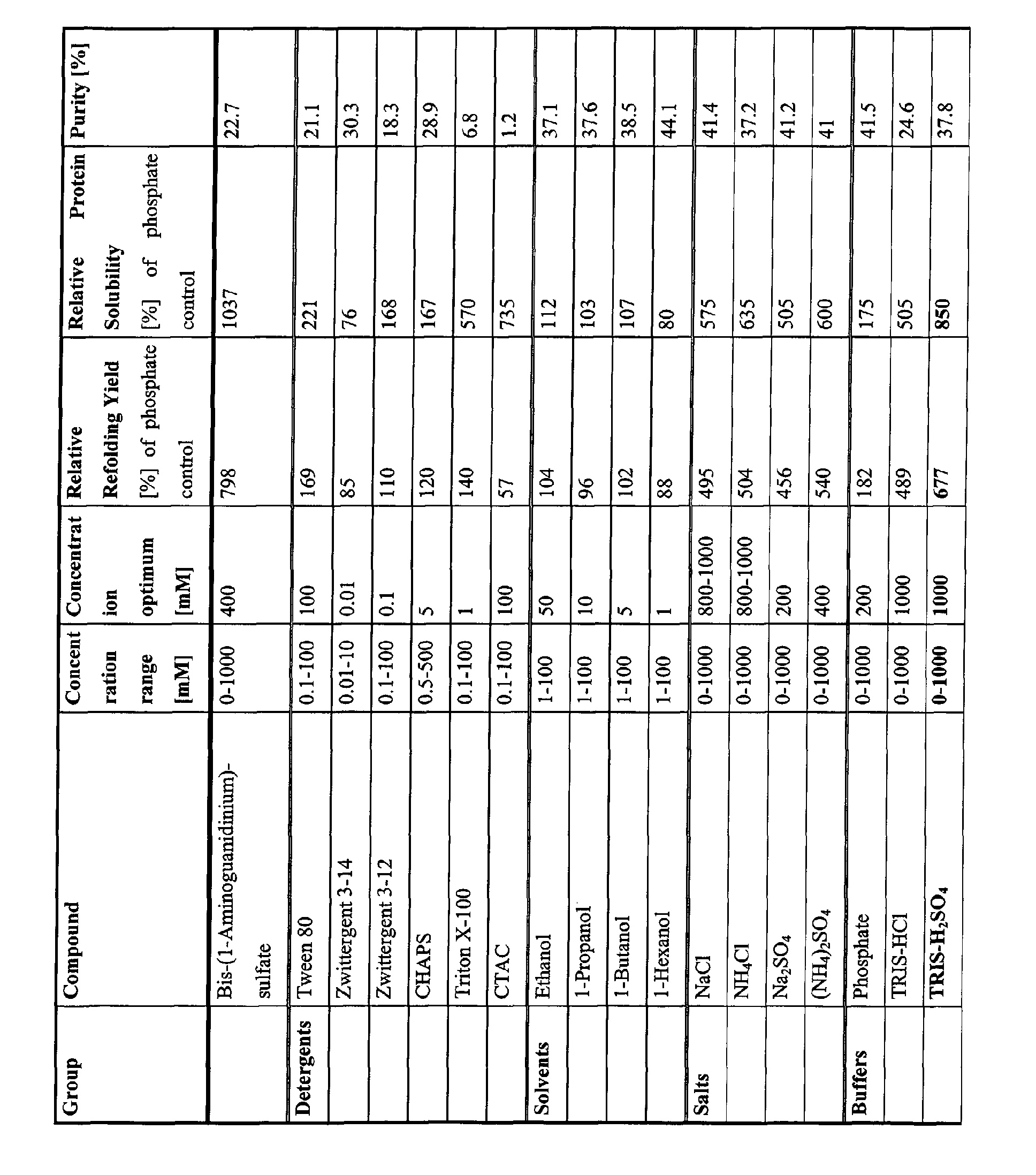
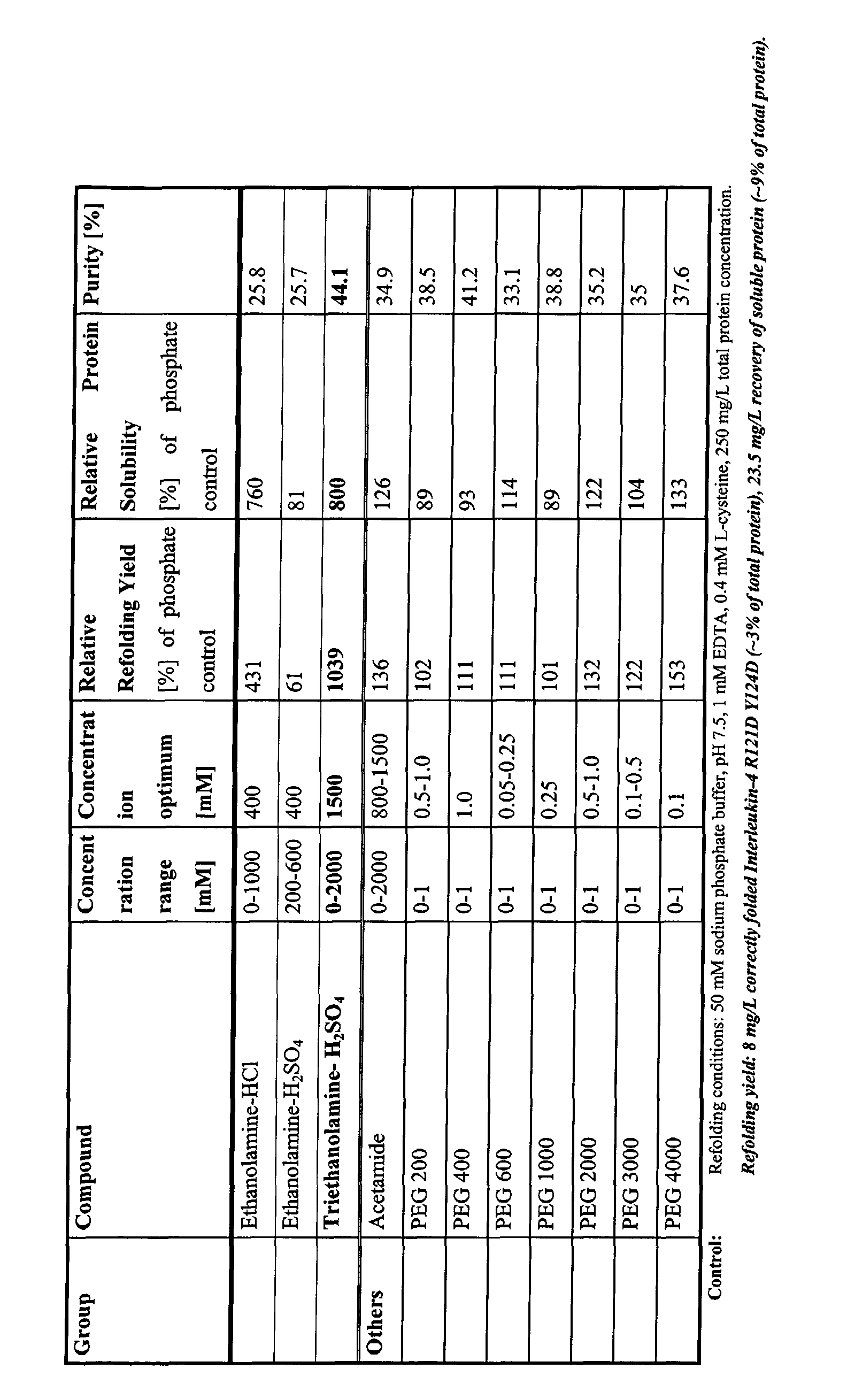
- As indicated in example 1 (Table 1), a number of chemicals effectively aids in the solubilization of folding intermediates resulting in a significant increase of the recovery of soluble protein. However, this does not necessarily mean that these compounds also lead to a significant increase in yield of the correctly folded, biologically active disulfide isoform (see column "relative refolding yield" in Table 1). For example, the detergent cetyl triethylammonium chloride (CTAC) effectively solubilizes folding intermediates leading to an increase in protein yield of 735% compared to the phosphate control. However, CTAC fails to increase the yield of correctly folded disulfide isoform resulting in a low refolding yield and a low purity. Several agents listed in Table 1 are well known from prior art for their ability to aid as aggregation suppressor during refolding, like e.g. L-Arginine, Urea, guanidinium hydrochloride, poly(ethylene)glycols, acetamide and short chain alcohols. However, most of these failed in case of Interleukin-4 derivative with the exception of L-arginine and, to a lesser extend, guanidinium hydrochloride.
- Guanidinium hydrochloride effectively solubilizes folding intermediates at optimal concentrations of 750 mM. The N-methylated or N-ethylated derivatives and bis(-1-aminoguanidinium)-sulfate are more effectively solubilizing folding intermediates at lower concentrations (200-600 mM) as compared to guanidinium hydrochloride. However, the purity of the refolded protein (18.4 to 27.1%) is much lower compared to the phosphate control.
- Surprisingly, the buffer agent Tris(hydroxymethyl)-aminomethane (TRIS) in the combination with sulfuric acid at high concentrations positively affected the solubilization of folding intermediates (850%) and the refolding yield (677%) while moderately decreasing the purity compared to the phosphate control. TRIS is widely used at very low concentrations (<0.1 M) as a buffering substance in refolding mixtures, but not at high concentrations as aggregation suppressor. Ethanolamine, which is structurally related to TRIS, also positively affected the solubilization of folding intermediates (pH-titration with HCl), resulting in comparable refolding and protein yields and purities. Comparison of TRIS titrated with sulfuric acid versus hydrochloric acid shows the positive additional effect of sulfate ions on the protein yield, refolding yield and the purity. However, ethanolamine titrated with sulfuric acid did not result in synergistic effects on the refolding and protein yield.
- For example, Interleukin-4 derivative and BPTI, as shown in examples 4 and 6, can be effectively refolded in a combined buffering system consisting of TRIS and sulfate ions (sulfuric acid titration). In case of Interleukin-4 derivative, protein concentrations of preferably 250 to 1000 [mg/L] can be employed, more preferably 400 to 700 [mg/L] and, even more preferably, 450 to 550 [mg/L]. L-cysteine should be included into the refolding mixture in order to allow for the formation of stabilizing disulfide bonds, preferably at 1 to 4 [mM], more preferably at 2.5 to 3.5 [mM]. TRIS/H2SO4 should be present preferably at 1 to 3 [M], more preferably at 1.4 to 2.4 [M]. The pH of the buffer is adjusted to about 7-9, more preferably 7 to 8, and most preferably 7.5.
- In case of BPTI, protein concentrations of preferably 500 to 1000 [mg/L] can be employed, more preferably 600 to 800 [mg/L] and, even more preferably, 700 to 800 [mg/L]. L-cysteine should be included into the refolding mixture in order to allow for the formation of stabilizing disulfide bonds, preferably at 2.5 to 4 [mM], more preferably at 3.0 to 3.5 [mM]. TRIS/H2SO4 should be present preferably at 0.2 to 1.4 [M], more preferably at 0.3 to 1.0 [M]. The pH of the buffer is adjusted to about 7-9, more preferably 7 to 8, and most preferably 7.5.
- Even more surprisingly, triethanolamine effectively solubilizes folding intermediates (800%), does not affect the purity of the refolded protein (44.1% which is comparable to the phosphate control), resulting in the best refolding yield (1039% compared to the phosphate control).
- For example, Interleukin-4 derivative, as shown in examples 5, can be effectively refolded in a combined buffering system consisting of TEA and sulfate ions (sulfuric acid titration). Protein concentrations of preferably 250 to 1000 [mg/L] can be employed, more preferably 400 to 700 [mg/L] and, even more preferably, 450 to 550 [mg/L]. L-cysteine should be included into the refolding mixture in order to allow for the formation of stabilizing disulfide bonds, preferably at 0.4 to 4 [mM], more preferably at 0.8 to 2 [mM]. TEA/H2SO4 should be present preferably at 0.5 to 2 [M], more preferably at 0.8 to 1.5 [M]. The pH of the buffer is adjusted to about 7-9, more preferably 7 to 8, and most preferably 7.5.
- Taking the data listed in Table 1 together, a structure-function relationship can be deduced, revealing a general chemical principle: The most effective aggregation suppressors are primary, more preferably secondary or tertiary amines with substitutions R1, R2, and R3, where R1 and R2 can be any combination of the ligands H, O=C-NH2, (CH2)4-NH2, (CH2)3-COOH, (CH2)2-CHOH-CH3, CH2-CH2-OH, CH2-CH3, CH3, NH2. The residue R3 can be C(NH2)=NH, C(CH2OH)3, CH2-CH2-OH or H.
The central role of the amine function was demonstrated with canavanine-sulfate, where the central amine group is exchanged for an oxygen group, resulting in a complete loss of recovery of soluble protein (equal to the control without the addition of any aggregation suppressor) and loss of correctly refolded Interleukin-4 derivative. The data listed in Table 1 also show that the counter ion may also play a significant role. Sulfate ions are superior to chloride ions with regard to the refolding yield and inhibition of protein aggregation. Therefore, a combination of an amine as described above and a sulfate salt of sulfuric acid most effectively inhibits the formation of protein aggregates and allows the protein to refold into its native conformation. - Analytical methods
- Analytical RP-HPLC is carried out on a YMC C4 column (5 µ, 200Å, 4.6 x 250 mm) at a flow rate of 1.0 ml/min. Detection is performed at 210 nm. The optional pre-column (20 mm x 4 mm) is packed with Source 15 RPC (Pharmacia, Sweden). Buffer A is 0.1% TFA, buffer B is 0.1% TFA with 70% acetonitrile. The gradient is performed as follows: 0-2 min, 40% B; 2-19.5 min, 40%-85% B; 19.5-20 min, 85%-100%B; 20-21 min, 100% B, 21-22 min, 100%-40% B, 22-25 min, 40% B (reequilibration). Correctly folded Interleukin-4 elutes at a retention time of 16 min employing a Hewlett-Packard LC 1100 system. Correctly folded BPTI elutes at a retention time of 12.8 min. Samples of refolding mixtures are sterile filtered (0.22 µ cut-off) before analysis.
- The peak eluting at the retention time of the native form is integrated giving the refolding yield expressed in [mg/L] units and corresponds to the concentration of correctly folded protein (calculated based on external standard curves). The total area counts correspond to the concentration of soluble protein present in the refolding mixture expressed in [mg/L] units. The ratio of these two values give the purity of the refolded protein expressed in [%] units.
- The total protein concentration was determined after trichloroacetic acid precipitation, which was performed according to biochemical standard methods, using the commercially available BCA-assay (Pierce, USA) and bovine serum albumin (Boehringer-Mannheim, Germany) as calibration standard.
- Proteins were solubilized in the presence of 0.2 M Tris-HCl, pH 9 containing 8 M Guanidinium hydrochloride to give a final protein concentration of 10 [g/L]. The SH-groups were then sulfitolyzed by the addition of 30 [g/L] sodium sulfite and 60 [g/L] potassium tetrathionate. After the addition of sulfite, the solution was stirred at room temperature for 30 min in order to allow completeness of the reaction of sulfite with any disulfides present in the solubilized proteins. Subsequently, tetrathionate was added and the solution is stirred for further 90 min in order to allow the conversion of SH-groups to disulfides and the cleavage to S-sulfite-groups to run to completion. Finally, the solution was filtered through a 1.2 µ-cut off depth filter (e.g. Sartopure PP2, 1.2 µ, Sartorius AG, Germany). The solution was then diafiltered against 5 volumes of diafiltration buffer consisting of 0.2 M Tris-HCl, pH 9 containing 4 M Guanidinium hydrochloride employing an ultrafiltration membrane (cut-off 10.000 MW, e.g. Hydrosart 10 kD, Sartorius AG, Germany). The retentate harvested from the ultrafiltration apparatus contained a final protein concentration of approx. 10 [g/L] and was stored at 2-8°C for up to 2 weeks.
- The protein solution from Example 2, containing denatured, sulfitolyzed protein, is diluted into refolding buffer to give a final protein concentration of 250 [mg/L] as determined by the BCA-assay (Pierce, USA). The refolding buffer consisted of the following ingredients:
- 50 mM sodium phosphate buffer, pH 7.5
- 1 mM Ethylenediamine tetraacetic acid, tetrasodium salt (EDTA)
- 0.8 mM L-cysteine
- A certain amount of aggregation suppressor as indicated in Table 1.
- The total final volume of the refolding solution was 50 mL (glass vials, Schott, Germany). The glass vials were capped with parafilm. Refolding was allowed to run to completion within 24-36 hours with stirring on a magnetic bar stirrer (100-200 rpm). At intervals, samples were withdrawn and analyzed by RP-HPLC (see Example 1).

- An attractive combination of aggregation suppressors is the TRIS-base/H2SO4- system. Therefore, this system was chosen for further optimization employing a multifactorial analysis.
- The total final volume of the refolding solution was 50 mL (glass vials, Schott, Germany). The glass vials were capped with parafilm. Refolding was allowed to run to completion within 24-36 hours with stirring on a magnetic bar stirrer (100-200 rpm). At intervals, samples were withdrawn and analyzed by RP-HPLC (see Example 1).
- The protein solution from Example 2, containing denatured, sulfitolyzed protein, is diluted into refolding buffer to give a final protein concentration indicated in Table 3. The following aspects of refolding buffer composition were investigated: concentration of TRIS-base (0.5 to 3 [M]), H2SO4 (depending on TRIS-concentration; 0.4 to 1.4 [M]), residual guanidinium hydrochloride concentration (80-400 mM), L-cysteine concentration (0.4 to 4 [mM]), and initial protein concentration (50 to 1000 [mg/L]). The pH of the refolding buffer was adjusted to 7.5. All refolding mixtures contained 1 mM EDTA.
- The experiments described in this example was designed to allow multifactorial statistical analysis of correctly folded Interleukin-4 derivative yield data in order to assess the importance of all single factors and all two-factor interactions. A partial cubic experimental design was generated and the resulting data were also analyzed employing a partial cubic model. The coefficients of the polynoms of the partial cubic model are given in Table 2.

Effect of solution conditions (TRIS-H2SO4-system) on Interleukin-4 R121D Y124D refolding yield, recovery of soluble protein, overall refolding yield and purity Trial # TRIS-base Cysteine Protein Ref. Yield Protein recovery Overall refolding yield Purity [mg/L] [%] [%] [%] 1 3 4 50 9 81.3 18.00 22.1 2 3 0.4 1000 2.92 10.65 0.29 2.7 3 0.5 4 525 90.45 48.55 17.23 35.5 4 0.5 2.2 1000 137.7 46.34 13.77 29.7 5 1.75 4 1000 199.72 54.77 19.97 36.5 6 1.75 0.4 1000 25.05 27.23 2.50 9.2 7 3 2.2 50 11.3 60.79 22.60 37.2 8 0.5 4 50 10.37 53.54 20.73 38.7 9 3 0.4 525 68.32 55.36 13.01 23.5 10 0.5 0.4 525 81.82 36.66 15.58 42.5 11 1.75 0.4 50 13.6 62.08 27.21 43.8 12 0.5 0.4 1000 15.8 18.89 1.58 8.4 13 3 4 1000 176.31 43.94 17.63 40.1 14 1.75 4 525 131.19 68.94 24.99 36.2 15 1.3333 1.6 366.667 93.63 68.21 25.54 37.4 16 2.1667 1.6 366.667 91.95 69.77 25.08 35.9 17 3 2.8 683.333 134.38 55.72 19.67 35.3 18 0.5 1.6 683.333 110.68 48.94 16.20 33.1 20 2.1667 2.8 50 12.49 71.59 24.98 34.9 1 3 4 50 9.38 52.32 18.76 35.9 2 3 0.4 1000 8.94 18.32 0.89 4.9 3 0.5 4 525 97.16 50.43 18.51 36.7 4 0.5 2.2 1000 140.29 45.63 14.03 30.7 5 1.75 4 1000 197.53 56.85 19.75 34.7 6 1.75 0.4 1000 19.75 27.61 1.97 7.2 7 3 2.2 50 15.08 72.5 30.15 41.6 - The yields obtained with selected combinations of these components are shown in Table 3. Inspection of these results shows that, under the experimental conditions employed, the following trends were apparent: (1) best refolding yields are obtained at high protein concentrations (750-1000 [mg/L]); (2) best overall refolding yields are obtained at 250 to 650 [mg/L] total protein concentration; (3) the optimal L-cysteine concentration range is 2.5 to 4 [mM]; (4) the optimal Tris-H2SO4- concentration range is 1.4 to 2.4 [M]; (5) best protein recovery is obtained at low protein concentrations (50 to 250 [mg/L]), high Tris-H2SO4-concentrations (2-3 [M]) and 2 to 3.5 [mM] L-cysteine; (6) best purity is obtained at high protein concentrations (400-1000 [mg/L]), high L-cysteine concentrations (2.5-4 [mM]). The purity is indepening on the Tris-H2SO4 concentration.
- A compromise between optimal refolding yield, purity and protein recovery was identified employing the following settings: 500 mg/L total protein, 3.3 mM L-cysteine, 2 M Tris-H2SO4 and 1 mM EDTA.
- Checkpoints employing these optimal conditions revealed that the predicted and measured response values fit reasonably well, indicating that the model is adequate.
Overall refolding yield Predicted 24.9 [%] (±1.84 StdErr) Measured 25.4 [%] (±0.37 StdErr) Protein recovery Predicted 65.9 [%] (±6.55 StdErr) Measured 62.9 [%] (±0.63 StdErr) Purity Predicted 38.6 [%] (±3.63 StdErr) Measured 40.4 [%] (±0.45 StdErr) Refolding yield Predicted 127 [mg/L] (±14.5 StdErr) Measured 126.9 [mg/L] (±1.85 StdErr) - Another attractive combination of aggregation suppressors is the Triethanolamine (TEA) /H2SO4-system. Therefore, this system was chosen for further optimization and scale-up of the protein concentration.
- The total final volume of the refolding solution was 50 mL (glass vials, Schott, Germany). The glass vials were capped with parafilm. Refolding was allowed to run to completion within 24-36 hours with stirring on a magnetic bar stirrer (100-200 rpm). At intervals, samples were withdrawn and analyzed by RP-HPLC (see Example 1).
- The protein solution from Example 2, containing denatured, sulfitolyzed protein, is diluted into refolding buffer to give a final protein concentration indicated in Table 5. The following aspects of refolding buffer composition were investigated: concentration of TEA (1 to 2 [M]), H2SO4 (depending on TEA-concentration), residual guanidinium hydrochloride concentration (80-400 mM), L-cysteine concentration (0.4 to 10 [mM]), and initial protein concentration (50 to 1000 [mg/L]). The pH of the refolding buffer was adjusted to 7.5. All refolding mixtures contained 1 mM EDTA.
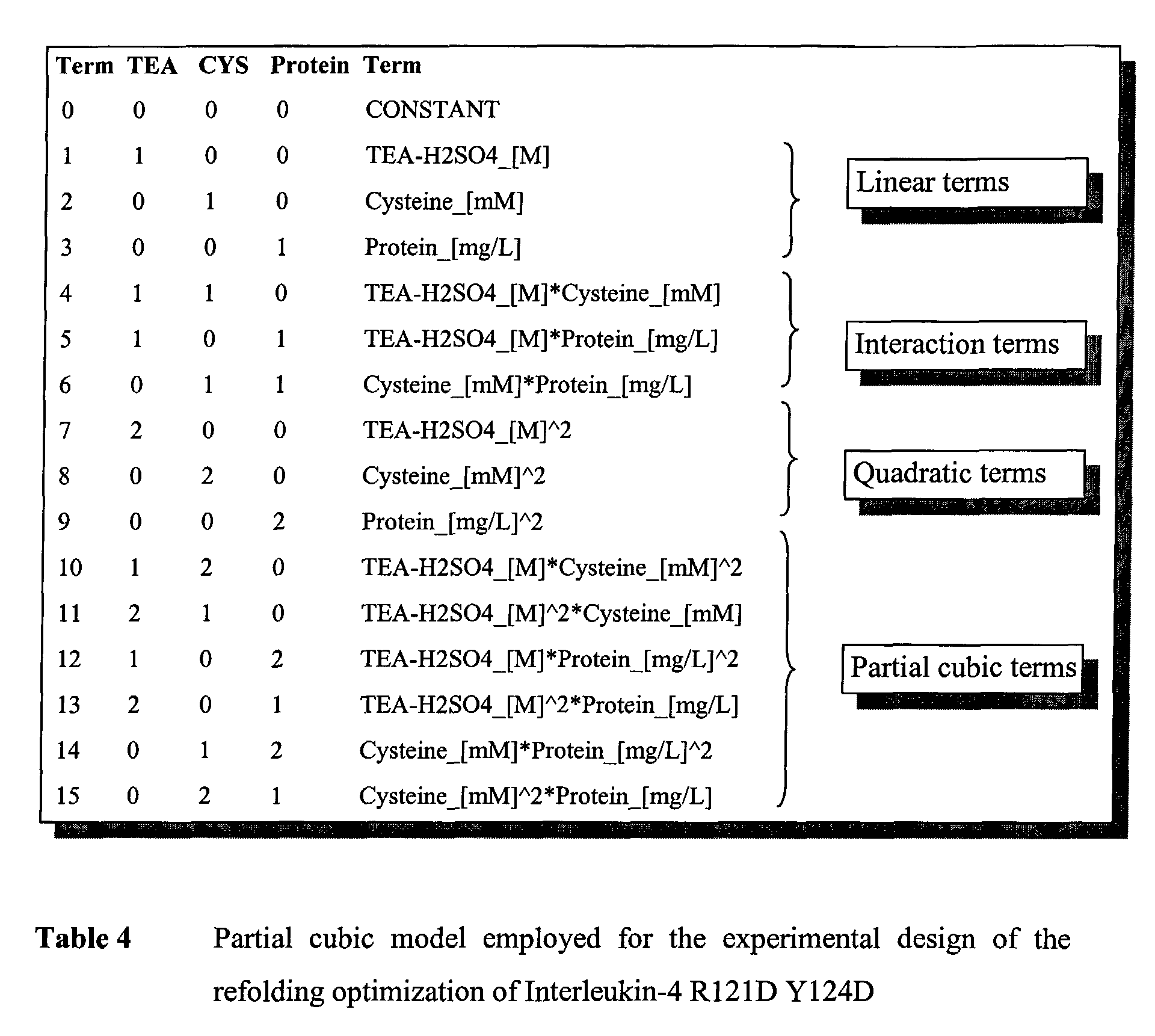
- The experiments described in this example was designed to allow multifactorial statistical analysis of correctly folded Interleukin-4 derivative yield data in order to assess the importance of all single factors and all two-factor interactions. A partial cubic experimental design was generated and the resulting data were also analyzed employing a partial cubic model. The coefficients of the polynoms of the partial cubic model are given in Table 4.
Effect of solution conditions (TEA-H2SO4-system) on Interleukin-4 R121D Y124D refolding yield, recovery of soluble protein, overall refolding yield and purity Trial # TEA Cysteine Protein Ref. Yield Protein recovery Overall refolding yield Purity [-] [M] [mM] [mg/L] [mg/L] [%] [%] [%] 1 2 10 0.1 5.91 138.09 5.9 4.3 2 2 0.4 1 135.12 49.49 13.5 27.3 3 0.5 10 0.55 15.23 16.92 2.8 16.4 4 0.5 5.2 1 70.06 19.28 7 36.3 5 1.25 10 1 49.37 18.06 4.9 27.3 6 0.5 5.2 0.1 9.64 66.78 9.6 14.4 7 1.25 0.4 1 167.96 42.5 16.8 39.5 8 2 5.2 0.1 13.66 103.17 13.7 13.2 9 0.5 10 0.1 3.56 76.7 3.6 4.6 10 2 0.4 0.55 45.39 54.66 8.3 15.1 11 0.5 0.4 0.55 68.41 31.3 12.4 39.7 12 1.25 0.4 0.1 30.09 77.34 30.1 38.9 13 0.5 0.4 1 90.11 21.55 9 41.8 14 2 10 1 63.75 22.94 6.4 27.8 15 0.5 0.4 0.1 24.18 59.26 24.2 40.8 16 1.25 10 0.55 43.47 31.42 7.9 25.2 17 1 3.6 0.4 107.54 61.7 26.9 43.6 18 1.5 3.6 0.4 118.95 70.26 29.7 42.3 19 2 6.8 0.7 115.96 45.83 16.6 36.1 20 0.5 3.6 0.7 97.81 32.69 14 42.7 21 1.5 6.8 0.1 12.29 75.29 12.3 16.3 1 2 10 0.1 6.51 91.62 6.5 7.1 2 2 0.4 1 136.71 44.08 13.7 31.0 3 0.5 10 0.55 17.13 13.98 3.1 22.3 4 0.5 5.2 1 68.29 17.34 6.8 39.4 5 1.25 10 1 53.25 16.96 5.3 31.4 6 0.5 5.2 0.1 10.75 44.69 10.8 24.1 7 1.25 0.4 1 170.11 39.82 17 42.7 8 2 5.2 0.1 18.01 81.64 18 22.1 9 0.5 10 0.1 4.92 43.65 4.9 11.3 - The yields obtained with selected combination of these components are shown in Table 5. Inspection of these results shows that, under the experimental conditions employed, the following trends were apparent: (1) best refolding yields are obtained at high protein concentrations (750-1000 [mg/L]); (2) best overall refolding yields are obtained at 100 to 550 [mg/L] total protein concentration; (3) the optimal L-cysteine concentration range is 0.4 to 4 [mM]; (4) the optimal TEA-H2SO4- concentration range is 1 to 1.6 [M]; (5) best protein recovery is obtained at low protein concentrations (50 to 250 [mg/L]), high TEA-H2SO4-concentrations (1.5-2 [M]) and 4 to 10 [mM] L-cysteine; (6) best purity is obtained at high protein concentrations (600-1000 [mg/L]), L-cysteine concentrations ranging between 0.4 and 4 [mM]) and at the TEA-H2SO4 concentrations ranging between 0.8 and 1.5 [M]. A compromise between optimal refolding yield, purity and protein recovery was identified employing the following settings: 500 mg/L total protein, 0.8 mM L-cysteine, 1.4 M TEA-H2SO4 and 1 mM EDTA.
- Checkpoints employing these optimal conditions revealed that the predicted and measured response values fit reasonably well, indicating that the model is adequate.
Overall refolding yield Predicted 24.6 [%] (±4.1 StdErr) Measured 24.3 [%] (±0.8 StdErr) Protein recovery Predicted 52.8 [%] (±10.5 StdErr) Measured 58.2 [%] (±4.5 StdErr) Purity Predicted 43.2 [%] (±5.3 StdErr) Measured 41.8 [%] (±3.9 StdErr) Refolding yield Predicted 106.8 [mg/L] (±16.9 StdErr) Measured 121.6 [mg/L] (±2.0 StdErr) - In order to demonstrate that the TRIS/H2SO4-system can also be employed for the refolding of other proteins than Interleukin-4 derivatives, the TRIS/H2SO4-system was also optimized for BPTI.
- In order to demonstrate that the TRIS/H2SO4-system can also be employed for the refolding of other proteins than Interleukin-4 derivatives, the TRIS/H2SO4-system was also optimized for BPTI.
- The total final volume of the refolding solution was 50 mL (glass vials, Schott, Germany). The glass vials were capped with parafilm. Refolding was allowed to run to completion within 24-36 hours with stirring on a magnetic bar stirrer (100-200 rpm). At intervals, samples were withdrawn and analyzed by RP-HPLC (see Example 1).
- The protein solution from Example 2, containing denatured, sulfitolyzed protein, is diluted into refolding buffer to give a final protein concentration indicated in Table 7. The following aspects of refolding buffer composition were investigated: concentration of TRIS (0 to 2 [M]), H2SO4 (depending on the concentration of TRIS-base), residual guanidinium hydrochloride concentration (80-400 mM), L-cysteine concentration (0.1 to 4 [mM]), and initial protein concentration (50 to 1000 [mg/L]). The pH of the refolding buffer was adjusted to 7.5. All refolding mixtures contained 1 mM EDTA.
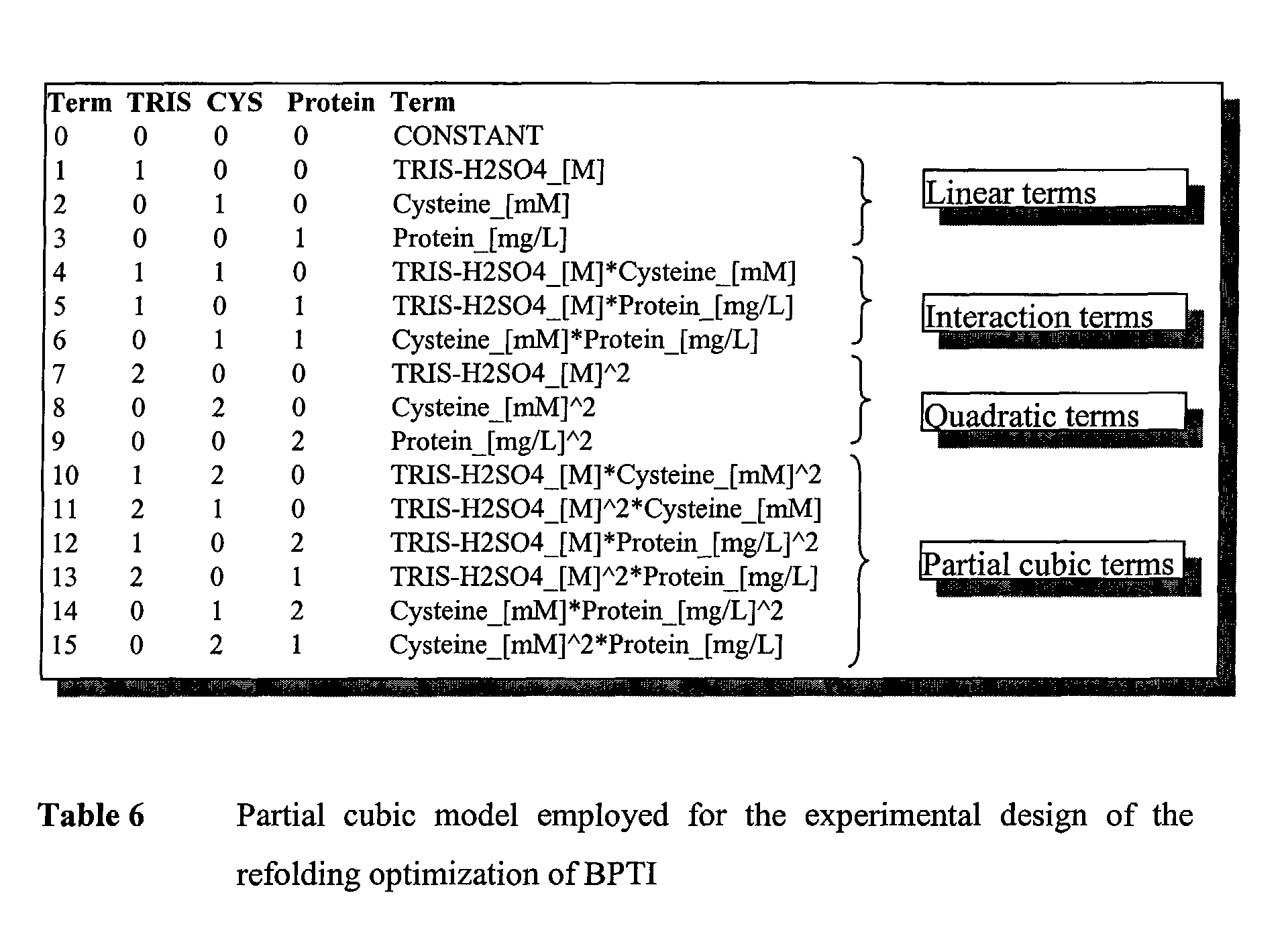
- The experiments described in this example was designed to allow multifactorial statistical analysis of correctly folded BPTI yield data in order to assess the importance of all single factors and all two-factor interactions. A partial cubic experimental design was generated and the resulting data were also analyzed employing a partial cubic model. The coefficients of the polynoms of the partial cubic model are given in Table 6.
Effect of solution conditions on BPTI refolding yield, recovery of soluble protein and overall refolding yield Trial # TRIS-base Cysteine Protein Ref. Yield Protein recovery Overall refolding yield Purity [-] [M] [mM] [mg/L] [mg/L] [%] [%] [%] 1 2 4 50 20.43 85.69 40.86 47.7 2 2 0.1 1000 0 0 0 0 3 0 4 525 159.29 61.05 30.34095 49.7 4 0 2.05 1000 275.45 70.84 27.545 38.9 5 1 4 1000 256.9 71.75 25.69 35.8 6 0 2.05 50 35.67 136.48 71.34 52.3 7 1 0.1 1000 0 2.59 0 0 8 2 2.05 50 19.45 80.85 38.9 48.1 9 0 4 50 8.51 39.92 17.02 42.6 10 2 0.1 525 0 0 0 0 11 0 0.1 525 0 0.4 0 0 12 1 0.1 50 15.71 69.04 31.42 45.5 13 0 0.1 1000 0 1.05 0 0 14 2 4 1000 158.93 36.23 15.893 43.9 15 0 0.1 50 5.03 14.13 10.06 71.2 16 1 4 525 18.64 89.48 3.550476 4 17 0.6667 1.4 366.667 107.29 83.34 29.26088 35.1 18 1.3333 1.4 366.667 104.5 82.6 28.49997 34.5 19 2 2.7 683.333 97.4 41.66 14.25367 34.2 20 0 1.4 683.333 149.44 51.46 21.86928 42.5 21 1.3333 2.7 50 14.08 76.21 28.16 36.9 1 2 4 50 16.15 69.37 32.3 46.5 2 2 0.1 1000 1.47 3.44 0.147 4.3 3 0 4 525 162.49 58.91 30.95048 52.5 4 0 2.05 1000 273.77 68.91 27.377 39.7 5 1 4 1000 265.9 78.2 26.59 34 6 0 2.05 50 9.73 39.56 19.46 49.2 7 1 0.1 1000 0 0.94 0 0 8 2 2.05 50 19.18 77.88 38.36 49.3 - The yields obtained with selected combination of these components are shown in Table 7. Inspection of these results shows that, under the experimental conditions employed, the following trends were apparent: (1) best refolding yields are obtained at high protein concentrations (750-1000 [mg/L]); (2) best overall refolding yields are obtained at 500 to 1000 [mg/L] total protein concentration; (3) the optimal L-cysteine concentration range is 2.5 to 4 [mM]; (4) the optimal TRIS-H2SO4- concentration range is 0.2 to 1.0 [M]; (5) best protein recovery is obtained at low protein concentrations (50 to 100 [mg/L]), moderate TRIS-H2SO4-concentrations (0.9-1.4[M]) and 1.8 to 3.3 [mM] L-cysteine; (6) best purity is obtained at low protein concentrations (50-100 [mg/L]), L-cysteine concentrations ranging between 0.1 and 0.4 [mM]) and at the TRIS-H2SO4 concentrations ranging between 0.1 and 0.5 [M].
- A compromise between optimal refolding yield, purity and protein recovery was identified employing the following settings: 700 mg/L total protein, 3.3 mM L-cysteine, 0.3 M TRIS-H2SO4 and 1 mM EDTA.
Claims (8)
- A method for renaturation of proteins comprising adding to a solution of denatured, chemically modified or reduced proteins a refolding buffer containing a primary, secondary or tertiary amine.
- The method of claim 1 characterised in that the amine has the formulawherein R1 and R2 can be any combination of the ligands H, O=C-NH2, (CH2)4-NH2, (CH2)3-COOH, (CH2)2-CHOH-CH3, CH2-CH2-OH, CH2-CH3, CH3, NH2
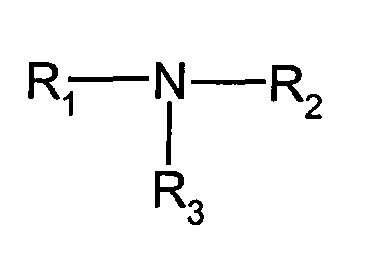
and R3 can be C(NH2)=NH, C(CH2OH)3, CH2-CH2-OH or H - The method of any one of claims 1 or 2 wherein the buffer further contains a solubility enhancer.
- The method of claims 3 wherein solubility enhancer is an ion.
- The method of claims 3 wherein solubility enhancer is chloride or sulfate.
- The method of claims 1 to 5 wherein the protein is an interleukin
- The method of claims 1 to 5 wherein the protein is interleukin 4
- The method of claims 1 to 5 wherein the protein is a mutein of interleukin 4.
Priority Applications (13)
| Application Number | Priority Date | Filing Date | Title |
|---|---|---|---|
| EP01127373A EP1314739A1 (en) | 2001-11-22 | 2001-11-22 | Process for renaturation of recombinant, disulfide containing proteins at high protein concentrations in the presence of amines |
| JP2003545690A JP4348188B2 (en) | 2001-11-22 | 2002-11-12 | Regeneration of recombinant disulfide-containing proteins at high protein concentrations in the presence of amines. |
| PCT/EP2002/012607 WO2003044055A1 (en) | 2001-11-22 | 2002-11-12 | Process for renaturation of recombinant, disulfide containing proteins at high protein concentrations in the presence of amines |
| AU2002340510A AU2002340510A1 (en) | 2001-11-22 | 2002-11-12 | Process for renaturation of recombinant, disulfide containing proteins at high protein concentrations in the presence of amines |
| DK02774777.3T DK1453858T3 (en) | 2001-11-22 | 2002-11-12 | Process for Renaturation of Recombinant Disulfide-Containing Proteins at High Protein Concentrations in the Presence of Amines |
| KR1020047007769A KR100944845B1 (en) | 2001-11-22 | 2002-11-12 | Process for renaturation of recombinant, disulfide containing proteins at high protein concentrations in the presence of amines |
| US10/495,417 US7893210B2 (en) | 2001-11-22 | 2002-11-12 | Process for renaturation of recombinant, disulfide containing proteins at high protein concentrations in the presence of amines |
| ES02774777T ES2357888T3 (en) | 2001-11-22 | 2002-11-12 | PROCEDURE FOR RENATURALIATION OF RECOMBINANT PROTEINS CONTAINING DISULFURE AT HIGH PROTEIN CONCENTRATIONS IN THE PRESSENCE OF AMINAS. |
| DE60238938T DE60238938D1 (en) | 2001-11-22 | 2002-11-12 | METHOD FOR RENATURING RECOMBINANT DISULPHIDE-CONTAINING PROTEINS AT HIGH PROTEIN CONCENTRATIONS IN THE PRESENCE OF AMINES |
| AT02774777T ATE495191T1 (en) | 2001-11-22 | 2002-11-12 | METHOD FOR RENATURING RECOMBINANT, DISULFIDE-CONTAINING PROTEINS AT HIGH PROTEIN CONCENTRATIONS IN THE PRESENCE OF AMINES |
| PT02774777T PT1453858E (en) | 2001-11-22 | 2002-11-12 | Process for renaturation of recombinant, disulfide containing proteins at high protein concentrations in the presence of amines |
| EP02774777A EP1453858B1 (en) | 2001-11-22 | 2002-11-12 | Process for renaturation of recombinant, disulfide containing proteins at high protein concentrations in the presence of amines |
| CY20111100332T CY1112209T1 (en) | 2001-11-22 | 2011-03-29 | PROCEDURE FOR REPRODUCTION OF RECOVERED BUSINESS CONTAINED PROTEINS, IN HIGH PROTEIN CONCENTRATES WITH |
Applications Claiming Priority (1)
| Application Number | Priority Date | Filing Date | Title |
|---|---|---|---|
| EP01127373A EP1314739A1 (en) | 2001-11-22 | 2001-11-22 | Process for renaturation of recombinant, disulfide containing proteins at high protein concentrations in the presence of amines |
Publications (1)
| Publication Number | Publication Date |
|---|---|
| EP1314739A1 true EP1314739A1 (en) | 2003-05-28 |
Family
ID=8179272
Family Applications (2)
| Application Number | Title | Priority Date | Filing Date |
|---|---|---|---|
| EP01127373A Withdrawn EP1314739A1 (en) | 2001-11-22 | 2001-11-22 | Process for renaturation of recombinant, disulfide containing proteins at high protein concentrations in the presence of amines |
| EP02774777A Expired - Lifetime EP1453858B1 (en) | 2001-11-22 | 2002-11-12 | Process for renaturation of recombinant, disulfide containing proteins at high protein concentrations in the presence of amines |
Family Applications After (1)
| Application Number | Title | Priority Date | Filing Date |
|---|---|---|---|
| EP02774777A Expired - Lifetime EP1453858B1 (en) | 2001-11-22 | 2002-11-12 | Process for renaturation of recombinant, disulfide containing proteins at high protein concentrations in the presence of amines |
Country Status (12)
| Country | Link |
|---|---|
| US (1) | US7893210B2 (en) |
| EP (2) | EP1314739A1 (en) |
| JP (1) | JP4348188B2 (en) |
| KR (1) | KR100944845B1 (en) |
| AT (1) | ATE495191T1 (en) |
| AU (1) | AU2002340510A1 (en) |
| CY (1) | CY1112209T1 (en) |
| DE (1) | DE60238938D1 (en) |
| DK (1) | DK1453858T3 (en) |
| ES (1) | ES2357888T3 (en) |
| PT (1) | PT1453858E (en) |
| WO (1) | WO2003044055A1 (en) |
Families Citing this family (7)
| Publication number | Priority date | Publication date | Assignee | Title |
|---|---|---|---|---|
| US7442370B2 (en) | 2001-02-01 | 2008-10-28 | Biogen Idec Ma Inc. | Polymer conjugates of mutated neublastin |
| CN101043899B (en) | 2004-08-19 | 2011-03-30 | 比奥根艾迪克Ma公司 | Refolding transforming growth factor beta family proteins |
| TWI501774B (en) | 2006-02-27 | 2015-10-01 | Biogen Idec Inc | Treatments for neurological disorders |
| JP4984983B2 (en) * | 2007-03-09 | 2012-07-25 | 富士通株式会社 | Encoding apparatus and encoding method |
| TWI445544B (en) | 2007-05-01 | 2014-07-21 | Biogen Idec Inc | Compositions and methods for increasing vascularization |
| US10947521B2 (en) * | 2014-11-18 | 2021-03-16 | Merck Sharp & Dohme Corp. | Process for producing recombinant trypsin |
| CN113322222A (en) * | 2021-07-02 | 2021-08-31 | 江苏恒丰强生物技术有限公司 | Production process of genetic engineering bacteria for expressing feline omega interferon |
Citations (8)
| Publication number | Priority date | Publication date | Assignee | Title |
|---|---|---|---|---|
| WO1989001046A1 (en) * | 1987-07-29 | 1989-02-09 | Schering Biotech Corporation | Purification of human interleukin-4 expressed in escherichia coli |
| WO1993003134A1 (en) * | 1991-07-29 | 1993-02-18 | Immunex Corporation | Process for isolating and purifying recombinant interleukin-7 |
| WO1995006059A1 (en) * | 1993-08-20 | 1995-03-02 | Genentech, Inc. | Aqueous multiple-phase isolation of polypeptide |
| US5453363A (en) * | 1985-10-23 | 1995-09-26 | Boehringer Mannheim Gmbh | Process for the activation of t-PA or Ing after genetic expression in prokaryotes |
| WO1996040784A2 (en) * | 1995-06-07 | 1996-12-19 | Chiron Corporation | Method of solubilizing, purifying, and refolding protein |
| WO1998020033A2 (en) * | 1996-11-06 | 1998-05-14 | Schering Corporation | RENATURATION AND PURIFICATION OF VIRAL INTERLEUKIN-10 (vIL-10) |
| WO1999033988A1 (en) * | 1997-12-29 | 1999-07-08 | Chong Kun Dang Corporation | A process for preparing human proinsulin |
| WO2001087925A2 (en) * | 2000-05-16 | 2001-11-22 | Bolder Biotechnology, Inc. | Methods for refolding proteins containing free cysteine residues |
Family Cites Families (8)
| Publication number | Priority date | Publication date | Assignee | Title |
|---|---|---|---|---|
| DE4137333A1 (en) | 1991-11-13 | 1993-05-19 | W Prof Dr Sebald | THERAPEUTIC AGENTS THAT ARE ANTAGONISTS OR PARTIAL AGONISTS OF THE HUMAN INTERLEUKIN 4 OR CONTAIN THEM, HIL-4-MUTANT PROTEINS AND METHOD FOR THE PRODUCTION THEREOF |
| US5663304A (en) * | 1993-08-20 | 1997-09-02 | Genentech, Inc. | Refolding of misfolded insulin-like growth factor-I |
| ATE189004T1 (en) * | 1994-10-13 | 2000-02-15 | Kyowa Medex Co Ltd | METHOD FOR DETERMINING UREA NITROGEN |
| US5563057A (en) | 1994-10-31 | 1996-10-08 | Wisconsin Alumni Research Foundation | Method for refolding misfolded enzymes with detergent and cyclodextrin |
| US5728804A (en) | 1995-06-02 | 1998-03-17 | Research Corporation Technologies, Inc. | Use of cyclodextrins for protein renaturation |
| US20020052026A1 (en) * | 1997-10-08 | 2002-05-02 | Steven M. Vicik | Methods of refolding proteins |
| DE69929638T2 (en) | 1999-01-20 | 2006-09-21 | Bayer Healthcare Ag | Plasmids, their construction and use for the production of interleukin-4 and its muteins |
| GB9912350D0 (en) | 1999-05-26 | 1999-07-28 | European Molecular Biology Lab Embl | Modified cytokine |
-
2001
- 2001-11-22 EP EP01127373A patent/EP1314739A1/en not_active Withdrawn
-
2002
- 2002-11-12 KR KR1020047007769A patent/KR100944845B1/en not_active Expired - Fee Related
- 2002-11-12 ES ES02774777T patent/ES2357888T3/en not_active Expired - Lifetime
- 2002-11-12 EP EP02774777A patent/EP1453858B1/en not_active Expired - Lifetime
- 2002-11-12 JP JP2003545690A patent/JP4348188B2/en not_active Expired - Fee Related
- 2002-11-12 US US10/495,417 patent/US7893210B2/en not_active Expired - Fee Related
- 2002-11-12 WO PCT/EP2002/012607 patent/WO2003044055A1/en not_active Ceased
- 2002-11-12 AU AU2002340510A patent/AU2002340510A1/en not_active Abandoned
- 2002-11-12 DE DE60238938T patent/DE60238938D1/en not_active Expired - Lifetime
- 2002-11-12 PT PT02774777T patent/PT1453858E/en unknown
- 2002-11-12 DK DK02774777.3T patent/DK1453858T3/en active
- 2002-11-12 AT AT02774777T patent/ATE495191T1/en active
-
2011
- 2011-03-29 CY CY20111100332T patent/CY1112209T1/en unknown
Patent Citations (8)
| Publication number | Priority date | Publication date | Assignee | Title |
|---|---|---|---|---|
| US5453363A (en) * | 1985-10-23 | 1995-09-26 | Boehringer Mannheim Gmbh | Process for the activation of t-PA or Ing after genetic expression in prokaryotes |
| WO1989001046A1 (en) * | 1987-07-29 | 1989-02-09 | Schering Biotech Corporation | Purification of human interleukin-4 expressed in escherichia coli |
| WO1993003134A1 (en) * | 1991-07-29 | 1993-02-18 | Immunex Corporation | Process for isolating and purifying recombinant interleukin-7 |
| WO1995006059A1 (en) * | 1993-08-20 | 1995-03-02 | Genentech, Inc. | Aqueous multiple-phase isolation of polypeptide |
| WO1996040784A2 (en) * | 1995-06-07 | 1996-12-19 | Chiron Corporation | Method of solubilizing, purifying, and refolding protein |
| WO1998020033A2 (en) * | 1996-11-06 | 1998-05-14 | Schering Corporation | RENATURATION AND PURIFICATION OF VIRAL INTERLEUKIN-10 (vIL-10) |
| WO1999033988A1 (en) * | 1997-12-29 | 1999-07-08 | Chong Kun Dang Corporation | A process for preparing human proinsulin |
| WO2001087925A2 (en) * | 2000-05-16 | 2001-11-22 | Bolder Biotechnology, Inc. | Methods for refolding proteins containing free cysteine residues |
Non-Patent Citations (1)
| Title |
|---|
| CREIGHTON T.E. ET AL.: "On the biosynthesis of Bovine Pancreatic Trypsin Inhibitor (BPTI): Structure, Processing, Folding, and Disulphide bond formation of the Precursor in Vitro and in Microsomes", J. MOL. BIOL., vol. 232, 1993, pages 1176 - 1196, XP001058004 * |
Also Published As
| Publication number | Publication date |
|---|---|
| DK1453858T3 (en) | 2011-05-09 |
| PT1453858E (en) | 2011-03-16 |
| JP2005510217A (en) | 2005-04-21 |
| US7893210B2 (en) | 2011-02-22 |
| EP1453858B1 (en) | 2011-01-12 |
| EP1453858A1 (en) | 2004-09-08 |
| KR100944845B1 (en) | 2010-03-04 |
| ES2357888T3 (en) | 2011-05-03 |
| AU2002340510A1 (en) | 2003-06-10 |
| ATE495191T1 (en) | 2011-01-15 |
| US20050014933A1 (en) | 2005-01-20 |
| CY1112209T1 (en) | 2015-12-09 |
| JP4348188B2 (en) | 2009-10-21 |
| WO2003044055A1 (en) | 2003-05-30 |
| KR20050058243A (en) | 2005-06-16 |
| DE60238938D1 (en) | 2011-02-24 |
Similar Documents
| Publication | Publication Date | Title |
|---|---|---|
| FI94050C (en) | Method for activating gene-technologically produced heterologous eukaryotic proteins exhibiting disulfide crosslinks after expression in prokaryotes | |
| Mitsui et al. | Crystal structures of Streptomyces subtilisin inhibitor and its complex with subtilisin BPN′ | |
| RU2275377C2 (en) | Method for space packing chemically synthesized polypeptides | |
| EP0364926B1 (en) | Activation of recombinant antibodies expressed in prokaryotes | |
| US6084076A (en) | Method of refolding human activin A | |
| JP3288720B2 (en) | Method for activating denatured protein | |
| US7893210B2 (en) | Process for renaturation of recombinant, disulfide containing proteins at high protein concentrations in the presence of amines | |
| KR0178274B1 (en) | Recovery method of recombinant somatotropin | |
| Kelley et al. | Folding of eukaryotic proteins produced in Escherichia coli | |
| JP3070935B2 (en) | A method for biocatalytic accurate chain folding of denatured recombinant fusion proteins | |
| US7189811B2 (en) | Process for solubilization of recombinant proteins expressed as inclusion body | |
| EP4501345B1 (en) | A composition comprising aflibercept and a variant thereof and related methods and uses | |
| JP4312154B2 (en) | Method for preparing growth hormone and its antagonists with lower levels of isoform impurities | |
| JP3930051B2 (en) | Method for producing correctly folded biologically active recombinant protein | |
| US20110034678A1 (en) | Methods of renaturation of recombinant proteins | |
| Mori et al. | Effect of long-chain alkyl sulfate binding on circular dichroism and conformation of soybean trypsin inhibitor | |
| EP2739646B1 (en) | Comprehensive buffer system for renaturing human proinsulin or proinsulin derivatives | |
| EP0432419B1 (en) | Method for solubilization and naturation of somatotropins utilizing low urea concentration | |
| EP1439191A1 (en) | Process for the purification of bacterially expressed proteins | |
| EP1833841A1 (en) | Method for preventing formation of trisulfide derivatives of polypeptides | |
| WO1996003425A1 (en) | Process for folding of proteins like recombinant hirudin or epidermal growth factor | |
| CA2527158A1 (en) | Oxidation of peptides | |
| Meloun et al. | Primary structure of the N-terminal region (1-95) of thermitase, a thermostable proteinase from Thermoactinomyces vulgaris | |
| MXPA97000658A (en) | Process for the folding of proteins as recombinant hirudine or growth factor epiderm | |
| EP1489096A1 (en) | Novel hemepeptide |
Legal Events
| Date | Code | Title | Description |
|---|---|---|---|
| PUAI | Public reference made under article 153(3) epc to a published international application that has entered the european phase |
Free format text: ORIGINAL CODE: 0009012 |
|
| AK | Designated contracting states |
Designated state(s): AT BE CH CY DE DK ES FI FR GB GR IE IT LI LU MC NL PT SE TR |
|
| AX | Request for extension of the european patent |
Extension state: AL LT LV MK RO SI |
|
| RAP1 | Party data changed (applicant data changed or rights of an application transferred) |
Owner name: BAYER HEALTHCARE AG |
|
| 17P | Request for examination filed |
Effective date: 20031128 |
|
| AKX | Designation fees paid |
Designated state(s): AT BE CH CY DE DK ES FI FR GB GR IE IT LI LU MC NL PT SE TR |
|
| 17Q | First examination report despatched |
Effective date: 20040510 |
|
| STAA | Information on the status of an ep patent application or granted ep patent |
Free format text: STATUS: THE APPLICATION IS DEEMED TO BE WITHDRAWN |
|
| 18D | Application deemed to be withdrawn |
Effective date: 20080927 |