FIELD OF INVENTION
-
The present invention relates to a novel substituted
benzoic acid derivative and, more specifically, the
present invention relates to a preventive or therapeutic
agent for diseases caused by the activation of NF-κB,
which is an NF-κB inhibitor containing a substituted
benzoic acid derivative or a hydroquinone form or a
pharmaceutically acceptable salt thereof, as an active
ingredient.
BACKGROUND ART
-
NF-κB is a protein that regulates the gene
expression and is one of the so-called transcription
factors. When normal cells are stimulated by an
inflammatory cytokine such as interleukin-1 (IL-1) and
TNF-α or by lipopolysaccharide, or ultraviolet rays, NF-κB
is activated and migrates from the cytosol into the
nucleus to bind to its specific nucleotide sequences on
the genome DNA and thereby participate in the expression
of various genes (see, T.S. Blackwell and J.W. Christman,
Am. J. Respir. Cell. Mol. Biol., 17, 3-9 (1997)).
-
Among the genes of which the expression is under the
control of NF-κB, many genes participate in an
immunoinflammatory reaction, such as inflammatory
cytokines (e.g., IL-1, IL-6, IL-8, TNF-α), cell adhesion
molecules (e.g., ICAM-1, VCAM-1, ELAM-1) and inducible
NO-synthase (iNOS) (see, T. Collins, M.A. Read, A.S.
Neish, M.Z. Whitley, D. Thanos and T. Maniatis, Faseb.
J.,899-909 (1995)). Furthermore, the inflammatory
cytokine bound to its receptor is known to transduce a
signal for activating NF-κB through various pathways and
this is considered to make the inflammation worse. As
such, in an inflammation, the activation of NF-κB is
understood to be a cause or an exacerbation factor of a
disease (see, P.A. Baeuerle and V.R. Baichwal, Adv.
Immunol., 65, 111-137 (1997)).
-
In recent years, it has also been reported that HIV,
HTLV-1, CMV and adenovirus activate NF-κB in host cells
(see, B.J. Dezube, A.B. Pardee, L.A. Beckett, C.M.
Ahlers, L. Ecto, J. Allen-Ryan, Z.A. Anisowicz, R. Sager
and C.S. Crumpacker, J. Acquir. Immune Defic. Syndr., 5,
1099-1104 (1992); G. Nabel and D. Baltimore, Nature 326,
711-713 (1987); F. Fazely, B.J. Dezube, J. Allen-Ryan,
A.B. Pardee and R.M. Ruprecht, Blood, 77, 1653-1656
(1991); and E. Munoz and A. Israel, Immunobiology, 193,
128-136 (1995)) and this activation of NF-κB is
considered to participate in the self replication or
increase of virus in the infected host cell.
-
Accordingly, the expression and induction of the
inflammatory cytokines, the cell adhesion molecules gene
and the viruses can be prevented altogether by inhibiting
the activation of NF-κB and the NF-κB activation
inhibitor is thought to be promising as a therapeutic
agent for diseases directly or indirectly caused by the
activation of NF-κB, particularly various inflammatory
diseases and autoimmune diseases, or as a
immunosuppressant or as a therapeutic agent for viral
diseases.
-
At present, many antiinflammatory drugs are
clinically used for the purpose of treating
osteoarthritis, lumbago, rheumatoid arthritis and the
like, however, there has been not found an effective for
inhibiting the production of various inflammatory
cytokines or the expression of cell adhesion molecules.
NSAIDs (non-steroidal anti-inflammatory drugs), which are
very often used, inhibit cyclooxygenase in the metabolic
pathway of arachidonic acid cascade and thereby inhibit
the production of prostaglendins, however, in general,
they do not directly inhibit the production of cytokines.
Steroids inhibit the production of a plurality of
cytokines but these are known to bring about grave side
effects such as undesired hormone activity, aggravation
of infectious diseases, onset of peptic ulcers, and
central effect and therefore are not amenable to a long-term
administration.
-
It has also been reported in recent years that
antiinframmatory drugs at high doses suppress the
activation of NF-κB. (see, N. Auphan, J.A. DiDonato, C.
Rosette, A. Helmberg and M. Karin, Science, 270, 286-290
(1995); R.E. Shackelford, P.B. Alford, Y. Xue, S.F. Thai,
D.O. Adams and S. Pizzo, Mol. Phamacol., 52, 421-429
(1997); and V. Bitko, A. Velazquez, L. Yang, Y.C. Yang
and S. Barik, Virology. 232, 369-378 (1997)). For
example, benzoic acid derivatives such as salicylic acid
and aspirin have been reported to inhibit the activation
of NF-κB (see, Science, 265, 956-959 (1994)), however,
insufficient efficacy and side effects due to various
pharmacological actions have been pointed out as
problems.
-
Accordingly, development of medicines capable of
more specifically inhibiting the activation of NF-κB and
having higher safety is required and many researchers are
making investigations for NF-κB activation inhibitors.
-
As the NF-κB activation inhibitors, there have been
recently proposed, for example, isocarbazole derivatives
(see, Japanese Unexamined Patent Publication (Kokai) Nos.
8-319238 and 2000-169479), isoquinoline derivatives (see,
Kokai Nos. 10-87491 and 11-180873), benzoquinone
derivatives (see, Kokai Nos. 7-291859 and 11-266872), β-lactam
derivatives (see, Kokai No. 11-71278), lignan
derivatives (see, Kokai No. 10-175861), benzylidene
derivatives (see, PCT/JP98/04774), pyrimidine-5-carboxamide
derivatives (see, WO97/09315 and WO97/09325),
cyclopentabenzofuran derivatives (see, WO00/08007),
benzene derivatives (see, WO00/15603), pyrrolidine
dithiocarbonate (PDTC) (see, Eur. J. Immunol., 29, 1890-1900
(1999)), 3-deazaadenosine (DZA) (see, J. Biol.
Chem., 274, 27, 18981-18988 (1999)) and 2,2'-bi-1H-pyrrole
derivatives (see, J. Immunol., 162, 7102-7109
(1999)).
-
In many cases, the mechanisms of action inhibiting
the activation are not clearly known, however, as for the
substances considered to inhibit the activation by
antioxidant effects or activities of inhibiting protein
phosphorylation, the stability or the specificity seems
to be a problem. Furthermore, at present, drugs having a
enough potency to inhibit transcription factor NF-κB
activation are not found.
-
On the other hand, Kokai No. 7-291859 discloses the
following benzoquinone derivative (A) as an NF-κB
activation inhibitor:
-
Also, Kokai No. 11-266872 discloses a novel method
for screening substances capable of inhibiting the
activation of NF-κB and a substance capable of inhibiting
the activation of NF-κB found by the method, the
following benzoquinone derivative (B) was described:
-
However, these compounds are not sufficiently high
in efficacy as NF-κB activation inhibitors. A substance
having a stronger NF-κB inhibitory activity is required.
DISCLOSURE OF THE INVENTION
-
The present invention provides a preventive and
therapeutic agent for diseases caused by the activation
of NF-κB such as, for example, diseases caused by the
excess production of various inflammation mediators or
increase of viruses, by inhibiting the activation of NF-κB.
More specifically, the present invention provides a
preventive and therapeutic agent for diseases considered
caused by the excess production of NO or TNF-α, for
example, septic shock, osteoarthritis, rheumatold
arthritis, cachexia, multiple organ failure, inflammatory
bowel disease, malaria, acquired immune deficiency
syndrome, human T-cell leukemia, meningitis, hepatitis,
myocarditis, type II diabetes, multiple sclerosis, Behcet
disease, systemic lupus erythematosus and ischemic heart
disease, and the like.
-
As a result of extensive investigations on
substances capable of inhibiting the activation of NF-κB,
the present inventors have found that novel substituted
benzoic acid derivatives represented by formula (I), or
its hydroquinone forms, or pharmaceutically acceptable
salts thereof, strongly inhibit the activation of NF-κB.
The present invention has been accomplished based on this
finding.
-
More specifically, the present invention provides
novel substituted benzoic acid derivatives represented by
the following formula (I):
(wherein
R
1 is the following formula (II):
or the following formula (III):
[wherein R
3, R
4 and R
5 each independently represents
a hydrogen atom, an alkyl group having from 1 to 6
carbons or an alkoxy group having from 1 to 6 carbons,
and R
9 and R
10 each independently represents a hydrogen
atom, an alkyl group having from 1 to 6 carbons or an
acyl group having from 2 to 11 carbons);
R
2 represents a hydrogen atom, a lower alkyl group
having from 1 to 6 carbons, which may be substituted, an
aryl group having from 6 to 12 carbons, which may be
substituted, a heteroaryl group having from 4 to 11
carbons, which may be substituted, an aralkyl group
having from 7 to 14 carbons, which may be substituted, a
heteroarylalkyl group having from 5 to 13 carbons, which
may be substituted, or an acyl group having from 2 to 11
carbons; and
X represents a carboxyl group which may be
esterified or amidated],
NF-κB inhibitors comprising the novel substituted benzoic
acid derivatives or its hydroquinone form or
pharmaceutically acceptable salts thereof as active
ingredients, and application thereof to a preventive or
therapeutic agent for inflammatory diseases, autoimmune
diseases and viral diseases, which are used as an
inhibitor of gene expression of one or more substances
selected from the group consisting of IL-1, TNF-α, IL-2,
IL-6, IL-8, iNOS, granulocyte colony-stimulating factor,
interferon-γ, ICAM-1, VCAM-1, ELAM-1, major
histocompatibility system class I, major
histocompatibility system class II, β-2 microglobulin,
immunoglobulin light chain, serum amyloid A,
angiotensinogen, complement B, complement C4, c-myc, HIV,
HTLV-1, SV-40, CMV and adenovirus.
-
The present invention also provides a preventive or
therapeutic agent for diseases caused by the activation
of NF-κB, comprising a novel substituted benzoic acid
derivative represented by formula (I), or its
hydroquinone form, or pharmaceutically acceptable salt
thereof, as an active ingredient.
BRIEF DESCRIPTION OF THE DRAWINGS
-
- Fig. 1 shows the results when a 7-week-old C3H/HeN
female mouse was intraperitoneally administered with
GalN/LPS and immediately thereafter, administered with
the compound of Example 112, the liver was removed 60
minutes after the stimulation and the TNF-α mRNA levels
(center in the Figure) and the IL-1β mRNA levels (right
in the Figure) in liver were measured, in addition 90
minutes after the stimulation, blood was collected from
the heart and the TNF-α levels (left in the Figure) in
plasma were also measured.
- Fig. 2 shows the results when a 7-week-old C3H/HeN
female mouse was intraperitoneally administered with
GalN/LPS and, 10 minutes before this, administered with
the compound of Example 112, the liver was removed 60
minutes after the stimulation and the TNF-α mRNA levels
were measured (right in the Figure) and, 90 minutes after
the stimulation, blood was collected from the heart and
the TNF-α levels (left in the Figure) in plasma were
also measured.
- Fig. 3 shows the results when a 7-week-old C3H/HeN
female mouse was intraperitoneally administered with
GalN/LPS and, 10 minutes before this, administered with
the compound of Example 157, the liver was removed 60
minutes after the stimulation and the TNF-α mRNA levels
were measured (right in the Figure) and, 90 minutes after
the stimulation, blood was collected from the heart and
the TNF-α levels (left in the Figure) in plasma were
also measured.
- Fig. 4 shows the foot edema ratio when carrageenin
was subcutaneously administered to the foot pat of the
right hind leg of rat and immediately thereafter, 100
mg/kg of the compound of Example 112 or Example 157 was
orally administered or 10 mg/kg of indomethacin as a
positive control was also orally administered. The foot
edma ratio was calculated according to the formula:
(volume of foot after administration of carrageenin-volume
of foot before administration)/volume of foot
before administration × 100, and shown by the average of
foot edma ratio +/-SE.
-
MODE FOR CARRYING OUT THE INVENTION
-
When the substituted benzoic acid derivative, as an
active ingredient of the present invention, has a
benzoquinone ring within the molecule, a corresponding
hydroquinone form can be easily obtained by the
reduction. Accordingly, in the present invention, a
hydroquinone form resulting from the reduction of a
benzoquinone ring of a substituted benzoic acid
derivative as an active ingredient of the present
invention can also be used as an active ingredient of the
present invention. The "hydroquinone form" means a
compound that is formed by converting an oxo at the 1-position
and/or the 4-position of the benzoquinone ring
of the benzoquinone derivative of the present invention
to a hydroxy group chemically with a catalyst etc., or
biochemically with an enzyme etc., or by converting with
reduction in vivo and that still has an activity
equivalent to that of the benzoquinone derivative.
-
As for the pharmaceutically acceptable salt for use
in the present invention, examples thereof include salts
with an inorganic acid such as hydrochloric acid, nitric
acid, sulfuric acid, phosphoric acid and hydrobromic
acid, an organic acid such as maleic acid, fumaric acid,
tartaric acid, lactic acid, citric acid, acetic acid,
methanesulfonic acid, p-toluenesulfonic acid, adipic
acid, palmitic acid and tannic acid, an inorganic metal
such as alkali metal (e.g., lithium, sodium, potassium)
and alkali earth metal (e.g., calcium, magnesium), and a
basic amino acid such as lysine.
-
In the formula, R
1 represents the following formula
(II):
or the following formula (III):
-
In the formulae, R3, R4 and R5 each independently
represents a hydrogen atom, an alkyl group having from 1
to 6 carbons or an alkoxy group having from 1 to 6
carbons. Preferred examples of the alkyl group include a
straight or branched saturated aliphatic hydrocarbon
group having from 1 to 6 carbons, such as methyl, ethyl,
propyl, isopropyl, n-butyl, sec-butyl, tert-butyl,
pentyl, isopentyl, neopentyl, tert-pentyl and n-hexyl, a
saturated alicyclic hydrocarbon group such as
cyclopropyl, cyclobutyl, cyclopentyl and cyclohexyl, and
a saturated alicyclic hydrocarbon group-aliphatic
hydrocarbon group such as cyclopropylmethyl,
cyclopropylethyl and cyclobutylmethyl. The alkoxy group
means a group resulting from bonding of the above-described
alkyl group to an oxygen atom and preferred
examples of the alkoxy group include a straight or
branched alkoxy group having from 1 to 6 carbons, such as
methoxy, ethoxy, propoxy, isopropoxy, n-butoxy,
isobutoxy, sec-butoxy and tert-butoxy.
-
R9 and R10 each independently represents a hydrogen
atom, an alkyl group having from 1 to 6 carbons or an
acyl group having from 2 to 11 carbons. Preferred
examples of the alkyl group include a straight or
branched saturated aliphatic hydrocarbon group having
from 1 to 6 carbons, such as methyl, ethyl, propyl,
isopropyl, n-butyl, sec-butyl, tert-butyl, pentyl,
isopentyl, neopentyl, tert-pentyl and n-hexyl, a
saturated alicyclic hydrocarbon group such as
cyclopropyl, cyclobutyl, cyclopentyl and cyclohexyl, and
a saturated alicyclic hydrocarbon group-aliphatic
hydrocarbon group such as cyclopropylmethyl,
cyclopropylethyl and cyclobutylmethyl. Preferred
examples of the acyl group include an acetyl group, a
propanoyl group, a butanoyl group, a cyclopropylcarbonyl
croup, a cyclopentylcarbonyl group, a cyclohexylcarbonyl
group, a benzoyl group, a 2-pyridinecarbonyl group, a 3-pyridinecarbonyl
group and a 4-pyridinecarbonyl group.
-
R2 represents a hydrogen atom, a lower alkyl group
having from 1 to 6 carbons, which may be substituted, an
aryl group having from 6 to 12 carbons, which may be
substituted, a heteroaryl group having from 4 to 11
carbons, which may be substituted, an aralkyl group
having from 7 to 14 carbons, which may be substituted, a
heteroarylalkyl group having from 5 to 13 carbons, which
may be substituted, or an acyl group having from 2 to 11
carbons.
-
In the present invention, specific examples of the
substituent for a group "which may be substituted"
include an aryl group, a heteroaryl group, a hydroxy
group, an alkoxy group, an acyloxy group, a carboxyl
group, an alkoxycarbonyl group, an aryloxycarbonyl group,
a carbamoyl group which may be substituted, an amino
group which may be substituted, a cyano group and a
halogen atom.
-
Accordingly, preferred examples of the alkyl group
include those described above and preferred examples of
the substituted lower alkyl group having from 1 to 6
carbons include a hydroxymethyl group, an alkoxymethyl
group, an aminomethyl group, a mono- or di-substituted
aminomethyl group (e.g., N-methylaminomethyl, N,N-dimethylaminomethyl),
a cyanomethyl group, a
carboxymethyl group, a methoxycarbonylmethyl group, an
ethoxycarbonylmethyl group and a carbamoylmethyl group.
-
Preferred examples of the aryl group having from 6
to 12 carbons, which may be substituted, include a phenyl
group, a 4-methoxyphenyl group, a 3-methoxyphenyl group,
a 2-methoxyphenyl group, a 3,4-dimethoxyphenyl group, a
3,4,5-trimethoxyphenyl group, a 4-trifluoromethylphenyl
group, a 4-morpholinophenyl group, a 4-cyanophenyl group,
a 4-chlorophenyl group, a 4-nitrophenyl group and a 1-naphthyl
group.
-
Preferred examples of the heteroaryl group having
from 4 to 11 carbons, which may be substituted, include a
2-pyridyl group, a 3-pyridyl group, a 4-pyridyl group, a
2-furanyl group, a 2-thienyl group, a 2-pyrimidinyl
group, a 2-quinolyl group and a 3-isoquinolyl group.
-
Preferred examples of the aralkyl group having from
7 to 14 carbons, which may be substituted, include a
benzyl group, a 4-nitrobenzyl group, a 3-nitrobenzyl
group, a 4-methoxybenzyl group, a 3-methoxybenzyl group,
a 4-chlorobenzyl group, a 2-phenethyl group and a 3-phenylpropyl
group.
-
Preferred examples of the heteroarylalkyl group
having from 5 to 13 carbons, which may be substituted,
include a 4-pyridylmethyl group, a 3-pyridylmethyl group,
a 2-pyridylmethyl group, a 2-(pyridin-4-yl)ethyl group, a
2-(pyridin-3-yl)ethyl group, a 2-quinolylmethyl group and
a 3-isoquinolylmethyl group.
-
Preferred examples of the acyl group having from 2
to 11 carbons include a straight or branched
alkylcarbonyl group having from 2 to 11 carbons, an
arylcarbonyl group having from 7 to 11 carbons, which may
be substituted, and a heteroarylcarbonyl group having
from 4 to 10 carbons, which may be substituted. In the
arylcarbonyl group, the aryl group which may be
substituted indicates an aromatic hydrocarbon group such
as phenyl, naphthyl and indenyl, and in the
heteroarylcarbonyl group, the heteroaryl group which may
be substituted indicates an aromatic heterocyclic group
such as 2-pyridyl, 3-pyridyl and 2-pyrimidyl (in this
case, the aromatic ring may be substituted by one or two
substituent(s) selected from a lower alkyl group such as
methyl, ethyl and propyl, an alkoxy group such as methoxy
and ethoxy, a halogen atom such as chlorine atom,
fluorine atom, and a carboxyl group which may be
esterified or amidated). Preferred examples thereof
include an acetyl group, a propanoyl group, a butanoyl
group, a pentanoyl group, a benzoyl group, a p-chlorobenzoyl
group, a nicotinoyl group, an isonicotinoyl
group and a picolinoyl group.
-
R2 is preferably a hydrogen atom, a methyl group, an
isopropyl group, a phenyl group, a 3-methoxyphenyl group,
a 3-pyridyl group, a 4-pyridyl group, a benzyl group, a
3-pyridylmethyl group, a 4-pyridylmethyl group, an acetyl
group, a carboxymethyl group, a methoxycarbonylmethyl
group or a tert-butoxycarbonylmethyl group.
-
X represents a carboxyl group which may be
esterified or amidated. Preferred examples of the
carboxyl group which may be esterified or amidated
include a group -COOR6 (wherein R6 represents a hydrogen
atom, an alkyl group having from 1 to 6 carbons, which
may be substituted, or an aralkyl group having from 7 to
14 carbons, which may be substituted), a group -CONR7R8
(wherein R7 and R8 each independently represents a
hydrogen atom, an alkyl group having from 1 to 6 carbons,
which may be substituted, an aryl group having from 6 to
12 carbons, which may be substituted, a heteroaryl group
having from 4 to 11 carbons, which may be substituted, an
aralkyl group having from 7 to 14 carbons, which may be
substituted, or a heteroarylalkyl group having from 5 to
13 carbons, which may be substituted, or R7 and R8,
together with the nitrogen atom to which they are
attached, represent a heterocyclic ring which may further
contain a nitrogen atom, an oxygen atom, and or a sulfur
atom or may be condensed) and a group -CONR7R8 (wherein R7
and R8, together with nitrogen atom to which they are
attached represent a 5- to 8-membered nitrogen-containing
heterocyclic ring which may contain from 1 to 3
heteroatoms selected from the group consist of a nitrogen
atom, an oxygen atom and a sulfur atom, in addition to
the carbon atom and nitrogen atom which may be
substituted, and the carbon atom or sulfur atom on the
ring may be converted into an oxide form).
-
Specific preferred examples of the substituents R6,
R7 and R8 in these functional groups include the
following. Preferred examples of the alkyl group having
from 1 to 6 carbons include a straight or branched
saturated aliphatic hydrocarbon group such as methyl,
ethyl, propyl, isopropyl, butyl, isobutyl, sec-butyl,
tert-butyl, pentyl, isopentyl, neopentyl and hexyl, a
saturated alicyclic hydrocarbon group such as
cyclopropyl, cyclobutyl, cyclopentyl and cyclohexyl, and
a saturated alicyclic hydrocarbon group-aliphatic
hydrocarbon group such as cyclopropylmethyl,
cyclopropylethyl, cyclobutylmethyl and cyclopentylmethyl.
-
Preferred examples of the substituted alkyl group
having from 1 to 6 carbons include an alkyl group
substituted by a group selected from the group consisting
of a) an aryl group such as phenyl and naphthyl (in this
case, the aromatic ring may be substituted by one or two
substituent(s) selected from an alkyl group such as
methyl, ethyl and propyl, a halogen atom such as chlorine
atom and fluorine atom, and a carboxyl group which may be
esterified or amidated), b) a heteroaryl group such as 2-pyridyl,
3-pyridyl and 2-pyrimidinyl, c) a carboxyl group
which may be esterified or amidated, d) a hydroxyl group,
e) an alkoxy group, f) an amino group which may be
substituted and g) a cyano group. Particularly preferred
specific examples thereof include a carboxymethyl group,
a methoxycarbonylmethyl group, a carboxyethyl group, a
carbamoylmethyl group, a 2-hydroxyethyl group, a 3-hydroxypropyl
group, a 4-hydroxybutyl group, a 2-(diethylamino)ethyl
group, a cyanomethyl group and a
cyanoethyl group.
-
Preferred examples of the aralkyl group having from
7 to 14 carbons, which may be substituted, include a
benzyl group, a 4-nitrobenzyl group, a 3-nitrobenzyl
group, a 4-methoxybenzyl group, a 3-methoxybenzyl group,
a 4-chlorobenzyl group, a 2-phenethyl group and a 3-phenylpropyl
group.
-
Preferred examples of the aryl group having from 6
to 12 carbons, which may be substituted, include an
aromatic hydrocarbon group such as phenyl, naphthyl and
indenyl. In this case, the aromatic ring may be
substituted by one, two or three substituent(s) selected
from an alkyl group which may be substituted, such as
methyl, ethyl, propyl, trifluoromethyl and cyanomethyl,
an alkoxy group which may be substituted, such as
methoxy, ethoxy, isopropoxy and trifluoromethoxy, a
hydroxyl group, a nitro group, an amino group which may
be substituted, such as amino, N-methylamino, N,N-dimethylamino,
morpholino and alkoxycarbamoyl, a
trifluoromethanesulfonyl group, a heterocyclic ring such
as imidazol-1-yl and 1H-pyrazol-3-yl, a halogen atom such
as chlorine atom and fluorine atom, and a carboxyl group
which may be esterified or amidated.
-
Preferred examples of the heteroaryl group having
from 4 to 11 carbons, which may be substituted, include
an aromatic heterocyclic group such as pyridin-2-yl,
pyridin-3-yl, pyridin-4-yl and pyrimidin-4-yl. In this
case, the aromatic heterocyclic ring may be substituted
by one, two or three substituent(s) selected from an
alkyl group which may be substituted, such as methyl,
ethyl, propyl, trifluoromethyl and cyanomethyl, an alkoxy
group which may be substituted, such as methoxy, ethoxy,
isopropoxy and trifluoromethoxy, a hydroxyl group, a
nitro group, an amino group which may be substituted,
such as amino, N-methylamino, N,N-dimethylamino,
morpholino and alkoxycarbamoyl, a
trifluoromethanesulfonyl group, a heterocyclic ring such
as imidazol-1-yl and 1H-pyrazol-3-yl, a halogen atom such
as chlorine atom and fluorine atom, and a carboxyl group
which may be esterified or amidated.
-
For example, in the case of an amidated carboxyl
group, when in the group -CONR7R8, R7 and R8, together
with the nitrogen atom to which they are attached,
represent a heterocyclic ring which may further contain a
nitrogen atom, an oxygen atom and/or a sulfur atom or may
be condensed, preferred specific examples of the
heterocyclic ring include a piperidino group, a
pyrrolidino group, a morpholino group, a thiomorpholino
group, a piperazino group and a homopiperazino group.
-
The carbon atom or sulfur atom on this ring may be
converted into an oxide or the ring may have thereon one
or two substituent(s) selected from an alkyl group such
as methyl, ethyl and propyl, an aryl group which may be
substituted, such as phenyl, 4-methoxyphenyl, 4-chlorophenyl
and naphthyl, a heteroaryl group which may
be substituted, such as 2-pyridyl, 3-pyridyl and 2-pyrimidyl,
a carboxyl group, a carbamoyl group which may
be substituted, such as carbamoyl and
dimethylaminocarbamoyl, and an aralkyl group which may be
substituted, such as benzyl, 4-chlorobenzyl, 2-pyridylmethyl
and 3-pyridylmethyl.
-
Examples of the amino group which may be substituted
include a group -NRaRb (wherein Ra and Rb each
independently represents a hydrogen atom or a lower alkyl
group having from 1 to 6 carbons, which may be
substituted, or Ra and Rb, together with the nitrogen
atom to which they are attached represent a heterocyclic
ring which may further contain a nitrogen atom, an oxygen
atom or a sulfur atom or may be condensed), a group-NHCORc
(wherein Rc represents a hydrogen atom, a lower
alkyl group having from 1 to 6 carbons, which may be
substituted, or an aryl group having from 6 to 12
carbons, which may be substituted), a group -NHCOCH2NRdRe
(wherein Rd and Re each independently represents a
hydrogen atom, an alkyl group having from 1 to 6 carbons,
which may be substituted, or an aryl group having from 6
to 12 carbons, which may be substituted, or Rd and Re,
together with the nitrogen atom to which they are
attached represent a heterocyclic ring which may further
contain a nitrogen atom, an oxygen atom or a sulfur atom
or may be condensed), a group -NHSO2Rf (wherein Rf
represents a lower alkyl group having from 1 to 6
carbons, which may be substituted, or an aryl group
having from 6 to 12 carbons, which may be substituted), a
group -NRgCOORh (wherein Rg represents a hydrogen atom or
a lower alkyl group having from 1 to 6 carbons, which may
be substituted, and Rh represents a lower alkyl group
having from 1 to 6 carbons, which may be substituted, or
an aryl group having from 6 to 12 carbons, which may be
substituted), a group -NHCONRiRj (wherein Ri and Rj each
independently represents a hydrogen atom, a lower alkyl
group having from 1 to 6 carbons, which may be
substituted, or an aryl group having from 6 to 12
carbons, which may be substituted, or Ri and Rj, together
with the nitrogen atom to which they are attached
represent a heterocyclic ring which may further contain a
nitrogen atom, an oxygen atom or a sulfur atom or may be
condensed), and a group -NHC (=NH) NRkRl (wherein Rk and Rl
each independently represents a hydrogen atom or a lower
alkyl group having from 1 to 6 carbons, which may be
substituted).
-
Preferred examples of the lower alkyl group having
from 1 to 6 carbons, which may be substituted, include a
straight or branched saturated aliphatic hydrocarbon
group such as methyl, ethyl, propyl, isopropyl, n-butyl,
sec-butyl, tert-butyl, pentyl, isopentyl, neopentyl,
tert-pentyl and n-hexyl, a saturated alicyclic
hydrocarbon group such as cyclopropyl, cyclobutyl,
cyclopentyl and cyclohexyl, and a saturated alicyclic
hydrocarbon group-aliphatic hydrocarbon group such as
cyclopropylmethyl, cyclopropylethyl and cyclobutylmethyl.
-
Preferred examples of the aryl group having from 6
to 12 carbons, which may be substituted, include a phenyl
group, a 4-methoxyphenyl group, a 3-methoxyphenyl group,
a 2-methoxyphenyl group, a 3,4-dimethoxyphenyl group, a
3,4,5-trimethoxyphenyl group, a 4-trifluoromethylphenyl
group, a 4-morpholinophenyl group, a 4-cyanophenyl group,
a 4-chlorophenyl group, a 4-nitrophenyl group and a 1-naphthyl
group.
-
In this case, specific preferred examples include an
amino group, a methylamino group, an ethylamino group, an
n-propylamino group, a dimethylamino group, a
diethylamino group, a (2-hydroxyethyl)amino group, a (3-hydroxypropyl)amino
group, a (4-hydroxybutyl)amino group,
a di(2-hydroxyethyl)amino group, a (2-diethylaminoethyl)amino
group, a (carboxymethyl)amino
group, a di(carboxymethyl)amino group, an
(ethoxycarbonylmethyl)amino group, a
di(ethoxycarbonylmethyl)amino group, a benzylamino group,
a benzyl(methyl)amino group, an acetylamino group, an n-propionylamino
group, a (2-chloroacetyl)amino group, a
(2-aminoacetyl)amino group, a (2-morpholinoacetyl)amino
group, a (2-pyrrolidinoacetyl)amino group, a (2-piperazinoacetyl)amino
group, a (2-isopropylaminoacetyl)amino
group, a (2-cyclohexylaminoacetyl)amino
group, a (2-phenylaminoacetyl)amino
group, a benzoylamino group, a
(4-methylbenzoyl)amino group, a (4-chlorobenzoyl)amino
group, a (4-aminobenzoyl)amino group, a
(methoxycarbonyl)amino group, a (tert-butoxycarbonyl)amino
group, a (benzyloxycarbonyl)amino
group, an (aminocarbonyl)amino group, a
(dimethylaminocarbonyl)amino group, an
(anilinocarbonyl)amino group, a methanesulfonylamino
group, a benzenesulfonylamino group and a
toluenesulfonylamino group. For example, in the group -
NRaRb, when Ra and Rb, together with the nitrogen atom to
which they are attached represent a heterocyclic ring
which may further contain a nitrogen atom, an oxygen atom
or a sulfur atom or may be condensed, preferred specific
examples of the heterocyclic ring include a piperidino
group, a pyrrolidino group, a morpholino group, a
thiomorpholino group, a piperazino group, an N-methylpiperazino
group, an N-phenylpiperazino group and a
homopiperazino group.
-
Preferred examples of the heteroaryl group having
from 4 to 11 carbons, which may be substituted, include a
2-pyridyl group, a 3-pyridyl group, a 4-pyridyl group, a
2-furanyl group, a 2-thienyl group, a 2-pyrimidinyl
group, a 2-quinolyl group and a 3-isoquinolyl group.
-
Preferred examples of the aralkyl group having from
7 to 14 carbons, which may be substituted, include a
benzyl group, a 4-nitrobenzyl group, a 3-nitrobenzyl
group, a 4-methoxybenzyl group, a 3-methoxybenzyl group,
a 4-chlorobenzyl group, a 2-phenethyl group and a 3-phenylpropyl
group.
-
Preferred examples of the heteroarylalkyl group
having from 5 to 13 carbons, which may be substituted,
include a 4-pyridylmethyl group, a 3-pyridylmethyl group,
a 2-pyridylmethyl group, a 2-(pyridin-4-yl)ethyl group, a
2-(pyridin-3-yl)ethyl group, a 2-quinolylmethyl group and
a 3-isoquinolylmethyl group.
-
Examples of the halogen atom include a fluorine
atom, a chlorine atom, a bromine atom and an iodine atom.
-
The compounds of the present invention are
preferably compounds where in the following formula (I):
wherein R
1 is the following formula (II)
(wherein R
3 and R
4 each represents a methyl group or a
methoxy group and R
5 represents a methyl group); R
2
represents a hydrogen atom, a methyl group, an isopropyl
group, a phenyl group, a 3-methoxyphenyl group, a 3-pyridyl
group, a 4-pyridyl group, a benzyl group, a 3-pyridylmethyl
group, a 4-pyridylmethyl group, an acety
group, a carboxymethyl group, a methoxycarbonylmethyl
group or tert-butoxycarbonylmethyl group; and X
represents a carboxyl group which may be esterified or
amidated).
-
Particularly preferred specific examples of the
compounds include the following compounds:
4-(3,4,5,6-tetramethoxy-2-methylbenzyl)-2-benzyloxybenzoic
acid,
6-(3,4,5,6-tetramethoxy-2-methylbenzyl)-2-benzyloxybenzoic
acid,
5-(3,4,5,6-tetramethoxy-2-methylbenzyl)-2-benzyloxybenzoic
acid,
3-(3,4,5,6-tetramethoxy-2-methylbenzyl)-2-benzyloxybenzoic
acid,
N-[4-(3,4,5,6-tetramethoxy-2-methylbenzyl)-2-benzyloxybenzoyl]piperidine,
N-[5-(3,4,5,6-tetramethoxy-2-methylbenzyl)-2-benzyloxybenzoyl]
piperidine,
N-[5-(3,4,5,6-tetramethoxy-2-methylbenzyl)-2-benzyloxybenzoyl]
morpholine,
N-[5-(3,4,5,6-tetramethoxy-2-methylbenzyl)-2-benzyloxybenzoyl]-4-methoxyaniline,
4-(3,4,5,6-tetramethoxy-2-methylbenzyl)-2-hydroxybenzoic
acid,
5-(3,4,5,6-tetramethoxy-2-methylbenzyl)-2-hydroxybenzoic
acid,
3-(3,4,5,6-tetramethoxy-2-methylbenzyl)-2-hydroxybenzoic
acid,
4-(3,4,5,6-tetramethoxy-2-methylbenzyl)-2-acetoxybenzoic
acid,
5-(3,4,5,6-tetramethoxy-2-methylbenzyl)-2-acetoxybenzoic
acid,
3-(3,4,5,6-tetramethoxy-2-methylbenzyl)-2-acetoxybenzoic
acid,
methyl 5-(3,4,5,6-tetramethoxy-2-methylbenzyl)-2-hydroxybenzoate,
5-(3,4,5,6-tetramethoxy-2-methylbenzyl)-2-methoxybenzoic
acid,
5-(3,4,5,6-tetramethoxy-2-methylbenzyl)-2-isopropoxybenzoic
acid,
methyl 5-(3,4,5,6-tetramethoxy-2-methylbenzyl)-2-phenoxybenzoate,
methyl 5-(3,4,5,6-tetramethoxy-2-methylbenzyl)-2-(3-methoxyphenoxy)benzoate,
methyl 5-(3,4,5,6-tetramethoxy-2-methylbenzyl)-2-(3-pyridylmethyloxy)benzoate,
methyl 5-(3,4,5,6-tetramethoxy-2-methylbenzyl)-2-(4-pyridylmethyloxy)benzoate,
methyl 5-(3,4,5,6-tetramethoxy-2-methylbenzyl)-2-(tert-butoxycarbonylmethyloxy)benzoate,
5-(3,4,5,6-tetramethoxy-2-methylbenzyl)-2-phenoxybenzoic
acid,
5-(3,4,5,6-tetramethoxy-2-methylbenzyl)-2-(3-methoxyphenoxy)benzoic
acid,
5-(3,4,5,6-tetramethoxy-2-methylbenzyl)-2-(3-pyridylmethyloxy)benzoic
acid,
5-(3,4,5,6-tetramethoxy-2-methylbenzyl)-2-(4-pyridylmethyloxy)benzoic
acid,
N-[5-(3,4,5,6-tetramethoxy-2-methylbenzyl)-2-hydroxybenzoyl]piperidine,
N-[5-(3,4,5,6-tetramethoxy-2-methylbenzyl)-2-hydroxybenzoyl]
morpholine,
N-[5-(3,4,5,6-tetramethoxy-2-methylbenzyl)-2-(3-pyridylmethyloxy)benzoyl]piperidine,
N-[5-(3,4,5,6-tetramethoxy-2-methylbenzyl)-2-(4-pyridylmethyloxy)benzoyl]piperidine,
N-[5-(3,4,5,6-tetramethoxy-2-methylbenzyl)-2-(3-pyridyloxy)benzoyl]piperidine,
N-[5-(3,4,5,6-tetramethoxy-2-methylbenzyl)-2-(4-pyridyloxy)benzoyl]piperidine,
N-[5-(3,4,5,6-tetramethoxy-2-methylbenzyl)-2-(methoxycarbonylmethyloxy)benzoyl]piperidine,
N-[5-(3,4,5,6-tetramethoxy-2-methylbenzyl)-2-(3-tert-butoxycarbonylmethyloxy)benzoyl]piperidine,
N-[5-(3,4,5,6-tetramethoxy-2-methylbenzyl)-2-(3-pyridylmethyloxy)benzoyl]morpholine,
N-[5-(3,4,5;6-tetramethoxy-2-methylbenzyl)-2-(4-(pyridylmethyloxy)benzoyl]morpholine,
N-[5-(3,4,5,6-tetramethoxy-2-methylbenzyl)-2-(3-pyridyloxy)benzoyl]morpholine,
N-[5-(3,4,5,6-tetramethoxy-2-methylbenzyl)-2-(4-pyridyloxy)benzoyl]morpholine,
N-[5-(3,4,5,6-tetramethoxy-2-methylbenzyl)-2-(methoxycarbonylmethyloxy)benzoyl]
morpholine,
N-[5-(3,4,5,6-tetramethoxy-2-methylbenzyl)-2-(tert-butoxycarbonylmethyloxy)benzol]morpholine,
4-(5,6-dimethoxy-3-methyl-1,4-benzoquinon-2-yl)methyl-2-benzyloxybenzoic
acid,
6-(5,6-dimethoxy-3-methyl-1,4-benzoquinon-2-yl)methyl-2-benzyloxybenzoic
acid,
5-(5,6-dimethoxy-3-methyl-1,4-benzoquinon-2-yl)methyl-2-benzyloxybenzoic
acid,
3-(5,6-dimethoxy-3-methyl-1,4-benzoquinon-2-yl)methyl-2-benzyloxybenzoic
acid,
4-(5,6-dimethoxy-3-methyl-1,4-benzoquinon-2-yl)methyl-2-acetoxybenzoic
acid,
5-(5,6-dimethoxy-3-methyl-1,4-benzoquinon-2-yl)methyl-2-acetoxybenzoic
acid,
3-(5,6-dimethoxy-3-methyl-1,4-benzoquinon-2-yl)methyl-2-acetoxybenzoic
acid,
4-(5,6-dimethoxy-3-methyl-1,4-benzoquinon-2-yl)methyl-2-hydroxybenzoic
acid,
5-(5,6-dimethoxy-3-methyl-1,4-benzoquinon-2-yl)methyl-2-hydroxybenzoic
acid,
3-(5,6-dimethoxy-3-methyl-1,4-benzoquinon-2-yl)methyl-2-hydroxybenzoic
acid,
5-(5,6-dimethoxy-3-methyl-1,4-benzoquinon-2-yl)methyl-2-methoxybenzoic
acid,
5- (5,6-dimethoxy-3-methyl-1,4-benzoquinon-2-yl)methyl-2-isopropoxybenzoic
acid,
5-(5,6-dimethoxy-3-methyl-1,4-benzoquinon-2-yl)methyl-2-phenoxybenzoic
acid,
5-(5, 6-dimethoxy-3-methyl-1, 4-benzoquinon-2-yl)methyl-2-(3-methoxyphenoxy)benzoic
acid,
5-(5,6-dimethoxy-3-methyl-1,4-benzoquinon-2-yl)methyl-2-(3-pyridylmethyloxy)benzoic
acid,
5-(5,6-dimethoxy-3-methyl-1,4-benzoquinon-2-yl)methyl-2-(4-pyridylmethyloxy)benzoic
acid,
N-[4-(5,6-dimethoxy-3-methyl-1,4-benzoquinon-2-yl)methyl-2-benzyloxybenonyl]
piperidine,
N-[4-(5,6-dimethoxy-3-methyl-1,4-benzoquinon-2-yl)methyl-2-benzyloxybenzoyl]morpholine,
N-[4-(5,6-dimethoxy-3-methyl-1,4-benzoquinon-2-yl)methyl-2-benzyloxybenzoyl]-4-methoxyaniline,
N-[6-(5,6-dimethoxy-3-methyl-1,4-benzoquinon-2-yl
)methyl-2-benzyloxybenzoyl]-4-methoxyaniline,
N-[5-(5,6-dimethoxy-3-methyl-1,4-benzoquinon-2-yl)methyl-2-benzyloxybenzoyl]piperidine,
N-[5-(5,6-dimethoxy-3-methyl-1,4-benzoquinon-2-yl)methyl-2-benzyloxybenzoyl]morpholine,
N-[5-(5,6-dimethoxy-3-methyl 4-benzoquinon-2-yl)methyl-2-benzyloxybenzoyl]-4-methoxyaniline,
N- [3-(5,6-dimethoxy-3-methyl-1,4-benzoquinon-2-yl)methyl-2-benzyloxybenzoyl]piperidine,
N-[3-(5,6-dimethoxy-3-methyl-1,4-benzoquinon-2-yl)methyl-2-benzyloxybenzoyl]morpholine,
N-[3-(5,6-dimethoxy-3-methyl-1,4-benzoquinon-2-yl)methyl-2-benzyloxybenzoyl]-4-methoxyaniline,
N-[4-(5,6-dimethoxy-3-methyl-1,4-benzoquinon-2-yl)methyl-2-acetoxybenzoyl]-4-methoxyaniline,
N-[5-(5,6-dimethoxy-3-methyl-1,4-benzoquinon-2-yl)methyl-2-acetoxybenzoyl]piperidine,
N-[5-(5,6-dimethoxy-3-methyl-1,4-benzoquinon-2-yl)methyl-2-acetoxybenzoyl]morpholine,
N-[5-(5,6-dimethoxy-3-methyl-1,4-benzoquinon-2-yl)methyl-2-acetoxybenzoyl]-4-methoxyaniline,
N-[3-(5,6-dimethoxy-3-methyl-1,4-benzoquinon-2-yl)methyl-2-acetoxybenzoyl]piperidine,
N-[3-(5,6-dimethoxy-3-methyl-1,4-benzoquinon-2-yl)methyl-2-acetoxybenzoyl]morpholine,
N-[3-(5,6-dimethoxy-3-methyl-1,4-benzoquinon-2-yl)methyl-2-acetoxybenzoyl]-4-methoxyaniline,
N-[5-(5,6-dimethoxy-3-methyl-1,4-benzoquinon-2-yl)methyl-2-hydroxybenzoyl]piperidine,
N-[5-(5,6-dimethoxy-3-methyl-1,4-benzoquinon-2-yl)methyl-2-hydroxybenzoyl]morpholine,
N-[5-(5,6-dimethoxy-3-methyl-1,4-benzoquinon-2-yl)methyl-2-hydroxybenzoyl]-4-methoxyaniline,
N-[3-(5,6-dimethoxy-3-methyl-1,4-benzoquinon-2-yl)methyl-2-hycroxybenzoyl]piperidine,
N-[3-(5,6-dimethoxy-3-methyl-1,4-benzoquinon-2-yl)methyl-2-hydroxybenzoyl]morpholine,
N-[3-(5,6-dimethoxy-3-methyl-1,4-benzoquinon-2-yl)methyl-2-hycroxybenzoyl]-4-methoxyaniline,
N-[5-(5,6-dimethoxy-3-methyl-1,4-benzoquinon-2-yl)methyl-2-methoxybenzoyl]piperidine,
N-[5-(5,6-dimethoxy-3-methyl-1,4-benzoquinon-2-yl)methyl-2-methoxybenzoyl]morpholine,
N-[5-(5,6-dimethoxy-3-methyl-1,4-benzoquinon-2-yl)methyl-2-methoxybenzoyl]-4-methoxyaniline,
N-[5-(5,6-dimethoxy-3-methyl-1,4-benzoquinon-2-yl)methyl-2-isopropoxybenzoyl]piperidine,
N-[5-(5,6-dimethoxy-3-methyl-1,4-benzoquinon-2-yl)methyl-2-isopropoxybenzoyl]morpholine,
N-[5-(5,6-dimethoxy-3-methyl-1,4-benzoquinon-2-yl)methyl-2-isopropoxybenzoyl]-4-methoxyaniline,
N-[5-(5,6-dimethoxy-3-methyl-1,4-benzoquinon-2-yl)methyl-2-phenoxybenzoyl]piperidine,
N-[5-(5,6-dimethoxy-3-methyl-1,4-benzoquinon-2-yl)methyl-2-phenoxybenzoyl]morpholine,
N-[5-(5,6-dimethoxy-3-methyl-1,4-benzoquinon-2-yl)methyl-2-phenoxybenzoyl]-4-methoxyaniline,
N-[5-(5,6-dimethoxy-3-methyl-1,4-benzoquinon-2-yl)methyl-2-(3-methoxyphenoxy)benzoyl]piperidine,
N-[5-(5,6-dimethoxy-3-methyl-1,4-benzoquinon-2-yl)methyl-2-(3-methoxyphenoxy)benzoyl]morpholine,
N-[5-(5,6-dimethoxy-3-methyl-1,4-benzoquinon-2-yl)methyl-2-(3-methoxyphenoxy)benzoyl]-4-methoxyaniline,
N-[5-(5,6-dimethoxy-3-methyl-1,4-benzoquinon-2-yl)methyl-2-(3-pyridylmethyloxy)benzoyl]piperidine,
N-[5-(5,6-dimethoxy-3-methyl-1,4-benzoquinon-2-yl)methyl-2-(3-pyridylmethyloxy)benzoyl]morpholine,
N-[5-(5,6-dimethoxy-3-methyl-1,4-benzoquinon-2-yl)methyl-2-(3-pyridylmethyloxy)benzoyl]-4-methoxyaniline,
N-[5-(5,6-dimethoxy-3-methyl-1,4-benzoquinon-2-yl)methyl-2-(4-pyridylmethyloxy)benzoyl]piperidine,
N-[5-(5,6-dimethoxy-3-methyl-1,4-benzoquinon-2-yl)methyl-2-(4-pyridylmethyloxy)benzoyl]morpholine,
N-[5-(5,6-dimethoxy-3-methyl-1,4 -benzoquinon-2-yl)methyl-2-(4-pyridylmethyloxy)benzoyl]-4-methoxyaniline,
N-[5-(5,6-dimethoxy-3-methyl-1,4-benzoquinon-2-yl)methyl-2-(3-pyridyloxy)benzoyl]piperidine,
N-[5-(5,6-dimethoxy-3-methyl-1,4-benzoquinon-2-yl)methyl-2-(3-pyridyloxy)benzoyl]morpholine,
N-[5-(5,6-dimethoxy-3-methyl-1,4-benzoquinon-2-yl)methyl-2-(4-pyridyloxy)benzoyl]piperidine,
N-[5-(5,6-dimethoxy-3-methyl-1,4-benzoquinon-2-yl)methyl-2-(4-pyridyloxy)benzoyl]morpholine,
N-[5-(5,6-dimethoxy-3-methyl-1,4-benzoquinon-2-yl)methyl-2-(methoxycarbonylmethyloxy)benzoyl]piperidine,
N-[5-(5,6-dimethoxy-3-methyl-1,4-benzoquinon-2-yl)methyl-2-(methoxycarbonylmethyloxy)benzoyl]morpholine,
N-[5-(5,6-dimethoxy-3-methyl-1,4-benzoquinon-2-yl)methyl-2-(tert-butoxycarbonylmethyloxy)benzoyl]piperidine,
N-[5-(5,6-dimethoxy-3-methyl-1,4-benzoquinon-2-yl)methyl-2-(tert-butoxycarbonylmethyloxy)benzoyl]morpholine,
N-[5-(5,6-dimethoxy-3-methyl-1,4-benzoquinon-2-yl)methyl-2-acetoxybenzoyl]-3,4-dimethoxyaniline,
N-[5-(5,6-dimethoxy-3-methyl-1,4-benzoquinon-2-yl)methyl-2-acetoxybenzoyl]-3,4,5-trimethoxyaniline,
N-[5-(5,6-dimethoxy-3-methyl-1,4-benzoquinon-2-yl)methyl-2-acetoxybenzoyl]-4-acetylaniline,
N- [5-(5,6-dimethoxy-3-methyl-1,4-benzoquinon-2-yl)methyl-2-acetoxybenzoyl]-4-chloroaniline,
N-[5-(5,6-dimethoxy-3-methyl-1,4-benzoquinon-2-yl)methyl-2-acetoxybenzoyl]-4-morpholinoaniline,
N-[5-(5,6-dimethoxy-3-methyl-1,4-benzoquinon-2-yl)methyl-2-acetoxybenzoyl]-4-cyanoaniline,
N-[5-(5,6-dimethoxy-3-methyl-1,4-benzoquinon-2-yl)methyl-2-acetoxybenzoyl]-4-trifluoromethylaniline,
N-[5-(5,6-dimethoxy-3-methyl-1,4-benzoquinon-2-yl)methyl-2-acetoxybenzoyl]-3,5-bistrifluoromethylaniline,
N-[5-(5,6-dimethoxy-3-methyl-1,4-benzoquinon-2-yl)methyl-2-hydroxybenzoyl]-3,4-dimethoxyaniline,
N-[5-(5,6-dimethoxy-3-methyl-1,4-benzoquinon-2-yl)methyl-2-hydroxybenzoyl]-3,4,5-trimethoxyaniline,
N-[5-(5,6-dimethoxy-3-methyl-1,4-benzoquinon-2-yl)methyl-2-hydroxybenzoyl]-4-acetylaniline,
N-[5-(5,6-dimethoxy-3-methyl-1,4-benzoquinon-2-yl)methyl-2-hydroxybenzoyl]-4-chloroaniline,
N-[5-(5,6-dimethoxy-3-methyl-1,4-benzoquinon-2-yl)methyl-2-hydroxybenzoyl]-4-morpholinoaniline,
N-[5-(5,6-dimethoxy-3-methyl-1,4-benzoquinon-2-yl)methyl-2-hydroxybenzoyl]-4-cyanoaniline,
N-[5-(5,6-dimethoxy-3-methyl-1,4-benzoquinon-2-yl)methyl-2-hydroxybenzoyl]-4-trifluoromethylaniline,
N-[5-(5,6-dimethoxy-3-methyl-1,4-benzoquinon-2-yl)methyl-2-hydroxybenzoyl]-3,5-bistrifluoromethylaniline,
N-[5-(5,6-dimethoxy-3-methyl-1,4-benzoquinon-2-yl)methyl-2-hydroxybenzoyl]-(S)-1-phenylethylamine,
N-[5-(5,6-dimethoxy-3-methyl-1,4-benzoquinon-2-yl)
methyl-2-hydroxybenzoyl]-(R)-1-phenylethylamine,
N-[5-(5,6-dimethoxy-3-methyl-1,4-benzoquinon-2-yl)methyl-2-phenoxybenzoyl]-1,2,3,4-tetrahydroquinoline,
N-[5-(5,6-dimethoxy-3-methyl-1,4-benzoquinon-2-yl)methyl-2-phenoxybenzoyl
]-2-methylpiperidine,
N-[5-(5,6-dimethoxy-3-methyl-1,4-benzoquinon-2-yl)methyl-2-(3-pyridylmethyloxy)benzoyl)-1,2,3,4-tetrahydroquinoline,
N-[5-(5,6-dimethoxy-3-methyl-1,4-benzoquinon-2-yl)methyl-2-(3-pyridylmethyloxy)benzoyl]-4-methylpiperidine,
N-[5-(5,6-dimethoxy-3-methyl-1,4-benzoquinon-2-yl)methyl-2-(3-pyridylmethyloxy)benzoyl]-3,4,5-trimethoxyaniline,
N-[5-(5,6-dimethoxy-3-methyl-1,4-benzoquinon-2-yl)methyl-2-(3-pyridylmethyloxy)benzoyl]-4-acetylaniline,
methyl 5-(5,6-dimethoxy-3-methyl-1,4-benzoquinon-2-yl)methyl-2-(tert-butoxycarbonylmethyloxy)benzoate,
N-(6-chloropyridin-3-yl)-4-(5,6-dimethoxy-3-methyl-1,4-benzoquinon-2-yl)methyl-2-hydroxybenzamide,
N-(2-chloropyridin-3-yl)-4-(5,6-dimethoxy-3-methyl-1,4-benzoquinon-2-yl)methyl-2-acetoxybenzamide,
N-(2-chloropyridin-3-yl)-4-(5,6-dimethoxy-3-methyl-1,4-benzoquinon-2-yl)methyl-2-hydroxybenzamide,
N-(6-methoxypyridin-3-yl)-4-(5,6-dimethoxy-3-methyl-1,4-benzoquinon-2-yl)methyl-2-acetoxybenzamide,
N-(6-methoxypyridin-3-yl)-4-(5,6-dimethoxy-3-methyl-1,4-benzoquinon-2-yl)methyl-2-hydroxybenzamide,
N-[4-(5,6-dimethoxy-3-methyl-1,4-benzoquinon-2-yl)methyl-2-acetoxybenzoyl]-4-(trifluoromethylsulfonyl)aniline,
N-[4-(5,6-dimethoxy-3-methyl-1,4-benzoquinon-2-yl)methyl-2-hydroxybenzoyl]-4-(trifluoromethylsulfonyl)aniline,
N-(pyridin-3-yl)-4-(5,6-dimethoxy-3-methyl-1,4-benzoquinon-2-yl)methyl-2-acetoxybenzamide,
N-(pyridin-3-yl)-4-(5,6-dimethoxy-3-methyl-1,4-benzoquinon-2-yl)methyl-2-hydroxybenzamide,
N-(pyridin-4-yl)-4-(5,6-dimethoxy-3-methyl-1,4-benzoquinon-2-yl)methyl-2-hydroxybenzamide,
N-[5-(5,6-dimethoxy-3-methyl-1,4-benzoquinon-2-yl)methyl-2-acetoxybenzoyl]-4-fluoroaniline,
N-[5-(5,6-dimethoxy-3-methyl-1,4-benzoquinon-2-yl)methyl-2-hydroxybenzoyl]-4-fluoroaniline,
N-[5-(5,6-dimethoxy-3-methyl-1,4-benzoquinon-2-yl)methyl-2-acetoxybenzoyl]-3-nitroaniline,
N-[5-(5,6-dimethoxy-3-methyl-1,4-benzoquinon-2-yl)methyl-2-hydroxybenzoyl]-3-nitroaniline,
N-[5-(5,6-dimethoxy-3-methyl-1,4-benzoquinon-2-yl)methyl-2-acetoxybenzoyl]-2-trifluoromethylaniline,
N-[5-(5,6-dimethoxy-3-methyl-1,4-benzoquinon-2-yl)methyl-2-hydroxybenzoyl]-2-trifluoromethylaniline,
ethyl N-[5-(5,6-dimethoxy-3-methyl-1,4-benzoquinon-2-yl)methyl-2-acetoxybenzoyl]-4-aminobenzoate,
ethyl N-[5-(5,6-dimethoxy-3-methyl-1,4-benzoquinon-2-yl)methyl-2-hydroxybenzoyl
]-4-aminobenzoate,
N-[5-(5,6-dimethoxy-3-methyl-1,4-benzoquinon-2-yl)methyl-2-acetoxybenzoyl)-4-cyanomethylaniline,
N-[5-(5,6-dimethoxy-3-methyl-1,4-benzoquinon-2-yl)methyl-2-hydroxybenzoyl]-4-cyanomethylaniline,
N-[5-(5,6-dimethoxy-3-methyl-1,4-benzoquinon-2-yl)methyl-2-acetoxybenzoyl]-3-trifluoromethylaniline,
N-[5-(5,6-dimethoxy-3-methyl-1,4-benzoquinon-2-yl)methyl-2-hydroxybenzoyl]-3-trifluoromethylaniline,
N-(5-(5,6-dimethoxy-3-methyl-1,4-benzoquinon-2-yl)methyl-2-acetoxybenzoyl]-2-nitroaniline,
N-[5-(5,6-dimethoxy-3-methyl-1,4-benzoquinon-2-yl)methyl-2-hydroxybenzoyl]-2-nitroaniline,
N-(pyridin-2-yl)-5-(5,6-dimethoxy-3-methyl-1,4-benzoquinon-2-yl)methyl-2-acetoxybenzamide,
N-(pyridin-2-yl)-5-(5,6-dimethoxy-3-methyl-1,4-benzoquinon-2-yl)methyl-2-hydroxybenzamide,
N-(pyridin-4-yl)-5-(5,6-dimethoxy-3-methyl-1,4-benzoquinon-2-yl)methyl-2-hydroxybenzamide,
N-(pyridin-3-yl)-5-(5,6-dimethoxy-3-methyl-1,4-benzoquinon-2-yl)methyl-2-hydroxybenzamide,
N-cyclopropyl-5-(5,6-dimethoxy-3-methyl-1,4-benzoquinon-2-yl)methyl-2-acetoxybenzamide,
N-cyclopropyl-5-(5,6-dimethoxy-3-methyl-1,4-benzoquinon-2-yl)
methyl-2-hydroxybenzamide,
N-cyclohexyl-5-(5,6-dimethoxy-3-methyl-1,4-benzoquinon-2-yl)
methyl-2-acetoxybenzamide
N-cyclohexyl-5-(5,6-dimethoxy-3-methyl-1,4-benzoquinon-2-yl)methyl-2-hydroxybenzamide
N-methyl-N-[5-(5,6-dimethoxy-3-methyl-1,4-benzoquinon-2-yl)methyl-2-acetoxybenzoyl-4-methoxyaniline,
N-methyl-N-[5-(5,6-dimethoxy-3-methyl-1,4-benzoquinon-2-yl)methyl-2-hydroxybenzoyl]-4-methoxyaniline,
N-[3-(5,6-dimethoxy-3-methyl-1,4-benzoquinon-2-yl)methyl-2-acetoxybenzoyl]-4-trifluoromethylaniline,
N-[3-(5,6-dimethoxy-3-methyl-1,4-benzoquinon-2-yl
)methyl-2-hydroxybenzoyl]-4-trifluoromethylaniline,
ethyl N-[5-(5,6-dimethoxy-3-methyl-1,4-benzoquinon-2-yl)methyl-2-(3-pyridylmethyloxy)benzoyl]-4-aminobenzoate,
N-(pyridin-4-yl)-5-(5,6-dimethoxy-3-methyl-1,4-benzoquinon-2-yl)methyl-2-(3-pyridylmethyloxy)benzamide,
N-(pyridin-3-yl)-5-(5,6-dimethoxy-3-methyl-1,4-benzoquinon-2-yl)methyl-2-(3-pyridylmethyloxy)benzamide,
N-cyclopropyl-5-(5,6-dimethoxy-3-methyl-1,4-benzoquinon-2-yl)methyl-2-(3-pyridylmethyloxy)benzamide,
N-cyclohexyl-5-(5,6-dimethoxy-3-methyl-1,4-benzoquinon-2-yl)methyl-2-(3-pyridylmethyloxy)benzamide,
N-[5-(5,6-dimethoxy-3-methyl-1,4-benzoquinon-2-yl)methyl-2-(3-pyridylmethyloxy)benzoyl]-4-trifluoromethylaniline,
N-[5-(5,6-dimethoxy-3-methyl-1,4-benzoquinon-2-yl)methyl-2-acetoxybenzoyl]-4-(trifluoromethylsulfonyl)aniline,
N-[5-(5,6-dimethoxy-3-methyl-1,4-benzoquinon-2-yl)methyl-2-hydroxybenzoyl]-4-(trifluoromethylsulfonyl)aniline,
N-[3-(5,6-dimethoxy-3-methyl-1,4-benzoquinon-2-yl)methyl-2-acetoxybenzoyl]-4-(trifluoromethylsulfonyl)aniline,
N- [3(5,6 -dimethoxy-3-methyl-1,4-benzoquinon-2-yl)methyl-2-acetoxybenzoyl]-2,4-dichloroaniline,
N-[3-(5,6-dimethoxy-3-methyl-1,4 -benzoquinon-2-yl)methyl-2-hydroxybenzoyl]-2,4-dichloroaniline,
N-[3-(5, 6-dimethoxy-3-methyl-1,4-benzoquinon-2-yl)methyl-2-acetoxybenzoyl]-4-morpholinoaniline,
N-[3-(5,6-dimethoxy-3-methyl-1,4-benzoquinon-2-yl)methyl-2-hydroxybenzoyl]-4-morpholinoaniline,
N-(6-methoxypyridin-3-yl)-5-(5,6-dimethoxy-3-methyl-1,4-benzoquinon-2-yl)methyl-2-acetoxybenzamide,
N-(6-methoxypyridin-3-yl)-5-(5,6-dimethoxy-3-methyl-1,4-benzoquinon-2-yl)methyl-2-hydroxybenzamide,
N-(2,6-dimethoxypyridin-3-yl)-5-(5,6-dimethoxy-3-methyl-1,4-benzoquinon-2-yl)methyl-2-acetoxybenzamide,
N-(2,6-dimethoxypyridin-3-yl)-5-(5,6-dimethoxy-3-methyl-1,4-benzoquinon-2-yl)methyl-2-hydroxybenzamide,
N-(6-chloropyridin-3-yl)-5-(5,6-dimethoxy-3-methyl-1,4-benzoquinon-2-yl)methyl-2-acetoxybenzamide,
N-(6-chloropyridin-3-yl)-5-(5,6-dimethoxy-3-methyl-1,4-benzoquinon-2-yl)methyl-2-hydroxybenzamide,
N-(2-chloropyridin-3-yl)-5-(5,6-dimethoxy-3-methyl-1,4-benzoquinon-2-yl)methyl-2-acetoxybenzamide,
N-(2-chloropyridin-3-yl)-5-(5,6-dimethoxy-3-methyl-1,4-benzoquinon-2-yl)methyl-2-hydroxybenzamide,
tert-butyl N-[5-(5,6-dimethoxy-3-methyl-1,4-benzoquinon-2-yl)methyl-2-acetoxybenzoyl]-4-aminobenzoate,
N-[5-(5,6-dimethoxy-3-methyl-1,4-benzoquinon-2-yl)methyl-2-acetoxybenzoyl]-4-aminobenzoic
acid,
N-[5-(5,6-dimethoxy-3-methyl-1,4-benzoquinon-2-yl)methyl-2-hydroxybenzoyl]-4-aminobenzoic
acid,
N-[5-(5,6-dimethoxy-3-methyl-1,4-benzoquinon-2-yl)methyl-2-hydroxybenzoyl]-4-nitroaniline,
N-[5-(5,6-dimethoxy-3-methyl-1,4-benzoquinon-2-yl)methyl-2-hydroxybenzoyl]-2,6-dichloro-4-trifluoromethoxyaniline,
N-(3-tert-butoxycarbonylpyridin-2-yl)-5-(5,6-dimethoxy-3-methyl-1,4-benzoquinon-2-yl)methyl-2-acetoxybenzamide,
N-(3-hydroxycarbonylpyridin-2-yl)-5-(5,6-dimethoxy-3-methyl-1,4-benzoquinon-2-yl)methyl-2-acetoxybenzamide,
N-(3-hydroxycarbonylpyridin-2-yl)-5-(5,6-dimethoxy-3-methyl-1,4-benzoquinon-2-yl)methyl-2-hydroxybenzamide,
N-(5-tert-butoxycarbonylpyridin-2-yl)-5-(5,6-dimethoxy-3-methyl-1,4-benzoquinon-2-yl)methyl-2-acetoxybenzamide,
N-(5-hydroxycarbonylpyridin-2-yl)-5-(5,6-dimethoxy-3-methyl-1,4-benzoquinon-2-yl)methyl-2-acetoxybenzamide,
N-(5-hydroxycarbonylpyridin-2-yl)-5-(5,6-dimethoxy-3-methyl-1,4-benzoquinon-2-yl)methyl-2-hydroxybenzamide,
N-[5-(5,6-dimethoxy-3-methyl-1,4-benzoquinon-2-yl)methyl-2-acetoxybenzoyl]-4-tert-butoxycarbonylaminoaniline,
N-[5-(5,6-dimethoxy-3-methyl-1,4-benzoquinon-2-yl
)methyl-2-hydroxybenzoyl]-4-tert-butoxycarbonylaminoaniline,
N-(pyricin-3-yl)-5-(5,6-dimethoxy-3-methyl-1,4-benzoquinon-2-yl)methyl-2-acetoxybenzamide,
N-(pyridin-3-yl)-5-(5,6-dimethoxy-3-methyl-1,4-benzoquinon-2-yl)methyl-2-hydroxybenzamide
(methanesulfonate),
N-(pyridin-4-yl)-5-(5,6-dimethoxy-3-methyl-1,4-benzoquinon-2-yl)methyl-2-hydroxybenzamide
(methanesulfonate),
N-[5-(5,6-dimethoxy-3-methyl-1,4-benzoquinon-2-yl)methyl-2-hydroxybenzoyl]-p-phenylenediamine,
N-[5-(5,6-dimethoxy-3-methyl-1,4-benzoquinon-2-yl)methyl-2-hydroxybenzoyl]-p-phenylenediamine
(hydrochloride),
N-(pyridin-3-yl)-3-(5,6-dimethoxy-3-methyl-1,4-benzoquinon-2-yl)methyl-2-acetoxybenzamide,
N-(pyridin-3-yl)-3-(5,6-dimethoxy-3-methyl-1,4-benzoquinon-2-yl)methyl-2-hydroxybenzamide,
N-[5-(5,6-dimethoxy-3-methyl-1,4-benzoquinon-2-yl)methyl-2-acetoxybenzoyl]-4-(imidazol-1-yl)aniline,
N-[5- (5,6-dimethoxy-3-methyl-1,4-benzoquinon-2-yl)methyl-2-hydroxybenzoyl]-4-(imidazol-1-yl)aniline,
N-[5-(5,6-dimethoxy-3-methyl-1,4-benzoquinon-2-yl)methyl-2-acetoxybenzoyl]-4-(1H-pyrazol-3-yl)aniline,
N-[5-(5,6-dimethoxy-3-methyl-1,4-benzoquinon-2-yl)methyl-2-hydroxybenzoyl]-4-(1H-pyrazol-3-yl)aniline,
N-methyl-N-[5-(5,6-dimethoxy-3-methyl-1,4-benzoquinon-2-yl)methyl-2-acetoxybenzoyl]-4-trifluoromethylaniline,
N-methyl-N-[5-(5,6-dimethoxy-3-methyl-1,4-benzoquinon-2-yl)methyl-2-hydroxybenzoyl]-4-trifluoromethylaniline,
t-butyl N-[5-(5,6-dimethoxy-3-methyl-1,4-benzoquinon-2-yl)methyl-2-hydroxybenzoyl]-4-aminobenzoate,
N-(2-methoxypyridin-3-yl)-5-(5,6-dimethoxy-3-methyl-1,4-benzoquinon-2-yl)methyl-2-acetoxybezamide,
N-(2-methoxypyridin-3-yl)-5-(5,6-dimethoxy-3-methyl-1,4-benzoquinon-2-yl)methyl-2-hydroxybezamide,
N-(2-dimethylaminopyridin-3-yl)-5-(5,6-dimethoxy-3-methyl-1,4-benzoquinon-2-yl)methyl-2-acetoxybezamide,
N-(2-dimethylaminopyridin-3-yl)-5-(5,6-dimethoxy-3-methyl-1,4-benzoquinon-2-yl)methyl-2-hydroxybezamide,
N-[5-(5,6-dimethoxy-3-methyl-1,4-benzoquinon-2-yl)methyl-2-acetoxybenzoyl]-2,5-dimethoxyaniline,
N-[5-(5,6-dimethoxy-3-methyl-1,4-benzoquinon-2-yl)methyl-2-hydroxybenzoyl]-2,5-dimethoxyaniline,
N-(2-chloropyridin-3-yl)-5-(5,6-dimethoxy-3-methyl-1,4-benzoquinon-2-yl)methyl-2-methoxybenzamide,
N-(2-morpholinopyridin-3-yl)-5-(5,6-dimethoxy-3-methyl-1,4-benzoquinon-2-yl)methyl-2-acetoxybenzamide,
N-(2-morpholinopyridin-3-yl)-5-(5,6-dimethoxy-3-methyl-1,4-benzoquinon-2-yl)methyl-2-hydroxybenzamide,
N-(6-morpholinopyridin-3-yl)-5-(5,6-dimethoxy-3-methyl-1,4-benzoquinon-2-yl)methyl-2-acetoxybenzamide,
N-(6-morpholinopyridin-3-yl)-5-(5,6-dimethoxy-3-methyl-1,4-benzoquinon-2-yl)methyl-2-hydroxybenzamide,
N-(2-chloropyridin-4-yl)-5-(5,6-dimethoxy-3-methyl-1,4-benzoquinon-2-yl)methyl-2-acetoxybenzamide,
N-(2-chloropyridin-4-yl)-5-(5,6-dimethoxy-3-methyl-1,4-benzoquinon-2-yl)methyl-2-hydroxybenzamide,
N-(6-methoxypyrimidin-4-yl)-5-(5,6-dimethoxy-3-methyl-1,4-benzoquinon-2-yl)methyl-2-acetoxybenzamide,
N-(6-methoxypyrimidin-4-yl)-5-(5,6-dimethoxy-3-methyl-1,4-benzoquinon-2-yl)methyl-2-hydroxybenzamide,
N-(2-methoxypyridin-4-yl)-5-(5,6-dimethoxy-3-methyl-1,4-benzoquinon-2-yl
)methyl-2-acetoxybenzamide,
N-(2-methoxypyridin-4-yl)-5-(5,6-dimethoxy-3-methyl-1,4-benzoquinon-2-yl)methyl-2-hydroxybenzamide,
5-(2,5-dimethoxy-3,4,6-trimethylbenzyl)-2-acetoxybenzoic
acid,
5-(3,5,6-trimethyl-1,4-benzoquinon-2-yl)methyl-2-acetoxybenzoic
acid,
N-[5-(3,5,6-trimethyl-1,4-benzoquinon-2-yl)methyl-2-acetoxybenzoyl]-4-trifluoromethylaniline,
N-[5-(3,5,6-trimethyl-1,4-benzoquinon-2-yl)methyl-2-hydroxybenzoyl]-4-trifluoromethylaniline,
N-(2-chloropyridin-3-yl)-5-(3,5,6-trimethyl-1,4-benzoquinon-2-yl)methyl-2-acetoxybenzamide,
N-(2-chloropyridin-3-yl)-5-(3,5,6-trimethyl-1,4-benzoquinon-2-yl)methyl-2-hydroxybenzamide,
N-(pyridin-4-yl)-5-(3,5,6-trimethyl-1,4-benzoquinon-2-yl)methyl-2-hydroxybenzamide.
-
Examples of the production method of the compounds
for practicing the present invention are described below.
However, the production method of the compound as an
active ingredient of the present invention is not limited
thereto.
[General Production Method]
-
The substituted benzoic acid derivative represented
by formula (I), which is used as an active ingredient of
the present invention, can be produced using a synthetic
intermediate which can be prepared according to the
method described in K. Suzuki, T. Tatsuoka, T. Ishihara,
R. Ogino, T. Miyazaki, F. Satoh, S. Miyano and K. Sumoto,
Chem. Pharm. Bull., 45, 668-674 (1997), or a method based
thereupon.
-
More specifically, an aldehyde compound represented
by formula (IV):
(wherein R
3 to R
5, R
9 and R
10 are as defined above) is
allowed to react with a Grignard reagent or an organic
lithium reagent prepared from a bromophenol derivative to
afford a compound represented by formula (V):
(wherein R
3 to R
5, R
9 and R
10 are as defined above, and Bn
represents a benzyl group, which may be substituted), and
this compound is reduced with a reducing agent such as
triethylsilane in the presence of catalyst such as Lewis
acid or trimethylsilyl trifluoromethanesulfonate and then
catalytically reduced by stirring it in a hydrogen stream
in the presence of catalyst such as palladium-carbon to
obtain a phenol derivative represented by formula (VI):
(wherein R
3 to R
5, R
9 and R
10 are as defined above).
-
The obtained compound is stirred together with
hexamethylenetetramine in a solvent such as
trifluoroacetic acid at a temperature from room
temperature to 100°C and then hydrolyzed to obtain a
compound represented by formula (VIIa):
(wherein R
3 to R
5, R
9 and R
10 are as defined above).
-
This compound is stirred together with an alkylating
agent such as dimethyl sulfate or benzyl bromide at a
temperature from room temperature to 50°C in the presence
of a base such as potassium carbonate or sodium hydroxide
in a solvent not participating in the reaction, such as
acetone, to obtain a compound represented by formula
(VIIb):
(wherein R
3 to R
5 , R
9 and R
10 are as defined above and R
2
represents a lower alkyl group having from 1 to 6 carbons
or an aralkyl group having from 7 to 14 carbons).
-
The resulting compound is dissolved in a solvent not
participating in the reaction, such as acetonitrile, and
then stirred at a temperature of 0 to 50°C in the
presence of an oxidizing agent such as sodium chlorite
and aqueous hydrogen peroxide, in a mixed solution with a
phosphate buffer solution to obtain a substituted benzoic
acid derivative represented by formula (Ia):
(wherein R
3 to R
5, R
9 and R
10 are as defined above and R
2
represents a lower alkyl group having from 1 to 6 carbons
or an aralkyl group having from 7 to 14 carbons).
-
This carboxylic acid compound is treated with
diazomethane or (trimethylsilyl)diazomethane in a solvent
not participating in the reaction, such as methanol, or
condensed with an alcohol represented by formula (VIII):
R6-OH
(wherein R
6 represents a lower alkyl group having from 1
to 6 carbons or an aralkyl group having from 7 to 14
carbons) or an amine represented by formula (IX):
(wherein R
7 and R
8 are as defined above) using a
condensing agent such as 1-ethyl-3-(3-dimethylaminopropyl)carbodiimide
hydrochloride or as an
acid chloride form with oxalyl chloride or the like in
the presence or absence of catalyst such as 4-dimethylaminopyridine
in a solvent not participating in
the reaction, such as methylene chloride, whereby a
compound represented by formula (Ib):
(wherein R
2 to R
5, R
9 and R
10 are as defined above and X'
represents an esterified or amidated carboxyl group) can
be obtained.
-
The compound where in formula (Ib), R
2 is a benzyl
group which may be substituted is stirred at a
temperature from room temperature to 50°C in a hydrogen
stream in the presence of catalyst such as palladium-carbon,
whereby a compound represented by formula (Ic):
(wherein R
3 to R
5, R
9, R
10 and X' are as defined above) can
be obtained.
-
- 1) stirred together with an alkylating agent such
as alkyl halide at a temperature of 0 to 100°C in the
presence of a base such as potassium carbonate in a
solvent not participating in the reaction, such as
acetone,
- 2) stirred together with a boronic acid derivative
represented by formula (X):
(wherein R2 represents an aryl group which may be
substituted, or a heteroaryl group which may be
substituted) in the presence of catalyst such as copper
acetate in a solvent not participating in the reaction,
such as methylene chloride or acetonitrile, or
- 3) stirred together with an alcohol represented by
formula (XI):
R2' -OH
(wherein R2' represents a lower alkyl group which may be
substituted, an aralkyl group which may be substituted,
or a heteroarylalkyl group which may be substituted) in
the presence of, for example, triphenylphosphine (or
tributylphosphine) and diethylazodicaroxylate (or
N,N,N',N'-tetramethylazodicarboxylate) in a solvent not
participating in the reaction, such as tetrahydrofuran,
under the conditions of normal ┌Mitsunobu reactions┘ (or a
modified method thereof), whereby a compound represented
by formula (Ib'):
(wherein R2' represents a lower alkyl group having from 1
to 6 carbons, which may be substituted, an aryl group
having from 6 to 12 carbons, which may be substituted, a
heteroaryl group having from 4 to 11 carbons, which may
be substituted, an aralkyl group having from 7 to 14
carbons, which may be substituted, or a heteroarylalkyl
group having from 5 to 13 carbons, which may be
substituted, and R3 to R5, R9, R10 and X' are as defined
above) can be obtained.
-
-
The compounds (Ia), (Ib) and (Ib') each is oxidized
with an oxidizing agent such as ammonium cerium(IV)
nitrate in a solvent not participating in the reaction,
such as a mixed solvent of acetonitrile and water,
whereby a benzoquinone derivative represented by formula
(Id):
(wherein R
2 to R
5 and X are as defined above) can be
obtained.
-
Also, the compound where in formula (Ia), R
2 is a
benzyl group which may be substituted is stirred at a
temperature from room temperature to 50°C in a hydrogen
stream in the presence of catalyst such as palladium-carbon
to remove benzyl group and then reacted with an
acylating agent such as acetic anhydride or benzoic
anhydride, whereby a compound represented by formula
(Ie):
(wherein R
3 to R
5, R
9 and R
10 are as defined above and R
11
represents a lower alkyl group having from 1 to 6
carbons, which may be substituted, or an aryl group
having from 6 to 12 carbons, which may be substituted)
can be obtained.
-
This compound is oxidized with an oxidizing agent
such as ammonium cerium(IV) nitrate in a solvent not
participating in the reaction, such as a mixed solvent of
acetonitrile and water, whereby a carboxylic acid
compound represented by formula (If):
(wherein R
3 to R
5 and R
11 are as defined above) can be
obtained. Then, this carboxylic acid compound is
condensed with an alcohol or an amine using a condensing
agent in the presence or absence of catalyst such as 4-dimethylaminopyridine
in a solvent not participating in
the reaction, such as methylene chloride, whereby a
compound represented by formula (Iq):
(wherein R
3 to R
5 and R
11 are as defined above and X'
represents an esterified or amidated carboxyl group) can
be obtained.
-
Also, the compound of formula (Ic) is:
- 1) reacted with an acid anhydride such as acetic
anhydride in the presence of a base such as pyridine or
triethylamine,
- 2) condensed with a benzoic acid derivative which
may be substituted or with a heteroaryl carboxylic acid
derivative such as nicotinic acid or picolinic acid using
a condensing agent in the presence or absence of catalyst
such as 4-dimethylaminopyridine, or
- 3) reacted with an acid chloride such as acetyl
chloride or benzoyl chloride in the presence of a base
such as pyridine or triethylamine, whereby a compound
represented by formula (Ih):
(wherein R3 to R5, R9 and R10 are as defined above, R11'
represents a lower alkyl group having from 1 to 6
carbons, which may be substituted, an aryl group having
from 6 to 12 carbons, which may be substituted, or a
heteroaryl group having from 4 to 11 carbons, which may
be substituted, and X' represents an esterified or
amidated carboxyl group) can be obtained.
-
-
This compound is oxidized with an oxidizing agent
such as ammonium cerium(IV) nitrate in a solvent not
participating in the reaction, such as a mixed solvent of
acetonitrile and water, whereby a compound represented by
formula (Ii):
(wherein R
3 to R
5, R
11' and X' are as defined above) can be
obtained.
-
The compounds (Ig) and (Ii) each is hydrolyzed by
stirring it in the presence of a base such as sodium
hydrogencarbonate in a solvent not participating in the
reaction, such as a mixed solvent of methanol and water,
whereby a compound represented by formula (Ij):
(wherein R
3 to R
5 and X' are as defined above) can be
obtained.
-
The substances represented by formulae (Ia) to (Ij)
of the present invention can inhibit the activation of
NF-κB and therefore, are useful as a preventive or
therapeutic agent for diseases caused by the activation
of NF-κB, for example, diseases caused by excess
production of various inflammation mediators or viral
propagation. More specifically, these substances are
useful as a preventive or therapeutic agent for diseases
considered to be caused by the excess production of NO or
TNF-α, for example, septic shock, osteoarthritis,
rheumatoid arthris, cachexia, multiple organ failure,
inflammatory bowel disease, malaria, acquired immune
deficiency syndrome, human T-cell leukemia, meningitis,
hepatitis, myocarditis, type II diabetes, multiple
sclerosis, Behcet disease, systemic lupus erythematosus
and ischemic heart disease, and the like.
In the case of using the compound of the present
invention as the above-described medical composition, the
compound can be used orally in the preparation form of
tablets, capsules, elixirs, microcapsules or the like, or
parenterally in the preparation form of injections such
as a solution with water or other pharmaceutically
acceptable solution or a suspension. For example, the
medical composition can be produced by mixing the
compound with physiologically acceptable carriers,
flavoring agents, excipients, stabilizers and the like in
a generally admitted form. Examples of the additive
which can be mixed in tablets include a binder such as
gelatin, swelling agents such as corn starch, excipients
such as crystalline cellulose, and lubricants such as
magnesium stearate. When formulated into capsules, the
above-described composition may further contain liquid
carriers. The aseptic composition for injection can also
be formulated in the conventional manner.
-
Examples of the aqueous solution for injection
include an isotonic solution containing glucose. An
appropriate solubilizer such as polyethylene glycol may
be used in combination. Also, buffer, stabilizers,
preservatives, antioxidants, soothing agents and the like
may be blended. The preparation thus obtained can be
administered, for example, to mammals including humans.
The dosage varies depending on the symptom and the like
but in the case of oral administration, the daily dose
for adult is generally from about 0.01 to 100 mg,
preferably from about 0.1 to 50 mg, more preferably from
about 1.0 to 25 mg. In the case of parenteral
administration, for example, in the case of injection,
the preparation is preferably administered by
phleboclysis and the daily dose for adult is generally on
the order from about 0.001 to 50 mg, preferably from
about 0.01 to 25 mg, more preferably from about 0.1 to 10
mg.
-
The effect of NF-κB inhibition can be examined by
directly or indirectly measuring the expression of genes
regulated by the activation of NF-κB.
-
The effect of inhibiting the excess production of
inflammatory proteins can be examined by directly or
indirectly measuring the levels of inflammatory protein
increasing in the culture medium or the body fluid when
the cells or animals are stimulated with a cytokine such
as IL-1 or TNF-α or with a lipopolysaccharide. As for
the method of confirming the conventional anti-inflammatory
effect, the effect of inhibiting the edema
caused by carrageenin or dextran can be examined.
-
In these models, it is confirmed that the production
of NO or TNF-α is effectively inhibited (see, M.C.
Filion and N.C. Phillips, Br. J. Pharmacol., 122, 551-557
(1997); P.W. Tsao, T. Suzuki, R. Totsuka, T. Murata, T.
Takagi, Y. Ohmachi, H. Fujiwara and I. Takata, Clin.
immunol. Immunopathol. , 83, 173-178 (1997); S. Cuzzocrea,
B. Zingarelli, P. Hake, A.L. Salzman and C. Szabo, Free
Radic. Biol. Med. , 24, 450-459 (1998)).
-
For specific diseases, the efficacy as a therapeutic
agent for sepsis can be evaluated by administering a
lipopolysaccharide to an animal such as mice and
measuring the effect of improving the survival retio or
the levels of inflammatory cytokines in blood. The
effect as a therapeutic agent for rheumatoid arthritis
can be evaluated in animal models suffering from
arthritis caused by adjuvant or collagen (see, Y. Iigo et
al., J. Immunol., 147, 4167 (1991)).
-
The effect as a therapeutic agent for intractable
inflammation such as Crohn's disease, hepatitis and
nephritis can be presumed using an animal model prepared
by a known method or in accordance with the method (see,
K. Nishikawa et al., J. Exp. Med. , 180, 95 (1994); K.
Kawasaki et al., J. Jmmunol. , 150, 1074 (1992)).
Furthermore, the effect as an organ transplant rejection
inhibitor can be evaluated using, for example, GVH (Graft
versus Host) disease or various organ transplant model
animals (see. A.B. Cosimi et al., J. Immunol., 142, 2617
(1990); and M. Isobe et al., Science, 255, 1125 (1992)).
-
As such, the effect of the NF-κB inhibitor as a
therapeutic agent for diseases can be confirmed using
various animal models which can be prepared by a known
method or according to the method.
-
The present invention is described in more detail
with reference to Examples and Experiments, however, it
should be noted that the present invention is not limited
by them in any way.
Reference Example 1
3-(Benzyloxy)bromobenzene
-
3-Bromophenol (50 g, 0.289 mol) was dissolved in
acetone (500 ml) and after adding thereto in sequence
anhydrous potassium carbonate (80 g, 0.580 mmol) and
benzyl bromide (59 g, 0.345 mol), the solution was
refluxed under heating for 3 hours. The reaction mixture
was filtered and the filtrate was concentrated under
reduced pressure. The obtained crude product was
recrystallized (the recrystallization operation was
performed twice using hexane as a solvent) to obtain the
titled compound (45.0 g, 0.171 mol, 59%).
Reference Example 2
4-(Benzyloxy)bromobenzene
-
4-Bromophenol (100 g, 0.587 mol) was dissolved in
acetone (1,100 ml) and after adding thereto in sequence
anhydrous potassium carbonate (159.53 g, 1.156 mmol) and
benzyl bromide (103.78 g, 0.607 mol), the solution was
refluxed under heating for 3 hours. The reaction mixture
was filtered and the filtrate was concentrated under
reduced pressure. The obtained crude product was
recrystallized (the recrystallization operation was
performed using hexane as a solvent) to obtain the titled
compound (120.76 g, 0.459 mol, 79%).
Reference Example 3
2-(Benzyloxy)bromobenzene
-
2-Bromophenol (50.0 g, 0.289 mol) was dissolved in
acetone (400 ml) and after adding thereto in sequence
anhydrous potassium carbonate (79.89 g, 0.578 mmol) and
benzyl bromide (59.32 g, 0.347 mol), the solution was
refluxed under heating for 3 hours. The reaction mixture
was filtered and the filtrate was concentrated under
reduced pressure. The obtained crude product was
purified by silica gel column chromatography (hexane :
AcOEt = 95:5) to obtain the titled compound (30.0 g,
0.114 mol, 40%).
Reference Example 4
1-(3,4,5,6-Tetramethoxy-2-methylphenyl)-1-(3-
benzyloxyphenyl) methanol
-
An anhydrous tetrahydrofuran (50 ml) solution of
3,4,5,6-tetramethoxy-2-methylbenzaldehyde (14 g, 0.058
mol) was added dropwise under ice cooling to a Grignard
reagent (150 ml tetrahydrofuran solution) prepared from
3-(benzyloxy)bromobenzene (18.4 g, 0.070 mol) and
magnesium (1.87 g, 0.077 mol), and the resulting solution
was stirred for 2 hours. The reaction solution was
poured in an aqueous solution of saturated ammonium
chloride and extracted with ether. The extract was
washed with saturated brine and then dried. The reaction
solution was filtered, the filtrate was concentrated and
the obtained crude product was purified by silica gel
column chromatography (hexane : ethyl acetate = 4:1) to
obtain the titled compound (23.5 g, 0.055 mol, 95%).
Reference Example 5
1-(3,4,5,6-Tetramethoxy-2-methylphenyl-1-(4-benzyloxyphenyl)methanol
-
An anhydrous tetrahydrofuran (20 ml) solution of
3,4,5,6-tetramethoxy-2-methylbenzaldehyde (3.65 g, 0.015
mol) was added dropwise under ice cooling to a Grignard
reagent (30 ml tetrahydrofuran solution) prepared from 4-(benzyloxy)bromobenzene
(8.00 g, 0.030 mol) and magnesium
(0.81 g, 0.033 mol), and the resulting solution was
stirred for 2 hours. The reaction solution was poured in
an aqueous solution of saturated ammonium chloride and
extracted with ether. The extract was washed with
saturated brine and then dried. The reaction solution
was filtered, the filtrate was concentrated and the
obtained crude product was purified by silica gel column
chromatography (hexane : ethyl acetate = 4:1) to obtain
the titled compound (5.93 g, 0.014 mol, 92%).
Reference Example 6
1-(3, 4,5, 6-Tetramethoxy-2-methylphenyl)-1-(2-benzyloxyphenyl)methanol
-
An anhydrous tetrahydrofuran (30 ml) solution of
3,4,5,6-tetramethoxy-2-methylbenzaldehyde (5.00 g, 0.021
mol) was added dropwise under ice cooling to a Grignard
reagent (35 ml tetrahydrofuran solution) prepared from 2-(benzyloxy)bromobenzene
(11.50 g, 0.044 mol) and
magnesium (1.16 g, 0.048 mol), and the resulting solution
was stirred for 2 hours. The reaction solution was
poured in an aqueous solution of saturated ammonium
chloride and extracted with ether. The extract was
washed with saturated brine and then dried. The reaction
solution was filtered, the filtrate was concentrated and
the obtained crude product was purified by silica gel
column chromatography (hexane : ethyl acetate = 4:1) to
obtain the titled compound (8.80 g, 0.021 mol, 99%).
Reference Example 7
3-(3,4,5,6-Tetramethoxy-2-methylbenzyl)phenol
-
A methylene chloride solution of the compound
obtained in Reference Example 4 (25.3 g, 59.67 mmol) was
added dropwise to a methylene chloride solution (1,000
ml) of triethylsilane (8.33 g, 71.64 mmol) and TMSOTf
(2.65 g, 11.92 mmol) and the resulting solution was
stirred at room temperature for 1 hour. The reaction
solution was washed with water and then dried, and the
solvent was removed by distillation. The residue was
dissolved in ethanol (100 ml) and dioxane (150 ml) and
then added to an ethanol suspension (50 ml) of 5% Pd-C (3
g) and thereafter, the solution was stirred at room
temperature for 16 hours in a hydrogen stream. The
reaction solution was filtered, the filtrate was
concentrated and the obtained residue was purified by
silica gel column chromatography (hexane : ethyl acetate
= 3:1) to obtain the titled compound (18.4 g, 57.9 mmol,
97%).
Reference Example 8
4-(3,4,5.6-Tetramethoxy-2-methylbenzyl)phenol
-
A methylene chloride solution (70 ml) of the
compound obtained in Reference Example 5 (3.00 g, 7.08
mmol) was added dropwise to a methylene chloride solution
(80 ml) of triethylsilane (0.99 g, 8.52 mmol) and TMSOTf
(0.31 g, 1.39 mmol) and the resulting solution was
stirred at room temperature for 1 hour. The reaction
solution was washed with water and then dried, and the
solvent was removed by distillation. The residue was
dissolved in ethanol (50 ml) and then added to an ethanol
suspension (250 ml) of 5% Pd-C (500 mg) and thereafter,
the solution was stirred at room temperature for 16 hours
in a hydrogen stream. The reaction solution was
filtered, the filtrate was concentrated and the obtained
residue was purified by silica gel column chromatography
(hexane : ethyl acetate = 4:1) to obtain the titled
compound (1.96 g, 6.15 mmol, 87%).
Reference Example 9
2-(3,4,5,6-Tetramethoxy-2-methylbenzyl)phenol
-
A methylene chloride solution (130 ml) of the
compound obtained in Reference Example 6 (9.00 g, 21.23
mmol) was added dropwise to a methylene chloride solution
(150 ml) of triethylsilane (2.95 g, 25.43 mmol) and
TMSOTf (0.94 g, 4.23 mmol) and the resulting solution was
stirred at room temperature for 1 hour. The reaction
solution was washed with water and then dried, and the
solvent was removed by distillation. The residue was
dissolved in ethanol (50 ml) and then added to an ethanol
suspension (350 ml) of 5% Pd-C (1.5 g) and thereafter,
the solution was stirred at room temperature for 16 hours
in a hydrogen stream. The reaction solution was
filtered, the filtrate was concentrated and the obtained
residue was purified by silica gel column chromatography
(hexane : ethyl acetate = 4:1) to obtain the titled
compound (5.67 g, 17.83 mmol, 84%).
Reference Example 10
4-(3,4,5,6-Tetramethoxy-2-methylbenzyl)-2-hydroxybenzaldehyde
(A) and 6-(3,4,5,6-tetramethoxy-2-methylbenzyl)-2-hydroxybenzaldehyde
(B)
-
3-(3,4,5,6-Tetramethoxy-2-methylbenzyl)phenol (11.17
g, 35.13 mmol) and hexamethylenetetramine (6.39 g, 0.046
mol) were dissolved in trifluoroacetic acid (100 ml) and
the solution was stirred under heating at 80°C for 4
hours. After the completion of reaction, the solvent was
removed by distillation and to the obtained residue,
water (100 ml) was added. The resulting solution was
stirred for 30 minutes and extracted with methylene
chloride. The extract was washed with water and then
dried, the solvent was removed by distillation and the
obtained residue was purified by silica gel column
chromatography (hexane : ethyl acetate = 9:1) to obtain
the titled compound A (3.35 g, 9.68 mmol, 28%) and
compound B (2.03 g, 18%).
Reference Example 11
5-(3,4,5,6-Tetramethoxy-2-methylbenzyl)-2-hydroxybenzaldehyde
-
4-(3,4,5,6-Tetramethoxy-2-methylbenzyl)phenol (14.5
g, 45.60 mmol) and hexamethylenetetramine (8.30 g, 59.29
mmol) were dissolved in trifluoroacetic acid (100 ml) and
the solution was stirred under heating at 80°C for 4
hours. After the completion of reaction, the solvent was
removed by distillation and to the obtained residue,
water (100 ml) was added. The resulting solution was
stirred for 30 minutes and extracted with methylene
chloride. The extract was washed with water and then
dried, the solvent was removed by distillation and the
obtained residue was purified by silica gel column
chromatography (hexane : ethyl acetate = 4:1) to obtain
the titled compound (12.20 g, 35.26 mmol, 78%).
Reference Example 12
3-(3,4,5,6-Tetramethoxy-2-methylbenzyl)-2-hydroxybenzaldehyde
-
2-(3,4,5,6-Tetramethoxy-2-methylbenzyl)phenol (8.64
g, 27.17 mmol) and hexamethylenetetramine (5.00 g, 35.67
mmol) were dissolved in trifluoroacetic acid (100 ml) and
the solution was stirred under heating at 80°C for 4
hours. After the completion of reaction, the solvent was
removed by distillation and to the obtained residue,
water (100 ml) was added. The resulting solution was
stirred for 30 minutes and extracted with methylene
chloride. The extract was washed with water and then
dried, the solvent was removed by distillation and the
obtained residue was purified by silica gel column
chromatography (hexane : ethyl acetate = 4:1) to obtain
the titled compound (2.50 g, 7.23 mmol, 27%).
Reference Example 13
4-(3,4,5,6-Tetramethoxv-2-methylbenzyl)-2-benzyloxybenzaldehyde
-
4-(3,4,5,6-Tetramethoxy-2-methylbenzyl)-2-hydroxybenzaldehyde
(743 mg, 2.14 mmol) was dissolved in
acetone (50 ml) and after adding thereto anhydrous sodium
carbonate (593 mg, 4.30 mmol) and benzyl bromide (477 mg,
2.79 mmol), the solution was stirred at room temperature
for 16 hours. The reaction solution was filtered, the
filtrate was concentrated and the obtained residue was
purified by silica gel column chromatography (hexane :
ethyl acetate = 3:1) to obtain the titled compound (864
mg, 1.98 mmol, 93%).
Reference Example 14
6-(3,4 5,6-Tetramethoxy-2-methylbenzyl)-2-benzyloxybenzaldehyde
-
6-(3,4,5,6-Tetramethoxy-2-methylbenzyl)-2-hydroxybenzaldehyde
(187 mg, 0.54 mmol) was dissolved in
acetone (20 ml) and after adding thereto anhydrous sodium
carbonate (149 mg, 1.08 mmol) and benzyl bromide (120 mg,
0.70 mmol), the solution was stirred at room temperature
for 16 hours. The reaction solution was filtered, the
filtrate was concentrated and the obtained residue was
purified by silica gel column chromatography (hexane :
ethyl acetate = 3:1) to obtain the titled compound (221
mg, 0.51 mmol, 94%).
Reference Example 15
5-(3,4,5,6-Tetramethoxy-2-methylbenyl)-2-
benzyloxybenzaldehyde
-
5-(3,4,5,6-Tetramethoxy-2-methylbenzyl)-2-hydroxybenzaldehyde
(0.100 g, 0.290 mol) was dissolved in
acetone (10 ml) and after adding thereto anhydrous sodium
carbonate (0.080 g, 0.579 mmol) and benzyl bromide (0.059
g, 0.347 mmol), the solution was refluxed under heating
for 3 hours. The reaction solution was filtered, the
filtrate was concentrated and the obtained residue was
purified by silica gel column chromatography (hexane :
ethyl acetate = 4:1) to obtain the titled compound (0.114
g, 0.261 mmol, 90%).
Reference Example 16
3-(3,4,5,6-Tetramethoxy-2-methylbenzyl)-2-benzyloxybenzaldehyde
-
3-(3,4,5,6-Tetramethoxy-2-methylbenzyl)-2-hydroxybenzaldehyde
(1.16 g, 3.35 mol) was dissolved in
acetone (5 ml) and after adding thereto anhydrous sodium
carbonate (1.02 g, 7.38 mmol) and benzyl bromide (0.69 g,
4.02 mmol), the solution was refluxed under heating for 3
hours. The reaction solution was filtered, the filtrate
was concentrated and the obtained residue was purified by
silica gel column chromatography (hexane : ethyl acetate
= 2:1) to obtain the titled compound (1.45 g, 3.32 mmol,
99%).
Reference Example 17
5-(3.4.5.6-Tetramethoxy-2-methylbenzyl)-2-methoxybenzaldehyde
-
5-(3,4,5,6-Tetramethoxy-2-methylbenzyl)-2-hydroxybenzaldehyde
(0.500 g, 1.45 mmol) was dissolved in
ethanol (15 ml) and after adding thereto in sequence
sodium hydroxide (0.064 g, 1.59 mmol) and dimethyl
sulfate (0.200 g, 1.59 mmol), the solution was stirred at
room temperature for 12 hours. After the completion of
reaction, the reaction solution was poured into a cold
diluted hydrochloric acid solution and extracted with
ethyl acetate. The extract was washed with water and
then dried, the solvent was removed by distillation and
the obtained residue was purified by silica gel column
chromatography (hexane : ethyl acetate = 4:1) to obtain
the titled compound (0.359 g, 0.998 mmol, 69%).
Reference Example 18
5-(3,4,5,6-Tetramethoxy-2-methylbenzyl)-2-isopropoxybenzaldehyde
-
5-(3,4,5,6-Tetramethoxy-2-methylbenzyl)-2-hydroxybenzaldehyde
(0.500 g, 1.45 mmol) was dissolved in
DMF (15 ml) and after adding thereto in sequence
anhydrous potassium carbonate (0.359 g, 2.60 mmol) and
isopropyl bromide (0.320 g, 2.60 mmol), the solution was
refluxed under heating for 3 hours. The reaction mixture
was filtered, the filtrate was concentrated and the
obtained residue was purified by silica gel column
chromatography (hexane : ethyl acetate = 4:1) to obtain
the titled compound (0.530 g, 1.37 mmol, 94%).
Example 1
4- (3,4,5, 6-Tetramethoxy-2-methylbenzyl)-2-benzyloxybenzoic
acid
-
An aqueous solution (2 ml) of sodium
dihydrogenphosphate (157 mg, 1.31 mmol), an aqueous
solution (7 ml) of sodium chlorite (795 mg, 80%, 7.07
mmol) and aqueous hydrogen peroxide (0.5 ml, 30%) were
added to an acetonitrile solution (5 ml) of 4-(3,4,5,6-tetramethoxy-2-methylbenzyl)-2-benzyloxybenzaldehyde
(735
mg, 1.69 mmol) and the resulting solution was stirred at
room temperature for 16 hours. The reaction solution was
diluted with water and then extracted with ethyl acetate.
The extract was washed with an aqueous 10% sodium
hydrosulfite (Na2S2O4) solution and saturated brine, then
dried and concentrated to obtain the titled compound (603
mg, 1.33 mmol, 79%).
Example 2
6-(3,4,5,6-Tetramethoxy-2-methylbenzyl)-2-
benzyloxybenzoic acid
-
An aqueous solution (1 ml) of sodium
dihydrogenphosphate (24 mg, 0.20 mmol), an aqueous
solution (3.5 ml) of sodium chlorite (123 mg, 80%, 1.09
mmol) and aqueous hydrogen peroxide (0.08 ml, 30%) were
added to an acetonitrile solution (2.5 ml) of 6-(3,4,5,6-tetramethoxy-2-methylbenzyl)-2-benzyloxybenzaldehyde
(112
mg, 0.26 mmol) and the resulting solution was stirred at
room temperature for 16 hours. The reaction solution was
diluted with water and then extracted with ethyl acetate.
The extract was washed with an aqueous 10% sodium
hydrosulfite (Na2S2O4) solution and saturated brine, then
dried and concentrated to obtain the titled compound (106
mg, 0.23 mmol, 91%).
Example 3
5-(3,4,5,6-Tetramethoxy-2-methylbenzyl)-2-benzyloxybenzoic
acid
-
An aqueous solution (10 ml) of sodium
dihydrogenphosphate,(12.0 g, 0.100 mol), an aqueous
solution (30 ml) of sodium chlorite (5.19 g, 0.0577 mol)
and aqueous hydrogen peroxide (1.701 ml, 30%) were added
to an acetonitrile solution (30 ml) of 5-(3,4,5,6-tetramethoxy-2-methylbenzyl)-2-benzyloxybenzaldehyde
(5.60 g, 0.0128 mol) and the resulting solution was
stirred at room temperature for 5 hours. The reaction
solution was diluted with water and then extracted with
ethyl acetate. The extract was washed with an aqueous
saturated sodium hydrosulfite (Na2S2O4) solution and
saturated brine, then dried and concentrated to obtain
the titled compound (5.20 g, 0.0115 mol, 90%).
Example 4
3-(3,4,5,6-Tetramethoxy-2-methylbenzyl)-2-benzyloxybenzoic
acid
-
An aqueous solution (7 ml) of sodium
dihydrogenphosphate (4.01 g, 33.42 mmol), an aqueous
solution (7 ml) of sodium chlorite (1.74 g, 19.33 mmol)
and aqueous hydrogen peroxide (1.89 ml, 30%) were added
to an acetonitrile solution (12 ml) of 3-(3,4,5,6-tetramethoxy-2-methylbenzyl)-2-benzyloxybenzaldehyde
(1.87 g, 4.28 mmol) and the resulting solution was
stirred at room temperature for 5 hours. The reaction
solution was diluted with water and then extracted with
ethyl acetate. The extract was washed with an aqueous
saturated sodium hydrosulfite (Na2S2O4) solution and
saturated brine, then dried and concentrated to obtain
the titled compound (1.90 g, 4.20 mmol, 98%).
Example 5
N-[4-(3,4,5,6-Tetramethoxy-2-methylbenzyl)-2-benzyloxybenzoyl]piperidine
-
Piperidine (56 mg, 0.6576 mmol) and 1-ethyl-3-(3-dimethylaminopropyl)carbodiimide
hydrochloride (169 mg,
0.8815 mmol) were added to a methylene chloride solution
(20 ml) of 4-(3,4,5,6-tetramethoxy-2-methylbenzyl)-2-benzyloxybenzoic
acid (173 mg, 0.3827 mmol) and the
resulting solution was stirred at room temperature for 8
hours. The reaction solution was poured into ice water
and then extracted with methylene chloride. The extract
was washed with water and then dried, and the solvent was
removed by distillation. The obtained residue was
purified by flash column chromatography (hexane : ethyl
acetate = 2:1) to obtain the titled compound (129 mg,
0.2485 mmol, 65%).
Example 6
N-[5-(3,4,5,6-Tetramethoxy-2-methylbenzyl)-2-benzyloxybenzoyl]
piperidine
-
Piperidine (0.358 g, 4.20 mmol) and 1-ethyl-3-(3-dimethylaminopropyl)carbodiimide
hydrochloride (1.21 g,
6.30 mmol) were added to a methylene chloride solution
(50 ml) of 5-(3,4,5,6-tetramethoxy-2-methylbenzyl)-2-benzyloxybenzoic
acid (0.95 g, 2.10 mmol) and the
resulting solution was stirred at room temperature for 12
hours. The reaction solution was poured into ice water
and then extracted with methylene chloride. The extract
was washed with water and then dried, and the solvent was
removed by distillation. The obtained residue was
purified by silica gel column chromatography (chloroform
: methanol = 50:1) to obtain the titled compound (1.02 g,
2.09 mmol, 99%).
Example 7
N-[5-(3,4,5,6-Tetramethoxy-2-methylbenzyl)-2-benzyloxybenzoyl]
morpholine
-
Morpholine (0.451 g, 5.17 mmol) and 1-ethyl-3-(3-dimethylaminopropyl)carbodiimide
hydrochloride (1.49 g,
7.76 mmol) were added to a methylene chloride solution
(80 ml) of 5-(3,4,5,6-tetramethoxy-2-methylbenzyl)-2-benzyloxybenzoic
acid (1.17 g, 2.59 mmol) and the
resulting solution was stirred at room temperature for 12
hours. The reaction solution was poured into ice water
and then extracted with methylene chloride. The extract
was washed with water and then dried, and the solvent was
removed by distillation. The obtained residue was
purified by silica gel column chromatography (chloroform
: methanol = 50:1) to obtain the titled compound (1.27 g,
2.59 mmol, 99%).
Example 8
N-[5-(3,4,5,6-Tetramethoxy-2-methylbenzyl)-2-benzyloxybenzoyl-4-methoxyaniline]
-
p-Methoxyaniline (0.250 g, 2.03 mmol), triethylamine
(0.206 g, 2.03 mmol) and 2-chloro-1,3-dimethylimidazolinium
chloride (0.344 g, 2.03 mmol) were
added to a methylene chloride solution (40 ml) of 5-(3,4,5,6-tetramethoxy-2-methylbenzyl)-2-benzyloxybenzoic
acid (0.460 g, 1.02 mmol) and the resulting solution was
stirred at room temperature for 12 hours. The reaction
solution was poured into ice water and then extracted
with methylene chloride. The extract was washed with
water and then dried, and the solvent was removed by
distillation. The obtained residue was purified by
preparative thin-layer chromatography (ethyl acetate :
hexane = 1:2) and recrystallized from ether to obtain the
titled compound (0.211 g, 0.379 mmol, 37%).
Example 9
4-(3,4,5,6-Tetramethoxy-2-methylbenzyl)-2-hydroxybenzoic
acid
-
10% Pd-C (50 mg) was added to an ethanol (10 ml) and
dioxane (10 ml) mixed solution of 4-(3,4,5,6-tetramethoxy-2-methylbenzyl)-2-benzyloxybenzoic
acid (150
mg, 0.3554 mmol) and the resulting solution was stirred
at room temperature for 16 hours in a hydrogen stream.
The reaction solution was filtered, the filtrate was
concentrated under reduced pressure, and the residue was
washed with hexane to obtain the titled compound (97 mg,
0.2679 mmol, 75%).
Example 10
5-(3,4,5 6-Tetramethoxy-2-methylbenzyl-2-hydroxybenzoic
acid
-
5-(3,4,5,6-Tetramethoxy-2-methylbenzyl)-2-benzyloxybenzoic
acid (159.53 g, 1.156 mmol) was
dissolved in ethanol (20 ml) and after adding thereto an
ethanol suspension (3 ml) of 5% Pd-C (0.250 g), the
solution was stirred at room temperature for 16 hours in
a hydrogen stream. The reaction solution was filtered,
the filtrate was concentrated, and the obtained residue
was recrystallized from ether to obtain the titled
compound (0.630 g, 1.74 mmol, 79%).
Example 11
3-(3,4,5,6-Tetramethoxy-2-methylbenzyl)-2-hydroxybenzoic
acid
-
3-(3,4,5,6-Tetramethoxy-2-methylbenzyl)-2-benzyloxybenzoic
acid (0.52 g, 1.15 mmol) was dissolved
in ethanol (10 ml) and after adding thereto an ethanol
suspension (3 ml) of 5% Pd-C (0.15 g), the solution was
stirred at room temperature for 16 hours in a hydrogen
stream. The reaction solution was filtered, the filtrate
was concentrated, and the obtained residue was purified
by silica gel column chromatography (chloroform:
methanol = 9:1) to obtain the titled compound (0.41 g,
1.13 mmol, 98%).
Example 12
4-(3,4,5,6-Tetramethoxy-2-methylbenzyl)-2-acetoxybenzoic
acid
-
4-(3,4,5,6-Tetramethoxy-2-methylbenzyl)-2-hydroxybenzoic
acid (97 mg, 0.2679 mmol) was dissolved in
acetic anhydride (20 ml) and the resulting solution was
refluxed under heating for 2 hours. The reaction
solution was concentrated and the residue was purified by
silica gel column chromatography (5% methanol-methylene
chloride) to obtain the titled compound (65 mg, 0.1608
mmol, 60%).
Example 13
5-(3,4,5,6-Tetramethoxy-2-methylbenzyl)-2-acetoxybenzoic
acid
-
5-(3,4,5,6-Tetramethoxy-2-methylbenzyl)-2-hydroxybenzoic
acid (1.30 g, 3.59 mmol) was dissolved in
acetic anhydride (5 ml) and the resulting solution was
stirred under heating at 65°C for 3 hours. The reaction
solution was cooled and after adding thereto water (20
ml) and stirring at room temperature for 1 hour,
extracted with ethyl acetate. The extract was washed
with saturated brine and then dried, and the solvent was
removed by distillation. The residue was purified by
silica gel column chromatography (chloroform : methanol =
10:1) to obtain the titled compound (0.99 g, 2.45 mmol,
68%).
Example 14
3-(3,4,5,6-Tetramethoxy-2-methylbenzyl)-2-acetoxybenzoic
acid
-
3-(3,4,5,6-Tetramethoxy-2-methylbenzyl)-2-hydroxybenzoic
acid (0.288 g, 0.795 mmol) was dissolved
in acetic anhydride (5 ml) and the resulting solution was
stirred under heating at 65°C for 3 hours. The reaction
solution was cooled and after adding thereto water (20
ml) and stirring at room temperature for 1 hour,
extracted with ethyl acetate. The extract was washed
with saturated brine and then dried, and the solvent was
removed by distillation. The residue was purified by
silica gel column chromatography (chloroform : methanol =
9:1) to obtain the titled compound (0.245 g, 0.541 mmol,
68%).
Example 15
Methyl 5-(3,4,5,6-tetramethoxy-2-methylbenzyl)-2-hydroxybenzoate
-
5-(3,4,5,6-Tetramethoxy-2-methylbenzyl)-2-hydroxybenzoic
acid (0.800 g, 2.21 mmol) was dissolved in
a mixed solvent of methanol (4 ml) and benzene (28 ml)
and after adding thereto trimethylsilyldiazomethane (10%
hexane solution) (0.303 g, 2.65 mmol), the solution was
stirred at room temperature for 3 hours. The reaction
solution was concentrated and the obtained residue was
purified by silica gel column chromatography (hexane :
ethyl acetate = 3:1) to obtain the titled compound (0.800
g, 2.13 mmol, 96%).
Example 16
5-(3,4 ,5, 6-Tetramethoxy-2-methylbenzyl-2-methoxybenzoic
acid
-
An aqueous solution (5 ml) of sodium
dihydrogenphosphate (1.06 g, 8.86 mmol), an aqueous
solution (7 ml) of sodium chlorite (0.460 g, 5.11 mmol)
and aqueous hydrogen peroxide (0.502 ml, 30%) were added
to an acetonitrile solution (10 ml) of 5-(3,4,5,6-tetramethoxy-2-methylbenzyl)-2-methoxybenzaldehyde
(0.409
g, 1.14 mmol) and the resulting solution was stirred at
room temperature for 5 hours. The reaction solution was
diluted with water and then extracted with ethyl acetate.
The extract was washed with an aqueous saturated sodium
hydrosulfite (Na2S2O4) solution and saturated brine, then
dried and concentrated. The obtained residue was
purified by silica gel column chromatography (hexane :
ethyl acetate = 2:1) to obtain the titled compound (0.260
g, 0.691 mmol, 61%).
Example 17
5-(3,4,5,6-Tetramethoxy-2-methylbenzyl)-2-isopropoxybenzoic
acid
-
An aqueous solution (5 ml) of sodium
dihydrogenphosphate (1.28 g, 10.65 mmol), an aqueous
solution (7 ml) of sodium chlorite (0.533 g, 6.15 mmol)
and aqueous hydrogen peroxide (0.18 ml, 30%) were added
to an acetonitrile solution (5 ml) of 5-(3,4,5,6-tetramethoxy-2-methylbenzyl)-2-isopropoxybenzaldehyde
(0.530 g, 1.37 mol) and the resulting solution was
stirred at room temperature for 5 hours. The reaction
solution was diluted with water and then extracted with
ethyl acetate. The extract was washed with an aqueous
saturated sodium hydrosulfite (Na2S2O4) solution and
saturated brine, then dried and concentrated to obtain
the titled compound (0.475 g, 1.18 mmol, 86%).
Example 18
Methyl 5-(3,4,5,6-tetramethoxy-2-methylbenzyl)-2-phenoxybenzoate
-
Methyl 5-(3,4,5,6-tetramethoxy-2-methylbenzyl)-2-hydroxybenzoate
(0.510 g, 1.18 mmol) was dissolved in
methylene chloride (12 ml) and after adding thereto in
sequence copper acetate (0.215 g, 1.18 mmol),
phenylboronic acid (0.289 g, 2.37 mmol), Molecular Sieves
4A (0.300 g), triethylamine (0.299 g, 2.96 mmol) and
pyridine (0.234 g, 2.96 mmol), the solution was stirred
at room temperature for 12 hours. The reaction solution
was filtered and the filtrate was poured into water and
then extracted with methylene chloride. The extract was
washed with saturated brine, then dried and concentrated.
The obtained residue was purified by silica gel column
chromatography (hexane : ethyl acetate = 3:1) to obtain
the titled compound (0.220 g, 0.487 mmol, 41%).
Example 19
Methyl 5-(3,4.5,6-tetrcmethoxy-2-methylbenzyl)-2-(3-methoxyphenoxy)benzoate
-
Methyl 5-(3,4,5,6-tetramethoxy-2-methylbenzyl)-2-hydroxybenzoate
(0.805 g, 2.14 mmol) was dissolved in
methylene chloride (50 ml) and after adding thereto in
sequence copper acetate (0.429 g, 2.36 mmol), 3-methoxyphenylboronic
acid (0.651 g, 4.28 mmol), Molecular
Sieves 4A (0.500 g), triethylamine (0.541 g, 5.35 mmol)
and pyridine (0.423 g, 5.35 mmol), the solution was
stirred at room temperature for 12 hours. The reaction
solution was filtered and the filtrate was poured into
water and then extracted with methylene chloride. The
extract was washed with saturated brine, then dried and
concentrated. The obtained residue was purified by
silica gel column chromatography (hexane : ethyl acetate
= 4:1) to obtain the titled compound (0.200 g, 0.414
mmol, 19%).
Example 20
Methyl 5-(3,4,5,6-tetramethoxy-2-methylbenzyl)-2-(3-pyridylmethyloxy)benzoate
-
3-Pyridinemethanol (0.084 g, 0.774 mmol), tri-n-butylphosphine
(0.156 g, 0.774 mmol) and N,N,N',N'-tetramethylazodicarboxamide
(0.133 g, 0.774 mmol) were
added to a benzene solution of methyl 5-(3,4,5,6-tetramethoxy-2-methylbenzyl)-2-hydroxybenzoate
(0.194 g,
0.516 mmol) and the solution was stirred at room
temperature for 12 hours. The reaction solution was
poured into an aqueous 2N sodium hydroxide solution (15
ml) and then extracted with methylene chloride. The
extract was washed with water and then dried, and the
solvent was removed by distillation. The obtained
residue was purified by silica gel column chromatography
(hexane : ethyl acetate = 2:3) to obtain the titled
compound (0.167 g, 0.358 mmol, 69%).
Example 21
Methyl 5-(3,4,5,6-tetramethoxy-2-methylbenzyl)-2-(4-pyridylmethyloxy)
benzoate
-
4-Pyridinemethanol (0.232 g, 2.13 mmol), tri-n-butylphosphine
(0.430 g, 2.13 mmol) and N,N,N',N'-tetramethylazodicarboxamide
(0.366 g, 2.13 mmol) were
added to a benzene solution of methyl 5-(3,4,5,6-tetramethoxy-2-methylbenzyl)-2-hydroxybenzoate
(0.500 g,
1.33 mmol) and the solution was stirred at room
temperature for 12 hours. The reaction solution was
poured into an aqueous 2N sodium hydroxide solution (15
ml) and then extracted with methylene chloride. The
extract was washed with water and then dried, and the
solvent was removed by distillation. The obtained
residue was purified by silica gel column chromatography
(hexane : ethyl acetate = 2:3) to obtain the titled
compound (0.610 g, 1.31 mmol, 98%).
Example 22
Methyl 5-(3,4,5,6-tetramethoxy-2-methylbenzyl)-2-(tert-butoxycarbonylmethyloxy)benzoate
-
Methyl 5-(3,4,5,6-tetramethoxy-2-methylbenzyl)-2-hydroxybenzoate
(1.09 g, 2.53 mmol) was dissolved in
acetone (50 ml) and after adding thereto anhydrous sodium
carbonate (0.420 g, 3.03 mmol) and tert-butyl
bromoacetate (0.592 g, 3.03 mmol), the solution was
refluxed under heating for 3 hours. The reaction
solution was filtered, the filtrate was concentrated, and
the obtained residue was purified by silica gel column
chromatography (hexane : ethyl acetate = 2:1) to obtain
the titled compound (0.650 g, 1.33 mmol, 53%).
Example 23
5-(3,4,5,6-Tetramethoxy-2-methylbenzyl)-2-phenoxybenzoic
acid
-
Methyl 5-(3,4,5,6-tetramethoxy-2-methylbenzyl)-2-phenoxybenzoate
(0.220 g, 0.487 mmol) was dissolved in a
mixed solution of an aqueous 1N NaOH solution (3 ml) and
1,4-dioxane (5 ml) and the resulting solution was stirred
at room temperature for 12 hours. The reaction solution
was diluted with water, rendered acidic with concentrated
hydrochloric acid and then extracted with ether. The
extract was washed with water and then dried, and the
solvent was removed by distillation. The residue was
purified by silica gel column chromatography (hexane :
ethyl acetate = 2:1) to obtain the titled compound (0.210
g, 0.479 mmol, 98%).
Example 24
5-(3,4,5,6-Tetramethoxy-2-methylbenzyl)-2-(3-methoxyohenoxy)benzoic
acid
-
Methyl 5-(3,4,5,6-tetramethoxy-2-methylbenzyl)-2-(3-methoxyphenoxy)benzoate
(0.200 g, 0.414 mmol) was
dissolved in a mixed solution of an aqueous 1N NaOH
solution (3 ml) and 1,4-dioxane (3 ml) and the resulting
solution was stirred at room temperature for 6 hours.
The reaction solution was diluted with water, rendered
acidic with concentrated hydrochloric acid and then
extracted with ether. The extract was washed with water
and then dried, and the solvent was removed by
distillation. The residue was recrystallized from ether
to obtain the titled compound (0.190 g, 0.408 mmol, 99%).
Example 25
5-(3,4,5,6-Tetramethoxy-2-methylbenzyl)-2-(3-pyridylmethyloxy)benzoic
acid
-
Methyl 5-(3,4,5,6-tetramethoxy-2-methylbenzyl)-2-(3-pyridylmethyloxy)benzoate
(0.165 g, 0.353 mmol) was
dissolved in a mixed solution of an aqueous 1N NaOH
solution (3 ml) and 1,4-dioxane (3 ml) and the resulting
solution was stirred at room temperature for 6 hours.
The reaction solution was diluted with water, rendered
acidic with concentrated hydrochloric acid and then
extracted with ether. The extract was washed with water
and then dried, and the solvent was removed by
distillation. The obtained residue was purified by
silica gel column chromatography (hexane : ethyl acetate
= 2:3) to obtain the titled compound (0.150 g, 0.331
mmol, 88%).
Example 26
5-(3,4,5,6-Tetramethoxy-2-methylbenzyl)-2-(4-pyridylmethyloxy)benzoic
acid
-
Methyl 5-(3,4,5,6-tetramethoxy-2-methylbenzyl)-2-(4-pyridylmethyloxy)benzoate
(0.600 g, 1.28 mmol) was
dissolved in a mixed solution of an aqueous 1N NaOH
solution (3 ml) and 1,4-dioxane (3 ml) and the resulting
solution was stirred at room temperature for 6 hours.
The reaction solution was diluted with water, rendered
acidic with concentrated hydrochloric acid and then
extracted with ether. The extract was washed with water
and then dried, and the solvent was removed by
distillation. The obtained residue was purified by
silica gel column chromatography (hexane : ethyl acetate
= 1:2) to obtain the titled compound (0.500 g, 1.10 mmol,
86%).
Example 27
N-[5-(3,4,5,6-Tetramethoxy-2-methylbenzyl)-2-hydroxybenzoyl]piperidine
-
N-[5-(3,4,5,6-Tetramethoxy-2-methylbenzyl)-2-benzyloxybenzoyl]piperidine
(1.02 g, 2.09 mmol) was
dissolved in ethanol (50 ml) and the resulting solution
was added to an ethanol suspension (5 ml) of 5% Pd-C
(0.200 g) and stirred at room temperature for 16 hours in
a hydrogen stream. The reaction solution was filtered,
the filtrate was concentrated and the obtained residue
was recrystallized from ether to obtain the titled
compound (0.760 g, 1.95 mmol, 93%).
Example 28
N-[5-(3,4,5,6-Tetramethoxy-2-methylbenzyl)-2-hydroxybenzoyl]morpholine
-
N-[5-(3,4,5,6-Tetramethoxy-2-methylbenzyl)-2-benzyloxybenzoyl]morpholine
(1.27 g, 2.59 mmol) was
dissolved in ethanol (50 ml) and the resulting solution
was added to an ethanol suspension (5 ml) of 5% Pd-C
(0.200 g) and stirred at room temperature for 16 hours in
a hydrogen stream. The reaction solution was filtered,
the filtrate was concentrated and the obtained residue
was recrystallized from ether to obtain the titled
compound (1.00 g, 2.49 mmol, 96%).
Example 29
N-[5-(3,4,5,6-Tetramethoxy-2-methylbenzyl)-2-(3-pyridylmethyloxy)benzoyl]piperidine
-
3-Pyridinemethanol (0.102 g, 0.932 mmol),
triphenylphosphine (0.293 g, 1.12 mmol) and
diethylazodicarboxylate (0.195 g, 1.12 mmol) were added
to a benzene solution (30 ml) of N-[5-(3,4,5,6-tetramethoxy-2-methylbenzyl)-2-hydroxybenzoyl]piperidine
(0.320 g, 0.746 mmol) and the resulting solution was
stirred at room temperature for 12 hours. The reaction
solution was poured into an aqueous 2N sodium hydroxide
solution (15 ml) and then extracted with methylene
chloride. The extract was washed with water and then
dried, and the solvent was removed by distillation. The
obtained residue was purified by silica gel column
chromatography (hexane : ethyl acetate = 1.5:8.5) to
obtain the titled compound (0.350 g, 0.673 mmol, 90%).
Example 30
N-[5-(3,4,5,6-Tetramethoxy-2-methylbenzyl-2-(4-pyridylmethyloxy)benzoyl]piperidine
-
4-Pyridinemethanol (0.254 g, 2.33 mmol),
triphenylphosphine (0.611 g, 2.33 mmol) and
diethylazodicarboxylate (0.406 g, 2.33 mmol) were added
to a benzene solution (30 ml) of N-[5-(3,4,5,6-tetramethoxy-2-methylbenzyl)-2-hydroxybenzoyl]
piperidine
(0.500 g, 1.17 mmol) and the resulting solution was
stirred at room temperature for 12 hours. The reaction
solution was poured into an aqueous 2N sodium hydroxide
solution (15 ml) and then extracted with methylene
chloride. The extract was washed with water and then
dried, and the solvent was removed by distillation. The
obtained residue was purified by silica gel column
chromatography (hexane : ethyl acetate = 1:5) to obtain
the titled compound (0.375 g, 0.721 mmol, 62%).
Example 31
N-[5-(3,4,5,6-Tetramethoxy-2-methylbenzyl)-2-(3-pyridyloxy)benzoyl]piperidine
-
N-[5-(3,4,5,6-Tetramethoxy-2-methylbenzyl)-2-hydroxybenzoyl]piperidine
(0.150 g, 0.350 mmol) was
dissolved in methylene chloride (3.5 ml) and after adding
thereto in sequence copper acetate (0.064 g, 0.350 mmol),
3-pyridylboronic acid (0.114 g, 0.700 mmol), Molecular
Sieves 4A (0.150 g), triethylamine (0.088 g, 0.874 mmol)
and pyridine (0.069 g, 0.874 mmol), the solution was
stirred at room temperature for 12 hours. The reaction
solution was filtered and the filtrate was poured into
water and then extracted with methylene chloride. The
extract was washed with saturated brine, then dried and
concentrated. The obtained residue was purified by
silica gel column chromatography (chloroform : methanol =
9:1) to obtain the titled compound (0.063 g, 0.125 mmol,
36%).
Example 32
N-[5-(3,4,5,6-Tetramethoxy-2-methylbenzyl)-2-(4-pyridyloxy)benzoyl]piperidine
-
N-[5-(3,4,5,6-Tetramethoxy-2-methylbenzyl)-2-hydroxybenzoyl]piperidine
(0.150 g, 0.350 mmol) was
dissolved in methylene chloride (3.5 ml) and after adding
thereto in sequence copper acetate (0.064 g, 0.350 mmol),
4-pyridylboronic acid (0.086 g, 0.700 mmol), Molecular
Sieves 4A (0.150 g), triethylamine (0.088 g, 0.874 mmol)
and pyridine (0.069 g, 0.874 mmol), the solution was
stirred at room temperature for 12 hours. The reaction
solution was filtered and the filtrate was poured into
water and then extracted with methylene chloride. The
extract was washed with saturated brine, then dried and
concentrated. The obtained residue was purified by
silica gel column chromatography (chloroform : methanol =
9:1) to obtain the titled compound (0.055 g, 0.109 mmol,
31%).
Example 33
N-[5- (3,4,5,6-Tetramethoxy-2-methylbenzyl)-2-(methoxycarbonylmethyloxy)benzoyl]piperidine
-
N-[5-(3,4,5,6-Tetramethoxy-2-methylbenzyl)-2-hydroxybenzoyl]
piperidine (0.200 g, 0.465 mmol) was
dissolved in acetone (30 ml) and after adding thereto
anhydrous sodium carbonate (0.077 g, 0.558 mmol) and
methyl bromoacetate (0.078 g, 0.512 mmol), the solution
was refluxed under heating for 3 hours. The reaction
solution was filtered, the filtrate was concentrated and
the obtained residue was purified by silica gel column
chromatography (hexane : ethyl acetate = 1:1) to obtain
the titled compound (0.230 g, 0.459 mmol, 99%).
Example 34
N-[5-(3,4,5,6-Tetramethoxy-2-methylbenzyl)-2-(tert-butoxycarbonylmethyloxy)benzoyl]piperidine
-
N-[5-(3,4,5,6-Tetramethoxy-2-methylbenzyl)-2-hydroxybenzoyl]piperidine
(0.200 g, 0.467 mmol) was
dissolved in acetone (30 ml) and after adding thereto
anhydrous sodium carbonate (0.078 g, 0.561 mmol) and
tert-butyl bromoacetate (0.109 g, 0.561 mmol), the
solution was refluxed under heating for 3 hours. The
reaction solution was filtered, the filtrate was
concentrated and the obtained residue was purified by
silica gel column chromatography (hexane : ethyl acetate
= 2:1) to obtain the titled compound (0.205 g, 0.378
mmol, 81%).
Example 35
N- [5-(3,4,5,6-Tetramethoxy-2-methylbenzyl)-2-(3-pyridylmethyloxy)benzoyl]morpholine
-
3-Pyridinemethanol (0.080 g, 0.731 mmol),
triphenylphosphine (0.192 g, 0.731 mmol) and
diethylazodicarboxylate (0.127 g, 0.731 mmol) were added
to a benzene solution of N-[5-(3,4,5,6-tetramethoxy-2-methylbenzyl)-2-hydroxybenzoyl]morpholine
(0.210 g, 0.487
mmol) and the solution was stirred at room temperature
for 12 hours. The reaction solution was poured into an
aqueous 2N sodium hydroxide solution (15 ml) and then
extracted with methylene chloride. The extract was
washed with water and then dried, and the solvent was
removed by distillation. The obtained residue was
purified by silica gel column chromatography (hexane :
ethyl acetate = 1.5:8.5) to obtain the titled compound
(0.195 g, 0.374 mmol, 77%).
Example 36
N-[5-(3,4,5,6-Tetramethoxy-2-methylbenzyl)-2-(4-pyridylmethyloxy)benzoyl]morpholine
-
4-Pyridinemethanol (0.253 g, 2.32 mmol),
triphenylphosphine (0.609 g, 2.32 mmol) and
ciethylazodicarboxylate (0.404 g, 2.32 mmol) were added
to a benzene solution of N-[5-(3,4,5,6-tetramethoxy-2-methylbenzyl)-2-hydroxybenzoyl]morpholine
(0.500 g, 1.16
mmol) and the solution was stirred at room temperature
for 12 hours. The reaction solution was poured into an
aqueous 2N sodium hydroxide solution (15 ml) and then
extracted with methylene chloride. The extract was
washed with water and then dried, and the solvent was
removed by distillation. The obtained residue was
purified by silica gel column chromatography (hexane :
ethyl acetate = 1:5) to obtain the titled compound (0.380
g, 0.728 mmol, 63%).
Example 37
N-[5-(3,4,5,6-Tetramethoxy-2-methylbenzyl-2-(3-pyridyloxy)benzoyl]morpholine
-
N-[5-(3,4,5,6-Tetramethoxy-2-methylbenzyl)-2-hydroxybenzoyl]morpholine
(0.100 g, 0.232 mmol) was
dissolved in methylene chloride (2.5 ml) and after adding
thereto in sequence copper acetate (0.042 g, 0.232 mmol),
3-pyridylboronic acid (0.076 g, 0.464 mmol), Molecular
Sieves 4A (0.100 g), triethylamine (0.059 g, 0.580 mmol)
and pyridine (0.046 g, 0.580 mmol), the solution was
stirred at room temperature for 12 hours. The reaction
solution was filtered and the filtrate was poured into
water and then extracted with methylene chloride. The
extract was washed with saturated brine, then dried and
concentrated. The obtained residue was purified by
silica gel column chromatography (chloroform : methanol =
9:1) to obtain the titled compound (0.050 g, 0.0984 mmol,
42%).
Example 38
N-[5-(3,4,5,6-Tetramethoxy-2-methylbenzyl)-2-(4-pyridyloxy)benzoyl]morpholine
-
N-[5-(3,4,5,6-Tetramethoxy-2-methylbenzyl)-2-hydroxybenzoyl]morpholine
(0.150 g, 0.348 mmol) was
dissolved in methylene chloride (3.5 ml) and after adding
thereto in sequence copper acetate (0.070 g, 0.383 mmol),
4-pyridylboronic acid (0.086 g, 0.696 mmol), Molecular
Sieves 4A (0.150 g), triethylamine (0.088 g, 0.870 mmol)
and pyridine (0.069 g, 0.870 mmol), the solution was
stirred at room temperature for 12 hours. The reaction
solution was filtered and the filtrate was poured into
water and then extracted with methylene chloride. The
extract was washed with saturated brine, then dried and
concentrated. The obtained residue was purified by
silica gel column chromatography (chloroform : methanol =
9:1) to obtain the titled compound (0.052 g, 0.102 mmol,
29%).
Example 39
N-[5-(3,4,5,6-Tetramethoxy-2-methylbenzyl)-2-(methoxycarbonylmethyloxy)benzoyl]morpholine
-
N-[5-(3,4,5,6-Tetramethoxy-2-methylbenzyl)-2-hydroxybenzoyl]morpholine
(0.200 g, 0.465 mmol) was
dissolved in acetone (30 ml) and after adding thereto
anhydrous sodium carbonate (0.077 g, 0.558 mmol) and
methyl bromoacetate (0.078 g, 0.512 mmol), the solution
was refluxed under heating for 3 hours. The reaction
solution was filtered, the filtrate was concentrated and
the obtained residue was purified by silica gel column
chromatography (hexane : ethyl acetate = 1:1) to obtain
the titled compound (0.230 g, 0.398 mmol, 86%).
Example 40
N-[5-(3,4,5,6-Tetramethoxy-2-methylbenzyl)-2-(tert-butoxycarbonylmethyloxy)benzoyl]morpholine
-
N-[5-(3,4,5,6-Tetramethoxy-2-methylbenzyl)-2-hydroxybenzoyl]morpholine
(0.200 g, 0.465 mmol) was
dissolved in acetone (30 ml) and after adding thereto
anhydrous sodium carbonate (0.077 g, 0.558 mmol) and
tert-butyl bromoacetate (0.109 g, 0.558 mol), the
solution was refluxed under heating for 3 hours. The
reaction solution was filtered, the filtrate was
concentrated and the obtained residue was purified by
silica gel column chromatography (hexane : ethyl acetate
= 2:1) to obtain the titled compound (0.198 g, 0.363
mmol, 78%).
Example 41
4-(5,6-Dimethoxy-3-methyl-1,4-benzoquinon-2-yl)methyl-2-benzyloxybenzoic
acid
-
4-(3,4,5,6-Tetramethoxy-2-methylbenzyl)-2-benzyloxybenzoic
acid (312 mg, 0.6902 mmol) was dissolved
in a mixed solution of acetonitrile (15 ml) and water (5
ml) and after adding thereto ammonium cerium(IV) nitrate
(hereinafter simply referred to as "CAN") (946 mg, 1.7262
mmol) at room temperature, the solution was stirred at
room temperature for 1 hour. The reaction solution was
diluted with water and then extracted with ether. The
extract was washed with water and then dried, and the
solvent was removed by distillation. The residue was
recrystallized from ether to obtain the titled compound
(187 mg, 0.4431 mmol, 64%).
Example 42
6-(5,6-Dimethoxy-3-methyl-1,4-benzoquinon-2-yl methyl-2-benzyloxybenzoic
acid
-
6-(3,4,5,6-Tetramethoxy-2-methylbenzyl)-2-benzyloxybenzoic
acid (106 mg, 0.2345 mmol) was dissolved
in a mixed solution of acetonitrile (6 ml) and water (2
ml) and after adding thereto CAN (321 mg, 0.5857 mmol) at
room temperature, the solution was stirred at room
temperature for 1 hour. The reaction solution was
diluted with water and then extracted with ether. The
extract was washed with water and then dried, and the
solvent was removed by distillation. The residue was
recrystallized from ether to obtain the titled compound
(62 mg, 0.1469 mmol, 64%).
Example 43
5-(5,6-Dimethoxy-3-methyl-1,4-benzoquinon-2-yl)methyl-2-benzyloxybenzoic
acid
-
5-(3,4,5,6-Tetramethoxy-2-methylbenzyl)-2-benzyloxybenzoic
acid (0.490 g, 1.08 mmol) was dissolved
in a mixed solution of acetonitrile (15 ml) and water (3
ml) and after adding thereto CAN (1.48 g, 2.71 mmol) at
room temperature, the solution was stirred at room
temperature for 1 hour. The reaction solution was
diluted with water and then extracted with ether. The
extract was washed with water and then dried, and the
solvent was removed by distillation. The residue was
recrystallized from ether to obtain the titled compound
(0.217 g, 0.514 mmol, 48%).
Example 44
3-(5,6-Dimethoxy-3-methyl-1,4-benzoquinon-2-yl)methyl-2-benzyloxybenzoic
acid
-
3-(3,4,5,6-Tetramethoxy-2-methylbenzyl)-2-benzyloxybenzoic
acid (0.55 g, 1.21 mmol) was dissolved
in a mixed solution of acetonitrile (9 ml) and water (3
ml) and after adding thereto CAN (1.67 g, 3.03 mmol) at
room temperature, the solution was stirred at room
temperature for 2 hours. The reaction solution was
diluted with water and then extracted with ether. The
extract was washed with water and then dried, and the
solvent was removed by distillation. The residue was
recrystallized from ether to obtain the titled compound
(0.250 g, 0.592 mmol, 49%).
Example 45
4-(5,6-Dimethoxy-3-methyl-1,4-benzoquinon-2-yl)methyl-2-acetoxybenzoic
acid
-
4-(3,4,5,6-Tetramethoxy-2-methylbenzyl)-2-acetoxybenzoic
acid (60 mg, 0.1485 mmol) was dissolved in
a mixed solution of acetonitrile (15 ml) and water (5 ml)
and after adding thereto CAN (203 mg, 0.3704 mmol) at
room temperature, the solution was stirred at room
temperature for 3 hours. The reaction solution was
diluted with water and then extracted with ether. The
extract was washed with water and then dried, and the
solvent was removed by distillation. The residue was
purified by preparative thin-layer chromatography (5%
methanol-methylene chloride) to obtain the titled
compound (38 mg, 0.1016 mmol, 68%).
Example 46
5-(5.6-Dimethoxy-3-methyl-1,4-benzoquinon-2-yl)methyl-2-acetoxybenzoic
acid
-
5-(3,4,5,6-Tetramethoxy-2-methylbenzyl)-2-acetoxybenzoic
acid (0.200 g, 0.495 mmol) was dissolved
in a mixed solution of acetonitrile (9 ml) and water (3
ml) and after adding thereto CAN (0.678 g, 1.24 mmol) at
room temperature, the solution was stirred at room
temperature for 1 hour. The reaction solution was
diluted with water and then extracted with ether. The
extract was washed with water and then dried, and the
solvent was removed by distillation. The residue was
recrystallized from ether to obtain the titled compound
(0.160 g, 0.425 mmol, 86%).
Example 47
3-(5, 6-Dimethoxy-3-methyl-1,4-benzoquinon-2-yl) methyl-2-acetoxybenzoic
acid
-
3-(3,4,5,6-Tetramethoxy-2-methylbenzyl)-2-acetoxybenzoic
acid (0.300 g, 0.663 mmol) was dissolved
in a mixed solution of acetonitrile (9 ml) and water (3
ml) and after adding thereto CAN (0.909 g, 1.658 mmol) at
room temperature, the solution was stirred at room
temperature for 1 hour. The reaction solution was
diluted with water and then extracted with ether. The
extract was washed with water and then dried, and the
solvent was removed by distillation. The residue was
recrystallized from ether to obtain the titled compound
(0.248 g, 0.662 mmol, 99%).
Example 48
4-(5,6-Dimethoxy-3-methyl-1,4-benzoquinon-2-yl)methyl-2-hydroxybenzoic
acid
-
4-(5,6-Dimethoxy-3-methyl-1,4-benzoquinon-2-yl)methyl-2-acetoxybenzoic
acid (22 mg, 0.059 mmol) was
dissolved in methanol (2 ml) and after adding thereto an
aqueous saturated sodium hydrogencarbonate solution (3
ml), the solution was stirred at room temperature for 3
hours. After the completion of reaction, the reaction
solution was diluted with water and then extracted with
ethyl acetate. The extract was washed with water and
then dried, and the solvent was removed by distillation.
The obtained residue was purified by preparative thin-layer
chromatography (chloroform : methanol = 10:1) and
then recrystallized from ether to obtain the titled
compound (12 mg, 0.0361 mmol, 61%).
Example 49
5-(5,6-Dimethoxy-3-methyl-1,4-benzoquinon-2-yl)methyl-2-hydroxybenzoic
acid
-
5-(5,6-Dimethoxy-3-methyl-1,4-benzoquinon-2-yl)methyl-2-acetoxybenzoic
acid (0.150 g, 0.401 mmol) was
dissolved in methanol (2 ml) and after adding thereto an
aqueous saturated sodium hydrogencarbonate solution (3
ml), the solution was stirred at room temperature for 3
hours. After the completion of reaction, the reaction
solution was diluted with water and then extracted with
ethyl acetate. The extract was washed with water and
then dried, and the solvent was removed by distillation.
The obtained residue was purified by preparative thin-layer
chromatography (chloroform : methanol = 10:1) and
then recrystallized from ether to obtain the titled
compound (0.055 g, 0.166 mmol, 42%).
Example 50
3-(5,6-Dimethoxy-3-methyl-1,4-benzoquinon-2-yl)methyl-2-hydroxybenzoic
acid
-
3-(5,6-Dimethoxy-3-methyl-1,4-benzoquinon-2-yl)methyl-2-acetoxybenzoic
acid (0.036 g, 0.0963 mmol)
was dissolved in methanol (2 ml) and after adding thereto
an aqueous saturated sodium hydrogencarbonate solution (2
ml), the solution was stirred at room temperature for 3
hours. After the completion of reaction, the reaction
solution was diluted with water and then extracted with
ethyl acetate. The extract was washed with water and
then dried, and the solvent was removed by distillation.
The obtained residue was purified by preparative thin-layer
chromatography (chloroform : methanol = 9:1) and
then recrystallized from diisopropyl ether to obtain the
titled compound (0.010 g, 0.0301 mmol, 31%).
Example 51
5-(5,6-Dimethoxy-3-methyl-1,4-benzoquinon-2-yl)methyl-2-methoxybenzoic
acid
-
5-(3,4,5,6-Tetramethoxy-2-methylbenzyl)-2-methoxybenzoic
acid (0.257 g, 0.684 mmol) was dissolved
in a mixed solution of acetonitrile (9 ml) and water (3
ml) and after adding thereto CAN (0.937 g, 1.71 mmol) at
room temperature, the solution was stirred at room
temperature for 1 hour. The reaction solution was
diluted with water and then extracted with ether. The
extract was washed with water and then dried, and the
solvent was removed by distillation. The residue was
recrystallized from ether to obtain the titled compound
(0.237 g, 0.683 mmol, 99%).
Example 52
5-(5,6-Dimethoxy-3-methyl-1,4-benzoquinon-2-yl)methyl-2-isopropoxybenzoic
acid
-
5-(3,4,5,6-Tetramethoxy-2-methylbenzyl)-2-isopropoxybenzoic
acid (0.472 g, 1.17 mmol) was dissolved
in a mixed solution of acetonitrile (9 ml) and water (3
ml) and after adding thereto CAN (1.60 g, 2.92 mmol) at
room temperature, the solution was stirred at room
temperature for 1 hour. The reaction solution was
diluted with water and then extracted with ether. The
extract was washed with water and then dried, and the
solvent was removed by distillation. The residue was
recrystallized from ether to obtain the titled compound
(0.364 g, 0.972 mmol, 83%).
Example 53
5-(5,6-Dimethoxy-3-methyl-1,4-benzoquinon-2-yl)methyl-2-phenoxybenzoic
acid
-
5-(3,4,5,6-Tetramethoxy-2-methylbenzyl)-2-phenoxybenzoic
acid (0.220 g, 0.502 mmol) was dissolved
in a mixed solution of acetonitrile (12 ml) and water (4
ml) and after adding thereto CAN (0.688 g, 1.26 mmol) at
room temperature, the solution was stirred at room
temperature for 1 hour. The reaction solution was
diluted with water and then extracted with ether. The
extract was washed with water and then dried, and the
solvent was removed by distillation. The residue was
recrystallized from ether to obtain the titled compound
(0.100 g, 0.245 mmol, 49%).
Example 54
5-(5,6-Dimethoxy-3-methyl-1,4-benzoquinon-2-yl)methyl-2-(3-methoxyphenoxy)benzoic
acid
-
5-(3,4,5,6-Tetramethoxy-2-methylbenzyl)-2-(3-methoxyphenoxy)benzoic
acid (0.194 g, 0.408 mmol) was
dissolved in a mixed solution of acetonitrile (9 ml) and
water (3 ml) and after adding thereto CAN (0.638 g, 1.02
mmol) at room temperature, the solution was stirred at
room temperature for 1 hour. The reaction solution was
diluted with water and then extracted with ether. The
extract was washed with water and then dried, and the
solvent was removed by distillation. The residue was
recrystallized from ether to obtain the titled compound
(0.159 g, 0.365 mmol, 89%).
Example 55
5-(5,6-Dimethoxy-3-methyl-1,4-benzoquinon-2-yl)methyl-2-(3-pyridylmethyloxy)benzoic
acid
-
5-(3,4,5,6-Tetramethoxy-2-methylbenzyl)-2-(3-pyridylmethyloxy)benzoic
acid (0.100 g, 0.221 mmol) was
dissolved in a mixed solution of acetonitrile (9 ml) and
water (3 ml) and after adding thereto CAN (0.303 g, 0.552
mmol) at room temperature, the solution was stirred at
room temperature for 1 hour. The reaction solution was
diluted with water and then extracted with ether. The
extract was washed with water and then dried, and the
solvent was removed by distillation. The residue was
purified by silica gel column chromatography (chloroform
: methanol = 1:2) and then recrystallized from ether to
obtain the titled compound (0.071 g, 0.168 mmol, 76%).
Example 56
5-(5,6-Dimethoxy-3-methyl-1,4-benzoquinon-2-yl)methyl-2-(4-pyridylmethyloxy)
benzoic acid
-
5-(3,4,5,6 -Tetramethoxy-2-methylbenzyl)-2-(4-pyridylmethyloxy)benzoic
acid (0.425 g, 0.938 mmol) was
dissolved in a mixed solution of acetonitrile (18 ml) and
water (6 ml) and after adding thereto CAN (1.29 g, 2.35
mmol) at room temperature, the solution was stirred at
room temperature for 1 hour. The reaction solution was
diluted with water and then extracted with ether. The
extract was washed with water and then dried, and the
solvent was removed by distillation. The residue was
purified by silica gel column chromatography (chloroform
: methanol = 9:1) and then recrystallized from ether to
obtain the titled compound (0.376 g, 0.868 mmol, 93%).
Example 57
N-[4-(5,6-Dimethoxy-3-methyl-1,4-benzoquinon-2-yl)methyl-2-benzyloxybenzoyl]piperidine
-
N-[4-(3,4,5,6-Tetramethoxy-2-methylbenzyl)-2-benzyloxybenzoyl]piperidine
(129 mg, 0.2485 mmol) was
dissolved in a mixed solution of acetonitrile (15 ml) and
water (5 ml) and after adding thereto CAN (341 mg, 0.6222
mmol) at room temperature, the solution was stirred at
room temperature for 1 hour. The reaction solution was
diluted with water and then extracted with ether. The
extract was washed with water and then dried, and the
solvent was removed by distillation. The residue was
purified by flash column chromatography (hexane : ethyl
acetate = 2:1) to obtain the titled compound (85 mg,
0.1738 mmol, 70%).
Example 58
N-[4-(5,6-Dimethoxy-3-methyl-1,4-benzoquinon-2-yl)methyl-2-benzyloxybenzoyl]morpholine
-
Morpholine (19 mg, 0.2183 mmol) and 1-ethyl-3-(3-dimethylaminopropyl)carbodiimide
hydrochloride (55 mg,
0.2869 mmol) were added to a methylene chloride solution
(10 ml) of 4-(5,6-dimethoxy-3-methyl-1,4-benzoquinon-2-yl)methyl-2-benzyloxybenzoic
acid (60 mg, 0.1421 mmol)
and the resulting solution was stirred at room
temperature for 16 hours. The reaction solution was
poured into ice water and then extracted with methylene
chloride. The extract was washed with water and then
dried, and the solvent was removed by distillation. The
obtained residue was purified by preparative thin-layer
chromatography (hexane : ethyl acetate = 1:2) to obtain
the titled compound (55 mg, 0.1120 mmol, 79%).
Example 59
N-[4-(5,6-Dimethoxy-3-methyl-1,4-benzoquinon-2-yl)methyl-2-benzyloxybenzoyl]-4-methoxyaniline
-
p-Methoxyaniline (26 mg, 0.2113 mmol), triethylamine
(29 mg, 0.2871 mmol) and 2-chloro-1,3-dimethylimidazolinium
chloride (48 mg, 0.2840 mmol) were
added to a methylene chloride solution (10 ml) of 4-(5,6-dimethoxy-1,4-benzoquinon-2-yl)methyl-2-benzyloxybenzoic
acid (60 mg, 0.1421 mmol) and the resulting solution was
stirred at room temperature for 3 hours. The reaction
solution was poured into ice water and then extracted
with ether. The extract was washed with water and then
dried, and the solvent was removed by distillation. The
obtained residue was purified by preparative thin-layer
chromatography (hexane : ethyl acetate = 1:1) to obtain
the titled compound (55 mg, 0.1143 mmol, 73%).
Example 60
N-[6-(5,6-Dimethoxy-3-methyl-1,4-benzoquinon-2-yl)methyl-2-benzyloxybenzoyl]-4-methoxyaniline
-
p-Methoxyaniline (13 mg, 0.1056 mmol), triethylamine
(15 mg, 0.1485 mmol) and 2-chloro-1,3-dimethylimidazolinium
chloride (24 mg, 0.1420 mmol) were
added to a methylene chloride solution (3 ml) of 6-(5,6-dimethoxy-1,4-benzoquinon-2-yl)methyl-2-benzyloxybenzoic
acid (29 mg, 0.0687 mmol) and the resulting solution was
stirred at room temperature for 3 hours. The reaction
solution was poured into ice water and then extracted
with ether. The extract was washed with water and then
dried, and the solvent was removed by distillation. The
obtained residue was purified by preparative thin-layer
chromatography (hexane : ethyl acetate = 1:1) to obtain
the titled compound (20 mg, 0.0687 mmol, 55%).
Example 61
N-[5-(5,6-Dimethoxy-3-methyl-1,4-benzoquinon-2-yl)methyl-2-benzyloxybenzoyl]piperidine
-
Piperidine (0.025 g, 0.296 mmol) and 1-ethyl-3-(3-dimethylaminopropyl)carbodiimide
hydrochloride (0.068 g,
0.355 mmol) were added to a methylene chloride solution
(5 ml) of 5-(5,6-dimethoxy-3-methyl-1,4-benzoquinon-2-yl)methyl-2-benzyloxybenzoic
acid (0.050 g, 0.118 mmol)
and the resulting solution was stirred at room
temperature for 12 hours. The reaction solution was
poured into ice water and then extracted with methylene
chloride. The extract was washed with water and then
dried, and the solvent was removed by distillation. The
obtained residue was purified by preparative thin-layer
chromatography (chloroform : methanol = 10:1) to obtain
the titled compound (0.025 g, 0.0511 mmol, 43%).
Example 62
N-[5-(5,6-Dimethoxy-3-methyl-1,4-benzoquinon-2-yl)-methyl-2-benzyloxybenzoyl]morpholine
-
Oxalyl chloride (0.150 g, 1.18 mmol) was added to a
methylene chloride solution (5 ml) of 5-(5,6-dimethoxy-3-methyl-1,4-benzoquinon-2-yl)methyl-2-benzyloxybenzoic
acid (0.050 g, 0.118 mmol) and the resulting solution was
stirred at room temperature for 1 hour. The reaction
solution was concentrated and after adding a THF solution
of morpholine (0.036 g, 0.414 mmol) to the obtained
residue, the solution was stirred at room temperature for
30 minutes. The reaction solution was poured into ice
water and then extracted with methylene chloride. The
extract was washed with water and then dried, and the
solvent was removed by distillation. The obtained
residue was purified by preparative thin-layer
chromatography (hexane : ethyl acetate = 1:1) to obtain
the titled compound (0.058 g, 0.117 mmol, 99%).
Example 63
N-[5-(5,6-Dimethoxy-3-methyl-1,4-benzoquinon-2-yl)methyl-2-benzyloxybenzoyl]-4-methoxyaniline
-
p-Methoxyaniline (0.038 g, 0.308 mmol),
triethylamine (0.031 g, 0.308 mmol) and 2-chloro-1,3-dimethylimidazolinium
chloride (0.052 g, 0.308 mmol) were
added to a methylene chloride solution (5 ml) of 5-(5,6-dimethoxy-3-methyl-1,4-benzoquinon-2-yl)methyl-2-benzyloxybenzoic
acid (0.065 g, 0.154 mmol) and the
resulting solution was stirred at room temperature for 12
hours. The reaction solution was poured into ice water
and then extracted with methylene chloride. The extract
was washed with water and then dried, and the solvent was
removed by distillation. The obtained residue was
purified by preparative thin-layer chromatography (hexane
: ethyl acetate = 1:2) to obtain the titled compound
(0.066 g, 0.125 mmol, 81%).
Example 64
N-[3-(5,6-Dimethoxy-3-methyl-1,4-benzoquinon-2-yl)methyl-2-benzyloxybenzoyl]piperidine
-
Piperidine (0.038 g, 0.45 mmol) and 1-ethyl-3-(3-dimethylaminopropyl)carbodiimide
hydrochloride (0.129 g,
0.68 mmol) were added to a methylene chloride solution
(10 ml) of 3-(5,6-dimethoxy-3-methyl-1,4-benzoquinon-2-yl)methyl-2-benzyloxybenzoic
acid (0.095 g, 0.23 mmol)
and the resulting solution was stirred at room
temperature for 12 hours. The reaction solution was
poured into ice water and then extracted with methylene
chloride. The extract was washed with water and then
dried, and the solvent was removed by distillation. The
obtained residue was purified by preparative thin-layer
chromatography (hexane : ethyl acetate = 1:1) to obtain
the titled compound (0.060 g, 0.12 mmol, 55%).
Example 65
N-[3-(5,6-Dimethoxy-3-methyl-1,4-benzoquinon-2-yl)methyl-2-benzyloxybenzoyl]morpholine
-
Morpholine (0.033 g, 0.38 mmol) and 1-ethyl-3-(3-dimethylaminopropyl)carbodiimide
hydrochloride (0.109 g,
0.57 mmol) were added to a methylene chloride solution
(10 ml) of 3-(5,6-dimethoxy-3-methyl-1,4-benzoquinon-2-yl)methyl-2-benzyloxybenzoic
acid (0.080 g, 0.19 mmol)
and the resulting solution was stirred at room
temperature for 12 hours. The reaction solution was
poured into ice water and then extracted with methylene
chloride. The extract was washed with water and then
dried, and the solvent was removed by distillation. The
obtained residue was purified by preparative thin-layer
chromatography (hexane : ethyl acetate = 1:1) to obtain
the titled compound (0.057 g, 0.12 mmol, 61%).
Example 66
N-[3-(5,6-Dimethoxy-3-methyl-1,4-benzoquinon-2-yl)methyl-2-benzyloxybenzoyl]-4-methoxyaniline
-
p-Methoxyaniline (0.035 g, 0.28 mmol), triethylamine
(0.029 g, 0.28 mmol) and 2-chloro-1,3-dimethylimidazolinium
chloride (0.048 g, 0.28 mmol) were
added to a methylene chloride solution (5 ml) of 3-(5,6-dimethoxy-3-methyl-1,4-benzoquinon-2-yl)methyl-2-benzyloxybenzoic
acid (0.060 g, 0.14 mmol) and the
resulting solution was stirred at room temperature for 12
hours. The reaction solution was poured into ice water
and then extracted with methylene chloride. The extract
was washed with water and then dried, and the solvent was
removed by distillation. The obtained residue was
purified by preparative thin-layer chromatography (hexane
: ethyl acetate = 1:1) to obtain the titled compound
(0.038 g, 0.072 mmol, 51%).
Example 67
N-[4-(5,6-Dimethoxy-3-methyl-1,4-benzoquinon-2-yl)methyl-2-acetoxybenzoyl]-4-methoxyaniline
-
p-Methoxyaniline (4.3 mg, 0.0349 mmol),
triethylamine (5.9 mg, 0.0584 mmol) and 2-chloro-1,3-dimethylimidazolinium
chloride (9.9 mg, 0.0585 mmol) were
added to a methylene chloride solution (3 ml) of 4-(5,6-dimethoxy-1,4-benzoquinon-2-yl)methyl-2-acetoxybenzoic
acid (11 mg, 0.0294 mmol) and the resulting solution was
stirred at room temperature for 6 hours. The reaction
solution was poured into ice water and then extracted
with ether. The extract was washed with water and then
dried, and the solvent was removed by distillation. The
obtained residue was purified by preparative thin-layer
chromatography (hexane : ethyl acetate = 1:3) to obtain
the titled compound (6 mg, 0.0125 mmol, 43%).
Example 68
N- [5-( 5,6-Dimethoxy-3-methyl-1,4-benzoquinon-2-yl)methyl-2-acetoxybenzoyl]
piperidine
-
Piperidine (0.027 g, 0.321 mmol) and 1-ethyl-3-(3-dimethylaminopropyl)carbodiimide
hydrochloride (0.062 g,
0.321 mmol) were added to a methylene chloride solution
(5 ml) of 5-(5,6-dimethoxy-3-methyl-1,4-benzoquinon-2-yl)methyl-2-acetoxybenzoic
acid (0.040 g, 0.107 mmol) and
the resulting solution was stirred at room temperature
for 12 hours. The reaction solution was poured into ice
water and then extracted with methylene chloride. The
extract was washed with water and then dried, and the
solvent was removed by distillation. The obtained
residue was purified by preparative thin-layer
chromatography (chloroform : methanol = 10:1) to obtain
the titled compound (0.008 g, 0.0181 mmol, 17%).
Example 69
N-[5-(5,6-Dimethoxy-3-methyl-1,4-benzoquinon-2-yl)methyl-2-acetoxybenzoyl]morpholine
-
Morpholine (0.034 g, 0.385 mmol) and 1-ethyl-3-(3-dimethylaminopropyl)carbodiimide
hydrochloride (0.074 g,
0.385 mmol) were added to a methylene chloride solution
(5 ml) of 5-(5,6-dimethoxy-3-methyl-1,4-benzoquinon-2-yl)methyl-2-acetoxybenzoic
acid (0.048 g, 0.128 mmol) and
the resulting solution was stirred at room temperature
for 12 hours. The reaction solution was poured into ice
water and then extracted with methylene chloride. The
extract was washed with water and then dried, and the
solvent was removed by distillation. The obtained
residue was purified by preparative thin-layer
chromatography (chloroform : methanol = 10:1) to obtain
the titled compound (0.017 g, 0.0383 mmol, 30%).
Example 70
N-[5-(5,6-Dimethoxy-3-methyl-1,4-benzoquinon-2-yl)methyl-2-acetoxybenzoyl]-4-methoxyaniline
-
p-Methoxyaniline (0.046 g, 0.374 mmol),
triethylamine (0.038 g, 0.374 mmol) and 2-chloro-1,3-dimethylimidazolinium
chloride (0.063 g, 0.374 mmol) were
added to a methylene chloride solution (5 ml) of 5-(5,6-dimethoxy-3-methyl-1,4-benzoquinon-2-yl)methyl-2-acetoxybenzoic
acid (0.070 g, 0.187 mmol) and the
resulting solution was stirred at room temperature for 12
hours. The reaction solution was poured into ice water
and then extracted with methylene chloride. The extract
was washed with water and then dried, and the solvent was
removed by distillation. The obtained residue was
purified by preparative thin-layer chromatography
(chloroform : methanol = 10:1) and then recrystallized
from ether to obtain the titled compound (0.043 g, 0.0897
mmol, 48%).
Example 71
N-[3-(5,6-Dimethoxy-3-methyl-1,4-benzoquinon-2-yl)methyl-2-acetoxybenzoyl]
piperidine
-
Piperidine (0.133 g, 1.56 mmol) and 1-ethyl-3-(3-dimethylaminopropyl)carbodiimide
hydrochloride (0.448 g,
2.34 mmol) were added to a methylene chloride solution
(30 ml) of 3-(5,6-dimethoxy-3-methyl-1,4-benzoquinon-2-yl)methyl-2-acetoxybenzoic
acid (0.293 g, 0.783 mmol) and
the resulting solution was stirred at room temperature
for 12 hours. The reaction solution was poured into ice
water and then extracted with methylene chloride. The
extract was washed with water and then dried, and the
solvent was removed by distillation. The obtained
residue was purified by preparative thin-layer
chromatography (chloroform : methanol = 30:1) to obtain
the titled compound (0.152 g, 0.345 mmol, 44%).
Example 72
N-[3-(5,6-Dimethoxy-3-methyl-1,4-benzoquinon-2-yl)methyl-2-acetoxybenzoyl]morpholine
-
Morpholine (0.176 g, 2.02 mmol) and 1-ethyl-3-(3-dimethylaminopropyl)carbodiimide
hydrochloride (0.581 g,
3.03 mmol) were added to a methylene chloride solution
(50 ml) of 3-(5,6-dimethoxy-3-methyl-1,4-benzoquinon-2-yl)methyl-2-acetoxybenzoic
acid (0.380 g, 1.01 mmol) and
the resulting solution was stirred at room temperature
for 12 hours. The reaction solution was poured into ice
water and then extracted with methylene chloride. The
extract was washed with water and then dried, and the
solvent was removed by distillation. The obtained
residue was purified by preparative thin-layer
chromatography (chloroform : methanol = 30:1) to obtain
the titled compound (0.175 g, 0.394 mmol, 39%).
Example 73
N-[3-(5,6-Dimethoxy-3-methyl-1,4-benzoquinon-2-yl)methyl-2-acetoxybenzoyl]-4-methoxyaniline
-
p-Methoxyaniline (0.104 g, 0.845 mmol),
triethylamine (0.085 g, 0.845 mmol) and 2-chloro-1,3-dimethylimidazolinium
chloride (0.143 g, 0.845 mmol) were
added to a methylene chloride solution (20 ml) of 3-(5,6-dimethoxy-3-methyl-1,4-benzoquinon-2-yl)methyl-2-acetoxybenzoic
acid (0.158 g, 0.422 mmol) and the
resulting solution was stirred at room temperature for 12
hours. The reaction solution was poured into ice water
and then extracted with methylene chloride. The extract
was washed with water and then dried, and the solvent was
removed by distillation. The obtained residue was
purified by preparative thin-layer chromatography
(chloroform : methanol = 30:1) and then recrystallized
from isopropyl ether to obtain the titled compound (0.066
g, 0.138 mmol, 33%).
Example 74
N-[5-(5,6-Dimethoxy-3-methyl-1,4-benzoquinon-2-yl)methyl-2-hydroxybenzoyl]piperidine
-
N-[5-(5,6-Dimethoxy-3-methyl-1,4-benzoquinon-2-yl)methyl-2-acetoxybenzoyl]piperidine
(0.040 g, 0.0906
mmol) was dissolved in methanol (2 ml) and after adding
thereto an aqueous saturated sodium hydrogencarbonate
solution (3 ml), the solution was stirred at room
temperature for 3 hours. After the completion of
reaction, the reaction solution was diluted with water
and then extracted with ethyl acetate. The extract was
washed with water and then dried, and the solvent was
removed by distillation. The obtained residue was
purified by preparative thin-layer chromatography
(chloroform : methanol = 10:1) to obtain the titled
compound (0.025 g, 0.0626 mmol, 69%).
Example 75
N-[5-(5,6-Dimethoxy-3-methyl-1,4-benzoquinon-2-yl)methyl-2-hydroxybenzoyl]morpholine
-
N-[5-(5,6-Dimethoxy-3-methyl-1,4-benzoquinon-2-yl)methyl-2-acetoxybenzoyl]morpholine
(0.045 g, 0.101
mmol) was dissolved in methanol (2 ml) and after adding
thereto an aqueous saturated sodium hydrogencarbonate
solution (3 ml), the solution was stirred at room
temperature for 3 hours. After the completion of
reaction, the reaction solution was diluted with water
and then extracted with ethyl acetate. The extract was
washed with water and then dried, and the solvent was
removed by distillation. The obtained residue was
purified by preparative thin-layer chromatography
(chloroform : methanol = 10:1) to obtain the titled
compound (0.020 g, 0.0498 mmol, 49%).
Example 76
N-[5-(5,6-Dimethoxy-3-methyl-1,4-benzoquinon-2-yl)methyl-2-hydroxybenzoyl]-4-methoxyaniline
-
N-[5-(5,6-Dimethoxy-3-methyl-1,4-benzoquinon-2-yl)methyl-2-acetoxybenzoyl]-4-methoxyaniline
(0.073 g,
0.152 mmol) was dissolved in methanol (2 ml) and after
adding thereto an aqueous saturated sodium
hydrogencarbonate solution (3 ml), the solution was
stirred at room temperature for 3 hours. After the
completion of reaction, the reaction solution was diluted
with water and then extracted with ethyl acetate. The
extract was washed with water and then dried, and the
solvent was removed by distillation. The obtained
residue was purified by preparative thin-layer
chromatography (hexane : ethyl acetate = 1:1) and then
recrystallized from ether to obtain the titled compound
(0.043 g, 0.0983 mmol, 65%).
Example 77
N-[3-(5,6-Dimethoxy-3-methyl-1,4-benzoquinon-2-yl)methyl-2-hydroxybenzoyl]
piperidine
-
N-[3-(5,6-Dimethoxy-3-methyl-1,4-benzoquinon-2-yl)methyl-2-acetoxybenzoyl]piperidine
(0.050 g, 0.113
mmol) was dissolved in methanol (3 ml) and after adding
thereto an aqueous saturated sodium hydrogencarbonate
solution (3 ml), the solution was stirred at room
temperature for 3 hours. After the completion of
reaction, the reaction solution was diluted with water
and then extracted with ethyl acetate. The extract was
washed with water and then dried, and the solvent was
removed by distillation. The obtained residue was
purified by preparative thin-layer chromatography
(chloroform : methanol = 9:1) to obtain the titled
compound (0.017 g, 0.0426 mmol, 38%).
Example 78
N-[3-(5,6-Dimethoxy-3-methyl-1,4-benzoquinon-2-yl)methyl-2-hydroxybenzoyl]morpholine
-
N-[3-(5,6-Dimethoxy-3-methyl-1,4-benzoquinon-2-yl)methyl-2-acetoxybenzoyl]morpholine
(0.050 g, 0.113
mmol) was dissolved in methanol (3 ml) and after adding
thereto an aqueous saturated sodium hydrogencarbonate
solution (3 ml), the solution was stirred at room
temperature for 3 hours. After the completion of
reaction, the reaction solution was diluted with water
and then extracted with ethyl acetate. The extract was
washed with water and then dried, and the solvent was
removed by distillation. The obtained residue was
purified by preparative thin-layer chromatography
(chloroform : methanol = 9:1) to obtain the titled
compound (0.022 g, 0.0542 mmol, 48%).
Example 79
N-[3-(5,6-Dimethoxy-3-methyl-1,4-benzoquinon-2-yl)methyl-2-hydroxybenzoyl]-4-methoxyaniline
-
N-3-(5,6-Dimethoxy-3-methyl-1,4-benzoquinon-2-yl)methyl-2-acetoxybenzoyl]-4-methoxyaniline
(0.040 g,
0.0834 mmol) was dissolved in methanol (3 ml) and after
adding thereto an aqueous saturated sodium
hydrogencarbonate solution (3 ml), the solution was
stirred at room temperature for 3 hours. After the
completion of reaction, the reaction solution was diluted
with water and then extracted with ethyl acetate. The
extract was washed with water and then dried, and the
solvent was removed by distillation. The obtained
residue was purified by preparative thin-layer
chromatography (chloroform : methanol = 30:1) to obtain
the titled compound (0.025 g, 0.0528 mmol, 69%).
Example 80
N-[5-(5,6-Dimethoxy-3-methyl-1,4-benzoquinon-2-yl)methyl-2-methoxybenzoyl]piperidine
-
Piperidine (0.027 g, 0.318 mmol) and 1-ethyl-3-(3-dimethylaminopropyl)carbodiimide
hydrochloride (0.091 g,
0.477 mmol) were added to a methylene chloride solution
(5 ml) of 5-(5,6-dimethoxy-3-methyl-1,4-benzoquinon-2-yl)methyl-2-methoxybenzoic
acid (0.055 g, 0.159 mmol) and
the resulting solution was stirred at room temperature
for 12 hours. The reaction solution was poured into ice
water and then extracted with methylene chloride. The
extract was washed with water and then dried, and the
solvent was removed by distillation. The obtained
residue was purified by preparative thin-layer
chromatography (ethyl acetate) to obtain the titled
compound (0.0175 g, 0.0423 mmol, 27%).
Example 81
N-[5-(5,6-Dimethoxy-3-methyl-1,4-benzoquinon-2-yl)methyl-2-methoxybenzoyl]morpholine
-
Morpholine (0.025 g, 0.289 mmol) and 1-ethyl-3-(3-dimethylaminopropyl)carbodiimide
hydrochloride (0.083 g,
0.434 mmol) were added to a methylene chloride solution
(5 ml) of 5-(5,6-dimethoxy-3-methyl-1,4-benzoquinon-2-yl)methyl-2-methoxybenzoic
acid (0.050 g, 0.145 mmol) and
the resulting solution was stirred at room temperature
for 12 hours. The reaction solution was poured into ice
water and then extracted with methylene chloride. The
extract was washed with water and then dried, and the
solvent was removed by distillation. The obtained
residue was purified by preparative thin-layer
chromatography (ethyl acetate) to obtain the titled
compound (0.033 g, 0.0794 mmol, 55%).
Example 82
N-[5-(5,6-Dimethoxy-3-methyl-1,4-benzoquinon-2-yl)methyl-2-methoxvbenzoyl]-4-methoxyaniline
-
p-Methoxyaniline (0.043 g, 0.347 mmol),
triethylamine (0.035 g, 0.347 mmol) and 2-chloro-1,3-dimethylimidazolinium
chloride (0.059 g, 0.347 mmol) were
added to a methylene chloride solution (5 ml) of 5-(5,6-dimethoxy-3-methyl-1,4-benzoquinon-2-yl)methyl-2-methoxybenzoic
acid (0.060 g, 0.173 mmol) and the
resulting solution was stirred at room temperature for 12
hours. The reaction solution was poured into ice water
and then extracted with methylene chloride. The extract
was washed with water and then dried, and the solvent was
removed by distillation. The obtained residue was
purified by preparative thin-layer chromatography (ethyl
acetate) to obtain the titled compound (0.044 g, 0.0975
mmol, 56%).
Example 83
N-[5-(5,6-Dimethoxy-3-methyl-1,4-benzoquinon-2-yl)methyl-2-isopropoxybenzoyl]piperidine
-
Piperidine (0.030 g, 0.353 mmol) and 1-ethyl-3-(3-dimethylaminopropyl)carbodiimide
hydrochloride (0.101 g,
0.529 mmol) were added to a methylene chloride solution
(5 ml) of 5-(5,6-dimethoxy-3-methyl-1,4-benzoquinon-2-yl)methyl-2-isopropoxybenzoic
acid (0.066 g, 0.176 mmol)
and the resulting solution was stirred at room
temperature for 12 hours. The reaction solution was
poured into ice water and then extracted with methylene
chloride. The extract was washed with water and then
dried, and the solvent was removed by distillation. The
obtained residue was purified by preparative thin-layer
chromatography (hexane : ethyl acetate = 1:6) to obtain
the titled compound (0.030 g, 0.068 mmol, 39%).
Example 84
N-[5-(5,6-Dimethoxy-3-methyl-1,4-benzoquinon-2-yl)methyl-2-isopropoxybenzoyl]morpholine
-
Morpholine (0.030 g, 0.348 mmol) and 1-ethyl-3-(3-dimethylaminopropyl)carbodiimide
hydrochloride (0.100 g,
0.521 mmol) were added to a methylene chloride solution
(5 ml) of 5-(5,6-dimethoxy-3-methyl-1,4-benzoquinon-2-yl)methyl-2-isopropoxybenzoic
acid (0.065 g, 0.174 mmol)
and the resulting solution was stirred at room
temperature for 12 hours. The reaction solution was
poured into ice water and then extracted with methylene
chloride. The extract was washed with water and then
dried, and the solvent was removed by distillation. The
obtained residue was purified by preparative thin-layer
chromatography (hexane : ethyl acetate = 1:6) to obtain
the titled compound (0.026 g, 0.0586 mmol, 34%).
Example 85
N-[5-(5,6-Dimethoxy-3-methyl-1,4-benzoquinon-2-yl]methyl-2-isopropoxybenzoyl]-4-methoxyaniline
-
p-Methoxyaniline (0.077 g, 0.626 mmol),
triethylamine (0.063 g, 0.626 mmol) and 2-chloro-1,3-dimethylimidazolinium
chloride (0.106 g, 0.626 mmol) were
added to a methylene chloride solution (10 ml) of 5-(5,6-dimethoxy-3-methyl-1,4-benzoquinon-2-yl)methyl-2-isopropoxybenzoic
acid (0.117 g, 0.313 mmol) and the
resulting solution was stirred at room temperature for 12
hours. The reaction solution was poured into ice water
and then extracted with methylene chloride. The extract
was washed with water and then dried, and the solvent was
removed by distillation. The obtained residue was
purified by preparative thin-layer chromatography (hexane
: ethyl acetate = 1:2) to obtain the titled compound
(0.095 g, 0.198 mmol, 63%).
Example 86
N-[5-(5,6-Dimethoxy-3-methyl-1,4-benzoquinon-2-yl)methyl-2-phenoxybenzoyl]piperidine
-
Piperidine (0.054 g, 0.634 mmol) and 1-ethyl-3-(3-dimethylaminopropyl)carbodiimide
hydrochloride (0.182 g,
0.950 mmol) were added to a methylene chloride solution
(10 ml) of 5-(5,6-dimethoxy-3-methyl-1,4-benzoquinon-2-yl)methyl-2-phenoxybenzoic
acid (0.129 g, 0.317 mmol) and
the resulting solution was stirred at room temperature
for 12 hours. The reaction solution was poured into ice
water and then extracted with methylene chloride. The
extract was washed with water and then dried, and the
solvent was removed by distillation. The obtained
residue was purified by preparative thin-layer
chromatography (hexane : ethyl acetate = 1:1) to obtain
the titled compound (0.060 g, 0.126 mmol, 40%).
Example 87
N- [5-(5,6-Dimethoxy-3-methyl-1,4-benzoquinon-2-yl)methyl-2-phenoxybenzoyl]morpholine
-
Morpholine (0.030 g, 0.343 mmol) and 1-ethyl-3-(3-dimethylaminopropyl)carbodiimide
hydrochloride (0.099 g,
0.515 mmol) were added to a methylene chloride solution
(5 ml) of 5-(5,6-dimethoxy-3-methyl-1,4-benzoquinon-2-yl)methyl-2-phenoxybenzoic
acid (0.070 g, 0.172 mmol) and
the resulting solution was stirred at room temperature
for 12 hours. The reaction solution was poured into ice
water and then extracted with methylene chloride. The
extract was washed with water and then dried, and the
solvent was removed by distillation. The obtained
residue was purified by preparative thin-layer
chromatography (chloroform : methanol = 10:1) to obtain
the titled compound (0.040 g, 0.0839 mmol, 49%).
Example 88
N-[5-(5,6-Dimethoxy-3-methyl-1,4-benzoquinon-2-yl)methyl-2-phenoxybenzoyl]-4-methoxyaniline
-
p-Methoxyaniline (0.045 g, 0.368 mmol),
triethylamine (0.037 g, 0.368 mmol) and 2-chloro-1,3-dimethylimidazolinium
chloride (0.062 g, 0.368 mmol) were
added to a methylene chloride solution (5 ml) of 5-(5,6-dimethoxy-3-methyl-1,4-benzoquinon-2-yl)methyl-2-phenoxybenzoic
acid (0.075 g, 0.184 mmol) and the
resulting solution was stirred at room temperature for 12
hours. The reaction solution was poured into ice water
and then extracted with methylene chloride. The extract
was washed with water and then dried, and the solvent was
removed by distillation. The obtained residue was
purified by preparative thin-layer chromatography
(chloroform : methanol = 9:1) to obtain the titled
compound (0.040 g, 0.0780 mmol, 42%).
Example 89
N-[5-(5,6-Dimethoxy-3-methyl-1,4-benzoquinon-2-yl)methyl-2-(3-methoxyphenoxy)
benzonyl]piperidine
-
Piperidine (0.096 g, 1.128 mmol) and 1-ethyl-3-(3-dimethylaminopropyl)carbodiimide
hydrochloride (0.324 g,
1.692 mmol) were added to a methylene chloride solution
(5 ml) of 5-(5,6-dimethoxy-3-methyl-1,4-benzoquinon-2-yl)methyl-2-(3-methoxyphenoxy)benzoic
acid (0.247 g,
0.564 mmol) and the resulting solution was stirred at
room temperature for 12 hours. The reaction solution was
poured into ice water and then extracted with methylene
chloride. The extract was washed with water and then
dried, and the solvent was removed by distillation. The
obtained residue was purified by preparative thin-layer
chromatography (chloroform : methanol = 10:1) to obtain
the titled compound (0.165 g, 0.327 mmol, 58%).
Example 90
N-[5-(5,6-Dimethoxy-3-methyl-1,4-benzoquinon-2-yl)methyl-2-(3-methoxyphenoxy)benzoyl]morpholine
-
Morpholine (0.106 g, 1.225 mmol) and 1-ethyl-3-(3-dimethylaminopropyl)carbodiimide
hydrochloride (0.352 g,
1.838 mmol) were added to a methylene chloride solution
(50 ml) of 5-(5,6-dimethoxy-3-methyl-1,4-benzoquinon-2-yl)methyl-2-(3-methoxyphenoxy)benzoic
acid (0.250 g,
0.613 mmol) and the resulting solution was stirred at
room temperature for 12 hours. The reaction solution was
poured into ice water and then extracted with methylene
chloride. The extract was washed with water and then
dried, and the solvent was removed by distillation. The
obtained residue was purified by preparative thin-layer
chromatography (chloroform : methanol = 10:1) to obtain
the titled compound (0.173 g, 0.341 mmol, 51%).
Example 91
N-[5-(5,6-Dimethoxy-3-methyl-1,4-benzoquinon-2-yl)methyl-2-(3-methoxyphenoxy)benzoyl]-4-methoxyaniline
-
p-Methoxyaniline (0.056 g, 0.457 mmol),
triethylamine (0.046 g, 0.457 mmol) and 2-chloro-1,3-dimethylimidazolinium
chloride (0.077 g, 0.457 mmol) were
added to a methylene chloride solution (10 ml) of 5-(5,6-dimethoxy-3-methyl-1,4-benzoquinon-2-yl)methyl-2-(3-methoxyphenoxy)benzoic
acid (0.100 g, 0.228 mmol) and the
resulting solution was stirred at room temperature for 12
hours. The reaction solution was poured into ice water
and then extracted with methylene chloride. The extract
was washed with water and then dried, and the solvent was
removed by distillation. The obtained residue was
purified by preparative thin-layer chromatography (hexane
: ethyl acetate = 2:3) to obtain the titled compound
(0.058 g, 0.107 mmol, 47%).
Example 92
N-[5-(5,6-Dimethoxy-3-methyl-1,4-benzoquinon-2-yl)methyl-2-(3-pyridylmethyloxy)benzoyl]piperidine
-
N-[5-(3,4,5,6-Tetramethoxy-2-methylbenzyl)-2-(3-pyridylmethyloxy)benzoyl]piperidine
(0.380 g, 0.731 mmol)
was dissolved in a mixed solution of acetonitrile (12 ml)
and water (4 ml) and after adding thereto CAN (1.00 g,
1.83 mmol) at room temperature, the solution was stirred
at room temperature for 1 hour. The reaction solution
was diluted with water and then extracted with ether.
The extract was washed with water and then dried, and the
solvent was removed by distillation. The residue was
purified by silica gel column chromatography (chloroform
: methanol = 9:1) to obtain the titled compound (0.222 g,
0.453 mmol, 62%).
Example 93
N-[5-(5,6-Dimethoxy-3-methyl-1,4-benzoquinon-2-yl)-methyl-2-(3-pyridylmethyloxy)benzoyl)morpholine
-
N-[5-(3,4,5,6-Tetramethoxy-2-methylbenzyl-2-(3-pyridylmethyloxy)benzoyl]morpholine
(0.263 g, 0.506 mmol)
was dissolved in a mixed solution of acetonitrile (12 ml)
and water (4 ml) and after adding thereto CAN (0.693 g,
1.26 mmol) at room temperature, the solution was stirred
at room temperature for 1 hour. The reaction solution
was diluted with water and then extracted with ether.
The extract was washed with water and then dried, and the
solvent was removed by distillation. The residue was
purified by silica gel column chromatography (chloroform
: methanol = 9:1) to obtain the titled compound (0.153 g,
0.311 mmol, 61%).
Example 94
N-(5-(5,6-Dimethoxy-3-methyl-1,4-benzoquinon-2-yl)methyl-2-(3-pyridylmethyloxy)benzoyl]-4-methoxyaniline
-
p-Methoxyaniline (0.078 g, 0.639 mmol),
triethylamine (0.066 g, 0.639 mmol) and 2-chloro-1,3-dimethylimidazolinium
chloride (0.108 g, 0.639 mmol) were
added to a methylene chloride solution (20 ml) of 5-(5,6-dimethoxy-3-methyl-1,4-benzoquinon-2-yl)methyl-2-(3-pyridylmethyloxy)benzoic
acid (0.135 g, 0.318 mmol) and
the resulting solution was stirred at room temperature
for 12 hours. The reaction solution was poured into ice
water and then extracted with methylene chloride. The
extract was washed with water and then dried, and the
solvent was removed by distillation. The obtained
residue was purified by preparative thin-layer
chromatography (chloroform : methanol = 9:1) and then
recrystallized from ether to obtain the titled compound
(0.040 g, 0.0756 mmol, 24%).
Example 95
N-[5-(5,6-Dimethoxy-3-methyl-1,4-benzoquinon-2-yl)methyl-2-(4-pyridylmethyloxy)benzoyl]piperidine
-
N-[5-(3,4,5,6-Tetramethoxy-2-methylbenzyl)-2-(4-pyridylmethyloxy)benzoyl]piperidine
(0.550 g, 1.06 mmol)
was dissolved in a mixed solution of acetonitrile (15 ml)
and water (5 ml) and after adding thereto CAN (1.45 g,
2.64 mmol) at room temperature, the solution was stirred
at room temperature for 1 hour. The reaction solution
was diluted with water and then extracted with ether.
The extract was washed with water and then dried, and the
solvent was removed by distillation. The residue was
purified by silica gel column chromatography (chloroform
: methanol = 9:1) to obtain the titled compound (0.320 g,
0.652 mmol, 62%).
Example 96
N-[5-(5,6-Dimethoxy-3-methyl-1,4-benzoquinon-2-yl)methyl-2-(4-pyridylmethyloxy)benzoyl]morpholine
-
N-[5-(3,4,5,6-Tetramethoxy-2-methylbenzyl)-2-(4-pyridylmethyloxy)benzoyl]morpholine
(0.460 g, 0.885 mmol)
was dissolved in a mixed solution of acetonitrile (15 ml)
and water (5 ml) and after adding thereto CAN (1.21 g,
2.21 mmol) at room temperature, the solution was stirred
at room temperature for 1 hour. The reaction solution
was diluted with water and then extracted with ether.
The extract was washed with water and then dried, and the
solvent was removed by distillation. The residue was
purified by silica gel column chromatography (chloroform
: methanol = 9:1) to obtain the titled compound (0.270 g,
0.548 mmol, 62%).
Example 97
N-[5'-(5,6-Dimethoxy-3-methyl-1,4-benzoquinon-2-yl)methyl-2-(4-pyridylmethyloxy)benzoyl]-4-methoxyaniline
-
p-Methoxyaniline (0.078 g, 0.639 mmol),
triethylamine (0.066 g, 0.639 mmol) and 2-chloro-1,3-dimethylimidazolinium
chloride (0.108 g, 0.639 mmol) were
added to a methylene chloride solution (10 ml) of 5-(5,6-dimethoxy-3-methyl-1,4-benzoquinon-2-yl)methyl-2-(4-pyridylmethyloxy)benzoic
acid (0.135 g, 0.318 mmol) and
the resulting solution was stirred at room temperature
for 12 hours. The reaction solution was poured into ice
water and then extracted with methylene chloride. The
extract was washed with water and then dried, and the
solvent was removed by distillation. The obtained
residue was purified by preparative thin-layer
chromatography (chloroform : methanol = 9:1) and then
recrystallized from ether to obtain the titled compound
(0.054 g, 0.102 mmol, 32%).
Example 98
N-[5-(5,6-Dimethoxy-3-methyl-1,4-benzoquinon-2-yl)methyl-2-(3-pyridyloxy)benzoyl]piperidine
-
N-[5-(3,4,5,6-Tetramethoxy-2-methylbenzyl)-2-(3-pyridyloxy)benzoyl]piperidine
(0.050 g, 0.099 mmol) was
dissolved in a mixed solution of acetonitrile (12 ml) and
water (4 ml) and after adding thereto CAN (0.135 g, 0.247
mmol) at room temperature, the solution was stirred at
room temperature for 1 hour. The reaction solution was
diluted with water and then extracted with ether. The
extract was washed with water and then dried, and the
solvent was removed by distillation. The obtained
residue was purified by preparative thin-layer
chromatography (chloroform : methanol = 9:1) to obtain
the titled compound (0.025 g, 0.0525 mmol, 53%).
Example 99
N-[5-(5,6-Dimethoxy-3-methyl-1,4-benzoquinon-2-yl)methyl-2-(3-pyridyloxy)benzoyl]morpholine
-
N- 5-(3,4,5,6-Tetramethoxy-2-methylbenzyl )-2-(3-pyridyloxy)benzoyl]
morpholine (0.022 g, 0.0435 mmol) was
dissolved in a mixed solution of acetonitrile (6 ml) and
water (2 ml) and after adding thereto CAN (0.060 g, 0.109
mmol) at room temperature, the solution was stirred at
room temperature for 1 hour. The reaction solution was
diluted with water and then extracted with ether. The
extract was washed with water and then dried, and the
solvent was removed by distillation. The obtained
residue was purified by preparative thin-layer
chromatography (chloroform : methanol = 9:1) to obtain
the titled compound (0.012 g, 0.0251 mmol, 58%).
Example 100
N-[5-(5,6-Dimethoxy-3-methyl-1,4-benzoquinon-2-yl)methyl-2-(4-pyridyloxy)benzoyl]piperidine
-
N-[5-(3,4,5,6-Tetramethoxy-2-methylbenzyl)-2-(4-pyridyloxy)benzoyl]piperidine
(0.021 g, 0.0415 mmol) was
dissolved in a mixed solution of acetonitrile (6 ml) and
water (2 ml) and after adding thereto CAN (0.057 g, 0.104
mmol) at room temperature, the solution was stirred at
room temperature for 1 hour. The reaction solution was
diluted with water and then extracted with ether. The
extract was washed with water and then dried, and the
solvent was removed by distillation. The obtained
residue was purified by preparative thin-layer
chromatography (chloroform : methanol = 9:1) to obtain
the titled compound (0.013 g, 0.580 mmol, 66%).
Example 101
N-[5-(5,6-Dimethoxy-3-methyl-1,4-benzoquinon-2-yl)methyl-2-(4-pyridyloxy)benzoyl]morpholine
-
N-[5-(3,4,5,6-Tetramethoxy-2-methylbenzyl)-2-(4-pyridyloxy)benzoyl]morpholine
(0.042 g, 0.0827 mmol) was
dissolved in a mixed solution of acetonitrile (9 ml) and
water (3 ml) and after adding thereto CAN (0.113 g, 0.207
mmol) at room temperature, the solution was stirred at
room temperature for 1 hour. The reaction solution was
diluted with water and then extracted with ether. The
extract was washed with water and then dried, and the
solvent was removed by distillation. The obtained
residue was purified by preparative thin-layer
chromatography (hexane : ethyl acetate : methanol =
3:6:1) to obtain the titled compound (0.025 g, 0.0523
mmol, 63%).
Example 102
N-[5-(5,6-Dimethoxy-3-methyl-1,4-benzoquinon-2-yl)methyl-2-(methoxycarbonylmethyloxy)benzoyl]piperidine
-
N-[5-(3,4,5,6-Tetramethoxy-2-methylbenzyl)-2-(methoxycarbonylmethyloxy)benzoyl]piperidine
(0.260 g,
0.520 mmol) was dissolved in a mixed solution of
acetonitrile (12 ml) and water (4 ml) and after adding
thereto CAN (0.713 g, 1.30 mmol) at room temperature, the
solution was stirred at room temperature for 1 hour. The
reaction solution was diluted with water and then
extracted with ether. The extract was washed with water
and then dried, and the solvent was removed by
distillation. The obtained residue was purified by
preparative thin-layer chromatography (hexane : ethyl
acetate = 1:3) to obtain the titled compound (0.180 g,
0.382 mmol, 73%).
Example 103
N-[5-(5,6-Dimethoxy-3-methyl-1,4-benzoquinon-2-yl)methyl-2-(methoxycarbonylmethyloxy)benzoyl]morpholine
-
N-[5-(3,4,5,6-Tetramethoxy-2-methylbenzyl)-2-(methoxycarbonylmethyloxy)benzoyl]morpholine
(0.240 g,
0.478 mmol) was dissolved in a mixed solution of
acetonitrile (12 ml) and water (4 ml) and after adding
thereto CAN (0.655 g, 1.20 mmol) at room temperature, the
solution was stirred at room temperature for 1 hour. The
reaction solution was diluted with water and then
extracted with ether. The extract was washed with water
and then dried, and the solvent was removed by
distillation. The obtained residue was purified by
preparative thin-layer chromatography (hexane : ethyl
acetate = 1:3) to obtain the titled compound (0.180 g,
0.381 mmol, 80%).
Example 104
N-[5-(5,6-Dimethoxy-3-methyl-1,4-benzoquinon-2-yl)methyl-2-(tert-butoxycarbonylmethyloxy)benzoyl]piperidine
-
N-[5-(3,4,5,6-Tetramethoxy-2-methylbenzyl)-2-(tert-butoxycarbonylmethyloxy)benzoyl]piperidine
(0.292 g,
0.538 mmol) was dissolved in a mixed solution of
acetonitrile (12 ml) and water (4 ml) and after adding
thereto CAN (0.737 g, 1.34 mmol) at room temperature, the
solution was stirred at room temperature for 1 hour. The
reaction solution was diluted with water and then
extracted with ether. The extract was washed with water
and then dried, and the solvent was removed by
distillation. The obtained residue was purified by
preparative thin-layer chromatography (hexane : ethyl
acetate = 2:1) to obtain the titled compound (0.175 g,
0.341 mmol, 63%).
Example 105
N-[5-(5,6-Dimethoxy-3-methyl-1,4-benzoquinon-2-yl)methyl-2-(tert-butoxycarbonylmethyloxy)benzoyl]morpholine
-
N-[5-(3,4,5,6-Tetramethoxy-2-methylbenzyl)-2-(tert-butoxycarbonylmethyloxy)benzoyl]morpholine
(0.290 g,
0.533 mmol) was dissolved in a mixed solution of
acetonitrile (12 ml) and water (4 ml) and after adding
thereto CAN (0.731 g, 1.33 mmol) at room temperature, the
solution was stirred at room temperature for 1 hour. The
reaction solution was diluted with water and then
extracted with ether. The extract was washed with water
and then dried, and the solvent was removed by
distillation. The obtained residue was purified by
preparative thin-layer chromatography (hexane : ethyl
acetate = 2:1) to obtain the titled compound (0.170 g,
0.330 mmol, 62%).
Example 106
N-[5-(5,6-Dimethoxy-3-methyl-1,4-benzoquinon-2-yl)methyl-2-acetoxybenzoyl]-3,4,5-trimethoxyaniline
-
3,4,5-Trimethoxyaniline (0.216 g, 1.18 mmol),
triethylamine (0.119 g, 1.18 mmol) and 2-chloro-1,3-dimethylimidazolinium
chloride (0.199 g, 1.18 mmol) were
added to a methylene chloride solution (20 ml) of 5-(5,6-dimethoxy-3-methyl-1,4-benzoquinon-2-yl)methyl-2-acetoxybenzoic
acid (0.200 g, 0.535 mmol) and the
resulting solution was stirred at room temperature for 12
hours. The reaction solution was poured into ice water
and then extracted with methylene chloride. The extract
was washed with water and then dried, and the solvent was
removed by distillation. The obtained residue was
purified by preparative thin-layer chromatography
(chloroform : methanol = 10:1) to obtain the titled
compound (0.109 g, 0.202 mmol, 38%).
Example 107
N-[5-(5,6-Dimethoxy-3-methyl-1,4-benzoquinon-2-yl)methyl-2-acetoxybenzoyl]-3,4-dimethoxyaniline
-
3,4-Dimethoxyaniline (0.246 g, 1.604 mmol),
triethylamine (0.162 g, 1.604 mmol) and 2-chloro-1,3-dimethylimidazolinium
chloride (0.271 g, 1.604 mmol) were
added to a methylene chloride solution (20 ml) of 5-(5,6-dimethoxy-3-methyl-1,4-benzoquinon-2-yl)methyl-2-acetoxybenzoic
acid (0.200 g, 0.535 mmol) and the
resulting solution was stirred at room temperature for 12
hours. The reaction solution was poured into ice water
and then extracted with methylene chloride. The extract
was washed with water and then dried, and the solvent was
removed by distillation. The obtained residue was
purified by preparative thin-layer chromatography (hexane
: ethyl acetate = 1:2) to obtain the titled compound
(0.110 g, 0.216 mmol, 40%).
Example 108
N-[5-(5,6-Dimethoxy-3-methyl-1,4-benzoquinon-2-yl)methyl-2-acetoxybenzoyl]-4-acetylaniline
-
4-Acetylaniline (0.159 g, 1.18 mmol), triethylamine
(0.119 g, 1.18 mmol) and 2-chloro-1,3-dimethylimidazolinium
chloride (0.199 g, 1.18 mmol) were
added to a methylene chloride solution (20 ml) of 5-(5,6-dimethoxy-3-methyl-1,4-benzoquinon-2-yl)methyl-2-acetoxybenzoic
acid (0.200 g, 0.535 mmol) and the
resulting solution was stirred at room temperature for 12
hours. The reaction solution was poured into ice water
and then extracted with methylene chloride. The extract
was washed with water and then dried, and the solvent was
removed by distillation. The obtained residue was
purified by preparative thin-layer chromatography
(chloroform : methanol = 1:2) to obtain the titled
compound (0.160 g, 0.326 mmol, 61%).
Example 109
N-[5-(5,6-Dimethoxy-3-methyl-1,4-benzoquinon-2-yl)methyl-2-acetoxybenzoyl]-4-chloroaniline
-
4-Chloroaniline (0.150 g, 1.18 mmol), triethylamine
(0.119 g, 1.18 mmol) and 2-chloro-1,3-dimethylimidazolinium
chloride (0.199 g, 1.18 mmol) were
added to a methylene chloride solution (20 ml) of 5-(5,6-dimethoxy-3-methyl-1,4-benzoquinon-2-yl)methyl-2-acetoxybenzoic
acid (0.200 g, 0.535 mmol) and the
resulting solution was stirred at room temperature for 12
hours. The reaction solution was poured into ice water
and then extracted with methylene chloride. The extract
was washed with water and then dried, and the solvent was
removed by distillation. The obtained residue was
purified by preparative thin-layer chromatography (hexane
: ethyl acetate = 1:2) to obtain the titled compound
(0.115 g, 0.238 mmol, 44%).
Example 110
N-[5-(5,6-Dimethoxy-3-methyl-1,4-benzoquinon-2-yl)methyl-2-acetoxybenzoyl]-4-morpholinoaniline
-
4-Morpholinoaniline (0.286 g, 1.60 mmol),
triethylamine (0.162 g, 1.60 mmol) and 2-chloro-1,3-dimethylimidazolinium
chloride (0.271 g, 1.60 mmol) were
added to a methylene chloride solution (20 ml) of 5-(5,6-dimethoxy-3-methyl-1,4-benzoquinon-2-yl)methyl-2-acetoxybenzoic
acid (0.200 g, 0.535 mmol) and the
resulting solution was stirred at room temperature for 12
hours. The reaction solution was poured into ice water
and then extracted with methylene chloride. The extract
was washed with water and then dried, and the solvent was
removed by distillation. The obtained residue was
purified by preparative thin-layer chromatography (hexane
: ethyl acetate = 1:2) and then recrystallized from ether
to obtain the titled compound (0.077 g, 0.144 mmol, 27%).
Example 111
N-[5-(5,6-Dimethoxy-3-methyl-1,4-benzoquinon-2-yl)methyl-2-acetoxybenzoyl]-4-cyanoaniline
-
4-Cyanoaniline (0.189 g, 1.60 mmol), triethylamine
(0.162 g, 1.60 mmol) and 2-chloro-1,3-dimethylimidazolinium
chloride (0.271 g, 1.60 mmol) were
added to a methylene chloride solution (20 ml) of 5-(5,6-dimethoxy-3-methyl-1,4-benzoquinon-2-yl)methyl-2-acetoxybenzoic
acid (0.200 g, 0.535 mmol) and the
resulting solution was stirred at room temperature for 12
hours. The reaction solution was poured into ice water
and then extracted with methylene chloride. The extract
was washed with water and then dried, and the solvent was
removed by distillation. The obtained residue was
purified by preparative thin-layer chromatography (hexane
: ethyl acetate = 1:2) to obtain the titled compound
(0.141 g, 0.297 mmol, 56%).
Example 112
N-[5-(5,6-Dimethoxy-3-methyl-1,4-benzoquinon-2-yl)methyl-2-acetoxybenzoyl]-4-trifluoromethylaniline
-
4-Trifluoromethylaniline (0.258 g, 1.60 mmol),
triethylamine (0.162 g, 1.60 mmol) and 2-chloro-1,3-dimethylimidazolinium
chloride (0.271 g, 1.60 mmol) were
added to a methylene chloride solution (20 ml) of 5-(5,6-dimethoxy-3-methyl-1,4-benzoquinon-2-yl)methyl-2-acetoxybenzoic
acid (0.200 g, 0.535 mmol) and the
resulting solution was stirred at room temperature for 12
hours. The reaction solution was poured into ice water
and then extracted with methylene chloride. The extract
was washed with water and then dried, and the solvent was
removed by distillation. The obtained residue was
purified by preparative thin-layer chromatography (hexane
: ethyl acetate = 1:2) to obtain the titled compound
(0.123 g, 0.238 mmol, 44%).
Example 113
N-[5-(5,6-Dimethoxy-3-methyl-1,4-benzoquinon-2-yl)methyl-2-acetoxybenzoyl]-3,5-bistrifluoromethylaniline
-
3,5-Bistrifluoromethylaniline (0.368 g, 1.604 mmol),
triethylamine (0.162 g, 1.604 mmol) and 2-chloro-1,3-dimethylimidazolinium
chloride (0.271 g, 1.604 mmol) were
added to a methylene chloride solution (20 ml) of 5-(5,6-dimethoxy-3-methyl-1,4-benzoquinon-2-yl)methyl-2-acetoxybenzoic
acid (0.200 g, 0.535 mmol) and the
resulting solution was stirred at room temperature for 12
hours. The reaction solution was poured into ice water
and then extracted with methylene chloride. The extract
was washed with water and then dried, and the solvent was
removed by distillation. The obtained residue was
purified by preparative thin-layer chromatography (hexane
: ethyl acetate = 1:2) and then recrystallized from ether
to obtain the titled compound (0.196 g, 0.335 mmol, 63%).
Example 114
N-[5-(5,6-Dimethoxy-3-methyl-1,4-benzoquinon-2-yl)methyl-2-hydroxybenzoyl]-3,4,5-trimethoxyaniline
-
N-[5-(5,6-Dimethoxy-3-methyl-1,4-benzoquinon-2-yl)methyl-2-acetoxybenzoyl]-3,4,5-trimethoxyaniline
(0.100 g, 0.185 mmol) was dissolved in methanol (6 ml)
and after adding thereto an aqueous saturated sodium
hydrogencarbonate solution (3 ml), the solution was
stirred at room temperature for 3 hours. After the
completion of reaction, the reaction solution was diluted
with water and then extracted with ethyl acetate. The
extract was washed with water and then dried, and the
solvent was removed by distillation. The obtained
residue was purified by preparative thin-layer
chromatography (hexane : ethyl acetate = 1:2) and then
recrystallized from ether to obtain the titled compound
(0.050 g, 0.101 mmol, 55%).
Example 115
N-[5-(5,6-Dimethoxy-3-methyl-1,4-benzoquinon-2-yl)methyl-2-hydroxybenzoyl]-3,4-dimethoxyaniline
-
N-[5-(5,6-Dimethoxy-3-methyl-1,4-benzoquinon-2-yl)methyl-2-acetoxybenzoyl]-3,4-dimethoxyaniline
(0.100
g, 0.196 mmol) was dissolved in methanol (6 ml) and after
adding thereto an aqueous saturated sodium
hydrogencarbonate solution (3 ml), the solution was
stirred at room temperature for 3 hours. After the
completion of reaction, the reaction solution was diluted
with water and then extracted with ethyl acetate. The
extract was washed with water and then dried, and the
solvent was removed by distillation. The obtained
residue was purified by preparative thin-layer
chromatography (hexane : ethyl acetate = 1:2) and then
recrystallized from ether to obtain the titled compound
(0.032 g, 0.0685 mmol, 35%).
Example 116
N-[5-(5,6-Dimethoxy-3-methyl-1,4-benzoquinon-2-yl)methyl-2-hydroxybenzoyl]-4-acetylaniline
-
N-[5-(5,6-Dimethoxy-3-methyl-1,4-benzoquinon-2-yl)methyl-2-acetoxybenzoyl]-4-acetylaniline
(0.100 g,
0.204 mmol) was dissolved in methanol (6 ml) and after
adding thereto an aqueous saturated sodium
hydrogencarbonate solution (3 ml), the solution was
stirred at room temperature for 3 hours. After the
completion of reaction, the reaction solution was diluted
with water and then extracted with ethyl acetate. The
extract was washed with water and then dried, and the
solvent was removed by distillation. The obtained
residue was purified by preparative thin-layer
chromatography (hexane : ethyl acetate = 1:2) and then
recrystallized from ether to obtain the titled compound
(0.060 g, 0.133 mmol, 65%).
Example 117
N-[5-(5,6-Dimethoxy-3-methyl-1,4-benzoquinon-2-yl)methyl-2-hydroxybenzoyl]-4-chloroaniline
-
N-[5-(5,6-Dimethoxy-3-methyl-1,4-benzoquinon-2-yl)methyl-2-acetoxybenzoyl)-4-chloroaniline
(0.072 g,
0.149 mmol) was dissolved in methanol (6 ml) and after
adding thereto an aqueous saturated sodium
hydrogencarbonate solution (3 ml), the solution was
stirred at room temperature for 3 hours. After the
completion of reaction, the reaction solution was diluted
with water and then extracted with ethyl acetate. The
extract was washed with water and then dried, and the
solvent was removed by distillation. The obtained
residue was purified by preparative thin-layer
chromatography (hexane : ethyl acetate = 1:2) and then
recrystallized from ether to obtain the titled compound
(0.046 g, 0.104 mmol, 70%).
Example 118
N-[5-(5,6-Dimethoxy-3-methyl-1,4-benzoquinon-2-yl)methyl-2-hydroxybenzoyl]-4-morpholinoaniline
-
N-[5-(5,6-Dimethoxy-3-methyl-1,4-benzoquinon-2-yl)methyl-2-acetoxybenzoyl]-4-morpholinoaniline
(0.060 g,
0.110 mmol) was dissolved in methanol (6 ml) and after
adding thereto an aqueous saturated sodium
hydrogencarbonate solution (3 ml), the solution was
stirred at room temperature for 3 hours. After the
completion of reaction, the reaction solution was diluted
with water and then extracted with ethyl acetate. The
extract was washed with water and then dried, and the
solvent was removed by distillation. The obtained
residue was purified by preparative thin-layer
chromatography (hexane : ethyl acetate = 1:2) and then
recrystallized from ether to obtain the titled compound
(0.037 g, 0.0752 mmol, 68%).
Example 119
N-[5-(5,6-Dimethoxy-3-methyl-1,4-benzoquinon-2-yl)methyl-2-hydroxybenzoyl]-4-cyanoaniline
-
N-[5-(5,6-Dimethoxy-3-methyl-1,4-benzoquinon-2-yl)methyl-2-acetoxybenzoyl]-4-cyanoaniline
(0.100 g,
0.211 mmol) was dissolved in methanol (6 ml) and after
adding thereto an aqueous saturated sodium
hydrogencarbonate solution (3 ml), the solution was
stirred at room temperature for 3 hours. After the
completion of reaction, the reaction solution was diluted
with water and then extracted with ethyl acetate. The
extract was washed with water and then dried, and the
solvent was removed by distillation. The obtained
residue was purified by preparative thin-layer
chromatography (hexane : ethyl acetate = 1:2) and then
recrystallized from ether to obtain the titled compound
(0.063 g, 0.146 mmol, 69%).
Example 120
N-[5-(5,6-Dimethoxy-3-methyl-1,4-benzoquinon-2-yl)methyl-2-hydroxybenzoyl]-4-trifluoromethylaniline
-
N-[5-(5,6-Dimethoxy-3-methyl-1,4-benzoquinon-2-yl)methyl-2-acetoxybenzoyl]-4-trifluoromethylaniline
(0.087 g, 0.168 mmol) was dissolved in methanol (6 ml)
and after adding thereto an aqueous saturated sodium
hydrogencarbonate solution (3 ml), the solution was
stirred at room temperature for 3 hours. After the
completion of reaction, the reaction solution was diluted
with water and then extracted with ethyl acetate. The
extract was washed with water and then dried, and the
solvent was removed by distillation. The obtained
residue was purified by preparative thin-layer
chromatography (hexane : ethyl acetate = 1:2) and then
recrystallized from ether to obtain the titled compound
(0.056 g, 0.118 mmol, 70%).
Example 121
N-[5-(5,6-Dimethoxy-3-methyl-1,4-benzoquinon-2-yl)methyl-2-hydroxybenzoyl]-3,5-bistrifluoromethylaniline
-
N-[5-(5,6-Dimethoxy-3-methyl-1,4-benzoquinon-2-yl)methyl-2-acetoxybenzoyl]-3,5-bistrifluoromethylaniline
(0.130 g, 0.222 mmol) was dissolved in methanol (6 ml)
and after adding thereto an aqueous saturated sodium
hydrogencarbonate solution (3 ml), the solution was
stirred at room temperature for 3 hours. After the
completion of reaction, the reaction solution was diluted
with water and then extracted with ethyl acetate. The
extract was washed with water and then dried, and the
solvent was removed by distillation. The obtained
residue was purified by preparative thin-layer
chromatography (hexane : ethyl acetate = 1:2) and then
recrystallized from ether to obtain the titled compound
(0.050 g, 0.0921 mmol, 41%).
Example 122
N-[5-(5,6-Dimethoxy-3-methyl-1,4-benzoquinon-2-yl)methyl-2-hydroxybenzoyl]-(S)-1-phenylethylamine
-
(S)-Phenethylamine (0.130 g, 1.07 mmol),
dimethylaminopyridine (0.013 g, 0.107 mmol) and 1-ethyl-3-(3-dimethylaminopropyl)carbodiimide
hydrochloride
(0.308 g, 1.60 mmol) were added to a methylene chloride
solution (30 ml) of 5-(5,6-dimethoxy-3-methyl-1,4-benzoquinon-2-yl)methyl-2-acetoxybenzoic
acid (0.200 g,
0.535 mmol) and the resulting solution was stirred at
room temperature for 12 hours. The reaction solution was
poured into ice water and then extracted with methylene
chloride. The extract was washed with water and then
dried, and the solvent was removed by distillation. The
obtained residue was purified by preparative thin-layer
chromatography (hexane : ethyl acetate = 2:1) and then
recrystallized from ether to obtain the titled compound
(0.135 g, 0.283 mmol, 53%).
Example 123
N-[5-(5,6-Dimethoxy-3-methyl-1,4-benzoquinon-2-yl)methyl-2-hydroxybenzoyl]-(R)-1-phenylethylamine
-
(R)-Phenethylamine (0.162 g, 1.337 mmol),
dimethylaminopyridine (0.016 g, 0.134 mmol) and 1-ethyl-3-(3-dimethylaminopropyl)carbodiimide
hydrochloride
(0.384 g, 2.005 mmol) were added to a methylene chloride
solution (30 ml) of 5-(5,6-dimethoxy-3-methyl-1,4-benzoquinon-2-yl)methyl-2-acetoxybenzoic
acid (0.250 g,
0.668 mmol) and the resulting solution was stirred at
room temperature for 12 hours. The reaction solution was
poured into ice water and then extracted with methylene
chloride. The extract was washed with water and then
dried, and the solvent was removed by distillation. The
obtained residue was purified by preparative thin-layer
chromatography (hexane : ethyl acetate = 2:1) and then
recrystallized from ether to obtain the titled compound
(0.167 g, 0.350 mmol, 52%).
Example 124
N-[5-(5,6-Dimethoxy-3-methyl-1,4-benzoquinon-2-yl)methyl-2-phenoxybenzoyl]-1,2,3,4-tetrahydroquinoline
-
1,2,3,4-Tetrahydroquinoline (0.049 g, 0.367 mmol)
and 1-ethyl-3-(3-dimethylaminopropyl)carbodiimide
hydrochloride (0.105 g, 0.550 mmol) were added to a
methylene chloride solution (10 ml) of 5-(5,6-dimethoxy-3-methyl-1,4-benzoquinon-2-yl)methyl-2-phenoxybenzoic
acid (0.075 g, 0.183 mmol) and the resulting solution was
stirred at room temperature for 12 hours. The reaction
solution was poured into ice water and then extracted
with methylene chloride. The extract was washed with
water and then dried, and the solvent was removed by
distillation. The obtained residue was purified by
preparative thin-layer chromatography (chloroform :
methanol = 9:1) to obtain the titled compound (0.050 g,
0.0955 mmol, 52%).
Example 125
N-[5-(5,6-Dimethoxy-3-methyl-1,4-benzoquinon-2-yl)methyl-2-phenoxybenzoyl]-2-methylpiperidine
-
2-Methylpiperidine (0.039 g, 0.391 mmol) and 1-ethyl-3-(3-dimethylaminopropyl)carbodiimide
hydrochloride
(0.112 g, 0.587 mmol) were added to a methylene chloride
solution (5 ml) of 5-(5,6-dimethoxy-3-methyl-1,4-benzoquinon-2-yl)methyl-2-phenoxybenzoic
acid (0.080 g,
0.196 mmol) and the resulting solution was stirred at
room temperature for 12 hours. The reaction solution was
poured into ice water and then extracted with methylene
chloride. The extract was washed with water and then
dried, and the solvent was removed by distillation. The
obtained residue was purified by preparative thin-layer
chromatography (hexane : ethyl acetate = 9:1) to obtain
the titled compound (0.045 g, 0.0919 mmol, 47%).
Example 126
N-[5-(5,6-Dimethoxy-3-methyl-1,4-benzoquinon-2-yl)methyl-2-(3-pyridylmethyloxy)benzoyl]-1,2,3,4-tetrahydroquinoline
-
1,2,3,4-Tetrahydroquinoline (0.126 g, 0.946 mmol)
and 1-ethyl-3-(3-dimethylaminopropyl)carbodiimide
hydrochloride (0.272 g, 1.42 mmol) were added to a
methylene chloride solution (20 ml) of 5-(5,6-dimethoxy-3-methyl-1,4-benzoquinon-2-yl)methyl-2-(3-pyridylmethyloxy)benzoic
acid (0.200 g, 0.473 mmol) and
the resulting solution was stirred at room temperature
for 12 hours. The reaction solution was poured into ice
water and then extracted with methylene chloride. The
extract was washed with water and then dried, and the
solvent was removed by distillation. The obtained
residue was purified by preparative thin-layer
chromatography (hexane : ethyl acetate = 9:1) to obtain
the titled compound (0.100 g, 0.186 mmol, 39%).
Example 127
N-[5-(5,6-Dimethoxy-3-methyl-1 4-benzoquinon-2-yl)methyl-2-(3-pyridylmethyloxy)benzoyl]-4-methylpiperidine
-
4-Methylpiperidine (0.094 g, 0.946 mmol) and 1-ethyl-3-(3-dimethylaminopropyl)carbodiimide
hydrochloride
(0.272 g, 1.42 mmol) were added to a methylene chloride
solution (20 ml) of 5-(5,6-dimethoxy-3-methyl-1,4-benzoquinon-2-yl)methyl-2-(3-pyridylmethyloxy)benzoic
acid (0.200 g, 0.473 mmol) and the resulting solution was
stirred at room temperature for 12 hours. The reaction
solution was poured into ice water and then extracted
with methylene chloride. The extract was washed with
water and then dried, and the solvent was removed by
distillation. The obtained residue was purified by
preparative thin-layer chromatography (hexane : ethyl
acetate = 9:1) to obtain the titled compound (0.100 g,
0.198 mmol, 42%).
Example 128
N-[5-(5,6-Dimethoxy-3-methyl-1,4-benzoquinon-2-yl)methyl-2-(3-pyridylmethyloxy)benzoyl]-3,4,5-trimethoxyaniline
-
3,4,5-Trimethoxyaniline (0.260 g, 1.42 mmol),
triethylamine (0.144 g, 1.42 mmol) and 2-chloro-1,3-dimethylimidazolinium
chloride (0.240 g, 1.42 mmol) were
added to a methylene chloride solution (20 ml) of 5-(5,6-dimethoxy-3-methyl-1,4-benzoquinon-2-yl)methyl-2-(3-pyridylmethyloxy)benzoic
acid (0.200 g, 0.473 mmol) and
the resulting solution was stirred at room temperature
for 12 hours. The reaction solution was poured into ice
water and then extracted with methylene chloride. The
extract was washed with water and then dried, and the
solvent was removed by distillation. The obtained
residue was purified by preparative thin-layer
chromatography (chloroform : methanol = 10:1) and then
recrystallized from ether to obtain the titled compound
(0.050 g, 0.085 mmol, 18%).
Example 129
N-[5-(5,6-Dimethoxy-3-methyl-1,4-benzoquinon-2-yl)methyl-2-(3-pyridylmethyloxy)benzoyl]-4-acetylaniline
-
4-Acetylaniline (0.128 g, 0.946 mmol), triethylamine
(0.096 g, 0.946 mmol) and 2-chloro-1,3-dimethylimidazolinium
chloride (0.160 g, 0.946 mmol) were
added to a methylene chloride solution (20 ml) of 5-(5,6-dimethoxy-3-methyl-1,4-benzoquinon-2-yl)methyl-2-(3-pyridylmethyloxy)benzoic
acid (0.200 g, 0.473 mmol) and
the resulting solution was stirred at room temperature
for 12 hours. The reaction solution was poured into ice
water and then extracted with methylene chloride. The
extract was washed with water and then dried, and the
solvent was removed by distillation. The obtained
residue was purified by preparative thin-layer
chromatography (chloroform : methanol = 10:1) and then
recrystallized from ether to obtain the titled compound
(0.080 g, 0.148 mmol, 31%).
Example 130
Methyl 5-(5,6-Dimethoxy-3-methyl-1.4-benzoquinon-2-yl)methyl-2-(tert-butoxycarbonylmethyloxy)benzoate
-
Methyl 5-(3,4,5,6-tetramethoxy-2-methylbenzyl)-2-(tert-butoxycarbonylmethyloxy)benzoate
(1.25 g, 2.56
mmol) was dissolved in a mixed solution of acetonitrile
(30 ml) and water (10 ml) and after adding thereto CAN
(3.50 g, 6.39 mmol) at room temperature, the solution was
stirred at room temperature for 1 hour. The reaction
solution was diluted with water and then extracted with
ether. The extract was washed with water and then dried,
and the solvent was removed by distillation. The
obtained residue was purified by silica gel column
chromatography (hexane : ethyl acetate = 2:1) to obtain
the titled compound (0.800 g, 1.74 mmol, 68%).
Example 131
N-(6-Chloropyridin-3-yl)-4-(5,6-dimethoxy-3-methyl-1,4-benzoquinon-2-yl)methyl-2-hydroxybenzamide
-
2-Chloro-1,3-dimethylimidazolinium chloride (61 mg,
0.361 mmol), 5-amino-2-chloropyridine (46 mg, 0.361 mmol)
and triethylamine (36 mg, 0.361 mmol) were added to a
methylene chloride solution (3 ml) of 4-(5,6-dimethoxy-3-methyl-1,4-benzoquinon-2-yl)methyl-2-acetoxybenzoic
acid
(45 mg, 0.120 mmol) in a nitrogen atmosphere and the
resulting solution was stirred all the night through.
The reaction solution was diluted with chloroform, then
washed with water and dried, and the solvent was removed
by distillation. The residue was purified by silica gel
column chromatography (hexane : ethyl acetate = 3:1) to
obtain the titled compound (10 mg, 0.021 mmol, 17%).
Example 132
N-(2-Chloropyridin-3-yl)-4-(5,6-dimethoxy-3-methyl-1,4-benzoquinon-2-yl)
methyl-2-acetoxybenzamide
-
2-Chloro-1,3-dimethylimidazolinium chloride (89 mg,
0.524 mmol), 3-amino-2-chloropyridine (51 mg, 0.390 mmol)
and triethylamine (53 mg, 0.524 mmol) were added to a
methylene chloride solution (10 ml) of 4-(5,6-dimethoxy-3-methyl-1,4-benzoquinon-2-yl)methyl-2-acetoxybenzoic
acid (98 mg, 0.120 mmol) in a nitrogen atmosphere and the
resulting solution was stirred all the night through.
The reaction solution was diluted with chloroform, then
washed with water and dried, and the solvent was removed
by distillation. The residue was purified by silica gel
column chromatography (hexane : ethyl acetate = 3:1) to
obtain the titled compound (29 mg, 0.060 mmol, 23%).
Example 133
N-(2-Chloropyridin-3-yl)-4-(5,6-dimethoxy-3-methyl-1,4-benzoquinon-2-yl)methyl-2-hydroxybenzamide
-
An aqueous saturated sodium hydrogencarbonate
solution (1 ml) was added to a methanol solution (2 ml)
of N-(2-chloropyridin-3-yl)-4-(5,6-dimethoxy-3-methyl-1,4-benzoquinon-2-yl)methyl-2-acetoxybenzamide
(20 mg,
0.0412 mmol) and the resulting solution was stirred for 1
hour. The reaction solution was extracted with ethyl
acetate, then washed with water and dried, and the
solvent was removed by distillation. The residue was
recrystallized from an ethyl acetate-diisopropyl ether
mixed solvent to obtain the titled compound (18 mg,
0.0406 mmol, 99%).
Example
134
N-(6-Methoxypyridin-3-yl)-4-(5,6-dimethoxy-3-methyl-1,4-benzoquinon-2-yl)methyl-2-acetoxybenzamide
-
2-Chloro-1,3-dimethylimidazolinium chloride (93 mg,
0.555 mmol), 5-amino-2-methoxypyridine (55 mg, 0.440
mmol) and triethylamine (44 mg, 0.440 mmol) were added to
a methylene chloride solution (5 ml) of 4-(5,6-dimethoxy-3-methyl-1,4-benzoquinon-2-yl)methyl-2-acetoxybenzoic
acid (137 mg, 0.366 mmol) in a nitrogen atmosphere and
the resulting solution was stirred all the night through.
The reaction solution was diluted with chloroform, then
washed with water and dried, and the solvent was removed
by distillation. The residue was purified by silica gel
column chromatography (hexane : ethyl acetate = 3:1) to
obtain the titled compound (31 mg, 0.065 mmol, 18%).
Example 135
N-(6-Methoxypyridin-3-yl)-4-(5,6-dimethoxy-3-methyl-1,4-benzoquinon-2-yl)methyl-2-hydroxybenzamide
-
An aqueous saturated sodium hydrogencarbonate
solution (4 ml) was added to a methanol solution (8 ml)
of N-(6-methoxypyridin-3-yl)-5-(5,6-dimethoxy-3-methyl-1,4-benzoquinon-2-yl)methyl-2-acetoxybenzamide
(48 mg,
0.100 mmol) and the resulting solution was stirred for 1
hour. The reaction solution was extracted with ethyl
acetate, then washed with water and dried, and the
solvent was removed by distillation. The residue was
recrystallized from an ethyl acetate-diisopropyl ether
mixed solvent to obtain the titled compound (29 mg, 0.066
mmol, 66%).
Example 136
N-[4-(5,6-Dimethoxy-3-methyl-1,4-benzoquinon-2-yl)methyl-2-acetoxybenzoyl]-4-(trifluoromethylsulfonyl)aniline
-
2-Chloro-1,3-dimethylimidazolinium chloride (130 mg,
0.77 mmol), 4-(trifluoromethylsulfonyl)aniline (173 mg,
0.77 mmol) and triethylamine (78 mg, 0.77 mmol) were
added to a methylene chloride solution (8 ml) of 4-[(5,6-dimethoxy-3-methyl-1,4-benzoquinon-2-yl)methyl)-2-acetoxybenzoic
acid (240 mg, 0.64 mmol) in a nitrogen
atmosphere and the resulting solution was stirred for 2
hours. The reaction solution was diluted with
chloroform, then washed with water and dried, and the
solvent was removed by distillation. The residue was
purified by silica gel column chromatography (methylene
chloride : methanol = 60:1) to obtain the titled compound
(146 mg, 0.251 mmol, 39%).
Example 137
N-[4-(5,6-Dimethoxy-3-methyl-1,4-benzoquinon-2-yl)methyl-2-hydroxybenzoyl]-4-
(trifluoromethylsulfonyl)aniline
-
An aqueous saturated sodium hydrogencarbonate
solution (7 ml) was added to a methanol solution (15 ml)
of N-[4-(5,6-dimethoxy-3-methyl-1,4-benzoquinon-2-yl)methyl-2-acetoxybenzoyl]-4-(trifluoromethylsulfonyl)aniline
(114 mg, 0.196 mmol) and
the resulting solution was stirred for 1 hour. The
reaction solution was extracted with ethyl acetate, then
washed with water and dried, and the solvent was removed
by distillation. The residue was purified by silica gel
column chromatography (hexane : ethyl acetate = 4:1) to
obtain the titled compound (35 mg, 0.065 mmol, 33%).
Example 138
N-(Pyridin-3-yl)-4-(5, 6-dimethoxy-3-methyl-1,4-benzoquinon-2-yl)methyl-2-acetoxybenzamide
-
2-Chloro-1,3-dimethylimidazolinium chloride (39 mg,
0.23 mmol), 3-aminopyridine (21 mg, 0.23 mmol) and
triethylamine (23 mg, 0.23 mmol) were added to a
methylene chloride solution (5 ml) of 4-(5,6-dimethoxy-3-methyl-1,4-benzoquinon-2-yl)methyl-2-acetoxybenzoic
acid
(57 mg, 0.152 mmol) in a nitrogen atmosphere and the
resulting solution was stirred all the night through.
The reaction solution was diluted with chloroform, then
washed with water and dried, and the solvent was removed
by distillation. The residue was purified by silica gel
column chromatography (benzene : acetone = 3:1) to obtain
the titled compound (12 mg, 0.027 mmol, 18%).
Example 139
N-(Pyridin-3-yl)-4-(5,6-dimethoxy-3-methyl-1,4-benzoquinon-2-yl)
methyl-2-hydroxybenzamide
-
An aqueous saturated sodium hydrogencarbonate
solution (4 ml) was added to a methanol solution (10 ml)
of N-(pyridin-3-yl)-4-(5,6-dimethoxy-3-methyl-1,4-benzoquinon-2-yl)methyl-2-acetoxybenzamide
(55 mg, 0.122
mmol) and the resulting solution was stirred for 1 hour.
The reaction solution was extracted with ethyl acetate,
then washed with water and dried, and the solvent was
removed by distillation. The residue was purified by
silica gel column chromatography (benzene : acetone =
3:1) to obtain the titled compound (28 mg, 0.0686 mmol,
56%).
Example 140
N-(Pyridin-4-yl)-4-(5,6-dimethoxy-3-methyl-1,4-benzoquinon-2-yl)methyl-2-hydroxybenzamide
-
2-Chloro-1,3-dimethylimidazolinium chloride (43 mg,
0.257 mmol), 4-aminopyridine (24 mg, 0.257 mmol) and
triethylamine (26 mg, 0.257 mmol) were added to a
methylene chloride solution (5 ml) of 4-(5,6-dimethoxy-3-methyl-1,4-benzoquinon-2-yl)methyl-2-acetoxybenzoic
acid
(64 mg, 0.171 mmol) in a nitrogen atmosphere and the
resulting solution was stirred all the night through.
The reaction solution was diluted with chloroform, then
washed with water and dried, and the solvent was removed
by distillation. Subsequently, an aqueous saturated
sodium hydrogencarbonate solution (10 ml) was added to a
methanol solution (4 ml) of the obtained residue and the
resulting solution was stirred for 1 hour. The reaction
solution was extracted with ethyl acetate, then washed
with water and dried, and the solvent was removed by
distillation. The residue was purified by silica gel
column chromatography (methylene chloride : methanol =
30:1) to obtain the titled compound (5 mg, 0.012 mmol,
7.2%).
Example 141
N-[5-(5,6-Dimethoxy-3-methyl-1,4-benzoquinon-2-yl)methyl-2-acetoxybenzoyl]-4-fluoroaniline
-
4-Fluoroaniline (0.178 g, 1.604 mmol), triethylamine
(0.162 g, 1.604 mmol) and 2-chloro-1,3-dimethylimidazolinium
chloride (0.271 g, 1.604 mmol) were
added to a methylene chloride solution (50 ml) of 5-(5,6-dimethoxy-3-methyl-1,4-benzoquinon-2-yl)methyl-2-acetoxybenzoic
acid (0.200 g, 0.535 mmol) and the
resulting solution was stirred at room temperature for 12
hours. The reaction solution was poured into ice water
and then extracted with methylene chloride. The extract
was washed with water and then dried, and the solvent was
removed by distillation. The obtained residue was
purified by preparative thin-layer chromatography (hexane
: ethyl acetate = 1:1) and then recrystallized from ether
to obtain the titled compound (0.125 g, 0.268 mmol, 50%).
Example 142
N-[5-(5,6-Dimethoxy-3-methyl-1,4-benzoquinon-2-yl)methyl-2-hydroxybenzoyl]-4-fluoroaniline
-
N-[5-(5,6-dimethoxy-3-methyl-1,4-benzoquinon-2-yl)methyl-2-acetoxybenzoyl]-4-fluoroaniline
(0.068 g,
0.145 mmol) was dissolved in methanol (6 ml) and after
adding thereto an aqueous saturated sodium
hydrogencarbonate solution (3 ml), the solution was
stirred at room temperature for 3 hours. After the
completion of reaction, the reaction solution was diluted
with water and then extracted with ethyl acetate. The
extract was washed with water and then dried, and the
solvent was removed by distillation. The obtained
residue was purified by preparative thin-layer
chromatography (hexane : ethyl acetate = 1:2) and then
recrystallized from ether to obtain the titled compound
(0.030 g, 0.0705 mmol, 48%).
Example 143
N-[5-(5,6-Dimethoxy-3-methyl-1,4-benzoquinon-2-yl)methyl-2-acetoxybenzoyl]-3-nitroaniline
-
3-Nitroaniline (0.222 g, 1.604 mmol), triethylamine
(0.162 g, 1.604 mmol) and 2-chloro-1,3-dimethylimidazolinium
chloride (0.271 g, 1.604 mmol) were
added to a methylene chloride solution (50 ml) of 5-(5,6-dimethoxy-3-methyl-1,4-benzoquinon-2-yl)methyl-2-acetoxybenzoic
acid (0.200 g, 0.535 mmol) and the
resulting solution was stirred at room temperature for 12
hours. The reaction solution was poured into ice water
and then extracted with methylene chloride. The extract
was washed with water and then dried, and the solvent was
removed by distillation. The obtained residue was
purified by preparative thin-layer chromatography (hexane
: ethyl acetate = 1:1) and then recrystallized from ether
to obtain the titled compound (0.149 g, 0.301 mmol, 56%).
Example 144
N-[5-(5,6-Dimethoxy-3-methyl-1,4-benzoquinon-2-yl)methyl-2-hydroxybenzoyl]-3-nitroaniline
-
N-[5-(5,6-Dimethoxy-3-methyl-1,4-benzoquinon-2-yl)methyl-2-acetoxybenzoyl]-3-nitroaniline
(0.070 g,
0.142 mmol) was dissolved in methanol (6 ml) and after
adding thereto an aqueous saturated sodium
hydrogencarbonate solution (3 ml), the solution was
stirred at room temperature for 3 hours. After the
completion of reaction, the reaction solution was diluted
with water and then extracted with ethyl acetate. The
extract was washed with water and then dried, and the
solvent was removed by distillation. The obtained
residue was recrystallized from ether to obtain the
titled compound (0.060 g, 0.133 mmol, 94%).
Example 145
N-[5-(5,6-Dimethoxy-3-methyl-1,4-benzoquinon-2-yl)methyl-2-acetoxybenzoyl]-2-trifluoromethylaniline
-
2-Trifluoromethylaniline (0.483 g, 3.000 mmol),
triethylamine (0.304 g, 3.000 mmol) and 2-chloro-1,3-dimethylimidazolinium
chloride (0.507 g, 3.000 mmol) were
added to a methylene chloride solution (100 ml) of 5-(5,6-dimethoxy-3-methyl-1,4-benzoquinon-2-yl)methyl-2-acetoxybenzoic
acid (0.374 g, 1.000 mmol) and the
resulting solution was stirred at room temperature for 12
hours. The reaction solution was poured into ice water
and then extracted with methylene chloride. The extract
was washed with water and then dried, and the solvent was
removed by distillation. The obtained residue was
purified by preparative thin-layer chromatography
(chloroform : methanol = 10:1) and then recrystallized
from ether to obtain the titled compound (0.259 g, 0.500
mmol, 50%).
Example 146
N-[5-(5,6-Dimethoxy-3-methyl-1,4-benzoquinon-2-yl)methyl-2-hydroxybenzoyl]-2-trifluoromethylaniline
-
N-[5-(5,6-Dimethoxy-3-methyl-1,4-benzoquinon-2-yl)methyl-2-acetoxybenzoyl]-2-trifluoromethylaniline
(0.100 g, 0.193 mmol) was dissolved in methanol (6 ml)
and after adding thereto an aqueous saturated sodium
hydrogencarbonate solution (3 ml), the solution was
stirred at room temperature for 3 hours. After the
completion of reaction, the reaction solution was diluted
with water and then extracted with ethyl acetate. The
extract was washed with water and then dried, and the
solvent was removed by distillation. The obtained
residue was purified by preparative thin-layer
chromatography (chloroform : methanol = 10:1) and then
recrystallized from ether to obtain the titled compound
(0.090 g, 0.189 mmol, 98%).
Example 147
Ethyl N-[5-(5,6-dimethoxy-3-methyl-1,4-benzoquinon-2-yl)methyl-2-acetoxybenzoyl]-4-aminobenzoate
-
Ethyl 4-aminobenzoate (-0.265 g, 1.604 mmol),
triethylamine (0.162 g, 1.604 mmol) and 2-chloro-1,3-dimethylimidazolinium
chloride (0.271 g, 1.604 mmol) were
added to a methylene chloride solution (50 ml) of 5-(5,6-dimethoxy-3-methyl-1,4-benzoquinon-2-yl)methyl-2-acetoxybenzoic
acid (0.200 g, 0.535 mmol) and the
resulting solution was stirred at room temperature for 12
hours. The reaction solution was poured into ice water
and then extracted with methylene chloride. The extract
was washed with water and then dried, and the solvent was
removed by distillation. The obtained residue was
purified by preparative thin-layer chromatography (hexane
: ethyl acetate = 1:1) and then recrystallized from ether
to obtain the titled compound (0.165 g, 0.316 mmol, 59%).
Example 148
Ethyl N-[5-(5,6-dimethoxy-3-methyl-1,4-benzoquinon-2-yl)methyl-2-hydroxybenzoyl]-4-aminobenzoate
-
Ethyl N-[5-(5,6-dimethoxy-3-methyl-1,4-benzoquinon-2-yl)methyl-2-acetoxybenzoyl]-4-aminobenzoate
(0.060 g,
0.115 mmol) was dissolved in methanol (6 ml) and after
adding thereto an aqueous saturated sodium
hydrogencarbonate solution (3 ml), the solution was
stirred at room temperature for 3 hours. After the
completion of reaction, the reaction solution was diluted
with water and then extracted with ethyl acetate. The
extract was washed with water and then dried, and the
solvent was removed by distillation. The obtained
residue was purified by preparative thin-layer
chromatography (chloroform : methanol = 10:1) and then
recrystallized from ether to obtain the titled compound
(0.040 g, 0.0834 mmol, 73%).
Example 149
N-[5-(5,6-Dimethoxy-3-methyl-1,4-benzoquinon-2-yl)methyl-2-acetoxybenzoyl]-4-cyanomethylaniline
-
4-Cyanomethylaniline (0.212 g, 1.604 mmol),
triethylamine (0.162 g, 1.604 mmol) and 2-chloro-1,3-dimethylimidazolinium
chloride (0.271 g, 1.604 mmol) were
added to a methylene chloride solution (50 ml) of 5-(5,6-dimethoxy-3-methyl-1,4-benzoquinon-2-yl)methyl-2-acetoxybenzoic
acid (0.200 g, 0.535 mmol) and the
resulting solution was stirred at room temperature for 12
hours. The reaction solution was poured into ice water
and then extracted with methylene chloride. The extract
was washed with water and then dried, and the solvent was
removed by distillation. The obtained residue was
purified by preparative thin-layer chromatography (hexane
: ethyl acetate = 1:1) and then recrystallized from a
mixed solvent of ether and hexane (3:1) to obtain the
titled compound (0.110 g, 0.225 mmol, 42%).
Example 150
N-[5(5,6-Dimethoxy-3-methyl-1,4-benzoquinon-2-yl)methyl-2-hydroxybenzoyl]-4-cyanomethylaniline
-
N-[5-(5,6-Dimethoxy-3-methyl-1,4-benzoquinon-2-yl)methyl-2-acetoxybenzoyl]-4-cyanomethylaniline
(0.060
g, 0.123 mmol) was dissolved in methanol (6 ml) and after
adding thereto an aqueous saturated sodium
hydrogencarbonate solution (3 ml), the solution was
stirred at room temperature for 3 hours. After the
completion of reaction, the reaction solution was diluted
with water and then extracted with ethyl acetate. The
extract was washed with water and then dried, and the
solvent was removed by distillation. The obtained
residue was purified by preparative thin-layer
chromatography (chloroform : methanol = 10:1) and then
recrystallized from ether to obtain the titled compound
(0.040 g, 0.0897 mmol, 73%).
Example 151
N-[5-(5,6-Dimethoxy-3-methyl-1,4-benzoquinon-2-yl)methyl-2-acetoxybenzoyl]-3-trifluoromethylaniline
-
3-Trifluoromethylaniline (0.483 g, 3.000 mmol),
triethylamine (0.304 g, 3.000 mmol) and 2-chloro-1,3-dimethylimidazolinium
chloride (0.507 g, 3.000 mmol) were
added to a methylene chloride solution (100 ml) of 5-(5,6-dimethoxy-3-methyl-1,4-benzoquinon-2-yl)methyl-2-acetoxybenzoic
acid (0.374 g, 1.000 mmol) and the
resulting solution was stirred at room temperature for 12
hours. The reaction solution was poured into ice water
and then extracted with methylene chloride. The extract
was washed with water and then dried, and the solvent was
removed by distillation. The obtained residue was
purified by preparative thin-layer chromatography
(chloroform : methanol = 10:1) and then recrystallized
from ether to obtain the titled compound (0.235 g, 0.454
mmol, 45%).
Example 152
N-[5-(5,6-Dimethoxy-3-methyl-1,4-benzoquinon-2-yl)methyl-2-hydroxybenzoyl]-3-trifluoromethylaniline
-
N-[5-(5,6-Dimethoxy-3-methyl-1,4-benzoquinon-2-yl)methyl-2-acetoxybenzoyl]-3-trifluoromethylaniline
(0.100 g, 0.193 mmol) was dissolved in methanol (6 ml)
and after adding thereto an aqueous saturated sodium
hydrogencarbonate solution (3 ml), the solution was
stirred at room temperature for 3 hours. After the
completion of reaction, the reaction solution was diluted
with water and then extracted with ethyl acetate. The
extract was washed with water and then dried, and the
solvent was removed by distillation. The obtained
residue was purified by preparative thin-layer
chromatography (chloroform : methanol = 10:1) and then
recrystallized from ether to obtain the titled compound
(0.088 g, 0.185 mmol, 96%).
Example 153
N-[5-(5,6-Dimethoxy-3-methyl-1,4-benzoquinon-2-yl)methyl-2-acetoxybenzoyl]-2-nitroaniline
-
2-Nitroaniline (0.222 g, 1.604 mmol), triethylamine
(0.162 g, 1.604 mmol) and 2-chloro-1,3-dimethylimidazolinium
chloride (0.271 g, 1.604 mmol) were
added to a methylene chloride solution (50 ml) of 5-(5/6-dimethoxy-3-methyl-1,4-benzoquinon-2-yl)methyl-2-acetoxybenzoic
acid (0.200 g, 0.535 mmol) and the
resulting solution was stirred at room temperature for 12
hours. The reaction solution was poured into ice water
and then extracted with methylene chloride. The extract
was washed with water and then dried, and the solvent was
removed by distillation. The obtained residue was
purified by preparative thin-layer chromatography (hexane
: ethyl acetate = 1:1) and then recrystallized from ether
to obtain the titled compound (0.140 g, 0.283 mmol, 53%).
Example 154
N-[5-(5,6-Dimethoxy-3-methyl-1,4-benzoquinon-2-yl)methyl-2-hydroxybenzoyl]-2-nitroaniline
-
N-[5-(5,6-Dimethoxy-3-methyl-1,4-benzoquinon-2-yl)methyl-2-acetoxybenzoyl]-2-nitroaniline
(0.070 g,
0.142 mmol) was dissolved in methanol (6 ml) and after
adding thereto an aqueous saturated sodium
hydrogencarbonate solution (3 ml), the solution was
stirred at room temperature for 3 hours. After the
completion of reaction, the reaction solution was diluted
with water and then extracted with ethyl acetate. The
extract was washed with water and then dried, and the
solvent was removed by distillation. The obtained
residue was recrystallized from ether to obtain the
titled compound (0.063 g, 0.139 mmol, 98%).
Example 155
N-(Pyridin-2-yl)-5-(5,6-dimethoxy-3-methyl-1,4-benzoquinon-2-yl)methyl-2-acetoxybenzamide
-
2-Aminopyridine (0.282 g, 3.000 mmol), triethylamine
(0.304 g, 3.000 mmol) and 2-chloro-1,3-dimethylimidazolinium
chloride (0.507 g, 3.000 mmol) were
added to a methylene chloride solution (50 ml) of 5-(5,6-dimethoxy-3-methyl-1,4-benzoquinon-2-yl)methyl-2-acetoxybenzoic
acid (0.374 g, 1.000 mmol) and the
resulting solution was stirred at room temperature for 12
hours. The reaction solution was poured into ice water
and then extracted with methylene chloride. The extract
was washed with water and then dried, and the solvent was
removed by distillation. The obtained residue was
purified by preparative thin-layer chromatography (hexane
: ethyl acetate = 1:1) and then recrystallized from ether
to obtain the titled compound (0.140 g, 0.311 mmol, 31%).
Example 156
N-(Pyridin-2-yl)-5-(5,6-dimethoxy-3-methyl-1,4-benzoquinon-2-yl)methyl-2-hydroxybenzamide
-
N-(Pyridin-2-yl)-5-(5,6-dimethoxy-3-methyl-1,4-benzoquinon-2-yl)methyl-2-acetoxybenzamide
(0.050 g,
0.111 mmol) was dissolved in methanol (6 ml) and after
adding thereto an aqueous saturated sodium
hydrogencarbonate solution (3 ml), the solution was
stirred at room temperature for 3 hours. After the
completion of reaction, the reaction solution was diluted
with water and then extracted with ethyl acetate. The
extract was washed with water and then dried, and the
solvent was removed by distillation. The obtained
residue was recrystallized from ether to obtain the
titled compound (0.023 g, 0.0564 mmol, 51%).
Example 157
N-(Pyridin-4-yl)-5-(5,6-dimethoxy-3-methyl-1,4-benzoquinon-2-yl)methyl-2-hydroxybenzamide
-
4-Aminopyridine (0.282 g, 3.000 mmol), triethylamine
(0.304 g, 3.000 mmol) and 2-chloro-1,3-dimethylimidazolinium
chloride (0.507 g, 3.000 mmol) were
added to a methylene chloride solution (50 ml) of 5-(5,6-dimethoxy-3-methyl-1,4-benzoquinon-2-yl)methyl-2-acetoxybenzoic
acid (0.374 g, 1.000 mmol) and the
resulting solution was stirred at room temperature for 12
hours. The reaction solution was poured into ice water
and then extracted with methylene chloride. The extract
was washed with water and then dried, and the solvent was
removed by distillation. The obtained residue was
purified by preparative thin-layer chromatography
(chloroform : methanol = 10:1) and then recrystallized
from ether to obtain the titled compound (0.050 g, 0.123
mmol, 12%).
Example 158
N-(Pyridin-3-yl)-5-(5,6-dimethoxy-3-methyl-1,4-benzoquinon-2-yl)methyl-2-hydroxybenzamide
-
3-Aminopyridine (0.151 g, 1.604 mmol), triethylamine
(0.162 g, 1.604 mmol) and 2-chloro-1,3-dimethylimidazolinium
chloride (0.271 g, 1.604 mmol) were
added to a methylene chloride solution (50 ml) of 5-(5,6-dimethoxy-3-methyl-1,4-benzoquinon-2-yl)methyl-2-acetoxybenzoic
acid (0.200 g, 0.535 mmol) and the
resulting solution was stirred at room temperature for 12
hours. The reaction solution was poured into ice water
and then extracted with methylene chloride. The extract
was washed with water and then dried, and the solvent was
removed by distillation. The obtained residue was
purified by preparative thin-layer chromatography
(chloroform : methanol = 10:1) and then recrystallized
from ether to obtain the titled compound (0.065 g, 0.159
mmol, 30%).
Example 159
N-Cyclopropyl-5-(5,6-dimethoxy-3-methyl-1,4-benzoquinon-2-yl)
methyl-2-acetoxybenzamide
-
Cyclopropylamine (0.0916 g, 1.604 mmol),
triethylamine (0.162 g, 1.604 mmol) and 2-chloro-1,3-dimethylimidazolinium
chloride (0.271 g, 1.604 mmol) were
added to a methylene chloride solution (50 ml) of 5-(5,6-dimethoxy-3-methyl-1,4-benzoquinon-2-yl)methyl-2-acetoxybenzoic
acid (0.200 g, 0.535 mmol) and the
resulting solution was stirred at room temperature for 12
hours. The reaction solution was poured into ice water
and then extracted with methylene chloride. The extract
was washed with water and then dried, and the solvent was
removed by distillation. The obtained residue was
purified by preparative thin-layer chromatography (hexane
: ethyl acetate = 1:1) and then recrystallized from ether
to obtain the titled compound (0.089 g, 0.215 mmol, 40%).
Example 160
N-Cyclopropyl-5-(5.6-dimethoxy-3-methyl-1,4-benzoquinon-2-yl)methyl-2-hydroxybenzamide
-
N-Cyclopropyl-5-(5,6-dimethoxy-3-methyl-1,4-benzoquinon-2-yl)methyl-2-acetoxybenzamide
(0.050 g,
0.121 mmol) was dissolved in methanol (3 ml) and after
adding thereto an aqueous saturated sodium
hydrogencarbonate solution (1.5 ml), the solution was
stirred at room temperature for 3 hours. After the
completion of reaction, the reaction solution was diluted
with water and then extracted with ethyl acetate. The
extract was washed with water and then dried, and the
solvent was removed by distillation. The obtained
residue was purified by preparative thin-layer
chromatography (hexane : ethyl acetate = 1:1) and then
recrystallized from ether to obtain the titled compound
(0.023 g, 0.0673 mmol, 56%).
Example 161
N-Cyclohexyl-5-(5, 6-dimethoxy-3-methyl-1,4-benzoquinon-2-yl)methyl-2-acetoxybenzamide
-
Cyclohexylamine (0.159 g, 1.604 mmol), triethylamine
(0.162 g, 1.604 mmol) and 2-chloro-1,3-dimethylimidazolinium
chloride (0.271 g, 1.604 mmol) were
added to a methylene chloride solution (50 ml) of 5-(5,6-dimethoxy-3-methyl-1,4-benzoquinon-2-yl)methyl-2-acetoxybenzoic
acid (0.200 g, 0.535 mmol) and the
resulting solution was stirred at room temperature for 12
hours. The reaction solution was poured into ice water
and then extracted with methylene chloride. The extract
was washed with water and then dried, and the solvent was
removed by distillation. The obtained residue was
purified by preparative thin-layer chromatography (hexane
: ethyl acetate = 1:1) and then recrystallized from ether
to obtain the titled compound (0.134 g, 0.294 mmol, 55%).
Example 162
N-Cyclohexyl-5-(5,6-dimethoxy-3-methyl-1,4-benzoquinon-2-yl)methyl-2-hydroxybenzamide
-
N-Cyclohexyl-5-(5,6-dimethoxy-3-methyl-1,4-benzoquinon-2-yl)methyl-2-acetoxybenzamide
(0.070 g,
0.154 mmol) was dissolved in methanol (3 ml) and after
adding thereto an aqueous saturated sodium
hydrogencarbonate solution (1.5 ml), the solution was
stirred at room temperature for 3 hours. After the
completion of reaction, the reaction solution was diluted
with water and then extracted with ethyl acetate. The
extract was washed with water and then dried, and the
solvent was removed by distillation. The obtained
residue was recrystallized from ether to obtain the
titled compound (0.035 g, 0.0846 mmol, 55%).
Example 163
N-Methvl-[5-(5,6-dimethoxy-3-methyl-1,4-benzoquinon-2-yl)methyl-2-acetoxybenzoyl]-4-methoxyaniline
-
N-Methyl-4-methoxyaniline (0.220 g, 1.604 mmol),
triethylamine (0.162 g, 1.604 mmol) and 2-chloro-1,3-dimethylimidazolinium
chloride (0.271 g, 1.604 mmol) were
added to a methylene chloride solution (50 ml) of 5-(5,6-dimethoxy-3-methyl-1,4-benzoquinon-2-yl)methyl-2-acetoxybenzoic
acid (0.200 g, 0.535 mmol) and the
resulting solution was stirred at room temperature for 12
hours. The reaction solution was poured into ice water
and then extracted with methylene chloride. The extract
was washed with water and then dried, and the solvent was
removed by distillation. The obtained residue was
purified by preparative thin-layer chromatography (hexane
: ethyl acetate = 1:2) to obtain the titled compound
(0.142 g, 0.288 mmol, 54%).
Example
164
N-Methyl-[5-(5,6-dimethoxy-3-methyl-1,4-benzoquinon-2-yl)methyl-2-hydroxybenzoyl]-4-methoxyaniline
-
N-Methyl-[5-(5,6-dimethoxy-3-methyl-1,4-benzoquinon-2-yl)methyl-2-acetoxybenzoyl]-4-methoxyaniline
(0.070 g,
0.142 mmol) was dissolved in methanol (3 ml) and after
adding thereto an aqueous saturated sodium
hydrogencarbonate solution (2 ml), the solution was
stirred at room temperature for 3 hours. After the
completion of reaction, the reaction solution was diluted
with water and then extracted with ethyl acetate. The
extract was washed with water and then dried, and the
solvent was removed by distillation. The obtained
residue was purified by preparative thin-layer
chromatography (hexane : ethyl acetate = 1:2) to obtain
the titled compound (0.050 g, 0.111 mmol, 78%).
Example 165
N-[3-(5,6-Dimethoxy-3-methyl-1,4-benzoquinon-2-yl)methyl-2-acetoxybenzoyl]-4-trifluoromethylaniline
-
4-Trifluoromethylaniline (0.159 g, 1.604 mmol),
triethylamine (0.162 g, 1.604 mmol) and 2-chloro-1,3-dimethylimidazolinium
chloride (0.271 g, 1.604 mmol) were
added to a methylene chloride solution (50 ml) of 3-(5,6-dimethoxy-3-methyl-1,4-benzoquinon-2-yl)methyl-2-acetoxybenzoic
acid (0.200 g, 0.535 mmol) and the
resulting solution was stirred at room temperature for 12
hours. The reaction solution was poured into ice water
and then extracted with methylene chloride. The extract
was washed with water and then dried, and the solvent was
removed by distillation. The obtained residue was
purified by preparative thin-layer chromatography (hexane
: ethyl acetate = 1:1) and then recrystallized from ether
to obtain the titled compound (0.140 g, 0.271 mmol, 51%).
Example 166
N-[3-(5,6-Dimethoxy-3-methyl-1,4-benzoquinon-2-yl)methyl-2-hydroxybenzoyl]-4-trifluoromethylaniline
-
N-[3-(5,6-Dimethoxy-3-methyl-1,4-benzoquinon-2-yl)methyl-2-acetoxybenzoyl]-4-trifluoromethylaniline
(0.150 g, 0.290 mmol) was dissolved in methanol (3 ml)
and after adding thereto an aqueous saturated sodium
hydrogencarbonate solution (2 ml), the solution was
stirred at room temperature for 3 hours. After the
completion of reaction, the reaction solution was diluted
with water and then extracted with ethyl acetate. The
extract was washed with water and then dried, and the
solvent was removed by distillation. The obtained
residue was recrystallized from ether to obtain the
titled compound (0.080 g, 0.168 mmol, 58%).
Example 167
Ethyl N-[5-(5,6-dimethoxy-3-methyl-1,4-benzoquinon-2-yl)
methyl-2-(3-pyridylmethyloxy)benzoyl]-4-aminobenzoate
-
Ethyl 4-aminobenzoate (0.248 g, 1.500 mmol),
triethylamine (0.152 g, 1.500 mmol) and 2-chloro-1,3-dimethylimidazolinium
chloride (0.254 g, 1.500 mmol) were
added to a methylene chloride solution (100 ml) of 5-(5,6-dimethoxy-3-methyl-1,4-benzoquinon-2-yl)methyl-2-(3-pyridylmethyloxy)benzoic
acid (0.2115 g, 0.500 mmol) and
the resulting solution was stirred at room temperature
for 10 hours. The reaction solution was poured into ice
water and then extracted with methylene chloride. The
extract was washed with water and then dried, and the
solvent was removed by distillation. The obtained
residue was purified by preparative thin-layer
chromatography (chloroform : methanol = 10:1) and then
recrystallized from ether to obtain the titled compound
(0.020 g, 0.0351 mmol, 7%).
Example 168
N-(Pyridin-4-yl)-5-(5,6-dimethoxy-3-methyl-1,4-benzoquinon-2-yl)methyl-2-(3-pyridylmethyloxy)benzamide
-
4-Aminopyridine (0.141 g, 1.500 mmol), triethylamine
(0.152 g, 1.500 mmol) and 2-chloro-1,3-dimethylimidazolinium
chloride (0.254 g, 1.500 mmol) were
added to a methylene chloride solution (100 ml) of 5-(5,6-dimethoxy-3-methyl-1,4-benzoquinon-2-yl)methyl-2-(3-pyridylmethyloxy)benzoic
acid (0.2115 g, 0.500 mmol) and
the resulting solution was stirred at room temperature
for 10 hours. The reaction solution was poured into ice
water and then extracted with methylene chloride. The
extract was washed with water and then dried, and the
solvent was removed by distillation. The obtained
residue was purified by preparative thin-layer
chromatography (chloroform : methanol = 10:1) and then
recrystallized from ether to obtain the titled compound
(0.023 g, 0.0460 mmol, 9%).
Example 169
N-(Pyridin-3-yl)-5-(5,6-dimethoxy-3-methyl-1,4-benzoquinon-2-yl)methyl-2-(3-pyridylmethyloxy)benzamide
-
3-Aminopyridine (0.141 g, 1.500 mmol), triethylamine
(0.152 g, 1.500 mmol) and 2-chloro-1,3-dimethylimidazolinium
chloride (0.254 g, 1.500 mmol) were
added to a methylene chloride solution (100 ml) of 5-(5,6-dimethoxy-3-methyl-1,4-benzoquinon-2-yl)methyl-2-(3-pyridylmethyloxy)benzoic
acid (0.2115 g, 0.500 mmol) and
the resulting solution was stirred at room temperature
for 10 hours. The reaction solution was poured into ice
water and then extracted with methylene chloride. The
extract was washed with water and then dried, and the
solvent was removed by distillation. The obtained
residue was purified by preparative thin-layer
chromatography (chloroform : methanol = 10:1) and then
recrystallized from ether to obtain the titled compound
(0.024 g, 0.0480 mmol, 10%).
Example 170
N-Cyclopropyl-5-(5,6-dimethoxy-3-methyl-1,4-benzoquinon-2-yl)methyl-2-(3-pyridylmethyloxy)benzamide
-
Cyclopropylamine (0.0857 g, 1.500 mmol),
triethylamine (0.152 g, 1.500 mmol) and 2-chloro-1,3-dimethylimidazolinium
chloride (0.254 g, 1.500 mmol) were
added to a methylene chloride solution (100 ml) of 5-(5,6-dimethoxy-3-methyl-1,4-benzoquinon-2-yl)methyl-2-(3-pyridylmethyloxy)benzoic
acid (0.2115 g, 0.500 mmol) and
the resulting solution was stirred at room temperature
for 13 hours. The reaction solution was poured into ice
water and then extracted with methylene chloride. The
extract was washed with water and then dried, and the
solvent was removed by distillation. The obtained
residue was purified by preparative thin-layer
chromatography (chloroform : methanol = 10:1) and then
recrystallized from ether to obtain the titled compound
(0.029 g, 0.0627 mmol, 13%).
Example 171
N-Cyclohexyl-5-(5,6-dimethoxy-3-methyl-1-4-benzoquinon-2-yl)methyl-2-(3-pyridylmethyloxy)benzamide
-
Cyclohexylamine (0.149 g, 1.500 mmol), triethylamine
(0.152 g, 1.500 mmol) and 2-chloro-1,3-dimethylimidazolinium
chloride (0.254 g, 1.500 mmol) were
added to a methylene chloride solution (100 ml) of 5-(5,6-dimethoxy-3-methyl-1,4-benzoquinon-2-yl)methyl-2-(3-pyridylmethyloxy)benzoic
acid (0.215 g, 0.500 mmol) and
the resulting solution was stirred at room temperature
for 10 hours. The reaction solution was poured into ice
water and then extracted with methylene chloride. The
extract was washed with water and then dried, and the
solvent was removed by distillation. The obtained
residue was purified by preparative thin-layer
chromatography (chloroform : methanol = 10:1) and then
recrystallized from ether to obtain the titled compound
(0.032 g, 0.0634 mmol, 13%).
Example 172
N-[5-(5,6-Dimethoxy-3-methyl-1,4-benzoquinon-2-yl)methyl-2-(3-pyridylmethyloxy)benzoyl]-4-trifluoromethylaniline
-
4-Trifluoromethylaniline (0.242 g, 1.500 mmol),
triethylamine (0.152 g, 1.500 mmol) and 2-chloro-1,3-dimethylimidazolinium
chloride (0.254 g, 1.500 mmol) were
added to a methylene chloride solution (100 ml) of 5-(5,6-dimethoxy-3-methyl-1,4-benzoquinon-2-yl)methyl-2-(3-pyridylmethyloxy)benzoic
acid (0.215 g, 0.500 mmol) and
the resulting solution was stirred at room temperature
for 12 hours. The reaction solution was poured into ice
water and then extracted with methylene chloride. The
extract was washed with water and then dried, and the
solvent was removed by distillation. The obtained
residue was purified by preparative thin-layer
chromatography (chloroform : methanol = 10:1) and then
recrystallized from ether to obtain the titled compound
(0.035 g, 0.0618 mmol, 12%).
Example 173
N-[5-(5,6-Dimethoxy-3-methyl-1,4-benzoquinon-2-yl)methyl-2-acetoxybenzoyl]-4-(trifluoromethylsulfonyl)aniline
-
4-(Trifluoromethylsulfonyl)aniline (0.452 g, 2.005
mmol), triethylamine (0.203 g, 2.005 mmol) and 2-chloro-1,3-dimethylimidazolinium
chloride (0.339 g, 2.005 mmol)
were added to a methylene chloride solution (70 ml) of 5-(5,6-dimethoxy-3-methyl-1,4-benzoquinon-2-yl)methyl-2-acetoxybenzoic
acid (0.250 g, 0.668 mmol) and the
resulting solution was stirred at room temperature for 12
hours. The reaction solution was poured into ice water
and then extracted with methylene chloride. The extract
was washed with water and then dried, and the solvent was
removed by distillation. The obtained residue was
purified by preparative thin-layer chromatography
(chloroform : methanol = 10:1) and then recrystallized
from ether to obtain the titled compound (0.140 g, 0.241
mmol, 36%).
Example 174
N-[5-(5,6-Dimethoxy-3-methyl-1,4-benzoquinon-2-yl)methyl-2-hydroxybenzoyl]-4-(trifluoromethylsulfonyl)
aniline
-
N-[5-(5,6-Dimethoxy-3-methyl-1,4-benzoquinon-2-yl)methyl-2-acetoxybenzoyl]-4-(trifluoromethylsulfonyl)aniline
(0.060 g, 0.103 mmol)
was dissolved in methanol (3 ml) and after adding thereto
an aqueous saturated sodium hydrogencarbonate solution (2
ml), the solution was stirred at room temperature for 2
hours. After the completion of reaction, the reaction
solution was diluted with water and then extracted with
ethyl acetate. The extract was washed with water and
then dried, and the solvent was removed by distillation.
The obtained residue was purified by preparative thin-layer
chromatography (chloroform : methanol = 10:1) and
then recrystallized from ether to obtain the titled
compound (0.021 g, 0.0389 mmol, 38%).
Example 175
N-[3-(5,6-Dimethoxy-3-methyl-1,4-benzoquinon-2-yl)methyl-2-acetoxybenzoyl]-4-(trifluoromethylsulfonyl)aniline
-
4-(Trifluoromethylsulfonyl)aniline (0.361 g, 1.604
mmol), triethylamine (0.162 g, 1.604 mmol) and 2-chloro-1,3-dimethylimidazolinium
chloride (0.271 g, 1.604 mmol)
were added to a methylene chloride solution (50 ml) of 3-(5,6-dimethoxy-3-methyl-1,4-benzoquinon-2-yl)methyl-2-acetoxybenzoic
acid (0.200 g, 0.535 mmol) and the
resulting solution was stirred at room temperature for 12
hours. The reaction solution was poured into ice water
and then extracted with methylene chloride. The extract
was washed with water and then dried, and the solvent was
removed by distillation. The obtained residue was
purified by preparative thin-layer chromatography
(chloroform : methanol = l and then recrystallized
from ether to obtain the titled compound (0.084 g, 0.144
mmol, 27%).
Example 176
N-[3-(5,6-Dimethoxy-3-methyl-1,4-benzoquinon-2-yl)methyl-2-acetoxybenzoyl]-2,4-dichloroaniline
-
2,4-Dichloroaniline (0.383 g, 2.366 mmol),
triethylamine (0.239 g, 2.366 mmol) and 2-chloro-1,3-dimethylimidazolinium
chloride (0.400 g, 2.366 mmol) were
added to a methylene chloride solution (100 ml) of 3-(5,6-dimethoxy-3-methyl-1,4-benzoquinon-2-yl)methyl-2-acetoxybenzoic
acid (0.295 g, 0.789 mmol) and the
resulting solution was stirred at room temperature for 10
hours. The reaction solution was poured into ice water
and then extracted with methylene chloride. The extract
was washed with water and then dried, and the solvent was
removed by distillation. The obtained residue was
purified by preparative thin-layer chromatography
(chloroform : methanol = 10:1) and then recrystallized
from ether to obtain the titled compound (0.150 g, 0.289
mmol, 37%).
Example 177
N-[3-(5,6-Dimethoxy-3-methyl-1,4-benzoquinon-2-yl)methyl-2-hydroxybenzoyl]-2,4-dichloroaniline
-
N-[3-(5,6-Dimethoxy-3-methyl-1,4-benzoquinon-2-yl)methyl-2-acetoxybenzoyl]-2,4-dichloroaniline
(0.075 g,
0.145 mmol) was dissolved in methanol (2 ml) and after
adding thereto an aqueous saturated sodium
hydrogencarbonate solution (1.5 ml), the solution was
stirred at room temperature for 2 hours. After the
completion of reaction, the reaction solution was diluted
with water and then extracted with ethyl acetate. The
extract was washed with water and then dried, and the
solvent was removed by distillation. The obtained
residue was purified by preparative thin-layer
chromatography (chloroform : methanol = 10:1) and then
recrystallized from ether to obtain the titled compound
(0.035 g, 0.0735 mmol, 51%).
Example 178
N-[3-(5,6-Dimethoxy-3-methyl-1,4-benzoquinon-2-yl)methyl-2-acetoxybenzoyl-4-morpholinoaniline
-
4-Morpholinoaniline (0.214 g, 1.203 mmol),
triethylamine (0.122 g, 1.203 mmol) and 2-chloro-1,3-dimethylimidazolinium
chloride (0.203 g, 1.203 mmol) were
added to a methylene chloride solution (40 ml) of 3-(5,6-dimethoxy-3-methyl-1,4-benzoquinon-2-yl)methyl-2-acetoxybenzoic
acid (0.150 g, 0.401 mmol) and the
resulting solution was stirred at room temperature for 10
hours. The reaction solution was poured into ice water
and then extracted with methylene chloride. The extract
was washed with water and then dried, and the solvent was
removed by distillation. The obtained residue was
purified by preparative thin-layer chromatography (ethyl
acetate) and then recrystallized from ether to obtain the
titled compound (0.109 g, 0.203 mmol, 51%).
Example 179
N-[3-(5,6-Dimethoxy-3-methyl-1,4-benzoquinon-2-yl)methyl-2-hydroxybenzoyl]-4-morpholinoaniline
-
N-[3-(5,6-Dimethoxy-3-methyl-1,4-benzoquinon-2-yl)methyl-2-acetoxybenzoyl]-4-morpholinoaniline
(0.075 g,
0.145 mmol) was dissolved in methanol (5 ml) and after
adding thereto an aqueous saturated sodium
hydrogencarbonate solution (1.5 ml), the solution was
stirred at room temperature for 1.5 hours. After the
completion of reaction, the reaction solution was diluted
with water and then extracted with ethyl acetate. The
extract was washed with water and then dried, and the
solvent was removed by distillation. The obtained
residue was purified by preparative thin-layer
chromatography (ethyl acetate) and then recrystallized
from ether to obtain the titled compound (0.048 g, 0.0975
mmol, 74%).
Example 180
N-(6-Methoxypyridin-3-yl)-5-(5,6-dimethoxy-3-methyl-1,4-benzoquinon-2-yl)methyl-2-acetoxybenzamide
-
5-Amino-2-methoxypyridine (0.199 g, 1.604 mmol),
triethylamine (0.162 g, 1.604 mmol) and 2-chloro-1,3-dimethylimidazolinium
chloride (0.271 g, 1.604 mmol) were
added to a methylene chloride solution (100 ml) of 5-(5,6-dimethoxy-3-methyl-1,4-benzoquinon-2-yl)methyl-2-acetoxybenzoic
acid (0.200 g, 0.535 mmol) and the
resulting solution was stirred at room temperature for 10
hours. The reaction solution was poured into ice water
and then extracted with methylene chloride. The extract
was washed with water and then dried, and the solvent was
removed by distillation. The obtained residue was
purified by preparative thin-layer chromatography (ethyl
acetate) and then recrystallized from ether to obtain the
titled compound (0.109 g, 0.227 mmol, 42%).
Example 181
N-(6-Methoxypyridin-3-yl)-5-(5,6-dimethoxy-3-methyl-1,4-benzoquinon-2-yl)methyl-2-hydroxybenzamide
-
N-(6-Methoxypyridin-3-yl)-5-(5,6-dimethoxy-3-methyl-1,4-benzoquinon-2-yl)methyl-2-acetoxybenzamide
(0.065 g,
0.135 mmol) was dissolved in methanol (3 ml) and after
adding thereto an aqueous saturated sodium
hydrogencarbonate solution (1.5 ml), the solution was
stirred at room temperature for 3 hours. After the
completion of reaction, the reaction solution was diluted
with water and then extracted with ethyl acetate. The
extract was washed with water and then dried, and the
solvent was removed by distillation. The obtained
residue was purified by preparative thin-layer
chromatography (ethyl acetate) and then recrystallized
from ether to obtain the titled compound (0.050 g, 0.114
mmol, 84%).
Example 182
N-(2,6-Dimethoxypyridin-3-yl)-5-(5,6-dimethoxy-3-methyl-1,4-benzoquinon-2-yl)methyl-2-acetoxybenzamide
-
3-Amino-2,6-dimethoxypyridine hydrochloride (0.306
g, 1.604 mmol), triethylamine (0.162 g, 1.604 mmol) and
2-chloro-1,3-dimethylimidazolinium chloride (0.271 g,
1.604 mmol) were added to a methylene chloride solution
(100 ml) of 5-(5,6-dimethoxy-3-methyl-1,4-benzoquinon-2-yl)methyl-2-acetoxybenzoic
acid (0.200 g, 0.535 mmol) and
the resulting solution was stirred at room temperature
for 10 hours. The reaction solution was poured into ice
water and then extracted with methylene chloride. The
extract was washed with water and then dried, and the
solvent was removed by distillation. The obtained
residue was purified by preparative thin-layer
chromatography (chloroform : methanol = 10:1) and then
recrystallized from ether to obtain the titled compound
(0.160 g, 0.313 mmol, 59%).
Example 183
N-(2,6-Dimethoxypyridin-3-yl)-5-(5,6-dimethoxy-3-methyl-1,4-benzoquinon-2-yl)methyl-2-hydroxybenzamide
-
N-(2,6-Dimethoxypyridin-3-yl)-5-(5,6-dimethoxy-3-methyl-1,4-benzoquinon-2-yl)methyl-2-acetoxybenzamide
(0.100 g, 0.196 mmol) was dissolved in methanol (3 ml)
and after adding thereto an aqueous saturated sodium
hydrogencarbonate solution (1.5 ml), the solution was
stirred at room temperature for 3 hours. After the
completion of reaction, the reaction solution was diluted
with water and then extracted with ethyl acetate. The
extract was washed with water and then dried, and the
solvent was removed by distillation. The obtained
residue was purified by preparative thin-layer
chromatography (chloroform : methanol = 10:1) and then
recrystallized from ether to obtain the titled compound
(0.079 g, 0.169 mmol, 87%).
Example 184
N-(6-Chloropyridin-3-yl)-5-(5,6-dimethoxy-3-methyl-1,4-benzoquinon-2-yl)methyl-2-acetoxybenzamide
-
5-Amino-2-chloropyridine (0.206 g, 1.604 mmol),
triethylamine (0.162 g, 1.604 mmol) and 2-chloro-1,3-dimethylimidazolinium
chloride (0.271 g, 1.604 mmol) were
added to a methylene chloride solution (100 ml) of 5-(5,6-dimethoxy-3-methyl-1,4-benzoquinon-2-yl)methyl-2-acetoxybenzoic
acid (0.200 g, 0.535 mmol) and the
resulting solution was stirred at room temperature for 10
hours. The reaction solution was poured into ice water
and then extracted with methylene chloride. The extract
was washed with water and then dried, and the solvent was
removed by distillation. The obtained residue was
purified by preparative thin-layer chromatography
(chloroform : methanol = 10:1) and then recrystallized
from ether to obtain the titled compound (0.142 g, 0.293
mmol, 55%).
Example 185
N-(6-Chloropyridin-3-yl)-5-(5,6-dimethoxy-3-methyl-1,4-benzoquinon-2-yl)methyl-2-hydroxybenzamide
-
N-(6-Chloropyridin-3-yl)-5-(5,6-dimethoxy-3-methyl-1,4-benzoquinon-2-yl)methyl-2-acetoxybenzamide
(0.070 g,
0.144 mmol) was dissolved in methanol (3 ml) and after
adding thereto an aqueous saturated sodium
hydrogencarbonate solution (1.5 ml), the solution was
stirred at room temperature for 3 hours. After the
completion of reaction, the reaction solution was diluted
with water and then extracted with ethyl acetate. The
extract was washed with water and then dried, and the
solvent was removed by distillation. The obtained
residue was purified by preparative thin-layer
chromatography (chloroform : methanol = 10:1) and then
recrystallized from ether to obtain the titled compound
(0.056 g, 0.126 mmol, 88%).
Example 186
N-(2-Chloropyridin-3-yl)-5-(5,6-dimethoxy-3-methyl-1,4-benzoquinon-2-yl)methyl-2-acetoxybenzamide
-
3-Amino-2-chloropyridine (0.206 g, 1.604 mmol),
triethylamine (0.162 g, 1.604 mmol) and 2-chloro-1,3-dimethylimidazolinium
chloride (0.271 g, 1.604 mmol) were
added to a methylene chloride solution (100 ml) of 5-(5,6-dimethoxy-3-methyl-1,4-benzoquinon-2-yl)methyl-2-acetoxybenzoic
acid (0.200 g, 0.535 mmol) and the
resulting solution was stirred at room temperature for 10
hours. The reaction solution was poured into ice water
and then extracted with methylene chloride. The extract
was washed with water and then dried, and the solvent was
removed by distillation. The obtained residue was
purified by preparative thin-layer chromatography (ethyl
acetate : hexane = 1:1) to obtain the titled compound
(0.140 g, 0.289 mmol, 54%).
Example 187
N-(2-Chloropyridin-3-yl)-5-(5,6-dimethoxy-3-methyl-1,4-benzoquinon-2-yl)methyl-2-hydroxybenzamide
-
N-(2-Chloropyridin-3-yl)-5-(5,6-dimethoxy-3-methyl-1,4-benzoquinon-2-yl)methyl-2-acetoxybenzamide
(0.070 g,
0.144 mmol) was dissolved in methanol (3 ml) and after
adding thereto an aqueous saturated sodium
hydrogencarbonate solution (1.5 ml), the solution was
stirred at room temperature for 3 hours. After the
completion of reaction, the reaction solution was diluted
with water and then extracted with ethyl acetate. The
extract was washed with water and then dried, and the
solvent was removed by distillation. The obtained
residue was purified by preparative thin-layer
chromatography (ethyl acetate : hexane = 1:1) and then
recrystallized from ether to obtain the titled compound
(0.040 g, 0.0903 mmol, 63%).
Example 188
tert-Butyl N-[5-(5,6-dimethoxy-3-methyl-1,4-benzoquinon-2-yl)methyl-2-acetoxybenzoyl]-4-aminobenzoate
-
tert-Butyl 4-aminobenzoate (0.620 g, 6.209 mmol),
triethylamine (0.325 g, 3.209 mmol) and 2-chloro-1,3-dimethylimidazolinium
chloride (0.542 g, 3.209 mmol) were
added to a methylene chloride solution (150 ml) of 5-(5,6-dimethoxy-3-methyl-1,4-benzoquinon-2-yl)methyl-2-acetoxybenzoic
acid (0.400 g, 1.070 mmol) and the
resulting solution was stirred at room temperature for 6
hours. The reaction solution was poured into ice water
and then extracted with methylene chloride. The extract
was washed with water and then dried, and the solvent was
removed by distillation. The obtained residue was
purified by preparative thin-layer chromatography (ethyl
acetate : hexane = 1:2→1:0) to obtain the titled
compound (0.302 g, 0.549 mmol, 57%).
Example 189
N-[5-(5,6-Dimethoxy-3-methyl-1,4-benzoquinon-2-yl) methyl-2-acetoxybenzoyl]-4-aminobenzoic
acid
-
tert-Butyl N-[5-(5,6-dimethoxy-3-methyl-1,4-benzoquinon-2-yl)methyl-2-acetoxybenzoyl]-4-aminobenzoate
(0.250 g, 0.455 mmol) was dissolved in formic acid (3.0
ml) and the resulting solution was stirred at room
temperature for 12 hours. The reaction solution was
concentrated and the obtained residue was recrystallized
from methanol to obtain the titled compound (0.129 g,
0.261 mmol, 57%).
Example 190
N-[5-(5,6-Dimethoxy-3-methyl-1,4-benzoquinon-2-yl)methyl-2-hydroxybenzoyl]-4-aminobenzoic
acid
-
N-[5-(5,6-Dimethoxy-3-methyl-1,4-benzoquinon-2-yl)methyl-2-acetoxybenzoyl]-4-aminobenzoic
acid (0.070 g,
0.142 mmol) was dissolved in methanol (3 ml) and after
adding thereto an aqueous saturated sodium
hydrogencarbonate solution (1.5 ml), the solution was
stirred at room temperature for 3 hours. After the
completion of reaction, the reaction solution was diluted
with a 2N hydrochloric acid solution and the aqueous
layer was rendered acidic (pH = 1 to 2) and then
extracted with ethyl acetate. The extract was washed
with water and then dried, and the solvent was removed by
distillation. The obtained residue was purified by
preparative thin-layer chromatography (chloroform :
methanol = 10:1) and then recrystallized from methanol to
obtain the titled compound (0.049 g, 0.109 mmol, 77%).
Example 191
N-[5-(5,6-Dimethoxy-3-methyl-1,4-benzoquinon-2-yl)methyl-2-hydroxybenzoyl]-4-nitroaniline
-
4-Nitroaniline (0.414 g, 3.000 mmol), triethylamine
(0.304 g, 3.000 mmol) and 2-chloro-1,3-dimethylimidazolinium
chloride (0.507 g, 3.000 mmol) were
added to a methylene chloride solution (100 ml) of 5-(5,
6-dimethoxy-3-methyl-1,4-benzoquinon-2-yl)methyl-2-acetoxybenzoic
acid (0.374 g, 1.000 mmol) and the
resulting solution was stirred at room temperature for 12
hours. The reaction solution was poured into ice water
and then extracted with methylene chloride. The extract
was washed with water and then dried, and the solvent was
removed by distillation. The obtained residue was
dissolved in methanol (3 ml) and after adding thereto an
aqueous saturated sodium hydrogencarbonate solution (1.5
ml), the solution was stirred at room temperature for 3
hours. After the completion of reaction, the reaction
solution was diluted with water and then extracted with
ethyl acetate. The extract was washed with water and
then dried, and the solvent was removed by distillation.
The obtained residue was purified by preparative thin-layer
chromatography (chloroform : methanol = 10:1) and
then recrystallized from ether to obtain the titled
compound (0.080 g, 0.177 mmol, 18%).
Example 192
N-[5-(5,6-Dimethoxy-3-methyl-1, 4-benzoquinon-2-yl)methyl-2-hydroxybenzoyl]-2,6-dichloro-4-trifluoromethoxyaniline
-
2,6-Dichloro-4-trifluoromethoxyaniline (0.395 g,
1.604 mmol), triethylamine (0.162 g, 1.604 mmol) and 2-chloro-1,3-dimethylimidazolinium
chloride (0.271 g, 1.604
mmol) were added to a methylene chloride solution (100
ml) of 5-(5,6-dimethoxy-3-methyl-1,4-benzoquinon-2-yl)methyl-2-acetoxybenzoic
acid (0.200 g, 0.535 mmol) and
the resulting solution was stirred at room temperature
for 10 hours. The reaction solution was poured into ice
water and then extracted with methylene chloride. The
extract was washed with water and then dried, and the
solvent was removed by distillation. The obtained
residue was purified by preparative thin-layer
chromatography (ethyl acetate : hexane = 1:2) and then
recrystallized from ether to obtain the titled compound
(0.099 g, 0.177 mmol, 33%).
Example 193
N-(3-tert-Butoxycarbonylpyridin-2-yl)-5-(5,6-dimethoxy-3-methyl-1,4-benzoguinon-2-yl)methyl-2-acetoxybenzamide
-
tert-Butyl 2-aminonicotinate (0.311 g, 1.604 mmol),
triethylamine (0.162 g, 1.604 mmol) and 2-chloro-1,3-dimethylimidazolinium
chloride (0.271 g, 1.604 mmol) were
added to a methylene chloride solution (100 ml) of 5-(5,6-dimethoxy-3-methyl-1
, 4-benzoquinon-2-yl)methyl-2-acetoxybenzoic
acid (0.200 g, 0.535 mmol) and the
resulting solution was stirred at room temperature for 10
hours. The reaction solution was poured into ice water
and then extracted with methylene chloride. The extract
was washed with water and then dried, and the solvent was
removed by distillation. The obtained residue was
purified by preparative thin-layer chromatography
(chloroform : methanol = 15:1) to obtain the titled
compound (0.157 g, 0.285 mmol, 53%).
Example 194
N-(3-Hydroxycarbonylpyridin-2-yl)-5-(5,6-dimethoxy-3-methyl-1,4-benzoquinon-2-yl)methyl-2-acetoxybenzamide
-
N-(3-tert-Butoxycarbonylpyridin-2-yl)-5-(5,6-dimethoxy-3-methyl-1,4-benzoquinon-2-yl)methyl-2-acetoxybenzamide
(0.140 g, 0.254 mmol) was dissolved in
formic acid (2.0 ml) and the resulting solution was
stirred at room temperature for 12 hours. The reaction
solution was concentrated and the obtained residue was
purified by silica gel chromatography (chloroform :
methanol = 10:1) and then recrystallized from ether to
obtain the titled compound (0.110 g, 0.222 mmol, 87%).
Example 195
N-(3-Hydroxycarbonylpyridin-2-yl)-5-(5,6-dimethoxy-3-methyl-1,4-benzoquinon-2-yl)methyl-2-hydroxybenzamide
-
N-(3-Hydroxycarbonylpyridin-2-yl)-5-(5,6-dimethoxy-3-methyl-1,4-benzoquinon-2-yl)methyl-2-acetoxybenzamide
(0.080 g, 0.162 mmol) was dissolved in methanol (6 ml)
and after adding thereto an aqueous saturated sodium
hydrogencarbonate solution (2 ml), the solution was
stirred at room temperature for 3 hours. After the
completion of reaction, the reaction solution was diluted
with a 2N hydrochloric acid solution and the aqueous
layer was rendered acidic (pH = 3 to 4) and then
extracted with ethyl acetate. The extract was washed
with water and then dried, and the solvent was removed by
distillation. The obtained residue was recrystallized
from ether to obtain the titled compound (0.051 g, 0.113
mmol, 70%).
Example 196
N-(5-tert-Butoxycarbonylpyridin-2-yl)-5-(5,6-dimethoxy-3-methyl-1,4-benzoquinon-2-yl)methyl-2-acetoxybenzamide
-
tert-Butyl 6-aminonicotinate (0.467 g, 2.406 mmol),
triethylamine (0.244 g, 2.406 mmol) and 2-chloro-1,3-dimethylimidazolinium
chloride (0.407 g, 2.406 mmol) were
added to a methylene chloride solution (100 ml) of 5-(5,6-dimethoxy-3-methyl-1,4-benzoquinon-2-yl)methyl-2-acetoxybenzoic
acid (0.300 g, 0.802 mmol) and the
resulting solution was stirred at room temperature for 12
hours. The reaction solution was poured into ice water
and then extracted with methylene chloride. The extract
was washed with water and then dried, and the solvent was
removed by distillation. The obtained residue was
purified by preparative thin-layer chromatography
(chloroform : methanol = 10:1) to obtain the titled
compound (0.240 g, 0.436 mmol, 54%).
Example 197
N-(5-Hydroxycarbonylpyridin-2-yl)-5-(5.6-dimethoxy-3-methyl-1,4-benzoquinon-2-yl)methyl-2-acetoxybenzamide
-
N-(5-tert-Butoxycarbonylpyridin-2-yl)-5-(5,6-dimethoxy-3-methyl-1,4-benzoquinon-2-yl)methyl-2-acetoxybenzamide
(0.170 g, 0.309 mmol) was dissolved in
formic acid (3.0 ml) and the resulting solution was
stirred at room temperature for 12 hours. The reaction
solution was concentrated and the obtained residue was
purified by silica gel chromatography (chloroform :
methanol = 10:1) and then recrystallized from ether to
obtain the titled compound (0.109 g, 0.220 mmol, 71%).
Example 198
N-(5-Hydroxycarbonylpyridin-2-yl)-5-(5,6-dimethoxy-3-methyl-1,4-benzoquinon-2-yl)methyl-2-hydroxybenzamide
-
N-(5-Hydroxycarbonylpyridin-2-yl)-5-(5,6-dimethoxy-3-methyl-1,4-benzoquinon-2-yl)methyl-2-acetoxybenzamide
(0.085 g, 0.172 mmol) was dissolved in methanol (6 ml)
and after adding thereto an aqueous saturated sodium
hydrogencarbonate solution (2 ml), the solution was
stirred at room temperature for 3 hours. After the
completion of reaction, the reaction solution was diluted
with a 2N hydrochloric acid solution and the aqueous
layer was rendered acidic (pH = 3 to 4) and then
extracted with ethyl acetate. The extract was washed
with water and then dried, and the solvent was removed by
distillation. The obtained residue was recrystallized
from ether to obtain the titled compound (0.062 g, 0.137
mmol, 79%).
Example 199
N-[5-(5,6-Dimethoxy-3-methvl-1,4-benzoquinon-2-yl)methyl-2-acetoxybenzouyl]-4-(tert-butoxycarbonyl)aminoaniline
-
N-(tert-Butoxycarbonyl)-p-phenylenediamine (0.209 g,
1.002 mmol), triethylamine (0.101 g, 1.002 mmol) and 2-chloro-1,3-dimethylimidazolinium
chloride (0.279 g, 1.002
mmol) were added to a methylene chloride solution (100
ml) of 5-(5,6-dimethoxy-3-methyl-1,4-benzoquinon-2-yl)methyl-2-acetoxybenzoic
acid (0.250 g, 0.668 mmol) and
the resulting solution was stirred at room temperature
for 6 hours. The reaction solution was poured into ice
water and then extracted with methylene chloride. The
extract was washed with water and then dried, and the
solvent was removed by distillation. The obtained
residue was purified by preparative thin-layer
chromatography (chloroform : methanol = 10:1) and then
recrystallized from ethanol to obtain the titled compound
(0.180 g, 0.319 mmol, 48%).
Example 200
N-[5-(5,6-Dimethoxy-3-methyl-1,4-benzoquinon-2-yl)methyl-2-hydroxybenzoyl]-4-(tert-butoxycarbonyl)aminoaniline
-
N-[5-(5,6-Dimethoxy-3-methyl-1,4-benzoquinon-2-yl)methyl-2-acetoxybenzoyl]-4-(tert-butoxycarbonyl)aminoaniline
(0.140 g, 0.248 mmol) was
dissolved in methanol (6 ml) and after adding thereto an
aqueous saturated sodium hydrogencarbonate solution (2
ml), the solution was stirred at room temperature for 3
hours. After the completion of reaction, the reaction
solution was diluted with water and extracted with ethyl
acetate. The extract was washed with water and then
dried, and the solvent was removed by distillation. The
obtained residue was purified by preparative thin-layer
chromatography (chloroform : methanol = 10:1) and then
recrystallized from a mixed solvent of ether and hexane
(3:1) to obtain the titled compound (0.095 g, 0.182 mmol,
73%).
Example 201
N-(Pyridin-3-yl)-5-(5, 6-dimethoxy-3-methyl-1,4-benzoquinon-2-yl)methyl-2-acetoxybenzamide
-
3-Aminopyridine (0.424 g, 4.492 mmol), triethylamine
(0.440 g, 4.342 mmol) and 2-chloro-1,3-dimethylimidazolinium
chloride (0.735 g, 4.342 mmol) were
added to a methylene chloride solution (200 ml) of 5-(5,6-dimethoxy-3-methyl-1,4-benzoquinon-2-yl)methyl-2-acetoxybenzoic
acid (1.120 g, 2.995 mmol) and the
resulting solution was stirred at room temperature for 6
hours. The reaction solution was poured into ice water
and then extracted with methylene chloride. The extract
was washed with water and then dried, and the solvent was
removed by distillation. The obtained residue was
purified by preparative thin-layer chromatography
(chloroform : methanol = 10:1) to obtain the titled
compound (0.710 g, 1.576 mmol, 53%).
Example 202
N-(Pyridin-3-yl)-5-(5,6-dimethoxy-3-methyl-1,4-benzoquinon-2-yl)methyl-2-hydroxybenzamide
(methanesulfonate)
-
Methanesulfonic acid (0.00732 g, 0.0762 mmol) was
added to a methanol solution (2 ml) of N-(pyridin-3-yl)-5-(5,6-dimethoxy-3-methyl-1,4-benzoquinon-2-yl)methyl-2-acetoxybenzamide
(0.0327 g, 0.0726 mmol), and the solvent
was removed by distillation. The obtained residue was
recrystallized from a mixed solvent of methanol, hexane
and toluene (1:2:0.2) to obtain the titled compound
(0.030 g, 0.0595 mmol, 82%).
Example 203
N-(Pyridin-4-yl)-5-(5,6-dimethoxy-3-methyl-1,4-benzoquinon-2-yl)methyl-2-hydroxybenzamide
(methanesulfonate)
-
Methanesulfonic acid (0.00914 g, 0.0951 mmol) was
added to a methanol : dichloromethane mixed solution
(1:1, 2 ml) of N-(pyridin-4-yl)-5-(5,6-dimethoxy-3-methyl-1,4-benzoquinon-2-yl)methyl-2-hydroxybenzamide
(0.0370 g, 0.0906 mmol), and the solvent was removed by
distillation. The obtained residue was recrystallized
from a mixed solvent of methanol, ether and ethyl acetate
(2:1:0.5) to obtain the titled compound (0.019 g, 0.0377
mmol, 42%).
Example 204
N-[5-(5,6-Dimethoxy-3-methyl-1,4-benzoquinon-2-yl)methyl-2-hydroxybenzoyl]-p-phenylenediamine
-
Trifluoroacetic acid (0.5 ml) was added to a
methylene chloride solution (10 ml) of N-[5-(5,6-dimethoxy-3-methyl-1,4-benzoquinon-2-yl)methyl-2-hydroxybenzoyl]-4-tert-butoxycarbonylaminoaniline
(0.205
g, 0.309 mmol) and the resulting solution was stirred at
room temperature for 10 hours. The reaction solution was
concentrated and the obtained residue was purified by
silica gel column chromatography (chloroform : methanol =
95:5) to obtain the titled compound (0.150 g, 0.355 mmol,
91%).
Example 205
N-[5-(5,6-Dimethoxy-3-methyl-1,4-benzoquinon-2-yl)methyl-2-hydroxybenzoyl]-p-phenylenediamine
(hydrochloride)
-
A 4N hydrochloric acid-dioxane solution (0.045 g,
0.180 mmol) was added to a methylene chloride solution (3
ml) of N-[5-(5,6-dimethoxy-3-methyl-1,4-benzoquinon-2-yl)methyl-2-hydroxybenzoyl]-p-phenylenediamine
(0.0724 g,
0.171 mmol) and the solvent was removed by distillation.
The obtained residue was recrystallized from a methanol:
ether mixed solvent (1:10) to obtain the titled compound
(0.070 g, 0.153 mmol, 89%).
Example 206
N-(Pyridin-3-yl)-3-(5,6-dimethoxy-3-methyl-1,4-benzoquinon-2-yl)methyl-2-acetoxybenzamide
-
3-Aminopyridine (0.076 g, 0.802 mmol), triethylamine
(0.081 g, 0.802 mmol) and 2-chloro-1,3-dimethylimidazolinium
chloride (0.136 g, 0.802 mmol) were
added to a methylene chloride solution (100 ml) of 3-(5,6-dimethoxy-3-methyl-1,4-benzoquinon-2-yl)methyl-2-acetoxybenzoic
acid (0.200 g, 0.535 mmol) and the
resulting solution was stirred at room temperature for 12
hours. The reaction solution was poured into ice water
and then extracted with methylene chloride. The extract
was washed with water and then dried, and the solvent was
removed by distillation. The obtained residue was
purified by preparative thin-layer chromatography
(chloroform : methanol = 10:1) to obtain the titled
compound (0.100 g, 0.222 mmol, 41%).
Example 207
N-(Pyridin-3-yl)-3-(5.6-dimethoxy-3-methyl-1,4-benzoquinon-2-yl)methyl-2-hydroxybenzamide
-
N-(Pyridin-3-yl)-3-(5,6-dimethoxy-3-methyl-1,4-benzoquinon-2-yl)methyl-2-acetoxybenzamide
(0.060 g,
0.133 mmol) was dissolved in methanol (2 ml) and after
adding thereto an aqueous saturated sodium
hydrogencarbonate solution (1.5 ml), the solution was
stirred at room temperature for 2 hours. After the
completion of reaction, the reaction solution was diluted
with water and then extracted with ethyl acetate. The
extract was washed with water and then dried, and the
solvent was removed by distillation. The obtained
residue was purified by preparative thin-layer
chromatography (ethyl acetate : hexane = 4:1) and then
recrystallized from methanol to obtain the titled
compound (0.035 g, 0.0857 mmol, 64%).
Example 208
N-[5-(5,6-Dimethoxy-3-methyl-1,4-benzoquinon-2-yl)methyl-2-acetoxybenzoyl]-4-(imidazol-1-yl)aniline
-
4-(1H-Imidazol-1-yl)aniline (0.159 g, 1.003 mmol),
triethylamine (0.101 g, 1.003 mmol) and 2-chloro-1,3-dimethylimidazolinium
chloride (0.170 g, 1.003 mmol) were
added to a methylene chloride solution (100 ml) of 5-(5,6-dimethoxy-3-methyl-1,4-benzoquinon-2-yl)methyl-2-acetoxybenzoic
acid (0.250 g, 0.668 mmol) and the
resulting solution was stirred at room temperature for 3
hours. The reaction solution was poured into ice water
and then extracted with methylene chloride. The extract
was washed with water and then dried, and the solvent was
removed by distillation. The obtained residue was
purified by preparative thin-layer chromatography
(chloroform : methanol = 10:1) and then recrystallized
from a mixed solvent of ethyl acetate and hexane (2:1) to
obtain the titled compound (0.140 g, 0.272 mmol, 41%).
Example 209
N-[5-(5,6-Dimethoxy-3-methyl-1,4-benzoquinon-2-yl)methyl-2-hydroxybenzoyl]-4-(imidazol-1-yl)
aniline
-
N-[5-(5,6-Dimethoxy-3-methyl-1,4-benzoquinon-2-yl)methyl-2-acetoxybenzoyl]-4-(imidazol-1-yl)aniline
(0.070 g, 0.136 mmol) was dissolved in methanol (5 ml)
and after adding thereto an aqueous saturated sodium
hydrogencarbonate solution (3 ml), the solution was
stirred at room temperature for 3 hours. After the
completion of reaction, the reaction solution was diluted
with water and extracted with ethyl acetate. The extract
was washed with water and then dried, and the solvent was
removed by distillation. The obtained residue was
recrystallized from ether to obtain the titled compound
(0.063 g, 0.133 mmol, 98%).
Example 210
N-[5-(5,6-Dimethoxy-3-methyl-1,4-benzoquinon-2-yl) methyl-2-acetoxybenzoyl]-4-(1H-pyrazol-3-yl)aniline
-
4-(1H -Pyrazol-3-yl)aniline (0.159 g, 1.003 mmol),
triethylamine (0.101 g, 1.003 mmol) and 2-chloro-1,3-dimethylimidazolinium
chloride (0.170 g, 1.003 mmol) were
added to a methylene chloride solution (100 ml) of 5-(5,6-dimethoxy-3-methyl-1,4-benzoquinon-2-yl)methyl-2-acetoxybenzoic
acid (0.250 g, 0.668 mmol) and the
resulting solution was stirred at room temperature for 3
hours. The reaction solution was poured into ice water
and then extracted with methylene chloride. The extract
was washed with water and then dried, and the solvent was
removed by distillation. The obtained residue was
purified by preparative thin-layer chromatography
(chloroform : methanol = 10:1) to obtain the titled
compound (0.180 g, 0.350 mmol, 52%).
Example 211
N-[5-(5,6-Dimethoxy-3-methyl-1,4-benzoquinon-2-yl)methyl-2-hydroxybenzoyl]-4-(1H-pyrazol-3-yl)aniline
-
N-[5-(5,6-Dimethoxy-3-methyl-1,4-benzoquinon-2-yl)methyl-2-acetoxybenzoyl]-4-(1H-pyrazol-3-yl)aniline
(0.090 g, 0.175 mmol) was dissolved in a mixed solvent of
methanol (2 ml) and dichloromethane (1 ml), and after
adding thereto an aqueous saturated sodium
hydrogencarbonate solution (2 ml), the solution was
stirred at room temperature for 3 hours. After the
completion of reaction, the reaction solution was diluted
with water and then extracted with ethyl acetate. The
extract was washed with water and then dried, and the
solvent was removed by distillation. The obtained
residue was purified by preparative thin-layer
chromatography (chloroform : methanol = 10:1) and then
recrystallized from a mixed solvent of ethyl acetate and
hexane (1:1) to obtain the titled compound (0.049 g,
0.104,mmol, 59%).
Example 212
N-Methyl-N-[5-(5,6-dimethoxy-3-methyl-1,4-benzoquinon-2-yl)methyl-2-acetoxybenzoyl]-4-trifluoromethylaniline
-
N-Methyl-4-trifluoromethylaniline (0.200 g, 1.143
mmol), triethylamine (0.116 g, 1.143 mmol) and 2-chloro-1,3-dimethylimidazolinium
chloride (0.193 g, 1.143 mmol)
were added to a methylene chloride solution (100 ml) of
5-(5,6-dimethoxy-3-methyl-1,4-benzoquinon-2-yl)methyl-2-acetoxybenzoic
acid (0.285 g, 0.762 mmol) and the
resulting solution was stirred at room temperature for 12
hours. The reaction solution was poured into ice water
and then extracted with methylene chloride. The extract
was washed with water and then dried, and the solvent was
removed by distillation. The obtained residue was
purified by preparative thin-layer chromatography
(chloroform : methanol = 10:1) to obtain the titled
compound (0.140 g, 0.263 mmol, 35%).
Example 213
N-Methyl-N-[5-(5,6-dimethoxy-3-metyl-1,4-benzoquinon-2-yl)methyl-2-hydroxybenzoyl]-4-trifluoromethylaniline
-
N-Methyl-N-[5-(5,6-dimethoxy-3-methyl-1,4-benzoquinon-2-yl)methyl-2-acetoxybenzoyl]-4-trifluoromethylaniline
(0.138 g, 0.260 mmol) was
dissolved in methanol (3 ml) and after adding thereto an
aqueous saturated sodium hydrogencarbonate solution (2
ml), the solution was stirred at room temperature for 3
hours. After the completion of reaction, the reaction
solution was diluted with water and then extracted with
ethyl acetate. The extract was washed with water and
then dried, and the solvent was removed by distillation.
The obtained residue was purified by preparative thin-layer
chromatography (ethyl acetate : hexane = 1:2) to
obtain the titled compound (0.075 g, 0.153 mmol, 59%).
Example 214
tert-Butyl N-[5-(5,6-dimethoxy-3-methyl-1,4-benzoquinon-2-yl)
methyl-2-hydroxybenzoyl]-4-aminobenzoate
-
tert-Butyl N-[5-(5,6-dimethoxy-3-methyl-1,4-benzoquinon-2-yl)
methyl-2-acetoxybenzoyl]-4-aminobenzoate
(0.240 g, 0.437 mmol) was dissolved in methanol (5 ml)
and after adding thereto an aqueous saturated sodium
hydrogencarbonate solution (3 ml), the solution was
stirred at room temperature for 3 hours. After the
completion of reaction, the reaction solution was diluted
with water and then extracted with ethyl acetate. The
extract was washed with water and then dried, and the
solvent was removed by distillation. The obtained
residue was purified by preparative thin-layer
chromatography (chloroform : methanol = 95:5) and then
recrystallized from ether to obtain the titled compound
(0.115 g, 0.227 mmol, 52%).
Example 215
N-(2-Methoxypyridin-3-yl)-5-(5,6-dimethoxy-3-methyl-1,4-benzoquinon-2-yl)methyl-2-acetoxybenzamide
-
3-Amino-2-methoxypyridine (0.149 g, 1.203 mmol),
triethylamine (0.122 g, 1.203 mmol) and 2-chloro-1,3-dimethylimidazolinium
chloride (0.203 g, 1.203 mmol) were
added to a methylene chloride solution (150 ml) of 5-(5,6-dimethoxy-3-methyl-1,4-benzoquinon-2-yl)methyl-2-acetoxybenzoic
acid (0.300 g, 0.802 mmol) and the
resulting solution was stirred at room temperature for 4
hours. The reaction solution was poured into ice water
and then extracted with methylene chloride. The extract
was washed with water and then dried, and the solvent was
removed by distillation. The obtained residue was
purified by preparative thin-layer chromatography
(chloroform : methanol = 50:1) to obtain the titled
compound (0.250 g, 0.520 mmol, 65%).
Example 216
N-(2-Methoxypyridin-3-yl)-5-(5,6-dimethoxy-3-methyl-1,4-benzoquinon-2-yl)methyl-2-hydroxybenzamide
-
N-(2-Methoxypyridin-3-yl)-5-(5,6-dimethoxy-3-methyl-1,4-benzoquinon-2-yl)methyl-2-acetoxybenzamide
(0.150 g,
0.312 mmol) was dissolved in methanol (5 ml) and after
adding thereto an aqueous saturated sodium
hydrogencarbonate solution (3 ml), the solution was
stirred at room temperature for 3 hours. After the
completion of reaction, the reaction solution was diluted
with water and then extracted with ethyl acetate. The
extract was washed with water and then dried, and the
solvent was removed by distillation. The obtained
residue was purified by preparative thin-layer
chromatography (ethyl acetate : hexane = 3:1) to obtain
the titled compound (0.112 g, 0.255 mmol, 82%).
Example 217
N-(2-Dimethylaminopyridin-3-yl)-5-(5,6-dimethoxy-3-methyl-1,4-benzoquinon-2-yl)methyl-2-acetoxybenzamide
-
3-Amino-2-dimethylaminopyridine (0.154 g, 1.125
mmol), triethylamine (0.114 g, 1.125 mmol) and 2-chloro-1,3-dimethylimidazolinium
chloride (0.190 g, 1.125 mmol)
were added to a methylene chloride solution (100 ml) of
5-(5,6-dimethoxy-3-methyl-1,4-benzoquinon-2-yl)methyl-2-acetoxybenzoic
acid (0.281 g, 0.750 mmol) and the
resulting solution was stirred at room temperature for 4
hours. The reaction solution was poured into ice water
and then extracted with methylene chloride. The extract
was washed with water and then dried, and the solvent was
removed by distillation. The obtained residue was
purified by preparative thin-layer chromatography
(chloroform : methanol = 95:5) to obtain the titled
compound (0.139 g, 0.282 mmol, 38%).
Example 218
N-(2-Dimethylaminopyridin-3-yl)-5-(5,6-dimethoxy-3-methyl-1,4-benzoquinon-2-yl)methyl-2-hydroxybenzamide
-
N-(2-Dimethylaminopyridin-3-yl)-5-(5,6-dimethoxy-3-methyl-1,4-benzoquinon-2-yl)methyl-2-acetoxybenzamide
(0.074 g, 0.0933 mmol) was dissolved in methanol (3 ml)
and after adding thereto an aqueous saturated sodium
hydrogencarbonate solution (3 ml), the solution was
stirred at room temperature for 3 hours. After the
completion of reaction, the reaction solution was diluted
with water and then extracted with ethyl acetate. The
extract was washed with water and then dried, and the
solvent was removed by distillation. The obtained
residue was purified by preparative thin-layer
chromatography (ethyl acetate : hexane = 1:1) to obtain
the titled compound (0.042 g, 0.0930 mmol, 99%).
Example 219
N-[5-(5,6-Dimethoxy-3-methyl-1,4-benzoquinon-2-yl)methyl-2-acetoxybenzoyl]-2,5-dimethoxyaniline
-
2,5-Dimethoxyaniline (0.172 g, 1.125 mmol),
triethylamine (0.114 g, 1.125 mmol) and 2-chloro-1,3-dimethylimidazolinium
chloride (0.190 g, 1.125 mmol) were
added to a methylene chloride solution (100 ml) of 5-(5,6-dimethoxy-3-methyl-1,4-benzoquinon-2-yl)methyl-2-acetoxybenzoic
acid (0.281 g, 0.750 mmol) and the
resulting solution was stirred at room temperature for 4
hours. The reaction solution was poured into ice water
and then extracted with methylene chloride. The extract
was washed with water and then dried, and the solvent was
removed by distillation. The obtained residue was
purified by preparative thin-layer chromatography
(chloroform : methanol = 95:5) to obtain the titled
compound (0.149 g, 0.292 mmol, 39%).
Example 220
N-[5-(5,6-Dimethoxy-3-methyl-1,4-benzoquinon-2-yl)methyl-2-hydroxybenzoyl]-2,5-dimethoxyaniline
-
N-[5-(5,6-Dimethoxy-3-methyl-1,4-benzoquinon-2-yl)methyl-2-acetoxybenzoyl]-2,5-dimethoxyaniline
(0.075
g, 0.147 mmol) was dissolved in methanol (3 ml) and after
adding thereto an aqueous saturated sodium
hydrogencarbonate solution (3 ml), the solution was
stirred at room temperature for 3 hours. After the
completion of reaction, the reaction solution was diluted
with water and then extracted with ethyl acetate. The
extract was washed with water and then dried, and the
solvent was removed by distillation. The obtained
residue was recrystallized from a mixed solvent of ether
and hexane (1:1) to obtain the titled compound (0.048 g,
0.103 mmol, 70%).
Example 221
N- (2-Chloropyridin-3-yl)-5-(5,6-dimethoxy-3-methyl-1,4-benzoquinon-2-yl)methyl-2-methoxybenzamide
-
N-(2-Chloropyridin-3-yl)-5-(5,6-dimethoxy-3-methyl-1,4-benzoquinon-2-yl)methyl-2-hydroxybenzamide
(0.050 g,
0.113 mmol) was dissolved in methanol (5 ml) and after
adding thereto 10% trimethylsilyldiazomethane (hexane
solution) (3.5 ml), the solution was stirred at room
temperature for 2 hours. The reaction solution was
concentrated and the obtained residue was recrystallized
from a mixed solvent of ether and hexane (1:1) to obtain
the titled compound (0.051 g, 0.112 mmol, 99%).
Example 222
N-(2-Morpholinopyridin-3-yl)-5-(5,6-dimethoxy-3-methyl-1,4-benzoquinon-2-yl)methyl-2-acetoxybenzamide
-
3-Amino-2-morpholinopyridine (0.269 g, 1.500 mmol),
triethylamine (0.197 g, 1.950 mmol) and 2-chloro-1,3-dimethylimidazolinium
chloride (0.165 g, 0.975 mmol) were
added to a methylene chloride solution (100 ml) of 5-(5,6-dimethoxy-3-methyl-1,4-benzoquinon-2-yl)methyl-2-acetoxybenzoic
acid (0.281 g, 0.750 mmol) and the
resulting solution was stirred at room temperature for 12
hours. The reaction solution was poured into ice water
and then extracted with methylene chloride. The extract
was washed with water and then dried, and the solvent was
removed by distillation. The obtained residue was
purified by preparative thin-layer chromatography (ethyl
acetate : hexane = 2:1) to obtain the titled compound
(0.249 g, 0.465 mmol, 62%).
Example 223
N-(2-Morpholinopyridin-3-yl)-5-(5,6-dimethoxy-3-methyl-1,4-benzoquinon-2-yl)methyl-2-hydroxybenzamide
-
N-(2-Morpholinopyridin-3-yl)-5-(5,6-dimethoxy-3-methyl-1,4-benzoquinon-2-yl)methyl-2-acetoxybenzamide
(0.110 g, 0.205 mmol) was dissolved in methanol (3 ml)
and after adding thereto an aqueous saturated sodium
hydrogencarbonate solution (3 ml), the solution was
stirred at room temperature for 3 hours. After the
completion of reaction, the reaction solution was diluted
with water and then extracted with ethyl acetate. The
extract was washed with water and then dried, and the
solvent was removed by distillation. The obtained
residue was recrystallized from ether to obtain the
titled compound (0.100 g, 0.203 mmol, 99%).
Example 224
N-(6-Morpholinopyridin-3-yl)-5-(5,6-dimethoxy-3-methyl-1,4-benzoquinon-2-yl)methyl-2-acetoxybenzamide
-
3-Amino-6-morpholinopyridine (0.269 g, 1.500 mmol),
triethylamine (0.197 g, 1.950 mmol) and 2-chloro-1,3-dimethylimidazolinium
chloride (0.165 g, 0.975 mmol) were
added to a methylene chloride solution (100 ml) of 5-(5,6-dimethoxy-3-methyl-1,4-benzoquinon-2-yl)methyl-2-acetoxybenzoic
acid (0.281 g, 0.750 mmol) and the
resulting solution was stirred at room temperature for 12
hours. The reaction solution was poured into ice water
and then extracted with methylene chloride. The extract
was washed with water and then dried, and the solvent was
removed by distillation. The obtained residue was
purified by preparative thin-layer chromatography
(chloroform : methanol = 10:1) to obtain the titled
compound (0.239 g, 0.446 mmol, 59%).
Example 225
N-(6-Morpholinopyridin-3-yl)-5-(5,6-dimethoxy-3-methyl-1,4-benzoquinon-2-yl)methyl-2-hydroxybenzamide
-
N-(6-Morpholinopyridin-3-yl)-5-(5,6-dimethoxy-3-methyl-1,4-benzoquinon-2-yl)methyl-2-acetoxybenzamide
(0.100 g, 0.187 mmol) was dissolved in methanol (3 ml)
and after adding thereto an aqueous saturated sodium
hydrogencarbonate solution (3 ml), the solution was
stirred at room temperature for 3 hours. After the
completion of reaction, the reaction solution was diluted
with water and then extracted with ethyl acetate. The
extract was washed with water and then dried, and the
solvent was removed by distillation. The obtained
residue was recrystallized from ether to obtain the
titled compound (0.089 g, 0.180 mmol, 96%).
Example 226
N-(2-Chloropyridin-4-yl)-5-(5,6-dimethoxy-3-methyl-1,4-benzoquinon-2-yl)methyl-2-acetoxybenzamide
-
4-Amino-2-chloropyridine (0.103 g, 1.802 mmol),
triethylamine (0.0812 g, 0.802 mmol) and 2-chloro-1,3-dimethylimidazolinium
chloride (0.136 g, 0.802 mmol) were
added to a methylene chloride solution (100 ml) of 5-(5,6-dimethoxy-3-methyl-1,4-benzoquinon-2-yl)methyl-2-acetoxybenzoic
acid (0.200 g, 0.535 mmol) and the
resulting solution was stirred in an oil bath at 50°C for
8 hours. The reaction solution was poured into ice water
and then extracted with methylene chloride. The extract
was washed with water and then dried, and the solvent was
removed by distillation. The obtained residue was
purified by preparative thin-layer chromatography
(chloroform : methanol = 10:1) to obtain the titled
compound (0.078 g, 0.161 mmol, 30%).
Example 227
N-(2-Chloropyridin-4-yl)-5-(5,6-dimethoxy-3-methyl-1,4-benzoquinon-2-yl)methyl-2-hydroxybenzamide
-
N-(2-Chloropyridin-4-yl)-5-(5,6-dimethoxy-3-methyl-1,4-benzoquinon-2-yl)methyl-2-acetoxybenzamide
(0.079 g,
0.163 mmol) was dissolved in methanol (3 ml) and after
adding thereto an aqueous saturated sodium
hydrogencarbonate solution (3 ml), the solution was
stirred at room temperature for 3 hours. After the
completion of reaction, the reaction solution was diluted
with water and then extracted with ethyl acetate. The
extract was washed with water and then dried, and the
solvent was removed by distillation. The obtained
residue was recrystallized from ether to obtain the
titled compound (0.057 g, 0.129 mmol, 79%).
Example 228
N-(6-Methoxypyrimidin-4-yl)-5-(5,6-dimethoxy-3-methyl-1,4-benzoquinon-2-yl)methyl-2-acetoxybenzamide
-
4-Amino-6-methoxypyrimidine (0.134 g, 1.070 mmol),
triethylamine (0.141 g, 1.390 mmol) and 2-chloro-1,3-dimethylimidazolinium
chloride (0.118 g, 0.695 mmol) were
added to a methylene chloride solution (100 ml) of 5-(5,6-dimethoxy-3-methyl-1,4-benzoquinon-2-yl)methyl-2-acetoxybenzoic
acid (0.200 g, 0.535 mmol) and the
resulting solution was stirred at room temperature for 10
hours. The reaction solution was poured into ice water
and then extracted with methylene chloride. The extract
was washed with water and then dried, and the solvent was
removed by distillation. The obtained residue was
purified by preparative thin-layer chromatography
(chloroform : methanol = 10:1) to obtain the titled
compound (0.120 g, 0.249 mmol, 47%).
Example 229
N-(6-Methoxypyrimidin-4-yl)-5-(5,6-dimethoxy-3-methyl-1,4-benzoquinon-2-yl)methyl-2-hydroxybenzamide
-
N-(6-Methoxypyrimidin-4-yl)-5-(5,6-dimethoxy-3-methyl-1,4-benzoquinon-2-yl)methyl-2-acetoxybenzamide
(0.060 g, 0.125 mmol) was dissolved in methanol (3 ml)
and after adding thereto an aqueous saturated sodium
hydrogencarbonate solution (3 ml), the solution was
stirred at room temperature for 3 hours. After the
completion of reaction, the reaction solution was diluted
with water and then extracted with ethyl acetate. The
extract was washed with water and then dried, and the
solvent was removed by distillation. The obtained
residue was purified by preparative thin-layer
chromatography (chloroform : methanol = 10:1) and then
recrystallized from ether to obtain the titled compound
(0.040 g, 0.0910 mmol, 73%).
Example 230
N-(2-Methoxypyridin-4-yl)-5-(5,6-dimethoxy-3-methyl-1,4-benzoquinon-2-yl)
methyl-2-acetoxybenzamide
-
4-Amino-2-methoxypyridine (0.167 g, 1.340 mmol),
triethylamine (0.176 g, 1.740 mmol) and 2-chloro-1,3-dimethylimidazolinium
chloride (0.147 g, 0.869 mmol) were
added to a methylene chloride solution (100 ml) of 5-(5,6-dimethoxy-3-methyl-1,4-benzoquinon-2-yl)methyl-2-acetoxybenzoic
acid (0.250 g, 0.668 mmol) and the
resulting solution was stirred at room temperature for 10
hours. The reaction solution was poured into ice water
and then extracted with methylene chloride. The extract
was washed with water and then dried, and the solvent was
removed by distillation. The obtained residue was
purified by preparative thin-layer chromatography
(chloroform : methanol = 10:1) and then recrystallized
from ether to obtain the titled compound (0.200 g, 0.416
mmol, 62%).
Example 231
N-(2-Methoxypyridin-4-yl)-5-(5,6-dimethoxy-3-methyl-1,4-benzoquinon-2-yl)methyl-2-hydroxybenzamide
-
N-(2-Methoxypyridin-4-yl)-5-(5,6-dimethoxy-3-methyl-1,4-benzoquinon-2-yl)methyl-2-acetoxybenzamide
(0.100 g,
0.208 mmol) was dissolved in methanol (3 ml) and after
adding thereto an aqueous saturated sodium
hydrogencarbonate solution (3 ml), the solution was
stirred at room temperature for 3 hours. After the
completion of reaction, the reaction solution was diluted
with water and then extracted with ethyl acetate. The
extract was washed with water and then dried, and the
solvent was removed by distillation. The obtained
residue was purified by preparative thin-layer
chromatography (chloroform : methanol = 10:1) and then
recrystallized from ether to obtain the titled compound
(0.050 g, 0.114 mmol, 55%).
Example 232
5-(2,5-Dimethoxy-3,4,6-trimethylbenzyl)-2-acetoxybenzoic
acid
-
5-(2,5-Dimethoxy-3,4,6-trimethylbenzyl)-2-hydroxybenzoic
acid (0.150 g, 0.455 mmol) was dissolved
in acetic anhydride (3 ml) and the resulting solution was
stirred at 80°C for 1 hour. The reaction solution was
diluted with water and then extracted with ethyl acetate.
The extract was washed with water and then dried, and the
solvent was removed by distillation. The obtained
residue was purified by silica gel column chromatography
(hexane : ethyl acetate = 2:1) to obtain the titled
compound (0.170 g, 0.454 mmol, 99%).
Example 233
5-(3,5,6-Trimethyl-1,4-benzoquinon-2-yl)methyl-2-acetoxybenzoic
acid
-
5-(2,5-Dimethoxy-3,4,6-trimethylbenzyl)-2-etoxybenzoic
acid (1.25 g, 2.56 mmol) was dissolved in a
mixed solution of acetonitrile (30 ml) and water (10 ml)
and after adding thereto CAN (3.50 g, 6.39 mmol), the
solution was stirred at room temperature for 1 hour. The
reaction solution was diluted with water and then
extracted with ether. The extract was washed with water
and then dried, and the solvent was removed by
distillation. The obtained residue was purified by
silica gel column chromatography (hexane : ethyl acetate
= 2:1) and then recrystallized from ether to obtain the
titled compound (0.800 g, 1.74 mmol, 68%).
Example 234
N-[5-(3,5,6-Trimethyl-1,4-benzoquinon-2-yl)methyl-2-acetoxybenzoyl]-4-trifluoromethylaniline
-
4-Trifluoromethylaniline (0.176 g, 1.096 mmol),
triethylamine (0.111 g, 1.096 mmol) and 2-chloro-1,3-dimethylimidazolinium
chloride (0.185 g, 1.096 mmol) were
added to a methylene chloride solution (100 ml) of 5-(3,5,6-trimethyl-1,4-benzoquinon-2-yl)methyl-2-acetoxybenzoic
acid (0.250 g, 0.730 mmol) and the
resulting solution was stirred at room temperature for 12
hours. The reaction solution was poured into ice water
and then extracted with methylene chloride. The extract
was washed with water and then dried, and the solvent was
removed by distillation. The obtained residue was
purified by preparative thin-layer chromatography
(chloroform : methanol = 10:1) and then recrystallized
from a mixed solvent of ethyl acetate and hexane (1:2) to
obtain the titled compound (0.220 g, 0.453 mmol, 62%).
Example 235
N-(5-(3,5,6-Trimethyl-1,4-benzoquinon-2-yl)methyl-2-hydroxybenzoyl]-4-trifluoromethylaniline
-
N-[5-(3,5,6-Trimethyl-1,4-benzoquinon-2-yl)methyl-2-acetoxybenzoyl]-4-trifluoromethylaniline
(0.070 g, 0.144
mmol) was dissolved in methanol (4 ml) and after adding
thereto an aqueous saturated sodium hydrogencarbonate
solution (3 ml), the solution was stirred at room
temperature for 3 hours. After the completion of
reaction, the reaction solution was diluted with water
and then extracted with ethyl acetate. The extract was
washed with water and then dried, and the solvent was
removed by distillation. The obtained residue was
recrystallized from a mixed solvent of ethyl acetate and
hexane (1:1) to obtain the titled compound (0.060 g,
0.135 mmol, 94%).
Example 236
N-(2-Chloropyridin-3-yl)-5-(3,5,6-trimethyl-1,4-benzoquinon-2-yl)methyl-2-acetoxybenzamide
-
3-Amino-2-chloropyridine (0.141 g, 1.096 mmol),
triethylamine (0.111 g, 1.096 mmol) and 2-chloro-1,3-dimethylimidazolinium
chloride (0.185 g, 1.096 mmol) were
added to a methylene chloride solution (100 ml) of 5-(3,5,6-trimethyl-1,4-benzoquinon-2-yl)methyl-2-acetoxybenzoic
acid (0.250 g, 0.730 mmol) and the
resulting solution was stirred at room temperature for 12
hours. The reaction solution was poured into ice water
and then extracted with methylene chloride. The extract
was washed with water and then dried, and the solvent was
removed by distillation. The obtained residue was
purified by preparative thin-layer chromatography
(chloroform : methanol = 10:1) and then recrystallized
from a mixed solvent of ethyl acetate and hexane (2:1) to
obtain the titled compound (0.149 g, 0.329 mmol, 45%).
Example 237
N-(2-Chloropyridin-3-yl)-5-(3,5,6-trimethyl-1,4-benzoquinon-2-yl)
methyl-2-hydroxybenzamide
-
N-(2-Chloropyridin-3-yl)-5-(3,5,6-trimethyl-1,4-benzoquinon-2-yl)methyl-2-acetoxybenzamide
(0.055 g,
0.121 mmol) was dissolved in methanol (4 ml) and after
adding thereto an aqueous saturated sodium
hydrogencarbonate solution (3 ml), the solution was
stirred at room temperature for 3 hours. After the
completion of reaction, the reaction solution was diluted
with water and then extracted with ethyl acetate. The
extract was washed with water and then dried, and the
solvent was removed by distillation. The obtained
residue was recrystallized from a mixed solvent of ethyl
acetate and hexane (1:1) to obtain the titled compound
(0.035 g, 0.0852 mmol, 70%).
Example 238
N-(Pyridin-4-yl)-5-(3,5,6-trimethyl-1,4-benzoquinon-2-yl)methyl-2-hydroxybenzamide
-
4-Aminopyridine (0.103 g, 1.096 mmol), triethylamine
(0.111 g, 1.096 mmol) and 2-chloro-1,3-dimethylimidazolinium
chloride (0.185 g, 1.096 mmol) were
added to a methylene chloride solution (100 ml) of 5-(3,5,6-trimethyl-1,4-benzoquinon-2-yl)methyl-2-acetoxybenzoic
acid (0.250 g, 0.730 mmol) and the
resulting solution was stirred at room temperature for 12
hours. The reaction solution was poured into ice water
and then extracted with methylene chloride. The extract
was washed with water and then dried, and the solvent was
removed by distillation. The obtained residue was
dissolved in methanol (3 ml) and after adding thereto an
aqueous saturated sodium hydrogencarbonate solution (3
ml), the solution was stirred at room temperature for 3
hours. After the completion of reaction, the reaction
solution was diluted with water and then extracted with
ethyl acetate. The extract was washed with water and
then dried, and the solvent was removed by distillation.
The obtained residue was purified by preparative thin-layer
chromatography (chloroform : methanol = 95:5) to
obtain the titled compound (0.020 g, 0.049 mmol, 7%).
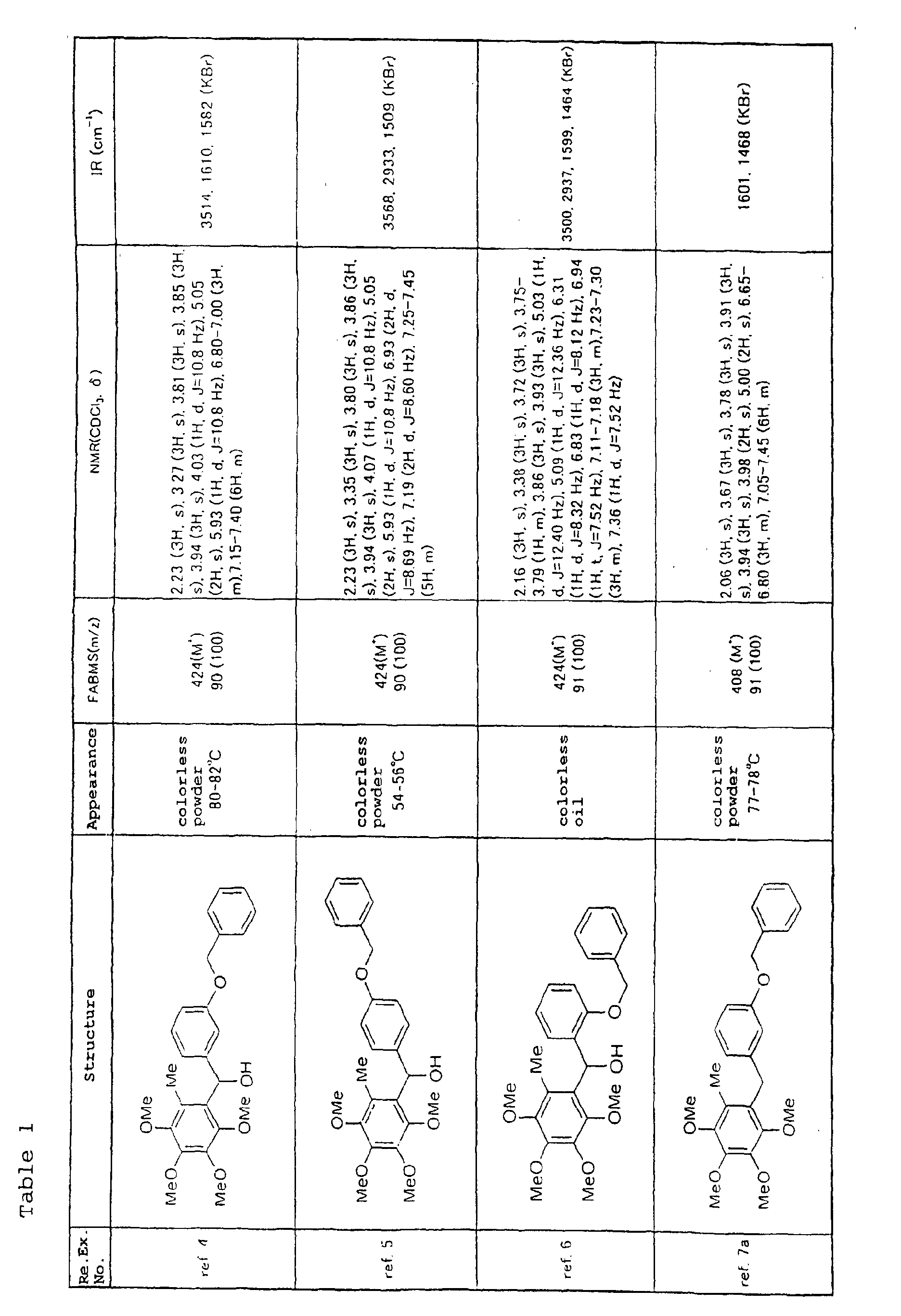

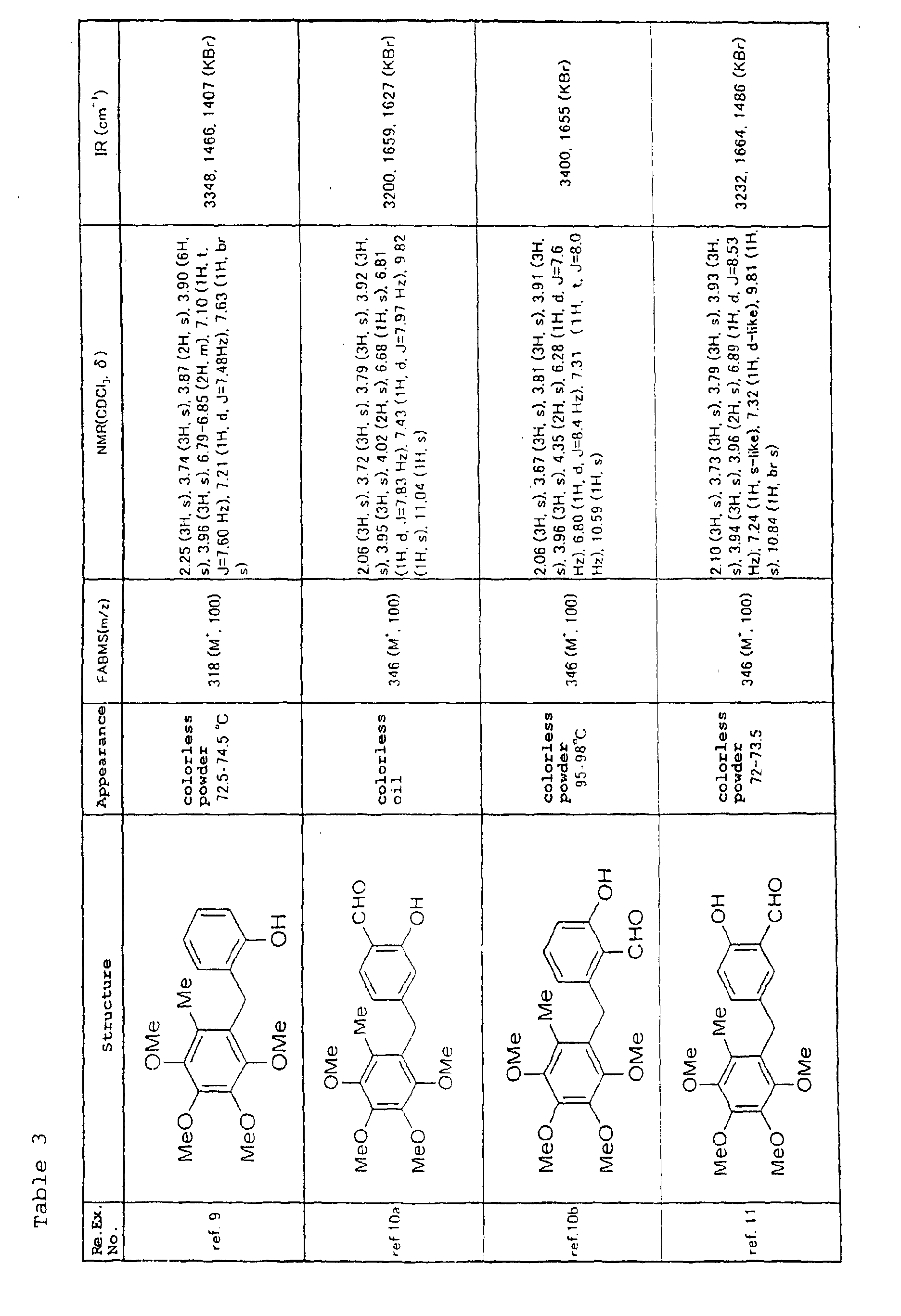
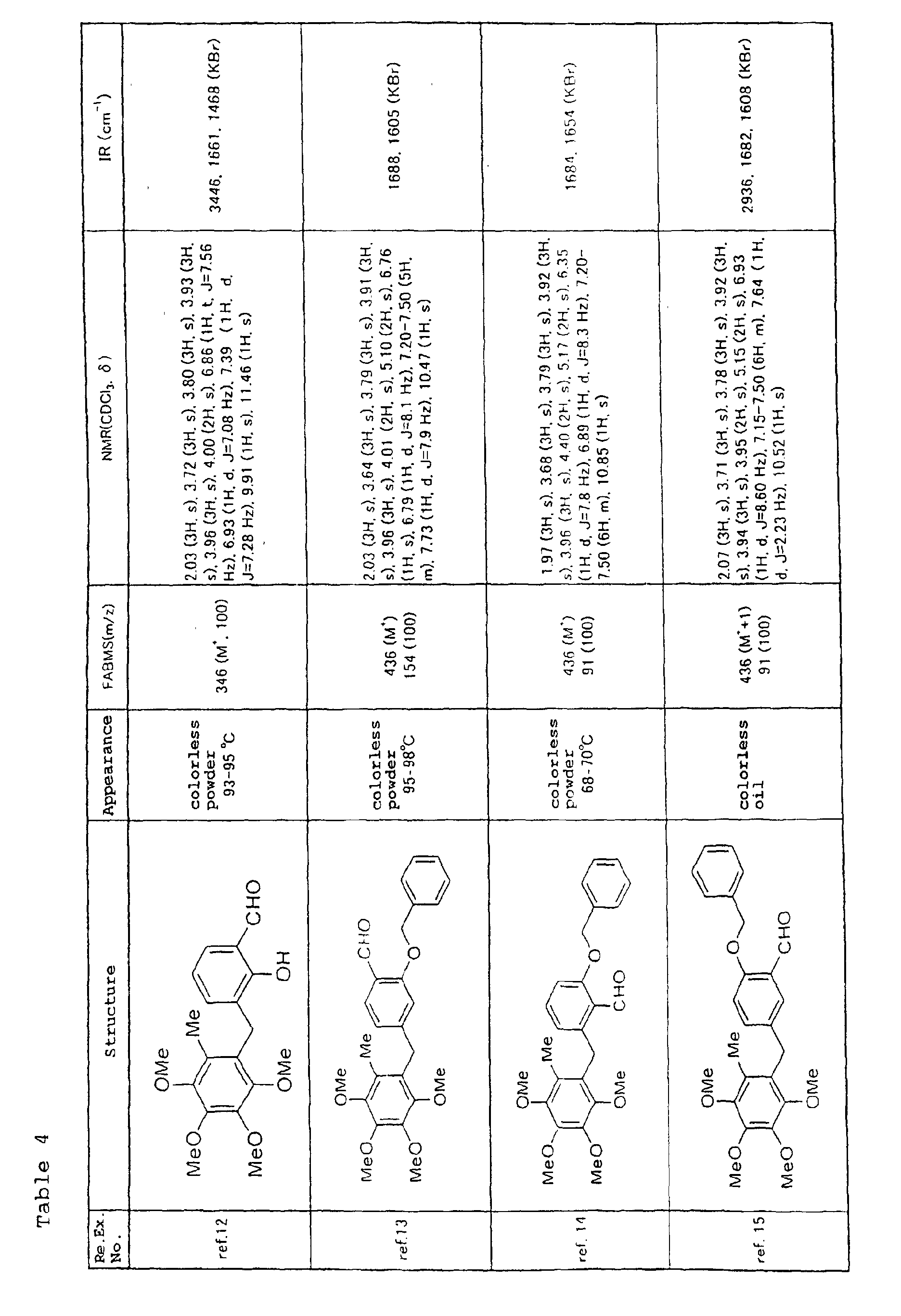
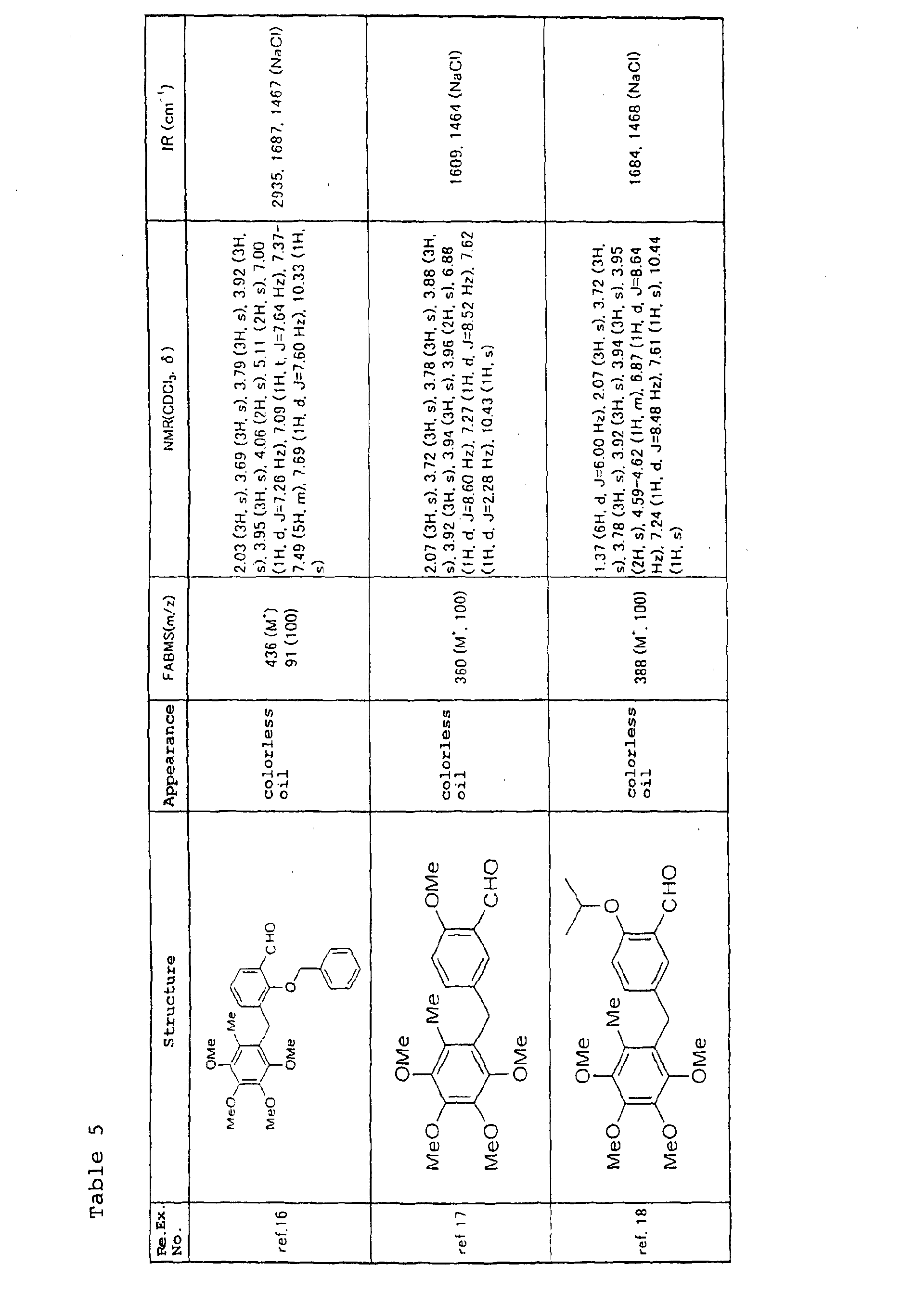
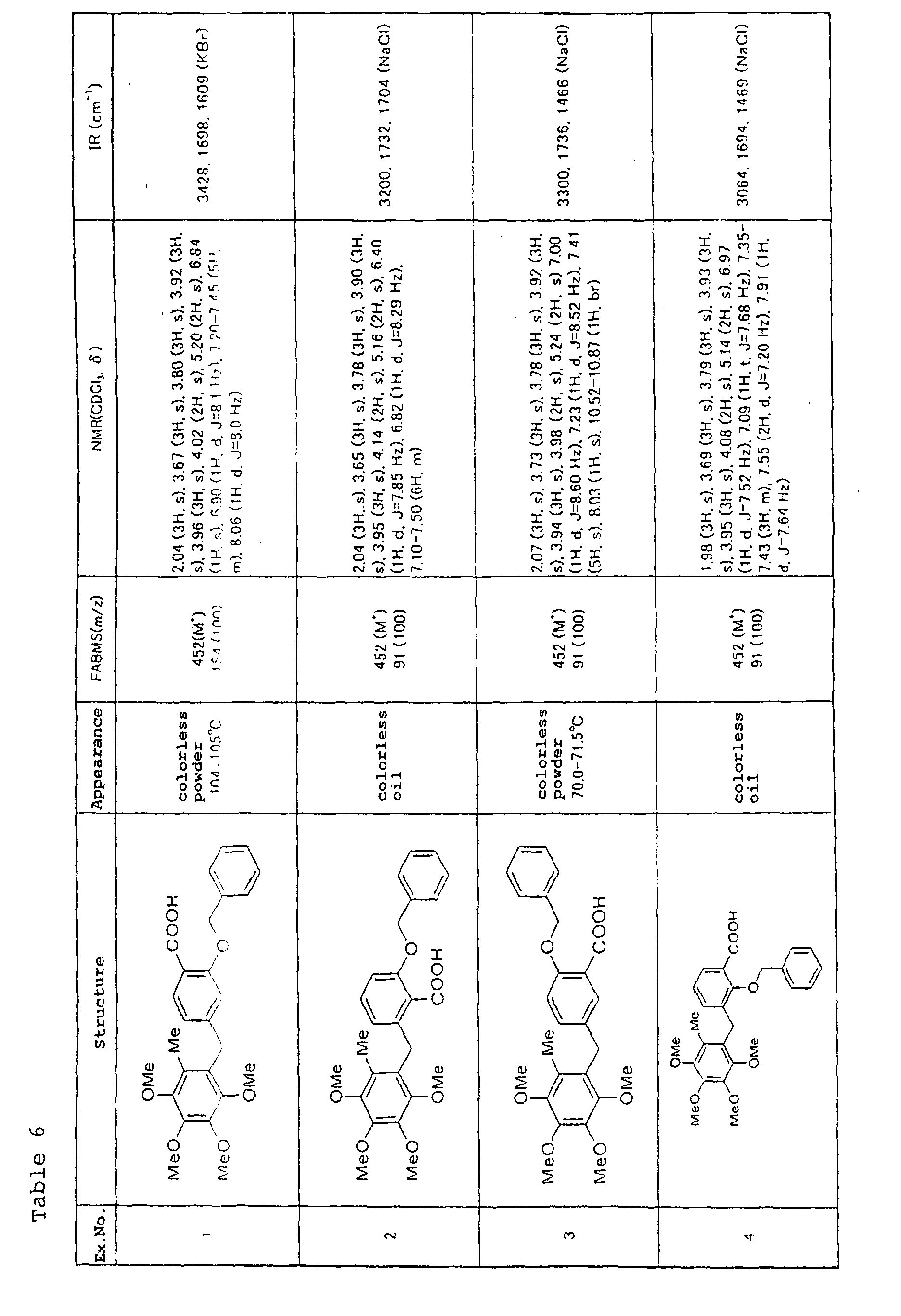


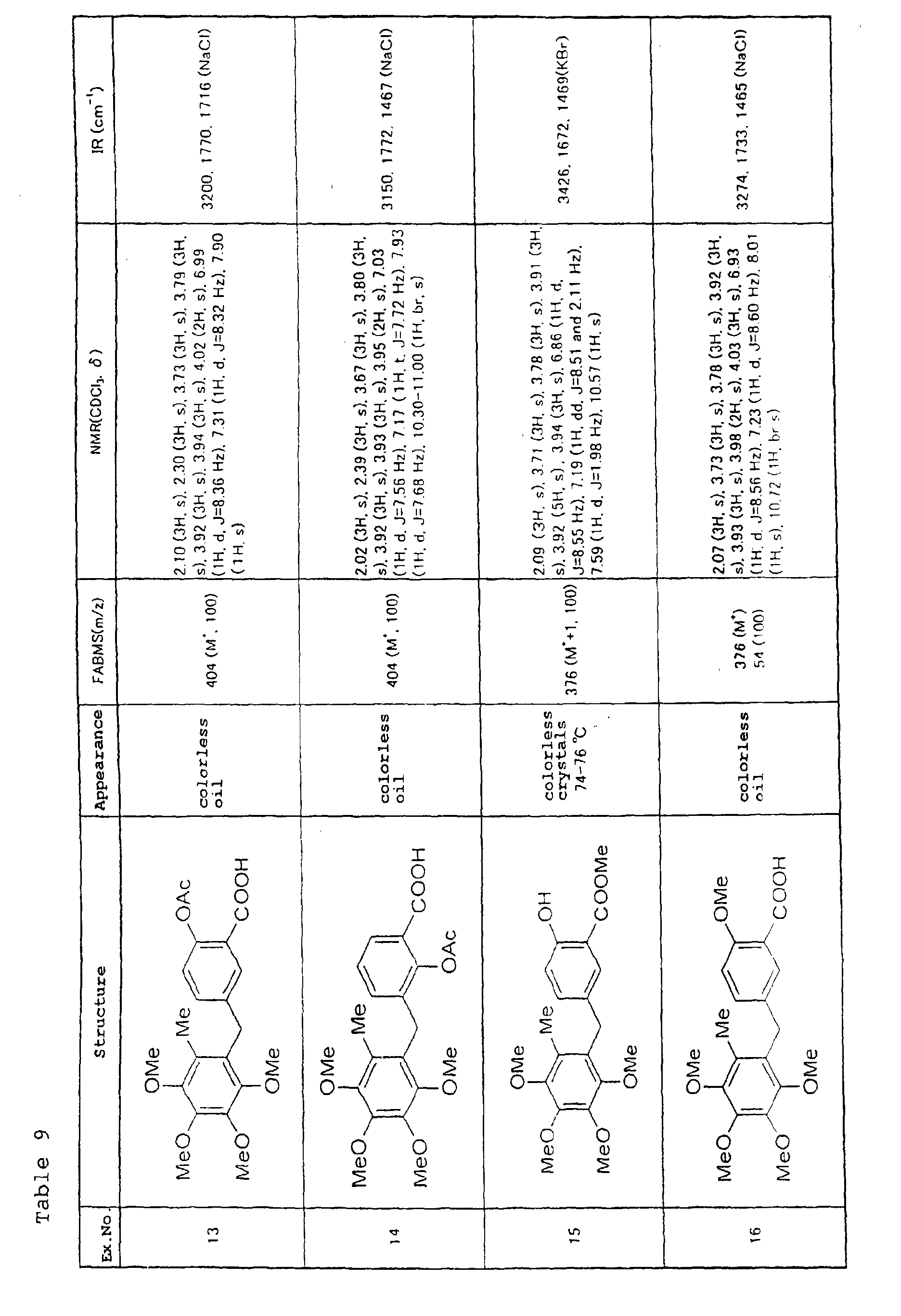
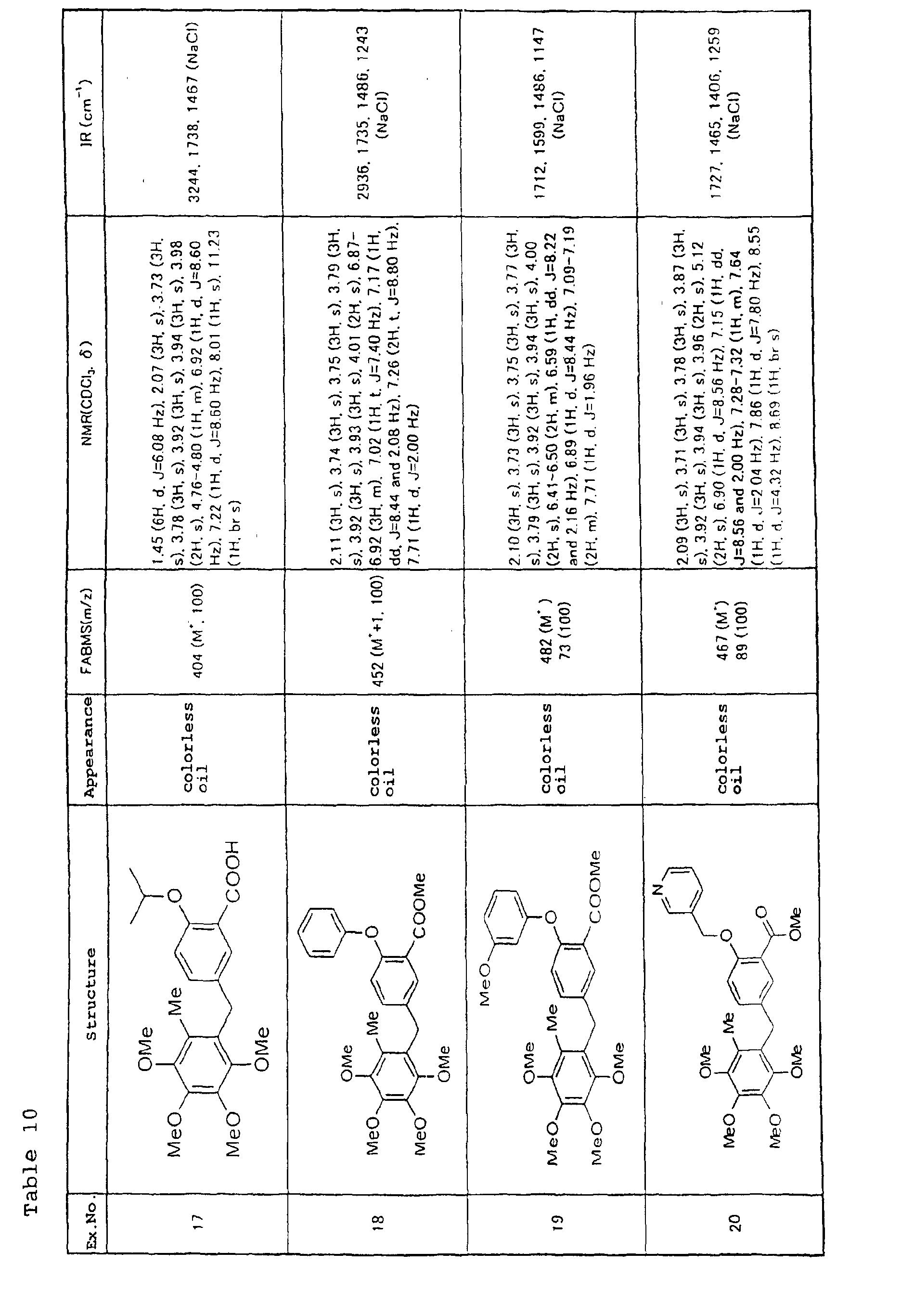

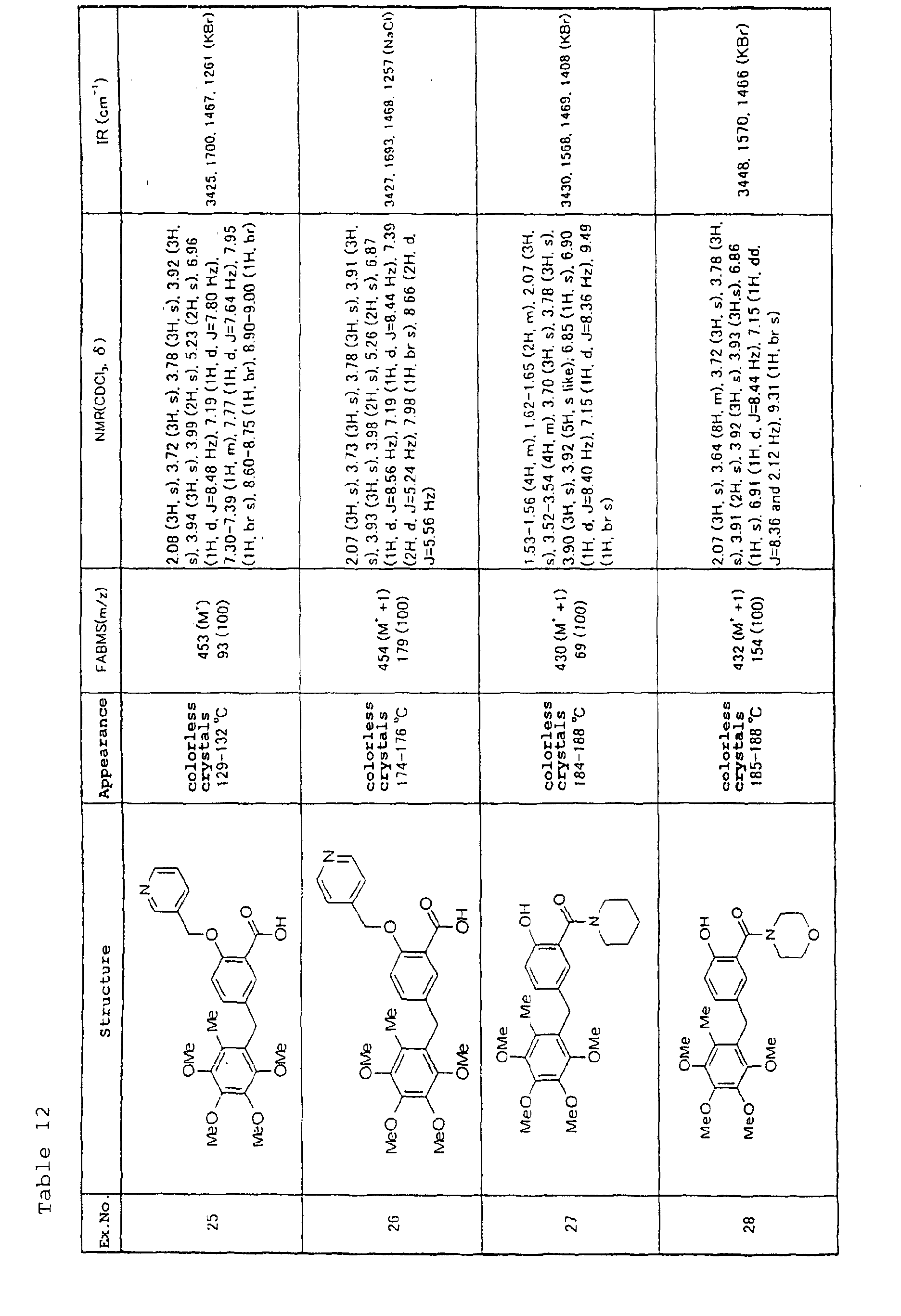
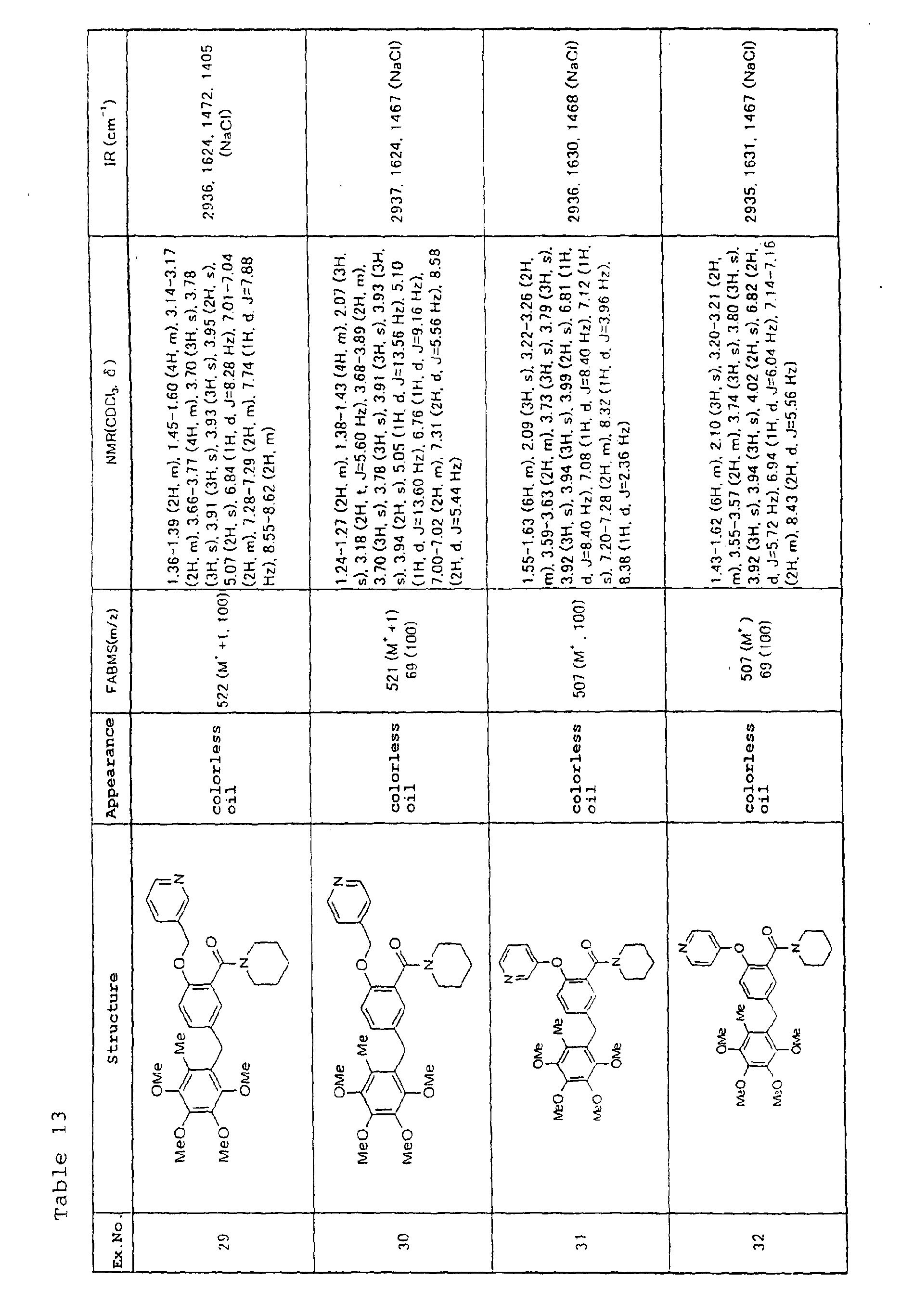
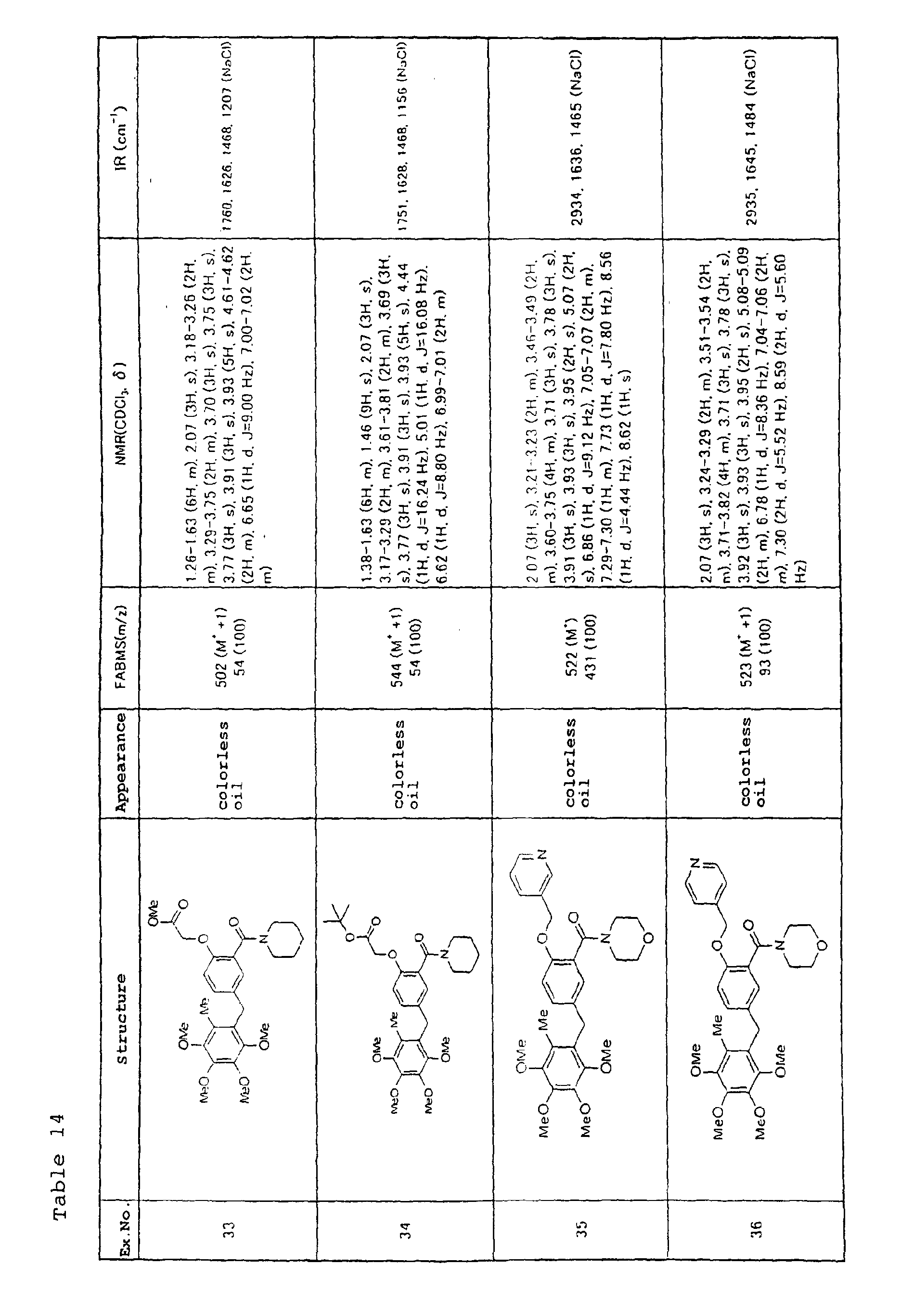
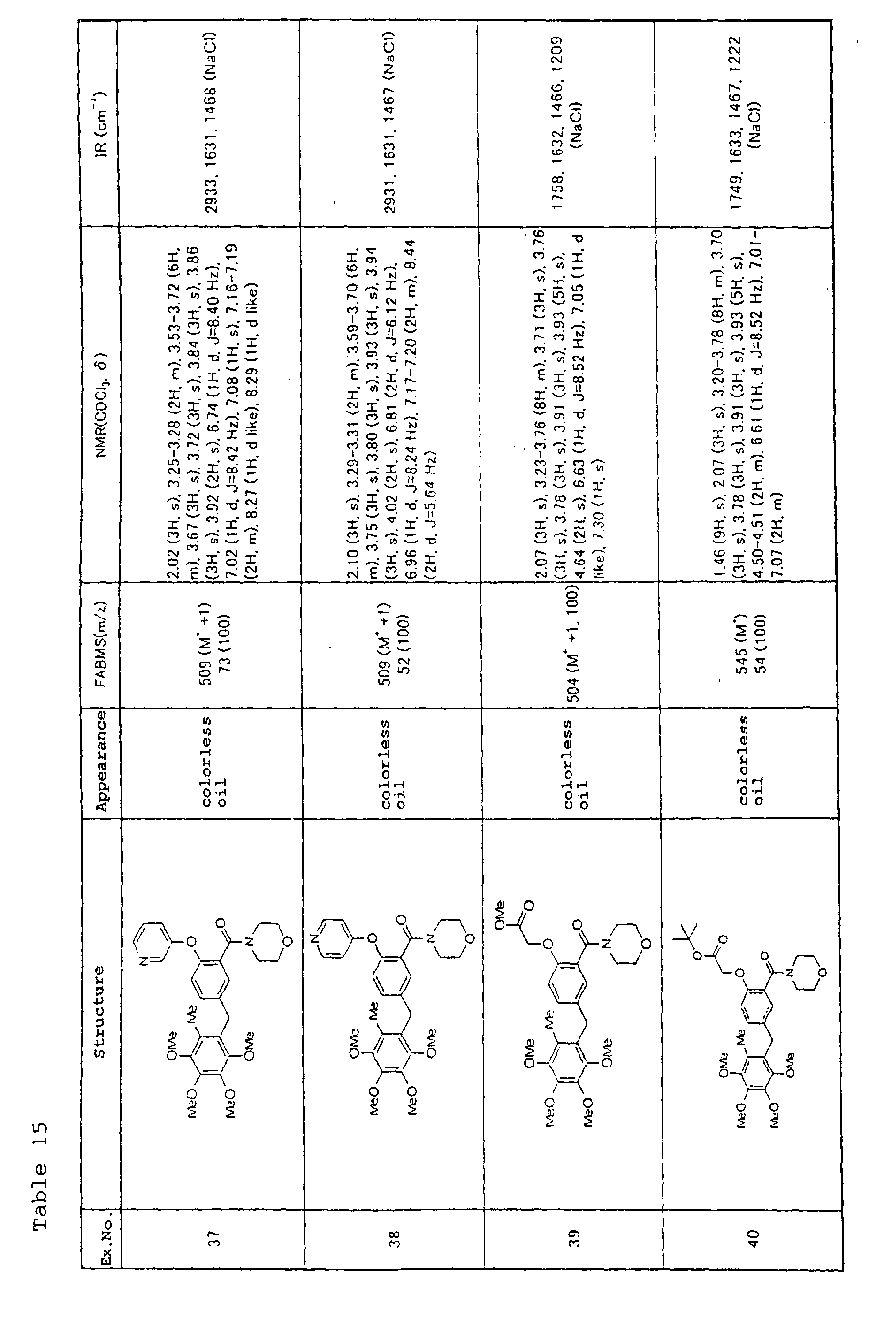

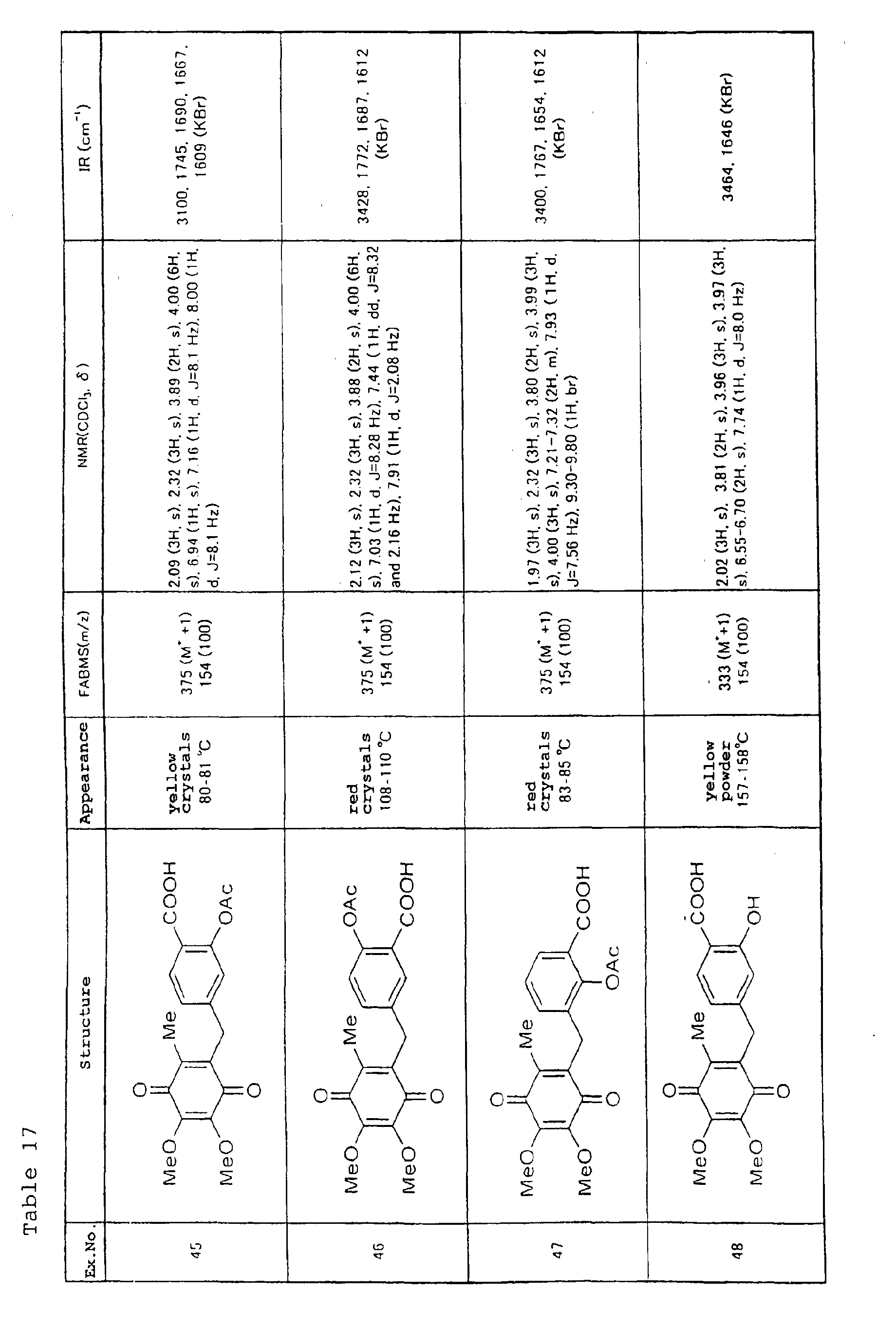
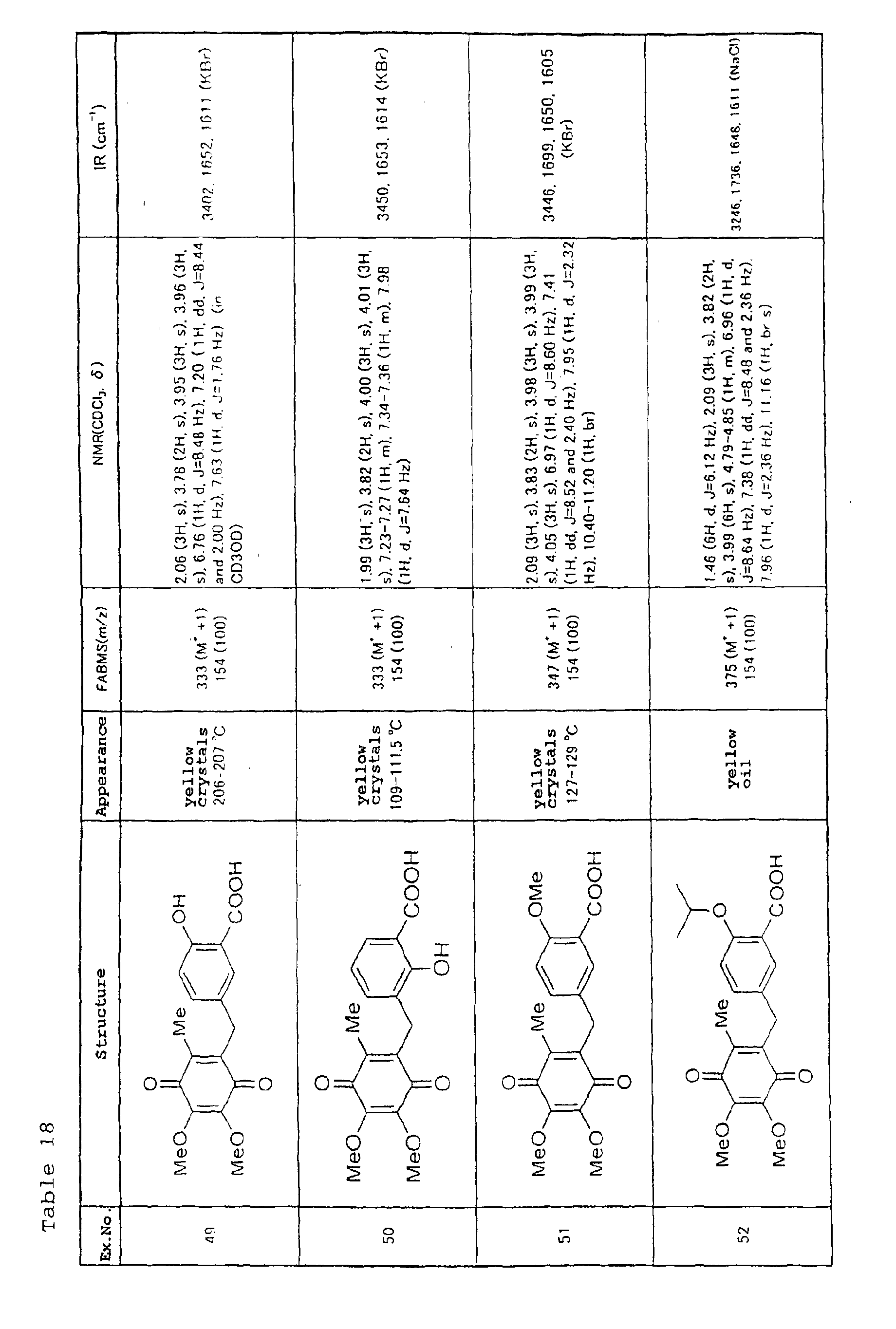

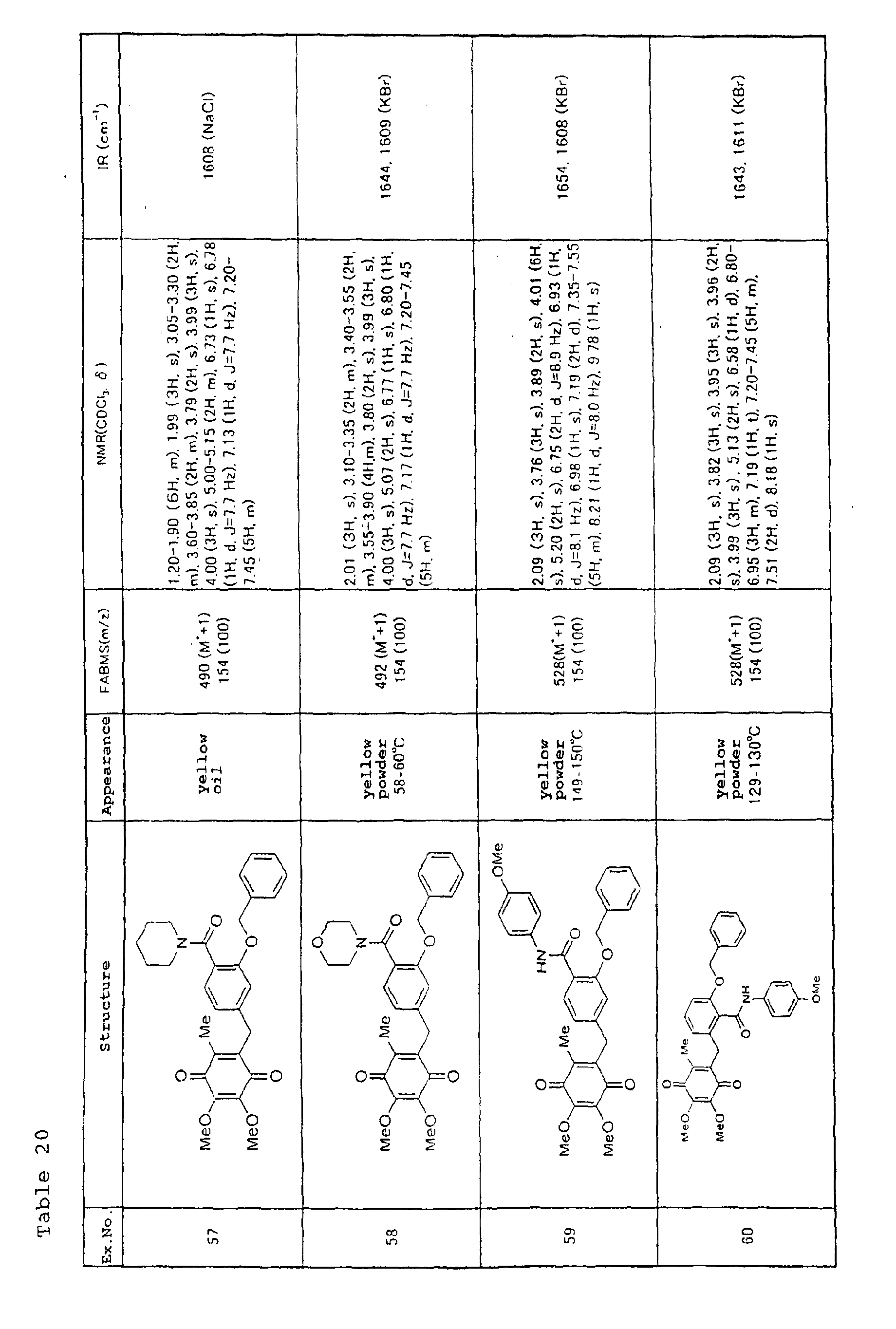
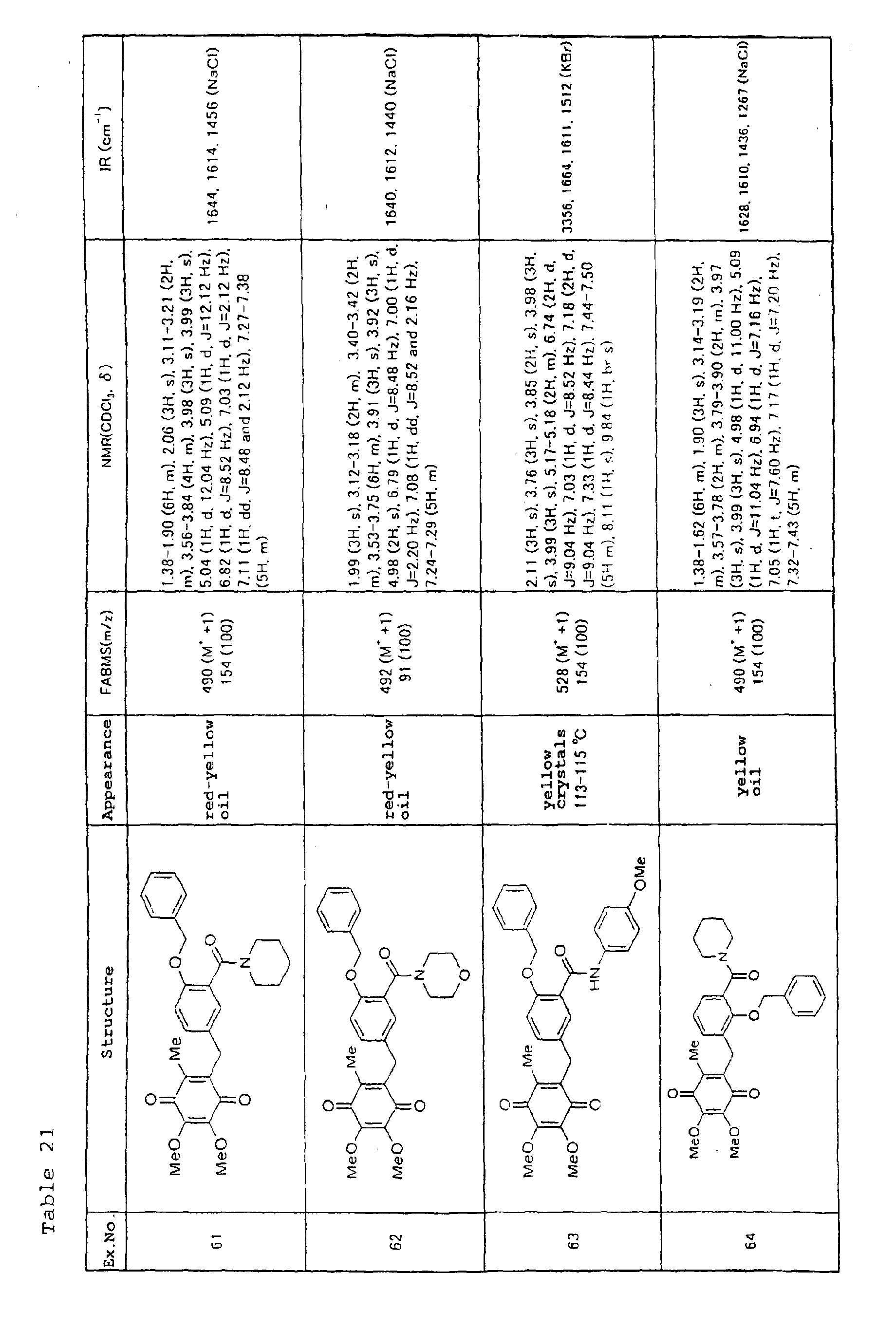

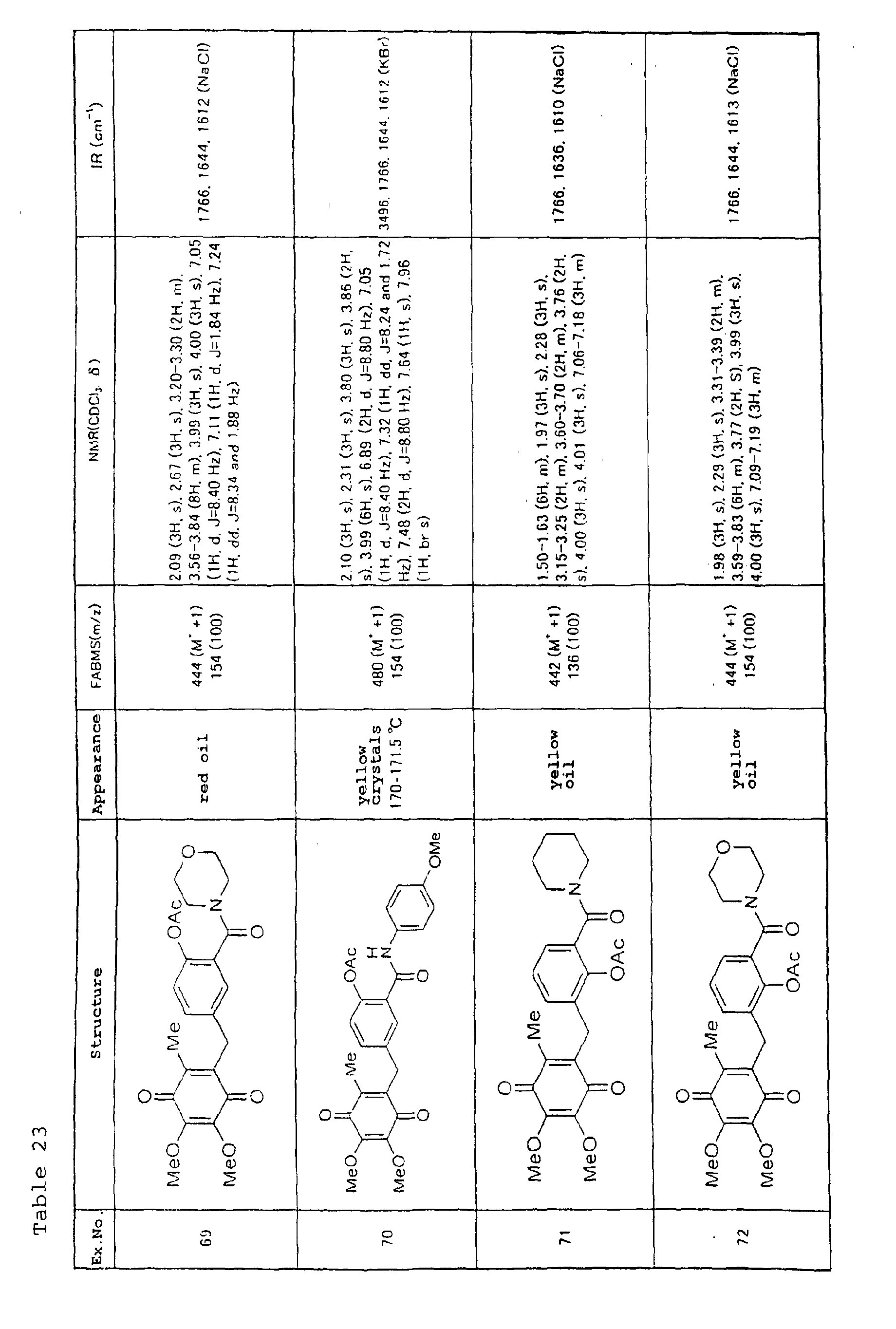
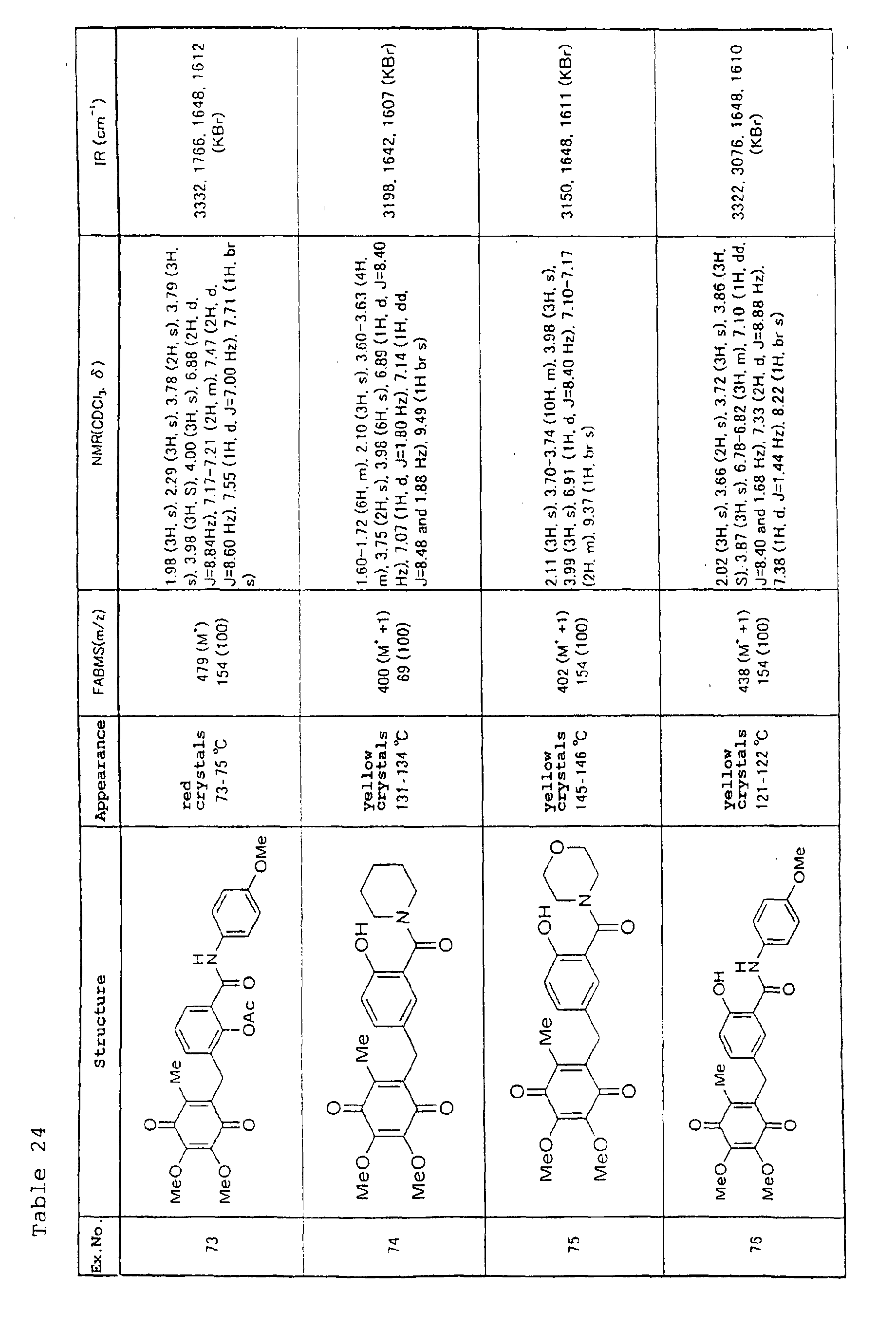

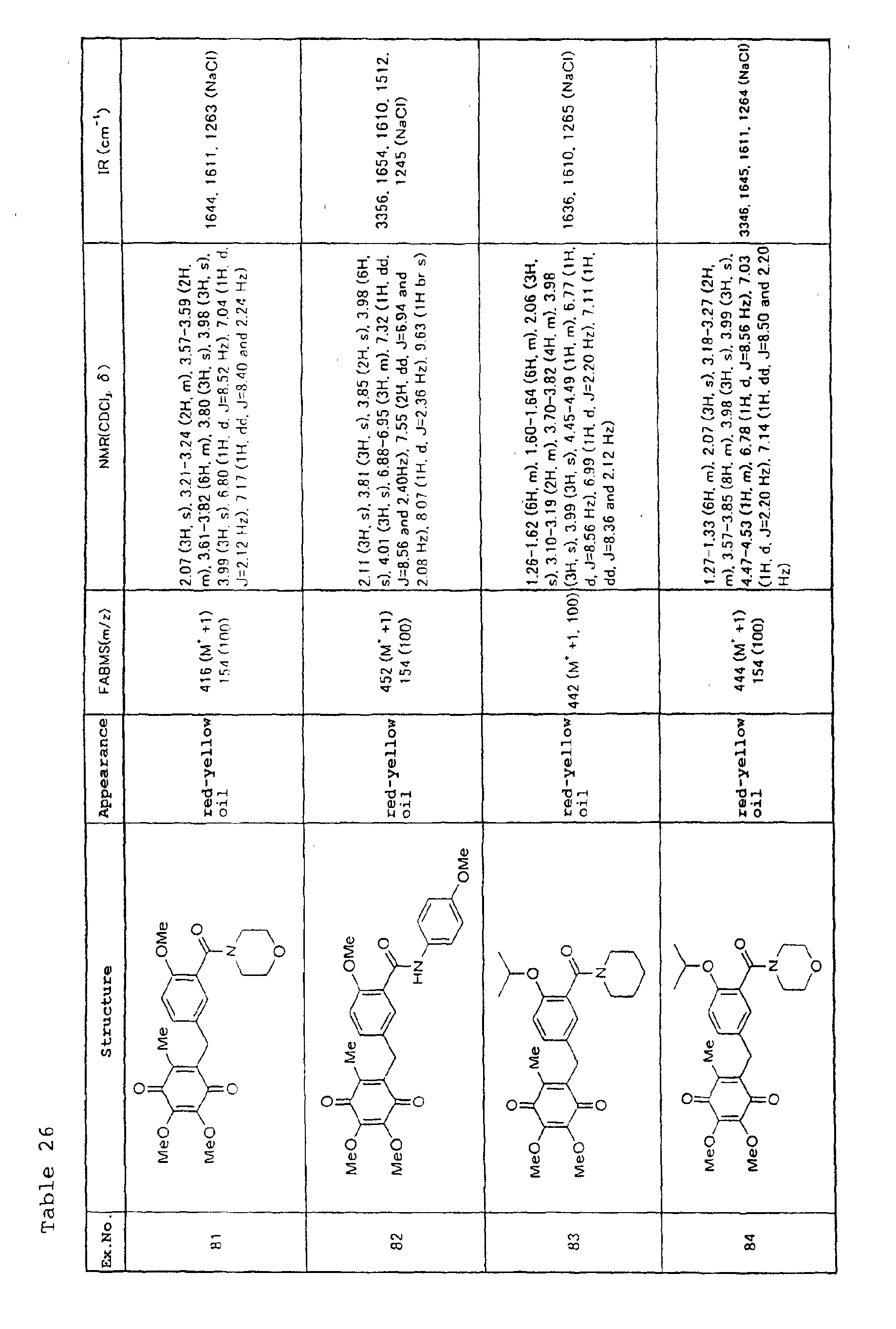

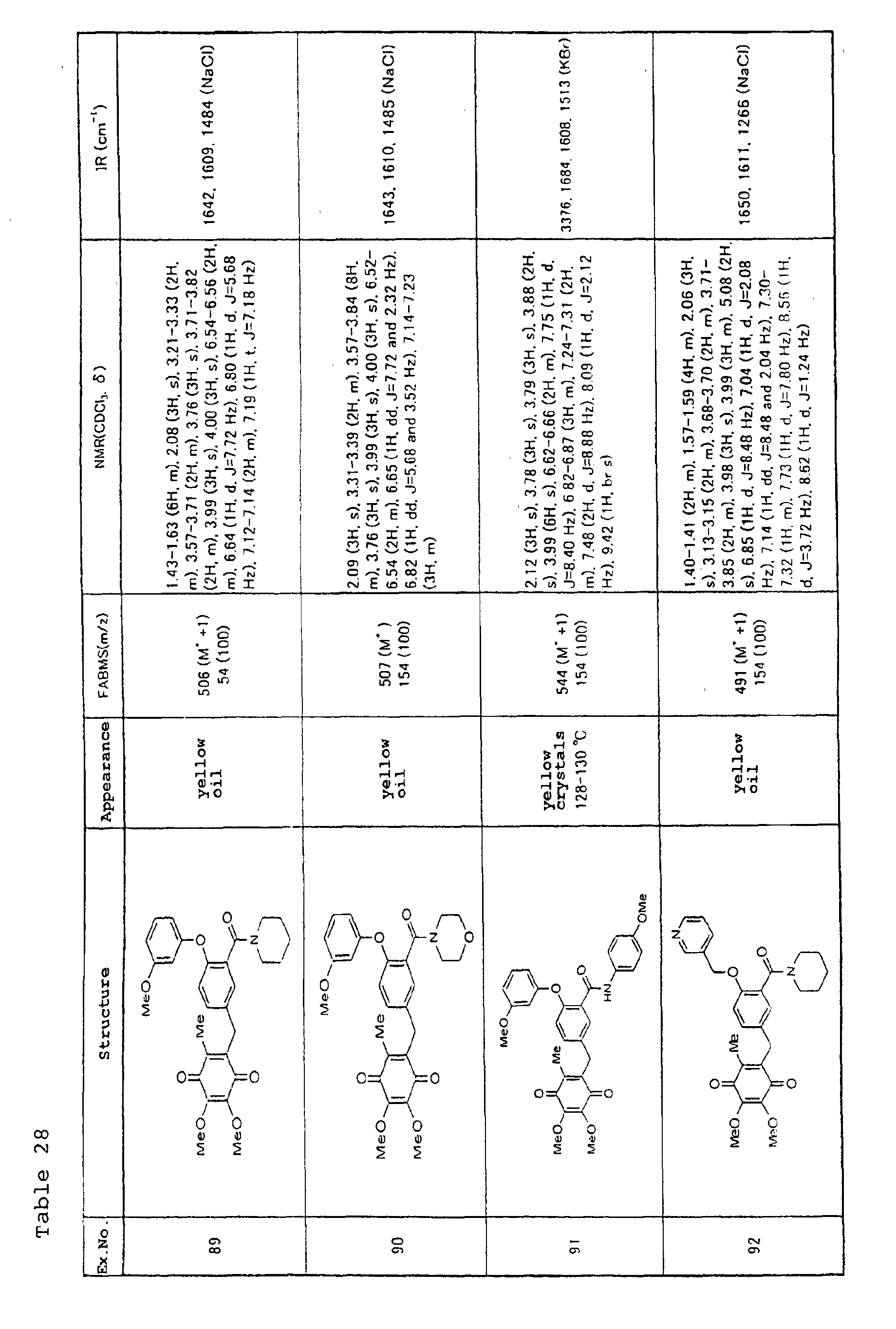

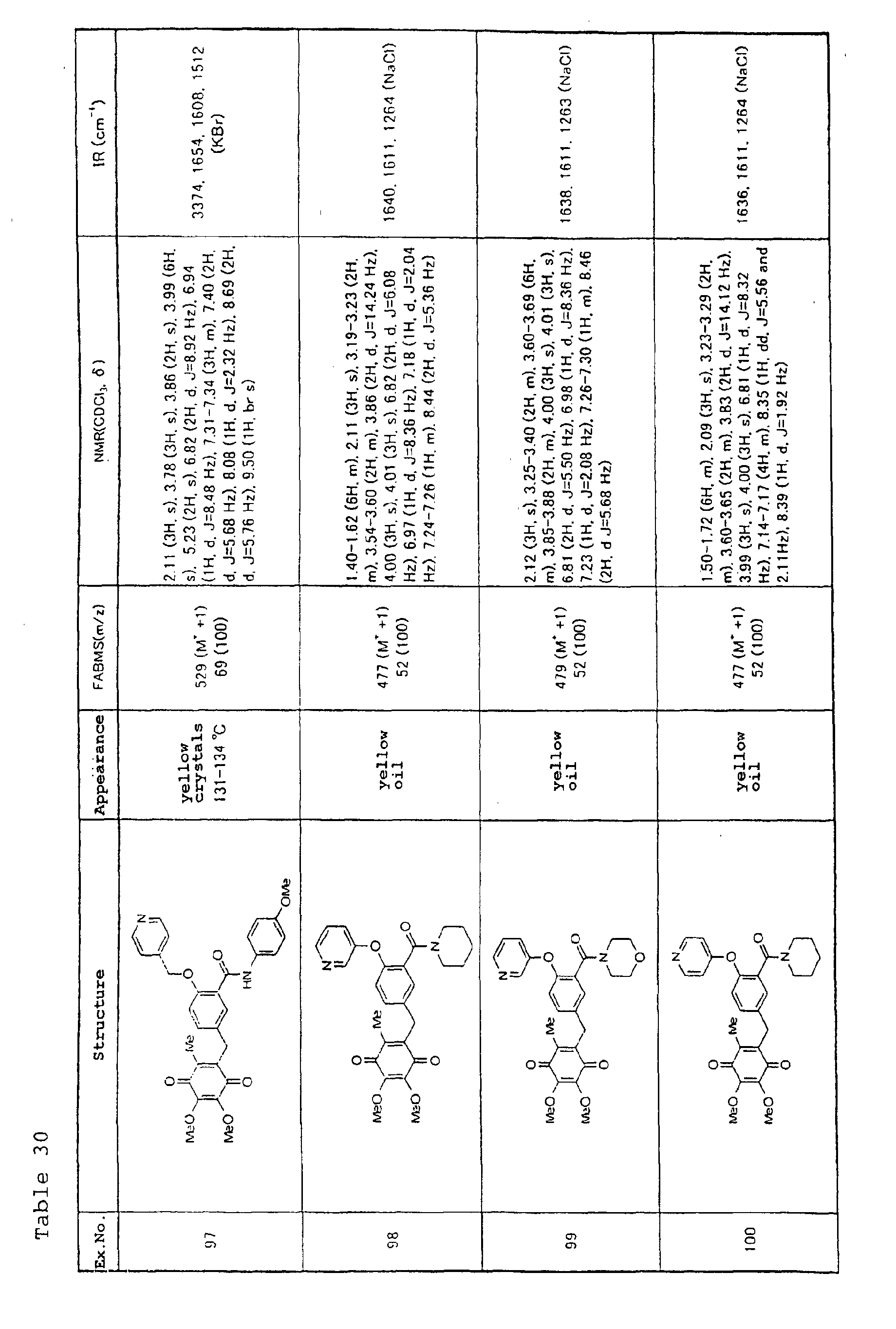


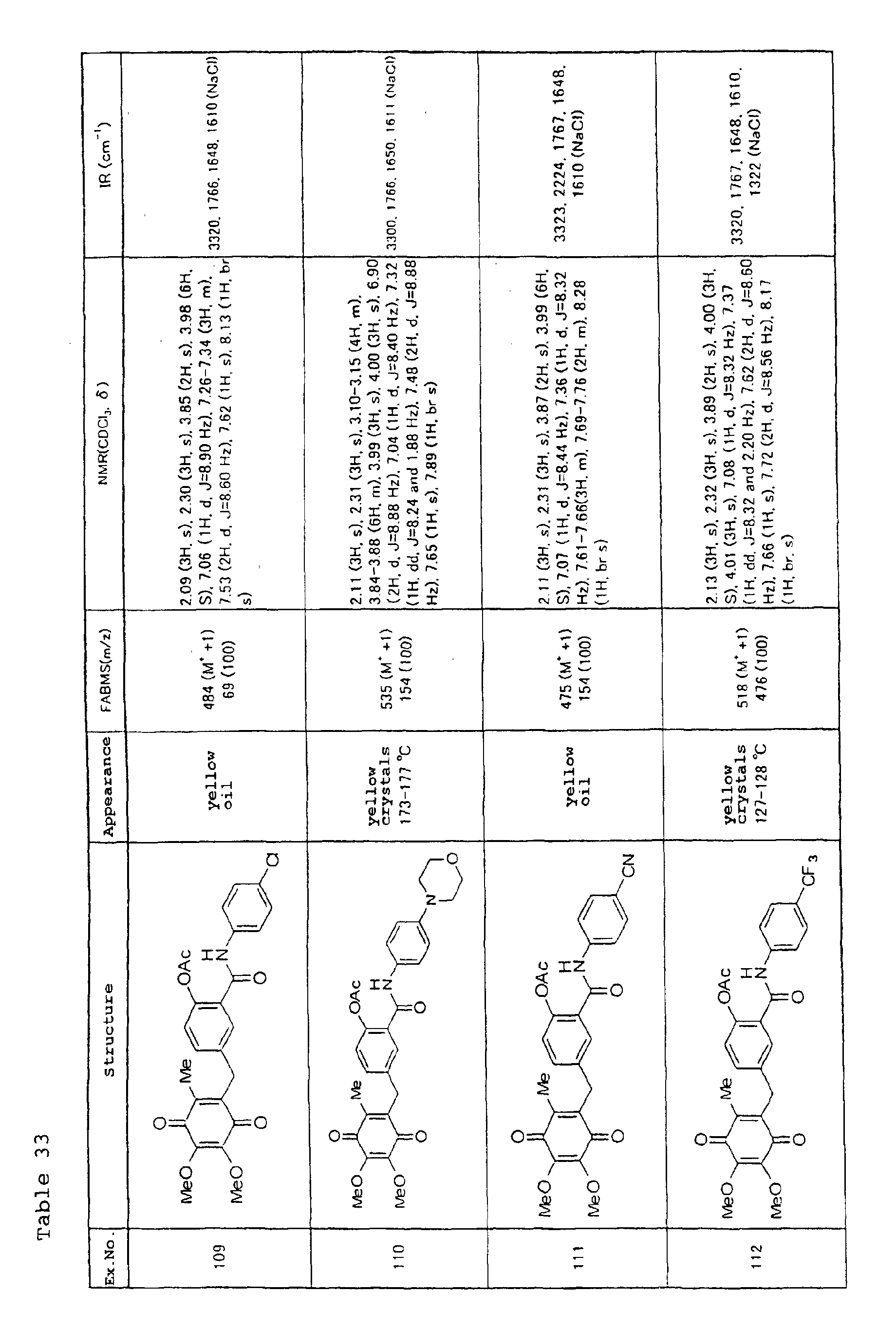


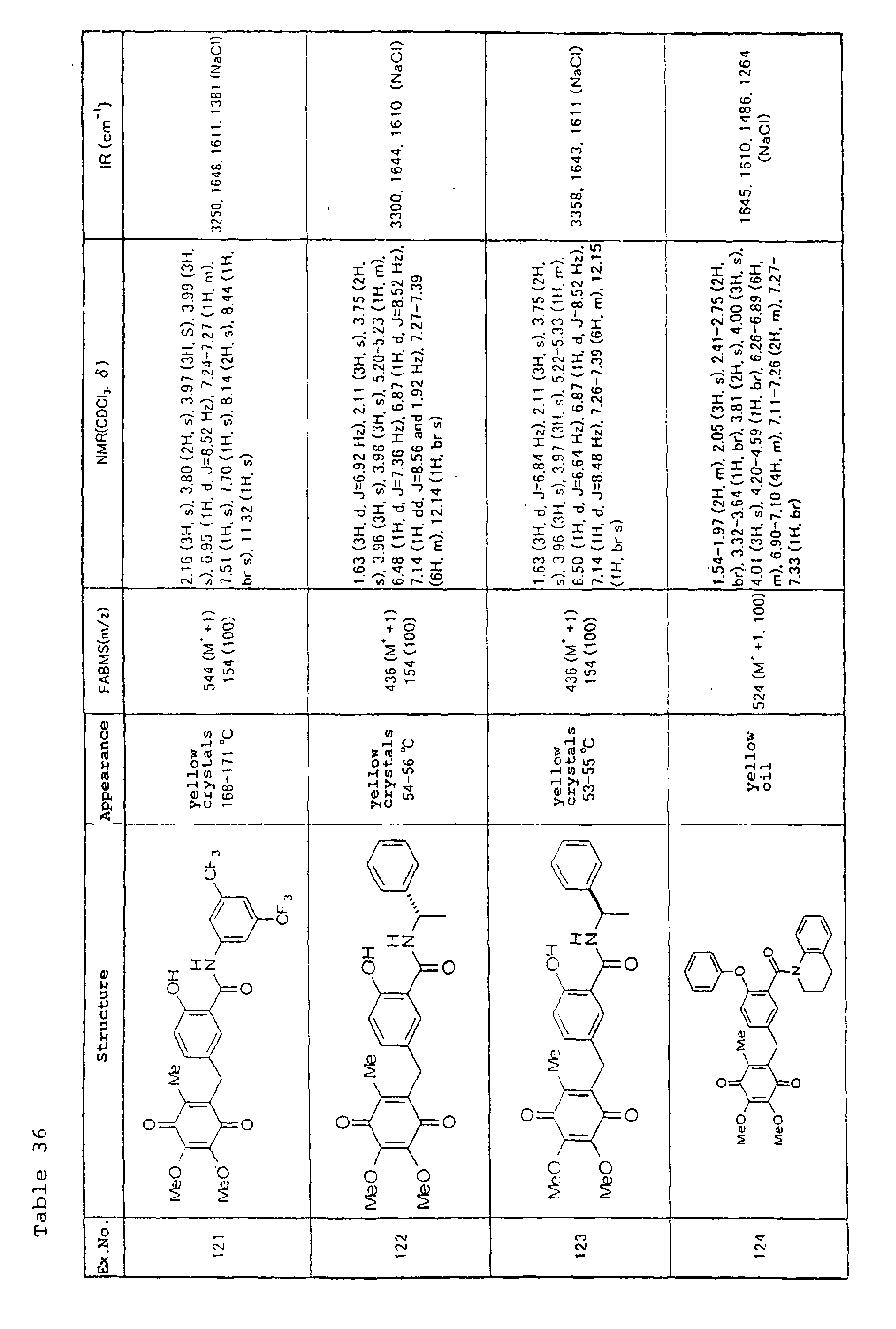


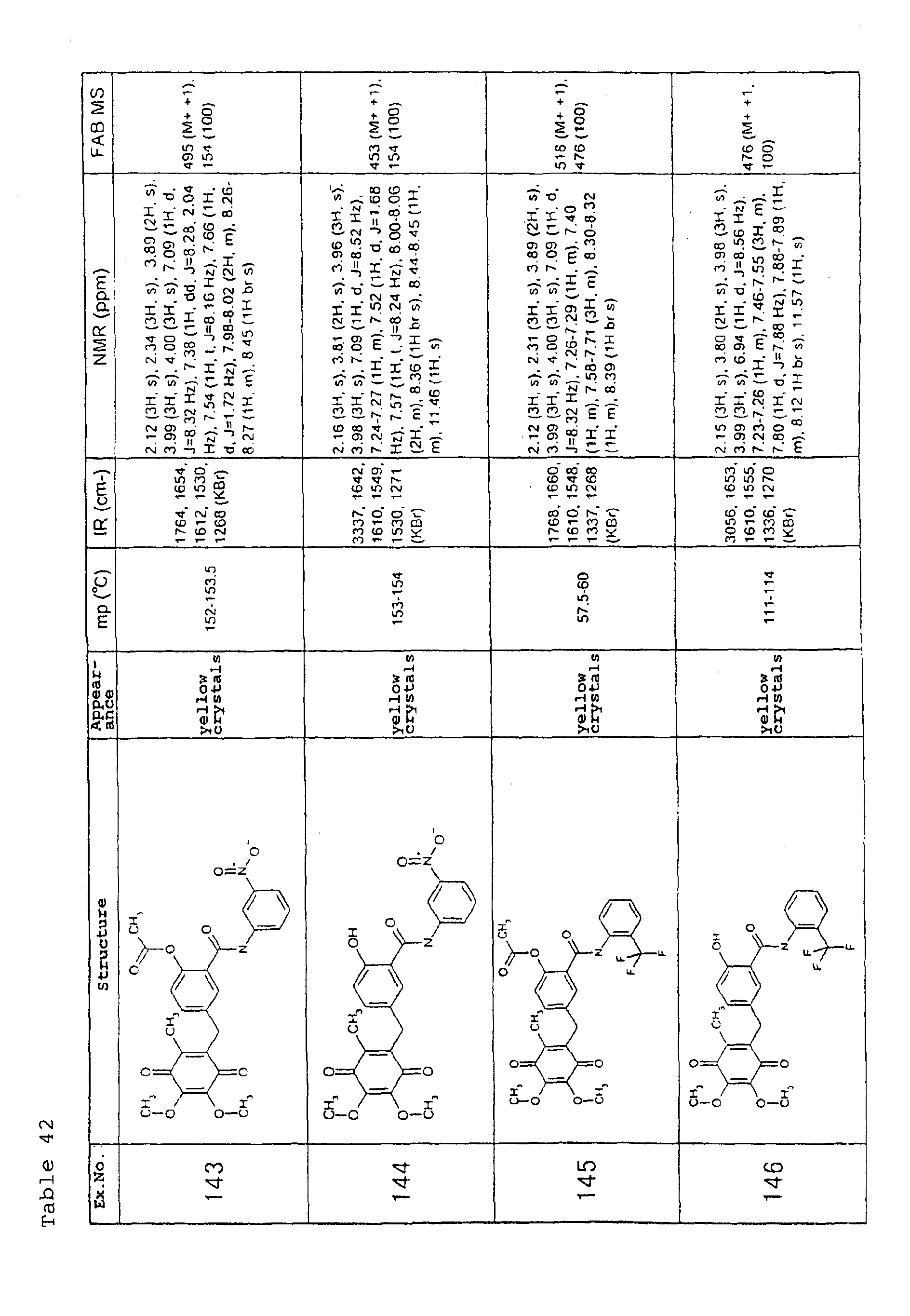


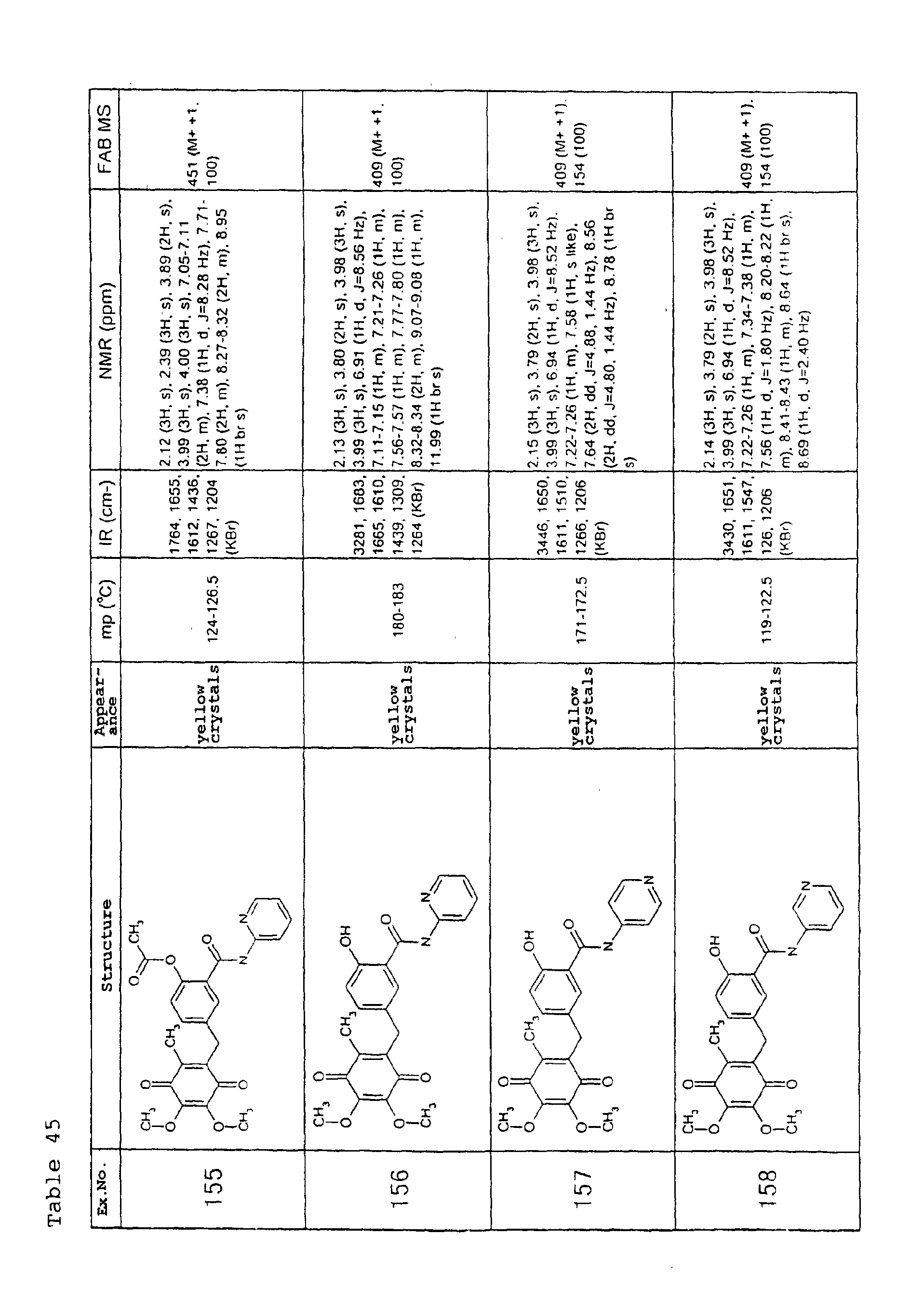
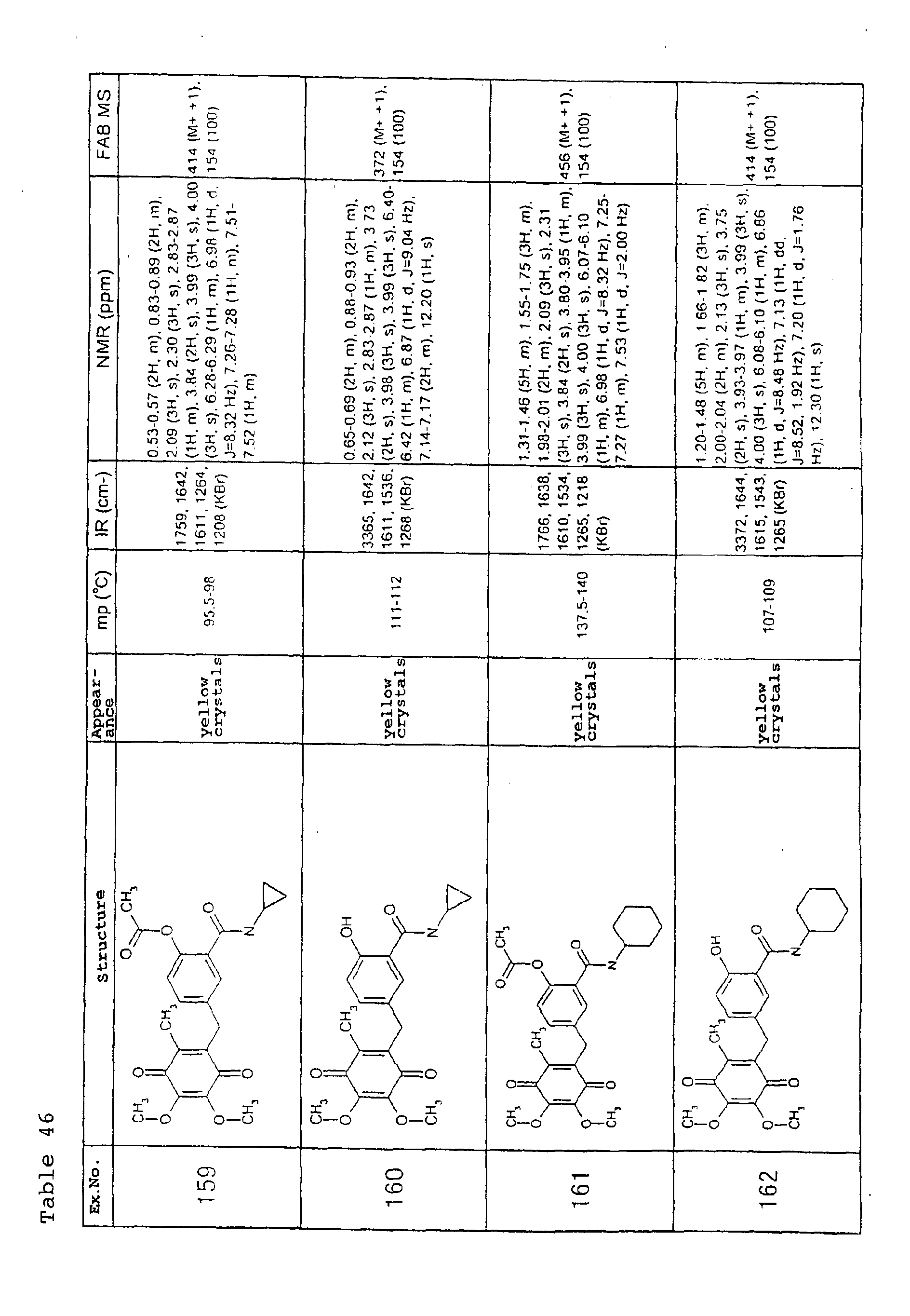

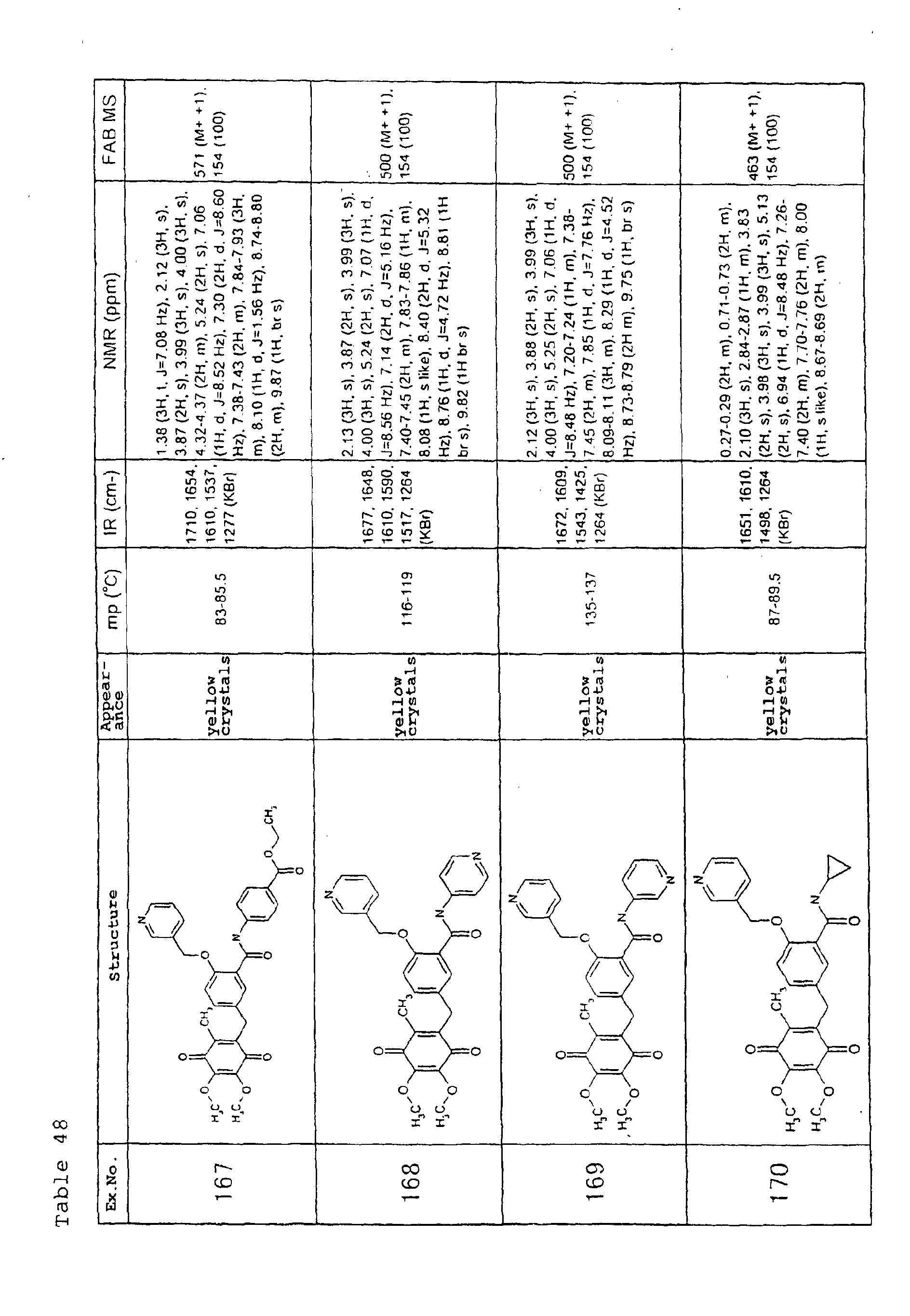
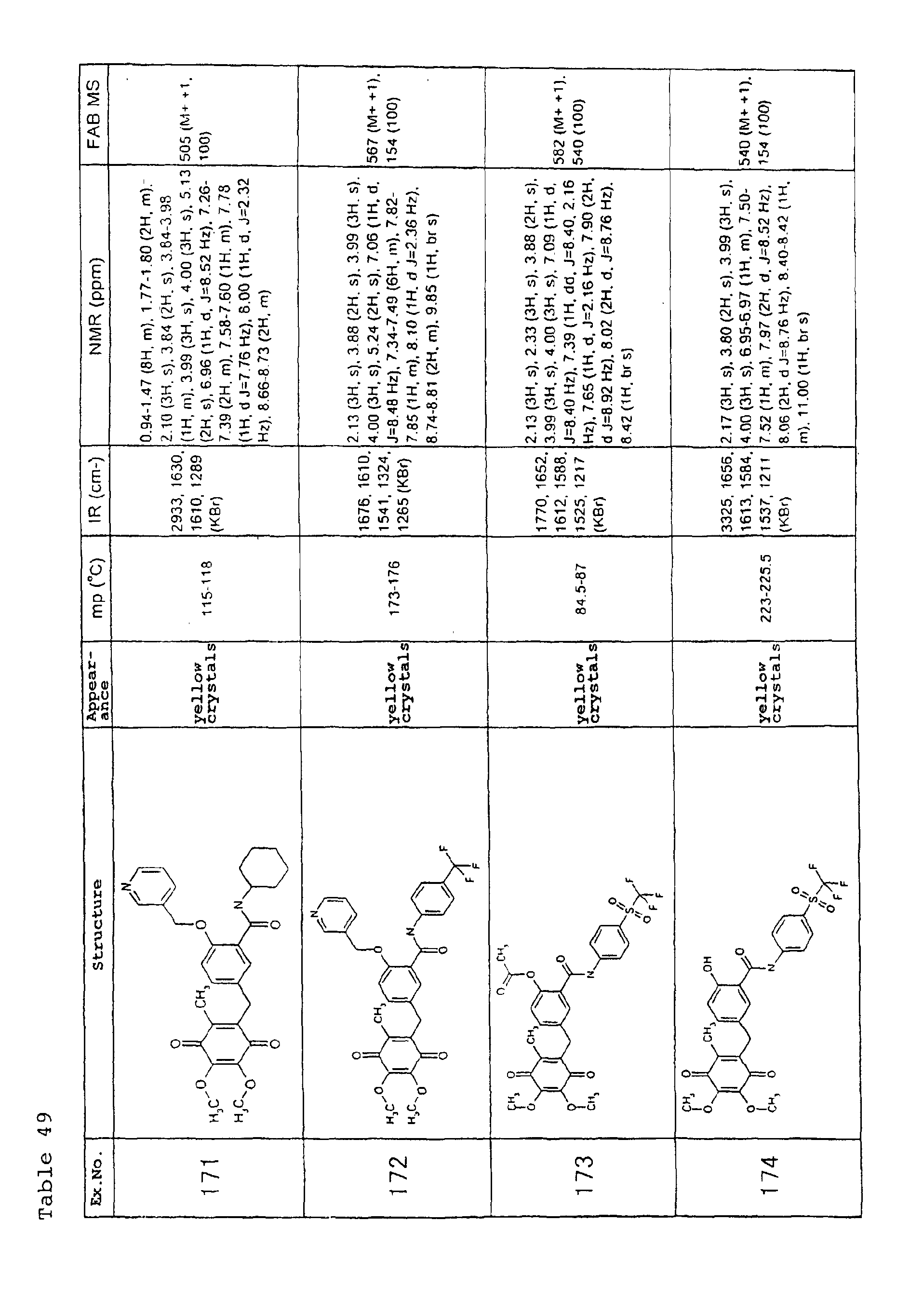

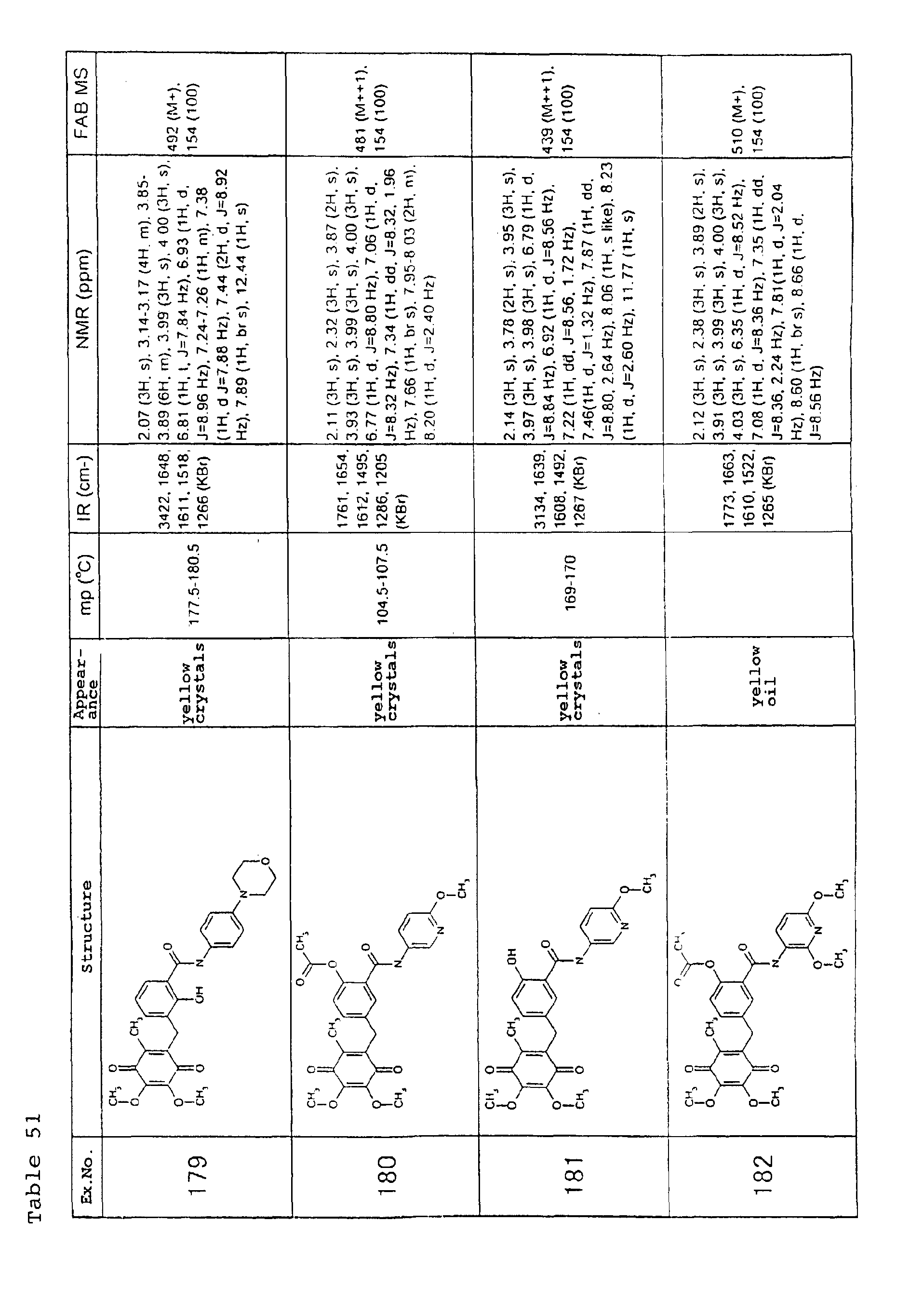
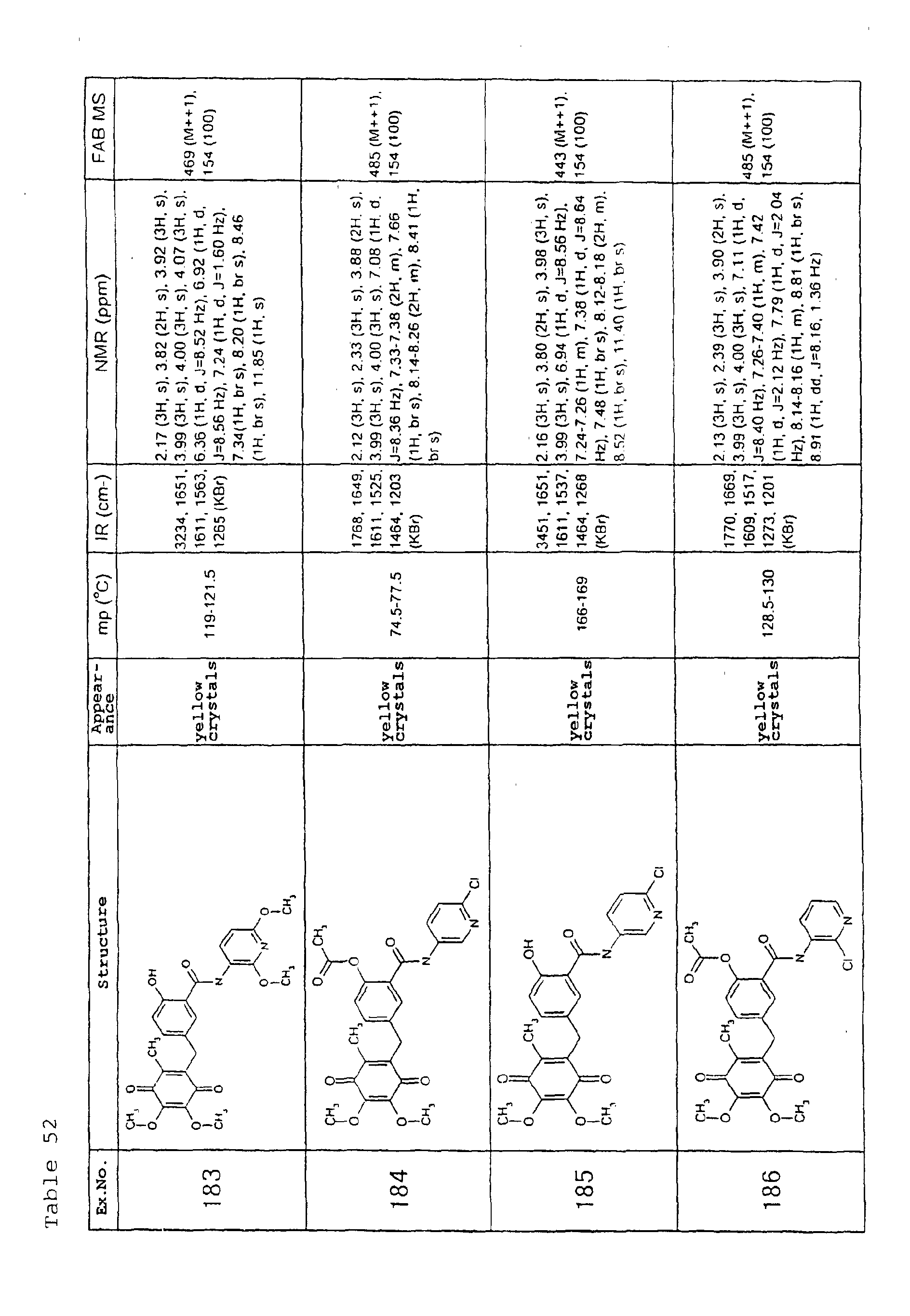
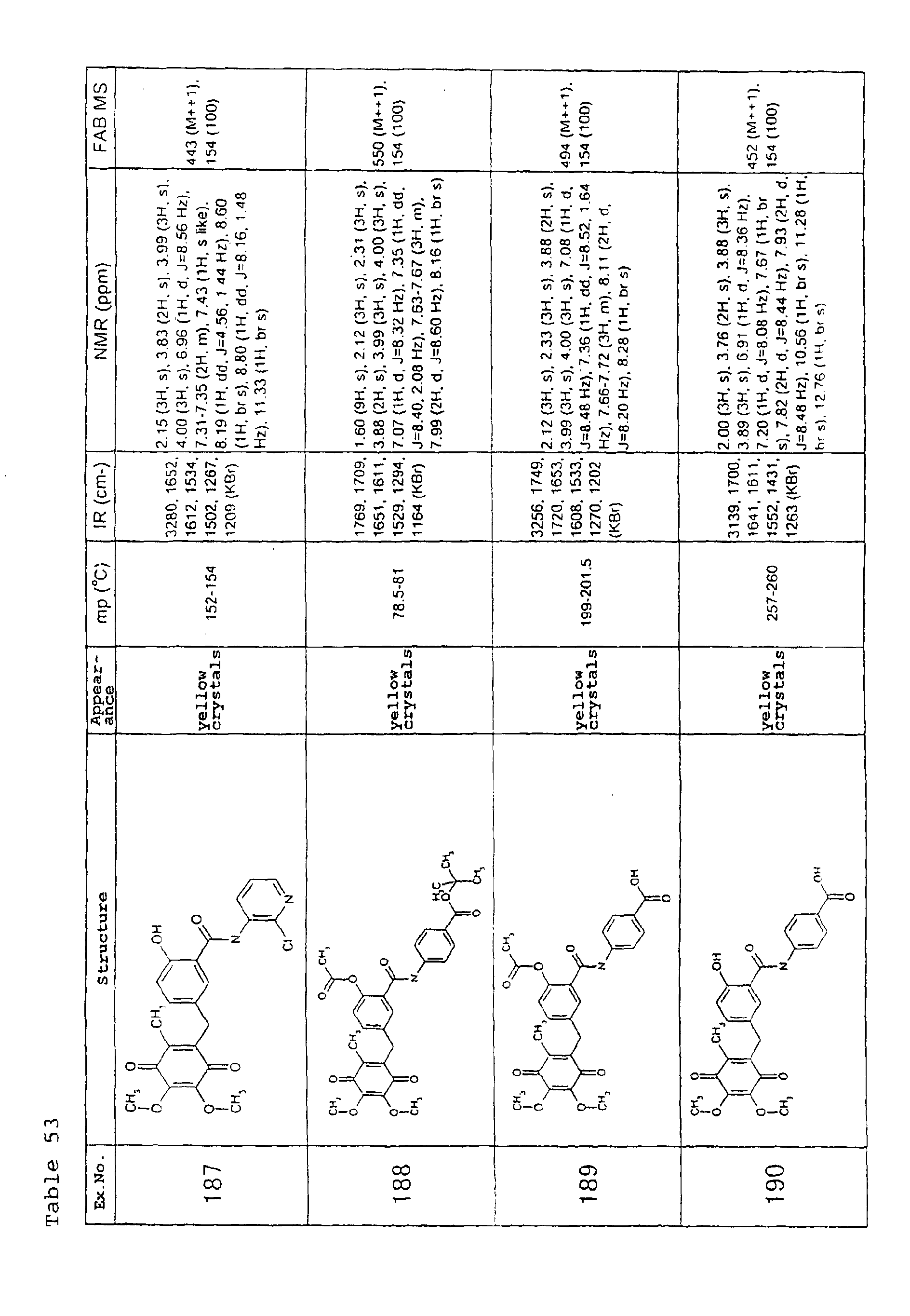

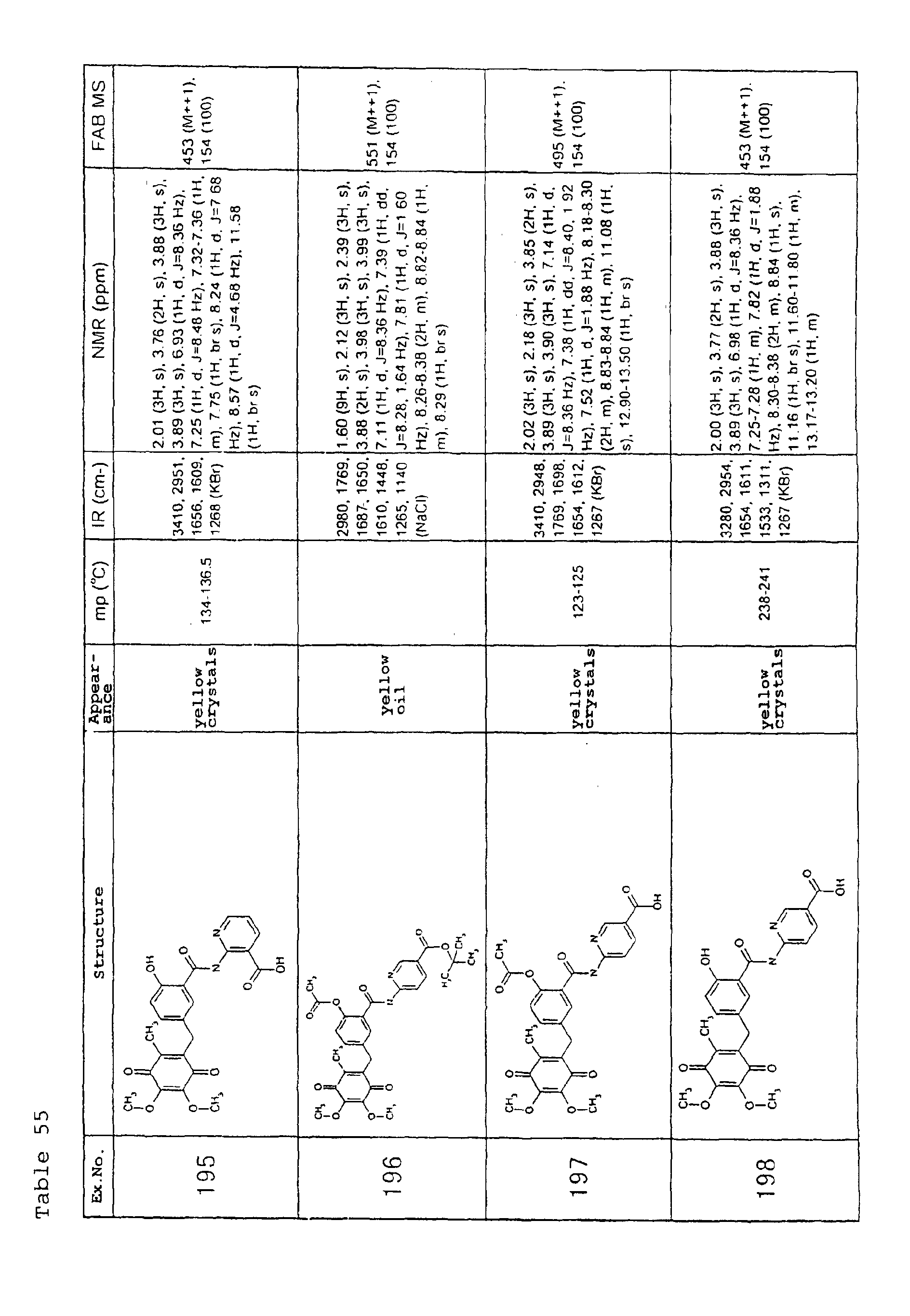
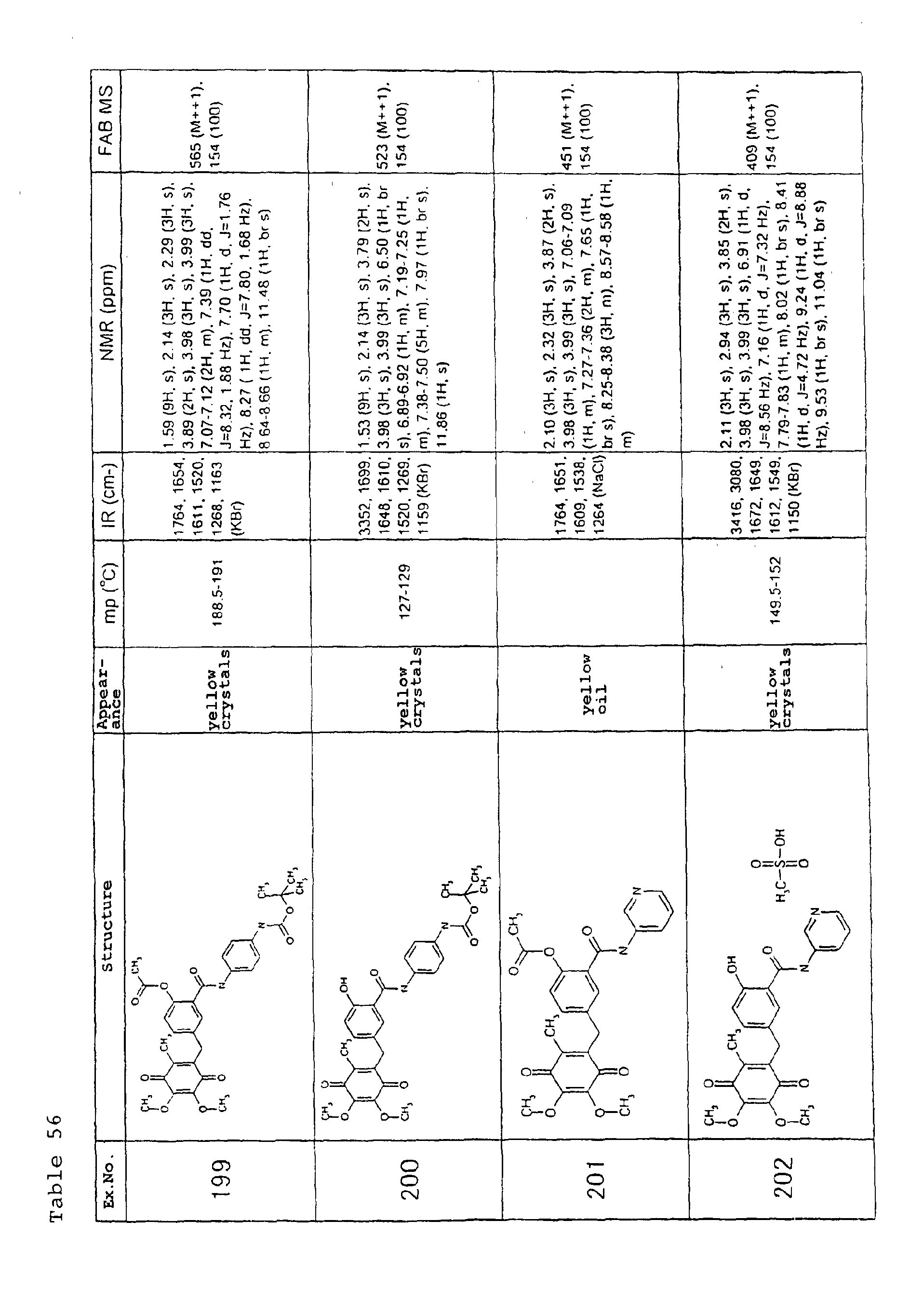
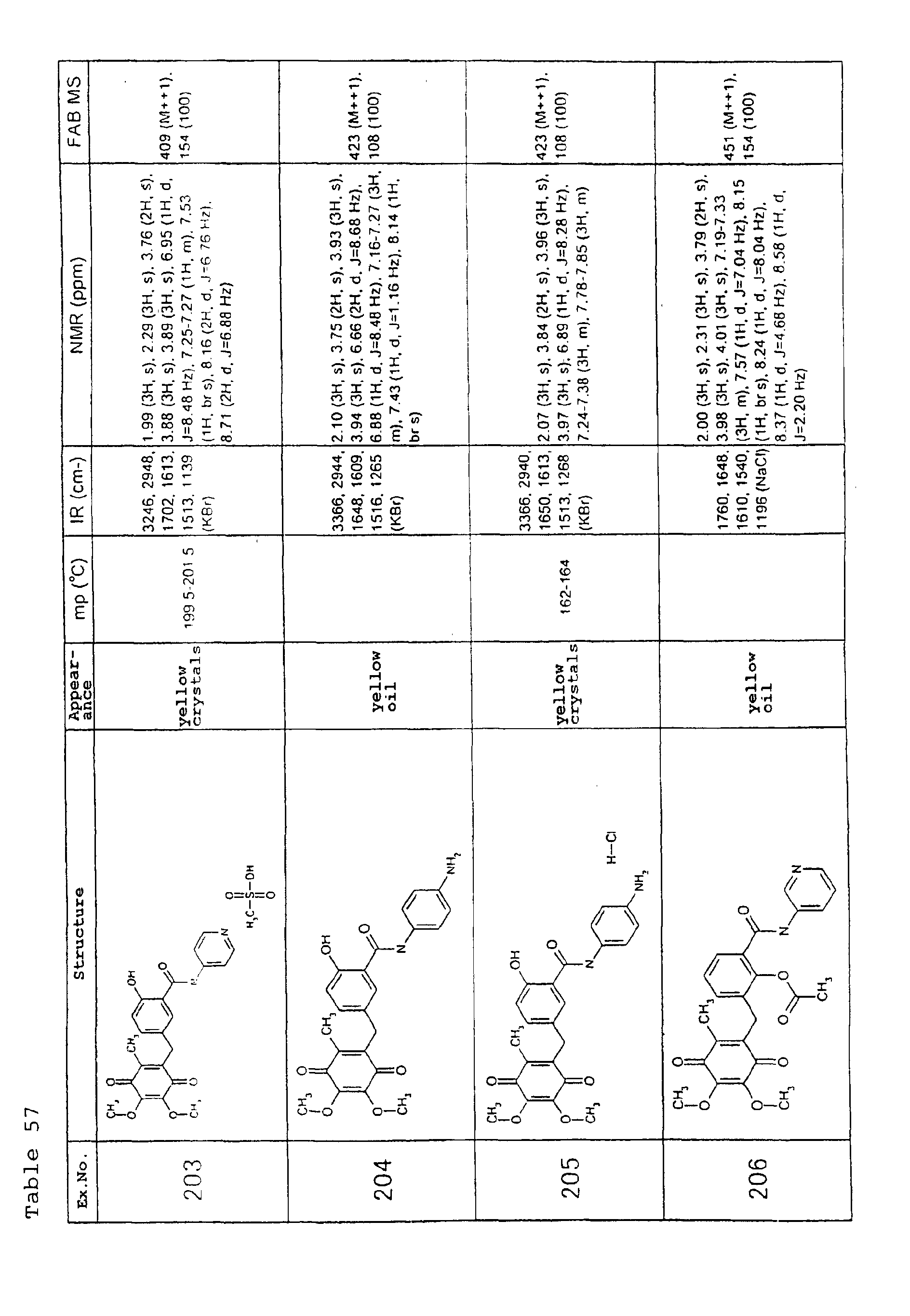


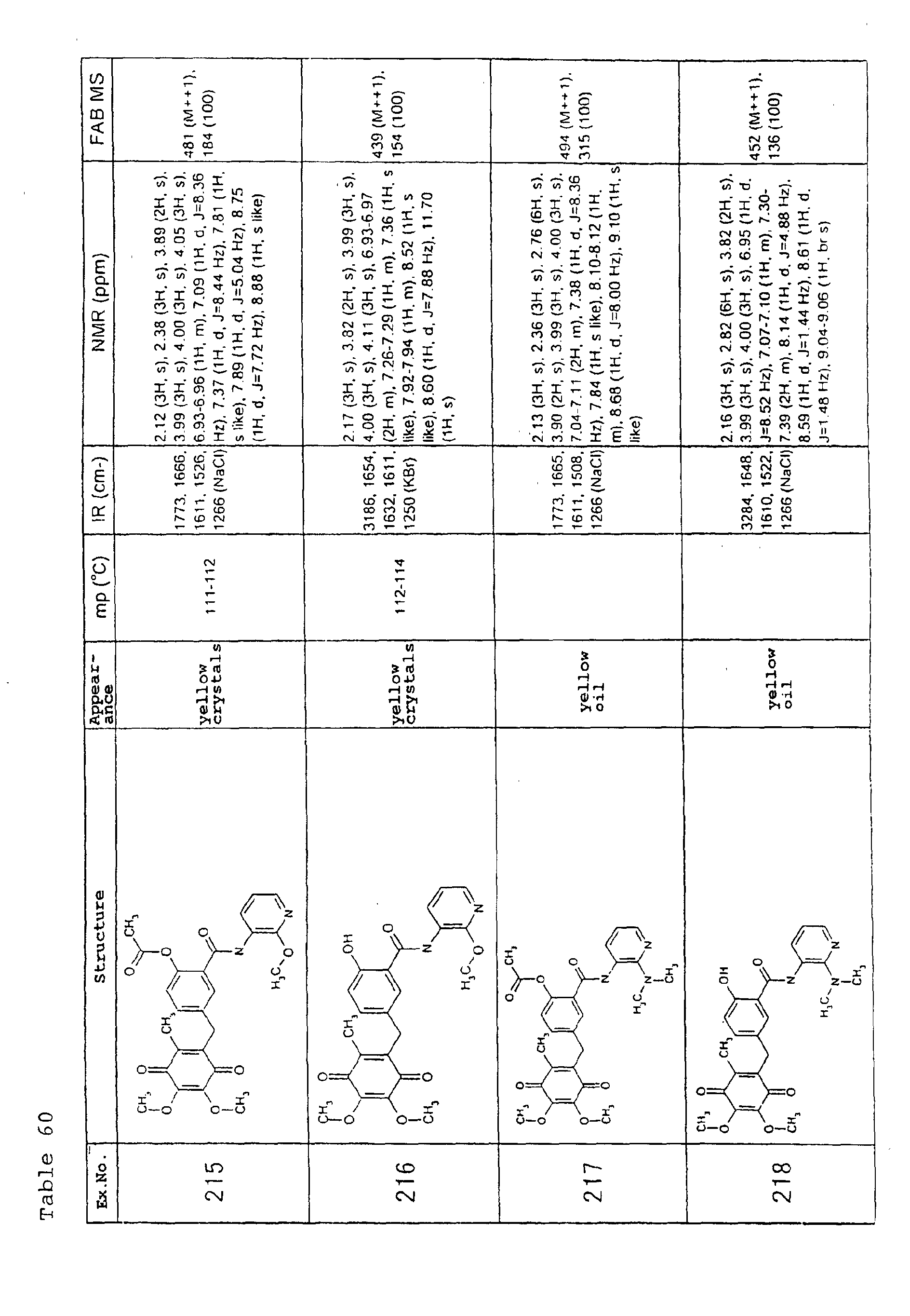
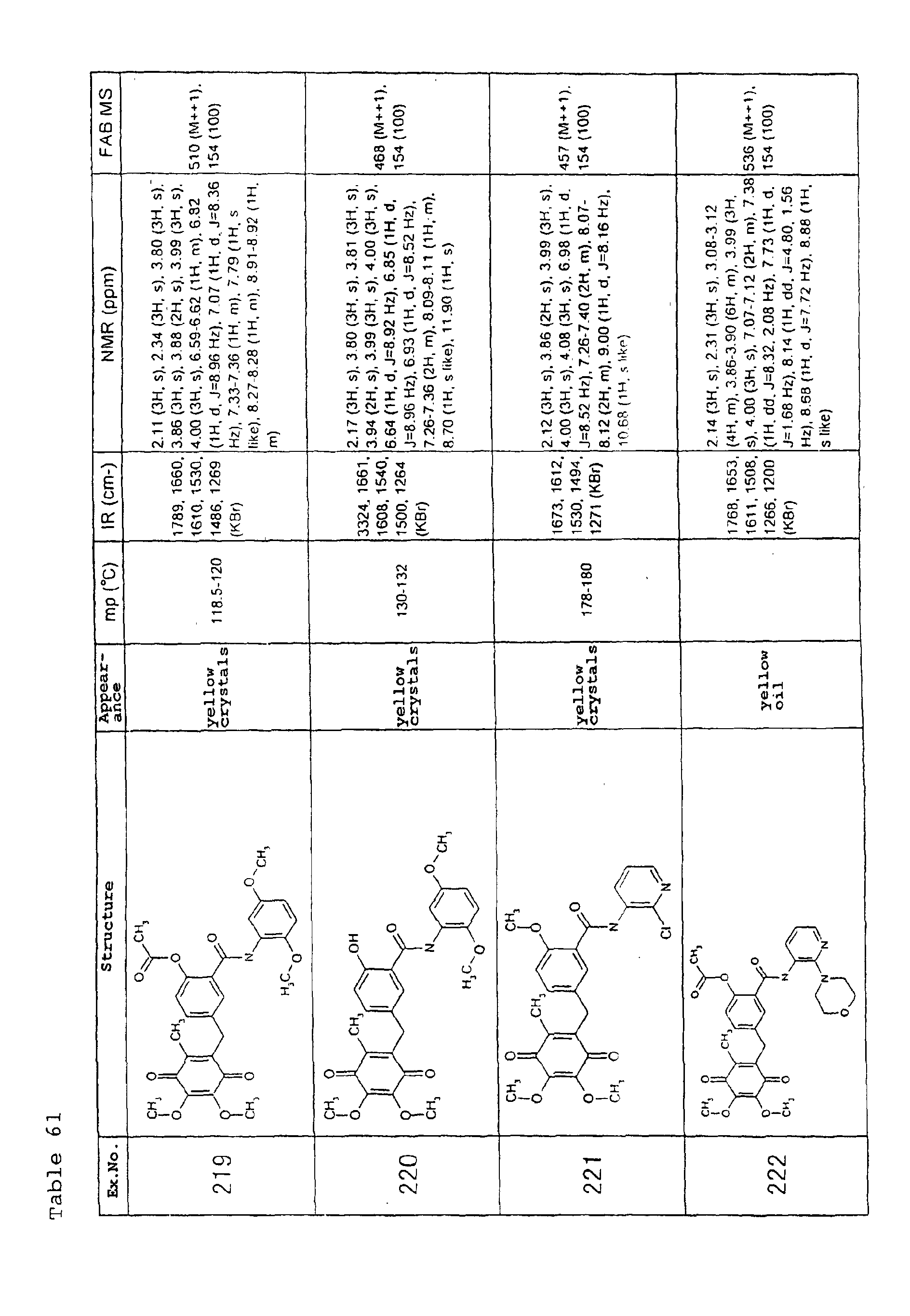


Experiment 1
Effect on Human Lung Cancer-Derived Cell A549 (A549/NF-κBluc)
Containing Stably Introduced Luciferase Plasmid
(pNFκB-Luc, Stratagene, U.S.A.) Regulated by NF-κB
Binding Sequence
-
Using Lipofectamine (Lifetech Oriental, Tokyo),
pNFκB-Luc and pSV2neo (Clontech, U.S.A.) were co-transfected
into the A549 cell (ATCC CCL185) and G418
sulfate (1 mg/ml, Lifetech Oriental) was added to the
culture medium to select cells containing stably
introduced pNFκB-Luc A549/NF-κBLuc.
-
The compound obtained in Examples each was added to
A549/NF-κBLuc and one hour after that, IL-1β capable of
activating NF-κB was added. The incubation was further
continued for 3 hours. As indexed by the luciferase
activity, the compounds obtained in Examples were
revealed to suppress the activation of NF-κB stimulated
with of IL-1β. The IC
50 values thereof are shown in
Table below.
| NF-κB Inhibitory Activity (IC50) of Substituted Benzoic Acid Derivatives: |
| Example 57 | | 29 µM |
| Example 60 | | 19 µM |
| Example 61 | | 31 µM |
| Example 64 | | 33 µM |
| Example 65 | | 37 µM |
| Example 70 | | 15 µM |
| Example 71 | | 36 µM |
| Example 72 | | 43 µM |
| Example 73 | | 31 µM |
| Example 76 | | 7 µM |
| Example 77 | | 35 µM |
| Example 78 | | 57 µM |
| Example 79 | | 27 µM |
| Example 80 | | 82 µM |
| Example 82 | | 84 µM |
| Example 84 | | 63 µM |
| Example 85 | | 65 µM |
| Example 86 | | 27 µM |
| Example 87 | | 19 µM |
| Example 89 | | 45 µM |
| Example 92 | | 49 µM |
| | (HCl) | 46 µM |
| Example 94 | | 45 µM |
| Example 95 | | 35 µM |
| | (pTsOH) | 51 µM |
| Example 104 | | 29 µM |
| Example 106 | | 70 µM |
| Example 107 | | 84 µM |
| Example 108 | | 67 µM |
| Example 109 | | 46 µM |
| Example 110 | | 34 µM |
| Example 111 | | 25 µM |
| Example 112 | | 14 µM |
| Example 114 | | 48 µM |
| Example 115 | | 36 µM |
| Example 116 | | 17 µM |
| Example 117 | | 20 µM |
| Example 118 | | 8.3 µM |
| Example 119 | | 13 µM |
| Example 120 | | 1.7 µM |
| Example 121 | | 64 µM |
| Example 124 | | 46 µM |
| Example 125 | | 19 µM |
| Example 126 | | 24 µM |
| Example 127 | | 24 µM |
| Example 128 | | 19 µM |
| Example 130 | | 59 µM |
| Example 142 | | 9 µg/ml |
| Example 146 | | 11 µg/ml |
| Example 147 | | 19 µg/ml |
| Example 148 | | 3 µg/ml |
| Example 149 | | 25 µg/ml |
| Example 150 | | 4 µg/ml |
| Example 157 | | 7 µg/ml |
| Example 158 | | 7 µg/ml |
| Example 163 | | 30 µg/ml |
| Example 164 | | 20 µg/ml |
| Example 171 | | 26 µg/ml |
| Example 173 | | 9 µg/ml |
| Example 174 | | 6 µg/ml |
| Example 180 | | 23 µg/ml |
| Example 181 | | 11 µg/ml |
| Example 184 | | 56 µg/ml |
| Example 185 | | 11 µg/ml |
| Example 186 | | 2 µg/ml |
| Example 187 | | 2 µg/ml |
| Example 188 | | 9 µg/ml |
| Example 191 | | 4 µg/ml |
| Example 199 | | 16 µg/ml |
| Example 200 | | 17 µg/ml |
| Example 201 | | 16 µg/ml |
| Example 202 | | 20 µg/ml |
| Example 203 | | 30 µg/ml |
| Example 204 | | 47 µg/ml |
| Example 205 | | 50 µg/ml |
| Example 206 | | 87 µg/ml |
| Example 207 | | 98 µg/ml |
| Example 208 | | 19 µg/ml |
| Example 214 | | 10 µg/ml |
| Example 216 | | 10 µg/ml |
| Example 220 | | 66 µg/ml |
| Example 221 | | 46 µg/ml |
| Example 222 | | 77 µg/ml |
| Example 223 | | 81 µg/ml |
| Example 224 | | 24 µg/ml |
| Example 225 | | 24 µg/ml |
| Example 226 | | 19 µg/ml |
| Example 227 | | 20 µg/ml |
| Example 228 | | 64 µg/ml |
| Example 229 | | 59 µg/ml |
| Example 235 | | 5 µg/ml |
| Example 237 | | 5 µg/ml |
Experiment 2
Effect on in vivo Sepsis Model
-
A mixed solution of N-acetyl galactosamine (GalN, 20
mg, Sigma) and lipopolysaccharide (LPS, 5 µg, Sigma) was
intraperitoneally administered as a stimulant to a 7-week-old
C3H/HeN female mice and immediately thereafter,
the compound of Example 112 suspended in a vehicle (0.5%
hydroxypropyl cellulose (HPC), produced by Nippon Soda
Co., Ltd.) was intraperitoneally administered to give a
dose of 10 mg/kg, 30 mg/kg or 100 mg/kg. The TNF-α mRNA
levels and the IL-1β mRNA levels in
liver 60 minutes
after the administration of stimulant each was measured
by the real-time PCR method, and the TNF-α levels in
plasma after 90 minutes were measured using the mouse
TNF-α ELISA kit (Biosource). In the real-time PCR using
PRISM7700 (PE Biosystems Japan) according to the protocol
of PCR quantitative System (PE Biosystems Japan), mRNA
was extracted from the liver and the TNF-α and IL-1β were
detected with cDNA obtained by Superscript
Preamplification System (Lifetech Orient) as a template.
For the detection, the following primers and TagMan
probes were used.
-
The RNA level in each sample was corrected by the
expression level of glyceraldehyde 3-phosphate
dehydrogenase (GAPDH) gene.
-
ELISA was performed according to the manual included
in the kit. The comparison with the vehicle group was
performed by the Dunnett's Multiple Comparison test using
Stat-View (SAS Institute).
-
As shown in Fig. 1, in the vehicle group, the TNF-α
mRNA levels in liver were markedly increased and the TNF-α
levels in plasma were also increased. Furthermore,
the IL-1β mRNA levels in liver were increased. On the
other hand, in the group administered with the compound
of Example 112, the TNF-α mRNA in liver and the TNF-α
levels in plasma were suppressed dose dependently. Also,
the IL-1β mRNA levels in liver were suppressed.
Experiment 3
Effect on Sepsis Model in Oral Administration
-
Similarly to Experiment 2, a mixed solution of GalN
(20 mg) and LPS (2 µg) was intraperitoneally administered
as a stimulant to a 7-week-old C3H/HeN female mice. Ten
minutes before that, the compound of Example 112 or the
compound of Example 157 each suspended in a vehicle (0.5%
HPC) was orally administered to give a dose of 10 mg/kg,
30 mg/kg or 100 mg/kg. The TNF-α mRNA levels in liver
60 minutes after the administration of stimulant were
measured by the real-time PCR method, and the TNF-α
levels in plasma after 90 minutes were measured using the
mouse TNF-α ELISA kit. The comparison with the vehicle
group was performed by the Dunnett's Multiple Comparison
test using Stat-View.
-
Also in the group where the compound of Example 112
(Fig. 2) or the compound of Example 157 (Fig. 3) was
orally administered, the TNF-α mRNA levels in liver and
the TNF-α levels in plasma were suppressed dose
dependently.
Experiment 4
Effect on Acute Inflammation in Oral Administration Model
-
On the footpad of the right hind leg of a 5-week-old
Wister male rat, 0.1 ml of 1 w/v% λ-carrageenin (Sigma)
was subcutaneously administered. Immediately thereafter,
the compound of Example 112 or the compound of Example
157 each suspended in a vehicle (0.5% HPC) was orally
administered to give a dose of 100 mg/kg. As a positive
control, indomethacin (sigma) was orally administered to
give a dose of 10 mg/kg. The foot edema ratio was
calculated according to the formula: (volume of foot 2
hours after administration of carrageenin - volume of
foot before administration)/volume of foot before
administration × 100, using a volume meter (TK-101,
manufactured by Unicom). For the comparison between the
vehicle group and the drug administered group, a variance
test was performed by the F-test and thereafter,
Student's t test was performed when the variance was
equal, or Aspin-Welch's t test was performed when the
variance was not equal.
-
As shown in Fig. 4, the compound of Example 112 and
the compound of Example 157 significantly suppressed the
acute inflammation (foot edema) caused by carrageenin
through their oral administration.


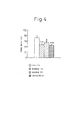


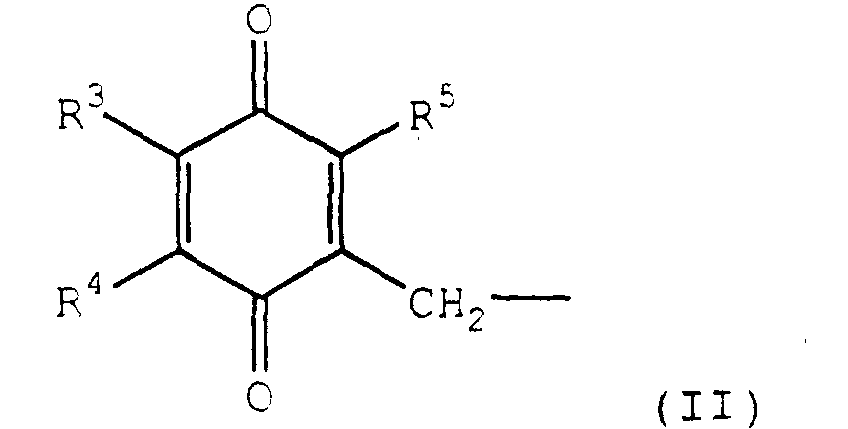 [wherein R3, R4 and R5 each independently represents a hydrogen atom, an alkyl group having from 1 to 6 carbons or an alkoxy group having from 1 to 6 carbons, and R9 and R10 each independently represents a hydrogen atom, an alkyl group having from 1 to 6 carbons or an acyl group having from 2 to 11 carbons);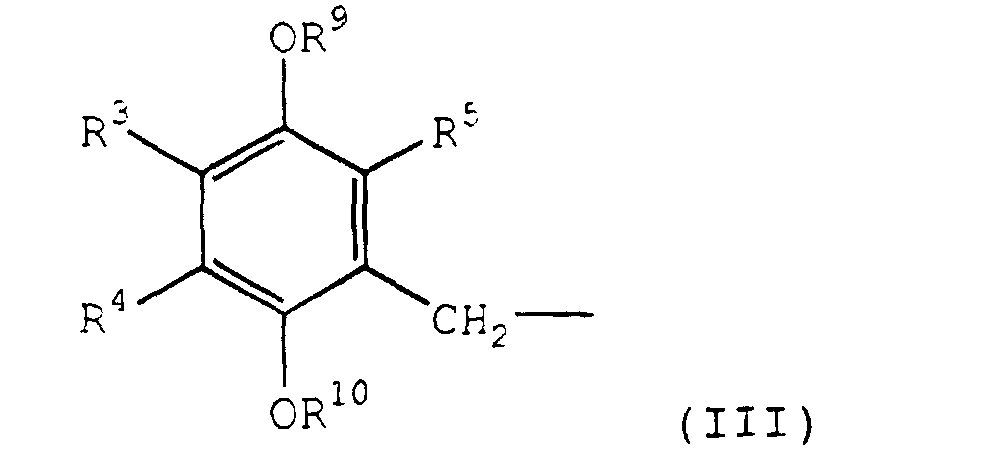


 (wherein R3 and R4 each represents a methyl group or a methoxy group and R5 represents a methyl group); R2 represents a hydrogen atom, a methyl group, an isopropyl group, a phenyl group, a 3-methoxyphenyl group, a 3-pyridyl group, a 4-pyridyl group, a benzyl group, a 3-pyridylmethyl group, a 4-pyridylmethyl group, an acety group, a carboxymethyl group, a methoxycarbonylmethyl group or tert-butoxycarbonylmethyl group; and X represents a carboxyl group which may be esterified or amidated).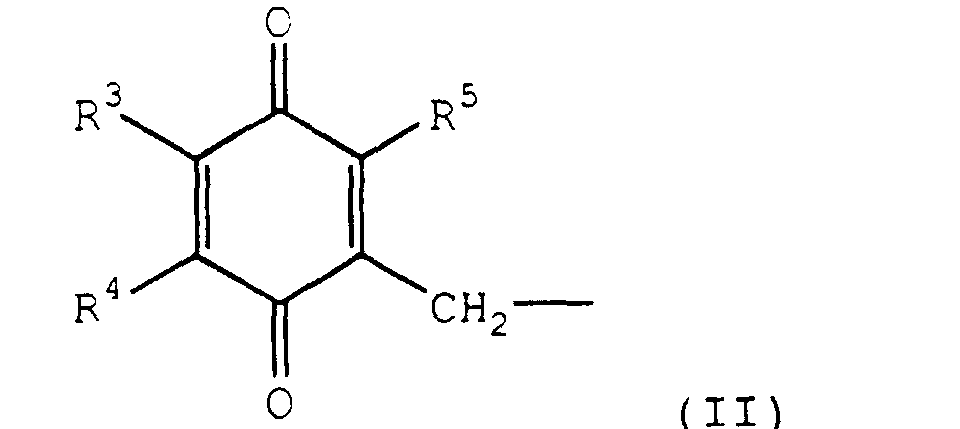
 (wherein R3 to R5, R9 and R10 are as defined above, and Bn represents a benzyl group, which may be substituted), and this compound is reduced with a reducing agent such as triethylsilane in the presence of catalyst such as Lewis acid or trimethylsilyl trifluoromethanesulfonate and then catalytically reduced by stirring it in a hydrogen stream in the presence of catalyst such as palladium-carbon to obtain a phenol derivative represented by formula (VI):
 (wherein R3 to R5, R9 and R10 are as defined above).
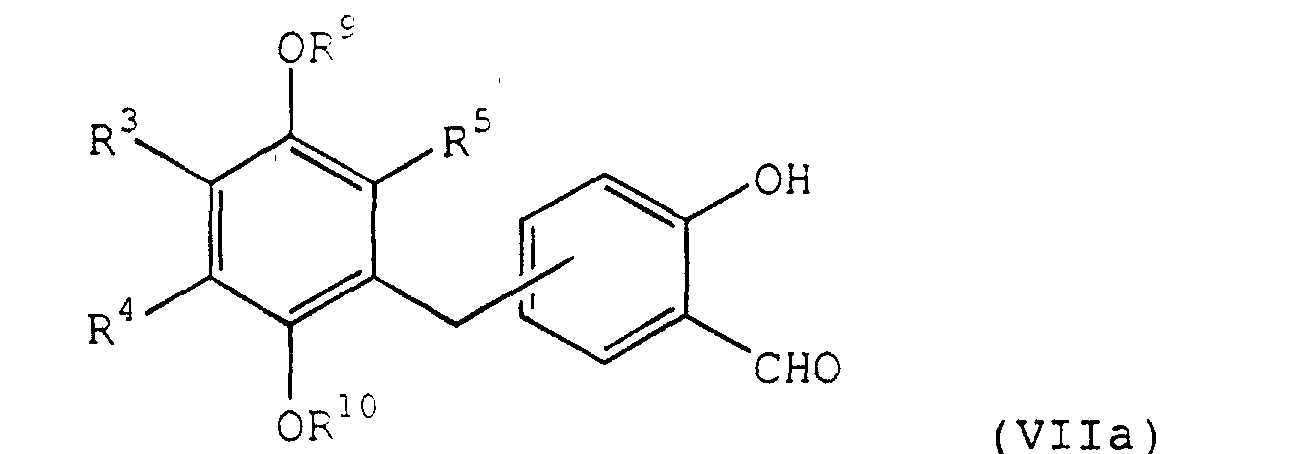
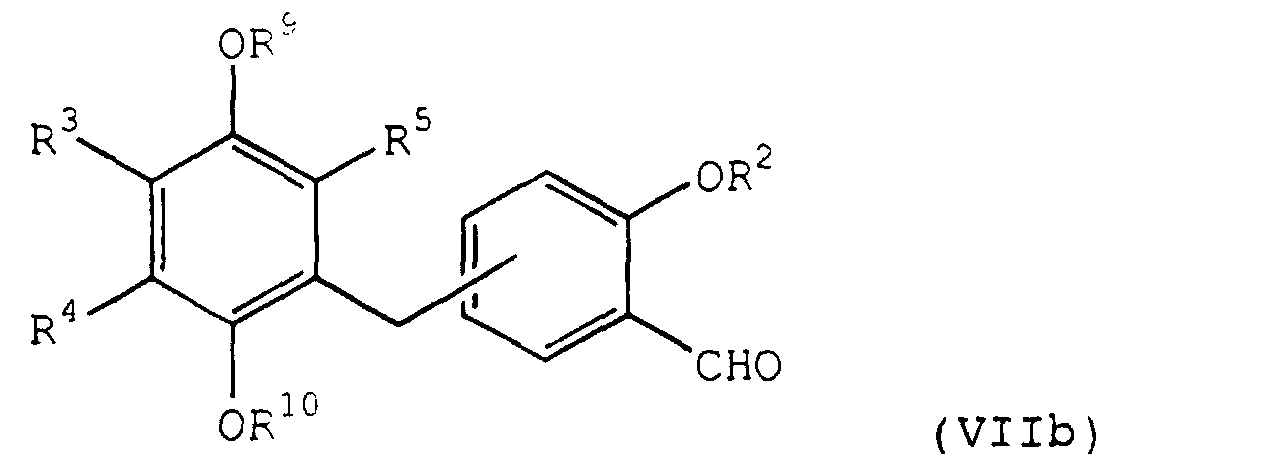
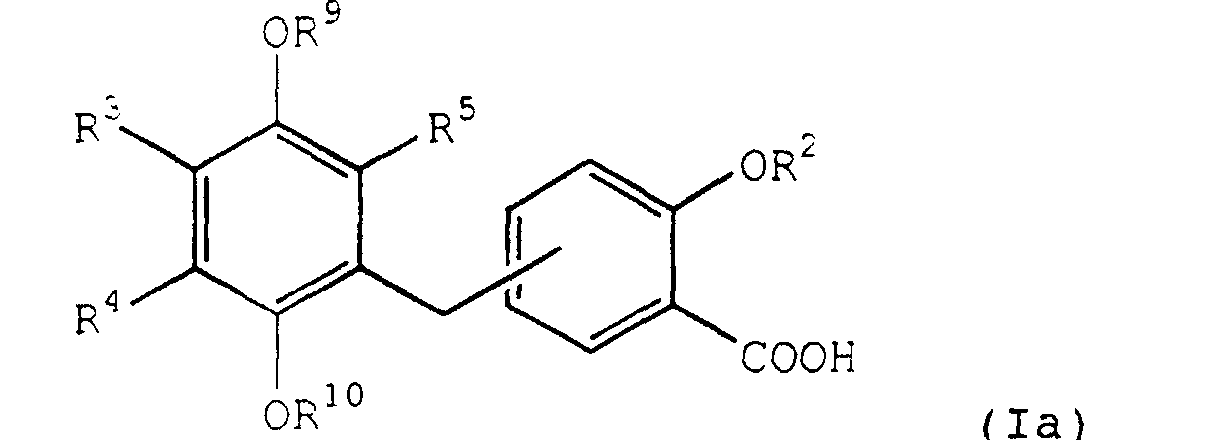
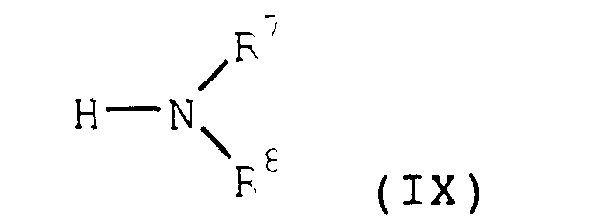 (wherein R2 to R5, R9 and R10 are as defined above and X' represents an esterified or amidated carboxyl group) can be obtained.
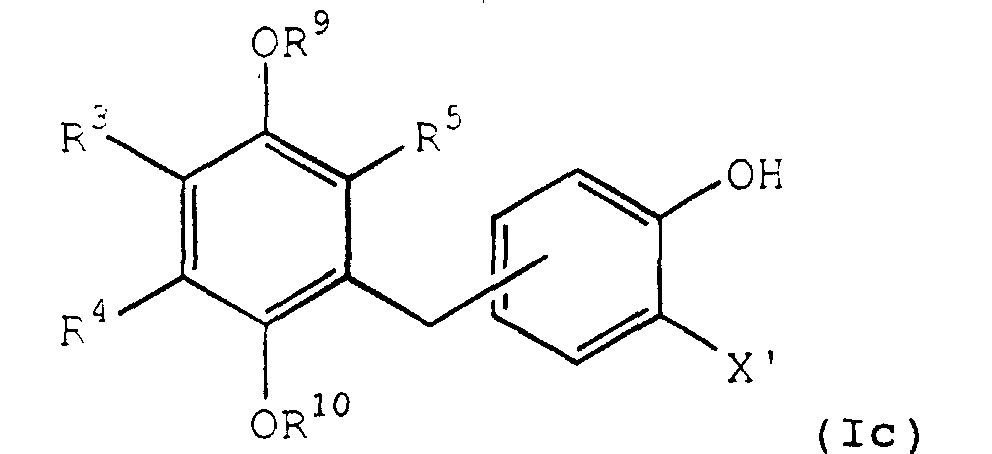


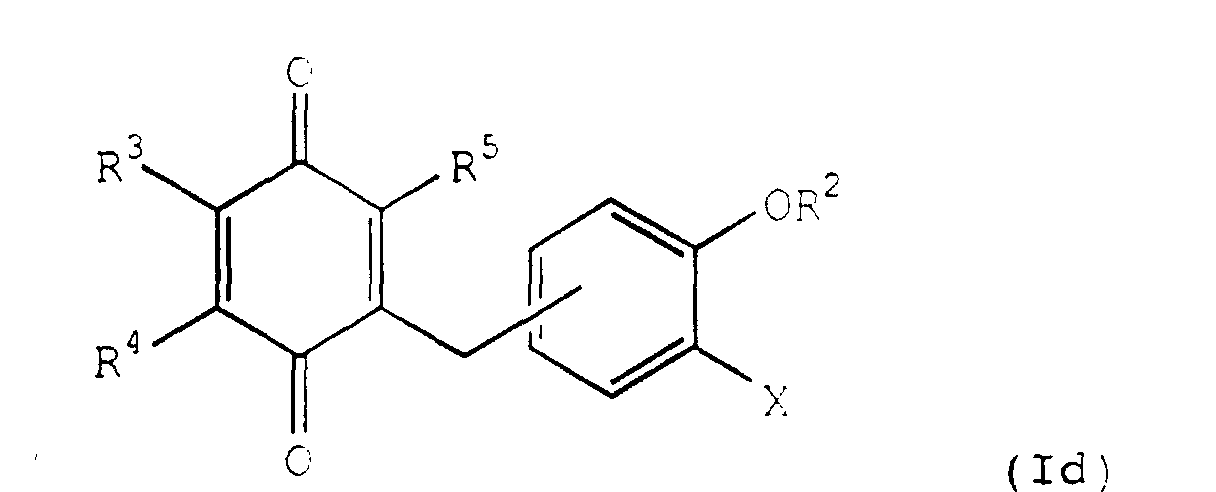
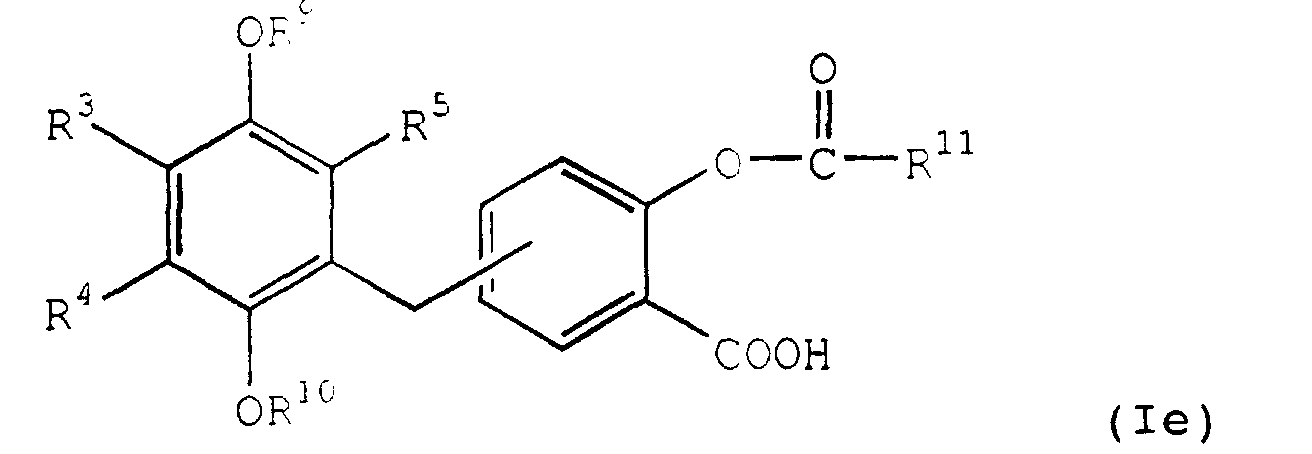
 (wherein R3 to R5 and R11 are as defined above and X' represents an esterified or amidated carboxyl group) can be obtained.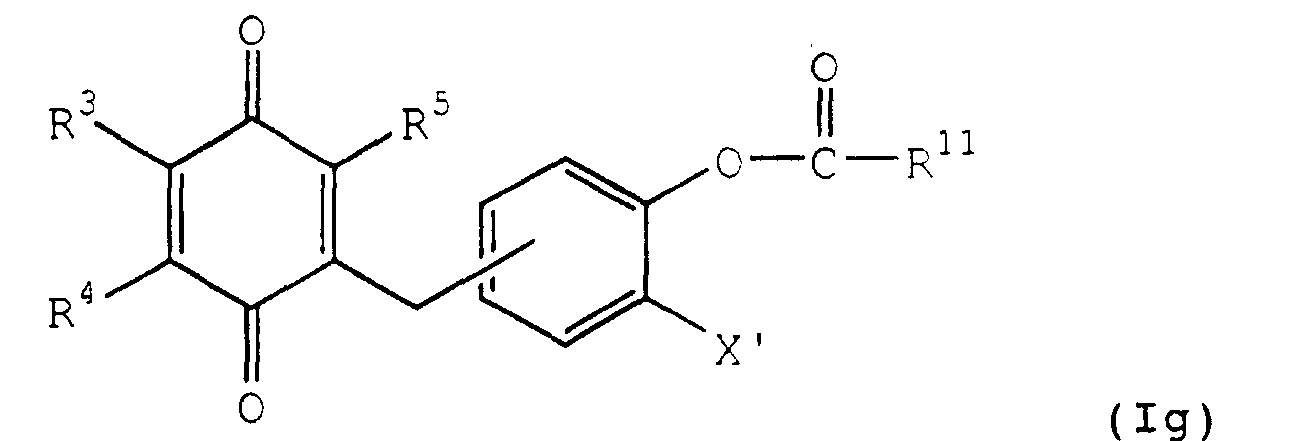
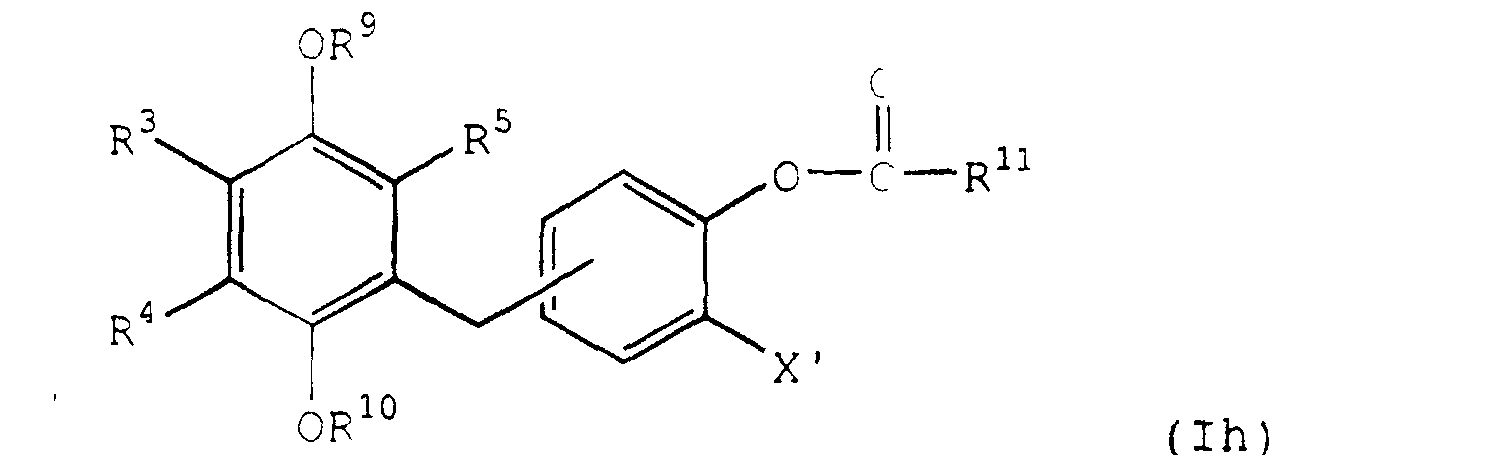


 (wherein R3, R4 and R5 each independently represents a hydrogen atom, an alkyl group having from 1 to 6 carbons or an alkoxy group having from 1 to 6 carbons, and R9 and R10 each independently represents a hydrogen atom, an alkyl group having from 1 to 6 carbons or an acyl group having from 2 to 11 carbons);

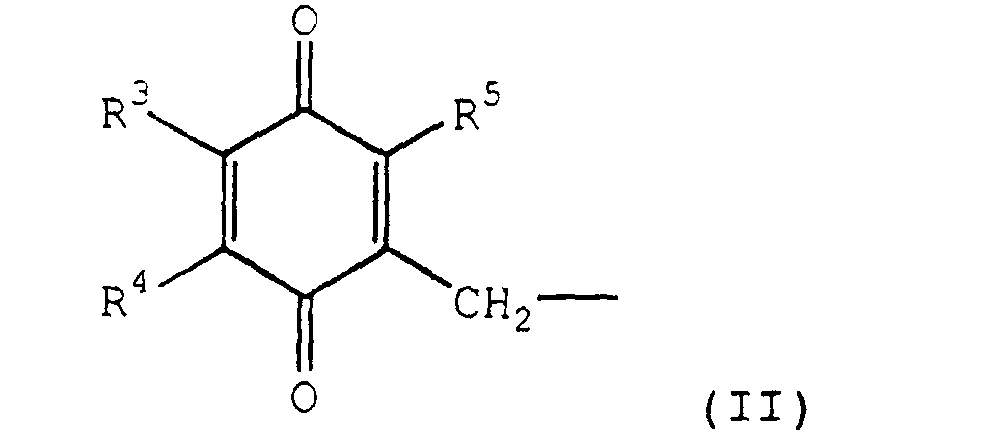
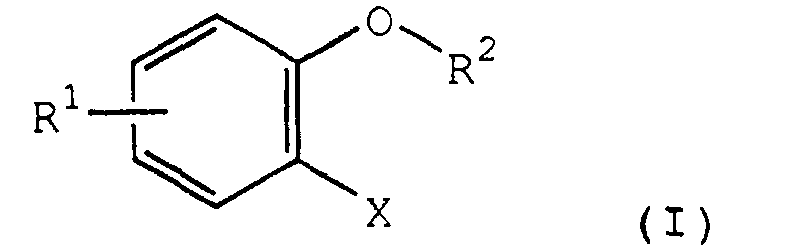 (wherein R3 and R4 each represents a methyl group or a methoxy group, and R5 represents a methyl group); R2 represents a hydrogen atom, a methyl group, an isopropyl group, a phenyl group, a 3-methoxyphenyl group, a 3-pyridyl group, a 4-pyridyl group, a benzyl group, a 3-pyridylmethyl group, a 4-pyridylmethyl group, an acetyl group, a carboxymethyl group, a methoxycarbonylmethyl group or a tert-butoxycarbonylmethyl group; and X represents a carboxyl group which may be esterified or amidated.

 (wherein R3, R4 and R5 each independently represents a hydrogen atom, an alkyl group having from 1 to 6 carbons or an alkoxy group having from 1 to 6 carbons, and R9 and R10 each independently represents a hydrogen atom, an alkyl group having from 1 to 6 carbons or an acyl group having from 2 to 11 carbons);