EP1314415A1 - Cosmetics - Google Patents
Cosmetics Download PDFInfo
- Publication number
- EP1314415A1 EP1314415A1 EP01947978A EP01947978A EP1314415A1 EP 1314415 A1 EP1314415 A1 EP 1314415A1 EP 01947978 A EP01947978 A EP 01947978A EP 01947978 A EP01947978 A EP 01947978A EP 1314415 A1 EP1314415 A1 EP 1314415A1
- Authority
- EP
- European Patent Office
- Prior art keywords
- cosmetic material
- silicone
- component
- wax
- acid
- Prior art date
- Legal status (The legal status is an assumption and is not a legal conclusion. Google has not performed a legal analysis and makes no representation as to the accuracy of the status listed.)
- Withdrawn
Links
Classifications
-
- A—HUMAN NECESSITIES
- A61—MEDICAL OR VETERINARY SCIENCE; HYGIENE
- A61K—PREPARATIONS FOR MEDICAL, DENTAL OR TOILETRY PURPOSES
- A61K8/00—Cosmetics or similar toiletry preparations
- A61K8/18—Cosmetics or similar toiletry preparations characterised by the composition
- A61K8/72—Cosmetics or similar toiletry preparations characterised by the composition containing organic macromolecular compounds
- A61K8/84—Cosmetics or similar toiletry preparations characterised by the composition containing organic macromolecular compounds obtained by reactions otherwise than those involving only carbon-carbon unsaturated bonds
- A61K8/89—Polysiloxanes
- A61K8/891—Polysiloxanes saturated, e.g. dimethicone, phenyl trimethicone, C24-C28 methicone or stearyl dimethicone
- A61K8/893—Polysiloxanes saturated, e.g. dimethicone, phenyl trimethicone, C24-C28 methicone or stearyl dimethicone modified by an alkoxy or aryloxy group, e.g. behenoxy dimethicone or stearoxy dimethicone
-
- A—HUMAN NECESSITIES
- A61—MEDICAL OR VETERINARY SCIENCE; HYGIENE
- A61K—PREPARATIONS FOR MEDICAL, DENTAL OR TOILETRY PURPOSES
- A61K8/00—Cosmetics or similar toiletry preparations
- A61K8/18—Cosmetics or similar toiletry preparations characterised by the composition
- A61K8/92—Oils, fats or waxes; Derivatives thereof, e.g. hydrogenation products thereof
-
- A—HUMAN NECESSITIES
- A61—MEDICAL OR VETERINARY SCIENCE; HYGIENE
- A61K—PREPARATIONS FOR MEDICAL, DENTAL OR TOILETRY PURPOSES
- A61K8/00—Cosmetics or similar toiletry preparations
- A61K8/18—Cosmetics or similar toiletry preparations characterised by the composition
- A61K8/30—Cosmetics or similar toiletry preparations characterised by the composition containing organic compounds
-
- A—HUMAN NECESSITIES
- A61—MEDICAL OR VETERINARY SCIENCE; HYGIENE
- A61K—PREPARATIONS FOR MEDICAL, DENTAL OR TOILETRY PURPOSES
- A61K8/00—Cosmetics or similar toiletry preparations
- A61K8/18—Cosmetics or similar toiletry preparations characterised by the composition
- A61K8/72—Cosmetics or similar toiletry preparations characterised by the composition containing organic macromolecular compounds
- A61K8/81—Cosmetics or similar toiletry preparations characterised by the composition containing organic macromolecular compounds obtained by reactions involving only carbon-to-carbon unsaturated bonds
- A61K8/8105—Compositions of homopolymers or copolymers of unsaturated aliphatic hydrocarbons having only one carbon-to-carbon double bond; Compositions of derivatives of such polymers
- A61K8/8111—Homopolymers or copolymers of aliphatic olefines, e.g. polyethylene, polyisobutene; Compositions of derivatives of such polymers
-
- A—HUMAN NECESSITIES
- A61—MEDICAL OR VETERINARY SCIENCE; HYGIENE
- A61K—PREPARATIONS FOR MEDICAL, DENTAL OR TOILETRY PURPOSES
- A61K8/00—Cosmetics or similar toiletry preparations
- A61K8/18—Cosmetics or similar toiletry preparations characterised by the composition
- A61K8/72—Cosmetics or similar toiletry preparations characterised by the composition containing organic macromolecular compounds
- A61K8/84—Cosmetics or similar toiletry preparations characterised by the composition containing organic macromolecular compounds obtained by reactions otherwise than those involving only carbon-carbon unsaturated bonds
- A61K8/89—Polysiloxanes
- A61K8/891—Polysiloxanes saturated, e.g. dimethicone, phenyl trimethicone, C24-C28 methicone or stearyl dimethicone
- A61K8/894—Polysiloxanes saturated, e.g. dimethicone, phenyl trimethicone, C24-C28 methicone or stearyl dimethicone modified by a polyoxyalkylene group, e.g. cetyl dimethicone copolyol
-
- A—HUMAN NECESSITIES
- A61—MEDICAL OR VETERINARY SCIENCE; HYGIENE
- A61K—PREPARATIONS FOR MEDICAL, DENTAL OR TOILETRY PURPOSES
- A61K8/00—Cosmetics or similar toiletry preparations
- A61K8/18—Cosmetics or similar toiletry preparations characterised by the composition
- A61K8/72—Cosmetics or similar toiletry preparations characterised by the composition containing organic macromolecular compounds
- A61K8/84—Cosmetics or similar toiletry preparations characterised by the composition containing organic macromolecular compounds obtained by reactions otherwise than those involving only carbon-carbon unsaturated bonds
- A61K8/89—Polysiloxanes
- A61K8/895—Polysiloxanes containing silicon bound to unsaturated aliphatic groups, e.g. vinyl dimethicone
-
- A—HUMAN NECESSITIES
- A61—MEDICAL OR VETERINARY SCIENCE; HYGIENE
- A61Q—SPECIFIC USE OF COSMETICS OR SIMILAR TOILETRY PREPARATIONS
- A61Q17/00—Barrier preparations; Preparations brought into direct contact with the skin for affording protection against external influences, e.g. sunlight, X-rays or other harmful rays, corrosive materials, bacteria or insect stings
- A61Q17/04—Topical preparations for affording protection against sunlight or other radiation; Topical sun tanning preparations
-
- A—HUMAN NECESSITIES
- A61—MEDICAL OR VETERINARY SCIENCE; HYGIENE
- A61Q—SPECIFIC USE OF COSMETICS OR SIMILAR TOILETRY PREPARATIONS
- A61Q19/00—Preparations for care of the skin
-
- A—HUMAN NECESSITIES
- A61—MEDICAL OR VETERINARY SCIENCE; HYGIENE
- A61Q—SPECIFIC USE OF COSMETICS OR SIMILAR TOILETRY PREPARATIONS
- A61Q1/00—Make-up preparations; Body powders; Preparations for removing make-up
- A61Q1/02—Preparations containing skin colorants, e.g. pigments
-
- A—HUMAN NECESSITIES
- A61—MEDICAL OR VETERINARY SCIENCE; HYGIENE
- A61Q—SPECIFIC USE OF COSMETICS OR SIMILAR TOILETRY PREPARATIONS
- A61Q1/00—Make-up preparations; Body powders; Preparations for removing make-up
- A61Q1/02—Preparations containing skin colorants, e.g. pigments
- A61Q1/04—Preparations containing skin colorants, e.g. pigments for lips
- A61Q1/06—Lipsticks
-
- A—HUMAN NECESSITIES
- A61—MEDICAL OR VETERINARY SCIENCE; HYGIENE
- A61Q—SPECIFIC USE OF COSMETICS OR SIMILAR TOILETRY PREPARATIONS
- A61Q1/00—Make-up preparations; Body powders; Preparations for removing make-up
- A61Q1/02—Preparations containing skin colorants, e.g. pigments
- A61Q1/10—Preparations containing skin colorants, e.g. pigments for eyes, e.g. eyeliner, mascara
-
- A—HUMAN NECESSITIES
- A61—MEDICAL OR VETERINARY SCIENCE; HYGIENE
- A61Q—SPECIFIC USE OF COSMETICS OR SIMILAR TOILETRY PREPARATIONS
- A61Q1/00—Make-up preparations; Body powders; Preparations for removing make-up
- A61Q1/12—Face or body powders for grooming, adorning or absorbing
-
- A—HUMAN NECESSITIES
- A61—MEDICAL OR VETERINARY SCIENCE; HYGIENE
- A61Q—SPECIFIC USE OF COSMETICS OR SIMILAR TOILETRY PREPARATIONS
- A61Q15/00—Anti-perspirants or body deodorants
-
- A—HUMAN NECESSITIES
- A61—MEDICAL OR VETERINARY SCIENCE; HYGIENE
- A61Q—SPECIFIC USE OF COSMETICS OR SIMILAR TOILETRY PREPARATIONS
- A61Q5/00—Preparations for care of the hair
Definitions
- the present invention relates to a cosmetic material using silicone-modified wax, specifically carboxyl group-and/or carboxylic acid anhydride-containing polyethylene wax and/or polypropylene wax modified with a silicone. More specifically, the invention is concerned with a cosmetic material in which the wax specified above is incorporated to impart thereto a good spread capability, high possibility of giving a feeling of refreshment to users and strong repellencies to sweat and water. When applied to skin, the present cosmetic material can therefore ensure elasticity, smoothness, emollient effect, natural luster and good keeping qualities.
- cosmetic materials containing liquid unctuous agents such as paraffin, ester, higher alcohol, glyceride and the like, have been used for the purpose of adding elasticity, smoothness, emollient effect and so on.
- these cosmetic materials have drawbacks of producing a greasy feeling, a tacky feeling and a feeling of being covered with an oil film. So it has also been known to mix silicone oils, such as dimethylpolysiloxane, in the cosmetic materials of the aforementioned compositions with the intention of reducing those greasy, tacky and filmy feels.
- silicone oils have good spread capability, high smoothness and strong repellency, they have a disadvantage of being inferior in compatibility with liquid oils of hydrocarbon type.
- silicone oils have low surface tension, so they spread quickly and have short residence time. Such being the case, attempts to solidify silicone oils have been made.
- the compound having a silicone chain to which alkyl groups are introduced Japanese Patent Laid-Open (hereinafter referred to as "Tokkai") Hei 2-64115
- the compound having a silicone chain to which 21-30C aliphatic alcohol or acid ester groups are introduced Tokkai Hei 10-500431
- the acrylate silicone Tokkai Hei 2-132141
- solidification of those compounds are made in the presence of liquid oil, such as ester oil, triglyceride oil, paraffin oil or so on, because their affinities for waxes are enhanced under such a condition.
- liquid oil such as ester oil, triglyceride oil, paraffin oil or so on
- the silicone oil by itself can form a solidified matter.
- this solidified matter is resinous and lacking in smoothness suitable for cosmetics. Under these circumstances, solid substances capable of bringing silicone oil characteristics into full play, and that with highly satisfactory smoothness, still haven't been found.
- silicone oil can be made into a smooth solid by mixing with silicone-modified wax containing an ester linkage in a molecule which is produced by reacting carboxyl group- and/or carboxylic anhydride-containing polyethylene and/or polypropylene wax with a silicone compound, preferably a silicone compound containing only one epoxy group in a molecule or a silicone compound containing both only one carbon-carbon double bond and only one epoxy group in a molecule, and then subjecting the resultant reaction product to hydrosilylation reaction with a silicone compound, preferably a silicone compound containing only one silicon-hydrogen bond in a molecule, thereby achieving the invention.
- a silicone compound preferably a silicone compound containing only one epoxy group in a molecule or a silicone compound containing both only one carbon-carbon double bond and only one epoxy group in a molecule
- an object of the present invention is to provide a cosmetic material having excellent usability and high stability over a long term, specifically a cosmetic material which can be spread lightly, easily and smoothly without tackiness when applied to skin and arouse dry, smooth and refreshing feelings in users, and further has not only strong repellency to sweat and water but also properties of imparting elasticity, smoothness, emollient effect and natural luster to skin without impairing skin's moderate transpiration by application thereof.
- the present invention is a cosmetic material containing silicone-modified wax as Component (A), characterized in that the silicone-modified wax is wax in which low-molecular-weight polyethylene and/or low-molecular-weight polypropylene is linked to a silicone via an ester linkage.
- the present cosmetic material can be spread lightly and produce a feeling of refreshment when applied to skin. More specifically, it can be spread easily and smoothly without tackiness when applied to skin and arouse dry, smooth and refreshing feelings in users. Further, the present cosmetic material has good long-term stability as well as excellent usability since it has not only strong repellency to sweat and water but also properties of imparting elasticity, smoothness, emollient effect and natural luster to skin without impairing skin's moderate transpiration by application thereof.
- the low-molecular-weight, carboxyl group- and/or carboxylic anhydride-containing polyethylene and/or polypropylene used as a starting material of the present silicone-modified wax has a molecular weight of 1,000 to 50,000.
- maleic anhydride-grafted polyethylene and polypropylene having an acid value of 10 to 100 KOH mg/g are advantageously used as such a starting material.
- these polyethylene and polypropylene are marketed by, e.g., Mitsui Chemicals and Sanyo Chemical Industries, Ltd. under the trade names of Mitsui Hiwax and Yumex, respectively, there have been no cases of using such high-melting-point silicone wax in cosmetic materials.
- the present invention enables smooth solidification of silicone oils themselves by taking advantage of their high-melting-point characteristics.
- Methods for synthesizing the aforesaid silicone-modified wax used in the invention fall into two broad categories.
- the methods in the first category involve reaction of carboxyl group- and/or carboxylic anhydride-containing polyethylene (or polypropylene) wax with an epoxy group-containing dimethylsilicone, preferably a dimethylsilicone having an epoxy group at only one end of its chain.
- an epoxy group-containing dimethylsilicone preferably a dimethylsilicone having an epoxy group at only one end of its chain.
- a silicone compound having two or more epoxy groups at both ends or/and in the interior of its molecule may be also used so far as it causes gelling in the reaction product.
- solvents may be used or not, and it is appropriate that the reaction temperature be adjusted to 100°C or higher, especially 140°C or higher.
- the reaction temperature When no solvent is used in the reaction, it is preferable to adjust the reaction temperature so as to be higher than the melting point of the wax used.
- the reaction may be conducted in the absence or presence of a catalyst.
- a catalyst tertiary amines, metal soaps, imidazole compounds and so on are suitable as the catalyst.
- the proportion of the silicone compound to the wax in the reaction it is appropriate that the silicone compound be used in an amount of 0.2 to 5 equivalents, particularly 0.5 to 2 equivalents, in terms of epoxy group when the wax is used in an amount of 1 equivalent in terms of carboxyl group. In respect of reactivity, cyclic epoxy groups are preferred to linear epoxy groups.
- the methods in the second category involve, as the first step, reaction of a compound containing an epoxy group and a double bond in its molecule, e.g., Celoxide 2,000 (trade name of vinylcyclohexene epoxide produced by DaiCel Chemical Industries, Ltd.), with carboxyl group and/or carboxylic anhydride-containing polyethylene (or polypropylene) wax. Since the compound, such as Celoxide 2,000, can be removed by heating under reduced pressure after the reaction, it is advantageous from the viewpoint of enhancing reaction efficiency to use 1.2 to 5 equivalents of Celoxide 2,000 or the like with respect to 1 equivalent of carboxyl group in the wax.
- the suitable reaction conditions are the same as in the former case of using an epoxysilicone compound.
- double bond-introduced polyethylene (or polypropylene) wax By distilling off Celoxide 2,000 or the like through heating under reduced pressure, double bond-introduced polyethylene (or polypropylene) wax can be obtained. It is appropriate that addition reaction between this wax and a Si-H bond-containing silicone be carried out at the melting temperature of the wax or higher when conducted in the absence of a solvent. When the addition reaction is conducted in the presence of a solvent, on the other hand, the suitable reaction temperature is in the range of to 140°C.
- precious metal catalysts such as chloroplatinic acid, can be used.
- the silicone compound be used in an amount of 0.1 to 5 equivalnets, particularly 0.2 to 1 equivalent, in terms of Si-H group when the wax is present in an amount of one equivalent in terms of double bond.
- the intended silicone-modified wax can be obtained by distilling off the solvent through heating under reduced pressure.
- the present silicone compound can be used for a wide variety of purposes. Specifically, it is highly suitable as an ingredient in every kind of cosmetic material externally applied to skin or hair, including skin-care cosmetics, makeup cosmetics, hair-care cosmetics, antiperspirant cosmetics, UV protective cosmetics and so on. In such cosmetics, it is possible to mix the silicone-modified wax of Component (A) in a proportion of 0.1 to 95 weight % to total cosmetic material. In a special case of solid-state or stick-shaped cosmetic materials wherein powdery ingredients account for at most 25 % of total formulation, the suitable proportion of the present silicone-modified wax compounded is from 5 to 95 weight % to total cosmetic material. In another case of solid cosmetics wherein powdery ingredients are contained in a proportion of at least 80 weight % to total formulation, it is appropriate to mix the present silicone-modified wax in a proportion of 0.1 to 10 weight % to total cosmetic material.
- the present cosmetic materials can further contain as Component (B) one or more kinds of unctuous agents depending on the desired purposes thereof.
- the unctuous agents used together may be in any of solid, semisolid and liquid states, provided that they have so far been used for general cosmetics.
- not only natural animal and vegetable fats and oils but also semi-synthetic fats and oils can be mixed as unctuous agents in the present cosmetic materials, with examples including avocado oil, linseed oil, almond oil, Chinese wax, perilla oil, olive oil, cacao butter, kapok wax, kaya oil, carnauba wax, liver oil, candellila wax, beef tallow, beef foot oil, beef bone fat, hydrogenated beef tallow, apricot kernel oil, spermaceti, hydrogenated oil, wheat germ oil, sesame oil, rice germ oil, rice bran oil, sugar cane wax, sasanqua oil, safflower oil, shea butter, Chinese tung oil, cinnamon oil, jojoba wax, shellac wax, turtle oil, soybean oil, tea seed oil, tsubaki oil, evening primrose oil, corn oil, lard, rape seed oil, Japanese tung oil, rice-bran wax, germ oil, horse fat, persic oil, palm oil, palm kernel oil,
- EPA eicosapentaenoic acid
- DHA docosahexaenoic acid
- higher alcohol examples include lauryl alcohol, myristyl alcohol, palmityl alcohol, stearyl alcohol, behenyl alcohol, hexadecyl alcohol, oleyl alcohol, isostearyl alcohol, hexyldodecanol, octyldodecanol, cetostearyl alcohol, 2-decyltetradecinol, cholesterol, phytosterol, POE cholesterol ether, monostearyl glycerin ether (batyl alcohol), monooleyl glyceryl ether (cerakyl alcohol) and so on.
- ester oil which can also be mixed include diisobutyl adipate, 2-hexyldecyl adipate, di-2-heptylundecyl adipate, N-alkylglycol monoisostearates, isocetyl isostearate, trimethylolpropane triisostearic acid ester, ethylene glycol di-2-ethylhexanoic acid ester, cetyl 2-ethylhexanoate, trimethylolpropane tri-2-ethylhexanoic acid ester, pentaerythritol tetra-2-ethylhexanoic acid ester, cetyl octanoate, octyldodecyl gum ester, oleyl oleate, octyldodecyl oleate, decyl oleate, neopentyl glycol dicapric acid ester
- silicone oils which can be mixed as an unctuous agent
- organopolysiloxanes ranging from low to high values in viscosity, such as dimethylpolysiloxane, methylphenylpolysiloxane, methylhydrogenpolysiloxane and dimethylsiloxane-methylphenylsiloxane copolymer
- cyclic siloxanes such as octamethylcyclotetrasiloxane, decamethylcyclopentasiloxane, dodecamethylcyclohexasiloxane, tetramethyltetrahydrogen-cyclotetrasiloxane and tetramethyltetraphenylcyclotetra-siloxane
- silicone rubbers such as gummy dimethylpolysiloxanes having high polymerization degrees and gummy dimethylsiloxane-methylphenylsiloxane copolymers having high polymerization
- those unctuous agents mixed as Component (B) account for 1 to 98 weight % of total cosmetic material.
- the cosmetic material has a solid form, e.g., a cake or a stick, it is desirable to mix them in a proportion of 5 to 95 weight % to the total cosmetic material.
- the present cosmetic materials can contain water as Component (C) according to their individual usage.
- the suitable proportion of water in total cosmetic material is from 1 to 95 % by weight.
- one or more of a compound having at least one alcoholic hydroxyl group in its molecular structure can be used as Component (D) depending on their respective purposes.
- Examples of a compound having an alcoholic hydroxyl group which can be added include lower alcohol, such as ethanol and isopropanol; sugar alcohol, such as sorbitol and maltose; sterols, such as cholesterol, sitosterol, phytosterol and lanosterol; polyhydric alcohol, such as butylene glycol, propylene glycol and dibutylene glycol; and the like.
- the suitable proportion of such a compound in total cosmetic material is from 0.1 to 98 % by weight.
- one or more of a macromolecular compound dissolving or swelling in water can be mixed as Component (E) depending on their individual purposes.
- Examples of such a compound include vegetable polymers, such as gum arabic, tragacanth, galactan, carob gum, guar gum, karaya gum, carrageenan, pectin, agar, quince seed, starch (rice, corn, potato, wheat), alge colloid, tranto gum and locust bean gum; microbial polymers, such as xanthan gum, dextran, succinoglucan and pullulan; animal polymers, such as collagen, casein, albumin and gelatin; starch polymers, such as carboxymethyl starch and methylhydroxypropyl starch; cellulose polymers, such as methyl cellulose, ethyl cellulose, methylhydroxypropyl cellulose, carboxymethyl cellulose, hydroxymethyl cellulose, hydroxypropyl cellulose, nitrocellulose, sodium cellulose sulfate, sodium carboxymethylcellulose, crystalline cellulose and cellulose; alginic acid polymers, such as sodium alginate and propylene glycol ester of alg
- film-forming agents such as polyvinyl alcohol and polyvinyl pyrrolidine, are also included.
- suitable proportion of polymers as recited above in total cosmetic material is from 0.1 to 25 % by weight.
- the present cosmetic material can contain one or more kinds of powders and/or coloring agents as Component (F) according to the desired purposes.
- any powders can be mixed regardless of shape (whether they are spherical, acicular or tabular), size (whether their sizes are on the order of fume, fine grain or pigment) and structure (whether they are porous or nonporous) as long as they have hitherto been used in conventional cosmetic materials.
- Examples of an inorganic powder usable herein include titanium oxide, zirconium oxide, zinc oxide, cerium oxide, magnesium oxide, barium sulfate, calcium sulfate, magnesium sulfate, calcium carbonate, magnesium carbonate, talc, mica, kaolin, sericite, muscovite, synthetic mica, phlogopite, ruby mica, biotite, lipidolite, silicic acid, silicic anhydride, aluminum silicate, magnesium silicate, aluminum magnesium silicate, calcium silicate, barium silicate, strontium silicate, metal salts of tungstic acid, hydroxyapatite, vermiculite, haidilite, bentonite, montmorillonite, hectorite, zeolite, ceramics powder, calcium secondary phosphate, alumina, aluminum hydroxide, boron nitride, boron nitride, silica and so on.
- Examples of an organic powder usable herein include polyamide powder, polyester powder, polyethylene powder, polypropylene powder, polystyrene powder, polyurethane powder, benzoguanamine powder, polymethylbenzoguanamine powder, poly(tetrafluoroethylene) powder, polymethyl methacrylate powder, cellulose powder, silk powder, nylon powder such as 12-nylon powder or 6-nylon powder, fine powders of cross-linked silicones having structures formed by cross-linking dimethylsilicones, fine powders of polymethylsilsesquioxanes, fine powders of resins, such as styrene-acrylic acid copolymer, divinylbenzene-styrene copolymer, vinyl resin, urea resin, phenol resin, fluororesin, silicone, acrylic resin, melamine resin, epoxy resin and polycarbonate resin, microcrystalline fiber powder, starch powder, lauroyl lysine powder and so on.
- polyamide powder such as 12-nylon powder or 6-nylon powder
- Examples of a surfactant metal salt powder (metal soap powder) usable herein include powders of zinc stearate, aluminum stearate, calcium stearate, magnesium stearate, zinc myristate, magnesium myristate, zinc cetylphosphate, calcium cetylphosphate, zinc sodium cetylphosphate and so on.
- Examples of a colored pigment usable herein include inorganic red pigments, such as iron oxide, iron hydroxide and iron titanate; inorganic brown pigments, such as ⁇ -iron oxide; inorganic yellow pigments, such as iron oxide yellow and loess; inorganic black pigments, such as iron oxide black and carbon black; inorganic violet pigments, such as manganese violet and cobalt violet; inorganic green pigments, such as chromium hydroxide, chromium oxide, cobalt oxide and cobalt titanate; inorganic blue pigments, such as Prussian blue and ultramarine blue; lakes of tar pigments; lakes of natural dyes; synthetic resin powder complexes of the inorganic pigments as recited above; and so on.
- inorganic red pigments such as iron oxide, iron hydroxide and iron titanate
- inorganic brown pigments such as ⁇ -iron oxide
- inorganic yellow pigments such as iron oxide yellow and loess
- inorganic black pigments such as iron
- Examples of a pearl pigment usable herein include titanium oxide-coated mica, titanium oxide-coated mica, bismuth oxychloride, titanium oxide-coated bismuth oxychloride, titanium oxide-coated talc, fish scales, and titanium oxide-coated colored mica; and examples of a metallic powder pigment include aluminum powder, copper powder, stainless powder, and the like.
- Usable tar pigments include Red No. 3, Red No. 104, Red No. 106, Red No. 201, Red No. 202, Red No. 204, Red No. 205, Red No. 220, Red No. 226, Red No. 227, Red No. 228, Red No. 230, Red No. 401, Red No. 505, Yellow No. 4, Yellow No. 5, Yellow No. 202, Yellow No. 203, Yellow No. 204, Yellow No. 401, Blue No. 1, Blue No. 2, Blue No. 201, Blue No. 404, Green No. 3, Green No. 201, Green No. 204, Green No. 205, Orange No. 201, Orange No. 203, Orange No. 204, Orange No. 206, Orange No. 207 and so on; and usable natural pigments include powders of carminic acid, laccaic acid, carthamin, bradilin, crocin, and so on.
- powders formed into complexes or treated with general oil, silicone oil, a fluorine-containing compound or a surfactant to the extent not to adversely affect the present effect may be used, too.
- the powders as recited above can be used as a mixture of two or more thereof, if desired.
- the suitable proportion of the powders as recited above in total cosmetic material is from 0.1 to 99 % by weight. In the special cases where the cosmetic materials are in powder or cake form, it is appropriate that the powders account for 80 to 99 weight % of the total cosmetic material.
- one or more of a surfactant can also be mixed as Component (G) if needed.
- the surfactant mixed therein has no particular restriction, but it may be any of anionic, cationic, nonionic and ampho-ionic ones so long as they have hitherto been used in general cosmetics.
- anionic surfactant usable herein examples include fatty acid soap, such as sodium stearate or triethanolamine palmitate; alkyl ether carboxylic acids and salts thereof; salts of amino acid-fatty acid condensates; alkanesulfonates; alkenesulfonates; sulfonated fatty acid esters; sulfonated fatty acid amides; sulfonates of formaldehyde condensate type; alkylsulfates; higher secondary alcohol sulfates; alkyl and aryl ether sulfates; fatty acid ester sulfates, fatty acid alkylolamide sulfates; sulfates, such as Turkeky red oil; alkyl phosphates; ether phosphates; alkyl aryl ether phosphates; amide phosphates; active agents of N-acylamino acid type; and so on.
- fatty acid soap such as sodium stearate
- Examples of a cationic surfactant usable herein include amine salts, such as alkylamine salts, polyamines and aminoalcohol fatty acid derivatives; quaternary alkylammonium salts, quaternary arylammonium salts, pyridinium salts and imidazolium salts; and so on.
- amine salts such as alkylamine salts, polyamines and aminoalcohol fatty acid derivatives
- quaternary alkylammonium salts such as quaternary arylammonium salts, quaternary arylammonium salts, pyridinium salts and imidazolium salts; and so on.
- nonionic surfactant usable herein examples include sorbitan fatty acid esters, glycerin fatty acid esters, polyglycerin fatty acid esters, propylene glycol fatty acid esters, polyethylene glycol fatty acid esters, sucrose fatty acid esters, polyoxyethylene alkyl ethers, polyoxypropylene alkyl ethers, polyoxyethylene alkyl phenyl ethers, polyoxyethylene fatty acid esters, polyoxyethylene sorbitan fatty acid esters, polyoxyethylene sorbitol fatty acid esters, polyoxyethylene glycerin fatty acid esters, polyoxyethylene propylene glycol fatty acid esters, polyoxyethylene castor oil, polyoxyethylene hydrogenated castor oil, polyoxyethylene phytostanol ehter, polyoxyethylene phytosterol ether, polyoxyethylene cholestanol ether, polyoxyethylene cholesteryl ether, straight-chain or branched polyoxyalkylene-modified organopolys
- the present cosmetic materials can further contain cross-linked organopolysiloxanes as Component (H), if desired.
- the cross-linked organopolysiloxanes suitable for the present cosmetic materials are those which cause swelling when they contain a silicone having low viscosity of from 0.65 to 10.0 mm 2 /sec (25°) in a quantity larger than their weight. Further, it is desirable that the cross-linked structure of those organopolysiloxanes be formed by reaction between the hydrogen atoms bonded directly to silicon atoms and a cross-linking agent having at least two vinylic reactive moieties per molecule.
- cross-linked organopolysiloxanes containing in each individual cross-linked molecules at least one kind of moiety selected from the group consisting of polyoxyalkylene, alkyl, alkenyl, aryl and fluoroalkyl moieties.
- the suitable amount of such cross-linked organopolysiloxanes mixed in the present cosmetic material is from 0.1 to 50 %, preferably from 1 to 30 %, of the total weight of the cosmetic material.
- the present cosmetic materials can further contain one or more of silicone resin as Component (I), if desired.
- Silicone resins appropriately used herein are acrylsilicone resins, such as acryl-silicone graft or block copolymers. Further, it is possible to use an acrylsilicone resin containing in a molecule at least one moiety selected from the group consisting of a pyrrolidone moiey, a long-chain alkyl moiety, a polyoxyalkylene moiety, a fluoroalkyl moiety and anionic moieties, such as carboxylic acid.
- reticular silicone compounds represented by MQ, MDQ, MT, MDT or MDTQ.
- M, D, T and Q used herein stand for well-known basic structural units referred to as M units, D units, T units and Q units, respectively.
- reticular silicone compounds having in a molecule at least one moiety selected from the group consisting of pyrrolidone, long-chain alkyl, polyoxyalkylene, fluoroalkyl and amino moieties can also be used herein.
- the appropriate proportion of silicone resins mixed is from 0.1 to 20 weight %, particularly from 1 to 10 weight %, to the total cosmetic material.
- the ingredients used in general cosmetic materials such as oil-soluble gelling agents, clay minerals modified with organic compounds, resins, antiperspirants, ultraviolet absorbents, ultraviolet absorbing-scattering agents, moisture retention agents, antiseptics, antimicrobial agents, perfume, salts, antioxidants, pH regulators, chelating agents, refrigerants, anti-inflammatory agents, skin beautifying ingredients (a skin whitener, a cell activator, a rough dry skin improver, a blood circulation promoter, a skin astringent and an anti-seborrheic agent), vitamins, amino acids, nucleic acids, hormones, clathrate compounds and hair setting agents, can be added so far as they have no adverse influence on the effects of the present invention.
- oil-soluble gelling agents such as oil-soluble gelling agents, clay minerals modified with organic compounds, resins, antiperspirants, ultraviolet absorbents, ultraviolet absorbing-scattering agents, moisture retention agents, antiseptics, antimicrobial agents, perfume, salts, antioxidants, pH regulators,
- an antiperspirant which can be added include aluminum chlorohydrate, aluminum chloride, aluminum sesquichlorohydrate, zirconium hydroxychloride, aluminum zirconium hydroxychloride, aluminum-zirconium-glycine complex and so on.
- an ultraviolet absorbent which can be added examples include ultraviolet absorbents of benzoic acid type, such as include ultraviolet absorbents of benzoic acid type, such as p-aminobenzoic acid; those of anthranilic acid type, such as methyl anthranilate; those of salicylic acid type, such as methyl salicylate; those of succinic acid type, such as octyl p-methoxysuccinate; those of benzophenone type, such as 2,4-dihydroxybenzophenone; those of urocanic acid type, such as ethyl urocanate; those of dibenzoylmethane type, such as 4-t-butyl-4'-methoxydibenzoylmethane; and so on: and examples of an ultraviolet absorbing-scattering agent which can be added include powders capable of absorbing and scattering ultraviolet rays, such as particulate titanium dioxide, particulate Fe-doped titanium dioxide, particulate zinc oxide, particulate
- Examples of a moisture retention agent which can be added include glycerin, sorbitol, propylene glycol, dipropylene glycol, 1,3-butylene glycol, glucose, xylitol, maltitol, polyethylene glycol, hyaluronic acid, chondroitin sulfuric acid, pyrrolidone carboxylic acid, polyoxyethylene methylglucoside, polyoxypropylene methylglucoside, and so on.
- Examples of an antimold-antiseptic agent which can be added include alkyl p-hydroxybenzoates, benzoic acid, sodium benzoate, sorbic acid, potassium sorbate, phenoxyethanol, and so on; and examples of an antibacterial agent which can be added include benzoic acid, salicylic acid, carbolic acid, sorbic acid, alkyl p-hydroxybenzoates, p-chlorometacresol, hexachlorophene, benzalkonium chloride, chlorhexidine chloride, trichlorocarbanilide, photosensitizers, phenoxyethanol, and so on.
- antioxidants examples include tocopherol, butylhydroxyanisole, dibutylhydroxytoluene, phytic acid and so on;
- examples of a pH regulator which can be added include lactic acid, citric acid, glycolic acid, succinic acid, tartaric acid, dl-malic acid, potassium carbonate, sodium hydrogen carbonate, ammonium hydrogen carbonate and so on;
- examples of a chelating agent which can be added include alanine, sodium ethylenediaminetetraacetate, sodium polyphosphate, sodium metaphosphate, phosphoric acid and so on;
- examples of a refrigerant which can be added include L-menthol, camphor and so on;
- examples of an anti-inflammatory agent which can added include allantoin, glycyrrhizin and salts thereof, glycyrrhetinic acid and stearyl glycyrrhetinate, tranexamic acid, azulene, and so on.
- Examples of skin-beautifying ingredients which can be added include whitening agents, such as placenta extract, arbutin, glutathione and Yukinoshita extract; cell activators, such as royal jelly, photosensitizers, cholesterol derivatives and calf blood extract; rough dry skin improvers; blood circulation improvers, such as nonylic acid vanillyl amide, benzyl nicotinate, ⁇ -butoxyethyl nicotinate capsaicin, zingerone, cantharis tincture, ichtammol, caffeine, tannic acid, ⁇ -borneol, tocopheryl nicotinate, inositol hexanicotinate, cyclandelate, cinnarizine, tolazoline, acetyl choline, verapamil, cepharanthin and ⁇ -oryzanol; skin astringents, such as zinc oxide and tannic acid; anti-seborrheic
- vitamins which can be added include vitamin A, such as vitamin A oil, retinol, retinyl acetate and retinyl palmitate; vitamin B, including vitamin B 2 such as riboflavin, riboflavin butyrate and flavin adenine nucleotide, vitamin B 6 such as pyridoxine hydrochloride, pyridoxine dioctanoate and pyridoxine tripalmitate, vitamin B 12 and its derivatives, vitamin B 15 and its derivatives, and so on; vitamin C, such as L-ascorbic acid, L-ascorbic acid dipalmitic ester, sodium (L-ascorbic acid)-2-sulfate and dipotassium L-ascorbic acid diphosphate; vitamin D, such as ergocalciferol and cholecarciferol; vitamin E, such as ⁇ -tocopherol, ⁇ -tocopherol, ⁇ -tocopherol, dl-a-tocopheryl
- Examples of an amino acid which can be added include glycine, valine, leucine, isoleucine, serine, threonine, phenylaranine, alginine, lysine, aspartic acid, glutamic acid, cystine, cysteine, methionine, tryptophan and the like;
- examples of a nucleic acid which can be added include deoxyribonucleic acid and the like; and examples of hormone which can be added include estradiol, ethenyl estradiol, and the like.
- ampho-ionic, anionic, cationic and nonionic polymers include macromolecular compounds of polyvinyl pyrrolidone type, such as polyvinyl pyrrolidone and vinyl pyrrolydone-vinyl acetate copolymer; macromolecular compounds of acidic vinyl ether type, such as copolymer of methyl vinyl ether and maleic anhydride alkyl halfester; high polymers of acidic polyvinyl acetate type, such as vinyl acetate/crotonic acid copolymer; acidic acrylic macromolecular compounds, such as (meth)acrylic acid/alkyl (meth)acrylate copolymers and (meth)acrylic acid/alkyl (meth)acrylate/alkylacrylamide copolymers; and ampho-ionic acrylic macromolecular compounds, such as N-methacryloylethyl-N, N-
- cosmetic material as used in the invention is intended to include skin-care cosmetics, such as face lotion, milky lotion, cream, cleansing cream, face pack, oil liquid, massage articles, toilet soap, detergent, hand cream and lip balm; makeup cosmetics, such as makeup foundation, face powder, liquid foundation, oil foundation, rouge, eye shadow, mascara, eyeliner, eyebrow and lipstick; hairdressing articles, such as shampoo, rinse, treatment and a set agent; antiperspirants; UV protective cosmetics, such as sunscreen lotion and sun block cream; and so on.
- skin-care cosmetics such as face lotion, milky lotion, cream, cleansing cream, face pack, oil liquid, massage articles, toilet soap, detergent, hand cream and lip balm
- makeup cosmetics such as makeup foundation, face powder, liquid foundation, oil foundation, rouge, eye shadow, mascara, eyeliner, eyebrow and lipstick
- hairdressing articles such as shampoo, rinse, treatment and a set agent
- antiperspirants such as sunscreen lotion and sun block cream
- the present cosmetic material may have any of forms, including liquid, emulsion, cream, solid, paste, gel, powder, pressed cake, multilayer, moose, spray, stick and pencil forms, if desired.
- solid and stick forms are suitable for the present cosmetic material.
- both xylene and excess vinylcyclohexene epoxide were distilled off by heating under reduced pressure, and polyethylene wax having a vinyl group in individual molecules thereof was obtained. Then, 200 g of the thus obtained polyethylene wax was weighed out, mixed with 200 g of one-end hydrogensiloxane having the following average structural formula, 800 g of xylene and 0.2 g of a 3 % isopropanol solution of chloroplatinic acid in a flask, and therein the reactants underwent 5-hour reaction under reflux of xylene.
- silicone-modified Wax (I) having a melting point of 98°C was obtained.
- maleic anhydride-modified low-molecular-weight polypropylene wax (Mitsui Hiwax NP0555A, trade name, a product of Mitsui Chemical) having a molecular weight of 17,400, an acid value of 47, a carboxyl equivalent of 1,190 and a melting point of 140°C (wherein 0.1 mole of carboxyl groups were contained), 119 g (0.047 mole in terms of epoxy group) of silicone having an epoxy group at one molecular-chain end and an average structural formula illustrated below (epoxy equivalent: 2,500), 0.5 g of dimethylethanolamine as a catalyst and 400 g of xylene as a solvent.
- maleic anhydride-modified low-molecular-weight polypropylene wax (Mitsui Hiwax NP0555A, trade name, a product of Mitsui Chemical) having a molecular weight of 17,400, an acid value of 47, a carboxyl equivalent of 1,190 and a melting point of 140°
- Example 1 Milky Lotion Ingredients Amount mixed (weight %) 1. Silicone-modified wax (I) obtained in Synthesis Example 1 2.0 2. Dimethylpolysiloxane (6 mm 2 /sec at 25°C) 30.0 3. Decamethylcyclopentasiloxane 10.0 4. Glyceryl trioctanoate 5.0 5. Polyether-modified silicone (note 1) 5.0 6. 1,3-Butylene glycol 5.0 7. Antiseptic proper 8. Perfume proper 9. Purified water 43.0 (note 1) : KF-6017 (trade name, a product of Shin-Etsu Chemical Co., Ltd.
- Example 2 Cream of Water-in-Oil Type Ingredients Amount mixed (weight %) 1. Dimethylpolysiloxane (6 mm 2 /sec at 25°C) 10.0 2. Decamethylcyclopentasiloxane 7.0 3. Glyceryl trioctanoate 5.0 4. Polyether-modified branched-type silicone (note 1) 2.0 5. Silicone-modified wax (I) obtained in Synthesis Example 1 1.0 6. Dipropylene glycol 7.0 7. Antiseptic proper 8. Perfume proper 9. Purified water 68.0 (note 1) : KF-6028 (trade name, a product of Shin-Etsu Chemical Co., Ltd.)
- Example 3 Cream of Water-in-Oil Type Ingredients Amount mixed (weight %) 1. Silicone-modified wax (I) obtained in Synthesis Example 1 2.0 2. Dimethylpolysiloxane (6 mm 2 /sec at 25°C) 10.0 3. Cross-linked polyether-modified silicone (note 1) 5.0 4. Dipropylene glycol 10.0 5. Sodium citrate 0.2 6. Ethanol 5.0 7. Antiseptic proper 8. Perfume proper 9. Purified water 67.8 (note 1) : KSG-21 (trade name, a product of Shin-Etsu Chemical Co., Ltd.)
- Example 4 Makeup Foundation of Water-in-Oil Type Ingredients Amount mixed (weight %) 1. Cross-linked polyether-modified silicone (note 1) 4.0 2. Cross-linked dimethylpolysiloxane (note 2) 1.0 3. Polyether-modified silicone (note 3) 0.5 4. Dimethylpolysiloxane (6 mm 2 /sec at 25°C) 6.0 5.
- Purified water 61.8 (note 1) : KSG-21 (trade name, a product of Shin-Etsu Chemical Co., Ltd.) (note 2) : KSG-15 (trade name, a product of Shin-Etsu Chemical Co., Ltd.) (note 3) : KF-6017 (trade name, a product of Shin-Etsu Chemical Co., Ltd.) (note 4) : SPD-T1S (trade name, a product of Shin-Etsu Chemical Co., Ltd.) (note 5): Metholose 65-SH4000 (trade name, a product of Shin-Etsu-Chemical Co., Ltd.)
- the water-in-oil makeup foundation thus prepared in accordance with the invention had neither oiliness nor tackiness, spread easily and smoothly, and gave a light and fresh feel to users' skin.
- the users of this foundation had not only a feeling that the cream was clung to the skin and well held by the skin but also a matte finish on the skin, and further the foundation had UV cut effect and permitted makeup effect to last long.
- Example 5 Cream of Oil-in-Water Type Ingredients Amount mixed (weight %) 1. Silicone-modified wax (I) obtained in Synthesis Example 1 2.0 2.
- Dimethylpolysiloxane (6 mm 2 /sec at 25°C) 18.0 5.
- Polyether-modified silicone (note 2) 0.7 6.
- Polyacrylamide mixture (note 3) 0.8
- Xanthan gum (2% aq. soln.) 8.0 9.
- Antiseptic proper 10.
- Perfume proper 11 Purified water 42.5 (note 1) : KSG-16 (trade name, a product of Shin-Etsu Chemical Co., Ltd.) (note 2) : KF-6011 (trade name, a product of Shin-Etsu Chemical Co., Ltd.) (note 3): SEPIGEL 305 (trade name, a product of SEPIC)
- Example 6 Solid Cream of Water-in-Oil Type Ingredients Amount mixed (weight %) 1. Silicone-modified wax (I) obtained in Synthesis Example 1 30.0 2. Dimethylpolysiloxane (6 mm 2 /sec at 25°C) 24.0 3. Decamethylcyclopentasiloxane 24.0 4. Polyether-modified silicone (note 1) 2.0 5. 1,3-Butylene glycol 2.0 6. Antiseptic proper 7. Perfume proper 8. Purified water 18.0 (note 1) : KF-6017 (trade name, a product of Shin-Etsu Chemical Co., Ltd.)
- the solid cream thus prepared in accordance with the invention had excellent properties of being free of both oiliness and tackiness although it contained high proportions of unctuous agents, spreading easily and smoothly, and giving a light feeling to users' skin. In addition, it was confirmed that the users of this solid cream had a feeling that the cream was clung to the skin and well held by the skin.
- Example 7 Lipstick Ingredients Amount mixed (weight %) 1. Silicone-modified wax (I) obtained in Synthesis Example 1 40.0 2. Dimethylpolysiloxane (6 mm 2 /sec at 25°C) 30.0 3. Decamethylcyclopentasiloxane 26.0 4. Acrylsilicone resin (note 1) 4.0 5. Pigments proper 6. Antiseptic proper 7. Perfume proper (note 1): KP-545 (trade name, a product or Shin-Etsu Chemical Co., Ltd.
- Example 8 Powder Foundation Ingredients Amount mixed (weight %) 1. Sericite 40.0 2. Mica 10.0 3. Talc the rest 4. Titanium dioxide 10.0 5. Particulate titanium dioxide 5.0 6. Magnesium stearate 3.0 7. Pigment 4.2 8. Silicone-modified wax (I) obtained in Synthesis Example 1 1.0 9. Dimethylpolysiloxane (6 mm 2 /sec at 25°C) 3.0 10. Antiseptic proper 11. Perfume proper
- Example 9 Cream Foundation Ingredients Amount mixed (weight %) 1. Cross-linked polyether-modified silicone (note 1) 4.0 2. Gryceryl trioctanoate 3.0 3. Dimethylpolysiloxane (6 mm 2 /sec at 25°C) 5.0 4. Decamethylcyclopentasiloxane 6.0 5. Silicone-modified wax (I) obtained in Synthesis Example 1 2.0 6. Fluorine-modified hybrid silicone complex powder (note 2) 2.5 7. Pigment 8.0 8. Acrylsilicone resin (note 3) 5.0 9.
- Example 10 Solid Foundation Ingredients Amount mixed (weight %) 1. Silicone-modified wax (I) obtained in Synthesis Example 1 30.0 2. Polyethylene wax 5.0 3. Dimethylpolysiloxane (6 mm 2 /sec at 25°C) 32.5 4. Decamethylcyclopentasiloxane 28.5 5. Acrylsilicone resin (note 1) 4.0 6. Pigments proper 7. Antiseptic proper 8. Perfume proper (note 1) : KP-545 (trade name, a product of Shin-Etsu Chemical Co., Ltd.
- Example 11 Compact Foundation of Water-in-Oil Type Ingredients Amount mixed (weight %) 1. Silicone-modified wax (I) obtained in Synthesis Example 1 30.0 2. Dimethylpolysiloxane (6 mm 2 /sec at 25°C) 24.0 3. Decamethylcyclopentasiloxane 22.0 4. Acrylsilicone resin (note 1) 4.0 5. Trimethylsiloxysilicate (note 2) 1.0 6. Polyether-modified silicone (note 3) 2.0 7. Pigment proper 8. 1,3-Butylene glycol 2.0 9. Antiseptic proper 10. Perfume proper 11.
- KP-545 trade name, a product of Shin-Etsu Chemical Co., Ltd.
- KF-7312J trade name, a product of Shin-Etsu Chemical Co., Ltd.
- KF-6017 trade name, a product of Shin-Etsu Chemical Co., Ltd.
- the water-in-oil compact foundation thus prepared in accordance with the invention had excellent properties of being free of both oiliness and tackiness although it contained high proportions of unctuous agents, spreading easily and smoothly, and giving a light feeling to users' skin. In addition, it was confirmed that this compact foundation gave users a feeling that the foundation was clung to the skin and well held by the skin and ensured long-lasting makeup effect.
- Example 12 Eye Shadow Ingredients Amount mixed (weight %) 1. Sericite 40.0 2. Mica 10.0 3. Talc the rest 4. Titanium dioxide 10.0 5. Particulate titanium dioxide 5.0 6. Magnesium stearate 3.0 7. Pigment proper 8. Octyl dodecanol 3.0 9. Dimethylpolysiloxane (6 mm 2 /sec at 25°C) 8.0 10. Silicone-modified wax (I) obtained in Synthesis Example 1 2.0 11. Antiseptic proper 12. Perfume proper
- Example 13 Powdered Eyebrow Ingredients Amount mixed (weight %) 1. Silicone-modified wax (I) obtained in Synthesis Example 1 3.0 2. Dimethylpolysiloxane (6 mm 2 /sec at 25°C) 5.0 3. Glyceryl trioctanoate 2.0 4. Silicone-treated mica 40.0 5. Silicone-treated barium sulfate 15.0 6. Silicone-treated titanium dioxide 10.0 7. Silicone-treated pigment proper 8. Hybrid silicone complex powder (note 1) 1.5 9.
- Spherical polymethylsilsesquioxane powder (note 2) 2.5 10. Silicone-treated talc the rest 11. Antiseptic proper 12.
- Perfume proper (note 1) : KSP-100 (trade name, a product of Shin-Etsu Chemical Co., Ltd.) (note 2) : KMP-590 (trade name, a product of Shin-Etsu Chemical Co., Ltd.)
- Example 14 Pencil-shaped Eyebrow Ingredients Amount mixed (weight %) 1. Silicone-modified wax (I) obtained in Synthesis Example 1 40.0 2. Polyethylene wax 10.0 3. Dimethylpolysiloxane (6 mm 2 /sec at 25°C) 40.0 4. Decamethylcyclopentasiloxane 5.0 5. Acrylsilicone resin (note 1) 5.0 6. Pigments proper 7. Antiseptic proper 8. Perfume proper (note 1): KP-545 (trade name, a product of Shin-Etsu Chemical Co., Ltd.
- Example 15 Hair Cream Ingredients Amount mixed (weight %) 1. Silicone-modified wax (I) obtained in Synthesis Example 1 2.0 2. Dimethylpolysiloxane (6 mm 2 /sec at 25°C) 5.0 3. Decamethylcyclopentasiloxane 8.0 4. Chlorostearyltrimethylammonium 1.5 5. Glycerol 3.0 6. Propylene glycol 5.0 7. Hydroxyethyl cellulose 0.2 8. Antiseptic proper 9. Perfume proper 10. Purified water 75.3
- Example 16 Conditioning Mousse Ingredients Amount mixed (weight %) 1. Silicone-modified wax (I) obtained in Synthesis Example 1 0.5 2. Dimethylpolysiloxane (6 mm 2 /sec at 25°C) 2.0 3. Cross-linked dimethylpolysiloxane (note 1) 0.5 4. Glyceryl trioctanoate 1.5 5. Glycerol 3.0 6. Chlorostearyltribenzylammonium 0.5 7. Polyoxyethylene hydrogenated castor oil 0.5 8. Ethanol 7.0 9. Antiseptic proper 10. Perfume proper 11. Purified water the rest 12. Liquefied petroleum gas 5.0 (note 1) : KSG-16 (trade name, a product of Shin-Etsu Chemical Co., Ltd.
- Example 17 Antiperspirant of Roll-on Type Ingredients Amount mixed (weight %) 1. Silicone-modified wax (I) obtained in Synthesis Example 1 5.0 2. Cross-linked polyether-modified silicone (note 1) 20.0 3. Dimethylpolysiloxane (6 mm 2 /sec at 25°C) 10.0 4. Cross-linked dimethylpolysiloxane (note 2) 15.0 5. Decamethylcyclopentasiloxane 30.0 6. Aluminum zirconium tetrachlorohydrate 20.0 7. Perfume proper (note 1): KSG-21 (trade name, a product of Shin-Etsu Chemical Co., Ltd.) (note 2): KSG-15 (trade name, a product of Shin-Etsu Chemical Co., Ltd.)
- Example 18 Antiperspirant of Water-in-Oil Type Ingredients Amount-mixed (weight %) 1. Silicone-modified wax (I) obtained in Synthesis Example 1 2.0 2. Cross-linked polyether-modified silicone (note 1) 7.0 3. Decamethylcyclopentasiloxane 7.0 4. Glyceryl trioctanoate 8.0 5. 1,3-Butylene glycol 5.0 6. Sodium citrate 0.2 7. Aluminum chlorohydrate 20.0 8. Perfume proper 9. Purified water 50.8 (note 1): KSG-21 (trade name, a product of Shin-Etsu Chemical Co., Ltd.)
- Example 19 Antiperspirant of Solid Type Ingredients Amount mixed (weight %) 1. Silicone-modified wax (I) obtained in Synthesis Example 1 22.0 2. Polyethylene wax 4.0 3. Dimethylpolysiloxane (6 mm 2 /sec at 25°C) 22.0 4. Decamethylcyclopentasiloxane 22.0 5. Cross-linked dimethylpolysiloxane (note 1) 15.0 6. Aluminum zirconium tetrachlorohydrate 15.0 7. Perfume proper (note 1): KSG-16 (trade name, a product of Shin-Etsu Chemical Co., Ltd.)
- Example 20 Antiperspirant of Solid Type Ingredients Amount mixed (weight %) 1. Silicone-modified wax (II) obtained in Synthesis Example 2 26.0 2. Dimethylpolysiloxane (6 mm 2 /sec at 25°C) 22.0 3. Decamethylcyclopentasiloxane 22.0 4. Cross-linked dimethylpolysiloxane (note 1) 15.0 5. Aluminum zirconium tetrachlorohydrate (glycine salt) 15.0 6. Perfume proper (note 1) : KSG-16 (trade name, a product of Shin-Etsu Chemical Co., Ltd.)
- Example 21 UV-Cut-Off Cream of Water-in-Oil Type Ingredients Amount mixed (weight %) 1. Silicone-treated zinc oxide 20.0 2. Acrylsilicone resin (note 1) 12.0 3. Decamethylcyclopentasiloxane 20.0 4. Glyceryl trioctanoate 3.0 5. Silicone-modified wax (I) obtained in Synthesis Example 1 2.0 6. Cross-linked polyether-modified silicone (note 2) 5.0 7. Polyether-modified silicone (note 3) 1.0 8.
- Alkyl-polyether-comodifited silicone (note 4) 1.0 9. Octyl methoxycinnamate 6.0 10. Sodium citrate 0.2 11. Dipropylene glycol 3.0 12. Antiseptic proper 13. Perfume proper 14. Purified water 26.8 (note 1) : KP-545 (trade name, a product of Shin-Etsu Chemical Co., Ltd.) (note 2) : KSG-21 (trade name, a product of Shin-Etsu Chemical Co., Ltd.) (note 3) : KF-6017 (trade name, a product of Shin-Etsu Chemical Co., Ltd.) (note 4): SKF-6026 (trade name, a product of Shin-Etsu Chemical Co., Ltd.)
- UV-cut-off cream of water-in-oil type spread easily, and had neither oily nor tacky feel but a fresh feel. Further, it gave a transparent feeling to users' skin and permitted makeup effect to last long. In addition, it caused no change with temperature variations and a lapse of time, and had very excellent usability and stability.
- Example 22 UV-Cut-Off Milky Lotion of Water-in-Oil Type Ingredients Amount mixed (weight %) 1. Dimethylpolysiloxane (6 mm 2 /sec at 25°C) 5.0 2. Cross-linked polyether-modified silicone (note 1) 5.0 3. Glyceryl trioctanoate 2.0 4. Silicone-modified wax (I) obtained in Synthesis Example 1 1.0 5.
- Polyether-modified silicone (note 2) 1.0 6. Titanium dioxide-decamethylcyclopentasiloxane dispersion (note 3) 30.0 7. Zinc oxide-decamethylcyclopentasiloxane dispersion (note 4) 30.0 8. Dipropylene glycol 3.0 9. Sodium citrate 0.2 10. Antiseptic proper 11. Perfume proper 12.
- Purified water 22.8 (note 1): KSG-21 (trade name, a product of Shin-Etsu Chemical Co., Ltd.) (note 2) : KF-6017 (trade name, a product of Shin-Etsu Chemical Co., Ltd.) (note 3) : SPD-T1S (trade name, a product of Shin-Etsu Chemical Co., Ltd.) (note 4) : SPD-Z1 (trade name, a product of Shin-Etsu Chemical Co., Ltd.)
- UV-Cut-Off Cream of Oil-in-Water Type Ingredients Amount mixed (weight %) 1. Cross-linked organopolysiloxane (note 1) 5.0 2. Cetyl isooctanoate 5.0 3. Silicone-modified wax (I) obtained in Synthesis Example 1 1.0 4. Titanium dioxide-decamethylcyclopentasiloxane dispersion (note 2) 15.0 5.
- Polyether-modified silicone (note 3) 1.0 6.
- Polyether-modified silicone (note 4) 1.0 7.
- Acrylic acid amide mixture (note-5) 2.0
- Propylene glycol 5.0
- Methyl cellolose (2 % aq. soln.) (note 6) 5.0 10.
- Antiseptic proper 11.
- Purified water 60.0 (note 1) : KSG-18 (trade name, a product of Shin-Etsu Chemical Co., Ltd.) (note 2): SPD-T1S (trade name, a product of Shin-Etsu Chemical Co., Ltd.) (note 3): KF-6027 (trade name, a product of Shin-Etsu Chemical Co., Ltd.) (note 4): KF-6011 (trade name, a product of Shin-Etsu Chemical Co., Ltd.) (note 5): SEPIGEL 305 (trade name, a product of SEPIC) (note 6): Metholose SM-4000 (trade name, a product of Shin-Etsu Chemical Co., Ltd.)
- UV-cut-off cream of oil-in-water type spread easily, and had neither oily nor tacky feel but a fresh feel. Further, it gave a transparent feeling to users' skin feel. Further, it gave a transparent feeling to users' skin and permitted makeup effect to last long. In addition, it caused no change with temperature variations and a lapse of time, and had very excellent usability and stability.
- the present cosmetic materials spread smoothly and have a fresh feel. Further, they are highly repellent to sweat and water. When applied to the skin or hair, they can impart thereto elasticity, smoothness and emollient effect, and besides, they ensure very natural luster. Moreover, the present cosmetic materials have excellent storage stability. Thus the present cosmetic materials are of great significance from a viewpoint of practical applicability.
Landscapes
- Health & Medical Sciences (AREA)
- Life Sciences & Earth Sciences (AREA)
- Veterinary Medicine (AREA)
- Animal Behavior & Ethology (AREA)
- General Health & Medical Sciences (AREA)
- Public Health (AREA)
- Birds (AREA)
- Epidemiology (AREA)
- Oil, Petroleum & Natural Gas (AREA)
- Chemical & Material Sciences (AREA)
- Dermatology (AREA)
- Cosmetics (AREA)
- Compositions Of Macromolecular Compounds (AREA)
Abstract
The present invention is a cosmetic material
characterized by comprising silicone-modified wax wherein
low-molecular-weight polyethylene and/or low-molecular-weight
polypropylene is linked to silicone via ester linkage.
The present cosmetic material spreads easily and gives
a refreshing feel to users. In addition, it has strong
repellency to sweat and water, but does not impair moderate
transpiration of moisture when it is coated. And the coating
thereof imparts elasticity, smoothness, emollient effect and
so on. Further, it is excellent in natural luster-imparting
effect and storage stability.
Description
The present invention relates to a cosmetic material
using silicone-modified wax, specifically carboxyl group-and/or
carboxylic acid anhydride-containing polyethylene wax
and/or polypropylene wax modified with a silicone. More
specifically, the invention is concerned with a cosmetic
material in which the wax specified above is incorporated to
impart thereto a good spread capability, high possibility of
giving a feeling of refreshment to users and strong
repellencies to sweat and water. When applied to skin, the
present cosmetic material can therefore ensure elasticity,
smoothness, emollient effect, natural luster and good keeping
qualities.
Hitherto, cosmetic materials containing liquid unctuous
agents, such as paraffin, ester, higher alcohol, glyceride and
the like, have been used for the purpose of adding elasticity,
smoothness, emollient effect and so on. However, these
cosmetic materials have drawbacks of producing a greasy feeling,
a tacky feeling and a feeling of being covered with an oil film.
So it has also been known to mix silicone oils, such as
dimethylpolysiloxane, in the cosmetic materials of the
aforementioned compositions with the intention of reducing
those greasy, tacky and filmy feels.
Although silicone oils have good spread capability, high
smoothness and strong repellency, they have a disadvantage of
being inferior in compatibility with liquid oils of hydrocarbon
type. In addition, silicone oils have low surface tension, so
they spread quickly and have short residence time. Such being
the case, attempts to solidify silicone oils have been made.
As materials capable of providing silicone oils in a
solid state, the compound having a silicone chain to which alkyl
groups are introduced (Japanese Patent Laid-Open (hereinafter
referred to as "Tokkai") Hei 2-64115), the compound having a
silicone chain to which 21-30C aliphatic alcohol or acid ester
groups are introduced (Tokkai Hei 10-500431), the acrylate
silicone (Tokkai Hei 2-132141) and so on have been reported.
With the compounds having silicone chains to which alkyl groups
and long chain fatty acid ester groups are introduced
respectively, however, it is hard to smoothly solidify silicone
oils themselves. In general, therefore, solidification of
those compounds are made in the presence of liquid oil, such
as ester oil, triglyceride oil, paraffin oil or so on, because
their affinities for waxes are enhanced under such a condition.
In the case of the acrylate silicone, on the other hand, the
silicone oil by itself can form a solidified matter. However,
this solidified matter is resinous and lacking in smoothness
suitable for cosmetics. Under these circumstances, solid
substances capable of bringing silicone oil characteristics
into full play, and that with highly satisfactory smoothness,
still haven't been found.
As a result of our intensive studies of solidified
silicone oils suitable for cosmetic materials, it has been
found that silicone oil can be made into a smooth solid by mixing
with silicone-modified wax containing an ester linkage in a
molecule which is produced by reacting carboxyl group- and/or
carboxylic anhydride-containing polyethylene and/or
polypropylene wax with a silicone compound, preferably a
silicone compound containing only one epoxy group in a molecule
or a silicone compound containing both only one carbon-carbon
double bond and only one epoxy group in a molecule, and then
subjecting the resultant reaction product to hydrosilylation
reaction with a silicone compound, preferably a silicone
compound containing only one silicon-hydrogen bond in a
molecule, thereby achieving the invention.
Therefore, an object of the present invention is to
provide a cosmetic material having excellent usability and high
stability over a long term, specifically a cosmetic material
which can be spread lightly, easily and smoothly without
tackiness when applied to skin and arouse dry, smooth and
refreshing feelings in users, and further has not only strong
repellency to sweat and water but also properties of imparting
elasticity, smoothness, emollient effect and natural luster to
skin without impairing skin's moderate transpiration by
application thereof.
The present invention is a cosmetic material containing
silicone-modified wax as Component (A), characterized in that
the silicone-modified wax is wax in which low-molecular-weight
polyethylene and/or low-molecular-weight polypropylene is
linked to a silicone via an ester linkage.
The present cosmetic material can be spread lightly and
produce a feeling of refreshment when applied to skin. More
specifically, it can be spread easily and smoothly without
tackiness when applied to skin and arouse dry, smooth and
refreshing feelings in users. Further, the present cosmetic
material has good long-term stability as well as excellent
usability since it has not only strong repellency to sweat and
water but also properties of imparting elasticity, smoothness,
emollient effect and natural luster to skin without impairing
skin's moderate transpiration by application thereof.
It is appropriate that the low-molecular-weight,
carboxyl group- and/or carboxylic anhydride-containing
polyethylene and/or polypropylene used as a starting material
of the present silicone-modified wax has a molecular weight of
1,000 to 50,000. In particular, maleic anhydride-grafted
polyethylene and polypropylene having an acid value of 10 to
100 KOH mg/g are advantageously used as such a starting material.
Although these polyethylene and polypropylene are marketed by,
e.g., Mitsui Chemicals and Sanyo Chemical Industries, Ltd.
under the trade names of Mitsui Hiwax and Yumex, respectively,
there have been no cases of using such high-melting-point
silicone wax in cosmetic materials. However, the present
invention enables smooth solidification of silicone oils
themselves by taking advantage of their high-melting-point
characteristics.
Methods for synthesizing the aforesaid silicone-modified
wax used in the invention fall into two broad
categories. The methods in the first category involve reaction
of carboxyl group- and/or carboxylic anhydride-containing
polyethylene (or polypropylene) wax with an epoxy group-containing
dimethylsilicone, preferably a dimethylsilicone
having an epoxy group at only one end of its chain. Therein,
a silicone compound having two or more epoxy groups at both ends
or/and in the interior of its molecule may be also used so far
as it causes gelling in the reaction product. In carrying out
the reaction, solvents may be used or not, and it is appropriate
that the reaction temperature be adjusted to 100°C or higher,
especially 140°C or higher.
When no solvent is used in the reaction, it is preferable
to adjust the reaction temperature so as to be higher than the
melting point of the wax used. The reaction may be conducted
in the absence or presence of a catalyst. In the case of using
a catalyst, tertiary amines, metal soaps, imidazole compounds
and so on are suitable as the catalyst. As to the proportion
of the silicone compound to the wax in the reaction, it is
appropriate that the silicone compound be used in an amount of
0.2 to 5 equivalents, particularly 0.5 to 2 equivalents, in
terms of epoxy group when the wax is used in an amount of 1
equivalent in terms of carboxyl group. In respect of reactivity,
cyclic epoxy groups are preferred to linear epoxy groups.
Although the reaction time depends on the reaction temperature,
it usually takes 5 to 10 hours to complete the reaction.
The methods in the second category involve, as the first
step, reaction of a compound containing an epoxy group and a
double bond in its molecule, e.g., Celoxide 2,000 (trade name
of vinylcyclohexene epoxide produced by DaiCel Chemical
Industries, Ltd.), with carboxyl group and/or carboxylic
anhydride-containing polyethylene (or polypropylene) wax.
Since the compound, such as Celoxide 2,000, can be removed by
heating under reduced pressure after the reaction, it is
advantageous from the viewpoint of enhancing reaction
efficiency to use 1.2 to 5 equivalents of Celoxide 2,000 or the
like with respect to 1 equivalent of carboxyl group in the wax.
The suitable reaction conditions are the same as in the former
case of using an epoxysilicone compound.
By distilling off Celoxide 2,000 or the like through
heating under reduced pressure, double bond-introduced
polyethylene (or polypropylene) wax can be obtained. It is
appropriate that addition reaction between this wax and a Si-H
bond-containing silicone be carried out at the melting
temperature of the wax or higher when conducted in the absence
of a solvent. When the addition reaction is conducted in the
presence of a solvent, on the other hand, the suitable reaction
temperature is in the range of to 140°C. As a catalyst
for the addition reaction, precious metal catalysts, such as
chloroplatinic acid, can be used. Therein, it is appropriate
that the silicone compound be used in an amount of 0.1 to 5
equivalnets, particularly 0.2 to 1 equivalent, in terms of Si-H
group when the wax is present in an amount of one equivalent
in terms of double bond. In the case of using a solvent, the
intended silicone-modified wax can be obtained by distilling
off the solvent through heating under reduced pressure.
The present silicone compound can be used for a wide
variety of purposes. Specifically, it is highly suitable as
an ingredient in every kind of cosmetic material externally
applied to skin or hair, including skin-care cosmetics, makeup
cosmetics, hair-care cosmetics, antiperspirant cosmetics, UV
protective cosmetics and so on. In such cosmetics, it is
possible to mix the silicone-modified wax of Component (A) in
a proportion of 0.1 to 95 weight % to total cosmetic material.
In a special case of solid-state or stick-shaped cosmetic
materials wherein powdery ingredients account for at most 25 %
of total formulation, the suitable proportion of the present
silicone-modified wax compounded is from 5 to 95 weight % to
total cosmetic material. In another case of solid cosmetics
wherein powdery ingredients are contained in a proportion of
at least 80 weight % to total formulation, it is appropriate
to mix the present silicone-modified wax in a proportion of 0.1
to 10 weight % to total cosmetic material.
The present cosmetic materials can further contain as
Component (B) one or more kinds of unctuous agents depending
on the desired purposes thereof. The unctuous agents used
together may be in any of solid, semisolid and liquid states,
provided that they have so far been used for general cosmetics.
More specifically, not only natural animal and vegetable
fats and oils but also semi-synthetic fats and oils can be mixed
as unctuous agents in the present cosmetic materials, with
examples including avocado oil, linseed oil, almond oil,
Chinese wax, perilla oil, olive oil, cacao butter, kapok wax,
kaya oil, carnauba wax, liver oil, candellila wax, beef tallow,
beef foot oil, beef bone fat, hydrogenated beef tallow, apricot
kernel oil, spermaceti, hydrogenated oil, wheat germ oil,
sesame oil, rice germ oil, rice bran oil, sugar cane wax,
sasanqua oil, safflower oil, shea butter, Chinese tung oil,
cinnamon oil, jojoba wax, shellac wax, turtle oil, soybean oil,
tea seed oil, tsubaki oil, evening primrose oil, corn oil, lard,
rape seed oil, Japanese tung oil, rice-bran wax, germ oil, horse
fat, persic oil, palm oil, palm kernel oil, castor oil,
hydrogenated castor oil, methyl ester of caster oil fatty acid,
sunflower oil, grape seed oil, bayberry wax, jojoba oil,
macadamia nut oil, beeds wax, mink oil, cottonseed oil, cotton
wax, Japan wax, haze kernel oil, montan wax, coconut oil,
hydrogenated coconut oil, tricoconut oil fatty acid glyceride,
mutton-tallow, peanut oil, lanolin, liquid lanolin, reduced
lanolin, lanolin alcohol, hard lanolin, lanolin acetate,
lanolin fatty acid isopropyl, hexyl laurate, POE lanolin
alcohol ether, POE lanolin alcohol acetate, polyethylene
glycol lanolin fatty acid, POE hydrogenated lanolin alcohol
ether, egg yolk oil, and so on. Herein, POE stands for
polyoxyethylene.
Examples of hydrocarbon oil which can be mixed include
ozokerite, squalane, squalene, ceresine, paraffin, paraffin
wax, liquid paraffin, pristane, polyisobutylene,
microcrystalline wax, Vaseline and so on; and examples of a
higher fatty acid which can be mixed include lauric acid,
myristic acid, palmitic acid, stearic acid, behenic acid,
undecylenic acid, oleic acid, linoleic acid, linolenic acid,
arachidonic acid, eicosapentaenoic acid (EPA),
docosahexaenoic acid (DHA), isostearic acid, 12-hydroxystearic
acid and so on.
Examples of higher alcohol which can also be mixed
include lauryl alcohol, myristyl alcohol, palmityl alcohol,
stearyl alcohol, behenyl alcohol, hexadecyl alcohol, oleyl
alcohol, isostearyl alcohol, hexyldodecanol, octyldodecanol,
cetostearyl alcohol, 2-decyltetradecinol, cholesterol,
phytosterol, POE cholesterol ether, monostearyl glycerin ether
(batyl alcohol), monooleyl glyceryl ether (cerakyl alcohol)
and so on.
Examples of ester oil which can also be mixed include
diisobutyl adipate, 2-hexyldecyl adipate, di-2-heptylundecyl
adipate, N-alkylglycol monoisostearates, isocetyl isostearate,
trimethylolpropane triisostearic acid ester, ethylene glycol
di-2-ethylhexanoic acid ester, cetyl 2-ethylhexanoate,
trimethylolpropane tri-2-ethylhexanoic acid ester,
pentaerythritol tetra-2-ethylhexanoic acid ester, cetyl
octanoate, octyldodecyl gum ester, oleyl oleate, octyldodecyl
oleate, decyl oleate, neopentyl glycol dicapric acid ester,
triethyl citrate, 2-ethylhexyl cinnamate, amyl acetate, ethyl
acetate, butyl acetate, isocetyl stearate, butyl stearate,
diisopropyl sebacate, di-2-ethylhexyl sebacate, cetyl lactate,
myristyl lactate, isopropyl palmitate, 2-ethylhexyl palmitate,
2-hexyldecyl palmitate, 2-heptylundecyl palmitate,
cholesteryl 12-hydroxystearate, dipentaerythritol fatty acid
esters, isopropyl myristate, octyldodecyl myristate, 2-hexyldecyl
myristate, myristyl myristate, hexyldecyl
dimethyloctanoate, ethyl laurate, hexyl laurate, 2-octyldodecyl
N-lauroyl-L-glutaminic acid ester and
diisostearyl malic acid; and examples of glyceride oil which
can also be mixed include acetoglyceride, triisooctanoic acid
glycride, triisostearic acid glyceride, triisopalmitic acid
glyceride, monostearic acid glyceride, di-2-heptylundecanoic
acid glyceride, trimyristic acid glyceride, myristic acid
isostearic acid diglyceride and so on.
As examples of silicone oils which can be mixed as an
unctuous agent, mention may be made of organopolysiloxanes
ranging from low to high values in viscosity, such as
dimethylpolysiloxane, methylphenylpolysiloxane, methylhydrogenpolysiloxane
and dimethylsiloxane-methylphenylsiloxane
copolymer; cyclic siloxanes, such as
octamethylcyclotetrasiloxane, decamethylcyclopentasiloxane,
dodecamethylcyclohexasiloxane, tetramethyltetrahydrogen-cyclotetrasiloxane
and tetramethyltetraphenylcyclotetra-siloxane;
silicone rubbers, such as gummy dimethylpolysiloxanes
having high polymerization degrees and gummy
dimethylsiloxane-methylphenylsiloxane copolymers having high
polymerization degrees; and cyclosiloxane solutions of
silicone rubber, trimethylsiloxysilicate, cyclosiloxane
solutions of trimethylsiloxysilicate, higer alkoxy-modified
silicones such as stearoxysilicone, higher fatty acid-modified
silicones, alkyl-modified silicones, amino-modified silicones,
fluorine-modified silicones, silicone resin solutions, and the
like. Examples of a fluorine-contained unctuous agent which
can also be mixed include perfluoropolyether, perfluoro-decaline,
perfluorooctaine and the like.
It is appropriate that those unctuous agents mixed as
Component (B) account for 1 to 98 weight % of total cosmetic
material. Especially when the cosmetic material has a solid
form, e.g., a cake or a stick, it is desirable to mix them in
a proportion of 5 to 95 weight % to the total cosmetic material.
Furthermore, the present cosmetic materials can contain
water as Component (C) according to their individual usage. The
suitable proportion of water in total cosmetic material is from
1 to 95 % by weight.
In the present cosmetic materials, one or more of a
compound having at least one alcoholic hydroxyl group in its
molecular structure can be used as Component (D) depending on
their respective purposes.
Examples of a compound having an alcoholic hydroxyl group
which can be added include lower alcohol, such as ethanol and
isopropanol; sugar alcohol, such as sorbitol and maltose;
sterols, such as cholesterol, sitosterol, phytosterol and
lanosterol; polyhydric alcohol, such as butylene glycol,
propylene glycol and dibutylene glycol; and the like. The
suitable proportion of such a compound in total cosmetic
material is from 0.1 to 98 % by weight.
In the present cosmetic materials, one or more of a
macromolecular compound dissolving or swelling in water can be
mixed as Component (E) depending on their individual purposes.
Examples of such a compound include vegetable polymers,
such as gum arabic, tragacanth, galactan, carob gum, guar gum,
karaya gum, carrageenan, pectin, agar, quince seed, starch
(rice, corn, potato, wheat), alge colloid, tranto gum and
locust bean gum; microbial polymers, such as xanthan gum,
dextran, succinoglucan and pullulan; animal polymers, such as
collagen, casein, albumin and gelatin; starch polymers, such
as carboxymethyl starch and methylhydroxypropyl starch;
cellulose polymers, such as methyl cellulose, ethyl cellulose,
methylhydroxypropyl cellulose, carboxymethyl cellulose,
hydroxymethyl cellulose, hydroxypropyl cellulose,
nitrocellulose, sodium cellulose sulfate, sodium
carboxymethylcellulose, crystalline cellulose and cellulose;
alginic acid polymers, such as sodium alginate and propylene
glycol ester of alginic acid; vinyl polymers, such as polyvinyl
methyl ether and carboxyvinyl polymer; polyoxyethylene
polymers; polyoxyethylene-polyoxypropylene copolymers;
acrylic polymers, such as sodium polyacrylate, polyethyl
acrylate and polyacrylamide; other synthetic water-soluble
polymers, such as polyethyleneimines and cationic polymers;
inorganic water-soluble polymers, such as bentonite, aluminum
magnesium silicate, montmorillonite, beidellite, nontronite,
saponite, hectorite and silicic acid anhydride; and so on.
In these water-soluble polymers, film-forming agents,
such as polyvinyl alcohol and polyvinyl pyrrolidine, are also
included. The suitable proportion of polymers as recited above
in total cosmetic material is from 0.1 to 25 % by weight.
In addition, the present cosmetic material can contain
one or more kinds of powders and/or coloring agents as Component
(F) according to the desired purposes.
Any powders can be mixed regardless of shape (whether
they are spherical, acicular or tabular), size (whether their
sizes are on the order of fume, fine grain or pigment) and
structure (whether they are porous or nonporous) as long as they
have hitherto been used in conventional cosmetic materials. As
examples of such powders and pigments, mention may be made of
inorganic powders, organic powders, surfactant metal salt
powders, colored pigments, pearl pigments, metallic powder
pigments, natural colors and so on.
Examples of an inorganic powder usable herein include
titanium oxide, zirconium oxide, zinc oxide, cerium oxide,
magnesium oxide, barium sulfate, calcium sulfate, magnesium
sulfate, calcium carbonate, magnesium carbonate, talc, mica,
kaolin, sericite, muscovite, synthetic mica, phlogopite, ruby
mica, biotite, lipidolite, silicic acid, silicic anhydride,
aluminum silicate, magnesium silicate, aluminum magnesium
silicate, calcium silicate, barium silicate, strontium
silicate, metal salts of tungstic acid, hydroxyapatite,
vermiculite, haidilite, bentonite, montmorillonite, hectorite,
zeolite, ceramics powder, calcium secondary phosphate, alumina,
aluminum hydroxide, boron nitride, boron nitride, silica and
so on.
Examples of an organic powder usable herein include
polyamide powder, polyester powder, polyethylene powder,
polypropylene powder, polystyrene powder, polyurethane powder,
benzoguanamine powder, polymethylbenzoguanamine powder,
poly(tetrafluoroethylene) powder, polymethyl methacrylate
powder, cellulose powder, silk powder, nylon powder such as
12-nylon powder or 6-nylon powder, fine powders of cross-linked
silicones having structures formed by cross-linking
dimethylsilicones, fine powders of polymethylsilsesquioxanes,
fine powders of resins, such as styrene-acrylic acid copolymer,
divinylbenzene-styrene copolymer, vinyl resin, urea resin,
phenol resin, fluororesin, silicone, acrylic resin, melamine
resin, epoxy resin and polycarbonate resin, microcrystalline
fiber powder, starch powder, lauroyl lysine powder and so on.
Examples of a surfactant metal salt powder (metal soap
powder) usable herein include powders of zinc stearate,
aluminum stearate, calcium stearate, magnesium stearate, zinc
myristate, magnesium myristate, zinc cetylphosphate, calcium
cetylphosphate, zinc sodium cetylphosphate and so on.
Examples of a colored pigment usable herein include
inorganic red pigments, such as iron oxide, iron hydroxide and
iron titanate; inorganic brown pigments, such as γ-iron oxide;
inorganic yellow pigments, such as iron oxide yellow and loess;
inorganic black pigments, such as iron oxide black and carbon
black; inorganic violet pigments, such as manganese violet and
cobalt violet; inorganic green pigments, such as chromium
hydroxide, chromium oxide, cobalt oxide and cobalt titanate;
inorganic blue pigments, such as Prussian blue and ultramarine
blue; lakes of tar pigments; lakes of natural dyes; synthetic
resin powder complexes of the inorganic pigments as recited
above; and so on.
Examples of a pearl pigment usable herein include
titanium oxide-coated mica, titanium oxide-coated mica,
bismuth oxychloride, titanium oxide-coated bismuth
oxychloride, titanium oxide-coated talc, fish scales, and
titanium oxide-coated colored mica; and examples of a metallic
powder pigment include aluminum powder, copper powder,
stainless powder, and the like.
Usable tar pigments include Red No. 3, Red No. 104, Red
No. 106, Red No. 201, Red No. 202, Red No. 204, Red No. 205,
Red No. 220, Red No. 226, Red No. 227, Red No. 228, Red No. 230,
Red No. 401, Red No. 505, Yellow No. 4, Yellow No. 5, Yellow
No. 202, Yellow No. 203, Yellow No. 204, Yellow No. 401, Blue
No. 1, Blue No. 2, Blue No. 201, Blue No. 404, Green No. 3, Green
No. 201, Green No. 204, Green No. 205, Orange No. 201, Orange
No. 203, Orange No. 204, Orange No. 206, Orange No. 207 and so
on; and usable natural pigments include powders of carminic
acid, laccaic acid, carthamin, bradilin, crocin, and so on.
Additionally, powders formed into complexes or treated
with general oil, silicone oil, a fluorine-containing compound
or a surfactant to the extent not to adversely affect the
present effect may be used, too. The powders as recited above
can be used as a mixture of two or more thereof, if desired.
The suitable proportion of the powders as recited above in total
cosmetic material is from 0.1 to 99 % by weight. In the special
cases where the cosmetic materials are in powder or cake form,
it is appropriate that the powders account for 80 to 99 weight %
of the total cosmetic material.
In the present cosmetic materials, one or more of a
surfactant can also be mixed as Component (G) if needed. The
surfactant mixed therein has no particular restriction, but it
may be any of anionic, cationic, nonionic and ampho-ionic ones
so long as they have hitherto been used in general cosmetics.
Examples of a anionic surfactant usable herein include
fatty acid soap, such as sodium stearate or triethanolamine
palmitate; alkyl ether carboxylic acids and salts thereof;
salts of amino acid-fatty acid condensates; alkanesulfonates;
alkenesulfonates; sulfonated fatty acid esters; sulfonated
fatty acid amides; sulfonates of formaldehyde condensate type;
alkylsulfates; higher secondary alcohol sulfates; alkyl and
aryl ether sulfates; fatty acid ester sulfates, fatty acid
alkylolamide sulfates; sulfates, such as Turkeky red oil; alkyl
phosphates; ether phosphates; alkyl aryl ether phosphates;
amide phosphates; active agents of N-acylamino acid type; and
so on. Examples of a cationic surfactant usable herein include
amine salts, such as alkylamine salts, polyamines and
aminoalcohol fatty acid derivatives; quaternary alkylammonium
salts, quaternary arylammonium salts, pyridinium salts and
imidazolium salts; and so on.
Examples of a nonionic surfactant usable herein include
sorbitan fatty acid esters, glycerin fatty acid esters,
polyglycerin fatty acid esters, propylene glycol fatty acid
esters, polyethylene glycol fatty acid esters, sucrose fatty
acid esters, polyoxyethylene alkyl ethers, polyoxypropylene
alkyl ethers, polyoxyethylene alkyl phenyl ethers,
polyoxyethylene fatty acid esters, polyoxyethylene sorbitan
fatty acid esters, polyoxyethylene sorbitol fatty acid esters,
polyoxyethylene glycerin fatty acid esters, polyoxyethylene
propylene glycol fatty acid esters, polyoxyethylene castor oil,
polyoxyethylene hydrogenated castor oil, polyoxyethylene
phytostanol ehter, polyoxyethylene phytosterol ether,
polyoxyethylene cholestanol ether, polyoxyethylene
cholesteryl ether, straight-chain or branched
polyoxyalkylene-modified organopolysiloxanes, organopolysiloxanes
modified with both straight-chain or branched
polyoxyalkylene and alkyl groups, alkanolamides, sugar ethers,
sugar amides and so on; and examples of an ampho-ionic
surfactant usable herein include surfactants of betaine,
aminocarboxylate, imdazoline derivative, amidoamine and like
types. The suitable proportion of surfactants in total
cosmetic material is from 0.1 to 20 %, particularly from 0.2
to 10 %, by weight.
The present cosmetic materials can further contain
cross-linked organopolysiloxanes as Component (H), if desired.
The cross-linked organopolysiloxanes suitable for the present
cosmetic materials are those which cause swelling when they
contain a silicone having low viscosity of from 0.65 to 10.0
mm2/sec (25°) in a quantity larger than their weight. Further,
it is desirable that the cross-linked structure of those
organopolysiloxanes be formed by reaction between the hydrogen
atoms bonded directly to silicon atoms and a cross-linking
agent having at least two vinylic reactive moieties per
molecule. Also, it is possible to use cross-linked
organopolysiloxanes containing in each individual cross-linked
molecules at least one kind of moiety selected from the
group consisting of polyoxyalkylene, alkyl, alkenyl, aryl and
fluoroalkyl moieties. The suitable amount of such cross-linked
organopolysiloxanes mixed in the present cosmetic material is
from 0.1 to 50 %, preferably from 1 to 30 %, of the total weight
of the cosmetic material.
The present cosmetic materials can further contain one
or more of silicone resin as Component (I), if desired.
Silicone resins appropriately used herein are
acrylsilicone resins, such as acryl-silicone graft or block
copolymers. Further, it is possible to use an acrylsilicone
resin containing in a molecule at least one moiety selected from
the group consisting of a pyrrolidone moiey, a long-chain alkyl
moiety, a polyoxyalkylene moiety, a fluoroalkyl moiety and
anionic moieties, such as carboxylic acid.
Other silicone resins favorably used herein are
reticular silicone compounds represented by MQ, MDQ, MT, MDT
or MDTQ. The characters M, D, T and Q used herein stand for
well-known basic structural units referred to as M units, D
units, T units and Q units, respectively. In addition,
reticular silicone compounds having in a molecule at least one
moiety selected from the group consisting of pyrrolidone,
long-chain alkyl, polyoxyalkylene, fluoroalkyl and amino
moieties can also be used herein.
When the silicone resins, such as acrylsilicone resins
and reticular silicone compounds, are mixed in the present
cosmetic materials, the appropriate proportion of silicone
resins mixed is from 0.1 to 20 weight %, particularly from 1
to 10 weight %, to the total cosmetic material.
To the present cosmetic materials, the ingredients used
in general cosmetic materials, such as oil-soluble gelling
agents, clay minerals modified with organic compounds, resins,
antiperspirants, ultraviolet absorbents, ultraviolet
absorbing-scattering agents, moisture retention agents,
antiseptics, antimicrobial agents, perfume, salts,
antioxidants, pH regulators, chelating agents, refrigerants,
anti-inflammatory agents, skin beautifying ingredients (a skin
whitener, a cell activator, a rough dry skin improver, a blood
circulation promoter, a skin astringent and an anti-seborrheic
agent), vitamins, amino acids, nucleic acids, hormones,
clathrate compounds and hair setting agents, can be added so
far as they have no adverse influence on the effects of the
present invention.
Examples of an oil-soluble gelling agent which can be
added include metal soaps, such as aluminum stearate, magnesium
stearate and zinc myristate; amino acid derivatives, such as
N-lauroyl-L-glutamic acid and α,γ-di-n-butylamine; dextrin
fatty acid esters, such as dextrin palmitic acid ester, dextrin
stearic acid ester and dextrin 2-ethylhexaminic acid palmitic
acid ester; sucrose fatty acid esters, such as sucrose palmitic
acid ester and sucrose stearic acid ester; benzylidene
derivatives of sorbitol, such as monobenzylidene sorbitol and
dibenzylidene sorbitol; clay minerals modified with organic
compounds, such as dimethylbenzyldodecyl ammonium
montmorillonite clay and dimethyldioctadecyl ammonium
montmorillonite clay; and so on.
Examples of an antiperspirant which can be added include
aluminum chlorohydrate, aluminum chloride, aluminum
sesquichlorohydrate, zirconium hydroxychloride, aluminum
zirconium hydroxychloride, aluminum-zirconium-glycine
complex and so on.
Examples of an ultraviolet absorbent which can be added
include ultraviolet absorbents of benzoic acid type, such as
include ultraviolet absorbents of benzoic acid type, such as
p-aminobenzoic acid; those of anthranilic acid type, such as
methyl anthranilate; those of salicylic acid type, such as
methyl salicylate; those of succinic acid type, such as octyl
p-methoxysuccinate; those of benzophenone type, such as
2,4-dihydroxybenzophenone; those of urocanic acid type, such
as ethyl urocanate; those of dibenzoylmethane type, such as
4-t-butyl-4'-methoxydibenzoylmethane; and so on: and examples
of an ultraviolet absorbing-scattering agent which can be added
include powders capable of absorbing and scattering
ultraviolet rays, such as particulate titanium dioxide,
particulate Fe-doped titanium dioxide, particulate zinc oxide,
particulate cerium oxide, composites of these oxides, and so
on.
Examples of a moisture retention agent which can be added
include glycerin, sorbitol, propylene glycol, dipropylene
glycol, 1,3-butylene glycol, glucose, xylitol, maltitol,
polyethylene glycol, hyaluronic acid, chondroitin sulfuric
acid, pyrrolidone carboxylic acid, polyoxyethylene
methylglucoside, polyoxypropylene methylglucoside, and so on.
Examples of an antimold-antiseptic agent which can be
added include alkyl p-hydroxybenzoates, benzoic acid, sodium
benzoate, sorbic acid, potassium sorbate, phenoxyethanol, and
so on; and examples of an antibacterial agent which can be added
include benzoic acid, salicylic acid, carbolic acid, sorbic
acid, alkyl p-hydroxybenzoates, p-chlorometacresol,
hexachlorophene, benzalkonium chloride, chlorhexidine
chloride, trichlorocarbanilide, photosensitizers,
phenoxyethanol, and so on.
Examples of an antioxidant which can be added include
tocopherol, butylhydroxyanisole, dibutylhydroxytoluene,
phytic acid and so on; examples of a pH regulator which can be
added include lactic acid, citric acid, glycolic acid, succinic
acid, tartaric acid, dl-malic acid, potassium carbonate,
sodium hydrogen carbonate, ammonium hydrogen carbonate and so
on; examples of a chelating agent which can be added include
alanine, sodium ethylenediaminetetraacetate, sodium
polyphosphate, sodium metaphosphate, phosphoric acid and so
on; examples of a refrigerant which can be added include L-menthol,
camphor and so on; and examples of an anti-inflammatory
agent which can added include allantoin,
glycyrrhizin and salts thereof, glycyrrhetinic acid and
stearyl glycyrrhetinate, tranexamic acid, azulene, and so on.
Examples of skin-beautifying ingredients which can be
added include whitening agents, such as placenta extract,
arbutin, glutathione and Yukinoshita extract; cell activators,
such as royal jelly, photosensitizers, cholesterol derivatives
and calf blood extract; rough dry skin improvers; blood
circulation improvers, such as nonylic acid vanillyl amide,
benzyl nicotinate, β-butoxyethyl nicotinate capsaicin,
zingerone, cantharis tincture, ichtammol, caffeine, tannic
acid, α-borneol, tocopheryl nicotinate, inositol
hexanicotinate, cyclandelate, cinnarizine, tolazoline, acetyl
choline, verapamil, cepharanthin and γ-oryzanol; skin
astringents, such as zinc oxide and tannic acid; anti-seborrheic
agents, such as sulfur and thianthol; and so on.
Examples of vitamins which can be added include vitamin
A, such as vitamin A oil, retinol, retinyl acetate and retinyl
palmitate; vitamin B, including vitamin B2 such as riboflavin,
riboflavin butyrate and flavin adenine nucleotide, vitamin B6
such as pyridoxine hydrochloride, pyridoxine dioctanoate and
pyridoxine tripalmitate, vitamin B12 and its derivatives,
vitamin B15 and its derivatives, and so on; vitamin C, such as
L-ascorbic acid, L-ascorbic acid dipalmitic ester, sodium
(L-ascorbic acid)-2-sulfate and dipotassium L-ascorbic acid
diphosphate; vitamin D, such as ergocalciferol and
cholecarciferol; vitamin E, such as α-tocopherol, β-tocopherol,
γ-tocopherol, dl-a-tocopheryl acetate, dl-α-tocopheryl
nicotinate and dl-α-tocopheryl succinate; vitamin H; vitamin
P; nicotinic acids, such as nicotinic acid, benzyl nicotinate
and nicotinic acid amide; pantothenic acids, such as calcium
pantothenate, D-pantothenyl alcohol, pantothenyl ethyl ether
and acetylpantothenyl ethyl ether; biotin; and the like.
Examples of an amino acid which can be added include
glycine, valine, leucine, isoleucine, serine, threonine,
phenylaranine, alginine, lysine, aspartic acid, glutamic acid,
cystine, cysteine, methionine, tryptophan and the like;
examples of a nucleic acid which can be added include
deoxyribonucleic acid and the like; and examples of hormone
which can be added include estradiol, ethenyl estradiol, and
the like.
As examples of a hair setting agent which can be added,
mention may be made of ampho-ionic, anionic, cationic and
nonionic polymers. More specifically, such polymers include
macromolecular compounds of polyvinyl pyrrolidone type, such
as polyvinyl pyrrolidone and vinyl pyrrolydone-vinyl acetate
copolymer; macromolecular compounds of acidic vinyl ether type,
such as copolymer of methyl vinyl ether and maleic anhydride
alkyl halfester; high polymers of acidic polyvinyl acetate type,
such as vinyl acetate/crotonic acid copolymer; acidic acrylic
macromolecular compounds, such as (meth)acrylic acid/alkyl
(meth)acrylate copolymers and (meth)acrylic acid/alkyl
(meth)acrylate/alkylacrylamide copolymers; and ampho-ionic
acrylic macromolecular compounds, such as N-methacryloylethyl-N,
N-dimethylammonium·α-N-methylcarboxy-betaine/alkyl
(meth)acrylate copolymers and hydroxypropyl
(meth)acrylate/butylaminoethyl methacrylate/acrylic acid
octylamide copolymer. In addition, polymers of natural origin,
such as cellulose or derivatives thereof, keratin and collagen
or derivatives thereof, can also be used appropriately.
The term "cosmetic material" as used in the invention is
intended to include skin-care cosmetics, such as face lotion,
milky lotion, cream, cleansing cream, face pack, oil liquid,
massage articles, toilet soap, detergent, hand cream and lip
balm; makeup cosmetics, such as makeup foundation, face powder,
liquid foundation, oil foundation, rouge, eye shadow, mascara,
eyeliner, eyebrow and lipstick; hairdressing articles, such as
shampoo, rinse, treatment and a set agent; antiperspirants; UV
protective cosmetics, such as sunscreen lotion and sun block
cream; and so on.
Additionally, the present cosmetic material may have any
of forms, including liquid, emulsion, cream, solid, paste, gel,
powder, pressed cake, multilayer, moose, spray, stick and
pencil forms, if desired. In particular, solid and stick forms
are suitable for the present cosmetic material.
The present invention will now be illustrated in greater
detail by reference to the following examples. However, the
invention should not be construed as being limited to these
examples. Additionally, the term "%" used hereinafter means
"% by weight" unless noted otherwise.
In a flask were placed 280 g of maleic anhydride-modified
low-molecular-weight polyethylene wax (Mitsui Hiwax 3202A,
trade name, a product of Mitsui Chemical) having a molecular
weight of 4,400, an acid value of 20, a carboxyl equivalent of
2,800 and a melting point of 102°C (wherein 0.1 mole of carboxyl
groups were contained), 37.2 g (0.3 mole) of vinylcyclohexene
epoxide and 640 g of xylene. Reaction was run for 5 hours in
the flask while refluxing the xylene. After the conclusion of
the reaction, both xylene and excess vinylcyclohexene epoxide
were distilled off by heating under reduced pressure, and
polyethylene wax having a vinyl group in individual molecules
thereof was obtained. Then, 200 g of the thus obtained
polyethylene wax was weighed out, mixed with 200 g of one-end
hydrogensiloxane having the following average structural
formula, 800 g of xylene and 0.2 g of a 3 % isopropanol solution
of chloroplatinic acid in a flask, and therein the reactants
underwent 5-hour reaction under reflux of xylene.

By heating and distilling off the solvent under reduced
pressure, silicone-modified Wax (I) having a melting point of
98°C was obtained.
In a flask were placed 280 g of maleic anhydride-modified
low-molecular-weight polypropylene wax (Mitsui Hiwax NP0555A,
trade name, a product of Mitsui Chemical) having a molecular
weight of 17,400, an acid value of 47, a carboxyl equivalent
of 1,190 and a melting point of 140°C (wherein 0.1 mole of
carboxyl groups were contained), 119 g (0.047 mole in terms of
epoxy group) of silicone having an epoxy group at one
molecular-chain end and an average structural formula
illustrated below (epoxy equivalent: 2,500), 0.5 g of
dimethylethanolamine as a catalyst and 400 g of xylene as a
solvent.
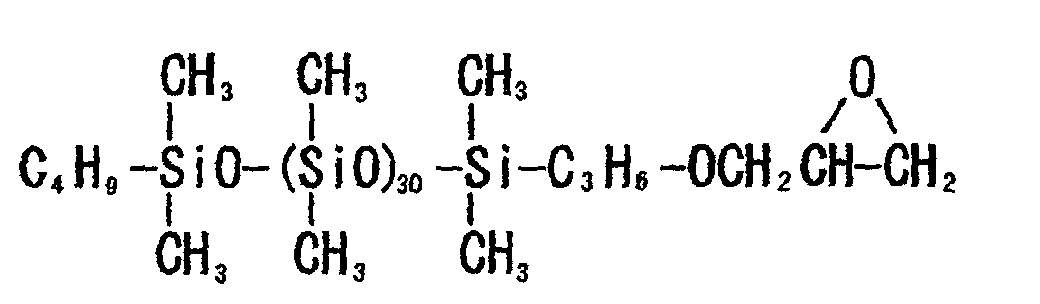
And in the flask, reaction was run for 5 hours while
refluxing the xylene. By heating and distilling off the solvent
under reduced pressure, silicone-modified Wax (II) having a
melting point of 127°C was obtained.
| Example 1: Milky Lotion | |
| Ingredients | Amount mixed (weight %) |
| 1. Silicone-modified wax (I) obtained in Synthesis Example 1 | 2.0 |
| 2. Dimethylpolysiloxane (6 mm2/sec at 25°C) | 30.0 |
| 3. Decamethylcyclopentasiloxane | 10.0 |
| 4. Glyceryl trioctanoate | 5.0 |
| 5. Polyether-modified silicone (note 1) | 5.0 |
| 6. 1,3-Butylene glycol | 5.0 |
| 7. Antiseptic | proper |
| 8. Perfume | proper |
| 9. Purified water | 43.0 |
| (note 1) : KF-6017 (trade name, a product of Shin-Etsu Chemical Co., Ltd. |
The milky lotion thus prepared in accordance with the
invention had no tackiness, and spread easily and smoothly. In
addition, it was confirmed that the users of this lotion had
not only a feeling that the lotion was clung to the skin and
well held by the skin but also a lustrous finish on the skin.
| Example 2: Cream of Water-in-Oil Type | |
| Ingredients | Amount mixed (weight %) |
| 1. Dimethylpolysiloxane (6 mm2/sec at 25°C) | 10.0 |
| 2. Decamethylcyclopentasiloxane | 7.0 |
| 3. Glyceryl trioctanoate | 5.0 |
| 4. Polyether-modified branched-type silicone (note 1) | 2.0 |
| 5. Silicone-modified wax (I) obtained in Synthesis Example 1 | 1.0 |
| 6. Dipropylene glycol | 7.0 |
| 7. Antiseptic | proper |
| 8. Perfume | proper |
| 9. Purified water | 68.0 |
| (note 1) : KF-6028 (trade name, a product of Shin-Etsu Chemical Co., Ltd.) |
The water-in-oil cream thus prepared in accordance with
the invention had neither-oiliness nor tackiness, spread easily
and smoothly, and gave a light feel to users' skin. In addition,
it was confirmed that the users of this cream had not only a
feeling that the cream was clung to the skin and well held by
the skin but also a lustrous finish on the skin.
| Example 3: Cream of Water-in-Oil Type | |
| Ingredients | Amount mixed (weight %) |
| 1. Silicone-modified wax (I) obtained in Synthesis Example 1 | 2.0 |
| 2. Dimethylpolysiloxane (6 mm2/sec at 25°C) | 10.0 |
| 3. Cross-linked polyether-modified silicone (note 1) | 5.0 |
| 4. Dipropylene glycol | 10.0 |
| 5. Sodium citrate | 0.2 |
| 6. Ethanol | 5.0 |
| 7. Antiseptic | proper |
| 8. Perfume | proper |
| 9. Purified water | 67.8 |
| (note 1) : KSG-21 (trade name, a product of Shin-Etsu Chemical Co., Ltd.) |
The water-in-oil cream thus prepared in accordance with
the invention had neither oiliness nor tackiness, spread easily
and smoothly, and gave a light and fresh feel to users' skin.
In addition, it was confirmed that the users of this cream had
not only a feeling that the cream way clung to the skin and well
held by the skin but also a matte finish on the skin.
| Example 4: Makeup Foundation of Water-in-Oil Type | |
| Ingredients | Amount mixed (weight %) |
| 1. Cross-linked polyether-modified silicone (note 1) | 4.0 |
| 2. Cross-linked dimethylpolysiloxane (note 2) | 1.0 |
| 3. Polyether-modified silicone (note 3) | 0.5 |
| 4. Dimethylpolysiloxane (6 mm2/sec at 25°C) | 6.0 |
| 5. Dimethylpolysiloxane (20 mm2/sec at 25°C) | 2.0 |
| 6. Decamethylcyclopentasiloxane | 3.0 |
| 7. Titanium oxid-cyclopentasiloxane dispersion (note 4) | 10.0 |
| 8. Silicone-modified wax (I) obtained in Synthesis Example 1 | 1.0 |
| 9. Dipropylene glycol | 5.0 |
| 10. Sodium citrate | 0.2 |
| 11. Methyl cellulose (2% aq. soln.) (note 5) | 2.5 |
| 12. Ethanol | 3.0 |
| 13. Antiseptic | proper |
| 14. Perfume | proper |
| 15. Purified water | 61.8 |
| (note 1) : KSG-21 (trade name, a product of Shin-Etsu Chemical Co., Ltd.) | |
| (note 2) : KSG-15 (trade name, a product of Shin-Etsu Chemical Co., Ltd.) | |
| (note 3) : KF-6017 (trade name, a product of Shin-Etsu Chemical Co., Ltd.) | |
| (note 4) : SPD-T1S (trade name, a product of Shin-Etsu Chemical | |
| Co., Ltd.) | |
| (note 5): Metholose 65-SH4000 (trade name, a product of Shin-Etsu-Chemical Co., Ltd.) |
The water-in-oil makeup foundation thus prepared in
accordance with the invention had neither oiliness nor
tackiness, spread easily and smoothly, and gave a light and
fresh feel to users' skin. In addition, it was confirmed that
the users of this foundation had not only a feeling that the
cream was clung to the skin and well held by the skin but also
a matte finish on the skin, and further the foundation had UV
cut effect and permitted makeup effect to last long.
| Example 5: Cream of Oil-in-Water Type | |
| Ingredients | Amount mixed (weight %) |
| 1. Silicone-modified wax (I) obtained in Synthesis Example 1 | 2.0 |
| 2. Cross-linked dimethylpolysiloxane (note 1) | 15.0 |
| 3. Decamethylcyclopentasiloxane | 10.0 |
| 4. Dimethylpolysiloxane (6 mm2/sec at 25°C) | 18.0 |
| 5. Polyether-modified silicone (note 2) | 0.7 |
| 6. Propylene glycol | 3.0 |
| 7. Polyacrylamide mixture (note 3) | 0.8 |
| 8. Xanthan gum (2% aq. soln.) | 8.0 |
| 9. Antiseptic | proper |
| 10. Perfume | proper |
| 11. Purified water | 42.5 |
| (note 1) : KSG-16 (trade name, a product of Shin-Etsu Chemical Co., Ltd.) | |
| (note 2) : KF-6011 (trade name, a product of Shin-Etsu Chemical Co., Ltd.) | |
| (note 3): SEPIGEL 305 (trade name, a product of SEPIC) |
It was confirmed that the oil-in-water cream thus
prepared in accordance with the invention had excellent
properties of spreading smoothly and giving a light feel to
users' skin.
| Example 6: Solid Cream of Water-in-Oil Type | |
| Ingredients | Amount mixed (weight %) |
| 1. Silicone-modified wax (I) obtained in Synthesis Example 1 | 30.0 |
| 2. Dimethylpolysiloxane (6 mm2/sec at 25°C) | 24.0 |
| 3. Decamethylcyclopentasiloxane | 24.0 |
| 4. Polyether-modified silicone (note 1) | 2.0 |
| 5. 1,3-Butylene glycol | 2.0 |
| 6. Antiseptic | proper |
| 7. Perfume | proper |
| 8. Purified water | 18.0 |
| (note 1) : KF-6017 (trade name, a product of Shin-Etsu Chemical Co., Ltd.) |
The solid cream thus prepared in accordance with the
invention had excellent properties of being free of both
oiliness and tackiness although it contained high proportions
of unctuous agents, spreading easily and smoothly, and giving
a light feeling to users' skin. In addition, it was confirmed
that the users of this solid cream had a feeling that the cream
was clung to the skin and well held by the skin.
| Example 7: Lipstick | |
| Ingredients | Amount mixed (weight %) |
| 1. Silicone-modified wax (I) obtained in Synthesis Example 1 | 40.0 |
| 2. Dimethylpolysiloxane (6 mm2/sec at 25°C) | 30.0 |
| 3. Decamethylcyclopentasiloxane | 26.0 |
| 4. Acrylsilicone resin (note 1) | 4.0 |
| 5. Pigments | proper |
| 6. Antiseptic | proper |
| 7. Perfume | proper |
| (note 1): KP-545 (trade name, a product or Shin-Etsu Chemical Co., Ltd. |
The lipstick thus prepared in accordance with the
invention had neither oiliness nor tackiness, and spread easily
and smoothly. In addition, it was confirmed that the lipstick
applied to lips stuck well and lasted long.
| Example 8: Powder Foundation | |
| Ingredients | Amount mixed (weight %) |
| 1. Sericite | 40.0 |
| 2. Mica | 10.0 |
| 3. Talc | the rest |
| 4. Titanium dioxide | 10.0 |
| 5. Particulate titanium dioxide | 5.0 |
| 6. Magnesium stearate | 3.0 |
| 7. Pigment | 4.2 |
| 8. Silicone-modified wax (I) obtained in Synthesis Example 1 | 1.0 |
| 9. Dimethylpolysiloxane (6 mm2/sec at 25°C) | 3.0 |
| 10. Antiseptic | proper |
| 11. Perfume | proper |
The powder foundation thus formed in accordance with the
invention had no tackiness and spread lightly. In addition,
it was confirmed that the powder foundation obtained stayed
well due to its good adhesion and gave a lustrous finish on the
skin.
| Example 9: Cream Foundation | |
| Ingredients | Amount mixed (weight %) |
| 1. Cross-linked polyether-modified silicone (note 1) | 4.0 |
| 2. Gryceryl trioctanoate | 3.0 |
| 3. Dimethylpolysiloxane (6 mm2/sec at 25°C) | 5.0 |
| 4. Decamethylcyclopentasiloxane | 6.0 |
| 5. Silicone-modified wax (I) obtained in Synthesis Example 1 | 2.0 |
| 6. Fluorine-modified hybrid silicone complex powder (note 2) | 2.5 |
| 7. Pigment | 8.0 |
| 8. Acrylsilicone resin (note 3) | 5.0 |
| 9. Dipropylene glycol | 5.0 |
| 10. Sodium citrate | 0.2 |
| 11. Antiseptic | proper |
| 12. Perfume | proper |
| 13. Purified water | 59.3 |
| (note 1) : KSG-21 (trade name, a product of Shin-Etsu Chemical Co., Ltd.) | |
| (note 2) : KSP-200 (trade name, a product of Shin-Etsu Chemical Co., Ltd.) | |
| (note 3): KP-545 (trade name, a product of Shin-Etsu Chemical Co., Ltd.) |
The cream foundation thus prepared in accordance with the
invention had no tackiness, and spread easily and smoothly. In
addition, it was confirmed that this cream foundation stayed
well on the skin due to its good adhesion and ensured a matte
finish feel.
| Example 10: Solid Foundation | |
| Ingredients | Amount mixed (weight %) |
| 1. Silicone-modified wax (I) obtained in Synthesis Example 1 | 30.0 |
| 2. Polyethylene wax | 5.0 |
| 3. Dimethylpolysiloxane (6 mm2/sec at 25°C) | 32.5 |
| 4. Decamethylcyclopentasiloxane | 28.5 |
| 5. Acrylsilicone resin (note 1) | 4.0 |
| 6. Pigments | proper |
| 7. Antiseptic | proper |
| 8. Perfume | proper |
| (note 1) : KP-545 (trade name, a product of Shin-Etsu Chemical Co., Ltd. |
The solid foundation thus prepared in accordance with the
invention had neither oiliness nor tackiness, and spread easily
and smoothly. In addition, it was confirmed that the foundation
applied to the skin stuck well and lasted long.
| Example 11: Compact Foundation of Water-in-Oil Type | |
| Ingredients | Amount mixed (weight %) |
| 1. Silicone-modified wax (I) obtained in Synthesis Example 1 | 30.0 |
| 2. Dimethylpolysiloxane (6 mm2/sec at 25°C) | 24.0 |
| 3. Decamethylcyclopentasiloxane | 22.0 |
| 4. Acrylsilicone resin (note 1) | 4.0 |
| 5. Trimethylsiloxysilicate (note 2) | 1.0 |
| 6. Polyether-modified silicone (note 3) | 2.0 |
| 7. Pigment | proper |
| 8. 1,3-Butylene glycol | 2.0 |
| 9. Antiseptic | proper |
| 10. Perfume | proper |
| 11. Purified water | 15.0 |
| (note 1) : KP-545 (trade name, a product of Shin-Etsu Chemical Co., Ltd.) | |
| (note 2): KF-7312J (trade name, a product of Shin-Etsu Chemical Co., Ltd.) | |
| (note 3) : KF-6017 (trade name, a product of Shin-Etsu Chemical Co., Ltd.) |
The water-in-oil compact foundation thus prepared in
accordance with the invention had excellent properties of being
free of both oiliness and tackiness although it contained high
proportions of unctuous agents, spreading easily and smoothly,
and giving a light feeling to users' skin. In addition, it was
confirmed that this compact foundation gave users a feeling
that the foundation was clung to the skin and well held by the
skin and ensured long-lasting makeup effect.
| Example 12: Eye Shadow | |
| Ingredients | Amount mixed (weight %) |
| 1. Sericite | 40.0 |
| 2. Mica | 10.0 |
| 3. Talc | the rest |
| 4. Titanium dioxide | 10.0 |
| 5. Particulate titanium dioxide | 5.0 |
| 6. Magnesium stearate | 3.0 |
| 7. Pigment | proper |
| 8. Octyl dodecanol | 3.0 |
| 9. Dimethylpolysiloxane (6 mm2/sec at 25°C) | 8.0 |
| 10. Silicone-modified wax (I) obtained in Synthesis Example 1 | 2.0 |
| 11. Antiseptic | proper |
| 12. Perfume | proper |
The eye shadow thus prepared in accordance with the
invention was free of tackiness and spread lightly. In addition,
it was confirmed that this eye shadow stayed well due to its
good adhesion, gave a lustrous finish on the skin, and ensured
long-lasting makeup effect.
| Example 13: Powdered Eyebrow | |
| Ingredients | Amount mixed (weight %) |
| 1. Silicone-modified wax (I) obtained in Synthesis Example 1 | 3.0 |
| 2. Dimethylpolysiloxane (6 mm2/sec at 25°C) | 5.0 |
| 3. Glyceryl trioctanoate | 2.0 |
| 4. Silicone-treated mica | 40.0 |
| 5. Silicone-treated barium sulfate | 15.0 |
| 6. Silicone-treated titanium dioxide | 10.0 |
| 7. Silicone-treated pigment | proper |
| 8. Hybrid silicone complex powder (note 1) | 1.5 |
| 9. Spherical polymethylsilsesquioxane powder (note 2) | 2.5 |
| 10. Silicone-treated talc | the rest |
| 11. Antiseptic | proper |
| 12. Perfume | proper |
| (note 1) : KSP-100 (trade name, a product of Shin-Etsu Chemical Co., Ltd.) | |
| (note 2) : KMP-590 (trade name, a product of Shin-Etsu Chemical Co., Ltd.) |
The powdered eyebrow thus formed in accordance with the
invention was free of tackiness and spread lightly. In addition,
it was confirmed that this powdered eyebrow stayed well due to
its good adhesion, gave a lustrous finish on brows, and ensured
long-lasting makeup effect.
| Example 14: Pencil-shaped Eyebrow | |
| Ingredients | Amount mixed (weight %) |
| 1. Silicone-modified wax (I) obtained in Synthesis Example 1 | 40.0 |
| 2. Polyethylene wax | 10.0 |
| 3. Dimethylpolysiloxane (6 mm2/sec at 25°C) | 40.0 |
| 4. Decamethylcyclopentasiloxane | 5.0 |
| 5. Acrylsilicone resin (note 1) | 5.0 |
| 6. Pigments | proper |
| 7. Antiseptic | proper |
| 8. Perfume | proper |
| (note 1): KP-545 (trade name, a product of Shin-Etsu Chemical Co., Ltd. |
It was confirmed that the pencil-shaped eyebrow thus
prepared in accordance with the invention caused no powdery
blur, slid well, and had long-lasting makeup effect.
| Example 15: Hair Cream | |
| Ingredients | Amount mixed (weight %) |
| 1. Silicone-modified wax (I) obtained in Synthesis Example 1 | 2.0 |
| 2. Dimethylpolysiloxane (6 mm2/sec at 25°C) | 5.0 |
| 3. Decamethylcyclopentasiloxane | 8.0 |
| 4. Chlorostearyltrimethylammonium | 1.5 |
| 5. Glycerol | 3.0 |
| 6. Propylene glycol | 5.0 |
| 7. Hydroxyethyl cellulose | 0.2 |
| 8. Antiseptic | proper |
| 9. Perfume | proper |
| 10. Purified water | 75.3 |
The hair cream thus prepared in accordance with the
invention spread well when applied to hair and gave hair
satisfactory softness, smoothness, setting effect, moist feel
and fine luster. In other words, the composition prepared
herein proved to be totally excellent for hair cream.
| Example 16: Conditioning Mousse | |
| Ingredients | Amount mixed (weight %) |
| 1. Silicone-modified wax (I) obtained in Synthesis Example 1 | 0.5 |
| 2. Dimethylpolysiloxane (6 mm2/sec at 25°C) | 2.0 |
| 3. Cross-linked dimethylpolysiloxane (note 1) | 0.5 |
| 4. Glyceryl trioctanoate | 1.5 |
| 5. Glycerol | 3.0 |
| 6. Chlorostearyltribenzylammonium | 0.5 |
| 7. Polyoxyethylene hydrogenated castor oil | 0.5 |
| 8. Ethanol | 7.0 |
| 9. Antiseptic | proper |
| 10. Perfume | proper |
| 11. Purified water | the rest |
| 12. Liquefied petroleum gas | 5.0 |
| (note 1) : KSG-16 (trade name, a product of Shin-Etsu Chemical Co., Ltd. |
The conditioning mousse thus prepared in accordance with
the invention had excellent feels, including satisfactory
moist, soft and smooth feels, in addition to no oily feel.
Further, it was confirmed that this mousse stayed well due to
its good adhesion and ensured a matte finish feel.
| Example 17: Antiperspirant of Roll-on Type | |
| Ingredients | Amount mixed (weight %) |
| 1. Silicone-modified wax (I) obtained in Synthesis Example 1 | 5.0 |
| 2. Cross-linked polyether-modified silicone (note 1) | 20.0 |
| 3. Dimethylpolysiloxane (6 mm2/sec at 25°C) | 10.0 |
| 4. Cross-linked dimethylpolysiloxane (note 2) | 15.0 |
| 5. Decamethylcyclopentasiloxane | 30.0 |
| 6. Aluminum zirconium tetrachlorohydrate | 20.0 |
| 7. Perfume | proper |
| (note 1): KSG-21 (trade name, a product of Shin-Etsu Chemical Co., Ltd.) | |
| (note 2): KSG-15 (trade name, a product of Shin-Etsu Chemical Co., Ltd.) |
The thus obtained roll-on antiperspirant spread smoothly,
gave a refreshing feeling, and had neither tacky nor oily feel.
Further, it caused no change with temperature variations and
lapse of time. In other words, the antiperspirant according
to the invention had excellent usability and stability.
| Example 18: Antiperspirant of Water-in-Oil Type | |
| Ingredients | Amount-mixed (weight %) |
| 1. Silicone-modified wax (I) obtained in Synthesis Example 1 | 2.0 |
| 2. Cross-linked polyether-modified silicone (note 1) | 7.0 |
| 3. Decamethylcyclopentasiloxane | 7.0 |
| 4. Glyceryl trioctanoate | 8.0 |
| 5. 1,3-Butylene glycol | 5.0 |
| 6. Sodium citrate | 0.2 |
| 7. Aluminum chlorohydrate | 20.0 |
| 8. Perfume | proper |
| 9. Purified water | 50.8 |
| (note 1): KSG-21 (trade name, a product of Shin-Etsu Chemical Co., Ltd.) |
The thus prepared antiperspirant of water-in-oil type
spread smoothly, gave a refreshing feeling, and had neither
tacky nor oily feel. In addition, it caused no change with
temperature variations and lapse of time. In other words, the
water-in-oil antiperspirant according to the invention had
excellent usability and stability.
| Example 19: Antiperspirant of Solid Type | |
| Ingredients | Amount mixed (weight %) |
| 1. Silicone-modified wax (I) obtained in Synthesis Example 1 | 22.0 |
| 2. Polyethylene wax | 4.0 |
| 3. Dimethylpolysiloxane (6 mm2/sec at 25°C) | 22.0 |
| 4. Decamethylcyclopentasiloxane | 22.0 |
| 5. Cross-linked dimethylpolysiloxane (note 1) | 15.0 |
| 6. Aluminum zirconium tetrachlorohydrate | 15.0 |
| 7. Perfume | proper |
| (note 1): KSG-16 (trade name, a product of Shin-Etsu Chemical Co., Ltd.) |
The solid antiperspirant thus obtained spread smoothly,
gave a refreshing feeling, and had neither tacky nor oily feel.
Further, it caused no change with temperature variations and
a lapse of time. In other words, the antiperspirant according
to the invention had excellent usability and stabiliby.
| Example 20: Antiperspirant of Solid Type | |
| Ingredients | Amount mixed (weight %) |
| 1. Silicone-modified wax (II) obtained in Synthesis Example 2 | 26.0 |
| 2. Dimethylpolysiloxane (6 mm2/sec at 25°C) | 22.0 |
| 3. Decamethylcyclopentasiloxane | 22.0 |
| 4. Cross-linked dimethylpolysiloxane (note 1) | 15.0 |
| 5. Aluminum zirconium tetrachlorohydrate (glycine salt) | 15.0 |
| 6. Perfume | proper |
| (note 1) : KSG-16 (trade name, a product of Shin-Etsu Chemical Co., Ltd.) |
The thus obtained solid antiperspirant spread smoothly,
gave a refreshing feeling, and had neither tacky nor oily feel.
Further, it caused no change with temperature variations and
a lapse of time. In other words, the antiperspirant according
to the invention had excellent usability and stability.
| Example 21: UV-Cut-Off Cream of Water-in-Oil Type | |
| Ingredients | Amount mixed (weight %) |
| 1. Silicone-treated zinc oxide | 20.0 |
| 2. Acrylsilicone resin (note 1) | 12.0 |
| 3. Decamethylcyclopentasiloxane | 20.0 |
| 4. Glyceryl trioctanoate | 3.0 |
| 5. Silicone-modified wax (I) obtained in Synthesis Example 1 | 2.0 |
| 6. Cross-linked polyether-modified silicone (note 2) | 5.0 |
| 7. Polyether-modified silicone (note 3) | 1.0 |
| 8. Alkyl-polyether-comodifited silicone (note 4) | 1.0 |
| 9. Octyl methoxycinnamate | 6.0 |
| 10. Sodium citrate | 0.2 |
| 11. Dipropylene glycol | 3.0 |
| 12. Antiseptic | proper |
| 13. Perfume | proper |
| 14. Purified water | 26.8 |
| (note 1) : KP-545 (trade name, a product of Shin-Etsu Chemical Co., Ltd.) | |
| (note 2) : KSG-21 (trade name, a product of Shin-Etsu Chemical Co., Ltd.) | |
| (note 3) : KF-6017 (trade name, a product of Shin-Etsu Chemical Co., Ltd.) | |
| (note 4): SKF-6026 (trade name, a product of Shin-Etsu Chemical Co., Ltd.) |
The thus obtained UV-cut-off cream of water-in-oil type
spread easily, and had neither oily nor tacky feel but a fresh
feel. Further, it gave a transparent feeling to users' skin
and permitted makeup effect to last long. In addition, it
caused no change with temperature variations and a lapse of time,
and had very excellent usability and stability.
| Example 22: UV-Cut-Off Milky Lotion of Water-in-Oil Type | |
| Ingredients | Amount mixed (weight %) |
| 1. Dimethylpolysiloxane (6 mm2/sec at 25°C) | 5.0 |
| 2. Cross-linked polyether-modified silicone (note 1) | 5.0 |
| 3. Glyceryl trioctanoate | 2.0 |
| 4. Silicone-modified wax (I) obtained in Synthesis Example 1 | 1.0 |
| 5. Polyether-modified silicone (note 2) | 1.0 |
| 6. Titanium dioxide-decamethylcyclopentasiloxane dispersion (note 3) | 30.0 |
| 7. Zinc oxide-decamethylcyclopentasiloxane dispersion (note 4) | 30.0 |
| 8. Dipropylene glycol | 3.0 |
| 9. Sodium citrate | 0.2 |
| 10. Antiseptic | proper |
| 11. Perfume | proper |
| 12. Purified water | 22.8 |
| (note 1): KSG-21 (trade name, a product of Shin-Etsu Chemical Co., Ltd.) | |
| (note 2) : KF-6017 (trade name, a product of Shin-Etsu Chemical | |
| Co., Ltd.) | |
| (note 3) : SPD-T1S (trade name, a product of Shin-Etsu Chemical Co., Ltd.) | |
| (note 4) : SPD-Z1 (trade name, a product of Shin-Etsu Chemical Co., Ltd.) |
The thus obtained UV-cut-off milky lotion of water-in-oil
type spread easily, and had neither oily nor tacky feel
but a fresh feel. Further, it gave a transparent feeling to
users' skin and permitted makeup effect to last long. In
addition, it caused no change with temperature variations and
a lapse of time, and had very excellent usability and stability.
| Example 23: UV-Cut-Off Cream of Oil-in-Water Type | |
| Ingredients | Amount mixed (weight %) |
| 1. Cross-linked organopolysiloxane (note 1) | 5.0 |
| 2. Cetyl isooctanoate | 5.0 |
| 3. Silicone-modified wax (I) obtained in Synthesis Example 1 | 1.0 |
| 4. Titanium dioxide-decamethylcyclopentasiloxane dispersion (note 2) | 15.0 |
| 5. Polyether-modified silicone (note 3) | 1.0 |
| 6. Polyether-modified silicone (note 4) | 1.0 |
| 7. Acrylic acid amide mixture (note-5) | 2.0 |
| 8. Propylene glycol | 5.0 |
| 9. Methyl cellolose (2 % aq. soln.) (note 6) | 5.0 |
| 10. Antiseptic | proper |
| 11. Perfume | proper |
| 12. Purified water | 60.0 |
| (note 1) : KSG-18 (trade name, a product of Shin-Etsu Chemical Co., Ltd.) | |
| (note 2): SPD-T1S (trade name, a product of Shin-Etsu Chemical Co., Ltd.) | |
| (note 3): KF-6027 (trade name, a product of Shin-Etsu Chemical Co., Ltd.) | |
| (note 4): KF-6011 (trade name, a product of Shin-Etsu Chemical Co., Ltd.) | |
| (note 5): SEPIGEL 305 (trade name, a product of SEPIC) | |
| (note 6): Metholose SM-4000 (trade name, a product of Shin-Etsu Chemical Co., Ltd.) |
The thus obtained UV-cut-off cream of oil-in-water type
spread easily, and had neither oily nor tacky feel but a fresh
feel. Further, it gave a transparent feeling to users' skin
feel. Further, it gave a transparent feeling to users' skin
and permitted makeup effect to last long. In addition, it
caused no change with temperature variations and a lapse of time,
and had very excellent usability and stability.
The present cosmetic materials spread smoothly and have
a fresh feel. Further, they are highly repellent to sweat and
water. When applied to the skin or hair, they can impart thereto
elasticity, smoothness and emollient effect, and besides, they
ensure very natural luster. Moreover, the present cosmetic
materials have excellent storage stability. Thus the present
cosmetic materials are of great significance from a viewpoint
of practical applicability.
Claims (33)
- A cosmetic material comprising silicone-modified wax as Component (A)., characterized in that the silicone-modified wax is wax in which low-molecular-weight polyethylene and/or low-molecular-weight polypropylene is linked to silicone via an ester linkage.
- A cosmetic material as described in claim 1, wherein the silicone-modified wax of Component (A) is wax produced by reacting carboxyl group- and/or carboxylic anhydride-containing polyethylene and/or polypropylene wax with a double bond-containing epoxy compound, and thereafter subjecting the reaction product to reaction with a hydrosilyl group-containing silicone.
- A cosmetic material as described in claim 1 or 2, further comprising unctuous agents as Component (B).
- A cosmetic material as described in claim 3, wherein at least one of the unctuous agents of Component (B) is an unctuous agent in a liquid state at room temperature.
- A cosmetic material as described in claim 3, wherein at least one of the unctuous agents of Component (B) is a solid unctuous agent having a melting point of 50°C or higher.
- A cosmetic material as described in any of claims 3 to 5, wherein at least one of the unctuous agents of Component (B) is a straight-chain or cyclic silicone oil represented by R1 aSiO(4-a)/2 wherein R1 is a hydrogen atom or a group selected from 1-30C alkyl groups, aryl groups, aralkyl groups or fluorinated alkyl groups and a is a number satisfying a relation 0≤a≤2.5.
- A cosmetic material as described in any of claims 3 to 6, wherein at least one of the unctuous agents of Component (B) is a fluorinated or amino group-containing unctuous agent.
- A cosmetic material as described in any of claims 1 to 7, further comprising water as Component (C).
- A cosmetic material as described in any of claims 1 to 8, further comprising as Component (D) a compound having an alcoholic hydroxyl group in its molecular structure.
- A cosmetic material as described in claim 9, wherein the compound of Component (D) having an alcoholic hydroxyl group in its molecular structure is monohydric water-soluble alcohol, polyhydric water-soluble alcohol or a mixture thereof.
- A cosmetic material as described in any of claims 1 to 10, further comprising as Component (E) a high molecular compound capable of dissolving or swelling in water.
- A cosmetic material as described in any of claims 1 to 11, further comprising powders, coloring agents or mixtures thereof as Component (F).
- A cosmetic material as described in claim 12, wherein at least one of the powders, coloring agents and the mixtures thereof as Component (F) is at least one fine powder selected from fine powders of cross-linked silicones having structures formed by cross-linking dimethylsilicones, fine powders of polymethylsilsesquioxanes, hydrophobicity-imparted silica or complex fine powders prepared by coating spherical silicone rubber powder with polymethylsilsesquioxane particles.
- A cosmetic material as described in claim 12 or 13, wherein at least one of the powders, coloring agents and the mixtures thereof as Component (F) is a fluorinated group-containing powder, a coloring agent or a mixture thereof.
- A cosmetic material as described in any of claims 1 to 14, further comprising a surfactant as Component (G).
- A cosmetic material as described in claim 15, wherein the surfactant of Component (G) is a straight-chain or branched silicone containing at least one polyoxyalkylene chain in a molecule.
- A cosmetic material as described in claim 15 or 16, wherein the surfactant of Component (G) has a HLB value of 2 to 8.
- A cosmetic material as described in any of claims 1 to 17, further comprising cross-linked organopolysiloxanes as Component (H).
- A cosmetic material as described in claim 18, wherein the cross-linked organopolysiloxanes are cross-linked organopolysiloxanes which cause swelling when they contain a silicone having low viscosity of from 0.65 to 10.0 mm2/sec at 25°C in a quantity larger than the weight of the cross-linked organopolysiloxanes themselves.
- A cosmetic material as described in claim 18 or 19, wherein the cross-linked organopolysiloxanes of Component (H) are organopolysiloxanes having a cross-linked structure formed by reaction between the hydrogen atoms bonded directly to silicon atoms and a cross-linking agent having at least two vinylic reactive moities per molecule.
- A cosmetic material as described in any of claims 18 to 20, wherein the cross-linked organopolysiloxanes of Component (H) are organopolysiloxanes having in their cross-links at least one kind of moiety selected from polyoxyalkylene, alkyl, alkenyl, aryl and fluoroalkyl moieties.
- A cosmetic material as described in any of claims 1 to 21, further comprising silicone resin as Component (I).
- A cosmetic material as described in claim 22, wherein the silicone resin of Component (I) is an acrylsilicone resin.
- A cosmetic material as described in claim 24, wherein the acrylsilicone resin of Component (I) is an acrylsilicone resin containing at least one moiety selected from pyrrolidone, long-chain alkyl, polyoxyalkylene and fluoroalkyl moieties.
- A cosmetic material as described in claim 22, wherein the silicone resin is at least one silicone compound selected from reticular silicone compounds represented by MQ, MDQ, MT, MDT and MDTQ.
- A cosmetic material as described in claim 25, wherein the reticular silicone compound is a reticular silicone compound containing at least one moiety selected from pyrrolidone, long-chain alkyl, polyoxyalkylene, fluoroalkyl and amino moieties.
- A skincare cosmetic material containing a cosmetic material as described in any of claims 1 to 26 as at least one constituent.
- A makeup cosmetic material containing a cosmetic material as described in any of claims 1 to 26 as at least one constituent.
- A hair-care cosmetic material containing a cosmetic material as described in any of claims 1 to 26 as at least one constituent.
- An antiperspirant cosmetic material containing a cosmetic material as described in any of claims 1 to 26 as at least one constituent.
- An UV protective cosmetic material containing a cosmetic material as described in any of claims 1 to 26 as at least one constituent.
- A cosmetic material as described in any of claims 1 to 31, which is prepared in a state selected from liquid, emulsion, cream, solid, paste, gel, powder, pressed cake, multilayer, mousse, spray, stick and pencil.
- A cosmetic material characterized by containing 5 to 95 weight % of silicone-modified wax of the aforesaid Component (A) described above and 95 to 5 weight % of unctuous agents of the aforesaid Component (B) and having the form of solid or stick.
Applications Claiming Priority (3)
| Application Number | Priority Date | Filing Date | Title |
|---|---|---|---|
| JP2000211319A JP4548685B2 (en) | 2000-07-12 | 2000-07-12 | Solid cosmetics |
| JP2000211319 | 2000-07-12 | ||
| PCT/JP2001/006026 WO2002003928A1 (en) | 2000-07-12 | 2001-07-11 | Cosmetics |
Publications (2)
| Publication Number | Publication Date |
|---|---|
| EP1314415A1 true EP1314415A1 (en) | 2003-05-28 |
| EP1314415A4 EP1314415A4 (en) | 2004-03-17 |
Family
ID=18707443
Family Applications (1)
| Application Number | Title | Priority Date | Filing Date |
|---|---|---|---|
| EP01947978A Withdrawn EP1314415A4 (en) | 2000-07-12 | 2001-07-11 | Cosmetics |
Country Status (5)
| Country | Link |
|---|---|
| US (1) | US20030082218A1 (en) |
| EP (1) | EP1314415A4 (en) |
| JP (1) | JP4548685B2 (en) |
| KR (1) | KR20020060175A (en) |
| WO (1) | WO2002003928A1 (en) |
Cited By (28)
| Publication number | Priority date | Publication date | Assignee | Title |
|---|---|---|---|---|
| EP1600144A1 (en) * | 2004-05-24 | 2005-11-30 | The Procter & Gamble Company | Translucent cosmetic foundation |
| EP1600145A1 (en) * | 2004-05-24 | 2005-11-30 | The Procter & Gamble Company | Foundation comprising cross-linked organopolysiloxane elastomer |
| EP1709954A1 (en) * | 2005-04-05 | 2006-10-11 | The Procter & Gamble Company | Translucent, sunscreening cosmetic foundation composition |
| US7482419B2 (en) | 2004-04-12 | 2009-01-27 | Dow Corning Corporation | Silsesquioxane resin wax |
| EP1832275A3 (en) * | 2006-03-03 | 2009-09-09 | L'Oréal | Hair styling compositions containing a silicone elastomer and a non-aqueous polar solvent |
| US7695727B2 (en) | 2006-10-11 | 2010-04-13 | Wyeth Llc | Botanical butter stick lip balm |
| WO2010115782A3 (en) * | 2009-03-31 | 2010-12-16 | Dow Corning Corporation | Organopolysiloxane emulsions and their production |
| US7892570B2 (en) | 2004-05-24 | 2011-02-22 | The Procter & Gamble Company | Cosmetic foundation |
| US8017136B2 (en) | 2004-05-24 | 2011-09-13 | The Procter & Gamble Company | Shiny foundation |
| EP2224903A4 (en) * | 2007-12-28 | 2013-01-02 | Oreal | COMPOSITION CONTAINING A POLARIZED WAX |
| EP2224896A4 (en) * | 2007-12-28 | 2013-01-02 | Oreal | COMPOSITIONS GIVING VOLUME |
| US8580729B2 (en) | 2009-03-31 | 2013-11-12 | Dow Corning Corporation | Organopolysiloxane compositions containing an active material |
| US8597626B2 (en) | 2009-06-29 | 2013-12-03 | L'oreal | Long wear, waterproof mascara composition with water washability |
| US8623958B2 (en) | 2009-03-10 | 2014-01-07 | Dow Corning Toray Co. Ltd. | Oil-in-water silicone emulsion composition |
| US8647611B2 (en) | 2009-06-29 | 2014-02-11 | L'oréal | Composition containing a polyol and a reaction product |
| US8652451B2 (en) | 2009-06-29 | 2014-02-18 | L'oreal | Composition comprising a sugar silicone surfactant and a oil-soluble polar modified polymer |
| US8663609B2 (en) | 2009-06-29 | 2014-03-04 | L'oreal | Composition comprising a polyol, a sugar silicone surfactant and a oil-soluble polar modified polymer |
| US8663667B2 (en) | 2009-06-29 | 2014-03-04 | L'oreal | Refreshing cream foundation in gel form |
| US8747868B2 (en) | 2010-12-30 | 2014-06-10 | L'oreal | Reaction product of a polar modified polymer and an alkoxysilane and a composition containing the reaction product |
| US8828366B2 (en) | 2009-06-29 | 2014-09-09 | L'oreal | Hydrating cream foundation in emulsion form |
| US8932566B2 (en) | 2009-06-29 | 2015-01-13 | L'oreal | Composition comprising a polyol and a oil-soluble polar modified polymer |
| US9023387B2 (en) | 2008-12-09 | 2015-05-05 | L'oreal | Transfer-resistant emulsion containing a surfactant |
| US9029428B2 (en) | 2010-07-02 | 2015-05-12 | Dow Corning Toray Co., Ltd. | Oil-in-water silicone emulsion composition |
| US9040593B2 (en) | 2008-12-16 | 2015-05-26 | L'oreal | Water-insoluble reaction product of a polyamine and an oil-soluble high carbon polar modified polymer |
| EP2347794A3 (en) * | 2009-07-28 | 2015-09-02 | Shin-Etsu Chemical Co., Ltd. | Silicone-modified wax-containing composition and cosmetic preparation containing the composition |
| US9278060B2 (en) | 2007-12-28 | 2016-03-08 | L'oreal | Composition containing a polar modified polymer |
| US9308396B2 (en) | 2008-12-16 | 2016-04-12 | L'oreal | Transfer-resistant and long wear foundation in emulsion form containing oil absorbing powders |
| US9976105B2 (en) | 2006-10-10 | 2018-05-22 | Dow Silicones Corporation | Silicone polymer emulsions |
Families Citing this family (21)
| Publication number | Priority date | Publication date | Assignee | Title |
|---|---|---|---|---|
| JP4236141B2 (en) * | 2000-07-12 | 2009-03-11 | 信越化学工業株式会社 | Coating agent for heat-resistant slip layer of heat-sensitive transfer film |
| WO2002077071A1 (en) * | 2001-03-15 | 2002-10-03 | Nippon Unicar Company Limited | Waxy organopolysiloxane and toner composition containing the same |
| US20030082222A1 (en) * | 2001-10-22 | 2003-05-01 | Kao Corporation | Cosmetic particle and method of production thereof |
| DE60232547D1 (en) * | 2002-03-11 | 2009-07-16 | Kao Corp | COSMETICS |
| JP2004346046A (en) * | 2003-05-26 | 2004-12-09 | Shin Etsu Chem Co Ltd | Cosmetics |
| BRPI0411481A (en) * | 2003-06-19 | 2006-07-25 | Procter & Gamble | silicone polyol emulsions |
| DE10361854A1 (en) * | 2003-12-23 | 2005-07-28 | Beiersdorf Ag | Cosmetic preparation for the care of the hair, containing lauroyl lysine |
| JP2006070218A (en) * | 2004-09-06 | 2006-03-16 | Dow Corning Toray Co Ltd | Wax-like organopolysiloxane for cosmetics and cosmetics containing the same |
| US7811553B2 (en) * | 2005-11-09 | 2010-10-12 | The Gillette Company | Molded shaving aid compositions, components and methods of manufacture |
| EP1813262A1 (en) * | 2006-01-19 | 2007-08-01 | Wella Aktiengesellschaft | Stable oil-in-water and water/oil/water multiple emulsions and hair treating compositions comprising them |
| EP1913975B1 (en) * | 2006-10-20 | 2011-06-08 | Faber-Castell AG | Cosmetic preparation for dyeing eyelashes and eyebrows |
| US20100112022A1 (en) * | 2008-09-17 | 2010-05-06 | Jody Lynn Hoying | Antiperspirant Products and Methods of Merchandising the Same |
| US20130230477A1 (en) * | 2010-12-17 | 2013-09-05 | L'oreal | Swellable cosmetic systems |
| JP6017910B2 (en) * | 2012-09-28 | 2016-11-02 | 株式会社マンダム | Deodorant |
| EP2806000A1 (en) * | 2013-05-24 | 2014-11-26 | Sunjin Chemical Co., Ltd. | Mass preparation method for spherical natural color wax beads |
| JP6058200B2 (en) * | 2016-09-28 | 2017-01-11 | 株式会社マンダム | Deodorant |
| JP6058201B2 (en) * | 2016-09-28 | 2017-01-11 | 株式会社マンダム | Deodorant |
| CN112639013A (en) * | 2018-08-29 | 2021-04-09 | 住友化学株式会社 | Aqueous dispersion |
| JP2022546928A (en) * | 2019-08-05 | 2022-11-10 | シーエス メディカ アー/エス | TOPICAL FORMULATIONS CONTAINING CANNABIDIOL, METHODS FOR PREPARATION OF COMPOSITIONS AND USES THEREOF |
| KR102109137B1 (en) * | 2019-09-17 | 2020-05-11 | (주)제이엠월드 | Cosmetic Composition for Hair Volume |
| CN114980859A (en) * | 2020-01-30 | 2022-08-30 | 株式会社高丝 | Solid Powder Cosmetics |
Family Cites Families (12)
| Publication number | Priority date | Publication date | Assignee | Title |
|---|---|---|---|---|
| JP2704637B2 (en) * | 1988-08-30 | 1998-01-26 | 日本ユニカー株式会社 | Polydialkylsiloxane-olefin block copolymer, method for producing the same, composition containing the copolymer, and molded article made from the composition |
| US5061481A (en) * | 1989-03-20 | 1991-10-29 | Kobayashi Kose Co., Ltd. | Cosmetic composition having acryl-silicone graft copolymer |
| US5219560A (en) * | 1989-03-20 | 1993-06-15 | Kobayashi Kose Co., Ltd. | Cosmetic composition |
| CA2014633C (en) * | 1989-06-02 | 2000-07-18 | Andrew D. Mccrea | Stable anhydrous compositions for topical delivery of active materials |
| JP2804998B2 (en) * | 1992-07-17 | 1998-09-30 | 三洋化成工業株式会社 | Release agent and resin composition using the same |
| US5346951A (en) * | 1992-07-17 | 1994-09-13 | Sanyo Chemical Industries, Ltd. | Releasing agents and resin compositions therewith |
| US5476901A (en) * | 1993-06-24 | 1995-12-19 | The Procter & Gamble Company | Siloxane modified polyolefin copolymers |
| DE69415678T2 (en) * | 1993-08-27 | 1999-07-22 | Procter & Gamble | POLYSILOXANE GRAFTED ADHESIVE POLYMER AND CARE AGENT CONTAINING DRYING AGENT |
| GB9506039D0 (en) * | 1995-03-24 | 1995-05-10 | Unilever Plc | Underarm compositions |
| FR2739283B1 (en) * | 1995-09-29 | 1997-11-07 | Oreal | TOPICAL COMPOSITION CONTAINING A SILICONE GRAFT POLYMER AND AN AMPHIPHILIC FATTY CHAIN POLYMER |
| FR2749506B1 (en) * | 1996-06-07 | 1998-08-07 | Oreal | DETERGENT COSMETIC COMPOSITIONS FOR HAIR USE AND USE |
| JP4271291B2 (en) * | 1999-02-04 | 2009-06-03 | 花王株式会社 | Polyethylene wax |
-
2000
- 2000-07-12 JP JP2000211319A patent/JP4548685B2/en not_active Expired - Fee Related
-
2001
- 2001-07-11 WO PCT/JP2001/006026 patent/WO2002003928A1/en not_active Ceased
- 2001-07-11 KR KR1020027003207A patent/KR20020060175A/en not_active Ceased
- 2001-07-11 US US10/070,808 patent/US20030082218A1/en not_active Abandoned
- 2001-07-11 EP EP01947978A patent/EP1314415A4/en not_active Withdrawn
Cited By (37)
| Publication number | Priority date | Publication date | Assignee | Title |
|---|---|---|---|---|
| US7482419B2 (en) | 2004-04-12 | 2009-01-27 | Dow Corning Corporation | Silsesquioxane resin wax |
| US7867505B2 (en) | 2004-05-24 | 2011-01-11 | The Procter & Gamble Company | Foundation |
| EP1600145A1 (en) * | 2004-05-24 | 2005-11-30 | The Procter & Gamble Company | Foundation comprising cross-linked organopolysiloxane elastomer |
| WO2005115310A1 (en) * | 2004-05-24 | 2005-12-08 | The Procter & Gamble Company | Foundation |
| WO2005115312A1 (en) * | 2004-05-24 | 2005-12-08 | The Procter & Gamble Company | Translucent cosmetic foundation |
| EP1600144A1 (en) * | 2004-05-24 | 2005-11-30 | The Procter & Gamble Company | Translucent cosmetic foundation |
| US8017136B2 (en) | 2004-05-24 | 2011-09-13 | The Procter & Gamble Company | Shiny foundation |
| US7892570B2 (en) | 2004-05-24 | 2011-02-22 | The Procter & Gamble Company | Cosmetic foundation |
| WO2006108003A1 (en) * | 2005-04-05 | 2006-10-12 | The Procter & Gamble Company | Translucent, sunscreening cosmetic foundation composition |
| EP1709954A1 (en) * | 2005-04-05 | 2006-10-11 | The Procter & Gamble Company | Translucent, sunscreening cosmetic foundation composition |
| EP1832275A3 (en) * | 2006-03-03 | 2009-09-09 | L'Oréal | Hair styling compositions containing a silicone elastomer and a non-aqueous polar solvent |
| US8252271B2 (en) | 2006-03-03 | 2012-08-28 | L'oreal S.A. | Hair styling compositions containing a silicone elastomer and a non-aqueous polar solvent |
| US9976105B2 (en) | 2006-10-10 | 2018-05-22 | Dow Silicones Corporation | Silicone polymer emulsions |
| US7695727B2 (en) | 2006-10-11 | 2010-04-13 | Wyeth Llc | Botanical butter stick lip balm |
| US8563048B2 (en) | 2006-10-11 | 2013-10-22 | Wyeth Llc | Botanical butter stick lip balm |
| EP2224903A4 (en) * | 2007-12-28 | 2013-01-02 | Oreal | COMPOSITION CONTAINING A POLARIZED WAX |
| EP2224896A4 (en) * | 2007-12-28 | 2013-01-02 | Oreal | COMPOSITIONS GIVING VOLUME |
| US9278060B2 (en) | 2007-12-28 | 2016-03-08 | L'oreal | Composition containing a polar modified polymer |
| US9023387B2 (en) | 2008-12-09 | 2015-05-05 | L'oreal | Transfer-resistant emulsion containing a surfactant |
| US9308396B2 (en) | 2008-12-16 | 2016-04-12 | L'oreal | Transfer-resistant and long wear foundation in emulsion form containing oil absorbing powders |
| US9040593B2 (en) | 2008-12-16 | 2015-05-26 | L'oreal | Water-insoluble reaction product of a polyamine and an oil-soluble high carbon polar modified polymer |
| US8623958B2 (en) | 2009-03-10 | 2014-01-07 | Dow Corning Toray Co. Ltd. | Oil-in-water silicone emulsion composition |
| US8580729B2 (en) | 2009-03-31 | 2013-11-12 | Dow Corning Corporation | Organopolysiloxane compositions containing an active material |
| US8597624B2 (en) | 2009-03-31 | 2013-12-03 | Dow Corning Corporation | Organopolysiloxane emulsions and their production |
| WO2010115782A3 (en) * | 2009-03-31 | 2010-12-16 | Dow Corning Corporation | Organopolysiloxane emulsions and their production |
| CN102361624A (en) * | 2009-03-31 | 2012-02-22 | 道康宁公司 | Organopolysiloxane emulsions and their production |
| US8597626B2 (en) | 2009-06-29 | 2013-12-03 | L'oreal | Long wear, waterproof mascara composition with water washability |
| US8828366B2 (en) | 2009-06-29 | 2014-09-09 | L'oreal | Hydrating cream foundation in emulsion form |
| US8932566B2 (en) | 2009-06-29 | 2015-01-13 | L'oreal | Composition comprising a polyol and a oil-soluble polar modified polymer |
| US8647611B2 (en) | 2009-06-29 | 2014-02-11 | L'oréal | Composition containing a polyol and a reaction product |
| US8652451B2 (en) | 2009-06-29 | 2014-02-18 | L'oreal | Composition comprising a sugar silicone surfactant and a oil-soluble polar modified polymer |
| US8663667B2 (en) | 2009-06-29 | 2014-03-04 | L'oreal | Refreshing cream foundation in gel form |
| US8663609B2 (en) | 2009-06-29 | 2014-03-04 | L'oreal | Composition comprising a polyol, a sugar silicone surfactant and a oil-soluble polar modified polymer |
| EP2347794A3 (en) * | 2009-07-28 | 2015-09-02 | Shin-Etsu Chemical Co., Ltd. | Silicone-modified wax-containing composition and cosmetic preparation containing the composition |
| US9029428B2 (en) | 2010-07-02 | 2015-05-12 | Dow Corning Toray Co., Ltd. | Oil-in-water silicone emulsion composition |
| US8846062B2 (en) | 2010-12-30 | 2014-09-30 | L'oreal | Reaction product of a polar modified polymer and an alkoxysilane and a composition containing the reaction product |
| US8747868B2 (en) | 2010-12-30 | 2014-06-10 | L'oreal | Reaction product of a polar modified polymer and an alkoxysilane and a composition containing the reaction product |
Also Published As
| Publication number | Publication date |
|---|---|
| KR20020060175A (en) | 2002-07-16 |
| JP4548685B2 (en) | 2010-09-22 |
| JP2002029918A (en) | 2002-01-29 |
| EP1314415A4 (en) | 2004-03-17 |
| WO2002003928A1 (en) | 2002-01-17 |
| US20030082218A1 (en) | 2003-05-01 |
Similar Documents
| Publication | Publication Date | Title |
|---|---|---|
| US20030082218A1 (en) | Cosmetics | |
| EP1062944B1 (en) | Cosmetic material | |
| US6660281B1 (en) | Silicones for power treatment powers having surface treated with said silicones and cosmetic materials containing said powers | |
| US9023969B2 (en) | Powder surface-treated with an organopolysiloxane having carboxyl groups, a dispersion of the same, and a cosmetic comprising the same | |
| EP1992656B9 (en) | Novel Organopolysiloxanpolymer, Pasty Composition, and Cosmetic Preparation Containing the Composition | |
| US6747115B2 (en) | Silicone polymer, silicone composition, and cosmetic preparation containing the same | |
| EP1416016B1 (en) | Powder composition, a dispersion of powder in oil, and a cosmetic preparation comprising polyglycerine modified silicone | |
| US8592547B2 (en) | Organopolysiloxane, a method of preparing the same and a cosmetic comprising the same | |
| EP1426027B1 (en) | Composition and cosmetic preparation containing the same | |
| EP1072627B1 (en) | Silicone compound and cosmetic materials containing the same | |
| US8828410B2 (en) | Pasty composition and cosmetics containing the same | |
| US6984390B2 (en) | Silicone compound and cosmetic preparation | |
| EP1632213B1 (en) | Cosmetic preparation | |
| US20040241126A1 (en) | Cosmetic | |
| US20040091440A1 (en) | Hydrophilized powder and a composition comprising the same | |
| US20130150458A1 (en) | Silicone-modified wax, composition and cosmetic preparation containing the same, and production method of silicone-modified wax | |
| JP2003292415A (en) | Cosmetics | |
| EP3409703A1 (en) | Water absorbent resin having siloxane skeleton, and cosmetic including same | |
| JP2002363445A (en) | Organopolysiloxane powder treating agent, surface-treated powder treated with the same, and cosmetic containing the surface-treated powder |
Legal Events
| Date | Code | Title | Description |
|---|---|---|---|
| PUAI | Public reference made under article 153(3) epc to a published international application that has entered the european phase |
Free format text: ORIGINAL CODE: 0009012 |
|
| 17P | Request for examination filed |
Effective date: 20020311 |
|
| AK | Designated contracting states |
Designated state(s): DE FR GB |
|
| A4 | Supplementary search report drawn up and despatched |
Effective date: 20040204 |
|
| 17Q | First examination report despatched |
Effective date: 20071115 |
|
| STAA | Information on the status of an ep patent application or granted ep patent |
Free format text: STATUS: THE APPLICATION IS DEEMED TO BE WITHDRAWN |
|
| 18D | Application deemed to be withdrawn |
Effective date: 20100113 |