EP1313090A2 - Active noise control system with a Helmholtz resonator - Google Patents
Active noise control system with a Helmholtz resonator Download PDFInfo
- Publication number
- EP1313090A2 EP1313090A2 EP02079759A EP02079759A EP1313090A2 EP 1313090 A2 EP1313090 A2 EP 1313090A2 EP 02079759 A EP02079759 A EP 02079759A EP 02079759 A EP02079759 A EP 02079759A EP 1313090 A2 EP1313090 A2 EP 1313090A2
- Authority
- EP
- European Patent Office
- Prior art keywords
- active
- resonator
- controller
- noise
- active noise
- Prior art date
- Legal status (The legal status is an assumption and is not a legal conclusion. Google has not performed a legal analysis and makes no representation as to the accuracy of the status listed.)
- Withdrawn
Links
Images

Classifications
-
- G—PHYSICS
- G10—MUSICAL INSTRUMENTS; ACOUSTICS
- G10K—SOUND-PRODUCING DEVICES; METHODS OR DEVICES FOR PROTECTING AGAINST, OR FOR DAMPING, NOISE OR OTHER ACOUSTIC WAVES IN GENERAL; ACOUSTICS NOT OTHERWISE PROVIDED FOR
- G10K11/00—Methods or devices for transmitting, conducting or directing sound in general; Methods or devices for protecting against, or for damping, noise or other acoustic waves in general
- G10K11/16—Methods or devices for protecting against, or for damping, noise or other acoustic waves in general
- G10K11/172—Methods or devices for protecting against, or for damping, noise or other acoustic waves in general using resonance effects
Definitions
- the present invention relates to a vehicle noise cancellation system, and more particularly to an active noise control system which utilizes an active resonator to minimize low frequency noise.
- Active noise cancellation (ANC) systems typically utilize a speaker to create a canceling noise that attenuates engine noise.
- the noise created is out of phase with the engine noise and combines with this noise to result in its reduction.
- this noise is generated in proximity to the inlet of the air induction system.
- a control unit such as a digital signal processor, obtains data from the vehicle engine, creates a predictive model of engine noise, and thereby generates the appropriate cancellation signal based on the results of this model. This signal is then transmitted to the speaker, which transforms this signal into a canceling noise. Because the control unit may not perfectly model engine noise, an error microphone is placed in proximity to the intake of the air induction system to determine if engine noise need be further attenuated.
- ANC system Small vehicles provide less packaging space for the ANC system.
- the ANC system on such vehicles must utilize smaller components which may result in unsatisfactory noise cancellation.
- ANC system deficiency may be particularly pronounced in four-cylinder engines which generate low frequency noise which is difficult to cancel.
- the active noise control system is mounted adjacent an air introduction body to control engine noise which is radiated through the air introduction system.
- the active noise control system includes an error microphone, a speaker, and an active resonator which communicate with an ANC controller.
- the active resonator is a Helmholtz resonator which is coupled to the air introduction body.
- the resonance frequency of the active resonator is varied in response to the ANC controller which provides logic to control the active resonator in response to sensor signals such as a cam sensor signal.
- the active resonator eliminates low frequency noise such that the ANC system speaker will effectively control the remaining noise.
- the present invention therefore provides an effective ANC system which requires minimum packaging space for utilization in relatively small vehicles when compared to conventional passive/active noise control system for a four-cylinder application.
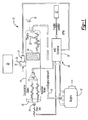
- Figure 1 is a general schematic view of an air introduction system according to the present invention.
- Figure 2 is general graphical representation of a noise attenuation frequency band which for the present invention.
- FIG. 1 illustrates a general schematic view of an air introduction system 10 for a vehicle 12.
- the air introduction system 10 includes an air introduction body 14 mounted adjacent a vehicle body component (illustrated schematically at 16).
- the air introduction body 14 intakes ambient air and communicate airflow to an engine 18.
- noise and vibration emanates through the air introduction system 10 and out the inlet.
- the air introduction body 14 includes an inlet 20 which communicates with ambient atmosphere through a throttle 22 and an air filter 24. It should be understood that the illustrated embodiment is schematic and that other arrangements will also benefit from the present invention.
- An active noise control system 26 is mounted adjacent the air introduction body 14 to control engine noise which is radiated from the air introduction system 10.
- the active noise control system 26 preferably includes an error microphone 28, a speaker 29 and an active resonator 30 which communicate with an ANC controller 32.
- the error microphone 28 is located in a reception area such that the speaker 29 of the active noise control system 26 will effectively counteract undesirable noise in response to the ANC controller 32 as generally known.
- the active resonator 30 is preferably a Helmholtz resonator which is coupled to the air introduction body 14 and driven by an activator 31.
- the active resonator 30 generally provides an air space which communicates with a Helmholtz volume 35 through an opening 33. A mass that resonates on support of a biasing force is formed by the air enclosed in the hollow space.
- the resonant frequency of the Helmholtz resonator depends on the area of the opening 33, on the volume of the air space, and on the length of the mass formed in the opening. When the area of the opening becomes larger, the resonance frequency is shifted toward higher frequencies. When the area of the opening is made smaller, the resonance frequency is shifted towards lower frequencies.
- the resonance frequency of the active resonator 30 is varied in response to the ANC controller 32. That is, actuator 31 responds to ANC controller 32 to vary opening 33.
- the ANC controller 32 provides logic which utilize a sensor 37 such as cam sensor equal to control the active resonator 30 to best match engine noise.
- the active resonator 30 is preferably tuned to eliminate low frequency noise such that the ANC system speaker 29 will effectively control the remaining noise.
- an eight liter Helmholtz volume with neck length of 20mm and opening diameter range of 19-30mm will attenuate 90Hz-120Hz (Figure 2) which is an otherwise difficult frequency range for a relatively small ANC system 26 to cancel.
- Such a frequency range is representative of a typically four-cylinder engine, however, other ranges will also benefit from the present invention.
- the ANC system 26 and active resonator 30 will have an advantageous attenuation frequency band of 75Hz-150Hz where the ANC system speaker 29 provides an attenuation capability of approximately 20 dB.
Landscapes
- Physics & Mathematics (AREA)
- Engineering & Computer Science (AREA)
- Acoustics & Sound (AREA)
- Multimedia (AREA)
- Soundproofing, Sound Blocking, And Sound Damping (AREA)
- Fittings On The Vehicle Exterior For Carrying Loads, And Devices For Holding Or Mounting Articles (AREA)
- Exhaust Silencers (AREA)
- Obtaining Desirable Characteristics In Audible-Bandwidth Transducers (AREA)
Abstract
Description
- The present application claims priority to United States Provisional Patent Application Serial No. 60/336,263, filed 15 November 2001.
- The present invention relates to a vehicle noise cancellation system, and more particularly to an active noise control system which utilizes an active resonator to minimize low frequency noise.
- Manufacturers have employed active and passive methods to reduce engine noise within the passenger compartment. Such noise frequently emanates from the engine, travels through the air induction system and emanates out of an inlet of the air intake into the passenger compartment.
- Active noise cancellation (ANC) systems typically utilize a speaker to create a canceling noise that attenuates engine noise. The noise created is out of phase with the engine noise and combines with this noise to result in its reduction. Generally, this noise is generated in proximity to the inlet of the air induction system. In one such system, a control unit, such as a digital signal processor, obtains data from the vehicle engine, creates a predictive model of engine noise, and thereby generates the appropriate cancellation signal based on the results of this model. This signal is then transmitted to the speaker, which transforms this signal into a canceling noise. Because the control unit may not perfectly model engine noise, an error microphone is placed in proximity to the intake of the air induction system to determine if engine noise need be further attenuated.
- Small vehicles provide less packaging space for the ANC system. The ANC system on such vehicles must utilize smaller components which may result in unsatisfactory noise cancellation. Also, ANC system deficiency may be particularly pronounced in four-cylinder engines which generate low frequency noise which is difficult to cancel.
- Accordingly, it is desirable to provide an effective ANC system which requires minimum packaging space for utilization in relatively small vehicles.
- The active noise control system according to the present invention is mounted adjacent an air introduction body to control engine noise which is radiated through the air introduction system. The active noise control system includes an error microphone, a speaker, and an active resonator which communicate with an ANC controller.
- The active resonator is a Helmholtz resonator which is coupled to the air introduction body. The resonance frequency of the active resonator is varied in response to the ANC controller which provides logic to control the active resonator in response to sensor signals such as a cam sensor signal. The active resonator eliminates low frequency noise such that the ANC system speaker will effectively control the remaining noise.
- The present invention therefore provides an effective ANC system which requires minimum packaging space for utilization in relatively small vehicles when compared to conventional passive/active noise control system for a four-cylinder application.
- The various features and advantages of this invention will become apparent to those skilled in the art from the following detailed description of the currently preferred embodiment. The drawings that accompany the detailed description can be briefly described as follows:
- Figure 1 is a general schematic view of an air introduction system according to the present invention; and
- Figure 2 is general graphical representation of a noise attenuation frequency band which for the present invention.
- Figure 1 illustrates a general schematic view of an
air introduction system 10 for a vehicle 12. Theair introduction system 10 includes anair introduction body 14 mounted adjacent a vehicle body component (illustrated schematically at 16). Theair introduction body 14 intakes ambient air and communicate airflow to anengine 18. As known, noise and vibration (illustrated schematically at N) from theengine 18 emanates through theair introduction system 10 and out the inlet. Theair introduction body 14 includes aninlet 20 which communicates with ambient atmosphere through athrottle 22 and anair filter 24. It should be understood that the illustrated embodiment is schematic and that other arrangements will also benefit from the present invention. - An active
noise control system 26 is mounted adjacent theair introduction body 14 to control engine noise which is radiated from theair introduction system 10. The activenoise control system 26 preferably includes anerror microphone 28, aspeaker 29 and anactive resonator 30 which communicate with an ANCcontroller 32. Theerror microphone 28 is located in a reception area such that thespeaker 29 of the activenoise control system 26 will effectively counteract undesirable noise in response to the ANCcontroller 32 as generally known. - The
active resonator 30 is preferably a Helmholtz resonator which is coupled to theair introduction body 14 and driven by anactivator 31. A Helmholtz resonator is defined by the Helmholtz equation:active resonator 30 generally provides an air space which communicates with a Helmholtzvolume 35 through an opening 33. A mass that resonates on support of a biasing force is formed by the air enclosed in the hollow space. The resonant frequency of the Helmholtz resonator depends on the area of theopening 33, on the volume of the air space, and on the length of the mass formed in the opening. When the area of the opening becomes larger, the resonance frequency is shifted toward higher frequencies. When the area of the opening is made smaller, the resonance frequency is shifted towards lower frequencies. - The resonance frequency of the
active resonator 30 is varied in response to the ANCcontroller 32. That is,actuator 31 responds to ANCcontroller 32 to vary opening 33. Particularly, the ANCcontroller 32 provides logic which utilize asensor 37 such as cam sensor equal to control theactive resonator 30 to best match engine noise. - The
active resonator 30 is preferably tuned to eliminate low frequency noise such that the ANCsystem speaker 29 will effectively control the remaining noise. For example only, an eight liter Helmholtz volume with neck length of 20mm and opening diameter range of 19-30mm will attenuate 90Hz-120Hz (Figure 2) which is an otherwise difficult frequency range for a relatively small ANCsystem 26 to cancel. Such a frequency range is representative of a typically four-cylinder engine, however, other ranges will also benefit from the present invention. Furthermore, the ANCsystem 26 andactive resonator 30 will have an advantageous attenuation frequency band of 75Hz-150Hz where the ANCsystem speaker 29 provides an attenuation capability of approximately 20 dB. - The foregoing description is exemplary rather than defined by the limitations within. Many modifications and variations of the present invention are possible in light of the above teachings. The preferred embodiments of this invention have been disclosed, however, one of ordinary skill in the art would recognize that certain modifications would come within the scope of this invention. It is, therefore, to be understood that within the scope of the appended claims, the invention may be practiced otherwise than as specifically described. For that reason the following claims should be studied to determine the true scope and content of this invention.
- It should be understood that various sensors will benefit from the present invention.
Claims (9)
- An active noise control system for attenuating noise from a vehicle comprising:an active noise cancellation controller;an active noise cancellation speaker mounted adjacent an air introduction body, said active noise cancellation speaker in communication with said controller; andan active resonator mounted adjacent said air introduction body, said active resonator in communication with said controller to attenuate a low frequency noise.
- The active noise control system as recited in claim 1, further comprising an error microphone mounted adjacent said air introduction body, said error microphone in communication with said controller for a closed loop ANC system.
- The active noise control system as recited in claim 1, wherein said active resonator has an attenuation frequency band of 90Hz-120Hz.
- The active noise control system as recited in claim 1, wherein said active resonator comprises a Helmholtz resonator.
- The active noise control system as recited in claim 1, further comprising a cam sensor in communication with said controller, said controller operable to adjust attenuation of said low frequency noise in response to said cam sensor.
- A vehicle intake system comprising:an air introduction body;an active noise cancellation controller;a cam sensor in communication with said controller;an active noise cancellation speaker mounted adjacent said air introduction body, said active noise cancellation speaker in communication with said controller; anda Helmholtz resonator mounted adjacent said air introduction body, said Helmholtz resonator operable to attenuate a low frequency noise in response to said controller and to said cam sensor.
- The system as recited in claim 1, wherein said active resonator has an attenuation frequency band of 90Hz-120Hz.
- A method of noise cancellation for a vehicle intake system comprising the steps of:(1) driving an active noise cancellation speaker in response to an active noise cancellation controller which communicates with an error microphone adjacent an air introduction body;(2) determining an engine speed; and(3) adjusting an active resonator to attenuate a low frequency noise in response to said step (2).
- A method as recited in claim 8, wherein said step (2) further comprising adjusting the active resonator within an attenuation frequency band of 90Hz-120Hz.
Applications Claiming Priority (4)
| Application Number | Priority Date | Filing Date | Title |
|---|---|---|---|
| US33626301P | 2001-11-15 | 2001-11-15 | |
| US336263P | 2001-11-15 | ||
| US268130 | 2002-10-10 | ||
| US10/268,130 US20030091198A1 (en) | 2001-11-15 | 2002-10-10 | Active noise control system with a helmholtz resonator |
Publications (2)
| Publication Number | Publication Date |
|---|---|
| EP1313090A2 true EP1313090A2 (en) | 2003-05-21 |
| EP1313090A3 EP1313090A3 (en) | 2004-04-21 |
Family
ID=26952896
Family Applications (1)
| Application Number | Title | Priority Date | Filing Date |
|---|---|---|---|
| EP02079759A Withdrawn EP1313090A3 (en) | 2001-11-15 | 2002-11-12 | Active noise control system with a Helmholtz resonator |
Country Status (2)
| Country | Link |
|---|---|
| US (1) | US20030091198A1 (en) |
| EP (1) | EP1313090A3 (en) |
Cited By (2)
| Publication number | Priority date | Publication date | Assignee | Title |
|---|---|---|---|---|
| CN108932939A (en) * | 2017-05-26 | 2018-12-04 | 南京大学 | It is a kind of to have the slim sound absorption structure and its design method for adjusting noise for low frequency |
| US11170751B1 (en) | 2020-09-21 | 2021-11-09 | Toyota Motor Engineering & Manufacturing North America, Inc. | Active noise control for vehicle with a single open window |
Families Citing this family (6)
| Publication number | Priority date | Publication date | Assignee | Title |
|---|---|---|---|---|
| US20090136052A1 (en) * | 2007-11-27 | 2009-05-28 | David Clark Company Incorporated | Active Noise Cancellation Using a Predictive Approach |
| AU2010280388A1 (en) | 2009-08-03 | 2012-03-29 | Koninklijke Philips Electronics N.V. | Low restriction resonator with adjustable frequency characteristics for use in compressor nebulizer systems |
| US8220267B1 (en) * | 2009-10-01 | 2012-07-17 | Florida Turbine Technologies, Inc. | Process to detect two-phase flow in a conduit |
| TW201247996A (en) * | 2011-05-26 | 2012-12-01 | Anpec Electronics Corp | Noiseless motor apparatus and denoise driver |
| EP2797075B1 (en) * | 2013-04-26 | 2018-09-12 | Eberspächer Exhaust Technology GmbH & Co. KG | System for influencing exhaust noise, engine noise and/or intake noise |
| CN112709654B (en) * | 2019-10-25 | 2023-12-05 | 陕西汽车集团股份有限公司 | Air inlet system and noise reduction method of commercial vehicle |
Citations (3)
| Publication number | Priority date | Publication date | Assignee | Title |
|---|---|---|---|---|
| US6009705A (en) * | 1995-11-06 | 2000-01-04 | Tennex Europe Limited | Noise attenuator for an induction system or an exhaust system |
| US6084971A (en) * | 1997-06-10 | 2000-07-04 | Siemens Electric Limited | Active noise attenuation system |
| EP1152132A1 (en) * | 2000-05-02 | 2001-11-07 | FILTERWERK MANN & HUMMEL GMBH | Ducting system with electromechanical converter producing a correction noise |
Family Cites Families (8)
| Publication number | Priority date | Publication date | Assignee | Title |
|---|---|---|---|---|
| JPS593157A (en) * | 1982-06-29 | 1984-01-09 | Hino Motors Ltd | Noise reduction device for internal-combustion engine |
| US5446790A (en) * | 1989-11-24 | 1995-08-29 | Nippondenso Co., Ltd. | Intake sound control apparatus |
| GB2265277B (en) * | 1992-03-17 | 1996-07-24 | Fuji Heavy Ind Ltd | Noise reduction system for automobile compartment |
| DE4215495A1 (en) * | 1992-05-12 | 1993-11-18 | Basf Ag | Azo dyes with an acetalized diazo component from the thiophene or thiazole series |
| JPH08189431A (en) * | 1995-01-09 | 1996-07-23 | Unisia Jecs Corp | Automotive noise reduction device |
| DE19618432A1 (en) * | 1996-05-08 | 1997-11-13 | Mann & Hummel Filter | Intake device for an internal combustion engine |
| US5930371A (en) * | 1997-01-07 | 1999-07-27 | Nelson Industries, Inc. | Tunable acoustic system |
| US6775384B2 (en) * | 2000-09-20 | 2004-08-10 | Siemens Vdo Automotive Inc. | Environmentally robust noise attenuation system |
-
2002
- 2002-10-10 US US10/268,130 patent/US20030091198A1/en not_active Abandoned
- 2002-11-12 EP EP02079759A patent/EP1313090A3/en not_active Withdrawn
Patent Citations (3)
| Publication number | Priority date | Publication date | Assignee | Title |
|---|---|---|---|---|
| US6009705A (en) * | 1995-11-06 | 2000-01-04 | Tennex Europe Limited | Noise attenuator for an induction system or an exhaust system |
| US6084971A (en) * | 1997-06-10 | 2000-07-04 | Siemens Electric Limited | Active noise attenuation system |
| EP1152132A1 (en) * | 2000-05-02 | 2001-11-07 | FILTERWERK MANN & HUMMEL GMBH | Ducting system with electromechanical converter producing a correction noise |
Cited By (2)
| Publication number | Priority date | Publication date | Assignee | Title |
|---|---|---|---|---|
| CN108932939A (en) * | 2017-05-26 | 2018-12-04 | 南京大学 | It is a kind of to have the slim sound absorption structure and its design method for adjusting noise for low frequency |
| US11170751B1 (en) | 2020-09-21 | 2021-11-09 | Toyota Motor Engineering & Manufacturing North America, Inc. | Active noise control for vehicle with a single open window |
Also Published As
| Publication number | Publication date |
|---|---|
| US20030091198A1 (en) | 2003-05-15 |
| EP1313090A3 (en) | 2004-04-21 |
Similar Documents
| Publication | Publication Date | Title |
|---|---|---|
| EP0878001B1 (en) | System and method for reducing engine noise | |
| US5446790A (en) | Intake sound control apparatus | |
| US20040173175A1 (en) | Helmholtz resonator | |
| US6758304B1 (en) | Tuned Helmholtz resonator using cavity forcing | |
| US8259958B2 (en) | Engine sound control apparatus and control method | |
| EP1313090A2 (en) | Active noise control system with a Helmholtz resonator | |
| US6940983B2 (en) | Resonator for active noise attenuation system | |
| JP2000303925A (en) | Air intake system for automotive internal combustion engine | |
| US20100314193A1 (en) | Membrane stiffening through ribbing for engine sound transmission device | |
| US8184820B2 (en) | Indirect acoustic transfer control of noise | |
| EP1085201B1 (en) | Tuned active helmholtz resonator with forced response | |
| US20030215101A1 (en) | Active noise control system with an elongated transmission member | |
| EP1249829B1 (en) | Low frequency active noise control | |
| US6557665B2 (en) | Active dipole inlet using drone cone speaker driver | |
| US6775384B2 (en) | Environmentally robust noise attenuation system | |
| JPH04234096A (en) | Reduction device for car compartment noise | |
| US20030059058A1 (en) | Modular active noise air filter speaker and microphone assembly | |
| EP1162600B1 (en) | Active control of automotive induction noise | |
| Miljković | Brief Introduction to Active Noise Control in Cars | |
| US20010036282A1 (en) | Active noise attenuation inlet microphone system | |
| KR100482797B1 (en) | resonator of intake noise | |
| KR101119700B1 (en) | Device for Decreasing Intake Noise of Vehicle | |
| JPH0580965U (en) | Vehicle muffled noise reduction device | |
| JPH05106524A (en) | Intake sound reduction device for internal combustion engine | |
| JPH06249093A (en) | Silencer for internal combustion engine |
Legal Events
| Date | Code | Title | Description |
|---|---|---|---|
| PUAI | Public reference made under article 153(3) epc to a published international application that has entered the european phase |
Free format text: ORIGINAL CODE: 0009012 |
|
| AK | Designated contracting states |
Designated state(s): AT BE BG CH CY CZ DE DK EE ES FI FR GB GR IE IT LI LU MC NL PT SE SK TR |
|
| AX | Request for extension of the european patent |
Extension state: AL LT LV MK RO SI |
|
| PUAL | Search report despatched |
Free format text: ORIGINAL CODE: 0009013 |
|
| AK | Designated contracting states |
Kind code of ref document: A3 Designated state(s): AT BE BG CH CY CZ DE DK EE ES FI FR GB GR IE IT LI LU MC NL PT SE SK TR |
|
| AX | Request for extension of the european patent |
Extension state: AL LT LV MK RO SI |
|
| 17P | Request for examination filed |
Effective date: 20040929 |
|
| AKX | Designation fees paid |
Designated state(s): DE GB |
|
| 17Q | First examination report despatched |
Effective date: 20090616 |
|
| STAA | Information on the status of an ep patent application or granted ep patent |
Free format text: STATUS: THE APPLICATION IS DEEMED TO BE WITHDRAWN |
|
| 18D | Application deemed to be withdrawn |
Effective date: 20131022 |