Field of the Invention
-
The present invention relates to electrostatographic toners and, more particularly, to a
composition for forming magenta-colored toner particles and to toner particles formed
therefrom.
Background of the Invention
-
When Neptune 525, a magenta-colored dye commercially available from BASF, is
employed in an evaporative limited coalescence (ELC) process, dye crystallization occurs
during the evaporation of the ethyl acetate used in the process, resulting in the formation of
a substantial number of toner particles containing little or no dye.
-
It is generally recognized that crystallization rates are enhanced by factors such as
molecular symmetry and coplanarity that allow for the close packing and alignment of
molecules. To eliminate or substantially reduce the tendency towards crystallization
exhibited by dyes such as Neptune 525, one might consider variations in dye molecular
structure that would hinder molecular packing.
-
International Patent Application WO 92/19684 and the corresponding Canadian Patent
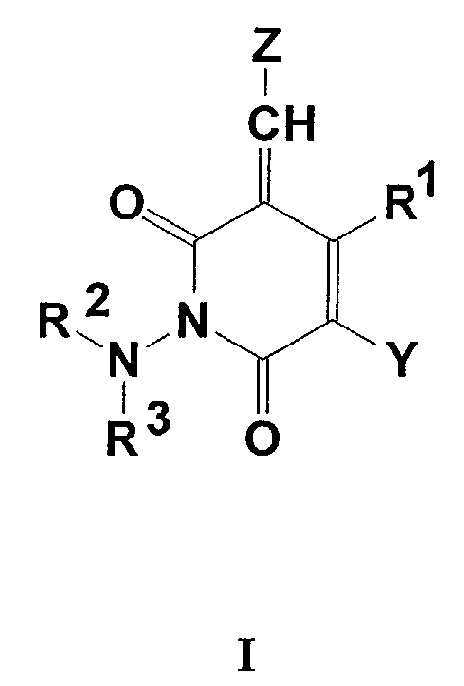
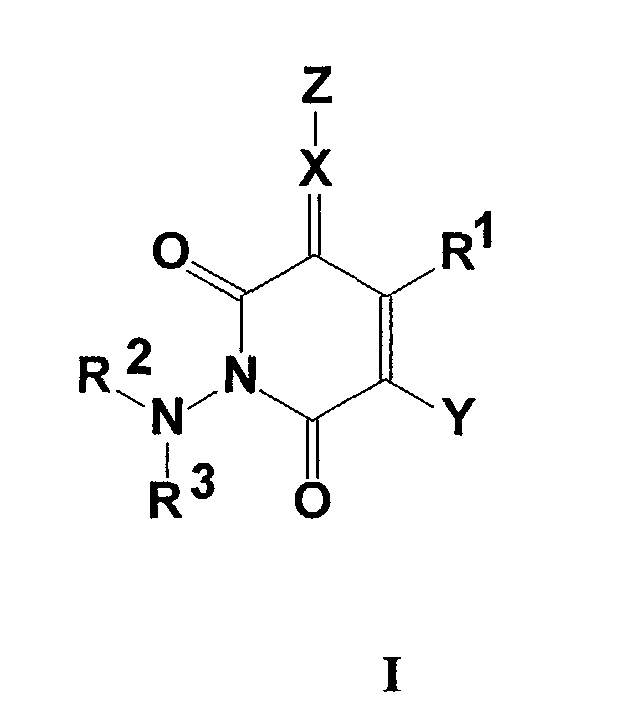
Application No. 2106779, issued to BASF AG, describe N-aminopyridone dyes of formula
(I), wherein R
1 represents hydrogen or C
1-C
4 alkyl, R
2 and R
3 may be identical or different
and independently represent hydrogen, optionally substituted C
1-C
12 alkyl, C
5-C
7
cycloalkyl, optionally substituted phenyl, optionally substituted pyridyl, optionally
substituted C
1-C
12 alkanoyl, C
1-C
12 alkoxycarbonyl, optionally substituted C
1-C
12
cycloalkylsulphonyl, optionally substituted phenyl substituted phenylsulphonyl,
pyridylsulphonyl, optionally substituted benzoyl, pyridylcarbonyl, or thienylcarbonyl, or
R
2 and R
3 together with the nitrogen atom linking them represent succinimido optionally
substituted by C
1-C
4 alkyl, phthalimido optionally substituted by C
1-C
4 alkyl, or a five- or
six-membered saturated heterocylic residue optionally containing additional heteroatoms,
and X represents CH or nitrogen, Y represents cyano or a residue of formula CO-W, CO-OW
or CO-NHW, wherein W represents hydrogen, C
1-C
8 alkyl that is optionally
substituted and may be interrupted by one or two oxygen atoms with an ether function, C
5-C
7
cycloalkyl, phenyl, or tolyl, and Z represents an aromatic carbocyclic or heterocyclic
residue.
-
The applications further disclose a process for transferring a pyridone dye from a transfer
to plastic-coated paper by diffusion or sublimation with the aid of an energy source.
Summary of the Invention
-
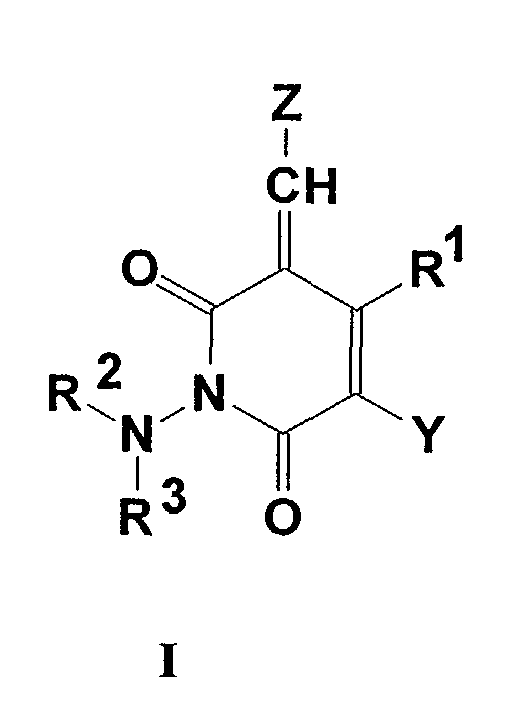
The present invention is directed to composition for electrostatographic toner particles that
comprises an organic binder polymer and a dye having the structure
wherein R
1 represents hydrogen or an alkyl group containing 1 to about 4 carbon atoms, R
2
and R
3 each individually represents hydrogen, a substituted or unsubstituted alkyl group
containing 1 to about 12 carbon atoms, a cycloalkyl group containing 5 to 7 carbon atoms,
a substituted or unsubstituted phenyl group, a substituted or unsubstituted pyridyl group, an
alkanoyl group containing 2 to about 12 carbon atoms, an alkoxycarbonyl group containing
2 to about 12 carbon atoms, an alkylsulfonyl group containing 1 to about 12 carbon atoms,
a cycloalkylsulfonyl group containing 5 to 7 carbon atoms, a substituted or unsubstituted
phenylsulfonyl group, a substituted or unsubstituted pyridylsulfonyl group, a substituted or
unsubstituted benzoyl group, a substituted or unsubstituted pyridylcarbonyl group, or a
substituted or unsubstituted thienylcarbonyl group; or R
2 and R
3 together with the nitrogen
atom represents a substituted or unsubstituted succinimido group, a substituted or
unsubstituted phthalimido group, or a 5- or 6-membered saturated heterocyclic group; Y
represents cyano or a residue of formula CO-W, CO-OW or CO-NHW, wherein W
represents hydrogen, a substituted or unsubstituted alkyl group containing 1 to about 8
carbon atoms, an alkoxyalkyl group containing up to about 8 carbon atoms, a cycloalkyl
group containing 5 to 7 carbon atoms, a substituted or unsubstituted phenyl group;
wherein R
4 and R
5 each individually represents a substituted or unsubstituted alkyl group
containing 1 to about 8 carbon atoms, or R
4 and R
5 taken together with N represent a 5- or
6-membered cyclic ring system, and R
6 represents a substituted or unsubstituted alkyl, aryl,
alkenyl, or cycloalkyl group containing up to about 10 carbon atoms.
Detailed Description of the Invention
-
In structure I above, R1 preferably represents a methyl group, R2 preferably represents
hydrogen, R3 preferably represents a benzoyl group, and Y preferably represents a cyano
group.
-
In structure II above, R4 and R5 can represent the same alkyl group, preferably an n-butyl
group. R4 and R5 together with N can also represent a morpholino group, a piperidino
group, or a pyrrolidino group. R6 preferably represents an alkyl group, more preferably, a
methyl group.
-
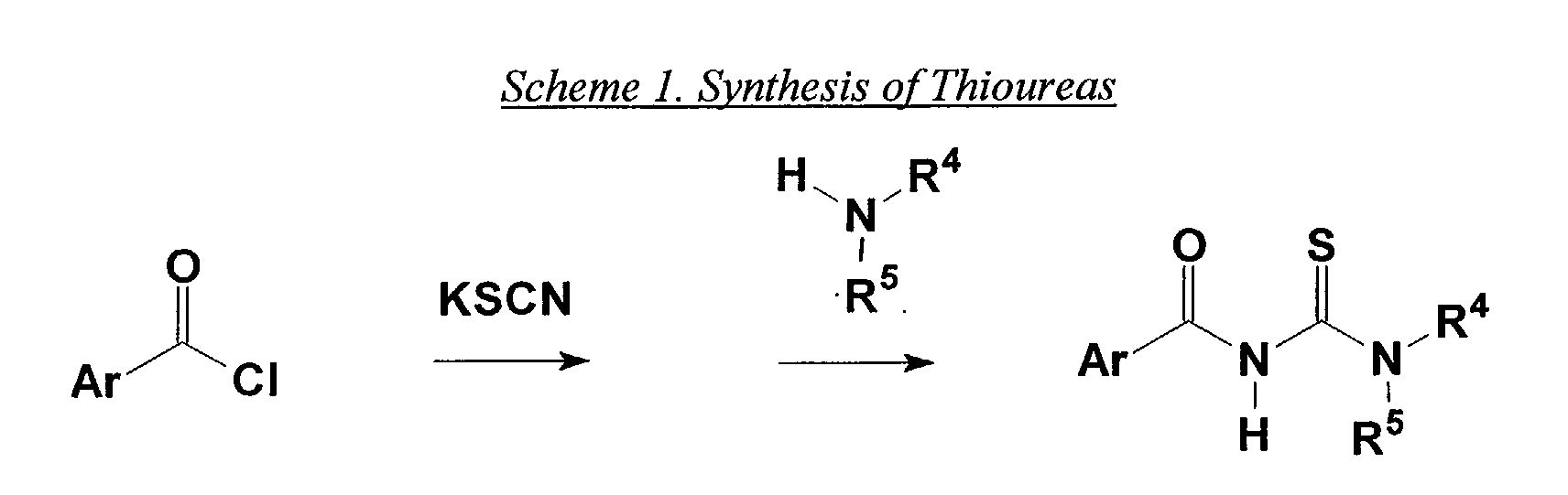
Synthesis Scheme 1 below, a modification of that described in WO 92/19684, was utilized
in the preparation of the thiazole N-aminopyridone dyes of the present invention. In
Scheme 1 as well as in Schemes 2, 3, and 4 that follow, Ar represents, in accordance with
the present invention, a phenyl ring substituted at the 3-position with a substituted or
unsubstituted alkoxy, alkenoxy, cycloalkoxy, or aryloxy group containing up to about 10
carbon atoms. Preferably, the phenyl 3-substituent is an unsubstituted alkoxy group, more
preferably, a methoxy group.
-
As shown in Scheme 1, the first step is the reaction of an aroyl chloride with potassium
thiocyanate, followed by reaction of the resulting product with a secondary amine to form
the corresponding thiourea, using the general procedure included in Example 1 of U.S.
Patent No. 4,560,751. The structures of thioureas so prepared are presented in Table 1.
-
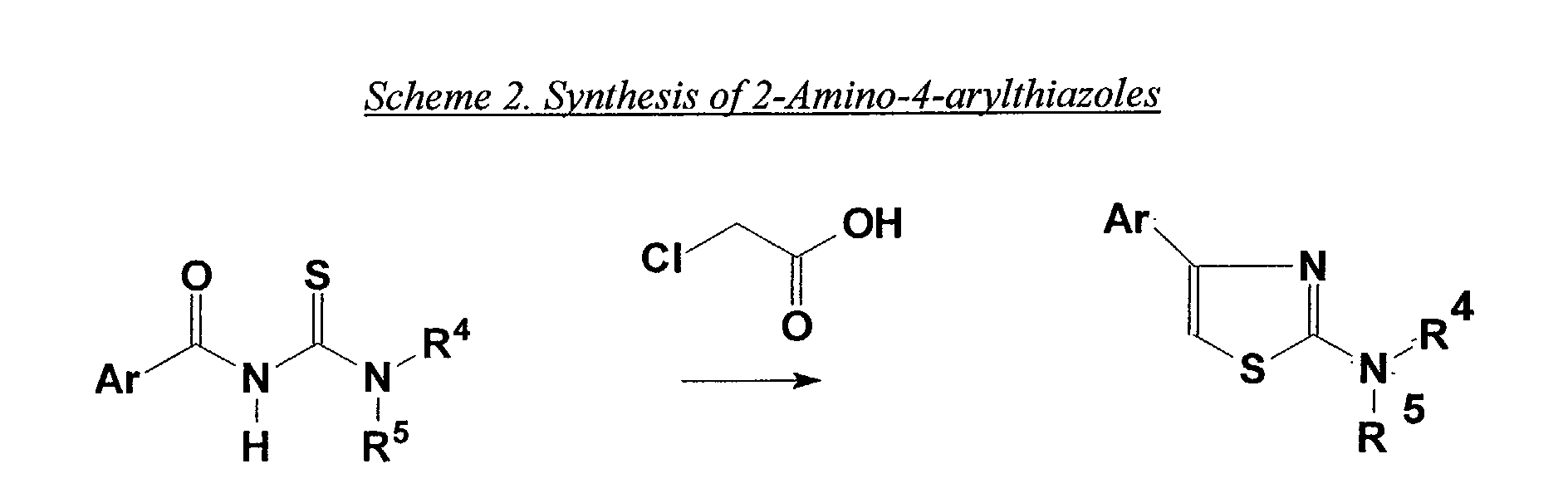
The second step of the synthesis sequence, Scheme 2 below, utilizes the general procedure
of Example 1 of U.S. Patent No. 4,560,751 for the reaction of the thioureas with
chloroacetic acid to give the 2-amino-4-arylthiazoles. The structure of the 2-amino-4-arylthiazoles
prepared are shown in Table 2.
-
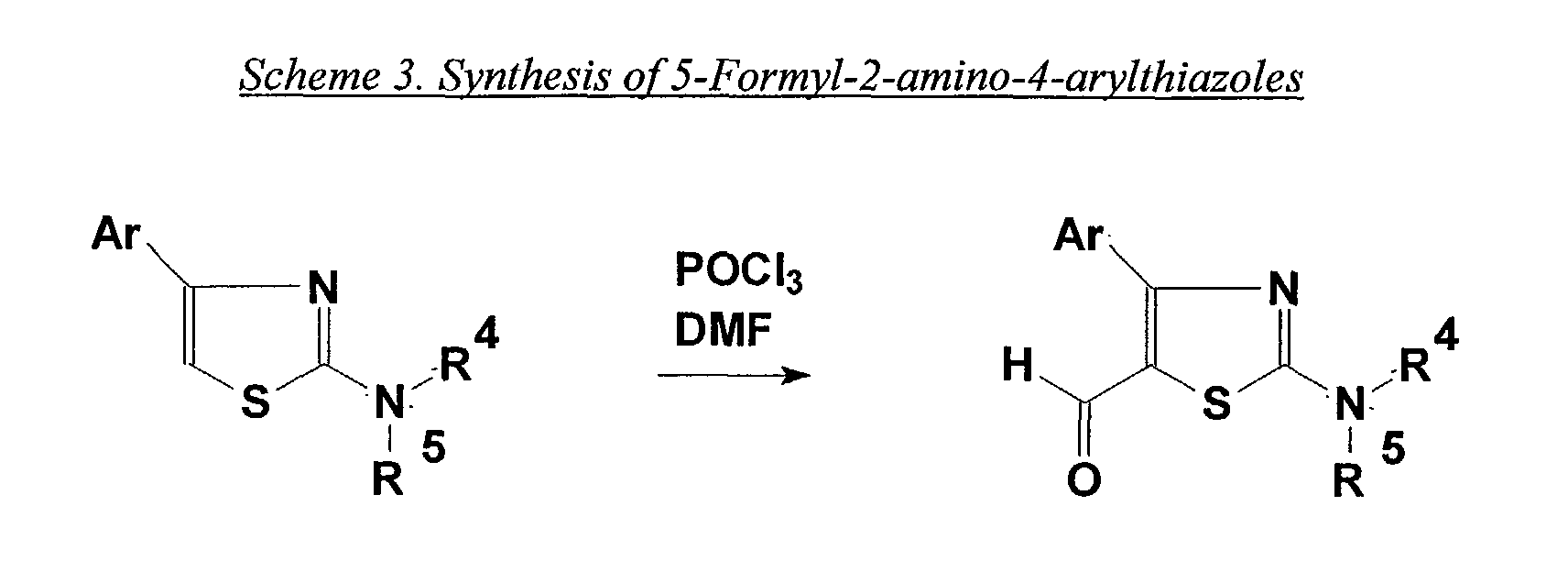
The third step of the reaction sequence, Scheme 3 below, entails formylation of the 2-amino-4-arylthiazoles
at the 5-position via the Vilsmeier reaction from phosphorous
oxychloride and DMF, following the general procedure reported in
J. Chem. Soc., Perkin
Tram. I, 1983, p.346. The structures of the thiazole aldehydes prepared are shown in
Table 3.
-
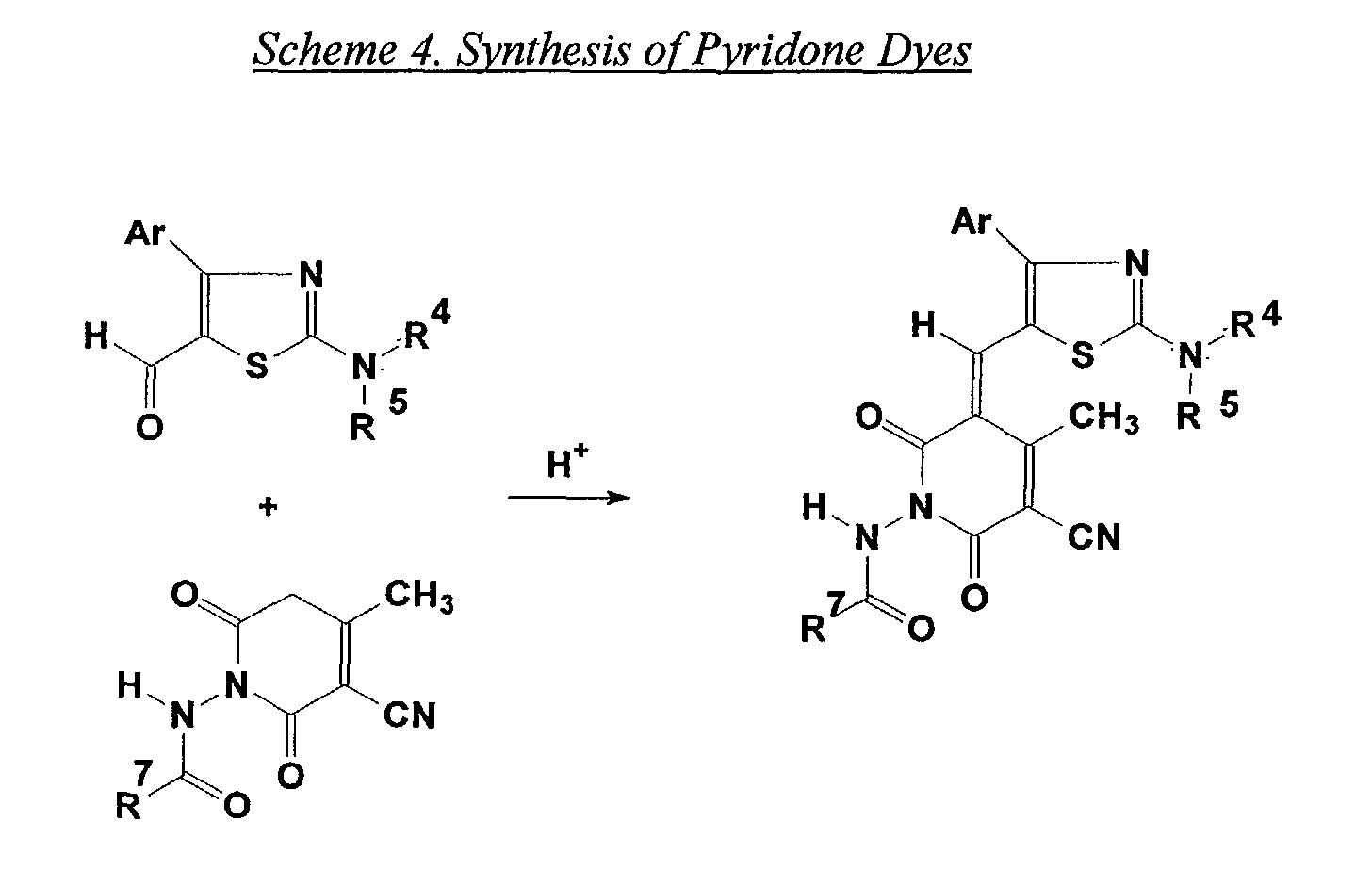
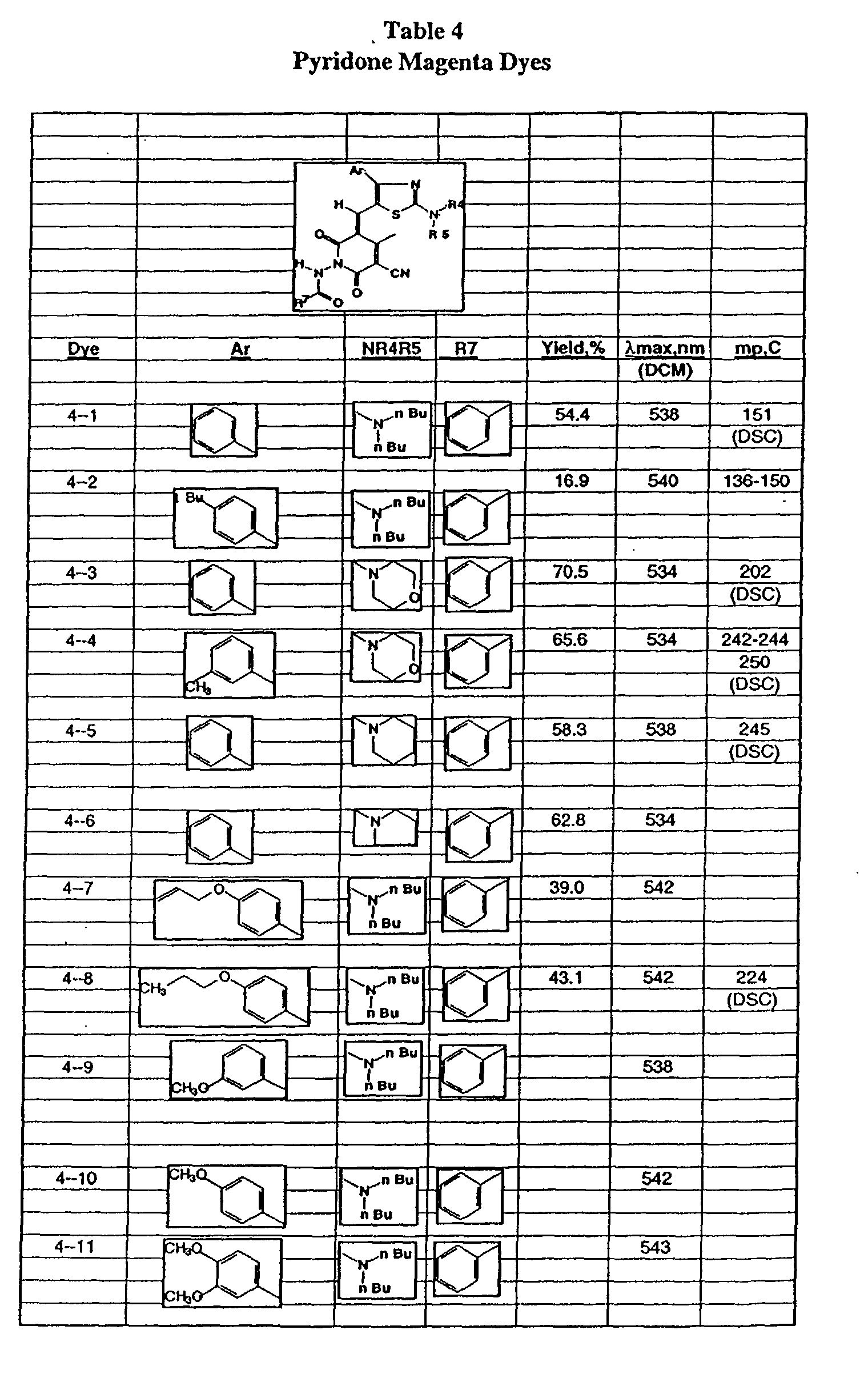
The next step of the reaction sequence, Scheme 4 below, is the acylation of 1-amino-5-cyano-2-hydroxy-4-methyl-6-pyridone,
prepared as reported in
Polish Journal of
Chemistry, Vol. 58, 1984, page 85 (CA 123:313975), followed by condensation of the
acylated product with a thiazole aldehyde. The general procedure described in WO
92/19684 was used to prepare the pyridone dyes, whose structures are shown in Table 4.
-
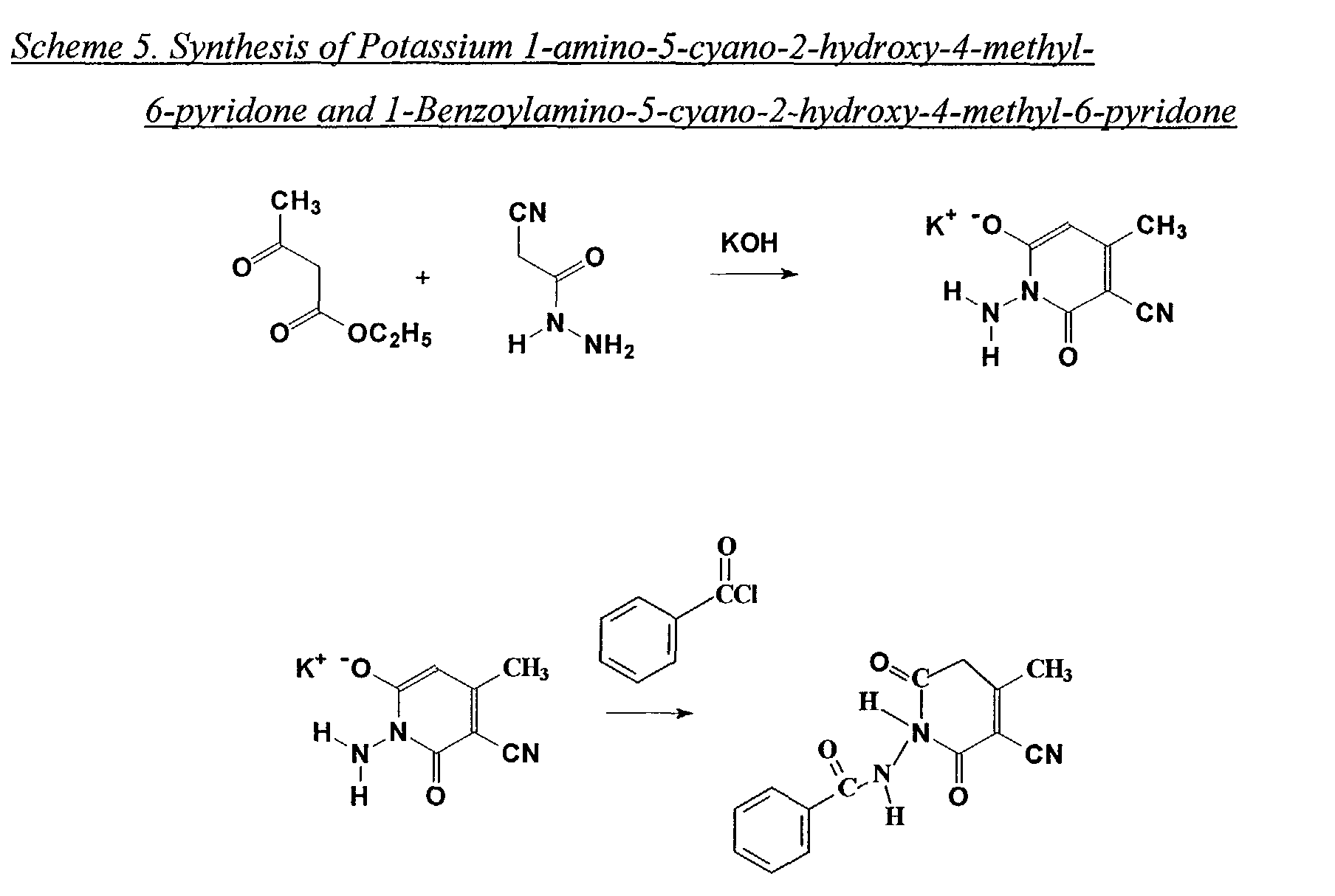
Acylamino-5-cyano-2-hydroxy-4-methyl-6-pyridones, in particular, the benzoylamino
derivative, can be also prepared by Scheme 5, shown below.
-
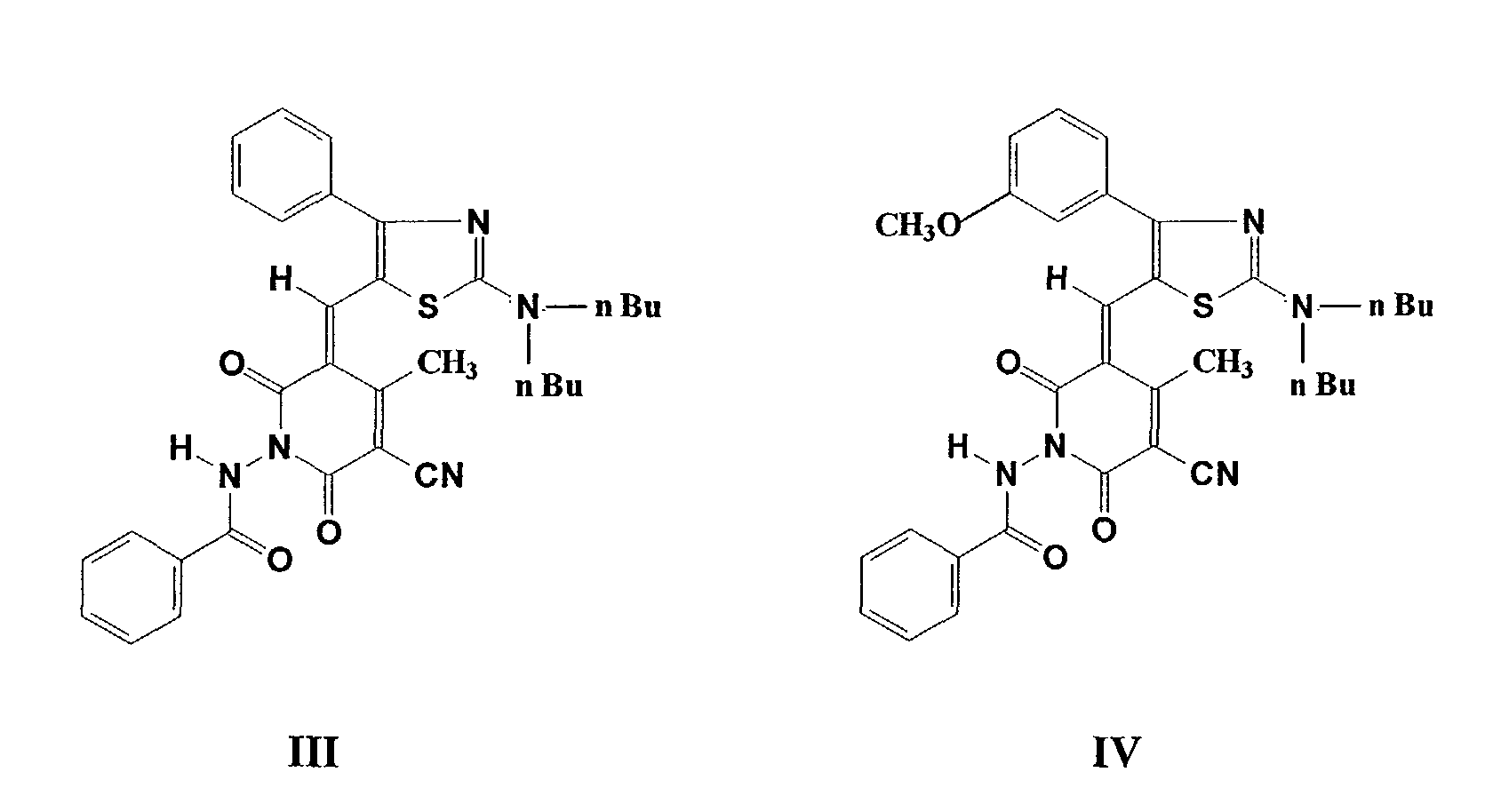
Although not wishing to be bounds by the following interpretation, it is possible that an
aromatic substituent such as the phenyl group at the 4-position of the thiazole ring shown
in structure III below resides in an extended conjugated coplanar arrangement with the
thiazole nucleus. Such an arrangement might be expected to facilitate alignment of
molecules in such a way as to result in crystallization of the dye. To avoid this possible
tendency towards dye crystallization, various substituents were introduced into the
aromatic ring at the thiazolyl 4-position. Substitution of a 3-methoxy group of the phenyl
ring, as shown in structure IV below, yielded a dye that did not crystallize when subjected
to an evaporative limited coalescence process. Furthermore when this dye was used to
make toner particles, all of the particles were colored. It is theorized that a combination of
steric effects and hydrogen bonding resulting from the introduction of the 3-methoxy
substituent into the phenyl group at the 4-position of the thiazole ring effectively removes
the phenyl ring from coplanarity with the conjugated system formed by the thiazolyl ring
and the pyridone nucleus.
-
Introduction of a methyl substituent in the 3-position of the phenyl ring on thiazole was not
effective in preventing the crystallization of the dye. Similarly, placing the methoxy
substituent in the 4-position or introducing methoxy groups into both the 3- and 4-positions
were not effective in forestalling dye crystallization. A propyleneoxy substituent in the
phenyl 4-position slightly reduced the tendency toward dye crystallization, but other alkyl
and alkoxy groups in the 4-position had no significant effect.
-
In the examples that follow, all melting points are uncorrected. NMR spectra were
obtained with a GE QE-300 NMR spectrometer. All chemicals were commercially
available unless otherwise indicated.
N,N-Dibutyl-N'-benzoylthiourea (Compound 1-1)
-
To a solution of 36.93 g (380 mmol) of potassium thiocyanate in 600 ml of acetone was
added dropwise over 15 mins, 53.42 g (380 mmol) of benzoyl chloride. The resultant
mixture was heated at reflux for 20 mins. To this mixture was added over 10 mins, 51.70 g
(400 mmol) of dibutylamine. The mixture was stirred for 3 hrs and poured into a solution
of 100 ml of concentrated HCl and 800 ml of ice. The yellow solid precipitate was
collected, washed with water and recrystallized from isopropanol. The white solid was
collected and dried to give 70.12g of product (63.1% yield); mp: 90-93°C. The NMR
spectrum was consistent with the proposed structure. Anal. Calcd. for C16H24N2OS: C,
65.7; H, 8.3; N, 9.6; S, 11.0.
-
Found: C, 65.84; H, 8.25; N, 9.61; S, 10.7.
N,N-Dibutyl-N'-(3-methoxybenzoyl)thiourea (Compound 1-24)
-
To a solution of 38.87 g (0.40 mol) of potassium thiocyanate in 630 ml of acetone was
added dropwise over 15 min, 68.24 g (0.40 mol) m-anisoyl chloride. The mixture was
heated to reflux and maintained at reflux for 20 mins. To this mixture was added 51.7 g
(0.40 mol) of dibutylamine over 10 min. The mixture was stirred overnight. The mixture
was added to a mixture of 103 ml of conc. HCl in 840 ml of ice water. The oily residue
was extracted with methylene chloride, dried over magnesium sulfate and concentrated.
The yield of product was 94.62 % and was used without further purification. Anal. Calcd.
for C17H26N2O2S: C, 63.3; H, 8.1, N, 8.7; S, 9.9. Found: C, 62.54; H, 8.38; N, 8.66: S,
9.19.
2-Dibutylamino-4-(4-t-butylphenyl)thiazole (Compound 2-2)
-
To a mixture of 174.15 g (0.50 mol) ofN,N-di-n-butyl-N'-(4-t-butylbenzoyl)thiourea
(compound 1-2), 44.0 g (1.10 mol) of sodium hydroxide and 500 ml of water was added
56.70 g (0.60 mol) of chloroacetic acid. The mixture was stirred and heated on a steam
bath for 22 hrs and cooled. The water phase was decanted from the solid phase, and the
solid was washed with water and methanol. Recrystallization of the solid from methanol
gave 85.6 g (49.7% yield) of product; mp: 48.5-49.5°C. The NMR spectrum was consistent
with the proposed structure. Anal. Calcd. for C21H32N2S: C, 73.20; H, 9.36; N, 8.13; S,
9.30. Found: C, 73.04; H, 9.29; N, 8.02; S, 9.19.
2-Dibutylamino-4-(3-methoxyphenyl)thiazole (Compound 2-12)
-
A mixture of 114.95 g (356.5 mmol) of N,N-di-n-butyl-N'-(3-methoxybenzoyl)thiourea
(compound 1-24), 31.37 g (784.2 mmol) of sodium hydroxide, and 350 ml of water was
prepared, to which was added 40.42 g (427.8 mmol) of chloroacetic acid. The mixture was
stirred and heated on a steam bath for 23 hrs, then cooled. The mixture was extracted with
methylene chloride, and the extracts were washed with water, dried over magnesium
sulfate, and concentrated. The oily residue began to crystallize on standing. The yield of
thiazole was 100.8 g and was used without further purification.
2-Morpholino-4-phenyl-5-thiazolecarboxaldehyde (Compound 3-3)
-
To a solution of 24.63 g (100 mmol) of 2-morpholino-4-phenyl-5-thiazole (compound 2-3)
in 240 ml of DMF was added dropwise a solution of 17.63 g (115 mmol) of phosphorus
oxychloride in 60 ml of DMF over 30 mins. The solution was stirred for 16 hrs, with solid
forming during the reaction. The mixture was poured into a solution of 50 g of sodium
carbonate in 1.2 1 of water. A voluminous precipitate was formed, requiring the addition of
more water. The solid was collected, washed with water and methanol, and recrystallized
from acetonitrile. The white solid was collected and dried to give 19.59 g (71.4% yield) of
product; mp 180.5-181.5°C. The NMR spectrum was consistent with the proposed
structure. Anal. Calcd. for C14H14N2O2S: C, 61.3 ; H, 5.1 ; N, 10.2 ; S, 11.7. Found: C,
61.04; H, 5.14; N, 10.23; S, 11.58.
2-Dibutylamino-4-(3-methoxyphenyl)-5-thiazolecarboxaldehyde (Compound 3-11)
-
To a solution of 100.8 g (316.5 mmol) of crude 2-di-n-butylamino-4-(3-methoxyphenyl)thiazole
(compound 2-12) and 630 ml of DMF was added, over about 30
mins, a solution of 55.81 g (364 mmol) of phosphorus oxychloride in 188 ml of DMF. The
mixture was stirred overnight and poured into a solution of 158.1 g of sodium carbonate in
3.5 1 of water. The oily precipitate was extracted with methylene chloride, and the extract
was washed with water, dried over magnesium sulfate, and concentrated. The yield of
brown oil was 88.77 g and was used without further purification. Anal. Calcd. For
C19H26N2O2S: C, 65.9; H, 7.6; N, 8.1; S, 9.3.
Found: C, 66.20; H, 7.85; N, 8.60; S, 7.93.
3-[2-Dibutylamino-4-(4-propoxyphenyl)-5-thiazolidene]-1-benzoylamino-5-cyano-2-hydroxy-4-methyl-6-pyridone
(Dye 4-8)
-
A mixture of 96.50 g (256.6 mmol) of 2-di-n-butylamino-4-(4-propoxyphenyl)-5-thiazolecarboxaldehyde
(compound 3-9), 69.19 g (256.6 mmol) of 1-benzoylamino-5-cyano-2-hydroxy-4-methyl-6-pyridone,
2.5 g of p-toluenesulfonic acid monohydrate, and 2
1 of toluene was heated at reflux for 19 hrs in a 5-1 round bottom flask equipped with a
Dean-Stark trap. The hot solution was filtered, and the filtrate was cooled and concentrated
to 900 ml. On cooling and standing, a first crop was collected. The filtrate was
concentrated to 400 ml, cooled, and allowed to stand. A second crop was collected, washed
with P-950 ligroine, and dried. The yield of second crop was 69.26 g (43.14 %); Tm (DSC)
= 223.5°C. The NMR spectrum was consistent with the proposed structure. HPLC analysis
of the dye indicated 96.8 % purity. Anal. Calcd. for C35H39N5O4S: C, 67.2 ; H, 6.3 ; N,
11.2 ; S, 5.1.
Found: C, 67.03; H, 6.12; N, 11.28; S, 4.94.
3-[2-Dibutylamino-4-(3-methoxyphenyl)-5-thiazolidene]-1-benzoylamino-5-cyano-2-hydroxy-4-methyl-6-pyridone
(Dye 4-9)
-
To a solution of 113.0 g (326 mmol) of 2-di-n-butylamino-4-(3-methoxyphenyl)-5-thiazolecarboxaldehyde
(compound 3-11) in 2500 ml of ethanol was added 87.3 g (324
mmol) of 1-benzoylamino-5-cyano-2-hydroxy-4-methyl-6-pyridone 3.0 g of p-toluenesulfonic
acid monohydrate. The mixture was heated at reflux for 2 hrs, at which
time a TLC plate showed no more starting material. The mixture was cooled to 10°C, and a
red solid precipitated. The mixture was allowed to stand overnight. 750 ml of ethanol was
added to the thick precipitate, and the solid was collected. The solid was dried to give 150
g of crude material, which was dissolved in 750 ml of methylene chloride and passed
through a pad of silica gel in a sintered glass funnel. The filtrate was concentrated to about
300 ml and poured into 2 1 of P-950 ligroine. The solid was collected, washed with P-950
ligroine, and dried. The yield of product was 142 g (73% yield). HPLC analysis of the dye
indicated 99+% purity. Anal. Calcd. for C33H35N5O4S: C, 66.3; H, 5.9; N, 11.7; S, 5.4.
Found: C, 66.5; H, 5.87; N, 11.53; S, 5.19.
Potassium 1-Amino-5-cyano-2-hydroxy-4-methyl-6-pyridone (Scheme 5)
-
To a mixture of 13.01 g (100 mmol) of ethyl acetoacetate, 9.01 g (100 mmol) of
cyanoacetohydrazide, and 150 ml of 3A-ethanol was added a solution of 6.60 g (100
mmol) of 85% KOH in 100 ml of 3A ethanol. The mixture was heated at reflux on a steam
bath for 2 hrs, and then cooled. The solid was collected, washed with methanol, and dried.
The yield of product was 11.56 g (56.9%). Anal. Calcd. for C7H6N3O2K: C, 41.37; H, 2.98;
N, 20.67; K, 19.24. Found: C, 39.86; H, 3.00; N, 20.36; K, 19.2.
1-Benzoylamino-5-cyano-2-hydroxy-4-methyl-6-pyridone (Scheme 5)
-
To a solution of 10.16 g (50 mmol) of potassium 1-amino-5-cyano-2-hydroxy-4-methyl-6-pyridone
in 50 ml of water was added a solution of 7.03 g (50 mmol) of benzoyl chloride
in 50 ml of methylene chloride. The mixture was stirred rapidly for 1 hr, and then filtered.
The solid was washed with isopropanol and air dried. The yield of product was 3.90 g
(29.0%); mp: 256°C dec. The NMR spectrum was consistent with the proposed structure.
Anal. Calcd. for C
14H
11N
3O
3: C, 62.5; H, 4.1; N, 15.6. Found: C, 62.23; H, 4.31; N, 15.85.
-
The toner particle composition of the present invention includes the dye and binder
polymer in a weight ratio preferably of about 1:4 to about 1:50 dye:polymer, more
preferably, about 1:10 to about 1:40 dye:polymer. Preferably, the toner particle
composition comprises a polyester as the binder polymer, and toner particles are formed
from the composition by an evaporative limited coalescence process.
Example 1 (Invention)
-
To 100.0g of ethyl acetate was added 24.0g of KAO C® binder polymer and 1.0g of Dye
4-9. This mixture, which comprised the organic phase in an evaporative limited
coalescence process, was mixed with an aqueous phase comprising 170ml of pH4 buffer
containing 14.0g of NALCO® 1060 silica and 3.05ml of a 10 wt.% aqueous solution of
poly (adipic acid-co-N-methylaminoethanol). The resulting organic-aqueous mixture was
then subjected to very high shear using a POLYTRON® mixer, followed by treatment with
a MICROFLUIDIZER® device. Upon exiting, the solvent was removed from the particles
so formed by stirring at room temperature overnight in an open container, during which
time the organic solvent evaporated. The particles were collected, washed with 0.1N
potassium hydroxide solution to remove the silica, then washed with water, and dried. The
toner particles were of about 4.2µ volume average diameter and non-spherical, with the
dye dispersed uniformly within the toner particle. Inclusion of this magenta-colored toner
is a set of colored toners resulted in a substantial increase in the color gamut relative to that
obtained from the baseline color set.
Example 2 (Comparison)
-
The procedure of Example 1 was repeated, with the exception that dye 4-9 was replaced by
Neptune 525 magenta dye. Upon removal of the solvent, the dye crystallized out of the
toner particles.
Example 3 (Comparison)
-
The procedure of Example 1 was repeated, with the exception that dye 4-9 was replaced by
Dye 4-1. Upon removal of the solvent, the dye crystallized out of the toner particles.
Example 4 (Comparison)
-
The procedure of Example 1 was repeated, with the exception that Dye 4-9 was replaced
by dye 4-2. Upon removal of the solvent, the dye crystallized out of the toner particles so
formed.
Example 5 (Comparison)
-
The procedure of Example 1 was repeated, with the exception that Dye 4-9 was replaced
by Dye 4-7. Upon removal of the solvent, some dye crystallization from the toner particles
was observed.
Example 6 (Comparison)
-
The procedure of Example 1 was repeated, with the exception that Dye 4-9 was replaced
by Dye 4-8. Upon removal of the solvent, the dye crystallized out of the toner particles so
formed.
Example 7 (Comparison)
-
The procedure of Example 1 was repeated, with the exception that dye 4-9 was replaced by
Dye 4-10. Upon removal of the solvent, the dye crystallized out of the toner particles.
Example 8 (Comparison)
-
The procedure of Example 1 was repeated, with the exception that Dye 4-9 was replaced
by Dye 4-11. Upon removal of the solvent, the dye crystallized out of the toner particles.
Example 9 (Comparison)
-
The procedure of Example 1 was repeated, with the exception that Dye 4-9 was replaced
by Dye 4-3. Upon removal of the solvent, the dye crystallized out of the toner particles.
Example 10 (Comparison)
-
The procedure of Example 1 was repeated, with the exception that Dye 4-9 was replaced
by Dye 4-4. Upon removal of the solvent, the dye crystallized out of the toner particles.
Example 11 (Comparison)
-
The procedure of Example 1 was repeated, with the exception that Dye 4-9 was replaced
by Dye 4-5. Upon removal of the solvent, the dye crystallized out of the toner particles.
Example 12 (Comparison)
-
The procedure of Example 1 was repeated, with the exception that Dye 4-9 was replaced
by Dye 4-6. Upon removal of the solvent, the dye crystallized out of the toner particles.
-
Dyes prepared in accordance with the present invention can be advantageously employed
in the preparation of toners by an evaporative limited coalescence (ELC) process. The dyes
so prepared show little tendency to crystallize and maintain the chroma and hue angle. In
addition to their usefulness for preparing toners, they can also be employed as colorants in
other marking materials such as thermal media, inks, and the like. They are especially
useful as magenta colorants in any subtractive primary colorant system based on a cyan,
yellow, and magenta (CYM) process. They are also useful in processes where subtractive
primary color marking particles are used along with one or more colorants selected from
the group consisting of black, orange, violet, and green.
-
The invention has been described in detail with particular reference to certain preferred
embodiments thereof, but it is understood that variations and modifications can be effected
within the spirit and scope of the invention, which is defined by the claims that follow.

 wherein R4 and R5 each individually represents a substituted or unsubstituted alkyl group containing 1 to about 8 carbon atoms, or R4 and R5 taken together with N represent a 5- or 6-membered cyclic ring system, and R6 represents a substituted or unsubstituted alkyl, aryl, alkenyl, or cycloalkyl group containing up to about 10 carbon atoms.


 wherein R4 and R5 each individually represents a substituted or unsubstituted alkyl group containing 1 to about 8 carbon atoms, or R4 and R5 taken together with N represent a 5- or 6-membered cyclic ring system, and R6 represents a substituted or unsubstituted alkyl, aryl, alkenyl, or cycloalkyl group containing up to about 10 carbon atoms.
