EP1312614A1 - Polynucleotides and polypeptides of the GCP-2 gene - Google Patents
Polynucleotides and polypeptides of the GCP-2 gene Download PDFInfo
- Publication number
- EP1312614A1 EP1312614A1 EP01402950A EP01402950A EP1312614A1 EP 1312614 A1 EP1312614 A1 EP 1312614A1 EP 01402950 A EP01402950 A EP 01402950A EP 01402950 A EP01402950 A EP 01402950A EP 1312614 A1 EP1312614 A1 EP 1312614A1
- Authority
- EP
- European Patent Office
- Prior art keywords
- amino acid
- acid sequence
- nucleotide sequence
- polypeptide
- polynucleotide
- Prior art date
- Legal status (The legal status is an assumption and is not a legal conclusion. Google has not performed a legal analysis and makes no representation as to the accuracy of the status listed.)
- Withdrawn
Links
- 108090000765 processed proteins & peptides Proteins 0.000 title claims abstract description 106
- 102000004196 processed proteins & peptides Human genes 0.000 title claims abstract description 103
- 229920001184 polypeptide Polymers 0.000 title claims abstract description 102
- 108091033319 polynucleotide Proteins 0.000 title claims abstract description 93
- 102000040430 polynucleotide Human genes 0.000 title claims abstract description 93
- 239000002157 polynucleotide Substances 0.000 title claims abstract description 92
- 101710085504 C-X-C motif chemokine 6 Proteins 0.000 title claims abstract 5
- 101710115997 Gamma-tubulin complex component 2 Proteins 0.000 title claims abstract 5
- 125000003729 nucleotide group Chemical group 0.000 claims abstract description 127
- 239000002773 nucleotide Substances 0.000 claims abstract description 126
- 102100028605 Gamma-tubulin complex component 2 Human genes 0.000 claims abstract 3
- 150000001413 amino acids Chemical class 0.000 claims description 81
- 210000004027 cell Anatomy 0.000 claims description 53
- 208000037265 diseases, disorders, signs and symptoms Diseases 0.000 claims description 46
- 238000000034 method Methods 0.000 claims description 45
- 201000010099 disease Diseases 0.000 claims description 27
- 230000008569 process Effects 0.000 claims description 22
- 239000013598 vector Substances 0.000 claims description 22
- 208000035475 disorder Diseases 0.000 claims description 19
- 238000003205 genotyping method Methods 0.000 claims description 19
- 239000003814 drug Substances 0.000 claims description 16
- 229940079593 drug Drugs 0.000 claims description 15
- 108091026890 Coding region Proteins 0.000 claims description 14
- 238000002360 preparation method Methods 0.000 claims description 13
- 230000000295 complement effect Effects 0.000 claims description 11
- 238000001514 detection method Methods 0.000 claims description 11
- 239000000203 mixture Substances 0.000 claims description 11
- 238000011282 treatment Methods 0.000 claims description 10
- 201000009030 Carcinoma Diseases 0.000 claims description 9
- 201000003793 Myelodysplastic syndrome Diseases 0.000 claims description 9
- 206010036030 Polyarthritis Diseases 0.000 claims description 9
- 201000004681 Psoriasis Diseases 0.000 claims description 9
- 206010073071 hepatocellular carcinoma Diseases 0.000 claims description 9
- 231100000844 hepatocellular carcinoma Toxicity 0.000 claims description 9
- 230000004054 inflammatory process Effects 0.000 claims description 9
- 201000008968 osteosarcoma Diseases 0.000 claims description 9
- 206010039073 rheumatoid arthritis Diseases 0.000 claims description 9
- 210000004881 tumor cell Anatomy 0.000 claims description 9
- 206010061218 Inflammation Diseases 0.000 claims description 8
- 230000004709 cell invasion Effects 0.000 claims description 8
- 210000000987 immune system Anatomy 0.000 claims description 8
- 239000008194 pharmaceutical composition Substances 0.000 claims description 8
- 230000002265 prevention Effects 0.000 claims description 8
- 239000013543 active substance Substances 0.000 claims description 6
- 230000000694 effects Effects 0.000 claims description 6
- 239000000546 pharmaceutical excipient Substances 0.000 claims description 6
- 241001465754 Metazoa Species 0.000 claims description 5
- 239000001963 growth medium Substances 0.000 claims description 5
- 239000012472 biological sample Substances 0.000 claims description 3
- 238000002649 immunization Methods 0.000 claims description 2
- 230000003053 immunization Effects 0.000 claims description 2
- 125000003275 alpha amino acid group Chemical group 0.000 claims 21
- 230000035772 mutation Effects 0.000 abstract description 8
- 230000001225 therapeutic effect Effects 0.000 abstract description 7
- 108090000623 proteins and genes Proteins 0.000 description 50
- 235000001014 amino acid Nutrition 0.000 description 34
- 235000018102 proteins Nutrition 0.000 description 26
- 102000004169 proteins and genes Human genes 0.000 description 26
- 102000004890 Interleukin-8 Human genes 0.000 description 25
- 108090001007 Interleukin-8 Proteins 0.000 description 25
- 108091058560 IL8 Proteins 0.000 description 24
- 239000003795 chemical substances by application Substances 0.000 description 24
- 108020004414 DNA Proteins 0.000 description 18
- 238000003752 polymerase chain reaction Methods 0.000 description 16
- RWQNBRDOKXIBIV-UHFFFAOYSA-N thymine Chemical compound CC1=CNC(=O)NC1=O RWQNBRDOKXIBIV-UHFFFAOYSA-N 0.000 description 16
- 108091028043 Nucleic acid sequence Proteins 0.000 description 15
- 150000001875 compounds Chemical class 0.000 description 13
- 239000012634 fragment Substances 0.000 description 13
- 108091032973 (ribonucleotides)n+m Proteins 0.000 description 11
- 230000015572 biosynthetic process Effects 0.000 description 11
- 230000004048 modification Effects 0.000 description 11
- 238000012986 modification Methods 0.000 description 11
- 108700028369 Alleles Proteins 0.000 description 10
- 238000005516 engineering process Methods 0.000 description 10
- 101000947177 Homo sapiens C-X-C motif chemokine 6 Proteins 0.000 description 9
- 238000012408 PCR amplification Methods 0.000 description 9
- 230000003213 activating effect Effects 0.000 description 8
- 238000009396 hybridization Methods 0.000 description 8
- 230000002401 inhibitory effect Effects 0.000 description 8
- 108091034117 Oligonucleotide Proteins 0.000 description 7
- 230000000692 anti-sense effect Effects 0.000 description 7
- 238000003786 synthesis reaction Methods 0.000 description 7
- 101001058904 Homo sapiens Gamma-tubulin complex component 2 Proteins 0.000 description 6
- 230000003321 amplification Effects 0.000 description 6
- 238000003199 nucleic acid amplification method Methods 0.000 description 6
- 239000000523 sample Substances 0.000 description 6
- 238000012360 testing method Methods 0.000 description 6
- 241001529936 Murinae Species 0.000 description 5
- 230000004913 activation Effects 0.000 description 5
- 238000006243 chemical reaction Methods 0.000 description 5
- 230000005284 excitation Effects 0.000 description 5
- 230000005764 inhibitory process Effects 0.000 description 5
- 210000000440 neutrophil Anatomy 0.000 description 5
- 108010076504 Protein Sorting Signals Proteins 0.000 description 4
- 102100040247 Tumor necrosis factor Human genes 0.000 description 4
- 241000700605 Viruses Species 0.000 description 4
- HDRRAMINWIWTNU-NTSWFWBYSA-N [[(2s,5r)-5-(2-amino-6-oxo-3h-purin-9-yl)oxolan-2-yl]methoxy-hydroxyphosphoryl] phosphono hydrogen phosphate Chemical compound C1=2NC(N)=NC(=O)C=2N=CN1[C@H]1CC[C@@H](COP(O)(=O)OP(O)(=O)OP(O)(O)=O)O1 HDRRAMINWIWTNU-NTSWFWBYSA-N 0.000 description 4
- 230000004071 biological effect Effects 0.000 description 4
- 238000003776 cleavage reaction Methods 0.000 description 4
- URGJWIFLBWJRMF-JGVFFNPUSA-N ddTTP Chemical compound O=C1NC(=O)C(C)=CN1[C@@H]1O[C@H](COP(O)(=O)OP(O)(=O)OP(O)(O)=O)CC1 URGJWIFLBWJRMF-JGVFFNPUSA-N 0.000 description 4
- 230000002068 genetic effect Effects 0.000 description 4
- UYTPUPDQBNUYGX-UHFFFAOYSA-N guanine Chemical compound O=C1NC(N)=NC2=C1N=CN2 UYTPUPDQBNUYGX-UHFFFAOYSA-N 0.000 description 4
- 238000011534 incubation Methods 0.000 description 4
- 238000003780 insertion Methods 0.000 description 4
- 230000037431 insertion Effects 0.000 description 4
- 238000004519 manufacturing process Methods 0.000 description 4
- 230000007017 scission Effects 0.000 description 4
- 229940113082 thymine Drugs 0.000 description 4
- 238000001890 transfection Methods 0.000 description 4
- MZOFCQQQCNRIBI-VMXHOPILSA-N (3s)-4-[[(2s)-1-[[(2s)-1-[[(1s)-1-carboxy-2-hydroxyethyl]amino]-4-methyl-1-oxopentan-2-yl]amino]-5-(diaminomethylideneamino)-1-oxopentan-2-yl]amino]-3-[[2-[[(2s)-2,6-diaminohexanoyl]amino]acetyl]amino]-4-oxobutanoic acid Chemical compound OC[C@@H](C(O)=O)NC(=O)[C@H](CC(C)C)NC(=O)[C@H](CCCN=C(N)N)NC(=O)[C@H](CC(O)=O)NC(=O)CNC(=O)[C@@H](N)CCCCN MZOFCQQQCNRIBI-VMXHOPILSA-N 0.000 description 3
- 102000004190 Enzymes Human genes 0.000 description 3
- 108090000790 Enzymes Proteins 0.000 description 3
- LFQSCWFLJHTTHZ-UHFFFAOYSA-N Ethanol Chemical compound CCO LFQSCWFLJHTTHZ-UHFFFAOYSA-N 0.000 description 3
- PEDCQBHIVMGVHV-UHFFFAOYSA-N Glycerine Chemical compound OCC(O)CO PEDCQBHIVMGVHV-UHFFFAOYSA-N 0.000 description 3
- 240000004808 Saccharomyces cerevisiae Species 0.000 description 3
- 108060008682 Tumor Necrosis Factor Proteins 0.000 description 3
- JLCPHMBAVCMARE-UHFFFAOYSA-N [3-[[3-[[3-[[3-[[3-[[3-[[3-[[3-[[3-[[3-[[3-[[5-(2-amino-6-oxo-1H-purin-9-yl)-3-[[3-[[3-[[3-[[3-[[3-[[5-(2-amino-6-oxo-1H-purin-9-yl)-3-[[5-(2-amino-6-oxo-1H-purin-9-yl)-3-hydroxyoxolan-2-yl]methoxy-hydroxyphosphoryl]oxyoxolan-2-yl]methoxy-hydroxyphosphoryl]oxy-5-(5-methyl-2,4-dioxopyrimidin-1-yl)oxolan-2-yl]methoxy-hydroxyphosphoryl]oxy-5-(6-aminopurin-9-yl)oxolan-2-yl]methoxy-hydroxyphosphoryl]oxy-5-(6-aminopurin-9-yl)oxolan-2-yl]methoxy-hydroxyphosphoryl]oxy-5-(6-aminopurin-9-yl)oxolan-2-yl]methoxy-hydroxyphosphoryl]oxy-5-(6-aminopurin-9-yl)oxolan-2-yl]methoxy-hydroxyphosphoryl]oxyoxolan-2-yl]methoxy-hydroxyphosphoryl]oxy-5-(5-methyl-2,4-dioxopyrimidin-1-yl)oxolan-2-yl]methoxy-hydroxyphosphoryl]oxy-5-(4-amino-2-oxopyrimidin-1-yl)oxolan-2-yl]methoxy-hydroxyphosphoryl]oxy-5-(5-methyl-2,4-dioxopyrimidin-1-yl)oxolan-2-yl]methoxy-hydroxyphosphoryl]oxy-5-(5-methyl-2,4-dioxopyrimidin-1-yl)oxolan-2-yl]methoxy-hydroxyphosphoryl]oxy-5-(6-aminopurin-9-yl)oxolan-2-yl]methoxy-hydroxyphosphoryl]oxy-5-(6-aminopurin-9-yl)oxolan-2-yl]methoxy-hydroxyphosphoryl]oxy-5-(4-amino-2-oxopyrimidin-1-yl)oxolan-2-yl]methoxy-hydroxyphosphoryl]oxy-5-(4-amino-2-oxopyrimidin-1-yl)oxolan-2-yl]methoxy-hydroxyphosphoryl]oxy-5-(4-amino-2-oxopyrimidin-1-yl)oxolan-2-yl]methoxy-hydroxyphosphoryl]oxy-5-(6-aminopurin-9-yl)oxolan-2-yl]methoxy-hydroxyphosphoryl]oxy-5-(4-amino-2-oxopyrimidin-1-yl)oxolan-2-yl]methyl [5-(6-aminopurin-9-yl)-2-(hydroxymethyl)oxolan-3-yl] hydrogen phosphate Polymers Cc1cn(C2CC(OP(O)(=O)OCC3OC(CC3OP(O)(=O)OCC3OC(CC3O)n3cnc4c3nc(N)[nH]c4=O)n3cnc4c3nc(N)[nH]c4=O)C(COP(O)(=O)OC3CC(OC3COP(O)(=O)OC3CC(OC3COP(O)(=O)OC3CC(OC3COP(O)(=O)OC3CC(OC3COP(O)(=O)OC3CC(OC3COP(O)(=O)OC3CC(OC3COP(O)(=O)OC3CC(OC3COP(O)(=O)OC3CC(OC3COP(O)(=O)OC3CC(OC3COP(O)(=O)OC3CC(OC3COP(O)(=O)OC3CC(OC3COP(O)(=O)OC3CC(OC3COP(O)(=O)OC3CC(OC3COP(O)(=O)OC3CC(OC3COP(O)(=O)OC3CC(OC3COP(O)(=O)OC3CC(OC3COP(O)(=O)OC3CC(OC3CO)n3cnc4c(N)ncnc34)n3ccc(N)nc3=O)n3cnc4c(N)ncnc34)n3ccc(N)nc3=O)n3ccc(N)nc3=O)n3ccc(N)nc3=O)n3cnc4c(N)ncnc34)n3cnc4c(N)ncnc34)n3cc(C)c(=O)[nH]c3=O)n3cc(C)c(=O)[nH]c3=O)n3ccc(N)nc3=O)n3cc(C)c(=O)[nH]c3=O)n3cnc4c3nc(N)[nH]c4=O)n3cnc4c(N)ncnc34)n3cnc4c(N)ncnc34)n3cnc4c(N)ncnc34)n3cnc4c(N)ncnc34)O2)c(=O)[nH]c1=O JLCPHMBAVCMARE-UHFFFAOYSA-N 0.000 description 3
- 238000004458 analytical method Methods 0.000 description 3
- 238000003556 assay Methods 0.000 description 3
- 230000001580 bacterial effect Effects 0.000 description 3
- 239000000872 buffer Substances 0.000 description 3
- 238000004364 calculation method Methods 0.000 description 3
- 239000003153 chemical reaction reagent Substances 0.000 description 3
- 238000009826 distribution Methods 0.000 description 3
- 239000002158 endotoxin Substances 0.000 description 3
- 239000013604 expression vector Substances 0.000 description 3
- 210000002950 fibroblast Anatomy 0.000 description 3
- 210000003714 granulocyte Anatomy 0.000 description 3
- 210000004408 hybridoma Anatomy 0.000 description 3
- 238000010348 incorporation Methods 0.000 description 3
- 208000015181 infectious disease Diseases 0.000 description 3
- 229920006008 lipopolysaccharide Polymers 0.000 description 3
- 239000002609 medium Substances 0.000 description 3
- 210000001616 monocyte Anatomy 0.000 description 3
- 238000000746 purification Methods 0.000 description 3
- 239000000376 reactant Substances 0.000 description 3
- 238000011160 research Methods 0.000 description 3
- 230000028327 secretion Effects 0.000 description 3
- 238000002741 site-directed mutagenesis Methods 0.000 description 3
- 239000000126 substance Substances 0.000 description 3
- 102000040650 (ribonucleotides)n+m Human genes 0.000 description 2
- 229930024421 Adenine Natural products 0.000 description 2
- GFFGJBXGBJISGV-UHFFFAOYSA-N Adenine Chemical compound NC1=NC=NC2=C1N=CN2 GFFGJBXGBJISGV-UHFFFAOYSA-N 0.000 description 2
- 241000894006 Bacteria Species 0.000 description 2
- 101000947179 Bos taurus C-X-C motif chemokine 6 Proteins 0.000 description 2
- 102000019034 Chemokines Human genes 0.000 description 2
- 108010012236 Chemokines Proteins 0.000 description 2
- 102000004127 Cytokines Human genes 0.000 description 2
- 108090000695 Cytokines Proteins 0.000 description 2
- 102000053602 DNA Human genes 0.000 description 2
- 241000196324 Embryophyta Species 0.000 description 2
- 241000588724 Escherichia coli Species 0.000 description 2
- 108700024394 Exon Proteins 0.000 description 2
- ZHNUHDYFZUAESO-UHFFFAOYSA-N Formamide Chemical compound NC=O ZHNUHDYFZUAESO-UHFFFAOYSA-N 0.000 description 2
- 241000238631 Hexapoda Species 0.000 description 2
- 108010074328 Interferon-gamma Proteins 0.000 description 2
- CSNNHWWHGAXBCP-UHFFFAOYSA-L Magnesium sulfate Chemical compound [Mg+2].[O-][S+2]([O-])([O-])[O-] CSNNHWWHGAXBCP-UHFFFAOYSA-L 0.000 description 2
- 241000124008 Mammalia Species 0.000 description 2
- 241000699666 Mus <mouse, genus> Species 0.000 description 2
- 101710163270 Nuclease Proteins 0.000 description 2
- 102000006382 Ribonucleases Human genes 0.000 description 2
- 108010083644 Ribonucleases Proteins 0.000 description 2
- 229960000643 adenine Drugs 0.000 description 2
- 238000013459 approach Methods 0.000 description 2
- 238000012512 characterization method Methods 0.000 description 2
- 210000001612 chondrocyte Anatomy 0.000 description 2
- 238000004587 chromatography analysis Methods 0.000 description 2
- 210000000349 chromosome Anatomy 0.000 description 2
- 238000010367 cloning Methods 0.000 description 2
- OPTASPLRGRRNAP-UHFFFAOYSA-N cytosine Chemical compound NC=1C=CNC(=O)N=1 OPTASPLRGRRNAP-UHFFFAOYSA-N 0.000 description 2
- 238000012217 deletion Methods 0.000 description 2
- 230000037430 deletion Effects 0.000 description 2
- 238000003745 diagnosis Methods 0.000 description 2
- 239000005546 dideoxynucleotide Substances 0.000 description 2
- 230000029087 digestion Effects 0.000 description 2
- 210000002919 epithelial cell Anatomy 0.000 description 2
- 239000000284 extract Substances 0.000 description 2
- 238000002875 fluorescence polarization Methods 0.000 description 2
- 238000009472 formulation Methods 0.000 description 2
- 230000006870 function Effects 0.000 description 2
- 230000016784 immunoglobulin production Effects 0.000 description 2
- 239000003112 inhibitor Substances 0.000 description 2
- 210000002540 macrophage Anatomy 0.000 description 2
- HQKMJHAJHXVSDF-UHFFFAOYSA-L magnesium stearate Chemical compound [Mg+2].CCCCCCCCCCCCCCCCCC([O-])=O.CCCCCCCCCCCCCCCCCC([O-])=O HQKMJHAJHXVSDF-UHFFFAOYSA-L 0.000 description 2
- 239000003550 marker Substances 0.000 description 2
- 238000005259 measurement Methods 0.000 description 2
- 239000012528 membrane Substances 0.000 description 2
- 238000010369 molecular cloning Methods 0.000 description 2
- 239000013642 negative control Substances 0.000 description 2
- BASFCYQUMIYNBI-UHFFFAOYSA-N platinum Chemical compound [Pt] BASFCYQUMIYNBI-UHFFFAOYSA-N 0.000 description 2
- 230000004481 post-translational protein modification Effects 0.000 description 2
- 230000001323 posttranslational effect Effects 0.000 description 2
- 239000003755 preservative agent Substances 0.000 description 2
- 125000002924 primary amino group Chemical group [H]N([H])* 0.000 description 2
- 238000003127 radioimmunoassay Methods 0.000 description 2
- 102000005962 receptors Human genes 0.000 description 2
- 108020003175 receptors Proteins 0.000 description 2
- 230000001177 retroviral effect Effects 0.000 description 2
- 238000012216 screening Methods 0.000 description 2
- 230000035945 sensitivity Effects 0.000 description 2
- 238000012163 sequencing technique Methods 0.000 description 2
- 239000000243 solution Substances 0.000 description 2
- 230000004936 stimulating effect Effects 0.000 description 2
- 238000006467 substitution reaction Methods 0.000 description 2
- 210000001519 tissue Anatomy 0.000 description 2
- 238000013518 transcription Methods 0.000 description 2
- 230000035897 transcription Effects 0.000 description 2
- 230000014616 translation Effects 0.000 description 2
- 230000034512 ubiquitination Effects 0.000 description 2
- 238000010798 ubiquitination Methods 0.000 description 2
- 238000011144 upstream manufacturing Methods 0.000 description 2
- OAKPWEUQDVLTCN-NKWVEPMBSA-N 2',3'-Dideoxyadenosine-5-triphosphate Chemical compound C1=NC=2C(N)=NC=NC=2N1[C@H]1CC[C@@H](CO[P@@](O)(=O)O[P@](O)(=O)OP(O)(O)=O)O1 OAKPWEUQDVLTCN-NKWVEPMBSA-N 0.000 description 1
- BFSVOASYOCHEOV-UHFFFAOYSA-N 2-diethylaminoethanol Chemical compound CCN(CC)CCO BFSVOASYOCHEOV-UHFFFAOYSA-N 0.000 description 1
- KKAJSJJFBSOMGS-UHFFFAOYSA-N 3,6-diamino-10-methylacridinium chloride Chemical compound [Cl-].C1=C(N)C=C2[N+](C)=C(C=C(N)C=C3)C3=CC2=C1 KKAJSJJFBSOMGS-UHFFFAOYSA-N 0.000 description 1
- ODHCTXKNWHHXJC-VKHMYHEASA-N 5-oxo-L-proline Chemical compound OC(=O)[C@@H]1CCC(=O)N1 ODHCTXKNWHHXJC-VKHMYHEASA-N 0.000 description 1
- 230000005730 ADP ribosylation Effects 0.000 description 1
- 102000002260 Alkaline Phosphatase Human genes 0.000 description 1
- 108020004774 Alkaline Phosphatase Proteins 0.000 description 1
- 241000143060 Americamysis bahia Species 0.000 description 1
- 241000554155 Andes Species 0.000 description 1
- 241000228212 Aspergillus Species 0.000 description 1
- 241000972773 Aulopiformes Species 0.000 description 1
- 244000063299 Bacillus subtilis Species 0.000 description 1
- 235000014469 Bacillus subtilis Nutrition 0.000 description 1
- 101710082501 C-X-C chemokine receptor type 1 Proteins 0.000 description 1
- 102100036166 C-X-C chemokine receptor type 1 Human genes 0.000 description 1
- 102100028989 C-X-C chemokine receptor type 2 Human genes 0.000 description 1
- 101710082498 C-X-C chemokine receptor type 2 Proteins 0.000 description 1
- 102100036153 C-X-C motif chemokine 6 Human genes 0.000 description 1
- 108050006947 CXC Chemokine Proteins 0.000 description 1
- 102000019388 CXC chemokine Human genes 0.000 description 1
- 101100476202 Caenorhabditis elegans mog-2 gene Proteins 0.000 description 1
- 101710091342 Chemotactic peptide Proteins 0.000 description 1
- 108020004705 Codon Proteins 0.000 description 1
- 108020004635 Complementary DNA Proteins 0.000 description 1
- 108010062580 Concanavalin A Proteins 0.000 description 1
- 229920002307 Dextran Polymers 0.000 description 1
- 238000002965 ELISA Methods 0.000 description 1
- 108010007577 Exodeoxyribonuclease I Proteins 0.000 description 1
- 102100029075 Exonuclease 1 Human genes 0.000 description 1
- 241000233866 Fungi Species 0.000 description 1
- 108700028146 Genetic Enhancer Elements Proteins 0.000 description 1
- WQZGKKKJIJFFOK-GASJEMHNSA-N Glucose Natural products OC[C@H]1OC(O)[C@H](O)[C@@H](O)[C@@H]1O WQZGKKKJIJFFOK-GASJEMHNSA-N 0.000 description 1
- 108091027305 Heteroduplex Proteins 0.000 description 1
- 108010093488 His-His-His-His-His-His Proteins 0.000 description 1
- 241000282412 Homo Species 0.000 description 1
- 101000998146 Homo sapiens Interleukin-17A Proteins 0.000 description 1
- -1 IFNsα Chemical class 0.000 description 1
- DGAQECJNVWCQMB-PUAWFVPOSA-M Ilexoside XXIX Chemical compound C[C@@H]1CC[C@@]2(CC[C@@]3(C(=CC[C@H]4[C@]3(CC[C@@H]5[C@@]4(CC[C@@H](C5(C)C)OS(=O)(=O)[O-])C)C)[C@@H]2[C@]1(C)O)C)C(=O)O[C@H]6[C@@H]([C@H]([C@@H]([C@H](O6)CO)O)O)O.[Na+] DGAQECJNVWCQMB-PUAWFVPOSA-M 0.000 description 1
- 108060003951 Immunoglobulin Proteins 0.000 description 1
- 102000001706 Immunoglobulin Fab Fragments Human genes 0.000 description 1
- 108010054477 Immunoglobulin Fab Fragments Proteins 0.000 description 1
- 229930010555 Inosine Natural products 0.000 description 1
- UGQMRVRMYYASKQ-KQYNXXCUSA-N Inosine Chemical compound O[C@@H]1[C@H](O)[C@@H](CO)O[C@H]1N1C2=NC=NC(O)=C2N=C1 UGQMRVRMYYASKQ-KQYNXXCUSA-N 0.000 description 1
- 102100037850 Interferon gamma Human genes 0.000 description 1
- 102100033461 Interleukin-17A Human genes 0.000 description 1
- 102000015696 Interleukins Human genes 0.000 description 1
- 108010063738 Interleukins Proteins 0.000 description 1
- GUBGYTABKSRVRQ-QKKXKWKRSA-N Lactose Natural products OC[C@H]1O[C@@H](O[C@H]2[C@H](O)[C@@H](O)C(O)O[C@@H]2CO)[C@H](O)[C@@H](O)[C@H]1O GUBGYTABKSRVRQ-QKKXKWKRSA-N 0.000 description 1
- 102000003820 Lipoxygenases Human genes 0.000 description 1
- 108090000128 Lipoxygenases Proteins 0.000 description 1
- 241000829100 Macaca mulatta polyomavirus 1 Species 0.000 description 1
- 102000001776 Matrix metalloproteinase-9 Human genes 0.000 description 1
- 108010015302 Matrix metalloproteinase-9 Proteins 0.000 description 1
- 101710151803 Mitochondrial intermediate peptidase 2 Proteins 0.000 description 1
- 241000699670 Mus sp. Species 0.000 description 1
- 238000000636 Northern blotting Methods 0.000 description 1
- 108020005497 Nuclear hormone receptor Proteins 0.000 description 1
- 102000007399 Nuclear hormone receptor Human genes 0.000 description 1
- 108020005187 Oligonucleotide Probes Proteins 0.000 description 1
- 108010038807 Oligopeptides Proteins 0.000 description 1
- 102000015636 Oligopeptides Human genes 0.000 description 1
- 241000283973 Oryctolagus cuniculus Species 0.000 description 1
- 241001631646 Papillomaviridae Species 0.000 description 1
- 108091000080 Phosphotransferase Proteins 0.000 description 1
- 108010047620 Phytohemagglutinins Proteins 0.000 description 1
- 102000004022 Protein-Tyrosine Kinases Human genes 0.000 description 1
- 108090000412 Protein-Tyrosine Kinases Proteins 0.000 description 1
- 108091081021 Sense strand Proteins 0.000 description 1
- 238000012300 Sequence Analysis Methods 0.000 description 1
- 108020004682 Single-Stranded DNA Proteins 0.000 description 1
- 241000256248 Spodoptera Species 0.000 description 1
- 241000295644 Staphylococcaceae Species 0.000 description 1
- 229920002472 Starch Polymers 0.000 description 1
- 108091081024 Start codon Proteins 0.000 description 1
- 241000187747 Streptomyces Species 0.000 description 1
- 241000701093 Suid alphaherpesvirus 1 Species 0.000 description 1
- 210000001744 T-lymphocyte Anatomy 0.000 description 1
- 102000040945 Transcription factor Human genes 0.000 description 1
- 108091023040 Transcription factor Proteins 0.000 description 1
- 102000004887 Transforming Growth Factor beta Human genes 0.000 description 1
- 108090001012 Transforming Growth Factor beta Proteins 0.000 description 1
- LEHOTFFKMJEONL-UHFFFAOYSA-N Uric Acid Chemical compound N1C(=O)NC(=O)C2=C1NC(=O)N2 LEHOTFFKMJEONL-UHFFFAOYSA-N 0.000 description 1
- 241000700618 Vaccinia virus Species 0.000 description 1
- QYSXJUFSXHHAJI-XFEUOLMDSA-N Vitamin D3 Natural products C1(/[C@@H]2CC[C@@H]([C@]2(CCC1)C)[C@H](C)CCCC(C)C)=C/C=C1\C[C@@H](O)CCC1=C QYSXJUFSXHHAJI-XFEUOLMDSA-N 0.000 description 1
- 241000282485 Vulpes vulpes Species 0.000 description 1
- ARLKCWCREKRROD-POYBYMJQSA-N [[(2s,5r)-5-(4-amino-2-oxopyrimidin-1-yl)oxolan-2-yl]methoxy-hydroxyphosphoryl] phosphono hydrogen phosphate Chemical compound O=C1N=C(N)C=CN1[C@@H]1O[C@H](COP(O)(=O)OP(O)(=O)OP(O)(O)=O)CC1 ARLKCWCREKRROD-POYBYMJQSA-N 0.000 description 1
- 230000002159 abnormal effect Effects 0.000 description 1
- 235000010489 acacia gum Nutrition 0.000 description 1
- 239000001785 acacia senegal l. willd gum Substances 0.000 description 1
- 230000021736 acetylation Effects 0.000 description 1
- 238000006640 acetylation reaction Methods 0.000 description 1
- 239000002253 acid Substances 0.000 description 1
- 239000012190 activator Substances 0.000 description 1
- 230000010933 acylation Effects 0.000 description 1
- 238000005917 acylation reaction Methods 0.000 description 1
- 238000001042 affinity chromatography Methods 0.000 description 1
- 230000032683 aging Effects 0.000 description 1
- 239000000556 agonist Substances 0.000 description 1
- 230000004057 allelic distribution Effects 0.000 description 1
- 230000009435 amidation Effects 0.000 description 1
- 238000007112 amidation reaction Methods 0.000 description 1
- 230000006229 amino acid addition Effects 0.000 description 1
- BFNBIHQBYMNNAN-UHFFFAOYSA-N ammonium sulfate Chemical compound N.N.OS(O)(=O)=O BFNBIHQBYMNNAN-UHFFFAOYSA-N 0.000 description 1
- 229910052921 ammonium sulfate Inorganic materials 0.000 description 1
- 235000011130 ammonium sulphate Nutrition 0.000 description 1
- 210000004102 animal cell Anatomy 0.000 description 1
- 239000005557 antagonist Substances 0.000 description 1
- 239000008135 aqueous vehicle Substances 0.000 description 1
- 230000010516 arginylation Effects 0.000 description 1
- 210000001130 astrocyte Anatomy 0.000 description 1
- 230000003416 augmentation Effects 0.000 description 1
- 238000011888 autopsy Methods 0.000 description 1
- 210000003719 b-lymphocyte Anatomy 0.000 description 1
- 108010058966 bacteriophage T7 induced DNA polymerase Proteins 0.000 description 1
- WQZGKKKJIJFFOK-VFUOTHLCSA-N beta-D-glucose Chemical compound OC[C@H]1O[C@@H](O)[C@H](O)[C@@H](O)[C@@H]1O WQZGKKKJIJFFOK-VFUOTHLCSA-N 0.000 description 1
- 230000027455 binding Effects 0.000 description 1
- 230000033228 biological regulation Effects 0.000 description 1
- 238000001574 biopsy Methods 0.000 description 1
- 210000000601 blood cell Anatomy 0.000 description 1
- 239000001506 calcium phosphate Substances 0.000 description 1
- 229910000389 calcium phosphate Inorganic materials 0.000 description 1
- 235000011010 calcium phosphates Nutrition 0.000 description 1
- 235000013736 caramel Nutrition 0.000 description 1
- 125000002091 cationic group Chemical group 0.000 description 1
- 230000001413 cellular effect Effects 0.000 description 1
- 230000008859 change Effects 0.000 description 1
- 230000003196 chaotropic effect Effects 0.000 description 1
- 238000001311 chemical methods and process Methods 0.000 description 1
- 230000001889 chemoattractive effect Effects 0.000 description 1
- 230000003399 chemotactic effect Effects 0.000 description 1
- PRQROPMIIGLWRP-BZSNNMDCSA-N chemotactic peptide Chemical compound CSCC[C@H](NC=O)C(=O)N[C@@H](CC(C)C)C(=O)N[C@H](C(O)=O)CC1=CC=CC=C1 PRQROPMIIGLWRP-BZSNNMDCSA-N 0.000 description 1
- 230000035605 chemotaxis Effects 0.000 description 1
- 229940110456 cocoa butter Drugs 0.000 description 1
- 235000019868 cocoa butter Nutrition 0.000 description 1
- 230000009137 competitive binding Effects 0.000 description 1
- 239000002299 complementary DNA Substances 0.000 description 1
- 238000004132 cross linking Methods 0.000 description 1
- 239000013078 crystal Substances 0.000 description 1
- 125000004122 cyclic group Chemical group 0.000 description 1
- 235000018417 cysteine Nutrition 0.000 description 1
- XUJNEKJLAYXESH-UHFFFAOYSA-N cysteine Natural products SCC(N)C(O)=O XUJNEKJLAYXESH-UHFFFAOYSA-N 0.000 description 1
- 229940104302 cytosine Drugs 0.000 description 1
- 230000002950 deficient Effects 0.000 description 1
- 230000017858 demethylation Effects 0.000 description 1
- 238000010520 demethylation reaction Methods 0.000 description 1
- 230000030609 dephosphorylation Effects 0.000 description 1
- 238000006209 dephosphorylation reaction Methods 0.000 description 1
- 238000011161 development Methods 0.000 description 1
- 230000018109 developmental process Effects 0.000 description 1
- 229960002086 dextran Drugs 0.000 description 1
- 229960000633 dextran sulfate Drugs 0.000 description 1
- 239000008121 dextrose Substances 0.000 description 1
- 239000002270 dispersing agent Substances 0.000 description 1
- 238000001962 electrophoresis Methods 0.000 description 1
- 238000004520 electroporation Methods 0.000 description 1
- 239000003995 emulsifying agent Substances 0.000 description 1
- 210000002472 endoplasmic reticulum Anatomy 0.000 description 1
- 210000002889 endothelial cell Anatomy 0.000 description 1
- 230000003511 endothelial effect Effects 0.000 description 1
- 230000006862 enzymatic digestion Effects 0.000 description 1
- 235000019441 ethanol Nutrition 0.000 description 1
- XTLNYNMNUCLWEZ-UHFFFAOYSA-N ethanol;propan-2-one Chemical compound CCO.CC(C)=O XTLNYNMNUCLWEZ-UHFFFAOYSA-N 0.000 description 1
- 230000000763 evoking effect Effects 0.000 description 1
- 238000002270 exclusion chromatography Methods 0.000 description 1
- 238000000605 extraction Methods 0.000 description 1
- 230000003328 fibroblastic effect Effects 0.000 description 1
- 238000001506 fluorescence spectroscopy Methods 0.000 description 1
- 230000022244 formylation Effects 0.000 description 1
- 238000006170 formylation reaction Methods 0.000 description 1
- 230000037433 frameshift Effects 0.000 description 1
- 230000004927 fusion Effects 0.000 description 1
- 108020001507 fusion proteins Proteins 0.000 description 1
- 102000037865 fusion proteins Human genes 0.000 description 1
- 230000006251 gamma-carboxylation Effects 0.000 description 1
- 239000007897 gelcap Substances 0.000 description 1
- 238000001415 gene therapy Methods 0.000 description 1
- 239000003862 glucocorticoid Substances 0.000 description 1
- 235000011187 glycerol Nutrition 0.000 description 1
- 150000002334 glycols Chemical class 0.000 description 1
- 230000013595 glycosylation Effects 0.000 description 1
- 238000006206 glycosylation reaction Methods 0.000 description 1
- 239000008187 granular material Substances 0.000 description 1
- 150000003278 haem Chemical class 0.000 description 1
- 210000003494 hepatocyte Anatomy 0.000 description 1
- 238000004128 high performance liquid chromatography Methods 0.000 description 1
- 210000005260 human cell Anatomy 0.000 description 1
- 238000004191 hydrophobic interaction chromatography Methods 0.000 description 1
- 229910052588 hydroxylapatite Inorganic materials 0.000 description 1
- 230000033444 hydroxylation Effects 0.000 description 1
- 238000005805 hydroxylation reaction Methods 0.000 description 1
- 102000018358 immunoglobulin Human genes 0.000 description 1
- 238000001727 in vivo Methods 0.000 description 1
- 230000002458 infectious effect Effects 0.000 description 1
- 230000008595 infiltration Effects 0.000 description 1
- 238000001764 infiltration Methods 0.000 description 1
- 210000004969 inflammatory cell Anatomy 0.000 description 1
- 238000002347 injection Methods 0.000 description 1
- 239000007924 injection Substances 0.000 description 1
- 229960003786 inosine Drugs 0.000 description 1
- 230000010354 integration Effects 0.000 description 1
- 238000004255 ion exchange chromatography Methods 0.000 description 1
- 238000002955 isolation Methods 0.000 description 1
- 210000002510 keratinocyte Anatomy 0.000 description 1
- 239000008101 lactose Substances 0.000 description 1
- 230000003902 lesion Effects 0.000 description 1
- 231100000518 lethal Toxicity 0.000 description 1
- 230000001665 lethal effect Effects 0.000 description 1
- 108010002060 leukoregulin Proteins 0.000 description 1
- 239000003446 ligand Substances 0.000 description 1
- 150000002632 lipids Chemical class 0.000 description 1
- 239000007788 liquid Substances 0.000 description 1
- 239000006166 lysate Substances 0.000 description 1
- 235000019359 magnesium stearate Nutrition 0.000 description 1
- 229910052943 magnesium sulfate Inorganic materials 0.000 description 1
- 238000004949 mass spectrometry Methods 0.000 description 1
- 230000035800 maturation Effects 0.000 description 1
- 238000002483 medication Methods 0.000 description 1
- 210000002752 melanocyte Anatomy 0.000 description 1
- 108020004999 messenger RNA Proteins 0.000 description 1
- MYWUZJCMWCOHBA-VIFPVBQESA-N methamphetamine Chemical compound CN[C@@H](C)CC1=CC=CC=C1 MYWUZJCMWCOHBA-VIFPVBQESA-N 0.000 description 1
- 230000011987 methylation Effects 0.000 description 1
- 238000007069 methylation reaction Methods 0.000 description 1
- 244000005700 microbiome Species 0.000 description 1
- 238000000520 microinjection Methods 0.000 description 1
- 238000013508 migration Methods 0.000 description 1
- 230000005012 migration Effects 0.000 description 1
- 210000003643 myeloid progenitor cell Anatomy 0.000 description 1
- 230000007498 myristoylation Effects 0.000 description 1
- 230000003448 neutrophilic effect Effects 0.000 description 1
- QJGQUHMNIGDVPM-UHFFFAOYSA-N nitrogen group Chemical group [N] QJGQUHMNIGDVPM-UHFFFAOYSA-N 0.000 description 1
- 239000002687 nonaqueous vehicle Substances 0.000 description 1
- 108020004017 nuclear receptors Proteins 0.000 description 1
- 239000002751 oligonucleotide probe Substances 0.000 description 1
- 238000011275 oncology therapy Methods 0.000 description 1
- 230000003647 oxidation Effects 0.000 description 1
- 238000007254 oxidation reaction Methods 0.000 description 1
- 230000036961 partial effect Effects 0.000 description 1
- 239000002245 particle Substances 0.000 description 1
- 230000008506 pathogenesis Effects 0.000 description 1
- XYJRXVWERLGGKC-UHFFFAOYSA-D pentacalcium;hydroxide;triphosphate Chemical compound [OH-].[Ca+2].[Ca+2].[Ca+2].[Ca+2].[Ca+2].[O-]P([O-])([O-])=O.[O-]P([O-])([O-])=O.[O-]P([O-])([O-])=O XYJRXVWERLGGKC-UHFFFAOYSA-D 0.000 description 1
- 210000001322 periplasm Anatomy 0.000 description 1
- 230000002974 pharmacogenomic effect Effects 0.000 description 1
- PHEDXBVPIONUQT-RGYGYFBISA-N phorbol 13-acetate 12-myristate Chemical compound C([C@]1(O)C(=O)C(C)=C[C@H]1[C@@]1(O)[C@H](C)[C@H]2OC(=O)CCCCCCCCCCCCC)C(CO)=C[C@H]1[C@H]1[C@]2(OC(C)=O)C1(C)C PHEDXBVPIONUQT-RGYGYFBISA-N 0.000 description 1
- 239000002644 phorbol ester Substances 0.000 description 1
- 150000003905 phosphatidylinositols Chemical class 0.000 description 1
- 229940080469 phosphocellulose Drugs 0.000 description 1
- 230000026731 phosphorylation Effects 0.000 description 1
- 238000006366 phosphorylation reaction Methods 0.000 description 1
- 102000020233 phosphotransferase Human genes 0.000 description 1
- 230000001885 phytohemagglutinin Effects 0.000 description 1
- 239000013612 plasmid Substances 0.000 description 1
- 239000013600 plasmid vector Substances 0.000 description 1
- 229910052697 platinum Inorganic materials 0.000 description 1
- 230000010287 polarization Effects 0.000 description 1
- 230000003389 potentiating effect Effects 0.000 description 1
- 239000000843 powder Substances 0.000 description 1
- 238000001556 precipitation Methods 0.000 description 1
- 230000013823 prenylation Effects 0.000 description 1
- 230000035755 proliferation Effects 0.000 description 1
- 230000009145 protein modification Effects 0.000 description 1
- 238000001243 protein synthesis Methods 0.000 description 1
- 230000002797 proteolythic effect Effects 0.000 description 1
- 230000001185 psoriatic effect Effects 0.000 description 1
- 229940043131 pyroglutamate Drugs 0.000 description 1
- 230000006340 racemization Effects 0.000 description 1
- 238000003259 recombinant expression Methods 0.000 description 1
- 230000009467 reduction Effects 0.000 description 1
- 230000001105 regulatory effect Effects 0.000 description 1
- 230000004044 response Effects 0.000 description 1
- 230000000284 resting effect Effects 0.000 description 1
- 230000000717 retained effect Effects 0.000 description 1
- 238000003757 reverse transcription PCR Methods 0.000 description 1
- 238000007363 ring formation reaction Methods 0.000 description 1
- 210000003296 saliva Anatomy 0.000 description 1
- 235000019515 salmon Nutrition 0.000 description 1
- 150000003839 salts Chemical class 0.000 description 1
- 210000002966 serum Anatomy 0.000 description 1
- 210000003491 skin Anatomy 0.000 description 1
- 210000001626 skin fibroblast Anatomy 0.000 description 1
- 239000011734 sodium Substances 0.000 description 1
- 229910052708 sodium Inorganic materials 0.000 description 1
- 239000001509 sodium citrate Substances 0.000 description 1
- 239000001488 sodium phosphate Substances 0.000 description 1
- 229910000162 sodium phosphate Inorganic materials 0.000 description 1
- 239000007787 solid Substances 0.000 description 1
- 239000008107 starch Substances 0.000 description 1
- 235000019698 starch Nutrition 0.000 description 1
- 230000003068 static effect Effects 0.000 description 1
- 238000007619 statistical method Methods 0.000 description 1
- 239000000758 substrate Substances 0.000 description 1
- 239000000829 suppository Substances 0.000 description 1
- 230000001629 suppression Effects 0.000 description 1
- 210000001179 synovial fluid Anatomy 0.000 description 1
- 238000010189 synthetic method Methods 0.000 description 1
- 229940037128 systemic glucocorticoids Drugs 0.000 description 1
- 239000003826 tablet Substances 0.000 description 1
- 239000000454 talc Substances 0.000 description 1
- 229910052623 talc Inorganic materials 0.000 description 1
- ZRKFYGHZFMAOKI-QMGMOQQFSA-N tgfbeta Chemical compound C([C@H](NC(=O)[C@H](C(C)C)NC(=O)CNC(=O)[C@H](CCC(O)=O)NC(=O)[C@H](CCCNC(N)=N)NC(=O)[C@H](CC(N)=O)NC(=O)[C@H](CC(C)C)NC(=O)[C@H]([C@@H](C)O)NC(=O)[C@H](CCC(O)=O)NC(=O)[C@H]([C@@H](C)O)NC(=O)[C@H](CC(C)C)NC(=O)CNC(=O)[C@H](C)NC(=O)[C@H](CO)NC(=O)[C@H](CCC(N)=O)NC(=O)[C@@H](NC(=O)[C@H](C)NC(=O)[C@H](C)NC(=O)[C@@H](NC(=O)[C@H](CC(C)C)NC(=O)[C@@H](N)CCSC)C(C)C)[C@@H](C)CC)C(=O)N[C@@H]([C@@H](C)O)C(=O)N[C@@H](C(C)C)C(=O)N[C@@H](CC=1C=CC=CC=1)C(=O)N[C@@H](C)C(=O)N1[C@@H](CCC1)C(=O)N[C@@H]([C@@H](C)O)C(=O)N[C@@H](CC(N)=O)C(=O)N[C@@H](CCC(O)=O)C(=O)N[C@@H](C)C(=O)N[C@@H](CC=1C=CC=CC=1)C(=O)N[C@@H](CCCNC(N)=N)C(=O)N[C@@H](C)C(=O)N[C@@H](CC(C)C)C(=O)N1[C@@H](CCC1)C(=O)N1[C@@H](CCC1)C(=O)N[C@@H](CCCNC(N)=N)C(=O)N[C@@H](CCC(O)=O)C(=O)N[C@@H](CCCNC(N)=N)C(=O)N[C@@H](CO)C(=O)N[C@@H](CCCNC(N)=N)C(=O)N[C@@H](CC(C)C)C(=O)N[C@@H](CC(C)C)C(O)=O)C1=CC=C(O)C=C1 ZRKFYGHZFMAOKI-QMGMOQQFSA-N 0.000 description 1
- 238000010361 transduction Methods 0.000 description 1
- 230000026683 transduction Effects 0.000 description 1
- 230000009261 transgenic effect Effects 0.000 description 1
- 238000013519 translation Methods 0.000 description 1
- QORWJWZARLRLPR-UHFFFAOYSA-H tricalcium bis(phosphate) Chemical compound [Ca+2].[Ca+2].[Ca+2].[O-]P([O-])([O-])=O.[O-]P([O-])([O-])=O QORWJWZARLRLPR-UHFFFAOYSA-H 0.000 description 1
- YNJBWRMUSHSURL-UHFFFAOYSA-N trichloroacetic acid Chemical compound OC(=O)C(Cl)(Cl)Cl YNJBWRMUSHSURL-UHFFFAOYSA-N 0.000 description 1
- HRXKRNGNAMMEHJ-UHFFFAOYSA-K trisodium citrate Chemical compound [Na+].[Na+].[Na+].[O-]C(=O)CC(O)(CC([O-])=O)C([O-])=O HRXKRNGNAMMEHJ-UHFFFAOYSA-K 0.000 description 1
- 229940038773 trisodium citrate Drugs 0.000 description 1
- RYFMWSXOAZQYPI-UHFFFAOYSA-K trisodium phosphate Chemical compound [Na+].[Na+].[Na+].[O-]P([O-])([O-])=O RYFMWSXOAZQYPI-UHFFFAOYSA-K 0.000 description 1
- 241000701161 unidentified adenovirus Species 0.000 description 1
- 241000701447 unidentified baculovirus Species 0.000 description 1
- 241001430294 unidentified retrovirus Species 0.000 description 1
- 210000002700 urine Anatomy 0.000 description 1
- 235000013311 vegetables Nutrition 0.000 description 1
- 230000003612 virological effect Effects 0.000 description 1
- QYSXJUFSXHHAJI-YRZJJWOYSA-N vitamin D3 Chemical compound C1(/[C@@H]2CC[C@@H]([C@]2(CCC1)C)[C@H](C)CCCC(C)C)=C\C=C1\C[C@@H](O)CCC1=C QYSXJUFSXHHAJI-YRZJJWOYSA-N 0.000 description 1
- 235000005282 vitamin D3 Nutrition 0.000 description 1
- 239000011647 vitamin D3 Substances 0.000 description 1
- 229940021056 vitamin d3 Drugs 0.000 description 1
- 238000005406 washing Methods 0.000 description 1
- 238000001262 western blot Methods 0.000 description 1
- 239000000080 wetting agent Substances 0.000 description 1
- 210000005253 yeast cell Anatomy 0.000 description 1
Images

Classifications
-
- C—CHEMISTRY; METALLURGY
- C07—ORGANIC CHEMISTRY
- C07K—PEPTIDES
- C07K14/00—Peptides having more than 20 amino acids; Gastrins; Somatostatins; Melanotropins; Derivatives thereof
- C07K14/435—Peptides having more than 20 amino acids; Gastrins; Somatostatins; Melanotropins; Derivatives thereof from animals; from humans
- C07K14/52—Cytokines; Lymphokines; Interferons
- C07K14/521—Chemokines
- C07K14/522—Alpha-chemokines, e.g. NAP-2, ENA-78, GRO-alpha/MGSA/NAP-3, GRO-beta/MIP-2alpha, GRO-gamma/MIP-2beta, IP-10, GCP-2, MIG, PBSF, PF-4, KC
Definitions
- the present invention relates to new polynucleotides deriving from the nucleotide sequence of the GCP-2 gene and comprising new SNPs, new polypeptides derived from the natural protein GCP-2 and comprising mutations caused by these SNPs as well as their therapeutic uses.
- GCP-2 (Ganulocyte Chemotactic Peptide-2) is a factor of 6 kDa (75 amino acids) which is produced by stimulated human osteosarcoma cells (MG-63).
- GCP-2 is structurally related to the other members of the IL8 family and belongs to the family of chemotactic cytokines known as Chemokines (C-X-C Chemokines). A characteristic feature of this factor is the presence of a conserved ELR sequence motif.
- the protein is known also as SCY B6 (small inductible cytokine subfamily B member 6) and the sequence is identical to that of CKA-3.
- the first form corresponds to the mature protein lacking the signal sequence
- the second one additionally lacks the 38 and 39 amino acids
- the third one additionally lacks the 38 to 42 amino acids
- the fourth one additionally lacks the 38 to 45 amino acids.
- Human and bovine GCP-2 are 67 percent identical at the amino acid level.
- Murine GCP-2 isolated from mouse fibroblasts and epithelial cells
- human or bovine GCP-2 have 61 and 64 percent identical residues, respectively. Amino-terminal cleavage of murine GCP-2 generates 11 different forms of the protein. GCP-2 sequences show only weak similarity with that of IL8, and human GCP-2 does not crossreact in a radioimmunoassay for IL8.
- GCP-2 In diploid fibroblasts and epithelial cells, expression of GCP-2 is induced by IL1 and downregulated by IFN-gamma. GCP-2 expression is induced in MG-63 cells (but not A549 cells) by TNF-alpha, IL1-beta, and bacteria! lipopolysaccharides.
- GCP-2 The chemoattractive potency of GCP-2 for neutrophilic granulocytes at optimal dose (100 ng/ml) is comparable with that of IL8.
- GCP-2 provokes a significant granulocyte infiltration in a rabbit skin model involving intradermal injection, albeit to a lesser extent than IL8 and related factors. GCP-2 does not attract monocytes in vivo.
- Murine GCP-2 Short forms of murine GCP-2 have a higher specific activity in neutrophil activation (gelatinase B release) and chemotaxis assays.
- Murine GCP-2 is more potent than human GCP-2 on human neutrophils, and more active than murine KC and MIP-2 on mouse neutrophils.
- GCP-2 appears to utilize the receptors for IL8, CXCR-1 and CXCR-2.
- IL8 also called GCP (granulocyte chemotactic peptide)
- GCP granulocyte chemotactic peptide
- IL8 is produced by stimulated monocytes but not by tissue macrophages and T-lymphocytes.
- IL8 is produced also by macrophages, fibroblasts, endothelial cells, keratinocytes, melanocytes, hepatocytes, chondrocytes, and a number of tumor cell lines.
- IL8 In many cell types the synthesis of IL8 is strongly stimulated by IL1 and TNF alpha. In human skin fibroblasts the expression of IL8 is enhanced by leukoregulin. The interferon IFN-gamma can function as a costimulator. The synthesis of IL8 is induced also by phytohemagglutinins, concanavalin A, double-stranded RNA, Phorbol ester, sodium urate crystals, viruses, and bacterial lipopolysaccharides. The expression of IL8 from resting and stimulated human blood monocytes is up-regulated by IL7.
- IL8 In chondrocytes the synthesis of IL8 is stimulated by IL1-beta, TNF-alpha and lipopolysaccharides. In human astrocytes the synthesis and secretion of IL8 is induced by IL1 and TNF-alpha. Glucocorticoids, IL4, TGF-beta, inhibitors of 5' lipoxygenase, and 1,25(OH) 2 vitamin D3 inhibit the synthesis of IL8. IL8 is constitutively and commonly produced by various carcinoma cell lines and this synthesis may be related to the elevation of serum IL8 in patients with hepatocellular carcinoma. In epithelial, endothelial, and fibroblastic cells secretion of IL8 is induced by IL17.
- IL8 may be of clinical relevance in psoriasis and rheumatoid arthritis. Elevated concentrations are observed in psoriatic scales and this may explain the high proliferation rate observed in these cells. IL8 may be also a marker of different inflammatory processes.
- IL8 probably plays a role in the pathogenesis of chronic polyarthritis since excessive amounts of this factor are found in synovial fluids.
- the activation of neutrophils may enhance the migration of cells into the capillaries of the joints. These cells are thought to pass through the capillaries and enter the surrounding tissues, thus causing a constant stream of inflammatory cells through the joints.
- IL8 may be able to reduce the risks of lethal infections in these patients without the potential risk of stimulating leukemic clones.
- GCP-2 gene may be involved in different human disorders and/or diseases involving the immune system, inflammation and tumor cell invasion, psoriasis and rheumatoid arthritis, chronic polyarthritis, myelodysplastic syndrome, carcinoma such as hepatocellular carcinoma and osteosarcoma.
- the inventors have found new polypeptides and new polynucleotides analogs to the GCP-2 gene capable of having a different functionality from the natural GCP-2 protein.
- the invention has as its first object new polynucleotides that differ from the nucleotide sequence of the reference wild-type GCP-2 gene, in that it comprises one or several SNPs (Single Nucleotide Polymorphism).
- the nucleotide sequence SEQ ID N°1 of the human reference wild-type GCP-2 gene is composed of 3460 nucleotides and comprises the four following exons:
- the nucleotide sequence SEQ ID N°1 comprises a coding sequence of 345 nucleotides, with the four exons, from nucleotide 912 (start codon) to the nucleotide 1802 (stop codon).
- the applicant has identified seven SNPs in the nucleotide sequence of the reference wild-type GCP-2 gene.
- SNPs are the following: g563t, c574g, c646g, g742t, a1026t, g1069c and 1254-1255 Ins (t).
- the numbering corresponding to the positioning of the SNP previously defined is relative to the numbering of the nucleotide sequence SEQ ID N°1. If a specific portion of the nucleotide sequence SEQ ID N°1 is isolated, it is understood that the SNP which is comprised in this portion is renumbered accordingly. For example, if a portion of the nucleotide sequence SEQ ID N°1 comprising nucleotides 500 to 600 is isolated, then the SNP g563t becomes g63t on said portion of the sequence.
- the letters a, t, c and g correspond respectively to the nitrogenous bases adenine, thymine, cytosine and guanine.
- the first letter corresponds to the wild-type nucleotide, whereas the last letter corresponds to the mutated nucleotide.
- the SNP g563t corresponds to a mutation of the nucleotide guanine (g) at position 563 of the nucleotide sequence SEQ ID N°1 of the reference wild-type GCP-2 gene, to a thymine (t).
- the SNP 1254-1255 Ins (t) corresponds to the insertion of a thymine (t) between the nucleotide 1254 and 1255.
- the process described in this patent application permits the identification of one (or several) preexisting SNP(s) in at least one individual from a random population of individuals.
- a fragment of the nucleotide sequence of the GCP-2 gene comprising, for example, the coding sequence, was isolated from different individuals in a population of individuals chosen in a random manner.
- the fragment sequenced in this way was then compared to the nucleotide sequence of the fragment of the reference wild-type GCP-2 gene and the SNPs in conformity with the invention identified.
- the SNPs are natural and each of them is present in certain individuals of the world population.
- the reference wild-type GCP-2 gene encodes for an immature protein of 114 amino acids, corresponding to the amino acid sequence SEQ ID N°2, that will be converted to a mature protein of 77 amino acids, by cleavage of the signal peptide that includes the 37 first amino acids.
- the coding SNP of the invention 1254-1255 Ins (t) causes modifications of the protein encoded by the nucleotide sequence of the GCP-2 gene at the level of the amino acid sequence.
- the SNP 1254-1255 Ins (t) causes an insertion of a thymine (t) after position 1254 of the nucleotide sequence SEQ ID N°1 of the GCP-2 gene, in exon 2. This insertion creates a frameshift in said sequence.
- the resulting protein, encoded by the SEQ ID N°1 comprising the SNP 1254-1255 Ins (t), has the same sequence as the wild-type protein for the first 80 amino acids. The rest of the resulting protein is completely different after the amino acid number 80.
- the immature mutated amino acid sequence corresponds to the amino acid sequence SEQ ID N°3. This amino acid sequence comprises 115 amino acids.
- the mature mutated amino acid sequence comprises 78 amino acids obtained by cleavage of the signal peptide that includes the 37 first amino acids.
- This abnormal mutated protein is certainly unable to functionally replace the wild-type protein.
- SNPs in conformity with the invention namely: g563t, c574g, c646g, g742t, a1026t and g1069c do not involve modification of the protein encoded by the nucleotide sequence of the GCP-2 gene at the level of the amino acid sequence SEQ ID N°2. These SNPs are non-coding.
- Genotyping of the polynucleotides in conformity with the invention can be carried out in such a fashion as to determine the allelic frequency of these polynucleotides in a population.
- An example of genotyping is given, hereinafter, in the experimental part.
- the invention also has for an object the use of polynucleotides and of polypeptides in conformity with the invention as well as of therapeutic molecules obtained and/or identified starting from these polynucleotides and polypeptides, notably for the prevention and the treatment of certain human disorders and/or diseases.
- Figure 1 represents the result of the genotyping of the SNP 1254-1255 Ins (t) in a population of individuals.
- abscissas represent the mP value of the Tamra filter (ddTTP) and the ordinates represent the mP value of the R-110 filter (ddGTP).
- the heterozygote group TG contains 3 individuals.
- the homozygote group GG contains 263 individuals.
- the group of individuals contains 8 negative-controls and 2 non-genotyped individuals.
- nucleotide sequence of the reference wild-type gene is understood the nucleotide sequence SEQ ID N° 1 of the human gene.
- natural GCP-2 protein is understood the mature protein encoded by the nucleotide sequence of the reference wild-type GCP-2 gene.
- the natural immature protein GCP-2 corresponds to the peptide sequence SEQ ID N°2.
- polynucleotide is understood a polyribonucleotide or a polydeoxyribonucleotide that can be a modified or non-modified DNA or an RNA.
- polynucleotide includes, for example, a single strand or double strand DNA, a DNA composed of a mixture of one or several single strand region(s) and of one or several double strand region(s), a single strand or double strand RNA and an RNA composed of a mixture of one or several single strand region(s) and of one or several double strand region(s).
- polynucleotide can also include an RNA and/or a DNA including one or several triple strand regions.
- polypeptide is understood a peptide, an oligopeptide, an oligomer or a protein comprising at least two amino acids joined to each other by a normal or modified peptide bond, such as in the cases of the isosteric peptides, for example.
- a polypeptide can be composed of amino acids other than the 20 amino acids defined by the genetic code.
- a polypeptide can equally be composed of amino acids modified by natural processes, such as post translational maturation processes or by chemical processes, which are well known to a person skilled in the art. Such modifications are fully detailed in the literature. These modifications can appear anywhere in the polypeptide: in the peptide skeleton, in the amino acid chain or even at the carboxy- or amino-terminal ends.
- a polypeptide can be branched following an ubiquitination or be cyclic with or without branching. This type of modification can be the result of natural or synthetic post-translational processes that are well known to a person skilled in the art.
- polypeptide modifications is understood acetylation, acylation, ADP-ribosylation, amidation, covalent fixation of flavine, covalent fixation of heme, covalent fixation of a nucleotide or of a nucleotide derivative, covalent fixation of a lipid or of a lipidic derivative, the covalent fixation of a phosphatidylinositol, covalent or non-covalent cross-linking, cyclization, disulfide bridge formation, demethylation, cysteine formation, pyroglutamate formation, formylation, gamma-carboxylation, glycosylation, GPI anchor formation, hydroxylation, iodization, methylation, myristoylation, oxidation, proteolytic processes, phosphorylation, prenylation, racemization, seneloylation, sulfatation, amino acid addition such as arginylation or ubiquitination.
- isolated polynucleotide or isolated polypeptide is understood a polynucleotide or a polypeptide such as previously defined which is isolated from the human body or otherwise produced by a technical process.
- identity is understood the measurement of nucleotide or polypeptide sequence identity.
- a polynucleotide having, for example, an identity of at least 95 % with the nucleotide sequence SEQ ID N° 1 is a polynucleotide which contains at most 5 points of mutation over 100 nucleotides, compared to said sequence.
- These points of mutation can be one (or several) substitution(s), addition(s) and/or deletion(s) of one (or several) nucleotide(s).
- a polypeptide having, for example, an identity of at least 95 % with the amino acid sequence SEQ ID N° 3 is a polypeptide that contains at most 5 points of mutation over 100 amino acids, compared to said sequence.
- These points of mutation can be one (or several) substitution(s), addition(s) and/or deletion(s) of one (or several) amino acid(s).
- polynucleotides according to the invention which are not totally identical with the nucleotide sequence SEQ ID N°1, it being understood that this sequence contains at least one of the SNPs of the invention, are considered as variants of these sequences.
- polypeptides according to the invention which are not totally identical with the amino acid sequence SEQ ID N°3 are considered as variants of this sequence.
- a variant, according to the invention can be obtained, for example, by site-directed mutagenesis or by direct synthesis.
- SNP is understood any natural variation of a base in a nucleotide sequence.
- a SNP, on a nucleotide sequence, can be coding, silent or non-coding.
- a coding SNP is a polymorphism included in the coding sequence of a nucleotide sequence that involves a modification of at least one amino acid in the sequence of amino acids encoded by this nucleotide sequence.
- SNP applies equally, by extension, to a mutation in an amino acid sequence.
- a silent SNP is a polymorphism included in the coding sequence of a nucleotide sequence that does not involve a modification of an amino acid in the amino acid sequence encoded by this nucleotide sequence.
- a non-coding SNP is a polymorphism included in the non-coding sequence of a nucleotide sequence. This polymorphism can notably be found in an intron, a splicing zone, a transcription promoter or a site enhancer sequence.
- a SNP such as previously defined, which is included in a nucleotide sequence or an amino acid sequence, having a functionality.
- the functionality of a polypeptide or of a polynucleotide according to the invention can consist in a conservation, an augmentation, a reduction or a suppression of the biological activity of the polypeptide encoded by the nucleotide sequence of the wild reference gene or of this latter nucleotide sequence.
- polypeptide or of a polynucleotide according to the invention can equally consist in a change in the nature of the biological activity of the polypeptide encoded by the nucleotide sequence of the reference wild-type gene or of this latter nucleotide sequence.
- the biological activity can, notably, be linked to the affinity or to the absence of affinity of a polypeptide according to the invention with a receptor.
- the present invention has for its first object an isolated polynucieotide comprising:
- the present invention relates equally to an isolated polynucleotide comprising:
- the polynucleotide of the invention consists of the sequence SEQ ID N° 1 or its coding sequence, it being understood that each of these sequences comprises the following coding SNP : 1254-1255 Ins (t).
- a polynucleotide such as previously defined can equally include at least one of the following non-coding SNPs : g563t, c574g, c646g, g742t, a1026t and g1069c.
- the present invention equally has for its object an isolated polynucleotide comprising or consisting of:
- the present invention concerns also an isolated polynucleotide consisting of a part of a polynucleotide according to the invention, such as previously defined, it being understood that the sequence of said isolated polynucleotide contains at least one of the following SNP g563t, c574g, c646g, g742t, a1026t, g1069c and 1254-1255 Ins (t), said isolated nucleotide is composed of at least 10 nucleotides.
- the isolated polynucleotide as defined above is composed of 10 to 40 nucleotides.
- the present invention also has for its object an isolated polynucleotide coding for a polypeptide comprising:
- a polynucleotide according to the invention is composed of a DNA or RNA molecule.
- a polynucleotide according to the invention can be obtained by standard DNA or RNA synthetic methods.
- a polynucleotide according to the invention can equally be obtained by site-directed mutagenesis starting from the nucleotide sequence of the GCP-2 gene by modifying the wild-type nucleotide by the mutated nucleotide for each SNP on the nucleotide sequence SEQ ID N° 1.
- An isolated polynucleotide can equally include, for example, nucleotide sequences coding for pre-, pro- or pre-pro-protein amino acid sequences or marker amino acid sequences, such as hexa-histidine peptide.
- a polynucleotide of the invention can equally be associated with nucleotide sequences coding for other proteins or protein fragments in order to obtain fusion proteins or other purification products.
- a polynucleotide according to the invention can equally include nucleotide sequences such as the 5' and/or 3' non-coding sequences, such as, for example, transcribed or non-transcribed sequences, translated or non-translated sequences, splicing signal sequences, polyadenylated sequences, ribosome binding sequences or even sequences which stabilize mRNA.
- nucleotide sequences such as the 5' and/or 3' non-coding sequences, such as, for example, transcribed or non-transcribed sequences, translated or non-translated sequences, splicing signal sequences, polyadenylated sequences, ribosome binding sequences or even sequences which stabilize mRNA.
- a nucleotide sequence complementary to the nucleotide or polynucleotide sequence is defined as one that can be hybridized with this nucleotide sequence, under stringent conditions.
- stringent hybridization conditions is generally but not necessarily understood the chemical conditions that permit a hybridization when the nucleotide sequences have an identity of at least 80 %, preferably greater than or equal to 90 %, still more preferably greater than or equal to 95 % and most preferably greater than or equal to 97 %.
- 5xSSC 150 mM of NaCI, 15 mM of trisodium citrate
- 5x Denhardt Solution 10 % dextran sulfate and 20 ⁇ g denatured salmon sperm DNA
- nucleotide sequence when the stringent hybridization conditions permit hybridization of the nucleotide sequences having an identity equal to 100 %, the nucleotide sequence is considered to be strictly complementary to the nucleotide sequence such as described under a).
- nucleotide sequence complementary to a nucleotide sequence comprises at least one anti-sense SNP according to the invention.
- nucleotide sequence comprises the SNP 1254-1255 Ins (t)
- its complementary nucleotide sequence still comprises the adenine (a) nucleotide at the same position.
- the present invention also has for its object the use of all or part of a previously defined polynucleotide, in order to identify, hybridize and/or amplify all or part of a polynucleotide consisting of:
- SNP : 1254-1255 Ins (t) can be comprised in the coding sequence of the nucleotide sequence SEQ ID N° 1.
- the present invention equally has for its object the use of all or part of a polynucleotide according to the invention for the genotyping of a nucleotide sequence which has 90 to 100 % identity with the nucleotide sequence SEQ ID N°1 and which comprises at least one of the following SNPs : g563t, c574g, c646g, g742t, a1026t, g1069c and 1254-1255 Ins (t).
- the genotyping may be carried out on an individual or a population of individuals.
- genotyping is defined as a process for the determination of the genotype of an individual or of a population of individuals.
- Genotype consists of the alleles present at one or more specific loci.
- population of individuals is understood a group of determined individuals selected in random or non-random fashion. These individuals can be humans, animals, microorganisms or plants.
- the group of individuals comprises at least 10 persons, preferably from 100 to 300 persons.
- the individuals can be selected according to their ethnicity or according to their phenotype, notably those who are affected by the disorders and/or diseases involving the immune system, inflammation and tumor cell invasion and disorders and/or diseases such as psoriasis and rheumatoid arthritis, chronic polyarthritis, myelodysplastic syndrome, carcinoma such as hepatocellular carcinoma and osteosarcoma.
- disorders and/or diseases involving the immune system inflammation and tumor cell invasion and disorders and/or diseases such as psoriasis and rheumatoid arthritis, chronic polyarthritis, myelodysplastic syndrome, carcinoma such as hepatocellular carcinoma and osteosarcoma.
- a functional SNP according to the invention is preferably genotyped in a population of individuals.
- Genotyping can notably be carried out by minisequencing with hot ddNTPs (2 different ddNTPs labeled by different fluorophores) and cold (2 non labeled ddNTPs), in connection with a polarized fluorescence scanner.
- the minisequencing protocol with reading of polarized fluorescence (Technology FP-TDI or Fluorescence Polarization Template-direct Dye-Terminator Incorporation) is well known to a person skilled in the art.
- PCR polymerase chain reaction
- the sense and antisense primers respectively for the PCR amplification in the case of a SNP of the invention, can easily be selected by a person skilled in the art according to the position of the SNPs of the invention.
- the sense and antisense nucleotide sequences for the PCR amplification can be respectively SEQ ID N° 4 and SEQ ID N° 5, for the SNP 1254-1255 Ins (t).
- nucleotide sequences permit amplification of a fragment having a length of 214 nucleotides, of the nucleotide 1088 to the nucleotide 1301 in the nucleotide sequence SEQ ID N° 1.
- the sense and antisense nucleotide sequences for the PCR amplification can be respectively SEQ ID N° 6 and SEQ ID N° 7, for the SNPs g563t, c574g, c646g and g742t.
- nucleotide sequences permit amplification of a fragment having a length of 478 nucleotides, of the nucleotide 487 to the nucleotide 964 in the nucleotide sequence SEQ ID N° 1.
- the sense and antisense nucleotide sequences for the PCR amplification can be respectively SEQ ID N° 8 and SEQ ID N° 9, for the SNPs a1026t and g1069c.
- nucleotide sequences permit amplification of a fragment having a length of 264 nucleotides, of the nucleotide 843 to the nucleotide 1106 in the nucleotide sequence SEQ ID N° 1.
- a statistical analysis of the frequency of each allele (allelic frequency) encoded by the gene comprising the SNP in the population of individuals is then achieved, which permits determination of the importance of their impact and their distribution in the different sub-groups and notably, if necessary, the diverse ethnic groups that constitute this population of individuals.
- the genotyping data are analyzed in order to estimate the distribution frequency of the different alleles observed in the studied populations.
- the calculations of the allelic frequencies can be carried out with the help of software such as SAS-suite® (SAS) or SPLUS® (MathSoft).
- SAS-suite® SAS
- SPLUS® SPLUS®
- the comparison of the allelic distributions of a SNP of the invention across different ethnic groups of the population of individuals can be carried out by means of the software ARLEQUIN® and SAS-suite®.
- the present invention also has for its object a recombinant vector comprising at least one polynucleotide according to the invention.
- chromosomes can be used, like, for example, chromosomes, episomes, derived viruses. More particularly, the recombinant vectors used can be derived from bacterial plasmids, transposons, yeast episome, insertion elements, yeast chromosome elements, viruses such as baculovirus, papilloma viruses such as SV40, vaccinia viruses, adenoviruses, fox pox viruses, pseudorabies viruses, retroviruses.
- viruses such as baculovirus, papilloma viruses such as SV40, vaccinia viruses, adenoviruses, fox pox viruses, pseudorabies viruses, retroviruses.
- recombinant vectors can equally be cosmid or phagemid derivatives.
- the nucleotide sequence can be inserted in the recombinant expression vector by methods well known to a person skilled in the art such as, for example, those that are described in MOLECULAR CLONING, A LABORATORY MANUAL (supra) Sambrook et al.
- the recombinant vector can include nucleotide sequences that control the regulation of the polynucleotide expression as well as nucleotide sequences permitting the expression and the transcription of a polynucleotide of the invention and the translation of a polypeptide of the invention, these sequences being selected according to the host cells that are used.
- an appropriate secretion signal can be integrated in the recombinant vector so that the polypeptide, encoded by the polynucleotide of the invention, will be directed towards the opening of the endoplasmic reticulum, towards the periplasmic space, on the membrane or towards the extracellular environment.
- the present invention also has for its object a host cell comprising a recombinant vector according to the invention.
- the introduction of the recombinant vector in a host cell can be carried out according to methods that are well known to a person skilled in the art such as those described in BASIC METHODS IN MOLECULAR BIOLOGY, Davis et al., 1986 et MOLECULAR CLONING: A LABORATORY MANUAL, 2 nd Ed., Cold Spring Harbor Laboratory Press, Cold Spring Harbor, N.Y., 1989, such as transfection by calcium phosphate, transfection by DEAE dextran, transfection, microinjection, transfection by cationic lipids, electroporation, transduction or infection.
- the host cell can be, for example, bacterial cells such as cells of streptococci, staphylococci, E. coli or Bacillus subtilis, cells of fungi such as yeast cells and cells of Aspergillus, Streptomyces, insect cells such as cells of Drosophilia S2 and of Spodoptera Sf9, animal cells, such as CHO, COS, HeLa, C127, BHK, HEK 293 cells and human cells of the subject to treat or even plant cells.
- bacterial cells such as cells of streptococci, staphylococci, E. coli or Bacillus subtilis
- cells of fungi such as yeast cells and cells of Aspergillus, Streptomyces
- insect cells such as cells of Drosophilia S2 and of Spodoptera Sf9
- animal cells such as CHO, COS, HeLa, C127, BHK, HEK 293 cells and human cells of the subject to treat or even plant cells.
- the host cells can be used, for example, to express a polypeptide of the invention or as active product in pharmaceutical compositions, as will be seen hereinafter.
- the present invention also has for its object an isolated polypeptide comprising an amino acid sequence having at least 80 % identity, preferably at least 90 % identity, more preferably at least 95 % identity and still more preferably at least 99 % identity with :
- amino acid sequence comprising the amino acids included between positions 38 and 115 of the amino acid sequence SEQ ID N° 3 corresponds to the mature mutated protein.
- amino acid sequence comprising the amino acids included between positions 46 and 115 of the amino acid sequence SEQ ID N° 3 corresponds to a variant of human GCP-2 showing a truncation at the amino terminus. This variant lacks the 38 to 45 amino acids.
- polypeptide of the invention can equally comprise:
- polypeptide of the invention can more particularly consist of:
- the present invention equally has for its object a process for the preparation of the above-described polypeptide, in which a previously defined host cell is cultivated in a culture medium and said polypeptide is isolated from the culture medium.
- the polypeptide can be purified starting from the host cells, according to methods well known to a person skilled in the art such as precipitation with the help of chaotropic agents such as salts, in particular ammonium sulfate, ethanol acetone or trichloroacetic acid, acid extraction; ion exchange chromatography; phosphocellulose chromatography; hydrophobic interaction chromatography; affinity chromatography; hydroxyapatite chromatography or exclusion chromatographies.
- chaotropic agents such as salts, in particular ammonium sulfate, ethanol acetone or trichloroacetic acid, acid extraction; ion exchange chromatography; phosphocellulose chromatography; hydrophobic interaction chromatography; affinity chromatography; hydroxyapatite chromatography or exclusion chromatographies.
- culture medium is understood the medium in which the polypeptide of the invention is isolated or purified.
- This medium can be composed of the extracellular medium and/or the cellular lysate. Techniques well known to a person skilled in the art equally permit the latter to give back an active conformation to the polypeptide, if the conformation of said polypeptide was altered during the isolation or the purification.
- the present invention also has for its object a process for obtaining an immunospecific antibody.
- antibody is understood the monoclonal, polyclonal, chimeric, simple chain, humanized antibodies as well as the Fab fragments, including Fab or immunoglobulin expression library products.
- An immunospecific antibody can be obtained by immunization of an animal with a polypeptide according to the invention.
- the invention also relates to an immunospecific antibody for a polypeptide according to the invention, such as defined previously.
- a polypeptide according to the invention one of its fragments, an analog, one of its variants or a cell expressing this polypeptide can also be used to produce immunospecific antibodies.
- immunospecific means that the antibody possesses a better affinity for the polypeptide of the invention than for other polypeptides known in the prior art.
- the immunospecific antibodies can be obtained by administration of a polypeptide of the invention, of one of its fragments, of an analog or of an epitopic fragment or of a cell expressing this polynucleotide in a mammal, preferably non human, according to methods well known to a person skilled in the art.
- Transgenic animals such as mice, for example, can equally be used to produce humanized antibodies.
- the present invention equally has for its object a process for the identification of an activating or inhibiting agent of a polypeptide according to the invention, comprising:
- a polypeptide according to the invention can also be employed for a process for screening compounds that interact with it.
- These compounds can be activating (agonists) or inhibiting (antagonists) agents of intrinsic activity of a polypeptide according to the invention.
- These compounds can equally be ligands or polypeptide substrates of the invention. See Coligan et al., Current Protocols in Immunology 1 (2), Chapter 5 (1991).
- Such cells can be, for example, cells of mammals, yeasts, insects such as Drosophilia or bacteria such as E. coli.
- the linking capacity of the compounds to be tested with the polypeptide of the invention can then be observed, as well as the inhibition or the activation of the functional response.
- Stage d) of the above process can be implemented by using a labeled agent to be tested directly or indirectly. It can also include a competition test, by using a labeled or non-labeled agent and a labeled competitor agent.
- an agent to be tested leads to the generation of an activation or inhibition signal on cells expressing the polypeptide of the invention, by using appropriate detection means, following the signal to be detected.
- Such activating or inhibiting agents can be polynucleotides, and in certain cases oligonucleotides or polypeptides, such as proteins or antibodies, for example.
- the present invention also has for its object a process for the identification of an activated or inhibited agent by a polypeptide according to the invention, comprising:
- agent activated or inhibited by the polypeptide of the invention is an agent that responds, respectively, to an activation or an inhibition in the presence of this polypeptide.
- the agents, activated or inhibited directly or indirectly by the polypeptide of the invention can consist of polypeptides such as, for example, membranal or nuclear receptors, kinases and more preferably tyrosine kinases, transcription factor or polynucleotides.
- the present invention also has for its object a process for the detection of the expression of a polypeptide according to the invention, comprising:
- the detection of a polynucleotide and/or the determination of the concentration of a polypeptide according to the invention can permit one to know if a subject is affected or at risk of being affected or, to the contrary, presents a partial resistance to the development of a disease, of an indisposition or of a disorder such as previously defined, relative to the expression of a polypeptide of the invention.
- stage a) of the detection process mentioned above the presence or absence of a polynucleotide containing the coding SNP such as previously defined is going to be detected.
- the detection of the polynucleotide can be carried out starting from biological samples of the subject to be studied, such as cells, blood, urine, saliva, or starting from a biopsy or an autopsy of the subject to be studied.
- the genomic DNA can be used for the detection directly or after a PCR amplification, for example.
- RNA or cDNA can equally be used in a similar fashion.
- nucleotide sequence of a polynucleotide according to the invention is then possible to compare the nucleotide sequence of a polynucleotide according to the invention with the nucleotide sequence detected in the genome of the subject.
- the comparison of the nucleotide sequences can be carried out by sequencing, by DNA hybridization methods, by mobility difference of the DNA fragments on an electrophoresis gel with or without denaturing agents or by fusion temperature difference. See Myers et al., Science (1985) 230: 1242. Such modifications in the structure of the nucleotide sequence at a precise point can equally be revealed by nuclease protection tests, such as RNase and the S1 nuclease or also by chemical cleaving agents. See Cotton et al., Proc. Nat. Acad. Sci. USA (1985) 85:4397-4401. Oligonucleotide probes comprising a polynucleotide fragment of the invention can equally be used to conduct the screening.
- the present invention equally has for its object the use of a polynucleotide according to the invention to carry out a genetic diagnosis of a disease or of a resistance to a disease linked to the presence, in one or several individuals of the human population, of the mutant allele encoded by a functional SNP according to the invention.
- diseases can be disorders and/or human diseases, such as disorder or diseases involving the immune system, inflammation and tumor cell invasion, psoriasis and rheumatoid arthritis, chronic polyarthritis, myelodysplastic syndrome, carcinoma such as hepatocellular carcinoma and osteosarcoma.
- disorders and/or human diseases such as disorder or diseases involving the immune system, inflammation and tumor cell invasion, psoriasis and rheumatoid arthritis, chronic polyarthritis, myelodysplastic syndrome, carcinoma such as hepatocellular carcinoma and osteosarcoma.
- the determination of the polypeptide concentration according to the invention, in stage b), can equally help in the diagnosis of a disease, an indisposition or a disorder or, to the contrary, the resistance to a disease, an indisposition or a disorder in a subject by withdrawing a sample derived from that subject.
- the increase or the decrease of the expression of the polypeptide can be measured by quantifying the level of RNA coding for this polypeptide, following methods well known to a person skilled in the art, for example, by PCR, RT-PCR, RNase protection, Northern blot, and other hybridization methods.
- polypeptide concentration of the invention present in a biological sample of the subject by well known methods, for example, by radioimmunoassay, competitive binding tests, Western blot and ELISA tests.
- the determined polypeptide concentration according to the invention can be compared with the natural protein concentration usually found in a subject.
- the present invention also has for its object a medication containing, by way of active principle, a polypeptide according to the invention.
- the invention also relates to the use of a polypeptide according to the invention, for the manufacture of a medication intended for the prevention or the treatment of different human disorders and/or diseases, such as disorder or diseases involving the immune system, inflammation and tumor cell invasion, psoriasis and rheumatoid arthritis, chronic polyarthritis, myelodysplastic syndrome, carcinoma such as hepatocellular carcinoma and osteosarcoma.
- diseases such as disorder or diseases involving the immune system, inflammation and tumor cell invasion, psoriasis and rheumatoid arthritis, chronic polyarthritis, myelodysplastic syndrome, carcinoma such as hepatocellular carcinoma and osteosarcoma.
- Certain of the compounds permitting to obtain the polypeptide according to the invention as well as the compounds obtained or identified starting from this polypeptide can likewise be used for the therapeutic treatment of the human body, i.e., by way of medication.
- the present invention also has for an object a medication containing, by way of active principle a polynucleotide according to the invention containing preferably the previously defined coding SNP, a previously defined recombinant vector, a previously defined host cell, a previously defined antibody and/or an activating and or inhibiting agent of a polypeptide according to the invention.
- the invention also relates to the use of a polynucleotide according to the invention containing preferably the previously defined coding SNP, a previously defined recombinant vector, a previously defined host cell, a previously defined antibody and/or an activator and/or inhibitor agent of a polypeptide according to the invention, for the manufacture of a medication intended for the prevention or the treatment of different human disorders and/or diseases, such as disorders or diseases involving the immune system, inflammation and tumor cell invasion, psoriasis and rheumatoid arthritis, chronic polyarthritis, myelodysplastic syndrome, carcinoma such as hepatocellular carcinoma and osteosarcoma.
- diseases such as disorders or diseases involving the immune system, inflammation and tumor cell invasion, psoriasis and rheumatoid arthritis, chronic polyarthritis, myelodysplastic syndrome, carcinoma such as hepatocellular carcinoma and osteosarcoma.
- the dosage of a polypeptide and of the other compounds of the invention, useful as active principle depends on the choice of the compound, the therapeutic indication, the mode of administration, the nature of the formulation, the nature of the subject and the judgment of the doctor.
- a polypeptide according to the invention is generally administered at doses ranging between 1 and 100 ⁇ g/kg of the subject, per day and according to the mode of administration.
- the invention also has as an object a pharmaceutical composition that contains at least one above-mentioned compound, such as a polypeptide according to the invention, a polynucleotide according to the invention containing preferably the previously defined coding SNP, a previously defined recombinant vector, a previously defined host cell, a previously defined antibody and/or an activating and/or inhibiting agent of a polypeptide according to the invention, by way of active principle, as well as a pharmaceutically acceptable excipient.
- a pharmaceutical composition that contains at least one above-mentioned compound, such as a polypeptide according to the invention, a polynucleotide according to the invention containing preferably the previously defined coding SNP, a previously defined recombinant vector, a previously defined host cell, a previously defined antibody and/or an activating and/or inhibiting agent of a polypeptide according to the invention, by way of active principle, as well as a pharmaceutically acceptable excipient.
- the active principle is advantageously present at physiologically effective doses.
- compositions can be, for example, solids or liquids and be present in pharmaceutical forms currently used in human medicine, such as for example simple or coated tablets, gelcaps, granules, caramels, suppositories and preferably injectable preparations and powders for injectables.
- pharmaceutical forms can be prepared according to typical methods.
- the active agent(s) can be incorporated into typically employed excipients in these pharmaceutical compositions, such as talc, Arabic gum, lactose, starch, dextrose, glycerol, ethanol, magnesium stearate, cocoa butter, aqueous or non-aqueous vehicles, fatty substances of animal or vegetable origin, paraffinic derivatives, glycols, various wetting agents, dispersants or emulsifiers, preservatives.
- typically employed excipients in these pharmaceutical compositions such as talc, Arabic gum, lactose, starch, dextrose, glycerol, ethanol, magnesium stearate, cocoa butter, aqueous or non-aqueous vehicles, fatty substances of animal or vegetable origin, paraffinic derivatives, glycols, various wetting agents, dispersants or emulsifiers, preservatives.
- the active agent(s) according to the invention can be employed alone or in combination with other compounds, such as therapeutic compounds such as IFNs ⁇ , cytokines such as interleukin, IL-8, for example.
- the different formulations of the pharmaceutical compositions are adapted according to the mode of administration.
- compositions can be administered by different routes of administration known to a person skilled in the art.
- the invention equally has for an object a diagnostic composition that contains at least one above-mentioned compound, such as a polypeptide according to the invention, all or part of a polynucleotide according to the invention containing preferably the previously defined coding SNP, a previously defined recombinant vector, a previously defined host cell and/or a previously defined antibody.
- a diagnostic composition that contains at least one above-mentioned compound, such as a polypeptide according to the invention, all or part of a polynucleotide according to the invention containing preferably the previously defined coding SNP, a previously defined recombinant vector, a previously defined host cell and/or a previously defined antibody.
- This diagnostic composition may contain, for example, an appropriate excipient like those generally used in the diagnostic composition such as buffers and preservatives.
- the present invention equally has as an object the use:
- this polynucleotide can be inserted in a retroviral expression vector.
- a retroviral expression vector can be isolated starting from cells having been infected by a retroviral plasmid vector containing RNA encoding for the polypeptide of the invention, in such a fashion that the transduced cells produce infectious viral particles containing the gene of interest. See Gene Therapy and other Molecular Genetic-based Therapeutic Approaches, Chapter 20, in Human Molecular Genetics, Strachan and Read, BIOS Scientifics Publishers Ltd (1996).
- a polynucleotide containing the coding SNP such as previously defined is going to be preferably used.
- the present invention equally relates to the use:
- a complementary polynucleotide containing the coding SNP such as previously defined can be used.
- the present invention concerns also the use of a GCP-2 protein for the preparation of a medication for the prevention or the treatment of a patient having a disorder or a disease caused by a GCP-2 variant linked to the presence in the genome of said patient of a nucleotide sequence having at least 95% identity (preferably, 97% identity, more preferably 99% identity and particularly 100% identity) with the nucleotide sequence SEQ ID N° 1, provided that said nucleotide sequence comprises at least one of the following SNPs : g563t, c574g, c646g, g742t, a1026t, g1069c and preferably 1254-1255 Ins (t).
- said medication is used for the prevention or the treatment of one of the diseases selected from the group consisting of the disorder or diseases involving the immune system, inflammation and tumor cell invasion, psoriasis and rheumatoid arthritis, chronic polyarthritis, myelodysplastic syndrome, carcinoma such as hepatocellular carcinoma and osteosarcoma.
- the diseases selected from the group consisting of the disorder or diseases involving the immune system, inflammation and tumor cell invasion, psoriasis and rheumatoid arthritis, chronic polyarthritis, myelodysplastic syndrome, carcinoma such as hepatocellular carcinoma and osteosarcoma.
- Example 1 Genotyping of the SNPs 1254-1255 Ins (t) in a population of individuals
- the genotyping of SNPs is based on the principle of the minisequencing wherein the product is detected by a reading of polarized fluorescence.
- the technique consists of a fluorescent minisequencing (Technology FP-TDI or Fluorescence Polarization Template-direct Dye-terminator Incorporation).
- the minisequencing consists of lengthening an oligonucleotide primer, placed just upstream of the site of the SNP, by dideoxynucleotides fluorolabeled using a polymerase enzyme. The resulting product of this lengthening is directly analyzed by a reading of polarized fluorescence.
- the genotyping requires 5 stages:
- the PCR amplification of the nucleotide sequence of the GCP-2 gene is carried out starting from genomic DNA coming from 268 of individuals of ethnically diverse origins.
- the 268 individuals are distributed as follows: PHYLOGENIC POPULATION SPECIFIC ETHNIC POPULATION NUMBER OF INDIVIDUALS African American African American 50 Amerind Scios American Indian 5 Amerdind South American (Andes) 10 Carribean Caribbean 10 European Caucasoid North American Caucasian 79 European Caucasoid Iberian 10 European Caucasoid Italian 10 Mexican Mexican 10 Northeast Asian Chinese 10 Northeast Asian Japanese 10 Non-European Caucasoid Greek 8 Non-European Caucasoid Indo-Pakistani 9 Non-European Caucasoid Middle-Eastern 20 Southeast Asian Pacific Islander 7 Southeast Asian South Asian 10 South American South American 10
- the genomic DNA coming from each one of these individuals constitutes a sample.
- the PCR amplification is carried out starting from the following primers: SEQ ID N° 4 and SEQ ID N° 5.
- the total reactional volume made use of for the PCR amplification is 5 ⁇ l per sample.
- This reactional volume is composed of the reagents indicated in the following table: Supplier Reference Reactant Initial Conc. Vol. per tube ( ⁇ l) Final Conc. Life Technology Delivered with Taq Buffer (X) 10 0.5 1 Life Technology Delivered with Taq MgSO 4 (mM) 50 0.2 2 AP Biotech 27-2035-03 dNTPs (mM) 10 0.1 0.2 On request Primer F ( ⁇ M) SEQ ID N° 3 10 0.1 0.2 On request Primer R ( ⁇ M) SEQ ID N° 4 10 0.1 0.2 Life Technology 11304-029 Taq platinum 5U/ ⁇ l 0.02 0.1 U/reaction H 2 O Qsp 5 ⁇ l 1.98 DNA (sample) 2.5 ng/ ⁇ l 2 5 ng/reaction Total volume 5 ⁇ l
- PCR Cycles 1 min at 94° C, followed by 36 cycles composed of 3 stages (15 sec. at 94° C, 30 sec. at 56° C, 1 min at 68° C).
- the PCR amplified product is then purified with the assistance of two enzymes: Shrimp Alkaline Phosphatase (SAP) and exonuclease I (Exo I).
- SAP Shrimp Alkaline Phosphatase
- Exo I exonuclease I
- the first of these enzymes permits the dephosphorylation of the dNTPs which have not been incorporated during the PCR amplification, whereas the second eliminates the single stranded DNA residues, in particular the primers which have not been used during the PCR.
- This digestion is done by addition, in each well of the PCR plate, of a reactional mixture of 5 ⁇ l per sample.
- This reactional mixture is composed of the following reagents: Supplier Reference Reactant Initial Conc Vol. per tube ( ⁇ l) Final conc. AP Biotech E70092X SAP 1 U/ ⁇ l 0.5 0.5/reaction AP Biotech 070073Z Exo I 10 U/ ⁇ l 0.1 1/reaction AP Biotech Supplied with SAP Buffer SAP (X) 10 0.5 1 H 2 O Qsp 5 ⁇ l 3.9 PCR ampl apart 5 ⁇ l Vol total 10 ⁇ l
- the plate is sealed, centrifuged, then placed in a thermocycler for 384 well plates (Tetrad of MJ Research) and undergoes the following incubation: Digestion SAP-EXO : 45 min at 37° C, 15 min at 80° C.
- the elongation or minisequencing stage is then carried out on this product of PCR digested by addition of a reactional mixture of 5 ⁇ l per prepared sample.
- the elongation or minisequencing stage is then carried out as indicated in the following table: Supplier Reference Reactant Initial conc. Vol. per tube ( ⁇ l) Final conc. Clean preparation Elongation Buffer (X) 5 1 1 Life Technologies On request Miniseq Primer ( ⁇ M) A or B 10 0.5 1 AP Biotech 27-2051 (61,71,81)-01 ddNTPs ( ⁇ M) 2 non labeled 2.5 of each 0.25 0.125 of each NEN Nel 472/5 and Nel 492/5 ddNTPs ( ⁇ M) 2 labeled Tamra and R110 2.5 of each 0.25 0.125 of each AP Biotech E79000Z Thermo-sequenase 3.2 U/ ⁇ l 0.125 0.125 0.4 U/reaction H2O Qsp 5 ⁇ l 3.125 PCR digested 10 ⁇ l Vol total 15 ⁇ l
- the plate is sealed, centrifuged, then placed in a thermocycler for 384 well plates (Tetrad of MJ Research) and undergoes the following incubation: Elongation cycles : 1 min. at 93° C, followed by 35 cycles composed of 2 stages (10 sec. at 93° C, 30 sec. at 55° C).
- the plate is directly placed on a polarized fluorescence reader of type Analyst® HT of LJL Biosystems Inc.
- the plate is read using Criterion Host® software by using two methods. The first permits reading the Tamra labeled base by using emission and excitation filters specific for this fluorophore (excitation 550-10 nm, emission 580-10 nm) and the second permits reading the R110 labeled base by using the excitation and emission filters specific for this fluorophore (excitation 490-10 nm, emission 520-10 nm).
- a dichroic double mirror R110/Tamra
- the other reading parameters are :
- a file result is thus obtained containing the calculated values of mP (milliPolarization) for the Tamra filter and that for the R110 filter.
- the value ⁇ is weighted by a factor g. It is a machine parameter that must be determined experimentally beforehand.
- mP values are reported on a graph using Microsoft Inc. Excel software, and/or Allele Caller® software developed by LJL Biosystems Inc.
- the mP value of the Tamra labeled base On the abscissa is indicated the mP value of the Tamra labeled base, on the ordinate is indicated the mP value of the R110 labeled base.
- a strong mP value indicates that the base labeled with this fluorophore is incorporated and, conversely, a weak mP value reveals the absence of incorporation of this base.
- Allele Caller® software permits, once the identification of the different groups is carried out, to directly extract the genotype defined for each individual in table form.
- the sequences of the two minisequencing primers necessary for the genotyping were determined in a way to be placed upstream of the site of a SNP according to the invention.
- the selected primers are manufactured by Life Technologies Inc.
- the minisequencing primers are the following:
- the minisequencing of the SNP 1254-1255 Ins (t) was first validated over 48 samples, then genotyped over the set of the population of individuals composed of 268 individuals and 11 negative controls.
- This genotype is in theory either homozygote GG, or heterozygote GT, or homozygote TT in the tested individuals. In reality, and as shown below, the homozygote genotype TT is not detected in the population of individuals.
- the three heterozygote individuals GT are from the sub-population European Caucasoid and Non-European Caucasoid of the population of individuals.
Landscapes
- Chemical & Material Sciences (AREA)
- Health & Medical Sciences (AREA)
- Life Sciences & Earth Sciences (AREA)
- Organic Chemistry (AREA)
- General Health & Medical Sciences (AREA)
- Gastroenterology & Hepatology (AREA)
- Biochemistry (AREA)
- Biophysics (AREA)
- Zoology (AREA)
- Genetics & Genomics (AREA)
- Medicinal Chemistry (AREA)
- Molecular Biology (AREA)
- Proteomics, Peptides & Aminoacids (AREA)
- Toxicology (AREA)
- Micro-Organisms Or Cultivation Processes Thereof (AREA)
- Peptides Or Proteins (AREA)
Abstract
The present invention relates to new polynucleotides deriving from
the nucleotide sequence of the GCP-2 gene and comprising new SNPs, new
polypeptides derived from the natural protein GCP-2 and comprising a mutation
caused by the SNPs of the invention as well as their therapeutic uses.
Description
The present invention relates to new polynucleotides deriving from the
nucleotide sequence of the GCP-2 gene and comprising new SNPs, new
polypeptides derived from the natural protein GCP-2 and comprising mutations
caused by these SNPs as well as their therapeutic uses.
GCP-2 (Ganulocyte Chemotactic Peptide-2) is a factor of 6 kDa (75
amino acids) which is produced by stimulated human osteosarcoma cells (MG-63).
It is co-produced in minute amounts together with IL8. GCP-2 is
structurally related to the other members of the IL8 family and belongs to the
family of chemotactic cytokines known as Chemokines (C-X-C Chemokines). A
characteristic feature of this factor is the presence of a conserved ELR
sequence motif.
The protein is known also as SCY B6 (small inductible cytokine subfamily
B member 6) and the sequence is identical to that of CKA-3.
Four different forms of human GCP-2, showing differences in truncation
at the amino terminus, have been described. The first form corresponds to the
mature protein lacking the signal sequence, the second one additionally lacks
the 38 and 39 amino acids, the third one additionally lacks the 38 to 42 amino
acids, and the fourth one additionally lacks the 38 to 45 amino acids.
Human and bovine GCP-2 are 67 percent identical at the amino acid
level. Murine GCP-2 (isolated from mouse fibroblasts and epithelial cells) and
human or bovine GCP-2 have 61 and 64 percent identical residues,
respectively. Amino-terminal cleavage of murine GCP-2 generates 11 different
forms of the protein. GCP-2 sequences show only weak similarity with that of
IL8, and human GCP-2 does not crossreact in a radioimmunoassay for IL8.
In diploid fibroblasts and epithelial cells, expression of GCP-2 is induced
by IL1 and downregulated by IFN-gamma. GCP-2 expression is induced in MG-63
cells (but not A549 cells) by TNF-alpha, IL1-beta, and bacteria!
lipopolysaccharides.
The chemoattractive potency of GCP-2 for neutrophilic granulocytes at
optimal dose (100 ng/ml) is comparable with that of IL8. GCP-2 provokes a
significant granulocyte infiltration in a rabbit skin model involving intradermal
injection, albeit to a lesser extent than IL8 and related factors. GCP-2 does not
attract monocytes in vivo.
Short forms of murine GCP-2 have a higher specific activity in neutrophil
activation (gelatinase B release) and chemotaxis assays. Murine GCP-2 is more
potent than human GCP-2 on human neutrophils, and more active than murine
KC and MIP-2 on mouse neutrophils.
GCP-2 appears to utilize the receptors for IL8, CXCR-1 and CXCR-2.
GCP-2 is mentioned in the following references :
- Ahuja SK and Murphy PM; The CXC chemokines growth-regulated oncogene (GRO) alpha, GRObeta, GROgamma, neutrophil-activating peptide-2, and epithelial cell-derived neutrophil-activating peptide-78 are potent agonists for the type B, but not the type A, human interleukin-8 receptor. Journal of Biological Chemistry 271(34): 20545-20550 (1996).
- Froyen G et al.; Cloning, bacterial expression and biological characterization of recombinant human granulocyte chemotactic protein 2 and differential expression of granulocyte chemotactic protein 2 and epithelial cell derived neutrophil activating peptide 78 mRNAs. European Journal of Biochemistry 243(3): 762-769 (1997).
- Proost P et al.; Human and bovine granulocyte chemotactic protein-2: complete amino acid sequence and functional characterization as chemokines. Biochemistry 32: 10170-10177 (1993).
- Proost P et al.; Identification of a novel granulocyte chemotactic protein (GCP-2) from human tumor cells. In vitro and in vivo comparison with natural forms of GRO, IP-10, and IL8. Journal of Immunology 150: 1000-10 (1993).
- Rovai LE et al Cloning and characterization of the human granulocyte chemotactic protein-2 gene. Journal of Immunology 158(11): 5257-66 (1997).
- Wuyts A et al.; Identification of mouse granulocyte chemotactic protein 2 from fibroblasts and epithelial cells: functional comparison with natural kc and macrophage inflammatory protein 2. Journal of Immunology 157(4): 1736-1743 (1996).
- Wuyts A et al.; Characterization of synthetic human granulocyte chemotactic protein 2: usage of chemokine receptors CXCR1 and CXCR2 and in vivo inflammatory properties. Biochemistry 36(9): 2716-23 (1997).
IL8, also called GCP (granulocyte chemotactic peptide), is produced by
stimulated monocytes but not by tissue macrophages and T-lymphocytes. IL8 is
produced also by macrophages, fibroblasts, endothelial cells, keratinocytes,
melanocytes, hepatocytes, chondrocytes, and a number of tumor cell lines.
In many cell types the synthesis of IL8 is strongly stimulated by IL1 and
TNF alpha. In human skin fibroblasts the expression of IL8 is enhanced by
leukoregulin. The interferon IFN-gamma can function as a costimulator. The
synthesis of IL8 is induced also by phytohemagglutinins, concanavalin A,
double-stranded RNA, Phorbol ester, sodium urate crystals, viruses, and
bacterial lipopolysaccharides. The expression of IL8 from resting and stimulated
human blood monocytes is up-regulated by IL7. In chondrocytes the synthesis
of IL8 is stimulated by IL1-beta, TNF-alpha and lipopolysaccharides. In human
astrocytes the synthesis and secretion of IL8 is induced by IL1 and TNF-alpha.
Glucocorticoids, IL4, TGF-beta, inhibitors of 5' lipoxygenase, and 1,25(OH)2
vitamin D3 inhibit the synthesis of IL8. IL8 is constitutively and commonly
produced by various carcinoma cell lines and this synthesis may be related to
the elevation of serum IL8 in patients with hepatocellular carcinoma. In
epithelial, endothelial, and fibroblastic cells secretion of IL8 is induced by IL17.
IL8 may be of clinical relevance in psoriasis and rheumatoid arthritis.
Elevated concentrations are observed in psoriatic scales and this may explain
the high proliferation rate observed in these cells. IL8 may be also a marker of
different inflammatory processes.
IL8 probably plays a role in the pathogenesis of chronic polyarthritis since
excessive amounts of this factor are found in synovial fluids. The activation of
neutrophils may enhance the migration of cells into the capillaries of the joints.
These cells are thought to pass through the capillaries and enter the
surrounding tissues, thus causing a constant stream of inflammatory cells
through the joints.
Using Human recombinant IL8, it has been shown that the lesion
responsible for defective neutrophil functions in patients with myelodysplastic
syndrome can be restored without stimulating myeloid progenitor cells. Thus,
IL8 may be able to reduce the risks of lethal infections in these patients without
the potential risk of stimulating leukemic clones.
It appears that the GCP-2 gene may be involved in different human
disorders and/or diseases involving the immune system, inflammation and
tumor cell invasion, psoriasis and rheumatoid arthritis, chronic polyarthritis,
myelodysplastic syndrome, carcinoma such as hepatocellular carcinoma and
osteosarcoma.
The inventors have found new polypeptides and new polynucleotides
analogs to the GCP-2 gene capable of having a different functionality from the
natural GCP-2 protein.
The invention has as its first object new polynucleotides that differ from
the nucleotide sequence of the reference wild-type GCP-2 gene, in that it
comprises one or several SNPs (Single Nucleotide Polymorphism).
The nucleotide sequence SEQ ID N°1 of the human reference wild-type
GCP-2 gene is composed of 3460 nucleotides and comprises the four following
exons:
- Exon 1 : nucleotide 912 to nucleotide 1020;
- Exon 2 : nucleotide 1125 to nucleotide 1257;
- Exon 3 : nucleotide 1364 to nucleotide 1447; and
- Exon 4 : nucleotide 1784 to nucleotide 1802;
The nucleotide sequence SEQ ID N°1 comprises a coding sequence of
345 nucleotides, with the four exons, from nucleotide 912 (start codon) to the
nucleotide 1802 (stop codon).
The applicant has identified seven SNPs in the nucleotide sequence of
the reference wild-type GCP-2 gene.
These SNPs are the following: g563t, c574g, c646g, g742t, a1026t,
g1069c and 1254-1255 Ins (t).
It is understood, in the sense of the present invention, that the numbering
corresponding to the positioning of the SNP previously defined is relative to the
numbering of the nucleotide sequence SEQ ID N°1. If a specific portion of the
nucleotide sequence SEQ ID N°1 is isolated, it is understood that the SNP
which is comprised in this portion is renumbered accordingly. For example, if a
portion of the nucleotide sequence SEQ ID N°1 comprising nucleotides 500 to
600 is isolated, then the SNP g563t becomes g63t on said portion of the
sequence.
The letters a, t, c and g correspond respectively to the nitrogenous bases
adenine, thymine, cytosine and guanine.
The first letter corresponds to the wild-type nucleotide, whereas the last
letter corresponds to the mutated nucleotide.
Thus, for example, the SNP g563t corresponds to a mutation of the
nucleotide guanine (g) at position 563 of the nucleotide sequence SEQ ID N°1
of the reference wild-type GCP-2 gene, to a thymine (t).
The SNP 1254-1255 Ins (t) corresponds to the insertion of a thymine (t)
between the nucleotide 1254 and 1255.
These SNPs have each been identified by the applicant using the
determination process described in applicant's patent application FR 00 22894,
entitled "Process for the determination of one or several functional
polymorphism(s) in the nucleotide sequence of a preselected functional candidate
gene and its applications" (Procédé de détermination d'un ou plusieurs
polymorphisme(s) fonctionnel(s) dans la séquence nucléique d'un gène "candidat"
fonctionnel présélectionné et ses applications) and filed December 6, 2000, cited
here by way of reference.
The process described in this patent application permits the identification
of one (or several) preexisting SNP(s) in at least one individual from a random
population of individuals.
In the scope of the present invention, a fragment of the nucleotide
sequence of the GCP-2 gene, comprising, for example, the coding sequence,
was isolated from different individuals in a population of individuals chosen in a
random manner.
Sequencing of these fragments was then carried out on certain of these
samples having a heteroduplex profile (that is a profile different from that of the
reference wild-type GCP-2 gene sequence) after analysis by DHPLC
("Denaturing-High Performance Liquid Chromatography").
The fragment sequenced in this way was then compared to the
nucleotide sequence of the fragment of the reference wild-type GCP-2 gene
and the SNPs in conformity with the invention identified.
Thus, the SNPs are natural and each of them is present in certain
individuals of the world population.
The reference wild-type GCP-2 gene encodes for an immature protein of
114 amino acids, corresponding to the amino acid sequence SEQ ID N°2, that
will be converted to a mature protein of 77 amino acids, by cleavage of the
signal peptide that includes the 37 first amino acids.
The coding SNP of the invention : 1254-1255 Ins (t) causes modifications
of the protein encoded by the nucleotide sequence of the GCP-2 gene at the
level of the amino acid sequence.
The SNP 1254-1255 Ins (t) causes an insertion of a thymine (t) after
position 1254 of the nucleotide sequence SEQ ID N°1 of the GCP-2 gene, in
exon 2. This insertion creates a frameshift in said sequence. The resulting
protein, encoded by the SEQ ID N°1 comprising the SNP 1254-1255 Ins (t), has
the same sequence as the wild-type protein for the first 80 amino acids. The
rest of the resulting protein is completely different after the amino acid number
80.
The immature mutated amino acid sequence corresponds to the amino
acid sequence SEQ ID N°3. This amino acid sequence comprises 115 amino
acids. The mature mutated amino acid sequence comprises 78 amino acids
obtained by cleavage of the signal peptide that includes the 37 first amino acids.
This abnormal mutated protein is certainly unable to functionally replace
the wild-type protein.
Other SNPs in conformity with the invention, namely: g563t, c574g,
c646g, g742t, a1026t and g1069c do not involve modification of the protein
encoded by the nucleotide sequence of the GCP-2 gene at the level of the
amino acid sequence SEQ ID N°2. These SNPs are non-coding.
Genotyping of the polynucleotides in conformity with the invention can be
carried out in such a fashion as to determine the allelic frequency of these
polynucleotides in a population. An example of genotyping is given, hereinafter,
in the experimental part.
The invention also has for an object the use of polynucleotides and of
polypeptides in conformity with the invention as well as of therapeutic molecules
obtained and/or identified starting from these polynucleotides and polypeptides,
notably for the prevention and the treatment of certain human disorders and/or
diseases.
Figure 1 represents the result of the genotyping of the SNP 1254-1255
Ins (t) in a population of individuals.
On this figure, the abscissas represent the mP value of the Tamra filter
(ddTTP) and the ordinates represent the mP value of the R-110 filter (ddGTP).
At the upper right, the heterozygote group TG contains 3 individuals.
At the upper left, the homozygote group GG contains 263 individuals.
At the lower left, the group of individuals contains 8 negative-controls and
2 non-genotyped individuals.
By "nucleotide sequence of the reference wild-type gene" is understood
the nucleotide sequence SEQ ID N° 1 of the human gene.
This sequence is accessible in GenBank under Accession number
U83303 and described in Rovai et al., (1997); "Cloning and characterization of
the human granulocyte chemotactic protein-2 gene"; J. Immunol.; 158, 5257-5266.
By "natural GCP-2 protein" is understood the mature protein encoded by
the nucleotide sequence of the reference wild-type GCP-2 gene. The natural
immature protein GCP-2 corresponds to the peptide sequence SEQ ID N°2.
By "polynucleotide" is understood a polyribonucleotide or a
polydeoxyribonucleotide that can be a modified or non-modified DNA or an
RNA.
The term polynucleotide includes, for example, a single strand or double
strand DNA, a DNA composed of a mixture of one or several single strand
region(s) and of one or several double strand region(s), a single strand or
double strand RNA and an RNA composed of a mixture of one or several single
strand region(s) and of one or several double strand region(s). The term
polynucleotide can also include an RNA and/or a DNA including one or several
triple strand regions. By polynucleotide is equally understood the DNAs and
RNAs containing one or several bases modified in such a fashion as to have a
skeleton modified for reasons of stability or for other reasons. By modified base
is understood, for example, the unusual bases such as inosine.
By "polypeptide" is understood a peptide, an oligopeptide, an oligomer or
a protein comprising at least two amino acids joined to each other by a normal
or modified peptide bond, such as in the cases of the isosteric peptides, for
example.
A polypeptide can be composed of amino acids other than the 20 amino
acids defined by the genetic code. A polypeptide can equally be composed of
amino acids modified by natural processes, such as post translational
maturation processes or by chemical processes, which are well known to a
person skilled in the art. Such modifications are fully detailed in the literature.
These modifications can appear anywhere in the polypeptide: in the peptide
skeleton, in the amino acid chain or even at the carboxy- or amino-terminal
ends.
A polypeptide can be branched following an ubiquitination or be cyclic
with or without branching. This type of modification can be the result of natural
or synthetic post-translational processes that are well known to a person skilled
in the art.
For example, by polypeptide modifications is understood acetylation,
acylation, ADP-ribosylation, amidation, covalent fixation of flavine, covalent
fixation of heme, covalent fixation of a nucleotide or of a nucleotide derivative,
covalent fixation of a lipid or of a lipidic derivative, the covalent fixation of a
phosphatidylinositol, covalent or non-covalent cross-linking, cyclization, disulfide
bridge formation, demethylation, cysteine formation, pyroglutamate formation,
formylation, gamma-carboxylation, glycosylation, GPI anchor formation,
hydroxylation, iodization, methylation, myristoylation, oxidation, proteolytic
processes, phosphorylation, prenylation, racemization, seneloylation,
sulfatation, amino acid addition such as arginylation or ubiquitination. Such
modifications are fully detailed in the literature: PROTEINS-STRUCTURE AND
MOLECULAR PROPERTIES, 2nd Ed., T. E. Creighton, New York, 1993, POST-TRANSLATIONAL
COVALENT MODIFICATION OF PROTEINS, B. C.
Johnson, Ed., Academic Press, New York, 1983, Seifter et al. "Analysis for
protein modifications and nonprotein cofactors", Meth. Enzymol. (1990)
182: 626-646 et Rattan et al. "Protein Synthesis: Post-translational
Modifications and Aging", Ann NY Acad Sci (1992) 663: 48-62.
By "isolated polynucleotide" or "isolated polypeptide" is understood a
polynucleotide or a polypeptide such as previously defined which is isolated
from the human body or otherwise produced by a technical process.
By "identity" is understood the measurement of nucleotide or polypeptide
sequence identity.
Identity is a term well known to a person skilled in the art and well
described in the literature. See COMPUTATIONAL MOLECULAR BIOLOGY,
Lesk, A.M., Ed., Oxford University Press, New York, 1998; BIOCOMPUTING
INFORMATICS AND GENOME PROJECT, Smith, D.W., Ed., Academic Press,
New York, 1993; COMPUTER ANALYSIS OF SEQUENCE DATA, PART I,
Griffin, A.M. and Griffin H.G., Ed, Humana Press, New Jersey, 1994; et
SEQUENCE ANALYSIS IN MOLECULAR BIOLOGY, von Heinje, G., Academic
Press, 1987.
The methods commonly employed to determine the identity and the
similarity between two sequences are equally well described in the literature.
See GUIDE TO HUGE COMPUTER, Martin J. Bishop, Ed, Academic Press,
San Diego, 1994, et Carillo H. and Lipton D., Siam J Applied Math (1988)
48:1073.
A polynucleotide having, for example, an identity of at least 95 % with the
nucleotide sequence SEQ ID N° 1 is a polynucleotide which contains at most 5
points of mutation over 100 nucleotides, compared to said sequence.
These points of mutation can be one (or several) substitution(s),
addition(s) and/or deletion(s) of one (or several) nucleotide(s).
In the same way, a polypeptide having, for example, an identity of at
least 95 % with the amino acid sequence SEQ ID N° 3 is a polypeptide that
contains at most 5 points of mutation over 100 amino acids, compared to said
sequence.
These points of mutation can be one (or several) substitution(s),
addition(s) and/or deletion(s) of one (or several) amino acid(s).
The polynucleotides according to the invention which are not totally
identical with the nucleotide sequence SEQ ID N°1, it being understood that this
sequence contains at least one of the SNPs of the invention, are considered as
variants of these sequences.
The polypeptides according to the invention which are not totally identical
with the amino acid sequence SEQ ID N°3 are considered as variants of this
sequence.
A variant, according to the invention, can be obtained, for example, by
site-directed mutagenesis or by direct synthesis.
By "SNP" is understood any natural variation of a base in a nucleotide
sequence. A SNP, on a nucleotide sequence, can be coding, silent or non-coding.
A coding SNP is a polymorphism included in the coding sequence of a
nucleotide sequence that involves a modification of at least one amino acid in
the sequence of amino acids encoded by this nucleotide sequence. In this case,
the term SNP applies equally, by extension, to a mutation in an amino acid
sequence.
A silent SNP is a polymorphism included in the coding sequence of a
nucleotide sequence that does not involve a modification of an amino acid in the
amino acid sequence encoded by this nucleotide sequence.
A non-coding SNP is a polymorphism included in the non-coding
sequence of a nucleotide sequence. This polymorphism can notably be found in
an intron, a splicing zone, a transcription promoter or a site enhancer sequence.
By "functional SNP" is understood a SNP, such as previously defined,
which is included in a nucleotide sequence or an amino acid sequence, having
a functionality.
By "functionality" is understood the biological activity of a polypeptide or
of a polynucleotide.
The functionality of a polypeptide or of a polynucleotide according to the
invention can consist in a conservation, an augmentation, a reduction or a
suppression of the biological activity of the polypeptide encoded by the
nucleotide sequence of the wild reference gene or of this latter nucleotide
sequence.
The functionality of a polypeptide or of a polynucleotide according to the
invention can equally consist in a change in the nature of the biological activity
of the polypeptide encoded by the nucleotide sequence of the reference wild-type
gene or of this latter nucleotide sequence.
The biological activity can, notably, be linked to the affinity or to the
absence of affinity of a polypeptide according to the invention with a receptor.
The present invention has for its first object an isolated polynucieotide
comprising:
The present invention relates equally to an isolated polynucleotide
comprising:
Preferably, the polynucleotide of the invention consists of the sequence
SEQ ID N° 1 or its coding sequence, it being understood that each of these
sequences comprises the following coding SNP : 1254-1255 Ins (t).
A polynucleotide such as previously defined can equally include at least
one of the following non-coding SNPs : g563t, c574g, c646g, g742t, a1026t and
g1069c.
The present invention equally has for its object an isolated polynucleotide
comprising or consisting of:
The present invention concerns also an isolated polynucleotide
consisting of a part of a polynucleotide according to the invention, such as
previously defined, it being understood that the sequence of said isolated
polynucleotide contains at least one of the following SNP g563t, c574g, c646g,
g742t, a1026t, g1069c and 1254-1255 Ins (t), said isolated nucleotide is
composed of at least 10 nucleotides.
Preferably, the isolated polynucleotide as defined above is composed of
10 to 40 nucleotides.
The present invention also has for its object an isolated polynucleotide
coding for a polypeptide comprising:
Preferably a polynucleotide according to the invention is composed of a
DNA or RNA molecule.
A polynucleotide according to the invention can be obtained by standard
DNA or RNA synthetic methods.
A polynucleotide according to the invention can equally be obtained by
site-directed mutagenesis starting from the nucleotide sequence of the GCP-2
gene by modifying the wild-type nucleotide by the mutated nucleotide for each
SNP on the nucleotide sequence SEQ ID N° 1.
The processes of site-directed mutagenesis that can be implemented in
this way are well known to a person skilled in the art. The publication of
TA Kunkel in 1985 in "Proc. Natl. Acad. Sci. USA" 82:488 can notably be
mentioned.
An isolated polynucleotide can equally include, for example, nucleotide
sequences coding for pre-, pro- or pre-pro-protein amino acid sequences or
marker amino acid sequences, such as hexa-histidine peptide.
A polynucleotide of the invention can equally be associated with
nucleotide sequences coding for other proteins or protein fragments in order to
obtain fusion proteins or other purification products.
A polynucleotide according to the invention can equally include
nucleotide sequences such as the 5' and/or 3' non-coding sequences, such as,
for example, transcribed or non-transcribed sequences, translated or non-translated
sequences, splicing signal sequences, polyadenylated sequences,
ribosome binding sequences or even sequences which stabilize mRNA.
A nucleotide sequence complementary to the nucleotide or
polynucleotide sequence is defined as one that can be hybridized with this
nucleotide sequence, under stringent conditions.
By "stringent hybridization conditions" is generally but not necessarily
understood the chemical conditions that permit a hybridization when the
nucleotide sequences have an identity of at least 80 %, preferably greater than
or equal to 90 %, still more preferably greater than or equal to 95 % and most
preferably greater than or equal to 97 %.
The stringent conditions can be obtained according to methods well
known to a person skilled in the art and, for example, by an incubation of the
polynucleotides, at 42° C, in a solution comprising 50 % formamide, 5xSSC
(150 mM of NaCI, 15 mM of trisodium citrate), 50 mM of sodium phosphate (pH
= 7.6), 5x Denhardt Solution, 10 % dextran sulfate and 20 µg denatured salmon
sperm DNA, followed by washing the filters at 0.1x SSC, at 65° C.
Within the scope of the invention, when the stringent hybridization
conditions permit hybridization of the nucleotide sequences having an identity
equal to 100 %, the nucleotide sequence is considered to be strictly
complementary to the nucleotide sequence such as described under a).
It is understood within the meaning of the present invention that the
nucleotide sequence complementary to a nucleotide sequence comprises at
least one anti-sense SNP according to the invention.
Thus, for example, if the nucleotide sequence comprises the SNP 1254-1255
Ins (t), its complementary nucleotide sequence still comprises the adenine
(a) nucleotide at the same position.
The present invention also has for its object the use of all or part of a
previously defined polynucleotide, in order to identify, hybridize and/or amplify
all or part of a polynucleotide consisting of:
- the sequence SEQ ID N° 1, it being understood that this sequence contains at least one of the following SNPs : g563t, c574g, c646g, g742t, a1026t, g1069c, 1254-1255 Ins (t), and/or
- the coding sequence of the nucleotide sequence SEQ ID N° 1, it being understood that this sequence contains the following SNP : 1254-1255 Ins (t).
It is understood that only the following SNP : 1254-1255 Ins (t) can be
comprised in the coding sequence of the nucleotide sequence SEQ ID N° 1.
The present invention equally has for its object the use of all or part of a
polynucleotide according to the invention for the genotyping of a nucleotide
sequence which has 90 to 100 % identity with the nucleotide sequence SEQ ID
N°1 and which comprises at least one of the following SNPs : g563t, c574g,
c646g, g742t, a1026t, g1069c and 1254-1255 Ins (t).
According to the invention, the genotyping may be carried out on an
individual or a population of individuals.
Within the meaning of the invention, genotyping is defined as a process
for the determination of the genotype of an individual or of a population of
individuals. Genotype consists of the alleles present at one or more specific loci.
By "population of individuals" is understood a group of determined
individuals selected in random or non-random fashion. These individuals can be
humans, animals, microorganisms or plants.
Usually, the group of individuals comprises at least 10 persons,
preferably from 100 to 300 persons.
The individuals can be selected according to their ethnicity or according
to their phenotype, notably those who are affected by the disorders and/or
diseases involving the immune system, inflammation and tumor cell invasion
and disorders and/or diseases such as psoriasis and rheumatoid arthritis,
chronic polyarthritis, myelodysplastic syndrome, carcinoma such as
hepatocellular carcinoma and osteosarcoma.
A functional SNP according to the invention is preferably genotyped in a
population of individuals.
Multiple technologies exist which can be implemented in order to
genotype SNPs (see notably Kwok Pharmacogenomics, 2000, vol 1, pp 95-100.
"High-throughput genotyping assay approaches"). These technologies are
based on one of the four following principles: allele specific oligonucleotide
hybridization, oligonucleotide elongation by dideoxynucleotides optionally in the
presence of deoxynucleotides, ligation of allele specific oligonucleotides or
cleavage of allele specific oligonucleotides. Each one of these technologies can
be coupled to a detection system such as measurement of direct or polarized
fluorescence, or mass spectrometry.
Genotyping can notably be carried out by minisequencing with hot
ddNTPs (2 different ddNTPs labeled by different fluorophores) and cold (2 non
labeled ddNTPs), in connection with a polarized fluorescence scanner. The
minisequencing protocol with reading of polarized fluorescence (Technology
FP-TDI or Fluorescence Polarization Template-direct Dye-Terminator
Incorporation) is well known to a person skilled in the art.
It can be carried out on a product obtained after amplification by
polymerase chain reaction (PCR) of the DNA of each individual. This PCR
product is selected to cover the polynucleotide genic region containing the
studied SNP. After the last stage in the PCR thermocycler, the plate is then
placed on a polarized fluorescence scanner for a reading of the labeled bases
by using fluorophore specific excitation and emission filters. The intensity values
of the labeled bases are reported on a graph.
The sense and antisense primers respectively for the PCR amplification,
in the case of a SNP of the invention, can easily be selected by a person skilled
in the art according to the position of the SNPs of the invention.
For example, the sense and antisense nucleotide sequences for the PCR
amplification can be respectively SEQ ID N° 4 and SEQ ID N° 5, for the SNP
1254-1255 Ins (t).
These nucleotide sequences permit amplification of a fragment having a
length of 214 nucleotides, of the nucleotide 1088 to the nucleotide 1301 in the
nucleotide sequence SEQ ID N° 1.
For example, the sense and antisense nucleotide sequences for the PCR
amplification can be respectively SEQ ID N° 6 and SEQ ID N° 7, for the SNPs
g563t, c574g, c646g and g742t.
These nucleotide sequences permit amplification of a fragment having a
length of 478 nucleotides, of the nucleotide 487 to the nucleotide 964 in the
nucleotide sequence SEQ ID N° 1.
For example, the sense and antisense nucleotide sequences for the PCR
amplification can be respectively SEQ ID N° 8 and SEQ ID N° 9, for the SNPs
a1026t and g1069c.
These nucleotide sequences permit amplification of a fragment having a
length of 264 nucleotides, of the nucleotide 843 to the nucleotide 1106 in the
nucleotide sequence SEQ ID N° 1.
A statistical analysis of the frequency of each allele (allelic frequency)
encoded by the gene comprising the SNP in the population of individuals is then
achieved, which permits determination of the importance of their impact and
their distribution in the different sub-groups and notably, if necessary, the
diverse ethnic groups that constitute this population of individuals.
The genotyping data are analyzed in order to estimate the distribution
frequency of the different alleles observed in the studied populations. The
calculations of the allelic frequencies can be carried out with the help of
software such as SAS-suite® (SAS) or SPLUS® (MathSoft). The comparison of
the allelic distributions of a SNP of the invention across different ethnic groups
of the population of individuals can be carried out by means of the software
ARLEQUIN® and SAS-suite®.
The present invention also has for its object a recombinant vector
comprising at least one polynucleotide according to the invention.
Numerous expression systems can be used, like, for example,
chromosomes, episomes, derived viruses. More particularly, the recombinant
vectors used can be derived from bacterial plasmids, transposons, yeast
episome, insertion elements, yeast chromosome elements, viruses such as
baculovirus, papilloma viruses such as SV40, vaccinia viruses, adenoviruses,
fox pox viruses, pseudorabies viruses, retroviruses.
These recombinant vectors can equally be cosmid or phagemid
derivatives. The nucleotide sequence can be inserted in the recombinant
expression vector by methods well known to a person skilled in the art such as,
for example, those that are described in MOLECULAR CLONING, A
LABORATORY MANUAL (supra) Sambrook et al.
The recombinant vector can include nucleotide sequences that control
the regulation of the polynucleotide expression as well as nucleotide sequences
permitting the expression and the transcription of a polynucleotide of the
invention and the translation of a polypeptide of the invention, these sequences
being selected according to the host cells that are used.
Thus, for example, an appropriate secretion signal can be integrated in
the recombinant vector so that the polypeptide, encoded by the polynucleotide
of the invention, will be directed towards the opening of the endoplasmic
reticulum, towards the periplasmic space, on the membrane or towards the
extracellular environment.
The present invention also has for its object a host cell comprising a
recombinant vector according to the invention.
The introduction of the recombinant vector in a host cell can be carried
out according to methods that are well known to a person skilled in the art such
as those described in BASIC METHODS IN MOLECULAR BIOLOGY, Davis et
al., 1986 et MOLECULAR CLONING: A LABORATORY MANUAL, 2nd Ed., Cold
Spring Harbor Laboratory Press, Cold Spring Harbor, N.Y., 1989, such as
transfection by calcium phosphate, transfection by DEAE dextran, transfection,
microinjection, transfection by cationic lipids, electroporation, transduction or
infection.
The host cell can be, for example, bacterial cells such as cells of
streptococci, staphylococci, E. coli or Bacillus subtilis, cells of fungi such as
yeast cells and cells of Aspergillus, Streptomyces, insect cells such as cells of
Drosophilia S2 and of Spodoptera Sf9, animal cells, such as CHO, COS, HeLa,
C127, BHK, HEK 293 cells and human cells of the subject to treat or even plant
cells.
The host cells can be used, for example, to express a polypeptide of the
invention or as active product in pharmaceutical compositions, as will be seen
hereinafter.
The present invention also has for its object an isolated polypeptide
comprising an amino acid sequence having at least 80 % identity, preferably at
least 90 % identity, more preferably at least 95 % identity and still more
preferably at least 99 % identity with :
The amino acid sequence comprising the amino acids included between
positions 38 and 115 of the amino acid sequence SEQ ID N° 3 corresponds to
the mature mutated protein.
The amino acid sequence comprising the amino acids included between
positions 46 and 115 of the amino acid sequence SEQ ID N° 3 corresponds to a
variant of human GCP-2 showing a truncation at the amino terminus. This
variant lacks the 38 to 45 amino acids.
The polypeptide of the invention can equally comprise:
The polypeptide of the invention can more particularly consist of:
The present invention equally has for its object a process for the
preparation of the above-described polypeptide, in which a previously defined
host cell is cultivated in a culture medium and said polypeptide is isolated from
the culture medium.
The polypeptide can be purified starting from the host cells, according to
methods well known to a person skilled in the art such as precipitation with the
help of chaotropic agents such as salts, in particular ammonium sulfate, ethanol
acetone or trichloroacetic acid, acid extraction; ion exchange chromatography;
phosphocellulose chromatography; hydrophobic interaction chromatography;
affinity chromatography; hydroxyapatite chromatography or exclusion
chromatographies.
By "culture medium" is understood the medium in which the polypeptide
of the invention is isolated or purified. This medium can be composed of the
extracellular medium and/or the cellular lysate. Techniques well known to a
person skilled in the art equally permit the latter to give back an active
conformation to the polypeptide, if the conformation of said polypeptide was
altered during the isolation or the purification.
The present invention also has for its object a process for obtaining an
immunospecific antibody.
By "antibody" is understood the monoclonal, polyclonal, chimeric, simple
chain, humanized antibodies as well as the Fab fragments, including Fab or
immunoglobulin expression library products.
An immunospecific antibody can be obtained by immunization of an
animal with a polypeptide according to the invention.
The invention also relates to an immunospecific antibody for a
polypeptide according to the invention, such as defined previously.
A polypeptide according to the invention, one of its fragments, an analog,
one of its variants or a cell expressing this polypeptide can also be used to
produce immunospecific antibodies.
The term "immunospecific" means that the antibody possesses a better
affinity for the polypeptide of the invention than for other polypeptides known in
the prior art.
The immunospecific antibodies can be obtained by administration of a
polypeptide of the invention, of one of its fragments, of an analog or of an
epitopic fragment or of a cell expressing this polynucleotide in a mammal,
preferably non human, according to methods well known to a person skilled in
the art.
For the preparation of monoclonal antibodies, typical methods for
antibody production can be used, starting from cell lines, such as the hybridoma
technique (Kohler et al., Nature (1975) 256: 495-497), the trioma technique, the
human B cell hybridoma technique (Kozbor et al., Immunology Today (1983)
4: 72) and the EBV hybridoma technique (Cole et al., MONOCLONAL
ANTIBODIES AND CANCER THERAPY, pp. 77-96, Alan R. Liss, 1985).
The techniques of single chain antibody production such as described,
for example, in US Patent N° 4,946, 778 can equally be used.
Transgenic animals such as mice, for example, can equally be used to
produce humanized antibodies.
The present invention equally has for its object a process for the
identification of an activating or inhibiting agent of a polypeptide according to
the invention, comprising:
A polypeptide according to the invention can also be employed for a
process for screening compounds that interact with it.
These compounds can be activating (agonists) or inhibiting (antagonists)
agents of intrinsic activity of a polypeptide according to the invention. These
compounds can equally be ligands or polypeptide substrates of the invention.
See Coligan et al., Current Protocols in Immunology 1 (2), Chapter 5 (1991).
In general, in order to implement such a process, it is first desirable to
produce appropriate host cells that express a polypeptide according to the
invention. Such cells can be, for example, cells of mammals, yeasts, insects
such as Drosophilia or bacteria such as E. coli.
These cells or membrane extracts of these cells are then put in the
presence of compounds to be tested.
The linking capacity of the compounds to be tested with the polypeptide
of the invention can then be observed, as well as the inhibition or the activation
of the functional response.
Stage d) of the above process can be implemented by using a labeled
agent to be tested directly or indirectly. It can also include a competition test, by
using a labeled or non-labeled agent and a labeled competitor agent.
It can equally be determined if an agent to be tested leads to the
generation of an activation or inhibition signal on cells expressing the
polypeptide of the invention, by using appropriate detection means, following
the signal to be detected.
Such activating or inhibiting agents can be polynucleotides, and in
certain cases oligonucleotides or polypeptides, such as proteins or antibodies,
for example.
The present invention also has for its object a process for the
identification of an activated or inhibited agent by a polypeptide according to the
invention, comprising:
An agent activated or inhibited by the polypeptide of the invention is an
agent that responds, respectively, to an activation or an inhibition in the
presence of this polypeptide. The agents, activated or inhibited directly or
indirectly by the polypeptide of the invention, can consist of polypeptides such
as, for example, membranal or nuclear receptors, kinases and more preferably
tyrosine kinases, transcription factor or polynucleotides.
The present invention also has for its object a process for the detection
of the expression of a polypeptide according to the invention, comprising:
The detection of a polynucleotide and/or the determination of the
concentration of a polypeptide according to the invention can permit one to
know if a subject is affected or at risk of being affected or, to the contrary,
presents a partial resistance to the development of a disease, of an
indisposition or of a disorder such as previously defined, relative to the
expression of a polypeptide of the invention.
Preferably, in stage a) of the detection process mentioned above, the
presence or absence of a polynucleotide containing the coding SNP such as
previously defined is going to be detected.
The detection of the polynucleotide can be carried out starting from
biological samples of the subject to be studied, such as cells, blood, urine,
saliva, or starting from a biopsy or an autopsy of the subject to be studied. The
genomic DNA can be used for the detection directly or after a PCR
amplification, for example. RNA or cDNA can equally be used in a similar
fashion.
It is then possible to compare the nucleotide sequence of a
polynucleotide according to the invention with the nucleotide sequence detected
in the genome of the subject.
The comparison of the nucleotide sequences can be carried out by
sequencing, by DNA hybridization methods, by mobility difference of the DNA
fragments on an electrophoresis gel with or without denaturing agents or by
fusion temperature difference. See Myers et al., Science (1985) 230: 1242.
Such modifications in the structure of the nucleotide sequence at a precise point
can equally be revealed by nuclease protection tests, such as RNase and the
S1 nuclease or also by chemical cleaving agents. See Cotton et al., Proc. Nat.
Acad. Sci. USA (1985) 85:4397-4401. Oligonucleotide probes comprising a
polynucleotide fragment of the invention can equally be used to conduct the
screening.
Numerous methods well known to a person skilled in the art can be used
to determine the expression of a polynucleotide of the invention and to identify
the genetic variability of this polynucleotide. See Chee et al., Science (1996),
Vol 274, pp 610-613.
The present invention equally has for its object the use of a
polynucleotide according to the invention to carry out a genetic diagnosis of a
disease or of a resistance to a disease linked to the presence, in one or several
individuals of the human population, of the mutant allele encoded by a
functional SNP according to the invention.
These diseases can be disorders and/or human diseases, such as
disorder or diseases involving the immune system, inflammation and tumor cell
invasion, psoriasis and rheumatoid arthritis, chronic polyarthritis,
myelodysplastic syndrome, carcinoma such as hepatocellular carcinoma and
osteosarcoma.
The determination of the polypeptide concentration according to the
invention, in stage b), can equally help in the diagnosis of a disease, an
indisposition or a disorder or, to the contrary, the resistance to a disease, an
indisposition or a disorder in a subject by withdrawing a sample derived from
that subject.
The increase or the decrease of the expression of the polypeptide can be
measured by quantifying the level of RNA coding for this polypeptide, following
methods well known to a person skilled in the art, for example, by PCR, RT-PCR,
RNase protection, Northern blot, and other hybridization methods.
It is equally possible to determine the polypeptide concentration of the
invention present in a biological sample of the subject by well known methods,
for example, by radioimmunoassay, competitive binding tests, Western blot and
ELISA tests.
Consecutively to stage b), the determined polypeptide concentration
according to the invention can be compared with the natural protein
concentration usually found in a subject.
A person skilled in the art can identify the threshold above or below
which appears the sensitivity or, to the contrary, the resistance to the disease,
the indisposition or the disorder evoked above, with the help of prior art
publications or by conventional tests or assays, such as those that are
previously mentioned.
The present invention also has for its object a medication containing, by
way of active principle, a polypeptide according to the invention.
The invention also relates to the use of a polypeptide according to the
invention, for the manufacture of a medication intended for the prevention or the
treatment of different human disorders and/or diseases, such as disorder or
diseases involving the immune system, inflammation and tumor cell invasion,
psoriasis and rheumatoid arthritis, chronic polyarthritis, myelodysplastic
syndrome, carcinoma such as hepatocellular carcinoma and osteosarcoma.
Certain of the compounds permitting to obtain the polypeptide according
to the invention as well as the compounds obtained or identified starting from
this polypeptide can likewise be used for the therapeutic treatment of the human
body, i.e., by way of medication.
This is why the present invention also has for an object a medication
containing, by way of active principle a polynucleotide according to the invention
containing preferably the previously defined coding SNP, a previously defined
recombinant vector, a previously defined host cell, a previously defined antibody
and/or an activating and or inhibiting agent of a polypeptide according to the
invention.
The invention also relates to the use of a polynucleotide according to the
invention containing preferably the previously defined coding SNP, a previously
defined recombinant vector, a previously defined host cell, a previously defined
antibody and/or an activator and/or inhibitor agent of a polypeptide according to
the invention, for the manufacture of a medication intended for the prevention or
the treatment of different human disorders and/or diseases, such as disorders
or diseases involving the immune system, inflammation and tumor cell invasion,
psoriasis and rheumatoid arthritis, chronic polyarthritis, myelodysplastic
syndrome, carcinoma such as hepatocellular carcinoma and osteosarcoma.
The dosage of a polypeptide and of the other compounds of the
invention, useful as active principle, depends on the choice of the compound,
the therapeutic indication, the mode of administration, the nature of the
formulation, the nature of the subject and the judgment of the doctor.
When it is used as active principle, a polypeptide according to the
invention is generally administered at doses ranging between 1 and 100 µg/kg
of the subject, per day and according to the mode of administration.
The invention also has as an object a pharmaceutical composition that
contains at least one above-mentioned compound, such as a polypeptide
according to the invention, a polynucleotide according to the invention
containing preferably the previously defined coding SNP, a previously defined
recombinant vector, a previously defined host cell, a previously defined antibody
and/or an activating and/or inhibiting agent of a polypeptide according to the
invention, by way of active principle, as well as a pharmaceutically acceptable
excipient.
In these pharmaceutical compositions, the active principle is
advantageously present at physiologically effective doses.
These pharmaceutical compositions can be, for example, solids or liquids
and be present in pharmaceutical forms currently used in human medicine,
such as for example simple or coated tablets, gelcaps, granules, caramels,
suppositories and preferably injectable preparations and powders for
injectables. These pharmaceutical forms can be prepared according to typical
methods.
The active agent(s) can be incorporated into typically employed
excipients in these pharmaceutical compositions, such as talc, Arabic gum,
lactose, starch, dextrose, glycerol, ethanol, magnesium stearate, cocoa butter,
aqueous or non-aqueous vehicles, fatty substances of animal or vegetable
origin, paraffinic derivatives, glycols, various wetting agents, dispersants or
emulsifiers, preservatives.
The active agent(s) according to the invention can be employed alone or
in combination with other compounds, such as therapeutic compounds such as
IFNsα, cytokines such as interleukin, IL-8, for example.
The different formulations of the pharmaceutical compositions are
adapted according to the mode of administration.
The pharmaceutical compositions can be administered by different
routes of administration known to a person skilled in the art.
The invention equally has for an object a diagnostic composition that
contains at least one above-mentioned compound, such as a polypeptide
according to the invention, all or part of a polynucleotide according to the
invention containing preferably the previously defined coding SNP, a previously
defined recombinant vector, a previously defined host cell and/or a previously
defined antibody.
This diagnostic composition may contain, for example, an appropriate
excipient like those generally used in the diagnostic composition such as buffers
and preservatives.
The present invention equally has as an object the use:
Thus, to treat a subject who needs an increase in the expression or in
the activity of a polypeptide of the invention, several methods are possible.
It is possible to administer to the subject a therapeutically effective
quantity of a polypeptide of the invention and/or of the activating agent and/or
activated such as previously defined, possibly in combination, with a
pharmaceutically acceptable excipient.
It is likewise possible to increase the endogenous production of a
polypeptide of the invention by administration to the subject of a polynucleotide
according to the invention. For example, this polynucleotide can be inserted in a
retroviral expression vector. Such a vector can be isolated starting from cells
having been infected by a retroviral plasmid vector containing RNA encoding for
the polypeptide of the invention, in such a fashion that the transduced cells
produce infectious viral particles containing the gene of interest. See Gene
Therapy and other Molecular Genetic-based Therapeutic Approaches, Chapter
20, in Human Molecular Genetics, Strachan and Read, BIOS Scientifics
Publishers Ltd (1996).
In accordance with the invention, a polynucleotide containing the coding
SNP such as previously defined is going to be preferably used.
It is equally possible to administer to the subject host cells belonging to
him, these host cells having been taken and modified, preliminarily, so as to
express the polypeptide of the invention, as previously described.
The present invention equally relates to the use:
In order to prepare a medication intended to reduce the expression or the
activity, in a subject, of a polypeptide according to the invention.
Thus, it is possible to administer to the subject a therapeutically effective
quantity of an inhibiting agent and/or of an antibody such as previously defined,
possibly in combination, with a pharmaceutically acceptable excipient.
It is equally possible to reduce the endogenous production of a
polypeptide of the invention by administration to the subject of a complementary
polynucleotide according to the invention permitting inhibition of the expression
of a polynucleotide of the invention.
Preferably, a complementary polynucleotide containing the coding SNP
such as previously defined can be used.
The present invention concerns also the use of a GCP-2 protein for the
preparation of a medication for the prevention or the treatment of a patient
having a disorder or a disease caused by a GCP-2 variant linked to the
presence in the genome of said patient of a nucleotide sequence having at least
95% identity (preferably, 97% identity, more preferably 99% identity and
particularly 100% identity) with the nucleotide sequence SEQ ID N° 1, provided
that said nucleotide sequence comprises at least one of the following SNPs :
g563t, c574g, c646g, g742t, a1026t, g1069c and preferably 1254-1255 Ins (t).
Preferably, said medication is used for the prevention or the
treatment of one of the diseases selected from the group consisting of the
disorder or diseases involving the immune system, inflammation and tumor cell
invasion, psoriasis and rheumatoid arthritis, chronic polyarthritis,
myelodysplastic syndrome, carcinoma such as hepatocellular carcinoma and
osteosarcoma.
The genotyping of SNPs is based on the principle of the minisequencing
wherein the product is detected by a reading of polarized fluorescence. The
technique consists of a fluorescent minisequencing (Technology FP-TDI or
Fluorescence Polarization Template-direct Dye-terminator Incorporation).
The minisequencing consists of lengthening an oligonucleotide primer,
placed just upstream of the site of the SNP, by dideoxynucleotides fluorolabeled
using a polymerase enzyme. The resulting product of this lengthening is directly
analyzed by a reading of polarized fluorescence.
The genotyping requires 5 stages:
1) The PCR amplification of the nucleotide sequence of the GCP-2
gene is carried out starting from genomic DNA coming from 268 of individuals
of ethnically diverse origins.
These genomic DNAs were provided by the Coriell Institute in the United
States.
The 268 individuals are distributed as follows:
| PHYLOGENIC POPULATION | SPECIFIC ETHNIC POPULATION | NUMBER OF INDIVIDUALS |
| African American | African American | 50 |
| Amerind | Southwestern American Indian | 5 |
| Amerdind | South American (Andes) | 10 |
| Carribean | Caribbean | 10 |
| European Caucasoid | North American Caucasian | 79 |
| European Caucasoid | Iberian | 10 |
| European Caucasoid | Italian | 10 |
| Mexican | Mexican | 10 |
| Northeast Asian | Chinese | 10 |
| Northeast Asian | Japanese | 10 |
| Non-European Caucasoid | Greek | 8 |
| Non-European Caucasoid | Indo-Pakistani | 9 |
| Non-European Caucasoid | Middle-Eastern | 20 |
| Southeast Asian | Pacific Islander | 7 |
| Southeast Asian | South Asian | 10 |
| South American | South American | 10 |
The genomic DNA coming from each one of these individuals constitutes
a sample.
The PCR amplification is carried out starting from the following primers:
SEQ ID N° 4 and SEQ ID N° 5.
The total reactional volume made use of for the PCR amplification is 5 µl
per sample.
This reactional volume is composed of the reagents indicated in the
following table:
| Supplier | Reference | Reactant | Initial Conc. | Vol. per tube (µl) | Final Conc. |
| Life Technology | Delivered with Taq | Buffer (X) | 10 | 0.5 | 1 |
| Life Technology | Delivered with Taq | MgSO4 (mM) | 50 | 0.2 | 2 |
| AP Biotech | 27-2035-03 | dNTPs (mM) | 10 | 0.1 | 0.2 |
| On request | Primer F ( µM) SEQ ID N° 3 | 10 | 0.1 | 0.2 | |
| On request | Primer R (µM) SEQ ID N° 4 | 10 | 0.1 | 0.2 | |
| Life Technology | 11304-029 | Taq platinum | 5U/ µl | 0.02 | 0.1 U/reaction |
| H2O | Qsp 5 µl | 1.98 | |||
| DNA (sample) | 2.5 ng/ µl | 2 | 5 ng/reaction | ||
| Total volume | 5 µl |
These reagents are distributed in a black PCR plate having 384 wells
provided by ABGene (ref :TF-0384-k). The plate is sealed, centrifuged, then
placed in a thermocycler for 384 well plates (Tetrad of MJ Research) and
undergoes the following incubation: PCR Cycles: 1 min at 94° C, followed by 36
cycles composed of 3 stages (15 sec. at 94° C, 30 sec. at 56° C, 1 min at
68° C).
2) The PCR amplified product is then purified with the assistance
of two enzymes: Shrimp Alkaline Phosphatase (SAP) and exonuclease I (Exo I).
The first of these enzymes permits the dephosphorylation of the dNTPs which
have not been incorporated during the PCR amplification, whereas the second
eliminates the single stranded DNA residues, in particular the primers which
have not been used during the PCR.
This digestion is done by addition, in each well of the PCR plate, of a
reactional mixture of 5 µl per sample.
This reactional mixture is composed of the following reagents:
| Supplier | Reference | Reactant | Initial Conc | Vol. per tube (µl) | Final conc. |
| AP Biotech | E70092X | SAP | 1 U/ µl | 0.5 | 0.5/reaction |
| AP Biotech | 070073Z | Exo I | 10 U/ µl | 0.1 | 1/reaction |
| AP Biotech | Supplied with SAP | Buffer SAP (X) | 10 | 0.5 | 1 |
| H2O | Qsp 5 µl | 3.9 | |||
| PCR amplifiant | 5 µl | ||||
| Vol total | 10 µl |
Once filled, the plate is sealed, centrifuged, then placed in a
thermocycler for 384 well plates (Tetrad of MJ Research) and undergoes the
following incubation: Digestion SAP-EXO : 45 min at 37° C, 15 min at 80° C.
The elongation or minisequencing stage is then carried out on this
product of PCR digested by addition of a reactional mixture of 5 µl per prepared
sample.
The elongation or minisequencing stage is then carried out as indicated
in the following table:
| Supplier | Reference | Reactant | Initial conc. | Vol. per tube (µl) | Final conc. |
| Clean preparation | Elongation Buffer (X) | 5 | 1 | 1 | |
| Life Technologies | On request | Miniseq Primer (µM) A or B | 10 | 0.5 | 1 |
| AP Biotech | 27-2051 (61,71,81)-01 | ddNTPs (µM) 2 non labeled | 2.5 of each | 0.25 | 0.125 of each |
| NEN | Nel 472/5 and Nel 492/5 | ddNTPs (µM) 2 labeled Tamra and R110 | 2.5 of each | 0.25 | 0.125 of each |
| AP Biotech | E79000Z | Thermo-sequenase | 3.2 U/µl | 0.125 0.125 | 0.4 U/reaction |
| H2O | Qsp 5 µl | 3.125 | |||
| PCR digested | 10 µl | ||||
| Vol total | 15 µl |
- 2.5 µM of ddCTP non labeled,
- 2.5 µM of ddATP non-labeled,
- 2.5 µM of ddTTP (1.875 µM of ddTTP non labeled and 0.625 µM of ddTTP Tamra labeled),
- 2.5 µM of ddGTP (1.875 µM of ddGTP non labeled and 0.625 µM of ddGTP R110 labeled),
Once filled, the plate is sealed, centrifuged, then placed in a
thermocycler for 384 well plates (Tetrad of MJ Research) and undergoes the
following incubation: Elongation cycles : 1 min. at 93° C, followed by 35 cycles
composed of 2 stages (10 sec. at 93° C, 30 sec. at 55° C).
After the last stage in the thermocycler, the plate is directly placed on a
polarized fluorescence reader of type Analyst® HT of LJL Biosystems Inc. The
plate is read using Criterion Host® software by using two methods. The first
permits reading the Tamra labeled base by using emission and excitation filters
specific for this fluorophore (excitation 550-10 nm, emission 580-10 nm) and the
second permits reading the R110 labeled base by using the excitation and
emission filters specific for this fluorophore (excitation 490-10 nm, emission
520-10 nm). In the two cases, a dichroic double mirror (R110/Tamra) is used
and the other reading parameters are :
A file result is thus obtained containing the calculated values of mP
(milliPolarization) for the Tamra filter and that for the R110 filter. These mP
values are calculated starting from intensity values obtained on the parallel
plane (//) and on the perpendicular plane (⊥) according to the following formula :
MP =1000(// - g⊥)/(// + g⊥).
In this calculation, the value ⊥ is weighted by a factor g. It is a machine
parameter that must be determined experimentally beforehand.
4.1) and 5.1) Interpretation of the reading and determination of the
genotypes.
The mP values are reported on a graph using Microsoft Inc. Excel
software, and/or Allele Caller® software developed by LJL Biosystems Inc.
On the abscissa is indicated the mP value of the Tamra labeled base, on
the ordinate is indicated the mP value of the R110 labeled base. A strong mP
value indicates that the base labeled with this fluorophore is incorporated and,
conversely, a weak mP value reveals the absence of incorporation of this base.
Up to three homogenous groups of nucleotide sequences having
different genotypes, as indicated in Figure 1 are obtained.
The use of the Allele Caller® software permits, once the identification of
the different groups is carried out, to directly extract the genotype defined for
each individual in table form.
The sequences of the two minisequencing primers necessary for the
genotyping were determined in a way to be placed upstream of the site of a
SNP according to the invention. The PCR product that contains the SNP being
a double stranded DNA product, the genotyping can therefore be done either on
the sense strand or on the antisense strand. The selected primers are
manufactured by Life Technologies Inc.
The minisequencing primers are the following:
The minisequencing of the SNP 1254-1255 Ins (t) was first validated over
48 samples, then genotyped over the set of the population of individuals
composed of 268 individuals and 11 negative controls.
Several conditions for the minisequencing have been tested and the
following condition was retained for the genotyping : Sense primer + ddGTP-R110
+ ddTTP-Tamra.
After the complete carrying out of the genotyping process, the
determination of the genotypes of the individuals of the population of individuals
for the functional SNP studied here was carried out using the graph represented
in Figure 1
This genotype is in theory either homozygote GG, or heterozygote GT, or
homozygote TT in the tested individuals. In reality, and as shown below, the
homozygote genotype TT is not detected in the population of individuals.
The results of the controls, of the distribution of the determined
genotypes in the population of individuals and the calculation of the different
allelic frequencies for this functional SNP are presented in the following tables:

| Number of individuals | Number of controls | Percentage of success | ||
| tested | genotyped | tested | Validated | |
| 268 | 266 | 11 | 8 | 98.2% |
In the above table,
- N represents the number of individuals,
- % represents the percentage of individuals in the specific sub-population,
- the allelic frequency represents the percentage of the mutated allele in the specific sub-population,
- 95 % IC represents the minimal and maximal interval of confidence at 95 %.
By examining these results by population, it is observed that the three
heterozygote individuals GT are from the sub-population European Caucasoid
and Non-European Caucasoid of the population of individuals.

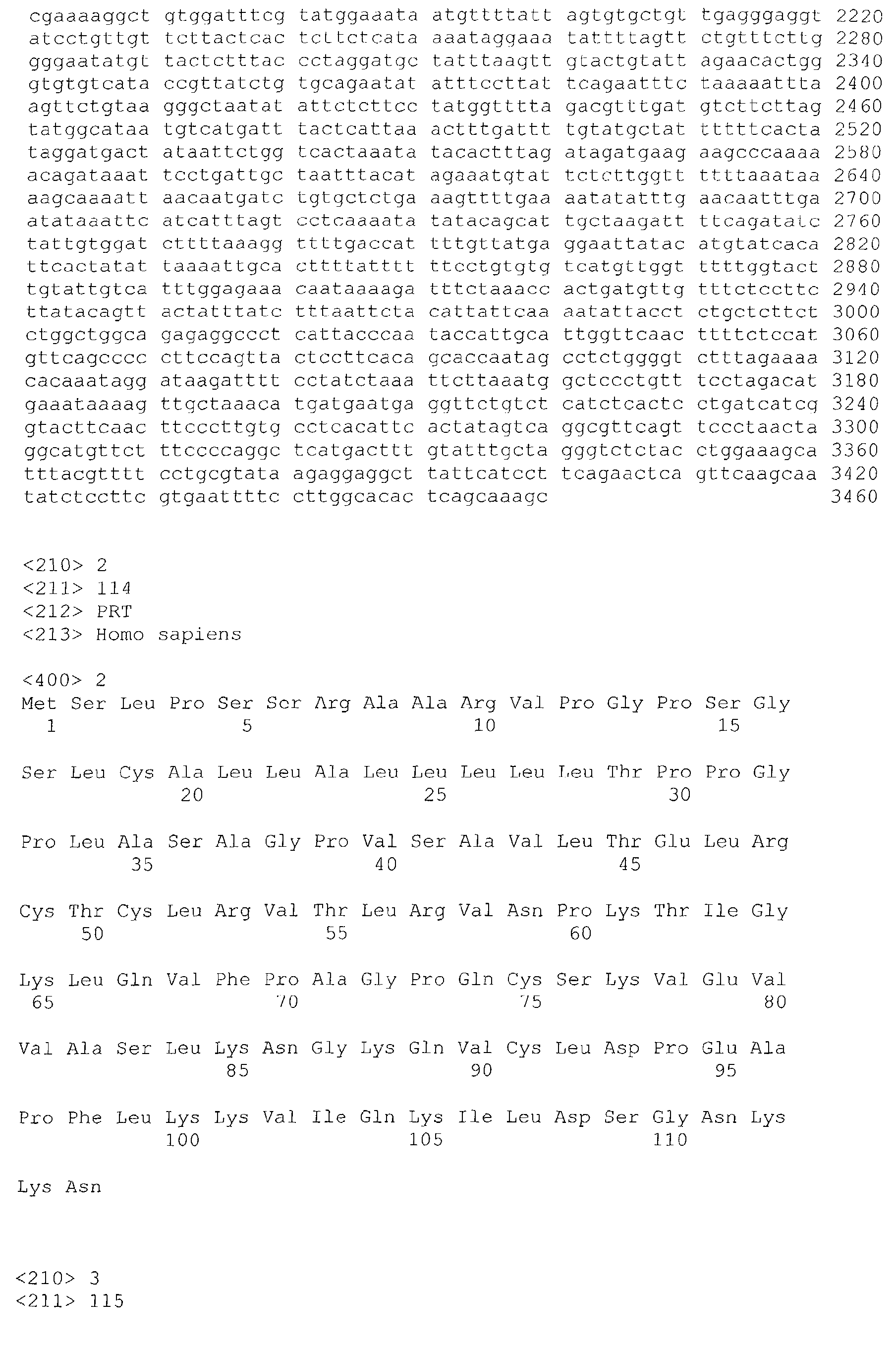
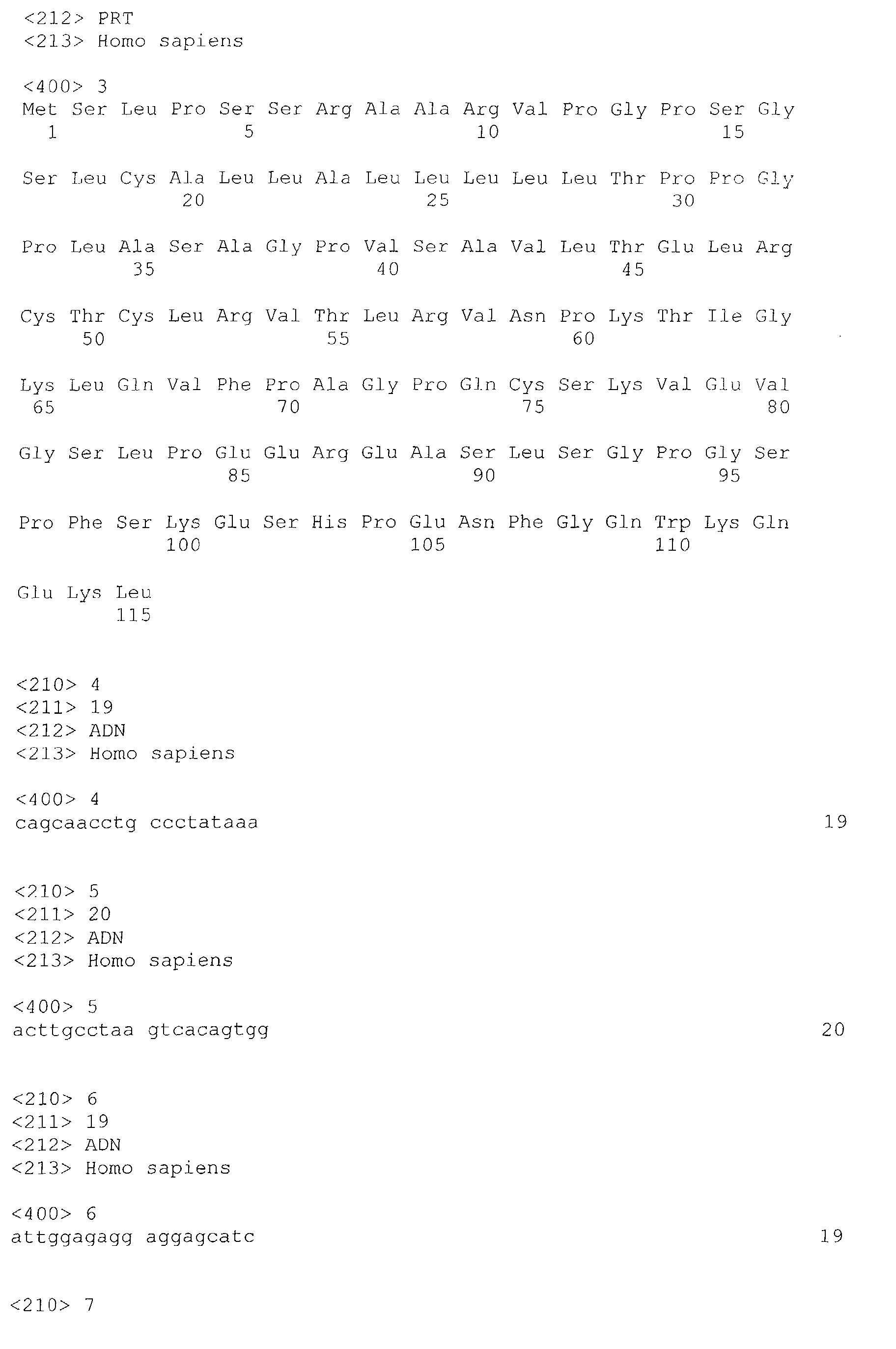
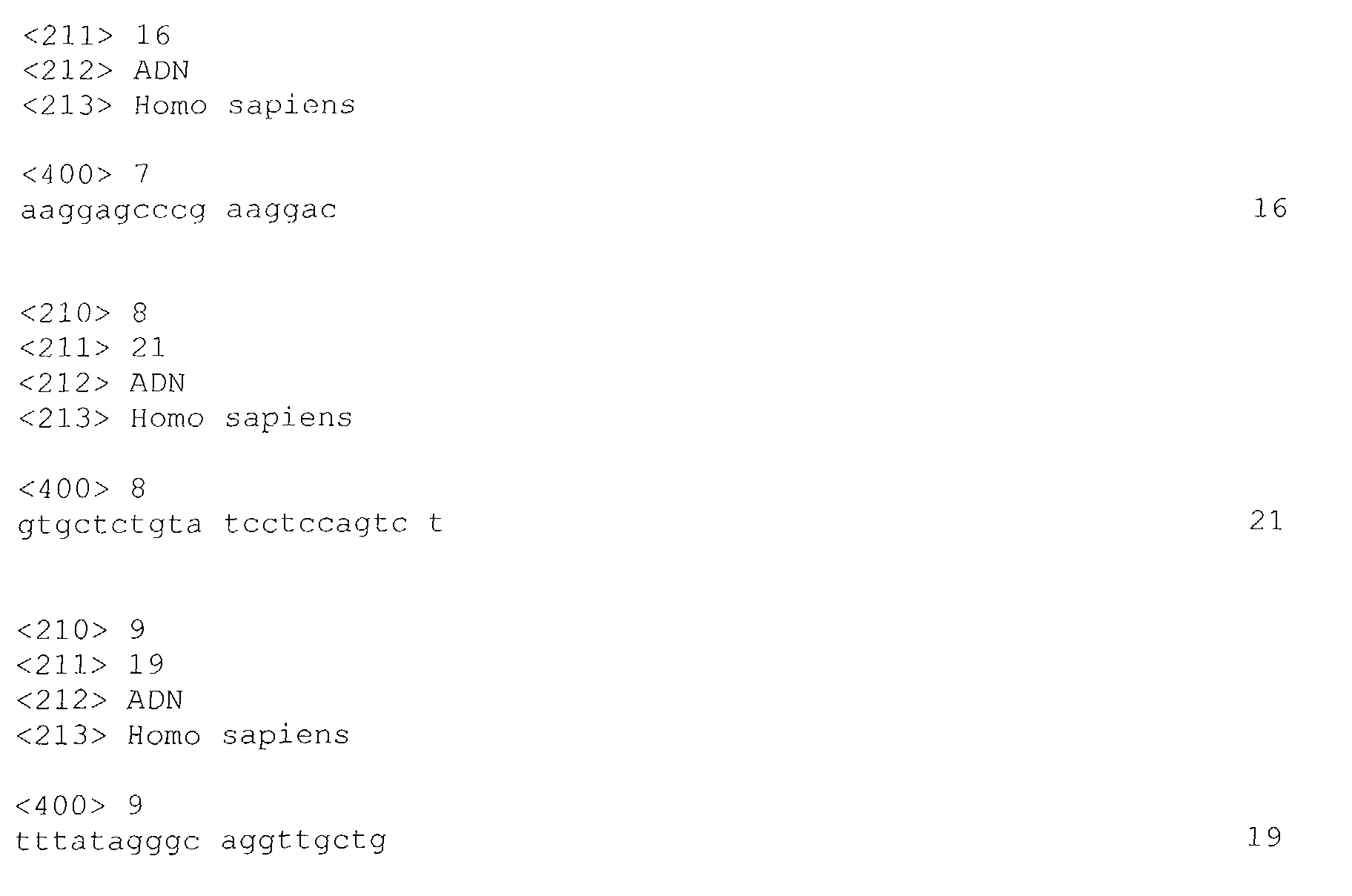
Claims (25)
- Isolated polynucleotide comprising:a) a nucleotide sequence having at least 80 % identity with the sequence SEQ ID N° 1 or its coding sequence, it being understood that this nucleotide sequence contains the SNP : 1254-1255 Ins (t); orb) a nucleotide sequence complementary to a nucleotide sequence under a).
- Isolated polynucleotide comprising:a) the nucleotide sequence SEQ ID N° 1 or its coding sequence, it being understood that each one of these sequences comprises the SNP : 1254-1255 Ins (t); orb) a nucleotide sequence complementary to a nucleotide sequence under a).
- Polynucleotide according to any one of claims 1 to 2, characterized in that it consists of the sequence SEQ ID N° 1 or its coding sequence, it being understood that each one of the sequences contains the SNP 1254-1255 Ins (t).
- Isolated polynucleotide comprising:a) a nucleotide sequence having at least 80 % identity with the nucleotide sequence SEQ ID N°1, it being understood that this sequence contains at least one of the following SNPs : g563t, c574g, c646g, g742t, a1026t, g1069c, orb) a nucleotide sequence complementary to the nucleotide sequence under a).
- Isolated polynucleotide consisting of a part of a polynucleotide according to any one of claims 1 to 4, it being understood that the sequence of said isolated polynucleotide contains at least one of the following SNPs : g563t, c574g, c646g, g742t, a1026t, g1069c, 1254-1255 Ins (t), said isolated nucleotide being composed of at least 10 nucleotides.
- Isolated polynucleotide, characterized in that it codes for a polypeptide comprising:a) the amino acid sequence SEQ ID N° 3,b) the amino acid sequence comprising the amino acids included between positions 38 and 115 of the amino acid sequence SEQ ID N° 3, orc) the amino acid sequence comprising the amino acids included between positions 46 and 115 of the amino acid sequence SEQ ID N° 3.
- Use of all or part of a polynucleotide according to any one of claims 1 to 6, to identify, hybridize and/or amplify all or part of a polynucleotide consisting of:the sequence SEQ ID N° 1, it being understood that this sequence contains at least one of the following SNPs : g563t, c574g, c646g, g742t, a1026t, g1069c, 1254-1255 Ins (t), and/orthe coding sequence of the nucleotide sequence SEQ ID N° 1, it being understood that this sequence contains the following SNP : 1254-1255 Ins (t).
- Use of all or part of a polynucleotide according to any one of claims 1 to 6, for the genotyping of a nucleotide sequence which has 90 to 100 % identity with the nucleotide sequence SEQ ID N°1 and which comprises at least one of the following SNPs : g563t, c574g, c646g, g742t, a1026t, g1069c, 1254-1255 Ins (t).
- Use according to claim 8, in which the genotyping is carried out by minisequencing.
- Recombinant vector comprising a polynucleotide according to one of claims 1 to 6.
- Host cell comprising a recombinant vector according to claim 10.
- Process for the preparation of a polypeptide, characterized in that a host cell according to claim 11 is cultivated in a culture medium and said polypeptide is isolated from the culture medium.
- Isolated polypeptide comprising an amino acid sequence having at least 80 % identity with:a) the amino acid sequence SEQ ID N° 3,b) the amino acid sequence containing the amino acids included between positions 38 and 115 of the amino acid sequence SEQ ID N° 3,c) the amino acid sequence containing the amino acids included between positions 46 and 115 of the amino acid sequence SEQ ID N° 3.
- Polypeptide according to claim 13, characterized in that it comprises:a) the amino acid sequence SEQ ID N° 3,b) the amino acid sequence containing the amino acids included between positions 38 and 115 of the amino acid sequence SEQ ID N° 3, orc) the amino acid sequence containing the amino acids included between positions 46 and 115 of the amino acid sequence SEQ ID N° 3.
- Polypeptide according to any one of claims 13 and 14, characterized in that it consists of:a) the amino acid sequence SEQ ID N° 3,b) the amino acid sequence containing the amino acids included between positions 38 and 115 of the amino acid sequence SEQ ID N° 3, orc) the amino acid sequence containing the amino acids included between positions 46 and 115 of the amino acid sequence SEQ ID N° 3.
- Process for obtaining an immunospecific antibody, characterized in that it is obtained by immunization of an animal with a polypeptide according to any one of claims 13 to 15.
- Immunospecific antibody for a polypeptide according to any one of claims 13 to 15.
- Process for the detection of the expression and/or of the activity of a polypeptide according to any one of claims 13 to 15, comprising :a) the detection of the presence or of the absence of a polynucleotide according to any one of claims 1 to 3 and 6 in the genome of the subject, and/orb) the determination of the concentration of a polypeptide according to any one of claims 13 to 15, in a biological sample of the subject.
- Medication comprising by way of active agent at least one polypeptide according to any one of claims 13 to 15.
- Use of a polypeptide according to any one of claims 13 to 15, for the preparation of a medication intended for the prevention or the treatment of one of the diseases selected from the group consisting of the disorders or diseases involving the immune system, inflammation and tumor cell invasion, psoriasis and rheumatoid arthritis, chronic polyarthritis, myelodysplastic syndrome, carcinoma such as hepatocellular carcinoma and osteosarcoma.
- Medication comprising by way of active agent at least one polynucleotide according to any one of claims 1 to 6, a recombinant vector according to claim 10, a host cell according to claim 11 and/or an antibody according to claim 17.
- Use of a polynucleotide according to any one of claims 1 to 6, a recombinant vector according to claim 10, a host cell according to claim 11 and/or an antibody according to claim 17, for the preparation of a medication intended for the prevention or the treatment of one of the diseases selected from the group consisting of the disorders or diseases involving the immune system, inflammation and tumor cell invasion, psoriasis and rheumatoid arthritis, chronic polyarthritis, myelodysplastic syndrome, carcinoma such as hepatocellular carcinoma and osteosarcoma.
- Pharmaceutical composition containing by way of active agent at least one polypeptide according to any one of claims 13 to 15, all or part of a polynucleotide according to any one of claims 1 to 6, a recombinant vector according to claim 10, a host cell according to claim 11 and/or an antibody according to claim 17, as well as a pharmaceutically acceptable excipient.
- Diagnostic composition containing by way of active agent at least one polypeptide according to any one of claims 13 to 15, all or part of a polynucleotide according to any one of claims 1 to 6, a recombinant vector according to claim 10, a host cell according to claim 11 and/or an antibody according to claim 17.
- Use of a GCP-2 protein for the preparation of a medication for the prevention or the treatment of a patient having a disorder or a disease caused by a GCP-2 variant linked to the presence in the genome of said patient of a nucleotide sequence having at least 95% identity with the nucleotide sequence SEQ ID N° 1, provided that said nucleotide sequence comprises at least one of the following SNPs : g563t, c574g, c646g, g742t, a1026t, g1069c, 1254-1255 Ins (t).
Priority Applications (1)
| Application Number | Priority Date | Filing Date | Title |
|---|---|---|---|
| EP01402950A EP1312614A1 (en) | 2001-11-16 | 2001-11-16 | Polynucleotides and polypeptides of the GCP-2 gene |
Applications Claiming Priority (1)
| Application Number | Priority Date | Filing Date | Title |
|---|---|---|---|
| EP01402950A EP1312614A1 (en) | 2001-11-16 | 2001-11-16 | Polynucleotides and polypeptides of the GCP-2 gene |
Publications (1)
| Publication Number | Publication Date |
|---|---|
| EP1312614A1 true EP1312614A1 (en) | 2003-05-21 |
Family
ID=8182967
Family Applications (1)
| Application Number | Title | Priority Date | Filing Date |
|---|---|---|---|
| EP01402950A Withdrawn EP1312614A1 (en) | 2001-11-16 | 2001-11-16 | Polynucleotides and polypeptides of the GCP-2 gene |
Country Status (1)
| Country | Link |
|---|---|
| EP (1) | EP1312614A1 (en) |
Cited By (2)
| Publication number | Priority date | Publication date | Assignee | Title |
|---|---|---|---|---|
| WO2005014026A3 (en) * | 2003-08-12 | 2005-03-17 | Tigenix Nv | Use of cxcl6 chemokine in the prevention or repair of cartilage defects |
| WO2024079460A1 (en) * | 2022-10-11 | 2024-04-18 | Queen Mary University Of London | Cxc receptor ligands |
Citations (2)
| Publication number | Priority date | Publication date | Assignee | Title |
|---|---|---|---|---|
| WO1998011227A1 (en) * | 1996-09-12 | 1998-03-19 | Incyte Pharmaceuticals, Inc. | Granulocyte chemotactic protein 2 variant |
| US5840524A (en) * | 1992-11-27 | 1998-11-24 | Stichting Rega Vzw | Granulocyte chemotactic protein |
-
2001
- 2001-11-16 EP EP01402950A patent/EP1312614A1/en not_active Withdrawn
Patent Citations (2)
| Publication number | Priority date | Publication date | Assignee | Title |
|---|---|---|---|---|
| US5840524A (en) * | 1992-11-27 | 1998-11-24 | Stichting Rega Vzw | Granulocyte chemotactic protein |
| WO1998011227A1 (en) * | 1996-09-12 | 1998-03-19 | Incyte Pharmaceuticals, Inc. | Granulocyte chemotactic protein 2 variant |
Non-Patent Citations (4)
| Title |
|---|
| DATABASE SWISS-PROT 6 January 1999 (1999-01-06), NI J.: "cloning,sequencing and biological chracterization of a C-X-C chemokine, CKA-3", XP002196466 * |
| PROOST P ET AL: "HUMAN AND BOVINE GRANULOCYTE CHEMOTACTIC PROTEIN-2: COMPLETE AMINO ACID SEQUENCE AND FUNCTIONAL CHARACTERIZATION AS CHEMOKINES", BIOCHEMISTRY, AMERICAN CHEMICAL SOCIETY. EASTON, PA, US, vol. 32, 1993, pages 10170 - 10177, XP002049871, ISSN: 0006-2960 * |
| ROVAI L E ET AL: "CLONING AND CHARACTERIZATION OF THE HUMAN GRANULOCYTE CHEMOTACTIC PROTEIN-2 GENE", JOURNAL OF IMMUNOLOGY, THE WILLIAMS AND WILKINS CO. BALTIMORE, US, vol. 158, June 1997 (1997-06-01), pages 5257 - 5266, XP002906957, ISSN: 0022-1767 * |
| WUYTS A. ET AL.,: "purification and identification of human and mouse granulocyte chemotactic protein 2-isoforms", METHODS IN EZYMOLOGY, vol. 287, 1997, pages 12 - 33, XP001068383 * |
Cited By (7)
| Publication number | Priority date | Publication date | Assignee | Title |
|---|---|---|---|---|
| WO2005014026A3 (en) * | 2003-08-12 | 2005-03-17 | Tigenix Nv | Use of cxcl6 chemokine in the prevention or repair of cartilage defects |
| US7485310B2 (en) | 2003-08-12 | 2009-02-03 | Tigenix N.V. | Use of CXCL6 chemokine in the prevention or repair of cartilage defects |
| RU2363491C2 (en) * | 2003-08-12 | 2009-08-10 | Тижени Н. В. | Application of cxcl6 chemokine during prevention or elimination of cartilage defects |
| AU2004262451B2 (en) * | 2003-08-12 | 2009-11-26 | Tigenix N.V. | Use of CXCL6 chemokine in the prevention or repair of cartilage defects |
| US7842502B2 (en) | 2003-08-12 | 2010-11-30 | Tigenix N.V. | Use of CXCL6 chemokine for inducing precursor cells into chondrocytes |
| NO338152B1 (en) * | 2003-08-12 | 2016-08-01 | Tigenix Nv | The use of CXCL6 chemokine in the prevention or repair of cartilage defects |
| WO2024079460A1 (en) * | 2022-10-11 | 2024-04-18 | Queen Mary University Of London | Cxc receptor ligands |
Similar Documents
| Publication | Publication Date | Title |
|---|---|---|
| EP1383927B1 (en) | New polynucleotides and polypeptides of the erythropoietin gene | |
| US7041794B2 (en) | Polynucleotides and polypeptides of the erythropoietin gene | |
| AU2002319142A1 (en) | New polynucleotides and polypeptides of the erythropoietin gene | |
| US20080299081A1 (en) | Polynucleotides and Polypeptides of the IFNalpha-21 Gene | |
| US20040110715A1 (en) | Polynucleotides and polypeptides of the IFNalpha-17 gene | |
| AU2002257777A1 (en) | New polynucleotides and polypeptides of the IFN$G(A)-21 gene | |
| US20040203118A1 (en) | Polynucleotides and polypeptides of the IFNalpha-14 gene | |
| JP2000502903A (en) | Nucleic acid encoding interferon gamma inducing factor-2 | |
| US7358333B2 (en) | Polypeptides of the IFNα-5 gene | |
| US7399464B2 (en) | Polypeptides of the IFNα-7 gene | |
| US20020192682A1 (en) | Polynucleotides and polypeptides of the IFNalpha-2 gene | |
| EP1308458A1 (en) | New polynucleotides and polypeptides of the CX26 gene | |
| WO2002101002A2 (en) | Identification of snps the hgv-v gene | |
| WO2002083733A2 (en) | Polynucleotides and polypeptides of the ifnalpha-6 gene | |
| WO1996023410A1 (en) | UBIQUITIN CONJUGATING ENZYMES 7, 8 and 9 | |
| US20100168008A1 (en) | Method of use of epiregulin protein and nucleic acid encoding the same in inflammatory conditions | |
| CN1351613A (en) | Chemokine-like factor with cell chemotactic and hematopoietic stimulatory activity |
Legal Events
| Date | Code | Title | Description |
|---|---|---|---|
| PUAI | Public reference made under article 153(3) epc to a published international application that has entered the european phase |
Free format text: ORIGINAL CODE: 0009012 |
|
| AK | Designated contracting states |
Designated state(s): AT BE CH CY DE DK ES FI FR GB GR IE IT LI LU MC NL PT SE TR |
|
| AX | Request for extension of the european patent |
Extension state: AL LT LV MK RO SI |
|
| AKX | Designation fees paid | ||
| REG | Reference to a national code |
Ref country code: DE Ref legal event code: 8566 |
|
| STAA | Information on the status of an ep patent application or granted ep patent |
Free format text: STATUS: THE APPLICATION IS DEEMED TO BE WITHDRAWN |
|
| 18D | Application deemed to be withdrawn |
Effective date: 20031122 |