EP1312607A1 - Dithiocarbamate derivatives and their use as antibacterial agents - Google Patents
Dithiocarbamate derivatives and their use as antibacterial agents Download PDFInfo
- Publication number
- EP1312607A1 EP1312607A1 EP01127296A EP01127296A EP1312607A1 EP 1312607 A1 EP1312607 A1 EP 1312607A1 EP 01127296 A EP01127296 A EP 01127296A EP 01127296 A EP01127296 A EP 01127296A EP 1312607 A1 EP1312607 A1 EP 1312607A1
- Authority
- EP
- European Patent Office
- Prior art keywords
- nitropyrimidine
- dinitro
- formula
- nitro
- pyrimidine
- Prior art date
- Legal status (The legal status is an assumption and is not a legal conclusion. Google has not performed a legal analysis and makes no representation as to the accuracy of the status listed.)
- Withdrawn
Links
- 239000003242 anti bacterial agent Substances 0.000 title description 2
- 150000004659 dithiocarbamates Chemical class 0.000 title description 2
- 150000001875 compounds Chemical class 0.000 claims abstract description 32
- 241000124008 Mammalia Species 0.000 claims abstract description 4
- 238000011321 prophylaxis Methods 0.000 claims abstract 2
- 230000001225 therapeutic effect Effects 0.000 claims abstract 2
- -1 aliphatic radical Chemical class 0.000 claims description 20
- 238000000034 method Methods 0.000 claims description 17
- 229920006395 saturated elastomer Polymers 0.000 claims description 16
- 125000001997 phenyl group Chemical group [H]C1=C([H])C([H])=C(*)C([H])=C1[H] 0.000 claims description 12
- 125000002023 trifluoromethyl group Chemical group FC(F)(F)* 0.000 claims description 12
- 150000003254 radicals Chemical class 0.000 claims description 10
- 125000001797 benzyl group Chemical group [H]C1=C([H])C([H])=C(C([H])=C1[H])C([H])([H])* 0.000 claims description 9
- 229910052736 halogen Inorganic materials 0.000 claims description 6
- 150000002367 halogens Chemical class 0.000 claims description 6
- JUJWROOIHBZHMG-UHFFFAOYSA-N pyridine Substances C1=CC=NC=C1 JUJWROOIHBZHMG-UHFFFAOYSA-N 0.000 claims description 6
- 125000004432 carbon atom Chemical group C* 0.000 claims description 4
- 208000035143 Bacterial infection Diseases 0.000 claims description 3
- 208000022362 bacterial infectious disease Diseases 0.000 claims description 3
- 125000000753 cycloalkyl group Chemical group 0.000 claims description 3
- 125000004573 morpholin-4-yl group Chemical group N1(CCOCC1)* 0.000 claims description 3
- 125000001624 naphthyl group Chemical group 0.000 claims description 3
- UHOVQNZJYSORNB-UHFFFAOYSA-N benzene Substances C1=CC=CC=C1 UHOVQNZJYSORNB-UHFFFAOYSA-N 0.000 claims description 2
- 230000007717 exclusion Effects 0.000 claims description 2
- 239000008194 pharmaceutical composition Substances 0.000 claims description 2
- JFDZBHWFFUWGJE-UHFFFAOYSA-N benzonitrile Substances N#CC1=CC=CC=C1 JFDZBHWFFUWGJE-UHFFFAOYSA-N 0.000 claims 1
- 201000008827 tuberculosis Diseases 0.000 abstract description 12
- 241000295644 Staphylococcaceae Species 0.000 abstract description 7
- 230000000844 anti-bacterial effect Effects 0.000 abstract description 7
- 208000035473 Communicable disease Diseases 0.000 abstract description 4
- 201000010099 disease Diseases 0.000 abstract description 4
- 208000037265 diseases, disorders, signs and symptoms Diseases 0.000 abstract description 4
- 241000894006 Bacteria Species 0.000 abstract description 3
- 241001465754 Metazoa Species 0.000 abstract description 3
- 241000236488 Lepra Species 0.000 abstract description 2
- 206010024229 Leprosy Diseases 0.000 abstract description 2
- 239000007787 solid Substances 0.000 description 31
- LFQSCWFLJHTTHZ-UHFFFAOYSA-N Ethanol Chemical compound CCO LFQSCWFLJHTTHZ-UHFFFAOYSA-N 0.000 description 24
- XLYOFNOQVPJJNP-UHFFFAOYSA-N water Substances O XLYOFNOQVPJJNP-UHFFFAOYSA-N 0.000 description 11
- 238000002425 crystallisation Methods 0.000 description 8
- 230000008025 crystallization Effects 0.000 description 8
- 239000003814 drug Substances 0.000 description 8
- 239000011541 reaction mixture Substances 0.000 description 8
- 229940079593 drug Drugs 0.000 description 7
- 230000002401 inhibitory effect Effects 0.000 description 7
- CSCPPACGZOOCGX-UHFFFAOYSA-N Acetone Chemical compound CC(C)=O CSCPPACGZOOCGX-UHFFFAOYSA-N 0.000 description 6
- XEKOWRVHYACXOJ-UHFFFAOYSA-N Ethyl acetate Chemical compound CCOC(C)=O XEKOWRVHYACXOJ-UHFFFAOYSA-N 0.000 description 6
- 239000000203 mixture Substances 0.000 description 6
- 230000000694 effects Effects 0.000 description 4
- 239000002609 medium Substances 0.000 description 4
- 239000000243 solution Substances 0.000 description 4
- 239000000725 suspension Substances 0.000 description 4
- GUDFEGXIJXTNJG-UHFFFAOYSA-N 2-chloro-3,5-dinitrobenzamide Chemical compound NC(=O)C1=CC([N+]([O-])=O)=CC([N+]([O-])=O)=C1Cl GUDFEGXIJXTNJG-UHFFFAOYSA-N 0.000 description 3
- GXBZQHWSOAJTLZ-UHFFFAOYSA-N 2-chloro-3,5-dinitrobenzonitrile Chemical compound [O-][N+](=O)C1=CC(C#N)=C(Cl)C([N+]([O-])=O)=C1 GXBZQHWSOAJTLZ-UHFFFAOYSA-N 0.000 description 3
- OKKJLVBELUTLKV-UHFFFAOYSA-N Methanol Chemical compound OC OKKJLVBELUTLKV-UHFFFAOYSA-N 0.000 description 3
- 239000007788 liquid Substances 0.000 description 3
- 239000011734 sodium Substances 0.000 description 3
- 229910052708 sodium Inorganic materials 0.000 description 3
- NQVBYQPOGVWUPK-UHFFFAOYSA-M sodium;n,n-dimethylcarbamodithioate;dihydrate Chemical compound O.O.[Na+].CN(C)C([S-])=S NQVBYQPOGVWUPK-UHFFFAOYSA-M 0.000 description 3
- 0 CCCN(CCC)C(SC(CCC*CCCC1)=C1[N+]([O-])=O)=S Chemical compound CCCN(CCC)C(SC(CCC*CCCC1)=C1[N+]([O-])=O)=S 0.000 description 2
- KFZMGEQAYNKOFK-UHFFFAOYSA-N Isopropanol Chemical compound CC(C)O KFZMGEQAYNKOFK-UHFFFAOYSA-N 0.000 description 2
- 241001646725 Mycobacterium tuberculosis H37Rv Species 0.000 description 2
- FAPWRFPIFSIZLT-UHFFFAOYSA-M Sodium chloride Chemical compound [Na+].[Cl-] FAPWRFPIFSIZLT-UHFFFAOYSA-M 0.000 description 2
- 230000000845 anti-microbial effect Effects 0.000 description 2
- 239000003610 charcoal Substances 0.000 description 2
- AEUTYOVWOVBAKS-UWVGGRQHSA-N ethambutol Chemical compound CC[C@@H](CO)NCCN[C@@H](CC)CO AEUTYOVWOVBAKS-UWVGGRQHSA-N 0.000 description 2
- 208000015181 infectious disease Diseases 0.000 description 2
- 239000006379 löwenstein-jensen medium Substances 0.000 description 2
- 239000013049 sediment Substances 0.000 description 2
- WWGXHTXOZKVJDN-UHFFFAOYSA-M sodium;n,n-diethylcarbamodithioate;trihydrate Chemical compound O.O.O.[Na+].CCN(CC)C([S-])=S WWGXHTXOZKVJDN-UHFFFAOYSA-M 0.000 description 2
- UCSJYZPVAKXKNQ-HZYVHMACSA-N streptomycin Chemical compound CN[C@H]1[C@H](O)[C@@H](O)[C@H](CO)O[C@H]1O[C@@H]1[C@](C=O)(O)[C@H](C)O[C@H]1O[C@@H]1[C@@H](NC(N)=N)[C@H](O)[C@@H](NC(N)=N)[C@H](O)[C@H]1O UCSJYZPVAKXKNQ-HZYVHMACSA-N 0.000 description 2
- HEEACTTWORLLPM-UHFFFAOYSA-N 2-(1h-imidazol-5-yl)ethanol Chemical compound OCCC1=CNC=N1 HEEACTTWORLLPM-UHFFFAOYSA-N 0.000 description 1
- QLHVJBXAQWPEDI-UHFFFAOYSA-N 2-chloro-3,5-dinitropyridine Chemical compound [O-][N+](=O)C1=CN=C(Cl)C([N+]([O-])=O)=C1 QLHVJBXAQWPEDI-UHFFFAOYSA-N 0.000 description 1
- YZTJXHWQWCLEJX-UHFFFAOYSA-N 4-chloro-6-methoxy-5-nitropyrimidine Chemical compound COC1=NC=NC(Cl)=C1[N+]([O-])=O YZTJXHWQWCLEJX-UHFFFAOYSA-N 0.000 description 1
- UOIJIZBXRZREBE-UHFFFAOYSA-N 6-chloro-5-nitro-n-propan-2-ylpyrimidin-4-amine Chemical compound CC(C)NC1=NC=NC(Cl)=C1[N+]([O-])=O UOIJIZBXRZREBE-UHFFFAOYSA-N 0.000 description 1
- HJCNZFOBWVEBNC-UHFFFAOYSA-N 6-chloro-n-methyl-5-nitropyrimidin-4-amine Chemical compound CNC1=NC=NC(Cl)=C1[N+]([O-])=O HJCNZFOBWVEBNC-UHFFFAOYSA-N 0.000 description 1
- 206010061822 Drug intolerance Diseases 0.000 description 1
- 206010059866 Drug resistance Diseases 0.000 description 1
- 206010062207 Mycobacterial infection Diseases 0.000 description 1
- 241000186365 Mycobacterium fortuitum Species 0.000 description 1
- 241000187480 Mycobacterium smegmatis Species 0.000 description 1
- 108700035964 Mycobacterium tuberculosis HsaD Proteins 0.000 description 1
- 241000187644 Mycobacterium vaccae Species 0.000 description 1
- 241000144944 Mylossoma aureum Species 0.000 description 1
- 239000007832 Na2SO4 Substances 0.000 description 1
- 101100062394 Picea mariana DAD1 gene Proteins 0.000 description 1
- PMZURENOXWZQFD-UHFFFAOYSA-L Sodium Sulfate Chemical compound [Na+].[Na+].[O-]S([O-])(=O)=O PMZURENOXWZQFD-UHFFFAOYSA-L 0.000 description 1
- NINIDFKCEFEMDL-UHFFFAOYSA-N Sulfur Chemical group [S] NINIDFKCEFEMDL-UHFFFAOYSA-N 0.000 description 1
- 238000002441 X-ray diffraction Methods 0.000 description 1
- KGTSLTYUUFWZNW-PPJQWWMSSA-N [(7S,9E,11S,12R,13S,14R,15R,16R,17S,18S,19E,21Z)-2,15,17,27,29-pentahydroxy-11-methoxy-3,7,12,14,16,18,22-heptamethyl-26-[(E)-(4-methylpiperazin-1-yl)iminomethyl]-6,23-dioxo-8,30-dioxa-24-azatetracyclo[23.3.1.14,7.05,28]triaconta-1(29),2,4,9,19,21,25,27-octaen-13-yl] acetate pyridine-4-carbohydrazide Chemical compound NNC(=O)c1ccncc1.CO[C@H]1\C=C\O[C@@]2(C)Oc3c(C2=O)c2c(O)c(\C=N\N4CCN(C)CC4)c(NC(=O)\C(C)=C/C=C/[C@H](C)[C@H](O)[C@@H](C)[C@@H](O)[C@@H](C)[C@H](OC(C)=O)[C@@H]1C)c(O)c2c(O)c3C KGTSLTYUUFWZNW-PPJQWWMSSA-N 0.000 description 1
- 208000036981 active tuberculosis Diseases 0.000 description 1
- 125000003342 alkenyl group Chemical group 0.000 description 1
- 125000000217 alkyl group Chemical group 0.000 description 1
- 238000004458 analytical method Methods 0.000 description 1
- 238000009635 antibiotic susceptibility testing Methods 0.000 description 1
- 239000007900 aqueous suspension Substances 0.000 description 1
- QVGXLLKOCUKJST-UHFFFAOYSA-N atomic oxygen Chemical compound [O] QVGXLLKOCUKJST-UHFFFAOYSA-N 0.000 description 1
- 230000003385 bacteriostatic effect Effects 0.000 description 1
- 229940054066 benzamide antipsychotics Drugs 0.000 description 1
- 230000015572 biosynthetic process Effects 0.000 description 1
- 230000037396 body weight Effects 0.000 description 1
- 239000012267 brine Substances 0.000 description 1
- 239000004490 capsule suspension Substances 0.000 description 1
- 239000003795 chemical substances by application Substances 0.000 description 1
- 230000034994 death Effects 0.000 description 1
- 231100000517 death Toxicity 0.000 description 1
- 239000012895 dilution Substances 0.000 description 1
- 238000010790 dilution Methods 0.000 description 1
- 229960000285 ethambutol Drugs 0.000 description 1
- 239000000284 extract Substances 0.000 description 1
- 244000000059 gram-positive pathogen Species 0.000 description 1
- 238000011534 incubation Methods 0.000 description 1
- 239000002054 inoculum Substances 0.000 description 1
- 238000010255 intramuscular injection Methods 0.000 description 1
- 239000007927 intramuscular injection Substances 0.000 description 1
- 238000010253 intravenous injection Methods 0.000 description 1
- 238000001819 mass spectrum Methods 0.000 description 1
- 230000007246 mechanism Effects 0.000 description 1
- 230000000813 microbial effect Effects 0.000 description 1
- 238000005142 microbroth dilution method Methods 0.000 description 1
- 201000009671 multidrug-resistant tuberculosis Diseases 0.000 description 1
- 208000027531 mycobacterial infectious disease Diseases 0.000 description 1
- XJZVSYRZTQQOHZ-UHFFFAOYSA-N n-[5-[(2-methoxy-5-nitrophenyl)methylsulfanyl]-1,3,4-thiadiazol-2-yl]acetamide Chemical compound COC1=CC=C([N+]([O-])=O)C=C1CSC1=NN=C(NC(C)=O)S1 XJZVSYRZTQQOHZ-UHFFFAOYSA-N 0.000 description 1
- 239000002547 new drug Substances 0.000 description 1
- 238000000655 nuclear magnetic resonance spectrum Methods 0.000 description 1
- 229910052760 oxygen Inorganic materials 0.000 description 1
- 239000001301 oxygen Substances 0.000 description 1
- 238000007911 parenteral administration Methods 0.000 description 1
- 239000000546 pharmaceutical excipient Substances 0.000 description 1
- 125000004193 piperazinyl group Chemical group 0.000 description 1
- 239000011780 sodium chloride Substances 0.000 description 1
- 229910052938 sodium sulfate Inorganic materials 0.000 description 1
- HPALAKNZSZLMCH-UHFFFAOYSA-M sodium;chloride;hydrate Chemical compound O.[Na+].[Cl-] HPALAKNZSZLMCH-UHFFFAOYSA-M 0.000 description 1
- 239000007858 starting material Substances 0.000 description 1
- 229960005322 streptomycin Drugs 0.000 description 1
- 238000010254 subcutaneous injection Methods 0.000 description 1
- 239000007929 subcutaneous injection Substances 0.000 description 1
- 125000001424 substituent group Chemical group 0.000 description 1
- 239000006228 supernatant Substances 0.000 description 1
- 238000003786 synthesis reaction Methods 0.000 description 1
- 239000003826 tablet Substances 0.000 description 1
- 238000002560 therapeutic procedure Methods 0.000 description 1
- 238000011200 topical administration Methods 0.000 description 1
- 230000000699 topical effect Effects 0.000 description 1
Classifications
-
- C—CHEMISTRY; METALLURGY
- C07—ORGANIC CHEMISTRY
- C07D—HETEROCYCLIC COMPOUNDS
- C07D239/00—Heterocyclic compounds containing 1,3-diazine or hydrogenated 1,3-diazine rings
- C07D239/02—Heterocyclic compounds containing 1,3-diazine or hydrogenated 1,3-diazine rings not condensed with other rings
- C07D239/24—Heterocyclic compounds containing 1,3-diazine or hydrogenated 1,3-diazine rings not condensed with other rings having three or more double bonds between ring members or between ring members and non-ring members
- C07D239/28—Heterocyclic compounds containing 1,3-diazine or hydrogenated 1,3-diazine rings not condensed with other rings having three or more double bonds between ring members or between ring members and non-ring members with hetero atoms or with carbon atoms having three bonds to hetero atoms with at the most one bond to halogen, directly attached to ring carbon atoms
- C07D239/46—Two or more oxygen, sulphur or nitrogen atoms
- C07D239/56—One oxygen atom and one sulfur atom
-
- A—HUMAN NECESSITIES
- A61—MEDICAL OR VETERINARY SCIENCE; HYGIENE
- A61P—SPECIFIC THERAPEUTIC ACTIVITY OF CHEMICAL COMPOUNDS OR MEDICINAL PREPARATIONS
- A61P31/00—Antiinfectives, i.e. antibiotics, antiseptics, chemotherapeutics
- A61P31/04—Antibacterial agents
-
- A—HUMAN NECESSITIES
- A61—MEDICAL OR VETERINARY SCIENCE; HYGIENE
- A61P—SPECIFIC THERAPEUTIC ACTIVITY OF CHEMICAL COMPOUNDS OR MEDICINAL PREPARATIONS
- A61P31/00—Antiinfectives, i.e. antibiotics, antiseptics, chemotherapeutics
- A61P31/04—Antibacterial agents
- A61P31/06—Antibacterial agents for tuberculosis
-
- C—CHEMISTRY; METALLURGY
- C07—ORGANIC CHEMISTRY
- C07D—HETEROCYCLIC COMPOUNDS
- C07D213/00—Heterocyclic compounds containing six-membered rings, not condensed with other rings, with one nitrogen atom as the only ring hetero atom and three or more double bonds between ring members or between ring members and non-ring members
- C07D213/02—Heterocyclic compounds containing six-membered rings, not condensed with other rings, with one nitrogen atom as the only ring hetero atom and three or more double bonds between ring members or between ring members and non-ring members having three double bonds between ring members or between ring members and non-ring members
- C07D213/04—Heterocyclic compounds containing six-membered rings, not condensed with other rings, with one nitrogen atom as the only ring hetero atom and three or more double bonds between ring members or between ring members and non-ring members having three double bonds between ring members or between ring members and non-ring members having no bond between the ring nitrogen atom and a non-ring member or having only hydrogen or carbon atoms directly attached to the ring nitrogen atom
- C07D213/60—Heterocyclic compounds containing six-membered rings, not condensed with other rings, with one nitrogen atom as the only ring hetero atom and three or more double bonds between ring members or between ring members and non-ring members having three double bonds between ring members or between ring members and non-ring members having no bond between the ring nitrogen atom and a non-ring member or having only hydrogen or carbon atoms directly attached to the ring nitrogen atom with hetero atoms or with carbon atoms having three bonds to hetero atoms with at the most one bond to halogen, e.g. ester or nitrile radicals, directly attached to ring carbon atoms
- C07D213/62—Oxygen or sulfur atoms
- C07D213/70—Sulfur atoms
- C07D213/71—Sulfur atoms to which a second hetero atom is attached
-
- C—CHEMISTRY; METALLURGY
- C07—ORGANIC CHEMISTRY
- C07D—HETEROCYCLIC COMPOUNDS
- C07D239/00—Heterocyclic compounds containing 1,3-diazine or hydrogenated 1,3-diazine rings
- C07D239/02—Heterocyclic compounds containing 1,3-diazine or hydrogenated 1,3-diazine rings not condensed with other rings
- C07D239/24—Heterocyclic compounds containing 1,3-diazine or hydrogenated 1,3-diazine rings not condensed with other rings having three or more double bonds between ring members or between ring members and non-ring members
- C07D239/28—Heterocyclic compounds containing 1,3-diazine or hydrogenated 1,3-diazine rings not condensed with other rings having three or more double bonds between ring members or between ring members and non-ring members with hetero atoms or with carbon atoms having three bonds to hetero atoms with at the most one bond to halogen, directly attached to ring carbon atoms
- C07D239/46—Two or more oxygen, sulphur or nitrogen atoms
- C07D239/47—One nitrogen atom and one oxygen or sulfur atom, e.g. cytosine
Definitions
- the invention relates furthermore to a compound of the formula I for use in a method for the treatment of bacterial infections in mammals.
- Preferred compounds of the formula I for use in such method are those specifically listed above plus additionally 4-methylamino-6-diethyldithiocarbamoyl-5-nitropyrimidine.
Landscapes
- Chemical & Material Sciences (AREA)
- Organic Chemistry (AREA)
- Health & Medical Sciences (AREA)
- Communicable Diseases (AREA)
- Oncology (AREA)
- Chemical Kinetics & Catalysis (AREA)
- General Chemical & Material Sciences (AREA)
- Medicinal Chemistry (AREA)
- Nuclear Medicine, Radiotherapy & Molecular Imaging (AREA)
- Pharmacology & Pharmacy (AREA)
- Life Sciences & Earth Sciences (AREA)
- Animal Behavior & Ethology (AREA)
- General Health & Medical Sciences (AREA)
- Public Health (AREA)
- Veterinary Medicine (AREA)
- Pulmonology (AREA)
- Pharmaceuticals Containing Other Organic And Inorganic Compounds (AREA)
- Acyclic And Carbocyclic Compounds In Medicinal Compositions (AREA)
Abstract
Compounds of the formula I
 wherein X is a bivalent residue selected from the group consisting of


Description
- The invention relates to novel dithiocarbamate derivatives and their use as antibacterial agents in infectious diseases of mammals (humans and animals) caused by bacteria, especially diseases like tuberculosis (TB) and lepra caused by mycobacteria and infectious diseases caused by staphylococci.
- As known, there is a threadful worldwide increase in tuberculosis infections with mycobacteria which developed resistance against the available therapeutics (B.R.Bloom, J.L.Murray, tuberculosis: commentary on a reemergent killer. Science 257, 1992, 1055-1064). Extremely dangerous is the development of multidrug resistant (MDR) mycobacteria. These are mycobacteria, resistant at least against two of the most active tuberculosis drugs, isoniazid and rifampicin, but also against streptomycin, pyranzinamid and ethambutol. The proportion of MDR-TB in some countries is already more than 20%. In Germany resistance against a single tuberculosis drug raised since 1996 for 50%. Together with the increased number of diseases generally, worldwide tuberculosis causes a number of 3.000.000 deaths annually. Another growing problem is the therapy of infections with multiresistant staphylococci (M. Kresken, Bundesgesundheitsblatt 38,1996, 170-178).
- For the treatment of such diseases there is an urgent need for new drugs with new mechanisms of actions, especially to overcome drug resistance and to overcome the known dramatic side effects of the available drugs.
- The present invention aims at the generation of new compounds with activity against mycobacteria as potential new tuberculosis drugs and with activity against other Gram-positive pathogens like staphylococci to overcome problems concerning resistance and drug intolerance.
- This aim has been solved by providing compounds of the formula Iwherein X is a bivalent residue selected from the group consisting of
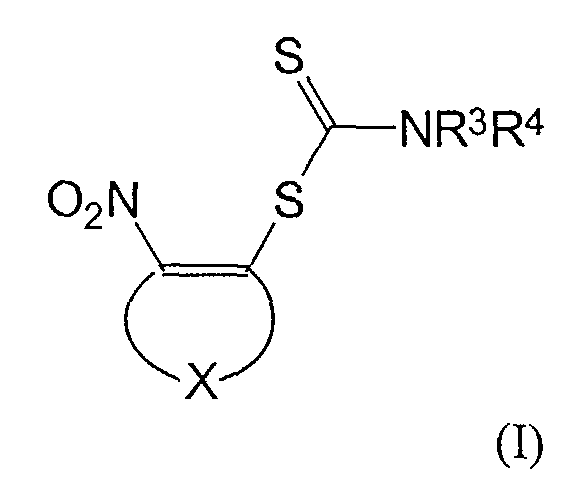

 wherein
R1 is CN, CONR3R4, CONHNR3R4;
R2 is H, NO2, CN, CONR3R4, COOR5, CHO, halogen or a saturated or unsaturated, linear or branched aliphatic radical having 1-7 chain members, OR5, SR5, NR3R4, trifluoromethyl, phenyl;
n is 0-3;
R3 and R4 are, independently from each other, H, a saturated or unsaturated, linear or branched aliphatic radical having 1-7 chain members, cycloalkyl having 3-6 carbon atoms, benzyl, naphthyl, OR5; or NR3R4 is morpholino; or R3 and R4 together represent a bivalent radical -(CH2)m- wherein m is 2-7, or a bivalent radical -(CH2CH2)NR6(CH2CH2)-, or R3 and R4 together represent a bivalent radicalR5 is H or a saturated or unsaturated, linear or branched aliphatic radical having 1-7 chain members, trifluoromethyl, benzyl or phenyl;
R6 is H or a saturated or unsaturated, linear or branched aliphatic radical having 1-7 chain members, trifluoromethyl, benzyl or phenyl;
R7 is H, halogen or a saturated or unsaturated, linear or branched aliphatic radical having 1-7 chain members, OR5, SR5, NR3R4, trifluoromethyl, phenyl;
with the exclusion of the known compounds
1,5-dinitro-3-cyano-6-dimethyldithiocarbamoyl-benzene (J.Org. Chem., 1979, 44(2), p.267-274), 3,5-dinitro-2-dimethyldithiocarbamoylpyridine, 3,5-dinitro-6-dimethylamino-2-dimethyl-dithiocarbamoyl-pyridine, 4-methoxy-6-diethyldithiocarbamoyl-5-nitro-pyrimidine, 4-methoxy-6-dipropyldithiocarbamoyl-5-nitro-pyrimidine, 4-dimethylamino-6-diethyldithiocarbamoyl-5-nitro-pyrimidine, 4-dimethylamino-6-dipropyldithiocarbamoyl-5-nitro-pyrimidine (Khim. Geterotsikl. Soedin., (Rus.) 1994, 10, p. 1420-1423, CA 122:314512), and 4-methylamino-6-diethyldithiocarbamoyl-5-nitro-pyrimidine (Acta Cryst. Section C, 2001, C57, p.72-75). - In a preferred embodiment the invention concerns compounds of the formula (I) selected from the group consisting of
3,5-dinitro-2-R3R4-dithiocarbamoyl-benzonitriles,
3,5-di-nitro-2-R3R4-dithiocarbamoyl-benzamides,
3,5-dinitro-2-R3R4-dithiocarbamoyl-pyridines, and
4-R7-2-R5-6-R3R4-dithiocarbamoyl-5-nitro-pyrimidines,
wherein R3, R4, R5 and R7 have the above meanings,
except 3,5-dinitro-2-dimethyl-dithiocarbamoyl-pyridine, 4-methoxy-6-diethyldithiocarbamoyl-5-nitro-pyrimidine, 4-methoxy-6-dipropyldithiocarbamoyl-5-nitro-pyrimidine, 4-dimethylamino-6-diethyldithiocarbamoyl-5-nitro-pyrimidine, 4-dimethylamino-6-dipropyl-dithiocarbamoyl-5-nitro-pyrimidine and 4-methylamino-6-diethyldithiocarbamoyl-5-nitro-pyrimidine. - The present invention is even more particularly concerned with at least one compound selected from the group consisting of
4-isopropylamino-6-diethyldithiocarbamoyl-5-nitropyrimidine,
4-cyclopropylamino-6-diethyldithiocarbamoyl-5-nitropyrimidine,
3,5-dinitro-2-diethyldithiocarbamoylbenzonitril,
4-methylhydroxyamino-6-diethyldithiocarbamoyl-5-nitropyrimidine,
4-ethoxy-2-methyl-6-diethyldithiocarbamoyl-5-nitropyrimidine,
4-methylamino-6-dimethyldithiocarbamoyl-5-nitropyrimidine,
4-dimethylamino-6-dimethyldithiocarbamoyl-5-nitropyrimidine,
3,5-dinitro-2-dimethyldithiocarbamoylbenzonitrile,
4-ethoxy-2-methyl-6-tetramethylenedithiocarbamoyl-5-nitropyrimidine,
4-propoxy-6-dimethyldithiocarbamoyl-5-nitropyrimidine,
4-methylamino-6-tetramethylenedithiocarbamoyl-5-nitropyrimidine,
4-dimethylamino-6-tetramethylenedithiocarbamoyl-5-nitropyrimidine,
4-methoxy-6-dimethyldithiocarbamoyl-5-nitropyrimidine,
4-methoxy-6-tetramethylenedithiocarbamoyl-5-nitropyrimidine,
3,5-dinitro-2-hexamethylenedithiocarbamoylbenzamide,
3,5-dinitro-2-tetramethylenedithiocarbamoylbenzamide,
3,5-dinitro-2-tetramethylenedithiocarbamoylpyridine,
3,5-dinitro-2-hexamethylenedithiocarbamoylbenzonitril, and
4-methylamino-6-heptamethylenedithiocarbamoyl-5-nitropyrimidine. - The substituents mentioned hereinbefore or hereinafter have the following meanings: A saturated or unsaturated, linear or branched aliphatic radical having 1-7 chain members is, for example, a corresponding alkyl, alkenyl or alkinyl radical having 1-6 carbon atoms optionally interrupted by one oxygen or sulphur atom or by NR6. Compounds of the formula I wherein R3 and R4 together represent a bivalent radicalare preferably symmetrical with respect to the symmetric axis dividing the central piperazine ring into equal halves.

- Surprisingly the compounds of the invention exhibit strong antibacterial activity, especially against mycobacteria with minimal inhibitory concentrations (MIC) in the range of 0,1-50 µg/ml for fast growing mycobacteria and of 3,12-12,5 µg/ml for M. tuberculosis, and against multiresistant staphylococci (MRSA) in a MIC range of. 0,4-50 µg/ml.
- Thus, the compounds of the invention are useful for the treatment of bacterial infections, especially tuberculosis and other mycobacterial infections, in humans and in animals.
- Accordingly, the invention concerns pharmaceutical compositions comprising a compound of the formula I.
- The invention relates furthermore to a compound of the formula I for use in a method for the treatment of bacterial infections in mammals. Preferred compounds of the formula I for use in such method are those specifically listed above plus additionally 4-methylamino-6-diethyldithiocarbamoyl-5-nitropyrimidine.
- The compounds of the invention are formulated for use by preparing a dilute solution or suspension in pharmacautically acceptable aqueous, organic or aqueous-organic medium for topical or parenteral administration by intravenous, subcutaneous or intramuscular injection, or for intranasal application; or are prepared in tablet, capsule or aqueous suspension form with conventional excipients for oral administration or as suppositorium.
The compounds can be used in dosages from 0,1 - 1000 mg/kg body weight.. - The examples which follow in the subsequent experimental part serve to illustrate the invention but should not be construed as a limitation thereof.
- The structures of the compounds of the invention were established by modes of synthesis and elementary analysis, and by nuclear magnetic resonance and/or mass spectra, X-ray analysis.
- Starting 4-chloro-6-R-5-nitropyrimidines were synthesized according to Chesney J.D., Gonzales-Sierra M., Pharm. Res., 1985, p.145-147 and Clark J., Parvizi B., Colmam R., J.Chem.Soc., Perkin Trans 1, 1976, p. 1004-1007; 3,5-dinitro-2-chlorobenzonitrile and 3,5-dinitro-2-chlorobenzamide were synthesized according to Thiel W., Mayer R., J.Prakt. Chemie, B328, 1986, p.497-514.
- A mixture of 4-isopropylamino-6-chloro-5-nitropyrimidine (0.94 g, 4.3 mmol), sodium diethyldithiocarbamate trihydrate (1.05 g, 4.6 mmol) and ethanol (25 mL) was mixed for 24 hours at room temperature. Reaction mixture was diluted by water (50 mL), yellow solid was filtered and purified by crystallization from ethanol to give 0.8 g of pure title compound as an yellow crystalline solid, m.p. 165-167°C.
Anal. Calcd. for C12H17N5O2S2 C, 44.02; H, 5.23; N, 21.39; S, 19.59 Found C, 44.31; H, 5.17; N, 21.52; S, 19.78 - Following the procedure of Example 1. Yellow crystalline solid, m.p. 143-145°C.
Anal. Calcd. for C12H17N5O2S2 C, 44.02; H, 5.23; N, 21.39; S, 19.59 Found C, 44.17; H, 5.31; N, 21.39; S, 19.38 - A mixture of 3,5-dinitro-2-chlorobenzonitrile (1.5 g, 6.6 mmol), sodium diethyldithiocarbamate trihydrate (1.6 g, 7.1 mmol) and ethanol (40 mL) was mixed for 2 hours at room temperature. Reaction mixture was treated by active charcoal, filtered off. Mother liquid was diluted by water (80 mL), yellow solid was filtered and purified by consecutive crystallization from i-propanol and acetone/water to give 1.2 g of pure title compound as an light yellow crystalline solid, m.p. 151-153°C.
Anal. Calcd. for C12H12N4O4S2 C, 42.34; H, 3.55; N, 16.46; S, 18.84 Found C, 42.32; H, 3.46; N, 16.41; S, 18.69 - A mixture of 4-methylamino-6-chloro-5-nitropyrimidine (0.7 g, 3.7 mmol), sodium dimethyldithiocarbamate dihydrate (0.7 g, 3.9 mmol), ethanol (15 mL) and acetone (15 mL) was mixed for 4 hours at room temperature. Reaction mixture was diluted by water (60 mL), yellow solid was filtered and purified by crystallization from ethanol to give 0.5 g of pure title compound as an yellow crystalline solid, m.p. 136-137°C.
Anal. Calcd. for C8H11N5O2S2 C, 35.15; H, 4.06; N, 25.62; S, 23.46 Found C, 34.95; H, 4.11; N, 25.53; S, 23.58 - Following the procedure of Example 4. Yellow crystalline solid, m.p. 180-182°C.
Anal. Calcd. for C11H15N5O2S2 C, 42.16; H, 4.82; N, 22.35; S, 20.46 Found C, 42.11; H, 5.01; N, 22.42; S, 20.49 - Following the procedure of Example 4. Yellow crystalline solid, m.p. 213-215°C.
Anal. Calcd. for C10H13N5O2S2: C, 40.12; H, 4.38; N, 23.39; S, 21.42 Found: C, 40.23; H, 4.37; N, 23.47; S, 21.35 - Following the procedure of Example 4. Yellow crystalline solid, m.p.92-94°C.
Anal. Calcd. for C10H15N5O3S2 C, 37.84; H, 4.76; N, 22.07; S, 20.21 Found C, 37.81; H, 4.57; N, 22.01; S, 20.33 - Following the procedure of Example 4. Yellow crystalline solid, m.p.135-137°C.
Anal. Calcd. for C9H13N5O2S2 C, 37.62; H, 4.56; N, 24.37; S, 22.32 Found C, 37.66; H, 4.48; N, 24.49; S, 22.39 - Following the procedure of Example 4. Yellow crystalline solid, m.p. 130-132°C.
Anal. Calcd. for C11H15N5O2S2 C, 42.16; H, 4.82; N, 22.35; S, 20.46 Found C, 42.23; H, 4.88; N, 22.36; S, 20.23 - A mixture of 3,5-dinitro-2-chlorobenzonitrile (2.0 g, 8.8 mmol), sodium dimethyldithiocarbamate dihydrate (1.7 g, 9.5 mmol) and ethanol (50 mL) was mixed for 0,5 hour at room temperature. Reaction mixture was diluted by water (100 mL), yellow solid was filtered and purified by consecutive crystallization from ethanol with addition of active charcoal to give 1.4 g of pure title compound as an orange solid, m.p. 147-149°C.
Anal. Calcd. for C10H8N4O4S2 C, 38.46; H, 2.58; N, 17.94; S, 20.53 Found C, 38.61; H, 2.58; N, 17.93; S, 20.52 - Following the procedure of Example 10. Yellow crystalline solid, m.p. 148-150°C.
Anal. Calcd. for C14H14N4O4S2 C, 45.62; H, 3.85; N, 15.29; S, 17.50 Found C, 45.56; H, 3.87; N, 15.37; S, 17.42 - A solution of 4-methoxy-6-chloro-5-nitropyrimidine (0.5 g, 2.6 mmol), sodium dimethyldithiocarbamate dihydrate (0.6 g, 3.3 mmol) and ethanol (40 mL) was mixed for 1 hour at room temperature. Reaction mixture was diluted by water (80 mL), light yellow solid was filtered and purified by crystallization from methanol to give 0.4 g of pure title compound as an bright yellow crystalline solid, m.p. 122-125°C.
Anal. Calcd. for C8H10N4O3S2: C, 35.03; H, 3.67; N, 20.42; S, 23.38 Found: C, 34.93; H, 4.02; N, 20.50; S, 23.42 - Following the procedure of Example 12. Yellow crystalline solid, m.p. 147-149°C.
Anal. Calcd. for C10H12N4O3S2 C, 39.99; H, 4.03; N, 18.65; S, 21.35 Found C, 39.98; H, 4.06; N, 18.73; S, 21.32 - Following the procedure of Example 12. Yellow crystalline solid, m.p. 108-110°C.
Anal. Calcd. for C12H18N4O3S2 C, 43.62; H, 5.49; N, 16.96; S, 19.41 Found C, 43.74; H, 5.45; N, 16.82; S, 20.01 - Following the procedure of Example 12. Yellow crystalline solid, m.p. 100-102°C.
Anal. Calcd. for C10H13N5O2S2: C, 40.12; H, 4.38; N, 23.39; S, 21.42 Found: C, 40.23; H, 4.37; N, 23.47; S, 21.35 - Following the procedure of Example 12. Yellow crystalline solid, m.p. 107-109°C.
Anal. Calcd. for C10H14N4O3S2: C, 39.72; H, 4.67; N, 18.53; S, 21.21 Found: C, 40.04; H, 4.65; N, 18.42; S, 21.56 - A solution of 3,5-dinitro-2-chlorobenzamide (0.7 g, 2.9 mmol), sodium hexamethylenedithiocarbamate dihydrate (0.7 g, 3.0 mmol) and ethanol (50 mL) was mixed for 0,5 hour at room temperature. Reaction mixture was partitioned between water (100 mL) and ethyl acetate (50 mL). The aqueous layer was extracted twice with 30 mL portions of ethyl acetate. The combined organic extracts were washed with water, brine, dried (Na2SO4), and concentrated in vacuo to provide brown oil. Its treatment by water provide yellow solid was filtered and purified by consecutive crystallization from ethanol to give 0.6 g of pure title compound as an yellow solid, m.p. 187-189°C.
Anal. Calcd. for C14H16N4O5S2 C, 43.74; H, 4.20; N, 14.57; S, 16.68 Found C, 43.82; H, 3.99; N, 14.77; S, 16.57 - A solution of 3,5-dinitro-2-chlorobenzamide (1.0 g, 4.0 mmol), sodium tetramethylenedithiocarbamate dihydrate (0.9 g, 4.4 mmol) and acetone (40 mL) was mixed for 0.5 hour at room temperature. Reaction mixture was diluted by water (80 mL), yellow solid was filtered and purified by crystallization from i-propanol to give 0.9 g of pure title compound as an light yellow crystalline solid, m.p. 116-118°C.
Anal. Calcd. for C12H12N4O5S2 C, 40.44; H, 3.39; N, 15.72; S, 18.00 Found C, 40.57; H, 3.42; N, 15.64; S, 17.87 - A mixture of 3,5-dinitro-2-chloropyridine (0.5 g, 2.4 mmol), sodium tetramethylenedithiocarbamate dihydrate (0.6 g, 2.9 mmol) and ethanol (40 mL) was mixed for 3 hours at room temperature. Reaction mixture was diluted by water (80 mL), light tan yellow solid was filtered and purified by crystallization from mixture EtOH/DMF to give 0.5 g of pure title compound as an yellow crystalline solid, m.p. 157-159°C.
Anal. Calcd. for C10H10N4O4S2 C, 38.21; H, 3.21; N, 17.82; S, 20.40 Found C, 38.03; H, 3.22; N, 17.79; S, 20.44 - The antibacterial activities of the compounds against multiresistent staphylococci (MRSA) strains 134/93 and 994/93 as well as against Mycobacterium smegmatis SG 987, M. aureum SB66, M. vaccae IMET 1010670 and M. fortuitum B were tested by determination of minimal inhibitory concentrations (MIC) by the micro broth dilution method in Mueller-Hinton broth (Difco) according to the NCCLS guidelines [National Committee for Clinical Laboratory Standards: Methods for dilution antimicrobial susceptibility tests for bacteria that grow aerobically; 4th Ed.; Villanova, Ed.; Approved standard Document M7-A4. NCCLS, (1997)]
Activity against M. tuberculosis H37Rv was tested by the following method for determination of minimal inhibitory concentrations (MIC) and minimal bactericidal concentrations (MBC): - Strains were inoculated onto solid Lowenstein-Jensen medium. After 21 days, the cultures grown were used to prepare an inoculum suspension corresponding to 5 x 10⁸ microbial cells/ml). With 0,2 ml of that suspension tubes with 2 ml liquid Shkolnikova medium containing corresponding concentrations of compounds under study - from 100,0 to 0,195 µg/ml. were inoculated. After 14 days of incubation at 37 °C the tubes with liquid medium were centrifuged for 15min. at 3000 RPM. After discarding the supernatant, the sediment was resuspended in 0,8 ml of sterile 0,9% NaCl. 0,1 ml of the suspension was used to prepare smears subsequently stained by the Ziehl-Neelsen method. The remaining sediment was inoculated in 0,2 ml volumes into three tubes with solid drug free Lowenstein-Jensen medium to determine minimal bactericidal concentrations (MBC). The results were read after 21-28 days of cultivation at 37 °C. Controls were tubes cultured with test-strains not treated with the studied agents.
- Minimal bactericidal concentration of drugs (MBC) was considered as the drug concentration completely inhibiting the growth of mycobacteria on the solid medium. The bacteriostatic effect (MIC) was characterized by the presence of only individual mycobacteria in the smear and a strong decrease in the number of colonies grown on solid media compared to the controls.
- The results are presented in Tables 1 and 2.
Antimicrobial activity of compounds as of the formula I determined by minimal inhibitory concentrations MIC [µg/ml] Subst.Nr. HKI-Nr. 134/94 994/93 SG 987 SB 66 10670 M.fort. M.chel. 1 9926004 3,12 25 12,5 25 3,12 25 12,5 2 9926075 1,56 3,12 6,25 12,5 3,12 6,25 3,12 3 9926088 3,12 6,25 12,5 12,5 3,12 6,25 3,12 4 9926097 0,78 1,56 6,25 6,24 1,56 6,25 3,12 5 9926101 1,56 3,12 6,25 12,5 3,12 6,25 3,12 6 9926108 3,12 3,12 12,5 12,5 3,12 12,5 12,5 7 10026016 1,56 3,12 12,5 6,25 3,12 6,25 12,5 8 10026023 3,12 6,52 12,5 6,25 3,12 12,5 12,5 9 10026068 0,4 0,4 3,12 1,56 3,12 6,25 n.d. 10 10026122 3,12 0,8 12,5 25 12,5 50 n.d. 11 10026125 0,8 0,8 6,25 1,56 0,8 1,56 n.d. 12 10026132 n.d. n.d. 3,12 1,56 0,8 0,8 n.d. 13 10026137 3,12 1,56 3,12 3,12 1,56 1,56 n.d. 14 10126068 6,25 3,12 3,12 0,8 3,12 0,8 n.d. 15 10126069 3,12 3,12 3,12 1,56 0,8 1,56 n.d. 15a 10126076 1,56 1,56 1,56 1,56 0,8 1,56 n.d. 16 10126078 6,25 12,5 6,25 6,25 0,1 0,8 n.d. 17 10126080 25 12,5 50 6,25 0,4 6,25 n.d. 18 10126095 1,56 12,5 6,25 3,12 3,12 3,12 n.d. n.d.: not determined Antimicrobial activity of compounds of the formula I against Mycobacterium tuberculosis H37Rv as determined by minimal inhibitory concentrations (MIC) and minimal bactericidal concentrations (MBC) Subst.Nr. HKI-Nr. MIC (µg/ml) MBC (µg/ml) 1 9926004 31,3 100,0 2 9926075 20,8 29,1 3 9926088 5,37 7,29 4 9926097 6,25 12,5 5 9926101 9,38 12,5 6 9926108 20,8 41,7 7 10026016 7,78 10,42 8 10026023 7,81 12,5 9 10026068 4,78 6,25 10 10026122 5,21 8,33 11 10026125 9,37 12,5 12 10026132 3,64 8,33 13 10026137 3,12 6,25
Claims (8)
- A compound of the formula Iwherein X is a bivalent residue selected from the group consisting of


 wherein
R1 is CN, CONR3R4, CONHNR3R4;
R2 is H, NO2, CN, CONR3R4, COOR5, CHO, halogen or a saturated or unsaturated, linear or branched aliphatic radical having 1-7 chain members, OR5, SR5, NR3R4, trifluoromethyl, phenyl;
n is 0-3;
R3 and R4 are, independently from each other, H, a saturated or unsaturated, linear or branched aliphatic radical having 1-7 chain members, cycloalkyl having 3-6 carbon atoms, benzyl, naphthyl, OR5; or NR3R4 is morpholino; or R3 and R4 together represent a bivalent radical -(CH2)m- wherein m is 2-7, or a bivalent radical -(CH2CH2)NR6(CH2CH2)-, or R3 and R4 together represent a bivalent radicalR5 is H or a saturated or unsaturated, linear or branched aliphatic radical having 1-7 chain members, trifluoromethyl, benzyl or phenyl;
R6 is H or a saturated or unsaturated, linear or branched aliphatic radical having 1-7 chain members, trifluoromethyl, benzyl or phenyl;
R7 is H, halogen or a saturated or unsaturated, linear or branched aliphatic radical having 1-7 chain members, OR5, SR5, NR3R4, trifluoromethyl, phenyl;
with the exclusion of
1,5-dinitro-3-cyano-6-dimethyldithiocarbamoyl-benzene, 3,5-dinitro-2-dimethyldithiocarbamoyl-pyridine, 3,5-dinitro-6-dimethyl-amino-2-dimethyl-dithiocarbamoyl-pyridine, 4-methoxy-6-diethyldithiocarbamoyl-5-nitro-pyrimidine, 4-methoxy-6-dipropyldithiocarbamoyl-5-nitro-pyrimidine, 4-dimethyl-amino-6-diethyldithiocarbamoyl-5-nitro-pyrimidine, 4-dimethylamino-6-dipropyldithio-carbamoyl-5-nitro-pyrimidine, and 4-methylamino-6-diethyldithiocarbamoyl-5-nitro-pyrimidine. - A 3,5-dinitro-2-R3R4-dithiocarbamoyl-benzonitrile of the formula (I) according to claim 1 wherein X is the residue of the formula (1), R1 represents CN, R2 is NO2, n is 1 and R3 and R4 have the meanings given in claim 1.
- A 3,5-dinitro-2-R3R4-dithiocarbamoyl-benzamide of the formula (I) according to claim 1 wherein X is the residue of the formula (1), R1 represents CONR3R4, R2 is NO2, n is 1 and R3 and R4 have the meanings given in claim 1.
- A 3,5-dinitro-2-R3R4-dithiocarbamoyl-pyridine of the formula (I) according to claim 1 wherein X is the residue of the formula (2), R2 is NO2, n is 1 and R3 and R4 have the meanings given in claim 1, except 3,5-dinitro-2-dimethyl-dithiocarbamoyl-pyridine.
- A 4-R7-2-R5-6-R3R4-dithiocarbamoyl-5-nitro-pyrimidine of the formula (I) according to claim 1 wherein X is the residue of the formula (3), R3, R4, R5 and R7 have the meanings given in claim 1, except 4-methoxy-6-diethyldithio-carbamoyl-5-nitropyrimidine, 4-methoxy-6-dipropyldithiocarbamoyl-5-nitro-pyrimidine, 4-dimethylamino-6-diethyldithiocarbamoyl-5-nitro-pyrimidine, 4-dimethylamino-6-dipropyl-dithio-carbamoyl-5-nitro-pyrimidine and 4-methylamino-6-diethyldithiocarbamoyl-5-nitro-pyrimidine
- A compound of the formula I according to claim 1 selected from the group consisting of
4-isopropylamino-6-diethyldithiocarbamoyl-5-nitropyrimidine,
4-cyclopropylamino-6-diethyldithiocarbamoyl-5-nitropyrimidine,
3,5-dinitro-2-diethyldithiocarbamoylbenzonitril,
4-methylhydroxyamino-6-diethyldithiocarbamoyl-5-nitropyrimidine,
4-ethoxy-2-methyl-6-diethyldithiocarbamoyl-5-nitropyrimidine,
4-methylamino-6-dimethyldithiocarbamoyl-5-nitropyrimidine,
4-dimethylamino-6-dimethyldithiocarbamoyl-5-nitropyrimidine,
3,5-dinitro-2-dimethyldithiocarbamoylbenzonitrile,
4-ethoxy-2-methyl-6-tetramethylenedithiocarbamoyl-5-nitropyrimidine,
4-propoxy-6-dimethyldithiocarbamoyl-5-nitropyrimidine,
4-methylamino-6-tetramethylenedithiocarbamoyl-5-nitropyrimidine,
4-dimethylamino-6-tetramethylenedithiocarbamoyl-5-nitropyrimidine,
4-methoxy-6-dimethyldithiocarbamoyl-5-nitropyrimidine,
4-methoxy-6-tetramethylenedithiocarbamoyl-5-nitropyrimidine,
3,5-dinitro-2-hexamethylenedithiocarbamoylbenzamide,
3,5-dinitro-2-tetramethylenedithiocarbamoylbenzamide,
3,5-dinitro-2-tetramethylenedithiocarbamoylpyridine,
3,5-dinitro-2-hexamethylenedithiocarbamoylbenzonitril, and
4-methylamino-6-heptamethylenedithiocarbamoyl-5-nitropyrimidine. - A pharmaceutical composition comprising a compound of the formula I according to claim 1.
- A compound of the formula Iwherein X is a bivalent residue selected from the group consisting of


 wherein
R1 is CN, CONR3R4, CONHNR3R4;
R2 is H, NO2, CN, CONR3R4, COOR5, CHO, halogen or a saturated or unsaturated, linear or branched aliphatic radical having 1-7 chain members, OR5, SR5, NR3R4, trifluoromethyl, phenyl;
n is 0-3;
R3 and R4 are, independently from each other, H, a saturated or unsaturated, linear or branched aliphatic radical having 1-7 chain members, cycloalkyl having 3-6 carbon atoms, benzyl, naphthyl, OR5; or NR3R4 is morpholino; or R3 and R4 together represent a bivalent radical -(CH2)m- wherein m is 2-7, or a bivalent radical -(CH2CH2)NR6(CH2CH2)-, or R3 and R4 together represent a bivalent radicalR5 is H or a saturated or unsaturated, linear or branched aliphatic radical having 1-7 chain members, trifluoromethyl, benzyl or phenyl;
R6 is H or a saturated or unsaturated, linear or branched aliphatic radical having 1-7 chain members, trifluoromethyl, benzyl or phenyl;
R7 is H, halogen or a saturated or unsaturated, linear or branched aliphatic radical having 1-7 chain members, OR5, SR5, NR3R4, trifluoromethyl, phenyl; for use in a method for the therapeutic or prophylactic treatment of bacterial infections in mammals.
Priority Applications (8)
| Application Number | Priority Date | Filing Date | Title |
|---|---|---|---|
| EP01127296A EP1312607A1 (en) | 2001-11-17 | 2001-11-17 | Dithiocarbamate derivatives and their use as antibacterial agents |
| PCT/EP2002/012826 WO2003042186A1 (en) | 2001-11-17 | 2002-11-18 | Dithiocarbamate derivatives and their use as antibacterial agents |
| EP02787700A EP1448533A1 (en) | 2001-11-17 | 2002-11-18 | Dithiocarbamate derivatives and their use as antibacterial agents |
| US10/495,651 US20050032822A1 (en) | 2001-11-17 | 2002-11-18 | Dithiocarbamate derivatives and their use as antibacterial agents |
| CNB028271815A CN1310892C (en) | 2001-11-17 | 2002-11-18 | Dithiocarbamate derivatives and their use as antibacterial agents |
| APAP/P/2004/003064A AP1684A (en) | 2001-11-17 | 2002-11-18 | Dithiocarbamate derivatives and their use as antibacterial agents. |
| ZA200404665A ZA200404665B (en) | 2001-11-17 | 2004-06-11 | Dithiocarbamate derivatives and their use as antibacterial agents. |
| US12/155,604 US20080255166A1 (en) | 2001-11-17 | 2008-06-06 | Dithiocarbamate derivatives and their use as antibacterial agents |
Applications Claiming Priority (1)
| Application Number | Priority Date | Filing Date | Title |
|---|---|---|---|
| EP01127296A EP1312607A1 (en) | 2001-11-17 | 2001-11-17 | Dithiocarbamate derivatives and their use as antibacterial agents |
Publications (1)
| Publication Number | Publication Date |
|---|---|
| EP1312607A1 true EP1312607A1 (en) | 2003-05-21 |
Family
ID=8179261
Family Applications (2)
| Application Number | Title | Priority Date | Filing Date |
|---|---|---|---|
| EP01127296A Withdrawn EP1312607A1 (en) | 2001-11-17 | 2001-11-17 | Dithiocarbamate derivatives and their use as antibacterial agents |
| EP02787700A Withdrawn EP1448533A1 (en) | 2001-11-17 | 2002-11-18 | Dithiocarbamate derivatives and their use as antibacterial agents |
Family Applications After (1)
| Application Number | Title | Priority Date | Filing Date |
|---|---|---|---|
| EP02787700A Withdrawn EP1448533A1 (en) | 2001-11-17 | 2002-11-18 | Dithiocarbamate derivatives and their use as antibacterial agents |
Country Status (6)
| Country | Link |
|---|---|
| US (2) | US20050032822A1 (en) |
| EP (2) | EP1312607A1 (en) |
| CN (1) | CN1310892C (en) |
| AP (1) | AP1684A (en) |
| WO (1) | WO2003042186A1 (en) |
| ZA (1) | ZA200404665B (en) |
Families Citing this family (1)
| Publication number | Priority date | Publication date | Assignee | Title |
|---|---|---|---|---|
| CN101472922B (en) | 2006-05-24 | 2012-05-30 | e.V.汉斯-诺尔-研究院(HKI)莱布尼茨天然产物研究和感染生物学研究所 | Benzothiazinone derivatives and their use as antibacterial agents |
Citations (2)
| Publication number | Priority date | Publication date | Assignee | Title |
|---|---|---|---|---|
| EP0036841A1 (en) * | 1980-03-26 | 1981-09-30 | Ciba-Geigy Ag | Preparation of 1,3-benzodithiol derivatives |
| US4406902A (en) * | 1980-09-17 | 1983-09-27 | Merck & Co., Inc. | Dipeptidase inhibitors |
-
2001
- 2001-11-17 EP EP01127296A patent/EP1312607A1/en not_active Withdrawn
-
2002
- 2002-11-18 US US10/495,651 patent/US20050032822A1/en not_active Abandoned
- 2002-11-18 WO PCT/EP2002/012826 patent/WO2003042186A1/en not_active Ceased
- 2002-11-18 CN CNB028271815A patent/CN1310892C/en not_active Expired - Fee Related
- 2002-11-18 EP EP02787700A patent/EP1448533A1/en not_active Withdrawn
- 2002-11-18 AP APAP/P/2004/003064A patent/AP1684A/en active
-
2004
- 2004-06-11 ZA ZA200404665A patent/ZA200404665B/en unknown
-
2008
- 2008-06-06 US US12/155,604 patent/US20080255166A1/en not_active Abandoned
Patent Citations (2)
| Publication number | Priority date | Publication date | Assignee | Title |
|---|---|---|---|---|
| EP0036841A1 (en) * | 1980-03-26 | 1981-09-30 | Ciba-Geigy Ag | Preparation of 1,3-benzodithiol derivatives |
| US4406902A (en) * | 1980-09-17 | 1983-09-27 | Merck & Co., Inc. | Dipeptidase inhibitors |
Non-Patent Citations (4)
| Title |
|---|
| CHEMICAL ABSTRACTS, vol. 123, no. 28, 1995, Columbus, Ohio, US; abstract no. 143795g, MAKAROV,V.: "INVESTIGATION OF BISHETEROARYL DERIVATIVES OF PIPERAZINE A. ITS ANALOGS." page 1265; XP002195908 * |
| KHALID RASHEED: "THERMAL DECOMPOSITION OF DINITROPYRIDYL AND DINITROTHIENYL DITHIOCARBAMATES", JOURNAL OF HETEROCYCLIC CHEMISTRY., vol. 18, no. 8, December 1981 (1981-12-01), HETEROCORPORATION. PROVO., US, pages 1581 - 5, XP002195907, ISSN: 0022-152X * |
| KHIM. GETEROTSIKL. SOEDIN, vol. 2, 1995, RUSSIA, pages 208 - 10 * |
| PREM DUREJA: "SYNTHESIS A. FUNGITOXICITY OF HALOGENONITROPHENYL ESTERS OF N-(PRPO...)DITHIOFORMIC ACIDS.", J. INDIAN CHEM. SOC., vol. 57, no. 10, 1980, CALCUTTA, pages 1017 - 19, XP001064804 * |
Also Published As
| Publication number | Publication date |
|---|---|
| CN1615301A (en) | 2005-05-11 |
| AP1684A (en) | 2006-11-29 |
| ZA200404665B (en) | 2004-10-12 |
| US20080255166A1 (en) | 2008-10-16 |
| CN1310892C (en) | 2007-04-18 |
| EP1448533A1 (en) | 2004-08-25 |
| AP2004003064A0 (en) | 2004-06-30 |
| WO2003042186A1 (en) | 2003-05-22 |
| US20050032822A1 (en) | 2005-02-10 |
Similar Documents
| Publication | Publication Date | Title |
|---|---|---|
| EP2176248B1 (en) | New antimicrobial compounds, their synthesis and their use for treatment of mammalian infections | |
| EP2029583B1 (en) | New benzothiazinone derivatives and their use as antibacterial agents | |
| WO2012137224A1 (en) | Coumarin compounds for the treatment of mycobacterial infections | |
| EP2570413A1 (en) | Benzothiazinone derivatives as anti-tuberculosis agents | |
| US20080255166A1 (en) | Dithiocarbamate derivatives and their use as antibacterial agents | |
| RU2395508C1 (en) | Novel benzothiazinone derivatives and use thereof as antibacterial agents | |
| EP2181998B1 (en) | New benzothiazinone derivative and its use as antibacterial agent | |
| HK1142605A (en) | New benzothiazinone derivative and its use as antibacterial agent |
Legal Events
| Date | Code | Title | Description |
|---|---|---|---|
| PUAI | Public reference made under article 153(3) epc to a published international application that has entered the european phase |
Free format text: ORIGINAL CODE: 0009012 |
|
| AK | Designated contracting states |
Designated state(s): AT BE CH CY DE DK ES FI FR GB GR IE IT LI LU MC NL PT SE TR |
|
| AX | Request for extension of the european patent |
Extension state: AL LT LV MK RO SI |
|
| AKX | Designation fees paid |
Designated state(s): GB |
|
| REG | Reference to a national code |
Ref country code: DE Ref legal event code: 8566 |
|
| STAA | Information on the status of an ep patent application or granted ep patent |
Free format text: STATUS: THE APPLICATION IS DEEMED TO BE WITHDRAWN |
|
| 18D | Application deemed to be withdrawn |
Effective date: 20031122 |