EP1312605A1 - Method for producing biaryl compounds - Google Patents
Method for producing biaryl compounds Download PDFInfo
- Publication number
- EP1312605A1 EP1312605A1 EP02025500A EP02025500A EP1312605A1 EP 1312605 A1 EP1312605 A1 EP 1312605A1 EP 02025500 A EP02025500 A EP 02025500A EP 02025500 A EP02025500 A EP 02025500A EP 1312605 A1 EP1312605 A1 EP 1312605A1
- Authority
- EP
- European Patent Office
- Prior art keywords
- group
- compound
- nitrogen
- substituted
- mmol
- Prior art date
- Legal status (The legal status is an assumption and is not a legal conclusion. Google has not performed a legal analysis and makes no representation as to the accuracy of the status listed.)
- Granted
Links
Classifications
-
- C—CHEMISTRY; METALLURGY
- C07—ORGANIC CHEMISTRY
- C07D—HETEROCYCLIC COMPOUNDS
- C07D213/00—Heterocyclic compounds containing six-membered rings, not condensed with other rings, with one nitrogen atom as the only ring hetero atom and three or more double bonds between ring members or between ring members and non-ring members
- C07D213/02—Heterocyclic compounds containing six-membered rings, not condensed with other rings, with one nitrogen atom as the only ring hetero atom and three or more double bonds between ring members or between ring members and non-ring members having three double bonds between ring members or between ring members and non-ring members
- C07D213/04—Heterocyclic compounds containing six-membered rings, not condensed with other rings, with one nitrogen atom as the only ring hetero atom and three or more double bonds between ring members or between ring members and non-ring members having three double bonds between ring members or between ring members and non-ring members having no bond between the ring nitrogen atom and a non-ring member or having only hydrogen or carbon atoms directly attached to the ring nitrogen atom
- C07D213/06—Heterocyclic compounds containing six-membered rings, not condensed with other rings, with one nitrogen atom as the only ring hetero atom and three or more double bonds between ring members or between ring members and non-ring members having three double bonds between ring members or between ring members and non-ring members having no bond between the ring nitrogen atom and a non-ring member or having only hydrogen or carbon atoms directly attached to the ring nitrogen atom containing only hydrogen and carbon atoms in addition to the ring nitrogen atom
-
- C—CHEMISTRY; METALLURGY
- C07—ORGANIC CHEMISTRY
- C07B—GENERAL METHODS OF ORGANIC CHEMISTRY; APPARATUS THEREFOR
- C07B37/00—Reactions without formation or introduction of functional groups containing hetero atoms, involving either the formation of a carbon-to-carbon bond between two carbon atoms not directly linked already or the disconnection of two directly linked carbon atoms
- C07B37/04—Substitution
-
- C—CHEMISTRY; METALLURGY
- C07—ORGANIC CHEMISTRY
- C07C—ACYCLIC OR CARBOCYCLIC COMPOUNDS
- C07C1/00—Preparation of hydrocarbons from one or more compounds, none of them being a hydrocarbon
- C07C1/32—Preparation of hydrocarbons from one or more compounds, none of them being a hydrocarbon starting from compounds containing hetero-atoms other than or in addition to oxygen or halogen
- C07C1/325—Preparation of hydrocarbons from one or more compounds, none of them being a hydrocarbon starting from compounds containing hetero-atoms other than or in addition to oxygen or halogen the hetero-atom being a metal atom
- C07C1/326—Preparation of hydrocarbons from one or more compounds, none of them being a hydrocarbon starting from compounds containing hetero-atoms other than or in addition to oxygen or halogen the hetero-atom being a metal atom the hetero-atom being a magnesium atom
-
- C—CHEMISTRY; METALLURGY
- C07—ORGANIC CHEMISTRY
- C07C—ACYCLIC OR CARBOCYCLIC COMPOUNDS
- C07C2527/00—Catalysts comprising the elements or compounds of halogens, sulfur, selenium, tellurium, phosphorus or nitrogen; Catalysts comprising carbon compounds
- C07C2527/02—Sulfur, selenium or tellurium; Compounds thereof
- C07C2527/04—Sulfides
- C07C2527/043—Sulfides with iron group metals or platinum group metals
- C07C2527/045—Platinum group metals
-
- C—CHEMISTRY; METALLURGY
- C07—ORGANIC CHEMISTRY
- C07C—ACYCLIC OR CARBOCYCLIC COMPOUNDS
- C07C2531/00—Catalysts comprising hydrides, coordination complexes or organic compounds
- C07C2531/02—Catalysts comprising hydrides, coordination complexes or organic compounds containing organic compounds or metal hydrides
Definitions
- the present invention relates to a method for producing biaryl compounds.
- Biaryl compounds are useful as raw materials or intermediates of medicines, agricultural chemicals, liquid crystal materials and organic EL materials.
- a cross-coupling reaction of naphthyl or phenyl bromide with a phenyl or naphthyl Grignard reagent by using a nickel complex coordinated with an electron-donating phosphine compound as a ligand was known as a production process of biaryl compounds (Table 7, page 1961, Bulletin of the Chemical Society of Japan, Vol.49(7), 1958-1969(1976)).
- Phosphine compounds are widely used as the ligand of metal complexes, however, there is a problem with phosphorus compounds in that treatments of them after the production are burdensome to the environment. Furthermore, phosphine compounds are readily oxidized and care must be taken to handle them, depending upon the kind of phosphine compound. Moreover, it is, in some cases, difficult to remove and treat resulting phosphorus compounds such as phosphines and phosphine oxides after the reaction.
- a nitrogen atom is a Group 15 element as phosphorus is and has an ability of coordinating to a metal atom, it is disclosed that the coordination ability of a nitrogen atom is generally inferior to that of a phosphorous atom of phosphine compounds (Yukigoseikagakukyoukai-shi, Vol. 58 Aug. 2000, 736-744).
- JP-A 2000-229243 discloses a method of coupling an aryl Grignard reagent with a vinyl chloride by using a catalyst containing 1) a compound of a Group 8, 9 or 10 metal of the 4th period of the Periodic Table such as ferric chloride, or [1,3-bis(diphenylphosphino)ethane]nickel chloride(II), 2) at least one compound selected from organometallic compounds of Groups 2 and 3 having no metal hydride structure such as triethylaluminium or triisobutylaluminium, and 3) an electron-donating compound such as triethylamine.
- This method is not always satisfactory in that phosphine compounds and flammable organometallic compounds of Groups 2 and 3 such as hydrocarbon-substituted aluminum are required.
- a nickel catalyst comprising a nickel compound and a readily available nitrogen-containing compound effectively catalyzes a Grignard coupling reaction, and a sterically hindered ortho-substituted biaryl compounds can also be readily obtained by the Grignard coupling reaction using the nickel catalyst.
- the present invention provides a method for producing a biaryl compound of formula (I) : wherein R 1 is the same or different and independently denotes a substituted or unsubstituted aliphatic hydrocarbon group, a substituted or unsubstituted aryl group, a substituted or unsubstituted alkoxy group, a substituted or unsubstituted aryloxy group, or a fluorine atom, "A” denotes an aromatic hydrocarbon ring having from 6 to 14 carbon atoms or a pyridine ring, "B” denotes an aromatic hydrocarbon ring having from 6 to 14 carbon atoms, k and m independently denote an integer of from 0 to 5, and 1 denotes an integer of 1 or 2, which method comprises reacting an aromatic compound of formula (II) : wherein R 1 , k and 1 denote the same as defined above, and X 1 denotes a leaving group, with a Grignard reagent of formula (III): where
- aliphatic hydrocarbon group examples include, for example, a straight chain or branched chain, saturated or unsaturated aliphatic hydrocarbon group, typically, having from 1 to 12 carbon atoms, and specific examples thereof include, for example, a methyl group, an ethyl group, a propyl group, an isopropyl group, a butyl group, a sec-butyl group, an isobutyl group, a tert-butyl group, a hexyl group, a heptyl group, an octyl group, a decanyl group, an undecanyl group, a dodecanyl group, a cyclopropyl group, a cyclobutyl group, a cyclopentyl group, a cyclohexyl group, a cycloheptyl group, a vinyl group, a 1-propenyl group, a 2-propenyl group, a 1-methylviny
- alkoxyl group examples include, for example, a straight chain or branched, cyclic or acyclic alkoxyl group, typically having from 1 to 12 carbon atoms, and specific examples thereof include, for example, a methoxy group, an ethoxy group, a propoxy group, an isopropoxy group, a butoxy group, a sec-butoxy group, an iso-butoxy group, a tert-butoxy group, a hexyloxy group, a heptyloxy group, an octyloxy group, a decyloxy group, a dodecyloxy group, a cyclopropyloxy group, a cyclobutyloxy group, a cyclopentyloxy group, a cyclohexyloxy group, a cycloheptyloxy group, etc.
- Preferred alkoxy groups are methoxy, ethoxy, n-propoxy, I-propoxy, and butoxy groups
- aryl group examples include, for example, an aryl group having from 6 to 14 carbon atoms, and specific examples thereof include, for example, a phenyl group, a naphthyl group, an anthracenyl group, a phenanthryl group, an indenyl group, a fluorenyl group, etc. Preferred are a phenyl group, a naphthyl group, an anthracenyl group, and the like.
- aryloxy group examples include, for example, an aryloxy group having from 6 to 14 carbon atoms, and specific examples thereof include, for example, a phenoxy group, a naphthoxy group, an anthracenyloxy group, a phenanthryloxy group, an indenyloxy group, a fluorenyloxy group, etc. Preferred are a phenoxy group, a naphthoxy group, and the like.
- the leaving group represented by X 1 is not particularly limited as long as it can react with a Grignard reagent, and typical examples thereof include, for example, chlorine, bromine, iodine, a hydrocarbylsulfonate group, a halogen-substituted hydrocarbonsulfonate group or a diazonium group.
- hydrocarbylsulfonate group examples include, for example, amethanesulfonate group or a p-toluenesulfonate group.
- halogen-substituted hydrocarbylsulfonate group examples include, for example, a trifluoromethanesulfonate group, etc.
- Examples of the aromatic hydrocarbon ring having from 6 to 14 carbon atoms represented by "A" include, for example, a benzene ring, a naphthalene ring, an anthracene ring, a phenanthrene ring, an indene ring, a fluorene ring, etc.
- Preferred are the benzene, naphthalene, and anthracene rings, etc and more preferred is the benzene, or anthracene ring.
- substituted aliphatic hydrocarbon, aryl, alkoxyl, and aryloxy groups are those groups that are substituted with at least one substituent group selected from a straight chain, branched, or cyclic, saturated or unsaturated aliphatic hydrocarbon group having from 1 to 12 carbon atoms, an aryl group having from 6 to 14 carbon atoms, a straight chain or branched, cyclic alkoxy group having from 1 to 12 carbon atoms, and an aryloxy group having from 6 to 14 carbon atoms, all of which are the same as defined above.
- Example of the aromatic compound of formula (II) include, a compound of formula (IV): wherein R 3 and R 4 are the same or different and independently denote an aliphatic hydrocarbon group, an aryl group, an alkoxyl group, an aryloxy group, an aralkyloxy group or a fluorine atom, and p and q independently denote an integer of from 0 to 4, and p+q ⁇ 5.
- the aliphatic hydrocarbon, aryl, alkoxyl, or aryloxy group, or a fluorine atom represented by R 3 and R 4 has the same meaning as defined for R 1 above.
- aryl compound (I) include, for example, substituted phenyl compounds such as bromobenzene, 2-tolyl bromide, 3-tolyl bromide, 4-tolyl bromide, 2-nonylphenyl bromide, 4-cyclohexylphenyl bromide, 2-dodecanylphenyl bromide, 3-decanylphenyl bromide, 4-octylphenyl bromide, 4-dodecanylphenyl bromide, 2-trifluoromethylphenyl bromide, 3-trifluoromethylphenyl bromide, 4-trifluoromethylphenyl bromide, 3-methoxyphenyl bromide, 4-methoxyphenyl bromide, 3-ethoxyphenyl bromide, 4-dodecyloxyphenyl bromide, 2-phenoxyphenyl bromide, 3-phenoxyphenyl bromide, 4-phenoxyphenyl bromide, 3-benzy
- Grignard reagent (II) include, for example, phenylmagnesium bromide, 2-tolylmagnesium bromide, 4-methoxyphenylmagnesium bromide, 4-tert-butoxyphenylmagnesium bromide, 2-naphthylmagnesium bromide, 2-methyl-1-naphthylmagnesium bromide, 3,5-di(trifluoromethyl)-phenylmagnesium bromide, 9-anthracenylmagnesium bromide, phenylmagnesium chloride, 4-tert-butoxyphenylmagnesium chloride, 2-tolylmagnesium chloride, 4-methoxyphenylmagnesium chloride, 2-naphthylmagnesium chloride, 2-methyl-1-naphthylmagnesium chloride, 3,5-di(trifluoromethyl)phenylmagnesium chloride, 9-anthracenylmagnesium bromide,
- the amount of the Grignard reagent (III) that may be suitably used is usually not less than 0.8 mol, preferably not less than 1 mol, and usually not more than 5 moles, preferably not more than 3 moles per mol of one leaving group.
- the nickel catalyst suitably used in the present invention comprises, as components, a nickel compound and a nitrogen-containing compound, or is a complex compound in which the nitrogen-containing compound is coordinated to the nickel compound and may be used as the catalyst which was prepared beforehand and isolated as it is, alternatively, nitrogen-containing compound and the nickel compound may be separately added as catalyst components in the present process.
- nickel compound examples include, for example, a nickel salt(II) such as nickel halide(II) (e.g. nickel chloride(II), nickel bromide(II), nickel iodide(II)), nickel nitrate(II), nickel acetate(II), ), nickel acetylacetonate(II) and a nickel complex(0) (e.g. bis(1,5-cyclooctadiene)nickel (0), nickel carbonyl(0) and the like.
- nickel salt(II) such as nickel halide(II) (e.g. nickel chloride(II), nickel bromide(II), nickel iodide(II)), nickel nitrate(II), nickel acetate(II), ), nickel acetylacetonate(II) and a nickel complex(0) (e.g. bis(1,5-cyclooctadiene)nickel (0), nickel carbonyl(0) and the like.
- the nickel compound may
- the reducing agent is not particularly limited and specific examples thereof include sodium borohydride, lithium aluminum hydride, sodium hydride, diisobutylaluminum hydride, alkyl Grignard reagents and metallic zinc, etc.
- the catalyst is typically prepared, by adding the nickel compound, the nitrogen-containing compound, optionally a reducing agent, and a suitable solvent, which does not adversely affect the reaction, that is, that does not react with the reducing agent, may be added, if necessary.
- the order of addition thereof is not particularly limited.
- the amount of the reducing agent used is usually 0.1 mol or more, preferably 1 mol or more, and usually 5 moles or less, preferably 3 moles or less per mol of the nickel compound.
- the nickel compound may be either dissolved completely or suspended in a reaction mixture.
- the nickel compound may be used as it is purchased or alternatively may be made to be bonded to or supported on a carrier, which cannot be dissolved in a reaction solvent used, such as resin, carbon, silica and alumina.
- the amount of the nickel compound that may be used is usually catalytic, preferably 0.00001 mol or more, and 1 mol or less, more preferably 0.2 mol or less, per mol of the aryl compound (II).
- nitrogen-containing compound examples include, for example, an acyclic nitrogen-containing compound and a cyclic nitrogen-containing compound.
- Examples of the acyclic nitrogen-containing compound include, for example, an alkylamine having from 1 to 3 nitrogen atoms and from 4 to 20 carbon atoms such as triethylamine, diisopropylethylamine, diisopropylamine, N,N,N',N'-tetramethylethylene-1,2-diamine, N,N,N',N'-tetramethylpropylene-1,3-diamine, N,N,N',N'',N'-pentamethyldiethylenetriamine, or the like, an alkoxyalkylamine having from 1 to 2 nitrogen atoms, from 5 to 20 carbon atoms and from 1 to 6 oxygen atoms such as tris(2-(2-methoxyethoxy)ethyl)amine, tris(2-methoxyethyl)amine, N,N-diethyl-2-methoxyethylamine or the like, and N-alkylguanidines(e.g. tetra
- cyclic nitrogen-containing compound examples include, for example, a saturated cyclic nitrogen-containing compound, which are formed from the alkylamine or alkoxyamine by bonding the alkyl groups or alkoxyalkyl groups at heir terminals to form an alkylene group or oxaalkylene group, and an unsaturated cyclic nitrogen-containing compound.
- saturated cyclic nitrogen-containing compound examples include, for example, piperazine and N,N-dialkylpiperazine(e.g.,1,4-dimethylpiperazine), piperidine and alkylpiperidine (e.g., N-methylpiperidine and 1,2,2,6,6-pentamethylpiperidine), pyrrolidine or N-alkylpyrrolidine(e.g., N-ethylpyrrolidine), N,N',N''-trialkyltriazines( e.g., 1,3,5-trimethyltriazine), N,N',N''-trialkyltriazacycloalkane(e.g.1,4,7-trimethy ltriazacyclononane), morpholine or N-alkylmorpholine(e.g., morpholine and N-methylmorpholine), bicycloalkylamines(e.g., 1,4-diazabicyclo[2.2.2.]octane and
- Examples of the unsaturated cyclic nitrogen-containing compound include, for example, enamine compound(e.g., N-(1-cyclopentenyl)morpholine, diazabicycloalkene(e.g.,1,8-diazabicyclo-[5.4.0]-undec-7-ene and 1,5-diazabicyclo-[4.3.0]-non-5-ene), pyridine, N,N-dialkylaminopyridine, and alkylpyridine (e.g., N,N-dimethylaminopyridine, and methylpyridine), pyrrole and alkylpyrrole including N-alkylpyrrole(e.g., pyrrole, N-isopropylpyrrole and 3-methylpyrrole), imidazole which may be substituted with an alkyl group, which alkyl has preferably from 1 to 15, more preferably 1 to 12 carbon atoms, aryl-alkyl group or an aryl group (e.g.
- Preferred acyclic nitrogen-containing compounds and cyclic nitrogen-containing compounds are those having tertiary nitrogen atom or atoms, more preferred are the imidazoles, alkylamines, alkoxyalkylamines N,N-dialkylaminopyridines and diazabicycloalkenes as specified above.
- acyclic nitrogen-containing compounds and cyclic nitrogen-containing compounds having tertiary nitrogen atom or atoms include, for example, triethylamine, diisopropylethylamine, N,N,N',N'-tetramethylethylene-1,2-diamine, N,N,N',N'-tetramethylpropylene-1,3-diamine, N,N,N',N'',N''-pentamethyldiethylenetriamine, tris(2-(2-methoxyethoxy)ethyl)amine, tris(2-methoxyethyl)amine, N,N-diethyl-2-methoxyethylamine, tetramethylguanidine, 1,4-dimethylpiperazine, N-methylpiperidine, 1,2,2,6,6-pentamethylpiperidine, N-ethylpyrrolidine, 1,3,5-trimethyltriazine, 1,4,7-trimethyltriazacyclononan
- preferred nitrogen compounds are those of which conjugated acids have pKa of 1 or more, preferably 3 or more, more preferably 5.5 or more, yet more preferably 6 or more.
- the pKa of the conjugated acid referred to herein can be calculated using commercially available software for pKa calculation, ACD/pKa (version 1.0) available from L.A.SYSTEMS Inc., and an updated version may be relied on, if appropriate)
- ACD/pKa is a program that calculates acid-base ionization constants (pKa values) under 25°C and zero ionic strength in aqueous solutions for a given organic structure. Each calculation is provided with both its ⁇ 95% confidence limits and a detailed report of how it has been carried out, including Hammett-type equation(s), substituent constants, and literature references where available.
- the amount of the nitrogen-containing compound used based on the metal of the nickel compound is usually catalytic, preferably not less than 0.05 mol, more preferably not less than 0.5 mol, and is preferably not more than 100 moles, more preferably not more than 10 moles per gram atom of the nickel atom.
- an excess amount of the nitrogen-containing compound may be used as a solvent.
- the nitrogen-containing compound may be use, for example, in an amount of from 1 ml to 20 ml based on 1 mmol of the aryl compound.
- a single nitrogen-containing compound may be used or, alternatively, two or more nitrogen-containing compounds may be used in combination.
- Such a nitrogen-containing compound carried on a suitable support may be used, and examples of the support include a resin, which does not be dissolved in a reaction solvent.
- cyclic ether examples include, for example, 5- to 8-membered monocyclic ethers having from 1 to 3 ether oxygen atoms, and specific examples thereof include, for example, a tetrahydrofuran, dioxane, etc.
- Examples of the acyclic ether having two or more ether oxygen atoms in the molecule include acyclic ethers having from 4 to 8 carbon atoms, and preferred is the acyclic ethers having from 2 to 4 ether oxygen atom.
- ethylene glycol dimethyl ether diethylene glycol dimethyl ether, triethylene glycol dimethyl ether, tetramethylene ether dimethyl ether, ethylene glycol diethyl ether, diethylene glycol diethyl ether, triethylene glycol diethyl ether, and tetramethylene ether diethyl ether.
- the cyclic or acyclic ether having two or more ether oxygen atoms in the molecule may be used in a catalytic amount or may be used as the ether solvent as described below.
- the reaction of the present invention is usually carried out in an organic solvent.
- the solvent include ether solvents such as diethyl ether, diisopropyl ether, diethylene glycol dimethyl ether, 1,4-dioxane and tetrahydrofuran, aromatic hydrocarbons such as benzene, toluene and xylene, aliphatic hydrocarbons such as hexane and heptane, etc.
- Such organic solvents are used singly or in combination of two or more of them.
- the amount thereof is usually not less than 1 part and not more than 200 parts, preferably not less than 5 parts and not more than 100 parts by weight per weight of the aryl compound.
- ether solvents are preferred. 1,4-Dioxane and glymes are more preferably used for the production of non-ortho-substituted aromatic compound.
- a suitable solvent if necessary.
- One also may feed a mixture prepared from the nickel compound and the nitrogen-containing compound to a system prepared by adding the aryl compound (II), the Grignard reagent (III), and, if necessary, a suitable solvent in an optional order under an atmosphere of an inert gas such as a nitrogen gas, an argon gas, etc.
- an inert gas such as a nitrogen gas, an argon gas, etc.
- those compounds may be fed in an optional order.
- a reducing agent such as a nitrogen gas, an argon gas, etc.
- an inert gas such as a nitrogen gas, an argon gas, etc.
- a mixture prepared from the nickel compound, the Grignard reagent (II) and the reducing agent for example, may be added to a system prepared by adding an aryl compound, the Grignard reagent (II) in an optional order, and if necessary, a suitable solvent under an atmosphere of an inert gas such as a nitrogen gas, an argon gas, etc.
- the above reaction mixtures may be dissolved completely in the solvents. Alternatively, a part of the mixture may be present as a solid in a solvent instead of being dissolved.
- the reaction temperature is usually not lower than -40°C, preferably not lower than -20°C, and is usually not higher than 200°C, and, if the boiling point of the organic solvent is lower than 200°C and not higher than the boiling point.
- biaryl compound is formed.
- the biaryl compound (I) may be separated in such a way that an acid is added so as to inactivate the remaining Grignard reagent and then, for example, separation by extraction is conducted. After that, the product may be purified by distillation, if necessary.
- an ortho-substituted biaryl compound which is typically produced as crystals, can be separated after crystallization.
- the ortho-substituted aromatic compound may also separated as crystals by mixing the resulting reaction mixture with an insufficient solvent so as to precipitate the ortho-substituted biaryl compound.
- the resulting reaction mixture is concentrated so that an ortho-substutyted biaryl compound is precipitated.
- the crystals can be separated readily, for example, by filtration.
- crystals of a substituted aromatic compound can be obtained by removing a solvent from a reaction mixture by distillation, followed by further removal of a solvent by distillation. It can also be separated by conventional chromatography or distillation. These post-treatment can readily separate nickel compounds and nitrogen-containing compounds contained in a reaction mixture.
- the ortho-substituted biaryl compound separated may be purified further by chromatography, distillation, recrystallization, or the like.
- biaryl compound of formula (I) include, for example, 2-methyl-1,1'-biphenyl, 2-hexyl-1,1'-biphenyl, 2-isopropyl-1,1'-biphenyl, 2-cyclohexyl-1,1'-biphenyl, 2-dodecanyl-1,1'-biphenyl,3-cyclohexyl-1,1'-biphenyl, 4-dodecanyl-1,1'-biphenyl, 4-dodecanyl-1,1':4',1''-terphenyl, 4-dodecanyl-1,1':2',1''-terphenyl, 2-methyl-2'-ethyl-1,1'-biphenyl, 2,5-dimethyl-1,1'-biphenyl, 2,2'-dimethyl-1,1'-biphenyl, 4'-tert-butoxy-2-methyl-1,1'
- Preferred compounds are those compounds having the ring "A" representing an aromatic hydrocarbon ring and at least one ortho-hydrogen atom on the four ortho-positions of the carbon atoms that are connected by the biaryl single bond formed by the Grignard coupling reaction.
- Such compound can typically be obtained by reacting the aromatic compound of formula (II) or the Grignard compound of formula (III) wherein at least one ortho-carbon atom of the aromatic compound of formula (II) or the Grignard compound of formula (III)is substituted with a hydrogen atom, wherein the ortho-carbon atom is defined in relation to the carbon atom bonded with X 1 group or MgX 2 group.
- the preferred compound include, for example, 2-methyl-1-[2'-methylphenyl)-naphthalene, 9-phenylanthracene, 9-(2-naphthyl)anthracene, 9,10-diphenylanthracene, 9,10-di(3,5-dimethoxyphenyl)anthracene, 2-t-butyl-9,10-diphenylanthracene, 9,10-di(2-naphthyl)anthracene, 1,4-dimethoxy-5,8-dimethyl-9,10-diphenylanthracene, 2,2'-(1,1'-biphenyl)-4,4'-diylbis(9,10-diphenylanthracene), 9,9',10,10'-tetraphenyl-1,1'bianthracene, 1,2,3,4-tetramethyl-9,10-diphenylanthracene, 1-(methoxymethoxy
- substituted aromatic compounds can be produced.
- the present invention is described in detail below by way of examples, but it is not to be construed to limit the invention thereto.
- the contents shown below are values obtained through analysis of a reaction mixture by gas chromatography, followed by area ratios of individual gas chromatogram areas of the desired substituted aromatic compound, the unreacted aryl compound and impurities derived from the aryl compound to the total gas chromatogram areas of these components.
- Example Solvent Amount of NiCl 2 Content of substituted aromatic compound Example 16 Diethylene glycol dimethyl ether 0.15 mmol (0.5 mol% based on unsaturated organic compound) 96.0%
- Example 17 Tetrahydrofuran 0.15 mmol (0.5 mol% based on unsaturated organic compound) 90. 5%
- Example 18 Toluene 0.15 mmol (0.5 mol% based on unsaturated organic compound) 90.3%
- Example 19 Diethylene glycol dimethyl ether 0.03 mmol (0.1 mol% based on unsaturated organic compound) 93.9%
- Example 21 Operations were conducted in the same manner as Example 21 except for using 0.05 mmol of N,N,N',N",N"-pentamethyldiethylenetriamine in place of N-methylimidazole in Example 21.
- Example 21 Operations were conducted in the same manner as Example 21 except for using 0.05 mmol of tris(2-methoxyethyl-2'-ethoxy)amine in place of N-methylimidazole in Example 21.
- Example 21 Operations were conducted in the same manner as Example 21 except for using 0.025 mmol of PdCl 2 and 0.05 mmol of triethylamine in place of NiCl 2 and N-methylimidazole in Example 21, respectively. The result is shown in Table 3.
- Example 21 Operations were conducted in the same manner as Example 21 except for using 0.05 mmol of 2,2'-bipyridyl in place of N-methylimidazole in Example 21. The result is shown in Table 3.
- Example 32 Operations were conducted in the same manner as Example 32 except for using 0.05 mmol of 2,2'-bipyridyl in place of triethylamine in Example 32. The result is shown in Table 3.
- Example 33 Operations were conducted in the same manner as Example 33 except for using 0.05 mmol of 2,2'-bipyridyl in place of triethylamine in Example 33. The result is shown in Table 3.
- Example 20 Operations were conducted in the same manner as Example 20 except for using 0.025 mmol of FeCl 3 and 0.05 mmol of triethylamine in place of NiCl 2 and N-methylimidazole in Example 20, respectively. The result is shown in Table 3.
Landscapes
- Chemical & Material Sciences (AREA)
- Organic Chemistry (AREA)
- Chemical Kinetics & Catalysis (AREA)
- Organic Low-Molecular-Weight Compounds And Preparation Thereof (AREA)
- Catalysts (AREA)
Abstract
Description
a method for producing a biaryl compound of formula (I) :

R1 is the same or different and independently denotes a substituted or unsubstituted aliphatic hydrocarbon group, a substituted or unsubstituted aryl group, a substituted or unsubstituted alkoxy group, a substituted or unsubstituted aryloxy group, or a fluorine atom,
"A" denotes an aromatic hydrocarbon ring having from 6 to 14 carbon atoms or a pyridine ring,
"B" denotes an aromatic hydrocarbon ring having from 6 to 14 carbon atoms,
k and m independently denote an integer of from 0 to 5, and 1 denotes an integer of 1 or 2,
which method comprises reacting
an aromatic compound of formula (II) :

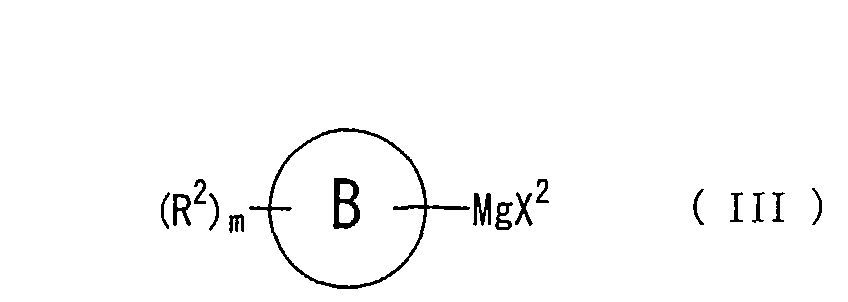
X2 denotes a chlorine, bromine or iodine atom, in the presence of a cyclic ether, or an acyclic ether having two or more ether oxygens in the molecule and a nickel catalyst comprising a nickel compound and a nitrogen-containing compound, provided that the nitrogen-containing compound is not 2,2'-bipyridyl.
a straight chain or branched chain, saturated or unsaturated aliphatic hydrocarbon group, typically, having from 1 to 12 carbon atoms, and specific examples thereof include, for example, a methyl group, an ethyl group, a propyl group, an isopropyl group, a butyl group, a sec-butyl group, an isobutyl group, a tert-butyl group, a hexyl group, a heptyl group, an octyl group, a decanyl group, an undecanyl group, a dodecanyl group, a cyclopropyl group, a cyclobutyl group, a cyclopentyl group, a cyclohexyl group, a cycloheptyl group,
a vinyl group, a 1-propenyl group, a 2-propenyl group, a 1-methylvinyl group, a 1,3-butadienyl group, a heptenyl group, an octenyl group, an ethynyl group, a 2-propynyl group, a heptynyl group, an octynyl group, and the like.
a straight chain, branched, or cyclic, saturated or unsaturated aliphatic hydrocarbon group having from 1 to 12 carbon atoms,
an aryl group having from 6 to 14 carbon atoms,
a straight chain or branched, cyclic alkoxy group having from 1 to 12 carbon atoms, and
an aryloxy group having from 6 to 14 carbon atoms, all of which are the same as defined above.
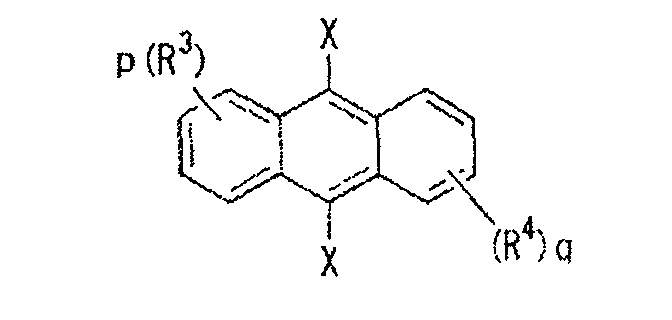
p and q independently denote an integer of from 0 to 4, and p+q<5.
substituted naphthyl compounds such as 1-naphthyl bromide, 2-methylnaphthyl bromide, 3-methoxy-2-naphthyl chloride, 1-naphthyliodide, 2-naphthyltrifluoromethanesulfonate, etc.,
substituted anthracenyl compounds such as 2-tert-butyl-9,10-dibromoanthracene, 9-bromoanthracene, 9,10-dichloroanthracene, 9-chloroanthracene, 9,10-diiodoanthracene, etc., substituted biphenyls such as 4,4,-dibromobiphenyl, 4,4'-diiodobiphenyl, etc., 9-bromophenanthrene, 2-bromofluorene, 5-bromoindanone, 2,7-dibromobromofluorene, etc and
pyridine compound such as 2-bromopyridine, 3-brompyridine, 4-brompyridine or the like.
an alkylamine having from 1 to 3 nitrogen atoms and from 4 to 20 carbon atoms such as triethylamine, diisopropylethylamine, diisopropylamine, N,N,N',N'-tetramethylethylene-1,2-diamine, N,N,N',N'-tetramethylpropylene-1,3-diamine, N,N,N',N'',N''-pentamethyldiethylenetriamine, or the like,
an alkoxyalkylamine having from 1 to 2 nitrogen atoms, from 5 to 20 carbon atoms and from 1 to 6 oxygen atoms such as tris(2-(2-methoxyethoxy)ethyl)amine, tris(2-methoxyethyl)amine, N,N-diethyl-2-methoxyethylamine or the like, and
N-alkylguanidines(e.g. tetramethylguanidine).
piperazine and N,N-dialkylpiperazine(e.g.,1,4-dimethylpiperazine), piperidine and alkylpiperidine (e.g., N-methylpiperidine and 1,2,2,6,6-pentamethylpiperidine), pyrrolidine or N-alkylpyrrolidine(e.g., N-ethylpyrrolidine), N,N',N''-trialkyltriazines( e.g., 1,3,5-trimethyltriazine), N,N',N''-trialkyltriazacycloalkane(e.g.1,4,7-trimethy ltriazacyclononane), morpholine or N-alkylmorpholine(e.g., morpholine and N-methylmorpholine), bicycloalkylamines(e.g., 1,4-diazabicyclo[2.2.2.]octane and quinuclidine, etc).;
enamine compound(e.g., N-(1-cyclopentenyl)morpholine, diazabicycloalkene(e.g.,1,8-diazabicyclo-[5.4.0]-undec-7-ene and 1,5-diazabicyclo-[4.3.0]-non-5-ene), pyridine, N,N-dialkylaminopyridine, and alkylpyridine (e.g., N,N-dimethylaminopyridine, and methylpyridine), pyrrole and alkylpyrrole including N-alkylpyrrole(e.g., pyrrole, N-isopropylpyrrole and 3-methylpyrrole), imidazole which may be substituted with an alkyl group, which alkyl has preferably from 1 to 15, more preferably 1 to 12 carbon atoms, aryl-alkyl group or an aryl group (e.g., imidazole, N-phenylimidazole, N-methylimidazole, 1,5-dimethylimidazole and N-benzylimidazole), pyrazole which may be substituted with an alkyl or aryl group(e.g., 1-phenyl-1,2-pyrazole, and 1-methyl-1,2-pyrazole), triazole which may be substituted with an alkyl group (e.g., 1,2,4-triazole, and 1-methyl-1,2,3-triazole), tetrazole which may be substituted with an alkyl group (e.g., 1,5-dicyclohexyl-1,2,3,4-tetrazole), benzimidazole which may be substituted with an alkyl group, (e.g., 1-methylbenzimidazole), benzotriazole which may be substituted with an alkyl group (e.g., 1-methyl-1,2,3-benzotriazole), oxazole which may be substituted with an alkyl group (e.g., 3,5-dimethyloxazole), benzoxazole compound(e.g., benzoxazole), benzothiazole compound (e.g., benzothiazole), carbazole and N-alkylcarbazole,(e.g., carbazole and N-ethylcarbazole), quinoline compound(e.g., quinoline), phthalazine compound(e.g., phthalazine), quinazoline compound(e.g., quinazoline), pyrimidine which may be substituted with an alkyl group(e.g., 4-ethylpyrimidine), cyclic urea compound(e.g. N,N-dimethylimidazolidone and N,N-dimethyl-propyleneurea) and the like.
Each calculation is provided with both its ± 95% confidence limits and a detailed report of how it has been carried out, including Hammett-type equation(s), substituent constants, and literature references where available.

| Example | Solvent | Amount of NiCl2 | Content of substituted aromatic compound |
| Example 16 | Diethylene glycol dimethyl ether | 0.15 mmol (0.5 mol% based on unsaturated organic compound) | 96.0% |
| Example 17 | Tetrahydrofuran | 0.15 mmol (0.5 mol% based on unsaturated organic compound) | 90. 5% |
| Example 18 | Toluene | 0.15 mmol (0.5 mol% based on unsaturated organic compound) | 90.3% |
| Example 19 | Diethylene glycol dimethyl ether | 0.03 mmol (0.1 mol% based on unsaturated organic compound) | 93.9% |


Claims (19)
- A method for producing a biaryl compound of formula(I) :wherein
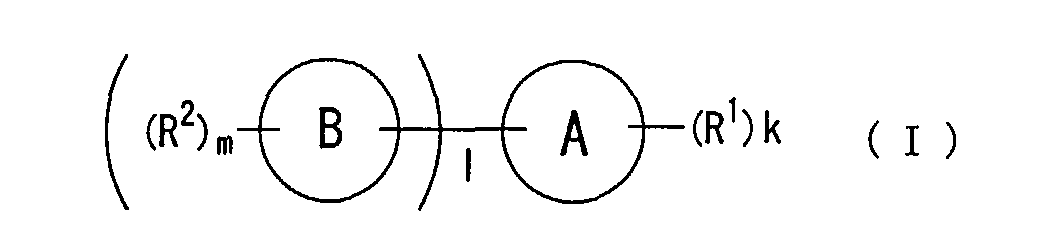
R1 is the same or different and independently denotes a substituted or unsubstituted aliphatic hydrocarbon group, a substituted or unsubstituted aryl group,
a substituted or unsubstituted alkoxy group,
a substituted or unsubstituted aryloxy group, or
a fluorine atom,
A denotes an aromatic hydrocarbon ring having from 6 to 14 carbon atoms or a pyridine ring,
B denotes an aromatic hydrocarbon ring having from 6 to 14 carbon atoms,
k and m independently denote an integer of from 0 to 5, and 1 denotes an integer of 1 or 2,
which method comprises reacting
an aromatic compound of formula (II):wherein R1, k and 1 denote the same as defined above, and X1 denotes a leaving group, with a Grignard reagent of formula (III): wherein R2, B, and m denote the same as defined above, and
X2 denote a chlorine, bromine or iodine atom, in the presence of a cyclic ether, or an acyclic ether having two or more ether oxygens in the molecule and a nickel catalyst comprising a nickel compound and a nitrogen-containing compound, provided that the nitrogen-containing compound is not 2,2'-bipyridyl. - A method according to claim 1, wherein the leaving group in formula (I) is a chlorine atom, a bromine atom, an iodine atom, a hydrocarbylsulfonate group, a halogen-substituted hydrocarbyl group, or a diazonium group.
- A method according to claim 2, wherein the hydrocarbylsulfonate group is a methanesulfonate group or a p-toluenesulfonate group.
- A method according to claim 2, wherein the halogen-substituted hydrocarbylsulfonate group is a trifluoromethanesulfonate group.
- A method according to claim 1, wherein the nickel compound is a nickel salt(II) or a nickel complex(0).
- A method according to claim 5, wherein the nickel compound is nickel halide(II), nickel nitrate(II), nickel acetate(II), nickel acetylacetonate(II), bis(1,5-cyclooctadiene)nickel (0), or nickel carbonyl(0).
- A method according to claim 1, wherein R1 and R2 independently represent
a straight chain or branched chain, saturated or unsaturated aliphatic hydrocarbon group having from 1 to 12 carbon atoms,
a straight chain or branched, cyclic or acyclic alkoxy group having from 1 to 12 carbon atoms,
an aryl group having from 6 to 14 carbon atoms, or
an aryloxy group having from 6 to 14 carbon atoms, all of which may be substituted with at least one substituent group selected from
a straight chain, branched, or cyclic, saturated or unsaturated aliphatic hydrocarbon group having from 1 to 12 carbon atoms,
an aryl group having from 6 to 14 carbon atoms,
a straight chain or branched, cyclic alkoxy group having from 1 to 12 carbon atoms, and
an aryloxy group having from 6 to 14 carbon atoms. - A method according to claim 1, wherein the nitrogen-containing compound is
an alkylamine having from 1 to 3 nitrogen atoms and from 4 to 20 carbon atoms,
an alkoxyalkylamine having from 1 to 2 nitrogen atoms, from 5 to 20 carbon atoms and from 1 to 6 oxygen atoms,
N-alkylguanidines, N,N-dialkylpiperazine,
alkylpiperidine, N-alkylpyrrolidine,
N,N',N''-trialkyltriazine, N-alkylmorpholine,
bicycloalkylamine, enamine, diazabicycloalkene,
pyridine, N,N-dialkylaminopyridine, and alkylpyridine pyrrole and alkylpyrrole,
imidazole which may be substituted with an alkyl group having from 1 to 15 carbon atoms, aryl-alkyl group or an aryl group, pyrazole which may be substituted with an alkyl or aryl group, triazole which may be substituted with an alkyl group, tetrazole which may be substituted with an alkyl group, benzimidazole which may be substituted with an alkyl group, benzotriazole which may be substituted with an alkyl group, oxazole which may be substituted with an alkyl group, benzoxazole compound, benzothiazole compound, carbazole and N-alkylcarbazole, quinoline compound phthalazine compound, quinazoline compound, pyrimidine which may be substituted with an alkyl group, piperazine, piperidine, pyrrolidine, N,N',N""-trialkyltriazacycloalkane, morpholine, or a cyclic urea compound. - A method according to claim 1, wherein the nitrogen-containing compound is acyclic nitrogen-containing compound or cyclic nitrogen-containing compounds, wherein
the nitrogen atom or atoms of the acyclic nitrogen-containing compound and cyclic nitrogen-containing compounds are tertiary nitrogen atom or atoms. - A method according to claim 9, wherein the nitrogen-containing compound is triethylamine, diisopropylethylamine, N,N,N',N'-tetramethylethylene-1,2-diamine, N,N,N',N'-tetramethylpropylene-1,3-diamine, N,N,N',N'',N''-pentamethyldiethylenetriamine, tris(2-(2-methoxyethoxy)ethyl)amine, tris(2-methoxyethyl)amine, N,N-diethyl-2-methoxyethylamine, tetramethylguanidine, 1,4-dimethylpiperazine, N-methylpiperidine, 1,2,2,6,6-pentamethylpiperidine, N-ethylpyrrolidine, 1,3,5-trimethyltriazine, 1,4,7-trimethyltriazacyclononane, N-methylmorpholine, 1,4-diazabicyclo[2.2.2.]octane, quinuclidine, N-(1-cyclopentenyl)morpholine, 1,8-diazabicyclo-[5.4.0]-undec-7-ene, 1,5-diazabicyclo-[4.3.0]-non-5-ene, N,N-dimethylaminopyridine, N-isopropylpyrrole, N-phenylimidazole, N-methylimidazole, 1,5-dimethylimidazole, N-benzylimidazole, 1-phenyl-1,2-pyrazole, 1-methyl-1,2-pyrazole, 1-methyl-1,2,3-triazole, 1,5-dicyclohexyl-1,2,3,4-tetrazole, 1-methylbenzimidazole, 1-methyl-1,2,3-benzotriazole, 2,4,5-trimethyloxazole, benzoxazole, benzothiazole, N-ethylcarbazole, quinoline, phthalazine, quinazoline, 4-ethylpyrimidine, N,N-dimethylimidazolidone or N,N-dimethyl-propyleneurea.
- A method according to any one of claims 1 to 4, wherein the cyclic ether is 1,4-dioxane.
- A method according to any one of claims 1 to 4, wherein the chain ether having two or more ether oxygens in the molecule is a glyme.
- A method according to claims 8, wherein the nitrogen-containing compound is the imidazole which may be substituted with an alkyl group, aryl-alkyl group or an aryl group, the diazabicycloalkene, the N,N-dialkylaminopyridine, the alkoxyalkylamine, or the alkylamine.
- A method according to claim 8, wherein the nitrogen-containing compound is N-methylimidazole.
- A method according to claim 8, wherein the diazabicycloalkene is 1,8-diazabicyclo-[5.4.0]-undec-7-ene.
- A method according to any one of claims 2 to 7, wherein at least one ortho-carbon atom of the aromatic compound of formula (II) or the Grignard compound of formula (III)is substituted with a hydrogen atom, wherein the ortho-carbon atom is defined in relation to the carbon atom bonded with X1 group or MgX2 group.
- A method according to claim 8, wherein the aromatic compound of formula (II) is a compound of formula (IV) :wherein R3 and R4 are the same or different and independently denote an aliphatic hydrocarbon group, an aryl group, an alkoxyl group, an aryloxy group, an aralkyloxy group or a fluorine atom,

p and q independently denote an integer of from 0 to 4, and p+q<5. - A method according to claim 11, wherein the nitrogen-containing compound is triethylamine.
- Amethod according to any one of claims 1 to 9, wherein the reaction is conducted at a temperature range of from not lower than -40°C to not higher than 200°C.
Applications Claiming Priority (4)
| Application Number | Priority Date | Filing Date | Title |
|---|---|---|---|
| JP2001352796 | 2001-11-19 | ||
| JP2001352798 | 2001-11-19 | ||
| JP2001352796 | 2001-11-19 | ||
| JP2001352798 | 2001-11-19 |
Publications (2)
| Publication Number | Publication Date |
|---|---|
| EP1312605A1 true EP1312605A1 (en) | 2003-05-21 |
| EP1312605B1 EP1312605B1 (en) | 2007-04-25 |
Family
ID=26624590
Family Applications (1)
| Application Number | Title | Priority Date | Filing Date |
|---|---|---|---|
| EP02025500A Expired - Lifetime EP1312605B1 (en) | 2001-11-19 | 2002-11-15 | Method for producing biaryl compounds |
Country Status (3)
| Country | Link |
|---|---|
| US (1) | US7122711B2 (en) |
| EP (1) | EP1312605B1 (en) |
| DE (1) | DE60219746T2 (en) |
Cited By (3)
| Publication number | Priority date | Publication date | Assignee | Title |
|---|---|---|---|---|
| US7446222B2 (en) | 2002-11-01 | 2008-11-04 | Glaxo Group Limited | Phenyl compounds |
| WO2010151654A1 (en) * | 2009-06-24 | 2010-12-29 | Cyalume Technologies, Inc. | Blue/violet diphenylanthracene chemiluminescent fluorescers |
| CN111285749A (en) * | 2020-03-26 | 2020-06-16 | 阮楚君 | An improved microchannel continuous flow method for preparing biphenyl derivatives |
Families Citing this family (6)
| Publication number | Priority date | Publication date | Assignee | Title |
|---|---|---|---|---|
| JP4311069B2 (en) * | 2003-01-17 | 2009-08-12 | 住友化学株式会社 | Method for producing coupling compound |
| EP1449580B1 (en) * | 2003-02-19 | 2005-12-28 | Sumitomo Chemical Company, Limited | Production method of a cross-coupling compound from an alkyl halide and an organoboron compound |
| WO2008111414A1 (en) * | 2007-03-09 | 2008-09-18 | Kyoto University | Catalyst composition, and process for production of cross-coupling compound using the same |
| CN101835535B (en) * | 2007-07-11 | 2012-11-07 | 东曹株式会社 | Catalyst composition and method for producing cross-coupling compound using same |
| KR20120104087A (en) | 2010-08-05 | 2012-09-20 | 이데미쓰 고산 가부시키가이샤 | Organic electroluminescent element |
| CN107602319B (en) * | 2017-09-29 | 2020-11-10 | 徐州博康信息化学品有限公司 | Method for synthesizing anthracene OLED intermediate |
Citations (3)
| Publication number | Priority date | Publication date | Assignee | Title |
|---|---|---|---|---|
| EP0366573A1 (en) * | 1988-10-25 | 1990-05-02 | Eastman Chemical Company | Preparation of biaryl compounds |
| FR2804956A1 (en) * | 2000-02-14 | 2001-08-17 | Rhodia Chimie Sa | PROCESS FOR THE PREPARATION OF A POLYAROMATIC COMPOUND |
| WO2001066248A2 (en) * | 2000-02-22 | 2001-09-13 | University Of New Orleans Research And Technology Foundation | C-c and c-n coupling catalyst comprising transition metal and carbene |
Family Cites Families (1)
| Publication number | Priority date | Publication date | Assignee | Title |
|---|---|---|---|---|
| JP4238405B2 (en) | 1999-02-09 | 2009-03-18 | 東ソー株式会社 | Method for producing substituted styrene derivative or substituted biaryl derivative |
-
2002
- 2002-11-15 EP EP02025500A patent/EP1312605B1/en not_active Expired - Lifetime
- 2002-11-15 US US10/294,622 patent/US7122711B2/en not_active Expired - Fee Related
- 2002-11-15 DE DE60219746T patent/DE60219746T2/en not_active Expired - Lifetime
Patent Citations (3)
| Publication number | Priority date | Publication date | Assignee | Title |
|---|---|---|---|---|
| EP0366573A1 (en) * | 1988-10-25 | 1990-05-02 | Eastman Chemical Company | Preparation of biaryl compounds |
| FR2804956A1 (en) * | 2000-02-14 | 2001-08-17 | Rhodia Chimie Sa | PROCESS FOR THE PREPARATION OF A POLYAROMATIC COMPOUND |
| WO2001066248A2 (en) * | 2000-02-22 | 2001-09-13 | University Of New Orleans Research And Technology Foundation | C-c and c-n coupling catalyst comprising transition metal and carbene |
Non-Patent Citations (1)
| Title |
|---|
| BOEHM V P W ET AL: "Nickel-catalyzed cross-coupling of aryl chlorides with aryl grignard reagents", ANGEWANDTE CHEMIE. INTERNATIONAL EDITION, VERLAG CHEMIE. WEINHEIM, DE, vol. 39, no. 9, 2 May 2000 (2000-05-02), pages 1602 - 1604, XP002178608, ISSN: 0570-0833 * |
Cited By (5)
| Publication number | Priority date | Publication date | Assignee | Title |
|---|---|---|---|---|
| US7446222B2 (en) | 2002-11-01 | 2008-11-04 | Glaxo Group Limited | Phenyl compounds |
| WO2010151654A1 (en) * | 2009-06-24 | 2010-12-29 | Cyalume Technologies, Inc. | Blue/violet diphenylanthracene chemiluminescent fluorescers |
| US8257620B2 (en) | 2009-06-24 | 2012-09-04 | Cyalume Technologies, Inc. | Blue/violet diphenylanthracene chemiluminescent fluorescers |
| CN111285749A (en) * | 2020-03-26 | 2020-06-16 | 阮楚君 | An improved microchannel continuous flow method for preparing biphenyl derivatives |
| CN111285749B (en) * | 2020-03-26 | 2021-04-20 | 山东冠森高分子材料科技股份有限公司 | An improved microchannel continuous flow method for preparing biphenyl derivatives |
Also Published As
| Publication number | Publication date |
|---|---|
| US7122711B2 (en) | 2006-10-17 |
| DE60219746T2 (en) | 2008-01-17 |
| DE60219746D1 (en) | 2007-06-06 |
| US20030158419A1 (en) | 2003-08-21 |
| EP1312605B1 (en) | 2007-04-25 |
Similar Documents
| Publication | Publication Date | Title |
|---|---|---|
| Do et al. | A general method for copper-catalyzed arylation of arene CH bonds | |
| EP2736881B1 (en) | Process for producing n-(hetero)arylazoles | |
| Orbisaglia et al. | Synthesis, characterization, and catalytic activity of cationic NHC gold (III) pyridine complexes | |
| US7122711B2 (en) | Method for producing biaryl compound | |
| Haneda et al. | Imidazole and Imidazoline Derivatives as N‐Donor Ligands for Palladium‐Catalyzed Mizoroki–Heck Reaction | |
| Nan et al. | Suzuki–Miyaura cross-coupling reaction of 1-aryltriazenes with arylboronic acids catalyzed by a recyclable polymer-supported N-heterocyclic carbene–palladium complex catalyst | |
| Patricio-Rangel et al. | Mercaptopyridine-functionalized MIC-Pd (II)-PEPPSI complexes: Synthesis and hemilability effect in catalytic applications | |
| CN104496736A (en) | Rare earth metal compound-based cross-coupling reaction and use thereof | |
| JP7295451B2 (en) | Method for producing perfluoroalkyl group-containing aromatic compound | |
| JP4427946B2 (en) | Method for producing coupling compound | |
| JP4581322B2 (en) | Process for producing substituted aromatic compounds | |
| JP4321131B2 (en) | Method for producing coupling compound | |
| CN114539097A (en) | Polysubstituted alkenyl cyanide and synthetic method thereof | |
| JP2003522744A (en) | Method for producing polycyclic aromatic compound | |
| CN115160196B (en) | Preparation method of symmetrical thioether compounds | |
| CN101516824A (en) | Process for the production of aromatic amines in the presence of a palladium complex comprising a ferrocenyl biphosphine ligand | |
| Ghonchepour et al. | Transition metal-free and base-mediated transformation arylation of unactivated benzene with aryl halides in presence of N, N′-bis (salicylidene) ethylenediamine as organocatalyst | |
| CN112574244B (en) | Synthesis method of 1-phenyl vinyl borate | |
| JP7081698B2 (en) | Method for manufacturing a coupling compound | |
| CN111039923A (en) | The preparation method of 2,6-dicarbazolylpyridine | |
| CN118946536A (en) | Method for producing fluorine-containing aromatic compounds | |
| CN114832862B (en) | Catalytic composition for coupling reaction and application of catalytic composition in preparation of isoquinoline-1, 3-dione compounds | |
| JP2010280637A (en) | Method for producing B-arylborazine | |
| WO2009081872A1 (en) | Method for producing 6-halogeno-3-arylpyridine derivative | |
| Tudose et al. | Synthesis of stilbenoids via the Suzuki–Miyaura reaction catalysed by palladium N-heterocyclic carbene complexes |
Legal Events
| Date | Code | Title | Description |
|---|---|---|---|
| PUAI | Public reference made under article 153(3) epc to a published international application that has entered the european phase |
Free format text: ORIGINAL CODE: 0009012 |
|
| AK | Designated contracting states |
Designated state(s): AT BE BG CH CY CZ DE DK EE ES FI FR GB GR IE IT LI LU MC NL PT SE SK TR |
|
| AX | Request for extension of the european patent |
Extension state: AL LT LV MK RO SI |
|
| 17P | Request for examination filed |
Effective date: 20031112 |
|
| AKX | Designation fees paid |
Designated state(s): CH DE FR GB LI |
|
| 17Q | First examination report despatched |
Effective date: 20040308 |
|
| RAP1 | Party data changed (applicant data changed or rights of an application transferred) |
Owner name: SUMITOMO CHEMICAL COMPANY, LIMITED |
|
| GRAP | Despatch of communication of intention to grant a patent |
Free format text: ORIGINAL CODE: EPIDOSNIGR1 |
|
| GRAS | Grant fee paid |
Free format text: ORIGINAL CODE: EPIDOSNIGR3 |
|
| GRAA | (expected) grant |
Free format text: ORIGINAL CODE: 0009210 |
|
| AK | Designated contracting states |
Kind code of ref document: B1 Designated state(s): CH DE FR GB LI |
|
| REG | Reference to a national code |
Ref country code: GB Ref legal event code: FG4D |
|
| REG | Reference to a national code |
Ref country code: CH Ref legal event code: EP |
|
| REF | Corresponds to: |
Ref document number: 60219746 Country of ref document: DE Date of ref document: 20070606 Kind code of ref document: P |
|
| REG | Reference to a national code |
Ref country code: CH Ref legal event code: NV Representative=s name: A. BRAUN, BRAUN, HERITIER, ESCHMANN AG PATENTANWAE |
|
| ET | Fr: translation filed | ||
| PLBE | No opposition filed within time limit |
Free format text: ORIGINAL CODE: 0009261 |
|
| STAA | Information on the status of an ep patent application or granted ep patent |
Free format text: STATUS: NO OPPOSITION FILED WITHIN TIME LIMIT |
|
| 26N | No opposition filed |
Effective date: 20080128 |
|
| REG | Reference to a national code |
Ref country code: CH Ref legal event code: PFA Owner name: SUMITOMO CHEMICAL COMPANY, LIMITED Free format text: SUMITOMO CHEMICAL COMPANY, LIMITED#27-1, SHINKAWA 2-CHOME, CHUO-KU#TOKYO 104-8260 (JP) -TRANSFER TO- SUMITOMO CHEMICAL COMPANY, LIMITED#27-1, SHINKAWA 2-CHOME, CHUO-KU#TOKYO 104-8260 (JP) |
|
| PGFP | Annual fee paid to national office [announced via postgrant information from national office to epo] |
Ref country code: CH Payment date: 20121113 Year of fee payment: 11 Ref country code: DE Payment date: 20121107 Year of fee payment: 11 Ref country code: FR Payment date: 20121130 Year of fee payment: 11 |
|
| PGFP | Annual fee paid to national office [announced via postgrant information from national office to epo] |
Ref country code: GB Payment date: 20121114 Year of fee payment: 11 |
|
| REG | Reference to a national code |
Ref country code: CH Ref legal event code: PL |
|
| GBPC | Gb: european patent ceased through non-payment of renewal fee |
Effective date: 20131115 |
|
| PG25 | Lapsed in a contracting state [announced via postgrant information from national office to epo] |
Ref country code: LI Free format text: LAPSE BECAUSE OF NON-PAYMENT OF DUE FEES Effective date: 20131130 Ref country code: CH Free format text: LAPSE BECAUSE OF NON-PAYMENT OF DUE FEES Effective date: 20131130 |
|
| REG | Reference to a national code |
Ref country code: FR Ref legal event code: ST Effective date: 20140731 |
|
| REG | Reference to a national code |
Ref country code: DE Ref legal event code: R119 Ref document number: 60219746 Country of ref document: DE Effective date: 20140603 |
|
| PG25 | Lapsed in a contracting state [announced via postgrant information from national office to epo] |
Ref country code: DE Free format text: LAPSE BECAUSE OF NON-PAYMENT OF DUE FEES Effective date: 20140603 |
|
| PG25 | Lapsed in a contracting state [announced via postgrant information from national office to epo] |
Ref country code: GB Free format text: LAPSE BECAUSE OF NON-PAYMENT OF DUE FEES Effective date: 20131115 Ref country code: FR Free format text: LAPSE BECAUSE OF NON-PAYMENT OF DUE FEES Effective date: 20131202 |