EP1311722B1 - Two-stage chlorine bleaching process with filtrate recirculation - Google Patents
Two-stage chlorine bleaching process with filtrate recirculation Download PDFInfo
- Publication number
- EP1311722B1 EP1311722B1 EP01961500A EP01961500A EP1311722B1 EP 1311722 B1 EP1311722 B1 EP 1311722B1 EP 01961500 A EP01961500 A EP 01961500A EP 01961500 A EP01961500 A EP 01961500A EP 1311722 B1 EP1311722 B1 EP 1311722B1
- Authority
- EP
- European Patent Office
- Prior art keywords
- stage
- pulp
- bleaching
- chlorine dioxide
- filtrate
- Prior art date
- Legal status (The legal status is an assumption and is not a legal conclusion. Google has not performed a legal analysis and makes no representation as to the accuracy of the status listed.)
- Expired - Lifetime
Links
- 238000004061 bleaching Methods 0.000 title claims abstract description 45
- 239000000706 filtrate Substances 0.000 title claims abstract description 30
- 238000000034 method Methods 0.000 title claims abstract description 20
- ZAMOUSCENKQFHK-UHFFFAOYSA-N Chlorine atom Chemical compound [Cl] ZAMOUSCENKQFHK-UHFFFAOYSA-N 0.000 title description 2
- 239000000460 chlorine Substances 0.000 title description 2
- 229910052801 chlorine Inorganic materials 0.000 title description 2
- OSVXSBDYLRYLIG-UHFFFAOYSA-N dioxidochlorine(.) Chemical compound O=Cl=O OSVXSBDYLRYLIG-UHFFFAOYSA-N 0.000 claims abstract description 64
- 239000004155 Chlorine dioxide Substances 0.000 claims abstract description 32
- 235000019398 chlorine dioxide Nutrition 0.000 claims abstract description 32
- 229920001131 Pulp (paper) Polymers 0.000 claims abstract description 8
- 239000000126 substance Substances 0.000 claims description 17
- MYMOFIZGZYHOMD-UHFFFAOYSA-N Dioxygen Chemical compound O=O MYMOFIZGZYHOMD-UHFFFAOYSA-N 0.000 claims description 8
- 229910001882 dioxygen Inorganic materials 0.000 claims description 8
- MHAJPDPJQMAIIY-UHFFFAOYSA-N Hydrogen peroxide Chemical compound OO MHAJPDPJQMAIIY-UHFFFAOYSA-N 0.000 claims description 2
- 238000000605 extraction Methods 0.000 claims description 2
- 238000004064 recycling Methods 0.000 abstract description 2
- 238000010790 dilution Methods 0.000 description 7
- 239000012895 dilution Substances 0.000 description 7
- CBENFWSGALASAD-UHFFFAOYSA-N Ozone Chemical compound [O-][O+]=O CBENFWSGALASAD-UHFFFAOYSA-N 0.000 description 4
- 238000005406 washing Methods 0.000 description 4
- XLYOFNOQVPJJNP-UHFFFAOYSA-N water Substances O XLYOFNOQVPJJNP-UHFFFAOYSA-N 0.000 description 4
- 239000007788 liquid Substances 0.000 description 3
- 150000002978 peroxides Chemical class 0.000 description 3
- 230000000694 effects Effects 0.000 description 2
- 230000007613 environmental effect Effects 0.000 description 2
- 239000002253 acid Substances 0.000 description 1
- 230000002542 deteriorative effect Effects 0.000 description 1
- 230000002349 favourable effect Effects 0.000 description 1
- 239000002657 fibrous material Substances 0.000 description 1
- 239000013505 freshwater Substances 0.000 description 1
- 239000012535 impurity Substances 0.000 description 1
- 238000006386 neutralization reaction Methods 0.000 description 1
- 238000010992 reflux Methods 0.000 description 1
Images
Classifications
-
- D—TEXTILES; PAPER
- D21—PAPER-MAKING; PRODUCTION OF CELLULOSE
- D21C—PRODUCTION OF CELLULOSE BY REMOVING NON-CELLULOSE SUBSTANCES FROM CELLULOSE-CONTAINING MATERIALS; REGENERATION OF PULPING LIQUORS; APPARATUS THEREFOR
- D21C9/00—After-treatment of cellulose pulp, e.g. of wood pulp, or cotton linters ; Treatment of dilute or dewatered pulp or process improvement taking place after obtaining the raw cellulosic material and not provided for elsewhere
- D21C9/10—Bleaching ; Apparatus therefor
- D21C9/12—Bleaching ; Apparatus therefor with halogens or halogen-containing compounds
- D21C9/14—Bleaching ; Apparatus therefor with halogens or halogen-containing compounds with ClO2 or chlorites
- D21C9/144—Bleaching ; Apparatus therefor with halogens or halogen-containing compounds with ClO2 or chlorites with ClO2/Cl2 and other bleaching agents in a multistage process
Definitions
- This invention relates to a method of bleaching lignocellulosic fibrous material in the form of chemical pulp.
- the invention comprises more specifically two bleaching stages with chlorine dioxide as dominating bleaching chemical and at least one intermediate alkaline bleaching stage.
- Bleaching of chemical pulp is carried out in a sequence, which comprises several bleaching stages with different bleaching chemicals.
- a usual bleaching sequence comprises a first chlorine dioxide stage (D 0 ) followed by an alkaline bleaching stage (E) and a second chlorine dioxide stage (D 1 ).
- the chlorine dioxide stages normally are carried out only with chlorine dioxide, but alternatively the chlorine dioxide can be completed with other chemicals, for example ozone.
- the chemicals are added in different phases of the bleaching stage.
- the alkaline bleaching stage normally is an extraction stage with addition of oxygen gas and peroxide (EOP).
- EOP oxygen gas and peroxide
- the alkaline stage alternatively can be completed with an ozone phase, which then is carried out at acid conditions.
- the bleaching of pulp has the object to increase the ISO-brightness of the pulp, which implies that impurities and discolouring matter are solved out of the pulp and removed by washing/dewatering before and after the bleaching stages by means of filters or presses.
- the filtrate from the dewatering can to a large extent be re-cycled and be used for washing and dilution in previous stages of the process in order thereby to minimize the emissions of solved substances. For environmental reasons a low effluent volume is desired, but the reflux of the filtrate causes a build-up of the substance content in the bleaching stages, with the resulting risk of increased chemical consumption.
- the chlorine dioxide stages are carried out with a pulp of mean concentration (8-15%).
- the pulp is dewatered by pressing to high concentration (25-40%). It is, therefore, necessary by dilution to lower the pulp concentration before the pulp is introduced into the bleaching stage. This dilution often is carried out with clean water, but by using instead the filtrate from the washing/dewatering directly after the bleaching stage (D 0 ) the filtrate flow, and thereby also the total effluent volume, from the process could be reduced.
- the present invention solves the aforesaid problems by a more advantageous re-cycling of the filtrate in the process. Thereby an unfavourable build-up of the substance content in the bleaching process is avoided, and the ISO-brightness of the pulp is improved.
- the invention thus, relates to a method of bleaching chemical pulp, comprising two bleaching stages with chlorine dioxide as dominating bleaching chemical and at least one intermediate alkaline bleaching stage.
- the chlorine dioxide stages (D 0 ) and, respectively, D 1 ) can be pure chlorine dioxide stages or bleaching stages where chlorine dioxide is completed with some other bleaching chemical, for example ozone, in different phases.
- the chlorine dioxide bleaching is carried out with pulp of mean concentration, 8-15%.
- an alkaline bleaching (E) is carried out, which can be combined with the addition of oxygen gas (O) and/or hydroperoxide (P), so-called (EOP)-stage, or ozone (Z(EO)).
- the pulp is washed by dewatering, at which liquid (filtrate) is removed by means of filters or presses.
- the dewatering can be carried out with or without the supply of washing liquid.
- the pressing suitably takes place in so-called roller presses, where the pulp is pressed between two rollers so that the pulp concentration is increased to 25-40%.
- a pulp concentration of only 10-20% is obtained.
- the pulp is moved to subsequent treatment stages, where the pulp concentration by liquid addition is adjusted to a level suitable for treatment in this stage.
- filtrate is re-cycled from the dewatering after the second chlorine dioxide stage (D 1 ) and utilized for controlling the pulp concentration of the pulp dewatered to 25-40% before the first chlorine dioxide stage (D 0 ).
- the pulp thus, is diluted by this filtrate from 25-40% to the concentration suitable in this stage (D 0 ), i.e. 8-15%.
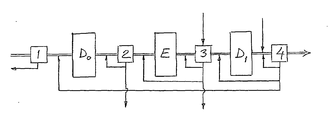
- Chemical pulp which can be oxygen gas delignified, is moved via a first roller press 1 to a first chlorine dioxide stage Do.
- the pulp is thereafter via a second roller press 2 moved to an alkaline bleaching stage E and further via a third roller press 3 to a second chlorine dioxide stage D 1 and from there to a fourth roller press 4, from where the pulp is moved to a subsequent treatment stage.
- the second, third and fourth roller press 2,3,4 can possibly be replaced by filters. This, however, has the consequence, that the effluent volume increases.
- the pulp is dewatered to a concentration of 25-40%, in order as much as possible to reduce the content of undesired substances in the pulp before the D 0 -stage.
- the filtrate from the fourth roller press 4 is supplied for adjusting the pulp concentration to the level suitable for the D 0 -stage, i.e. 8-15%.
- the pulp is dewatered, and the main part of the filtrate is removed from the process.
- the concentration of the pulp is controlled again with re-circulated filtrate from the subsequent roller press 3 to a concentration suitable for the E-stage where also oxygen gas and peroxide are added (EOP).
- the D 1 -stage can be a single chlorine dioxide stage or alternatively be carried out with chlorine dioxide in two phases with an intermediate neutralization. After the D 1 -stage the pulp is again dewatered and advanced to subsequent treatment stages, while the main part of the filtrate is re-cycled to the pulp before the D 0 -stage.
- the invention implies that the bleaching process can be made more effective in that added bleaching chemicals are utilized effectively, at the same time as the effluent volume can be kept low, which is favourable from an environmental point of view.
- the kappa factor in the bleaching stage was 1.8 kg active chlorine/kappa number. Final pH 2.3 - 2.5. After D(EO) Dilution with: Kappa number ISO-brightness Viscosity ml/g Clean water 2.7 71.6 887 D 0 -filtrate 3.1 68.8 887 D 1 -filtrate 2.5 72.0 894
- the result shows an increase of the kappa number from 2.7 to 3.1 after D(EO) when the dilution was made with D 0 -filtrate instead of clean water.
- D 1 -filtrate was used, the effect was the opposite one.
- the kappa number was lowered after D(EO)from 2.7 to 2.5.
Landscapes
- Life Sciences & Earth Sciences (AREA)
- Engineering & Computer Science (AREA)
- Wood Science & Technology (AREA)
- Paper (AREA)
- Detergent Compositions (AREA)
- Silver Salt Photography Or Processing Solution Therefor (AREA)
Abstract
Description
- This invention relates to a method of bleaching lignocellulosic fibrous material in the form of chemical pulp. The invention comprises more specifically two bleaching stages with chlorine dioxide as dominating bleaching chemical and at least one intermediate alkaline bleaching stage.
- Bleaching of chemical pulp is carried out in a sequence, which comprises several bleaching stages with different bleaching chemicals. A usual bleaching sequence comprises a first chlorine dioxide stage (D0) followed by an alkaline bleaching stage (E) and a second chlorine dioxide stage (D1). The chlorine dioxide stages normally are carried out only with chlorine dioxide, but alternatively the chlorine dioxide can be completed with other chemicals, for example ozone. The chemicals are added in different phases of the bleaching stage. The alkaline bleaching stage normally is an extraction stage with addition of oxygen gas and peroxide (EOP). The alkaline stage alternatively can be completed with an ozone phase, which then is carried out at acid conditions.
- The bleaching of pulp has the object to increase the ISO-brightness of the pulp, which implies that impurities and discolouring matter are solved out of the pulp and removed by washing/dewatering before and after the bleaching stages by means of filters or presses. The filtrate from the dewatering can to a large extent be re-cycled and be used for washing and dilution in previous stages of the process in order thereby to minimize the emissions of solved substances. For environmental reasons a low effluent volume is desired, but the reflux of the filtrate causes a build-up of the substance content in the bleaching stages, with the resulting risk of increased chemical consumption.
- In bleaching sequences of the aforedescribed kind the chlorine dioxide stages are carried out with a pulp of mean concentration (8-15%). As it is desired prior to the first chlorine dioxide stage (D0) to the greatest possible extent to remove solved substances from previous treatment stages, the pulp is dewatered by pressing to high concentration (25-40%). It is, therefore, necessary by dilution to lower the pulp concentration before the pulp is introduced into the bleaching stage. This dilution often is carried out with clean water, but by using instead the filtrate from the washing/dewatering directly after the bleaching stage (D0) the filtrate flow, and thereby also the total effluent volume, from the process could be reduced.
- This recycling of filtrate, however, has the disadvantage of deteriorating the ISO-brightness of the pulp. In order to compensate for this, increased chemical addition is required, which involves higher costs.
- The present invention solves the aforesaid problems by a more advantageous re-cycling of the filtrate in the process. Thereby an unfavourable build-up of the substance content in the bleaching process is avoided, and the ISO-brightness of the pulp is improved.
- The characterizing features of the invention are apparent from the attached claims.
- The invention, thus, relates to a method of bleaching chemical pulp, comprising two bleaching stages with chlorine dioxide as dominating bleaching chemical and at least one intermediate alkaline bleaching stage. The chlorine dioxide stages (D0) and, respectively, D1) can be pure chlorine dioxide stages or bleaching stages where chlorine dioxide is completed with some other bleaching chemical, for example ozone, in different phases. The chlorine dioxide bleaching is carried out with pulp of mean concentration, 8-15%. Between the chlorine dioxide stages an alkaline bleaching (E) is carried out, which can be combined with the addition of oxygen gas (O) and/or hydroperoxide (P), so-called (EOP)-stage, or ozone (Z(EO)).
- After the bleaching stages the pulp is washed by dewatering, at which liquid (filtrate) is removed by means of filters or presses. The dewatering can be carried out with or without the supply of washing liquid. The pressing suitably takes place in so-called roller presses, where the pulp is pressed between two rollers so that the pulp concentration is increased to 25-40%. At dewatering by means of filters, however, a pulp concentration of only 10-20% is obtained. After the dewatering the pulp is moved to subsequent treatment stages, where the pulp concentration by liquid addition is adjusted to a level suitable for treatment in this stage.
- At the method according to the invention, filtrate is re-cycled from the dewatering after the second chlorine dioxide stage (D1) and utilized for controlling the pulp concentration of the pulp dewatered to 25-40% before the first chlorine dioxide stage (D0). The pulp, thus, is diluted by this filtrate from 25-40% to the concentration suitable in this stage (D0), i.e. 8-15%.
- By utilizing in this way the filtrate from D1, an unfavourable build-up of the substance content in Do can be avoided. It was, moreover, surprisingly found that the addition of filtrate from D0 results in a lowering of the kappa number and an increase of the ISO-brightness of the pulp.
- The invention is described in greater detail in the following, with reference to the accompanying drawing showing an embodiment of a flow sheet for a bleaching method according to the invention.
- Chemical pulp, which can be oxygen gas delignified, is moved via a first roller press 1 to a first chlorine dioxide stage Do. The pulp is thereafter via a
second roller press 2 moved to an alkaline bleaching stage E and further via athird roller press 3 to a second chlorine dioxide stage D1 and from there to afourth roller press 4, from where the pulp is moved to a subsequent treatment stage. The second, third andfourth roller press - Before the bleaching step in question, necessary chemicals are admixed in a conventional manner. To the E-stage suitably also oxygen gas and peroxide are added. The necessary amount of fresh water suitably is supplied to the third roller press and after the second chlorine dioxide stage D1, see Figure. The filtrate, which is removed as effluent from the process, suitably is taken out from the second and
third roller press 2 and, respectively, 3. The filtrate from the first roller press 1 is moved backward to previous process stages. A small portion of the filtrates from every roller press 1-4 is re-cycled in a short circulation to the pulp before the respective press, for example as shown in the Figure. From thefourth roller press 4 the main part of the filtrate is re-cycled directly to the pulp in a position between the first roller press 1 and the first chlorine dioxide stage Do. - In the first roller press 1 the pulp is dewatered to a concentration of 25-40%, in order as much as possible to reduce the content of undesired substances in the pulp before the D0-stage. Thereafter the filtrate from the
fourth roller press 4 is supplied for adjusting the pulp concentration to the level suitable for the D0-stage, i.e. 8-15%. After the D0-stage the pulp is dewatered, and the main part of the filtrate is removed from the process. The concentration of the pulp is controlled again with re-circulated filtrate from thesubsequent roller press 3 to a concentration suitable for the E-stage where also oxygen gas and peroxide are added (EOP). Thereafter the pulp is dewatered and, after control to the desired concentration (8-15%), moved to the D1-stage. The main part of the filtrate from this dewatering 3 is removed from the process. The D1-stage can be a single chlorine dioxide stage or alternatively be carried out with chlorine dioxide in two phases with an intermediate neutralization. After the D1-stage the pulp is again dewatered and advanced to subsequent treatment stages, while the main part of the filtrate is re-cycled to the pulp before the D0-stage. - The invention, thus, implies that the bleaching process can be made more effective in that added bleaching chemicals are utilized effectively, at the same time as the effluent volume can be kept low, which is favourable from an environmental point of view.
- In the following example a comparison is made between the method according to the invention and known state of art, whereby the surprising technical effect becomes apparent.
- An oxygen gas delignified coniferous wood pulp with kappa number 10.1 was pressed to a pulp concentration of 30% and bleached in a chlorine dioxide stage and subsequent alkaline stage according to the sequence D (EO). Before the addition of chlorine dioxide to the D-stage, a dilution of the pulp to 10% was made. For the dilution were used clean water, filtrate from a D0-stage and, respectively, filtrate from a D1-stage. The result appears from the Table below.
Table Chlorine dioxide bleaching of oxygen gas delignified pulp with kappa number 10.1, ISO-brightness 43% and viscosity 915 mL/g. The kappa factor in the bleaching stage was 1.8 kg active chlorine/kappa number. Final pH 2.3 - 2.5. After D(EO) Dilution with: Kappa number ISO-brightness Viscosity ml/g Clean water 2.7 71.6 887 D0-filtrate 3.1 68.8 887 D1-filtrate 2.5 72.0 894 - The result shows an increase of the kappa number from 2.7 to 3.1 after D(EO) when the dilution was made with D0-filtrate instead of clean water. When D1-filtrate was used, the effect was the opposite one. The kappa number was lowered after D(EO)from 2.7 to 2.5.
- The invention, of course, is not restricted to the embodiment shown, but can be varied within the scope of the attached claims.
Claims (4)
- A method of bleaching chemical pulp, comprising two bleaching stages (D0 and, respectively, D1) with chlorine dioxide as dominating bleaching chemical and at least one intermediate alkaline bleaching stage (E), where the pulp is dewatered to a concentration of 25-40% before the first chlorine dioxide stage (D0) and to 10-40% after the second chlorine dioxide stage (D1), characterized in that filtrate from the dewatering after the second chlorine dioxide stage (D1) is re-cycled and utilized for controlling the pulp concentration to 8-15% of the dewatered pulp to the first chlorine dioxide stage (D0).
- A method as defined in claim 1, characterized in that the dewatering of the pulp before the first stage (D0) and after the second stage (D1) is carried out by roller presses (1, 4).
- A method as defined in anyone of the preceding claims, characterized in that the bleaching in the intermediate stage (E) is carried out as an extraction stage with the addition of oxygen gas and/or hydroperoxide.
- A method as defined in anyone of the preceding claims, characterized in that the dewatering before and after the intermediate stage (E) is carried out by roller presses (2, 3).
Applications Claiming Priority (3)
| Application Number | Priority Date | Filing Date | Title |
|---|---|---|---|
| SE0002930A SE516969C2 (en) | 2000-08-14 | 2000-08-14 | Chlorine dioxide bleaching in two stages with return of filtrate |
| SE0002930 | 2000-08-14 | ||
| PCT/SE2001/001752 WO2002014600A1 (en) | 2000-08-14 | 2001-08-14 | Two-stage chlorine bleaching process with filtrate recirculation |
Publications (2)
| Publication Number | Publication Date |
|---|---|
| EP1311722A1 EP1311722A1 (en) | 2003-05-21 |
| EP1311722B1 true EP1311722B1 (en) | 2008-10-08 |
Family
ID=20280715
Family Applications (1)
| Application Number | Title | Priority Date | Filing Date |
|---|---|---|---|
| EP01961500A Expired - Lifetime EP1311722B1 (en) | 2000-08-14 | 2001-08-14 | Two-stage chlorine bleaching process with filtrate recirculation |
Country Status (9)
| Country | Link |
|---|---|
| US (1) | US7182835B2 (en) |
| EP (1) | EP1311722B1 (en) |
| JP (1) | JP2004506818A (en) |
| AT (1) | ATE410542T1 (en) |
| AU (1) | AU2001282761A1 (en) |
| CA (1) | CA2417338C (en) |
| DE (1) | DE60136079D1 (en) |
| SE (1) | SE516969C2 (en) |
| WO (1) | WO2002014600A1 (en) |
Families Citing this family (5)
| Publication number | Priority date | Publication date | Assignee | Title |
|---|---|---|---|---|
| SE516969C2 (en) * | 2000-08-14 | 2002-03-26 | Metso Paper Inc | Chlorine dioxide bleaching in two stages with return of filtrate |
| DE102006057861A1 (en) * | 2006-12-08 | 2008-06-12 | Voith Patent Gmbh | Method for treating a filtrate produced from a paper fiber suspension of waste paper comprises adding the filtrate partly to the paper fiber suspension at a site lying downstream of a thickening units from which the filtrate is produced |
| FI122241B (en) | 2007-06-15 | 2011-10-31 | Andritz Oy | Procedure in connection with pulp washing at a pulp mill |
| SE532370C2 (en) * | 2008-02-28 | 2009-12-29 | Metso Paper Inc | Method of bleaching a pulp |
| CA2793941C (en) | 2010-03-23 | 2015-08-18 | International Paper Company | Improved bctmp filtrate recycling system and method |
Family Cites Families (12)
| Publication number | Priority date | Publication date | Assignee | Title |
|---|---|---|---|---|
| US3632469A (en) * | 1969-06-05 | 1972-01-04 | Ethyl Corp | Process for the manufacture of dissolving grade pulp |
| SE390178B (en) * | 1974-09-04 | 1976-12-06 | Sunds Ab | WHEN BLACHING LIGNOCELLULOSE-CONTAINING MATERIAL WITH A COMBINATION OF GAS PHASE CHLORINATION AND A REPLACEMENT BLACHING SYSTEM CONTAINING CHLORIO DIOXIDE |
| ZA761255B (en) * | 1975-03-11 | 1977-03-30 | Erco Envirotech Ltd | Bleachplant operation |
| US4104114A (en) * | 1977-05-05 | 1978-08-01 | Erco Envirotech Ltd. | Bleach plant operation |
| NZ235983A (en) * | 1989-11-08 | 1993-01-27 | Novo Nordisk As | Process for hydrolysis of resins in lignocellulosic pulp using enzymes simultaneously with peroxy bleaching; ctmp fluff-pulp and absorbent articles produced therefrom |
| US5118389A (en) * | 1990-07-06 | 1992-06-02 | Ici Canada Inc. | Two-stage peroxide bleaching process using different amounts of peroxide on different portions of mechanical pulp |
| US5853535A (en) * | 1991-01-28 | 1998-12-29 | Champion International Corporation | Process for manufacturing bleached pulp including recycling |
| DE19614587A1 (en) * | 1996-04-13 | 1997-10-16 | Jaschinski Thomas Dipl Holzw | Process and bleaching solution for bleaching cellulosic fibers |
| US6569284B1 (en) * | 1996-09-24 | 2003-05-27 | International Paper Company | Elemental-chlorine-free bleaching process having an initial Eo or Eop stage |
| US6315863B1 (en) * | 1998-06-18 | 2001-11-13 | Weyerhaeuser Company | Chlorine dioxide pulp bleaching process having reduced barium scaling by recycling post-chlorination waste filtrate |
| SE516969C2 (en) * | 2000-08-14 | 2002-03-26 | Metso Paper Inc | Chlorine dioxide bleaching in two stages with return of filtrate |
| SE0300276L (en) * | 2003-01-31 | 2003-12-09 | Kvaerner Pulping Tech | Method for bleaching cellulose pulp and bleaching line for this |
-
2000
- 2000-08-14 SE SE0002930A patent/SE516969C2/en not_active IP Right Cessation
-
2001
- 2001-08-14 DE DE60136079T patent/DE60136079D1/en not_active Expired - Fee Related
- 2001-08-14 WO PCT/SE2001/001752 patent/WO2002014600A1/en not_active Ceased
- 2001-08-14 CA CA002417338A patent/CA2417338C/en not_active Expired - Fee Related
- 2001-08-14 AT AT01961500T patent/ATE410542T1/en not_active IP Right Cessation
- 2001-08-14 US US10/344,425 patent/US7182835B2/en not_active Expired - Fee Related
- 2001-08-14 EP EP01961500A patent/EP1311722B1/en not_active Expired - Lifetime
- 2001-08-14 AU AU2001282761A patent/AU2001282761A1/en not_active Abandoned
- 2001-08-14 JP JP2002519719A patent/JP2004506818A/en not_active Withdrawn
Also Published As
| Publication number | Publication date |
|---|---|
| WO2002014600A1 (en) | 2002-02-21 |
| CA2417338A1 (en) | 2002-02-21 |
| US7182835B2 (en) | 2007-02-27 |
| ATE410542T1 (en) | 2008-10-15 |
| AU2001282761A1 (en) | 2002-02-25 |
| DE60136079D1 (en) | 2008-11-20 |
| SE0002930D0 (en) | 2000-08-14 |
| EP1311722A1 (en) | 2003-05-21 |
| SE0002930L (en) | 2002-02-15 |
| SE516969C2 (en) | 2002-03-26 |
| US20030178163A1 (en) | 2003-09-25 |
| CA2417338C (en) | 2009-12-15 |
| JP2004506818A (en) | 2004-03-04 |
Similar Documents
| Publication | Publication Date | Title |
|---|---|---|
| EP1095184B1 (en) | Method of producing lignocellulosic pulp from non-woody species | |
| EP0512590B1 (en) | Process for bleaching of lignocellulose-containing material | |
| EP0670928B1 (en) | Process for delignification of lignocellulose-containing pulp | |
| US20040035537A1 (en) | Method for bleaching paper pulp | |
| RU2126471C1 (en) | Method of cellulose production without chloride chemicals | |
| EP0395792A2 (en) | Procedure for the bleaching of pulp | |
| JP3623469B2 (en) | Pressure control method of upright continuous pulverized cellulose fiber digester | |
| AU634665B2 (en) | Two-stage peroxide bleaching process | |
| US7182835B2 (en) | Two-stage chlorine bleaching process with filtrate recirculation | |
| EP0519061B1 (en) | Split alkali addition for high consistency oxygen delignification | |
| EP0494519A1 (en) | High yield pulping process | |
| SE9102589D0 (en) | CHLORINE-FREE PROCESS FOR BLEACHING PULP | |
| EP0797703B1 (en) | Peroxide bleaching process for cellulosic and lignocellulosic material | |
| US5785811A (en) | Process for treating lignocellulosic material with soybean peroxidase in the presence of peroxide | |
| CA1147909A (en) | Method for delignifying and/or bleaching cellulose pulp | |
| US4269656A (en) | Wood pulp forming system and method of recovering spent chemicals | |
| EP0670929B1 (en) | Process for bleaching of lignocellulose-containing pulp | |
| EP0547100B1 (en) | Process for treatment of lignocellulosic pulp and apparatus for performance of the process | |
| US6325891B1 (en) | Method of bleaching pulp without using chlorine chemicals in a (QP)Z bleaching sequence | |
| EP0530881A1 (en) | Use of wash press for pulp alkali addition process | |
| JP2001003287A (en) | Oxygen delignification of lignocellulose material | |
| EP0540091B1 (en) | Wash press modification for oxygen delignification process | |
| WO1995008021A1 (en) | Eop stage for chlorine free bleaching | |
| EP0557112A1 (en) | Chlorine free bleaching and pulping process | |
| JPH11323758A (en) | Method for producing bleached pulp |
Legal Events
| Date | Code | Title | Description |
|---|---|---|---|
| PUAI | Public reference made under article 153(3) epc to a published international application that has entered the european phase |
Free format text: ORIGINAL CODE: 0009012 |
|
| 17P | Request for examination filed |
Effective date: 20030124 |
|
| AK | Designated contracting states |
Designated state(s): AT BE CH CY DE DK ES FI FR GB GR IE IT LI LU MC NL PT SE TR |
|
| AX | Request for extension of the european patent |
Extension state: AL LT LV MK RO SI |
|
| GRAP | Despatch of communication of intention to grant a patent |
Free format text: ORIGINAL CODE: EPIDOSNIGR1 |
|
| GRAS | Grant fee paid |
Free format text: ORIGINAL CODE: EPIDOSNIGR3 |
|
| GRAA | (expected) grant |
Free format text: ORIGINAL CODE: 0009210 |
|
| AK | Designated contracting states |
Kind code of ref document: B1 Designated state(s): AT BE CH CY DE DK ES FI FR GB GR IE IT LI LU MC NL PT SE TR |
|
| REG | Reference to a national code |
Ref country code: GB Ref legal event code: FG4D |
|
| REG | Reference to a national code |
Ref country code: CH Ref legal event code: EP |
|
| REG | Reference to a national code |
Ref country code: IE Ref legal event code: FG4D |
|
| REF | Corresponds to: |
Ref document number: 60136079 Country of ref document: DE Date of ref document: 20081120 Kind code of ref document: P |
|
| NLV1 | Nl: lapsed or annulled due to failure to fulfill the requirements of art. 29p and 29m of the patents act | ||
| PG25 | Lapsed in a contracting state [announced via postgrant information from national office to epo] |
Ref country code: ES Free format text: LAPSE BECAUSE OF FAILURE TO SUBMIT A TRANSLATION OF THE DESCRIPTION OR TO PAY THE FEE WITHIN THE PRESCRIBED TIME-LIMIT Effective date: 20090119 |
|
| PG25 | Lapsed in a contracting state [announced via postgrant information from national office to epo] |
Ref country code: PT Free format text: LAPSE BECAUSE OF FAILURE TO SUBMIT A TRANSLATION OF THE DESCRIPTION OR TO PAY THE FEE WITHIN THE PRESCRIBED TIME-LIMIT Effective date: 20090218 Ref country code: NL Free format text: LAPSE BECAUSE OF FAILURE TO SUBMIT A TRANSLATION OF THE DESCRIPTION OR TO PAY THE FEE WITHIN THE PRESCRIBED TIME-LIMIT Effective date: 20081008 |
|
| PLBI | Opposition filed |
Free format text: ORIGINAL CODE: 0009260 |
|
| PG25 | Lapsed in a contracting state [announced via postgrant information from national office to epo] |
Ref country code: BE Free format text: LAPSE BECAUSE OF FAILURE TO SUBMIT A TRANSLATION OF THE DESCRIPTION OR TO PAY THE FEE WITHIN THE PRESCRIBED TIME-LIMIT Effective date: 20081008 Ref country code: DK Free format text: LAPSE BECAUSE OF FAILURE TO SUBMIT A TRANSLATION OF THE DESCRIPTION OR TO PAY THE FEE WITHIN THE PRESCRIBED TIME-LIMIT Effective date: 20081008 |
|
| PLAX | Notice of opposition and request to file observation + time limit sent |
Free format text: ORIGINAL CODE: EPIDOSNOBS2 |
|
| 26 | Opposition filed |
Opponent name: ANDRITZ OY Effective date: 20090708 |
|
| PG25 | Lapsed in a contracting state [announced via postgrant information from national office to epo] |
Ref country code: SE Free format text: LAPSE BECAUSE OF FAILURE TO SUBMIT A TRANSLATION OF THE DESCRIPTION OR TO PAY THE FEE WITHIN THE PRESCRIBED TIME-LIMIT Effective date: 20090108 Ref country code: IT Free format text: LAPSE BECAUSE OF FAILURE TO SUBMIT A TRANSLATION OF THE DESCRIPTION OR TO PAY THE FEE WITHIN THE PRESCRIBED TIME-LIMIT Effective date: 20081008 |
|
| PGFP | Annual fee paid to national office [announced via postgrant information from national office to epo] |
Ref country code: AT Payment date: 20090828 Year of fee payment: 9 Ref country code: FI Payment date: 20090818 Year of fee payment: 9 |
|
| PG25 | Lapsed in a contracting state [announced via postgrant information from national office to epo] |
Ref country code: MC Free format text: LAPSE BECAUSE OF NON-PAYMENT OF DUE FEES Effective date: 20090831 |
|
| REG | Reference to a national code |
Ref country code: CH Ref legal event code: PL |
|
| GBPC | Gb: european patent ceased through non-payment of renewal fee |
Effective date: 20090814 |
|
| PG25 | Lapsed in a contracting state [announced via postgrant information from national office to epo] |
Ref country code: CH Free format text: LAPSE BECAUSE OF NON-PAYMENT OF DUE FEES Effective date: 20090831 Ref country code: LI Free format text: LAPSE BECAUSE OF NON-PAYMENT OF DUE FEES Effective date: 20090831 |
|
| REG | Reference to a national code |
Ref country code: FR Ref legal event code: ST Effective date: 20100430 |
|
| REG | Reference to a national code |
Ref country code: IE Ref legal event code: MM4A |
|
| PG25 | Lapsed in a contracting state [announced via postgrant information from national office to epo] |
Ref country code: DE Free format text: LAPSE BECAUSE OF NON-PAYMENT OF DUE FEES Effective date: 20100302 Ref country code: FR Free format text: LAPSE BECAUSE OF NON-PAYMENT OF DUE FEES Effective date: 20090831 Ref country code: IE Free format text: LAPSE BECAUSE OF NON-PAYMENT OF DUE FEES Effective date: 20090814 |
|
| PG25 | Lapsed in a contracting state [announced via postgrant information from national office to epo] |
Ref country code: GR Free format text: LAPSE BECAUSE OF FAILURE TO SUBMIT A TRANSLATION OF THE DESCRIPTION OR TO PAY THE FEE WITHIN THE PRESCRIBED TIME-LIMIT Effective date: 20090109 |
|
| PG25 | Lapsed in a contracting state [announced via postgrant information from national office to epo] |
Ref country code: GB Free format text: LAPSE BECAUSE OF NON-PAYMENT OF DUE FEES Effective date: 20090814 |
|
| PG25 | Lapsed in a contracting state [announced via postgrant information from national office to epo] |
Ref country code: LU Free format text: LAPSE BECAUSE OF NON-PAYMENT OF DUE FEES Effective date: 20090814 |
|
| PG25 | Lapsed in a contracting state [announced via postgrant information from national office to epo] |
Ref country code: FI Free format text: LAPSE BECAUSE OF NON-PAYMENT OF DUE FEES Effective date: 20100814 Ref country code: AT Free format text: LAPSE BECAUSE OF NON-PAYMENT OF DUE FEES Effective date: 20100814 |
|
| PG25 | Lapsed in a contracting state [announced via postgrant information from national office to epo] |
Ref country code: TR Free format text: LAPSE BECAUSE OF FAILURE TO SUBMIT A TRANSLATION OF THE DESCRIPTION OR TO PAY THE FEE WITHIN THE PRESCRIBED TIME-LIMIT Effective date: 20081008 |
|
| PG25 | Lapsed in a contracting state [announced via postgrant information from national office to epo] |
Ref country code: CY Free format text: LAPSE BECAUSE OF FAILURE TO SUBMIT A TRANSLATION OF THE DESCRIPTION OR TO PAY THE FEE WITHIN THE PRESCRIBED TIME-LIMIT Effective date: 20081008 |
|
| PLBD | Termination of opposition procedure: decision despatched |
Free format text: ORIGINAL CODE: EPIDOSNOPC1 |
|
| PLBM | Termination of opposition procedure: date of legal effect published |
Free format text: ORIGINAL CODE: 0009276 |
|
| STAA | Information on the status of an ep patent application or granted ep patent |
Free format text: STATUS: OPPOSITION PROCEDURE CLOSED |
|
| 27C | Opposition proceedings terminated |
Effective date: 20120213 |