EP1311133A2 - Integrated gateway functionality in an access network element - Google Patents
Integrated gateway functionality in an access network element Download PDFInfo
- Publication number
- EP1311133A2 EP1311133A2 EP02019946A EP02019946A EP1311133A2 EP 1311133 A2 EP1311133 A2 EP 1311133A2 EP 02019946 A EP02019946 A EP 02019946A EP 02019946 A EP02019946 A EP 02019946A EP 1311133 A2 EP1311133 A2 EP 1311133A2
- Authority
- EP
- European Patent Office
- Prior art keywords
- network
- access
- set forth
- tdm
- information
- Prior art date
- Legal status (The legal status is an assumption and is not a legal conclusion. Google has not performed a legal analysis and makes no representation as to the accuracy of the status listed.)
- Withdrawn
Links
Images





Classifications
-
- H—ELECTRICITY
- H04—ELECTRIC COMMUNICATION TECHNIQUE
- H04Q—SELECTING
- H04Q3/00—Selecting arrangements
- H04Q3/0016—Arrangements providing connection between exchanges
- H04Q3/0025—Provisions for signalling
-
- H—ELECTRICITY
- H04—ELECTRIC COMMUNICATION TECHNIQUE
- H04L—TRANSMISSION OF DIGITAL INFORMATION, e.g. TELEGRAPHIC COMMUNICATION
- H04L12/00—Data switching networks
- H04L12/28—Data switching networks characterised by path configuration, e.g. LAN [Local Area Networks] or WAN [Wide Area Networks]
- H04L12/46—Interconnection of networks
-
- H—ELECTRICITY
- H04—ELECTRIC COMMUNICATION TECHNIQUE
- H04L—TRANSMISSION OF DIGITAL INFORMATION, e.g. TELEGRAPHIC COMMUNICATION
- H04L12/00—Data switching networks
- H04L12/54—Store-and-forward switching systems
- H04L12/56—Packet switching systems
- H04L12/5601—Transfer mode dependent, e.g. ATM
- H04L2012/5614—User Network Interface
- H04L2012/5618—Bridges, gateways [GW] or interworking units [IWU]
-
- H—ELECTRICITY
- H04—ELECTRIC COMMUNICATION TECHNIQUE
- H04L—TRANSMISSION OF DIGITAL INFORMATION, e.g. TELEGRAPHIC COMMUNICATION
- H04L12/00—Data switching networks
- H04L12/54—Store-and-forward switching systems
- H04L12/56—Packet switching systems
- H04L12/5601—Transfer mode dependent, e.g. ATM
- H04L2012/5638—Services, e.g. multimedia, GOS, QOS
- H04L2012/5665—Interaction of ATM with other protocols
-
- H—ELECTRICITY
- H04—ELECTRIC COMMUNICATION TECHNIQUE
- H04L—TRANSMISSION OF DIGITAL INFORMATION, e.g. TELEGRAPHIC COMMUNICATION
- H04L12/00—Data switching networks
- H04L12/54—Store-and-forward switching systems
- H04L12/56—Packet switching systems
- H04L12/5601—Transfer mode dependent, e.g. ATM
- H04L2012/5638—Services, e.g. multimedia, GOS, QOS
- H04L2012/5665—Interaction of ATM with other protocols
- H04L2012/5667—IP over ATM
Definitions
- the present invention generally relates to telecommunications. More particularly, and not by way of any limitation, the present invention is directed to a system and method for providing integrated gateway functionality in a node deployed in an access network coupled to one or more communication network domains
- the remote access market is undergoing a major metamorphosis.
- Three factors serve as catalysts for change. The first is the growing number of users, for example, small office / home office (SOHO) users, demanding high performance Internet and remote access for multimedia. Liberalized governmental activity with respect to telecommunications is another factor, which is fostering broader competition through deregulation in local area markets everywhere.
- the third and final factor is congestion in the Public Switched Telephone Network (PSTN), originally designed and developed for voice-only traffic.
- PSTN Public Switched Telephone Network
- PSN packet-switched network
- IP Internet Protocol
- CSN circuit-switched network
- next-generation network NTN
- integrated voice/data/video applications may be provisioned using a packet transport over a packet network in an end-to-end transmission path.
- NTN next-generation network
- the requisite gateway functionality can be implemented as a separate piece of equipment deployed in the access network.
- the functionality may be integrated with an access switch of the packet network.
- the present invention advantageously provides a solution which implements integrated gateway functionality in an existing access network element by way of a broadband resource card that can be incrementally added on an as-needed basis.
- the need for expensive additional equipment e.g., stand-alone gateway equipment in the access network or separate packet switch equipment with gateway functionality, is obviated.
- the access network element is deployed in an access network coupled to a first network domain and a second network domain.
- the network domains may comprise a TDM network, an ATM or IP network, etc.
- a structure is included for providing signaling functionality operable to replace a first network connection operating in the first network domain with a second network connection operating in the second network domain, which signaling functionality is preferably operable in conjunction with a signaling protocol (e.g., Megaco) under the control of a softswitch.
- a media converter integrated with the signaling functionality structure is operable to convert between the two media of the network domains.
- the present invention is directed to an integrated access media gateway system operable in conjunction with an access network element.
- a formatter interface is included for generating raw TDM information based on analog voice information received in a plurality of channels over a bus.
- a signal processing assembly is operably coupled to the formatter interface for processing the raw TDM information into processed TDM information.
- a packet engine is provided for packetizing the processed TDM information into a plurality of packets under a host processor's control.
- the host processor is operable, preferably in conjunction with a multimedia-capable call server such as a softswitch, to provide necessary control signaling information for setting up at least one packet-switched session based on channel associated signaling (CAS) information relating to the TDM stream.
- the packet engine operates to aggregate the packets into a transport medium using, for example, appropriate ATM Adaptation Layers (AAL1-AAL5), which medium is operable with a packet-switched network (PSN) through a packet interface.
- ATM Adaptation Layers
- the present invention is directed to a broadband resource card for providing integrated access media gateway functionality in an access network element.
- a formatter is provided for converting information received over a plurality of channels in a first network domain into raw TDM information.
- a digital signal processing (DSP) array is coupled to the formatter for processing the raw TDM information into processed TDM information.
- a packet engine operating responsive to a host processor is provided for packetizing the processed TDM information into a second network medium. Control signaling for setting up packet-switched sessions is provided by the host processor based on channel associated signaling relating to the TDM channels.
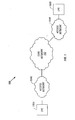
- FIG. 1 depicts an exemplary telecommunications network arrangement having an access network portion wherein the teachings of the present invention may be advantageously practiced;
- FIG. 2 depicts a high level conceptualization of an access network portion involving a loop carrier in conjunction with a central office
- FIG. 3 depicts an exemplary embodiment of a loop carrier system having a plurality of nodes (or, terminals) wherein integrated gateway functionality may be provided in a terminal in accordance with the teachings of the present invention
- FIG. 4 depicts an exemplary loop carrier system where an access media gateway is provided in a central office terminal (COT);
- COT central office terminal
- FIG. 5 depicts an exemplary loop carrier system where an access media gateway is provided in a remote terminal (RT);
- RT remote terminal
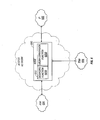
- FIG. 6 depicts a high level network configuration having the access network node of the present invention for providing integrated gateway functionality between any two networks;
- FIG. 7 depicts a high level functional block diagram of a portion of the access network terminal exemplifying various interfaces in addition to a gateway resource card;
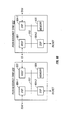
- FIG. 8A depicts a high level functional block diagram of an exemplary embodiment of the gateway resource card of the present invention, wherein the line concentration function is within the resource card;
- FIG. 8B depicts a high level functional block diagram of another exemplary embodiment of the gateway resource card of the present invention, wherein the line concentration function is outside the resource card;
- FIG. 9A depicts an exemplary integrated access media gateway system operable in an access network element in accordance with the teachings of the present invention, wherein gateway cards stratified into primary and secondary levels are illustrated;
- FIG. 9B depicts another exemplary integrated access media gateway system operable in an access network element in accordance with the teachings of the present invention, wherein a plurality of peer-level gateway cards are illustrated;
- FIG. 10 is a flow chart of the various steps involved in an exemplary methodology for providing integrated access media gateway functionality between analog voice-over-TDM and voice-over-packet domains in accordance with the teachings of the present invention.
- FIG. 1 depicted therein is an exemplary network arrangement 100 having one or more access network portions, wherein the teachings of the present invention may be advantageously practiced for providing integrated gateway functionality in an access network element.
- the exemplary network arrangement 100 comprising a core transport network 102 and access network portions 104A and 104B, is preferably operable to support telecommunications, data communications, or any combination thereof involving diverse media such as voice, audio, video, graphics, data, and assorted multimedia.
- the core transport network 102 may be provisioned as a circuit-switched network (CSN), packet-switched network (PSN), or an integrated hybrid network capable of next-generation network (NGN) service infrastructure.
- CSN circuit-switched network
- PSN packet-switched network
- NTN next-generation network
- PSTN Public Switched Telephony Network
- PLMN Public Land Mobile Network
- the core network 102 is implemented as a packet network, it may preferably be comprised of a network operable with Internet Protocol (IP), Frame Relay, ATM, and/or other applicable technologies.
- IP Internet Protocol
- Frame Relay Frame Relay
- ATM and/or other applicable technologies.
- the access network portions 104A and 104B are deployed between end users (i.e., subscribers) exemplified by customer premises equipment (CPE) 106A, 106B, and the core network 102.
- CPE customer premises equipment
- CPE customer premises equipment
- HAN home area network
- CPN customer premises network
- PDN premises distribution network
- the CPE units may be comprised of any known or heretofore unknown Integrated Access Devices (IADs) operable with diverse media.
- IADs Integrated Access Devices
- the access network portions 104A, 104B are operable to provide remote access to the subscribers by means of various Point-of-Interface (POI) nodes and Point-of-Presence (POP) nodes interconnected via any suitable wireline, wireless, narrowband, or broadband local network.
- POI Point-of-Interface
- POP Point-of-Presence
- any suitable wireline, wireless, narrowband, or broadband local network may be implemented using well known technologies such as the Integrated Services Digital Network (ISDN), Digital Subscriber Line (DSL) and its variants, Fiber In The Loop (FITL) and its variants, Hybrid Fiber/Coaxial (HFC) cable technologies, or Wireless Local Loop (WLL) technologies.
- ISDN Integrated Services Digital Network
- DSL Digital Subscriber Line
- FITL Fiber In The Loop
- HFC Hybrid Fiber/Coaxial
- WLL Wireless Local Loop
- the exemplary access network portions 104A and 104B may be comprised of a converged local network in further embodiments of the present invention
- the access network portion (e.g., access network 104A or 104B) is provided as a fiber-based loop carrier system that can be implemented in various embodiments depending on cost, availability of appropriate local infrastructure, services supported, etc.
- implementations such as Fiber To The Home (FTTH), Fiber To The Curb (FTTC), Fiber To The Neighborhood (FTTN), and other FITL variants may be architected as a digital loop carrier (DLC) for providing integrated, broadband access services to the subscribers.
- DLC digital loop carrier
- the fiber-based loop carrier system is preferably at least operable with a suitable physical layer infrastructure such as the Synchronous Optical Network (SONET) technology or its companion, the Synchronous Digital Hierarchy (SDH), which is similar to SONET except that its multiplexing hierarchy is a subset of the SONET multiplexing scheme.
- FIG. 2 depicts a high level conceptualization of the exemplary access network portion (e.g., access network 104A) involving a loop carrier 204 in conjunction with a central office (CO) 202.
- An exemplary IAD for instance CPE 106A, is coupled to the loop carrier 204 operable to multiplex the access loop signal between the equipment and the CO with other loop signals.
- the POI equipment located at the CO is operable, in turn, to provide interface connectivity to the core network.
- the loop carrier nodes which may also be referred to as access network nodes or terminals (more generically, telecommunications nodes), may be organized in one of several topologies for purposes of the present invention and are comprised of two forms depending on their location in the access loop.
- the loop carrier node When co-located at a CO, the loop carrier node is referred to as a central office terminal (COT).
- COT central office terminal
- Reference numeral 304 exemplifies a COT coupled to a CO switch 302 that forms part of CO 202.
- Other loop carrier nodes external to the CO are referred to as remote terminals (RTs), e.g., RT 306A and 306B.
- RTs remote terminals
- Fiber paths 305 are used for interconnecting the COT and RTs in a particular topology. Where only one RT is coupled to the COT, the resultant two-node arrangement is referred to as a point-to-point loop carrier system.
- a point-to-point loop carrier system On the other hand, if multiple RTs are coupled in a linear fashion, either a single feeder multiple RT (MRT) system or a dual feeder MRT system may be obtained.
- MRT single feeder multiple RT
- the RTs are located on only one side of the COT, as exemplified in this FIG.
- the RTs are deployed on both sides of the COT.
- the loop carrier system may be arranged in a ring topology.
- either the COT, RTs, or both may be provided with the capability to concentrate the total access lines connected thereto. That is, the total number of lines to which a terminal is connected may be greater than the maximum number of active lines supported by it. Accordingly, each terminal may have its own concentration ratio (which is the ratio between the total number of connection lines and the maximum number of active lines supported by the terminal).
- the exemplary loop carrier system may also include other equipment such as Optical Network Units (ONUs) that serve end users that are far enough away from each other that it isn't economical to connect all of them to an RT.
- the ONUs are operable to convert the signals between electrical and optical domains, if necessary.
- the ONUs digitize the analog communication signals from a plurality of customers and multiplex them onto a piece of fiber coupled to the RT.
- reference numeral 308 refers to an ONU that is coupled to RT 306A and serves, by way of example, IAD/CPE 106A.
- an RT in the loop carrier system may be coupled to one or more ONUs and RTs, in addition to the CPEs directly served by the RT.
- FIG. 4 depicts an exemplary loop carrier system 400 wherein an integrated gateway 403 is provided in a COT 402.
- COT 402 provides connectivity to a conventional Class 5 switch 406 operable with time-division multiplexed (TDM) communication data, which TDM switch 406 is connected to a CSN 408.
- IAD/CPE 404A and 404B are illustrative CPE units coupled to respective RTs 405A, 405B which in turn are coupled to COT 402 in any topology.
- exemplary POTS equipment 403A and 403B is coupled to respective RTs. In the network configuration shown in FIG. 4, both COT and RTs may be provided with the capability to perform concentration.
- the integrated access gateway 403 of the present invention is preferably capable to provide a signaling function as well as a media conversion function between any two network domains.
- the gateway is capable of replacing a circuit-switched connection with an appropriate session over a packet network, e.g., PSN 412 coupled to COT 403 via a packet switch 410, preferably under the control of a multimedia-capable call server such as a softswitch (not shown in this FIG.).
- the gateway is operable to take the outgoing voice/TDM traffic from the DLC and convert it into a packet stream towards the PSN, and take the incoming packet stream from the PSN and convert it to TDM traffic towards the local users.
- AMG access/media gateway
- FIG. 5 depicts an exemplary loop carrier system 500 where an access media gateway is provided in an RT.
- COT 402 is conventionally interfaced with TDM switch 406 for connectivity with the CSN 408.
- Each exemplary RT i.e., RT 502A and RT 502B, is provided with an AMG for effectuating the gateway functionality such that the RT is capable of interfacing directly to the PSN 412 via the packet switch 410.
- Reference numerals 504A and 504B are illustrative of the RT-based AMGs in this exemplary embodiment. Accordingly, COT 402 does not have any interfaces to the PSN. Also, RTs - rather than the COT - are responsible in this exemplary embodiment for performing concentration with respect to both packet traffic as well as TDM traffic.
- the access network node 602 may operate as a COT or an RT depending upon where it is deployed in an access network such as the access networks 104A/104B described hereinabove.
- the access network node 602 may operate as a COT or an RT depending upon where it is deployed in an access network such as the access networks 104A/104B described hereinabove.
- three network domains are interconnected with the access network: an ATM network 604, an IP network 606 and a TDM network 608.
- the integrated access media gateway 603 comprises a structure 605A for providing appropriate signaling functionality to replace any network connection operable with one network domain with another network connection operable with a second network domain.
- a media conversion structure 605B integrated therewith is operable to convert between any two media (one functioning in one network domain and the other in a second network domain).
- the integrated AMG structure 603 advantageously provides gateway functionality between, for example, voice-over-TDM and voice-over-packet domains, two packet voice domains, between packet voice and analog voice domains, etc.
- the access network node 602 may be provided as a scalable stack of a plurality of shelves or channel banks, which include a primary shelf and a number of secondary shelves disposed both above and below the primary shelf, wherein the various secondary shelves are coupled to the primary shelf via an interconnection mechanism that includes appropriate inter-shelf interfacing involving the network domains to which the access node is coupled.
- FIG. 7 therein is depicted a high level functional block diagram of a portion of the access network node 602 exemplifying a plurality of interfaces in addition to a gateway resource card having the integrated signaling and media conversion functionalities described hereinabove.
- such integrated functionality is provided as a system implemented on one or more broadband resource cards (BRCs) disposed in the primary shelf 718A.
- BRCs broadband resource cards
- Reference numeral 708 refers to a BRC-AMG card which will be described in greater detail hereinbelow.
- An exemplary secondary shelf 718B is coupled to the primary shelf 718A via inter-shelf interfaces 723.
- exemplary network interfaces provided in the primary shelf 718A are a DS3 interface 702 operable with a TDM network 701 and an ATM network 703; an OC3 interface 704 operable with a TDM/ATM network 705; and optical line units (OLUs) 706A and 706B operable with hybrid nodes 707A and 707B, respectively.
- exemplary subscriber interfaces in the primary shelf 718A include a POTS interface operable with conventional telephone equipment 711 and a DSL interface 712 operable with appropriate IAD/CPE 713 comprising derived POTS equipment 719 and one or more computers 721.
- the secondary shelf 718B is exemplified with a T1 interface 716 operable with IAD/CPE 715 and a DSL interface operable with IAD/CPE 713.
- T1 interface 716 operable with IAD/CPE 715
- DSL interface operable with IAD/CPE 713.
- other subsystems such as alarm units, power supplies, et cetera, associated with the shelves are not shown in this FIG.
- FIG. 8A depicts a high level functional block diagram of an exemplary gateway resource card 800A of the present invention, wherein the concentration is done at the resource card itself rather than in the XCF of the node in which the resource card is deployed.
- the resource card 800A is preferably provided as a BRC suitably disposed in the access network element, e.g., in a primary shelf, secondary shelf, or otherwise. Accordingly, the resource card 800A is interfaced to a backplane broadband slot 802 via a plurality of interfaces.
- An TDM formatter 804 is coupled to the broadband slot 802 via a bus 806 operable to provide a TDM/voice traffic interface.
- the formatter 804 is operable to convert between raw TDM traffic and appropriate voice information disposed on the bus 806 in a plurality of channels.
- raw TDM information is first provided to a processing array/assembly 814 via path 808 for converting raw TDM information into processed TDM information.
- a digital signal processing (DSP) array or assembly coupled with appropriate first-in-first-out (FIFO) stacks may be employed for processing the TDM information.
- any conventional generic processor may also be used for TDM processing upon programming it suitably.
- a state detection/generation block 812 is coupled to the TDM formatter via path 810 for detecting channel associated signaling (CAS) information in the TDM traffic supported by the traffic channels of the resource card 800A.
- a packet engine 834 receives the processed TDM information via path 833 for packetizing the TDM information into a plurality of packets that can be packaged into a suitable transport medium.
- a host processor 818 is coupled via an application programming interface (API) 826 to the signal processing array 814 and the packet engine 834 for providing overall control with respect to packet aggregation, signaling, call setup and tear down (i.e., session control), and the like.
- API application programming interface
- the host processor 818 communicates with the signal processing array 814 via path 816 with respect to in-band TDM signaling, DTMF digits, etc. DSP processing and DSP code downloads are controlled by the host processor via path 820. Path 836 disposed between the host processor 818 and the packet engine 834 is operable carry appropriate ATM Adaptation Layer (AAL) connection information for voice packets. In addition, the state detector/generator 812 communicates with the host processor 818 via path 838 with respect to the CAS information.
- AAL ATM Adaptation Layer
- the host processor 818 is provided with an optional signaling path 822 for establishing communication with a call server via an Ethernet port 824.
- the call server (not shown in this FIG.) may be deployed in a call server network and can comprise a multimedia-capable softswitch to support next-generation network (NGN) services.
- NTN next-generation network
- a packet bus interface 840 is coupled to the packet engine 834 for transporting the aggregated packet flow over a suitable bus 842 connected to the broadband slot 802.
- the bus 842 may be comprised of a proprietary bus such as Cell Bus disclosed in U.S. Patent No. 6,091,729 to Dove, which patent is incorporated by reference herein.
- buses 806 and 842 may be integrated into a single bus structure operable to carry both TDM and ATM/packet information.
- the gateway resource card 800A is also provided with an interface 830 that is coupled to the broadband slot 802 via a bus 844 for providing connectivity to the node's XCF (not shown).
- the host processor 818 is coupled to the interface 830 via path 828, whereby code downloads to the host processor (upgrades, maintenance, etc.) are effectuated.
- the path 828 is also utilized for establishing signaling between XCF and the host processor 818.
- the access gateway resource card 800A utilizes applicable gateway signaling protocols such as, e.g., MEGACO, to communicate with the call server. Also, as alluded to hereinabove, applicable adaptation layers (e.g., AAL1-AAL5, etc.) are operable with the gateway resource card for transporting the packets.
- a storage block comprising suitable memory modules 819 (e.g., nonvolatile memory) is interfaced with the host processor 818, which storage block is operable to provide service resource functionality, e.g., call/message announcements and the like, traditionally associated with a Class 5 switch. Accordingly, it should be appreciated that the combination of an access network terminal with the integrated gateway resource functionality of the present invention can replace an entire Class 5 switch in the provisioning of a next-generation network.
- the gateway functionality is presented to all subscriber access lines that are configured for gateway access.
- the connections between the inbound channels and the channels supported by the gateway card's packet processing functionality are preferably nailed up through the access node.
- a DS0 cross-connect is included to interface the inbound channels with the available channels supported by the processing array 814.
- signaling detection must be done by the gateway's state detection block 812 on all inbound channels to pick up appropriate connect requests. Because of the nailed-up connection (i.e., static connection), the gateway resource card 800A does not have to communicate with the access node's XCF processor. However, this arrangement may not allow a scalable gateway architecture wherein multiple resource cards need to be implemented.
- FIG. 8B depicts a high level functional block diagram of another exemplary embodiment of the gateway resource card 800B provided in accordance with the teachings of the present invention. It should be readily apparent upon taking reference hereto that the gateway resource card 800B is essentially similar to the resource card embodiment 800A described in detail hereinabove. In the partitioning model supported by the gateway resource card 800B, concentration is done in the access node's XCF rather than at the gateway level, however. Accordingly, only active calls are presented to the gateway resource card 800B over the STS bus 806. As a consequence, there is no separate state detector block needed in this exemplary embodiment, and the CAS information necessary with respect to setting up packet connections is directly provided to the signal processing array 814 via path 810. The gateway card embodiment 800B is thus operable to collect signaling from an active channel once the call is connected to the gateway by the access node's XCF.
- gateway card embodiment 800B no separate DS0 cross-connect is required within the gateway card embodiment 800B.
- Signaling monitoring functionality is advantageously partitioned such that the gateway is operable to monitor only the active channels, whereas the access node's XCF and associated line cards monitor inactive channels configured for gateway access. This necessitates a messaging link for transmitting signals between the gateway card and the node's XCF (similar to GR.303), which is realized via signal path 828.
- connections between the gateway card 800B and the nodal XCF are established dynamically, real-time capacity is required with respect to the associated XCF processor.
- the partitioning model supported by the exemplary gateway card embodiment 800B is scalable to accommodate multiple gateway resource card architectures, wherein calls can be routed to any resource card depending upon availability.
- FIGS. 9A and 9B depicted therein are two exemplary integrated access media gateway systems operable in an access network element in a multi-card architecture in accordance with the teachings of the present invention.
- the primary resource card 902A also includes memory 906 and one or more DSPs, e.g., DSP 904-1 and DSP 904-2.
- a high-speed, low latency bus 908 couples the primary resource card 902A to one or more secondary resource cards (e.g., resource card 902B) having a plurality of additional DSPs 904-3 to 904-6.
- Each of the DSPs on the primary as well as the secondary cards is provided with an appropriate network interface.
- the host processor 901 manages all the DSPs in the AMG system and is interfaced to a call server (CS).
- CS call server
- each resource card is provided with a separate host processor, memory and a signal processing assembly (e.g., DSP assembly) associated therewith.
- the host processor manages only the DSP assembly it is associated with.
- each resource card is operable as a peer resource card.
- Two exemplary peer resource cards 950, 952 are illustrated in this FIG., wherein a bus 952 couples the various blocks on each particular peer resource card.
- the DSPs are provided with the necessary network interfaces and the host processors 901 are interfaced to the call server. There is no separate link disposed between the peers and, accordingly, each peer resource card works as an independent gateway.
- FIG. 10 is a flow chart of the various steps involved in an exemplary methodology for providing integrated access media gateway functionality between analog voice-over-TDM and voice-over-packet domains in accordance with the teachings of the present invention.
- a suitable signal processing array is operable to generate processed TDM information based on the raw TDM stream (step 1004).
- the CAS information relating to the inbound channel traffic is extracted from the TDM stream (step 1006), depending on the concentration partitioning as described hereinabove.
- the processed TDM information is packetized and aggregated into a suitable transport medium under a host processor's control (step 1008).
- the packaged packet information is transported via a suitable packet interface upon setting up a packet session over the PSN pursuant to control signaling information provided by a call server (step 1010).
- the present invention advantageously provides an innovative and efficient solution for supporting gateway functionality in a scalable architecture which allows a network operator to incrementally add the requisite AMG functions as the demand for packet-based NGN service infrastructure grows. Since only gateway resource cards need to be added to the legacy equipment, no new network elements are required. Accordingly, the network operators can realize a smooth transition from the existing TDM network infrastructure to a packet-based network infrastructure. Furthermore, the provisioning of gateway services in accordance with the teachings of the present invention advantageously affords a cost-effective business model which spreads the risk factors associated with network upgrading on a broader horizon.
Landscapes
- Engineering & Computer Science (AREA)
- Computer Networks & Wireless Communication (AREA)
- Signal Processing (AREA)
- Data Exchanges In Wide-Area Networks (AREA)
Abstract
A solution for providing integrated gateway functionality (603) in an access network element (602) by way of a broadband resource card, which access network element (602) is deployed in an access network coupled to a first network domain (604,606,608) and a second network domain (604,606,608). A structure is included for providing signaling functionality (605A) operable to replace a first network connection operating in the first network domain with a second network connection operating in the second network domain. A media converter (605B) integrated with the signaling functionality structure is operable to convert between the two media of the network domains. <IMAGE>
Description
The present invention generally relates to
telecommunications. More particularly, and not by way of
any limitation, the present invention is directed to a
system and method for providing integrated gateway
functionality in a node deployed in an access network
coupled to one or more communication network domains
The remote access market is undergoing a major
metamorphosis. Three factors serve as catalysts for change.
The first is the growing number of users, for example,
small office / home office (SOHO) users, demanding high
performance Internet and remote access for multimedia.
Liberalized governmental activity with respect to
telecommunications is another factor, which is fostering
broader competition through deregulation in local area
markets everywhere. The third and final factor is
congestion in the Public Switched Telephone Network (PSTN),
originally designed and developed for voice-only traffic.
There have been several important advances in
telecommunications technology that enable high rates of
throughput in carrier networks' backbone connections. For
example, by implementing Asynchronous Transfer Mode (ATM)
networking technology over a Synchronous Optical Network
(SONET) / Synchronous Digital Hierarchy (SDH) physical
layer, carrier networks can achieve data rates of up to
several hundred megabits per second (Mbps). However,
efforts to meet the bandwidth demand for remote access have
been beset by the limitations of the existing twisted-pair
copper cable infrastructure (i.e., access network) provided
between a carrier's central office (CO) and a subscriber's
remote site, typically referred to as the local loop. In
the telecommunications art, these limitations are sometimes
collectively described as the "last-mile" problem.
Current access network solutions that attempt to
avoid the bottleneck created by the last-mile problem
involve the use of fiber optic technology in the local loop
also. As with the high-speed carrier networks, the fiber-based
local loop infrastructure is typically architected
using SONET as the physical layer technology. With recent
developments in optical components and related optoelectronics,
in addition to improvements in network design,
broadband access is now becoming commonplace.
Moreover, coupled with the phenomenal growth in
popularity of the Internet, there has been a tremendous
interest in using packet-switched network (PSN)
infrastructures (e.g., those based on Internet Protocol
(IP) addressing) as a replacement for the existing circuit-switched
network (CSN) infrastructures used in today's
telecommunications networks. From the network operators'
perspective, the inherent traffic aggregation in packet-switched
infrastructures allows for a reduction in the cost
of transmission and the infrastructure cost per end-user.
Ultimately, such cost reductions enable the network
operators to pass on the concomitant cost savings to the
end-users.
Accordingly, a new breed of service-centric
networks (distinct from the existing voice-centric and
data-centric networks) are being explored for
implementation on what is known as the next-generation
network (NGN) infrastructure, where integrated
voice/data/video applications may be provisioned using a
packet transport over a packet network in an end-to-end
transmission path. As alluded to hereinabove, it is
believed that using a packet network infrastructure in
access networks provides higher transmission efficiency,
lower operation and maintenance costs, and a unified
access.
Whereas traditional access systems allow
accessing a digital local voice switch, such as a Class 5
switch, by extending a plurality of metallic loops and
aggregating them in a bundle for efficiently transmitting
the time-division multiplexed (TDM) voice traffic,
interoperability with packet switches is required in NGN-based
access infrastructures. Accordingly, a gateway
structure is needed in the access network whereby the TDM
traffic is converted to a packet stream for transmission
over a packet network.
In accordance with one existing approach, the
requisite gateway functionality can be implemented as a
separate piece of equipment deployed in the access network.
In yet another approach, the functionality may be
integrated with an access switch of the packet network.
Although these solutions may be advantageous in some
applications, they are nevertheless beset with several
problems. First, where separate stand-alone gateway
equipment is required in an access network, it would not be
acceptable for many network operators because of the
additional maintenance and operation, extra space, et
cetera. The increased cost structure would be particularly
inefficient where only smaller line sizes are supported. On
the other hand, integrating the gateway functionality
within the packet network also requires additional outlays
because the access network operator is forced to purchase
expensive packet switch equipment.
Accordingly, the present invention advantageously
provides a solution which implements integrated gateway
functionality in an existing access network element by way
of a broadband resource card that can be incrementally
added on an as-needed basis. As a result, the need for
expensive additional equipment, e.g., stand-alone gateway
equipment in the access network or separate packet switch
equipment with gateway functionality, is obviated.
Preferably, the access network element is
deployed in an access network coupled to a first network
domain and a second network domain. The network domains may
comprise a TDM network, an ATM or IP network, etc. A
structure is included for providing signaling functionality
operable to replace a first network connection operating in
the first network domain with a second network connection
operating in the second network domain, which signaling
functionality is preferably operable in conjunction with a
signaling protocol (e.g., Megaco) under the control of a
softswitch. A media converter integrated with the signaling
functionality structure is operable to convert between the
two media of the network domains.
In one aspect, the present invention is directed
to an integrated access media gateway system operable in
conjunction with an access network element. A formatter
interface is included for generating raw TDM information
based on analog voice information received in a plurality
of channels over a bus. A signal processing assembly is
operably coupled to the formatter interface for processing
the raw TDM information into processed TDM information. A
packet engine is provided for packetizing the processed TDM
information into a plurality of packets under a host
processor's control. The host processor is operable,
preferably in conjunction with a multimedia-capable call
server such as a softswitch, to provide necessary control
signaling information for setting up at least one packet-switched
session based on channel associated signaling
(CAS) information relating to the TDM stream. Further, the
packet engine operates to aggregate the packets into a
transport medium using, for example, appropriate ATM
Adaptation Layers (AAL1-AAL5), which medium is operable
with a packet-switched network (PSN) through a packet
interface.
In another aspect, the present invention is
directed to a broadband resource card for providing
integrated access media gateway functionality in an access
network element. A formatter is provided for converting
information received over a plurality of channels in a
first network domain into raw TDM information. A digital
signal processing (DSP) array is coupled to the formatter
for processing the raw TDM information into processed TDM
information. A packet engine operating responsive to a host
processor is provided for packetizing the processed TDM
information into a second network medium. Control signaling
for setting up packet-switched sessions is provided by the
host processor based on channel associated signaling
relating to the TDM channels.
A more complete understanding of the present
invention may be had by reference to the following Detailed
Description when taken in conjunction with the accompanying
drawings wherein:
FIG. 1 depicts an exemplary telecommunications
network arrangement having an access network portion
wherein the teachings of the present invention may be
advantageously practiced;
FIG. 2 depicts a high level conceptualization of
an access network portion involving a loop carrier in
conjunction with a central office;
FIG. 3 depicts an exemplary embodiment of a loop
carrier system having a plurality of nodes (or, terminals)
wherein integrated gateway functionality may be provided in
a terminal in accordance with the teachings of the present
invention;
FIG. 4 depicts an exemplary loop carrier system
where an access media gateway is provided in a central
office terminal (COT);
FIG. 5 depicts an exemplary loop carrier system
where an access media gateway is provided in a remote
terminal (RT);
FIG. 6 depicts a high level network configuration
having the access network node of the present invention for
providing integrated gateway functionality between any two
networks;
FIG. 7 depicts a high level functional block
diagram of a portion of the access network terminal
exemplifying various interfaces in addition to a gateway
resource card;
FIG. 8A depicts a high level functional block
diagram of an exemplary embodiment of the gateway resource
card of the present invention, wherein the line
concentration function is within the resource card;
FIG. 8B depicts a high level functional block
diagram of another exemplary embodiment of the gateway
resource card of the present invention, wherein the line
concentration function is outside the resource card;
FIG. 9A depicts an exemplary integrated access
media gateway system operable in an access network element
in accordance with the teachings of the present invention,
wherein gateway cards stratified into primary and secondary
levels are illustrated;
FIG. 9B depicts another exemplary integrated
access media gateway system operable in an access network
element in accordance with the teachings of the present
invention, wherein a plurality of peer-level gateway cards
are illustrated; and
FIG. 10 is a flow chart of the various steps
involved in an exemplary methodology for providing
integrated access media gateway functionality between
analog voice-over-TDM and voice-over-packet domains in
accordance with the teachings of the present invention.
In the drawings, like or similar elements are
designated with identical reference numerals throughout the
several views thereof, and the various elements depicted
are not necessarily drawn to scale. Referring now to FIG.
1, depicted therein is an exemplary network arrangement 100
having one or more access network portions, wherein the
teachings of the present invention may be advantageously
practiced for providing integrated gateway functionality in
an access network element. The exemplary network
arrangement 100, comprising a core transport network 102
and access network portions 104A and 104B, is preferably
operable to support telecommunications, data
communications, or any combination thereof involving
diverse media such as voice, audio, video, graphics, data,
and assorted multimedia. The core transport network 102 may
be provisioned as a circuit-switched network (CSN), packet-switched
network (PSN), or an integrated hybrid network
capable of next-generation network (NGN) service
infrastructure. In an exemplary embodiment, the Public
Switched Telephony Network (PSTN) (for wireline
communications), the Public Land Mobile Network (PLMN) (for
wireless communications), or any combination thereof may be
provided as the CSN. Where the core network 102 is
implemented as a packet network, it may preferably be
comprised of a network operable with Internet Protocol
(IP), Frame Relay, ATM, and/or other applicable
technologies.
The access network portions 104A and 104B are
deployed between end users (i.e., subscribers) exemplified
by customer premises equipment (CPE) 106A, 106B, and the
core network 102. It should be appreciated that although
isolated CPE units are illustrated in this FIG., they may
also be deployed in a private network such as a home area
network (HAN), customer premises network (CPN), or a
premises distribution network (PDN). Furthermore, the CPE
units may be comprised of any known or heretofore unknown
Integrated Access Devices (IADs) operable with diverse
media. The access network portions 104A, 104B are operable
to provide remote access to the subscribers by means of
various Point-of-Interface (POI) nodes and Point-of-Presence
(POP) nodes interconnected via any suitable
wireline, wireless, narrowband, or broadband local network.
By way of example, such a local network may be implemented
using well known technologies such as the Integrated
Services Digital Network (ISDN), Digital Subscriber Line
(DSL) and its variants, Fiber In The Loop (FITL) and its
variants, Hybrid Fiber/Coaxial (HFC) cable technologies, or
Wireless Local Loop (WLL) technologies. Additionally, the
exemplary access network portions 104A and 104B may be
comprised of a converged local network in further
embodiments of the present invention.
In a presently preferred exemplary embodiment of
the present invention, the access network portion (e.g.,
access network 104A or 104B) is provided as a fiber-based
loop carrier system that can be implemented in various
embodiments depending on cost, availability of appropriate
local infrastructure, services supported, etc. For example,
implementations such as Fiber To The Home (FTTH), Fiber To
The Curb (FTTC), Fiber To The Neighborhood (FTTN), and
other FITL variants may be architected as a digital loop
carrier (DLC) for providing integrated, broadband access
services to the subscribers.
The fiber-based loop carrier system is preferably
at least operable with a suitable physical layer
infrastructure such as the Synchronous Optical Network
(SONET) technology or its companion, the Synchronous
Digital Hierarchy (SDH), which is similar to SONET except
that its multiplexing hierarchy is a subset of the SONET
multiplexing scheme. FIG. 2 depicts a high level
conceptualization of the exemplary access network portion
(e.g., access network 104A) involving a loop carrier 204 in
conjunction with a central office (CO) 202. An exemplary
IAD, for instance CPE 106A, is coupled to the loop carrier
204 operable to multiplex the access loop signal between
the equipment and the CO with other loop signals. The POI
equipment located at the CO is operable, in turn, to
provide interface connectivity to the core network.
Referring now to FIG. 3, depicted therein is an
exemplary embodiment of a fiber-based loop carrier system
having a plurality of nodes wherein integrated gateway
functionality may be provided in a node in accordance with
the teachings of the present invention. The loop carrier
nodes, which may also be referred to as access network
nodes or terminals (more generically, telecommunications
nodes), may be organized in one of several topologies for
purposes of the present invention and are comprised of two
forms depending on their location in the access loop. When
co-located at a CO, the loop carrier node is referred to as
a central office terminal (COT). Reference numeral 304
exemplifies a COT coupled to a CO switch 302 that forms
part of CO 202. Other loop carrier nodes external to the CO
are referred to as remote terminals (RTs), e.g., RT 306A
and 306B.
Regardless of the particular topological
configuration used for implementing a DLC, either the COT,
RTs, or both may be provided with the capability to
concentrate the total access lines connected thereto. That
is, the total number of lines to which a terminal is
connected may be greater than the maximum number of active
lines supported by it. Accordingly, each terminal may have
its own concentration ratio (which is the ratio between the
total number of connection lines and the maximum number of
active lines supported by the terminal).
In addition to the COT and RT access loop nodes,
the exemplary loop carrier system may also include other
equipment such as Optical Network Units (ONUs) that serve
end users that are far enough away from each other that it
isn't economical to connect all of them to an RT. The ONUs
are operable to convert the signals between electrical and
optical domains, if necessary. Also, the ONUs digitize the
analog communication signals from a plurality of customers
and multiplex them onto a piece of fiber coupled to the RT.
In FIG. 3, reference numeral 308 refers to an ONU that is
coupled to RT 306A and serves, by way of example, IAD/CPE
106A. Further, an RT in the loop carrier system may be
coupled to one or more ONUs and RTs, in addition to the
CPEs directly served by the RT.
FIG. 4 depicts an exemplary loop carrier system
400 wherein an integrated gateway 403 is provided in a COT
402. As described in detail hereinabove, COT 402 provides
connectivity to a conventional Class 5 switch 406 operable
with time-division multiplexed (TDM) communication data,
which TDM switch 406 is connected to a CSN 408. Further,
IAD/ CPE 404A and 404B are illustrative CPE units coupled to
respective RTs 405A, 405B which in turn are coupled to COT
402 in any topology. Also, exemplary POTS equipment 403A
and 403B is coupled to respective RTs. In the network
configuration shown in FIG. 4, both COT and RTs may be
provided with the capability to perform concentration.
The integrated access gateway 403 of the present
invention is preferably capable to provide a signaling
function as well as a media conversion function between any
two network domains. As exemplified herein, the gateway is
capable of replacing a circuit-switched connection with an
appropriate session over a packet network, e.g., PSN 412
coupled to COT 403 via a packet switch 410, preferably
under the control of a multimedia-capable call server such
as a softswitch (not shown in this FIG.). As part of the
media conversion functionality, the gateway is operable to
take the outgoing voice/TDM traffic from the DLC and
convert it into a packet stream towards the PSN, and take
the incoming packet stream from the PSN and convert it to
TDM traffic towards the local users. Accordingly, it is
useful to conceptualize the integrated gateway 403 as an
access/media gateway (AMG) which, as will be described in
greater detail hereinbelow, is architected as a network
resource card operable to be disposed in the terminal.
FIG. 5 depicts an exemplary loop carrier system
500 where an access media gateway is provided in an RT.
Similar to the loop carrier arrangement shown in FIG. 4,
COT 402 is conventionally interfaced with TDM switch 406
for connectivity with the CSN 408. Each exemplary RT, i.e.,
RT 502A and RT 502B, is provided with an AMG for
effectuating the gateway functionality such that the RT is
capable of interfacing directly to the PSN 412 via the
packet switch 410. Reference numerals 504A and 504B are
illustrative of the RT-based AMGs in this exemplary
embodiment. Accordingly, COT 402 does not have any
interfaces to the PSN. Also, RTs - rather than the COT -
are responsible in this exemplary embodiment for performing
concentration with respect to both packet traffic as well
as TDM traffic.
Referring now to FIG. 6, depicted therein is a
high level network configuration having the access network
node 602 of the present invention for providing integrated
gateway functionality between any two network domains. The
access network node 602 may operate as a COT or an RT
depending upon where it is deployed in an access network
such as the access networks 104A/104B described
hereinabove. By way of example, three network domains are
interconnected with the access network: an ATM network 604,
an IP network 606 and a TDM network 608. The integrated
access media gateway 603 comprises a structure 605A for
providing appropriate signaling functionality to replace
any network connection operable with one network domain
with another network connection operable with a second
network domain. Also, a media conversion structure 605B
integrated therewith is operable to convert between any two
media (one functioning in one network domain and the other
in a second network domain). Accordingly, the integrated
AMG structure 603 advantageously provides gateway
functionality between, for example, voice-over-TDM and
voice-over-packet domains, two packet voice domains,
between packet voice and analog voice domains, etc.
In one exemplary embodiment, the access network
node 602 may be provided as a scalable stack of a plurality
of shelves or channel banks, which include a primary shelf
and a number of secondary shelves disposed both above and
below the primary shelf, wherein the various secondary
shelves are coupled to the primary shelf via an
interconnection mechanism that includes appropriate inter-shelf
interfacing involving the network domains to which
the access node is coupled. Referring now to FIG. 7,
therein is depicted a high level functional block diagram
of a portion of the access network node 602 exemplifying a
plurality of interfaces in addition to a gateway resource
card having the integrated signaling and media conversion
functionalities described hereinabove. Preferably, such
integrated functionality is provided as a system
implemented on one or more broadband resource cards (BRCs)
disposed in the primary shelf 718A. Reference numeral 708
refers to a BRC-AMG card which will be described in greater
detail hereinbelow. An exemplary secondary shelf 718B is
coupled to the primary shelf 718A via inter-shelf
interfaces 723.
Among the exemplary network interfaces provided
in the primary shelf 718A are a DS3 interface 702 operable
with a TDM network 701 and an ATM network 703; an OC3
interface 704 operable with a TDM/ATM network 705; and
optical line units (OLUs) 706A and 706B operable with
hybrid nodes 707A and 707B, respectively. Exemplary
subscriber interfaces in the primary shelf 718A include a
POTS interface operable with conventional telephone
equipment 711 and a DSL interface 712 operable with
appropriate IAD/CPE 713 comprising derived POTS equipment
719 and one or more computers 721. The secondary shelf 718B
is exemplified with a T1 interface 716 operable with
IAD/CPE 715 and a DSL interface operable with IAD/CPE 713.
For the sake of simplicity, other subsystems such as alarm
units, power supplies, et cetera, associated with the
shelves are not shown in this FIG.
FIG. 8A depicts a high level functional block
diagram of an exemplary gateway resource card 800A of the
present invention, wherein the concentration is done at the
resource card itself rather than in the XCF of the node in
which the resource card is deployed. As alluded to in the
foregoing description, the resource card 800A is preferably
provided as a BRC suitably disposed in the access network
element, e.g., in a primary shelf, secondary shelf, or
otherwise. Accordingly, the resource card 800A is
interfaced to a backplane broadband slot 802 via a
plurality of interfaces. An TDM formatter 804 is coupled to
the broadband slot 802 via a bus 806 operable to provide a
TDM/voice traffic interface. The formatter 804 is operable
to convert between raw TDM traffic and appropriate voice
information disposed on the bus 806 in a plurality of
channels. To facilitate media conversion, raw TDM
information is first provided to a processing
array/assembly 814 via path 808 for converting raw TDM
information into processed TDM information. Preferably, a
digital signal processing (DSP) array or assembly coupled
with appropriate first-in-first-out (FIFO) stacks may be
employed for processing the TDM information. In further
exemplary embodiments of the present invention, any
conventional generic processor may also be used for TDM
processing upon programming it suitably.
A state detection/generation block 812 is coupled
to the TDM formatter via path 810 for detecting channel
associated signaling (CAS) information in the TDM traffic
supported by the traffic channels of the resource card
800A. A packet engine 834 receives the processed TDM
information via path 833 for packetizing the TDM
information into a plurality of packets that can be
packaged into a suitable transport medium. A host processor
818 is coupled via an application programming interface
(API) 826 to the signal processing array 814 and the packet
engine 834 for providing overall control with respect to
packet aggregation, signaling, call setup and tear down
(i.e., session control), and the like. Accordingly, the
host processor 818 communicates with the signal processing
array 814 via path 816 with respect to in-band TDM
signaling, DTMF digits, etc. DSP processing and DSP code
downloads are controlled by the host processor via path
820. Path 836 disposed between the host processor 818 and
the packet engine 834 is operable carry appropriate ATM
Adaptation Layer (AAL) connection information for voice
packets. In addition, the state detector/generator 812
communicates with the host processor 818 via path 838 with
respect to the CAS information.
In a preferred exemplary embodiment of the
present invention, the host processor 818 is provided with
an optional signaling path 822 for establishing
communication with a call server via an Ethernet port 824.
The call server (not shown in this FIG.) may be deployed in
a call server network and can comprise a multimedia-capable
softswitch to support next-generation network (NGN)
services. Signaling information with respect to packet flow
is provided to the packet engine 834 by the host processor
818 via path 832.
A packet bus interface 840 is coupled to the
packet engine 834 for transporting the aggregated packet
flow over a suitable bus 842 connected to the broadband
slot 802. In an exemplary embodiment, the bus 842 may be
comprised of a proprietary bus such as Cell Bus disclosed
in U.S. Patent No. 6,091,729 to Dove, which patent is
incorporated by reference herein. In a further exemplary
embodiment, buses 806 and 842 may be integrated into a
single bus structure operable to carry both TDM and
ATM/packet information.
The gateway resource card 800A is also provided
with an interface 830 that is coupled to the broadband slot
802 via a bus 844 for providing connectivity to the node's
XCF (not shown). The host processor 818 is coupled to the
interface 830 via path 828, whereby code downloads to the
host processor (upgrades, maintenance, etc.) are
effectuated. In addition, the path 828 is also utilized for
establishing signaling between XCF and the host processor
818.
The access gateway resource card 800A utilizes
applicable gateway signaling protocols such as, e.g.,
MEGACO, to communicate with the call server. Also, as
alluded to hereinabove, applicable adaptation layers (e.g.,
AAL1-AAL5, etc.) are operable with the gateway resource
card for transporting the packets. In addition, a storage
block comprising suitable memory modules 819 (e.g., nonvolatile
memory) is interfaced with the host processor 818,
which storage block is operable to provide service resource
functionality, e.g., call/message announcements and the
like, traditionally associated with a Class 5 switch.
Accordingly, it should be appreciated that the combination
of an access network terminal with the integrated gateway
resource functionality of the present invention can replace
an entire Class 5 switch in the provisioning of a next-generation
network.
Since the concentration is done at the resource
card level, the gateway functionality is presented to all
subscriber access lines that are configured for gateway
access. In this partitioning model, the connections between
the inbound channels and the channels supported by the
gateway card's packet processing functionality are
preferably nailed up through the access node. Accordingly,
a DS0 cross-connect is included to interface the inbound
channels with the available channels supported by the
processing array 814. Furthermore, signaling detection must
be done by the gateway's state detection block 812 on all
inbound channels to pick up appropriate connect requests.
Because of the nailed-up connection (i.e., static
connection), the gateway resource card 800A does not have
to communicate with the access node's XCF processor.
However, this arrangement may not allow a scalable gateway
architecture wherein multiple resource cards need to be
implemented.
FIG. 8B depicts a high level functional block
diagram of another exemplary embodiment of the gateway
resource card 800B provided in accordance with the
teachings of the present invention. It should be readily
apparent upon taking reference hereto that the gateway
resource card 800B is essentially similar to the resource
card embodiment 800A described in detail hereinabove. In
the partitioning model supported by the gateway resource
card 800B, concentration is done in the access node's XCF
rather than at the gateway level, however. Accordingly,
only active calls are presented to the gateway resource
card 800B over the STS bus 806. As a consequence, there is
no separate state detector block needed in this exemplary
embodiment, and the CAS information necessary with respect
to setting up packet connections is directly provided to
the signal processing array 814 via path 810. The gateway
card embodiment 800B is thus operable to collect signaling
from an active channel once the call is connected to the
gateway by the access node's XCF.
Those skilled in the art should recognize that no
separate DS0 cross-connect is required within the gateway
card embodiment 800B. Signaling monitoring functionality is
advantageously partitioned such that the gateway is
operable to monitor only the active channels, whereas the
access node's XCF and associated line cards monitor
inactive channels configured for gateway access. This
necessitates a messaging link for transmitting signals
between the gateway card and the node's XCF (similar to
GR.303), which is realized via signal path 828. Also, since
connections between the gateway card 800B and the nodal XCF
are established dynamically, real-time capacity is required
with respect to the associated XCF processor. On the other
hand, the partitioning model supported by the exemplary
gateway card embodiment 800B is scalable to accommodate
multiple gateway resource card architectures, wherein calls
can be routed to any resource card depending upon
availability.
Referring now to FIGS. 9A and 9B, depicted
therein are two exemplary integrated access media gateway
systems operable in an access network element in a multi-card
architecture in accordance with the teachings of the
present invention. In the embodiment depicted in FIG. 9A,
only one host processor 901 disposed on a primary resource
card 902A is provided for the AMG system. The primary
resource card 902A also includes memory 906 and one or more
DSPs, e.g., DSP 904-1 and DSP 904-2. A high-speed, low
latency bus 908 couples the primary resource card 902A to
one or more secondary resource cards (e.g., resource card
902B) having a plurality of additional DSPs 904-3 to 904-6.
Each of the DSPs on the primary as well as the secondary
cards is provided with an appropriate network interface.
The host processor 901 manages all the DSPs in the AMG
system and is interfaced to a call server (CS).
In the exemplary AMG embodiment shown in FIG. 9B,
each resource card is provided with a separate host
processor, memory and a signal processing assembly (e.g.,
DSP assembly) associated therewith. The host processor
manages only the DSP assembly it is associated with.
Accordingly, each resource card is operable as a peer
resource card. Two exemplary peer resource cards 950, 952
are illustrated in this FIG., wherein a bus 952 couples the
various blocks on each particular peer resource card.
Again, the DSPs are provided with the necessary network
interfaces and the host processors 901 are interfaced to
the call server. There is no separate link disposed between
the peers and, accordingly, each peer resource card works
as an independent gateway.
FIG. 10 is a flow chart of the various steps
involved in an exemplary methodology for providing
integrated access media gateway functionality between
analog voice-over-TDM and voice-over-packet domains in
accordance with the teachings of the present invention.
Upon converting the analog voice information available on
the inbound channels into raw TDM information (step 1002),
a suitable signal processing array is operable to generate
processed TDM information based on the raw TDM stream (step
1004). Optionally, the CAS information relating to the
inbound channel traffic is extracted from the TDM stream
(step 1006), depending on the concentration partitioning as
described hereinabove. Thereafter, the processed TDM
information is packetized and aggregated into a suitable
transport medium under a host processor's control (step
1008). The packaged packet information is transported via a
suitable packet interface upon setting up a packet session
over the PSN pursuant to control signaling information
provided by a call server (step 1010).
Based upon the foregoing Detailed Description, it
should be readily apparent that the present invention
advantageously provides an innovative and efficient
solution for supporting gateway functionality in a scalable
architecture which allows a network operator to
incrementally add the requisite AMG functions as the demand
for packet-based NGN service infrastructure grows. Since
only gateway resource cards need to be added to the legacy
equipment, no new network elements are required.
Accordingly, the network operators can realize a smooth
transition from the existing TDM network infrastructure to
a packet-based network infrastructure. Furthermore, the
provisioning of gateway services in accordance with the
teachings of the present invention advantageously affords a
cost-effective business model which spreads the risk
factors associated with network upgrading on a broader
horizon.
It is believed that the operation and
construction of the present invention will be apparent from
the foregoing Detailed Description. While the exemplary
embodiments of the invention shown and described have been
characterized as being preferred, it should be readily
understood that various changes and modifications could be
made therein without departing from the scope of the
present invention as set forth in the following claims.
Claims (26)
- A system, comprising:wherein said means for providing signaling functionality and said media conversion means are integrated into a broadband resource card disposed in an access network node.means for providing signaling functionality operable to replace a first network connection operating in a first network domain with a second network connection operating in a second network domain, said means for providing signaling functionality operating in conjunction with a signaling protocol effectuated via a softswitch; andmedia conversion means operating to convert between a first network medium and a second network medium, said first network medium operating with said first network domain and second network medium operating with said network domain,
- The system as set forth in claim 1, wherein said means for providing signaling functionality is operable responsive to a call server coupled to said access network node.
- The system as set forth in claim 1, wherein said first network domain comprises a circuit-switched network.
- The system as set forth in claim 1, wherein said first network domain comprises a packet-switched network.
- The system as set forth in claim 1, wherein said second network domain comprises a circuit-switched network.
- The system as set forth in claim 1, wherein said second network domain comprises a packet-switched network.
- The system as set forth in claim 1, wherein said first network domain comprises a network portion selected from the group consisting of a TDM network, an ATM network and an IP network.
- The system as set forth in claim 1, wherein said second network domain comprises a network portion selected from the group consisting of a TDM network, an ATM network and an IP network.
- An integrated access media gateway system operable in conjunction with an access network element, comprising:a formatter interface for generating raw time-division multiplexed (TDM) information based on analog voice information received in a plurality of channels over a bus;a signal processing assembly operably coupled to said formatter interface for processing said raw TDM information into processed TDM information; anda packet engine operating responsive at least in part to a host processor for packetizing said processed TDM information into a plurality of packets, said host processor providing control signaling information for setting up at least one packet-switched session based on channel associated signaling relating to said plurality of channels, wherein said packet engine operates to aggregate said packets into a transport medium operable with a packet-switched network (PSN) through a packet interface.
- The integrated access media gateway system operable in conjunction with an access network element as set forth in claim 9, wherein said PSN comprises an Internet Protocol (IP) network.
- The integrated access media gateway system operable in conjunction with an access network element as set forth in claim 9, wherein said PSN comprises an Asynchronous Transfer Mode (ATM) network.
- The integrated access media gateway system operable in conjunction with an access network element as set forth in claim 1, wherein said host processor includes an interface for communicating with a call server.
- The integrated access media gateway system operable in conjunction with an access network element as set forth in claim 9, wherein said signal processing assembly comprises a digital signal processing (DSP) assembly.
- The integrated access media gateway system operable in conjunction with an access network element as set forth in claim 13, wherein said DSP farm is partitioned among a plurality of network cards disposed in said access network element.
- The integrated access media gateway system operable in conjunction with an access network element as set forth in claim 9, further comprising a storage block coupled to said host processor for storing media announcements.
- A broadband resource card for providing integrated access media gateway functionality in an access network element, comprising:means for providing raw time-division multiplexed (TDM) information based on information received in a first network medium operable with a first network domain;means for processing said raw TDM information into processed TDM information; andmeans operating responsive at least in part to a host processor for packetizing said processed TDM information into a plurality of packets, said host processor providing control signaling information for setting up at least one packet-switched session based on channel associated signaling relating to said plurality of channels, wherein said packet engine operates to aggregate said packets into a second network medium operable with a second network domain.
- The broadband resource card for providing integrated access media gateway functionality in an access network element as set forth in claim 16, wherein said means for processing said raw TDM information comprises at least one digital signal processor.
- The broadband resource card for providing integrated access media gateway functionality in an access network element as set forth in claim 16, wherein said means for processing said raw TDM information comprises at least one generic processor.
- The broadband resource card for providing integrated access media gateway functionality in an access network element as set forth in claim 6, wherein said host processor includes an interface for communicating with a call server.
- The broadband resource card for providing integrated access media gateway functionality in an access network element as set forth in claim 16, wherein said second network domain comprises an Internet Protocol (IP) network.
- The broadband resource card for providing integrated access media gateway functionality in an access network element as set forth in claim 16, wherein said second network domain comprises an Asynchronous Transfer Mode (ATM) network.
- The broadband resource card for providing integrated access media gateway functionality in an access network element as set forth in claim 16, further comprising a storage block coupled to said host processor for storing media announcements.
- An access network element having integrated gateway functionality, comprising:a formatter for converting information received in a plurality of channels in a first network medium operable with a first network domain into raw time-division multiplexed (TDM) information;a signal processing array operably coupled to said formatter for processing said raw TDM information into processed TDM information; anda packet engine operating responsive at least in part to a host processor disposed on said broadband resource card for packetizing said processed TDM. information into a plurality of packets, said host processor providing control signaling information for setting up at least one packet-switched session based on channel associated signaling relating to said plurality of channels, wherein said packet engine operates to aggregate said packets into a second network medium operable with a second network domain.
- The access network element having integrated gateway functionality as set forth in claim 23, wherein said signal processing array comprises a plurality of digital signal processors (DSPs).
- The access network element having integrated gateway functionality as set forth in claim 24, wherein at least a portion of said DSPs are partitioned into a secondary resource card having a common bus connection with said host processor.
- The access network element having integrated gateway functionality as set forth in claim 23, further comprising a storage block coupled to said host processor for storing media announcements.
Applications Claiming Priority (2)
| Application Number | Priority Date | Filing Date | Title |
|---|---|---|---|
| US5284601A | 2001-11-02 | 2001-11-02 | |
| US52846 | 2001-11-02 |
Publications (1)
| Publication Number | Publication Date |
|---|---|
| EP1311133A2 true EP1311133A2 (en) | 2003-05-14 |
Family
ID=21980273
Family Applications (1)
| Application Number | Title | Priority Date | Filing Date |
|---|---|---|---|
| EP02019946A Withdrawn EP1311133A2 (en) | 2001-11-02 | 2002-09-05 | Integrated gateway functionality in an access network element |
Country Status (1)
| Country | Link |
|---|---|
| EP (1) | EP1311133A2 (en) |
Cited By (2)
| Publication number | Priority date | Publication date | Assignee | Title |
|---|---|---|---|---|
| WO2006083202A1 (en) * | 2005-02-07 | 2006-08-10 | Telefonaktiebolaget Lm Ericsson (Publ) | Plain old telephony equivalent services supported via unlicensed mobile access |
| CN100382544C (en) * | 2003-09-05 | 2008-04-16 | 华为技术有限公司 | Realization Method and Transitional Network of Transformation from Traditional Telephone Switching Network to Next Generation Network |
-
2002
- 2002-09-05 EP EP02019946A patent/EP1311133A2/en not_active Withdrawn
Cited By (2)
| Publication number | Priority date | Publication date | Assignee | Title |
|---|---|---|---|---|
| CN100382544C (en) * | 2003-09-05 | 2008-04-16 | 华为技术有限公司 | Realization Method and Transitional Network of Transformation from Traditional Telephone Switching Network to Next Generation Network |
| WO2006083202A1 (en) * | 2005-02-07 | 2006-08-10 | Telefonaktiebolaget Lm Ericsson (Publ) | Plain old telephony equivalent services supported via unlicensed mobile access |
Similar Documents
| Publication | Publication Date | Title |
|---|---|---|
| US7190676B2 (en) | Traffic manager, gateway signaling and provisioning service for all packetized networks with total system-wide standards for broadband applications including all legacy services | |
| US6584122B1 (en) | Method and system for providing voice and data service | |
| US6493348B1 (en) | XDSL-based internet access router | |
| US6639913B1 (en) | System and method for communicating voice and data over a local packet network | |
| EP0968586B1 (en) | Network access in multi-service environment | |
| US5949791A (en) | Method and apparatus for converting synchronous narrowband signals into broadband asynchronous transfer mode signals in an integrated telecommunications network | |
| US6961335B1 (en) | Multi-layer ring architecture for fiber-to-the-home telco carrier network | |
| US6674749B1 (en) | Bandwidth transfer switching system | |
| JPH10271136A (en) | Method and system for asynchronous transfer mode integrated access service | |
| US7050546B1 (en) | System and method for providing POTS services in DSL environment in event of failures | |
| US6603760B1 (en) | System and method for gradual transition of local phone services from PSTN to next generation network | |
| US20030081619A1 (en) | Hybrid fiber coax communication system | |
| US20040109440A1 (en) | Optimized packet and time division multiplex transmission and network integration | |
| JP2003529240A (en) | System and method for providing POTS service in DSL environment when abnormal | |
| EP0797373B1 (en) | A method and apparatus for converting synchronous narrowband signals into broadband asynchronous transfer mode signals in an integrated telecommunications network | |
| US20040136359A1 (en) | Communication system architecture to converge voice and data services for point- to-multipoint transmission | |
| KR100738293B1 (en) | System and method for providing voice and / or data services | |
| EP1311133A2 (en) | Integrated gateway functionality in an access network element | |
| US6944191B2 (en) | Method of optimizing equipment utilization in telecommunication access network | |
| US7180897B1 (en) | Telecommunications systems | |
| US7092384B1 (en) | System and method for providing voice and/or data services | |
| AU770481B2 (en) | Bandwidth transfer switching system | |
| Raatikainen | Interworking Support in a Multi-Discipline Switch | |
| US6925093B2 (en) | Communication apparatus, communication system and method for integrating speech and data | |
| KR20010038496A (en) | apparatus for ADSL subscriber matching in switching system |
Legal Events
| Date | Code | Title | Description |
|---|---|---|---|
| PUAI | Public reference made under article 153(3) epc to a published international application that has entered the european phase |
Free format text: ORIGINAL CODE: 0009012 |
|
| STAA | Information on the status of an ep patent application or granted ep patent |
Free format text: STATUS: THE APPLICATION HAS BEEN PUBLISHED |
|
| AK | Designated contracting states |
Designated state(s): AT BE BG CH CY CZ DE DK EE ES FI FR GB GR IE IT LI LU MC NL PT SE SK TR |
|
| AX | Request for extension of the european patent |
Extension state: AL LT LV MK RO SI |
|
| RAP1 | Party data changed (applicant data changed or rights of an application transferred) |
Owner name: ALCATEL LUCENT |
|
| STAA | Information on the status of an ep patent application or granted ep patent |
Free format text: STATUS: THE APPLICATION IS DEEMED TO BE WITHDRAWN |
|
| 18D | Application deemed to be withdrawn |
Effective date: 20070403 |