EP1311017A2 - Alkaline storage battery - Google Patents
Alkaline storage battery Download PDFInfo
- Publication number
- EP1311017A2 EP1311017A2 EP02025191A EP02025191A EP1311017A2 EP 1311017 A2 EP1311017 A2 EP 1311017A2 EP 02025191 A EP02025191 A EP 02025191A EP 02025191 A EP02025191 A EP 02025191A EP 1311017 A2 EP1311017 A2 EP 1311017A2
- Authority
- EP
- European Patent Office
- Prior art keywords
- positive electrode
- storage battery
- compound
- alkaline storage
- separator
- Prior art date
- Legal status (The legal status is an assumption and is not a legal conclusion. Google has not performed a legal analysis and makes no representation as to the accuracy of the status listed.)
- Granted
Links
Images



Classifications
-
- H—ELECTRICITY
- H01—ELECTRIC ELEMENTS
- H01M—PROCESSES OR MEANS, e.g. BATTERIES, FOR THE DIRECT CONVERSION OF CHEMICAL ENERGY INTO ELECTRICAL ENERGY
- H01M4/00—Electrodes
- H01M4/02—Electrodes composed of, or comprising, active material
- H01M4/24—Electrodes for alkaline accumulators
- H01M4/32—Nickel oxide or hydroxide electrodes
-
- H—ELECTRICITY
- H01—ELECTRIC ELEMENTS
- H01M—PROCESSES OR MEANS, e.g. BATTERIES, FOR THE DIRECT CONVERSION OF CHEMICAL ENERGY INTO ELECTRICAL ENERGY
- H01M10/00—Secondary cells; Manufacture thereof
- H01M10/24—Alkaline accumulators
-
- H—ELECTRICITY
- H01—ELECTRIC ELEMENTS
- H01M—PROCESSES OR MEANS, e.g. BATTERIES, FOR THE DIRECT CONVERSION OF CHEMICAL ENERGY INTO ELECTRICAL ENERGY
- H01M10/00—Secondary cells; Manufacture thereof
- H01M10/42—Methods or arrangements for servicing or maintenance of secondary cells or secondary half-cells
- H01M10/4235—Safety or regulating additives or arrangements in electrodes, separators or electrolyte
-
- H—ELECTRICITY
- H01—ELECTRIC ELEMENTS
- H01M—PROCESSES OR MEANS, e.g. BATTERIES, FOR THE DIRECT CONVERSION OF CHEMICAL ENERGY INTO ELECTRICAL ENERGY
- H01M10/00—Secondary cells; Manufacture thereof
- H01M10/34—Gastight accumulators
- H01M10/345—Gastight metal hydride accumulators
-
- H—ELECTRICITY
- H01—ELECTRIC ELEMENTS
- H01M—PROCESSES OR MEANS, e.g. BATTERIES, FOR THE DIRECT CONVERSION OF CHEMICAL ENERGY INTO ELECTRICAL ENERGY
- H01M4/00—Electrodes
- H01M4/02—Electrodes composed of, or comprising, active material
- H01M2004/021—Physical characteristics, e.g. porosity, surface area
-
- H—ELECTRICITY
- H01—ELECTRIC ELEMENTS
- H01M—PROCESSES OR MEANS, e.g. BATTERIES, FOR THE DIRECT CONVERSION OF CHEMICAL ENERGY INTO ELECTRICAL ENERGY
- H01M4/00—Electrodes
- H01M4/02—Electrodes composed of, or comprising, active material
- H01M2004/026—Electrodes composed of, or comprising, active material characterised by the polarity
- H01M2004/028—Positive electrodes
-
- Y—GENERAL TAGGING OF NEW TECHNOLOGICAL DEVELOPMENTS; GENERAL TAGGING OF CROSS-SECTIONAL TECHNOLOGIES SPANNING OVER SEVERAL SECTIONS OF THE IPC; TECHNICAL SUBJECTS COVERED BY FORMER USPC CROSS-REFERENCE ART COLLECTIONS [XRACs] AND DIGESTS
- Y02—TECHNOLOGIES OR APPLICATIONS FOR MITIGATION OR ADAPTATION AGAINST CLIMATE CHANGE
- Y02E—REDUCTION OF GREENHOUSE GAS [GHG] EMISSIONS, RELATED TO ENERGY GENERATION, TRANSMISSION OR DISTRIBUTION
- Y02E60/00—Enabling technologies; Technologies with a potential or indirect contribution to GHG emissions mitigation
- Y02E60/10—Energy storage using batteries
Definitions
- the present invention relates to alkaline storage batteries.
- alkaline storage batteries have been used as power sources for portable information equipment such as cellular phones and notebook computers, electric cars, or hybrid vehicles, and there has been a demand for high performance, in particular long life of alkaline storage batteries.
- batteries for electric cars it is considered that they are left unused for a long time, so that in order to prevent the start-up properties of an engine from deteriorating after being left unused, there is a strong demand for batteries with little self-discharge.
- alkali storage batteries such as nickel/metal-hydride (Ni/MH) storage batteries
- a specific treatment for providing hydrophilicity such as a sulfonation treatment with respect to a separator (e.g., JP 1-132044 A).
- An alkaline storage battery of the present invention includes a positive electrode, a negative electrode, a separator and an alkaline electrolyte retained in the positive electrode, the negative electrode and the separator.
- the alkaline storage battery further comprises a first compound for adsorbing ammonia between the positive electrode and the negative electrode.
- the positive electrode comprises a second compound for increasing oxygen overvoltage at the time of overcharge.
- a self-discharge reaction is suppressed by the compound for adsorbing ammonia, so that an alkaline storage battery with particularly little self-discharge can be obtained.
- the positive electrode since the positive electrode includes the second compound for increasing oxygen overvoltage at the time of overcharge, carbodiimide groups are prevented from being oxidized by oxygen, and a synergistic effect also is present, although the reason for this is not clear, so that an alkaline storage battery having good life characteristics can be obtained.
- the first compound may include carbodiimide groups, and the carbodiimide groups may be present in the amount of 1.0 x 10 -6 mol or more per Ah of the theoretical capacity of the positive electrode between the positive electrode and the negative electrode.
- the first compound may be contained in the form of powder, and the average particle size of the powder may be 0.1 ⁇ m or more and 100 ⁇ m or less.
- the positive electrode may contain at least one compound selected from the group consisting of yttrium compounds, indium compounds, antimony compounds, beryllium compounds and ytterbium compounds as the second compound.
- the positive electrode may contain at least one compound selected from the group consisting of Y 2 O 3 , Y(OH) 3 , In 2 O 3 , In 2 O, In 2 O 3 ⁇ H 2 O, Sb 2 O 3 , Sb 2 O 4 , BeO, Be(OH) 2 , Yb 2 O 3 and Yb(OH) 3 as the second compound.
- the amount X (g) of the second compound contained in the positive electrode and the amount Y (g) of an active material contained in the positive electrode may satisfy 0.001 ⁇ X/Y ⁇ 0.05.
- Fig. 1 is a partially exploded perspective view schematically showing an example of an alkaline storage battery of the present invention.
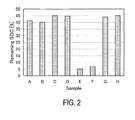
- Fig. 2 is a graph showing the measurement results of the self-discharge characteristics of nickel-hydrogen storage batteries with varied amounts of diphenyl carbodiimide.
- Fig. 3 is a graph showing how the self-discharge characteristics change over charge/discharge cycles in the cases where the positive electrode contains Y 2 O 3 and does not contain Y 2 O 3 .
- Fig. 4 is a graph showing the relationship between the average particle size of diphenyl carbodiimide polymer and the initial internal pressure in the alkaline storage battery of the present invention.
- Fig. 5 is a graph showing the relationship between the average particle size of diphenyl carbodiimide polymer and the remaining SOC in the alkaline storage battery of the present invention.
- Fig. 1 is a partially exploded perspective view schematically showing an alkaline storage battery 10, which is an example of the alkaline storage battery of the present invention.
- the alkaline storage battery 10 includes a case 11, a positive electrode 12 enclosed in the case 11, a negative electrode 13, a separator 14 disposed between the positive electrode 12 and the negative electrode 13, an electrolyte (not shown), and a sealing plate 15 provided with a safety valve.
- the electrolyte is retained in the positive electrode plate 12, the negative electrode plate 13 and the separator 14.
- the alkaline storage battery 10 further includes a compound (first compound, not shown) for adsorbing ammonia that is disposed between the positive electrode 12 and the negative electrode 13.
- the positive electrode 12 includes a substance (second compound) for increasing oxygen overvoltage at the positive electrode at the time of overcharge.
- a phenylene group (-C 6 H 4 -) / phenylene group, phenylene group / methylene group (-CH 2 -), methylene group / methylene group or the like can be used as a combination of R 1 / R 2 .
- a compound obtained as a result of removing R 2 from the compound of the general formula (1) also can be used.
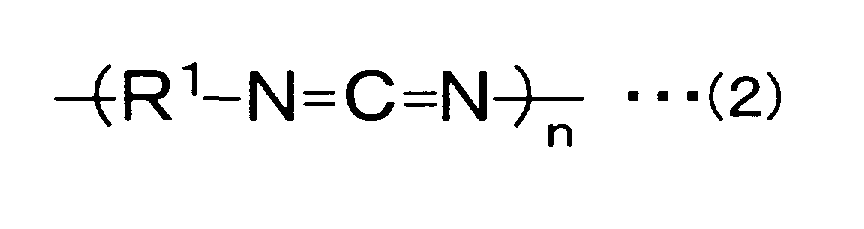
- compounds expressed by the following general formula (2) can be used. where the same substances as described above can be used for R 1 and n is, for example, in the range from 50 to 5000.
- the compound expressed by the general formula (2) is terminated with a commonly used atom or atomic group (e.g., hydrogen).
- the carbodiimide groups contained in the compound A it is preferable that 1.0 ⁇ 10 -6 mol or more, more preferably 1.0 ⁇ 10 -5 mol or more, and most preferably 1.0 ⁇ 10 -4 mol or more, of the carbodiimide groups are provided per Ah of the theoretical capacity of the positive electrode 12 between the positive electrode 12 and the negative electrode 13.
- powder of the compound A is dispersed on the surface of the positive electrode 12, and then the separator 14 is sandwiched by the positive electrode 12 and the negative electrode 13 and they are rolled up.
- any other methods can be used, as long as the compound A is disposed between the positive electrode 12 and the negative electrode 13 while being dispersed.
- the average particle size of the powder is 0.1 ⁇ m or more and 100 ⁇ m or less (more preferably, 0.5 ⁇ m or more and 50 ⁇ m or less).
- powder having a particle size of 0.1 ⁇ m or more and 100 ⁇ m or less can be used. If powder having a particle size of 0.1 ⁇ m or more is used, an increase in the internal pressure of the battery due to clogging of the separator can be prevented. If powder having a particle size of 100 ⁇ m or less is used, a sufficient effect of suppressing self-discharge can be obtained.
- the same positive electrode as used for a commonly used alkaline storage battery can be used for the positive electrode 12, except that the positive electrode 12 includes a substance (second compound, referred to as a substance B in some cases in the following) for increasing oxygen overvoltage at the time of overcharge. More specifically, a positive electrode containing nickel hydroxide as an active material can be used.
- the substance B contained in the positive electrode 12 at least one compound selected from the group consisting of yttrium compounds, indium compounds, antimony compounds, beryllium compounds and ytterbium compounds can be used. More specifically, as the substance B, at least one compound selected from the group consisting of Y 2 O 3 , Y(OH) 3 , In 2 O 3 , In 2 O, In 2 O 3 ⁇ H 2 O, Sb 2 O 3 , Sb 2 O 4 , BeO, Be(OH) 2 , Yb 2 O 3 and Yb(OH) 3 can be used. Among these, Y 2 O 3 , which has the largest effect, is preferable.
- the positive electrode 12 containing the substance B can be obtained by producing a positive electrode with an active material paste for a positive electrode containing the substance B.
- the amount X (g) of the substance B (second compound) contained in the positive electrode 12 and the amount Y (g) of the active material (nickel hydroxide) contained in the positive electrode 12 satisfy 0.001 ⁇ X/Y ⁇ 0.05.
- the alkaline storage battery 10 is a nickel-hydrogen storage battery
- a positive electrode plate containing nickel hydroxide as an active material is used for the positive electrode plate 12
- a negative electrode plate containing a hydrogen-absorbing alloy as a main component can be used for the negative electrode plate 13.
- an alkaline electrolyte containing potassium hydroxide as a main solute can be used for the alkaline storage battery 10
- a negative electrode plate employing cadmium is used for the negative electrode plate 13, which is the difference from the case of the nickel-hydrogen storage battery.
- a separator that commonly is used for alkaline storage batteries can be used. More specifically, a separator made of a resin obtained by treating polyolefin resin such as polypropylene or polyethylene so as to be hydrophilic can be used. A sulfonation treatment, graft polymerization, a plasma treatment, a corona discharge treatment, a fluoridization treatment or the like can be used to let polyolefin resin be hydrophilic.
- an electrolyte that commonly is used for alkaline storage batteries can be used. More specifically, an alkaline aqueous solution containing potassium hydroxide or lithium hydroxide as a solute can be used.
- the cylindrical alkaline storage battery 10 shown in Fig. 1 is only an example, and the form of the alkaline storage battery of the present invention is not limited to that shown in Fig. 1.
- the alkaline storage battery of the present invention can be applied to those having other forms than a cylindrical shape, such as a rectangular shape
- the charge amount is reduced even if they are not used. This is because self-discharge occurs between the positive electrode and the negative electrode through the medium of a nitrogen compound such as ammonia (shuttle mechanism).
- a nitrogen compound such as ammonia (shuttle mechanism).
- the number of the compounds or the functional groups having ammonia adsorbing properties contained in the alkaline storage battery of the present invention is larger than that of nitrogen compounds that contribute to a shuttle mechanism.
- an active material paste containing nickel hydrogen was filled in nickel foam, dried, compressed, and cut so as to produce a positive electrode.
- a paste containing a hydrogen-absorbing alloy was applied onto a conductive support, dried, compressed, and cut so as to produce a negative electrode.
- a separator made of polyolefin resin that had been subjected to a sulfonation treatment or a corona discharge treatment was prepared.
- an electrolyte was poured into the case and the case was sealed with a sealing plate.
- a nickel-hydrogen storage battery whose positive electrode has a theoretical capacity of 6.5 Ah was obtained.
- an electrolyte containing potassium hydroxide as a main solute and having a relative density of about 1.3 was used for the electrolyte.
- Example 1 Eight samples having different amounts of diphenyl carbodiimide added and different methods for providing hydrophilicity were produced. Table 1 shows the amount of the carbodiimide groups added and the method for providing hydrophilicity with respect to each sample.
- Sample Method for providing hydrophilicity Amount of carbodiimide groups added [mol/Ah] A Sulfonation treatment 0 B 1.0 ⁇ 10 -8 C 1.0 ⁇ 10 -6 D 1.0 ⁇ 10 -4 E Corona discharge treatment 0 F 1.0 ⁇ 10 -8 G 1.0 ⁇ 10 -6 H 1.0 ⁇ 10 -4
- the self-discharge characteristics were evaluated with respect to each sample of Table 1. More specifically, the battery was charged such that the SOC (state of charge) was 60%, and then was left unused in a 45°C atmosphere for two weeks, and then the remaining SOC was measured. Fig. 2 shows the measurement results.
- the self-discharge characteristics were improved by letting the amount of the carbodiimide group between the positive electrode and the negative electrode be 1.0 ⁇ 10 -6 mol or more per Ah of the theoretical capacity of the positive electrode.
- the self-discharge characteristics were improved significantly by adding diphenyl carbodiimide in the amount of 1.0 x 10 -6 mol or more per Ah of the theoretical capacity of the positive electrode.
- Example 1 the substance B (second compound) for increasing oxygen overvoltage was not added to the positive electrode, but there is no large influence on the characteristics of the battery in a short period of time.
- batteries were produced using a positive electrode that contains Y 2 O 3 or a positive electrode that does not contain Y 2 O 3 .
- Table 2 shows the amount of Y 2 O 3 added and the method for treating a separator so as to be hydrophilic.
- Example 2 the positive electrode was produced in the same manner as in Example 1, except for whether the active material paste contains Y 2 O 3 .
- diphenyl carbodiimide polymer was added such that the number of carbodiimide groups per Ah of the theoretical capacity of the positive electrode is 1.0 x 10 -3 mol.
- the positive electrode was produced such that the ratio (X/Y) of the amount X (g) of Y 2 O 3 contained in the positive electrode to the Y (g) of the active material (nickel hydroxide) contained in the positive electrode was 0.02.
- separator a separator made of a polyolefin resin that had been subjected to a corona discharge treatment or a sulfonation treatment was used.
- the same method as in Example 1 was used to produce a nickel-hydrogen storage battery.
- a battery including a positive electrode containing Y 2 O 3 and a separator that has been subjected to a corona treatment is denoted by sample I.
- a battery including a positive electrode containing Y 2 O 3 and a separator that has been subjected to a sulfonation treatment is denoted by sample J.
- a battery including a positive electrode that does not contain Y 2 O 3 and a separator that has been subjected to a corona treatment is denoted by sample K.
- a battery including a positive electrode that does not contain Y 2 O 3 and a separator that has been subjected to a sulfonation treatment is denoted by sample L.
- Example 3 a plurality of nickel-hydrogen batteries having a difference only in the average particle size of the diphenyl carbodiimide polymer from the sample G of Example 1 were produced.
- the average particle size of the diphenyl carbodiimide polymer was changed in the range from 0.01 ⁇ m to 1000 ⁇ m.
- the initial internal pressure of the battery was measured. More specifically, the battery was charged at a current value of 2.5A at 25 °C for 3 hours and 12 minutes, and the internal pressure of the battery during charging was measured.
- Fig. 4 shows the relationship between the average particle size of the diphenyl carbodiimide polymer and the largest internal pressure during charging. As seen from Fig. 4, in the case where the average particle size was 0.1 ⁇ m or more and 100 ⁇ m or less, the largest internal pressure during charging was low.
- Fig. 5 shows the measurement results. As seen from Fig. 5, in the case where the average particle size was 0.01 ⁇ m or more and 100 ⁇ m or less, the remaining SOC was high.
- An alkaline storage battery includes a positive electrode, a negative electrode, a separator, and an alkaline electrolyte retained in the positive electrode, the negative electrode, and the separator.
- the alkaline storage battery further includes a first compound for adsorbing ammonia between the positive electrode and the negative electrode.
- the positive electrode comprises a second compound for increasing oxygen overvoltage at a time of overcharge.
Landscapes
- Chemical & Material Sciences (AREA)
- Chemical Kinetics & Catalysis (AREA)
- Electrochemistry (AREA)
- General Chemical & Material Sciences (AREA)
- Engineering & Computer Science (AREA)
- Manufacturing & Machinery (AREA)
- Secondary Cells (AREA)
Abstract
Description

| Sample | Method for providing hydrophilicity | Amount of carbodiimide groups added [mol/Ah] |
| A | Sulfonation treatment | 0 |
| B | 1.0×10⁻⁸ | |
| C | 1.0×10⁻⁶ | |
| D | 1.0×10⁻⁴ | |
| E | Corona discharge treatment | 0 |
| F | 1.0×10⁻⁸ | |
| G | 1.0×10⁻⁶ | |
| H | 1.0×10⁻⁴ |
| Sample | Amount of carbodiimide group added [mol/Ah] | Method for providing hydrophilicity | Amount of Y2O3 added (X/Y) |
| I | 1.0×10⁻³ | Corona discharge treatment | 0.02 |
| J | Sulfonation treatment | 0.02 | |
| K | Corona discharge treatment | 0 | |
| | Sulfonation treatment | 0 |
Claims (6)
- An alkaline storage battery comprising a positive electrode, a negative electrode, a separator, and an alkaline electrolyte retained in the positive electrode, the negative electrode and the separator, wherein
the alkaline storage battery further comprises a first compound for adsorbing ammonia between the positive electrode and the negative electrode, and
the positive electrode comprises a second compound for increasing oxygen overvoltage at a time of overcharge. - The alkaline storage battery according to claim 1, wherein
the first compound comprises carbodiimide groups, and the carbodiimide groups are disposed in an amount of 1.0 × 10⁻⁶ mol or more per Ah of a theoretical capacity of the positive electrode between the positive electrode and the negative electrode. - The alkaline storage battery according to claim 2, wherein
the first compound is contained in a form of powder, and an average particle size of the powder is 0.1 µm or more and 100 µm or less. - The alkaline storage battery according to claim 1, wherein
the positive electrode contains at least one compound selected from the group consisting of yttrium compounds, indium compounds, antimony compounds, beryllium compounds and ytterbium compounds as the second compound. - The alkaline storage battery according to claim 4, wherein
the positive electrode contains at least one compound selected from the group consisting of Y2O3, Y(OH)3, In2O3, In2O, In2O3 · H2O, Sb2O3, Sb2O4, BeO, Be(OH)2, Yb2O3 and Yb(OH)3 as the second compound. - The alkaline storage battery according to claim 4, wherein
an amount X (g) of the second compound contained in the positive electrode and an amount Y (g) of an active material contained in the positive electrode satisfy 0.001 ≤ X/Y ≤ 0.05.
Applications Claiming Priority (4)
| Application Number | Priority Date | Filing Date | Title |
|---|---|---|---|
| JP2001346232 | 2001-11-12 | ||
| JP2001346232 | 2001-11-12 | ||
| JP2002256961 | 2002-09-02 | ||
| JP2002256961 | 2002-09-02 |
Publications (3)
| Publication Number | Publication Date |
|---|---|
| EP1311017A2 true EP1311017A2 (en) | 2003-05-14 |
| EP1311017A3 EP1311017A3 (en) | 2005-12-14 |
| EP1311017B1 EP1311017B1 (en) | 2008-10-15 |
Family
ID=26624482
Family Applications (1)
| Application Number | Title | Priority Date | Filing Date |
|---|---|---|---|
| EP02025191A Expired - Lifetime EP1311017B1 (en) | 2001-11-12 | 2002-11-11 | Alkaline storage battery |
Country Status (3)
| Country | Link |
|---|---|
| US (1) | US7056621B2 (en) |
| EP (1) | EP1311017B1 (en) |
| DE (1) | DE60229345D1 (en) |
Cited By (1)
| Publication number | Priority date | Publication date | Assignee | Title |
|---|---|---|---|---|
| CN106587160A (en) * | 2016-03-28 | 2017-04-26 | 北京纳米能源与系统研究所 | Carbodiimide compound, and preparation method and applications thereof |
Families Citing this family (2)
| Publication number | Priority date | Publication date | Assignee | Title |
|---|---|---|---|---|
| JP2005216676A (en) * | 2004-01-29 | 2005-08-11 | Nitto Denko Corp | Battery additive and battery using the same |
| US8000084B2 (en) * | 2007-07-25 | 2011-08-16 | Honeywell International, Inc. | High voltage electrolytes |
Family Cites Families (11)
| Publication number | Priority date | Publication date | Assignee | Title |
|---|---|---|---|---|
| JPH06101323B2 (en) | 1987-11-17 | 1994-12-12 | 松下電器産業株式会社 | Battery separator |
| JP3632866B2 (en) * | 1995-09-28 | 2005-03-23 | 株式会社ユアサコーポレーション | Nickel hydride storage battery |
| CN1205679C (en) * | 1995-09-28 | 2005-06-08 | 株式会社汤浅 | Hydrogen storage electrodes, nickel electrodes and alkaline batteries |
| JP3505953B2 (en) * | 1997-03-27 | 2004-03-15 | 松下電器産業株式会社 | Active material for nickel electrode and nickel positive electrode for alkaline storage battery using the same |
| JP3489960B2 (en) * | 1997-04-01 | 2004-01-26 | 松下電器産業株式会社 | Alkaline storage battery |
| JP3348343B2 (en) * | 1997-04-21 | 2002-11-20 | 株式会社豊田中央研究所 | Non-aqueous electrolyte for battery and non-aqueous electrolyte battery |
| US6576368B1 (en) * | 1998-10-02 | 2003-06-10 | Sanyo Electric Co., Ltd. | Positive active material for use in sealed alkaline storage batteries |
| JP4248119B2 (en) * | 2000-03-01 | 2009-04-02 | 三洋電機株式会社 | Alkaline storage battery |
| EP1205986B1 (en) * | 2000-04-05 | 2005-12-28 | Nitto Denko Corporation | Separator for battery |
| WO2001075994A1 (en) * | 2000-04-05 | 2001-10-11 | Nitto Denko Corporation | Battery |
| US20030008209A1 (en) * | 2001-06-22 | 2003-01-09 | Marufur Rahim | Cathode coating dispersion |
-
2002
- 2002-11-11 EP EP02025191A patent/EP1311017B1/en not_active Expired - Lifetime
- 2002-11-11 DE DE60229345T patent/DE60229345D1/en not_active Expired - Lifetime
- 2002-11-12 US US10/293,183 patent/US7056621B2/en not_active Expired - Fee Related
Cited By (2)
| Publication number | Priority date | Publication date | Assignee | Title |
|---|---|---|---|---|
| CN106587160A (en) * | 2016-03-28 | 2017-04-26 | 北京纳米能源与系统研究所 | Carbodiimide compound, and preparation method and applications thereof |
| CN106587160B (en) * | 2016-03-28 | 2018-05-01 | 北京纳米能源与系统研究所 | Carbodiimides and its preparation method and application |
Also Published As
| Publication number | Publication date |
|---|---|
| EP1311017A3 (en) | 2005-12-14 |
| DE60229345D1 (en) | 2008-11-27 |
| EP1311017B1 (en) | 2008-10-15 |
| US20030091906A1 (en) | 2003-05-15 |
| US7056621B2 (en) | 2006-06-06 |
Similar Documents
| Publication | Publication Date | Title |
|---|---|---|
| US9698398B2 (en) | Secondary battery module | |
| EP2365571B1 (en) | Nonaqueous electrolyte secondary battery | |
| US6352794B1 (en) | Lithium rechargeable battery | |
| US7682748B2 (en) | Nonaqueous electrolyte secondary battery | |
| KR100281729B1 (en) | Nickel positive electrode and alkaline storage battery using the same | |
| US20030008213A1 (en) | Method for manufacturing lithium battery | |
| CN117154188A (en) | Lithium-ion batteries, batteries and electrical devices | |
| US6358646B1 (en) | Method of making a flat type lithium secondary battery and electrode | |
| EP2518811B1 (en) | Process for production of lithium ion secondary battery | |
| JP7850286B2 (en) | Secondary batteries and battery modules, battery packs, and electrical devices containing them. | |
| US20220085377A1 (en) | Lithium ion secondary battery and production method thereof | |
| EP3998665A1 (en) | Lithium metal secondary battery and battery module comprising same | |
| EP0957526A1 (en) | Lithium secondary cell, charger, and device for information terminal | |
| US7056621B2 (en) | Alkaline storage battery | |
| EP4510290A1 (en) | Battery cell, battery, and electric apparatus | |
| EP4503244A1 (en) | Secondary battery | |
| US6933079B2 (en) | Separator for alkaline storage battery and alkaline storage battery using the same | |
| KR20100016344A (en) | Power system and method for charging battery pack | |
| JP4566507B2 (en) | Alkaline storage battery | |
| JP6292917B2 (en) | Alkaline storage battery | |
| EP0834939B1 (en) | Alkaline storage battery and separator therefor | |
| EP4597639A1 (en) | Secondary battery and negative electrode current collector | |
| Shinyama et al. | Effect of separators on the self-discharge reaction in nickel-metal hydride batteries | |
| KR101474394B1 (en) | Method for manufacturing secondary battery and secondary battery manufactured thereby | |
| EP0834940A2 (en) | Sealed alkaline storage battery |
Legal Events
| Date | Code | Title | Description |
|---|---|---|---|
| PUAI | Public reference made under article 153(3) epc to a published international application that has entered the european phase |
Free format text: ORIGINAL CODE: 0009012 |
|
| AK | Designated contracting states |
Designated state(s): AT BE BG CH CY CZ DE DK EE ES FI FR GB GR IE IT LI LU MC NL PT SE SK TR |
|
| AX | Request for extension of the european patent |
Extension state: AL LT LV MK RO SI |
|
| PUAL | Search report despatched |
Free format text: ORIGINAL CODE: 0009013 |
|
| AK | Designated contracting states |
Kind code of ref document: A3 Designated state(s): AT BE BG CH CY CZ DE DK EE ES FI FR GB GR IE IT LI LU MC NL PT SE SK TR |
|
| AX | Request for extension of the european patent |
Extension state: AL LT LV MK RO SI |
|
| 17P | Request for examination filed |
Effective date: 20060310 |
|
| 17Q | First examination report despatched |
Effective date: 20060626 |
|
| AKX | Designation fees paid |
Designated state(s): DE FR GB |
|
| 17Q | First examination report despatched |
Effective date: 20060626 |
|
| GRAP | Despatch of communication of intention to grant a patent |
Free format text: ORIGINAL CODE: EPIDOSNIGR1 |
|
| GRAS | Grant fee paid |
Free format text: ORIGINAL CODE: EPIDOSNIGR3 |
|
| GRAA | (expected) grant |
Free format text: ORIGINAL CODE: 0009210 |
|
| AK | Designated contracting states |
Kind code of ref document: B1 Designated state(s): DE FR GB |
|
| REG | Reference to a national code |
Ref country code: GB Ref legal event code: FG4D |
|
| RAP2 | Party data changed (patent owner data changed or rights of a patent transferred) |
Owner name: TOYOTA JIDOSHA KABUSHIKI KAISHA Owner name: PANASONIC CORPORATION |
|
| REF | Corresponds to: |
Ref document number: 60229345 Country of ref document: DE Date of ref document: 20081127 Kind code of ref document: P |
|
| PLBE | No opposition filed within time limit |
Free format text: ORIGINAL CODE: 0009261 |
|
| STAA | Information on the status of an ep patent application or granted ep patent |
Free format text: STATUS: NO OPPOSITION FILED WITHIN TIME LIMIT |
|
| 26N | No opposition filed |
Effective date: 20090716 |
|
| PGFP | Annual fee paid to national office [announced via postgrant information from national office to epo] |
Ref country code: DE Payment date: 20141105 Year of fee payment: 13 Ref country code: FR Payment date: 20141110 Year of fee payment: 13 Ref country code: GB Payment date: 20141105 Year of fee payment: 13 |
|
| REG | Reference to a national code |
Ref country code: DE Ref legal event code: R119 Ref document number: 60229345 Country of ref document: DE |
|
| GBPC | Gb: european patent ceased through non-payment of renewal fee |
Effective date: 20151111 |
|
| REG | Reference to a national code |
Ref country code: FR Ref legal event code: ST Effective date: 20160729 |
|
| PG25 | Lapsed in a contracting state [announced via postgrant information from national office to epo] |
Ref country code: DE Free format text: LAPSE BECAUSE OF NON-PAYMENT OF DUE FEES Effective date: 20160601 Ref country code: GB Free format text: LAPSE BECAUSE OF NON-PAYMENT OF DUE FEES Effective date: 20151111 |
|
| PG25 | Lapsed in a contracting state [announced via postgrant information from national office to epo] |
Ref country code: FR Free format text: LAPSE BECAUSE OF NON-PAYMENT OF DUE FEES Effective date: 20151130 |