EP1310856A2 - Method of access to a directory server using filter expressions - Google Patents
Method of access to a directory server using filter expressions Download PDFInfo
- Publication number
- EP1310856A2 EP1310856A2 EP02257837A EP02257837A EP1310856A2 EP 1310856 A2 EP1310856 A2 EP 1310856A2 EP 02257837 A EP02257837 A EP 02257837A EP 02257837 A EP02257837 A EP 02257837A EP 1310856 A2 EP1310856 A2 EP 1310856A2
- Authority
- EP
- European Patent Office
- Prior art keywords
- attribute
- filter
- entry
- access
- filter expression
- Prior art date
- Legal status (The legal status is an assumption and is not a legal conclusion. Google has not performed a legal analysis and makes no representation as to the accuracy of the status listed.)
- Withdrawn
Links
Images





Classifications
-
- H—ELECTRICITY
- H04—ELECTRIC COMMUNICATION TECHNIQUE
- H04L—TRANSMISSION OF DIGITAL INFORMATION, e.g. TELEGRAPHIC COMMUNICATION
- H04L63/00—Network architectures or network communication protocols for network security
- H04L63/02—Network architectures or network communication protocols for network security for separating internal from external traffic, e.g. firewalls
- H04L63/0227—Filtering policies
- H04L63/0263—Rule management
-
- G—PHYSICS
- G06—COMPUTING OR CALCULATING; COUNTING
- G06F—ELECTRIC DIGITAL DATA PROCESSING
- G06F16/00—Information retrieval; Database structures therefor; File system structures therefor
- G06F16/10—File systems; File servers
-
- H—ELECTRICITY
- H04—ELECTRIC COMMUNICATION TECHNIQUE
- H04L—TRANSMISSION OF DIGITAL INFORMATION, e.g. TELEGRAPHIC COMMUNICATION
- H04L61/00—Network arrangements, protocols or services for addressing or naming
- H04L61/45—Network directories; Name-to-address mapping
- H04L61/4505—Network directories; Name-to-address mapping using standardised directories; using standardised directory access protocols
- H04L61/4523—Network directories; Name-to-address mapping using standardised directories; using standardised directory access protocols using lightweight directory access protocol [LDAP]
-
- H—ELECTRICITY
- H04—ELECTRIC COMMUNICATION TECHNIQUE
- H04L—TRANSMISSION OF DIGITAL INFORMATION, e.g. TELEGRAPHIC COMMUNICATION
- H04L63/00—Network architectures or network communication protocols for network security
- H04L63/10—Network architectures or network communication protocols for network security for controlling access to devices or network resources
- H04L63/101—Access control lists [ACL]
Definitions
- This invention relates to distributed computer systems and, more particularly, to condition defining data such as that used to control access to entries in a directory.
- computer systems such as web networks include equipment and software of diverse types and having different manufacturers. This is true at both the hardware and the software level.
- client components can access, upon query, to a large amount of data (“application software components”) making it possible for the network users to create their own dynamic web site or to consult a dynamic web site such as an e-commerce site on an multi-platform computer system (e.g., Solaris, Windows NT, AIX, HPUX).
- a dynamic web site such as an e-commerce site on an multi-platform computer system (e.g., Solaris, Windows NT, AIX, HPUX).
- a directory e.g., an LDAP (Lightweight Data Access Protocol directory) and managed by a directory server. It is further desirable that this access be made possible rapidly for each query arriving after a first query.
- LDAP Lightweight Data Access Protocol directory
- Directories often have access control mechanisms to restrict access to certain portions of the directory. For example, some access control mechanisms may be designed so that regular users only have access to the information they need to know while other users (e.g., administrators) have access to larger segments (or all) of the directory. However, the access control mechanisms may have to be duplicated a large number of times (e.g., for each node in the directory), within a given directory structure. This may induce a supplementary load in many respects, including storage capability and the usual compromise in memory between data storage and program execution, in connection with the time needed for execution.
- a 'list of values' scheme may present certain problems such as an impractical and verbose definition of the protected attribute values in certain situations (e.g., where a range of attribute values is to be protected).
- a method involves designating a location in the directory server, providing attribute related data that includes a filter expression, and selectively controlling access to an entry situated at the designated location using the filter expression in the attribute related data.
- a directory server request processor includes an access control instruction processor and a filter execution processor for generating a result of a filter expression.
- the access control instruction processor includes an interpreter that is responsive to a filter-indicating keyword for calling the filter execution function and controls access via the directory server request in accordance with the result of the filter execution function.
- One embodiment of a computer readable medium comprises program instructions computer executable to receive a request to access an attribute of a directory server entry and deny access if a criterion defined by a filter expression associated with the attribute is not met by a first value of the attribute.
- the program instructions may be computer executable to authorize access if the criterion defined by the filter expression associated with the attribute is met by each value of the attribute.
- the request to access may be a request to delete the first value of the attribute and the filter expression may be associated with operations that delete values of the attribute.
- the request may be denied if the criterion defined by the filter expression specifies that the attribute cannot be deleted if the value of the attribute is the first value.
- the request to access may be a request to add the first value of the attribute and the filter expression may be associated with operations that add values of the attribute.
- the request may be denied if the criterion defined by the filter expression specifies that the attribute cannot be added if the value of the attribute is the first value.
- the program instructions may be computer executable to evaluate the filter expression for each instance of the attribute and deny access if any instance of the attribute fails to satisfy the criterion defined by the filter expression.
- a directory server may include an access control processor for processing an access control instruction controlling access to a first attribute of a first entry, where the access control instruction specifies a filter expression.
- the directory server may also include a filter processor for generating a result of a filter expression for a first value of the first attribute.
- the access control processor may provide the filter processor with the filter expression and the first value and control access to the first attribute of the first entry based on the result of the filter expression.
- the filter expression may define a criterion for values of the first attribute. The result of the filter expression may be false if the first value of the first attribute fails to meet the criterion defined in the filter expression.
- the access control processor may provide the filter processor with the filter expression and the first value if a requested access to the first attribute involves a class of operations associated with the filter expression.
- the result of the filter expression may be false if any value of the first attribute fails to meet the criterion defined in the filter expression.
- FIG. 1 One example of the hardware used in such a computer system is shown in Figure 1.
- computer system 1 includes processor 11, nonvolatile memory 12, memory 13, mass memory 14, display 15, user input device 16, network interface device 21, communication medium 20, and bus system 10.
- Non-volatile memory 12 may include an EPROM (as shown), Flash memory, or other suitable type of memory on which to store BIOS (Basic Input Output System) instructions.
- Memory 13 may include a suitable type of RAM (Random Access Memory) such as DRAM, SDRAM, DDR DRAM, RDRAM, etc.
- Mass memory 14 may include one or more hard disk drives or other mass storage media (e.g., optical or magneto-optical drives).
- Display 15 may include a suitable monitor.
- User input device 16 may include one or more devices such as a keyboard, mouse, joystick, etc.
- Embodiments of software instructions may include, separately or together, the instructions used when writing the condition-defining data and/or macros (or equivalent), as well as precursors and/or generators of such instructions, and the resulting instructions, as applicable (e.g., in a directory server).
- the instructions may be combined with language dependent and/or hardware dependent instructions and/or data.
- the instructions may be stored on another computer readable medium (e.g., a CD, DVD, hard disk, optical disk, tape device, floppy disk, etc.). In order to execute the instructions, the instructions may be loaded into memory 13.
- the computer readable medium may be located in either a first computer, in which the software program is stored or executed, or in a second different computer, which connects to the first computer over a network such as the Internet. In the latter instance, the second computer may provide the program instructions to the first computer for execution.
- the instructions and/or data may also be transferred upon a carrier medium.
- a computer readable medium may include a carrier medium such as networks and/or a wireless link upon which signals such as electrical, electromagnetic, or digital signals may be conveyed.
- Network interface 21 may be connected to communication medium 20.
- network interface device 21 may be an Ethernet device, a serial line device, and/or an ATM device.
- Communication medium 20 may be in communication with other computers (not shown).
- Medium 20 may include wire cables, fiber optics, and/or radio-communications, etc.
- Bus system 10 may exchange data through one or more bus systems 10, schematically shown as a single bus for ease of description.
- Bus system 10 may include a processor bus (e.g., a PCI (Peripheral Component Interconnect) bus) connected via appropriate bus bridges to one or more peripheral buses (e.g., an ISA (Industry Standard Architecture) bus and/or an SCSI (Small Computer System Interface) bus).
- processor bus e.g., a PCI (Peripheral Component Interconnect) bus
- peripheral buses e.g., an ISA (Industry Standard Architecture) bus and/or an SCSI (Small Computer System Interface) bus.
- ISA Industry Standard Architecture
- SCSI Small Computer System Interface
- Figure 2 illustrates a conceptual arrangement in which a first computer 2 running the Solaris platform and a second computer 4 running the Windows 98TM platform are connected to a server 8 via the Internet 6.
- a resource provider using the server 8 may be any type of business, government, or educational institution.
- the resource provider 8 may need to be able to provide its resources to both the user of the Solaris platform and the user of the Windows 98TM platform, but may not have the luxury of being able to custom design its content for the individual platforms.
- effective programming at the application level may require the platform concept to be extended all the way up the stack, including all the new elements introduced by the Internet. Such an extension may allow application programmers to design for a stable, consistent environment.
- ISDP 28 Internet Service Deployment Platform 28.
- ISDP 28 may be an ISDP developed by iPlanet E-commerce Solutions, a Sun Microsystems
- ISDP 28 may be a "net-enabling" platform that provides business with a very broad, evolving, and standards-based foundation upon which to enable network service.
- ISDP 28 may incorporate the elements of the Internet portion of the stack and join the elements with traditional platforms at the lower levels.
- ISDP 28 may sit on top of traditional operating systems 30 and infrastructures 32. This arrangement may allow enterprises and service providers to deploy next generation platforms while preserving "legacy-system" investments, such as a mainframe computer or any other computer equipment that is selected to remain in use after new systems are installed.
- ISDP 28 may include multiple integrated layers of software that provide services supporting application development, e.g., business-to-business exchanges, communications and entertainment vehicles, and retail Web sites.
- ISDP 28 may employ open standards at each level of integration, enabling customers to mix and match components.
- ISDP 28 components may be designed to be integrated and optimized to reflect a specific business need. However, there is no requirement that all solutions within the ISDP 28 be employed, or any one or more be exclusively employed.
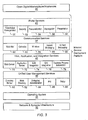
- ISDP 28 may include several layers. Graphically, the uppermost layer of ISDP 28 starts below the Open Digital Marketplace/Application strata 40. The uppermost layer of ISDP 28 may be a Portal Services Layer 42 that may provide a basic user point of contact and may be supported by integration solution modules such as knowledge management 50, personalization 52, presentation 54, security 56, and/or aggregation 58.
- integration solution modules such as knowledge management 50, personalization 52, presentation 54, security 56, and/or aggregation 58.
- a layer of specialized Communication Services (44) may handle functions such as unified messaging 68, instant messaging 66, web mail 60, calendar scheduling 62, and/or wireless access interfacing 64.
- a layer called Web, Application, and Integration Services 46 may follow.
- This layer may have different server types to handle the mechanics of user interactions and may include application and Web servers.
- iPlanetTM offers the iPlanetTM Application Server 72, Web Server 70, Process Manager 78, Enterprise Application and Integration (EAI) 76, and Integrated Development Environment (IDE) tools 74.
- EAI Enterprise Application and Integration
- IDE Integrated Development Environment
- Unified User Management Services 48 may be included below the server strata to handle issues surrounding management of user populations, including Directory Server 80, Meta-directory 82, delegated administration 84, Public Key Infrastructure (PKI) 86, and/or other administrative/access policies 88.
- the Unified User Management Services layer 48 may provide a single solution to centrally manage user account information in extranet and e-commerce applications.
- the core of this layer may be the iPlanetTM Directory Server 80 or another Lightweight Directory Access Protocol (LDAP)-based directory server.
- LDAP Lightweight Directory Access Protocol
- a LDAP-based directory server such as the iPlanet Directory Server (iDS) may provide a centralized directory service for an intranet or extranet while integrating with existing systems.
- the term directory service refers to a collection of software, hardware, and processes that store information and make the information available to users.
- the directory service generally includes at least one instance of the directory server and one or more directory client programs. Client programs can access names, phone numbers, addresses, and/or other data stored in the directory.
- DNS Domain Name System
- a DNS server maps computer host names to IP addresses.
- IP Internet Protocol
- a directory server such as iDS may be a general-purpose directory that stores information in a network-accessible repository.
- a directory server may provide a standard protocol and application programming interface (API) to access the information contained by the directory server.
- API application programming interface
- the directory server may provide global directory services, meaning that information may be provided to a wide variety of applications. Until recently, many applications came bundled with a proprietary database. While a proprietary database may be convenient if only one application is used, multiple databases may become an administrative burden if the databases manage the same information. For example, in a network that supports three different proprietary e-mail systems where each system has a proprietary directory service, if a user changes passwords in one directory, the changes may not automatically be replicated in the other directories. Accordingly, managing multiple instances of the same information may result in increased hardware and personnel costs.
- a global directory service may provide a single, centralized repository of directory information that any application can access. However, giving a wide variety of applications access to a directory may create a need for a network-based means of communicating between the numerous applications and the single directory.
- a directory lookup tool such as LDAP may be used to give applications access to the global directory service.
- LDAP is the Internet standard for directory lookups, just as the Simple Mail Transfer Protocol (SMTP) is the Internet standard for delivering e-mail and the Hypertext Transfer Protocol (HTTP) is the Internet standard for delivering documents.
- SMTP Simple Mail Transfer Protocol
- HTTP Hypertext Transfer Protocol
- LDAP is defined as an on-the-wire bit protocol (similar to HTTP) that runs over Transmission Control Protocol/Internet Protocol (TCP/IP).
- LDAP creates a standard way for applications to request and manage directory information.
- X.500 and X.400 are the corresponding Open Systems Interconnect (OSI) standards.
- OSI Open Systems Interconnect
- LDAP currently supports X.500 Directory Access Protocol (DAP) capabilities and may easily be embedded in lightweight applications (both client and server) such as email, web browsers, and groupware.
- DAP Directory Access Protocol
- An LDAP-compliant directory such as the iDS, may provide a master directory that owns all user, group, and access control information.
- the directory may be hierarchical (as opposed to relational) and may be optimized for reading, reliability, and scalability.
- This directory may become a specialized central repository that contains information about objects and provides user, group, and/or access control information to all applications on a network.
- the directory may be used to provide information technology managers with a list of all the hardware and software assets in a widely spanning enterprise.
- a directory server may also provide resources that all applications can use and aid in the integration of applications that have previously functioned as stand-alone systems. For example, instead of creating an account for each user in each system the user needs to access, a single directory entry may be created for the user in the LDAP directory.
- Figure 4 shows a portion of a typical directory with different entries corresponding to real-world objects.
- the directory depicts an organization entry 90 with the attribute type of domain component (dc), an organizational unit entry 92 with the attribute type of organizational unit (ou), a server application entry 94 with the attribute type of common name (cn), and a person entry 96 with the attribute type of user ID (uid). All entries may be connected by the directory.
- the directory protocol (e.g., a LDAP protocol) may be a message-oriented protocol.
- a client may construct an LDAP message containing a request and send the message to the server.
- the server may process the request and send one or more results back to the client as a series of one or more LDAP messages.
- Figure 5 shows an example of how an LDAP client 100 may search the directory for a specific entry.
- the client 100 may construct an LDAP search request message and send the message to the LDAP server 102, (operation ST104).
- the LDAP server 102 may retrieve the requested entry from the database and send the entry to the client 100 in an LDAP message (operation ST106).
- a result code may also be returned to the client 100 (e.g., in a separate LDAP message), (operation ST108).
- LDAP-compliant directory servers may have nine basic protocol operations.
- the basic protocol operations may be divided into three categories.
- the first category is interrogation operations, which include search and compare operators. These interrogation operations allow questions to be asked of the directory.
- the search operation is used to search the directory for entries and retrieve individual directory entries. In some embodiments, a separate LDAP read operation may not be implemented.
- the second category of interrogation operations is update operations, which include add, delete, modify, and modify distinguished name (DN) (i.e., rename) operators.
- DN distinguished name
- Update operations allow information in the directory to be updated.
- the third category of protocol operations is authentication and control operations, which include bind, unbind, and abandon operators.
- the bind operator allows a client to identify itself to the directory by providing an identity and authentication credentials. For example, the client may provide a DN and a set of credentials t to the directory. The server may check whether the credentials are correct for the given DN and, if the credentials are correct, note that the client is authenticated as long as the client's connection remains open or until the client re-authenticates.
- the unbind operation allows a client to terminate a session. When the client issues an unbind operation, the server may discard any authentication information associated with the client connection, terminate any outstanding LDAP operations, and disconnect from the client, thus closing the TCP connection.
- the abandon operation allows a client to indicate that the result of an operation (e.g., identified by a message ID in which the request for that operation was submitted) previously submitted is no longer of interest.
- the server may terminate processing of the operation that corresponds to the message ID.
- the LDAP protocol defines a framework for adding new operations to the protocol via LDAP extended operations.
- Extended operations allow the protocol to be extended in an orderly manner to meet new marketplace needs as they emerge.
- a typical LDAP client/server exchange may proceed as depicted in Figure 6.
- the LDAP client 100 opens a TCP connection to the LDAP server 102 and submits the bind operation (operation ST111).
- This bind operation may include the name of the directory entry that the client wants to authenticate as, along with the credentials to be used when authenticating. Credentials are often simple passwords, but they may also be digital certificates used to authenticate the client 100.
- the directory may return a success result to the client 100 (operation ST 112).
- the client 100 may issue a search request (operation ST 113).
- the LDAP server 102 processes this request, which results in two matching entries (operation STs 114 and 115).
- the LDAP server 102 may send a result message (operation ST 116).
- the client 100 may then issue the unbind request (operation ST 117), which indicates to the LDAP server 102 that the client 100 wants to disconnect.
- the LDAP server 102 may oblige by closing the connection (operation ST 118).
- Directory-enabled clients may perform useful, complex tasks by combining the basic LDAP operations. For example, an electronic mail client may look up mail recipients in a directory in order to help a user address an e-mail message.
- the basic unit of information in the LDAP directory is an entry.
- An entry is a collection of information about an object.
- Entries may include a set of attributes, each of which describes one particular trait of an object.
- Attributes may include an attribute type (e.g., common name (cn), surname (sn), etc.) and one or more values.
- Figure 7 shows an exemplary entry 124 showing attribute types 120 and values 122. Attributes may have constraints that limit the type and length of data placed in attribute values 122.
- a directory scheme may place restrictions on the attribute types 120 that must be, or are allowed to be, contained in the entry 124.
- An LDAP directory may be provided with access control mechanisms so that regular users only have access to the information they need to know, while other users such as administrators may access large segments of (or all of) the tree.
- the access control mechanism may be called "Access Control Instructions" (ACIs).
- ACIs Access Control Instructions
- An exemplary implementation of a set of ACIs is described below, by way of example only, and for helping to understand this specification.
- the access control mechanism e.g., the ACIs
- the access control mechanism may be used to target specific attribute values. This means that permissions may be granted or denied on an attribute if the value of that attribute meets the criteria defined in the ACI.
- An ACI that grants or denies access based on an attribute's value is called a value-based ACI.
- permission may be granted to all users to modify the nsRoleDN attribute in their own entry. However, in so doing, it may be desirable to restrict a user from giving himself certain key roles such as "Top Level Administrator.”
- LDAP filters may be used to target attribute values.
- the LDAP filters may be provided in an LDAP directory.
- the scope of the filter expressions may provide control over entries being targeted based on their attribute values.
- the filter or filters may also be associated with a class of operations (e.g., add or delete) that then will be controlled by that filter when applied to the particular attribute being targeted.
- a class of operations e.g., add or delete
- LDAP filters may be used to check that the conditions on attribute values are satisfied.
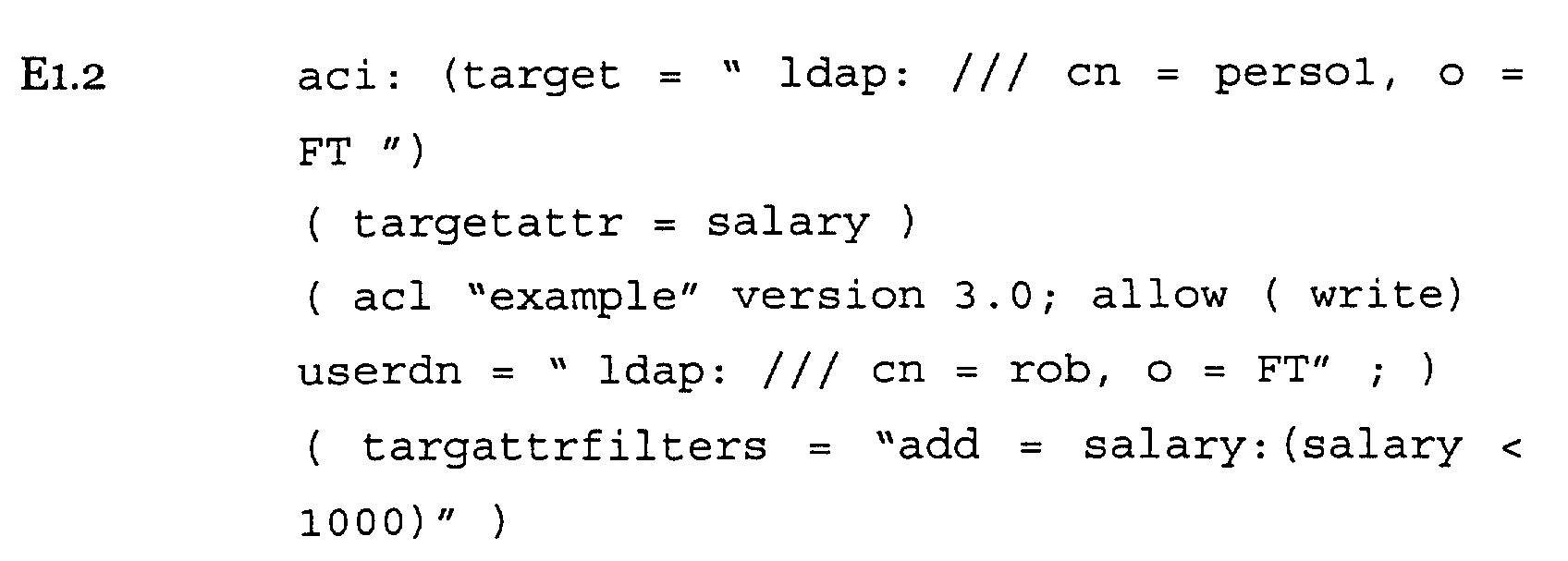
- a corresponding new keyword indicating the "filter” may be added in the ACI syntax.
- the keyword may be "targattrfilters".
- Exemplary ACI syntax including the keyword "targattrfilters” is shown in E1.2.
- Several exemplary filters are shown in E1.3
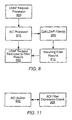
- an LDAP request is submitted to an LDAP request processor 900.
- an ACI processor 910 is operated.
- an LDAP filter function may be called at 912 (once or iteratively, as required) to obtain the filter results 914, which are used to control the execution of the LDAP request at 920, i.e. which information is sent to the client having initiated the LDAP request, or, more broadly, which rights of access to such information are granted to the client for that request.
- LDAP request aiming at one target entry (if it exists), the access is simply authorized or denied, depending upon whether the overall result of the filters is true or false.
- Certain LDAP requests may aim at more than one target entry; if so, block 920 will restrict the execution of the LDAP request to those of the targeted entries that match the filters.
- the LDAP request processor 900 and/or the ACI interpreter or processor 910 may be located in a directory server close to the databases, such that they not easily accessible to regular users.
- the directory servers and their respective databases may be in a specific protected zone, also termed "militarized zone", designating a zone whose access is authorized subject to given security conditions, as defined in the field of computer networks.
- a "current" ACI filter expression is considered, having the form: Attr i : Fi, where Attr i is an attribute name, and Fi is a current (plain) filter expression, used in connection with Attr i.
- An entry is being examined, and att designates an attribute instance, i.e. an attribute value in that entry, which is involved in plain filter expression Fi.
- Operation 8120 executes a filter interpreter on expression Fi to determine its contents. This may involve putting expression Fi in a canonical form, and/or using semantic analysis techniques.
- test 8121 determines whether filter expression Fi refers to only one type of attribute, as described above. (In fact, operations 8120 and 8121 are distinguished for clarity, but they might be considered as a single operation as well).
- operation 8122 defines a boolean result as false. Otherwise, operation 8123 calls the LDAP filter facilities to evaluate whether Fi verifies on the instance value att under consideration. If not, operation 8124 defines a boolean result as false.
- test 8125 determines whether there is another instance of attribute Attr i in the target entry. If so, control is returned to operation 8120, with att being now that other instance.
- operation 8126 defines the boolean result as true if all filters Fi have matched.
- operation 812 of figure 9 may be seen as a function using the LDAP filter facilities to check conditions on an entry, and returning a true or false boolean.
- the exemplary embodiment of figure 9 is a possible implementation, taking into account the current features of the LDAP schema, including the following facts: an attribute may be authorized as an option, or, by contrast, mandatory; an attribute may be single-valued or multi-valued.
- figure 9 may be adapted, for example in a system where all attributes would be mandatory, and/or at least certain attributes would be single-valued.
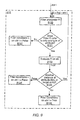
- the overall ACI interpretation or processing may include the exemplary operations illustrated in Figure 10, starting from operation call 800.
- Operation 802 executes the usual interpretation of the ACI keywords. At this time, a target entry corresponding to the request is available in the directory server or servers. The ACI has also been interpreted, except for its filter portion.
- test 804 determines whether the LDAP request includes the "filter” keyword, "targattrfilters” in the example. If test 804 finds no filter expression, operation 806 executes the LDAP request on the target entry, i.e. the user is given access to the target entry.
- test 804 finds one or more filter expressions, a loop is made on each of these filter expressions, involving operations 812, 816 and 818.
- Each of the filter expressions may be processed in its turn, as bearing on an attribute Attr i.
- the number of filter expressions is denoted N.
- Operation 812 considers a filter expression attached to the "targattrfilters" keyword and bearing on an attribute Attr i. In one embodiment, it may operate as described in Figure 9. If the output of operation 812 is false, operation 816 denies access to the target entry and the loop is terminated.
- test 818 determines whether there are further filter expressions after the filter keyword (targattrfilters in the example). If so, control is given again to operation 812 for processing the next filter expression.
- operation 822 causes the LDAP request to be executed on the target entry. In fact, operation 822 is similar to operation 806.
- the arguments of the keyword may obey the following syntax, in which the order may be changed: ⁇ keyword> ⁇ class of operation> ⁇ attribute being concerned> ⁇ filter expression>.
- a value based ACI may be created by using the targattrfilters keyword with the syntax as shown in E1.4, where add represents the class of operations which involve creating an attribute and del represents the class of operations which involve deleting an attribute in the ⁇ class of operation> argument.
- add represents the class of operations which involve creating an attribute
- del represents the class of operations which involve deleting an attribute in the ⁇ class of operation> argument.
- at trx represents the target attributes.
- Fx represents filters that apply only to the associated attribute.
- the attributes and filters after each class of operation may be different, despite their notation being the same. Also, certain portions of the above syntax may be implicit.
- the attrx may be implicit, e.g., by referring to the preceding attribute attr ⁇ x-1 > if no attribute is indicated at attrx.
- an ACI may include one or more filters. If so, the filter may be checked at 935 to verify the filter expression(s). With the exemplary syntax as shown in E1.4, each filter expression F i (i from 1 to n), may be applied to the LDAP directory (or directory structure) to verify that it indeed has effect on the corresponding attribute attr i. This is done separately for each class of operation ( add, del , in the example). Creation or modification of an ACI with a filter having no effect may be denied, or a meaningful modification may be prompted.
- each instance of that attribute may be required to satisfy the filter.
- each instance of that attribute may be required to satisfy the filter.
- the operation adds an attribute then it may be required that the add filter that applies to that attribute be satisfied; if the operation deletes an attribute, then it may be required that the delete filter that applies to that attribute be satisfied.
- both the add and delete filters may be required to be satisfied.
- a modify filter expression may be used instead of, or in addition to, the add (e.g., to adapt the user interface, if desired).
- modify e.g., to adapt the user interface, if desired.
- add if modify is added it will mean "delete, then add"(this makes it possible to do some checking between the previous and new attribute value).
- add and delete may apply only in cases of mere creation and deletion, respectively, of an attribute value.
- a search class of operations may be further used, enabling access control when searching in an LDAP directory.
- the attribute filter shown in E1.5 is now considered.
- This filter can be used to allow users to add any role (nsRoleDN attribute) to their own entry except the superAdmin role (the "! represents the logical "NOT” operation). It also allows users to add a telephone number with a 123 prefix.
- filter-based access control may provide a solution to a number of problems, e.g. where ranges of attribute values have to be considered in an ACI or other access control mechanism. In the prior art, it was necessary either to list all possible values of the attribute within the range, or to subtype the attribute in accordance with all ranges forming access conditions. In some embodiments, using filter-based access control may provide a more lightweight and quick solution.
- the mechanism by which one defines access is called access control.
- a server uses the authentication information provided by the user in the bind operation and the access control instructions (ACIs) defined in the server to allow or deny access to directory information.
- the server may be configured to allow or deny permissions such as read, write, search, and compare.
- the permission level granted to a user may be dependent on the authentication information provided.
- access control access to the entire directory, a subtree of the directory, specific entries in the directory (including entries defining configuration tasks), or a specific set of entry attributes may be controlled. Permissions may be set for a specific user, all users belonging to a specific group or role, or all users of the directory. Access may be defined for a specific location such as an IP address or a DNS name.
- Access control instructions may be stored in the directory as attributes of entries.
- the aci attribute may be an operational attribute. It may be available for use on every entry in the directory, regardless of whether it is defined for the object class of the entry. It may be used by the directory server to evaluate what rights are granted or denied when it receives an LDAP request from a client.
- the aci attribute may be returned in an ldapsearch operation if specifically requested.
- ACI statement The three main parts of an ACI statement are Target, Permission, and Bind Rule.
- the permission and bind rule portions of the ACI are set as a pair and are called an Access Control Rule (ACR).
- ACR Access Control Rule
- the specified permission may be granted or denied depending on whether the accompanying rule is evaluated to be true.
- the server evaluates access permissions to any given entry, it verifies the ACIs for every entry between the one requested and the directory suffix, as well as the ACIs on the entry itself.
- the aci attribute is multi-valued, which means that you can define several ACIs for the same entry or subtree.
- An ACI may be created so that it does not apply directly to the entry containing the ACI. Instead, the ACI may apply to some or all of the entries in the subtree below it. This may allow a general ACI that effectively applies to entries more likely to be located lower in the tree to be placed at a high level in the directory tree. For example, at the level of an organizationalUnit entry or a locality entry, one could create an ACI that targets entries that include the inetorgperson object class. Exceptions may exist. For example, ACIs placed in the root DSE entry may only apply to that entry.
- This feature may allow the number of ACIs in the directory tree to be reduced by placing general rules at high-level branch points. To limit the scope of more specific rules, they may be placed as close as possible to leaf entries.
- the server may compile a list of the ACIs present on the entry itself and on the parent entries back up to the top level entry stored on the directory server.
- ACIs may be evaluated across all of the databases for a particular directory server, but not across directory servers.
- This list of ACIs may be done based on the semantics of the ACIs, not on their placement in the directory tree. This means that ACIs that are close to the root of the directory tree may not take precedence over ACIs that are closer to the leaves of the directory tree.
- the precedence rule that applies is as follows: ACIs that deny access take precedence over ACIs that allow access. Between ACIs that allow access, union semantics apply, so there is no precedence. For example, if an ACI denies write permission at the directory's root level, then none of the users can write to the directory regardless of the specific permissions you grant them. To grant a specific user write permissions to the directory, you have to restrict the scope of the original denial for write permission so that it does not include the user.
- ACIs that depend on group entries may be required to be located on the same server as the group entry. If the group is dynamic, then all members of the group may be required to have an entry on the server too. If the group is static, however, the members's entries may be located on remote servers.
- ACIs that depend on role definitions may be required to be located on the same server as the role definition entry. Every entry that is intended to have the role may also be required to be located on the same server.
- Values stored in the target entry may be value matched with values stored in the entry of the bind user (for example, using the userattr keyword). Access may be evaluated normally even if the bind user does not have an entry on server that holds the ACI.
- Attributes generated by a CoS cannot be used in all ACI keywords in some embodiments. Specifically, one should not use attributes generated by CoS with the following keywords: targetfilter,targattrfilters, and userattr. If one creates target filters or bind rules that depend on the value of attributes generated by CoS, the access control rule may not work.
- Access control rules may be evaluated on the local server. Therefore, it may not be necessary to specify the hostname or port number of the server in LDAP URLs (Uniform Resource Locators) used in ACI keywords. If one does, the LDAP URL may not be taken into account.
- LDAP URLs Uniform Resource Locators
- default ACIs may apply to some of the directory information.
- the NetscapeRoot subtree has its own set of default ACIs: all members of the Configuration Administrators group have all rights on the NetscapeRoot subtree except proxy rights; users have anonymous access to the NetscapeRoot subtree for search and read operations; group expansion; all authenticated users have search, compare, and read rights to configuration attributes that identify the administration server.
- Default settings may be modified as needed to suit the needs of a given organization.
- access control instructions may be created manually using LDIF (Lightweight Directory Interchange Format) ACI statements and added to a directory tree using the ldapmodify utility.
- LDIF Lightweight Directory Interchange Format
- LDIF ACI statements may be used (as opposed to Console). Using LDIF ACI statements may take less time that using Console. Alternatively, to familiarize oneself with LDIF ACI statements, one may want to use the Directory Server Console to set the ACI and then click the Edit Manually button on the Access Control Editor. This shows the correct LDIF syntax. If the operating system allows it, one can even copy the LDIF from the Access Control Editor and paste it into a LDIF file.
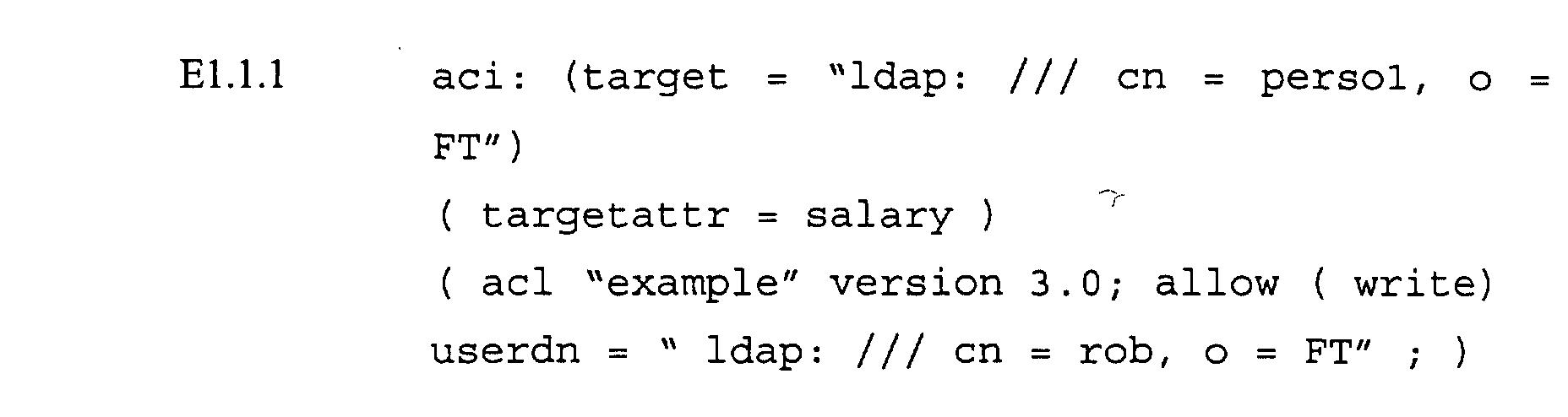
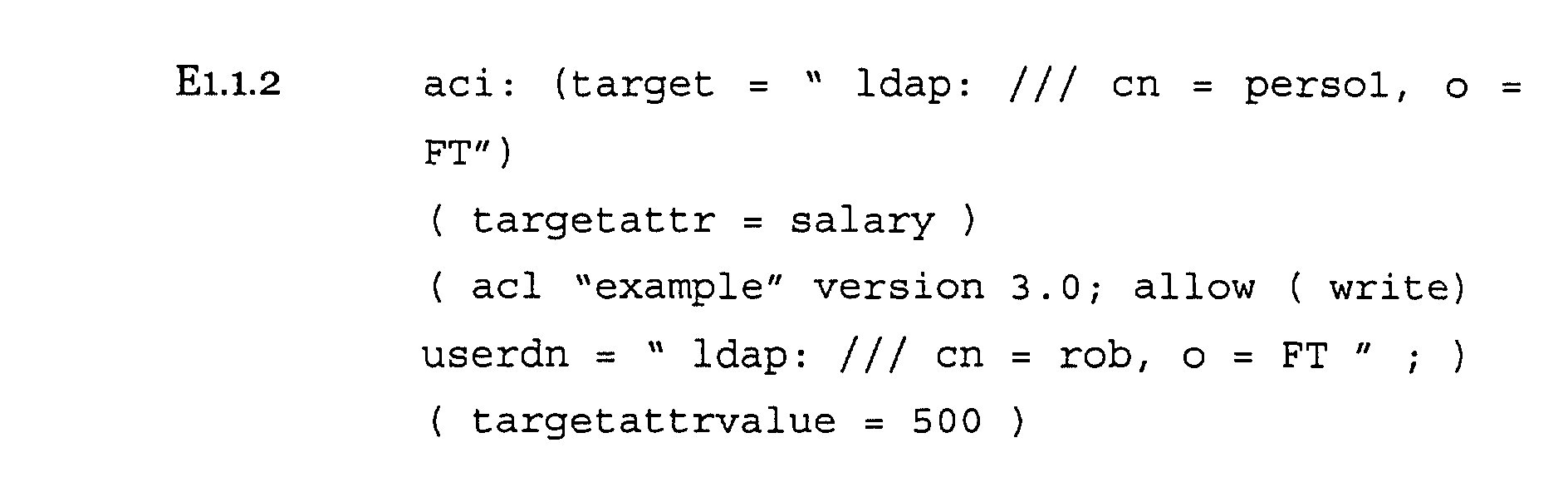
- the aci attribute may use the following syntax: aci : ( target )(version 3.0;acl " name "; permission bind_rules;), where target specifies the entry, attributes, or set of entries and attributes for which you want to control access.
- the target can be a distinguished name, one or more attributes, or a single LDAP filter.
- the target may be an optional part of an ACI.
- Version 3.0 is a string that identifies the ACI version in this embodiment.
- "Name" is a name for the ACI.
- the name may be any string that identifies the ACI.
- the ACI name may be required in some embodiments. Permission specifically outlines what rights you are either allowing or denying (for example, read or search rights).
- Bind_rules specify the credentials and bind parameters that a user has to provide to be granted access. Bind rules may also specifically deny access to certain users or groups of users.
- the ACI states that the user bjensen has rights to modify all attributes in his/her own directory entry.
- the target identifies what the ACI applies to. If the target is not specified, the ACI may apply to the entry containing the aci attribute and to the entries below it.
- a target may be a directory entry or all of the entries in a subtree, attributes of an entry, a set of entries or attributes that match a specified LDAP filter, and/or an attribute value or combination of values that match a specified LDAP filter.
- the wildcard indicates that any character or string or substring is a match for the wildcard.
- Pattern matching may be based on any other strings that have been specified with the wildcard.
- the wildcard may be used as a substitute for portions of the DN.
- Sun Sun Microsystems, Solaris, Java, EmbeddedJava, PersonalJava, JavaBeans, Java Naming and Directory Interface, JDBC, Enterprise JavaBeans (EJB), Jini, Sun Spontaneous Management, Java 2 Enterprise Edition (J2EE), JavaServer Pages (JSP) and I-planet are trademarks of Sun Microsystems, Inc.
- SPARC is a trademark of SPARC International, Inc.
- a method involves designating a location in the directory server, providing attribute related data that includes a filter expression, and selectively controlling access to an entry situated at the designated location using the filter expression in the attribute related data. For example, access to an attribute of the entry may be denied if a criterion defined by the filter expression associated with the attribute is not met by a first value of the attribute.
- An aspect of the invention described herein provides a method comprising: designating a location in a directory server; providing attribute-related data comprising a filter expression; and selectively controlling access to an entry situated at the designated location using the filter expression in said attribute-related data.
- a directory server request processor comprising: a filter execution processor configured to generate a result of a filter expression; and an access control instruction processor comprising an interpreter, wherein the interpreter calls the filter execution processor in response to a filter-indicating keyword in an access control instruction and controls access through the directory server request in accordance with the result of the filter execution processor.
- a further aspect of the invention described herein provides a computer program product comprising program instructions computer executable to: receive a request to access an attribute of a directory server entry; and to deny access if a criterion defined by a filter expression associated with the attribute is not met by a first value of the attribute.
- a computer program product for implementing the invention can be in the form of a computer program on a carrier medium.
- the carrier medium could be a storage medium, such as a solid state, magnetic, optical, magneto-optical or other storage medium.
- the carrier medium could be a transmission medium such as broadcast, telephonic, computer network, wired, wireless, electrical, electromagnetic, optical or indeed any other transmission medium.
- the carrier medium can be computer readable.
- Another aspect of the invention described herein provides a method comprising: receiving a request to access an attribute of a directory server entry; and denying access if a criterion defined by a filter expression associated with the attribute is not met by a first value of the attribute.
- a further aspect of the invention described herein provides a directory server comprising: an access control processor for processing an access control instruction controlling access to a first attribute of a first entry, wherein the access control instruction specifies a filter expression; and a filter processor for generating a result of a filter expression for a first value of the first attribute; wherein the access control processor provides the filter processor with the filter expression and the first value and controls access to the first attribute of the first entry based on the result of the filter expression; and wherein the filter expression defines a criterion for values of the first attribute.
Landscapes
- Engineering & Computer Science (AREA)
- General Engineering & Computer Science (AREA)
- Computer Networks & Wireless Communication (AREA)
- Signal Processing (AREA)
- Theoretical Computer Science (AREA)
- Computer Hardware Design (AREA)
- Computer Security & Cryptography (AREA)
- Computing Systems (AREA)
- General Business, Economics & Management (AREA)
- Data Mining & Analysis (AREA)
- Databases & Information Systems (AREA)
- Physics & Mathematics (AREA)
- General Physics & Mathematics (AREA)
- Business, Economics & Management (AREA)
- Storage Device Security (AREA)
- Information Retrieval, Db Structures And Fs Structures Therefor (AREA)
Abstract
Description


| Table 6-1 _ LDIF Target Keywords Keyword | Valid Expressions | Wildcard Allowed? |
| target_ | ldap:///distinguished_name_ | yes_ |
| targetattr_ | attribute_ | yes_ |
| targetfilter_ | LDAP_filter_ | yes_ |
| targattrfilters_ | LDAP_operation:LDAP_filter_ | yes_ |
Numerous variations and modifications will become apparent to those skilled in the art once the above disclosure is fully appreciated. It is intended that the following claims be interpreted to embrace all such variations and modifications.
Claims (22)
- A method comprising:receiving a request to access at least one entry of one or more entries in a directory server, wherein an access control instruction including a filter expression is associated with the one or more entries, and wherein the filter expression specifies a range of values of an attribute of the one or more entries;in response to said receiving, evaluating the filter expression on a value of the attribute of the at least one entry to determine whether the value of the attribute is within the range of values specified in the filter expression; andselectively providing access to the at least one entry dependent on an outcome of said evaluating.
- The method of claim 1, wherein the filter expression is associated with a class of operations, and wherein said evaluating is only performed if the request specifies an operation included in the class of operations.
- The method of claim 2, wherein the class of operations comprises "add" and "delete" classes of operations.
- The method of claim 2, wherein the class of operations comprises the "search" class of operations.
- The method of claim 1 or 2, wherein said evaluating is repeated for each attribute value of an instance of the attribute specified in the filter expression.
- The method of any preceding claim, wherein said evaluating comprises evaluating a plurality of filter expressions included in the access control instruction associated with the at least one entry, wherein the plurality of filter expressions includes the filter expression, and wherein said selectively providing access to the at least one entry is dependent on an outcome of each of the plurality of filter expressions.
- The method of any preceding claim, wherein the request to access comprises a request to delete the value of the attribute, wherein the filter expression is associated with operations that delete values of the attribute, and wherein said evaluating comprises determining whether the value of the attribute currently included in the at least one entry meets a criterion specified in the filter expression.
- The method of any of claims 1 to 6, wherein the request to access comprises a request to add the value of the attribute, wherein the filter expression is associated with operations that add values of the attribute, and wherein said evaluating comprises determining whether the value of the attribute included in the request to add meets a criterion specified in the filter expression.
- A system, comprising:wherein in response to receiving the request, the access control instruction processor is configured to call the filter execution processor if the filter-indicating keyword is included in the access control instruction associated with the entry;a filter execution processor configured to generate a result of a filter expression by evaluating the filter expression on a value of an attribute of an entry in a directory server; andan access control instruction processor coupled to the filter execution processor and configured to receive a request to access the entry, wherein an access control instruction is associated with the entry, and wherein the access control instruction includes the filter expression and an associated filter-indicating keyword;
wherein the access control instruction processor is configured to selectively provide access to the entry dependent on the result of the filter expression generated by the filter execution processor. - The system of claim 9, wherein the filter execution processor is configured to generate the result by evaluating each of a plurality of filter expressions included in the access control instruction associated with the entry.
- The system of claim 9 or 10, wherein the filter execution processor is configured to generate the result by evaluating the filter expression on a value of each instance of the attribute of the entry.
- The system of any of claims 9 to 11, wherein the filter execution processor is configured to generate the result of the filter expression as false if the value of the attribute fails to meet a criterion defined in the filter expression.
- The system of any of claims 9 to 12, wherein the access control processor provides the filter processor with the filter expression and the value of the attribute only if a requested access to the attribute involves a class of operations associated with the filter expression.
- The system of any of claims 9 to 13, wherein the filter execution processor is configured to generate the result of the filter expression as false if any value of any instance of the attribute fails to meet a criterion defined in the filter expression.
- A computer program product comprising program instructions computer executable to carry out the steps of the method of any of claims 1 to 8.
- The computer program product of claim 15, wherein the program instructions are computer executable:to receive a request to access a directory server entry, wherein an access control instruction is associated with the directory server entry, wherein the access control instruction includes a filter expression associated with an attribute of the directory server entry, and wherein the filter expression identifies a range of values of the attribute; andto generate a result by evaluating whether a value of the attribute is within the range of values of the attribute identified by the filter expression;to deny access to the entry dependent on the result.
- The computer program product of claim 15 or claim 16, wherein the program instructions are computer executable to authorize access to the entry if a value of each instance of the attribute is within the range of values identified by the filter.
- The computer program product of any of claims 15 to 17, wherein the request to access comprises a request to delete the value of the attribute and wherein the filter expression is associated with operations that delete values of the attribute.
- The computer program product of any of claims 15 to 18, wherein a criterion defined by the filter expression specifies that the attribute cannot be deleted if the value of the attribute is not within the range of values of the attribute identified by the filter expression.
- The computer program product of any of claims 15 to 17, wherein the request to access comprises a request to add the value of the attribute and wherein the filter expression is associated with operations that add values of the attribute.
- The computer program product of any of claims 15 to 17 and 20, wherein the criterion defined by the filter expression specifies that the attribute cannot be added if the value of the attribute is not within the range of values of the attribute identified by the filter expression.
- The computer program product of any preceding claim on a carrier medium.
Applications Claiming Priority (2)
| Application Number | Priority Date | Filing Date | Title |
|---|---|---|---|
| US10/010,748 US7024693B2 (en) | 2001-11-13 | 2001-11-13 | Filter-based attribute value access control |
| US10748 | 2001-11-13 |
Publications (2)
| Publication Number | Publication Date |
|---|---|
| EP1310856A2 true EP1310856A2 (en) | 2003-05-14 |
| EP1310856A3 EP1310856A3 (en) | 2007-01-24 |
Family
ID=21747210
Family Applications (1)
| Application Number | Title | Priority Date | Filing Date |
|---|---|---|---|
| EP02257837A Withdrawn EP1310856A3 (en) | 2001-11-13 | 2002-11-13 | Method of access to a directory server using filter expressions |
Country Status (2)
| Country | Link |
|---|---|
| US (1) | US7024693B2 (en) |
| EP (1) | EP1310856A3 (en) |
Cited By (3)
| Publication number | Priority date | Publication date | Assignee | Title |
|---|---|---|---|---|
| US7734658B2 (en) * | 2006-08-31 | 2010-06-08 | Red Hat, Inc. | Priority queue to determine order of service for LDAP requests |
| US8639655B2 (en) * | 2006-08-31 | 2014-01-28 | Red Hat, Inc. | Dedicating threads to classes of LDAP service |
| EP3373551A1 (en) * | 2017-03-06 | 2018-09-12 | SSH Communications Security Oyj | Access control in a computer system |
Families Citing this family (49)
| Publication number | Priority date | Publication date | Assignee | Title |
|---|---|---|---|---|
| US7712128B2 (en) * | 2001-07-24 | 2010-05-04 | Fiberlink Communication Corporation | Wireless access system, method, signal, and computer program product |
| US7382787B1 (en) | 2001-07-30 | 2008-06-03 | Cisco Technology, Inc. | Packet routing and switching device |
| WO2003027878A1 (en) * | 2001-09-28 | 2003-04-03 | Fiberlink Communications Corporation | Client-side network access polices and management applications |
| US7167918B2 (en) | 2001-10-29 | 2007-01-23 | Sun Microsystems, Inc. | Macro-based access control |
| US9031924B2 (en) * | 2002-02-26 | 2015-05-12 | International Business Machines Corporation | Query conditions having filtered fields within a data abstraction environment |
| WO2003093465A1 (en) * | 2002-04-30 | 2003-11-13 | Maxygen Holdings Ltd. | FACTOR VII OR VIIa POLYPEPTIDE VARIANTS |
| US8010961B1 (en) * | 2003-06-11 | 2011-08-30 | Symantec Corporation | Data layer prioritization in an application layered system |
| US7945897B1 (en) | 2002-06-12 | 2011-05-17 | Symantec Corporation | Method and system for running an application in a clean operating environment using a layered computing system |
| US7525904B1 (en) | 2002-06-20 | 2009-04-28 | Cisco Technology, Inc. | Redundant packet routing and switching device and method |
| US7450438B1 (en) | 2002-06-20 | 2008-11-11 | Cisco Technology, Inc. | Crossbar apparatus for a forwarding table memory in a router |
| US7536476B1 (en) * | 2002-12-20 | 2009-05-19 | Cisco Technology, Inc. | Method for performing tree based ACL lookups |
| US20040199539A1 (en) * | 2003-01-31 | 2004-10-07 | Juliet Richardson | Method and system for supporting hierarchical tree filtering |
| US7565684B2 (en) * | 2003-07-22 | 2009-07-21 | Sap Ag | Declarative configuration of enterprises services |
| WO2005020002A2 (en) * | 2003-08-15 | 2005-03-03 | Fiberlink Communications Corporation | System, method, apparatus and computer program product for facilitating digital communications |
| EP1526423A1 (en) * | 2003-10-20 | 2005-04-27 | Bayer Aktiengesellschaft | A method of auditing an SAP user authorization system |
| JP4676779B2 (en) * | 2004-04-02 | 2011-04-27 | 株式会社リコー | Information processing device, resource management device, attribute change permission determination method, attribute change permission determination program, and recording medium |
| US7725589B2 (en) * | 2004-08-16 | 2010-05-25 | Fiberlink Communications Corporation | System, method, apparatus, and computer program product for facilitating digital communications |
| EP1790112A2 (en) * | 2004-09-07 | 2007-05-30 | Philippe J. M. Coueignoux | Controlling electronic messages |
| US20060168344A1 (en) * | 2004-12-01 | 2006-07-27 | Kabushiki Kaisha Toshiba | Address book information sharing system and method thereof |
| US7889712B2 (en) | 2004-12-23 | 2011-02-15 | Cisco Technology, Inc. | Methods and apparatus for providing loop free routing tables |
| US20060156418A1 (en) * | 2005-01-10 | 2006-07-13 | Ibm Corporation | Method and apparatus for preventing unauthorized access to data |
| US9069436B1 (en) * | 2005-04-01 | 2015-06-30 | Intralinks, Inc. | System and method for information delivery based on at least one self-declared user attribute |
| US7657746B2 (en) * | 2005-04-22 | 2010-02-02 | Microsoft Corporation | Supporting statements for credential based access control |
| US20070055752A1 (en) * | 2005-09-08 | 2007-03-08 | Fiberlink | Dynamic network connection based on compliance |
| US20070143827A1 (en) * | 2005-12-21 | 2007-06-21 | Fiberlink | Methods and systems for intelligently controlling access to computing resources |
| US20070143851A1 (en) * | 2005-12-21 | 2007-06-21 | Fiberlink | Method and systems for controlling access to computing resources based on known security vulnerabilities |
| US7921104B2 (en) * | 2006-08-31 | 2011-04-05 | Red Hat, Inc. | Invoking actions on data via LDAP requests |
| US7962493B2 (en) * | 2007-03-05 | 2011-06-14 | Microsoft Corporation | Dynamic computation of identity-based attributes |
| US20090006520A1 (en) * | 2007-06-28 | 2009-01-01 | Microsoft Corporation | Multiple Thread Pools for Processing Requests |
| US7970943B2 (en) * | 2007-08-14 | 2011-06-28 | Oracle International Corporation | Providing interoperability in software identifier standards |
| US8434146B2 (en) * | 2008-03-04 | 2013-04-30 | Apple Inc. | Access control based on development profiles |
| US8495701B2 (en) * | 2008-06-05 | 2013-07-23 | International Business Machines Corporation | Indexing of security policies |
| US8112495B2 (en) * | 2009-03-19 | 2012-02-07 | International Business Machines Corporation | Transmitting information about distributed group memberships |
| US8219565B2 (en) * | 2009-06-15 | 2012-07-10 | International Business Machines Corporation | Filter range bound paged search |
| US8250628B2 (en) * | 2009-08-28 | 2012-08-21 | International Business Machines Corporation | Dynamic augmentation, reduction, and/or replacement of security information by evaluating logical expressions |
| JP5576697B2 (en) * | 2010-04-14 | 2014-08-20 | オリンパス株式会社 | Service using terminal, service providing terminal, service using terminal control method, service providing terminal control method, and service providing system |
| US9253176B2 (en) | 2012-04-27 | 2016-02-02 | Intralinks, Inc. | Computerized method and system for managing secure content sharing in a networked secure collaborative exchange environment |
| US9251360B2 (en) | 2012-04-27 | 2016-02-02 | Intralinks, Inc. | Computerized method and system for managing secure mobile device content viewing in a networked secure collaborative exchange environment |
| US9195759B2 (en) * | 2012-03-27 | 2015-11-24 | Varonis Systems, Ltd. | Method and apparatus for enterprise-level filtered search |
| US9553860B2 (en) | 2012-04-27 | 2017-01-24 | Intralinks, Inc. | Email effectivity facility in a networked secure collaborative exchange environment |
| WO2013163625A1 (en) | 2012-04-27 | 2013-10-31 | Intralinks, Inc. | Computerized method and system for managing networked secure collaborative exchange |
| US9514327B2 (en) | 2013-11-14 | 2016-12-06 | Intralinks, Inc. | Litigation support in cloud-hosted file sharing and collaboration |
| US9818085B2 (en) * | 2014-01-08 | 2017-11-14 | International Business Machines Corporation | Late constraint management |
| US9613190B2 (en) | 2014-04-23 | 2017-04-04 | Intralinks, Inc. | Systems and methods of secure data exchange |
| CN105824855B (en) | 2015-01-09 | 2019-12-13 | 阿里巴巴集团控股有限公司 | Method, device and electronic device for screening and classifying data objects |
| US10033702B2 (en) | 2015-08-05 | 2018-07-24 | Intralinks, Inc. | Systems and methods of secure data exchange |
| US10909266B2 (en) * | 2017-10-24 | 2021-02-02 | Merck Sharp & Dohme Corp. | Adaptive model for database security and processing |
| US12184699B2 (en) * | 2020-09-18 | 2024-12-31 | Prama, Inc. | Method and a system for providing security and access control in a network model |
| US20240143816A1 (en) * | 2022-10-28 | 2024-05-02 | Chanalytics Io, Llc | Information Acquisition, Filtering and Analyzing System and Method |
Family Cites Families (9)
| Publication number | Priority date | Publication date | Assignee | Title |
|---|---|---|---|---|
| US5677851A (en) * | 1994-12-15 | 1997-10-14 | Novell, Inc. | Method and apparatus to secure digital directory object changes |
| US5812776A (en) * | 1995-06-07 | 1998-09-22 | Open Market, Inc. | Method of providing internet pages by mapping telephone number provided by client to URL and returning the same in a redirect command by server |
| WO1998040992A2 (en) * | 1997-03-10 | 1998-09-17 | Internet Dynamics, Inc. | Methods and apparatus for controlling access to information |
| US6792605B1 (en) * | 1999-06-10 | 2004-09-14 | Bow Street Software, Inc. | Method and apparatus for providing web based services using an XML Runtime model to store state session data |
| US6505238B1 (en) * | 1999-08-19 | 2003-01-07 | International Business Machines Corporation | Method and system for implementing universal login via web browser |
| US6539379B1 (en) * | 1999-08-23 | 2003-03-25 | Oblix, Inc. | Method and apparatus for implementing a corporate directory and service center |
| US6490619B1 (en) * | 1999-12-07 | 2002-12-03 | International Business Machines Corporation | Method and system for managing multiple lightweight directory access protocol directory servers |
| US6535879B1 (en) * | 2000-02-18 | 2003-03-18 | Netscape Communications Corporation | Access control via properties system |
| US7167918B2 (en) * | 2001-10-29 | 2007-01-23 | Sun Microsystems, Inc. | Macro-based access control |
-
2001
- 2001-11-13 US US10/010,748 patent/US7024693B2/en not_active Expired - Lifetime
-
2002
- 2002-11-13 EP EP02257837A patent/EP1310856A3/en not_active Withdrawn
Cited By (4)
| Publication number | Priority date | Publication date | Assignee | Title |
|---|---|---|---|---|
| US7734658B2 (en) * | 2006-08-31 | 2010-06-08 | Red Hat, Inc. | Priority queue to determine order of service for LDAP requests |
| US8639655B2 (en) * | 2006-08-31 | 2014-01-28 | Red Hat, Inc. | Dedicating threads to classes of LDAP service |
| EP3373551A1 (en) * | 2017-03-06 | 2018-09-12 | SSH Communications Security Oyj | Access control in a computer system |
| US10880295B2 (en) | 2017-03-06 | 2020-12-29 | Ssh Communications Security Oyj | Access control in a computer system |
Also Published As
| Publication number | Publication date |
|---|---|
| EP1310856A3 (en) | 2007-01-24 |
| US7024693B2 (en) | 2006-04-04 |
| US20030105978A1 (en) | 2003-06-05 |
Similar Documents
| Publication | Publication Date | Title |
|---|---|---|
| US7024693B2 (en) | Filter-based attribute value access control | |
| US7167918B2 (en) | Macro-based access control | |
| US7020662B2 (en) | Method and system for determining a directory entry's class of service based on the value of a specifier in the entry | |
| US7016893B2 (en) | Method and system for sharing entry attributes in a directory server using class of service | |
| US6768988B2 (en) | Method and system for incorporating filtered roles in a directory system | |
| US6785686B2 (en) | Method and system for creating and utilizing managed roles in a directory system | |
| US7130839B2 (en) | Method and system for grouping entries in a directory server by group memberships defined by roles | |
| US7016907B2 (en) | Enumerated roles in a directory system | |
| US7350075B1 (en) | Method for autoconfiguration of authentication servers | |
| US7363339B2 (en) | Determining group membership | |
| US7475151B2 (en) | Policies for modifying group membership | |
| US7299492B2 (en) | Multi-level multi-user web services security system and method | |
| US7519596B2 (en) | Globally trusted credentials leveraged for server access control | |
| US6973463B2 (en) | Replication architecture for a directory server | |
| US20020147813A1 (en) | Proxy system | |
| WO2003001324A2 (en) | Authorization services with external authentication | |
| Tuttle et al. | Understanding LDAP-design and implementation | |
| US20030078937A1 (en) | Method and system for nesting roles in a directory system | |
| EP1358572A4 (en) | Support for multiple data stores | |
| EP1316016A2 (en) | Localized access | |
| NZ545755A (en) | A directory system | |
| WO2002005487A1 (en) | A system for logging access system events and providing identity management and access management for a network | |
| US20030088648A1 (en) | Supporting access control checks in a directory server using a chaining backend method | |
| CN101091369A (en) | Means and method for control of personal data | |
| US20030088678A1 (en) | Virtual attribute service in a directory server |
Legal Events
| Date | Code | Title | Description |
|---|---|---|---|
| PUAI | Public reference made under article 153(3) epc to a published international application that has entered the european phase |
Free format text: ORIGINAL CODE: 0009012 |
|
| AK | Designated contracting states |
Designated state(s): AT BE BG CH CY CZ DE DK EE ES FI FR GB GR IE IT LI LU MC NL PT SE SK TR |
|
| AX | Request for extension of the european patent |
Extension state: AL LT LV MK RO SI |
|
| PUAL | Search report despatched |
Free format text: ORIGINAL CODE: 0009013 |
|
| AK | Designated contracting states |
Kind code of ref document: A3 Designated state(s): AT BE BG CH CY CZ DE DK EE ES FI FR GB GR IE IT LI LU MC NL PT SE SK TR |
|
| AX | Request for extension of the european patent |
Extension state: AL LT LV MK RO SI |
|
| AKX | Designation fees paid | ||
| REG | Reference to a national code |
Ref country code: DE Ref legal event code: 8566 |
|
| STAA | Information on the status of an ep patent application or granted ep patent |
Free format text: STATUS: THE APPLICATION IS DEEMED TO BE WITHDRAWN |
|
| 18D | Application deemed to be withdrawn |
Effective date: 20070725 |