EP1310796A2 - Reagents for the simultaneous detection of HCV core antigens and antibodies - Google Patents
Reagents for the simultaneous detection of HCV core antigens and antibodies Download PDFInfo
- Publication number
- EP1310796A2 EP1310796A2 EP02257659A EP02257659A EP1310796A2 EP 1310796 A2 EP1310796 A2 EP 1310796A2 EP 02257659 A EP02257659 A EP 02257659A EP 02257659 A EP02257659 A EP 02257659A EP 1310796 A2 EP1310796 A2 EP 1310796A2
- Authority
- EP
- European Patent Office
- Prior art keywords
- hcv
- core
- antibodies
- antibody
- antigen
- Prior art date
- Legal status (The legal status is an assumption and is not a legal conclusion. Google has not performed a legal analysis and makes no representation as to the accuracy of the status listed.)
- Withdrawn
Links
Classifications
-
- C—CHEMISTRY; METALLURGY
- C07—ORGANIC CHEMISTRY
- C07K—PEPTIDES
- C07K14/00—Peptides having more than 20 amino acids; Gastrins; Somatostatins; Melanotropins; Derivatives thereof
- C07K14/005—Peptides having more than 20 amino acids; Gastrins; Somatostatins; Melanotropins; Derivatives thereof from viruses
-
- C—CHEMISTRY; METALLURGY
- C07—ORGANIC CHEMISTRY
- C07K—PEPTIDES
- C07K16/00—Immunoglobulins [IG], e.g. monoclonal or polyclonal antibodies
- C07K16/08—Immunoglobulins [IG], e.g. monoclonal or polyclonal antibodies against material from viruses
- C07K16/10—RNA viruses
- C07K16/116—Togaviridae (F); Matonaviridae (F); Flaviviridae (F)
- C07K16/118—Hepatitis C virus; GB virus C [GBV-C]
-
- G—PHYSICS
- G01—MEASURING; TESTING
- G01N—INVESTIGATING OR ANALYSING MATERIALS BY DETERMINING THEIR CHEMICAL OR PHYSICAL PROPERTIES
- G01N33/00—Investigating or analysing materials by specific methods not covered by groups G01N1/00 - G01N31/00
- G01N33/48—Biological material, e.g. blood, urine; Haemocytometers
- G01N33/50—Chemical analysis of biological material, e.g. blood, urine; Testing involving biospecific ligand binding methods; Immunological testing
- G01N33/53—Immunoassay; Biospecific binding assay; Materials therefor
- G01N33/576—Immunoassay; Biospecific binding assay; Materials therefor for hepatitis
- G01N33/5767—Immunoassay; Biospecific binding assay; Materials therefor for hepatitis non-A, non-B hepatitis
-
- C—CHEMISTRY; METALLURGY
- C12—BIOCHEMISTRY; BEER; SPIRITS; WINE; VINEGAR; MICROBIOLOGY; ENZYMOLOGY; MUTATION OR GENETIC ENGINEERING
- C12N—MICROORGANISMS OR ENZYMES; COMPOSITIONS THEREOF; PROPAGATING, PRESERVING, OR MAINTAINING MICROORGANISMS; MUTATION OR GENETIC ENGINEERING; CULTURE MEDIA
- C12N2770/00—MICROORGANISMS OR ENZYMES; COMPOSITIONS THEREOF; PROPAGATING, PRESERVING, OR MAINTAINING MICROORGANISMS; MUTATION OR GENETIC ENGINEERING; CULTURE MEDIA ssRNA viruses positive-sense
- C12N2770/00011—Details
- C12N2770/24011—Flaviviridae
- C12N2770/24211—Hepacivirus, e.g. hepatitis C virus, hepatitis G virus
- C12N2770/24222—New viral proteins or individual genes, new structural or functional aspects of known viral proteins or genes
-
- G—PHYSICS
- G01—MEASURING; TESTING
- G01N—INVESTIGATING OR ANALYSING MATERIALS BY DETERMINING THEIR CHEMICAL OR PHYSICAL PROPERTIES
- G01N2333/00—Assays involving biological materials from specific organisms or of a specific nature
- G01N2333/005—Assays involving biological materials from specific organisms or of a specific nature from viruses
- G01N2333/08—RNA viruses
- G01N2333/18—Togaviridae; Flaviviridae
Definitions
- HCV Hepatitis C Virus
- the present invention is directed to core protein sequences and anti-core antibodies that can be used to detect core antigen and anti core antibodies in serum collected from HCV infected individuals.
- Anti-core antibodies are major contributors to the sensitivity of the anti-HCV antibodies assays. These antibodies are generally among the earlier antibodies to develop. HCV anti-core antibodies are directed against multiple epitopes. Most of the HCV anti-core activity can be accounted for by the amino terminal 1/3 rd of the HCV core protein. HCV infected individuals have antibodies to multiple epitopes in HCV core protein sequence. It is possible to detect HCV anti-core antibodies by using part of the HCV core sequence. Analysis of serum from HCV infected individuals using overlapping pentadecapeptides showed that the antibodies to HCV core are distributed over many of the peptides.
- HCV core protein when further analyzed by a peptide walk analysis using overlapping octapeptides showed that 6-8 amino acids stretch of sequences between amino acids 10-43 represent multiple epitopes in HCV core sequence.
- the antibodies to HCV core were spread all across the core protein sequence, it should be possible to delete or alter amino acid sequences outside the 10-43 sequence with little impact on the ability of these modified antigens to detect anti-core antibodies. Based on the serological information a sensitive assay for the simultaneous detection of core antigen and anti-core antibodies can be designed as follows.
- HCV core protein as recombinant protein or synthetic peptides along with anti-core monoclonal or polyclonal antibodies is coated onto microwells.
- the anti-core antibodies selected for this assay are selected from a group of antibodies that do not recognize core sequence 10-43.
- This solid phase is then used to capture anti HCV core antibodies and core antigen from patient serum or plasma specimens using standard ELISA format.
- the captured proteins, human anti-HCV core antibodies and core protein are detected using immunochemical methods.
- the anti-HCV core human antibodies are detected using peroxidase labeled anti-human IgG.
- the core antigen is detected using peroxidase labeled anti-core monoclonal antibodies.
- the anti-core antibodies used for detection are selected from a group of antibodies that do not recognize aa 10-43 and are different from the antibodies used to capture the core antigen onto the solid phase.
- the core antigen used to detect ant-HCV core antibodies includes most of the sequence 10-43 with or without additional HCV core sequences.
- the core sequences outside of aa 10-43 are modified by deleting or altering amino sequence in the region recognized by the anti-core antibodies used to capture or detect core antigen.
- This new assay can detect HCV infected blood earlier than the currently used anti-HCV antibodies detection assay.
- the method described herein can detect HCV infection earlier because in addition to the detection of anti-HCV antibodies, this assay method also detects HCV core antigen.
- a specific detergent from the polyoxyethylene class is used in the HCV assay. The detergent used should be able to release the HCV core antigen from the virus by possibly disrupting the envelope protein and/or the lipid layer but this detergent should not affect the ability of the HCV recombinant antigens to capture the anti-HCV antibodies.
- Some of the common detergents such as N-lauryl sarcosine used in the detection of HCV core antigen destroy the ability of HCV recombinant proteins such as c22, c200, and NS5 to detect anti-HCV antibodies in a standard ELISA.
- HCV antigens c200-3, NS5 and a modified core antigen such as c22KSV 47,48 or c22KSR47L along with anti-core monoclonal antibodies were coated onto microwells in a buffer solution. After overnight incubation the buffer containing the coating proteins are removed and the microwells washed with phosphate buffered saline (PBS) containing a detergent, TWEEN 20. The antigen/antibody coated microwells were then treated with bovine serum albumin (BSA)/ sucrose solution to block the remaining protein binding sites that may be available on the microwells. After 2-24 hours, the BSA/sucrose solution is removed and the microwells air dried and stored under a descicant.
- PBS phosphate buffered saline
- BSA bovine serum albumin
- Two aliquotes of the specimen to be tested are diluted into 100 uL of PBS solution containing BSA, superoxide dismutase, yeast extract and 1% BRIJ 58 or BRIJ 35 or a mixture of both.
- the two diluted specimens were then pipetted into two HCV antigen/antibody coated wells described above.
- the microwells were incubated for 90 minutes at 37 degrees Celsius.
- the microwells were then washed five times with PBS containing 0.5% TWEEN 20 detergent.
- To one microwell 200uL of a murine anti-human IgG labeled with HRP was added and in the other well the same volume of anti-HCV core monoclonal antibodies (Anti Pep4) labeled with HRP was added.
- HCV core sequences are synthesized based on the HCV core sequence represented below. These sequences are prepared using recombinant techniques or standard peptide synthesis methods. Modifications can be made in the italicized and underlined amino acid sequence of HCV core protein. These modifications can be alterations of amino acids or deletion of sets of amino acids to remove sites of reagent anti-core antibodies.
- the antigen used for the assay is paired with the monoclonal antibodies that have their binding sites outside the core region 10-43.
- the modified core antigens along with the appropriate anti-core antibodies are used for the simultaneous detection of HCV core antigen and anti-HCV antibodies in specimens infected with HCV.
Landscapes
- Health & Medical Sciences (AREA)
- Life Sciences & Earth Sciences (AREA)
- Chemical & Material Sciences (AREA)
- Molecular Biology (AREA)
- Immunology (AREA)
- Organic Chemistry (AREA)
- Engineering & Computer Science (AREA)
- General Health & Medical Sciences (AREA)
- Medicinal Chemistry (AREA)
- Biochemistry (AREA)
- Virology (AREA)
- Genetics & Genomics (AREA)
- Biophysics (AREA)
- Proteomics, Peptides & Aminoacids (AREA)
- Urology & Nephrology (AREA)
- Biomedical Technology (AREA)
- Hematology (AREA)
- Cell Biology (AREA)
- Biotechnology (AREA)
- Microbiology (AREA)
- Communicable Diseases (AREA)
- Food Science & Technology (AREA)
- Physics & Mathematics (AREA)
- Analytical Chemistry (AREA)
- General Physics & Mathematics (AREA)
- Pathology (AREA)
- Gastroenterology & Hepatology (AREA)
- Peptides Or Proteins (AREA)
- Micro-Organisms Or Cultivation Processes Thereof (AREA)
Abstract
Description
- Hepatitis C Virus (HCV) is the leading cause of transfusion-associated and community-acquired hepatitis. HCV antibodies and antigens are used in immunoassays to test blood that might be used in transfusion in order to detect the presence of HCV. This type of blood screening has significantly reduced the spread of this virus due to blood transfusion.
- During the last 10 years there has been considerable progress made in improving the sensitivity of blood screening assays but there is a window period of 60-80 days from the time of infection in which there are no detectable antibodies. During this window period the persons are highly infective. To close this window, nucleic acids based tests are being developed to detect HCV infection. These nucleic acids based test are very laborious and have not yet been adapted for routine blood screening assays. Recently methods have been developed for detecting HCV core antigen. HCV core antigen can be detected in most HCV antibody negative HCV RNA positive individuals. From the published research it appears that HCV core antigen detection can be used as an earlier indication of HCV infection. (S.R. Lee et al., Vox Sanguinis, Efficacy Of A Hepatitis C Virus Core Antigen Enzyme-Linked Immunosorbent Assay For The Identification Of The 'Window-Phase' Blood Donation. 2001; 80: 19-23.) Though core antigen detection can detect HCV infection during the window period, the detection of core antigen becomes difficult once the anti-core antibodies appear. The core antigen gets complexed with the anti-core antibodies and it requires strong dissociating reagents to separate the core antigen from the antibodies.
- Therefore, there remains a need for a more effective assay that detects HCV infection. We describe herein a combination assay that detects anti-HCV antibodies and HCV core antigen in a single assay will able to detect HCV infection much more effectively than the current HCV core antigen or anti-HCV antibody assays.
- The present invention is directed to core protein sequences and anti-core antibodies that can be used to detect core antigen and anti core antibodies in serum collected from HCV infected individuals.
- Anti-core antibodies are major contributors to the sensitivity of the anti-HCV antibodies assays. These antibodies are generally among the earlier antibodies to develop. HCV anti-core antibodies are directed against multiple epitopes. Most of the HCV anti-core activity can be accounted for by the amino terminal 1/3rd of the HCV core protein. HCV infected individuals have antibodies to multiple epitopes in HCV core protein sequence. It is possible to detect HCV anti-core antibodies by using part of the HCV core sequence. Analysis of serum from HCV infected individuals using overlapping pentadecapeptides showed that the antibodies to HCV core are distributed over many of the peptides. Four peptides towards the amino terminus end have lot more reactivity than the peptides towards the carboxy terminus of the HCV c22-3 protein. This region of HCV core protein when further analyzed by a peptide walk analysis using overlapping octapeptides showed that 6-8 amino acids stretch of sequences between amino acids 10-43 represent multiple epitopes in HCV core sequence. Though the antibodies to HCV core were spread all across the core protein sequence, it should be possible to delete or alter amino acid sequences outside the 10-43 sequence with little impact on the ability of these modified antigens to detect anti-core antibodies. Based on the serological information a sensitive assay for the simultaneous detection of core antigen and anti-core antibodies can be designed as follows.
- A mixture of HCV core protein as recombinant protein or synthetic peptides along with anti-core monoclonal or polyclonal antibodies is coated onto microwells. The anti-core antibodies selected for this assay are selected from a group of antibodies that do not recognize core sequence 10-43. This solid phase is then used to capture anti HCV core antibodies and core antigen from patient serum or plasma specimens using standard ELISA format. The captured proteins, human anti-HCV core antibodies and core protein, are detected using immunochemical methods. The anti-HCV core human antibodies are detected using peroxidase labeled anti-human IgG. The core antigen is detected using peroxidase labeled anti-core monoclonal antibodies. The anti-core antibodies used for detection are selected from a group of antibodies that do not recognize aa 10-43 and are different from the antibodies used to capture the core antigen onto the solid phase. The core antigen used to detect ant-HCV core antibodies includes most of the sequence 10-43 with or without additional HCV core sequences. The core sequences outside of aa 10-43 are modified by deleting or altering amino sequence in the region recognized by the anti-core antibodies used to capture or detect core antigen.
- Therefore, we have developed an ELISA based assay for the detection of HCV infection. This new assay can detect HCV infected blood earlier than the currently used anti-HCV antibodies detection assay. The method described herein can detect HCV infection earlier because in addition to the detection of anti-HCV antibodies, this assay method also detects HCV core antigen. A specific detergent from the polyoxyethylene class is used in the HCV assay. The detergent used should be able to release the HCV core antigen from the virus by possibly disrupting the envelope protein and/or the lipid layer but this detergent should not affect the ability of the HCV recombinant antigens to capture the anti-HCV antibodies. Some of the common detergents such as N-lauryl sarcosine used in the detection of HCV core antigen destroy the ability of HCV recombinant proteins such as c22, c200, and NS5 to detect anti-HCV antibodies in a standard ELISA.
- The effectiveness and advantages of the invention are further illustrated by the following examples. The examples are meant to illustrate, but not to limit, the scope and spirit of the invention.
- In the present assay, HCV antigens c200-3, NS5 and a modified core antigen such as c22KSV 47,48 or c22KSR47L along with anti-core monoclonal antibodies (anti core murine monoclonals Pep 10, 12) were coated onto microwells in a buffer solution. After overnight incubation the buffer containing the coating proteins are removed and the microwells washed with phosphate buffered saline (PBS) containing a detergent, TWEEN 20. The antigen/antibody coated microwells were then treated with bovine serum albumin (BSA)/ sucrose solution to block the remaining protein binding sites that may be available on the microwells. After 2-24 hours, the BSA/sucrose solution is removed and the microwells air dried and stored under a descicant.
- Two aliquotes of the specimen to be tested are diluted into 100 uL of PBS solution containing BSA, superoxide dismutase, yeast extract and 1% BRIJ 58 or BRIJ 35 or a mixture of both. The two diluted specimens were then pipetted into two HCV antigen/antibody coated wells described above. The microwells were incubated for 90 minutes at 37 degrees Celsius. The microwells were then washed five times with PBS containing 0.5% TWEEN 20 detergent. To one microwell 200uL of a murine anti-human IgG labeled with HRP was added and in the other well the same volume of anti-HCV core monoclonal antibodies (Anti Pep4) labeled with HRP was added. To each well a solution of ORTHO phenylenediamine and hydrogen peroxide was added. After incubation in the dark for 30 minutes, the reaction is stopped by adding 50 microliters of 4N sulfuric acid. An orange color in either well indicates that the specimen being tested is infected with HCV. The microwell tested with anti-human IgG tests for anti-HCV antibodies and the one tested with anti-core conjugate tests for HCV core antigen.
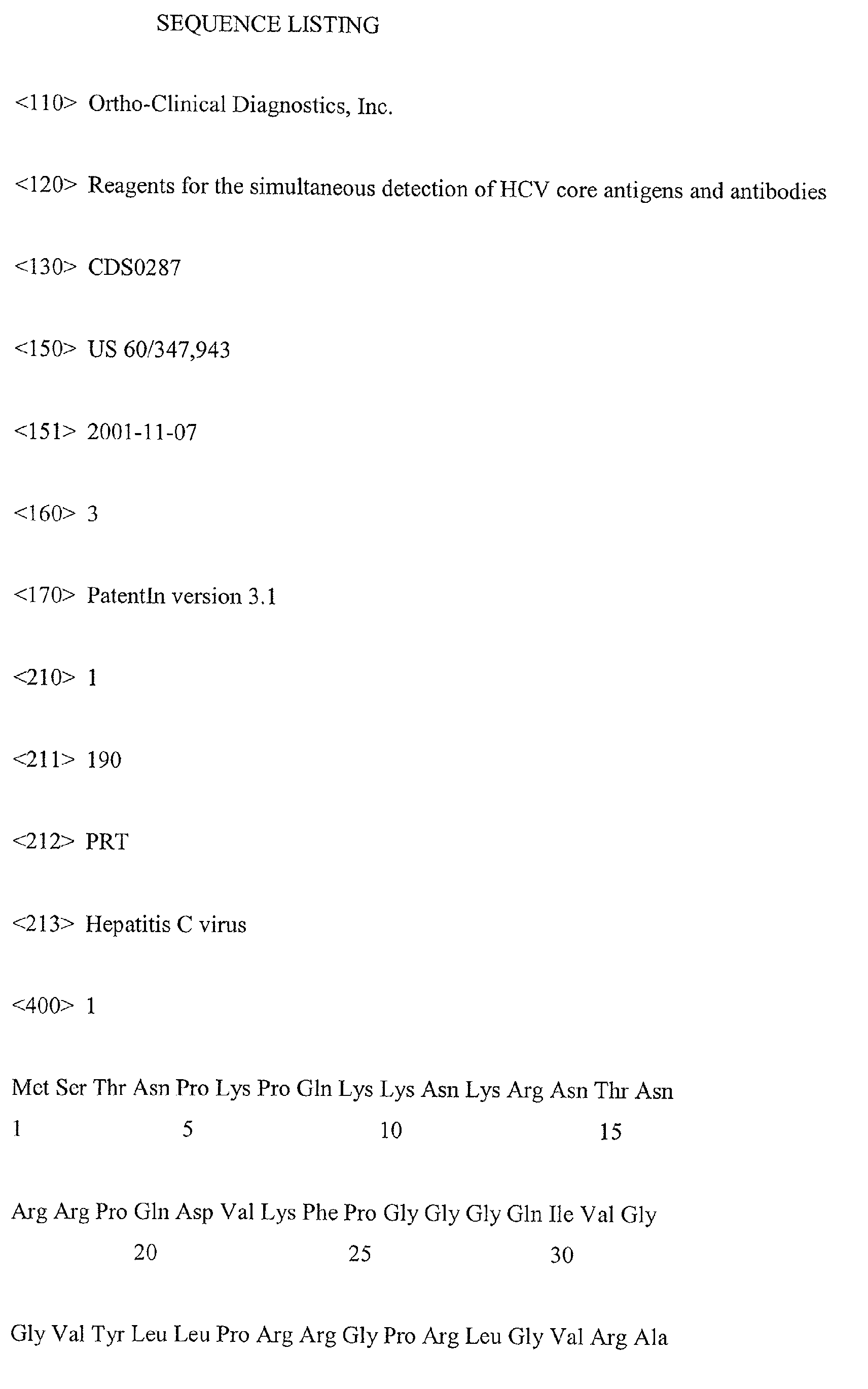
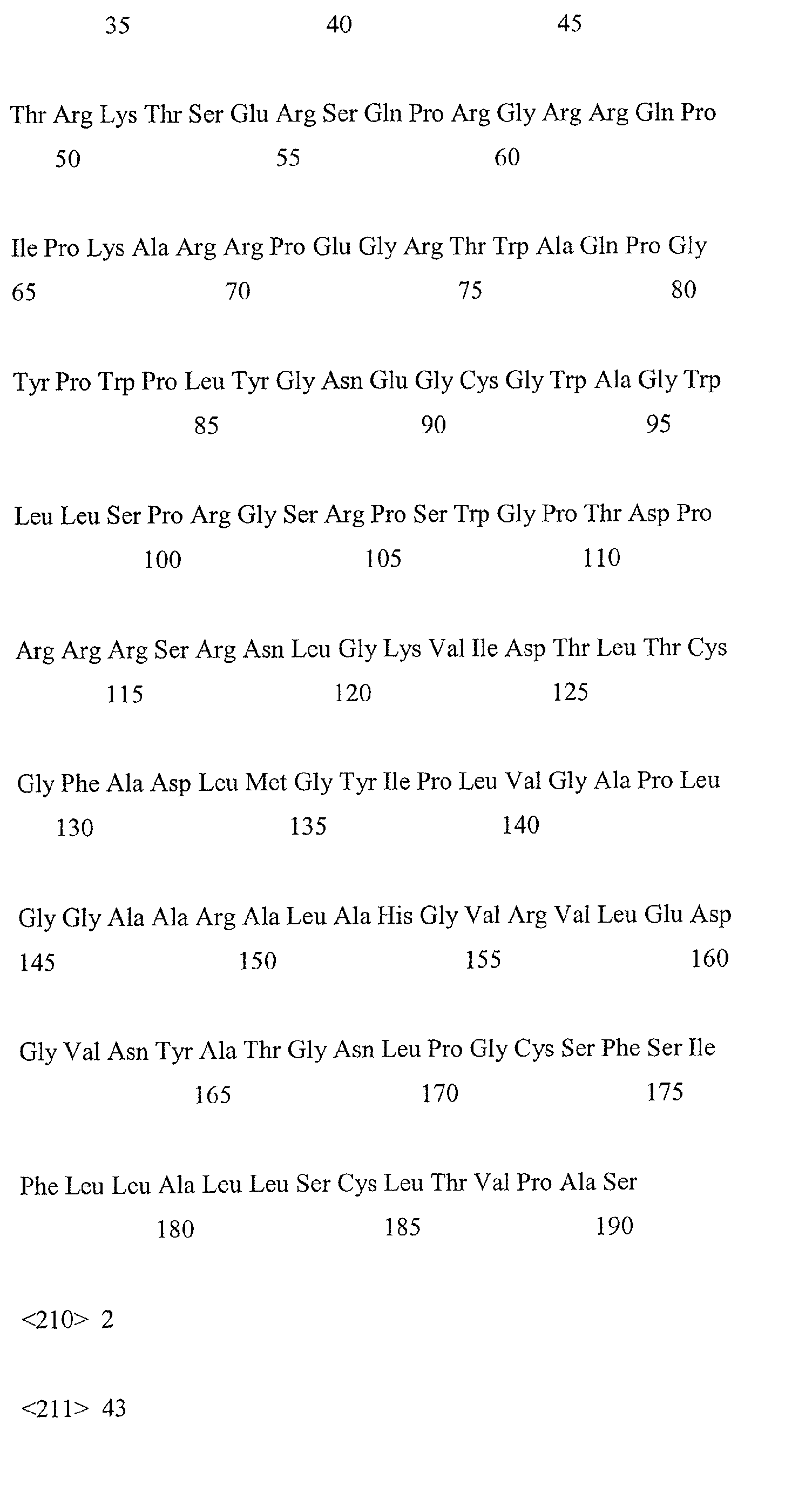
- HCV core sequences are synthesized based on the HCV core sequence represented below. These sequences are prepared using recombinant techniques or standard peptide synthesis methods.
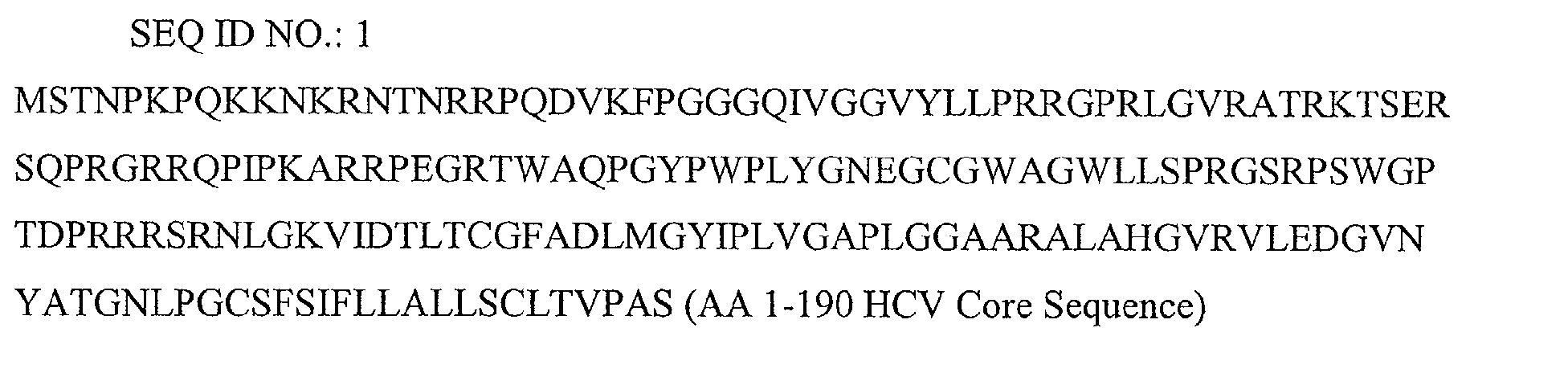

 Modifications can be made in the italicized and underlined amino acid sequence of HCV core protein. These modifications can be alterations of amino acids or deletion of sets of amino acids to remove sites of reagent anti-core antibodies. The antigen used for the assay is paired with the monoclonal antibodies that have their binding sites outside the core region 10-43. The modified core antigens along with the appropriate anti-core antibodies are used for the simultaneous detection of HCV core antigen and anti-HCV antibodies in specimens infected with HCV.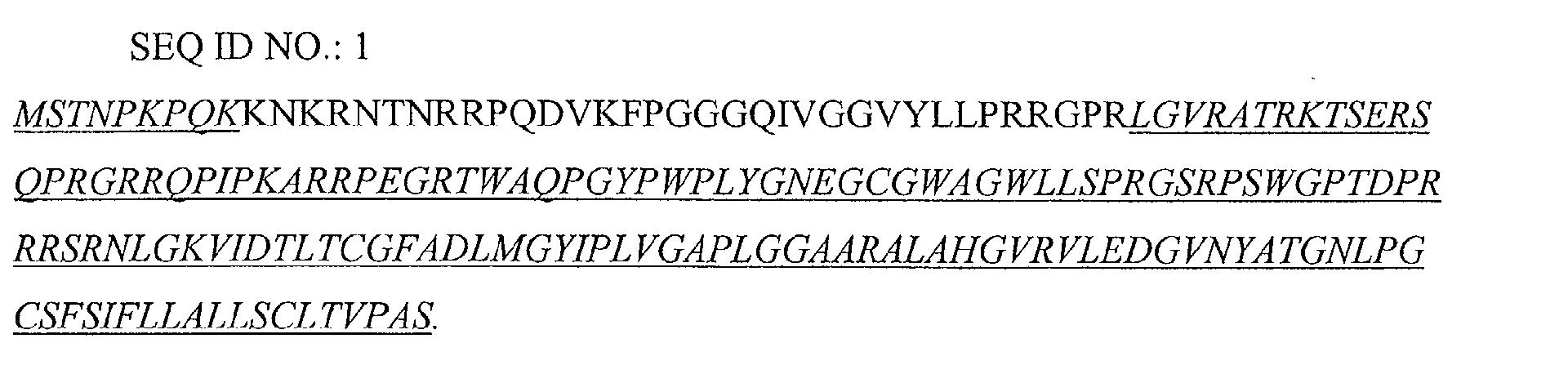

Claims (8)
- An antibody/antigen composition comprising a mixture of HCV protein and modified HCV core protein and anti-core antibodies wherein said anti-core antibodies do not recognize HCV core sequence amino acids 10-43.
- The antibody composition as claimed in claim 1 wherein said HCV protein is selected from the group consisting of: c200-3 and NS5 and said modified HCV core protein is selected from the group consisting of: c22KSV 47,48 and c22KSR47L.
- The antibody composition as claimed in claim 1 wherein said anti-core antibodies comprise a monoclonal antibody.
- The antibody composition as claimed in claim 1 wherein said anti-core antibodies comprise a polyclonal antibody.
- A method of immunoassay for HCV which comprises a) immobilizing onto a solid phase an antibody/antigen composition according to claim 1, b) contacting said antibody/antigen composition with blood or serum from a patient to form an HCV antibody/antigen complex, c) adding anti-human IgG carrying a label, and d) detecting said complex.
- The immunoassay method as claimed in claim 5 wherein said solid phase is a microwell, mircrotitre plate, membrane or bead.
- The immunoassay method as claimed in claim 5 wherein said label is an enzyme, a dye, colored particle, radionuclide or fluorescent substance.
- A kit containing the antibody/antigen composition as claimed in claim 1.
Applications Claiming Priority (4)
| Application Number | Priority Date | Filing Date | Title |
|---|---|---|---|
| US34794301P | 2001-11-07 | 2001-11-07 | |
| US347943P | 2001-11-07 | ||
| US268562 | 2002-10-10 | ||
| US10/268,562 US20030108563A1 (en) | 2001-11-07 | 2002-10-10 | Reagents for the simultaneous detection of HCV core antigens and antibodies |
Publications (2)
| Publication Number | Publication Date |
|---|---|
| EP1310796A2 true EP1310796A2 (en) | 2003-05-14 |
| EP1310796A3 EP1310796A3 (en) | 2004-06-09 |
Family
ID=26953175
Family Applications (1)
| Application Number | Title | Priority Date | Filing Date |
|---|---|---|---|
| EP02257659A Withdrawn EP1310796A3 (en) | 2001-11-07 | 2002-11-05 | Reagents for the simultaneous detection of HCV core antigens and antibodies |
Country Status (3)
| Country | Link |
|---|---|
| US (1) | US20030108563A1 (en) |
| EP (1) | EP1310796A3 (en) |
| JP (1) | JP2003202345A (en) |
Cited By (4)
| Publication number | Priority date | Publication date | Assignee | Title |
|---|---|---|---|---|
| EP2971046A4 (en) * | 2013-03-14 | 2016-11-02 | Abbott Lab | MONOCLONAL ANTIBODIES WITH LIPID BINDING TO THE HEART OF HCV |
| US9790478B2 (en) | 2013-03-14 | 2017-10-17 | Abbott Laboratories | HCV NS3 recombinant antigens and mutants thereof for improved antibody detection |
| US9841427B2 (en) | 2013-03-14 | 2017-12-12 | Abbott Laboratories | HCV antigen-antibody combination assay and methods and compositions for use therein |
| US9915658B2 (en) | 2009-05-20 | 2018-03-13 | Ortho-Clinical Diagnostics, Inc. | Reagents for HCV antigen-antibody combination assays |
Families Citing this family (5)
| Publication number | Priority date | Publication date | Assignee | Title |
|---|---|---|---|---|
| US7332269B2 (en) * | 2001-11-11 | 2008-02-19 | Ortho-Clinical Diagnostics, Inc. | HCV core protein sequences |
| JP4533656B2 (en) * | 2004-04-28 | 2010-09-01 | アボットジャパン株式会社 | Hepatitis C virus (HCV) antibody assay with improved specificity |
| WO2006081701A1 (en) * | 2005-02-02 | 2006-08-10 | Peng Cui | A kit for detecting the antibody of hcv and its preparing method |
| US8865398B2 (en) | 2006-09-01 | 2014-10-21 | Abbott Laboratories | Combination hepatitis C virus antigen and antibody detection method |
| FR2984328B1 (en) * | 2011-12-20 | 2016-12-30 | Bio-Rad Innovations | METHOD FOR DETECTING HEPATITIS C VIRUS INFECTION |
Citations (1)
| Publication number | Priority date | Publication date | Assignee | Title |
|---|---|---|---|---|
| EP1251353A2 (en) * | 2001-03-28 | 2002-10-23 | Ortho-Clinical Diagnostics, Inc. | A hepatitis C antigen-antibody combination assay for the early detection of infection |
Family Cites Families (8)
| Publication number | Priority date | Publication date | Assignee | Title |
|---|---|---|---|---|
| US4198398A (en) * | 1977-07-12 | 1980-04-15 | Derek Hudson | Enkephalin analogues |
| US5683864A (en) * | 1987-11-18 | 1997-11-04 | Chiron Corporation | Combinations of hepatitis C virus (HCV) antigens for use in immunoassays for anti-HCV antibodies |
| DE4112743C2 (en) * | 1991-04-19 | 2000-01-13 | Dade Behring Marburg Gmbh | Synthetic core peptides for the determination of HCV antibodies and HCV antigens, agents therefor and their use in these detection methods |
| US5380668A (en) * | 1993-07-06 | 1995-01-10 | University Of Utah Research Foundation | Compounds having the antigenicity of hCG |
| KR100523685B1 (en) * | 1997-08-04 | 2005-10-26 | 가부시끼가이샤 센탈 세메 가가꾸 겐꾸쇼 | A monoclonal antibody which recognizes an amino acid sequence of hepatitis C virus core region |
| JP3514729B2 (en) * | 1998-07-30 | 2004-03-31 | 株式会社先端生命科学研究所 | Method for measuring hepatitis C virus |
| US6623921B2 (en) * | 1998-07-30 | 2003-09-23 | Advanced Life Science Institute, Inc. | Method for measurement of hepatitis C virus |
| US7101683B2 (en) * | 2001-06-26 | 2006-09-05 | Abbott Laboratories | Methods for the simultaneous detection of HCV antigens and HCV antibodies |
-
2002
- 2002-10-10 US US10/268,562 patent/US20030108563A1/en not_active Abandoned
- 2002-11-05 EP EP02257659A patent/EP1310796A3/en not_active Withdrawn
- 2002-11-05 JP JP2002321299A patent/JP2003202345A/en active Pending
Patent Citations (1)
| Publication number | Priority date | Publication date | Assignee | Title |
|---|---|---|---|---|
| EP1251353A2 (en) * | 2001-03-28 | 2002-10-23 | Ortho-Clinical Diagnostics, Inc. | A hepatitis C antigen-antibody combination assay for the early detection of infection |
Cited By (11)
| Publication number | Priority date | Publication date | Assignee | Title |
|---|---|---|---|---|
| US9915658B2 (en) | 2009-05-20 | 2018-03-13 | Ortho-Clinical Diagnostics, Inc. | Reagents for HCV antigen-antibody combination assays |
| US10041946B2 (en) | 2009-05-20 | 2018-08-07 | Ortho-Clinical Diagnostics Inc. | Reagents for HCV antigen-antibody combination assays |
| EP2971046A4 (en) * | 2013-03-14 | 2016-11-02 | Abbott Lab | MONOCLONAL ANTIBODIES WITH LIPID BINDING TO THE HEART OF HCV |
| US9790478B2 (en) | 2013-03-14 | 2017-10-17 | Abbott Laboratories | HCV NS3 recombinant antigens and mutants thereof for improved antibody detection |
| US9841427B2 (en) | 2013-03-14 | 2017-12-12 | Abbott Laboratories | HCV antigen-antibody combination assay and methods and compositions for use therein |
| US10197573B2 (en) | 2013-03-14 | 2019-02-05 | Abbott Laboratories | HCV core lipid binding domain monoclonal antibodies |
| US10345311B2 (en) | 2013-03-14 | 2019-07-09 | Abbott Laboratories | Detection methods employing HCV core lipid and DNA binding domain monoclonal antibodies |
| US10444242B2 (en) | 2013-03-14 | 2019-10-15 | Abbott Laboratories | Detection methods employing HCV core lipid and DNA binding domain monoclonal antibodies |
| EP3564384A1 (en) * | 2013-03-14 | 2019-11-06 | Abbott Laboratories | Hcv core lipid binding domain monoclonal antibodies |
| EP3916103A1 (en) * | 2013-03-14 | 2021-12-01 | Abbott Laboratories | Hcv core lipid binding domain monoclonal antibodies |
| US11428694B2 (en) | 2013-03-14 | 2022-08-30 | Abbott Laboratories | Detection methods employing HCV core lipid and DNA binding domain monoclonal antibodies |
Also Published As
| Publication number | Publication date |
|---|---|
| EP1310796A3 (en) | 2004-06-09 |
| JP2003202345A (en) | 2003-07-18 |
| US20030108563A1 (en) | 2003-06-12 |
Similar Documents
| Publication | Publication Date | Title |
|---|---|---|
| US6489129B1 (en) | Antigen-specific IgM detection | |
| US6645732B2 (en) | Antigen-specific IgG detection | |
| KR101828767B1 (en) | Reagents for HCV antigen-antibody combination assays | |
| EP2064551A2 (en) | Combination hepatitis c virus antigen and antibody detection method | |
| US6723502B2 (en) | Hepatitis C antigen—antibody combination assay for the early detection of infection | |
| US20030108563A1 (en) | Reagents for the simultaneous detection of HCV core antigens and antibodies | |
| US6391540B1 (en) | Method for detecting antibodies in a sample | |
| JP3374101B2 (en) | Diagnosing Feline Immunodeficiency Virus Infection Using ENV / GAG Polypeptide Markers | |
| US20040152070A1 (en) | Method of detection of HCV antibodies in combination assay or sole antibody assay | |
| WO2018172337A1 (en) | Immunoassay for detecting zika virus infection | |
| JP2837669B2 (en) | T-cell lymphotropic virus protein and its analysis | |
| CA2405849A1 (en) | Reagents for the simultaneous detection of hcv core antigens and antibodies | |
| JP4283527B2 (en) | HCV core protein sequence | |
| EP0536838A2 (en) | Non-A, non-B peptides | |
| Cranage et al. | An indirect haemadsorption procedure (MRSPAH) for detecting antibodies to respiratory syncytial virus | |
| AU2007200598A1 (en) | A hepatitis C antigen - antibody combination assay for the early detection of HCV infection | |
| KR970065728A (en) | Diagnostic reagents for antibodies against hepatitis C virus, including mixed antigens of synthetic peptides | |
| CA2081888A1 (en) | Method of determining type specific antibodies to herpes simplex virus types 1 and 2 | |
| JPH05307040A (en) | Reagent for inspection of c-type hepatitis and inspecting method | |
| JPH06213895A (en) | Method for determining acute phase of hepatitis C | |
| TH17011A (en) | Modified HCV diagnostic substances | |
| TH12086B (en) | Modified HCV diagnostic substances |
Legal Events
| Date | Code | Title | Description |
|---|---|---|---|
| PUAI | Public reference made under article 153(3) epc to a published international application that has entered the european phase |
Free format text: ORIGINAL CODE: 0009012 |
|
| AK | Designated contracting states |
Designated state(s): AT BE BG CH CY CZ DE DK EE ES FI FR GB GR IE IT LI LU MC NL PT SE SK TR |
|
| AX | Request for extension of the european patent |
Extension state: AL LT LV MK RO SI |
|
| PUAL | Search report despatched |
Free format text: ORIGINAL CODE: 0009013 |
|
| RIC1 | Information provided on ipc code assigned before grant |
Ipc: 7C 07K 14/18 B Ipc: 7C 07K 16/10 B Ipc: 7G 01N 33/576 A |
|
| AK | Designated contracting states |
Kind code of ref document: A3 Designated state(s): AT BE BG CH CY CZ DE DK EE ES FI FR GB GR IE IT LI LU MC NL PT SE SK TR |
|
| AX | Request for extension of the european patent |
Extension state: AL LT LV MK RO SI |
|
| 17P | Request for examination filed |
Effective date: 20041119 |
|
| AKX | Designation fees paid |
Designated state(s): AT BE BG CH CY CZ DE DK EE ES FI FR GB GR IE IT LI LU MC NL PT SE SK TR |
|
| 17Q | First examination report despatched |
Effective date: 20050318 |
|
| STAA | Information on the status of an ep patent application or granted ep patent |
Free format text: STATUS: THE APPLICATION IS DEEMED TO BE WITHDRAWN |
|
| 18D | Application deemed to be withdrawn |
Effective date: 20060301 |