EP1310497A1 - Pyrazole derivatives, pest controllers containing the same as the active ingredient and process for their production - Google Patents
Pyrazole derivatives, pest controllers containing the same as the active ingredient and process for their production Download PDFInfo
- Publication number
- EP1310497A1 EP1310497A1 EP01954379A EP01954379A EP1310497A1 EP 1310497 A1 EP1310497 A1 EP 1310497A1 EP 01954379 A EP01954379 A EP 01954379A EP 01954379 A EP01954379 A EP 01954379A EP 1310497 A1 EP1310497 A1 EP 1310497A1
- Authority
- EP
- European Patent Office
- Prior art keywords
- group
- cyano
- hydrogen atom
- examples
- compound
- Prior art date
- Legal status (The legal status is an assumption and is not a legal conclusion. Google has not performed a legal analysis and makes no representation as to the accuracy of the status listed.)
- Granted
Links
- 0 *S/C(/C(C#N)=N)=C(\NCc1ccccn1)/[N+]c(c(Cl)cc(C(F)(F)F)c1)c1Cl Chemical compound *S/C(/C(C#N)=N)=C(\NCc1ccccn1)/[N+]c(c(Cl)cc(C(F)(F)F)c1)c1Cl 0.000 description 4
- JUJWROOIHBZHMG-UHFFFAOYSA-N c1ccncc1 Chemical compound c1ccncc1 JUJWROOIHBZHMG-UHFFFAOYSA-N 0.000 description 4
- DHIAZTRBPNTBCR-UHFFFAOYSA-N CSc1c(NCc2ccncc2)[n](-c(c(Cl)cc(C(F)(F)F)c2)c2Cl)nc1C#N Chemical compound CSc1c(NCc2ccncc2)[n](-c(c(Cl)cc(C(F)(F)F)c2)c2Cl)nc1C#N DHIAZTRBPNTBCR-UHFFFAOYSA-N 0.000 description 1
Classifications
-
- C—CHEMISTRY; METALLURGY
- C07—ORGANIC CHEMISTRY
- C07D—HETEROCYCLIC COMPOUNDS
- C07D401/00—Heterocyclic compounds containing two or more hetero rings, having nitrogen atoms as the only ring hetero atoms, at least one ring being a six-membered ring with only one nitrogen atom
- C07D401/02—Heterocyclic compounds containing two or more hetero rings, having nitrogen atoms as the only ring hetero atoms, at least one ring being a six-membered ring with only one nitrogen atom containing two hetero rings
- C07D401/12—Heterocyclic compounds containing two or more hetero rings, having nitrogen atoms as the only ring hetero atoms, at least one ring being a six-membered ring with only one nitrogen atom containing two hetero rings linked by a chain containing hetero atoms as chain links
-
- A—HUMAN NECESSITIES
- A01—AGRICULTURE; FORESTRY; ANIMAL HUSBANDRY; HUNTING; TRAPPING; FISHING
- A01N—PRESERVATION OF BODIES OF HUMANS OR ANIMALS OR PLANTS OR PARTS THEREOF; BIOCIDES, e.g. AS DISINFECTANTS, AS PESTICIDES OR AS HERBICIDES; PEST REPELLANTS OR ATTRACTANTS; PLANT GROWTH REGULATORS
- A01N43/00—Biocides, pest repellants or attractants, or plant growth regulators containing heterocyclic compounds
- A01N43/48—Biocides, pest repellants or attractants, or plant growth regulators containing heterocyclic compounds having rings with two nitrogen atoms as the only ring hetero atoms
- A01N43/56—1,2-Diazoles; Hydrogenated 1,2-diazoles
Definitions
- the present invention relates to novel 1-aryl-3-cyano-5-pyridylalkylaminopyrazole derivatives and a pest control agent, particularly an insecticide, comprising the same as an active ingredient.
- 3-cyano-1-phenylpyrazole derivatives having an amino group which may be substituted at the 5-position are disclosed in JP-A-62-228065, JP-A-63-316771, and JP-A-3-118369
- substituted 1-aryl-3-cyano-5-(het)arylmethylideneiminopyrazole derivatives are disclosed in JP-A-5-148240
- substituted 1-aryl-5-(het)arylmethylaminopyrazole derivatives are disclosed in JP-A-64-47768.
- JP-A-10-338676 and the like are more excellent in insecticidal activity and have a more reduced toxicity than known compounds but problems that the compounds have insufficient performance in view of systemic activity and that those having a high systemic activity have a relatively insufficient safety have been found.
- systemic activity is an important factor.
- the safety to organisms other than target pest insects and the environment has been increasingly demanded and, hereafter, measures for environmental protection will be strongly taken. Therefore, in order to develop pesticides satisfying more strict regulation, it has been an important problem to find compounds having a higher safety.
- the present inventors have found that a compound having an improved systemic activity and a high safety is obtained by using a pyridyl group as the heteroaryl group attached to the alkylamino group at the 5-position of the pyrazole ring in 1-aryl-3-cyano-5-heteroarylalkylaminopyrazole derivatives and further using a partially halogenated specific alkylthio group as the substituent at the 4-position of the pyrazole ring, and have accomplished the present invention.
- the present invention relates to 1-aryl-3-cyano-5-pyridylalkylaminopyrazole derivatives represented by the following formula (1): wherein X represents an N or C-halogen atom; R 1 represents a haloalkyl group, excluding a perhaloalkyl group; R 2 represents a hydrogen atom or an alkyl group; R 3 represents a hydrogen atom, an alkyl group, or an acyl group; and R 4 represents a hydrogen atom, a hydroxyl group, an alkyl group, a haloalkyl group, an alkoxy group, a haloalkoxy group, an alkylthio group, an alkylsulfinyl group, an alkylsulfonyl group, a halogen atom, a nitro group, or a cyano group, and a pest control agent comprising the derivative as an active ingredient, and a process for producing the compound.
- X represents an N or C-halogen
- the substituent R 1 in the compounds represented by the above formula (1) represents a partially halogenated linear or branched alkyl group such as a fluoromethyl group, a difluoromethyl group, a 2-fluoroethyl group, a 2-chloroethyl group, a 2,2,2-trifluoroethyl group, a 2,2,2-trichloroethyl group, a 3-chloropropyl group, a 3-bromopropyl group, a 3,3,3-trifluoropropyl group, a 2,2,3,3-tetrafluoropropyl group, a 2,2,3,3,3-pentafluoropropyl group, a 2,2-dichloro-3,3,3-trifluoropropyl group, a 2,2-dichloro-3,3,3-trifluoropropyl group, a 3,3,3-trichloropropyl group, a 4-chlorobutyl group, a
- a haloalkyl group having 1 to 4 carbon atoms is preferable, and a haloalkyl group having 1 to 2 carbon atoms such as a fluoromethyl group, and a difluoromethyl group is particularly preferable.
- R 2 represents a hydrogen atom; a linear or branched alkyl group such as a methyl group, an ethyl group, an n-propyl group, an isopropyl group, an n-butyl group, an isobutyl group, a sec-butyl group, or a t -butyl group.
- a hydrogen atom and an alkyl group having 1 to 4 carbon atoms are preferable, and a hydrogen atom is particularly preferable.
- R 3 represents a hydrogen atom; a linear or branched alkyl group such as a methyl group, an ethyl group, an n-propyl group, an isopropyl group, an n-butyl group, an isobutyl group, a sec-butyl group, or a t -butyl group; or a linear or branched acyl group such as a methylcarbonyl group, an ethylcarbonyl group, an n-propylcarbonyl group, an isopropylcarbonyl group, an n-butylcarbonyl group, an isobutylcarbonyl group, a sec-butylcarbonyl group, or a t -butylcarbonyl group.
- a hydrogen atom is particularly preferable.
- R 4 represents a hydrogen atom; a hydroxyl group; a linear or branched alkyl group such as a methyl group, an ethyl group, an n-propyl group, an isopropyl group, an n-butyl group, an isobutyl group, a sec-butyl group, or a t -butyl group; a linear or branched haloalkyl group such as a difluoromethyl group, a trifluoromethyl group, a 2-fluoroethyl group, a 2-chloroethyl group, a 2,2,2-trifluoroethyl group, a 2,2,2-trichloroethyl group, a 3-chloropropyl group, a 3-bromopropyl group, a 3,3,3-trifluoropropyl group, a 2,2,3,3-tetrafluoropropyl group, a 2,2,3,3,3-pentafluor
- alkyl group haloalkyl group, alkoxy group, haloalkoxy group, alkylthio group, alkylsulfinyl group, and alkylsulfonyl group
- those having 1 to 4 carbon atoms are preferable.
- R 4 a hydrogen atom and an alkyl group are preferable, and a hydrogen atom is most preferable.
- R 1 is a partially halogenated alkyl group having 1 to 2 carbon atoms and R 2 , R 3 and R 4 are hydrogen atoms.
- R 1 is a fluoromethyl group or difluoromethyl group
- the most preferable compound is 1-(2,6-dichloro-4-trifluoromethylphenyl)-4-difluoromethylthio-5-(pyridin-2-ylmethylamino)pyrazole-3-carbonitrile as shown below.
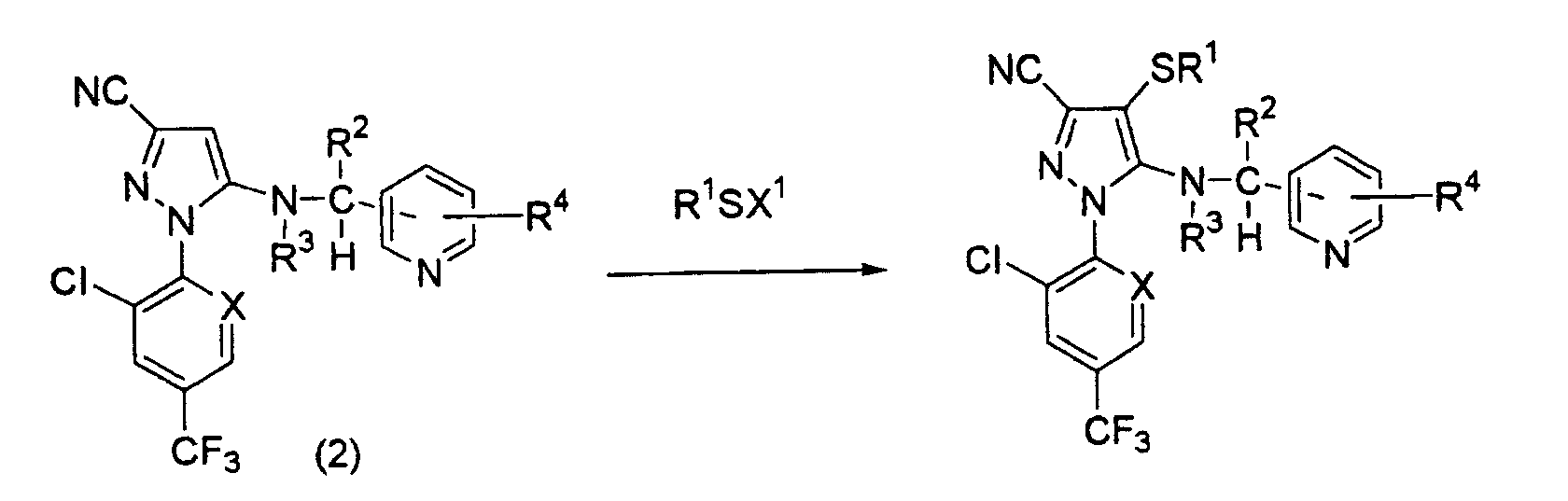
- Reaction Scheme 1 shows a process for producing a pyrazole derivative of formula (1), which comprises treating a pyrazole derivative of formula (2) with R 1 SX 1 wherein R 1 has the same meaning as in formula (1) and X 1 represents a chlorine atom, a bromine atom, an alkylsulfonyl group, or an arylsulfonyl group. X 1 is preferably a chlorine atom. Specific examples of R 1 SX 1 include difluoromethylsulfenyl chloride (CHF 2 SCl) and the compound can be produced by the method described in J. Org. Chem ., Vol. 44, No. 10, 1708 (1979).
- CHF 2 SCl difluoromethylsulfenyl chloride
- R 1 SX 1 is used in an amount of 0.5 to 10.0 molar equivalents, preferably 0.8 to 5 molar equivalents, to the compound represented by formula (2) and the reaction is carried out at 0°C to 150°C, preferably 0°C to 100°C, generally for 1 to 24 hours, preferably 1 to 4 hours, which may vary depending on a reaction scale.
- the solvent for use in the reaction includes an aromatic hydrocarbon such as benzene, toluene, and xylene; a ketone such as acetone and methyl ethyl ketone; a halogenated hydrocarbon such as chloroform and methylene chloride; an ether solvent such as ether, diisopropyl ether, and tetrahydrofuran; an aprotic polar solvent such as N,N-dimethylformamide (DMF) and dimethyl sulfoxide; and the like.
- aromatic hydrocarbon such as benzene, toluene, and xylene
- a ketone such as acetone and methyl ethyl ketone
- a halogenated hydrocarbon such as chloroform and methylene chloride
- an ether solvent such as ether, diisopropyl ether, and tetrahydrofuran
- an aprotic polar solvent such as N,N-dimethylformamide
- the reaction is carried out preferably in the presence of a base, and an amine such as pyridine or triethylamine is used as the base.
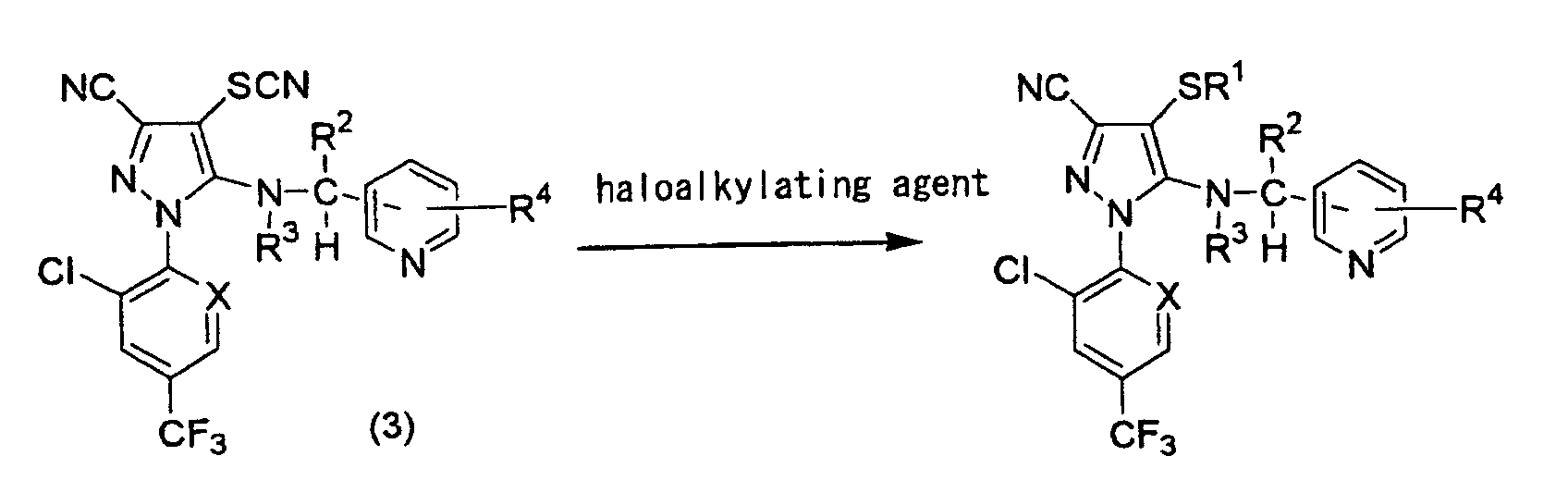
- Reaction Scheme 2 shows a process for producing a pyrazole derivative of formula (1), which comprises treating a pyrazole derivative of formula (3) with a haloalkylating agent.
- haloalkylating agent examples include fluoromethyl bromide, difluoromethyl chloride, trimethylsilyldifluoromethane, and the like.
- the solvent for use in the reaction includes an ether solvent such as tetrahydrofuran, diethyl ether, and dimethoxy ethane; a hydrocarbon solvent such as toluene and hexane; a halogenated hydrocarbon solvent such as dichloromethane and chloroform; and the like.
- ether solvent such as tetrahydrofuran, diethyl ether, and dimethoxy ethane
- hydrocarbon solvent such as toluene and hexane
- a halogenated hydrocarbon solvent such as dichloromethane and chloroform
- the haloalkylating agent is used in an amount of 0.5 to 10.0 molar equivalents, preferably 0.8 to 5 molar equivalents to the compound represented by formula (3) and the reaction is carried out at -20°C to 120°C, preferably 0°C to room temperature, generally for 1 to 24 hours, preferably 1 to 4 hours, which may vary depending on a reaction scale.
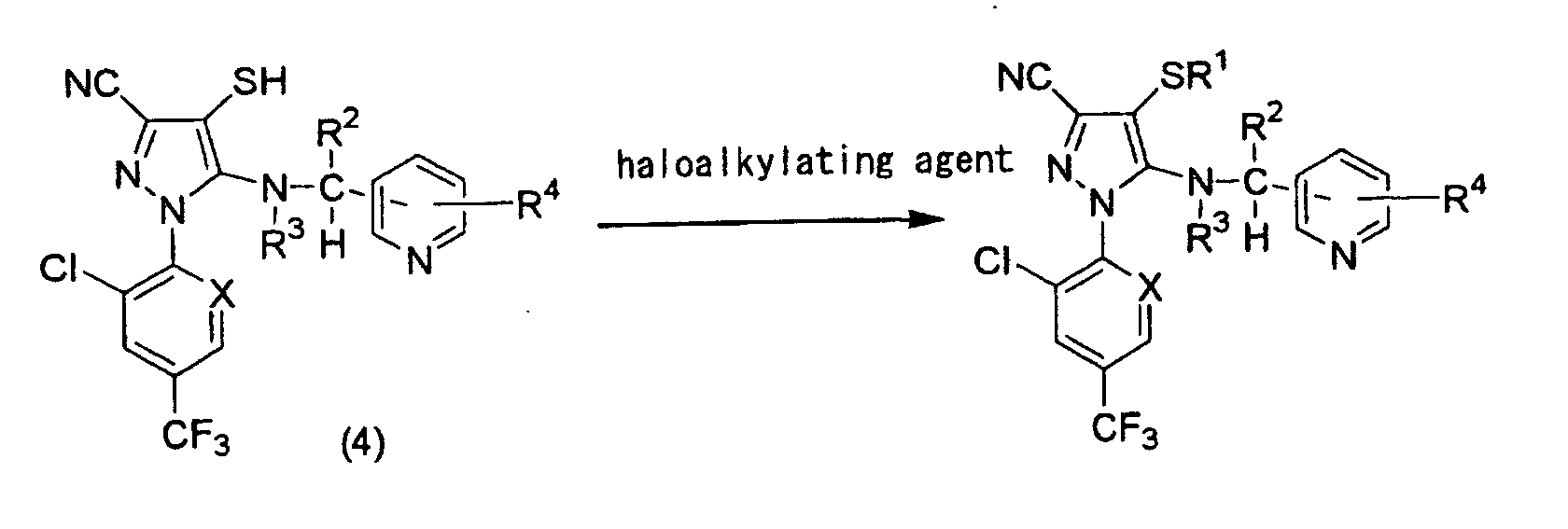
- Reaction Scheme 3 shows a process for producing a pyrazole derivative of formula (1), which comprises treating a pyrazole derivative of formula (4) with a haloalkylating agent.
- haloalkylating agent examples include a haloalkylating agent having a halomethyl group.
- the haloalkylating agent having a halomethyl group is preferably a compound having a difluoromethyl group, and more preferably a compound known as a difluorocarbene precursor.
- difluorocarbene precursor examples include compounds described in Organofluorine Compounds, p 107-111, written by Hiyama, published by Springer, and specific examples include difluoromethyl chloride, chlorodifluoroacetic acid, chlorodifluoroacetic acid metal salts, chlorodifluoroacetic acid esters, and the like.
- the solvent for use in the reaction includes an aprotic polar solvent such as N,N-dimethylformamide (DMF) and dimethyl sulfoxide (DMSO); an alcohol solvent such as methanol, ethanol, and isopropanol; a hydrocarbon solvent such as toluene and hexane; a halogenated hydrocarbon solvent such as dichloromethane and chloroform; a basic solvent such as triethylamine and liquid ammonia; and the like.
- a polar solvent such as DMF and an alcohol solvent such as ethanol and isopropanol are preferable.
- the reaction is carried out at -20°C to 200°C, preferably 0°C to 150°C for 1 to 24 hours, preferably 1 to 4 hours.
- the reaction may be carried out as a two-layer system.
- the solvent includes a two-layer system of a polar solvent such as dioxane or a hydrocarbon solvent such as toluene or xylene and a concentrated aqueous sodium hydroxide solution.
- the reaction is carried out in the presence of a phase transfer catalyst such as tetrabutylammonium bromide at a reaction temperature of -20°C to 120°C, preferably 0°C to room temperature, generally for 1 to 24 hours, preferably 1 to 4 hours, which may vary depending on a reaction scale.
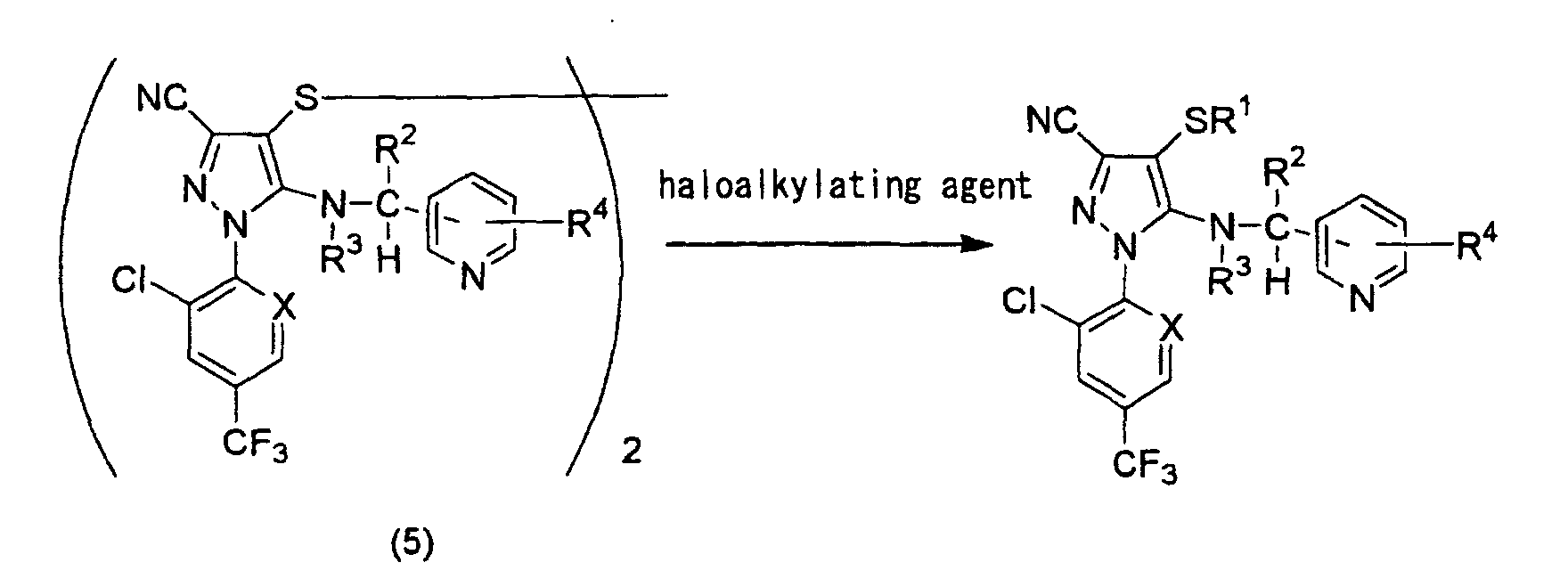
- Reaction Scheme 4 shows a process for producing a pyrazole derivative of formula (1), which comprises treating a pyrazole derivative of formula (5) with a haloalkylating agent.
- reaction is carried out in the presence of a reducing agent, if necessary.
- Examples of the reducing agent include hydrides such as sodium borohydride, zinc borohydride, and lithium aluminum hydride; metal zinc; hydrazine; and the like.
- the amount to be used is in the range of 1 to 20 molar times, preferably 1 to 5 molar times, to the substrate.
- the compound of the above formula (3), (4) or (5) can be produced by known methods using the compound of formula (2) as a starting material.
- a process for producing an amine which is commonly known (for example, the process described in Organic Functional Group Preparations I , p 377, chapter 13 (Amines), Academic Press, 1983) is applicable.
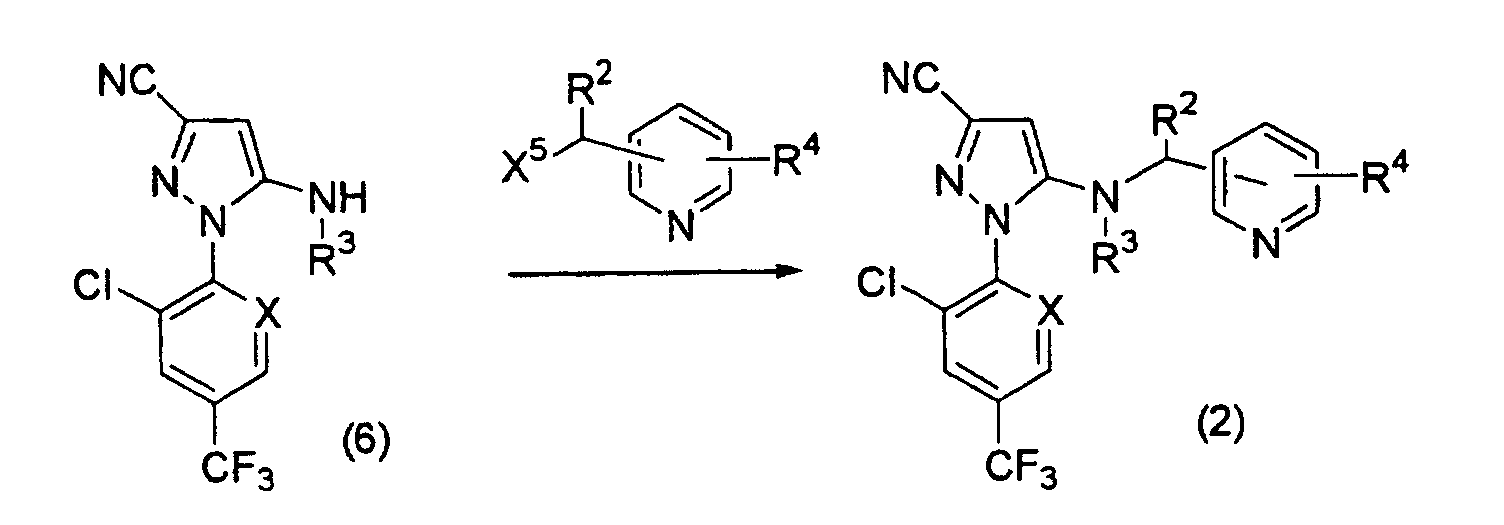
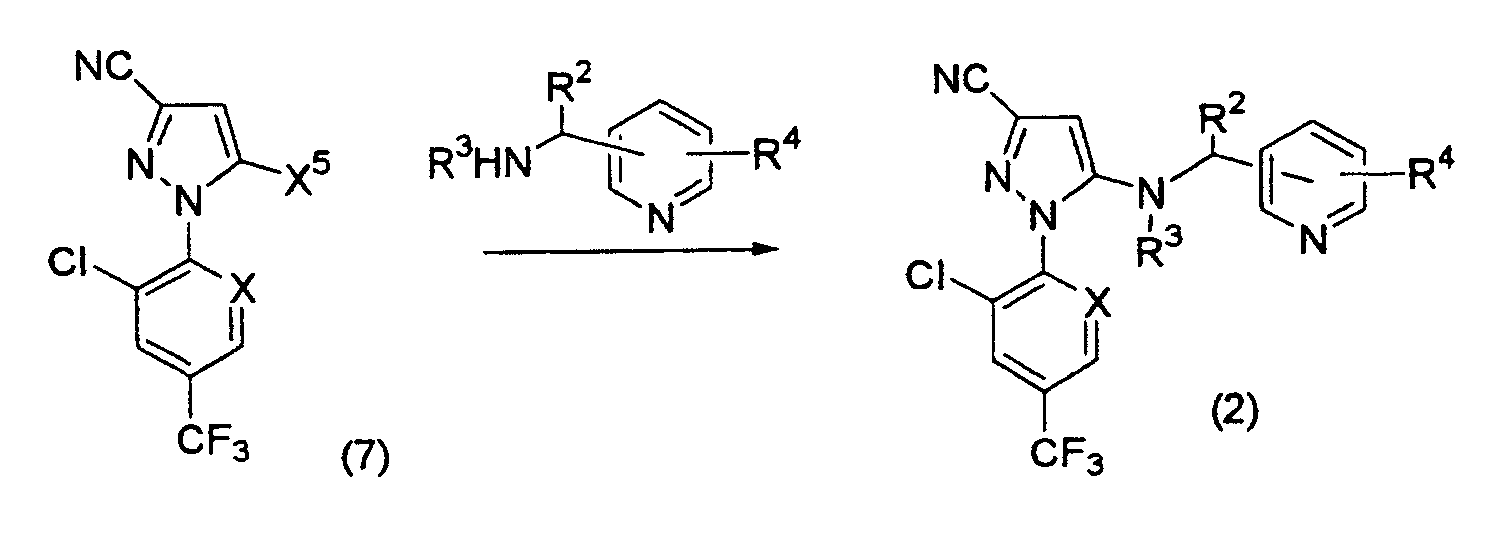
- the pyrazole derivative represented by formula (2) can be produced using the compound represented by formula (6), (7), or (8) as a starting material by the processes shown in Reaction Schemes 5 to 8.
- X 5 represents a leaving group such as a halogen atom or a hydroxyl group
- X 6 represents a halogen atom, a hydroxyl group, or an alkoxy group
- A represents an R 4 -pyridyl group
- a reagent for use in the usual reduction of an imine, amide or haloimidate can be utilized, and hydrogen or a hydrogen-donating substance is used.
- a catalyst such as palladium or platinum is usually used.
- the hydrogen-donating substance include organic hydrogen-donating substances such as formic acid and isopropanol; inorganic hydrogen-donating substances such as hydrazine; metal hydrides; and the like.
- the metal hydrides include boran-THF complex, sodium borohydride, sodium cyanoborohydride, lithium borohydride, lithium aluminum hydride, and the like.
- so-called reductive amination wherein a) formation of an imine compound (10) and b) formation of a pyrazole derivative (2) by reduction are carried out in the same step is also effective.
- the solvent for use in the reaction includes a polar solvent, for example, an ether such as diethyl ether, dioxane, and tetrahydrofuran; alcohol such as methanol, ethanol, and propanol; and the like.
- a polar solvent for example, an ether such as diethyl ether, dioxane, and tetrahydrofuran; alcohol such as methanol, ethanol, and propanol; and the like.
- the reaction is carried out at a temperature of -20°C to 120°C, preferably 0°C to room temperature, for 1 to 24 hours, preferably 1 to 4 hours.
- the chlorinating agent for use in the haloimidation includes phosphorus pentachloride, phosphorus oxy chloride, thionyl chloride, and the like.
- the solvent for use in the reaction includes a nonpolar solvent such as benzene, toluene, and xylene; a halogenated solvent such as carbon tetrachloride, chloroform, and dichloromethane; an ether solvent such as dimethoxyethane and tetrahydrofuran; and the like.
- a nonpolar solvent such as benzene, toluene, and xylene
- a halogenated solvent such as carbon tetrachloride, chloroform, and dichloromethane
- an ether solvent such as dimethoxyethane and tetrahydrofuran
- the reaction is carried out at a temperature of 0°C to 200°C, preferably room temperature to 150°C, for 1 to 24 hours, preferably 1 to 4 hours.
- the pest control agent comprising the compound of the present invention as an active ingredient has an effect of controlling pests such as pest insects and mites, and is effective for repelling, expelling, and controlling pests in wide range of cases, for example, at agriculture, forestry, stock raising, fisheries, and preservation of the products of these industries, and public health.
- the compound of the present invention exhibits excellent effects as insecticides and acaricides for use at repelling, expelling, and controlling pests in agriculture, forestry, and the like, specifically pests damaging agricultural crops at their raising, harvested crops, trees, plants for appreciation, and the like, and pests in cases for the public health.
- target pests are described below, but the present invention is not limited thereto. Furthermore, target pests are not limited to those specifically described, and the pests include their imagoes, larvae, eggs, and the like.
- the pest control agent comprising the compound of the present invention as an active ingredient is effective for repelling and controlling pests such as arthropods, mollusks, nematoda, various fungi, and the like, which damage agricultural crops, such as food crops (e.g., rice plant, oats, maize, potato, sweet potato, beans), vegetables (e.g., brassicaceous crops, cucurbitaceous fruits, eggplant, tomato, onions), fruit trees (e.g., citrus fruits, apple, grapes, peach), industrial crops (e.g., tobacco, tea, sugar beet, sugar cane, cotton, olive), crops for pasture and feed (e.g., solgums, grass pastures, leguminous pastures), plants for appreciation (e.g., herbage, flowers and ornamental plants, garden trees) at the raising of these crops.
- food crops e.g., rice plant, oats, maize, potato, sweet potato, beans
- vegetables e.g., brassicaceous crops,
- the compound of the present invention is also effective for repelling and controlling pests at the storage of harvest products from the above crops, for example, food grains, fruits, nuts, spices, and tobacco, and products resulting from subjecting them to a treatment such as drying or pulverization.
- the compound is also effective for protecting standing trees, fallen trees, processed timber, stored woods from the damage by pests such as termites or beetles.
- Lepidoptera examples include Noctuidae such as Leucania unipuncta, Heliothis assulata, Barathra brassicae, and Plusia peponis; Putellidae such as Plutella xylostella; Tortricidae such as Homona magnanima and Grapholita molesta; Psychidae such as Canephora asiatica; Lyonetiidae such as Lyonetia clerkella; Lithocolletidae such as Lithocolletis ringoniella; Acrolepiidae such as Acrolepia alliella; Aegieridae such as Aegeria molybdoceps; Heliodinidae such as Kakivoria flavofasciata; Gelechiidae such as Pectinophora gossypiella; Carposinidae such as Carposina
- Coleoptera examples include Scarabaeidae such as Anomala cuprea, Oxycetonia jucunda, and Popillia japonica; Buprestidae such as Agrilus auriventris; Elateridae such as Melanotus legatus; Coccinellidae such as Epilachna vigintioctopunctata; Cerambycidae such as Anoplophora malasiaca and Xylotrechus pyrrhoderus; Chrysomelidae such as Aulacophora femoralis, Phyllotreta striolata, and Donacia provostii; Attelabidae such as Phynchites heros; Brenthidae such as Cylas formicarius; Curculionidae such as Curculio sikkimensis and Echinocnemus squameus; and the like.
- Scarabaeidae such as Anomala cuprea, Oxycetonia
- Hemiptera examples include Pentatomidae such as Plautia stali and Halyomorpha halys; Urostylidae such as Urochela luteovaria; Coreidae such as Cletus punctiger; Alydidae such as Leptocorisa chinensis; Pyrrhocoridae such as Dysdercus cingulatus; Tingidae such as Stephanitis nashi; Miridae such as Deraeocoris amplus; Cicadidae such as Platypleura kaempferi; Aphrophoridae such as Dophoara vitis; Tektigellidae such as Oniella leucocephala; Cicadellidae such as Arboridia apicalis and Empoasca onukii; Deltocephalidae such as Nephotettix cincticeps; Delphacidae such as Laodelphax striatellus and Nila
- Thysanoptera examples include Thysanoptera such as Frankliniella occidentalis, Scirtothrips dorsalis, and Thrips palmi; Phlaeothripidae such as Ponticulcthrips diospyrosi and Haplothrips aculeatus; and the like.
- Hymenoptera examples include Tenthredinidae such as Athalia japonica; Argidae such as Arge mali; Cynipidae such as Dryocosmus kuriphilus; Megachilidae such as Megachile nipponica; and the like.
- Dioptera examples include Cecidomyiidae such as Asphondylia sp.; Tephiridae such as Wegodacus cucurbitae; Ephydridae such as Hydrellia griseola; Drosophilidae such as Drosophila suzukii; Agromyzidae such as Chromatomyia horticola and Liriomyza trifolii; Anthomyiidae such as Hylemya antiqua; and the like.
- Cecidomyiidae such as Asphondylia sp.
- Tephiridae such as Schlodacus cucurbitae
- Ephydridae such as Hydrellia griseola
- Drosophilidae such as Drosophila suzukii
- Agromyzidae such as Chromatomyia horticola and Liriomyza trifolii
- Anthomyiidae such as Hylemy
- Orthoptera examples include Tettigoniidae such as Homorocoryphus nitidulus; Gryllidae such as Calyptotrypes hihinonis; Gryllotalpidae such as Gryllotalpa afrcana; Acrididae such as Oxya japonica; and the like.
- Collembola examples include Sminthuridae such as Sminthurus viridis; Onychiuridae such as Onychiurus matsumotoi ; and the like.
- Isoptera examples include Termitidae such as Odontotermes formosanus, and the like.
- Dermaptera examples include Labiduridae such as Labidura riparia, and the like.
- crustacea Isopoda examples include Armadillidiidae such as Armadillidium vulgare, and the like.
- Arachnida Acarina examples include Tarsonemidae such as Hemitarsonemus latus and Tarsonemus pallidus; Eupodidae such as Penthaleus major; Tenuipalpidae such as Brevipalpus lewisi; Tetranychidae such as Tetranychus urticae, Tetranychus kanzawai, Panonychus citri, and Panonychus ulmi; Eriophyidae such as Aculus pelekassi, Aculus pointedendali, and Eriophyyes chibaensis; Acaridae such as Tyrophagus putrescentiae; and the like.
- Tarsonemidae such as Hemitarsonemus latus and Tarsonemus pallidus
- Eupodidae such as Penthaleus major
- Tenuipalpidae such as Brevipalpus lewisi
- Tetranychidae such as Tetranychus urtica
- Gastropoda Mesogastropoda examples of Gastropoda Mesogastropoda include Pomacea canaliculata , and the like.
- Stylommatophora examples of Stylommatophora include Achatina fulica, Incilaria bilineata, Milax gagates, Limax maximus, Acusta despecta, and the like.
- Nematoda Secernentea and Adenophorea are described below.
- Secernentea Tylenchida examples include Anguinidae such as Ditylenchus destructor; Tylenchorhynchidae such as Tylenchorhynchus claytoni; Pratylenchidae such as Pratylenchus penetrans and Pratylenchus coffeae; Hoplolaimidae such as Helicotylenchus dihystera; Heteroderidae such as Heterodera rostochiensis; Meloidogynidae such as Meloidogyne incognita; Criconematidae such as Criconemoides; Nothotylenchidae such as Nothotylencus acris; Aphelenchoidae such as Aphelenchoides fragariae; and the like.
- Anguinidae such as Ditylenchus destructor
- Tylenchorhynchidae such as Tylen
- Dorylaimida examples include Longidoridae such as Xiphinema americanum; Trichdoridae such as Paratrichodorus porosus; and the like.
- the compound of the present invention is also effective for repelling, controlling, expelling pests damaging or affecting natural forest, artificial forest, trees in urban green districts, and the like.
- specific pests are described below. Examples of Arthropoda Insecta and Arachnida are described below.
- Lepidoptera examples include Lymantriidae such as Dasychira argentata and Lymantria disper japonica; Lasiocampidae such as Dendrolimus spectabilis and Malacosoma neustria; Pyralidae such as Dioryctria abietella; Noctuidae such as Agrotis fucosa; Tortricidae such as Ptycholomoides aeriferana, Laspeyresia kurokoi, and Cydia cryptomeriae; Arctiidae such as Hyphantria cunea; Nepticulidae such as Stigmella malella; Heterogeneidae such as Parasa consocia; and the like.
- Lymantriidae such as Dasychira argentata and Lymantria disper japonica
- Lasiocampidae such as Dendrolimus spectabilis and Malacosoma
- Coleoptera examples include Scarabaeidae such as Anomala rufocuprea and Heptophylla picea; Buprestidae such as Agrilus spinipennis; Cerambycidae such as Monochamus alternatus; Chrysomelidae such as Lypesthes itoi; Curculionidae such as Scepticus griseus and Shirahoshizo coniferae; Rhynchophoridae such as Sipalinus gigas; Scolytidae such as Tomicus piniperda and Indocryphalus aceris; Bostrychidae such as Rhizopertha dominica; and the like.
- Scarabaeidae such as Anomala rufocuprea and Heptophylla picea
- Buprestidae such as Agrilus spinipennis
- Cerambycidae such as Monochamus alternatus
- Chrysomelidae such as Lypes
- Hemiptera examples include Aphididae such as Cinara todocola; Adelgidae such as Adelges japonicus; Diaspidiae such as Aspidiotus cryptomeriae; Coccidae such as Ceroplastes pseudoceriferus; and the like.
- Hymenoptera examples include Tenthredinidae such as Pristiphora erichsoni; Diprionidae such as Nesodiprion japonica; Cynipidae such as Dryocosmus kuriphilus; and the like.
- Dioptera examples include Tipulidae such as Tipula aino; Anthomyiidae such as Hylemya platura; Cecidomyiidae such as Contarinia inouyei and Contarinia matsusintome; and the like.
- Arachnida Acaria examples include Oligonychus hondoensis, Oligonychus unuguis, and the like.
- Nematoda Secernentea Tylenchida examples include Paracytaphelenchidae such as Bursaphelenchus xylophilus, and the like.
- the pest control agent comprising the compound of the present invention as an active ingredient can be employed as any preparation or any usable form prepared by formulation effective on the above agricultural or forestry cases, alone or in combination with or as a mixed preparation with other active compounds such as an insecticide, acaricide, nematicide, fungicide, synergist, plant regulator, herbicide, and toxic feed. Specific examples of the above other active compounds are described below, which are not limited thereto.
- organophosphorus agents include dichlorvos, fenitorothion, malathion, naled, chlorpyrifos, diazinon, tetrachorvinphos, fenthion, isoxathion, methidathion, salithion, acephate, demeton-S-methyl, disulfoton, monocrotophos, azinephos-methyl, parathion, phosalone, pyrimiphos-methyl, and prothiofos.
- carbamate agents examples include methorcarb, fenobcarb, propoxur, carbaryl, ethiofencarb, pyrimicarb, bendiocarb, carbosulfan, carbofuran, methomyl, thiodicarb, and the like.
- organochlorine agents include lindane, DDT, endosulfan, aldrin, chlordene, and the like.
- pyrethroid agents include permethrin, cypermethrin, deltamethrin, cyhalothrin, cyfluthrin, acrinathrin, fenvalerate, ethofenprox, silafluofen, fluvalinate, flucythrinate, bifenthrin, allethrin, phenothrin, fenpropathrin, cyphenothrin, furamethrin, resmethrin, transfurthrin, prallethrin, flufeneprox, halfenprox, imiprothrin, and the like.
- neonicotinoid agents include imidacloprid, nitenpyram, acetamiprid, dinotefuran, thiamethoxam, thiacloprid, clothianidin, and the like.
- insect growth regulators such as phenylbenzoylurea include diflubenzuron, chlorfluazuron, triflumuron, flufenoxuron, hexaflumuron, lufenuron, teflubenzuron, buprofezin, tebufenozide, chromafenozide, methoxyfenozide, cyromazine, and the like.
- juvenile hormone agents include pyriproxyfen, fenoxycarb, methoprene, hydroprene, and the like.
- insecticidal substances produced by microorganisms include abamectin, milbemectin, nikkomycin, emamectin benzoate, ivermectin, spinosad, and the like.
- insecticides examples include cartap, bensultap, chlorfenapyr, diafenthiuron, nicotine sulfate, metaldehyde, fipronil, pymetrozine, indoxacarb, tolfenpyrad, pyridalyl, and the like.
- Examples of acaricides includes dicofol, phenisobromolate, benzomate, tetradifon, polynactins, amitraz, propargite, fenbutatin oxide, tricyclohexyltin hydroxide, tebufenpyrad, pyridaben, fenpyroximate, pyrimidifen, fenazaquin, clofentezine, hexathiazox, acequinocyl, chinomethionat, fenothiocarb, ethoxazole, bifenazate, fluacrypyrim, and the like.
- active compounds of nematicides include methyl isocyanate, fosthiazate, oxamyl, mesulfenfos, cadusafos, and the like.
- Examples of toxic feeds include monofluoroacetic acid, warfarin, coumatetralyl, diphacinone, and the like.
- active compounds of fungicides include inorganic coppers, organic coppers, sulfur, maneb, thiram, thiadiazine, captan, chlorothalonil, iprobenfos, thiophanate methyl, benomyl, thiabendazole, iprodione, procymidone, pencycuron, metalaxyl, sandofan, byleton, triflumizole, fenarimol, triforine, dithianon, triazine, fluazinam, probenasole; diethofencarb, isoprothiolane, pyroquilon, iminoctadine acetate, echlomezol, dazomet, kresoxime methyl, carpropamid, diclocymet, tricyclozole, probenazole, ipconazole, azoxystrobin, metominostrobin, acibenzolar-S-methyl, fenoxanil, the compound represented
- NNF-9850 (Nihon Nohyaku Co., Ltd.), the compound represented by Code No. BJL-003 (BASF), the compound represented by Code No. DF-391 (Dainippon Ink & Chemicals, Incorporated), and the like.
- active compounds of synergists include bis(2,3,3,3-tetrachloropropyl) ether, N-(2-ethylhexyl)bicyclo[2.1.1]hept-5-ene-2,3-dicarboxyimide, ⁇ -[2-(2-butoxyethoxy)ethoxy]-4,5-methylenedioxy-2-propyltoluene, and the like.
- active compounds of herbicides include bialaphos, sethoxydim, trifluralin, mefenacet, and the like.
- active compounds of plant regulators include indoleacetic acid, ethephon, 4-CPA, and the like.
- active compounds of repellents include carane-3,4-diol, N,N-diethyl-m-triamide (Deet), limonene, linalool, citronellal, menthone, hinokitiol, menthol, geraniol, eucalyptol, and the like.
- the pest control agent of the present invention may be employed in any forms, and the compound of formula (1) is formulated together with auxiliaries for pesticides to produce preparations, e.g., wettable powders, wettable granules, aqueous solutions, emulsions, liquids, flowable agents including suspensions in water and emulsions in water, capsules, dusts, granules, and aerosols, which are then used.
- auxiliaries for pesticides e.g., wettable powders, wettable granules, aqueous solutions, emulsions, liquids, flowable agents including suspensions in water and emulsions in water, capsules, dusts, granules, and aerosols, which are then used.
- Any amount of the active ingredient compound such as the compound of the present invention may be contained in the preparations but the content is usually selected from the range of from 0.001 to 99.5% by weight as total amount of the active ingredients, being appropriately decided in accord
- the content of the active ingredients ranges about 0.01 to 90% by weight, preferably 1 to 50% by weight, in wettable powders, wettable granules, aqueous solutions, emulsions, liquids, flowable agents, capsules, and the like; about 0.1 to 50% by weight, preferably 1 to 10% by weight, in dusts and granules; or about 0.001 to 20% by weight, preferably 0.01 to 2% by weight, in aerosols and the like.
- the auxiliaries for pesticides are used for the purposes of improvement of the repelling effect, controlling effect, and expelling effect against pests, improvement of stabilization and dispersibility, and the like.
- Examples include carriers (diluents), spreaders, emulsifiers, wetting agents, dispersants, and disintegrators.
- Liquid carriers include water; aromatic hydrocarbons such as toluene and xylene; alcohols such as methanol, butanol and glycol; ketones such as acetone; amides such as dimethylformamide; sulfoxides such as dimethyl sulfoxide; methylnaphthalene; cyclohexane; animal or vegetable oils; fatty acids; and the like.
- Solid carriers include clay, kaolin, talc, diatomaceous earth, silica, calcium carbonate, montmorillonite, bentonite, feldspar, quartz, alumina, sawdust, nitrocellulose, starch, gum arabic, and the like.
- Usual surfactants can be used as emulsifiers or dispersants.
- anionic, cationic, nonionic or amphoteric surfactants such as sodium higher alcohol sulfates, stearyltrimethylammonium chloride, polyoxyethylene alkylphenyl ethers, and lauryl betaine, are useful.
- spreaders such as polyoxyethylene nonylphenyl ether and polyoxyethylene laurylphenyl ether; wetting agents such as dialkyl sulfosuccinates; fixing agents such as carboxymethyl cellulose and polyvinyl alcohol; and disintegrators such as sodium lignin sulfonate and sodium lauryl sulfate can be used.
- a bulk powder is prepared by mixing the compound of formula (I) as an active ingredient, with a solid carrier, a surfactant, etc ., and the bulk power can be applied after dilution to a prescribed concentration with water on use.
- a bulk liquid of an emulsion is prepared by mixing the above compound as an active ingredient with a solvent, a surfactant, etc ., and the bulk liquid can be applied after dilution to a prescribed concentration with water on use.
- a dust is prepared by mixing the above compound as an active ingredient with a solid carrier, etc. and can be applied as such.
- a granule is prepared by mixing the above compound as an active ingredient with a solid carrier, a surfactant, etc. , followed by granulation.
- the granule can be applied as such.
- the methods for preparing the above-described preparations of various forms are not limited to the above-described methods, and those skilled in the art can optionally select an appropriate method depending on the kind of the active ingredient, the purpose of application, and the like.
- the preparations may be generally applied in an amount of the active ingredient ranging from 0.1 to 1000 g, preferably 1 to 100 g, per 10 are to the place where damage by the pests occurs or where the occurrence of damage is predicted.
- the above wettable powders, wettable granules, aqueous solutions, emulsions, liquids, flowable agents including suspensions in water and emulsions in water, capsules, and the like may be diluted with water and sprayed onto crops, trees, and the like in an amount ranging from 10 to 1000 liter per 10 are depending on the kind, cultivation form, and growth state of target crops, trees, and the like.
- the preparations may be applied as such to crops, trees, and the like within the range described in the above method of use.
- the wettable powders, wettable granules, aqueous solutions, emulsions, liquids, flowable agents including suspensions in water and emulsions in water, capsules, and the like may be, for example, diluted with water and applied generally in an amount ranging from 5 to 500 liter per 10 are.
- the preparations may be sprayed on the soil surface uniformly over the whole area to be applied or may be irrigated into soil.
- the preparations are dusts or granules
- the preparations as such may be sprayed on the soil surface uniformly over the whole area to be applied.
- the preparations may be applied only to the vicinity of seeds, crops, trees, and the like to be protected from the damage by pests or the soil may be turned over during or after the spraying to disperse the active ingredient mechanically.
- the outbreak of disease and pests can be also suppressed over a long period of time by using the compound of the present invention for coating seeds and sowing them.
- seeds are coated with a wettable powder, sol or dust prepared so as to contain the compound of the present invention is coated around the wetted seeds.
- the wettable powder, sol or dust is preferably used in an amount of 1 to 1000 g, preferably 10 to 200 g, per 100 g of seeds.
- a granule comprising the compound of the present invention is mixed with soil for sowing and the soil is placed in a nursery bed.
- the soil to which the granule is applied may be used only for bed soil for the nursery bed, the soil to which the granule is applied may be used only for covering soil of a nursery box, or the soil may be used for both of bed soil and covering soil.
- the granule is used in an amount of preferably 0.1 to 100 g, more preferably 1 to 50 g, per 1.0 kg of soil.
- a granule comprising the compound of the present invention may be applied by a method of dispersing it around the place where seeds are sown or by a method of dispersing the granule onto the place covered with soil after sowing.
- the granule is generally used in an amount of preferably 1 to 1000 g, more preferably 10 to 100 g, per one box of a nursery box (usually, one box of the nursery box corresponds to 0.5 a at fixing planting).
- a wettable powder, dust, or the like may be used in a similar applying method instead of the granule.
- a granule comprising the compound of the present invention is applied to a nursery box by dispersing it.
- the granule is generally used in an amount of preferably 1 to 1000 g, more preferably 10 to 100 g, per one box of a nursery box (usually, one box of the nursery box corresponds to 0.5 a at fixing planting).
- liquid or sol flowable agent
- microcapsule preparation they may be used by irrigating a nursery box as they are or after diluting them with water.
- a wettable powder, wettable granule, aqueous solution, and aqueous granule solution they may be used by irrigating a nursery box after diluting them with water.
- the pest control agent comprising the compound of the present invention as an active ingredient can be employed alone or in combination with or as a mixed preparation with other active compounds such as an insecticide, acaricide, nematicide, fungicide, repellant, and synergist.
- any amount of the active ingredient such as the compound of the present invention may be contained in the preparations but the content is usually in the range of 0.0001 to 95% by weight as total amount of the active ingredients. It is preferable to contain the active ingredient in an amount of 0.005 to 10% by weight in oil solutions, dusts, granules, and the like and in an amount of 0.01 to 50% by weight in emulsions, wettable powders, sols, and the like. Specifically, in the case of expelling or controlling termites or beetles, the preparations may be sprayed onto the surface of soil or timber and woods in an amount of 0.01 to 100 g per 1 m 2 as the amount of the active ingredient.
- the pest control agent comprising the compound of the present invention as an active ingredient is effective for repelling, expelling, and controlling pests such as arthropods, nematodes, trematodes, cestoids, and protozoa, which are parasitic internally or externally to animals and pets raised in stock raising industry, fisheries, and homes and which give direct damage such as ingestion of skin or the like and blood-sucking or give damage such as disease-spreading, and the agent can be used for preventing and treating the diseases relating to theses pests.
- pests such as arthropods, nematodes, trematodes, cestoids, and protozoa, which are parasitic internally or externally to animals and pets raised in stock raising industry, fisheries, and homes and which give direct damage such as ingestion of skin or the like and blood-sucking or give damage such as disease-spreading, and the agent can be used for preventing and treating the diseases relating to theses pests.
- Target animals include spinal animals such as livestock including cattle, sheep, goat, horse, swine, and the like and cultural fishes; pets and experimental animals such as domestic fowls, dog, cat, etc ., rodents including mouse, rat, hamster, squirrel, etc ., Carnivora including ferret, etc ., fishes, and the like.
- Examples of Arthropoda Insecta and Arachnida include Tabanidae such as Chrysops japonica, Simulium iwatens, and Tabanus trigonus; Muscidae such as Ophyra leucostoma, Musca domestica, and Stomoxys calcitrans; Gasterophilidae such as Gasterophilus intestinalis; Hypodermidae such as Hypoderma bovis; Calliphoridae such as Phaenicia cuprina; Phoridae such as Megaseria spiracularis; Sepsidae such as Sepsis monostigma; Psychodidae such as Telmatoscopus albipunctatus and Psychoda alternata; Culicidae such as Anopheles hyrcanus sinensis, Culex tritaeniorhynchus, and Aedes albopictus; Simuliidae
- Siphonaptera examples include Fulicidae such as Ctenocephalides felis and Ctenocephalides canis, and the like.
- Anoplura examples include Echinophthlegidae such as Haematopinus suis and Haematopinus eurysternus; Trichodectidae such as Damalinia equi; Linognathidae such as Linognathus vituli; Menoponidae such as Menopon gallinae; and the like.
- Arthropoda Arachnida Acarina examples include Ixodidae such as Haemaphysalis longicornis, Ixodes ovatus, Boophilus microplus, and Amblyomma testudinarium; Macronyssidae such as Ornithonyssus sylviarum; Dermanyssidae such as Dermanyssus gallinae; Demodicidae such as Demodex suis; Sarcoptidae such as Notoederes cati and Sarcoptes sylvianum; Psoroptidae such as Otodectes cynotis and Psoroptes bovis; and the like.
- Ixodidae such as Haemaphysalis longicornis, Ixodes ovatus, Boophilus microplus, and Amblyomma testudinarium
- Macronyssidae such as Ornithonyss
- Nematoda Phasmidia examples include Ancylostoma, Stephanurus dentatus, Metastrongylus elongatus, Trichostrongylus, Oesophagostomum, and the like.
- Examples of Ascarida include Ascarus lumbricoides, Parascaris equorum, and the like.
- Platyhelminthes Trematoda examples include Schistosoma japonicum, Fasciola hepatica, Paramphistomum cervi, Paragonimus westermanii, Prosthogonimus japonicus, and the like.
- Cestoda examples include Anoplocephala perfoliata, Moniezia expansa, Moniezia benedeni, Raillietina tetragona, Raillietina sp., Raillietina cesticillus, and the like.
- Protozoa Mastigophora examples include Histomonas and the like as Rhizomastigida; Leishmania, Trypanosoma, and the like as Tripanpsomidae; Giardia and the like as Polymastigida; and Trichomonas and the like as Trichomonadia.
- examples of Sarcodina Amoebida include Entamoeba and the like.
- examples of Sporozoa Piroplasmea include Theilaria, Babesia and the like.
- Examples of Telosporidia include Eimeria, Plasmodium, Toxoplasma, and the like.
- the pest control agent comprising the compound of the present invention as an active ingredient can be employed as any preparation or any usable form prepared by formulation effective on the above agricultural or forestry cases, alone or in combination with or as a mixed preparation with other active compounds such as an insecticide, acaricide, nematicide, fungicide, synergist, plant regulator, herbicide, and toxic feed.
- active compounds such as an insecticide, acaricide, nematicide, fungicide, synergist, plant regulator, herbicide, and toxic feed.
- the specific application methods include incorporation into feeds of livestock, pets, and the like; oral administration as a suitable orally-ingestible formulated composition, e.g., a tablet, pill, capsule, paste, gel, drink, medicated feed, medicated drink, medicated additional feed, sustained release large pill, or sustained release device so as to be retained in gastrointestinal tracts containing a pharmaceutically acceptable carrier and coating substance; and percutaneous application as a spray, powder, grease, cream, ointment, emulsion, lotion, preparation for spot-on, preparation for pour-on, shampoo, or the like.
- a suitable orally-ingestible formulated composition e.g., a tablet, pill, capsule, paste, gel, drink, medicated feed, medicated drink, medicated additional feed, sustained release large pill, or sustained release device so as to be retained in gastrointestinal tracts containing a pharmaceutically acceptable carrier and coating substance
- percutaneous application as a spray, powder, grease, cream, ointment, emulsion, lotion, preparation for spot
- devices e.g., collars, medallions, and ear-tags attached to animals so as to control arthropods topically or systemically may be utilized.
- a suspension or dispersion may be usually formed by dissolving an active ingredient into an appropriate nontoxic solvent or water together with a suspending agent such as bentonite, a wetting agent, or other excipients, and an antifoaming agent may be contained, if necessary.
- the drink generally contains the active ingredient in an amount of 0.01 to 1.0% by weight, preferably 0.01 to 0.1% by weight.
- unit usable forms of dry solid a capsule, pill, or tablet containing a predetermined amount of the active ingredient is usually employed.
- These usable forms may be prepared by mixing the active ingredient homogeneously with a suitably pulverized diluent, filler, disintegrator, and/or binders, such as starch, lactose, talc, magnesium stearate, plant gum, and the like.
- the quantity and content of an anthelmintic may be optionally determined depending on the kind of host animal to be treated, the extent of infection, the kind of parasite, and the body weight of the host.
- the compound of the active ingredient is contained in the final feed in an amount of 0.0001 to 0.05% by weight, preferably 0.0005 to 0.01% by weight.
- the preparations may be administered parenterally to animals by injection to proventriculus, or intramuscular, endotracheal, or subcutaneous injection.
- the compound of the active ingredient is preferably mixed with a vegetable oil such as peanuts oil or cottonseed oil.
- the compound of the active ingredient is generally contained in an amount of 0.05 to 50% by weight, preferably 0.1 to 0.2% by weight.
- the preparation mixed with a carrier such as an aliphatic alcohol, a hydrocarbon solvent, or the like can be applied directly and topically to the outer surface of livestock or pets by spraying or direct pouring.
- a carrier such as an aliphatic alcohol, a hydrocarbon solvent, or the like
- the compound of the active ingredient is generally contained in an amount of 0.05 to 50% by weight, preferably 1 to 20% by weight.
- crystallization-inhibiting agents such as surfactants and film-forming agents.
- the compound of the active ingredient is generally contained in an amount of about 0.1 to 40% by weight, preferably about 1 to 15% by weight.
- the parent material may be optionally selected depending on the usable forms, and examples include molded articles of thermoplastic resins such as vinyl chloride resin and fabric articles produced from textile products such as cotton and polyesters.
- the pest control agent comprising the compound of the present invention as an active ingredient is also effective for repelling, expelling, and controlling pests on cases for public health which adversely affect the environment of food, clothing and shelter, or further damage human bodies or transporting or carrying pathogens, for the purpose of keeping public health conditions.
- the pest control agent of the present invention is effective for repelling, expelling, and controlling lepidopteran, beetles, bookworms, cockroaches, flies, and mites which damage houses themselves and indoor or outdoor timber, wood products such as wood furniture, stored foods, clothes, books, animal goods (leather, fur, wool, feathers, etc .), plant goods (clothes, paper, etc .), and the like, and adversely affect healthy life. Specific examples of pests on such public health cases are described below.
- Arthropoda Insecta examples include Lymantriidae such as Euproctis similis; Lasiocampidae such as Dendrolimus undans flaveola; Heterogeneidae such as Parasa consocia; Zygaenidae such as Artona funeralis; Pyralidae such as Cadra cautella, Ephestia cautella, and Plodia interpunctella; Gelechiidae such as Sitotroga cerearella; Tineidae such as Tinea pellionella and Tineola bisselliella; and the like.
- Lymantriidae such as Euproctis similis
- Lasiocampidae such as Dendrolimus undans flaveola
- Heterogeneidae such as Parasa consocia
- Zygaenidae such as Artona funeralis
- Pyralidae such as Cadra cautella, Ephesti
- Coleoptera examples include Oedemeridae such as Xanthochroa waterhousei; Meloidae such as Epicauta gorhami; Staphylinidae such as Paederus fuscipes; Rhynchophoridae such as Sitophilus zeamais and Sitophilus oryzae; Bruchidae such as Callosobruchus chinensis, Bruchus pisorum, and Bruchus rufimanus; Tenebrionidae such as Tribolium castaneum; Cucujidae such as Oryzoephilus surinamensis and Placonotus testaceus; Anobiidae such as Lasioderma serricorne and Stegobium paniceum; Dermestidae such as Attagenus unicolor, Anthrenus verbasci, and Dermestes maculatus; Ptinidae such as Gibbium aequinoctiale
- Hymenoptera examples include Vespidae such as Vespa mandarinia; Formicidae such as Brachyponera chinensis; Pompilidae such as Batozonellus annulatus; and the like.
- Diptera examples include Culicidae such as Aedes jaonica; Ceratopogonidae such as Culicoides sp.; Chironomidae such as Chironomus dorsalis; Simuliidae such as Simulium aokii; Tabanidae such as Chrysops japonicus; Muscidae such as Musca domestica; Anthomyiidae such as Fannia canicularis; Calliphoridae such as Phormia regina; Sarcophagidae such as Boettcherisca peregrina; Drosophilidae such as Drosophila virilis; Piophilidae such as Piophila casei; and the like.
- Culicidae such as Aedes jaonica
- Ceratopogonidae such as Culicoides sp.
- Chironomidae such as Chironomus dorsalis
- Siphonaptera examples include Pulicidae such as Pulex irritans, and the like.
- Collembola examples include Neogastruridae such as Neogastruna communis, and the like.
- Examples of Blattaria include Blattellidae such as Blattela germania and Asiablatta kyotensis; Blattidae such as Periplaneta americana, Periplaneta fuliginosa, and Periplaneta japonica; and the like.
- Orthoptera examples include Gryllacridoidea such as Diestrammena japonica and Steropelmatidae, and the like.
- Anoplura examples include Pediculidae such as Pediculus humanus capitis; Pthiridae such as Pthirus pubis; and the like.
- Hemiptera examples include Cimicidae such as Cimex lectularius; Reduriidae such as Isyndus obscurus; and the like.
- Isoptera examples include Phinotermitidae such as Reticulitermes speratus and Coptotermes formosanus; Kalotermitidae such as Cryptotermes domesticus; and the like.
- Psocoptera examples include Trogiidae such as Lepinotus reticulatus; Liposcelidae such as Liposcelis bostrichophilus; and the like.
- Thysanura include Lepismatidae such as Ctenolepisma villosa and Lepisma saccharina, and the like.
- Acarina examples include Ixodidae such as Ixodes persulcatus; Macronyssidae such as Ornithonyssus bacoti; Cheyletidae such as Chelacaropsis moorei; Pyemotidae such as Pyemotes tritici; Demodicidae such as Demodex folliculorum; Pyroglyphidae such as Pexmatophagoides pteronyssius; Sarcoptidae such as Sarcoptes scabiei; Trombiculidae such as Leptotrombidum akamushi; Acaridae such as Tyrophagus putrescentiae and Lardoglyphus konoi; Carpoglyphidae such as Carpoglyphus lactis; and the like.
- Ixodidae such as Ixodes persulcatus
- Macronyssidae such as Ornithonyss
- Araneae examples include Clubionidae such as Chiracanthium japonicum; Heteropodidae such as Heteropoda venatoria; Pholcidae such as Spermophora senoculata and Pholcus phalangioides; Urocteidae such as Uroctea compactilis; and Salticidae such as Plexippus paykulli and Plexippus setipes; and the like.
- Clubionidae such as Chiracanthium japonicum
- Heteropodidae such as Heteropoda venatoria
- Pholcidae such as Spermophora senoculata and Pholcus phalangioides
- Urocteidae such as Uroctea compactilis
- Salticidae such as Plexippus paykulli and Plexippus setipes; and the like.
- Scorpiones include Buthidae such as Isometrus europaeus, and the like.
- examples of Chilopoda Scolopendromorpha include Scolopendridae such as Scolopendra subspinipes and Otostigmus multispinosus, and the like.
- Examples of Scutigeromorpha include Scutigeridae such as Thereuonema hilgendorfi, and the like.
- examples of Arthropoda Diplopoda Polydesmoidea include Strongylosomidae such as Oxidus gracilis, and the like.
- Examples of Arthropoda Crustacea Isopoda include Oniscidae such as Porcellio scaber, and the like.
- examples of Annelida Hirudinea Gnathobdellida include Haemadipsidae such as Haemadipsa zeylanica japonica, and the like.
- the pest control agent comprising the compound of the present invention as an active ingredient can be employed as any preparation or any usable form prepared by formulation effective on the above public health cases, alone or in combination with or as a mixed preparation with other active compounds such as an insecticide, acaricide, nematicide, fungicide, synergist, plant regulator, herbicide, and toxic feed.
- active compounds such as an insecticide, acaricide, nematicide, fungicide, synergist, plant regulator, herbicide, and toxic feed.
- the usable form of the pest control agent of the present invention may be any form and the protection of the above animal goods or plant goods can be achieved by spraying an oil solution, emulsion, wettable powder, dust, or the like, placing a resin steam-fogging agent, treating with a smoking agent or aerosol, placing a granule, tablet, or toxic feeds, spraying an aerosol, or the like.
- the compound of the active ingredient is preferably contained in the preparations in an amount of 0.0001 to 95% by weight.
- Examples of application method, against pests, for example, directly damaging arthropods, disease-carrying arthropods, and the like include methods of spraying, injecting, irrigating, and applying an oil solution, emulsion, wettable powder, or the like, spraying a dust or the like, treating with a preparation such as a fumigant, mosquito coil, heat aerosol including self-combustion type smoking agent or chemically reactive aerosol, smoking agent including fogging, or ULV agent, and others.
- a granule, tablet, or toxic feed for example, may be placed as other form, or a floating dust, granule, or the like may be applied by adding them dropwise into waterways, wells, reservoirs, water tanks, and other running water or retained water.
- Euproctis which is also a pest in agriculture and forestry can be controlled in a similar manner to the methods described in the article of "(A) Cases such as agriculture and forestry".
- the preparations which are useable forms thereof may be present as mixed preparations together with the above-described other active compound such as an insecticide, acaricide, nematicide, fungicide, repellant, or synergist, and the compound of the active ingredient is preferably contained in these preparations in an amount of 0.0001 to 95% by weight in total.
- the preparations in combination with other active compounds on use.
- the compound of the present invention can be also employed alone or in combination with or as a mixed preparation with other active compounds such as an insecticide, acaricide, nematicide, fungicide, repellant, and synergist.
- any amount of the compound of the active ingredient such as the compound of the present invention may be contained in the preparations but the content is usually in the range of 0.0001 to 95% by weight as a total amount of the active ingredients. It is preferable to contain the compounds in an amount of 0.005 to 10% by weight in oil solutions, dusts, granules, and the like and in an amount of 0.01 to 50% by weight in emulsions, wettable powders, sols, and the like. Specifically, in the case of expelling or controlling termites or beetles, the preparations may be sprayed to the vicinity or directly onto the surface in an amount of 0.01 to 100 g per 1 m 2 as the amount of the compound of the active ingredient.
- oral administration as a suitable orally-ingestible formulated composition, e.g., a tablet, pill, capsule, paste, gel, drink, medicated feed, medicated drink, medicated additional feed, sustained release large pill, or sustained release device so as to be retained in gastrointestinal tracts containing a pharmaceutically acceptable carrier and coating substance; and percutaneous application as spay, powder, grease, cream, ointment, emulsion, lotion, preparation for spot-on, preparation for pour-on, shampoo, or the like.
- a suitable orally-ingestible formulated composition e.g., a tablet, pill, capsule, paste, gel, drink, medicated feed, medicated drink, medicated additional feed, sustained release large pill, or sustained release device so as to be retained in gastrointestinal tracts containing a pharmaceutically acceptable carrier and coating substance
- percutaneous application as spay, powder, grease, cream, ointment, emulsion, lotion, preparation for spot-on, preparation for pour-on, shampoo, or the like.
- silica sand was placed in a rolling granulator and wetted, 2 parts of the compound of the present invention, 3 parts of calcium lignin sulfonate, 0.5 part of polyvinyl alcohol (PVA), 0.5 part of white carbon, and 94 parts of silica sand which had been mixed and grounded beforehand were charged thereto to effect coating, and then the resulting product was dried and sized to thereby obtain a granule.
- PVA polyvinyl alcohol
- Granule seeds coated with dust were:
- a dust prepared by uniformly mixing and grinding 2 parts of the compound of the present invention, 6 parts of calcium lignin sulfonate, and 82 parts of polyvinyl al, clay was mixed with seeds wetted beforehand, and the mixture was air-dried to thereby obtain coated seeds.
- a rice seedling was planted in a glass cylinder (inner diameter: 3 cm ⁇ length: 17 cm), and five 4th instar larvae of Nilaparvata lugens were set free therein.
- An agricultural and horticultural insecticide of the present invention was prepared in accordance with Formulation Example 3 and diluted with water, and 0.5 ml of the resulting dilution was sprayed into the above glass cylinder with a spraying tower (manufactured by Mizuho Rika) (duplicates at a concentration).
- the cylinder was kept in a constant temperature room at 25°C, and the mortality and agony of the larvae were investigated after 5 days from the treatment to obtain a death rate (%) taking an agonizing insect as a 1/2 dead insect.
- the results obtained are shown in Table 2 (the compound numbers in the table correspond to the numbers in Table 1).
- a disc (diameter: 6 cm) cut out of a cabbage leaf was soaked for 1 minute in an aqueous dilution of the agricultural and horticultural insecticide of the present invention prepared in accordance with Formulation Example 1, then air-dried, and placed in a plastic cup (inner diameter: 7 cm).
- Five 3-instar larvae of Plutella xylostella were set free in the cup (duplicates at a concentration).
- the cup was kept in a constant temperature room at 25°C, and the death and agony of the larvae were investigated after 4 days from the treatment to obtain a death rate (%) taking an agonizing insect as a 1/2 dead insect.
- the results are shown in Table 3 (the compound numbers in the following table below correspond to the numbers in Table 1).
- the cylinder was kept in the constant temperature room at 25°C, and the number of the insects on the leaves was counted on the 4th day after the treatment to obtain a death rate (%) based on the results.
- the results obtained are shown in Table 5 (the compound numbers in the table correspond to the numbers in Table 1).
- Roots of young rice seedlings (height: about 10 cm) planted in a plastic cup were washed with water and soil was washed away so as not to damage the fine roots.
- the stem was pinched by a urethane tip (diameter: 3 cm, height: 2 cm) having a cut line and the roots were inserted into an Erlenmeyer flask to which 50 ml of an agent solution (an aqueous dilution of the agricultural and horticultural insecticide of the present invention prepared in accordance with Formulation Example 1) was placed beforehand (2 to 3 young rice seedlings/flask).
- the urethane chip was wedged into the mouse of the flask to fix the rice seedlings.
- a glass tube (diameter: 3 cm, height: 5 cm) was placed thereon, wedged into the urethane chip, and fixed with a tape. The flask in such state was kept in a constant temperature room at 25°C for 3 days. Five larvae of Nilaparvata lugens were placed in the glass tube and then the tube was capped with a urethane chip, followed by keeping in the constant temperature room at 25°C (duplicates at a concentration). The mortality and agony of the larvae were investigated on 4th day after the treatment to obtain a death rate (%) taking an agonizing insect as a 1/2 dead insect. This test was carried out on two agent solutions different in the concentration of the active ingredient. The results are shown in Table 6 (the compound numbers in the table correspond to the numbers in Table 1).
- Brown rice planthopper (Nilaparvata lugens) is a highly problematic pest insect species in agricultural and horticultural cases, but a sufficient effect cannot be attained by the application method of spraying an agent to stems and leafs, provided that the detection is delayed or that an enough amount of the agent is not spread to the roots.
- IMC In vitro intercellular metabolic cooperation inhibition test
- a mixed culture system of Chinese hamster lung fibroblast line V79 (hgprt+) having hypoxanthine-guanine phosphoribosyltransferase activity and cells having no such activity (hgprt-) was treated by adding thereto the following compounds together with 6-thioguanine (6-TG).
- 6-TG 6-thioguanine
- the toxic metabolite of 6-TG formed in hgprt+ cells (6-TG sensitive) is transferred into hgprt- cells (6-TG resistant) through gap junction, so that both of the cells die.
- the intracellular communication is inhibited by the test compound, only the hgprt- cells survive and form colonies.
- the compound of the present invention was found to have a lower carcinogenic risk than Compound I.
- the 1-aryl-3-cyano-5-pyridylalkylaminopyrazole derivatives of the present invention are compounds useful as novel pest control agents having combined characteristics of a systemic activity and a high safety in addition to an excellent insecticidal activity and a wide insecticidal spectrum.
Landscapes
- Chemical & Material Sciences (AREA)
- Organic Chemistry (AREA)
- Life Sciences & Earth Sciences (AREA)
- Agronomy & Crop Science (AREA)
- Pest Control & Pesticides (AREA)
- Plant Pathology (AREA)
- Health & Medical Sciences (AREA)
- Engineering & Computer Science (AREA)
- Dentistry (AREA)
- General Health & Medical Sciences (AREA)
- Wood Science & Technology (AREA)
- Zoology (AREA)
- Environmental Sciences (AREA)
- Agricultural Chemicals And Associated Chemicals (AREA)
- Plural Heterocyclic Compounds (AREA)
- Pharmaceuticals Containing Other Organic And Inorganic Compounds (AREA)
- Nitrogen Condensed Heterocyclic Rings (AREA)
Abstract
Description






Melting point: 204°C
1HNMR (CDCl3) : 4.41 (2H, d), 4.68 (1H, t), 5.39 (1H, s), 5.56 (1H, s), 7.04 (2H, d), 7.67 (2H, s), 8.49 (2H, d)
Melting point: 117-120°C
1HNMR (CDCl3) : 4.57 (2H, d), 5.88 (1H, m), 6.73 (1H, t), 7.19 (2H, t), 7.66 (1H, t), 7.77 (2H, s), 8.41 (1H, d)
No. 3:
1HNMR (CDCl3): 4.47 (2H, d), 4.67 (1H, bs), 6.69 (1H, t), 7.05 (2H, d), 7.68 (2H, s), 8.51 (2H, d)
No. 4:
1HNMR (CDCl3): 3.25 (2H, q), 4.44 (2H, d), 4.67 (1H, t), 7.04 (2H, d), 7.64 (2H, s), 8.48 (2H, d)

| CompoundNo. | SR1 | R4 | Substitution position of pyridine | m.p. (°C) |
| 1 | SCH 2 F | H | 4- | 204 |
| 2 | SCHF2 | H | 2- | 117-120 |
| 3 | SCHF2 | H | 4- | 127-131 |
| 4 | SCH2CF3 | H | 4- | 164-167 |
| Compound No. | Concentration (ppm) | Death rate (%) |
| 1 | 500 | 100 |
| 2 | 500 | 100 |
| 3 | 500 | 100 |
| 4 | 500 | 100 |
| Compound No. | Concentration (ppm) | Death rate (%) |
| 1 | 500 | 100 |
| 2 | 500 | 100 |
| 3 | 500 | 100 |
| 4 | 500 | 100 |
| Compound No. | Concentration (ppm) | Death rate (%) |
| 1 | 500 | 100 |
| 2 | 500 | 100 |
| 3 | 500 | 100 |
| 4 | 500 | 100 |
| Compound No. | Concentration (ppm) | Death rate (%) |
| 1 | 500 | 100 |
| 2 | 500 | 100 |
| 3 | 500 | 100 |
| 4 | 500 | 100 |

| Death rate (%) | ||
| Compound No. | 3.1 ppm | 0.8 ppm |
| 1 | 100 | 100 |
| 2 | 100 | 100 |
| 3 | 100 | 100 |
| I | 100 | 100 |
| II | 50 | 20 |
| III | 0 | 0 |
| Compound No. | Amount of Agent Tested (mg/filter) | Death Rate (%) |
| 2 | 0.7 | 100 |
Claims (12)
- A 1-aryl-3-cyano-5-pyridylalkylaminopyrazole derivative represented by the following formula (1):wherein X represents an N or C-halogen atom; R1 represents a haloalkyl group, excluding a perhaloalkyl group; R2 represents a hydrogen atom or an alkyl group; R3 represents a hydrogen atom, an alkyl group, or an acyl group; and R4 represents a hydrogen atom, a hydroxyl group, an alkyl group, a haloalkyl group, an alkoxy group, a haloalkoxy group, an alkylthio group, an alkylsulfinyl group, an alkylsulfonyl group, a halogen atom, a nitro group, or a cyano group.

- The 1-aryl-3-cyano-5-pyridylalkylaminopyrazole derivative according to claim 1, wherein R4 is a hydrogen atom.
- The 1-aryl-3-cyano-5-pyridylalkylaminopyrazole derivative according to claim 1 or 2, wherein R1 is a haloalkyl group having 1 to 4 carbon atoms, excluding a perhaloalkyl group.
- The 1-aryl-3-cyano-5-pyridylalkylaminopyrazole derivative according to any one of claims 1 to 3, wherein R2 and R3 are hydrogen atoms.
- A pest control agent comprising the 1-aryl-3-cyano-5-pyridylalkylaminopyrazole derivative according to any one of claims 1 to 4 as an active ingredient.
- An insecticide comprising the 1-aryl-3-cyano-5-pyridylalkylaminopyrazole derivative according to any one of claims 1 to 4 as an active ingredient.
- An agricultural and horticultural insecticide comprising the 1-aryl-3-cyano-5-pyridylalkylaminopyrazole derivative according to any one of claims 1 to 4 as an active ingredient.
- An insecticide for a pet comprising the 1-aryl-3-cyano-5-pyridylalkylaminopyrazole derivative according to any one of claims 1 to 4 as an active ingredient.
- A process for producing the 1-aryl-3-cyano-5-pyridylalkylaminopyrazole derivative according to any one of claims 1 to 4, which comprises reacting a pyrazole derivative represented by the following formula (2) with R1SX1, wherein R1 has the same meaning as in formula (1); and X1 represents a chlorine atom, a bromine atom, an alkylsulfonyl group, or an arylsulfonyl group:wherein X represents an N or C-halogen atom; R2 represents a hydrogen atom or an alkyl group; R3 represents a hydrogen atom, an alkyl group, or an acyl group; and R4 represents a hydrogen atom, a hydroxyl group, an alkyl group, a haloalkyl group, an alkoxy group, a haloalkoxy group, an alkylthio group, an alkylsulfinyl group, an alkylsulfonyl group, a halogen atom, a nitro group, or a cyano group.

- A process for producing the 1-aryl-3-cyano-5-pyridylalkylaminopyrazole derivative according to any one of claims 1 to 4, which comprises treating a pyrazole derivative represented by the following formula (3) with a haloalkylating agent:wherein X represents an N or C-halogen atom; R2 represents a hydrogen atom or an alkyl group; R3 represents a hydrogen atom, an alkyl group, or an acyl group; and R4 represents a hydrogen atom, a hydroxyl group, an alkyl group, a haloalkyl group, an alkoxy group, a haloalkoxy group, an alkylthio group, an alkylsulfinyl group, an alkylsulfonyl group, a halogen atom, a nitro group, or a cyano group.

- A process for producing the 1-aryl-3-cyano-5-pyridylalkylaminopyrazole derivative according to any one of claims 1 to 4, which comprises treating a pyrazole derivative represented by the following formula (4) with a haloalkylating agent:wherein X represents an N or C-halogen atom; R2 represents a hydrogen atom or an alkyl group; R3 represents a hydrogen atom, an alkyl group, or an acyl group; and R4 represents a hydrogen atom, a hydroxyl group, an alkyl group, a haloalkyl group, an alkoxy group, a haloalkoxy group, an alkylthio group, an alkylsulfinyl group, an alkylsulfonyl group, a halogen atom, a nitro group, or a cyano group.

- A process for producing the 1-aryl-3-cyano-5-pyridylalkylaminopyrazole derivative according to any one of claims 1 to 4, which comprises treating a pyrazole derivative represented by the following formula (5) with a haloalkylating agent:wherein X represents an N or C-halogen atom; R2 represents a hydrogen atom or an alkyl group; R3 represents a hydrogen atom, an alkyl group, or an acyl group; and R4 represents a hydrogen atom, a hydroxyl group, an alkyl group, a haloalkyl group, an alkoxy group, a haloalkoxy group, an alkylthio group, an alkylsulfinyl group, an alkylsulfonyl group, a halogen atom, a nitro group, or a cyano group.

Applications Claiming Priority (3)
| Application Number | Priority Date | Filing Date | Title |
|---|---|---|---|
| JP2000230238 | 2000-07-31 | ||
| JP2000230238 | 2000-07-31 | ||
| PCT/JP2001/006549 WO2002010153A1 (en) | 2000-07-31 | 2001-07-30 | Pyrazole derivatives, pest controllers containing the same as the active ingredient and process for their production |
Publications (3)
| Publication Number | Publication Date |
|---|---|
| EP1310497A1 true EP1310497A1 (en) | 2003-05-14 |
| EP1310497A4 EP1310497A4 (en) | 2004-07-07 |
| EP1310497B1 EP1310497B1 (en) | 2006-03-01 |
Family
ID=18723223
Family Applications (1)
| Application Number | Title | Priority Date | Filing Date |
|---|---|---|---|
| EP01954379A Expired - Lifetime EP1310497B1 (en) | 2000-07-31 | 2001-07-30 | Pyrazole derivative, pest control agent comprising the same as active ingredient and process for producing the same |
Country Status (18)
| Country | Link |
|---|---|
| US (1) | US7371768B2 (en) |
| EP (1) | EP1310497B1 (en) |
| KR (1) | KR100724321B1 (en) |
| AT (1) | ATE318808T1 (en) |
| AU (2) | AU2001276698B8 (en) |
| BR (1) | BR0112880B1 (en) |
| CA (1) | CA2417369C (en) |
| DE (2) | DE60117557T2 (en) |
| DK (1) | DK1310497T3 (en) |
| ES (1) | ES2259329T3 (en) |
| FR (1) | FR07C0036I2 (en) |
| IL (2) | IL154149A0 (en) |
| MX (1) | MXPA03000982A (en) |
| NZ (1) | NZ523844A (en) |
| PT (1) | PT1310497E (en) |
| RU (1) | RU2265603C2 (en) |
| WO (1) | WO2002010153A1 (en) |
| ZA (1) | ZA200300832B (en) |
Families Citing this family (15)
| Publication number | Priority date | Publication date | Assignee | Title |
|---|---|---|---|---|
| DE102006031978A1 (en) * | 2006-07-11 | 2008-01-17 | Bayer Cropscience Ag | Drug combinations with insecticidal and acaricidal properties |
| CN101437778A (en) * | 2006-11-06 | 2009-05-20 | 财团法人相模中央化学研究所 | Reaction reagent for trifluoromethylation |
| TW200846029A (en) * | 2007-02-09 | 2008-12-01 | Wyeth Corp | High dose, long-acting ectoparasiticide for extended control |
| EP2039248A1 (en) * | 2007-09-21 | 2009-03-25 | Bayer CropScience AG | Active agent combinations with insecticide and acaricide properties |
| DE102007045922A1 (en) | 2007-09-26 | 2009-04-02 | Bayer Cropscience Ag | Drug combinations with insecticidal and acaricidal properties |
| BRPI0818691A2 (en) * | 2007-10-02 | 2014-09-30 | Bayer Cropscience Ag | METHODS TO IMPROVE VEGETABLE GROWTH. |
| EP2280608A1 (en) * | 2008-05-07 | 2011-02-09 | Bayer CropScience Aktiengesellschaft | Synergistic active ingredient combinations |
| EP2127522A1 (en) | 2008-05-29 | 2009-12-02 | Bayer CropScience AG | Active-agent combinations with insecticidal and acaricidal properties |
| US8110608B2 (en) | 2008-06-05 | 2012-02-07 | Ecolab Usa Inc. | Solid form sodium lauryl sulfate (SLS) pesticide composition |
| US20110190365A1 (en) | 2008-08-14 | 2011-08-04 | Bayer Crop Science Ag | Insecticidal 4-phenyl-1H-pyrazoles |
| UA108619C2 (en) * | 2009-08-07 | 2015-05-25 | PESTICIDIC COMPOSITIONS | |
| EP2382865A1 (en) | 2010-04-28 | 2011-11-02 | Bayer CropScience AG | Synergistic active agent compounds |
| US20130131083A1 (en) * | 2010-08-03 | 2013-05-23 | Sumitomo Chemical Company, Limited | Pest control composition |
| US8968757B2 (en) | 2010-10-12 | 2015-03-03 | Ecolab Usa Inc. | Highly wettable, water dispersible, granules including two pesticides |
| CN113149909B (en) * | 2021-03-24 | 2022-04-19 | 台州达辰药业有限公司 | Preparation method of 5-amino-3-cyano-1- (2, 6-dichloro-4-trifluoromethyl-phenyl) pyrazole disulfide |
Family Cites Families (9)
| Publication number | Priority date | Publication date | Assignee | Title |
|---|---|---|---|---|
| GB8713768D0 (en) * | 1987-06-12 | 1987-07-15 | May & Baker Ltd | Compositions of matter |
| DE3724920A1 (en) * | 1987-07-28 | 1989-02-09 | Bayer Ag | SUBSTITUTED 1-ARYL-5- (HET) ARYLMETHYLAMINO-PYRAZOLE |
| US5236938A (en) * | 1991-04-30 | 1993-08-17 | Rhone-Poulenc Inc. | Pesticidal 1-aryl-5-(substituted alkylideneimino)pyrazoles |
| CA2067282A1 (en) * | 1991-04-30 | 1992-10-31 | Rhone-Poulenc Agrochimie | Pesticidal 1-aryl-5-(substituted alkylideneimino)-pyrazoles |
| DE4343832A1 (en) * | 1993-12-22 | 1995-06-29 | Bayer Ag | Substituted 1-arylpyrazoles |
| EP0839809A1 (en) * | 1996-11-01 | 1998-05-06 | Rhone-Poulenc Agrochimie | Pesticidal 1-arylpyrazole-5-sulfinilimine derivatives |
| PT976737E (en) * | 1997-04-07 | 2009-07-31 | Nihon Nohyaku Co Ltd | Pyrazole derivatives, process for preparing the same, intermediates, and pest control agent containing the same as active ingredient |
| CN1160349C (en) * | 1999-06-29 | 2004-08-04 | 日本农药株式会社 | Pyrazole derivative, preparation method thereof, and pest control agent containing the derivative as an active ingredient |
| WO2002066423A1 (en) * | 2001-02-22 | 2002-08-29 | Nihon Nohyaku Co., Ltd. | Process for preparation of polyfluoroalkylsulfenyl compounds |
-
2001
- 2001-07-30 IL IL15414901A patent/IL154149A0/en unknown
- 2001-07-30 MX MXPA03000982A patent/MXPA03000982A/en active IP Right Grant
- 2001-07-30 CA CA002417369A patent/CA2417369C/en not_active Expired - Lifetime
- 2001-07-30 DK DK01954379T patent/DK1310497T3/en active
- 2001-07-30 BR BRPI0112880-9A patent/BR0112880B1/en not_active IP Right Cessation
- 2001-07-30 DE DE60117557T patent/DE60117557T2/en not_active Expired - Lifetime
- 2001-07-30 ES ES01954379T patent/ES2259329T3/en not_active Expired - Lifetime
- 2001-07-30 KR KR1020037001352A patent/KR100724321B1/en not_active Expired - Lifetime
- 2001-07-30 EP EP01954379A patent/EP1310497B1/en not_active Expired - Lifetime
- 2001-07-30 AU AU2001276698A patent/AU2001276698B8/en not_active Expired
- 2001-07-30 AU AU7669801A patent/AU7669801A/en active Pending
- 2001-07-30 DE DE200712000046 patent/DE122007000046I1/en active Pending
- 2001-07-30 RU RU2003102626/04A patent/RU2265603C2/en active
- 2001-07-30 AT AT01954379T patent/ATE318808T1/en active
- 2001-07-30 WO PCT/JP2001/006549 patent/WO2002010153A1/en not_active Ceased
- 2001-07-30 PT PT01954379T patent/PT1310497E/en unknown
- 2001-07-30 NZ NZ523844A patent/NZ523844A/en not_active IP Right Cessation
-
2003
- 2003-01-27 IL IL154149A patent/IL154149A/en unknown
- 2003-01-30 ZA ZA200300832A patent/ZA200300832B/en unknown
- 2003-01-31 US US10/355,182 patent/US7371768B2/en not_active Expired - Lifetime
-
2007
- 2007-06-13 FR FR07C0036C patent/FR07C0036I2/en active Active
Also Published As
| Publication number | Publication date |
|---|---|
| NZ523844A (en) | 2004-10-29 |
| US20040053969A1 (en) | 2004-03-18 |
| DE60117557T2 (en) | 2006-12-28 |
| AU2001276698B8 (en) | 2006-08-10 |
| MXPA03000982A (en) | 2005-02-25 |
| AU2001276698B2 (en) | 2006-07-20 |
| BR0112880B1 (en) | 2012-08-07 |
| DK1310497T3 (en) | 2006-06-26 |
| WO2002010153A1 (en) | 2002-02-07 |
| EP1310497B1 (en) | 2006-03-01 |
| PT1310497E (en) | 2006-06-30 |
| IL154149A0 (en) | 2003-07-31 |
| BR0112880A (en) | 2003-10-07 |
| RU2265603C2 (en) | 2005-12-10 |
| FR07C0036I1 (en) | 2007-07-27 |
| US7371768B2 (en) | 2008-05-13 |
| ZA200300832B (en) | 2004-04-30 |
| IL154149A (en) | 2009-05-04 |
| DE122007000046I1 (en) | 2007-09-13 |
| CA2417369C (en) | 2008-07-29 |
| FR07C0036I2 (en) | 2009-12-18 |
| DE60117557D1 (en) | 2006-04-27 |
| ES2259329T3 (en) | 2006-10-01 |
| KR20030029644A (en) | 2003-04-14 |
| EP1310497A4 (en) | 2004-07-07 |
| ATE318808T1 (en) | 2006-03-15 |
| AU7669801A (en) | 2002-02-13 |
| CA2417369A1 (en) | 2002-02-07 |
| KR100724321B1 (en) | 2007-06-04 |
Similar Documents
| Publication | Publication Date | Title |
|---|---|---|
| AU763625B2 (en) | Pyrazole derivatives and process for producing the same, and pesticides containing the same as the active ingredient | |
| US7371768B2 (en) | Pyrazol derivatives, pest control agent comprising the same as active ingredient, and process for producing the same | |
| BRPI0615003B1 (en) | Substituted pyrazolecarboxylic acid anilide or salt thereof, intermediate thereof, agent for agricultural and horticultural use, and use thereof | |
| AU2021214350A1 (en) | 3-alkoxybenzamide derivative, and pest control agent | |
| WO2024117205A1 (en) | Bicyclic pyridine derivative and salt thereof, and harmful organism control agent characterized by containing said derivative or salt thereof as active ingredient | |
| WO2020179910A1 (en) | Novel hydrazone derivative and agricultural and horticultural agent using same as active ingredient | |
| US7153815B2 (en) | Insecticide containing hydrazone derivative as the active ingredient and novel hydrazone derivative | |
| CN116924952B (en) | A sulfuramide compound and its preparation method and application | |
| CN114008045B (en) | Agricultural and horticultural pesticides with new imidazopyridine-2-carboxamide derivatives as active ingredients | |
| WO2020251012A1 (en) | Novel 1-benzylamine derivative and agricultural and horticultural agent using same as active ingredient | |
| JPWO2018186440A1 (en) | Novel 1-phenylpiperidine derivative and agricultural and horticultural drug containing the same as an active ingredient | |
| CN121511235A (en) | Novel hydrazone derivatives and agricultural and horticultural agents containing them as active ingredients | |
| JP2024056194A (en) | New hydrazone derivatives and agricultural and horticultural agents containing the same as active ingredients | |
| WO2022004673A1 (en) | Novel hydrazone derivative and agricultural and horticultural agent containing same as active ingredient | |
| JP2020189821A (en) | Novel pyrazole derivative and agricultural and horticultural chemical agent containing the same as active ingredient |
Legal Events
| Date | Code | Title | Description |
|---|---|---|---|
| PUAI | Public reference made under article 153(3) epc to a published international application that has entered the european phase |
Free format text: ORIGINAL CODE: 0009012 |
|
| 17P | Request for examination filed |
Effective date: 20030227 |
|
| AK | Designated contracting states |
Designated state(s): AT BE CH CY DE DK ES FI FR GB GR IE IT LI LU MC NL PT SE TR |
|
| AX | Request for extension of the european patent |
Extension state: AL LT LV MK RO SI |
|
| RIN1 | Information on inventor provided before grant (corrected) |
Inventor name: MIYAUCHI, AKIKO,C/O MITSUBISHI CHEMICAL CORP. Inventor name: HE, LIANGYOU,C/O MITSUBISHI CHEMICAL CORPORATION Inventor name: OKANO, KAZUYA,C/O MITSUBISHI CHEMICAL CORPORATION Inventor name: FUKUCHI, TOSHIKI,C/O MITSUBISHI CHEMICAL CORP. Inventor name: KYOMURA, NOBOU,C/O MITSUBISHI CHEMICAL CORP. Inventor name: OKUI, SHUKO,C/O MITSUBISHI CHEMICAL CORPORATION |
|
| A4 | Supplementary search report drawn up and despatched |
Effective date: 20040525 |
|
| 17Q | First examination report despatched |
Effective date: 20041228 |
|
| GRAP | Despatch of communication of intention to grant a patent |
Free format text: ORIGINAL CODE: EPIDOSNIGR1 |
|
| GRAS | Grant fee paid |
Free format text: ORIGINAL CODE: EPIDOSNIGR3 |
|
| GRAA | (expected) grant |
Free format text: ORIGINAL CODE: 0009210 |
|
| RIN1 | Information on inventor provided before grant (corrected) |
Inventor name: MIYAUCHI, AKIKO, C/O MITSUBISHI CHEMICAL CORP. Inventor name: HE, LIANGYOU, 1-105, PAAKUPIA TSUKUBA Inventor name: OKANO, KAZUYA, C/O MITSUBISHI CHEMICAL CORPORATION Inventor name: FUKUCHI, TOSHIKI, C/O MITSUBISHI CHEMICAL CORP. Inventor name: KYOMURA, NOBOU, C/O MITSUBISHI CHEMICAL CORP. Inventor name: OKUI, SHUKO, C/O MITSUBISHI CHEMICAL CORPORATION |
|
| RTI1 | Title (correction) |
Free format text: PYRAZOLE DERIVATIVE, PEST CONTROL AGENT COMPRISING THE SAME AS ACTIVE INGREDIENT AND PROCESS FOR PRODUCING THE SAME |
|
| RIN1 | Information on inventor provided before grant (corrected) |
Inventor name: MIYAUCHI, AKIKO,C/O MITSUBISHI CHEMICAL CORP. Inventor name: HE, LIANGYOU,1-105, PAAKUPIA TSUKUBA Inventor name: OKANO, KAZUYA,C/O MITSUBISHI CHEMICAL CORPORATION Inventor name: FUKUCHI, TOSHIKI,C/O MITSUBISHI CHEMICAL CORP. Inventor name: KYOMURA, NOBUO,C/O MITSUBISHI CHEMICAL CORP. Inventor name: OKUI, SHUKO,C/O MITSUBISHI CHEMICAL CORPORATION |
|
| AK | Designated contracting states |
Kind code of ref document: B1 Designated state(s): AT BE CH CY DE DK ES FI FR GB GR IE IT LI LU MC NL PT SE TR |
|
| REG | Reference to a national code |
Ref country code: GB Ref legal event code: FG4D |
|
| REG | Reference to a national code |
Ref country code: CH Ref legal event code: EP |
|
| REG | Reference to a national code |
Ref country code: IE Ref legal event code: FG4D |
|
| REF | Corresponds to: |
Ref document number: 60117557 Country of ref document: DE Date of ref document: 20060427 Kind code of ref document: P |
|
| REG | Reference to a national code |
Ref country code: GR Ref legal event code: EP Ref document number: 20060401167 Country of ref document: GR |
|
| REG | Reference to a national code |
Ref country code: SE Ref legal event code: TRGR |
|
| REG | Reference to a national code |
Ref country code: DK Ref legal event code: T3 |
|
| REG | Reference to a national code |
Ref country code: PT Ref legal event code: SC4A Effective date: 20060502 Ref country code: CH Ref legal event code: NV Representative=s name: BOVARD AG PATENTANWAELTE |
|
| REG | Reference to a national code |
Ref country code: ES Ref legal event code: FG2A Ref document number: 2259329 Country of ref document: ES Kind code of ref document: T3 |
|
| ET | Fr: translation filed | ||
| PLBE | No opposition filed within time limit |
Free format text: ORIGINAL CODE: 0009261 |
|
| STAA | Information on the status of an ep patent application or granted ep patent |
Free format text: STATUS: NO OPPOSITION FILED WITHIN TIME LIMIT |
|
| 26N | No opposition filed |
Effective date: 20061204 |
|
| REG | Reference to a national code |
Ref country code: DE Ref legal event code: 8364 Ref document number: 60117557 Country of ref document: DE Kind code of ref document: T |
|
| REG | Reference to a national code |
Ref country code: DE Ref legal event code: V448 Ref document number: 60117557 Country of ref document: DE Kind code of ref document: T Free format text: PRODUCT NAME: PYRIPROL IN ALLEN DEM SCHUTZ DES GRUNDPATENTS UNTERLIEGENDEN FORMEN; REGISTRATION NO/DATE: EU/2/06/066/001 - EU/2/06/066/012; 20061218 Spc suppl protection certif: 12 2007 000 046 Filing date: 20070608 |
|
| REG | Reference to a national code |
Ref country code: FR Ref legal event code: CP Free format text: PRODUCT NAME: PYRIPOLE; REGISTRATION NO/DATE: EU/2/06/066/001 20061218 Spc suppl protection certif: 07C0036 Filing date: 20070613 |
|
| REG | Reference to a national code |
Ref country code: IT Ref legal event code: SPCF Ref document number: 502006901414848 Country of ref document: IT Free format text: PRODUCT NAME: PIRIPROLO(PRAC-TIC); AUTHORISATION NUMBER(S) AND DATE(S): DA EU/2/06/066/001 A EU/2/06/066/012, 20061218 Spc suppl protection certif: 132007901533205 |
|
| REG | Reference to a national code |
Ref country code: GB Ref legal event code: CTFF Free format text: SPC/GB07/039: 20070612 Spc suppl protection certif: SPC/GB07/039 Filing date: 20070612 |
|
| REG | Reference to a national code |
Ref country code: FR Ref legal event code: CR Free format text: PRODUCT NAME: PYRIPROLE; REGISTRATION NO/DATE IN FRANCE: EU/2/06/066/001 DU 20061218; REGISTRATION NO/DATE AT EEC: EU/2/06/066/001 DU 20061218 Spc suppl protection certif: 07C0036 Filing date: 20070613 |
|
| REG | Reference to a national code |
Ref country code: CH Ref legal event code: SPCF Free format text: PRODUCT NAME: PYRIPROLE; REGISTRATION NUMBER/DATE: SWISSMEDIC 58037 08.03.2007 Spc suppl protection certif: C01310497/01 Filing date: 20070905 |
|
| REG | Reference to a national code |
Ref country code: IT Ref legal event code: SPCG Ref document number: 502006901414848 Country of ref document: IT Free format text: PRODUCT NAME: PIRIPROLO(PRAC-TIC); AUTHORISATION NUMBER(S) AND DATE(S): DA EU/2/06/066/001 A EU/2/06/066/012, 20061218 Spc suppl protection certif: 132007901533205 Extension date: 20211218 |
|
| REG | Reference to a national code |
Ref country code: GB Ref legal event code: CTFG Spc suppl protection certif: SPC/GB07/039 Filing date: 20070612 Extension date: 20211217 Effective date: 20081016 |
|
| REG | Reference to a national code |
Ref country code: CH Ref legal event code: SPCG Free format text: PRODUCT NAME: PYRIPROLE; REGISTRATION NUMBER/DATE: SWISSMEDIC 58037 08.03.2007 Spc suppl protection certif: C01310497/01 Filing date: 20070905 Extension date: 20220307 |
|
| REG | Reference to a national code |
Ref country code: FR Ref legal event code: AV Spc suppl protection certif: 2007C0036 Ref country code: FR Ref legal event code: CY Free format text: PRODUCT NAME: PYRIPROLE; REGISTRATION NO/DATE IN FRANCE: EU/2/06/066/001 DU 20061218; REGISTRATION NO/DATE AT EEC: EU/2/06/066/001 DU 20061218 Spc suppl protection certif: 07C0036 Filing date: 20070613 Extension date: 20211218 Ref country code: FR Ref legal event code: AV |
|
| REG | Reference to a national code |
Ref country code: CH Ref legal event code: SPCN Free format text: FORMER REPRESENTATIVE: BOVARD AG PATENTANWAELTE, CH Spc suppl protection certif: C01310497/01 Representative=s name: BOVARD SA, CH |
|
| REG | Reference to a national code |
Ref country code: CH Ref legal event code: PFA Owner name: NIHON NOHYAKU CO., LTD. Free format text: NIHON NOHYAKU CO., LTD.#2-5, NIHONBASHI 1-CHOME, CHUO-KU#TOKYO 103-8236 (JP) -TRANSFER TO- NIHON NOHYAKU CO., LTD.#2-5, NIHONBASHI 1-CHOME, CHUO-KU#TOKYO 103-8236 (JP) |
|
| REG | Reference to a national code |
Ref country code: DE Ref legal event code: R067 Ref document number: 60117557 Country of ref document: DE Kind code of ref document: T Free format text: PRODUCT NAME: PYRIPROL; REGISTRATION NO/DATE: EU/2/06/066/001-012 20061218 Spc suppl protection certif: 122007000046 Filing date: 20070608 Expiry date: 20210731 Extension date: 20211218 |
|
| REG | Reference to a national code |
Ref country code: DE Ref legal event code: R069 Ref document number: 60117557 Country of ref document: DE Kind code of ref document: T Free format text: PRODUCT NAME: PYRIPROL; REGISTRATION NO/DATE: EU/2/06/066/001-012 20061218 Spc suppl protection certif: 122007000046 Filing date: 20070608 Expiry date: 20210731 Extension date: 20211218 Effective date: 20131214 |
|
| REG | Reference to a national code |
Ref country code: FR Ref legal event code: PLFP Year of fee payment: 16 |
|
| REG | Reference to a national code |
Ref country code: FR Ref legal event code: PLFP Year of fee payment: 17 |
|
| REG | Reference to a national code |
Ref country code: FR Ref legal event code: PLFP Year of fee payment: 18 |
|
| PGFP | Annual fee paid to national office [announced via postgrant information from national office to epo] |
Ref country code: GR Payment date: 20200610 Year of fee payment: 20 Ref country code: MC Payment date: 20200629 Year of fee payment: 20 Ref country code: FR Payment date: 20200611 Year of fee payment: 20 |
|
| PGFP | Annual fee paid to national office [announced via postgrant information from national office to epo] |
Ref country code: NL Payment date: 20200615 Year of fee payment: 20 Ref country code: BE Payment date: 20200617 Year of fee payment: 20 |
|
| PGFP | Annual fee paid to national office [announced via postgrant information from national office to epo] |
Ref country code: IE Payment date: 20200709 Year of fee payment: 20 Ref country code: ES Payment date: 20200803 Year of fee payment: 20 Ref country code: GB Payment date: 20200722 Year of fee payment: 20 Ref country code: PT Payment date: 20200804 Year of fee payment: 20 Ref country code: DK Payment date: 20200710 Year of fee payment: 20 Ref country code: CY Payment date: 20200611 Year of fee payment: 20 Ref country code: LU Payment date: 20200710 Year of fee payment: 20 Ref country code: TR Payment date: 20200728 Year of fee payment: 20 Ref country code: FI Payment date: 20200709 Year of fee payment: 20 Ref country code: DE Payment date: 20200714 Year of fee payment: 20 |
|
| PGFP | Annual fee paid to national office [announced via postgrant information from national office to epo] |
Ref country code: CH Payment date: 20200716 Year of fee payment: 20 Ref country code: IT Payment date: 20200610 Year of fee payment: 20 Ref country code: SE Payment date: 20200710 Year of fee payment: 20 Ref country code: AT Payment date: 20200625 Year of fee payment: 20 |
|
| REG | Reference to a national code |
Ref country code: FR Ref legal event code: SPAY Free format text: PRODUCT NAME: PYRIPOLE; REGISTRATION NO/DATE: EU/2/06/066/001 20061218 Spc suppl protection certif: 07C0036 Filing date: 20070613 Year of fee payment: 1 Extension date: 20211218 |
|
| REG | Reference to a national code |
Ref country code: DE Ref legal event code: R071 Ref document number: 60117557 Country of ref document: DE |
|
| REG | Reference to a national code |
Ref country code: DK Ref legal event code: EUP Expiry date: 20210730 |
|
| REG | Reference to a national code |
Ref country code: NL Ref legal event code: MK Effective date: 20210729 Ref country code: FI Ref legal event code: MAE |
|
| REG | Reference to a national code |
Ref country code: CH Ref legal event code: PL |
|
| REG | Reference to a national code |
Ref country code: BE Ref legal event code: MK Effective date: 20210730 Ref country code: GB Ref legal event code: PE20 Expiry date: 20210729 |
|
| REG | Reference to a national code |
Ref country code: SE Ref legal event code: EUG |
|
| REG | Reference to a national code |
Ref country code: IE Ref legal event code: MK9A |
|
| REG | Reference to a national code |
Ref country code: AT Ref legal event code: MK07 Ref document number: 318808 Country of ref document: AT Kind code of ref document: T Effective date: 20210730 |
|
| REG | Reference to a national code |
Ref country code: GB Ref legal event code: CTFE Free format text: PRODUCT NAME: PYRIPROLE HAVING THE CHEMICAL NAME 1-(2,6-DICHLORO- , , -TRIFLUORO-P-TOLYL)-4-(DIFLUOROMETHYLTHIO)-5-((2-PYRIDYLMETHYL)AMINO) PYRAZOLE-3-CARBONITRILE; REGISTERED: UK EU/2/06/066/001 20061218; UK EU/2/06/066/002 20061218; UK EU/2/06/066/003 20061218; UK EU/2/06/066/004 20061218; UK EU/2/06/066/005 20061218; UK EU/2/06/066/006 20061218; UK EU/2/06/066/007 20061218; UK EU/2/06/066/008 20061218; UK EU/2/06/066/009 20061218; UK EU/2/06/066/010 20061218; UK EU/2/06/066/011 20061218; UK EU/2/06/066/012 20061218 Spc suppl protection certif: SPC/GB07/039 Filing date: 20070612 Expiry date: 20210930 Extension date: 20211217 |
|
| PG25 | Lapsed in a contracting state [announced via postgrant information from national office to epo] |
Ref country code: IE Free format text: LAPSE BECAUSE OF EXPIRATION OF PROTECTION Effective date: 20210730 |
|
| PG25 | Lapsed in a contracting state [announced via postgrant information from national office to epo] |
Ref country code: PT Free format text: LAPSE BECAUSE OF EXPIRATION OF PROTECTION Effective date: 20210809 Ref country code: GB Free format text: LAPSE BECAUSE OF EXPIRATION OF PROTECTION Effective date: 20210729 |
|
| REG | Reference to a national code |
Ref country code: ES Ref legal event code: FD2A Effective date: 20211203 |
|
| REG | Reference to a national code |
Ref country code: DE Ref legal event code: R071 Ref document number: 60117557 Country of ref document: DE Free format text: PRODUCT NAME: PYRIPROL; REGISTRATION NO/DATE: EU/2/06/066/001-012 20061218 Spc suppl protection certif: 122007000046 Filing date: 20070608 Expiry date: 20210731 Extension date: 20211218 |
|
| REG | Reference to a national code |
Ref country code: GB Ref legal event code: SPCE Free format text: PRODUCT NAME: PYRIPROLE HAVING THE CHEMICAL NAME 1-(2,6-DICHLORO- , , -TRIFLUORO-P-TOLYL)-4-(DIFLUOROMETHYLTHIO)-5-((2-PYRIDYLMETHYL)AMINO) PYRAZOLE-3-CARBONITRILE; REGISTERED: UK EU/2/06/066/001 20061218; UK EU/2/06/066/002 20061218; UK EU/2/06/066/003 20061218; UK EU/2/06/066/004 20061218; UK EU/2/06/066/005 20061218; UK EU/2/06/066/006 20061218; UK EU/2/06/066/007 20061218; UK EU/2/06/066/008 20061218; UK EU/2/06/066/009 20061218; UK EU/2/06/066/010 20061218; UK EU/2/06/066/011 20061218; UK EU/2/06/066/012 20061218 Spc suppl protection certif: SPC/GB07/039 Filing date: 20070612 Expiry date: 20210930 Extension date: 20211217 |
|
| PG25 | Lapsed in a contracting state [announced via postgrant information from national office to epo] |
Ref country code: ES Free format text: LAPSE BECAUSE OF EXPIRATION OF PROTECTION Effective date: 20210731 |
|
| REG | Reference to a national code |
Ref country code: CH Ref legal event code: SPCL Spc suppl protection certif: C01310497/01 |