EP1310485A1 - Pyrrole derivatives - Google Patents
Pyrrole derivatives Download PDFInfo
- Publication number
- EP1310485A1 EP1310485A1 EP01953325A EP01953325A EP1310485A1 EP 1310485 A1 EP1310485 A1 EP 1310485A1 EP 01953325 A EP01953325 A EP 01953325A EP 01953325 A EP01953325 A EP 01953325A EP 1310485 A1 EP1310485 A1 EP 1310485A1
- Authority
- EP
- European Patent Office
- Prior art keywords
- compound
- optionally substituted
- mixture
- solution
- nmr
- Prior art date
- Legal status (The legal status is an assumption and is not a legal conclusion. Google has not performed a legal analysis and makes no representation as to the accuracy of the status listed.)
- Withdrawn
Links
- 0 *C1(CCCCCCC1)N Chemical compound *C1(CCCCCCC1)N 0.000 description 6
- JVUKGRBABOMYKI-UHFFFAOYSA-N C=CCOc(cc1)ccc1C(c1ccc[n]1Cc1cnc(cccc2)c2c1)=O Chemical compound C=CCOc(cc1)ccc1C(c1ccc[n]1Cc1cnc(cccc2)c2c1)=O JVUKGRBABOMYKI-UHFFFAOYSA-N 0.000 description 1
- GRJMBTVSGOINFN-UHFFFAOYSA-N CCN(CC)CCOC(C1)=C(C)C=CC1(C)C(C1(C)N(Cc2cc(cccc3)c3nc2)C=CC1)=O Chemical compound CCN(CC)CCOC(C1)=C(C)C=CC1(C)C(C1(C)N(Cc2cc(cccc3)c3nc2)C=CC1)=O GRJMBTVSGOINFN-UHFFFAOYSA-N 0.000 description 1
- MAYRQQSOCXEGPW-UHFFFAOYSA-N C[I](CC=C1)CC=C1C(c1ccc[n]1C=C=C)=O Chemical compound C[I](CC=C1)CC=C1C(c1ccc[n]1C=C=C)=O MAYRQQSOCXEGPW-UHFFFAOYSA-N 0.000 description 1
- CTZIQVPHOJESSP-UHFFFAOYSA-N Cc(cc1)cc(O)c1C(c1ccc[n]1Cc1cc2ccccc2nc1)=O Chemical compound Cc(cc1)cc(O)c1C(c1ccc[n]1Cc1cc2ccccc2nc1)=O CTZIQVPHOJESSP-UHFFFAOYSA-N 0.000 description 1
- RCVSZMWRIMKEBL-UHFFFAOYSA-N Cc(cc1)cc(OCCN(C)C)c1C(c1ccc[n]1Cc1cc(cccc2)c2nc1)=O Chemical compound Cc(cc1)cc(OCCN(C)C)c1C(c1ccc[n]1Cc1cc(cccc2)c2nc1)=O RCVSZMWRIMKEBL-UHFFFAOYSA-N 0.000 description 1
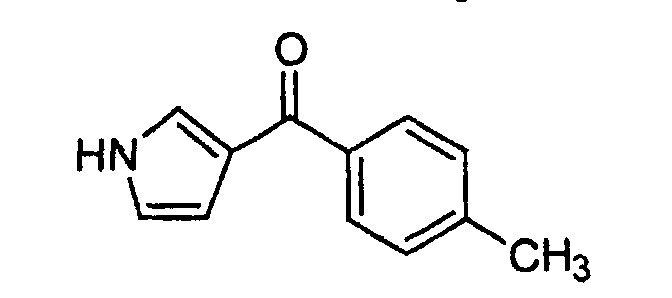
- XDFNIPTUZKLQOY-UHFFFAOYSA-N Cc(cc1)ccc1C(c1c[nH]cc1)=O Chemical compound Cc(cc1)ccc1C(c1c[nH]cc1)=O XDFNIPTUZKLQOY-UHFFFAOYSA-N 0.000 description 1
- MDNRTNIOWCDASD-UHFFFAOYSA-N Cc(cc1)ccc1C(c1ccc[nH]1)=O Chemical compound Cc(cc1)ccc1C(c1ccc[nH]1)=O MDNRTNIOWCDASD-UHFFFAOYSA-N 0.000 description 1
- RYMCTGLGGLNMRW-UHFFFAOYSA-N Cc(cc1)ccc1C(c1ccc[n]1Cc1cnc(cccc2)c2n1)=O Chemical compound Cc(cc1)ccc1C(c1ccc[n]1Cc1cnc(cccc2)c2n1)=O RYMCTGLGGLNMRW-UHFFFAOYSA-N 0.000 description 1
- BUFAZPMESYHZNN-UHFFFAOYSA-N Cc1ccc(Cc2ccc[n]2Cc(cnc2ccc3)cc2c3C#N)cc1 Chemical compound Cc1ccc(Cc2ccc[n]2Cc(cnc2ccc3)cc2c3C#N)cc1 BUFAZPMESYHZNN-UHFFFAOYSA-N 0.000 description 1
- KQPXYZPCLCEZFP-UHFFFAOYSA-N NC(COc(cc1)ccc1C(c1ccc[n]1Cc1cc(cccc2)c2nc1)=O)=O Chemical compound NC(COc(cc1)ccc1C(c1ccc[n]1Cc1cc(cccc2)c2nc1)=O)=O KQPXYZPCLCEZFP-UHFFFAOYSA-N 0.000 description 1
Classifications
-
- C—CHEMISTRY; METALLURGY
- C07—ORGANIC CHEMISTRY
- C07D—HETEROCYCLIC COMPOUNDS
- C07D207/00—Heterocyclic compounds containing five-membered rings not condensed with other rings, with one nitrogen atom as the only ring hetero atom
- C07D207/02—Heterocyclic compounds containing five-membered rings not condensed with other rings, with one nitrogen atom as the only ring hetero atom with only hydrogen or carbon atoms directly attached to the ring nitrogen atom
- C07D207/30—Heterocyclic compounds containing five-membered rings not condensed with other rings, with one nitrogen atom as the only ring hetero atom with only hydrogen or carbon atoms directly attached to the ring nitrogen atom having two double bonds between ring members or between ring members and non-ring members
- C07D207/32—Heterocyclic compounds containing five-membered rings not condensed with other rings, with one nitrogen atom as the only ring hetero atom with only hydrogen or carbon atoms directly attached to the ring nitrogen atom having two double bonds between ring members or between ring members and non-ring members with only hydrogen atoms, hydrocarbon or substituted hydrocarbon radicals, directly attached to ring carbon atoms
- C07D207/33—Heterocyclic compounds containing five-membered rings not condensed with other rings, with one nitrogen atom as the only ring hetero atom with only hydrogen or carbon atoms directly attached to the ring nitrogen atom having two double bonds between ring members or between ring members and non-ring members with only hydrogen atoms, hydrocarbon or substituted hydrocarbon radicals, directly attached to ring carbon atoms with substituted hydrocarbon radicals, directly attached to ring carbon atoms
-
- C—CHEMISTRY; METALLURGY
- C07—ORGANIC CHEMISTRY
- C07D—HETEROCYCLIC COMPOUNDS
- C07D207/00—Heterocyclic compounds containing five-membered rings not condensed with other rings, with one nitrogen atom as the only ring hetero atom
- C07D207/02—Heterocyclic compounds containing five-membered rings not condensed with other rings, with one nitrogen atom as the only ring hetero atom with only hydrogen or carbon atoms directly attached to the ring nitrogen atom
- C07D207/30—Heterocyclic compounds containing five-membered rings not condensed with other rings, with one nitrogen atom as the only ring hetero atom with only hydrogen or carbon atoms directly attached to the ring nitrogen atom having two double bonds between ring members or between ring members and non-ring members
- C07D207/32—Heterocyclic compounds containing five-membered rings not condensed with other rings, with one nitrogen atom as the only ring hetero atom with only hydrogen or carbon atoms directly attached to the ring nitrogen atom having two double bonds between ring members or between ring members and non-ring members with only hydrogen atoms, hydrocarbon or substituted hydrocarbon radicals, directly attached to ring carbon atoms
- C07D207/33—Heterocyclic compounds containing five-membered rings not condensed with other rings, with one nitrogen atom as the only ring hetero atom with only hydrogen or carbon atoms directly attached to the ring nitrogen atom having two double bonds between ring members or between ring members and non-ring members with only hydrogen atoms, hydrocarbon or substituted hydrocarbon radicals, directly attached to ring carbon atoms with substituted hydrocarbon radicals, directly attached to ring carbon atoms
- C07D207/333—Radicals substituted by oxygen or sulfur atoms
-
- C—CHEMISTRY; METALLURGY
- C07—ORGANIC CHEMISTRY
- C07D—HETEROCYCLIC COMPOUNDS
- C07D401/00—Heterocyclic compounds containing two or more hetero rings, having nitrogen atoms as the only ring hetero atoms, at least one ring being a six-membered ring with only one nitrogen atom
- C07D401/02—Heterocyclic compounds containing two or more hetero rings, having nitrogen atoms as the only ring hetero atoms, at least one ring being a six-membered ring with only one nitrogen atom containing two hetero rings
- C07D401/06—Heterocyclic compounds containing two or more hetero rings, having nitrogen atoms as the only ring hetero atoms, at least one ring being a six-membered ring with only one nitrogen atom containing two hetero rings linked by a carbon chain containing only aliphatic carbon atoms
-
- C—CHEMISTRY; METALLURGY
- C07—ORGANIC CHEMISTRY
- C07D—HETEROCYCLIC COMPOUNDS
- C07D403/00—Heterocyclic compounds containing two or more hetero rings, having nitrogen atoms as the only ring hetero atoms, not provided for by group C07D401/00
- C07D403/02—Heterocyclic compounds containing two or more hetero rings, having nitrogen atoms as the only ring hetero atoms, not provided for by group C07D401/00 containing two hetero rings
- C07D403/06—Heterocyclic compounds containing two or more hetero rings, having nitrogen atoms as the only ring hetero atoms, not provided for by group C07D401/00 containing two hetero rings linked by a carbon chain containing only aliphatic carbon atoms
-
- C—CHEMISTRY; METALLURGY
- C07—ORGANIC CHEMISTRY
- C07D—HETEROCYCLIC COMPOUNDS
- C07D471/00—Heterocyclic compounds containing nitrogen atoms as the only ring hetero atoms in the condensed system, at least one ring being a six-membered ring with one nitrogen atom, not provided for by groups C07D451/00 - C07D463/00
- C07D471/02—Heterocyclic compounds containing nitrogen atoms as the only ring hetero atoms in the condensed system, at least one ring being a six-membered ring with one nitrogen atom, not provided for by groups C07D451/00 - C07D463/00 in which the condensed system contains two hetero rings
- C07D471/04—Ortho-condensed systems
Definitions
- the present invention relates to pyrrole derivatives exhibiting TGF- ⁇ inhibitory activity and being useful as fibrosis inhibitors for organs or tissues, a prodrug thereof, and pharmaceutically acceptable salts thereof.
- Fibrosis of organs or tissues is induced by excessive accumulation of extracellular matrix within the organ, as repair or defenses, when said organ is invaded or damaged by some causes.
- the extracellular matrix is a substance surrounding the cells of tissues, and representative ones thereof are, for example, fibrinoproteins such as collagen, elastin, etc., complex carbohydrates such as proteoglycan, etc., glycoproteins such as fibronectin, laminin, etc.
- TGF- ⁇ Transforming Growth Factor- ⁇ plays an important role in the accumulation of extracellular matrix.
- TGF- ⁇ Transforming Growth Factor- ⁇
- TGF- ⁇ participates in the fibrosis of tissues in the following manner:
- the inhibition of TGF- ⁇ is a useful means for inhibiting the accumulation of extracellular matrix.
- the fibrosis is alleviated by administering antiserum of TGF- ⁇ to animal models for fibrosis (Nature, 346: 371-374, 1990).
- An object of the present invention is to provide a compound being useful as fibrosis inhibitors for organs or tissues.
- the present inventors have intensively studied, and found that pyrrole derivatives inhibit the fibrosis of organs or tissues, and have accomplished the present invention.
- the present invention is as follows:
- the number of the substituents on the "substituted pyrrole ring", “substituted indole ring”, “substituted thiophene ring”, “substituted pyrazole ring”, “substituted benzene ring”, “substituted imidazole ring” and “substituted isothiazole ring” is 1 or more, for example, 2 or 3, and the substituents include the same groups for R 1 except for hydrogen, i.e., a halogen or an optionally substituted alkyl.
- alkyl includes, for example, a straight chain or branched chain C 1 -C 6 alkyl group, such as methyl, ethyl, 2-propyl, 2-methyl-1-propyl, butyl, 2-butyl, t-butyl, pentyl, 3-methyl-2-butyl, 2-methyl-2-butyl, hexyl, etc., and preferably a straight chain or branched chain C 1 -C 4 alkyl.
- the substituent of the "substituted alkyl for R 2 and R 5" includes, for example, hydroxy, an alkanoyloxy, a halogen, cyano, an alkanoyl, an alkoxy, an alkoxycarbonyl, carboxy, an amino having optionally alkyl-substituent(s), an amino having optionally alkoxyalkyl-substituent(s), a cyclic amino, a monocyclic heteroaryl, a carbamoyl having optionally alkyl-substituent(s), a cyclic aminocarbonyl, a sulfamoyl having optionally alkyl-substituent(s), a cyclic aminosulfonyl, azide, etc.
- the number of the substituents may be one or more, for example, 2 or 3, and the substituents are the same or different.
- the preferable substituents of the substituted alkyl for R 2 are a halogen, an alkoxy, etc.
- the preferable substituents of the substituted alkyl for R 5 are a halogen, an alkoxy, morpholino, hydroxy, etc.
- the substituent of the "substituted alkyl for R 1 , R 12 , R 13 , R 14 and R 15 " includes, for example, a halogen, an alkoxy, hydroxy, oxo, etc., and the number of the substituents are one or more, for example, 2 or 3, and the substituents may be the same or different.
- alkoxy includes, for example, a straight chain or branched chain C 1 -C 6 alkoxy, such as methoxy, ethoxy, propyloxy, 2-propyloxy, 2-methyl-2-propyloxy, butoxy, pentyloxy, hexyloxy, etc. and preferably a straight chain or branched chain C 1 -C 4 alkoxy.
- the substituent of the "substituted alkoxy for R 2 and R 5 " is, for example, hydroxy, an alkanoyloxy, a halogen, cyano, an alkanoyl, an alkoxy, an alkoxycarbonyl, carboxy, an amino having optionally alkyl-substituent(s), an amino having optionally alkoxyalkyl-substituent(s), a cyclic amino, a monocyclic heteroaryl, a carbamoyl having optionally alkyl-substituent(s), a cyclic aminocarbonyl, a sulfamoyl having optionally alkyl-substituent(s), a cyclic aminosulfonyl, azide, etc.
- the number of the substituents may be one or more, for example, 2 or 3, and the substituents may be the same or different.
- the preferable substituents of the substituted alkoxy for R 2 are a halogen, an alkoxy, etc.
- the preferable substituents of the substituted alkoxy for R 5 are a halogen, an alkoxy, morpholino, hydroxy, etc., and especially preferable substituted alkoxy is 2-morpholinoethoxy, etc.
- alkanoyl includes, for example, a straight chain or branched chain C 1 -C 6 alkanoyl, such as formyl, acetyl, propanoyl, butanoyl, isobutanoyl, pentanoyl, hexanoyl, etc., and preferably a straight chain or branched chain C 2 -C 5 alkanoyl.
- alkenyl includes, for example, a straight chain or branched chain C 2 -C 6 alkenyl, such as vinyl, allyl, isopropenyl, 2-butenyl, 3-butenyl, 2-pentenyl, 3-hexenyl, etc., and preferably a straight chain or branched chain C 2 -C 4 alkenyl.
- alkenyloxy includes, for example, a straight chain or branched chain C 3 -C 6 alkenyloxy, such as allyloxy, 3-butenyloxy, 2-butenyloxy, etc., and preferably a straight chain or branched chain C 3 -C 4 alkenyloxy.
- alkynyl includes, for example, a straight chain or branched chain C 2 -C 6 alkynyl, such as ethynyl, 2-propynyl, 1-propynyl, 3-butynyl, 2-butynyl, 2-pentynyl, 3-hexynyl, etc., and preferably a straight chain or branched chain C 2 -C 4 alkynyl.
- alkynyloxy includes, for example, a straight chain or branched chain C 3 -C 6 alkynyloxy, such as allyloxy, 3-butynyloxy, 2-butynyloxy, 3-pentynyloxy, etc., and preferably a straight chain or branched chain C 3 -C 4 alkynyloxy.
- alkylene includes, for example, a straight chain alkylene having carbon atoms in a number within the scope of each alkylene, such as methylene, ethylene, trimethylene, tetramethylene, pentamethylene, hexamethylene, etc.
- Preferable examples of the "C 1 -C 4 alkylene for W 2 " are methylene and ethylene, and especially preferable one is methylene.
- C 1 -C 4 alkylene for W 1 when Ar 1 is an optionally substituted bicyclic heteroaryl having 1 to 4 nitrogen atoms as ring-forming atoms are methylene, etc.
- C 1 -C 5 alkylene for W 3 are methylene, ethylene, etc.
- the substituents of the "substituted alkylene” includes, for example, an alkyl, an alkoxy, hydoxy, an alkanoyloxy, a halogen, etc., and the substituted alkylene has 1 or 2 substituents, which are the same or different.
- alkenylene includes, for example, a straight chain alkenylene having carbon atoms in a number within the scope of each alkenylene, such as vinylene, 1-propenylene, 2-propenylene, 1-butenylene, 2-butenylene, 3-butenylene, 1-pentenylene, 2-pentenylene, 3-pentenylene, 4-pentenylene, 2,4-pentadienylene, etc.
- the configuration at the double bonds may be either cis-configuration or trans-configuration, and preferable configuration is trans-configuration.
- C 2 -C 5 alkynylene includes, for example, a straight chain C 2 -C 5 alkynylene, such as ethynylene, 2-propynylene, 2-butynylene, 3-butynylene, 2-pentynylene, 3-pentynylene, etc.
- the substituents of the "substituted alkenylene” and the “substituted alkynylene” are, for example, an alkyl, etc., and these groups have independently 1 or 2 substituents.
- aryl includes, for example, a C 6 -C 10 aryl, such as phenyl, 1-naphthyl, 2-naphthyl, etc., and preferably one is phenyl.
- heteroaryl includes, for example, a monocyclic or bicyclic heteroaryl having 1 to 3 heteroatom selected from a nitrogen, an oxygen and a sulfur, and these heteroatoms are the same or different, such as a monocyclic 5-membered heteroaryl (e.g., thiophene, furan, pyrrole, imidazole, pyrazole, thiazole, oxazole, isothiazole, isoxazole, etc.), a monocyclic 6-membered heteroaryl (e.g., pyridine, pyrimidine, pyrazine, pyridazine, triazine, etc.), a bicyclic heteroaryl (e.g., indole, isoindole, indolidine, indazole, purine, 4-H-quinolidine, quinoline, isoquinoline, phthalazine, naphthyridine, quinoxaline, quinazoline, benzo
- the "monocyclic heteroaryl” includes monocyclic heteroaryls among heteroaryls.
- Preferable examples of the "monocyclic heteroaryl for Ar 1 " are a monocyclic heteroaryl being weak basic (pKb ⁇ 7), and more preferable ones are a monocyclic 5-membered heteroaryl containing a sulfur atom or an oxygen atom, and especially preferable ones are thiophene, furan, thiazole, oxazole, isothiazole, isoxazole, etc.
- heteroaryl for Ar 2 are a heteroaryl being weak basic (pKb ⁇ 7), and more preferable ones are a monocyclic 5-membered heteroaryl and bicyclic heteroaryl containing a sulfur atom or an oxygen atom, and especially preferable ones are thiophene, furan, thiazole, oxazole, isothiazole, isoxazole, indole, isoindole, benzothiazole, benzoxazole, benzisothiazole, benzisoxazole, benzofuran, benzothiophene, etc.
- the "monocyclic or bicyclic heteroaryl having 1 to 4 nitrogen atoms as ring-forming atoms” includes, for example, a monocyclic 5-membered heteroaryl (e.g., pyrrolyl, imidazolyl, 3H-pyrazolyl, tetrazolyl, etc.), a monocyclic 6-membered heteroaryl (e.g., pyridyl, pyrimidyl, pyrazinyl, pyridazinyl, triazinyl, etc.), a bicyclic heteroaryl (e.g., indolyl, isoindolyl, indolidinyl, indazolyl, puryl, 4-H-quinolidinyl, quinolinyl, isoquinolinyl, phthalazinyl, naphthyridyl, quinoxalyl, quinazolyl, etc.), etc.
- a monocyclic 5-membered heteroaryl
- Preferable examples are a bicyclic heteroaryl, and more preferable ones are quinolyl, quinoxalyl, naphthyridyl, etc., and especially preferable ones are 3-quinolyl, 2-quinoxalyl, 3-naphthyridyl, etc.
- substituents of the "substituted aryl for Ar 2 and A" are an optionally substituted alkyl, an optionally substituted alkoxy, hydroxy, morpholino, etc.
- More preferable examples are an optionally substituted alkyl (the substituents of the substituted alkyl is a halogen, an alkoxy, morpholino, hydroxy, etc.), a substituted alkoxy (the substituents of the substituted alkoxy is a halogen, an alkoxy, morpholino, hydroxy, etc.), hydroxy, etc., and especially perferable ones are methyl, methoxy, 2-morpholinoethoxy, hydroxy, etc.
- Ar 2 and A are a substituted phenyl, then the substitution position of these substituents is preferably para-position with respect to the binding position of W 13 or W 21 , respectively.
- substituents of the "substituted monocyclic or bicyclic heteroaryl containing 1 to 4 nitrogen atoms as ring-forming atoms for Ar 1 and Het are a halogen, cyano, an optionally substituted alkyl, an optionally substituted alkoxy, etc.
- More preferable examples are a halogen, an optionally substituted alkyl (the substituent of the substituted alkyl is a halogen, an alkoxy, etc.), a substituted alkoxy (the substituent of the substituted alkyl is a halogen, an alkoxy, etc.), cyano, etc., and especially preferable examples are a halogen, an alkyl, an alkoxy, cyano, etc., and further most preferable examples are chlorine, methyl, cyano, etc.
- Ar 1 is a substituted phenyl
- the substitution position of these substituents is preferably para-position with respect to the binding position of W 1 .
- the substituents of the "substituted C 1 -C 4 alkyl, substituted C 2 -C 4 alkenyl, substituted C 2 -C 4 alkynyl, and substituted C 1 -C 4 alkoxy, which are substituents for aryl for Ar 3 " are, for example, an alkoxy, an alkoxycarbonyl, an alkanoyl, hydroxy, an alkanoyloxy, a halogen, cyano, a carbamoyl having optionally alkyl-substituent(s), a cyclic aminocarbonyl, carboxy, an amino having optionally alkyl-substituent(s), a cyclic amino, a sulfamoyl having optionally alkyl-substituent(s), a cyclic aminosulfonyl, etc.
- the number of the substituents of these groups is 1 or more, for example, 2 or 3, and the substituents are the same or different.
- the ortho- or meta-position with respect to the binding position of W 1 means a position adjacent to the binding position of W 1 and further a position adjacent thereto, respectively.
- the ortho-, meta- and para-positions are indicated below in cases wherein Ar 1 is phenyl:
- halogen is fluorine, chlorine, bromine, etc.
- cycloalkanediyl includes, for example, a C 3 -C 6 cycloalkanediyl, such as 1,2-cyclopropanediyl, 1,2-cyclobutanediyl, 1,2-cyclopentanediyl, 1,2-cyclohexanediyl, 1,3-cyclohexanediyl, 1,4-cyclohexanediyl, etc.
- amino having optionally alkyl-substituent(s) amino being optionally substituted by an alkoxyalkyl
- carbamoyl having optionally alkyl-substituent(s) amino being optionally substituted by an alkoxyalkyl
- sulfamoyl having optionally alkyl-substituent(s) when these groups are substituted by an alkyl or an alkoxyalkyl, then these groups can be substituted by 1 or 2 alkyls or alkoxyalkyls which are the same or different.
- cyclic amino includes a 5- to 7-membered cyclic amino optionally containing an oxygen atom, a sulfur atom or a nitrogen atom as ring-forming atoms, and this cyclic amino may be further substituted by an alkyl, hydroxy, etc., for example, pyrrolidino, piperidino, piperazinyl, 4-methylpiperazinyl, morpholino, thiomorpholino, 4-hydroxypiperidino, etc., and especially preferable cyclic amino is morpholino.
- the "prodrug” means a compound, which can be hydrolyzed chemically or biochemically in the living body and converted into the compound of the present invention.
- a compound wherein said carboxyl group is converted into a suitable ester group is a prodrug thereof.
- the ester are pivaloyloxymethyl ester, acetyloxymethyl ester, cyclohexylacetyloxymethyl ester, 1-methylcylohexylcarbonyloxymethyl ester, ethyloxycarbonyloxy-1-ethyl ester, cyclohexyloxycarbonyloxy-1-ethyl ester, etc.
- the "pharmaceutically acceptable salt” includes, for example, an alkali metal salt such as sodium salt, potassium salt, etc., an alkaline earth metal salt such as calcium salt, magnesium salt, etc., an inorganic metal salt such as zinc salt, a salt with an organic base such as triethylamine, triethanolamine, trihydroxymethylaminomethane, amino acid, etc., when the pyrrole derivatives of the present invention or a pharmaceutically acceptable salt thereof have an acidic group.
- the pharmaceutically acceptable salt includes, for example, a salt with an inorganic acid such as hydrochloride, hydrobromide, sulfate, phosphate, nitrate, etc., a salt with an organic acid such as acetate, propionate, succinate, lactate, malate, tartrate, citrate, maleate, fumarate, methanesulfonate, p-toluenesulfonate, benzenesulfonate, ascorbate, etc.
- an inorganic acid such as hydrochloride, hydrobromide, sulfate, phosphate, nitrate, etc.
- an organic acid such as acetate, propionate, succinate, lactate, malate, tartrate, citrate, maleate, fumarate, methanesulfonate, p-toluenesulfonate, benzenesulfonate, ascorbate, etc.
- the pyrrole derivatives of the present invention and a pharmaceutically acceptable salt thereof exhibit TGF- ⁇ inhibitory activity and are useful as a fibrosis inhibitor for organs or tissues.
- the present compounds are useful as a medicament for treating the following diseases, which is caused by the fibrosis of organs or tissues.
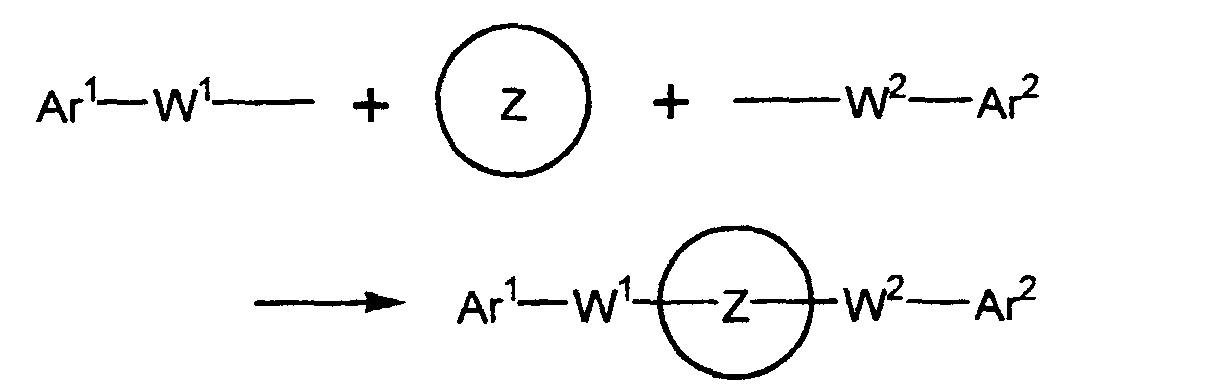
- the pyrrole derivatives of the present invention may be prepared, for example, by the following process. wherein Ring Z, W 2 , Ar 2 , W 1 and Ar 1 are as defined above.
- the present pyrrole derivatives can be prepared by binding the groups of Ar 1 -W 1 - and Ar 2 -W 2 - to Ring Z.
- the binding reaction of the groups Ar 1 -W 1 - and Ar 2 -W 2 - with Ring Z is carried out, for example, by the following reactions.
- Double bond, hydroxy group and carbonyl group, etc. being produced in each reaction as mentioned above are subjected to hydrogenolysis, reduction, oxidization, etc., if necessary.
- function groups may be converted into other function groups.
- the conversion reaction of these function groups is carried out, for example, according to the following articles.
- the reduction of the hydroxy group existing at the 1-position of the alkylene bound to Ring Z is carried out by using a combined reducing agent such as sodium borohydride/isopropanol, triethylsilane/trifluoroacetic acid, etc.
- the reaction solvent is, for example, tetrahydrofuran (THF), dioxane, dichloromethane, chlorobenzene, etc., and the reaction is carried out at a temperature of from about -20°C to a boiling point of the solvent to be used.
- the reduction of carbonyl into methylene is carried out, for example, by using a combined reducing agent such as sodium borohydride/isopropanol, hydrazine/potassium hydroxide or sodium hydroxide, zinc amalgam/hydrochloric acid, etc.
- the reaction solvent is, for example, THF, dioxane, etc., and the reaction is carried out at a temperature of from 0°C to a boiling point of the solvent to be used.
- the oxidization of hydroxy group existing at the 1-positin of the alkylene bound to Ring Z is carried out by using an oxidizing reagent such as manganese dioxide, etc., a composite oxidizing reagent such as 4-methylmorpholine-4-oxide/tetra-n-propylammonium perruthenate, etc.
- the reaction solvent is, for example, THF, dioxane, dichloromethane, chlorobenzene, chloroform, etc., and the reaction is carried out at a temperature of from about 0°C to a boiling point of the solvent to be used.
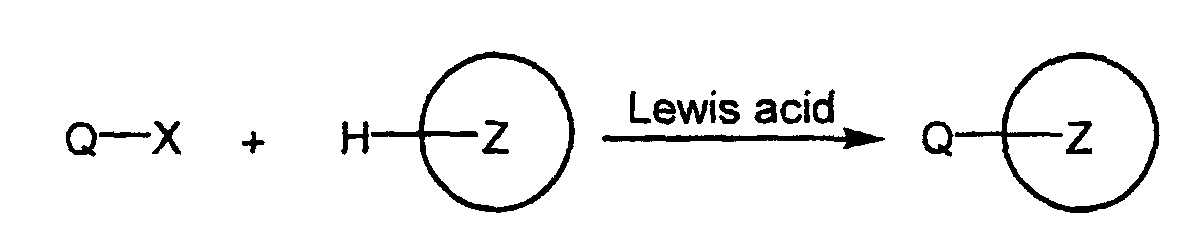
- Ring Z is as defined above, Q is an organic group, and X is a chlorine, bromine, etc.
- the Friedel-Crafts reaction is carried out, for example, according to J. Org. Chem., 48, 3214-3219 (1983), to introduce Q- on the carbon atom of Ring Z.
- Q-X is, for example, an alkyl halide, an acid halide, etc.
- the reaction is carried out in the presence of a Lewis acid such as AlCl 3 , BF 3 ⁇ OEt 2 , ZnCl 2 , SnCl 4 , etc., in an inert solvent such as dichloromethane, dichloroethane, etc. and usually at a temperature of from room temperature to a boiling point of the solvent to be used.
- the Friedel-Crafts reaction is preferably carried out by firstly protecting the nitrogen atom at the 1-position with a phenylsulfonyl (or toluylsulfonyl) moiety.
- a phenylsulfonyl or toluylsulfonyl
- the reaction is carried out, for example, by reacting with phenylsulfonyl chloride, etc. in the presence of a base such as NaH, etc.
- the reaction position can be controlled by the kind of a Lewis acid to be used.
- a Lewis acid for example, by using AlCl 3 , the 3-position is reacted (J. Org. Chem., 48, 3214-3219 (1983)), and by using BF 3 ⁇ OEt 2 , the 2-position is reacted.
- the phenylsulfonyl is removed by hydrolysis.
- the phenylsulfonyl is removed by reacting in the presence of a base such as sodium hydroxide, potassium hydroxide, etc. in a mixed solvent of water and methanol, ethanol, etc. at a temperature of from room temperature to a boiling point of the solvent to be use.
- reaction is carried out, for example, according to the methods disclosed in Synth. Commun., 11, 513 (1981), J. Am. Chem. Soc., 111, 314 (1989), J. Org. Chem., 52, 422 (1987), J. Org. Chem., 37, 2320 (1972), etc.
- the reaction is carried out by reacting a compound having a multiple bond between carbon and carbon or an organic metal compound with an organic halide in an inert solvent in the presence of a palladium catalyst, a base, etc.
- the palladium catalyst includes, for example, a palladium (II) catalyst such as Pd(OAc) 2 , PdCl 2 (PPh 3 ) 2 , etc., and a palladium (0) catalyst such as Pd(PPh 3 ) 4 , Pd(dba) 2 , etc.
- a palladium (II) catalyst such as Pd(OAc) 2 , PdCl 2 (PPh 3 ) 2 , etc.
- a palladium (0) catalyst such as Pd(PPh 3 ) 4 , Pd(dba) 2 , etc.
- the base includes, for example, an inorganic base such as NaHCO 3 , K 2 CO 3 , etc., an organic base such as NEt 3 , iPr 2 NEt, Et 2 NH, etc., and the reaction can be accelerated by addition of a phosphine ligand such as PPh 3 , etc., a phase-transfer catalyst such as BnEt 3 NCl, etc., or an inorganic salt such as CuI, etc.
- the inert solvent includes, for example, N,N-dimethylformamide (DMF), THF, dioxane, toluene, etc.
- the reaction temperature is usually in the range of from around room temperature to a boiling point of the solvent to be used.
- the organic metal compound containing Ring Z can be prepared, for example, by halogen-metal exchange reaction, or by removing hydrogen atom using a base, which is further reacted with Q-X.
- Ring Z is a pyrrole ring, an indole ring, a pyrazole ring or an imidazole ring
- the group Q- can be introduced on the nitrogen atom of these rings by reacting in an inert solvent (e.g., THF, ether, DMF, etc.) in the presence of a base (e.g., NaH, KH, potassium t-butoxide, ethylmagnesium bromide, butyl lithium, lithium 2,2,6,6-tetramethylpiperidine, etc.).
- an inert solvent e.g., THF, ether, DMF, etc.
- a base e.g., NaH, KH, potassium t-butoxide, ethylmagnesium bromide, butyl lithium, lithium 2,2,6,6-tetramethylpiperidine, etc.
- the reaction temperature is in the range of from about 0°C to about 80°C.
- This reaction is carried out, for example, by the method disclosed in Tetrahedron, 26, 2239 (1970), J. Org. Chem., 55, 6317 (1990), etc.
- the organic metal compound in this reaction can be prepared in a similar manner to the preparation of the organic metal compound of the above (3).
- the organic metal compound thus obtained is reacted, for example, with an aldehyde in an inert solvent (e.g., THF, ether, toluene, etc.).
- the reaction temperature is in the range of from about -100°C to room temperature.
- This reaction is carried out, for example, by the method disclosed in Org. Lett., 2, 1649 (2000).
- the organic metal compound in this reaction can be prepared in a similar manner to the preparation of the organic metal compound of the above (3) & (4).
- the organic metal compound thus obtained is reacted, for example, with a compound having an activated carbonyl group in an inert solvent (e.g., THF, ether, toluene, etc.).
- the reaction temperature is in the range of from about -100°C to room temperature.
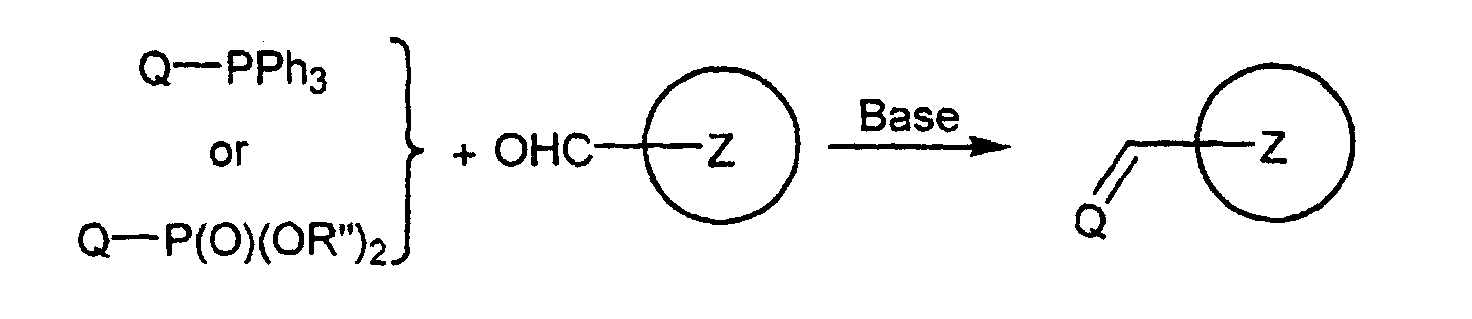
- This reaction is carried out, for example, by the method disclosed in Tetrahedron, 49, 1343 (1993).
- an organic phosphorus compound e.g., a phosphonium salt, a phosphoric acid ester, etc.
- a base e.g., NaH, BuLi, KOtBu, etc.
- a carbonyl compound in an inert solvent (e.g., THF, ether, dichloromethane, etc.).
- the reaction temperature is in the range of from about -100°C to a boiling point of the solvent to be used.
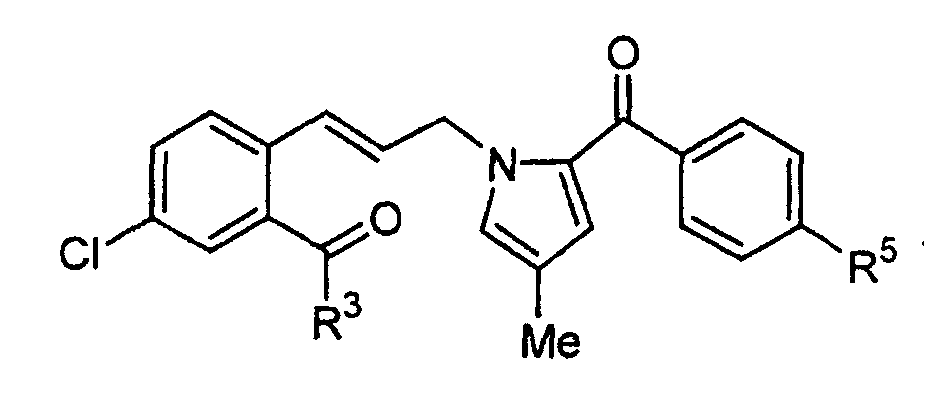
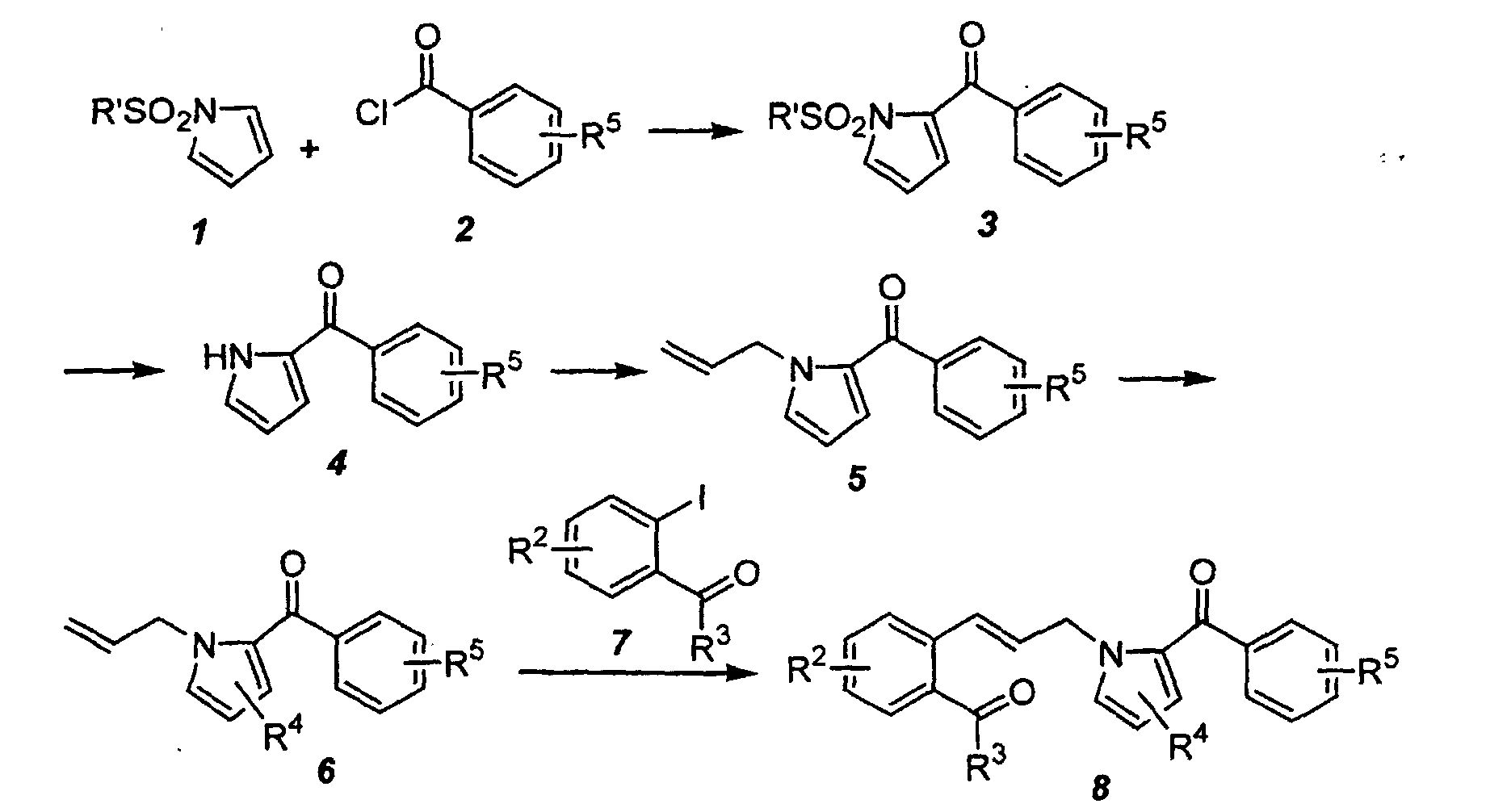
- the following compound 8 is preferably prepared as follows: wherein R 2 , R 3 , R 4 and R 5 are as defined above, and R' is phenyl or 4-toluyl.
- the compound 3 is prepared by reacting the compound 1 with the compound 2 in the presence of a Lewis acid in an inert solvent, according to J. Org. Chem., 48, 3214-3219 (1983).
- the 2-position of the pyrrole ring is advantageously preferentially reacted with the compound 2 by using BF 3 -OEt 2 , ZnCl 2 , SnCl 4 as a Lewis acid.
- the inert solvent is preferably halogenated hydrocarbons such as dichloromethane, dichloroethane, etc., and the reaction temperature is in the range of from about 0°C to a boiling point of the solvent to be used, and preferably around room temperature.
- the compound 3 is hydrolyzed in the presence of a base to give the compound 4 .
- the base includes NaOH, KOH, etc.
- the solvent includes a mixed solvent of dioxane and water, a mixed solvent of methanol and water, etc.
- the reaction temperature is in the range of from about 50°C to about 90°C.
- the compound 4 is reacted with an allyl halide in an inert solvent in the presence of a base to give the compound 5 .
- the base is preferably KOtBu, etc., and NaH can also be used.
- the inert solvent includes, for example, THF, DMF, etc., and the reaction temperature is in the range of about 40°C to about 60°C.
- the compound 6 wherein R 4 is methyl is prepared by reacting the compound 5 with a Vilsmeier reagent (Org. Synth. Coll. Vol. IV, 831, etc.), followed by subjecting the product to reduction in a halogenated hydrocarbon solvent.
- the reduction is carried out, for example, by using triethylsilane-trifluoroacetic acid as a reducing agent, etc., and usually at a temperature of from about 0°C to around room temperature.
- the compound 6 wherein R 4 is an alkyl group other than methyl is prepared by reacting the compound 5 with an alkanoyl halide in the presence of a Lewis acid, followed by reduction of the product.
- the Lewis acid includes AlCl 3 , etc., and the reaction is usually carried out at a temperature of from about 0°C to a boiling point of the solvent to be used.
- the compound 8 is prepared by reacting the compound 6 and the compound 7 in the presence of a palladium catalyst and a base in an inert solvent.
- the palladium catalyst includes a palladium (II) catalyst such as Pd(OAc) 2 , etc., a palladium (0) catalyst such as Pd(dba) 2 , etc.
- the base includes NaHCO 3 , K 2 CO 3 , triethylamine, etc., and the reaction can be accelerated by addition of a phosphine ligand such as PPh 3 , etc., a phase-transfer catalyst such as BnEt 3 NCl, etc.
- the inert solvent includes DMF, THF, toluene, etc., and the reaction temperature is usually in the range of from room temperature to a boiling point of the solvent to be used.
- the present invention also includes hydrates and solvates such as ethanolates of the present pyrrole derivatives, a prodrug thereof, and a pharmaceutically acceptable salt thereof.
- the pyrrole derivatives, etc. of the present invention exist in the form of an optical isomer, a stereoisomer, an enatiomer, then the present invention also includes each isomer or a mixture thereof.
- an optically active acid e.g., mandelic acid, N-benzyloxyalanine, lactic acid, tartaric acid, o-diisopropilidene tartrate, malic acid, camphor sulfonic acid, bromo camphor sulfonic acid, etc.
- an optically active amine e.g., ⁇ -phenethylamine, kinin, quinidine, cinchonidine, cinchonine, strychnine, etc.
- the pyrrole derivative of the present invention, or a prodrug thereof, or a pharmaceutically acceptable salt thereof can be administered either orally or parenterally.
- the pharmaceutical composition for oral administration includes, for example, tablets, pills, granules, powders, capsules, cachets, liquids, suspensions, emulsions, syrups, etc.
- the pharmaceutical composition for parenteral administration includes, for example, injections (e.g., intravenous injection, intramuscular injection, etc.), percutaneous formulations (e.g., creams, ointments, lotions, patches, matrixes, etc.), intranasal formulations, rectal formulations (e.g., suppositories, etc.), etc.
- These formulations are prepared by a conventional method.
- Oral solid preparations such as tablets are prepared, for example, by mixing the present pyrrole derivative, etc., with excipients (e.g., lactose, D-mannitol, sugar, corn starch, cellulose, calcium hydrogenphosphate, etc.), disintegrants (e.g., calcium carmerose, low substituted hydroxypropyl cellulose, crosscarmerose sodium, sodium carboxymethyl starch, carboxymethylcellulose sodium, starch sodium glycolate, etc.), binders (e.g., polyvinylpyrrolidone, polyvinyl alcohol, hydroxypropylcellulose, hydroxypropylmethylcellulose, methyl cellulose, etc.), lubricants (e.g., magnesium stearate, talc, magnesium stearate, etc.), flavors and corrigents, stabilizers, coloring agents, etc., and formulated into tablets, granules, powders, capsules, etc. by a conventional method.
- excipients e.g., lacto
- Oral liquid preparations are prepared, for example, by adding the present pyrrole derivative, etc. into water, and further adding thereto a coloring agent, a flavor, a stabilizer, a sweetening agent, a solubilizer, a thickening agent, etc. if necessary.
- the thickening agent includes, for example, a pharmaceutically acceptable natural or synthesized gum, resin, methyl cellulose, sodium carboxymethyl cellulose, or a conventional suspending agent, etc.
- Injections are prepared by dissolving or suspending the present pyrrole derivative, etc. into a pharmaceutically acceptable carrier such as water, a physiological saline, an oil, aqueous glucose solution, etc., and further adding thereto as a coadjuvant a pH adjuster, a buffer, a stabilizer, a solubilizing agent, an emulsifier, etc. if necessary.
- a pharmaceutically acceptable carrier such as water, a physiological saline, an oil, aqueous glucose solution, etc.
- the dosage and the frequency of administration of the present pyrrole derivative, etc. may vary according to the diseases, ages, weights of the patients and the administration form, etc., but the present compounds can usually be administered orally in a dose of about 1 to about 500 mg per day, preferably in a dose of about 3 to about 300 mg per day, especially preferably in a dose of about 5 to about 100 mg per day, in adult (body weight: 60 kg), once a day, or divided into several dosage units.
- the dosage thereof is in the range of about 0.1 to about 300 mg per day, preferably in the range of about 1 to about 100 mg per day, in an adult (body weight: 60 kg), once a day, or divided into several dosage units, or continuously.
- reaction solution was washed successively with aqueous hydrochloric acid, water, and aqueous sodium hydroxide solution, dried, filtered, and concentrated.
- residue was purified by silica gel chromatography to give a mixture of (1-p-toluenesulfonyl-1H-pyrrol-2-yl) (4-allyloxyphenyl) ketone and 4-allyloxybenzoic acid. This mixture was dissolved in 1N aqueous NaOH solution, and extracted three time with ethyl acetate.
- Example 10 The compound of Example 10 (200 mg) and pyrrolidine (77.2 mg) were dissolved in a mixture of THF (1 mL) and ethanol (3 mL), and thereto was added P(PPh 3 ) 4 (62.7 mg), and the mixture was stirred at room temperature for 30 minutes. The reaction solution was concentrated, and the residue was purified by silica gel column chromatography to give the title compound (190 mg, 100 %).
- Example 18 The compound of Example 18 (2.00 g) was dissolved in THF (20 mL) and methanol (20 mL), and thereto was added 1N aqueous NaOH solution (20 mL). The mixture was stirred at 40°C for one hour under nitrogen atmosphere. The organic solvent was evaporated under reduced pressure, and the residue was washed with ether. The ether layer was extracted with 1N aqueous NaOH solution, and the combined aqueous layer was washed with hexane and acidified with hydrochloric acid. The mixture was extracted with ethyl acetate, and the extract was dried, and treated with activated carbon, filtered, and concentrated to give the title compound (1.55 g, 84 %).
- Example 20-2 To the compound of Example 20-2 (4.16g) were added at 0°C trifluoroacetic acid (32 ml) and triethylsilane (1.70 ml) under nitrogen atmosphere, and the mixture was stirred at room temperature for 20 minutes. The solvent in the reaction solution was evaporated under reduced pressure, and the residue was neutralized with a saturated aqueous sodium hydrogen carbonate solution, and extracted with ethyl acetate. The extract was washed with a saturated aqueous sodium hydrogen carbonate solution, dried over magnesium sulfate, filtered, and the solvent was evaporated under reduced pressure.
- Example 22 To the compound of Example 22 (47.1 mg) and 60 % zinc cyanide (28.4 mg) were added DMF (1.3 mL), bis(dibenzylideneacetone)palladium (0) (32.1 mg), and a 2.47 N solution of tri-t-butylphosphine in toluene (120 ⁇ l) under nitrogen atmosphere, and the mixture was stirred at 110°C for 6 hours. The reaction solution was cooled to room temperature, and thereto was added a saturated aqueous sodium hydrogen carbonate solution. The mixture was extracted with ethyl acetate-toluene, and the extract was washed twice with a saturated aqueous sodium hydrogen carbonate solution, dried over magnesium sulfate, and filtered.
- DMF 1.3 mL
- bis(dibenzylideneacetone)palladium (0) 32.1 mg
- a 2.47 N solution of tri-t-butylphosphine in toluene 120 ⁇ l
- a solution of the compound of Reference Example 2 (80.2 mg) in DMF (2.0 ml) was cooled to 0°C under nitrogen atmosphere, and thereto was added 60 % NaH (22.0 mg), and the mixture was stirred at 50°C for 30 minutes.
- the solution (about 0.56 N) of the crude bromo compound obtained from the compound of Example 22-3 in toluene (1.0 mL) was added thereto, and the mixture was stirred at 50°C for one hour.
- the reaction solution was cooled to room temperature, and thereto was added a saturated aqueous sodium hydrogen carbonate solution, and the mixture was extracted three times with ethyl acetate-toluene.
- the extract was washed with a saturated aqueous sodium hydrogen carbonate solution and a saturated brine, dried over magnesium sulfate, filtered, and the solvent was evaporated under reduced pressure.
- Example 25 To the compound of Example 25 (37.3 mg) and 60 % zinc cyanide (24.0 mg) were added DMF (1.0 mL), bis(dibenzilidenacetone)palladium (0) (52.1 mg) and a 2.47N solution of tri-t-butylphosphine in toluene (150 ⁇ L) under nitrogen atmosphere, and the mixture was stirred at 110°C for 3 hours. The reaction solution was cooled to room temperature, and thereto was added a saturated aqueous sodium hydrogen carbonate solution.
- Example 28-5 Under nitrogen atmosphere, to the compound of Example 28-5 (269 mg) and 60 % zinc cyanide (243 mg) were added DMF (6.0ml), and P(PPh 3 ) 4 (620 mg), and the mixture was stirred at 100°C for 2 hours. The reaction solution was cooled to room temperature, and thereto was added a saturated aqueous sodium hydrogen carbonate solution. The mixture was extracted three times with ethyl acetate-toluene, and the extract was washed twice with a saturated aqueous sodium hydrogen carbonate solution, and then washed with a saturated brine, dried over magnesium sulfate, and filtered.
- DMF 6.0ml
- P(PPh 3 ) 4 620 mg
- Example 22-4 In a similar manner to Example 22-4, a solution (about 0.71 N) of a crude bromo compound in toluene was obtained from the compound of Example 29-1, and the title compound (59.9 mg, 32 %, 2 steps) was obtained from said solution (about 0.71 N) of the crude bromo compound (750 ml) and the compound of Reference Example 1 (91.7 mg).
- Example 29 Under nitrogen atmosphere, to the compound of Example 29 (27.5 mg) was added t-butanol (3.0 mL), and the mixture was warmed to 50°C. To the mixture wad added potassium hydroxide powder (140 mg), and the mixture was stirred at 50°C for 1.5 hour. The reaction solution was cooled to room temperature, and the insoluble materials were removed by filtration. Water was added to the filtrate, and the mixture was extracted with ethyl acetate. The extract was washed with a saturated brine, dried over magnesium sulfate, filtered, and the solvent was evaporated under reduced pressure. The residue was purified by silica gel column (ethyl acetate) to give the title compound (5.0 mg, 17 %).
- Example 34-2 Under nitrogen atmosphere, to the compound of Example 34-2 (50.0 mg) and 60 % zinc cyanide (38.6 mg) were added DMF (1.0mL) and P(PPh 3 ) 4 (63.1 mg), and the mixture was stirred at 100°C for 2 hours. The reaction solution was cooled to room temperature, and thereto was added a saturated aqueous sodium hydrogen carbonate solution. The mixture was extracted three times with ethyl acetate-toluene, and the extract was washed twice with a saturated aqueous sodium hydrogen carbonate solution, dried over magnesium sulfate, and filtered.
- Example 33 Under nitrogen atmosphere, to the compound of Example 33 (39.5 mg) and 60 % zinc cyanide (30.4 mg) were DMF (1.0 mL), bis(dibenzilidenacetone)palladium (0) (32.5 mg) and a 2.47N solution of tri-t-butylphosphine in toluene (100 ⁇ L), and the mixture was stirred at 120°C for 5 hours. The reaction solution was filtered to remove the insoluble materials, and to the filtrate was added a saturated aqueous sodium hydrogen carbonate solution.
- the mixture was extracted twice with ethyl acetate-toluene, and the extract was washed twice with a saturated aqueous sodium hydrogen carbonate solution, and washed with a saturated brine, dried over magnesium sulfate, and filtered.
- the title compound (32.3 mg, 55 %) was obtained from the compound of Example 35 (60.0 mg), while the purification was carried out as follows. That is, after the purification of silica gel column, the product was suspended in ethyl acetate, and the precipitates were collected by filtration, and dried.
- Example 42 Under nitrogen atmosphere, to the compound of Example 42 (45.0 mg) are added acetic acid (2.0 mL), water (1.0 mL) and conc. hydrochloric acid (1.0 mL), and the mixture was stirred at 100°C for 4 hours. Toluene was added to the mixture, and the solvent was evaporated under reduced pressure to give the title compound (60.8 mg, quantitatively).
- the extract was washed twice with a saturated aqueous sodium hydrogen carbonate solution, and washed with a saturated brine, dried over magnesium sulfate, and filtered.
- the solvent was evaporated under reduced pressure, and the residue was purified by silica gel column (ethyl acetate) to give the title compound (2.4 mg, 17 %).
- Example 49 Under nitrogen atmosphere, to the compound of Example 49 (17.4 mg) was added a 4N solution of hydrochloric acid in dioxane (1.0 mL), and the the mixture was stirred at 50°C for 8 hours. To the reaction solution was added toluene, and the solvent was evaporated under reduced pressure to give the title compound (14.3 mg, 86 %).
- the starting compound (686 mg, 33 %) was also recovered.
- Example 51 Under nitrogen atmosphere, to the compound of Example 51 (1.74 g) were added successively methanol (4.1 mL), THF (4.1 ml) and 1N aqueous NaOH solution (4.07 mL), and the mixture was stirred at 45°C for 2 hours. The reaction solution was cooled to room temperature, and the precipitated solid was suspended in ether, and collected by filtration to give the title compound (1.67 g, 94 %).
- the extract was washed with a saturated aqueous sodium hydrogen carbonate solution and a saturated brine, dried over magnesium sulfate, and filtered.
- Example 59 (19.0 mg) in dioxane (1.0 mL) was added a 4N solution of hydrochloric acid in dioxane (0.7 mL), and the mixture was stirred at 50°C for 5 hours. The solvent in the reaction solution was evaporated under reduced pressure, and the precipitated solid was collected by filtration, and dried to give the title compound (17.9 mg, 98 %).
- Example 57 Under nitrogen atmosphere, a mixture of the compound of Example 57 (76.8 mg), sodium t-butoxide (30.8 mg) and bis(dibenzylideneacetone)palladium (18.9 mg) were added toluene (1.0 mL) and a 2.47N solution of tri-t-butylphosphine in toluene (20 ⁇ L), and the mixture was stirred at 100°C for 9 hours. Water was added to the reaction solution, and the mixture was extracted with ethyl acetate. The extract was washed with a saturated brine, dried over magnesium sulfate, and filtered.
- Example 62 Under nitrogen atmosphere, to the compound of Example 62 (8.7 mg) were added toluene (0.5 mL) and a solution (500 ⁇ L), wherein trifluoroacetic acid (100 ⁇ L) and trifluoromethanesulfonic acid (110 ⁇ L) were dissolved in toluene (10 mL), and the mixture was stirred at room temperature for 30 minutes. The reaction solution was poured into a saturated aqueous sodium hydrogen carbonate solution, and the mixture was extracted with ethyl acetate. The extract was dried over magnesium sulfate, and filtered.
- reaction solution was stirred at -78°C for 2 hours, and thereto was added a saturated aqueous ammonium chloride solution (50 mL), and the mixture was warmed to room temperature.
- ethyl acetate 100 mL
- the organic layer was separated. Further, the aqueous layer was extracted with ethyl acetate (50 mL x 2).
- the organic layers were combined, and washed successively with 9 % hydrochloric acid (100 mL), 10 % aqueous sodium hydrogen carbonate solution (100 mL), water (100 mL) and a saturated brine (100 mL), dried over magnesium sulfate, filterd and concentrated under reduced pressure.
- the compound of Reference Example 4-3 (379.1 mg) was dissolved in a mixture of THF/MeOH (1:1, 30mL), and thereto was added 2N NaOH (1.54 mL). The reaction mixture was stirred at room temperature for one day, and concentrated under reduced pressure. The residue was dissolved in a 0.5N NaOH (20 mL), and washed with ethyl acetate. The aqueous layer was acidified with a 6N hydrochloric acid, and the precipitated solid was collected by filtration, and dried to give the title compound (341.8 mg, 85 %).
- Example 15 The compound of Example 15 (10.0 mg) was dissolved in THF (1.0 mL), and thereto was added a solution of diisobutyl aluminium hydride in THF (1.0 M solution, 241 mL) at 0°C. The reaction solution was treated with an aqueous hydrochloric acid solution, and extracted with ethyl acetate. The residue was purified by silica gel column chromatography to give 2-(4- ⁇ hydroxy[1-(3-quinolylmethyl)-1H-pyrrol-2-yl]methyl ⁇ phenoxy)ethanol (2.00 mg, 22%).
- Example 77-1 The compound of Example 77-1 (2.00 mg) was dissolved in THF (1.0 mL), and thereto was added manganese dioxide (50.0 mg), and the mixture was stirred at room temperature for 15 minutes. The reaction solution was filtered, and the filtrate was concentrated, and the residue was purified by silica gel column chromatography to give the title compound (2.00 mg, 100 %).
- Example 96-1 The compound of Example 96-1 (28.0 mg) was dissolved in THF (1.0 mL) and methanol (2.0 mL), and thereto was added hydrazine hydrate (27.0 mg), and the mixture was stirred at room temperature for 1 hour. The mixture was concentrated, and thereto was added a 3N aqueous hydrochloric acid solution, and the mixture was washed with ether. The aqueous layer was basified with a 5N aqueous NaOH solution, and extracted with ethyl acetate. The organic layer was dried, filtered, and concentrated to give the title compound (18.0 mg, 85 %).
- Example 16 The compound of Example 16 (50.0 mg), morpholine (16.2 mg), 1-hydroxybenzotriazole (23.4 mg) and 1-(3-dimethylaminopropyl)-3-ethylcarbodiimide hydrochloride (34.4 mg) were dissolved in DMF (3.0 mL), and thereto was added triethylamine (34.6 mg). The mixture was stirred under nitrogen atmosphere at room temperature for 8 hours. To the reaction mixture was further added the same amount of the reacting reagents, and the mixture was further stirred for 2 hours. The reaction was quenched by adding a saturated aqueous sodium hydrogen carbonate solution to the mixture. The reaction mixture was extracted with ethyl acetate, dried, and filtered.
- Example 101 The compound of Example 101 (100 mg) was dissolved in methanol (3.0 mL) and THF (3.0 mL), and thereto was added a 1N aqueous NaOH solution (3.0 mL), and the mixture was stirred at 55°C for 30 minutes. The reaction solution was concentrated to about 3 mL, and thereto were added a 1N aqueous NaOH solution and ether, and the mixture was stirred. The precipitated crystals were collected by filtration to give the title compound (100 mg, 98%).
- Example 106-2 The title compound was obtained from the compound of Example 106-2 in a similar manner to Example 1.
- Ethyl 4-methyl-1-(3-quinolinylmethyl)-1H-pyrrole-2-carboxylate was obtained from ethyl 4-methyl-2-pyrrolecarboxylate in a similar manner to Example 1.
- Example 107-4 The title compound was obtained from the compound of Example 107-4 in a similar manner to Example 28-4.
- Example 108-2 The title compound was obtained from the compound of Example 108-2 in a similar manner to Example 28-4.
- Ethyl 4-methyl-1-(phenylsulfonyl)-1H-pyrrole-2-carboxylate was obtained from methyl 4-methyl-1H-pyrrole-2-carboxylate in a similar manner to Example 6-1.
- Example 109-1 Under nitrogen atmosphere, to a solution of the compound of Example 109-1 (1.58 g) in toluene (30 mL) that was colled to -78°C was added dropwise a 0.93N solution of diisobutylaluminum hydride in toluene (12.5 mL). The mixture was stirred at -78°C for 1 hour, and to the reaction solution was added a 1N aqueous hydrochloric acid solution. The mixture was extracted with ethyl acetate, and the extract was washed with a saturated brine, dried over magnesium sulfate, and filtered.
- Example 109-2 4-Methyl-1-(phenylsulfonyl)-1H-pyrrole-2-carbaldehyde was otained from the compound of Example 109-2 in a similar manner to Example 28-4.
- Example 109 The compound of Example 109 was also prepared as follows.
- the mixture was further stirred at 35°C for 1.5 hour, and thereto was added water (300 mL).
- the mixture was extracted twice with toluene (450 g), and the organic layers were combined, washed twice with water (450 mL), and washed successively with an aqueous solution of sodium hydrogen carbonate (450 g), a 10 % aqueous sodium thiosulfate solution (450 g) and water (225 mL). Then, the mixture was concentrated to give methyl 5-chloro-2-iodobenzoate (44.1 g, yield: 92 %).
- the precipitated crystals were collected by filtration, and dried to give (4-formyl-1-(2-propenyl)-1H-pyrrol-2-yl) (4-methoxyphenyl) ketone (3.31 g).
- the organic layer of the filtrate was collected, concentraed, and the precipitated crystals were collected by filtration, and dried (1.48 g, total 4.79 g, 71 %).
- Example 111-2 The title compound was obtained from the compound of Example 111-2 and the compound of Example 9-2 in a similar manner in Example 9-3.
- Example 113 The compound of Example 113 (560 mg) was dissolved in THF (2.0 mL), and the mixture was treated with a 1N aqueous NaOH solution (1.50 mL), and the solvent was evaporated under reduced pressure. The residue was suspended in ether, and the solid was collected by filtration, and dried to give the title compound (510 mg, 89 %).
- Example 122-2 The compound of Example 122-2 was treated in a similar manner to Example 28-4 to give 4- ⁇ hydroxy[1-(phenylsulfonyl)-1H-pyrrol-2-yl]methyl ⁇ benzaldehyde.
- Example 122-3 Under nitrogen atmosphere, to a solution of the compound of Example 122-3 (726 mg) in 1,2- dichloroethane (50 mL) were added successively morpholine (933.9 mg) and NaBH(OAc) 3 (908 mg), and the mixture was stirred at room temperature for 7 hours. In addition, NaBH(OAc) 3 (908 mg) was added to the reaction mixture, and stirred at room temperature for 2 hours. To the mixture was added NaHCO 3 , and the mixture was extracted twice with ethyl acetate, and dried over MgSO 4 .
- Example 125-2 To a solution of the compound of Example 125-2 (1.02 g) in 1,4-dioxane (60 mL) were added water (15 mL) and p-toluenesulfonic acid monohydrate (220 mg), and the mixture was stirred at 101°C for 2 hours. The solvent was evaporated under reduced pressure, and thereto was added an aqueous sodium carbonate solution, and the mixture was extracted twice with ethyl acetate-toluene. The extracts were dried over MgSO 4 , and the solvent was evaporated under reduced pressure to give crude ⁇ 4-[2-oxoethyl]phenyl ⁇ (1H-pyrrol-2-yl)methanone.
- Example 126-1 The compound of Example 126-1 was treated with acetic acid in THF-water to give (4-hydroxymethylphenyl)(1-phenylsulfonyl-4-methyl-1H-pyrrol-2-yl)methanol.
- Example 126-6 The title compound was obtained from the compound of Example 126-6 in a similar manner to Example 16.
- Example 127-4 The title compound was obtained from the compound of Example 127-4 in a similar manner to Example 16.
- Example 102 The compound of Example 102 was treated with an acid, and further treated in a similar manner to Examples 128 and 129 to give a tetrazole compound.
- tetrazole compound 91 mg
- MeOH 1.0 mL
- THF 1.0 mL
- 1N aqueous NaOH solution 210 ⁇ l
- the solvent was evaporated under reduced pressure, and thereto was added toluene. This procedure was repeated five times, and the precipitated solid was suspended in Et 2 O, and collected by filtration to give the title compound (98.5 mg, 35 %).
- a methanesulfonylamide compound was obtained from the compound of Example 110 in a similar manner to Example 115. To this methanesulfonylamide compound (74.5 mg) were added MeOH (1.0 mL), THF (1.0 mL), and a 1N aqueous NaOH solution (150 ⁇ l), and the mixture was allowed to stand at room temperature for 10 minutes. The solvent was evaporated under reduced pressure, and thereto was added toluene. This procedure was repeated three times. The precipitated solid was suspended in Et 2 O, and collected by filtration to give the title compound (66.0 mg, 43 %).
- Example 137-5 Under nitrogen atmosphere, the title compound was obtained from the compound of Example 137-5 and the compound of Example 109-6 in a similar manner to Example 18-3.
- Example 139-1 To the compound of Example 139-1 (336 mg) were added MeOH (3.0 mL), THF (3.0 mL), and a 1N aqueous NaOH solution (850 ⁇ l), and the mixture was allowed to stand at room temperature for 10 minutes. The solvent was evaporated under reduced pressure, and Et 2 O was added thereto. The precipitated solid was collected by filtration to give the title compound (330 mg, 93 %).
- the resulting amino compound was dissolved in THF (5.0 mL), and thereto were added NEt 3 (300 ⁇ l) and methanesulfonylchloride (120 ⁇ l) at 0°C, and the mixture was stirred at room temperature for 2 hours. Water was added to the mixture, and the mixture was extracted with ethyl acetate, washed with a saturated brine, and dried over MgSO 4 .
- Example 109-6 (4-Methyl-1H-pyrrol-2-yl) (4-hydroxyphenyl) ketone was obtained from the compound of Example 109-6 in a similar manner to Example 119-1.
- 1 H NMR (CDCl 3 , 400MHz) ⁇ 9.40 (br, 1H), 7.86 (d, 2H, J 8.7Hz), 6.90-6.93 (m, 3H), 6.72 (m, 1H), 2.15 (s, 3H).
- Example 143-1 Under nitrogen atmosphere, to a solution of the compound of Example 143-1 (174 mg) in DMF (4.0 mL) were added imidazole (89.7 mg) and t-butyldimethylsilyl chloride (147 mg), and the mixture was stirred at room temperature for 1.5 hours. Water was added thereto, and the mixture was extracted with ethyl acetate-toluene, washed with water and a saturated brine, and dried over MgSO 4 .
- a coupling compound (38.4 mg) was obtained from the compound of Example 137-5 (61.7 mg) and the compound of Example 143-2 (89.6 mg) in a similar manner to Example 18-3. Subsequently, the resuling compound was dissolvd in THF (3.0 mL), and thereto was added a 1N solution of Bu 4 NF in THF (100 ⁇ L), and the mixture was stirred at room temperature for 1 hour. To the mixture was added a 5 % aqueous KHSO 4 solution, and the mixture was extracted with ethyl acetate, washed with a saturated brine, and dried over MgSO 4 .
- Methyl 5-chloro-2- ⁇ (1E)-3-[2-(4-methoxybenzoyl)-4-formyl-1H-pyrrol-1-yl]-1-propenyl ⁇ benzoate was obtained by treating the compound of Example 101 with a Vilsmeier reagent.
- Example 146-1 The title compound was obtained from the compound of Example 146-1 in a similar manner to Example 16.
- Example 110 The title compound was obtained from the compound of Example 110 and ethanesulfonamide in a similar manner to Example 136.
Landscapes
- Chemical & Material Sciences (AREA)
- Organic Chemistry (AREA)
- Pharmaceuticals Containing Other Organic And Inorganic Compounds (AREA)
- Plural Heterocyclic Compounds (AREA)
Abstract
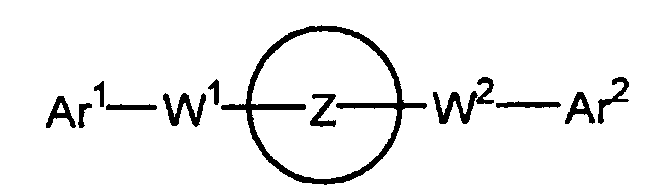
or a pharmaceutically acceptable salt thereof
Description
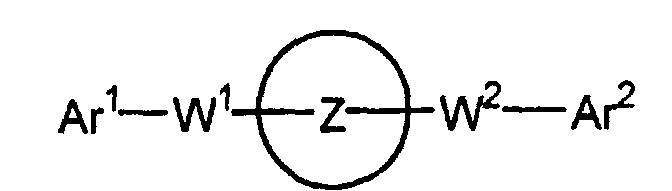
W2 is -CO-, -SO2-, -CONR-, an optionally substituted C1-C4 alkylene or an optionally substituted C2-C4 alkenylene, and R is hydrogen or an alkyl;
Ar2 is an optionally substituted aryl or an optionally substituted heteroaryl;
W1 and Ar1 mean the following (1) or (2):

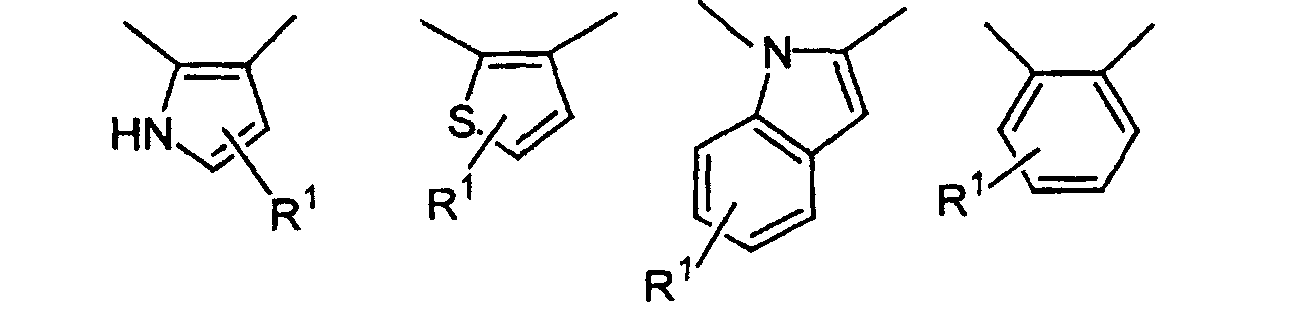

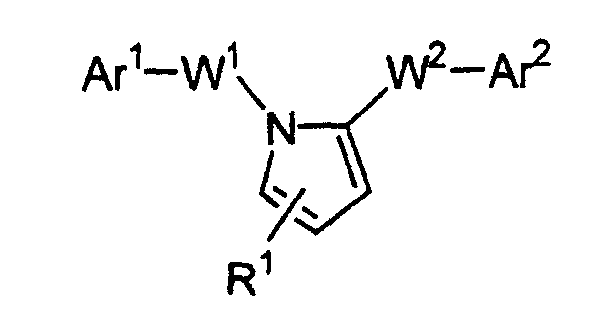
or a prodrug thereof, or a pharmaceutically acceptable salt thereof.
or a prodrug thereof, or a pharmaceutically acceptable salt thereof.

R2 is a halogen, cyano, an optionally substituted alkoxy or an optionally substituted alkyl;
R3 is hydroxyl, an alkoxy, an amino having optionally alkyl-substituent(s), a cyclic amino or an alkylsulfonylamino;
R4 is hydrogen, a halogen or an alkyl;
R5 is an optionally substituted alkoxy or an optionally substituted alkyl,
or a prodrug thereof, or a pharmaceutically acceptable salt thereof.
or a prodrug thereof, or a pharmaceutically acceptable salt thereof.
or a prodrug thereof, or a pharmaceutically acceptable salt thereof.

R11, R12 and R13 are as follows:
Het is an optionally substituted monocyclic or bicyclic heteroaryl having 1 to 4 nitrogen atoms as ring-forming atoms;
A is an optionally substituted aryl, or an optionally substituted monocyclic or bicyclic heteroaryl;
R16 is hydroxyl, an alkoxy, an amino having optionally alkyl-substituent(s), a cyclic amino, or an alkylsulfonylamino;
R17 is an alkyl, an amino having optionally alkyl-substituent(s), or a cyclic amino;
R11 is -W11-Ar3 or -W12-Het;
one of R12 and R13 is -W13-A, and the other is hydrogen or an optionally substituted C1-C4 alkyl;
W11 is an optionally substituted C2-C5 alkenylene;
W12 is an optionally substituted C1-C4 alkylene;
W13 is -CO-, an optionally substituted C1-C6 alkylene, or an optionally substituted C2-C5 alkenylene;
Ar3 is an aryl being substituted at the ortho-position thereof with respect to the binding position of W11 by a group selected from -COR16, -SO2R17 and tetrazolyl, and said aryl being optionally further substituted by a group selected from hydroxy, an optionally substituted C1-C4 alkyl, an optionally substituted C2-C4 alkenyl, an optionally substituted C2-C4 alkynyl, an optionally substituted C1-C4 alkoxy, a halogen, cyano, a carbamoyl having optionally C1-C4 alkyl-substituent(s), and a cyclic aminocarbonyl;
Het is an optionally substituted 3-quinolyl, an optionally substituted 3-naphthyridinyl or an optionally substituted 2-quinoxalyl;
A is an optionally substituted aryl, or an optionally substituted monocyclic or bicyclic heteroaryl;
R16 is hydroxy, a C1-C4 alkoxy, an amino having optionally C1-C4 alkyl-substituent(s), a cyclic amino, or a C1-C4 alkylsulfonylamino;
R17 is a C1-C4 alkyl, an amino having optionally C1-C4 alkyl-substituent(s), or a cyclic amino.
- Optionally substituted alkyl
(the substituents of this substituted alkyl include, for example, hydroxy, an alkanoyloxy, a halogen, cyano, an alkanoyl, an alkoxy, an alkoxycarbonyl, carboxy, an amino having optionally alkyl-substituent(s), an amino having optionally alkoxyalkyl-substituent(s), a cyclic amino, a monocyclic heteroaryl, a carbamoyl having optionally alkyl-substituent(s), a cyclic aminocarbonyl, a sulfamoyl having optionally alkyl-substituent(s), a cyclic aminosulfonyl, azide, etc. The number of the substituents is 1 or more, for example, 2 or 3, and the substituents are the same or different.) - Optionally substituted alkoxy:
(the substituents of this substituted alkoxy include, for example, hydroxy, an alkanoyloxy, a halogen, cyano, an alkanoyl, an alkoxy, an alkoxycarbonyl, carboxy, an amino having optionally alkyl-substituent(s), an amino having optionally alkoxyalkyl-substituent(s), a cyclic amino, a monocyclic heteroaryl, a carbamoyl having optionally alkyl-substituent(s), a cyclic aminocarbonyl, a sulfamoyl having optionally alkyl-substituent(s), a cyclic aminosulfonyl, azide, etc. The number of the substituents is 1 or more, for example, 2 or 3, and the substituents are the same or different.) - Optionally substituted alkenyl, optionally substituted alkynyl:
(the substituents of these substituted alkenyl and substituted alkynyl include, for example, an alkoxy, an alkoxycarbonyl, an alkanoyl, hydroxy, an alkanoyloxy, a halogen, cyano, a carbamoyl having optionally alkyl-substituent(s), a cyclic aminocarbonyl, carboxy, an amino having optionally alkyl-substituent(s), a cyclic amino, a sulfamoyl having optionally alkyl-substituent(s), a cyclic aminosulfonyl, etc. The number of the substituents is 1 or more, for example, 2 or 3, and the substituents are the same or different.) - An alkenyloxy, hydroxy, an alkanoyl, an alkanoyloxy, a halogen, an alkylsulfonyl, an amino having optionally alkyl-substituent(s), a cyclic amino, a carbamoyl having optionally alkyl-substituent(s), a cyclic aminocarbonyl, a sulfamoyl having optionally alkyl-substituent(s), a cyclic aminosulfone, cyano, methylenedioxy, a heteroaryl, 1,3-dioxan-2-yl, etc.

- Kidney diseases: diabetic renal disease, glomerular nephritis, tubulointerstitial nephritis, hereditary renal disease
- Respiratory diseases: interstitial pneumonia, chronic obstructive pulmonary disease, asthma
- Digestive diseases: cirrhosis hepatis, chronic pancreatitis, scirrhousgastric cancer
- Cardiovascular diseases: myocardial fibrosis, restenosis after PTCA, arteriosclerosis
- Bone-joint diseases: myelofibrosis, arthrorheumatism
- Skin diseases: post-surgical scarring, burn scarring, keloid, hypertrophic scar, atopic dermatitis, scleroderma
- Obstetrics diseases: uterus myoma
- Urinary diseases: prostatomegaly
- Other diseases: Alzheimer's disease, sclerosing peritonitis, diabetic retinopathy, type 1 diabetes mellitus, Post-surgical organ adhesion



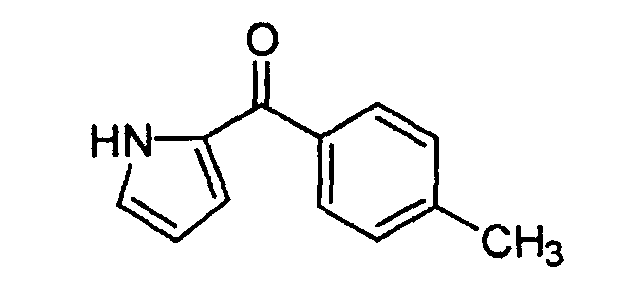
1H NMR (CDCl3, 300MHz) δ 8.12 (d, 2H, J=8.3Hz), 7.75-7.78 (m, 1H), 7.72 (brd, 2H, J=7.9Hz), 7.65 (brt, 1H, J=7.9Hz), 7.58 (brt, 2H, J=7.9Hz), 7.25 (d, 2H, J=8.3Hz), 6.69-6.72 (m, 1H), 6.35 (dd, 1H, J=3.1 and 0.5Hz), 2.42 (s, 3H).
1H NMR (CDCl3, 300MHz) δ 9.52 (brs, 1H), 8.25 (d, 2H, J=8.3Hz), 7.29 (d, 2H, J=8.3Hz), 7.12 (brs, 1H), 6.88-6.91 (m, 1H), 6.32-6.36 (m, 1H), 2.44 (s, 3H).

1H NMR (CDCl3, 300MHz) δ 7.42 (brs, 1H), 7.10 (d, 2H, J=8.1Hz), 7.08 (d, 2H, J=8.1Hz), 6.63 (brs, 1H), 6.11-6.17 (m, 1H), 5.98 (s, 1H), 3.93 (brs, 2H), 2.32 (s, 3H).
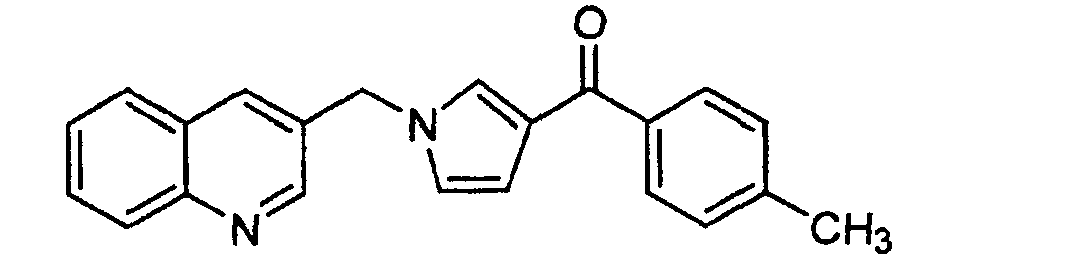
1H NMR (CDCl3, 300MHz) δ 7.89 (brd, 2H, J=7.9Hz), 7.73 (d, 2H, J=8.0Hz), 7.65 (brt, 1H, J=7.9Hz), 7.65 (brs, 1H), 7.34 (brt, 2H, J=7.9Hz), 7.29 (d, 2H, J=8.0Hz), 7.22 (dd, 1H, J=2.2 and 2.8Hz), 6.80 (dd, 1H, J=1.5 and 2.8Hz), 2.44 (s, 3H).
1H NMR (CDCl3, 300MHz) δ 7.76 (d, 2H, J=8.1Hz), 7.35 (brquint., 1H, J=1.5 Hz), 7.26 (d, 2H, J=8.1Hz), 6.84 (brq, 1H, J=1.5Hz), 6.76 (brs, 1H), 2.43 (s, 3H).
1H NMR (CDCl3, 300MHz) δ 8.77 (d, 1H, J=2.2Hz), 8.11 (d, 1H, J=8.6Hz), 7.86 (brs, 1H), 7.71-7.81 (series of m, 2H), 7.75 (d, 2H, J=8.1Hz), 7.57 (brt, 1H, J=8.0Hz), 7.34 (brt, 1H, J=1.8Hz), 7.25 (d, 2H, J=8.1Hz), 6.75 (brs, 1H), 6.74 (brs, 1H), 5.26 (s, 2H), 3.38 (s, 3H).
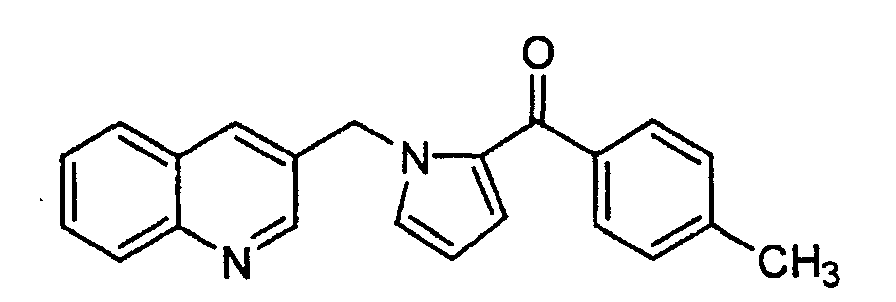
1H NMR (CDCl3, 300MHz) δ 8.81 (d, 1H, J=2.2Hz), 8.06 (d, 1H, J=8.6Hz), 7.93 (brs, 1H), 7.74 (brd, 1H, J=8.1Hz), 7.68 (d, 2H, J=8.1Hz), 7.66 (brt, 1H, J=8.1 and 1.1Hz), 7.51 (ddd, 1H, J=8.6, 8.1 and 1.1Hz), 7.23 (d, 2H, J=8.1Hz), 7.10 (dd, 1H, J=1.7 and 2.6Hz), 6.82 (dd, 1H, J=1.7 and 4.0Hz), 6.26 (dd, 1H, J=2.6 and 4.0Hz), 5.84 (s, 2H), 2.38 (s, 3H).
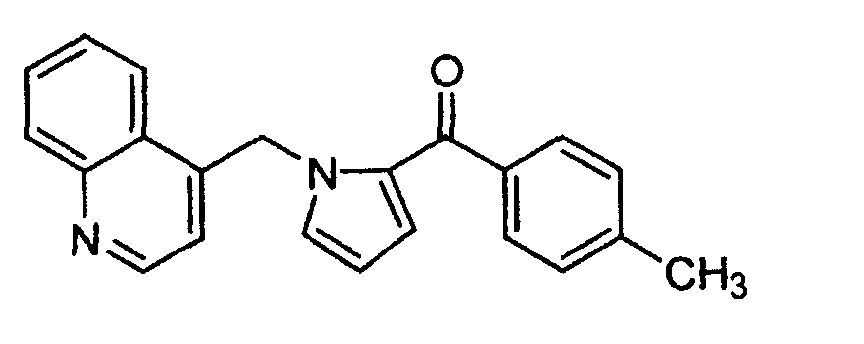
1H NMR (CDCl3, 300MHz) δ 8.78 (d, 1H, J=4.6Hz), 8.14 (brd, 1H, J=7.7Hz), 8.04 (brd, 1H, J=8.4Hz), 7.74 (ddd, 1H, J=8.4, 7.7 and 1.5Hz), 7.71 (d, 2H, J=8.1Hz), 7.61 (ddd, 1H, J=8.4, 7.7 and 1.3Hz), 7.24 (d, 2H, J=8.1Hz), 7.00 (dd, 1H, J=1.7 and 2.6Hz), 6.91 (dd, 1H, J=1.7 and 4.0Hz), 6.33 (dd, 1H, J=2.6 and 4.0Hz), 6.18 (s, 2H), 2.41 (s, 3H).
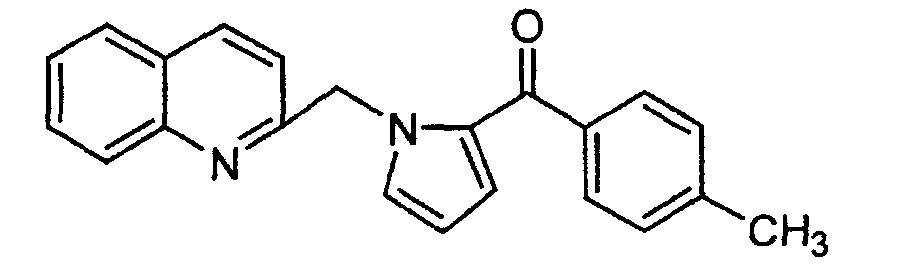
1H NMR (CDCl3, 300MHz) δ 8.07 (d, 1H, J=8.4Hz), 8.06 (brd, 1H, J=8.4Hz), 8.04 (brd, 1H, J=8.4Hz), 7.74 (d, 2H, J=8.1Hz), 7.66-7.79 (m, 2H), 7.50 (ddd, 1H, J=8.4, 7.7 and 1.3Hz), 7.25 (d, 2H, J=8.1Hz), 7.17 (d, 1H, J=8.4Hz), 7.15 (dd, 1H, J=1.7 and 2.6Hz), 6.83 (dd, 1H, J=1.7 and 4.0Hz), 6.26 (dd, 1H, J=2.6 and 4.0Hz), 5.94 (s, 2H), 2.42 (s, 3H).

1H NMR (CDCl3, 300 MHz) δ 8.03 (brd, 1H, J=8.4Hz), 7.96 (d, 1H, J=8.4Hz), 7.76 (brd, 1H, J=8.4Hz), 7.72 (ddd, 1H, J=8.4, 7.5 and 1.3Hz), 7.52 (ddd, 1H, J=8.4, 7.5 and 1.3Hz), 6.95 (d, 2H, J=8.1Hz), 6.93 (d, 2H, J=8.1Hz), 6.74 (dd, 1H, J=1.7 and 2.6Hz), 6.60 (d, 1H, J=8.4Hz), 6.20 (dd, 1H, J=1.7 and 4.0Hz), 6.00 (dd, 1H, J=2.6 and 4.0Hz), 5.26 (s, 2H), 3.81 (brs, 2H), 2.20 (s, 3H).

1H NMR (CDCl3, 300MHz) δ 7.73 (dt, 2H, J=8.4 and 2.0Hz), 7.27 (dt, 2H, J=8.4 and 2.0Hz), 7.15 (dd, 2H, J=2.2 and 2.4Hz), 6.28 (dd, 2H, J=2.2 and 2.4Hz), 2.40 (s, 3H).
(1-p-toluenesulfonyl-1H-pyrrol-2-yl) (3-quinolyl)methanol:
1H NMR (CDCl3, 300 MHz) δ 8.55 (d, 1H, J=2.2Hz), 8.04 (d, 1H, J=2.2Hz), 8.02 (brd, 1H, J=8.4Hz), 7.62-7.72 (m, 2H), 7.52 (brt, 1H, J=7.0Hz), 7.49 (d, 2H, J=8.4Hz), 7.37 (dd, 1H, J=3.1 and 1.7Hz), 7.07 (brd, 2H, J=8.4Hz), 6.30 (brs, 1H), 6.21 (t, 1H, J=3.5Hz), 5.94 (brquint., 1H, J=1.7Hz), 4.25 (brs, 1H), 2.25 (s, 3H).
(1H-pyrrol-2-yl)(3-quinolyl)methanol:
1H NMR (CDCl3, 300MHz) δ 8.87 (d, 1H, J=2.0Hz), 8.19 (brs, 1H), 8.08 (brd, 1H, J=8.4Hz), 7.79 (brd, 1H, J=8.4Hz), 7.70 (brt, 1H, J=8.4Hz), 7.55 (brt, 1H, J=8.4Hz), 6.80 (brd, 1H, J=1.5Hz), 6.16 (brq, 1H, J=2.8Hz), 6.11 (brs, 1H), 6.04 (brs, 1H).

1H NMR (CDCl3, 300MHz) δ 8.68 (d, 1H, J=2.2Hz), 8.57 (brs, 1H), 8.04 (d, 1H, J=8.4Hz), 7.86 (brs, 1H), 7.69 (brd, 1H, J=8.1Hz), 7.63 (ddd, 1H, J=8.4, 7.0 and 1.5Hz), 7.49 (ddd, 1H, J=8.1, 7.0 and 1.1Hz), 6.75 (brdd, 1H, J=2.9 and 4.0Hz), 6.18 (brq, 1H, J=2.9Hz), 6.04 (brs, 1H), 4.12 (s, 2H).
1H NMR (CDCl3, 300MHz) δ 8.70 (d, 1H, J=2.2Hz), 8.06 (brd, 1H, J=8.4Hz), 7.70 (d, 1H, J=1.7Hz), 7.66 (d, 1H, J=8.2Hz), 7.59-7.65 (m, 1H), 7.49 (ddd, 1H, J=8.2, 7.0 and 1.1Hz), 7.01 (brd, 2H, J=8.4Hz), 6.81 (brd, 2H, J=8.4Hz), 6.72 (brt, 1H, J=2.4Hz), 6.17 (t, 1H, J=3.0Hz), 5.97 (brs, 1H), 4.92 (s, 2H), 3.99 (s, 2H), 2.23 (s, 3H).

1H NMR (CDCl3, 400MHz) δ 9.15 (dd, 1H, J=4.2 and 1.9Hz), 8.85 (s, 1H), 8.45 (dd, 1H, J=8.3 and 1.9Hz), 7.68 (dd, 1H, J=8.3 and 4.2Hz), 2.88 (s, 3H).
1H NMR (CDCl3, 400MHz) δ 9.17 (dd, 1H, J=4.2 and 1.9Hz), 8.88 (s, 1H), 8.46 (dd, 1H, J=8.3 and 1.9Hz), 7.72 (dd, 1H, J=8.3 and 4.2Hz), 7.71 (d, 2H, J=8.0Hz), 7.27 (dd, 1H, J=2.6 and 1.6Hz), 7.25 (d, 2H, J=8.0Hz), 6.87 (dd, 1H, J=4.1 and 1.6Hz), 6.31 (dd, 1H, J=4.1 and 2.6Hz), 6.01 (s, 2H), 2.42 (s, 3H).
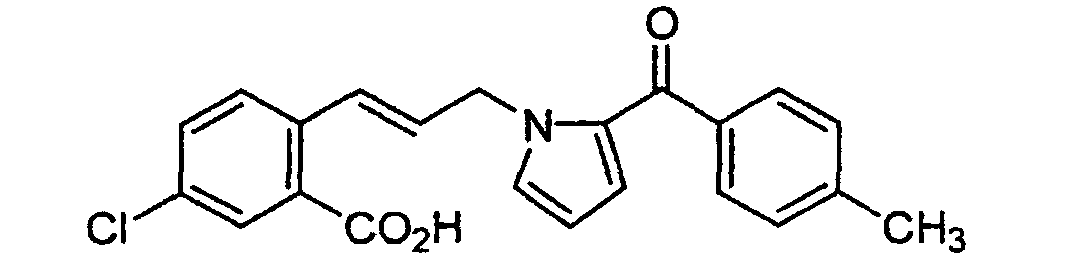
1H NMR (CDCl3, 400MHz) δ 8.51 (d, 1H, J=15.9Hz), 7.98 (d, 1H, J=1.9Hz), 7.58 (d, 1H, J=8.4Hz), 7.53 (dd, 1H, J=8.4 and 1.9Hz), 6.31 (d, 1H, J=15.9Hz), 3.95 (s, 3H).
1H NMR (CDCl3, 400MHz) δ 7.88 (d, 1H, J=2.2Hz), 7.50 (d, 1H, J=8.5Hz), 7.44 (dd, 1H, J=8.5 and 2.2Hz), 7.35 (brd, 1H, J=15.9Hz), 6.26 (dt, 1H, J=15.9 and 5.6Hz), 4.36 (brd, 2H, J=5.6Hz), 3.91 (s, 3H).
1H NMR (DMSO-d6, 400MHz) δ 7.67 (d, 2H, J=8.1Hz), 7.46 (brd, 1H, J=16.2Hz), 7.40 (brd, 1H, J=8.5Hz), 7.39 (brs, 1H), 7.33 (dd, 1H, J=1.7 and 2.4Hz), 7.31 (d, 2H, J=8.1Hz), 7.13 (brdd, 1H, J=8.4 and 2.3Hz), 6.65 (dd, 1H, J=1.7 and 4.0Hz), 6.25 (dt, 1H, J=16.2 and 6.4Hz), 6.20 (dd, 1H, J=2.4 and 4.0Hz), 5.10 (brd, 1H, J=6.4Hz), 2.38 (s, 3H)

1H NMR (CDCl3, 400MHz) δ 9.51(brs, 1H), 7.92 (dt, 2H, J=8.4 and 2.0Hz), 7.12 (dt, 1H, J=1.3 and 2.7Hz), 6.99 (dt, 2H, J=8.4 and 2.0Hz), 6.89 (ddd, 1H, J=3.8, 2.4 and 1.3Hz), 6.35 (dt, 1H, J=3.8 and 2.7Hz), 6.08 (ddt, 1H, J=17.3, 10.6 and 5.0Hz), 5.45 (ddt, 1H, J=17.3, 1.6 and 1.6Hz), 5.33 (ddt, 1H, J=10.6, 1.6 and 1.6Hz), 4.63 (ddd, 2H, J=5.0, 1.6 and 1.6Hz).
1H NMR (CDCl3, 400MHz) δ 8.80 (d, 1H, J=2.2Hz), 8.07 (d, 1H, J=8.4Hz), 7.92 (d, 1H, J=2.0Hz), 7.78 (dt, 2H, J=8.4 and 2.0Hz), 7.76 (brd, 1H, J=8.1Hz), 7.68 (ddd, 1H, J=8.4, 7.0 and 1.5Hz), 7.52 (ddd, 1H, J=8.1, 7.0 and 1.1Hz), 7.09 (dd, 1H, J=1.7 and 2.5Hz), 6.99 (dt, 2H, J=8.4 and 2.0Hz), 6.83 (dd, 1H, J=1.7 and 4.0Hz), 6.28 (dd, 1H, J=2, 5 and 4.0Hz), 6.06 (ddt, 1H, J=17.3, 10.6 and 5.0Hz), 5.84 (brs, 2H), 5.43 (ddt, 1H, J=17.3, 1.6 and 1.6Hz), 5.32 (ddt, 1H, J=10.6, 1.6 and 1.6Hz), 4.59 (ddd, 2H, J=5.0, 1.6 and 1.6Hz).
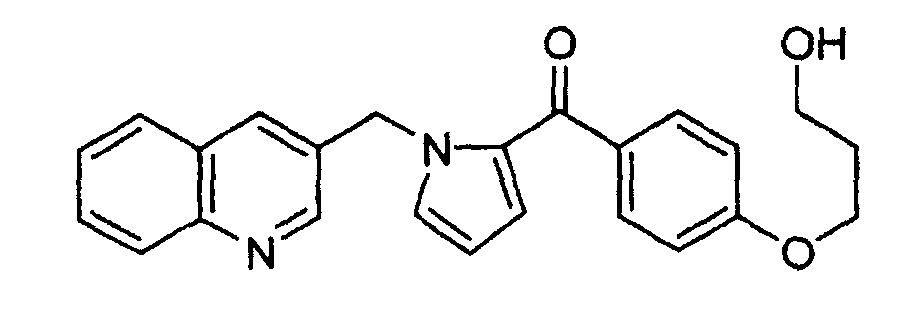

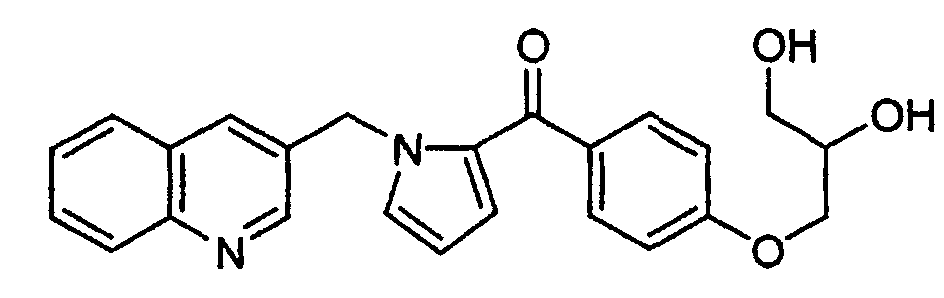
1H NMR (CDCl3, 300MHz) δ 8.79 (d, 1H, J=2.2Hz), 8.07 (d, 1H, J=8.4Hz), 7.92 (d, 1H, J=2.0Hz), 7.73-7.78 (series of m, 3H), 7.67 (ddd, 1H, J=8.4, 7.0 and 1.5Hz), 7.51 (ddd, 1H, J=8.1, 7.0 and 1.1Hz), 7.09 (dd, 1H, J=1.7 and 2.5Hz), 6.89 (brd, 2H, J=8.4Hz), 6.80 (dd, 1H, J=1.7 and 4.0Hz), 6.27 (dd, 1H, J=2. 5 and 4.0Hz), 5.82 (brs, 2H), 4.04-4.16 (m, 3H), 3.84 (dd, 1H, J=11.4 and 3.8Hz), 3.75 (dd, 1H, J=11.4 and 5.5Hz).

1H NMR (CDCl3, 400 MHz) δ 8.61 (brs, 1H), 8.07 (brd, 1H, J=8.4Hz), 8.05 (brs, 1H), 7.79 (brd, 1H, J=8.1Hz), 7.68 (ddd, 1H, J=8.4, 7.0 and 1.5Hz), 7.66 (dt, 2H, J=8.4 and 2.0Hz), 7.54 (ddd, 1H, J=8.1, 7.0 and 1.1Hz), 7.12 (dd, 1H, J=1.7 and 2.5Hz), 6.81 (dd, 1H, J=1.7 and 4.0Hz), 6.79 (dt, 2H, J=8.4 and 2.0Hz), 6.27 (dd, 1H, J=2. 5 and 4.0Hz), 5.86 (brs, 2H).
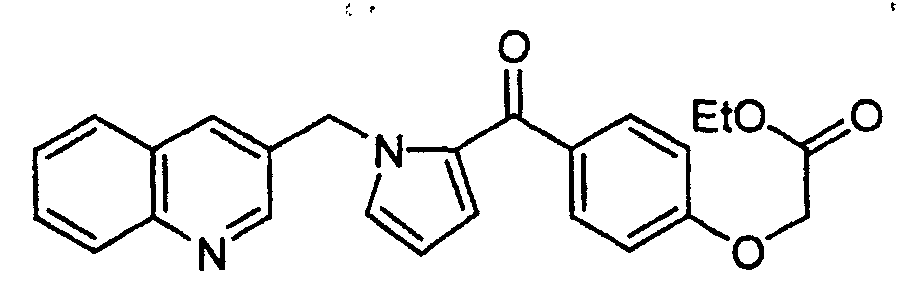
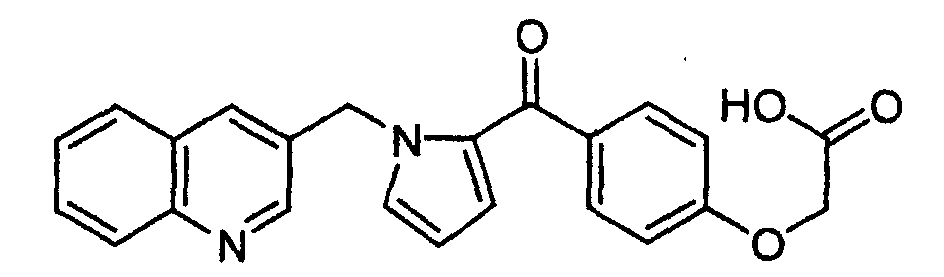
1H NMR (CDCl3, 400MHz) δ 8.78 (d, 1H, J=2.2Hz), 8.12 (d, 1H, J=8.4Hz), 8.04 (brs, 1H), 7.78 (brd, 1H, J=8.1Hz), 7.76 (brd, 2H, J=8.4Hz), 7.68 (ddd, 1H, J=8.4, 7.0 and 1.5Hz), 7.54 (ddd, 1H, J=8.1, 7.0 and 1.1Hz), 7.11 (dd, 1H, J=1.7 and 2.5Hz), 6.93 (brd, 2H, J=8.4Hz), 6.82 (dd, 1H, J=1.7 and 4.0Hz), 6.28 (dd, 1H, J=2. 5 and 4.0Hz), 5.81 (brs, 2H), 4.73 (s, 2H).
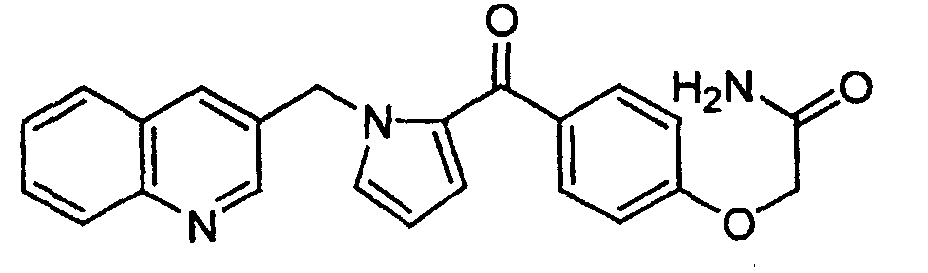
1H NMR (CDCl3, 400MHz) δ 8.80 (d, 1H, J=2.2Hz), 8.07 (d, 1H, J=8.4Hz), 7.92 (d, 1H, J=2.0Hz), 7.80 (dt, 2H, J=8.4 and 2.0Hz), 7.76 (brd, 1H, J=8.1Hz), 7.68 (ddd, 1H, J=8.4, 7.0 and 1.5Hz), 7.52 (ddd, 1H, J=8.1, 7.0 and 1.1Hz), 7.12 (dd, 1H, J=1.7 and 2.5Hz), 6.94 (dt, 2H, J=8.4 and 2.0Hz), 6.81 (dd, 1H, J=1.7 and 4.0Hz), 6.55 (brs, 1H), 6.29 (dd, 1H, J=2.5 and 4.0Hz), 5.92 (brs, 1H), 5.84 (brs, 2H), 4.55 (s, 2H).
1H NMR (CDCl3, 400MHz) δ 8.58 (d, 1H, J=15.9Hz), 7.99 (dd, 1H, J=1.2 and 7.7Hz), 7.62 (brd, 1H, J=7.7Hz), 7.56 (dt, 1H, J=1.1 and 7.7Hz), 7.47 (dt, 1H, J=1.2 and 7.7Hz), 6.31 (d, 1H, J=15.9Hz), 4.41 (q, 2H, J=7.2Hz), 1.42 (t, 3H, J=7.2Hz).
1H NMR (CDCl3, 400MHz) δ 7.89 (dd, 1H, J=1.2 and 7.7Hz), 7.56 (brd, 1H, J=7.7Hz), 7.47 (dt, 1H, J=1.1 and 7.7Hz), 7.38 (brd, 1H, J=15.9Hz), 7.32 (dt, 1H, J=1.2 and 7.7Hz), 6.26 (dt, 1H, J=15.9 and 5.6Hz), 4.36 (brd, 2H, J=5.6Hz), 4.35 (q, 2H, J=7.2Hz), 1.39 (t, 3H, J=7.2Hz).
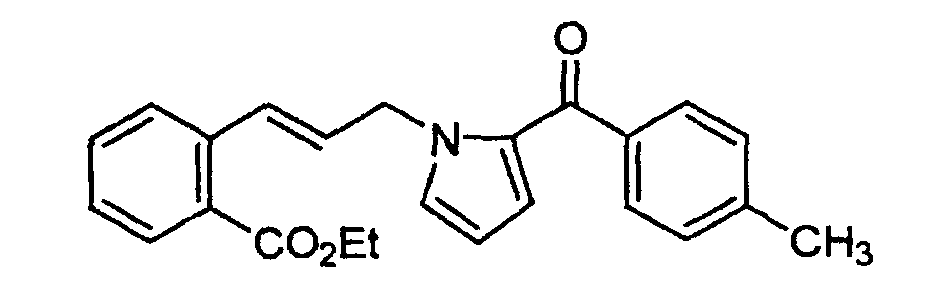
1H NMR (CDCl3, 400MHz) δ 7.87 (dd, 1H, J=1.2 and 7.7Hz), 7.74 (dt, 2H, J=8.4 and 2.0Hz), 7.54 (brd, 1H, J=7.7Hz), 7.43 (dt, 1H, J=1.1 and 7.7Hz), 7.30 (brd, 1H, J=15.7Hz), 7.29 (dt, 1H, J=1.2 and 7.7Hz), 7.25 (brd, 2H, J=8.4Hz), 7.11 (dd, 1H, J=1.7 and 2.5Hz), 6.76 (dd, 1H, J=1.7 and 4.0Hz), 6.36 (dt, 1H, J=15.7 and 5.6Hz), 6.21 (dd, 1H, J=2. 5 and 4.0Hz), 5.23 (dd, 2H, J=6.2 and 1.4Hz), 4.34 (q, 2H, J=7.2Hz), 2.43 (s, 3H), 1.37 (t, 3H, J=7.2Hz).
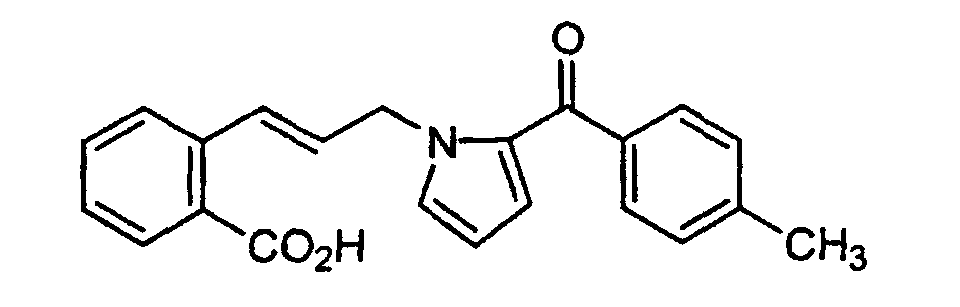
1H NMR (CDCl3, 400MHz) δ 8.02 (dd, 1H, J=1.2 and 7.7Hz), 7.74 (brd, 2H, J=8.4Hz), 7.57 (brd, 1H, J=7.7Hz), 7.50 (dt, 1H, J=1.1 and 7.7Hz), 7.36 (brd, 1H, J=15.7Hz), 7.34 (dt, 1H, J=1.2 and 7.7Hz), 7.24 (brd, 2H, J=8.4Hz), 7.11 (dd, 1H, J=1.7 and 2.5Hz), 6.78 (dd, 1H, J=1.7 and 4.0Hz), 6.38 (dt, 1H, J=15.7 and 5.6Hz), 6.22 (dd, 1H, J=2. 5 and 4.0Hz), 5.25 (dd, 2H, J=6.2 and 1.4Hz), 2.40 (s, 3H).
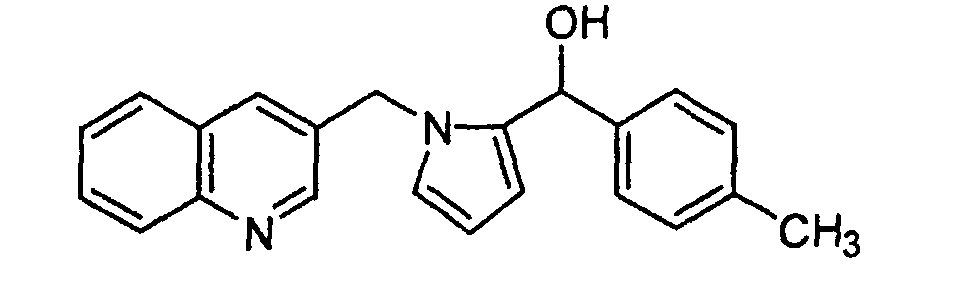
1H NMR (CDCl3, 270MHz) δ 9.57 (d, 1H, J=1.3Hz), 8.80 (d, 1H, J=2.3Hz), 8.08 (d, 1H, J=7.9Hz), 7.87 (d, 1H, J=2.3Hz), 7.76 (d, 1H, J=7.9Hz), 7.70 (dd, 1H, J=7.9 and 7.9Hz), 7.53 (dd, 1H, J=7.9 and 7.9Hz), 7.08 (m, 1H), 7.02 (dd, 1H, J=1.7 and 4.0Hz), 6.33 (dd, 1H, J=2.6 and 4.0Hz), 5.76 (s, 2H).
1H NMR (CDCl3, 270MHz) δ 8.63 (d, 1H, J=2.3Hz), 8.06 (d, 1H, J=8.3Hz), 7.65-7.71 (m, 2H), 7.49-7.54 (m, 2H), 7.20 (d, 2H, J=8.1Hz), 7.03 (d, 2H, J=8.1Hz), 6.71 (dd, 1H, J=1.7 and 2.7Hz), 6.15 (dd, 1H, J=2.7, 3.5Hz), 5.99 (dd, 1H, J=1.7, 3.5Hz), 5.81 (d, 1H, J=4.3Hz), 5.37 (d, 1H, J=16.3Hz), 5.28 (d, 1H, J=16.3Hz), 2.36 (d, 1H, J=4.3Hz), 2.21 (s, 3H).

1H NMR (CDCl3, 270MHz) δ 8.60 (d, 1H, J=1.8Hz), 8.07 (d, 1H, J=7.7Hz), 7.63-7.71 (m, 2H), 7.51 (dd, 1H, J=7.7 and 7.7Hz), 7.38 (d, 1H, J=1.8 Hz), 6.96 (s, 4H), 6.68 (dd, 1H, J=1.8 and 2.8Hz), 6.20 (m, 1H), 6.06 (m, 1H), 5.09 (s, 2H), 3.84 (s, 2H), 2.18 (s, 3H).

1H NMR (CDCl3, 300MHz) δ 7.75 (dd, 1H, J=1.5, 8.6Hz), 7.25 (ddd, 1H, J=1.5, 7.7 and 7.7Hz), 6.62-6.67 (m, 2H), 6.28 (brs, 2H), 2.98 (q, 2H, J=7.3Hz), 1.21 (t, 3H, J=7.3Hz).
1H NMR (CDCl3, 300MHz) δ 8.75 (s, 1H), 8.24 (d, 1H, J=7.7Hz), 8.09 (d, 1H, J=7.7Hz), 7.72 (dd, 1H, J=7.7 and 7.7Hz), 7.63 (dd, 1H, J=7.7 and 7.7Hz), 2.58 (s, 3H).
1H NMR (CDCl3, 300MHz) δ 8.26-8.29 (m, 2H), 8.06 (d, 1H, J=7.9Hz), 7.63-7.76 (m, 4H), 7.23 (d, 2H, J=7.9Hz), 7.07 (dd, 1H, J=1.7, 2.6Hz), 6.86 (dd, 1H, J=1.7 and 4.1Hz), 6.29 (dd, 1H, J=2.6 and 4.1Hz), 5.99 (s, 2H), 2.41(s, 3H).

1H NMR (CDCl3, 300MHz) δ 8.65 (s, 1H), 8.22 (d, 1H, J=7.9Hz), 8.15 (d, 1H, J=7.9Hz), 7.83 (dd, 1H, J=7.9, 7.9Hz), 7.76 (dd, 1H, J=7.9, 7.9Hz), 7.69 (d, 2H, J=8.0Hz), 7.24 (d, 2H, J=8.0Hz), 7.17 (dd, 1H, J=1.7, 2.6Hz), 6.89 (dd, 1H, J=1.7, 4.1Hz), 6.33 (dd, 1H, J=2.6, 4.1Hz), 6.08 (s, 2H), 2.41 (s, 3H).

1H NMR (CDCl3, 300MHz) δ 8.19 (s, 1H), 8.01-8.04 (m, 2H), 7.81 (brs, 1H), 7.70 (dd, 1H, J=7.2, 7.2Hz), 7.60 (dd, 1H, J=7.2, 7.2Hz), 7.54 (d, 2H, J=8.0Hz), 7.30 (dd, 1H, J=1.7, 2.6Hz), 7.17 (d, 2H, J=8.0Hz), 6.92 (dd, 1H, J=1.7, 4.0Hz), 6.36 (dd, 1H, J=2.6, 4.0Hz), 6.23 (brs, 1H), 5.84 (brs, 2H), 2.37 (s, 3H).
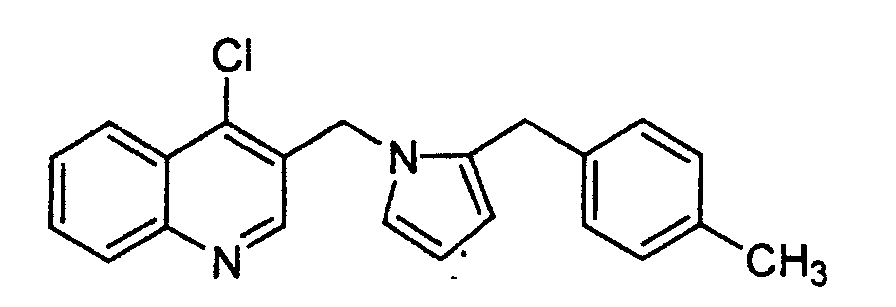
1H NMR (CDCl3, 300MHz) δ 8.20 (d, 1H, J=7.2Hz), 8.04 (d, 1H, J=7.2Hz), 7.88 (s, 1H), 7.74 (dd, 1H, J=7.2, 7.2Hz), 7.64 (dd, 1H, J=7.2, 7.2Hz), 6.94 (d, 2H, J=7.9Hz), 6.87 (d, 2H, J=7.9Hz), 6.69 (dd, 1H, J=1.8, 3.1Hz), 6.20 (dd, 1H, J=3.1, 3.1Hz), 6.06 (dd, 1H, J=1.8, 3.1Hz), 5.21 (s, 2H), 3.86 (s, 2H), 2.06 (s, 3H).
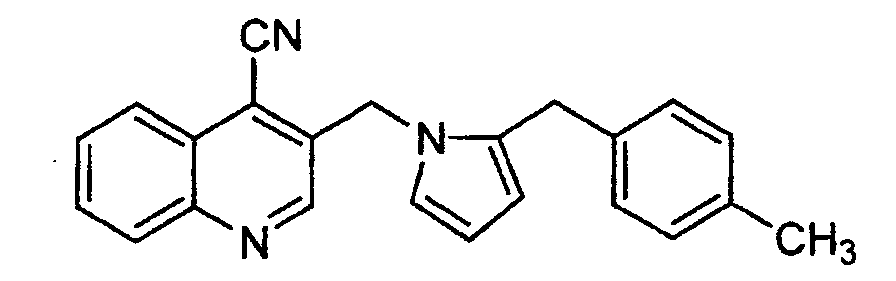
1H NMR (CDCl3, 300MHz) δ 8.17 (s, 1H), 8.10 (d, 1H, J=7.4Hz), 8.07 (d, 1H, J=7.4Hz), 7.80 (dd, 1H, J=7.4, 7.4Hz), 7.73 (dd, 1H, J=7.4, 7.4Hz), 6.87 (d, 2H, J=7.9Hz), 6.77 (dd, 1H, J=1.8, 3.1Hz), 6.72 (d, 2H, J=7.9Hz), 6.25 (dd, 1H, J=3.1, 3.1Hz), 6.12 (dd, 1H, J=1.8, 3.1Hz), 5.32 (s, 2H), 3.92 (s,2H), 1.87 (s, 3H).
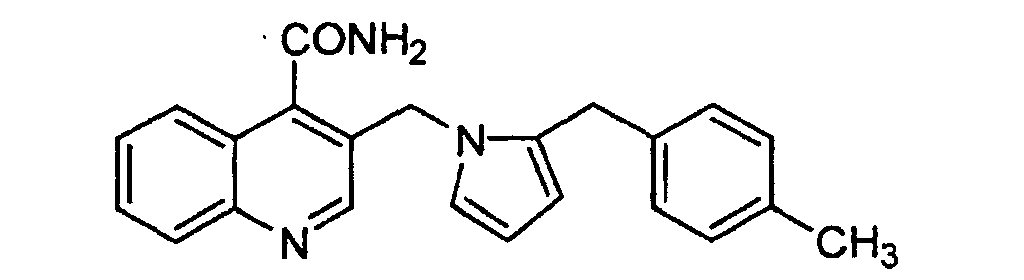
1H NMR (CDCl3, 300MHz) δ 8.34 (s, 1H), 8.09 (d, 1H, J=7.6Hz), 7.91 (d, 1H, J=7.6Hz), 7.74 (dd, 1H, J=7.6, 7.6Hz), 7.59 (dd, 1H, J=7.6, 7.6Hz), 6.90-6.96 (m, 4H), 6.58 (dd, 1H, J=2.0, 3.1Hz), 6.15 (dd, 1H, J=3.1, 3.1Hz), 6.01 (dd, 1H, J=2.0, 3.1Hz), 5.90 (brs, 1H), 5.57 (brs, 1H), 5.14 (s, 2H), 3.88 (s, 2H), 2.15 (s, 3H).

1H NMR (CDCl3, 300MHz) δ 10.29 (s, 1H), 8.02 (d, 1H, J=7.8Hz), 7.94 (d, 1H, J=7.8Hz), 7.54 (dd, 1H, J=7.8, 7.8Hz).
1H NMR (CDCl3, 300MHz) δ 7.89-7.97 (m, 3×1/2H), 7.83 (dd, 1×1/2H, J=1.2, 7.9Hz), 7.62 (s, 1×1/2H), 7.38 (dd, 1×1/2H, J=8.4, 8.4Hz), 7.31 (dd, 1×1/2H, J=7.9, 7.9Hz), 6.89 (s, 1×1/2H), 4.30 (q, 2×1/2H, J=7.1Hz), 3.94 (q, 2×1/2H, J=7.2Hz), 2.14 (s, 3×1/2H), 1.67 (s, 3×1/2H), 1.37 (t, 3×1/2H, J=7.1Hz), 0.95 (t, 3×1/2H, J=7.2Hz).
1H NMR (CDCl3, 300MHz) δ 7.73-7.86 (m, 2H), 7.30 (dd, 1×1/2H, J=8.1, 8.1Hz), 7.29 (dd, 1×1/2H, J=8.1, 8.1Hz), 6.47 (s, 1×1/2H), 6.22 (s, 1×1/2H), 4.21 (s, 2×1/2H), 3.85 (s, 2×1/2H), 2.01 (s, 3×1/2H), 1.48 (s, 3×1/2H).
1H NMR (CDCl3, 300MHz) δ 9.74 (s, 1×1/2H), 9.41 (s, 1×1/2H), 7.92-8.06 (m, 2H), 7.43-7.47 (m, 2H), 2.02 (s, 3×1/2H), 1.59 (s, 3×1/2H).
1H NMR (CDCl3, 300MHz) δ 8.79 (d, 1H, J=2.2Hz), 8.30 (d, 1H, J=2.2Hz), 8.05 (d, 1H, J=8.2Hz), 7.80 (d, 1H, J=8.2Hz), 7.50 (dd, 1H, J=8.2, 8.2Hz), 2.59 (s, 3H).
1H NMR (CDCl3, 400MHz) δ 8.79 (d, 1H, J=2.1Hz), 8.20 (d, 1H, J=2.1Hz), 8.04 (d, 1H, J=8.4Hz), 7.80 (d, 1H, J=7.5Hz), 7.70 (d, 2H, J=8.0Hz), 7.53 (dd, 1H, J=7.5, 8.4Hz), 7.23 (d, 2H, J=8.0Hz), 7.11 (dd, 1H, J=1.7, 2.5Hz), 6.86 (dd, 1H, J=1.7, 4.0Hz), 6.31 (dd, 1H, J=2.5, 4.0Hz), 5.91 (s, 2H), 2.41 (s, 3H).
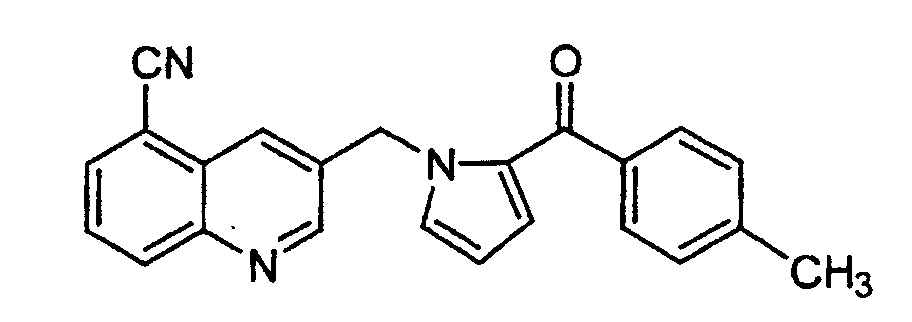
1H NMR (CDCl3, 300MHz) δ 8.90 (d, 1H, J=2.0Hz), 8.30-8.33 (m, 2H), 7.96 (d, 1H, J=7.3Hz), 7.71 (dd, 1H, J=7.3, 7.3Hz), 2.62 (s, 3H).
1H NMR (CDCl3, 300MHz) δ 8.90 (d, 1H, J=2.2Hz), 8.32 (d, 1H, J=7.9Hz), 8.13 (d, 1H, J=2.2Hz), 7.95 (d, 1H, J=7.9Hz), 7.69-7.76 (m, 3H), 7.24 (d, 2H, J=7.9Hz), 7.12 (dd, 1H, J=1.7 and 2.6Hz), 6.89 (dd, 1H, J=1.7 and 4.0Hz), 6.34 (dd, 1H, J=2.6 and 4.0Hz), 5.93 (s, 2H), 2.41 (s, 3H).
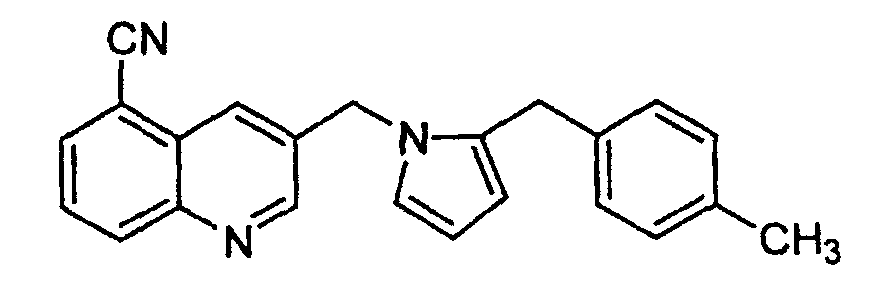
1H NMR (CDCl3, 300MHz) δ 8.57 (d, 1H, J=2.0Hz), 8.29 (d, 1H, J=8.6Hz), 7.94 (d, 1H, J=7.2Hz), 7.78 (d, 1H, J=2.0Hz), 7.27 (dd, 1H, J=7.2 and 8.6Hz), 6.90 (d, 2H, J=8.2Hz), 6.85 (d, 2H, J=8.2Hz), 6.72 (dd, 1H, J=1.8 and 3.0Hz), 6.24 (dd, 1H, J=3.0 and 3.0Hz), 6.12 (dd, 1H, J=1.8 and 3.0Hz), 5.15 (s, 2H), 3.87 (s, 2H), 2.03 (s, 3H).

1H NMR (CDCl3, 300MHz) δ 8.79 (d, 1H, J=1.7Hz), 8.32 (d, 1H, J=7.9Hz), 8.13 (d, 1H, J=2.2Hz), 7.95 (d, 1H, J=7.9Hz), 7.69-7.76 (m, 3H), 7.24 (d, 2H, J=7.9Hz), 7.12 (dd, 1H, J=1.7, 2.6Hz), 6.89 (dd, 1H, J=1.7, 4.0Hz), 6.34 (dd, 1H, J=2.6, 4.0Hz), 5.93 (s, 2H), 2.41 (s, 3H).
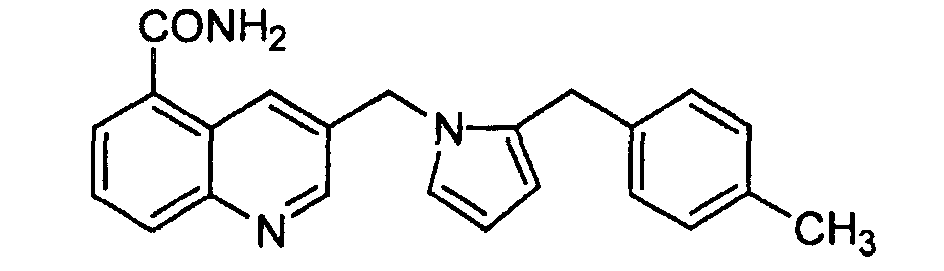
1H NMR (CDCl3, 300MHz) δ 8.52 (d, 1H, J=2.2Hz), 8.38 (d, 1H, J=2.2Hz), 8.18 (d, 1H, J=8.4Hz), 7.79 (d, 1H, J=7.0Hz), 7.68 (dd, 1H, J=7.0, 8.4Hz), 6.95 (s, 4H), 6.69 (dd, 1H, J=1.8, 3.1Hz), 6.18 (dd, 1H, J=3.1, 3.1Hz), 6.03 (dd, 1H, J=1.8, 3.1Hz), 5.86 (brs, 2H), 5.10 (s, 2H), 3.85 (s, 2H), 2.17 (s, 3H).
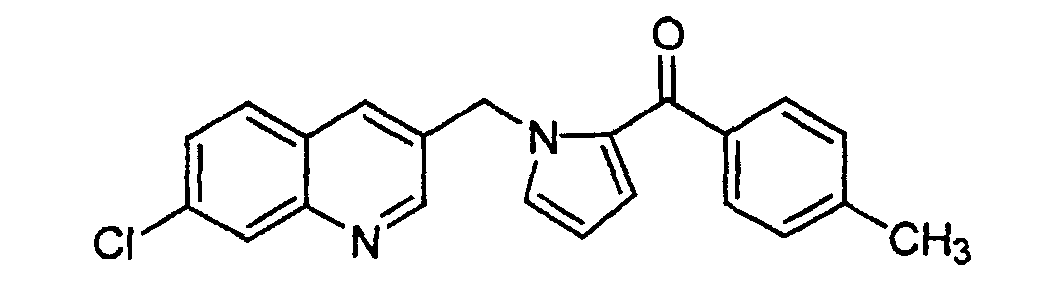
1H NMR (CDCl3, 300MHz) δ 8.77 (d, 1H, J=2.0Hz), 8.06 (d, 1H, J=2.1Hz), 7.90 (d, 1H, J=2.0Hz), 6.68(d, 1H, J=8.7Hz), 7.47 (dd, 1H, J=2.1, 8.7Hz), 2.51 (s, 3H).
1H NMR (CDCl3, 400MHz) δ 8.80 (d, 1H, J=1.7Hz), 8.07 (d, 1H, J=2.0Hz), 7.90 (d, 1H, J=1.7Hz), 7.69 (d, 1H, J=8.7Hz), 7.67 (d, 2H, J=8.2Hz), 7.47 (dd, 1H, J=2.0, 8.7Hz), 7.23 (d, 2H, J=8.2Hz), 7.11 (dd, 1H, J=1.7,2.5Hz), 6.84 (dd, 1H, J=1.7, 4.0Hz), 6.29 (dd, 1H, J=2.5, 4.0Hz), 5.83 (s, 2H), 2.41 (s, 3H).
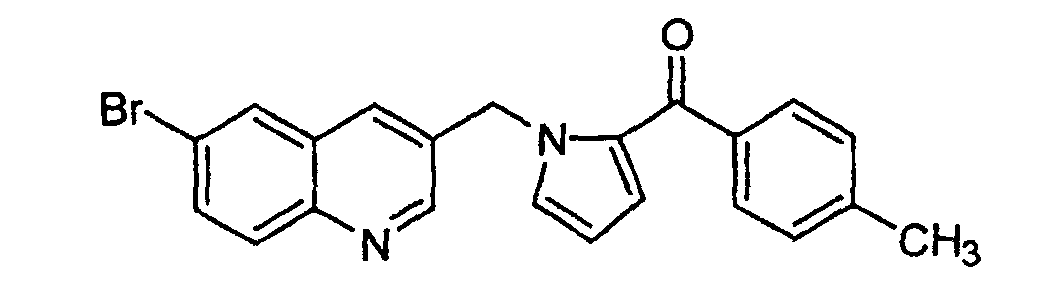
1H NMR (CDCl3, 300MHz) δ 8.77 (d, 1H, J=2.0Hz), 7.93 (d, 1H, J=9.0Hz), 7.91 (d, 1H, J=2.2Hz), 7.83 (d, 1H, J=2.0Hz), 7.71 (dd, 1H, J=2.2, 9.0Hz), 2.53 (s, 3H).
1H NMR (CDCl3, 300MHz) δ 8.81 (d, 1H, J=2.2Hz), 7.93 (d, 1H, J=9.1Hz), 7.91 (d, 1H, J=2.2Hz), 7.78 (d, 1H, J=2.2Hz), 7.73 (dd, 1H, J=2.2, 9.1Hz), 7.67 (d, 2H, J=8.1Hz), 7.23 (d, 2H, J=8.1Hz), 7.10 (dd, 1H, J=1.7, 2.6Hz), 6.84 (dd, 1H, J=1.7, 4.1Hz), 6.29 (dd, 1H, J=2.6, 4.1Hz), 5.84 (s, 2H), 2.41 (s, 3H).

1H NMR (CDCl3, 300MHz) δ 8.90 (d, 1H, J=2.2Hz), 7.95 (d, 1H, J=2.2Hz), 7.77 (dd, 1H, J=1.6, 7.5Hz), 7.68 (dd, 1H, J=1.6, 7.5Hz), 7.43 (dd, 1H, J=7.5, 7.5Hz), 2.55 (s, 3H).
1H NMR (CDCl3, 300MHz) δ 8.89 (d, 1H, J=2.2Hz), 7.97 (d, 1H, J=2.2Hz), 7.80 (dd, 1H, J=1.3, 7.7Hz), 7.65-7.71 (m, 3H), 7.44 (dd, 1H, J=7.7, 7.7Hz), 7.22 (d, 2H, J=8.1Hz), 7.11 (dd, 1H, J=1.7, 2.6Hz), 6.84 (dd, 1H, J=1.7, 4.0Hz), 6.29 (dd, 1H, J=2.6, 4.0Hz), 5.87 (s, 2H), 2.41 (s, 3H).

1H NMR (CDCl3, 300MHz) δ 8.94 (d, 1H, J=2.2Hz), 8.14-8.17 (m, 2H), 7.90 (d, 1H, J=2.2Hz), 7.81 (dd, 1H, J=1.7, 8.8Hz), 7.66 (d, 2H, J=7.9Hz), 7.23 (d, 2H, J=7.9Hz), 7.13 (dd, 1H, J=1.7, 2.6Hz), 6.87 (dd, 1H, J=1.7, 4.0Hz), 6.32 (dd, 1H, J=2.6, 4.0Hz), 5.86 (s, 2H), 2.41 (s, 3H).
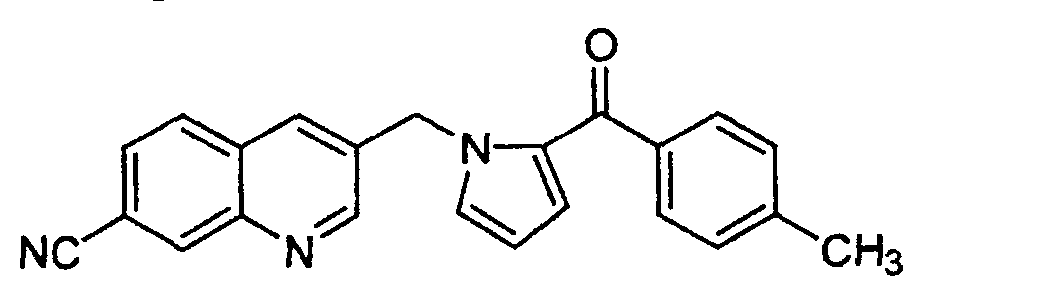
1H NMR (CDCl3, 300MHz) δ 8.90 (d, 1H, J=2.2Hz), 8.44 (s, 1H), 7.91 (d, 1H, J=2.2Hz), 7.85 (d, 1H, J=8.4Hz), 7.65-7.67 (m, 3H), 7.23 (d, 2H, J=7.9Hz), 7.13 (dd, 1H, J=1.7, 2.6Hz), 6.87 (dd, 1H, J=1.7, 4.0Hz), 6.32 (dd, 1H, J=2.6, 4.0Hz), 5.86 (s, 2H), 2.41 (s, 3H).
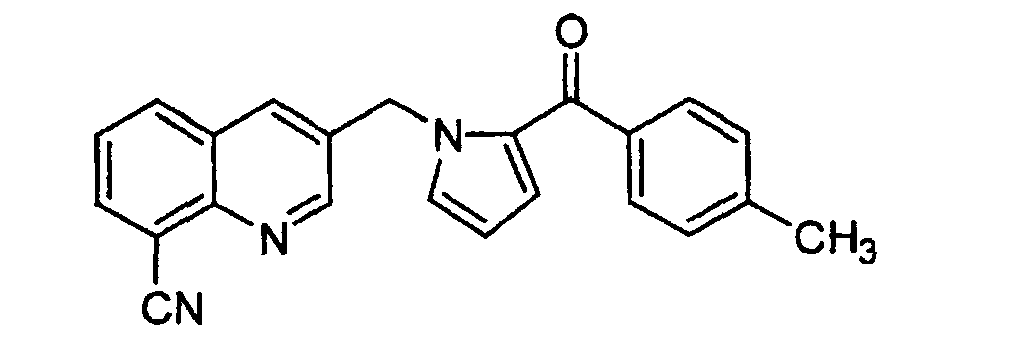
1H NMR (CDCl3, 300MHz) δ 8.93 (d, 1H, J=2.2Hz), 8.09 (dd, 1H, J=1.2, 7.6Hz), 8.00-8.03 (m, 2H), 7.66 (d, 2H, J=8.1Hz), 7.58 (dd, 1H, J=7.6, 7.6Hz), 7.23 (d, 2H, J=8.1Hz), 7.14 (dd, 1H, J=1.7, 2.6Hz), 6.86 (dd, 1H, J=1.7, 4.0Hz), 6.31 (dd, 1H, J=2.6, 4.0Hz), 5.87 (s, 2H), 2.41 (s, 3H).
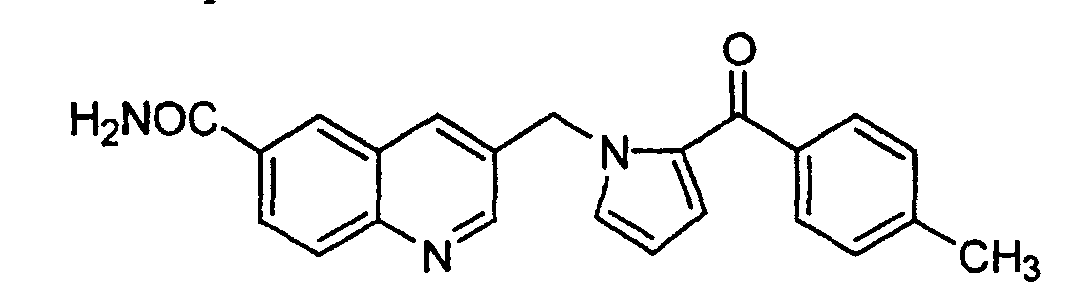
1H NMR (DMSO-d6, 400MHz) δ 8.88 (d, 1H, J=2.2Hz), 8.45 (d, 1H, J=1.9Hz), 8.16 (brs, 1H), 8.14 (dd, 1H, J=1.9, 8.8Hz), 8.03 (d, 1H, J=8.8Hz), 7.98 (d, 1H, J=2.2Hz), 7.59-7.62 (m, 3H), 7.55 (brs, 1H), 7.28 (d, 2H, J=7.9Hz), 6.79 (dd, 1H, J=1.7, 4.0Hz), 6.34 (dd, 1H, J=2.5, 4.0Hz), 5.86 (s, 2H), 2.36 (s, 3H).

1H NMR (DMSO-d6, 300MHz) δ 8.85 (d, 1H, J=2.0Hz), 8.54 (s, 1H), 8.26 (brs, 1H), 7.97-8.03 (m, 3H), 7.58-7.61 (m, 4H), 7.28 (d, 2H, J=7.9Hz), 6.78 (dd, 1H, J=1.7, 3.9Hz), 6.34 (dd, 1H, J=2.6, 3.9Hz), 5.85 (s, 2H), 2.36 (s, 3H).
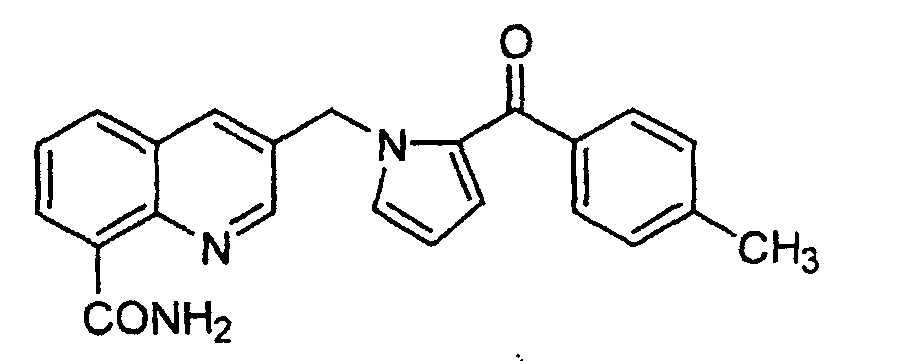
1H NMR (DMSO-d6, 400MHz) δ 10.04 (brs, 1H), 8.92 (d, 1H, J=2.3Hz), 8.51 (dd, 1H, J=1.5, 7.5Hz), 8.13-8.16 (m, 2H), 7.90 (brs, 1H), 7.70 (dd, 1H, J=7.5, 7.5Hz), 7.59-7.62 (m, 3H), 7.28 (d, 2H, J=7.9Hz), 6.79 (dd, 1H, J=1.6, 4.0Hz), 6.34 (dd, 1H, J=2.6, 4.0Hz), 5.88 (s, 2H), 2.36 (s, 3H).

1H NMR (CDCl3, 400MHz) δ 9.12 (d, 1H, J=2.0Hz), 8.81 (d, 1H, J=2.0Hz), 8.24-8.27 (m, 2H), 7.67 (dd, 1H, J=7.4, 8.3Hz), 4.47 (q, 2H, J=7.1Hz), 2.57 (s, 3H), 1.47 (t, 3H, J=7.1Hz).
1H NMR (CDCl3, 400MHz) δ 9.10 (d, 1H, J=2.1Hz), 8.82 (d, 1H, J=2.1Hz), 8.24-8.28 (m, 2H), 7.70 (dd, 1H, J=7.4, 8.3Hz), 7.70 (d, 2H, J=8.0Hz), 7.22 (d, 2H, J=8.0Hz), 7.11 (dd, 1H, J=1.7, 2.5Hz), 6.85 (dd, 1H, J=1.7, 4.0Hz), 6.29 (dd, 1H, J=2.5, 4.0Hz), 5.90 (s, 2H), 4.43 (q, 2H, J=7.1Hz), 2.41 (s, 3H), 1.42 (t, 3H, J=7.1Hz).
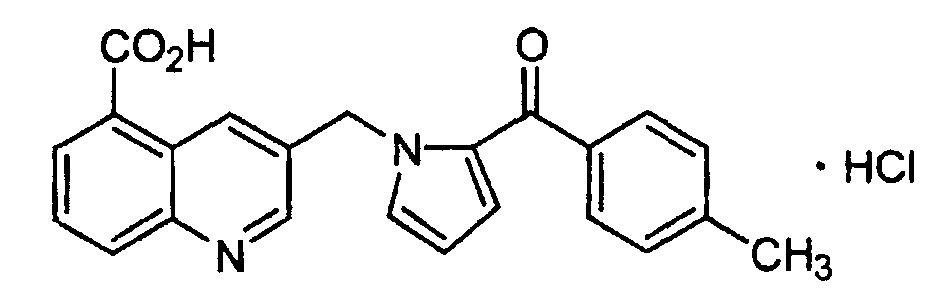
1H NMR (CD3OD, 400MHz) δ 9.85 (s, 1H), 9.27 (s, 1H), 8.63 (d, 1H, J=7.6Hz), 8.38 (d, 1H, J=8.4Hz), 8.17 (dd, 1H, J=7.6, 8.4Hz), 7.62 (d, 2H, J=8.0Hz), 7.51 (dd, 1H, J=1.5, 2.6Hz), 7.26 (d, 2H, J=8.0Hz), 6.94 (dd, 1H, J=1.5, 4.0Hz), 6.42 (dd, 1H, J=2.6, 4.0Hz), 6.00 (s, 2H), 2.39 (s, 3H).
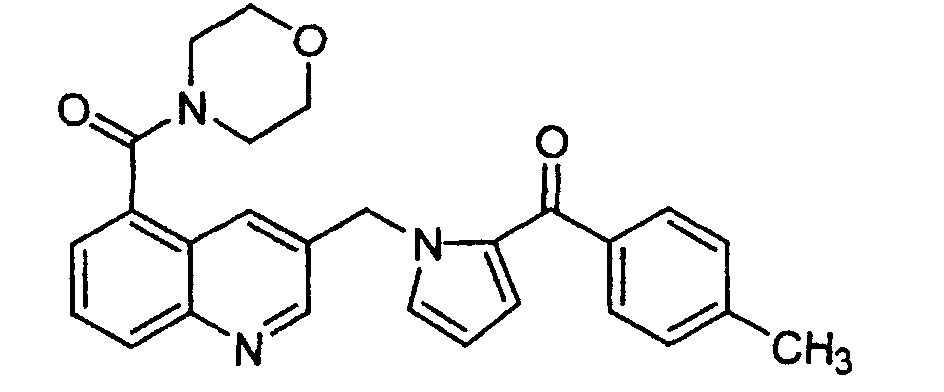
1H NMR (CDCl3, 400MHz) δ 8.87 (d, 1H, J=2.1Hz), 8.12 (d, 1H, J=8.5Hz), 7.88 (d, 1H, J=2.1Hz), 7.70 (dd, 1H, J=7.0, 8.5Hz), 7.67 (d, 2H, J=8.1Hz), 7.47 (d, 1H, J=7.0Hz), 7.23 (d, 2H, J=8.1Hz), 7.13 (dd, 1H, J=1.6, 2.5Hz), 6.86 (dd, 1H, J=1.6, 4.0Hz), 6.31 (dd, 1H, J=2.5, 4.0Hz), 5.83 (m, 2H), 3.68-3.97 (m, 4H), 3.23-3.41 (m, 2H), 2.96-3.11 (m, 2H), 2.40 (s, 3H).

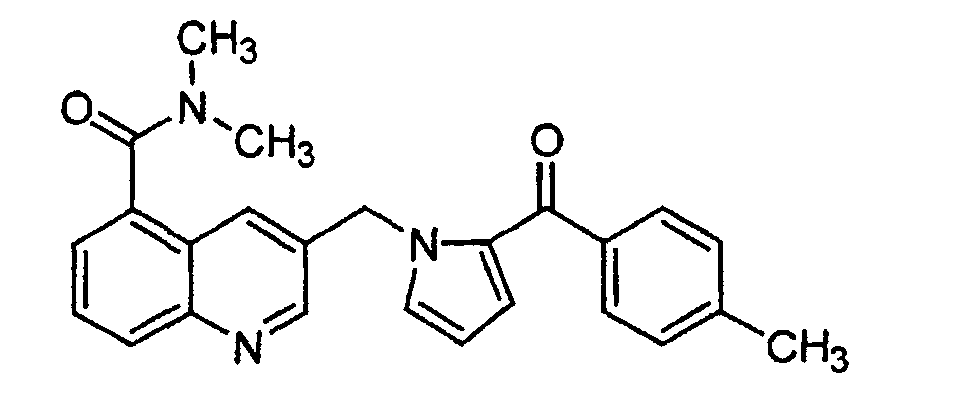
1H NMR (CDCl3, 400MHz) δ 8.79 (d, 1H, J=2.2Hz), 8.18 (brd, 1H, J=8.4Hz), 7.93 (brs, 1H), 7.72 (dd, 1H, J=7.1, 8.4Hz), 7.66 (d, 2H, J=8.0Hz), 7.52 (d, 1H, J=7.1Hz), 7.23 (d, 2H, J=8.0Hz), 7.09 (dd, 1H, J=1.7, 2.5Hz), 6.85 (dd, 1H, J=1.7, 4.0Hz), 6.29 (dd, 1H, J=2.5, 4.0Hz), 5.84 (s, 2H), 3.18 (s, 3H), 2.69 (s, 3H), 2.41 (s, 3H).
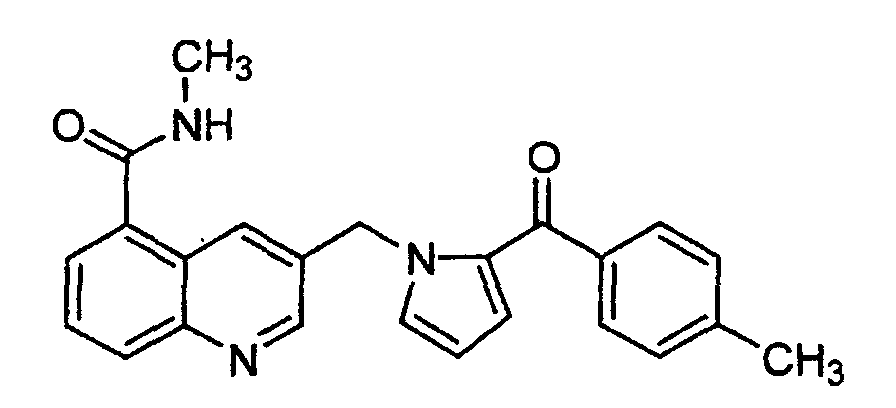
1H NMR (CDCl3, 400MHz) δ 8.74 (d, 1H, J=1.9Hz), 8.59 (d, 1H, J=1.9Hz), 8.13 (d, 1H, J=8.2Hz), 7.69 (d, 2H, J=8.0Hz), 7.60-7.67 (m, 2H), 7.23 (d, 2H, J=8.0Hz). 7.10 (dd, 1H, J=1.7, 2.5Hz), 6.84 (dd, 1H, J=1.7, 4.0Hz), 6.28 (dd, 1H, J=2.5, 4.0Hz), 6.17 (brs, 2H), 5.84 (s, 2H), 3.06 (d, 3H, J=4.9Hz), 2.41 (s, 3H).

1H NMR (CDCl3, 400MHz) δ 8.83 (d, 1H, J=2.1Hz), 8.31 (d, 1H, J=2.1Hz), 8.04 (d, 1H, J=8.4Hz), 7.68 (d, 1H, J=7.2Hz), 7.68 (d, 2H, J=8.1Hz), 7.60 (dd, 1H, J=7.2, 8.4Hz), 7.23 (d, 2H, J=8.1Hz), 7.10 (dd, 1H, J=1.7, 2.5Hz), 6.83 (dd, 1H, J=1.7, 4.0Hz), 6.28 (dd, 1H, J=2.5, 4.0Hz), 5.89 (s, 2H), 3.79 (s, 2H), 2.66-2.70 (brs, 4H), 2.41(s, 3H), 1.17 (t, 6H, J=7.1Hz).
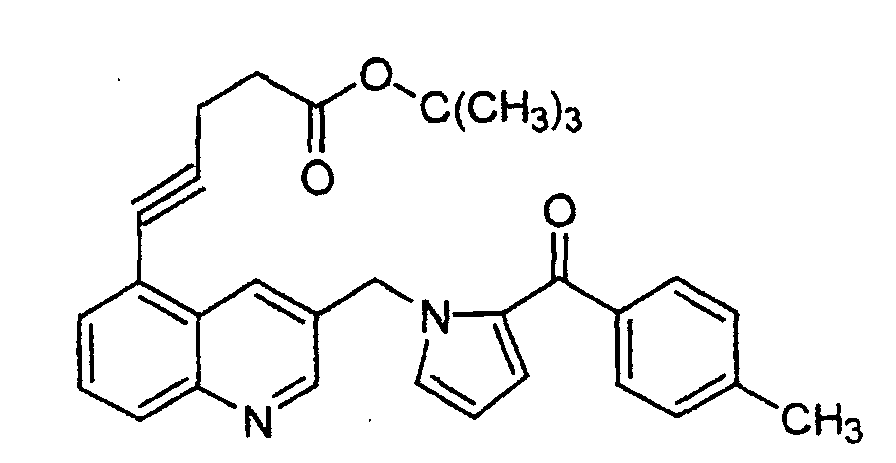
1H NMR (CDCl3, 400MHz) δ 8.79 (d, 1H, J=2.1Hz), 8.35 (brs, 1H), 8.05 (brd, 1H, J=7.5Hz), 7.70 (d, 2H, J=8.0Hz), 7.58-7.63 (m, 2H), 7.24 (d, 2H, J=8.0Hz), 7.12 (dd, 1H, J=1.7, 2.5Hz), 6.85 (dd, 1H, J=1.7, 4.0Hz), 6.29 (dd, 1H, J=2.5, 4.0Hz), 5.91 (s, 2H), 2.77 (t, 2H, J=7.4Hz), 2.59 (t, 2H, J=7.4Hz), 2.41 (s, 3H), 1.48 (s, 9H).

1H NMR (DMSO-d6, 400MHz) δ 9.00 (s, 1H), 8.33 (s, 1H), 8.08 (d, 1H, J=8.0Hz), 7.87 (dd, 1H, J=8.0, 8.0Hz), 7.60-7.62 (m, 3H), 7.29 (d, 2H, J=7.7Hz), 6.78 (s, 1H), 6.32 (s, 1H), 5.86 (m, 3H), 2.83 (t, 2H, J=6.5Hz), 2.40 (t, 2H, J=6.5Hz), 2.37 (s, 3H).
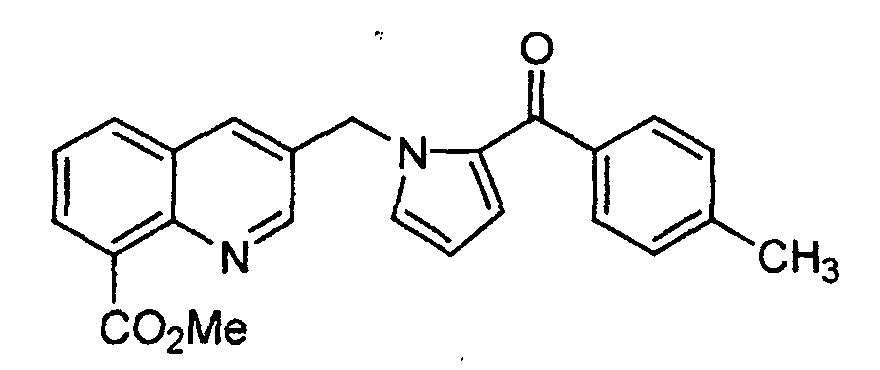
1H NMR (CDCl3, 400MHz) δ 9.88 (s, 1H), 8.41 (brs, 2H), 8.14 (t, 1H, J=7.7Hz), 7.67 (t, 1H, J=7.7Hz), 6.70 (t, 1H, J=7.7Hz), 3.89 (s, 3H).
1H NMR (CDCl3, 400MHz) δ 8.93 (d, 1H, J=2.1Hz), 8.00 (dd, 1H, J=1.2, 7.2Hz), 7.96 (d, 1H, J=2.1Hz), 7.89 (dd, 1H, J=1.2, 8.2Hz), 7.54 (dd, 1H, J=7.2, 8.2Hz), 4.06 (s, 3H), 2.54 (s, 3H).
1H NMR (CDCl3, 400MHz) δ 8.95 (d, 1H, J=2.0Hz), 8.02-8.04 (m, 2H), 7.91 (d, 1H, J=7.9Hz), 7.66 (d, 2H, J=7.8Hz), 7.55 (dd, 1H, J=7.9, 7.9Hz), 7.22 (d, 2H, J=7.8Hz), 7.11 (brs, 1H), 6.82 (dd, 1H, J=1.1, 2.8Hz), 6.27 (dd, 1H, J=2.8, 3.3Hz), 5.86 (s, 2H), 4.04 (s, 3H), 2.40 (s, 3H).

1H NMR (DMSO-d6, 400MHz) δ 8.71 (d, 1H, J=2.2Hz), 7.88 (d, 1H, J=2.2Hz), 7.56-7.63 (m, 4H), 7.38-7.43 (m, 2H), 7.27 (d, 2H, J=7.9Hz), 6.74 (dd, 1H, J=1.6, 4.0Hz), 6.30 (dd, 1H, J=2.6, 4.0Hz), 5.81 (s, 2H), 2.36 (s, 3H).
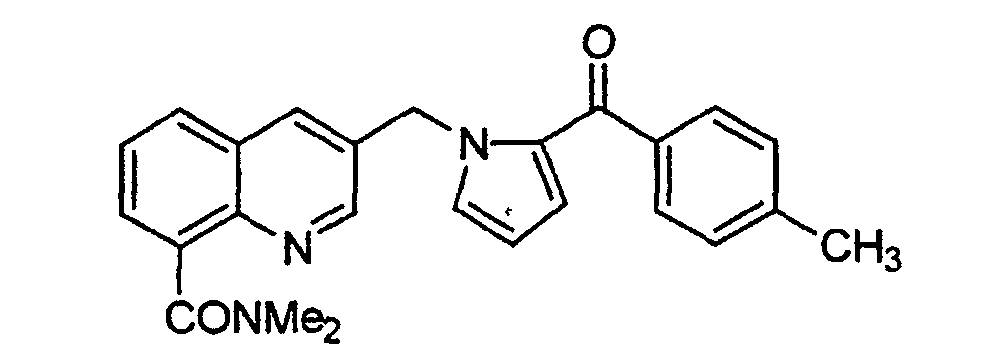
1H NMR (CDCl3, 400MHz) δ 8.82 (d, 1H, J=2.0Hz), 7.97 (d, 1H, J=2.0Hz), 7.79 (dd, 1H, J=1.4, 8.1Hz), 7.67 (d, 2H, J=8.0Hz), 7.63 (dd, 1H, J=1.4, 7.1Hz), 7.54 (dd, 1H, J=7.1, 8.1Hz), 7.23 (d, 2H, J=8.0Hz), 7.09 (dd, 1H, J=1.6, 2.6Hz), 6.83 (dd, 1H, J=1.6, 4.0Hz), 6.27 (dd, 1H, J=2.6, 4.0Hz), 5.85 (s, 2H), 3.26 (s, 3H), 2.78 (s, 3H), 2.41 (s, 3H).

1H NMR (CDCl3, 400MHz) δ 8.82 (s, 1H), 7.94 (s, 1H), 7.80 (dd, 1H, J=1.3, 8.1Hz), 7.67 (d, 2H, J=8.0Hz), 7.64 (dd, 1H, J=1.3, 7.1Hz), 7.54 (dd, 1H, J=7.1, 8.1Hz), 7.23 (d, 2H, J=8.0Hz), 7.10 (dd, 1H, J=1.6, 2.6Hz), 6.84 (dd, 1H, J=1.6, 4.0Hz), 6.29 (dd, 1H, J=2.6, 4.0Hz), 5.85 (s, 2H), 3.85-3.96 (m, 4H), 3.55 (m, 2H), 3.13-3.16 (m, 2H), 2.41 (s, 3H).

1H NMR (CDCl3, 400MHz) δ 8.79 (d, 1H, J=1.9Hz), 8.03 (d, 1H, J=1.9Hz), 7.82 (dd, 1H, J=1.2, 8.2Hz), 7.75 (dd, 1H, J=1.2, 7.0Hz), 7.67 (d, 2H, J=8.0Hz), 7.58 (dd, 1H, J=7.0, 8.2Hz), 7.23 (d, 2H, J=8.0Hz), 7.11 (dd, 1H, J=1.5, 2.6Hz), 6.84 (dd, 1H, J=1.5, 4.0Hz), 6.29 (dd, 1H, J=2.6, 4.0Hz), 5.83 (s, 2H), 4.00 (m, 2H), 3.80 (t, 1H, J=5.1Hz), 3.55 (t, 1H, J=5.1Hz), 2.78 (s, 3H), 2.41 (s, 3H).

1H NMR (CDCl3, 400MHz) δ 8.81 (d, 1H, J=2.2Hz), 7.92 (d, 1H, J=2.2Hz), 7.78 (dd, 1H, J=1.4, 8.1Hz), 7.67 (d, 2H, J=8.0Hz), 7.62 (dd, 1H, J=1.4, 7.1Hz), 7.53 (dd, 1H, J=7.1, 8.1Hz), 7.23 (d, 2H, J=8.0Hz), 7.10 (dd, 1H, J=1.6, 2.6Hz), 6.83 (dd, 1H, J=1.6, 4.0Hz), 6.28 (dd, 1H, J=2.6, 4.0Hz), 5.89 (d, 1H, J=15.5Hz), 5.80 (d, 1H, J=15.5Hz), 4.00 (m, 2H), 3.68 (m, 1H), 3.18-3.20 (m, 2H), 2.67-2.72 (m, 1H), 2.51-2.54 (m, 1H), 2.41 (s, 3H), 2.34 (s, 3H), 2.23 (m, 3H).
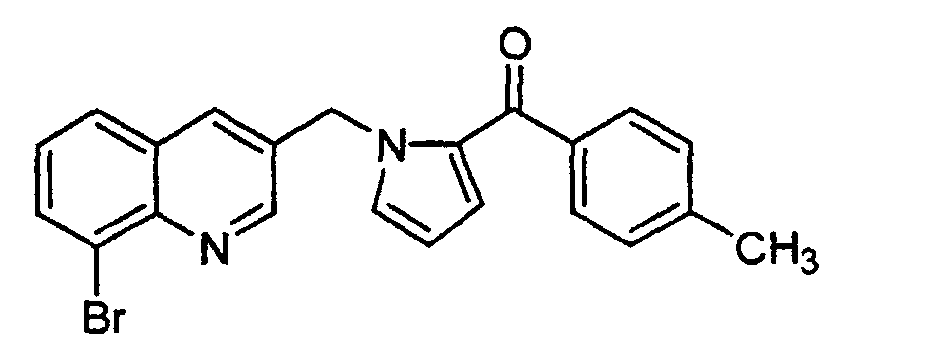
1H NMR (CDCl3, 400MHz) δ 9.83 (s, 1H), 7.62 (dd, 1H, J=1.5, 7.7Hz), 7.48 (dd, 1H, J=1.5, 7.7Hz), 6.67 (t, 1H, J=7.7Hz).
1H NMR (CDCl3, 400MHz) δ 8.90 (d, 1H, J=1.5Hz), 7.99 (dd, 1H, J=1.2, 7.5Hz), 7.94 (d, 1H, J=1.5Hz), 7.73 (dd, 1H, J=1.2, 8.2Hz), 7.38 (dd, 1H, J=7.5, 8.2Hz), 2.56 (s, 3H).
1H NMR (CDCl3, 400MHz) δ 8.91 (d, 1H, J=2.1Hz), 8.01-8.04 (m, 2H), 7.76 (dd, 1H, J=1.0, 8.1Hz), 7.66 (d, 2H, J=8.0Hz), 7.39 (dd, 1H, J=7.5, 8.1Hz), 7.23 (d, 2H, J=8.0Hz), 7.11 (dd, 1H, J=1.6, 2.6Hz), 6.84 (dd, 1H, J=1.6, 4.0Hz), 6.29 (dd, 1H, J=2.6, 4.0Hz), 5.87 (s, 2H), 2.41 (s, 3H).
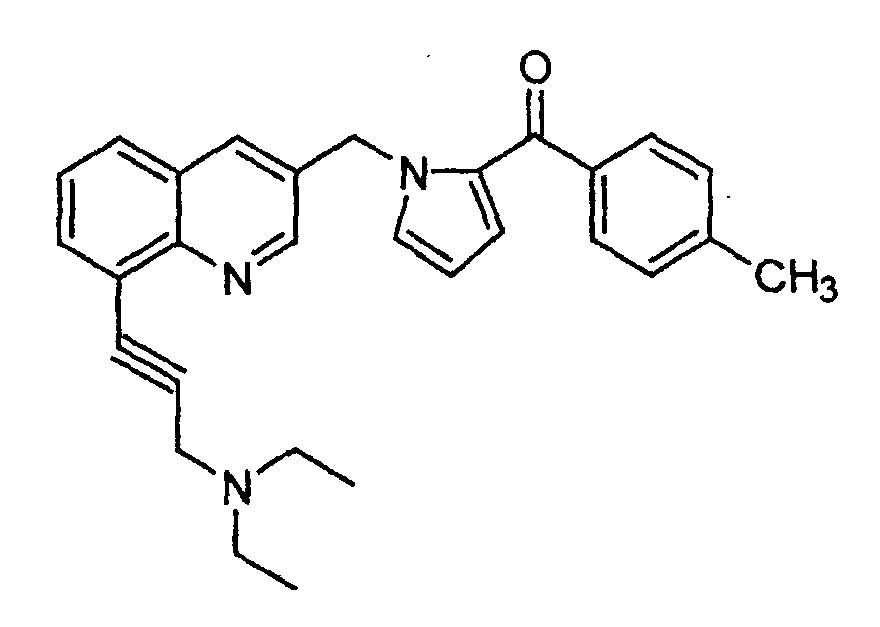
1H NMR (CDCl3, 400MHz) δ 8.88 (d, 1H, J=2.2Hz), 7.97 (d, 1H, J=2.2Hz), 7.86 (dd, 1H, J=1.2, 7.3Hz), 7.73 (dd, 1H, J=1.2, 8.1Hz), 7.67 (d, 2H, J=8.0Hz), 7.45 (dd, 1H, J=7.3, 8.1Hz), 7.22 (d, 2H, J=8.0Hz), 7.10 (dd, 1H, J=1.6, 2.6Hz), 6.82 (dd, 1H, J=1.6, 4.0Hz), 6.27 (dd, 1H, J=2.6, 4.0Hz), 5.85 (s, 2H), 3.89 (s, 2H), 2.80 (brs, 4H), 2.41 (s, 3H), 1.20 (t, 6H, J=7.1Hz).

1H NMR (CDCl3, 400MHz) δ 8.87 (d, 1H, J=2.2Hz), 8.74 (d, 1H, J=16.2Hz), 7.98 (d, 1H, J=2.2Hz), 7.92 (dd, 1H, J=1.0, 7.3Hz), 7.79 (dd, 1H, J=1.0, 8.2Hz), 7.67 (d, 2H, J=8.0Hz), 7.53 (dd, 1H, J=7.3, 8.2Hz), 7.23 (d, 2H, J=8.0Hz), 7.11 (dd, 1H, J=1.7, 2.5Hz), 6.83 (dd, 1H, J=1.7, 4.0Hz), 6.72 (d, 1H, J=16.2Hz), 6.28 (dd, 1H, J=2.5, 4.0Hz), 5.86 (s, 2H), 2.41 (s, 3H), 1.56 (s, 9H).

1H NMR (DMSO-d6, 400MHz) δ 8.88 (d, 1H, J=2.2Hz), 8.77 (d, 1H, J=16.3Hz), 7.21 (d, 1H, J=7.3Hz), 8.00-8.03 (m, 2H), 7.59-7.65 (m, 4H), 7.27 (d, 2H, J=7.9Hz), 6.81 (d, 1H, J=16.3Hz), 6.78 (dd, 1H, J=1.6, 4.0Hz), 6.33 (dd, 1H, J=2.6, 4.0Hz), 5.86 (s, 2H), 2.36 (s, 3H).
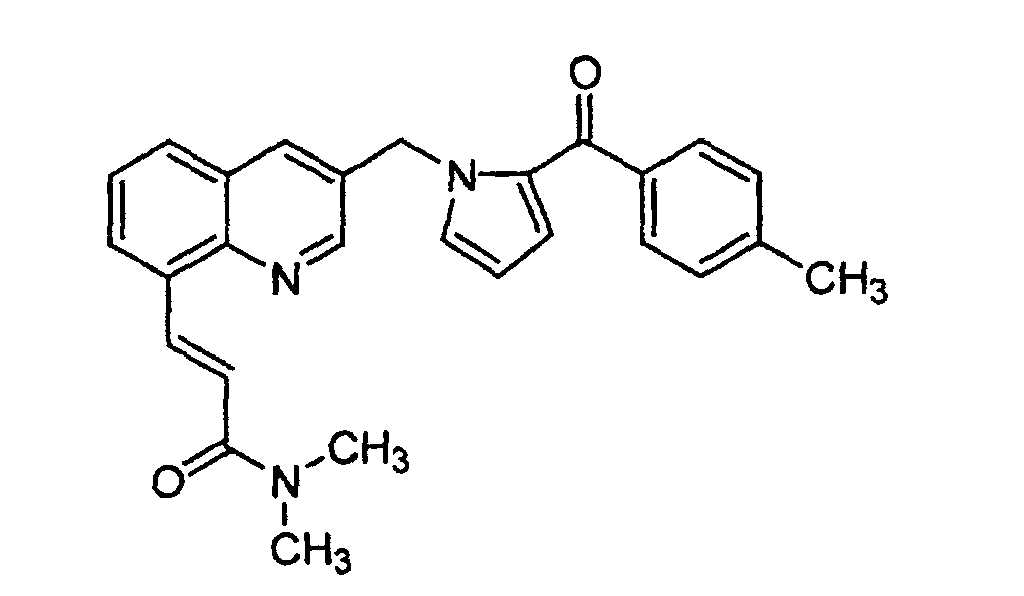
1H NMR (CDCl3, 400MHz) δ 8.87 (d, 1H, J=2.2Hz), 8.53 (d, 1H, J=15.6Hz), 7.96 (d, 1H, J=2.2Hz), 7.87 (dd, 1H, J=1.2, 7.1Hz), 7.74 (dd, 1H, J=1.2, 8.1Hz), 7.67 (d, 2H, J=8.0Hz), 7.51 (dd, 1H, J=7.1, 8.1Hz), 7.49 (d, 1H, J=15.6Hz), 7.22 (d, 2H, J=8.0Hz), 7.12 (dd, 1H, J=1.7, 2.5Hz), 6.83 (dd, 1H, J=1.7, 4.0Hz), 6.28 (dd, 1H, J=2.5, 4.0Hz), 5.85 (s, 2H), 3.21 (s, 3H), 3.09 (s, 3H), 2.40 (s, 3H).

1H NMR (CDCl3, 400MHz) δ 8.81 (d, 1H, J=1.8Hz), 7.93 (d, 1H, J=1.8 z), 7.68 (d, 2H, J=8.0Hz), 7.45 (dd, 1H, J=1.5, 8.1Hz), 7.40 (dd, 1H, J=7.4, 8.1Hz), 7.31 (dd, 1H, J=1.5, 7.4Hz), 7.23 (d, 2H, J=8.0Hz), 7.08 (dd, 1H, J=1.6, 2.6Hz), 6.81 (dd, 1H, J=1.6, 4.0Hz), 6.25 (dd, 1H, J=2.6, 4.0Hz), 5.84 (s, 2H), 2.41 (s, 3H), 1.49 (s, 9H).

1H NMR (CDCl3, 300MHz) δ 8.68 (s, 1H), 7.99 (s, 1H), 7.67 (d, 2H, J=8.1Hz), 7.45 (dd, 1H, J=8.0, 8.1Hz), 7.23 (d, 2H, J=8.1Hz), 7.17-7.30 (m, 2H), 7.11 (dd, 1H, J=1.7, 2.5Hz), 6.84 (dd, 1H, J=1.7, 4.0Hz), 6.29 (dd, 1H, J=2.5, 4.0Hz). 5.85 (s, 2H), 2.41 (s, 3H).
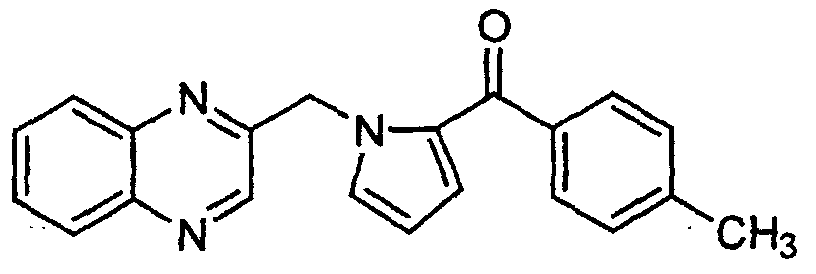

1H NMR (300MHz, CDCl3) δ 8.85 (s, 1H), 8.30 (dd, 1H, J=8.4, 1.3Hz), 8.10 (dd, 1H, J=7.5, 1.3Hz), 7.77 (t, 1H, J=8.1Hz), 2.84 (s, 3H).
1H NMR (300MHz, CDCl3) δ 8.70 (s, 1H), 7.47 (t, 1H, J=7.5Hz), 7.39 (dd, 1H, J=8.3, 1.3Hz), 6.92 (dd, 1H, J=7.3, 1.3Hz), 4.95 (brs, 1H), 2.73 (s, 3H).
1H NMR (300MHz, CDCl3) δ 8.70 (s, 1H), 8.34 (dd, 1H, J=7.5, 1.3Hz), 8.07 (dd, 1H, J=8.3, 1.1Hz), 7.44 (t, 1H, J=7.7Hz), 2.86 (s, 3H).
1H NMR (300MHz, CDCl3) δ 8.86 (s, 1H), 8.32 (dd, 1H, J=8.4, 1.3Hz), 8.15 (dd, 1H, J=7.3, 1.3Hz), 7.77 (dd, 1H, J=8.3, 7.3Hz), 2.88 (s, 3H)..
1H NMR (300MHz, CDCl3) δ 8.84 (s, 1H), 8.33 (dd, 1H, J=8.4, 1.3Hz), 8.15 (dd, 1H, J=7.3, 1.5Hz), 7.80 (dd, 1H, J=8.6, 7.3Hz), 7.72 (d, 2H, J=8.1Hz), 7.25 (m, 3H), 6.89 (dd, 1H, J=4.0, 1.7Hz), 6.33 (dd, 1H, J=4.0, 2.8Hz), 6.01 (s, 2H), 2.42 (s, 3H).

1H NMR (300MHz, CDCl3) δ 8.91 (s, 1H), 8.26 (dd, 1H, J=8.6, 1.2Hz), 8.12 (d, 1H, J=7.7Hz), 7.83 (t, 1H, J=7.7Hz), 2.84 (s, 3H).
1H NMR (300MHz, CDCl3) δ 8.55 (s, 1H), 7.51 (t, 1H, J=7.7Hz), 7.33 (dd, 1H, J=8.4, 0.9Hz), 6.89 (d, 1H, J=7.7Hz), 2.75 (s, 3H).
1H NMR (300MHz, CDCl3) δ 8.78 (s, 1H), 8.31 (dd, 1H, J=7.3, 1.1Hz), 8.02 (dd, 1H, J=8.4, 1.1Hz), 7.48 (dd, 1H, J=8.3, 7.5Hz), 2.82 (s, 3H).
1H NMR (300MHz, CDCl3) δ 8.91 (s, 1H), 8.27 (dd, 1H, J=8.4, 1.3Hz), 8.12 (dd, 1H, J=7.2, 1.3Hz), 7.82 (dd, 1H, J=8.2, 7.2Hz), 2.77 (s, 3H).
1H NMR (300MHz, CDCl3) δ 8.73 (s, 1H), 8.29 (dd, 1H, J=8.4, 1.1Hz), 8.14 (dd, 1H, J=7.3, 1.5Hz), 7.82 (dd, 1H, J=8.4, 7.3Hz), 7.69 (d, 2H, J=8.1Hz), 7.25 (d, 2H, J-8.lHz), 7.18 (dd, 1H. J=2.4, 1.5Hz), 6.90 (dd, 1H, J=4.0, 1.5Hz), 6.34 (dd, 1H, J=4.0, 2.4Hz), 5.97 (s, 2H), 2.42 (s, 3H).
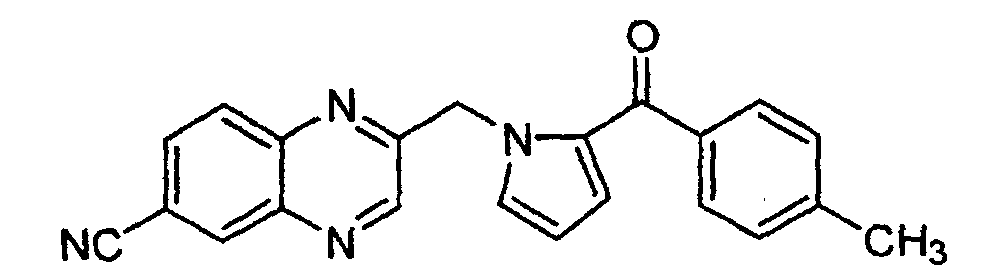
1H NMR (300MHz, CDCl3) δ 8.99 (d, 1H, J=2.4Hz), 8.90 (s, 1H), 8.52 (dd, 1H, J=9.2, 2.4Hz), 8.18 (d, 1H, J=9.2Hz), 2.84 (s, 3H).
1H NMR (300MHz, CDCl3) δ 8.53 (s, 1H), 7.80 (d, 1H, J=8.8Hz), 7.16 (m, 2H), 4.13 (brs, 2H), 2.69 (s, 3H).
1H NMR (300MHz, CDCl3) δ 8.72 (s, 1H), 8.49 (d, 1H, J=2.0Hz), 7.99 (dd, 1H, J=8.8, 1.8Hz), 7.73 (d, 1H, J=8.8Hz), 2.76 (s, 3H).
1H NMR (300MHz, CDCl3) δ 8.86 (s, 1H), 8.46 (d, 1H, J=1.7Hz), 8.11 (d, 1H, J=8.6Hz), 7.90 (dd, 1H, J=8.2, 1.8Hz), 2.83 (s, 3H).
1H NMR (300MHz, CDCl3) δ 8.73 (s, 1H), 8.46 (d, 1H, J=1.5Hz), 8.13 (d, 1H, J=8.4Hz), 7.89 (dd, 1H, J=8.6, 1.6Hz), 7.69 (d, 2H, J=8.1Hz), 7.25 (d, 2H, J=8.1Hz), 7.19 (dd, 1H, J=2.4, 1.5Hz), 6.90 (dd, 1H, J=4.0, 1.5Hz), 6.34 (dd, 1H, J=4.0, 2.4Hz), 5.94 (s, 2H), 2.42(s, 3H).
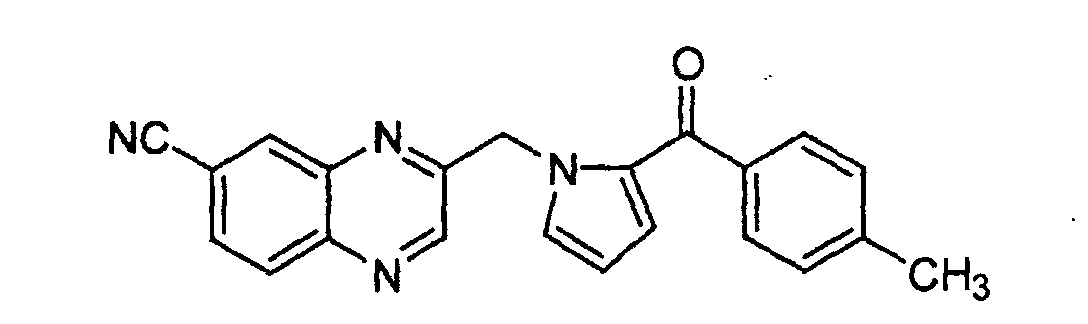
1H NMR (300MHz, CDCl3) δ 8.46 (s, 1H), 7.83 (d, 1H, J=8.8Hz), 7.11 (dd, 1H, J=8.8, 2.6Hz), 7.06 (d, 1H, J=2.6Hz), 2.69 (s, 3H).
1H NMR (300MHz, CDCl3) δ 8.74 (s, 1H), 8.44 (d, 1H, J=1.8Hz), 7.95 (dd, 1H, J=8.6, 1.8Hz), 7.78 (d, 1H, J=8.8Hz), 2.77 (s, 3H).
1H NMR (300MHz, CDCl3) δ 8.85 (s, 1H), 8.39 (d, 1H, J=1.8Hz), 8.17 (d, 1H, J=8.6Hz), 7.86 (dd, 1H, J=8.6, 1.8Hz), 2.83 (s, 3H).
1H NMR (300MHz, CDCl3) δ 8.80 (s, 1H), 8.41 (d, 1H, J=1.3Hz), 8.18 (d, 1H, J=8.8Hz), 7.87 (dd, 1H, J=8.6, 1.7Hz), 7.69 (d,2H, J=8.1Hz), 7.21 (m, 3H), 6.89 (dd, 1H, J=4.0, 1.7Hz), 6.34 (dd, 1H, J=4.0, 2.6Hz), 5.94 (s, 2H), 2.42 (s, 3H).

1H NMR (400MHz, CDCl3) δ 8.70 (s, 1H), 7.79 (d, 1H, J=9.OHz), 7.26 (d, 1H, J=9.0Hz), 4.67 (brs, 2H), 2.73 (s, 3H).
1H NMR (400MHz, CDCl3) δ 8.85 (s, 1H), 8.03 (dd, 1H, J=7.6, 1.2Hz), 8.01 (dd, 1H, J=8.6, 1.2Hz), 7.62 (dd, 1H, J=8.6, 7.6Hz), 2.83 (s, 3H).
1H NMR (400MHz, CDCl3) δ 8.67 (s, 1H), 8.05 (dd, 1H, J=7.6, 1.2Hz), 8.03 (dd, 1H, J=8.6, 1.2Hz), 7.70 (d, 2H, J=8.0Hz), 7.63 (dd, 1H, J=8.6, 7.6Hz), 7.25 (d, 2H, J=8.0Hz), 7.17 (dd, 1H, J=2.5, 1.7Hz), 6.88 (dd, 1H, J=4.1, 1.7Hz), 6.32 (dd, 1H, J=4.1, 2.5Hz), 5.98 (s, 2H), 2.42 (s, 3H).
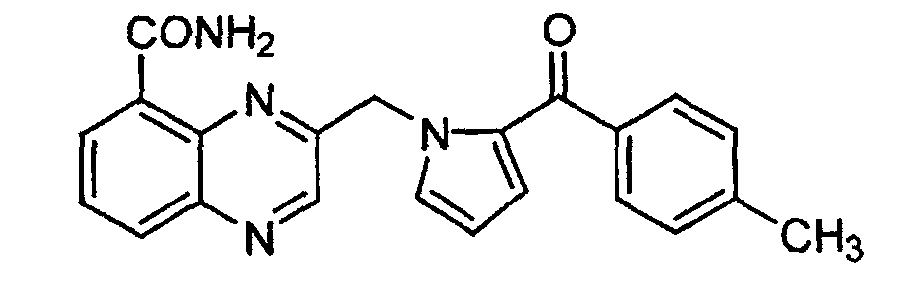
1H NMR (300MHz, CDCl3) δ 9.49 (brs, 1H), 8.93 (s, 1H), 8.51 (dd, 1H, J=7.5, 1.5Hz), 8.26 (dd, 1H, J=8.3, 1.5Hz), 7.84 (t, 1H, J=8.3Hz), 7.62 (d, 2H, J=8.1Hz), 7.21 (d, 2H, J=8.1Hz), 7.19 (m, 1H), 6.98 (dd, 1H, J=4.0, 1.5Hz), 6.38 (dd, 1H, J=4.0, 2.7Hz), 6.05 (s, 2H), 2.39 s, 3H).

1H NMR (300MHz, CDCl3) δ 8.73 (s, 1H), 8.45 (d, 1H, J=1.8Hz), 8.23 (dd, 1H, J=8.9, 2.1Hz), 8.11 (d, 1H, J=8.6Hz), 7.71 (d, 2H, J=8.1Hz), 7.25 (d, 2H, J=8.1Hz), 7.20 (dd, 1H, J=2,6, 1.7Hz), 6.89 (dd, 1H, J=4.0, 1.7Hz), 6.33 (dd, 1H, J=4.0, 2.6Hz), 6.29 (brs, 1H), 5.96 (s, 2H), 5.72 (brs, 1H), 2.42 (s, 3H).
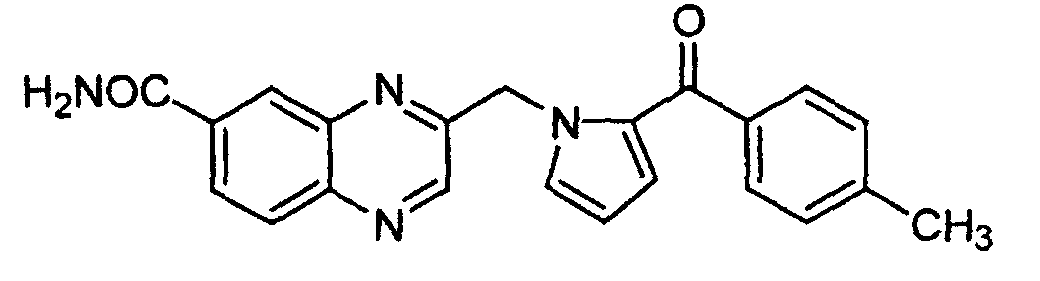
1H NMR (400MHz, CDCl3) δ 8.74 (s, 1H), 8.42 (d, 1H, J=1.7Hz), 8.18 (dd, 1H, J=8.7, 1.9Hz), 8.12 (d, 1H, J=8.7Hz), 7.69 (d, 2H, J=8.1Hz), 7.24 (d, 2H, J=8.1Hz), 7.21 (dd, 1H, J=2.6, 1.7Hz), 6.89 (dd, 1H, J=4.0, 1.7Hz), 6.46 (brs, 1H), 6.33 (dd, 1H, J=4.0, 2.6Hz), 5.95 (s, 2H), 2.42 (s, 3H).

1H NMR (400MHz, CDCl3) δ 9.15 (dd, 1H, J=4.2, 1.9Hz), 8.84 (s, 1H), 8.41 (dd, 1H, J=8.4, 1.9Hz), 7.71 (dd, 1H, J=8.4, 4.2Hz), 7.70 (dd, 2H, J=8.0Hz), 7.25 (d, 2H, J=8.0Hz), 7.19 (dd, 1H, J=2.5, 1.7Hz), 6.89 (dd, 1H, J=4.0, 1.7Hz), 6.33 (dd, 1H, J=4.0, 2.5Hz), 5.98 (s, 2H), 2.42 (s, 3H).
1H NMR (300MHz, CDCl3) δ 8.70 (m, 1H), 8.16 (d, 2H, J=8.6Hz), 8.07 (d, 2H, J=8.6Hz), 7.82 (dt, 1H, J=7.9, 2.0Hz), 7.68 (m, 1H), 7.37 (m, 1H), 3.97 (s, 3H).
1H NMR (CDCl3, 400MHz) δ 9.72 (brs, 1H), 8.15 (d, 2H, J=8.4Hz), 7.94 (d, 2H, J=8.4Hz), 7.19 (m, 1H), 6.87 (m, 1H), 6.37 (m, 1H), 3.97 (s, 3H).
1H NMR (CDCl3, 400MHz) δ 8.83 (d, 1H, J=2.2Hz), 8.09 (m, 3H), 7.95 (1H, brd, J=1.35Hz), 7.78 (m, 3H), 7.69 (ddd, 1H, J=8.4, 6.9, 1.4Hz), 7.53 (ddd, 1H, J=8.1, 6.9, 1.1Hz), 7.16 (dd, 1H, J=2.4, 1.8Hz), 6.81 (dd, 1H, J=4.1, 1.8Hz), 6.30 (dd, 1H, J=4.1, 2.4Hz), 5.87 (s, 2H), 3.94 (s, 3H).
1H NMR (DMSO-d6, 400MHz) δ 13.22 (brs, 1H), 8.82 (d, 1H, J=2.2Hz), 8.00 (m, 4H), 7.94 (dd, 1H, J=8.1, 1.0Hz), 7.74 (m, 3H), 7.67 (dd, 1H, J=2.3, 1.7Hz), 7.58 (ddd, 1H, J=8.1, 6.9, 1.0Hz), 6.81 (dd, 1H, J=4.1, 1.7Hz), 6.35 (dd, 1H, J=4.1, 2.3Hz), 5.87 (s, 2H).
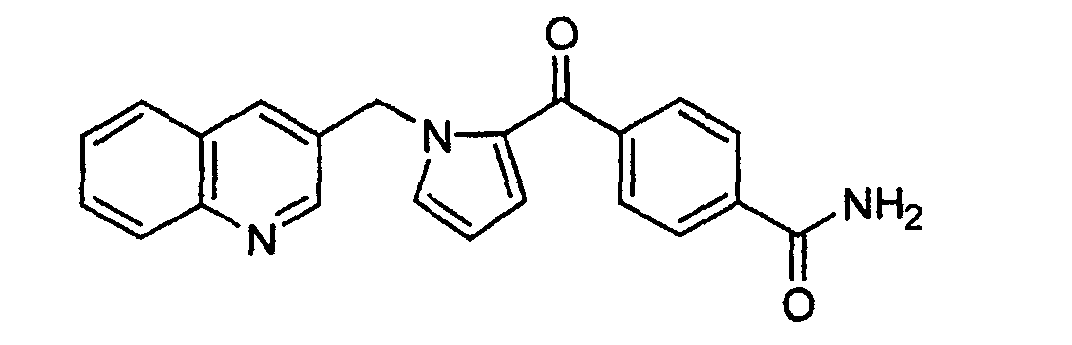
1H NMR (DMSO-d6, 400MHz) δ 8.82 (d, 1H, J=2.2Hz), 8.10 (brs, 1H), 8.00 (m, 2H), 7.94 (m, 3H), 7.73 (m, 3H), 7.66 (dd, 1H, J=2.3, 1.8Hz), 7.58 (ddd, 1H, J=8.1, 7.0, 1.1Hz), 7.51 (brs, 1H), 6.80 (dd, 1H, J=4.1, 1.6Hz), 6.35 (dd, 1H, J=4.1, 2.3Hz), 5.86 (s, 2H).
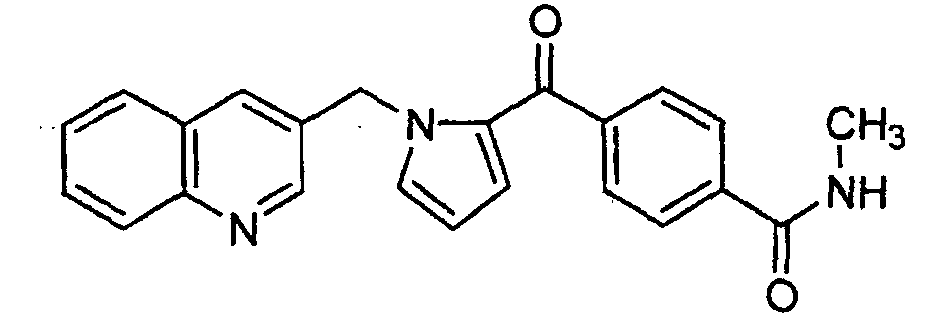
1H NMR (CDCl3, 400MHz) δ 8.82 (d, 1H, J=2.2Hz), 8.08 (d, 1H, J=8.5Hz), 7.94 (d, 1H, J=1.3Hz), 7.79 (m, 5H), 7.69 (m, 1H), 7.53 (m, 1H), 7.16 (dd, 1H, J=2.5, 1.7Hz), 6.80 (dd, 1H, J=4.1, 1.7Hz), 6.30 (dd, 1H, J=4.1, 2.5Hz), 6.21 (brs, 1H), 5.86 (s, 2H), 3.03 (s, 3H).
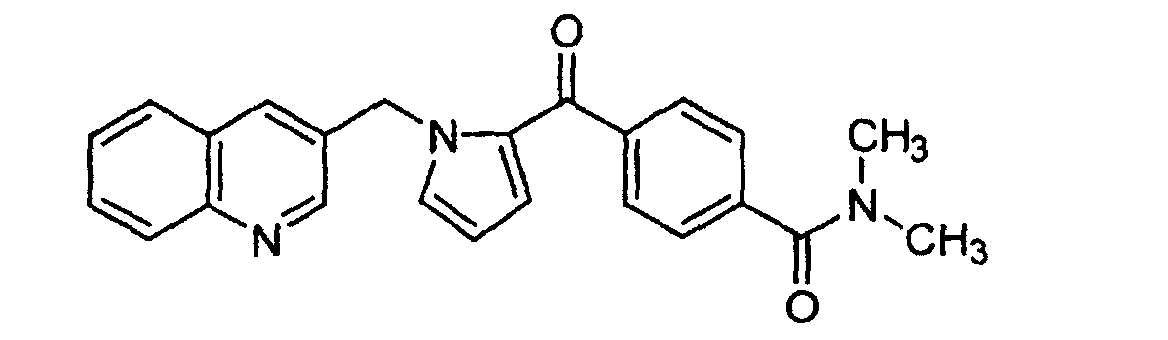
1H NMR (CDCl3, 400MHz) δ 8.82 (d, 1H, J=2.2Hz), 8.08 (d, 1H, J=8.5Hz), 7.94 (d, 1H, J=1.3Hz), 7.77 (m, 3H), 7.69 (m, 1H), 7.53 (m, 1H), 7.46 (d, 2H, J=8.4Hz), 7.16 (dd, 1H, J=2.4, 1.7Hz), 6.83 (dd, 1H, J=4.1, 1.7Hz), 6.30 (dd, 1H, J=4.1, 2.4Hz), 5.86 (s, 2H), 3.13 (s, 3H), 2.96 (s, 3H).
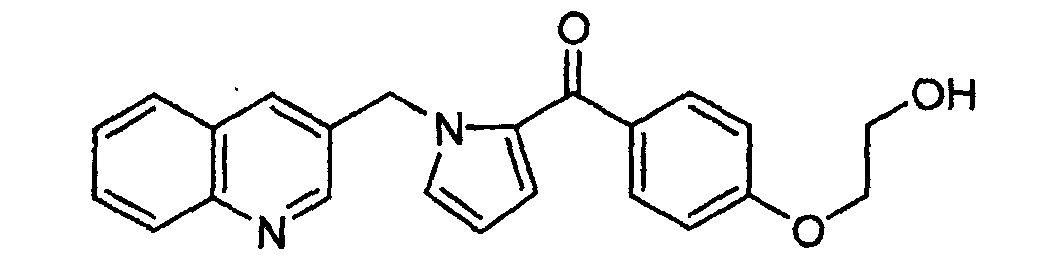
1H NMR (CDCl3, 400MHz) δ 8.52 (d, 1H, J=2.2Hz), 8.06 (brd, 1H, J=8.3Hz), 7.68 (dt, 1H, J=1.3, 8.3Hz), 7.67 (d, 1H, J=7.6Hz), 7.52 (ddd, 1H, J=0.9, 7.6, 8.3Hz), 7.51 (brs, 1H), 7.21 (brd, 2H, J=8.7Hz), 6.74 (d, 2H, J=8.7Hz), 6.73 (dd, 1H, J=1.8, 3.1Hz), 6.17 (dd, 1H, J=3.1, 3.5Hz), 6.04 (dd, 1H, J=1.8, 3.5Hz), 5.81 (brs, 1H), 5.32 (d, 1H, J=16.2Hz), 5.29 (d, 1H, J=16.2Hz), 3.89-3.99 (m, 4H).
1H NMR (CDCl3, 400MHz) δ 8.81 (d, 1H, J=2.2Hz), 8.07 (brd, 1H, J=8.6Hz), 7.93 (brs, 1H), 7.79 (d, 2H, J=8.8Hz), 7.76 (brd, 1H, J=7.6Hz), 7.68 (ddd, 1H, J=1.7, 7.6, 8.6Hz), 7.52 (dt, 1H, J=0.9, 7.6Hz), 7.10 (dd, 1H, J=1.5, 2.5Hz), 6.95 (d, 2H, J=8.8Hz), 6.82 (dd, 1H, J=1.5, 4.0Hz), 6.28 (dd, 1H, J=2.5, 4.0Hz), 5.84 (brs, 2H), 4.15 (dt, 2H, J=5.0, 1.6Hz), 3.97-4.02 (m, 2H).

1H NMR (CDCl3, 400MHz) δ 7.56 (dd, 1H, J=1.5, 7.7Hz), 7.47 (d, 1H, J=1.5Hz), 7.19 (dd, 1H, J=0.5, 7.7Hz), 6.08 (ddt, 1H, J=10.6, 17.3, 5.0Hz), 5.45 (ddt, 1H, J=17.3, 1.6, 1.6Hz), 5.29 (ddt, 1H, J=10.6, 1.6, 1.6Hz), 4.60 (dt, 2H, J=5.0, 1.6Hz), 3.90 (s, 3H), 2.30 (brs, 3H).
1H NMR (CDCl3, 400MHz) δ 9.78 (brs, 1H), 7.46 (dd, 1H, J=1.5, 7.2Hz), 7.36 (d, 1H, J=1.5Hz), 7.24 (dd, 1H, J=0.2, 7.2Hz), 7.13 (dt, 1H, J=1.3, 2.7Hz), 6.91 (ddd, 1H, J=3.8, 2.4, 1.3Hz), 6.34 (dt, 1H, J=3.8, 2.7Hz), 6.09 (ddt, 1H, J=10.6, 17.3, 5.0Hz), 5.45 (ddt, 1H, J=17.3, 1.6, 1.6Hz), 5.30 (ddt, 1H, J=10.6, 1.6, 1.6Hz), 4.62 (dt, 2H, J=5.0, 1.6Hz), 2.33 (brs, 3H).
1H NMR (CDCl3, 400MHz) δ 8.82 (d, 1H, J=2.2Hz), 8.08 (d, 1H, J=8.4Hz), 7.94 (d, 1H, J=2.0Hz), 7.76 (brd, 1H, J=8.1Hz), 7.69 (ddd, 1H, J=8.4, 7.0, 1.5Hz), 7.53 (ddd, 1H, J=8.1, 7.0, 1.1Hz), 7.30 (dd, 1H, J=1.5, 7.2Hz), 7.23 (d, 1H, J=1.5Hz), 7.18 (brd, 1H, J=7.2Hz), 7.11 (dd, 1H, J=1.7, 2.5Hz), 6.86 (dd, 1H, J=1.7, 4.0Hz), 6.28 (dd, 1H, J=2.5, 4.0Hz), 6.06 (ddt, 1H, J=10.6, 17.3, 5.0Hz), 5.84 (brs, 2H), 5.42 (ddt, 1H, J=17.3, 1.6 1.6Hz), 5.27 (ddt, 1H, J=10.6, 1.6, 1.6Hz), 4.57 (dt, 2H, J=5.0, 1.6Hz), 2.30 (brs, 3H).

1H NMR (CDCl3, 400MHz) δ 8.73 (brs, 1H), 8.08 (d, 1H, J=8.4Hz), 7.94 (brs, 1H), 7.71 (brd, 1H, J=8.1Hz), 7.65 (ddd, 1H, J=8.4, 7.0, 1.5Hz), 7.40-7.53 (series of m, 2H), 7.23 (d, 1H, J=1.5Hz), 7.21 (brd, 1H, J=7.2Hz), 7.14 (brd, 1H, J=7.2Hz), 7.05 (dd, 1H, J=1.7, 2.5Hz), 6.80 (dd, 1H, J=1.7, 4.0Hz), 6.18 (dd, 1H, J=2.5, 4.0Hz), 5.84 (brs, 2H), 2.29 (brs, 3H).
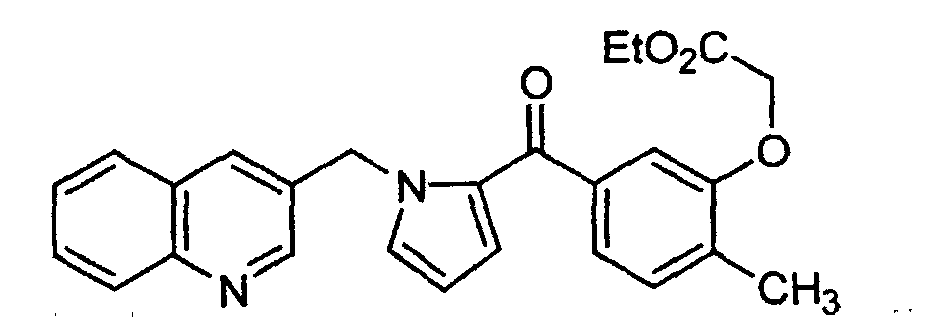
1H NMR (CDCl3, 400MHz) δ 8.81 (d, 1H, J=2.2Hz), 8.07 (d, 1H, J=8.4Hz), 7.92 (d, 1H, J=2.0Hz), 7.76 (brd, 1H, J=8.1Hz), 7.68 (ddd, 1H, J=8.4, 7.0, 1.5Hz), 7.51 (ddd, 1H, J=8.1, 7.0, 1.1Hz), 7.34 (dd, 1H, J=1.5, 7.2Hz), 7.20 (brd, 1H, J=7.2Hz), 7.12 (d, 1H, J=1.5Hz), 7.10 (dd, 1H, J=1.7, 2.5Hz), 6.83 (dd, 1H, J=1.7, 4.0Hz), 6.27 (dd, 1H, J=2.5, 4.0Hz), 5.83 (brs, 2H), 4.66 (s, 2H), 4.24 (q, 2H, J=7.1Hz), 2.34 (brs, 3H), 1.27 (t, 3H, J=7.1Hz).

1H NMR (CDCl3, 400MHz) δ 8.82 (d, 1H, J=2.2Hz), 8.07 (d, 1H, J=8.4Hz), 7.93 (d, 1H, J=2.0Hz), 7.76 (brd, 1H, J=8.1Hz), 7.68 (ddd, 1H, J=8.4, 7.0, 1.5Hz), 7.52 (ddd, 1H, J=8.1, 7.0, 1.1Hz), 7.29 (dd, 1H, J=1.5, 7.2Hz), 7.24 (d, 1H, J=1.5Hz), 7.17 (brd, 1H, J=7.2Hz), 7.11 (dd, 1H, J=1.7, 2.5Hz), 6.86 (dd, 1H, J=1.7, 4.0Hz), 6.27 (dd, 1H, J=2.5, 4.0Hz), 5.83 (brs, 2H), 4.11 (t, 2H, J=5.7Hz), 2.78 (t, 2H, J=5.7Hz), 2.36 (s, 6H), 2.27 (brs, 3H).

1H NMR (CDCl3, 400MHz) δ 8.82 (d, 1H, J=2.2Hz), 8.07 (d, 1H, J=8.4Hz), 7.93 (d, 1H, J=2.0Hz), 7.76 (brd, 1H, 3=8.1Hz), 7.68 (ddd, 1H, J=8.4, 7.0, 1.5Hz), 7.52 (ddd, 1H, J=8.1, 7.0, 1.1Hz), 7.29 (dd, 1H, J=1.5, 7.2Hz), 7.24 (d, 1H, J=1.5Hz), 7.16 (brd, 1H, J=7.2Hz), 7.11 (dd, 1H, J=1.7, 2.5Hz), 6.86 (dd, 1H, J=1.7, 4.0Hz), 6.27 (dd, 1H, J=2.5, 4.0Hz), 5.84 (brs, 2H), 4.07 (t, 2H, J=5.7Hz), 2.92 (t, 2H, J=5.7Hz), 2.64 (q, 4H, J=7.1Hz), 2.27 (brs, 3H), 1.07 (t, 6H, J=7.1Hz).
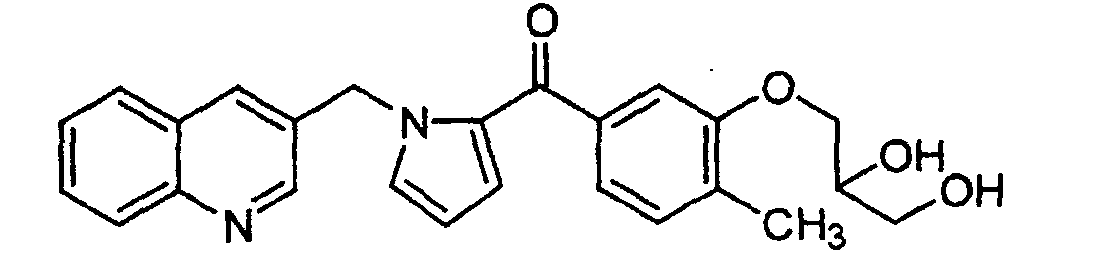
1H NMR (CDCl3, 400MHz) δ 8.77 (d, 1H, J=2.2Hz), 8.07 (d, 1H, J=8.4Hz), 7.93 (d, 1H, J=2.0Hz), 7.75 (brd, 1H, 3=8.1Hz), 7.67 (ddd, 1H, J=8.4, 7.0, 1.5Hz), 7.51 (ddd, 1H, J=8.1, 7.0, 1.1Hz), 7.31 (dd, 1H, J=1.5, 7.2Hz), 7.22 (d, 1H, J=1.5Hz), 7.16 (brd, 1H, J=7.2Hz), 7.12 (dd, 1H, J=1.7, 2.5Hz), 6.84 (dd, 1H, J=1.7, 4.0Hz), 6.28 (dd, 1H, J=2.5, 4.0Hz), 5.82 (brs, 2H), 4.04-4.15 (series of m, 3H), 3.83 (dd, 1H, J=11.4, 3.8Hz), 3.76 (dd, 1H, J=11.4, 5.5Hz), 2.25 (brs, 3H).
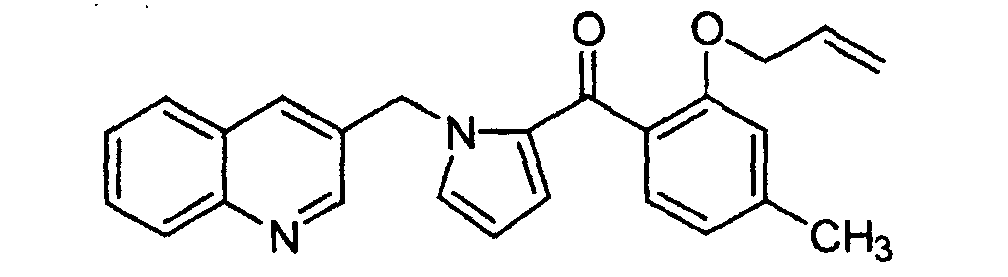
1H NMR (CDCl3, 400MHz) δ 7.73 (d, 1H, J=7.9Hz), 6.79 (dd, 1H, J=0.6, 7.9Hz), 6.76 (brs, 1H), 6.08 (ddt, 1H, J=10.6, 17.3, 5.0Hz), 5.53 (ddt, 1H, J=17.3, 1.6, 1.6Hz), 5.30 (ddt, 1H, J=10.6, 1.6, 1.6Hz), 4.61 (dt, 2H, J=5.0, 1.6Hz), 3.88 (s, 3H), 2.37 (brs, 3H).
1H NMR (CDCl3, 400MHz) δ 9.69 (brs, 1H), 7.36 (d, 1H, J=7.9Hz), 7.08 (dt, 1H, J=1.3, 2.7Hz), 6.82 (brd, 1H, J=7.9Hz), 6.79 (brs, 1H), 6.67 (ddd, 1H, J=3.8, 2.4, 1.3Hz), 6.26 (dt, 1H, J=3.8, 2.7Hz), 5.95 (ddt, 1H, J=10.6, 17.3, 5.0Hz), 5.30 (ddt, 1H, J=17.3, 1.6, 1.6Hz), 5.18 (ddt, 1H, J=10.6, 1.6, 1.6Hz), 4.56 (dt, 2H, J=5.0, 1.6Hz), 2.39 (brs, 3H).
1H NMR (CDCl3, 400MHz) δ 8.84 (d, 1H, J=2.2Hz), 8.08 (d, 1H, J=8.4Hz), 7.95 (d, 1H, J=2.0Hz), 7.76 (dd, 1H, J=1.1, 8.1Hz), 7.68 (ddd, 1H, J=8.4, 7.0, 1.5Hz), 7.51 (ddd, 1H, J=8.1, 7.0, 1.1Hz), 7.20 (d, 1H, J=7.9Hz), 7.06 (dd, 1H, J=1.7, 2.5Hz), 6.77 (brd, 1H, J=7.9Hz), 6.72 (brs, 1H), 6.64 (dd, 1H, J=1.7, 4.0Hz), 6.19 (dd, 1H, J=2.5, 4.0Hz), 5.89 (brs, 2H), 5.77 (ddt, 1H, J=10.6, 17.3, 5.0Hz), 5.12 (ddt, 1H, J=17.3, 1.6, 1.6Hz), 5.02 (ddt, 1H, J=10.6, 1.6, 1.6Hz), 4.44 (dt, 2H, J=5.0, 1.6Hz), 2.36 (brs, 3H).
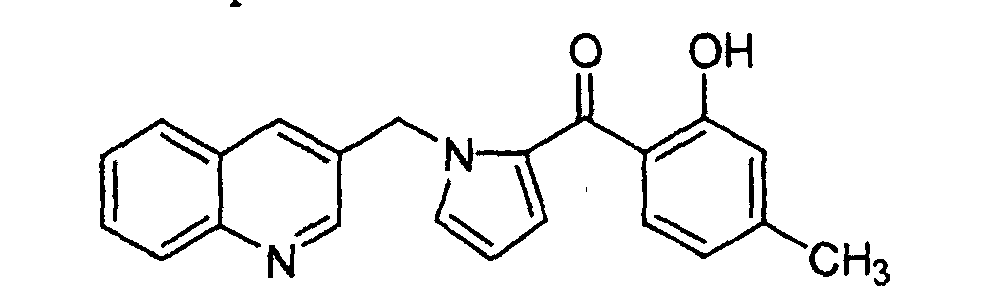
1H NMR (CDCl3, 400MHz) δ 8.79 (d, 1H, J=2.2Hz), 8.07 (d, 1H, J=8.4Hz) 7.89 (d, 1H, J=2.0Hz), 7.75 (dd, 1H, J=1.1, 8.1Hz), 7.74 (d, 1H, J=7.9Hz) 7.69 (ddd, 1H, J=8.4, 7.0, 1.5Hz), 7.52 (ddd, 1H, J=8.1, 7.0, 1.1Hz), 7.10 (dd, 1H, J=1.7, 2.5Hz), 6.89 (dd, 1H, J=1.7, 4.0Hz), 6.80 (brs, 1H), 6.68 (brd, 1H, J=7.9Hz), 6.32 (dd, 1H, J=2.5, 4.0Hz), 5.75 (brs, 2H), 2.34 (brs 3H).
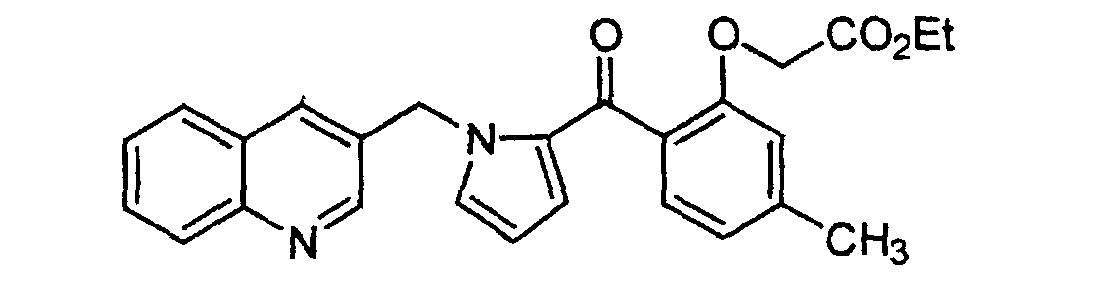
1H NMR (CDCl3, 400MHz) δ 8.83 (d, 1H, J=2.2Hz), 8.08 (d, 1H, J=8.4Hz), 7.96 (d, 1H, J=2.0Hz), 7.77 (dd, 1H, J=1.1, 8.1Hz), 7.68 (ddd, 1H, J=8.4, 7.0, 1.5Hz), 7.51 (ddd, 1H, J=8.1, 7.0, 1.1Hz), 7.21 (d, 1H, J=7.9Hz), 7.06 (dd, 1H, J=1.7, 2.5Hz), 6.81 (brd, 1H, J=7.9Hz), 6.71 (brs, 1H), 6.62 (dd, 1H, J=1.7, 4.0Hz), 6.20 (dd, 1H, J=2.5, 4.0Hz), 5.89 (brs, 2H), 4.53 (s, 2H), 4.17 (q, 2H, J=7.1Hz), 2.34 (brs, 3H), 1.21 (t, 3H, J=7.1Hz).
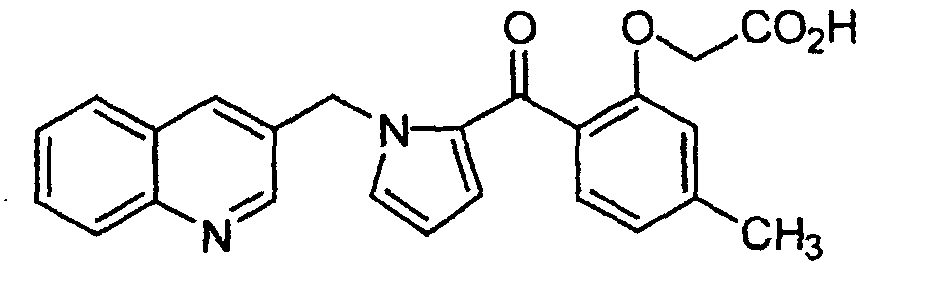
1H NMR (CDCl3, 400MHz) δ 8.83 (brs, 1H), 8.49 (brs, 1H), 8.43 (brd, 1H, J=8.4Hz), 7.96 (brd, 1H, J=8.1Hz), 7.83 (brdd, 1H, J=8.4, 7.0Hz), 7.69 (brdd, 1H, J=8.1, 7.0Hz), 7.34 (d, 1H, J=7.9Hz), 7.27 (brs, 1H), 6.87 (brd, 1H, J=7.9Hz), 6.81 (brd, 1H, J=4.0Hz), 6.80 (brs, 1H), 6.30 (brd, 1H, J=4.0Hz), 5.92 (brs, 2H), 4.66 (s, 2H), 2.37 (brs, 3H).

1H NMR (CDCl3, 400MHz) δ 8.84 (d, 1H, J=2.2Hz), 8.08 (d, 1H, J=8.4Hz), 7.97 (d, 1H, J=2.0Hz), 7.78 (dd, 1H, J=1.1, 8.1Hz), 7.69 (ddd, 1H, J=8.4, 7.0, 1.5Hz), 7.53 (ddd, 1H, J=8.1, 7.0, 1.1Hz), 7.19 (d, 1H, J=7.9Hz), 7.07 (dd, 1H, J=1.7, 2.5Hz), 6.77 (brd, 1H, J=7.9Hz), 6.73 (brs, 1H), 6.61 (dd, 1H, J=1.7, 4.0Hz), 6.19 (dd, 1H, J=2.5, 4.0Hz), 5.87 (brs, 2H), 3.98 (t, 2H, J=5.7Hz), 2.42 (t, 2H, J=5.7Hz), 2.36 (brs, 3H), 2.08 (s, 6H).
1H NMR (CDCl3, 400MHz) δ 8.12 (dt, 2H, J=7.2, 1.5Hz), 7.84 (d, 2H, J=8.9Hz), 7.73 (dd, 1H, J=1.7, 3.2Hz), 7.65 (tt, 1H, J=1.5, 7.2Hz), 7.58 (tt, 2H, J=1.5, 7.2Hz), 6.93 (d, 2H, J=8.9Hz), 6.68 (dd, 1H, J=1.7, 3.6Hz), 6.34 (dd, 1H, J=3.2, 3.6Hz), 3.87 (s, 3H).
1H NMR (CDCl3, 400MHz) δ 9.54 (brs, 1H), 7.94 (d, 2H, J=8.9Hz), 7.12 (dt, 1H, J=1.3, 2.7Hz), 6.93 (d, 2H, J=8.9Hz), 6.89 (ddd, 1H, J=3.8, 2.4, 1.3Hz), 6.34 (dt, 1H, J=3.8, 2.7Hz), 3.89 (s, 3H).
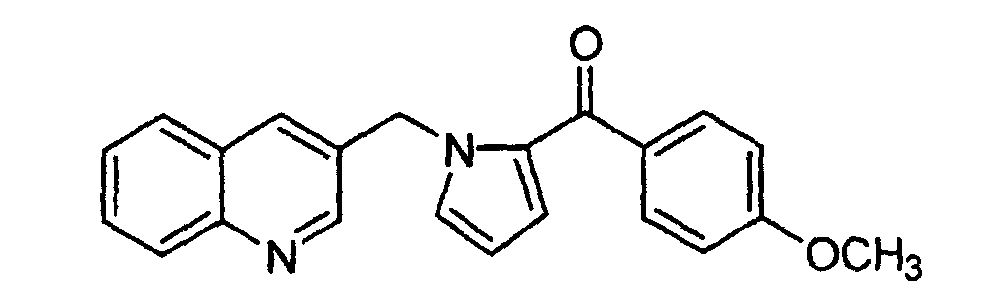
1H NMR (CDCl3, 400MHz) δ 8.81 (d, 1H, J=2.2Hz), 8.07 (brd, 1H, J=8.4Hz), 7.92 (d, 1H, J=2.0Hz), 7.79 (dt, 2H, J=8.4, 2.0Hz), 7.76 (brd, 1H, J=8.1Hz), 7.68 (ddd, 1H, J=8.4, 7.0, 1.5Hz), 7.51 (ddd, 1H, J=8.1, 7.0, 1.1Hz), 7.09 (dd, 1H, J=1.7, 2.5Hz), 6.92 (dt, 2H, J=8.4, 2.0Hz), 6.82 (dd, 1H, J=1.7, 4.0Hz), 6.28 (dd, 1H, J=2.5, 4.0Hz), 5.84 (brs, 2H), 3.86 (s, 3H).

1H NMR (CDCl3, 400MHz) δ 7.87 (dd, 1H, J=1.2, 7.7Hz), 7.86 (d, 2H, J=8.8Hz), 7.53 (brd, 1H, J=7.7Hz), 7.43 (dt, 1H, J=1.1, 7.7Hz), 7.30 (brd, 1H, J=15.7Hz), 7.29 (dt, 1H, J=1.2, 7.7Hz), 7.10 (dd, 1H, J=1.7, 2.5Hz), 6.95 (brd, 2H, J=8.8Hz), 6.76 (dd, 1H, J=1.7, 4.0Hz), 6.35 (dt, 1H, J=15.7, 6.2Hz), 6.21 (dd, 1H, J=2.5, 4.0Hz), 5.21 (dd, 2H, J=6.2, 1.4Hz), 4.34 (q, 2H, J=7.2Hz), 3.88 (s, 3H), 1.37 (t, 3H, J=7.2Hz).

1H NMR (CDCl3, 400MHz) δ 8.66 (s, 1H), 8.01-8.10 (m, 2H), 7.83 (d, 2H, J=8.8Hz), 7.70-7.78 (m, 2H), 7.19 (dd, 1H, J=1.6, 2.5Hz), 6.94 (d, 2H, J=8.8Hz), 6.85 (dd, 1H, J=1.6, 4.0Hz), 6.30 (dd, 1H, J=2.5, 4.0Hz), 5.95 (brs, 2H), 3.86 (s, 3H).

1H NMR (CDCl3, 400MHz) δ 8.64 (s, 1H), 8.03-8.11 (m, 2H), 7.76 (d, 2H, J=8.8Hz), 7.72-7.79 (m, 2H), 7.19 (dd, 1H, J=1.6, 2.5Hz), 6.86 (d, 2H, J=8.8Hz), 6.85 (dd, 1H, J=1.6, 4.0Hz), 6.30 (dd, 1H, J=2.5, 4.0Hz), 6.04 (brs, 1H), 5.95 (brs, 2H).

1H NMR (CDCl3, 400MHz) δ 8.65 (s, 1H), 8.01-8.10 (m, 2H), 7.82 (d, 2H, J=8.8Hz), 7.70-7.78 (m, 2H), 7.19 (dd, 1H, J=1.6, 2.5Hz), 6.94 (d, 2H, J=8.8Hz), 6.85 (dd, 1H, J=1.6, 4.0Hz), 6.30 (dd, 1H, J=2.5, 4.0Hz), 5.94 (brs, 2H), 4.68 (s, 2H), 4.28 (q, 2H, J=7.1Hz), 1.30 (t, 3H, J=7.1Hz).
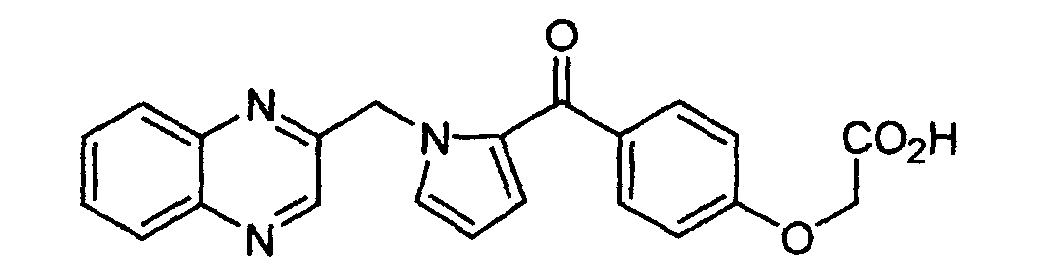
1H NMR (CDCl3, 400MHz) δ 8.65 (s, 1H), 8.03-8.12 (m, 2H), 7.81 (d, 2H, J=8.8Hz), 7.72-7.79 (m, 2H), 7.19 (dd, 1H, J=1.6, 2.5Hz), 6.94 (d, 2H, J=8.8Hz), 6.85 (dd, 1H, J=1.6, 4.0Hz), 6.30 (dd, 1H, J=2.5, 4.0Hz), 5.95 (brs, 2H), 4.72 (s, 2H).

1H NMR (CDCl3, 400MHz) δ 8.65 (s, 1H), 8.01-8.10 (m, 2H), 7.82 (d, 2H, J=8.8Hz), 7.70-7.78 (m, 2H), 7.18 (dd, 1H, J=1.6, 2.5Hz), 6.94 (d, 2H, J=8.8Hz), 6.85 (dd, 1H, J=1.6, 4.0Hz), 6.30 (dd, 1H, J=2.5, 4.0Hz), 5.94 (brs, 2H), 4.17 (t, 2H, J=5.7Hz), 3.74 (dd, 4H, J=4.6, 4.7Hz), 2.83 (t, 2H, J=5.7Hz), 2.59 (dd, 4H, J=4.6, 4.7Hz).

1H NMR (CDCl3, 400MHz) δ 8.81 (d, 1H, J=2.2Hz), 8.07 (d, 1H, J=8.4Hz), 7.92 (d, 1H, J=2.0Hz), 7.82-7.87 (m, 2H), 7.77 (d, 2H, J=8.4Hz), 7.76 (brd, 1H, J=8.1Hz), 7.69-7.74 (m, 2H), 7.68 (ddd, 1H, J=8.4, 7.0, 1.5Hz), 7.51 (ddd, 1H, J=8.1, 7.0, 1.1Hz), 7.09 (dd, 1H, J=1.7, 2.5Hz), 6.89 (d, 2H, J=8.4Hz), 6.81 (dd, 1H, J=1.7, 4.0Hz), 6.27 (dd, 1H, J=2.5, 4.0Hz), 5.83 (brs, 2H), 4.05 (t, 2H, J=5.9Hz), 3.78 (t, 2H, J=6.7Hz), 1.81-1.95 (m, 4H).
1H NMR (CDCl3, 400MHz) δ 8.80 (d, 1H, J=2.2Hz), 8.07 (d, 1H, J=8.4Hz), 7.91 (d, 1H, J=2.0Hz), 7.77 (d, 2H, J=8.4Hz), 7.75 (brd, 1H, J=8.1Hz), 7.67 (ddd, 1H, J=8.4, 7.0, 1.5Hz), 7.51 (ddd, 1H, J=8.1, 7.0, 1.1Hz), 7.09 (dd, 1H, J=1.7, 2.5Hz), 6.88 (d, 2H, J=8.4Hz), 6.81 (dd, 1H, J=1.7, 4.0Hz), 6.27 (dd, 1H, J=2.5, 4.0Hz), 5.83 (brs, 2H), 4.05 (t, 2H, J=6.4Hz), 2.79 (t, 2H, J=7.2Hz), 1.84 (tt, 2H, J=6.4, 7.3Hz), 1.64 (tt, 2H, J=7.2, 7.3Hz).

1H NMR (CDCl3, 400MHz) δ 8.80 (d, 1H, J=2.2Hz), 8.07 (d, 1H, J=8.4Hz), 7.93 (d, 1H, J=2.0Hz), 7.78 (dt, 2H, J=8.4, 2.0Hz), 7.76 (brd, 1H, J=8.1Hz), 7.68 (ddd, 1H, J=8.4, 7.0, 1.5Hz), 7.51 (ddd, 1H, J=8.1, 7.0, 1.1Hz), 7.09 (dd, 1H, J=1.7, 2.5Hz), 6.92 (dt, 2H, J=8.4, 2.0Hz), 6.82 (dd, 1H, J=1.7, 4.0Hz), 6.27 (dd, 1H, J=2.5, 4.0Hz), 5.83 (brs, 2H), 4.17 (t, 2H, J=5.7Hz), 3.74 (dd, 4H, J=4.6, 4.7Hz), 2.82 (t, 2H, J=5.7Hz), 2.59 (dd, 4H, J=4.6, 4.7Hz).

1H NMR (CDCl3, 400MHz) δ 8.80 (d, 1H, J=2.2Hz), 8.07 (d, 1H, J=8.4Hz), 7.92 (d, 1H, J=2.0Hz), 7.78 (dt, 2H, J=8.4, 2.0Hz), 7.76 (brd, 1H, J=8.1Hz), 7.68 (ddd, 1H, J=8.4, 7.0, 1.5Hz), 7.52 (ddd, 1H, J=8.1, 7.0, 1.1Hz), 7.11 (dd, 1H, J=1.7, 2.5Hz), 6.97 (dt, 2H, J=8.4, 2.0Hz), 6.82 (dd, 1H, J=1.7, 4.0Hz), 6.28 (dd, 1H, J=2.5, 4.0Hz), 5.84 (brs, 2H), 4.75 (s, 2H), 3.57-3.70 (series of m, 8H).

1H NMR (CDCl3, 400MHz) δ 8.80 (d, 1H, J=2.2Hz), 8.07 (d, 1H, J=8.4Hz), 7.92 (d, 1H, J=2.0Hz), 7.78 (dt, 2H, J=8.4, 2.0Hz), 7.76 (brd, 1H, J=8.1Hz), 7.68 (ddd, 1H, J=8.4, 7.0, 1.5Hz), 7.51 (ddd, 1H, J=8.1, 7.0, 1.1Hz), 7.10 (dd, 1H, J=1.7, 2.5Hz), 6.96 (dt, 2H, J=8.4, 2.0Hz), 6.82 (dd, 1H, J=1.7, 4.0Hz), 6.28 (dd, 1H, J=2.5, 4.0Hz), 5.83 (brs, 2H), 4.74 (s, 2H), 3.64 (brt, 2H, J=4.8Hz), 3.58 (brt, 2H, J=4.8Hz), 2.41 (brt, 2H, J=5.1Hz), 2.38 (brt, 2H, J=5.1Hz), 2.29 (s, 3H).

1H NMR (CDCl3, 400MHz) δ 8.65 (s, 1H), 8.01-8.10 (m, 2H), 7.82 (d, 2H, J=8.8Hz), 7.70-7.78 (m, 2H), 7.17 (dd, 1H, J=1.6, 2.5Hz), 6.94 (d, 2H, J=8.8Hz), 6.85 (dd, 1H, J=1.6, 4.0Hz), 6.30 (dd, 1H, J=2.5, 4.0Hz), 5.94 (brs, 2H), 4.11 (t, 2H, J=6.2Hz), 2.90 (t, 2H, J=6.2Hz), 2.65 (q, 4H, J=7.1 Hz), 1.08 (t, 6H, J=7.1Hz).
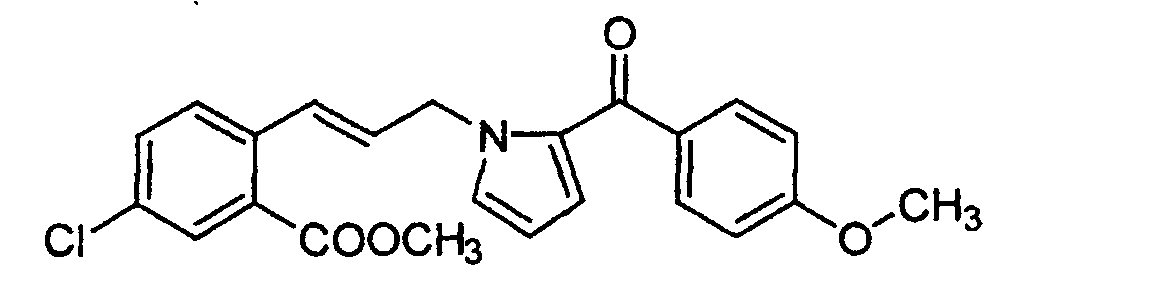
1H NMR (CDCl3, 400MHz) δ 7.85 (d, 2H, J=8.8Hz), 7.85 (d, 1H, J=2.2Hz), 7.47 (d, 1H, J=8.5Hz), 7.39 (dd, 1H, J=8.5, 2.2Hz), 7.20 (dt, 1H, J=15.8, 1.4Hz), 7.07 (dd, 1H, J=1.7, 2.5Hz), 6.94 (d, 2H, J=8.8Hz), 6.77 (dd, 1H, J=1.7, 4.0Hz), 6.35 (dt, 1H, J=15.8, 6.1Hz), 6.23 (dd, 1H, J=2.5, 4.0Hz), 5.20 (dd, 2H, J=1.4, 6.1Hz), 3.88 (s, 3H), 3.86 (s, 3H).

1H NMR (DMSO-d6, 400MHz) δ 7.78 (d, 2H, J=8.8Hz), 7.44 (brd, 1H, J=15.8Hz), 7.39 (d, 1H, J=8.5Hz), 7.37 (brs, 1H), 7.31 (dd, 1H, J=1.7, 2.5Hz), 7.11 (brd, 1H, J=8.5Hz), 7.04 (d, 2H, J=8.8Hz), 6.65 (dd, 1H, J=1.7, 4.0Hz), 6.23 (dt, 1H, J=15.8, 6.1Hz), 6.20 (dd, 1H, J=2.5, 4.0Hz), 5.20 (dd, 2H, J=1.4, 6.1Hz), 3.84 (s, 3H).
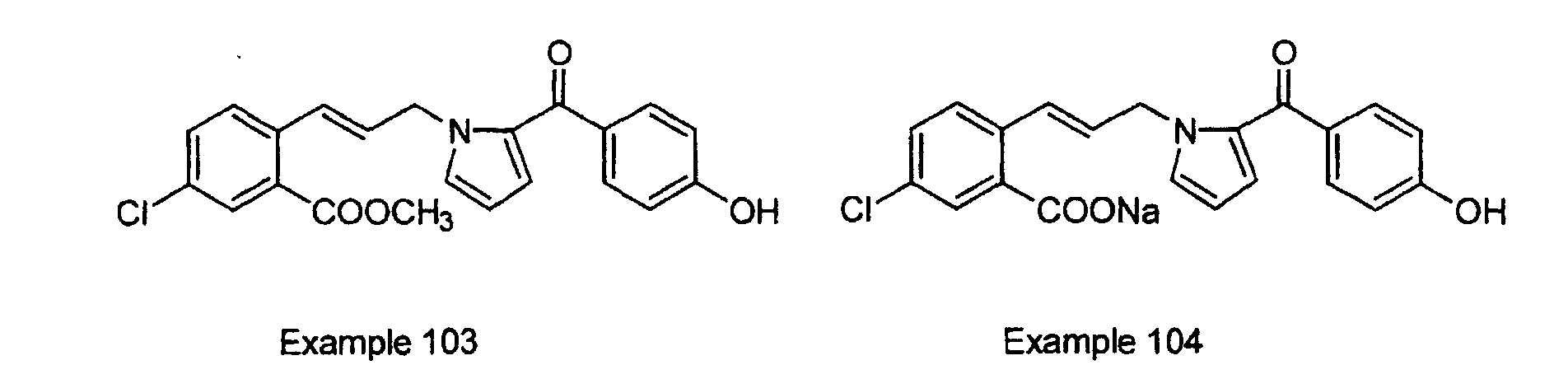
1H NMR (the compound of Example 103: CDCl3, 400MHz) δ 7.85 (d, 1H, J=2.2Hz), 7.79 (d, 2H, J=8.7Hz), 7.47 (d, 1H, J=8.5Hz), 7.39 (dd, 1H, J=8.5, 2.2Hz), 7.19 (dt, 1H, J=15.8, 1.4Hz), 7.08 (dd, 1H, J=1.7, 2.5Hz), 6.88 (d, 2H, J=8.7Hz), 6.77 (dd, 1H, J=1.7, 4.0Hz), 6.34 (dt, 1H, J=15.8, 6.0Hz), 6.23 (dd, 1H, J=2.5, 4.0Hz), 5.20 (dd, 2H, J=1.4, 6.0Hz), 3.86 (s, 3H)
1H NMR (the compound of Example 104: DMSO-d6, 400MHz) δ 7.68 (d, 2H, J=8.7Hz), 7.42 (brd, 1H, J=15.8Hz), 7.38 (d, 1H, J=8.5Hz), 7.35 (d, 1H, J=2.2Hz), 7.27 (dd, 1H, J=1.7, 2.5Hz), 7.10 (dd, 1H, J=8.5, 2.2Hz), 6.84 (d, 2H, J=8.7Hz), 6.63 (dd, 1H, J=1.7, 4.0Hz), 6.22 (dt, 1H, J=15.8, 6.0Hz), 6.18 (dd, 1H, J=2.5, 4.0Hz), 5.06 (brd, 2H, J=6.0Hz).
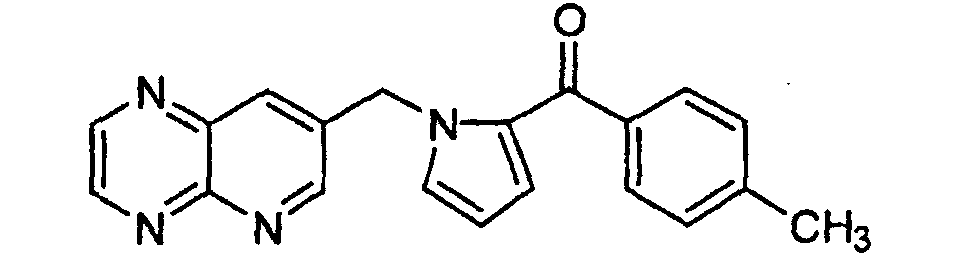
1H NMR (CDCl3, 400MHz) δ 9.06 (d, 1H, J=2.3Hz), 9.02 (d, 1H, J=1.7Hz), 8.91 (d, 1H, J=1.7Hz), 8.24 (d, 1H, J=2.3Hz), 2.65 (s, 3H).
1H NMR (CDCl3, 400MHz) δ 9.09 (d, 1H, J=2.4Hz), 9.03 (d, 1H, J=1.7Hz), 8.90 (d, 1H, J=1.7Hz), 8.10 (d, 1H, J=2.4Hz), 7.67 (d, 2H, J=8.0Hz), 7.23 (d, 2H, J=8.0Hz), 7.14 (dd, 1H, J=1.7, 2.5Hz), 6.89 (dd, 1H, J=1.7, 4.1Hz), 6.34 (dd, 1H, J=2.5, 4.1Hz), 5.94 (s, 2H), 2.41 (s, 3H).
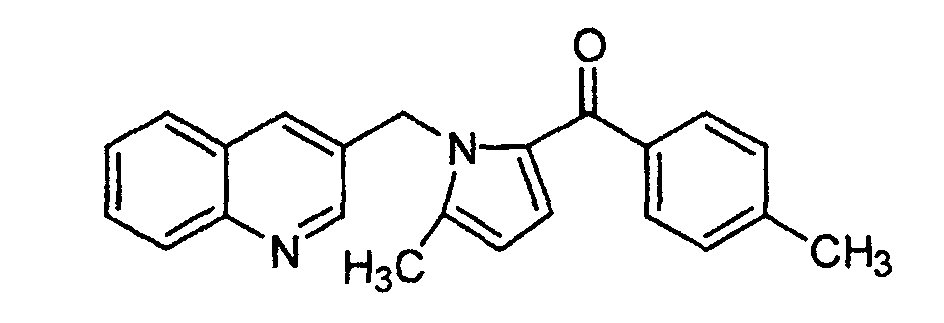
1H NMR (CDCl3, 400MHz) δ 8.23 (d, 2H, J=7.2Hz), 7.84 (d, 2H, J=8.1Hz), 7.56-7.68 (m, 3H), 7.26 (d, 2H, J=8.1Hz), 6.48 (d, 1H, J=3.5Hz), 6.01 (d, 1H, J=3.5Hz), 2.53 (s, 3H), 2.43 (s, 3H).
1H NMR (CDCl3, 400MHz) δ 9.97 (brs, 1H), 7.80 (d, 2H, J=8.0Hz), 7.27 (d, 2H, J=8.0Hz), 6.80 (dd, 1H, J=2.7, 3.4Hz), 6.04 (d, 1H, J=3.0, 3.4Hz), 2.43 (s, 3H), 2.39 (s, 3H).
1H NMR (CDCl3, 400MHz) δ 8.73 (d, 1H, J=2.2Hz), 8.12 (d, 1H, J=7.8Hz), 7.67-7.75 (m, 3H), 7.68 (d, 2H, J=8.0Hz), 7.52 (t, 1H, J=7.8Hz), 7.23 (d, 2H, J=8.0Hz), 6.81 (d, 1H, J=4.0Hz), 6.10 (d, 1H, J=4.0Hz), 5.90 (s, 2H), 2.41 (s, 3H), 2.29 (s, 3H).
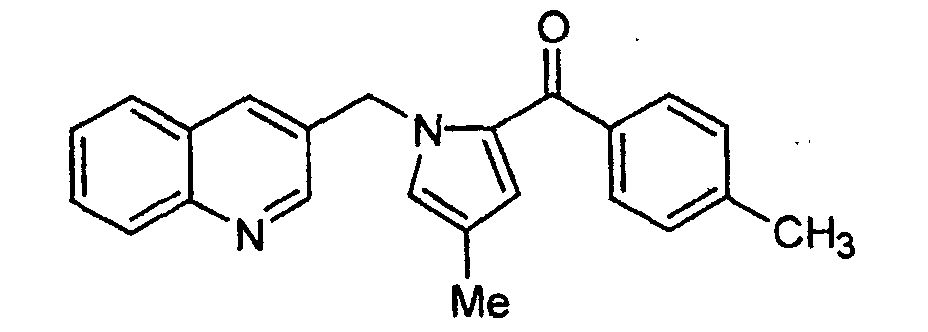
1H NMR (CDCl3, 400MHz) δ 8.78 (d, 1H, J=2.2Hz), 8.08 (d, 1H, J=7.9Hz), 7.79 (d, 1H, J=2.2Hz), 7.75 (d, 1H, J=7.9Hz), 7.68 (t, 1H, J=7.9Hz), 7.52 (t, 1H, J=7.9Hz), 6.86 (d, 1H, J=1.3Hz), 6.74 (d, 1H, J=1.3Hz), 5.69 (s, 2H), 4.21 (q, 2H, J=7.1Hz), 2.09 (s, 3H), 1.28 (t, 3H, J=7.1Hz).
1H NMR (CDCl3, 400MHz) δ 8.77 (d, 1H, J=2.2Hz), 8.09 (d, 1H, J=7.9Hz), 7.76 (d, 1H, J=7.9Hz), 7.75 (d, 1H, J=2.2Hz), 7.70 (t, 1H, J=7.9Hz), 7.54 (t, 1H, J=7.9Hz), 6.51 (d, 1H, J=1.3Hz), 6.04 (d, 1H, J=1.3Hz), 5.33 (s, 2H), 4.53 (d, 2H, J=5.8Hz), 2.08 (s, 3H), 1.38 (t, 1H, J=5.8Hz)
1H NMR (CDCl3, 400MHz) δ 9.48 (s, 1H), 8.79 (d, 1H, J=2.2Hz), 8.08 (d, 1H, J=7.9Hz), 7.89 (d, 1H, J=2.2Hz), 7.77 (d, 1H, J=7.9Hz), 7.69 (t, 1H, J=7.9Hz), 7.53 (t, 1H, J=7.9Hz), 6.86 (d, 1H, J=1.3Hz), 6.80 (d, 1H, J=1.3Hz), 5.70 (s, 2H), 2.11 (s, 3H).
1H NMR (CDCl3, 400MHz) δ 8.65 (d, 1H, J=2.2Hz), 8.07 (d, 1H, J=7.9Hz), 7.69 (d, 1H, J=7.9Hz), 7.68 (dd, 1H, J=7.9, 7.9Hz), 7.56 (d, 1H, J=2.2Hz), 7.52 (dd, 1H, J=7.9, 7.9Hz), 7.21 (d, 2H, J=8.0Hz), 7.05 (d, 2H, J=8.0Hz), 6.46 (d, 1H, J=1.3Hz), 5.78 (d, 1H, J=1.3Hz), 5.76 (d, 1H, J=4.5Hz), 5.30 (d, 1H, J=16.3Hz), 5.21 (d, 1H, J=16.3Hz), 2.23 (s, 3H), 2.23 (1H), 2.05 (s, 3H).
1H NMR (CDCl3, 400MHz) δ 8.81 (d, 1H, J=2.2Hz), 8.07 (d, 1H, J=7.9Hz), 7.95 (d, 1H, J=2.2Hz), 7.77 (d, 1H, J=7.9Hz), 7.67 (t, 1H, J=7.9Hz), 7.67 (d, 2H, J=7.9Hz), 7.51 (t, 1H, J=7.9Hz), 7.22 (d, 2H, J=7.9Hz), 6.88 (d, 1H, J=1.3Hz), 6.63 (d, 1H, J=1.3Hz), 5.79 (s, 2H), 2.41 (s, 3H), 2.09 (s, 3H).
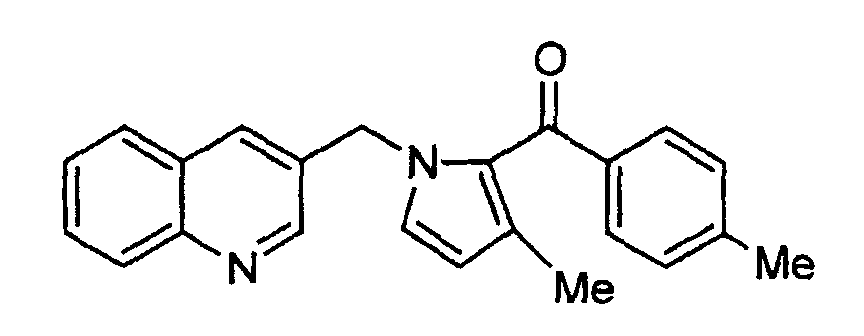
1H NMR (CDCl3, 400MHz) δ 9.71 (s, 1H), 8.77 (d, 1H, J=2.2Hz), 8.17 (d, 1H, J=7.9Hz), 7.98 (d, 1H, J=2.2Hz), 7.80 (d, 1H, J=7.9Hz), 7.73 (t, 1H, J=7.9Hz), 7.57 (t, 1H, J=7.9Hz), 6.98 (d, 1H, J=2.4Hz), 6.12 (d, 1H, J=2.4Hz), 5.72 (s, 2H), 2.39 (s, 3H).
1H NMR (CDCl3, 400MHz) δ 8.44 (d, 1H, J=2.2Hz), 8.08 (d, 1H, J=7.8Hz), 7.66 (dd, 1H, J=7.8, 7.8Hz), 7.61 (d, 1H, J=7.8Hz), 7.50 (dd, 1H, J=7.8, 7.8Hz), 7.37 (d, 1H, J=2.2Hz), 7.11 (d, 2H, J=8.0Hz), 6.89 (d, 2H, J=8.0Hz), 6.56 (d, 1H, J=2.7Hz), 6.11 (s, 1H), 6.06 (d, 1H, J=2.7Hz), 5.22 (d, 1H, J=16.3Hz), 5.10 (d, 1H, J=16.3Hz), 2.17 (s, 3H), 2.04 (s, 3H).
1H NMR (CDCl3, 400MHz) δ 8.72 (d, 1H, J=2.2Hz), 8.16 (brd, 1H, J=7.7Hz), 7.98 (brs, 1H), 7.77 (d, 1H, J=7.7Hz), 7.71 (t, 1H, J=7.7Hz), 7.55 (t, 1H, J=7.7Hz), 7.52 (d, 2H, J=8.0Hz), 7.19 (d, 2H, J=8.0Hz), 6.97 (d, 1H, J=2.5Hz), 6.09 (d, 1H, J=2.5Hz), 5.64 (s, 2H), 2.38 (s, 3H), 1.82 (s, 3H).

1H NMR (CDCl3, 400MHz) δ 7.97 (d, 2H, J=7.7Hz), 7.61 (t, 1H, J=7.7Hz), 7.53 (dd, 2H, J=7.7, 7.7Hz), 7.48 (d, 1H, J=2.0Hz 6.90 (d, 1H, J=2.0Hz), 3.70 (s, 3H), 2.10 (s, 3H).
1H NMR (CDCl3, 400MHz) δ 7.81 (dd, 2H, J=1.4, 7.7Hz), 7.61 (dt, 1H, J=7.7, 1.4Hz), 7.52 (t, 2H, J=7.7Hz), 7.00 (d, 1H, J=1.7Hz), 6.11 (d, 1H, J=1.7Hz), 4.56 (s, 2H), 2.02 (s, 3H).
1H NMR (CDCl3, 400MHz) δ 9.95 (s, 1H), 7.90 (dd, 2H, J=1.4, 7.7Hz), 7.64 (dt, 1H, J=7.7, 1.4Hz), 7.53 (t, 2H, J=7.7Hz), 7.37 (d, 1H, J=1.8Hz), 7.00 (d, 1H, J=1.8Hz), 2.10 (s, 3H).
1H NMR (CDCl3, 400MHz) δ 7.71 (dd, 2H, J=1.3, 7.8Hz), 7.60 (dt, 1H, J=7.8, 1.3Hz), 7.47 (t, 2H, J=7.8Hz), 7.16 (d, 2H, J=8.6Hz), 7.04 (d, 1H, J=2.0Hz), 6.81 (d, 2H, J=8.6Hz), 5.97 (s, 1H), 5.67 (d, 1H, J=2.0Hz), 3.80 (s, 3H), 1.96 (s, 3H).
1H NMR (CDCl3, 400MHz) δ 8.10 (dd, 2H, J=1.6, 7.4Hz), 7.82 (d, 2H, J=8.9Hz), 7.64 (dt, 1H, J=7.4, 1.6Hz), 7.57 (t, 2H, J=7.4Hz), 7.47 (d, 1H, J=1.8Hz), 6.92 (d, 2H, J=8.9Hz), 6.51 (d, 1H, J=1.8Hz), 3.87 (s, 3H), 2.10 (s, 3H).
1H NMR (CDCl3, 400MHz) δ 9.38 (brs, 1H), 7.92 (d, 2H, J=8.9Hz), 6.97 (d, 2H, J=8.9Hz), 6.89-6.90 (m, 1H), 6.70 (dd, 1H, J=1.2, 2.0Hz), 3.88 (s, 3H), 2.15 (s, 3H).
1H NMR (CDCl3, 400MHz) δ 7.85 (d, 1H, J=2.3Hz), 7.83 (d, 2H, J=8.9Hz), 7.48 (d, 1H, J=8.5Hz), 7.39 (dd, 1H, J=2.3, 8.5Hz), 7.21 (dt, 1H, J=15.8, 1.4Hz), 6.94 (d, 2H, J=8.9Hz), 6.85 (d, 1H, J=1.1Hz), 6.57 (d, 1H, J=1.1Hz), 6.34 (dt, 1H, J=15.8, 6.1Hz), 5.14 (dd, 2H, J=1.4, 6.1Hz), 3.88 (s, 3H), 3.87 (s, 3H), 2.09 (s, 3H).
1H NMR (CDCl3, 400MHz) δ 7.83 (d, 1H, J=2.6Hz), 7.21 (dd, 1H, J=8.5 and 2.6Hz), 6.61 (d, 1H, J=8.5Hz), 5.73 (brs, 2H), 3.88 (s, 3H).
1H NMR (CDCl3, 400MHz) δ 7.91 (d, 1H, J=8.5Hz), 7.80 (d, 1H, J=2.6Hz), 7.15 (dd, 1H, J = 8.5 and 2.6Hz), 3.94 (s, 3H).
1H NMR (CDCl3, 400MHz) δ 9.81 (s, 1H), 7.86 (d, 2H, J=8.6Hz), 7.58 (d, 1H, J=1.8Hz), 7.15 (d, 1H, J=1.8Hz), 6.97 (d, 2H, J=8.6Hz), 6.06 (ddt, 1H, J=10.0, 15.0 and 5.8Hz), 5.26 (dq, 1H, J=10.0 and 1.1Hz), 5.16 (dq, 1H, J=15.0 and 1.1Hz), 5.05 (dt, 1H, J=5.8 and 1.1Hz), 3.89 (s, 3H).
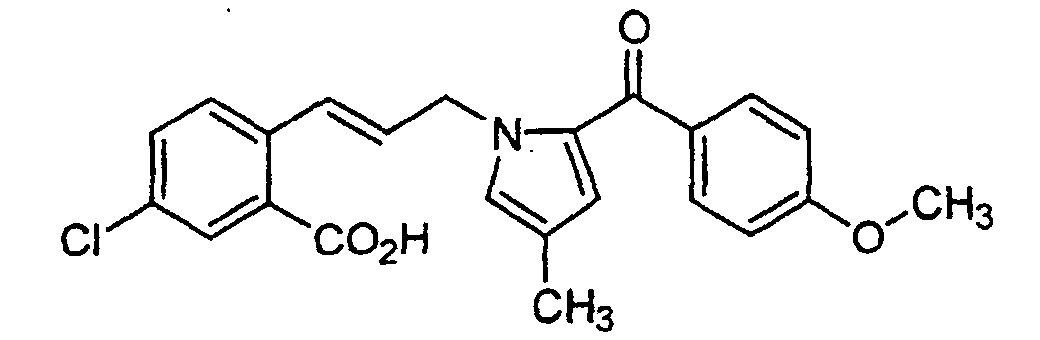
1H NMR (CDCl3, 400MHz) δ 7.97 (d, 1H, J=2.2Hz), 7.83 (d, 2H, J=8.9Hz), 7.50 (d, 1H, J=8.5Hz), 7.44 (dd, 1H, J=2.2, 8.5Hz), 7.28 (dt, 1H, J=15.5, 1.3Hz), 6.93 (d, 2H, J=8.9Hz), 6.86 (d, 1H, J=1.1Hz), 6.58 (d, 1H, J=1.1Hz), 6.35 (dt, 1H, J=15.5, 6.0Hz), 5.15 (dd, 2H, J=1.3, 6.0Hz), 3.85 (s, 3H), 2.09 (s, 3H).
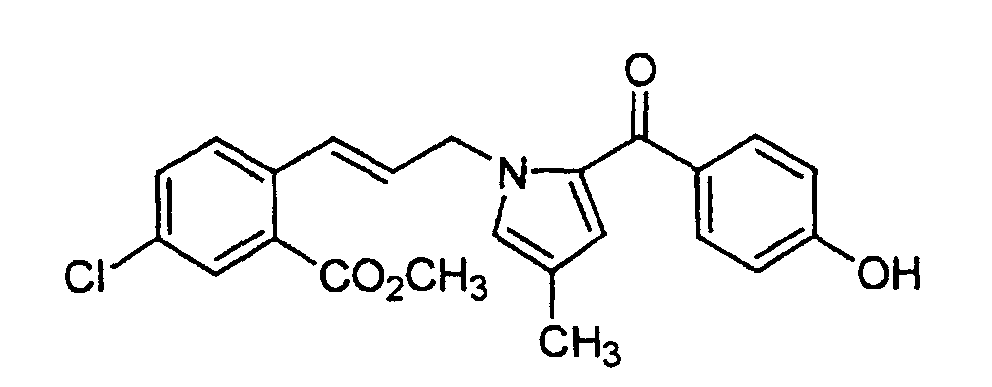
1H NMR (CDCl3, 400MHz) δ 7.85 (d, 1H, J=2.3Hz), 7.78 (d, 2H, J=8.7Hz), 7.47 (d, 1H, J=8.5Hz), 7.39 (dd, 1H, J=2.3, 8.5Hz), 7.20 (dt, 1H, J=15.8, 1.4Hz), 6.87 (d, 2H, J=8.7Hz), 6.86 (d, 1H, J=1.6Hz), 6.57 (d, 1H, J=1.6Hz), 6.33 (dt, 1H, J=15.8, 6.1Hz), 5.13 (dd, 2H, J=1.4, 6.1Hz), 3.87 (s, 3H), 2.09 (s, 3H).
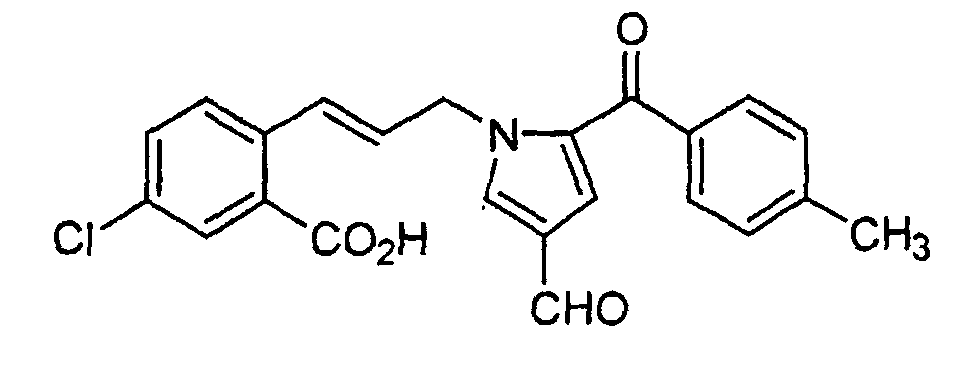
1H NMR (CDCl3, 400MHz) δ 10.22 (brs, 1H), 9.90 (s, 1H), 7.86 (d, 2H, J=8.2Hz), 7.73 (dd, 1H, J=1.4, 3.4Hz), 7.31-7.34 (m, 3H), 2.46 (s, 3H).
1H NMR (CDCl3, 400MHz) δ 9.81 (s, 1H), 8.00 (d, 1H, J=1.4Hz), 7.75 (d, 2H; J=8.2Hz), 7.73 (d, 1H, J=1.7Hz), 7.48 (m, 2H), 7.34 (dt, 1H, J=15.7, 1.3Hz), 7.27 (d, 2H, J=8.2Hz), 7.21 (d, 1H, J=1.7Hz), 6.33 (dd, 1H, J=15.7, 6.1Hz), 5.26 (dd, 2H, J=1.3, 6.1Hz), 2.42 (s, 3H).

1H NMR (CDCl3, 400MHz) δ 8.01 (dd, 1H, J=1.2, 7.7Hz), 7.86 (d, 2H, J=8.8Hz), 7.57 (brd, 1H, J=7.7Hz), 7.50 (dt, 1H, J=1.1, 7.7Hz), 7.36 (brd, 1H, J=15.7Hz), 7.34 (dt, 1H, J=1.2, 7.7Hz), 7.10 (dd, 1H, J=1.7, 2.5Hz), 6.94 (brd, 2H, J=8.8Hz), 6.77 (dd, 1H, J=1.7, 4.0Hz), 6.37 (dt, 1H, J=15.7, 6.2Hz), 6.23 (dd, 1H, J=2.5, 4.0Hz), 5.24 (dd, 2H, J=6.2, 1.4Hz), 3.86 (s, 3H).

1H NMR (DMSO-d6, 400MHz) δ 7.78 (d, 2H, J=8.8Hz), 7.46 (brd, 1H, J=15.7Hz), 7.31-7.37 (m, 2H), 7.31 (dd, 1H, J=1.7, 2.5Hz), 7.04 (d, 2H, J=8.8Hz), 7.02-7.08 (m, 2H), 6.65 (dd, 1H, J=1.7, 4.0Hz), 6.20 (dd, 1H, J=2.5, 4.0Hz), 6.19 (dt, 1H, J=15.7, 6.2Hz), 5.08 (dd, 2H, J=6.2, 1.4Hz), 3.84 (s, 3H).
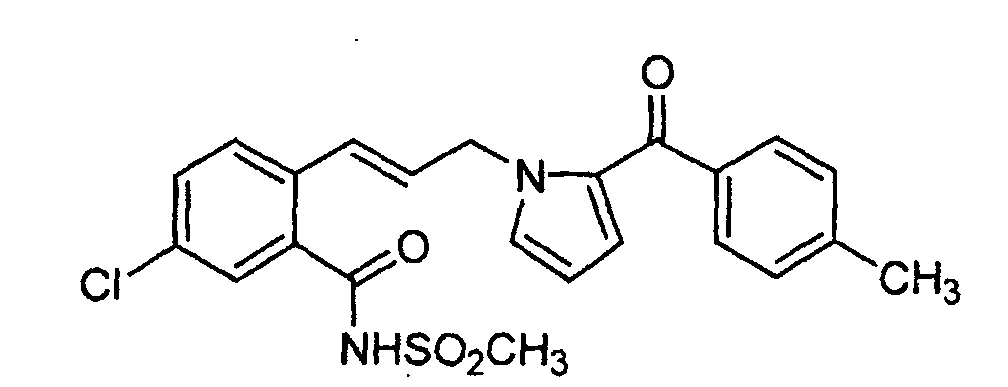
1H NMR (CDCl3, 400MHz) δ 8.79 (brs, 1H), 7.69 (d, 2H, J=8.0Hz), 7.52 (d, 1H, J=2. 1Hz), 7.44 (d, 1H, J=8.4Hz), 7.39 (dd, 1H, J=2.1, 8.4Hz), 7.23 (d, 2H, J=8.0Hz), 7.06 (dd, 1H, J=1.6, 2.5Hz), 6.78 (dd, 1H, J=1.6, 4.0Hz), 6.70 (d, 1H, J=15.6Hz), 6.40 (dt, 1H, J=15.6, 5.4Hz), 6.23 (dd, 1H, J=2.5, 4.0Hz), 5.16 (d, 2H, J=5.4Hz), 3.33 (s, 3H), 2.41 (s, 3H).
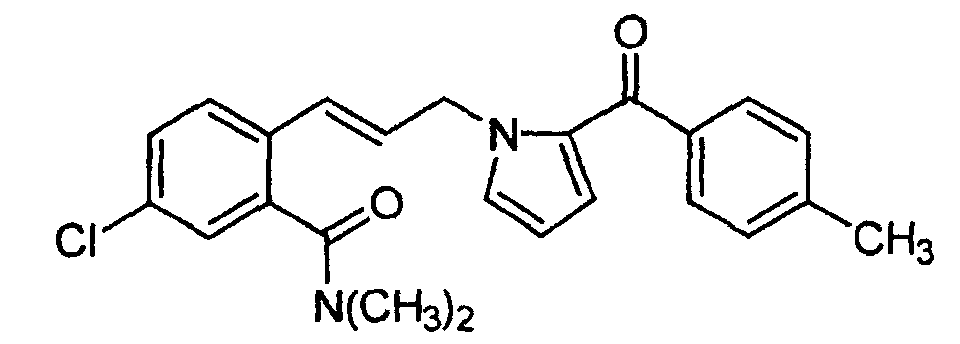
1H NMR (CDCl3, 400MHz) δ 7.71 (d, 2H, J=8.1Hz), 7.44 (d, 1H, J=8.4Hz), 7.27 (dd, 1H, J=2.2, 8.4Hz), 7.25 (d, 2H, J=8.1Hz), 7.19 (d, 1H, J=2.2Hz), 7.00 (dd, 1H, J=1.6, 2.5Hz), 6.78 (dd, 1H, J=1.6, 4.0Hz), 6.43 (dt, 1H, J=15.8, 5.7Hz), 6.29 (d, 1H, J=15.8Hz), 6.22 (dd, 1H, J=2.5, 4.0Hz), 5.17 (brs, 2H), 3.02 (s, 3H), 2.66 (s, 3H), 2.43 (s, 3H).

1H NMR (CDCl3, 400MHz) δ 7.72 (d, 2H, J=8.0Hz), 7.53 (d, 1H, J=2.2Hz), 7.39 (d, 1H, J=8.4Hz), 7.31 (dd, 1H, J=2.2, 8.4Hz), 7.26(d, 2H, J=8.0Hz), 7.04 (dd, 1H, J=1.6, 2.5Hz), 6.79 (dd, 1H, J=1.6, 4.0Hz), 6.72(d, 1H, J=15.7Hz), 6.30 (dt, 1H, J=15.7, 5.7Hz), 6.23 (dd, 1H, J=2.5, 4.0Hz), 6.04 (brs, 1H), 5.14 (d, 2H, J=5.7Hz), 2.94 (d, 3H, J=4.8Hz), 2.43 (s, 3H).

1H NMR (CDCl3, 400MHz) δ 7.70 (d, 2H, J=8.0Hz), 7.60 (d, 1H, J=2.2Hz), 7.40 (d, 1H, J=8.4Hz), 7.34 (dd, 1H, J=2.2, 8.4Hz), 7.26 (d, 2H, J=8.0Hz), 7.04 (dd, 1H, J=1.7, 2.5Hz), 6.81 (dd, 1H, J=1.7, 4.0Hz), 6.76 (d, 1H, J=15.8Hz), 6.32 (dt, 1H, J=15.8, 5.6Hz), 6.23 (dd, 1H, J=2.5, 4.0Hz), 6.09 (br, 1H), 5.78 (br, 1H), 5.16 (d, 2H, J=5.6Hz), 2.43 (s, 3H).

| Ex. | Ra | Rb | Rc | Rd | Starting Comp. (Ex) | Ref. Ex. |
| 119 | CO2CH3 | CH3 | H | 2-morpholinoethoxy | ||
| 120 | CO2Na | CH3 | H | 2-morpholinoethoxy | 119-2 | 16 |
| 121 | CONHCH3 | CH3 | H | 2-morpholinoethoxy hydrochloride | 119-2 | 116 |
| 122 | CO2CH3 | H | H | morpholinomethyl | ||
| 123 | CO2H | H | H | morpholinomethyl hydrochloride | 122 | 16 |
| 124 | CONHCH3 | H | H | morpholinomethyl | 123 | 116 |
| 125 | CO2H | H | H | 2-morpholinoethyl | ||
| 126 | CO2H | CH3 | H | morpholinomethyl | ||
| 127 | CO2H | H | H | morpholino | ||
| 128 | CN | H | H | CH3 | ||
| 129 | 5-tetrazolyl | H | H | CH3 | ||
| 130 | CONHCH3 | H | H | OCH3 | 102 | 116 |
| 131 | CONHSO2CH3 | H | H | OCH3 | 102 | 115 |
| 132 | CONHSO2CH3 | H | H | OH | 131 | 119-1 |
| 133 | CONHCH3 | H | H | OH | 130 | 119-1 |
| 134 | 1-sodio-5-tetrazolyl | H | H | OCH3 | ||
| 135 | 5-tetrazolyl | CH3 | H | OCH3 | 109 | 128, 129 |
| 136 | CONNaSO2CH3 | CH3 | H | OCH3 | ||
| 137 | OCH3 | CH3 | H | OCH3 | ||
| 138 | CO2CH3 | CH3 | H | CH3 | ||
| 139 | CO2Na | CH3 | H | CH3 | ||
| 140 | CONaSO2CH3 | CH3 | H | CH3 | 139-1 | 115 |
| 141 | OCH3 | CH3 | H | CH3 | 138-1 | 18-3 |
| 142 | NHSO2CH3 | CH3 | H | OCH3 | ||
| 143 | OCH3 | CH3 | H | OH | ||
| 144 | OCH3 | CH3 | H | 2-morpholinoethoxy | 143 | 119-2 |
| 145 | CONHSO2CH3 | CH3 | H | OH | 136 | 119-1 |
| 146 | CO2H | CHO | H | OCH3 | ||
| 147 | CONHSO2Et | CH3 | H | OCH3 | ||
| 148 | CONHSO2Ph | CH3 | H | OCH3 | ||
| 149 | CO2CH3 | H | H | H | 9-2 | 18-3 |
| 150 | CO2H | H | H | H | 149 | 16 |
| 151 | CO2CH3 | H | Cl | CH3 | ||
| 152 | CO2H | H | Cl | CH3 | 151 | 16 |
| 153 | CO2CH3 | H | H | OCH2CH2OH | ||
| 154 | CO2H | H | H | OCH2CH2OH | 153 | 16 |
| 155 | CONHCH3 | H | H | OCH2CH2OH | ||
| 156 | CONHSO2CH3 | H | H | OCH2CH2OH | ||
| 157 | CO2CH3 | CH3 | H | OCH2CH2OH | ||
| 158 | CO2H | CH3 | H | OCH2CH2OH | 157 | 16 |
| 159 | CO2CH3 | H | H | OCH2CH2Cl | ||
| 160 | CO2CH3 | H | H | OCH2CH2N(CH2CH2OEt)2 | 159-1 | 81 |
| 161 | CO2H | H | H | OCH2CH2N(CH2CH2OEt)2 | 160 | 16 |
| 162 | CO2H | CH3 | H | O(CH2)8N3 | ||
| 163 | CO2CH3 | H | H | CH(OCH2)2CH2 | ||
| 164 | CO2H | H | H | CH2OH | ||
| 165 | CO2CH3 | H | H | CH2N(CH2CH2)2CHOH | ||
| 166 | CO2CH3 | H | H | pyrazolylmethyl | ||
| 167 | CO2H | H | H | pyrazolylmethyl | 166 | 16 |
| 168 | CO2H | H | H | 2-thiazolyl | ||
| 169 | CO2CH3 | H | H | CH2OCH3 | ||
| 170 | CO2H | H | H | CH2OCH3 | 169 | 16 |
| 171 | CO2CH3 | H | H | pyrazolyl | ||
| 172 | CO2H | H | H | pyrazolyl | 171 | 16 |
| 173 | CO2CH3 | H | H | triazolylmethyl | ||
| 220 | CO2CH3 | H | H | Cl | ||
| 221 | CO2H | H | H | Cl | 220 | 16 |
| 222 | CO2CH3 | H | H | CF3 | ||
| 223 | CO2H | H | H | CF3 | 222 | 16 |

| Ex. | Re | Rf | Rg | Rh | Starting Comp. (Ex) | Ref. Ex. |
| 174 | H | CO2CH3 | CH3 | OCH3 | 109-6, 18-2 | 18-3 |
| 175 | H | CO2Na | CH3 | OCH3 | 174 | 16 |
| 176 | CO2Et | H | H | CH3 | ||
| 177 | CO2Et | H | H | OCH3 | 176-1, Ref. Ex. 5 | 18-3 |
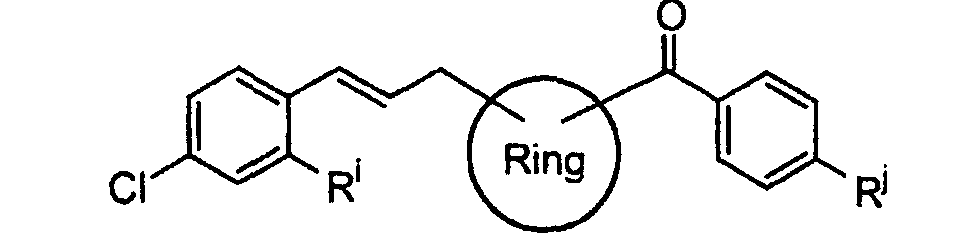
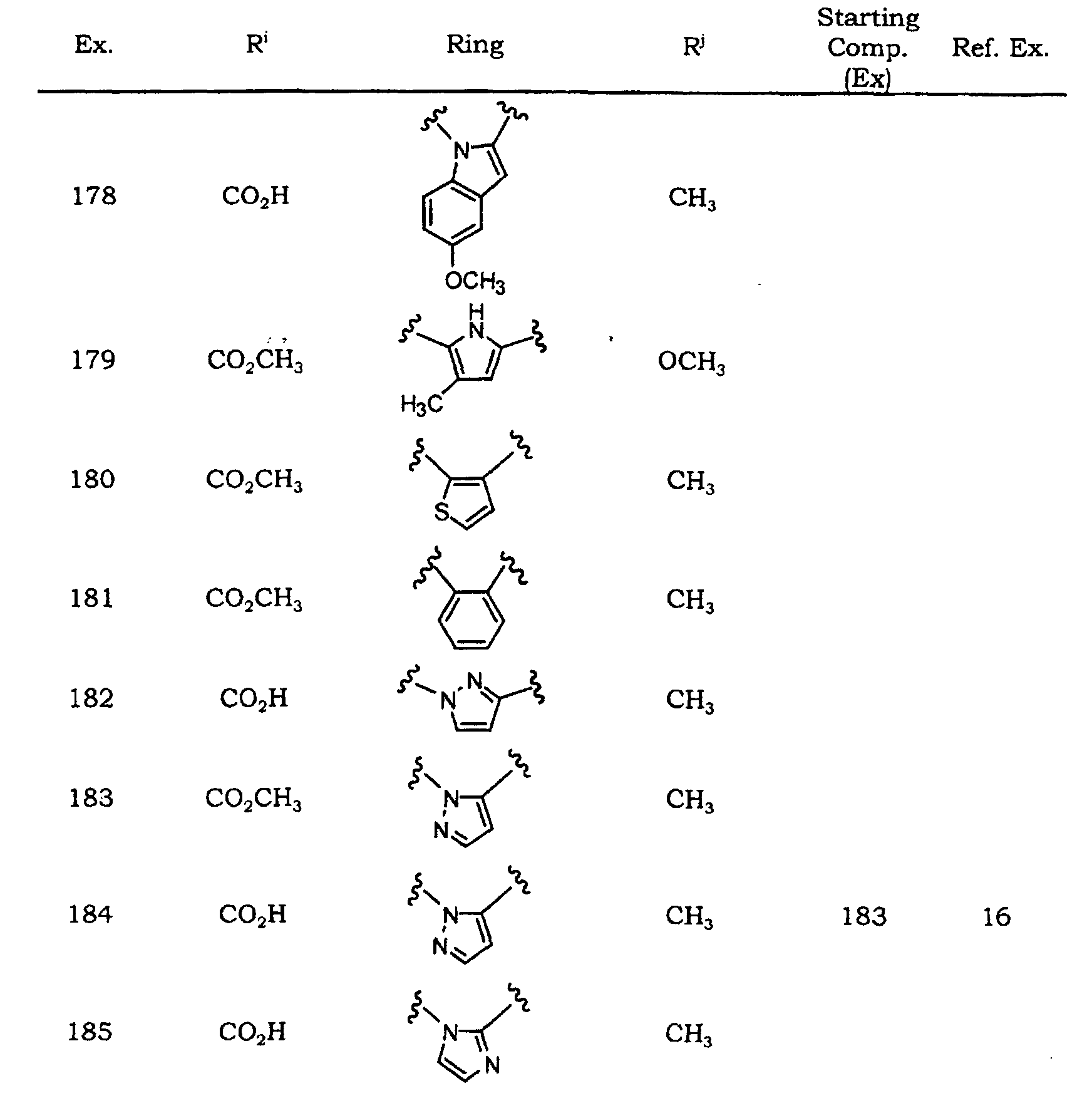
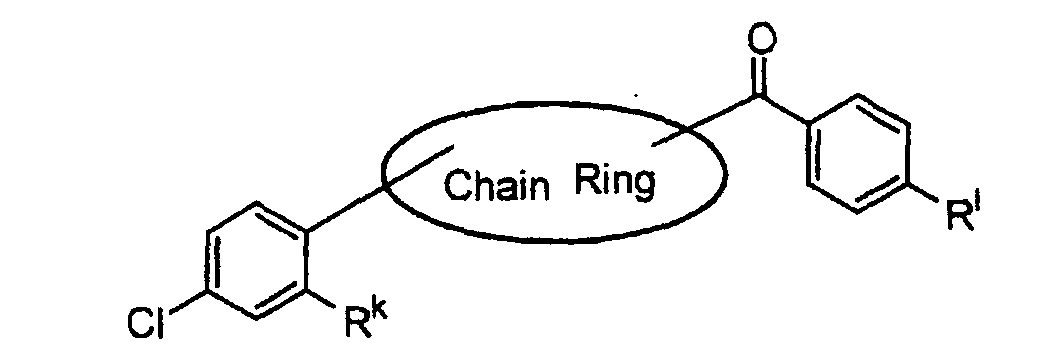

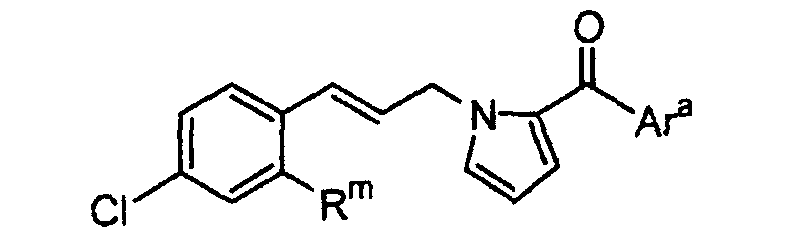
| Ex. | Rm | Ara | Starting Comp. (Ex.) | Ref. Ex. |
| 190 | CO2CH3 | 5-methylthienyl | ||
| 191 | CO2H | 5-methylthienyl | 190 | 16 |
| 192 | CO2CH3 | 1-methyl-5-indolyl | ||
| 193 | CO2H | 1-methyl-5-indolyl | 192 | 16 |
| 194 | CO2H | 2-methyl-5-thiazolyl | ||
| 195 | CO2H | 6-benzothiazolyl | ||
| 196 | CO2CH3 | 6-methyl-2-pyridyl | ||
| 197 | CO2H | 6-methyl-2-pyridyl | 196 | 16 |
| 198 | CO2CH3 | 3,4-dimethoxyphenyl | ||
| 199 | CO2Na | 3,4-dimethoxyphenyl | 198 | 16 |
| 200 | CO2CH3 | 1,3-benzodioxol-5-yl | ||
| 201 | CO2Na | 1,3-benzodioxol-5-yl | 200 | 16 |
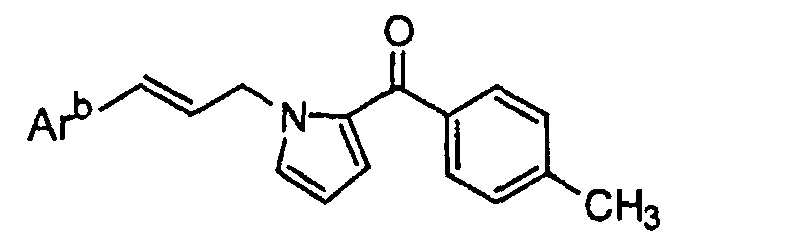
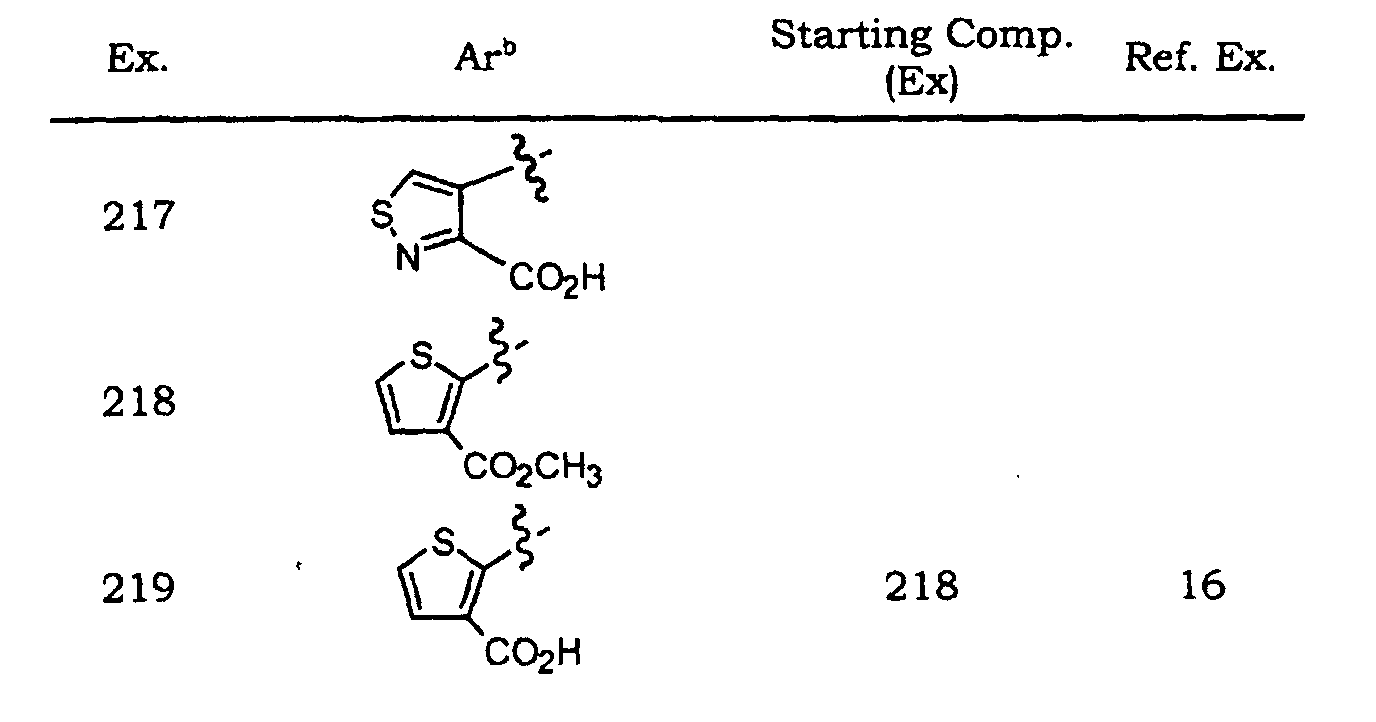
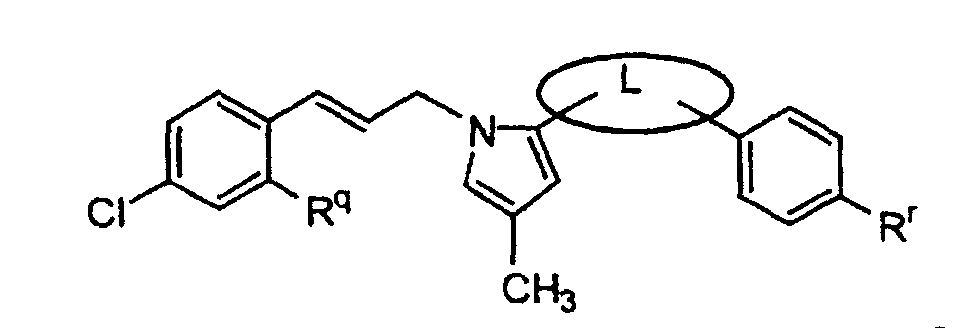
| Ex. | Rq | L | Rr | Starting Comp. (Ex) | Ref. Ex. |
| 224 | CO2H | -CONH- | OCH3 | ||
| 225 | CO2CH3 | -CONCH3- | CH3 | ||
| 226 | CO2H | -CONCH3- | CH3 | 225 | 16 |
1H NMR (CDCl3, 400MHz) δ 7.85 (d, 1H, J=2.3Hz), 7.78 (d, 2H, J=8.7Hz), 7.47 (d, 1H, J=8.5Hz), 7.39 (dd, 1H, J=2.3, 8.5Hz), 7.20 (dt, 1H, J=15.8, 1.4Hz), 6.87 (d, 2H, J=8.7Hz), 6.86 (d, 1H, J=1.6Hz), 6.57 (d, 1H, J=1.6Hz), 6.33 (dt, 1H, J=15.8, 6.1Hz), 5.13 (dd, 2H, J=1.4, 6.1Hz), 3.87 (s, 3H), 2.09 (s, 3H).
1H NMR (CDCl3, 400MHz) δ 7.85 (d, 1H, J=2.3Hz), 7.82 (d, 2H, J=8.8Hz), 7.48 (d, 1H, J=8.4Hz), 7.39 (dd, 1H, J=2.3, 8.4Hz), 7.20 (d, 1H, J=15.8Hz), 6.95 (d, 2H, J=8.8Hz), 6.86 (d, 1H, J=1.1Hz), 6.56 (d, 1H, J=1.1Hz), 6.34 (dt, 1H, J=15.8, 6.1Hz), 5.14 (d, 2H, J=6.1Hz), 4.20-4.23 (m, 2H), 3.87 (s, 3H), 3.76-3.79 (m, 4 H), 2.87 (m, 2H), 2.64 (m, 4 H), 2.09 (s, 3H).
1H NMR (CDCl3, 400MHz) δ 7.94 (d, 2H, J=8.4Hz), 7.73 (d, 2H, J=8.4Hz), 7.63 (m, 1H), 7.49 (m, 2H), 7.34 (dd, 1H, J=3.3, 1.8Hz), 7.31 (d, 2H, J=8.4Hz), 6.21 (dd, 1H, J=3.3, 3.3Hz), 6.11 (d, 1H, J=4.6Hz), 5.77 (m, 1H), 3.92 (s, 3H), 3.33 (d, 1H, J=4.6Hz).
1H NMR (CDCl3, 400MHz) δ 7.73 (d, 2H, J=8.4Hz), 7.61 (m, 1H), 7.49 (m, 2H), 7.33 (dd, 1H, J=3.3, 1.8Hz), 7.28 (d, 2H, J=8.4Hz), 7.23 (d, 2H, J=8.4Hz), 6.20 (dd, 1H, J=3.3, 3.3Hz), 6.07 (d, 1H, J=4.7Hz), 5.82 (m, 1H), 4.68 (d, 2H, J=5.7Hz), 3.21 (d, 1H, J=4.7Hz), 1.73 (t, 1H, J=5.7Hz).
1H NMR (CDCl3, 400MHz) δ 10.11 (s, 1H,), 8.13 (m, 2H), 7.96 (d, 2H, J=8.5Hz), 7.92 (d, 2H, J=8.5Hz), 7.85(dd, 1H, J=3.1, 1.7Hz), 7.67 (m, 1H), 7.60 (m, 2H), 6.75 (dd, 1H, J=3.7, 1.7Hz), 6.39 (dd, 1H, J=3.7, 3.1Hz).
1H NMR (CDCl3, 400MHz) δ 9.65 (brs, 1H), 7.87 (d, 2H, J=8.2Hz), 7.46 (d, 2H, J=8.2Hz), 7.14 (m, 1H), 6.90 (m, 1H), 6.35 (m, 1H), 3.73 (t, 4H, J=4.7Hz), 3.58 (s, 2H), 2.48 (t, 4H, J=4.7Hz).
1H NMR (CDCl3, 400MHz) δ 7.85 (d, 1H, J=2.3Hz), 7.78 (d, 2H, J=8.1Hz), 7.48 (d, 1H, J=8.5Hz), 7.42 (d, 2H, J=8. 1Hz), 7.40 (dd, 1H, J=8.5, 2.3Hz), 7.21 (d, 1H, J=15.8Hz), 7.10 (dd, 1H, J=2.6, 1.6Hz), 6.79 (dd, 1H, J=4.0, 1.6Hz), 6.35 (dt, 1H, J=15.8, 6.0Hz), 6.23 (dd, 1H, J=4.0, 2.6Hz), 5.23 (dd, 2H, J=6.0, 1.3Hz), 3.87 (s, 3H), 3.73 (t, 4H, J=4.6Hz), 3.56 (s, 2H), 2.47 (t, 4H, J=4.6Hz).
1H NMR (DMSO-d6, 400MHz) δ 12.73 (brs, 2H), 7.84 (d, 2H, J=8.4Hz), 7.80 (d, 2H, J=8.4Hz), 7.60 (d, 2H, J=8.4Hz), 7.44 (d, 1H, J=13.0Hz), 7.40 (d, 2H, J=8.4Hz), 6.45 (d, 1H, J=7.0Hz), 5.90 (d, 1H, J=13.0Hz), 5.31 (d, 1H, J=7.0Hz), 3.80 (s, 3H), 3.67 (s, 3H).
1H NMR (CDCl3, 400MHz) δ 9.76 (brs, 2H), 7.86 (d, 2H, J=8.4Hz), 7.84 (d, 2H, J=8.4Hz), 7.67 (d, 2H, J=8.4Hz), 7.32 (d, 2H, J=8.4Hz), 7.19 (d, 1H, J=13.0Hz), 7.13 (m, 2H), 6.91 (m, 2H), 6.34 (m, 2H), 6.26 (d, 1H, J=7.0Hz), 5.86 (d, 1H, J=13.0Hz), 5.29 (d, 1H, J=7.0Hz), 3.84 (s, 3H), 3.73 (s, 3H).
1H NMR (CDCl3, 400MHz) δ 9.59 (brs, 1H), 7.85 (d, 2H, J=8.3Hz), 7.32 (d, 2H, J=8.3Hz), 7.13 (m, 1H), 6.89 (m, 1H), 6.34 (m, 1H), 3.75 (t, 4H, J=4.6Hz), 2.89 (m, 2H), 2.64 (m, 2H), 2.54 (t, 4H, J=4.6Hz).
1H NMR (CDCl3, 400MHz) δ 7.85 (d, 1H, J=2.2Hz), 7.76 (d, 2H, J=8.2Hz), 7.48 (d, 1H, J=8.4Hz), 7.40 (dd, 1H, J=8.4, 2.2Hz), 7.29 (d, 2H, J=8.2Hz), 7.20 (d, 1H, J=15.8Hz), 7.09 (dd, 1H, J=2.5, 1.8Hz), 6.78 (dd, 1H, J=4.0, 1.8Hz), 6.35 (dt, 1H, J=15.8, 6.0Hz), 6.23 (dd, 1H, J=4.0, 2.5Hz), 5.22 (dd, 2H, J=6.0, 1.4Hz), 3.87 (s, 3H), 3.75 (t, 4H, J=4.6Hz), 2.88 (m, 2H), 2.63 (m, 2H), 2.54 (t, 4H, J=4.6Hz).
1H NMR (DMSO-d6, 400MHz) δ 7.71 (d, 1H, J=2.3Hz), 7.67 (m, 3H), 7.53 (dd, 1H, J=8.5, 2.3Hz), 7.35 (m, 3H), 7.00 (d, 1H, J=16.0Hz), 6.69 (dd, 1H, J=4.0, 1.6Hz), 6.48 (dt, 1H, J=16.0, 5.5Hz), 6.23 (dd, 1H, J=4.0, 2.5Hz), 5.20 (d, 2H, J=5.5Hz), 3.58 (t, 4H, J=4.5Hz), 2.82 (t, 2H, J=8.2Hz), 2.57 (t, 2H, J=8.2Hz), 2.45 (t, 4H, J=4.5Hz).
1H NMR (CDCl3, 400MHz) δ 7.71 (m, 2H), 7.60 (m, 1H), 7.48 (m, 2H), 7.24 (d, 2H, J=8.4Hz), 7.20 (d, 2H, J=8.4Hz), 7.05 (m, 1H), 6.01 (d, 1H, J=4.6Hz), 5.64 (d, 1H, J=1.8Hz), 4.73 (s, 2H), 3.22 (d, 1H, J=4.7Hz), 1.95 (d, 3H, J=1.0Hz), 0.94 (s, 9H), 0.10 (s, 6H).
1H NMR (CDCl3, 400MHz) δ 7.75 (m, 2H), 7.61 (m, 1H), 7.49 (m, 2H), 7.29 (d, 2H, J=8.1Hz), 7.25 (d, 2H, J=8.1Hz), 7.09 (m, 1H), 6.02 (s, 1H), 5.87 (d, 1H, J=1.7Hz), 4.68 (s, 2H), 1.98 (d, 3H, J=0.9Hz).
1H NMR (CDCl3, 400MHz) δ 10.10 (s, 1H), 8.11 (m, 2H), 7.95 (d, 2H, J=8.4Hz), 7.91 (d, 2H, J=8.4Hz), 7.66 (m, 1H), 7.58 (m, 3H), 6.58 (d, 1H, J=1.9Hz), 2.12 (s, 3H).
1H NMR (CDCl3, 400MHz) δ 8.11 (m, 2H), 7.76 (d, 2H, J=8.3Hz), 7.64 (m, 1H), 7.57 (m, 2H), 7.53 (m, 1H), 7.40 (d, 2H, J=8.3Hz), 6.56 (d, 1H, J=1.7Hz), 3.72 (t, 4H, J=4.6Hz), 3.55 (s, 2H), 2.45 (t, 4H, J=4.6Hz), 2.10 (d, 3H, J=0.6Hz).
1H NMR (CDCl3, 400MHz) δ 9.34 (brs, 1H), 7.84 (d, 2H, J=8.3Hz), 7.44 (d, 2H, J=8.3Hz), 6.92 (m, 1H), 6.71 (m, 1H), 3.73 (t, 4H, J=4.7Hz), 3.57 (s, 2H), 2.48 (t, 4H, J=4.7Hz), 2.14 (s, 3H).
1H NMR (CDCl3, 400MHz) δ 7.85 (d, 1H, J=2.2Hz), 7.76 (d, 2H, J=8.2Hz), 7.48 (d, 1H, J=8.5Hz), 7.41 (d, 2H, J=8.2Hz), 7.40 (dd, 1H, J=8.5, 2.2Hz), 7.21 (d, 1H, J=15.7Hz), 6.88 (m, 1H), 6.58 (m, 1H), 6.34 (dt, 1H, J=15.7, 6.1Hz), 5.16 (dd, 2H, J=6.1, 1.4Hz), 3.87 (s, 3H), 3.73 (t, 4H, J=4.6Hz), 3.56 (s, 2H), 2.47 (t, 4H, J=4.6Hz), 2.09 (s, 3H).
1H NMR (DMSO-d6, 400MHz) δ 7.70 (d, 2H, J=8.0Hz), 7.43 (m, 5H), 7.12 (m, 2H), 6.48 (s, 1H), 6.23 (dt, 1H, J=15.7, 6.3Hz), 5.04 (d, 2H, J=6.3Hz), 3.58 (t, 4H, J=4.3 Hz), 3.53 (s, 2H), 2.38 (t, 4H, J=4.3 Hz), 2.02 (s, 3H).
1H NMR (CDCl3, 400MHz) δ 7.52 (d, 2H, J=9.1Hz), 6.87 (d, 2H, J=9.1Hz), 3.85 (t, 4H, J=4.9Hz), 3.28 (t, 4H, J=4.9Hz).
1H NMR (DMSO-d6, 400MHz) δ 12.32 (brs, 1H), 7.78 (d, 2H, J=9.0Hz), 6.97 (d, 2H, J=9.0Hz), 3.73 (t, 4H, J=4.8Hz), 3.24 (t, 4H, J=4.8Hz).
1H NMR (CDCl3, 400MHz) δ 9.58 (brs, 1H), 7.93 (d, 2H, J=8.9Hz), 7.10 (m, 1H), 6.93 (d, 2H, J=8.9Hz), 6.90 (m, 1H), 6.34 (m, 1H), 3.88 (t, 4H, J=4.9Hz), 3.32 (t, 4H, J=4.9Hz).
1H NMR (CDCl3, 400MHz) δ 7.85 (d, 1H, J=2.3Hz), 7.84 (d, 2H, J=8.9Hz), 7.47 (d, 1H, J=8.5Hz), 7.39 (dd, 1H, J=8.5, 2.3Hz), 7.20 (d, 1H, J=15.8Hz), 7.06 (dd, 1H, J=2.6, 1.7Hz), 6.90 (d, 2H, J=8.9Hz), 6.77 (dd, 1H, J=4.0, 1.7Hz), 6.35 (dt, 1H, J=15.8, 6.1Hz), 6.22 (dd, 1H, J=4.0, 2.6Hz), 5.19 (dd, 2H, J=6.1, 1.4Hz), 3.87 (t, 4H, J=5.0Hz), 3.87 (s, 3H), 3.30 (t, 4H, J=5.0Hz).
1H NMR (DMSO-d6, 400MHz) δ 7.72 (d, 2H, J=8.9Hz), 7.44 (d, 1H, J=16.1Hz), 7.39 (d, 1H, J=8.4Hz), 7.38 (d, 1H, J=2.3Hz), 7.26 (dd, 1H, J=2.6, 1.7Hz), 7.12 (dd, 1H, J=8.4, 2.3Hz), 7.00 (d, 2H, J=8.9Hz), 6.64 (dd, 1H,J=3.9, 1.7Hz), 6.23 (dt, 1H, J=16.1, 6.4Hz), 6.18 (dd, 1H, J=3.9, 2.6Hz), 5.06 (d, 2H, J=6.4Hz), 3.74 (t, 4H, J=5.1Hz), 3.27 (t, 4H, J=5.1Hz).
1H NMR (CDCl3, 400MHz) δ 7.70 (d, 2H, J=8.0 Hz), 7.60 (d, 1H, J=2.2Hz), 7.40 (d, 1H, J=8.4Hz), 7.34 (dd, 1H, J=2.2, 8.4Hz), 7.26 (d, 2H, J=8.0 Hz), 7.04 (dd, 1H, J=1.7, 2.5Hz), 6.81 (dd, 1H, J=1.7, 4.0 Hz), 6.76 (d, 1H, J=15.8Hz), 6.32 (dt, 1H, J=15.8, 5.6Hz), 6.23 (dd, 1H, J=2.5, 4.0 Hz), 6.09 (br, 1H), 5.78 (br, 1H), 5.16 (d, 2H, J=5.6Hz), 2.43 (s, 3H).
1H NMR (CDCl3, 400MHz) δ 7.75 (d, 2H, J=8.0 Hz), 7.57 (d, 1H, J=8.7Hz), 7.56 (d, 1H, J=2.1Hz), 7.47 (dd, 1H, J=2.1, 8.7Hz), 7.26 (d, 2H, J=8.0 Hz), 7.04 (dd, 1H, J=1.7, 2.6Hz), 6.81 (dd, 1H, J=1.7, 4.0 Hz), 6.68-6.69 (m, 2H), 6.25 (dd, 1H, J=2.6, 4.0 Hz), 5.25 (d, 2H, J=3.8Hz), 2.43 (s, 3H).
1H NMR (CDCl3, 400MHz) δ 8.22 (d, 1H, J=2.2Hz), 7.88 (d, 2H, J=8.1Hz), 7.43 (dd, 1H, J=2.2, 8.3Hz), 7.38 (d, 1H, J=8.3Hz), 7.28 (d, 2H, J=8.1Hz), 7.14 (dd, 1H, J=1.7, 2.5Hz), 6.94 (dd, 1H, J=1.7, 4.1Hz), 6.84 (d, 1H, J=15.5Hz), 6.30 (dd, 1H, J=2.5, 4.1Hz), 6.15 (dt, 1H, J=15.5, 5.9Hz), 5.12 (d, 2H, J=5.9Hz), 2.42 (s, 3H).
1H NMR (DMSO-d6, 400MHz) δ 7.86(d, 1H, J=2.4Hz), 7.78(d, 2H, J=8.7Hz), 7.75(d, 1H, J=15.8Hz), 7.60(d, 1H, J=8.5Hz), 7.33(dd, 1H, J=1.6, 2.6Hz), 7.25(dd, 1H, J=2.4, 8.5Hz), 7.03(d, 2H, J=8.7Hz), 6.65(dd, 1H, J=1.6, 3.9Hz), 6.37(dt, 1H, J=15.8, 6.2Hz), 6.19(dd, 1H, J=2.6, 3.9Hz), 5.14(d, 2H, J=6.2Hz), 3.84(s, 3H)
1H NMR (DMSO-d6, 400MHz) δ 7.76 (d, 2H, J=8.8Hz), 7.47 - 7.49 (m, 2H), 7.25 (dd, 1H, J=2.4, 8.4Hz), 7.11 (d, 1H, J=15.9Hz), 7.10 (d, 1H, J=1.3Hz), 7.02 (d, 2H, J=8.8Hz), 6.46 (d, 1H, J=1.3Hz), 6.29 (dt, 1H, J=15.9, 5.8Hz), 5.05 (d, 2H, J=5.8Hz), 3.83 (s, 3H), 2.82 (s, 3H), 2.02 (s, 3H).
1H NMR (CDCl3, 400MHz) δ 7.76 (d, 1H, J=8.8Hz), 6.96 - 6.98 (m, 2H), 3.91 (s, 3H), 3.88 (s, 3H).
1H NMR (CDCl3, 400MHz) δ 7.21(d, 1H, J=8.0 Hz), 6.93 (dd, 1H, J=1.9, 8.0 Hz), 6.87 (d, 1H, J=1.9Hz), 4.64 (s, 2H), 3.86 (s, 3H).
1H NMR (CDCl3, 400MHz) δ 10.39 (s, 1H), 7.77 (d, 1H, J=8.3Hz), 7.02 (dd, 1H, J=1.7, 8.3Hz), 6.99 (d, 1H, J=1.7Hz), 3.94 (s, 3H).
1H NMR (CDCl3, 400MHz) δ 7.89 (d, 1H, J=16.2Hz), 7.42 (d, 1H, J=8.3Hz), 6.95 (dd, 1H, J=1.9, 8.3Hz), 6.90 (d, 1H, J=1.9Hz), 6.50 (d, 1H, J=16.2Hz), 4.26 (q, 2H, J=7.1Hz), 3.89 (s, 3H), 1.33 (t, 3H, J=7.1Hz).
1H NMR (CDCl3, 400MHz) δ 7.34 (d, 1H, J=8.2Hz), 6.91 (dd, 1H, J=2.0, 8.2Hz), 6.85 (d, 1H, J=2.0 Hz), 6.85 (d, 1H, J=16.0 Hz), 6.36 (dt, 1H, J=16.0, 5.8Hz), 4.32 (d, 2H, J=5.8Hz), 3.84 (s, 3H).
1H NMR (CDCl3, 400MHz) δ 7.83 (d, 2H, J=8.9Hz), 7.32 (d, 1H, J=8.2Hz), 6.94 (d, 2H, J=8.9Hz), 6.87 (dd, 1H, J=1.9, 8.2Hz), 6.83 (d, 1H, J=1.3Hz), 6.82 (d, 1H, J=1.9Hz), 6.76 (d, 1H, J=16.0 Hz), 6.42 (dt, 1H, J=16.0, 6.4Hz), 6.21 (d, 1H, J=1.3Hz), 5.11 (d, 2H, J=6.4Hz), 3.88 (s, 3H), 3.81 (s, 3H), 2.08 (s, 3H).
1H NMR (CDCl3, 400MHz) δ 9.38 (br, 1H), 7.80 (d, 2H, J=8.0 Hz), 7.28 (d, 2H, J=8.0 Hz), 6.91 (m, 1H), 6.70 - 6.71 (m, 1H), 2.43 (s, 3H), 2.14 (s, 3H).
1H NMR (CDCl3), 400MHz) δ 7.85 (d, 1H, J=2.3Hz), 7.72 (d, 2H, J=8.0 Hz), 7.48 (d, 1H, J=8.4Hz), 7.39 (dd, 1H, J=2.3, 8.4Hz), 7.24 (d, 2H, J=8.0 Hz), 7.21 (d, 1H, J=15.8Hz), 6.86 (d, 1H, J=1.3Hz), 6.57 (d, 1H, J=1.3Hz), 6.34 (dt, 1H, J=15.8, 6.1Hz), 5.15 (d, 2H, J=6.1Hz), 3.87 (s, 3H), 2.42 (s, 3H), 2.08 (s, 3H).
1H NMR (CDCl3, 400MHz) δ 7.96 (d, 1H, J=2.2Hz), 7.71 (d, 2H, J=8.0 Hz), 7.51 (d, 1H, J=8.5Hz), 7.45 (dd, 1H, J=2.2, 8.5Hz), 7.27 (d, 1H, J=15.9Hz), 7.24 (d, 2H, J=8.0 Hz), 6.86 (d, 1H, J=1.3Hz), 6.58 (d, 1H, J=1.3Hz), 6.36 (dt, 1H, J=15.9, 6.0 Hz), 5.17 (d, 2H, J=6.0 Hz), 2.40 (s, 3H), 2.09 (s, 3H).
1H NMR (DMSO-d6, 400MHz) δ 7.65 (d, 2H, J=8.0 Hz), 7.48 (d, 1H, J=16.0 Hz), 7.41 (d, 1H, J=8.4Hz), 7.39 (d, 1H, J=2.4Hz), 7.30 (d, 2H, J=8.0 Hz), 7.12 (dd, 1H, J=2.4, 8.4Hz), 7.11 (d, 1H, J=1.3Hz), 6.47 (d, 1H, J=1.3Hz), 6.22 (dt, 1H, J=16.0, 5.8Hz), 5.03 (d, 2H, J=5.8Hz), 2.39 (s, 3H), 2.02 (s, 3H).
1H NMR (CDCl3, 400MHz) δ 8.11 (d, 1H, J=2.1Hz), 7.74 (d, 1H, J=8.3Hz), 7.65 (dd, 1H, J=2.1, 8.3Hz), 4.98 (s, 1H).
1H NMR (CDCl3, 400MHz) δ 10.39 (brs, 1H), 8.11 (d, 1H, J=1.9Hz), 7.95 (d, 1H, J=8.3Hz), 7.77 (dd, 1H, J=1.9, 8.3Hz).
1H NMR (CDCl3, 400MHz) δ 8.04 (d, 1H, J=15.8Hz), 8.04 (d, 1H, J=2.0 Hz), 7.63 (dd, 1H, J=2.0, 8.4Hz), 7.59 (d, 1H, J=8.4Hz), 6.36 (d, 1H, J=15.8Hz), 4.29 (q, 2H, J=7.1Hz), 1.35 (t, 3H, J=7.1Hz).
1H NMR (CDCl3, 400MHz) δ 7.91 (d, 1H, J=16.0 Hz), 7.70 (d, 1H, J=8.5Hz), 7.50 (dd, 1H, J=1.9, 8.5Hz), 7.36 (d, 1H, J=1.9Hz), 6.47 (d, 1H, J=16.0 Hz), 4.27 (q, 2H, J=7.1Hz), 3.47 (s, 6 H), 1.33 (t, 3H, J=7.1Hz).
1H NMR (DMSO-d6, 400MHz) δ 7.76 (d, 1H, J=8.6Hz), 7.67 (d, 1H, J=2.2Hz), 7.55 (dd, 1H, J=2.2, 8.6Hz), 7.79 (d, 1H, J=15.9Hz), 6.54 (dt, 1H, J=15.9, 4.3Hz), 5.04 (t, 1H, J=5.4Hz), 4.15-4.18 (m, 2H), 3.54 (s, 6 H)
1H NMR (CDCl3, 400MHz) δ 9.15 (brs, 1H), 7.87(d, 2H, J=8.8Hz), 7.56 (d, 1H, J=2.1Hz), 7.20 (dd, 1H, J=2.1, 8.4Hz), 7.07(d, 1H, J=8.4Hz), 6.97 (d, 2H, J=8.8Hz), 6.73 (d, 1H, J=2.5Hz), 6.40 (d, 1H, J=2.5Hz), 6.22 (ddd, 1H, J=5.8, 10.2, 17.1Hz), 5.44 (d, 1H, J=10.2Hz), 5.03 (d, 1H, J=5.8Hz), 4.99 (d, 1H, J=17.1Hz), 3.88 (s, 3H), 2.92 (s, 3H), 2.00 (s, 3H).
1H NMR (CDCl3, 400MHz) δ 9.40 (br, 1H), 7.86 (d, 2H, J=8.7Hz), 6.90-6.93 (m, 3H), 6.72 (m, 1H), 2.15 (s, 3H).
1H NMR (CDCl3, 400MHz) δ 9.39 (br, 1H), 7.84 (d, 2H, J=8.7Hz), 6.89-6.92 (m, 3H), 6.71 (m, 1H), 2.15 (s, 3H), 1.00 (s, 9 H), 0.25 (s, 6 H).
1H NMR (CDCl3, 400MHz) δ 7.77 (d, 2H, J=8.7Hz), 7.32 (d, 1H, J=8.2Hz), 6.84-6.89 (m, 2H), 6.87 (d, 2H, J=8.7Hz), 6.82 (d, 1H, J=1.9Hz), 6.75 (d, 1H, J=16.0 Hz), 6.55 (d, 1H, J=1.9Hz), 6.41 (dt, 1H, J=16.0, 6.3Hz), 5.11 (d, 2H, J=6.3Hz), 3.81 (s, 3H), 2.08 (s, 3H).
1H NMR (CDCl3, 400MHz) δ 9.82 (s, 1H), 7.89 (d, 1H, J=2.2Hz), 7.88 (d, 2H, J=8.9Hz), 7.68 (d, 1H, J=1.7Hz), 7.47 (d, 1H, J=8.4Hz), 7.42 (dd, 1H, J=2.2, 8.4Hz), 7.33 (d, 1H, J=15.8Hz), 7.18 (d, 1H, J=1.7Hz), 6.97 (d, 2H, J=8.9Hz), 6.31 (dt, 1H, J=15.8, 6.3Hz), 5.22 (d, 2H, J=6.3Hz), 3.90 (s, 3H), 3.88 (s, 3H).
1H NMR (DMSO-d6, 400MHz) δ 9.78 (s, 1H), 8.13 (d, 1H, J=1.6Hz), 7.82 (d, 2H, J=8.8Hz), 7.70 (d, 1H, J=2.2Hz), 7.65 (d, 1H, J=8.5Hz), 7.50 (dd, 1H, J=2.2, 8.5Hz), 7.12 (d, 1H, J=15.8Hz), 7.05 (d, 1H, J=1.6Hz), 7.07 (d, 2H, J=8.8Hz), 6.49 (dt, 1H, J=15.8, 5.4Hz), 5.23 (d, 2H, J=5.4Hz), 3.85 (s, 3H).
1H NMR (CDCl3, 400MHz) δ 8.39 (brs, 1H), 7.80 (d, 2H, J=7.7Hz), 7.55 (s, 1H), 7.36-7.44 (m, 2H), 6.93 (d, 2H, J=7.7Hz), 6.85 (s, 1H), 6.70-6.74 (m, 1H), 6.57 (s, 1H), 6.40-6.43 (m, 1H), 5.08 (br, 2H), 3.86 (s, 3H), 3.53 (br, 2H), 2.09 (s, 3H), 1.41 (t, 3H, J=7.4Hz).
1H NMR (DMSO-d6, 400MHz) δ 12.73 (brs, 1H), 7.95-7.97 (m, 2H), 7.75 (d, 2H, J=8.8Hz), 7.55-7.60 (m, 5 H), 7.48 (d, 1H, J=2.3Hz), 7.39-7.41 (m, 1H), 7.03 (d, 2H, J=8.8Hz), 6.99 (d, 1H, J=1.3Hz), 6.48 (d, 1H, J=1.3Hz), 6.32-6.36 (m, 1H), 4.94 (d, 2H, J=4.7Hz), 3.84 (s, 3H), 2.03 (s, 3H).
1H NMR (CDCl3, 400MHz) δ 7.86 (d, 1H, J=2.2Hz), 7.81 (dd, 2H, J=1.4, 7.0 Hz), 7.43-7.56 (m, 4 H), 7.40 (dd, 1H, J=2.2, 8.4Hz), 7.21 (d, 1H, J=15.8Hz), 7.10 (dd, 1H, J=1.7, 2.5Hz), 6.78 (dd, 1H, J=1.7, 4.0 Hz), 6.35 (dt, 1H, J=15.8, 6.0 Hz), 6.23 (dd, 1H, J=2.5, 4.0 Hz), 5.24 (d, 2H, J=6.0 Hz), 3.87 (s, 3H).
1H NMR (CDCl3, 400MHz) δ 6.65-6.68 (m, 2H), 6.23 (dd, 1H, J=1.4, 2.8Hz), 1.41 (sep, 3H, J=7.5Hz), 1.09 (d, 18 H, J=7.5Hz).
1H NMR (CDCl3, 400MHz) δ 9.67 (s, 1H), 9.66 (br, 1H), 7.03-7.05 (m, 1H), 6.29-6.30 (m, 1H).
1H NMR (CDCl3, 400MHz) δ 9.87 (s, 1H), 7.99 (dd, 2H, J=1.3, 8.3Hz), 7.71 (d, 1H, J=3.4Hz), 7.67 (tt, 1H, J=1.3, 7.5Hz), 7.56 (dd, 2H, J=7.5, 8.3Hz), 6.41 (d, 1H, J=3.4Hz).
1H NMR (CDCl3, 400MHz) δ 9.36 (br, 1H), 7.70 (d, 2H, J=8.2Hz), 7.27 (d, 2H, J=8.2Hz), 6.99-7.00 (m, 1H), 6.28-6.30 (m, 1H), 2.44 (s, 3H).
1H NMR (CDCl3, 400MHz) δ 7.86 (d, 1H, J=2.4Hz), 7.71 (d, 2H, J=8.1Hz), 7.39 (m, 2H), 7.24 (d, 2H, J=8.1Hz), 7.20(d, 1H, J=15.8Hz), 6.95 (d, 1H, J=2.8Hz), 6.22 (dt, 1H, J=15.8, 6.1Hz), 6.19 (d, 1H, J=2.8Hz), 4.96 (d, 2H, J=6.1Hz), 3.87 (s, 3H), 2.42 (s, 3H).
Silyl compound: 1H NMR (CDCl3, 400MHz) δ 7.85 (d, 1H, J=2.2Hz), 7.83 (d, 2H, J=8.7Hz), 7.47 (d, 1H, J=8.5Hz), 7.39 (dd, 1H, J=8.5 and 2.2Hz), 7.20 (brd, 1H, J=15.8Hz), 7.07 (dd, 1H, J=1.7 and 2.5Hz), 6.95 (d, 2H, J=8.7Hz), 6.76 (dd, 1H, J=1.7 and 4.0Hz), 6.35 (dt, 1H, J=15.8 and 6.0Hz), 6.23 (dd, 1H, J=2.5 and 4.0Hz), 5.20 (dd, 2H, J=1.4 and 6.0Hz), 4.11 (brt, 2H, J=5.0Hz), 4.00 (brt, 2H, J=5.0Hz), 3.86 (s, 3H), 0.91 (s, 9 H), 0.11 (s, 6 H).
The compound of Example 153: 1H NMR (CDCl3, 400MHz) δ 7.85 (d, 1H, J=2.2Hz), 7.84 (d, 2H, J=8.7Hz), 7.47 (d, 1H, J=8.5Hz), 7.39 (dd, 1H, J=8.5 and 2.2Hz), 7.19 (brd, 1H, J=15.8Hz), 7.08 (dd, 1H, J=1.7 and 2.5Hz), 6.96 (d, 2H, J=8.7Hz), 6.76 (dd, 1H, J=1.7 and 4.0Hz), 6.34 (dt, 1H, J=15.8 and 6.0Hz), 6.23 (dd, 1H, J=2.5 and 4.0Hz), 5.20 (dd, 2H, J=1.4 and 6.0Hz), 4.15 (brt, 2H, J=5.0Hz), 4.00 (brt, 2H, J=5.0Hz), 3.86 (s, 3H).
1H NMR (CDCl3, 400MHz) δ 7.81 (d, 2H, J=8.7Hz), 7.52 (d, 1H, J=2.2Hz), 7.38 (d, 1H, J=8.5Hz), 7.30 (dd, 1H, J=8.5 and 2.2Hz), 7.03 (dd, 1H, J=1.7 and 2.5Hz), 6.95 (d, 2H, J=8.7Hz), 6.78 (dd, 1H, J=1.7 and 4.0Hz), 6.69 (brd, 1H, J=15.8Hz), 6.30 (dt, 1H, J=15.8 and 6.0Hz), 6.23 (dd, 1H, J=2.5 and 4.0Hz), 6.10 (brq, 1H, J=4.9Hz), 5.12 (dd, 2H, J=1.4 and 6.0Hz), 4.11 (brt, 2H, J=5.0Hz), 4.00 (brt, 2H, J=5.0Hz), 2.93 (d, 3H, J=4.9Hz), 0.91 (s, 9 H), 0.11 (s, 6 H).
1H NMR (CDCl3, 400MHz) δ 7.83 (d, 2H, J=8.7Hz), 7.53 (d, 1H, J=2.2Hz), 7.39 (d, 1H, J=8.5Hz), 7.31 (dd, 1H, J=8.5 and 2.2Hz), 7.03 (dd, 1H, J=1.7 and 2.5Hz), 6.97(d, 2H, J=8.7Hz), 6.78(dd, 1H, J=1.7 and 4.0Hz), 6.70 (brdt, 1H, J=15.8 and 1.4Hz), 6.31 (dt, 1H, J=15.8 and 6.0Hz), 6.23 (dd, 1H, J=2.5 and 4.0Hz), 6.20 (brq, 1H, J=4.9Hz), 5.13 (dd, 2H, J=1.4 and 6.0Hz), 4.16 (brt, 2H, J=5.0Hz), 4.01 (brt, 2H, J=5.0Hz), 2.94 (d, 3H, J=4.9Hz).
1H NMR (CDCl3, 400MHz) δ 7.88 (d, 2H, J=8.7Hz), 7.49 (d, 1H, J=2.2Hz), 7.42 (d, 1H, J=8.5Hz), 7.36 (dd, 1H, J=8.5 and 2.2Hz), 7.04 (dd, 1H, J=1.7 and 2.5Hz), 6.93 (d, 2H, J=8.7Hz), 6.76 (dd, 1H, J=1.7 and 4.0Hz), 6.67 (brd, 1H, J=15.8Hz), 6.39 (dt, 1H, J=15.8 and 6.0Hz), 6.23 (dd, 1H, J=2.5 and 4.0Hz), 5.12 (dd, 2H, J=1.4 and 6.0Hz), 4.10 (brt, 2H, J=5.0Hz), 3.99 (brt, 2H, J=5.0Hz), 3.31 (brs, 3H), 0.91 (s, 9 H), 0.11 (s, 6 H).
1H NMR (CDCl3, 400MHz) δ 7.78 (d, 2H, J=8.7Hz), 7.48 (brs, 1H), 7.42 (d, 1H, J=8.5Hz), 7.35 (brd, 1H, J=8.5Hz), 7.05 (dd, 1H, J=1.7 and 2.5Hz), 6.92 (d, 2H, J=8.7Hz), 6.76 (dd, 1H, J=1.7 and 4.0Hz), 6.64 (brd, 1H, J=15.8Hz), 6.39 (dt, 1H, J=15.8 and 6.0Hz), 6.23 (dd, 1H, J=2.5 and 4.0Hz), 5.13 (brd, 2H, J=6.0Hz), 4.10 (brt, 2H, J=5.0Hz), 3.96 (brt, 2H, J=5.0Hz), 3.30 (brs, 3H).
1H NMR (CDCl3, 400MHz) δ 7.85 (d, 1H, J=2.3Hz), 7.81 (d, 2H, J=8.8Hz), 7.48 (d, 1H, J=8.4Hz), 7.39 (dd, 1H, J=2.3, 8.4Hz), 7.20 (d, 1H, J=15.7Hz), 6.95 (d, 2H, J=8.8Hz), 6.85 (d, 1H, J=1.2Hz), 6.56 (d, 1H, 3=1.2Hz), 6.34 (dt, 1H, J=15.7, 6.1Hz), 5.13 (d, 2H, J=6.1Hz), 4.11 (t, 2H, J=5.0 Hz), 4.00 (t, 2H, J=5.0 Hz), 3.87 (s, 3H), 2.09 (s, 3H), 0.92 (s, 9 H), 0.11 (s, 6 H).
1H NMR (CDCl3, 400MHz) δ 7.85 (d, 1H, J=2.3Hz), 7.83 (d, 2H, J=8.8Hz), 7.48 (d, 1H, J=8.5Hz), 7.39 (dd, 1H, J=2.3, 8.5Hz), 7.20 (d, 1H, J=15.8Hz), 6.96 (d, 2H, J=8.8Hz), 6.86 (d, 1H, J=1.3Hz), 6.56 (d, 1H, J=1.3Hz), 6.33 (dt, 1H, J=15.8, 6.1Hz), 5.14 (d, 2H, J=6.1Hz), 4.16 (t, 2H, J=4.5Hz), 4.00 (t, 2H, J=4.5Hz), 3.87 (s, 3H), 2.09 (s, 3H).
1H NMR (CDCl3, 400MHz) δ 7.84 (d, 1H, J=2.2Hz), 7.84 (d, 2H, J=8.7Hz), 7.47 (d, 1H, J=8.5Hz), 7.39 (dd, 1H, J=8.5 and 2.2Hz), 7.19 (brd, 1H, J=15.8Hz), 7.09 (dd, 1H, J=1.7 and 2.5Hz), 6.95 (d, 2H, J=8.7Hz), 6.76 (dd, 1H, J=1.7 and 4.0Hz), 6.34 (dt, 1H, J=15.8 and 6.0Hz), 6.23 (dd, 1H, J=2.5 and 4.0Hz), 5.20 (dd, 2H, J=1.4 and 6.0Hz), 4.61 (brt, 2H, J=4.5Hz), 4.32 (brt, 2H, J=4.5Hz), 3.87 (s, 3H), 3.11 (s, 3H).
1H NMR (CDCl3, 400MHz) δ 7.84 (d, 1H, J=2.2Hz), 7.83 (d, 2H, J=8.7Hz), 7.47 (d, 1H, J=8.5Hz), 7.39 (dd, 1H, J=8.5 and 2.2Hz), 7.19 (brd, 1H, J=15.8Hz), 7.08 (dd, 1H, J=1.7 and 2.5Hz), 6.96 (d, 2H, J=8.7Hz), 6.76 (dd, 1H, J=1.7 and 4.0Hz), 6.34 (dt, 1H, J=15.8 and 6.0Hz), 6.23 (dd, 1H, J=2.5 and 4.0Hz), 5.20 (dd, 2H, J=1.4 and 6.0Hz), 4.30 (t, 2H, J=5.8Hz), 3.87 (s, 3H), 3.85 (t, 2H, J=5.8Hz).
1H NMR (CDCl3, 400MHz) δ 7.96 (brs, 1H), 7.75 (d, 1H, J=2.3Hz), 7.68 (d, 2H, J=8.8Hz), 7.33 (d, 1H, J=8.5Hz), 7.24 (dd, 1H, J=2.3, 8.5Hz), 7.20 (d, 1H, J=15.8Hz), 6.77 (d, 2H, J=8.8Hz), 6.73 (d, 1H, J=1.3Hz), 6.46 (d, 1H, J=1.3Hz), 6.17 (dt, 1H, J=15.8, 6.1Hz). 3.86 (d, 2H, J=6.4Hz), 3.19 (t, 2H, J=6.9Hz), 1.97 (brs, 3H), 1.69 (brquintet, 2H, J=6.4Hz), 1.53 (brquintet, 2H, J=6.9Hz), 1.01-1.42 (series of m, 8H).
1H NMR (DMSO-d6, 400MHz) δ 7.93 (d, 2H, J=8.2Hz), 7.51 (d, 2H, J=8.2Hz), 5.58 (s, 1H), 4.15 (m, 2H), 3.95 (m, 2H), 2.00 (m, 1H), 1.45 (m, 1H).
1H NMR (CDCl3, 400MHz) δ 9.68 (s, 1H), 7.90 (d, 2H, J=8.4Hz), 7.61 (d, 2H, J=8.4Hz), 7.13 (m, 1H), 6.85 (m, 1H), 6.33 (m, 1H), 5.58 (s, 1H), 4.31 (m, 2H), 4.03 (m, 2H), 2.26 (m, 1H), 1.48 (m, 1H).
1H NMR (CDCl3, 400MHz) δ 7.85 (d, 1H, J=2.3Hz), 7.81 (d, 2H, J=8.3Hz), 7.57 (d, 2H, J=8.3Hz), 7.47 (d, 1H, J=8.5Hz), 7.40 (dd, 1H, J=8.5, 2.3Hz), 7.20 (d, 1H, J=15.8Hz), 7.09 (dd, 1H, J=2.3, 1.8Hz), 6.74 (dd, 1H, J=4.0, 1.8Hz), 6.34 (dt, 1H, J=15.8, 6.0Hz), 6.22 (dd, 1H, J=4.0, 2.3Hz), 5.57 (s, 1H), 5.22 (dd, 2H, J=6.0, 1.4Hz), 4.30 (m, 2H), 4.03 (m, 2H), 3.86 (s, 3H), 2.26 (m, 1H), 1.48 (m, 1H).
1H NMR (CDCl3, 400MHz) δ 10.11 (s, 1H), 7.97 (d, 2H, J=8.4Hz), 7.94 (d, 2H, J=8.4Hz), 7.87 (d, 1H, J=2.2Hz), 7.48 (d, 1H, J=8.4Hz), 7.41 (dd, 1H, J=8.4, 2.2Hz), 7.21 (d, 1H, J=15.8Hz), 7.15 (dd, 1H, J=2.5, 1.6Hz), 6.76 (dd, 1H, J=4.1, 1.6Hz), 6.34 (dt, 1H, J=15.8, 6.0Hz), 6.26 (dd, 1H, J=4.1, 2.5Hz), 5.25 (dd, 2H, J=6.0, 1.5Hz), 3.87 (s, 3H).
1H NMR (CDCl3, 400MHz) δ 7.86 (d, 1H, J=2.3Hz), 7.82 (d, 2H, J=8.2Hz), 7.48 (d, 1H, J=8.5Hz), 7.45 (d, 2H, J=8.2Hz), 7.40 (dd, 1H, J=8.5, 2.3Hz), 7.21 (d, 1H, J=15.8Hz), 7.10 (dd, 1H, J=2.6, 1.7Hz), 6.77 (dd, 1H, J=4.0, 1.7Hz), 6.35 (dt, 1H, J=15.8, 6.0Hz), 6.23 (dd, 1H, J=4.0, 2.6Hz), 5.23 (dd, 2H, J=6.0, 1.4Hz), 4.79 (d, 2H, J=4.8Hz), 3.87 (s, 3H), 1.76 (t, 1H, J=4.8Hz).
1H NMR (CDCl3, 400MHz) δ 7.96 (d, 1H, J=2.2Hz), 7.77 (d, 2H, J=8.2Hz), 7.50 (d, 1H, J=8.5Hz), 7.45 (dd, 1H, J=8.5, 2.2Hz), 7.38 (d, 2H, J=8.2Hz), 7.22 (d, 1H, J=15.8Hz), 7.09 (dd, 1H, J=2.5, 1.6Hz), 6.77 (dd, 1H, J=4.0, 1.6Hz), 6.36 (dt, 1H, J=15.8, 5.7Hz), 6.23 (dd, 1H, J=4.0, 2.5Hz), 5.24 (dd, 2H, J=5.7, 1.4Hz), 4.73 (s, 2H).
1H NMR (CDCl3, 400MHz) δ 9.73 (brs, 1H), 7.89 (d, 2H, J=8.2Hz), 7.49 (d, 2H, J=8.2Hz), 7.16 (m, 1H), 6.91 (m, 1H), 6.35 (m, 1H), 3.70 (s, 2H), 2.79 (t, 4H, J=6.1Hz), 2.49 (t, 4H, J=6.1Hz).
1H NMR (CDCl3, 400MHz) δ 7.86 (d, 1H, J=2.3Hz), 7.80 (d, 2H, J=8.2Hz), 7.48 (d, 1H, J=8.5Hz), 7.45 (d, 2H, J=8.2Hz), 7.40 (dd, 1H, J=8.5, 2.3Hz), 7.21(d, 1H, J=15.8Hz), 7.11 (dd, 1H, J=2.4, 1.8Hz), 6.80 (dd, 1H, J=4.0, 1.8Hz), 6.35 (dt, 1H, J=15.8, 6.0Hz), 6.24 (dd, 1H, J=4.0, 2.4Hz), 5.23 (dd, 2H, J=6.0, 1.4Hz), 3.87 (s, 3H), 3.69 (s, 2H), 2.78 (t, 4H, J=6.1Hz), 2.48 (t, 4H, J=6.1Hz).
1H NMR (CDCl3, 400MHz) δ 7.86 (d, 1H, J=2.3Hz), 7.78 (d, 2H, J=8.1Hz), 7.48 (d, 1H, J=8.4Hz), 7.40 (m, 3H), 7.21 (d, 1H, J=15.8Hz), 7.09 (dd, 1H, J=2.6, 1.6Hz), 6.79 (dd, 1H, J=4.0, 1.6Hz), 6.35 (dt, 1H, J=15.8, 6.0Hz), 6.23 (dd, 1H, J=4.0, 2.6Hz), 5.23 (dd, 2H, J=6.0, 1.3Hz), 3.87 (s, 3H), 3.72 (m, 1H), 3.56 (s, 2H), 2.77 (m, 2H), 2.18 (m, 2H), 1.90 (m, 2H), 1.62 (m, 2H).
1H NMR (CDCl3, 400MHz) δ 8.00 (d, 2H, J=8.3Hz), 7.57 (d, 1H, J=2.2Hz), 7.42 (d, 1H, J=2.2Hz), 7.23 (d, 2H, J=8.3Hz), 6.31 (dd, 1H, J=2.2, 2.2Hz), 5.38 (s, 2H), 3.90 (s, 3H).
1H NMR (DMSO-d6, 400MHz) δ 12.98 (brs, 1H), 7.90 (d, 2H, J=8.2Hz), 7.86 (d, 1H, J=2.2Hz), 7.49 (d, 1H, J=2.2Hz), 7.26 (d, 2H, J=8.2Hz), 6.29 (dd, 1H, J=2.2, 2.2Hz), 5.42 (s, 2H).
1H NMR (CDCl3, 400MHz) δ 10.00 (brs, 1H), 7.87 (d, 2H, J=8.3Hz), 7.59 (d, 1H, J=2.2Hz), 7.45 (d, 1H, J=2.2Hz), 7.28 (d, 2H, J=8.3Hz), 7.14 (m, 1H), 6.86 (m, 1H), 6.33 (m, 2H), 5.42 (s, 2H).
1H NMR (CDCl3, 400MHz) δ 7.85 (d, 1H, J=2.3Hz), 7.79 (d, 2H, J=8.2Hz), 7.58 (d, 1H, J=2.2Hz), 7.47 (d, 1H, J=8.4Hz), 7.44 (d, 1H, J=2.2Hz), 7.40 (dd, 1H, J=8.4, 2.3Hz), 7.25 (d, 2H, J=8.2Hz), 7.19 (d, 1H, J=15.7Hz), 7.09 (dd, 1H, J=2.6, 1.7Hz), 6.75 (dd, 1H, J=4.0, 1.7Hz), 6.33 (dt, 1H, J=15.7, 6.0Hz), 6.32 (dd, 1H, J=2.2, 2.2Hz), 6.22 (dd, 1H, J=4.0, 2.6Hz), 5.40 (s, 2H), 5.22 (dd, 2H, J=6.0, 1.4Hz), 3.86 (s, 3H).
1H NMR (CDCl3, 400MHz) δ 8.12 (d, 2H, J=8.5Hz), 8.04 (d, 2H, J=8.5Hz), 7.93 (d, 1H, J=3.2Hz), 7.42 (d, 1H, J=3.2Hz), 4.41 (q, 2H, J=7.1Hz), 1.42 (3H, t, J 7.1Hz).
1H NMR (DMSO-d6, 400MHz) δ 13.16 (brs, 1H), 8.08 (d, 2H, J=8.7Hz), 8.05 (d, 2H, J=8.7Hz), 8.01 (d, 1H, J=3.2Hz), 7.90 (d, 1H, J=3.2Hz).
1H NMR (CDCl3, 400MHz) δ 9.67 (brs, 1H), 8.10 (d, 2H, J=8.5Hz), 7.99 (d, 2H, J=8.5Hz), 7.94 (d, 1H, J=3.2Hz), 7.42 (d, 1H, J=3.2Hz), 7.17 (m, 1H), 6.93 (m, 1H), 6.37 (m, 1H).
1H NMR (CDCl3, 400MHz) δ 8.06 (d, 2H, J=8.4Hz), 7.93 (d, 1H, J=3.3Hz), 7.91 (d, 2H, J=8.4Hz), 7.86 (d, 1H, J=3.3Hz), 7.49 (d, 1H, J=8.3Hz), 7.41 (dd, 1H, J=8.3, 2.4Hz), 7.41 (d, 1H, J=2.4Hz), 7.22 (d, 1H, J=15.8Hz), 7.13 (dd, 1H, J=2.3, 1.8Hz), 6.82 (dd, 1H, J=4.0, 1.8Hz), 6.36 (dt, 1H, J=15.8, 6.0Hz), 6.26 (dd, 1H, J=4.0, 2.3Hz), 5.25 (dd, 2H, J=6.0, 1.4Hz), 3.87 (s, 3H).
1H NMR (DMSO-d6, 400MHz) δ 13.32 (brs, 1H), 8.08 (d, 2H, J=8.4Hz), 8.01 (d, 1H, J=3.2Hz), 7.89 (d, 1H, J=3.2Hz), 7.87 (d, 2H, J=8.4Hz), 7.72 (d, 1H, J=2.3Hz), 7.68 (d, 1H, J=8.5Hz), 7.54 (dd, 1H, J=8.5, 2.3Hz), 7.41 (dd, 1H, J=2.5, 1.6Hz), 7.01 (d, 1H, J=15.9Hz), 6.78 (dd, 1H, J=4.0, 1.6Hz), 6.50 (dt, 1H, J=15.9, 5.4Hz), 6.27 (dd, 1H, J=4.0, 2.5Hz), 5.23 (d, 2H, J=5.4Hz).
1H NMR (CDCl3), 400MHz) δ 8.02 (d, 2H, J=8.3Hz), 7.40 (d, 2H, J=8.3Hz), 4.51 (s, 2H), 3.91 (s, 3H), 3.42 (s, 3H).
1H NMR (DMSO-d6, 400MHz) δ 12.91 (brs, 1H), 7.92 (d, 2H, J=8.2Hz), 7.42 (d, 2H, J=8.2Hz), 4.48 (s, 2H), 3.31 (s, 3H).
1H NMR (CDCl3, 400MHz) δ 9.78 (brs, 1H), 7.90 (d, 2H, J=8.3Hz), 7.46 (d, 2H, J=8.3Hz), 7.15 (m, 1H), 6.89 (m, 1H), 6.34 (m, 1H), 4.55 (s, 2H), 3.44 (s, 3H).
1H NMR (CDCl3, 400MHz) δ 7.86 (d, 1H, J=2.3Hz), 7.81 (d, 2H, J=8.2Hz), 7.48 (d, 1H, J=8.5Hz), 7.42 (d, 2H, J=8.2Hz), 7.40 (dd, 1H, J=8.5, 2.3Hz), 7.21 (d, 1H, J=15.8Hz), 7.10 (dd, 1H, J=2.6, 1.7Hz), 6.78 (dd, 1H, J=4.0, 1.7Hz), 6.35 (dt, 1H, J=15.8, 6.0Hz), 6.23 (dd, 1H, J=4.0, 2.6Hz), 5.23 (dd, 2H, J=6.0, 1.4Hz), 4.53 (s, 2H), 3.87 (s, 3H), 3.43 (s, 3H).
1H NMR (CDCl3, 400MHz) δ 8.14 (d, 2H, J=8.9Hz), 8.01 (d, 1H, J=2.5Hz), 7.79 (d, 2H, J=8.9Hz), 7.76 (d, 1H, J=2.5Hz), 6.51 (dd, 1H, J=2.5, 2.5Hz), 4.40 (q, 2H, J=7.1Hz), 1.41 (t, 3H, J=7.1Hz).
1H NMR (DMSO-d6, 400MHz) δ 13.03 (brs, 1H), 8.63 (d, 1H, J=2.5Hz), 8.05 (d, 2H, J=8.9Hz), 7.98 (d, 2H, J=8.9Hz), 7.82 (d, 1H, J=2.5Hz), 6.60 (dd, 1H, J=2.5, 2.5Hz).
1H NMR (CDCl3, 400MHz) δ 9.65 (brs, 1H), 8.04 (d, 2H, J=8.8Hz), 8.03 (d, 1H, J=2.4Hz), 7.84 (d, 2H, J=8.8Hz), 7.78 (d, 1H, J=2.4Hz), 7.17 (m, 1H), 6.92 (m, 1H), 6.53 (dd, 1H, J=2.4, 2.4Hz), 6.37 (m, 1H).
1H NMR (CDCl3, 400MHz) δ 8.02 (dd, 1H, J=2.5, 0.4Hz), 7.95 (d, 2H, J=8.8Hz), 7.86 (d, 1H, J=2.5Hz), 7.80 (d, 2H, J=8.8Hz), 7.77 (d, 1H, J=2.5Hz), 7.49 (d, 1H, J=8.5Hz), 7.41 (ddd, 1H, J=8.5, 2.5, 0.4Hz), 7.21 (d, 1H, J=15.8Hz), 7.12 (dd, 1H, J=2.5, 1.8Hz), 6.81 (dd, 1H, J=4.0, 1.8Hz), 6.52 (dd, 1H, J=2.5, 2.5Hz), 6.35 (dt, 1H, J=15.8, 6.0Hz), 6.26 (dd, 1H, J=4.0, 2.5Hz), 5.24 (dd, 2H, J=6.0, 1.5Hz), 3.87 (s, 3H).
1H NMR (CDCl3, 400MHz) δ 8.12 (s, 1H), 8.05 (d, 2H, J=8.4Hz), 8.00 (s, 1H), 7.31 (d, 2H, J=8.4Hz), 5.42 (s, 2H), 3.92 (s, 3H).
1H NMR (CDCl3, 400MHz) δ 9.59 (bs, 1H), 8.15 (s, 1H), 8.02 (s, 1H), 7.90 (d, 2H, J=8.3Hz), 7.36 (d, 2H, J=8.3Hz), 7.15 (m, 1H), 6.86 (m, 1H), 6.35 (m, 1H), 5.44 (s, 2H).
1H NMR (CDCl3, 400MHz) δ 8.13 (s, 1H), 8.01 (s, 1H), 7.86 (d, 1H, J=2.2Hz), 7.82 (d, 2H, J=8.3Hz), 7.47 (d, 1H, J=8.3Hz), 7.40 (dd, 1H, J=8.3, 2.2Hz), 7.32 (d, 2H, J=8.3Hz), 7.20 (d, 1H, J=15.8Hz), 7.11 (dd, 1H, J=2.4, 1.7Hz), 6.75 (dd, 1H, J=4.1, 1.7Hz), 6.33 (dt, 1H, J=15.8, 6.0Hz), 6.23 (dd, 1H, J=4.1, 2.4Hz), 5.43 (s, 2H), 5.22 (dd, 2H, J=6.0, 1.5Hz), 3.86 (s, 3H).
1H NMR (CDCl3, 400MHz) δ 8.06 (t, 1H, J=1.4Hz), 7.95 (dt, 1H, J=7.8 and 1.4Hz), 7.56 (dt, 1H, J=7.8 and 1.4Hz), 7.41 (t, 1H, J=7.8Hz), 6.68 (brd, 1H, J=15.6Hz), 6.49 (dt, 1H, J=15.6 and 7.7Hz), 4.39 (q, 2H, J=7.1Hz), 4.16 (dd, 2H, J=7.7 and 0.8Hz), 1.41 (t, 3H, J=7.1Hz).
1H NMR (CDCl3, 400MHz) δ 8.02 (t, 1H, J=1.4Hz), 7.90 (dt, 1H, J=7.8 and 1.4Hz), 7.74 (brd, 2H, J=8.1Hz), 7.54 (dt, 1H, J=7.8 and 1.4Hz), 7.36 (t, 1H, J=7.8Hz), 7.25 (brd, 2H, J=8.1Hz), 7.05 (dd, 1H, J=2.6 and 1.6Hz), 6.78 (dd, 1H, J=4.0 and 1.6Hz), 6.46-6.57 (m, 2H), 6.23 (dd, 1H, J=4.0 and 2.6Hz), 5.21 - 5.25 (m, 2H), 4.37 (q, 2H, J=7.1Hz), 2.43 (brs, 3H), 1.39 (t, 3H, 3=7.1Hz).
1H NMR (CDCl3, 400MHz) δ 9.80 (s, 1H), 8.90 (brs, 1H), 7.34 (brd, 1H, J=8.9Hz), 7.19 (dd, 1H, J=2.1 and 0.8Hz), 7.11 (brs, 1H), 7.08 (dd, 1H, J=8.9 and 2.1Hz), 3.86 (s, 3H).
1H NMR (CDCl3, 400MHz) δ 10.51 (s, 1H), 8.13 (brd, 1H, J=8.9Hz), 7.74 (dq, 2H, J=8.3 and 1.0Hz), 7.54 (tt, 1H, J=8.3 and 1.0Hz), 7.41 (tt, 2H, J=8.3 and 1.0Hz), 7.40 (brs, 1H), 7.15 (dd, 1H, J=8.9 and 2.1Hz), 6.99 (brd, 1H, J=2.1Hz), 3.82 (s, 3H).
1H NMR (CDCl3, 400MHz) δ 8.02 (brd, 1H, J=8.9Hz), 7.98 (dq, 2H, J=8.3 and 1.0Hz), 7.87 (brd, 2H, J=8.2Hz), 7.55 (tt, 1H, J=8.3 and 1.0Hz), 7.46 (tt, 2H, J=8.3 and 1.0Hz), 7.29 (brd, 2H, J=8.2Hz), 7.06 (dd, 1H, J=8.9 and 2.1Hz), 6.97 (brd, 1H, J=2.1Hz), 6.86 (d, 1H, J= 0.8Hz), 3.82 (s, 3H), 2.44 (brs, 3H).
1H NMR (CDCl3, 400MHz) δ 9.19 (brs, 1H), 7.90 (brd, 2H, J=8.2Hz), 7.37 (brd, 1H, J=8.9Hz), 7.33 (brd, 2H, J=8.2Hz), 7.09 (brs, 1H), 7.08 (brd, 1H, J=2.1Hz), 7.06 (dd, 1H, J=8.9 and 2.1Hz), 3.86 (s, 3H), 2.47 (brs, 3H).
1H NMR (CDCl3, 400MHz) δ 7.84 (brd, 2H, J=8.2Hz), 7.82 (d, 1H, J=2.2Hz), 7.45 (brd, 1H, J=8.9Hz), 7.43 (d, 1H, J=8.5Hz), 7.36 (dd, 1H, J=8.5 and 2.2Hz), 7.30 (brd, 2H, J=8.2Hz), 7.21 (dt, 1H, J=15.8 and 1.7Hz), 7.08 (dd, 1H, J=8.9 and 2.1Hz), 7.07 (brs, 1H, J=2.1Hz), 6.96 (d, 1H, J= 0.6Hz), 6.32 (dt, 1H, J=15.8 and 5.8Hz), 5.36 (dd, 2H, J=1.7 and 5.8Hz), 3.84 (s, 3H), 3.77 (s, 3H), 2.46 (brs, 3H).
1H NMR (CD3OD, 400MHz) δ 7.85 (brd, 2H, J=8.2Hz), 7.70 (d, 1H, J=2.2Hz), 7.55 (brd, 1H, J=9.1Hz), 7.53 (d, 1H, J=8.6Hz), 7.39 (brd, 2H, J=8.2Hz), 7.36 (dd, 1H, J=8.6 and 2.2Hz), 7.26 (dt, 1H, J=15.8 and 1.7Hz), 7.17 (brs, 1H, J=2.4Hz), 7.08 (dd, 1H, J=9.1 and 2.4Hz), 7.00 (d, 1H, J= 0.6Hz), 6.40 (dt, 1H, J=15.8 and 5.8Hz), 5.39 (dd, 2H, J=1.7 and 5.8Hz), 3.85 (s, 3H), 2.49 (brs, 3H).
1H NMR (CDCl3, 400MHz) δ 9.43 (brs, 1H), 7.89 (d, 1H, J=2.2Hz), 7.88 (d, 2H, J=8.9Hz), 7.44 (d, 1H, J=8.3Hz), 7.41 (dd, 1H, J=2.2 and 8.3Hz), 7.24 (brd, 1H, J=15.7Hz), 6.96 (d, 2H, J=8.9Hz), 6.67 (brd, 1H, J=2.4Hz), 6.11 (dt, 1H, J=15.7 and 6.7Hz), 3.92 (s, 3H), 3.88 (s, 3H), 3.58 (dd, 2H, J=1.4 and 6.7Hz), 2.10 (brs, 3H).
1H NMR (CDCl3, 400MHz) δ 7.42 (m, 1H), 7.32 (dd, 1H, J=5.0, 3.0Hz), 7.16 (dd, 1H, J=5.0, 1.2Hz), 5.91 (s, 1H), 4.11 (m, 2H), 4.03 (m, 2H).
1H NMR (CDCl3, 400MHz) δ 7.44 (d, 1H, J=5.6Hz), 6.98 (d, 1H, J=5.6Hz), 5.75 (s, 1H), 4.13 (m, 2H).
1H NMR (CDCl3, 400MHz) δ 10.19 (s, 1H), 9.75 (d, 1H, J=7.6Hz), 8.39 (dd, 1H, J=15.8, 0.5Hz), 7.54 (d, 1H, J=5.3Hz), 7.48 (d, 1H, J=5.3Hz), 6.67 (dd, 1H, J=15.8, 7.6).
1H NMR (CDCl3, 400MHz) δ 9.82 (t, 1H, J=1.0Hz), 7.09 (d, 1H, J=5.3Hz), 7.05 (d, 1H, J=5.3Hz), 5.87 (s, 1H), 4.12 (m, 2H), 4.01 (m, 2H), 3.22 (t, 2H, J=7.3Hz), 2.86 (dt, 2H, J=7.3, 1.0).
1H NMR (CDCl3, 400MHz) δ 7.09 (d, 1H, J=5.3Hz), 7.07 (d, 1H, J=5.3Hz), 6.06 (m, 2H), 5.86 (s, 1H), 4.08 (m, 2H), 3.99 (m, 2H), 3.72 (d, 2H, J=4.2Hz), 1.51 (m, 6H), 1.30 (m, 6H), 0.90 (m, 15H).
1H NMR (CDCl3, 400MHz) δ 7.86 (d, 1H, J=2.3Hz), 7.48 (d, 1H, J=8.5Hz), 7.40 (dd, 1H, J=8.5, 2.3Hz), 7.21 (d, 1H, J=15.6Hz), 7.12 (d, 1H, J=5.3Hz), 7.09 (d, 1H, J=5.3Hz), 6.22 (dt, 1H, J=15.6, 6.8Hz), 5.92 (s, 1H), 4.14 (m, 2H), 4.03 (m, 2H), 3.89 (s, 3H), 3.84 (dd, 2H, J=6.8, 1.5).
1H NMR (CDCl3, 400MHz) δ 10.10 (s, 1H), 7.88 (d, 1H, J=2.2Hz), 7.47 (d, 1H, J=8.4Hz), 7.44 (d, 1H, J=5.4Hz), 7.42 (dd, 1H, J=8.4, 2.2Hz), 7.27 (d, 1H, J=15.7Hz), 7.16 (d, 1H, J=5.4Hz), 6.24 (dt, 1H, J=15.7, 6.7Hz), 4.15 (dd, 2H, J=6.7, 1.5Hz), 3.90 (s, 3H).
1H NMR (CDCl3, 400MHz) δ 7.85 (d, 1H, J=2.2Hz), 7.72 (d, 2H, J=8.1Hz), 7.47 (d, 1H, J=8.4Hz), 7.39 (dd, 1H, J=8.4, 2.2Hz), 7.27 (d, 2H, J=8.1Hz), 7.22 (d, 1H, J=15.7Hz), 7.17 (d, 1H, J=5.3Hz), 7.14 (d, 1H, J=5.3Hz), 6.29 (dt, 1H, J=15.7, 7.0Hz), 3.82 (d, 2H, J=7.0Hz), 3.89 (s, 3H), 2.43 (s, 3H).
1H NMR (CDCl3, 400MHz) δ 7.60 (dd, 1H, J=7.6, 1.8Hz), 7.57 (dd, 1H, J=7.6, 1.8Hz), 7.34 (ddd, 1H, J=7.6, 7.6, 1.8Hz), 7.22 (ddd, 1H, J=7.6, 7.6, 1.8Hz), 6.10 (s, 1H), 4.15 (m, 2H), 4.09 (m, 2H).
1H NMR (CDCl3, 400MHz) δ 7.57 (m, 2H), 7.25 (m, 2H), 6.10 (td, 1H, J=18.9, 5.8Hz), 5.93 (ddd, 1H, J=18.8, 1.4, 1.4Hz), 4.14 (m, 2H), 4.02 (m, 2H), 3.63 (dd, 2H, J=5.8, 1.4Hz), 1.46 (m, 6H), 1.31 (m, 6H), 0.83 (m, 15H).
1H NMR (CDCl3, 400MHz) δ 7.82 (d, 1H, J=2.3Hz), 7.60 (dd, 1H, J=8.5, 2.3Hz), 7.46 (d, 1H, J=8.5Hz), 7.38 (dd, 1H, J=8.5, 2.3Hz), 7.32 (dd, 1H, J=8.5, 2.3Hz), 7.27 (m, 2H), 7.12 (d, 1H, J=15.7Hz), 6.25 (dt, 1H, J=15.7, 6.7Hz), 6.05 (s, 1H), 4.14 (m, 2H), 4.06 (m, 2H), 3.87 (s, 3H), 3.74 (dd, 2H, J=6.7, 1.4).
1H NMR (CDCl3, 400MHz) δ 7.80 (d, 1H, J=1.6Hz), 7.70 (d, 2H, J=8.2Hz), 7.44 (dd, 1H, J=7.3, 1.6Hz), 7.40 (d, 1H, J=7.3Hz), 7.30 (m, 4H), 7.22 (d, 2H, J=8.2Hz), 7.05 (d, 1H, J=15.7Hz), 6.15 (dt, 1H, J=15.7, 6.9Hz), 3.87 (s, 3H), 3.60 (dd, 2H, J=6.9, 1.3Hz), 2.41 (s, 3H).
1-Allyl-1H-pyrazole-5-carbaldehyde: 1H NMR (CDCl3, 400MHz) δ 9.87 (s, 1H), 7.60 (d, 1H, J=2.0Hz), 6.93 (d, 1H, J=2.0Hz), 6.00 (dddd, 1H, J=17.1, 10.3, 5.7, 5.7Hz), 5.20 (dd, 1H, J=10.3, 1.2Hz), 5.17 (ddd, 2H, J=5.7, 1.5, 1.5Hz), 5.10 (dd, 1H, J=17.1, 1.2).
1-allyl-1H-pyrazole-3-carbaldehyde: 1H NMR (CDCl3, 400MHz) δ 9.98 (s, 1H), 7.47 (d, 1H, J=2.4Hz), 6.84 (d, 1H, J=2.4Hz), 6.05 (dddd, 1H, J=16.3, 10.2, 6.0, 6.0Hz), 5.35 (dd, 1H, J=10.2, 1.1Hz), 5.28 (dd, 1H, J=16.3, 1.1Hz), 4.85 (ddd, 2H, J=6.0, 1.4 and 1.4).
1H NMR (CDCl3, 400MHz) δ 8.15 (d, 2H, J=8.2Hz), 7.47 (d, 1H, J=2.4Hz), 7.28 (d, 2H, J=8.2Hz), 6.95 (d, 1H, J=2.4Hz), 6.07 (dddd, 1H, J=16.3, 10.2, 6.0, 6.0Hz), 5.33 (dd, 1H, J=10.2, 1.1Hz), 5.27 (dd, 1H, J=16.3, 1.1Hz), 4.85 (ddd, 1H, J=6.0, 1.3, 1.3Hz), 2.42 (s, 3H).
1H NMR (CDCl3, 400MHz) δ 8.17 (d, 2H, J=8.2Hz), 7.91 (d, 1H, J=2.0Hz), 7.57 (d, 1H, J=2.4Hz), 7.48 (d, 1H, J=8.4Hz), 7.45 (dd, 1H, J=8.4, 2.0Hz), 7.39 (d, 1H, J=15.7Hz), 7.28 (d, 2H, J=8.2Hz), 6.98 (d, 1H, J=2.4Hz), 6.27 (dt, 1H, J=15.7, 6.4Hz), 5.04 (dd, 2H, J=6.4, 1.4Hz), 3.90 (s, 3H), 2.43 (s, 3H).
1H NMR (DMSO-d6, 400MHz) δ 8.10 (d, 2H, J=8.1Hz), 7.94 (brs, 1H), 7.62 (brs, 1H), 7.57 (m, 2H), 7.31 (m, 3H), 6.87 (d, 1H, J=1.7Hz), 6.35 (dt, 1H, J=15.9, 6.6Hz), 5.01 (d, 2H, J=6.6Hz), 2.38 (s, 3H).
1H NMR (CDCl3, 400MHz) δ 7.83 (d, 1H, J=2.3Hz), 7.82 (d, 2H, J=8.5Hz), 7.59 (d, 1H, J=2.0Hz), 7.45 (d, 1H, J=8.5Hz), 7.38 (dd, 1H, J=8.5, 2.3Hz), 7.30 (d, 2H, J=8.5Hz), 7.26 (d, 1H, J=15.8Hz), 6.69 (d, 1H, J=2.0Hz), 6.34 (dt, 1H, J=15.8, 6.1Hz), 5.37 (dd, 2H, J=6.1, 1.3Hz), 3.85 (s, 3H), 2.45 (s, 3H).
1H NMR (CDCl3, 400MHz) δ 7.26 (d, 2H, J=8.1Hz), 7.24 (d, 1H, J=1.6Hz), 7.14 (d, 2H, J=8.1Hz), 7.07 (d, 1H, J=1.6Hz), 6.15 (s, 1H), 2.70 (s, 6H), 2.32 (s, 3H).
1H NMR (CDCl3, 400MHz) δ 7.95 (d, 2H, J=8.3Hz), 7.52 (d, 1H, J=1.4Hz), 7.29 (d, 2H, J=8.3Hz), 7.16 (d, 1H, J=1.4Hz), 3.10 (s, 6H), 2.43 (s, 3H).
1H NMR (CDCl3, 400MHz) δ 10.72 (brs, 1H), 8.52 (d, 2H, J=8.3Hz), 7.39 (s, 0.5H), 7.32 (d, 2H, J=8.3Hz), 7.32 (s, 0.5H), 2.44 (s, 3H).
1H NMR (CDCl3, 400MHz) δ 8.17 (d, 2H, J=8.2Hz), 7.28 (d, 2H, J=8.2Hz), 7.25 (m, 1H), 7.16 (m, 1H), 6.07 (dddd, 1H, J=17.0, 10.2, 5.7, 5.7Hz), 5.24 (dd, 1H, J=10.2, 1.2Hz), 5.14 (dd, 1H, J=17.0, 1.2Hz), 5.09 (ddd, 2H, J=5.7, 1.4, 1.4Hz), 2.42 (s, 3H).
1H NMR (CDCl3, 400MHz) δ 8.19 (d, 2H, J=8.3Hz), 7.88 (d, 1H, J=2.2Hz), 7.47 (d, 1H, J=8.4Hz), 7.42 (dd, 1H, J=8.4, 2.2Hz), 7.31 (d, 1H, J=15.8Hz), 7.29 (m, 2H), 7.27 (d, 2H, J=8.3Hz), 6.31 (dt, 1H, J=15.8, 6.3Hz), 5.26 (dd, 2H, J=6.3, 1.4Hz), 3.88 (s, 3H), 2.42 (s, 3H).
1H NMR (DMSO-d6, 400MHz) δ 8.16 (d, 2H, J=8.2Hz), 7.66 (d, 1H, J=0.8Hz), 7.56 (d, 1H, J=16.1Hz), 7.44 (d, 1H, J=2.4Hz), 7.44 (d, 1H, J=8.4Hz), 7.33 (d, 2H, J=8.2Hz), 7.22 (d, 1H, J=0.8Hz), 7.15 (dd, 1H, J=8.4, 2.4Hz), 6.27 (dt, 1H, J=16.1, 6.5Hz), 5.16 (dd, 2H, J=6.5, 0.8Hz), 2.39 (s, 3H).
1H NMR (CDCl3, 400MHz) δ 7.26 (dd, 1H, J=5.0 and 3.0Hz), 7.10 (dd, 1H, J=1.4 and 3.0Hz), 7.08 (dd, 1H, J=5.0 and 1.4Hz), 3.65 (s, 3H), 1.58 (s, 6H).
1H NMR (CDCl3, 400MHz) δ 9.59(s, 1H), 7.31 (d, 1H, J=5.3Hz), 7.00 (d, 1H, J=5.3Hz), 5.98 (s, 1H), 4.11 (m, 2H), 4.01 (m, 2H), 1.44 (s, 6H).
1H NMR (CDCl3, 400MHz) δ 7.16 (d, 1H, J=5.3Hz), 7.03 (d, 1H, J=5.3Hz), 6.06 (s, 1H), 4.14 (m, 2H), 4.03 (m, 2H), 2.31 (s, 1H), 1.56 (s, 6H).
1H NMR (CDCl3, 400MHz) δ 7.21 (d, 1H, J=5.3Hz), 6.97 (d, 1H, J=5.3Hz), 6.33 (s, 1H), 6.22 (d, 1H, J=19.3Hz), 5.98 (d, 1H, J=19.3Hz), 4.12 (m, 2H), 3.95 (m, 2H), 1.48 (m, 6H), 1.43 (s, 6H), 1.29 (m, 6H), 0.88 (m, 15H).
1H NMR (CDCl3, 400MHz) δ 7.87 (d, 1H, J=2.3Hz), 7.54 (d, 1H, J=8.5Hz), 7.41 (dd, 1H, J=8.5 and 2.3Hz), 7.24 (d, 1H, J=5.3Hz), 7.18 (d, 1H, J=16.1Hz), 7.03 (d, 1H, J=5.3Hz), 6.36 (d, 1H, J=16.1Hz), 6.33 (s, 1H), 4.12 (m, 2H), 3.90 (s, 3H), 3.89 (s, 3H), 1.57 (s, 6H).
1H NMR (CDCl3, 400MHz) δ 10.33 (d, 1H, J=1.2Hz), 7.90 (d, 1H, J=2.3Hz), 7.42 (m, 4H), 7.22 (d, 1H, J=16.1Hz), 7.19 (d, 1H, J=5.1Hz), 6.37 (d, 1H, J=16.1Hz), 3.89 (s, 3H), 1.67 (s, 6H).
1H NMR (CDCl3, 400MHz) δ 7.86 (d, 1H, J=1.8Hz), 7.40 (m, 2H), 7.24 (d, 2H, J=8.1Hz), 7.23 (d, 1H, J=5.0Hz), 7.07 (d, 2H, J=8.1Hz), 7.04 (d, 1H, J=5.0Hz), 7.03 (d, 1H, J=15.9Hz), 6.38 (d, 1H, J=3.6Hz), 6.36 (d, 1H, J=15.9Hz), 3.85 (s, 3H), 3.45 (d, 1H, J=3.6Hz), 2.31 (s, 3H), 1.57 (s, 6H).
1H NMR (CDCl3, 400MHz) δ 7.79 (d, 1H, J=2.2Hz), 7.66 (d, 2H, J=8.2Hz), 7.37 (d, 1H, J=5.1Hz), 7.25 (dd, 1H, J=8.5 and 2.2Hz), 7.20 (d, 1H, J=8.5Hz), 7.17 (d, 1H, J=5.1Hz), 7.14 (d, 2H, J=8.2Hz), 7.02 (d, 1H, J=16.2Hz), 6.34 (d, 1H, J=16.2Hz), 3.87 (s, 3H), 2.38 (s, 3H), 1.57 (s, 6H).
1H NMR (CDCl3, 400MHz) δ 7.85 (d, 1H, J=2.3Hz), 7.62 (d, 2H, J=8.2Hz), 7.34 (d, 1H, J=5.1Hz), 7.24 (dd, 1H, J=8.5 and 2.3Hz), 7.17 (d, 1H, J=8.5Hz), 7.14 (d, 1H, J=5.1Hz), 7.09 (d, 2H, J=8.2Hz), 7.08 (d, 1H, J=16.2Hz), 6.25 (d, 1H, J=16.2Hz), 2.35 (s, 3H), 1.53 (s, 6H).
1H NMR (CDCl3, 400MHz) δ 8.40 (s, 1H), 6.01 (dddd, 1H, J=16.8, 10.2, 6.6, 6.6Hz), 5.12 (m, 2H), 3.98 (s, 3H), 3.76 (dd, 2H, J=6.6, 1.0).
1H NMR (CDCl3, 400MHz) δ 10.14 (s, 1H), 8.37 (s, 1H), 5.99 (dddd, 1H, J=16.9, 10.2, 6.6, 6.6Hz), 5.11 (m, 2H), 3.76 (dd, 2H, J=6.6, 1.1).
1H NMR (CDCl3, 400MHz) δ 8.40 (s, 1H), 7.98 (d, 2H, J=8.3Hz), 7.29 (d, 2H, J=8.3Hz), 6.00 (dddd, 1H, J=16.3, 9.7, 6.6, 6.6Hz), 5.11 (m, 2H), 3.69 (dd, 2H, J=6.6, 1.0Hz), 2.44 (s, 3H).
1H NMR (CDCl3, 400MHz) δ 8.62 (s, 1H), 8.51 (s, 1H), 7.99 (d, 2H, J=8.2Hz), 7.94 (d, 2H, J=8.2Hz), 7.88 (d, 1H, J=2.3Hz), 7.84 (d, 1H, J=2.3Hz), 7.40 (m, 3H), 7.27 (m, 5H), 7.19 (d, 1H, J=15.7Hz), 6.82 (d, 1H, J=15.9Hz), 6.28 (m, 2H), 3.90 (s, 3H), 3.88 (s, 3H), 3.84 (m, 2H), 2.43 (s, 6H).
1H NMR (CDCl3, 400MHz) δ 7.77 (d, 2H, J=8.0 Hz), 7.33 (dd, 1H, J=1.7, 1.7Hz), 7.26 (d, 2H, J=8.0 Hz), 6.78-6.80 (m, 2H), 2.43 (s, 3H), 1.47 (sep, 3H, J=7.5Hz), 1.11 (d, 18 H, J=7.5Hz).
1H NMR (CDCl3, 400MHz) δ 7.73 (d, 2H, J=8.1Hz), 7.25 (d, 2H, J=8.1Hz), 7.06 (d, 1H, J=2.2Hz), 6.91 (d, 1H, J=2.2Hz), 2.43 (s, 3H), 1.43 (sep, 3H, J=7.5Hz), 1.10 (d, 18 H, J=7.5Hz).
1H NMR (CDCl3, 400MHz) δ 8.87 (br, 1H), 7.73 (d, 2H, J=8.1Hz), 7.25 (d, 2H, J=8.1Hz), 7.15 (dd, 1H, J=2.2, 3.1Hz), 7.00 (dd, 1H, J=2.2, 2.2Hz), 2.42 (s, 3H).
1H NMR (CDCl3, 400MHz) δ 7.70 (d, 2H, J=8.0 Hz), 7.24 (d, 2H, J=8.0 Hz), 6.97 (d, 1H, J=2.3Hz), 6.81 (d, 1H, J=2.3Hz), 3.69 (s, 3H), 2.42 (s, 3H).
1H NMR (CDCl3, 400MHz) δ 7.67 (d, 2H, J=8.0 Hz), 7.23 (d, 2H, J=8.0 Hz), 6.93 (d, 1H, J=2.2Hz), 6.45 (d, 1H, J=2.2Hz), 6.06 (ddt, 1H, J=10.1, 17.0, 6.8Hz), 5.11 (dd, 1H, J=17.0, 2.0 Hz), 5.02 (dd, 1H, J=10.1, 2.0 Hz), 3.62 (s, 3H), 3.59(d, 2H, J=6.8Hz), 2.41(s, 3H).
The compound of Example 188: 1H NMR (CDCl3, 400MHz) δ 7.81 (d, 1H, J=2.2Hz), 7.69 (d, 2H, J=7.9Hz), 7.52 (d, 1H, J=8.5Hz), 7.37 (d, 1H, J=2.2, 8.5Hz), 7.24 (d, 2H, J=7.9Hz), 7.17 (d, 1H, J=15.7Hz), 6.94 (d, 1H, J=2.2Hz), 6.52 (d, 1H, J=2.2Hz), 6.41 (dt, 1H, J=15.7, 7.0 Hz), 3.88 (s, 3H), 3.76 (d, 2H, J=7.0 Hz), 3.63 (s, 3H), 2.42 (s, 3H).
The compound of Example 189: 1H NMR (CDCl3, 400MHz) 6 7.84 (d, 1H, J=2.3Hz), 7.67 (d, 2H, J=8.0 Hz), 7.38 (dd, 1H, J=2.3, 8.3Hz), 7.29 (d, 1H, J=8.3Hz), 7.22 (d, 2H, J=8.0 Hz), 6.95 (d, 1H, J=16.0 Hz), 6.87 (d, 1H, J=2.2Hz), 6.76 (d, 1H, J=2.2Hz), 6.07 (dt, 1H, J=16.0, 7.2Hz), 3.91 (s, 3H), 3.80 (d, 2H, J=7.2Hz), 3.62 (s, 3H), 2.42 (s, 3H).
1H NMR (CDCl3, 400MHz) δ 9.60 (brs, 1H), 7.75 (d, 1H, J=3.7Hz), 7.13 (m, 1H), 7.11 (m, 1H), 6.84 (m, 1H), 6.35 (m, 1H), 2.57 (d, 3H, J=0.4Hz).
1H NMR (CDCl3, 400MHz) δ 7.85 (d, 1H, J=2.3Hz), 7.59 (d, 1H, J=3.7Hz), 7.46 (d, 1H, J=8.5Hz), 7.39 (dd, 1H, J=8.5, 2.3Hz), 7.18 (d, 1H, J=15.8Hz), 7.07 (dd, 1H, J=2.6, 1.6Hz), 7.04 (dd, 1H, J=4.0, 1.6Hz), 6.81 (m, 1H), 6.33 (dt, 1H, J=15.8, 6.1Hz), 6.24 (dd, 1H, J=4.0, 2.6Hz), 5.14 (dd, 2H, J=6.1, 1.4Hz), 3.87 (s, 3H), 2.56 (d, 3H, J=0.6Hz).
1H NMR (DMSO-d6, 400MHz) δ 12.42 (brs, 1H,), 8.23 (d, 1H, J=1.2Hz), 7.76 (dd, 1H, J=8.6, 1.2Hz), 7.50 (d, 1H, J=8.6Hz), 7.43 (d, 1H, J=3.1Hz), 6.57 (dd, 1H, J=3.1, 0.7Hz), 3.82 (s, 3H).
1H NMR (CDCl3, 400MHz) δ 9.62 (brs, 1H), 8.30 (d, 1H, J-1.6HZ), 7.86 (dd, 1H, J=8.6, 1.6Hz), 7.40 (d, 1H, J=8.6Hz), 7.14 (d, 1H, J=3.1Hz), 7.12 (m, 1H), 6.96 (m, 1H), 6.62 (dd, 1H, J=3.1, 0.9Hz), 6.36 (m, 1H), 3.85 (s, 3H).
1H NMR (CDCl3, 400MHz) δ 8.21 (d, 1H, J=1.6Hz), 7.85 (d, 1H, J=2.3Hz), 7.80 (dd, 1H, J=8.6, 1.6Hz), 7.48 (d, 1H, J=8.5Hz), 7.39 (dd, 1H, J=8.5, 2.3Hz), 7.37 (d, 1H, J=8.6Hz), 7.22 (d, 1H, J=15.8Hz), 7.13 (d, 1H, J=3.1Hz), 7.08 (dd, 1H, J=2.4, 1.8Hz), 6.81 (dd, 1H, J=4.0, 1.8Hz), 6.59 (dd, 1H, J=3.1, 0.6Hz), 6.38 (dt, 1H, J=15.8, 6.1Hz), 6.24 (dd, 1H, J=4.0, 2.4Hz), 5.23 (dd, 2H, J=6.1, 1.4Hz), 3.87 (s, 3H).
1H NMR (CDCl3, 400MHz) δ 8.24 (s, 1H), 4.35 (q, 2H, J=7.1Hz), 2.75 (s, 3H), 1.37 (t, 3H, J=7.1Hz).
1H NMR (DMSO-d6, 400MHz) δ 13.31 (brs, 1H), 8.17 (s, 1H), 2.70 (s, 3H).
1H NMR (CDCl3, 400MHz) δ 9.67 (brs, 1H), 8.36 (s, 1H), 7.16 (m, 1H), 7.13 (m, 1H), 6.38 (m, 1H), 2.79 (s, 3H).
1H NMR (CDCl3, 400MHz) δ 8.20 (s, 1H), 7.86 (d, 1H, J=2.2Hz), 7.46 (d, 1H, J=8.4Hz), 7.40 (dd, 1H, J=8.4, 2.2Hz), 7.18 (d, 1H, J=15.7Hz), 7.12 (m, 1H), 7.08 (m, 1H), 6.30 (m, 2H), 5.15 (dd, 2H, J=6.0, 1.3Hz), 3.87 (s, 3H), 2.77 (s, 3H).
1H NMR (DMSO-d6, 400MHz) δ 8.26 (s, 1H), 7.67 (d, 1H, J=2.3Hz), 7.61 (d, 1H, J=8.5Hz), 7.46 (dd, 1H, J=8.5, 2.3Hz), 7.40 (dd, 1H, J=2.5, 1.6Hz), 7.15 (dd, 1H, J=4.1, 1.6Hz), 7.09 (d, 1H, J=15.7Hz), 6.40 (dt, 1H, J=15.7, 5.7Hz), 6.28 (dd, 1H, J=4.1, 2.5Hz), 5.12 (dd, 2H, J=5.7, 1.1Hz), 2.71 (s, 3H).
1H NMR (DMSO-d6, 400MHz) δ 8.65 (brs, 2H), 8.38 (d, 1H, J=1.7Hz), 7.89 (dd, 1H, J=8.5, 1.7Hz), 7.44 (d, 1H, J=8.5Hz), 4.30 (q, 2H, J=7.1Hz), 1.32 (t, 3H, J=7.1Hz).
1H NMR (CDCl3, 400MHz) δ 9.15 (s, 1H), 8.71 (dd, 1H, J=1.6, 0.5Hz), 8.21 (dd, 1H, J=8.6, 1.6Hz), 8.17 (dd, 1H, J=8.6, 0.5Hz), 4.44 (q, 2H, J=7.1Hz), 1.44 (t, 3H, J=7.1Hz).
1H NMR (DMSO-d6, 400MHz) δ 13.10 (brs, 1H), 9.58 (s, 1H), 8.81 (d, 1H, J=1.3Hz), 8.17 (d, 1H, J=8.5Hz), 8.08 (dd, 1H, J=8.5, 1.3Hz).
1H NMR (CDCl3, 400MHz) δ 9.71 (brs, 1H), 9.16 (s, 1H), 8.56 (d, 1H, J=1.2Hz), 8.24 (d, 1H, J=8.5Hz), 8.09 (dd, 1H, J=8.5, 1.2Hz), 7.19 (m, 1H), 6.95 (m, 1H), 6.39 (m, 1H).
1H NMR (CDCl3, 400MHz) δ 9.14 (s, 1H), 8.48 (d, 1H, J=1.3Hz), 8.20 (d, 1H, J=8.5Hz), 8.01 (dd, 1H, J=8.5, 1.3Hz), 7.86 (d, 1H, J=2.2Hz), 7.49 (d, 1H, J=8.5Hz), 7.41 (dd, 1H, J=8.5, 2.2Hz), 7.22 (d, 1H, J=15.8Hz), 7.14 (dd, 1H,J=2.4, 1.8Hz), 6.81 (dd, 1H, J=4.0, 1.8Hz), 6.36 (dt, 1H, J=15.8, 5.9Hz), 6.27 (dd, 1H, J=4.0, 2.4Hz), 5.26 (dd, 2H, J=5.9, 1.5Hz), 3.87 (s, 3H).
1H NMR (DMSO-d6, 400MHz) δ 9.56 (s, 1H), 8.62 (d, 1H, J=1.5Hz), 8.17 (d, 1H, J=8.5Hz), 7.90 (dd, 1H, J=8.5, 1.5Hz), 7.64 (d, 1H, J=2.2Hz), 7.59 (d, 1H, J=8.5Hz), 7.39 (m, 2H), 7.26 (d, 1H, J=15.3Hz), 6.76 (dd, 1H, J=4.0, 1.6Hz), 6.42-(dt, 1H, J=15.3, 5.9Hz), 6.25 (dd, 1H, J=4.0, 2.5Hz), 5.20 (d, 2H, J=5.9Hz).
1H NMR (CDCl3, 400MHz) δ 7.99 (dd, 2H, J=1.3, 8.4Hz), 7.61 (tt, 1H, J=1.3, 7.4Hz), 7.49-7.56 (m, 3H), 7.30 (dd, 1H, J=1.7, 3.3Hz), 7.08 (d, 1H, J=7.6Hz), 7.04 (d, 1H, J=7.7Hz), 6.25 (d, 1H, J=5.3Hz), 6.16 (dd, 1H, J=3.3, 3.3Hz), 5.76 (dd, 1H, J=1.7, 3.3Hz), 5.14 (d, 1H, J=5.3Hz), 2.55 (s, 3H).
1H NMR (CDCl3, 400MHz) δ 11.7 (br, 1H), 8.08 (d, 1H, J=7.7Hz), 7.78 (dd, 1H, J=7.7, 7.7Hz), 7.48 (br, 1H), 7.33 (d, 1H, J=7.7Hz), 7.11-7.12 (m, 1H), 6.36-6.38 (m, 1H), 2.70 (s, 3H).
1H NMR (CDCl3, 400MHz) δ 7.85 (d, 1H, J=2.3Hz), 7.71-7.72 (m, 2H), 7.49 (d, 1H, J=8.4Hz), 7.40 (dd, 1H, J=2.3, 8.4Hz), 7.36 (dd, 1H, J=1.7, 4.1Hz), 7.28-7.30 (m, 1H), 7.23 (d, 1H, J=15.8Hz), 7.10 (dd, 1H, J=1.7, 2.5Hz), 6.38 (dt, 1H, J=15.8, 6.1Hz), 6.25 (dd, 1H, J=2.5, 4.1Hz), 5.25 (d, 2H, J=6.1Hz), 3.87 (s, 3H), 2.65 (s, 3H).
1H NMR (CDCl3, 400MHz) δ 9.55 (brs, 1H), 7.62 (dd, 1H, J=8.3 and 2.0Hz), 7.48 (d, 1H, J=2.0Hz), 7.13 (dt, 1H, J=1.3 and 2.6Hz), 6.94 (d, 1H, J=8.3Hz), 6.92 (ddd, 1H, J=3.8, 2.4 and 1.3Hz), 6.35 (dt, 1H, J=3.8 and 2.6Hz), 3.97 (s, 3H), 3.96 (s, 3H).
1H NMR (CDCl3, 400MHz) δ 7.85 (d, 1H, J=2.2Hz), 7.52 (dd, 1H, J=8.3 and 2.0Hz), 7.48 (d, 1H, J=8.5Hz), 7.44 (d, 1H, J=2.0Hz), 7.40 (dd, 1H, J=8.5 and 2.2Hz), 7.21 (dt, 1H, J=15.8 and 1.4Hz), 7.09 (dd, 1H, J=1.7 and 2.5Hz), 6.91 (d, 1H, J=8.3Hz), 6.80 (dd, 1H, J=1.7 and 4.0Hz), 6.36 (dt, 1H, J=15.8 and 6.1Hz), 6.23 (dd, 1H, J=2.5 and 4.0Hz), 5.20 (dd, 2H, J=1.4 and 6.1Hz), 3.96 (s, 3H), 3.94 (s, 3H), 3.87 (s, 3H).
1H NMR (CDCl3, 400MHz) δ 9.50 (brs, 1H), 7.55 (dd, 1H, J=8.1 and 1.7Hz), 7.48 (d, 1H, J=1.7Hz), 7.12 (dt, 1H, J=1.3 and 2.7Hz), 6.89 (d, 1H, J=8.1Hz), 6.88 (ddd, 1H, J=3.8, 2.4 and 1.3Hz), 6.34 (dt, 1H, J=3.8 and 2.7Hz), 6.06 (s, 2H).
1H NMR (CDCl3, 400MHz) δ 7.85 (d, 1H, J=2.2Hz), 7.48 (d, 1H, J=8.5Hz), 7.44 (dd, 1H, J=8.1 and 1.7Hz), 7.40 (dd, 1H, J=8.5 and 2.2Hz), 7.35 (d, 1H, J=1.7Hz), 7.18 (dt, 1H, J=15.8 and 1.4Hz), 7.08 (dd, 1H, J=1.7 and 2.5Hz), 6.86 (d, 1H, J=8.1Hz), 6.78 (dd, 1H, J=1.7 and 4.0Hz), 6.33 (dt, 1H, J=15.8 and 6.1Hz), 6.23 (dd, 1H, J=2.5 and 4.0Hz), 6.04 (s, 2H), 5.19 (dd, 2H, J=1.4 and 6.1Hz), 3.87 (s, 3H).
1H NMR (CDCl3, 400MHz) δ 7.80 (d, 2H, J=8.8Hz), 6.94 (d, 2H, J=8.8Hz), 6.74 (d, 1H, J=1.3Hz), 6.52 (d, 1H, J=1.3Hz), 5.79 (ddt, 1H, J=10.4, 17.1, 7.1Hz), 5.06 (dd, 1H, J=17.1, 1.7Hz), 5.02 (dd, 1H, J=10.4, 1.7Hz), 4.38 (t, 2H, J=7.1Hz), 3.88 (s, 3H), 2.54 (dt, 2H, J=7.1, 7.1Hz), 2.07 (s, 3H).
1H NMR (CDCl3, 400MHz) δ 7.81 (d, 1H, J=2.2Hz), 7.77 (d, 2H, J=8.8Hz), 7.36 (d, 1H, J=8.5Hz), 7.32 (dd, 1H, J=2.2, 8.5Hz), 7.10 (d, 1H, J=15.7Hz), 6.90 (d, 2H, J=8.8Hz), 6.77 (d, 1H, J=1.4Hz), 6.51 (d, 1H, J=1.4Hz), 6.08 (dt, 1H, J=15.7, 7.1Hz), 4.49 (t, 2H, J=7.1Hz), 3.89 (s, 3H), 3.87 (s, 3H), 2.72 (dt, 2H, J=7.1, 7.1Hz), 2.07 (s, 3H).
1H NMR (CDCl3, 400MHz) δ 7.93 (d, 1H, J=1.7Hz), 7.76 (d, 2H, J=8.8Hz), 7.37 (m, 2H), 7.16 (d, 1H, J=15.6Hz), 6.90 (d, 2H, J=8.8Hz), 6.78 (d, 1H, J=1.3Hz), 6.52 (d, 1H, J=1.3Hz), 6.09 (dt, 1H, J=15.6, 6.9Hz), 4.50 (t, 2H, J=6.9Hz), 3.86 (s, 3H), 2.72 (dt, 2H, J=6.9, 6.9Hz), 2.07 (s, 3H).
1H NMR (DMSO-d6, 400MHz) δ 12.38 (brs, 1H), 7.85 (d, 1H, J=8.6Hz), 7.82 (d, 1H, J=2.3Hz), 7.68 (dd, 1H, J=2.3, 8.6Hz), 7.53 (d, 1H, J=15.5Hz), 7.34 (dd, 1H, J=11.0, 15.1Hz), 7.10 (dd, 1H, J=11.0, 15.5Hz), 6.07 (d, 1H, J=15.1Hz), 3.87 (s, 3H).
1H NMR (CDCl3, 400MHz) δ 7.86 (d, 1H, J=2.3Hz), 7.55 (d, 1H, J=8.5Hz), 7.43 (dd, 1H, J=2.3, 8.5Hz), 7.34 (d, 1H, J=15.5Hz), 6.70 (dd, 1H, J=10.6, 15.5Hz), 6.49 (dd, 1H, J=10.6, 15.1Hz), 6.01 (dd, 1H, J=15.1, 5.7Hz), 4.27 (d, 2H, J=5.7Hz), 3.91 (s, 3H).
1H NMR (CDCl3, 400MHz) δ 7.84 (d, 1H, J=2.2Hz), 7.82 (d, 2H, J=8.8Hz), 7.51 (d, 1H, J=8.5Hz), 7.40 (dd, 1H, J=2.2, 8.5Hz), 7.30 (d, 1H, J=15.6Hz), 6.95 (d, 2H, J=8.8Hz), 6.79 (d, 1H, J=1.3Hz), 6.67 (dd, 1H, J=10.5, 15.6Hz), 6.56-(d, 1H, J=1.3Hz), 6.30 (dd, 1H, J=10.5, 15.0 Hz), 6.09 (dt, 1H, J=15.0, 6.0 Hz), 5.05 (d, 2H, J=6.0 Hz), 3.90 (s, 3H), 3.88 (s, 3H), 2.10 (s, 3H).
1H NMR (CDCl3, 400MHz) δ 7.97 (d, 1H, J=2.3Hz), 7.82 (d, 2H, J=8.8Hz), 7.53 (d, 1H, J=8.5Hz), 7.45 (dd, 1H, J=2.3, 8.5Hz), 7.37 (d, 1H, J=15.6Hz), 6.95 (d, 2H, J=8.8Hz), 6.80 (d, 1H, J=1.5Hz), 6.68 (dd, 1H, J=10.4, 15.6Hz), 6.57 (d, 1H, J=1.5Hz), 6.33 (dd, 1H, J=10.4, 15.0 Hz), 6.10 (dt, 1H, J=15.0, 6.0 Hz), 5.06 (d, 2H, J=6.0 Hz), 3.87 (s, 3H), 2.10 (s, 3H).
1H NMR (CDCl3, 400MHz) δ 7.73 (d, 2H, J=8.1Hz), 7.29 (dd, 1H, J=1.6, 2.6Hz), 7.26 (d, 2H, J=8.1Hz), 6.78 (dd, 1H, J=1.6, 4.0 Hz), 6.22 (dd, 1H, J=2.6, 4.0 Hz), 5.30 (d, 2H, J=2.6Hz), 2.45 (t, 1H, J=2.6Hz), 2.43 (s, 3H).
1H NMR (CDCl3, 400MHz) δ 7.93 (d, 1H, J=2.2Hz), 7.74 (d, 2H, J=8.0 Hz), 7.56 (dd, 1H, J=1.7, 2.7Hz), 7.49 (d, 1H, J=8.3Hz), 7.43 (dd, 1H, J=2.2, 8.3Hz), 7.26 (d, 2H, J=8.0 Hz), 6.80 (dd, 1H, J=1.7, 4.0 Hz), 6.26 (dd, 1H, J=2.7, 4.0 Hz), 5.58 (s, 2H), 3.89 (s, 3H), 2.43 (s, 3H).
1H NMR (CDCl3, 400MHz) δ 10.68 (s, 1H), 7.81 (d, 1H, J=2.7Hz), 7.40 (dd, 1H, J=2.7, 8.9Hz), 6.94 (d, 1H, J=8.9Hz), 3.96 (s, 3H).
1H NMR (CDCl3, 400MHz) δ 7.72 (d, 1H, J=2.7Hz), 7.38 (dd, 1H, J=2.7, 8.9Hz), 6.97 (d, 1H, J=8.9Hz), 4.11 (t, 2H, J=5.4Hz), 3.98 (t, 2H, J=5.4Hz), 3.88 (s, 3H), 0.89 (s, 9 H), 0.08 (s, 6 H).
1H NMR (CDCl3, 400MHz) δ 7.80 (d, 1H, J=2.7Hz), 7.44 (dd, 1H, J=2.7, 8.8Hz), 6.96 (d, 1H, J=8.8Hz), 4.21 (t, 2H, J=4.5Hz), 3.90-3.92 (m, 2H), 3.90 (s, 3H), 3.59 (brs, 1H).
1H NMR (CDCl3, 400MHz) δ 7.79 (d, 2H, J=8.8Hz), 7.75 (d, 1H, J=2.7Hz), 7.36 (dd, 1H, J=2.7, 8.9Hz), 7.05 (d, 1H, J=1.4Hz), 6.95 (d, 2H, J=8.8Hz), 6.88 (d, 1H, J=8.9Hz), 6.57 (d, 1H, J=1.4Hz), 4.72 (t, 2H, J=4.8Hz), 4.40 (t, 2H, J=4.8Hz), 3.91 (s, 3H), 3.88 (s, 3H), 2.08 (s, 3H).
1H NMR (CDCl3, 400MHz) δ 7.94 (d, 1H, J=2.3Hz), 7.45 (dd, 1H, J=2.3, 8.3Hz), 7.23 (d, 1H, J=8.3Hz), 6.88 (q, 1H, J=1.3Hz), 4.22 (d, 2H, J=6.0 Hz), 3.87 (s, 3H), 1.72 (d, 3H, J=1.3Hz), 1.64 (t, 1H, J=6.0 Hz).
1H NMR (CDCl3, 400MHz) δ 7.89 (d, 1H, J=2.3Hz), 7.82 (d, 2H, J=8.8Hz), 7.40 (dd, 1H, J=2.3, 8.3Hz), 7.15 (d, 1H, J=8.3Hz), 6.93 (d, 2H, J=8.8Hz), 6.90 (d, 1H, J=1.4Hz), 6.55 (d, 1H, J=1.4Hz), 6.47 (s, 1H), 5.10 (s, 2H), 3.87 (s, 3H), 3.81 (s, 3H), 2.11 (s, 3H), 1.65 (s, 3H).
1H NMR (CDCl3, 400MHz) 6 7.92 (d, 1H, J=2.3Hz), 7.40 (dd, 1H, J=2.3, 8.4Hz), 7.08 (d, 1H, J=8.4Hz), 3.94 (s, 3H), 3.95-4.01 (m, 1H), 3.16-3.21 (m, 2H), 2.31-2.35 (m, 1H), 1.13-1.23 (m, 2H), 0.83-0.87 (m, 1H).
1H NMR (CDCl3, 400MHz) δ 7.80 (d, 2H, J=8.8Hz), 7.80 (d, 1H, J=2.3Hz), 7.31 (dd, 1H, J=2.3, 8.4Hz), 6.94 (d, 2H, J=8.8Hz), 6.90 (d, 1H, J=8.4Hz), 6.85 (d, 1H, J=1.4Hz), 6.53 (d, 1H, J=1.4Hz), 4.53 (dd, 1H, J=6.3, 14.0 Hz), 4.29 (dd, 1H, J=7.2, 14.0 Hz), 3.92 (s, 3H), 3.88 (s, 3H), 2.69-2.73 (m, 1H), 2.08 (s, 3H), 1.63-1.70 (m, 1H), 1.05-1.10 (m, 1H), 0.93-0.98 (m, 1H).
1H NMR (CDCl3, 400MHz) δ 7.85 (d, 1H, J=8.4Hz), 7.65 (d, 1H, J=2.6Hz), 7.10 (dd, 1H, J=2.6, 8.4Hz), 1.62-(s, 9 H).
1H NMR (CDCl3, 400MHz) δ 7.83 (d, 1H, J=2.2Hz), 7.73 (d, 2H, J=8.1Hz), 7.57 (dd, 1H, J=1.6, 2.6Hz), 7.46 (d, 1H, J=8.3Hz), 7.39 (dd, 1H, J=2.2, 8.3Hz), 7.26 (d, 2H, J=8.1Hz), 6.79 (dd, 1H, J=1.6, 4.0 Hz), 6.23 (dd, 1H, J=2.6, 4.0 Hz), 5.57 (s, 2H), 2.43 (s, 3H), 1.58 (s, 9 H).
1H NMR (DMSO-d6, 400MHz) δ 13.54 (brs, 1H), 7.86 (d, 1H, J=2.3Hz), 7.68 (d, 2H, J=8.0 Hz), 7.67 (dd, 1H, J=1.6, 2.6Hz), 7.63 (dd, 1H, J=2.3, 8.3Hz), 7.55 (d, 1H, J=8.3Hz), 7.33 (d, 2H, J=8.0 Hz), 6.72 (dd, 1H, J=1.6, 3.9Hz), 6.26 (dd, 1H, J=2.6, 3.9Hz), 5.55 (s, 2H), 2.40 (s, 3H).
1H NMR (CDCl3, 400MHz) δ 7.81 (d, 1H, J=2.3Hz), 7.42 (dd, 1H, J=2.3, 8.2Hz), 7.16 (d, 1H, J=8.2Hz), 5.11 (tq, 1H, J=6.3, 1.3Hz), 4.30 (d, 2H, J=6.3Hz), 3.86 (s, 3H), 1.98 (d, 3H, J=1.3Hz).
1H NMR (CDCl3, 400MHz) δ 7.81 (d, 2H, J=8.8Hz), 7.78 (d, 1H, J=2.3Hz), 7.38 (dd, 1H, J=2.3, 8.2Hz), 7.13 (d, 1H, J=8.2Hz), 6.94 (d, 2H, J=8.8Hz), 6.89 (d, 1H, J=1.3Hz), 6.53 (d, 1H, J=1.3Hz), 5.50 (t, 1H, J=6.9Hz), 5.13 (d, 2H, J=6.9Hz), 3.88 (s, 3H), 3.81 (s, 3H), 2.08 (s, 3H), 2.08 (s, 3H).
1H NMR (CDCl3, 400MHz) δ 7.72 (d, 2H, J=7.9Hz), 7.26 (d, 2H, J=7.9Hz), 7.25-7.26 (m, 1H), 6.77 (dd, 1H, J=1.7, 4.0 Hz), 6.22 (dd, 1H, J=2.6, 4.0 Hz), 5.35 (t, 2H, J=2.1Hz), 4.18 (t, 2H, J=2.1Hz), 2.43 (s, 3H).
1H NMR (CDCl3, 400MHz) δ 7.77 (d, 1H, J=2.7Hz), 7.70 (d, 2H, J=8.1Hz), 7.30 (dd, 1H, J=2.7, 8.9Hz), 7.25 (d, 2H, J=8.1Hz), 7.13 (dd, 1H, J=1.7, 2.6Hz), 7.02 (d, 1H, J=8.9Hz), 6.75 (dd, 1H, J=1.7, 4.0 Hz), 6.19 (dd, 1H, J=2.6, 4.0 Hz), 5.30 (t, 2H, J=1.9Hz), 4.81 (t, 2H, J=1.9Hz), 3.88 (s, 3H), 2.43 (s, 3H).
1H NMR (CDCl3, 400MHz) δ 8.08 (d, 1H, J=2.7Hz), 7.69 (d, 2H, J=8.0 Hz), 7.37 (dd, 1H, J=2.7, 8.9Hz), 7.26 (d, 2H, J=8.0 Hz), 7.06 (dd, 1H, J=1.7, 2.6Hz), 7.05 (d, 1H, J=8.9Hz), 6.77 (dd, 1H, J=1.7, 4.0 Hz), 6.21 (dd, 1H, J=2.6, 4.0 Hz), 5.31 (t, 2H, J=1.8Hz), 4.94 (t, 2H, J=1.8Hz), 2.44 (s, 3H).
1H NMR (CDCl3, 400MHz) δ 7.93 (d, 1H, J=2.1Hz), 7.49 (d, 1H, J=8.3Hz), 7.44 (dd, 1H, J=2.1, 8.3Hz), 4.54 (d, 2H, J=4.9Hz), 3.93 (s, 3H), 2.01 (br, 1H).
1H NMR (CDCl3, 400MHz) δ 7.95 (d, 1H, J=2.3Hz), 7.46 (dd, 1H, J=2.3, 8.3Hz), 7.18 (d, 1H, J=8.3Hz), 6.98 (d, 1H, J=11.6Hz), 5.97 (dt, 1H, J=11.6, 5.8Hz), 4.54 (d, 1H, J=5.7Hz), 4.19 (dd, 2H, J=5.7, 5.8Hz), 3.89 (s, 3H).
1H NMR (CDCl3, 400MHz) δ 7.98 (d, 1H, J=2.3Hz), 7.79 (d, 2H, J=8.8Hz), 7.47 (dd, 1H, J=2.3, 8.2Hz), 7.26 (d, 1H, J=8.2Hz), 7.01 (d, 1H, J=11.5Hz), 6.94 (d, 2H, J=8.8Hz), 6.69 (d, 1H, J=1.3Hz), 6.51 (d, 1H, J=1.3Hz), 5.95 (dt, 1H, J=11.5, 6.6Hz), 5.03 (d, 2H, J=6.6Hz), 3.88 (s, 3H), 3.86 (s, 3H), 2.04 (s, 3H).
1H NMR (CDCl3, 400MHz) δ 9.76 (d, 1H, J=7.7Hz), 9.00 (d, 1H, J=0.3Hz), 8.27 (dd, 1H, J=16.1, 0.3Hz), 6.62 (dd, 1H, J=16.1, 7.7Hz), 4.04 (s, 3H).
1H NMR (CDCl3, 400MHz) δ 8.70 (s, 1H), 7.27 (d, 1H, J=16.0Hz), 6.31 (dt, 1H, J=16.0, 5.6Hz), 4.36 (dd, 2H, J=5.6, 1.6Hz), 1.59 (brs, 1H).
1H NMR (CDCl3, 400MHz) δ 8.69 (s, 1H), 7.74 (d, 2H, J=8.1Hz), 7.26 (d, 2H, J=8.1Hz), 7.14 (d, 1H, J=16.0Hz), 7.06 (dd, 1H, J=2.6, 1.6Hz), 6.79 (dd, 1H, J=4.0, 1.6Hz), 6.43 (dt, 1H, J=16.0, 6.0Hz), 6.23 (dd, 1H, J=4.0, 2.6Hz), 5.20 (dd, 2H, J=6.0, 1.4Hz), 3.96 (s, 3H), 2.43 (s, 3H).
1H NMR (DMSO-d6, 400MHz) δ 8.90 (s, 1H), 7.67 (d, 2H, J=8.0Hz), 7.33 (dd, 1H, J=2.5, 1.6Hz), 7.31 (d, 2H, J=8.0Hz), 6.99 (d, 1H, J=15.6Hz), 6.66 (dd, 1H, J=4.0, 1.6Hz), 6.34 (dt, 1H, J=15.6, 5.9Hz), 6.21 (dd, 1H, J=4.0, 2.5Hz), 5.12 (d, 2H, J=5.9Hz), 2.38 (s, 3H).
1H NMR (CDCl3, 400MHz) δ 7.41 (d, 1H, J=5.6Hz), 7.33 (d, 1H, J=5.6Hz), 3.89 (s, 3H).
1H NMR (CDCl3, 400MHz) δ 9.73 (d, 1H, J=7.7Hz), 8.58 (d, 1H, J=15.9Hz), 7.53 (d, 1H, J=5.3Hz), 7.39 (d, 1H, J=5.3Hz), 6.60 (dd, 1H, J=15.9, 7.7Hz), 3.93 (s, 3H).
1H NMR (CDCl3, 400MHz) δ 7.63 (d, 1H, J=15.9Hz), 7.38 (d, 1H, J=5.4Hz), 7.06 (d, 1H, J=5.4Hz), 6.38 (dt, 1H, J=15.9, 5.6Hz), 4.34 (d, 2H, J=5.6Hz), 3.86 (s, 3H), 1.67 (brs, 1H).
1H NMR (CDCl3, 400MHz) δ 7.75 (d, 2H, J=8.1Hz), 7.48 (d, 1H, J=15.9Hz), 7.36 (d, 1H, J=5.4Hz), 7.25 (d, 2H, J=8.1Hz), 7.05 (dd, 1H, J=2.4, 1.7Hz), 7.03 (d, 1H, J=5.4Hz), 6.78 (dd, 1H, J=4.0, 1.7Hz), 6.47 (dt, 1H, J=15.9, 6.0Hz), 6.23 (dd, 1H, J=4.0, 2.4Hz), 5.22 (dd, 2H, J=6.0, 1.5Hz), 3.83 (s, 3H), 2.43 (s, 3H).
1H NMR (CDCl3, 400MHz) δ 7.86 (d, 1H, J=2.2Hz), 7.77 (d, 2H, J=8.5Hz), 7.47 (d, 1H, J=8.4Hz), 7.43 (d, 2H, J=8.5Hz), 7.40 (dd, 1H, J=2.2, 8.4Hz), 7.20 (d, 1H, J=15.8Hz), 7.11 (dd, 1H, J=1.6, 2.6Hz), 6.75 (dd, 1H, J=1.6, 4.0 Hz), 6.33(dt, 1H, J=15.8, 6.0 Hz), 6.24(dd, 1H, J=2.6, 4.0 Hz), 5.22(d, 2H, J=6.0 Hz), 3.86 (s, 3H).
1H NMR (CDCl3, 400MHz) δ 7.90 (d, 2H, J=8.1Hz), 7.86 (d, 1H, J=2.2Hz), 7.71 (d, 2H, J=8.1Hz), 7.48 (d, 1H, J=8.4Hz), 7.41 (dd, 1H, J=2.2, 8.4Hz), 7.21 (d, 1H, J=15.8Hz), 7.14 (dd, 1H, J=1.6, 2.5Hz), 6.75 (dd, 1H, J=1.6, 4.1Hz), 6.33 (dt, 1H, J=15.8, 5.9Hz), 6.25 (dd, 1H, J=2.5, 4.1Hz), 5.24 (d, 2H, J=5.9Hz), 3.86 (s, 3H).
1H NMR (CDCl3, 400MHz) δ 6.77 (d, 1H, J=1.3Hz), 6.63 (d, 1H, J=1.3Hz), 5.99 (ddt, 1H, J=10.2, 17.1, 5.4Hz), 5.13 (d, 1H, J=10.2Hz), 4.98 (d, 1H, J=17.1Hz), 4.89 (d, 2H, J=5.4Hz), 3.78 (s, 3H), 2.07 (s, 3H).
1H NMR (CDCl3, 400MHz) δ 6.91 (d, 1H, J=1.4Hz), 6.69 (d, 1H, J=1.4Hz), 5.99 (ddt, 1H, J=10.2, 17.0, 5.5Hz), 5.14 (d, 1H, J=10.2Hz), 5.00 (d, 1H, J=17.0 Hz), 4.88 (d, 2H, J=5.5Hz), 2.08 (s, 3H).
1H NMR (CDCl3, 400MHz) δ 7.43 (br, 1H), 7.43 (d, 2H, J=9.0 Hz), 6.87 (d, 2H, J=9.0 Hz), 6.62 (d, 1H, J=1.2Hz), 6.50 (d, 1H, J=1.2Hz), 6.03 (ddt, 1H, J=10.2, 17.0, 5.5Hz), 5.13 (d, 1H, J=10.2Hz), 5.02 (d, 1H, J=17.0 Hz), 4.95 (d, 2H, J=5.5Hz), 3.80 (s, 3H), 2.10 (s, 3H).
1H NMR (CDCl3, 400MHz) δ 7.84 (d, 1H, J=2.3Hz), 7.51 (brs, 1H), 7.47 (d, 1H, J=8.4Hz), 7.44 (d, 2H, J=9.0 Hz), 7.38 (dd, 1H, J=2.3, 8.4Hz), 7.10 (d, 1H, J=15.8Hz), 6.88 (d, 2H, J=9.0 Hz), 6.70 (d, 1H, J=1.2Hz), 6.53 (d, 1H, J=1.2Hz), 6.31 (dt, 1H, J=15.8, 5.9Hz), 5.12 (d, 2H, J=5.9Hz), 3.86 (s, 3H), 3.80 (s, 3H), 2.11 (s, 3H).
1H NMR (CDCl3, 400MHz) δ 7.93 (d, 1H, J=2.4Hz), 7.56 (brs, 1H), 7.48 (d, 1H, J=8.5Hz), 7.42 (dd, 1H, J=2.4, 8.5Hz), 7.42 (d, 2H, J=9.0 Hz), 7.13 (d, 1H, J=15.8Hz), 6.85 (d, 2H, J=9.0 Hz), 6.70 (d, 1H, J=1.5Hz), 6.54 (d, 1H, J=1.5Hz), 6.31 (dt, 1H, J=15.8, 5.7Hz), 5.13 (d, 2H, J=5.7Hz), 3.78 (s, 3H), 2.10 (s, 3H).
1H NMR (CDCl3, 400MHz) δ 7.85 (d, 1H, J=2.3Hz), 7.51 (d, 1H, J=8.5Hz), 7.41 (dd, 1H, J=2.3, 8.5Hz), 7.12 (d, 1H, J=15.7Hz), 7.09 (d, 2H, J=8.1Hz), 6.99 (d, 2H, J=8.1Hz), 6.50 (d, 1H, J=1.2Hz), 6.31 (dt, 1H, J=15.7, 6.0 Hz), 5.45 (d, 1H, J=1.2Hz), 5.00 (d, 2H, J=6.0 Hz), 3.85 (s, 3H), 3.38 (s, 3H), 2.34 (s, 3H), 1.85 (s, 3H).
B: Radioactivity in the presence of TGF-β and a test compound
C: Radioactivity in the absence of TGF-β and a test compound

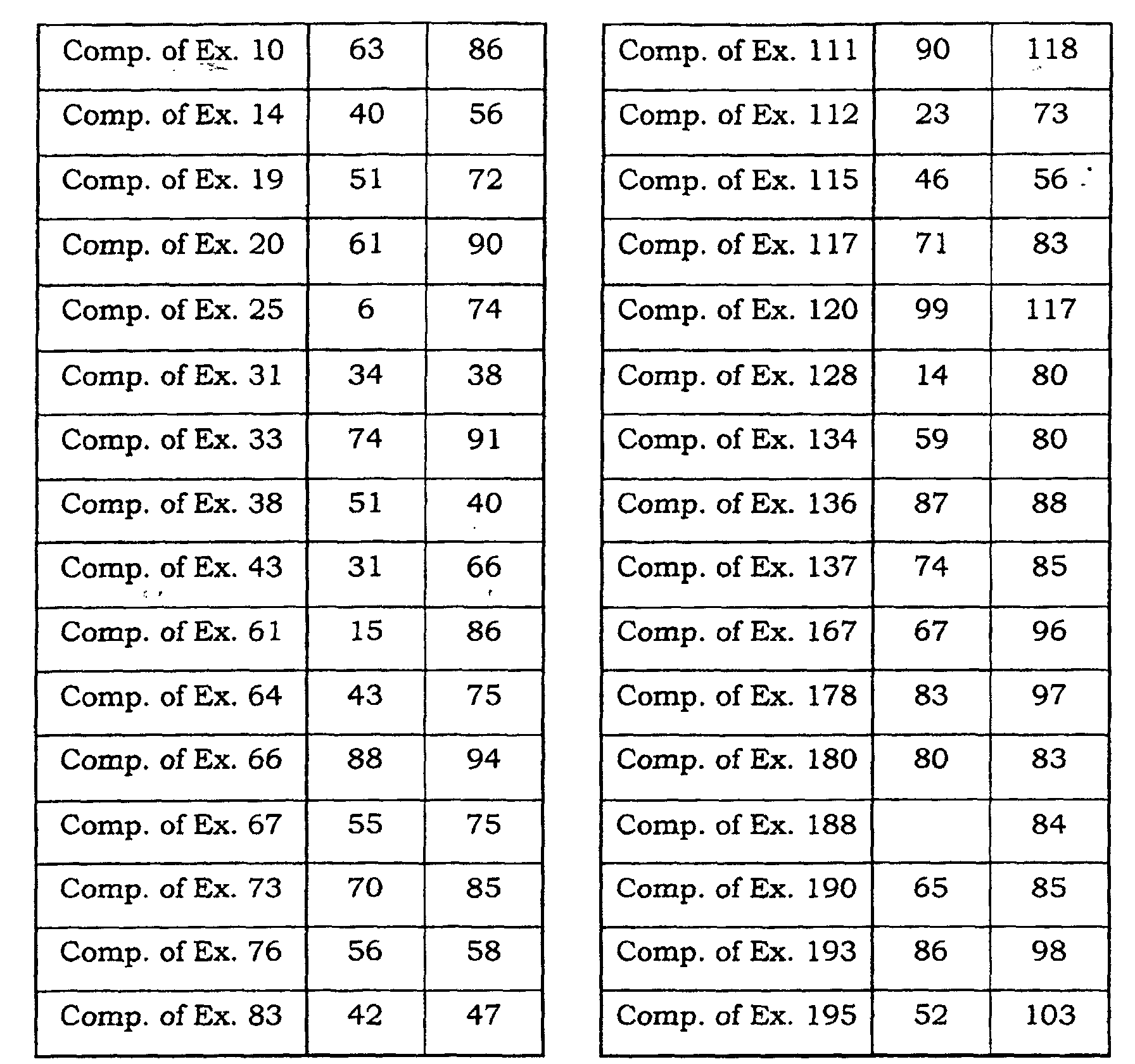
| Groups | Hydroxyproline content (µg/mg protein) |
| Normal Rat | 6.7±1.6 |
| Anti-Thy-1 antibody + the vehicle | 8.7±2.0 |
| Anti-Thy-1 antibody + the compound of Example 9 (15 mg/kg) | 7.2±2.1 |
| Anti-Thy-1 antibody + the compound of Example 14(150 mg/kg) | 6.3±1.3 |
| Groups | Hydroxyproline content (µg/mg protein) |
| Normal Rat | 8.2±0.8 |
| Anti-Thy-1 antibody + the vehicle | 11.8 ± 0.6 |
| Anti-Thy-1 antibody + the compound of Example 110(1.5 mg/kg) | 10.1±0.8 |
| Anti-Thy-1 antibody + the compound of Example 110 (5 mg/kg) | 9.5±0.8 |
| Anti-Thy-1 antibody + the compound of Example 110 (15 mg/kg) | 9.7+0.7 |
| Anti-Thy-1 antibody + the compound of Example 110 (50 mg/kg) | 9.5±0.6 |
| Groups | Hydroxyproline content (µg/mg protein) |
| Normal Rat | 8.0±0.5 |
| Anti-Thy-1 antibody + the vehicle | 10.8 ± 1.8 |
| Anti-Thy-1 antibody + the compound of Example 120 (1.5 mg/kg) | 9.7 ± 1.0 |
| Anti-Thy-1 antibody + the compound of Example 120 (5 mg/kg) | 9.3 ± 0.9 |
| Anti-Thy-1 antibody + the compound of Example 120 (15 mg/kg) | 7.9±1.0 |
| Anti-Thy-1 antibody + the compound of Example 120 (50 mg/kg) | 8.1±1.5 |
| Groups | Hydroxyproline content (µg/mg protein) |
| Normal Rat | 11.3±0.7 |
| Anti-Thy-1 antibody + the vehicle | 16.1±1.6 |
| Anti-Thy-1 antibody + the compound of Example 136 (1.5 mg/kg) | 17.2±2.2 |
| Anti-Thy-1 antibody + the compound of Example 136 (5 mg/kg) | 13.4±1.0 |
| Anti-Thy-1 antibody + the compound of Example 136 (15 mg/kg) | 12.2±1.6 |
| Anti-Thy-1 antibody + the compound of Example 136 (50 mg/kg) | 11.2±1.4 |
Claims (14)
- A pyrrole derivative of the formula:wherein Ring Z is an optionally substituted pyrrole ring, an optionally substituted indole ring, an optionally substituted thiophene ring, an optionally substituted pyrazole ring, an optionally substituted benzene ring, an optionally substituted imidazole ring, or an optionally substituted isothiazole ring;

W2 is -CO-, -SO2-, -CONR-, an optionally substituted C1-C4 alkylene or an optionally substituted C2-C4 alkenylene, and R is hydrogen or an alkyl;
Ar2 is an optionally substituted aryl or an optionally substituted heteroaryl;
W1 and Ar1 mean the following (1) or (2):(1) W1 is an optionally substituted C1-C4 alkylene or an optionally substituted C2-C4 alkenylene; Ar1 is an optionally substituted bicyclic heteroaryl having 1 to 4 nitrogen atoms as ring-forming atoms:(2) W1 is an optionally substituted C2-C5 alkylene, an optionally substituted C2-C5 alkenylene, an optionally substituted C2-C5 alkynylene, or -Y-W3-, Y is an oxygen atom or a cycloalkanediyl, and W3 is an optionally substituted C1-C5 alkylene, an optionally substituted C2-C5 alkenylene, or an optionally substituted C2-C5 alkynylene; and Ar1 is an aryl or monocyclic heteroaryl, which is substituted at the ortho- or meta-position thereof with respect to the binding position of W1 by a group selected from carboxyl, an alkoxycarbonyl, a carbamoyl having optionally alkyl-substituent(s), a cyclic aminocarbonyl, an alkylsulfonylcarbamoyl, an arylsulfonylcarbamoyl, an alkylsulfonyl, a sulfamoyl having optionally alkyl-substituent(s), a cyclic aminosulfonyl, tetrazolyl, cyano, an alkoxy and an alkylsulfonylamino, and said aryl or monocyclic heteroaryl being optionally further substituted, or a prodrug thereof, or a pharmaceutically acceptable salt thereof. - The pyrrole derivative according to claim 1, wherein the divalent group including Ring Z may be any one of the following divalent groups (any direction of bonds are included), or a prodrug thereof, or a pharmaceutically acceptable salt thereof.
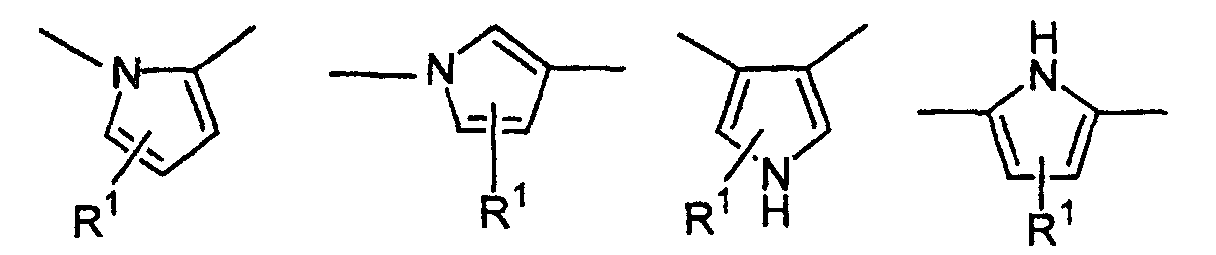
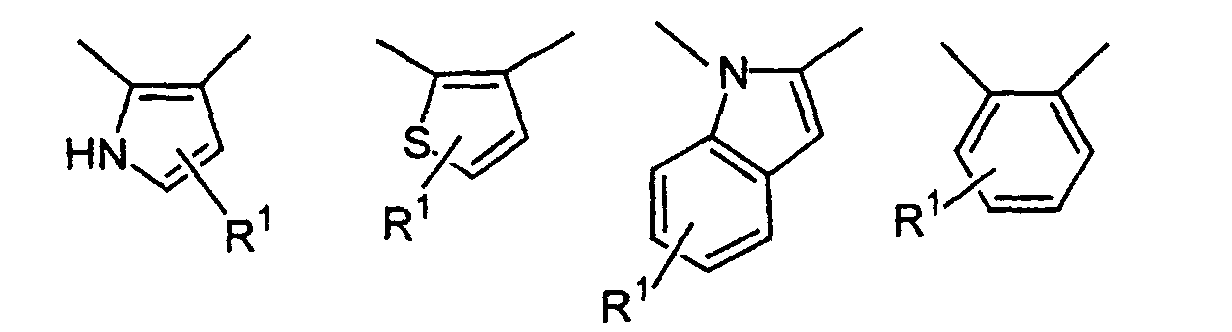 wherein the number of R1 is one or more, and each is independently hydrogen, a halogen or an optionally substituted alkyl.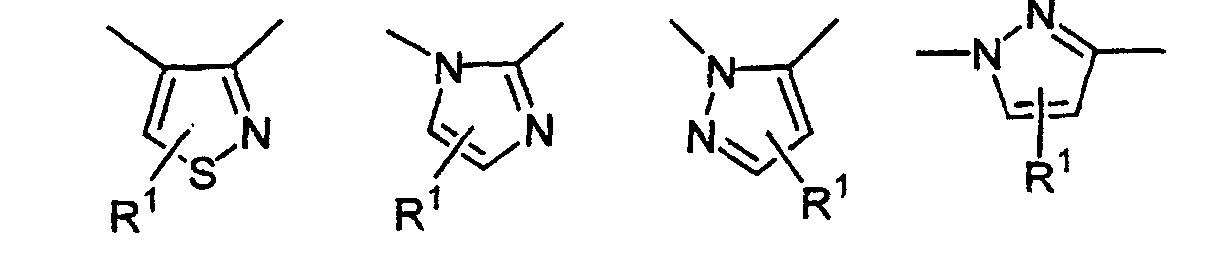
- The pyrrole derivative according to claim 1 or 2, wherein Ring Z is an optionally substituted pyrrole ring, an optionally substituted indole ring or an optionally substituted thiophene ring, or a prodrug thereof, or a pharmaceutically acceptable salt thereof.
- The pyrrole derivative according to claim 1, which is the compound of the formula:wherein W1, W2, Ar1, Ar2 and R1 are as defined in claim 1 or 2, or a prodrug thereof, or a pharmaceutically acceptable salt thereof.
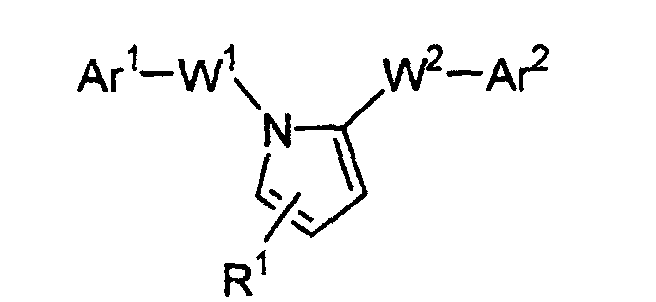
- The pyrrole derivative according to any one of claims 1 to 4, wherein W2 is -CO-, -SO2-, -CONR-, methylene, or hydroxymethylene, or a prodrug thereof, or a pharmaceutically acceptable salt thereof.
- The pyrrole derivative according to any one of claims 1 to 5, wherein Ar2 is a substituted phenyl, or a prodrug thereof, or a pharmaceutically acceptable salt thereof.
- The pyrrole derivative according to any one of claims 1 to 6, wherein W1 is an optionally substituted C2-C5 alkylene, an optionally substituted C2-C5 alkenylene, an optionally substituted C2-C5 alkynylene; and Ar1 is an aryl, which is substituted at the ortho-position thereof with respect to the binding position of W1 by a group selected from carboxyl, an alkoxycarbonyl, a carbamoyl having optionally alkylsubstituent(s), a cyclic aminocarbonyl, an alkylsulfonylcarbamoyl, an arylsulfonylcarbamoyl, an alkylsulfonyl, a sulfamoyl having optionally alkyl-substituent(s), a cyclic aminosulfonyl, tetrazolyl, cyano, an alkoxy and an alkylsulfonylamino, and said aryl being optionally further substituted,
or a prodrug thereof, or a pharmaceutically acceptable salt thereof. - The pyrrole derivative according to any one of claims 1 to 6, wherein W1 is an optionally substituted trans-C3-C4 alkenylene; and Ar1 is an aryl, which is substituted at the ortho-position thereof with respect to the binding position of W1 by a group selected from carboxyl, an alkoxycarbonyl, a carbamoyl having optionally alkyl-substituent(s), a cyclic aminocarbonyl, an alkylsulfonylcarbamoyl, an arylsulfonylcarbamoyl, tetrazolyl, cyano, an alkoxy and an alkylsulfonylamino, and said aryl being optionally further substituted by a halogen, cyano, an optionally substituted alkoxy or an optionally substituted alkyl,
or a prodrug thereof, or a pharmaceutically acceptable salt thereof. - The pyrrole derivative according to claim 1, which is a compound of the formula:wherein W4 is -CO-, -CONR- or methylene, R is as defined in claim 1;

R2 is a halogen, cyano, an optionally substituted alkoxy or an optionally substituted alkyl;
R3 is hydroxyl, an alkoxy, an amino having optionally alkylsubstituent(s), a cyclic amino or an alkylsulfonylamino;
R4 is hydrogen, a halogen or an alkyl;
R5 is an optionally substituted alkoxy or an optionally substituted alkyl,
or a prodrug thereof, or a pharmaceutically acceptable salt thereof. - The pyrrole derivative according to claim 9, wherein W4 is -CO-; R2 is a halogen, cyano, an alkoxy being optionally substituted by a halogen or an alkoxy, or an alkyl being optionally substituted by a halogen or an alkoxy; R4 is hydrogen or an alkyl; R5 is an alkoxy being optionally substituted by a halogen, an alkoxy or morpholino, or an alkyl being optionally substituted by a halogen, an alkoxy or morpholino,
or a prodrug thereof, or a pharmaceutically acceptable salt thereof. - The pyrrole derivative according to claim 9 or 10, which is a compound of the formula:wherein R3 and R5 are as defined in claim 9,
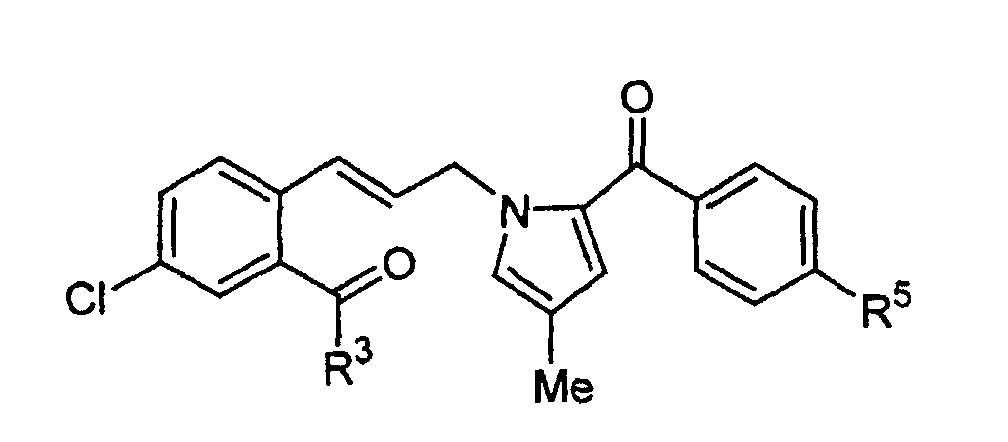
or a prodrug thereof, or a pharmaceutically acceptable salt thereof. - A medicament containing the pyrrole derivative according to any one of claims 1 to 11, or a prodrug thereof, or a pharmaceutically acceptable salt thereof.
- The medicament according to claim 12, which is a TGF-β inhibitor.
- The medicament according to claim 12, which is a fibrosis inhibitor.
Applications Claiming Priority (3)
| Application Number | Priority Date | Filing Date | Title |
|---|---|---|---|
| JP2000229423 | 2000-07-28 | ||
| JP2000022943 | 2000-07-28 | ||
| PCT/JP2001/006495 WO2002010131A1 (en) | 2000-07-28 | 2001-07-27 | Pyrrole derivatives |
Publications (2)
| Publication Number | Publication Date |
|---|---|
| EP1310485A1 true EP1310485A1 (en) | 2003-05-14 |
| EP1310485A4 EP1310485A4 (en) | 2005-07-20 |
Family
ID=18722544
Family Applications (1)
| Application Number | Title | Priority Date | Filing Date |
|---|---|---|---|
| EP01953325A Withdrawn EP1310485A4 (en) | 2000-07-28 | 2001-07-27 | pyrrole |
Country Status (7)
| Country | Link |
|---|---|
| US (2) | US6759429B2 (en) |
| EP (1) | EP1310485A4 (en) |
| KR (1) | KR20030031132A (en) |
| CN (1) | CN1466572A (en) |
| AU (1) | AU2001275794A1 (en) |
| CA (1) | CA2416946A1 (en) |
| WO (1) | WO2002010131A1 (en) |
Cited By (5)
| Publication number | Priority date | Publication date | Assignee | Title |
|---|---|---|---|---|
| US7642253B2 (en) | 2005-05-11 | 2010-01-05 | Takeda San Diego, Inc. | Histone deacetylase inhibitors |
| US7642275B2 (en) | 2004-12-16 | 2010-01-05 | Takeda San Diego, Inc. | Histone deacetylase inhibitors |
| US7732475B2 (en) | 2005-07-14 | 2010-06-08 | Takeda San Diego, Inc. | Histone deacetylase inhibitors |
| EP2266970A1 (en) * | 2007-06-18 | 2010-12-29 | Syngenta Participations AG | Substituted aromatic heterocyclic compounds as fungicides |
| WO2013011033A1 (en) | 2011-07-21 | 2013-01-24 | Bayer Intellectual Property Gmbh | 3-(fluorvinyl)pyrazoles and the use thereof |
Families Citing this family (7)
| Publication number | Priority date | Publication date | Assignee | Title |
|---|---|---|---|---|
| US6946481B1 (en) * | 1994-08-19 | 2005-09-20 | Abbott Laboratories | Endothelin antagonists |
| EP1458710A4 (en) * | 2001-12-21 | 2005-04-20 | Merck & Co Inc | HETEROARYLSUBSTITUTED PYRROL MODULATORS OF THE METABOTROPIC GLUTAMATE RECEPTOR 5 |
| EP1479384A1 (en) * | 2002-01-30 | 2004-11-24 | Sumitomo Pharmaceuticals Company, Limited | Fibrosis inhibitor |
| AU2003284479A1 (en) * | 2002-11-28 | 2004-06-18 | Sumitomo Pharmaceuticals Co., Ltd. | Novel heteroaryl derivative |
| JP4784402B2 (en) * | 2006-06-06 | 2011-10-05 | 東ソー株式会社 | Catalyst for producing arylamines and method for producing arylamines using the same |
| KR100985792B1 (en) * | 2008-03-14 | 2010-10-06 | 오세천 | End sealed structure of electrothermal hot water pipe and electrothermal hot water pipe system |
| PE20150974A1 (en) * | 2012-11-14 | 2015-07-04 | Teijin Pharma Ltd | PYRIDINE DERIVATIVES |
Family Cites Families (6)
| Publication number | Priority date | Publication date | Assignee | Title |
|---|---|---|---|---|
| GB9125924D0 (en) | 1991-06-18 | 1992-02-05 | Orion Yhtymae Oy | Stereoisomers of an imidazole derivative |
| JPH08333249A (en) * | 1995-06-07 | 1996-12-17 | Ono Pharmaceut Co Ltd | TGF-β release, activation and synthesis inhibitor |
| AU715658B2 (en) | 1996-04-03 | 2000-02-10 | Merck & Co., Inc. | Inhibitors of farnesyl-protein transferase |
| ES2190221T3 (en) * | 1998-05-04 | 2003-07-16 | Zentaris Ag | DERIVATIVES OF INDOL AND ITS USE FOR THE TREATMENT OF MALIGNAL AND OTHER DISEASES, BASED ON PATHOLOGICAL CELL PROLIFERATIONS. |
| US6211197B1 (en) | 1998-10-07 | 2001-04-03 | Merck Frosst Canada & Co. | Prostaglandin receptor ligands |
| JP2001089412A (en) * | 1999-09-22 | 2001-04-03 | Otsuka Pharmaceut Co Ltd | Benzene derivative or its pharmaceutically acceptable salt |
-
2001
- 2001-07-27 EP EP01953325A patent/EP1310485A4/en not_active Withdrawn
- 2001-07-27 CA CA002416946A patent/CA2416946A1/en not_active Abandoned
- 2001-07-27 AU AU2001275794A patent/AU2001275794A1/en not_active Abandoned
- 2001-07-27 KR KR10-2003-7001182A patent/KR20030031132A/en not_active Ceased
- 2001-07-27 WO PCT/JP2001/006495 patent/WO2002010131A1/en not_active Ceased
- 2001-07-27 CN CNA018162037A patent/CN1466572A/en active Pending
-
2003
- 2003-01-28 US US10/352,067 patent/US6759429B2/en not_active Expired - Fee Related
-
2004
- 2004-05-07 US US10/840,746 patent/US20040209939A1/en not_active Abandoned
Cited By (5)
| Publication number | Priority date | Publication date | Assignee | Title |
|---|---|---|---|---|
| US7642275B2 (en) | 2004-12-16 | 2010-01-05 | Takeda San Diego, Inc. | Histone deacetylase inhibitors |
| US7642253B2 (en) | 2005-05-11 | 2010-01-05 | Takeda San Diego, Inc. | Histone deacetylase inhibitors |
| US7732475B2 (en) | 2005-07-14 | 2010-06-08 | Takeda San Diego, Inc. | Histone deacetylase inhibitors |
| EP2266970A1 (en) * | 2007-06-18 | 2010-12-29 | Syngenta Participations AG | Substituted aromatic heterocyclic compounds as fungicides |
| WO2013011033A1 (en) | 2011-07-21 | 2013-01-24 | Bayer Intellectual Property Gmbh | 3-(fluorvinyl)pyrazoles and the use thereof |
Also Published As
| Publication number | Publication date |
|---|---|
| CN1466572A (en) | 2004-01-07 |
| US20030181496A1 (en) | 2003-09-25 |
| WO2002010131A1 (en) | 2002-02-07 |
| US20040209939A1 (en) | 2004-10-21 |
| EP1310485A4 (en) | 2005-07-20 |
| US6759429B2 (en) | 2004-07-06 |
| AU2001275794A1 (en) | 2002-02-13 |
| KR20030031132A (en) | 2003-04-18 |
| CA2416946A1 (en) | 2003-01-22 |
Similar Documents
| Publication | Publication Date | Title |
|---|---|---|
| US6759429B2 (en) | Pyrrole derivatives | |
| US9988379B2 (en) | GPR40 receptor agonist, methods of preparing the same, and pharmaceutical compositions containing the same as an active agent | |
| FI97381B (en) | Process for the preparation of substituted antihypertensive substituted pyrrole, pyrazole and triazole compounds | |
| US6800645B1 (en) | Substituted azabicyclic compounds | |
| JP4377228B2 (en) | Benzimidazole derivatives and their use as KDR kinase protein inhibitors | |
| US20050032869A1 (en) | Pyrazolyl-indole derivatives active as kinase inhibitors, process for their preparation and pharmaceutical compositions comprising them | |
| KR20030010739A (en) | Azaindole derivatives, process for their preparation, and their use as antitumor agents | |
| EP1432416A1 (en) | Aminoindazole derivatives active as kinase inhibitors, process for their preparation and pharmaceutical compositions containing them | |
| KR101126736B1 (en) | Tyrosine kinase inhibitory compounds, isomers thereof or pharmaceutical acceptable salts thereof, and pharmaceutical composition comprising the same | |
| AU2007218966A1 (en) | 2-(phenyl or heterocyclic) - 1h-phenanthro [9,10-d] imidazoles | |
| RU2702644C2 (en) | Benzo-derivatives with six-membered ring as dpp-4 inhibitor and use thereof | |
| CN102459226B (en) | 4-azetidinyl-1-heteroatom linked-cyclohexane antagonists of ccr2 | |
| JP2011251974A (en) | New heteroaryl derivative | |
| AU2013331493A1 (en) | Heteroaryl linked quinolinyl modulators of RORyt | |
| EP1479384A1 (en) | Fibrosis inhibitor | |
| JPWO2005012258A1 (en) | Protein kinase inhibitor | |
| JP2001031569A (en) | Combination of aldose reductase inhibitor with selective cyclooxygenase-2 inhibitor | |
| US5043349A (en) | Substituted pyrrole angiotensin II antagonists | |
| KR101741956B1 (en) | Novel compound, process for the preparation thereof and pharmaceutical composition comprising the same | |
| JPWO2002010131A1 (en) | Pyrrole Derivatives | |
| JP2004534072A (en) | Alkylidenepyrazolidinedione derivatives and uses for treating diabetes and obesity | |
| HK40063832B (en) | Aryl-n-aryl derivatives for treating a rna virus infection | |
| AU2002340917A1 (en) | Aminoindazole derivatives active as kinase inhibitors, process for their preparation and pharmaceutical composition containing them |
Legal Events
| Date | Code | Title | Description |
|---|---|---|---|
| PUAI | Public reference made under article 153(3) epc to a published international application that has entered the european phase |
Free format text: ORIGINAL CODE: 0009012 |
|
| 17P | Request for examination filed |
Effective date: 20030228 |
|
| AK | Designated contracting states |
Designated state(s): AT BE CH CY DE DK ES FI FR GB GR IE IT LI LU MC NL PT SE TR |
|
| AX | Request for extension of the european patent |
Extension state: AL LT LV MK RO SI |
|
| A4 | Supplementary search report drawn up and despatched |
Effective date: 20050603 |
|
| RIC1 | Information provided on ipc code assigned before grant |
Ipc: 7C 07D 207/32 B Ipc: 7C 07D 275/02 B Ipc: 7C 07D 233/64 B Ipc: 7C 07D 231/12 B Ipc: 7C 07D 333/22 B Ipc: 7C 07D 417/10 B Ipc: 7C 07D 403/10 B Ipc: 7C 07D 403/06 B Ipc: 7C 07D 471/04 B Ipc: 7C 07D 401/06 B Ipc: 7C 07D 209/12 B Ipc: 7C 07D 207/333 A |
|
| RAP1 | Party data changed (applicant data changed or rights of an application transferred) |
Owner name: DAINIPPON SUMITOMO PHARMA CO., LTD. |
|
| 17Q | First examination report despatched |
Effective date: 20060301 |
|
| STAA | Information on the status of an ep patent application or granted ep patent |
Free format text: STATUS: THE APPLICATION IS DEEMED TO BE WITHDRAWN |
|
| 18D | Application deemed to be withdrawn |
Effective date: 20070418 |