TECHNICAL FIELD
-
The present invention relates to novel vitamin D
derivatives, more particularly, relates to 1-methyl-20-epi-vitamin
D derivatives, in which the steric configuration at
the 20-position is not native and the 1-position is
substituted with methyl.
BACKGROUND ART
-
Active vitamin D derivatives including 1α,25-dihydroxyvitamin
D3 are known to have many physiological
activities such as calcium metabolism regulatory
activities, growth inhibitory and differentiation inducing
activities for tumor cells and immunoregulatory activities.
However, some active vitamin D3 derivatives may cause
hypercalcemia during long-term and continuous
administration, therefore they are not suitable for use as
antitumor agents, antirheumatic agents and the like. Thus,
a number of synthetic studies have been conducted to obtain
such vitamin D derivatives that are excellent in specific
activities among the above-mentioned activities.
-
For example, if the A-ring of an active vitamin D3
derivative is substituted, the possible conformation of the
molecule may be limited, resulting in a characteristic
activity of the resulting vitamin D derivative. For
example, 1α,25-dihydroxyvitamin D3 derivatives having
methyl at the 2- or 4-position are described by K. Konno et
al. (Bioorg. Med. Chem. Lett., 1998, 8, 151) and T.
Fujishima et al. (ibid., 1998, 8, 2145) and in Abstracts of
the 118th Annual Meeting of the Pharmaceutical Society of
Japan 2 (p.171). In addition, a vitamin D derivative
having methyl at the 1-position is described in Abstracts
of the 120th Annual Meeting of the Pharmaceutical Society
of Japan 2 (p.105). However, no vitamin D3 derivative has
been reported in which the 1-position is substituted with
methyl and the steric configuration at the 20-position is
epimerized.
DISCLOSURE OF THE INVENTION
-
An object of the present invention is to provide and
to synthesize 1-methyl-20-epi-vitamin D derivatives.
Another object of the present invention is to evaluate
biological activity of the resulting 1-methyl-20-epi-vitamin
D derivatives.
-
As a result of careful studies so as to achieve the
above mentioned objects, the inventors of the present
invention have succeeded in synthesizing desired vitamin D
derivatives by coupling A-ring part precursors and CD-ring
parts using palladium catalyst after synthesizing the A-ring
part precursors and the CD-ring parts separately by
the method described in Abstracts of the 120th Annual
Meeting of the Pharmaceutical Society of Japan 2 (p.105)
and by the method described by T. Fujishima et al. (Bioorg.
Med. Chem., 2000, 8, 123), respectively; thereby they
achieved the present invention.
-
According to one aspect of the present invention,
there is provided a vitamin D derivative of Formula (1):
wherein R is straight or branched alkyl optionally
substituted with hydroxy.
-
For R of Formula (1), straight or branched C1-12 alkyl
substituted with hydroxy is preferred and straight or
branched C1-10 alkyl substituted with hydroxy is more
preferred.
-
Particularly preferably, R is 4-hydroxy-4-methylpentyl
or 4-ethyl-4-hydroxyhexyl, more preferably R
is 4-hydroxy-4-methylpentyl.
-
The vitamin D derivatives of the present invention
may be used for medicines, for example, for the purpose of
calcium metabolism regulating agent and the like.
-
Therefore, according to the present invention, there
is provided a pharmaceutical composition comprising the
vitamin D derivative of Formula (1) as an active ingredient.
-
Furthermore, there is provided use of the vitamin D
derivative of Formula (1) as a medicine.
-
The vitamin D derivatives of the present invention
can be also used as test reagents in studying the
metabolism of active vitamin D3 (i.e., 1α,25-dihydroxyvitamin
D3).
-
The contents of the specification of Japanese Patent
Application No. 2000-245607, the application on the basis
of which the present application claims priority are to be
incorporated in their entirety by reference.
PREFERRED MODE FOR CARRYING OUT THE INVENTION
-
Detailed modes and methods with respect to vitamin D
derivatives of Formula (1) of the present invention are
described in further detail below.
-
In the present specification, "straight or branched
alkyl" is preferably straight or branched C1-15 alkyl;
examples thereof include methyl, ethyl, n-propyl, i-propyl,
n-butyl, s-butyl, i-butyl and t-butyl, and further include
pentyl, hexyl, heptyl, octyl, nonyl, decanyl, etc.
-
"Straight or branched alkyl optionally substituted
with hydroxy" means that one or more hydrogen atoms of the
above-mentioned straight or branched alkyl may be
substituted with hydroxy. In the definition of R, the
number of hydrogen atoms substituted with hydroxy is
preferably 1, 2 or 3, more preferably 1 or 2 and most
preferably 1.
-
Non-limiting examples of R include 4-hydroxy-4-methylpentyl,
4-ethyl-4-hydroxyhexyl, 6-hydroxy-6-methyl-2-heptyl,
7-hydroxy-7-methyl-2-octyl, 5,6-dihydroxy-6-methyl-2-heptyl,
4,6,7-trihydroxy-6-methyl-2-heptyl, etc.
-
Preferably R is straight or branched C1-12 alkyl
substituted with hydroxy, more preferably straight or
branched C3-10 alkyl substituted with hydroxy. Further more
preferably R is 4-hydroxy-4-methylpentyl or 4-ethyl-4-hydroxyhexyl
and most preferably R is 4-hydroxy-4-methylpentyl.
-
The vitamin D derivatives of Formula (1) of the
present invention can be used as active ingredients of
pharmaceutical compositions (such as a calcium metabolism
regulating agent).
-
Although there is no limitation with respect to
methods of synthesizing vitamin D derivatives of Formula
(I) of the present invention which are novel compounds,
they are synthesizable, for example, by synthesizing A-ring
and CD-ring parts of the vitamin D derivatives separately
and then coupling them together, as described in the
following Examples.
-
CD-ring part compounds of vitamin D derivatives are
known. Alternatively, a desired CD-ring compound is
obtainable by appropriately modifying a side chain of a
known CD-ring compound or is obtainable from a known
vitamin D derivative having a corresponding side chain.
-
Examples of such a known vitamin D derivative include
those which are disclosed in Japanese Patent Publication
(Kokai) Nos. 61-267550 A, 6-72994 A and 6-256300 A and
Japanese Patent Publication (Kohyo) Nos. 4-503669 A, 4-504573
A and 10-182597 A, WO94/14766, WO95/27697, etc.
-
According to Scheme 4 described by T. Fujishima et al
(Bioorg. Med. Chem., 2000, 8, 123), a CD-ring compound
having a desired side chain is obtainable as follows:
- an aldehyde led from the ozonolysis of vitamin D2 is
treated with a base to epimerize the stereochemistry on a
carbon, the position of which corresponds to the 20-position
of the steroid skeleton. A desired side chain is
introduced to the epimerized aldehyde to give a protected
alcohol, which is then deprotected and oxidized. Thus
obtained ketone is converted to a bromomethylene to give a
CD-ring compound having the desired side chain.
-
-
An A-ring compound having methyl at the 1-position is
synthesizable by the method described on page 105 of
Abstracts of the 120th Annual Meeting of the Pharmaceutical
Society of Japan 2 via a 3-methylbutane-1,2,4-triol
derivative, which is synthesizable from 3-methylbut-3-en-1-ol,
as a starting material; however there is no limitation
with respect to a method for synthesizing the compounds.
-
An A-ring compound and a CD-ring compound can be
coupled by a known conventional method. Namely, an A-ring
compound, which is obtainable by the above method and which
has a triple bond at one terminal and a double bond at the
other terminal, is reacted with a CD-ring compound, which
has bromomethylene at the coupling site for the A-ring
compound, in the presence of a palladium catalyst in an
appropriate solvent.
-
After the coupling reaction, the resulting product is
purified in a usual manner such as thin layer
chromatography and subjected to removal of the hydroxy
protecting groups, to give a desired vitamin D derivative.
-
When the compounds of the present invention are used
as medicines, they are preferably formulated into
appropriate dosage forms with pharmaceutically acceptable
carriers, excipients, disintegrants, lubricants, binders,
flavors, colorants and the like; examples of the dosage
forms include tablets, granules, fine granules, capsules,
powders, injections, solutions, suspensions, emulsions,
percutaneous administration formulations, suppositories and
the like.
-
There is no restriction on routes of administration
for the compounds of the present invention as medicines;
they may be administered orally or parenterally
(intravenously, intramuscularly, intraperitoneally,
percutaneously and the like).
-
Dosage of compounds of the present invention as
medicines can be appropriately chosen depending on target
disease, conditions, body type, constitution, age and sex
of the patient, administration route, dosage form and other
factors. Typically, the lower limit for an adult ranges
from 0.001 µg to 0.1 µg and preferably around 0.01 µg
daily, and the upper limit for an adult ranges from 100 µg
to 10000 µg and preferably from 200 µg to 1000 µg daily,
which may be administered at a time or in divided portions
two or three times a day.
EXAMPLES
-
The present invention will be described specifically
by way of the following Examples, which in no way limit the
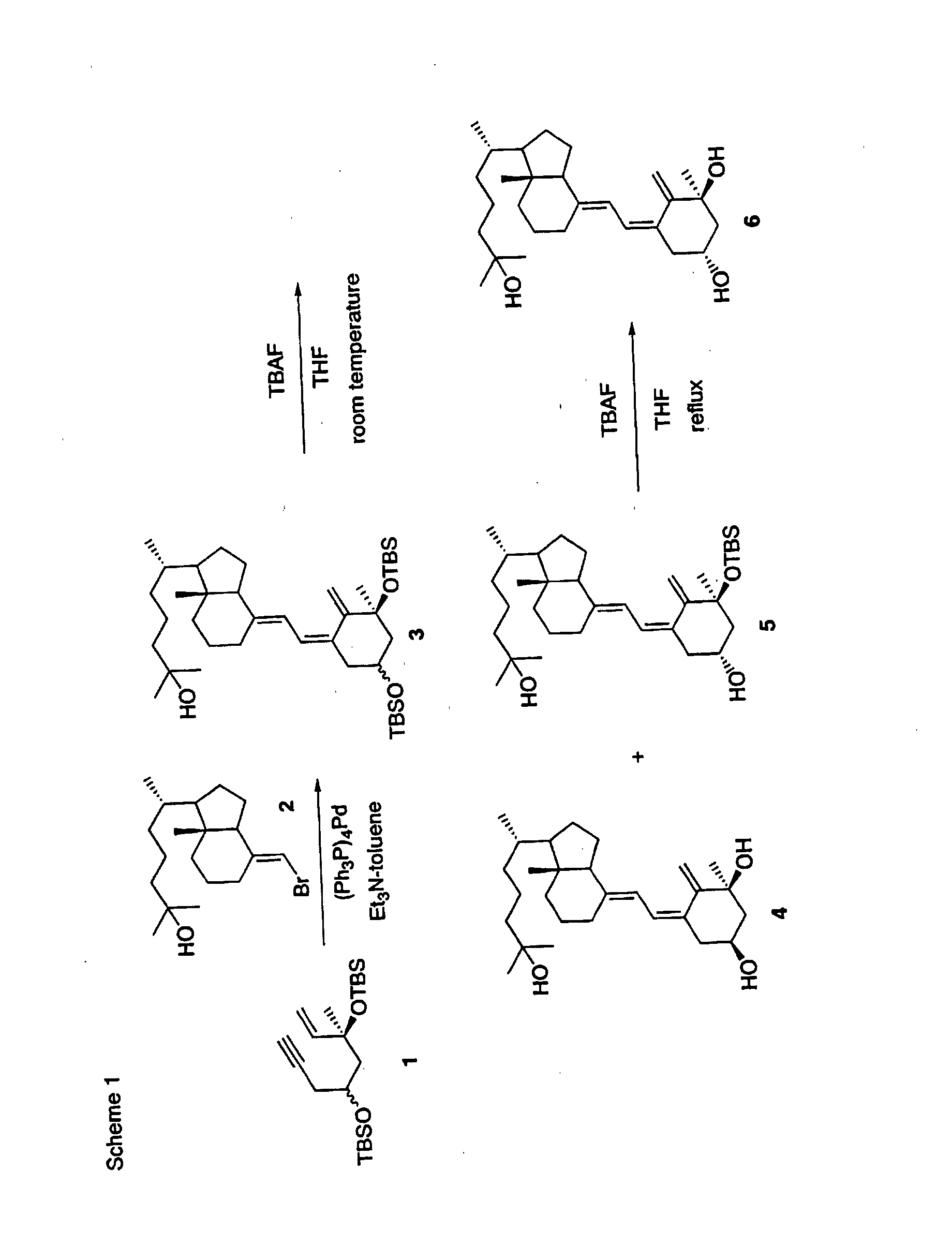
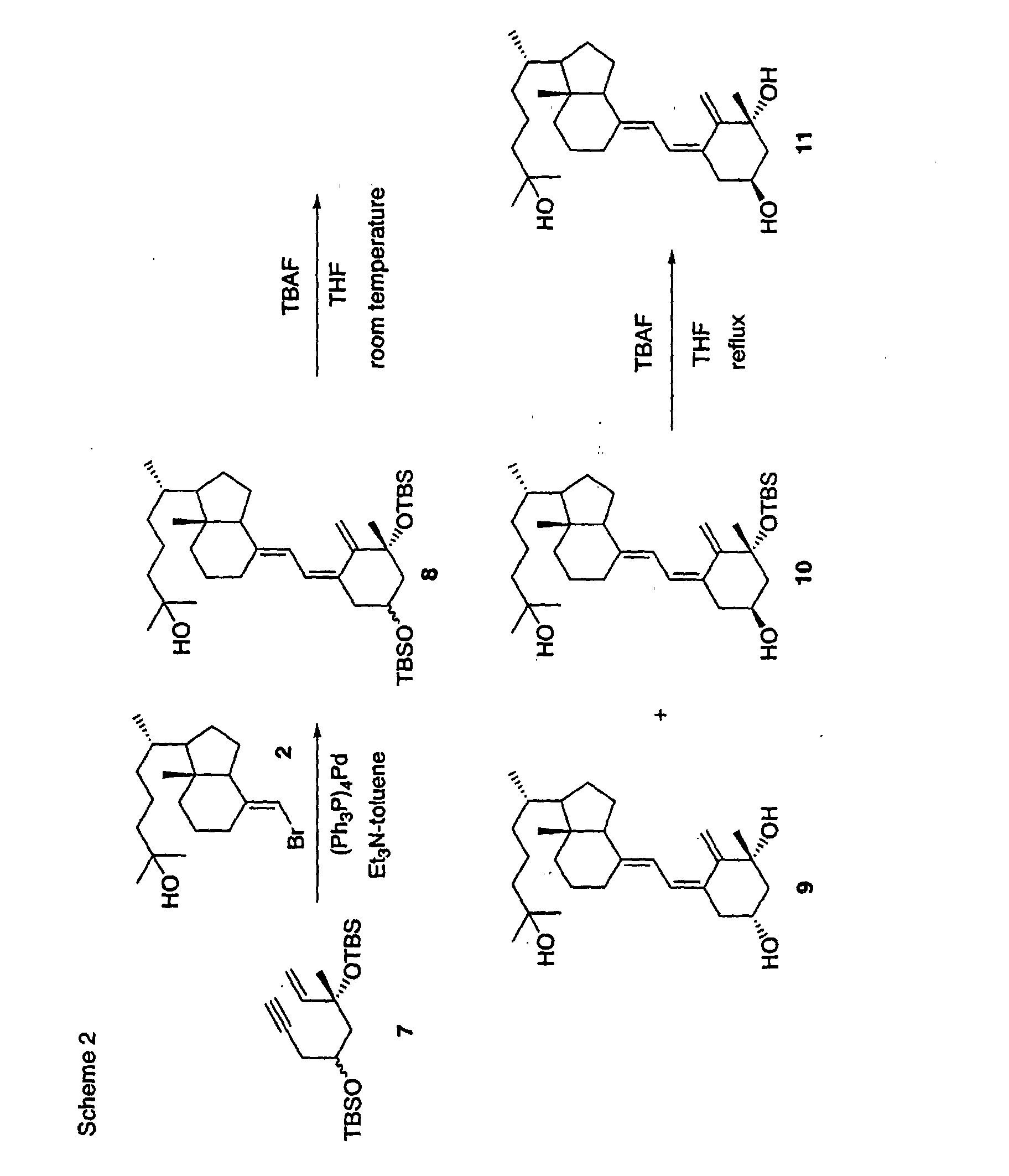
invention. The following schemes show the reactions
carried out in Examples.
(Example 1) Synthesis of (5Z, 7E)-(1S,3S,20S)-1-Methyl-9,10-seco-5,7,10(19)-cholestatriene-1,3,25-triol
(Compound
4)
-
(E)-de-A,B-8-(bromomethylene)cholestan-25-ol
(Compound 2) (90 mg, 0.25 mmol) and triethylamine (3 ml)
were mixed in toluene (2 ml); the resulting solution was
mixed with (Ph3P)4Pd (145 mg, 0.13 mmol) and stirred at room
temperature for 10 minutes. A solution of an A-ring
compound (Compound 1) (150 mg, 0.39 mmol) was then added,
followed by stirring at room temperature for a further 20
minutes. The reaction mixture was heated under reflux for
4 hours and filtered through a pad of silica gel with ethyl
acetate. After evaporation of the solvent, the crude
product was purified by silica gel preparative thin layer
chromatography (ethyl acetate:n-hexane = 1:3) to give
Compound 3 (63 mg) as a colorless foam in 38% yield.
-
The above-mentioned Compound 3 (63 mg, 0.096 mmol)
which was a protected vitamin D derivative was dissolved in
THF (2 ml). While stirring thus obtained solution at 0°C
under an argon atmosphere, TBAF (tetrabutylammonium
fluoride) (1.0 M solution in THF, 0.5 ml, 0.5 mmol) was
added. The reaction mixture was stirred at room
temperature for 6 hours, mixed with brine, and extracted
with ethyl acetate. The organic layer was dried over
sodium sulfate and filtered. The filtrate was evaporated
to remove the solvent and thus obtained crude product was
purified by silica gel preparative thin layer
chromatography (ethyl acetate:n-hexane = 1:1) to give
Compound 4 (12 mg, 30%) and Compound 5 (11 mg, 21%), each
as a white solid. Compound 4 was further purified by
reverse phase recycle HPLC (YMC-Pack ODS column, 20 mm X
150 mm, 9.0 ml/min, acetonitrile:water = 8:2) for
biological activity evaluation.
UV (EtOH) λmax 266 nm, λmin 226 nm; 1H NMR (400 MHz, CDCl3)
δ 0.55 (3 H, s), 0.85 (3H, d, J = 6.4 Hz), 1.19 (6 H, s),
1.23 (3 H, s), 1.80 (1 H, dd, J = 14.3, 3.4 Hz), 2.11 (1 H,
ddd, J = 14.3, 3.1, 2.4 Hz), 2.40 (2H, m), 2.84 (1 H, dd, J
= 11.3. 3.7 Hz), 4.42 (1 H, t, J = 3.1 Hz), 5.02 (1 H, d, J
= 2.1 Hz), 5.28 (1 H, d, J = 2.1 Hz), 6.07 (1 H, d, J =
11.3 Hz), 6.45 (1 H, d, J = 11.3 Hz); MS 430 [M]+, 412 [M-H2O]+;
HRMS calcd. for [C28H46O3] 430.3447, found 430.3448.
(Example 2) Synthesis of (5Z, 7E)-(lS,3R,20S)-1-Methyl-9,10-seco-5,7,10(19)-cholestatriene-1,3,25-triol
(Compound 6)
-
Under an argon atmosphere at 60°C, a solution of
Compound 5 (11 mg, 0.02 mmol) in THF (3 ml) was treated
with TBAF (1.0 M solution in THF, 0.2 ml, 0.2 mmol) for 24
hours. After the treatment, thus obtained mixture was
mixed with brine and extracted with ethyl acetate. The
organic layer was dried over sodium sulfate, and filtered.
The filtrate was evaporated for removing the solvent to
give a crude product, which was then subjected to silica
gel preparative thin layer chromatography (ethyl acetate:n-hexane
= 2:1) to give Compound 6 (3.8 mg) as a white solid
in 44% yield. Compound 6 was further purified by reverse
phase recycle HPLC (YMC-Pack ODS column, 20 mm X 150 mm,
9.0 ml/min, acetonitrile:water = 8:2) for biological
activity evaluation.
UV (EtOH) λmax 263 nm, λmin 228 nm; 1H NMR (400 MHz, CDCl3)
δ 0.55 (3 H, s), 0.85 (3H, d, J = 6.4 Hz), 1.21 (6 H, s),
1.32 (3 H, s), 1.51 (1 H, dd, J = 12.2, 11.6 Hz), 2.19 (1 H,
ddd, J = 12.8, 5.5, 2.7 Hz), 2.24 (1 H, dd, J = 14.0, 2.4
Hz), 2.42 (1 H, d, J = 13.7 Hz), 2.81 (1 H, m), 4.34 (1 H,
ddt, J = 11.3, 5.2, 2.2 Hz), 5.02 (1 H, t, J = 1.8 Hz),
5.38 (1 H, t, J = 1.8 Hz), 6.05 (1 H, d, J = 11.6 Hz), 6.32
(1 H, dd, J = 11.0, 1.8 Hz); MS 430 [M]+, 412 [M-H2O]+; HRMS
calcd. for [C28H46O3] 430.3447, found 430.3447.
(Example 3) Synthesis of (5Z,7E)-(1R,3R,20S)-1-Methyl-9,10-seco-5,7,10(19)-cholestatriene-1,3,25-triol
(Compound 9)
-
(E)-de-A,B-8-(bromomethylene)cholestan-25-ol
(Compound 2) (90 mg, 0.25 mmol) and triethylamine (3 ml)
were dissolved in toluene (2 ml), to which (Ph3P)4Pd (145 mg,
0.13 mmol) was added and stirred for 10 min at room
temperature. Then a solution of Compound 7 (192 mg, 0.50
mmol) which was an A-ring part compound in toluene (2 ml)
was added to the mixture, followed by stirring for a
further 20 minutes at room temperature. The mixture was
heated under reflux for 4 hours, the reaction mixture was
filtered through a pad of silica gel with ethyl acetate.
After evaporation of the solvent, the resulting crude
product was purified by silica gel preparative thin layer
chromatography (ethyl acetate:n-hexane = 1:3) to give
Compound 8 (96 mg) as a colorless foam in 58% yield.
-
TBAF (1.0 M solution in THF, 0.7 ml, 0.7 mmol) was
added to a stirred solution of Compound 8 (96 mg, 0.15
mmol) which was a protected vitamin D derivative in THF (2
ml) under an argon atmosphere at 0°C. The reaction mixture
was stirred at room temperature for 6 hours, mixed with
brine, and extracted with ethyl acetate. The organic layer
was dried over sodium sulfate, and filtered. The filtrate
was evaporated to remove the solvent, and thus obtained
crude product was separated by silica gel preparative thin
layer chromatography (ethyl acetate:n-hexane = 1:1) to give
Compound 9 (22 mg, 34%) and Compound 10 (17 mg, 21%), each
as a white solid. Compound 9 was further purified by
reverse phase recycle HPLC (YMC-Pack ODS column, 20 mm X
150 mm, 9.0 ml/min, acetonitrile:water = 8:2) for
biological activity evaluation.
UV (EtOH) λmax 265 nm, λmin 227 nm; 1H NMR (400 MHz, CDCl3)
δ 0.53 (3 H, s), 0.84 (3 H, d, J = 6.4 Hz), 1.21 (6 H, s),
1.32 (3 H, s), 1.81 (1 H, dd, J = 14.4, 3.4 Hz), 2.09 (1 H,
m), 2.40 (2 H, m), 2.84 (1 H, dd, J = 11.9, 4.0 Hz), 4.39
(1 H, t, J = 3.1 Hz), 4.98 (1 H, d, J = 1.8 Hz), 5.26 (1 H,
d, J = 1.8 Hz), 6.02 (1 H, d, J = 11.3 Hz), 6.44 (1 H, d, J
= 11.0 Hz); MS 430 [M]+, 412 [M-H2O]+, HRMS calcd. for
[C28H46O3] 430.3447, found 430.3465.
(Example 4) Synthesis of (5Z,7E)-(1R,3S,20S)-1-Methyl-9,10-seco-5,7,10(19)-cholestatriene-1,3,25-triol
(Compound 11).
-
Under an argon atmosphere at 60°C, a solution of
Compound 10 (17 mg, 0.03 mmol) in THF (3 ml) was treated
with TBAF (1.0 M solution in THF, 0.4 ml, 0.4 mmol) for 24
hours. After the treatment, thus obtained mixture was
mixed with brine and extracted with ethyl acetate. The
organic layer was dried over sodium sulfate and filtered.
The filtrate was evaporated for removing the solvent to
give a crude product, which was then subjected to silica
gel preparative thin layer chromatography (ethyl acetate:n-hexane
= 2:1) to give Compound 11 (4.8 mg) as a white solid
in 37% yield. Compound 21 was further purified by reverse
phase recycle HPLC (YMC-Pack ODS column, 20 mm X 150 mm,
9.0 ml/min, acetonitrile:water = 8:2) for biological
activity evaluation.
UV (EtOH) λmax 263 nm λmin 228 nm; 1H NMR (400 MHz, CDCl3) δ
0.53 (3 H, s), 0.85 (3H, d, J = 6.7 Hz), 1.21 (6 H, s),
1.30 (3 H, s), 1.53 (1 H, dd, J = 12.5, 11.0 Hz), 2.18 (1 H,
ddd, J = 12.5, 5.2, 2.4 Hz), 2.25 (1 H, dd, J = 13.7, 2.1
Hz), 2.41 (1 H, d, J = 13.7 Hz), 2.81 (1 H, dd, J = 12.2,
4.0 Hz), 4.36 (1 H, ddt, J = 11.0, 5.2, 1.8 Hz), 4.97 (1 H,
m), 5.36 (1 H, t, J = 1.8 Hz), 6.10 (1 H, d, J = 11.3 Hz),
6.32 (1 H, dd, J = 11.3 Hz); MS 430 [M]+, 412 [M-H2O]+; HRMS
calcd. for [C28H46O3] 430.3447, found 430.3444.
(Test example) Assay for binding to bovine thymus vitamin D
receptor (VDR)
-
Bovine thymus 1α,25-dihydroxyvitamin D3 receptor was
purchased from Yamasa Biochemcal and, just before use, one
ampule (approximately 25 mg) of the receptor was dissolved
in 55 mL of 0.05 M phosphate buffer (pH 7.4) containing
0.3M KCl and 5 mM dithiothreitol to prepare a receptor
solution. Compounds 4, 6, 9 and 11 synthesized in the
above Examples 1 to 4 were used as test compounds, and
1α,25-dihydroxyvitamin D3 was used as standard.
-
Ethanol solutions of the test compounds and
1α,25-dihydroxyvitamin D3 were prepared at various
concentrations. Each of the ethanol solutions (50 µl) of
the test compounds, and 1α,25-dihydroxyvitamin D3 was pre-incubated
at 25°C for 1 hour with 500 µl (0.23 mg protein)
of the receptor solution. [3H]-1α,25-Dihydroxyvitamin D3
was added to the pre-incubated solution at the final
concentration of 0.1 nM, followed by incubation overnight
at 4°C. Each of the reaction mixtures was treated with
dextran coated charcoal for 30 minutes at 4°C and
centrifuged at 3000 rpm for ten minutes to separate the
bound and free forms of [3H]-1α,25-dihydroxyvitamin D3.
Each of the resultant supernatants (500 µl) was mixed with
ACS-II (9.5 ml) (AMERSHAM, England) for radioactivity
measurement.
-
The VDR binding properties of the test compounds
expressed in relative value with that of 1α,25-dihydroxyvitamin
D
3 taken as 100 were shown in Table below.
| Compound | Compound 4 | Compound 6 | Compound 9 | Compound 11 |
| VDR binding properties | 1 | 1 | 0.017 | 0.004 |
INDUSTRIAL APPLICABILITY
-
As described above, the vitamin D derivatives of the
present invention are novel, exhibit excellent
physiological activities, and are expected to be useful as
medicines, for example, for calcium metabolism regulation.
The compounds of the present invention may be useful as
reagents for studying metabolism of active vitamin D3
(i.e., 1α,25-dihydroxyvitamin D3).