EP1310482A1 - Prodrugs of excitatory amino acids - Google Patents
Prodrugs of excitatory amino acids Download PDFInfo
- Publication number
- EP1310482A1 EP1310482A1 EP01500264A EP01500264A EP1310482A1 EP 1310482 A1 EP1310482 A1 EP 1310482A1 EP 01500264 A EP01500264 A EP 01500264A EP 01500264 A EP01500264 A EP 01500264A EP 1310482 A1 EP1310482 A1 EP 1310482A1
- Authority
- EP
- European Patent Office
- Prior art keywords
- compound
- amino
- formula
- hexane
- dicarboxylic acid
- Prior art date
- Legal status (The legal status is an assumption and is not a legal conclusion. Google has not performed a legal analysis and makes no representation as to the accuracy of the status listed.)
- Withdrawn
Links
- 230000002461 excitatory amino acid Effects 0.000 title claims abstract description 9
- 239000003257 excitatory amino acid Substances 0.000 title claims abstract description 9
- 229940002612 prodrug Drugs 0.000 title abstract description 6
- 239000000651 prodrug Substances 0.000 title abstract description 6
- 150000001875 compounds Chemical class 0.000 claims abstract description 150
- 238000000034 method Methods 0.000 claims abstract description 97
- 150000003839 salts Chemical class 0.000 claims abstract description 33
- 239000001257 hydrogen Substances 0.000 claims abstract description 31
- 229910052739 hydrogen Inorganic materials 0.000 claims abstract description 31
- 208000012902 Nervous system disease Diseases 0.000 claims abstract description 15
- 125000000217 alkyl group Chemical group 0.000 claims abstract description 14
- UFHFLCQGNIYNRP-UHFFFAOYSA-N Hydrogen Chemical compound [H][H] UFHFLCQGNIYNRP-UHFFFAOYSA-N 0.000 claims abstract description 11
- 208000020016 psychiatric disease Diseases 0.000 claims abstract description 10
- 125000000266 alpha-aminoacyl group Chemical group 0.000 claims abstract description 9
- 125000001153 fluoro group Chemical group F* 0.000 claims abstract description 8
- 125000004435 hydrogen atom Chemical group [H]* 0.000 claims abstract description 8
- 125000003412 L-alanyl group Chemical group [H]N([H])[C@@](C([H])([H])[H])(C(=O)[*])[H] 0.000 claims abstract description 6
- 125000003342 alkenyl group Chemical group 0.000 claims abstract description 6
- 125000003710 aryl alkyl group Chemical group 0.000 claims abstract description 6
- 125000003118 aryl group Chemical group 0.000 claims abstract description 6
- 239000008194 pharmaceutical composition Substances 0.000 claims abstract description 5
- PXBRQCKWGAHEHS-UHFFFAOYSA-N dichlorodifluoromethane Chemical group FC(F)(Cl)Cl PXBRQCKWGAHEHS-UHFFFAOYSA-N 0.000 claims abstract description 4
- VEXZGXHMUGYJMC-UHFFFAOYSA-N Hydrochloric acid Chemical compound Cl VEXZGXHMUGYJMC-UHFFFAOYSA-N 0.000 claims description 44
- -1 L-methionyl Chemical group 0.000 claims description 31
- 239000002253 acid Substances 0.000 claims description 23
- 208000037265 diseases, disorders, signs and symptoms Diseases 0.000 claims description 12
- 150000002431 hydrogen Chemical class 0.000 claims description 12
- 108010010914 Metabotropic glutamate receptors Proteins 0.000 claims description 11
- 102000016193 Metabotropic glutamate receptors Human genes 0.000 claims description 11
- ANUFAWHRSIJTHW-UHFFFAOYSA-N 2-methylheptanedioic acid Chemical compound OC(=O)C(C)CCCCC(O)=O ANUFAWHRSIJTHW-UHFFFAOYSA-N 0.000 claims description 10
- 208000019901 Anxiety disease Diseases 0.000 claims description 9
- 125000006242 amine protecting group Chemical group 0.000 claims description 9
- 208000035475 disorder Diseases 0.000 claims description 9
- 230000036506 anxiety Effects 0.000 claims description 8
- 125000003178 carboxy group Chemical group [H]OC(*)=O 0.000 claims description 8
- 208000007271 Substance Withdrawal Syndrome Diseases 0.000 claims description 7
- 125000002496 methyl group Chemical group [H]C([H])([H])* 0.000 claims description 7
- LMBFAGIMSUYTBN-MPZNNTNKSA-N teixobactin Chemical compound C([C@H](C(=O)N[C@@H]([C@@H](C)CC)C(=O)N[C@@H](CO)C(=O)N[C@H](CCC(N)=O)C(=O)N[C@H]([C@@H](C)CC)C(=O)N[C@@H]([C@@H](C)CC)C(=O)N[C@@H](CO)C(=O)N[C@H]1C(N[C@@H](C)C(=O)N[C@@H](C[C@@H]2NC(=N)NC2)C(=O)N[C@H](C(=O)O[C@H]1C)[C@@H](C)CC)=O)NC)C1=CC=CC=C1 LMBFAGIMSUYTBN-MPZNNTNKSA-N 0.000 claims description 7
- 206010052804 Drug tolerance Diseases 0.000 claims description 6
- 241000124008 Mammalia Species 0.000 claims description 6
- 235000008206 alpha-amino acids Nutrition 0.000 claims description 6
- QCQCHGYLTSGIGX-GHXANHINSA-N 4-[[(3ar,5ar,5br,7ar,9s,11ar,11br,13as)-5a,5b,8,8,11a-pentamethyl-3a-[(5-methylpyridine-3-carbonyl)amino]-2-oxo-1-propan-2-yl-4,5,6,7,7a,9,10,11,11b,12,13,13a-dodecahydro-3h-cyclopenta[a]chrysen-9-yl]oxy]-2,2-dimethyl-4-oxobutanoic acid Chemical group N([C@@]12CC[C@@]3(C)[C@]4(C)CC[C@H]5C(C)(C)[C@@H](OC(=O)CC(C)(C)C(O)=O)CC[C@]5(C)[C@H]4CC[C@@H]3C1=C(C(C2)=O)C(C)C)C(=O)C1=CN=CC(C)=C1 QCQCHGYLTSGIGX-GHXANHINSA-N 0.000 claims description 5
- 208000002193 Pain Diseases 0.000 claims description 5
- 230000002378 acidificating effect Effects 0.000 claims description 5
- 229940079593 drug Drugs 0.000 claims description 5
- 239000003814 drug Substances 0.000 claims description 5
- 239000000546 pharmaceutical excipient Substances 0.000 claims description 5
- 125000006239 protecting group Chemical group 0.000 claims description 5
- 230000005586 smoking cessation Effects 0.000 claims description 5
- 230000005062 synaptic transmission Effects 0.000 claims description 5
- 208000030507 AIDS Diseases 0.000 claims description 4
- 208000024827 Alzheimer disease Diseases 0.000 claims description 4
- 201000006474 Brain Ischemia Diseases 0.000 claims description 4
- 206010048962 Brain oedema Diseases 0.000 claims description 4
- 206010008120 Cerebral ischaemia Diseases 0.000 claims description 4
- 208000000094 Chronic Pain Diseases 0.000 claims description 4
- 206010010904 Convulsion Diseases 0.000 claims description 4
- 206010012289 Dementia Diseases 0.000 claims description 4
- 206010019196 Head injury Diseases 0.000 claims description 4
- 208000023105 Huntington disease Diseases 0.000 claims description 4
- 208000019695 Migraine disease Diseases 0.000 claims description 4
- 206010027603 Migraine headaches Diseases 0.000 claims description 4
- 208000037212 Neonatal hypoxic and ischemic brain injury Diseases 0.000 claims description 4
- 208000028017 Psychotic disease Diseases 0.000 claims description 4
- 208000017442 Retinal disease Diseases 0.000 claims description 4
- 206010038923 Retinopathy Diseases 0.000 claims description 4
- 208000005392 Spasm Diseases 0.000 claims description 4
- 206010043118 Tardive Dyskinesia Diseases 0.000 claims description 4
- 206010046543 Urinary incontinence Diseases 0.000 claims description 4
- 206010047700 Vomiting Diseases 0.000 claims description 4
- 206010002026 amyotrophic lateral sclerosis Diseases 0.000 claims description 4
- 208000006752 brain edema Diseases 0.000 claims description 4
- 230000000747 cardiac effect Effects 0.000 claims description 4
- 230000002490 cerebral effect Effects 0.000 claims description 4
- 206010008118 cerebral infarction Diseases 0.000 claims description 4
- 208000010877 cognitive disease Diseases 0.000 claims description 4
- 230000036461 convulsion Effects 0.000 claims description 4
- 230000006378 damage Effects 0.000 claims description 4
- 230000006735 deficit Effects 0.000 claims description 4
- 230000002218 hypoglycaemic effect Effects 0.000 claims description 4
- 208000014674 injury Diseases 0.000 claims description 4
- 238000004519 manufacturing process Methods 0.000 claims description 4
- 230000003961 neuronal insult Effects 0.000 claims description 4
- 208000033300 perinatal asphyxia Diseases 0.000 claims description 4
- 201000000980 schizophrenia Diseases 0.000 claims description 4
- 210000000278 spinal cord Anatomy 0.000 claims description 4
- 230000008733 trauma Effects 0.000 claims description 4
- DUNWINFUDNGOJH-DEGSGYPDSA-N (1s,2s,5r,6s)-2-[(2-aminoacetyl)amino]bicyclo[3.1.0]hexane-2,6-dicarboxylic acid Chemical compound NCC(=O)N[C@@]1(C(O)=O)CC[C@H]2[C@H](C(O)=O)[C@@H]12 DUNWINFUDNGOJH-DEGSGYPDSA-N 0.000 claims description 3
- 208000006096 Attention Deficit Disorder with Hyperactivity Diseases 0.000 claims description 3
- 208000036864 Attention deficit/hyperactivity disease Diseases 0.000 claims description 3
- 208000020925 Bipolar disease Diseases 0.000 claims description 3
- 208000021384 Obsessive-Compulsive disease Diseases 0.000 claims description 3
- 208000018737 Parkinson disease Diseases 0.000 claims description 3
- 208000000323 Tourette Syndrome Diseases 0.000 claims description 3
- 208000016620 Tourette disease Diseases 0.000 claims description 3
- 208000015802 attention deficit-hyperactivity disease Diseases 0.000 claims description 3
- 239000003937 drug carrier Substances 0.000 claims description 3
- 208000035231 inattentive type attention deficit hyperactivity disease Diseases 0.000 claims description 3
- 208000019116 sleep disease Diseases 0.000 claims description 3
- 125000003301 D-leucyl group Chemical group N[C@@H](C(=O)*)CC(C)C 0.000 claims description 2
- 125000003338 L-glutaminyl group Chemical group O=C([*])[C@](N([H])[H])([H])C([H])([H])C([H])([H])C(=O)N([H])[H] 0.000 claims description 2
- 125000002061 L-isoleucyl group Chemical group [H]N([H])[C@]([H])(C(=O)[*])[C@](C([H])([H])[H])([H])C(C([H])([H])[H])([H])[H] 0.000 claims description 2
- 125000003440 L-leucyl group Chemical group O=C([*])[C@](N([H])[H])([H])C([H])([H])C(C([H])([H])[H])([H])C([H])([H])[H] 0.000 claims description 2
- 125000001176 L-lysyl group Chemical group [H]N([H])[C@]([H])(C(=O)[*])C([H])([H])C([H])([H])C([H])([H])C(N([H])[H])([H])[H] 0.000 claims description 2
- 125000002435 L-phenylalanyl group Chemical group O=C([*])[C@](N([H])[H])([H])C([H])([H])C1=C([H])C([H])=C([H])C([H])=C1[H] 0.000 claims description 2
- 125000000174 L-prolyl group Chemical group [H]N1C([H])([H])C([H])([H])C([H])([H])[C@@]1([H])C(*)=O 0.000 claims description 2
- 125000000769 L-threonyl group Chemical group [H]N([H])[C@]([H])(C(=O)[*])[C@](O[H])(C([H])([H])[H])[H] 0.000 claims description 2
- 125000002707 L-tryptophyl group Chemical group [H]C1=C([H])C([H])=C2C(C([C@](N([H])[H])(C(=O)[*])[H])([H])[H])=C([H])N([H])C2=C1[H] 0.000 claims description 2
- 125000003798 L-tyrosyl group Chemical group [H]N([H])[C@]([H])(C(=O)[*])C([H])([H])C1=C([H])C([H])=C(O[H])C([H])=C1[H] 0.000 claims description 2
- 125000003580 L-valyl group Chemical group [H]N([H])[C@]([H])(C(=O)[*])C(C([H])([H])[H])(C([H])([H])[H])[H] 0.000 claims description 2
- YKGMKSIHIVVYKY-UHFFFAOYSA-N dabrafenib mesylate Chemical group CS(O)(=O)=O.S1C(C(C)(C)C)=NC(C=2C(=C(NS(=O)(=O)C=3C(=CC=CC=3F)F)C=CC=2)F)=C1C1=CC=NC(N)=N1 YKGMKSIHIVVYKY-UHFFFAOYSA-N 0.000 claims description 2
- 125000000524 functional group Chemical group 0.000 claims description 2
- 125000003630 glycyl group Chemical group [H]N([H])C([H])([H])C(*)=O 0.000 claims description 2
- 150000001450 anions Chemical class 0.000 claims 3
- 125000000988 D-alanyl group Chemical group N[C@@H](C(=O)*)C 0.000 claims 1
- 150000001370 alpha-amino acid derivatives Chemical class 0.000 claims 1
- 150000001768 cations Chemical class 0.000 claims 1
- 238000002360 preparation method Methods 0.000 abstract description 14
- 208000025966 Neurological disease Diseases 0.000 abstract description 7
- 230000008569 process Effects 0.000 abstract description 7
- OKKJLVBELUTLKV-UHFFFAOYSA-N Methanol Chemical compound OC OKKJLVBELUTLKV-UHFFFAOYSA-N 0.000 description 66
- XEKOWRVHYACXOJ-UHFFFAOYSA-N Ethyl acetate Chemical compound CCOC(C)=O XEKOWRVHYACXOJ-UHFFFAOYSA-N 0.000 description 62
- HEDRZPFGACZZDS-MICDWDOJSA-N Trichloro(2H)methane Chemical compound [2H]C(Cl)(Cl)Cl HEDRZPFGACZZDS-MICDWDOJSA-N 0.000 description 58
- 239000007787 solid Substances 0.000 description 53
- 238000003786 synthesis reaction Methods 0.000 description 52
- 230000015572 biosynthetic process Effects 0.000 description 50
- OKKJLVBELUTLKV-MZCSYVLQSA-N Deuterated methanol Chemical compound [2H]OC([2H])([2H])[2H] OKKJLVBELUTLKV-MZCSYVLQSA-N 0.000 description 41
- 238000005160 1H NMR spectroscopy Methods 0.000 description 38
- 239000000243 solution Substances 0.000 description 34
- 238000001644 13C nuclear magnetic resonance spectroscopy Methods 0.000 description 32
- YMWUJEATGCHHMB-UHFFFAOYSA-N Dichloromethane Chemical compound ClCCl YMWUJEATGCHHMB-UHFFFAOYSA-N 0.000 description 29
- 229940024606 amino acid Drugs 0.000 description 29
- 239000000203 mixture Substances 0.000 description 29
- HEMHJVSKTPXQMS-UHFFFAOYSA-M Sodium hydroxide Chemical compound [OH-].[Na+] HEMHJVSKTPXQMS-UHFFFAOYSA-M 0.000 description 27
- XLYOFNOQVPJJNP-ZSJDYOACSA-N Heavy water Chemical compound [2H]O[2H] XLYOFNOQVPJJNP-ZSJDYOACSA-N 0.000 description 26
- WYURNTSHIVDZCO-UHFFFAOYSA-N Tetrahydrofuran Chemical compound C1CCOC1 WYURNTSHIVDZCO-UHFFFAOYSA-N 0.000 description 26
- 235000001014 amino acid Nutrition 0.000 description 26
- 150000001413 amino acids Chemical group 0.000 description 25
- OJURWUUOVGOHJZ-UHFFFAOYSA-N methyl 2-[(2-acetyloxyphenyl)methyl-[2-[(2-acetyloxyphenyl)methyl-(2-methoxy-2-oxoethyl)amino]ethyl]amino]acetate Chemical compound C=1C=CC=C(OC(C)=O)C=1CN(CC(=O)OC)CCN(CC(=O)OC)CC1=CC=CC=C1OC(C)=O OJURWUUOVGOHJZ-UHFFFAOYSA-N 0.000 description 24
- 235000019439 ethyl acetate Nutrition 0.000 description 22
- XLYOFNOQVPJJNP-UHFFFAOYSA-N water Chemical group O XLYOFNOQVPJJNP-UHFFFAOYSA-N 0.000 description 16
- 238000006243 chemical reaction Methods 0.000 description 13
- YLQBMQCUIZJEEH-UHFFFAOYSA-N tetrahydrofuran Natural products C=1C=COC=1 YLQBMQCUIZJEEH-UHFFFAOYSA-N 0.000 description 13
- IJGRMHOSHXDMSA-UHFFFAOYSA-N Atomic nitrogen Chemical compound N#N IJGRMHOSHXDMSA-UHFFFAOYSA-N 0.000 description 12
- HEDRZPFGACZZDS-UHFFFAOYSA-N Chloroform Chemical compound ClC(Cl)Cl HEDRZPFGACZZDS-UHFFFAOYSA-N 0.000 description 12
- VTAARTQTOOYTES-RGDLXGNYSA-N eglumegad Chemical compound OC(=O)[C@]1(N)CC[C@H]2[C@H](C(O)=O)[C@@H]12 VTAARTQTOOYTES-RGDLXGNYSA-N 0.000 description 12
- ZMANZCXQSJIPKH-UHFFFAOYSA-N Triethylamine Chemical compound CCN(CC)CC ZMANZCXQSJIPKH-UHFFFAOYSA-N 0.000 description 11
- RTZKZFJDLAIYFH-UHFFFAOYSA-N Diethyl ether Chemical compound CCOCC RTZKZFJDLAIYFH-UHFFFAOYSA-N 0.000 description 10
- IXCSERBJSXMMFS-UHFFFAOYSA-N hydrogen chloride Substances Cl.Cl IXCSERBJSXMMFS-UHFFFAOYSA-N 0.000 description 10
- 229910000041 hydrogen chloride Inorganic materials 0.000 description 10
- 239000012074 organic phase Substances 0.000 description 10
- 239000002904 solvent Substances 0.000 description 10
- CSCPPACGZOOCGX-UHFFFAOYSA-N Acetone Chemical compound CC(C)=O CSCPPACGZOOCGX-UHFFFAOYSA-N 0.000 description 9
- BZLVMXJERCGZMT-UHFFFAOYSA-N Methyl tert-butyl ether Chemical compound COC(C)(C)C BZLVMXJERCGZMT-UHFFFAOYSA-N 0.000 description 9
- ZMXDDKWLCZADIW-UHFFFAOYSA-N N,N-Dimethylformamide Chemical compound CN(C)C=O ZMXDDKWLCZADIW-UHFFFAOYSA-N 0.000 description 9
- LFQSCWFLJHTTHZ-UHFFFAOYSA-N Ethanol Chemical compound CCO LFQSCWFLJHTTHZ-UHFFFAOYSA-N 0.000 description 8
- CSNNHWWHGAXBCP-UHFFFAOYSA-L Magnesium sulfate Chemical compound [Mg+2].[O-][S+2]([O-])([O-])[O-] CSNNHWWHGAXBCP-UHFFFAOYSA-L 0.000 description 8
- 239000008346 aqueous phase Substances 0.000 description 8
- DYHSDKLCOJIUFX-UHFFFAOYSA-N tert-butoxycarbonyl anhydride Chemical compound CC(C)(C)OC(=O)OC(=O)OC(C)(C)C DYHSDKLCOJIUFX-UHFFFAOYSA-N 0.000 description 8
- LMDZBCPBFSXMTL-UHFFFAOYSA-N 1-ethyl-3-(3-dimethylaminopropyl)carbodiimide Chemical compound CCN=C=NCCCN(C)C LMDZBCPBFSXMTL-UHFFFAOYSA-N 0.000 description 6
- WEVYAHXRMPXWCK-UHFFFAOYSA-N Acetonitrile Chemical compound CC#N WEVYAHXRMPXWCK-UHFFFAOYSA-N 0.000 description 6
- QOSSAOTZNIDXMA-UHFFFAOYSA-N Dicylcohexylcarbodiimide Chemical compound C1CCCCC1N=C=NC1CCCCC1 QOSSAOTZNIDXMA-UHFFFAOYSA-N 0.000 description 6
- IMNFDUFMRHMDMM-UHFFFAOYSA-N N-Heptane Chemical compound CCCCCCC IMNFDUFMRHMDMM-UHFFFAOYSA-N 0.000 description 6
- 239000004480 active ingredient Substances 0.000 description 6
- 150000002148 esters Chemical class 0.000 description 6
- 229910052757 nitrogen Inorganic materials 0.000 description 6
- 238000000746 purification Methods 0.000 description 6
- FYSNRJHAOHDILO-UHFFFAOYSA-N thionyl chloride Chemical compound ClS(Cl)=O FYSNRJHAOHDILO-UHFFFAOYSA-N 0.000 description 6
- IAZDPXIOMUYVGZ-UHFFFAOYSA-N Dimethylsulphoxide Chemical compound CS(C)=O IAZDPXIOMUYVGZ-UHFFFAOYSA-N 0.000 description 5
- WMFOQBRAJBCJND-UHFFFAOYSA-M Lithium hydroxide Chemical compound [Li+].[OH-] WMFOQBRAJBCJND-UHFFFAOYSA-M 0.000 description 5
- XBDQKXXYIPTUBI-UHFFFAOYSA-N Propionic acid Substances CCC(O)=O XBDQKXXYIPTUBI-UHFFFAOYSA-N 0.000 description 5
- PMZURENOXWZQFD-UHFFFAOYSA-L Sodium Sulfate Chemical compound [Na+].[Na+].[O-]S([O-])(=O)=O PMZURENOXWZQFD-UHFFFAOYSA-L 0.000 description 5
- 150000001371 alpha-amino acids Chemical class 0.000 description 5
- 150000005690 diesters Chemical class 0.000 description 5
- 238000004128 high performance liquid chromatography Methods 0.000 description 5
- 239000012071 phase Substances 0.000 description 5
- 230000036470 plasma concentration Effects 0.000 description 5
- 229910052938 sodium sulfate Inorganic materials 0.000 description 5
- 125000001424 substituent group Chemical group 0.000 description 5
- 238000004809 thin layer chromatography Methods 0.000 description 5
- DTQVDTLACAAQTR-UHFFFAOYSA-N trifluoroacetic acid Substances OC(=O)C(F)(F)F DTQVDTLACAAQTR-UHFFFAOYSA-N 0.000 description 5
- VHYFNPMBLIVWCW-UHFFFAOYSA-N 4-Dimethylaminopyridine Chemical compound CN(C)C1=CC=NC=C1 VHYFNPMBLIVWCW-UHFFFAOYSA-N 0.000 description 4
- IAZDPXIOMUYVGZ-WFGJKAKNSA-N Dimethyl sulfoxide Chemical compound [2H]C([2H])([2H])S(=O)C([2H])([2H])[2H] IAZDPXIOMUYVGZ-WFGJKAKNSA-N 0.000 description 4
- DHMQDGOQFOQNFH-UHFFFAOYSA-N Glycine Chemical compound NCC(O)=O DHMQDGOQFOQNFH-UHFFFAOYSA-N 0.000 description 4
- 241000282414 Homo sapiens Species 0.000 description 4
- WHUUTDBJXJRKMK-VKHMYHEASA-N L-glutamic acid Chemical compound OC(=O)[C@@H](N)CCC(O)=O WHUUTDBJXJRKMK-VKHMYHEASA-N 0.000 description 4
- AFVFQIVMOAPDHO-UHFFFAOYSA-N Methanesulfonic acid Chemical compound CS(O)(=O)=O AFVFQIVMOAPDHO-UHFFFAOYSA-N 0.000 description 4
- PCLIMKBDDGJMGD-UHFFFAOYSA-N N-bromosuccinimide Chemical compound BrN1C(=O)CCC1=O PCLIMKBDDGJMGD-UHFFFAOYSA-N 0.000 description 4
- 241000700159 Rattus Species 0.000 description 4
- UIIMBOGNXHQVGW-UHFFFAOYSA-M Sodium bicarbonate Chemical compound [Na+].OC([O-])=O UIIMBOGNXHQVGW-UHFFFAOYSA-M 0.000 description 4
- 239000002585 base Substances 0.000 description 4
- 239000012267 brine Substances 0.000 description 4
- 229910052799 carbon Inorganic materials 0.000 description 4
- 238000001035 drying Methods 0.000 description 4
- 125000001495 ethyl group Chemical group [H]C([H])([H])C([H])([H])* 0.000 description 4
- 125000001449 isopropyl group Chemical group [H]C([H])([H])C([H])(*)C([H])([H])[H] 0.000 description 4
- 239000010410 layer Substances 0.000 description 4
- 229910052943 magnesium sulfate Inorganic materials 0.000 description 4
- 238000002844 melting Methods 0.000 description 4
- 230000008018 melting Effects 0.000 description 4
- 231100000822 oral exposure Toxicity 0.000 description 4
- BWHMMNNQKKPAPP-UHFFFAOYSA-L potassium carbonate Chemical compound [K+].[K+].[O-]C([O-])=O BWHMMNNQKKPAPP-UHFFFAOYSA-L 0.000 description 4
- 125000002924 primary amino group Chemical group [H]N([H])* 0.000 description 4
- 239000011541 reaction mixture Substances 0.000 description 4
- 238000010898 silica gel chromatography Methods 0.000 description 4
- 235000011152 sodium sulphate Nutrition 0.000 description 4
- HPALAKNZSZLMCH-UHFFFAOYSA-M sodium;chloride;hydrate Chemical compound O.[Na+].[Cl-] HPALAKNZSZLMCH-UHFFFAOYSA-M 0.000 description 4
- FPGGTKZVZWFYPV-UHFFFAOYSA-M tetrabutylammonium fluoride Chemical compound [F-].CCCC[N+](CCCC)(CCCC)CCCC FPGGTKZVZWFYPV-UHFFFAOYSA-M 0.000 description 4
- XJPQOSJARVVBIU-PLFKSMQJSA-N (1s,2s,5r,6s)-2-aminobicyclo[3.1.0]hexane-2,6-dicarboxylic acid;hydrate Chemical compound O.OC(=O)[C@]1(N)CC[C@H]2[C@H](C(O)=O)[C@@H]12 XJPQOSJARVVBIU-PLFKSMQJSA-N 0.000 description 3
- QVHJQCGUWFKTSE-YFKPBYRVSA-N (2s)-2-[(2-methylpropan-2-yl)oxycarbonylamino]propanoic acid Chemical compound OC(=O)[C@H](C)NC(=O)OC(C)(C)C QVHJQCGUWFKTSE-YFKPBYRVSA-N 0.000 description 3
- RYHBNJHYFVUHQT-UHFFFAOYSA-N 1,4-Dioxane Chemical compound C1COCCO1 RYHBNJHYFVUHQT-UHFFFAOYSA-N 0.000 description 3
- QTBSBXVTEAMEQO-UHFFFAOYSA-N Acetic acid Chemical compound CC(O)=O QTBSBXVTEAMEQO-UHFFFAOYSA-N 0.000 description 3
- 108010027915 Glutamate Receptors Proteins 0.000 description 3
- 102000018899 Glutamate Receptors Human genes 0.000 description 3
- KFZMGEQAYNKOFK-UHFFFAOYSA-N Isopropanol Chemical compound CC(C)O KFZMGEQAYNKOFK-UHFFFAOYSA-N 0.000 description 3
- 239000004472 Lysine Substances 0.000 description 3
- 238000005481 NMR spectroscopy Methods 0.000 description 3
- 150000007513 acids Chemical class 0.000 description 3
- 230000001154 acute effect Effects 0.000 description 3
- 229960003767 alanine Drugs 0.000 description 3
- QWCKQJZIFLGMSD-UHFFFAOYSA-N alpha-aminobutyric acid Chemical compound CCC(N)C(O)=O QWCKQJZIFLGMSD-UHFFFAOYSA-N 0.000 description 3
- 150000001412 amines Chemical class 0.000 description 3
- 125000001797 benzyl group Chemical group [H]C1=C([H])C([H])=C(C([H])=C1[H])C([H])([H])* 0.000 description 3
- 125000004432 carbon atom Chemical group C* 0.000 description 3
- 230000001684 chronic effect Effects 0.000 description 3
- 125000001511 cyclopentyl group Chemical group [H]C1([H])C([H])([H])C([H])([H])C([H])(*)C1([H])[H] 0.000 description 3
- 238000010511 deprotection reaction Methods 0.000 description 3
- 239000003085 diluting agent Substances 0.000 description 3
- HOXIGUFACWWDOQ-WNJZBLRHSA-N dimethyl (1s,2s,5r,6s)-2-aminobicyclo[3.1.0]hexane-2,6-dicarboxylate;hydrochloride Chemical compound Cl.C1C[C@@](N)(C(=O)OC)[C@@H]2[C@@H](C(=O)OC)[C@@H]21 HOXIGUFACWWDOQ-WNJZBLRHSA-N 0.000 description 3
- 201000010099 disease Diseases 0.000 description 3
- 238000004821 distillation Methods 0.000 description 3
- 238000000434 field desorption mass spectrometry Methods 0.000 description 3
- BTCSSZJGUNDROE-UHFFFAOYSA-N gamma-aminobutyric acid Chemical compound NCCCC(O)=O BTCSSZJGUNDROE-UHFFFAOYSA-N 0.000 description 3
- 239000007789 gas Substances 0.000 description 3
- 238000001727 in vivo Methods 0.000 description 3
- 239000000543 intermediate Substances 0.000 description 3
- 125000000959 isobutyl group Chemical group [H]C([H])([H])C([H])(C([H])([H])[H])C([H])([H])* 0.000 description 3
- 229960003646 lysine Drugs 0.000 description 3
- 230000007935 neutral effect Effects 0.000 description 3
- 125000001997 phenyl group Chemical group [H]C1=C([H])C([H])=C(*)C([H])=C1[H] 0.000 description 3
- 239000003223 protective agent Substances 0.000 description 3
- FSYKKLYZXJSNPZ-UHFFFAOYSA-N sarcosine Chemical compound C[NH2+]CC([O-])=O FSYKKLYZXJSNPZ-UHFFFAOYSA-N 0.000 description 3
- 239000002002 slurry Substances 0.000 description 3
- 239000007858 starting material Substances 0.000 description 3
- 239000000725 suspension Substances 0.000 description 3
- 125000000999 tert-butyl group Chemical group [H]C([H])([H])C(*)(C([H])([H])[H])C([H])([H])[H] 0.000 description 3
- 125000005931 tert-butyloxycarbonyl group Chemical group [H]C([H])([H])C(OC(*)=O)(C([H])([H])[H])C([H])([H])[H] 0.000 description 3
- 238000012360 testing method Methods 0.000 description 3
- 229940086542 triethylamine Drugs 0.000 description 3
- SNICXCGAKADSCV-JTQLQIEISA-N (-)-Nicotine Chemical compound CN1CCC[C@H]1C1=CC=CN=C1 SNICXCGAKADSCV-JTQLQIEISA-N 0.000 description 2
- KWCYLWHONPEMJT-NDPIOBCDSA-N (1s,2s,5r,6s)-2-[(2-methylpropan-2-yl)oxycarbonylamino]bicyclo[3.1.0]hexane-2,6-dicarboxylic acid Chemical compound CC(C)(C)OC(=O)N[C@@]1(C(O)=O)CC[C@H]2[C@H](C(O)=O)[C@@H]12 KWCYLWHONPEMJT-NDPIOBCDSA-N 0.000 description 2
- MTCFGRXMJLQNBG-REOHCLBHSA-N (2S)-2-Amino-3-hydroxypropansäure Chemical compound OC[C@H](N)C(O)=O MTCFGRXMJLQNBG-REOHCLBHSA-N 0.000 description 2
- ASOKPJOREAFHNY-UHFFFAOYSA-N 1-Hydroxybenzotriazole Chemical group C1=CC=C2N(O)N=NC2=C1 ASOKPJOREAFHNY-UHFFFAOYSA-N 0.000 description 2
- FPIRBHDGWMWJEP-UHFFFAOYSA-N 1-hydroxy-7-azabenzotriazole Chemical compound C1=CN=C2N(O)N=NC2=C1 FPIRBHDGWMWJEP-UHFFFAOYSA-N 0.000 description 2
- OYIFNHCXNCRBQI-UHFFFAOYSA-N 2-aminoadipic acid Chemical compound OC(=O)C(N)CCCC(O)=O OYIFNHCXNCRBQI-UHFFFAOYSA-N 0.000 description 2
- SNDPXSYFESPGGJ-UHFFFAOYSA-N 2-aminopentanoic acid Chemical compound CCCC(N)C(O)=O SNDPXSYFESPGGJ-UHFFFAOYSA-N 0.000 description 2
- JUQLUIFNNFIIKC-UHFFFAOYSA-N 2-aminopimelic acid Chemical compound OC(=O)C(N)CCCCC(O)=O JUQLUIFNNFIIKC-UHFFFAOYSA-N 0.000 description 2
- YOETUEMZNOLGDB-UHFFFAOYSA-N 2-methylpropyl carbonochloridate Chemical compound CC(C)COC(Cl)=O YOETUEMZNOLGDB-UHFFFAOYSA-N 0.000 description 2
- PECYZEOJVXMISF-UHFFFAOYSA-N 3-aminoalanine Chemical compound [NH3+]CC(N)C([O-])=O PECYZEOJVXMISF-UHFFFAOYSA-N 0.000 description 2
- 229960000549 4-dimethylaminophenol Drugs 0.000 description 2
- 239000004475 Arginine Substances 0.000 description 2
- XKRFYHLGVUSROY-UHFFFAOYSA-N Argon Chemical compound [Ar] XKRFYHLGVUSROY-UHFFFAOYSA-N 0.000 description 2
- 0 CC(C)CC(C(*([C@]1(CC2)C(OC)=O)[C@@]1([C@]1C(OC)=O)[C@@]21N)=O)NC(OC(C)(C)C)=O Chemical compound CC(C)CC(C(*([C@]1(CC2)C(OC)=O)[C@@]1([C@]1C(OC)=O)[C@@]21N)=O)NC(OC(C)(C)C)=O 0.000 description 2
- QNAYBMKLOCPYGJ-UHFFFAOYSA-N D-alpha-Ala Natural products CC([NH3+])C([O-])=O QNAYBMKLOCPYGJ-UHFFFAOYSA-N 0.000 description 2
- WHUUTDBJXJRKMK-UHFFFAOYSA-N Glutamic acid Natural products OC(=O)C(N)CCC(O)=O WHUUTDBJXJRKMK-UHFFFAOYSA-N 0.000 description 2
- 239000004471 Glycine Substances 0.000 description 2
- 208000010496 Heart Arrest Diseases 0.000 description 2
- XUJNEKJLAYXESH-REOHCLBHSA-N L-Cysteine Chemical compound SC[C@H](N)C(O)=O XUJNEKJLAYXESH-REOHCLBHSA-N 0.000 description 2
- ONIBWKKTOPOVIA-BYPYZUCNSA-N L-Proline Chemical compound OC(=O)[C@@H]1CCCN1 ONIBWKKTOPOVIA-BYPYZUCNSA-N 0.000 description 2
- AGPKZVBTJJNPAG-UHNVWZDZSA-N L-allo-Isoleucine Chemical compound CC[C@@H](C)[C@H](N)C(O)=O AGPKZVBTJJNPAG-UHNVWZDZSA-N 0.000 description 2
- ZGUNAGUHMKGQNY-ZETCQYMHSA-N L-alpha-phenylglycine zwitterion Chemical compound OC(=O)[C@@H](N)C1=CC=CC=C1 ZGUNAGUHMKGQNY-ZETCQYMHSA-N 0.000 description 2
- ODKSFYDXXFIFQN-BYPYZUCNSA-P L-argininium(2+) Chemical compound NC(=[NH2+])NCCC[C@H]([NH3+])C(O)=O ODKSFYDXXFIFQN-BYPYZUCNSA-P 0.000 description 2
- CKLJMWTZIZZHCS-REOHCLBHSA-N L-aspartic acid Chemical compound OC(=O)[C@@H](N)CC(O)=O CKLJMWTZIZZHCS-REOHCLBHSA-N 0.000 description 2
- HNDVDQJCIGZPNO-YFKPBYRVSA-N L-histidine Chemical compound OC(=O)[C@@H](N)CC1=CN=CN1 HNDVDQJCIGZPNO-YFKPBYRVSA-N 0.000 description 2
- AGPKZVBTJJNPAG-WHFBIAKZSA-N L-isoleucine Chemical compound CC[C@H](C)[C@H](N)C(O)=O AGPKZVBTJJNPAG-WHFBIAKZSA-N 0.000 description 2
- KDXKERNSBIXSRK-YFKPBYRVSA-N L-lysine Chemical compound NCCCC[C@H](N)C(O)=O KDXKERNSBIXSRK-YFKPBYRVSA-N 0.000 description 2
- FFEARJCKVFRZRR-BYPYZUCNSA-N L-methionine Chemical compound CSCC[C@H](N)C(O)=O FFEARJCKVFRZRR-BYPYZUCNSA-N 0.000 description 2
- LRQKBLKVPFOOQJ-YFKPBYRVSA-N L-norleucine Chemical compound CCCC[C@H]([NH3+])C([O-])=O LRQKBLKVPFOOQJ-YFKPBYRVSA-N 0.000 description 2
- COLNVLDHVKWLRT-QMMMGPOBSA-N L-phenylalanine Chemical compound OC(=O)[C@@H](N)CC1=CC=CC=C1 COLNVLDHVKWLRT-QMMMGPOBSA-N 0.000 description 2
- AYFVYJQAPQTCCC-GBXIJSLDSA-N L-threonine Chemical compound C[C@@H](O)[C@H](N)C(O)=O AYFVYJQAPQTCCC-GBXIJSLDSA-N 0.000 description 2
- QIVBCDIJIAJPQS-VIFPVBQESA-N L-tryptophane Chemical compound C1=CC=C2C(C[C@H](N)C(O)=O)=CNC2=C1 QIVBCDIJIAJPQS-VIFPVBQESA-N 0.000 description 2
- KZSNJWFQEVHDMF-BYPYZUCNSA-N L-valine Chemical compound CC(C)[C@H](N)C(O)=O KZSNJWFQEVHDMF-BYPYZUCNSA-N 0.000 description 2
- KDXKERNSBIXSRK-UHFFFAOYSA-N Lysine Natural products NCCCCC(N)C(O)=O KDXKERNSBIXSRK-UHFFFAOYSA-N 0.000 description 2
- 238000003820 Medium-pressure liquid chromatography Methods 0.000 description 2
- SJRJJKPEHAURKC-UHFFFAOYSA-N N-Methylmorpholine Chemical compound CN1CCOCC1 SJRJJKPEHAURKC-UHFFFAOYSA-N 0.000 description 2
- 208000027030 Premenstrual dysphoric disease Diseases 0.000 description 2
- ONIBWKKTOPOVIA-UHFFFAOYSA-N Proline Natural products OC(=O)C1CCCN1 ONIBWKKTOPOVIA-UHFFFAOYSA-N 0.000 description 2
- MTCFGRXMJLQNBG-UHFFFAOYSA-N Serine Natural products OCC(N)C(O)=O MTCFGRXMJLQNBG-UHFFFAOYSA-N 0.000 description 2
- FAPWRFPIFSIZLT-UHFFFAOYSA-M Sodium chloride Chemical compound [Na+].[Cl-] FAPWRFPIFSIZLT-UHFFFAOYSA-M 0.000 description 2
- 208000006011 Stroke Diseases 0.000 description 2
- QAOWNCQODCNURD-UHFFFAOYSA-N Sulfuric acid Chemical compound OS(O)(=O)=O QAOWNCQODCNURD-UHFFFAOYSA-N 0.000 description 2
- AYFVYJQAPQTCCC-UHFFFAOYSA-N Threonine Natural products CC(O)C(N)C(O)=O AYFVYJQAPQTCCC-UHFFFAOYSA-N 0.000 description 2
- 239000004473 Threonine Substances 0.000 description 2
- QIVBCDIJIAJPQS-UHFFFAOYSA-N Tryptophan Natural products C1=CC=C2C(CC(N)C(O)=O)=CNC2=C1 QIVBCDIJIAJPQS-UHFFFAOYSA-N 0.000 description 2
- KZSNJWFQEVHDMF-UHFFFAOYSA-N Valine Natural products CC(C)C(N)C(O)=O KZSNJWFQEVHDMF-UHFFFAOYSA-N 0.000 description 2
- 239000000556 agonist Substances 0.000 description 2
- 229910052783 alkali metal Inorganic materials 0.000 description 2
- 150000001340 alkali metals Chemical class 0.000 description 2
- 229910052784 alkaline earth metal Inorganic materials 0.000 description 2
- 239000011609 ammonium molybdate Substances 0.000 description 2
- APUPEJJSWDHEBO-UHFFFAOYSA-P ammonium molybdate Chemical compound [NH4+].[NH4+].[O-][Mo]([O-])(=O)=O APUPEJJSWDHEBO-UHFFFAOYSA-P 0.000 description 2
- 235000018660 ammonium molybdate Nutrition 0.000 description 2
- 229940010552 ammonium molybdate Drugs 0.000 description 2
- 238000004458 analytical method Methods 0.000 description 2
- 239000000730 antalgic agent Substances 0.000 description 2
- 230000001430 anti-depressive effect Effects 0.000 description 2
- 239000000935 antidepressant agent Substances 0.000 description 2
- 229940005513 antidepressants Drugs 0.000 description 2
- ODKSFYDXXFIFQN-UHFFFAOYSA-N arginine Natural products OC(=O)C(N)CCCNC(N)=N ODKSFYDXXFIFQN-UHFFFAOYSA-N 0.000 description 2
- 229960003121 arginine Drugs 0.000 description 2
- 235000009697 arginine Nutrition 0.000 description 2
- 229960005261 aspartic acid Drugs 0.000 description 2
- 235000003704 aspartic acid Nutrition 0.000 description 2
- 229940049706 benzodiazepine Drugs 0.000 description 2
- 125000003310 benzodiazepinyl group Chemical class N1N=C(C=CC2=C1C=CC=C2)* 0.000 description 2
- OQFSQFPPLPISGP-UHFFFAOYSA-N beta-carboxyaspartic acid Natural products OC(=O)C(N)C(C(O)=O)C(O)=O OQFSQFPPLPISGP-UHFFFAOYSA-N 0.000 description 2
- 125000002843 carboxylic acid group Chemical group 0.000 description 2
- 210000003169 central nervous system Anatomy 0.000 description 2
- 239000003153 chemical reaction reagent Substances 0.000 description 2
- ZPUCINDJVBIVPJ-LJISPDSOSA-N cocaine Chemical compound O([C@H]1C[C@@H]2CC[C@@H](N2C)[C@H]1C(=O)OC)C(=O)C1=CC=CC=C1 ZPUCINDJVBIVPJ-LJISPDSOSA-N 0.000 description 2
- 238000005859 coupling reaction Methods 0.000 description 2
- 125000006165 cyclic alkyl group Chemical group 0.000 description 2
- 125000001559 cyclopropyl group Chemical group [H]C1([H])C([H])([H])C1([H])* 0.000 description 2
- 229960002433 cysteine Drugs 0.000 description 2
- 235000018417 cysteine Nutrition 0.000 description 2
- XUJNEKJLAYXESH-UHFFFAOYSA-N cysteine Natural products SCC(N)C(O)=O XUJNEKJLAYXESH-UHFFFAOYSA-N 0.000 description 2
- JNVALPBEPZSLLZ-UHFFFAOYSA-N dimethyl 1-aminobicyclo[3.1.0]hexane-2,6-dicarboxylate Chemical compound COC(=O)C1C2(C(C2CC1)C(=O)OC)N JNVALPBEPZSLLZ-UHFFFAOYSA-N 0.000 description 2
- 239000002552 dosage form Substances 0.000 description 2
- 230000004064 dysfunction Effects 0.000 description 2
- 230000000694 effects Effects 0.000 description 2
- 238000000921 elemental analysis Methods 0.000 description 2
- 238000001704 evaporation Methods 0.000 description 2
- 239000000284 extract Substances 0.000 description 2
- 238000010265 fast atom bombardment Methods 0.000 description 2
- 229940049906 glutamate Drugs 0.000 description 2
- 229930195712 glutamate Natural products 0.000 description 2
- 235000013922 glutamic acid Nutrition 0.000 description 2
- 229960002989 glutamic acid Drugs 0.000 description 2
- 239000004220 glutamic acid Substances 0.000 description 2
- 229960002449 glycine Drugs 0.000 description 2
- 235000014304 histidine Nutrition 0.000 description 2
- 229960002885 histidine Drugs 0.000 description 2
- HNDVDQJCIGZPNO-UHFFFAOYSA-N histidine Natural products OC(=O)C(N)CC1=CN=CN1 HNDVDQJCIGZPNO-UHFFFAOYSA-N 0.000 description 2
- 230000007062 hydrolysis Effects 0.000 description 2
- 238000006460 hydrolysis reaction Methods 0.000 description 2
- NPZTUJOABDZTLV-UHFFFAOYSA-N hydroxybenzotriazole Substances O=C1C=CC=C2NNN=C12 NPZTUJOABDZTLV-UHFFFAOYSA-N 0.000 description 2
- INQOMBQAUSQDDS-UHFFFAOYSA-N iodomethane Chemical compound IC INQOMBQAUSQDDS-UHFFFAOYSA-N 0.000 description 2
- 229960000310 isoleucine Drugs 0.000 description 2
- AGPKZVBTJJNPAG-UHFFFAOYSA-N isoleucine Natural products CCC(C)C(N)C(O)=O AGPKZVBTJJNPAG-UHFFFAOYSA-N 0.000 description 2
- 125000001972 isopentyl group Chemical group [H]C([H])([H])C([H])(C([H])([H])[H])C([H])([H])C([H])([H])* 0.000 description 2
- 235000018977 lysine Nutrition 0.000 description 2
- HQKMJHAJHXVSDF-UHFFFAOYSA-L magnesium stearate Chemical compound [Mg+2].CCCCCCCCCCCCCCCCCC([O-])=O.CCCCCCCCCCCCCCCCCC([O-])=O HQKMJHAJHXVSDF-UHFFFAOYSA-L 0.000 description 2
- 238000004949 mass spectrometry Methods 0.000 description 2
- 238000001819 mass spectrum Methods 0.000 description 2
- 239000000463 material Substances 0.000 description 2
- 229930182817 methionine Natural products 0.000 description 2
- 229960004452 methionine Drugs 0.000 description 2
- 150000007522 mineralic acids Chemical class 0.000 description 2
- PSHKMPUSSFXUIA-UHFFFAOYSA-N n,n-dimethylpyridin-2-amine Chemical compound CN(C)C1=CC=CC=N1 PSHKMPUSSFXUIA-UHFFFAOYSA-N 0.000 description 2
- VLKZOEOYAKHREP-UHFFFAOYSA-N n-Hexane Chemical class CCCCCC VLKZOEOYAKHREP-UHFFFAOYSA-N 0.000 description 2
- 125000004108 n-butyl group Chemical group [H]C([H])([H])C([H])([H])C([H])([H])C([H])([H])* 0.000 description 2
- 125000001280 n-hexyl group Chemical group C(CCCCC)* 0.000 description 2
- 125000000740 n-pentyl group Chemical group [H]C([H])([H])C([H])([H])C([H])([H])C([H])([H])C([H])([H])* 0.000 description 2
- 125000004123 n-propyl group Chemical group [H]C([H])([H])C([H])([H])C([H])([H])* 0.000 description 2
- 125000001971 neopentyl group Chemical group [H]C([*])([H])C(C([H])([H])[H])(C([H])([H])[H])C([H])([H])[H] 0.000 description 2
- 230000000926 neurological effect Effects 0.000 description 2
- 229960002715 nicotine Drugs 0.000 description 2
- SNICXCGAKADSCV-UHFFFAOYSA-N nicotine Natural products CN1CCCC1C1=CC=CN=C1 SNICXCGAKADSCV-UHFFFAOYSA-N 0.000 description 2
- 229940127240 opiate Drugs 0.000 description 2
- 150000007524 organic acids Chemical class 0.000 description 2
- 239000012044 organic layer Substances 0.000 description 2
- COLNVLDHVKWLRT-UHFFFAOYSA-N phenylalanine Natural products OC(=O)C(N)CC1=CC=CC=C1 COLNVLDHVKWLRT-UHFFFAOYSA-N 0.000 description 2
- 229960005190 phenylalanine Drugs 0.000 description 2
- YBYRMVIVWMBXKQ-UHFFFAOYSA-N phenylmethanesulfonyl fluoride Chemical compound FS(=O)(=O)CC1=CC=CC=C1 YBYRMVIVWMBXKQ-UHFFFAOYSA-N 0.000 description 2
- 229910000027 potassium carbonate Inorganic materials 0.000 description 2
- LJCNRYVRMXRIQR-OLXYHTOASA-L potassium sodium L-tartrate Chemical compound [Na+].[K+].[O-]C(=O)[C@H](O)[C@@H](O)C([O-])=O LJCNRYVRMXRIQR-OLXYHTOASA-L 0.000 description 2
- 239000000843 powder Substances 0.000 description 2
- 239000002244 precipitate Substances 0.000 description 2
- 229960002429 proline Drugs 0.000 description 2
- 230000002829 reductive effect Effects 0.000 description 2
- 238000004366 reverse phase liquid chromatography Methods 0.000 description 2
- 239000012047 saturated solution Substances 0.000 description 2
- 125000002914 sec-butyl group Chemical group [H]C([H])([H])C([H])([H])C([H])(*)C([H])([H])[H] 0.000 description 2
- 229960001153 serine Drugs 0.000 description 2
- 235000004400 serine Nutrition 0.000 description 2
- 229910000030 sodium bicarbonate Inorganic materials 0.000 description 2
- 235000011006 sodium potassium tartrate Nutrition 0.000 description 2
- 238000003756 stirring Methods 0.000 description 2
- 239000000126 substance Substances 0.000 description 2
- 238000001356 surgical procedure Methods 0.000 description 2
- 239000006188 syrup Substances 0.000 description 2
- 235000020357 syrup Nutrition 0.000 description 2
- 230000001225 therapeutic effect Effects 0.000 description 2
- 235000008521 threonine Nutrition 0.000 description 2
- 229960002898 threonine Drugs 0.000 description 2
- 229960004799 tryptophan Drugs 0.000 description 2
- 229960004295 valine Drugs 0.000 description 2
- 239000004474 valine Substances 0.000 description 2
- OGNSCSPNOLGXSM-UHFFFAOYSA-N (+/-)-DABA Natural products NCCC(N)C(O)=O OGNSCSPNOLGXSM-UHFFFAOYSA-N 0.000 description 1
- QVHJQCGUWFKTSE-RXMQYKEDSA-N (2r)-2-[(2-methylpropan-2-yl)oxycarbonylamino]propanoic acid Chemical compound OC(=O)[C@@H](C)NC(=O)OC(C)(C)C QVHJQCGUWFKTSE-RXMQYKEDSA-N 0.000 description 1
- MDXGYYOJGPFFJL-MRVPVSSYSA-N (2r)-4-methyl-2-[(2-methylpropan-2-yl)oxycarbonylamino]pentanoic acid Chemical compound CC(C)C[C@H](C(O)=O)NC(=O)OC(C)(C)C MDXGYYOJGPFFJL-MRVPVSSYSA-N 0.000 description 1
- LNAZSHAWQACDHT-XIYTZBAFSA-N (2r,3r,4s,5r,6s)-4,5-dimethoxy-2-(methoxymethyl)-3-[(2s,3r,4s,5r,6r)-3,4,5-trimethoxy-6-(methoxymethyl)oxan-2-yl]oxy-6-[(2r,3r,4s,5r,6r)-4,5,6-trimethoxy-2-(methoxymethyl)oxan-3-yl]oxyoxane Chemical compound CO[C@@H]1[C@@H](OC)[C@H](OC)[C@@H](COC)O[C@H]1O[C@H]1[C@H](OC)[C@@H](OC)[C@H](O[C@H]2[C@@H]([C@@H](OC)[C@H](OC)O[C@@H]2COC)OC)O[C@@H]1COC LNAZSHAWQACDHT-XIYTZBAFSA-N 0.000 description 1
- ZQEBQGAAWMOMAI-ZETCQYMHSA-N (2s)-1-[(2-methylpropan-2-yl)oxycarbonyl]pyrrolidine-2-carboxylic acid Chemical compound CC(C)(C)OC(=O)N1CCC[C@H]1C(O)=O ZQEBQGAAWMOMAI-ZETCQYMHSA-N 0.000 description 1
- ZYJPUMXJBDHSIF-NSHDSACASA-N (2s)-2-[(2-methylpropan-2-yl)oxycarbonylamino]-3-phenylpropanoic acid Chemical compound CC(C)(C)OC(=O)N[C@H](C(O)=O)CC1=CC=CC=C1 ZYJPUMXJBDHSIF-NSHDSACASA-N 0.000 description 1
- IMUSLIHRIYOHEV-ZETCQYMHSA-N (2s)-2-[(2-methylpropan-2-yl)oxycarbonylamino]-4-methylsulfanylbutanoic acid Chemical compound CSCC[C@@H](C(O)=O)NC(=O)OC(C)(C)C IMUSLIHRIYOHEV-ZETCQYMHSA-N 0.000 description 1
- CNBUSIJNWNXLQQ-NSHDSACASA-N (2s)-3-(4-hydroxyphenyl)-2-[(2-methylpropan-2-yl)oxycarbonylamino]propanoic acid Chemical compound CC(C)(C)OC(=O)N[C@H](C(O)=O)CC1=CC=C(O)C=C1 CNBUSIJNWNXLQQ-NSHDSACASA-N 0.000 description 1
- SZXBQTSZISFIAO-ZETCQYMHSA-N (2s)-3-methyl-2-[(2-methylpropan-2-yl)oxycarbonylamino]butanoic acid Chemical compound CC(C)[C@@H](C(O)=O)NC(=O)OC(C)(C)C SZXBQTSZISFIAO-ZETCQYMHSA-N 0.000 description 1
- QJCNLJWUIOIMMF-YUMQZZPRSA-N (2s,3s)-3-methyl-2-[(2-methylpropan-2-yl)oxycarbonylamino]pentanoic acid Chemical compound CC[C@H](C)[C@@H](C(O)=O)NC(=O)OC(C)(C)C QJCNLJWUIOIMMF-YUMQZZPRSA-N 0.000 description 1
- XIXKMSRXBYUXOF-ABLWVSNPSA-N (4s)-2-benzyl-4-[(2-methylpropan-2-yl)oxycarbonylamino]pentanedioic acid Chemical compound CC(C)(C)OC(=O)N[C@H](C(O)=O)CC(C(O)=O)CC1=CC=CC=C1 XIXKMSRXBYUXOF-ABLWVSNPSA-N 0.000 description 1
- ADFXKUOMJKEIND-UHFFFAOYSA-N 1,3-dicyclohexylurea Chemical compound C1CCCCC1NC(=O)NC1CCCCC1 ADFXKUOMJKEIND-UHFFFAOYSA-N 0.000 description 1
- JHTPBGFVWWSHDL-UHFFFAOYSA-N 1,4-dichloro-2-isothiocyanatobenzene Chemical compound ClC1=CC=C(Cl)C(N=C=S)=C1 JHTPBGFVWWSHDL-UHFFFAOYSA-N 0.000 description 1
- ZFGOYLVAXSSNIR-UHFFFAOYSA-N 1-aminobicyclo[3.1.0]hexane-2,6-dicarboxylic acid;hydrochloride Chemical compound Cl.OC(=O)C1C2(N)C1CCC2C(O)=O ZFGOYLVAXSSNIR-UHFFFAOYSA-N 0.000 description 1
- GMKMEZVLHJARHF-UHFFFAOYSA-N 2,6-diaminopimelic acid Chemical compound OC(=O)C(N)CCCC(N)C(O)=O GMKMEZVLHJARHF-UHFFFAOYSA-N 0.000 description 1
- VRPJIFMKZZEXLR-UHFFFAOYSA-N 2-[(2-methylpropan-2-yl)oxycarbonylamino]acetic acid Chemical compound CC(C)(C)OC(=O)NCC(O)=O VRPJIFMKZZEXLR-UHFFFAOYSA-N 0.000 description 1
- NGNBDVOYPDDBFK-UHFFFAOYSA-N 2-[2,4-di(pentan-2-yl)phenoxy]acetyl chloride Chemical compound CCCC(C)C1=CC=C(OCC(Cl)=O)C(C(C)CCC)=C1 NGNBDVOYPDDBFK-UHFFFAOYSA-N 0.000 description 1
- GPIQOFWTZXXOOV-UHFFFAOYSA-N 2-chloro-4,6-dimethoxy-1,3,5-triazine Chemical compound COC1=NC(Cl)=NC(OC)=N1 GPIQOFWTZXXOOV-UHFFFAOYSA-N 0.000 description 1
- 125000005916 2-methylpentyl group Chemical group 0.000 description 1
- 125000003903 2-propenyl group Chemical group [H]C([*])([H])C([H])=C([H])[H] 0.000 description 1
- FPQQSJJWHUJYPU-UHFFFAOYSA-N 3-(dimethylamino)propyliminomethylidene-ethylazanium;chloride Chemical compound Cl.CCN=C=NCCCN(C)C FPQQSJJWHUJYPU-UHFFFAOYSA-N 0.000 description 1
- KLDLRDSRCMJKGM-UHFFFAOYSA-N 3-[chloro-(2-oxo-1,3-oxazolidin-3-yl)phosphoryl]-1,3-oxazolidin-2-one Chemical compound C1COC(=O)N1P(=O)(Cl)N1CCOC1=O KLDLRDSRCMJKGM-UHFFFAOYSA-N 0.000 description 1
- XABCFXXGZPWJQP-UHFFFAOYSA-N 3-aminoadipic acid Chemical compound OC(=O)CC(N)CCC(O)=O XABCFXXGZPWJQP-UHFFFAOYSA-N 0.000 description 1
- 125000005917 3-methylpentyl group Chemical group 0.000 description 1
- SLXKOJJOQWFEFD-UHFFFAOYSA-N 6-aminohexanoic acid Chemical compound NCCCCCC(O)=O SLXKOJJOQWFEFD-UHFFFAOYSA-N 0.000 description 1
- 241000220479 Acacia Species 0.000 description 1
- BYXHQQCXAJARLQ-ZLUOBGJFSA-N Ala-Ala-Ala Chemical group C[C@H](N)C(=O)N[C@@H](C)C(=O)N[C@@H](C)C(O)=O BYXHQQCXAJARLQ-ZLUOBGJFSA-N 0.000 description 1
- GUBGYTABKSRVRQ-XLOQQCSPSA-N Alpha-Lactose Chemical compound O[C@@H]1[C@@H](O)[C@@H](O)[C@@H](CO)O[C@H]1O[C@@H]1[C@@H](CO)O[C@H](O)[C@H](O)[C@H]1O GUBGYTABKSRVRQ-XLOQQCSPSA-N 0.000 description 1
- USFZMSVCRYTOJT-UHFFFAOYSA-N Ammonium acetate Chemical compound N.CC(O)=O USFZMSVCRYTOJT-UHFFFAOYSA-N 0.000 description 1
- 239000005695 Ammonium acetate Substances 0.000 description 1
- DCXYFEDJOCDNAF-UHFFFAOYSA-N Asparagine Natural products OC(=O)C(N)CC(N)=O DCXYFEDJOCDNAF-UHFFFAOYSA-N 0.000 description 1
- 241000416162 Astragalus gummifer Species 0.000 description 1
- COVZYZSDYWQREU-UHFFFAOYSA-N Busulfan Chemical compound CS(=O)(=O)OCCCCOS(C)(=O)=O COVZYZSDYWQREU-UHFFFAOYSA-N 0.000 description 1
- LOPXOZDSPVOASQ-LWUVORARSA-N CC(C)(C)OC(N(CCC1)C1C(N[C@@](CC[C@H]12)([C@@H]1[C@H]2C(OC)=O)C(OC)=O)=O)=O Chemical compound CC(C)(C)OC(N(CCC1)C1C(N[C@@](CC[C@H]12)([C@@H]1[C@H]2C(OC)=O)C(OC)=O)=O)=O LOPXOZDSPVOASQ-LWUVORARSA-N 0.000 description 1
- SRPDJPXRGDDARQ-RVHDWQEGSA-N CC(C)(C)OCC(N[C@@H](CCC(OCc1ccccc1)=O)C(N[C@](CC1)(C(O)OC)C(CCC2)C1[C@@H]2C(OC)=O)=O)=O Chemical compound CC(C)(C)OCC(N[C@@H](CCC(OCc1ccccc1)=O)C(N[C@](CC1)(C(O)OC)C(CCC2)C1[C@@H]2C(OC)=O)=O)=O SRPDJPXRGDDARQ-RVHDWQEGSA-N 0.000 description 1
- DRSHXJFUUPIBHX-UHFFFAOYSA-N COc1ccc(cc1)N1N=CC2C=NC(Nc3cc(OC)c(OC)c(OCCCN4CCN(C)CC4)c3)=NC12 Chemical compound COc1ccc(cc1)N1N=CC2C=NC(Nc3cc(OC)c(OC)c(OCCCN4CCN(C)CC4)c3)=NC12 DRSHXJFUUPIBHX-UHFFFAOYSA-N 0.000 description 1
- OKTJSMMVPCPJKN-UHFFFAOYSA-N Carbon Chemical compound [C] OKTJSMMVPCPJKN-UHFFFAOYSA-N 0.000 description 1
- 208000024172 Cardiovascular disease Diseases 0.000 description 1
- 241000700199 Cavia porcellus Species 0.000 description 1
- 108020004705 Codon Proteins 0.000 description 1
- FBPFZTCFMRRESA-FSIIMWSLSA-N D-Glucitol Natural products OC[C@H](O)[C@H](O)[C@@H](O)[C@H](O)CO FBPFZTCFMRRESA-FSIIMWSLSA-N 0.000 description 1
- FBPFZTCFMRRESA-KVTDHHQDSA-N D-Mannitol Chemical compound OC[C@@H](O)[C@@H](O)[C@H](O)[C@H](O)CO FBPFZTCFMRRESA-KVTDHHQDSA-N 0.000 description 1
- QNAYBMKLOCPYGJ-UWTATZPHSA-N D-alanine Chemical compound C[C@@H](N)C(O)=O QNAYBMKLOCPYGJ-UWTATZPHSA-N 0.000 description 1
- 125000000030 D-alanine group Chemical group [H]N([H])[C@](C([H])([H])[H])(C(=O)[*])[H] 0.000 description 1
- FBPFZTCFMRRESA-JGWLITMVSA-N D-glucitol Chemical compound OC[C@H](O)[C@@H](O)[C@H](O)[C@H](O)CO FBPFZTCFMRRESA-JGWLITMVSA-N 0.000 description 1
- MNQZXJOMYWMBOU-VKHMYHEASA-N D-glyceraldehyde Chemical compound OC[C@@H](O)C=O MNQZXJOMYWMBOU-VKHMYHEASA-N 0.000 description 1
- ROHFNLRQFUQHCH-RXMQYKEDSA-N D-leucine Chemical compound CC(C)C[C@@H](N)C(O)=O ROHFNLRQFUQHCH-RXMQYKEDSA-N 0.000 description 1
- 229930182819 D-leucine Natural products 0.000 description 1
- 108010016626 Dipeptides Proteins 0.000 description 1
- 102000030782 GTP binding Human genes 0.000 description 1
- 108091000058 GTP-Binding Proteins 0.000 description 1
- 108010010803 Gelatin Proteins 0.000 description 1
- WQZGKKKJIJFFOK-GASJEMHNSA-N Glucose Natural products OC[C@H]1OC(O)[C@H](O)[C@@H](O)[C@@H]1O WQZGKKKJIJFFOK-GASJEMHNSA-N 0.000 description 1
- 241000282412 Homo Species 0.000 description 1
- 101000738322 Homo sapiens Prothymosin alpha Proteins 0.000 description 1
- PMMYEEVYMWASQN-DMTCNVIQSA-N Hydroxyproline Chemical compound O[C@H]1CN[C@H](C(O)=O)C1 PMMYEEVYMWASQN-DMTCNVIQSA-N 0.000 description 1
- DGAQECJNVWCQMB-PUAWFVPOSA-M Ilexoside XXIX Chemical compound C[C@@H]1CC[C@@]2(CC[C@@]3(C(=CC[C@H]4[C@]3(CC[C@@H]5[C@@]4(CC[C@@H](C5(C)C)OS(=O)(=O)[O-])C)C)[C@@H]2[C@]1(C)O)C)C(=O)O[C@H]6[C@@H]([C@H]([C@@H]([C@H](O6)CO)O)O)O.[Na+] DGAQECJNVWCQMB-PUAWFVPOSA-M 0.000 description 1
- SNDPXSYFESPGGJ-BYPYZUCNSA-N L-2-aminopentanoic acid Chemical compound CCC[C@H](N)C(O)=O SNDPXSYFESPGGJ-BYPYZUCNSA-N 0.000 description 1
- QNAYBMKLOCPYGJ-REOHCLBHSA-N L-alanine Chemical compound C[C@H](N)C(O)=O QNAYBMKLOCPYGJ-REOHCLBHSA-N 0.000 description 1
- DCXYFEDJOCDNAF-REOHCLBHSA-N L-asparagine Chemical compound OC(=O)[C@@H](N)CC(N)=O DCXYFEDJOCDNAF-REOHCLBHSA-N 0.000 description 1
- RHGKLRLOHDJJDR-BYPYZUCNSA-N L-citrulline Chemical compound NC(=O)NCCC[C@H]([NH3+])C([O-])=O RHGKLRLOHDJJDR-BYPYZUCNSA-N 0.000 description 1
- ZDXPYRJPNDTMRX-VKHMYHEASA-N L-glutamine Chemical compound OC(=O)[C@@H](N)CCC(N)=O ZDXPYRJPNDTMRX-VKHMYHEASA-N 0.000 description 1
- ROHFNLRQFUQHCH-YFKPBYRVSA-N L-leucine Chemical compound CC(C)C[C@H](N)C(O)=O ROHFNLRQFUQHCH-YFKPBYRVSA-N 0.000 description 1
- OUYCCCASQSFEME-QMMMGPOBSA-N L-tyrosine Chemical compound OC(=O)[C@@H](N)CC1=CC=C(O)C=C1 OUYCCCASQSFEME-QMMMGPOBSA-N 0.000 description 1
- GUBGYTABKSRVRQ-QKKXKWKRSA-N Lactose Natural products OC[C@H]1O[C@@H](O[C@H]2[C@H](O)[C@@H](O)C(O)O[C@@H]2CO)[C@H](O)[C@@H](O)[C@H]1O GUBGYTABKSRVRQ-QKKXKWKRSA-N 0.000 description 1
- 235000010643 Leucaena leucocephala Nutrition 0.000 description 1
- ROHFNLRQFUQHCH-UHFFFAOYSA-N Leucine Natural products CC(C)CC(N)C(O)=O ROHFNLRQFUQHCH-UHFFFAOYSA-N 0.000 description 1
- 229930195725 Mannitol Natural products 0.000 description 1
- 102100036837 Metabotropic glutamate receptor 2 Human genes 0.000 description 1
- 229920000168 Microcrystalline cellulose Polymers 0.000 description 1
- 241000699666 Mus <mouse, genus> Species 0.000 description 1
- FYYSQDHBALBGHX-YFKPBYRVSA-N N(alpha)-t-butoxycarbonyl-L-asparagine Chemical compound CC(C)(C)OC(=O)N[C@H](C(O)=O)CC(N)=O FYYSQDHBALBGHX-YFKPBYRVSA-N 0.000 description 1
- MDXGYYOJGPFFJL-QMMMGPOBSA-N N(alpha)-t-butoxycarbonyl-L-leucine Chemical compound CC(C)C[C@@H](C(O)=O)NC(=O)OC(C)(C)C MDXGYYOJGPFFJL-QMMMGPOBSA-N 0.000 description 1
- NFVNYBJCJGKVQK-ZDUSSCGKSA-N N-[(Tert-butoxy)carbonyl]-L-tryptophan Chemical compound C1=CC=C2C(C[C@H](NC(=O)OC(C)(C)C)C(O)=O)=CNC2=C1 NFVNYBJCJGKVQK-ZDUSSCGKSA-N 0.000 description 1
- OLNLSTNFRUFTLM-BYPYZUCNSA-N N-ethyl-L-asparagine Chemical compound CCN[C@H](C(O)=O)CC(N)=O OLNLSTNFRUFTLM-BYPYZUCNSA-N 0.000 description 1
- YPIGGYHFMKJNKV-UHFFFAOYSA-N N-ethylglycine Chemical compound CC[NH2+]CC([O-])=O YPIGGYHFMKJNKV-UHFFFAOYSA-N 0.000 description 1
- 239000007832 Na2SO4 Substances 0.000 description 1
- RHGKLRLOHDJJDR-UHFFFAOYSA-N Ndelta-carbamoyl-DL-ornithine Natural products OC(=O)C(N)CCCNC(N)=O RHGKLRLOHDJJDR-UHFFFAOYSA-N 0.000 description 1
- GEYBMYRBIABFTA-VIFPVBQESA-N O-methyl-L-tyrosine Chemical compound COC1=CC=C(C[C@H](N)C(O)=O)C=C1 GEYBMYRBIABFTA-VIFPVBQESA-N 0.000 description 1
- 206010033664 Panic attack Diseases 0.000 description 1
- 241000009328 Perro Species 0.000 description 1
- 229940124158 Protease/peptidase inhibitor Drugs 0.000 description 1
- 108010077895 Sarcosine Proteins 0.000 description 1
- VYPSYNLAJGMNEJ-UHFFFAOYSA-N Silicium dioxide Chemical compound O=[Si]=O VYPSYNLAJGMNEJ-UHFFFAOYSA-N 0.000 description 1
- 229920002472 Starch Polymers 0.000 description 1
- 229930006000 Sucrose Natural products 0.000 description 1
- CZMRCDWAGMRECN-UGDNZRGBSA-N Sucrose Chemical compound O[C@H]1[C@H](O)[C@@H](CO)O[C@@]1(CO)O[C@@H]1[C@H](O)[C@@H](O)[C@H](O)[C@@H](CO)O1 CZMRCDWAGMRECN-UGDNZRGBSA-N 0.000 description 1
- 229920001615 Tragacanth Polymers 0.000 description 1
- 102100033632 Tropomyosin alpha-1 chain Human genes 0.000 description 1
- BHIIGRBMZRSDRI-UHFFFAOYSA-N [chloro(phenoxy)phosphoryl]oxybenzene Chemical compound C=1C=CC=CC=1OP(=O)(Cl)OC1=CC=CC=C1 BHIIGRBMZRSDRI-UHFFFAOYSA-N 0.000 description 1
- 125000002777 acetyl group Chemical group [H]C([H])([H])C(*)=O 0.000 description 1
- 230000004913 activation Effects 0.000 description 1
- 239000011149 active material Substances 0.000 description 1
- 102000030621 adenylate cyclase Human genes 0.000 description 1
- 108060000200 adenylate cyclase Proteins 0.000 description 1
- 239000000443 aerosol Substances 0.000 description 1
- 235000004279 alanine Nutrition 0.000 description 1
- 235000010443 alginic acid Nutrition 0.000 description 1
- 229920000615 alginic acid Polymers 0.000 description 1
- 125000003282 alkyl amino group Chemical group 0.000 description 1
- 125000000539 amino acid group Chemical group 0.000 description 1
- 125000003277 amino group Chemical group 0.000 description 1
- 229940124277 aminobutyric acid Drugs 0.000 description 1
- 229960002684 aminocaproic acid Drugs 0.000 description 1
- 235000019257 ammonium acetate Nutrition 0.000 description 1
- 229940043376 ammonium acetate Drugs 0.000 description 1
- 230000000202 analgesic effect Effects 0.000 description 1
- 150000008064 anhydrides Chemical class 0.000 description 1
- 230000001773 anti-convulsant effect Effects 0.000 description 1
- 230000000561 anti-psychotic effect Effects 0.000 description 1
- 239000001961 anticonvulsive agent Substances 0.000 description 1
- 239000002111 antiemetic agent Substances 0.000 description 1
- 229940125683 antiemetic agent Drugs 0.000 description 1
- 229960003965 antiepileptics Drugs 0.000 description 1
- 239000002249 anxiolytic agent Substances 0.000 description 1
- 230000000949 anxiolytic effect Effects 0.000 description 1
- 238000013459 approach Methods 0.000 description 1
- 229910052786 argon Inorganic materials 0.000 description 1
- 229960001230 asparagine Drugs 0.000 description 1
- 235000009582 asparagine Nutrition 0.000 description 1
- 125000004429 atom Chemical group 0.000 description 1
- 238000010533 azeotropic distillation Methods 0.000 description 1
- 150000007514 bases Chemical class 0.000 description 1
- RROBIDXNTUAHFW-UHFFFAOYSA-N benzotriazol-1-yloxy-tris(dimethylamino)phosphanium Chemical compound C1=CC=C2N(O[P+](N(C)C)(N(C)C)N(C)C)N=NC2=C1 RROBIDXNTUAHFW-UHFFFAOYSA-N 0.000 description 1
- WQZGKKKJIJFFOK-VFUOTHLCSA-N beta-D-glucose Chemical compound OC[C@H]1O[C@@H](O)[C@H](O)[C@@H](O)[C@@H]1O WQZGKKKJIJFFOK-VFUOTHLCSA-N 0.000 description 1
- UCMIRNVEIXFBKS-UHFFFAOYSA-N beta-alanine Chemical compound NCCC(O)=O UCMIRNVEIXFBKS-UHFFFAOYSA-N 0.000 description 1
- MWECKFISVWUYDM-UHFFFAOYSA-N bicyclo[3.1.0]hexane-2,6-dicarboxylic acid Chemical compound C1CC(C(O)=O)C2C(C(=O)O)C21 MWECKFISVWUYDM-UHFFFAOYSA-N 0.000 description 1
- 230000005540 biological transmission Effects 0.000 description 1
- SIPUZPBQZHNSDW-UHFFFAOYSA-N bis(2-methylpropyl)aluminum Chemical compound CC(C)C[Al]CC(C)C SIPUZPBQZHNSDW-UHFFFAOYSA-N 0.000 description 1
- 239000008280 blood Substances 0.000 description 1
- 210000004369 blood Anatomy 0.000 description 1
- 125000000484 butyl group Chemical group [H]C([*])([H])C([H])([H])C([H])([H])C([H])([H])[H] 0.000 description 1
- 230000003491 cAMP production Effects 0.000 description 1
- 239000001506 calcium phosphate Substances 0.000 description 1
- 229910000389 calcium phosphate Inorganic materials 0.000 description 1
- 235000011010 calcium phosphates Nutrition 0.000 description 1
- 239000000378 calcium silicate Substances 0.000 description 1
- 229910052918 calcium silicate Inorganic materials 0.000 description 1
- 229960003340 calcium silicate Drugs 0.000 description 1
- 235000012241 calcium silicate Nutrition 0.000 description 1
- OYACROKNLOSFPA-UHFFFAOYSA-N calcium;dioxido(oxo)silane Chemical compound [Ca+2].[O-][Si]([O-])=O OYACROKNLOSFPA-UHFFFAOYSA-N 0.000 description 1
- 239000002775 capsule Substances 0.000 description 1
- 239000011203 carbon fibre reinforced carbon Substances 0.000 description 1
- 150000001735 carboxylic acids Chemical class 0.000 description 1
- 238000012754 cardiac puncture Methods 0.000 description 1
- 239000000969 carrier Substances 0.000 description 1
- 230000001413 cellular effect Effects 0.000 description 1
- 239000001913 cellulose Substances 0.000 description 1
- 235000010980 cellulose Nutrition 0.000 description 1
- 229920002678 cellulose Polymers 0.000 description 1
- VZDYWEUILIUIDF-UHFFFAOYSA-J cerium(4+);disulfate Chemical compound [Ce+4].[O-]S([O-])(=O)=O.[O-]S([O-])(=O)=O VZDYWEUILIUIDF-UHFFFAOYSA-J 0.000 description 1
- 229910000355 cerium(IV) sulfate Inorganic materials 0.000 description 1
- 238000012512 characterization method Methods 0.000 description 1
- 238000013375 chromatographic separation Methods 0.000 description 1
- 235000013477 citrulline Nutrition 0.000 description 1
- 229960002173 citrulline Drugs 0.000 description 1
- 229960003920 cocaine Drugs 0.000 description 1
- 229940124301 concurrent medication Drugs 0.000 description 1
- 238000001816 cooling Methods 0.000 description 1
- 239000007822 coupling agent Substances 0.000 description 1
- 239000013078 crystal Substances 0.000 description 1
- 238000002425 crystallisation Methods 0.000 description 1
- 230000008025 crystallization Effects 0.000 description 1
- 125000001995 cyclobutyl group Chemical group [H]C1([H])C([H])([H])C([H])(*)C1([H])[H] 0.000 description 1
- 125000000582 cycloheptyl group Chemical group [H]C1([H])C([H])([H])C([H])([H])C([H])([H])C([H])(*)C([H])([H])C1([H])[H] 0.000 description 1
- 125000000113 cyclohexyl group Chemical group [H]C1([H])C([H])([H])C([H])([H])C([H])(*)C([H])([H])C1([H])[H] 0.000 description 1
- 125000002704 decyl group Chemical group [H]C([H])([H])C([H])([H])C([H])([H])C([H])([H])C([H])([H])C([H])([H])C([H])([H])C([H])([H])C([H])([H])C([H])([H])* 0.000 description 1
- 230000003111 delayed effect Effects 0.000 description 1
- 239000012351 deprotecting agent Substances 0.000 description 1
- 238000003795 desorption Methods 0.000 description 1
- 238000001514 detection method Methods 0.000 description 1
- 239000008121 dextrose Substances 0.000 description 1
- 238000003745 diagnosis Methods 0.000 description 1
- 150000001993 dienes Chemical class 0.000 description 1
- 238000010790 dilution Methods 0.000 description 1
- 239000012895 dilution Substances 0.000 description 1
- XWHAIJVOLKXXGJ-WSHGPQCASA-N dimethyl (1s,2s,5r,6s)-2-[(2-methylpropan-2-yl)oxycarbonylamino]bicyclo[3.1.0]hexane-2,6-dicarboxylate Chemical compound C1C[C@@](NC(=O)OC(C)(C)C)(C(=O)OC)[C@@H]2[C@@H](C(=O)OC)[C@@H]21 XWHAIJVOLKXXGJ-WSHGPQCASA-N 0.000 description 1
- AASUFOVSZUIILF-UHFFFAOYSA-N diphenylmethanone;sodium Chemical compound [Na].C=1C=CC=CC=1C(=O)C1=CC=CC=C1 AASUFOVSZUIILF-UHFFFAOYSA-N 0.000 description 1
- PMMYEEVYMWASQN-UHFFFAOYSA-N dl-hydroxyproline Natural products OC1C[NH2+]C(C([O-])=O)C1 PMMYEEVYMWASQN-UHFFFAOYSA-N 0.000 description 1
- 239000012636 effector Substances 0.000 description 1
- 238000002330 electrospray ionisation mass spectrometry Methods 0.000 description 1
- 239000003480 eluent Substances 0.000 description 1
- 239000003995 emulsifying agent Substances 0.000 description 1
- 230000001804 emulsifying effect Effects 0.000 description 1
- 239000000839 emulsion Substances 0.000 description 1
- 230000002255 enzymatic effect Effects 0.000 description 1
- 229960004756 ethanol Drugs 0.000 description 1
- 239000012259 ether extract Substances 0.000 description 1
- DEQYTNZJHKPYEZ-UHFFFAOYSA-N ethyl acetate;heptane Chemical compound CCOC(C)=O.CCCCCCC DEQYTNZJHKPYEZ-UHFFFAOYSA-N 0.000 description 1
- 230000008020 evaporation Effects 0.000 description 1
- 238000002474 experimental method Methods 0.000 description 1
- 238000000605 extraction Methods 0.000 description 1
- 239000012065 filter cake Substances 0.000 description 1
- 239000000706 filtrate Substances 0.000 description 1
- 238000001914 filtration Methods 0.000 description 1
- 238000003818 flash chromatography Methods 0.000 description 1
- 239000000796 flavoring agent Substances 0.000 description 1
- 239000006260 foam Substances 0.000 description 1
- 235000013355 food flavoring agent Nutrition 0.000 description 1
- 235000003599 food sweetener Nutrition 0.000 description 1
- 238000009472 formulation Methods 0.000 description 1
- 229960003692 gamma aminobutyric acid Drugs 0.000 description 1
- 239000008273 gelatin Substances 0.000 description 1
- 229920000159 gelatin Polymers 0.000 description 1
- 229940014259 gelatin Drugs 0.000 description 1
- 239000007903 gelatin capsule Substances 0.000 description 1
- 235000019322 gelatine Nutrition 0.000 description 1
- 235000011852 gelatine desserts Nutrition 0.000 description 1
- 239000011521 glass Substances 0.000 description 1
- ZDXPYRJPNDTMRX-UHFFFAOYSA-N glutamine Natural products OC(=O)C(N)CCC(N)=O ZDXPYRJPNDTMRX-UHFFFAOYSA-N 0.000 description 1
- 235000004554 glutamine Nutrition 0.000 description 1
- 229960002743 glutamine Drugs 0.000 description 1
- 230000036541 health Effects 0.000 description 1
- 125000003187 heptyl group Chemical group [H]C([*])([H])C([H])([H])C([H])([H])C([H])([H])C([H])([H])C([H])([H])C([H])([H])[H] 0.000 description 1
- 150000002391 heterocyclic compounds Chemical class 0.000 description 1
- 125000000623 heterocyclic group Chemical group 0.000 description 1
- 230000003301 hydrolyzing effect Effects 0.000 description 1
- UWYVPFMHMJIBHE-OWOJBTEDSA-N hydroxymaleic acid group Chemical group O/C(/C(=O)O)=C/C(=O)O UWYVPFMHMJIBHE-OWOJBTEDSA-N 0.000 description 1
- 229960002591 hydroxyproline Drugs 0.000 description 1
- 239000011261 inert gas Substances 0.000 description 1
- 238000002329 infrared spectrum Methods 0.000 description 1
- 238000001802 infusion Methods 0.000 description 1
- 230000005764 inhibitory process Effects 0.000 description 1
- 229910052500 inorganic mineral Inorganic materials 0.000 description 1
- 229940030980 inova Drugs 0.000 description 1
- 238000007918 intramuscular administration Methods 0.000 description 1
- 238000001990 intravenous administration Methods 0.000 description 1
- SUMDYPCJJOFFON-UHFFFAOYSA-N isethionic acid Chemical compound OCCS(O)(=O)=O SUMDYPCJJOFFON-UHFFFAOYSA-N 0.000 description 1
- 125000004491 isohexyl group Chemical group C(CCC(C)C)* 0.000 description 1
- 239000008101 lactose Substances 0.000 description 1
- 229960003136 leucine Drugs 0.000 description 1
- 230000000670 limiting effect Effects 0.000 description 1
- 238000001294 liquid chromatography-tandem mass spectrometry Methods 0.000 description 1
- 239000011344 liquid material Substances 0.000 description 1
- 239000007937 lozenge Substances 0.000 description 1
- 239000000314 lubricant Substances 0.000 description 1
- 235000019359 magnesium stearate Nutrition 0.000 description 1
- 239000000594 mannitol Substances 0.000 description 1
- 235000010355 mannitol Nutrition 0.000 description 1
- 239000002609 medium Substances 0.000 description 1
- 108010038421 metabotropic glutamate receptor 2 Proteins 0.000 description 1
- 102000006239 metabotropic receptors Human genes 0.000 description 1
- 108020004083 metabotropic receptors Proteins 0.000 description 1
- 229910052751 metal Inorganic materials 0.000 description 1
- 239000002184 metal Substances 0.000 description 1
- 229940098779 methanesulfonic acid Drugs 0.000 description 1
- 125000004184 methoxymethyl group Chemical group [H]C([H])([H])OC([H])([H])* 0.000 description 1
- HKFBJRUJLJWAJR-NSHDSACASA-N methyl (2s)-3-[tert-butyl(dimethyl)silyl]oxy-2-[(2-methylpropan-2-yl)oxycarbonylamino]propanoate Chemical compound CC(C)(C)[Si](C)(C)OC[C@@H](C(=O)OC)NC(=O)OC(C)(C)C HKFBJRUJLJWAJR-NSHDSACASA-N 0.000 description 1
- HMLUSNHTPIFCNR-RYUDHWBXSA-N methyl (2s,3s)-3-[tert-butyl(dimethyl)silyl]oxy-2-[(2-methylpropan-2-yl)oxycarbonylamino]butanoate Chemical compound CC(C)(C)OC(=O)N[C@H](C(=O)OC)[C@H](C)O[Si](C)(C)C(C)(C)C HMLUSNHTPIFCNR-RYUDHWBXSA-N 0.000 description 1
- 229920000609 methyl cellulose Polymers 0.000 description 1
- 239000001923 methylcellulose Substances 0.000 description 1
- 235000010981 methylcellulose Nutrition 0.000 description 1
- 235000019813 microcrystalline cellulose Nutrition 0.000 description 1
- 239000008108 microcrystalline cellulose Substances 0.000 description 1
- 229940016286 microcrystalline cellulose Drugs 0.000 description 1
- 235000010755 mineral Nutrition 0.000 description 1
- 239000011707 mineral Substances 0.000 description 1
- 239000002480 mineral oil Substances 0.000 description 1
- 235000010446 mineral oil Nutrition 0.000 description 1
- 150000004682 monohydrates Chemical class 0.000 description 1
- 229910000402 monopotassium phosphate Inorganic materials 0.000 description 1
- 235000019796 monopotassium phosphate Nutrition 0.000 description 1
- SYSQUGFVNFXIIT-UHFFFAOYSA-N n-[4-(1,3-benzoxazol-2-yl)phenyl]-4-nitrobenzenesulfonamide Chemical class C1=CC([N+](=O)[O-])=CC=C1S(=O)(=O)NC1=CC=C(C=2OC3=CC=CC=C3N=2)C=C1 SYSQUGFVNFXIIT-UHFFFAOYSA-N 0.000 description 1
- KVBGVZZKJNLNJU-UHFFFAOYSA-N naphthalene-2-sulfonic acid Chemical compound C1=CC=CC2=CC(S(=O)(=O)O)=CC=C21 KVBGVZZKJNLNJU-UHFFFAOYSA-N 0.000 description 1
- 125000001624 naphthyl group Chemical group 0.000 description 1
- 230000004770 neurodegeneration Effects 0.000 description 1
- 208000015122 neurodegenerative disease Diseases 0.000 description 1
- 230000000626 neurodegenerative effect Effects 0.000 description 1
- 125000001400 nonyl group Chemical group [H]C([*])([H])C([H])([H])C([H])([H])C([H])([H])C([H])([H])C([H])([H])C([H])([H])C([H])([H])C([H])([H])[H] 0.000 description 1
- 238000002414 normal-phase solid-phase extraction Methods 0.000 description 1
- 239000003921 oil Substances 0.000 description 1
- 239000002674 ointment Substances 0.000 description 1
- 230000003287 optical effect Effects 0.000 description 1
- 235000005985 organic acids Nutrition 0.000 description 1
- 208000019906 panic disease Diseases 0.000 description 1
- 238000005897 peptide coupling reaction Methods 0.000 description 1
- 239000000137 peptide hydrolase inhibitor Substances 0.000 description 1
- 239000008024 pharmaceutical diluent Substances 0.000 description 1
- 150000003906 phosphoinositides Chemical class 0.000 description 1
- PJNZPQUBCPKICU-UHFFFAOYSA-N phosphoric acid;potassium Chemical compound [K].OP(O)(O)=O PJNZPQUBCPKICU-UHFFFAOYSA-N 0.000 description 1
- 230000035790 physiological processes and functions Effects 0.000 description 1
- 239000006187 pill Substances 0.000 description 1
- 239000001267 polyvinylpyrrolidone Substances 0.000 description 1
- 235000013855 polyvinylpyrrolidone Nutrition 0.000 description 1
- 229920000036 polyvinylpyrrolidone Polymers 0.000 description 1
- 229940074439 potassium sodium tartrate Drugs 0.000 description 1
- 239000003755 preservative agent Substances 0.000 description 1
- 108090000765 processed proteins & peptides Proteins 0.000 description 1
- 102000004196 processed proteins & peptides Human genes 0.000 description 1
- 238000012545 processing Methods 0.000 description 1
- 239000000047 product Substances 0.000 description 1
- 230000000069 prophylactic effect Effects 0.000 description 1
- LZFIOSVZIQOVFW-UHFFFAOYSA-N propyl 2-hydroxybenzoate Chemical class CCCOC(=O)C1=CC=CC=C1O LZFIOSVZIQOVFW-UHFFFAOYSA-N 0.000 description 1
- 125000001453 quaternary ammonium group Chemical group 0.000 description 1
- 239000000018 receptor agonist Substances 0.000 description 1
- 229940044601 receptor agonist Drugs 0.000 description 1
- 102000005962 receptors Human genes 0.000 description 1
- 108020003175 receptors Proteins 0.000 description 1
- 230000004044 response Effects 0.000 description 1
- 230000000452 restraining effect Effects 0.000 description 1
- 230000002441 reversible effect Effects 0.000 description 1
- 238000012552 review Methods 0.000 description 1
- 229940043230 sarcosine Drugs 0.000 description 1
- 229920006395 saturated elastomer Polymers 0.000 description 1
- 239000012056 semi-solid material Substances 0.000 description 1
- 239000011734 sodium Substances 0.000 description 1
- 229910052708 sodium Inorganic materials 0.000 description 1
- 235000017557 sodium bicarbonate Nutrition 0.000 description 1
- 239000011780 sodium chloride Substances 0.000 description 1
- 239000011343 solid material Substances 0.000 description 1
- 239000007790 solid phase Substances 0.000 description 1
- 239000011877 solvent mixture Substances 0.000 description 1
- 239000000600 sorbitol Substances 0.000 description 1
- 235000010356 sorbitol Nutrition 0.000 description 1
- 241000894007 species Species 0.000 description 1
- 238000001228 spectrum Methods 0.000 description 1
- 238000012453 sprague-dawley rat model Methods 0.000 description 1
- 238000010561 standard procedure Methods 0.000 description 1
- 235000019698 starch Nutrition 0.000 description 1
- 239000012058 sterile packaged powder Substances 0.000 description 1
- 230000000638 stimulation Effects 0.000 description 1
- 238000007920 subcutaneous administration Methods 0.000 description 1
- 239000005720 sucrose Substances 0.000 description 1
- 239000000829 suppository Substances 0.000 description 1
- 239000000375 suspending agent Substances 0.000 description 1
- 230000002459 sustained effect Effects 0.000 description 1
- 239000003765 sweetening agent Substances 0.000 description 1
- 208000024891 symptom Diseases 0.000 description 1
- 238000001308 synthesis method Methods 0.000 description 1
- 239000003826 tablet Substances 0.000 description 1
- 239000000454 talc Substances 0.000 description 1
- 229910052623 talc Inorganic materials 0.000 description 1
- 235000012222 talc Nutrition 0.000 description 1
- 125000001981 tert-butyldimethylsilyl group Chemical group [H]C([H])([H])[Si]([H])(C([H])([H])[H])[*]C(C([H])([H])[H])(C([H])([H])[H])C([H])([H])[H] 0.000 description 1
- JOXIMZWYDAKGHI-UHFFFAOYSA-N toluene-4-sulfonic acid Chemical compound CC1=CC=C(S(O)(=O)=O)C=C1 JOXIMZWYDAKGHI-UHFFFAOYSA-N 0.000 description 1
- 239000000196 tragacanth Substances 0.000 description 1
- 235000010487 tragacanth Nutrition 0.000 description 1
- 229940116362 tragacanth Drugs 0.000 description 1
- FGMPLJWBKKVCDB-UHFFFAOYSA-N trans-L-hydroxy-proline Natural products ON1CCCC1C(O)=O FGMPLJWBKKVCDB-UHFFFAOYSA-N 0.000 description 1
- 230000009466 transformation Effects 0.000 description 1
- QORWJWZARLRLPR-UHFFFAOYSA-H tricalcium bis(phosphate) Chemical compound [Ca+2].[Ca+2].[Ca+2].[O-]P([O-])([O-])=O.[O-]P([O-])([O-])=O QORWJWZARLRLPR-UHFFFAOYSA-H 0.000 description 1
- 125000000026 trimethylsilyl group Chemical group [H]C([H])([H])[Si]([*])(C([H])([H])[H])C([H])([H])[H] 0.000 description 1
- CWMFRHBXRUITQE-UHFFFAOYSA-N trimethylsilylacetylene Chemical compound C[Si](C)(C)C#C CWMFRHBXRUITQE-UHFFFAOYSA-N 0.000 description 1
- 229960004441 tyrosine Drugs 0.000 description 1
- 235000002374 tyrosine Nutrition 0.000 description 1
- OUYCCCASQSFEME-UHFFFAOYSA-N tyrosine Natural products OC(=O)C(N)CC1=CC=C(O)C=C1 OUYCCCASQSFEME-UHFFFAOYSA-N 0.000 description 1
- 238000005292 vacuum distillation Methods 0.000 description 1
- 239000003981 vehicle Substances 0.000 description 1
- 239000003643 water by type Substances 0.000 description 1
- 239000000080 wetting agent Substances 0.000 description 1
Classifications
-
- C—CHEMISTRY; METALLURGY
- C07—ORGANIC CHEMISTRY
- C07C—ACYCLIC OR CARBOCYCLIC COMPOUNDS
- C07C271/00—Derivatives of carbamic acids, i.e. compounds containing any of the groups, the nitrogen atom not being part of nitro or nitroso groups
- C07C271/06—Esters of carbamic acids
- C07C271/08—Esters of carbamic acids having oxygen atoms of carbamate groups bound to acyclic carbon atoms
- C07C271/10—Esters of carbamic acids having oxygen atoms of carbamate groups bound to acyclic carbon atoms with the nitrogen atoms of the carbamate groups bound to hydrogen atoms or to acyclic carbon atoms
- C07C271/22—Esters of carbamic acids having oxygen atoms of carbamate groups bound to acyclic carbon atoms with the nitrogen atoms of the carbamate groups bound to hydrogen atoms or to acyclic carbon atoms to carbon atoms of hydrocarbon radicals substituted by carboxyl groups
-
- A—HUMAN NECESSITIES
- A61—MEDICAL OR VETERINARY SCIENCE; HYGIENE
- A61K—PREPARATIONS FOR MEDICAL, DENTAL OR TOILETRY PURPOSES
- A61K31/00—Medicinal preparations containing organic active ingredients
- A61K31/185—Acids; Anhydrides, halides or salts thereof, e.g. sulfur acids, imidic, hydrazonic or hydroximic acids
- A61K31/19—Carboxylic acids, e.g. valproic acid
- A61K31/195—Carboxylic acids, e.g. valproic acid having an amino group
-
- A—HUMAN NECESSITIES
- A61—MEDICAL OR VETERINARY SCIENCE; HYGIENE
- A61P—SPECIFIC THERAPEUTIC ACTIVITY OF CHEMICAL COMPOUNDS OR MEDICINAL PREPARATIONS
- A61P25/00—Drugs for disorders of the nervous system
-
- C—CHEMISTRY; METALLURGY
- C07—ORGANIC CHEMISTRY
- C07C—ACYCLIC OR CARBOCYCLIC COMPOUNDS
- C07C237/00—Carboxylic acid amides, the carbon skeleton of the acid part being further substituted by amino groups
- C07C237/02—Carboxylic acid amides, the carbon skeleton of the acid part being further substituted by amino groups having the carbon atoms of the carboxamide groups bound to acyclic carbon atoms of the carbon skeleton
- C07C237/14—Carboxylic acid amides, the carbon skeleton of the acid part being further substituted by amino groups having the carbon atoms of the carboxamide groups bound to acyclic carbon atoms of the carbon skeleton the carbon skeleton being saturated and containing rings
-
- C—CHEMISTRY; METALLURGY
- C07—ORGANIC CHEMISTRY
- C07C—ACYCLIC OR CARBOCYCLIC COMPOUNDS
- C07C237/00—Carboxylic acid amides, the carbon skeleton of the acid part being further substituted by amino groups
- C07C237/02—Carboxylic acid amides, the carbon skeleton of the acid part being further substituted by amino groups having the carbon atoms of the carboxamide groups bound to acyclic carbon atoms of the carbon skeleton
- C07C237/20—Carboxylic acid amides, the carbon skeleton of the acid part being further substituted by amino groups having the carbon atoms of the carboxamide groups bound to acyclic carbon atoms of the carbon skeleton the carbon skeleton containing six-membered aromatic rings
-
- C—CHEMISTRY; METALLURGY
- C07—ORGANIC CHEMISTRY
- C07C—ACYCLIC OR CARBOCYCLIC COMPOUNDS
- C07C237/00—Carboxylic acid amides, the carbon skeleton of the acid part being further substituted by amino groups
- C07C237/02—Carboxylic acid amides, the carbon skeleton of the acid part being further substituted by amino groups having the carbon atoms of the carboxamide groups bound to acyclic carbon atoms of the carbon skeleton
- C07C237/22—Carboxylic acid amides, the carbon skeleton of the acid part being further substituted by amino groups having the carbon atoms of the carboxamide groups bound to acyclic carbon atoms of the carbon skeleton having nitrogen atoms of amino groups bound to the carbon skeleton of the acid part, further acylated
-
- C—CHEMISTRY; METALLURGY
- C07—ORGANIC CHEMISTRY
- C07D—HETEROCYCLIC COMPOUNDS
- C07D207/00—Heterocyclic compounds containing five-membered rings not condensed with other rings, with one nitrogen atom as the only ring hetero atom
- C07D207/02—Heterocyclic compounds containing five-membered rings not condensed with other rings, with one nitrogen atom as the only ring hetero atom with only hydrogen or carbon atoms directly attached to the ring nitrogen atom
- C07D207/04—Heterocyclic compounds containing five-membered rings not condensed with other rings, with one nitrogen atom as the only ring hetero atom with only hydrogen or carbon atoms directly attached to the ring nitrogen atom having no double bonds between ring members or between ring members and non-ring members
- C07D207/10—Heterocyclic compounds containing five-membered rings not condensed with other rings, with one nitrogen atom as the only ring hetero atom with only hydrogen or carbon atoms directly attached to the ring nitrogen atom having no double bonds between ring members or between ring members and non-ring members with hetero atoms or with carbon atoms having three bonds to hetero atoms with at the most one bond to halogen, e.g. ester or nitrile radicals, directly attached to ring carbon atoms
- C07D207/16—Carbon atoms having three bonds to hetero atoms with at the most one bond to halogen, e.g. ester or nitrile radicals
-
- C—CHEMISTRY; METALLURGY
- C07—ORGANIC CHEMISTRY
- C07D—HETEROCYCLIC COMPOUNDS
- C07D209/00—Heterocyclic compounds containing five-membered rings, condensed with other rings, with one nitrogen atom as the only ring hetero atom
- C07D209/02—Heterocyclic compounds containing five-membered rings, condensed with other rings, with one nitrogen atom as the only ring hetero atom condensed with one carbocyclic ring
- C07D209/04—Indoles; Hydrogenated indoles
- C07D209/10—Indoles; Hydrogenated indoles with substituted hydrocarbon radicals attached to carbon atoms of the hetero ring
- C07D209/18—Radicals substituted by carbon atoms having three bonds to hetero atoms with at the most one bond to halogen, e.g. ester or nitrile radicals
-
- C—CHEMISTRY; METALLURGY
- C07—ORGANIC CHEMISTRY
- C07K—PEPTIDES
- C07K5/00—Peptides containing up to four amino acids in a fully defined sequence; Derivatives thereof
- C07K5/04—Peptides containing up to four amino acids in a fully defined sequence; Derivatives thereof containing only normal peptide links
- C07K5/06—Dipeptides
- C07K5/06008—Dipeptides with the first amino acid being neutral
- C07K5/06017—Dipeptides with the first amino acid being neutral and aliphatic
- C07K5/06026—Dipeptides with the first amino acid being neutral and aliphatic the side chain containing 0 or 1 carbon atom, i.e. Gly or Ala
-
- C—CHEMISTRY; METALLURGY
- C07—ORGANIC CHEMISTRY
- C07K—PEPTIDES
- C07K5/00—Peptides containing up to four amino acids in a fully defined sequence; Derivatives thereof
- C07K5/04—Peptides containing up to four amino acids in a fully defined sequence; Derivatives thereof containing only normal peptide links
- C07K5/06—Dipeptides
- C07K5/06008—Dipeptides with the first amino acid being neutral
- C07K5/06017—Dipeptides with the first amino acid being neutral and aliphatic
- C07K5/06034—Dipeptides with the first amino acid being neutral and aliphatic the side chain containing 2 to 4 carbon atoms
-
- C—CHEMISTRY; METALLURGY
- C07—ORGANIC CHEMISTRY
- C07K—PEPTIDES
- C07K5/00—Peptides containing up to four amino acids in a fully defined sequence; Derivatives thereof
- C07K5/04—Peptides containing up to four amino acids in a fully defined sequence; Derivatives thereof containing only normal peptide links
- C07K5/06—Dipeptides
- C07K5/06008—Dipeptides with the first amino acid being neutral
- C07K5/06017—Dipeptides with the first amino acid being neutral and aliphatic
- C07K5/06034—Dipeptides with the first amino acid being neutral and aliphatic the side chain containing 2 to 4 carbon atoms
- C07K5/06043—Leu-amino acid
-
- C—CHEMISTRY; METALLURGY
- C07—ORGANIC CHEMISTRY
- C07K—PEPTIDES
- C07K5/00—Peptides containing up to four amino acids in a fully defined sequence; Derivatives thereof
- C07K5/04—Peptides containing up to four amino acids in a fully defined sequence; Derivatives thereof containing only normal peptide links
- C07K5/06—Dipeptides
- C07K5/06008—Dipeptides with the first amino acid being neutral
- C07K5/06017—Dipeptides with the first amino acid being neutral and aliphatic
- C07K5/06034—Dipeptides with the first amino acid being neutral and aliphatic the side chain containing 2 to 4 carbon atoms
- C07K5/06052—Val-amino acid
-
- C—CHEMISTRY; METALLURGY
- C07—ORGANIC CHEMISTRY
- C07K—PEPTIDES
- C07K5/00—Peptides containing up to four amino acids in a fully defined sequence; Derivatives thereof
- C07K5/04—Peptides containing up to four amino acids in a fully defined sequence; Derivatives thereof containing only normal peptide links
- C07K5/06—Dipeptides
- C07K5/06008—Dipeptides with the first amino acid being neutral
- C07K5/06017—Dipeptides with the first amino acid being neutral and aliphatic
- C07K5/0606—Dipeptides with the first amino acid being neutral and aliphatic the side chain containing heteroatoms not provided for by C07K5/06086 - C07K5/06139, e.g. Ser, Met, Cys, Thr
-
- C—CHEMISTRY; METALLURGY
- C07—ORGANIC CHEMISTRY
- C07K—PEPTIDES
- C07K5/00—Peptides containing up to four amino acids in a fully defined sequence; Derivatives thereof
- C07K5/04—Peptides containing up to four amino acids in a fully defined sequence; Derivatives thereof containing only normal peptide links
- C07K5/06—Dipeptides
- C07K5/06008—Dipeptides with the first amino acid being neutral
- C07K5/06078—Dipeptides with the first amino acid being neutral and aromatic or cycloaliphatic
-
- C—CHEMISTRY; METALLURGY
- C07—ORGANIC CHEMISTRY
- C07K—PEPTIDES
- C07K5/00—Peptides containing up to four amino acids in a fully defined sequence; Derivatives thereof
- C07K5/04—Peptides containing up to four amino acids in a fully defined sequence; Derivatives thereof containing only normal peptide links
- C07K5/06—Dipeptides
- C07K5/06086—Dipeptides with the first amino acid being basic
-
- C—CHEMISTRY; METALLURGY
- C07—ORGANIC CHEMISTRY
- C07K—PEPTIDES
- C07K5/00—Peptides containing up to four amino acids in a fully defined sequence; Derivatives thereof
- C07K5/04—Peptides containing up to four amino acids in a fully defined sequence; Derivatives thereof containing only normal peptide links
- C07K5/06—Dipeptides
- C07K5/06104—Dipeptides with the first amino acid being acidic
-
- C—CHEMISTRY; METALLURGY
- C07—ORGANIC CHEMISTRY
- C07K—PEPTIDES
- C07K5/00—Peptides containing up to four amino acids in a fully defined sequence; Derivatives thereof
- C07K5/04—Peptides containing up to four amino acids in a fully defined sequence; Derivatives thereof containing only normal peptide links
- C07K5/06—Dipeptides
- C07K5/06104—Dipeptides with the first amino acid being acidic
- C07K5/06113—Asp- or Asn-amino acid
-
- C—CHEMISTRY; METALLURGY
- C07—ORGANIC CHEMISTRY
- C07K—PEPTIDES
- C07K5/00—Peptides containing up to four amino acids in a fully defined sequence; Derivatives thereof
- C07K5/04—Peptides containing up to four amino acids in a fully defined sequence; Derivatives thereof containing only normal peptide links
- C07K5/06—Dipeptides
- C07K5/06191—Dipeptides containing heteroatoms different from O, S, or N
-
- C—CHEMISTRY; METALLURGY
- C07—ORGANIC CHEMISTRY
- C07K—PEPTIDES
- C07K5/00—Peptides containing up to four amino acids in a fully defined sequence; Derivatives thereof
- C07K5/04—Peptides containing up to four amino acids in a fully defined sequence; Derivatives thereof containing only normal peptide links
- C07K5/08—Tripeptides
- C07K5/0802—Tripeptides with the first amino acid being neutral
- C07K5/0804—Tripeptides with the first amino acid being neutral and aliphatic
- C07K5/0806—Tripeptides with the first amino acid being neutral and aliphatic the side chain containing 0 or 1 carbon atoms, i.e. Gly, Ala
-
- C—CHEMISTRY; METALLURGY
- C07—ORGANIC CHEMISTRY
- C07K—PEPTIDES
- C07K5/00—Peptides containing up to four amino acids in a fully defined sequence; Derivatives thereof
- C07K5/04—Peptides containing up to four amino acids in a fully defined sequence; Derivatives thereof containing only normal peptide links
- C07K5/08—Tripeptides
- C07K5/0802—Tripeptides with the first amino acid being neutral
- C07K5/0804—Tripeptides with the first amino acid being neutral and aliphatic
- C07K5/0808—Tripeptides with the first amino acid being neutral and aliphatic the side chain containing 2 to 4 carbon atoms, e.g. Val, Ile, Leu
-
- C—CHEMISTRY; METALLURGY
- C07—ORGANIC CHEMISTRY
- C07K—PEPTIDES
- C07K5/00—Peptides containing up to four amino acids in a fully defined sequence; Derivatives thereof
- C07K5/04—Peptides containing up to four amino acids in a fully defined sequence; Derivatives thereof containing only normal peptide links
- C07K5/10—Tetrapeptides
- C07K5/1002—Tetrapeptides with the first amino acid being neutral
- C07K5/1005—Tetrapeptides with the first amino acid being neutral and aliphatic
- C07K5/1008—Tetrapeptides with the first amino acid being neutral and aliphatic the side chain containing 0 or 1 carbon atoms, i.e. Gly, Ala
-
- A—HUMAN NECESSITIES
- A61—MEDICAL OR VETERINARY SCIENCE; HYGIENE
- A61K—PREPARATIONS FOR MEDICAL, DENTAL OR TOILETRY PURPOSES
- A61K38/00—Medicinal preparations containing peptides
-
- C—CHEMISTRY; METALLURGY
- C07—ORGANIC CHEMISTRY
- C07C—ACYCLIC OR CARBOCYCLIC COMPOUNDS
- C07C2602/00—Systems containing two condensed rings
- C07C2602/02—Systems containing two condensed rings the rings having only two atoms in common
- C07C2602/14—All rings being cycloaliphatic
- C07C2602/18—All rings being cycloaliphatic the ring system containing six carbon atoms
Definitions
- This invention relates to synthetic excitatory amino acid prodrugs (and their pharmaceutically acceptable salts) and processes for their preparation.
- the invention further relates to methods of using, and pharmaceutical compositions comprising, the compounds for the treatment of neurological disorders and psychiatric disorders.
- the present invention provides for a prodrug form of LY354740 which enhances the oral exposure of LY354740.
- the present invention also provides for prodrug forms of other compounds which possess improved oral exposure.
- Compounds of the present invention represent an improved approach for maintaining LY354740-like safety and efficacy in humans with increased oral bioavailability. Preclinical studies with compounds of the present invention have shown greatly enhanced oral exposure of the parent compound.
- the present invention provides a compound of the formula I wherein R 11 is CO 2 R 14 and R 12 is hydrogen or fluoro; or R 11 is hydrogen or fluoro and R 12 is CO 2 R 14 ; R 13 and R 14 are independently hydrogen, (1-10C) alkyl, (2-4C) alkenyl, aryl or arylalkyl; A is (Q) p - ; p is any integer from 1-10; and Q is independently selected, each time taken, from the group amino acyl; provided that the compound is not one in which R 11 is CO 2 R 14 ; R 12 , R 13 and R 14 are hydrogen; p is 1 and Q is L-alanyl; or a pharmaceutically acceptable salt thereof.
- Compounds of the present invention have been found to be useful prodrugs for selective agonists of metabotropic glutamate receptors and are therefore useful in the treatment of diseases of the central nervous system such as neurological diseases, for example neurodegenerative diseases, and as antipsychotic, anxiolytic, drug-withdrawal, antidepressant, anticonvulsant, analgesic and anti-emetic agents.
- the compounds of formula (I) contain at least four asymmetric carbon atoms, three being in the cyclopropane ring and one being at the ⁇ -carbon of the amino acid group within the cyclopentane ring. Additional asymmetric carbons may be present in the generic radicals as defined. Accordingly, the compounds of the invention may exist in and be isolated in enantiomerically pure form, in racemic form, or in a diastereoisomeric mixture.
- the amino acid moiety within the cyclopentane ring preferably has the natural amino acid configuration, i.e. the L-configuration relating to D-glyceraldehyde.
- the present invention includes pharmaceutically acceptable salts of the compound of formula I.
- These salts can exist in conjunction with the acidic or basic portion of the molecule and can exist as acid addition, primary, secondary, tertiary, or quaternary ammonium, alkali metal, or alkaline earth metal salts.
- the acid addition salts are prepared by the reaction of an acid with a compound of formula I.
- the alkali metal and alkaline earth metal salts are generally prepared by the reaction of the hydroxide form of the desired metal salt with a compound of formula I.
- Acids commonly employed to form such salts include inorganic acids, for example hydrochloric, hydrobromic, nitric, sulphuric or phoshoric acids, or with organic acids, such as organic carboxylic acids, for example, glycollic, maleic, hydroxymaleic, fumaric, malic, tartaric, citric, salicyclic, o-acetoxybenzoic, or organic sulphonic acids, for example, 2-hydroxyethane sulphonic, toluene-p-sulphonic, methane-sulfonic or naphthalene-2-sulphonic acid.
- organic acids such as organic carboxylic acids, for example, glycollic, maleic, hydroxymaleic, fumaric, malic, tartaric, citric, salicyclic, o-acetoxybenzoic, or organic sulphonic acids, for example, 2-hydroxyethane sulphonic, toluene-p-sulphonic, methane-sulfonic or
- salts are included in the invention. They may serve as intermediates in the purification of compounds or in the preparation of other, for example pharmaceutically-acceptable, acid addition salts, or are useful for identification, characterization or purification.
- the compounds of formula I of the present invention are believed to have the ability to treat a variety of neurological disorders in mammals associated with this condition, including acute neurological disorder such as cerebral deficits subsequent to cardiac bypass surgery and grafting, stroke, cerebral ischemia, spinal cord trauma, head trauma, perinatal hypoxia, cardiac arrest, and hypoglycemic neuronal damage.
- the compounds of formula I are believed to have the ability to treat a variety of chronic neurological disorders, such as Alzheimer's disease, Huntington's Chorea, amyotrophic lateral sclerosis, AIDS-induced dementia, ocular damage and retinopathy, cognitive disorders, and idiopathic and drug-induced Parkinson's.
- the present invention also provides methods for treating these disorders which comprises administering to a patient in need thereof an effective amount of a compound of formula I or a pharmaceutically acceptable salt thereof.
- the compounds of formula I of the present invention treat a variety of other neurological disorders in patients that are associated with glutamate dysfunction, including muscular spasms, convulsions, migraine headaches, urinary incontinence, pain, premenstrual dysphoric disorder (PDD), psychosis, (such as schizophrenia), drug tolerance and withdrawal (such as nicotine, opiates and benzodiazepines), anxiety and related disorders, emesis, brain edema, chronic pain, and tardive dyskinesia.
- the compounds of formula I are also useful as antidepressant and analgesic agents. Therefore, the present invention also provides methods for treating these disorders which comprise administering to a patient in need thereof an effective amount of the compound of formula I, or a pharmaceutically acceptable salt thereof.
- a compound of formula I may be made by a process which is analogous to one known in the chemical art for the production of structurally analogous heterocyclic compounds or by a novel process described herein. Such processes and intermediates useful for the manufacture of a compound of formula I as defined above are provided as further features of the invention and are illustrated by the following procedures in which, unless otherwise specified, the meanings of the generic radicals are as defined above.
- amine protecting group refers to those groups intended to protect or block the amine group against undesirable reactions during synthetic procedures. Choice of the suitable amine protecting group used will depend upon the conditions that will be employed in subsequent reaction steps wherein protection is required, as is well within the knowledge of one of ordinary skill in the art. Commonly used amine protecting groups are disclosed in T.W. Greene and P.G.M. Wuts, Protective Groups In Organic Synthesis, 3rd Ed. (John Wiley & Sons, New York (1999)). The amine protecting group is decomposed by using a conventional procedure which does not affect another portion of the molecule.
- carboxy protecting group refers to one of the ester derivatives of the carboxylic acid group commonly employed to block or protect the carboxylic acid group while reactions are carried out on other functional groups of the compound.
- Particular values of carboxy protecting group include, for example, methyl, ethyl, tert-butyl, benzyl, methoxymethyl, trimethylsilyl, and the like. Further examples of such groups as well as carboxy-protecting groups may be found in T.W. Greene and P.G.M. Wuts, Protecting Groups in Organic Synthesis, 3rd. Ed. (John Wiley & Sons, N.Y. (1999)).
- the ester is decomposed by using a conventional procedure which does not affect another portion of the molecule.
- a pharmaceutically acceptable salt of a compound of formula I when required, it is obtained by reacting the acid of formula I with a physiologically acceptable base or by reacting a basic compound of formula I with a physiologically acceptable acid or by any other conventional procedure.
- (1-10C) alkyl represents a straight, branched, or cyclic alkyl chain having from one to ten carbon atoms.
- Typical straight or branched (1-10C) alkyl groups include methyl, ethyl, n -propyl, isopropyl, n -butyl, isobutyl, sec-butyl, t -butyl, n -pentyl, isopentyl, neopentyl, n -hexyl, 2-methylpentyl, 3-methylpentyl, 4-methylpentyl, 2,2-dimethylbutyl, 2,3-dimethylbutyl, 3,3-dimethylbutyl, heptyl, n -octyl, 2,2-dimethylhexyl, 2,5-dimethylhexyl, 2-methylheptyl, 4-methylheptyl, 2,2,4-trimethylpentyl, 2,3,4-
- Typical cyclic alkyl groups include cyclopropyl, cyclobutyl, cyclopentyl, cyclohexyl, cycloheptyl, and the like.
- the term "(1-10C) alkyl” includes within it the terms "(1-6C) alkyl” and "(1-4C) alkyl”.
- Typical (1-6C) alkyl groups include methyl, ethyl, n -propyl, isopropyl, n -butyl, isobutyl, sec-butyl, t -butyl, n -pentyl, isopentyl, neopentyl, and n -hexyl.
- Preferred (1-10C) alkyl groups include methyl.
- (2-4C) alkenyl represents straight or branched unsaturated alkyl chains having from two to four carbon atoms, and having one or more carbon-carbon double bond, such as, dienes.
- Examples of (2-4C) alkenyl include allyl.
- aryl represents groups such as phenyl, substituted phenyl, and naphthyl.
- arylalkyl represents a (1-4C) alkyl group bearing one or more aryl groups. Examples of arylalkyl groups include benzyl.
- amino acyl means an amino acyl derived from an amino acid selected from the group consisting of natural and unnatural amino acids as defined herein.
- the natural amino acids may be neutral, positive or negative depending on the substituents in the side chain.
- Negtral amino acid means an amino acid containing uncharged side chain substituents. Exemplary neutral amino acids include alanine, valine, leucine, isoleucine, proline, phenylalanine, tryptophan, methionine, glycine, serine, threonine and cysteine.
- “Positive amino acid” means an amino acid in which the side chain substituents are positively charged at physiological pH.
- Exemplary positive amino acids include lysine, arginine and histidine.
- Negative amino acid means an amino acid in which the side chain substituents bear a net negative charge at physiological pH.
- Exemplary negative amino acids include aspartic acid and glutamic acid.
- Preferred amino acids are ⁇ -amino acids. The most preferred amino acids are ⁇ -amino acids having L stereochemistry at the ⁇ -carbon.
- Exemplary natural ⁇ -amino acids are valine, isoleucine, proline, phenylalanine, tryptophan, methionine, glycine, serine, threonine, cysteine, tyrosine, asparagine, glutamine, lysine, arginine, histidine, aspartic acid and glutamic acid.
- Unnatural amino acid means an amino acid for which there is no nucleic acid codon.
- unnatural amino acids include, for example, the D-isomers of the natural ⁇ -amino acids as indicated above; Aib (aminobutyric acid), ⁇ Aib (3-aminoisobutyric acid), Nva (norvaline), ⁇ -Ala, Aad (2-aminoadipic acid), ⁇ Aad (3-aminoadipic acid), Abu (2-aminobutyric acid), Gaba ( ⁇ -aminobutyric acid), Acp (6-aminocaproic acid), Dbu (2,4-diaminobutryic acid), ⁇ -aminopimelic acid, TMSA (trimethylsilyl-Ala), aIle (alloisoleucine), Nle (norleucine), tert -Leu, Cit (citrulline), Orn, Dpm (2,2'-diaminopimelic acid), Dpr
- Exemplary unnatural ⁇ -amino acids include D-alanine, D-leucine and phenylglycine.
- the names of natural and unnatural amino acids and residues thereof used herein follow the naming conventions suggested by the IUPAC-IUB Joint Commission on Biochemical Nomenclature (JCBN) as set out in "Nomenclature and Symbolism for Amino Acids and Peptides (Recommendations, 1983)" European Journal of Biochemistry, 138, 9-37 (1984). To the extent that the names and abbreviations of amino acids and residues thereof employed in this specification and appended claims differ from those noted, differing names and abbreviations will be made clear.
- R 11 is CO 2 R 14 ;
- R 12 , R 13 and R 14 are hydrogen;
- p is 1-3; and Q is independently selected, each time taken, from L-alanyl, glycyl, L-leucyl, L-phenylalanyl, L-valyl, L-lysyl, L-tryptophyl, L-isoleucyl, L-methionyl, L-glutamyl, L-tyrosyl, D-alanyl, L-prolyl, L-serinyl, D-leucyl, L-asparagyl and L-threonyl.
- Representative compounds from this preferred group of formula I compounds include:
- More preferred compounds of formula I are where p is 1.
- Representative compounds from this more preferred group of formula I compounds include (1 S ,2 S ,5 R ,6 S )-2-[(2' S )-(2'-amino-4'-methyl)-pentanoyl]amino-bicyclo[3.1.0]hexane-2,6-dicarboxylic acid.
- affecting refers to a formula I compound acting as an agonist at an excitatory amino acid receptor.
- excitatory amino acid receptor refers to a metabotropic glutamate receptor, a receptor that is coupled to cellular effectors via GTP-binding proteins.
- cAMP-linked metabotropic glutamate receptor refers to a metabotropic receptor that is coupled to inhibition of adenylate cyclase activity.
- neurodegenerative disorder refers to both acute and chronic neurodegenerative conditions, including cerebral deficits subsequent to cardiac bypass surgery and grafting, cerebral ischemia (for example stroke resulting from cardiac arrest), spinal cord trauma, head trauma, Alzheimer's Disease, Huntington's Chorea, amyotrophic lateral sclerosis, AIDS-induced dementia, perinatal hypoxia, hypoglycemic neuronal damage, ocular damage and retinopathy, cognitive disorders, idiopathic and drug-induced Parkinson's Disease.
- This term also includes other neurological conditions that are caused by glutamate dysfunction, including muscular spasms, migraine headaches, urinary incontinence, drug tolerance, withdrawal, and cessation (i.e.
- psychiatric disorder refers to both acute and chronic psychiatric conditions, including schizophrenia, anxiety and related disorders (e.g. panic attack and stress-related cardiovascular disorders), depression, bipolar disorders, psychosis, and obsessive compulsive disorders.
- an effective amount refers to the amount or dose of the compound, upon single or multiple dose administration to the patient, which provides the desired effect in the patient under diagnosis or treatment.
- an effective amount can be readily determined by the attending diagnostician, as one skilled in the art, by the use of known techniques and by observing results obtained under analogous circumstances.
- determining the effective amount or dose of compound administered a number of factors are considered by the attending diagnostician, including, but not limited to: the species of mammal; its size, age, and general health; the spe4cific disease involved; the degree of or involvement or the severity of the disease; the response of the individual patient; the particular compound administered; the mode of administration; the bioavailability characteristics of the preparation administered; the dose regimen selected; the use of concomitant medication; and other relevant circumstances.
- a typical daily dose may contain from about 25 mg to about 300 mg of the active ingredient.
- the compounds can be administered by a variety of routes including oral, rectal, transdermal, subcutaneous, intravenous, intramuscular, bucal or intranasal routes. Alternatively, the compound may be administered by continuous infusion.
- patient refers to a mammal, such as a mouse, guinea pig, rat, dog or human. It is understood that the preferred patient is a human.
- treating includes its generally accepted meaning which encompasses prohibiting, preventing, restraining, and slowing, stopping, or reversing progression of a resultant symptom. As such, the methods of this invention encompass both therapeutic and prophylactic administration.
- a further aspect of the present invention provides for a method of administering an effective amount of a compound of formula II, where R 13 and R 14 are both hydrogen (a di-acid), which comprises administering to a patient requiring modulated excitatory amino acid neurotransmission a pharmaceutically-effective amount of a compound of formula I.
- a crystalline form of a compound of formula I may be prepared according to the route outlined in Scheme 2 below in which each R 13 and R 14 , respectively, represents a value defined for the groups R 13 and R 14 .
- the process described in Scheme 2 is a synthesis method for the preparation of a crystalline hydrochloride form of a compound of formula I and a methanesulfonate salt form of a compound of formula I.
- compound II is treated with amine protecting agents such as di-tert-butyl dicarbonate in a suitable base such as sodium hydroxide to afford compound V where R 13 and R 14 are both hydrogen.
- amine protecting agents such as di-tert-butyl dicarbonate
- suitable base such as sodium hydroxide
- Convenient solvents include tetrahydrofuran.
- Compound V is treated with carboxy protecting agents such as methyl iodide in a suitable base such as potassium carbonate to afford compound V where R 13 and R 14 are both carboxy protecting groups.
- Convenient solvents include dimethylforamide.
- Compound V is treated with amine deprotecting agents such as hydrochloric acid to afford the diester compound of formula II where R 13 and R 14 are both carboxy protecting groups.
- Convenient solvents include ethyl acetate.
- the di-ester, formula II is amidated with a compound of formula III using dicyclohexylcarbodiimide (DCC), 1-(3-dimethylaminopropyl)-3-ethylcarbodiimide (EDCI) or isobutyl chloroformate as coupling agents to afford a di-ester protected peptidyl compound of formula I.
- DCC dicyclohexylcarbodiimide
- EDCI 1-(3-dimethylaminopropyl)-3-ethylcarbodiimide
- isobutyl chloroformate isobutyl chloroformate
- This transformation could also be achieved using the acid chloride or by using a variety of other peptide coupling reagents, for example, diphenyl chlorophosphate and 2-chloro-4,6-dimethoxy-1,3,5-triazine (CDMT), bis(2-oxo-3-oxazolidinyl)phosphinic chloride and benzotriazol-1-yloxytris(dimethylamino)phosphonium hexafluorophosphate.
- CDMT 2-chloro-4,6-dimethoxy-1,3,5-triazine
- CDMT 2-chloro-4,6-dimethoxy-1,3,5-triazine
- CDMT 2-chloro-4,6-dimethoxy-1,3,5-triazine
- benzotriazol-1-yloxytris(dimethylamino)phosphonium hexafluorophosphate benzotriazol-1-yloxytris(dimethylamino)phosphonium
- the di-acid amine protected peptidyl compound of formula IV may be deprotected with a mineral or organic acid in a suitable solvent. Such conditions may produce the corresponding acid salt of the di-acid peptidyl compound of formula I as an amorphous solid or, directly, a crystalline solid. In the case of an amorphous solid, subsequent crystallization may occur from suitable solvents.
- a di-acid protected peptidyl compound of formula IV when treated hydrogen chloride gas in ethyl acetate provides the deprotected hydrochloride salt as an amorphous solid.
- the amorphous hydrochloride compound may then be crystallized from acetone and water to afford the crystalline hydrochloride salt compound of formula I.
- filtration of the reaction mixture may afford the crystalline salt.
- the zwitterionic compound of formula I is afforded by treatment of the crystalline hydrochloride salt of formula I with sodium hydroxide or by purification by HPLC using an appropriate buffered solvent mixture. It will be appreciated by one of ordinary skill in the art that a compound of formula I may be prepared in one procedure where the indicated intermediates are not isolated.
- Plasma samples and internal standard compounds were pretreated by solid phase extraction (SAX support, methanol/water/dilute acetic acid).
- SAX support methanol/water/dilute acetic acid
- the plasma concentrations (ng/ml) of LY354740 for each test compound were determined by LC/MS/MS and are presented as a sum of the concentrations at the 0.5 and 1 hour or, alternatively, 1 and 3 hour sample time points.
- Comparison of plasma concentrations of LY354740 and compounds of the present invention Compound (@5mg/kg p.
- compositions of the present invention are preferably formulated prior to administration. Therefore, another aspect of the present invention is a pharmaceutical formulation comprising a compound of formula I, a pharmaceutically acceptable metabolically labile ester thereof, or a pharmaceutically acceptable salt thereof, and a pharmaceutically-acceptable carrier, diluent, or excipient.
- the pharmaceutical formulations may be prepared by procedures using well-known by one of ordinary skill in the art.
- the active ingredient will usually be mixed with a carrier, or diluted by a carrier, or enclosed within a carrier, and may be in the form of a capsule, sachet, paper, or other container.
- the carrier When the carrier serves as a diluent, it may be a solid, semi-solid, or liquid material which acts as a vehicle, excipient, or medium for the active ingredient.
- the compositions can be in the form of tablets, pills, powders, lozenges, sachets, cachets, elixirs, suspensions, emulsions, solutions, syrups, aerosols, ointments containing, for example, up to 10% by weight of active compound, soft and hard gelatin capsules, suppositories, sterile injectable solutions, and sterile packaged powders.
- Suitable carriers, excipients, and diluents include lactose, dextrose, sucrose, sorbitol, mannitol, starches, gum, acacia, calcium phosphate, alginates, tragacanth, gelatin, calcium silicate, microcrystalline cellulose, polyvinylpyrrolidone, cellulose, water syrup, methyl cellulose, methyl and propyl hydroxybenzoates, talc, magnesium stearate, and mineral oil.
- the formulations can additionally include lubricating agents, wetting agents, emulsifying and suspending agents, preserving agents, sweetening agents, or flavoring agents.
- Compositions of the invention may be formulated so as to provide quick, sustained, or delayed release of the active ingredient after administration to the patient by employing procedures well known in the art.
- compositions are preferably formulated in a unit dosage form, each dosage containing from about 5 mg to about 500 mg, more preferably about 25 mg to about 300 mg of the active ingredient.
- active ingredient refers to a compound included within the scope of formula I.
- unit dosage form refers to a physically discrete unit suitable as unitary dosages for human subjects and other mammals, each unit containing a predetermined quantity of active material calculated to produce the desired therapeutic effect, in association with a suitable pharmaceutical carrier, diluent, or excipient.
- Electrospray mass spectroscopy was performed on a Agilent MSD/B intrument using acetonitrile/aqueous ammonium acetate as a mobile phase.
- Free atom bombardment mass spectroscopy was performed on a VG ZAB-2SE instrument.
- Field desorption mass spectroscopy was performed using either a VG 70SE or a Varian MAT 731 instrument.
- Optical rotations were measured with a Perkin-Elmer 241 polarimeter.
- Chromatographic separation on a Waters Prep 500 LC was generally carried out using a linear gradient of the solvents indicated in the text. The reactions were generally monitored for completion using thin layer chromatography (TLC).
- TLC thin layer chromatography
- Thin layer chromatography was performed using E. Merck Kieselgel 60 F 254 plates, 5 cm X 10 cm, 0.25 mm thickness. Spots were detected using a combination of UV and chemical detection (plates dipped in a ceric ammonium molybdate solution [75 g of ammonium molybdate and 4 g of cerium (IV) sulfate in 500 mL of 10% aqueous sulfuric acid] and then heated on a hot plate). Flash or silica gel chromatography was performed as described by Still, et al . Still, Kahn, and Mitra, J. Org. Chem., 43, 2923 (1978).
- Elemental analyses for carbon, hydrogen, and nitrogen were determined on a Control Equipment Corporation 440 Elemental Analyzer, or were performed by the Universidad Complutense Analytical Centre (Facultad de Farmacia, Madrid, Spain). Melting points were determined in open glass capillaries on a Gallenkamp hot air bath melting point apparatus or a Büchi melting point apparatus, and are uncorrected.
- the corresponding N-BOC-aminoacid (1.3 to 1.5 equiv), N-ethyl-N',N'-dimethylaminopropylcarbodiimide (EDC, 1.4 to 1.5 equiv) and 1-hydroxybenzotriazole (HOBt, 1.2 to 1.5 equiv) were added in one portion, followed by triethyl amine(1.0 to 1.3 equiv) via syringe and, finally, dimethylaminopyridine (DMAP, 0.1 equiv).
- DMAP dimethylaminopyridine
- the dimethyl ester solution (445 mL) was then added to the isobutyl mixed anhydride mixture. The cooling bath was removed, and the corresponding mixture was stirred for 30 min. A solution of 1.0 N HCl (445 mL) was then added. The phases were separated, and the organic phase was washed with 1.0 N HCl (445 mL). The organic phase was concentrated to approximately 180 mL total volume. THF (450 mL) was then added, and the resulting solution was concentrated to approximately 180 mL total volume. To this solution was added 1.0 N NaOH (1.67 L, 1.67 mol). The resulting mixture was heated to 40 °C, stirred for 1.5 h then cooled to room temperature.
- the crude N-BOC-dicarboxylic acid was dissolved in a saturated solution of hydrogen chloride gas in ethyl acetate (5-10 ml / mmol) and the mixture was stirred for 16 h. The resulting white precipitate was filtered, rinsed with ethyl ether and dried under high vacuum to afford the amino diacid hydrochloride salt as a fine white powder. If further purification was needed, the crude amino diacid was chromatogaphed over a C8 reverse phase support eluting with acetonitrile in water with 0.05% of trifluoroacetic acid to provide, after drying, the amino diacid as a zwitterion.
Landscapes
- Chemical & Material Sciences (AREA)
- Organic Chemistry (AREA)
- Health & Medical Sciences (AREA)
- Medicinal Chemistry (AREA)
- Life Sciences & Earth Sciences (AREA)
- General Health & Medical Sciences (AREA)
- Genetics & Genomics (AREA)
- Molecular Biology (AREA)
- Proteomics, Peptides & Aminoacids (AREA)
- Biophysics (AREA)
- Biochemistry (AREA)
- Pharmacology & Pharmacy (AREA)
- Veterinary Medicine (AREA)
- Public Health (AREA)
- Animal Behavior & Ethology (AREA)
- Bioinformatics & Cheminformatics (AREA)
- Chemical Kinetics & Catalysis (AREA)
- General Chemical & Material Sciences (AREA)
- Nuclear Medicine, Radiotherapy & Molecular Imaging (AREA)
- Neurosurgery (AREA)
- Neurology (AREA)
- Biomedical Technology (AREA)
- Engineering & Computer Science (AREA)
- Epidemiology (AREA)
- Acyclic And Carbocyclic Compounds In Medicinal Compositions (AREA)
- Organic Low-Molecular-Weight Compounds And Preparation Thereof (AREA)
Abstract
This invention relates to synthetic excitatory amino acid prodrugs of
the formula I
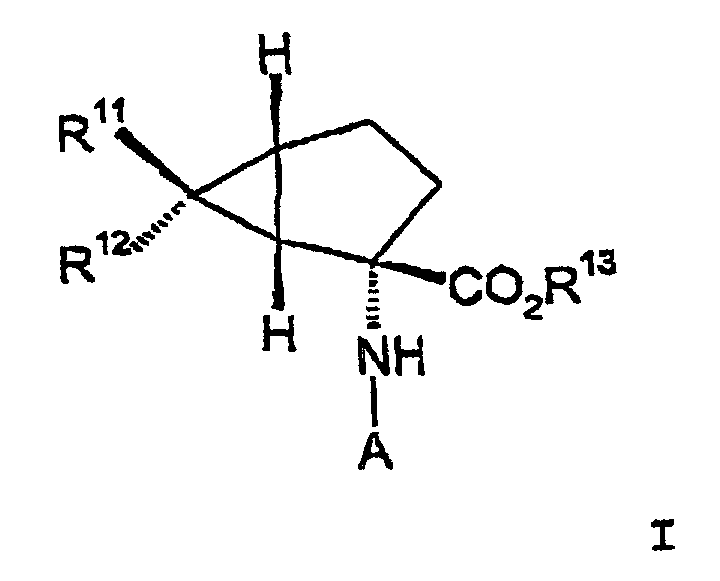 wherein
Description
- This invention relates to synthetic excitatory amino acid prodrugs (and their pharmaceutically acceptable salts) and processes for their preparation. The invention further relates to methods of using, and pharmaceutical compositions comprising, the compounds for the treatment of neurological disorders and psychiatric disorders.
- Treatment of neurological or psychiatric disorders, such as anxiety disorder, have been linked to selective activation of metabotropic excitatory amino acid receptors such as (+)-2-aminobicyclo[3.1.0]hexane-2,6-dicarboxylic acid, also known as LY354740, which is disclosed in U.S. Patent No. 5,750,566 (the '566 patent) issued May 12, 1998 is an active mGluR2 receptor agonist. CNS Drug Reviews, 5, pgs. 1-12 (1999).
- The present invention provides for a prodrug form of LY354740 which enhances the oral exposure of LY354740. The present invention also provides for prodrug forms of other compounds which possess improved oral exposure. Compounds of the present invention represent an improved approach for maintaining LY354740-like safety and efficacy in humans with increased oral bioavailability. Preclinical studies with compounds of the present invention have shown greatly enhanced oral exposure of the parent compound.
- Accordingly, the present invention provides a compound of the formula Iwherein
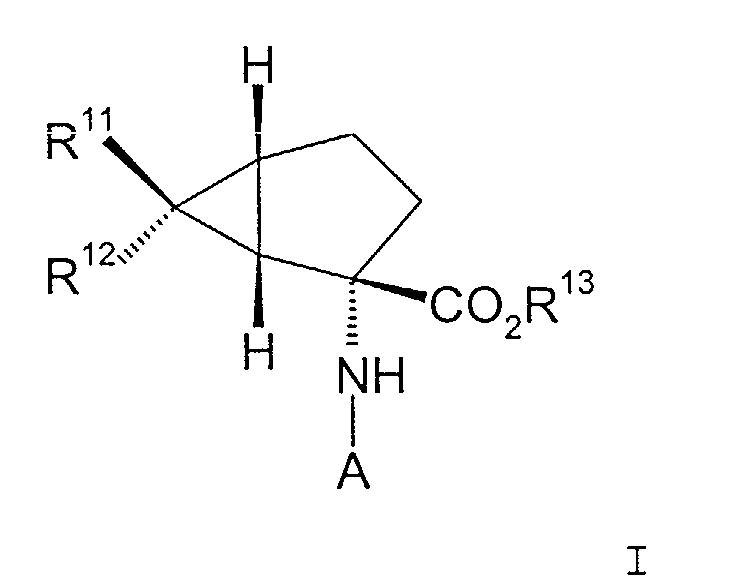
R11 is CO2R14 and R12 is hydrogen or fluoro; or R11 is hydrogen or fluoro and R12 is CO2R14;
R13 and R14 are independently hydrogen, (1-10C) alkyl, (2-4C) alkenyl, aryl or arylalkyl;
A is (Q)p- ;
p is any integer from 1-10; and
Q is independently selected, each time taken, from the group amino acyl;
provided that the compound is not one in which R11 is CO2R14; R12, R13 and R14 are hydrogen; p is 1 and Q is L-alanyl;
or a pharmaceutically acceptable salt thereof. - Compounds of the present invention have been found to be useful prodrugs for selective agonists of metabotropic glutamate receptors and are therefore useful in the treatment of diseases of the central nervous system such as neurological diseases, for example neurodegenerative diseases, and as antipsychotic, anxiolytic, drug-withdrawal, antidepressant, anticonvulsant, analgesic and anti-emetic agents.
- It will be appreciated that the compounds of formula (I) contain at least four asymmetric carbon atoms, three being in the cyclopropane ring and one being at the α-carbon of the amino acid group within the cyclopentane ring. Additional asymmetric carbons may be present in the generic radicals as defined. Accordingly, the compounds of the invention may exist in and be isolated in enantiomerically pure form, in racemic form, or in a diastereoisomeric mixture.
- The amino acid moiety within the cyclopentane ring preferably has the natural amino acid configuration, i.e. the L-configuration relating to D-glyceraldehyde.
- The present invention includes pharmaceutically acceptable salts of the compound of formula I. These salts can exist in conjunction with the acidic or basic portion of the molecule and can exist as acid addition, primary, secondary, tertiary, or quaternary ammonium, alkali metal, or alkaline earth metal salts. Generally, the acid addition salts are prepared by the reaction of an acid with a compound of formula I. The alkali metal and alkaline earth metal salts are generally prepared by the reaction of the hydroxide form of the desired metal salt with a compound of formula I.
- Acids commonly employed to form such salts include inorganic acids, for example hydrochloric, hydrobromic, nitric, sulphuric or phoshoric acids, or with organic acids, such as organic carboxylic acids, for example, glycollic, maleic, hydroxymaleic, fumaric, malic, tartaric, citric, salicyclic, o-acetoxybenzoic, or organic sulphonic acids, for example, 2-hydroxyethane sulphonic, toluene-p-sulphonic, methane-sulfonic or naphthalene-2-sulphonic acid.
- In addition to pharmaceutically-acceptable salts, other salts are included in the invention. They may serve as intermediates in the purification of compounds or in the preparation of other, for example pharmaceutically-acceptable, acid addition salts, or are useful for identification, characterization or purification.
- A variety of physiological functions have been shown to be subject to influence by excessive or inappropriate stimulation of excitatory amino acid transmission. The compounds of formula I of the present invention are believed to have the ability to treat a variety of neurological disorders in mammals associated with this condition, including acute neurological disorder such as cerebral deficits subsequent to cardiac bypass surgery and grafting, stroke, cerebral ischemia, spinal cord trauma, head trauma, perinatal hypoxia, cardiac arrest, and hypoglycemic neuronal damage. The compounds of formula I are believed to have the ability to treat a variety of chronic neurological disorders, such as Alzheimer's disease, Huntington's Chorea, amyotrophic lateral sclerosis, AIDS-induced dementia, ocular damage and retinopathy, cognitive disorders, and idiopathic and drug-induced Parkinson's. The present invention also provides methods for treating these disorders which comprises administering to a patient in need thereof an effective amount of a compound of formula I or a pharmaceutically acceptable salt thereof.
- The compounds of formula I of the present invention treat a variety of other neurological disorders in patients that are associated with glutamate dysfunction, including muscular spasms, convulsions, migraine headaches, urinary incontinence, pain, premenstrual dysphoric disorder (PDD), psychosis, (such as schizophrenia), drug tolerance and withdrawal (such as nicotine, opiates and benzodiazepines), anxiety and related disorders, emesis, brain edema, chronic pain, and tardive dyskinesia. The compounds of formula I are also useful as antidepressant and analgesic agents. Therefore, the present invention also provides methods for treating these disorders which comprise administering to a patient in need thereof an effective amount of the compound of formula I, or a pharmaceutically acceptable salt thereof.
- A compound of formula I may be made by a process which is analogous to one known in the chemical art for the production of structurally analogous heterocyclic compounds or by a novel process described herein. Such processes and intermediates useful for the manufacture of a compound of formula I as defined above are provided as further features of the invention and are illustrated by the following procedures in which, unless otherwise specified, the meanings of the generic radicals are as defined above.
- (A) For a compound of formula I in which R13 and R14
are hydrogen, deprotecting a compound of formula IV
where Rm is an amine protecting group and R13 and R14 are carboxy protecting groups as described in the General Procedures for Examples 22-42.

- (B) For a compound of formula I in which R13 and R14
are not both hydrogen, acylating a compound of formula II
with a corresponding amino acyl of formula III.

- (C) For a compound of formula II where R13 and R14 are not hydrogen, esterifying a compound of formula II where R13 and R14 are both hydrogen (a di-acid).
-
- The term "amine protecting group," as used herein, refers to those groups intended to protect or block the amine group against undesirable reactions during synthetic procedures. Choice of the suitable amine protecting group used will depend upon the conditions that will be employed in subsequent reaction steps wherein protection is required, as is well within the knowledge of one of ordinary skill in the art. Commonly used amine protecting groups are disclosed in T.W. Greene and P.G.M. Wuts, Protective Groups In Organic Synthesis, 3rd Ed. (John Wiley & Sons, New York (1999)). The amine protecting group is decomposed by using a conventional procedure which does not affect another portion of the molecule.
- The term "carboxy protecting group" as used herein refers to one of the ester derivatives of the carboxylic acid group commonly employed to block or protect the carboxylic acid group while reactions are carried out on other functional groups of the compound. Particular values of carboxy protecting group include, for example, methyl, ethyl, tert-butyl, benzyl, methoxymethyl, trimethylsilyl, and the like. Further examples of such groups as well as carboxy-protecting groups may be found in T.W. Greene and P.G.M. Wuts, Protecting Groups in Organic Synthesis, 3rd. Ed. (John Wiley & Sons, N.Y. (1999)). The ester is decomposed by using a conventional procedure which does not affect another portion of the molecule.
- Whereafter, for any of the above procedures, when a pharmaceutically acceptable salt of a compound of formula I is required, it is obtained by reacting the acid of formula I with a physiologically acceptable base or by reacting a basic compound of formula I with a physiologically acceptable acid or by any other conventional procedure.
- The term "(1-10C) alkyl" represents a straight, branched, or cyclic alkyl chain having from one to ten carbon atoms. Typical straight or branched (1-10C) alkyl groups include methyl, ethyl, n-propyl, isopropyl, n-butyl, isobutyl, sec-butyl, t-butyl, n-pentyl, isopentyl, neopentyl, n-hexyl, 2-methylpentyl, 3-methylpentyl, 4-methylpentyl, 2,2-dimethylbutyl, 2,3-dimethylbutyl, 3,3-dimethylbutyl, heptyl, n-octyl, 2,2-dimethylhexyl, 2,5-dimethylhexyl, 2-methylheptyl, 4-methylheptyl, 2,2,4-trimethylpentyl, 2,3,4-trimethylpentyl, nonyl, 3,5,5-trimethylhexyl, decyl, 3,7-dimethyloctyl, and the like. Typical cyclic alkyl groups include cyclopropyl, cyclobutyl, cyclopentyl, cyclohexyl, cycloheptyl, and the like. The term "(1-10C) alkyl" includes within it the terms "(1-6C) alkyl" and "(1-4C) alkyl". Typical (1-6C) alkyl groups include methyl, ethyl, n-propyl, isopropyl, n-butyl, isobutyl, sec-butyl, t-butyl, n-pentyl, isopentyl, neopentyl, and n-hexyl. Preferred (1-10C) alkyl groups include methyl.
- The term "(2-4C) alkenyl" represents straight or branched unsaturated alkyl chains having from two to four carbon atoms, and having one or more carbon-carbon double bond, such as, dienes. Examples of (2-4C) alkenyl include allyl.
- The term "aryl" represents groups such as phenyl, substituted phenyl, and naphthyl. The term "arylalkyl" represents a (1-4C) alkyl group bearing one or more aryl groups. Examples of arylalkyl groups include benzyl.
- The term "amino acyl" means an amino acyl derived from an amino acid selected from the group consisting of natural and unnatural amino acids as defined herein. The natural amino acids may be neutral, positive or negative depending on the substituents in the side chain. "Neutral amino acid" means an amino acid containing uncharged side chain substituents. Exemplary neutral amino acids include alanine, valine, leucine, isoleucine, proline, phenylalanine, tryptophan, methionine, glycine, serine, threonine and cysteine. "Positive amino acid" means an amino acid in which the side chain substituents are positively charged at physiological pH. Exemplary positive amino acids include lysine, arginine and histidine. "Negative amino acid" means an amino acid in which the side chain substituents bear a net negative charge at physiological pH. Exemplary negative amino acids include aspartic acid and glutamic acid. Preferred amino acids are α-amino acids. The most preferred amino acids are α-amino acids having L stereochemistry at the α-carbon. Exemplary natural α-amino acids are valine, isoleucine, proline, phenylalanine, tryptophan, methionine, glycine, serine, threonine, cysteine, tyrosine, asparagine, glutamine, lysine, arginine, histidine, aspartic acid and glutamic acid.
- "Unnatural amino acid" means an amino acid for which there is no nucleic acid codon. Examples of unnatural amino acids include, for example, the D-isomers of the natural α-amino acids as indicated above; Aib (aminobutyric acid), βAib (3-aminoisobutyric acid), Nva (norvaline), β-Ala, Aad (2-aminoadipic acid), βAad (3-aminoadipic acid), Abu (2-aminobutyric acid), Gaba (γ-aminobutyric acid), Acp (6-aminocaproic acid), Dbu (2,4-diaminobutryic acid), α-aminopimelic acid, TMSA (trimethylsilyl-Ala), aIle (alloisoleucine), Nle (norleucine), tert-Leu, Cit (citrulline), Orn, Dpm (2,2'-diaminopimelic acid), Dpr (2,3-diaminopropionic acid), α- or β-Nal, Cha (cyclohexyl-Ala), hydroxyproline, Sar (sarcosine), O-methyl tyrosine, phenyl glycine and the like; cyclic amino acids; Na-alkylated amino acids where Na-alkylated amino acid is Na-(1-10C)alkyl amino acid such as MeGly (Na-methylglycine), EtGly (Na-ethylglycine) and EtAsn (Na-ethylasparagine) and amino acids in which the α-carbon bears two side-chain substituents. Exemplary unnatural α-amino acids include D-alanine, D-leucine and phenylglycine. The names of natural and unnatural amino acids and residues thereof used herein follow the naming conventions suggested by the IUPAC-IUB Joint Commission on Biochemical Nomenclature (JCBN) as set out in "Nomenclature and Symbolism for Amino Acids and Peptides (Recommendations, 1983)" European Journal of Biochemistry, 138, 9-37 (1984). To the extent that the names and abbreviations of amino acids and residues thereof employed in this specification and appended claims differ from those noted, differing names and abbreviations will be made clear.
- While all the compounds of formula I of the present invention are believed to provide improved oral exposure, certain compounds of the invention are preferred for such use. Preferably, R11 is CO2R14; R12, R13 and R14 are hydrogen; p is 1-3; and Q is independently selected, each time taken, from L-alanyl, glycyl, L-leucyl, L-phenylalanyl, L-valyl, L-lysyl, L-tryptophyl, L-isoleucyl, L-methionyl, L-glutamyl, L-tyrosyl, D-alanyl, L-prolyl, L-serinyl, D-leucyl, L-asparagyl and L-threonyl. Representative compounds from this preferred group of formula I compounds include:
- a) (1S,2S,5R,6S)-2-[(2'S)-(2'-Amino)-3'-phenylpropionyl]amino-bicyclo[3.1.0]hexane-2,6-dicarboxylic acid hydrochloride;
- b) (1S,2S,5R,6S)-2-[(2'S)-(2'-Amino)-3'-methylbutyryl]amino-bicyclo[3.1.0]hexane-2,6-dicarboxylic acid hydrochloride;
- c) (1S,2S,5R,6S)-2-[(2'S,3'S)-(2'-Amino-3'-methylpentanoylamino)-bicyclo[3.1.0]hexane-2,6-dicarboxylic acid hydrochloride;
- d) (1S,2S,5R,6S)-2-(2-Amino-acetylamino)-bicyclo[3.1.0]hexane-2,6-dicarboxylic acid;
- e) (1S,2S,5R,6S)-2-[(2'S)-(2'-Amino)-(4'-methylthio)-butyryl]amino-bicyclo[3.1.0]hexane-2,6-dicarboxylic acid;
- f) (1S,2S,5R,6S)-2-[(2'S)-(2'-amino)-(3'-p-hydroxyphenyl)-propionyl]amino-bicyclo[3.1.0]hexane-2,6-dicarboxylic acid;
- g) (1S,2S,5R,6S)-2-[(2'S,3'R)-2-amino-3-hydroxy)-butyryl)amino-bicyclo[3.1.0]hexane-2,6-dicarboxylic acid;
- h) (1S,2S,5R,6S)-2-[2'S-(2"S-amino-4-methylpentanonylamino)-propionylamino]-bicyclo[3.1.0]hexane-2,6-dicarboxylic acid; and
- i) (1S,2S,5R,6S)-2-[2'(S)-(2"(S)-amino-propionylamino)-propionylamino]-bicyclo[3.1.0]hexane-2,6-dicarboxylic acid.
-
- More preferred compounds of formula I are where p is 1. Representative compounds from this more preferred group of formula I compounds include (1S,2S,5R,6S)-2-[(2'S)-(2'-amino-4'-methyl)-pentanoyl]amino-bicyclo[3.1.0]hexane-2,6-dicarboxylic acid.
- The term "affecting" refers to a formula I compound acting as an agonist at an excitatory amino acid receptor. The term "excitatory amino acid receptor" refers to a metabotropic glutamate receptor, a receptor that is coupled to cellular effectors via GTP-binding proteins. The term "cAMP-linked metabotropic glutamate receptor" refers to a metabotropic receptor that is coupled to inhibition of adenylate cyclase activity.
- The term "neurological disorder" refers to both acute and chronic neurodegenerative conditions, including cerebral deficits subsequent to cardiac bypass surgery and grafting, cerebral ischemia (for example stroke resulting from cardiac arrest), spinal cord trauma, head trauma, Alzheimer's Disease, Huntington's Chorea, amyotrophic lateral sclerosis, AIDS-induced dementia, perinatal hypoxia, hypoglycemic neuronal damage, ocular damage and retinopathy, cognitive disorders, idiopathic and drug-induced Parkinson's Disease. This term also includes other neurological conditions that are caused by glutamate dysfunction, including muscular spasms, migraine headaches, urinary incontinence, drug tolerance, withdrawal, and cessation (i.e. opiates, benzodiazepines, nicotine, cocaine, or ethanol), smoking cessation, emesis, brain edema, chronic pain, sleep disorders, convulsions, Tourette's syndrome, attention deficit disorder, and tardive dyskinesia.
- The term "psychiatric disorder" refers to both acute and chronic psychiatric conditions, including schizophrenia, anxiety and related disorders (e.g. panic attack and stress-related cardiovascular disorders), depression, bipolar disorders, psychosis, and obsessive compulsive disorders.
- A used herein the term "effective amount" refers to the amount or dose of the compound, upon single or multiple dose administration to the patient, which provides the desired effect in the patient under diagnosis or treatment.
- An effective amount can be readily determined by the attending diagnostician, as one skilled in the art, by the use of known techniques and by observing results obtained under analogous circumstances. In determining the effective amount or dose of compound administered, a number of factors are considered by the attending diagnostician, including, but not limited to: the species of mammal; its size, age, and general health; the spe4cific disease involved; the degree of or involvement or the severity of the disease; the response of the individual patient; the particular compound administered; the mode of administration; the bioavailability characteristics of the preparation administered; the dose regimen selected; the use of concomitant medication; and other relevant circumstances. For example, a typical daily dose may contain from about 25 mg to about 300 mg of the active ingredient. The compounds can be administered by a variety of routes including oral, rectal, transdermal, subcutaneous, intravenous, intramuscular, bucal or intranasal routes. Alternatively, the compound may be administered by continuous infusion.
- As used herein the term "patient" refers to a mammal, such as a mouse, guinea pig, rat, dog or human. It is understood that the preferred patient is a human.
- The term "treating" (or "treat") as used herein includes its generally accepted meaning which encompasses prohibiting, preventing, restraining, and slowing, stopping, or reversing progression of a resultant symptom. As such, the methods of this invention encompass both therapeutic and prophylactic administration.
- If not commercially available, the necessary starting materials for the above procedures may be made by procedures which are selected from standard techniques of organic and heterocyclic chemistry, techniques which analogous to the syntheses of known, structurally similar compounds, and the procedures described in the Examples, including novel procedures.
- A further aspect of the present invention provides for a method of administering an effective amount of a compound of formula II, where R13 and R14 are both hydrogen (a di-acid), which comprises administering to a patient requiring modulated excitatory amino acid neurotransmission a pharmaceutically-effective amount of a compound of formula I.
- Compounds of formula I are converted via enzymatic or hydrolytic process in vivo, to form compounds of formula II, where R13 and R14 are both hydrogen (a di-acid).

- A crystalline form of a compound of formula I may be prepared according to the route outlined in Scheme 2 below in which each R13 and R14, respectively, represents a value defined for the groups R13 and R14. The process described in Scheme 2 is a synthesis method for the preparation of a crystalline hydrochloride form of a compound of formula I and a methanesulfonate salt form of a compound of formula I.

- In scheme 2 above, the monohydrate of II, where R13 and R14 are both hydrogen (a di-acid), is treated with carboxy protecting agents such as thionyl chloride or hydrochloric acid in methanol to afford the corresponding di-ester of II.
- Alternatively, compound II is treated with amine protecting agents such as di-tert-butyl dicarbonate in a suitable base such as sodium hydroxide to afford compound V where R13 and R14 are both hydrogen. Convenient solvents include tetrahydrofuran.
- Compound V is treated with carboxy protecting agents such as methyl iodide in a suitable base such as potassium carbonate to afford compound V where R13 and R14 are both carboxy protecting groups. Convenient solvents include dimethylforamide. Compound V is treated with amine deprotecting agents such as hydrochloric acid to afford the diester compound of formula II where R13 and R14 are both carboxy protecting groups. Convenient solvents include ethyl acetate.
- The di-ester, formula II, is amidated with a compound of formula III using dicyclohexylcarbodiimide (DCC), 1-(3-dimethylaminopropyl)-3-ethylcarbodiimide (EDCI) or isobutyl chloroformate as coupling agents to afford a di-ester protected peptidyl compound of formula I. This transformation could also be achieved using the acid chloride or by using a variety of other peptide coupling reagents, for example, diphenyl chlorophosphate and 2-chloro-4,6-dimethoxy-1,3,5-triazine (CDMT), bis(2-oxo-3-oxazolidinyl)phosphinic chloride and benzotriazol-1-yloxytris(dimethylamino)phosphonium hexafluorophosphate.
- The hydrolysis of the di-ester protected peptidyl compound of formula I with a suitable base such as lithium hydroxide or sodium hydroxide in THF affords the di-acid protected peptidyl compound of formula I, where R13 and R14 are both hydrogen (a di-acid). The di-acid amine protected peptidyl compound of formula IV may be deprotected with a mineral or organic acid in a suitable solvent. Such conditions may produce the corresponding acid salt of the di-acid peptidyl compound of formula I as an amorphous solid or, directly, a crystalline solid. In the case of an amorphous solid, subsequent crystallization may occur from suitable solvents. For example, a di-acid protected peptidyl compound of formula IV when treated hydrogen chloride gas in ethyl acetate provides the deprotected hydrochloride salt as an amorphous solid. The amorphous hydrochloride compound may then be crystallized from acetone and water to afford the crystalline hydrochloride salt compound of formula I. In the case of a crystalline solid which is formed directly, filtration of the reaction mixture may afford the crystalline salt. The zwitterionic compound of formula I is afforded by treatment of the crystalline hydrochloride salt of formula I with sodium hydroxide or by purification by HPLC using an appropriate buffered solvent mixture. It will be appreciated by one of ordinary skill in the art that a compound of formula I may be prepared in one procedure where the indicated intermediates are not isolated.
- The ability of compounds to modulate metabotropic glutamate receptor function may be demonstrated by examining their ability to influence either cAMP production (mGluR 2, 3, 4, 6, 7 or 8) or phosphoinositide hydrolysis (mGluR 1 or 5) in cells expressing these individual human metabotropic glutamate receptor (mGluR) subtypes. (D. D. Schoepp, et al., Neuropharmacol., 1996, 35, 1661-1672 and 1997, 36, 1-11) .
- The ability of compounds of formula I to treat anxiety or a related disorder may be demonstrated using the well known fear potentiated startle and elevated plus maze models of anxiety described respectively in Davis, Psychopharmacology, 62:1;1979 and Lister, Psychopharmacol, 92:180-185; 1987
- To study the in vivo exposure of LY354740 following oral dosing of compounds of the present invention in comparison to LY354740, studies measuring the plasma concentrations of LY354740 in rats were performed.
- Mature Fischer 344 male rats (190-270 gram) were obtained from Harlan Sprague-Dawley, Cumberland, IN, USA and acclimated in the study housing for 3 days. On day 4, test compounds were dissolved in buffered water (1mg/ml = test compound/20mM potassium dihydrogen phosphate, pH=2) and given orally (P. O.) as a single 5mg/kg dose. Blood samples were collected through orbital sinus or cardiac puncture (last time point) at 0.5 and 1 hour or, alternatively, 1 and 3 hours. Plasma samples were stored at -20°C in the presence of phenylmethylsulfonyl fluoride, a protease inhibitor, prior to analysis. Plasma samples and internal standard compounds were pretreated by solid phase extraction (SAX support, methanol/water/dilute acetic acid). As shown in the second row of Table 1, below, the plasma concentrations (ng/ml) of LY354740 for each test compound were determined by LC/MS/MS and are presented as a sum of the concentrations at the 0.5 and 1 hour or, alternatively, 1 and 3 hour sample time points.
Comparison of plasma concentrations of LY354740 and compounds of the present invention Compound (@5mg/kg p. o.) Plasma Concentration of LY354740, ng/ml (sum of 0.5 and 1 hour) LY354740 466 Example 22 7114 Example 23 8812 Example 24 4037 Example 25 4512 Example 27 2180 Example 28 4041 Example 29 4094 Example 30 5827 Example 31 2334 Example 32 4079 Example 35 5174 Example 36 3652 Example 38 2861 Example 39 4791 - The compounds of the present invention are preferably formulated prior to administration. Therefore, another aspect of the present invention is a pharmaceutical formulation comprising a compound of formula I, a pharmaceutically acceptable metabolically labile ester thereof, or a pharmaceutically acceptable salt thereof, and a pharmaceutically-acceptable carrier, diluent, or excipient. The pharmaceutical formulations may be prepared by procedures using well-known by one of ordinary skill in the art. In making the compositions of the present invention, the active ingredient will usually be mixed with a carrier, or diluted by a carrier, or enclosed within a carrier, and may be in the form of a capsule, sachet, paper, or other container. When the carrier serves as a diluent, it may be a solid, semi-solid, or liquid material which acts as a vehicle, excipient, or medium for the active ingredient. The compositions can be in the form of tablets, pills, powders, lozenges, sachets, cachets, elixirs, suspensions, emulsions, solutions, syrups, aerosols, ointments containing, for example, up to 10% by weight of active compound, soft and hard gelatin capsules, suppositories, sterile injectable solutions, and sterile packaged powders.
- Some examples of suitable carriers, excipients, and diluents include lactose, dextrose, sucrose, sorbitol, mannitol, starches, gum, acacia, calcium phosphate, alginates, tragacanth, gelatin, calcium silicate, microcrystalline cellulose, polyvinylpyrrolidone, cellulose, water syrup, methyl cellulose, methyl and propyl hydroxybenzoates, talc, magnesium stearate, and mineral oil. The formulations can additionally include lubricating agents, wetting agents, emulsifying and suspending agents, preserving agents, sweetening agents, or flavoring agents. Compositions of the invention may be formulated so as to provide quick, sustained, or delayed release of the active ingredient after administration to the patient by employing procedures well known in the art.
- The compositions are preferably formulated in a unit dosage form, each dosage containing from about 5 mg to about 500 mg, more preferably about 25 mg to about 300 mg of the active ingredient. As used herein, the term "active ingredient" refers to a compound included within the scope of formula I.
- The term "unit dosage form" refers to a physically discrete unit suitable as unitary dosages for human subjects and other mammals, each unit containing a predetermined quantity of active material calculated to produce the desired therapeutic effect, in association with a suitable pharmaceutical carrier, diluent, or excipient.
- The following Examples further illustrate the compounds of the present invention and the methods for their synthesis. The Examples are not intended to be limiting to the scope of the invention in any respect, and should not be so construed. All experiments were run under a positive pressure of dry inert gas such as nitrogen or argon. All solvents and reagents were purchased from commercial sources and used as received, unless otherwise indicated. Dry tetrahydrofuran (THF) was obtained by distillation from sodium or sodium benzophenone ketyl prior to use. Proton nuclear magnetic resonance (1H NMR) spectra were obtained on a Bruker Avance II bay-500 at 500 MHz, a Bruker Avance I bay-200GE at 200MHz or a Varian Inova at 500 MHz. Electrospray mass spectroscopy (ESI) was performed on a Agilent MSD/B intrument using acetonitrile/aqueous ammonium acetate as a mobile phase. Free atom bombardment mass spectroscopy (FABMS) was performed on a VG ZAB-2SE instrument. Field desorption mass spectroscopy (FDMS) was performed using either a VG 70SE or a Varian MAT 731 instrument. Optical rotations were measured with a Perkin-Elmer 241 polarimeter. Chromatographic separation on a Waters Prep 500 LC was generally carried out using a linear gradient of the solvents indicated in the text. The reactions were generally monitored for completion using thin layer chromatography (TLC). Thin layer chromatography was performed using E. Merck Kieselgel 60 F254 plates, 5 cm X 10 cm, 0.25 mm thickness. Spots were detected using a combination of UV and chemical detection (plates dipped in a ceric ammonium molybdate solution [75 g of ammonium molybdate and 4 g of cerium (IV) sulfate in 500 mL of 10% aqueous sulfuric acid] and then heated on a hot plate). Flash or silica gel chromatography was performed as described by Still, et al. Still, Kahn, and Mitra, J. Org. Chem., 43, 2923 (1978). Elemental analyses for carbon, hydrogen, and nitrogen were determined on a Control Equipment Corporation 440 Elemental Analyzer, or were performed by the Universidad Complutense Analytical Centre (Facultad de Farmacia, Madrid, Spain). Melting points were determined in open glass capillaries on a Gallenkamp hot air bath melting point apparatus or a Büchi melting point apparatus, and are uncorrected.
- The abbreviations, symbols and terms used in the examples have the following meanings.
- Ac = acetyl
- Anal. = elemental analysis
- Bn or Bzl = benzyl
- Bu = butyl
- BOC = tert-butoxycarbonyl
- calcd = calculated
- D2O = deuterium oxide
- DCC = dicyclohexylcarbodiimide
- DIBAL-H = diisobutyl aluminum hydride
- DMAP = dimethylaminopyridine
- DMF = dimethylformamide
- DMSO = dimethylsulfoxide
- EDC = N-ethyl-N'N'-dimethylaminopropyl carbodiimide
- Et = ethyl
- EtOH = ethanol
- FAB = Fast Atom Bombardment (Mass Spectrascopy)
- FDMS = field desorption mass spectrum
- HOAt = 1-hydroxy-7-azabenzotriazole
- HOBt = 1-hydroxybenzotriazole
- HPLC = High Performance Liquid Chromatography
- HRMS = high resolution mass spectrum
- i-PrOH = isopropanol
- IR = Infrared Spectrum
- L = liter
- Me = methyl
- MeOH = methanol
- MPLC = Medium Pressure Liquid Chromatography
- Mp = melting point
- MTBE = t-butyl methyl ether
- NBS = N-bromosuccinimide
- NMR = Nuclear Magnetic Resonance
- Ph = phenyl
- p.o. = oral administration
- i-Pr = isopropyl
- Rochelle's Salt = potassium sodium tartrate
- SM = starting material
- TBS = tert-butyldimethylsilyl
- TEA = triethylamine
- Temp. = temperature
- TFA = trifluoroacetic acid
- THF = tetrahydrofuran
- TLC = thin layer chromatography
- t-BOC = tert-butoxycarbonyl
-
-

- A 1 L flask was charged with (1S,2S,5R,6S)-2-aminobicyclo[3.1.0]hexane-2,6-dicarboxylic acid monohydrate (24.4 g, 0.12 mol, 1 equiv), dioxane (200 mL) and di-tert-butyl dicarbonate (52.4 g, 0.24 mol, 2.0 equiv). The suspension was vigorously stirred while IN sodium hydroxide (420 mL, 3.5 equiv) was added. The mixture was stirred for 2 days, then 2.0 more equiv of di-tert-butyl dicarbonate were added and the reaction stirred for 3 additional days at room temperature. After 5 total days of reaction, water (400 mL) was added to dissolve the salts. The aqueous layer was extracted with ethyl acetate (4 x 100 mL) and acidified to pH 2 with 6 N hydrochloric acid. The acidic aqueous phase was extracted with ethyl ether (6 x 200 mL). The combined ether extracts were washed with water (250 mL) and brine (250 mL). After drying over sodium sulfate, solvents were evaporated under vacuum to afford a foamy white solid (26.4 g).
77% Yield; mp 100-101 °C.
[α]D 25 = - 41.1 ° (c = 1.0, MeOH).
1H NMK (Methanol-d 4) δ: 4.98 (brs, 1H), 2.44 (dd, 1H, J = 6.2, 2.6 Hz), 2.19-1.92 (m, 4H), 1.62 (t, 1H, J = 2.8 Hz), 1.43 (s, 9H), 1.29 (m, 1H).
13C NMR (Methanol-d 4) δ: 175.6, 175.2, 158.2, 60.1, 34.6, 31.9, 28.4, 27.2, 25.6, 20.6.
MS (Electrospray): 285.12. -

- (1S,2S,5R,6S)-2-tert-Butoxycarbonylaminobicyclo[3.1.0]hexane-2,6-dicarboxylic acid (20 g, 0.07 mol, 1.0 equiv) was dissolved in 210 ml of dry dimethylformamide and potassium carbonate (21.3 g, 0.154 mol, 2.2 equiv) was added at 0 °C under nitrogen. After 15 minutes, methyl iodide (17.6 ml, 0.28 mol, 4.0 equiv) was added. The reaction mixture was warmed up slowly and stirred at room temperature for 3h. Water (200 ml) was added and the aqueous phase was extracted with ethyl ether (4 x 75 ml each). The combined organic phase was washed with cold water (4 x 50 ml), and the aqueous phase extracted again with ethyl ether (2 x 50 ml). After drying the organic phase over sodium sulfate and evaporating under vacuum, a foamy solid ((1S,2S,5R,6S)-2-tert-butoxycarbonylaminobicyclo[3.1.0]hexane-2,6-dicarboxylic acid-2,6-dimethyl ester) was obtained (19.2 g, 87% yield).
- This compound was diluted with 150 ml of a saturated solution of hydrogen chloride gas in ethyl acetate and the mixture vigorously stirred for 1 hour (a white precipitate appeared within 15 minutes). The solid was filtered, rinsed with ethyl ether and thoroughly dried under high vacuum.
73% Yield; mp 193-194 °C.
[α]D 25 = + 22.2 ° (c = 1.0, MeOH).
1H NMR (D2O) δ: 3.86 (s, 3H), 3.67 (s, 3H), 2.31-2.04 (m, 6H), 1.57 (m, 1H).
13C NMR (Methanol-d 4) δ: 171.9, 170.2, 65.6, 52.8, 51.2, 32.4, 29.9, 28.5, 26.2, 20.7. -
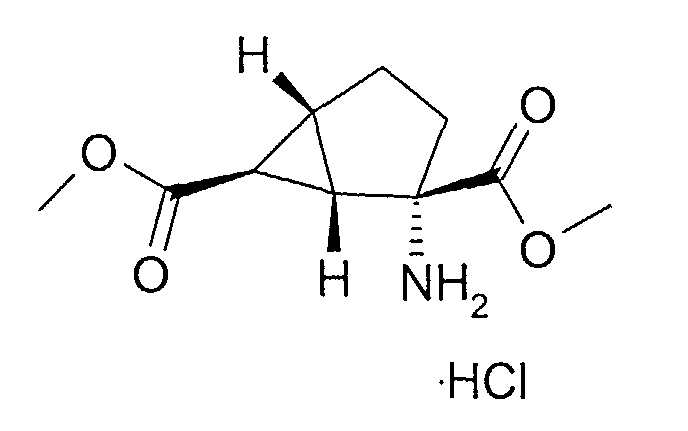
- Thionyl chloride (807 mL, 11.1 mol) was added to methanol (9.5 L) over a period of 1 h while maintaining the temperature between 2 - 20 °C. The solution was maintained for 30 min, then (1S,2S,5R,6S)-2-amino-bicyclo[3.1.0]hexane-2,6-dicarboxylic acid monohydrate (1.61 kg, 7.92 mol) was added. The resulting solution was heated to 47 °C and maintained between 47 - 50 °C for 17 h. Approximately 7.3 L of methanol was then removed by vacuum distillation (47 - 50 °C, 240 - 275 mm Hg). The remaining methanol was removed by azeotropic distillation with t-butyl methyl ether (MTBE) at atmospheric pressure [added MTBE (10 L), removed 8.5 L; added MTBE (10 L), removed 8.5 L; added MTBE (8 L), removed 5.1 L]. During the course of the distillations a white solid began to precipitate from the solution. After completion of the distillations, MTBE (2 L) was added to the resulting slurry, and the slurry was cooled to 22 °C. The solid was filtered, rinsed with MTBE (2 L) and dried under vacuum to afford 1.94 kg (98%) of the title compound as a white solid.
Analysis Calculated for C10H16NO4Cl: C, 48.10; H, 6.46; N, 5.61; Cl, 14.20.;
Found: C, 47.88; H, 6.25; N, 5.57; Cl, 14.52. -
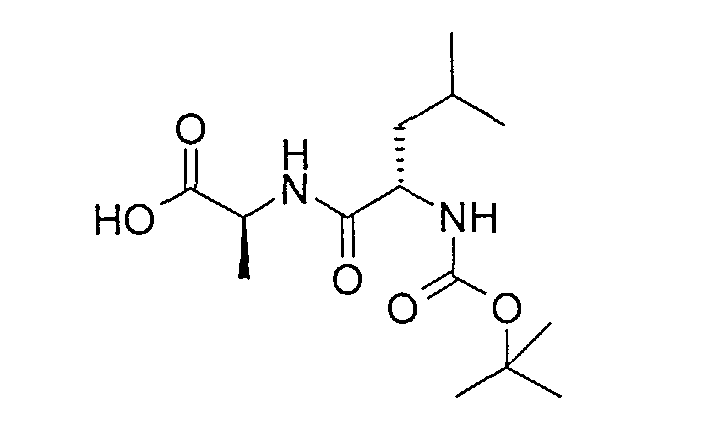
- In a flask containing L-leucinyl-L-alanine (5 mmol), di-tert-butyl dicarbonate (10 mmol) dissolved in 15 mL of dioxane and 15 mL of saturated aqueous sodium bicarbonate were added. The reaction was stirred at room temperature overnight. It was diluted with water (100 mL) and washed with EtOAc (2x50 mL). The aqueous layer was acidified to pH 1 with 6N hydrochloric acid and extracted with EtOAc. The organic layer was washed with brine, dried over MgSO4, filtered and evaporated to provide the title compound. Yield: 78%
1H NMR (CDCl3) : 6.90 (bs, 1 H); 5.15 (bs, 1 H); 4.63-4.46 (m, 1 H); 4.17-4.06 (m, 2 H); 1.75-1.43 (m, 15 H); 0.95-0.91 (m, 6 H) . -
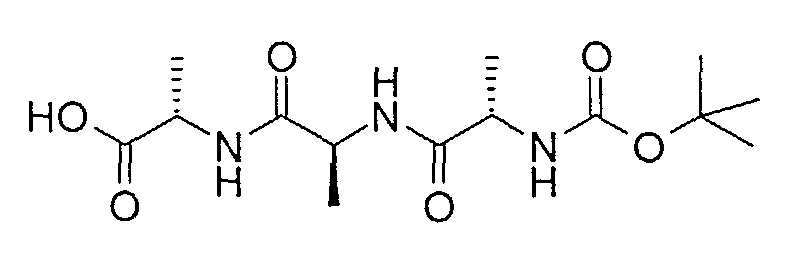
- The title compound was prepared according to the procedure of Preparation 3 substituting L-alanyl-L-alanyl-L-alanine for L-leucinyl-L-alanine.
1H NMR (CD3OD): 4.48-4.38 (2 H, m), 4.10-4.03 (1H, m), 1.50 (9H, s), 1.4-1.2 (9H, 3 x d, 7.0 Hz)
MS: m/z 231 [M + H - CO2tBu] - The starting dimethyl ester hydrochloride salt (1.0 equiv), the product of Preparation 2, was suspended in dry dichloromethane (0.1 M solution) under nitrogen. The corresponding N-BOC-aminoacid (1.3 to 1.5 equiv), N-ethyl-N',N'-dimethylaminopropylcarbodiimide (EDC, 1.4 to 1.5 equiv) and 1-hydroxybenzotriazole (HOBt, 1.2 to 1.5 equiv) were added in one portion, followed by triethyl amine(1.0 to 1.3 equiv) via syringe and, finally, dimethylaminopyridine (DMAP, 0.1 equiv). The reaction mixture was stirred overnight at room temperature, then hydrolyzed by addition of IN hydrochloric acid (20 ml / mmol) and diluted with methylene chloride (10 ml / mmol). The aqueous layer was extracted with methylene chloride (5 ml / mmol) and the combined organic layers washed twice with 1 N hydrochloric acid (10 ml / mmol), and finally with water and brine (10 ml / mmol each). After drying over sodium sulfate and evaporation under vacuum the crude residue was purified by silica gel chromatography using the appropriate eluent for example mixtures hexanes and ethyl acetate.
- A solution of dicyclohexylcarbodiimide (DCC) (1.1 equiv) in methylene chloride (4.0 M solution) was added to a mixture of Example Preparation 2 (1.0 equiv), triethylamine (1.0 equiv) and N-t-butoxycarbonyl-L-alanine (1.1 equiv) in methylene chloride (1.0 M solution) over a period of approximately 1.5 h while stirring. The resulting mixture was stirred for 1 - 12 h then filtered. The filter cake (dicyclohexylurea) was rinsed with methylene chloride, and the filtrate was washed with 0.1 M NaHCO3 followed by 1.0 N hydrochloric acid. The organic phase was dried (Na2SO4), filtered and concentrated to afford the title compound as an oil.
-
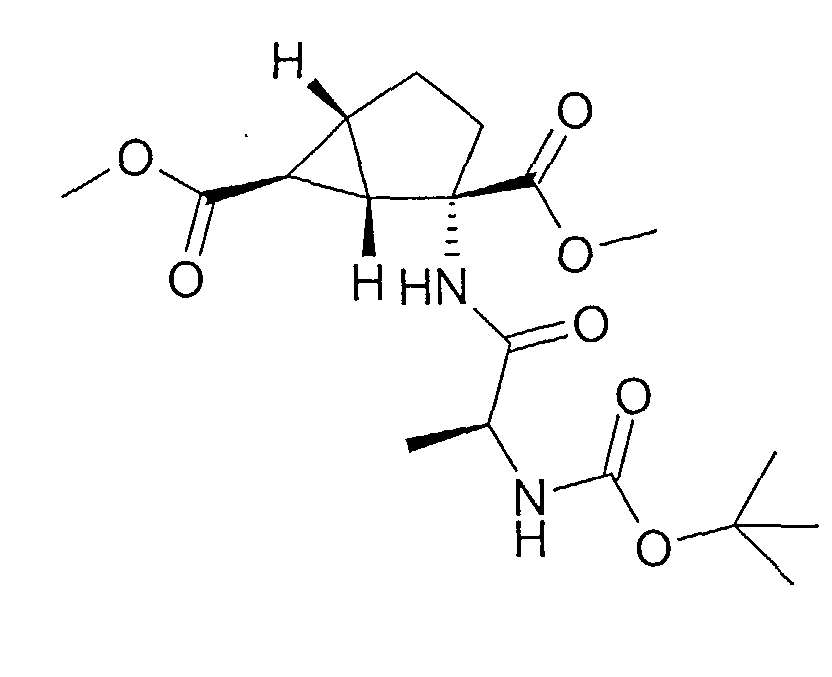
- The title compound was prepared using commercially available N-BOC-(L)-alanine according to General Procedure 1.
50% Yield. Foamy white solid. mp 51-52 °C.
[α]D 25 = - 27.7 ° (c = 0.52, CHCl3).
1H NMR (CDCl3) δ: 7.28 (brs, 1H), 5.04 (brd, 1H, J = 7.6 Hz), 4.16 (m, 1H), 3.74 (s, 3H), 3.66 (s, 3H), 2.49 (dd, 1H, J = 13.9, 8.3 Hz), 2.42 (dd, 1H, J = 6.3, 2.8 Hz), 2.18-1.89 (m, 3H), 1.70 (t, 1H, J = 2.9 Hz), 1.45 (s, 9H), 1.33 (d, 3H, J = 7.0 Hz), 1.19 (m, 1H).
13C NMR (CDCl3) δ: 172.8, 172.6, 172.6, 155.7, 80.2, 66.3, 52.6, 51.8, 49.5, 34.4, 32.0, 28.2, 28.1, 26.6, 21.1, 17.6. -
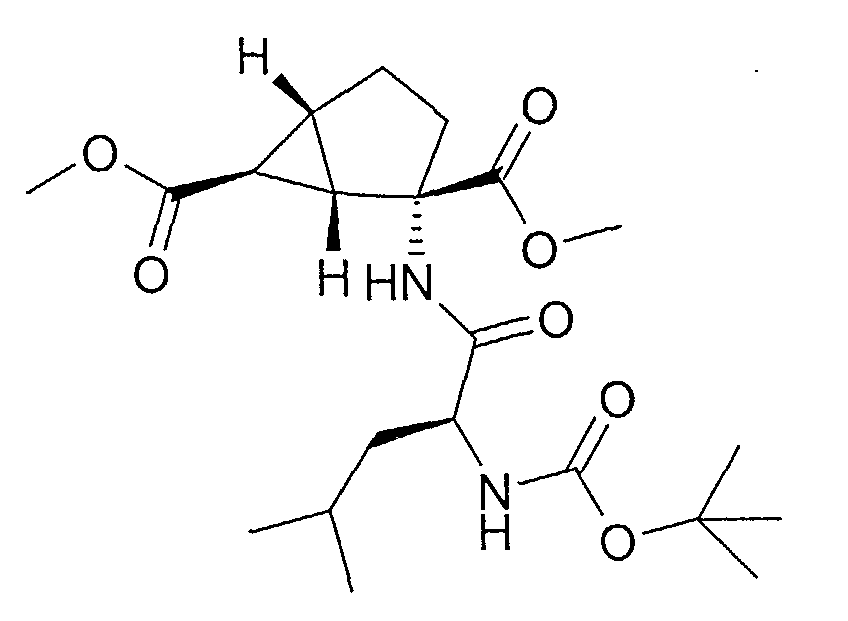
- The title compound was prepared using commercially available N-BOC-(L)-leucine according to General Procedure 1.
95% Yield. Foamy white solid. mp 62-63 °C.
[α]D 25 = - 27.2 ° (c = 1.0, CHCl3).
1H NMR (CDCl3) δ: 7.00 (brs, 1H), 4.97 (brd, 1H, J = 8.4), 4.05 (m, 1H), 3.69 (s, 3H), 3.62 (s, 3H), 2.40 (m, 2H), 2.08-1.84 (m, 3H), 1.67-1.58 (m, 3H), 1.41 (m, 1H), 1.41 (s, 9H), 1.22 (m, 1H), 0.90 (d, 3H, J = 6.2 Hz), 0.89 (d, 3H, J = 6.1 Hz).
13C NMR (CDCl3) δ: 172.8, 172.6, 172.5, 155.8, 80.0, 66.2, 52.5, 51.7, 40.7, 34.3, 31.9, 28.2, 28.1, 26.4, 24.6, 22.7, 22.0, 21.0. -
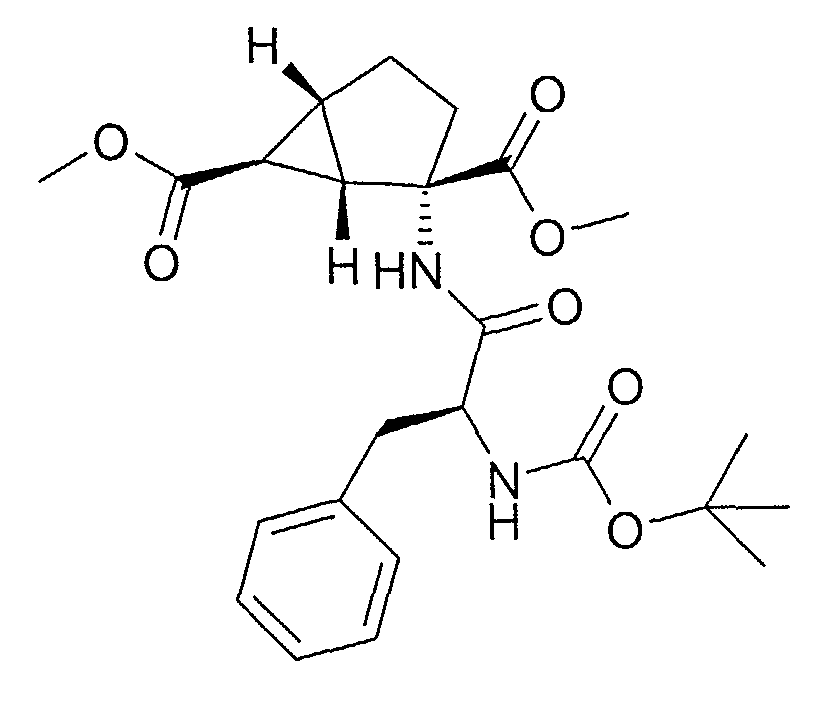
- The title compound was prepared using commercially available N-BOC-(L)-phenylalanine according to General Procedure 1. 87% Yield. Foamy white solid. mp 60-61 °C.
[α]D 25 = - 1.8 ° (c = 1.0, CHCl3).
1H NNR (CDCl3) δ: 7.33-7.21 (m, 5H), 6.64 (brs, 1H), 5.13 (brd, 1H, J = 6.9 Hz), 4.32 (q, 1H, J = 7.0 Hz), 3.72 (s, 3H), 3.66 (s, 3H), 3.03 (d, 2H, J = 7.1 Hz), 2.48-2.38 (m, 2H), 2.08-1.84 (m, 3H), 1.60 (t, 1H, J = 2.9 Hz), 1.41 (s, 9H), 1.14-1.02 (m, 1H).
13C NMR (CDCl3) δ: 172.5, 172.4, 171.3, 155.4, 136.8, 129.4, 128.5, 126.7, 80.1, 66.1, 55.3, 52.5, 51.7, 38.1, 34.1, 31.7, 28.2, 28.0, 26.3, 20.9. -

- The title compound was prepared using commercially available N-BOC-(L)-valine according to General Procedure 1. 87% Yield. White foamy solid. mp 63-65 °C.
[α]D 25 = - 1.12 ° (c = 1.16, CHCl3).
1H NMR (CDCl3) δ: 6.75 (brs, 1H), 5.06 (brd, 1H, J = 8.8 Hz), 3.90 (dd, 1H, J = 8.9, 8.8 Hz), 3.73 (s, 3H), 3.66 (s, 3H), 2.54 (dd, 1H, J = 13.8, 8.3 Hz), 2.41 (dd, 1H, J = 5.9, 2.4 Hz), 2.23-1.88 (m, 4H), 1.71 (t, 1H, J = 2.9 Hz), 1.44 (s, 9H), 1.30-1.19 (m, 1H),0.97 (d, 3H, J = 6.8 Hz), 0.93 (d, 3H, J = 6.8 Hz).
13C NMR (CDCl3) δ: 172.5, 172.4, 171.8, 155.8, 79.8, 66.2, 59.3, 52.4, 51.7, 34.3, 31.9, 30.9, 28.2, 27.9, 26.5, 21.1, 18.9, 17.6. -

- The title compound was prepared using commercially Nα-BOC-Nε-BOC-(L)-lysine according to General Procedure 1.
94% Yield. White foamy solid. mp 65-67 °C.
[α]D 25 = -10.5° (c = 1.05, CHCl3).
1H NMR (CDCl3) δ: 6.97 (brs, 1H), 5.12 (brd, 1H, J = 7.0 Hz), 4.76 (brs, 1H), 4.06 (brq, 1H, J = 7.4 Hz), 3.75 (s, 3H), 3.66 (s, 3H), 3.11 (AB system, 2H), 2.50 (dd, 1H, J = 13.8, 8.3 Hz), 2.42 (dd, 1H, J = 6.5, 2.7 Hz), 2.23-1.76 (m, 5H), 1.69 (t, 1H, J = 2.9 Hz), 1.63-1.11 (m, 5H), 1.43 (s, 9H), 1.42 (s, 9H).
13C NMR (CDCl3) δ: 172.6, 172.5, 172.3, 156.1, 155.8, 80.1, 66.3, 53.7, 52.7, 51.9, 39.8, 34.4, 32.0, 31.7, 29.5, 28.4, 28.3, 28.1, 26.6, 22.3, 21.1. -

- The title compound was prepared using commercially available N-BOC-L-tryptophan according to General Procedure 1.
90% Yield. White foamy solid. mp 89-91 °C.
[α]D 25 = -12.7 ° (c = 1.15, CHCl3).
1H NNR (CDCl3) δ: 8.36 (brs, 1H), 7.72 (brd, 1H, J = 7.0 Hz), 7.35 (dd, 1H, J = 7.2, 2.6 Hz), 7.16 (m, 2H), 7.06 (brd, 1H, J = 2.4 Hz), 6.24 (brs, 1H), 5.18 (brs, 1H), 4.44 (brdd, 1H, J = 8.1, 5.5 Hz), 3.70 (s, 3H), 3.64 (s, 3H), 3.29 (dd, 1H, J = 14.4, 5.5 Hz), 3.11 (dd, 1H, J = 14.4, 8.2 Hz), 2.41 (dd, 1H, J = 6.0, 2.6 Hz), 2.28 (dd, 1H, J = 13.5, 8.3 Hz), 2.10-1.94 (m, 2H), 1.82 (dd, 1H, J = 12.6, 7.6 Hz), 1.43 (brs, 1H, 9H), 1.43 (m, 1H), 0.99-0.83 (m, 1H).
13C NMR (CDCl3) δ: 172.8, 172.4, 171.8, 155.5, 136.2, 127.2, 123.6, 122.2, 119.7, 118.9, 111.2, 110.6, 80.1, 66.1, 60.3, 54.6, 52.6, 51.8, 34.0, 31.9, 28.3, 28.1, 26.1, 21.0. -

- The title compound was prepared using commercially available N-BOC-(L)-isoleucine according to General Procedure 1.
79% Yield. White foamy solid.
1H NMR (CDCl3) δ: 6.75 (bs, 1 H); 5.06 (bd, J = 8.3 Hz, 1 H) ; 3.90 (dd, J = 8.9, 6.7 Hz, 1 H); 3.70 (s, 3H); 3.63 (s, 3 H); 2.54-2.39 (m, 2 H); 2.21-1.72 (m, 4 H); 1.67 (t, J = 3.2 Hz, 1 H); 1.60-1.40 (m, 1H); 1.41 (s, 9H); 1.22-1.0 (m, 2H); 0.91 (d, J = 6.7 Hz,3 H) ; 0.87 (t, J = 7.3 Hz, 3 H). -

- The title compound was prepared using commercially available N-BOC-glycine according to General Procedure 1.
88% Yield. White foamy solid.
1H NMR (CDCl3) δ: 7.01 (bs, 1 H); 5.28 (bs, 1 H); 3.75 (d, J = 5.6 Hz, 2 H); 3.72 (s, 3 H); 3.63 (s, 3 H); 2.54-2.38 (m, 2 H); 2.15-1.87 (m, 3 H); 1.68 (t, J = 2.9 Hz, 1 H); 1.43 (s, 9 H) ; 1.31-1.11 (m, 1 H). -
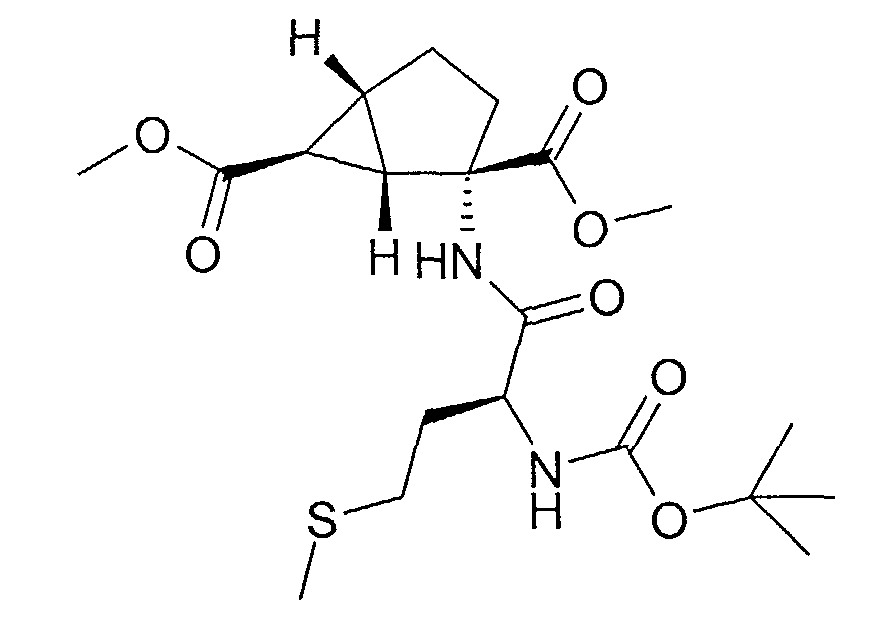
- The title compound was prepared using commercially available N-BOC-(L)-methionine according to General Procedure 1.
89% yield. Foamy white solid
1H NMR (CDCl3) δ: 7.04 (brs, 1 H), 5.15 (d, 1 H, J = 8.3 Hz), 4.13 (m, 1 H), 3.61 (s, 3 H), 3.53 (s, 3 H), 2.48-2.25 (m, 4 H), 1.97 (s, 3 H), 2.15-1.71 (m, 5 H), 1.57 (t, 1 H, J = 3.0 Hz), 1.31 (s, 9 H), 1.13 (m, 1 H).
13C NMR (CDCl3) δ: 172.4, 172.3, 171.5, 155.4, 79.9, 66.1, 52.7, 52.4, 51.6, 34.2, 31.8, 31.4, 29.7, 28.1 (3 C), 27.9, 26.4, 20.9, 15.0. -

- The title compound was prepared using commercially available N-BOC-(L)-γ-benzyl glutamic acid according to General Procedure 1.
67% yield. Foamy white solid.
1H NMR (CDCl3) δ: 7.32 (s, 5 H), 7.21 ( brs, 1 H), 5.28 (d, 1 H, J = 8.0 Hz), 5.10 (s, 2 H), 4.16 (m, 1 H), 3.69 (s, 3 H), 3.62 (s, 3 H), 2.58-2.43 (m, 3 H), 2.37 (dd, 1 H, J = 5.9, 2.1 Hz), 2.17-1.86 (m, 5 H), 1.68 (t, 1 H, J = 3.0 Hz), 1.41 (s, 9 H), 1.20 (m, 1 H) .
13C NMR (CDCl3) δ: 173.2, 172.6, 172.5, 171.6, 155.6, 135.6, 128.5 (2 C), 128.2, 128.1, 79.9, 66.4, 66.2, 52.7, 52.6, 51.8, 34.4, 31.9, 30.0, 28.2 (3 C), 28.0, 27.9, 26.6, 21.0. -

- The title compound was prepared using commercially available N-BOC-(L)-tyrosine according to General Procedure 1.
73% yield. Foamy white solid.
1H NMR (Methanol-d 4) δ: 7.03 (d, 2 H, J = 8.0 Hz), 6.72 (d, 2 H, J = 8.0 Hz), 5.21 (brs, 1 H), 4.28 (m, 1 H), 3.75 (s, 3 H), 3.63 (s, 3 H), 2.91 (m, 2 H), 2.39 (m, 2 H), 2.15-1.80 (m, 3 H), 1.59 (t, 1 H, J = 4.0 Hz), 1.39 (s, 9 H).
13C NMR (Methanol-d 4) δ: 173.6, 171.7, 155.3, 130.4 (2 C), 127.8, 121.2, 115.4 (2 C), 80.3, 66.2, 52.6, 51.8, 37.4, 34.1, 31.7, 28.1 (3 C), 26.3, 22.5, 21.0. -

- The title compound was prepared using commercially available N-BOC-(L)-asparagine according to General Procedure 1.
46% yield. Foamy white solid.
1H NMR (CDCl3) δ: 7.85 (brs, 1 H), 6.59 (brs, 1 H), 6.13 (d, 1 H, J = 7.8 Hz), 6.00 (brs, 1 H), 4.41 (m, 1 H), 3.67 (s, 3 H), 3.60 (s, 3 H), 2.75-2.35 (m, 4 H), 2.16-1.83 (m, 3 H), 1.15 (t, 1 H, J = 3.0 Hz), 1.43 (s, 9 H), 1.26 (m, 1 H).
13C NMR (CDCl3) δ: 173.3, 172.7, 172.6, 171.9, 155.6, 80.0, 66.2, 52.5, 51.7, 50.8, 37.3, 34.1, 31.8, 28.6, 28.0, 26.3, 20.9. -

- The title compound was prepared using commercially available N-BOC-(D)-alanine according to General Procedure 1..
93% Yield. White foam.
1H NMR (CDCl3) δ: 7.03 (s, 1 H), 5.00 (s, 1 H), 4.12 (br m, 1 H), 3.72 (s, 3 H), 3.64 (s, 3 H), 2.52 (dd, J = 14.0, 8.5 Hz, 1 H), 2.39 (dd, J = 6.5, 3.0 Hz, 1 H), 2.18-2.10 (m, 1 H), 2.01 (app. quintet, J = 3.5 Hz, 1 H), 1.94 (dd, J = 13.5, 8.0 Hz, 1 H), 1.67 (t, J = 3.0 Hz, 1 H), 1.44 (s, 9 H), 1.31 (d, J = 7.0 Hz, 3 H), 1.24-1.17 (m, 1 H).
13C NMR (CDCl3) δ: 172.8, 172.7, 172.6, 155.7, 80.2, 66.1, 52.7, 51.8, 49.6, 34.4, 32.0, 28.2, 28.1, 26.6, 21.0, 17.4. -

- The title compound was prepared using commercially available N-BOC-(L)-proline according to General Procedure 1.
78% Yield. Foamy white solid.
1H NNR (CDCl3) δ: 4.2 (brs, 1H), 3.71 (s, 3H), 3.63 (s, 3H), 3.30 (brs, 2H), 2.47-2.45 (m, 2H), 2.03-1.77 (m, 8H), 1.65 (t, 1H, J = 3 Hz), 1.47 (s, 9H), 1.20-1.00 (m, 1H). -
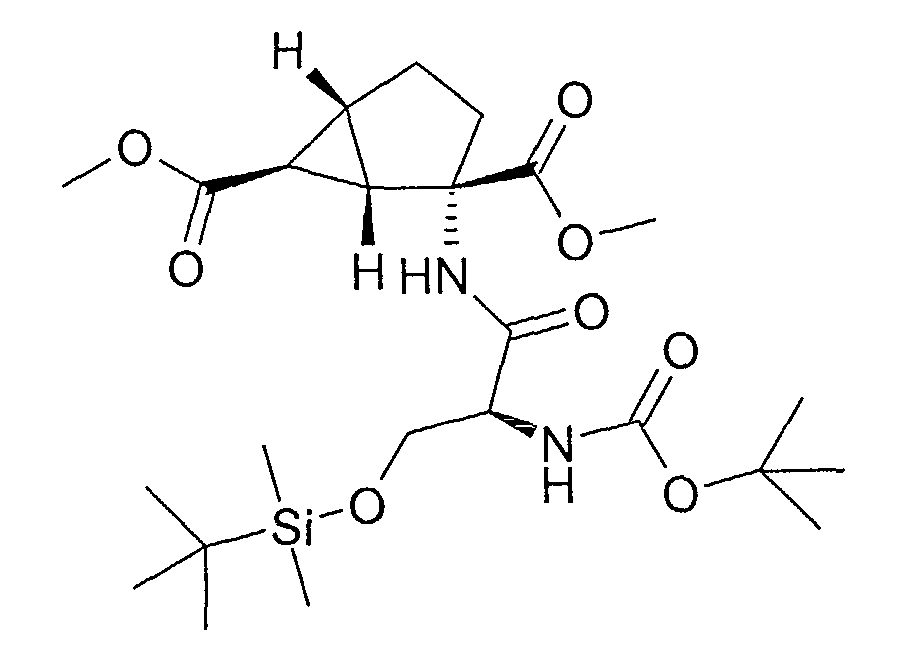
- The title compound was prepared from (2S)-2-tert-butoxycarbonylamino-3-(tert-butyl-dimethyl-silanyloxy)-propionic acid methyl ester (which was prepared using a similar procedure described by Jacobson, et al, J. Med. Chem. 1999, 42(9), p. 1525-1536.) according to General Procedure 1.
82% yield. White foamy solid.
1H-NMR (CDCl3)δ: 7.44 (brs, 1 H); 5.38 (brs, 1 H); 4.16-4.05 (m, 1 H); 3.94 (dd, J = 9.7, 4.3 Hz, 1 H); 3.72 (s, 3 H); 3.65 (s, 3 H) ; 3.60-3.51 (m, 1 H); 2.64 (dd, J = 14.0, 8.6 Hz, 1 H); 2.30-2.11 (m, 2 H); 2.03-1.97 (m, 2 H); 1.72 (m, 1 H); 1.43 (s, 9 H); 1.26-1.09 (m, 1 H); 0.88 (s, 9 H); 0.11 (s, 3 H); 0.10 (s, 3 H). -
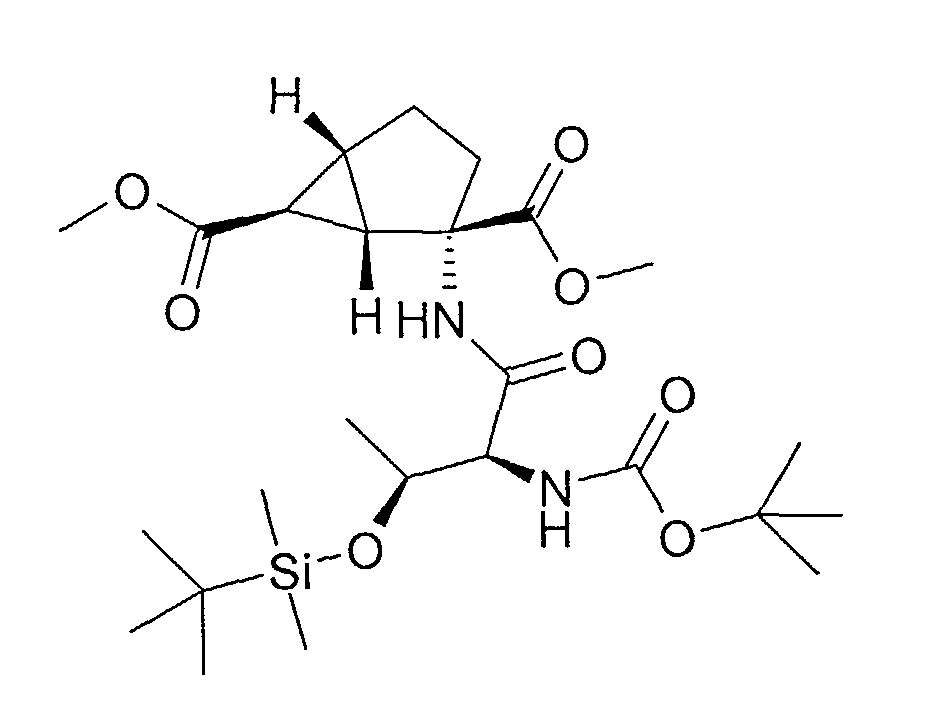
- The title compound was prepared using (2S,3S) 2-tert-butoxycarbonylamino-3-(tert-butyl-dimethyl-silanyloxy)-butyric acid methyl ester (which was prepared using a similar procedure described by Jacobson, et al, J. Med. Chem. 1999, 42(9), p. 1525-1536) according to General Procedure 1.
70% yield. White foamy solid.
1H-NMR (CDCl3) : 7.55 (brs, 1 H); 5.52 (brd, J = 4.6 Hz, 1 H) ; 4.20-4.12 (m, 2 H) ; 3.73 (s, 3 H); 3.64 (s, 3 H); 2.64 (dd, J = 13.7, 8.1 Hz, 1 H); 2.31 (dd, J = 6.5, 2.7 Hz, 1 H); 2.26-2.10 (m, 1 H); 2.01-1.89 (m, 2 H); 1.71 (t, J = 1.6 Hz, 1 H) ; 1.41 (s, 9 H) ; 1.24-1.16 (m, 1 H); 1.11 (d, J = 6.4 Hz, 3 H); 0.89 (s, 9 H); 0.17 (s, 3 H); 0.13 (s, 3 H). -
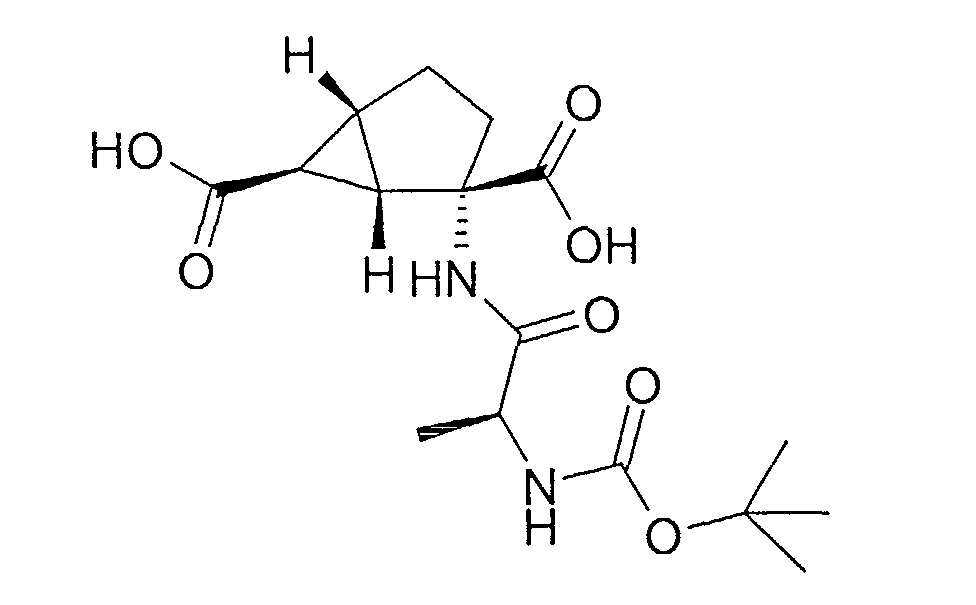
- A solution of 2 M NaOH (5.45 L, 10.9 mol) was added to a solution of (1S,2S,5R,6S)-2-[(2'S) - (2'-tert-butoxycarbonylamino)-propionyl]amino-bicyclo[3.1.0]hexane-2,6-dicarboxylic acid dimethyl ester (4.52 mol, crude) in THF (2.8 L). The resulting mixture was stirred at ambient temperature for 3 h then extracted with CH2Cl2 (2 x 3 L). Ethyl acetate (5 L) and tetrahydrofuran (3 L) were then added to the aqueous phase. While stirring, concentrated HCl (970 mL) was added to the mixture until the pH = 2. The organic phase was dried (MgSO4) and filtered. The aqueous phase was then extracted with ethyl acetate (5 L). The organic phase was dried (MgSO4), filtered and combined with the previous organic phase. The combined organics were concentrated to a soft solid. Ethyl acetate was then added, and the mixture was concentrated to a soft solid. Ethyl acetate (3.5 L) was again added. The mixture was concentrated until a freely flowing suspension was present. Heptane ( 1.8 L) was then added, and the slurry was stirred at ambient temperature for 15 h. The solid was filtered, washed with heptane (3 L) then dried under vacuum to afford the title compound.
Yield 1.36 kg (84%) as an approximate 85:15 mixture of rotamers as a white solid
1H NNR (DMSO-d6) δ 12.20 (s, 2 H), 8.40 (s, 0.85 H), 8.36 (s, 0.15 H), 6.69 (d, J = 8.2 Hz, 0.85 H), 6.33 (br d, 0.15 H), 3.99 (quintet, J = 7.2 Hz, 0.85 H), 3.84 (br m, 0.15 H), 2.18-2.13 (m, 2 H), 1.91-1.84 (m, 1 H), 1.82-1.75 (m, 2 H), 1.46 (br s, 0.85 H), 1.43 (br s, 0.15 H), 1.35 (s, 9 H), 1.23-1.15 (m, 1 H), 1.13 (d, J = 6.9 Hz, 3 H).
13C NMR (methanol-d4) δ 176.4, 176.0 (2 C), 157.5, 80.5, 67.3 (minor rotamer), 67.2 (major rotamer), 50.9, 35.6, 32.8, 29.3, 28.7, 27.4, 22.1, 18.5.
MS (EI) calcd for C16H28N3O7 (M + NH4 +) 374.20, found 374.24 m/z. -

- A solution of (1S,2S,5R,6S)-2-aminobicyclo[3.1.0]hexane-2,6-dicarboxylic acid monohydrate (85 g, 418 mmol) and MeOH (850 mL) was cooled to 10 °C. Thionyl chloride (199 g, 1.67 mol) was added at a rate such that the temperature did not exceed 20 °C. The solution was then heated to 50 °C and stirred for 6 h. Upon completion of the reaction, the solution was cooled to room temperature and concentrated to approximately 170 mL total volume under reduced pressure at 20 - 30 °C. Water (850 mL) was added, and the pH of the solution was adjusted to approximately pH 2.0 with 1.0 N NaOH (300 mL). The solution was concentrated under reduced pressure until the temperature reached approximately 40 °C. Methylene chloride (850 mL) was then added, and the pH of the solution was adjusted to pH 8 with 1.0 N NaOH (180 mL). The phases were separated, and the aqueous phase was extracted with CH2Cl2 (425 mL). The combined organic phases containing the corresponding dimethyl ester were concentrated to approximately 425 mL total volume and held for further processing.
- In a separate reaction vessel a solution of N-t-butoxycarbonyl-L-alanine (83.2 g, 439 mmol) and 4-methylmorpholine (44.4 g, 439 mmol) in CH2Cl2 (712 mL) was cooled to -5 - -10 °C. Isobutyl chloroformate (59.9 g, 439 mmol) was then added at rate such that the temperature did not exceed -5 °C. Upon completion of the addition, the solution was stirred for 15 min. Simultaneously, CH2Cl2 (20 mL) was added to the dimethyl ester solution previously prepared, and this solution was cooled to -5 °C. The dimethyl ester solution (445 mL) was then added to the isobutyl mixed anhydride mixture. The cooling bath was removed, and the corresponding mixture was stirred for 30 min. A solution of 1.0 N HCl (445 mL) was then added. The phases were separated, and the organic phase was washed with 1.0 N HCl (445 mL). The organic phase was concentrated to approximately 180 mL total volume. THF (450 mL) was then added, and the resulting solution was concentrated to approximately 180 mL total volume. To this solution was added 1.0 N NaOH (1.67 L, 1.67 mol). The resulting mixture was heated to 40 °C, stirred for 1.5 h then cooled to room temperature. Ethyl acetate (2.4 L) was added, and the pH of the aqueous phase was adjusted to pH 2.1 with concentrated HCl (150 mL). The phases were separated, and the aqueous phase was extracted with ethyl acetate (800 mL). The combined organic phases were dried with MgSO4, filtered and washed with EtOAc (2 x 320 mL). The resulting solution was then concentrated to approximately 400 mL total volume. Ethyl acetate (800 mL) was added, and the solution was concentrated to 400 mL). This ethyl acetate addition/concentration was repeated again, then heptane (640 mL) was added. The resulting mixture was stirred for 2 h, filtered and washed with a 2 : 1 mixture of heptane-ethyl acetate (2 x 320 mL) to afford 115.5 g (78% yield) of (1S,2S,5R,6S)-2-[(2'S)-(2'-tert-butoxycarbonylamino)-propionyl]amino-bicyclo[3.1.0] hexane-2,6-dicarboxylic acid as a white solid.
-

- The title compound was prepared from 2' (S) - (2" (S) -tert-butoxycarbonylamino-propionylamino)-propionic acid according to General Procedure 1.
Yield 90%.
1H NMR (CDCl3): 7.26 (bs, 1 H); 6.66 (bd, J = 7.5 Hz, 1 H); 4.98 (bd, J = 7.0 Hz, 1 H); 4.46 (quint, J = 7.2 Hz, 1 H); 4.13 (m, J = 7.2 Hz, 1 H); 3.74 (s, 3H); 3.65 (s, 3H); 2.48-2.36 (m, 2H); 2.14-1.87 (m, 3H); 1.69 (t, J = 2.4 Hz, 1H); 1.43 (s, 9 H); 1.36 (d, J = 7.0 Hz, 3 H); 1.35 (d, J = 7.0 Hz, 3 H). -

- The title compound was prepared from 2(S)-(2'(S)-tert-butoxycarbonylamino-4-methyl-pentanonylamino)-propionic acid (preparation 3) according to General Procedure 1.
A mixture 2:1 of isomers was obtained.
Yield 95%.
1H-NMR (CDCl3): 7.09 (s, 1 H); 6.62 (d, J = 7.3 Hz, 1 H); 4.90 (d, J = 7.3 Hz, 1 H); 4.45 (m, 1 H); 4.08 (m, 1 H); 3.72 (s, 3 H); 3.65 (s, 3 H); 2.47-2.37 (m, 2 H); 2.07-1.53 (m, 7 H); 1.43 (s, 9 H); 1.34 (d, J = 7.0 Hz, 3 H); 1.40-1.20 (m, 1H); 0.95-0.92 (m, 6 H). -
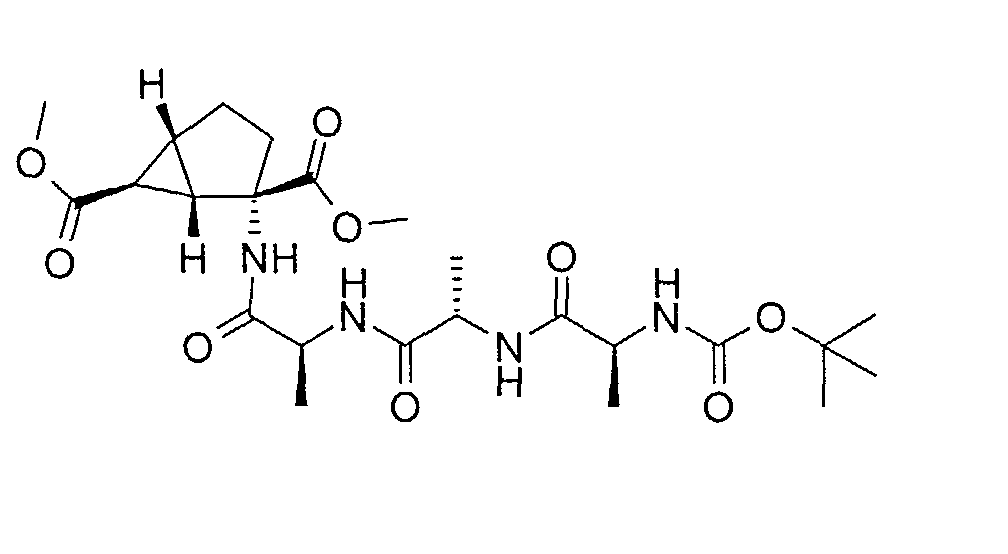
- The title compound was prepared from 2S-[2'S-(2"S-tert-Butoxycarbonylamino-propionyl-amino)-propionylamino]-propionic acid (Preparation 4) according to General Procedure 1.
-

- The title compound was prepared using commercially available N-BOC-(D)-leucine according to General Procedure 1.
1H NMR (CD3OD): 7.92 (1H, br s), 4.57-4.48 (1H, m), 3.75 (3H, s), 3.70 (3H, s), 2.60 (1H, br s), 2.30-1.70 (8H, m), 1.43 (9H, s), 0.99-0.90 (6H, m)
MS: m/z 327 [M + H-CO2tBu] - The corresponding 2'-N-BOC-2,6-dimethyl ester dipeptide derivative (1.0 equiv) was dissolved in THF and an equal volume of 2.5 N aqueous LiOH (10-20 equiv) was added. The reaction mixture was stirred at room temperature for 1-3 h. After dilution with water, the mixture was extracted twice with EtOAc and the organic extracts were discarded. The aqueous layer was acidified to pH = 1-2 with IN hydrochloric acid and thoroughly extracted with ethyl acetate (5 times). The combined organic extracts were washed with brine, dried over sodium sulfate, filtered and evaporated under vacuum to dryness. The crude N-BOC-dicarboxylic acid was dissolved in a saturated solution of hydrogen chloride gas in ethyl acetate (5-10 ml / mmol) and the mixture was stirred for 16 h. The resulting white precipitate was filtered, rinsed with ethyl ether and dried under high vacuum to afford the amino diacid hydrochloride salt as a fine white powder. If further purification was needed, the crude amino diacid was chromatogaphed over a C8 reverse phase support eluting with acetonitrile in water with 0.05% of trifluoroacetic acid to provide, after drying, the amino diacid as a zwitterion.
-
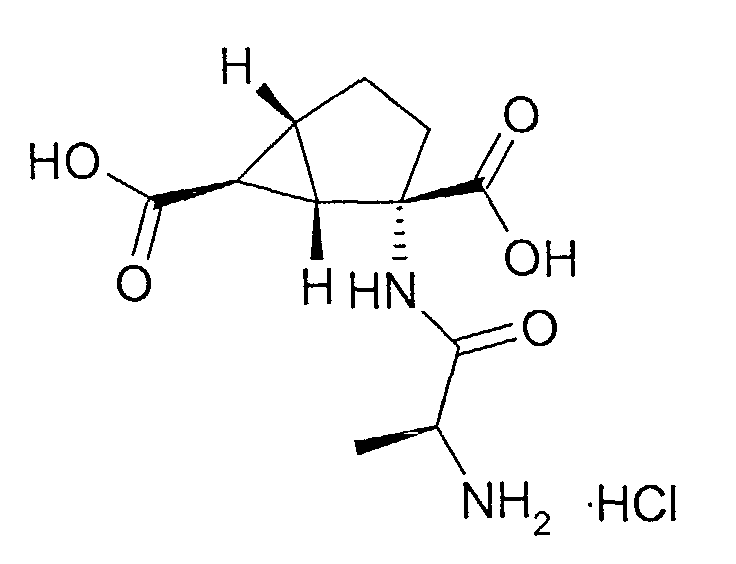
- The title compound was prepared according to General Procedure 2.
80% Yield. White solid. mp >250 °C, dec.
[α]D 25 = - 7.80 ° (c = 1.0, MeOH).
1H NMR (Methanol-d 4) δ: 3.96 (q, 1H, J = 7.0 Hz), 2.47 (dd, 1H, J = 6.3, 2.7 Hz), 2.37 (dd, 1H, J = 13.6, 8.2 Hz), 2.18-1.92 (m, 3H), 1.66 (t, 1H, J = 3.0 Hz), 1.53 (d, 3H, J = 7.0 Hz), 1.46-1.34 (m, 1H).
13C NMR (Methanol-d 4) δ: 175.2, 174.7, 170.2, 66.4, 49.0, 36.6, 32.0, 28.5, 26.3, 21.2, 16.6. -

- The title compound was prepared according to General Procedure 2.
48% Yield. White solid. mp 135-137 °C.
[α]D 25 = + 0.3 ° (c = 1.0, MeOH).
1H NMR (Methanol-d 4) δ: 3.84 (brt, 1H, J = 6.6 Hz), 2.52 (dd, 1H, J = 6.2, 2.8 Hz), 2.31 (dd, 1H, J = 13.5, 8.6 Hz), 2.21-1.89 (m, 3H), 1.74-1.59 (m, 4H), 1.44 (m, 1H), 1.02 (d, 3H, J = 6.4 Hz), 0.99 (d, 3H, J = 6.2 Hz).
13C NMR (Methanol-d 4) δ: 175.3, 174.9, 169.7, 66.6, 51.8, 40.6, 34.4, 32.0, 28.7, 26.1, 24.4, 21.8, 21.5, 21.3. -

- The title compound was prepared according to General Procedure 2.
44% Yield. White solid. mp 122-123 °C.
[α]D 25 = - 2.10 ° (c = 1.0, MeOH).
1H NMR (Methanol-d 4) δ: 7.41-7.26 (m, 5H), 4.13 (dd, 1H, J = 7.6, 6.1 Hz), 3.28 (dd, 1H, J = 14.2, 6.2 Hz), 3.07 (dd, 1H, J = 14.2, 7.6 Hz), 2.55 (dd, 1H, J = 6.4, 2.8 Hz), 2.31-1.89 (m, 4H), 1.64 (t, 1H, J = 2.8 Hz), 1.35 (m, 1H).
13C NMR (Methanol-d4 ) δ: 178.8, 178.3, 172.2, 137.9, 133.2, 132.6, 131.3, 70.0, 57.9, 41.0, 37.7, 35.4, 32.3, 29.4, 24.7. -

- The title compound was prepared according to General Procedure 2.
64% Yield. White solid. mp 217-219 °C.
[α]D 25 = + 5.93 ° (c = 0.86, MeOH).
1H NMR (D2O) δ: 3.78 (d, 1H, J = 5.8 Hz), 2.56 (dd, 1H, J = 6.9, 2.9 Hz), 2.19-1.95 (m, 5H), 1.66 (t, 1H, J = 3.0 Hz), 1.50 (m, 1H), 0.99 (d, 3H, J = 6.9 Hz), 0.98 (d, 3H, J = 6.9 Hz).
13C NMR (D2O + Methanol-d4 ) δ: 177.0, 176.0, 169.3, 66.3, 58.1, 34.0, 31.3, 30.0, 29.5, 25.1, 20.9, 17.3, 16.9. -

- The title compound was prepared according to General Procedure 2.
82% Yield. White solid. mp 75-77 °C.
[α]D 25 = - 1.10 ° (c = 1.0, MeOH).
1H NMR (D2O) δ: 3.90 (t, 1H, J = 6.3 Hz), 2.84 (brt, 2H, J = 7.6 Hz), 4.42 (dd, 1H, J = 6.3, 2.8 Hz), 2.09-1.73 (m, 6H), 1.59-1.26 (m, 6H).
13C NMR (D2O + Methanol-d4) δ: 177.1, 176.3, 169.4, 66.1, 52.4, 38.8, 33.8, 31.2, 30.2, 29.3, 26.3, 25.1, 20.8, 20.6. -

- The title compound was prepared according to General Procedure 2.
41% Yield. White solid. mp 96-98 °C.
[α]D 25 = + 1.35° (c = 0.74, MeOH).
1H NMR (D2O) δ: 7.51 (d, 1H, J = 7.8 Hz), 7.38 (d, 1H, J = 7.9 Hz), 7.17-7.00 (m, 2H), 7.08 (brs, 1H), 4.18 (t, 1H, J = 7.1 Hz), 3.24 (AB system, 2H), 2.37 (dd, 1H, J = 6.5, 2.8 Hz), 2.09-1.65 (m, 4H), 1.34 (t, 1H, J = 2.9 Hz), 1.22-1.12 (m, 1H).
13C NMR (D2O + Methanol-d4) δ: 177.9, 176.8, 170.6, 137.2, 127.3, 126.2, 123.2, 120.5, 119.0, 113.1, 107.1, 67.0, 54.0, 34.3, 32.1, 30.4, 27.9, 25.8, 21.4. -
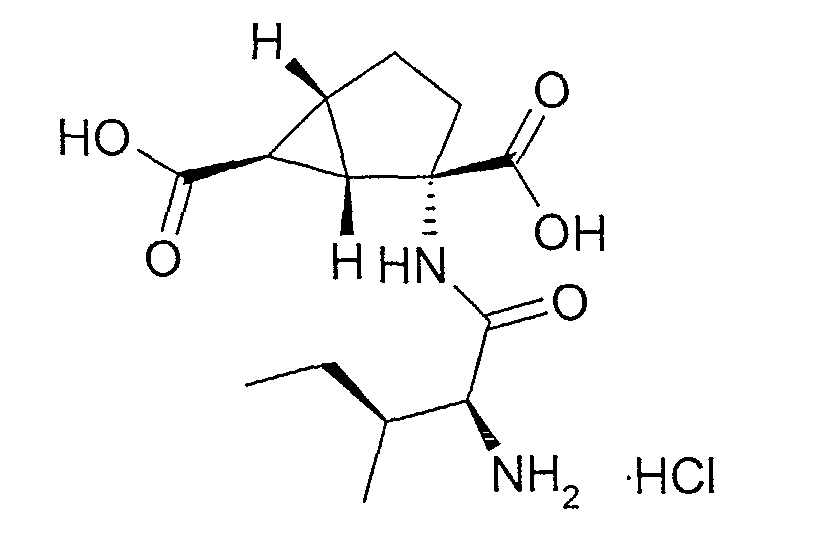
- The title compound was prepared according to General Procedure 2.
64% Yield. White solid. mp>300°C.
[α]D 25 = -5° (c=1,1N HCl).
1H NNR (MeOH-d4) δ: 8.93 (s, 1 H); 3.73 (d, J = 5.4 Hz, 1 H); 2.54 (dd, J = 6.4, 3.0 Hz, 1 H); 2.35-1.91 (m, 5 H); 1.67-1.15 (m, 4 H); 1.06 (d, J = 7.0 Hz, 3 H); 0.98 (t, J = 7.3 Hz, 3 H) .
13C NMR (MeOH-d4) δ: 176.2, 175.7, 169.6, 67.4, 58.7, 38.1, 35.3, 32.9, 29.8, 26.9, 25.2, 22.2, 15.1, 11.7. -
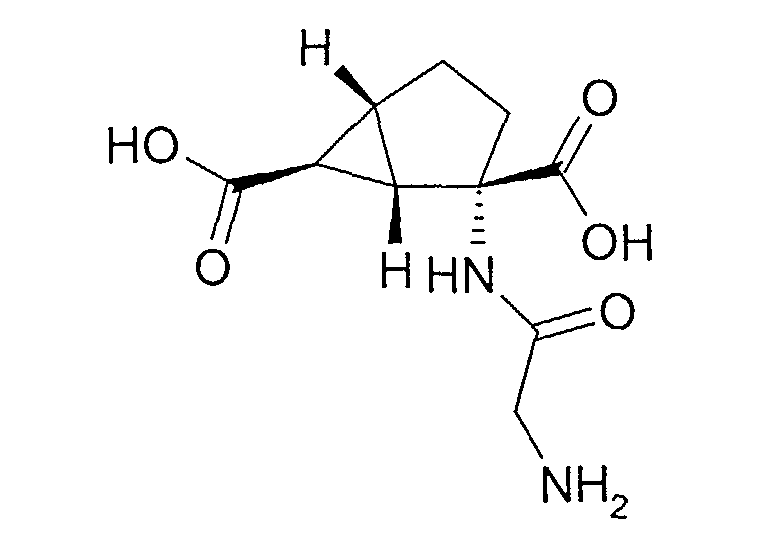
- The title compound was prepared according to General Procedure 2.
(44% yield) White solid. mp: 149-156°C.
1H NNK (MeOH-d4) δ: 3.68 (s, 2 H); 2.37 (dd, J = 6.2, 3.0 Hz, 1 H); 2.19-2.08 (m, 1 H); 2.01-1.85 (m, 3 H) ; 1.59 (t, J = 2.7 Hz, 1 H); 1.37-1.21 (m, 1 H). -
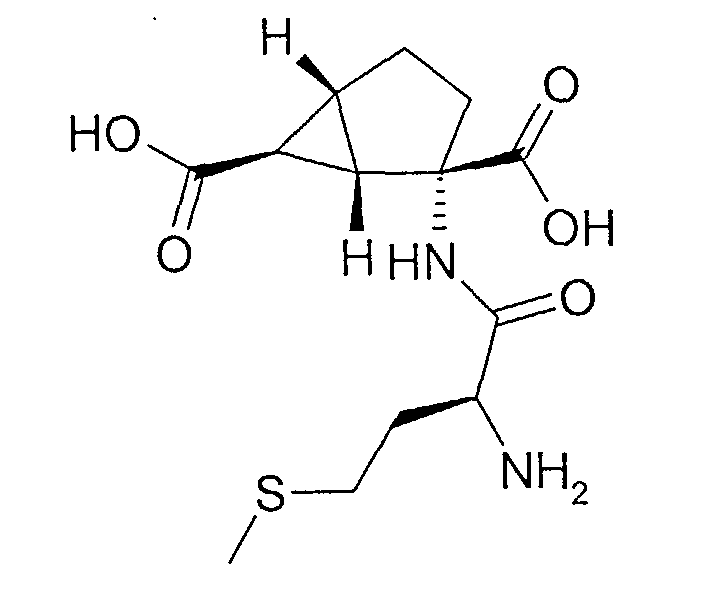
- The title compound was prepared according to General Procedure 2.
(78% Yield) White solid. mp: 164 °C.
[α]D 25 = + 13.4 ° (c = 1.1, MeOH).
1H NMR (Methanol-d 4) δ: 3.97 (t, 1 H, J = 6.4 Hz), 2.64-2.56 (m, 2 H), 2.48-2.38 (m, 2 H), 2.11 (s, 3 H), 2.19-1.91 (m, 5 H), 1.66 (t, 1 H, J = 3.0 Hz), 1.38 (m, 1 H).
13C NMR (Methanol-d 4) δ: 174.7, 174.1, 168.3, 66.1, 52.0, 34.1, 31.5, 30.8, 28.1, 28.0, 25.9, 20.8, 13.6.
MS (Electrospray): 317 (M++1), 229. -

- The title compound was further purified by solid phase (C18) extraction eluting with methanol in water according to General Procedure 2.
84% Yield.White solid mp: 193 °C.
[α]D 25 = + 19.1 ° (c = 0.90, MeOH).
1H NMR (Methanol-d 4) δ: 3.92 (t, 1 H, J = 6.1 Hz), 2.59-2.50 (m, 2 H), 2.42 (dd, 2 H, J = 6.5, 2.8 Hz), 2.19-1.92 (m, 5 H), 1.68 (t, 1 H, J = 3.0 Hz), 1.37 (m, 1H).
13C NMR (Methanol-d 4) δ: 174.9, 174.6, 174.1, 168.4, 66.1, 52.0, 34.2, 31.5, 28.6, 28.0, 26.2, 26.1, 20.9.
MS (Electrospray): 315 (M++1), 297, 279. -

- The title compound was prepared according to General Procedure 2.
35 % Yield. White solid mp: 169 °C.
[α]D 25 = -2.4 ° (c = 0.95, MeOH).
1H NMR (Methanol-d 4) δ: 7.13 (d, 2 H, J = 8.6 Hz), 6.79 (d, 2 H, J = 8.6 Hz), 4.02 (dd, 1 H, J = 7.5, 5.9 Hz), 3.18 (dd, 1 H, J = 14.2, 5.9 Hz), 2.94 (dd, 1 H, J = 14.4, 7.5 Hz), 2.54 (dd, 1 H, J = 6.3, 2.8 Hz), 2.34-1.89 ( m, 4 H), 1.66 (t, 1 H, J = 3.0 Hz), 1.35 (m, 1 H).
13C NMR (Methanol-d4 ) δ: 174.9, 174.3, 168.5, 156.7, 130.3, 124.5, 115.4, 66.0, 54.2, 36.3, 33.9, 31.5, 28.3, 25.5, 20.8.
MS (Electrospray): 349 (M++1), 331. -

- The title compound was prepared according to General Procedure 2.
1H NMR (Methanol-d 4) δ: 3.92 (q, J = 7.1 Hz, 1 H), 2.56 (dd, J = 6.4, 2.7 Hz, 1 H), 2.25 (J =14.0, 8.5 Hz, 1 H), 2.13-2.06 (m, 1 H), 2.01 (m, 1 H), 1.95 (dd, J = 12.8, 8.0 Hz, 1 H), 1.62 (t, J = 3.0 Hz, 1 H), 1.51 (d, J = 6.9 Hz, 3 H), 1.43-1.37 (m, 1H).
13C NMR (Methanol-d 4) δ: 176.4, 175.7, 171.2, 67.3, 50.0, 35.5, 32.8, 30.0, 26.7, 21.9, 17.7. -
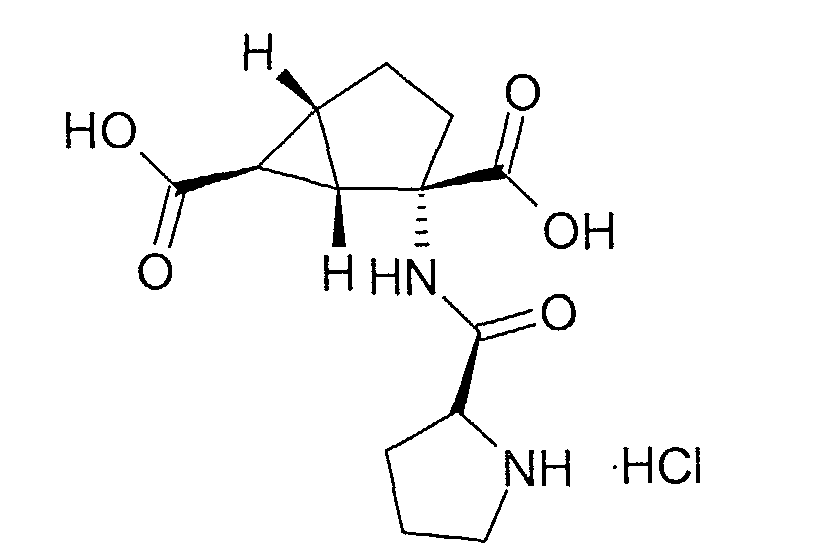
- The title compound was prepared according to General Procedure 2.
90% Yield. White solid.
1H NMR (Methanol-d 4) δ: 4.31-4.24 (m, 1H), 3.37-3.28 (m, 2H), 2.45-2.41 (m, 3H), 2.14-1.98 (m, 6H), 1.65 (t, 1H, J = 2Hz), 1.44-1.32 (m, 1H) ppm.
13C NMR (Methanol-d4) δ: 174.7, 174.1, 168.4, 66.2, 59.5, 46.1, 34.3, 31.6, 29.6, 28.0, 26.0, 23.4, 20.8 ppm. -

- The title compound was prepared according to general procedure 2. Purification by reverse phase chromatography provided a white solid.
45% Yield. mp = 193°C.
[α]D 25 = -25° (c=1.05, MeOH).
I.R. (KBr) : 3380, 3285, 1664 cm-1.
1H NMR (MeOH-d4) δ: 8.67 (bs, 1 H) ; 4.43 (q, J = 7.3 Hz, 1 H); 3.93 (q, J = 7.0 Hz, 1 H); 2.45-2.34 (m, 2 H); 2.16-1.88 (m, 3 H); 1.66 (t, J = 3.2 Hz, 1 H); 1.50 (d, J = 7.3 Hz, 3 H); 1.35 (d, J = 7.3 Hz, 3 H); 1.33 (m, 1 H).
13C NMR (MeOH-d4) δ: 176.8, 176.3, 175.0, 171.0, 67.7, 50.6, 50.4, 36.1, 33.3, 29.8, 27.8, 22.7, 18.6, 18.0. -

- The title compound was prepared according to general procedure 2 with final purification by reverse phase chromatography.
30% Yield of a white solid. mp = 195-201°C
[α]D25 = -10° (c=1.01, MeOH).
I.R. (KBr): 3414, 1669 cm-1.
1H NMR (MeOH-d4) δ: 4.46 (q, J = 7.0 Hz, 1 H); 3.87 (m, 1 H); 2.45-2.35 (m, 2 H); 2.16-1.60 (m, 7 H); 1.37 (d, J = 7.3 Hz, 3 H); 1.39-1.20 (m, 1H); 0.99 (m, 6 H).
13C NMR (DMSO-d6) δ: 174.9, 174.7, 172.8, 169.3, 66.2, 51.8, 48.8, 41.0, 34.8, 32.5, 28.3, 27.0, 24.6, 23.7, 23.2, 21.8, 19.6. -
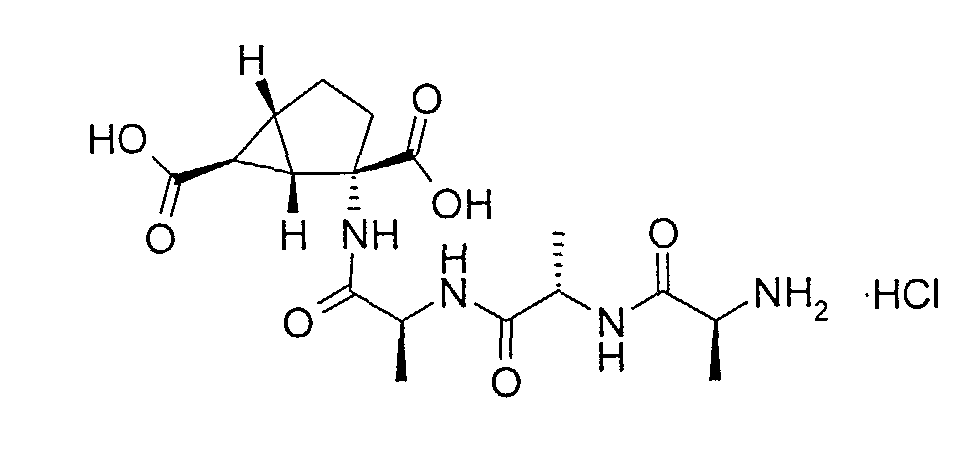
- The title compound was prepared according to general procedure 2. A white solid was obtained.
1H NMR (D2O) : 4.19-4.13 (2H, m), 3.97-3.90 (1H, m), 2.33 (1H, dd, 8.3 Hz, 2.3 Hz), 2.14-2.09 (1H, m), 1.95-1.83 (2H, m), 1.59-1.55 (1H, m), 1.39-1.10 (11H, m)
MS: m/z 399 [M + H] -
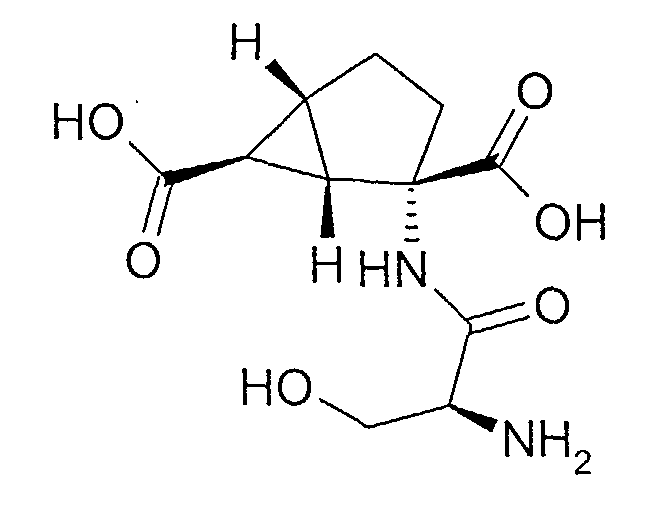
- (1S,2S,5R,6S)-Methyl 2-[(2'S)-2-tert-butoxycarbonylamino-3-(tert-butyl-dimethyl-silanyloxy)-propionylamino]-bicyclo[3.1.0]hexane-2,6-dicarboxylate was dissolved in dry THF (10 mL) under nitrogen and 1M tetrabutylammonium fluoride in THF was added. The reaction was stirred at rt for 1h, the solvent was evaporated and the residue was purified by silica gel chromatography eluting with ethyl acetate. The desilyated material was subjected to the general procedure for 2'-tert-butoxycarbonylamino and 2,6-dimehtyl ester deprotection. The title compound was purified by HPLC.
11% yield. Very hygroscopic white solid.
1H-NMR (CDCl3) δ: 4.01-3.71 (m, 3 H); 2.39 (dd, J = 6.4, 3.0 Hz, 1 H); 2.19-1.86 (m, 4 H); 1.59 (t, J = 2.7 Hz, 1 H); 1.41-1.25 (m, 1 H).
13C-NMR (D2O) δ: 177.0, 175.9, 167.8, 66.4, 60.2, 54.4, 34.2, 31.4, 29.1, 25.5, 20.7.
[α]D 25 = -14° [c=1, 1N HCl]. -
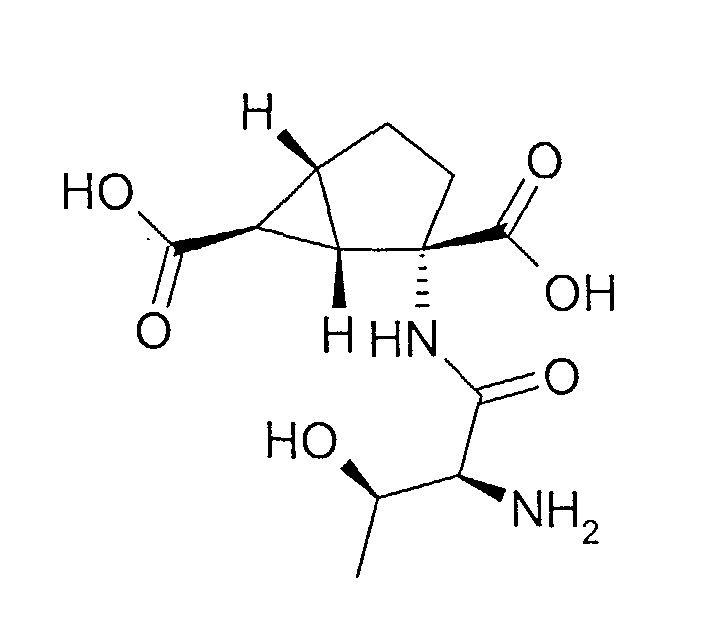
- (1S,2S,5R,6S)-Nethyl 2-[(2'S,3'R)-2-tert-butoxycarbonylamino-3-(tert-butyl-dimethyl-silanyloxy)-butyrylamino]-bicyclo[3.1.0]hexane-2,6-dicarboxylate was dissolved in dry THF (10 mL) under nitrogen and 1M tetrabutylammonium fluoride was added. The reaction was stirred at rt for 1h, the solvent was evaporated and the residue was purified by silica gel chromatography eluting with ethyl acetate. The desilylated material was subjected to the general procedure for 2'-tert-butoxycarbonylamino and 2,6-dimehtyl ester deprotection. The title compound was purified by HPLC.
14% yield. Hygroscopic white solid.
[□]D 25 = -13° [c=1, 1N HCl].
1H-NNR (D2O)δ: 4.03 (dq, J = 7.3, 6.4 Hz, 1 H); 3.77 (d, J = 7.3 Hz, 1 H); 2.52 (dd, J = 6.2, 2.7 Hz, 1 H); 2.27-2.07 (m, 4 H); 1.69 (t, J = 3.0 Hz, 1 H); 1.55-1.39 (m, 1 H); 1.28 (d, J = 6.5 Hz, 3 H).
13C-NMR (D2O)δ: 176.9, 175.9, 167.9, 66.4, 66.3, 58.6, 33.8, 31.3, 29.2, 25.2, 20.8, 18.7. -
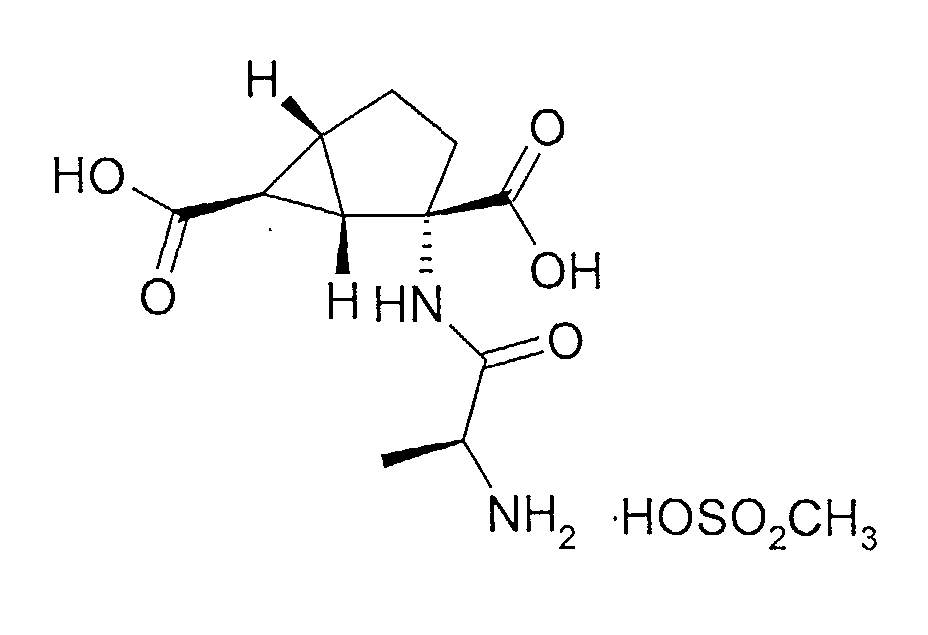
- A solution of (1S,2S,5R,6S)-2-[(2'S)-(2'-tert-butoxycarbonylamino)-propionyl]amino-bicyclo[3.1.0]hexane-2,6-dicarboxylic acid (1.07 g, 3.00 mmol), methanesulfonic acid (584 ul, 9.00 mmol) and dioxane (10 mL) was stirred for 48 h. The mixture was filtered and dried to afford (1S, 2S, 5R, 6S)-2-[(2'S)- (2'-Amino)- propionyl]aminobicyclo[3.1.0]hexane-2,6-dicarboxylic acid methane sulfonate as a crude, white, amorphous solid (1.05 g). A sample of this solid (1.0 g) was dissolved in MeOH (10 mL). The solution was concentrated to 3.3 g total weight and seed crystals were added. Ethyl acetate (10 mL) was then added to the mixture over a period of 15 min. The mixture was stirred for 30 min, filtered and dried under vacuum to afford 830 mg of the title compound as a white, crystalline solid.
Yield 78%
1H NMR (methanol-d4) δ 3.96 (q, J = 7.1 Hz, 1 H), 2.71 (s, 3 H), 2.45 (dd, J = 6.4, 2.7 Hz, 1 H), 2.38 (dd, J = 13.9, 8.4 Hz, 1 H), 2.20-2.08 (m, 1 H), 2.01-1.93 (m, 2 H), 1.67 (t, J = 2.9 Hz, 1 H), 1.52 (d, J = 7.0 Hz, 3 H), 1.46-1.35 (m, 1 H)
13C NMR (methanol-d4) δ 176.3, 175.7, 171.2, 67.4, 50.0, 39.5, 35.7, 33.1, 29.5, 27.4, 22.2, 17.6.
Anal. Calcd for C12H0N2O8S: C, 40.90; H, 5.72; N, 7.95.
Found: C, 40.81; H, 5.69; N, 7.83. -
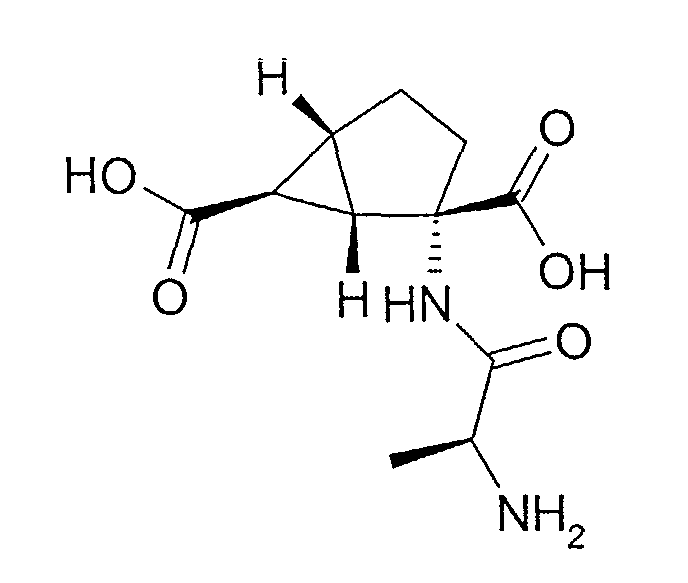
- (1S, 2S, 5R, 6S)-2-[(2'S)- (2'-Amino)- propionyl]aminobicyclo[3.1.0]hexane-2,6-dicarboxylic acid hydrochloride (1.0 g, 3.42 mmol) was dissolved in water (1 mL), and 1.0 N NaOH (3.42 mL, 3.42 mmol) was added. The solution was maintained in the refrigerator for 24 h. The solution remained clear. Acetone (2 mL) was added, and the solution was stored in the refrigerator for 16 h. A white solid precipitated out of solution, and mixture could not be stirred. Acetone (4 mL) was added, and the mixture was stirred at rt, then filtered and dried to afford 630 mg of the title compound as a white crystalline solid which contained 2-4% NaCl.
Yield 72%
1H NMR (methanol-d4) δ 3.93 (q, J = 7.1 Hz, 1 H), 2.48 (dd, , J = 6.6, 2.9 Hz, 1 H), 2.32 (dd, , J = 13.5, 8.4 Hz, 1 H), 2.20-2.08 (m, 1 H), 2.01-1.90 (m, 2 H), 1.61 (t, , J = 2.9 Hz, 1 H), 1.51 (d, , J = 7.0 Hz, 3 H), 1.48-1.33 (m, 1 H)
13C NMR (methanol-d4) δ 176.9 (2 C), 171.1, 68.0, 50.1, 35.9, 33.2, 29.7, 27.3, 22.5, 17.6. -

- The title compound was prepared according to General Procedure 2.
1H NMR (CD3OD): 3.62 (1H, t, 7.2 Hz), 3.02 (1H, t), 2.18 (1H, dd, 2.3 Hz, 6.4 Hz), 2.04-1.91 (1H, m), 1.90-0.80 (7H, m), 0.68 (6H, 2 x t, 6.7 Hz, 6.8 Hz)
MS: m/z 299 [M + H]

Claims (31)
- A compound of the formula Iwherein

R11 is CO2R14 and R12 is hydrogen or fluoro; or R11 is hydrogen or fluoro and R12 is CO2R14;
R13 and R14 are, independently, hydrogen, (1-10C) alkyl, (2-4C) alkenyl, aryl or arylalkyl;
A is (Q)p- ;
p is any integer from 1-10; and
Q is independently selected, each time taken, from the group amino acyl;
provided that the compound is not one in which R11 is CO2R14; R12, R13 and R14 are hydrogen; p is 1; and Q is L-alanyl;
or a pharmaceutically acceptable salt thereof. - A compound of the formula Iwherein

R11 is CO2R14 and R12 is hydrogen or fluoro; or R11 is hydrogen or fluoro and R12 is CO2R14;
R13 and R14 are, independently, hydrogen,
(1-10C) alkyl, (2-4C) alkenyl, aryl or arylalkyl;
A is (Q)p- ;
p is any integer from 1-10; and
Q is independently selected, each time taken, from the group amino acyl wherein amino acyl is an α-amino acid;
provided that the compound is not one in which R11 is CO2R14; R12, R13 and R14 are hydrogen; p is 1; and Q is L-alanyl;
or a pharmaceutically acceptable salt thereof. - The compound (or salt thereof) of Claims 1 or 2 wherein (1-10C) alkyl is methyl.
- The compound (or salt thereof) of Claims 1 or 2 wherein
R11 is CO2R14;
R12, R13, R14 and R15 are hydrogen; and
p is any integer from 1-3. - The compound (or salt thereof) of Claims 1, 2, or 4 wherein Q is independently selected, each time taken, from L-alanyl, glycyl, L-leucyl, L-phenylalanyl, L-valyl, L-lysyl, L-tryptophyl, L-isoleucyl, L-methionyl, L-glutamyl, L-tyrosyl, D-alanyl, L-prolyl, L-serinyl, D-leucyl, L-asparagyl and L-threonyl.
- The compound of Claims 1, 2, 4, or 5 which is selected from:a) (1S,2S,5R,6S)-2-[(2'S)-(2'-Amino)-3'-phenylpropionyl]amino-bicyclo[3.1.0]hexane-2,6-dicarboxylic acid hydrochloride;b) (1S,2S,5R,6S)-2-[(2'S)-(2'-Amino)-3'-methylbutyryl]amino-bicyclo[3.1.0]hexane-2,6-dicarboxylic acid hydrochloride;c) (1S,2S,5R,6S)-2-[(2'S,3'S)-(2'-Amino-3'-methylpentanoylamino)-bicyclo[3.1.0]hexane-2,6-dicarboxylic acid hydrochloride;d) (1S,2S,5R,6S)-2-(2-Amino-acetylamino)-bicyclo[3.1.0]hexane-2,6-dicarboxylic acid;e) (1S,2S,5R,6S)-2-[(2'S)-(2'-Amino)-(4'-methylthio)-butyryl]amino-bicyclo[3.1.0]hexane-2,6-dicarboxylic acid;f) (1S,2S,5R,6S)-2-[(2'S)-(2'-amino)-(3'-p-hydroxyphenyl)-propionyl]amino-bicyclo[3.1.0]hexane-2,6-dicarboxylic acid;g) (1S,2S,5R,6S)-2-[(2'S,3'R)-2-amino-3-hydroxy)-butyryl)amino-bicyclo[3.1.0]hexane-2,6-dicarboxylic acid;h) (1S,2S,6R,6S)-2-[2'S-(2"S-amino-4-methylpentanonylamino)-propionylamino]-bicyclo[3.1.0]hexane-2,6-dicarboxylic acid; ori) (1S,2S,5R,6S)-2-[2'(S)-(2"(S)-amino-propionylamino)-propionylamino]-bicyclo[3.1.0]hexane-2,6-dicarboxylic acid.
- The compound of Claims 1, 2, 4, or 5 which is (1S,2S,5R,6S)-2-[(2'S)-(2'-amino-4'-methyl)-pentanoyl]aminobicyclo[3.1.0]hexane-2,6-dicarboxylic acid.
- A pharmaceutically acceptable salt of a compound of formula I as claimed in Claims 1-7 which is an acid-addition salt made with an acid which provides a pharmaceutically acceptable anion or, for a compound which contains an acidic moiety, which is a salt made with a base which provides a pharmaceutically acceptable anion.
- The pharmaceutically acceptable salt of a compound of formula I as claimed in Claim 8 wherein the salt is a hydrochloride salt.
- The pharmaceutically acceptable salt of a compound of formula I as claimed in Claim 8 wherein the salt is a methane sulfonate salt.
- A pharmaceutical formulation comprising in association with a pharmaceutically acceptable carrier, dilutent or excipient, a compound of formula I (or a pharmaceutically acceptable salt thereof) as provided Claims 1-10.
- A process for preparing the compound of formula I, or a pharmaceutically acceptable salt thereof, as claimed in Claim 1 comprising:(A) for a compound of formula I in which R13 and R14 are hydrogen, deprotecting a compound of formula IVwhere Rm is an amine protecting group and R13 and R14 are carboxy protecting groups;
 (B) for a compound of formula I in which R13 and R14 are both not hydrogen, acylating a compound of formula IIwith a corresponding amino acyl of formula III
whereafter, for any of the above procedures, when a functional group is protected using a protecting group, removing the protecting group;
whereafter, for any of the above procedures, when a pharmaceutically acceptable salt of a compound of formula I is required, it is obtained by reacting the basic form of such a compound of formula I with an acid affording a physiologically acceptable anion, or, for a compound of formula I which bears an acidic moiety, reacting the acidic form of such a compound of formula I with a base which affords a pharmaceutically acceptable cation, or by any other conventional procedure. - A method for affecting the cAMP-linked metabotropic glutamate receptors in a patient, which comprises administering to a patient requiring modulated excitatory amino acid neurotransmission a pharmaceutically-effective amount of the compound of Claim 1.
- A method for affecting the cAMP-linked metabotropic glutamate receptors in a patient, which comprises administering to a patient requiring modulated excitatory amino acid neurotransmission a pharmaceutically-effective amount of the compound of Claim 7.
- A method for treating a neurological disorder in a patient which comprises administering to the patient in need of treatment thereof a pharmaceutically-effective amount of the compound of Claim 1.
- The method of Claim 15 wherein said neurological disorder is cerebral deficits subsequent to cardiac bypass and grafting; cerebral ischemia; spinal cord trauma; head trauma; Alzheimer's Disease; Huntington's Chorea; amyotrophic lateral sclerosis; AIDS-induced dementia; perinatal hypoxia; hypoglycemic neuronal damage; ocular damage and retinopathy; cognitive disorders; idiopathic and drug-induced Parkinson's Disease; muscular spasms; migraine headaches; urinary incontinence; drug tolerance, withdrawal, and cessation; smoking cessation; emesis; brain edema; chronic pain; sleep disorders; convulsions; Tourette's syndrome; attention deficit disorder; and tardive dyskinesia.
- The method of Claim 16 wherein said neurological disorder is drug tolerance, withdrawal, and cessation; or smoking cessation.
- A method for treating a neurological disorder in a patient which comprises administering to the patient in need of treatment thereof a pharmaceutically-effective amount of a compound of Claim 7.
- The method of Claim 18 wherein said neurological disorder is cerebral deficits subsequent to cardiac bypass and grafting; cerebral ischemia; spinal cord trauma; head trauma; Alzheimer's Disease; Huntington's Chorea; amyotrophic lateral sclerosis; AIDS-induced dementia; perinatal hypoxia; hypoglycemic neuronal damage; ocular damage and retinopathy; cognitive disorders; idiopathic and drug-induced Parkinson's Disease; muscular spasms; migraine headaches; urinary incontinence; drug tolerance, withdrawal, and cessation; smoking cessation; emesis; brain edema; chronic pain; sleep disorders; convulsions; Tourette's syndrome; attention deficit disorder; and tardive dyskinesia.
- The method of Claim 19 wherein said neurological disorder is drug tolerance, withdrawal, and cessation; or smoking cessation.
- A method for treating a psychiatric disorder in a patient which comprises administering to the patient in need of treatment thereof a pharmaceutically-effective amount of the compound of Claim 1.
- The method of Claim 21 wherein said psychiatric disorder is schizophrenia, anxiety and related disorders, depression, bipolar disorders, psychosis, and obsessive compulsive disorders.
- The method of Claim 22 wherein said psychiatric disorder is anxiety and related disorders.
- A method for treating a psychiatric disorder in a patient which comprises administering to the patient in need of treatment thereof a pharmaceutically-effective amount of a compound of Claim 7.
- The method of Claim 24 wherein said psychiatric disorder is schizophrenia, anxiety and related disorders, depression, bipolar disorders, psychosis, and obsessive compulsive disorders.
- The method of Claim 25 wherein said psychiatric disorder is anxiety and related disorders.
- A compound of formula IVwherein Rm is an amine protecting group and the groups R11, R12 and R13 have any of the values defined in Claim 1.

- A method of administering an effective amount of a compound of formula II, where R13 and R14 are both hydrogen (a di-acid), which comprises administering to a patient requiring modulated excitatory amino acid neurotransmission a pharmaceutically effective amount of a compound of Claim 1.
- A novel compound of formula I substantially as hereinbefore described with reference to any of the Examples.
- A method for affecting the CAMP-linked metabotropic glutamate receptors in a mammal, which comprises administering to a mammal requiring modulated excitatory amino acid neurotransmission a pharmaceutically effective amount of a compound of formula I substantially as hereinbefore described with reference to any of the Examples.
- A process for preparing a novel compound of formula I substantially as hereinbefore described with reference to any of the Examples.
Priority Applications (4)
| Application Number | Priority Date | Filing Date | Title |
|---|---|---|---|
| EP01500264A EP1310482A1 (en) | 2001-11-07 | 2001-11-07 | Prodrugs of excitatory amino acids |
| EP02707416A EP1351925A1 (en) | 2001-01-11 | 2002-01-09 | Prodrugs of excitatory amino acids |
| US10/465,972 US7038077B2 (en) | 2001-01-11 | 2002-01-09 | Prodrugs of excitatory amino acids |
| PCT/US2002/000488 WO2002055485A1 (en) | 2001-01-11 | 2002-01-09 | Prodrugs of excitatory amino acids |
Applications Claiming Priority (1)
| Application Number | Priority Date | Filing Date | Title |
|---|---|---|---|
| EP01500264A EP1310482A1 (en) | 2001-11-07 | 2001-11-07 | Prodrugs of excitatory amino acids |
Publications (1)
| Publication Number | Publication Date |
|---|---|
| EP1310482A1 true EP1310482A1 (en) | 2003-05-14 |
Family
ID=8183498
Family Applications (1)
| Application Number | Title | Priority Date | Filing Date |
|---|---|---|---|
| EP01500264A Withdrawn EP1310482A1 (en) | 2001-01-11 | 2001-11-07 | Prodrugs of excitatory amino acids |
Country Status (1)
| Country | Link |
|---|---|
| EP (1) | EP1310482A1 (en) |
Citations (3)
| Publication number | Priority date | Publication date | Assignee | Title |
|---|---|---|---|---|
| US5750566A (en) * | 1994-08-12 | 1998-05-12 | Eli Lilly And Company | Synthetic excitatory amino acids |
| WO2000004010A1 (en) * | 1998-07-17 | 2000-01-27 | Eli Lilly And Company Limited | Bicyclohexane derivatives |
| WO2002022627A2 (en) * | 2000-09-15 | 2002-03-21 | Georgetwon University | Ligands for metabotropic glutamate receptors |
-
2001
- 2001-11-07 EP EP01500264A patent/EP1310482A1/en not_active Withdrawn
Patent Citations (3)
| Publication number | Priority date | Publication date | Assignee | Title |
|---|---|---|---|---|
| US5750566A (en) * | 1994-08-12 | 1998-05-12 | Eli Lilly And Company | Synthetic excitatory amino acids |
| WO2000004010A1 (en) * | 1998-07-17 | 2000-01-27 | Eli Lilly And Company Limited | Bicyclohexane derivatives |
| WO2002022627A2 (en) * | 2000-09-15 | 2002-03-21 | Georgetwon University | Ligands for metabotropic glutamate receptors |
Similar Documents
| Publication | Publication Date | Title |
|---|---|---|
| US7671082B2 (en) | Prodrugs of excitatory amino acids | |
| EP1351925A1 (en) | Prodrugs of excitatory amino acids | |
| CA2433667C (en) | Prodrugs of excitatory amino acids | |
| AU2002228737A1 (en) | Prodrugs of excitatory amino acids | |
| EP1423411A2 (en) | Prodrugs of excitatory amino acids | |
| US20040176459A1 (en) | Prodrugs of excitatory amino acids | |
| KR101061663B1 (en) | Prodrugs of Excitable Amino Acids | |
| AU2008200612B8 (en) | Prodrugs of excitatory amino acids | |
| US7456221B2 (en) | Prodrugs of excitatory amino acids | |
| EP1310480A1 (en) | Prodrugs of excitatory amino acids | |
| JPS63238099A (en) | Peptides derived from cck8, preparation and pharmaceutical composition | |
| ZA200304351B (en) | Prodrugs of excitatory amino acids. | |
| HK1116415A (en) | Prodrugs of excitatory amino acids |
Legal Events
| Date | Code | Title | Description |
|---|---|---|---|
| PUAI | Public reference made under article 153(3) epc to a published international application that has entered the european phase |
Free format text: ORIGINAL CODE: 0009012 |
|
| AK | Designated contracting states |
Designated state(s): AT BE CH CY DE DK ES FI FR GB GR IE IT LI LU MC NL PT SE TR |
|
| AX | Request for extension of the european patent |
Extension state: AL LT LV MK RO SI |
|
| STAA | Information on the status of an ep patent application or granted ep patent |
Free format text: STATUS: THE APPLICATION IS DEEMED TO BE WITHDRAWN |
|
| 18D | Application deemed to be withdrawn |
Effective date: 20030308 |