EP1310310A2 - Surface enhancer formulation for a metal or metal/ceramic article - Google Patents
Surface enhancer formulation for a metal or metal/ceramic article Download PDFInfo
- Publication number
- EP1310310A2 EP1310310A2 EP02250585A EP02250585A EP1310310A2 EP 1310310 A2 EP1310310 A2 EP 1310310A2 EP 02250585 A EP02250585 A EP 02250585A EP 02250585 A EP02250585 A EP 02250585A EP 1310310 A2 EP1310310 A2 EP 1310310A2
- Authority
- EP
- European Patent Office
- Prior art keywords
- poly
- metal
- maleic acid
- polymer
- styrene
- Prior art date
- Legal status (The legal status is an assumption and is not a legal conclusion. Google has not performed a legal analysis and makes no representation as to the accuracy of the status listed.)
- Withdrawn
Links
- 239000002184 metal Substances 0.000 title claims abstract description 46
- 229910052751 metal Inorganic materials 0.000 title claims abstract description 46
- 238000009472 formulation Methods 0.000 title claims abstract description 33
- 239000000203 mixture Substances 0.000 title claims abstract description 33
- 239000000919 ceramic Substances 0.000 title claims abstract description 16
- 239000003623 enhancer Substances 0.000 title description 16
- MCMNRKCIXSYSNV-UHFFFAOYSA-N Zirconium dioxide Chemical compound O=[Zr]=O MCMNRKCIXSYSNV-UHFFFAOYSA-N 0.000 claims abstract description 101
- 238000000034 method Methods 0.000 claims abstract description 42
- 229920000642 polymer Polymers 0.000 claims abstract description 38
- 239000002904 solvent Substances 0.000 claims abstract description 22
- 125000002524 organometallic group Chemical group 0.000 claims abstract description 7
- CSCPPACGZOOCGX-UHFFFAOYSA-N Acetone Chemical group CC(C)=O CSCPPACGZOOCGX-UHFFFAOYSA-N 0.000 claims description 25
- 239000011976 maleic acid Substances 0.000 claims description 22
- 239000011230 binding agent Substances 0.000 claims description 16
- 238000000576 coating method Methods 0.000 claims description 13
- 125000002914 sec-butyl group Chemical group [H]C([H])([H])C([H])([H])C([H])(*)C([H])([H])[H] 0.000 claims description 10
- 239000011248 coating agent Substances 0.000 claims description 9
- 239000002131 composite material Substances 0.000 claims description 9
- 150000004702 methyl esters Chemical class 0.000 claims description 9
- RTAQQCXQSZGOHL-UHFFFAOYSA-N Titanium Chemical compound [Ti] RTAQQCXQSZGOHL-UHFFFAOYSA-N 0.000 claims description 7
- RVTZCBVAJQQJTK-UHFFFAOYSA-N oxygen(2-);zirconium(4+) Chemical compound [O-2].[O-2].[Zr+4] RVTZCBVAJQQJTK-UHFFFAOYSA-N 0.000 claims description 7
- -1 2-butoxy Chemical group 0.000 claims description 5
- 239000004593 Epoxy Substances 0.000 claims description 5
- 239000004793 Polystyrene Substances 0.000 claims description 4
- QOSMNYMQXIVWKY-UHFFFAOYSA-N Propyl levulinate Chemical compound CCCOC(=O)CCC(C)=O QOSMNYMQXIVWKY-UHFFFAOYSA-N 0.000 claims description 4
- 230000002708 enhancing effect Effects 0.000 claims description 4
- 125000004494 ethyl ester group Chemical group 0.000 claims description 4
- 229920001490 poly(butyl methacrylate) polymer Polymers 0.000 claims description 4
- 229920003229 poly(methyl methacrylate) Polymers 0.000 claims description 4
- 239000004926 polymethyl methacrylate Substances 0.000 claims description 4
- 229920002223 polystyrene Polymers 0.000 claims description 4
- 239000011118 polyvinyl acetate Substances 0.000 claims description 4
- 229920002689 polyvinyl acetate Polymers 0.000 claims description 4
- 230000002401 inhibitory effect Effects 0.000 claims description 3
- 230000008569 process Effects 0.000 abstract description 19
- 239000007822 coupling agent Substances 0.000 abstract description 11
- 238000005336 cracking Methods 0.000 abstract description 6
- 239000000725 suspension Substances 0.000 description 16
- 238000001556 precipitation Methods 0.000 description 14
- 239000002245 particle Substances 0.000 description 11
- 239000000463 material Substances 0.000 description 7
- 229910000906 Bronze Inorganic materials 0.000 description 5
- OKTJSMMVPCPJKN-UHFFFAOYSA-N Carbon Chemical group [C] OKTJSMMVPCPJKN-UHFFFAOYSA-N 0.000 description 5
- 230000008901 benefit Effects 0.000 description 5
- 239000010974 bronze Substances 0.000 description 5
- KUNSUQLRTQLHQQ-UHFFFAOYSA-N copper tin Chemical compound [Cu].[Sn] KUNSUQLRTQLHQQ-UHFFFAOYSA-N 0.000 description 5
- 230000000694 effects Effects 0.000 description 5
- 238000001764 infiltration Methods 0.000 description 5
- 230000008595 infiltration Effects 0.000 description 5
- 239000003112 inhibitor Substances 0.000 description 5
- 239000000443 aerosol Substances 0.000 description 4
- 238000002156 mixing Methods 0.000 description 4
- 239000002244 precipitate Substances 0.000 description 4
- 229910000831 Steel Inorganic materials 0.000 description 3
- ATJFFYVFTNAWJD-UHFFFAOYSA-N Tin Chemical compound [Sn] ATJFFYVFTNAWJD-UHFFFAOYSA-N 0.000 description 3
- 239000000843 powder Substances 0.000 description 3
- 239000003380 propellant Substances 0.000 description 3
- 238000000110 selective laser sintering Methods 0.000 description 3
- 238000005245 sintering Methods 0.000 description 3
- 239000010959 steel Substances 0.000 description 3
- ATUOYWHBWRKTHZ-UHFFFAOYSA-N Propane Chemical compound CCC ATUOYWHBWRKTHZ-UHFFFAOYSA-N 0.000 description 2
- 239000000654 additive Substances 0.000 description 2
- 230000000740 bleeding effect Effects 0.000 description 2
- 229910052799 carbon Inorganic materials 0.000 description 2
- 238000001816 cooling Methods 0.000 description 2
- 238000002845 discoloration Methods 0.000 description 2
- 239000007789 gas Substances 0.000 description 2
- 230000009477 glass transition Effects 0.000 description 2
- 239000007788 liquid Substances 0.000 description 2
- 238000005259 measurement Methods 0.000 description 2
- 238000012986 modification Methods 0.000 description 2
- 230000004048 modification Effects 0.000 description 2
- 238000000465 moulding Methods 0.000 description 2
- 239000003960 organic solvent Substances 0.000 description 2
- 238000012216 screening Methods 0.000 description 2
- 239000002893 slag Substances 0.000 description 2
- 239000000243 solution Substances 0.000 description 2
- 238000005507 spraying Methods 0.000 description 2
- 238000003756 stirring Methods 0.000 description 2
- 239000006228 supernatant Substances 0.000 description 2
- 238000009736 wetting Methods 0.000 description 2
- 238000009825 accumulation Methods 0.000 description 1
- 238000005054 agglomeration Methods 0.000 description 1
- 230000002776 aggregation Effects 0.000 description 1
- 238000013459 approach Methods 0.000 description 1
- 230000004888 barrier function Effects 0.000 description 1
- 238000009835 boiling Methods 0.000 description 1
- 230000001680 brushing effect Effects 0.000 description 1
- 239000013590 bulk material Substances 0.000 description 1
- 239000001273 butane Substances 0.000 description 1
- 239000008199 coating composition Substances 0.000 description 1
- 150000001875 compounds Chemical class 0.000 description 1
- 230000008878 coupling Effects 0.000 description 1
- 238000010168 coupling process Methods 0.000 description 1
- 238000005859 coupling reaction Methods 0.000 description 1
- 230000003247 decreasing effect Effects 0.000 description 1
- 230000007547 defect Effects 0.000 description 1
- 238000004512 die casting Methods 0.000 description 1
- 238000004090 dissolution Methods 0.000 description 1
- 239000000839 emulsion Substances 0.000 description 1
- 150000002148 esters Chemical class 0.000 description 1
- 238000002474 experimental method Methods 0.000 description 1
- 238000011049 filling Methods 0.000 description 1
- 239000013020 final formulation Substances 0.000 description 1
- 239000011521 glass Substances 0.000 description 1
- PCHJSUWPFVWCPO-UHFFFAOYSA-N gold Chemical compound [Au] PCHJSUWPFVWCPO-UHFFFAOYSA-N 0.000 description 1
- 239000010931 gold Substances 0.000 description 1
- 229910052737 gold Inorganic materials 0.000 description 1
- 235000003642 hunger Nutrition 0.000 description 1
- 230000002209 hydrophobic effect Effects 0.000 description 1
- 230000005764 inhibitory process Effects 0.000 description 1
- 238000001746 injection moulding Methods 0.000 description 1
- 238000011835 investigation Methods 0.000 description 1
- 238000002386 leaching Methods 0.000 description 1
- 238000011068 loading method Methods 0.000 description 1
- 239000011159 matrix material Substances 0.000 description 1
- 239000000155 melt Substances 0.000 description 1
- 125000002496 methyl group Chemical group [H]C([H])([H])* 0.000 description 1
- IJDNQMDRQITEOD-UHFFFAOYSA-N n-butane Chemical compound CCCC IJDNQMDRQITEOD-UHFFFAOYSA-N 0.000 description 1
- OFBQJSOFQDEBGM-UHFFFAOYSA-N n-pentane Natural products CCCCC OFBQJSOFQDEBGM-UHFFFAOYSA-N 0.000 description 1
- 238000004806 packaging method and process Methods 0.000 description 1
- 239000003973 paint Substances 0.000 description 1
- 150000002978 peroxides Chemical class 0.000 description 1
- 239000003348 petrochemical agent Substances 0.000 description 1
- 239000004033 plastic Substances 0.000 description 1
- 229920003023 plastic Polymers 0.000 description 1
- 229920002959 polymer blend Polymers 0.000 description 1
- 230000001376 precipitating effect Effects 0.000 description 1
- 239000001294 propane Substances 0.000 description 1
- 238000000926 separation method Methods 0.000 description 1
- 230000009919 sequestration Effects 0.000 description 1
- 239000011877 solvent mixture Substances 0.000 description 1
- 239000007921 spray Substances 0.000 description 1
- 230000037351 starvation Effects 0.000 description 1
- 238000004381 surface treatment Methods 0.000 description 1
- 238000010998 test method Methods 0.000 description 1
- 238000012360 testing method Methods 0.000 description 1
- 230000000007 visual effect Effects 0.000 description 1
- 229910001928 zirconium oxide Inorganic materials 0.000 description 1
Images


Classifications
-
- C—CHEMISTRY; METALLURGY
- C23—COATING METALLIC MATERIAL; COATING MATERIAL WITH METALLIC MATERIAL; CHEMICAL SURFACE TREATMENT; DIFFUSION TREATMENT OF METALLIC MATERIAL; COATING BY VACUUM EVAPORATION, BY SPUTTERING, BY ION IMPLANTATION OR BY CHEMICAL VAPOUR DEPOSITION, IN GENERAL; INHIBITING CORROSION OF METALLIC MATERIAL OR INCRUSTATION IN GENERAL
- C23C—COATING METALLIC MATERIAL; COATING MATERIAL WITH METALLIC MATERIAL; SURFACE TREATMENT OF METALLIC MATERIAL BY DIFFUSION INTO THE SURFACE, BY CHEMICAL CONVERSION OR SUBSTITUTION; COATING BY VACUUM EVAPORATION, BY SPUTTERING, BY ION IMPLANTATION OR BY CHEMICAL VAPOUR DEPOSITION, IN GENERAL
- C23C22/00—Chemical surface treatment of metallic material by reaction of the surface with a reactive liquid, leaving reaction products of surface material in the coating, e.g. conversion coatings, passivation of metals
-
- C—CHEMISTRY; METALLURGY
- C08—ORGANIC MACROMOLECULAR COMPOUNDS; THEIR PREPARATION OR CHEMICAL WORKING-UP; COMPOSITIONS BASED THEREON
- C08K—Use of inorganic or non-macromolecular organic substances as compounding ingredients
- C08K3/00—Use of inorganic substances as compounding ingredients
- C08K3/18—Oxygen-containing compounds, e.g. metal carbonyls
- C08K3/20—Oxides; Hydroxides
- C08K3/22—Oxides; Hydroxides of metals
-
- C—CHEMISTRY; METALLURGY
- C08—ORGANIC MACROMOLECULAR COMPOUNDS; THEIR PREPARATION OR CHEMICAL WORKING-UP; COMPOSITIONS BASED THEREON
- C08K—Use of inorganic or non-macromolecular organic substances as compounding ingredients
- C08K5/00—Use of organic ingredients
- C08K5/56—Organo-metallic compounds, i.e. organic compounds containing a metal-to-carbon bond
-
- C—CHEMISTRY; METALLURGY
- C23—COATING METALLIC MATERIAL; COATING MATERIAL WITH METALLIC MATERIAL; CHEMICAL SURFACE TREATMENT; DIFFUSION TREATMENT OF METALLIC MATERIAL; COATING BY VACUUM EVAPORATION, BY SPUTTERING, BY ION IMPLANTATION OR BY CHEMICAL VAPOUR DEPOSITION, IN GENERAL; INHIBITING CORROSION OF METALLIC MATERIAL OR INCRUSTATION IN GENERAL
- C23C—COATING METALLIC MATERIAL; COATING MATERIAL WITH METALLIC MATERIAL; SURFACE TREATMENT OF METALLIC MATERIAL BY DIFFUSION INTO THE SURFACE, BY CHEMICAL CONVERSION OR SUBSTITUTION; COATING BY VACUUM EVAPORATION, BY SPUTTERING, BY ION IMPLANTATION OR BY CHEMICAL VAPOUR DEPOSITION, IN GENERAL
- C23C30/00—Coating with metallic material characterised only by the composition of the metallic material, i.e. not characterised by the coating process
-
- B—PERFORMING OPERATIONS; TRANSPORTING
- B22—CASTING; POWDER METALLURGY
- B22F—WORKING METALLIC POWDER; MANUFACTURE OF ARTICLES FROM METALLIC POWDER; MAKING METALLIC POWDER; APPARATUS OR DEVICES SPECIALLY ADAPTED FOR METALLIC POWDER
- B22F2998/00—Supplementary information concerning processes or compositions relating to powder metallurgy
-
- C—CHEMISTRY; METALLURGY
- C08—ORGANIC MACROMOLECULAR COMPOUNDS; THEIR PREPARATION OR CHEMICAL WORKING-UP; COMPOSITIONS BASED THEREON
- C08K—Use of inorganic or non-macromolecular organic substances as compounding ingredients
- C08K3/00—Use of inorganic substances as compounding ingredients
- C08K3/18—Oxygen-containing compounds, e.g. metal carbonyls
- C08K3/20—Oxides; Hydroxides
- C08K3/22—Oxides; Hydroxides of metals
- C08K2003/2244—Oxides; Hydroxides of metals of zirconium
Definitions
- Prior processes for refractory molding included the two-step use of a furnace process that required a sintering step followed by a bronze metal infiltration step.
- U.S. Patent No. 4,554,218 describes one such process.
- a binder is solely burned out of the parts after which the parts or articles are sintered at an elevated temperature and then the furnace in which the parts are sintered is cooled.
- the sintered parts are then removed and sprayed with a compound, including zirconia, to inhibit over-wetting past the steel surface of the part.
- the parts are then positioned in an appropriate device, heated to an elevated temperature for infiltration of the metal, and the furnace is cooled again.
- the cooling process in each instance is lengthy and time consuming. This is a disadvantage in the process adding costs, delay, and unnecessary handling.
- Organometallic binding agents such as the zirconates NZ09 and KZ55 were studied.
- the organometallic binding agent reacts with the surface of the zirconia to lower the surface energy of the zirconia to make it more compatible with the organic solvent.
- Zirconates were thought to be preferable to titanates since zirconates degrade to zirconium oxide (zirconia) and so would not interfere with any surface energy relationship to the infiltrant.
- KZ55 was found to reduce the zirconia precipitation rate by a factor of 80, the shelf life of the resulting formulation is substantially shortened. It was found that the shelf life was shortened because the reactive end groups of the KZ55 react with the residual peroxide in the polymer to problematically create agglomerates.
- a heavy collection platform was suspended within a 25 mm diameter glass cylinder approximately 40 mm from the bottom of the cylinder.
- the platform was not located too close to the bottom of the cylinder to prevent precipitates from the suspension hindering movement of the collection platform. There was approximately a 1 mm gap between the platform and the cylinder walls enabling the collection platform to move freely.
- the platform was constructed from a U.S. five-cent piece having two very small holes from which it was suspended by very thin wires.
- the suspension wire was attached to a digital balance.
- the platform mass was recorded as a function of time via the RS-232 port on the balance and the use of a custom visual basic program. However, manual observation of mass recordings can be as effective.
- the cylinder was filled with zirconia suspension such that the suspended platform would collect all of the precipitate from a 150 mm column of suspension.
- This method recorded the entire quantity of zirconia precipitation as a function of time. Because the buoyant force of the suspension varied as a function of the density of the zirconia suspension, and this density varied with time, the mass reported by the balance also varied with time, relative to the absolute mass. However, this method was used to measure the relative differences between formulations. No effort was made to correct for the buoyant force of the suspension. Results of different weight-percentages of zirconia using this method are shown in Fig. 3
- the green part is coated with the enhancer formulation of the present invention, such as by spraying, brushing, immersing, or other appropriate method. Accordingly, the spirit and broad scope of the appended claims are intended to embrace all such changes, modifications and variations that may occur to one of skill in the art upon a reading of the disclosure. All patent applications, patents and other publications cited herein are incorporated by reference in their entirety.
Landscapes
- Chemical & Material Sciences (AREA)
- Chemical Kinetics & Catalysis (AREA)
- Organic Chemistry (AREA)
- Health & Medical Sciences (AREA)
- Medicinal Chemistry (AREA)
- Polymers & Plastics (AREA)
- Engineering & Computer Science (AREA)
- Materials Engineering (AREA)
- Mechanical Engineering (AREA)
- Metallurgy (AREA)
- General Chemical & Material Sciences (AREA)
- Compositions Of Oxide Ceramics (AREA)
Abstract
A formulation for use in forming precision molded articles from a furnace
process is disclosed wherein an organometallic zirconia coupling agent is used
in conjunction with a polymer in solvent to inhibit the bleed-through of infiltrant
metal in a finished metal or metal/ceramic part formed in a single-step furnace
process. The formulation is usable to enhance the surface appearance of the
part by reducing surface cracking or wrinkling.
Description
- The present invention relates to a formulation for enhancing the surface of an infiltrated metal or metal/ceramic part and to a method of inhibiting infiltrant bleed-through in a metal or metal/ceramic part. The invention also relates to a formulation for coating the surface of an infiltrated metal or metal/ceramic composite part.
- The present invention finds application generally to the forming of precision-molded articles such as hard molds for plastic injection molding or die casting from mixes of refractory or laser sinterable particles in heat fugitive organic binds. The surface enhancer formulation is applicable to improving the surface appearance and quality of a molded refractory or laser sintered article, for example a metal or metal/ceramic composite part.
- Prior processes for refractory molding included the two-step use of a furnace process that required a sintering step followed by a bronze metal infiltration step. U.S. Patent No. 4,554,218 describes one such process. In the prior process, a binder is solely burned out of the parts after which the parts or articles are sintered at an elevated temperature and then the furnace in which the parts are sintered is cooled. The sintered parts are then removed and sprayed with a compound, including zirconia, to inhibit over-wetting past the steel surface of the part. The parts are then positioned in an appropriate device, heated to an elevated temperature for infiltration of the metal, and the furnace is cooled again. The cooling process in each instance is lengthy and time consuming. This is a disadvantage in the process adding costs, delay, and unnecessary handling.
- The zirconia has been found to function as a barrier to the infiltration of the metal infiltrant. This is accomplished because of the different surface energies between the zirconia and the metal infiltrant so that the zirconia prevents the over-wetting or bleed-through of the metal infiltrant beyond the steel surfaces of the parts being formed.
- An improved refractory furnace process has been developed that combines the sintering and infiltration steps so that the green parts are sprayed with an improved surface enhancer prior to being positioned in the appropriate apparatus for binder burnout, sintering and infiltration in a single step with accelerated cooling. This process is described in U.S. Patent No. 5,989,476. However, the improved process creates a problem of increased infiltrant bleeding through the coating and leaving the finished steel parts with an undesirable surface appearance, including discoloration with a gold-type appearance and cracking or wrinkling. The gold discoloration is attributed to the flaking off of the zirconia from the article during the binder burnout phase of the process. Additionally, there are problems encountered with the presence of carbon residue that is scavenged from the binder gases into the infiltrant. The sequestered carbon is subsequently released in the process after the infiltrant melts. It thereby forms a slag on the surface that inhibits the flow of the infiltrant into the metal part, resulting in infiltrant starvation in the finished part when the carbonaceous slag retains the infiltrant in the reservoir apparatus during the process.
- Articles formed by the selective laser sintering process utilizing metal powder or metal/ceramic powder are also subject to bleed through problems. A suitable process and apparatus for performing selective laser sintering is described in U.S. Patent Nos. 4,863,538 and 5,252,264.
- These problems are solved in the preferred practice of the use of the surface enhancer formulation of the present invention. Aspects, features and advantages of the present invention given in the following summary relate to the preferred practice of the invention which is described later.
- It is an aspect of the present invention that an improved polymer inhibitor is added to the surface enhancer solution that is applied to the green part in a furnace process to produce an infiltrated metal or metal/ceramic composite article which eliminates excess metal infiltrant-bleed-through in the finished part.
- It is another aspect of the present invention that the improved polymer inhibitor is a polymer with an optimum formulation of between about two to four percent concentration by weight of the carrier solvent in the total enhancer formulation.
- It is a feature of the present invention that the polymer inhibitor added to the enhancer is a poly(styrene-co-maleic acid), partial sec-butyl/methyl ester that is combined with the suspension of zirconia particles in a solvent.
- It is another feature of the present invention that a zirconate coupling agent is used with the enhancer formulation to inhibit infiltrant-bleed-through and reduce surface cracking and wrinkling in the finished part.
- It is still another feature of the present invention that the preferred coupling agent is a zirconate that is added to the zirconia inhibitor prior to the addition of the polymer.
- It is an advantage of the present invention that the improved enhancer reduces metal infiltrant-bleed-through in the final finished part.
- It is another advantage of the present invention that the improved enhancer reduces undesirable cracked and wrinkled surfaces in the finished part.
- These and other aspects, features and advantages are obtained in the present invention by use of an improved enhancer with a solvent, a polymer, a zirconate coupling agent, and zirconia particles wherein the polymer is present in a concentration of about two to four percent of the solvent.
- More generally stated, according to one aspect of the present invention there is provided a formulation for enhancing the surface appearance of a metal or metal/ceramic composite part which is as set forth in Claim 1.
- According to another aspect of the present invention there is provided a method of inhibiting infiltrant bleed-through in a metal or metal/ceramic composite part which is as set forth in Claim 12.
- The invention and its preferred practice will now be described in the following detailed disclosure, especially when taken in conjunction with the accompanying drawings wherein:
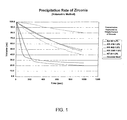
- Fig. 1 is a graphical representation of the precipitation rate of zirconia when treated with different percentage organometallic coupling agents;
- Fig. 2 is a graphical illustration of the precipitation rate of zirconia when treated with a preferred titanate coupling agent; and
- Fig. 3 is a graphical illustration of the precipitation rate of zirconia in a solvent at varying concentrations by weight of the titanate coupling agent.
-
- An approach was developed in order to alleviate the problem of infiltrant bleeding through the zirconia coating in a single step furnace infiltrated metal or metal/ceramic composite molding process. Carrier solvents and solvent leaching were evaluated, as were polymer additives.
- Since the degree of infiltrant-bleed-through was often variable, it was hypothesized that the solvent contact time with the part as well as the solvent polarity (solvent strength relative to epoxy binder) might be a factor. Zirconia, suspended in a variety of organic solvents with differing polarities and boiling points, was sprayed onto green parts that were subsequently sintered and infiltrated. Acetone was found to be the preferred solvent. The zirconia-solvent mixture was sprayed to maximize the effect of the quantity of material applied as well as to minimize possible mechanical application effects. The coating thickness was critical to minimize the infiltrant-bleed-through problem. Excessive coating thickness causes surface cracking of the part surface and lift off of the surface enhancer, permitting infiltrant-bleed-through. High polarity solvents better suspended the zirconia particles.
- Polymers of various polarities and glass transition temperatures were added to the acetone-zirconia suspension. Polymer glass transition temperature was not found have an effect. However, it was found that polymers that bind strongly to the part surface greatly improved or eliminated the infiltrant-bleed-through situation. Polymers that aggressively adhered to the part surface (often containing carboxylic functionalities) also deformed and wrinkled these surfaces. This effect was inversely proportional to the amount of infiltrant-bleed-through in the negative sense. Many polymers and polymer mixtures were evaluated in an effort to balance the infiltrant-bleed-through effect against surface cracking and wrinkling. These included polystyrene; two-part epoxy; polymethylmethacrylate; polyvinylacetate; polybutylmethacrylate; polyethymethacrylate; poly(t-butylacrylate-co-ethylacrylate-co-methacrylic acid); poly(ethylmethacrylate-co-methylacrylate); poly(styrene-co-maleic acid), partial sec-butyl/methyl ester; poly(styrene-co-maleic acid), partial 2-butoxy/ethyl ester; poly(styrene-co-maleic acid), propyl ester; poly(methylvinylether-alt-maleic acid); and poly (ethylene-co-methylacrylate-co-acrylic acid) available from Sigma-Aldrich Chemical Co.
- Polymer concentrations between about 0.5% and about 4% relative to the carrier solvent were tested with zirconia loading of 25g per 100g solvent. The optimum formulation contained about 2% poly(styrene-co-maleic acid), partial sec-butyl/methyl ester. Concentrations less than about 2% were inadequate to prevent infiltrant-bleed-through and 4% concentrations often produced surface defects. It was found that excessively thick coatings of this zirconia-polymer inhibitor could also result in cracked and deformed surfaces. It was demonstrated that only very thin coatings of this formula are necessary to inhibit infiltrant-bleed-through. Coatings as thin as about 1 micron are effective to inhibit bleed-through. This result dictates that the polymer to zirconia ratio remain constant during application. In the existing commercial formulation of enhancer, zirconia precipitates rapidly to the bottom of the aerosol can, causing the undesirable uneven coating of zirconia and propellant and polymer containing solvent to be applied. Since the enhancer material is drawn from the bottom of the aerosol can, this zirconia precipitation phenomenon would result in the application of zirconia with insufficient polymer when the aerosol can is full, and excessive amounts of polymer as the can is emptied.
- Several additives that chemically react with the surface of the zirconia particles to make them more hydrophobic can be employed. This surface treatment increases the suspension time of the zirconia particles in acetone and helps break up agglomerates. Zirconia particles (about 0.6 µ) suspended in acetone were treated with zirconate and titanate coupling agents from Kenrich Petrochemicals.
- Different methods can be used to evaluate the precipitation of the coupling agents. One volumetric screening method used a 100 ml graduated cylinder filled with the zirconia-acetone suspension previously treated with the coupling agent. A distinct separation forms between the zirconia and the supernatant. The rate of precipitation of the finest material can be followed as a function of time. This volumetric method works well for screening of the rapidly precipitating formulations, but some formulations kept ultrafine materials suspended for long periods of time and can be difficult to follow the precipitation of the bulk material. Another method is a gravimetric method.
- Organometallic binding agents, such as the zirconates NZ09 and KZ55 were studied. The organometallic binding agent reacts with the surface of the zirconia to lower the surface energy of the zirconia to make it more compatible with the organic solvent. Zirconates were thought to be preferable to titanates since zirconates degrade to zirconium oxide (zirconia) and so would not interfere with any surface energy relationship to the infiltrant. While KZ55 was found to reduce the zirconia precipitation rate by a factor of 80, the shelf life of the resulting formulation is substantially shortened. It was found that the shelf life was shortened because the reactive end groups of the KZ55 react with the residual peroxide in the polymer to problematically create agglomerates. Further investigations with the titanate coupling or binding agents KR138S, KR41B and KR46B indicated that KR41B, while not as good as KZ55 in terms of reducing the rate of precipitation, is the best choice for performance and stability (Fig. 1). Both the volumetric and gravimetric test methods showed about a 2.0% concentration of KR41B to be optimum for minimizing the rate of zirconia precipitation (Figs. 2 and 3). Higher concentrations of KR41B increased the precipitation rate.
- This balance of infiltrant-bleed-through inhibition with polymer adhesion and concentration, against surface cracking has yielded a formula that performs quite well to inhibit infiltrant-bleed-through. An additional benefit gained from incorporating a polymer is that the parts can be handled immediately after spraying. The resulting zirconia coating also is more durable and is not removed simply by handling as occurred with prior formulations.
- The problem of carbon residue scavenged from the binder gases can be corrected by minimizing the surface area of the metal infiltrant, such as bronze, which minimizes the sequestration of carbon as a consequence. The use of fused bronze pieces essentially eliminated the problem of the carbon residue. The pieces should weigh between about 50 grams and about 100 grams to avoid under or over filling the reservoir apparatus. The bronze should contain about 11% by weight tin. Less than 10% by weight tin causes the final parts to be soft while greater than about 11.5% by weight tin causes the parts to be brittle and have low impact strength.
- The practice of the present invention is further described in detail by means of the following Examples. All percentages are by weight unless otherwise noted.
- Zirconia coating formulations were mixed by hand in a breaker until the agglomerates were separated. The formula and mixing procedure is described below. Zirconia suspensions were subsequently applied to green parts using a compressed air paint sprayer while continuously agitating to maintain the suspension. For comparison, these same materials were also applied using a common paintbrush. The solutions containing about 2% polymer in acetone performed best. While original experiments utilized 250 grams zirconia to 1,000 grams acetone, subsequent work with test samples containing 30% A70 propellant indicated a greater ratio of zirconia was required.
Final Formulation: Acetone 1000.0g Poly(styrene-co-maleic acid) partial sec-butyl/methyl mixed ester 32.0g Ken-React KR41B 8.0g Zirconium Dioxide 400.0g - The Kenrich Petrochemical Ken-React KR41B was added to the acetone first. Since KR41B is not very soluble in acetone, an emulsion was formed while stirring. The zirconium dioxide was then added. Vigorous mixing of the zirconium dioxide helps the 0.6 µ particles deagglomerate so that they remain in suspension for a longer period of time. To permit the KR41 B to chemically react with the zirconia particle surfaces, it was necessary to continue mixing for 30 minutes. Finally, the polymer was added while stirring vigorously in order to avoid agglomeration of the polymer particles during dissolution. The polymer dissolved easily in acetone. The mixing was continued until the polymer was completely dissolved (5-10 minutes) before packaging. If the order of addition is reversed, a precipitate will form with the polymer. The above formula is packaged with A70 propellant (50% propane; 50% butane) in a 70:30 ratio respectively in aerosol spray cans.
- The zirconia suspension of Example 1 was continuously agitated and then poured directly into a 100 ml graduated cylinder measuring 25 mm in diameter by 240 mm high. The cylinder was filled to the 100 ml mark and readings were begun immediately. The decreasing volume of zirconia remaining in suspension was recorded as a function of time. The interface between the zirconia and the supernatant liquid defined the volume at time T. Because this method is based on observing the last material to precipitate, the method is biased toward the smallest particles. Results of different weight percentages of zirconia using this method are shown in Fig. 2.
- A heavy collection platform was suspended within a 25 mm diameter glass cylinder approximately 40 mm from the bottom of the cylinder. The platform was not located too close to the bottom of the cylinder to prevent precipitates from the suspension hindering movement of the collection platform. There was approximately a 1 mm gap between the platform and the cylinder walls enabling the collection platform to move freely. The platform was constructed from a U.S. five-cent piece having two very small holes from which it was suspended by very thin wires. The suspension wire was attached to a digital balance. The platform mass was recorded as a function of time via the RS-232 port on the balance and the use of a custom visual basic program. However, manual observation of mass recordings can be as effective. The cylinder was filled with zirconia suspension such that the suspended platform would collect all of the precipitate from a 150 mm column of suspension. This method recorded the entire quantity of zirconia precipitation as a function of time. Because the buoyant force of the suspension varied as a function of the density of the zirconia suspension, and this density varied with time, the mass reported by the balance also varied with time, relative to the absolute mass. However, this method was used to measure the relative differences between formulations. No effort was made to correct for the buoyant force of the suspension. Results of different weight-percentages of zirconia using this method are shown in Fig. 3
- While the invention has been described above with references to specific embodiments thereof, it is apparent that many changes, modifications and variations in the materials, arrangements of parts and steps can be made without departing from the inventive concept disclosed herein. For example, it is to be understood that the enhancer formulation of the present invention is equally well applicable to metal or metal/ceramic articles produced by selective laser sintering. In this process a green part is placed in an oven with infiltrant metal, for example bronze, placed adjacent to and in contact with it through appropriate means, such as a metal base plate or in any other manner that brings liquid infiltrant into contact with the sintered parts. The infiltrant metal then infiltrates the green part. The green part is a matrix of metal or metal/ceramic powder and organic polymeric binder. To practice this invention, the green part is coated with the enhancer formulation of the present invention, such as by spraying, brushing, immersing, or other appropriate method. Accordingly, the spirit and broad scope of the appended claims are intended to embrace all such changes, modifications and variations that may occur to one of skill in the art upon a reading of the disclosure. All patent applications, patents and other publications cited herein are incorporated by reference in their entirety.
Claims (17)
- A formulation for enhancing the surface appearance of an infiltrated metal or metal/ceramic composite part comprising:(a) a solvent;(b) an organometallic binding agent;(c) zirconium dioxide; and(d) at least one polymer.
- The formulation according to claim 1 wherein the binding agent is selected from the group consisting of titanate and zirconate, and combinations thereof.
- The formulation according to claim 2 wherein the polymer is selected from the group consisting of polystyrene; two-part epoxy; polymethylmethacrylate; polyvinylacetate; polybutylmethacrylate; polyethymethacrylate; poly(t-butylacrylate-co-ethylacrylate-co-methacrylic acid); poly(ethylmethacrylate-co-methylacrylate); poly(styrene-co-maleic acid), partial sec-butyl/methyl ester; poly(styrene-co-maleic acid), partial 2-butoxy/ethyl ester; poly(styrene-co-maleic acid), propyl ester; poly(methylvinylether-alt-maleic acid); and poly (ethylene-co-methylacrylate-co-acrylic acid).
- The formulation according to claim 3 wherein the at least one polymer is poly(styrene-co-maleic acid), partial sec-butyl/methyl ester.
- The formulation according to claim 3 wherein the solvent is acetone.
- A formulation for coating the surface of an infiltrated metal or metal/ceramic composite part, the improvement comprising adding to zirconium dioxide at least one of an organometallic binding agent or at least one polymer.
- The formulation of claim 6 wherein the at least one binding agent is selected from the group consisting of titanate and zirconate, and combinations thereof.
- The formulation of claim 6 wherein the at least one polymer is selected from the group consisting of polystyrene; two-part epoxy; polymethylmethacrylate; polyvinylacetate; polybutylmethacrylate; polyethymethacrylate; poly(t-butylacrylate-co-ethylacrylate-co-methacrylic acid); poly(ethylmethacrylate-co-methylacrylate); poly(styrene-co-maleic acid), partial sec-butyl/methyl ester; poly(styrene-co-maleic acid), partial 2-butoxy/ethyl ester; poly(styrene-co-maleic acid), propyl ester; poly(methylvinylether-alt-maleic acid); and poly (ethylene-co-methylacrylate-co-acrylic acid).
- The formulation according to claim 8 wherein the at least one polymer is poly(styrene-co-maleic acid), partial sec-butyl/methyl ester.
- The formulation according to claim 6 further comprising a solvent.
- The formulation according to claim 10 wherein the solvent is acetone.
- A method of inhibiting infiltrant-bleed-through in a metal or metal/ceramic composite part comrising:(a) forming a green part;(b) coating the part with a surface enhancing formulation; and(c) infiltrating the part with a metal infiltrant.
- The method of claim 12 further comprising using a formulation to coat the green part comprising a solvent, an organometallic binding agent, zirconium dioxide, and at least one polymer.
- The method of claim 13 further comprising using a binding agent selected from the group consisting of titanate and zirconate, and combinations thereof.
- The method of claim 13 further comprising using a polymer selected from the group consisting of polystyrene; two-part epoxy; polymethylmethacrylate; polyvinylacetate; polybutylmethacrylate; polyethymethacrylate; poly(t-butylacrylate-co-ethylacrylate-co-methacrylic acid); poly(ethylmethacrylate-co-methylacrylate); poly(styrene-co-maleic acid), partial sec-butyl/methyl ester; poly(styrene-co-maleic acid), partial 2-butoxy/ethyl ester; poly(styrene-co-maleic acid), propyl ester; poly(methylvinylether-alt-maleic acid); and poly (ethylene-co-methylacrylate-co-acrylic acid).
- The method of claim 13 further comprising using poly(styrene-co-maleic acid), partial sec-butyl/methyl ester as the polymer.
- The method of claim 13 further comprising using acetone as the solvent.
Applications Claiming Priority (2)
| Application Number | Priority Date | Filing Date | Title |
|---|---|---|---|
| US10708 | 2001-11-09 | ||
| US10/010,708 US6784225B2 (en) | 2000-11-10 | 2001-11-09 | Surface enhancer for making a molded metal/ceramic article |
Publications (1)
| Publication Number | Publication Date |
|---|---|
| EP1310310A2 true EP1310310A2 (en) | 2003-05-14 |
Family
ID=21747007
Family Applications (1)
| Application Number | Title | Priority Date | Filing Date |
|---|---|---|---|
| EP02250585A Withdrawn EP1310310A2 (en) | 2001-11-09 | 2002-01-29 | Surface enhancer formulation for a metal or metal/ceramic article |
Country Status (2)
| Country | Link |
|---|---|
| US (1) | US6784225B2 (en) |
| EP (1) | EP1310310A2 (en) |
Families Citing this family (2)
| Publication number | Priority date | Publication date | Assignee | Title |
|---|---|---|---|---|
| KR100889256B1 (en) | 2007-11-07 | 2009-03-19 | 주식회사 라이온켐텍 | Metal polymer composite powder for laser sintering composed of a core shell structure and a manufacturing method thereof |
| US11346002B2 (en) * | 2014-12-15 | 2022-05-31 | Chemetall Gmbh | Composition for coating of metallic surfaces with good adhesion, in particular aluminum materials |
Family Cites Families (18)
| Publication number | Priority date | Publication date | Assignee | Title |
|---|---|---|---|---|
| US525264A (en) * | 1893-08-30 | 1894-08-28 | Roller-jewel protector for watches | |
| US3823002A (en) | 1972-05-05 | 1974-07-09 | Minnesota Mining & Mfg | Precision molded refractory articles |
| US3929476A (en) | 1972-05-05 | 1975-12-30 | Minnesota Mining & Mfg | Precision molded refractory articles and method of making |
| US3947277A (en) * | 1973-12-19 | 1976-03-30 | Universal Oil Products Company | Duplex resistor inks |
| US4431449A (en) | 1977-09-26 | 1984-02-14 | Minnesota Mining And Manufacturing Company | Infiltrated molded articles of spherical non-refractory metal powders |
| US4469654A (en) | 1980-02-06 | 1984-09-04 | Minnesota Mining And Manufacturing Company | EDM Electrodes |
| US4373127A (en) | 1980-02-06 | 1983-02-08 | Minnesota Mining And Manufacturing Company | EDM Electrodes |
| US4327156A (en) | 1980-05-12 | 1982-04-27 | Minnesota Mining And Manufacturing Company | Infiltrated powdered metal composite article |
| US4455354A (en) | 1980-11-14 | 1984-06-19 | Minnesota Mining And Manufacturing Company | Dimensionally-controlled cobalt-containing precision molded metal article |
| US4491558A (en) | 1981-11-05 | 1985-01-01 | Minnesota Mining And Manufacturing Company | Austenitic manganese steel-containing composite article |
| US4554218A (en) | 1981-11-05 | 1985-11-19 | Minnesota Mining And Manufacturing Company | Infiltrated powered metal composite article |
| EP0217129B1 (en) * | 1985-08-27 | 1989-11-23 | Ube Industries Limited | Heat-resistant paint comprising polymetallocarbosilane |
| US4863538A (en) | 1986-10-17 | 1989-09-05 | Board Of Regents, The University Of Texas System | Method and apparatus for producing parts by selective sintering |
| US5914162A (en) * | 1988-04-11 | 1999-06-22 | Minnesota Mining And Manufacturing Company | Coating for metal surfaces of unsaturated polymer and colloidal inorganic particles |
| US5252264A (en) | 1991-11-08 | 1993-10-12 | Dtm Corporation | Apparatus and method for producing parts with multi-directional powder delivery |
| EP0598537B2 (en) * | 1992-11-10 | 2002-09-11 | Shin-Etsu Chemical Co., Ltd. | Polymer scale preventive agent |
| US5648407A (en) * | 1995-05-16 | 1997-07-15 | Minnesota Mining And Manufacturing Company | Curable resin sols and fiber-reinforced composites derived therefrom |
| US5989476A (en) | 1998-06-12 | 1999-11-23 | 3D Systems, Inc. | Process of making a molded refractory article |
-
2001
- 2001-11-09 US US10/010,708 patent/US6784225B2/en not_active Expired - Fee Related
-
2002
- 2002-01-29 EP EP02250585A patent/EP1310310A2/en not_active Withdrawn
Also Published As
| Publication number | Publication date |
|---|---|
| US6784225B2 (en) | 2004-08-31 |
| US20020086925A1 (en) | 2002-07-04 |
Similar Documents
| Publication | Publication Date | Title |
|---|---|---|
| EP3019648B1 (en) | Composite filament comprising surface modified particulate, and sintered extruded products | |
| US4787439A (en) | Casting of reactive metals into ceramic molds | |
| EP3582912A1 (en) | Particles having a sinterable core and a polymeric coating, use thereof, and additive manufacturing method using the same | |
| KR20140073576A (en) | Coating compositions for inorganic casting molds and cores, containing salts, and use thereof | |
| KR20140077196A (en) | Coating compositions for inorganic casting molds and cores, comprising formic acid esters, and use thereof | |
| US3501354A (en) | Alkali metal aluminate bonded welding flux and manufacture thereof and coated welding electrode | |
| JPH02296759A (en) | Ceramic composite composed of zirconium oxide and silicate salt | |
| US6784225B2 (en) | Surface enhancer for making a molded metal/ceramic article | |
| WO2021071493A1 (en) | Three-dimensional printing with dihydrazides and glycidyl compounds | |
| EP3630389A1 (en) | Surface modified metallic particulate in sintered products | |
| CN112552776A (en) | Hard alloy sintering anti-sticking coating and preparation method and application thereof | |
| JPH05161938A (en) | Mold face coating material for high melting point metal casting and method for manufacturing cast product by mold using the same | |
| US20200276643A1 (en) | Surface Modified Metallic Particulate In Sintered Products | |
| JPH04329801A (en) | Production of sintered parts | |
| US6776954B1 (en) | Recycle methods for water based powder injection molding compounds | |
| EP2824087B1 (en) | A composition for coating of a surface, and a coating | |
| CN118599371B (en) | Film-forming composition for cold isostatic pressing of green body and preparation method and use thereof | |
| Bakan | Injection moulding of alumina with partially water soluble binder system and solvent debinding kinetics | |
| US6326429B1 (en) | Polymeric organic carbonate materials useful as fillers for investment casting waxes | |
| CA1339184C (en) | Ceramic shell molds and cores for casting of reactive metals | |
| Andersson | Aqueous processing of WC-Co powders | |
| JPH08225802A (en) | Composition for powder injection molding and its manufacture | |
| JPH038533A (en) | Rare earth oxide slurry | |
| KR20050095764A (en) | Process for producing oxide magnetic material based permanent magnet | |
| JP7647182B2 (en) | Modeling liquid, three-dimensional modeling kit, and method for manufacturing three-dimensional object |
Legal Events
| Date | Code | Title | Description |
|---|---|---|---|
| PUAI | Public reference made under article 153(3) epc to a published international application that has entered the european phase |
Free format text: ORIGINAL CODE: 0009012 |
|
| AK | Designated contracting states |
Designated state(s): AT BE CH CY DE DK ES FI FR GB GR IE IT LI LU MC NL PT SE TR |
|
| AX | Request for extension of the european patent |
Extension state: AL LT LV MK RO SI |
|
| STAA | Information on the status of an ep patent application or granted ep patent |
Free format text: STATUS: THE APPLICATION HAS BEEN WITHDRAWN |
|
| 18W | Application withdrawn |
Effective date: 20030714 |