EP1310301A1 - Photocatalysts made by using oxides containing metal ions of d?10 electronic state - Google Patents
Photocatalysts made by using oxides containing metal ions of d?10 electronic state Download PDFInfo
- Publication number
- EP1310301A1 EP1310301A1 EP01954437A EP01954437A EP1310301A1 EP 1310301 A1 EP1310301 A1 EP 1310301A1 EP 01954437 A EP01954437 A EP 01954437A EP 01954437 A EP01954437 A EP 01954437A EP 1310301 A1 EP1310301 A1 EP 1310301A1
- Authority
- EP
- European Patent Office
- Prior art keywords
- photo
- catalyst
- ruo
- loaded
- activity
- Prior art date
- Legal status (The legal status is an assumption and is not a legal conclusion. Google has not performed a legal analysis and makes no representation as to the accuracy of the status listed.)
- Granted
Links
Images




Classifications
-
- B—PERFORMING OPERATIONS; TRANSPORTING
- B01—PHYSICAL OR CHEMICAL PROCESSES OR APPARATUS IN GENERAL
- B01J—CHEMICAL OR PHYSICAL PROCESSES, e.g. CATALYSIS OR COLLOID CHEMISTRY; THEIR RELEVANT APPARATUS
- B01J23/00—Catalysts comprising metals or metal oxides or hydroxides, not provided for in group B01J21/00
- B01J23/38—Catalysts comprising metals or metal oxides or hydroxides, not provided for in group B01J21/00 of noble metals
- B01J23/54—Catalysts comprising metals or metal oxides or hydroxides, not provided for in group B01J21/00 of noble metals combined with metals, oxides or hydroxides provided for in groups B01J23/02 - B01J23/36
- B01J23/56—Platinum group metals
- B01J23/64—Platinum group metals with arsenic, antimony, bismuth, vanadium, niobium, tantalum, polonium, chromium, molybdenum, tungsten, manganese, technetium or rhenium
- B01J23/644—Arsenic, antimony or bismuth
- B01J23/6445—Antimony
-
- B—PERFORMING OPERATIONS; TRANSPORTING
- B01—PHYSICAL OR CHEMICAL PROCESSES OR APPARATUS IN GENERAL
- B01J—CHEMICAL OR PHYSICAL PROCESSES, e.g. CATALYSIS OR COLLOID CHEMISTRY; THEIR RELEVANT APPARATUS
- B01J23/00—Catalysts comprising metals or metal oxides or hydroxides, not provided for in group B01J21/00
- B01J23/38—Catalysts comprising metals or metal oxides or hydroxides, not provided for in group B01J21/00 of noble metals
- B01J23/40—Catalysts comprising metals or metal oxides or hydroxides, not provided for in group B01J21/00 of noble metals of the platinum group metals
- B01J23/46—Ruthenium, rhodium, osmium or iridium
- B01J23/462—Ruthenium
-
- B—PERFORMING OPERATIONS; TRANSPORTING
- B01—PHYSICAL OR CHEMICAL PROCESSES OR APPARATUS IN GENERAL
- B01J—CHEMICAL OR PHYSICAL PROCESSES, e.g. CATALYSIS OR COLLOID CHEMISTRY; THEIR RELEVANT APPARATUS
- B01J23/00—Catalysts comprising metals or metal oxides or hydroxides, not provided for in group B01J21/00
- B01J23/38—Catalysts comprising metals or metal oxides or hydroxides, not provided for in group B01J21/00 of noble metals
- B01J23/54—Catalysts comprising metals or metal oxides or hydroxides, not provided for in group B01J21/00 of noble metals combined with metals, oxides or hydroxides provided for in groups B01J23/02 - B01J23/36
- B01J23/56—Platinum group metals
- B01J23/62—Platinum group metals with gallium, indium, thallium, germanium, tin or lead
-
- B—PERFORMING OPERATIONS; TRANSPORTING
- B01—PHYSICAL OR CHEMICAL PROCESSES OR APPARATUS IN GENERAL
- B01J—CHEMICAL OR PHYSICAL PROCESSES, e.g. CATALYSIS OR COLLOID CHEMISTRY; THEIR RELEVANT APPARATUS
- B01J35/00—Catalysts, in general, characterised by their form or physical properties
- B01J35/30—Catalysts, in general, characterised by their form or physical properties characterised by their physical properties
- B01J35/39—Photocatalytic properties
-
- C—CHEMISTRY; METALLURGY
- C01—INORGANIC CHEMISTRY
- C01B—NON-METALLIC ELEMENTS; COMPOUNDS THEREOF; METALLOIDS OR COMPOUNDS THEREOF NOT COVERED BY SUBCLASS C01C
- C01B13/00—Oxygen; Ozone; Oxides or hydroxides in general
- C01B13/02—Preparation of oxygen
- C01B13/0203—Preparation of oxygen from inorganic compounds
- C01B13/0207—Water
-
- C—CHEMISTRY; METALLURGY
- C01—INORGANIC CHEMISTRY
- C01B—NON-METALLIC ELEMENTS; COMPOUNDS THEREOF; METALLOIDS OR COMPOUNDS THEREOF NOT COVERED BY SUBCLASS C01C
- C01B3/00—Hydrogen; Gaseous mixtures containing hydrogen; Separation of hydrogen from mixtures containing it; Purification of hydrogen; Reversible storage of hydrogen
- C01B3/02—Production of hydrogen; Production of gaseous mixtures containing hydrogen
- C01B3/04—Production of hydrogen; Production of gaseous mixtures containing hydrogen by decomposition of inorganic compounds
- C01B3/042—Decomposition of water
-
- B—PERFORMING OPERATIONS; TRANSPORTING
- B01—PHYSICAL OR CHEMICAL PROCESSES OR APPARATUS IN GENERAL
- B01J—CHEMICAL OR PHYSICAL PROCESSES, e.g. CATALYSIS OR COLLOID CHEMISTRY; THEIR RELEVANT APPARATUS
- B01J2235/00—Indexing scheme associated with group B01J35/00, related to the analysis techniques used to determine the catalysts form or properties
-
- B—PERFORMING OPERATIONS; TRANSPORTING
- B01—PHYSICAL OR CHEMICAL PROCESSES OR APPARATUS IN GENERAL
- B01J—CHEMICAL OR PHYSICAL PROCESSES, e.g. CATALYSIS OR COLLOID CHEMISTRY; THEIR RELEVANT APPARATUS
- B01J2235/00—Indexing scheme associated with group B01J35/00, related to the analysis techniques used to determine the catalysts form or properties
- B01J2235/15—X-ray diffraction
-
- B—PERFORMING OPERATIONS; TRANSPORTING
- B01—PHYSICAL OR CHEMICAL PROCESSES OR APPARATUS IN GENERAL
- B01J—CHEMICAL OR PHYSICAL PROCESSES, e.g. CATALYSIS OR COLLOID CHEMISTRY; THEIR RELEVANT APPARATUS
- B01J37/00—Processes, in general, for preparing catalysts; Processes, in general, for activation of catalysts
- B01J37/02—Impregnation, coating or precipitation
- B01J37/03—Precipitation; Co-precipitation
-
- Y—GENERAL TAGGING OF NEW TECHNOLOGICAL DEVELOPMENTS; GENERAL TAGGING OF CROSS-SECTIONAL TECHNOLOGIES SPANNING OVER SEVERAL SECTIONS OF THE IPC; TECHNICAL SUBJECTS COVERED BY FORMER USPC CROSS-REFERENCE ART COLLECTIONS [XRACs] AND DIGESTS
- Y02—TECHNOLOGIES OR APPLICATIONS FOR MITIGATION OR ADAPTATION AGAINST CLIMATE CHANGE
- Y02E—REDUCTION OF GREENHOUSE GAS [GHG] EMISSIONS, RELATED TO ENERGY GENERATION, TRANSMISSION OR DISTRIBUTION
- Y02E60/00—Enabling technologies; Technologies with a potential or indirect contribution to GHG emissions mitigation
- Y02E60/30—Hydrogen technology
- Y02E60/36—Hydrogen production from non-carbon containing sources, e.g. by water electrolysis
Definitions
- the present invention relates to a novel photo-catalyst.
- the photo decomposition reaction of water is broadly interested from the view point of photo energy transformation. While, a photo-catalyst which shows activity to the photo decomposition reaction of water can be considered to be a high quality photo functional material possessing functions such as photo absorption, electric charge separation or surface oxidation-reduction reaction.
- tantalate acts as a photo-catalyst which generates oxygen and hydrogen from pure water according to stoichiometric ratio without a promoter, and then has found that the catalyst activity is remarkably improved by carrying NiO promoter (right column of 635 th page).
- K 4 Nb 6 O 17 can generate oxygen and hydrogen from pure water without a promoter, and the fine crystalline of it obtained by pulverizing it indicates remarkably high activity. Furthermore, there is an illustration that a compound having perovskite structure such as K 2 La 2 Ti 3 O 10 has excellent photo-catalyst activity, because the hydration reaction can easily occur between layers.
- Fig.6 of 629 th page there is an explanation about main elements composing of un-uniform type photo-catalyst materials, and in which there is a description explaining that the oxide composed of a transition metal ion possessing d 0 and d 10 electron arrangement or a metal ion of p-block.
- the band gap of In 2 O 3 (ZnO) m composed of laminated structure of In 2 O and ZnO 3 is smaller than that of In 2 O 3 or ZnO alone, and generates hydrogen by photo decomposition of methanol aqueous solution under the visible radiation or generates oxygen by photo decomposition of AgNO 3 aqueous solution under the visible radiation.
- ⁇ -Ga 2 O 3 there is also following explanation. Namely, by forming a solid solution with In 2 O 3 , the band gap of it becomes smaller maintaining the structure of ⁇ -Ga 2 O 3 , and can generate hydrogen and oxygen by photo decomposition of water under the presence of methanol or AgNO 3 which are a sacrificial reagent, but not extends to the responsibility for visible radiation. However, there is no explanation teaching activity in regard to water decomposition reaction or Sb.
- the inventors of the present invention have carried out intensive study to make the photo-catalyst which uses a transition metal ion possessing d 10 electron arrangement generate high activity, especially have repeatedly continued various experiments in regard to various compounds aiming to provide a catalyst which make enable the photo decomposition of water.
- the inventors of the present invention have found the following fact and have accomplished the present invention. That is, the salt of alkali metal or alkali earth metal and transition metal ion possessing d 10 electron arrangement can act as a catalyst which make enable the complete photo decomposition of water by loading RuO 2 , without the presence of methanol or AgNO 3 which are a sacrificial reagent used in above mentioned prior arts.
- the present invention will be illustrated more in details.
- the method for preparation of indate of RuO 2 -loaded alkali earth is described hereinafter.
- the similar method can be applied for the preparation of indate of alkali metal and Zn and for the preparation of Ga salt or Sb salt of alkali metal, alkali earth metal and Zn.
- RuO 2 loading by penetrating method using THF (tetrahydrofurane) solution of Ru 3 (CO) 12 , which is a carbonyl complex, or aqueous solution of ruthenium chloride RuCl 3 , ruthenium metal is carried on indium salt so as the wt% of Ru in photo-catalyst to be 0.25 to 2.0 wt% and make Ru to RuO 2 by heating it to 400°C, thus the photo-catalyst is prepared.
- THF tetrahydrofurane
- Ru 3 (CO) 12 which is a carbonyl complex
- RuCl 3 ruthenium chloride
- a closed circulation type reaction apparatus composed of vacuum part, reaction part and analysis part. Generated gases from photo complete decomposition reaction of water are circulated with Ar of 100 torr previously added to the reaction circulation apparatus during the reaction using a piston pump, and the generated gases are analyzed from time to time by a gas chromatography which is directly connected to the reaction part.
- photo-catalyst powder 0.25 g is poured into a vertical reactor made of quartz and suspended by pure water prepared by further deionization of distilled water.
- the stirring of the photo-catalyst is carried out by bubbling of Ar of 100 torr pressure added in the reaction circulation apparatus.
- Ar 100 torr pressure added in the reaction circulation apparatus.
- 500WXe lamp light wave length range; from 260nm to 600nm
- Hg-Xe lamp light wave length range; from 248nm to 436nm
- Photo-catalyst activity of RuO 2 -loaded CaIn 2 O 4 RuO 2 -loaded CaIn 2 O 4 photo-catalyst is prepared by calcined temperature of 1000-1300°C.
- the calcined temperature is changed to 1150°C and 1wt% of CaIn 2 O 4 carrying RuO 2 is obtained. Then the obtained RuO 2 -loaded CaIn 2 O 4 is used so that the activity of photo-catalyst and the change of the activity with the passage of time is measured using a closed circulation type reaction apparatus described in paragraph II. Since a generation test apparatus is a closed system, gaseous hydrogen and oxygen are discharged. Said discharging operation is repeated for three times, and the change of activity is investigated. By the investigation, it becomes clear that the activity of catalyst maintains the initial feature after 13 hours of total reaction time.
- Fig.5 is the graph showing the relationship of the calcination temperature and photo-catalyst activity at the preparation of CaIn 2 O 4 .
- a case of coprecipitation powder calcined CaIn 2 O 4 when calcined by the temperature higher than 900°C, activity is generated and increases along with the elevation of calcined temperature, and most high activity can be obtained by calcined temperature from 1150°C to 1200°C. From these results, it becomes dear that the optimum temperature for calcination is from 1150°C to 1200°C.
- Fig. 6 the diffusion reflection UV spectrum of alkali earth indate prepared by altering the temperature for calcination from 1000°C to 1300°C. Photo absorption starts from approximately 450nm, has a mild absorption peak at 400nm, a sharp absorption peak at shorter wave length than 380nm and indicates maximum absorption peak at 310nm.
- Fig.7 the variation by aging of photo-catalyst of SrIn 2 O 4 loading 1wt% of Ru by impregnation method using Ru carbonyl complex Ru 3 (CO) 12 is indicated. Hydrogen and oxygen are generated. It is understood the initial catalyst activity is maintained after total reaction time of 8 hours.
- Fig.8 indicates the relationship between calcination temperature and photo-catalyst activity at the preparation of SrIn 2 O 4 .
- the photo-catalyst activity increases along with the elevation of calcination temperature at the higher temperature than 800°C, indicates maximum activity at 1000°C, and decreases at the higher temperature than 1000°C. That is, it is understood that the optimum calcination temperature is 1000°C.
- Fig.9 indicates the diffusion reflection UV spectrum of SrIn 2 O 4 prepared by altering the calcination temperature from 1000°C to 1300°C. Photo absorption starts from approximately 450nm, has a mild absorption peak at 400nm, a sharp absorption peak at shorter wave length than 380nm and indicates maximum absorption peak at 310nm.
- photo absorption starts from approximately 450nm, has a mild absorption peak at 400nm, a sharp absorption peak at shorter wave length than 380nm and indicates maximum absorption peak at 310nm.
- Photo-catalyst activity of RuO 2 -loaded MGa 2 O 4 RuO 2 -loaded ZnGa 2 O 4 is prepared according to the preparation method of photo active catalyst mentioned above. Water photo decomposition characteristics of RuO 2 -loaded ZnGa 2 O 4 photo-catalyst is shown in Fig.12.
- Photo-catalyst activity of antimonide salt RuO 2 -loaded Na 2 Sb 2 O 6 RuO 2 -loaded Na 2 Sb 2 O 6 is prepared according to the preparation method of photo active catalyst mentioned above. Water photo decomposition characteristics of RuO 2 -loaded Na 2 Sb 2 O 6 photo-catalyst is shown in Fig.13.
- the photo-catalyst which carry out the complete photo decomposition reaction of water is usually limited to a metallic salt with d 0 configuration.
- a metallic salt with d 10 configuration can be also used for the complete photo decomposition reaction of water. Therefore, it is obvious that the present invention contributes to the development of a novel catalyst for the complete photo decomposition of water.
Landscapes
- Chemical & Material Sciences (AREA)
- Organic Chemistry (AREA)
- Engineering & Computer Science (AREA)
- Materials Engineering (AREA)
- Chemical Kinetics & Catalysis (AREA)
- Inorganic Chemistry (AREA)
- Health & Medical Sciences (AREA)
- General Health & Medical Sciences (AREA)
- Combustion & Propulsion (AREA)
- Catalysts (AREA)
- Oxygen, Ozone, And Oxides In General (AREA)
Abstract
Description
- The present invention relates to a novel photo-catalyst. Especially, the present invention relates to a photo-catalyst comprising RuO2-loaded A2XnOm or RuO2-loaded BXnOm (wherein A is an alkali metal atom, B is an alkali earth metal atom or Zn, X is a metallic ion with d10 configuration, n=m/2 or n=m/3 and n is 2), more especially relates to a photo-catalyst used for complete decomposition of water.
- The photo decomposition reaction of water is broadly interested from the view point of photo energy transformation. While, a photo-catalyst which shows activity to the photo decomposition reaction of water can be considered to be a high quality photo functional material possessing functions such as photo absorption, electric charge separation or surface oxidation-reduction reaction.
- Kudo, Kato et al are explaining that alkali tantalate or alkali earth elements are the photo-catalyst showing high activity to the complete photo decomposition reaction of water by quoting various prior arts [Catal. Lett., 58(1999). 153-155, Chem. Lett., (1999), 1207, Surface Vol.36, No.12(1998), 625-645 (shortened to document A)].
- In above mentioned document A, there is an explanation about an useful photo-catalyst materials for proceeding the decomposition reaction of water to hydrogen and oxygen using a photo-catalyst, and many indications about photo-catalyst used for complete photo decomposition reaction of water are mentioned.
- In the document, it is reported that the authors has first at all found, that tantalate acts as a photo-catalyst which generates oxygen and hydrogen from pure water according to stoichiometric ratio without a promoter, and then has found that the catalyst activity is remarkably improved by carrying NiO promoter (right column of 635th page).
- Further, there is an explanation reporting that also K4Nb6O17 can generate oxygen and hydrogen from pure water without a promoter, and the fine crystalline of it obtained by pulverizing it indicates remarkably high activity. Furthermore, there is an illustration that a compound having perovskite structure such as K2La2Ti3O10 has excellent photo-catalyst activity, because the hydration reaction can easily occur between layers.
- In Fig.6 of 629th page, there is an explanation about main elements composing of un-uniform type photo-catalyst materials, and in which there is a description explaining that the oxide composed of a transition metal ion possessing d0 and d10 electron arrangement or a metal ion of p-block. And, in 640th page, following explanations are described. Namely, the band gap of In2O3(ZnO)m composed of laminated structure of In2O and ZnO3 is smaller than that of In2O3 or ZnO alone, and generates hydrogen by photo decomposition of methanol aqueous solution under the visible radiation or generates oxygen by photo decomposition of AgNO3 aqueous solution under the visible radiation. Further, regarding to β-Ga2O3, there is also following explanation. Namely, by forming a solid solution with In2O3, the band gap of it becomes smaller maintaining the structure of β-Ga2O3, and can generate hydrogen and oxygen by photo decomposition of water under the presence of methanol or AgNO3 which are a sacrificial reagent, but not extends to the responsibility for visible radiation. However, there is no explanation teaching activity in regard to water decomposition reaction or Sb.
- Concerning above mentioned circumstances, the inventors of the present invention have carried out intensive study to make the photo-catalyst which uses a transition metal ion possessing d10 electron arrangement generate high activity, especially have repeatedly continued various experiments in regard to various compounds aiming to provide a catalyst which make enable the photo decomposition of water.
- From the results conduced by these experiments, the inventors of the present invention have found the following fact and have accomplished the present invention. That is, the salt of alkali metal or alkali earth metal and transition metal ion possessing d10 electron arrangement can act as a catalyst which make enable the complete photo decomposition of water by loading RuO2, without the presence of methanol or AgNO3 which are a sacrificial reagent used in above mentioned prior arts.
- The present invention is the photo-catalyst comprising RuO2-loaded A2XnOm or RuO2-loaded BXnOm (wherein A is an alkali metal atom, B is an alkali earth metal atom or Zn, X is a metal ion with d10 configuration, n=m/2 or n=m/3 and n is 2). Desirably, A2XnOm or BXnOm (wherein A is an alkali metal atom, B is an alkali earth metal atom or Zn, X is a metal ion with d10 configuration, n=m/2 or n=m/3 and n is 2) is the photo-catalyst obtained by a coprecipitation powder calcination method calcined at the temperature of 1150 to 1200°C, more desirably, X is In, Ga or Sb, an alkali metal atom is Na, K or Rb and an alkali earth metal atom is Ca, Sr or Ba.
- The second important point of the present invention is the photo-catalyst for photo decomposition reaction of water comprising RuO2-loaded A2XnOm or RuO2-loaded BXnOm (wherein A is an alkali metal atom, B is an alkali earth metal atom or Zn, X is a metal ion with d10 configuration, n=m/2 or n=m/3 and n is 2).
-
- Fig.1 is the flow chart illustrating the preparation method of CaIn2O4 at the preparing process of RuO2-loaded CaIn2O4 photo-catalyst.
- Fig.2 is the graph showing the complete decomposition characteristic of water by RuO2-loaded CaIn2O4 photo-catalyst.
- Fig.3 is the graph showing the difference of CaIn2O4 preparation methods, a coprecipitation powder calcination method (a) and an oxide calcination method (b), further showing the relationship with activity of catalyst when they are used for the preparation of photo-catalyst.
- Fig.4 is the graph showing the relationship between activity of RuO2-loaded CaIn2O4 photo-catalyst at complete decomposition of water and loading concentration of Ru.
- Fig.5 is the graph showing the relationship of the calcination temperature and photo-catalyst activity at the preparation of coprecipitation powder calcined CaIn2O4.
- Fig.6 is the graph showing the calcination temperature and the characteristics of diffusion reflection spectrum in the preparation method of CaIn2O4.
- Fig.7 is the graph showing the complete water decomposition characteristics of 1wt% RuO2-loaded SrIn2O4photo-catalyst
- Fig.8 is the graph showing the relationship of the calcination temperature and photo-catalyst activity at the preparation of SrIn2O4.
- Fig.9 is the graph showing the calcination temperature and the characteristics of diffusion reflection spectrum in the preparation method of SrIn2O4.
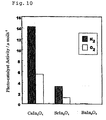
- Fig. 10 is the graph showing the difference of effects of alkali earth elements to the photo-catalyst activity in regard to RuO2-loaded MIn2O4 (M=Ca, Sr, Ba) photo-catalyst.
- Fig.11 is the graph showing the effects of alkali earth elements to the characteristics of diffusion reflection spectrum in regard to MIn2O4 (M=Ca, Sr, Ba).
- Fig.12 is the graph showing the photo decomposition characteristics of water of RuO2-loaded ZnGa2O4 photo-catalyst.
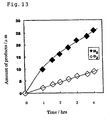
- Fig.13 is the graph showing the photo decomposition characteristics of water of RuO2-loaded Na2Sb2O6 photo-catalyst.
-
- The present invention will be illustrated more in details.
The method for preparation of indate of RuO2-loaded alkali earth is described hereinafter. The similar method can be applied for the preparation of indate of alkali metal and Zn and for the preparation of Ga salt or Sb salt of alkali metal, alkali earth metal and Zn. -
- a The preparation of alkali earth indate is; alkali earth metal carbonate and indium oxide are mixed by prescribed molar ratio and calcined by the temperature of 1000°C in the atmosphere for 16 hours (called as a oxide calcination method), or,
- b. In the ethanol solution containing alkali earth metal nitrate and indium nitrate by prescribed molar ratio, ethanol solution of oxalic acid is dropped and obtain white sediment. After said sediment is heated at the temperature of 80°C, cooled down and filtrated then the filtrated product is calcined by the temperature of 900-1300°C for 16 hours (coprecipitation powder calcination method) (the calcination time can be adjusted concerning calcination temperature).
-
- The flow chart showing CaIn2O4 preparation process by coprecipitation powder calcination method is shown in Fig.1.
- In regard to RuO2 loading, by penetrating method using THF (tetrahydrofurane) solution of Ru3(CO)12, which is a carbonyl complex, or aqueous solution of ruthenium chloride RuCl3, ruthenium metal is carried on indium salt so as the wt% of Ru in photo-catalyst to be 0.25 to 2.0 wt% and make Ru to RuO2 by heating it to 400°C, thus the photo-catalyst is prepared.
- For the measurement of activity of photo-catalyst reaction, a closed circulation type reaction apparatus composed of vacuum part, reaction part and analysis part. Generated gases from photo complete decomposition reaction of water are circulated with Ar of 100 torr previously added to the reaction circulation apparatus during the reaction using a piston pump, and the generated gases are analyzed from time to time by a gas chromatography which is directly connected to the reaction part.
- 0.25 g of photo-catalyst powder is poured into a vertical reactor made of quartz and suspended by pure water prepared by further deionization of distilled water. The stirring of the photo-catalyst is carried out by bubbling of Ar of 100 torr pressure added in the reaction circulation apparatus. As the photo radiation, 500WXe lamp light (wave length range; from 260nm to 600nm) or Hg-Xe lamp light (wave length range; from 248nm to 436nm) are used.
- Photo-catalyst activity of RuO2-loaded CaIn2O4
RuO2-loaded CaIn2O4 photo-catalyst is prepared by calcined temperature of 1000-1300°C. The obtained compound is analyzed by an X-ray diffraction method. The main peaks appear at 2=18° , 33° , 48° and 58° , and the highest peak appears at 2=33°, which indicates a diffraction pattern properly corresponding to a diffraction pattern described in JSPD card (17-643). - The calcined temperature is changed to 1150°C and 1wt% of CaIn2O4 carrying RuO2 is obtained. Then the obtained RuO2-loaded CaIn2O4 is used so that the activity of photo-catalyst and the change of the activity with the passage of time is measured using a closed circulation type reaction apparatus described in paragraph II. Since a generation test apparatus is a closed system, gaseous hydrogen and oxygen are discharged. Said discharging operation is repeated for three times, and the change of activity is investigated. By the investigation, it becomes clear that the activity of catalyst maintains the initial feature after 13 hours of total reaction time.
- In Fig.3, the activity of RuO2-loaded CaIn2O4 photo-catalysts prepared by a coprecipitation powder calcination method (a) and an oxide calcination method (b) are indicated in comparison. From this graph, it becomes clear that the photo-catalysts prepared by a coprecipitation powder calcination method (a) shows 14 times higher activity than that of the photo-catalysts prepared by method (b).
- In Fig.4, the dependency of Ru concentration which effects to the activity of photo-catalyst is indicated. The activity of photo-catalyst increases along with Ru concentration till 0.1 wt%, becomes almost constant at 1 wt% and slightly decreases at 2 wt%. From this phenomenon, it is understood that the optimum Ru concentration is 1 wt%.
- Fig.5 is the graph showing the relationship of the calcination temperature and photo-catalyst activity at the preparation of CaIn2O4. In a case of coprecipitation powder calcined CaIn2O4, when calcined by the temperature higher than 900°C, activity is generated and increases along with the elevation of calcined temperature, and most high activity can be obtained by calcined temperature from 1150°C to 1200°C. From these results, it becomes dear that the optimum temperature for calcination is from 1150°C to 1200°C.
- In Fig. 6, the diffusion reflection UV spectrum of alkali earth indate prepared by altering the temperature for calcination from 1000°C to 1300°C. Photo absorption starts from approximately 450nm, has a mild absorption peak at 400nm, a sharp absorption peak at shorter wave length than 380nm and indicates maximum absorption peak at 310nm.
- Photo-catalyst activity of RuO2-loaded SrIn2O4
In an X-ray diffraction pattern of SrIn2O4 calcined by the temperature from 800°C to 1200°C, the main peaks appear at 2=18° , 33° , 35° , 47° and 58° , and the highest peaks appear at 2=33° and 35° . Within this calcination temperature limit; a diffraction pattern corresponding to the diffraction pattern described in JSPD card (33-1337) is obtained. - In Fig.7, the variation by aging of photo-catalyst of SrIn2O4 loading 1wt% of Ru by impregnation method using Ru carbonyl complex Ru3(CO)12 is indicated. Hydrogen and oxygen are generated. It is understood the initial catalyst activity is maintained after total reaction time of 8 hours.
- Fig.8 indicates the relationship between calcination temperature and photo-catalyst activity at the preparation of SrIn2O4. The photo-catalyst activity increases along with the elevation of calcination temperature at the higher temperature than 800°C, indicates maximum activity at 1000°C, and decreases at the higher temperature than 1000°C. That is, it is understood that the optimum calcination temperature is 1000°C.
- Fig.9 indicates the diffusion reflection UV spectrum of SrIn2O4 prepared by altering the calcination temperature from 1000°C to 1300°C. Photo absorption starts from approximately 450nm, has a mild absorption peak at 400nm, a sharp absorption peak at shorter wave length than 380nm and indicates maximum absorption peak at 310nm.
- Effect of M ion to RuO2-loaded MIn2O4 (M=Ca, Sr, Ba) photo-catalyst Fig.10 indicates, activity of water photo decomposition of photo-catalysts when the kind of alkali earth element is changed. In a case of Ba, activity can not be observed, on the contrary, in a case of Sr, activity is generated and further activity can be observed in a case of Ca.
- Fig.11 indicates the diffusion reflection UV spectrum of alkali earth indate MIn2O4 (M=Ca, Sr, Ba) when kind of alkali earth metal M is changed. In cases of Sr and Ca, photo absorption starts from approximately 450nm, has a mild absorption peak at 400nm, a sharp absorption peak at shorter wave length than 380nm and indicates maximum absorption peak at 310nm.
- In the meanwhile, in a case of Ba, a remarkable absorption peak is observed at 440nm, has a mild absorption peak at 400nm and indicates maximum absorption peak at 350nm.
- Photo-catalyst activity of RuO2-loaded MGa2O4
RuO2-loaded ZnGa2O4 is prepared according to the preparation method of photo active catalyst mentioned above. Water photo decomposition characteristics of RuO2-loaded ZnGa2O4 photo-catalyst is shown in Fig.12. - It is understood that water is completely decomposed to hydrogen and oxygen by this photo-catalyst.
- Photo-catalyst activity of antimonide salt RuO2-loaded Na2Sb2O6
RuO2-loaded Na2Sb2O6 is prepared according to the preparation method of photo active catalyst mentioned above. Water photo decomposition characteristics of RuO2-loaded Na2Sb2O6 photo-catalyst is shown in Fig.13. - It is understood that water is completely decomposed to hydrogen and oxygen by this photo-catalyst.
- The photo-catalyst which carry out the complete photo decomposition reaction of water is usually limited to a metallic salt with d0 configuration. In the present invention, it is found out that a metallic salt with d10 configuration can be also used for the complete photo decomposition reaction of water. Therefore, it is obvious that the present invention contributes to the development of a novel catalyst for the complete photo decomposition of water.
Claims (4)
- A photo-catalyst comprises, RuO2-loaded A2XnOm or RuO2-loaded BXnOm, wherein A is an alkali metal atom, B is an alkali earth metal atom or Zn, X is a metal ion with d10 configuration, n=m/2 or n=m/3 and n is 2.
- The photo-catalyst of claim 1, wherein RuO2-loaded A2XnOm or RuO2-loaded BXnOm is obtained by a coprecipitation powder calcination method calcined at the temperature of 1150 to 1200°C.
- The photo-catalyst according to any one of claims 1 or 2, wherein X is In, Ga or Sb, alkali metal atom is Na, K or Rb and alkali earth metal atom is Ca, Sr or Ba.
- A photo-catalyst for complete photo decomposition reaction of water, comprising the photo-catalyst according to any one of claims 1, 2 or 3.
Applications Claiming Priority (3)
| Application Number | Priority Date | Filing Date | Title |
|---|---|---|---|
| JP2000245690 | 2000-08-14 | ||
| JP2000245690A JP4112162B2 (en) | 2000-08-14 | 2000-08-14 | Photocatalyst using oxide containing metal ion in d10 electronic state |
| PCT/JP2001/006702 WO2002013965A1 (en) | 2000-08-14 | 2001-08-03 | Photocatalysts made by using oxides containing metal ions of d10 electronic state |
Publications (3)
| Publication Number | Publication Date |
|---|---|
| EP1310301A1 true EP1310301A1 (en) | 2003-05-14 |
| EP1310301A4 EP1310301A4 (en) | 2004-08-11 |
| EP1310301B1 EP1310301B1 (en) | 2008-11-26 |
Family
ID=18736163
Family Applications (1)
| Application Number | Title | Priority Date | Filing Date |
|---|---|---|---|
| EP01954437A Expired - Lifetime EP1310301B1 (en) | 2000-08-14 | 2001-08-03 | Photocatalysts made by using oxides containing metal ions of d10 electronic state |
Country Status (5)
| Country | Link |
|---|---|
| US (1) | US6482767B2 (en) |
| EP (1) | EP1310301B1 (en) |
| JP (1) | JP4112162B2 (en) |
| DE (1) | DE60136717D1 (en) |
| WO (1) | WO2002013965A1 (en) |
Families Citing this family (8)
| Publication number | Priority date | Publication date | Assignee | Title |
|---|---|---|---|---|
| JP4025029B2 (en) * | 2001-04-10 | 2007-12-19 | 独立行政法人科学技術振興機構 | Photocatalyst using oxide containing typical metal ion in d10 electronic state |
| JP4107815B2 (en) * | 2001-07-12 | 2008-06-25 | 独立行政法人科学技術振興機構 | Phosphate photocatalysts containing metal ions in the d10 or d0 electronic state |
| JP4051247B2 (en) * | 2002-09-09 | 2008-02-20 | 独立行政法人科学技術振興機構 | Photocatalyst using composite oxide containing metal ions in d10 and d0 electronic states |
| JP4567992B2 (en) * | 2004-03-03 | 2010-10-27 | 独立行政法人科学技術振興機構 | Photocatalyst using oxide containing p-block metal ion in d10-d10 electronic state |
| US7578455B2 (en) * | 2004-08-09 | 2009-08-25 | General Motors Corporation | Method of grinding particulate material |
| US7553464B2 (en) * | 2004-08-09 | 2009-06-30 | General Motors Corporation | Lanthanum tantalate photocatalysts |
| EP2816087B1 (en) | 2005-12-13 | 2016-11-09 | Asahi Kasei Kabushiki Kaisha | Aqueous organic-inorganic hybrid composition |
| WO2014035919A2 (en) * | 2012-08-27 | 2014-03-06 | Sun Catalytix Corporation | Gas sparging for transport of dissolved species through a barrier |
Family Cites Families (13)
| Publication number | Priority date | Publication date | Assignee | Title |
|---|---|---|---|---|
| YU47516B (en) * | 1990-06-21 | 1995-10-03 | Ihtm-Oour Institut Za Katalizu I Hemijsko Inženjerstvo, Rj Kataliza | PEROVSKIT MATERIALS, CATALYSTS AND PEROVSKIT OBTAINING PROCEDURE |
| US5411927A (en) * | 1992-08-14 | 1995-05-02 | Council Of Scientific & Industrial Research | Process of preparing composite catalysts for production of synthesis gas by oxidative conversion of methane or natural gas |
| US5338488A (en) * | 1992-09-10 | 1994-08-16 | Council Of Scientific Research | Process for the production of synthesis gas by oxidative converson of methane (or natural gas) using composite catalyst containing transitional and alkine earth metal oxides |
| US5756421A (en) * | 1992-09-10 | 1998-05-26 | Council Of Scientific & Industrial Research | Composite catalysts containing transitional and alkaline earth metal oxides useful for oxidative conversion of methane (or natural gas) to carbon monoxide and hydrogen (or synthesis gas) |
| US5277844A (en) * | 1993-03-29 | 1994-01-11 | Rainey Clifford S | Resistor composition |
| GB9316926D0 (en) * | 1993-08-13 | 1993-09-29 | Ici Plc | Electrode |
| JPH0788370A (en) | 1993-09-24 | 1995-04-04 | Yasunobu Inoue | Photocatalyst and method for producing photocatalyst |
| US5851506A (en) * | 1994-04-21 | 1998-12-22 | The United States Of America As Represented By The Secretary Of The Army | Electrode materials from hydrous metal and/or hydrous mixed metal oxides and method of preparing the same |
| EP0869843A1 (en) * | 1994-12-30 | 1998-10-14 | Hoechst Aktiengesellschaft | Epoxides produced by the oxidation of olefines with air or oxygen |
| US5977017A (en) * | 1996-04-10 | 1999-11-02 | Catalytic Solutions, Inc. | Perovskite-type metal oxide compounds |
| JP2000189806A (en) | 1998-10-21 | 2000-07-11 | Sumitomo Osaka Cement Co Ltd | Photocatalyst |
| JP3579709B2 (en) | 1999-01-18 | 2004-10-20 | 独立行政法人物質・材料研究機構 | Hollandite-type photocatalyst and method for removing phenol in water using the catalyst |
| US6203692B1 (en) * | 1999-06-10 | 2001-03-20 | Srinivasan Sarangapani | Electrochemical purification of chlorine |
-
2000
- 2000-08-14 JP JP2000245690A patent/JP4112162B2/en not_active Expired - Fee Related
-
2001
- 2001-08-03 EP EP01954437A patent/EP1310301B1/en not_active Expired - Lifetime
- 2001-08-03 DE DE60136717T patent/DE60136717D1/en not_active Expired - Lifetime
- 2001-08-03 WO PCT/JP2001/006702 patent/WO2002013965A1/en not_active Ceased
- 2001-08-03 US US10/089,729 patent/US6482767B2/en not_active Expired - Lifetime
Non-Patent Citations (3)
| Title |
|---|
| KATO H ET AL: "HIGHLY EFFICIENT DECOMPOSITION OF PURE WATER INTO H2 AND O2 OVER NATAO3 PHOTOCATALYSTS" CATALYSIS LETTERS, BALTZER, SCIENTIFIC PUBL, BASEL, CH, vol. 58, no. 2/3, April 1999 (1999-04), pages 153-155, XP000825795 ISSN: 1011-372X * |
| SATO J ET AL: "NEW PHOTOCATALYST GROUP FOR WATER DECOMPOSITION OF RUO2-LOADED P-BLOCK METAL (IN, SN, AND SB) OXIDES WITH D10 CONFIGURATION" JOURNAL OF PHYSICAL CHEMISTRY, AMERICAN CHEMICAL SOCIETY, US, vol. 105, no. 26, 5 July 2001 (2001-07-05), pages 6061-6063, XP002948575 ISSN: 0022-3654 * |
| See also references of WO0213965A1 * |
Also Published As
| Publication number | Publication date |
|---|---|
| EP1310301A4 (en) | 2004-08-11 |
| US20020155948A1 (en) | 2002-10-24 |
| WO2002013965A1 (en) | 2002-02-21 |
| JP2002059008A (en) | 2002-02-26 |
| JP4112162B2 (en) | 2008-07-02 |
| EP1310301B1 (en) | 2008-11-26 |
| US6482767B2 (en) | 2002-11-19 |
| DE60136717D1 (en) | 2009-01-08 |
Similar Documents
| Publication | Publication Date | Title |
|---|---|---|
| US20240058800A1 (en) | Haber-bosch catalyst comprising an anion-vacant lattice | |
| Ye et al. | A novel hydrogen-evolving photocatalyst InVO4 active under visible light irradiation | |
| Niishiro et al. | Nickel and either tantalum or niobium-codoped TiO 2 and SrTiO 3 photocatalysts with visible-light response for H 2 or O 2 evolution from aqueous solutions | |
| Zou et al. | Photocatalytic water splitting into H2 and/or O2 under UV and visible light irradiation with a semiconductor photocatalyst | |
| Miseki et al. | Water splitting into H 2 and O 2 over niobate and titanate photocatalysts with (111) plane-type layered perovskite structure | |
| Bork et al. | Perovskite La 0.6 Sr 0.4 Cr 1− x Co x O 3− δ solid solutions for solar-thermochemical fuel production: strategies to lower the operation temperature | |
| Reinert et al. | Synthesis and characterization of visible light absorbing (GaN) 1–x (ZnO) x semiconductor nanorods | |
| Baidya et al. | Enhanced Reducibility of Ce1-x Ti x O2 Compared to That of CeO2 and Higher Redox Catalytic Activity of Ce1-x-y Ti x Pt y O2-δ Compared to That of Ce1-x Pt x O2-δ | |
| EP0405891B1 (en) | High surface area oxide compositions and their use in the conversion of light hydrocarbons | |
| Jana et al. | Photocatalytic hydrogen production in the water/methanol system using Pt/RE: NaTaO3 (RE= Y, La, Ce, Yb) catalysts | |
| DE69513792T2 (en) | Activated and stabilized copper oxide and zinc oxide catalyst and process for its manufacture | |
| EP1310301B1 (en) | Photocatalysts made by using oxides containing metal ions of d10 electronic state | |
| Kudo et al. | Photocatalytic water splitting into H2 and O2 over K2LnTa5O15 powder | |
| EP0070712A2 (en) | Catalysts for photo-assisted oxidation-reduction reactions | |
| Yao et al. | Photocatalytic properties of a new photocatalyst K2Sr1. 5Ta3O10 | |
| Donohue et al. | Novel perovskites M2IILnIIIRuVO6 as emission control catalysts | |
| Steiger et al. | Nickel incorporation in perovskite-type metal oxides–implications on reducibility | |
| Singh et al. | Lanthanum-based double perovskite oxides as cobalt-free catalyst for bifunctional application in electrocatalytic oxygen reactions | |
| Lin et al. | Zn-modified ceria as a redox material for thermochemical H 2 O and CO 2 splitting: effect of a secondary ZnO phase on its thermochemical activity | |
| JPH0724329A (en) | photocatalyst | |
| Iwase et al. | Overall Water Splitting Under Visible Light Irradiation Over Ir and A‐Codoped KTaO3 (A= Ca, Sr, Ba, La) Photocatalysts | |
| US5562888A (en) | Nitrous oxide decomposition using a solid oxide solution | |
| Iwase et al. | Development of visible-light-responsive Ru-doped KTaO 3 photocatalyst for overall water splitting with one-step photoexcitation and the effects of codoping with La | |
| JP3249776B2 (en) | Interlayer crosslinked product of layered titanium oxide and photocatalyst | |
| Zhu et al. | Characterization and catalytic activity in NO decomposition of La2− xSrxCuO4 (0≤ x≤ 1) compounds with T* phase structure |
Legal Events
| Date | Code | Title | Description |
|---|---|---|---|
| PUAI | Public reference made under article 153(3) epc to a published international application that has entered the european phase |
Free format text: ORIGINAL CODE: 0009012 |
|
| 17P | Request for examination filed |
Effective date: 20020412 |
|
| AK | Designated contracting states |
Designated state(s): AT BE CH CY DE DK ES FI FR GB GR IE IT LI LU MC NL PT SE TR |
|
| RBV | Designated contracting states (corrected) |
Designated state(s): AT BE CH DE FR GB LI |
|
| RAP1 | Party data changed (applicant data changed or rights of an application transferred) |
Owner name: JAPAN SCIENCE AND TECHNOLOGY AGENCY |
|
| A4 | Supplementary search report drawn up and despatched |
Effective date: 20040625 |
|
| RIC1 | Information provided on ipc code assigned before grant |
Ipc: 7B 01J 35/00 A Ipc: 7B 01J 23/46 B Ipc: 7C 01B 3/04 B |
|
| 17Q | First examination report despatched |
Effective date: 20041123 |
|
| RTI1 | Title (correction) |
Free format text: PHOTOCATALYSTS MADE BY USING OXIDES CONTAINING METAL IONS OF D10 ELECTRONIC STATE |
|
| GRAP | Despatch of communication of intention to grant a patent |
Free format text: ORIGINAL CODE: EPIDOSNIGR1 |
|
| RBV | Designated contracting states (corrected) |
Designated state(s): DE FR GB |
|
| GRAS | Grant fee paid |
Free format text: ORIGINAL CODE: EPIDOSNIGR3 |
|
| GRAA | (expected) grant |
Free format text: ORIGINAL CODE: 0009210 |
|
| AK | Designated contracting states |
Kind code of ref document: B1 Designated state(s): DE FR GB |
|
| REG | Reference to a national code |
Ref country code: GB Ref legal event code: FG4D |
|
| REF | Corresponds to: |
Ref document number: 60136717 Country of ref document: DE Date of ref document: 20090108 Kind code of ref document: P |
|
| PLBE | No opposition filed within time limit |
Free format text: ORIGINAL CODE: 0009261 |
|
| STAA | Information on the status of an ep patent application or granted ep patent |
Free format text: STATUS: NO OPPOSITION FILED WITHIN TIME LIMIT |
|
| 26N | No opposition filed |
Effective date: 20090827 |
|
| PGFP | Annual fee paid to national office [announced via postgrant information from national office to epo] |
Ref country code: DE Payment date: 20130731 Year of fee payment: 13 |
|
| PGFP | Annual fee paid to national office [announced via postgrant information from national office to epo] |
Ref country code: GB Payment date: 20130731 Year of fee payment: 13 Ref country code: FR Payment date: 20130808 Year of fee payment: 13 |
|
| REG | Reference to a national code |
Ref country code: DE Ref legal event code: R119 Ref document number: 60136717 Country of ref document: DE |
|
| GBPC | Gb: european patent ceased through non-payment of renewal fee |
Effective date: 20140803 |
|
| REG | Reference to a national code |
Ref country code: DE Ref legal event code: R119 Ref document number: 60136717 Country of ref document: DE Effective date: 20150303 |
|
| REG | Reference to a national code |
Ref country code: FR Ref legal event code: ST Effective date: 20150430 |
|
| PG25 | Lapsed in a contracting state [announced via postgrant information from national office to epo] |
Ref country code: GB Free format text: LAPSE BECAUSE OF NON-PAYMENT OF DUE FEES Effective date: 20140803 Ref country code: DE Free format text: LAPSE BECAUSE OF NON-PAYMENT OF DUE FEES Effective date: 20150303 |
|
| PG25 | Lapsed in a contracting state [announced via postgrant information from national office to epo] |
Ref country code: FR Free format text: LAPSE BECAUSE OF NON-PAYMENT OF DUE FEES Effective date: 20140901 |