EP1310064B1 - ARRANGEMENT AND METHOD FOR REALIZATION OF VIRTUAL SHARED MEDIUM FOR QoS - Google Patents
ARRANGEMENT AND METHOD FOR REALIZATION OF VIRTUAL SHARED MEDIUM FOR QoS Download PDFInfo
- Publication number
- EP1310064B1 EP1310064B1 EP01944062A EP01944062A EP1310064B1 EP 1310064 B1 EP1310064 B1 EP 1310064B1 EP 01944062 A EP01944062 A EP 01944062A EP 01944062 A EP01944062 A EP 01944062A EP 1310064 B1 EP1310064 B1 EP 1310064B1
- Authority
- EP
- European Patent Office
- Prior art keywords
- service
- data
- port
- output port
- transmission speed
- Prior art date
- Legal status (The legal status is an assumption and is not a legal conclusion. Google has not performed a legal analysis and makes no representation as to the accuracy of the status listed.)
- Expired - Lifetime
Links
Images
Classifications
-
- H—ELECTRICITY
- H04—ELECTRIC COMMUNICATION TECHNIQUE
- H04L—TRANSMISSION OF DIGITAL INFORMATION, e.g. TELEGRAPHIC COMMUNICATION
- H04L47/00—Traffic control in data switching networks
- H04L47/10—Flow control; Congestion control
- H04L47/24—Traffic characterised by specific attributes, e.g. priority or QoS
- H04L47/2408—Traffic characterised by specific attributes, e.g. priority or QoS for supporting different services, e.g. a differentiated services [DiffServ] type of service
-
- H—ELECTRICITY
- H04—ELECTRIC COMMUNICATION TECHNIQUE
- H04L—TRANSMISSION OF DIGITAL INFORMATION, e.g. TELEGRAPHIC COMMUNICATION
- H04L47/00—Traffic control in data switching networks
- H04L47/10—Flow control; Congestion control
-
- H—ELECTRICITY
- H04—ELECTRIC COMMUNICATION TECHNIQUE
- H04L—TRANSMISSION OF DIGITAL INFORMATION, e.g. TELEGRAPHIC COMMUNICATION
- H04L47/00—Traffic control in data switching networks
- H04L47/10—Flow control; Congestion control
- H04L47/20—Traffic policing
-
- H—ELECTRICITY
- H04—ELECTRIC COMMUNICATION TECHNIQUE
- H04L—TRANSMISSION OF DIGITAL INFORMATION, e.g. TELEGRAPHIC COMMUNICATION
- H04L47/00—Traffic control in data switching networks
- H04L47/10—Flow control; Congestion control
- H04L47/24—Traffic characterised by specific attributes, e.g. priority or QoS
- H04L47/2441—Traffic characterised by specific attributes, e.g. priority or QoS relying on flow classification, e.g. using integrated services [IntServ]
Definitions
- the invention relates to a system for achieving necessary QoS using a virtual shared medium in a communication network, and to a method for providing necessary QoS over a virtual shared medium in a communication network.
- TBCs Traffic Conditioning Blocks
- Each TCB consists in its turn of a combination of a number of components, classification, metering, action and queuing.
- the component classification classifies the packets to divide them into some form of flows.
- metering the transmission speed is metered in number of packets and bits per second to check if it complies with the agreement of how much the customer is allowed to transmit.
- different actions are taken. One action can for instance be to throw away packets if the flow is not kept within given limits.
- queuing the packets are queued up to be transmitted in correct order.
- One also within different fields is beginning to specify more complex services which shall be based on the new functionality.
- WO 99/53718 a system is described adapted to offer increased control of data flows in a data communication network. This is achieved according to the suggested solution by installing one or more control programs, which for instance can be adapted to multicast control.
- a method and a device for multicasting in an ATM-network is described, at which a TCB is arranged as buffer for each priority class of ATM-cells.
- ISP Internet Service Provider
- QoS and/or multicast that is directed data transmission to a plurality of users.
- Some services might be possible to realize at moderate costs if they were based on principles based on a shared medium. It can, for instance, be multicast-sessions where one wants that the whole session is allocated a total bandwidth which is shared by the participants in the session. This means that it will be easier to dimension the QoS-need of a session. When static dimensioning is possible, one does not need to calculate with the dynamics in the number of participants, which can be very expensive. This is an overall aim of the present invention.
- One aspect of this aim is to realize a virtual shared medium on IP-level for QoS with regard to policing and metering-functionality.
- the technology for this does not exist today, since the solutions of today are lacking connection between incoming and outgoing traffic, a requirement for a shared medium.
- the TCBs of today are not aware of each other.
- a network unit has an input port and an output port for two-way communication in a session with an opposite party or user of a service, where each port includes a metering device arranged to meter data transmission speed in data flows, and an action device, from a communication point of view connected to respective metering device and arranged to take actions on respective data flows depending on the belonging metering device.
- the system is characterized in that the metering device in said input port is adapted to metering of data flows associated with a first service, and the metering device in, said output port is adapted to metering of data flows associated with the same service, in that said output port includes a calculation device arranged to calculate control data depending on the metering device in said input port and the metering device in said output port. Further, the action device in said output port is arranged to, for said service, take actions on the flow through the output port associated with the service depending on said control data.
- each port further includes a classification device arranged to divide data packets of different services into different flows, from a communication point of view connected between the metering device in respective port and a data input of respective port for data incoming via the input port to the network unit, respective data outgoing via the output port from the network unit to the party included in the session.
- each port preferably further includes a queuing device arranged to queue packets from said action device to a data output of respective port for outgoing data from the output port to the party included in the session, respective reception from the input port to the network unit.
- said control data is the sum of data transmission speed of said service, as metered by said metering device in said input port and output port, that is the sum of incoming and outgoing data transmission speed or bandwidth of just that session.
- the metering device in the output port preferably includes control devices, adapted to check how metered and summed up transmission speed of a service is related to agreed bandwidth of the service in question for the party included in the session.
- the action device in the output port further includes means to throw away data packets if the sum of metered transmission speed of the service and the party included in the session exceeds agreed bandwidth.
- Said input port further preferably also includes a calculation device arranged to calculate the sum of data transmission speed of said service, as metered by the metering device in said input port and the metering device in said output port, and for said service, action device in said input port is arranged to take actions on the flow in the input port associated with the service depending on the summed up data transmission speed.
- the metering device in the input port includes control devices, adapted to check how metered and summed up transmission speed of a service is related to agreed bandwidth of the service in question for the party included in the session.
- the action device in the input port includes means to throw data packets if the sum of metered transmission speed of the service and the party included in the session exceeds agreed bandwidth.
- said network unit is a Diffserv-router.
- the Diff-Serv-router is preferably adapted to multicast sessions with a plurality of included parties, the Diffserv-router of respective included party being set up with an input port and an output port for two-way communication, and wherein the sum of incoming and outgoing data for each session is allocated a given data transmission speed.
- a method for providing necessary Qos over a virtual shared medium in a communication network, in which network a network unit for a service communicates two-way in a session with another party, and wherein incoming data to the network unit is flowing via an input port and outgoing data from the network unit is flowing via an output port, including the steps to meter the transmission speed of said service in said input port, meter the transmission speed of said service in said output port, calculate control data depending on metered transmission speed in said input port and in said output port of said service, and to take actions on the flow of the service in the output port depending on said control data.
- Said control data are preferably the sum of metered data transmission speed in said input port and said output port.
- the step is included to, for the service check how metered and summed up transmission speed is related to agreed bandwidth of the other party, and to throw away data packets related to the service if the metered transmission speed of the service exceeds agreed bandwidth.
- the procedure preferably also includes the step to take actions on the flow of the service in the input port depending on said control data, for instance throw away data packets.
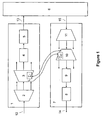
- a first TCB 1 is drawn, arranged for input of data to a network unit 6, and a second TCB 7, arranged for output of data from the network unit 6.
- TCB 1 for input of data serves as an input port 1 to the network unit 6, and includes a classification device 2, that is a classifier, which, from a communication point of view, is connected to the data input 12 of the input port 1 for a data flow including data for a number of different services.
- the classification device 2 has in the illustrated embodiment three output ports, this, however, shall only be regarded as an example. To these three output ports the classification device 2 divides data flows belonging to different services. The data flows are each flowing to a metering device, that is a meter, but in the figure only one 3 of these is drawn. The service which is classified to the drawn metering device 3 is in the following called the service. The metering device 3 is arranged to meter the data transmission speed, that is occupied bandwidth, of the belonging flow/service. Depending on if metered data transmission speed exceeds agreed available bandwidth of the service, different actions can be taken/executed by different action devices, of which only one 4 is drawn.
- TCB 7 for output of data functions as an output port 7 of the network unit 6, and includes in equivalent way as TCB 1 a classification device 11, which, from a communication point of view, is connected to the data input 15 of the output port 7 for a data flow including data for several different services. Also here applies that the in the illustrated embodiment three output ports at the classification device 11 only shall be regarded as an example.
- TCB 7 further includes one or more metering devices, one of which 10 is drawn, and one or more action devices for each metering device, of which one 9 is shown.
- a queuing device 8 is arranged to queue the data packets from the different action devices, so that they are transmitted in correct order from the output port 14 at TCB 7.
- the input port 1 and the output port 7 are arranged for two-way communication in a session between the network unit and an opposite party or user of the service.
- the metering devices 3,10 are combined by calculation devices ⁇ 0 , ⁇ 1 being arranged in each port 1,7.
- the calculation devices ⁇ 0 , ⁇ 1 are arranged to calculate control data by summing up by the metering devices 3,10 metered transmission speed of incoming data 12 and outgoing data 15 in the session.
- the action devices 4,9 by that can take/execute actions based on the same amount of traffic, but on traffic flows running in opposite directions. This results in that a virtual shared medium for QoS is possible to realize. This is particularly useful at multicast sessions.
- the access router which includes the network unit 6, input port 1 and output port 7, the multicast traffic which flows in both directions and which belongs to the same multicast session, is filtered out, classified.
- the metered flows are summed up only in one in the output port 7 arranged calculation device ⁇ 0 , where also the possible action is taken/executed by the action device 9.
- the metered flows are also summed up in one in the output port 1 arranged calculation device ⁇ 1 , where also the possible action is taken/executed by the action device 4.
- the invention can be used in routers in general, and can with advantage be applied to edge routers in the DiffServ-architecture. It is particularly suitable for services which are based on shared media.
- One example of such a service might be video conference via multicast sessions.
Landscapes
- Engineering & Computer Science (AREA)
- Computer Networks & Wireless Communication (AREA)
- Signal Processing (AREA)
- Data Exchanges In Wide-Area Networks (AREA)
- Paper (AREA)
- Magnetic Heads (AREA)
- Computer And Data Communications (AREA)
- Error Detection And Correction (AREA)
- Traffic Control Systems (AREA)
- Communication Control (AREA)
- Exchange Systems With Centralized Control (AREA)
- Radio Relay Systems (AREA)
Abstract
Description
- The invention relates to a system for achieving necessary QoS using a virtual shared medium in a communication network, and to a method for providing necessary QoS over a virtual shared medium in a communication network.
- Within Internet, functionality for QoS (Quality of Service) and service differentiation is beginning to be introduced. From just providing one type of service " best effort" one wants to be able to differentiate between different flows. At the same time as concepts in order to introduce QoS are produced within IETF (Internet Engineering Task Force), for instance DiffServ (Differentiated Services), functionality to support such services are beginning to be implemented in routers and other network elements. Within the working group DiffServ (within IETF) "A Conceptual Model for DiffServ Routers" (http://www.ietf.org/internet-drafts/draft-ietf-diffserv-model-01.txt) has been produced.
This model is built of "Traffic Conditioning Blocks" (TCBs), where a TCB is used for each interface and direction of the traffic flow. Each TCB consists in its turn of a combination of a number of components, classification, metering, action and queuing. The component classification classifies the packets to divide them into some form of flows. In metering, the transmission speed is metered in number of packets and bits per second to check if it complies with the agreement of how much the customer is allowed to transmit. Depending on whether the traffic is kept within given limits or not, different actions are taken. One action can for instance be to throw away packets if the flow is not kept within given limits. In the last step, queuing, the packets are queued up to be transmitted in correct order. One also within different fields is beginning to specify more complex services which shall be based on the new functionality. - In
WO97/48051 - In
WO 99/53718 - In
WO98/27689 - For the survival of an Internet Service Provider, ISP, in the market today considerably more than just offering ordinary "best effort"-surfing on Internet is required. A variety of new services are growing, many based on QoS and/or multicast, that is directed data transmission to a plurality of users. Some services might be possible to realize at moderate costs if they were based on principles based on a shared medium. It can, for instance, be multicast-sessions where one wants that the whole session is allocated a total bandwidth which is shared by the participants in the session. This means that it will be easier to dimension the QoS-need of a session. When static dimensioning is possible, one does not need to calculate with the dynamics in the number of participants, which can be very expensive. This is an overall aim of the present invention.
- One aspect of this aim is to realize a virtual shared medium on IP-level for QoS with regard to policing and metering-functionality. The technology for this, however, does not exist today, since the solutions of today are lacking connection between incoming and outgoing traffic, a requirement for a shared medium. The TCBs of today are not aware of each other.
- Above mentioned aims are fulfilled according to a first aspect of the present invention by a system according to claim 1. Thus a network unit has an input port and an output port for two-way communication in a session with an opposite party or user of a service, where each port includes a metering device arranged to meter data transmission speed in data flows, and an action device, from a communication point of view connected to respective metering device and arranged to take actions on respective data flows depending on the belonging metering device. The system is characterized in that the metering device in said input port is adapted to metering of data flows associated with a first service, and the metering device in, said output port is adapted to metering of data flows associated with the same service, in that said output port includes a calculation device arranged to calculate control data depending on the metering device in said input port and the metering device in said output port. Further, the action device in said output port is arranged to, for said service, take actions on the flow through the output port associated with the service depending on said control data. Preferably, each port further includes a classification device arranged to divide data packets of different services into different flows, from a communication point of view connected between the metering device in respective port and a data input of respective port for data incoming via the input port to the network unit, respective data outgoing via the output port from the network unit to the party included in the session. In addition each port preferably further includes a queuing device arranged to queue packets from said action device to a data output of respective port for outgoing data from the output port to the party included in the session, respective reception from the input port to the network unit.
- In a preferred embodiment of the invention, said control data is the sum of data transmission speed of said service, as metered by said metering device in said input port and output port, that is the sum of incoming and outgoing data transmission speed or bandwidth of just that session. The metering device in the output port preferably includes control devices, adapted to check how metered and summed up transmission speed of a service is related to agreed bandwidth of the service in question for the party included in the session. The action device in the output port further includes means to throw away data packets if the sum of metered transmission speed of the service and the party included in the session exceeds agreed bandwidth. Said input port further preferably also includes a calculation device arranged to calculate the sum of data transmission speed of said service, as metered by the metering device in said input port and the metering device in said output port, and for said service, action device in said input port is arranged to take actions on the flow in the input port associated with the service depending on the summed up data transmission speed. Then also the metering device in the input port includes control devices, adapted to check how metered and summed up transmission speed of a service is related to agreed bandwidth of the service in question for the party included in the session. The action device in the input port includes means to throw data packets if the sum of metered transmission speed of the service and the party included in the session exceeds agreed bandwidth. In a preferred embodiment said network unit is a Diffserv-router. The Diff-Serv-router is preferably adapted to multicast sessions with a plurality of included parties, the Diffserv-router of respective included party being set up with an input port and an output port for two-way communication, and wherein the sum of incoming and outgoing data for each session is allocated a given data transmission speed.
- According to a second aspect of the present invention a method is proposed for providing necessary Qos over a virtual shared medium in a communication network, in which network a network unit for a service communicates two-way in a session with another party, and wherein incoming data to the network unit is flowing via an input port and outgoing data from the network unit is flowing via an output port, including the steps to meter the transmission speed of said service in said input port, meter the transmission speed of said service in said output port, calculate control data depending on metered transmission speed in said input port and in said output port of said service, and to take actions on the flow of the service in the output port depending on said control data. Said control data are preferably the sum of metered data transmission speed in said input port and said output port.
- In one embodiment further the step is included to, for the service check how metered and summed up transmission speed is related to agreed bandwidth of the other party, and to throw away data packets related to the service if the metered transmission speed of the service exceeds agreed bandwidth. The procedure preferably also includes the step to take actions on the flow of the service in the input port depending on said control data, for instance throw away data packets.
- A preferred embodiment of the invention is described in detail below with reference to the only figure, at which
Figure 1 shows an arrangement at a network unit according to the present invention. - The idea of the invention is to introduce functionality to combine, preferably sum up, the meter-functionality in a first TCB in one direction with the meter-functionality in a second TCB in the other direction of the same interface of a network unit. In Figure 1 a first TCB 1 is drawn, arranged for input of data to a
network unit 6, and asecond TCB 7, arranged for output of data from thenetwork unit 6. TCB 1 for input of data serves as an input port 1 to thenetwork unit 6, and includes aclassification device 2, that is a classifier, which, from a communication point of view, is connected to thedata input 12 of the input port 1 for a data flow including data for a number of different services. Theclassification device 2 has in the illustrated embodiment three output ports, this, however, shall only be regarded as an example. To these three output ports theclassification device 2 divides data flows belonging to different services. The data flows are each flowing to a metering device, that is a meter, but in the figure only one 3 of these is drawn. The service which is classified to the drawnmetering device 3 is in the following called the service. Themetering device 3 is arranged to meter the data transmission speed, that is occupied bandwidth, of the belonging flow/service. Depending on if metered data transmission speed exceeds agreed available bandwidth of the service, different actions can be taken/executed by different action devices, of which only one 4 is drawn. That the result can be different in the metering devices is represented by different arrows which are aiming out from themetering device 3. In thequeuing device 5, the data packets from the different action devices are queued, so that they are transmitted in correct order from theoutput port 13 of TCB 1 to thenetwork unit 6. -
TCB 7 for output of data functions as anoutput port 7 of thenetwork unit 6, and includes in equivalent way as TCB 1 aclassification device 11, which, from a communication point of view, is connected to thedata input 15 of theoutput port 7 for a data flow including data for several different services. Also here applies that the in the illustrated embodiment three output ports at theclassification device 11 only shall be regarded as an example.TCB 7 further includes one or more metering devices, one of which 10 is drawn, and one or more action devices for each metering device, of which one 9 is shown. Aqueuing device 8 is arranged to queue the data packets from the different action devices, so that they are transmitted in correct order from theoutput port 14 atTCB 7. - The input port 1 and the
output port 7 are arranged for two-way communication in a session between the network unit and an opposite party or user of the service. According to the invention, themetering devices port 1,7. The calculation devices Σ0, Σ1 are arranged to calculate control data by summing up by themetering devices incoming data 12 andoutgoing data 15 in the session. Theaction devices network unit 6, input port 1 andoutput port 7, the multicast traffic which flows in both directions and which belongs to the same multicast session, is filtered out, classified. Themetering devices TCBs 1,7, for incoming 12 and outgoing 15 traffic sum by respective calculation devices Σ0, Σ1 up the two flows. If the sum exceeds promised bandwidth, the flow out on the communication network, for instance the DiffServ-network, is limited by theaction device 9 in the output port throwing away outgoing packets. In this way, according to the present invention, is controlled that a session does not use too much bandwidth. In one embodiment the metered flows are summed up only in one in theoutput port 7 arranged calculation device Σ0, where also the possible action is taken/executed by theaction device 9. In another embodiment, the metered flows are also summed up in one in the output port 1 arranged calculation device Σ1, where also the possible action is taken/executed by theaction device 4. - The invention can be used in routers in general, and can with advantage be applied to edge routers in the DiffServ-architecture. It is particularly suitable for services which are based on shared media. One example of such a service might be video conference via multicast sessions.
- It is to the expert within the field evident that a number of variants and modifications of the described preferred embodiment are conceivable, without for that reason end up outside the scope of the invention, which is only limited by the claims below.
Claims (16)
- A system for achieving necessary Qos using a virtual shared medium in a communication network, including a network unit (6) having an input port (1) and an output port (7) for two-way communication in a session, where each port (1,7) includes a metering device (3,10) arranged to meter data transmission speed, and an action device (4,9), from a communication point of view connected to respective metering devices (3,10) and arranged to take actions depending on the associated metering device,
characterized in that the metering device (3) in said input port (1) is adapted to metering of data flows associated with a first service, and the metering device (10) in said output port (7) is adapted to metering of data flow associated with the same service, in that said output port (7) includes a calculation device (Σ0, Σ1) arranged to calculate control data depending on the metering device (3) in said input port (1) and the metering device (10) in said output port, and in that, for said service the action device (9) in said output port (7) is arranged to, take actions on the flow associated with the service depending on said control data. - The system as claimed in claim 1, wherein each port (1,7) further includes a classification device (2,11) arranged to divide data packets of different services into different flows, from a communication point of view connected between the metering device (3,10) in respective port (1,7) and a data input (12,15) of respective port (1,7) for data incoming (12) via the input port (1) to the network unit (6), respective data outgoing (15) via the output port (7) from the network unit (6) to a party included in the session.
- The system as claimed in claim 2, wherein each port (1,7) further includes a queuing device (5,8) arranged to queue packets from said action device (4,9) to a data output (13,14) of respective port (1,7) for outgoing data (14) from the output port (7) to a party included in the session, respective reception from the input port (13) to the network unit.
- The system as claimed in any of the previous claims, wherein said control data is the sum of data transmission speed for said service, metered by said metering device (3,10) in said input port (1) and output port (7).
- The system as claimed in claim 4, wherein the metering device (10) in the output port (7) includes control devices, adapted to check or control how metered and summed up transmission speed for a service is related to agreed bandwidth of the service in question for the party included in the session.
- The system as claimed in claim 5, wherein the action device (9) in the output port (7) includes means to throw away data packets if the sum of metered transmission speed for the service and the party included in the session exceeds agreed bandwidth.
- The system as claimed in claim 6, wherein said input port (1) includes a calculation device (Σ1) arranged to calculate the sum of data transmission speed for said service, metered by the metering device (3) in said input port (1) and the metering device (10) in said output port, and that, for said service, the action device (4) in said input port (1) is arranged to take actions on the flow associated with the service depending on the summed up data transmission speed.
- The system as claimed in claim 7, wherein the metering device (3) in the input port (1) includes control devices, adapted to check or control how met ed and summed up transmission speed for a service is related to agreed bandwidth of the service in question for the party included in the session.
- The system as claimed in claim 8, wherein the action device (4) in the input port (1) includes means to throw away data packets if the sum of metered transmission speed for the service and party included in the session exceeds agreed bandwidth.
- The system as claimed in claim 9, wherein said network unit (6) is a Diffserv-router.
- The system as claimed in claim 10, wherein said network unit (6) is adapted to multicast sessions with a plurality of included parties, the network unit (6) for respective included party being set up with an input port (1) and an output port (7) for two-way communication, and wherein the sum of incoming (12) and outgoing (14) data for each session is allocated a given data transmission speed.
- A method for providing necessary Qos over a virtual shared medium in a communication network, in which network a network unit (6) for a service communicates two-way in a session with another party, and wherein incoming data (12) to the network unit (6) is flowing via a input port (1) and outgoing data (14) from the network unit (6) is flowing via an output port (7), including the steps to:- meter (3) the transmission speed for said service in said input port (1),- meter (10) the transmission speed for said service in said output port (7),- calculate (Σ0, Σ1) control data depending on metered transmission speed in said input port (1) and in said output port (7) for said service, and to- take actions (9) on the flow for the service in the output port (7) depending on said control data.
- The method as claimed in claim 12, wherein said control data is the sum of metered data transmission speed in said input port and said output port.
- The method as claimed in claim 13, further including the step to, for the service, check or control how metered and summed up transmission speed is related to agreed bandwidth of the other party.
- The method as claimed in claim 14, further including the step to throw away data packets related to the service if the metered transmission speed for that service exceeds agreed bandwidth.
- The method as claimed in claim 15, further including the step to take actions (4) on the flow of the service in the input port (1) depending on said control data.
Applications Claiming Priority (3)
| Application Number | Priority Date | Filing Date | Title |
|---|---|---|---|
| SE0002582 | 2000-07-07 | ||
| SE0002582A SE516515C2 (en) | 2000-07-07 | 2000-07-07 | Arrangement and method for realization of virtual shared medium for service quality |
| PCT/SE2001/001451 WO2002005498A1 (en) | 2000-07-07 | 2001-06-21 | ARRANGEMENT AND METHOD FOR REALIZATION OF VIRTUAL SHARED MEDIUM FOR QoS |
Publications (2)
| Publication Number | Publication Date |
|---|---|
| EP1310064A1 EP1310064A1 (en) | 2003-05-14 |
| EP1310064B1 true EP1310064B1 (en) | 2007-12-12 |
Family
ID=20280423
Family Applications (1)
| Application Number | Title | Priority Date | Filing Date |
|---|---|---|---|
| EP01944062A Expired - Lifetime EP1310064B1 (en) | 2000-07-07 | 2001-06-21 | ARRANGEMENT AND METHOD FOR REALIZATION OF VIRTUAL SHARED MEDIUM FOR QoS |
Country Status (8)
| Country | Link |
|---|---|
| EP (1) | EP1310064B1 (en) |
| AT (1) | ATE381178T1 (en) |
| DE (1) | DE60131857D1 (en) |
| DK (1) | DK1310064T3 (en) |
| EE (1) | EE05572B1 (en) |
| NO (1) | NO333981B1 (en) |
| SE (1) | SE516515C2 (en) |
| WO (1) | WO2002005498A1 (en) |
Families Citing this family (1)
| Publication number | Priority date | Publication date | Assignee | Title |
|---|---|---|---|---|
| US7366174B2 (en) * | 2002-12-17 | 2008-04-29 | Lucent Technologies Inc. | Adaptive classification of network traffic |
Family Cites Families (1)
| Publication number | Priority date | Publication date | Assignee | Title |
|---|---|---|---|---|
| US6542466B1 (en) * | 1999-05-20 | 2003-04-01 | Motorola, Inc. | Communication network method and apparatus |
-
2000
- 2000-07-07 SE SE0002582A patent/SE516515C2/en not_active IP Right Cessation
-
2001
- 2001-06-21 DK DK01944062T patent/DK1310064T3/en active
- 2001-06-21 EE EEP200300012A patent/EE05572B1/en not_active IP Right Cessation
- 2001-06-21 AT AT01944062T patent/ATE381178T1/en not_active IP Right Cessation
- 2001-06-21 DE DE60131857T patent/DE60131857D1/en not_active Expired - Lifetime
- 2001-06-21 WO PCT/SE2001/001451 patent/WO2002005498A1/en not_active Ceased
- 2001-06-21 EP EP01944062A patent/EP1310064B1/en not_active Expired - Lifetime
-
2002
- 2002-12-19 NO NO20026099A patent/NO333981B1/en not_active IP Right Cessation
Also Published As
| Publication number | Publication date |
|---|---|
| SE516515C2 (en) | 2002-01-22 |
| SE0002582L (en) | 2002-01-08 |
| SE0002582D0 (en) | 2000-07-07 |
| WO2002005498A1 (en) | 2002-01-17 |
| NO333981B1 (en) | 2013-11-04 |
| DK1310064T3 (en) | 2008-04-07 |
| ATE381178T1 (en) | 2007-12-15 |
| EE05572B1 (en) | 2012-08-15 |
| NO20026099D0 (en) | 2002-12-19 |
| NO20026099L (en) | 2003-02-27 |
| EE200300012A (en) | 2004-10-15 |
| EP1310064A1 (en) | 2003-05-14 |
| DE60131857D1 (en) | 2008-01-24 |
Similar Documents
| Publication | Publication Date | Title |
|---|---|---|
| Dovrolis et al. | A case for relative differentiated services and the proportional differentiation model | |
| Roberts | Internet traffic, QoS, and pricing | |
| Wang | Internet QoS: architectures and mechanisms for quality of service | |
| Bohn et al. | Mitigating the coming Internet crunch: Multiple service levels via precedence | |
| Salsano et al. | QoS control by means of COPS to support SIP-based applications | |
| US7272115B2 (en) | Method and apparatus for enforcing service level agreements | |
| US7499398B2 (en) | Method and system for oversubscribing bandwidth in a communications network | |
| Roberts | Realizing quality of service guarantees in multiservice networks | |
| Floyd | Notes on CBQ and guaranteed service | |
| Mamais et al. | Efficient buffer management and scheduling in a combined IntServ and DiffServ architecture: a performance study | |
| Lee et al. | WF2Q-M: Worst-case fair weighted fair queueing with maximum rate control | |
| Wang | USD: Scalable bandwidth allocation for the Internet | |
| EP1310064A1 (en) | ARRANGEMENT AND METHOD FOR REALIZATION OF VIRTUAL SHARED MEDIUM FOR QoS | |
| Bodamer | A scheduling algorithm for relative delay differentiation | |
| Teitelbaum et al. | Quality of service for Internet2 | |
| Chimento | Tutorial on QoS support for IP | |
| Domżał | Flow-aware networking as an architecture for the IPv6 QoS Parallel Internet | |
| Almesberger | Scalable Resource Reservation for the Internet | |
| Kingston | Dynamic precedence for military ip networks | |
| AlWehaibi et al. | Performance behavior evaluation of Internet congestion control policing mechanisms | |
| Ram et al. | Admission control by implicit signaling in support of voice over IP over ADSL | |
| Mustafa et al. | End to end IP rate control | |
| WO2001091406A1 (en) | Device and method for service differentiation in a communication network | |
| Majoor | Quality of service in the Internet age | |
| Karsten et al. | A Brief History of Per-Flow QoS in the Internet |
Legal Events
| Date | Code | Title | Description |
|---|---|---|---|
| PUAI | Public reference made under article 153(3) epc to a published international application that has entered the european phase |
Free format text: ORIGINAL CODE: 0009012 |
|
| 17P | Request for examination filed |
Effective date: 20030207 |
|
| AK | Designated contracting states |
Designated state(s): AT BE CH CY DE DK ES FI FR GB GR IE IT LI LU MC NL PT SE TR |
|
| AX | Request for extension of the european patent |
Extension state: LT LV |
|
| RIN1 | Information on inventor provided before grant (corrected) |
Inventor name: BERGSTEN, ANDERS Inventor name: BORG, NIKLAS Inventor name: SVANBERG, EMIL Inventor name: JOHANSSON, JOACHIM |
|
| 17Q | First examination report despatched |
Effective date: 20061218 |
|
| GRAP | Despatch of communication of intention to grant a patent |
Free format text: ORIGINAL CODE: EPIDOSNIGR1 |
|
| GRAS | Grant fee paid |
Free format text: ORIGINAL CODE: EPIDOSNIGR3 |
|
| GRAA | (expected) grant |
Free format text: ORIGINAL CODE: 0009210 |
|
| AK | Designated contracting states |
Kind code of ref document: B1 Designated state(s): AT BE CH CY DE DK ES FI FR GB GR IE IT LI LU MC NL PT SE TR |
|
| AX | Request for extension of the european patent |
Extension state: LT LV |
|
| REG | Reference to a national code |
Ref country code: GB Ref legal event code: FG4D |
|
| RAP2 | Party data changed (patent owner data changed or rights of a patent transferred) |
Owner name: TELIASONERA AB |
|
| REG | Reference to a national code |
Ref country code: CH Ref legal event code: EP |
|
| REG | Reference to a national code |
Ref country code: IE Ref legal event code: FG4D |
|
| REF | Corresponds to: |
Ref document number: 60131857 Country of ref document: DE Date of ref document: 20080124 Kind code of ref document: P |
|
| NLT2 | Nl: modifications (of names), taken from the european patent patent bulletin |
Owner name: TELIASONERA AB Effective date: 20071219 |
|
| REG | Reference to a national code |
Ref country code: DK Ref legal event code: T3 |
|
| PG25 | Lapsed in a contracting state [announced via postgrant information from national office to epo] |
Ref country code: CH Free format text: LAPSE BECAUSE OF FAILURE TO SUBMIT A TRANSLATION OF THE DESCRIPTION OR TO PAY THE FEE WITHIN THE PRESCRIBED TIME-LIMIT Effective date: 20071212 Ref country code: LI Free format text: LAPSE BECAUSE OF FAILURE TO SUBMIT A TRANSLATION OF THE DESCRIPTION OR TO PAY THE FEE WITHIN THE PRESCRIBED TIME-LIMIT Effective date: 20071212 Ref country code: SE Free format text: LAPSE BECAUSE OF FAILURE TO SUBMIT A TRANSLATION OF THE DESCRIPTION OR TO PAY THE FEE WITHIN THE PRESCRIBED TIME-LIMIT Effective date: 20080312 |
|
| LTIE | Lt: invalidation of european patent or patent extension |
Effective date: 20071212 |
|
| PG25 | Lapsed in a contracting state [announced via postgrant information from national office to epo] |
Ref country code: NL Free format text: LAPSE BECAUSE OF FAILURE TO SUBMIT A TRANSLATION OF THE DESCRIPTION OR TO PAY THE FEE WITHIN THE PRESCRIBED TIME-LIMIT Effective date: 20071212 |
|
| NLV1 | Nl: lapsed or annulled due to failure to fulfill the requirements of art. 29p and 29m of the patents act | ||
| REG | Reference to a national code |
Ref country code: CH Ref legal event code: PL |
|
| PG25 | Lapsed in a contracting state [announced via postgrant information from national office to epo] |
Ref country code: AT Free format text: LAPSE BECAUSE OF FAILURE TO SUBMIT A TRANSLATION OF THE DESCRIPTION OR TO PAY THE FEE WITHIN THE PRESCRIBED TIME-LIMIT Effective date: 20071212 |
|
| PG25 | Lapsed in a contracting state [announced via postgrant information from national office to epo] |
Ref country code: ES Free format text: LAPSE BECAUSE OF FAILURE TO SUBMIT A TRANSLATION OF THE DESCRIPTION OR TO PAY THE FEE WITHIN THE PRESCRIBED TIME-LIMIT Effective date: 20080323 |
|
| PG25 | Lapsed in a contracting state [announced via postgrant information from national office to epo] |
Ref country code: BE Free format text: LAPSE BECAUSE OF FAILURE TO SUBMIT A TRANSLATION OF THE DESCRIPTION OR TO PAY THE FEE WITHIN THE PRESCRIBED TIME-LIMIT Effective date: 20071212 |
|
| EN | Fr: translation not filed | ||
| PG25 | Lapsed in a contracting state [announced via postgrant information from national office to epo] |
Ref country code: PT Free format text: LAPSE BECAUSE OF FAILURE TO SUBMIT A TRANSLATION OF THE DESCRIPTION OR TO PAY THE FEE WITHIN THE PRESCRIBED TIME-LIMIT Effective date: 20080512 |
|
| PLBE | No opposition filed within time limit |
Free format text: ORIGINAL CODE: 0009261 |
|
| STAA | Information on the status of an ep patent application or granted ep patent |
Free format text: STATUS: NO OPPOSITION FILED WITHIN TIME LIMIT |
|
| PG25 | Lapsed in a contracting state [announced via postgrant information from national office to epo] |
Ref country code: FR Free format text: LAPSE BECAUSE OF FAILURE TO SUBMIT A TRANSLATION OF THE DESCRIPTION OR TO PAY THE FEE WITHIN THE PRESCRIBED TIME-LIMIT Effective date: 20080926 Ref country code: DE Free format text: LAPSE BECAUSE OF FAILURE TO SUBMIT A TRANSLATION OF THE DESCRIPTION OR TO PAY THE FEE WITHIN THE PRESCRIBED TIME-LIMIT Effective date: 20080313 |
|
| 26N | No opposition filed |
Effective date: 20080915 |
|
| PG25 | Lapsed in a contracting state [announced via postgrant information from national office to epo] |
Ref country code: GR Free format text: LAPSE BECAUSE OF FAILURE TO SUBMIT A TRANSLATION OF THE DESCRIPTION OR TO PAY THE FEE WITHIN THE PRESCRIBED TIME-LIMIT Effective date: 20080313 Ref country code: MC Free format text: LAPSE BECAUSE OF NON-PAYMENT OF DUE FEES Effective date: 20080630 |
|
| GBPC | Gb: european patent ceased through non-payment of renewal fee |
Effective date: 20080621 |
|
| PG25 | Lapsed in a contracting state [announced via postgrant information from national office to epo] |
Ref country code: IE Free format text: LAPSE BECAUSE OF NON-PAYMENT OF DUE FEES Effective date: 20080623 |
|
| PG25 | Lapsed in a contracting state [announced via postgrant information from national office to epo] |
Ref country code: GB Free format text: LAPSE BECAUSE OF NON-PAYMENT OF DUE FEES Effective date: 20080621 |
|
| PG25 | Lapsed in a contracting state [announced via postgrant information from national office to epo] |
Ref country code: CY Free format text: LAPSE BECAUSE OF FAILURE TO SUBMIT A TRANSLATION OF THE DESCRIPTION OR TO PAY THE FEE WITHIN THE PRESCRIBED TIME-LIMIT Effective date: 20071212 |
|
| PG25 | Lapsed in a contracting state [announced via postgrant information from national office to epo] |
Ref country code: LU Free format text: LAPSE BECAUSE OF NON-PAYMENT OF DUE FEES Effective date: 20080621 |
|
| PG25 | Lapsed in a contracting state [announced via postgrant information from national office to epo] |
Ref country code: TR Free format text: LAPSE BECAUSE OF FAILURE TO SUBMIT A TRANSLATION OF THE DESCRIPTION OR TO PAY THE FEE WITHIN THE PRESCRIBED TIME-LIMIT Effective date: 20071212 |
|
| PG25 | Lapsed in a contracting state [announced via postgrant information from national office to epo] |
Ref country code: IT Free format text: LAPSE BECAUSE OF NON-PAYMENT OF DUE FEES Effective date: 20080630 |
|
| PGFP | Annual fee paid to national office [announced via postgrant information from national office to epo] |
Ref country code: FI Payment date: 20160613 Year of fee payment: 16 |
|
| PGFP | Annual fee paid to national office [announced via postgrant information from national office to epo] |
Ref country code: DK Payment date: 20160620 Year of fee payment: 16 |
|
| REG | Reference to a national code |
Ref country code: DK Ref legal event code: EBP Effective date: 20170630 |
|
| PG25 | Lapsed in a contracting state [announced via postgrant information from national office to epo] |
Ref country code: FI Free format text: LAPSE BECAUSE OF NON-PAYMENT OF DUE FEES Effective date: 20170621 |
|
| PG25 | Lapsed in a contracting state [announced via postgrant information from national office to epo] |
Ref country code: DK Free format text: LAPSE BECAUSE OF NON-PAYMENT OF DUE FEES Effective date: 20170630 |