EP1308901A2 - Display apparatus and display method - Google Patents
Display apparatus and display method Download PDFInfo
- Publication number
- EP1308901A2 EP1308901A2 EP02254817A EP02254817A EP1308901A2 EP 1308901 A2 EP1308901 A2 EP 1308901A2 EP 02254817 A EP02254817 A EP 02254817A EP 02254817 A EP02254817 A EP 02254817A EP 1308901 A2 EP1308901 A2 EP 1308901A2
- Authority
- EP
- European Patent Office
- Prior art keywords
- sphere
- display
- minimum
- shape data
- objects
- Prior art date
- Legal status (The legal status is an assumption and is not a legal conclusion. Google has not performed a legal analysis and makes no representation as to the accuracy of the status listed.)
- Withdrawn
Links
Images






Classifications
-
- G—PHYSICS
- G06—COMPUTING OR CALCULATING; COUNTING
- G06T—IMAGE DATA PROCESSING OR GENERATION, IN GENERAL
- G06T15/00—Three-dimensional [3D] image rendering
- G06T15/10—Geometric effects
- G06T15/40—Hidden part removal
Definitions
- This invention relates to a display apparatus for displaying objects that are located in a virtual 3-dimensional space.
- correlating the image to be displayed on the display with the actual scene is important. For example, by drawing close objects in high detail and far objects in low detail, the image becomes closer to the actual scene.
- the objective of this invention is to provide a display apparatus that is capable of keeping the number of missing objects that are supposed to be displayed to a minimum even without improving the drawing performance for 3-dimensional graphics, and that is capable of displaying an image that coincides with the actual scene.
- the display apparatus for displaying objects that are located in a virtual 3-dimensional space of this invention comprises a calculation means and a selection means, which will be explained below.
- the calculation means calculates the distance between the position of the viewpoint when displaying an object and the position of the center of the minimum encompassing sphere, which is the smallest sphere that contains the object. Then, based on the distance calculated by the calculation means and the diameter or radius of the minimum encompassing sphere, the selection means selects the object to be displayed from among display candidates.
- the object to be displayed is selected from among display candidates based on the diameter or radius of the minimum encompassing sphere of the shape data and the distance between the object and the viewpoint. Therefore, it is possible to keep the number of missing objects that are supposed to be displayed to a minimum without having to improve the drawing performance for 3-dimensional graphics.
- the calculation means calculates the distance between the position of the viewpoint when displaying the object and the position of the center of the minimum encompassing sphere, which is the smallest sphere that contains the object. Then, based on the distance calculated by the calculation means, the selection means selects the most suitable shape data from among a plurality of shape data having varying degrees of detail as the data to display.
- the most suitable shape data are selected from among a plurality of shape data having varying degrees of detail. Therefore, it is possible to draw close objects in high detail and far objects in low detail. In addition, there is a merit in that it is possible to reduce the amount of time required for drawing far objects.
- the calculation means calculates the distance between the position of the viewpoint when displaying the object and the position of the center of the minimum encompassing sphere, which is the smallest sphere that contains the object. Then, based on the distance calculated by the calculation means, the selection means selects the most suitable texture data from among a plurality of texture data having varying resolution.
- the most suitable texture data are selected from among a plurality of texture data having varying degrees of detail. Therefore, it is possible to draw near objects with a realistic texture, and to draw far objects with a more simple texture.
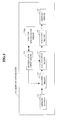
- Fig. 1 is a block diagram of the basic features of the display apparatus 10 of this invention. The construction and operation of the display apparatus will be explained below.
- the minimum encompassing sphere is the smallest sphere that contains an object in a virtual 3-dimensional space.
- FIG. 6A shows the X-Z plane of the object V
- Fig. 6B shows the Y-Z plane of the object V
- Fig. 6C shows the X-Y plane of the object V.
- the average value Xa of the maximum X coordinate X1 and the minimum X coordinate X2 of the shape data of the object V is found, as well as the average value Ya of the maximum Y coordinate Y1 and the minimum Y coordinate Y2 and average value Za of the maximum Z coordinate Z1 and the minimum Z coordinate Z2.
- These coordinates (Xa, Ya, Za) are taken to be the center of the minimum encompassing sphere.
- the difference Xb between the maximum X coordinate X1 and the minimum X coordinate X2 of the shape data of the object V is found, as well as is the difference Yb between the maximum Y coordinate Y1 and the minimum Y coordinate Y2, and the difference Zb between the maximum Z coordinate Z1 and the minimum Z coordinate Z2.
- the largest value among these differences Xb, Yb and Zb is taken to be the diameter of the minimum encompassing sphere.
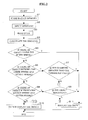
- the diameter and coordinates of the center of the minimum encompassing sphere are correlated to the shape data of the object V, and that correlation is stored in a memory 11, such as a hard disk, in advance (step S1 in Fig. 2).
- Attribute data of the minimum encompassing sphere which are correlated to the shape data and stored in memory in this way, are not limited to the center coordinates and the diameter.
- the diameter of the minimum encompassing sphere instead of the diameter of the minimum encompassing sphere, it is possible to store the radius of the minimum encompassing sphere in memory, and a similar effect is obtained by finding the diameter from this radius.
- the user enters instructions for the desired location using an instruction-input means 12.
- the coordinates of the viewpoint when displaying an object are read from the instruction-input means 12 by a reading means 13 and input to a calculation means 14 (step S2 in Fig. 2).
- the current position of the display apparatus 10 and the direction of movement must be specified.
- This current position can be obtained from a position-specification means 12a such as a GPS (Global Positioning System) that is installed in the display apparatus 10.
- the direction of movement can be specified based on the destination that were entered as described above and the current position of the display apparatus 10.
- the reading means 13 that obtained the viewpoint coordinates reads from the memory 11 shape data 25, 26, 27 for the objects that can be seen from the viewpoint 21, and gives that data over to the calculation means 14 (step S3 in Fig. 2).
- the method for specifying the shape data of the objects that can be seen from a certain viewpoint can be the normal method.
- shape data for those objects can be eliminated as display candidates.
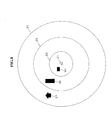
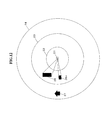
- the radius of the spheres increases in the order of inner sphere 22, middle sphere 23 and outer sphere 24.
- these spheres 22, 23, 24 themselves are not the objects to be displayed. In other words, these spheres 22, 23, 24 just function as thresholds that are used when selecting the objects to be displayed from among the display candidates. (This will be explained later.)
- the calculation means 14 calculates the distance between the objects and the viewpoint (hereafter this distance will be called the object-to-viewpoint distance L) based on the viewpoint coordinates that were obtained from the instruction-input method 12 and the center coordinates of the minimum encompassing spheres of the shape data 25, 26, 27 that were obtained from the reading means 13.
- the object-to-viewpoint distances that are calculated in this way are then correlated with the shape data 25, 26, 27 and given over to a selection means 15 (step S4 in Fig. 2).
- the selection means 15 selects the objects to be displayed from among the display candidates.
- the shape data 25 for the objects inside the inner sphere 22 are given over to a display means 16 such as a display to be displayed. In this way, all of the near objects are displayed regardless of their size (steps S5 and S11 in Fig. 2).
- the 'objects inside the inner sphere 22' are objects object whose object-to-viewpoint distance L is less than the radius r1 of the inner sphere 22.
- shape data 26 for an object between the inner sphere 22 and middle sphere 23 are given over to the display means 16 to be displayed when the diameter of the minimum encompassing sphere is greater than a threshold value. In this way, for example in the case of the Tokyo Tower, objects that are large even though they are far away are displayed (steps S6, S7 and S11 in Fig. 2).
- the 'objects between the inner sphere 22 and middle sphere 23' are objects whose object-to-point distance L is greater than the radius r1 of the inner sphere 22 and less than the radius r2 of the middle sphere 23.
- shape data 27 for objects between the middle sphere 23 and outer sphere 24 are only given over to the display means 16 when those objects are important objects. In this way, for example in the case of an enemy character, objects that are important even though they are far away are displayed (step S8, S9 and S11 in Fig. 2).
- the 'objects between the middle sphere 23 and outer sphere 24' are objects whose object-to-viewpoint distance L is greater than the radius r2 of the middle sphere 23 and less than the radius r3 of the outer sphere 24.
- a flag indicating whether or not an object should always be displayed, can be set for the shape data of the object and stored in advance in the memory 11. This makes it possible to determine by the selection means 15 the importance of each object.
- shape data whose constant-display flag value is '1' can be determined to be shape data for an important object.
- shape data whose constant-distant display flag is '0' can be determined to be shape data for an object that is not important.
- objects to be displayed are selected from among display candidates based on the diameter of the minimum encompassing sphere of the shape data and the object-to-viewpoint distance L. Therefore, it is possible to keep the number of missing objects that should be displayed to a minimum without having to improve the drawing performance of 3-dimensional graphics.
- the shape data 26 of objects between the inner sphere 22 and middle sphere 23 are to be displayed when the diameter of the minimum encompassing sphere is greater than a threshold value, and the shape data 27 of objects between the middle sphere 23 and outer sphere 24 are to be displayed only when the objects are important.
- the invention is not limited to this.
- an opposite form in other words, a form where the shape data 26 for the objects between the inner sphere 22 and middle sphere 23 are to be displayed only when the objects are important objects, and the shape data 27 for the objects between the middle sphere 23 and the outer sphere 24 are displayed when the diameter of the minimum encompassing sphere is greater than a threshold value.
- the importance of the objects that are between the inner sphere 22 and middle sphere 23 is not determined, however, it is also possible to determine the importance of the objects in this area as well.
- the center coordinates and diameter of the minimum encompassing sphere is correlated to the shape data for the object and stored in memory 11 in advance, however, the invention is not limited to this.
- the invention when categorizing objects according to different height levels (single-level object, two-level object, three-level object, etc.), it is effective to store height data, which expresses which height level the object belongs to. In this case, the taller a building is, the higher its display priority is.
- the invention is not limited by this. That is, there is no problem in first storing just the shape data, and then finding the center coordinates and diameters of the minimum encompassing spheres when the shape data are read and input to the calculation means 14 via the reading means 13.
- a person is very perceptive to changes in the area near the point where the line of sight is fixed (point of fixation). Therefore, in this embodiment of the invention, objects near the point of fixation are selected as objects to be displayed.
- the shape data for the objects are given over to the calculation means 14 from the reading means 13 using the same procedure as in the first embodiment.
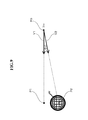
- the calculation means 14 calculates the inner product of a vector V1 in the direction that connects the position of the viewpoint P0 and the point of fixation P1 and a vector V2 in the direction that connects the position of the viewpoint P0 and the center P2 of the minimum encompassing sphere W (cos ⁇ 3, where ⁇ 3 is the elongation angle between both vectors V1, V2).
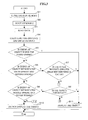
- the inner product that is calculated in this way is correlated with the shape data 25, 26, 27 and given over to the selection means 15 (step S4 in Fig. 3).
- the selection means 15 selects the objects to be displayed from among these candidates.
- the shape data 25 for objects that are within the inner sphere 22 are given over to a display means 16 such as a display to be displayed. In this way, all of those objects are displayed regardless of whether or not their position is near the point of fixation (step S5 and S11 in Fig. 3).
- the shape data 26 for objects that are between the inner sphere 22 and middle sphere 23 are given over to the display means 16 as objects to be displayed when their inner product is greater than a threshold value. In this way, objects that are near the point of fixation become objects to be displayed even though they are far way (step S6, S7 and S11 in Fig. 3).
- Fig. 10 will be used to explain in detail the relationship between the inner product and threshold value.
- An inner product that is greater than the threshold value means that the object is in an area 30 that includes the point of fixation P1.
- an inner product that is less than the threshold value means that the object is not in the area 30 that includes this point of fixation P1.
- shape data 26 for objects that are between the inner sphere 22 and middle sphere 23 have an inner product that is greater than the threshold value (in other words, the objects are in the area 30), so the data are given over to the display means 16 to be displayed.
- shape data 26a or 26b for objects that are between the inner sphere 22 and middle sphere 23 have an inner product that is less than the threshold value (in other words, the objects are not in the area 30), so will not be displayed.
- shape data 27 for objects between the middle sphere 23 and outer sphere 24 are given over to the display means 16 to be displayed only when an object is an important object. In this way, important objects, such as enemy characters or the like, are displayed even when they are far away (step S8, S9 and S11 in Fig. 3).
- objects that are near the point of fixation are selected as objects to be displayed. Therefore, it is possible to keep the number of missing objects that should be displayed to a minimum without having to improve the drawing performance of 3-dimensional graphics.
- the invention is not limited to this. In other words, it is also possible to determine whether or not the inner product is greater than a threshold value in the cases when the display candidates are within the inner sphere 22, between the inner sphere 22 and middle sphere 23, or between the middle sphere 23 and outer sphere 24. Of course, in these cases, it is not necessary to consider whether or not the display candidates are within the inner sphere 22, between the inner sphere 22 and middle sphere 23, or between the middle sphere 23 and outer sphere 24, so it is not necessary to calculate the object-to-viewpoint distance L.
- the inner product is calculated using the center position of the minimum encompassing sphere, however, the invention is not limited to this. That is, if it is possible to find the center position of the object by another method, it is possible to calculate the inner product in a similar way using that center position instead of the center position of the minimum encompassing sphere.
- a person is very perceptive to changes in objects that occupy a large percentage of the field of view. Therefore, in this embodiment of the invention, objects that occupy a large percentage of the field of view are selected as objects to be displayed.
- the shape data for the objects are given over to the calculation means 14 from the reading means 13 using the same procedure as in the first embodiment. From this the calculation means 14 calculates the solid angles of the objects as seen from the viewpoint. The solid angles that are calculated in this way are then correlated with the shape data 25, 26, 27 and given over to the selection means 15 (step S4 in Fig. 4).
- the solid angle expands the concept of the angle to three dimensions.
- a conical form Q that is formed by a point O outside the closed contour, and a moving point P that moves along the contour
- the area of the surface R that is cut out from a sphere having a radius 1 and whose center is at point O is taken to be the solid angle of the closed contour S.
- the conical form Q does not change every time the line of sight changes when the viewpoint is constant. Therefore, in that case, it is not necessary to calculate the solid angle of the object every time the line of sight changes.
- the selection means 15 selects the objects to display from among the display candidates.
- shape data 25 for objects within the inner sphere 22 are given over to a display means 16, such as a display, as objects to be display.
- a display means 16 such as a display
- near objects are all displayed regardless of the percentage of the field of view that they occupy (step S5 and S11 in Fig. 4).
- shape data 26 for objects that are between the inner sphere 22 and middle sphere 23 are given over to the display means 16 as objects to be displayed when their respective solid angles are greater than a threshold value. In this way, objects that occupy a large percentage of the field of view are displayed even though they are far away (steps S6, S7 and S11, in Fig. 4).
- the shape data 26 for an object that is between the inner sphere 22 and middle sphere 23 are given over to the display means 16 to be displayed when it is determined that the solid angle of that object is greater than a threshold value.
- shape data 26a for an object that is between the inner sphere 22 and middle sphere 23 are not displayed when it is determined that the solid angle of that object is less than the threshold value.
- shape data 27 for an object between the middle sphere 23 and outer sphere 24 is given over to the display means 16 only when that object is an important item. In this way, important objects, such as an enemy character, are displayed even though they are far away (steps S8, S9 and S11 in Fig. 4).
- objects that occupy a large percentage of the field of view are selected as objects to be displayed. Therefore, it is possible to keep the number of missing objects that should be displayed to a minimum without having to improve the drawing performance of 3-dimensional graphics.
- the invention is not limited to this. In other words, it is also possible to determine whether or not the solid angle is greater than a threshold value in the cases when the display candidates are within the inner sphere 22, between the inner sphere 22 and middle sphere 23, or between the middle sphere 23 and outer sphere 24. Of course, in these cases, it is not necessary to consider whether or not the display candidates are within the inner sphere 22, between the inner sphere 22 and middle sphere 23, or between the middle sphere 23 and outer sphere 24, so it is not necessary to calculate the object-to-viewpoint distance L.
- high-detail shape data 31 and low-detail shape data 32 for the same object are stored in the memory 11 in advance.
- the selection means 15 selects the most suitable shape data from among the two kinds of shape data 31, 32 using the method described below.
- the size of an object 35 seen from the viewpoint 21 changes depending on the object-to-viewpoint distance L.
- the object 35 as seen from the viewpoint 21 becomes smaller.
- the selection means 15 selects low-detail shape data 32 instead of the high-detail shape data 31 when the diameter 34 of the minimum part 33 of the shape data 31 for the object 35 as seen from the viewpoint 21 becomes less than the minimum picture element of the display means 16.
- the most suitable shape data are selected from among a plurality of shape data having different levels of detail. Therefore, it is possible to draw near objects in high detail and far objects in low detail Moreover, there is also a merit in that it is possible to shorten the amount of time required for drawing far objects.
- a plurality of shape data having different levels of detail are stored in memory 11 in advance, however, the invention is not limited to this.
- the calculation means 14 calculates the inner product of a vector V1 in the direction that connects the position of the viewpoint P0 and the point of fixation P1 and a vector V2 in the direction that connects the position of the viewpoint P0 and the center P2 of the minimum encompassing sphere W (cos ⁇ 3, where ⁇ 3 is the elongation angle between both vectors V1, V2). Then the calculation means 14 correlates the calculated inner product with the shape data and gives it over to the selection means 15.
- the selection means 15 selects the most suitable shape data from among a plurality of shape data having different levels of detail to be displayed. In other words, when the inner product is greater than the threshold value, high-detail shape data 31 are selected, and on the other hand, when the inner product is less than the threshold value, low-detail shape data 32 are selected.
- the most suitable shape data are selected from among a plurality of shape data having different levels of detail. Therefore, it is possible to draw objects that are near the point of fixation in high detail, and to draw objects that are not near the point of fixation in low detail. In addition, there is a merit in that it is possible to reduce the amount of time required for drawing objects that are not near the point of fixation.
- the calculation means 14 calculates the solid angle of an object as seen from the viewpoint position. Then it correlates the calculated solid angle and gives it over to the selection means 15.
- the selection means 15 selects the most suitable shape data from among a plurality of shape data having different levels of detail to be displayed. In other words, when the solid angle is greater than a threshold value, high-detail shape data 31 are selected, and when the solid angle is less than the threshold value, low-detail shape data 32 are selected.
- the most suitable shape data are selected from among a plurality of shape data having different levels of detail. Therefore, it is possible to draw objects that occupy a large percentage of the field of view in high detail, and to draw objects that occupy a small percentage of the field of view in low detail. In addition, there is a merit in that it is possible to reduce the amount of time required for drawing objects that occupy a small percentage of the field of view.
- 'texture mapping' In computer graphics, applying a pattern to the surface of an object is called 'texture mapping'. If texture mapping is not performed, the surface of the drawn object just becomes a simple uniform or a shaded (graduated change in density) surface, and a realistic feel is not obtained.
- the texture mapping is obtained by applying texture bit mapping to the object and rendering the image.
- This texture data is often created using paint software or comprises actual photographs or images.
- texture data 42 with high resolution and texture data 43 with low resolution are stored in memory 11 in advance. Also, using a method that will be explained below, the selection means 15 selects the most suitable texture data from among the two kinds of texture data 42, 43.
- the size of an object 41 that is seen from the viewpoint 21 changes depending on the object-to-viewpoint distance L. In other words, as the object-to-viewpoint distance L increases, the size of the object 41 seen from the viewpoint 21 becomes smaller.
- the selection means 15 When the selection means 15 has applied texture data 42 with high resolution to the object 41, it then selects texture data 43 with lower resolution in the place of this texture data 42 as the diameter 44 of the texel 45 as seen from the viewpoint becomes smaller than the minimum picture element of the display means 16.
- the texel 45 is the smallest picture element of the texture data.
- the most suitable texture data are selected from among a plurality of texture data having different resolutions. Therefore, it is possible to draw near objects with a realistic feel and draw far objects with a simpler feel.
- a plurality of texture data having different resolution is stored in memory 11 in advance, however, the invention is not limited to that. In other words, it is also possible to obtain the same effect by just storing texture data having high resolution in advance and then generating texture data having low resolution based on the stored texture data.
- the calculation means 14 calculates the inner product of a vector V1 in the direction that connects the position of the viewpoint P0 and the point of fixation P1 and a vector V2 in the direction that connects the position of the viewpoint P0 and the center P2 of the minimum encompassing sphere W (cos ⁇ 3, where ⁇ 3 is the elongation angle between both vectors V1, V2). Then it correlates the inner product that was calculated in this way with the shape data and gives the inner product to the selection means 15.
- the selection means 15 selects the most suitable texture data from among a plurality of texture data having different resolution to be displayed. In other words, when the inner product is greater than a threshold value, the selection means 15 selects high-resolution texture data 42, and when the inner product is less then the threshold value, it selects low-resolution texture data 43.
- the most suitable texture data are selected from among a plurality of texture data having different resolution. Therefore, it is possible to draw objects near the point of fixation with a realistic feel, and to draw objects that are not near the point of fixation more simply.
- the calculation means 14 calculates the solid angle of an object as seen from the viewpoint position, and then it correlates the calculated solid angle with the shape data and gives that solid angle over to the selection means 15.
- the selection means 15 selects the most suitable texture data from among a plurality of texture data having different resolution. In other words, when the solid angle is greater than a threshold value, the selection means 15 selects high-resolution texture data 42, and when the solid angle is less than the threshold value, it selects low-resolution texture data 43. As described above, in this embodiment of the invention, the most suitable texture data are selected from among a plurality of texture data having different resolution. Therefore, it is possible to draw objects that occupy a large percentage of the field of view with a realistic feel, and to draw objects that occupy a small percentage of the field of view more simply.
Landscapes
- Physics & Mathematics (AREA)
- Engineering & Computer Science (AREA)
- Geometry (AREA)
- Computer Graphics (AREA)
- General Physics & Mathematics (AREA)
- Theoretical Computer Science (AREA)
- Processing Or Creating Images (AREA)
- Image Generation (AREA)
Abstract
Description
As described above, in this embodiment of the invention, the most suitable texture data are selected from among a plurality of texture data having different resolution. Therefore, it is possible to draw objects that occupy a large percentage of the field of view with a realistic feel, and to draw objects
that occupy a small percentage of the field of view more simply.
Claims (18)
- A display apparatus, which displays objects located in a virtual 3-dimensional space, comprising:a calculation means of calculating the distance between the viewpoint position when displaying the object and the center position of a minimum encompassing sphere, which is the smallest sphere that contains the object; anda selection means of selecting the objects to display from among display candidates based on the distance calculated by said calculation means and the diameter or radius of said minimum encompassing sphere.
- A display apparatus, which displays objects located in a virtual 3-dimensional space, comprising:a calculation means of calculating the inner product of a vector in the direction connecting the viewpoint position when displaying an object and the center position of the object, and a vector in the direction connecting this viewpoint position and the point of fixation; anda selection means of selecting the object to display from among display candidates based on the inner product calculated by said calculation means.
- A display apparatus, which displays objects located in a virtual 3-dimensional space, comprising:a calculation means of calculating the solid angle of an object as seen from the viewpoint position when displaying the object; anda selection means of selecting the object to display from among candidates based on the solid angle calculated by said calculation means.
- A display apparatus, which displays objects located in a virtual 3-dimensional space, comprising:a calculation means of calculating the distance between the viewpoint position when displaying the object and the center position of a minimum encompassing sphere, which is the smallest sphere that contains the object; anda selection means of selecting the most suitable shape data to display from among a plurality of shape data having different levels of detail, based on the distance calculated by said calculation means.
- A display apparatus, which displays objects located in a virtual 3-dimensional space, comprising:a calculation means of calculating the inner product of a vector in the direction connecting the viewpoint position when displaying an object and the center position of the object, and a vector in the direction connecting this viewpoint position and the point of fixation; anda selection means of selecting the most suitable shape data to display from among a plurality of shape data having different levels of detail, based on the inner product calculated by said calculation means.
- A display apparatus, which displays objects located in a virtual 3-dimensional space, comprising:a calculation means of calculating the solid angle of an object as seen from the viewpoint position when displaying the object; anda selection means of selecting the most suitable shape data to display from among a plurality of shape data having different levels of detail, based on the solid angle calculated by said calculation means.
- A display apparatus, which displays objects located in a virtual 3-dimensional space, comprising:a calculation means of calculating the distance between the viewpoint position when displaying the object and the center position of a minimum encompassing sphere, which is the smallest sphere that contains the object; anda selection means of selecting the most suitable texture data to display from among a plurality of texture data having different levels of resolution, based on the distance calculated by said calculation means.
- A display apparatus, which displays objects located in a virtual 3-dimensional space, comprising:a calculation means of calculating the inner product of a vector in the direction connecting the viewpoint position when displaying an object and the center position of the object, and a vector in the direction connecting this viewpoint position and the point of fixation; anda selection means of selecting the most suitable texture data to display from among a plurality of texture data having different levels of resolution, based on the inner product calculated by said calculation means.
- A display apparatus, which displays objects located in a virtual 3-dimensional space, comprising:a calculation means of calculating the solid angle of an object as seen from the viewpoint position when displaying the object; anda selection means of selecting the most suitable texture data to display from among a plurality of texture data having different levels of resolution, based on the solid angle calculated by said calculation means.
- The display apparatus according to claim 1, 4 or 7 wherein
the average value Xa of the maximum X-coordinate and minimum X-coordinate, average value Ya of the maximum Y-coordinate and minimum Y-coordinate, and Za of the maximum Z-coordinate and minimum Z-coordinate of said shape data are found and these coordinates (Xa, Ya, Za) are taken to be the center position of said minimum encompassing sphere, and
the difference Xb between the maximum X-coordinate and minimum X-coordinate, the difference Yb between the maximum Y-coordinate and minimum Y-coordinate and the difference Zb between the maximum Z-coordinate and minimum Z-coordinate of said shape data are found and the maximum value of these values Xb, Yb, Zb is taken to be the diameter of said minimum encompassing sphere. - The display apparatus according to claim 2, 5 or 8 wherein
the center position of said object is the center position of the minimum encompassing sphere, which is the smallest sphere that contains said object. - The display apparatus according to claim 3, 6 or 9 wherein
the solid angle of said object is the solid angle of the minimum encompassing sphere, which is the smallest sphere that contains said object. - A display method of displaying objects located in a virtual 3-dimensional space and comprising:a method of selecting an object to display from among display candidates based on the distance between the viewpoint position when displaying the object and the center position of the minimum encompassing sphere, which is the smallest sphere that contains the object, and diameter or radius of said encompassing sphere.
- A display method of displaying objects located in a virtual 3-dimensional space and comprising:a method of selecting the most suitable shape data to display from among a plurality of shape data having different levels of detail, based on the distance between the viewpoint position when displaying the object and the center position of the minimum encompassing sphere.
- A display method of displaying objects located in a virtual 3-dimensional space and comprising:a method of selecting the most suitable texture data to display from among a plurality of texture data having different resolution, based on the distance between the viewpoint position when displaying the object and the center position of the minimum encompassing sphere.
- A program that is executed by a computer and comprising;a calculation process of calculating the distance between the viewpoint position when displaying an object and the center position of a minimum encompassing sphere, which is the smallest sphere that contains the object, anda selection process of selecting objects to display from among display candidates based on said calculated distance and the diameter or radius of said minimum encompassing sphere.
- A program that is executed by a computer and comprising;a calculation process of calculating the distance between the viewpoint position when displaying an object and the center position of a minimum encompassing sphere, which is the smallest sphere that contains the object, anda selection process of selecting the most suitable shape data to display from among a plurality of shape data having different levels of detail based on said calculated distance.
- A program that is executed by a computer and comprising;a calculation process of calculating the distance between the viewpoint position when displaying an object and the center position of a minimum encompassing sphere, which is the smallest sphere that contains the object, anda selection process of selecting the most suitable texture data to display from among a plurality of texture data having different resolution based on said calculated distance.
Applications Claiming Priority (2)
| Application Number | Priority Date | Filing Date | Title |
|---|---|---|---|
| JP2001235233 | 2001-08-02 | ||
| JP2001235233 | 2001-08-02 |
Publications (2)
| Publication Number | Publication Date |
|---|---|
| EP1308901A2 true EP1308901A2 (en) | 2003-05-07 |
| EP1308901A3 EP1308901A3 (en) | 2004-04-14 |
Family
ID=19066713
Family Applications (1)
| Application Number | Title | Priority Date | Filing Date |
|---|---|---|---|
| EP02254817A Withdrawn EP1308901A3 (en) | 2001-08-02 | 2002-07-09 | Display apparatus and display method |
Country Status (1)
| Country | Link |
|---|---|
| EP (1) | EP1308901A3 (en) |
Cited By (1)
| Publication number | Priority date | Publication date | Assignee | Title |
|---|---|---|---|---|
| CN115563800A (en) * | 2022-10-24 | 2023-01-03 | 中科南京移动通信与计算创新研究院 | Massive satellite simulation modeling method, system, equipment and storage medium |
Family Cites Families (2)
| Publication number | Priority date | Publication date | Assignee | Title |
|---|---|---|---|---|
| US5844562A (en) * | 1996-06-28 | 1998-12-01 | Deneb Robotics, Inc. | Method for hi-fidelity graphic rendering of three-dimensional objects |
| AU1158001A (en) * | 1999-11-02 | 2001-05-14 | Elixir Studios Limited | Improvements relating to computer graphics |
-
2002
- 2002-07-09 EP EP02254817A patent/EP1308901A3/en not_active Withdrawn
Cited By (1)
| Publication number | Priority date | Publication date | Assignee | Title |
|---|---|---|---|---|
| CN115563800A (en) * | 2022-10-24 | 2023-01-03 | 中科南京移动通信与计算创新研究院 | Massive satellite simulation modeling method, system, equipment and storage medium |
Also Published As
| Publication number | Publication date |
|---|---|
| EP1308901A3 (en) | 2004-04-14 |
Similar Documents
| Publication | Publication Date | Title |
|---|---|---|
| US11270506B2 (en) | Foveated geometry tessellation | |
| US11783536B2 (en) | Image occlusion processing method, device, apparatus and computer storage medium | |
| US10349033B2 (en) | Three-dimensional map generating and displaying apparatus and method | |
| US8154547B2 (en) | Method and system for early Z test in title-based three-dimensional rendering | |
| US20040075735A1 (en) | Method and system for producing a pseudo three-dimensional display utilizing a two-dimensional display device | |
| US20080198158A1 (en) | 3D map display system, 3D map display method and display program | |
| KR100634010B1 (en) | How to convert coordinate values in digital map | |
| US20080231631A1 (en) | Image processing apparatus and method of controlling operation of same | |
| US20080309668A1 (en) | Image processing method and apparatus | |
| US8994727B2 (en) | Map symbol drawing device | |
| US10325403B2 (en) | Image based rendering techniques for virtual reality | |
| US9250093B2 (en) | Navigation device, method of predicting a visibility of a triangular face in an electronic map view, and method for generating a database | |
| KR20190011492A (en) | Device for providing content and method of operating the same | |
| US7382374B2 (en) | Computerized method and computer system for positioning a pointer | |
| KR101508388B1 (en) | Mipmap Generation Device and Method | |
| US20020133291A1 (en) | Rendering device and method | |
| KR100825704B1 (en) | Image processor, image processing method and information storage medium | |
| EP1308901A2 (en) | Display apparatus and display method | |
| US7525551B1 (en) | Anisotropic texture prefiltering | |
| JP4781685B2 (en) | Outline map generator | |
| JP4642431B2 (en) | Map display device, map display system, map display method and program | |
| JP2019164787A (en) | Method and device for efficiently specifying building footprint | |
| JP2006171889A (en) | 3D shape display system, 3D shape display method, and 3D shape display program | |
| JPH05128274A (en) | Graphic display device | |
| US12548240B2 (en) | Map tile culling for displaying globe representations in an electronic map system |
Legal Events
| Date | Code | Title | Description |
|---|---|---|---|
| PUAI | Public reference made under article 153(3) epc to a published international application that has entered the european phase |
Free format text: ORIGINAL CODE: 0009012 |
|
| AK | Designated contracting states |
Designated state(s): AT BE BG CH CY CZ DE DK EE ES FI FR GB GR IE IT LI LU MC NL PT SE SK TR |
|
| AX | Request for extension of the european patent |
Extension state: AL LT LV MK RO SI |
|
| PUAL | Search report despatched |
Free format text: ORIGINAL CODE: 0009013 |
|
| RIC1 | Information provided on ipc code assigned before grant |
Ipc: 7G 06T 15/10 B Ipc: 7G 06T 15/40 A |
|
| AK | Designated contracting states |
Kind code of ref document: A3 Designated state(s): AT BE BG CH CY CZ DE DK EE ES FI FR GB GR IE IT LI LU MC NL PT SE SK TR |
|
| AX | Request for extension of the european patent |
Extension state: AL LT LV MK RO SI |
|
| 17P | Request for examination filed |
Effective date: 20040521 |
|
| AKX | Designation fees paid |
Designated state(s): DE FR GB |
|
| 17Q | First examination report despatched |
Effective date: 20050331 |
|
| STAA | Information on the status of an ep patent application or granted ep patent |
Free format text: STATUS: THE APPLICATION IS DEEMED TO BE WITHDRAWN |
|
| 18D | Application deemed to be withdrawn |
Effective date: 20050811 |