EP1308482A1 - Counterion use for reduction of decap and for improvement of durability of images - Google Patents
Counterion use for reduction of decap and for improvement of durability of images Download PDFInfo
- Publication number
- EP1308482A1 EP1308482A1 EP02257314A EP02257314A EP1308482A1 EP 1308482 A1 EP1308482 A1 EP 1308482A1 EP 02257314 A EP02257314 A EP 02257314A EP 02257314 A EP02257314 A EP 02257314A EP 1308482 A1 EP1308482 A1 EP 1308482A1
- Authority
- EP
- European Patent Office
- Prior art keywords
- dye
- group
- counterion
- linkage
- chromophore
- Prior art date
- Legal status (The legal status is an assumption and is not a legal conclusion. Google has not performed a legal analysis and makes no representation as to the accuracy of the status listed.)
- Granted
Links
- 235000001892 vitamin D2 Nutrition 0.000 title description 8
- 230000002209 hydrophobic effect Effects 0.000 claims abstract description 68
- 238000007641 inkjet printing Methods 0.000 claims abstract description 5
- 230000003993 interaction Effects 0.000 claims description 43
- -1 dimethylpyridyl Chemical group 0.000 claims description 18
- 239000003623 enhancer Substances 0.000 claims description 17
- 238000000034 method Methods 0.000 claims description 16
- 239000004094 surface-active agent Substances 0.000 claims description 15
- MSWZFWKMSRAUBD-UHFFFAOYSA-N beta-D-galactosamine Natural products NC1C(O)OC(CO)C(O)C1O MSWZFWKMSRAUBD-UHFFFAOYSA-N 0.000 claims description 11
- 125000000217 alkyl group Chemical group 0.000 claims description 10
- 239000000872 buffer Substances 0.000 claims description 8
- 239000000758 substrate Substances 0.000 claims description 6
- MSWZFWKMSRAUBD-IVMDWMLBSA-N 2-amino-2-deoxy-D-glucopyranose Chemical compound N[C@H]1C(O)O[C@H](CO)[C@@H](O)[C@@H]1O MSWZFWKMSRAUBD-IVMDWMLBSA-N 0.000 claims description 5
- RGHNJXZEOKUKBD-SQOUGZDYSA-M D-gluconate Chemical compound OC[C@@H](O)[C@@H](O)[C@H](O)[C@@H](O)C([O-])=O RGHNJXZEOKUKBD-SQOUGZDYSA-M 0.000 claims description 5
- 229940050410 gluconate Drugs 0.000 claims description 5
- 229960002442 glucosamine Drugs 0.000 claims description 5
- 229920005862 polyol Polymers 0.000 claims description 5
- 150000003077 polyols Chemical class 0.000 claims description 5
- BDHFUVZGWQCTTF-UHFFFAOYSA-M sulfonate Chemical compound [O-]S(=O)=O BDHFUVZGWQCTTF-UHFFFAOYSA-M 0.000 claims description 5
- 150000007942 carboxylates Chemical class 0.000 claims description 4
- 239000003153 chemical reaction reagent Substances 0.000 claims description 4
- LYCAIKOWRPUZTN-UHFFFAOYSA-N ethylene glycol Natural products OCCO LYCAIKOWRPUZTN-UHFFFAOYSA-N 0.000 claims description 4
- 150000002334 glycols Chemical class 0.000 claims description 4
- 239000003906 humectant Substances 0.000 claims description 4
- 239000003139 biocide Substances 0.000 claims description 3
- 150000002009 diols Chemical class 0.000 claims description 3
- WGCNASOHLSPBMP-UHFFFAOYSA-N hydroxyacetaldehyde Natural products OCC=O WGCNASOHLSPBMP-UHFFFAOYSA-N 0.000 claims description 3
- 229910052757 nitrogen Inorganic materials 0.000 claims description 3
- 125000002924 primary amino group Chemical group [H]N([H])* 0.000 claims description 3
- 229920003171 Poly (ethylene oxide) Polymers 0.000 claims description 2
- 230000003115 biocidal effect Effects 0.000 claims description 2
- 239000006177 biological buffer Substances 0.000 claims description 2
- 235000014113 dietary fatty acids Nutrition 0.000 claims description 2
- 150000002170 ethers Chemical class 0.000 claims description 2
- 239000000194 fatty acid Substances 0.000 claims description 2
- 229930195729 fatty acid Natural products 0.000 claims description 2
- 150000004665 fatty acids Chemical class 0.000 claims description 2
- 150000002193 fatty amides Chemical class 0.000 claims description 2
- 125000001153 fluoro group Chemical group F* 0.000 claims description 2
- 229920001515 polyalkylene glycol Polymers 0.000 claims description 2
- 229920001296 polysiloxane Polymers 0.000 claims description 2
- 150000003333 secondary alcohols Chemical class 0.000 claims description 2
- OISVCGZHLKNMSJ-UHFFFAOYSA-N 2,6-dimethylpyridine Chemical compound CC1=CC=CC(C)=N1 OISVCGZHLKNMSJ-UHFFFAOYSA-N 0.000 claims 3
- VEXZGXHMUGYJMC-UHFFFAOYSA-M Chloride anion Chemical compound [Cl-] VEXZGXHMUGYJMC-UHFFFAOYSA-M 0.000 claims 2
- 150000001408 amides Chemical class 0.000 claims 2
- 125000000664 diazo group Chemical group [N-]=[N+]=[*] 0.000 claims 2
- 150000004678 hydrides Chemical class 0.000 claims 2
- XLYOFNOQVPJJNP-UHFFFAOYSA-M hydroxide Chemical compound [OH-] XLYOFNOQVPJJNP-UHFFFAOYSA-M 0.000 claims 2
- 125000001841 imino group Chemical group [H]N=* 0.000 claims 2
- 150000002576 ketones Chemical class 0.000 claims 2
- 125000004433 nitrogen atom Chemical group N* 0.000 claims 2
- 125000006296 sulfonyl amino group Chemical group [H]N(*)S(*)(=O)=O 0.000 claims 2
- QGZKDVFQNNGYKY-UHFFFAOYSA-O Ammonium Chemical compound [NH4+] QGZKDVFQNNGYKY-UHFFFAOYSA-O 0.000 claims 1
- 239000000975 dye Substances 0.000 description 136
- 239000000976 ink Substances 0.000 description 27
- 125000002091 cationic group Chemical group 0.000 description 25
- 125000000129 anionic group Chemical group 0.000 description 17
- 0 CCCCCCc(cc1)ccc1NC(Cc1c2O)C=Cc1cc(*)c2N=C(C1)[*@]1c(c1c2ccc(*)c1)ccc2N=CC*C1=CC[C@](C)(C=CCCCC)C=C1 Chemical compound CCCCCCc(cc1)ccc1NC(Cc1c2O)C=Cc1cc(*)c2N=C(C1)[*@]1c(c1c2ccc(*)c1)ccc2N=CC*C1=CC[C@](C)(C=CCCCC)C=C1 0.000 description 11
- 238000006243 chemical reaction Methods 0.000 description 11
- 150000001412 amines Chemical group 0.000 description 9
- WQZGKKKJIJFFOK-GASJEMHNSA-N Glucose Natural products OC[C@H]1OC(O)[C@H](O)[C@@H](O)[C@@H]1O WQZGKKKJIJFFOK-GASJEMHNSA-N 0.000 description 8
- JUJWROOIHBZHMG-UHFFFAOYSA-N Pyridine Chemical group C1=CC=NC=C1 JUJWROOIHBZHMG-UHFFFAOYSA-N 0.000 description 8
- WQZGKKKJIJFFOK-VFUOTHLCSA-N beta-D-glucose Chemical compound OC[C@H]1O[C@@H](O)[C@H](O)[C@@H](O)[C@@H]1O WQZGKKKJIJFFOK-VFUOTHLCSA-N 0.000 description 8
- 238000005932 reductive alkylation reaction Methods 0.000 description 8
- 239000003960 organic solvent Substances 0.000 description 7
- OVEMTTZEBOCJDV-UHFFFAOYSA-N 4-hexylaniline Chemical compound CCCCCCC1=CC=C(N)C=C1 OVEMTTZEBOCJDV-UHFFFAOYSA-N 0.000 description 6
- PAYRUJLWNCNPSJ-UHFFFAOYSA-N Aniline Chemical compound NC1=CC=CC=C1 PAYRUJLWNCNPSJ-UHFFFAOYSA-N 0.000 description 6
- 239000002253 acid Substances 0.000 description 6
- MSWZFWKMSRAUBD-QZABAPFNSA-N beta-D-glucosamine Chemical compound N[C@H]1[C@H](O)O[C@H](CO)[C@@H](O)[C@@H]1O MSWZFWKMSRAUBD-QZABAPFNSA-N 0.000 description 6
- 238000003786 synthesis reaction Methods 0.000 description 6
- XLYOFNOQVPJJNP-UHFFFAOYSA-N water Substances O XLYOFNOQVPJJNP-UHFFFAOYSA-N 0.000 description 6
- 238000006149 azo coupling reaction Methods 0.000 description 5
- 230000015572 biosynthetic process Effects 0.000 description 5
- 239000000203 mixture Substances 0.000 description 5
- 239000000126 substance Substances 0.000 description 5
- 238000006467 substitution reaction Methods 0.000 description 5
- SECXISVLQFMRJM-UHFFFAOYSA-N N-Methylpyrrolidone Chemical compound CN1CCCC1=O SECXISVLQFMRJM-UHFFFAOYSA-N 0.000 description 4
- 238000005299 abrasion Methods 0.000 description 4
- 230000029936 alkylation Effects 0.000 description 4
- 238000005804 alkylation reaction Methods 0.000 description 4
- 230000001419 dependent effect Effects 0.000 description 4
- 239000000376 reactant Substances 0.000 description 4
- 239000007858 starting material Substances 0.000 description 4
- 229940015975 1,2-hexanediol Drugs 0.000 description 3
- JLTDJTHDQAWBAV-UHFFFAOYSA-N N,N-dimethylaniline Chemical compound CN(C)C1=CC=CC=C1 JLTDJTHDQAWBAV-UHFFFAOYSA-N 0.000 description 3
- HEMHJVSKTPXQMS-UHFFFAOYSA-M Sodium hydroxide Chemical compound [OH-].[Na+] HEMHJVSKTPXQMS-UHFFFAOYSA-M 0.000 description 3
- 125000001309 chloro group Chemical group Cl* 0.000 description 3
- 239000003086 colorant Substances 0.000 description 3
- RBTKNAXYKSUFRK-UHFFFAOYSA-N heliogen blue Chemical compound [Cu].[N-]1C2=C(C=CC=C3)C3=C1N=C([N-]1)C3=CC=CC=C3C1=NC([N-]1)=C(C=CC=C3)C3=C1N=C([N-]1)C3=CC=CC=C3C1=N2 RBTKNAXYKSUFRK-UHFFFAOYSA-N 0.000 description 3
- FHKSXSQHXQEMOK-UHFFFAOYSA-N hexane-1,2-diol Chemical compound CCCCC(O)CO FHKSXSQHXQEMOK-UHFFFAOYSA-N 0.000 description 3
- 125000001165 hydrophobic group Chemical group 0.000 description 3
- 239000002243 precursor Substances 0.000 description 3
- UMJSCPRVCHMLSP-UHFFFAOYSA-N pyridine Natural products COC1=CC=CN=C1 UMJSCPRVCHMLSP-UHFFFAOYSA-N 0.000 description 3
- 150000003222 pyridines Chemical class 0.000 description 3
- 238000006722 reduction reaction Methods 0.000 description 3
- 239000002904 solvent Substances 0.000 description 3
- PUPZLCDOIYMWBV-UHFFFAOYSA-N (+/-)-1,3-Butanediol Chemical compound CC(O)CCO PUPZLCDOIYMWBV-UHFFFAOYSA-N 0.000 description 2
- OPILSEWGCLFHQW-UHFFFAOYSA-N 2-methylbutane-1,1,1-triol Chemical compound CCC(C)C(O)(O)O OPILSEWGCLFHQW-UHFFFAOYSA-N 0.000 description 2
- DVLFYONBTKHTER-UHFFFAOYSA-N 3-(N-morpholino)propanesulfonic acid Chemical compound OS(=O)(=O)CCCN1CCOCC1 DVLFYONBTKHTER-UHFFFAOYSA-N 0.000 description 2
- IJGRMHOSHXDMSA-UHFFFAOYSA-N Atomic nitrogen Chemical compound N#N IJGRMHOSHXDMSA-UHFFFAOYSA-N 0.000 description 2
- VQUBIJAGGUHRMO-UHFFFAOYSA-N CS(NCC(C(C(C(CO)O)O)O)O)(=O)=O Chemical compound CS(NCC(C(C(C(CO)O)O)O)O)(=O)=O VQUBIJAGGUHRMO-UHFFFAOYSA-N 0.000 description 2
- PIICEJLVQHRZGT-UHFFFAOYSA-N Ethylenediamine Chemical compound NCCN PIICEJLVQHRZGT-UHFFFAOYSA-N 0.000 description 2
- SXRSQZLOMIGNAQ-UHFFFAOYSA-N Glutaraldehyde Chemical compound O=CCCCC=O SXRSQZLOMIGNAQ-UHFFFAOYSA-N 0.000 description 2
- 229920002873 Polyethylenimine Polymers 0.000 description 2
- DMSMPAJRVJJAGA-UHFFFAOYSA-N benzo[d]isothiazol-3-one Chemical compound C1=CC=C2C(=O)NSC2=C1 DMSMPAJRVJJAGA-UHFFFAOYSA-N 0.000 description 2
- WERYXYBDKMZEQL-UHFFFAOYSA-N butane-1,4-diol Chemical compound OCCCCO WERYXYBDKMZEQL-UHFFFAOYSA-N 0.000 description 2
- 238000009903 catalytic hydrogenation reaction Methods 0.000 description 2
- 235000017168 chlorine Nutrition 0.000 description 2
- MGNCLNQXLYJVJD-UHFFFAOYSA-N cyanuric chloride Chemical compound ClC1=NC(Cl)=NC(Cl)=N1 MGNCLNQXLYJVJD-UHFFFAOYSA-N 0.000 description 2
- 230000003247 decreasing effect Effects 0.000 description 2
- 238000006193 diazotization reaction Methods 0.000 description 2
- XWZDJOJCYUSIEY-UHFFFAOYSA-L disodium 5-[(4,6-dichloro-1,3,5-triazin-2-yl)amino]-4-hydroxy-3-phenyldiazenylnaphthalene-2,7-disulfonate Chemical compound [Na+].[Na+].Oc1c(N=Nc2ccccc2)c(cc2cc(cc(Nc3nc(Cl)nc(Cl)n3)c12)S([O-])(=O)=O)S([O-])(=O)=O XWZDJOJCYUSIEY-UHFFFAOYSA-L 0.000 description 2
- YOMFVLRTMZWACQ-UHFFFAOYSA-N ethyltrimethylammonium Chemical compound CC[N+](C)(C)C YOMFVLRTMZWACQ-UHFFFAOYSA-N 0.000 description 2
- 239000012467 final product Substances 0.000 description 2
- 239000008103 glucose Substances 0.000 description 2
- 239000001257 hydrogen Substances 0.000 description 2
- 229910052739 hydrogen Inorganic materials 0.000 description 2
- 125000004356 hydroxy functional group Chemical group O* 0.000 description 2
- 238000005342 ion exchange Methods 0.000 description 2
- 239000000463 material Substances 0.000 description 2
- 230000011987 methylation Effects 0.000 description 2
- 238000007069 methylation reaction Methods 0.000 description 2
- VATYWCRQDJIRAI-UHFFFAOYSA-N p-aminobenzaldehyde Chemical compound NC1=CC=C(C=O)C=C1 VATYWCRQDJIRAI-UHFFFAOYSA-N 0.000 description 2
- 229920001223 polyethylene glycol Polymers 0.000 description 2
- 229920001451 polypropylene glycol Polymers 0.000 description 2
- 239000000047 product Substances 0.000 description 2
- HNJBEVLQSNELDL-UHFFFAOYSA-N pyrrolidin-2-one Chemical compound O=C1CCCN1 HNJBEVLQSNELDL-UHFFFAOYSA-N 0.000 description 2
- 125000001273 sulfonato group Chemical group [O-]S(*)(=O)=O 0.000 description 2
- DNIAPMSPPWPWGF-VKHMYHEASA-N (+)-propylene glycol Chemical compound C[C@H](O)CO DNIAPMSPPWPWGF-VKHMYHEASA-N 0.000 description 1
- DNIAPMSPPWPWGF-GSVOUGTGSA-N (R)-(-)-Propylene glycol Chemical compound C[C@@H](O)CO DNIAPMSPPWPWGF-GSVOUGTGSA-N 0.000 description 1
- 229940031723 1,2-octanediol Drugs 0.000 description 1
- BFHKYHMIVDBCPC-UHFFFAOYSA-N 1,3,5,7-tetrahydro-[1,3]oxazolo[3,4-c][1,3]oxazol-7a-ylmethanol Chemical compound C1OCN2COCC21CO BFHKYHMIVDBCPC-UHFFFAOYSA-N 0.000 description 1
- CYSGHNMQYZDMIA-UHFFFAOYSA-N 1,3-Dimethyl-2-imidazolidinon Chemical compound CN1CCN(C)C1=O CYSGHNMQYZDMIA-UHFFFAOYSA-N 0.000 description 1
- YPFDHNVEDLHUCE-UHFFFAOYSA-N 1,3-propanediol Substances OCCCO YPFDHNVEDLHUCE-UHFFFAOYSA-N 0.000 description 1
- YSDRLNRMJRFZDN-UHFFFAOYSA-N 1-(chloromethyl)-4-hexylbenzene Chemical compound CCCCCCC1=CC=C(CCl)C=C1 YSDRLNRMJRFZDN-UHFFFAOYSA-N 0.000 description 1
- FENFUOGYJVOCRY-UHFFFAOYSA-N 1-propoxypropan-2-ol Chemical compound CCCOCC(C)O FENFUOGYJVOCRY-UHFFFAOYSA-N 0.000 description 1
- AVYGCQXNNJPXSS-UHFFFAOYSA-N 2,5-dichloroaniline Chemical compound NC1=CC(Cl)=CC=C1Cl AVYGCQXNNJPXSS-UHFFFAOYSA-N 0.000 description 1
- OAYXUHPQHDHDDZ-UHFFFAOYSA-N 2-(2-butoxyethoxy)ethanol Chemical compound CCCCOCCOCCO OAYXUHPQHDHDDZ-UHFFFAOYSA-N 0.000 description 1
- ZUAURMBNZUCEAF-UHFFFAOYSA-N 2-(2-phenoxyethoxy)ethanol Chemical compound OCCOCCOC1=CC=CC=C1 ZUAURMBNZUCEAF-UHFFFAOYSA-N 0.000 description 1
- SXGZJKUKBWWHRA-UHFFFAOYSA-N 2-(N-morpholiniumyl)ethanesulfonate Chemical compound [O-]S(=O)(=O)CC[NH+]1CCOCC1 SXGZJKUKBWWHRA-UHFFFAOYSA-N 0.000 description 1
- LCZVSXRMYJUNFX-UHFFFAOYSA-N 2-[2-(2-hydroxypropoxy)propoxy]propan-1-ol Chemical compound CC(O)COC(C)COC(C)CO LCZVSXRMYJUNFX-UHFFFAOYSA-N 0.000 description 1
- PDAZMXUHGPNZOU-UHFFFAOYSA-N 2-ethylpropane-1,2,3-triol Chemical compound CCC(O)(CO)CO PDAZMXUHGPNZOU-UHFFFAOYSA-N 0.000 description 1
- NECRQCBKTGZNMH-UHFFFAOYSA-N 3,5-dimethylhex-1-yn-3-ol Chemical compound CC(C)CC(C)(O)C#C NECRQCBKTGZNMH-UHFFFAOYSA-N 0.000 description 1
- APRRQJCCBSJQOQ-UHFFFAOYSA-N 4-amino-5-hydroxynaphthalene-2,7-disulfonic acid Chemical compound OS(=O)(=O)C1=CC(O)=C2C(N)=CC(S(O)(=O)=O)=CC2=C1 APRRQJCCBSJQOQ-UHFFFAOYSA-N 0.000 description 1
- TYMLOMAKGOJONV-UHFFFAOYSA-N 4-nitroaniline Chemical compound NC1=CC=C([N+]([O-])=O)C=C1 TYMLOMAKGOJONV-UHFFFAOYSA-N 0.000 description 1
- HBZVNWNSRNTWPS-UHFFFAOYSA-N 6-amino-4-hydroxynaphthalene-2-sulfonic acid Chemical compound C1=C(S(O)(=O)=O)C=C(O)C2=CC(N)=CC=C21 HBZVNWNSRNTWPS-UHFFFAOYSA-N 0.000 description 1
- USVZHTBPMMSRHY-UHFFFAOYSA-N 8-[(6-bromo-1,3-benzodioxol-5-yl)sulfanyl]-9-[2-(2-chlorophenyl)ethyl]purin-6-amine Chemical compound C=1C=2OCOC=2C=C(Br)C=1SC1=NC=2C(N)=NC=NC=2N1CCC1=CC=CC=C1Cl USVZHTBPMMSRHY-UHFFFAOYSA-N 0.000 description 1
- QGZKDVFQNNGYKY-UHFFFAOYSA-N Ammonia Chemical compound N QGZKDVFQNNGYKY-UHFFFAOYSA-N 0.000 description 1
- QLRRUWXMMVXORS-UHFFFAOYSA-N Augustine Natural products C12=CC=3OCOC=3C=C2CN2C3CC(OC)C4OC4C31CC2 QLRRUWXMMVXORS-UHFFFAOYSA-N 0.000 description 1
- FRGZKMBSWQWJDX-LMOHNTGSSA-N CCCCCCc(cc1)ccc1S(Nc1c(cc(c(S(N)(=O)=O)c2)/N=C\C[IH]C(C(CC=C3)Oc4ccccc4)=C3Cl)c2ccc1)(=O)=O Chemical compound CCCCCCc(cc1)ccc1S(Nc1c(cc(c(S(N)(=O)=O)c2)/N=C\C[IH]C(C(CC=C3)Oc4ccccc4)=C3Cl)c2ccc1)(=O)=O FRGZKMBSWQWJDX-LMOHNTGSSA-N 0.000 description 1
- YXFVVABEGXRONW-UHFFFAOYSA-N Cc1ccccc1 Chemical compound Cc1ccccc1 YXFVVABEGXRONW-UHFFFAOYSA-N 0.000 description 1
- 241000819038 Chichester Species 0.000 description 1
- RSSVIULUQOJCMD-UHFFFAOYSA-N ClN(N=N)Cl Chemical class ClN(N=N)Cl RSSVIULUQOJCMD-UHFFFAOYSA-N 0.000 description 1
- 229920000742 Cotton Polymers 0.000 description 1
- OTMSDBZUPAUEDD-UHFFFAOYSA-N Ethane Chemical compound CC OTMSDBZUPAUEDD-UHFFFAOYSA-N 0.000 description 1
- OJGMBLNIHDZDGS-UHFFFAOYSA-N N-Ethylaniline Chemical compound CCNC1=CC=CC=C1 OJGMBLNIHDZDGS-UHFFFAOYSA-N 0.000 description 1
- WPPOGHDFAVQKLN-UHFFFAOYSA-N N-Octyl-2-pyrrolidone Chemical compound CCCCCCCCN1CCCC1=O WPPOGHDFAVQKLN-UHFFFAOYSA-N 0.000 description 1
- WQZGKKKJIJFFOK-UHFFFAOYSA-N OCC(C(C(C1O)O)O)OC1O Chemical compound OCC(C(C(C1O)O)O)OC1O WQZGKKKJIJFFOK-UHFFFAOYSA-N 0.000 description 1
- QVHMSMOUDQXMRS-UHFFFAOYSA-N PPG n4 Chemical compound CC(O)COC(C)COC(C)COC(C)CO QVHMSMOUDQXMRS-UHFFFAOYSA-N 0.000 description 1
- ALQSHHUCVQOPAS-UHFFFAOYSA-N Pentane-1,5-diol Chemical compound OCCCCCO ALQSHHUCVQOPAS-UHFFFAOYSA-N 0.000 description 1
- 229920000604 Polyethylene Glycol 200 Polymers 0.000 description 1
- 229920002556 Polyethylene Glycol 300 Polymers 0.000 description 1
- 229920002565 Polyethylene Glycol 400 Polymers 0.000 description 1
- PQLVXDKIJBQVDF-UHFFFAOYSA-N acetic acid;hydrate Chemical compound O.CC(O)=O PQLVXDKIJBQVDF-UHFFFAOYSA-N 0.000 description 1
- LIKZXCROQGHXTI-UHFFFAOYSA-M acid blue 25 Chemical compound [Na+].C1=2C(=O)C3=CC=CC=C3C(=O)C=2C(N)=C(S([O-])(=O)=O)C=C1NC1=CC=CC=C1 LIKZXCROQGHXTI-UHFFFAOYSA-M 0.000 description 1
- CQPFMGBJSMSXLP-UHFFFAOYSA-M acid orange 7 Chemical compound [Na+].OC1=CC=C2C=CC=CC2=C1N=NC1=CC=C(S([O-])(=O)=O)C=C1 CQPFMGBJSMSXLP-UHFFFAOYSA-M 0.000 description 1
- 238000007259 addition reaction Methods 0.000 description 1
- 239000000654 additive Substances 0.000 description 1
- 230000000996 additive effect Effects 0.000 description 1
- 125000004429 atom Chemical group 0.000 description 1
- 235000015241 bacon Nutrition 0.000 description 1
- 125000001797 benzyl group Chemical group [H]C1=C([H])C([H])=C(C([H])=C1[H])C([H])([H])* 0.000 description 1
- 238000009835 boiling Methods 0.000 description 1
- 238000006664 bond formation reaction Methods 0.000 description 1
- 244000309464 bull Species 0.000 description 1
- MTAZNLWOLGHBHU-UHFFFAOYSA-N butadiene-styrene rubber Chemical compound C=CC=C.C=CC1=CC=CC=C1 MTAZNLWOLGHBHU-UHFFFAOYSA-N 0.000 description 1
- CDQSJQSWAWPGKG-UHFFFAOYSA-N butane-1,1-diol Chemical class CCCC(O)O CDQSJQSWAWPGKG-UHFFFAOYSA-N 0.000 description 1
- BMRWNKZVCUKKSR-UHFFFAOYSA-N butane-1,2-diol Chemical compound CCC(O)CO BMRWNKZVCUKKSR-UHFFFAOYSA-N 0.000 description 1
- 125000002915 carbonyl group Chemical group [*:2]C([*:1])=O 0.000 description 1
- 150000001768 cations Chemical class 0.000 description 1
- 125000003636 chemical group Chemical group 0.000 description 1
- 230000007547 defect Effects 0.000 description 1
- MTHSVFCYNBDYFN-UHFFFAOYSA-N diethylene glycol Chemical compound OCCOCCO MTHSVFCYNBDYFN-UHFFFAOYSA-N 0.000 description 1
- 239000000539 dimer Substances 0.000 description 1
- SZXQTJUDPRGNJN-UHFFFAOYSA-N dipropylene glycol Chemical compound OCCCOCCCO SZXQTJUDPRGNJN-UHFFFAOYSA-N 0.000 description 1
- XDBZPHDFHYZHNG-UHFFFAOYSA-L disodium 3-[(5-chloro-2-phenoxyphenyl)diazenyl]-4-hydroxy-5-[(4-methylphenyl)sulfonylamino]naphthalene-2,7-disulfonate Chemical compound [Na+].[Na+].C1=CC(C)=CC=C1S(=O)(=O)NC(C1=C2O)=CC(S([O-])(=O)=O)=CC1=CC(S([O-])(=O)=O)=C2N=NC1=CC(Cl)=CC=C1OC1=CC=CC=C1 XDBZPHDFHYZHNG-UHFFFAOYSA-L 0.000 description 1
- FPVGTPBMTFTMRT-UHFFFAOYSA-L disodium;2-amino-5-[(4-sulfonatophenyl)diazenyl]benzenesulfonate Chemical compound [Na+].[Na+].C1=C(S([O-])(=O)=O)C(N)=CC=C1N=NC1=CC=C(S([O-])(=O)=O)C=C1 FPVGTPBMTFTMRT-UHFFFAOYSA-L 0.000 description 1
- 238000001035 drying Methods 0.000 description 1
- 230000000694 effects Effects 0.000 description 1
- AZHSSKPUVBVXLK-UHFFFAOYSA-N ethane-1,1-diol Chemical class CC(O)O AZHSSKPUVBVXLK-UHFFFAOYSA-N 0.000 description 1
- 238000001704 evaporation Methods 0.000 description 1
- 230000008020 evaporation Effects 0.000 description 1
- 235000019233 fast yellow AB Nutrition 0.000 description 1
- 238000010304 firing Methods 0.000 description 1
- 239000012530 fluid Substances 0.000 description 1
- 238000009472 formulation Methods 0.000 description 1
- 125000000524 functional group Chemical group 0.000 description 1
- MHIBEGOZTWERHF-UHFFFAOYSA-N heptane-1,1-diol Chemical class CCCCCCC(O)O MHIBEGOZTWERHF-UHFFFAOYSA-N 0.000 description 1
- GCXZDAKFJKCPGK-UHFFFAOYSA-N heptane-1,2-diol Chemical compound CCCCCC(O)CO GCXZDAKFJKCPGK-UHFFFAOYSA-N 0.000 description 1
- SXCBDZAEHILGLM-UHFFFAOYSA-N heptane-1,7-diol Chemical compound OCCCCCCCO SXCBDZAEHILGLM-UHFFFAOYSA-N 0.000 description 1
- ACCCMOQWYVYDOT-UHFFFAOYSA-N hexane-1,1-diol Chemical class CCCCCC(O)O ACCCMOQWYVYDOT-UHFFFAOYSA-N 0.000 description 1
- XXMIOPMDWAUFGU-UHFFFAOYSA-N hexane-1,6-diol Chemical compound OCCCCCCO XXMIOPMDWAUFGU-UHFFFAOYSA-N 0.000 description 1
- OHMBHFSEKCCCBW-UHFFFAOYSA-N hexane-2,5-diol Chemical compound CC(O)CCC(C)O OHMBHFSEKCCCBW-UHFFFAOYSA-N 0.000 description 1
- 238000005984 hydrogenation reaction Methods 0.000 description 1
- SYGRIMFNUFCHJC-UHFFFAOYSA-N hydron;4-methyl-6-phenyldiazenylbenzene-1,3-diamine;chloride Chemical compound Cl.C1=C(N)C(C)=CC(N=NC=2C=CC=CC=2)=C1N SYGRIMFNUFCHJC-UHFFFAOYSA-N 0.000 description 1
- 238000011065 in-situ storage Methods 0.000 description 1
- 239000004615 ingredient Substances 0.000 description 1
- 238000011005 laboratory method Methods 0.000 description 1
- 230000007774 longterm Effects 0.000 description 1
- CRVGTESFCCXCTH-UHFFFAOYSA-N methyl diethanolamine Chemical compound OCCN(C)CCO CRVGTESFCCXCTH-UHFFFAOYSA-N 0.000 description 1
- 125000002496 methyl group Chemical group [H]C([H])([H])* 0.000 description 1
- 230000004048 modification Effects 0.000 description 1
- 238000012986 modification Methods 0.000 description 1
- 230000004001 molecular interaction Effects 0.000 description 1
- DNIAPMSPPWPWGF-UHFFFAOYSA-N monopropylene glycol Natural products CC(O)CO DNIAPMSPPWPWGF-UHFFFAOYSA-N 0.000 description 1
- OXHJCNSXYDSOFN-UHFFFAOYSA-N n-hexylaniline Chemical compound CCCCCCNC1=CC=CC=C1 OXHJCNSXYDSOFN-UHFFFAOYSA-N 0.000 description 1
- 125000000449 nitro group Chemical group [O-][N+](*)=O 0.000 description 1
- 239000002736 nonionic surfactant Substances 0.000 description 1
- AEIJTFQOBWATKX-UHFFFAOYSA-N octane-1,2-diol Chemical compound CCCCCCC(O)CO AEIJTFQOBWATKX-UHFFFAOYSA-N 0.000 description 1
- OEIJHBUUFURJLI-UHFFFAOYSA-N octane-1,8-diol Chemical compound OCCCCCCCCO OEIJHBUUFURJLI-UHFFFAOYSA-N 0.000 description 1
- HSXUHWZMNJHFRV-QIKYXUGXSA-L orange G Chemical compound [Na+].[Na+].OC1=CC=C2C=C(S([O-])(=O)=O)C=C(S([O-])(=O)=O)C2=C1\N=N\C1=CC=CC=C1 HSXUHWZMNJHFRV-QIKYXUGXSA-L 0.000 description 1
- 239000001048 orange dye Substances 0.000 description 1
- UWJJYHHHVWZFEP-UHFFFAOYSA-N pentane-1,1-diol Chemical class CCCCC(O)O UWJJYHHHVWZFEP-UHFFFAOYSA-N 0.000 description 1
- 238000005191 phase separation Methods 0.000 description 1
- 229920001601 polyetherimide Polymers 0.000 description 1
- 229920000642 polymer Polymers 0.000 description 1
- 229920000166 polytrimethylene carbonate Polymers 0.000 description 1
- 239000002244 precipitate Substances 0.000 description 1
- 238000001556 precipitation Methods 0.000 description 1
- 238000007639 printing Methods 0.000 description 1
- ULWHHBHJGPPBCO-UHFFFAOYSA-N propane-1,1-diol Chemical class CCC(O)O ULWHHBHJGPPBCO-UHFFFAOYSA-N 0.000 description 1
- 235000013772 propylene glycol Nutrition 0.000 description 1
- 239000000985 reactive dye Substances 0.000 description 1
- 238000011084 recovery Methods 0.000 description 1
- 230000002829 reductive effect Effects 0.000 description 1
- 238000005070 sampling Methods 0.000 description 1
- 238000009738 saturating Methods 0.000 description 1
- 239000001488 sodium phosphate Substances 0.000 description 1
- 229910000162 sodium phosphate Inorganic materials 0.000 description 1
- KMQIBJLEXVRTEB-UHFFFAOYSA-K sodium;6-azanidyl-5-[(4-nitro-2-oxidophenyl)diazenyl]naphthalene-1-sulfonate;chromium(3+);hydroxide Chemical compound [OH-].[Na+].[Cr+3].[NH-]C1=CC=C2C(S([O-])(=O)=O)=CC=CC2=C1N=NC1=CC=C([N+]([O-])=O)C=C1[O-] KMQIBJLEXVRTEB-UHFFFAOYSA-K 0.000 description 1
- 239000000243 solution Substances 0.000 description 1
- 125000001424 substituent group Chemical group 0.000 description 1
- QAOWNCQODCNURD-UHFFFAOYSA-L sulfate group Chemical group S(=O)(=O)([O-])[O-] QAOWNCQODCNURD-UHFFFAOYSA-L 0.000 description 1
- 150000003455 sulfinic acids Chemical class 0.000 description 1
- 150000003871 sulfonates Chemical class 0.000 description 1
- 125000000542 sulfonic acid group Chemical group 0.000 description 1
- XTHPWXDJESJLNJ-UHFFFAOYSA-N sulfurochloridic acid Chemical compound OS(Cl)(=O)=O XTHPWXDJESJLNJ-UHFFFAOYSA-N 0.000 description 1
- YBBRCQOCSYXUOC-UHFFFAOYSA-N sulfuryl dichloride Chemical compound ClS(Cl)(=O)=O YBBRCQOCSYXUOC-UHFFFAOYSA-N 0.000 description 1
- UWHCKJMYHZGTIT-UHFFFAOYSA-N tetraethylene glycol Chemical compound OCCOCCOCCOCCO UWHCKJMYHZGTIT-UHFFFAOYSA-N 0.000 description 1
- YODZTKMDCQEPHD-UHFFFAOYSA-N thiodiglycol Chemical compound OCCSCCO YODZTKMDCQEPHD-UHFFFAOYSA-N 0.000 description 1
- 229950006389 thiodiglycol Drugs 0.000 description 1
- ZIBGPFATKBEMQZ-UHFFFAOYSA-N triethylene glycol Chemical compound OCCOCCOCCO ZIBGPFATKBEMQZ-UHFFFAOYSA-N 0.000 description 1
- 239000013638 trimer Substances 0.000 description 1
- LENZDBCJOHFCAS-UHFFFAOYSA-N tris Chemical compound OCC(N)(CO)CO LENZDBCJOHFCAS-UHFFFAOYSA-N 0.000 description 1
- RYFMWSXOAZQYPI-UHFFFAOYSA-K trisodium phosphate Chemical compound [Na+].[Na+].[Na+].[O-]P([O-])([O-])=O RYFMWSXOAZQYPI-UHFFFAOYSA-K 0.000 description 1
Images

Classifications
-
- C—CHEMISTRY; METALLURGY
- C09—DYES; PAINTS; POLISHES; NATURAL RESINS; ADHESIVES; COMPOSITIONS NOT OTHERWISE PROVIDED FOR; APPLICATIONS OF MATERIALS NOT OTHERWISE PROVIDED FOR
- C09D—COATING COMPOSITIONS, e.g. PAINTS, VARNISHES OR LACQUERS; FILLING PASTES; CHEMICAL PAINT OR INK REMOVERS; INKS; CORRECTING FLUIDS; WOODSTAINS; PASTES OR SOLIDS FOR COLOURING OR PRINTING; USE OF MATERIALS THEREFOR
- C09D11/00—Inks
- C09D11/30—Inkjet printing inks
- C09D11/32—Inkjet printing inks characterised by colouring agents
- C09D11/328—Inkjet printing inks characterised by colouring agents characterised by dyes
-
- C—CHEMISTRY; METALLURGY
- C09—DYES; PAINTS; POLISHES; NATURAL RESINS; ADHESIVES; COMPOSITIONS NOT OTHERWISE PROVIDED FOR; APPLICATIONS OF MATERIALS NOT OTHERWISE PROVIDED FOR
- C09B—ORGANIC DYES OR CLOSELY-RELATED COMPOUNDS FOR PRODUCING DYES, e.g. PIGMENTS; MORDANTS; LAKES
- C09B43/00—Preparation of azo dyes from other azo compounds
- C09B43/11—Preparation of azo dyes from other azo compounds by introducing hydrocarbon radicals or substituted hydrocarbon radicals on primary or secondary amino groups
-
- C—CHEMISTRY; METALLURGY
- C09—DYES; PAINTS; POLISHES; NATURAL RESINS; ADHESIVES; COMPOSITIONS NOT OTHERWISE PROVIDED FOR; APPLICATIONS OF MATERIALS NOT OTHERWISE PROVIDED FOR
- C09B—ORGANIC DYES OR CLOSELY-RELATED COMPOUNDS FOR PRODUCING DYES, e.g. PIGMENTS; MORDANTS; LAKES
- C09B69/00—Dyes not provided for by a single group of this subclass
- C09B69/02—Dyestuff salts, e.g. salts of acid dyes with basic dyes
- C09B69/04—Dyestuff salts, e.g. salts of acid dyes with basic dyes of anionic dyes with nitrogen containing compounds
-
- C—CHEMISTRY; METALLURGY
- C09—DYES; PAINTS; POLISHES; NATURAL RESINS; ADHESIVES; COMPOSITIONS NOT OTHERWISE PROVIDED FOR; APPLICATIONS OF MATERIALS NOT OTHERWISE PROVIDED FOR
- C09B—ORGANIC DYES OR CLOSELY-RELATED COMPOUNDS FOR PRODUCING DYES, e.g. PIGMENTS; MORDANTS; LAKES
- C09B69/00—Dyes not provided for by a single group of this subclass
- C09B69/02—Dyestuff salts, e.g. salts of acid dyes with basic dyes
- C09B69/06—Dyestuff salts, e.g. salts of acid dyes with basic dyes of cationic dyes with organic acids or with inorganic complex acids
Definitions
- This invention pertains to the use of improved dyes in inks for inkjet printing; and, more specifically, to the selection of counterions to be used with these same dyes to improve ink and printing properties.
- Typical inkjet inks employ anionic dyes that are neutralized with cations such as Na + and/or Li + .
- the demand for fast drying inks has also led to an increase in the use of organic solvents in the ink.
- the limited range of miscibility of these organic solvents in an aqueous-based ink often leads to phase separation, especially at higher temperatures, and consequently reduces the solubility of the dye. This low solubility of the dye in turn degrades the decap performance of the inkjet pen.
- many of the organic solvents often have a greater boiling point than the corresponding aqueous-based inks, evaporation of water during inkjet drop ejection also leads to precipitation of the dye.
- Solubility is proportional to the strength of the non-covalent molecular interactions between the solute and the solvent molecules.
- Increased ink solubility in organic-based vehicles results in part from an increase in the hydrophobic interactions between the dye and the ink vehicle.
- the increased hydrophobicity of the dye molecules that increases solubility in organic-based vehicles also enhances interactions between the dye and hydrophobic print media, such as offset coated papers. These interactions increase the durability of the printed ink on such media; however, customers do not purchase an ink with the intent to use it solely on hydrophobic papers.
- a dye that is soluble in organic-based vehicles but leads to greater durability properties (such as waterfastness, smearfastness and smudgefastness) when printed on either hydrophilic media (plain paper) or hydrophobic media (coated offset media).
- the invention is a dye for ink-jet printing.
- the dye includes a chromophore, a counterion which includes a first interaction enhancer and is ionically linked to the chromophore, and a second interaction enhancer covalently linked to the chromophore.
- Either the first interaction enhancer or the second interaction enhancer includes a hydrophilic moiety, while the other is a hydrophobic moiety.
- the invention is a method of increasing the interaction of an ionic dye with a substrate. The method includes associating a first counterion with the ionic dye.
- the first counterion comprises a hydrophilic moiety or a hydrophobic moiety.
- a second counterion may also be associated with the ionic dye.
- the second counterion may include the hydrophilic moiety or a hydrophobic moiety.
- the invention is a method of increasing the interaction of a dye with a substrate. The method includes covalently attaching a hydrophilic moiety, a hydrophobic moiety, or both, to the dye.
- the invention provides a method for reducing the number of inks needed to obtain high durability prints on a wide variety of media types.
- a hydrophilic interaction enhancer in the counterion and a hydrophobic interaction enhancer in the dye or vice versa
- good durability can be obtained on plain paper (hydrophilic type media) or coated offset paper (hydrophobic media).
- plain paper hydrophilic type media
- coated offset paper hydrophobic media
- the hydrophilic portion of the dye (whether incorporated in the chromophore or the counterion) interacts strongly with the media through the formation of hydrogen bonds.
- coated paper typically hydrophobic in nature
- the hydrophobic portion of the dye interacts strongly through ⁇ - ⁇ interactions or van der Waals interactions, thereby increasing the durability of the resultant print.
- This invention also provides a method of improving the decap performance of the ink-jet pen when using high (organic) content organic-based vehicles. This may be accomplished by increasing the solubility of the resultant dye through manipulation of the counterion, thereby reducing deposits near the print head nozzle during ink drop formation and ejection.
- the invention exploits chemical interactions between a dye and the surface of a printed substrate (e.g.; paper) to increase the affinity between the dye and the substrate.
- a printed substrate e.g.; paper
- hydroxy dyes interact very well with plain paper due to hydrogen bond formation with the hydrophilic paper; however, they do not interact well with coated offset media, which are typically coated with hydrophobic materials such as butadiene-styrene polymers.
- hydrophobic derivatives or counterions enhances the interaction of these dyes with hydrophobic papers, but does not significantly enhance print stability on plain paper media.
- a hydrophobic dye with a hydrophilic counterion or a hydrophilic dye with a hydrophobic counterion interaction with either the plain paper media or the hydrophobic offset media
- High molecular weight dyes, typically dimers and trimers of the parent dyes exhibit increased waterfastness on hydrophobic media with respect to hydroxy dyes, presumably because the number of anionic interaction sites has increased, allowing increased interaction with a cationic underprinting fluid (e.g ., protonated polyethyleneimine, or PEI).
- a cationic underprinting fluid e.g ., protonated polyethyleneimine, or PEI
- hydrophobic dyes demonstrate good waterfastness and good smudgefastness when printed on hydrophobic media.
- physical abrasion resistance smudgefastness and smearfastness
- hydrophobic dyes exhibit an increased interaction with the media, reducing their susceptibility towards physical abrasion. Ionic dyes are very soluble in water and thus have low waterfastness.
- Hydrophilic and hydrophobic derivatives can enhance the interactions of these dyes with both plain papers and coated offset media.
- a counterion may also be selected that will enhance the solubility of the dye in an organic-based vehicle or increase its interaction with the print media.
- a glucosamine countercation may be coupled with a negatively charged hydrophobically modified dye. Reduced glucose may be linked to other charged moieties as well.
- gluconate may be used as a counteranion for positively charged hydrophobic dyes.
- a dye that has either a hydrophobic or hydrophilic group covalently attached to it will interact well with one sort of media (hydrophobic dyes with coated offset media, hydrophilic dyes with plain paper).
- a counterion having a contrasting composition e.g ., using a hydrophilic counterion with a hydrophobic dye or a hydrophobic counterion with a hydrophilic dye
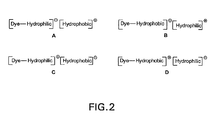
- the dye's interaction with both coated offset and plain paper may be increased ( Figure 2).
- Exemplary hydrophobic counterions include the following: where A is R 3 N + , CO 2 - , or SO 3 - and R is a straight chain having 1-3 carbons.
- dyes can be adapted for use with this invention.
- Commercially available dyes may be modified with either hydrophobic or hydrophilic functionalities and then subjected to ion exchange to provide the desired counterion to enhance their interactions with the print media and ink vehicle.
- Suitable dyes may be obtained from such companies as Avecia, Tricon Colors, Clariant Corporation, Akzo Nobel, PMC Specialties Group, Inc., BASF Corporation, Ciba Specialty Chemicals Color Division, Sun Chemical Corporation, and Toyo Color America.
- dyes may be synthesized using the desired components, followed by ion exchange to produce a dye-counterion pair.
- the syntheses should be performed in such a manner as to not alter the ⁇ -orbital system of the dye, which might alter its color.
- a hydrophilic or hydrophobic moiety for example, glucose or hexylphenyl is attached to the dye.
- An additional atom such as nitrogen might be used to link the additional group to the dye, or the synthesis of the dye may be modified to incorporate the desired functional group.
- the chromophore is used to impart color to the dye and may include sulfonates, carboxylates, ammonium ions or any combination of these.
- surfactants such as surfactants, buffers, humectants, and anti-cockle reagents may also be employed in the practice of the invention. Because the invention exploits the interaction of the counterion with the chemically modified dye through ionic interactions, suitable surfactants are typically non-ionic in nature to reduce exchange interactions of the surfactants with either the chemically-modified chromophore or the counterion.
- non-ionic surfactants include secondary alcohol ethoxylates (e.g ., Tergitol series available from Union Carbide Co.), non-ionic fluoro surfactants (such as Fluorad FC-170C available from 3M), non-ionic fatty acid ethoxylate surfactants (e.g ., Alkamul PSMO-20 available from Rhone-Poulenc), fatty amide ethoxylate surfactants ( e.g., Aldamide L-203 available from Rhone-Poulenc), ethoxylated silicone surfactants (such as Silwett L-7607 available from Witco) and acetylenic polyethylene oxide surfactants (e.g ., Surfynol 465, available from Air Products & Chemicals, Inc.).
- secondary alcohol ethoxylates e.g ., Tergitol series available from Union Carbide Co.
- non-ionic fluoro surfactants such as Fluorad FC-170C available from 3
- Buffers may be used to modulate pH. Both organic-based biological buffers and inorganic buffers such as sodium phosphate are appropriate for use with the invention. Furthermore, the buffer employed should provide a ink pH ranging from about 4 to about 9, prefereably from about 6 to about 8. Exemplary organic buffers include Trizma base, 4-morpholinoethane sulfonic acid (MES), and 4-morpholinepropanesulfonic acid (MOPS), available from companies such as Aldrich Chemical (Milwaukee, Wis.).
- MES 4-morpholinoethane sulfonic acid
- MOPS 4-morpholinepropanesulfonic acid
- any of the biocides commonly employed in ink-jet inks may be employed in the practice of the invention, such as NUOSEPT 95, available from Hals America (Piscataway,N.J.), Proxel GXL, available from Avecia (Wilmington, Del.), and glutaraldehyde, available from Union Carbide Company (Bound Brook, N.J.) under the trade designation UCARCIDE 250.
- Proxel GXL is a preferred biocide.
- the inks of the present invention comprise from about 1 to about 40 wt % of at least one organic solvent. More preferably, the inks comprise from about 10 to about 30 wt % of at least one organic solvent and, most preferably, from about 15 to 30 wt % of at least one organic solvent.
- Organic solvents are used as both humectants and as anti-cockle reagents.
- Solvents suitable for use in the inventive ink-jet ink compositions include any of, or a mixture of two or more of, nitrogen containing heterocyclic ketones such as 2-pyrrolidinone, N-methyl-2-pyrrolidinone (NMP), 1,3-dimethylimidazolid-2-one, and octyl-pyrrolidinone; diols such as ethanediols, (e.g., 1,2-ethanediol), propanediols (e.g., 1,2-propanediol, 1,3-propanediol, 2-ethyl-2-hydroxy-1,3-propanediol, ethylhydroxy-propanediol (EHPD)), butanediols (e.g., 1,2-butanediol, 1,3-butanediol, 1,4-butanediol), pentanediols (e.g
- ethers of the various glycols such as n-butyl carbitol, propylene glycol n-propyl ether, and phenyl carbitol, may also be used.
- n-butyl carbitol propylene glycol n-propyl ether
- phenyl carbitol ethers of the various glycols
- nitrogenated heterocyclic ketones, diols, glycols, and glycol ethers are examples of solvents.
- compositions for exemplary dyes prepared according to the invention are prepared according to the invention.
- Example 1 - Black hydrophilic anionic dye This dye was based on the commercially available C.I. (color index) Acid Black 200 dye. Upon addition of the amine functionality to the carbonyl group of D-glucose and reduction in situ, for example, with a cyanoborohydride, the desired dye was obtained (U.S. Patent No. 6,221,139, issued April 24, 2001; Borch, et al ., J. Am ,. Chem. Soc., 93: 2897 (1971); Highland, et al ., Bull. Soc. Chim. Fr. 2: 750 (1973); Lane Synthesis, 135 (March, 1975)).
- C.I. (color index) Acid Black 200 dye Upon addition of the amine functionality to the carbonyl group of D-glucose and reduction in situ, for example, with a cyanoborohydride, the desired dye was obtained (U.S. Patent No. 6,221,139, issued April 24, 2001; Borch, et al ., J. Am
- Example 2 - Black hydrophobic anionic dye This dye is based on the commercially available C.I. Acid Black 200 dye but is synthesized with different substituents to give it the desired characteristics. Starting with 6-amino-4-hydroxy-2-naphthalenesulfonic acid, an alkylation was performed to add one hydrophobic group to the molecule. After this is performed, two diazotizations are necessary to complete the chromophore for the black dye as well as to add one more hydrophobic group (see D. L. Pavia, et al ., Introduction to Organic Laboratory Techniques, 2 nd Ed., Philadelphia, PA: Saunders College Publishing, 1982, pp. 245-253; Gregory, et al . in The Chemistry and Application of Dyes, Ed.
- Example 3 Black hydrophilic cationic dye: Starting with N,N-dimethylaniline and p -nitroaniline, a diazo coupling is performed followed by alkylation of the dimethylaniline portion of the molecule to make a cationic version of this black dye. Reduction of the nitro group followed by a reductive alkylation results in the final hydrophilic cationic dye (Augustine, Catalytic Hydrogenation, New York, NY: Marcel Dekker, 1965, Chapter 5; Freifelder, Practical Catalytic Hydrogenation, New York, NY: Wiley Interscience, 1971, Chapter 10; Rylander, Hydrogenation Methods, New York, NY: Academic Press, 1985, Chapter 8).
- Example 4 - Black hydrophobic cationic dye An example of such a dye may be made by the addition of the corresponding pyridine derivative to C.I. Acid Black 180.
- the methyl groups in the 2,6-positions rotate the pyridine ring out of the plane of the chromophore (Schut, et al ., New J . Chem. 20 ( 1 ): 113 (1996)). This limits the interaction of the pyridine moiety with the ⁇ -orbital system of the chromophore and prevents modification of the color of the dye.
- Example 5a - Cyan hydrophilic anionic dye This dye is made as disclosed in U.S. Patent No. 5,102,459, issued April 7, 1992.
- the tetrasulfonic acid may be produced by sulfochlorination of copper phthalocyanine, followed by reduction of the sulfochloride to the sulfinic acid salt.
- D-glucosamine is attached to the sulfate groups on copper phthalocyanine tetrasulfonic acid.
- the ratio of sulfonate:D-glucosamine is variable and is highly dependent upon the conditions of the reaction as well as the equivalents of each reactant added.
- the position of substitution is also variable; the structure below is merely one example of several possible structures.
- Example 5b Cyan hydrophilic anionic dye: The following dye was produced by attaching D-glucose to the primary amino of C.I. Acid Blue 25 (a commercially available dye) via a reductive alkylation reaction.
- Example 6 Cyan hydrophobic anionic dye: Hexylaniline is attached to the sulfonic acid groups of copper phthalocyanine tetrasulfonic acid in much the same manner as D-glucosamine in Example 5a.
- the ratio of sulfonate: p -hexylaniline is variable and is highly dependent upon the conditions of the reaction as well as the equivalents of each reactant added.
- the position of substitution is also variable; the structure below is merely one example of several possible structures.
- Example 7 Cyan hydrophilic cationic dye:
- the dye produced in Example 5a is rendered cationic by attaching 1,2-diaminoethane on the remaining sulfonate groups using the same reaction described in Example 5a and Example 6, followed by methylation of the amine to produce the following cationic dye:
- the ratio of ethyl-trimethylammonium:D-glucosamine is variable and is highly dependent upon the conditions of the reaction as well as the equivalents of each reactant added.
- the position of substitution is also variable; the above structure is merely one example of several possible structures.
- Example 8 Cyan hydrophobic cationic dye:
- the dye produced in Example 6 is rendered cationic by reacting 1,2-diaminoethane at the remaining sulfonate groups using the same reaction described in Example 5a and Example 6, followed by methylation of the amine to produce the following cationic dye:
- the ratio of ethyl-trimethylammonium: p -hexylaniline is variable and is highly dependent upon the conditions of the reaction as well as the equivalents of each reactant added.
- the position of substitution is also variable; the above structure is merely one example of several possible structures.
- Example 9 - Magenta hydrophilic anionic dye The dye was produced by attaching D-glucosamine to Reactive Red 2, for example, in a solution of hot water (as disclosed in European Patent Publication No. 899 310A, published August 24, 1998, and U.S. Patent No. 6,056,811, issued May 2, 2000) to produce the following:
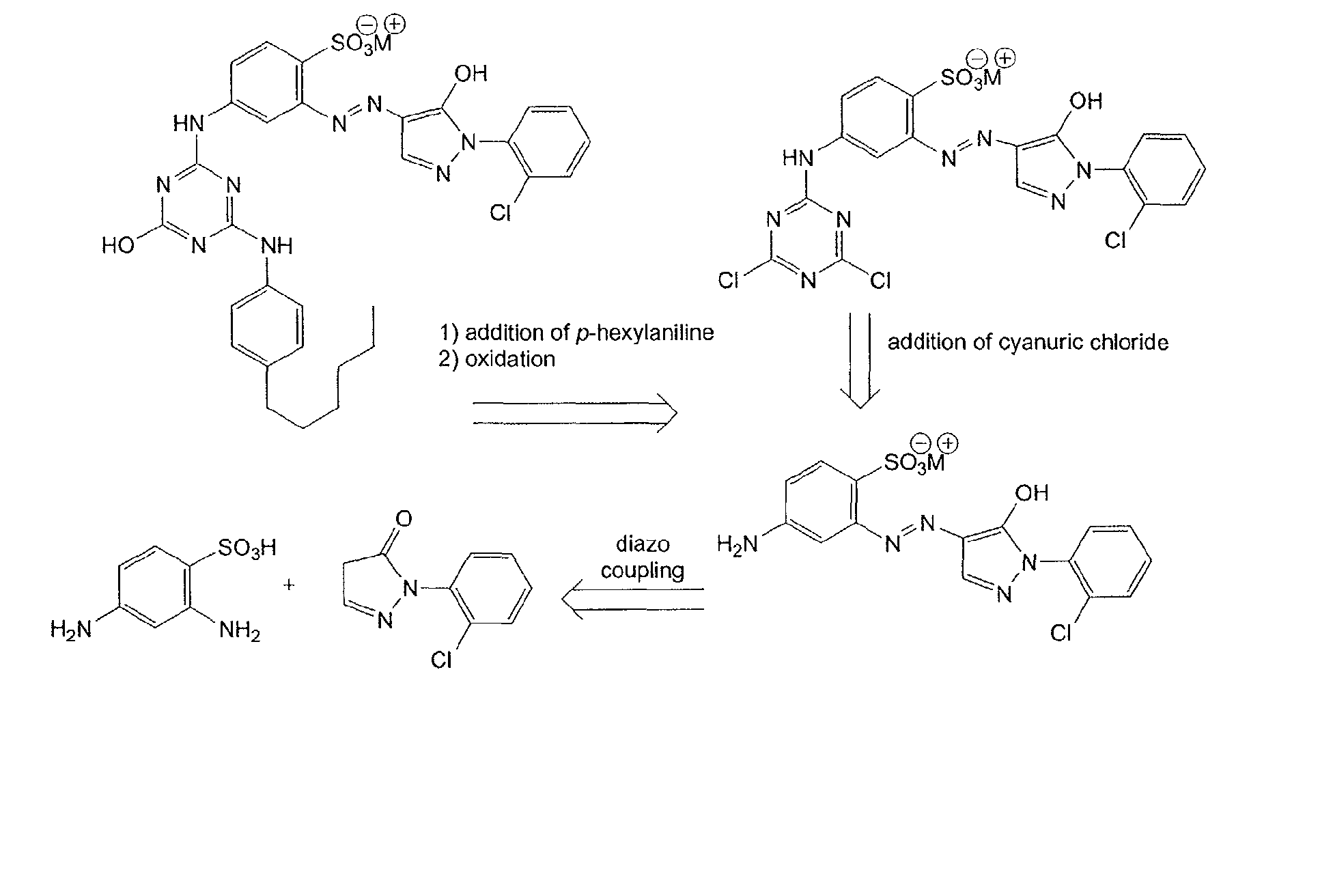
- Example 10 - Magenta hydrophobic anionic dye This dye may be produced by reacting 4-amino-5-hydroxy-2,7-naphthalene disulfonic acid with cyanuric chloride. The cyanuric chloro-derivative is then coupled with p-hexylaniline via a diazo coupling to produce a reactive magenta dye. This reactive magenta dye is then functionalized through the reactive chlorines through addition of p -hexylaniline and water to produce the final product.
- Example 11 - Magenta hydrophilic cationic dye Reactive Red 2 was used as a precursor for this dye. Reaction of D-glucosamine (as described in Example 9), followed by reaction with pyridine produced the following cationic dye with the hydrophilic groups attached:
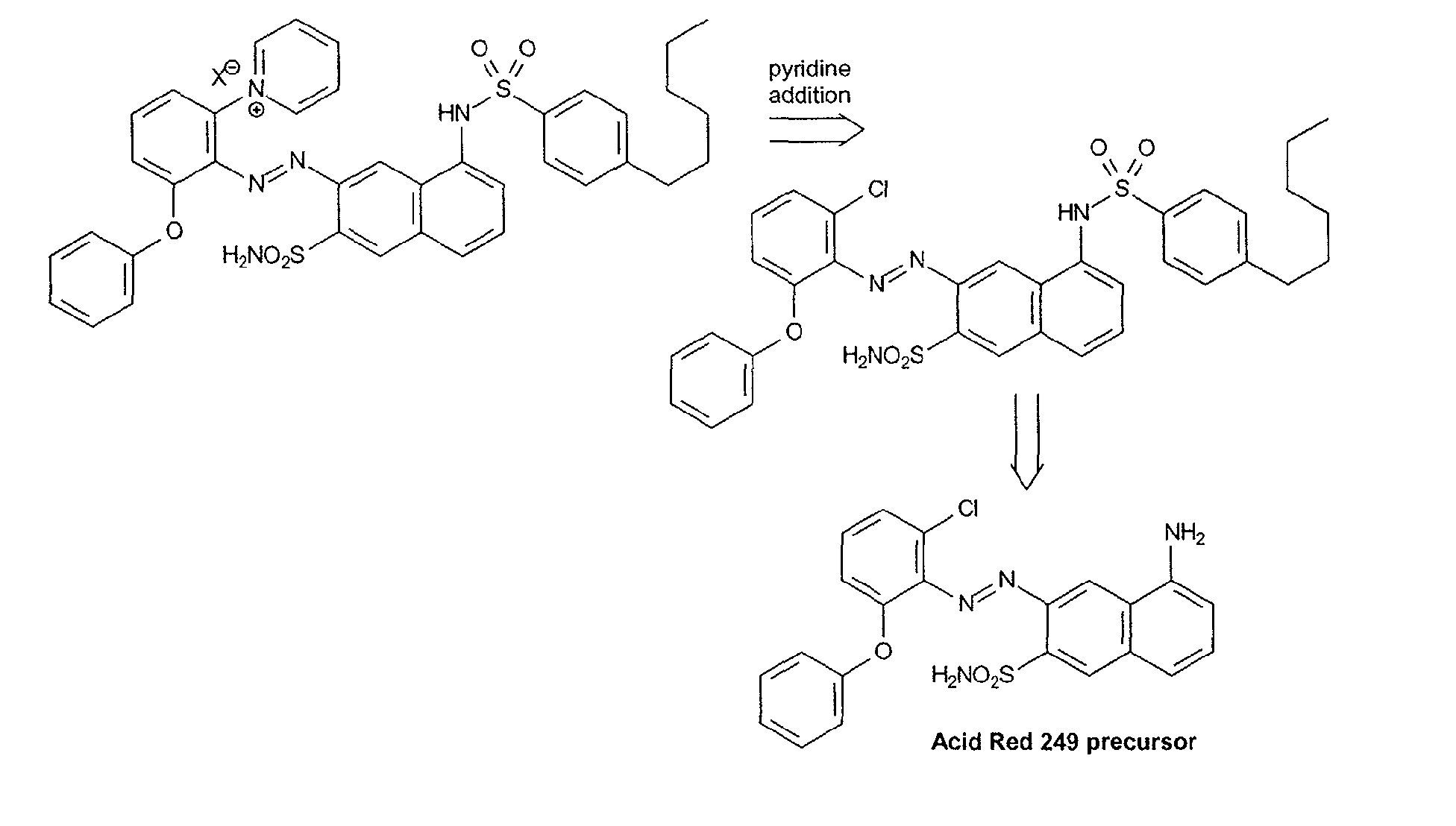
- Example 12 - Magenta hydrophobic cationic dye By using the precursor to C.I. Acid Red 249, the following dye may be made by reacting the aniline portion of the molecule with the sulfonyl chloride of the hydrophobic portion of the future dye, followed by reaction with pyridine to give the magenta hydrophobic cationic dye (Walker in The Chemistry and Application of Dyes , Ed. Waring, et al ., New York, NY: Plenum Press, 1984, p. 233; Morrison, et al ., Organic Chemistry, 4 th Ed., Boston, MA: Allyn and Bacon, 1983, Chapter 23):
- Example 13 Yellow hydrophilic anionic dye: The following dye resulted from the reductive alkylation of D-glucose to the known dye C.I. Acid Yellow 66.
- Example 14 Yellow hydrophobic anionic dye: The sequence of steps to produce this dye starts with diazo coupling, followed by addition of cyanuric chloride to the aniline portion of the dye, followed by addition of p -hexylaniline and then addition of NaOH to oxidize the triazo ring (Waring in The Chemistry and Application of Dyes, Ed. Waring, et al ., New York, NY: Plenum Press, 1994, Chapter 3; U.S. Patents Nos. 4,028,357, June 7, 1977, and 4,725,675, issued February 16, 1988).
- Example 15 Yellow hydrophilic cationic dye: The dye was produced through the reductive alkylation of the aniline portion of the starting material with D-glucose.
- Example 16 Yellow hydrophobic cationic dye: p-Aminobenzaldehyde is reacted with p-chloromethyl hexylbenzene to form the first intermediate. This is then alkylated with 1-chloro-2-trimethylammonium ethane to form the second intermediate. Finally, an ylide addition reaction is performed to derive the final dye product (Lee, et al ., J . Org. Chem ., 44: 719 (1979)).
- Example 17 Green hydrophilic anionic dye: A reductive alkylation of D-glucose to acid green 12 produced the following dye:
- Example 18 - Green hydrophobic anionic dye Synthesis of this dye occurs through the alkylation of the corresponding amine.
- Example 20 Green hydrophobic cationic dye: This dye is synthesized through the addition of pyridine and the desired hydrophobic component onto the reactive dye portion of the molecule (dichlorotriazene ring derivative). This is then followed by two separate diazo couplings to produce the desired dye.
- Example 21 Orange hydrophilic anionic dye: This dye was made from the reductive alkylation of Cotton Orange G with D-glucose.
- Example 22 Orange hydrophobic anionic dye: The following dye is made from the diazo coupling of the starting materials.
- Example 23 Orange hydrophilic cationic dye: Using C.I. Basic Orange 1 as the starting material, alkylation (after protection of the less hindered amine) of the amine to produce the cationic material followed by a reductive alkylation of the (now unprotected) amine gives the following dye structure:
- Example 24a - Orange hydrophobic cationic dye A nonmetallized dye is made by substituting the pyridine derivative (containing the hydrophobic hexylphenyl group) onto the chromophore precursor to C.I. Acid Orange 100. Through further reaction with Co, for example, as an acetate hydrate, the metallized orange dye shown below is synthesized (U.S. Patent No. 4,248,949, issued February 3, 1981):
- Example 24b Orange hydrophobic cationic dye: This dye is produced through the diazotization of 2,5-dichloroaniline with ethyl phenyl amine. The amine is then further functionalized with a benzyl group. Finally, substitution of the two chlorines with the pyridine derivatives of the hydrophobic additive gives the final product.
Landscapes
- Chemical & Material Sciences (AREA)
- Organic Chemistry (AREA)
- Inorganic Chemistry (AREA)
- Life Sciences & Earth Sciences (AREA)
- Engineering & Computer Science (AREA)
- Materials Engineering (AREA)
- Wood Science & Technology (AREA)
- Ink Jet Recording Methods And Recording Media Thereof (AREA)
- Inks, Pencil-Leads, Or Crayons (AREA)
- Ink Jet (AREA)
Abstract
Description
- This invention pertains to the use of improved dyes in inks for inkjet printing; and, more specifically, to the selection of counterions to be used with these same dyes to improve ink and printing properties.
- Typical inkjet inks employ anionic dyes that are neutralized with cations such as Na+ and/or Li+. The demand for fast drying inks has also led to an increase in the use of organic solvents in the ink. However, the limited range of miscibility of these organic solvents in an aqueous-based ink often leads to phase separation, especially at higher temperatures, and consequently reduces the solubility of the dye. This low solubility of the dye in turn degrades the decap performance of the inkjet pen. Additionally, because many of the organic solvents often have a greater boiling point than the corresponding aqueous-based inks, evaporation of water during inkjet drop ejection also leads to precipitation of the dye. This in turn increases the dye concentration of the ink around the nozzle portion of the inkjet pen, thereby saturating the ink vehicle. Because this phenomenon takes place near the nozzle portion of the inkjet pen, it also degrades decap performance. Short term decap performance refers to the time period in between successive firings a nozzle can tolerate without a defect. Long term decap performance refers to the level of nozzle recovery after the nozzles have been idle for an extended period of time. Use of counterions, such as NH4 +, in ink formulations can improve the decap performance of inks for inkjet printing. Still, it is desirable to improve the solubility of dyes in organic-based inks without suffering from the disadvantages of decreased decap performance (U.S. Patent Nos. 6,221,143, issued April 24, 2001, and 5,830,265, issued November 3, 1998, and PCT Publication WO 01/25340, published April 12, 2001).
Solubility is proportional to the strength of the non-covalent molecular interactions between the solute and the solvent molecules. Increased ink solubility in organic-based vehicles results in part from an increase in the hydrophobic interactions between the dye and the ink vehicle. The increased hydrophobicity of the dye molecules that increases solubility in organic-based vehicles also enhances interactions between the dye and hydrophobic print media, such as offset coated papers. These interactions increase the durability of the printed ink on such media; however, customers do not purchase an ink with the intent to use it solely on hydrophobic papers. Thus, it is desirable to formulate a dye that is soluble in organic-based vehicles but leads to greater durability properties (such as waterfastness, smearfastness and smudgefastness) when printed on either hydrophilic media (plain paper) or hydrophobic media (coated offset media). - In one aspect, the invention is a dye for ink-jet printing. The dye includes a chromophore, a counterion which includes a first interaction enhancer and is ionically linked to the chromophore, and a second interaction enhancer covalently linked to the chromophore. Either the first interaction enhancer or the second interaction enhancer includes a hydrophilic moiety, while the other is a hydrophobic moiety. In another aspect, the invention is a method of increasing the interaction of an ionic dye with a substrate. The method includes associating a first counterion with the ionic dye. The first counterion comprises a hydrophilic moiety or a hydrophobic moiety. A second counterion may also be associated with the ionic dye. The second counterion may include the hydrophilic moiety or a hydrophobic moiety. In another aspect, the invention is a method of increasing the interaction of a dye with a substrate. The method includes covalently attaching a hydrophilic moiety, a hydrophobic moiety, or both, to the dye.
- The invention is described with reference to the several figures of the drawing, in which,
- Figure 1 is a schematic of representative dye-counterion interactions with (A) hydrophilic and (B) hydrophobic media; and
- Figure 2 is a schematic of representative dye-counterion interactions: (A) hydrophilic anionic dye with hydrophobic countercation, (B) hydrophobic anionic dye with hydrophilic countercation, (C) hydrophilic cationic dye with hydrophobic counteranion, and (D) hydrophobic cationic dye with hydrophilic counteranion.
-
- The invention provides a method for reducing the number of inks needed to obtain high durability prints on a wide variety of media types. By including a hydrophilic interaction enhancer in the counterion and a hydrophobic interaction enhancer in the dye (or vice versa), good durability can be obtained on plain paper (hydrophilic type media) or coated offset paper (hydrophobic media). Where plain paper is used, the hydrophilic portion of the dye (whether incorporated in the chromophore or the counterion) interacts strongly with the media through the formation of hydrogen bonds. Where coated paper (typically hydrophobic in nature) is used, the hydrophobic portion of the dye interacts strongly through π-π interactions or van der Waals interactions, thereby increasing the durability of the resultant print.
- This invention also provides a method of improving the decap performance of the ink-jet pen when using high (organic) content organic-based vehicles. This may be accomplished by increasing the solubility of the resultant dye through manipulation of the counterion, thereby reducing deposits near the print head nozzle during ink drop formation and ejection.
The invention exploits chemical interactions between a dye and the surface of a printed substrate (e.g.; paper) to increase the affinity between the dye and the substrate. For example, hydroxy dyes interact very well with plain paper due to hydrogen bond formation with the hydrophilic paper; however, they do not interact well with coated offset media, which are typically coated with hydrophobic materials such as butadiene-styrene polymers. Use of hydrophobic derivatives or counterions enhances the interaction of these dyes with hydrophobic papers, but does not significantly enhance print stability on plain paper media. However, by combining these two chemical groups (i.e., a hydrophobic dye with a hydrophilic counterion or a hydrophilic dye with a hydrophobic counterion) interaction with either the plain paper media or the hydrophobic offset media can be obtained (Figure 1).
High molecular weight dyes, typically dimers and trimers of the parent dyes, exhibit increased waterfastness on hydrophobic media with respect to hydroxy dyes, presumably because the number of anionic interaction sites has increased, allowing increased interaction with a cationic underprinting fluid (e.g., protonated polyethyleneimine, or PEI). However, they do not exhibit strong interactions with printed media, decreasing their resistance to physical abrasion effects. Addition of hydrophobic groups or the use of hydrophobic counterions increases the mechanical stability of these dyes when printed on hydrophobic media.
Hydrophobic dyes demonstrate good waterfastness and good smudgefastness when printed on hydrophobic media. Typically, when good waterfastness is obtained, physical abrasion resistance (smudgefastness and smearfastness) suffers. This is because the dye "precipitates" towards the surface of the media, making it more susceptible to physical abrasion. However, hydrophobic dyes exhibit an increased interaction with the media, reducing their susceptibility towards physical abrasion. Ionic dyes are very soluble in water and thus have low waterfastness. Hydrophilic and hydrophobic derivatives can enhance the interactions of these dyes with both plain papers and coated offset media. In addition, instead of using counterions such as Na+ or Li+, a counterion may also be selected that will enhance the solubility of the dye in an organic-based vehicle or increase its interaction with the print media. For example, a glucosamine countercation may be coupled with a negatively charged hydrophobically modified dye. Reduced glucose may be linked to other charged moieties as well. Alternatively, gluconate may be used as a counteranion for positively charged hydrophobic dyes. - Thus, a dye that has either a hydrophobic or hydrophilic group covalently attached to it will interact well with one sort of media (hydrophobic dyes with coated offset media, hydrophilic dyes with plain paper). However, by using a counterion having a contrasting composition (e.g., using a hydrophilic counterion with a hydrophobic dye or a hydrophobic counterion with a hydrophilic dye), the dye's interaction with both coated offset and plain paper may be increased (Figure 2). Exemplary hydrophobic counterions include the following:where A is R3N+, CO2 -, or SO3 - and R is a straight chain having 1-3 carbons.

Exemplary hydrophilic counterions include the following:where R is straight chain having 1-3 carbons and n = 3-500.
- A variety of dyes can be adapted for use with this invention. Commercially available dyes may be modified with either hydrophobic or hydrophilic functionalities and then subjected to ion exchange to provide the desired counterion to enhance their interactions with the print media and ink vehicle. Suitable dyes may be obtained from such companies as Avecia, Tricon Colors, Clariant Corporation, Akzo Nobel, PMC Specialties Group, Inc., BASF Corporation, Ciba Specialty Chemicals Color Division, Sun Chemical Corporation, and Toyo Color America. In addition to choosing hydrophilic or hydrophobic counterions, dyes may be synthesized using the desired components, followed by ion exchange to produce a dye-counterion pair. The syntheses should be performed in such a manner as to not alter the π-orbital system of the dye, which might alter its color. In one embodiment, a hydrophilic or hydrophobic moiety, for example, glucose or hexylphenyl is attached to the dye.
An additional atom such as nitrogen might be used to link the additional group to the dye, or the synthesis of the dye may be modified to incorporate the desired functional group. A typical hydrophilic dye structure, including a polyol, and a typical hydrophobic dye structure are as follows:where L is any of the following: X is any of-Cl, -OH, -N=CH-R', -NH-CH2-R', -NR'2, or a chromophore, Y is any of
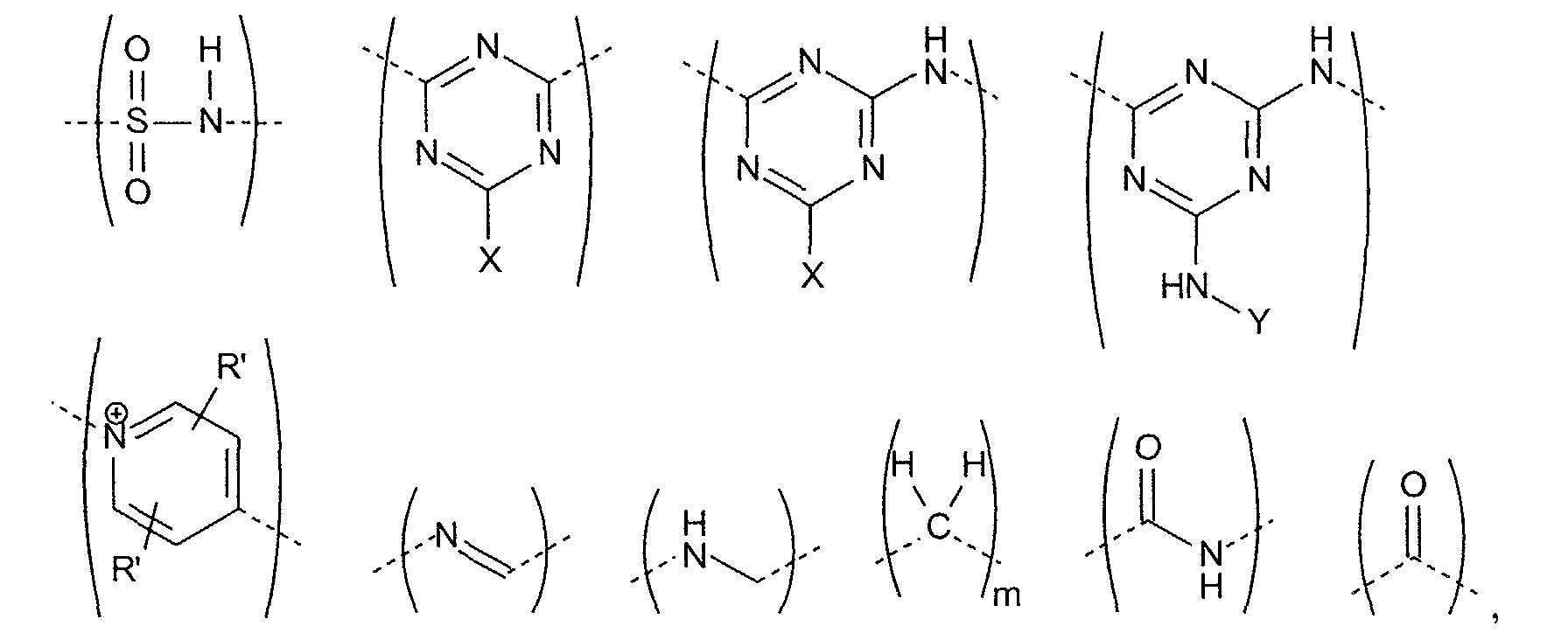 and R' = H, a straight alkyl chain having 1-4 carbons, or a branched alkyl chain having 3-4 carbons. The chromophore is used to impart color to the dye and may include sulfonates, carboxylates, ammonium ions or any combination of these.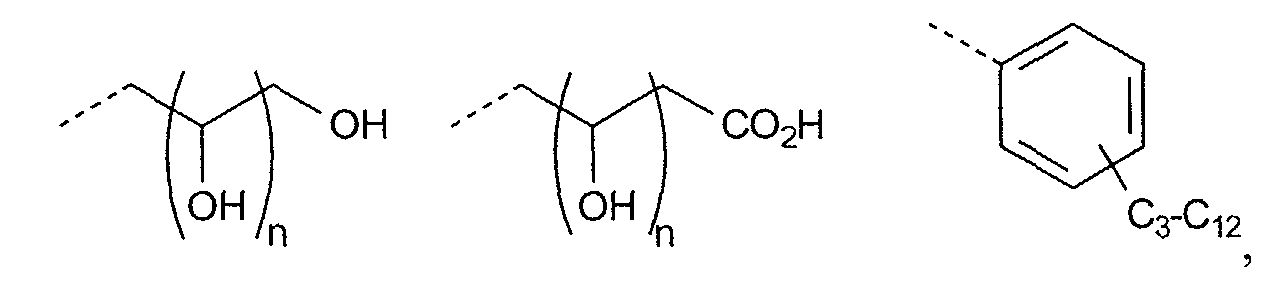
- Other ingredients such as surfactants, buffers, humectants, and anti-cockle reagents may also be employed in the practice of the invention. Because the invention exploits the interaction of the counterion with the chemically modified dye through ionic interactions, suitable surfactants are typically non-ionic in nature to reduce exchange interactions of the surfactants with either the chemically-modified chromophore or the counterion. Examples of suitable non-ionic surfactants include secondary alcohol ethoxylates (e.g., Tergitol series available from Union Carbide Co.), non-ionic fluoro surfactants (such as Fluorad FC-170C available from 3M), non-ionic fatty acid ethoxylate surfactants (e.g., Alkamul PSMO-20 available from Rhone-Poulenc), fatty amide ethoxylate surfactants (e.g., Aldamide L-203 available from Rhone-Poulenc), ethoxylated silicone surfactants (such as Silwett L-7607 available from Witco) and acetylenic polyethylene oxide surfactants (e.g., Surfynol 465, available from Air Products & Chemicals, Inc.).
- Buffers may be used to modulate pH. Both organic-based biological buffers and inorganic buffers such as sodium phosphate are appropriate for use with the invention. Furthermore, the buffer employed should provide a ink pH ranging from about 4 to about 9, prefereably from about 6 to about 8. Exemplary organic buffers include Trizma base, 4-morpholinoethane sulfonic acid (MES), and 4-morpholinepropanesulfonic acid (MOPS), available from companies such as Aldrich Chemical (Milwaukee, Wis.).
- Any of the biocides commonly employed in ink-jet inks may be employed in the practice of the invention, such as NUOSEPT 95, available from Hals America (Piscataway,N.J.), Proxel GXL, available from Avecia (Wilmington, Del.), and glutaraldehyde, available from Union Carbide Company (Bound Brook, N.J.) under the trade designation UCARCIDE 250. Proxel GXL is a preferred biocide.
- The inks of the present invention comprise from about 1 to about 40 wt % of at least one organic solvent. More preferably, the inks comprise from about 10 to about 30 wt % of at least one organic solvent and, most preferably, from about 15 to 30 wt % of at least one organic solvent. Organic solvents are used as both humectants and as anti-cockle reagents. Solvents suitable for use in the inventive ink-jet ink compositions include any of, or a mixture of two or more of, nitrogen containing heterocyclic ketones such as 2-pyrrolidinone, N-methyl-2-pyrrolidinone (NMP), 1,3-dimethylimidazolid-2-one, and octyl-pyrrolidinone; diols such as ethanediols, (e.g., 1,2-ethanediol), propanediols (e.g., 1,2-propanediol, 1,3-propanediol, 2-ethyl-2-hydroxy-1,3-propanediol, ethylhydroxy-propanediol (EHPD)), butanediols (e.g., 1,2-butanediol, 1,3-butanediol, 1,4-butanediol), pentanediols (e.g., 1,5-pentanediol), hexanediols (e.g., 1,2-hexanediol, 1,2-hexanediol, 2,5-hexanediol), heptanediols (e.g., 1,2-heptanediol, 1,7-heptanediol), octanediols (e.g., 1,2-octanediol, 1,8-octanediol); and glycol ethers and thioglycol ethers commonly employed in ink-jet inks, including polyalkylene glycols such as polyethylene glycols (e.g., diethylene glycol (DEG), triethylene glycol, tetraethylene glycol), polypropylene glycols (e.g., dipropylene glycol, tripropylene glycol, tetrapropylene glycol), polymeric glycols (e.g., PEG 200, PEG 300, PEG 400, PPG 400), and thiodiglycol. Additionally, ethers of the various glycols, such as n-butyl carbitol, propylene glycol n-propyl ether, and phenyl carbitol, may also be used. One skilled in the art will recognize that there are many more nitrogenated heterocyclic ketones, diols, glycols, and glycol ethers besides those listed above. Such solvents are appropriate for use with the invention but tend to be more expensive.
- The tables below give compositions for exemplary dyes prepared according to the invention.
Ink with hydrophilic dye and hydrophobic counterion Component Wt% Propylene glycol propylene ether 15.0 2-pyrrolidinone 7.5 1,2-hexanediol 5.0 Silwet L-7607 1.0 Colorant 5.0 Water balance Ink with hydrophobic dye and hydrophilic counterion Component Wt % Propylene glycol propylene ether 10.0 1,6-hexanediol 10.0 N-methyldiethanolamine 10.0 Fluorad FC-170C 1.5 Colorant 5.0 Water balance - The following examples provide, via retro-chemical synthesis, a sampling of the chemistries that may be employed to adapt commercially available dyes for use with the instant invention (S. Warren, Organic Synthesis: The Disconnection Approach, Chichester, England: John Wiley & Sons, 1982). The following molecules and reactions are merely exemplary. One skilled in the art will recognize that the chemistries described below may be adapted to a variety of different dyes.
- Example 1 - Black hydrophilic anionic dye: This dye was based on the commercially available C.I. (color index) Acid Black 200 dye. Upon addition of the amine functionality to the carbonyl group of D-glucose and reduction in situ, for example, with a cyanoborohydride, the desired dye was obtained (U.S. Patent No. 6,221,139, issued April 24, 2001; Borch, et al., J. Am,. Chem. Soc., 93: 2897 (1971); Boutique, et al., Bull. Soc. Chim. Fr. 2: 750 (1973); Lane Synthesis, 135 (March, 1975)).

- Example 2 - Black hydrophobic anionic dye: This dye is based on the commercially available C.I. Acid Black 200 dye but is synthesized with different substituents to give it the desired characteristics. Starting with 6-amino-4-hydroxy-2-naphthalenesulfonic acid, an alkylation was performed to add one hydrophobic group to the molecule. After this is performed, two diazotizations are necessary to complete the chromophore for the black dye as well as to add one more hydrophobic group (see D. L. Pavia, et al., Introduction to Organic Laboratory Techniques, 2nd Ed., Philadelphia, PA: Saunders College Publishing, 1982, pp. 245-253; Gregory, et al. in The Chemistry and Application of Dyes, Ed. Waring, et al., New York, NY: Plenum Press, 1994, Chapters 2 and 6; U.S. Patents Nos. 4,514,226, issued April 30, 1985, 4,725,675, issued February 16, 1988, 4,767,844, issued August 30, 1988, and 4,189,427, issued February 2, 1980).

- Example 3 - Black hydrophilic cationic dye: Starting with N,N-dimethylaniline and p-nitroaniline, a diazo coupling is performed followed by alkylation of the dimethylaniline portion of the molecule to make a cationic version of this black dye. Reduction of the nitro group followed by a reductive alkylation results in the final hydrophilic cationic dye (Augustine, Catalytic Hydrogenation, New York, NY: Marcel Dekker, 1965, Chapter 5; Freifelder, Practical Catalytic Hydrogenation, New York, NY: Wiley Interscience, 1971, Chapter 10; Rylander, Hydrogenation Methods, New York, NY: Academic Press, 1985, Chapter 8).

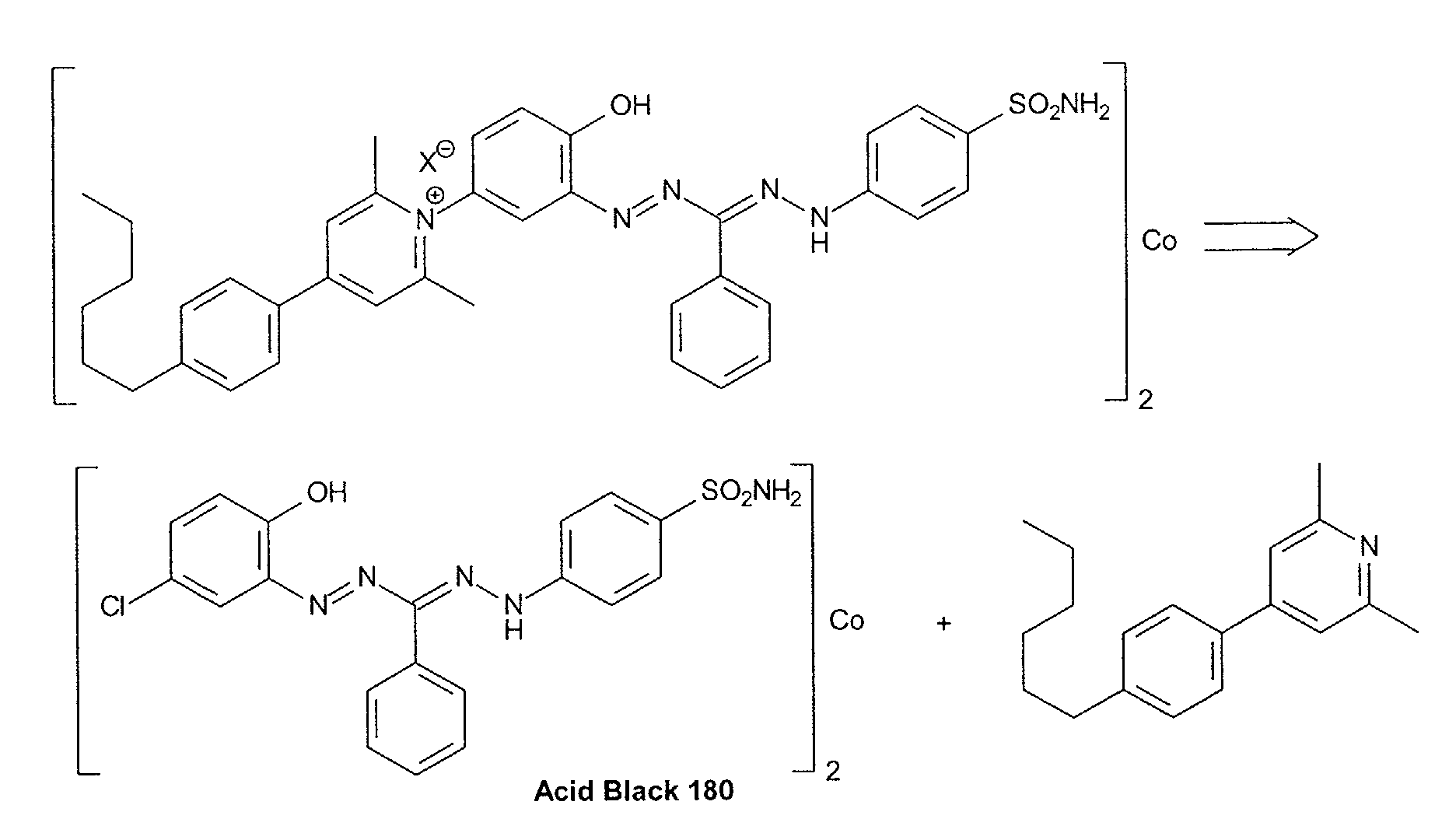
- Example 4 - Black hydrophobic cationic dye: An example of such a dye may be made by the addition of the corresponding pyridine derivative to C.I. Acid Black 180. The methyl groups in the 2,6-positions rotate the pyridine ring out of the plane of the chromophore (Schut, et al., New J. Chem. 20(1): 113 (1996)). This limits the interaction of the pyridine moiety with the π-orbital system of the chromophore and prevents modification of the color of the dye.
- Example 5a - Cyan hydrophilic anionic dye: This dye is made as disclosed in U.S. Patent No. 5,102,459, issued April 7, 1992. The tetrasulfonic acid may be produced by sulfochlorination of copper phthalocyanine, followed by reduction of the sulfochloride to the sulfinic acid salt. D-glucosamine is attached to the sulfate groups on copper phthalocyanine tetrasulfonic acid. The ratio of sulfonate:D-glucosamine is variable and is highly dependent upon the conditions of the reaction as well as the equivalents of each reactant added. The position of substitution is also variable; the structure below is merely one example of several possible structures.
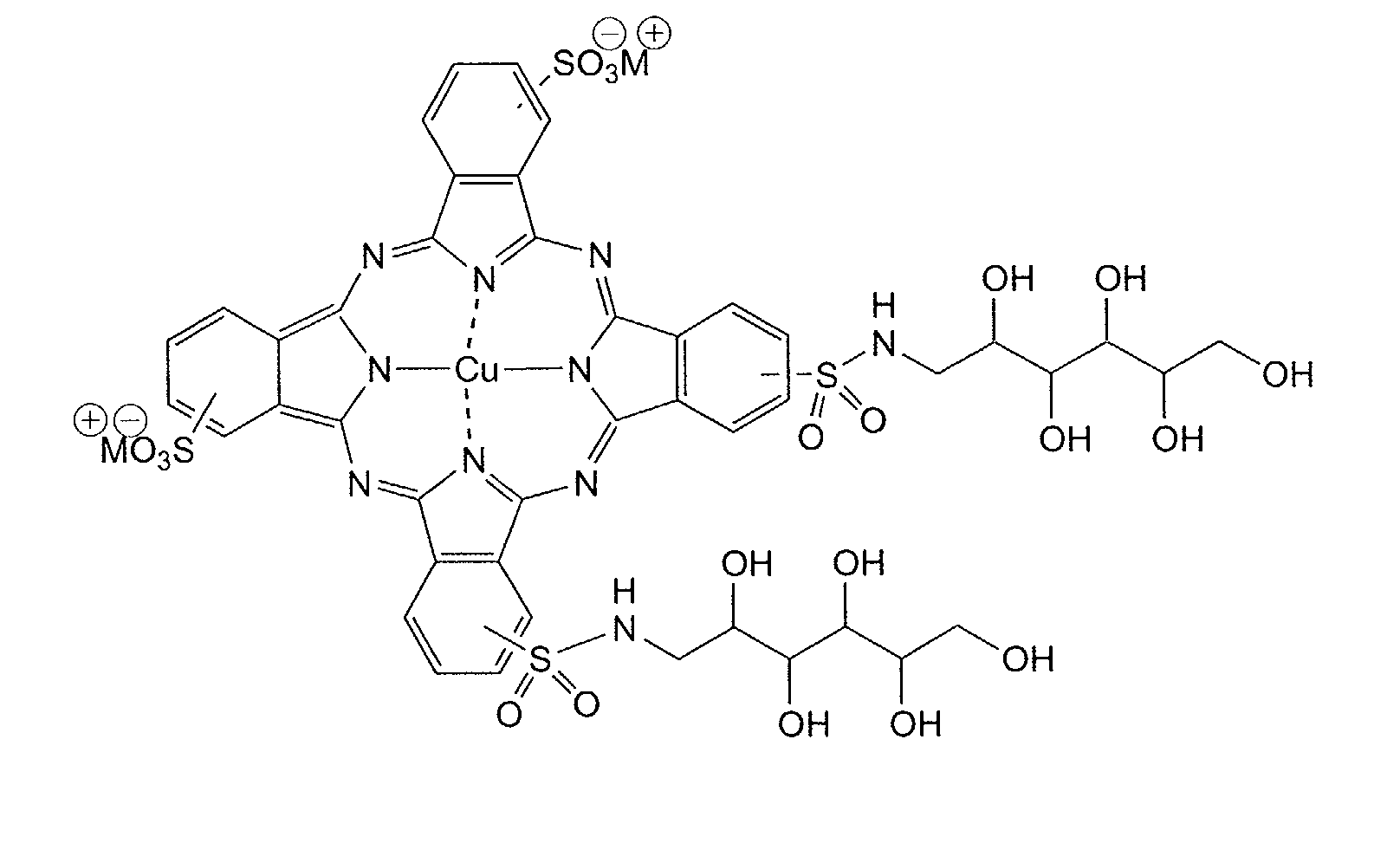
- Example 5b - Cyan hydrophilic anionic dye: The following dye was produced by attaching D-glucose to the primary amino of C.I. Acid Blue 25 (a commercially available dye) via a reductive alkylation reaction.

- Example 6 - Cyan hydrophobic anionic dye: Hexylaniline is attached to the sulfonic acid groups of copper phthalocyanine tetrasulfonic acid in much the same manner as D-glucosamine in Example 5a. The ratio of sulfonate:p-hexylaniline is variable and is highly dependent upon the conditions of the reaction as well as the equivalents of each reactant added. The position of substitution is also variable; the structure below is merely one example of several possible structures.
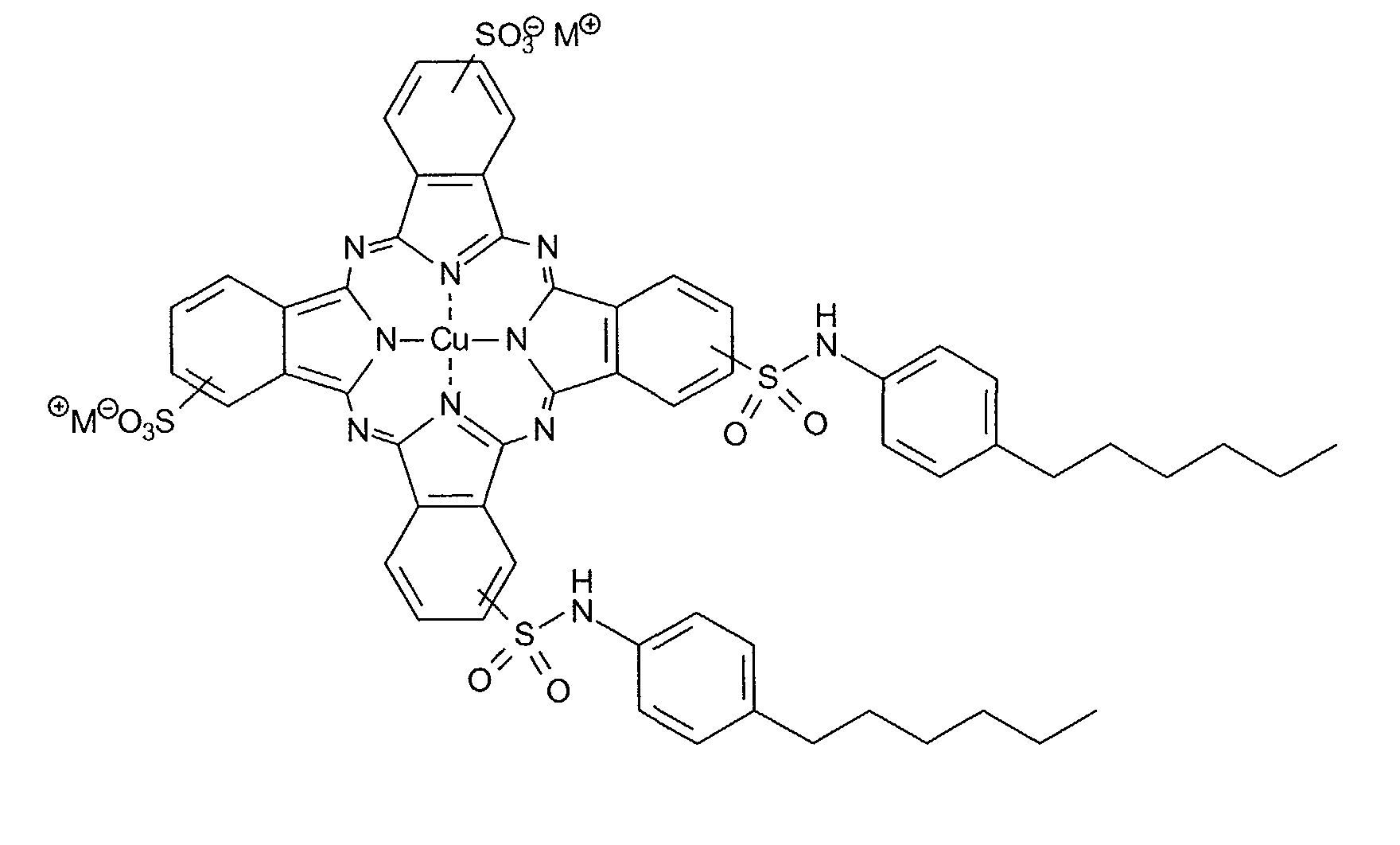
- Example 7 - Cyan hydrophilic cationic dye: The dye produced in Example 5a is rendered cationic by attaching 1,2-diaminoethane on the remaining sulfonate groups using the same reaction described in Example 5a and Example 6, followed by methylation of the amine to produce the following cationic dye:
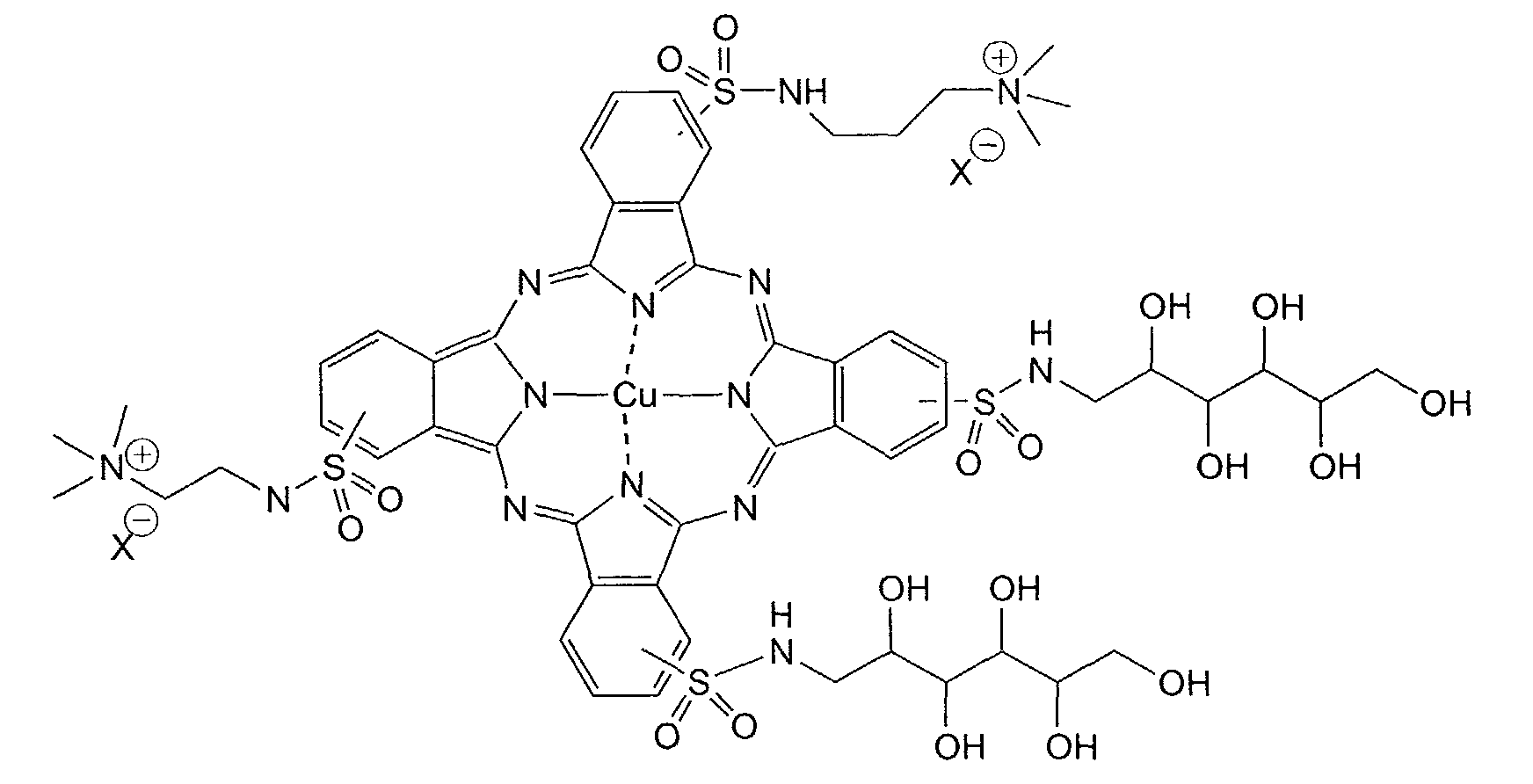
- The ratio of ethyl-trimethylammonium:D-glucosamine is variable and is highly dependent upon the conditions of the reaction as well as the equivalents of each reactant added. The position of substitution is also variable; the above structure is merely one example of several possible structures.
- Example 8 - Cyan hydrophobic cationic dye: The dye produced in Example 6 is rendered cationic by reacting 1,2-diaminoethane at the remaining sulfonate groups using the same reaction described in Example 5a and Example 6, followed by methylation of the amine to produce the following cationic dye:

- It should be noted that the ratio of ethyl-trimethylammonium:p-hexylaniline is variable and is highly dependent upon the conditions of the reaction as well as the equivalents of each reactant added. The position of substitution is also variable; the above structure is merely one example of several possible structures.
- Example 9 - Magenta hydrophilic anionic dye: The dye was produced by attaching D-glucosamine to Reactive Red 2, for example, in a solution of hot water (as disclosed in European Patent Publication No. 899 310A, published August 24, 1998, and U.S. Patent No. 6,056,811, issued May 2, 2000) to produce the following:

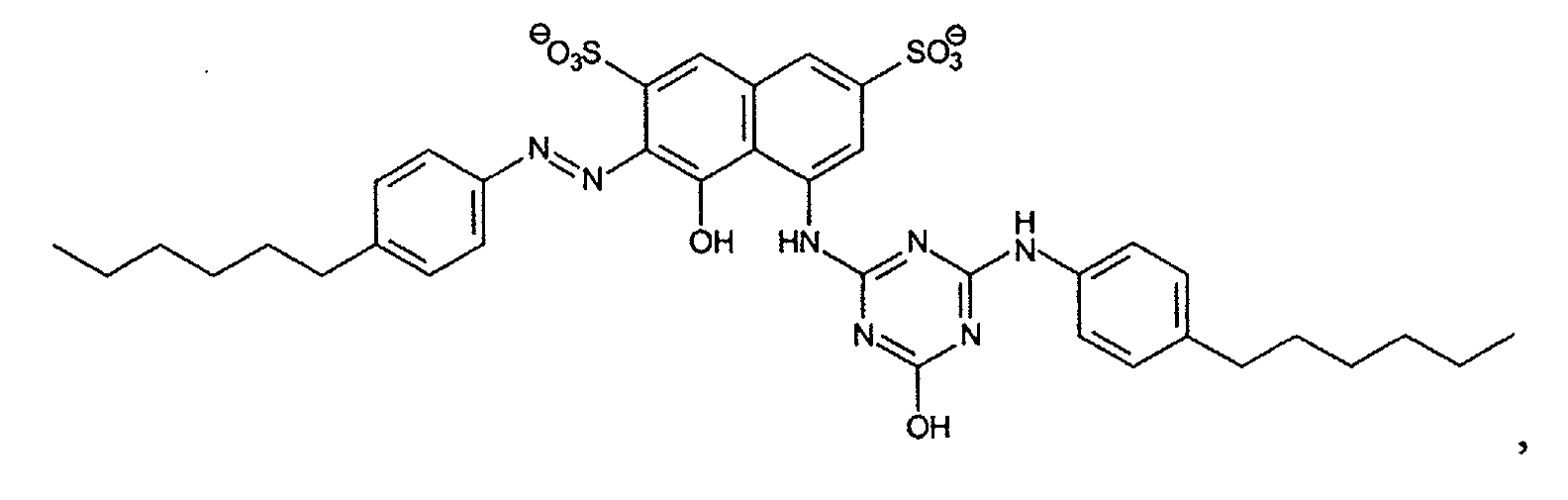
- Example 10 - Magenta hydrophobic anionic dye: This dye may be produced by reacting 4-amino-5-hydroxy-2,7-naphthalene disulfonic acid with cyanuric chloride. The cyanuric chloro-derivative is then coupled with p-hexylaniline via a diazo coupling to produce a reactive magenta dye. This reactive magenta dye is then functionalized through the reactive chlorines through addition of p-hexylaniline and water to produce the final product.
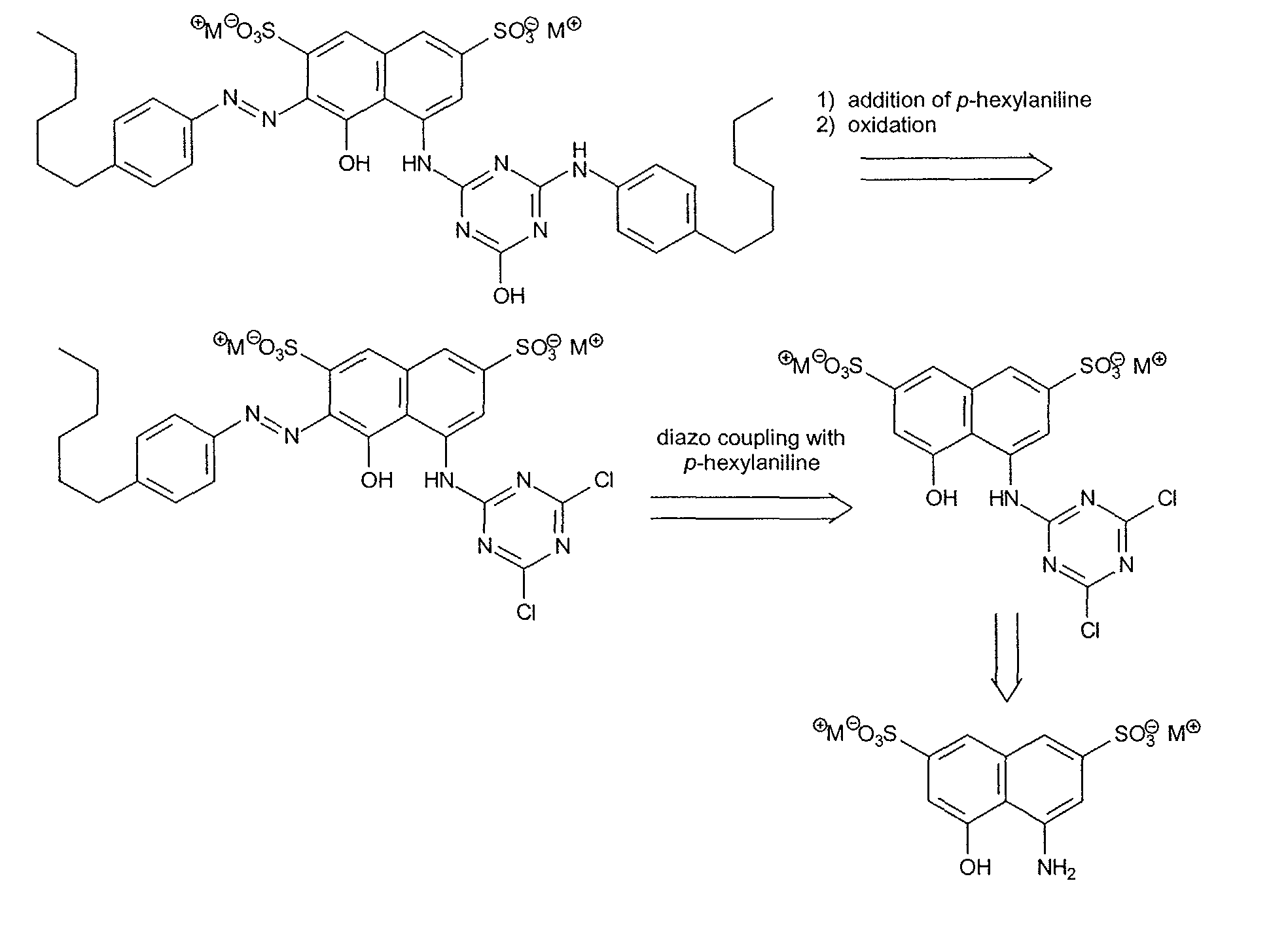
- Example 11 - Magenta hydrophilic cationic dye: Reactive Red 2 was used as a precursor for this dye. Reaction of D-glucosamine (as described in Example 9), followed by reaction with pyridine produced the following cationic dye with the hydrophilic groups attached:

- Example 12 - Magenta hydrophobic cationic dye: By using the precursor to C.I. Acid Red 249, the following dye may be made by reacting the aniline portion of the molecule with the sulfonyl chloride of the hydrophobic portion of the future dye, followed by reaction with pyridine to give the magenta hydrophobic cationic dye (Walker in The Chemistry and Application of Dyes, Ed. Waring, et al., New York, NY: Plenum Press, 1984, p. 233; Morrison, et al., Organic Chemistry, 4th Ed., Boston, MA: Allyn and Bacon, 1983, Chapter 23):
- Example 13 - Yellow hydrophilic anionic dye: The following dye resulted from the reductive alkylation of D-glucose to the known dye C.I. Acid Yellow 66.

- Example 14 - Yellow hydrophobic anionic dye: The sequence of steps to produce this dye starts with diazo coupling, followed by addition of cyanuric chloride to the aniline portion of the dye, followed by addition of p-hexylaniline and then addition of NaOH to oxidize the triazo ring (Waring in The Chemistry and Application of Dyes, Ed. Waring, et al., New York, NY: Plenum Press, 1994, Chapter 3; U.S. Patents Nos. 4,028,357, June 7, 1977, and 4,725,675, issued February 16, 1988).
- Example 15 - Yellow hydrophilic cationic dye: The dye was produced through the reductive alkylation of the aniline portion of the starting material with D-glucose.

- Example 16 - Yellow hydrophobic cationic dye: p-Aminobenzaldehyde is reacted with p-chloromethyl hexylbenzene to form the first intermediate. This is then alkylated with 1-chloro-2-trimethylammonium ethane to form the second intermediate. Finally, an ylide addition reaction is performed to derive the final dye product (Lee, et al., J. Org. Chem., 44: 719 (1979)).

- Example 17 - Green hydrophilic anionic dye: A reductive alkylation of D-glucose to acid green 12 produced the following dye:

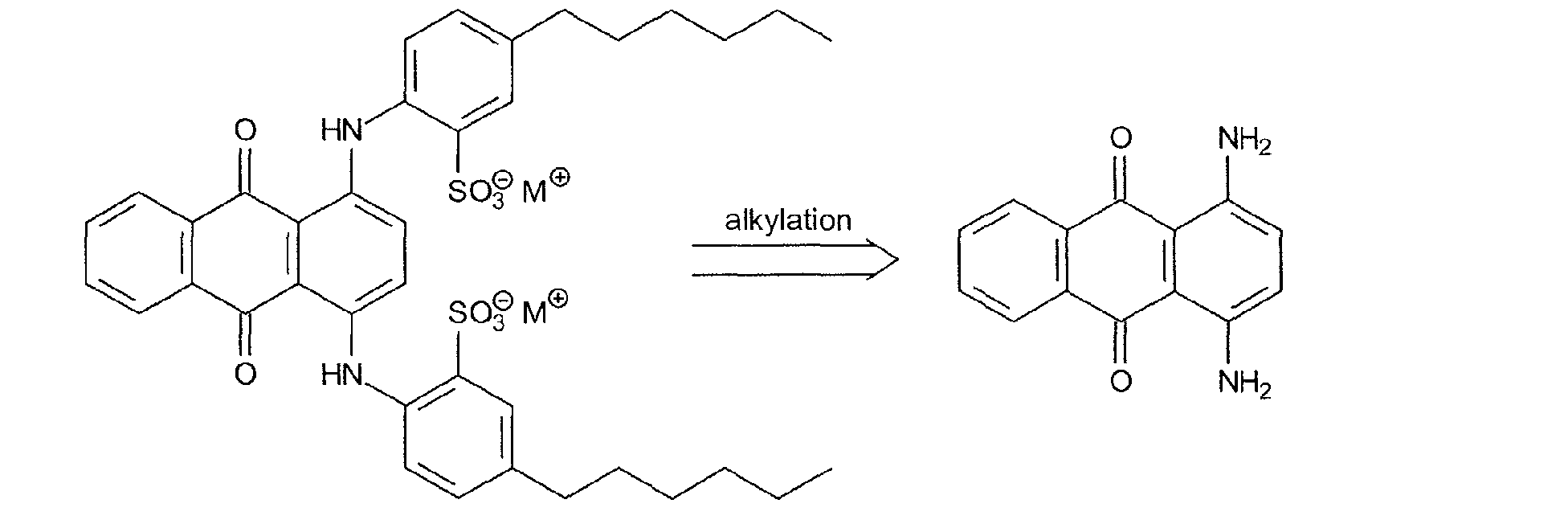
- Example 18 - Green hydrophobic anionic dye: Synthesis of this dye occurs through the alkylation of the corresponding amine.
- Example 19 - Green hydrophilic cationic dye: Reductive alkylation of the amine starting material resulted in the following dye:
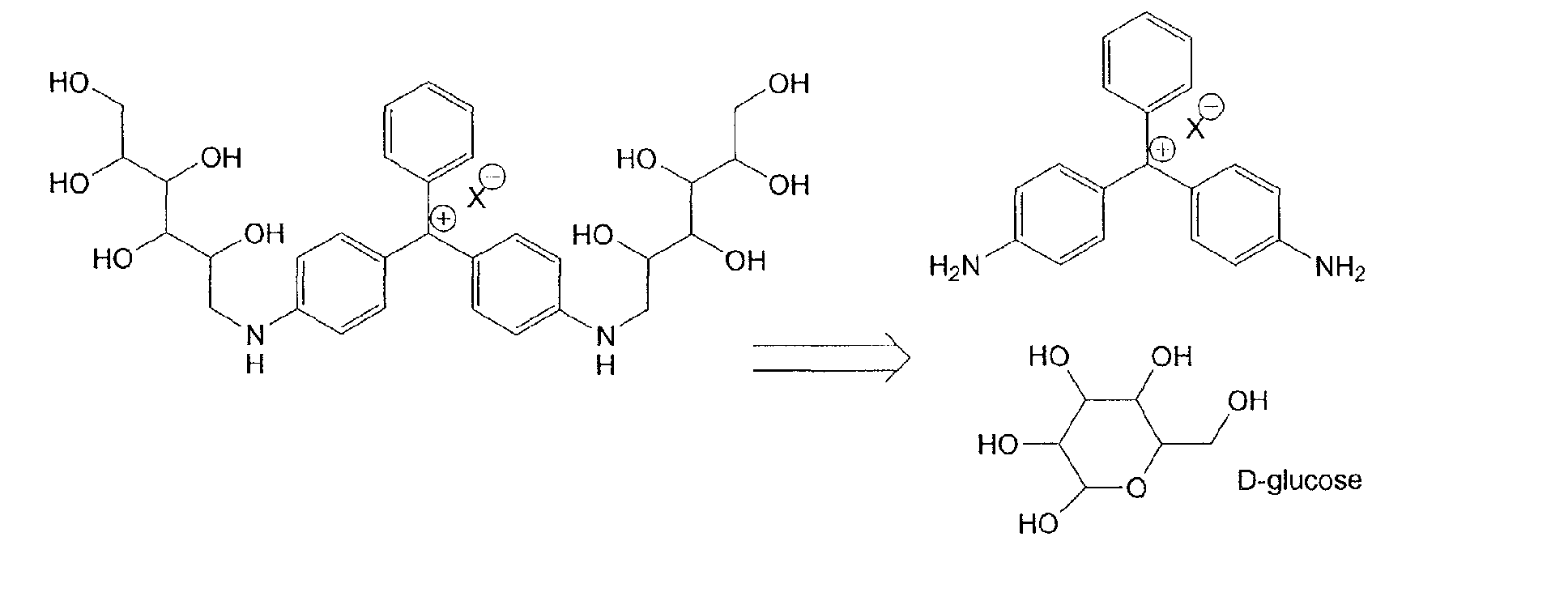
- Example 20 - Green hydrophobic cationic dye: This dye is synthesized through the addition of pyridine and the desired hydrophobic component onto the reactive dye portion of the molecule (dichlorotriazene ring derivative). This is then followed by two separate diazo couplings to produce the desired dye.

- Example 21 - Orange hydrophilic anionic dye: This dye was made from the reductive alkylation of Cotton Orange G with D-glucose.

- Example 22 - Orange hydrophobic anionic dye: The following dye is made from the diazo coupling of the starting materials.
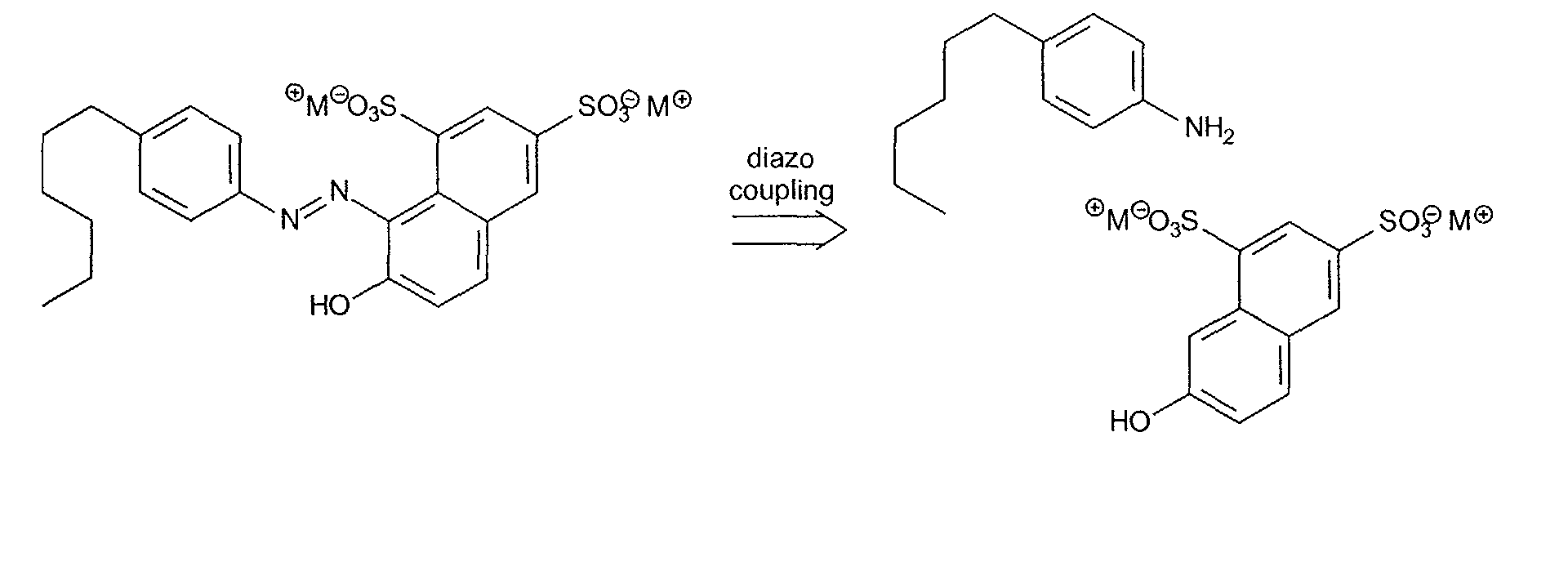
- Example 23 - Orange hydrophilic cationic dye: Using C.I. Basic Orange 1 as the starting material, alkylation (after protection of the less hindered amine) of the amine to produce the cationic material followed by a reductive alkylation of the (now unprotected) amine gives the following dye structure:

- Example 24a - Orange hydrophobic cationic dye: A nonmetallized dye is made by substituting the pyridine derivative (containing the hydrophobic hexylphenyl group) onto the chromophore precursor to C.I. Acid Orange 100. Through further reaction with Co, for example, as an acetate hydrate, the metallized orange dye shown below is synthesized (U.S. Patent No. 4,248,949, issued February 3, 1981):

- Example 24b - Orange hydrophobic cationic dye: This dye is produced through the diazotization of 2,5-dichloroaniline with ethyl phenyl amine. The amine is then further functionalized with a benzyl group. Finally, substitution of the two chlorines with the pyridine derivatives of the hydrophobic additive gives the final product.

- Other embodiments of the invention will be apparent to those skilled in the art from a consideration of the specification or practice of the invention disclosed herein. It is intended that the specification and examples be considered as exemplary only, with the true scope of the invention being indicated by the following claims.
Claims (24)
- A dye for ink-jet printing, comprising:one of the first interaction enhancer and the second interaction enhancer is a hydrophilic moiety, anda chromophore;a counterion ionically linked to the chromophore, wherein the counterion comprises a first interaction enhancer; anda second interaction enhancer covalently linked to the chromophore, wherein
one of the first interaction enhancer and the second interaction enhancer is a hydrophobic moiety. - The dye of claim 1, wherein the counterion comprises a charged nitrogen atom, sulfonate, or carboxylate.
- The dye of claim 1, wherein the counterion comprises a member of the group consisting of gluconate, glucosamine,
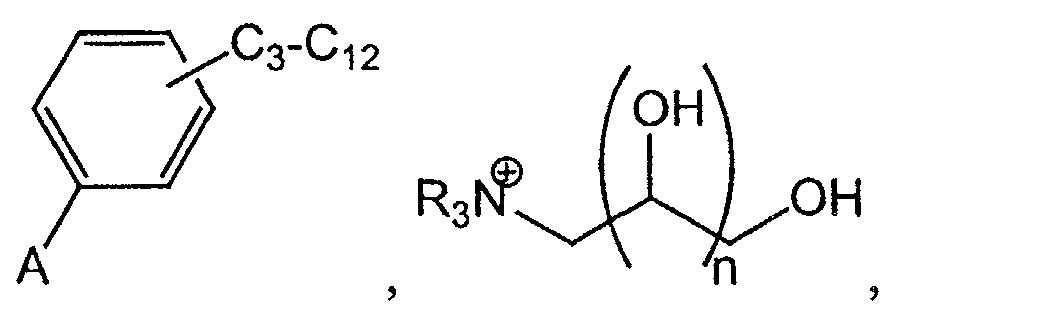 wherein A is a member of the group consisting of R3N+, CO2 -, and SO3 -, R is a straight alkyl chain comprising between 1 and 3 carbons, and n = 3-500.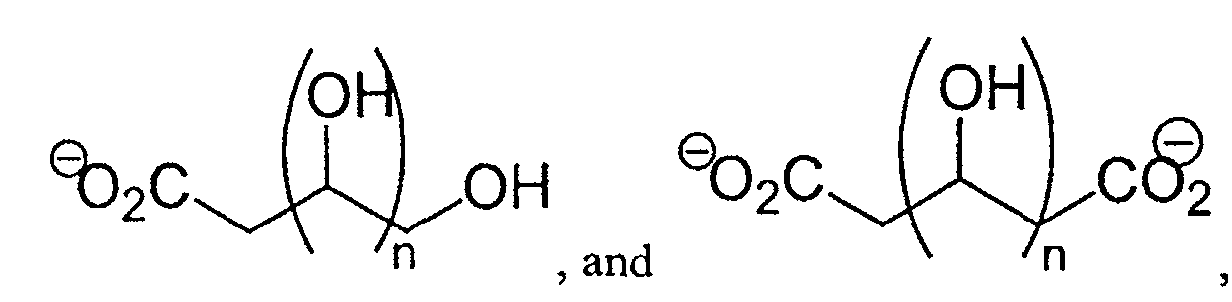
- The dye of claim 1, wherein the chromophore comprises a member of the group consisting of sulfonate, carboxylate, an ammonium ion, and any combination of the above.
- The dye of claim 1, wherein the hydrophilic moiety comprises a member of the group consisting of a polyol, gluconate, glucosamine,and any combination of the above.
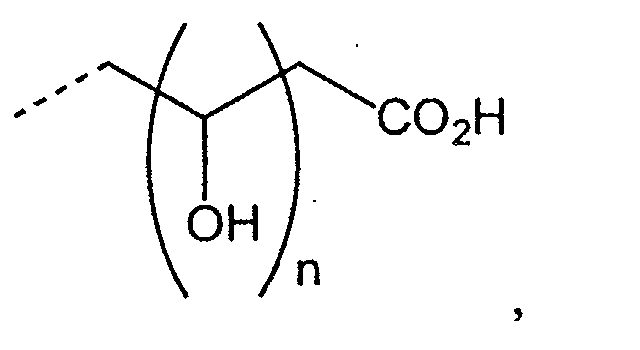
- The dye of claim 1, wherein the hydrophobic moiety comprises a member of the group consisting of dimethylpyridyl,and any combination of the above.
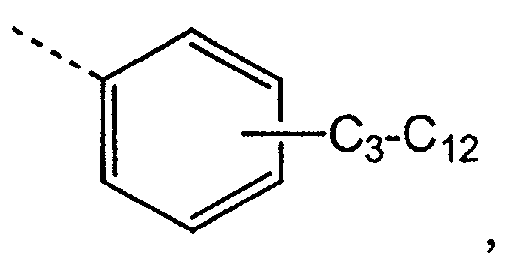
- The dye of claim 1, wherein the second interaction enhancer is linked to the chromophore via a member of the group consisting of an azo linkage, a diazo linkage, an amino linkage, an imino linkage, an amide linkage, an alkyl chain, a ketone linkage, a sulfonyl amino linkage,
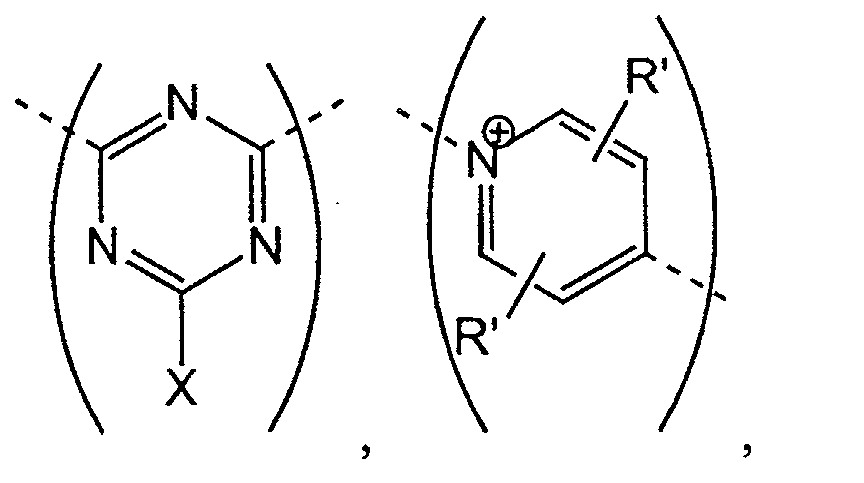 wherein X is a member of the group consisting of chloride, hydroxide, -N=CH-R', -NH-CH2-R', -NR'2, and a chromophoric moiety, Y is a member of the group consisting of a polyol,
 and R' is a member of the group consisting of hydride, a straight alkyl chain having between 1 and 4 carbons, and a branched alkyl chain having 3 or 4 carbons.
- The dye of claim 1, wherein the linked chromophore and second interaction enhancer comprise a member of
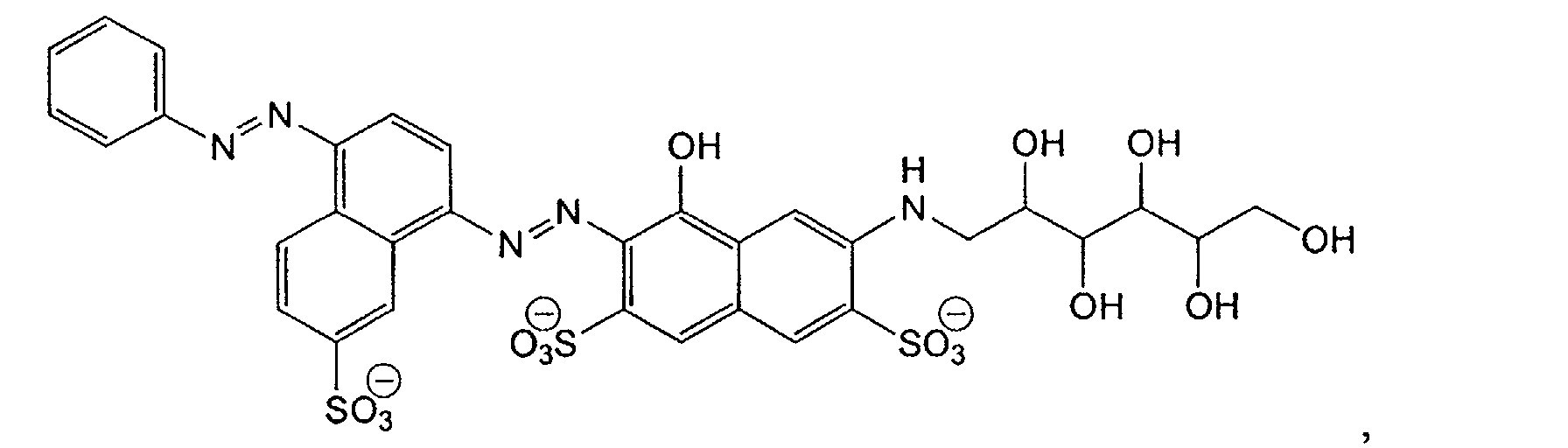


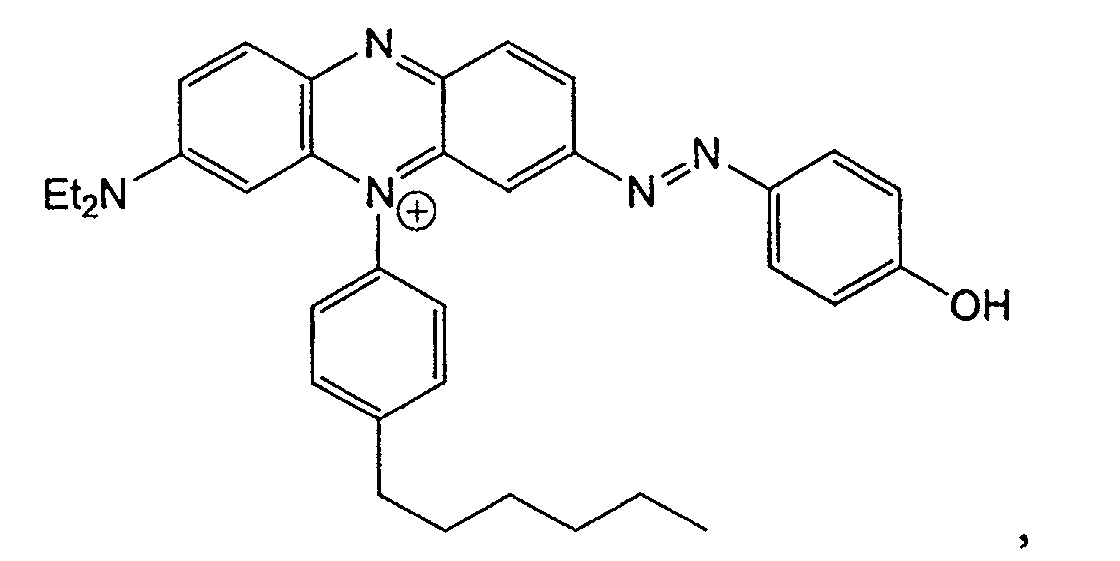

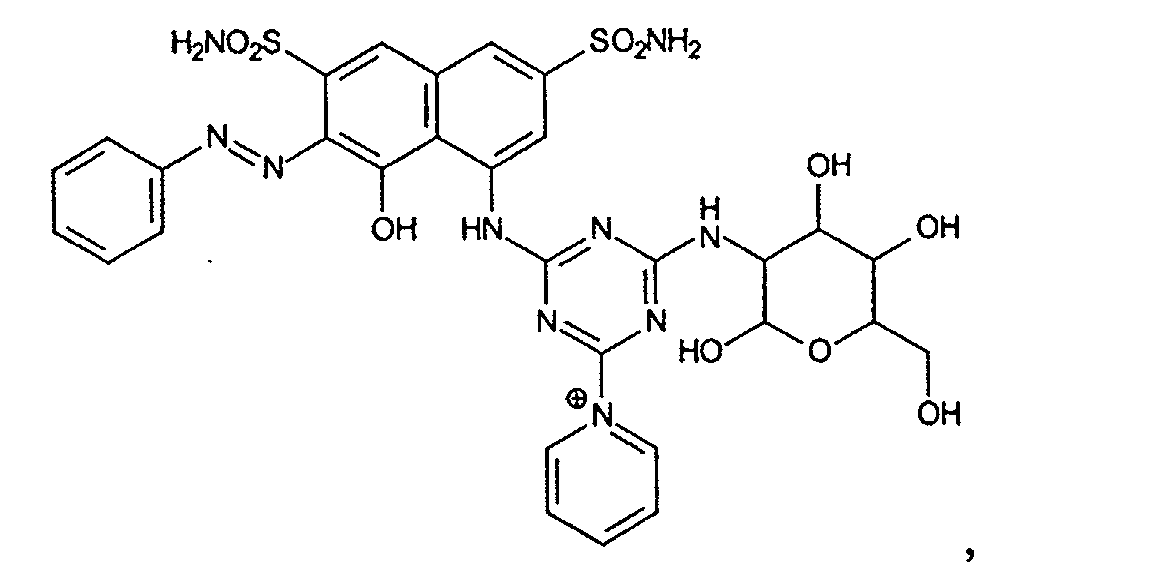
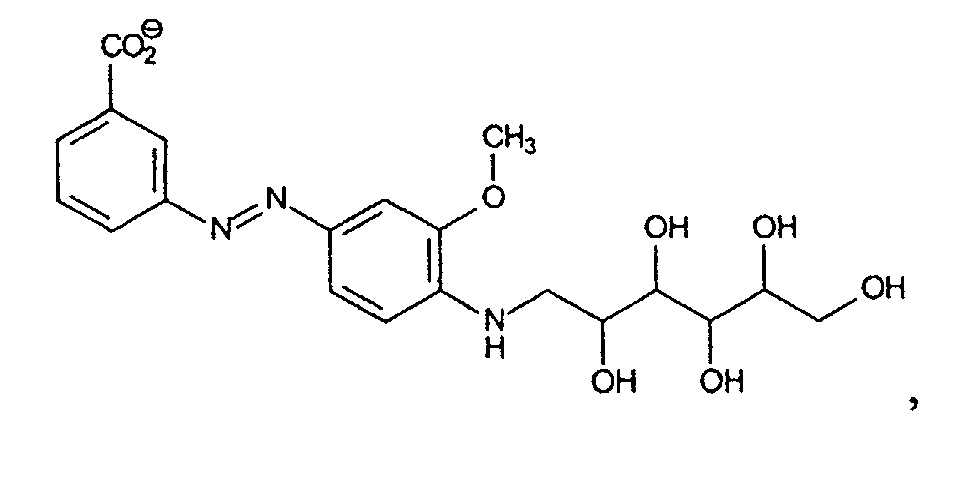


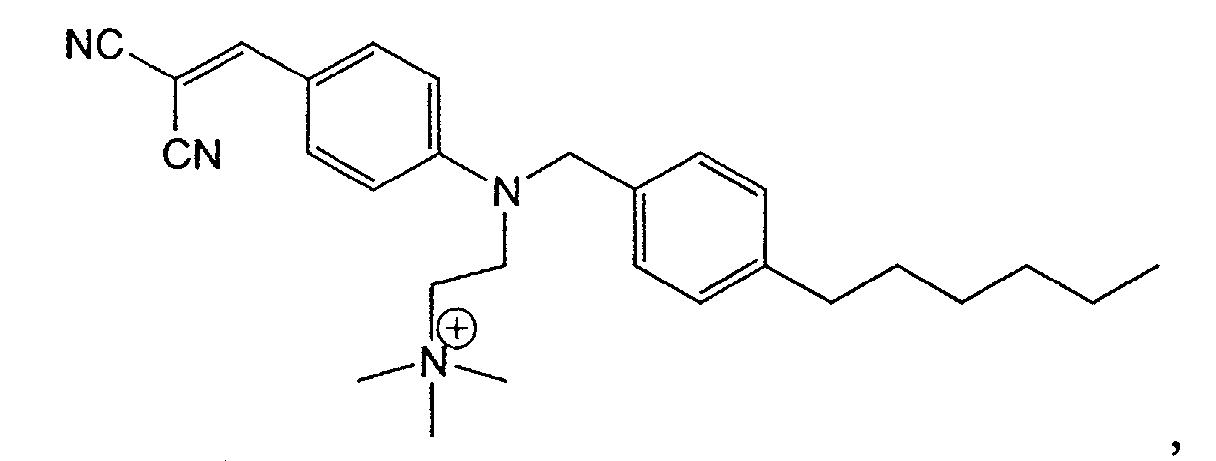

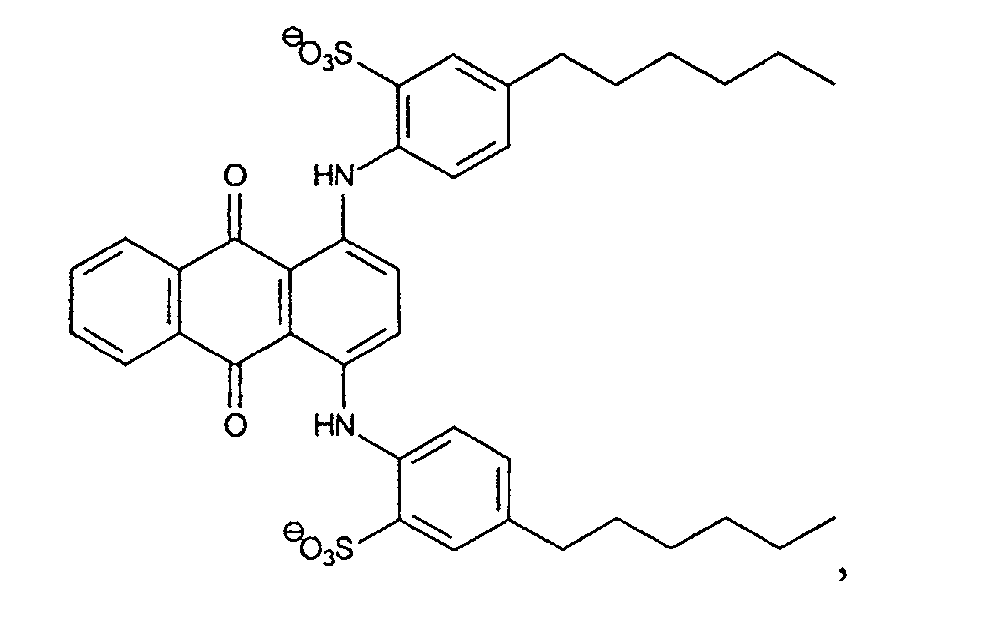
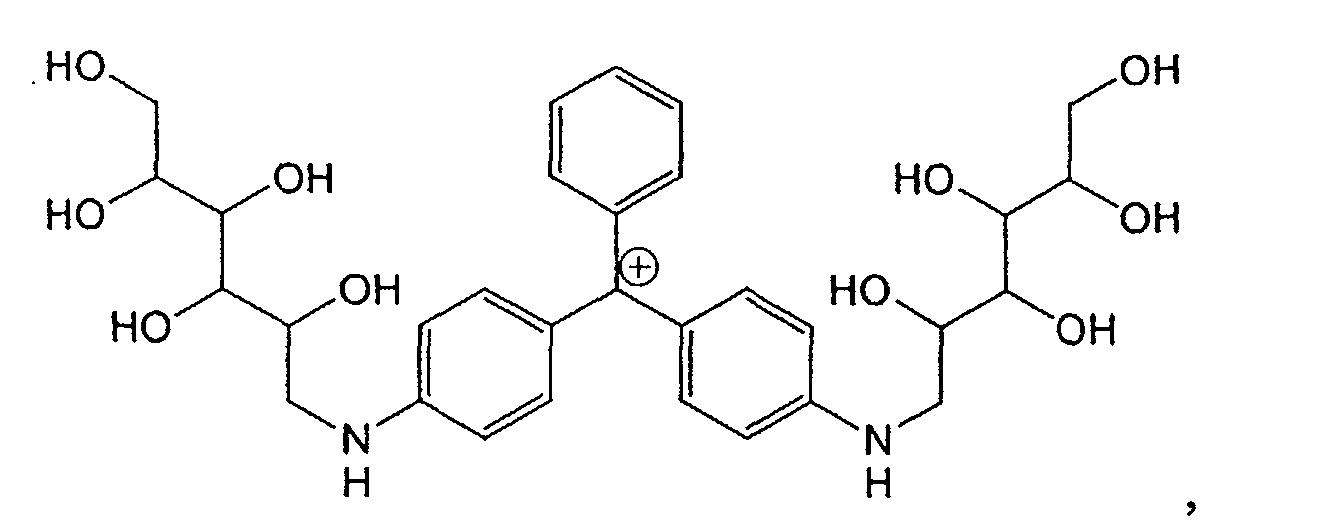 and
and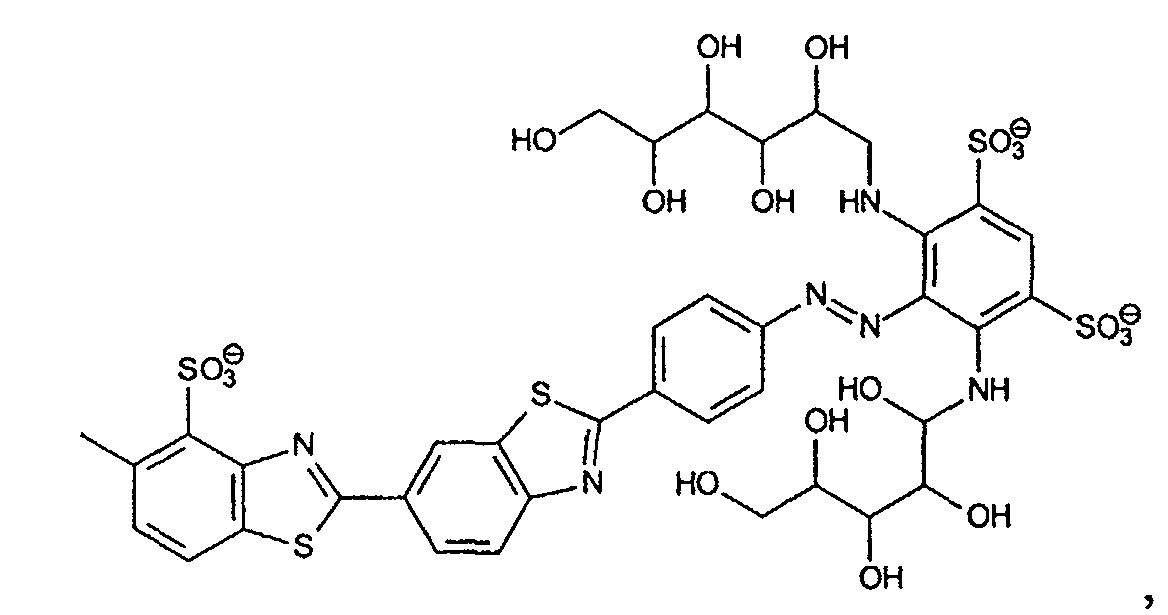

- The dye of claim 1, wherein the linked chromophore and second interaction enhancer comprise a member of
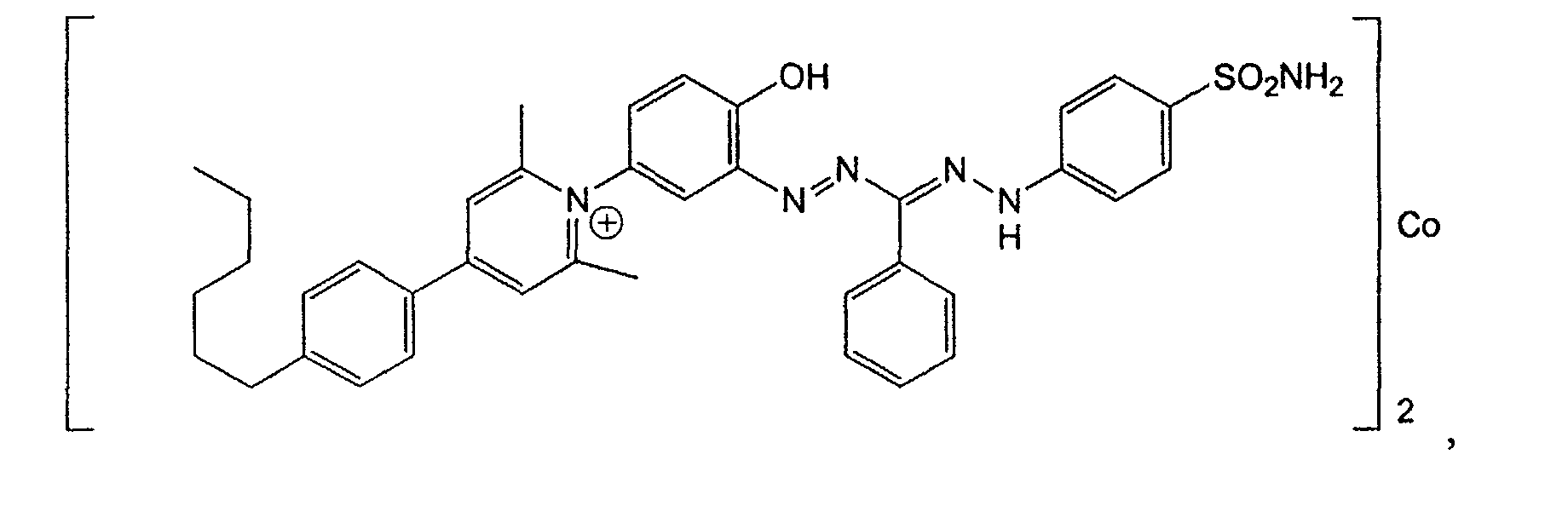 and
and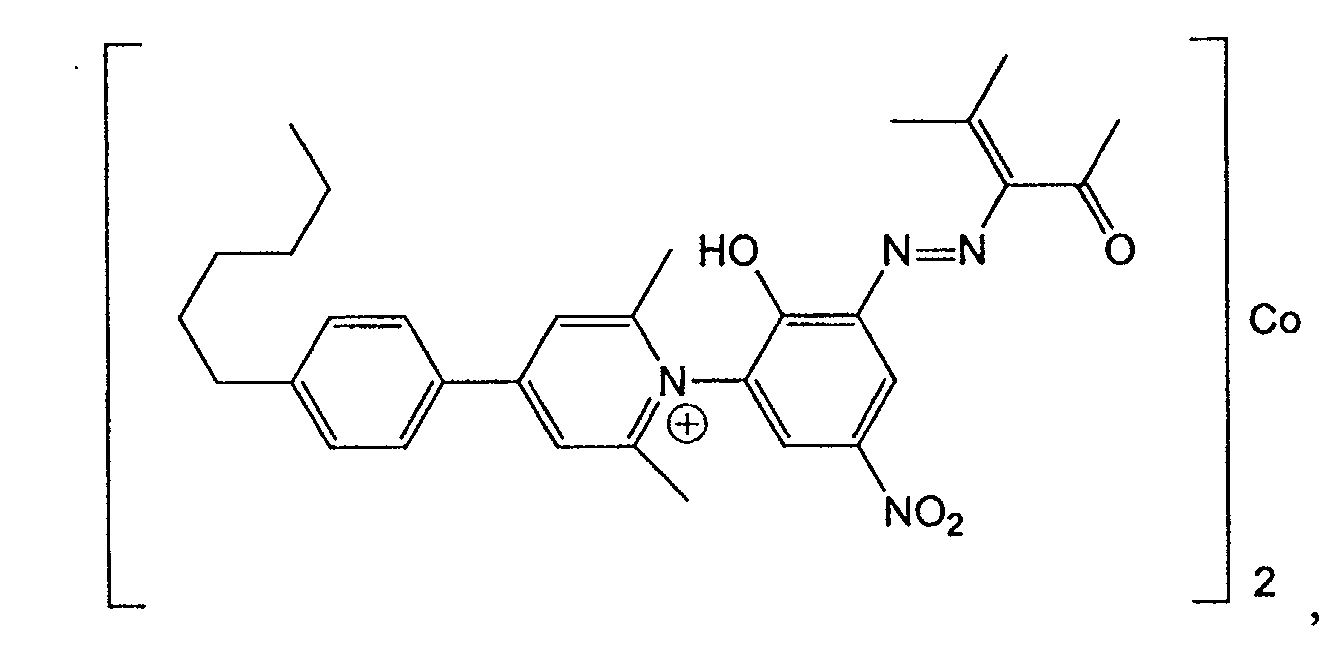

- The dye of claim 1, wherein the linked chromophore and second interaction enhancer comprise a member of
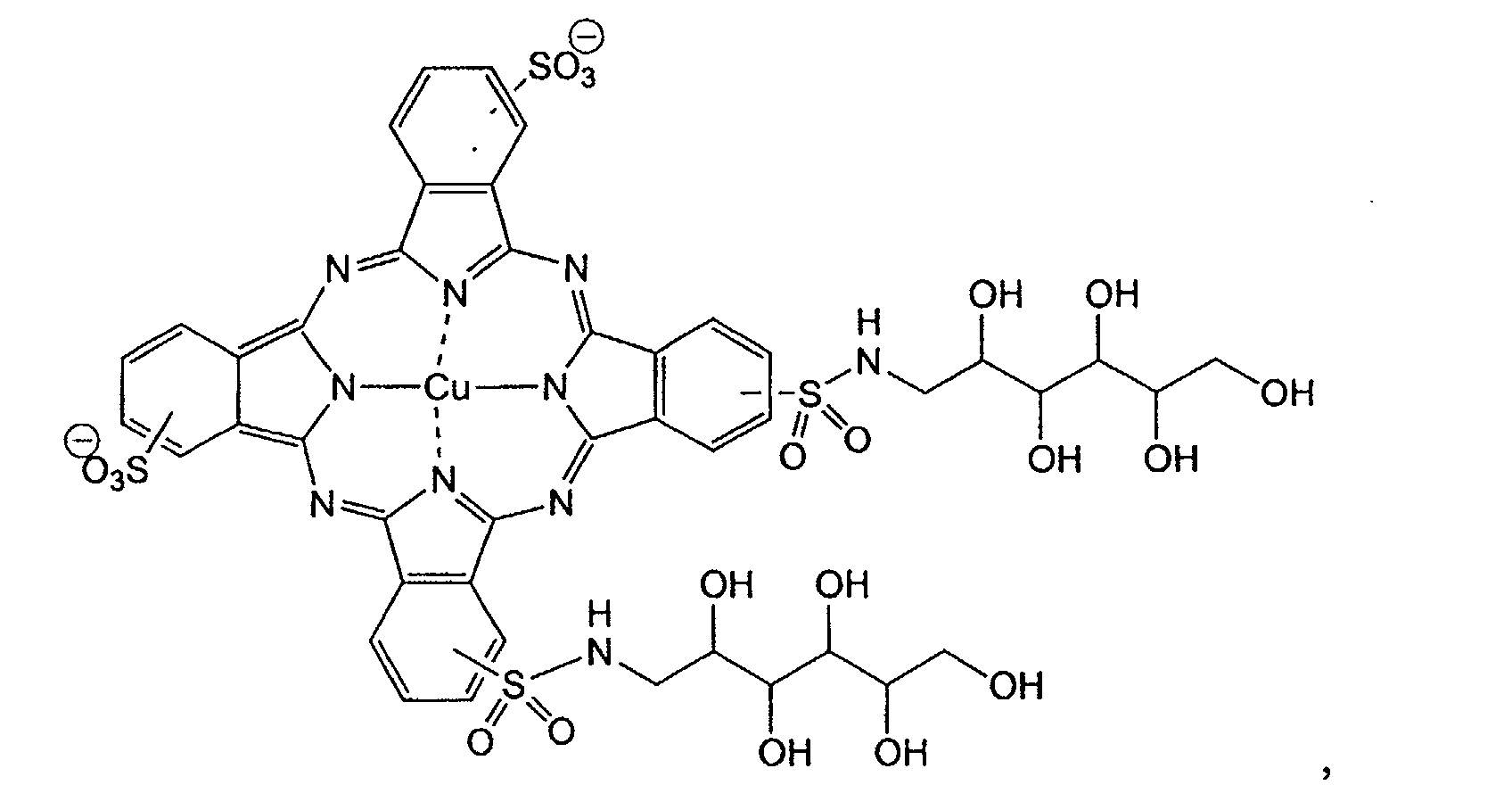

 and
and

- The dye of claim 1, wherein the linked chromophore and second interaction enhancer comprise a member of
 and
and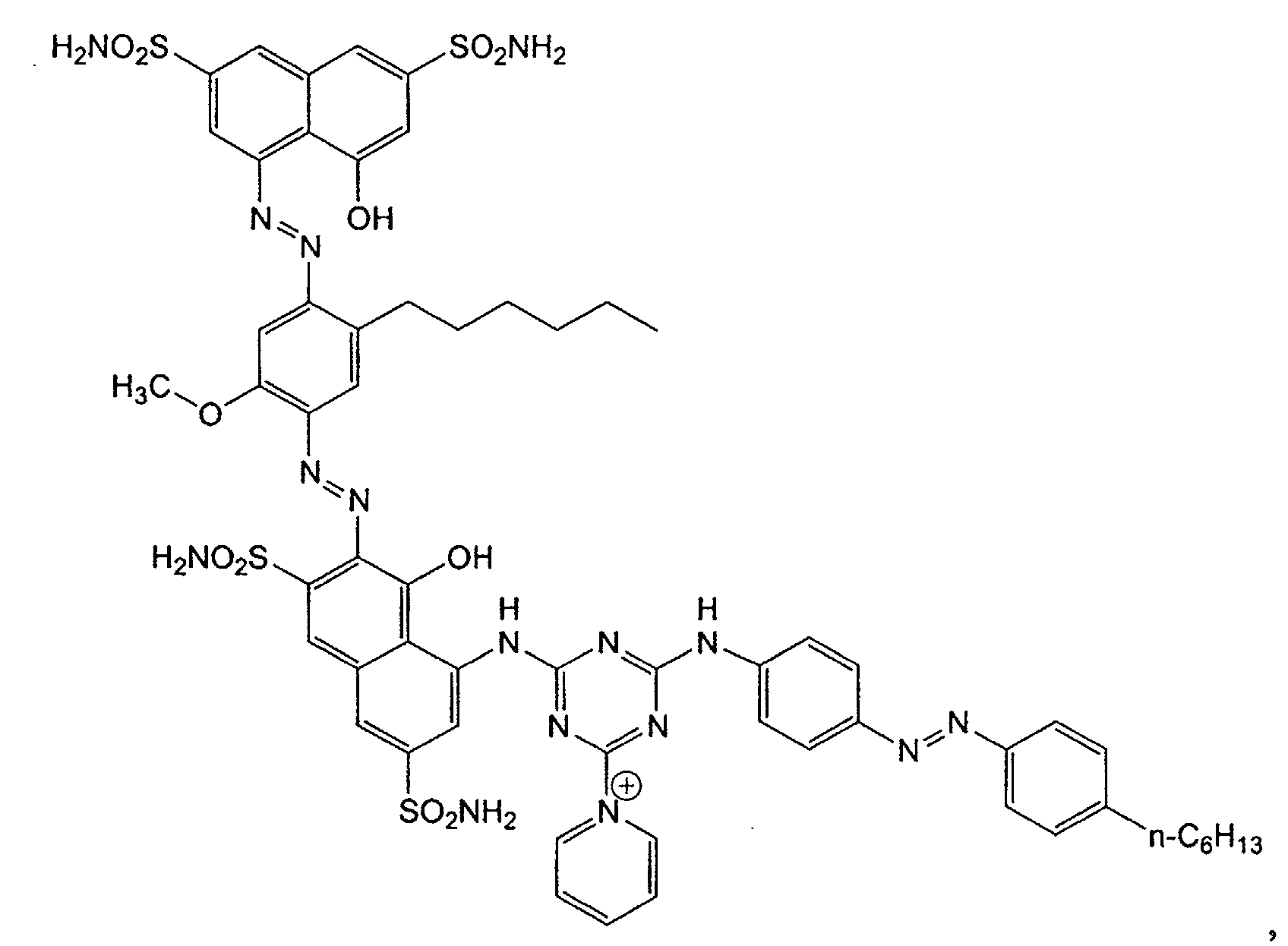

- An ink, comprising:the dye of claim 1;a member of the group consisting of a surfactant, a buffer, a humectant, a biocide, an anti-cockle reagent, and any combination of the above.
- The ink of claim 12, wherein the surfactant comprises a member of the group consisting of a secondary alcohol ethoxylate, a non-ionic fluoro surfactant, a non-ionic fatty acid ethoxylate surfactant, a fatty amide ethoxylate surfactant, an ethoxylated silicone surfactant, an acetylenic polyethylene oxide surfactant, and any combination of the above.
- The ink of claim 12, wherein the buffer comprises a member of the group consisting of an organic biological buffer and an inorganic buffer.
- The ink of claim 12, wherein a member of the humectant and the anti-cockle reagent is selected from the group consising of nitrogen-containing heterocyclic ketones, diols, glycol ethers, thioglycol ethers, polyalkylene glycols, ethers of two or more glycols, and any combination thereof.
- A method of increasing the interaction of an ionic dye with a substrate, comprising,
associating a first counterion with the ionic dye,
wherein the first counterion comprises a member of a hydrophilic moiety and a hydrophobic moiety. - The method of claim 16, further comprising associating a second counterion with the ionic dye, wherein the second counterion comprises a member of a hydrophilic moiety and a hydrophobic moiety.
- The method of claim 16, wherein the first counterion comprises a charged nitrogen atom, sulfonate, or carboxylate.
- The method of claim 16, wherein the first counterion comprises a member of the group consisting of gluconate, glucosamine,
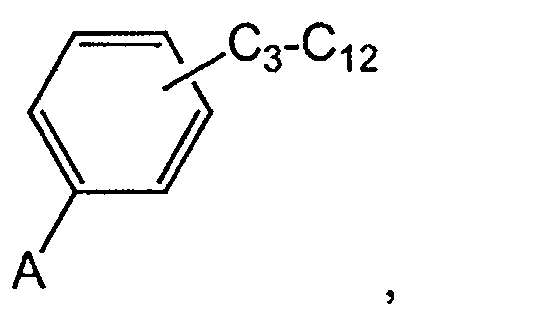 wherein A is a member of the group consisting of R3N+, CO2 -, and SO3 -, R is a straight alkyl chain comprising between 1 and 3 carbons, and n = 3-500.
- A method of increasing the interaction of a dye with a substrate, comprising covalently attaching at least one member of a hydrophilic and a hydrophobic moiety to the dye.
- The method of claim 20, wherein the hydrophilic moiety comprises a member of the group consisting of a polyol, gluconate, glucosamine,and any combination of the above.

- The method of claim 20, wherein the hydrophobic moiety comprises a member of the group consisting of dimethylpyridyl,and any combination of the above.
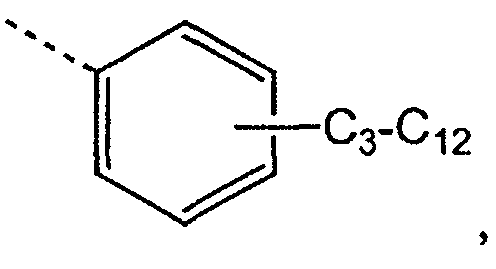
- The method of claim 20, wherein the at least one member is linked to the dye via a member of the group consisting of an azo linkage, a diazo linkage, an amino linkage, an imino linkage, an amide linkage, an alkyl chain, a ketone linkage, a sulfonyl amino linkage,and
 wherein X is a member of the group consisting of chloride, hydroxide, -N=CH-R', -NH-CH2-R', -NR'2, and a chromophoric moiety, Y is a member of the group consisting of a polyol,
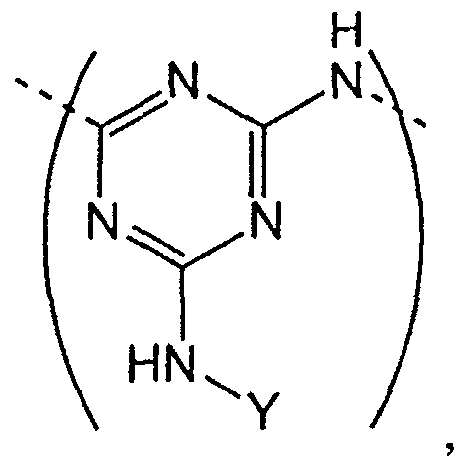 and
and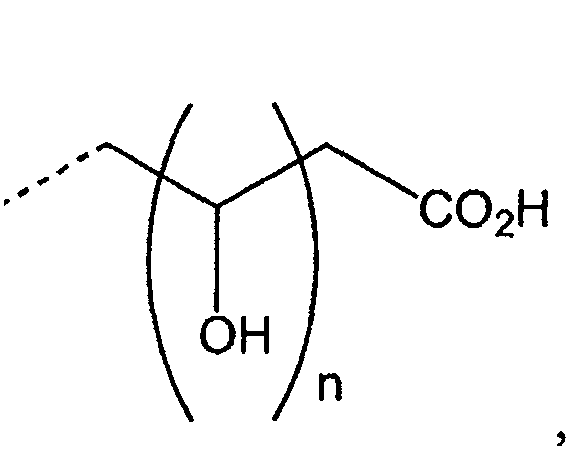 and R' is a member of the group consisting of hydride, a straight alkyl chain having between 1 and 4 carbons, and a branched alkyl chain having 3 or 4 carbons.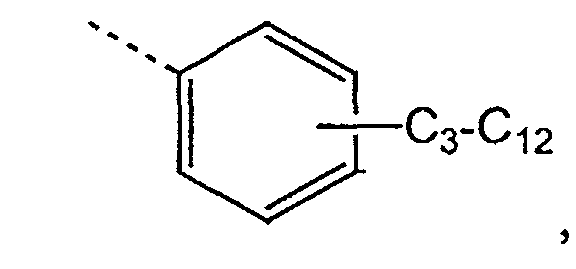
- The method of claim 20, wherein the at least one member comprises 2,6-dimethylpyridine.
Applications Claiming Priority (2)
| Application Number | Priority Date | Filing Date | Title |
|---|---|---|---|
| US10/004,148 US7094277B2 (en) | 2001-10-31 | 2001-10-31 | Counterion use for reduction of decap and for improvement of durability of inkjet images |
| US4148 | 2001-10-31 |
Publications (2)
| Publication Number | Publication Date |
|---|---|
| EP1308482A1 true EP1308482A1 (en) | 2003-05-07 |
| EP1308482B1 EP1308482B1 (en) | 2011-08-03 |
Family
ID=21709403
Family Applications (1)
| Application Number | Title | Priority Date | Filing Date |
|---|---|---|---|
| EP02257314A Expired - Lifetime EP1308482B1 (en) | 2001-10-31 | 2002-10-22 | Counterion use for reduction of decap and for improvement of durability of images |
Country Status (3)
| Country | Link |
|---|---|
| US (1) | US7094277B2 (en) |
| EP (1) | EP1308482B1 (en) |
| JP (2) | JP2003201415A (en) |
Cited By (3)
| Publication number | Priority date | Publication date | Assignee | Title |
|---|---|---|---|---|
| WO2007041628A1 (en) * | 2005-10-03 | 2007-04-12 | E. I. Du Pont De Nemours And Company | Inkjet inks and ink sets |
| WO2007042753A3 (en) * | 2005-10-13 | 2007-07-12 | Fujifilm Imaging Colorants Ltd | Phthalocyanine inks and their use in ink-jet printing |
| ITMI20090149A1 (en) * | 2009-02-05 | 2010-08-06 | Everlight Usa Inc | COMPOSITION OF INK |
Families Citing this family (3)
| Publication number | Priority date | Publication date | Assignee | Title |
|---|---|---|---|---|
| WO2007042755A2 (en) * | 2005-10-13 | 2007-04-19 | Fujifilm Imaging Colorants Limited | Phthalocyanine inks and their use in ink-jet printing |
| US8920552B2 (en) | 2009-09-30 | 2014-12-30 | Videojet Technologies Inc. | Thermal ink jet ink composition |
| JP6478810B2 (en) * | 2015-05-27 | 2019-03-06 | キヤノン株式会社 | Yellow toner |
Citations (8)
| Publication number | Priority date | Publication date | Assignee | Title |
|---|---|---|---|---|
| US4426226A (en) | 1981-07-01 | 1984-01-17 | Canon Kabushiki Kaisha | Recording liquid |
| EP0328375A2 (en) * | 1988-02-11 | 1989-08-16 | Hewlett-Packard Company | Dyes containing polyhydroxyl groups for ink-jet printing inks |
| EP0563907A1 (en) | 1992-03-31 | 1993-10-06 | Orient Chemical Industries, Ltd. | Salt-forming type dye and ink composition containing it |
| EP0626428A1 (en) * | 1993-05-18 | 1994-11-30 | Canon Kabushiki Kaisha | Azo dye compounds, ink containing the same, and recording method and instrument using the ink |
| EP0738764A1 (en) | 1995-04-22 | 1996-10-23 | Hoechst Aktiengesellschaft | Tetrakisazo compounds, their preparation and their use as dyestuffs |
| EP0971003A1 (en) | 1998-07-10 | 2000-01-12 | Clariant GmbH | Water soluble black stilbene dyes, their preparation and use |
| US6162846A (en) * | 1994-12-12 | 2000-12-19 | Scitex Digital Printing, Inc. | Waterfast dyes for making ink jet permanent inks |
| US6221139B1 (en) * | 1999-04-30 | 2001-04-24 | Hewlett-Packard Company | Waterfast dyes |
Family Cites Families (19)
| Publication number | Priority date | Publication date | Assignee | Title |
|---|---|---|---|---|
| DE2340569C2 (en) | 1973-08-10 | 1982-12-02 | Bayer Ag, 5090 Leverkusen | Azo dyes |
| US4028357A (en) | 1975-07-31 | 1977-06-07 | Sterling Drug Inc. | 2'-(4,6-Disubstituted)-s-triazin-2-yl)amino-6'-dialkylamino flurans |
| JPS5482386A (en) | 1977-12-15 | 1979-06-30 | Fuji Photo Film Co Ltd | Stabilizing method for organic basic substance to light |
| DE2949034A1 (en) | 1979-12-06 | 1981-06-25 | Hoechst Ag, 6230 Frankfurt | WATER-SOLUBLE AZO COMPOUNDS, METHOD FOR THE PRODUCTION THEREOF AND THEIR USE AS DYES |
| DE3111648A1 (en) | 1981-03-25 | 1982-10-07 | Basf Ag, 6700 Ludwigshafen | "METHOD FOR COLORING COATING, ORGANIC SOLVENTS AND MINERAL OIL PRODUCTS AND NEW DYES" |
| JPH0753835B2 (en) | 1985-05-20 | 1995-06-07 | 大日本インキ化学工業株式会社 | Method for producing azo lake pigment |
| DE3734528A1 (en) | 1987-10-13 | 1989-05-03 | Hoechst Ag | USE OF COLORING AGENTS FOR RECORDING LIQUIDS |
| US5043013A (en) * | 1987-12-30 | 1991-08-27 | Milliken Research Corporation | Washable ink compositions |
| US5176745A (en) * | 1991-12-11 | 1993-01-05 | Milliken Research Corporation | Aqueous ink composition and colorants useful therein |
| DE19610560A1 (en) * | 1996-03-18 | 1997-09-25 | Rainer Dipl Ing Kaufmann | Colorants, especially ink or printing ink |
| US5935309A (en) * | 1996-10-31 | 1999-08-10 | Hewlett-Packard Company | Ink-jet inks for improved print quality |
| US5830265A (en) | 1996-10-31 | 1998-11-03 | Hewlett-Packard Company | Counterion substitution in macromolecular chromophore (MMC) for ink-jet printing including textile, large format and office format printers |
| JPH10259334A (en) * | 1997-03-21 | 1998-09-29 | Konica Corp | Ink jet recording fluid |
| US6056811A (en) | 1997-08-25 | 2000-05-02 | Canon Kabushiki Kaisha | Water-based ink for ink-jet recording, ink-jet recording process, recording unit, ink cartridge and ink-jet recording apparatus |
| US6063175A (en) * | 1998-02-17 | 2000-05-16 | Milliken & Company | Triphenylmethane polymeric colorant having sterically hindered amine counter ion |
| US6221143B1 (en) | 1999-03-12 | 2001-04-24 | Cabot Corporation | Cationic pigments and aqueous compositions containing same |
| ATE239770T1 (en) | 1999-10-01 | 2003-05-15 | Cabot Corp | MODIFIED PIGMENTS WITH STERIC AND AMPHIPHIL GROUPS |
| US6281269B1 (en) * | 2000-01-27 | 2001-08-28 | Hewlett-Packard Company | Fluid set for ink-jet printers |
| US7273897B2 (en) * | 2001-07-31 | 2007-09-25 | Eastman Kodak Company | Ink jet ink composition |
-
2001
- 2001-10-31 US US10/004,148 patent/US7094277B2/en not_active Expired - Fee Related
-
2002
- 2002-10-22 EP EP02257314A patent/EP1308482B1/en not_active Expired - Lifetime
- 2002-10-31 JP JP2002318161A patent/JP2003201415A/en active Pending
-
2008
- 2008-12-15 JP JP2008317973A patent/JP2009114452A/en active Pending
Patent Citations (8)
| Publication number | Priority date | Publication date | Assignee | Title |
|---|---|---|---|---|
| US4426226A (en) | 1981-07-01 | 1984-01-17 | Canon Kabushiki Kaisha | Recording liquid |
| EP0328375A2 (en) * | 1988-02-11 | 1989-08-16 | Hewlett-Packard Company | Dyes containing polyhydroxyl groups for ink-jet printing inks |
| EP0563907A1 (en) | 1992-03-31 | 1993-10-06 | Orient Chemical Industries, Ltd. | Salt-forming type dye and ink composition containing it |
| EP0626428A1 (en) * | 1993-05-18 | 1994-11-30 | Canon Kabushiki Kaisha | Azo dye compounds, ink containing the same, and recording method and instrument using the ink |
| US6162846A (en) * | 1994-12-12 | 2000-12-19 | Scitex Digital Printing, Inc. | Waterfast dyes for making ink jet permanent inks |
| EP0738764A1 (en) | 1995-04-22 | 1996-10-23 | Hoechst Aktiengesellschaft | Tetrakisazo compounds, their preparation and their use as dyestuffs |
| EP0971003A1 (en) | 1998-07-10 | 2000-01-12 | Clariant GmbH | Water soluble black stilbene dyes, their preparation and use |
| US6221139B1 (en) * | 1999-04-30 | 2001-04-24 | Hewlett-Packard Company | Waterfast dyes |
Cited By (5)
| Publication number | Priority date | Publication date | Assignee | Title |
|---|---|---|---|---|
| WO2007041628A1 (en) * | 2005-10-03 | 2007-04-12 | E. I. Du Pont De Nemours And Company | Inkjet inks and ink sets |
| WO2007042753A3 (en) * | 2005-10-13 | 2007-07-12 | Fujifilm Imaging Colorants Ltd | Phthalocyanine inks and their use in ink-jet printing |
| GB2444204A (en) * | 2005-10-13 | 2008-05-28 | Fujifilm Imaging Colorants Ltd | Phthalocyanine inks and their use in ink-jet printing |
| GB2444204B (en) * | 2005-10-13 | 2009-01-28 | Fujifilm Imaging Colorants Ltd | Phthalocyanine inks and their use in ink-jet printing |
| ITMI20090149A1 (en) * | 2009-02-05 | 2010-08-06 | Everlight Usa Inc | COMPOSITION OF INK |
Also Published As
| Publication number | Publication date |
|---|---|
| US7094277B2 (en) | 2006-08-22 |
| JP2009114452A (en) | 2009-05-28 |
| EP1308482B1 (en) | 2011-08-03 |
| US20030127017A1 (en) | 2003-07-10 |
| JP2003201415A (en) | 2003-07-18 |
Similar Documents
| Publication | Publication Date | Title |
|---|---|---|
| US6281269B1 (en) | Fluid set for ink-jet printers | |
| EP1056808B1 (en) | Monoazo dyestuffs, a composition and an ink for ink jet printing comprising them | |
| US7150783B2 (en) | Disazo dyes and ink jet inks containing them | |
| EP1388576A1 (en) | Fluid set for ink-jet printers | |
| KR101023261B1 (en) | Tris azo dyes for ink jet printing inks | |
| EP1084201B1 (en) | Use of lithium salts of anionic dyes to enhance their light-fastness | |
| JP2009114452A (en) | Inkjet printing dye for reduction of decap and for improvement of durability of image | |
| EP1920008B1 (en) | Disazodyes for ink-jet printing | |
| JP5271468B2 (en) | Ink set for inkjet printing | |
| EP1563021B1 (en) | Inks for ink jet printing comprising a tris-azo dye | |
| HK1051549A (en) | Counterion use for reduction of decap and for improvement of durability of images | |
| US7824483B2 (en) | Colorant composition, ink, printing process | |
| US20100159210A1 (en) | Trisazo Dyestuffs With 6-Pyrazolyl-1-Naphtholsulphonic Acid as Middle Component | |
| US6746525B1 (en) | Disazo dyes and inks containing them | |
| US6221139B1 (en) | Waterfast dyes | |
| EP0494522A1 (en) | Anionic disazo dyes | |
| WO2002070609A1 (en) | Ink jet printing composition comprising a dye containing hydrazine or hydrazide | |
| EP1915430A2 (en) | Process for printing an image, composition and compound | |
| EP1758960B1 (en) | Metal complex diazo-compound and inks containing them | |
| GB2440422A (en) | Arylazo, hydroxy and sulpho substituted 2-aryl-naphtho[1,2-d]imidazoles for use as dyes in ink jet printing | |
| JP2005255828A (en) | Manufacturing method of dye aqueous solution for information recording | |
| HK1132288A (en) | Trisazo dyes, compositions and ink jet printing processes |
Legal Events
| Date | Code | Title | Description |
|---|---|---|---|
| PUAI | Public reference made under article 153(3) epc to a published international application that has entered the european phase |
Free format text: ORIGINAL CODE: 0009012 |
|
| AK | Designated contracting states |
Designated state(s): AT BE BG CH CY CZ DE DK EE ES FI FR GB GR IE IT LI LU MC NL PT SE SK TR |
|
| AX | Request for extension of the european patent |
Extension state: AL LT LV MK RO SI |
|
| 17P | Request for examination filed |
Effective date: 20031010 |
|
| AKX | Designation fees paid |
Designated state(s): DE FR GB NL |
|
| 17Q | First examination report despatched |
Effective date: 20040317 |
|
| 17Q | First examination report despatched |
Effective date: 20040317 |
|
| GRAP | Despatch of communication of intention to grant a patent |
Free format text: ORIGINAL CODE: EPIDOSNIGR1 |
|
| REG | Reference to a national code |
Ref country code: HK Ref legal event code: WD Ref document number: 1051549 Country of ref document: HK |
|
| GRAS | Grant fee paid |
Free format text: ORIGINAL CODE: EPIDOSNIGR3 |
|
| GRAA | (expected) grant |
Free format text: ORIGINAL CODE: 0009210 |
|
| AK | Designated contracting states |
Kind code of ref document: B1 Designated state(s): DE FR GB NL |
|
| REG | Reference to a national code |
Ref country code: GB Ref legal event code: FG4D |
|
| REG | Reference to a national code |
Ref country code: DE Ref legal event code: R096 Ref document number: 60240674 Country of ref document: DE Effective date: 20111006 |
|
| REG | Reference to a national code |
Ref country code: NL Ref legal event code: VDEP Effective date: 20110803 |
|
| REG | Reference to a national code |
Ref country code: DE Ref legal event code: R081 Ref document number: 60240674 Country of ref document: DE Owner name: HEWLETT-PACKARD DEVELOPMENT CO., L.P., US Free format text: FORMER OWNER: HEWLETT-PACKARD COMPANY, PALO ALTO, US Effective date: 20111026 Ref country code: DE Ref legal event code: R081 Ref document number: 60240674 Country of ref document: DE Owner name: HEWLETT-PACKARD DEVELOPMENT CO., L.P., US Free format text: FORMER OWNER: HEWLETT-PACKARD CO. (N.D.GES.D.STAATES DELAWARE), PALO ALTO, US Effective date: 20110811 Ref country code: DE Ref legal event code: R081 Ref document number: 60240674 Country of ref document: DE Owner name: HEWLETT-PACKARD DEVELOPMENT COMPANY, L.P., HOU, US Free format text: FORMER OWNER: HEWLETT-PACKARD CO. (N.D.GES.D.STAATES DELAWARE), PALO ALTO, CALIF., US Effective date: 20110811 Ref country code: DE Ref legal event code: R081 Ref document number: 60240674 Country of ref document: DE Owner name: HEWLETT-PACKARD DEVELOPMENT COMPANY, L.P., HOU, US Free format text: FORMER OWNER: HEWLETT-PACKARD COMPANY, PALO ALTO, CALIF., US Effective date: 20111026 |
|
| PG25 | Lapsed in a contracting state [announced via postgrant information from national office to epo] |
Ref country code: NL Free format text: LAPSE BECAUSE OF FAILURE TO SUBMIT A TRANSLATION OF THE DESCRIPTION OR TO PAY THE FEE WITHIN THE PRESCRIBED TIME-LIMIT Effective date: 20110803 |
|
| PLBE | No opposition filed within time limit |
Free format text: ORIGINAL CODE: 0009261 |
|
| STAA | Information on the status of an ep patent application or granted ep patent |
Free format text: STATUS: NO OPPOSITION FILED WITHIN TIME LIMIT |
|
| 26N | No opposition filed |
Effective date: 20120504 |
|
| REG | Reference to a national code |
Ref country code: FR Ref legal event code: ST Effective date: 20120629 |
|
| GBPC | Gb: european patent ceased through non-payment of renewal fee |
Effective date: 20111103 |
|
| REG | Reference to a national code |
Ref country code: DE Ref legal event code: R097 Ref document number: 60240674 Country of ref document: DE Effective date: 20120504 |
|
| PG25 | Lapsed in a contracting state [announced via postgrant information from national office to epo] |
Ref country code: FR Free format text: LAPSE BECAUSE OF NON-PAYMENT OF DUE FEES Effective date: 20111102 |
|
| PG25 | Lapsed in a contracting state [announced via postgrant information from national office to epo] |
Ref country code: GB Free format text: LAPSE BECAUSE OF NON-PAYMENT OF DUE FEES Effective date: 20111103 |
|
| PG25 | Lapsed in a contracting state [announced via postgrant information from national office to epo] |
Ref country code: DE Free format text: LAPSE BECAUSE OF NON-PAYMENT OF DUE FEES Effective date: 20130501 |
|
| REG | Reference to a national code |
Ref country code: DE Ref legal event code: R119 Ref document number: 60240674 Country of ref document: DE Effective date: 20130501 |