EP1308436A1 - Calcium receptor antagonists - Google Patents
Calcium receptor antagonists Download PDFInfo
- Publication number
- EP1308436A1 EP1308436A1 EP01955658A EP01955658A EP1308436A1 EP 1308436 A1 EP1308436 A1 EP 1308436A1 EP 01955658 A EP01955658 A EP 01955658A EP 01955658 A EP01955658 A EP 01955658A EP 1308436 A1 EP1308436 A1 EP 1308436A1
- Authority
- EP
- European Patent Office
- Prior art keywords
- group
- alkyl
- compound
- alkoxy
- solvate
- Prior art date
- Legal status (The legal status is an assumption and is not a legal conclusion. Google has not performed a legal analysis and makes no representation as to the accuracy of the status listed.)
- Granted
Links
- 0 C*c1cc(*C)c(*C)c(*)c1C Chemical compound C*c1cc(*C)c(*C)c(*)c1C 0.000 description 6
- JVMUPZODILRUIH-VPUSJEBWSA-N CC(C)(Cc1cc2ccccc2cc1)NC[C@H](C[O-][C@@H](C1CC1)c1ccccc1CO)O Chemical compound CC(C)(Cc1cc2ccccc2cc1)NC[C@H](C[O-][C@@H](C1CC1)c1ccccc1CO)O JVMUPZODILRUIH-VPUSJEBWSA-N 0.000 description 1
- DHHGVIOVURMJEA-UHFFFAOYSA-N CC(c(cccc1)c1OC)O Chemical compound CC(c(cccc1)c1OC)O DHHGVIOVURMJEA-UHFFFAOYSA-N 0.000 description 1
Images

Classifications
-
- C—CHEMISTRY; METALLURGY
- C07—ORGANIC CHEMISTRY
- C07D—HETEROCYCLIC COMPOUNDS
- C07D213/00—Heterocyclic compounds containing six-membered rings, not condensed with other rings, with one nitrogen atom as the only ring hetero atom and three or more double bonds between ring members or between ring members and non-ring members
- C07D213/02—Heterocyclic compounds containing six-membered rings, not condensed with other rings, with one nitrogen atom as the only ring hetero atom and three or more double bonds between ring members or between ring members and non-ring members having three double bonds between ring members or between ring members and non-ring members
- C07D213/04—Heterocyclic compounds containing six-membered rings, not condensed with other rings, with one nitrogen atom as the only ring hetero atom and three or more double bonds between ring members or between ring members and non-ring members having three double bonds between ring members or between ring members and non-ring members having no bond between the ring nitrogen atom and a non-ring member or having only hydrogen or carbon atoms directly attached to the ring nitrogen atom
- C07D213/24—Heterocyclic compounds containing six-membered rings, not condensed with other rings, with one nitrogen atom as the only ring hetero atom and three or more double bonds between ring members or between ring members and non-ring members having three double bonds between ring members or between ring members and non-ring members having no bond between the ring nitrogen atom and a non-ring member or having only hydrogen or carbon atoms directly attached to the ring nitrogen atom with substituted hydrocarbon radicals attached to ring carbon atoms
- C07D213/28—Radicals substituted by singly-bound oxygen or sulphur atoms
- C07D213/30—Oxygen atoms
-
- C—CHEMISTRY; METALLURGY
- C07—ORGANIC CHEMISTRY
- C07C—ACYCLIC OR CARBOCYCLIC COMPOUNDS
- C07C217/00—Compounds containing amino and etherified hydroxy groups bound to the same carbon skeleton
- C07C217/02—Compounds containing amino and etherified hydroxy groups bound to the same carbon skeleton having etherified hydroxy groups and amino groups bound to acyclic carbon atoms of the same carbon skeleton
- C07C217/04—Compounds containing amino and etherified hydroxy groups bound to the same carbon skeleton having etherified hydroxy groups and amino groups bound to acyclic carbon atoms of the same carbon skeleton the carbon skeleton being acyclic and saturated
- C07C217/06—Compounds containing amino and etherified hydroxy groups bound to the same carbon skeleton having etherified hydroxy groups and amino groups bound to acyclic carbon atoms of the same carbon skeleton the carbon skeleton being acyclic and saturated having only one etherified hydroxy group and one amino group bound to the carbon skeleton, which is not further substituted
- C07C217/08—Compounds containing amino and etherified hydroxy groups bound to the same carbon skeleton having etherified hydroxy groups and amino groups bound to acyclic carbon atoms of the same carbon skeleton the carbon skeleton being acyclic and saturated having only one etherified hydroxy group and one amino group bound to the carbon skeleton, which is not further substituted the oxygen atom of the etherified hydroxy group being further bound to an acyclic carbon atom
- C07C217/10—Compounds containing amino and etherified hydroxy groups bound to the same carbon skeleton having etherified hydroxy groups and amino groups bound to acyclic carbon atoms of the same carbon skeleton the carbon skeleton being acyclic and saturated having only one etherified hydroxy group and one amino group bound to the carbon skeleton, which is not further substituted the oxygen atom of the etherified hydroxy group being further bound to an acyclic carbon atom to an acyclic carbon atom of a hydrocarbon radical containing six-membered aromatic rings
-
- C—CHEMISTRY; METALLURGY
- C07—ORGANIC CHEMISTRY
- C07C—ACYCLIC OR CARBOCYCLIC COMPOUNDS
- C07C217/00—Compounds containing amino and etherified hydroxy groups bound to the same carbon skeleton
- C07C217/02—Compounds containing amino and etherified hydroxy groups bound to the same carbon skeleton having etherified hydroxy groups and amino groups bound to acyclic carbon atoms of the same carbon skeleton
- C07C217/04—Compounds containing amino and etherified hydroxy groups bound to the same carbon skeleton having etherified hydroxy groups and amino groups bound to acyclic carbon atoms of the same carbon skeleton the carbon skeleton being acyclic and saturated
- C07C217/28—Compounds containing amino and etherified hydroxy groups bound to the same carbon skeleton having etherified hydroxy groups and amino groups bound to acyclic carbon atoms of the same carbon skeleton the carbon skeleton being acyclic and saturated having one amino group and at least two singly-bound oxygen atoms, with at least one being part of an etherified hydroxy group, bound to the carbon skeleton, e.g. ethers of polyhydroxy amines
-
- C—CHEMISTRY; METALLURGY
- C07—ORGANIC CHEMISTRY
- C07C—ACYCLIC OR CARBOCYCLIC COMPOUNDS
- C07C217/00—Compounds containing amino and etherified hydroxy groups bound to the same carbon skeleton
- C07C217/54—Compounds containing amino and etherified hydroxy groups bound to the same carbon skeleton having etherified hydroxy groups bound to carbon atoms of at least one six-membered aromatic ring and amino groups bound to acyclic carbon atoms or to carbon atoms of rings other than six-membered aromatic rings of the same carbon skeleton
- C07C217/56—Compounds containing amino and etherified hydroxy groups bound to the same carbon skeleton having etherified hydroxy groups bound to carbon atoms of at least one six-membered aromatic ring and amino groups bound to acyclic carbon atoms or to carbon atoms of rings other than six-membered aromatic rings of the same carbon skeleton with amino groups linked to the six-membered aromatic ring, or to the condensed ring system containing that ring, by carbon chains not further substituted by singly-bound oxygen atoms
- C07C217/60—Compounds containing amino and etherified hydroxy groups bound to the same carbon skeleton having etherified hydroxy groups bound to carbon atoms of at least one six-membered aromatic ring and amino groups bound to acyclic carbon atoms or to carbon atoms of rings other than six-membered aromatic rings of the same carbon skeleton with amino groups linked to the six-membered aromatic ring, or to the condensed ring system containing that ring, by carbon chains not further substituted by singly-bound oxygen atoms linked by carbon chains having two carbon atoms between the amino groups and the six-membered aromatic ring or the condensed ring system containing that ring
-
- C—CHEMISTRY; METALLURGY
- C07—ORGANIC CHEMISTRY
- C07C—ACYCLIC OR CARBOCYCLIC COMPOUNDS
- C07C217/00—Compounds containing amino and etherified hydroxy groups bound to the same carbon skeleton
- C07C217/76—Compounds containing amino and etherified hydroxy groups bound to the same carbon skeleton having amino groups bound to carbon atoms of six-membered aromatic rings and etherified hydroxy groups bound to acyclic carbon atoms or to carbon atoms of rings other than six-membered aromatic rings of the same carbon skeleton
-
- C—CHEMISTRY; METALLURGY
- C07—ORGANIC CHEMISTRY
- C07C—ACYCLIC OR CARBOCYCLIC COMPOUNDS
- C07C229/00—Compounds containing amino and carboxyl groups bound to the same carbon skeleton
- C07C229/38—Compounds containing amino and carboxyl groups bound to the same carbon skeleton having amino groups bound to acyclic carbon atoms and carboxyl groups bound to carbon atoms of six-membered aromatic rings of the same carbon skeleton
-
- C—CHEMISTRY; METALLURGY
- C07—ORGANIC CHEMISTRY
- C07C—ACYCLIC OR CARBOCYCLIC COMPOUNDS
- C07C233/00—Carboxylic acid amides
- C07C233/01—Carboxylic acid amides having carbon atoms of carboxamide groups bound to hydrogen atoms or to acyclic carbon atoms
- C07C233/16—Carboxylic acid amides having carbon atoms of carboxamide groups bound to hydrogen atoms or to acyclic carbon atoms having the nitrogen atom of at least one of the carboxamide groups bound to a carbon atom of a hydrocarbon radical substituted by singly-bound oxygen atoms
- C07C233/24—Carboxylic acid amides having carbon atoms of carboxamide groups bound to hydrogen atoms or to acyclic carbon atoms having the nitrogen atom of at least one of the carboxamide groups bound to a carbon atom of a hydrocarbon radical substituted by singly-bound oxygen atoms with the substituted hydrocarbon radical bound to the nitrogen atom of the carboxamide group by a carbon atom of a six-membered aromatic ring
- C07C233/25—Carboxylic acid amides having carbon atoms of carboxamide groups bound to hydrogen atoms or to acyclic carbon atoms having the nitrogen atom of at least one of the carboxamide groups bound to a carbon atom of a hydrocarbon radical substituted by singly-bound oxygen atoms with the substituted hydrocarbon radical bound to the nitrogen atom of the carboxamide group by a carbon atom of a six-membered aromatic ring having the carbon atom of the carboxamide group bound to a hydrogen atom or to a carbon atom of an acyclic saturated carbon skeleton
-
- C—CHEMISTRY; METALLURGY
- C07—ORGANIC CHEMISTRY
- C07C—ACYCLIC OR CARBOCYCLIC COMPOUNDS
- C07C235/00—Carboxylic acid amides, the carbon skeleton of the acid part being further substituted by oxygen atoms
- C07C235/42—Carboxylic acid amides, the carbon skeleton of the acid part being further substituted by oxygen atoms having carbon atoms of carboxamide groups bound to carbon atoms of six-membered aromatic rings and singly-bound oxygen atoms bound to the same carbon skeleton
-
- C—CHEMISTRY; METALLURGY
- C07—ORGANIC CHEMISTRY
- C07C—ACYCLIC OR CARBOCYCLIC COMPOUNDS
- C07C235/00—Carboxylic acid amides, the carbon skeleton of the acid part being further substituted by oxygen atoms
- C07C235/42—Carboxylic acid amides, the carbon skeleton of the acid part being further substituted by oxygen atoms having carbon atoms of carboxamide groups bound to carbon atoms of six-membered aromatic rings and singly-bound oxygen atoms bound to the same carbon skeleton
- C07C235/44—Carboxylic acid amides, the carbon skeleton of the acid part being further substituted by oxygen atoms having carbon atoms of carboxamide groups bound to carbon atoms of six-membered aromatic rings and singly-bound oxygen atoms bound to the same carbon skeleton with carbon atoms of carboxamide groups and singly-bound oxygen atoms bound to carbon atoms of the same non-condensed six-membered aromatic ring
- C07C235/58—Carboxylic acid amides, the carbon skeleton of the acid part being further substituted by oxygen atoms having carbon atoms of carboxamide groups bound to carbon atoms of six-membered aromatic rings and singly-bound oxygen atoms bound to the same carbon skeleton with carbon atoms of carboxamide groups and singly-bound oxygen atoms bound to carbon atoms of the same non-condensed six-membered aromatic ring with carbon atoms of carboxamide groups and singly-bound oxygen atoms, bound in ortho-position to carbon atoms of the same non-condensed six-membered aromatic ring
- C07C235/60—Carboxylic acid amides, the carbon skeleton of the acid part being further substituted by oxygen atoms having carbon atoms of carboxamide groups bound to carbon atoms of six-membered aromatic rings and singly-bound oxygen atoms bound to the same carbon skeleton with carbon atoms of carboxamide groups and singly-bound oxygen atoms bound to carbon atoms of the same non-condensed six-membered aromatic ring with carbon atoms of carboxamide groups and singly-bound oxygen atoms, bound in ortho-position to carbon atoms of the same non-condensed six-membered aromatic ring having the nitrogen atoms of the carboxamide groups bound to hydrogen atoms or to acyclic carbon atoms
-
- C—CHEMISTRY; METALLURGY
- C07—ORGANIC CHEMISTRY
- C07C—ACYCLIC OR CARBOCYCLIC COMPOUNDS
- C07C237/00—Carboxylic acid amides, the carbon skeleton of the acid part being further substituted by amino groups
- C07C237/28—Carboxylic acid amides, the carbon skeleton of the acid part being further substituted by amino groups having the carbon atom of at least one of the carboxamide groups bound to a carbon atom of a non-condensed six-membered aromatic ring of the carbon skeleton
- C07C237/30—Carboxylic acid amides, the carbon skeleton of the acid part being further substituted by amino groups having the carbon atom of at least one of the carboxamide groups bound to a carbon atom of a non-condensed six-membered aromatic ring of the carbon skeleton having the nitrogen atom of the carboxamide group bound to hydrogen atoms or to acyclic carbon atoms
-
- C—CHEMISTRY; METALLURGY
- C07—ORGANIC CHEMISTRY
- C07C—ACYCLIC OR CARBOCYCLIC COMPOUNDS
- C07C255/00—Carboxylic acid nitriles
- C07C255/49—Carboxylic acid nitriles having cyano groups bound to carbon atoms of six-membered aromatic rings of a carbon skeleton
- C07C255/54—Carboxylic acid nitriles having cyano groups bound to carbon atoms of six-membered aromatic rings of a carbon skeleton containing cyano groups and etherified hydroxy groups bound to the carbon skeleton
-
- C—CHEMISTRY; METALLURGY
- C07—ORGANIC CHEMISTRY
- C07C—ACYCLIC OR CARBOCYCLIC COMPOUNDS
- C07C311/00—Amides of sulfonic acids, i.e. compounds having singly-bound oxygen atoms of sulfo groups replaced by nitrogen atoms, not being part of nitro or nitroso groups
- C07C311/15—Sulfonamides having sulfur atoms of sulfonamide groups bound to carbon atoms of six-membered aromatic rings
- C07C311/21—Sulfonamides having sulfur atoms of sulfonamide groups bound to carbon atoms of six-membered aromatic rings having the nitrogen atom of at least one of the sulfonamide groups bound to a carbon atom of a six-membered aromatic ring
-
- C—CHEMISTRY; METALLURGY
- C07—ORGANIC CHEMISTRY
- C07C—ACYCLIC OR CARBOCYCLIC COMPOUNDS
- C07C311/00—Amides of sulfonic acids, i.e. compounds having singly-bound oxygen atoms of sulfo groups replaced by nitrogen atoms, not being part of nitro or nitroso groups
- C07C311/22—Sulfonamides, the carbon skeleton of the acid part being further substituted by singly-bound oxygen atoms
- C07C311/29—Sulfonamides, the carbon skeleton of the acid part being further substituted by singly-bound oxygen atoms having the sulfur atom of at least one of the sulfonamide groups bound to a carbon atom of a six-membered aromatic ring
-
- C—CHEMISTRY; METALLURGY
- C07—ORGANIC CHEMISTRY
- C07D—HETEROCYCLIC COMPOUNDS
- C07D277/00—Heterocyclic compounds containing 1,3-thiazole or hydrogenated 1,3-thiazole rings
- C07D277/02—Heterocyclic compounds containing 1,3-thiazole or hydrogenated 1,3-thiazole rings not condensed with other rings
- C07D277/20—Heterocyclic compounds containing 1,3-thiazole or hydrogenated 1,3-thiazole rings not condensed with other rings having two or three double bonds between ring members or between ring members and non-ring members
- C07D277/22—Heterocyclic compounds containing 1,3-thiazole or hydrogenated 1,3-thiazole rings not condensed with other rings having two or three double bonds between ring members or between ring members and non-ring members with only hydrogen atoms, hydrocarbon or substituted hydrocarbon radicals, directly attached to ring carbon atoms
- C07D277/24—Radicals substituted by oxygen atoms
-
- C—CHEMISTRY; METALLURGY
- C07—ORGANIC CHEMISTRY
- C07D—HETEROCYCLIC COMPOUNDS
- C07D307/00—Heterocyclic compounds containing five-membered rings having one oxygen atom as the only ring hetero atom
- C07D307/02—Heterocyclic compounds containing five-membered rings having one oxygen atom as the only ring hetero atom not condensed with other rings
- C07D307/34—Heterocyclic compounds containing five-membered rings having one oxygen atom as the only ring hetero atom not condensed with other rings having two or three double bonds between ring members or between ring members and non-ring members
- C07D307/38—Heterocyclic compounds containing five-membered rings having one oxygen atom as the only ring hetero atom not condensed with other rings having two or three double bonds between ring members or between ring members and non-ring members with substituted hydrocarbon radicals attached to ring carbon atoms
- C07D307/40—Radicals substituted by oxygen atoms
- C07D307/42—Singly bound oxygen atoms
-
- C—CHEMISTRY; METALLURGY
- C07—ORGANIC CHEMISTRY
- C07D—HETEROCYCLIC COMPOUNDS
- C07D317/00—Heterocyclic compounds containing five-membered rings having two oxygen atoms as the only ring hetero atoms
- C07D317/08—Heterocyclic compounds containing five-membered rings having two oxygen atoms as the only ring hetero atoms having the hetero atoms in positions 1 and 3
- C07D317/44—Heterocyclic compounds containing five-membered rings having two oxygen atoms as the only ring hetero atoms having the hetero atoms in positions 1 and 3 ortho- or peri-condensed with carbocyclic rings or ring systems
- C07D317/46—Heterocyclic compounds containing five-membered rings having two oxygen atoms as the only ring hetero atoms having the hetero atoms in positions 1 and 3 ortho- or peri-condensed with carbocyclic rings or ring systems condensed with one six-membered ring
- C07D317/48—Methylenedioxybenzenes or hydrogenated methylenedioxybenzenes, unsubstituted on the hetero ring
- C07D317/50—Methylenedioxybenzenes or hydrogenated methylenedioxybenzenes, unsubstituted on the hetero ring with only hydrogen atoms, hydrocarbon or substituted hydrocarbon radicals, directly attached to atoms of the carbocyclic ring
- C07D317/58—Radicals substituted by nitrogen atoms
-
- C—CHEMISTRY; METALLURGY
- C07—ORGANIC CHEMISTRY
- C07D—HETEROCYCLIC COMPOUNDS
- C07D333/00—Heterocyclic compounds containing five-membered rings having one sulfur atom as the only ring hetero atom
- C07D333/02—Heterocyclic compounds containing five-membered rings having one sulfur atom as the only ring hetero atom not condensed with other rings
- C07D333/04—Heterocyclic compounds containing five-membered rings having one sulfur atom as the only ring hetero atom not condensed with other rings not substituted on the ring sulphur atom
- C07D333/06—Heterocyclic compounds containing five-membered rings having one sulfur atom as the only ring hetero atom not condensed with other rings not substituted on the ring sulphur atom with only hydrogen atoms, hydrocarbon or substituted hydrocarbon radicals, directly attached to the ring carbon atoms
- C07D333/14—Radicals substituted by singly bound hetero atoms other than halogen
- C07D333/16—Radicals substituted by singly bound hetero atoms other than halogen by oxygen atoms
-
- C—CHEMISTRY; METALLURGY
- C07—ORGANIC CHEMISTRY
- C07D—HETEROCYCLIC COMPOUNDS
- C07D333/00—Heterocyclic compounds containing five-membered rings having one sulfur atom as the only ring hetero atom
- C07D333/50—Heterocyclic compounds containing five-membered rings having one sulfur atom as the only ring hetero atom condensed with carbocyclic rings or ring systems
- C07D333/52—Benzo[b]thiophenes; Hydrogenated benzo[b]thiophenes
- C07D333/54—Benzo[b]thiophenes; Hydrogenated benzo[b]thiophenes with only hydrogen atoms, hydrocarbon or substituted hydrocarbon radicals, directly attached to carbon atoms of the hetero ring
- C07D333/56—Radicals substituted by oxygen atoms
-
- C—CHEMISTRY; METALLURGY
- C07—ORGANIC CHEMISTRY
- C07B—GENERAL METHODS OF ORGANIC CHEMISTRY; APPARATUS THEREFOR
- C07B2200/00—Indexing scheme relating to specific properties of organic compounds
- C07B2200/07—Optical isomers
-
- C—CHEMISTRY; METALLURGY
- C07—ORGANIC CHEMISTRY
- C07C—ACYCLIC OR CARBOCYCLIC COMPOUNDS
- C07C2601/00—Systems containing only non-condensed rings
- C07C2601/02—Systems containing only non-condensed rings with a three-membered ring
-
- C—CHEMISTRY; METALLURGY
- C07—ORGANIC CHEMISTRY
- C07C—ACYCLIC OR CARBOCYCLIC COMPOUNDS
- C07C2601/00—Systems containing only non-condensed rings
- C07C2601/04—Systems containing only non-condensed rings with a four-membered ring
-
- C—CHEMISTRY; METALLURGY
- C07—ORGANIC CHEMISTRY
- C07C—ACYCLIC OR CARBOCYCLIC COMPOUNDS
- C07C2601/00—Systems containing only non-condensed rings
- C07C2601/06—Systems containing only non-condensed rings with a five-membered ring
- C07C2601/08—Systems containing only non-condensed rings with a five-membered ring the ring being saturated
Definitions
- the present invention relates to a compound having a calcium-sensing receptor (CaSR, hereinafter to be simply referred to as a calcium receptor) antagonistic action, a pharmaceutical composition containing the compound, particularly a calcium receptor antagonist and a therapeutic agent of osteoporosis, and to an intermediate compound useful for synthesizing the compound.
- CaSR calcium-sensing receptor
- Calcium receptors sense extracellular Ca 2+ concentration and increase intracellular Ca 2+ , thereby suppressing the production of parathyroid hormone (PTH) involved in the control of Ca 2+ metabolism and bone metabolism.
- PTH parathyroid hormone
- the serum calcium concentration of healthy mammal is strictly maintained at about 9-10 mg/100 ml (ca. 2.5 mM), which is referred to as calcium homeostasis of living organisms. When this value falls to not more than 50%, tetania occurs, and when it increases by 50%, consciousness is clouded, both cases threatening the lives.
- duodenum acts as a Ca 2+ uptake organ
- bone acts as a Ca 2+ storage organ
- kidney acts as a Ca 2+ excretory organ.
- Ca 2+ kinetics are controlled by various hormones generally referred to as "calcium controlling hormone".
- Representative hormone includes active vitamin D [1 ⁇ , 25(OH) 2 D 3 ], PTH, calcitonin, Parathyroid Hormone-Related Protein (PTH-related Protein (PTHrP)) and the like.
- bone organic matrix bone matrix proteins such as type I collagen and the like
- Bone resorption is a mechanism including adhesion of osteoclast to the bone surface, intracellular absorption of Ca 2+ via acid secretion and ion transport, and excretion of absorbed Ca 2+ to the bone marrow side, thereby releasing Ca 2+ into blood.
- the deficient part of the bone absorbed by osteoclast is repaired by osteogenesis by osteoblast. This series of phenomena are called remodeling of bone, and by the remodeling, old bones are replaced by new bones, thus maintaining the strength of the entire bone while maintaining calcium homeostasis.
- PTH is a hormone that plays a key role in maintaining the calcium homeostasis.
- secretion of PTH from the parathyroid gland is promoted immediately, which, in the bone, acts on osteoblast (activation of osteoclast by osteoblast, production of bone organic matrix decomposition enzyme and the like) to promote osteoclastic bone resorption, whereby Ca 2+ is transferred from the bone into the blood.
- PTH promotes resorption of Ca 2+ in the distal convulted tubule, and activates 25(OH) vitamin D 3 in the proximal tubule, thereby promoting the production of active vitamin D 3 [1 ⁇ , 25(OH) 2 D 3 ] having a function of promoting resorption of Ca 2+ from the intestine. It also suppresses resorption of phosphorus.
- PTH directly or indirectly increases blood Ca 2+ concentration.
- sustained administration of PTH results in remarkable increase in bone mass in metaphysial cancellous bone highly susceptible to the effect of enchondral ossification, though associated with abnormal findings such as hyperplasia of epiphysial plate cartilage, fibrous ostitis and the like, and in marked promotion of bone resorption and decrease in bone mass accompanied by rarefaction of cortical bone, in epiphysial cancellous bone where the effect is small [Bone, 16 , 477-484 (1995)].
- intermittent administration of PTH results in significant increases in bone mass and bone trabecula in both epiphysial and metaphysial cancellous bones without increase in osteoclast or decrease of cortical bone.
- PTH is considered to not only prevent decrease in bone mass of osteoporosis model, but also has a bone mass recovery effect even on an animal already suffering from marked decrease in bone mass.
- Wronski et al. intermittently administered human PTH (1-34) to 90-day-old SD rat at 4 weeks post-ovariectomy and showing an obvious decrease in cancellous bone, for 15 weeks from 4 weeks post-ovariectomy.
- promotion of osteogenesis and inhibition of bone resorption were observed during the period of from week 5 to week 10 after the start of the administration, showing increased bone mass of about twice the bone mass of sham operation group [Endocrinology, 132, 823-831 (1993)].
- Calcium receptor is a G protein coupled receptor, which is cloned as a molecule essential for controlling PTH secretion, and which penetrates cell membrane 7 times.
- Human calcium receptor consists of 1078 amino acids, and shows 93% amino acid homology with bovine calcium receptor.
- Human calcium receptor consists of a large N terminal extracellular region consisting of 612 amino acids, a cell membrane penetration region consisting of 250 amino acids and a C terminal intracellular region consisting of 216 amino acids.
- calcium receptor When calcium receptor is bound with a ligand such as Ca 2+ and the like, it activates phospholipase C in conjugation with G protein, causes production of inositol triphosphate and increase in intracellular Ca 2+ concentration, and as a result, suppresses secretion of PTH [Nature, 366, 575-580 (1993)].
- a ligand such as Ca 2+ and the like
- a pharmaceutical agent that inhibits activation of calcium receptor or a pharmaceutical agent that antagonizes calcium receptor, removes suppression of PTH secretion in parathyroid gland cells, and promotes secretion of PTH. If the antagonistic action can increase blood PTH concentration discontinuously and intermittently, its antagonist is expected to show the same effect as provided by intermittent administration of PTH, and a pharmaceutical agent extremely effective for the treatment of osteoporosis is considered to be provided.
- C 1-4 alkylene means a straight chain, and the branched chain such as in the present invention is not described or suggested.
- C 1-4 alkylene means a straight chain, and the branched chain such as in the present invention is not described or suggested.
- Maxine Gowen et al. examined the effect of a compound having a CaSR antagonistic action and called NPS-2143 on osteogenesis by orally administering NPS-2143 to OVX rat and measuring the concentration in blood and bone density, and reported the results [J. Clin. Invest., 105, 1595-1604 (2000)].
- NPS-2143 significantly promotes release of PTH, but has no direct effect on osteoblast and osteoclast in vitro, as a result of which no bone increase or decrease was found.
- One of the reasons was considered to be the too long half-life of NPS-2143 in blood.
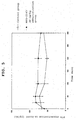
- rat PTH (1-34) was administered to OVX rat at a dose of 5 ⁇ g/kg, the PTH concentration in blood shows a peak at about 175 pg/ml in 30 min, and restores its original level in 2 hr.
- the concentration in blood of NPS-2143 itself remained above 100 ng/ml even at 8 hr after administration and it was only after 24 hr when the concentration became not more than 10 ng/ml and could not be detected.
- the present invention aims at providing a compound having a calcium receptor antagonistic action.
- the present invention also aims at providing a pharmaceutical composition comprising said compound, which is effective as an agent for the treatment of a disease showing abnormal calcium homeostasis, namely, osteoporosis, hypoparathyreosis, osteosarcoma, periodontal disease, bone fracture, steoarthrosis, chronic rheumatoid arthritis, Paget's disease, humoral hypercalcemia, autosomal dominant hypocalcemia and the like, particularly as a therapeutic agent for osteoporosis, which is capable of oral administration and intermittent administration.
- the present invention aims at providing a synthetic intermediate for a compound having a calcium receptor antagonistic action.
- the present inventors have conducted intensive studies in an attempt to solve the above-mentioned problems and as a result, found that a compound of the following formula [I] has a superior calcium receptor antagonistic action and can be administered orally and intermittently, which resulted in the completion of the present invention.
- All the conventionally known calcium receptor antagonists increase PTH concentration in blood in a sustained manner and a sufficient osteogenesis promoting action cannot be expected.
- the compound of the following formula is surprisingly capable of increasing the PTH concentration in blood intermittently in a non-sustained manner, and is expected to be put into practical use as a superior therapeutic agent for osteoporosis.
- the compound represented by the following formula of the present invention is characterized by its structure wherein carbon atom adjacent to oxygen atom has R 1 and R 2 as substituents, i.e.,
- the compound of the present invention having the structure has not only a superior calcium receptor antagonistic action, but a temporary non-sustained PTH secretion promoting action, as compared to conventional compounds having the structure Accordingly, it is considered that, by administration of the compound of the present invention, an effect similar to that obtained by intermittent administration of PTH is obtained, which is extremely effective for the treatment of osteoporosis.
- the present invention relates to a compound represented by the following formula, a calcium receptor antagonist and a therapeutic agent for osteoporosis, which contains the compound as an active ingredient, and an intermediate compound useful for the synthesis of the compound. More particularly, the present invention provides the following (1) to (21).
- the "aryl group” is aromatic hydrocarbon group having 6 to 12 carbon atoms, which may be partly saturated. Examples thereof include phenyl group, biphenyl group, indenyl group, naphthyl and the like. Preferred are phenyl group and naphthyl group, and particularly preferred is phenyl group. These aryl groups are optionally substituted by the substituents to be mentioned later. The position of the bond of these aryl groups and the position of the substituent when substituted are not particularly limited as long as they are chemically acceptable.
- heteroaryl group shows a 5-menbered to 6-membered unsaturated ring containing 1 to 3 heteroatoms in the ring, which is selected from nitrogen atom, oxygen atom and sulfur atom, including a fused ring with a benzene ring or other hetero ring.
- heteroaryl groups examples include pyrrolyl group, furyl group, thienyl group, imidazolyl group, oxazolyl group, thiazolyl group, pyrazolyl group, isoxazolyl group, isothiazolyl group, oxadiazolyl group, triazolyl group, indolyl group, benzofuryl group, benzothienyl group, benzimidazolyl group, benzoxazolyl group, benzothiazolyl group, pyridyl group, pyrimidinyl group, quinolyl group, isoquinolyl group and the like.
- benzofuryl group benzothienyl group, benzimidazolyl group, benzoxazolyl group, benzothiazolyl group, pyridyl group and quinolyl group.
- These heteroaryl groups may be substituted by the substituents to be mentioned later.
- the position of the bond of these heteroaryl groups and the position of the substituent when substituted are not particularly limited as long as they are chemically acceptable.
- halogen atom is fluorine atom, chlorine atom, bromine atom or iodine atom, preferably fluorine atom and chlorine atom, and particularly preferably chlorine atom.
- C 1-6 alkyl group is linear or branched chain alkyl group having 1 to 6, preferably 1 to 4, carbon atoms, and is exemplified by methyl group, ethyl group, propyl group, isopropyl group, butyl group, isobutyl group, tert-butyl group, pentyl group, isopentyl group, tert-pentyl group, hexyl group and the like, with preference given to C 1-4 alkyl group selected from methyl group, ethyl group, propyl group, isopropyl group, butyl group, isobutyl group and tert-butyl group.
- halo(C 1-6 )alkyl group is haloalkyl group wherein the aforementioned "C 1-6 alkyl group” is substituted by one or more halogen atoms.
- the position of the substituent is not particularly limited as long as it is chemically acceptable.
- halo(C 1-6 )alkyl group examples include fluoromethyl group, difluoromethyl group, trifluoromethyl group, chloromethyl group, dichloromethyl group, trichloromethyl group, bromomethyl group, dibromomethyl group, tribromomethyl group, iodomethyl group, diiodomethyl group, triiodomethyl group, 2-fluoroethyl group, 2,2-difluoroethyl group, 2,2,2-trifluoroethyl group, 2-chloroethyl group, 2,2-dichloroethyl group, 2,2,2-trichloroethyl group, 2-bromoethyl group, 2,2-dibromoethyl group, 2,2,2-tribromoethyl group, 3-chloropropyl group, 4-chlorobutyl group and the like, with preference given to halo(C 1-2 )alkyl group such as trifluoromethyl group and 2,
- hydroxy(C 1-6 )alkyl group is hydroxyalkyl group wherein the aforementioned "C 1-6 alkyl group” is substituted by hydroxyl group.
- the position of the substituent is not particularly limited as long as it is chemically acceptable.
- hydroxy(C 1-6 )alkyl group examples include hydroxymethyl group, 1-hydroxyethyl group, 2-hydroxyethyl group, 1-hydroxypropyl group, 2-hydroxypropyl group, 3-hydroxypropyl group, 2-hydroxy-1-methylethyl group, 1-hydroxybutyl group, 2-hydroxybutyl group, 3-hydroxybutyl group, 4-hydroxybutyl group, 3-hydroxy-2-methylpropyl group, 2-hydroxy-1,1-dimethylethyl group, 5-hydroxypentyl group, 6-hydroxyhexyl group and the like, with preference given to hydroxy C 1-4 alkyl group selected from hydroxymethyl group, 2-hydroxyethyl group, 3-hydroxypropyl group and 4-hydroxybutyl group.
- the "C 1-6 alkoxy group” is linear or branched chain alkoxy group having 1 to 6, preferably 1 to 4, carbon atoms. Examples thereof include methoxy group, ethoxy group, propoxy group, isopropoxy group, butoxy group, tert-butoxy group, pentyloxy group, tert-pentyloxy group, hexyloxy group and the like, with preference given to C 1-4 alkoxy group selected from methoxy group, ethoxy group, propoxy group, isopropoxy group, butoxy group and tert-butoxy group.
- C 1-6 alkoxy(C 1-6 )alkyl group is alkoxyalkyl group wherein the aforementioned "C 1-6 alkyl group” is substituted by the aforementioned "C 1-6 alkoxy group”.
- the position of the substituent is not particularly limited as long as it is chemically acceptable.
- C 1-6 alkoxy(C 1-6 )alkyl group examples include methoxymethyl group, ethoxymethyl group, propoxymethyl group, butoxymethyl group, pentyloxymethyl group, hexyloxymethyl group, 1-methoxyethyl group, 1-ethoxyethyl group, 2-methoxyethyl group, 2-ethoxyethyl group, 1-methoxypropyl group, 1-ethoxypropyl group, 2-methoxypropyl group, 2-ethoxypropyl group, 3-methoxypropyl group, 3-ethoxypropyl group, 2-methoxy-1-methylethyl group, 1-methoxybutyl group, 1-ethoxybutyl group, 2-methoxybutyl group, 2-ethoxybutyl group, 3-methoxybutyl group, 3-ethoxybutyl group, 4-methoxybutyl group, 4-ethoxybutyl group, 3-methoxy-2-methylpropyl group, 2-methoxybut
- halo(C 1-6 )alkoxy group is haloalkoxy group wherein the aforementioned "C 1-6 alkoxy group” is substituted by one or more halogen atoms.
- the position of the substituent is not particularly limited as long as it is chemically acceptable.
- halo(C 1-6 )alkoxy group examples include fluoromethoxy group, difluoromethoxy group, trifluoromethoxy group, chloromethoxy group, dichloromethoxy group, trichloromethoxy group, bromomethoxy group, dibromomethoxy group, tribromomethoxy group, iodomethoxy group, diiodomethoxy group, triiodomethoxy group, 2-fluoroethoxy group, 2,2-difluoroethoxy group, 2,2,2-trifluoroethoxy group, 2-chloroethoxy group, 2,2-dichloroethoxy group, 2,2,2-trichloroethoxy group, 2-bromoethoxy group, 2,2-dibromoethoxy group, 2,2,2-tribromoethoxy group, 3-chloropropoxy group, 4-chlorobutoxy group and the like, with preference given to halo(C 1-2 )alkoxy group such as trifluoromethoxy group,
- C 1-6 alkylthio group is linear or branched chain alkylthio group having 1 to 6, preferably 1 to 4, carbon atoms. Examples thereof include methylthio group, ethylthio group, propylthio group, isopropylthio group, butylthio group, tert-butylthio group, pentylthio group, tent-pentylthio group, hexylthio group and the like, with preference given to C 1-4 alkylthio group selected from methylthio group, ethylthio group, propylthio group, isopropylthio group, butylthio group and tert-butylthio group.
- C 1-6 alkylsulfanyl group is linear or branched chain alkylsulfanyl group having 1 to 6 carbon atoms. Examples thereof include methylsulfanyl group, ethylsulfanyl group, propylsulfanyl group, isopropylsulfanyl group, butylsulfanyl group, tent-butylsulfanyl group, pentylsulfanyl group, tert-pentylsulfanyl group, hexylsulfanyl group and the like, with preference given to methylsulfanyl group, ethylsulfanyl group, propylsulfanyl group, isopropylsulfanyl group, butylsulfanyl group and tert-butylsulfanyl group, all of which having 1 to 4 carbon atoms.
- C 1-6 alkylsulfonyl group is linear or branched chain alkylsulfonyl group having 1 to 6 carbon atoms. Examples thereof include methylsulfonyl group, ethylsulfonyl group, propylsulfonyl group, isopropylsulfonyl group, butylsulfonyl group, tert-butylsulfonyl group, pentylsulfonyl group, tert-pentylsulfonyl group, hexylsulfonyl group and the like, with preference given to methylsulfonyl group, ethylsulfonyl group, propylsulfonyl group, isopropylsulfonyl group, butylsulfonyl group and tert-butylsulfonyl group, all of which having 1 to 4 carbon atoms.
- C 1-6 alkylsulfamoyl group is sulfamoyl group monosubstituted by the aforementioned "C 1-6 alkyl group”. Examples thereof include methylsulfamoyl group, ethylsulfamoyl group, propylsulfamoyl group, isopropylsulfamoyl group, butylsulfamoyl group, tert-butylsulfamoyl group, pentylsulfamoyl group, tert-pentylsulfamoyl group; hexylsulfamoyl group and the like, with preference given to methylsulfamoyl group, ethylsulfamoyl group, propylsulfamoyl group, isopropylsulfamoyl group, butylsulfamoyl group and tert-butylsulfamo
- the "di(C 1-6 )alkylsulfamoyl group” is sulfamoyl group disubstituted by the aforementioned "C 1-6 alkyl group". Examples thereof include dimethylsulfamoyl group, diethylsulfamoyl group, dipropylsulfamoyl group, diisopropylsulfamoyl group, dibutylsulfamoyl group, diisobutylsulfamoyl group, di-tert-butylsulfamoyl group, dipentylsulfamoyl group, ethylmethylsulfamoyl group, methylpropylsulfamoyl group, butylmethylsulfamoyl group, ethylpropylsulfamoyl group, ethylbutylsulfamoyl group and the like, with preference given to dimethylsulfam
- the "(C 1-6 alkoxy)carbonyl group” is alkoxycarbonyl group wherein the C 1-6 alkoxy moiety is exemplified by the aforementioned "C 1-6 alkoxy group”. Examples thereof include methoxycarbonyl group, ethoxycarbonyl group, propoxycarbonyl group, isopropoxycarbonyl group, butoxycarbonyl group, isobutoxycarbonyl group, tert-butoxycarbonyl group, pentyloxycarbonyl group, hexyloxycarbonyl group and the like, with preference given to (C 1-4 alkoxy)carbonyl group selected from methoxycarbonyl group, ethoxycarbonyl group, propoxycarbonyl group, isopropoxycarbonyl group, butoxycarbonyl group and tert-butoxycarbonyl group.
- the "C 1-7 acyl group” is alkanoyl group or aroyl group having 1 to 7 carbon atoms. Examples thereof include formyl group, acetyl group, propionyl group, butyryl group, pivaloyl group, benzoyl group and the like, with preference given to formyl group, acetyl group, pivaloyl group and benzoyl group.
- (C 1-6 alkyl)carbamoyl group is alkylcarbamoyl group wherein the carbamoyl group is substituted by C 1-6 alkyl group exemplified for the aforementioned "C 1-6 alkyl group”.
- Examples thereof include methylcarbamoyl group, ethylcarbamoyl group, propylcarbamoyl group, isopropylcarbamoyl group, butylcarbamoyl group, tert-butylcarbamoyl group, pentylcarbamoyl group, tert-pentylcarbamoyl group, hexylcarbamoyl group and the like, with preference given to (C 1-4 alkyl)carbamoyl group selected from methylcarbamoyl group, ethylcarbamoyl group, propylcarbamoyl group, isopropylcarbamoyl group, butylcarbamoyl group and tert-butylcarbamoyl group.
- the "di(C 1-6 alkyl)carbamoyl group” is dialkylcarbamoyl group wherein the carbamoyl group is disubstituted by the aforementioned "C 1-6 alkyl group", and the kind of the alkyl groups may be different.
- Examples thereof include dimethylcarbamoyl group, diethylcarbamoyl group, dipropylcarbamoyl group, diisopropylcarbamoyl group, dibutylcarbamoyl group, di-tert-butylcarbamoyl group, dipentylcarbamoyl group, di-tert-pentylcarbamoyl group, dihexylcarbamoyl group, methylethylcarbamoyl group, methylpropylcarbamoyl group, methylbutylcarbamoyl group, ethylpropylcarbamoyl group, ethylbutylcarbamoyl group and the like, with preference given to di(C 1-4 alkyl)carbamoyl group selected from dimethylcarbamoyl group, diethylcarbamoyl group, dipropylcarbamoyl group, dibut
- C 1-6 alkylamino group is alkylamino group wherein the amino group is substituted by the aforementioned "C 1-6 alkyl group”. Examples thereof include methylamino group, ethylamino group, propylamino group, isopropylamino group, butylamino group, isobutylamino group, tert-butylamino group, pentylamino group, isopentylamino group, tert-pentylamino group, hexylamino group and the like, with preference given to C 1-4 alkylamino group selected from methylamino group, ethylamino group, propylamino group, isopropylamino group, butylamino group, isobutylamino group and tert-butylamino group.
- the "di C 1-6 alkylamino group” is dialkylamino group wherein the amino group is disubstituted by the aforementioned "C 1-6 alkyl group", and the kind of the alkyl groups may be different. Examples thereof include dimethylamino group, ethylmethylamino group, diethylamino group, methylpropylamino group, ethylpropylamino group, dipropylamino group, diisopropylamino group, dibutylamino group, diisobutylamino group, di-tert-butylamino group, dipentylamino group, diisopentylamino group, di-tert-pentylamino group, dihexylamino group and the like, with preference given to di(C 1-4 )alkylamino group selected from dimethylamino group, diethylamino group, dipropylamino group, diisopropylamino group, di
- the "C 1-7 acylamino group” is amino group substituted by the aforementioned "C 1-7 acyl group". Examples thereof include alkanoylamino group such as formylamino group, acetylamino group, propionylamino group, butyrylamino group, pivaloylamino group and the like; and aroylamino group wherein aryl group optionally has 1 to 3 substituents, such as benzoylamino group and the like, with preference given to formylamino group, acetylamino group, pivaloylamino group and benzoylamino group.
- C 3-7 cycloalkyl group is cyclic alkyl group having 3 to 7, preferably 3 to 6, carbon atoms. Examples thereof include cyclopropyl group, cyclobutyl group, cyclopentyl group, cyclohexyl group, cycloheptyl group and the like. Preferred are C 3-5 cycloalkyl group such as cyclopropyl group, cyclobutyl group, cyclopentyl group and the like, more preferred are cyclopropyl group and cyclobutyl group, and particularly preferred is cyclopropyl group.
- the "C 2-6 alkenyl group” is alkenyl group having 2 to 6 carbon atoms. Examples thereof include vinyl group, 1-propenyl group, allyl group, 1-butenyl group, 2-butenyl group, 3-butenyl group, 1-pentenyl group, 2-pentenyl group, 3-pentenyl group, 4-pentenyl group, 5-hexenyl group and the like, with preference given to C 2-4 alkenyl group such as vinyl group, allyl group and the like.
- C 2-6 alkynyl group is alkynyl group having 2 to 6, preferably 2 to 4, carbon atoms. Examples thereof include ethynyl group, 1-propynyl group, 2-propynyl group, 1-butynyl group, 2-butynyl group, 3-butynyl group, 1-pentynyl group, 2-pentynyl group, 3-pentynyl group, 4-pentynyl group, 5-hexynyl group and the like, with preference given to C 2-4 alkynyl group selected from ethynyl group, 1-propynyl group and 2-propynyl group.
- the “aralkyl group” is arylalkyl group wherein the aforementioned "C 1-6 alkyl group” is substituted by the aforementioned "aryl group”.
- the position of the substituent is not particularly limited as long as it is chemically acceptable.
- Examples of “aralkyl group” include benzyl group, phenethyl group, 3-phenylpropyl group, 4-phenylbutyl group, 5-phenylpentyl group, 6-phenylhexyl group, 1-naphthylmethyl group, 2-naphthylmethyl group and the like, with preference given to phenyl(C 1-2 )alkyl group wherein the "aryl” moiety is phenyl and the “alkyl” moiety is methyl or ethyl, such as benzyl group and phenethyl group.
- C 1-6 alkylsulfonyloxy group is alkylsulfonyloxy group wherein the C 1-6 alkyl moiety is the aforementioned "C 1-6 alkyl group”.
- Examples thereof include methylsulfonyloxy group, ethylsulfonyloxy group, propylsulfonyloxy group, isopropylsulfonyloxy group, butylsulfonyloxy group, isobutylsulfonyloxy group, tert-butylsulfonyloxy group, pentylsulfonyloxy group, isopentylsulfonyloxy group, tert-pentylsulfonyloxy group and hexylsulfonyloxy group, with preference given to C 1-4 alkylsulfonyloxy group selected from methylsulfonyloxy group, ethylsulfonyloxy group, propy
- the "C 1-3 alkylenedioxy group” is methylenedioxy group, ethylenedioxy group or propylenedioxy group, preferably methylenedioxy group or ethylenedioxy group, and particularly preferably methylenedioxy group.
- C 1-6 alkylene group is alkylene group having 1 to 6 carbon atoms. Examples thereof include methylene group, ethylene group, propylene group, butylene group, pentylene group, hexylene group and the like, with preference given to C 1-4 alkylene group selected from methylene group, ethylene group and propylene group.
- the "C 2-6 alkynylene group” is alkynylene group having 2 to 6, preferably 2 or 3, carbon atoms. Examples thereof include vinylene group, 1-propenylene group, 2-propenylene group, 1-butenylene group, 2-butenylene group, 3-butenylene group, 1-pentenylene group, 2-pentenylene group, 3-pentenylene group, 4-pentenylene group, 1-hexenylene group, 2-hexenylene group, 3-hexenylene group, 4-hexenylene group, 5-hexenylene group and the like, with preference given to C 2-3 alkynylene group selected from vinylene group, 1-propenylene group and 2-propenylene group.
- the aryl group and heteroaryl group of the present invention are optionally substituted by 1 to 3 substituents selected from halogen atom, C 1-6 alkyl group, halo(C 1-6 )alkyl group, hydroxy(C 1-6 )alkyl group, C 1-6 alkoxy(C 1-6 )alkyl group, hydroxyl group, C 1-6 alkoxy group, halo(C 1-6 )alkoxy group, mercapto group, C 1-6 alkylthio group, C 1-6 alkylsulfanyl group, C 1-6 alkylsulfonyl group, aminosulfonyl group, C 1-6 alkylsulfamoyl group, di(C 1-6 )alkylsulfamoyl group, carboxy group, (C 1-6 alkoxy)carbonyl group, C 1-7 acyl group, carbamoyl group, (C 1-6 alkyl)carbamoyl group, di(C 1-6 alky
- the “salt" of the compound of the present invention is exemplified by, but not limited to, inorganic acid addition salts such as hydrochloride, hydrobromide, sulfate, phosphate, nitrate and the like; organic acid addition salts such as acetate, propionate, succinate, glicolate, lactate, malate, oxalate, tartrate, citrate, maleate, fumarate, methanesulfonate, benzenesulfonate, p-toluenesulfonate, ascorbate and the like; amino acid addition salts such as aspartate, glutamate and the like.
- Preferable salts are hydrochloride and fumarate, particularly preferably fumarate.
- the present invention encompasses solvates, wherein a "solvate" of the compound means that the compound of the present invention is bonded to a solvent molecule such as water, alcohol and the like via a comparatively weak bond due to van der Waals force, electrostatic interaction, hydrogen bond, charge transfer bond, coordinate bond and the like in a solid such as crystal, amorphous and the like or a solution.
- a solvent may be taken in a solid as exemplified by hydrate, alcoholate and the like.
- Preferable solvate is hydrate.
- a "prodrug” of the compound means a derivative of the compound of the present invention, which has a chemically or metabolically decomposable group, and shows pharmaceutical activity upon hydrolysis, solvolysis or decomposition under physiological conditions.
- the compounds of the formula [I], [I-2] and [I-3] of the present invention may be present as various isomers such as optical isomer, stereoisomer, geometric isomer, tautomer and the like.
- the present invention encompasses all these isomers and mixtures thereof.
- R 1 is preferably aryl group, more preferably phenyl group or naphthyl group and particularly preferably phenyl group.
- the substituent is preferably halogen atom, C 1-4 alkyl group, hydroxy(C 1-6 )alkyl group, C 1-6 alkoxy(C 1-6 )alkyl group, hydroxyl group, C 1-4 alkoxy group, cyano group, nitro group or C 1-3 alkylenedioxy group, more preferably chlorine atom, methyl group, hydroxymethyl group, methoxy group, cyano group, nitro group, hydroxyl group or methylenedioxy group, particularly preferably methyl group, hydroxymethyl group, methoxy group or methylenedioxy group.
- R 1 is preferably selected from thienyl group, furyl group, pyridyl group and thiazolyl group, and the substituent when R 1 is heteroaryl group is preferably C 1-6 alkyl group or halogen atom, particularly preferably methyl group or bromine atom.
- R 2 is preferably optionally substituted and optionally branched C 1-4 alkyl group, C 3-5 cycloalkyl group, C 2-4 alkenyl group or aralkyl group, and the substituent of C 1-4 alkyl group is preferably C 1-4 alkoxy group.
- R 2 is more preferably methyl group, ethyl group, cyclopropyl group or cyclobutyl group, most preferably methyl group or cyclopropyl group, and particularly preferably cyclopropyl group.
- R 3 is preferably hydroxyl group, and R 4 is preferably hydrogen atom.
- R 5 and R 6 are each preferably methyl group.
- R 7 is preferably aryl group, more preferably phenyl group or naphthyl group.
- the substituent of R 7 is preferably C 1-6 alkyl group, C 1-6 alkoxy group, hydroxyl group or C 1-3 alkylenedioxy group, more preferably C 1-4 alkyl group, C 1-4 alkoxy group or C 1-3 alkylenedioxy group, most preferably C 1-4 alkyl group or C 1-4 alkoxy group, particularly preferably methyl group or methoxy group.
- R 7 is preferably naphthyl group, 4-methoxy-3-methylphenyl group or 3,4-methylenedioxyphenyl group, and particularly preferably naphthyl group or 4-methoxy-3-methylphenyl group.
- X 1 is preferably C 1-6 alkylene group, particularly preferably methylene group.
- X 2 is preferably methylene group.
- X 3 is preferably methylene group.
- X 4 and X 5 are each preferably a single bond.
- R 11 is preferably hydrogen atom, halogen atom, C 1-4 alkyl group, hydroxy(C 1-6 )alkyl group, C 1-6 alkoxy(C 1-6 )alkyl group, hydroxyl group, C 1-4 alkoxy group, cyano group or nitro group, more preferably hydrogen atom, chlorine atom, methyl group, hydroxymethyl group, methoxy group, cyano group, hydroxyl group or nitro group, particularly preferably hydrogen atom.
- R 12 is preferably hydrogen atom, halogen atom, C 1-4 alkyl group, hydroxy(C 1-6 )alkyl group, C 1-6 alkoxy(C 1-6 )alkyl group, hydroxyl group, C 1-4 alkoxy group, cyano group or nitro group, more preferably chlorine atom, methyl group, hydroxymethyl group, methoxy group, cyano group, hydroxyl group or nitro group, particularly preferably methyl group, hydroxymethyl group or methoxy group.
- R 21 is preferably methyl group, ethyl group, cyclopropyl group or cyclobutyl group, more preferably methyl group or cyclopropyl group, particularly preferably cyclopropyl group.
- a preferable embodiment of the compound [I] of the present invention is compound [I-2], and more preferably compound [I-3].
- the compound of the present invention When the compound of the present invention is used as a pharmaceutical product, its form is the compound itself (free form), a salt of the compound, a solvate of the compound or a prodrug of the compound, which is preferably a free form, a salt of the compound or a solvate of the compound, particularly preferably a salt of the compound.
- the production method of the compound of the formula [I] of the present invention is explained in detail. It is needless to say that the present invention is not limited to these production methods.
- the construction can be started from the moiety easily produced.
- a reactive functional group is involved in each step, it may be protected or deprotected as appropriate.
- a reagent other than the exemplified reagent can be used as appropriate.
- any compound obtained in each step can be isolated and purified by a conventional method, and in some cases, the next step is performed without isolation or purification.
- X is halogen atom
- L 1 and L 2 are each a leaving group, such as halogen atom and sulfonyloxy group (e.g., 3-nitrobenzenesulfonyloxy group, p-toluenesulfonyloxy group, benzenesulfonyloxy group, p-bromobenzenesulfonyloxy group, methanesulfonyloxy group, trifluoromethanesulfonyloxy group and the like),
- R 3' is oxygen atom or sulfur atom, and other symbols are as defined above.
- compound (6) By reacting aldehyde compound (4) with Grignard reagent (5) in diethyl ether, tetrahydrofuran, 1,4-dioxane and the like or a mixed solvent thereof at a temperature of from -80°C to room temperature, compound (6) can be obtained.
- the Grignard reagent can be prepared by a known method.
- ketone compound (4') is reduced with a reducing agent such as lithium aluminum hydride, sodium borohydride, lithium borohydride and the like in diethyl ether, tetrahydrofuran, 1,4-dioxane, isopropanol and the like or a mixed solvent thereof at a temperature of from -10°C to room temperature to give compound (6).
- a reducing agent such as lithium aluminum hydride, sodium borohydride, lithium borohydride and the like in diethyl ether, tetrahydrofuran, 1,4-dioxane, isopropanol and the like or a mixed solvent thereof at a temperature of from -10°C to room temperature to give compound (6).
- asymmetric reduction using an asymmetric reducing agent such as B-chlorodiisopinocampheylborane and the like
- asymmetric hydrogenation using a ruthenium complex such as dichloro[(S)-(-)-2,2'-bis(diphenylphosphino)-1,1'-binaphthyl]ruthenium (II) and the like can be also conducted.
- compound (7') is used instead of compound (7).
- alkylammonium hydrogensulfate such as tetrabutylammonium hydrogensulfate and the like can be added.
- compound (8') by reacting compound (8') with compound (9) in methanol, ethanol, n-propanol, isopropanol, tetrahydrofuran, 1,4-dioxane, acetonitrile, toluene and the like or a mixed solvent thereof at a temperature of from room temperature to refluxing temperature, a compound of the formula [I] wherein R 3 is hydroxyl group or mercapto group, R 4 is hydrogen atom and X 2 is methylene group can be obtained.
- alkali perchlorate such as lithium perchlorate and the like is preferably added.
- an acid addition salt of compound of the formula [I] is desired, a known method can be used.
- compound of the formula [I] is dissolved in water, methanol, ethanol, n-propanol, isopropanol, diethyl ether, tetrahydrofuran, 1,4-dioxane, ethyl acetate, dichloromethane, 1,2-dichloroethane, chloroform and the like or a mixed solvent of these, the above-mentioned solvent, in which a desired acid has been dissolved, is added and the precipitated crystals are collected by filtration, or the solution is concentrated under reduced pressure.
- the acid addition salt of the compound of the formula [I] is converted to a free form
- the acid addition salt of the compound of the formula [I] is subjected to partitioning between two phases of an aqueous solution of a base such as sodium hydrogencarbonate, potassium hydrogencarbonate, sodium carbonate, potassium carbonate, sodium hydroxide, potassium hydroxide, lithium hydroxide and the like and a solvent such as ethyl acetate, dichloromethane, 1,2-dichloroethane, chloroform, methyl ethyl ketone, toluene and the like to give a free form of the compound of the formula [I].
- a base such as sodium hydrogencarbonate, potassium hydrogencarbonate, sodium carbonate, potassium carbonate, sodium hydroxide, potassium hydroxide, lithium hydroxide and the like
- a solvent such as ethyl acetate, dichloromethane, 1,2-dichloroethane, chloroform, methyl ethyl ketone, tolu
- the compound (4') can be prepared by the following method. wherein each symbol is as defined above.
- compound (11) By reacting compound (10) with N,O-dimethylhydroxylamine or a salt thereof in a solvent such as dichloromethane, chloroform, 1,2-dichloroethane, tetrahydrofuran, 1,4-dioxane and the like in the presence of a base such as triethylamine, N,N-diisopropylethylamine and the like, compound (11) can be obtained.
- a solvent such as dichloromethane, chloroform, 1,2-dichloroethane, tetrahydrofuran, 1,4-dioxane and the like
- a base such as triethylamine, N,N-diisopropylethylamine and the like
- the compound (9) can be prepared by the following method. wherein Rh is carboxy-protecting group such as benzyl group, tert-butyl group and the like and each of other symbols is as defined above.
- compound (14) By reacting compound (12) with compound (13) in a solvent such as tetrahydrofuran, n-hexane and the like in the presence of a base such as n-butyllithium and the like and hexamethylphosphoramide, compound (14) can be obtained.
- a solvent such as tetrahydrofuran, n-hexane and the like
- a base such as n-butyllithium and the like and hexamethylphosphoramide
- compound (14) to be obtained in Step 6 is subjected to Curtius rearrangement to give compound (15).
- the compound (14) is reacted with alkyl halocarbonate such as ethyl chlorocarbonate and the like in water, acetone, methyl ethyl ketone and the like or a mixed solvent thereof in the presence of a base such as triethylamine, N,N-diisopropylethylamine and the like.
- a base such as triethylamine, N,N-diisopropylethylamine and the like.
- sodium azide is reacted, and the obtained compound is subjected to rearrangement under heating and reacted with alcohol represented by Rh-OH to give compound (15).
- -CO 2 Rh of compound (15) to be obtained in Step 7 is deprotected by a method generally employed for removing this protecting group.
- a method generally employed for removing this protecting group For example, when Rh is benzyl group, compound (15) is subjected to hydrogenation using a catalyst such as palladium carbon, palladium black, palladium hydroxide on carbon, Raney-nickel and the like in a solvent such as methanol, ethanol, n-propanol, isopropanol, tetrahydrofuran, 1,4-dioxane and the like to give compound (9).
- Rh is tert-butyl group
- a reaction using an acid such as hydrogen chloride, sulfuric acid, hydrogen bromide and the like in water, methanol, ethanol, n-propanol, isopropanol, tetrahydrofuran, 1,4-dioxane, acetic acid and the like or a mixed solvent thereof gives compound (9).
- compound (18) By reacting compound (17) with compound (16) in a solvent such as tetrahydrofuran, n-hexane and the like in the presence of abase such as n-butyllithium and the like, compound (18) can be obtained.
- a solvent such as tetrahydrofuran, n-hexane and the like
- abase such as n-butyllithium and the like
- the compound (9') can be also obtained by reacting compound (19) in a solvent such as water, methanol, ethanol, n-propanol, isopropanol, tetrahydrofuran, 1,4-dioxane, ethylene glycol and the like using a base such as sodium hydroxide, potassium hydroxide, lithium hydroxide and the like under heating.
- a solvent such as water, methanol, ethanol, n-propanol, isopropanol, tetrahydrofuran, 1,4-dioxane, ethylene glycol and the like
- a base such as sodium hydroxide, potassium hydroxide, lithium hydroxide and the like under heating.
- the compound (9') can be also obtained by the following method. wherein each symbol is as defined above.
- compound (22) By reacting compound (21) with compound (20) in a solvent such as tetrahydrofuran, N,N-dimethylformamide, dimethyl sulfoxide and the like, in the presence of tetraalkylammonium halide such as tetrabutylammonium fluoride and the like and trialkylhalosilane such as tert-butyldimethylchlorosilane and the like, compound (22) can be obtained.
- a solvent such as tetrahydrofuran, N,N-dimethylformamide, dimethyl sulfoxide and the like
- compound (23) By subjecting compound (22) to be obtained in Step 12 to halogenation using a halogenating agent such as thionyl chloride, oxalyl chloride and the like, compound (23) can be obtained.
- a halogenating agent such as thionyl chloride, oxalyl chloride and the like
- the halogenating agent itself to be used may be used as a solvent, or a solvent such as dichloromethane, chloroform, 1,2-dichloroethane, tetrahydrofuran, 1,4-dioxane and the like may be used.
- compound (24) By subjecting compound (23) to be obtained in Step 13 to hydrogenation in a solvent such as methanol, ethanol, n-propanol, isopropanol, tetrahydrofuran, 1,4-dioxane, ethyl acetate and the like in the presence of a catalyst such as palladium carbon, palladium black, palladium hydroxide on carbon and the like, compound (24) can be obtained. In this reaction, pressurization to some extent is preferable.
- compound (9') By subjecting compound (24) to be obtained in Step 24 to hydrogenation using a catalyst such as Raney-nickel and the like in a solvent such as methanol, ethanol, n-propanol, isopropanol, tetrahydrofuran, 1,4-dioxane and the like, compound (9') can be obtained. In this reaction, pressurization to some extent is preferable.
- the thus-obtained compound of the formula [I] of the present invention has a superior calcium receptor antagonistic action.
- the compound of the present invention is to be used as a therapeutic agent of osteoporosis, hypoparathyreosis, osteosarcoma, periodontal disease, bone fracture, steoarthrosis, chronic rheumatoid arthritis, Paget's disease, humoral hypercalcemia, autosomal dominant hypocalcemia and the like, it is generally administered systemically or topically, and orally or parenterally.
- the dose varies depending on age, body weight, condition, treatment effect, administration method, treatment period and the like, it is generally 0.01 mg to 10 g for an adult per day, which is given once or in several portions a day by oral or parenteral administration.
- a dosage form of tablet, pill, powder, granule and the like can be employed.
- one or more active ingredient is admixed with at least one inert diluent, dispersing agent, absorbent and the like, such as lactose, mannitol, glucose, hydroxypropyl cellulose, crystalline cellulose, starch, polyvinyl hydrin, magnesium aluminometasilicate, anhydrous silicic acid powder and the like.
- the composition may contain an additive other than diluent according to a conventional method.
- gastric or enteric film of sucrose, gelatin, hydroxypropyl cellulose, hydroxymethylcellulose phthalate and the like may be applied or two or more layers may be formed.
- they may be prepared into capsules of gelatin or ethylcellulose.
- a dosage form such as pharmaceutically acceptable emulsion, solution, suspension, syrup, elixir and the like can be employed.
- the diluent to be used is, for example, purified water, ethanol, vegitable oil, emulsifier and the like.
- This composition may contain diluent and an adjuvant other than the diluent, such as wetting agent, suspending agent, sweetener, flavor, perfume, preservative and the like.
- aqueous or nonaqueous solvent For preparation of parenteral injection, sterile aqueous or nonaqueous solvent, solubilizer, suspending agent or emulsifier is used.
- aqueous solvent, solubilizer and suspending agent include distilled water for injection, physiological saline, cyclodextrin and derivatives thereof, organic amines such as triethanolamine, diethanolamine, monoethanolamine, triethylamine and the like, inorganic alkali solution and the like.
- a water-soluble solvent for example, propylene glycol, polyethylene glycol, vegetable oil such as olive oil, alcohol such as ethanol, and the like may be used.
- solubilizer for example, surfactant (forming a mixed micelle) such as polyoxyethylene hydrogenated castor oil, sucrose esters of fatty acid and the like, lecithin or hydrogenated lecithin (forming a liposome) and the like can be used.
- an emulsion preparation consisting of a water-insoluble solvent such as vegetable oil and the like, and lecithin, polyoxyethylene hydrogenated castor oil, polyoxyethylene polyoxypropylene glycol and the like may be formed.
- compositions for parenteral administration an external liquid, liniment such as ointment, suppository, pessary and the like, containing one or more active ingredients and prepared by a method known per se may be formulated.
- o-anisaldehyde (8.17 g) was dissolved in tetrahydrofuran (150 ml), the 1M cyclopropylmagnesium bromide-tetrahydrofuran solution (90 ml) was added dropwise thereto over 50 min under ice-cooling, and the mixture was stirred at room temperature for 12 hr.
- the reaction mixture was ice-cooled, a saturated aqueous ammonium chloride solution (9 ml) was added, and the reaction mixture was stirred at room temperature for 30 min.
- the organic layer was dried over magnesium sulfate and concentrated under reduced pressure.
- the reaction mixture was ice-cooled, 6N hydrochloric acid (665 ml) was added thereto, and the organic layer was separated from the aqueous layer. The separated organic layer was concentrated under reduced pressure to yield a residue.
- ethyl acetate and water were added to an aqueous layer and the organic layer was separated from the aqueous layer.
- the organic layer and the aforementioned residue were combined and washed three times with water.
- the organic layer was extracted with a solution of sodium hydroxide (80 g) in water (600 ml), and then extracted three times with a 4N aqueous sodium hydroxide solution (200 ml). The aqueous layer was washed with ethyl acetate, acidified with conc.
- 2,2-Dimethyl-3-(naphthalen-2-yl)propionic acid (205.4 g) obtained in Step 10 was dissolved in water (173 ml), triethylamine (131 ml) and acetone (800 ml), and a solution of ethyl chlorocarbonate (101.5 ml) in acetone (400 ml) was added under ice-cooling.
- a solution of sodium azide (73.1 g) in water (400 ml) was added dropwise, and the reaction mixture was stirred at room temperature for 2 hr.
- To the reaction mixture were added water (1.5 L) and toluene (1.2 L) , and the organic layer was separated from the aqueous layer.
- the organic layer was washed twice with water and three times with a saturated aqueous sodium chloride solution, and dried over anhydrous sodium sulfate. After the drying agent was filtered off, the filtrate was heated to 100°C over 4 hr under an argon atmosphere, and stirred at 100°C for 1 hr.
- the reaction mixture was concentrated under reduced pressure and benzyl alcohol (500 ml) was added. The mixture was stirred at 105°C for 1 day.
- the reaction mixture was concentrated under reduced pressure, and ethyl acetate and n-hexane were added to the obtained residue.
- Lithium aluminum hydride (1.52 g) was suspended in tetrahydrofuran (100 ml), 2'-methoxyacetophenone (2.76 ml) was added under ice-cooling, and the mixture was stirred for 30 min. To the reaction mixture were successively added water (1.5 ml), 15% aqueous sodium hydroxide solution (1.5 ml) and water (4.5 ml). The organic layer was dried over magnesium sulfate and concentrated under reduced pressure to give the title compound (3.05 g).
- Example 9 - Example 20 were obtained. They are shown in Table 1 and Table 2.
- N-methoxy-2,N-dimethylbenzamide (3.55 g) obtained in Step 1 in tetrahydrofuran (40 ml) was added dropwise a solution (29.7 ml) of 1M cyclopropylmagnesium bromide-tetrahydrofuran under ice-cooling, and the mixture was stirred at room temperature for 12 hr.
- a 4N hydrogen chloride-ethyl acetate solution (10 ml), and the resulting mixture was concentrated under reduced pressure.
- Example 25 the compounds of Example 25 - Example 56 were obtained. They are shown in Table 3 - Table 7.
- Luciferase cDNA and human calcium receptor cDNA were transfected into a cell strain derived from rat adrenal and the transformed cells were cultured overnight in a medium (F12 medium containing 0.5% dialyzed horse serum and 0.25% dialyzed bovine fetal serum). The next day, a dimethyl sulfoxide solution containing a test compound at 0.01 - 100 mM was diluted 100-fold with the medium and added to the test compound group at 10 ⁇ l per well. A medium containing 50 mM calcium chloride was added to the control group at 10 ⁇ l per well, such that the final calcium concentration of the medium became 5 mM. A medium alone was added to the blank group.
- Inhibitory rate (%) 100 - measured value of compound group - measured value of blank group measured value of control group - measured value of blank group ⁇ 100
- test compound was orally administered to 6 to 9-week-old male SD rats (Charles River Japan, Inc.) fasted for 20 hr, using a solvent (5% ethanol, 0.5% aqueous methyl cellulose solution) at a dose of 30 mg/5 ml/kg and 100 mg/5 ml/kg.
- a solvent alone was orally administered to the control group at a dose of 5 ml/kg.
- the blood was drawn from the tail vein immediately before and 0.5, 1, 2, 4, 6 hr after the administration of the test compound, and sera were obtained.
- the serum PTH concentration was measured using rat PTH (1-84) ELISA kit (Nohon Medi-Physics).
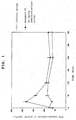
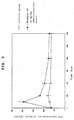
- Fig. 1 shows the time-course changes of the serum PTH concentration at the dose (30 mg/kg) of Example 22, Example 23 and Example 24 are shown.
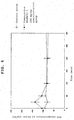
- Fig. 4 shows the time-course changes of the serum PTH concentration at the dose of Comparative Example 1 (100 mg/kg)
- Fig. 5 shows the time-course changes of the serum PTH concentration at the dose of NPS-2143 of 30 mg/kg.
- test compound IC 50 serum PTH concentration (pg/ml) Before administration 30 min later later later 240 min later 30 mg/kg administration group (upper line) 100 mg/kg administration group (lower line)
- Example 1 0.041 56.9 ⁇ 9.4 141.5 ⁇ 15.3 54.1 ⁇ 7.7 55.8 ⁇ 3.9 160.0 ⁇ 13.8 58.3 ⁇ 7.3
- Example 2 0.027 52.0 ⁇ 3.4 148.4 ⁇ 10.1 60.0 ⁇ 5.8 68.9 ⁇ 7.6 154.8 ⁇ 17.1 85.8 ⁇ 17.3
- Example 5 0.070 78.9 ⁇ 11.8 155.6 ⁇ 14.9 84.8 ⁇ 12.3 - - -
- Example 22 0.059 62.2 ⁇ 5.2 185.7 ⁇ 10.0 73.4 ⁇ 11.0 - - -
- Example 23 0.027 85.3 ⁇ 3.6 228.3 ⁇ 15.0 73.9 ⁇ 6.9 - - -
- Example 24 0.022 66.5 ⁇ 4.3 197.7 ⁇ 18.9 77.5 ⁇ 9.0 - - -
- Example 62 0.045
- test compound was orally administered to 4 to 6-week-old female Fisher rats (Charles River Japan, Inc.) fasted for 20 hr, using a solvent (5% ethanol, 0.5% aqueous methyl cellulose solution) at a dose of'30 mg/5 ml/kg.
- a solvent alone was orally administered to the control group at a dose of 5 ml/kg.
- the blood was drawn from the tail vein immediately before and 0.5, 1, 2, 4 hr after the administration of the test compound, and sera were obtained.
- the serum PTH concentration was measured using rat PTH (1-84) ELISA kit (Nohon Medi-Physics). The results of the serum PTH concentration before and 30 min and 4 hr after the administration of the test compound are shown in Table 26.
- test compound serum PTH concentration (pg/ml) Before administration 30 min later 240 min later
- Example 58 179.2 ⁇ 45.6 644.4 ⁇ 65.2 394.1 ⁇ 100.9
- Example 59 189.8 ⁇ 90.9 313.4 ⁇ 103.3 62.2 ⁇ 10.3
- Example 62 82.9 ⁇ 24.5 620.6 ⁇ 34.2 100.1 ⁇ 11.7 (mean ⁇ S.E.)
- the compound to be used for this end should have at least the following properties.
- the IC 50 value of the compound of the present invention is not more than 1 ⁇ M, and the compound has a sufficient antagonistic action on calcium receptors.
- the compound of the present invention is considered to be preferable in view of the IC 50 value.
- the compound of the formula [I] of the present invention has a superior calcium receptor antagonistic action. Accordingly, the compound is expected to be useful as a therapeutic drug of diseases accompanied by abnormal calcium homeostasis, such as osteoporosis, hypoparathyreosis, osteosarcoma, periodontal disease, bone fracture, steoarthrosis, chronic rheumatoid arthritis, Paget's disease, humoral hypercalcemia, autosomal dominant hypocalcemia and the like. As is clear from Experimental Examples 2 and 3, the compound of the present invention has a temporary PTH secretion promoting action. Accordingly, the compound is particularly useful as a therapeutic agent for osteoporosis.
- diseases accompanied by abnormal calcium homeostasis such as osteoporosis, hypoparathyreosis, osteosarcoma, periodontal disease, bone fracture, steoarthrosis, chronic rheumatoid arthritis, Paget's disease, humoral hypercalcemia, autosomal dominant hypocalcemia and the like
Landscapes
- Chemical & Material Sciences (AREA)
- Organic Chemistry (AREA)
- Pharmaceuticals Containing Other Organic And Inorganic Compounds (AREA)
- Acyclic And Carbocyclic Compounds In Medicinal Compositions (AREA)
Abstract

Description
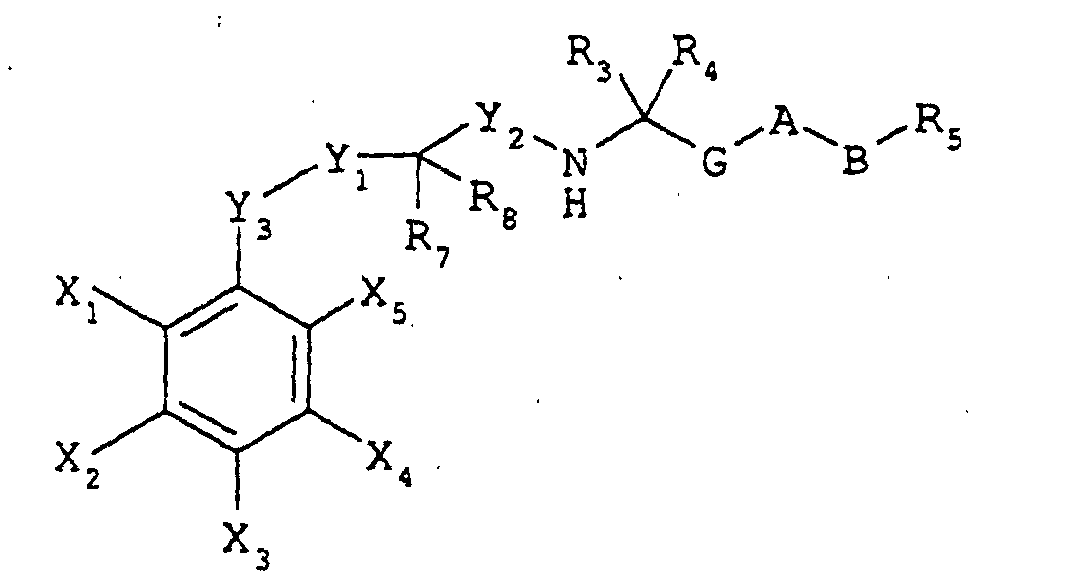
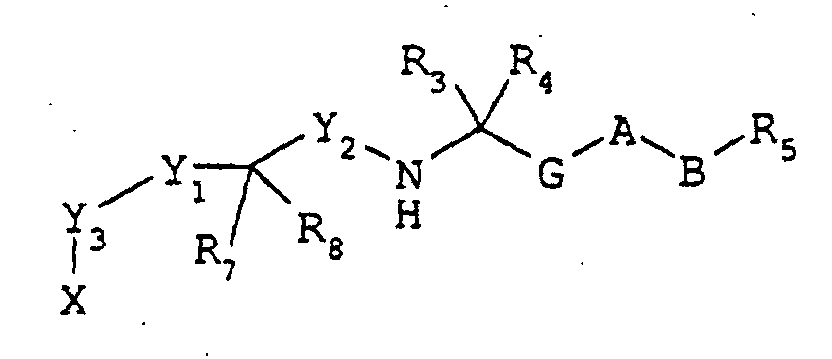
or R5 is heteroaryl or fused heteroaryl; wherein the hetero-ring contains N, O or S, and is aromatic, dihydro or tetrahydro, unsubstituted or substituted with any substituents being selected from the group consisting of OH, OCH3, CH(CH3)2, halogen, C1-4 alkyl, C1-4 alkoxy, C3-6 cycloalkyl, OSO2RIV, CN, NO2, OCF3, CF3, CH2CF3, (CH2)nCO2H, (CH2)nCO2RIV, and O- (CH2)nCO2RIV; G is a covalent bond, CHR6 or C-R6, wherein R6 is H, OH or O (forming a ketone) ;
wherein

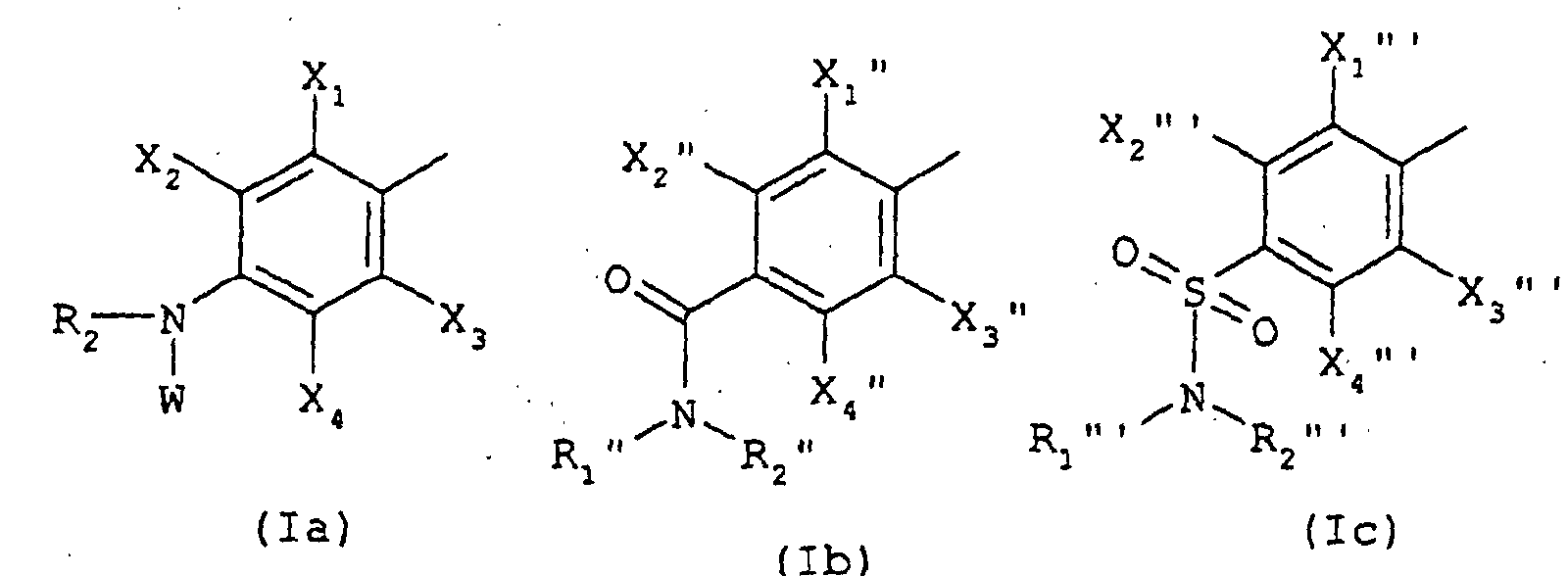

or X3" and X4" independently represent C(O)R1; and
wherein R" represents C1-4 alkyl, or C3-6 cycloalkyl; X1"' is selected from the group consisting of CN, NO2, Cl, F, Br, I, H, R, OR, CF3, OCF3 and OSO2R, wherein R represents C1-4 alkyl, or C3-6 cycloalkyl;
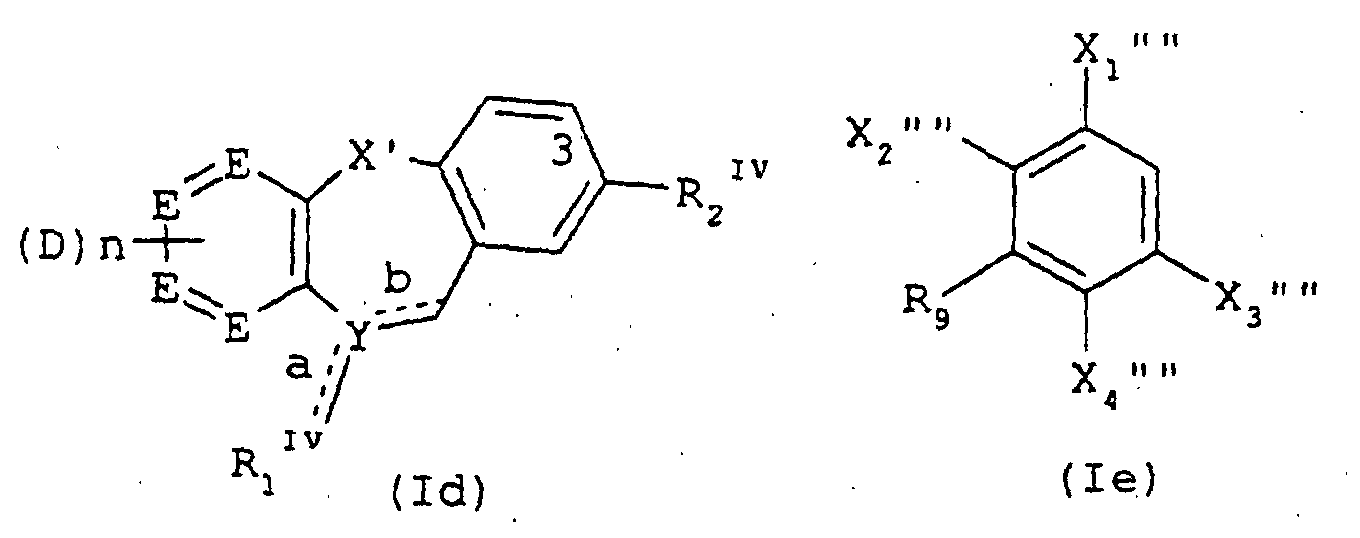
or X1"' and X2"' together form an aryl or heteroaryl ring, substituted or unsubstituted; wherein the heteroatom is selected from N, S and O and the substituents are selected from the group consisting of halo, C1-4 alkyl, OCF3, CF3, OMe, CN, OSO2-C1-4 alkyl, OSO2-C3-6 cycloalkyl and NO2;
or X3"' and X4"' independently represent C(O)R1;
or X1"" and X2"" together form an aryl or heteroaryl ring, substituted or unsubstituted; wherein the heteroatom is selected from N, S and O and the substituents are selected from the group consisting of halo, C1-4 alkyl, OCF3, CF3, OMe, CN, OSO2-C1-4 alkyl, OSO2-C3-6 cycloalkyl and NO2;
or X3"" and X4"" independently represent C(O)R1: and pharmaceutically acceptable salts and complex thereof.


- in sub formula (Ia):
- W is selected from the group consisting of R1, SO2R1, C(O)R1,
- SO2NR1R1', C(O)NR1R1' and C(O)OR1SO3R1', wherein R1 and R1' are independently selected from the group consisting of hydrogen,
- C1-4 alkyl, C3-6 cycloalkyl, C2-5 alkenyl, C2-5 alkynyl, heterocycloalkyl aryl and aryl C1-4 alkyl; or R1 and R1' together form a 3- to 7-membered optionally substituted heterocyclic ring; wherein any substituents are selected from the group consisting of CN, aryl, CO2R, CO2NHR, OH, OR, NH2, halo, CF3, OCF3 and NO2; wherein R represents C1-4 alkyl, or C3-6 cycloalkyl;
- X1 is selected from the group consisting of CN, NO2, Cl, F, Br, I, H, R', OR', CF3, OCF3 and OSO2R', wherein R' represents C1-4 alkyl, or C3-6 cycloalkyl;
- X2, X3 and X4 are, independently, selected from the group consisting of CN, NO2, Cl, F, Br, I, H, R", OR", CF3, OCF3 and OSO2R", wherein R" is C1-4 alkyl or haloalkyl; or X1 and X2 together form an aryl or heteroaryl ring, substituted or unsubstituted; wherein the heteroatom is selected from N, S and
- O; and any substituents are selected from the group consisting of halo, C1-4 alkyl, OCF3, CF3, OMe, CN, OSO2R' and NO2; or X3 and X4 independently represent C(O)R1; provided that when there are multiple halo substitutions in the haloalkyl, halo represents F; also provide that either X1 or X3 is hydrogen; and
- R2 is selected from the group consisting of hydrogen, C1-4 alkyl, C3-6 cycloalkyl, C2-5 alkenyl, C2-5 alkynyl, heterocycloalkyl aryl and aryl-C1-4 alkyl;
provided that either X1" or X3" is hydrogen; and
provided that either X1"' or X3"' represents H; and
further provided that when n is 2, each E is C;
or R1 IV is O, forming a ketone such that YR1 IV represents -C=O;
provided that when there are multiple halo substitutions in the haloalkyl, halo represents F; also provided that either X1"" or X3"" is hydrogen;

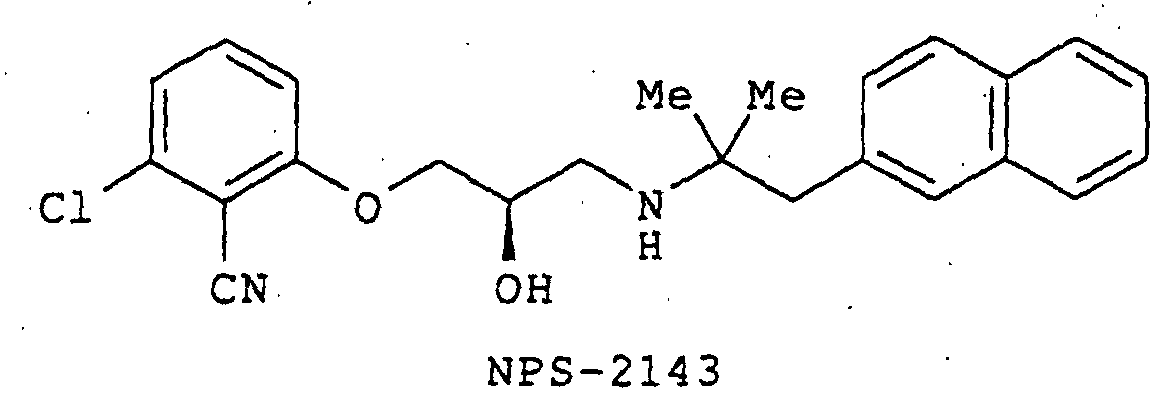
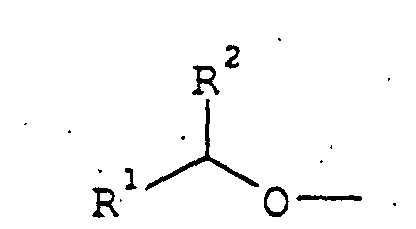
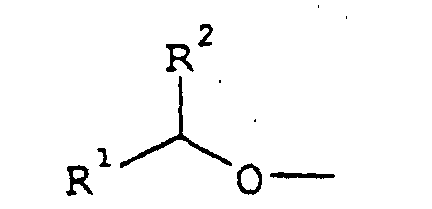
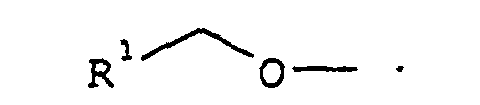

- R1
- is aryl group or heteroaryl group wherein said aryl group and heteroaryl group are optionally substituted by 1 to 3 substituents selected from halogen atom, C1-6 alkyl group, halo(C1-6)alkyl group, hydroxy(C1-6)alkyl group, C1-6 alkoxy(C1-6)alkyl group, hydroxyl group, C1-6 alkoxy group, halo(C1-6)alkoxy group, mercapto group, C1-6 alkylthio group, C1-6 alkylsulfanyl group, C1-6 alkylsulfonyl group, aminosulfonyl group, C1-6 alkylsulfamoyl group, di(C1-6)alkylsulfamoyl group, carboxy group, (C1-6 alkoxy)carbonyl group, C1-7 acyl group, carbamoyl group, (C1-6 alkyl)carbamoyl group, di(C1-6 alkyl)carbamoyl group, cyano group, nitro group, amino group, C1-6 alkylamino group, di(C1-6)alkylamino group, C1-7 acylamino group, C1-3 alkylenedioxy group,

- wherein RA
- is (C1-6 alkoxy)carbonyl group or carboxy group, and RB is hydrogen atom or C1-6 alkyl group;
- R2
- is C1-6 alkyl group
wherein said C1-6 alkyl group is optionally
substituted by 1 to 3 substituents selected from
halogen atom, hydroxyl group, C1-6 alkoxy group,
carboxy group, amino group, C1-6 alkylamino group,
di(C1-6)alkylamino group and oxo group, C3-7 cycloalkyl group, C2-6 alkenyl group, C2-6 alkynyl group, aralkyl group, carboxy group, (C1-6 alkoxy)carbonyl group or cyano group; - R3
- is hydrogen atom, C1-6 alkyl group, hydroxyl group, C1-6 alkoxy group, mercapto group, C1-6 alkylthio group, carboxy group, (C1-6 alkoxy)carbonyl group, (C1-6 alkyl)carbamoyl group, di(C1-6 alkyl)carbamoyl group, amino group, C1-6 alkylamino group or di(C1-6)alkylamino group;
- R4
- is hydrogen atom, C1-6 alkyl group or C2-6 alkenyl group, or R3 and R4 in combination show oxo group;
- R5 and R6
- are the same or different and each is C1-6 alkyl group, or R5 and R6 in combination show cyclopropyl group together with the carbon atom they bind to;
- R7
- is aryl group or heteroaryl group wherein said aryl group and heteroaryl group are optionally substituted by 1 to 3 substituents selected from halogen atom, C1-6 alkyl group, halo(C1-6)alkyl group, hydroxy(C1-6)alkyl group, C3-7 cycloalkyl group, hydroxyl group, C1-6 alkoxy group, halo(C1-6)alkoxy group, carboxy group, (C1-6 alkoxy)carbonyl group, nitro group, cyano group, C1-6 alkylsulfonyloxy group, carbamoyl group and C1-3 alkylenedioxy group;
- X1
- is a single bond, C1-6 alkylene group or C2-6 alkynylene group wherein said C1-6 alkylene group and C2-6 alkynylene group are optionally substituted by C1-6 alkyl group or oxo group;
- X2
- is C1-6 alkylene group wherein said C1-6 alkylene group is optionally substituted by C1-6 alkyl group or halo(C1-6)alkyl group;
- X3
- is a single bond or C1-6 alkylene group wherein said C1-6 alkylene group is optionally substituted by hydroxyl group or oxo group;
- X4 and X5
- in combination show a single bond, methylene group, -NH-, oxygen atom, sulfur atom, -C(=O)-, -CH2NH-, -CH2O-, -CH2S-, -CH2CO-, -NHCH2-, -OCH2-, -SCH2-, -COCH2-, -CH=CH- or -C≡C- (hereinafter sometimes to be referred to as compound [I]),

- R1'
- is aryl group or heteroaryl group wherein said aryl group and heteroaryl group are optionally substituted by 1 to 3 substituents selected from halogen atom, C1-6 alkyl group, halo(C1-6)alkyl group, hydroxy(C1-6)alkyl group, C1-6 alkoxy(C1-6)alkyl group, hydroxyl group, C1-6 alkoxy group, halo(C1-6)alkoxy group, mercapto group, C1-6 alkylthio group, C1-6 alkylsulfanyl group, C1-6 alkylsulfonyl group, aminosulfonyl group, C1-6 alkylsulfamoyl group, di(C1-6)alkylsulfamoyl group, carboxy group, (C1-6 alkoxy)carbonyl group, C1-7 acyl group, carbamoyl group, (C1-6 alkyl)carbamoyl group, di(C1-6 alkyl)carbamoyl group, cyano group, nitro group, amino group, C1-6 alkylamino group, di(C1-6)alkylamino group and C1-7 acylamino group;
- R7'
- is aryl group or heteroaryl group wherein said aryl group and heteroaryl group are optionally substituted by 1 to 3 substituents selected from halogen atom, C1-6 alkyl group, halo(C1-6)alkyl group, C3-6 cycloalkyl group, hydroxyl group, C1-6 alkoxy group, halo(C1-6)alkoxy group, carboxy group, (C1-6 alkoxy)carbonyl group, nitro group, cyano group and C1-6 alkylsulfonyloxy group; and
- R2, R3, R4, R5, R6, X1, X2, X3, X4 and X5
- are same as defined above in (1) (hereinafter sometimes to be referred to as compound [I']) respectively,

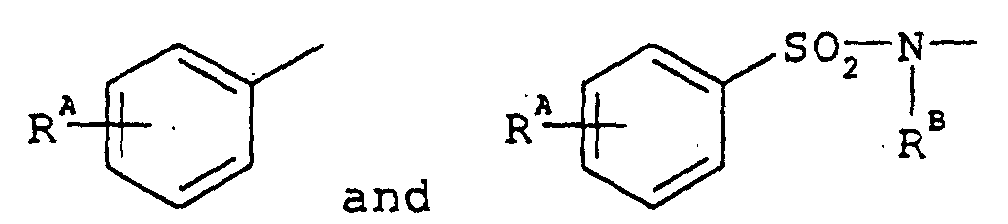

wherein said alkyl group is optionally substituted by
C1-4 alkoxy group,
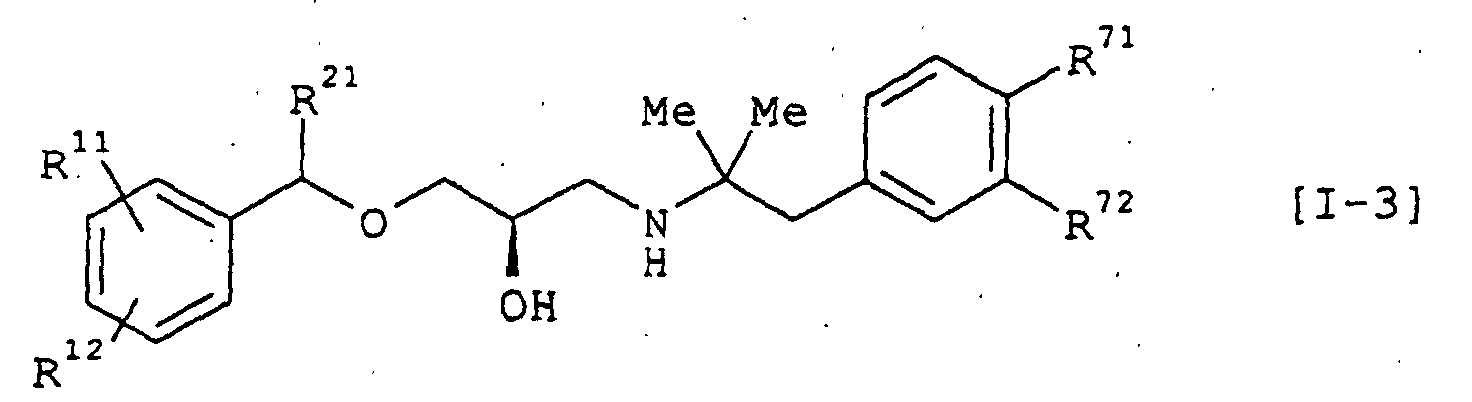
a salt thereof, a solvate thereof or a prodrug thereof.
a salt thereof, a solvate thereof or a prodrug thereof.
a salt thereof, a solvate thereof or a prodrug thereof.
a salt thereof, a solvate thereof or a prodrug thereof.
a salt thereof, a solvate thereof or a prodrug thereof.
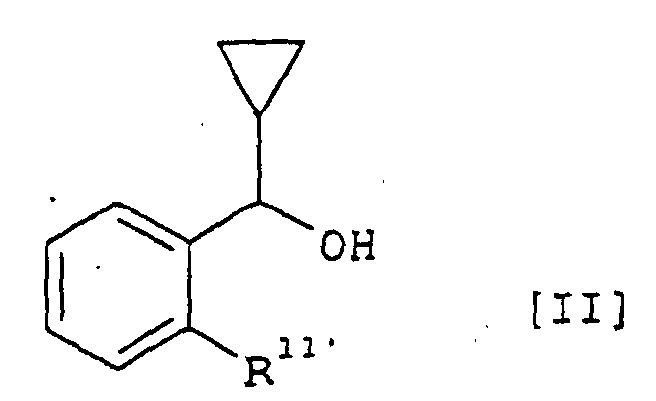
a salt thereof or a solvate thereof.
a salt thereof or a solvate thereof.
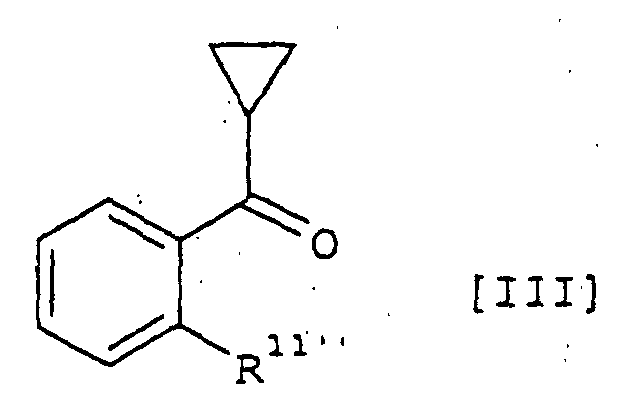
a salt thereof or a solvate thereof.
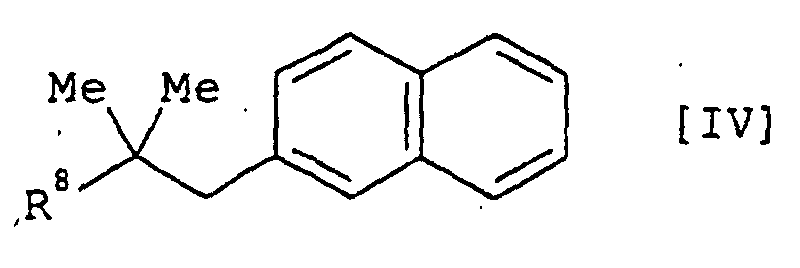
wherein the aforementioned "C1-6 alkyl group" is substituted by hydroxyl group. The position of the substituent is not particularly limited as long as it is chemically acceptable. Examples of "hydroxy(C1-6)alkyl group" include hydroxymethyl group, 1-hydroxyethyl group, 2-hydroxyethyl group, 1-hydroxypropyl group, 2-hydroxypropyl group, 3-hydroxypropyl group, 2-hydroxy-1-methylethyl group, 1-hydroxybutyl group, 2-hydroxybutyl group, 3-hydroxybutyl group, 4-hydroxybutyl group, 3-hydroxy-2-methylpropyl group, 2-hydroxy-1,1-dimethylethyl group, 5-hydroxypentyl group, 6-hydroxyhexyl group and the like, with preference given to hydroxy C1-4 alkyl group selected from hydroxymethyl group, 2-hydroxyethyl group, 3-hydroxypropyl group and 4-hydroxybutyl group.
wherein the aforementioned "C1-6 alkyl group" is substituted by the aforementioned "C1-6 alkoxy group". The position of the substituent is not particularly limited as long as it is chemically acceptable. Examples of "C1-6 alkoxy(C1-6)alkyl group" include methoxymethyl group, ethoxymethyl group, propoxymethyl group, butoxymethyl group, pentyloxymethyl group, hexyloxymethyl group, 1-methoxyethyl group, 1-ethoxyethyl group, 2-methoxyethyl group, 2-ethoxyethyl group, 1-methoxypropyl group, 1-ethoxypropyl group, 2-methoxypropyl group, 2-ethoxypropyl group, 3-methoxypropyl group, 3-ethoxypropyl group, 2-methoxy-1-methylethyl group, 1-methoxybutyl group, 1-ethoxybutyl group, 2-methoxybutyl group, 2-ethoxybutyl group, 3-methoxybutyl group, 3-ethoxybutyl group, 4-methoxybutyl group, 4-ethoxybutyl group, 3-methoxy-2-methylpropyl group, 2-methoxy-1,1-dimethylethyl group, 2-ethoxy-1,1-dimethylethyl group, 5-methoxypentyl group, 6-methoxyhexyl group and the like, with preference given to C1-4 alkoxy(C1-4)alkyl group selected from methoxymethyl group, ethoxymethyl group, propoxymethyl group, butoxymethyl group, 2-methoxyethyl group, 3-methoxypropyl group and 4-methoxybutyl group.


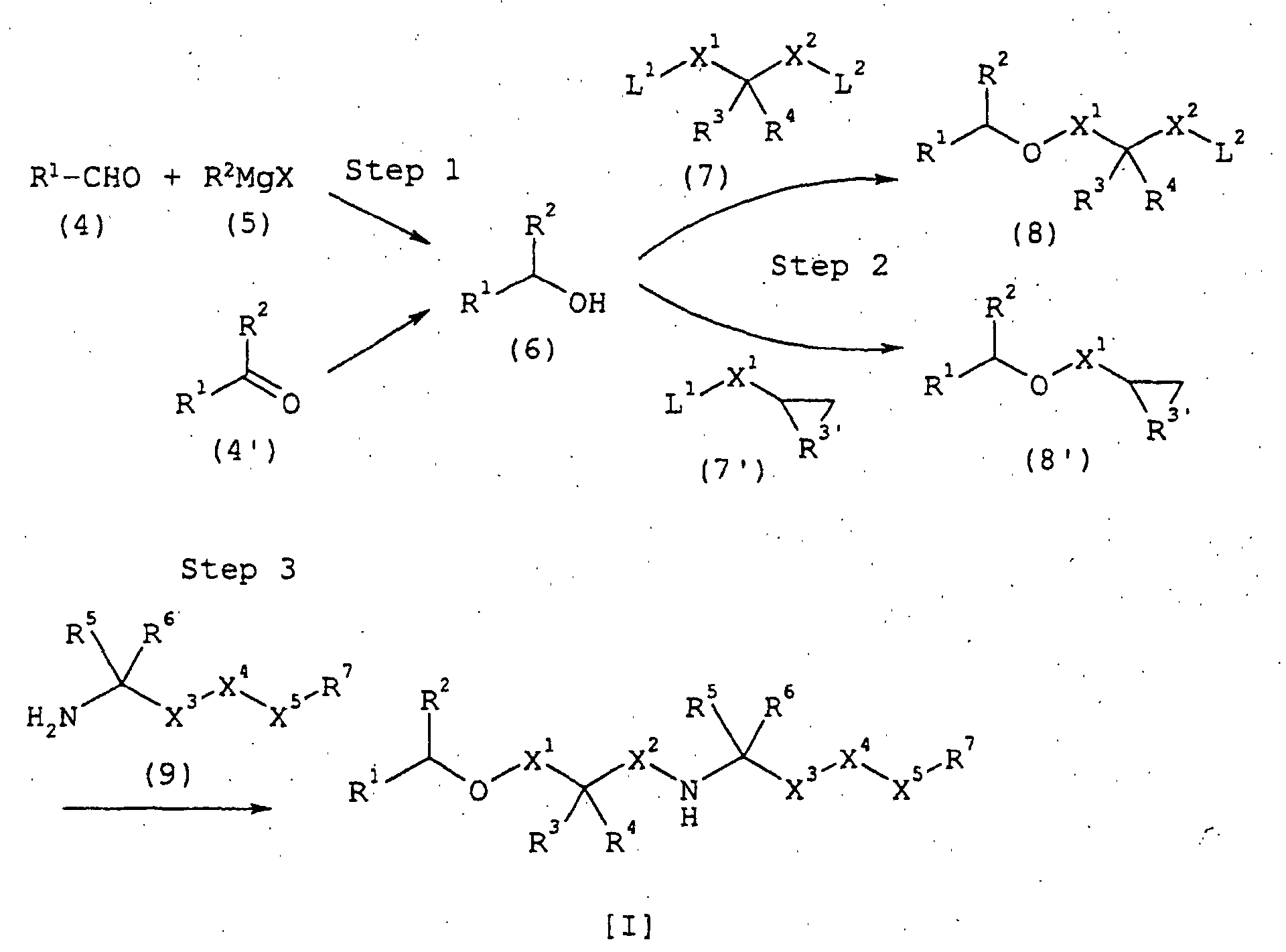
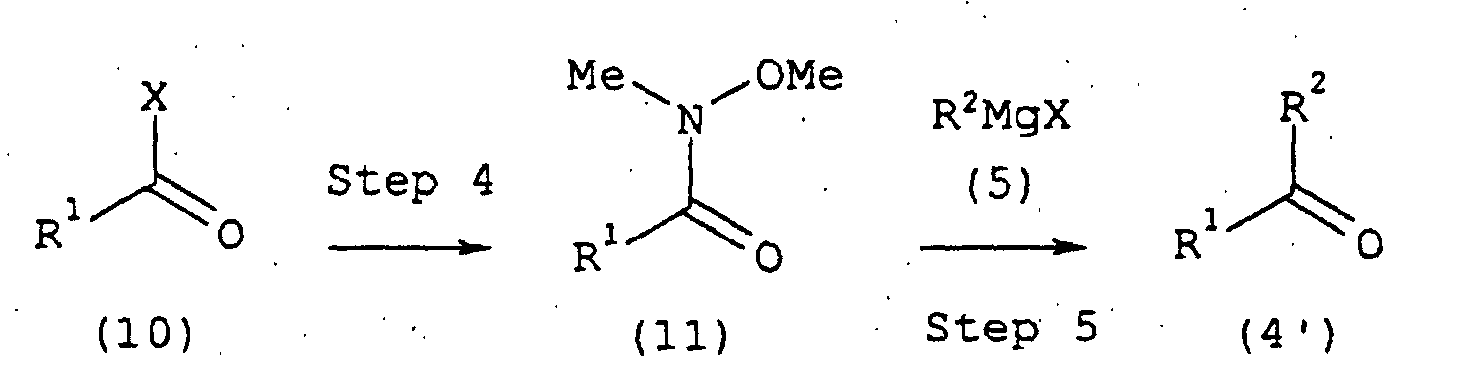

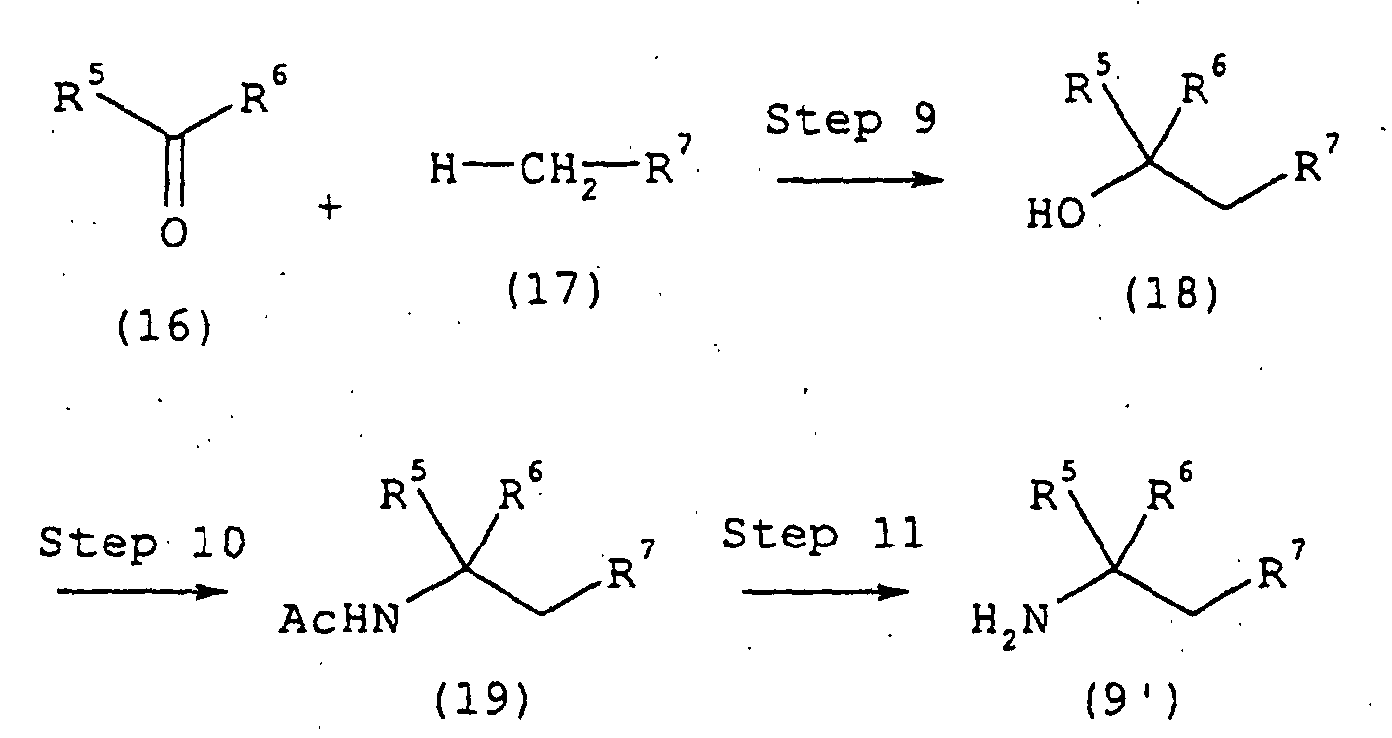
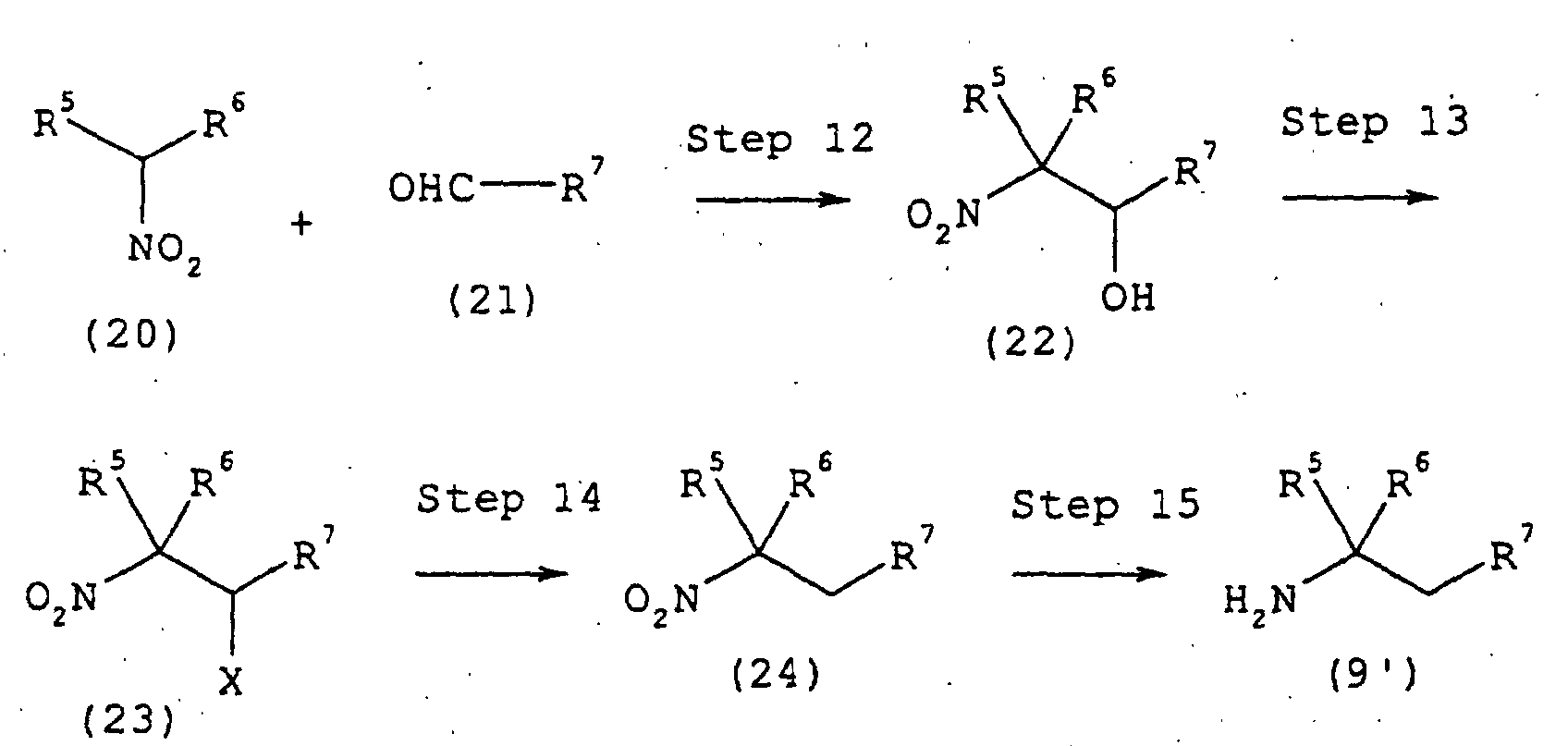
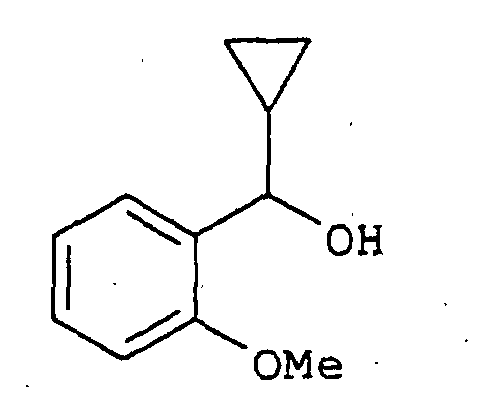
1H-NMR(300MHz, δppm, DMSO-d6) 7.41(1H,d,J=7.8Hz), 7.19(1H,dt,J=1.6, 7.7Hz), 6.92(2H,t,J=7.2Hz), 4.88(1H,d,J=4.8Hz), 4.55(1H,t,J=5.5Hz), 3.76(3H,s), 1.09-1.00(1H,m), 0.33-0.25(4H,m). MS(ESI,m/z) 161(M+H-H2O)+.

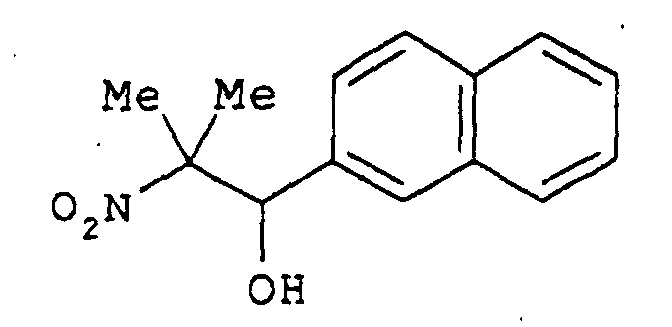


1H-NMR(300MHz, δppm, CDCl3) 7.85-7.76(3H,m), 7.58(1H,s), 7.50-7.44(2H,m), 7.22(1H,dd,J=1.7, 8.4Hz), 3.37(2H,s), 1.69(6H,s). MS(APCI,m/z) 183(M+H-NO2)+.
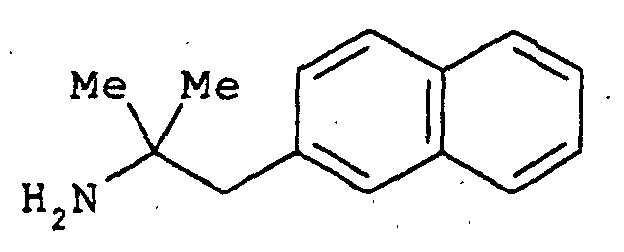
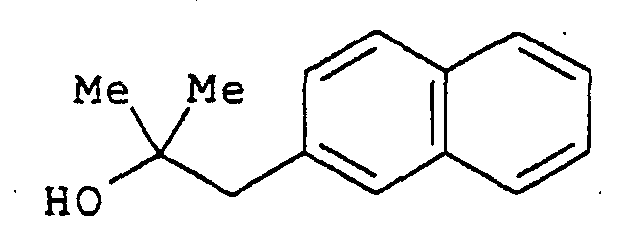
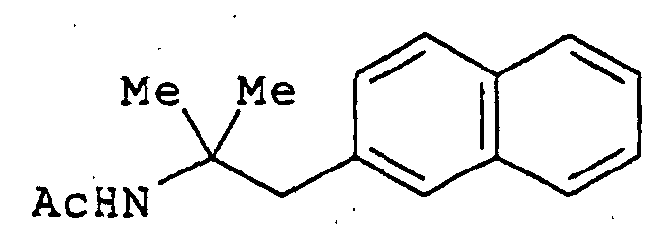
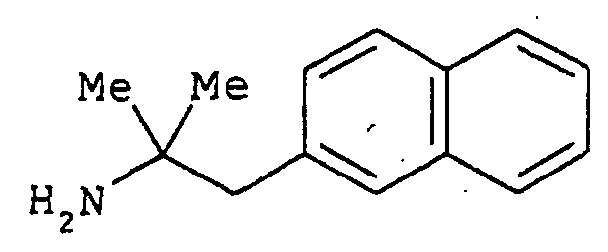
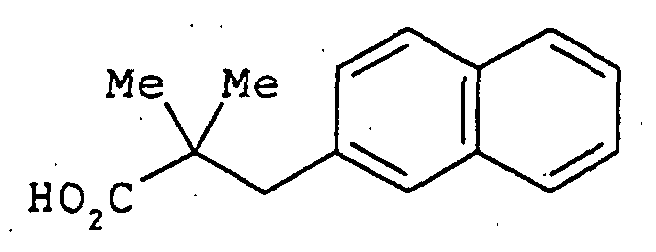
1H-NMR (300MHz, δppm, DMSO-d6) 7.88-7.80(3H,m), 7.66(1H,s), 7.51-7.44(2H,m), 7.33(1H,dd,J=8.4, 1.6Hz), 2.96(2H,s), 1.13(6H,s).
MS(FAB,m/z) 228(M)+.
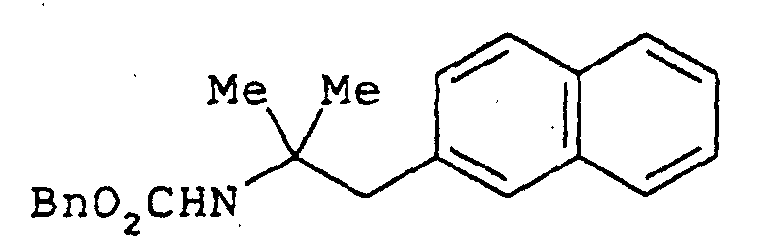
1H-NMR(300MHz, δppm, CDCl3) 8.83-7.78(1H,m), 7.71-7.66(2H,m), 7.45-7.36(7H,m), 7.22(1H,dd,J=1.6, 8.4Hz), 5.13(2H,s), 4.54(1H,br s), 3.15(2H,s), 1.34(6H,s).
MS(FAB,m/z) 334(M+H)+.
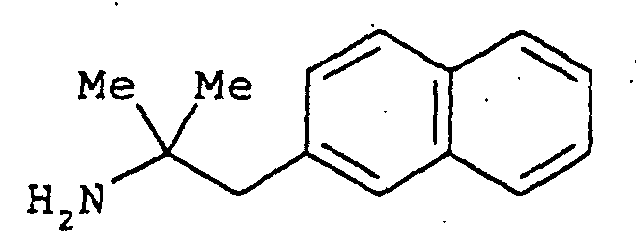

1H-NMR(300MHz, δppm, DMSO-d6) 7.90-7.70(3H,m), 7.67(1H,s), 7.50-7.20(5H,m) 7.00-6.90(2H,m), 4.62(1H,br s), 4.29(1H,d,J=7.0Hz), 3.77(3H,s), 3.70-3.50(1H,m), 3.30-3.10(2H,m), 2.80-2.50(4H,m), 1.50-0.85(8H,m), 0.50-0.20(4H,m).
MS(APCI,m/z) 433(M+H)+.
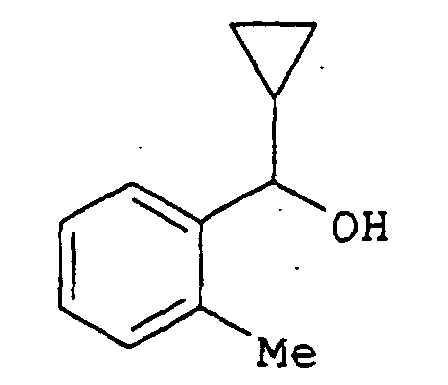
1H-NMR(300MHz, δppm, DMSO-d6) 7.43(1H,d,J=7.2Hz), 7.18-7.10(3H,m), 4.95(1H,d,J=4.8Hz), 4.36(1H,dd,J=4.4, 6.5Hz), 2.31(3H,s), 1.20-1.07(1H,m), 0.47-0.20(4H,m).
MS(APCI,m/z) 145(M+H-H2O)+.
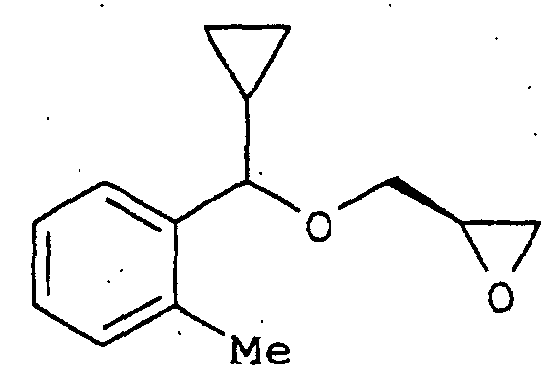
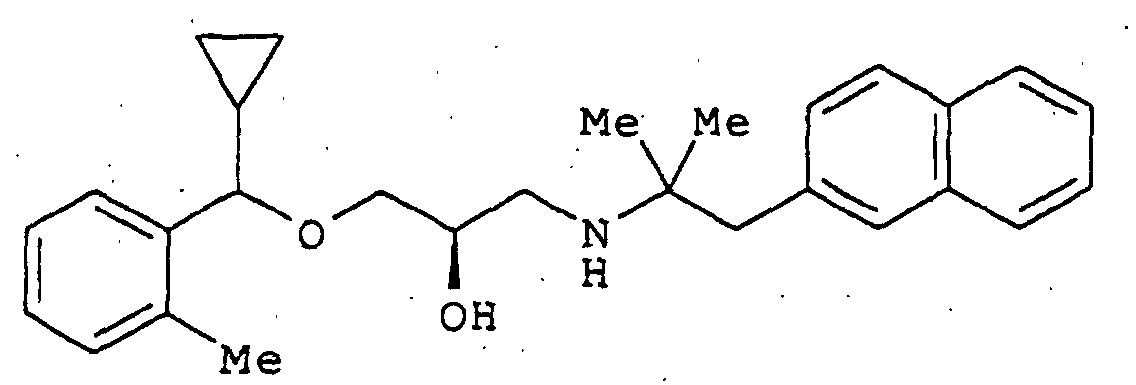
1H-NMR(300MHz, δppm, DMSO-d6) 7.90-7.70(3H,m), 7.67(1H,s), 7.50-7.25(4H,m) 7.20-7.10(3H,m), 4.65(1H,br s), 4.06(1H,d,J=7.4Hz), 3.70-3.50(1H,m), 3.30-3.10(2H,m), 2.80-2.50(4H,m), 2.31(3H,s), 1.50-0.80(8H,m), 0.60-0.10(4H,m).
MS(APCI,m/z) 417(M+H)+.
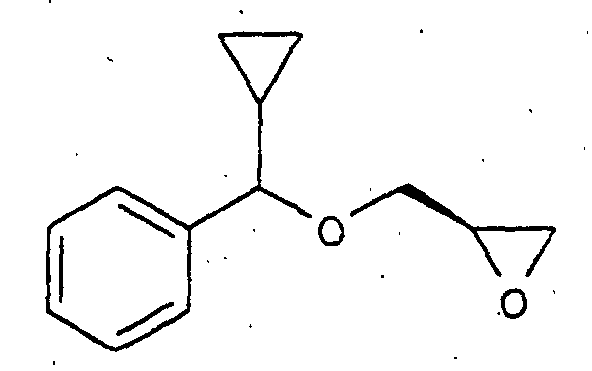
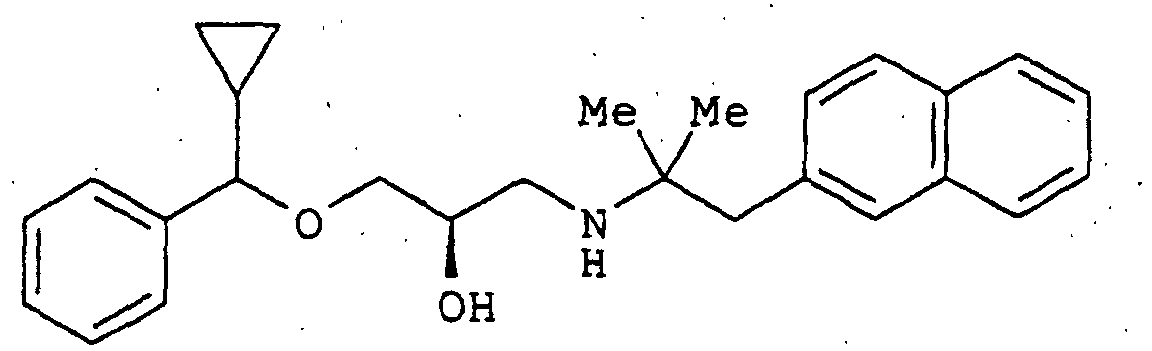
1H-NMR(300MHz, δppm, DMSO-d6) 7.90-7.70(3H,m), 7.67(1H,s), 7.50-7.20(8H,m) 4.65(1H,br s), 3.80-3.50(2H,m), 3.30-3.10(2H,m), 2.80-2.50(4H,m), 1.50-0.80(8H,m), 0.60-0.10(4H,m).
MS(APCI,m/z) 403(M+H)+.
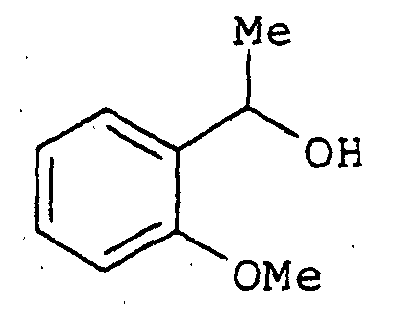

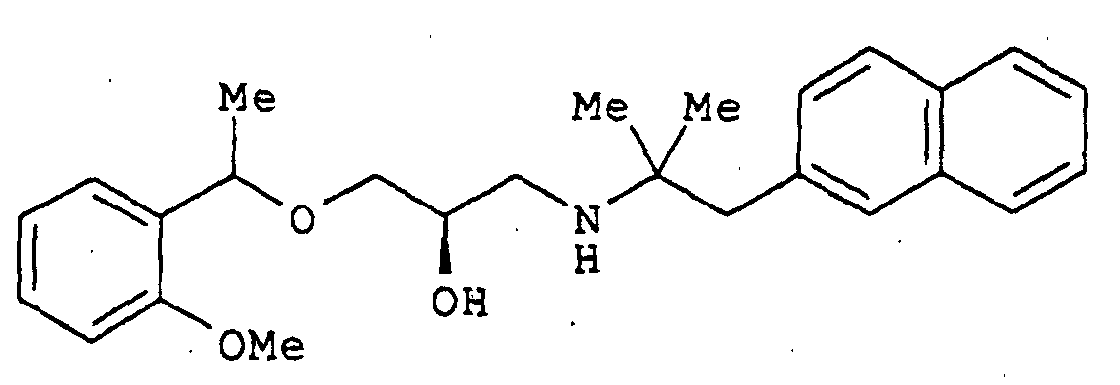
1H-NMR(300MHz, δppm, DMSO-d6) 7.85-7.70(3H,m), 7.61(1H,s), 7.50-7.20(5H,m), 7.00-6.80(2H,m), 4.88(1H,q,J=6.4Hz), 3.85-3.75(4H,m), 3.45-3.35(2H,m), 2.85-2.60(4H,m), 1.40-1.37(3H,m), 1.10-1.08(6H,m).
MS(APCI,m/z) 408 (M+H)+.

1H-NMR(300MHz, δppm, DMSO-d6) 8.91(1H,br s), 8.54(1H,br s), 7.95-7.86(3H,m), 7.67(1H,s), 7.55-7.45(2H,m), 7.40-7.20(3H,m), 7.02-6.93(2H,m), 5.66-5.61(1H,m), 4.90-4.80(1H,m), 4.05-3.95(1H,m), 3.80(3H,s), 3.40-3.10(5H,m), 3.05-2.85(1H,m), 1.32(3H,d,J=6.4Hz), 1.09(6H,s).
MS(APCI,m/z) 408(M+H-HCl)+.


MS(APCI,m/z) 392(M+H)+.
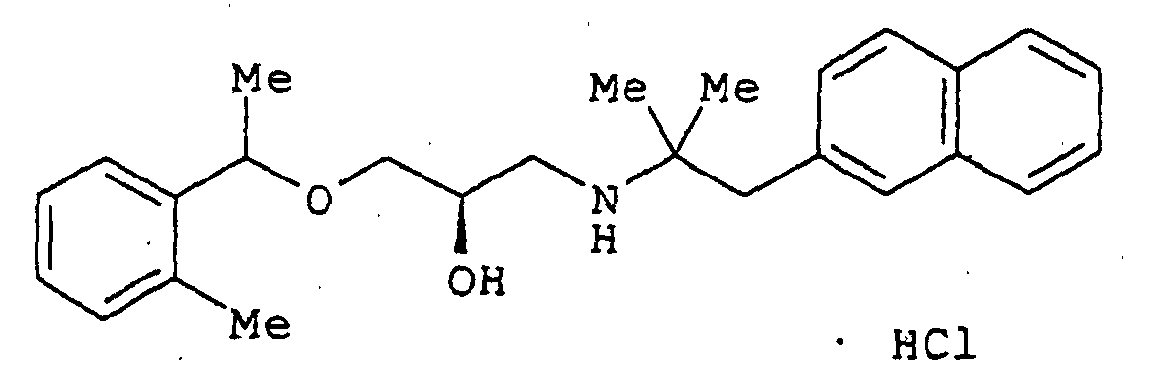
1H-NMR(300MHz, δppm, DMSO-d6) 8.97(1H,br s), 8.56(1H,br s), 7.95-7.85(3H,m), 7.77(1H,s), 7.75-7.65(2H,m), 7.40-7.32(2H,m), 7.25-7.12(3H,m), 5.66-5.61(1H,m), 4.73(1H,q,J=6.3Hz), 4.10-3.95(1H,br s), 3.40-3.10(5H,m), 3.05-2.90(1H,m), 2.31(3H,s), 1.34(3H,d,J=6.6Hz), 1.27(3H,s), 1.26(3H,s).
MS(APCI,m/z) 392(M+H-HCl)+.
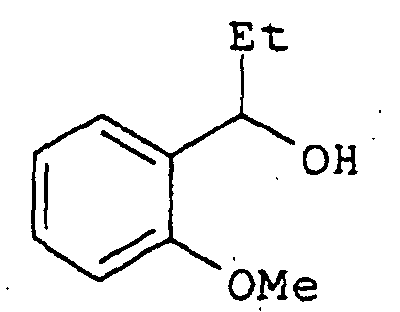
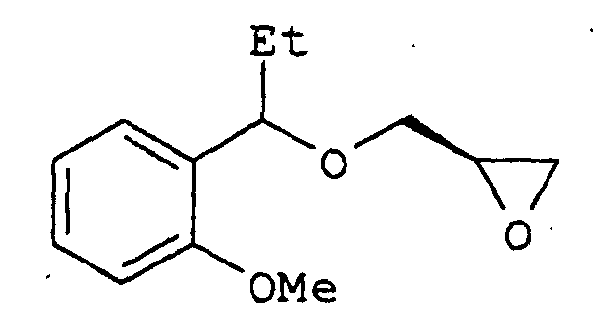

1H-NMR (300MHz, δppm, CDCl3) 7.85-7.70(3H,m), 7.61(1H,s), 7.50-7.20(5H,m), 7.00-6.90(1H,m), 6.85-6.75(1H,m), 4.67(1H,t,J=6.3Hz), 3.85-3.70(4H,m), 3.42-3.27(2H,m), 2.90-2.65(6H,m), 1.15-1.05(6H,m), 0.91(3H,t,J=7.4Hz).
MS(APCI,m/z) 422(M+H)+.
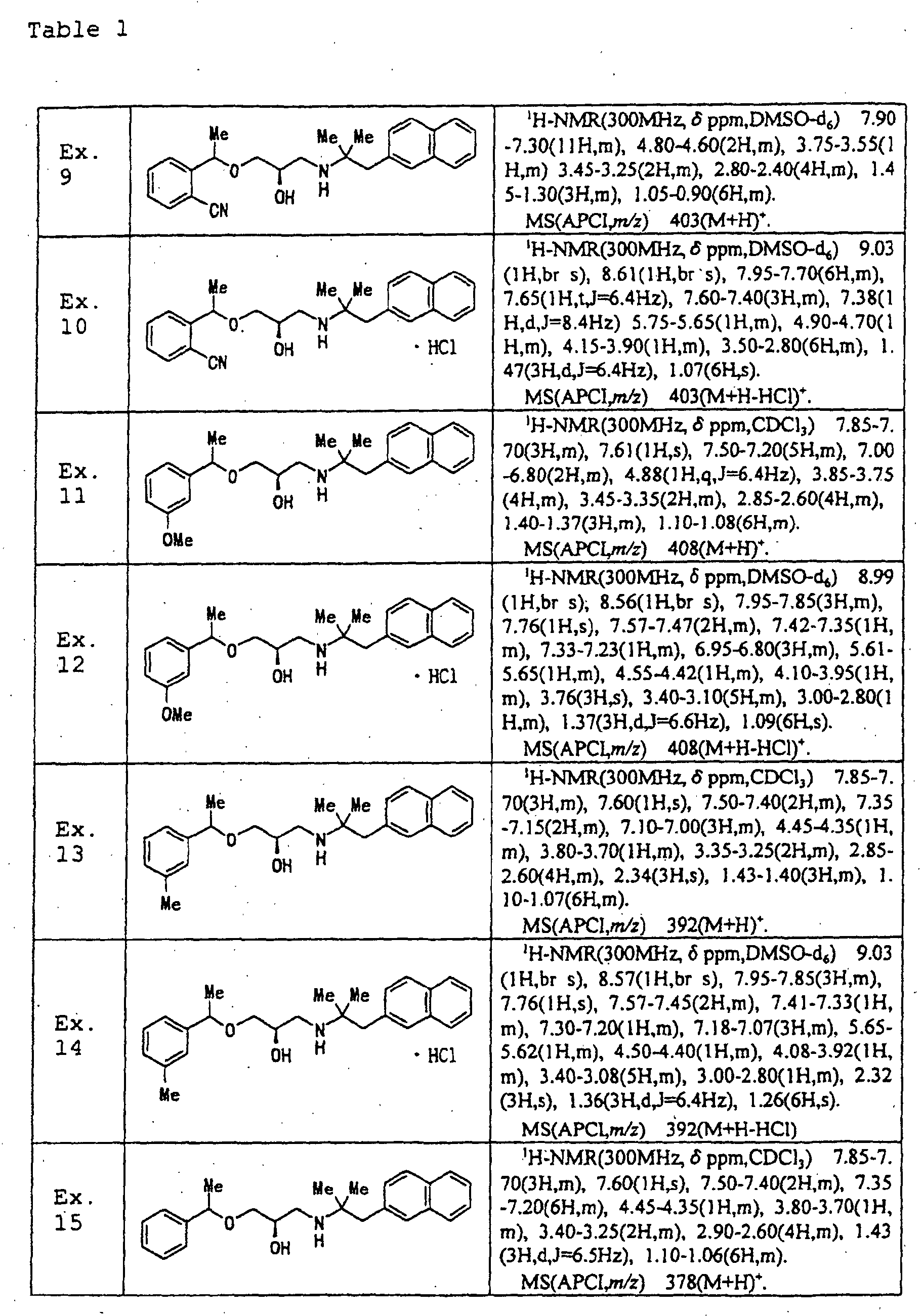
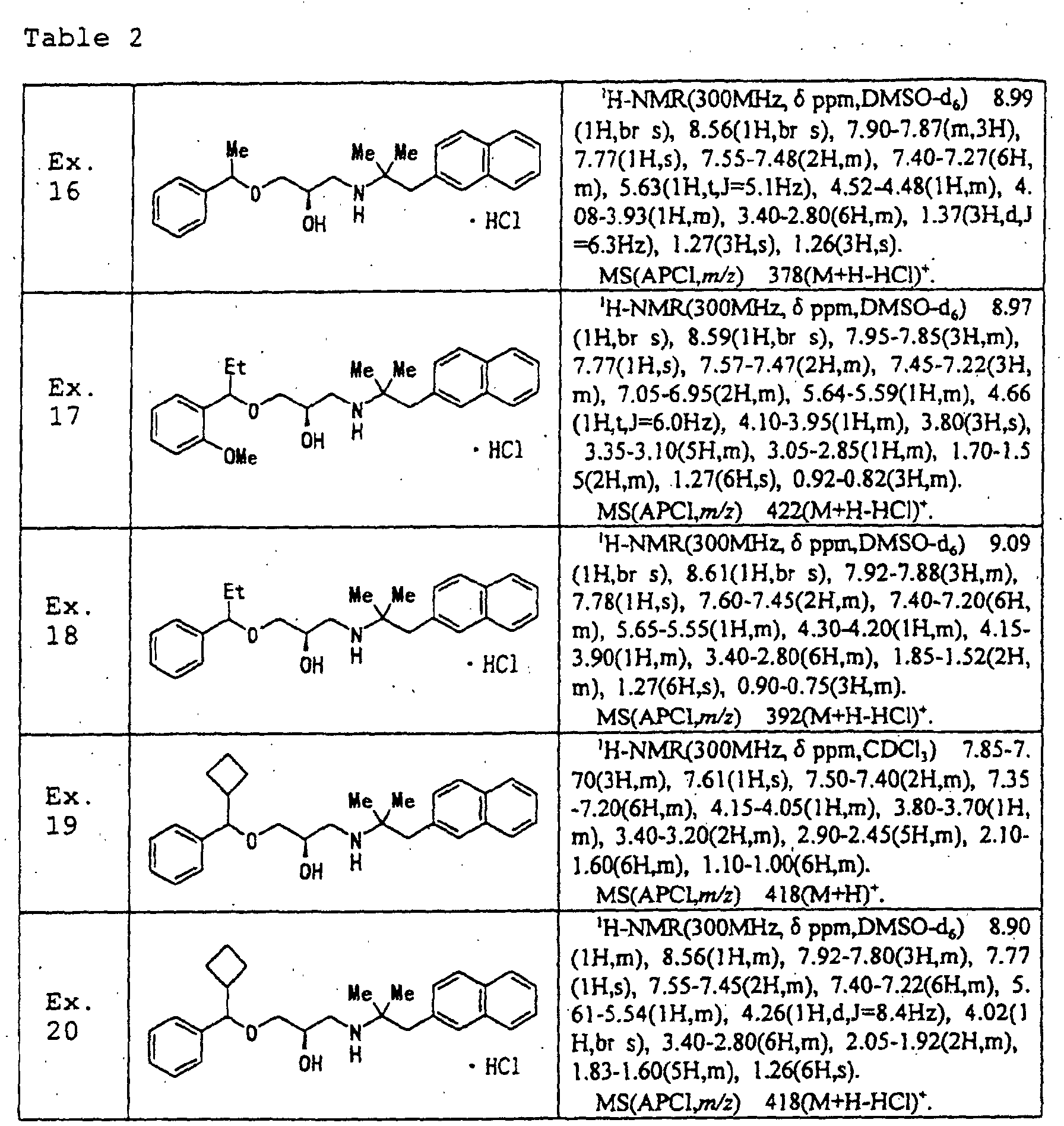


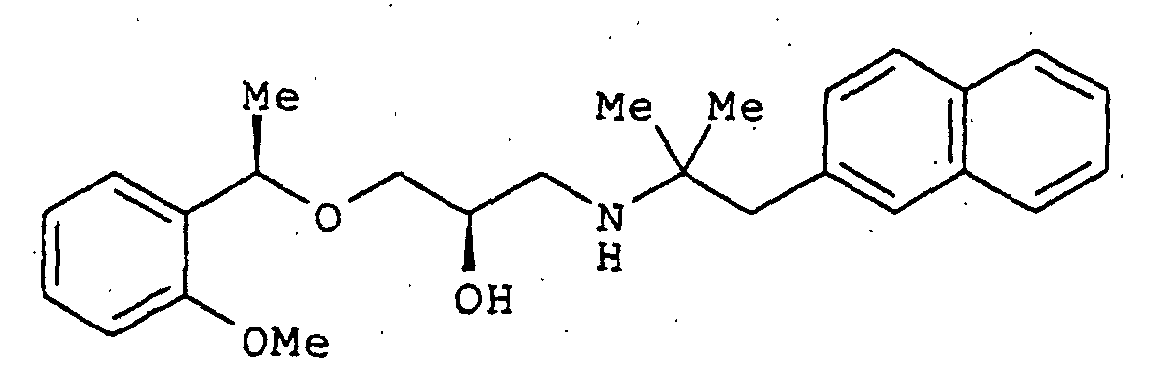
1H-NMR(300MHz, δppm, CDCl3) 7.85-7.70(3H,m), 7.62(1H,s), 7.50-7.20(5H,m), 7.00-6.80(2H,m), 4.88(1H,q,J=6.5Hz), 3.85-3.75(4H,m), 3.38(2H,d,J=5.1Hz), 2.90-2.60(4H,m), 1.38(3H,d,J=6.6Hz), 1.10(3H,s), 1.07(3H,s).
MS(APCI,m/z) 408(M+H)+.

1H-NMR(300MHz, δppm, DMSO-d6) 8.94(1H,br s), 8.56(1H,br s), 7.95-7.85(3H, m), 7.77(1H,s), 7.57-7.45(2H,m), 7.42-7.20(3H,m), 7.05-6.95(2H,m), 5.61(1H,d,J=4.8Hz), 4.84(1H,q,J=6.3Hz), 4.10-3.95(1H,m), 3.80(3H,s), 3.40-3.10(5H,m), 3.00-2.85(1H,m), 1.32(3H,d,J=6.3Hz), 1.26(6H,s).
MS(APCI,m/z) 408(M+H-HCl)+.

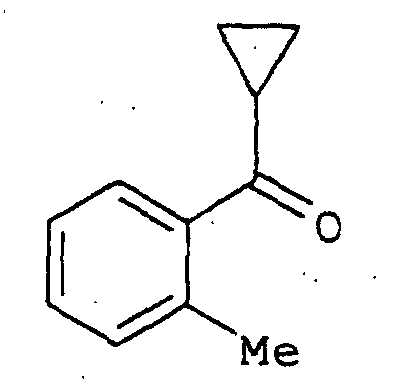

1H-NMR(300MHz, δppm, DMSO-d6) 7.43(1H,d,J=6.8Hz), 7.18-7.09(3H,m), 4.97(1H,d,J=4.6Hz), 4.36(1H,dd,J=4.6, 6.4Hz), 2.30(3H,s), 1.17-1.07(1H,m), 0.41-0.24(4H,m).
MS(APCI,m/z) 145(M+H-H2O)+.
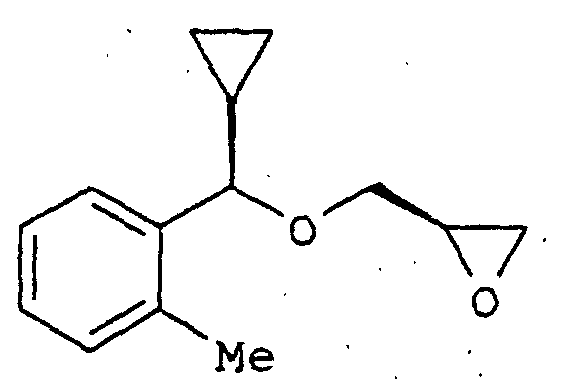
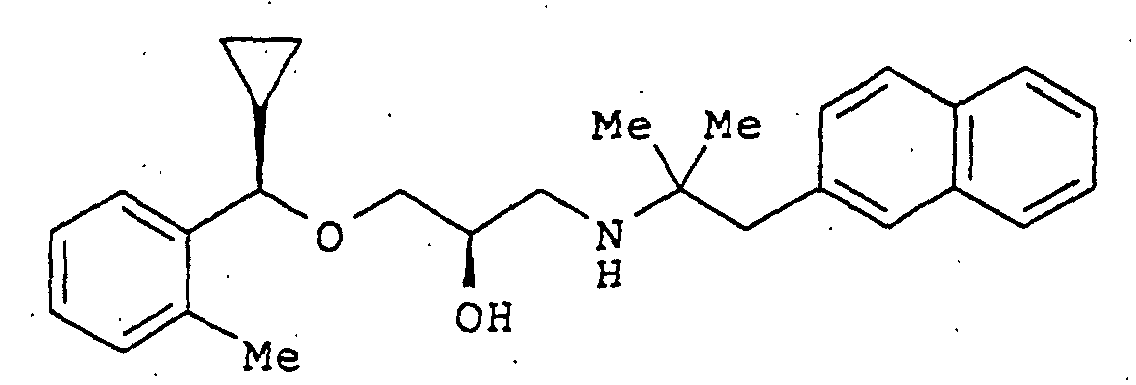
1H-NMR(300MHz, δppm, DMSO-d6) 7.90-7.70(3H,m), 7.66(1H,s), 7.50-7.25(4H,m) 7.20-7.10(3H,m), 4.64(1H,br s), 4.06(1H,d,J=7.4Hz), 3.70-3.50(1H,m), 3.30-3.10(2H,m), 2.80-2.50(4H,m), 2.31(3H,s), 1.50-0.85(2H,m), 0.60-0.10(4H,m)
MS(APCI,m/z) 417(M+H)+.


1H-NMR(300MHz, δppm, CDCl3) 7.59(1H,dd,J=7.5, 1.7Hz), 7.48-7.42(1H,m), 7.02-6.97(2H,m), 3.91(3H,s), 2.77-2.68(1H,m), 1.25-1.20(2H,m), 1.01-0.95(1H,m).
MS(ESI,m/z) 177(M+H)+.

MS(ESI,m/z) 161(M+H-H2O)+.


1H-NMR (300MHz, δppm, CDCl3) 7.83-7.70(3H,m), 7.61(1H,s), 7.50-7.37(3H,m), 7.35-7.20(2H,m), 7.00-6.82(2H,m), 4.28(1H,d,J=7.8Hz), 3.83-3.70(4H,m), 3.42-3.30(2H,m), 2.90-2.60(4H,m), 1.25-1.10(7H,m), 0.60-0.50(1H,m), 0.45-0.30(3H,m).
MS(APCI,m/z) 434(M+H)+.

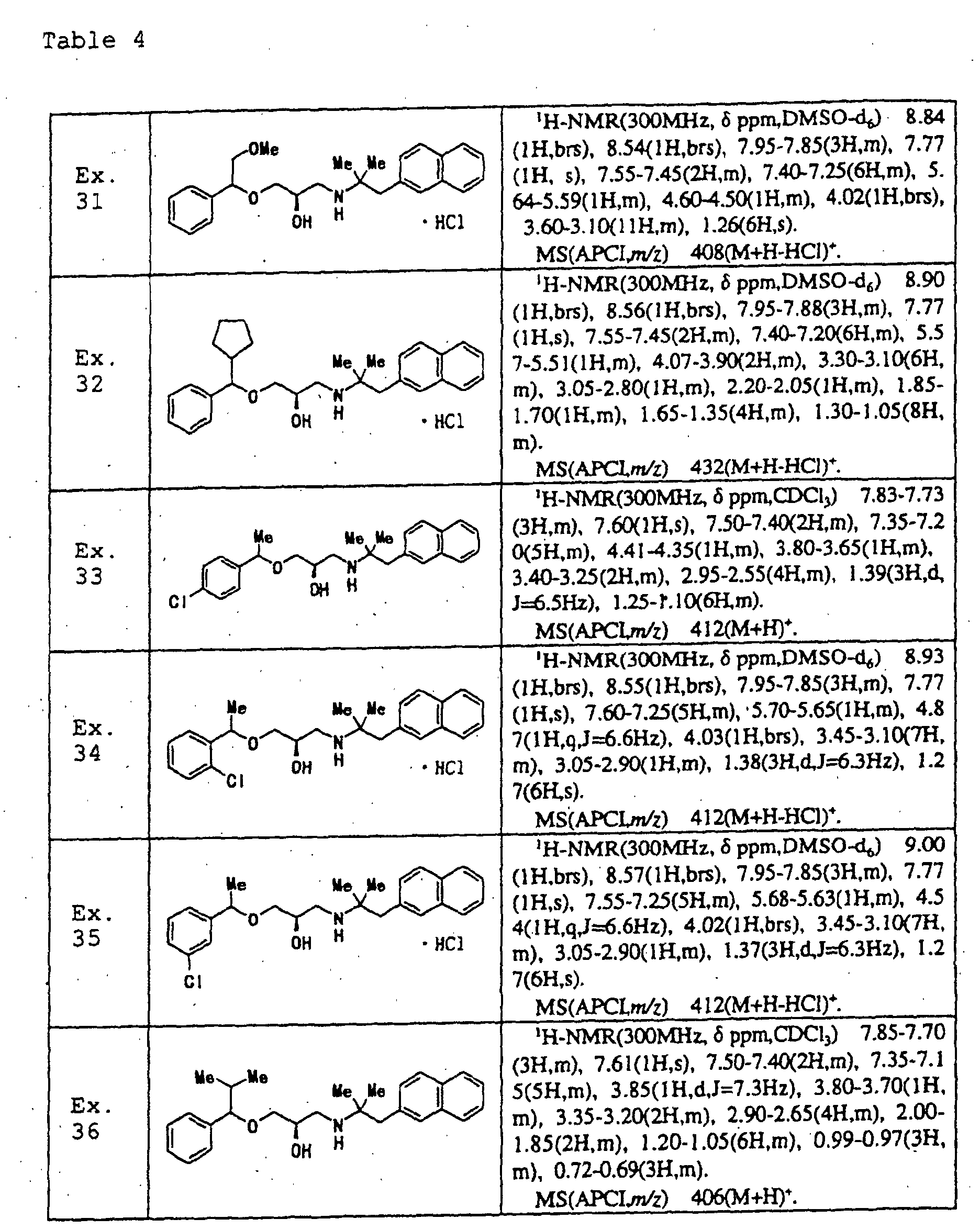


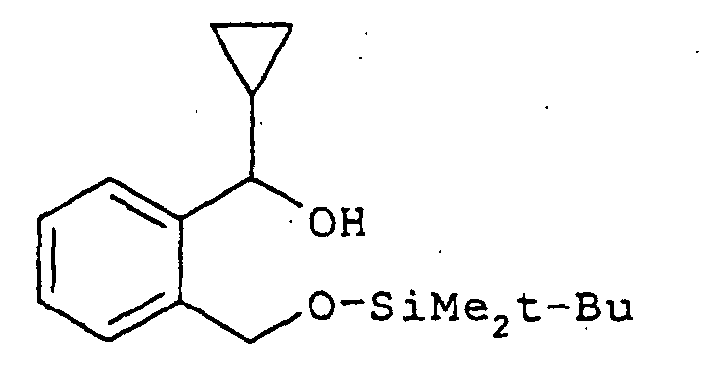
1H-NMR(300MHz, δppm, DMSO-d6) 7.53-7.34(2H,m), 7.25-7.20(2H,m), 4.91(1H,d,J=4.6Hz), 4.81(2H,s), 4.31(1H,dd,J=4.7, 6.5Hz), 1.20-1.10(1H,m), 0.91(9H,s), 0.47-0.23(4H,m), 0.10(3H,s), 0.08(3H,s).
MS(APCI,m/z) 275(M+H-H2O)+.
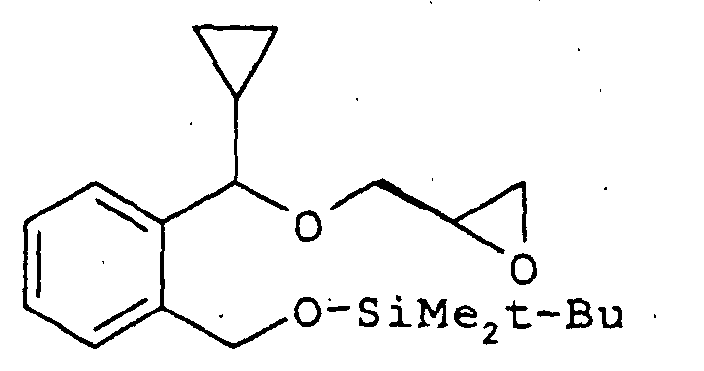

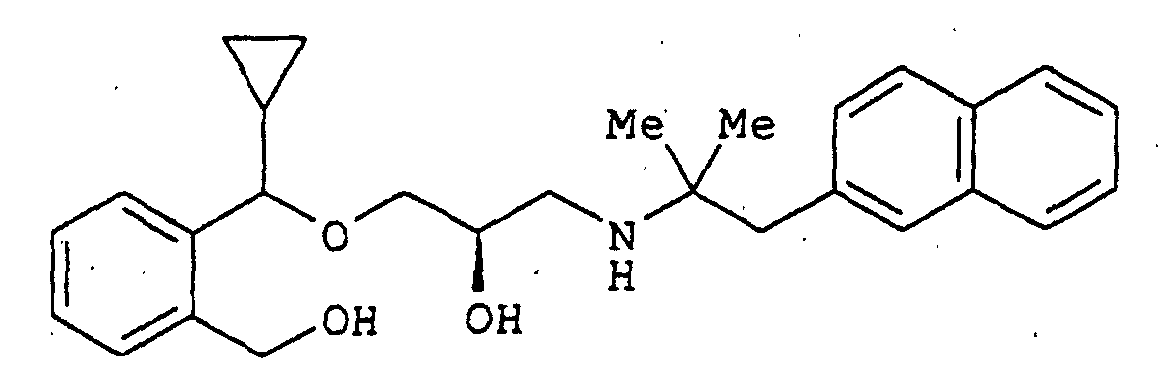
1H-NMR(300MHz, δppm, DMSO-d6) 7.90-7.70(3H,m), 7.67(1H,s), 7.50-7.20(7H,m), 5.13(1H,brs), 4.90-4.40(3H,m), 4.20-4.05(1H,m), 3.70-3.50(1H,m), 3.30-3.10(2H,m), 2.80-2.50(4H,m), 1.40-0.85(7H,m), 0.60-0.10(4H,m).
MS(APCI,m/z) 434(N+H)+.


1H-NMR(300MHz, δppm, CDCl3) 7.88 (1H,dd,J=1.1, 7.7Hz), 7.78(1H,d,J=7.3Hz), 7.53(1H,dt,J=1.2, 7.6Hz), 7.35(1H,t,J=7.2Hz), 4.97(2H,s), 2.57-2.48(1H,m), 1.24-1.20(2H,m), 1.06-1.01(2H,m), 0.95(9H,s), 0.11(6H,s).

1H-NMR (300MHz, δppm, DMSO-d6) 7.49-7.46(1H,m) 7.39-7.37(1H,m), 7.25-7.22(2H,m), 4.99(1H,br s), 4.81(2H,s), 4.32(1H,d,J=6.3Hz), 1,32-1.09(1H,m), 0.91(9H,s), 0.49-0.22(4H,m), 0.10(3H,s), 0.08(3H,s).
MS(ESI,m/z) 275 (M+H-H2O)+.

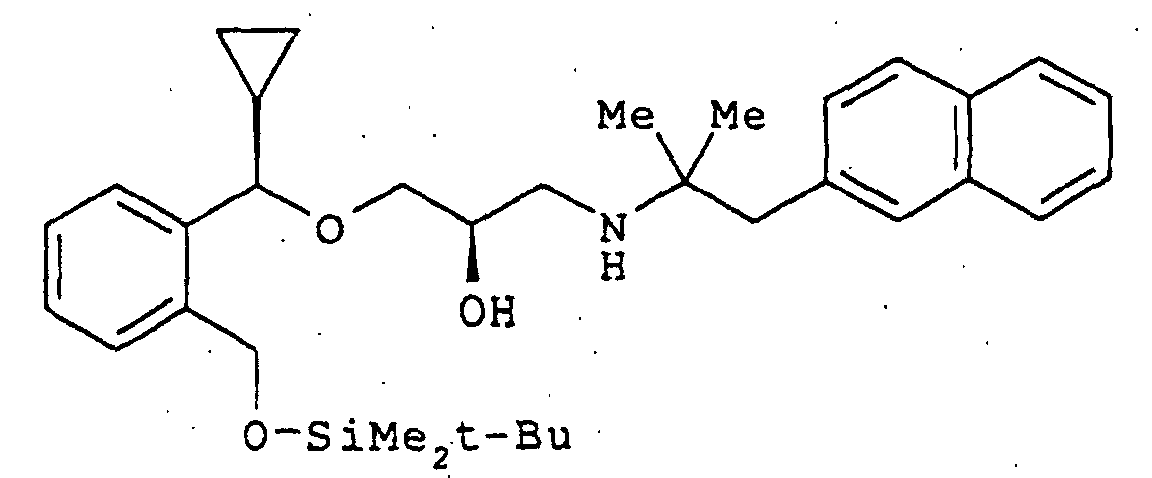
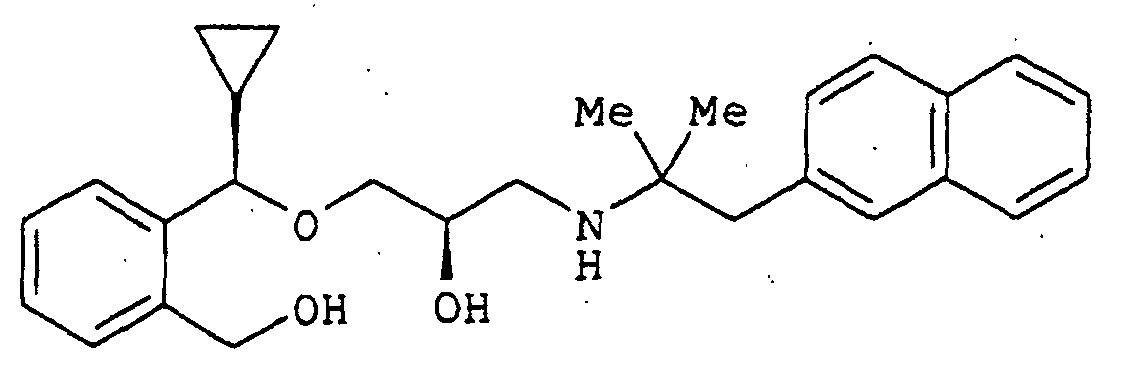

MS(ESI,m/z) 434(M+H-1/2C4R4O4)+.

1H-NMR (300MHz, δppm, DMSO-d6) 7.49-7.46(1H,m) , 7.40-7.37(1H,m), 7.22-7.20(2H,m), 4.99(1H,d,J=4.2Hz), 4.81(2H,s), 4.31(1H,dd,J=4.5, 6.6Hz), 1.20-1.09(1H,m), 0.91(9H,s), 0.47-0.21(4H,m), 0.10(3H,s), 0.08(3H,s).
MS(ESI,m/z) 275(M+H-H2O)+.


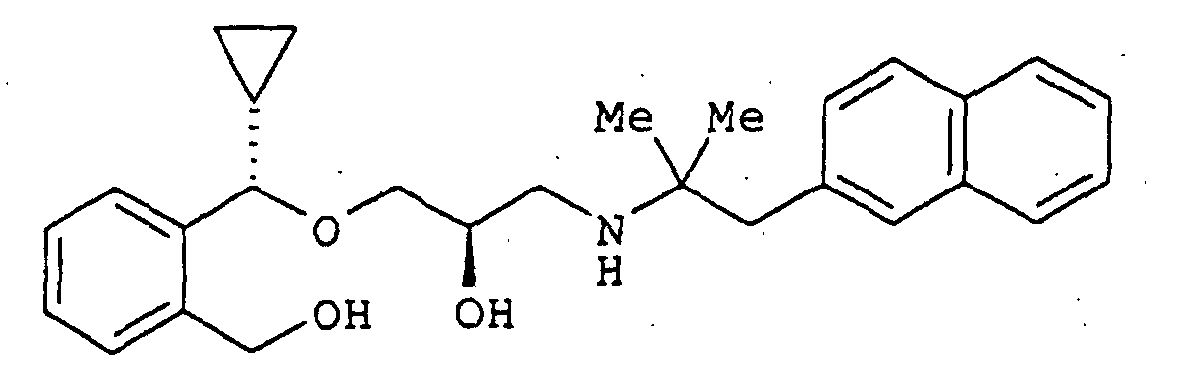

1H-NMR(300MHz, δppm, DMSO-d6) 7.90-7.80(3H,m), 7.71(1H,s), 7.50-7.20(7H,m), 6.48(1H,s), 4.63(1H,d,J=13.2Hz), 4.56(1H,d,J=13.2Hz), 4.12(1H,d,J=7.8Hz), 3.80-3.70(1H,brs), 3.35-3.15(2H,m), 2.95-2.85(3H,m), 2.80-2.65(1H,m), 1.20-1.00(7H,m), 0.60-0.20(4H,m).
MS(ESI,m/z) 434(M+H-1/2C4H4O4)+.
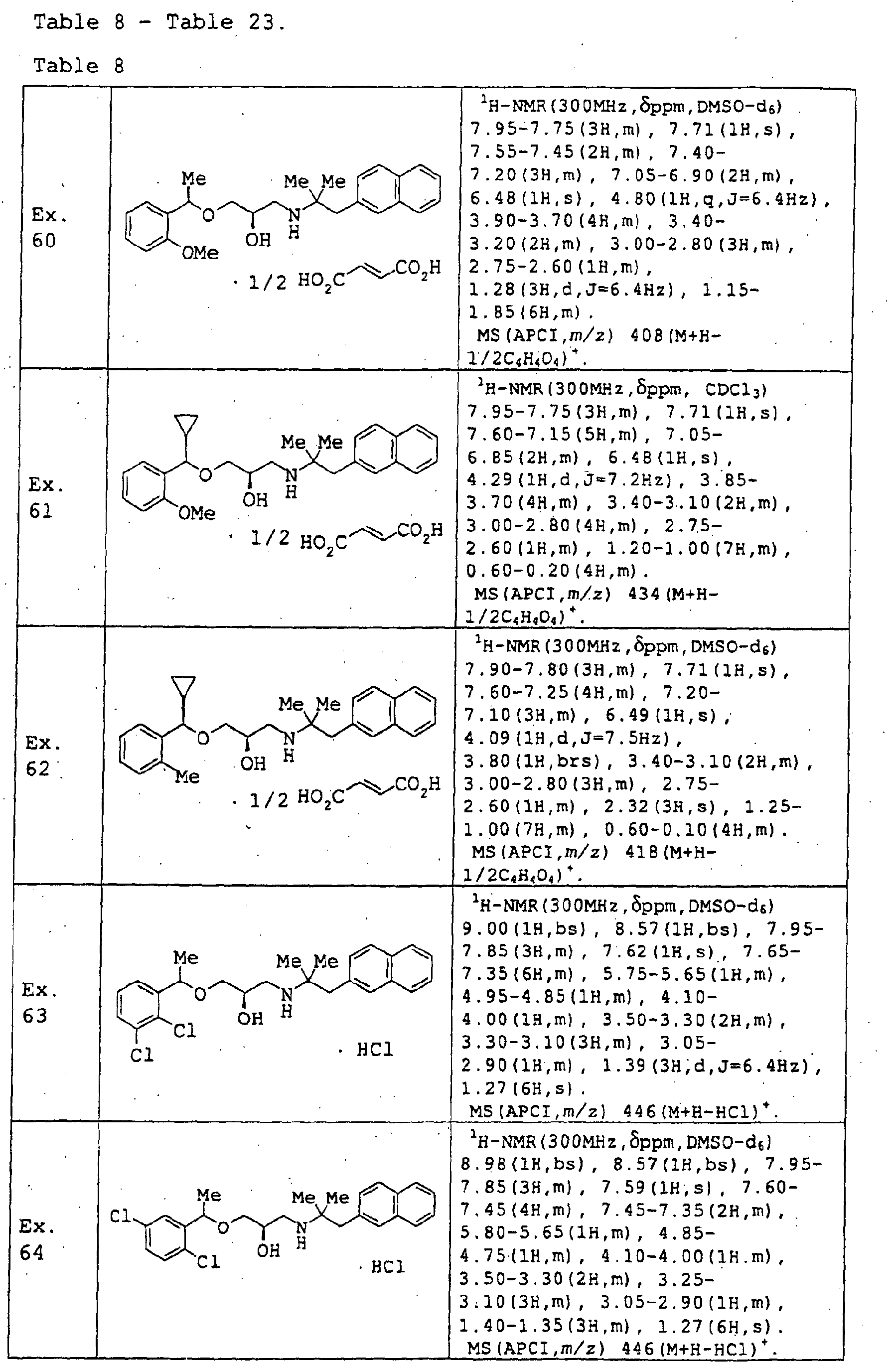


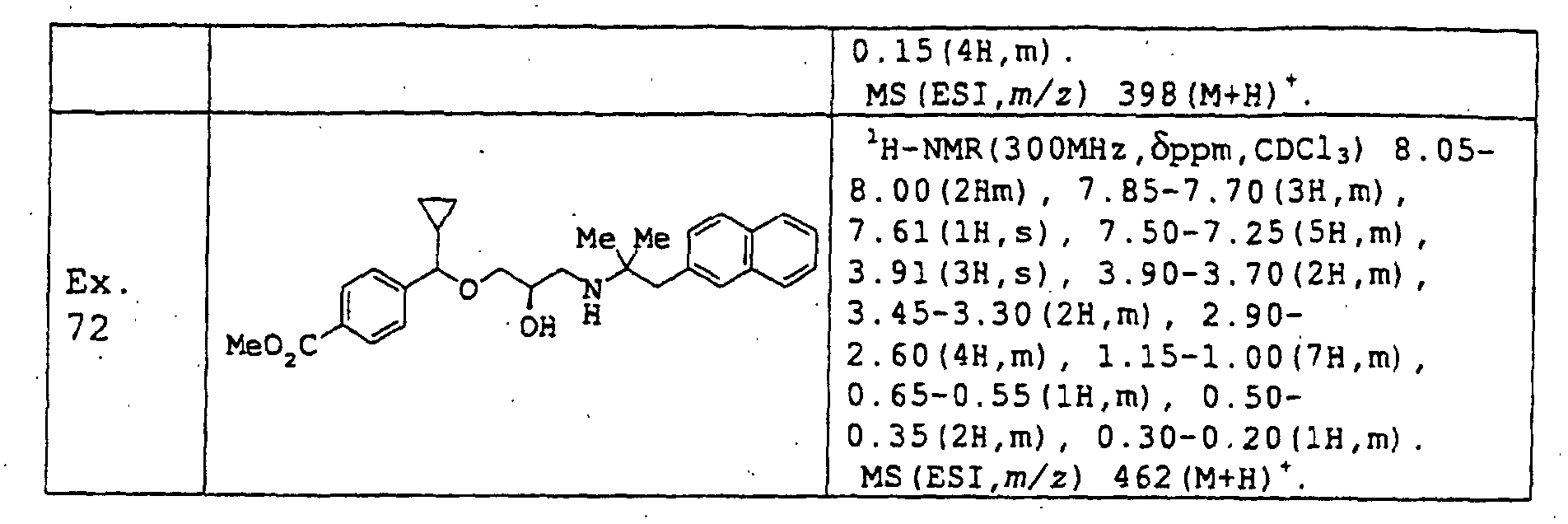

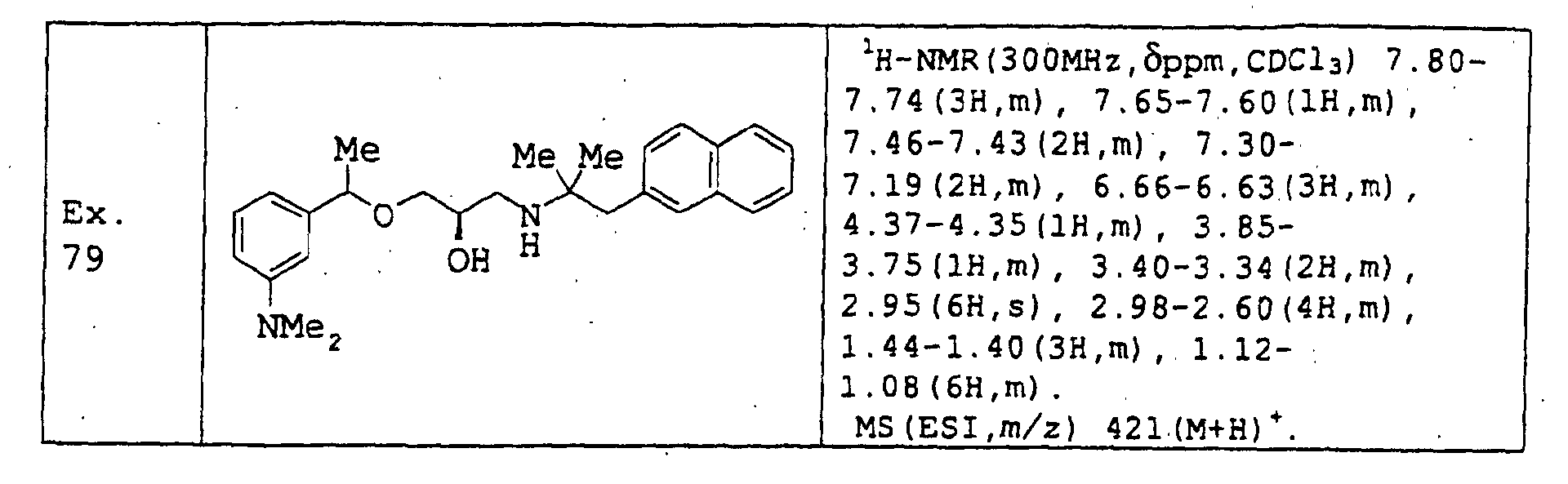


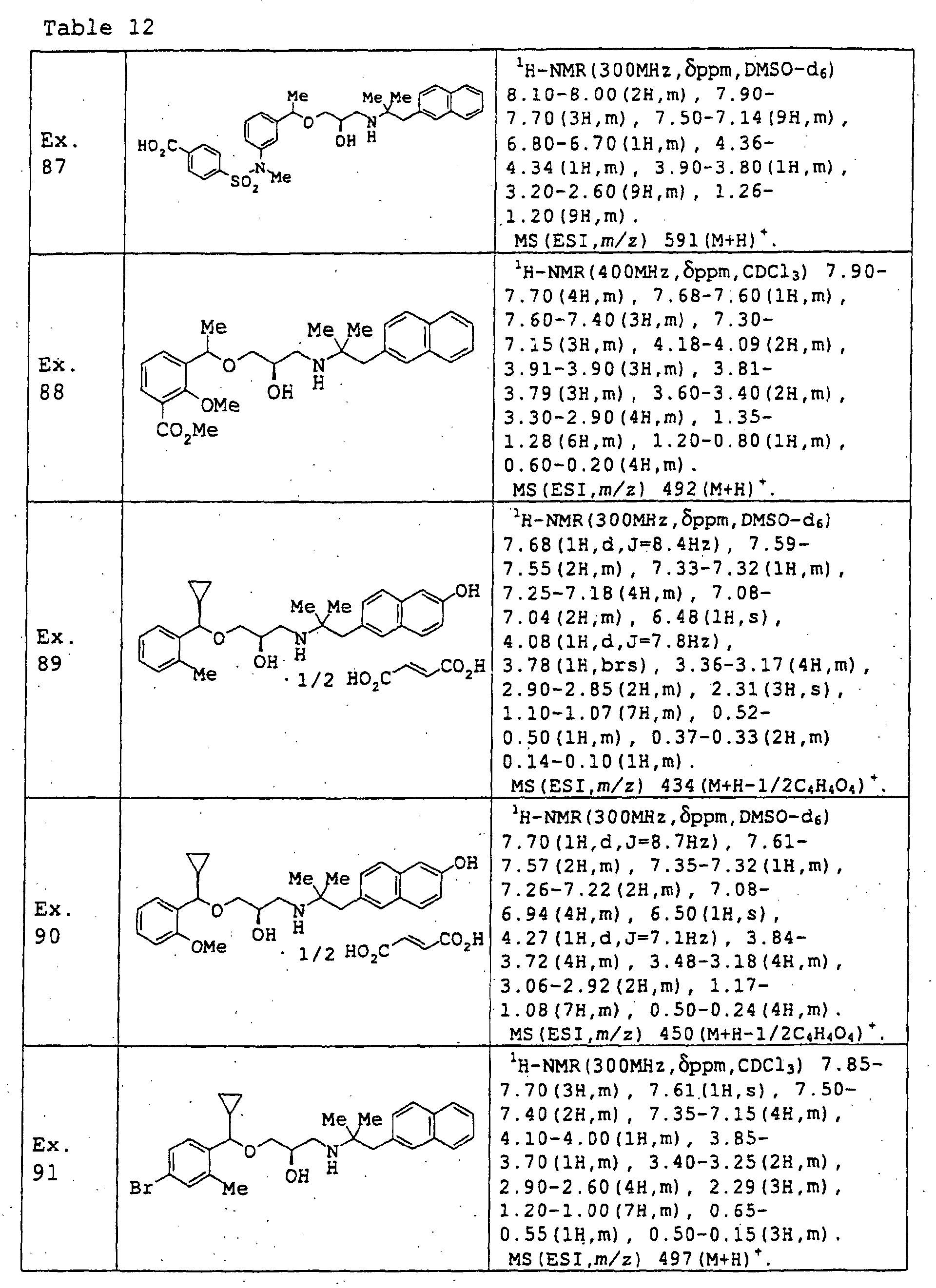
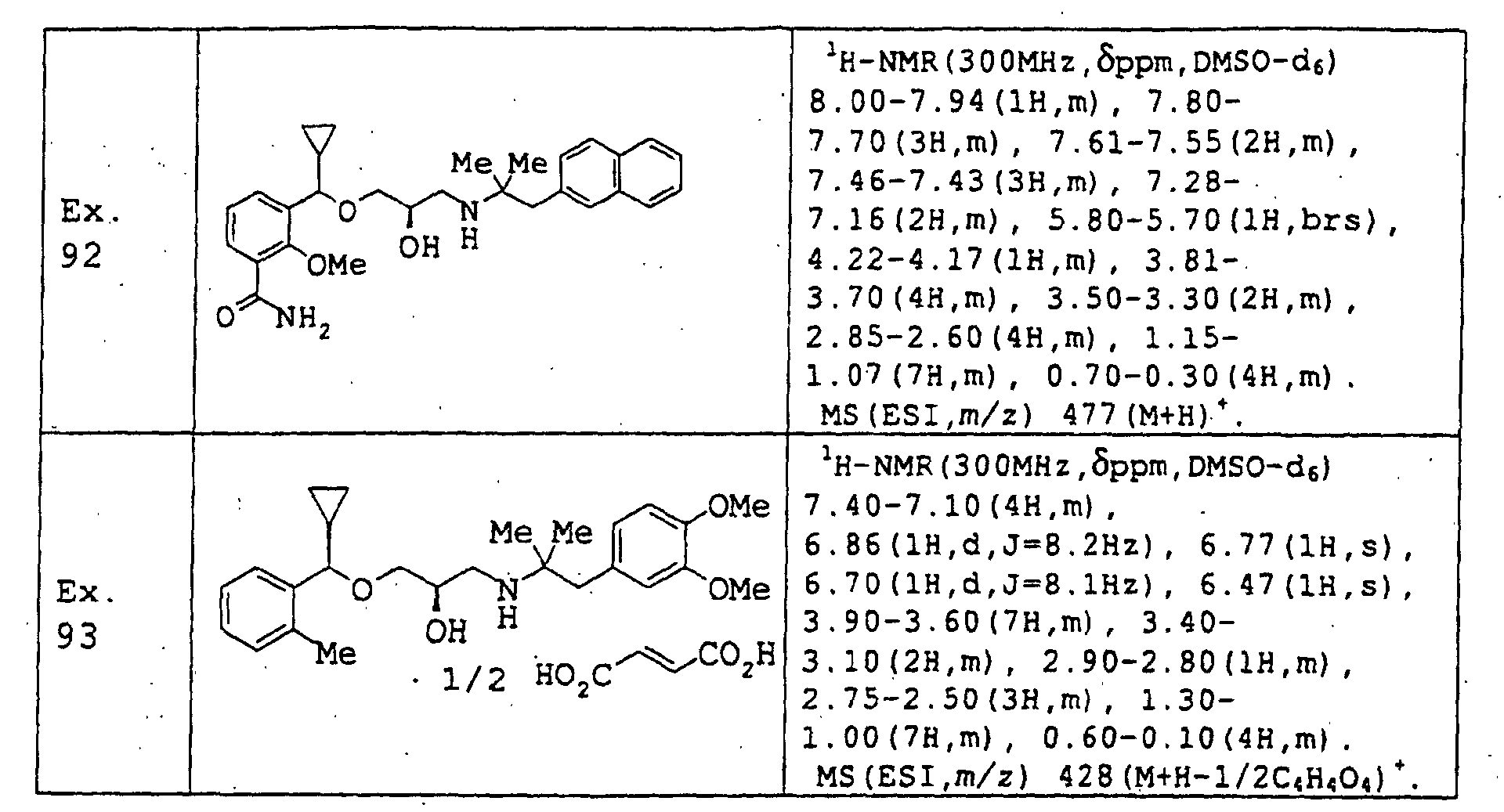
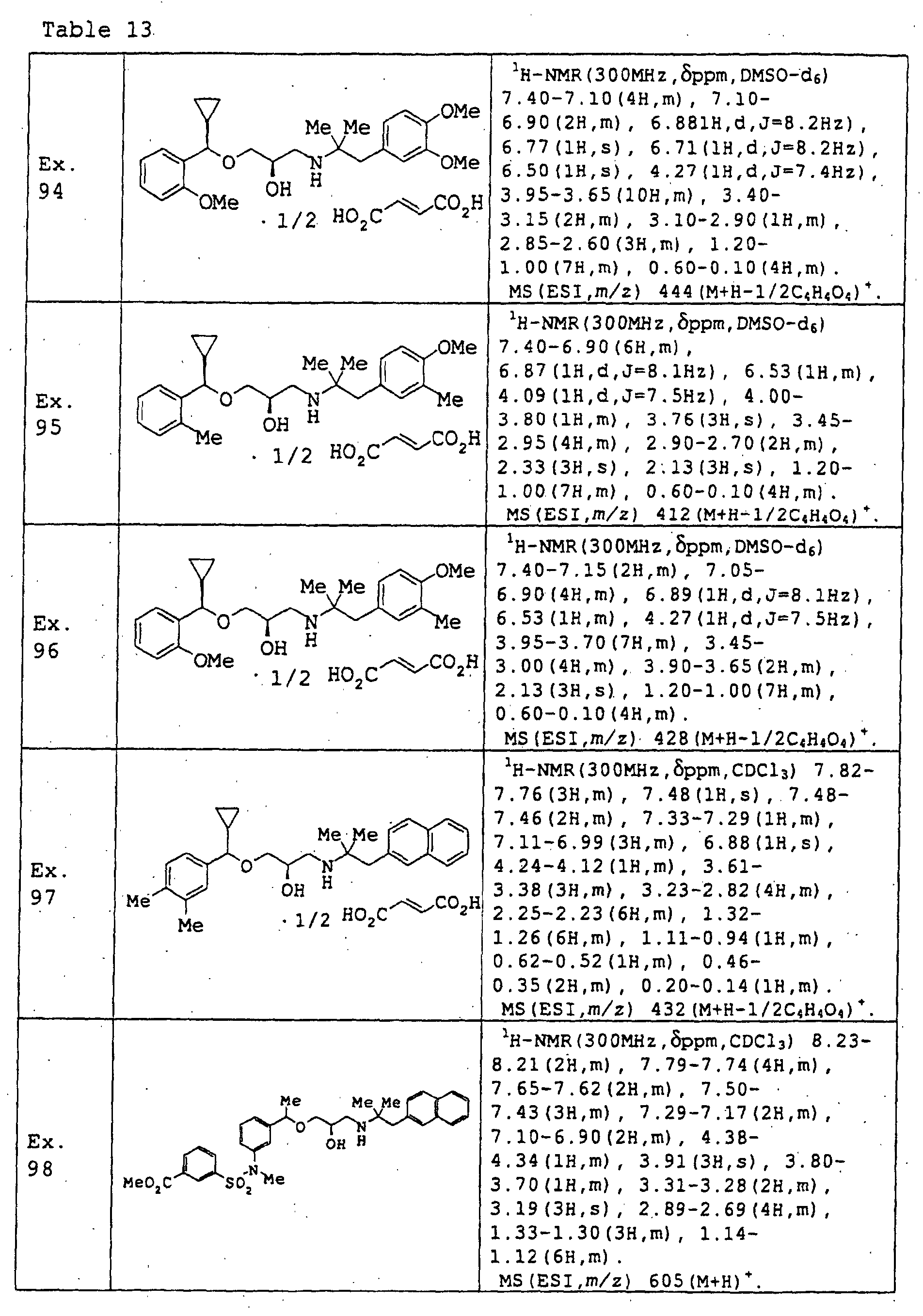
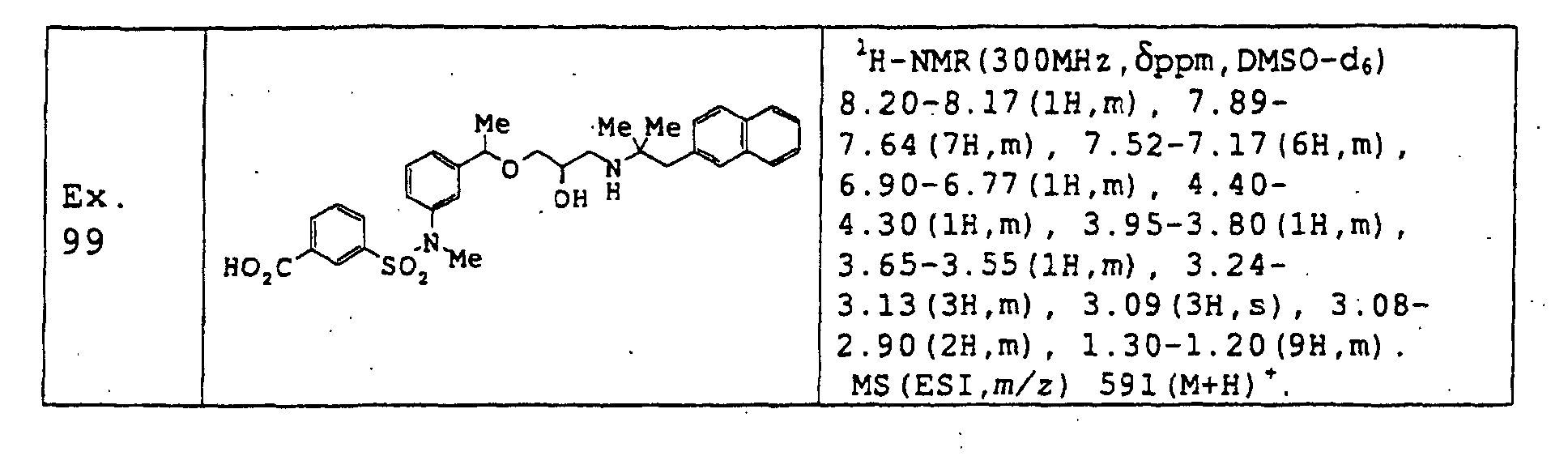


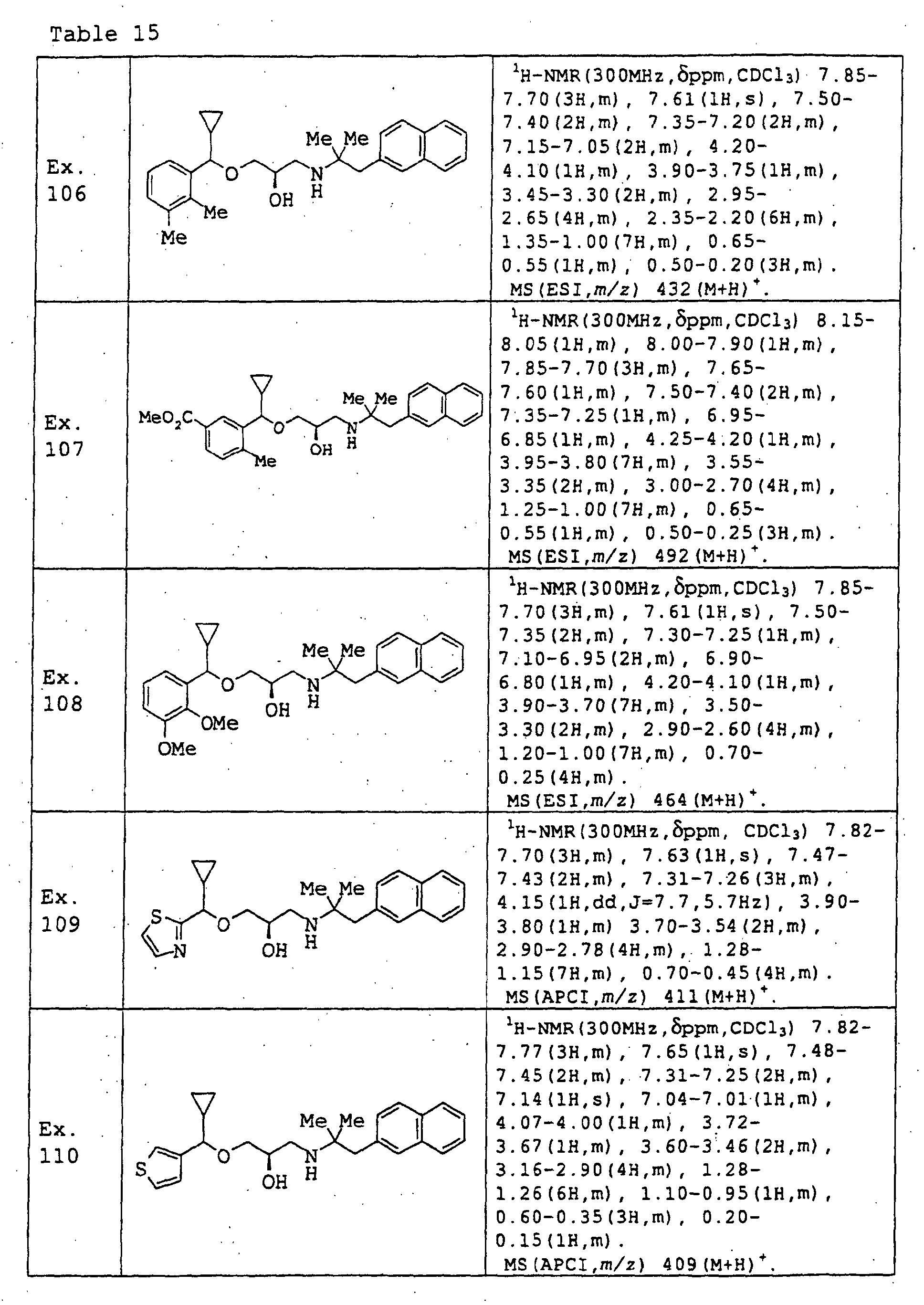
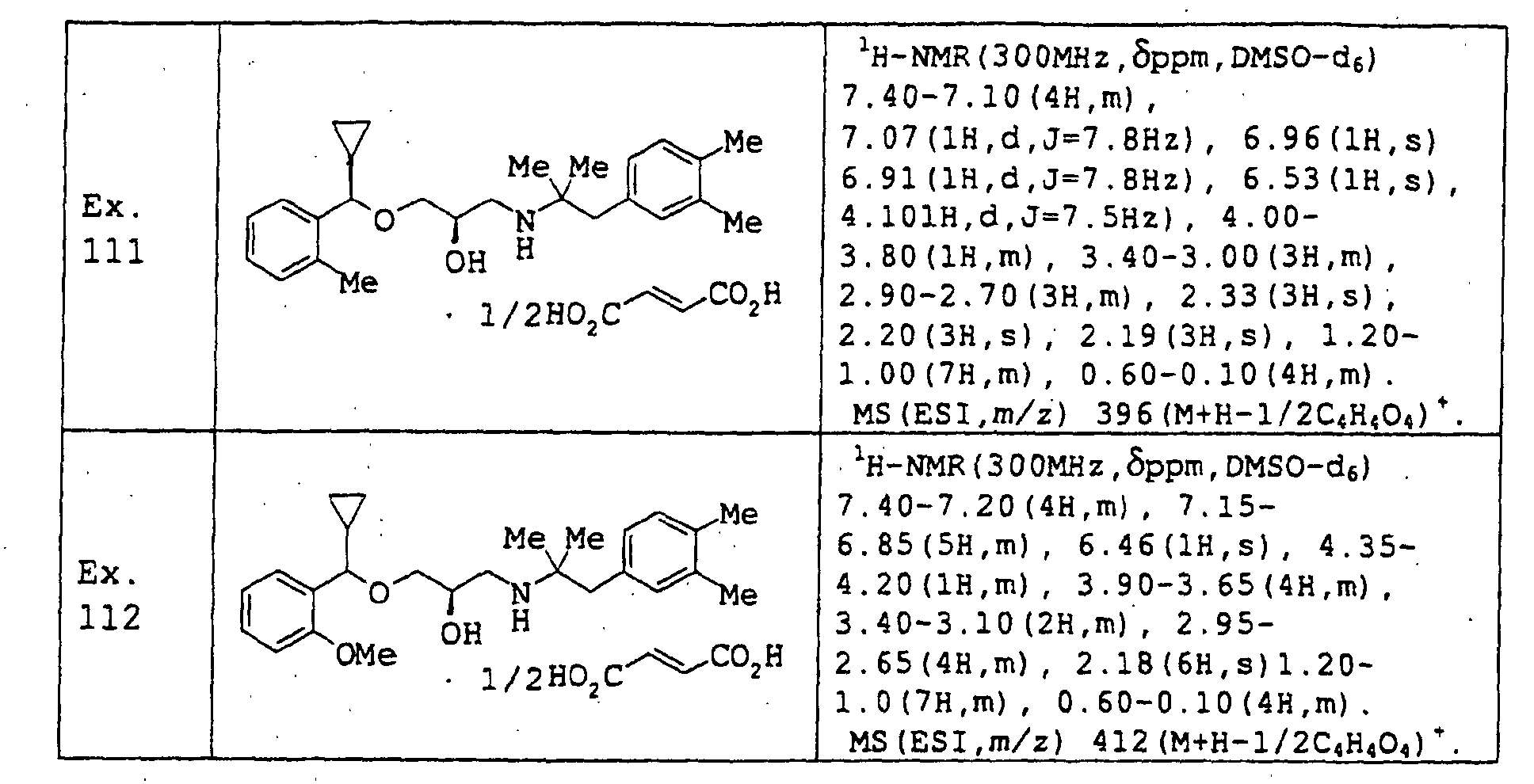

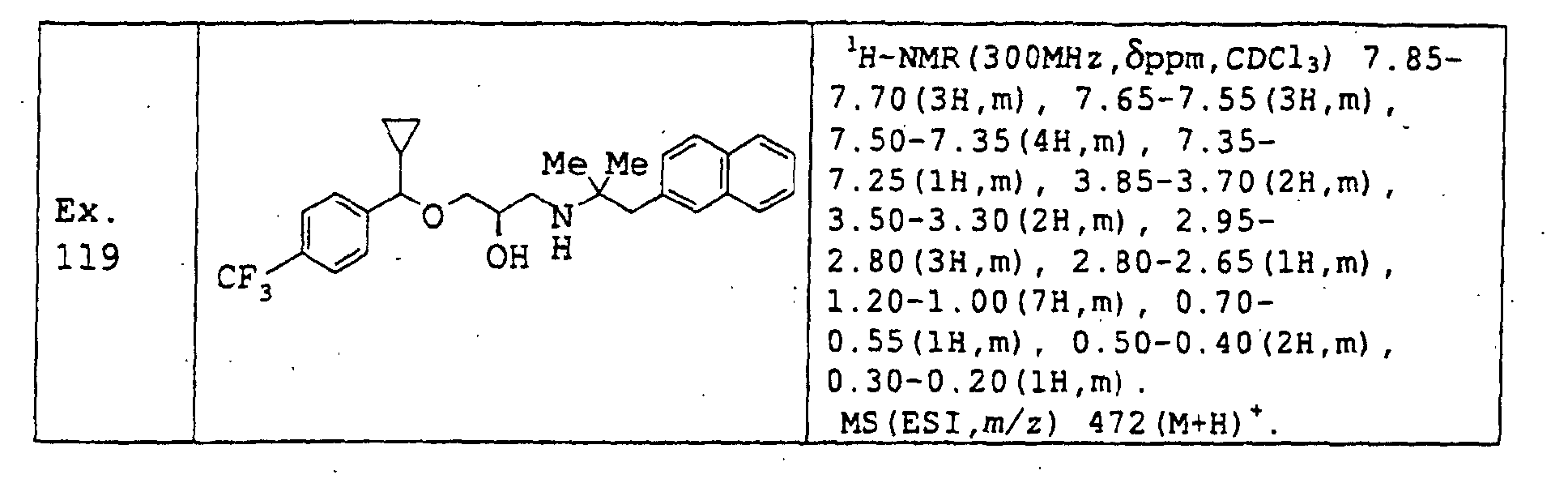

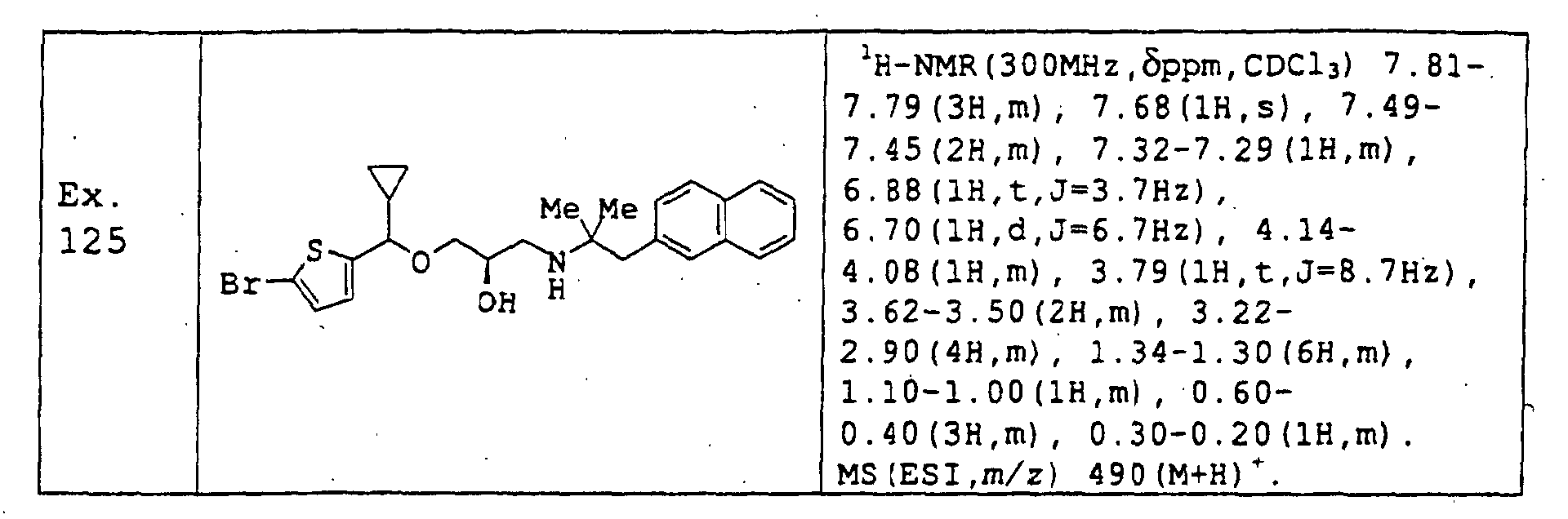


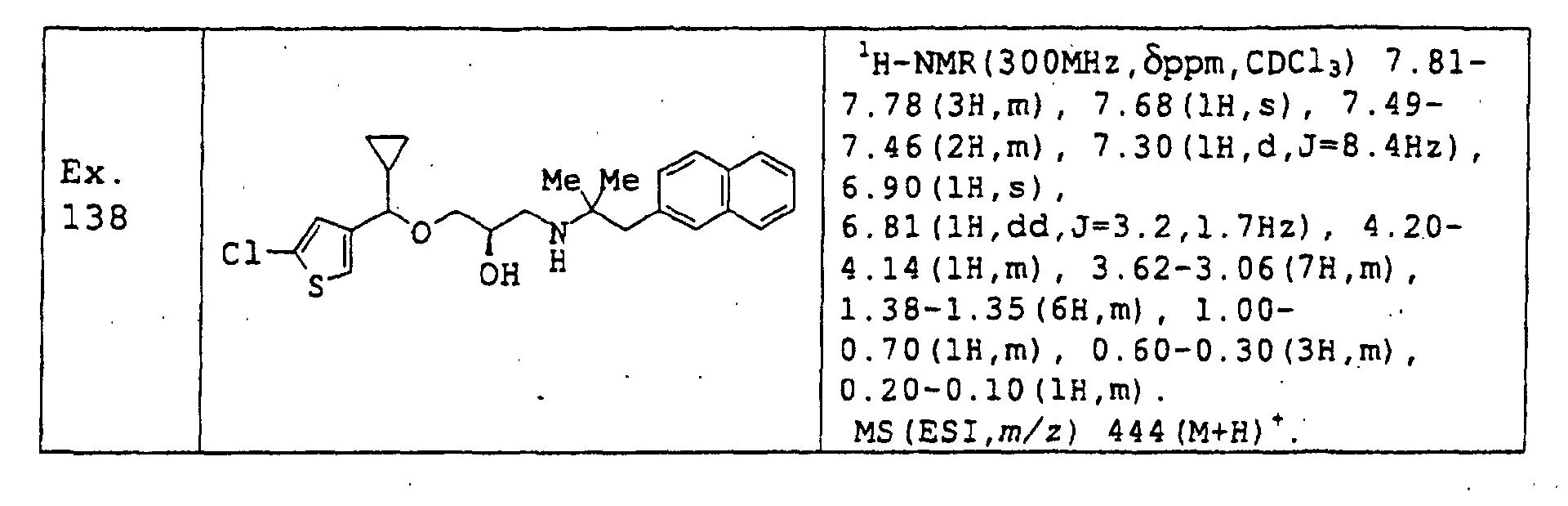
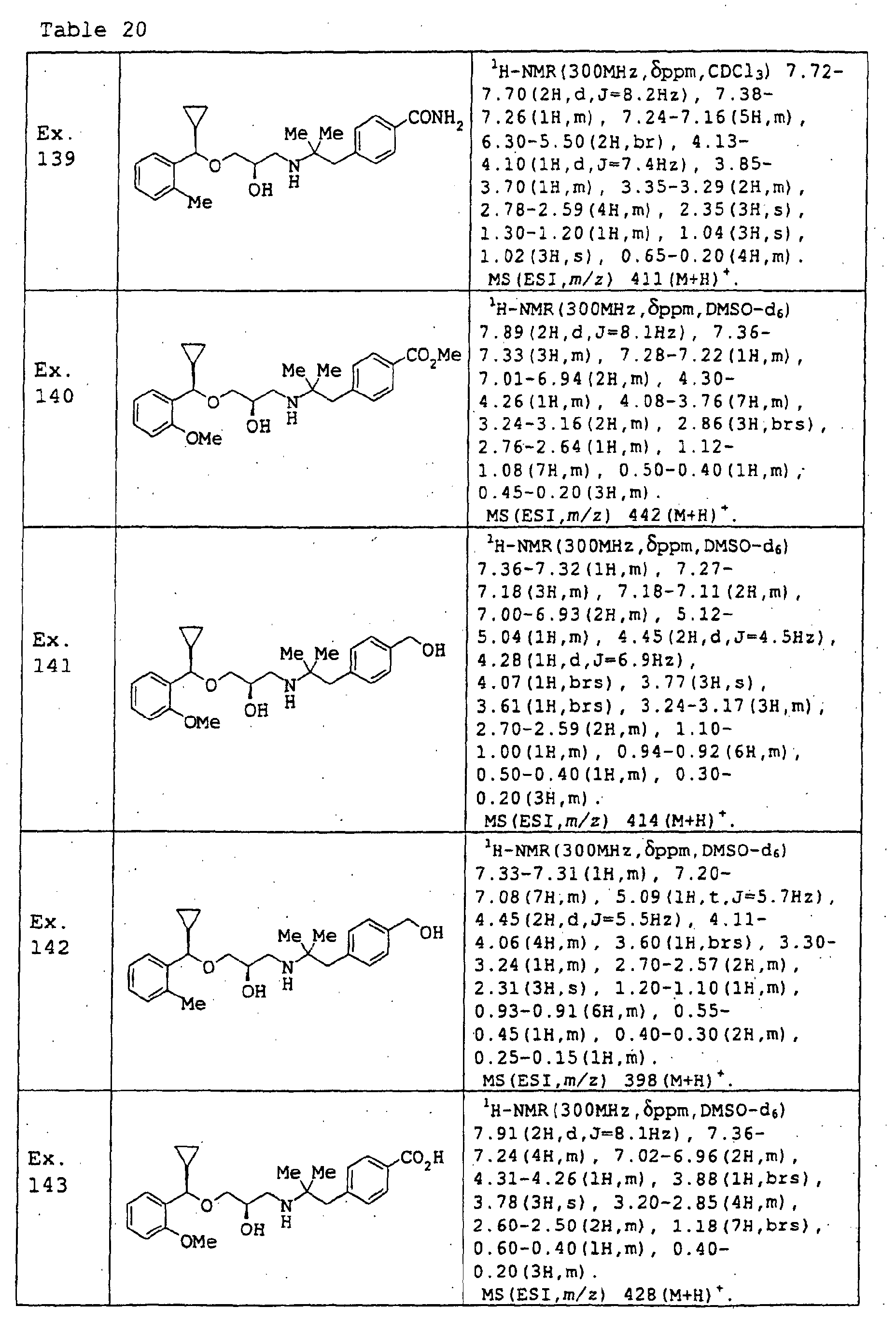
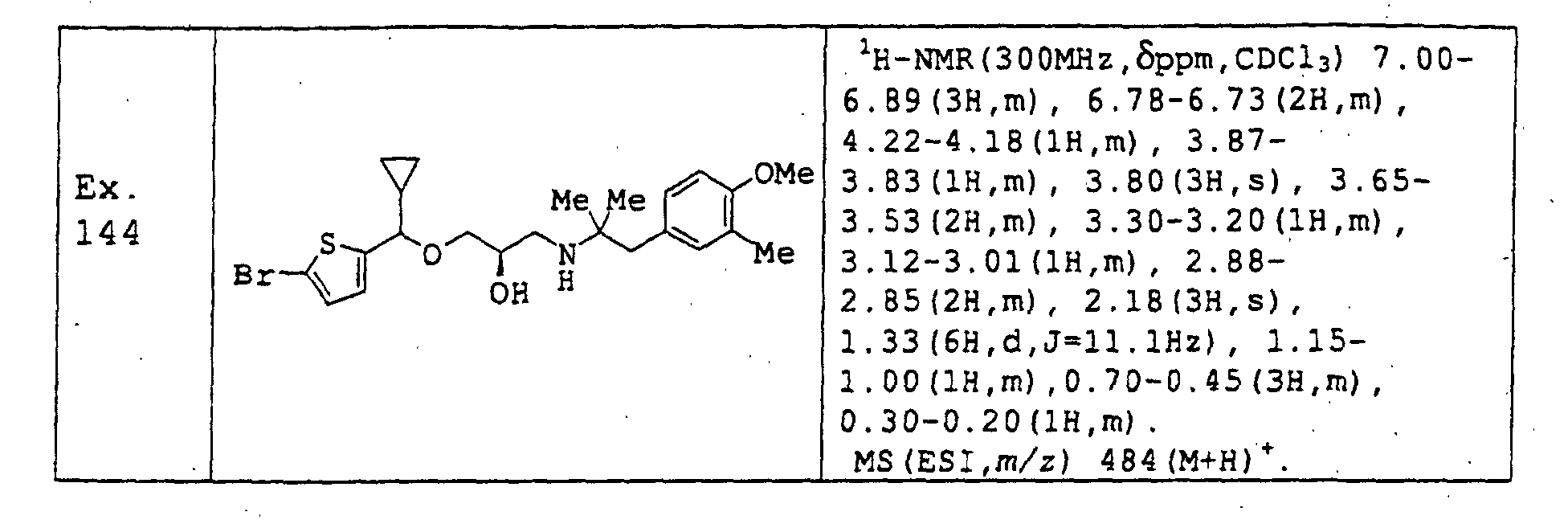
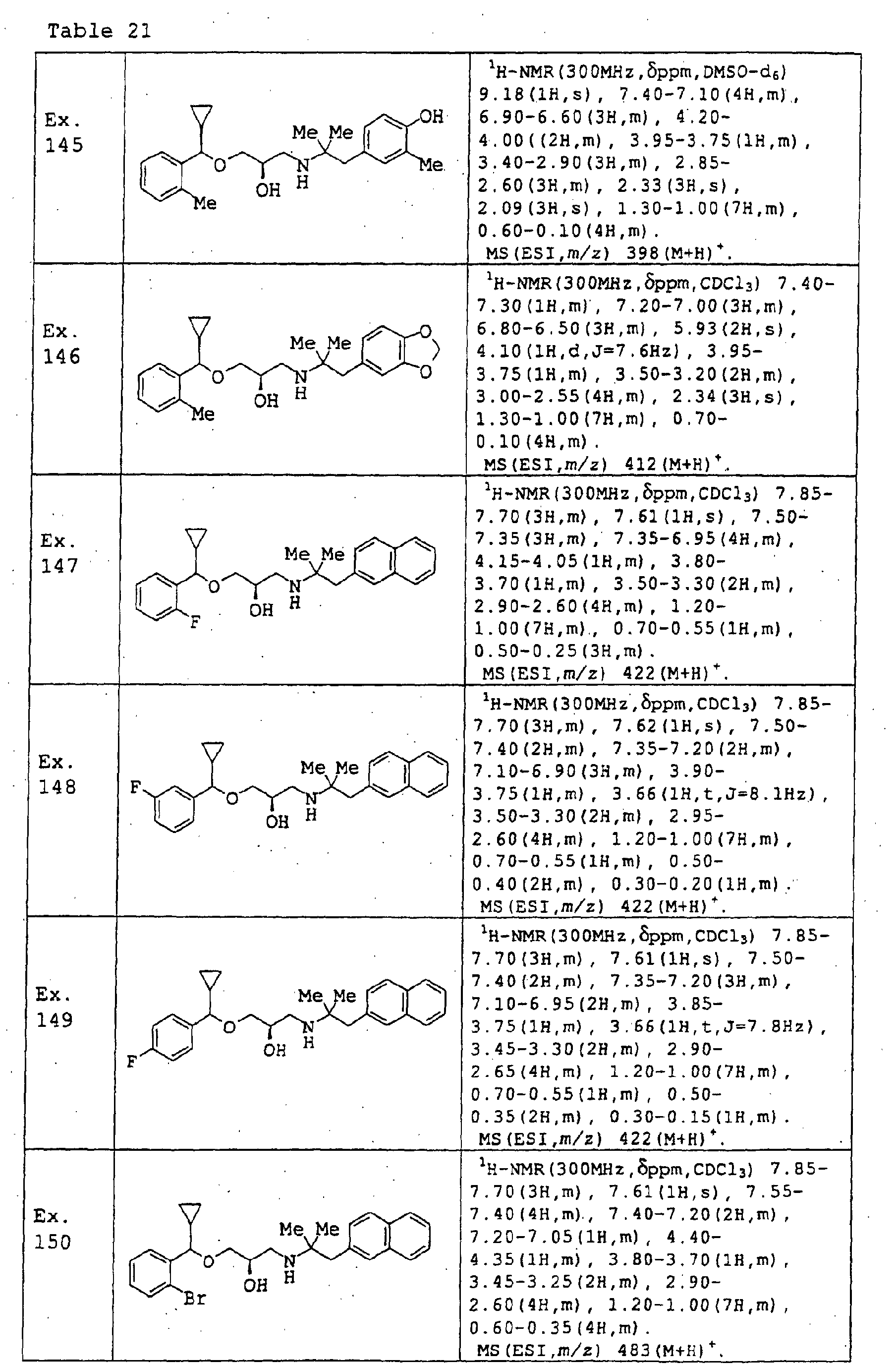


| test compound | IC50 (µM) | serum PTH concentration (pg/ml) | ||
| Before administration | 30 min later later | 240 min later | ||
| 30 mg/kg administration group (upper line) | ||||
| 100 mg/kg administration group (lower line) | ||||
| Example 1 | 0.041 | 56.9±9.4 | 141.5±15.3 | 54.1±7.7 |
| 55.8±3.9 | 160.0±13.8 | 58.3±7.3 | ||
| Example 2 | 0.027 | 52.0±3.4 | 148.4±10.1 | 60.0±5.8 |
| 68.9±7.6 | 154.8±17.1 | 85.8±17.3 | ||
| Example 5 | 0.070 | 78.9±11.8 | 155.6±14.9 | 84.8±12.3 |
| - | - | - | ||
| Example 22 | 0.059 | 62.2±5.2 | 185.7±10.0 | 73.4±11.0 |
| - | - | - | ||
| Example 23 | 0.027 | 85.3±3.6 | 228.3±15.0 | 73.9±6.9 |
| - | - | - | ||
| Example 24 | 0.022 | 66.5±4.3 | 197.7±18.9 | 77.5±9.0 |
| - | - | - | ||
| Example 62 | 0.045 | 99.3±43.6 | 259.2±29.4 | 82.2±9.9 |
| - | - | - | ||
| Comparative Example 1 | 0.56 | - | - | - |
| 107.1±17.5 | 139.0±18.8 | 78.9±12.3 | ||
| (- means unmeasured, mean±S.E.) |
| test compound | IC50 (µM) | serum PTH concentration (pg/ml) | ||
| Before administration | 30 min later | 120 min later | ||
| Example 80 | 0.064 | 44.8±6.3 | 156.6±15.3 | 76.1±12.6 |
| Example 82 | 0.051 | 66.7±5.0 | 121.9±9.0 | 68.5±11.4 |
| Example 95 | 0.029 | 105.8±44.2 | 199.1±25.8 | 80.4±9.6 |
| Example 100 | 0.067 | 52.2±4.4 | 130.1±53.7 | 49.3±4.4 |
| Example 105 | 0.049 | 38.3±8.6 | 115.4±20.0 | 74.3±12.1 |
| Example 111 | 0.024 | 51.2±12.8 | 236.3±60.8 | 65.3±6.4 |
| Example 127 | 0.133 | 65.0±6.9 | 265.3±22.3 | 75.2±7.3 |
| (- means unmeasured, mean±S.E.) |
| test compound | serum PTH concentration (pg/ml) | ||
| Before | 30 min later | 240 min later | |
| Example 58 | 179.2±45.6 | 644.4±65.2 | 394.1±100.9 |
| Example 59 | 189.8±90.9 | 313.4±103.3 | 62.2±10.3 |
| Example 62 | 82.9±24.5 | 620.6±34.2 | 100.1±11.7 |
| (mean±S.E.) |
Claims (21)
- A compound of the formula [I]wherein

- R1
- is aryl group or heteroaryl group wherein said aryl
group and heteroaryl group are optionally substituted by
1 to 3 substituents selected from halogen atom, C1-6
alkyl group, halo(C1-6)alkyl group, hydroxy(C1-6)alkyl
group, C1-6 alkoxy(C1-6)alkyl group, hydroxyl group, C1-6
alkoxy group, halo(C1-6)alkoxy group, mercapto group, C1-6
alkylthio group, C1-6 alkylsulfanyl group, C1-6
alkylsulfonyl group, aminosulfonyl group, C1-6
alkylsulfamoyl group, di(C1-6)alkylsulfamoyl group,
carboxy group, (C1-6 alkoxy)carbonyl group, C1-7 acyl
group, carbamoyl group, (C1-6 alkyl)carbamoyl group,
di(C1-6 alkyl)carbamoyl group, cyano group, nitro group,
amino group, C1-6 alkylamino group, di(C1-6)alkylamino
group, C1-7 acylamino group, C1-3 alkylenedioxy group,
wherein RA is (C1-6 alkoxy)carbonyl group or carboxy group, and RB is hydrogen atom or C1-6 alkyl group;
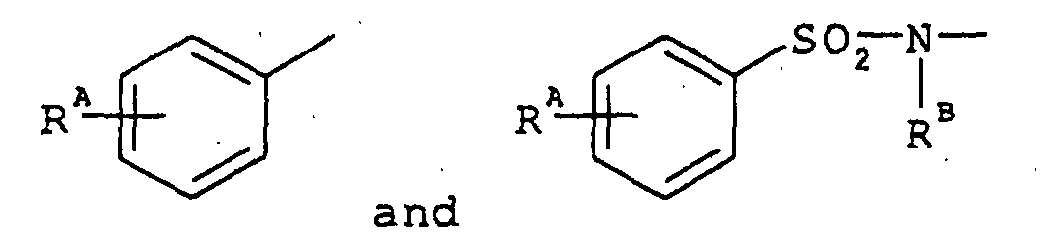
- R2
- is C1-6 alkyl group
wherein said C1-6 alkyl group is optionally substituted by 1 to 3 substituents selected from halogen atom, hydroxyl group, C1-6 alkoxy group, carboxy group, amino group, C1-6 alkylamino group, di(C1-6)alkylamino group and oxo group, C3-7 cycloalkyl group, C2-6 alkenyl group, C2-6 alkynyl group, aralkyl group, carboxy group, (C1-6 alkoxy)carbonyl group or cyano group; - R3
- is hydrogen atom, C1-6 alkyl group, hydroxyl group, C1-6 alkoxy group, mercapto group, C1-6 alkylthio group, carboxy group, (C1-6 alkoxy)carbonyl group, (C1-6 alkyl)carbamoyl group, di(C1-6 alkyl)carbamoyl group, amino group, C1-6 alkylamino group or di(C1-6)alkylamino group;
- R4
- is hydrogen atom, C1-6 alkyl group or C2-6 alkenyl group, or R3 and R4 in combination show oxo group;
- R5 and R6
- are the same or different and each is C1-6 alkyl group, or R5 and R6 in combination show cyclopropyl group together with the carbon atom they bind to;
- R7
- is aryl group or heteroaryl group wherein said aryl group and heteroaryl group are optionally substituted by 1 to 3 substituents selected from halogen atom, C1-6 alkyl group, halo(C1-6)alkyl group, hydroxy(C1-6)alkyl group, C3-7 cycloalkyl group, hydroxyl group, C1-6 alkoxy group, halo(C1-6)alkoxy group, carboxy group, (C1-6 alkoxy)carbonyl group, nitro group, cyano group, C1-6 alkylsulfonyloxy group, carbamoyl group and C1-3 alkylenedioxy group;
- X1
- is a single bond, C1-6 alkylene group or C2-6 alkynylene group wherein said C1-6 alkylene group and C2-6 alkynylene group are optionally substituted by C1-6 alkyl group or oxo group;
- X2
- is C1-6 alkylene group wherein said C1-6 alkylene group is optionally substituted by C1-6 alkyl group or halo(C1-6)alkyl group;
- X3
- is a single bond or C1-6 alkylene group wherein said C1-6 alkylene group is optionally substituted by hydroxyl group or oxo group;
- X4 and X5
- in combination show a single bond, methylene group,
a salt thereof, a solvate thereof or a prodrug thereof. - A compound of the formula [I']wherein
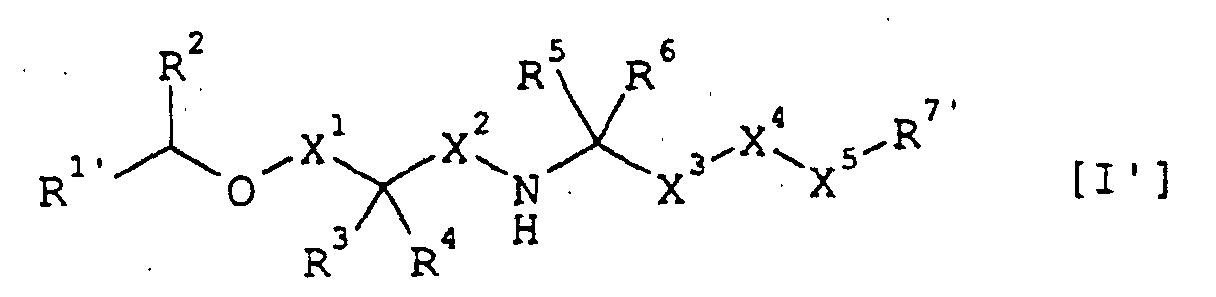
- R1'
- is aryl group or heteroaryl group wherein said aryl group and heteroaryl group are optionally substituted by 1 to 3 substituents selected from halogen atom, C1-6 alkyl group, halo(C1-6)alkyl group, hydroxy(C1-6)alkyl group, C1-6 alkoxy(C1-6)alkyl group, hydroxyl group, C1-6 alkoxy group, halo(C1-6)alkoxy group, mercapto group, C1-6 alkylthio group, C1-6 alkylsulfanyl group, C1-6 alkylsulfonyl group, aminosulfonyl group, C1-6 alkylsulfamoyl group, di(C1-6)alkylsulfamoyl group, carboxy group, (C1-6 alkoxy)carbonyl group, C1-7 acyl group, carbamoyl group, (C1-6 alkyl)carbamoyl group, di(C1-6 alkyl)carbamoyl group, cyano group, nitro group, amino group, C1-6 alkylamino group, di(C1-6)alkylamino group and C1-7 acylamino group;
- R7'
- is aryl group or heteroaryl group wherein said aryl group and heteroaryl group are optionally substituted by 1 to 3 substituents selected from halogen atom, C1-6 alkyl group, halo(C1-6)alkyl group, C3-6 cycloalkyl group, hydroxyl group, C1-6 alkoxy group, halo(C1-6)alkoxy group, carboxy group, (C1-6 alkoxy)carbonyl group, nitro group, cyano group and C1-6 alkylsulfonyloxy group; and
- R2,
- R3, R4, R5, R6, X1, X2, X3, X4 and X5 are same as defined in
a salt thereof, a solvate thereof or a prodrug thereof. - A compound of the formula [I"]wherein
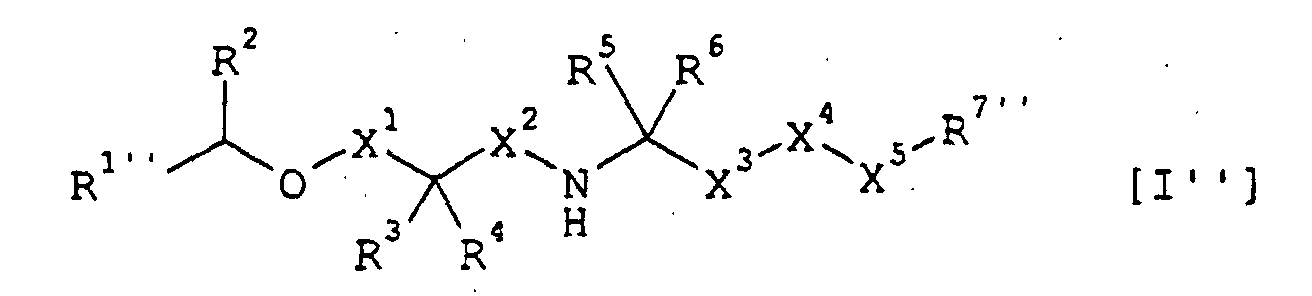
R1" is aryl group or heteroaryl group wherein said aryl group and heteroaryl group are optionally substituted by 1 to 3 substituents selected from C1-3 alkylenedioxy group,wherein RA is (C1-6 alkoxy)carbonyl group or carboxy group and RB is hydrogen atom or C1-6 alkyl group;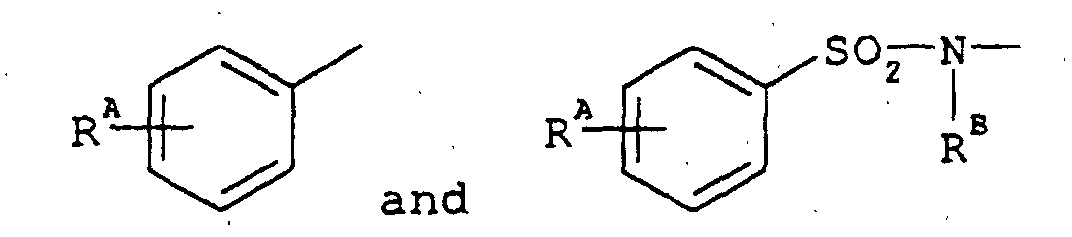
R7" is aryl group or heteroaryl group wherein said aryl group and heteroaryl group are optionally substituted by 1 to 3 substituents selected from hydroxy(C1-6)alkyl group, carbamoyl group and C1-3 alkylenedioxy group; and
R2, R3, R4, R5, R6, X1, X2, X4 and X5 are same as defined in claim 1 respectively,
a salt thereof, a solvate thereof or a prodrug thereof. - A compound of the formula [I-2]wherein R11 and R12 are the same or different and each is hydrogen atom, halogen atom, C1-4 alkyl group, hydroxy(C1-6)alkyl group, C1-6 alkoxy(C1-6)alkyl group, hydroxyl group, C1-4 alkoxy group, cyano group or nitro group, or R11 and R12 in combination show C1-3 alkylenedioxy group,

R21 is C1-4 alkyl group
wherein said alkyl group is optionally substituted by
C1-4 alkoxy group,
C3-5 cycloalkyl group, C2-4 alkenyl group, or aralkyl group, and R3, R4, R5, R6, R7, X1, X2, X3, X4 and X5 are same as defined in
claim 1 respectively,
a salt thereof, a solvate thereof or a prodrug thereof. - The compound of claim 4, which is represented by the formula [I-3]wherein R71 and R72 are the same or different and each is hydrogen atom, C1-4 alkyl group or C1-4 alkoxy group, or in combination show -CH=CH-CH=CH- or C1-3 alkylenedioxy group, and R11, R12 and R21 are same as defined in claim 4 respectively, a salt thereof, a solvate thereof or a prodrug thereof.
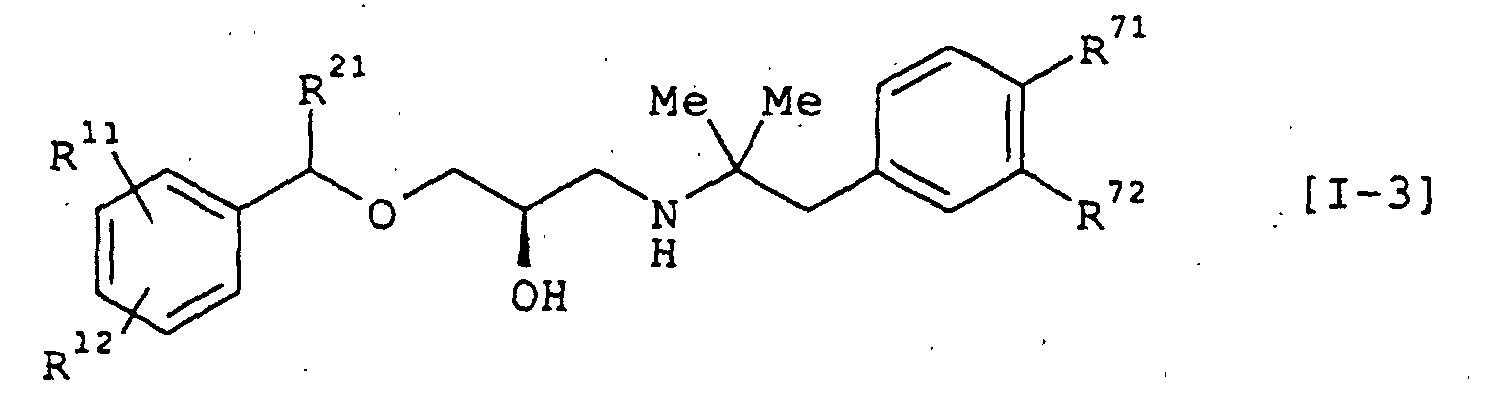
- The compound of claim 5, wherein R11 and R12 are the same or different and each is hydrogen atom, chlorine atom, methyl group, hydroxymethyl group, hydroxyl group, methoxy group, cyano group or nitro group, or R11 and R12 in combination show methylenedioxy group, and R21 is optionally branched C1-4 alkyl group or C3-5 cycloalkyl group,
a salt thereof, a solvate thereof or a prodrug thereof. - The compound of claim 6, wherein R21 is methyl group, ethyl group, cyclopropyl group or cyclobutyl group,
a salt thereof, a solvate thereof or a prodrug thereof. - The compound of claim 7, wherein R11 is hydrogen atom, R12 is methyl group, methoxy group or hydroxymethyl group, or R11 and R12 in combination show methylenedioxy group, and R21 is methyl group or cyclopropyl group,
a salt thereof, a solvate thereof or a prodrug thereof. - The compound of claim 8, wherein R21 is cyclopropyl group,
a salt thereof, a.solvate thereof or a prodrug thereof. - The compound of claim 9, wherein R71 and R72 in combination show -CH=CH-CH-CH-,
a salt thereof, a solvate thereof or a prodrug thereof. - The compound of claim 9, wherein R71 and R72 are groups selected from C1-4 alkyl group and C1-4 alkoxy group,
a salt thereof, a solvate thereof or a prodrug thereof. - The compound of claim 1, which is selected froma salt thereof, a solvate thereof or a prodrug thereof.(2R)-1-[1,1-dimethyl-2-(naphthalen-2-yl)ethylamino]-3-[(cyclopropyl)(2-methoxyphenyl)methoxy]propan-2-ol,(2R)-1-[1,1-dimethyl-2-(naphthalen-2-yl)ethylamino]-3-[(cyclopropyl)(2-methylphenyl)methoxy]propan-2-ol,(2R)-1-[1,1-dimethyl-2-(naphthalen-2-yl)ethylamino]-3-[(cyclopropyl)(phenyl)methoxy]propan-2-ol,(2R)-1-[1,1-dimethyl-2-(naphthalen-2-yl)ethylamino]-3-[1-(2-methoxyphenyl)ethoxy]propan-2-ol,(2R)-1-[1,1-dimethyl-2-(naphthalen-2-yl)ethylamino]-3-[1-(2-methylphenyl)ethoxy]propan-2-ol,(2R)-1-[1,1-dimethyl-2-(naphthalen-2-yl)ethylamino]-3-[1-(2-methoxyphenyl)propoxy]propan-2-ol,(2R)-1-[1,1-dimethyl-2-(naphthalen-2-yl)ethylamino]-3-[1-(2-cyanophenyl)ethoxy]propan-2-ol,(2R)-1-[1,1-dimethyl-2-(naphthalen-2-yl)ethylamino]-3-[1-(3-methoxyphenyl)ethoxy]propan-2-ol and(2R)-1-[1,1-dimethyl-2-(naphthalen-2-yl)ethylamino]-3-[1-(3-methylphenyl)ethoxy]propan-2-ol,
- (2R)-1-[1,1-Dimethyl-2-(naphthalen-2-yl)ethylamino]-3-[(cyclopropyl)(2-hydroxymethylphenyl)methoxy]propan-2-ol, a salt thereof, a solvate thereof or a prodrug thereof.
- A pharmaceutical composition comprising the compound of any of claims 1 to 13, a salt thereof, a solvate thereof or a prodrug thereof as an active ingredient.
- A calcium receptor antagonist comprising the compound of any of claims 1 to 13, a salt thereof, a solvate thereof or a prodrug thereof as an active ingredient.
- A therapeutic agent for osteoporosis comprising the compound of any of claims 1 to 13, a salt thereof, a solvate thereof or a prodrug thereof as an active ingredient.
- A compound of the formula [II]wherein R11' is halogen atom, C1-4 alkyl group, hydroxy(C1-6)alkyl group, C1-6 alkoxy(C1-6)alkyl group, hydroxyl group, C1-4 alkoxy group, tert-butyldimethylsilyloxymethyl group, cyano group or nitro group,
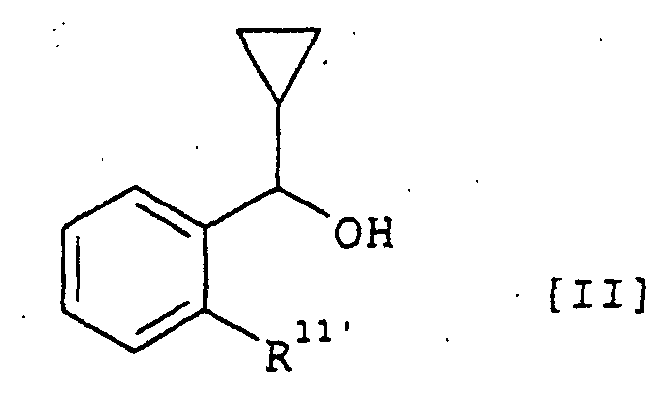
a salt thereof or a solvate thereof. - The compound of claim 17, wherein, in the formula [II], R11' is C1-4 alkyl group, hydroxy(C1-6)alkyl group or C1-4 alkoxy group,
a salt thereof or a solvate thereof. - A compound of the formula [III]wherein R11" is halogen atom, hydroxy(C1-6)alkyl group, C1-6 alkoxy(C1-6)alkyl group, hydroxyl group, C1-4 alkoxy group, tert-butyldimethylsilyloxymethyl group, cyano group or nitro group,

a salt thereof or a solvate thereof. - The compound of claim 19, wherein, in the formula [III], R11" is C1-4 alkoxy group,
a salt thereof or a solvate thereof. - A compound of the formula [IV]wherein R8 is carboxy group, nitro group, tert-butoxycarbonylamino group or benzyloxycarbonylamino group,

a salt thereof or a solvate thereof.
Applications Claiming Priority (5)
| Application Number | Priority Date | Filing Date | Title |
|---|---|---|---|
| JP2000244536 | 2000-08-11 | ||
| JP2000244536 | 2000-08-11 | ||
| JP2001132879 | 2001-04-27 | ||
| JP2001132879 | 2001-04-27 | ||
| PCT/JP2001/006903 WO2002014259A1 (en) | 2000-08-11 | 2001-08-10 | Calcium receptor antagonists |
Publications (3)
| Publication Number | Publication Date |
|---|---|
| EP1308436A1 true EP1308436A1 (en) | 2003-05-07 |
| EP1308436A4 EP1308436A4 (en) | 2005-10-05 |
| EP1308436B1 EP1308436B1 (en) | 2008-10-15 |
Family
ID=26597841
Family Applications (1)
| Application Number | Title | Priority Date | Filing Date |
|---|---|---|---|
| EP01955658A Expired - Lifetime EP1308436B1 (en) | 2000-08-11 | 2001-08-10 | Calcium receptor antagonists |
Country Status (8)
| Country | Link |
|---|---|
| US (2) | US6916956B2 (en) |
| EP (1) | EP1308436B1 (en) |
| KR (1) | KR100785675B1 (en) |
| AT (1) | ATE411275T1 (en) |
| AU (1) | AU2001277752A1 (en) |
| CA (1) | CA2418794C (en) |
| DE (1) | DE60136187D1 (en) |
| WO (1) | WO2002014259A1 (en) |
Cited By (6)
| Publication number | Priority date | Publication date | Assignee | Title |
|---|---|---|---|---|
| WO2008121386A2 (en) | 2007-03-30 | 2008-10-09 | Amgen Inc. | Calcimimetic compounds for use in the treatment of bowel disorders |
| WO2010104882A1 (en) | 2009-03-10 | 2010-09-16 | Amgen Inc. | Methods of modulating sperm motility |
| CN102056897A (en) * | 2008-06-05 | 2011-05-11 | 旭化成制药株式会社 | Sulfonamide compound and application thereof |
| US8173631B2 (en) | 2008-12-24 | 2012-05-08 | Daiichi Sankyo Company, Limited | Cyclic amine compounds |
| US8183272B2 (en) | 2008-12-24 | 2012-05-22 | Daiichi Sankyo Company, Limited | Indanyl compounds |
| US8779004B2 (en) | 2006-04-20 | 2014-07-15 | Amgen, Inc. | Stable emulsion formulations |
Families Citing this family (9)
| Publication number | Priority date | Publication date | Assignee | Title |
|---|---|---|---|---|
| RU2339624C2 (en) | 2002-12-12 | 2008-11-27 | Авентис Фарма С.А. | Derivatives of aminoindazols and their application as kinases inhibitors |
| PE20050460A1 (en) * | 2003-04-23 | 2005-07-08 | Japan Tobacco Inc | HETEROCYCLIC COMPOUNDS AS ANTAGONISTS CaSR (CALCIUM SENSITIVE RECEPTOR) |
| CA2527203C (en) * | 2003-05-28 | 2010-08-17 | Japan Tobacco Inc. | Casr antagonist |
| US7293246B2 (en) * | 2004-04-21 | 2007-11-06 | Microsoft Corporation | System and method for aligning objects using non-linear pointer movement |
| CA2663436A1 (en) * | 2006-10-04 | 2008-04-10 | Pfizer Products Inc. | Pyrido[4,3-d]pyrimidin-4(3h)-one derivatives as calcium receptor antagonists |
| WO2009055631A1 (en) * | 2007-10-25 | 2009-04-30 | Smithkline Beecham Corporation | Calcilytic compounds |
| WO2010103429A1 (en) | 2009-03-10 | 2010-09-16 | Pfizer Inc. | 1,1-(Dimethyl-Ethylamino)-2-Hydroxy-Propoxy]-Ethyl}-3-Methyl-Biphenyl-4- Carboxylic Acid Derivatives As Calcium Receptor Antagonists |
| EP2413139B1 (en) | 2010-07-30 | 2015-05-20 | Universität Leipzig | Method and compositions for the identification of agents that have a potential effect against chronic inflammatory diseases |
| GB201217330D0 (en) | 2012-09-28 | 2012-11-14 | Univ Cardiff | Therapeutic for treating inflammatory lung disorders |
Family Cites Families (15)
| Publication number | Priority date | Publication date | Assignee | Title |
|---|---|---|---|---|
| IE75693B1 (en) * | 1990-07-10 | 1997-09-10 | Janssen Pharmaceutica Nv | HIV-inhibiting benzeneacetamide derivatives |
| FR2670205A1 (en) * | 1990-12-06 | 1992-06-12 | Rhone Poulenc Agrochimie | 2,6-ALKOXYPENYL ALKYLCETONE AND DERIVATIVES HERBICIDES. |
| EP0542685A1 (en) | 1991-11-13 | 1993-05-19 | Ciba-Geigy Ag | 3-Aryluracile derivatives and their use against weeds |
| US5414136A (en) * | 1994-04-29 | 1995-05-09 | American Cyanamid | Method for the preparation of 4-halo-2'-nitrobutyrophenone compounds |
| SG99290A1 (en) * | 1996-04-09 | 2003-10-27 | Nps Pharma Inc | Calcilytic compounds |
| TW434205B (en) * | 1997-01-06 | 2001-05-16 | American Cyanamid Co | Aryne intermediates and a process for the preparation thereof |
| US5856576A (en) * | 1997-02-04 | 1999-01-05 | American Cyanamid Company | Aryne intermediates and a process for the preparation thereof |
| UY24949A1 (en) * | 1997-04-08 | 2001-04-30 | Smithkline Beecham Corp | CALCILITE COMPOUNDS |
| PE20000415A1 (en) * | 1998-04-08 | 2000-05-21 | Smithkline Beecham Corp | CALCILITIC COMPOUNDS |
| AR014975A1 (en) | 1998-04-08 | 2001-04-11 | Nps Pharma Inc | CALCILITICAL COMPOUNDS, A PHARMACEUTICAL COMPOSITION THAT UNDERSTANDS THEM, AND THE USE OF THEM FOR THE MANUFACTURE OF A MEDICINAL PRODUCT |
| JP2002522499A (en) | 1998-08-12 | 2002-07-23 | スミスクライン・ビーチャム・コーポレイション | Calcium decomposing compound |
| WO2000009491A1 (en) | 1998-08-12 | 2000-02-24 | Smithkline Beecham Corporation | Calcilytic compounds |
| PE20001456A1 (en) * | 1999-02-02 | 2001-01-28 | Smithkline Beecham Corp | CALCIOLYTIC COMPOUNDS |
| AR030684A1 (en) * | 2000-01-24 | 2003-09-03 | Smithkline Beecham Corp | CALCILITICAL COMPOUNDS, USE OF SUCH COMPOUNDS IN THE MANUFACTURE OF MEDICINES, AND USEFUL INTERMEDIARIES IN THE PREPARATION OF SUCH COMPOUNDS |
| HUP0300758A2 (en) | 2000-07-21 | 2003-08-28 | Smithkline Beecham Corp. | Calcilytic compounds and their as calcium receptor antagonists |
-
2001
- 2001-08-10 US US10/344,157 patent/US6916956B2/en not_active Expired - Fee Related
- 2001-08-10 WO PCT/JP2001/006903 patent/WO2002014259A1/en not_active Ceased
- 2001-08-10 DE DE60136187T patent/DE60136187D1/en not_active Expired - Lifetime
- 2001-08-10 AT AT01955658T patent/ATE411275T1/en not_active IP Right Cessation
- 2001-08-10 EP EP01955658A patent/EP1308436B1/en not_active Expired - Lifetime
- 2001-08-10 CA CA002418794A patent/CA2418794C/en not_active Expired - Fee Related
- 2001-08-10 AU AU2001277752A patent/AU2001277752A1/en not_active Abandoned
- 2001-08-10 KR KR1020037002012A patent/KR100785675B1/en not_active Expired - Fee Related
-
2004
- 2004-11-12 US US10/986,296 patent/US7211685B2/en not_active Expired - Fee Related
Cited By (8)
| Publication number | Priority date | Publication date | Assignee | Title |
|---|---|---|---|---|
| US8779004B2 (en) | 2006-04-20 | 2014-07-15 | Amgen, Inc. | Stable emulsion formulations |
| WO2008121386A2 (en) | 2007-03-30 | 2008-10-09 | Amgen Inc. | Calcimimetic compounds for use in the treatment of bowel disorders |
| CN102056897A (en) * | 2008-06-05 | 2011-05-11 | 旭化成制药株式会社 | Sulfonamide compound and application thereof |
| EP2292592A4 (en) * | 2008-06-05 | 2011-08-24 | Asahi Kasei Pharma Corp | Sulfonamide compound and application thereof |
| CN102056897B (en) * | 2008-06-05 | 2014-05-07 | 旭化成制药株式会社 | Sulfonamide compounds and their uses |
| US8173631B2 (en) | 2008-12-24 | 2012-05-08 | Daiichi Sankyo Company, Limited | Cyclic amine compounds |
| US8183272B2 (en) | 2008-12-24 | 2012-05-22 | Daiichi Sankyo Company, Limited | Indanyl compounds |
| WO2010104882A1 (en) | 2009-03-10 | 2010-09-16 | Amgen Inc. | Methods of modulating sperm motility |
Also Published As
| Publication number | Publication date |
|---|---|
| WO2002014259A1 (en) | 2002-02-21 |
| EP1308436A4 (en) | 2005-10-05 |
| US7211685B2 (en) | 2007-05-01 |
| ATE411275T1 (en) | 2008-10-15 |
| EP1308436B1 (en) | 2008-10-15 |
| US20040006130A1 (en) | 2004-01-08 |
| US6916956B2 (en) | 2005-07-12 |
| US20050107448A1 (en) | 2005-05-19 |
| AU2001277752A1 (en) | 2002-02-25 |
| CA2418794C (en) | 2009-11-24 |
| DE60136187D1 (en) | 2008-11-27 |
| KR20030059100A (en) | 2003-07-07 |
| CA2418794A1 (en) | 2003-02-10 |
| KR100785675B1 (en) | 2007-12-14 |
Similar Documents
| Publication | Publication Date | Title |
|---|---|---|
| US7285572B2 (en) | CaSR antagonist | |
| JP4067105B2 (en) | Prevention and recovery of bone mass loss by certain prostaglandin agonists | |
| US7211685B2 (en) | Calcium receptor antagonists | |
| EP1619180B1 (en) | CaSR ANTAGONIST | |
| JP2000256299A (en) | Cyano group-containing oxamic acid and its derivative as thyroid receptor ligand | |
| US6803480B2 (en) | Diphenylmethane derivatives | |
| JP2009516695A (en) | Compound | |
| WO2000031021A1 (en) | β-AMYLOID PROTEIN PRODUCTION/SECRETION INHIBITORS | |
| TWI699200B (en) | Substituted aromatic compounds and pharmaceutical compositions for the prevention and treatment of osteoporosis | |
| ZA200600819B (en) | Cycloalkylidene compounds as modulators of estrogen receptor | |
| US20100008867A1 (en) | Method of treatment and pharmaceutical compositions | |
| JP4713026B2 (en) | Calcium receptor antagonist | |
| KR19990087484A (en) | Novel sulfur derivatives containing amide bonds, methods for their preparation, their use as drugs, and pharmaceutical compositions containing them | |
| US7723393B2 (en) | Cycloalkylidene compounds as selective estrogen receptor modulators | |
| TWI225486B (en) | Reverse hydroxamate inhibitors of matrix metalloproteinases | |
| WO2010113860A1 (en) | Biphenyl-cyclic amine compound | |
| MXPA00002133A (en) | Cyano containing oxamic acids and derivatives as thyroid receptor ligands | |
| HK1083096B (en) | Casr antagonist | |
| JP2000026456A (en) | Novel benzylamine derivative or salt thereof and method for producing the same | |
| JP2013213010A (en) | Heterocyclic ring-containing cyclic amine compound |
Legal Events
| Date | Code | Title | Description |
|---|---|---|---|
| PUAI | Public reference made under article 153(3) epc to a published international application that has entered the european phase |
Free format text: ORIGINAL CODE: 0009012 |
|
| 17P | Request for examination filed |
Effective date: 20030214 |
|
| AK | Designated contracting states |
Designated state(s): AT BE CH CY DE DK ES FI FR GB GR IE IT LI LU MC NL PT SE TR |
|
| AX | Request for extension of the european patent |
Extension state: AL LT LV MK RO SI |
|
| A4 | Supplementary search report drawn up and despatched |
Effective date: 20050824 |
|
| 17Q | First examination report despatched |
Effective date: 20061129 |
|
| 17Q | First examination report despatched |
Effective date: 20061129 |
|
| GRAP | Despatch of communication of intention to grant a patent |
Free format text: ORIGINAL CODE: EPIDOSNIGR1 |
|
| GRAS | Grant fee paid |
Free format text: ORIGINAL CODE: EPIDOSNIGR3 |
|
| GRAA | (expected) grant |
Free format text: ORIGINAL CODE: 0009210 |
|
| AK | Designated contracting states |
Kind code of ref document: B1 Designated state(s): AT BE CH CY DE DK ES FI FR GB GR IE IT LI LU MC NL PT SE TR |
|
| REG | Reference to a national code |
Ref country code: CH Ref legal event code: EP Ref country code: GB Ref legal event code: FG4D |
|
| REG | Reference to a national code |
Ref country code: IE Ref legal event code: FG4D |
|
| REF | Corresponds to: |
Ref document number: 60136187 Country of ref document: DE Date of ref document: 20081127 Kind code of ref document: P |
|
| NLV1 | Nl: lapsed or annulled due to failure to fulfill the requirements of art. 29p and 29m of the patents act | ||
| PG25 | Lapsed in a contracting state [announced via postgrant information from national office to epo] |
Ref country code: AT Free format text: LAPSE BECAUSE OF FAILURE TO SUBMIT A TRANSLATION OF THE DESCRIPTION OR TO PAY THE FEE WITHIN THE PRESCRIBED TIME-LIMIT Effective date: 20081015 Ref country code: ES Free format text: LAPSE BECAUSE OF FAILURE TO SUBMIT A TRANSLATION OF THE DESCRIPTION OR TO PAY THE FEE WITHIN THE PRESCRIBED TIME-LIMIT Effective date: 20090126 |
|
| PG25 | Lapsed in a contracting state [announced via postgrant information from national office to epo] |
Ref country code: FI Free format text: LAPSE BECAUSE OF FAILURE TO SUBMIT A TRANSLATION OF THE DESCRIPTION OR TO PAY THE FEE WITHIN THE PRESCRIBED TIME-LIMIT Effective date: 20081015 Ref country code: NL Free format text: LAPSE BECAUSE OF FAILURE TO SUBMIT A TRANSLATION OF THE DESCRIPTION OR TO PAY THE FEE WITHIN THE PRESCRIBED TIME-LIMIT Effective date: 20081015 Ref country code: PT Free format text: LAPSE BECAUSE OF FAILURE TO SUBMIT A TRANSLATION OF THE DESCRIPTION OR TO PAY THE FEE WITHIN THE PRESCRIBED TIME-LIMIT Effective date: 20090316 |
|
| PG25 | Lapsed in a contracting state [announced via postgrant information from national office to epo] |
Ref country code: BE Free format text: LAPSE BECAUSE OF FAILURE TO SUBMIT A TRANSLATION OF THE DESCRIPTION OR TO PAY THE FEE WITHIN THE PRESCRIBED TIME-LIMIT Effective date: 20081015 Ref country code: DK Free format text: LAPSE BECAUSE OF FAILURE TO SUBMIT A TRANSLATION OF THE DESCRIPTION OR TO PAY THE FEE WITHIN THE PRESCRIBED TIME-LIMIT Effective date: 20081015 |
|
| PLBE | No opposition filed within time limit |
Free format text: ORIGINAL CODE: 0009261 |
|
| STAA | Information on the status of an ep patent application or granted ep patent |
Free format text: STATUS: NO OPPOSITION FILED WITHIN TIME LIMIT |
|
| PG25 | Lapsed in a contracting state [announced via postgrant information from national office to epo] |
Ref country code: IT Free format text: LAPSE BECAUSE OF FAILURE TO SUBMIT A TRANSLATION OF THE DESCRIPTION OR TO PAY THE FEE WITHIN THE PRESCRIBED TIME-LIMIT Effective date: 20081015 Ref country code: SE Free format text: LAPSE BECAUSE OF FAILURE TO SUBMIT A TRANSLATION OF THE DESCRIPTION OR TO PAY THE FEE WITHIN THE PRESCRIBED TIME-LIMIT Effective date: 20090115 |
|
| 26N | No opposition filed |
Effective date: 20090716 |
|
| PG25 | Lapsed in a contracting state [announced via postgrant information from national office to epo] |
Ref country code: MC Free format text: LAPSE BECAUSE OF NON-PAYMENT OF DUE FEES Effective date: 20090831 |
|
| REG | Reference to a national code |
Ref country code: CH Ref legal event code: PL |
|
| PG25 | Lapsed in a contracting state [announced via postgrant information from national office to epo] |
Ref country code: CH Free format text: LAPSE BECAUSE OF NON-PAYMENT OF DUE FEES Effective date: 20090831 Ref country code: LI Free format text: LAPSE BECAUSE OF NON-PAYMENT OF DUE FEES Effective date: 20090831 |
|
| REG | Reference to a national code |
Ref country code: IE Ref legal event code: MM4A |
|
| PG25 | Lapsed in a contracting state [announced via postgrant information from national office to epo] |
Ref country code: IE Free format text: LAPSE BECAUSE OF NON-PAYMENT OF DUE FEES Effective date: 20090810 |
|
| PG25 | Lapsed in a contracting state [announced via postgrant information from national office to epo] |
Ref country code: GR Free format text: LAPSE BECAUSE OF FAILURE TO SUBMIT A TRANSLATION OF THE DESCRIPTION OR TO PAY THE FEE WITHIN THE PRESCRIBED TIME-LIMIT Effective date: 20090116 |
|
| PG25 | Lapsed in a contracting state [announced via postgrant information from national office to epo] |
Ref country code: LU Free format text: LAPSE BECAUSE OF NON-PAYMENT OF DUE FEES Effective date: 20090810 |
|
| PG25 | Lapsed in a contracting state [announced via postgrant information from national office to epo] |
Ref country code: TR Free format text: LAPSE BECAUSE OF FAILURE TO SUBMIT A TRANSLATION OF THE DESCRIPTION OR TO PAY THE FEE WITHIN THE PRESCRIBED TIME-LIMIT Effective date: 20081015 |
|
| PG25 | Lapsed in a contracting state [announced via postgrant information from national office to epo] |
Ref country code: CY Free format text: LAPSE BECAUSE OF FAILURE TO SUBMIT A TRANSLATION OF THE DESCRIPTION OR TO PAY THE FEE WITHIN THE PRESCRIBED TIME-LIMIT Effective date: 20081015 |
|
| PGFP | Annual fee paid to national office [announced via postgrant information from national office to epo] |
Ref country code: GB Payment date: 20110810 Year of fee payment: 11 Ref country code: FR Payment date: 20110818 Year of fee payment: 11 Ref country code: DE Payment date: 20110803 Year of fee payment: 11 |
|
| GBPC | Gb: european patent ceased through non-payment of renewal fee |
Effective date: 20120810 |
|
| REG | Reference to a national code |
Ref country code: FR Ref legal event code: ST Effective date: 20130430 |
|
| PG25 | Lapsed in a contracting state [announced via postgrant information from national office to epo] |
Ref country code: GB Free format text: LAPSE BECAUSE OF NON-PAYMENT OF DUE FEES Effective date: 20120810 Ref country code: DE Free format text: LAPSE BECAUSE OF NON-PAYMENT OF DUE FEES Effective date: 20130301 |
|
| PG25 | Lapsed in a contracting state [announced via postgrant information from national office to epo] |
Ref country code: FR Free format text: LAPSE BECAUSE OF NON-PAYMENT OF DUE FEES Effective date: 20120831 |
|
| REG | Reference to a national code |
Ref country code: DE Ref legal event code: R119 Ref document number: 60136187 Country of ref document: DE Effective date: 20130301 |