EP1307463B1 - Pyrrolo 2,1-b]-[1,3]benzothiazepines and their use for the preparation of medicaments with antipsychotic activity - Google Patents
Pyrrolo 2,1-b]-[1,3]benzothiazepines and their use for the preparation of medicaments with antipsychotic activity Download PDFInfo
- Publication number
- EP1307463B1 EP1307463B1 EP01963371A EP01963371A EP1307463B1 EP 1307463 B1 EP1307463 B1 EP 1307463B1 EP 01963371 A EP01963371 A EP 01963371A EP 01963371 A EP01963371 A EP 01963371A EP 1307463 B1 EP1307463 B1 EP 1307463B1
- Authority
- EP
- European Patent Office
- Prior art keywords
- compounds
- preparation
- alkyl
- piperazinyl
- pyrrolo
- Prior art date
- Legal status (The legal status is an assumption and is not a legal conclusion. Google has not performed a legal analysis and makes no representation as to the accuracy of the status listed.)
- Expired - Lifetime
Links
Classifications
-
- C—CHEMISTRY; METALLURGY
- C07—ORGANIC CHEMISTRY
- C07D—HETEROCYCLIC COMPOUNDS
- C07D417/00—Heterocyclic compounds containing two or more hetero rings, at least one ring having nitrogen and sulfur atoms as the only ring hetero atoms, not provided for by group C07D415/00
- C07D417/02—Heterocyclic compounds containing two or more hetero rings, at least one ring having nitrogen and sulfur atoms as the only ring hetero atoms, not provided for by group C07D415/00 containing two hetero rings
- C07D417/04—Heterocyclic compounds containing two or more hetero rings, at least one ring having nitrogen and sulfur atoms as the only ring hetero atoms, not provided for by group C07D415/00 containing two hetero rings directly linked by a ring-member-to-ring-member bond
-
- C—CHEMISTRY; METALLURGY
- C07—ORGANIC CHEMISTRY
- C07D—HETEROCYCLIC COMPOUNDS
- C07D513/00—Heterocyclic compounds containing in the condensed system at least one hetero ring having nitrogen and sulfur atoms as the only ring hetero atoms, not provided for in groups C07D463/00, C07D477/00 or C07D499/00 - C07D507/00
- C07D513/02—Heterocyclic compounds containing in the condensed system at least one hetero ring having nitrogen and sulfur atoms as the only ring hetero atoms, not provided for in groups C07D463/00, C07D477/00 or C07D499/00 - C07D507/00 in which the condensed system contains two hetero rings
- C07D513/04—Ortho-condensed systems
-
- A—HUMAN NECESSITIES
- A61—MEDICAL OR VETERINARY SCIENCE; HYGIENE
- A61P—SPECIFIC THERAPEUTIC ACTIVITY OF CHEMICAL COMPOUNDS OR MEDICINAL PREPARATIONS
- A61P25/00—Drugs for disorders of the nervous system
-
- A—HUMAN NECESSITIES
- A61—MEDICAL OR VETERINARY SCIENCE; HYGIENE
- A61P—SPECIFIC THERAPEUTIC ACTIVITY OF CHEMICAL COMPOUNDS OR MEDICINAL PREPARATIONS
- A61P25/00—Drugs for disorders of the nervous system
- A61P25/18—Antipsychotics, i.e. neuroleptics; Drugs for mania or schizophrenia
-
- A—HUMAN NECESSITIES
- A61—MEDICAL OR VETERINARY SCIENCE; HYGIENE
- A61P—SPECIFIC THERAPEUTIC ACTIVITY OF CHEMICAL COMPOUNDS OR MEDICINAL PREPARATIONS
- A61P25/00—Drugs for disorders of the nervous system
- A61P25/24—Antidepressants
Definitions
- the invention described herein relates to compounds for the preparation of medicaments useful for the treatment of psychiatric and neurological disorders, to processes for their preparation and to pharmaceutical compositions containing them as active ingredients.
- the invention described herein relates to compounds with a pyrrolobenzothiazepine structure with typical and atypical antipsychotic activity that can be formulated in pharmaceutical compositions intended for the treatment of acute and chronic psychotic states.
- schizophrenia is characterised by a complex symptomatology caused by abnormal neurotransmission of the main dopaminergic pathways of the central nervous system.
- the states of hallucination and deliria, described as positive symptoms, are due to increased activity of the mesolimbic dopaminergic pathway, while the cognitive deficits and states of social isolation, indicated as negative symptoms, are attributed to reduced dopaminergic neurotransmission in the frontal cortex.
- Chlorpromazine was the first product to prove distinctly effective in the treatment of psychoses. This compound, initially used as a sedative, proved capable of improving the condition of psychotic patients, in that it was capable of inducing a particular indifference to environmental stimuli without altering the state of vigilance of the subjects using it. Thanks to the enormous commercial success of chlorpromazine, a search began in the '50s for new neuroleptic agents and this soon led to the identification of other antipsychotic products belonging to many chemical classes.
- the therapeutic efficacy of the neuroleptics is related to their ability to modulate the dopaminergic neurotransmission of the central nervous system, via blockade of the dopamine receptors.
- the antipsychotic efficacy of the numerous neuroleptic agents present on the market is qualitatively equivalent in all cases. They differ only in their potency, in the sense that, whereas some of them are effective at doses of only a few mg, others need to be administered at much higher doses.
- the real differences between the various neuroleptic agents depend on their ability to favour the occurrence of unwanted side effects such as arterial hypotension, sedation and, above all, severe motor abnormalities, some of which are among the most frequent manifestations associated with the clinical efficacy of the treatment. Whereas the former are due to the ability of the product to interact with the alpha-1 adrenergic and H 1 histaminergic receptors, respectively, the latter, common to all neuroleptic agents, are due to blockade of the D 2 receptors of the nigrostriatal dopaminergic system.
- Clozapine (8-chloro-11-(4-methyl-1-piperazinyl)-5H-dibenzo[b,e][1,4]diazepine) is an antipsychotic agent capable of simultaneously antagonising dopamine on D 2 receptors and serotonin on 5-HT 2 receptors. This new action profile, called “atypical”, allows schizophrenia to be treated with a lower incidence of extrapyramidal symptoms ( J. Med. Chem., 39, 1996, pp. 1172-1188 ).
- Octoclothepine (8-chloro-10-(4-methylpiperazino)-10,11-dihydrodibenzo[b,f]thiepine) is a compound partly endowed with "atypical” activity. Its pharmacological activity has been studied in relation to the optical isomers of this compound ( J. Med. Chem., 1991, 34, 2023-2030 ): a slightly greater effect on schizophrenia by the (S) form is unfortunately associated with a greater incidence of extrapyramidal effects, so that its use has been withdrawn from clinical trials.
- the (R) isomer presents a more "atypical" profile, with fewer side effects, but also an inferior general potency. Moreover, the two isomers prove to be endowed with the same activity as 5-HT 2 and D 1 antagonists.
- R H, Cl, Br, F, I, C 1 -C 4 alkoxy, C 1 -C 4 alkylthio, C 1 -C 4 alkyl, C 5 -C 6 cycloalkyl;
- R 1 C 1 -C 4 dialkylamine, where the alkyl groups can be the same or different from one another, 4-alkyl-1-piperazinyl, 4-hydroxyalkyl-1-piperazinyl, 1-imidazolyl, 4-alkyl-1-piperidinyl, 4-alkyl-1-homopiperazinyl;
- R 3 H, CHO; are endowed with antipsych
- One object of the invention described herein therefore consists in the formula (I) compounds indicated here above and their pharmaceutically acceptable salts.
- Another object of the invention described herein consists in processes for the preparation of formula (I) compounds.
- a further object of the invention described herein is the use of said compounds as medicaments useful as antipsychotic agents for the treatment of psychiatric and neurological disorders, particularly disorders related to increased activity of the mesolimbic dopaminergic pathway and/or mesocortical dopaminergic hypofunction such as schizophrenia in its positive and negative symptoms.
- Still another object of the present invention is the use of said compounds as medicaments, in particular as antipsychotic agents, for the treatment of psychosis, such as schizophrenia, paranoid states, manic-depressive states, affective disorders, social withdrawal, personality regression, hallucinations or cognitive dysfunctions.
- psychosis such as schizophrenia, paranoid states, manic-depressive states, affective disorders, social withdrawal, personality regression, hallucinations or cognitive dysfunctions.
- Yet another object of the invention described herein consists in pharmaceutical compositions containing a formula (I) compound in a mixture with at least one pharmaceutically acceptable vehicle and/ or excipient.
- C 1 -C 4 are methyl, ethyl, propyl, isopropyl, butyl, sec-butyl, and ter-butyl.
- a first preferred group includes those in which R 1 is 4-alkyl-1-piperazinyl.
- a second preferred group includes those in which R is H, Cl, Br, F, I.
- R Cl
- R 1 4-metil-piperazin
- R 3 H
- R 2 H
- the compounds are typical antipsychotics
- R H,F
- R 2 H, CHO, CH 3
- R 3 H
- R 1 4-methyl-1-piperazinyl
- one particularly preferred compound is 7-chloro-9-(4-methyl-1-piperazinyl)pyrrolo[2,1-b][1,3]benzothiazepine (hereinafter also referred to as ST1508), particularly the maleate (hereinafter also referred to as ST1699).
- Preferred compounds of formula (I) with antipsychotic atypical activity are:
- reaction is conducted in a solvent inert to the reagents and the reaction products, or, preferably, amine R 1 H can be used in relation to compound (Ia) in an excess such as to constitute the reaction medium.
- the reaction parameters are not critical and can be determined by a technician with average experience in the field on the basis of his or her own general knowledge of the subject.
- the molar ratios of compound (Ia) to amine R 1 H may range from 1:1 to an excess of amine in the sense referred to above.
- the reaction temperature will be selected also in relation to the type of reagents used, their molar ratios, and the optional presence of a solvent, in which case it may even be as high as the boiling temperature of the solvent, providing this does not lead to decomposition of the reagents themselves.
- the reaction times are selected on the basis of the parameters outlined above and will be such as to complete the reaction. Attempts to optimise the reaction do not constitute an additional experimental burden and are part of the normal techniques used in chemical synthesis.
- the formula (Ia) compound is reacted with amine R 1 H, using the latter as a reaction medium, when its physicochemical characteristics so permit.
- the triflate preferred is trimethylsilyltrifluoromethane sulphonate.
- the reaction temperature is approximately 120°C and the reaction time approximately 3 hours.
- the formula (Ia) compound is reacted with amine R 1 H, using the latter as the reaction medium, when its physicochemical characteristics so permit.
- the preferred sulphonic acid is p-toluene sulphonic acid.
- the reaction temperature is approximately 180°C and the reaction time approximately 1-2 hours.
- compositions containing as their active ingredient at least one formula (I) compound, alone or in combination with one or more formula (I) compounds, or, said formula (I) compound or compounds in combination with other active ingredients useful in the treatment of the diseases indicated in the invention described herein, for example, other products with selective antagonist activity on the serotoninergic 5-HT 2a receptors, also in separate dosage forms or in forms suitable for combined therapy.
- the active ingredient according to the invention described herein will be in a mixture with suitable vehicles and/or excipients commonly used in pharmacy, such as, for example, those described in "Remington's Pharmaceutical Sciences Handbook", latest edition.
- the compositions according to the invention will contain a therapeutically effective amount of the active ingredient.
- the doses will be determined by an expert in the field, e.g. clinician or primary care physician, according to the type of disease to be treated and the patient's condition, or concomitantly with the administration of other active ingredients. By way of an example, we may indicate doses ranging from 0.1 to 100 mg/kg.
- compositions are those that permit oral, parenteral, intravenous, intramuscular, subcutaneous or transdermal administration.
- Pharmaceutical compositions suitable for the purpose are tablets, rigid or soft capsules, powders, solutions, suspensions, syrups, and solid forms for extempore liquid preparations.
- Compositions for parenteral administration are, for example, all the intramuscular, intravenous and subcutaneous injectable forms, and those in the form of solutions, suspensions, and emulsions.
- reaction temperature was brought up to 120°C.
- the reaction monitored via TLC, was completed in 3 hours.
- the reaction mixture was left to cool at ambient temperature and the resulting solid mass was dissolved in methylene chloride (50 mL) and washed with water (2 x 30 mL).
- R 1 in the above table identifies the 4-alkyl substituent on the piperazine ring.
- the radioligand chosen was 3 H-7-OH-DPAT which was used at the concentration of 0.2 ⁇ M and the aspecific binding was obtained in the presence of dopamine 1 ⁇ M.
- interaction with 5HT 2a was evaluated using 3 H-ketanserine (0.7 ⁇ M) and the aspecific binding was determined in the presence of methysergide 1 ⁇ M.
- the substance studied, in the form of maleic acid salt (ST1699), was administered subcutaneously 30 minutes prior to the evaluation. The subsequent evaluation times were 60, 90, 120, 180, 240, and 300 minutes after administration.
- the test consisted in positioning the animal with its forepaws on the bar and measuring the time the animal remained attached to the bar, considering an end-point of 60 seconds ( N.A. Moore et al. Journal of Pharmacology and Experimental Therapeutics Vol. 262 pp. 545-551 (1992) ).
- Table 1 gives the means and standard deviation of the affinity values expressed as Ki (nM) of the study product ST1508 for the dopaminergic receptors D 1 , D 2 and D 3; the serotoninergic receptor 5-HT 2a , the alpha 1 -adrenergic receptor and the H 1 histaminergic receptor.
- the table presents the affinity values for the above-mentioned types of receptors for the compound haloperidol, as a reference belonging to the neuroleptic drug class, for the purposes of verifying the typical antipsychotic profile of the product studied.
- D 1 D 2 D 3 5-HT 2a ⁇ 1 H 1 K i ⁇ ds.
- ST1508 1.9 ⁇ 0.1 0.43 ⁇ 0.04 2.0 ⁇ 0.1 0.34 ⁇ 0.05 4.3 ⁇ 0.1 2.7 ⁇ 0.02
- the product ST1508 shows a substantial ability to interact with the receptor types considered.
- the low affinity values for the D 1 , D 2 and D 3 receptors indicate a strong reaction of the product with the dopaminergic system, which is even better than that found for the haloperidol receptor profile.
- This particular receptor profile enables the compounds according to the invention described herein to be defined as classic antipsychotic agents.
- the D 1 , D 2 and D 3 receptor affinity values indicate that the compounds are capable of exerting an effect on the hyperactivity condition of the mesolimbic dopaminergic system responsible for acute and chronic psychotic states.
- Table 2 gives the means and standard deviation of the affinity values expressed as Ki (nM) of the preferred compounds ST1899, ST1928 and ST2092 for the dopaminergic receptors D 1 , D 2 D 3; and for serotoninergic receptor 5-HT 2a .
- Ki (nM) the affinity values expressed as Ki (nM) of the preferred compounds ST1899, ST1928 and ST2092 for the dopaminergic receptors D 1 , D 2 D 3; and for serotoninergic receptor 5-HT 2a .
- Typical (haloperidol) and atypical (Clozapine, Olanzapine) antipsychotics binding affinities are represented.
- Preferred compounds display high affinity at 5-HT 2 receptor as atypical reference antipsychotics Clozapine and Olanzapine and differently from Haloperidol.
- ST1899, ST1928 and ST2092 binding affinity at 5 HT 2 receptor is greater than D 2 dopamine receptor, which resembles the binding characteristics of atypical antipsychotics.
- ST1508 5-HT 2 versus D 2 affinity ratio and LogY score values confirm a typical profile for this compound. Despite of high capacity interaction at 5HT 2 receptor (similarly to ST1928, ST1899, and ST2092), ST1508 has a more marked dopaminergic profile than that of its direct structural analogues ST1899 ST1928 and ST2092.
- Table 4 gives the percentages of animals presenting catalepsy at the various different times after administration of subacute doses of the study compound. Time (minutes) of catalepsy evaluation after Administration mg/kg 30 min 60 min 90 min 120 min 180 min ST1699 0.6 33 66 83 100 100 0.3 0 0 17 17 33 0.15 0 0 0 0 0 Haloperidol 0.2 0 70 100 100 100 100
- the product ST1699 induced the occurrence of catalepsy as a result of the highest dose among those used (0.6 mg/kg). The effects were comparable to those induced by 0.2 mg/kg of haloperidol.
- the occurrence of catalepsy only as a result of the highest dose may indirectly verify the ability of the compound exemplified by ST1699 to interact with the 5-HT 2a receptor.
- the antagonism to the above-mentioned receptor modulates the dopaminergic activity of the nigrostriatal system, thus limiting the possibility of the occurrence of catalepsy.
- the compound ST1508, alias ST1699 proves to be a classic antipsychotic agent in which the dose necessary to obtain an effective therapeutic response can be significantly reduced. Thanks to this potential, the prolonged use of this product, in chronic diseases such as schizophrenia, would be associated with a better tolerability.
Landscapes
- Chemical & Material Sciences (AREA)
- Organic Chemistry (AREA)
- Health & Medical Sciences (AREA)
- Engineering & Computer Science (AREA)
- Bioinformatics & Cheminformatics (AREA)
- Pharmacology & Pharmacy (AREA)
- Public Health (AREA)
- Chemical Kinetics & Catalysis (AREA)
- General Chemical & Material Sciences (AREA)
- Medicinal Chemistry (AREA)
- Nuclear Medicine, Radiotherapy & Molecular Imaging (AREA)
- Neurology (AREA)
- Biomedical Technology (AREA)
- Life Sciences & Earth Sciences (AREA)
- Animal Behavior & Ethology (AREA)
- General Health & Medical Sciences (AREA)
- Neurosurgery (AREA)
- Veterinary Medicine (AREA)
- Psychiatry (AREA)
- Pain & Pain Management (AREA)
- Pharmaceuticals Containing Other Organic And Inorganic Compounds (AREA)
- Nitrogen- Or Sulfur-Containing Heterocyclic Ring Compounds With Rings Of Six Or More Members (AREA)
- Nitrogen Condensed Heterocyclic Rings (AREA)
- Plural Heterocyclic Compounds (AREA)
- Nitrogen And Oxygen Or Sulfur-Condensed Heterocyclic Ring Systems (AREA)
- Heterocyclic Carbon Compounds Containing A Hetero Ring Having Oxygen Or Sulfur (AREA)
Abstract
Description
- The invention described herein relates to compounds for the preparation of medicaments useful for the treatment of psychiatric and neurological disorders, to processes for their preparation and to pharmaceutical compositions containing them as active ingredients. In particular, the invention described herein relates to compounds with a pyrrolobenzothiazepine structure with typical and atypical antipsychotic activity that can be formulated in pharmaceutical compositions intended for the treatment of acute and chronic psychotic states.
- The involvement of dopamine and of the dopaminergic neurons in a variety of psychiatric and neurological disorders, has now been extensively documented (E.R. Kandel, J.H. Schwartz, in "Principles of Neural Science "Neurology", Elsevier Science Publishing Co. New York, 1985).
- Among the various pathologies concerned, schizophrenia is characterised by a complex symptomatology caused by abnormal neurotransmission of the main dopaminergic pathways of the central nervous system. The states of hallucination and deliria, described as positive symptoms, are due to increased activity of the mesolimbic dopaminergic pathway, while the cognitive deficits and states of social isolation, indicated as negative symptoms, are attributed to reduced dopaminergic neurotransmission in the frontal cortex.
- The condition of hyperactivation of dopaminergic neurotransmission which underlies the acute and chronic psychotic states of schizophrenia, acute psychoses of unknown aetiology, and the forms of psychosis and agitation that form part of the symptomatology of other diseases, is counteracted from a therapeutic point of view by the use of classic antipsychotic agents, otherwise called neuroleptics, the most representative of which are chlorpromazine (phenothiazine class) and haloperidol (butyrophenone class).
- Chlorpromazine was the first product to prove distinctly effective in the treatment of psychoses. This compound, initially used as a sedative, proved capable of improving the condition of psychotic patients, in that it was capable of inducing a particular indifference to environmental stimuli without altering the state of vigilance of the subjects using it. Thanks to the enormous commercial success of chlorpromazine, a search began in the '50s for new neuroleptic agents and this soon led to the identification of other antipsychotic products belonging to many chemical classes.
- The therapeutic efficacy of the neuroleptics is related to their ability to modulate the dopaminergic neurotransmission of the central nervous system, via blockade of the dopamine receptors.
- Their antipsychotic potency is directly proportional to their ability to bind and block dopamine receptors of subtype D2 in the cerebral areas involved in abnormal functional dopaminergic neurotransmission. Moreover, psychopharmacology studies show that the dopaminergic hyperactivity that affects the mesolimbic pathway also involves the receptor subtypes D1 and D3. Consequently, the antipsychotic potency of a neuroleptic may also depend on its ability to interact with these receptors, which are densely distributed on the neuronal endings in this pathway (J. Schwartz, Giro B., M.P. Martres & P. Sokoloff "Neuroscience" 4, 99-108; 1992).
- From the clinical point of view, the antipsychotic efficacy of the numerous neuroleptic agents present on the market is qualitatively equivalent in all cases. They differ only in their potency, in the sense that, whereas some of them are effective at doses of only a few mg, others need to be administered at much higher doses.
- The real differences between the various neuroleptic agents depend on their ability to favour the occurrence of unwanted side effects such as arterial hypotension, sedation and, above all, severe motor abnormalities, some of which are among the most frequent manifestations associated with the clinical efficacy of the treatment. Whereas the former are due to the ability of the product to interact with the alpha-1 adrenergic and H1 histaminergic receptors, respectively, the latter, common to all neuroleptic agents, are due to blockade of the D2 receptors of the nigrostriatal dopaminergic system.
- Pharmacological and clinical studies have shown that the simultaneous administration of neuroleptics and products with selective antagonist activity on serotoninergic 5-HT2a receptors can increase the antipsychotic efficacy of the former and attenuate the occurrence of extrapyramidal symptoms as compared to treatment with neuroleptic agents alone (G.F. Busatto and R.W. Kerwin "Journal of Psychopharmacology" 11(1), 3-12; 1997).
- Further developments in this sense have led to the generation of drugs with a mixed antagonist component, i.e. which are active on different receptors.
- Clozapine (8-chloro-11-(4-methyl-1-piperazinyl)-5H-dibenzo[b,e][1,4]diazepine) is an antipsychotic agent capable of simultaneously antagonising dopamine on D2 receptors and serotonin on 5-HT2 receptors. This new action profile, called "atypical", allows schizophrenia to be treated with a lower incidence of extrapyramidal symptoms (J. Med. Chem., 39, 1996, pp. 1172-1188).
- Unfortunately, the occurrence of cases of agranulocytosis has limited the therapeutic use of this drug (Lancet. 1975, 2, 657).
- Octoclothepine (8-chloro-10-(4-methylpiperazino)-10,11-dihydrodibenzo[b,f]thiepine) is a compound partly endowed with "atypical" activity. Its pharmacological activity has been studied in relation to the optical isomers of this compound (J. Med. Chem., 1991, 34, 2023-2030): a slightly greater effect on schizophrenia by the (S) form is unfortunately associated with a greater incidence of extrapyramidal effects, so that its use has been withdrawn from clinical trials. The (R) isomer presents a more "atypical" profile, with fewer side effects, but also an inferior general potency. Moreover, the two isomers prove to be endowed with the same activity as 5-HT2 and D1 antagonists.
- In view of the studies cited above, the need for antipsychotic agents with substantial therapeutic activity and without side effects remains unsatisfied. In particular, the search continues for antipsychotic agents which present greater neuroleptic activity, a lower incidence of extrapyramidal effects and minimal side effects (agranulocytosis; neutropaenia; sedation; weigh gain; costipation; urinary retention; dryness; hypotension).
- It has now been found that compounds of the 9-amino-substituted pyrrolo[2,1-b][1,3]benzothiazepine class, particularly formula (I) compoundswhere:

R = H, Cl, Br, F, I, C1-C4 alkoxy, C1-C4 alkylthio, C1-C4 alkyl, C5-C6 cycloalkyl;
R1 = C1-C4 dialkylamine, where the alkyl groups can be the same or different from one another, 4-alkyl-1-piperazinyl, 4-hydroxyalkyl-1-piperazinyl, 1-imidazolyl, 4-alkyl-1-piperidinyl, 4-alkyl-1-homopiperazinyl;
R2 = H, C1-C4 alkoxy, C1-C4 alkylthio, C1-C4 alkyl, CHO, CH=NOH;
R3 = H, CHO;
are endowed with antipsychotic activity. - One object of the invention described herein therefore consists in the formula (I) compounds indicated here above and their pharmaceutically acceptable salts.
- Another object of the invention described herein consists in processes for the preparation of formula (I) compounds.
- A further object of the invention described herein is the use of said compounds as medicaments useful as antipsychotic agents for the treatment of psychiatric and neurological disorders, particularly disorders related to increased activity of the mesolimbic dopaminergic pathway and/or mesocortical dopaminergic hypofunction such as schizophrenia in its positive and negative symptoms.
- Still another object of the present invention is the use of said compounds as medicaments, in particular as antipsychotic agents, for the treatment of psychosis, such as schizophrenia, paranoid states, manic-depressive states, affective disorders, social withdrawal, personality regression, hallucinations or cognitive dysfunctions.
- Yet another object of the invention described herein consists in pharmaceutical compositions containing a formula (I) compound in a mixture with at least one pharmaceutically acceptable vehicle and/ or excipient.
- In the formula (I) compounds, what is meant by the terms C1-C4 are methyl, ethyl, propyl, isopropyl, butyl, sec-butyl, and ter-butyl.
- Among the formula (I) compounds, a first preferred group includes those in which R1 is 4-alkyl-1-piperazinyl. A second preferred group includes those in which R is H, Cl, Br, F, I.
- In particular, when R = Cl, R1 = 4-metil-piperazin, R3 = H, R2 = H the compounds are typical antipsychotics, while for R = H,F; R2 = H, CHO, CH3; R3 = H; R1 = 4-methyl-1-piperazinyl, the compounds are atypical antipsychotics.
- Among typical antipsychotics, one particularly preferred compound is 7-chloro-9-(4-methyl-1-piperazinyl)pyrrolo[2,1-b][1,3]benzothiazepine (hereinafter also referred to as ST1508), particularly the maleate (hereinafter also referred to as ST1699).
- Preferred compounds of formula (I) with antipsychotic atypical activity, according to the invention are:
- 9-(4-methyl-1-piperazinyl) pyrrolo[2,1-b][1,3]benzothiazepine (ST1899);
- 7-fluoro-9-(4-methyl-1-piperazinyl)pyrrolo[2,1-b][1,3]benzothiazepine (ST1928)
- 1 -Methyl-9-(4-methylpiperazin-1-yl)pyrrolo[2,1-b][1,3]benzothiazepine (ST2092).
-
- The compounds according to me invention described herein are prepared starting from the formula (Ia) compoundwhere R and R2 are as defined above for the formula (I) compound, which is reacted with the desired amine R1H as defined for the R1 group to yield the formula (I) compounds.

- The preparation of the formula (Ia) compound is described in patent application WO 00/06579, filed in the name of the applicant.
- This application and the subsequent Journal of Medicinal Chemistry, vol. 41, 1998, pages 3763-3772 disclose dyhydropyrrolo[2,1-b][1,3]benzothiazepines endowed with an atypical antipsychotic activity.
- The transformation from compound (Ia) into compound (I) is effected with known techniques, but it has been seen that the reaction is conveniently achieved by treating compound (Ia) with amine R1H in the presence of Lewis acids, e.g. triflates, such as trimethylsilyltrifluoromethane sulphonate, or protic acids, such as sulphonic acids, e.g. p-toluene sulphonic acid.
- The reaction is conducted in a solvent inert to the reagents and the reaction products, or, preferably, amine R1H can be used in relation to compound (Ia) in an excess such as to constitute the reaction medium. The reaction parameters are not critical and can be determined by a technician with average experience in the field on the basis of his or her own general knowledge of the subject. For example the molar ratios of compound (Ia) to amine R1H may range from 1:1 to an excess of amine in the sense referred to above. The reaction temperature will be selected also in relation to the type of reagents used, their molar ratios, and the optional presence of a solvent, in which case it may even be as high as the boiling temperature of the solvent, providing this does not lead to decomposition of the reagents themselves. The reaction times are selected on the basis of the parameters outlined above and will be such as to complete the reaction. Attempts to optimise the reaction do not constitute an additional experimental burden and are part of the normal techniques used in chemical synthesis.
- The isolation and purification of the formula (I) compound are accomplished with normal known procedures.
- In a first preferred embodiment of the invention, the formula (Ia) compound is reacted with amine R1H, using the latter as a reaction medium, when its physicochemical characteristics so permit. The triflate preferred is trimethylsilyltrifluoromethane sulphonate. The reaction temperature is approximately 120°C and the reaction time approximately 3 hours.
- In a second preferred embodiment of the invention, the formula (Ia) compound is reacted with amine R1H, using the latter as the reaction medium, when its physicochemical characteristics so permit. The preferred sulphonic acid is p-toluene sulphonic acid. The reaction temperature is approximately 180°C and the reaction time approximately 1-2 hours.
- Objects of the invention described herein are pharmaceutical compositions containing as their active ingredient at least one formula (I) compound, alone or in combination with one or more formula (I) compounds, or, said formula (I) compound or compounds in combination with other active ingredients useful in the treatment of the diseases indicated in the invention described herein, for example, other products with selective antagonist activity on the serotoninergic 5-HT2a receptors, also in separate dosage forms or in forms suitable for combined therapy. The active ingredient according to the invention described herein will be in a mixture with suitable vehicles and/or excipients commonly used in pharmacy, such as, for example, those described in "Remington's Pharmaceutical Sciences Handbook", latest edition. The compositions according to the invention will contain a therapeutically effective amount of the active ingredient. The doses will be determined by an expert in the field, e.g. clinician or primary care physician, according to the type of disease to be treated and the patient's condition, or concomitantly with the administration of other active ingredients. By way of an example, we may indicate doses ranging from 0.1 to 100 mg/kg.
- Examples of pharmaceutical compositions are those that permit oral, parenteral, intravenous, intramuscular, subcutaneous or transdermal administration. Pharmaceutical compositions suitable for the purpose are tablets, rigid or soft capsules, powders, solutions, suspensions, syrups, and solid forms for extempore liquid preparations. Compositions for parenteral administration are, for example, all the intramuscular, intravenous and subcutaneous injectable forms, and those in the form of solutions, suspensions, and emulsions. We should also mention the forms presenting controlled release of the active ingredient, whether as oral administration forms, tablets coated with suitable layers, microencapsulated powders, complexes with cyclodextrins, depot forms, e.g. subcutaneous ones, as depot injections or implants.
- The following examples further illustrate the invention.
-

- To a mixture of ketone [9b] (4.5 g; 18 mmol) and N-methylpiperazine (15 ml) was added drop-wise trimethylsilyltrifluoromethane sulphonate (5.7 mL; 31.5 mmol) in 5 minutes.
- The reaction temperature was brought up to 120°C. The reaction, monitored via TLC, was completed in 3 hours. The reaction mixture was left to cool at ambient temperature and the resulting solid mass was dissolved in methylene chloride (50 mL) and washed with water (2 x 30 mL). The organic phase was anhydrified on sodium sulphate and filtered. Evaporation of the solvent at reduced pressure enabled a crude reaction product to be recovered, which, when chromatographed on silica gel (n-hexane/ethyl acetate 50:50) finally yielded 4.7 g of the title compound.
Yield: 78%
TLC (AcOEt) Rf = 0.25; MP :127÷128 °C.
1H-NMR (300 MHz, CDCl3) δ 7.6 (d, 1H, J=2.1 Hz); 7.4 (d, 1H, J=8.5 Hz); 7.2 (dd, 1H, J1=8.4 Hz, J2=2.0 Hz); 6.7 (m, 1H); 6.6 (m, 1H); 6.2 (m, 1H); 6.1 (m, 1H); 2.9 (m, 4H); 2.6 (m, 4H); 2.3 (s, 3H).
13C-NMR (300 MHz CDCl3) δ 143.8; 140.5; 137.9; 134.8; 133.2; 129.8; 129.6; 127.9; 123.2; 112.7; 111.6; 111.2; 55.2; 50.1; 46.2.
Elemental analysis: (C17H18ClN3S): compliant. - A mixture of ketone [9b] (0.15 g; 0.6 mmol), N-methylpiperazine (0.18 g; 1.8 mmol) and p-toluene sulphonic acid (0.296 g; 1.56 mmol) was heated to 180°C.
- The reaction, which rapidly took on a dark colouring, was completed in 1.5 hours. After cooling at ambient temperature, the resulting solid mass was dissolved in methylene chloride (10 mL) and washed with water (2 x 10 mL). The organic phase was anhydrified on sodium sulphate and filtered. Evaporation of the solvent at reduced pressure yielded a crude reaction product which, when chromatographed on silica gel (n-hexane/ethyl acetate 50:50), yielded 0.10 g of the title compound.
Yield: 50% - The synthesis of products 2-13 has been carried out following approaches described in schemes 1

R R1 R2 R3 n ST 2 H Me H H 1 1899 3 H Me CHO H 1 2091 4 H Me CHO CHO 1 2147 5 H Me Me H 1 2092 6 H Me CH=NOH H 1 2129 7 H Me CH2OH H 1 2096 8 H Me CH2O/Pr H 1 2095 9 Cl Et H H 1 2148 10 Cl Me H H 2 2149 11 Br Me H H 1 2093 12 Br Et H H 1 2150 13 F Me H H 1 1928 - R1 in the above table identifies the 4-alkyl substituent on the piperazine ring.

- A solution of 9,10-dihydropyrrolo[2,1-b][1,3]benzothiazepin-9-one (0.24 g, 1.11 mmol), N-methylpiperazine (0.55 mL, 0.50 g, 4.99 mmol) and trimethylsilyl triflate (0.55 mL, 0.68 g, 3.05 mmol) was heated at 120°C under stirring, after a few minutes further 0.55 mL of N-methylpiperazine were added and the reaction was kept for 3 hours at 120°C. After that time water was added and was extracted with dichloromethane. The organic layer was dried over sodium sulphate, filtered and evaporated to give the crude product that was purified by means of a flash chromatography (20% methanol in ethyl acetate) to afford 0.114 g of the pure title compound as a yellowish solid (84% yield).
1H NMR (CDCl3) δ 7.65 (m, 1H), 7.50 (m, 1H), 7.34-7.22 (m 2H), 6.75 (m, 1H), 6.20 (m, 1H), 6.12 (m, 1H), 2.89 (m, 4H), 2.53 (m, 4H), 2.34 (s, 3H).
Elemental analysis (C17H19N3S): compliant. - A mixture of phosphorus oxychloride (50.70 µL, 0.08 g, 0.54 mmol) and N-methylformanilide (67.15 µL, 0.07 g, 0.54 mmol) was stirred for 30 minutes at room temperature. Then solid (1) (0.12 g, 0.42 mmol) was added and the resulting mixture was stirred overnight at room temperature. Then water was added and the water phase was extracted with dichloromethane (3x2.5 mL). Combined organic layers were dried over sodium sulphate, filtered and evaporated. Purification was accomplished by means of flash chromatography (5% methanol in dichloromethane) and afforded 0.05 g of the pure desired product as a yellowish crystalline solid (37% yield).
1H NMR (CDCl3) δ 9.45 (s, 1H), 7.65 (m, 1H), 7.46 (m, 1H), 7.32 (m, 2H), 7.04 (s, 1H), 6.93 (d, 1H, J=3.9 Hz), 6.24 (d, 1H, J=4.3 Hz), 3.15-2.95 (m, 4H), 2.57 (m, 4H), 2.35 (s, 3H).
MS m/z 325 (M+), 256, 81, 69 (100), 41.
Elemental analysis (C18H19N3OS): compliant. - A mixture of phosphorus oxychloride (18 µL, 30 mg, 0.198 mmol) and N-methylformanilide (24 µL, 26 mg, 0.198 mmol) was stirred for 30 minutes at room temperature. Then solid (1) (30 mg, 0.100 mmol) was added and the resulting mixture was stirred overnight at room temperature. Then water was added and the water phase was extracted with dichloromethane (3x2.5 mL). Combined organic layers were dried over sodium sulphate, filtered and evaporated. Purification was accomplished by means of flash chromatography (5% methanol in dichloromethane) and afforded 11.3 mg of the pure desired product as a yellowish crystalline solid (35% yield).
1H NMR (CDCl3) δ 9.68 (s, 1H), 9.42 (s, 1H), 7.59 (m, 2H), 7.42 (m, 2H), 6.87 (m, 1H), 6.31 (m, 1H), 3.70-3.62 (m, 4H), 2.59 (m, 4H), 2.38 (s, 3H).
MS m/z 353 (M+), 324, 295, 83, 70 (100), 57, 43.
Elemental analysis (C19H19N3O2S): compliant. - To a solution of (2) (0.035 g, 0.107 mmol) in absolute ethanol (0.70 mL), hydrazine monohydrate (182 µL, 0.019 g, 3.74 mmol) was added. The resulting mixture was stirred at reflux for 1 hour. After that time the solvent was removed under vacuum; the yellow solid obtained was dissolved in toluene (0.76 mL) and potassium tert-butoxyde (0.036 g, 0.321 mmol) was added. The reaction mixture was refluxing for further 8 hours. Then water was added, the organic phase was separated and the aqueous phase was extracted with dichloromethane; combined organic layers were dried over sodium sulphate, filtered and evaporated. The crude product obtained was chromatographed (20% methanol in ethylacetate). The desired pure product was obtained in a yield of 60%.
1H NMR (CDCl3) δ 7.62 (m, 1H), 7.48 (m, 1H), 7.26 (m, 2H), 6.32 (s, 1H), 6.03 (m, 1H), 5.90 (m, 1H), 2.89 (m, 4H), 2.53 (m, 4H), 2.34 (s, 3H), 2.20 (s, 3H).
MS m/z 311 (M+), 256, 213, 98, 69, 55 (100).
Elemental analysis (C18H21N3S): compliant. - To a solution of (2) (0.010 g, 0.031 mmol) in dichloromethane (1.00 mL), hydroxylamine hydrochloride (0.043 g, 0.062 mmol) and pyridine (5 µL, 0.049 g, 0.062 mmol) were added. The reaction mixture was stirred 1 hour at room temperature then dry potassium carbonate (0.008 g, 0.062 mmol) was added and the mixture was stirred for further 72 hours. After that time hydroxylamine hydrochloride (0.043 g, 0.062 mmol) and dry potassium carbonate (0.017 g, 0.124 mmol) were added and the solution was stirred at 25 °C overnight. Then water was added, the organic phase was separated and the aqueous phase was extracted with dichloromethane; combined organic layers were dried over sodium sulphate, filtered and evaporated. The crude product obtained was chromatographed (10% methanol in ethyl ether) to afford 2.5 mg of the desired product. (17% yield).
1H NMR (CDCl3) δ 7.80 (s, 1H);7.68 (m, 1H), 7.48 (m, 1H), 7.30 (m, 2H), 6.94 (s, 1H), 6.38 (d, 1H, J=3.9 Hz), 6.15 (d, 1H, J=3.8 Hz), 3.02 (m, 4H), 2.62 (m, 4H), 2.40 (s, 3H), 2.20 (s, 3H).
MS m/z 340 (M+), 323, 297, 225, 99, 70 (100), 56, 43.
Elemental analysis (C18H21N4OS ): compliant. - To a solution of (2) (17 mg, 0.052 mmol) in absolute ethanol (2.36 mL), sodium borohydride (7.13 mg, 0.188 mmol) was added. The resulting mixture was stirred overnight at room temperature. After that time the solvent was removed, the residue was treated with water and the solution was extracted with dichloromethane; combined organic layers were dried over sodium sulphate, filtered and evaporated. The crude product obtained was chromatographed (10% methanol and 10% triethylamine in ethyl acetate) to afford 9.5 mg of the desired pure product (yield 58.8%).
1H NMR (CDCl3) δ 7.63 (m, 1H), 7.49 (m, 1H), 7.29 (m, 2H), 6.76 (s, 1H), 6.14 (d, 1H, J= 3.7 Hz), 6.05 (d, 1H, J= 3.8 Hz), 4.51 (m, 1H); 3.05 (m, 4H); 2.47 (m, 4H), 2.32 (s, 3H).
MS m/z 327 (M+), 296, 225, 198, 87, 70 (100), 58.
Elemental analysis (C18H21N3OS): compliant. - To a solution of N-[9-(4-metylpiperazin-1-yl)pyrrolo[2,1-b][1,3]benzothiazepine-1-yl]-N-tosylhydrazyne (37 mg, 0.075 mmol) in 2-propanol (4.0 mL), sodium borohydride (13 mg, 0.449 mmol) was added in portions while stirring at 0°C. The resulting mixture was stirred for 24 hours at reflux then for 48 hours at room temperature. After that time the solvent was removed, the residue was treated with water and the solution was extracted with dichloromethane; combined organic layers were dried over sodium sulphate, filtered and evaporated to give the crude product which was chromatographed (0.8% methanol in ethyl acetate) to afford pure (7) as yellowish crystals (51.4% yield).
1H NMR (CDCl3) δ 7.63 (m, 1H), 7.48 (m, 1H), 7.27 (m, 2H), 6.76 (s, 1H), 6.14 (m, 1H), 6.05 (m, 1H), 4.37 (s, 1H); 3.60 (m, 1H), 2.52 (m, 4H), 2.92 (m, 4H), 2.34 (s, 3H), 1.17 (s, 3H), 1.14 (s, 3H).
MS m/z 369 (M+) (100), 326, 310, 296, 97, 70.
Elemental analysis (C21H27N3OS): compliant. - Starting from 7-chloro-9,10-dihydropyrrolo[2,1-b][1,3]benzothiazepin-9-one (0.19 g, 0.76 mmol) and N-ethylpiperazine (0.70 mL, 6.13 mmol), the title compound was obtained following the above described procedure for (1). After purification, 0.19 g of the desired product were obtained as a white solid (yield 74%).
1H NMR (CDCl3) δ 7.62 (d, 1H, J=1.9 Hz), 7.41 (d, 1H, J=8.0 Hz), 7.22 (d, 1H, J=8.0 Hz), 6.73 (m, 1H), 6.57 (s, 1H), 6.20 (m, 1H), 6.10 (m, 1H), 2.88 (m, 4H), 2.50 (m, 6H), 1.10 (t, 3H, J=7.1 Hz).
Elemental analysis (C18H20ClN3S): compliant. - The title compound was obtained following the above described procedure for (1), starting from 7-chloro-9,10-dihydropyrrolo[2,1-b][1,3]benzothiazepin-9-one (0.03 g, 0.12 mmol) and 1-methylhomopiperazine (0.06 mL, 5.41 mmol). After purification the desired product was obtained with a yield of 41%.
1H NMR (CDCl3) δ 7.53 (d, 1H, J=2.4 Hz), 7.43 (d, 1H, J=8.8 Hz), 7.22 (dd, 1H, J=8.4, 2.4 Hz), 6.75 (m, 1H), 6.55 (s, 1H), 6.19 (m, 1H), 6.11 (m, 1H), 3.20 (m, 4H), 3.15-2.61 (m, 4H), 2.40 (s, 3H), 1.95 (m, 2H).
MS m/z 345 (M+) (100), 205, 140, 97.
Elemental analysis (C18H20ClN3S): compliant. - A solution of 7-bromo-9,10-dihydropyrrolo[2,1-b][1,3]benzothiazepin-9-one (0.10 g, 0.34 mmol), N-methylpiperazine (0.169 mL, 1.53 mmol) and trimethylsilyl triflate (0.169 mL, 0.935 mmol) was heated at 120°C under stirring, after a few minutes further 0.50 mL of N-methylpiperazine were added and the reaction was kept for 3 hours at 120°C. After that time water was added and the water phase was extracted with dichloromethane. The organic layer was dried over sodium sulphate, filtered and evaporated to give the crude product that was purified by means of flash chromatography (20% methanol in ethyl acetate) to afford 0.114 g of the title compound as a yellowish solid (84% yield).
1H NMR (CDCl3) δ 7.76 (s, 1H) ,7.37 (m, 2H), 6.73 (m, 1H),6.57 (m, 1H), 6.20 (m, 1H), 6.10 (m, 1H), 2.87 (m, 4H), 2.53 (m, 4H), 2.35 (s, 3H); Elemental analysis (C17H18BrN3S) C, H, N. - The title compound was obtained following the above described procedure for (10), starting from 7-bromo-9,10-dihydropyrrolo[2,1-b][1,3]benzothiazepin-9-one (0.10 g, 0.34 mmol), N-ethylpiperazine (0.169 mL, 1.53 mmol) and trimethylsilyl triflate (0.169 mL, 0.935 mmol); then further 0.50 mL of N-ethylpiperazine were added. After purification 0.125 g of the desired pure product was obtained as a white solid (94% yield).
1H NMR (CDCl3) δ 7.76 (s, 1H), 7.36 (s, 1H), 7.26 (s, 1H), 6.75 (m, 1H), 6.57 (s, 1H), 6.21 (m, 1H), 6.10 (m, 1H), 2.90 (m, 4H), 2.60-2.46 (m, 6H), 1.12 (t, 3H, J=7.0 Hz); MS m/z 390 (M++H), 356, 137, 111, 97, 84 (100), 69, 57.
Elemental analysis (C18H20BrN3S): compliant. - The title compound was prepared starting from 7-fluoro-9,10-dihydropyrrolo[2,1-b][1,3]benzothiazepin-9-one and following the procedure A as described in example 1.
-
- Interaction with D1, D2, D3, and 5HT2a receptors was studied using various different cerebral areas (striate D1 and D2; olfactory tubule D3; prefrontal cortex 5HT2a) according to the method described in the literature (Campiani et. al. J. Med. Chem. pp.3763-3772, 1998).
- Interaction with the D1 receptor was evaluated using the radioligand [3H]-SCH 23390 (0.4 µM) and the aspecific binding was determined in the presence of (-)-cis-flupentixol (10 µM). For the D2 receptor 3H-spiperone (0.2 nM) was used and the aspecific binding was determined in the presence of 100 µM of (-) sulpyride.
- As regards the D3 receptor, the radioligand chosen was 3H-7-OH-DPAT which was used at the concentration of 0.2 µM and the aspecific binding was obtained in the presence of dopamine 1 µM. Lastly, interaction with 5HT2a was evaluated using 3H-ketanserine (0.7 µM) and the aspecific binding was determined in the presence of methysergide 1 µM.
- Interaction with H1 receptors was studied using rat cortex membranes incubated with [3H]-pyrilamine at a concentration of 1 nM in phosphate buffer 50 mM pH 7.4 for 60 minutes at 30°C, according to the procedure described by Hill (S.J. Hill, P.C. Emson, J.M. Young "J. Neurochemistry" 31, 997-1004; 1978). Aspecific binding was determined in the presence of 100 µM of pyrilamine.
- The interaction with α1-adrenergic receptors was evaluated on rat cortex using the radioligand [3H]-prazosin (0.2 nM), according to the procedure described by Greenglass (P. Greenglass, R. Bremner " Eur. J. Pharmacol." 55, 323-326; 1979).
- Aliquots of membrane protein were incubated for 30 minutes at 25°C with the radioligand and the aspecific binding was determined in the presence of 100 µM of prazosin.
- The test was performed on Wistar male rats (N = 7 animals); catalepsy was evaluated by means of a metal bar measuring 0.6 cm in diameter positioned at a distance of 10 cm from the work surface. The substance studied, in the form of maleic acid salt (ST1699), was administered subcutaneously 30 minutes prior to the evaluation. The subsequent evaluation times were 60, 90, 120, 180, 240, and 300 minutes after administration. The test consisted in positioning the animal with its forepaws on the bar and measuring the time the animal remained attached to the bar, considering an end-point of 60 seconds (N.A. Moore et al. Journal of Pharmacology and Experimental Therapeutics Vol. 262 pp. 545-551 (1992)).
- Table 1 gives the means and standard deviation of the affinity values expressed as Ki (nM) of the study product ST1508 for the dopaminergic receptors D1, D2 and D3; the serotoninergic receptor 5-HT2a, the alpha1-adrenergic receptor and the H1 histaminergic receptor.
- In addition, the table presents the affinity values for the above-mentioned types of receptors for the compound haloperidol, as a reference belonging to the neuroleptic drug class, for the purposes of verifying the typical antipsychotic profile of the product studied.
D1 D2 D3 5-HT2a α1 H1 Ki±ds. Ki±ds Ki±ds Ki±ds Ki±ds Ki±ds ST1508 1.9±0.1 0.43±0.04 2.0±0.1 0.34±0.05 4.3±0.1 2.7 ±0.02 Haloperidol 318±59 4.81±1.0 18.2±1.5 164±23.6 12±2.5 386±0.001 - The product ST1508 shows a substantial ability to interact with the receptor types considered. In particular, it can be seen that the low affinity values for the D1, D2 and D3 receptors indicate a strong reaction of the product with the dopaminergic system, which is even better than that found for the haloperidol receptor profile.
- This particular receptor profile enables the compounds according to the invention described herein to be defined as classic antipsychotic agents. In fact, the D1, D2 and D3 receptor affinity values indicate that the compounds are capable of exerting an effect on the hyperactivity condition of the mesolimbic dopaminergic system responsible for acute and chronic psychotic states.
- Table 2 gives the means and standard deviation of the affinity values expressed as Ki (nM) of the preferred compounds ST1899, ST1928 and ST2092 for the dopaminergic receptors D1, D2 D3; and for serotoninergic receptor 5-HT2a. Typical (haloperidol) and atypical (Clozapine, Olanzapine) antipsychotics binding affinities are represented.
Compound 5-HT2a D1 D2 D3 Ki (nM)±ds Ki (nM)±ds Ki (nM)±ds Ki (nM)±ds Clozapine 10±1 353±35 250±57 319±65 Olanzapine 4±1 85±3.5 69±17 26±7.75 Haloperidol 164±24 318±59 4.8±1 18±1.5 ST1508 0.34±0.05 1.9±0.1 0.43±0.04 2.0±0.1 ST1899 0.6±0.1 19±1.3 17±4.5 8±0.5 ST1928 0.35±0.04 7.7±0.58 8.5±5 2.70±0.10 ST2092 1.1±0.05 154±116 126±15 18±1 - Preferred compounds display high affinity at 5-HT2 receptor as atypical reference antipsychotics Clozapine and Olanzapine and differently from Haloperidol.
- Moreover, ST1899, ST1928 and ST2092 binding affinity at 5 HT2 receptor is greater than D2 dopamine receptor, which resembles the binding characteristics of atypical antipsychotics.
- In vitro, classification of atypical and typical antipsychotic drugs could be done considering 5-HT2 versus D2 affinity (pKi values) ratio and Log Y score (Meltzer HY et al. "Classification of typical and atypical antipsychotics drugs on the basis of dopamine D1, D2 and serotonin2 pKi values" J. Pharm. Exp. Ther. 1989, 251, 238-246). Antipsychotic with a 5-HT2 versus D2 affinity (pKi values) ratio greater than 1.12 and Log Y score smaller than 6.48 has an atypical profile. In table 3 the affinity ratios and Log Y score of typical (Haloperidol) and atypical antipsychotics (Clozapine and Olanzapine) are compared to those of preferred compounds. ST1899, ST1928, ST2092 display an atypical profile in similar fashion to Clozapine and Olanzapine. Furthermore, ST2092 display an atypical profile better than reference compounds.
- About ST1508, 5-HT2 versus D2 affinity ratio and LogY score values confirm a typical profile for this compound. Despite of high capacity interaction at 5HT2 receptor (similarly to ST1928, ST1899, and ST2092), ST1508 has a more marked dopaminergic profile than that of its direct structural analogues ST1899 ST1928 and ST2092.
Compound 5-HT2a D1 D2 D3 5-HT2/D2 LogY pKi pKi pKi pKi Ratio pKi values Clozapine 8.00 6.45 6.60 6.50 1.21 3.89 Olanzapine 8.4 7.07 7.16 7.41 1.17 4.69 Haloperidol 6.78 318 8.32 7.74 0.82 9.14 ST1508 9.47 8.72 9.37 8.70 1.01 8.20 ST1899 9.19 7.71 7.76 8.08 1.18 4.98 ST1928 9.46 8.11 8.07 8.57 1.17 5.36 ST2092 8.95 6.81 6.9 7.74 1.30 3.19 - These results render the compounds ST1899 ST1928 and ST2092 particularly useful in the treatment of positive and negative symptoms of schizophrenia .
- By means of the test used for evaluating catalepsy in the rat, ST1699 affinity for the D2 receptor subtype of the nigrostriatal dopaminergic system was verified.
- Table 4 gives the percentages of animals presenting catalepsy at the various different times after administration of subacute doses of the study compound.
Time (minutes) of catalepsy evaluation after Administration mg/kg 30 min 60 min 90 min 120 min 180 min ST1699 0.6 33 66 83 100 100 0.3 0 0 17 17 33 0.15 0 0 0 0 0 Haloperidol 0.2 0 70 100 100 100 - The product ST1699 induced the occurrence of catalepsy as a result of the highest dose among those used (0.6 mg/kg). The effects were comparable to those induced by 0.2 mg/kg of haloperidol.
- The occurrence of catalepsy only as a result of the highest dose may indirectly verify the ability of the compound exemplified by ST1699 to interact with the 5-HT2a receptor. In fact, the antagonism to the above-mentioned receptor modulates the dopaminergic activity of the nigrostriatal system, thus limiting the possibility of the occurrence of catalepsy.
- Thus, on the strength of these results and its substantial receptor affinity, the compound ST1508, alias ST1699, proves to be a classic antipsychotic agent in which the dose necessary to obtain an effective therapeutic response can be significantly reduced. Thanks to this potential, the prolonged use of this product, in chronic diseases such as schizophrenia, would be associated with a better tolerability.
Claims (19)
- Formula (I) compoundswhere:
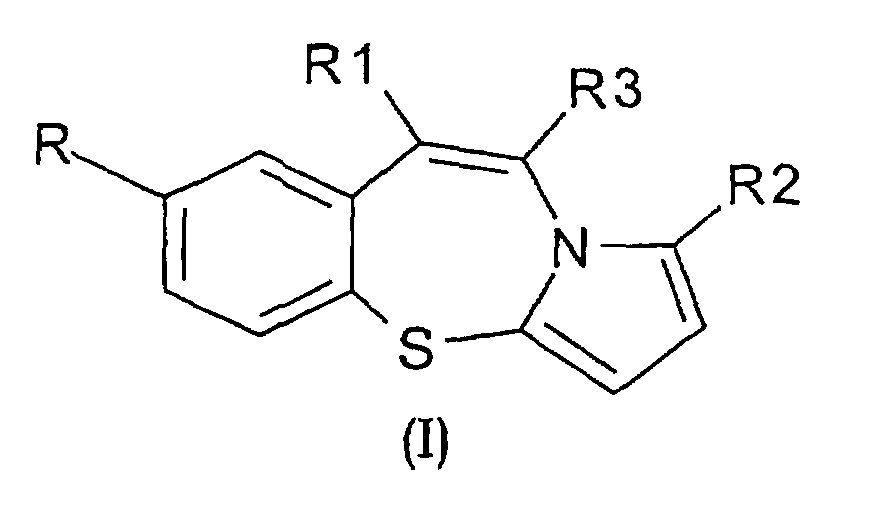 R = H, Cl, Br, F, I, C1-C4 alkoxy, C1-C4 alkylthio, C1-C4 alkyl, C5-C6 cycloalkyl;R1 = C1-C4 dialkylamine, where the alkyl groups can be the same or different from one another, 4-alkyl-1-piperazinyl, 4-hydroxyalkyl-1-piperazinyl, 1-imidazolyl, 4-alkyl-1-piperidinyl, 4-alkyl-1-homopiperazinyl;R2 = H, C1-C4 alkoxy, C1-C4 alkylthio, C1-C4 alkyl, CHO, CH=NOH;R3 = H, CHO; and their pharmaceutically acceptable salts.
 - Compounds according to claim 1, wherein R1 is 4-alkyl-1-piperazinyl.
- Compounds according to claim 1, wherein R is H, Cl, Br, F, I.
- Compound according to claim 1, which is 7-chloro-9-(4-methylpiperazin-1-yl)pyrrolo[2,1-b][1,3]benzothiazepine and its pharmaceutically acceptable salts.
- Compound according to claim 4, where the pharmaceutically acceptable salt is maleate.
- Compounds according to claim 1, where R = H, F; R2 = H, CHO, CH3; R3 = H; R1 = 4-methyl-1-piperazinyl.
- Compounds according to claim 6, selected from the group consisting of9-(4-methyl-1-piperazinyl)pyrrolo[2,1-b][1,3]benzothiazepine;7-fluoro-9-(4-methyl-1-piperazinyl)pyrrolo[2,1-b][1,3]benzothiazepine;1-methyl-9-(4-methylpiperazin-1-yl)pyrrolo[2,1-b][1,3]benzothiazepine.
- Compounds according to claims 1-7, for use as medicaments.
- Pharmaceutical compositions containing a compound according to claims 1-7 as an active ingredient in a mixture with at least one pharmaceutically acceptable vehicle and/or excipient.
- Use of compounds of claims 1-7 for the preparation of a medicament with antipsychotic activity.
- Use of compounds of claims 4 or 5 for the preparation of a medicament with classic antipsychotic activity.
- Use of compounds of claims 6-7 for the preparation of a medicament with atypical antipsychotic activity.
- Use of compounds of claims 1-7 for the preparation of a medicament useful for the treatment of conditions of hyperactivation of dopaminergic neurotransmission.
- Use according to claim 13, in which the dopaminergic hyperactivity affects the mesolimbic pathway
- Use of compounds of claims 1-7 for the preparation of a medicament useful for the treatment of schizophrenia.
- Use of compounds of claims 1-7 for the preparation of a medicament useful for the treatment of the acute and chronic psychotic states.
- Use of compounds of claims 6-7 for the preparation of a medicament useful for the treatment of disorders related to increased activity of the mesolimbic dopaminergic pathway and/ or mesocortical dopaminergic hypofunction.
- Use according to claim 17 for the preparation of a medicament useful for the treatment of schizophrenia in its positive and negative symptoms.
- Use according to claim 17 for the preparation of a medicament useful for the treatment of paranoid states, manic-depressive states, affective disorders, social withdrawal, personality regression, hallucinations or cognitive dysfunctions
Priority Applications (1)
| Application Number | Priority Date | Filing Date | Title |
|---|---|---|---|
| SI200130286T SI1307463T1 (en) | 2000-08-01 | 2001-07-26 | Pyrrolo 2,1-b)-(1,3)benzothiazepines and their use for the preparation of medicaments with antipsychotic activity |
Applications Claiming Priority (3)
| Application Number | Priority Date | Filing Date | Title |
|---|---|---|---|
| IT2000RM000432A IT1317884B1 (en) | 2000-08-01 | 2000-08-01 | PIRROLO (2,1-B) (1,3) BENZOTHIAZEPINE AND THEIR USE FOR THE PREPARATION OF CLASSIC ANTIPSYCHOTIC ACTIVITIES. |
| ITRM20000432 | 2000-08-01 | ||
| PCT/IT2001/000406 WO2002010175A1 (en) | 2000-08-01 | 2001-07-26 | PYRROLO[2,1-b][1,3]BENZOTHIAZEPINES AND THEIR USE FOR THE PREPARATION OF MEDICAMENTS WITH ANTIPSYCHOTIC ACTIVITY |
Publications (2)
| Publication Number | Publication Date |
|---|---|
| EP1307463A1 EP1307463A1 (en) | 2003-05-07 |
| EP1307463B1 true EP1307463B1 (en) | 2005-01-26 |
Family
ID=11454865
Family Applications (1)
| Application Number | Title | Priority Date | Filing Date |
|---|---|---|---|
| EP01963371A Expired - Lifetime EP1307463B1 (en) | 2000-08-01 | 2001-07-26 | Pyrrolo 2,1-b]-[1,3]benzothiazepines and their use for the preparation of medicaments with antipsychotic activity |
Country Status (19)
| Country | Link |
|---|---|
| US (1) | US6710041B2 (en) |
| EP (1) | EP1307463B1 (en) |
| JP (1) | JP2004505090A (en) |
| KR (1) | KR100826304B1 (en) |
| CN (1) | CN1264848C (en) |
| AT (1) | ATE287890T1 (en) |
| AU (2) | AU8439101A (en) |
| BR (1) | BR0112843A (en) |
| CA (1) | CA2415475C (en) |
| CZ (1) | CZ299340B6 (en) |
| DE (1) | DE60108642T2 (en) |
| DK (1) | DK1307463T3 (en) |
| ES (1) | ES2236291T3 (en) |
| IT (1) | IT1317884B1 (en) |
| MX (1) | MXPA03000775A (en) |
| PL (1) | PL203096B1 (en) |
| PT (1) | PT1307463E (en) |
| SK (1) | SK287248B6 (en) |
| WO (1) | WO2002010175A1 (en) |
Families Citing this family (2)
| Publication number | Priority date | Publication date | Assignee | Title |
|---|---|---|---|---|
| ITRM20040178A1 (en) * | 2004-04-07 | 2004-07-07 | Sigma Tau Ind Farmaceuti | COMPOUNDS WITH ATYPICAL ANTIPSYCHOTIC ACTIVITY. |
| ITRM20040222A1 (en) * | 2004-05-07 | 2004-08-07 | Sigma Tau Ind Farmaceuti | PYROL DEALKYLATED DERIVATIVES [2,1-B] BENZOTHIAZEPINE WITH ATYPICAL ANTIPSYCHOTIC ACTIVITY. |
Family Cites Families (1)
| Publication number | Priority date | Publication date | Assignee | Title |
|---|---|---|---|---|
| IT1301965B1 (en) | 1998-07-28 | 2000-07-20 | Sigma Tau Ind Farmaceuti | PYROL (2,1-B) (1,3) BENZOTHIAZEPINE WITH ANTIPSYCHOTIC ATYPICAL ACTIVITY. |
-
2000
- 2000-08-01 IT IT2000RM000432A patent/IT1317884B1/en active
-
2001
- 2001-07-26 US US10/343,627 patent/US6710041B2/en not_active Expired - Fee Related
- 2001-07-26 PL PL365008A patent/PL203096B1/en not_active IP Right Cessation
- 2001-07-26 AT AT01963371T patent/ATE287890T1/en not_active IP Right Cessation
- 2001-07-26 EP EP01963371A patent/EP1307463B1/en not_active Expired - Lifetime
- 2001-07-26 MX MXPA03000775A patent/MXPA03000775A/en active IP Right Grant
- 2001-07-26 SK SK130-2003A patent/SK287248B6/en not_active IP Right Cessation
- 2001-07-26 CA CA2415475A patent/CA2415475C/en not_active Expired - Fee Related
- 2001-07-26 AU AU8439101A patent/AU8439101A/en active Pending
- 2001-07-26 JP JP2002515904A patent/JP2004505090A/en not_active Withdrawn
- 2001-07-26 CZ CZ20030012A patent/CZ299340B6/en not_active IP Right Cessation
- 2001-07-26 ES ES01963371T patent/ES2236291T3/en not_active Expired - Lifetime
- 2001-07-26 CN CNB018133886A patent/CN1264848C/en not_active Expired - Fee Related
- 2001-07-26 PT PT01963371T patent/PT1307463E/en unknown
- 2001-07-26 WO PCT/IT2001/000406 patent/WO2002010175A1/en not_active Ceased
- 2001-07-26 DE DE60108642T patent/DE60108642T2/en not_active Expired - Lifetime
- 2001-07-26 DK DK01963371T patent/DK1307463T3/en active
- 2001-07-26 KR KR1020037000934A patent/KR100826304B1/en not_active Expired - Fee Related
- 2001-07-26 BR BR0112843-4A patent/BR0112843A/en not_active Application Discontinuation
- 2001-07-26 AU AU2001284391A patent/AU2001284391B2/en not_active Ceased
Also Published As
| Publication number | Publication date |
|---|---|
| ES2236291T3 (en) | 2005-07-16 |
| CA2415475C (en) | 2010-09-28 |
| IT1317884B1 (en) | 2003-07-15 |
| DK1307463T3 (en) | 2005-05-23 |
| DE60108642D1 (en) | 2005-03-03 |
| ITRM20000432A1 (en) | 2002-02-01 |
| EP1307463A1 (en) | 2003-05-07 |
| US6710041B2 (en) | 2004-03-23 |
| HK1059774A1 (en) | 2004-07-16 |
| PL365008A1 (en) | 2004-12-27 |
| US20030186959A1 (en) | 2003-10-02 |
| CZ299340B6 (en) | 2008-06-25 |
| ITRM20000432A0 (en) | 2000-08-01 |
| DE60108642T2 (en) | 2006-06-14 |
| SK287248B6 (en) | 2010-04-07 |
| KR100826304B1 (en) | 2008-04-29 |
| AU2001284391B2 (en) | 2006-09-28 |
| CN1264848C (en) | 2006-07-19 |
| BR0112843A (en) | 2003-04-22 |
| CA2415475A1 (en) | 2002-02-07 |
| JP2004505090A (en) | 2004-02-19 |
| MXPA03000775A (en) | 2003-10-15 |
| KR20030019598A (en) | 2003-03-06 |
| PL203096B1 (en) | 2009-08-31 |
| CN1444588A (en) | 2003-09-24 |
| ATE287890T1 (en) | 2005-02-15 |
| SK1302003A3 (en) | 2003-05-02 |
| AU8439101A (en) | 2002-02-13 |
| PT1307463E (en) | 2005-04-29 |
| WO2002010175A1 (en) | 2002-02-07 |
| CZ200312A3 (en) | 2003-05-14 |
Similar Documents
| Publication | Publication Date | Title |
|---|---|---|
| JP5784501B2 (en) | Organic compounds | |
| KR20110096032A (en) | Organic compounds | |
| WO2011153138A1 (en) | Organic compounds | |
| IE59864B1 (en) | Thiazepine compounds | |
| CZ223998A3 (en) | 5H-THIAZOLO/3,2-a/PYRIMIDINE DERIVATIVE, PROCESS OF ITS PREPARATION, INTERMEDIATE FOR ITS PREPARATION AND PHARMACEUTICAL COMPOSITION CONTAINING THEREOF | |
| HU180628B (en) | Process for preparing new dibenzo-azepines,-oxazepines and thiazepines | |
| KR20060082037A (en) | Metabolites of Quetiapine | |
| WO2004111060A1 (en) | IMIDAZO[2,1-b]-1,3,4-THIADIAZOLE SULFOXIDES AND SULFONES | |
| Eberlein et al. | Tricyclic compounds as selective antimuscarinics. 1. Structural requirements for selectivity towards the muscarinic acetylcholine receptor in a series of pirenzepine and imipramine analogs | |
| US6710041B2 (en) | Pyrrolo[2,1-B][3,1] benzothiazepines and their use for the preparation of medicaments with antipsychotic activity | |
| TW201144321A (en) | Benzazepine compound | |
| AU2001284391A1 (en) | Pyrrolo[2,1-b][1,3]benzothiazepines and their use for the preparation of medicaments with antipsychotic activity | |
| US6602865B1 (en) | Pyridazino(4,5-b)(1,5)oxazepinone, -thiazepinone and -diazepinone compounds | |
| US6288075B1 (en) | Thiazolo[5,4,3-ij]quinolines, preparation and medicines containing the same | |
| WO1998043976A1 (en) | Biphenyl derivatives and medicinal compositions | |
| AU2023280622A1 (en) | Compounds | |
| EP1100803B1 (en) | Pyrrolo [2,1-b] [1,3]benzothiazepines with atypical antipsychotic activity | |
| HUP9802585A2 (en) | Pyridazino-oxazepine, thiazepine, diazepine and thiazine derivatives, as well as pharmaceutical preparations containing them | |
| HU225327B1 (en) | Pyrrolo[2,1-b][1,3]benzothiazepines and their use for the preparation of medicaments with antipsychotic activity | |
| HK1059774B (en) | Pyrrolo[2,1-b][1,3]benzothiazepines and their use for the preparation of medicaments with antipsychotic activity | |
| HUP0104220A2 (en) | Novel type condensed pyridazinone compounds | |
| HK1036793B (en) | Pyrrolo [2,1-b][1,3]benzothiazepines with atypical antipsychotic activity | |
| AU2013245563A1 (en) | Methods and compositions for stimulating neurogenesis and inhibiting neuronal degeneration using isothiazolopyrimidinones |
Legal Events
| Date | Code | Title | Description |
|---|---|---|---|
| PUAI | Public reference made under article 153(3) epc to a published international application that has entered the european phase |
Free format text: ORIGINAL CODE: 0009012 |
|
| 17P | Request for examination filed |
Effective date: 20030204 |
|
| AK | Designated contracting states |
Designated state(s): AT BE CH CY DE DK ES FI FR GB GR IE IT LI LU MC NL PT SE TR |
|
| AX | Request for extension of the european patent |
Extension state: AL LT LV MK RO SI |
|
| 17Q | First examination report despatched |
Effective date: 20031028 |
|
| GRAP | Despatch of communication of intention to grant a patent |
Free format text: ORIGINAL CODE: EPIDOSNIGR1 |
|
| GRAS | Grant fee paid |
Free format text: ORIGINAL CODE: EPIDOSNIGR3 |
|
| GRAA | (expected) grant |
Free format text: ORIGINAL CODE: 0009210 |
|
| AK | Designated contracting states |
Kind code of ref document: B1 Designated state(s): AT BE CH CY DE DK ES FI FR GB GR IE IT LI LU MC NL PT SE TR |
|
| AX | Request for extension of the european patent |
Extension state: AL LT LV MK RO SI |
|
| REG | Reference to a national code |
Ref country code: GB Ref legal event code: FG4D |
|
| REG | Reference to a national code |
Ref country code: CH Ref legal event code: EP |
|
| REG | Reference to a national code |
Ref country code: IE Ref legal event code: FG4D |
|
| REG | Reference to a national code |
Ref country code: CH Ref legal event code: NV Representative=s name: ISLER & PEDRAZZINI AG |
|
| REF | Corresponds to: |
Ref document number: 60108642 Country of ref document: DE Date of ref document: 20050303 Kind code of ref document: P |
|
| REG | Reference to a national code |
Ref country code: GR Ref legal event code: EP Ref document number: 20050400611 Country of ref document: GR |
|
| REG | Reference to a national code |
Ref country code: PT Ref legal event code: SC4A Free format text: AVAILABILITY OF NATIONAL TRANSLATION Effective date: 20050301 |
|
| REG | Reference to a national code |
Ref country code: SE Ref legal event code: TRGR |
|
| REG | Reference to a national code |
Ref country code: DK Ref legal event code: T3 |
|
| REG | Reference to a national code |
Ref country code: ES Ref legal event code: FG2A Ref document number: 2236291 Country of ref document: ES Kind code of ref document: T3 |
|
| ET | Fr: translation filed | ||
| PLBE | No opposition filed within time limit |
Free format text: ORIGINAL CODE: 0009261 |
|
| STAA | Information on the status of an ep patent application or granted ep patent |
Free format text: STATUS: NO OPPOSITION FILED WITHIN TIME LIMIT |
|
| 26N | No opposition filed |
Effective date: 20051027 |
|
| REG | Reference to a national code |
Ref country code: CH Ref legal event code: PCAR Free format text: ISLER & PEDRAZZINI AG;POSTFACH 1772;8027 ZUERICH (CH) |
|
| PGFP | Annual fee paid to national office [announced via postgrant information from national office to epo] |
Ref country code: NL Payment date: 20100724 Year of fee payment: 10 Ref country code: MC Payment date: 20100701 Year of fee payment: 10 Ref country code: IE Payment date: 20100726 Year of fee payment: 10 Ref country code: ES Payment date: 20100726 Year of fee payment: 10 Ref country code: CH Payment date: 20100726 Year of fee payment: 10 |
|
| PGFP | Annual fee paid to national office [announced via postgrant information from national office to epo] |
Ref country code: TR Payment date: 20100707 Year of fee payment: 10 Ref country code: SE Payment date: 20100728 Year of fee payment: 10 Ref country code: LU Payment date: 20100802 Year of fee payment: 10 Ref country code: IT Payment date: 20100726 Year of fee payment: 10 Ref country code: FR Payment date: 20100805 Year of fee payment: 10 Ref country code: FI Payment date: 20100728 Year of fee payment: 10 Ref country code: DE Payment date: 20100728 Year of fee payment: 10 Ref country code: AT Payment date: 20100702 Year of fee payment: 10 |
|
| PGFP | Annual fee paid to national office [announced via postgrant information from national office to epo] |
Ref country code: GR Payment date: 20100729 Year of fee payment: 10 Ref country code: GB Payment date: 20100726 Year of fee payment: 10 |
|
| PGFP | Annual fee paid to national office [announced via postgrant information from national office to epo] |
Ref country code: PT Payment date: 20100706 Year of fee payment: 10 Ref country code: DK Payment date: 20100727 Year of fee payment: 10 |
|
| PGFP | Annual fee paid to national office [announced via postgrant information from national office to epo] |
Ref country code: CY Payment date: 20100713 Year of fee payment: 10 Ref country code: BE Payment date: 20100728 Year of fee payment: 10 |
|
| BERE | Be: lapsed |
Owner name: *SIGMA-TAU INDUSTRIE FARMACEUTICHE RIUNITE S.P.A. Effective date: 20110731 |
|
| REG | Reference to a national code |
Ref country code: PT Ref legal event code: MM4A Free format text: LAPSE DUE TO NON-PAYMENT OF FEES Effective date: 20120126 |
|
| REG | Reference to a national code |
Ref country code: NL Ref legal event code: V1 Effective date: 20120201 |
|
| PG25 | Lapsed in a contracting state [announced via postgrant information from national office to epo] |
Ref country code: MC Free format text: LAPSE BECAUSE OF NON-PAYMENT OF DUE FEES Effective date: 20110731 |
|
| REG | Reference to a national code |
Ref country code: CH Ref legal event code: PL |
|
| REG | Reference to a national code |
Ref country code: SE Ref legal event code: EUG |
|
| REG | Reference to a national code |
Ref country code: DK Ref legal event code: EBP |
|
| LTLA | Lt: lapse of european patent or patent extension |
Effective date: 20110726 |
|
| GBPC | Gb: european patent ceased through non-payment of renewal fee |
Effective date: 20110726 |
|
| REG | Reference to a national code |
Ref country code: GR Ref legal event code: ML Ref document number: 20050400611 Country of ref document: GR Effective date: 20120202 |
|
| REG | Reference to a national code |
Ref country code: AT Ref legal event code: MM01 Ref document number: 287890 Country of ref document: AT Kind code of ref document: T Effective date: 20110726 |
|
| REG | Reference to a national code |
Ref country code: FR Ref legal event code: ST Effective date: 20120330 |
|
| REG | Reference to a national code |
Ref country code: IE Ref legal event code: MM4A |
|
| PG25 | Lapsed in a contracting state [announced via postgrant information from national office to epo] |
Ref country code: BE Free format text: LAPSE BECAUSE OF NON-PAYMENT OF DUE FEES Effective date: 20110731 Ref country code: DE Free format text: LAPSE BECAUSE OF NON-PAYMENT OF DUE FEES Effective date: 20120201 Ref country code: LI Free format text: LAPSE BECAUSE OF NON-PAYMENT OF DUE FEES Effective date: 20110731 Ref country code: FR Free format text: LAPSE BECAUSE OF NON-PAYMENT OF DUE FEES Effective date: 20110801 Ref country code: CH Free format text: LAPSE BECAUSE OF NON-PAYMENT OF DUE FEES Effective date: 20110731 |
|
| REG | Reference to a national code |
Ref country code: SI Ref legal event code: KO00 Effective date: 20120302 |
|
| REG | Reference to a national code |
Ref country code: DE Ref legal event code: R119 Ref document number: 60108642 Country of ref document: DE Effective date: 20120201 |
|
| PG25 | Lapsed in a contracting state [announced via postgrant information from national office to epo] |
Ref country code: GR Free format text: LAPSE BECAUSE OF NON-PAYMENT OF DUE FEES Effective date: 20120202 Ref country code: PT Free format text: LAPSE BECAUSE OF NON-PAYMENT OF DUE FEES Effective date: 20120126 Ref country code: FI Free format text: LAPSE BECAUSE OF NON-PAYMENT OF DUE FEES Effective date: 20110726 Ref country code: NL Free format text: LAPSE BECAUSE OF NON-PAYMENT OF DUE FEES Effective date: 20120201 Ref country code: IT Free format text: LAPSE BECAUSE OF NON-PAYMENT OF DUE FEES Effective date: 20110726 |
|
| PG25 | Lapsed in a contracting state [announced via postgrant information from national office to epo] |
Ref country code: GB Free format text: LAPSE BECAUSE OF NON-PAYMENT OF DUE FEES Effective date: 20110726 Ref country code: CY Free format text: LAPSE BECAUSE OF NON-PAYMENT OF DUE FEES Effective date: 20110726 |
|
| PG25 | Lapsed in a contracting state [announced via postgrant information from national office to epo] |
Ref country code: DK Free format text: LAPSE BECAUSE OF NON-PAYMENT OF DUE FEES Effective date: 20110731 Ref country code: IE Free format text: LAPSE BECAUSE OF NON-PAYMENT OF DUE FEES Effective date: 20110726 |
|
| REG | Reference to a national code |
Ref country code: ES Ref legal event code: FD2A Effective date: 20121122 |
|
| PG25 | Lapsed in a contracting state [announced via postgrant information from national office to epo] |
Ref country code: AT Free format text: LAPSE BECAUSE OF NON-PAYMENT OF DUE FEES Effective date: 20110726 |
|
| PG25 | Lapsed in a contracting state [announced via postgrant information from national office to epo] |
Ref country code: ES Free format text: LAPSE BECAUSE OF NON-PAYMENT OF DUE FEES Effective date: 20110727 |
|
| PG25 | Lapsed in a contracting state [announced via postgrant information from national office to epo] |
Ref country code: SE Free format text: LAPSE BECAUSE OF NON-PAYMENT OF DUE FEES Effective date: 20110727 |
|
| PG25 | Lapsed in a contracting state [announced via postgrant information from national office to epo] |
Ref country code: LU Free format text: LAPSE BECAUSE OF NON-PAYMENT OF DUE FEES Effective date: 20110726 |
|
| PG25 | Lapsed in a contracting state [announced via postgrant information from national office to epo] |
Ref country code: TR Free format text: LAPSE BECAUSE OF NON-PAYMENT OF DUE FEES Effective date: 20110726 |