EP1306776A1 - Method of using muldi-media information, system and program recording medium therefor - Google Patents
Method of using muldi-media information, system and program recording medium therefor Download PDFInfo
- Publication number
- EP1306776A1 EP1306776A1 EP01936836A EP01936836A EP1306776A1 EP 1306776 A1 EP1306776 A1 EP 1306776A1 EP 01936836 A EP01936836 A EP 01936836A EP 01936836 A EP01936836 A EP 01936836A EP 1306776 A1 EP1306776 A1 EP 1306776A1
- Authority
- EP
- European Patent Office
- Prior art keywords
- information
- terminal
- sending
- user
- receiving
- Prior art date
- Legal status (The legal status is an assumption and is not a legal conclusion. Google has not performed a legal analysis and makes no representation as to the accuracy of the status listed.)
- Withdrawn
Links
Images





Classifications
-
- G—PHYSICS
- G06—COMPUTING OR CALCULATING; COUNTING
- G06F—ELECTRIC DIGITAL DATA PROCESSING
- G06F16/00—Information retrieval; Database structures therefor; File system structures therefor
- G06F16/40—Information retrieval; Database structures therefor; File system structures therefor of multimedia data, e.g. slideshows comprising image and additional audio data
- G06F16/48—Retrieval characterised by using metadata, e.g. metadata not derived from the content or metadata generated manually
-
- G—PHYSICS
- G06—COMPUTING OR CALCULATING; COUNTING
- G06F—ELECTRIC DIGITAL DATA PROCESSING
- G06F16/00—Information retrieval; Database structures therefor; File system structures therefor
- G06F16/40—Information retrieval; Database structures therefor; File system structures therefor of multimedia data, e.g. slideshows comprising image and additional audio data
-
- Y—GENERAL TAGGING OF NEW TECHNOLOGICAL DEVELOPMENTS; GENERAL TAGGING OF CROSS-SECTIONAL TECHNOLOGIES SPANNING OVER SEVERAL SECTIONS OF THE IPC; TECHNICAL SUBJECTS COVERED BY FORMER USPC CROSS-REFERENCE ART COLLECTIONS [XRACs] AND DIGESTS
- Y10—TECHNICAL SUBJECTS COVERED BY FORMER USPC
- Y10S—TECHNICAL SUBJECTS COVERED BY FORMER USPC CROSS-REFERENCE ART COLLECTIONS [XRACs] AND DIGESTS
- Y10S707/00—Data processing: database and file management or data structures
- Y10S707/99941—Database schema or data structure
- Y10S707/99944—Object-oriented database structure
- Y10S707/99945—Object-oriented database structure processing
-
- Y—GENERAL TAGGING OF NEW TECHNOLOGICAL DEVELOPMENTS; GENERAL TAGGING OF CROSS-SECTIONAL TECHNOLOGIES SPANNING OVER SEVERAL SECTIONS OF THE IPC; TECHNICAL SUBJECTS COVERED BY FORMER USPC CROSS-REFERENCE ART COLLECTIONS [XRACs] AND DIGESTS
- Y10—TECHNICAL SUBJECTS COVERED BY FORMER USPC
- Y10S—TECHNICAL SUBJECTS COVERED BY FORMER USPC CROSS-REFERENCE ART COLLECTIONS [XRACs] AND DIGESTS
- Y10S707/00—Data processing: database and file management or data structures
- Y10S707/99941—Database schema or data structure
- Y10S707/99948—Application of database or data structure, e.g. distributed, multimedia, or image
Definitions
- the present invention relates to a method of using multimedia (MM) information, a recording medium storing a program of using multimedia information and a multimedia information system.
- the present invention relates to a method of using multimedia information for transferring, storing and searching multimedia information, which is excellent in usability, a recording medium storing a program of using a multimedia information and a multimedia information system.
- multimedia information has gathered attentions for handing a plurality of media information such as moving pictures, sound, and text.
- a first conventional technology may be a television telephone system.
- the television (TV) telephone system is a system for connecting voice information through a telephone and image information through a TV bidirectionally.
- the TV telephone system cannot send a large amount of information since the transfer speed of the line is limited. Therefore, multimedia (MM) information in high quality cannot be exchanged.
- the communication information is lost on the spot, and the information generally cannot be stored and/or be reused.
- a second conventional technology may be a digital video disk (DVD) system in addition to a conventional technology example for providing reusable MM information in high quality.
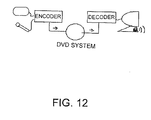
- Fig. 12 is a diagram for explaining the digital video disk system.
- an original image (moving image) is structured hierarchically and is compressed by an encoder.
- Voice is also encoded by the encoder.
- Synchronous signals of the image and the voice are written in an optical disk along with the respective data.
- a user reconstructs the encoded data stored in the optical disk by using a decoder so that high level MM information can be reconstruct, which is close to the original image and/or the original voice.
- the methods of encoding and decoding are standardized as MPEG-2, for example.
- the user can reuse the provided MM information by using a terminal apparatus including MPEG-2 decoder repeatedly whenever the user desires.
- the DVD uses the optical disk as a storage medium for MM information. Therefore, a large amount of information can be distributed easily. However, a fast transmission circuit is required for handling such a large amount of information in a distribution system. Thus, a private line such as satellite broadcasting is required. In other words, when a shared distribution system is used which is generally available presently, the reusable MM information in high quality is difficult to use.
- a third conventional technology may be a video letter, which is a system for transferring similar MM information as the sharable distribution system.
- the video letter packaged transmits compressed image/voice information by using a shared line and decodes the information in the receiver side for use.
- the video letter system is responsible for information communication in one direction from the sender side to the receiver side. Therefore, even when the incoming information can be transferred to another party directly, the information content cannot be reprocessed, which lacks convenience in using MM information.
- MM information which can reuse MM information and can transfer it by using a shared transmission line and which is excellence in convenience for use
- the data structure of transferred/stored MM information is important.
- the data structures in conventional technologies are as follows.
- a fourth conventional technology may be an object-based MM data structure.
- the data structure divides MM information into small units (objects), which are hierarchically structured and is stored for being used by a user.
- the user uses the MM information by expanding it from the high level in the hierarchy information and obtaining a required amount of information toward the low level.
- the object-based MM data structure includes a background, a foreground human character, a desk and a chair in computer graphics.
- a fifth conventional technology has been proposed for constructing MM information by content information and behavior information and transferring the MM information as package information including them according to Multimedia and Hypermedia information coding Expert Group (MHEG).
- MHEG Multimedia and Hypermedia information coding Expert Group
- the MHEG data structure can conveniently provide a function for reconstructing received data automatically in the receiver side by writing an automatically reconstructing function in the behavior information.
- the data structure of the fifth conventional technology is limited in automatic reconstruction, which limits handling of MM information in accordance with an intention of the user.
- MM information is uniquely reconstructed by the behavior information. Therefore, flexible usage is difficult such as changing a form of representing MM information in accordance with the determination by the received user.
- an intention of a sending user for reconstruction is not given when transferring MM information (that is, the reconstruction requirement cannot be controlled).
- MM information in high quality can be transferred by using a shared transfer system and can be reconstructed, edited, processed and/or re-transferred flexibly in accordance with the convenience of a user.
- the present invention can have feature as follows:
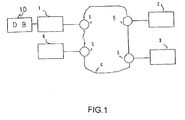
- Fig. 1 is a configuration diagram of an MM information system according to the present invention.
- the shown system includes a sending terminal 1, receiving terminals 2 and 3, a management terminal 4, a transfer device 5, and a transfer system 6.
- multiple pieces of MM information are stored in a database 10 of the sending terminal 1.
- a user can extract desired MM information from the receiving terminal 2 or 3 for use.
- the MM information desired by the user is sent/received through the transfer device 5 and the transfer system 6.
- the transfer system 6 may be a network such as a publicly switched network, a satellite network, a mobile apparatus network, the Internet, an optical fiber network, a radio network and a infrared ray network.
- the management terminal 4 manages information transfer.
- Fig. 2 is another configuration diagram of an MM information system according to the present invention.
- the system includes a sending terminal 1, a receiving terminals 2 and 3, a management terminal 4, a transfer device 5, a transfer system 6, a transmitter 7, a receiver 8 and a communication satellite 9.
- This embodiment is an asymmetrical network in which MM information transfer is divided into two systems including a shared transfer system specifically for transmission through the communication satellite 9 and a shared transfer system for mainly receiving control signals and so on through the transfer system 6.
- MM information from the sending terminal 1 is transferred from the transmitter 7 to the receiving terminal 2 and/or 3 including the receiver 8 through the communication satellite 9 by using the shared satellite communication line specifically for transmission.
- the receiving terminals 2 and 3 can receive the same MM information at the same time or can receive MM information from the sending terminal 1 separately.
- the receiving terminals 2 and 3, the sending terminal 1 and the management terminal 4 are connected through the transfer system 6 for the asynchronous communication like the first embodiment, which allows mutual communication (sending and receiving).
- the transfer system 6 in this case mainly transfers a control signal for controlling MM information.
- the transfer system 6 may be a shared communication network such as an ISDN line.
- the management terminal 4 is responsible for access authorization management for MM information.
- the sending terminal 1 sends data to the receiving terminal 2/3 in accordance with an instruction from the management terminal 4.
- the sending terminal 1 includes a database 10 for MM information basically.
- the access authorization (A-1) is implemented under application software control not under data control.
- the access authorization (A-1) includes data access authorization given to MM data viewing software and access authorization for MM information based on MM information use registration.
- the access authorization (A-2) further includes access authorizations (A-2-1) and (A-2-2), for example.
- the access authorization (A-2-1) inhibits intent information to be read and/or displayed (expanded) if the viewing action is not written as behavior information (reading block for operating viewing software);
- the access authorization (A-2-2) inhibits information to view until the encrypted data is decrypted.
- the access authorization (A-1) is given by exchanging authorization control information.
- the access authorization (A-2) is given by rewriting and operating authorization information (existing in container information, behavior information and container information, respectively) within MM information or by following opening steps between the authorization information and the management terminal. For example, this is the case when control data is given to information data A, and when the data cannot read at "000+A” but can be read at "001+A", where "000" and "001" do not have any special meanings.
- MM information can be used to implement partial reading and/or operational control such as allowing to read up to container information in general but inhibiting content information to be read without user registration and/or inhibiting MM information to operation if the behavior information cannot be read.
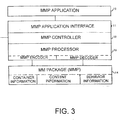
- FIG. 3 This is an example of a hierarchy model for implementing a data processing function for processing MM information according to the present invention in the sending terminal 1, the receiving terminals 2 and 3 and the management terminal 4.
- the hierarchy model includes, application software 10 for an MM information package (called MMP hereinafter), an MMP application interface 11, an MMP controller 12, an MMP processor 13 and an MM information package 14.
- MMP MM information package
- the application software 10 is created for each function of using MM information and controls processing for sending or receiving MMP data through the application interface 11.
- the application interface 11 performs processing for inputting user's determination and processing for outputting information to a user.
- the input/output device and an MM information display device for a user are provided but are omitted in the drawing.
- the MMP controller 12 transfers a signal between each terminal and a transfer device and controls MM information transferred to the MMP processor.
- the MMP processor 13 includes an MMP decoder for decoding transferred MM information and an MMP encoder for encoding MMP information when sending and/or using.
- the MMP package 14 is MMP information itself stored in the sending side or is MMP information itself transferred to the receiving side and includes container information, content information and behavior information.
- MM information in order to search a book in the library, the title, the author, the publisher, the abstract, the simple keyword of the book and so on are used for obtaining the target book. These kinds of brief content information are included in the container information. Therefore, the container information is searched. On the other hand, in order to search a book by using the content, the body information, a more specific keyword, the genre of the book and so on or in order to perform a image search or voice search, these kinds of information are included in content information. Thus, the content information is searched.
- the "container information” includes outline information describing outlines of content information and behavior information.
- the outline information may include, for example:
- the scalability means a measure for obtaining the variable quality of resolution and/or error tolerance and gives a hierarchy concept to an encoded structure.
- a part of encoded data and/or encoded bit stream is extracted so as to reconstruct and/or decode meaningful image and information.
- decoders having various complexities decodes an original moving image from a single encoded bit stream so as to reconstruct and display the image properly.
- four kinds of method are provided for providing the basic variable characteristics, including space scalability, SNR scalability, time scalability and data partitioning.
- the space scalability encoding is performed for providing multiple resolutions. In this case, images having different resolutions can be extracted from one bit stream. In addition, a transmission-error-proofed signal can be given to a lower layer so as to obtain a kind of error tolerance.
- the space scalability is characterized in using two special resolutions such as moving image application including communication, mutual conversion between moving image standards, overview of a moving image database, and mutual conversion between HDTV and SDTV.
- the lower layer encodes itself.
- the upper layer uses the lower layer internally provided spatially to represent a complete spatial resolution of the original moving image signal.
- the lower layer and the upper layer may be encoded in accordance with MPEG-2 Standard.
- the lower layer may be encoded in accordance with MPEG-1 Standard while the upper layer may be encoded in accordance with MPEG-2 Standard.
- the SNR scalability can be applied when at least two layers are required for quality such as moving image application including communication, a moving image service in multiquality, SDTV and HDTV.
- the SNR scalability means to create two quality layers having the same resolution but different qualities from one moving image.
- the lower layer encodes itself so as to provide basic moving image quality.
- the upper layer encodes itself to improve the quality of the lower layer.
- the lower layer encodes itself so as to provide a basic time speed.
- the upper layer encodes by using a time estimate from the lower layer. These layers are multiplexed in time so as to provide a complete time resolution of the original moving image signal when decoding.
- the data partitioning assumes a case where two channels can be used for transmitting and storing bit streams, such as an ATM network, terrestrial broadcasting and a magnetic medium.
- the bit stream is divided into channels.
- the important parts (such as a header, a motion vector and a low frequency DCT coefficient) are transferred through channels having fewer errors than the channel for transmitting unimportant data (such as high frequency DCT coefficient).
- the basic kinds of scalability may be combined to obtain a hybrid scalability.
- the basic kinds of scalability can handle two layers for a moving image, including a lower layer and an upper layer.
- the hybrid scalability can handle three layers.
- the “content information” is functionally divided into independent information, which is created by using a part of at least one piece of media information and has a meaning in use independently, and at least one piece of additional information to be added to the independent information to become closer to the original media information.
- the content information can be provided with multiple pieces of container information (which can include container information and/or behavior information typified thereby).
- a hierarchy encoding method for spatial resolution which may refer to special scalability proposed to the MPEG 2
- an high resolution image as an original image is and a low resolution image, in which the original image is reduced to horizontally and vertically half by filtering, are created first.
- An image in each layer is divided into micro-blocks, which is encoded by an encoder.
- motion estimation is performed for each layer, between layers and for each frame. Therefore, the image information is compressed.
- the encoded data is stored in a memory device within sending terminal once.
- the number of layers (two layers) is recorded in the scalability profile of the container information as the type name (MPEG-2) and the level of the special scalability.
- the low-resolution image (data) has the deteriorated special resolution.
- detail motion of the subject cannot be captured.
- brief motion can be stored by using a small amount of data capacity.
- the high-resolution image (data) can only capture the motion of the subject locally but can be encoded in a detail area by increasing the special resolution of the detected amount of motion.
- the "behavior information" includes information of manipulating (such as reconstructing, searching, editing and processing) content information, which is set by a user.
- the behavior information can include history information of manipulations performed by the user in past information relating to a behavior in the receiving side, which is set by a sender.
- the behavior information does not have to be always included.
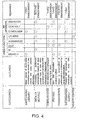
- Fig. 4 shows an explanatory diagram of an example of applying a data structure (MMP) according to the present invention to a multimedia service.
- MMP data structure
- An outline, available functions, mainly used MM information and a corresponding embodiment (remarks) for each service section are shown.
- the using forms are divided into searching, browser (Br), editing, summarizing and others.
- An O-shaped mark is given to a related available function.
- An O-shaped mark is given to mainly used information of MM information. Examples of each service are:
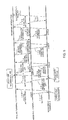
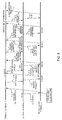
- Fig. 5 shows a sequence diagram for searching and obtaining MM information by using container information. Here, specific steps of searching and transferring MM information by using the MM information system will be described below.
- Fig. 5 is a sequence diagram showing steps of obtaining MM information in an electronic library, for example.
- Fig. 5 shows an outline of steps performed when a user A of the receiving terminal 2 searches and receives transfer of specified MM information (an moving image, here) in the sending terminal 1 in Fig. 1.
- the receiving terminal 2 launches an application (MM information browser) and specifies or automatically inquires the start of use by a user of the management terminal 4 (101).
- the management terminal 4 checks user registration with respect to the user checks whether or not the user has already registered with the management terminal 4).
- the management terminal 4 sends access authorization of the user to the sending terminal 1 once the user registration is determined (103).
- the sending terminal 1 authorizes the receiving terminal 2 for the access (the preparation for receiving information from the sending terminal 1 is completed) (105).
- the receiving terminal 2 requests an MM information list of the user to the management terminal 4 (107).
- the management terminal 4 checks a user service (checks a service class available to the user) . Once the user service is determined, the management terminal 4 requests the sending terminal 1 to create an MM information list for the user (109).
- the sending terminal 1 creates a service MM information list in accordance with the request from the management terminal 4.
- the MM information list is created by gathering container information within the MM information and includes multiple pieces of container information.
- the sending terminal 1 sends MM information of MM information list to the receiving terminal 2 (111).
- the receiving terminal 2 receives and displays the MM information list.
- the user of the receiving terminal 2 specifies to search container information.
- the receiving terminal 2 requests the management terminal 4 to search (113).
- the search request creates MM information using container information as a searched content or obtains identification information of the MM information from the container information and searches the MM information thereby.
- the search herein is for MM information.
- the available MM information varies depending on a user service.
- the management terminal 4 checks user's requirements of use. When the user's requirements of use are met, the management terminal 4 inquires the transfer requirements of the specified MM information of the sending terminal 1 (115). Then, the sending terminal 1 inquires the transfer requirement of the specified MM information of the receiving terminal 2 (117).
- the receiving terminal 2 sends the transfer requirements of the user to the management terminal 4 (the requirements are written in the behavior information within the MM information and are sent as MM information) (119).
- the management terminal 4 checks the user's requirements of use based on the user's transfer conditions.
- the management terminal 4 sends confirmation information to the sending terminal 1 (121). Then, the sending terminal 1 sends the confirmation information to the receiving terminal 2 (123). Next, the receiving terminal 2 sends the transfer confirmation to the management terminal 4.
- the management terminal 4 further checks the user's requirements of use and once the transfer confirmation and so on is received, a location of MM information managed by the management terminal 4 is specified as required. If this is not specified, search processing is required.
- the management terminal 4 request the sending terminal 1 to send the specified MM information (requires to search the specified MM information (127).
- the sending terminal 1 obtains the specified MM information from the database in accordance with the request for sending (or searches the specified MM information) and sends the specified MM information to the receiving terminal 2 (129). Once the specified MM information is received, the receiving terminal 2 instructs the management terminal 4 to end (131). The management terminal 4 requests the sending terminal 1 to disconnect from the receiving terminal (133).
- each data transmission information can be implemented by entire MM information including behavior information, container information (hierarchical MM information) or content information, for example.
- Fig. 6 shows a sequence diagram for searching and obtaining MM information by using content information.
- Fig. 6 shows a sequence for searching content information and relates to a search request based on MM information held by the receiving side.
- the search request (content information) from the receiving terminal 2 is sent to the sending terminal 1 through the management terminal 4.
- search processing is performed in the sending terminal 1 and the search result is returned to the receiving terminal 2 as MM information.
- the receiving terminal 2 launches an application (MM information browser) and specifies or automatically inquires the start of use by a user of the management terminal 4 (101).
- the management terminal 4 checks user registration with respect to the user (checks whether or not the user has already registered with the management terminal 4).
- the management terminal 4 sends access authorization of the user to the sending terminal 1 once the user registration is determined (103).
- the sending terminal 1 authorizes the receiving terminal 2 for the access (the preparation for receiving information from the sending terminal 1 is completed) (105).
- the receiving terminal 2 specifies a search based on the content information of the user. Th receiving terminal 2 requests the management terminal 4 to search (151). MM information is created by using content information as the searched content or identification information of the MM information is obtained from the content information to search the MM information. The search here is performed when MM information is always provided. However, the available MM information varies depending on a user service.
- the management terminal 4 checks the user's requirements of use. Once the user's requirements of use are met, the management terminal 4 requests the sending terminal 1 to search (153). The sending terminal 1 launches a search engine based on a search request. The sending terminal 1 creates the search request by the search engine as MM information and returns the search result to the receiving terminal 2 (155). The user of the receiving terminal 2 specifies a search based on the content information and instruct the management terminal 4 to select information (157). The steps after this are the same as the step 115 and thereafter in Fig. 5.
- a specific example relating to the search based on the content information may be an image search as follows:
- the receiving terminal 2 has MM information including content information taken by a digital camera.
- the image information feature amount (value information) of the image herein
- the sending terminal 1 operates the search engine by using the value number key to search database.
- detail photography information may be obtained from one photograph.
- the painter and/or the historical background can be found from a picture in an art museum.
- a video scene may be taken from one still image.
- Today's baseball scene of all of batters may be taken from a photograph in which one baseball player is standing at a batter box.
- the search engine extracts detail information from partial information.
- MM information can be transferred in a manner suitable for the convenience of the user.
- This embodiment has been described by assuming that the sending terminal 1 has one MM information file.
- content information can be exchanged between mutual sending terminals.
- the user A can search not only MM information in the sending terminal 1 but also MM information in another sending terminal.
- the target range of the search can be increased. thus, if required information is held in the other sending terminal than the sending terminal 1, the fact can be recognized.
- the receiving user can recognize the presence of the MM information in multiple sending terminals fast, which improves the usability.
- the transferring user (the provider of MM information( can improve the quality of the service by showing MM information other than the MM information held by the transferring user itself, which can improve the usability for increasing the number of users.
- the application software 10 determines that the container information is the highest layer including content information and behavior information.
- the application software 10 always refers to the container information first and inhibits manipulations other than the manipulations meeting the requirements, such as those relating to the copyright.
- the function can be provided to the MMP controller 12 instead of the application software 10.
- a bit stream encoded in time series may be used for the transfer of MM information.
- the sending application software 10 transfers the content information first.
- the receiving application software 10 or MMP controller 12 can surely determine the requirements with reference to the content information received first.
- the article service uses the MM information system according to the present invention to provide a service of transferring MM information in high quality.
- a user A of the receiving terminal 2 and a user B of the receiving terminal 3 register the sending terminal 1 (or the other sending terminal) having each required MM information and created search conditions for the MM information with the management terminal 4 in advance.
- the application software of the management terminal 4 accesses and searches container information through the MM information created in the every morning, for example, in the registered sending terminal. If the MM information meeting with the search conditions is found, the MM information is transferred to each of the user entirely.
- Fig. 7 is a flowchart showing processing steps in the article service.
- the flowchart shows information processing steps (for example, information deletion) performed when information is automatically transferred, for example.
- information processing steps for example, information deletion
- a processing portion is provided for monitoring a lapse of the MM information.
- the processing portion is automatically launched and deletes proper information after a predetermined storage period of time (one hour, one day, one month and the like).
- Fig. 8 is an explanatory diagram showing a construction of an MM package in the article service
- the MM information has container information (media profile) including heading information(text information), content information including text information for article sentences and compressed still image information, and behavior information recording a behavior condition after the receipt from the registered user, for example.
- container information media profile
- content information including text information for article sentences and compressed still image information
- behavior information recording a behavior condition after the receipt from the registered user, for example.
- a type of manipulation performed on the package information by a user is recorded in the behavior information of each package.
- the type of manipulation is written in a header of the media profile (type profile, description profile) content information, and the function information is written in the behavior information.
- Settings may be specified for a case where the application software is not launched on the day of the transfer because the user is traveling, for example, and a case where transferred MM information exists in the receiving terminal.
- the application software is launched automatically and detects an MM package, which has not been manipulated by a user yet (S301).
- behavior information in the MM packet is extracted (S303) and analyzes stored days, time and so on of each content information based on an instruction written in the behavior information (S304). Based on the analyzed stored days and time, image information transferred previously and passed three or more days, for example, is deleted (S307 and S309) (See Fig. 8(b)).
- the image information needs larger capacity than text information even when both of them are compressed.
- the application software As above, when a large amount of search result is transferred but the receiving terminal of the user has limited capacity for storing the MM information, the container information, which is not used immediately, is deleted. Therefore, a case can be avoided where MM information cannot be received because the memory capacity of the user's terminal reaches to the use limit.
- the storage capacity of the receiver can be used effectively. Furthermore, processing for deleting other information such as voice information can be added in accordance with predetermined storage days, time and so on.
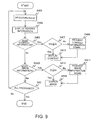
- Fig. 9 shows a flowchart for processing performed when a user needs more information while viewing information.
- a user returned from a travel can check unchecked heading information based on manipulation information stored in the behavior information in each MM package. Furthermore, in order to view the article sentences or the image content, the user can request it to the transfer center again. The steps in the flowchart will be described below.
- the application software detects the transferred MM package (S401). Then, the application software displays to the user heading information included in the container information (S403). The user refers to the heading information, and when it is important information, the user can further determine whether the user views the content (article sentences) and the image (still image) or not.
- N indicates a difference between a date when the MM package is transferred and a date when the application software is started by the user.
- the content information of the MM information is displayed (S411) if the information is not deleted by the above-described deletion processing before passing 10 days or more, for example (S409). On the other hand, after 10 days or more, the content information of the MM information is deleted. Thus, the user needs to request the content information again (S409), and the content information is then displayed (S411).
- content information of the MM information for the image information is displayed (S415) if it is determined as necessary (S413) and if three or more days are not passed, for example (S409). On the other hand, if three or more days are passed, the content information of the MM information is deleted. Therefore, the content information is requested again (S417) and then the content is displayed (S419). In this way, the processing is performed repeatedly on all packages (S421).
- the advantage unique to this embodiment is to use the storage capacity of the receiving terminal effectively even when the storage capacity is limited.
- the above-described embodiment describes the example where image and text information is deleted in order after a predetermined days from the delivery date. Furthermore, as a preferable example in a certain type of receiving terminal, a maximum amount of storable capacity for a predetermined article service may be set and the days until the deletion may be changed in accordance with the occupied condition.
- a terminal having a smaller amount of storable capacity can retrieve at least heading information in container information fast, which improves the convenience for users.
- a priority can be given to one retrieved from article information as described in the second embodiment.
- MM information of the present invention has behavior information.
- the sending terminal 1 writes the priority of the information in the behavior information as an behavior by the receiver.
- the behavior information retrieves document information from content information by using the scalability structure.
- the application software of the receiving terminal displays the heading information as soon as the information arrives.
- the place to transfer may be preset.
- the user has a mobile terminal separately from the receiving terminal, and when the user can transfer the content information including the heading and the document from the receiving terminal to the mobile terminal, the information is sent to the mobile terminal.
- Fig. 10 is an explanatory diagram showing a mutual communication between users according to the present invention.
- This embodiment includes a receiving terminal 2 used by a user A, a receiving terminal 3 used by a user B, and a transfer system (network) 4.
- the receiving terminals 2 and 3 are the information sender and receiver.
- the user A creates image information to send. Then, based on the spatial scalability, the image is encoded as content information having low-resolution information TB and high-resolution information TE.
- the user A transfers MM information from the receiving terminal 2 to the receiving terminal 3 through the transfer system 4.
- the user B reconstructs the transferred MM information by using both of the low resolution and high-resolution information TB and TE.
- the user B creates new image information to return. In this example, a frame is divided into four.
- the transferred low resolution information TB and the created low resolution screen are independently used as information for 1/4 screen (one frame) and divided three frames, respectively.
- the behavior information of the created MM information includes name information of the low-resolution information TB and the high-resolution information TE, on which the editing is based.
- the user B returns created image information to the user A.
- the user A selects any one of the divided three frames with low resolution in the returned image information for reconstruction and/or reuse (all of them have similar contents).
- the user A has the original image information sent by the user A.
- the image can be displayed by using the high-resolution information TE with higher resolution than the returned low-resolution information TB.
- the user A creates information to which new low resolution image divided into four (1/4 image) added (S507) and returns the information to the user B (S508).
- the user B reconstructs the image (S509).
- the image information sent from one user to the other can be reused so as to exchange MM information.
- the sending terminal 1 and the management terminal 4 in Fig. 1 do not operate.
- the intention is notified to the management terminal 4, with which the disclosure conditions are registered.
- the MM information is sent to the sending terminal 1 and can be stored to be available to the others.
- Fig. 11 is an explanatory diagram showing users and used functions. Accordingto Fig. 11, container, content, behavior and other information relating to users/used functions is stored.
- a teacher who is a user of MM information in the first row in Fig. 11 uses the electronic library function described in the first embodiment to retrieve many pieces of MM information stored in the sending terminal 1 in Fig. 1. Then, required pieces of MM information (such as image, voice, text and graphics) can be gathered.
- the teacher can use the editing function according to the third embodiment to edit the MM information and to create one packaged remote education material.
- the created remote education material includes outline information in the container information and is registered with the sending terminal 1 as one of the teaching material menu.
- the management terminal manages terms and conditions of the teaching material.
- a student who is another user of the MM information in the second row of Fig. 11 uses the receiving terminals 2 and 3 in Fig. 1 to inquire the teaching material of the sending terminal 1.
- the student can search many remote education teaching materials registered with the sending terminal 1 and can send a teaching material needed to him/her from the menu.
- the student applies to the management terminal 4 in Fig. 1 for receiving the delivery of the teaching material selected by him/her at one of the receiving terminals 2 and 3.
- the student can use the scalability of content information to select his/her preferred display format of the MM information. For example, a student interested in an image can study with a high quality image by using all image information. A student who can understand a content only from a document can check the main point quickly by using a low quality image only.
- Each of the receiving terminals used by a student and/or a teacher preferably has a sending function to be used when the teacher can answer to a question from the student.
- a manager who is a user of the MM information in the last row in Fig. 11 can fined a state of using the remote education teaching material for each student based on the behavior information.
- the manager can find a state of using each of teaching materials in the menu, contents viewed by students with interests and skipped contents. This is effective for improving the remote education teaching material in the future and for grasping the degree of use. Furthermore, grasping a condition relating to questions and answers exchanged between students and teachers can effectively improve the quality of remote education teaching materials.
- An advantage unique to this embodiment is that a student can easily select a remote education teaching material because MM information is packaged.
- content information is packaged in chapter or in section.
- a skip manipulation fitting to the degree of understanding and knowledge of a student can be performed in the receiving terminal, which can further improve the usability.
- a speaker who corresponds to the teacher in the remote education case in Fig. 11 edits a presentation content as MM information in advance and transfers it to a terminal (receiving terminal 2) in a presentation place.
- the speaker can combine moving image, still image, voice, text, and graphic information freely for effective presentation.
- the presentation content can be extended or reduced by combining a level selection within a course and a skip manipulation.
- the speaker can request the sending terminal 1 to retrieve and transfer the needed information. Alternatively, the speaker can use the information for explaining his/her answer while receiving.
- a method of using multimedia information according to the present invention can be implemented by a computer readable recording medium storing a multimedia information using program, a program product, which can include a multimedia information using program and can be loaded to an internal memory of a computer, and a program product, which includes a multimedia information using program and is stored in a computer usable recording medium.
Landscapes
- Engineering & Computer Science (AREA)
- Theoretical Computer Science (AREA)
- Multimedia (AREA)
- Data Mining & Analysis (AREA)
- Databases & Information Systems (AREA)
- Physics & Mathematics (AREA)
- General Engineering & Computer Science (AREA)
- General Physics & Mathematics (AREA)
- Library & Information Science (AREA)
- Information Transfer Between Computers (AREA)
- Information Retrieval, Db Structures And Fs Structures Therefor (AREA)
- Two-Way Televisions, Distribution Of Moving Picture Or The Like (AREA)
Abstract
Description
- "container information" to be used for identifying one piece of MM information;
- "Content information" including media information itself; and
- "Behavior information" to be used for manipulating content information.
- a scalability profile: including a type or a level of scalability of content information;
- a management profile: including copyright information, licensing requirement from the creator, personal use information and so on; and
- a media profile: including an outline of the content.
- Electronic library: storing many pieces of multimedia information and being selected and used by a used;
- Article service: automatically processing searched/transferred MM information in accordance with the number of days having passed since the transferred data;
- Communication: exchanging MM information among multiple users;
- Edit: creating and editing new MM information;
- Presentation: reporting/presenting in a conference, for example, by using MM information; and
- Information supply: introducing one piece of MM information to another MM system.
- the commonly usable information;
- the copyright protection function;
- the browsing function; and
- the information search function.
- the browsing function: allowing fast determination regarding whether the information is needed or not since the heading can be obtained from the container;
- recording manipulation information; and
- receiving in package: eliminating a need for real time transmission and allowing to compensate transmission delays.
- reuse of information; and
- processable information structure.
- A teacher can have functions for reusing, editing, reprocessing, copyright protection and browsing;
- a student can have arrangements for searches, bookmarks, manipulation information, and components in package; and
- a manager can have a function for recording manipulation information.
- An information search function corresponding to a table of contents or an index can be provided. Therefore, even when large and/or complex information received by a user easily can be searched.
- Since content information and container information are written, a type of search can be performed by going to library A to retrieve content information B having mark C.
- A user does not always have to receive information in real time.
- A user can identify necessary information, and data can be stored easily.
- A large amount of data can be transmitted and be stored in advance. Thus, information supposed to use can be transmitted and be stored in a used terminal. Then, a transmission delay in use (such as reconstruction) can be absorbed. By using a common package format, information can be used uniformly among various services.
- Higher quality and display speed are provided, as typically found in smaller and finer display device.
- A standardized content format is used.
- Scalability is used for image compression.
Claims (17)
- A method of using multimedia information for using a multimedia information system, having a sending terminal storing a plurality of multimedia (MM) information, a receiving terminal for sending or receiving MM information by a user and a management terminal for managing transfer of information, and in which a plurality of multimedia information is transferred, stored and/or used between the sending terminal and the receiving terminal, the method comprising the steps of:requesting an MM information list of a user to the management terminal by the receiving terminal;requesting the sending terminal to create an MM information list by the management terminal when a service class available to the user is identified;gathering container information within the MM information, creating MM information list and sending the MM information list to the receiving terminal by the sending terminal in accordance with the request from the management terminal;receiving and displaying the MM information list, setting searching or editing/processing based on the container information and requesting searching or editing/processing to the management terminal by the receiving terminal;requesting searching or editing/processing and sending specified MM information to the sending terminal by the management terminal when user's condition of use and a transfer condition of the specified MM information are checked and the conditions are satisfied;searching or editing/processing and obtaining the specified MM information from a database and sending the specified MM information to the receiving terminal by the sending terminal in accordance with the request; andreceiving the specified MM information by the receiving terminal.
- A method of using multimedia information according to Claim 1, wherein the request for searching or editing/processing sends MM information in which the container information is a searched or edited/processed content or MM information of identification information obtained from the container information.
- A method of using multimedia information for using a multimedia information system, which includes a sending terminal storing a plurality of multimedia (MM) information, a receiving terminal for sending or receiving MM information by a user and a management terminal for managing transfer of information, and in which a plurality of multimedia information is transferred, stored and/or used between the sending terminal and the receiving terminal, the method comprising the steps of:requesting searching or editing/processing to the management terminal by the receiving terminal based on content information of MM information held by the receiving terminal itself;requesting searching or editing/processing to the sending terminal by the management terminal when user's condition of use is satisfied;creating a searched or edited/processed result as MM information by the sending terminal based on the request for searching or editing/processing, and returning the searched or edited/processed result to the receiving terminal;setting searching or editing/processing based on content information and instructing the management terminal to select information by the receiving terminal;requesting searching or editing/processing and sending specified MM information to the sending terminal by the management terminal when user's condition of use and a transfer condition of the specified MM information are checked and the conditions are satisfied;searching or editing/processing and obtaining the specified MM information from a database and sending the specified MM information to the receiving terminal by the sending terminal in accordance with the request; andreceiving the specified MM information by the receiving terminal.
- A method of using multimedia information according to Claim 3, wherein the request for searching or editing/processing sends MM information in which the content information is a searched or edited/processed content or MM information of identification information obtained from the content information.
- A method of using multimedia information according to any one of Claims 1 to 4, wherein the MM information includes container information including outline information for identifying MM information, content information constructed by media information itself, and behavior information for manipulating the content information.
- A method of using multimedia information according to any one of Claims 1 to 5, wherein the behavior information includes information on manipulation by a user including reconstructing, searching, editing or processing content information, history information of manipulation performed by the user in past or information relating to a behavior in a receiver, which is set by a sender.
- A method of using multimedia information according to any one of Claims 1 to 6, wherein a data transmission form is MM information one of behavior information within MM information, container information or entire MM information including content information.
- A method of using multimedia information according to any one of Claims 1 to 7, in order to check the user's condition of use and the transfer condition of the specified MM information by the management terminal, the method further comprising the steps of:checking the user's condition of use and, when the user's condition of use is satisfied, inquiring the transfer condition of the specified MM information to the sending terminal by the management terminal;inquiring the transfer condition of the specified MM information to the receiving terminal by the sending terminal;sending the user's transfer condition to the management terminal by the receiving terminal when the inquiry relating to the transfer condition is received;checking the user's condition of use based on the user's transfer condition and, when the user's condition of use is satisfied, sending confirmation information to the sending terminal by the management terminal;sending confirmation information to the receiving terminal by the sending terminal;sending transfer confirmation to the management terminal by the receiving terminal; andchecking the user's condition of use and requesting sending and/or searching or editing/processing the specified MM information to the sending terminal by the management terminal when the transfer confirmation is obtained.
- A method of using multimedia information according to any one of Claims 1 to 8, further comprising the steps of:instructing the management terminal to end by the receiving terminal after receiving the specified MM information; andrequesting the sending terminal to disconnect from the receiving terminal by the management terminal.
- A method of using multimedia information according to any one of Claims 1 to 9, further comprising the steps of:when the receiving terminal is not launched for a predetermined period of time from a date or time when MM information is transferred,automatically launching the receiving terminal and detecting MM information which has not been manipulated by a user yet;extracting behavior information of the detected MM information;deleting first content information, which is transferred first and left for a first predetermined period of time or more, from the content information of the MM information based on stored days or time of each content information included in the extracted behavior information; anddeleting second content information left for a second predetermined period of time longer than the first predetermined period of time from the content information of the MM information.
- A method of using multimedia information according to any one of Claims 1 to 10, further comprising the steps of:where a first content information of content information of the selected MM information is required, displaying the first content information when the first content information is transferred before and is not left for a first predetermined period or time or more based on stored days or time of each content information included in behavior information, on the other hand, requesting the first content information to the sending terminal again when the first content information is transferred before and is left for the first predetermined period of time or more; anddetecting MM information stored in the receiving terminal by the receiving terminal;displaying, searching or editing/processing container information of the MM information and selecting desired MM information;
where a second content information of content information of the selected MM information is required, displaying the second content information when the second content information is transferred before and is not left for a second predetermined period or time or more based on stored days or time of each content information included in behavior information, on the other hand, requesting the second content information to the sending terminal again when the second content information is transferred before and is left for the second predetermined period of time or more. - A method of using multimedia information according to any one of Claims 1 to 11, further comprising the steps of:specifying the start of use by a user or automatically inquiring to the management terminal by the receiving terminal;sending access authorization for the user to the sending terminal by the management terminal when user registration about the user is identified; andauthorizing an access to the receiving terminal by the sending terminal in accordance with the access authorization from the management terminal.
- A recording medium storing a program of using multimedia information for using a multimedia information system which includes a sending terminal storing a plurality of multimedia (MM) information, a receiving terminal, for sending or receiving MM information by a user and a management terminal for managing transfer of information, and in which a plurality of multimedia information is transferred, stored and/or used between the sending terminal and the receiving terminal, the method comprising the steps of:requesting an MM information list of a user to the management terminal by the receiving terminal;requesting the sending terminal to create an MM information list by the management terminal when a service class available to the user is identified;gathering container information within the MM information, creating MM information list and sending the MM information list to the receiving terminal by the sending terminal in accordance with the request from the management terminal;receiving and displaying the MM information list, setting searching or editing/processing based on the container information and requesting searching or editing/processing to the management terminal by the receiving terminal;requesting searching or editing/processing and sending specified MM information to the sending terminal by the management terminal when user's condition of use and a transfer condition of the specified MM information are checked and the conditions are satisfied;searching or editing/processing and obtaining the specified MM information from a database and sending the specified MM information to the receiving terminal by the sending terminal in accordance with the request; andreceiving the specified MM information by the receiving terminal.
- A recording medium storing a program of using multimedia information for using a multimedia information system which includes a sending terminal storing a plurality of multimedia (MM) information, a receiving terminal, for sending or receiving MM information by a user and a management terminal for managing transfer of information, and in which a plurality of multimedia information is transferred, stored and/or used between the sending terminal and the receiving terminal, the method comprising the steps of:requesting searching or editing/processing to the management terminal by the receiving terminal based on content information of MM information held by the receiving terminal itself;requesting searching or editing/processing to the sending terminal by the management terminal when user's condition of use is satisfied;creating a searched or edited/processed result as MM information by the sending terminal based on the request for searching or editing/processing and returning the searched or edited/processed result to the receiving terminal;setting searching or editing/processing based on content information and instructing the management terminal to select information by the receiving terminal;requesting searching or editing/processing and sending specified MM information to the sending terminal by the management terminal when user's condition of use and a transfer condition of the specified MM information are checked and the conditions are satisfied;searching or editing/processing and obtaining the specified MM information from a database and sending the specified MM information to the receiving terminal by the sending terminal in accordance with the request; andreceiving the specified MM information by the receiving terminal.
- A multimedia information system, comprising:a sending terminal having a database storing a plurality of multimedia (MM) information;a receiving terminal for sending or receiving MM information by a user;a management terminal for managing transfer of information; anda transfer system to which the sending terminal and the receiving terminal are connected, in which a plurality of multimedia information is transferred, stored and/or used through the transfer system,
whereinthe receiving terminal requests an MM information list of a user to the management terminal;the management terminal requests the sending terminal to create an MM information list when a service class available to the user is identified;the sending terminal gathers container information within the MM information, creates MM information list and sends the MM information list to the receiving terminal in accordance with the request from the management terminal;the receiving terminal receives and displays the MM information list, sets searching or editing/processing based on the container information and requests searching or editing/processing to the management terminal;the management terminal requests searching or editing/processing and sending specified MM information to the sending terminal when user's condition of use and a transfer condition of the specified MM information are checked and the conditions are satisfied;the sending terminal searches or edits/processes and obtains the specified MM information from a database and sends the specified MM information to the receiving terminal in accordance with the request; andthe receiving terminal receives the specified MM information. - A multimedia information system, comprising:a sending terminal having a database storing a plurality of multimedia (MM) information;a receiving terminal for sending or receiving MM information by a user;a management terminal for managing transfer of information; anda transfer system to which the sending terminal and the receiving terminal are connected, in which a plurality of multimedia information is transferred, stored and/or used through the transfer system,
whereinthe receiving terminal requests searching or editing/processing to the management terminal based on content information of MM information held by the receiving terminal itself;the management terminal requests searching or editing/processing to the sending terminal when user's condition of use is satisfied;the sending terminal creates a searched or edited/processed result as MM information based on the request for searching or editing/processing, and returns the searched or edited/processed result to the receiving terminal;the receiving terminal sets searching or editing/processing based on content information and instructs the management terminal to select information;the management terminal requests searching or editing/processing and sending specified MM information to the sending terminal when user's condition of use and a transfer condition of the specified MM information are checked and the conditions are satisfied;the sending terminal searches or edits/processes and obtains the specified MM information from a database and sends the specified MM information to the receiving terminal in accordance with the request; andthe receiving terminal receives the specified MM information. - A multimedia information system according to Claim 16 or 17, wherein the transfer system includes:a first shared transfer system for transferring MM information; anda second shared transfer system for mainly transferring and receiving a control signal.
Applications Claiming Priority (3)
| Application Number | Priority Date | Filing Date | Title |
|---|---|---|---|
| JP2000169459A JP3555756B2 (en) | 2000-06-06 | 2000-06-06 | Multimedia information utilization method, recording medium recording multimedia information utilization program, and multimedia information system |
| JP2000169459 | 2000-06-06 | ||
| PCT/JP2001/004674 WO2001095150A1 (en) | 2000-06-06 | 2001-06-01 | Method of using muldi-media information, system and program recording medium therefor |
Publications (2)
| Publication Number | Publication Date |
|---|---|
| EP1306776A1 true EP1306776A1 (en) | 2003-05-02 |
| EP1306776A4 EP1306776A4 (en) | 2008-05-28 |
Family
ID=18672318
Family Applications (1)
| Application Number | Title | Priority Date | Filing Date |
|---|---|---|---|
| EP01936836A Withdrawn EP1306776A4 (en) | 2000-06-06 | 2001-06-01 | METHOD FOR USING MULTIMEDIA INFORMATION AND SYSTEM AND MEDIUM FOR RECORDING ASSOCIATED PROGRAMS |
Country Status (4)
| Country | Link |
|---|---|
| US (1) | US7035875B2 (en) |
| EP (1) | EP1306776A4 (en) |
| JP (1) | JP3555756B2 (en) |
| WO (1) | WO2001095150A1 (en) |
Families Citing this family (16)
| Publication number | Priority date | Publication date | Assignee | Title |
|---|---|---|---|---|
| NL1025098C2 (en) * | 2003-12-22 | 2005-07-04 | Xelion B V | Device, method, software and data carrier comprising software for displaying information on a screen. |
| US9275052B2 (en) | 2005-01-19 | 2016-03-01 | Amazon Technologies, Inc. | Providing annotations of a digital work |
| US9672533B1 (en) | 2006-09-29 | 2017-06-06 | Amazon Technologies, Inc. | Acquisition of an item based on a catalog presentation of items |
| US8725565B1 (en) | 2006-09-29 | 2014-05-13 | Amazon Technologies, Inc. | Expedited acquisition of a digital item following a sample presentation of the item |
| US7865817B2 (en) | 2006-12-29 | 2011-01-04 | Amazon Technologies, Inc. | Invariant referencing in digital works |
| US9665529B1 (en) | 2007-03-29 | 2017-05-30 | Amazon Technologies, Inc. | Relative progress and event indicators |
| US7716224B2 (en) | 2007-03-29 | 2010-05-11 | Amazon Technologies, Inc. | Search and indexing on a user device |
| US20080293450A1 (en) | 2007-05-21 | 2008-11-27 | Ryan Thomas A | Consumption of Items via a User Device |
| US8549441B2 (en) * | 2007-06-15 | 2013-10-01 | Microsoft Corporation | Presenting and navigating content having varying properties |
| US9087032B1 (en) | 2009-01-26 | 2015-07-21 | Amazon Technologies, Inc. | Aggregation of highlights |
| US8832584B1 (en) | 2009-03-31 | 2014-09-09 | Amazon Technologies, Inc. | Questions on highlighted passages |
| US8692763B1 (en) | 2009-09-28 | 2014-04-08 | John T. Kim | Last screen rendering for electronic book reader |
| US9495322B1 (en) | 2010-09-21 | 2016-11-15 | Amazon Technologies, Inc. | Cover display |
| US9158741B1 (en) | 2011-10-28 | 2015-10-13 | Amazon Technologies, Inc. | Indicators for navigating digital works |
| US9258747B2 (en) * | 2013-09-17 | 2016-02-09 | Intel IP Corporation | User equipment and methods for fast handover failure recovery in 3GPP LTE network |
| JP7027864B2 (en) * | 2017-12-15 | 2022-03-02 | トヨタ自動車株式会社 | Information processing equipment, information processing method, information processing program |
Family Cites Families (10)
| Publication number | Priority date | Publication date | Assignee | Title |
|---|---|---|---|---|
| US4899299A (en) * | 1987-12-23 | 1990-02-06 | International Business Machines Corporation | Method for managing the retention of electronic documents in an interactive information handling system |
| JP3520378B2 (en) * | 1994-07-05 | 2004-04-19 | 日本電信電話株式会社 | Multimedia service providing system and service management method |
| JPH0926965A (en) * | 1995-07-10 | 1997-01-28 | Nippon Telegr & Teleph Corp <Ntt> | Video information retrieval method and system |
| US5751672A (en) * | 1995-07-26 | 1998-05-12 | Sony Corporation | Compact disc changer utilizing disc database |
| US5752244A (en) * | 1996-07-15 | 1998-05-12 | Andersen Consulting Llp | Computerized multimedia asset management system |
| US6055566A (en) * | 1998-01-12 | 2000-04-25 | Lextron Systems, Inc. | Customizable media player with online/offline capabilities |
| US6314466B1 (en) * | 1998-10-06 | 2001-11-06 | Realnetworks, Inc. | System and method for providing random access to a multimedia object over a network |
| US6487663B1 (en) * | 1998-10-19 | 2002-11-26 | Realnetworks, Inc. | System and method for regulating the transmission of media data |
| US6581103B1 (en) * | 1999-10-22 | 2003-06-17 | Dedicated Radio, Llc | Method for internet radio broadcasting including listener requests of audio and/or video files with input dedications |
| US6731312B2 (en) * | 2001-01-08 | 2004-05-04 | Apple Computer, Inc. | Media player interface |
-
2000
- 2000-06-06 JP JP2000169459A patent/JP3555756B2/en not_active Expired - Fee Related
-
2001
- 2001-06-01 US US10/296,224 patent/US7035875B2/en not_active Expired - Lifetime
- 2001-06-01 EP EP01936836A patent/EP1306776A4/en not_active Withdrawn
- 2001-06-01 WO PCT/JP2001/004674 patent/WO2001095150A1/en not_active Ceased
Also Published As
| Publication number | Publication date |
|---|---|
| JP3555756B2 (en) | 2004-08-18 |
| JP2001350766A (en) | 2001-12-21 |
| WO2001095150A1 (en) | 2001-12-13 |
| US20030126123A1 (en) | 2003-07-03 |
| US7035875B2 (en) | 2006-04-25 |
| EP1306776A4 (en) | 2008-05-28 |
Similar Documents
| Publication | Publication Date | Title |
|---|---|---|
| US7035875B2 (en) | Method of using multi-media information, system and program recording medium therefor | |
| KR101702659B1 (en) | Appratus and method for syncronizing moving picture contents and e-book contents and system thereof | |
| Negroponte | Products and services for computer networks | |
| EP1274245A2 (en) | Content distribution system and distribution method | |
| KR20020063593A (en) | System for distributing digital image contents and method for playing the same, and media for recording playing program thereof | |
| JP2000242712A (en) | Web-based call center system and communication method thereof | |
| EP1311124A1 (en) | Selective protection method for images transmission | |
| JPH0946688A (en) | Video information provision / reception system | |
| KR100849900B1 (en) | Content delivery method, scenario data, recording medium, and scenario data creation method | |
| JP5205050B2 (en) | Distribution device and receiving device | |
| Armbruster | Applications of Future Braod-Band Services in the Office and Home | |
| Hoschka | An introduction to the synchronized multimedia integration language | |
| JP2004266578A (en) | Moving image editing method and apparatus | |
| CA2548986A1 (en) | Media storage and distribution in a local area network | |
| KR19990043435A (en) | Editing User Information and Playing the Edited Information in Interactive Multimedia System | |
| Herrtwich et al. | Towards integrated multimedia systems: Why and How | |
| JP2003337783A (en) | Communication system, communication device and communication method | |
| US20060218248A1 (en) | Contents distribution system, contents distribution method, and computer-readable storage medium therefor | |
| US9270779B2 (en) | Display service method, network device capable of performing the method, and storage medium storing the method | |
| JP3581085B2 (en) | Secondary content generation system and method, and recording medium recording secondary content generation program | |
| KR102392908B1 (en) | Method, Apparatus and System for Providing of Free Viewpoint Video Service | |
| US8407595B1 (en) | Imaging service for automating the display of images | |
| Hardman et al. | CMIFed: a transportable hypermedia authoring system | |
| JP2003256643A (en) | Help desk system | |
| CN111869225A (en) | Information processing device, information processing device, and program |
Legal Events
| Date | Code | Title | Description |
|---|---|---|---|
| PUAI | Public reference made under article 153(3) epc to a published international application that has entered the european phase |
Free format text: ORIGINAL CODE: 0009012 |
|
| 17P | Request for examination filed |
Effective date: 20021231 |
|
| AK | Designated contracting states |
Designated state(s): DE FI FR GB NL |
|
| RAP1 | Party data changed (applicant data changed or rights of an application transferred) |
Owner name: JAPAN SCIENCE AND TECHNOLOGY AGENCY |
|
| A4 | Supplementary search report drawn up and despatched |
Effective date: 20080429 |
|
| 17Q | First examination report despatched |
Effective date: 20080730 |
|
| RAP1 | Party data changed (applicant data changed or rights of an application transferred) |
Owner name: HIROSHIMA UNIVERSITY |
|
| RAP1 | Party data changed (applicant data changed or rights of an application transferred) |
Owner name: INTELLECTUAL VENTURES FUND 35 LLC |
|
| STAA | Information on the status of an ep patent application or granted ep patent |
Free format text: STATUS: THE APPLICATION HAS BEEN WITHDRAWN |
|
| 18W | Application withdrawn |
Effective date: 20121015 |