EP1306459A2 - Pretreatment of a metal matrix composite for hot isostatic pressing - Google Patents
Pretreatment of a metal matrix composite for hot isostatic pressing Download PDFInfo
- Publication number
- EP1306459A2 EP1306459A2 EP02024455A EP02024455A EP1306459A2 EP 1306459 A2 EP1306459 A2 EP 1306459A2 EP 02024455 A EP02024455 A EP 02024455A EP 02024455 A EP02024455 A EP 02024455A EP 1306459 A2 EP1306459 A2 EP 1306459A2
- Authority
- EP
- European Patent Office
- Prior art keywords
- metal matrix
- temperature
- pressure
- preform
- fabricating
- Prior art date
- Legal status (The legal status is an assumption and is not a legal conclusion. Google has not performed a legal analysis and makes no representation as to the accuracy of the status listed.)
- Granted
Links
Images




Classifications
-
- C—CHEMISTRY; METALLURGY
- C22—METALLURGY; FERROUS OR NON-FERROUS ALLOYS; TREATMENT OF ALLOYS OR NON-FERROUS METALS
- C22C—ALLOYS
- C22C47/00—Making alloys containing metallic or non-metallic fibres or filaments
- C22C47/02—Pretreatment of the fibres or filaments
- C22C47/06—Pretreatment of the fibres or filaments by forming the fibres or filaments into a preformed structure, e.g. using a temporary binder to form a mat-like element
- C22C47/062—Pretreatment of the fibres or filaments by forming the fibres or filaments into a preformed structure, e.g. using a temporary binder to form a mat-like element from wires or filaments only
- C22C47/064—Winding wires
-
- B—PERFORMING OPERATIONS; TRANSPORTING
- B22—CASTING; POWDER METALLURGY
- B22F—WORKING METALLIC POWDER; MANUFACTURE OF ARTICLES FROM METALLIC POWDER; MAKING METALLIC POWDER; APPARATUS OR DEVICES SPECIALLY ADAPTED FOR METALLIC POWDER
- B22F3/00—Manufacture of workpieces or articles from metallic powder characterised by the manner of compacting or sintering; Apparatus specially adapted therefor ; Presses and furnaces
- B22F3/12—Both compacting and sintering
- B22F3/1208—Containers or coating used therefor
- B22F3/1258—Container manufacturing
- B22F3/1291—Solid insert eliminated after consolidation
-
- C—CHEMISTRY; METALLURGY
- C22—METALLURGY; FERROUS OR NON-FERROUS ALLOYS; TREATMENT OF ALLOYS OR NON-FERROUS METALS
- C22C—ALLOYS
- C22C47/00—Making alloys containing metallic or non-metallic fibres or filaments
-
- C—CHEMISTRY; METALLURGY
- C22—METALLURGY; FERROUS OR NON-FERROUS ALLOYS; TREATMENT OF ALLOYS OR NON-FERROUS METALS
- C22C—ALLOYS
- C22C47/00—Making alloys containing metallic or non-metallic fibres or filaments
- C22C47/16—Making alloys containing metallic or non-metallic fibres or filaments by thermal spraying of the metal, e.g. plasma spraying
- C22C47/18—Making alloys containing metallic or non-metallic fibres or filaments by thermal spraying of the metal, e.g. plasma spraying using a preformed structure of fibres or filaments
-
- C—CHEMISTRY; METALLURGY
- C22—METALLURGY; FERROUS OR NON-FERROUS ALLOYS; TREATMENT OF ALLOYS OR NON-FERROUS METALS
- C22C—ALLOYS
- C22C47/00—Making alloys containing metallic or non-metallic fibres or filaments
- C22C47/20—Making alloys containing metallic or non-metallic fibres or filaments by subjecting to pressure and heat an assembly comprising at least one metal layer or sheet and one layer of fibres or filaments
-
- B—PERFORMING OPERATIONS; TRANSPORTING
- B22—CASTING; POWDER METALLURGY
- B22F—WORKING METALLIC POWDER; MANUFACTURE OF ARTICLES FROM METALLIC POWDER; MAKING METALLIC POWDER; APPARATUS OR DEVICES SPECIALLY ADAPTED FOR METALLIC POWDER
- B22F2998/00—Supplementary information concerning processes or compositions relating to powder metallurgy
-
- B—PERFORMING OPERATIONS; TRANSPORTING
- B22—CASTING; POWDER METALLURGY
- B22F—WORKING METALLIC POWDER; MANUFACTURE OF ARTICLES FROM METALLIC POWDER; MAKING METALLIC POWDER; APPARATUS OR DEVICES SPECIALLY ADAPTED FOR METALLIC POWDER
- B22F2998/00—Supplementary information concerning processes or compositions relating to powder metallurgy
- B22F2998/10—Processes characterised by the sequence of their steps
-
- B—PERFORMING OPERATIONS; TRANSPORTING
- B22—CASTING; POWDER METALLURGY
- B22F—WORKING METALLIC POWDER; MANUFACTURE OF ARTICLES FROM METALLIC POWDER; MAKING METALLIC POWDER; APPARATUS OR DEVICES SPECIALLY ADAPTED FOR METALLIC POWDER
- B22F2999/00—Aspects linked to processes or compositions used in powder metallurgy
Definitions
- the present invention relates to a method for fabricating a composite having a high specific strength and a high specific rigidity, applicable to component parts such as those of an aircraft engine and particularly to a method for fabricating a composite of metal matrix such as titan or titan alloy having reinforcing fibers such as silicon carbide fibers.
- TMC titan matrix composite
- component parts such as those of aircraft engines, requiring high specific strength and high specific rigidity.
- the composites are reinforced in such a way that reinforcing materials typified by ceramic fibers such as silicon carbide or alumina fiber are mixed with metal matrices consisting of metals or metal alloys.
- a circular disc or an annulus members such as a disc or a ring of a fan rotor is fabricated in such a manner that mono-tape preform consisting of titan alloy mixed with reinforcing fibers is composed by hot isostatic pressing (herein after referred as HIP), reinforcing fibers which have contained metal matrix by wrapping reinforcing fibers around a titan alloy drum are treated by HIP, or spiral formed reinforcing fibers which are lapped alternately between titan alloy foils are treated by HIP.
- HIP hot isostatic pressing
- a fabricating method of composite material using mono-tape that is low in cost and capable of least dimension change when composing is as follows.
- a mono-tape preform 19 is made by aligning SiC reinforcing fibers 12 , sandwiching the aligned fibers between metal (alloy) matrix foil 15 and hot-pressing the sandwiched materials with a hot press 17 while winding around a take-up roller 18.
- the mono-tape preform is convolved at a low temperature as shown in Fig. 8(a), then hot-isostatic pressed to form a ring form titan matrix composite 23 shown in Fig. 8(b).
- Hot isostatic pressing is inevitable for a fabricating process of metal matrix composite as described above.
- material is pressed isotropically in a metal vessel while heating.
- the method is utilized for adhesion of different materials, consolidation of powder material, compacting a sintered body, eliminating defects in a sintered body and others. It is necessary to improve the performance of material using such treatment of material particularly such as titan which is used under severe condition for problems arise in connection to such characteristics as fatigue or impact strength.
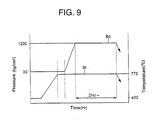
- the hot isostatic pressing is usually carried out under the temperature and pressure condition shown in Fig. 9 with composite material in which reinforcing fibers are mixed with metal matrix.
- Bp denotes a pressure condition in conventional hot isostaitc pressing and Bt a temperature condition.
- the mono-tape preform 19 is put in a HIP vessel where an initial pressure and temperature is set.
- the initial pressure is set at about 30 kg/cm 2 and the temperature at about 400 degrees Celsius.
- the temperature is gradually raised to a high temperature region of HIP treatment that is a temperature of plastic deformation and diffusion and is kept there for a predetermined time.
- An appropriate temperature of HIP treatment of Ti-4.5Al-3V-2Fe-2Mo alloy is, for example, is about 775 degrees Celsius.
- the pressure is increased to about 1200 kg/cm 2 .
- the composite is kept under the temperature and pressure for about 2 hours. Then, the temperature and pressure are lowered.
- metal foils 15 shown in Fig. 5, and spiral fibers 14 are lapped each other to make a disk formed preform 16 and the preform is hot-isostatic-pressed.
- Such HIP treatment is performed by heating and pressurizing in a capsule type HIP jig 22 as shown in Fig. 6. Pressure from inner side to outer side is not generated so as not to affect the disk formed preform 16 because round shaped metal foils 15 and spiral reinforcing fibers 14 are lapped each other in the arrow direction, resulting in preventing rupture of reinforcing fibers and processing a composite material having even strength.
- the round-formed metal matrix composite has such problems as it is unstable in strength or it is high in fabricating cost owing to the fabricating process.
- the present invention has an object to provide a method for fabricating a metal matrix composite having high specific strength, evenly balanced performance as well as capability of fabricating in low cost.
- a method for fabricating metal matrix composite wherein a preform of metal matrix with reinforcing fiber is hot-isostatic-pressed by keeping at a high temperature region capable of HIP treatment and of diffusing welding temperature of the metal matrix in a pressure vessel, comprises heating a preform of metal matrix with reinforcing fiber to the temperature, which is below the HIP treatment temperature region, of low temperature region or medium temperature region of the plastic deformation temperature of the metal matrix in a pressure vessel having an initial processing pressure and keeping for a predetermined time for a preparative treatment.
- Such preparative treatment prevents abrupt temperature increase in the pressure vessel so as to relax the tensile stress caused by deformation of the preform. Since the inner pressure of the pressure vessel is spontaneously increased while the inner temperature is increased to the HIP treatment temperature, the inner pressure is gradually changed as the inner temperature is gradually changed so that bonding surfaces between the reinforcing fibers and the metal matrix slide, as they are composed. As a result, rupture of reinforcing fibers in the fabrication process of composite material decreases to obtain a composite material having a stable specific strength at a low cost.
- the preparative treatment is conducted at a preparative treatment temperature of about 300 to 700 degrees Celsius for a sustained time of about 0.5 hours to 2.0 hours.
- the invention provides a material having required performance at a low cost using titan or titan alloy as metal matrix when a component part which is light in weight and strong in specific strength such as that of aircraft engine is required.
- the inner pressure of the pressure vessel is spontaneously increased to about 30 kg/cm 2 to 100 kg/cm 2 while the inner temperature is increased to the HIP treatment temperature.
- the preform is a solid cylinder or a hollow cylinder which is preferably formed by lapping the materials in the radius direction.
- the hollow cylinder preform may preferably be formed by winding reinforcing fibers around a drum of metal matrix and thermal spraying the metal matrix to the surface of the drum wound with the reinforcing fibers.
- the materials can be lapped in a radius direction though hitherto the materials are obliged to be lapped in the axial direction.
- a composite material having a big dimension in the axial direction can be fabricated in an extremely low cost.
- malposition of the reinforcing fibers can be controlled to the least extent so as to regularly align the reinforcing fibers, processing a most favorite composite material with regard to its strength.
- kinds of metal matrix and reinforcing fiber are not restricted so that metal or metal alloy matrix such as aluminum, stainless steel or others and reinforcing fiber such as ceramic fiber or others can be used.
- the reinforcing fiber 12 is wound around a titan alloy drum 11 of Fig. 3(a) at a constant interstice ((S1), Fig.3(b)).
- Matrix consisting of titan alloy is thermal sprayed on the surface of the drum 11 wound with the reinforcing fiber 12 ((S2), Fig.3(c)).
- the thermal sprayed matrix is ground to smooth the surface ((S3), Fig.3(d))
- a series of winding step (S1), thermal spraying step (S2) and grinding step (S3) is repeated predetermined times to produce a ring shape perform 13.
- the perform is put into the HIP vessel to be sealed in vacuum as shown in Fig. 4 ((S4), Fig.3(e)).
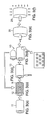
- Fig. 4 20 is a pressure vessel of stainless steel i.e. a HIP jig; 21a and 21b are mild steel pieces for a positioning device; 21a is a HIP inside jig which is inserted in the inner part of the ring; 21b is a HIP outside jig which fixes the outer position of the ring; 11 is a titan alloy drum which forms the inside of the ring shape perform; 10 is a preform comprising reinforcing fiber 12 wound around the drum and matrix thermal sprayed thereto; and the preform 10 is lapped in the arrow direction.
- a HIP inside jig which is inserted in the inner part of the ring
- 21b is a HIP outside jig which fixes the outer position of the ring
- 11 is a titan alloy drum which forms the inside of the ring shape perform
- 10 is a preform comprising reinforcing fiber 12 wound around the drum and matrix thermal sprayed thereto; and the preform 10 is lapped in the arrow
- titan alloy includes (a) Ti-4.5Al-3V-2Mo-2Fealloy (SP700), (b) pure titan, (c) Ti-6Al-4V alloy, (d) Ti-6Al-6V-2Sn alloy, (e) Ti-6Al-2Sn-2Mo alloy, (f) Ti-15V-3Cr-3Sn-3Al alloy, (g) Ti-5.8Al-4Sn-3.5Zr-0.7Nb-0.5Mo-0.35Si (IML834), (h) Ti-6Al-2.8Sn-4ZR-0.4Mo-0.45Si-0.0702 alloy (Ti-1100), (i) Ti-15Mo-3Nb-3Al-0.2Si alloy (beta21s), (j) Ti-41 ⁇ 52Al-X alloy (titan and aluminum inter metallic compound: X is other additives such as Ti-48Al-2Cr-2Nb), (k) Ti-25Al-10Nb-3V-1Mo alloy (super ⁇ 2), (1) Ti
- HIP treatment is applied to the ring shape perform 13 enclosed in the HIP jig 20 at the temperature and pressure shown in Fig. 1 to be hereinafter described (f).
- an initial pressure of about 30 kg/cm 2 and temperature of about 400 °C is established (S5) and then temperature is raised to a preprocessing temperature of about 500°C ⁇ 700°C, preferably to about 600°C to process for 1 hour (S6). After that, the temperature is gradually raised to about a HIP treatment temperature of 775 °C for about an hour (S7) . While the temperature is kept constant, the inner pressure of the jig is increased to a HIP treatment pressure of about 1200 kg/cm 2 and kept for about 2 hours (S8).
- Fig. 1 is a graph showing a temperature and pressure condition of the aforementioned HIP treatment.
- Ap denotes a pressure condition and At a temperature condition of the HIP treatment according to the present embodiment.
- the pressure between point a and b or f and g is that of preprocessing step.
- the inner pressure of the jig is spontaneously raised to point a.
- the preprocessing is performed for about 1 hour where the preform is kept under the condition of a pressure of about 30 kg/cm 2 to 100 kg/cm 2 , preferably about 60 kg/cm 2 and of a temperature of 500°C to 700°C, preferably about 600°C.
- temperature is gradually raised to a HIP temperature of about 775°C of h point during an extended time of about one hour while pressure is increased spontaneously between point b and c .
- pressure is increased to a HIP pressure of 1200 kg/cm 2 and kept for about 2 hours at d point. After that, the pressure and the temperature are lowered.
- the tensile stress caused by deformation of the preform is relaxed by preprocessing and by spontaneously increasing the pressure before and after the preprocessing to gradually transfer the condition of pressure and temperature.
- rupture of reinforcing fibers in the fabrication process of composite material decreases to obtain a composite material having a stable specific strength at a low cost.
- a preform produced by winding reinforcing fiber to a titan alloy drum and thermal spraying matrix thereon is used in this embodiment, a preform produced by convolving mono-tape preform, a disk shape preform and preforms having any other shapes can be applied.
Landscapes
- Chemical & Material Sciences (AREA)
- Engineering & Computer Science (AREA)
- Mechanical Engineering (AREA)
- Materials Engineering (AREA)
- Metallurgy (AREA)
- Organic Chemistry (AREA)
- Crystallography & Structural Chemistry (AREA)
- Physics & Mathematics (AREA)
- Plasma & Fusion (AREA)
- Manufacturing & Machinery (AREA)
- Manufacture Of Alloys Or Alloy Compounds (AREA)
- Powder Metallurgy (AREA)
- Treatment Of Fiber Materials (AREA)
Abstract
Description
Claims (6)
- A method for fabricating metal matrix composite, wherein a preform of metal matrix with reinforcing fiber is hot-isostatic-pressed by keeping at a high temperature region capable of HIP treatment and of diffusing welding temperature of the metal matrix in a pressure vessel, comprising heating a preform of metal matrix with reinforcing fiber to the temperature, which is below the high temperature region, of low temperature region or medium temperature region of the plastic deformation temperature of the metal matrix in a pressure vessel having an initial processing pressure and keeping for a predetermined time for a preparative treatment.
- A method for fabricating metal matrix composite according to claim 1 wherein the inner pressure of the pressure vessel is spontaneously increased while the inner temperature is increased to the HIP treatment temperature.
- A method for fabricating metal matrix composite according to claim 1 wherein, in case metal matrix is titan or titan alloy, the preparative treatment is conducted at a preparative treatment temperature of about 300°C to 700°C for a sustained time of about 0.5 hours to 2.0 hours.
- A method for fabricating metal matrix composite according to claim 3 wherein the inner pressure of the pressure vessel is spontaneously increased to about 30 kg/cm2 to 100 kg/cm2 while the inner temperature is increased to the HIP treatment temperature.
- A method for fabricating metal matrix composite according to claim 3 wherein the preform is a solid cylinder or a hollow cylinder which is formed by lapping the materials in the radius direction.
- A method for fabricating metal matrix composite according to claim 5 wherein the hollow cylinder preform is formed by winding reinforcing fibers around a drum of metal matrix and thermal-spraying the metal matrix to the surface of the drum wound with the reinforcing fibers.
Applications Claiming Priority (2)
| Application Number | Priority Date | Filing Date | Title |
|---|---|---|---|
| JP2001330781A JP2003138352A (en) | 2001-10-29 | 2001-10-29 | Molding method of metal matrix composite material |
| JP2001330781 | 2001-10-29 |
Publications (3)
| Publication Number | Publication Date |
|---|---|
| EP1306459A2 true EP1306459A2 (en) | 2003-05-02 |
| EP1306459A3 EP1306459A3 (en) | 2005-11-09 |
| EP1306459B1 EP1306459B1 (en) | 2008-04-09 |
Family
ID=19146456
Family Applications (1)
| Application Number | Title | Priority Date | Filing Date |
|---|---|---|---|
| EP02024455A Expired - Lifetime EP1306459B1 (en) | 2001-10-29 | 2002-10-29 | Pretreatment of a metal matrix composite for hot isostatic pressing |
Country Status (5)
| Country | Link |
|---|---|
| US (1) | US6858177B2 (en) |
| EP (1) | EP1306459B1 (en) |
| JP (1) | JP2003138352A (en) |
| CA (1) | CA2409791C (en) |
| DE (1) | DE60225988T2 (en) |
Cited By (6)
| Publication number | Priority date | Publication date | Assignee | Title |
|---|---|---|---|---|
| US7343677B2 (en) | 2003-10-24 | 2008-03-18 | Rolls-Royce Plc | Method of manufacturing a fiber reinforced metal matrix composite article |
| US7516548B2 (en) | 2003-11-20 | 2009-04-14 | Rolls-Royce Plc | Method of manufacturing a fibre reinforced metal matrix composite article |
| FR2962482A1 (en) * | 2010-07-12 | 2012-01-13 | Snecma | METHOD FOR PRODUCING A MASSIVE PIECE |
| WO2012007682A1 (en) * | 2010-07-12 | 2012-01-19 | Snecma | Method for producing a solid part |
| EP2374911A3 (en) * | 2010-03-30 | 2017-07-26 | Rolls-Royce plc | A method of manufacturing a rotor disc |
| RU2819775C1 (en) * | 2023-11-30 | 2024-05-24 | федеральное государственное бюджетное образовательное учреждение высшего образования "Уфимский университет науки и технологий" | Method of producing composites with metal matrix using effect of low-temperature superplasticity |
Families Citing this family (7)
| Publication number | Priority date | Publication date | Assignee | Title |
|---|---|---|---|---|
| US7682650B1 (en) * | 2003-05-09 | 2010-03-23 | Uchicago Argonne, Llc | Method for producing functionally graded nanocrystalline layer on metal surface |
| US7900811B1 (en) * | 2005-07-15 | 2011-03-08 | The United States Of America As Represented By The United States Department Of Energy | Method for producing components with internal architectures, such as micro-channel reactors, via diffusion bonding sheets |
| FR2946550A1 (en) * | 2009-06-16 | 2010-12-17 | Messier Dowty Sa | PROCESS FOR MANUFACTURING A METAL PIECE INCORPORATING A FIBROUS ANNULAR REINFORCEMENT. |
| US10648065B2 (en) | 2017-12-01 | 2020-05-12 | General Electric Company | Systems and methods for manufacturing prepreg tapes |
| CN115502399B (en) * | 2022-09-27 | 2024-03-12 | 哈尔滨工业大学 | A titanium-based composite material prepared by low-temperature hot isostatic pressing and its method |
| CN118788965A (en) * | 2024-06-21 | 2024-10-18 | 华中科技大学 | A discontinuous body reinforced titanium-based composite material sintering-rolling short process ring forming method and product |
| CN120644660B (en) * | 2025-08-12 | 2025-11-25 | 西安欧中材料科技股份有限公司 | A near-net-shape forming method for complex-shaped titanium alloy components and its application |
Family Cites Families (9)
| Publication number | Priority date | Publication date | Assignee | Title |
|---|---|---|---|---|
| US5096518A (en) * | 1989-02-22 | 1992-03-17 | Kabushiki Kaisha Kobe Seiko Sho | Method for encapsulating material to be processed by hot or warm isostatic pressing |
| US4981643A (en) * | 1990-06-29 | 1991-01-01 | General Electric Company | Hiping method for composite structures |
| DE4021547A1 (en) * | 1990-07-06 | 1992-01-16 | Deutsche Forsch Luft Raumfahrt | Fibre-reinforced body prodn. - by winding slivers of parallel fibre coated in matrix material to prevent fibre breakage |
| US5579532A (en) * | 1992-06-16 | 1996-11-26 | Aluminum Company Of America | Rotating ring structure for gas turbine engines and method for its production |
| JPH0732332A (en) | 1993-07-19 | 1995-02-03 | Mitsubishi Alum Co Ltd | Manufacture of hollow preform of metal based composite material and casting mold for manufacturing the same |
| JPH0780625A (en) | 1993-09-14 | 1995-03-28 | Toyota Motor Corp | Method for producing metal matrix composite material having hollow portion |
| DE4335557C1 (en) * | 1993-10-19 | 1995-02-02 | Deutsche Forsch Luft Raumfahrt | Method for the production of components reinforced by long fibres |
| US5897922A (en) * | 1997-04-07 | 1999-04-27 | National Research Council Of Canada | Method to manufacture reinforced axi-symmetric metal matrix composite shapes |
| US6064031A (en) * | 1998-03-20 | 2000-05-16 | Mcdonnell Douglas Corporation | Selective metal matrix composite reinforcement by laser deposition |
-
2001
- 2001-10-29 JP JP2001330781A patent/JP2003138352A/en not_active Withdrawn
-
2002
- 2002-10-25 CA CA002409791A patent/CA2409791C/en not_active Expired - Fee Related
- 2002-10-28 US US10/281,355 patent/US6858177B2/en not_active Expired - Lifetime
- 2002-10-29 DE DE60225988T patent/DE60225988T2/en not_active Expired - Fee Related
- 2002-10-29 EP EP02024455A patent/EP1306459B1/en not_active Expired - Lifetime
Cited By (6)
| Publication number | Priority date | Publication date | Assignee | Title |
|---|---|---|---|---|
| US7343677B2 (en) | 2003-10-24 | 2008-03-18 | Rolls-Royce Plc | Method of manufacturing a fiber reinforced metal matrix composite article |
| US7516548B2 (en) | 2003-11-20 | 2009-04-14 | Rolls-Royce Plc | Method of manufacturing a fibre reinforced metal matrix composite article |
| EP2374911A3 (en) * | 2010-03-30 | 2017-07-26 | Rolls-Royce plc | A method of manufacturing a rotor disc |
| FR2962482A1 (en) * | 2010-07-12 | 2012-01-13 | Snecma | METHOD FOR PRODUCING A MASSIVE PIECE |
| WO2012007682A1 (en) * | 2010-07-12 | 2012-01-19 | Snecma | Method for producing a solid part |
| RU2819775C1 (en) * | 2023-11-30 | 2024-05-24 | федеральное государственное бюджетное образовательное учреждение высшего образования "Уфимский университет науки и технологий" | Method of producing composites with metal matrix using effect of low-temperature superplasticity |
Also Published As
| Publication number | Publication date |
|---|---|
| CA2409791A1 (en) | 2003-04-29 |
| EP1306459B1 (en) | 2008-04-09 |
| US20030082311A1 (en) | 2003-05-01 |
| DE60225988D1 (en) | 2008-05-21 |
| DE60225988T2 (en) | 2009-05-14 |
| US6858177B2 (en) | 2005-02-22 |
| EP1306459A3 (en) | 2005-11-09 |
| CA2409791C (en) | 2009-12-29 |
| JP2003138352A (en) | 2003-05-14 |
Similar Documents
| Publication | Publication Date | Title |
|---|---|---|
| US6858177B2 (en) | Method for fabricating metal matrix composite | |
| US5400505A (en) | Method for manufacturing fiber-reinforced components for propulsion plants | |
| GB2095137A (en) | A method of making filamentary reinforced metallic structures | |
| US5184769A (en) | Tooling and method for consolidating a filamentary reinforced metal matrix composite | |
| US5074923A (en) | Method for id sizing of filament reinforced annular objects | |
| EP2272664A1 (en) | Process for manufacturing foils, sheets and shaped parts from an alloy with titanium and aluminium as its main elements. | |
| US7343677B2 (en) | Method of manufacturing a fiber reinforced metal matrix composite article | |
| JPH07197108A (en) | Production of fiber-reinforced circular metal part | |
| US4762268A (en) | Fabrication method for long-length or large-sized dense filamentary monotapes | |
| US5015533A (en) | Member of a refractory metal material of selected shape and method of making | |
| US5058411A (en) | Method for shaping filament reinforced annular objects | |
| GB2078338A (en) | A metal composite drive shaft and method of fabrication thereof | |
| US6202277B1 (en) | Reusable hard tooling for article consolidation and consolidation method | |
| US6730412B2 (en) | Metal matrix composite | |
| JPS58128525A (en) | Manufacture of composite roll | |
| US20130340634A1 (en) | Pressure vessel sealing | |
| RU2761530C1 (en) | Method for producing cylindrical reinforced elements for manufacturing parts of a bladed disk of a gas turbine engine | |
| JPH0425694A (en) | Manufacture of clad tee-tube | |
| JPH02175014A (en) | Composite sintered hard alloy roll and its manufacture | |
| JPH05287409A (en) | Asymmetrical hip method for filament reinforced annular body | |
| JPH0220686B2 (en) | ||
| JPH01107912A (en) | Composite roll | |
| JPS6231042B2 (en) | ||
| JPH03107433A (en) | Manufacture of superplasticity silicon nitride whisker reinforced aluminum alloy composite | |
| JPH03484A (en) | Composite product and manufacture thereof |
Legal Events
| Date | Code | Title | Description |
|---|---|---|---|
| PUAI | Public reference made under article 153(3) epc to a published international application that has entered the european phase |
Free format text: ORIGINAL CODE: 0009012 |
|
| 17P | Request for examination filed |
Effective date: 20021029 |
|
| AK | Designated contracting states |
Designated state(s): AT BE BG CH CY CZ DE DK EE ES FI FR GB GR IE IT LI LU MC NL PT SE SK TR |
|
| AX | Request for extension of the european patent |
Extension state: AL LT LV MK RO SI |
|
| PUAL | Search report despatched |
Free format text: ORIGINAL CODE: 0009013 |
|
| AK | Designated contracting states |
Kind code of ref document: A3 Designated state(s): AT BE BG CH CY CZ DE DK EE ES FI FR GB GR IE IT LI LU MC NL PT SE SK TR |
|
| AX | Request for extension of the european patent |
Extension state: AL LT LV MK RO SI |
|
| RIC1 | Information provided on ipc code assigned before grant |
Ipc: 7C 22C 47/18 - Ipc: 7B 22F 5/10 - Ipc: 7B 22F 3/15 - Ipc: 7C 22C 47/20 B Ipc: 7C 22C 47/00 A |
|
| AKX | Designation fees paid |
Designated state(s): DE FR GB IT |
|
| 17Q | First examination report despatched |
Effective date: 20060824 |
|
| GRAP | Despatch of communication of intention to grant a patent |
Free format text: ORIGINAL CODE: EPIDOSNIGR1 |
|
| RIN1 | Information on inventor provided before grant (corrected) |
Inventor name: KONO, AKIRA,NAGOYA AEROSPACE SYSTEMS WORKS Inventor name: YAMADA, TAKESHI,NAGOYA AEROSPACE SYSTEMS WORKS, |
|
| GRAS | Grant fee paid |
Free format text: ORIGINAL CODE: EPIDOSNIGR3 |
|
| GRAA | (expected) grant |
Free format text: ORIGINAL CODE: 0009210 |
|
| AK | Designated contracting states |
Kind code of ref document: B1 Designated state(s): DE FR GB IT |
|
| REG | Reference to a national code |
Ref country code: GB Ref legal event code: FG4D |
|
| REF | Corresponds to: |
Ref document number: 60225988 Country of ref document: DE Date of ref document: 20080521 Kind code of ref document: P |
|
| ET | Fr: translation filed | ||
| PGFP | Annual fee paid to national office [announced via postgrant information from national office to epo] |
Ref country code: DE Payment date: 20081027 Year of fee payment: 7 |
|
| PLBE | No opposition filed within time limit |
Free format text: ORIGINAL CODE: 0009261 |
|
| STAA | Information on the status of an ep patent application or granted ep patent |
Free format text: STATUS: NO OPPOSITION FILED WITHIN TIME LIMIT |
|
| 26N | No opposition filed |
Effective date: 20090112 |
|
| PGFP | Annual fee paid to national office [announced via postgrant information from national office to epo] |
Ref country code: FR Payment date: 20081014 Year of fee payment: 7 |
|
| GBPC | Gb: european patent ceased through non-payment of renewal fee |
Effective date: 20081029 |
|
| PG25 | Lapsed in a contracting state [announced via postgrant information from national office to epo] |
Ref country code: IT Free format text: LAPSE BECAUSE OF FAILURE TO SUBMIT A TRANSLATION OF THE DESCRIPTION OR TO PAY THE FEE WITHIN THE PRESCRIBED TIME-LIMIT Effective date: 20080409 |
|
| PG25 | Lapsed in a contracting state [announced via postgrant information from national office to epo] |
Ref country code: GB Free format text: LAPSE BECAUSE OF NON-PAYMENT OF DUE FEES Effective date: 20081029 |
|
| REG | Reference to a national code |
Ref country code: FR Ref legal event code: ST Effective date: 20100630 |
|
| PG25 | Lapsed in a contracting state [announced via postgrant information from national office to epo] |
Ref country code: FR Free format text: LAPSE BECAUSE OF NON-PAYMENT OF DUE FEES Effective date: 20091102 Ref country code: DE Free format text: LAPSE BECAUSE OF NON-PAYMENT OF DUE FEES Effective date: 20100501 |