EP1306396A1 - 1,2-polybutadiene, thermoplastic elastomer composition and polymer composition - Google Patents
1,2-polybutadiene, thermoplastic elastomer composition and polymer composition Download PDFInfo
- Publication number
- EP1306396A1 EP1306396A1 EP00948245A EP00948245A EP1306396A1 EP 1306396 A1 EP1306396 A1 EP 1306396A1 EP 00948245 A EP00948245 A EP 00948245A EP 00948245 A EP00948245 A EP 00948245A EP 1306396 A1 EP1306396 A1 EP 1306396A1
- Authority
- EP
- European Patent Office
- Prior art keywords
- thermoplastic elastomer
- polybutadiene
- polymer
- range
- butadiene
- Prior art date
- Legal status (The legal status is an assumption and is not a legal conclusion. Google has not performed a legal analysis and makes no representation as to the accuracy of the status listed.)
- Withdrawn
Links
Images

Classifications
-
- C—CHEMISTRY; METALLURGY
- C08—ORGANIC MACROMOLECULAR COMPOUNDS; THEIR PREPARATION OR CHEMICAL WORKING-UP; COMPOSITIONS BASED THEREON
- C08F—MACROMOLECULAR COMPOUNDS OBTAINED BY REACTIONS ONLY INVOLVING CARBON-TO-CARBON UNSATURATED BONDS
- C08F36/00—Homopolymers and copolymers of compounds having one or more unsaturated aliphatic radicals, at least one having two or more carbon-to-carbon double bonds
- C08F36/02—Homopolymers and copolymers of compounds having one or more unsaturated aliphatic radicals, at least one having two or more carbon-to-carbon double bonds the radical having only two carbon-to-carbon double bonds
- C08F36/04—Homopolymers and copolymers of compounds having one or more unsaturated aliphatic radicals, at least one having two or more carbon-to-carbon double bonds the radical having only two carbon-to-carbon double bonds conjugated
- C08F36/06—Butadiene
-
- C—CHEMISTRY; METALLURGY
- C08—ORGANIC MACROMOLECULAR COMPOUNDS; THEIR PREPARATION OR CHEMICAL WORKING-UP; COMPOSITIONS BASED THEREON
- C08L—COMPOSITIONS OF MACROMOLECULAR COMPOUNDS
- C08L21/00—Compositions of unspecified rubbers
-
- C—CHEMISTRY; METALLURGY
- C08—ORGANIC MACROMOLECULAR COMPOUNDS; THEIR PREPARATION OR CHEMICAL WORKING-UP; COMPOSITIONS BASED THEREON
- C08L—COMPOSITIONS OF MACROMOLECULAR COMPOUNDS
- C08L23/00—Compositions of homopolymers or copolymers of unsaturated aliphatic hydrocarbons having only one carbon-to-carbon double bond; Compositions of derivatives of such polymers
- C08L23/02—Compositions of homopolymers or copolymers of unsaturated aliphatic hydrocarbons having only one carbon-to-carbon double bond; Compositions of derivatives of such polymers not modified by chemical after-treatment
- C08L23/04—Homopolymers or copolymers of ethene
- C08L23/06—Polyethylene
-
- C—CHEMISTRY; METALLURGY
- C08—ORGANIC MACROMOLECULAR COMPOUNDS; THEIR PREPARATION OR CHEMICAL WORKING-UP; COMPOSITIONS BASED THEREON
- C08L—COMPOSITIONS OF MACROMOLECULAR COMPOUNDS
- C08L53/00—Compositions of block copolymers containing at least one sequence of a polymer obtained by reactions only involving carbon-to-carbon unsaturated bonds; Compositions of derivatives of such polymers
- C08L53/02—Compositions of block copolymers containing at least one sequence of a polymer obtained by reactions only involving carbon-to-carbon unsaturated bonds; Compositions of derivatives of such polymers of vinyl-aromatic monomers and conjugated dienes
-
- C—CHEMISTRY; METALLURGY
- C08—ORGANIC MACROMOLECULAR COMPOUNDS; THEIR PREPARATION OR CHEMICAL WORKING-UP; COMPOSITIONS BASED THEREON
- C08L—COMPOSITIONS OF MACROMOLECULAR COMPOUNDS
- C08L53/00—Compositions of block copolymers containing at least one sequence of a polymer obtained by reactions only involving carbon-to-carbon unsaturated bonds; Compositions of derivatives of such polymers
- C08L53/02—Compositions of block copolymers containing at least one sequence of a polymer obtained by reactions only involving carbon-to-carbon unsaturated bonds; Compositions of derivatives of such polymers of vinyl-aromatic monomers and conjugated dienes
- C08L53/025—Compositions of block copolymers containing at least one sequence of a polymer obtained by reactions only involving carbon-to-carbon unsaturated bonds; Compositions of derivatives of such polymers of vinyl-aromatic monomers and conjugated dienes modified
-
- C—CHEMISTRY; METALLURGY
- C08—ORGANIC MACROMOLECULAR COMPOUNDS; THEIR PREPARATION OR CHEMICAL WORKING-UP; COMPOSITIONS BASED THEREON
- C08L—COMPOSITIONS OF MACROMOLECULAR COMPOUNDS
- C08L67/00—Compositions of polyesters obtained by reactions forming a carboxylic ester link in the main chain; Compositions of derivatives of such polymers
- C08L67/02—Polyesters derived from dicarboxylic acids and dihydroxy compounds
- C08L67/025—Polyesters derived from dicarboxylic acids and dihydroxy compounds containing polyether sequences
-
- C—CHEMISTRY; METALLURGY
- C08—ORGANIC MACROMOLECULAR COMPOUNDS; THEIR PREPARATION OR CHEMICAL WORKING-UP; COMPOSITIONS BASED THEREON
- C08L—COMPOSITIONS OF MACROMOLECULAR COMPOUNDS
- C08L9/00—Compositions of homopolymers or copolymers of conjugated diene hydrocarbons
-
- Y—GENERAL TAGGING OF NEW TECHNOLOGICAL DEVELOPMENTS; GENERAL TAGGING OF CROSS-SECTIONAL TECHNOLOGIES SPANNING OVER SEVERAL SECTIONS OF THE IPC; TECHNICAL SUBJECTS COVERED BY FORMER USPC CROSS-REFERENCE ART COLLECTIONS [XRACs] AND DIGESTS
- Y10—TECHNICAL SUBJECTS COVERED BY FORMER USPC
- Y10S—TECHNICAL SUBJECTS COVERED BY FORMER USPC CROSS-REFERENCE ART COLLECTIONS [XRACs] AND DIGESTS
- Y10S525/00—Synthetic resins or natural rubbers -- part of the class 520 series
- Y10S525/914—Polymer from conjugated diene hydrocarbon or halohydrocarbons having more than 50 per cent 1,2-microstructure
Definitions
- the present invention relates to 1,2-polybutadiene and a thermoplastic elastomer composition and a polymer composition, more particularly, it relates to 1,2-polybutadiene having improved mold contamination, thermal deterioration and change with time in the properties at molding at a high temperature, and an thermoplastic elastomer composition excellent in a moldability, a transparency, a mechanical strength and an wet skid resistance.
- the 1,2-polybutadiene of the present invention is used as a thermoplastic elastomer for molding various molded articles such as industrial parts and footwears, various sheets, films and the like, and as an electron beam cross-linking resin, a modifier for a resin or a rubber, a vulcanized rubber and the like.
- a thermoplasic elastomer composition containing 1,2-polybutadiene is used as various molded articles such as industrial parts and footwears, various sheets, films, tubes and the like.
- 1,2-polybutadiene having a suitably controllable crystallinity comprises a crystalline part and an amorphous part, and has a carbon-carbon double bond has a high chemical reactivity in a molecule, it has not only the function as a thermoplastic elastomer but also the function as the conventional vulcanized rubber and a thermosetting resin having the high cross-linking density.
- this 1,2-polybutadiene is excellent in a processibility, it is applied as a modifier for other resins and thermoplastic elastomers, or a medical polymer material.
- 1,2-polybutadiene having a controlled crystallinity has been obtained by using a catalyst comprising a cobalt salt phosphine complex, trialkylaluminium and water (JP-B-44-32425), or a catalyst comprising a cobalt compound, trialkylaluminium, water and a triphenylphosphine derivative (JP-B-61-27402).
- a catalyst comprising a cobalt salt phosphine complex, trialkylaluminium and water JP-B-44-32425
- a catalyst comprising a cobalt compound, trialkylaluminium, water and a triphenylphosphine derivative JP-B-61-27402
- 1,2-polybutadiene has more excellent properties as a thermoplastic elastomer.
- An object of the present invention is to provide 1,2-polybutadiene which does not cause the mold contamination and the thermal deterioration at high temperature molding and has improved change with time in the physical properties, and a thermoplastic elastomer composition excellent in the moldability, the transparency, the mechanical strength and the wet skid resistance.
- 1,2-polybutadiene of the invention described in claim 1 is characterized in that the 1,2-bond content in butadiene unit is 70% by weight or more, a melting point is in a range of 50-140°C, the viscosity ⁇ measured with a slit die rheometer at a shear rate of 5113sec -1 is in a range of 400-1200 poises at 120°C, in a range of 300-1000 poises at 150°C, and in a range of 200-800 poises at 180°C, and the total halogen content is 30ppm or less.
- the 1,2-bond content in butadiene unit of 1,2-polybutadiene of the invention described in claim 1 has the close relationship with the thermoplastic elastomer properties, and is 70% by weight or more, preferably 80% by weight or more.
- 1,2-polybutadiene has a crystalline property and a melting point thereof is in a range of 50-140°C, preferably 60-130°C.
- 1,2-polybutadiene is excellent in the balance between the mechanical strength such as tensile strength, the tear strength and the like and the flexibility as a thermoplastic elastomer.
- the viscosity ⁇ of 1,2-polybutadiene of the invention described in claim 1 measured with a slit die rheometer at a shear rate of 5113sec -1 is in each viscosity range at each temperature described above.
- 1,2-polybutadiene is inferior in the mechanical strength, being not preferable.
- the viscosity exceeds each upper viscosity limit, the processibility and moldability are inferior, being not preferable.
- a method for measuring the viscosity ⁇ with a slit die rheometer will be described in detail in Examples.
- the 1,2-polybutadiene of the invention described in claim 1 has a total amount of halogen of 30ppm or less.
- an amount of halogen in a polymer is measured by quantitative analysis with fluorescent X-ray, and 30ppm is a lower limit of measurement in this method. Since a total amount of halogen remaining in 1,2-polybutadiene of the present invention is slight like this, the mold contamination and the thermal deterioration are not occured at high temperature molding such as injection molding, a problem such as change with time in the physical properties is improved, the processibility and moldability is better, and the physical properties of a molded articles are maintained for a long period of time.
- the 1,2-polybutadiene of the present invention may be copolymerized with conjugated diene other than butadiene.
- conjugated diene other than butadiene include 1,3-pentadiene, 1,3-butadiene derivative substituted with a higher alkyl group, 2-alkyl-substituted-1, 3-butadiene and the like.
- examples of the 1,3-butadiene derivative substituted with a higher alkyl group include 1-pentyl-1,3-butadiene, 1-hexyl-1,3-butadiene, 1-heptyl-1,3-butadiene, 1-octyl-1,3-butadiene and the like.
- examples of the 2-alkyl-substituted-1,3-butadiene include 2-methyl-1,3-butadiene (isoprene), 2-ethyl-1,3-butadiene, 2-propyl-1,3-butadiene, 2-isopropyl-1,3-butadiene, 2-butyl-1,3-butadiene, 2-isobutyl-1,3-butadiene, 2-amyl-1,3-butadiene, 2-isoamyl-1,3-butadiene, 2-hexyl-1,3-butadiene, 2-cyclohexyl-1,3-butadiene, 2-isohexyl-1,3-butadiene, 2-heptyl-1,3-butadiene, 2-isoheptyl-1,3-butadiene, 2-octyl-1,3-butadiene, 2-isooctyl-1,3-butadiene and the like.
- the content of butadiene in a monomer component to be supplied to polymerization is 50mol% or more, particularly preferably 70mol% or more.
- a melting point or a viscosity of the resulting 1,2-polybutadiene are outside the aforementioned ranges in some cases.
- the 1,2-polybutadiene of the present invention is obtained by polymerizing butadiene in the presence of a catalyst containing a cobalt compound and aluminoxane.
- Examples of the aforementioned cobalt compound include organic acid salts of cobalt, preferably, having a carbon number of 4 or more.
- Examples of the organic acid salt of cobalt include butyric acid salt, hexanoic acid salt, heptylic acid salt, octylic acid salt such as 2-ethylhexylic acid and the like, decanoic acid salt, higher fatty acid salt such as stearic acid, oleic acid, erucic acid and the like, benzoic acid salt, tolylic acid salt, xylylic acid, alkyl, aralkyl and allyl-substituted benzole acid salt such as ethyl benzoic acid and the like, naphtoic acid salt, alkyl, aralkyl or allyl-substituted naphtoic acid salt and the like.
- so-called octylic acid salt such as 2-ethylhexylic acid, stearic acid salt
- aluminoxane examples include ones represented by the following general formula (I) or general formula (II).
- R is a hydrocarbon group such as methyl group, ethyl group, propyl group, butyl group and the like, preferably methyl group or ethyl group, particularly preferably methyl group.
- Rs on both terminals may be the same or different.
- m is an integer of 2 or more, preferably an integer of 5 or more, more preferably an integer of 10-100.
- Examples of aluminoxane include methylaluminoxane, ethylaluminoxane, propylaluminoxane, butylaluminoxane and the like, and methylaluminoxane is particularly preferable.
- a polymerization catalyst containing a phosphine compound besides the aforementioned cobalt compound and aluminoxane is extremely preferable.
- a phosphine compound is a component effective in controlling the activity of a polymerization catalyst and the control of the vinyl binding structure and the crystalline property.
- a preferable examples thereof include an organic phosphorus compound represented by the following general formula (III). P(Ar) n R 3-n
- Ar denotes a group described below: (wherein R 1 , R 2 and R 3 are the same or different, and represent a hydrogen atom, an alkyl group having a carbon number of, preferably 1-6, a halogen atom, an alkoxy group having a carbon number of, preferably 1-6, or an aryl group having a carbon number of, preferably, 6-12.)
- R denotes a cycloalkyl group or an alkyl-substituted cycloalkyl group
- n is an integer of 0-3.
- Examples of the phosphine compound represented by the general formula (III) include tris(3-methylphenyl)phosphine, tris(3-ethylphenyl)phosphine, tris(3,5-dimethylphenyl)phosphine, tris(3,4-dimethylphenyl)phosphine, tris(3-isopropylphenyl)phosphine, tris(3-t-butylphenyl)phosphine, tris(3,5-diethylphenyl)phosphine, tris(3-methyl-5-ethylphenyl)phosphine, tris(3-phenylphenyl)phosphine, tris(3,4,5-trimethylphenyl)phosphine, tris(4-methoxy-3,5-dimethylphenyl)phosphine, tris(4-ethoxy-3,5-diethylphenyl)phosphine, tris(4-but
- cobalt compound a cobalt compound represented by the following general formula (IV) can be used.
- a cobalt compound which was synthesized in advance may be used, or a cobalt compound may be used by a method for contacting cobalt chloride and a phosphine compound in a polymerization system. An amount of a 1,2-bond and the crystallinity of the resulting 1,2-polybutadiene can be controlled.
- Examples of the cobalt compound represented by the aforementioned general formula (IV) include cobalt bis(triphenylphosphine)dichloride, cobalt bis[tris(3-methylphenylphosphine)]dichloride, cobalt bis[tris(3-ethylphenylphosphine)]dichloride, cobalt bis[tris(4-methylphenylphosphine)]dichloride, cobalt bis[tris(3,5-dimethylphenylphosphine)]dichloride, cobalt bis[tris(3,4-dimethylphenylphosphine)]dichloride, cobalt bis[tris(3-isopropylphenylphosphine)]dichloride, cobalt bis[tris(3-t-butylphenylphosphine)]dichloride, cobalt bis[tris(3,5-dimethylphenylphosphine)]d
- cobalt bis(triphenylphosphine)dichloride particularly preferred are cobalt bis(triphenylphosphine)dichloride, cobalt bis[tris(3-methylphenylphosphine)]dichloride, cobalt bis[tris(3,5-dimethylphenylphosphine)]dichloride, cobalt bis[tris(4-methoxy-3,5-dimethylphenylphosphine)]dichloride and the like.
- a cobalt compound is used at 0.001-1mmol preferably 0.01-0.5mmol in terms of cobalt atom per 1mol of butadiene in the case of polymerization of butadiene alone, or per 1mol of at a total amount of butadiene and conjugated diene other than butadiene.
- a ratio of phosphorous atom relative to cobalt atom is usually 0.1-50, preferably 0.5-20, more preferably 1-20.
- a ratio of aluminum atom relative to cobalt atom of a cobalt compound Al/Co
- Al/Co aluminum atom relative to cobalt atom of a cobalt compound
- an inert organic solvent used as a polymerization solvent examples include aromatic hydrocarbons such as benzene, toluene, xylene, cumene and the like, aliphatic hydrocarbons such as n-pentane, n-hexane, n-butane and the like, alicyclic hydrocarbons such as cyclopentane, methylcyclopentane, cyclohexane and the like and a mixture of them.
- a polymerization temperature is usually -50 - 120°C, preferably -20- 100°C.
- a polymerization reaction is preferably continuous polymerization in which a plurality of reactors is connected in series.
- the concentration of amonomer in a solvent is usually 5-50% by weight, preferably 10-35% by weight.
- contamination of a compound having the activity of inactivation such as oxygen, water, carbonic gas and the like into a polymerization system is diminished as much as possible.
- 1,2-polybutadiene of the present invention itself can obtain the sufficient strength without cross-linking, it is suitable for use in industrial parts such as injection molding, extrusion molding and the like, and non-cross-linking molding such as films and the like.
- 1,2-polybutadiene of the present invention is also excellent in cross-linking reactivity, it is suitably used in a cross-linked rubber and a reaction aid for a vulcanized rubber.
- a method of processing is not particularly limited but mixing such as melt kneading and the like using a roll, a kneader, a Banbury mixer, a screw extruder, a feeder ruder extruder and the like which are used in rubber processing is possible.
- 1,2-polybutadiene of the present invention is suitably used as a modifier for other thermoplastic elastomers and resins.
- thermoplastic elastomer composition of the present invention described in claim 2 is characterized in that it contains a thermoplastic elastomer selected from an aromatic vinyl-based thermoplastic elastomer, an urethane-based thermoplastic elastomer, a polyester-based thermoplastic elastomer, a polyamide-based thermoplastic elastomer, a vinyl chloride-based thermoplastic elastomer and a fluorine-based thermoplastic elastomer, and the aforementioned 1,2-polybutadiene.
- a thermoplastic elastomer selected from an aromatic vinyl-based thermoplastic elastomer, an urethane-based thermoplastic elastomer, a polyester-based thermoplastic elastomer, a polyamide-based thermoplastic elastomer, a vinyl chloride-based thermoplastic elastomer and a fluorine-based thermoplastic elastomer, and the aforementioned 1,2-polybutadiene.
- aromatic vinyl-based thermoplastic elastomer examples include a block copolymer of an aromatic vinyl compound and conjugated diolefin such as polystyrene-polybutadiene block copolymer, polystyrene-polybutadiene-polystyrene block copolymer, polystyrene-poly(styrene-butadiene)-polystyrene block copolymer, polystyrene-polyisoprene-polystyrene copolymer and the aforementioned block copolymer wherein a part or the whole of styrene is substituted with ⁇ -methylene, and hydrogenated these block copolymers.
- polystyrene-polybutadiene-polystyrene block copolymer is used.
- polyester-based thermoplastic elastomer examples include multi-blocks polymers using polybutylene terephthalate as a hard segment and polytetramethylene ether glycol as a soft segment and the like.
- polyamide-based thermoplastic elastomer examples include block polymers using nylon as a hard segment and polyester or polyol as a soft segment and the like.
- a ratio of the aforementioned thermoplastic elastomer and the aforementioned 1,2-polybutadiene in the thermoplastic elastomer composition can be such that the aforementioned thermoplastic elastomer is 50-99 parts by weight and the aforementioned 1,2-polybutadiene is 1-50 parts by weight as shown in claim 3.
- the content of the aforementioned 1,2-polybutadiene is less than 1 part by weight, the molding appearance is inferior and, when the content exceeds 50 parts by weight, the characteristics of the thermoplastic elastomer itself to be used are lost, being not preferable.
- the elastomer composition of the invention described in claim 6 is characterized in that it contains a polyolefin-based polymer and the aforementioned 1,2-polybutadiene.
- the aforementioned polyolefin-based polymer is not particularly limited and may be a resin or an elastomer as long as it is thermoplastic.
- a polymer containing at least one selected from the group consisting of an ethylene component, a propylene and a butylene component is preferably used as shown in claim 8.
- Examples of them include polyethylene, polypropylene, ethylene propylene copolymer (EPR, EPDM), polybutylene, polyisobutylene, ethylene-vinyl acetate copolymer and the like.
- EPR ethylene propylene copolymer
- polybutylene polyisobutylene
- ethylene-vinyl acetate copolymer examples of them include polyethylene, polypropylene, crystalline ethylene-propylene copolymer and ethylene-vinyl acetate copolymer.
- a ratio of the aforementioned polyolefin polymer and the aforementioned 1,2-polybutadiene can be such that the aforementioned polyolefin polymer is 70-99 parts by weight and the aforementioned 1,2-polybutadiene is 1-20 parts by weight as shown in claim 7.
- the content of the aforementioned 1,2-polybutadiene is less than 1 part by weight, the scratch resistance of a molded article of a polyolefin polymer is inferior and, when the content exceeds 20 parts by weight, the properties of polyolefin polymer itself are lost, being not preferable.
- Fig. 1 is a schematic cross-sectional view of a slit die rheometer.
- a slit die rheometer was used in which two pressure sensors (P1, P2), a slit die, and cylinder (Barrel) pressure sensor (Pin) are fixed to a die part.
- a polymer was filled in a cylinder maintained at a predetermined temperature, and the viscosity when extruded at a rate of a plunger of 5000cm/min. (upon this, a shear rate was 5113sec -1 ) was measured.
- a diameter of cylinder is 15mm
- transverse section h ⁇ M of a slit die is 1mm ⁇ 12mm
- a length is 54mm
- a hopper angle is 90 degree.
- the 1,2-bond content in butadiene unit of was obtained by an infrared absorption spectrum method by D. Morero et al. (Chem. e. Ind., 41, 758(1959)).
- a melting point was measured using DSC (differential scanning calorimeter) according to ASTM D3418.
- the crystallinity was obtained by density measurement according to JIS K7112. Upon this, as the density of 1,2-polybutadiene having the crystallinity of 100%, 0.963 by G. Natta(J. Polymer. Sci., 20, 25(1956)) was used. And, as the density of 1,2-polybutadiene having the crystallinity of 0%, the density of 0.892 of 1,2-polybutadiene which had been confirmed to be amorphous by X-ray analysis (JP-B-44-32425, JP-B-4-32426) was used.
- the halogen content was measured by a fluorescent X-ray method.
- the mechanical strength was measured using a molded article obtained by injection-molding under the molding conditions shown below according to JIS K6301.
- a sample having an inner diameter of 50mm and an external diameter of 70mm was prepared from a molded article obtained by injection-molding as in the aforementioned 6 ⁇ and the wet skid resistance was measured using JSR-type WSR tester.
- the flow mark, the surface roughness, the brushing, the silver streak, the bluing and the like on the surface of a molded article obtained by injection-molding in the aforementioned 6 ⁇ were observed with naked eyes, and assessed according to the 3 levels.
- the parallel rays transmittance was measured using a film prepared by the following molding conditions according to JIS K6714.
- the water vapor permeability was measured using a film made as in the aforementioned 9 ⁇ according to JIS Z0208.
- the oxygen permeability and the ethylene oxide permeability were measured using a film made as in the aforementioned 9 ⁇ according to ASTM D1434.
- an initial time for torque is defined as a time indicated by a cross point with a time axis when a straight line at an angle of 30 degree relative to a baseline is drawn on an initial part of a torque carve.
- a polymer and other components except for vulcanizing accelerator and sulfur were kneaded in a Banbury mixer at a cooling water temperature of 70°C for 5 minutes in advance according to the following formulation, and a vulcanizing accelerator and sulfur were added with a roller to obtain an unvulcanized compound.
- the resulting unvulcanized compound was press-vulcanized at 160°C for 20 minutes to obtain a vulcanized material.
- the surface of a molded article having 150 ⁇ 150 ⁇ 2(mm 3 ) shape was irradiated with electron beam (accelerating voltage 150kV, radiation dose 30Mrad), and scratched with a nail.
- the evaluation was assessed according to the following 3 levels.
- the polymer A was synthesized by continuous polymerization using an apparatus in which three vertical reactors equipped with a stirrer having an inner volume of 20L are connected in series.
- a cyclohexane/n-heptane (weight ratio:80/20) mixed solvent was supplied at 270mL/min. through a position near a bottom of a first reactor, and 1,3-butadiene was supplied at 43g/min., a solution of methylaluminoxane in toluene at 1mL/min., and a solution of cobalt bis[tris(4-methylphenylphosphine)]dichloride in toluene at 1mL/min., followed by polymerization at 40°C.
- amolar ratio of Co atom/1,3-butadiene was 1/63000, and an atomic ratio of Al/Co was 38/1.
- a retention time (polymerization time) for a first reactor was 1 hour, and conversion degree was 58%.
- a polymerization solution removed through a position near a top of a first reactor was supplied to a position near a bottom of a second reactor, followed by polymerization for 1 hour.
- conversion degree became 76%.
- a polymerization solution removed through a position near a top of the second reactor was supplied to a position near a bottom of a third reactor, followed by polymerization for 1 hour.
- conversion degree became 85%.
- a polymerization reaction was terminated by injecting a small amount of ethanol containing 2,6-di-t-butyl-p-cresol as a terminator into a pipe for conveying a polymerization solution taken out through a position near a top of the third reactor. Then, the material was supplied to a devolatilizer (direct work-up equipment) set at 170°C and 250Torr, the solvent was removed, and the material was pelletized with a pelletizer to obtain a polymer A.
- a devolatilizer direct work-up equipment
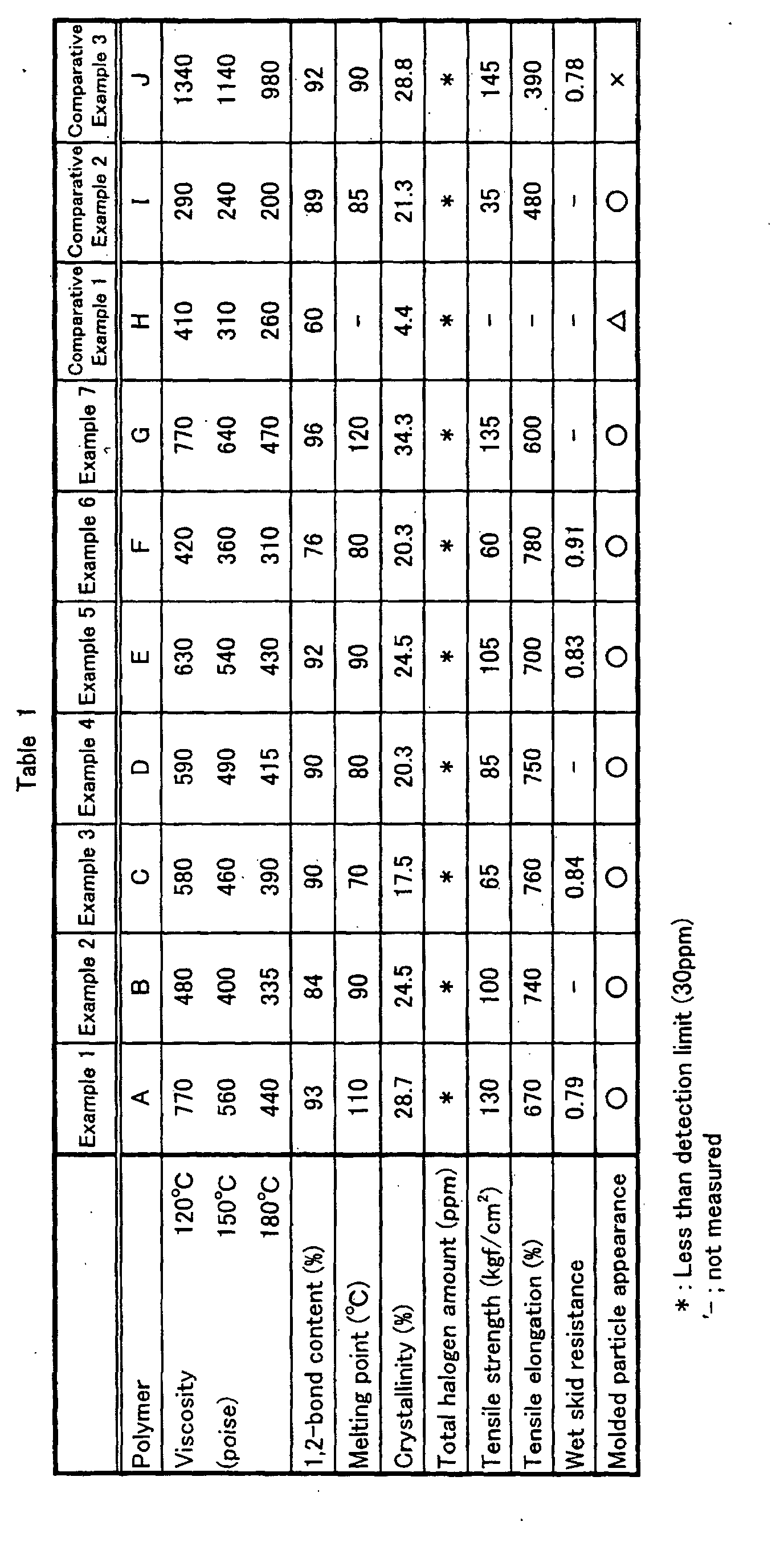
- the aforementioned polymers A-J were measured for the viscosity, the 1,2-bond content, a melting point, the crystallinity, the total halogen amount, the tensile strength, the tensile elongation, the wet skid resistance and the molded article appearance. The results were shown in Table 1.
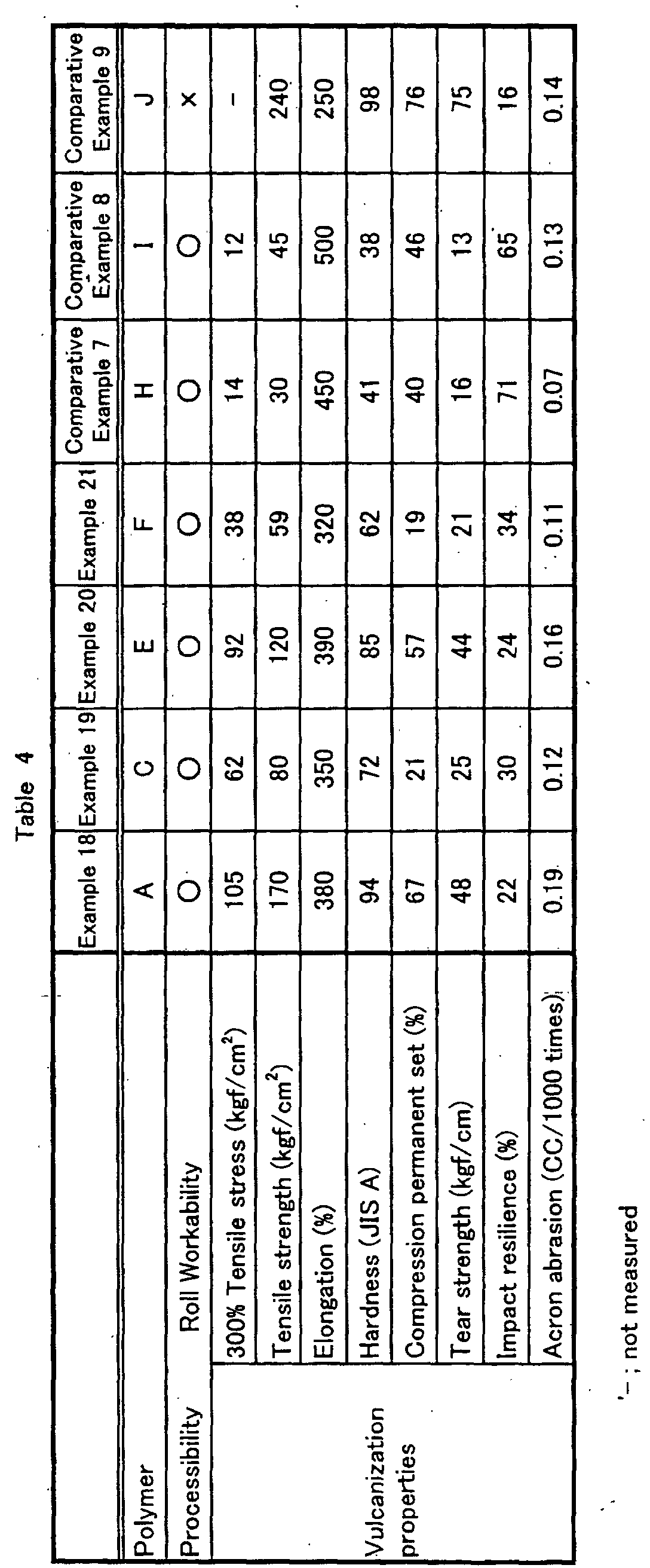
- vulcanized polymers were obtained by the aforementioned method, and the processibility and the vulcanized polymers were assessed. The results were shown in Table 4.
- Comparative Example 1 From Table 1, in Comparative Example 1, the 1,2-bond content was outside of the present invention, the crystallinity was small, and the molded article appearance is inferior. In Comparative Example 2, the viscosity (120°C and 150°C) was outside of the present invention, and the tensile strength and the tensile elongation were inferior as compared with Examples. In Comparative Example 3, the viscosity (120°C, 150°C, and 180°C) was outside of the present invention, and the tensile elongation and the molded article appearance are inferior. On the other hand, in all of polymers A-G of Examples 1-7, the 1,2-bond content exceeded 70%, and all of the viscosities at 120°C, 150°C and 180°C were within the present invention. The tensile elongation were high figures as 600-780%, and the molded article appearance was also excellent. The total halogen amount was less than a detection limit (30ppm) for an analyzing apparatus, and there was little influence of a catalyst.
- 1,2-polybutadiene of the present invention is excellent in the transparency and the water vapor permeability, and is also excellent in the gas permeability for oxygen and ethylene oxide.
- Comparative Example 11 has the 1,2-bond content in a polymer H outside of the present invention, and Comparative Examples 12 and 13 have the viscosity of polymers I and J outside of the present invention, the molded article appearance is not sufficient. Since Comparative Example 14 contains halogen and, therefore, the thermal stability is worse, the molded article appearance is not sufficient. In addition, Comparative Example 10 containing no 1,2-polybutadiene is remarkably inferior in the molded article appearance. On the other hand, it can be seen that, since all of Examples 22 and 23 contain a polymer (A and B, respectively) at 30 parts by weight, the molded article appearance is improved.
- Comparative Example 16 has the 1,2-bond content of a polymer H outside of the present invention, the scratch resistance is remarkably inferior. Since Comparative Examples 17 and 18 have the viscosities of polymers I and J outside of the present invention, and since Comparative Example 19 contains halogen and has the deteriorated thermal stability, the scratch resistance is not sufficient. Further, Comparative Example 15 without 1,2-polybutadiene is remarkably inferior in the scratch resistance. On the other hand, it can be seen that since both of Examples 24 and 25 contain a polymer (A and B, respectively) at 30 parts by weight, the scratch resistance is improved.
- the 1,2-polybutadiene of the present invention solves a problem of the mold contamination and the thermal deterioration at high temperature molding and change in the physical properties with time, is excellent in the properties such as the moldability, the transparency, the mechanical strength and the wet skid resistance, and is suitably used in uses as a thermoplastic elastomer, for example, uses such as industrial parts and various molded articles such as footwears, various sheets, films and the like.
- 1,2-polubutadiene of the present invention has a molding temperature of about 150°C, being lower among thermoplastic elastomers, and is advantageous also in respect of the energy.
- 1,2-polybutadiene of the present invention can be vulcanized with sulfur and is excellent in a degree of the peroxide cross-linking activity and the filling property of a filler and a drug, it can be utilized as a vulcanizing rubber, or as a reaction aid for other vulcanizing rubbers.
- thermoplastic elastomer composition of the present invention is excellent in moldability and the molding appearance, and the polymer composition of the present invention has the excellent nature in the scratch resistance.
Landscapes
- Chemical & Material Sciences (AREA)
- Health & Medical Sciences (AREA)
- Chemical Kinetics & Catalysis (AREA)
- Medicinal Chemistry (AREA)
- Polymers & Plastics (AREA)
- Organic Chemistry (AREA)
- Compositions Of Macromolecular Compounds (AREA)
- Addition Polymer Or Copolymer, Post-Treatments, Or Chemical Modifications (AREA)
Abstract
Description
- The present invention relates to 1,2-polybutadiene and a thermoplastic elastomer composition and a polymer composition, more particularly, it relates to 1,2-polybutadiene having improved mold contamination, thermal deterioration and change with time in the properties at molding at a high temperature, and an thermoplastic elastomer composition excellent in a moldability, a transparency, a mechanical strength and an wet skid resistance. The 1,2-polybutadiene of the present invention is used as a thermoplastic elastomer for molding various molded articles such as industrial parts and footwears, various sheets, films and the like, and as an electron beam cross-linking resin, a modifier for a resin or a rubber, a vulcanized rubber and the like. In addition, a thermoplasic elastomer composition containing 1,2-polybutadiene is used as various molded articles such as industrial parts and footwears, various sheets, films, tubes and the like.
- Since 1,2-polybutadiene having a suitably controllable crystallinity comprises a crystalline part and an amorphous part, and has a carbon-carbon double bond has a high chemical reactivity in a molecule, it has not only the function as a thermoplastic elastomer but also the function as the conventional vulcanized rubber and a thermosetting resin having the high cross-linking density. In addition, since this 1,2-polybutadiene is excellent in a processibility, it is applied as a modifier for other resins and thermoplastic elastomers, or a medical polymer material.
- Conventionally, 1,2-polybutadiene having a controlled crystallinity has been obtained by using a catalyst comprising a cobalt salt phosphine complex, trialkylaluminium and water (JP-B-44-32425), or a catalyst comprising a cobalt compound, trialkylaluminium, water and a triphenylphosphine derivative (JP-B-61-27402). These catalytic systems show a high polymerization activity in a halogenated hydrocarbon solvent, such as methylene chloride, and has reduced polymerization activity in a hydrocarbon solvent, therefore, polymerization is performed by using a halogenated hydrocarbon solvent.
- However, since 1,2-polybutadiene polymerized using a halogenated hydrocarbon solvent contains a considerable high amount of halogen such as chlorine and the like due to the solvent remaining therein, hydrogen halide such as hydrogen chloride is generated at high temperature molding, there arises problems that a mold is rusted, 1,2-polybutadiene is thermally deteriorated and the physical properties are changed with time.
- Further, it is requested that 1,2-polybutadiene has more excellent properties as a thermoplastic elastomer.
- An object of the present invention is to provide 1,2-polybutadiene which does not cause the mold contamination and the thermal deterioration at high temperature molding and has improved change with time in the physical properties, and a thermoplastic elastomer composition excellent in the moldability, the transparency, the mechanical strength and the wet skid resistance.
- In order to solve the aforementioned problems, the present inventors studied intensively and, as a result, completed the present invention. That is, 1,2-polybutadiene of the invention described in claim 1 is characterized in that the 1,2-bond content in butadiene unit is 70% by weight or more, a melting point is in a range of 50-140°C, the viscosity η measured with a slit die rheometer at a shear rate of 5113sec-1 is in a range of 400-1200 poises at 120°C, in a range of 300-1000 poises at 150°C, and in a range of 200-800 poises at 180°C, and the total halogen content is 30ppm or less.
- The 1,2-bond content in butadiene unit of 1,2-polybutadiene of the invention described in claim 1 has the close relationship with the thermoplastic elastomer properties, and is 70% by weight or more, preferably 80% by weight or more.
- In addition, the aforementioned 1,2-polybutadiene has a crystalline property and a melting point thereof is in a range of 50-140°C, preferably 60-130°C. When a melting point is in this range, 1,2-polybutadiene is excellent in the balance between the mechanical strength such as tensile strength, the tear strength and the like and the flexibility as a thermoplastic elastomer.
- The viscosity η of 1,2-polybutadiene of the invention described in claim 1 measured with a slit die rheometer at a shear rate of 5113sec-1 is in each viscosity range at each temperature described above. When the viscosity η at each temperature is less than each lower viscosity limit described above, 1,2-polybutadiene is inferior in the mechanical strength, being not preferable. When the viscosity exceeds each upper viscosity limit, the processibility and moldability are inferior, being not preferable. A method for measuring the viscosity η with a slit die rheometer will be described in detail in Examples.
- The 1,2-polybutadiene of the invention described in claim 1 has a total amount of halogen of 30ppm or less. Usually, an amount of halogen in a polymer is measured by quantitative analysis with fluorescent X-ray, and 30ppm is a lower limit of measurement in this method. Since a total amount of halogen remaining in 1,2-polybutadiene of the present invention is slight like this, the mold contamination and the thermal deterioration are not occured at high temperature molding such as injection molding, a problem such as change with time in the physical properties is improved, the processibility and moldability is better, and the physical properties of a molded articles are maintained for a long period of time.
- The 1,2-polybutadiene of the present invention may be copolymerized with conjugated diene other than butadiene. Examples of conjugated diene other than butadiene include 1,3-pentadiene, 1,3-butadiene derivative substituted with a higher alkyl group, 2-alkyl-substituted-1, 3-butadiene and the like. Among them, examples of the 1,3-butadiene derivative substituted with a higher alkyl group include 1-pentyl-1,3-butadiene, 1-hexyl-1,3-butadiene, 1-heptyl-1,3-butadiene, 1-octyl-1,3-butadiene and the like.
- In addition, examples of the 2-alkyl-substituted-1,3-butadiene include 2-methyl-1,3-butadiene (isoprene), 2-ethyl-1,3-butadiene, 2-propyl-1,3-butadiene, 2-isopropyl-1,3-butadiene, 2-butyl-1,3-butadiene, 2-isobutyl-1,3-butadiene, 2-amyl-1,3-butadiene, 2-isoamyl-1,3-butadiene, 2-hexyl-1,3-butadiene, 2-cyclohexyl-1,3-butadiene, 2-isohexyl-1,3-butadiene, 2-heptyl-1,3-butadiene, 2-isoheptyl-1,3-butadiene, 2-octyl-1,3-butadiene, 2-isooctyl-1,3-butadiene and the like.
Among these conjugated dienes, examples of a preferable conjugated diene to be copolymerized with butadiene include isoprene and 1,3-pentadiene. - The content of butadiene in a monomer component to be supplied to polymerization is 50mol% or more, particularly preferably 70mol% or more. When a conjugated diene other than butadiene is copolymerized too much, a melting point or a viscosity of the resulting 1,2-polybutadiene are outside the aforementioned ranges in some cases.
- The 1,2-polybutadiene of the present invention is obtained by polymerizing butadiene in the presence of a catalyst containing a cobalt compound and aluminoxane.
- Examples of the aforementioned cobalt compound include organic acid salts of cobalt, preferably, having a carbon number of 4 or more. Examples of the organic acid salt of cobalt include butyric acid salt, hexanoic acid salt, heptylic acid salt, octylic acid salt such as 2-ethylhexylic acid and the like, decanoic acid salt, higher fatty acid salt such as stearic acid, oleic acid, erucic acid and the like, benzoic acid salt, tolylic acid salt, xylylic acid, alkyl, aralkyl and allyl-substituted benzole acid salt such as ethyl benzoic acid and the like, naphtoic acid salt, alkyl, aralkyl or allyl-substituted naphtoic acid salt and the like. Among them, so-called octylic acid salt such as 2-ethylhexylic acid, stearic acid salt and benzoic acid salt are excellent in the solubility in hydrocarbon solvent, being preferable.
- Examples of the aluminoxane include ones represented by the following general formula (I) or general formula (II).


- In aluminoxane represented by the general formula (I) or (II), R is a hydrocarbon group such as methyl group, ethyl group, propyl group, butyl group and the like, preferably methyl group or ethyl group, particularly preferably methyl group. In the general formula (I), Rs on both terminals may be the same or different. In addition, m is an integer of 2 or more, preferably an integer of 5 or more, more preferably an integer of 10-100. Examples of aluminoxane include methylaluminoxane, ethylaluminoxane, propylaluminoxane, butylaluminoxane and the like, and methylaluminoxane is particularly preferable.
- A polymerization catalyst containing a phosphine compound besides the aforementioned cobalt compound and aluminoxane is extremely preferable. A phosphine compound is a component effective in controlling the activity of a polymerization catalyst and the control of the vinyl binding structure and the crystalline property. A preferable examples thereof include an organic phosphorus compound represented by the following general formula (III).
- In the general formula (III), Ar denotes a group described below:(wherein R1, R2 and R3 are the same or different, and represent a hydrogen atom, an alkyl group having a carbon number of, preferably 1-6, a halogen atom, an alkoxy group having a carbon number of, preferably 1-6, or an aryl group having a carbon number of, preferably, 6-12.)

- In addition, in the general formula (III), R denotes a cycloalkyl group or an alkyl-substituted cycloalkyl group, n is an integer of 0-3.
- Examples of the phosphine compound represented by the general formula (III) include tris(3-methylphenyl)phosphine, tris(3-ethylphenyl)phosphine, tris(3,5-dimethylphenyl)phosphine, tris(3,4-dimethylphenyl)phosphine, tris(3-isopropylphenyl)phosphine, tris(3-t-butylphenyl)phosphine, tris(3,5-diethylphenyl)phosphine, tris(3-methyl-5-ethylphenyl)phosphine, tris(3-phenylphenyl)phosphine, tris(3,4,5-trimethylphenyl)phosphine, tris(4-methoxy-3,5-dimethylphenyl)phosphine, tris(4-ethoxy-3,5-diethylphenyl)phosphine, tris(4-butoxy-3,5-dibutylphenyl)phosphine, tris(p-methoxyphenylphosphine), tricyclohexylphosphine, dicyclohexylphenylphosphine, tribenzylphosphine, tris(4-methylphenylphosphine), tris(4-ethylphenylphosphine) and the like. Among them, particularly preferred are triphenylphosphine, tris(3-methylphenyl)phosphine, tris(4-methoxy-3,5-dimethylphenyl)phosphine and the like.
- In addition, as the cobalt compound, a cobalt compound represented by the following general formula (IV) can be used.
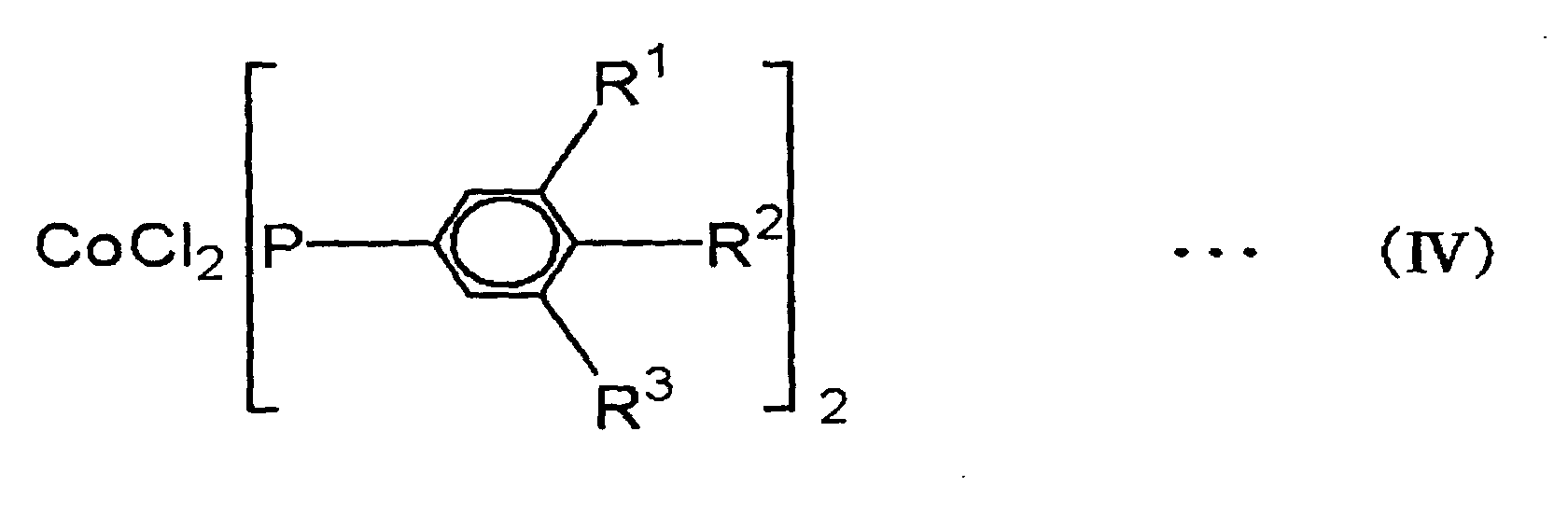
- The compound represented by the aforementioned general formula (IV) is a complex having as a ligand a phosphine compound wherein n=3 in the aforementioned general formula (III) relative to cobalt chloride. Upon use of this cobalt compound, a cobalt compound which was synthesized in advance may be used, or a cobalt compound may be used by a method for contacting cobalt chloride and a phosphine compound in a polymerization system. An amount of a 1,2-bond and the crystallinity of the resulting 1,2-polybutadiene can be controlled.
- Examples of the cobalt compound represented by the aforementioned general formula (IV) include cobalt bis(triphenylphosphine)dichloride, cobalt bis[tris(3-methylphenylphosphine)]dichloride, cobalt bis[tris(3-ethylphenylphosphine)]dichloride, cobalt bis[tris(4-methylphenylphosphine)]dichloride, cobalt bis[tris(3,5-dimethylphenylphosphine)]dichloride, cobalt bis[tris(3,4-dimethylphenylphosphine)]dichloride, cobalt bis[tris(3-isopropylphenylphosphine)]dichloride, cobalt bis[tris(3-t-butylphenylphosphine)]dichloride, cobalt bis[tris(3,5-dimethylphenylphosphine)]dichloride covalt bis[tris(3-methyl-5-ethylphenylphosphine)]dichloride, cobalt bis[tris(3-phenylphenylphosphine)]dichloride, cobalt bis[tris(3,4,5-trimethylphenylphosphine)]dichloride, cobalt bis[tirs(4-methoxy-3,5-dimethylphenylphosphine)]dichloride, cobalt bis[tris(4-ethoxy-3,5-diethylphenylphosphine)]dichloride, cobalt bis[tris(4-butoxy-3,5-dibutylphenylphosphine)]dichloride, cobalt bis[tris(4-methoxyphenylphosphine)]dichloride, cobalt bis[tris(3-methoxyphenylphosphine)]dichloride, cobalt bis[tris(4-dodecylphenylphosphine)]dichloride, cobalt bis[tris(4-ethylphenylphosphine)]dichloride and the like.
- Among them, particularly preferred are cobalt bis(triphenylphosphine)dichloride, cobalt bis[tris(3-methylphenylphosphine)]dichloride, cobalt bis[tris(3,5-dimethylphenylphosphine)]dichloride, cobalt bis[tris(4-methoxy-3,5-dimethylphenylphosphine)]dichloride and the like.
- As an amount of a catalyst to be used, a cobalt compound is used at 0.001-1mmol preferably 0.01-0.5mmol in terms of cobalt atom per 1mol of butadiene in the case of polymerization of butadiene alone, or per 1mol of at a total amount of butadiene and conjugated diene other than butadiene. In addition, as an amount of phosphine compound to be used, a ratio of phosphorous atom relative to cobalt atom (P/Co) is usually 0.1-50, preferably 0.5-20, more preferably 1-20. Further, as an amount of aluminoxane to be used, a ratio of aluminum atom relative to cobalt atom of a cobalt compound (Al/Co) is usually 4-107, preferably 10-106.
- When a complex represented by the general formula (IV) is used, when as an amount of a phosphine compound to be used, a ratio of phosphorus atom relative to cobalt atom (P/Co) is regarded as 2, an amount of aluminoxane is as described above.
- Examples of an inert organic solvent used as a polymerization solvent include aromatic hydrocarbons such as benzene, toluene, xylene, cumene and the like, aliphatic hydrocarbons such as n-pentane, n-hexane, n-butane and the like, alicyclic hydrocarbons such as cyclopentane, methylcyclopentane, cyclohexane and the like and a mixture of them.
- A polymerization temperature is usually -50 - 120°C, preferably -20- 100°C. A polymerization reaction is preferably continuous polymerization in which a plurality of reactors is connected in series. The concentration of amonomer in a solvent is usually 5-50% by weight, preferably 10-35% by weight. In addition, for preparing a polymer, in order that a catalyst and a polymer in the present invention are not inactivated, it is necessary that contamination of a compound having the activity of inactivation such as oxygen, water, carbonic gas and the like into a polymerization system is diminished as much as possible. When a polymerization reaction proceeds to a desired stage, an alcohol, other polymerization termination agent, an aging preventing agent, an antioxidant, an ultraviolet absorbing agent and the like are added to the reaction mixture, and the produced polymer is separated, washed and dried according to the conventional method to obtain 1,2-polybutadiene of the present invention.
- Since 1,2-polybutadiene of the present invention itself can obtain the sufficient strength without cross-linking, it is suitable for use in industrial parts such as injection molding, extrusion molding and the like, and non-cross-linking molding such as films and the like.
- In addition, since 1,2-polybutadiene of the present invention is also excellent in cross-linking reactivity, it is suitably used in a cross-linked rubber and a reaction aid for a vulcanized rubber.
- Upon this, a method of processing is not particularly limited but mixing such as melt kneading and the like using a roll, a kneader, a Banbury mixer, a screw extruder, a feeder ruder extruder and the like which are used in rubber processing is possible.
- In addition, 1,2-polybutadiene of the present invention is suitably used as a modifier for other thermoplastic elastomers and resins.
- The thermoplastic elastomer composition of the present invention described in claim 2 is characterized in that it contains a thermoplastic elastomer selected from an aromatic vinyl-based thermoplastic elastomer, an urethane-based thermoplastic elastomer, a polyester-based thermoplastic elastomer, a polyamide-based thermoplastic elastomer, a vinyl chloride-based thermoplastic elastomer and a fluorine-based thermoplastic elastomer, and the aforementioned 1,2-polybutadiene.
- Examples of the aforementioned aromatic vinyl-based thermoplastic elastomer include a block copolymer of an aromatic vinyl compound and conjugated diolefin such as polystyrene-polybutadiene block copolymer, polystyrene-polybutadiene-polystyrene block copolymer, polystyrene-poly(styrene-butadiene)-polystyrene block copolymer, polystyrene-polyisoprene-polystyrene copolymer and the aforementioned block copolymer wherein a part or the whole of styrene is substituted with α-methylene, and hydrogenated these block copolymers. Preferably, polystyrene-polybutadiene-polystyrene block copolymer is used.
- Examples of the aforementioned polyester-based thermoplastic elastomer include multi-blocks polymers using polybutylene terephthalate as a hard segment and polytetramethylene ether glycol as a soft segment and the like. Examples of the aforementioned polyamide-based thermoplastic elastomer include block polymers using nylon as a hard segment and polyester or polyol as a soft segment and the like.
- A ratio of the aforementioned thermoplastic elastomer and the aforementioned 1,2-polybutadiene in the thermoplastic elastomer composition can be such that the aforementioned thermoplastic elastomer is 50-99 parts by weight and the aforementioned 1,2-polybutadiene is 1-50 parts by weight as shown in claim 3. When the content of the aforementioned 1,2-polybutadiene is less than 1 part by weight, the molding appearance is inferior and, when the content exceeds 50 parts by weight, the characteristics of the thermoplastic elastomer itself to be used are lost, being not preferable.
- The elastomer composition of the invention described in claim 6 is characterized in that it contains a polyolefin-based polymer and the aforementioned 1,2-polybutadiene. The aforementioned polyolefin-based polymer is not particularly limited and may be a resin or an elastomer as long as it is thermoplastic. In addition, as this polyolefin-based polymer, a polymer containing at least one selected from the group consisting of an ethylene component, a propylene and a butylene component is preferably used as shown in claim 8. Examples of them include polyethylene, polypropylene, ethylene propylene copolymer (EPR, EPDM), polybutylene, polyisobutylene, ethylene-vinyl acetate copolymer and the like. Among them, polyethylene, polypropylene, crystalline ethylene-propylene copolymer and ethylene-vinyl acetate copolymer are preferably used.
- A ratio of the aforementioned polyolefin polymer and the aforementioned 1,2-polybutadiene can be such that the aforementioned polyolefin polymer is 70-99 parts by weight and the aforementioned 1,2-polybutadiene is 1-20 parts by weight as shown in claim 7. When the content of the aforementioned 1,2-polybutadiene is less than 1 part by weight, the scratch resistance of a molded article of a polyolefin polymer is inferior and, when the content exceeds 20 parts by weight, the properties of polyolefin polymer itself are lost, being not preferable.
- Fig. 1 is a schematic cross-sectional view of a slit die rheometer.
- The present invention will be explained specifically by way of Examples and Comparative Examples below. However, the present invention is not limited by them as long as it is not beyond the gist of the present invention. Unless otherwise indicated, part and % in Examples and Comparative Examples are based on weight.
In addition, various measurements in Examples and Comparative Examples were performed by the following methods. - The viscosity was measured using a slit die rheometer, and an outline of a structure is shown in Fig. 1. That is, a slit die rheometer was used in which two pressure sensors (P1, P2), a slit die, and cylinder (Barrel) pressure sensor (Pin) are fixed to a die part.
- A polymer was filled in a cylinder maintained at a predetermined temperature, and the viscosity when extruded at a rate of a plunger of 5000cm/min. (upon this, a shear rate was 5113sec-1) was measured.
- In Fig. 1, a diameter of cylinder is 15mm, transverse section h×M of a slit die is 1mm×12mm, a length is 54mm, and a hopper angle is 90 degree.
- The 1,2-bond content in butadiene unit of was obtained by an infrared absorption spectrum method by D. Morero et al. (Chem. e. Ind., 41, 758(1959)).
- A melting point was measured using DSC (differential scanning calorimeter) according to ASTM D3418.
- The crystallinity was obtained by density measurement according to JIS K7112. Upon this, as the density of 1,2-polybutadiene having the crystallinity of 100%, 0.963 by G. Natta(J. Polymer. Sci., 20, 25(1956)) was used. And, as the density of 1,2-polybutadiene having the crystallinity of 0%, the density of 0.892 of 1,2-polybutadiene which had been confirmed to be amorphous by X-ray analysis (JP-B-44-32425, JP-B-4-32426) was used.
- The halogen content was measured by a fluorescent X-ray method.
- The mechanical strength was measured using a molded article obtained by injection-molding under the molding conditions shown below according to JIS K6301.
-
- Molding machine: in-line screw type injection molding machine
- Mold: 2×70×150mm direct gate plate
- Molding temperature: 150°C
- Injection pressure: 660kg/cm2
- Flow control: medium
- Injection: 10seconds
- Cooling: 50seconds
- Mold temperature: 30°C
-
- A sample having an inner diameter of 50mm and an external diameter of 70mm was prepared from a molded article obtained by injection-molding as in the aforementioned 6 ○and the wet skid resistance was measured using JSR-type WSR tester.
-
- Road surface, porcelain tile completely wetted with water (measured at a water amount of about 180cc/min.).
- Sample rotation number: 600 rotation
- Contact pressure: 3kg/cm2
- Contact time: 0.02 second
-
- The results are expressed by an A value calculated by the following equation. As this value grows larger, the wet skid resistance becomes better.
- The flow mark, the surface roughness, the brushing, the silver streak, the bluing and the like on the surface of a molded article obtained by injection-molding in the aforementioned 6 ○were observed with naked eyes, and assessed according to the 3 levels.
- ○: Excellent
- Δ: usable but inferior in the aforementioned properties
- ×: unfit for use
-
- The parallel rays transmittance was measured using a film prepared by the following molding conditions according to JIS K6714.
-
- Extruder: 50mm extruder
- Screw: shape metering type, L/D 28, compression ratio 2.0
- Die: bore diameter 75mm , lip interval 0.7mm
- Extruding temperature:150°C
- Resin pressure:155kg/mm2
- Discharge amount :31kg/hr
- Blow ratio: 4.8
- Take-off speed: 15m/min.
- Film thickness: 50µm
-
- The water vapor permeability was measured using a film made as in the aforementioned 9 ○according to JIS Z0208.
- The oxygen permeability and the ethylene oxide permeability were measured using a film made as in the aforementioned 9 ○according to ASTM D1434.
- The thermal stability was assessed using, as a stabilizing time, an initial time for torque measured using a laboplastmill under the following conditions. Here, an initial time for torque is defined as a time indicated by a cross point with a time axis when a straight line at an angle of 30 degree relative to a baseline is drawn on an initial part of a torque carve.
-
- Mixer: volume 100cc, blade shape roller shape
- Measuring temperature:170°C
- Rotation number: 60rpm
- Packing ratio: 80%
-
- A polymer and other components except for vulcanizing accelerator and sulfur were kneaded in a Banbury mixer at a cooling water temperature of 70°C for 5 minutes in advance according to the following formulation, and a vulcanizing accelerator and sulfur were added with a roller to obtain an unvulcanized compound. The resulting unvulcanized compound was press-vulcanized at 160°C for 20 minutes to obtain a vulcanized material.
-
Polymer 100 parts by weight Zinc white No.1 3 Stearic acid 1 Dibenzothiazyl disulfide 1.5 Tetramethylthiuram disulfide 0.55 Sulfur 1.6 - Evaluation of a vulcanized material was performed according to JIS K6301.
- Evaluation of the processibility was assessed by the following 2 levels.
- ○: Excellent in the melting property, the roll winding property and the roll separability
- ×: Inferior in the meltability, the roll wrapping property and/or the roll separability
-
- The surface of a molded article having 150×150×2(mm3) shape was irradiated with electron beam (accelerating voltage 150kV, radiation dose 30Mrad), and scratched with a nail. The evaluation was assessed according to the following 3 levels.
- ○: No scratch mark
- Δ: Slight scratch mark
- ×: Easily scratched
-
- The polymer A was synthesized by continuous polymerization using an apparatus in which three vertical reactors equipped with a stirrer having an inner volume of 20L are connected in series. A cyclohexane/n-heptane (weight ratio:80/20) mixed solvent was supplied at 270mL/min. through a position near a bottom of a first reactor, and 1,3-butadiene was supplied at 43g/min., a solution of methylaluminoxane in toluene at 1mL/min., and a solution of cobalt bis[tris(4-methylphenylphosphine)]dichloride in toluene at 1mL/min., followed by polymerization at 40°C. Upon this, amolar ratio of Co atom/1,3-butadiene was 1/63000, and an atomic ratio of Al/Co was 38/1. A retention time (polymerization time) for a first reactor was 1 hour, and conversion degree was 58%.
- A polymerization solution removed through a position near a top of a first reactor was supplied to a position near a bottom of a second reactor, followed by polymerization for 1 hour. At the second reactor, conversion degree became 76%. Further, a polymerization solution removed through a position near a top of the second reactor was supplied to a position near a bottom of a third reactor, followed by polymerization for 1 hour. At the third reactor, conversion degree became 85%.
- A polymerization reaction was terminated by injecting a small amount of ethanol containing 2,6-di-t-butyl-p-cresol as a terminator into a pipe for conveying a polymerization solution taken out through a position near a top of the third reactor. Then, the material was supplied to a devolatilizer (direct work-up equipment) set at 170°C and 250Torr, the solvent was removed, and the material was pelletized with a pelletizer to obtain a polymer A.
- According to the same manner as that for polymer A except that a polymerization temperature was 60°C, a polymer B was obtained at conversion degree of 85%.
- According to the same manner as that for a polymer A except that the mixed solvent was supplied at 260mL/min., 1,3-butadiene was supplied at 47.5g/min., a polymerization temperature was 80°C, a molar ratio of Co atom/1,3-butadiene was 1/73000 and an atomic ratio of Al/Co was 44/1, a polymer C was obtained at conversion degree of 75%.
- According to the same manner as that for a polymer A except that a polymerization temperature was 70°C, a molar ratio of Co atom/1,3-butadiene was 1/73000, and an atomic ratio of Al/Co was 44/1, a polymer D was obtained at conversion degree of 80%.
- According to the same manner as that for a polymer A except that a polymerization temperature was 60°C, a molar ratio of Co atom/1,3-butadiene was 1/70000, and an atomic ratio of Al/Co was 42/1, a polymer E was obtained at conversion degree of 85%.
- According to the same manner as that for a polymer A except that a polymerization temperature was 70°C, a molar ratio of Co atom/1,3-butadiene was 1/73000, and an atomic ratio of Al/Co was 44/1 (the same conditions as those for Example 4), a polymer F was obtained at conversion degree of 75%.
- According to the same manner as that for a polymer A except that a polymerization temperature was 30°C, a polymer G was obtained at conversion degree of 85%.
- According to the same manner as that for a polymer A except that a polymerization temperature was 100°C, a polymer H was obtained at conversion degree of 65%.
- According to the same manner as that for a polymer A except that a polymerization temperature was 65°C, a polymer I was obtained at conversion degree of 85%.
- According to the same manner as that for a polymer A except that a mixed solvent was supplied at 250mL/min., 1,3-butadiene was supplied at 53g/min., a polymerization temperature was 60°C, a molar ratio of Co atom/1,3-butadiene was 1/70000, and an atomic ratio of Al/Co was 42/1, a polymer J was obtained at conversion degree of 85%.
- The aforementioned polymers A-J were measured for the viscosity, the 1,2-bond content, a melting point, the crystallinity, the total halogen amount, the tensile strength, the tensile elongation, the wet skid resistance and the molded article appearance. The results were shown in Table 1.
- Methylene chloride which had been conventionally used as a polymerization solvent for preparing 1,2-polybutadiene, was added to the aforementioned polymers A, B and C, respectively, so that 100ppm was contained in terms of halogen, whereby, polymers K, L and M were obtained, respectively.
- Regarding polymers A - C and K - M, the influence of inclusion of halogen on the thermal stability was confirmed by the aforementionedmethod. The results were shown in Table 2.

Example 8 Comparative Example 4 Example 9 Comparative Example 5 Example 10 Comparative Example 6 Polymer A K B L C M Amount of chlorine to be added (ppm) 0 100 0 100 0 100 Total halogen amourit (ppm) 110 120 110 Stabilizing time (min) 38 36 55 50 54 50 - Then, in order to examine the film physical properties of polymers A-G, the parallel ray transmittance, the water vapor permeability and the gas permeability were measured. The results were shown in Table 3.

- Regarding polymers A, C, E, F, H, I and J, vulcanized polymers were obtained by the aforementioned
- From Table 1, in Comparative Example 1, the 1,2-bond content was outside of the present invention, the crystallinity was small, and the molded article appearance is inferior. In Comparative Example 2, the viscosity (120°C and 150°C) was outside of the present invention, and the tensile strength and the tensile elongation were inferior as compared with Examples. In Comparative Example 3, the viscosity (120°C, 150°C, and 180°C) was outside of the present invention, and the tensile elongation and the molded article appearance are inferior. On the other hand, in all of polymers A-G of Examples 1-7, the 1,2-bond content exceeded 70%, and all of the viscosities at 120°C, 150°C and 180°C were within the present invention. The tensile elongation were high figures as 600-780%, and the molded article appearance was also excellent. The total halogen amount was less than a detection limit (30ppm) for an analyzing apparatus, and there was little influence of a catalyst.
- From the results of Table 2, it can be seen that, when halogen is contained at 100ppm, a polymer is deteriorated during kneading, an initial time for torque (stabilizing time) was shortened, and the thermal stability was inferior.
- From the results of Table 3, it can be seen that 1,2-polybutadiene of the present invention is excellent in the transparency and the water vapor permeability, and is also excellent in the gas permeability for oxygen and ethylene oxide.
- From the results of Table 4, in Comparative Example 7, the elongation and the impact resilience of a vulcanized polymer were excellent, and the 300% tensile stress, the tensile strength, the hardness and the tear strength were inferior. In Comparative Example 8, the elongation, the tear strength and the impact resilience of a vulcanized polymer were inferior. In Comparative Example 6, the roll workability in the processibility was remarkably worse. On the other hand, in Examples 18-21. all could be vulcanized, and vulcanized polymers having the high hardness and the excellent strength were obtained even without reinforcing agent. In particular, in Example 18 and Example 20, the excellent physical properties were exhibited in the 300% tensile stress, the tensile strength, the hardness, the compression permanent set strain and the tear strength.
- Each of polymers A, B, H, I, J, and K and a styrene butadiene block polymer (SBS; trade name "TR2827", manufactured by JSR) were blended at a ratio by weight of 30/70, respectively (see Table 5), to prepare a composition. Assessment of each thermoplastic elastomer composition was performed according to the aforementioned 8 ○. Only SBS without polymer (Comparative Example 10) was also assessed. The results were shown in Table 5.
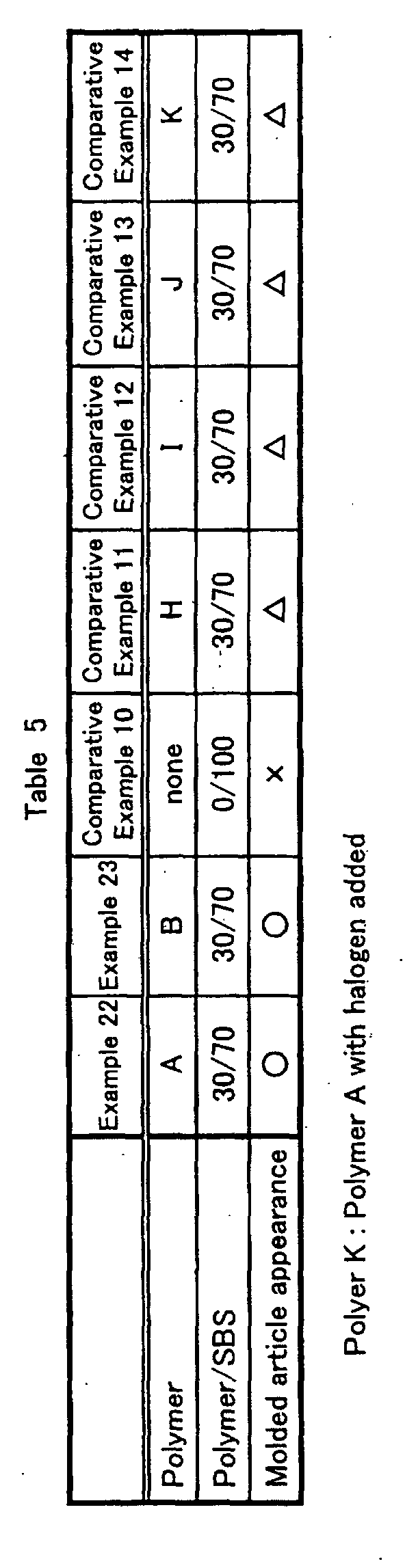
- From Table 5, since Comparative Example 11 has the 1,2-bond content in a polymer H outside of the present invention, and Comparative Examples 12 and 13 have the viscosity of polymers I and J outside of the present invention, the molded article appearance is not sufficient. Since Comparative Example 14 contains halogen and, therefore, the thermal stability is worse, the molded article appearance is not sufficient. In addition, Comparative Example 10 containing no 1,2-polybutadiene is remarkably inferior in the molded article appearance. On the other hand, it can be seen that, since all of Examples 22 and 23 contain a polymer (A and B, respectively) at 30 parts by weight, the molded article appearance is improved.
- Each of polymers A, B, H, I, J, and K and low density polyethylene (LDPE;trade name "Novatech YF39", manufactured by Nihonpolychem) were blended at a ratio by weight of 30/70, respectively (See Table 6), to prepare a composition. Assessment of each polymer composition was performed according to the aforementioned

- From Table 6, since Comparative Example 16 has the 1,2-bond content of a polymer H outside of the present invention, the scratch resistance is remarkably inferior. Since Comparative Examples 17 and 18 have the viscosities of polymers I and J outside of the present invention, and since Comparative Example 19 contains halogen and has the deteriorated thermal stability, the scratch resistance is not sufficient. Further, Comparative Example 15 without 1,2-polybutadiene is remarkably inferior in the scratch resistance. On the other hand, it can be seen that since both of Examples 24 and 25 contain a polymer (A and B, respectively) at 30 parts by weight, the scratch resistance is improved.
- The 1,2-polybutadiene of the present invention solves a problem of the mold contamination and the thermal deterioration at high temperature molding and change in the physical properties with time, is excellent in the properties such as the moldability, the transparency, the mechanical strength and the wet skid resistance, and is suitably used in uses as a thermoplastic elastomer, for example, uses such as industrial parts and various molded articles such as footwears, various sheets, films and the like. In addition, 1,2-polubutadiene of the present invention has a molding temperature of about 150°C, being lower among thermoplastic elastomers, and is advantageous also in respect of the energy. In addition, since 1,2-polybutadiene of the present invention can be vulcanized with sulfur and is excellent in a degree of the peroxide cross-linking activity and the filling property of a filler and a drug, it can be utilized as a vulcanizing rubber, or as a reaction aid for other vulcanizing rubbers.
- In addition, the thermoplastic elastomer composition of the present invention is excellent in moldability and the molding appearance, and the polymer composition of the present invention has the excellent nature in the scratch resistance.


Claims (9)
- A 1,2-polybutadiene characterized in that the 1,2-bond content in butadiene unit is 70% by weight or more, a melting point is in a range of 50-140°C, the viscosity η measured with a slit die rheometer at a shear rate of 5113sec-1 is in a range of 400-1200 poises at 120°C, in a range of 300-1000 poises at 150°C and in a range of 200-800 poises at 180°C, and a total halogen content is 30ppm or less.
- A thermoplastic elastomer composition, which comprises a thermoplastic elastomer selected from the group consisting of an aromatic vinyl-based thermoplastic elastomer, an urethane-based thermoplastic elastomer, a polyester-based thermoplastic elastomer, a polyamide-based thermoplastic elastomer, a vinyl chloride-based thermoplastic elastomer and a fluorine-based thermoplastic elastomer, and a 1,2-polybutadiene described in claim 1.
- A thermoplastic elastomer composition according to claim 2, which contains 50-99 parts by weight of said thermoplastic elastomer and 1-50 parts by weight of said 1,2-polybutadiene.
- A thermoplastic elastomer composition according to claim 2 or 3, wherein said thermoplastic elastomer is an aromatic vinyl-based thermoplastic elastomer.
- A thermoplastic elastomer composition according to claim 4, wherein said aromatic vinyl-based thermoplastic elastomer is at least one selected from the group consisting of a block copolymer of an aromatic vinyl compound and conjugated diolefin such as polystyrene-polybutadiene block copolymer, polystyrene-polybutadiene-polystyrene block copolymer, polystyrene-poly(styrene-butadiene)-polystyrene block copolymer, polystyrene-polyisoprene-polystyrene copolymer and the aforementioned block copolymer wherein a part or the whole of styrene is substituted with α-methylene, and hydrogenated these block copolymers
- A polymer composition, which comprises a polyolefin -based polymer and a 1,2-polybutadiene described in claim 1.
- A polymer composition according to claim 6, which contains 70-99 parts by weight of said polyolefin-based polymer and 1-30 parts by weight of said 1,2-polybutadiene described in claim 1.
- A polymer composition according to claim 6 or 7, said polyolefin-based polymer contains at least one selected from the group consisting of an ethylene component, a propylene component and a butylene component.
- A polymer composition according to claim 8, wherein said polyolefin-based polymer is at least one selected from the group consisting of polyethylene, polypropylene, crystalline ethylene-propylene copolymer and ethylene-vinyl acetate copolymer.
Applications Claiming Priority (1)
| Application Number | Priority Date | Filing Date | Title |
|---|---|---|---|
| PCT/JP2000/005015 WO2002010232A1 (en) | 2000-07-27 | 2000-07-27 | 1,2-polybutadiene, thermoplastic elastomer composition and polymer composition |
Publications (2)
| Publication Number | Publication Date |
|---|---|
| EP1306396A1 true EP1306396A1 (en) | 2003-05-02 |
| EP1306396A4 EP1306396A4 (en) | 2004-12-15 |
Family
ID=11736298
Family Applications (1)
| Application Number | Title | Priority Date | Filing Date |
|---|---|---|---|
| EP00948245A Withdrawn EP1306396A4 (en) | 2000-07-27 | 2000-07-27 | 1,2-polybutadiene, thermoplastic elastomer composition and polymer composition |
Country Status (7)
| Country | Link |
|---|---|
| US (1) | US6930146B1 (en) |
| EP (1) | EP1306396A4 (en) |
| KR (1) | KR100625135B1 (en) |
| CN (1) | CN1223616C (en) |
| AU (1) | AU2000261797A1 (en) |
| BR (1) | BR0017300A (en) |
| WO (1) | WO2002010232A1 (en) |
Cited By (1)
| Publication number | Priority date | Publication date | Assignee | Title |
|---|---|---|---|---|
| EP1535931A4 (en) * | 2002-07-22 | 2010-01-20 | Jsr Corp | Process for producing crystalline 1,2-polybutadiene |
Families Citing this family (6)
| Publication number | Priority date | Publication date | Assignee | Title |
|---|---|---|---|---|
| DE102005044453A1 (en) * | 2005-09-17 | 2007-03-22 | Lanxess Deutschland Gmbh | Peroxidically cross-linked hydrogenated vinylpolybutadienes and their use for the production of technical rubber articles with good recovery behavior over a wide temperature range |
| KR101960726B1 (en) * | 2015-10-22 | 2019-03-22 | 주식회사 엘지화학 | Method for preparing of polybutadiene |
| KR101946482B1 (en) | 2015-10-22 | 2019-02-11 | 주식회사 엘지화학 | Apparatus for preparing of polybutadiene |
| KR102154046B1 (en) * | 2017-10-26 | 2020-09-09 | 주식회사 엘지화학 | Method for preparing conjugated diene polymer by continuous polymerization |
| JP7282903B2 (en) * | 2019-09-20 | 2023-05-29 | 三井化学株式会社 | Display device |
| WO2021054428A1 (en) * | 2019-09-20 | 2021-03-25 | 株式会社クラレ | Conjugated diene-based graft polymer, and method for producing same |
Family Cites Families (5)
| Publication number | Priority date | Publication date | Assignee | Title |
|---|---|---|---|---|
| JPS53143685A (en) | 1977-05-23 | 1978-12-14 | Japan Synthetic Rubber Co Ltd | Preparation of 1,2-polybutadiene |
| JPS5753507A (en) * | 1980-09-17 | 1982-03-30 | Asahi Chem Ind Co Ltd | Butadiene polymer and its preparation |
| JPH06207048A (en) | 1991-03-07 | 1994-07-26 | Japan Synthetic Rubber Co Ltd | Flame-retardant composition |
| JP3463811B2 (en) * | 1991-04-24 | 2003-11-05 | Jsr株式会社 | Method for producing butadiene-based polymer |
| JP2000109618A (en) | 1998-09-30 | 2000-04-18 | Nippon Polyolefin Kk | Polyolefin resin composition |
-
2000
- 2000-07-27 AU AU2000261797A patent/AU2000261797A1/en not_active Abandoned
- 2000-07-27 US US10/333,988 patent/US6930146B1/en not_active Expired - Lifetime
- 2000-07-27 KR KR1020037001149A patent/KR100625135B1/en not_active Expired - Lifetime
- 2000-07-27 WO PCT/JP2000/005015 patent/WO2002010232A1/en not_active Ceased
- 2000-07-27 BR BR0017300-2A patent/BR0017300A/en not_active Application Discontinuation
- 2000-07-27 EP EP00948245A patent/EP1306396A4/en not_active Withdrawn
- 2000-07-27 CN CNB008197792A patent/CN1223616C/en not_active Expired - Lifetime
Non-Patent Citations (2)
| Title |
|---|
| No further relevant documents disclosed * |
| See also references of WO0210232A1 * |
Cited By (1)
| Publication number | Priority date | Publication date | Assignee | Title |
|---|---|---|---|---|
| EP1535931A4 (en) * | 2002-07-22 | 2010-01-20 | Jsr Corp | Process for producing crystalline 1,2-polybutadiene |
Also Published As
| Publication number | Publication date |
|---|---|
| US6930146B1 (en) | 2005-08-16 |
| CN1454221A (en) | 2003-11-05 |
| CN1223616C (en) | 2005-10-19 |
| EP1306396A4 (en) | 2004-12-15 |
| WO2002010232A1 (en) | 2002-02-07 |
| BR0017300A (en) | 2003-04-29 |
| KR20030031564A (en) | 2003-04-21 |
| KR100625135B1 (en) | 2006-09-20 |
| AU2000261797A1 (en) | 2002-02-13 |
Similar Documents
| Publication | Publication Date | Title |
|---|---|---|
| KR101615832B1 (en) | Cross-linked composition, method for producing cross-linked composition, and molding | |
| EP3133121B1 (en) | Thermoplastic elastomer composition, stopper for medical container, and medical container | |
| JP5887274B2 (en) | Isobutylene block copolymer composition | |
| US8748530B2 (en) | Arborescent polymers and process for making same | |
| RU2728997C2 (en) | Hydrogenated rubber with improved operational characteristics in thermoplastic elastomeric compositions | |
| JP2617549B2 (en) | Rubber composition | |
| JP5271749B2 (en) | Tire inner liner | |
| US6930146B1 (en) | 1,2-polybutadiene, thermoplastic elastomer composition and polymer composition | |
| CA2418532C (en) | Thermoplastic polymer composition having barrier properties | |
| JP4561964B2 (en) | Medical member and medical instrument | |
| US7579057B2 (en) | Resin molding and worked item therefrom | |
| EP4045106B1 (en) | Styrene butadiene block copolymer compositions for medical devices | |
| EP1468704B1 (en) | Medical member mainly comprising syndiotactic 1,2-polybutadiene | |
| JPWO2013030944A1 (en) | Cycloolefin copolymer resin composition | |
| JP2006089759A (en) | 1,2-polybutadiene and method for producing the same, 1,2-polybutadiene for non-crosslinking molding, modifier, cross-linked rubber, and reaction aid for vulcanizing rubber | |
| JP2003052791A (en) | Double chamber container | |
| JP2978712B2 (en) | Polymer composition | |
| JP4194706B2 (en) | Cycloolefin resin composition | |
| JP2000265019A (en) | Vinylated cyclic hydrocarbon resin composition | |
| JP2000212227A (en) | 1,2-polybutadiene | |
| JPWO2002010232A1 (en) | 1,2-Polybutadiene and Thermoplastic Elastomer Compositions and Polymer Compositions | |
| JP3367585B2 (en) | Polypropylene resin composition | |
| US20100063211A1 (en) | Arborescent polymers and process for making same | |
| JP2005146092A (en) | Shoe sole molded product processing method and shoe sole processed product | |
| JP2024112180A (en) | Rubber composition |
Legal Events
| Date | Code | Title | Description |
|---|---|---|---|
| PUAI | Public reference made under article 153(3) epc to a published international application that has entered the european phase |
Free format text: ORIGINAL CODE: 0009012 |
|
| 17P | Request for examination filed |
Effective date: 20030123 |
|
| AK | Designated contracting states |
Designated state(s): AT BE CH CY DE DK ES FI FR GB GR IE IT LI LU MC NL PT SE |
|
| AX | Request for extension of the european patent |
Extension state: AL LT LV MK RO SI |
|
| RAP1 | Party data changed (applicant data changed or rights of an application transferred) |
Owner name: JSR CORPORATION |
|
| REG | Reference to a national code |
Ref country code: DE Ref legal event code: 8566 |
|
| RBV | Designated contracting states (corrected) |
Designated state(s): AT BE CH CY ES FR IT LI PT |
|
| A4 | Supplementary search report drawn up and despatched |
Effective date: 20041029 |
|
| RIC1 | Information provided on ipc code assigned before grant |
Ipc: 7C 08L 67/02 B Ipc: 7C 08L 21/00 B Ipc: 7C 08L 23/02 B Ipc: 7C 08L 27/12 B Ipc: 7C 08L 27/06 B Ipc: 7C 08L 77/00 B Ipc: 7C 08L 67/00 B Ipc: 7C 08L 75/04 B Ipc: 7C 08L 53/02 B Ipc: 7C 08L 47/00 B Ipc: 7C 08F 36/06 A |
|
| 17Q | First examination report despatched |
Effective date: 20061201 |
|
| RIC1 | Information provided on ipc code assigned before grant |
Ipc: C08L 53/02 20060101ALI20120131BHEP Ipc: C08L 67/02 20060101ALI20120131BHEP Ipc: C08L 21/00 20060101ALI20120131BHEP Ipc: C08L 23/06 20060101AFI20120131BHEP |
|
| GRAP | Despatch of communication of intention to grant a patent |
Free format text: ORIGINAL CODE: EPIDOSNIGR1 |
|
| STAA | Information on the status of an ep patent application or granted ep patent |
Free format text: STATUS: THE APPLICATION IS DEEMED TO BE WITHDRAWN |
|
| 18D | Application deemed to be withdrawn |
Effective date: 20120808 |